Cambridge A Level Chemistry 9701 — 2009 May/June Paper 2 · Variant 1
9701/21/M/J/09
The question paper and its mark scheme, free to read here and free to download. This is Cambridge’s own paper, exactly as it was sat.
Question paper25 pages
Mark scheme17 pages
Answers below. Sit the paper first if you are practising.
Paper as text
Question paper, page 1
Location Entry Codes As part of CIE’s continual commitment to maintaining best practice in assessment, CIE uses different variants of some question papers for our most popular assessments with large and widespread candidature. The question papers are closely related and the relationships between them have been thoroughly established using our assessment expertise. All versions of the paper give assessment of equal standard. The content assessed by the examination papers and the type of questions is unchanged. This change means that for this component there are now two variant Question Papers, Mark Schemes and Principal Examiner’s Reports where previously there was only one. For any individual country, it is intended that only one variant is used. This document contains both variants which will give all Centres access to even more past examination material than is usually the case. The diagram shows the relationship between the Question Papers, Mark Schemes and Principal Examiners’ Reports that are available. Question Paper Mark Scheme Principal Examiner’s Report Introduction Introduction Introduction First variant Question Paper First variant Mark Scheme First variant Principal Examiner’s Report Second variant Question Paper Second variant Mark Scheme Second variant Principal Examiner’s Report Who can I contact for further information on these changes? Please direct any questions about this to CIE’s Customer Services team at: international@cie.org.uk The titles for the variant items should correspond with the table above, so that at the top of the first page of the relevant part of the document and on the header, it has the words: • First variant Question Paper / Mark Scheme / Principal Examiner’s Report or • Second variant Question Paper / Mark Scheme / Principal Examiner’s Report as appropriate.
Question paper, page 2
This document consists of 11 printed pages and 1 blank page. SJF4799/DT T65099/2 © UCLES 2009 [Turn over UNIVERSITY OF CAMBRIDGE INTERNATIONAL EXAMINATIONS General Certificate of Education Advanced Subsidiary Level and Advanced Level READ THESE INSTRUCTIONS FIRST Write your name, Centre number and candidate number on all the work you hand in. Write in dark blue or black pen. You may use a pencil for any diagrams, graphs, or rough working. Do not use staples, paper clips, highlighters, glue or correction fluid. DO NOT WRITE IN ANY BARCODES. Answer all questions. You may lose marks if you do not show your working or if you do not use appropriate units. A Data Booklet is provided. The number of marks is given in brackets [ ] at the end of each question or part question. At the end of the examination, fasten all your work securely together. DO NOT WRITE IN THE GREY AREAS BETWEEN THE PAGES. * 1 9 9 8 3 3 0 6 0 2 * CHEMISTRY 9701/21 Paper 2 Structured Questions AS Core May/June 2009 1 hour 15 minutes Candidates answer on the Question Paper. Additional Materials: Data Booklet For Examiner’s Use 1 2 3 4 5 Total First Variant Question Paper
Question paper, page 3
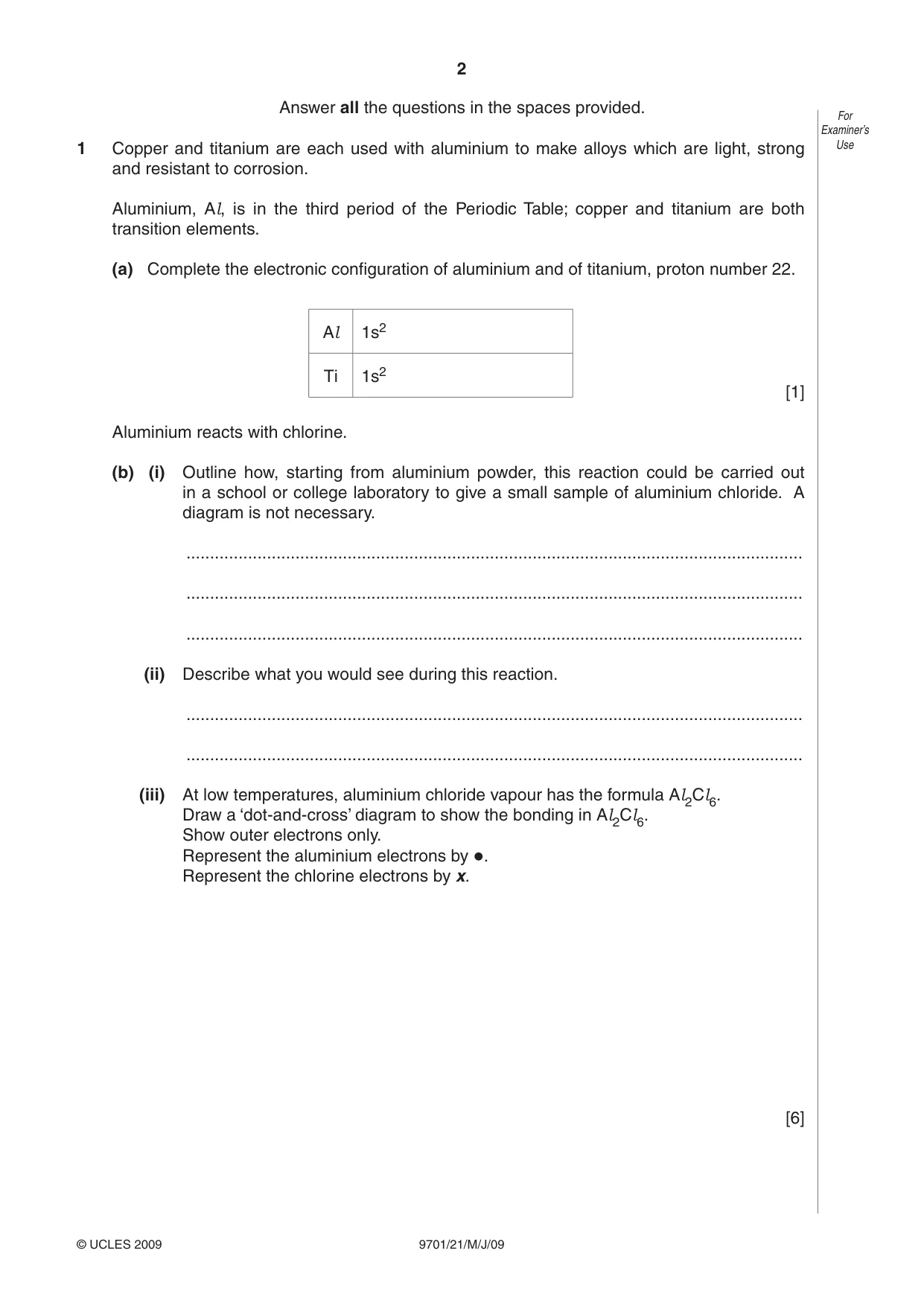
2 9701/21/M/J/09 © UCLES 2009 For Examiner’s Use Answer all the questions in the spaces provided. 1 Copper and titanium are each used with aluminium to make alloys which are light, strong and resistant to corrosion. Aluminium, Al, is in the third period of the Periodic Table; copper and titanium are both transition elements. (a) Complete the electronic configuration of aluminium and of titanium, proton number 22. Al 1s2 Ti 1s2 [1] Aluminium reacts with chlorine. (b) (i) Outline how, starting from aluminium powder, this reaction could be carried out in a school or college laboratory to give a small sample of aluminium chloride. A diagram is not necessary. … … … (ii) Describe what you would see during this reaction. … … (iii) At low temperatures, aluminium chloride vapour has the formula Al2Cl6. Draw a ‘dot-and-cross’ diagram to show the bonding in Al2Cl6. Show outer electrons only. Represent the aluminium electrons by z. Represent the chlorine electrons by x. [6]
Question paper, page 4
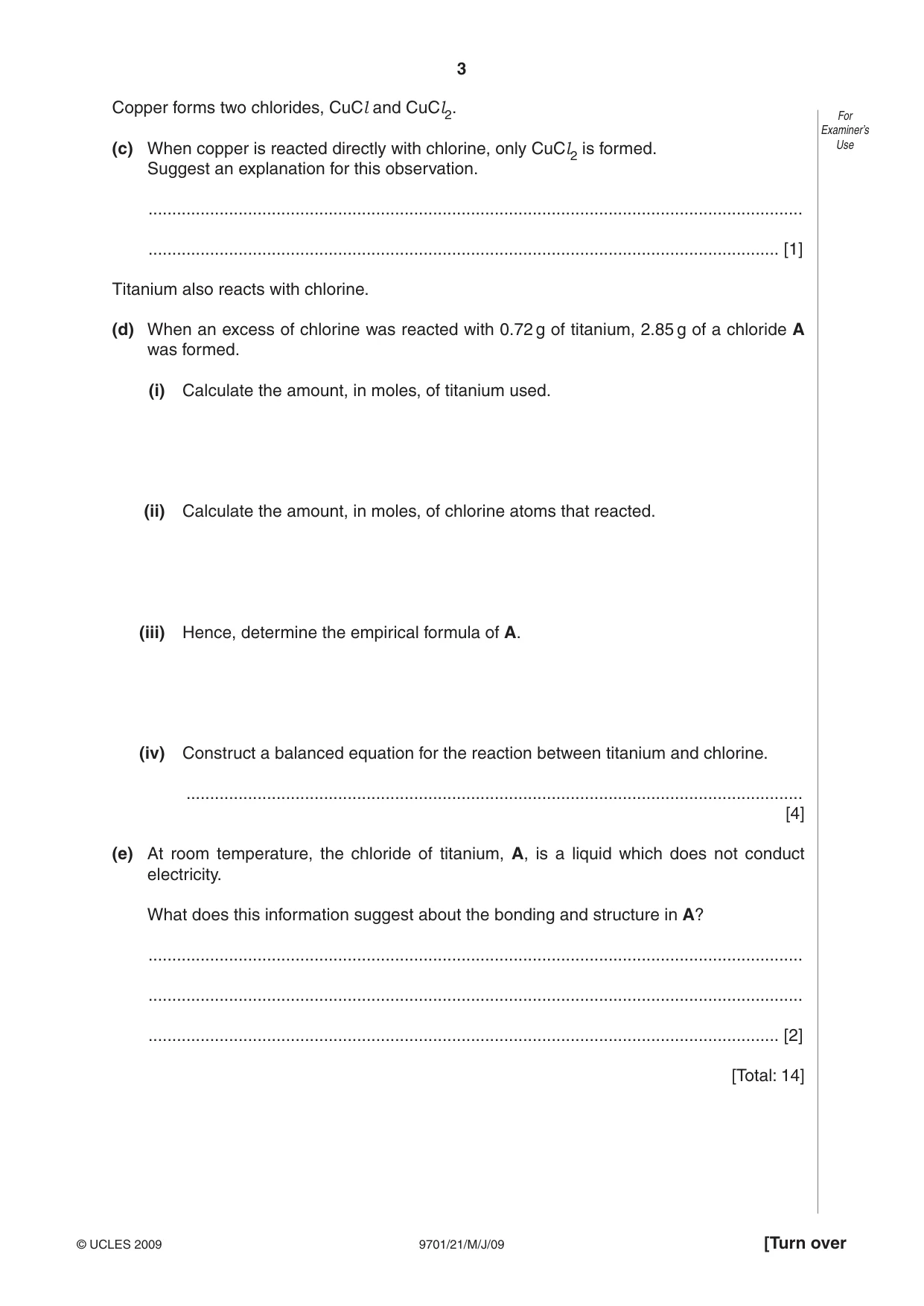
3 9701/21/M/J/09 © UCLES 2009 [Turn over For Examiner’s Use Copper forms two chlorides, CuCl and CuCl2. (c) When copper is reacted directly with chlorine, only CuCl2 is formed. Suggest an explanation for this observation. … … [1] Titanium also reacts with chlorine. (d) When an excess of chlorine was reacted with 0.72 g of titanium, 2.85 g of a chloride A was formed. (i) Calculate the amount, in moles, of titanium used. (ii) Calculate the amount, in moles, of chlorine atoms that reacted. (iii) Hence, determine the empirical formula of A. (iv) Construct a balanced equation for the reaction between titanium and chlorine. … [4] (e) At room temperature, the chloride of titanium, A, is a liquid which does not conduct electricity. What does this information suggest about the bonding and structure in A? … … … [2] [Total: 14]
Question paper, page 5
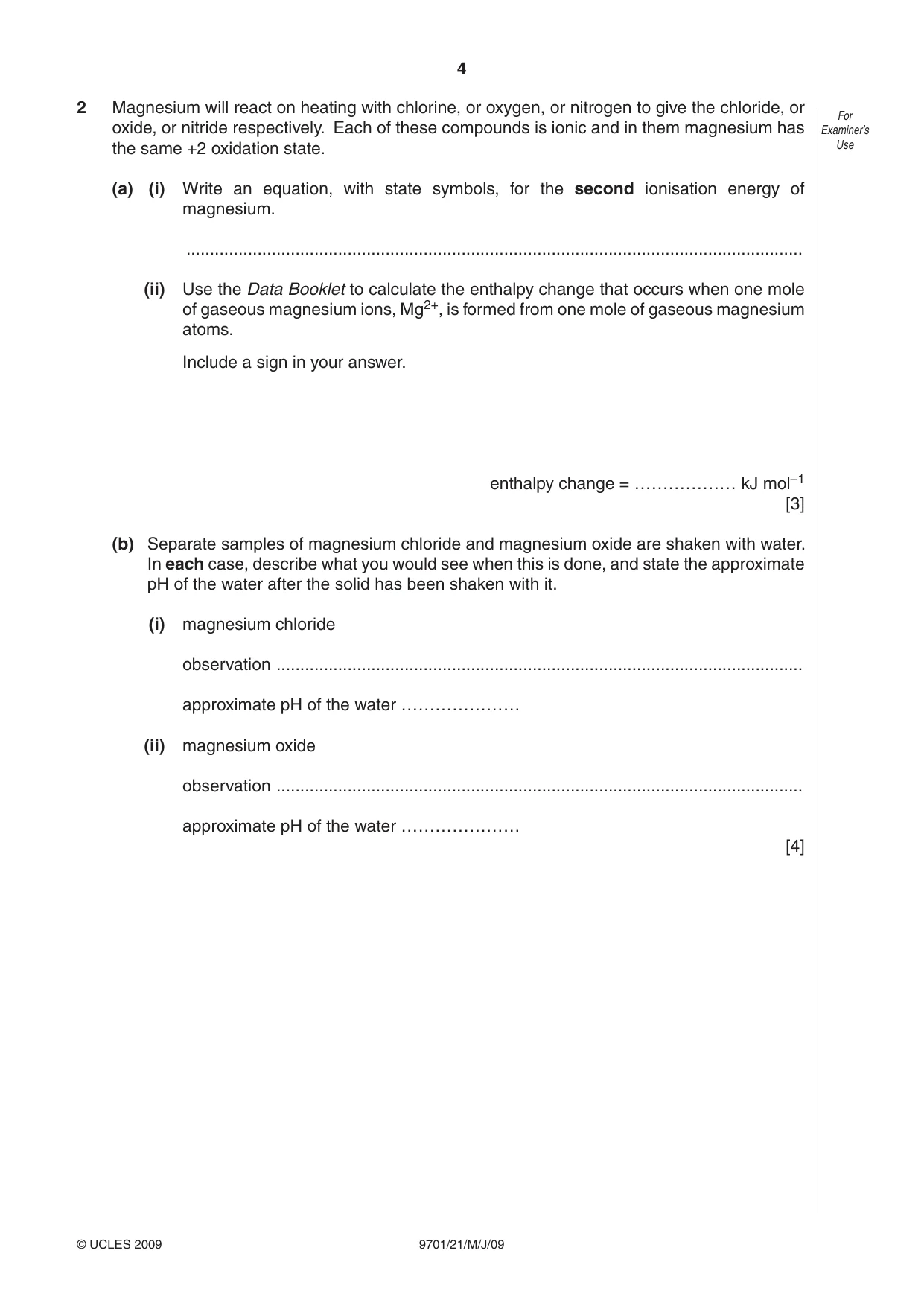
4 9701/21/M/J/09 © UCLES 2009 For Examiner’s Use 2 Magnesium will react on heating with chlorine, or oxygen, or nitrogen to give the chloride, or oxide, or nitride respectively. Each of these compounds is ionic and in them magnesium has the same +2 oxidation state. (a) (i) Write an equation, with state symbols, for the second ionisation energy of magnesium. … (ii) Use the Data Booklet to calculate the enthalpy change that occurs when one mole of gaseous magnesium ions, Mg2+, is formed from one mole of gaseous magnesium atoms. Include a sign in your answer. enthalpy change = ……………… kJ mol–1 [3] (b) Separate samples of magnesium chloride and magnesium oxide are shaken with water. In each case, describe what you would see when this is done, and state the approximate pH of the water after the solid has been shaken with it. (i) magnesium chloride observation … approximate pH of the water ………………… (ii) magnesium oxide observation … approximate pH of the water ………………… [4]
Question paper, page 6
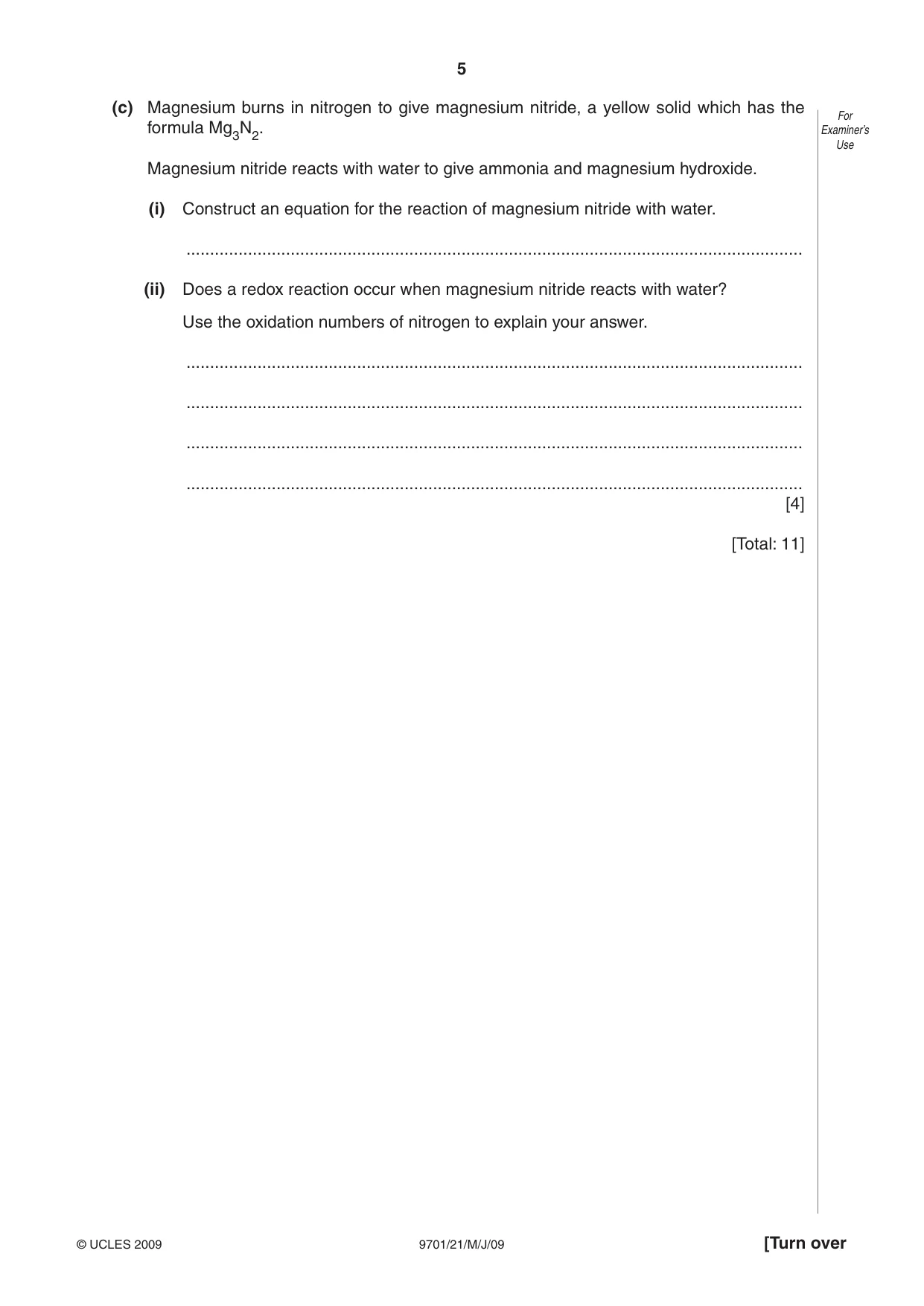
5 9701/21/M/J/09 © UCLES 2009 [Turn over For Examiner’s Use (c) Magnesium burns in nitrogen to give magnesium nitride, a yellow solid which has the formula Mg3N2. Magnesium nitride reacts with water to give ammonia and magnesium hydroxide. (i) Construct an equation for the reaction of magnesium nitride with water. … (ii) Does a redox reaction occur when magnesium nitride reacts with water? Use the oxidation numbers of nitrogen to explain your answer. … … … … [4] [Total: 11]
Question paper, page 7
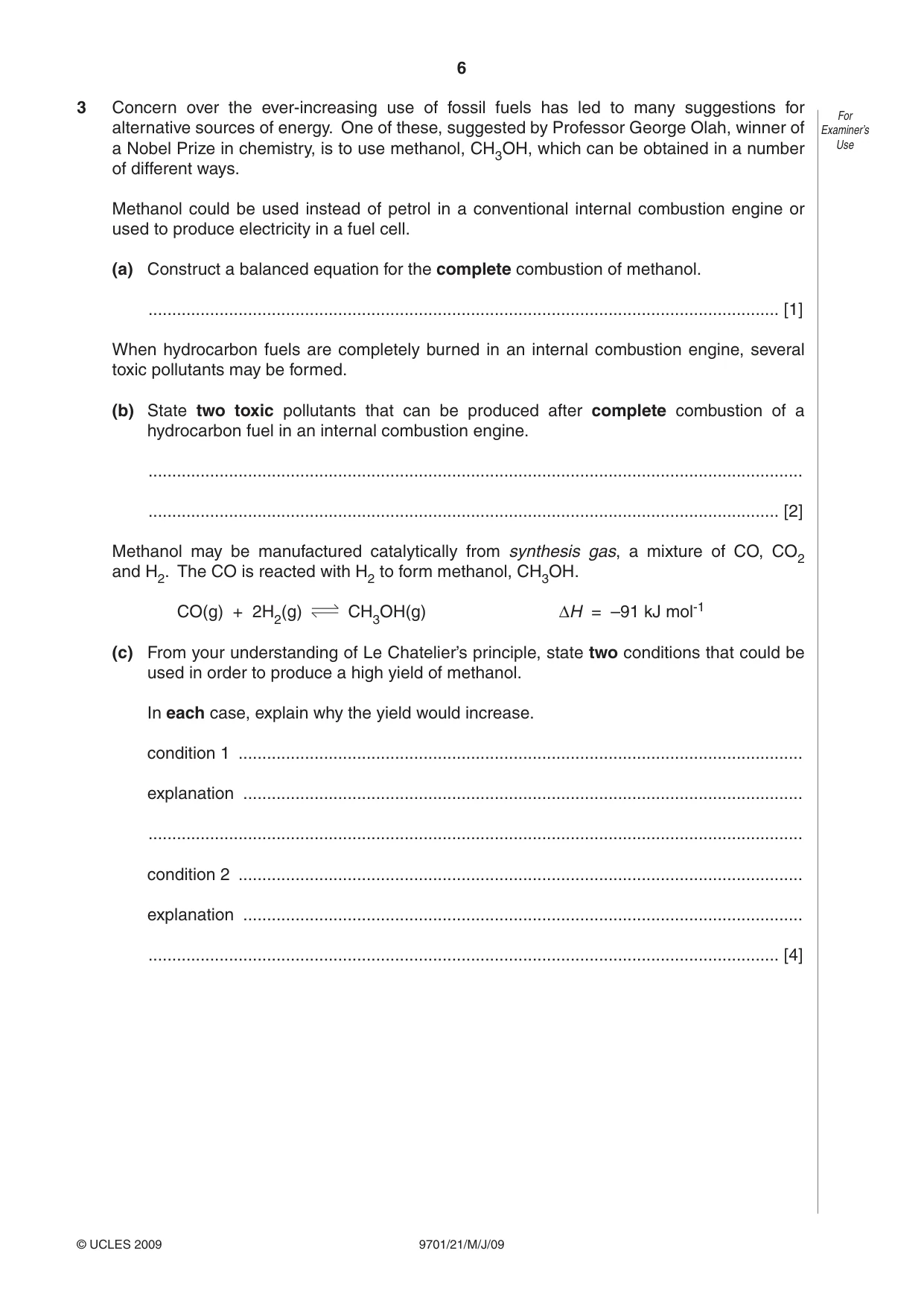
6 9701/21/M/J/09 © UCLES 2009 For Examiner’s Use 3 Concern over the ever-increasing use of fossil fuels has led to many suggestions for alternative sources of energy. One of these, suggested by Professor George Olah, winner of a Nobel Prize in chemistry, is to use methanol, CH3OH, which can be obtained in a number of different ways. Methanol could be used instead of petrol in a conventional internal combustion engine or used to produce electricity in a fuel cell. (a) Construct a balanced equation for the complete combustion of methanol. … [1] When hydrocarbon fuels are completely burned in an internal combustion engine, several toxic pollutants may be formed. (b) State two toxic pollutants that can be produced after complete combustion of a hydrocarbon fuel in an internal combustion engine. … … [2] Methanol may be manufactured catalytically from synthesis gas, a mixture of CO, CO2 and H2. The CO is reacted with H2 to form methanol, CH3OH. CO(g) + 2H2(g) CH3OH(g) ΔH = –91 kJ mol-1 (c) From your understanding of Le Chatelier’s principle, state two conditions that could be used in order to produce a high yield of methanol. In each case, explain why the yield would increase. condition 1 … explanation … … condition 2 … explanation … … [4]
Question paper, page 8
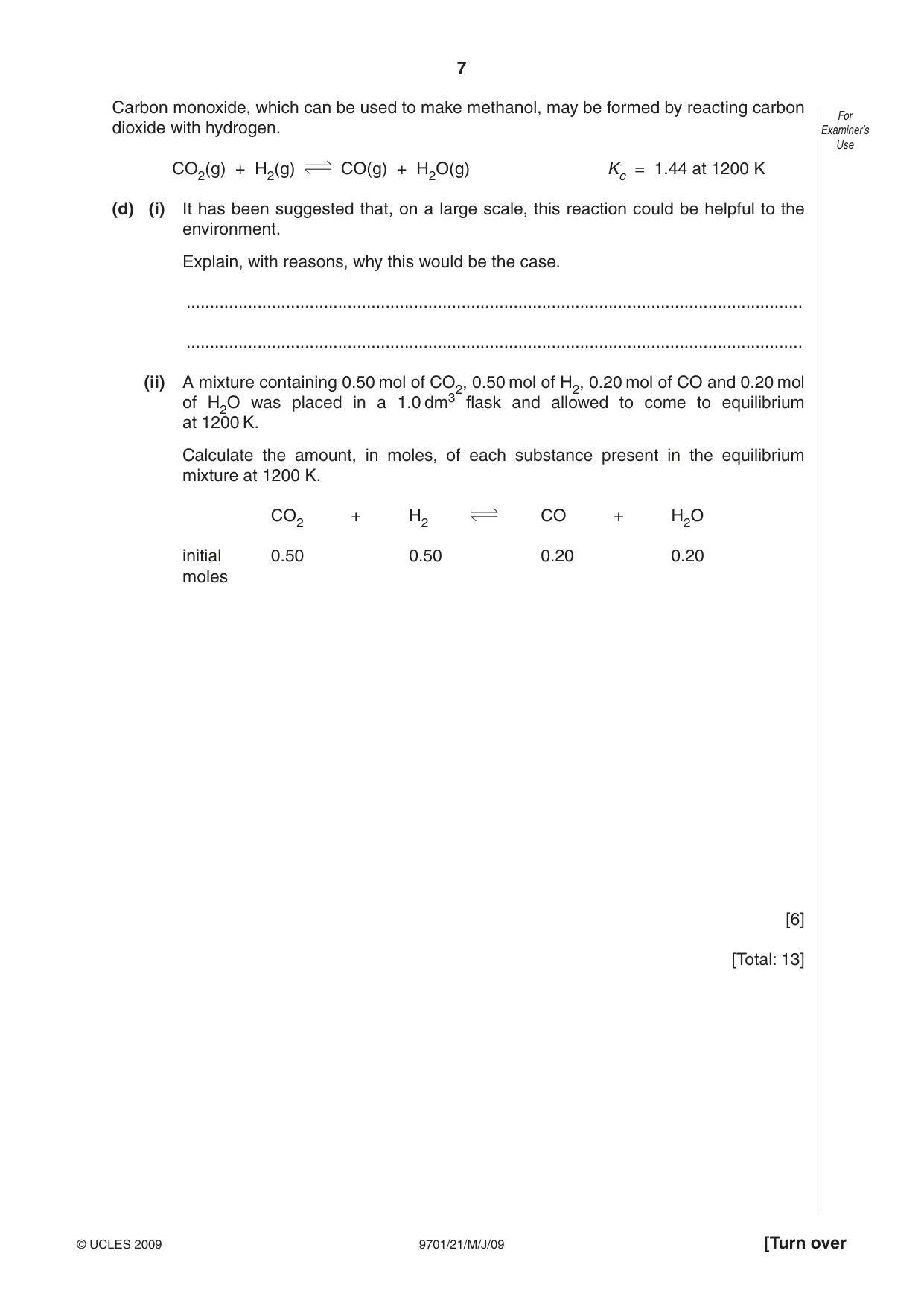
7 9701/21/M/J/09 © UCLES 2009 [Turn over For Examiner’s Use Carbon monoxide, which can be used to make methanol, may be formed by reacting carbon dioxide with hydrogen. CO2(g) + H2(g) CO(g) + H2O(g) Kc = 1.44 at 1200 K (d) (i) It has been suggested that, on a large scale, this reaction could be helpful to the environment. Explain, with reasons, why this would be the case. … … (ii) A mixture containing 0.50 mol of CO2, 0.50 mol of H2, 0.20 mol of CO and 0.20 mol of H2O was placed in a 1.0 dm3 flask and allowed to come to equilibrium at 1200 K. Calculate the amount, in moles, of each substance present in the equilibrium mixture at 1200 K. CO2 + H2 CO + H2O initial 0.50 0.50 0.20 0.20 moles [6] [Total: 13]
Question paper, page 9
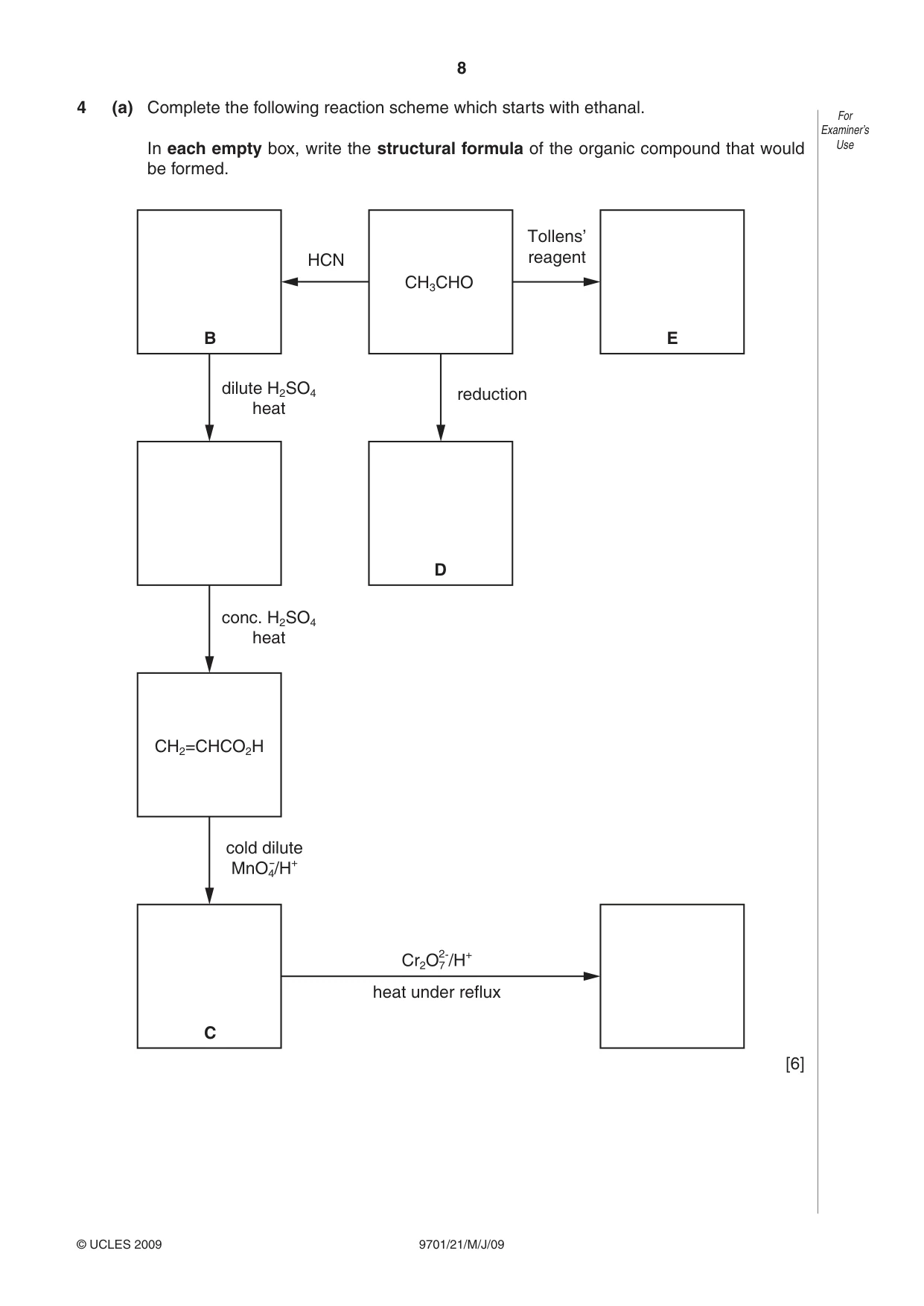
8 9701/21/M/J/09 © UCLES 2009 For Examiner’s Use 4 (a) Complete the following reaction scheme which starts with ethanal. In each empty box, write the structural formula of the organic compound that would be formed. B dilute H2SO4 heat D conc. H2SO4 heat CH2=CHCO2H C HCN Tollens’ reagent reduction E CH3CHO heat under reflux [6]
Question paper, page 10
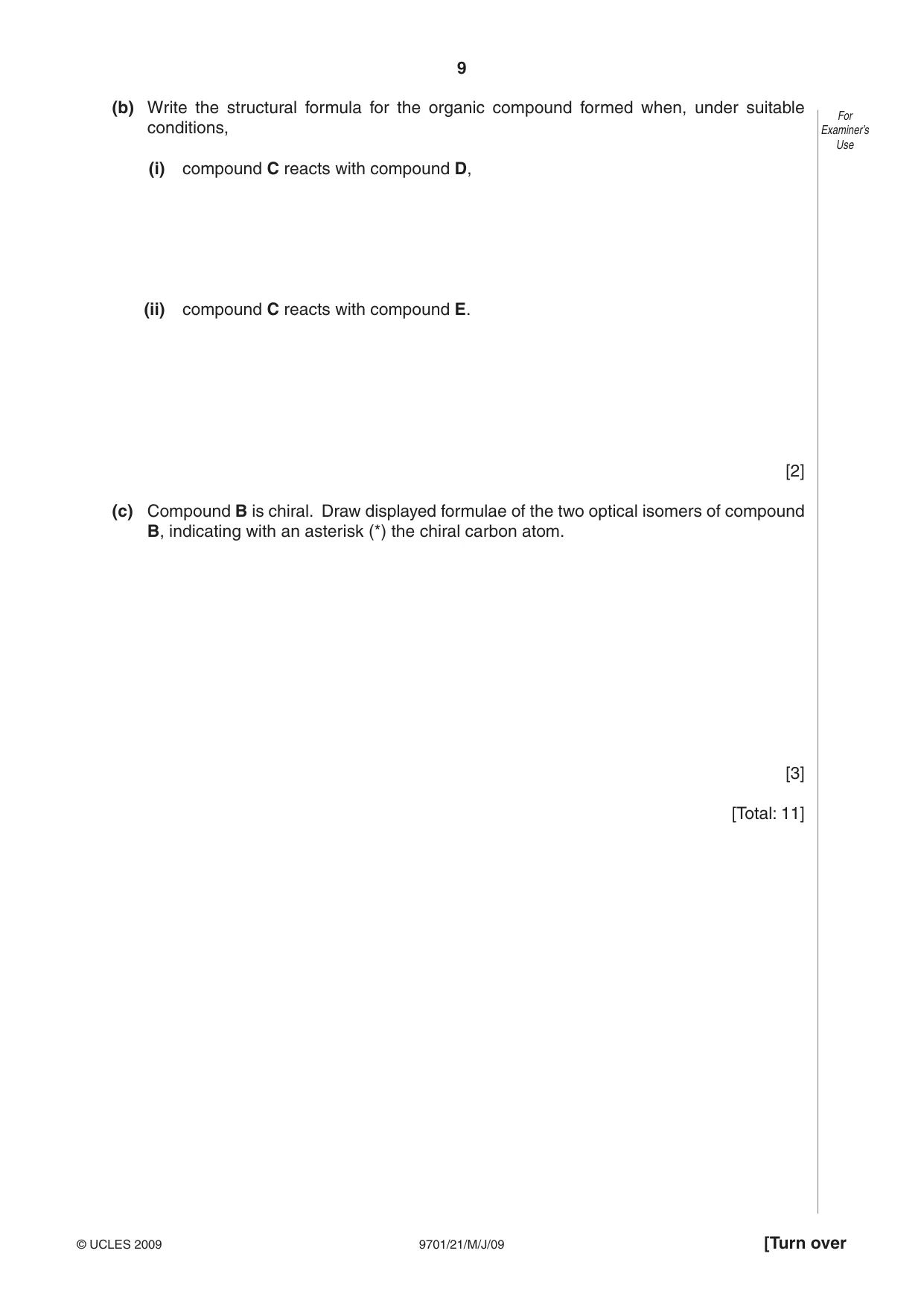
9 9701/21/M/J/09 © UCLES 2009 [Turn over For Examiner’s Use (b) Write the structural formula for the organic compound formed when, under suitable conditions, (i) compound C reacts with compound D, (ii) compound C reacts with compound E. [2] (c) Compound B is chiral. Draw displayed formulae of the two optical isomers of compound B, indicating with an asterisk (*) the chiral carbon atom. [3] [Total: 11]
Question paper, page 11
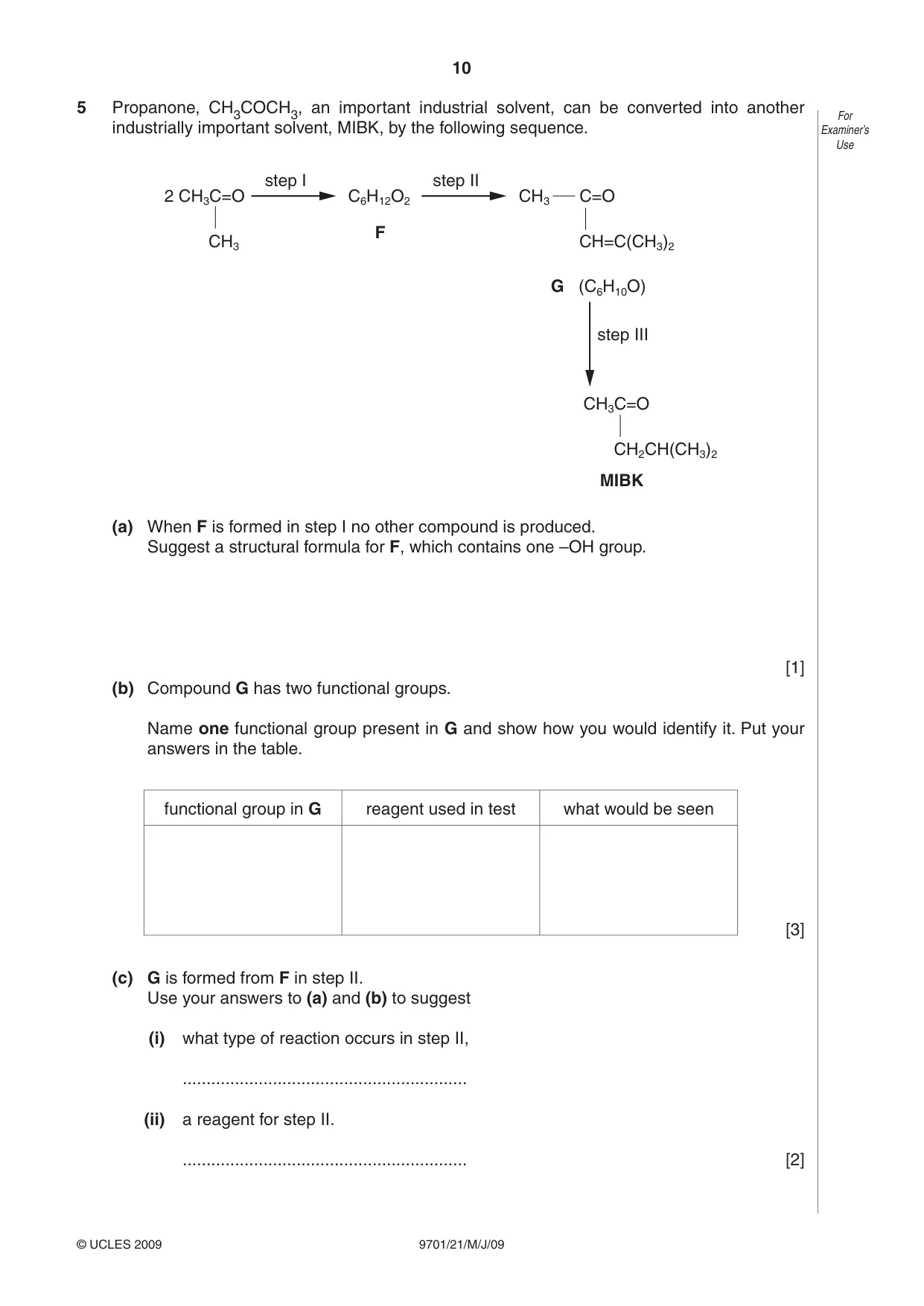
10 9701/21/M/J/09 © UCLES 2009 For Examiner’s Use 5 Propanone, CH3COCH3, an important industrial solvent, can be converted into another industrially important solvent, MIBK, by the following sequence. 2 CH3C=O C6H12O2 CH3 F step I step II step III CH3 C=O CH=C(CH3)2 (C6H10O) CH3C=O CH2CH(CH3)2 G MIBK (a) When F is formed in step I no other compound is produced. Suggest a structural formula for F, which contains one –OH group. [1] (b) Compound G has two functional groups. Name one functional group present in G and show how you would identify it. Put your answers in the table. functional group in G reagent used in test what would be seen [3] (c) G is formed from F in step II. Use your answers to (a) and (b) to suggest (i) what type of reaction occurs in step II, … (ii) a reagent for step II. … [2]
Question paper, page 12
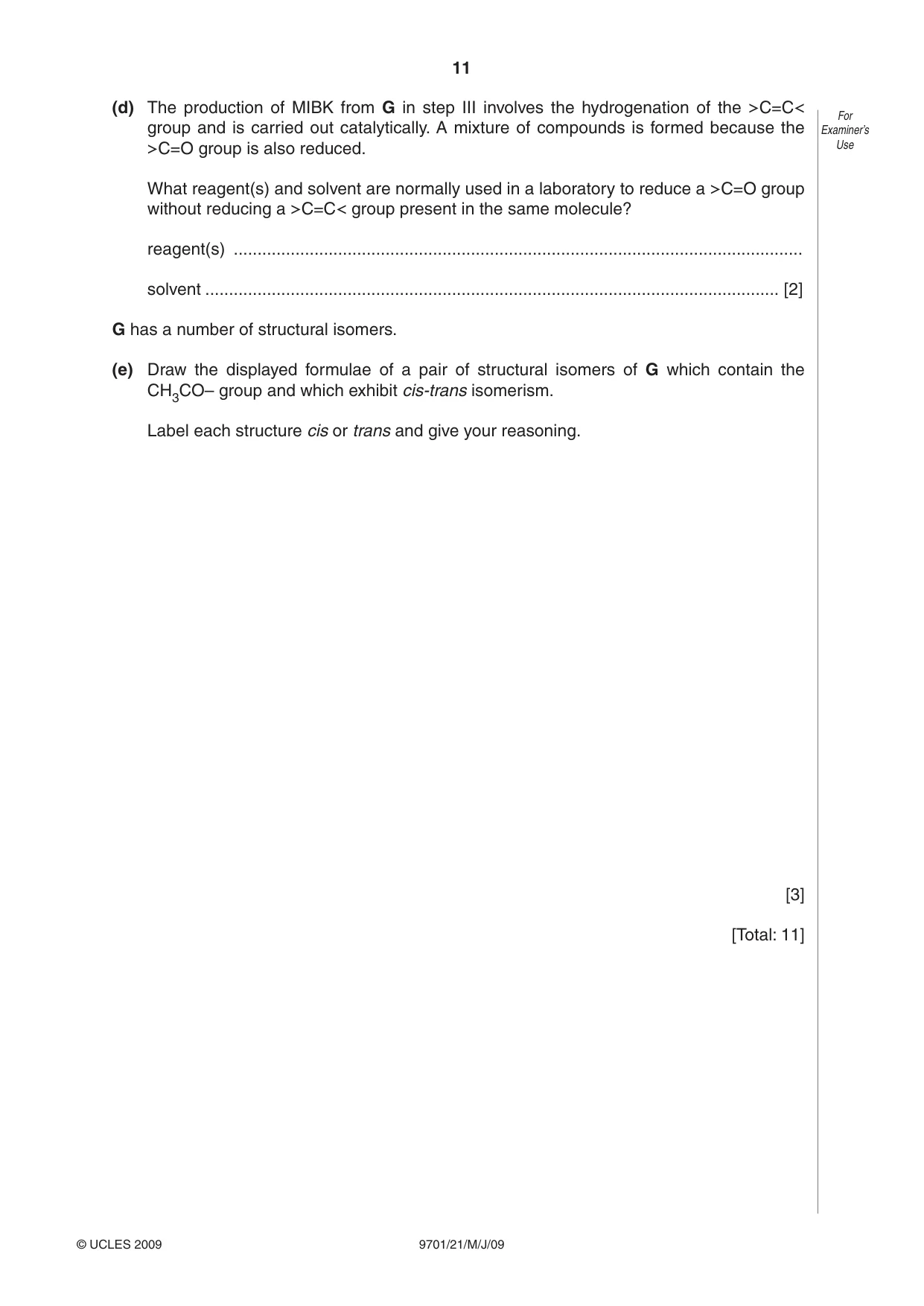
11 9701/21/M/J/09 © UCLES 2009 For Examiner’s Use (d) The production of MIBK from G in step III involves the hydrogenation of the >C=C< group and is carried out catalytically. A mixture of compounds is formed because the >C=O group is also reduced. What reagent(s) and solvent are normally used in a laboratory to reduce a >C=O group without reducing a >C=C< group present in the same molecule? reagent(s) … solvent … [2] G has a number of structural isomers. (e) Draw the displayed formulae of a pair of structural isomers of G which contain the CH3CO– group and which exhibit cis-trans isomerism. Label each structure cis or trans and give your reasoning. [3] [Total: 11]
Question paper, page 13
12 9701/21/M/J/09 BLANK PAGE Permission to reproduce items where third-party owned material protected by copyright is included has been sought and cleared where possible. Every reasonable effort has been made by the publisher (UCLES) to trace copyright holders, but if any items requiring clearance have unwittingly been included, the publisher will be pleased to make amends at the earliest possible opportunity. University of Cambridge International Examinations is part of the Cambridge Assessment Group. Cambridge Assessment is the brand name of University of Cambridge Local Examinations Syndicate (UCLES), which is itself a department of the University of Cambridge.
Question paper, page 14
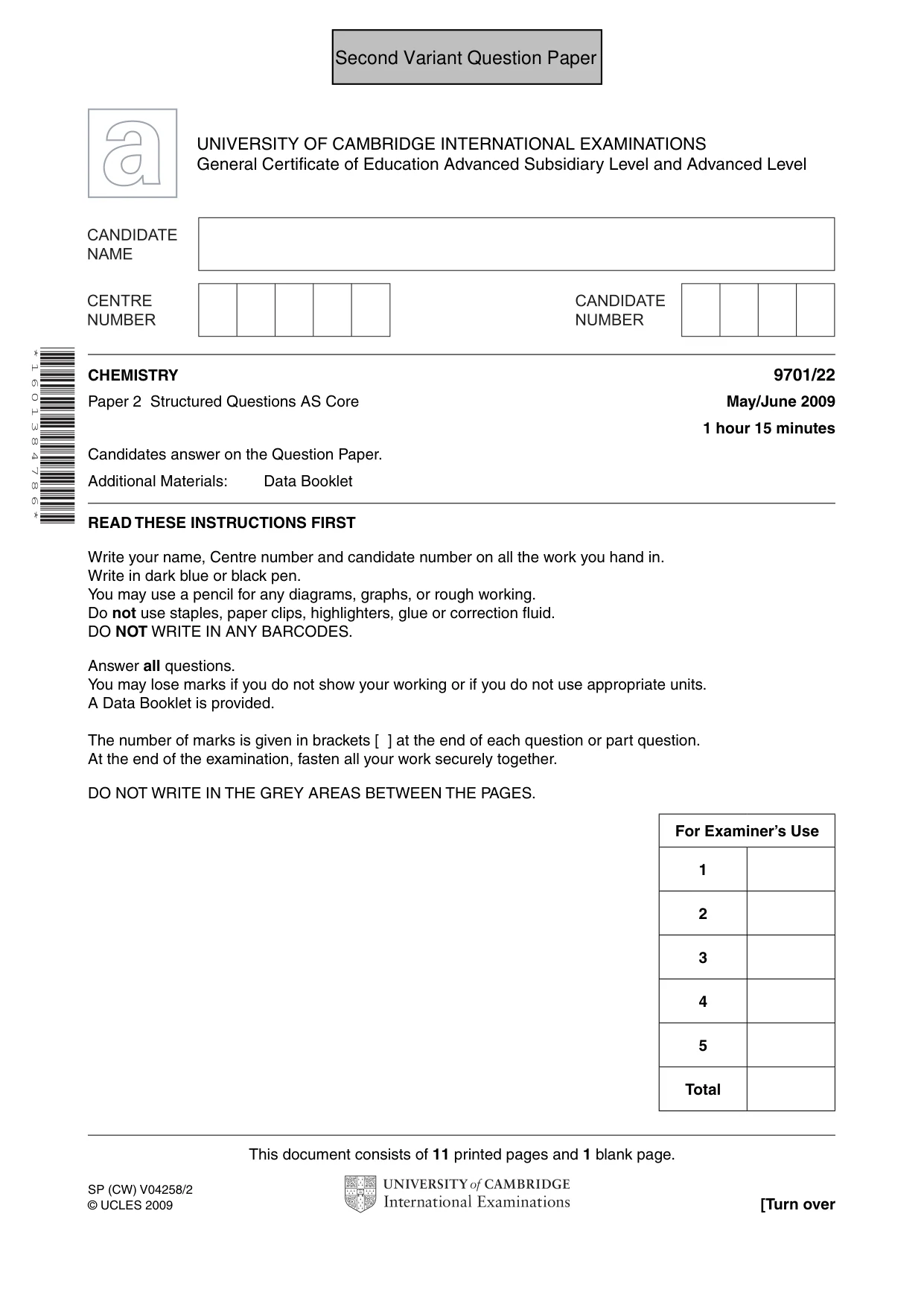
This document consists of 11 printed pages and 1 blank page. SP (CW) V04258/2 © UCLES 2009 [Turn over UNIVERSITY OF CAMBRIDGE INTERNATIONAL EXAMINATIONS General Certificate of Education Advanced Subsidiary Level and Advanced Level READ THESE INSTRUCTIONS FIRST Write your name, Centre number and candidate number on all the work you hand in. Write in dark blue or black pen. You may use a pencil for any diagrams, graphs, or rough working. Do not use staples, paper clips, highlighters, glue or correction fluid. DO NOT WRITE IN ANY BARCODES. Answer all questions. You may lose marks if you do not show your working or if you do not use appropriate units. A Data Booklet is provided. The number of marks is given in brackets [ ] at the end of each question or part question. At the end of the examination, fasten all your work securely together. DO NOT WRITE IN THE GREY AREAS BETWEEN THE PAGES. * 1 6 0 1 3 8 4 7 8 6 * CHEMISTRY 9701/22 Paper 2 Structured Questions AS Core May/June 2009 1 hour 15 minutes Candidates answer on the Question Paper. Additional Materials: Data Booklet For Examiner’s Use 1 2 3 4 5 Total Second Variant Question Paper
Question paper, page 15
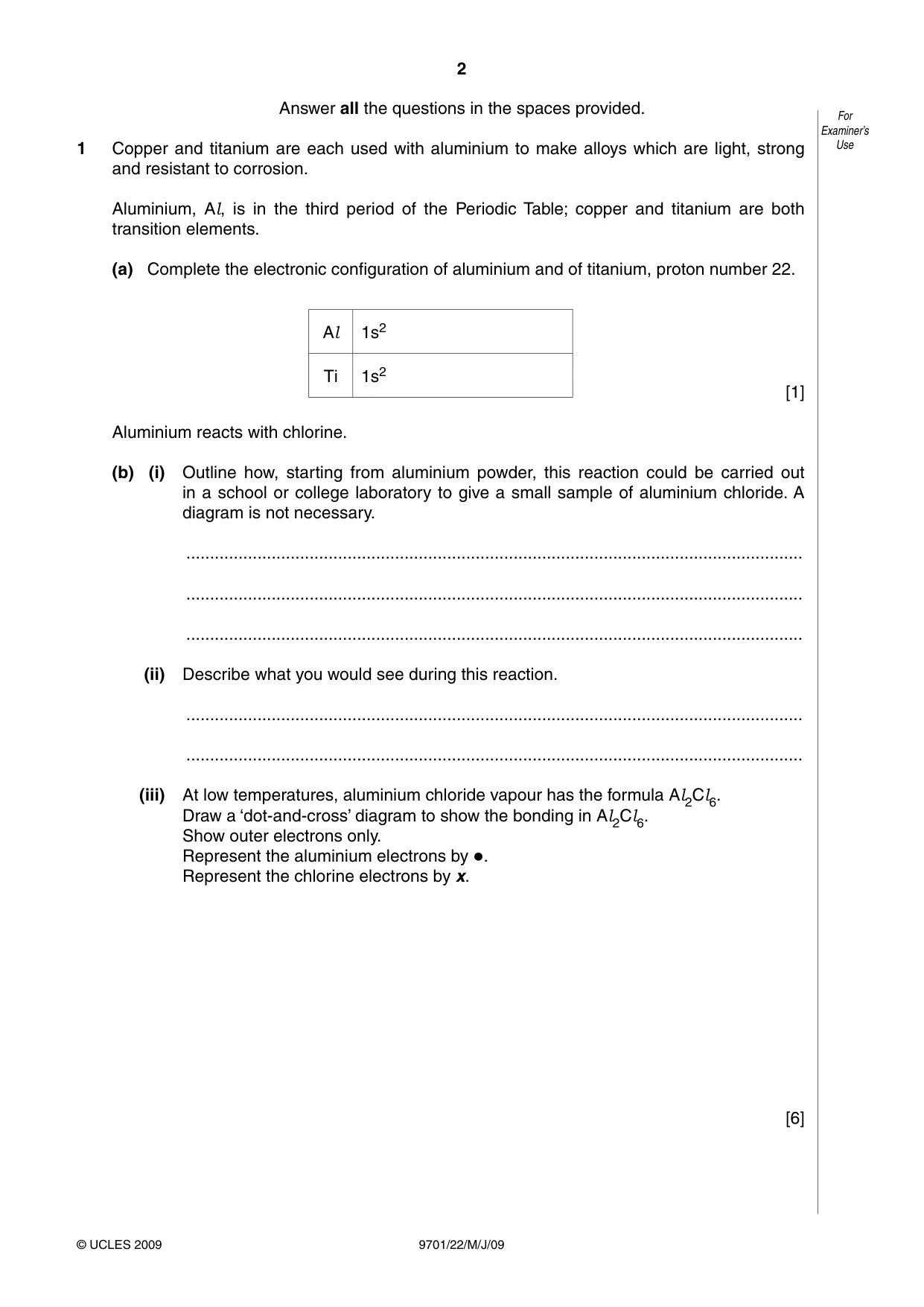
2 9701/22/M/J/09 © UCLES 2009 For Examiner’s Use Answer all the questions in the spaces provided. 1 Copper and titanium are each used with aluminium to make alloys which are light, strong and resistant to corrosion. Aluminium, Al, is in the third period of the Periodic Table; copper and titanium are both transition elements. (a) Complete the electronic configuration of aluminium and of titanium, proton number 22. Al 1s2 Ti 1s2 [1] Aluminium reacts with chlorine. (b) (i) Outline how, starting from aluminium powder, this reaction could be carried out in a school or college laboratory to give a small sample of aluminium chloride. A diagram is not necessary. … … … (ii) Describe what you would see during this reaction. … … (iii) At low temperatures, aluminium chloride vapour has the formula Al2Cl6. Draw a ‘dot-and-cross’ diagram to show the bonding in Al2Cl6. Show outer electrons only. Represent the aluminium electrons by z. Represent the chlorine electrons by x. [6]
Question paper, page 16
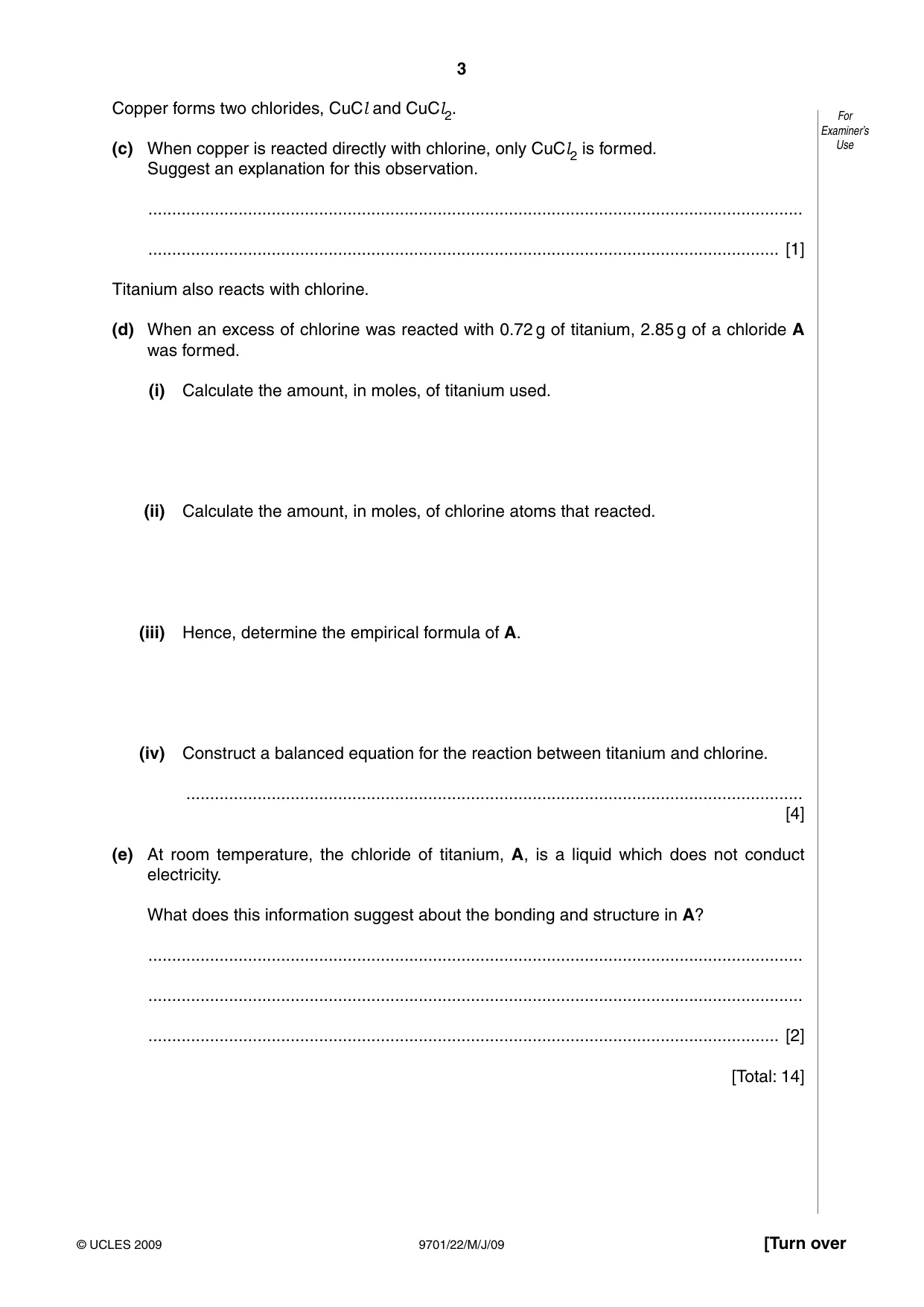
3 9701/22/M/J/09 © UCLES 2009 [Turn over For Examiner’s Use Copper forms two chlorides, CuCl and CuCl2. (c) When copper is reacted directly with chlorine, only CuCl2 is formed. Suggest an explanation for this observation. … … [1] Titanium also reacts with chlorine. (d) When an excess of chlorine was reacted with 0.72 g of titanium, 2.85 g of a chloride A was formed. (i) Calculate the amount, in moles, of titanium used. (ii) Calculate the amount, in moles, of chlorine atoms that reacted. (iii) Hence, determine the empirical formula of A. (iv) Construct a balanced equation for the reaction between titanium and chlorine. … [4] (e) At room temperature, the chloride of titanium, A, is a liquid which does not conduct electricity. What does this information suggest about the bonding and structure in A? … … … [2] [Total: 14]
Question paper, page 17
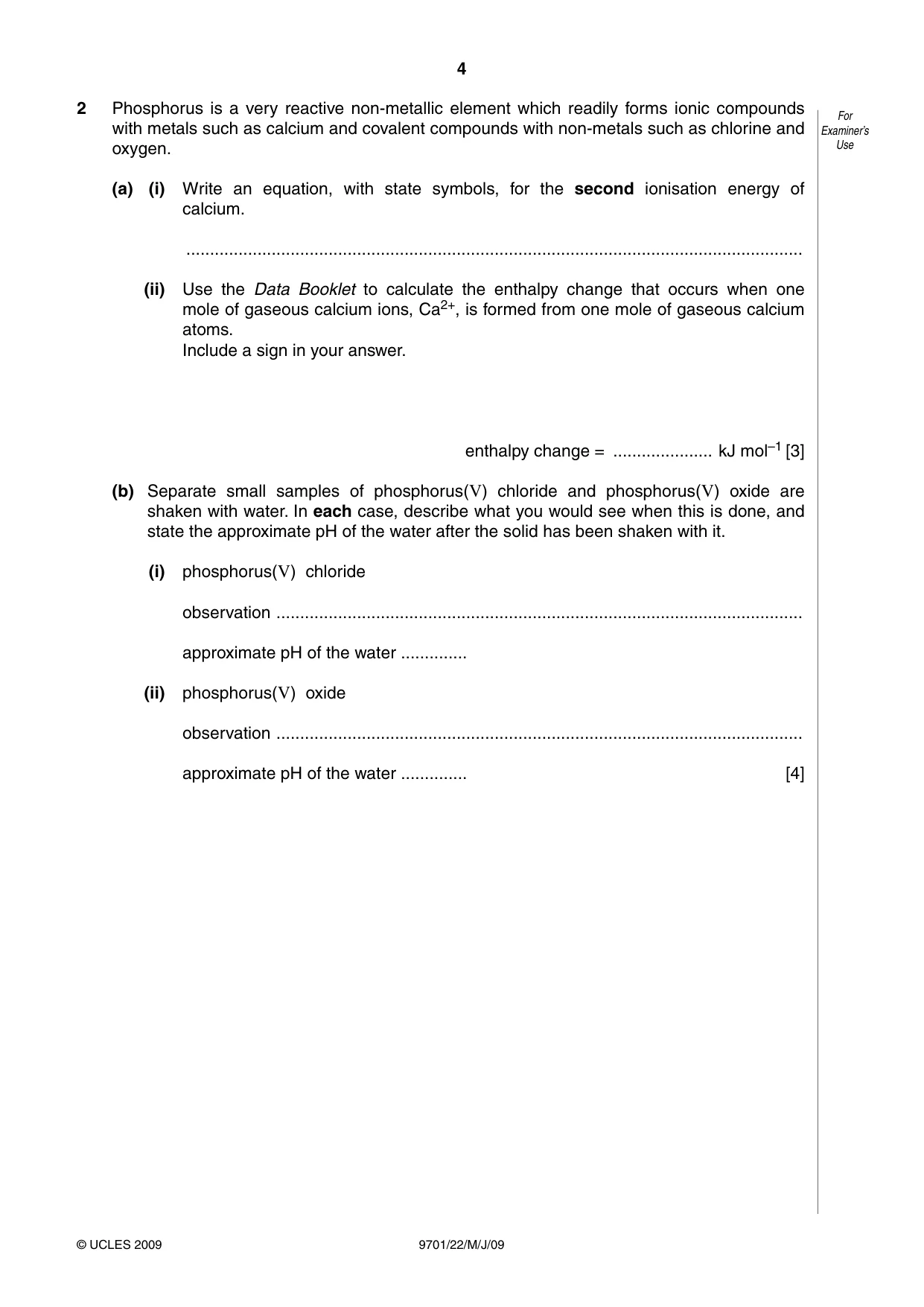
4 9701/22/M/J/09 © UCLES 2009 For Examiner’s Use 2 Phosphorus is a very reactive non-metallic element which readily forms ionic compounds with metals such as calcium and covalent compounds with non-metals such as chlorine and oxygen. (a) (i) Write an equation, with state symbols, for the second ionisation energy of calcium. … (ii) Use the Data Booklet to calculate the enthalpy change that occurs when one mole of gaseous calcium ions, Ca2+, is formed from one mole of gaseous calcium atoms. Include a sign in your answer. enthalpy change = … kJ mol–1 [3] (b) Separate small samples of phosphorus(V) chloride and phosphorus(V) oxide are shaken with water. In each case, describe what you would see when this is done, and state the approximate pH of the water after the solid has been shaken with it. (i) phosphorus(V) chloride observation … approximate pH of the water … (ii) phosphorus(V) oxide observation … approximate pH of the water … [4]
Question paper, page 18
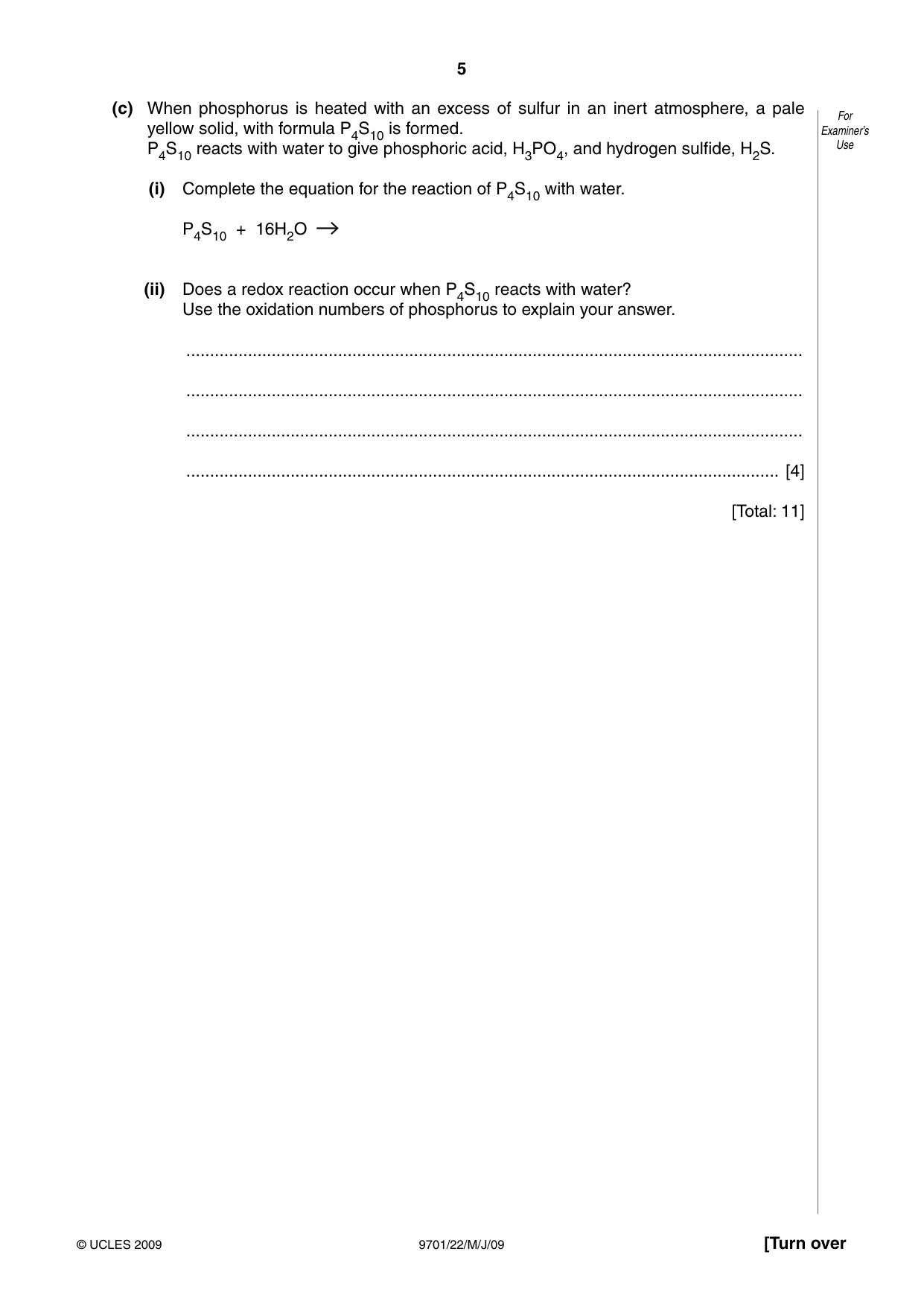
5 9701/22/M/J/09 © UCLES 2009 [Turn over For Examiner’s Use (c) When phosphorus is heated with an excess of sulfur in an inert atmosphere, a pale yellow solid, with formula P4S10 is formed. P4S10 reacts with water to give phosphoric acid, H3PO4, and hydrogen sulfide, H2S. (i) Complete the equation for the reaction of P4S10 with water. P4S10 + 16H2O (ii) Does a redox reaction occur when P4S10 reacts with water? Use the oxidation numbers of phosphorus to explain your answer. … … … … [4] [Total: 11]
Question paper, page 19
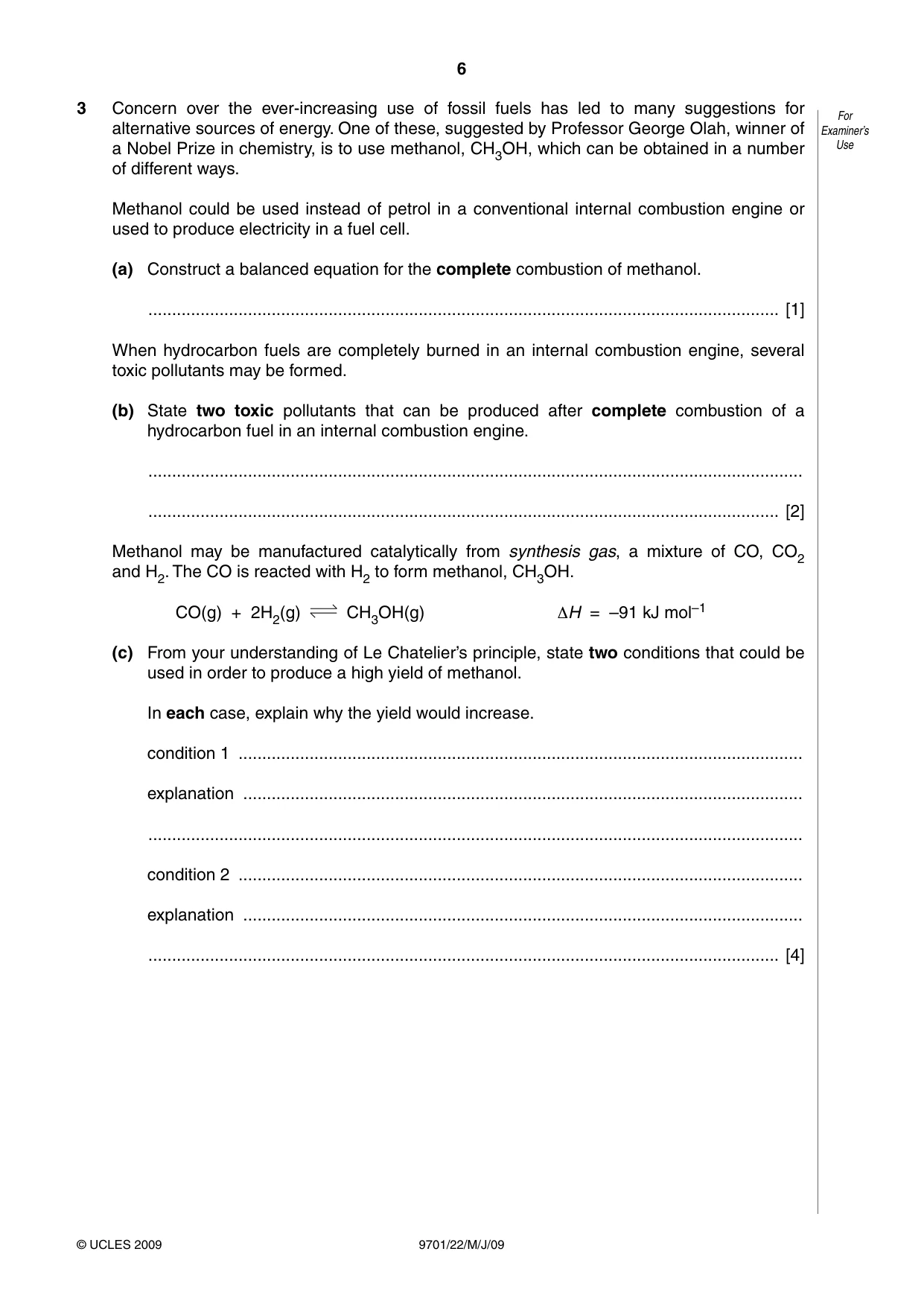
6 9701/22/M/J/09 © UCLES 2009 For Examiner’s Use 3 Concern over the ever-increasing use of fossil fuels has led to many suggestions for alternative sources of energy. One of these, suggested by Professor George Olah, winner of a Nobel Prize in chemistry, is to use methanol, CH3OH, which can be obtained in a number of different ways. Methanol could be used instead of petrol in a conventional internal combustion engine or used to produce electricity in a fuel cell. (a) Construct a balanced equation for the complete combustion of methanol. … [1] When hydrocarbon fuels are completely burned in an internal combustion engine, several toxic pollutants may be formed. (b) State two toxic pollutants that can be produced after complete combustion of a hydrocarbon fuel in an internal combustion engine. … … [2] Methanol may be manufactured catalytically from synthesis gas, a mixture of CO, CO2 and H2. The CO is reacted with H2 to form methanol, CH3OH. CO(g) + 2H2(g) CH3OH(g) ΔH = –91 kJ mol–1 (c) From your understanding of Le Chatelier’s principle, state two conditions that could be used in order to produce a high yield of methanol. In each case, explain why the yield would increase. condition 1 … explanation … … condition 2 … explanation … … [4]
Question paper, page 20
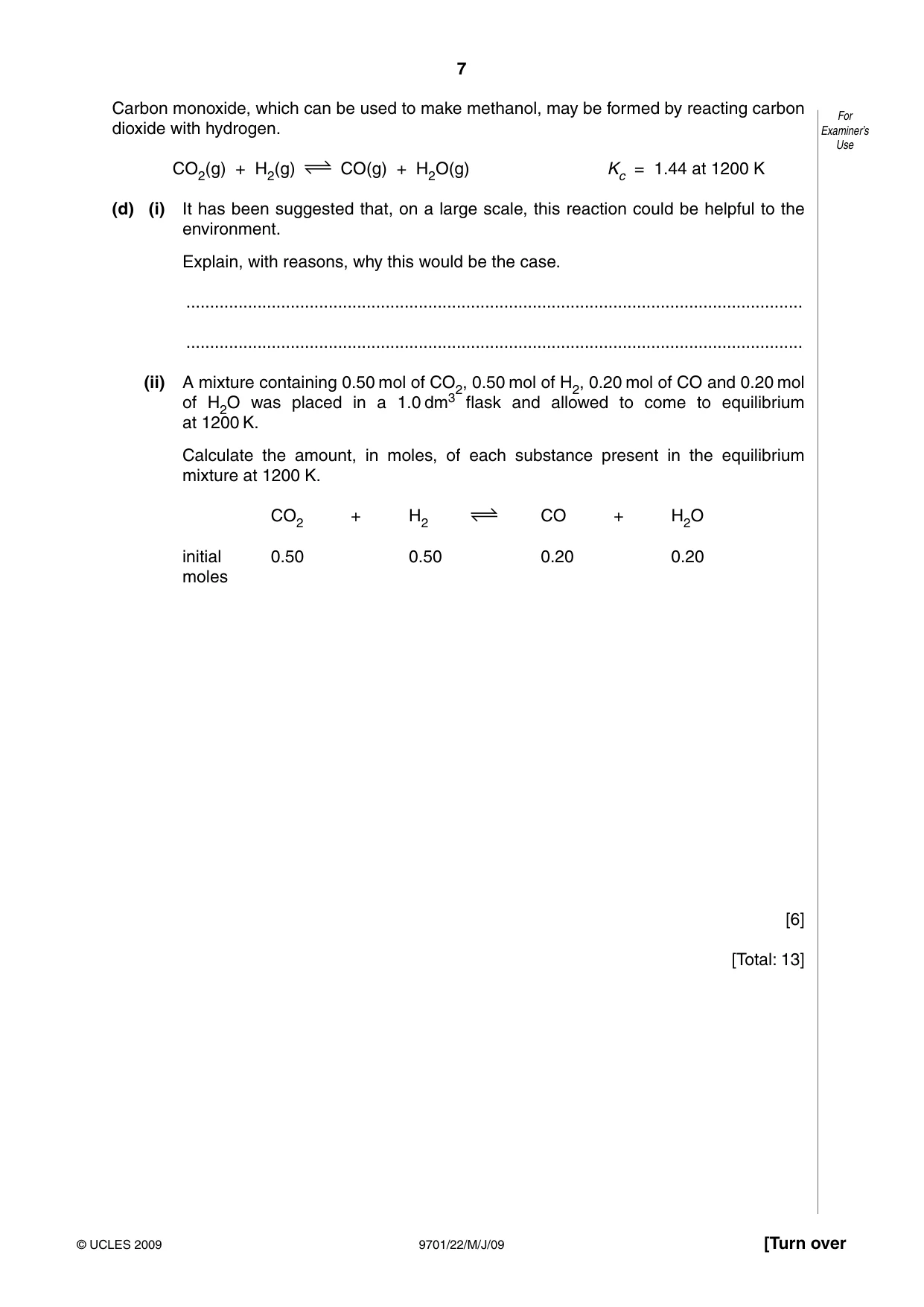
7 9701/22/M/J/09 © UCLES 2009 [Turn over For Examiner’s Use Carbon monoxide, which can be used to make methanol, may be formed by reacting carbon dioxide with hydrogen. CO2(g) + H2(g) CO(g) + H2O(g) Kc = 1.44 at 1200 K (d) (i) It has been suggested that, on a large scale, this reaction could be helpful to the environment. Explain, with reasons, why this would be the case. … … (ii) A mixture containing 0.50 mol of CO2, 0.50 mol of H2, 0.20 mol of CO and 0.20 mol of H2O was placed in a 1.0 dm3 flask and allowed to come to equilibrium at 1200 K. Calculate the amount, in moles, of each substance present in the equilibrium mixture at 1200 K. CO2 + H2 CO + H2O initial 0.50 0.50 0.20 0.20 moles [6] [Total: 13]
Question paper, page 21
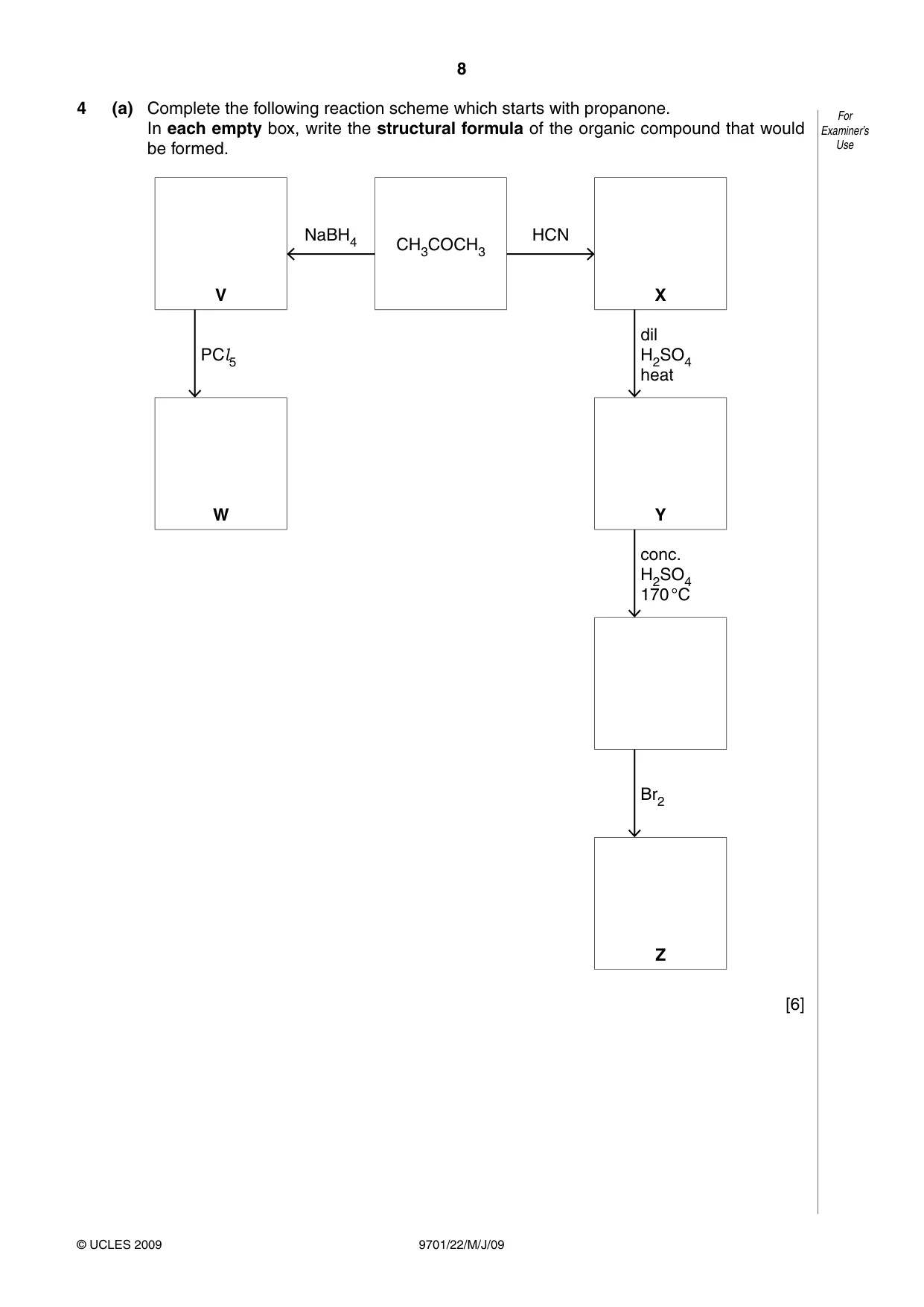
8 9701/22/M/J/09 © UCLES 2009 For Examiner’s Use 4 (a) Complete the following reaction scheme which starts with propanone. In each empty box, write the structural formula of the organic compound that would be formed. V NaBH4 CH3COCH3 HCN X PCl5 dil H2SO4 heat W Y conc. H2SO4 170 °C Br2 Z [6]
Question paper, page 22
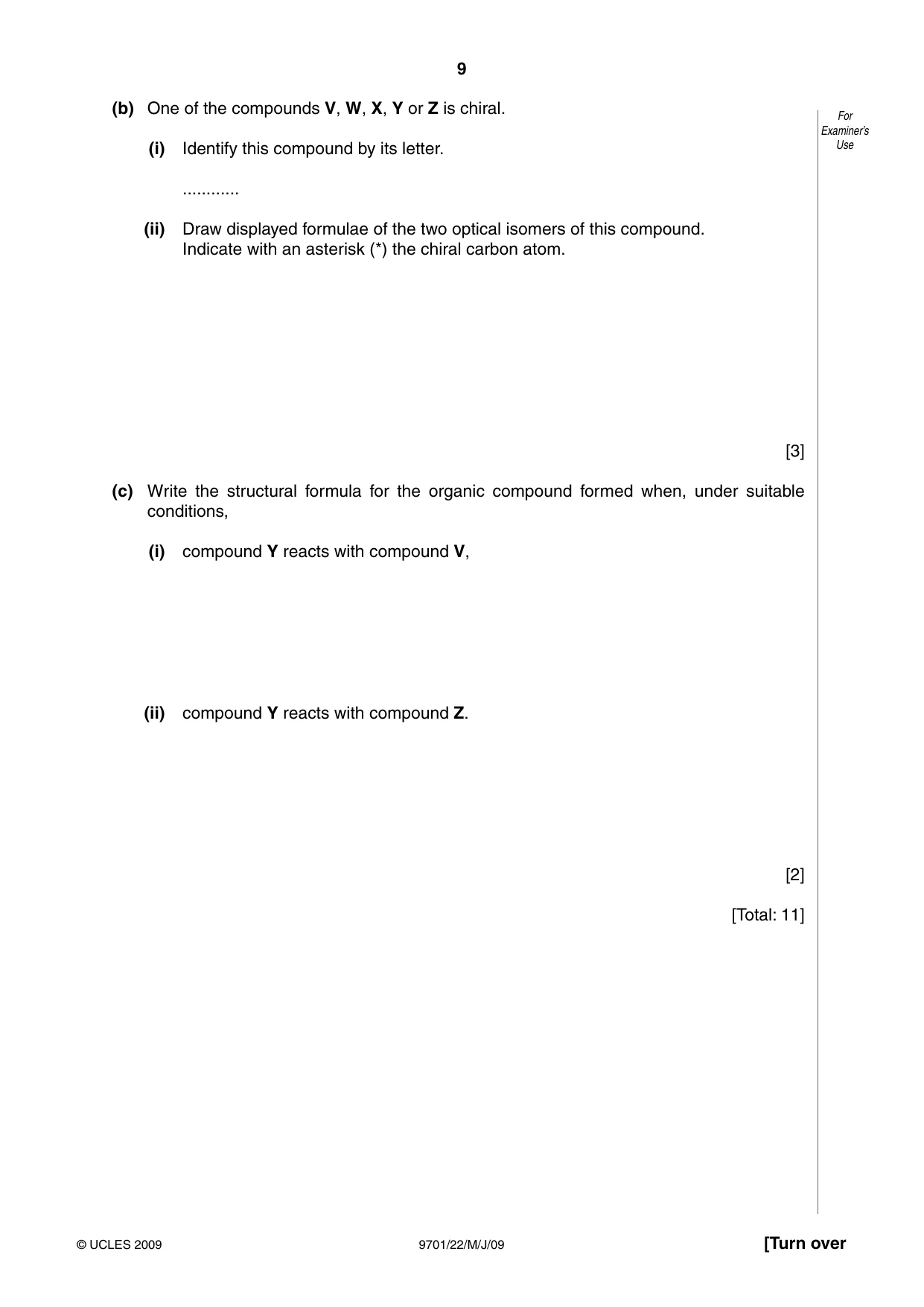
9 9701/22/M/J/09 © UCLES 2009 [Turn over For Examiner’s Use (b) One of the compounds V, W, X, Y or Z is chiral. (i) Identify this compound by its letter. … (ii) Draw displayed formulae of the two optical isomers of this compound. Indicate with an asterisk (*) the chiral carbon atom. [3] (c) Write the structural formula for the organic compound formed when, under suitable conditions, (i) compound Y reacts with compound V, (ii) compound Y reacts with compound Z. [2] [Total: 11]
Question paper, page 23
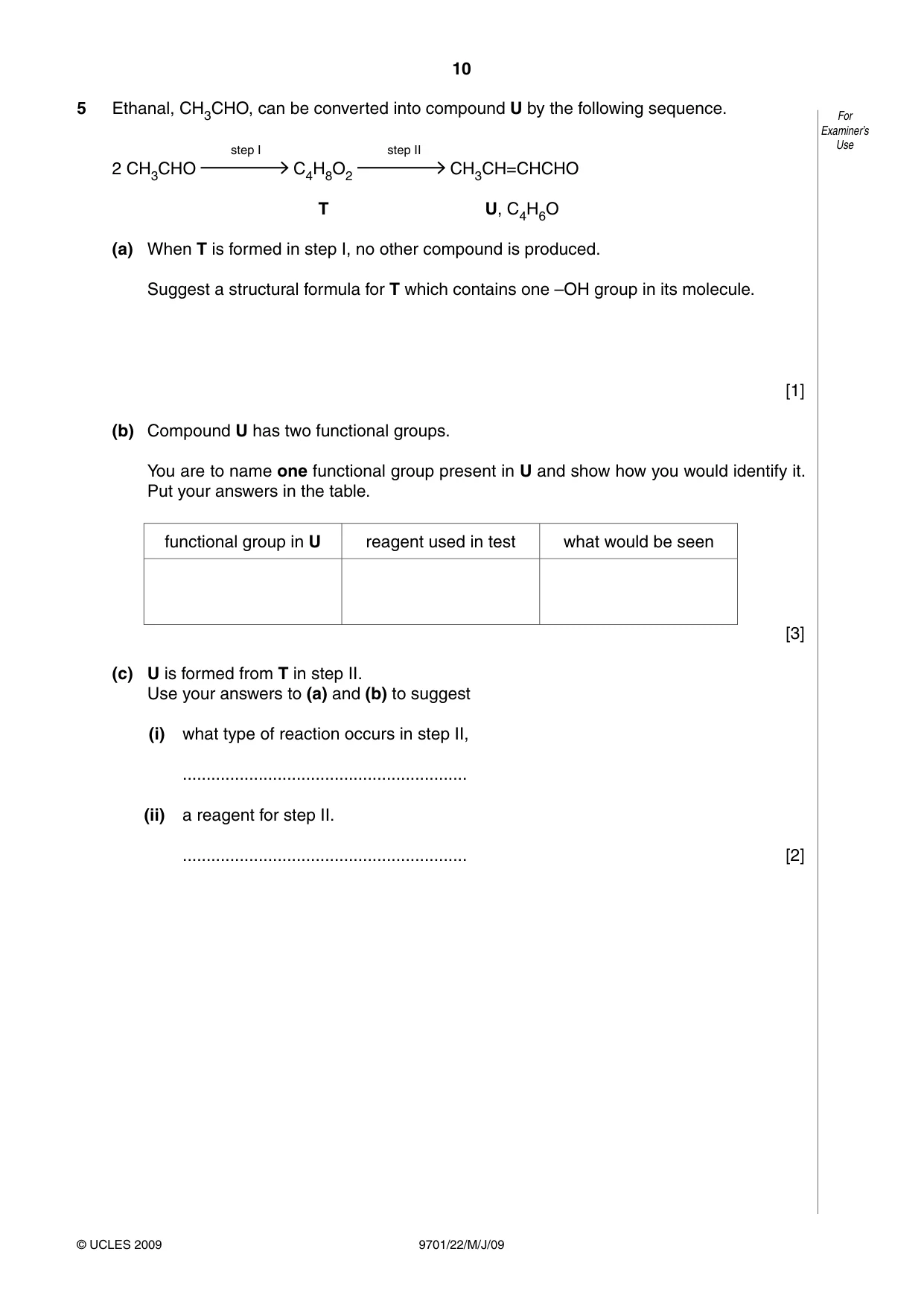
10 9701/22/M/J/09 © UCLES 2009 For Examiner’s Use 5 Ethanal, CH3CHO, can be converted into compound U by the following sequence. step I step II 2 CH3CHO C4H8O2 CH3CH=CHCHO T U, C4H6O (a) When T is formed in step I, no other compound is produced. Suggest a structural formula for T which contains one –OH group in its molecule. [1] (b) Compound U has two functional groups. You are to name one functional group present in U and show how you would identify it. Put your answers in the table. functional group in U reagent used in test what would be seen [3] (c) U is formed from T in step II. Use your answers to (a) and (b) to suggest (i) what type of reaction occurs in step II, … (ii) a reagent for step II. … [2]
Question paper, page 24
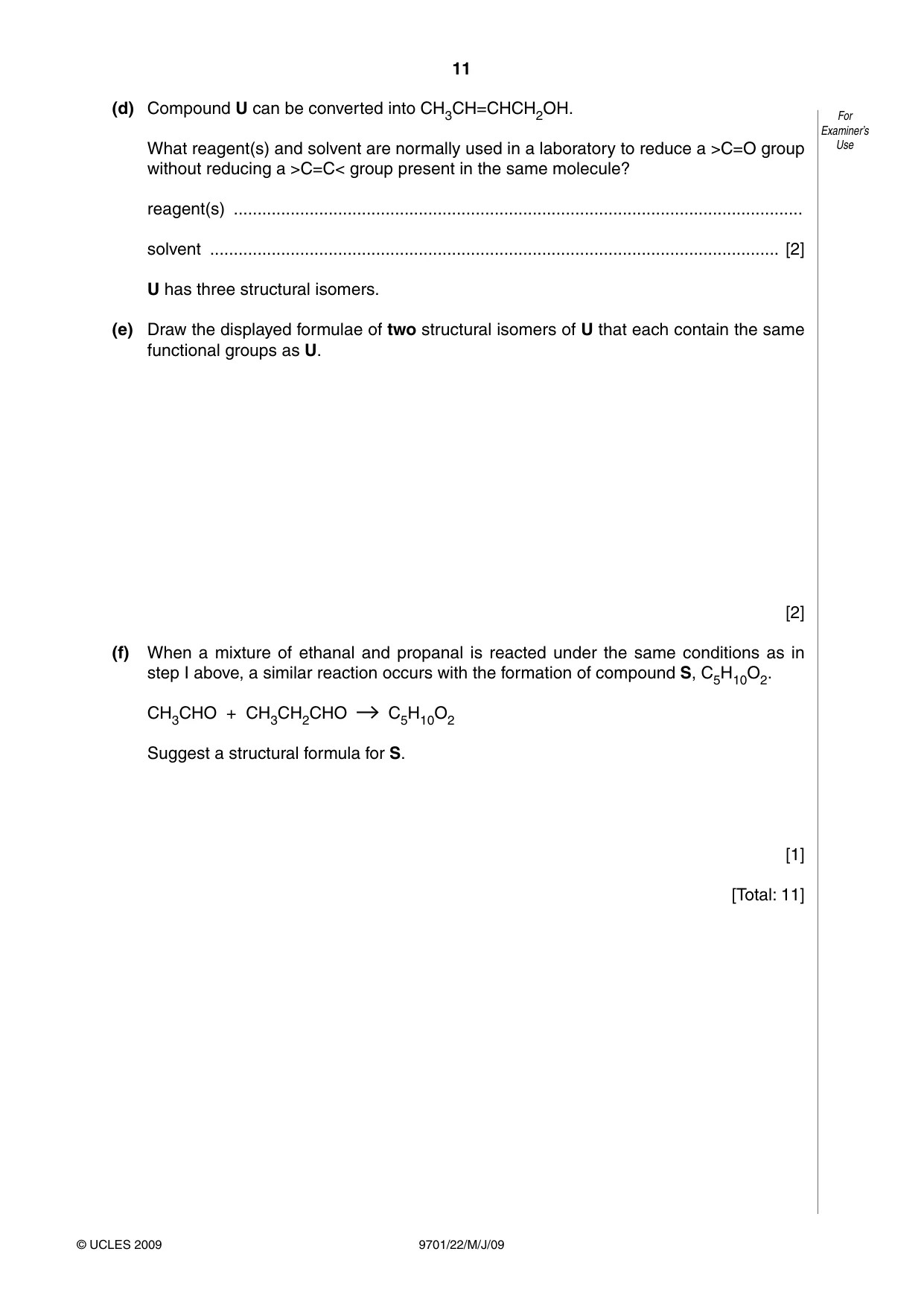
11 9701/22/M/J/09 © UCLES 2009 For Examiner’s Use (d) Compound U can be converted into CH3CH=CHCH2OH. What reagent(s) and solvent are normally used in a laboratory to reduce a >C=O group without reducing a >C=C< group present in the same molecule? reagent(s) … solvent … [2] U has three structural isomers. (e) Draw the displayed formulae of two structural isomers of U that each contain the same functional groups as U. [2] (f) When a mixture of ethanal and propanal is reacted under the same conditions as in step I above, a similar reaction occurs with the formation of compound S, C5H10O2. CH3CHO + CH3CH2CHO C5H10O2 Suggest a structural formula for S. [1] [Total: 11]
Question paper, page 25
12 9701/22/M/J/09 BLANK PAGE Permission to reproduce items where third-party owned material protected by copyright is included has been sought and cleared where possible. Every reasonable effort has been made by the publisher (UCLES) to trace copyright holders, but if any items requiring clearance have unwittingly been included, the publisher will be pleased to make amends at the earliest possible opportunity. University of Cambridge International Examinations is part of the Cambridge Assessment Group. Cambridge Assessment is the brand name of University of Cambridge Local Examinations Syndicate (UCLES), which is itself a department of the University of Cambridge.
Mark scheme, page 1
Location Entry Codes As part of CIE’s continual commitment to maintaining best practice in assessment, CIE has begun to use different variants of some question papers for our most popular assessments with extremely large and widespread candidature, The question papers are closely related and the relationships between them have been thoroughly established using our assessment expertise. All versions of the paper give assessment of equal standard. The content assessed by the examination papers and the type of questions are unchanged. This change means that for this component there are now two variant Question Papers, Mark Schemes and Principal Examiner’s Reports where previously there was only one. For any individual country, it is intended that only one variant is used. This document contains both variants which will give all Centres access to even more past examination material than is usually the case. The diagram shows the relationship between the Question Papers, Mark Schemes and Principal Examiner’s Reports. Question Paper Mark Scheme Principal Examiner’s Report Introduction Introduction Introduction First variant Question Paper First variant Mark Scheme First variant Principal Examiner’s Report Second variant Question Paper Second variant Mark Scheme Second variant Principal Examiner’s Report Who can I contact for further information on these changes? Please direct any questions about this to CIE’s Customer Services team at: international@cie.org.uk
Mark scheme, page 2
UNIVERSITY OF CAMBRIDGE INTERNATIONAL EXAMINATIONS GCE Advanced Subsidiary Level and GCE Advanced Level MARK SCHEME for the May/June 2009 question paper for the guidance of teachers 9701 CHEMISTRY 9701/21 Paper 2 (AS Structured Questions), maximum raw mark 60 This mark scheme is published as an aid to teachers and candidates, to indicate the requirements of the examination. It shows the basis on which Examiners were instructed to award marks. It does not indicate the details of the discussions that took place at an Examiners’ meeting before marking began, which would have considered the acceptability of alternative answers. Mark schemes must be read in conjunction with the question papers and the report on the examination. • CIE will not enter into discussions or correspondence in connection with these mark schemes. CIE is publishing the mark schemes for the May/June 2009 question papers for most IGCSE, GCE Advanced Level and Advanced Subsidiary Level syllabuses and some Ordinary Level syllabuses. First variant Mark Scheme
Mark scheme, page 3
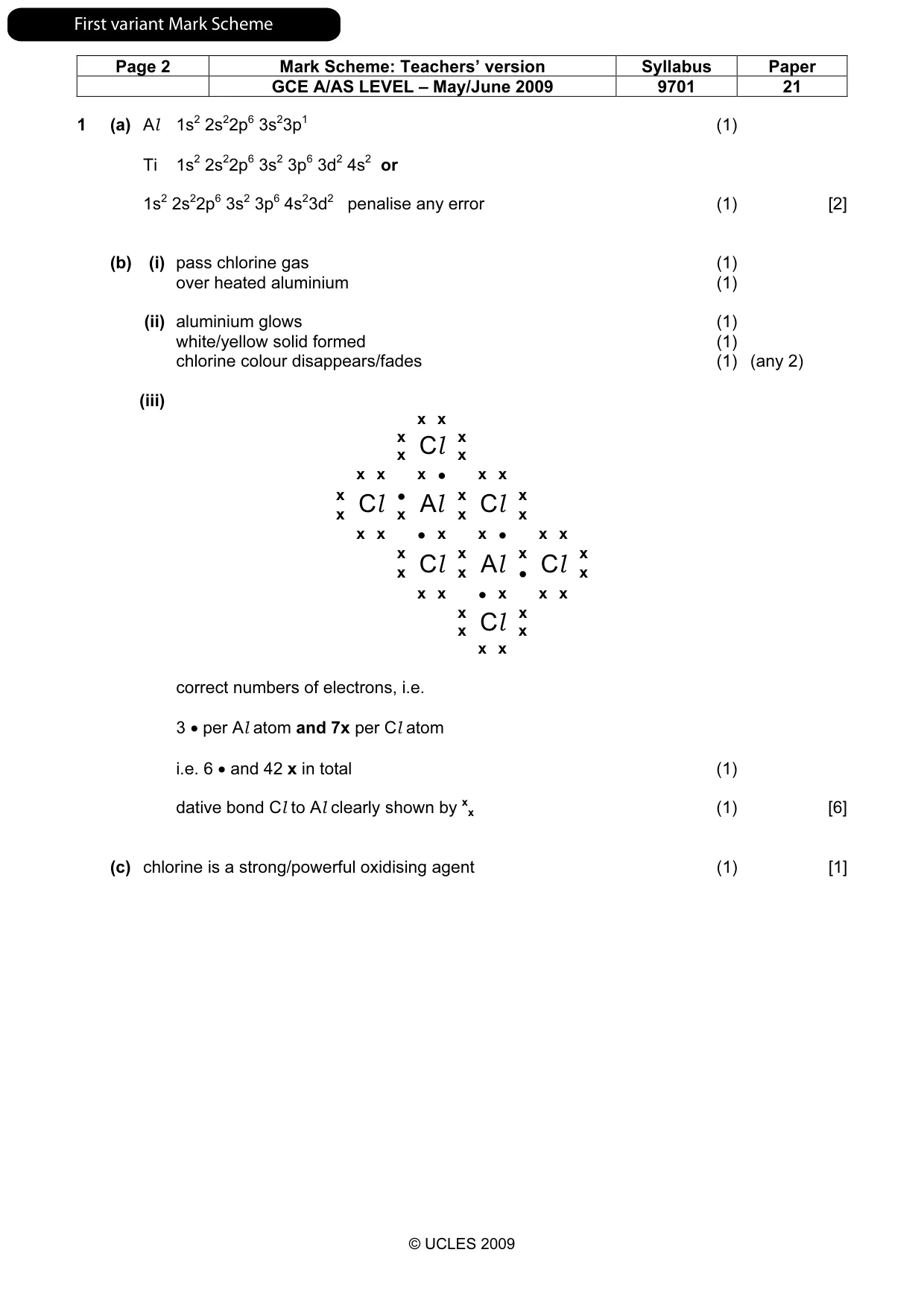
Page 2 Mark Scheme: Teachers’ version Syllabus Paper GCE A/AS LEVEL – May/June 2009 9701 21 © UCLES 2009 1 (a) Al 1s2 2s22p6 3s23p1 (1) Ti 1s2 2s22p6 3s2 3p6 3d2 4s2 or 1s2 2s22p6 3s2 3p6 4s23d2 penalise any error (1) [2] (b) (i) pass chlorine gas (1) over heated aluminium (1) (ii) aluminium glows (1) white/yellow solid formed (1) chlorine colour disappears/fades (1) (any 2) (iii) x x x x x Cl x x x x • x x x • x x x Cl x Al x Cl x x x • x x • x x x x x x x Cl x Al • Cl x x x • x x x x x x Cl x x x correct numbers of electrons, i.e. 3 • per Al atom and 7x per Cl atom i.e. 6 • and 42 x in total (1) dative bond Cl to Al clearly shown by x x (1) [6] (c) chlorine is a strong/powerful oxidising agent (1) [1] First variant Mark Scheme
Mark scheme, page 4
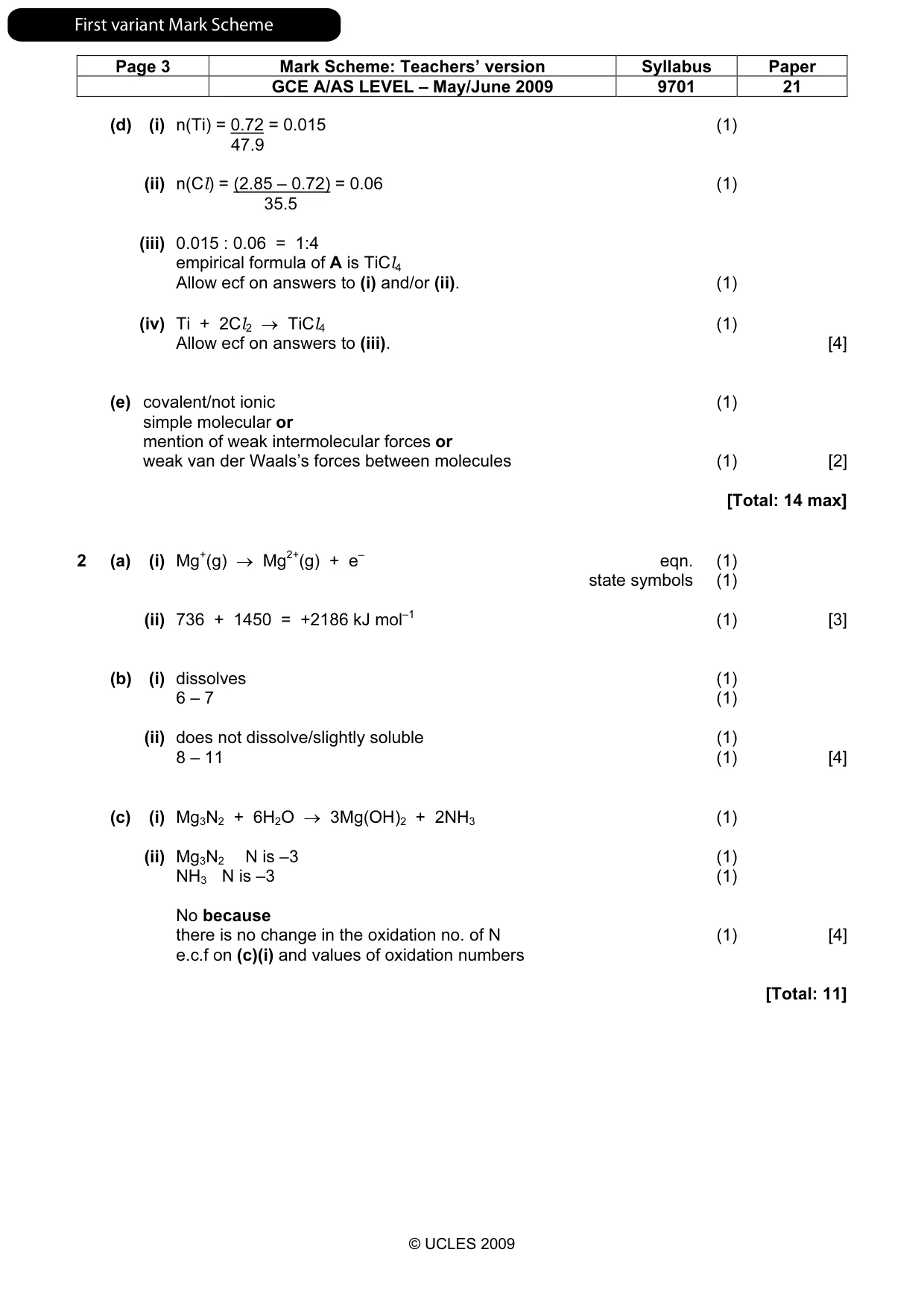
Page 3 Mark Scheme: Teachers’ version Syllabus Paper GCE A/AS LEVEL – May/June 2009 9701 21 © UCLES 2009 (d) (i) n(Ti) = 0.72 = 0.015 (1) 47.9 (ii) n(Cl) = (2.85 – 0.72) = 0.06 (1) 35.5 (iii) 0.015 : 0.06 = 1:4 empirical formula of A is TiCl4 Allow ecf on answers to (i) and/or (ii). (1) (iv) Ti + 2Cl2 → TiCl4 (1) Allow ecf on answers to (iii). [4] (e) covalent/not ionic (1) simple molecular or mention of weak intermolecular forces or weak van der Waals’s forces between molecules (1) [2] [Total: 14 max] 2 (a) (i) Mg+(g) → Mg2+(g) + e– eqn. (1) state symbols (1) (ii) 736 + 1450 = +2186 kJ mol–1 (1) [3] (b) (i) dissolves (1) 6 – 7 (1) (ii) does not dissolve/slightly soluble (1) 8 – 11 (1) [4] (c) (i) Mg3N2 + 6H2O → 3Mg(OH)2 + 2NH3 (1) (ii) Mg3N2 N is –3 (1) NH3 N is –3 (1) No because there is no change in the oxidation no. of N (1) [4] e.c.f on (c)(i) and values of oxidation numbers [Total: 11] First variant Mark Scheme
Mark scheme, page 5
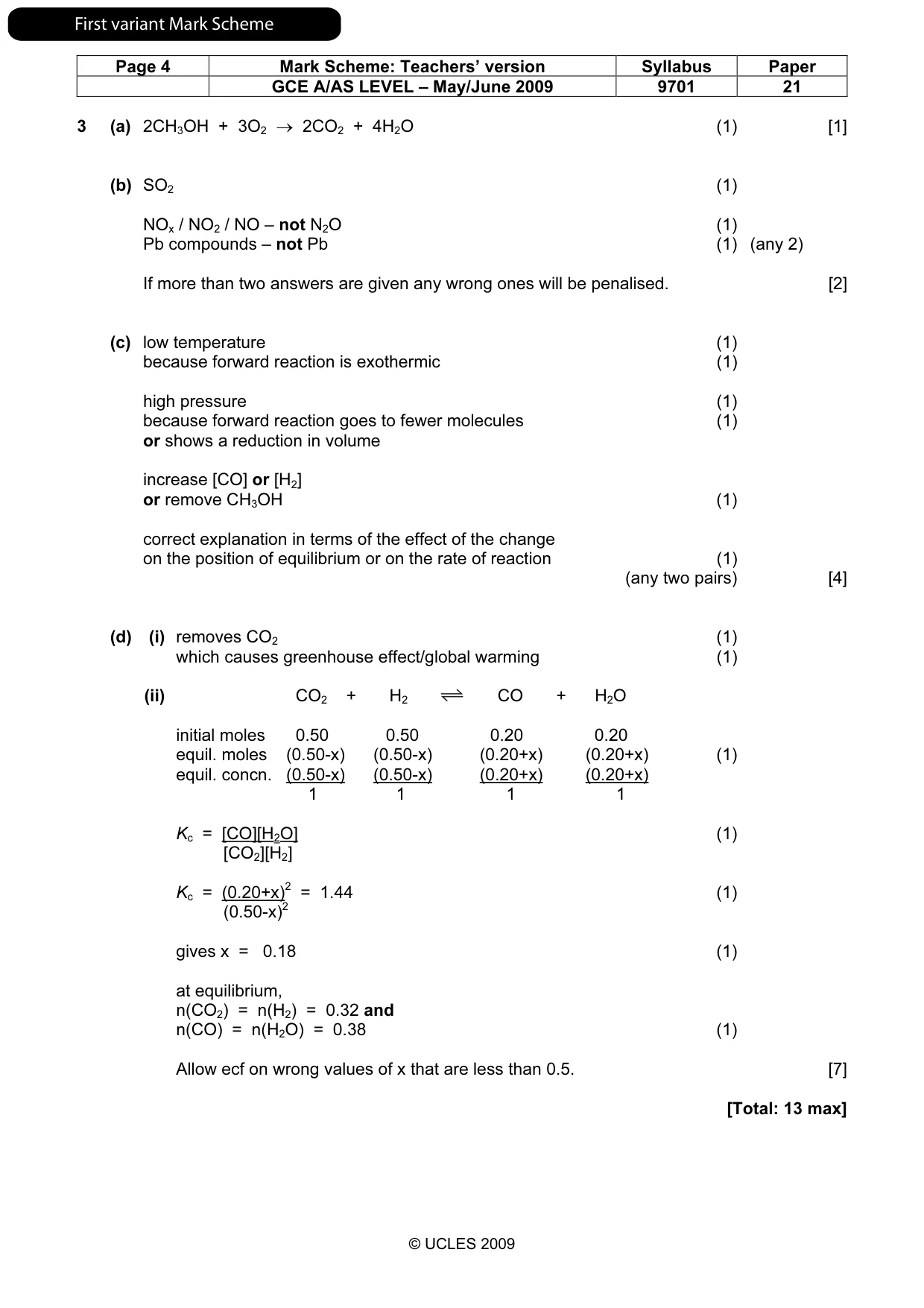
Page 4 Mark Scheme: Teachers’ version Syllabus Paper GCE A/AS LEVEL – May/June 2009 9701 21 © UCLES 2009 3 (a) 2CH3OH + 3O2 → 2CO2 + 4H2O (1) [1] (b) SO2 (1) NOx / NO2 / NO – not N2O (1) Pb compounds – not Pb (1) (any 2) If more than two answers are given any wrong ones will be penalised. [2] (c) low temperature (1) because forward reaction is exothermic (1) high pressure (1) because forward reaction goes to fewer molecules (1) or shows a reduction in volume increase [CO] or [H2] or remove CH3OH (1) correct explanation in terms of the effect of the change on the position of equilibrium or on the rate of reaction (1) (any two pairs) [4] (d) (i) removes CO2 (1) which causes greenhouse effect/global warming (1) (ii) CO2 + H2 CO + H2O initial moles 0.50 0.50 0.20 0.20 equil. moles (0.50-x) (0.50-x) (0.20+x) (0.20+x) (1) equil. concn. (0.50-x) (0.50-x) (0.20+x) (0.20+x) 1 1 1 1 Kc = [CO][H2O] (1) [CO2][H2] Kc = (0.20+x)2 = 1.44 (1) (0.50-x)2 gives x = 0.18 (1) at equilibrium, n(CO2) = n(H2) = 0.32 and n(CO) = n(H2O) = 0.38 (1) Allow ecf on wrong values of x that are less than 0.5. [7] [Total: 13 max] First variant Mark Scheme
Mark scheme, page 6
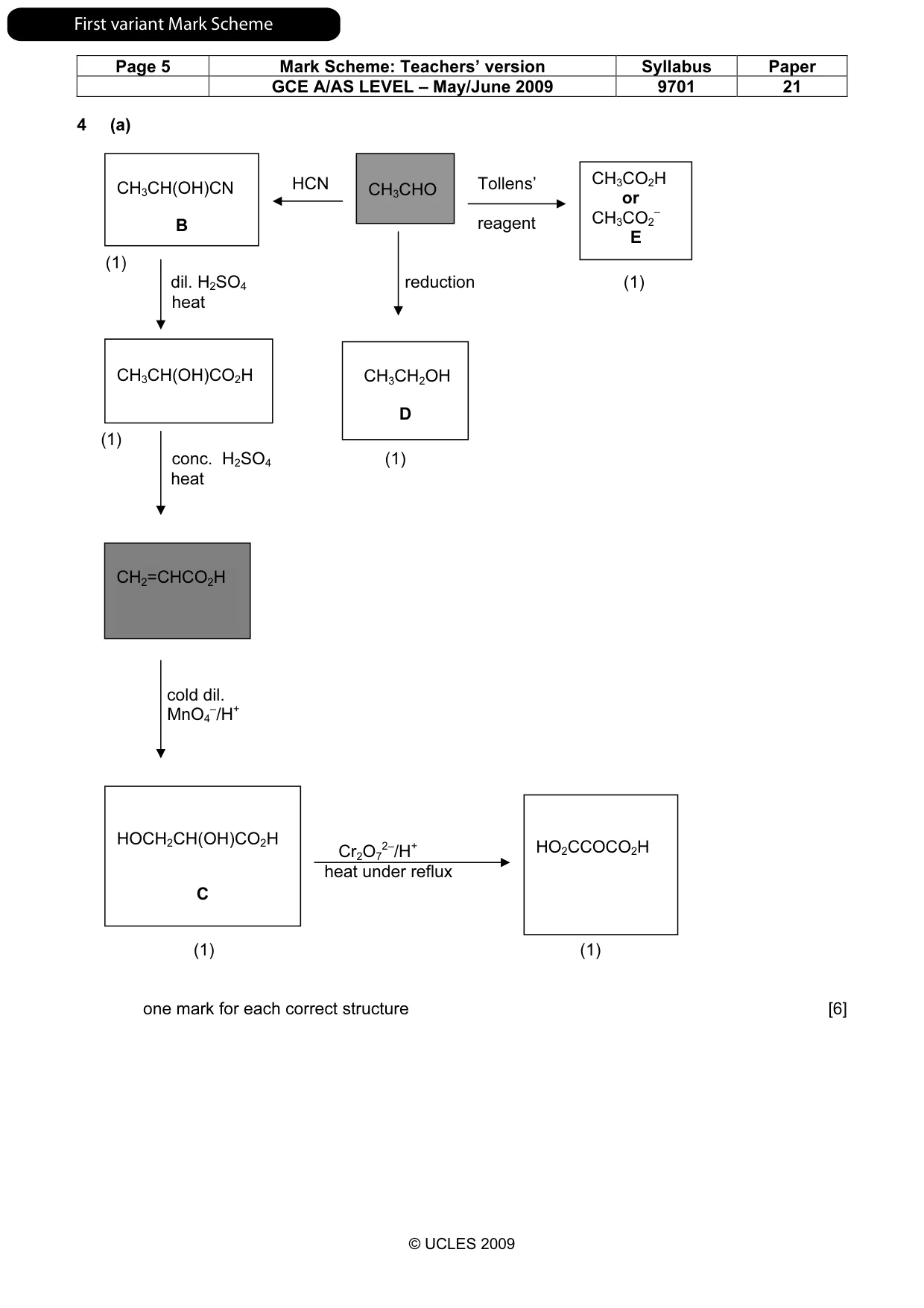
Page 5 Mark Scheme: Teachers’ version Syllabus Paper GCE A/AS LEVEL – May/June 2009 9701 21 © UCLES 2009 4 (a) HCN Tollens’ reagent (1) dil. H2SO4 reduction (1) heat (1) (1) conc. H2SO4 (1) heat dil. cold dil. MnO4 –/H+ Cr2O7 2–/H+ heat under reflux (1) (1) one mark for each correct structure [6] CH3CHO CH3CH(OH)CN B CH3CO2H or CH3CO2 – E CH3CH(OH)CO2H CH3CH2OH D CH2=CHCO2H HOCH2CH(OH)CO2H C HO2CCOCO2H First variant Mark Scheme
Mark scheme, page 7
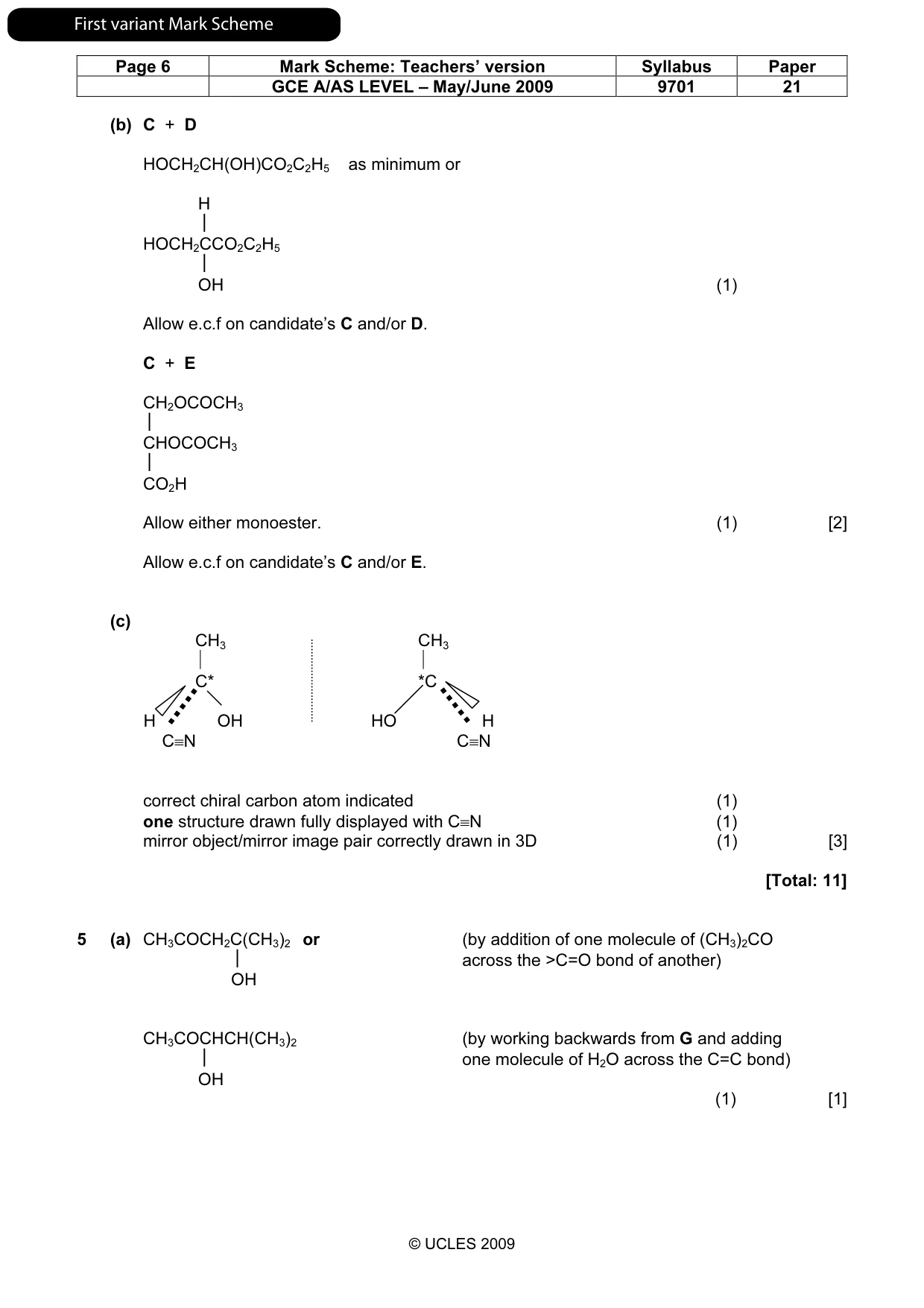
Page 6 Mark Scheme: Teachers’ version Syllabus Paper GCE A/AS LEVEL – May/June 2009 9701 21 © UCLES 2009 (b) C + D HOCH2CH(OH)CO2C2H5 as minimum or H HOCH2CCO2C2H5 OH (1) Allow e.c.f on candidate’s C and/or D. C + E CH2OCOCH3 CHOCOCH3 CO2H Allow either monoester. (1) [2] Allow e.c.f on candidate’s C and/or E. (c) CH3 CH3 C* *C H OH HO H C≡N C≡N correct chiral carbon atom indicated (1) one structure drawn fully displayed with C≡N (1) mirror object/mirror image pair correctly drawn in 3D (1) [3] [Total: 11] 5 (a) CH3COCH2C(CH3)2 or (by addition of one molecule of (CH3)2CO across the >C=O bond of another) OH CH3COCHCH(CH3)2 (by working backwards from G and adding one molecule of H2O across the C=C bond) OH (1) [1] First variant Mark Scheme
Mark scheme, page 8
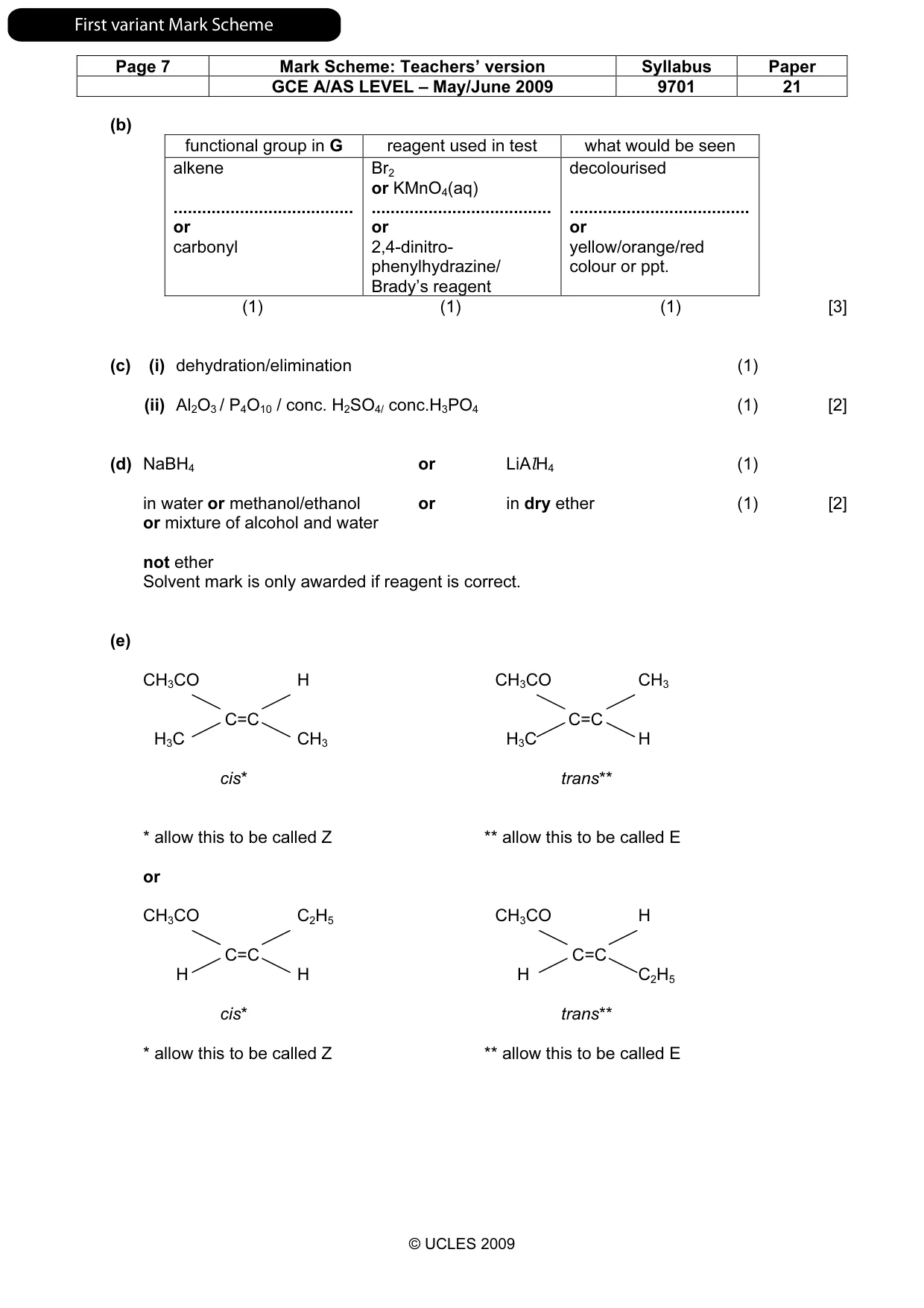
Page 7 Mark Scheme: Teachers’ version Syllabus Paper GCE A/AS LEVEL – May/June 2009 9701 21 © UCLES 2009 (b) functional group in G reagent used in test what would be seen alkene … or carbonyl Br2 or KMnO4(aq) … or 2,4-dinitro- phenylhydrazine/ Brady’s reagent decolourised … or yellow/orange/red colour or ppt. (1) (1) (1) [3] (c) (i) dehydration/elimination (1) (ii) Al2O3 / P4O10 / conc. H2SO4/ conc.H3PO4 (1) [2] (d) NaBH4 or LiAlH4 (1) in water or methanol/ethanol or in dry ether (1) [2] or mixture of alcohol and water not ether Solvent mark is only awarded if reagent is correct. (e) CH3CO H CH3CO CH3 C=C C=C H3C CH3 H3C H cis* trans** * allow this to be called Z ** allow this to be called E or CH3CO C2H5 CH3CO H C=C C=C H H H C2H5 cis* trans** * allow this to be called Z ** allow this to be called E First variant Mark Scheme
Mark scheme, page 9
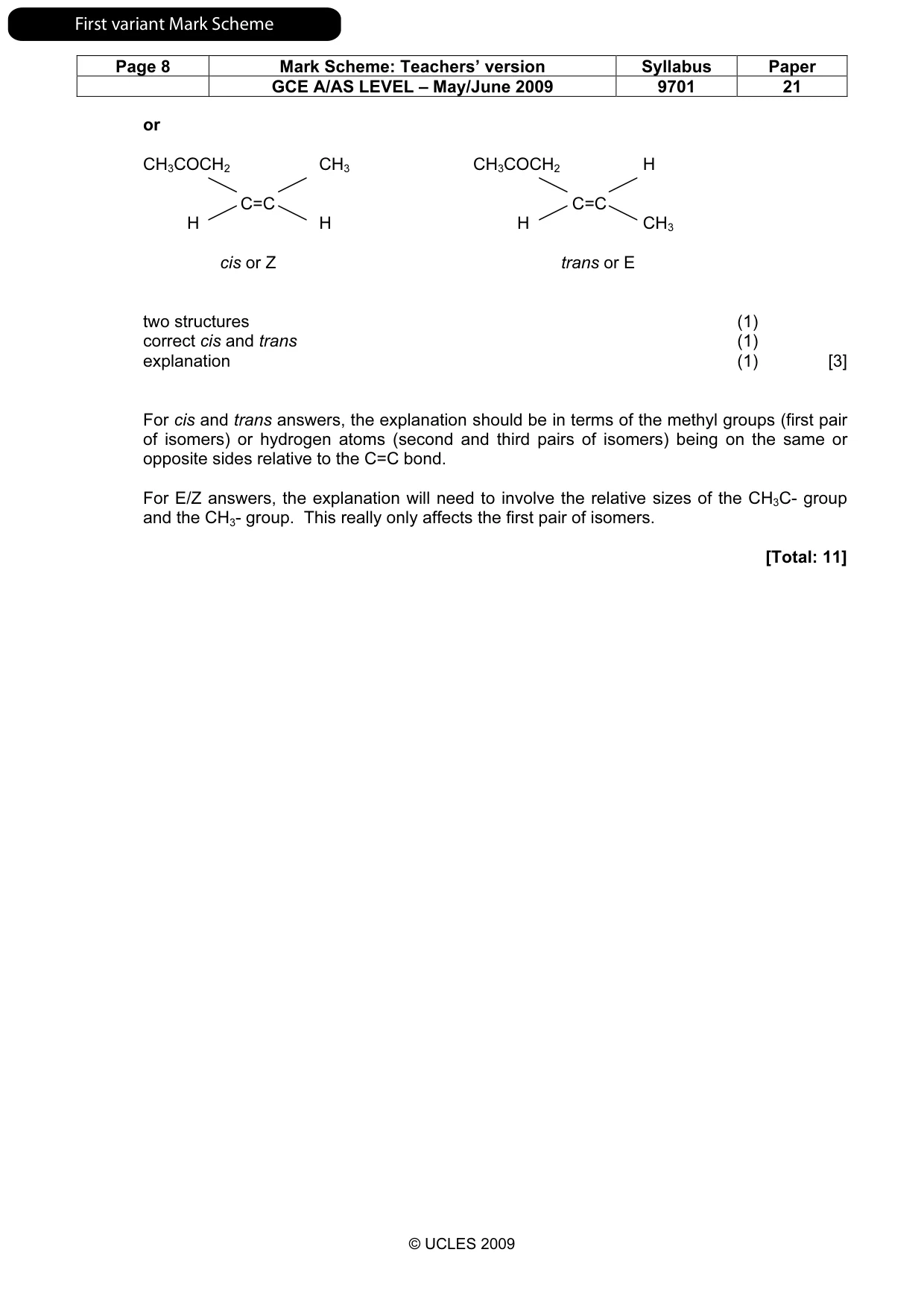
Page 8 Mark Scheme: Teachers’ version Syllabus Paper GCE A/AS LEVEL – May/June 2009 9701 21 © UCLES 2009 or CH3COCH2 CH3 CH3COCH2 H C=C C=C H H H CH3 cis or Z trans or E two structures (1) correct cis and trans (1) explanation (1) [3] For cis and trans answers, the explanation should be in terms of the methyl groups (first pair of isomers) or hydrogen atoms (second and third pairs of isomers) being on the same or opposite sides relative to the C=C bond. For E/Z answers, the explanation will need to involve the relative sizes of the CH3C- group and the CH3- group. This really only affects the first pair of isomers. [Total: 11] First variant Mark Scheme
Mark scheme, page 10
UNIVERSITY OF CAMBRIDGE INTERNATIONAL EXAMINATIONS GCE Advanced Subsidiary Level and GCE Advanced Level MARK SCHEME for the May/June 2009 question paper for the guidance of teachers 9701 CHEMISTRY 9701/22 Paper 22 (AS Structured Questions), maximum raw mark 60 This mark scheme is published as an aid to teachers and candidates, to indicate the requirements of the examination. It shows the basis on which Examiners were instructed to award marks. It does not indicate the details of the discussions that took place at an Examiners’ meeting before marking began, which would have considered the acceptability of alternative answers. Mark schemes must be read in conjunction with the question papers and the report on the examination. • CIE will not enter into discussions or correspondence in connection with these mark schemes. CIE is publishing the mark schemes for the May/June 2009 question papers for most IGCSE, GCE Advanced Level and Advanced Subsidiary Level syllabuses and some Ordinary Level syllabuses. Second variant Mark Scheme
Mark scheme, page 11
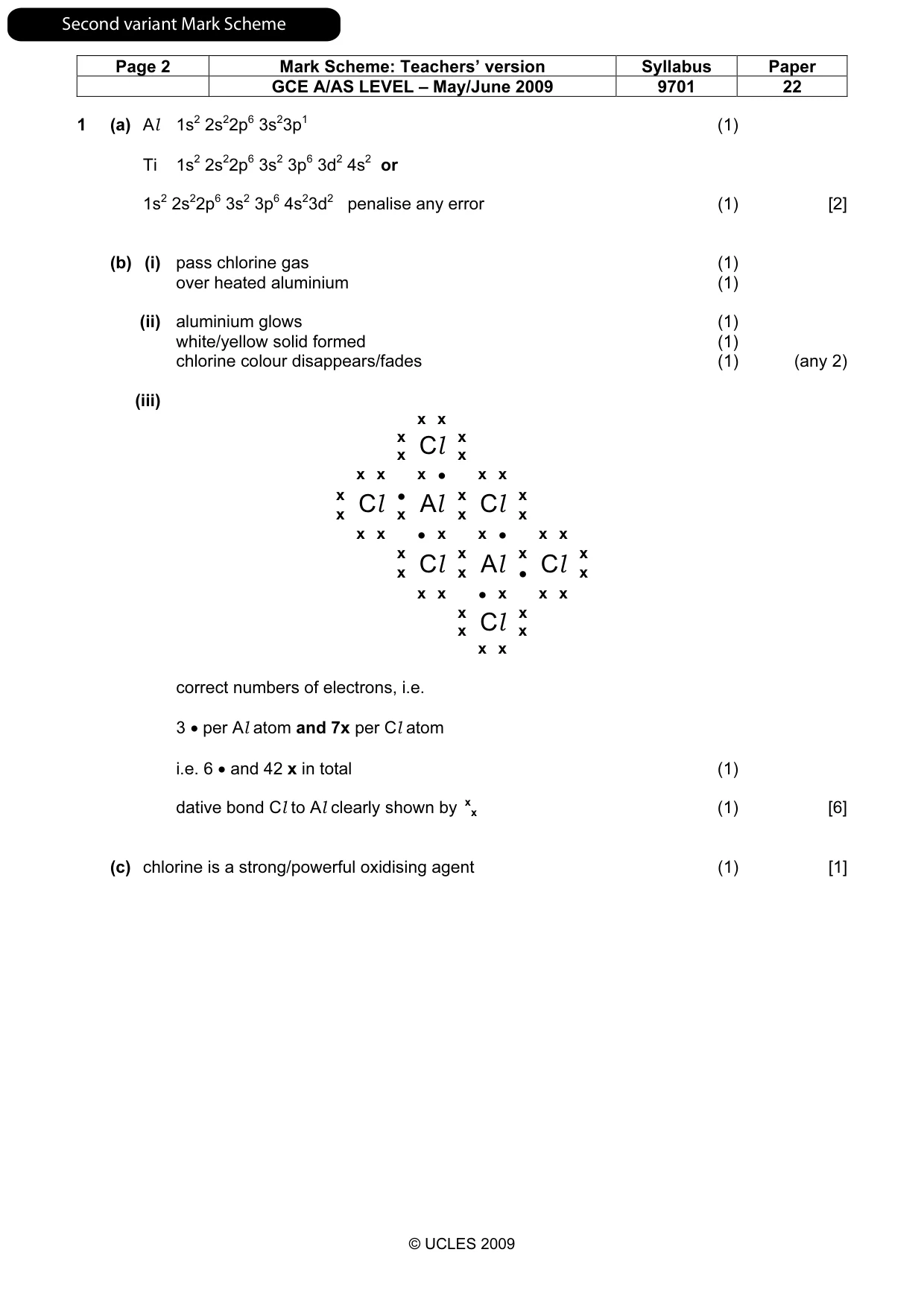
Page 2 Mark Scheme: Teachers’ version Syllabus Paper GCE A/AS LEVEL – May/June 2009 9701 22 © UCLES 2009 1 (a) Al 1s2 2s22p6 3s23p1 (1) Ti 1s2 2s22p6 3s2 3p6 3d2 4s2 or 1s2 2s22p6 3s2 3p6 4s23d2 penalise any error (1) [2] (b) (i) pass chlorine gas (1) over heated aluminium (1) (ii) aluminium glows (1) white/yellow solid formed (1) chlorine colour disappears/fades (1) (any 2) (iii) x x x x x Cl x x x x • x x x • x x x Cl x Al x Cl x x x • x x • x x x x x x x Cl x Al • Cl x x x • x x x x x x Cl x x x correct numbers of electrons, i.e. 3 • per Al atom and 7x per Cl atom i.e. 6 • and 42 x in total (1) dative bond Cl to Al clearly shown by x x (1) [6] (c) chlorine is a strong/powerful oxidising agent (1) [1] Second variant Mark Scheme
Mark scheme, page 12
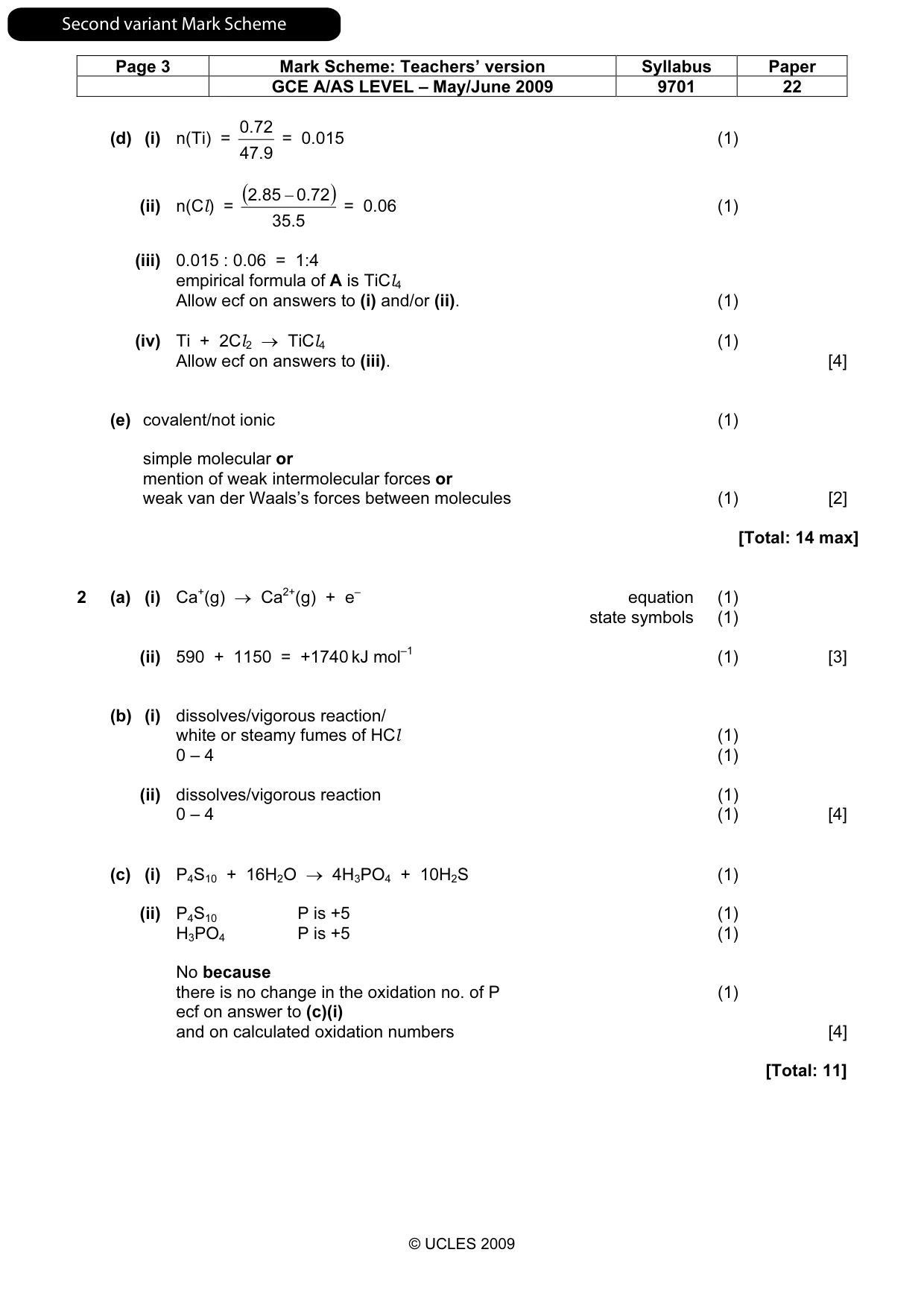
Page 3 Mark Scheme: Teachers’ version Syllabus Paper GCE A/AS LEVEL – May/June 2009 9701 22 © UCLES 2009 (d) (i) n(Ti) = 47.9 0.72 = 0.015 (1) (ii) n(Cl) = ( ) 35.5 0.72 2.85 − = 0.06 (1) (iii) 0.015 : 0.06 = 1:4 empirical formula of A is TiCl4 Allow ecf on answers to (i) and/or (ii). (1) (iv) Ti + 2Cl2 → TiCl4 (1) Allow ecf on answers to (iii). [4] (e) covalent/not ionic (1) simple molecular or mention of weak intermolecular forces or weak van der Waals’s forces between molecules (1) [2] [Total: 14 max] 2 (a) (i) Ca+(g) → Ca2+(g) + e– equation (1) state symbols (1) (ii) 590 + 1150 = +1740 kJ mol–1 (1) [3] (b) (i) dissolves/vigorous reaction/ white or steamy fumes of HCl (1) 0 – 4 (1) (ii) dissolves/vigorous reaction (1) 0 – 4 (1) [4] (c) (i) P4S10 + 16H2O → 4H3PO4 + 10H2S (1) (ii) P4S10 P is +5 (1) H3PO4 P is +5 (1) No because there is no change in the oxidation no. of P (1) ecf on answer to (c)(i) and on calculated oxidation numbers [4] [Total: 11] Second variant Mark Scheme
Mark scheme, page 13
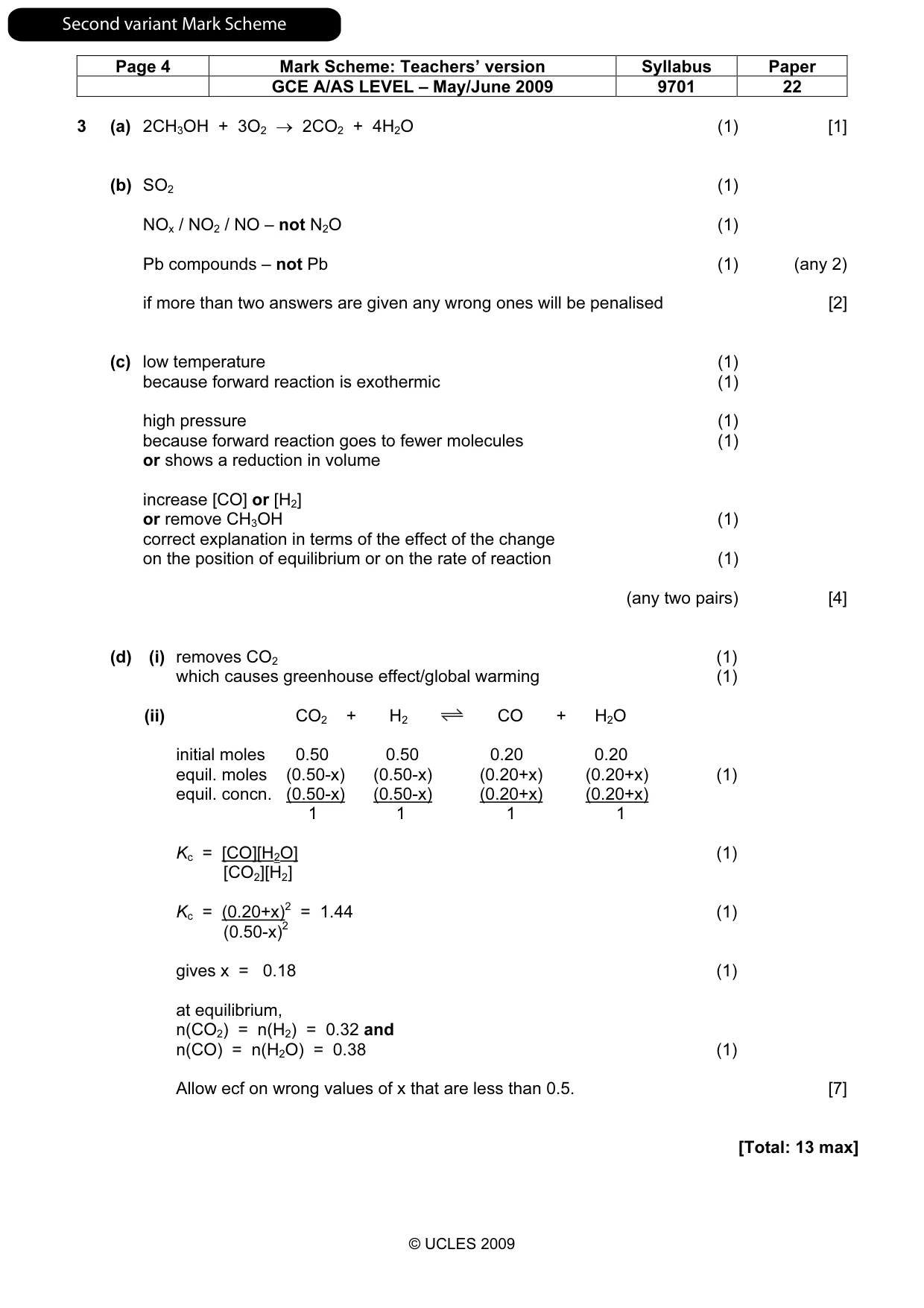
Page 4 Mark Scheme: Teachers’ version Syllabus Paper GCE A/AS LEVEL – May/June 2009 9701 22 © UCLES 2009 3 (a) 2CH3OH + 3O2 → 2CO2 + 4H2O (1) [1] (b) SO2 (1) NOx / NO2 / NO – not N2O (1) Pb compounds – not Pb (1) (any 2) if more than two answers are given any wrong ones will be penalised [2] (c) low temperature (1) because forward reaction is exothermic (1) high pressure (1) because forward reaction goes to fewer molecules (1) or shows a reduction in volume increase [CO] or [H2] or remove CH3OH (1) correct explanation in terms of the effect of the change on the position of equilibrium or on the rate of reaction (1) (any two pairs) [4] (d) (i) removes CO2 (1) which causes greenhouse effect/global warming (1) (ii) CO2 + H2 CO + H2O initial moles 0.50 0.50 0.20 0.20 equil. moles (0.50-x) (0.50-x) (0.20+x) (0.20+x) (1) equil. concn. (0.50-x) (0.50-x) (0.20+x) (0.20+x) 1 1 1 1 Kc = [CO][H2O] (1) [CO2][H2] Kc = (0.20+x)2 = 1.44 (1) (0.50-x)2 gives x = 0.18 (1) at equilibrium, n(CO2) = n(H2) = 0.32 and n(CO) = n(H2O) = 0.38 (1) Allow ecf on wrong values of x that are less than 0.5. [7] [Total: 13 max] Second variant Mark Scheme
Mark scheme, page 14
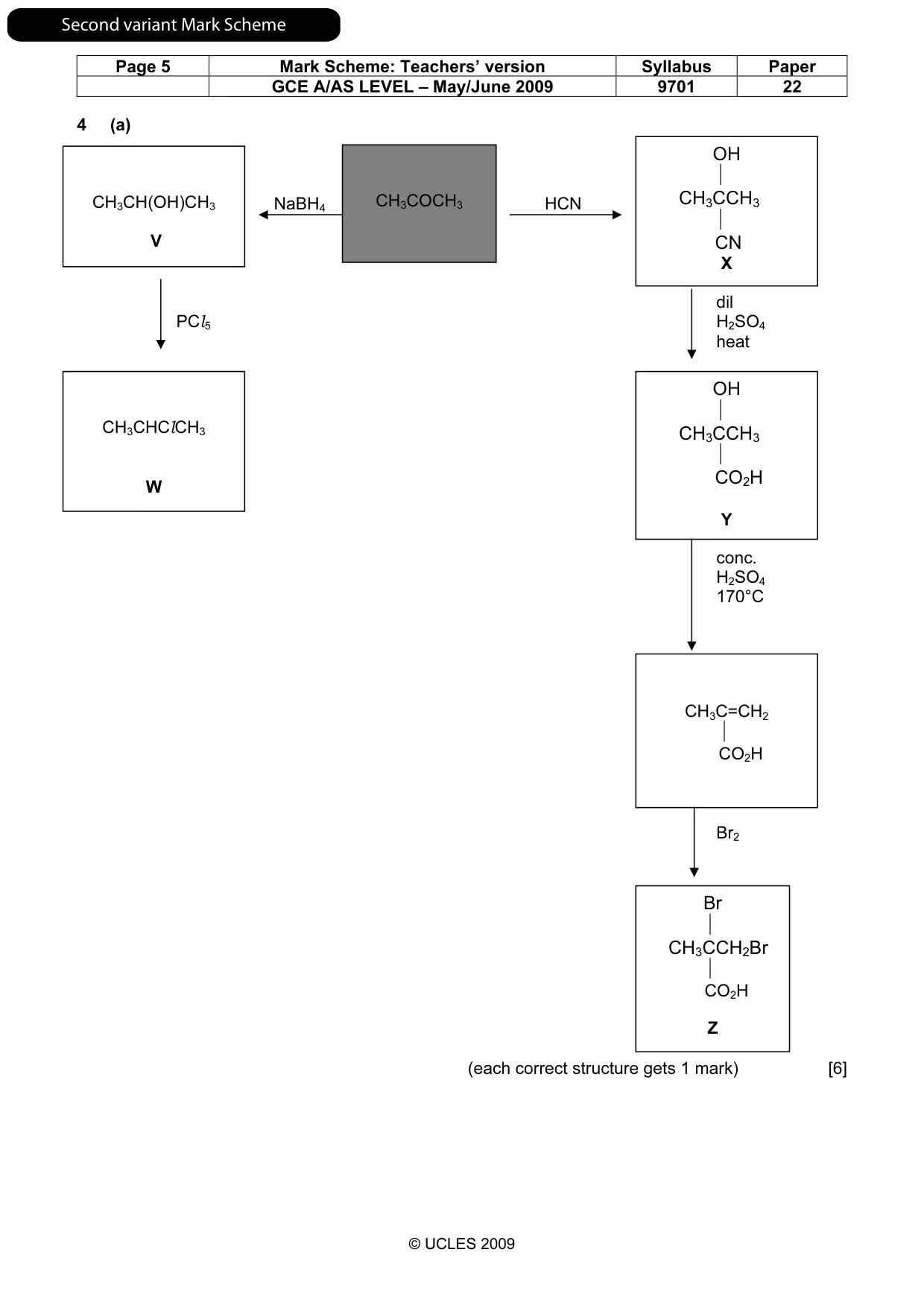
Page 5 Mark Scheme: Teachers’ version Syllabus Paper GCE A/AS LEVEL – May/June 2009 9701 22 © UCLES 2009 4 (a) NaBH4 HCN dil PCl5 H2SO4 heat CCCCCCC conc. H2SO4 170°C Br2 (each correct structure gets 1 mark) [6] CH3COCH3 CH3CH(OH)CH3 V OH CH3CCH3 CN X CH3CHClCH3 W CH3C=CH2 CO2H Br CH3CCH2Br CO2H Z OH CH3CCH3 CO2H Y Second variant Mark Scheme
Mark scheme, page 15
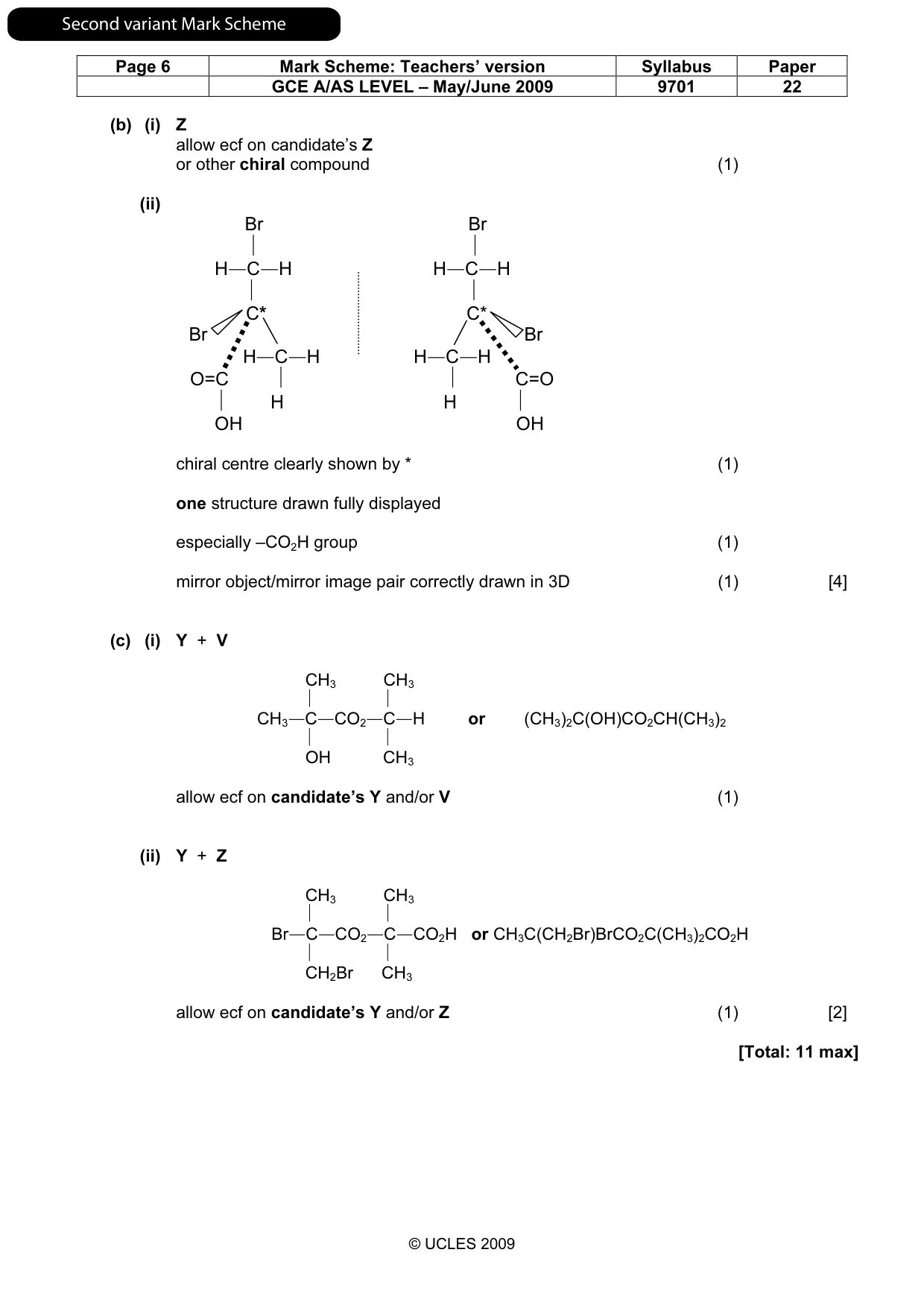
Page 6 Mark Scheme: Teachers’ version Syllabus Paper GCE A/AS LEVEL – May/June 2009 9701 22 © UCLES 2009 (b) (i) Z allow ecf on candidate’s Z or other chiral compound (1) (ii) Br Br H—C—H H—C—H C* C* Br Br H—C—H H—C—H O=C C=O H H OH OH chiral centre clearly shown by * (1) one structure drawn fully displayed especially –CO2H group (1) mirror object/mirror image pair correctly drawn in 3D (1) [4] (c) (i) Y + V CH3 CH3 CH3—C—CO2—C—H or (CH3)2C(OH)CO2CH(CH3)2 OH CH3 allow ecf on candidate’s Y and/or V (1) (ii) Y + Z CH3 CH3 Br—C—CO2—C—CO2H or CH3C(CH2Br)BrCO2C(CH3)2CO2H CH2Br CH3 allow ecf on candidate’s Y and/or Z (1) [2] [Total: 11 max] Second variant Mark Scheme
Mark scheme, page 16
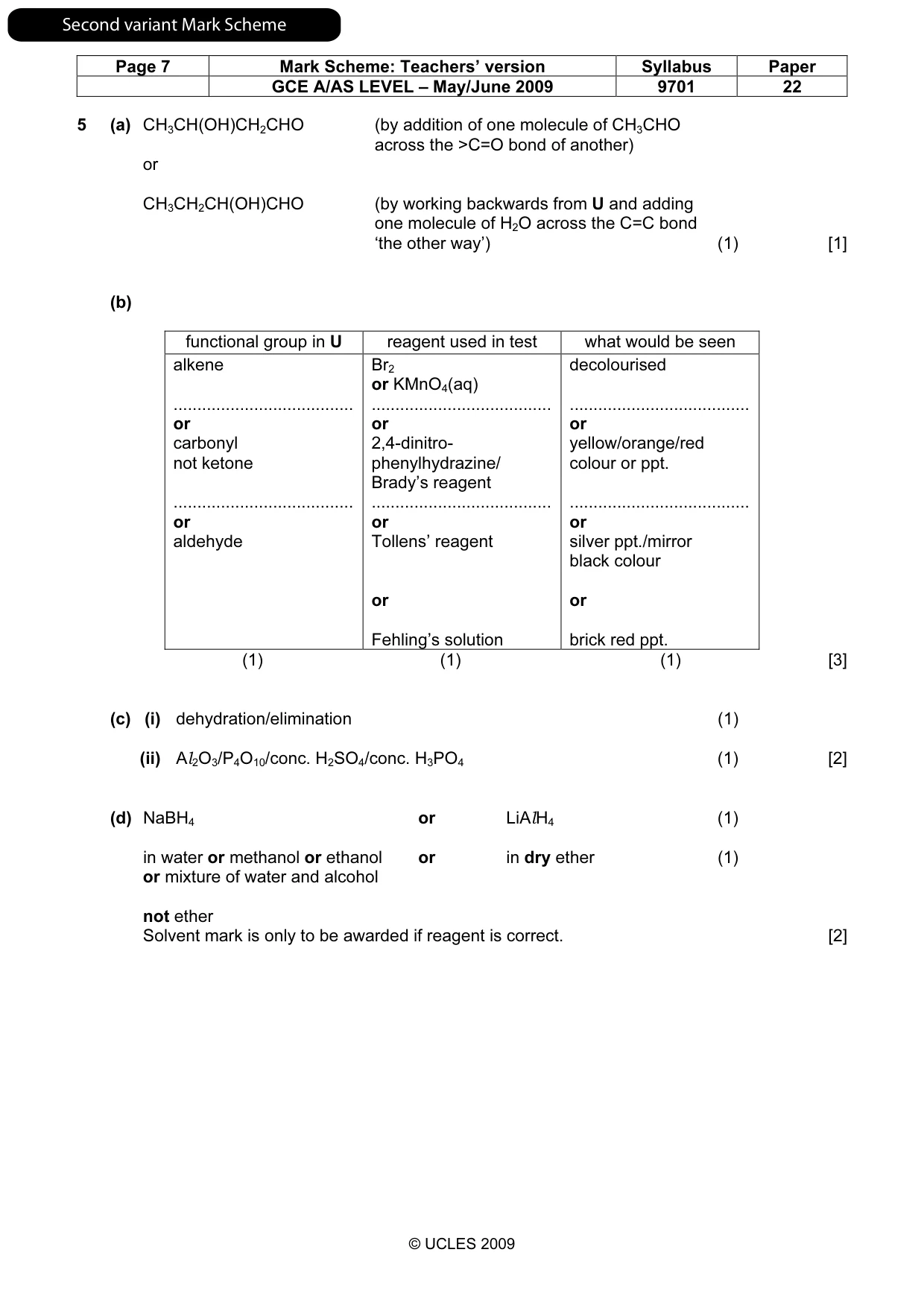
Page 7 Mark Scheme: Teachers’ version Syllabus Paper GCE A/AS LEVEL – May/June 2009 9701 22 © UCLES 2009 5 (a) CH3CH(OH)CH2CHO (by addition of one molecule of CH3CHO across the >C=O bond of another) or CH3CH2CH(OH)CHO (by working backwards from U and adding one molecule of H2O across the C=C bond ‘the other way’) (1) [1] (b) functional group in U reagent used in test what would be seen alkene … or carbonyl not ketone … or aldehyde Br2 or KMnO4(aq) … or 2,4-dinitro- phenylhydrazine/ Brady’s reagent … or Tollens’ reagent or Fehling’s solution decolourised … or yellow/orange/red colour or ppt. … or silver ppt./mirror black colour or brick red ppt. (1) (1) (1) [3] (c) (i) dehydration/elimination (1) (ii) Al2O3/P4O10/conc. H2SO4/conc. H3PO4 (1) [2] (d) NaBH4 or LiAlH4 (1) in water or methanol or ethanol or in dry ether (1) or mixture of water and alcohol not ether Solvent mark is only to be awarded if reagent is correct. [2] Second variant Mark Scheme
Mark scheme, page 17
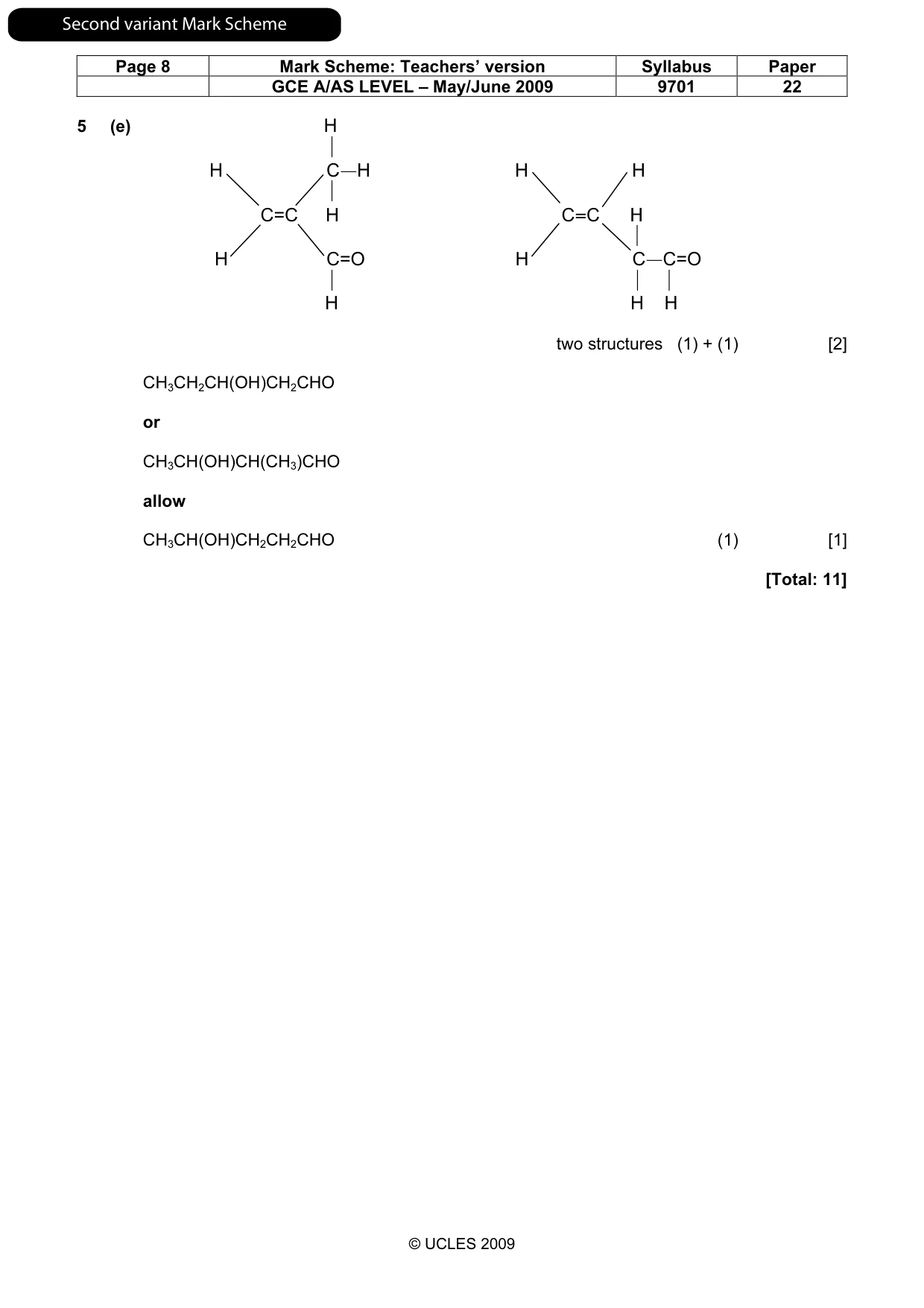
Page 8 Mark Scheme: Teachers’ version Syllabus Paper GCE A/AS LEVEL – May/June 2009 9701 22 © UCLES 2009 5 (e) H H C—H H H C=C H C=C H H C=O H C—C=O H H H two structures (1) + (1) [2] CH3CH2CH(OH)CH2CHO or CH3CH(OH)CH(CH3)CHO allow CH3CH(OH)CH2CH2CHO (1) [1] [Total: 11] Second variant Mark Scheme