Cambridge A Level Chemistry 9701 — 2008 Oct/Nov Paper 2 · Variant 1
9701/21/O/N/08 · 60 marks · ≈68 min
The question paper and its mark scheme, free to read here and free to download. This is Cambridge’s own paper, exactly as it was sat.
Question paper12 pages

Mark scheme5 pages
Answers below. Sit the paper first if you are practising.
Paper as text
Question paper, page 1
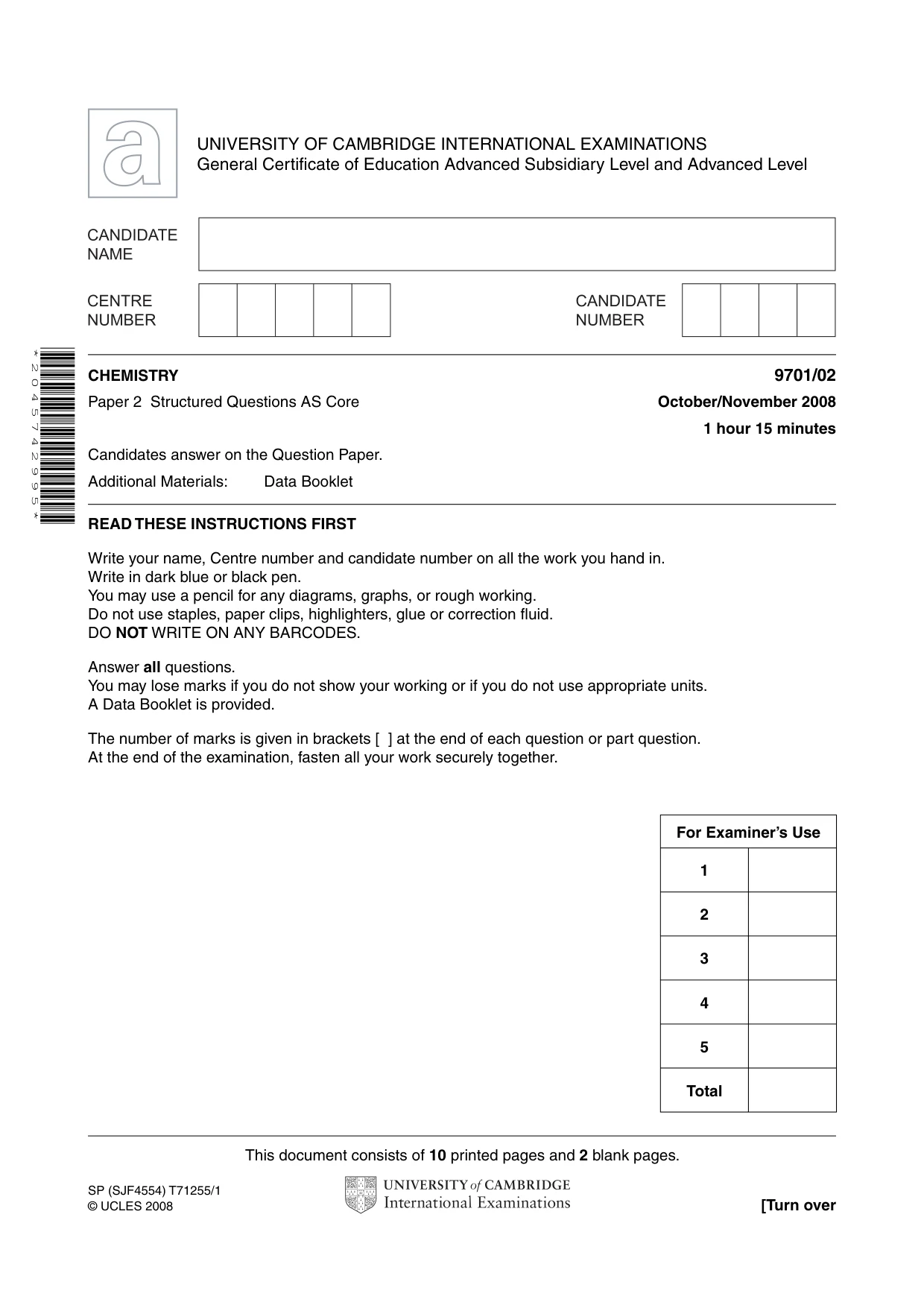
This document consists of 10 printed pages and 2 blank pages. SP (SJF4554) T71255/1 © UCLES 2008 [Turn over UNIVERSITY OF CAMBRIDGE INTERNATIONAL EXAMINATIONS General Certificate of Education Advanced Subsidiary Level and Advanced Level READ THESE INSTRUCTIONS FIRST Write your name, Centre number and candidate number on all the work you hand in. Write in dark blue or black pen. You may use a pencil for any diagrams, graphs, or rough working. Do not use staples, paper clips, highlighters, glue or correction fluid. DO NOT WRITE ON ANY BARCODES. Answer all questions. You may lose marks if you do not show your working or if you do not use appropriate units. A Data Booklet is provided. The number of marks is given in brackets [ ] at the end of each question or part question. At the end of the examination, fasten all your work securely together. * 2 0 4 5 7 4 2 9 9 5 * CHEMISTRY 9701/02 Paper 2 Structured Questions AS Core October/November 2008 1 hour 15 minutes Candidates answer on the Question Paper. Additional Materials: Data Booklet For Examiner’s Use 1 2 3 4 5 Total
Question paper, page 2
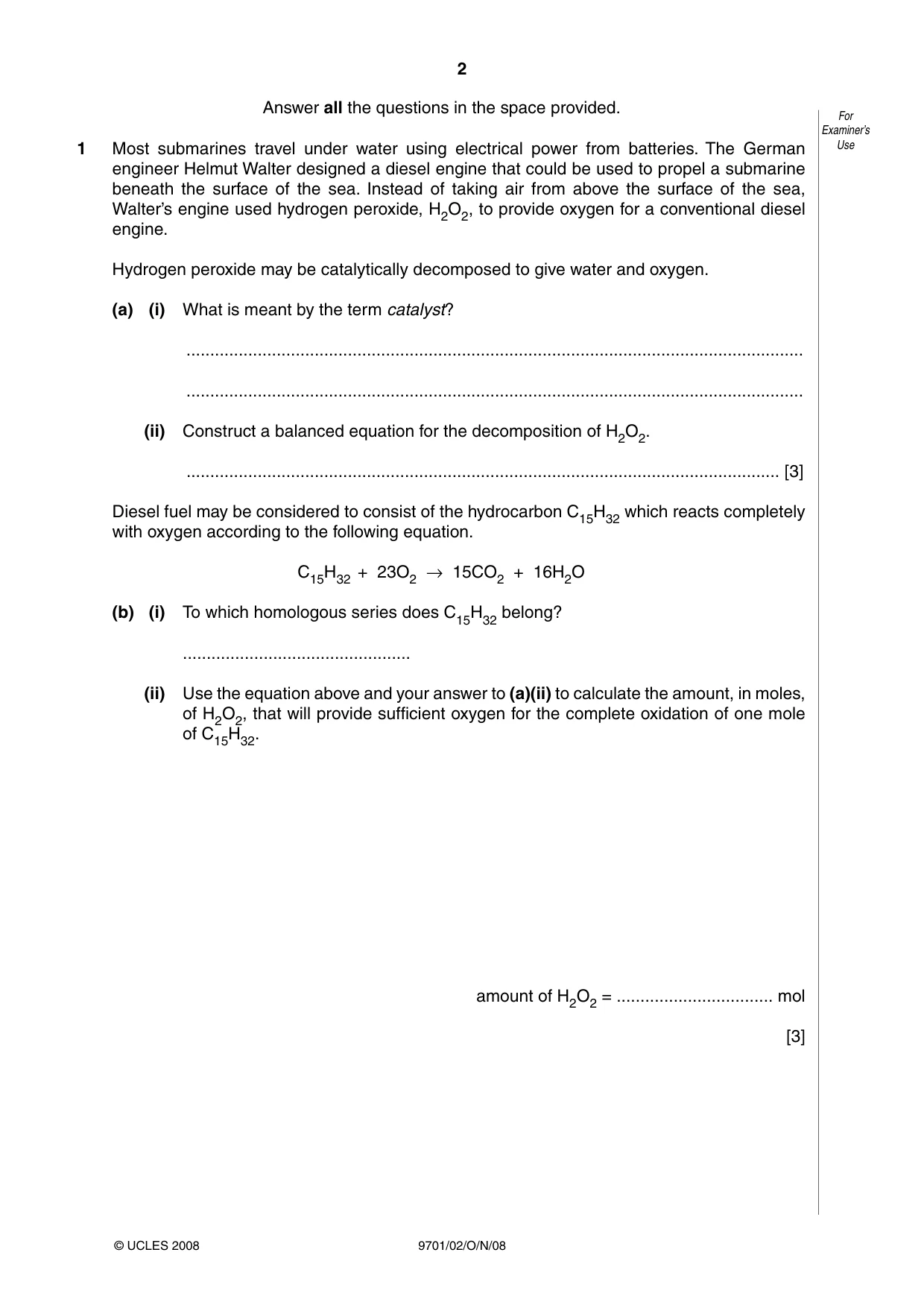
2 9701/02/O/N/08 For Examiner’s Use © UCLES 2008 Answer all the questions in the space provided. 1 Most submarines travel under water using electrical power from batteries. The German engineer Helmut Walter designed a diesel engine that could be used to propel a submarine beneath the surface of the sea. Instead of taking air from above the surface of the sea, Walter’s engine used hydrogen peroxide, H2O2, to provide oxygen for a conventional diesel engine. Hydrogen peroxide may be catalytically decomposed to give water and oxygen. (a) (i) What is meant by the term catalyst? … … (ii) Construct a balanced equation for the decomposition of H2O2. … [3] Diesel fuel may be considered to consist of the hydrocarbon C15H32 which reacts completely with oxygen according to the following equation. C15H32 + 23O2 → 15CO2 + 16H2O (b) (i) To which homologous series does C15H32 belong? … (ii) Use the equation above and your answer to (a)(ii) to calculate the amount, in moles, of H2O2, that will provide sufficient oxygen for the complete oxidation of one mole of C15H32. amount of H2O2 = … mol [3]
Question paper, page 3
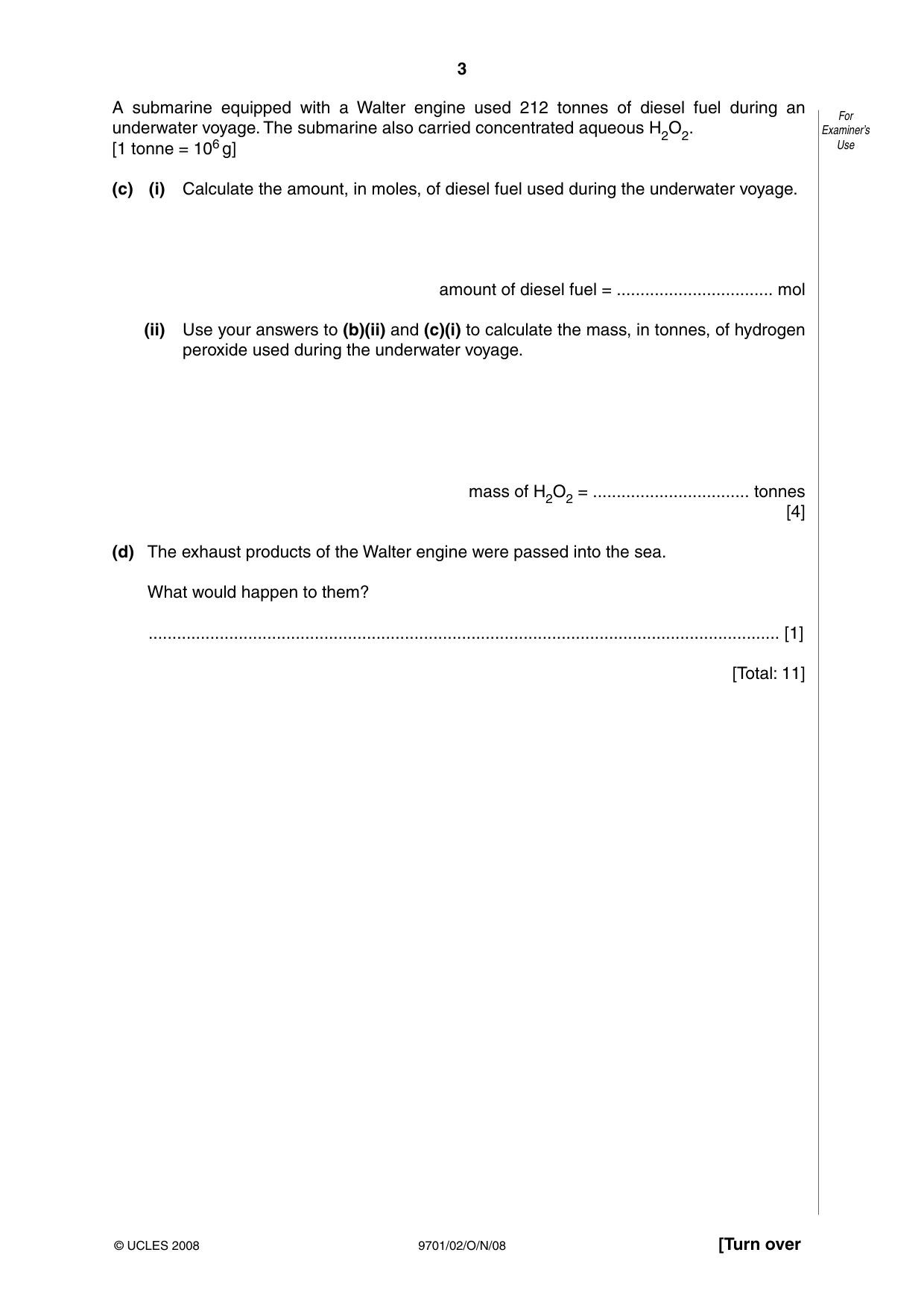
3 9701/02/O/N/08 [Turn over For Examiner’s Use © UCLES 2008 A submarine equipped with a Walter engine used 212 tonnes of diesel fuel during an underwater voyage. The submarine also carried concentrated aqueous H2O2. [1 tonne = 106g] (c) (i) Calculate the amount, in moles, of diesel fuel used during the underwater voyage. amount of diesel fuel = … mol (ii) Use your answers to (b)(ii) and (c)(i) to calculate the mass, in tonnes, of hydrogen peroxide used during the underwater voyage. mass of H2O2 = … tonnes [4] (d) The exhaust products of the Walter engine were passed into the sea. What would happen to them? … [1] [Total: 11]
Question paper, page 4
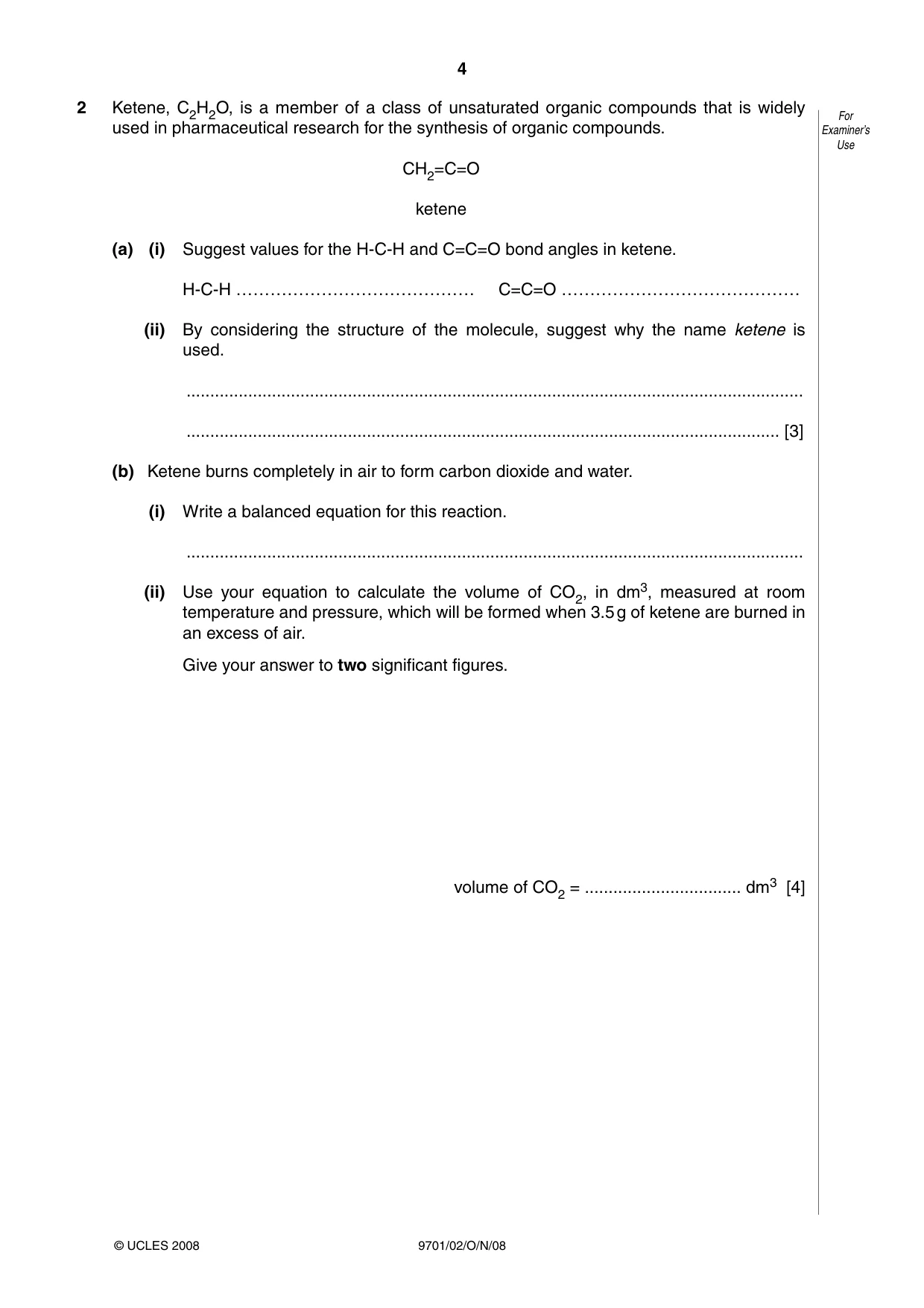
4 9701/02/O/N/08 For Examiner’s Use © UCLES 2008 2 Ketene, C2H2O, is a member of a class of unsaturated organic compounds that is widely used in pharmaceutical research for the synthesis of organic compounds. CH2=C=O ketene (a) (i) Suggest values for the H-C-H and C=C=O bond angles in ketene. H-C-H …………………………………… C=C=O …………………………………… (ii) By considering the structure of the molecule, suggest why the name ketene is used. … … [3] (b) Ketene burns completely in air to form carbon dioxide and water. (i) Write a balanced equation for this reaction. … (ii) Use your equation to calculate the volume of CO2, in dm3, measured at room temperature and pressure, which will be formed when 3.5g of ketene are burned in an excess of air. Give your answer to two significant figures. volume of CO2 = … dm3 [4]
Question paper, page 5
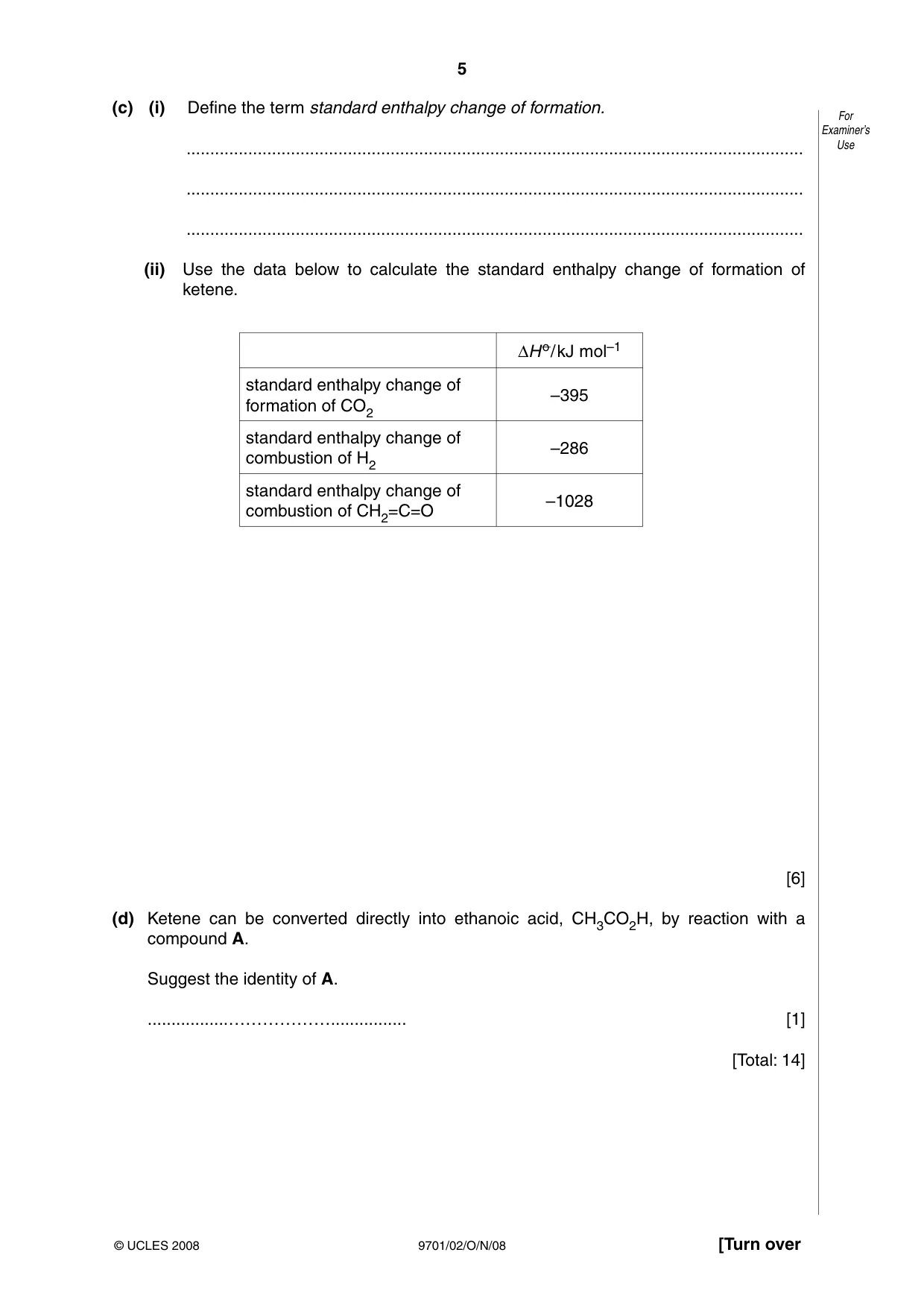
5 9701/02/O/N/08 [Turn over For Examiner’s Use © UCLES 2008 (c) (i) Define the term standard enthalpy change of formation. … … … (ii) Use the data below to calculate the standard enthalpy change of formation of ketene. ∆H o/kJ mol–1 standard enthalpy change of formation of CO2 –395 standard enthalpy change of combustion of H2 –286 standard enthalpy change of combustion of CH2=C=O –1028 [6] (d) Ketene can be converted directly into ethanoic acid, CH3CO2H, by reaction with a compound A. Suggest the identity of A. …………………… [1] [Total: 14]
Question paper, page 6
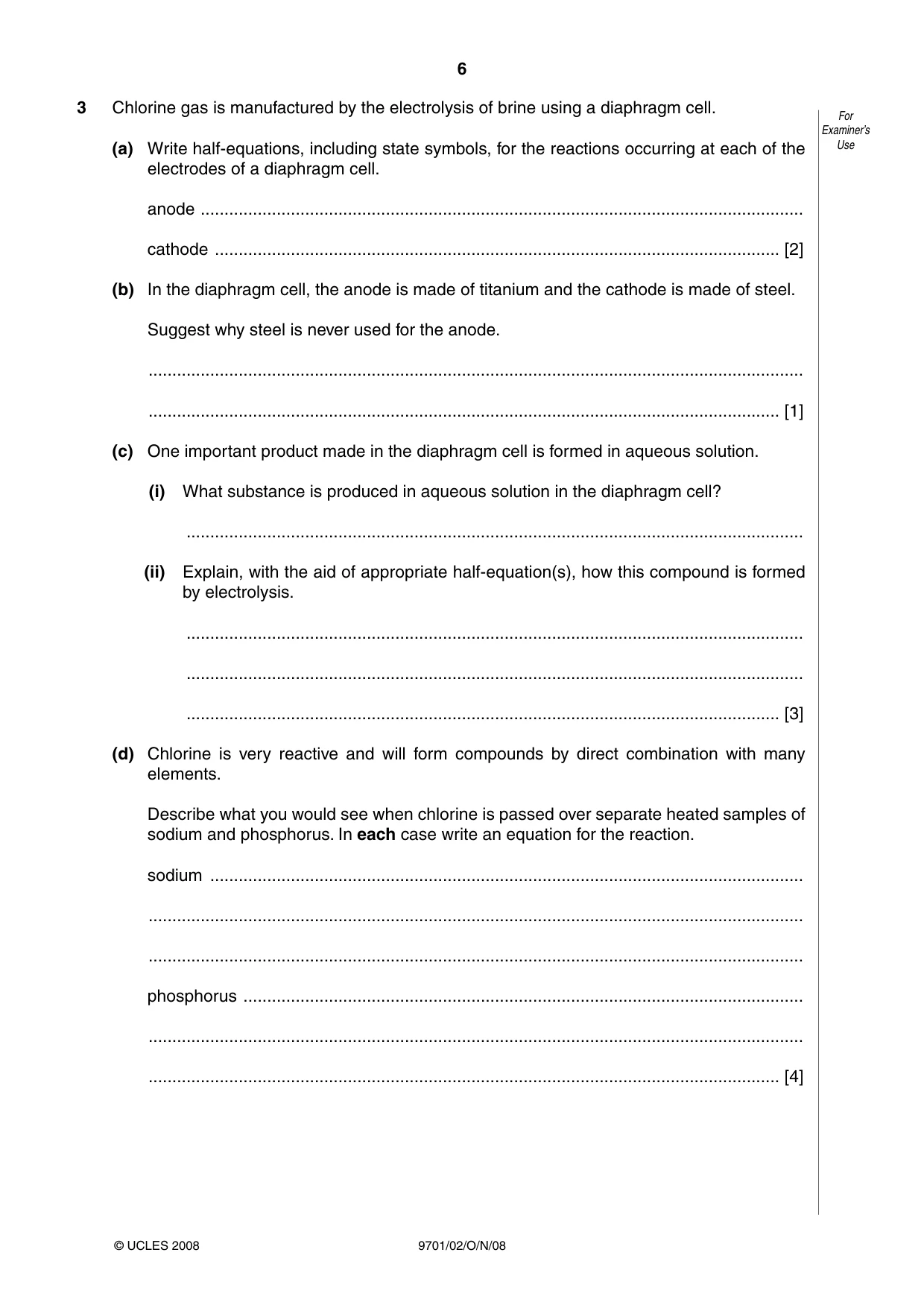
6 9701/02/O/N/08 For Examiner’s Use © UCLES 2008 3 Chlorine gas is manufactured by the electrolysis of brine using a diaphragm cell. (a) Write half-equations, including state symbols, for the reactions occurring at each of the electrodes of a diaphragm cell. anode … cathode … [2] (b) In the diaphragm cell, the anode is made of titanium and the cathode is made of steel. Suggest why steel is never used for the anode. … … [1] (c) One important product made in the diaphragm cell is formed in aqueous solution. (i) What substance is produced in aqueous solution in the diaphragm cell? … (ii) Explain, with the aid of appropriate half-equation(s), how this compound is formed by electrolysis. … … … [3] (d) Chlorine is very reactive and will form compounds by direct combination with many elements. Describe what you would see when chlorine is passed over separate heated samples of sodium and phosphorus. In each case write an equation for the reaction. sodium … … … phosphorus … … … [4]
Question paper, page 7
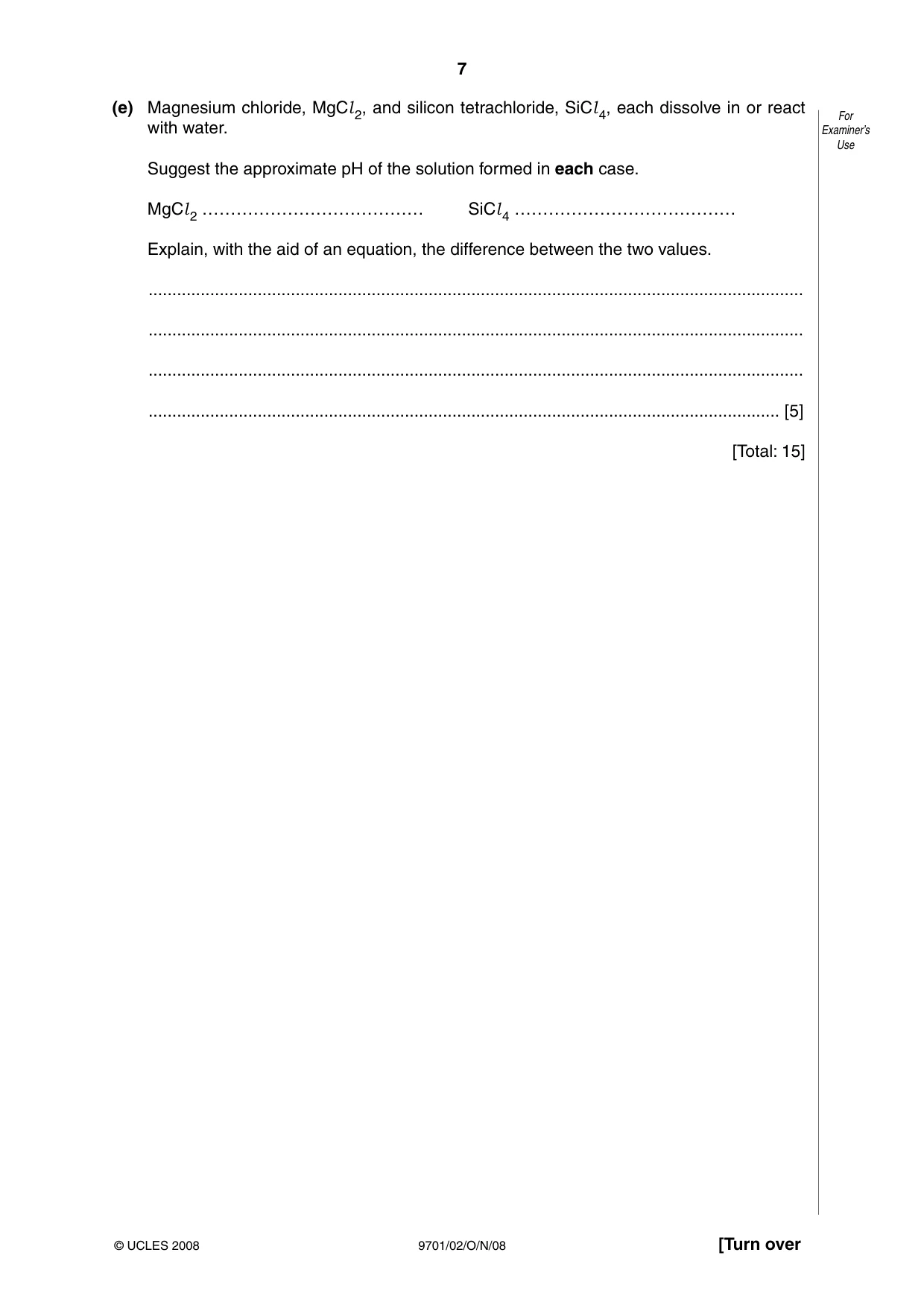
7 9701/02/O/N/08 [Turn over For Examiner’s Use © UCLES 2008 (e) Magnesium chloride, MgCl2, and silicon tetrachloride, SiCl4, each dissolve in or react with water. Suggest the approximate pH of the solution formed in each case. MgCl2 ………………………………… SiCl4 ………………………………… Explain, with the aid of an equation, the difference between the two values. … … … … [5] [Total: 15]
Question paper, page 9
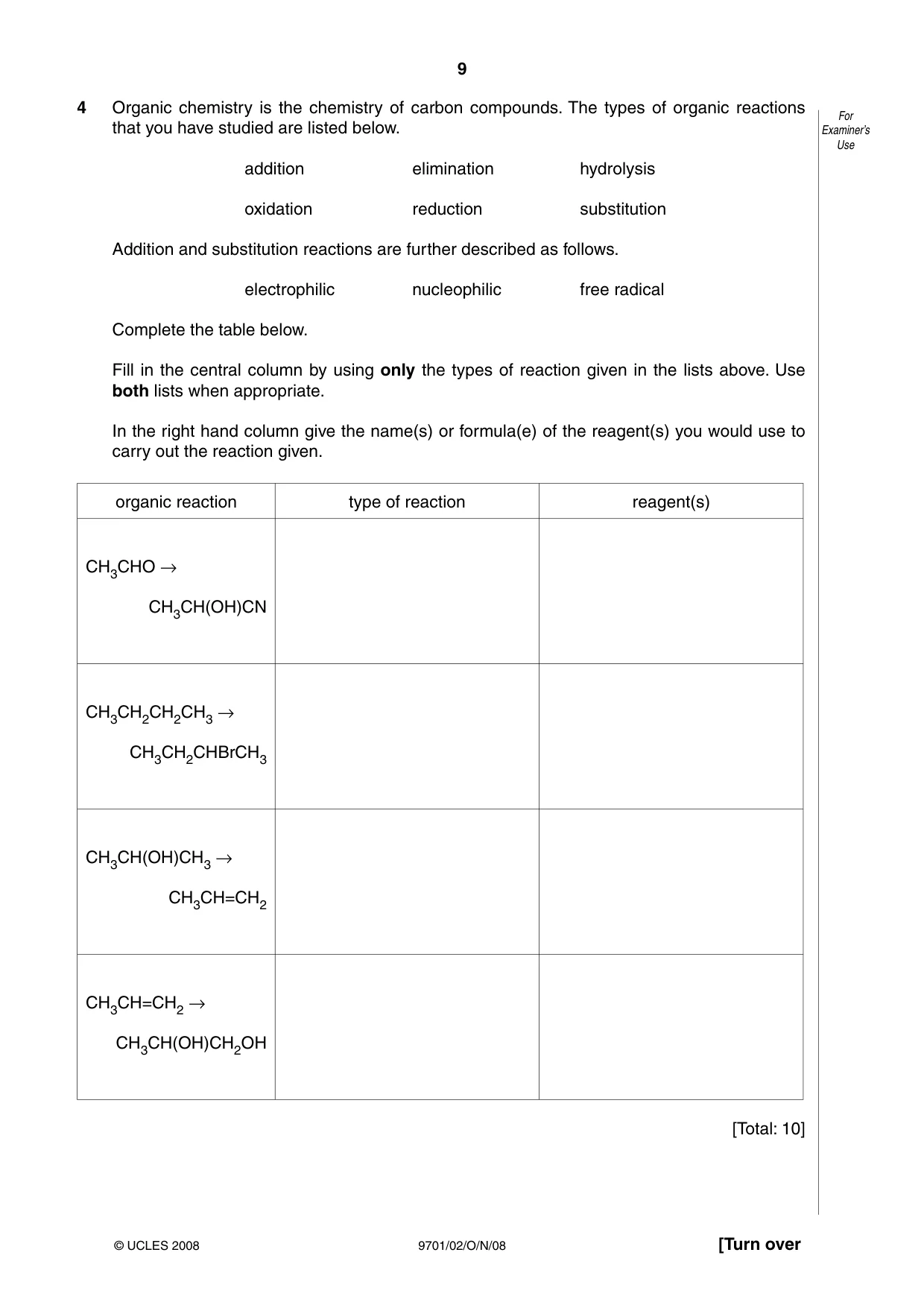
9 9701/02/O/N/08 [Turn over For Examiner’s Use © UCLES 2008 4 Organic chemistry is the chemistry of carbon compounds. The types of organic reactions that you have studied are listed below. addition elimination hydrolysis oxidation reduction substitution Addition and substitution reactions are further described as follows. electrophilic nucleophilic free radical Complete the table below. Fill in the central column by using only the types of reaction given in the lists above. Use both lists when appropriate. In the right hand column give the name(s) or formula(e) of the reagent(s) you would use to carry out the reaction given. organic reaction type of reaction reagent(s) CH3CHO → CH3CH(OH)CN CH3CH2CH2CH3 → CH3CH2CHBrCH3 CH3CH(OH)CH3 → CH3CH=CH2 CH3CH=CH2 → CH3CH(OH)CH2OH [Total: 10]
Question paper, page 10
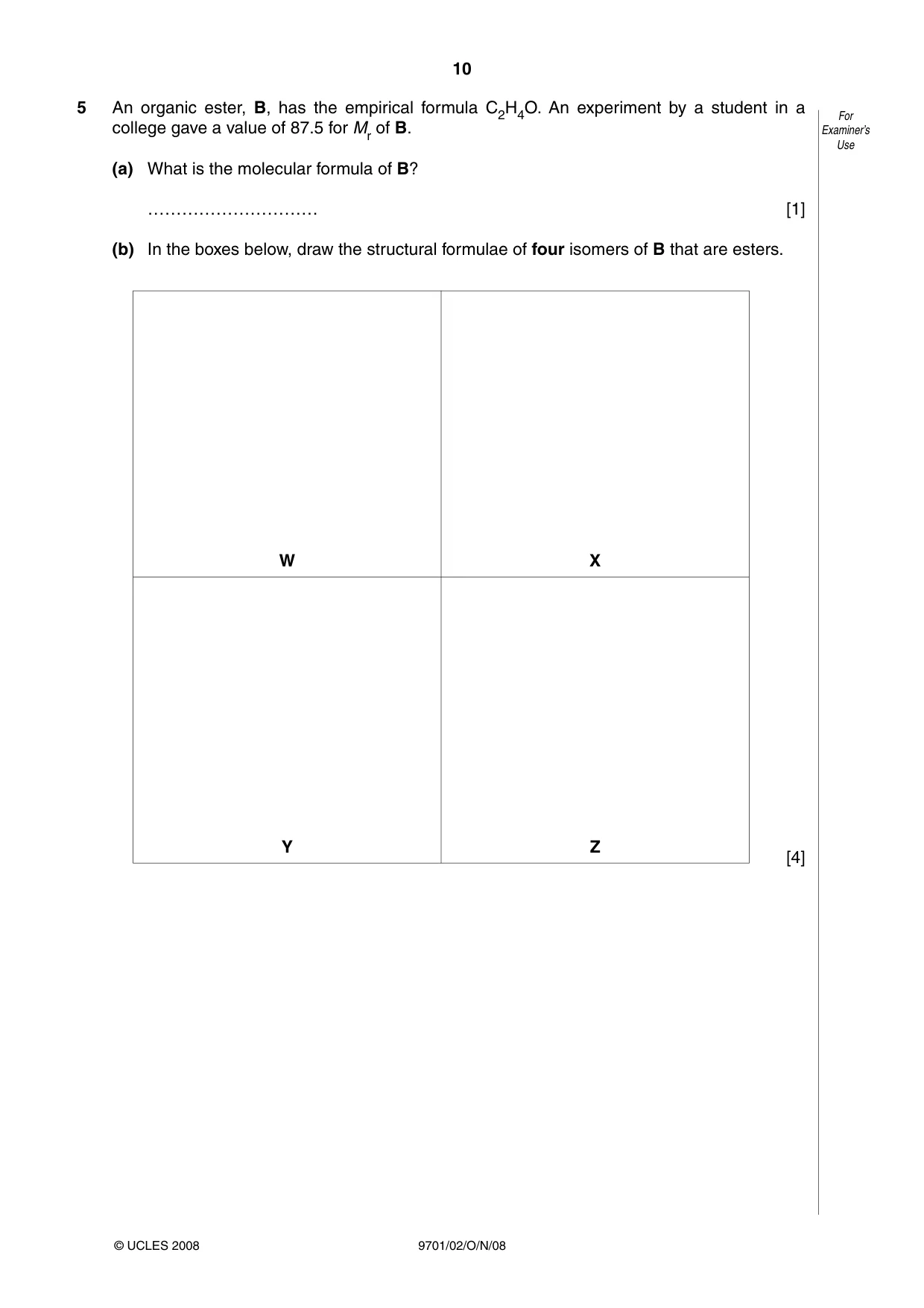
10 9701/02/O/N/08 For Examiner’s Use © UCLES 2008 5 An organic ester, B, has the empirical formula C2H4O. An experiment by a student in a college gave a value of 87.5 for Mr of B. (a) What is the molecular formula of B? ………………………… [1] (b) In the boxes below, draw the structural formulae of four isomers of B that are esters. W X Y Z [4]
Question paper, page 11
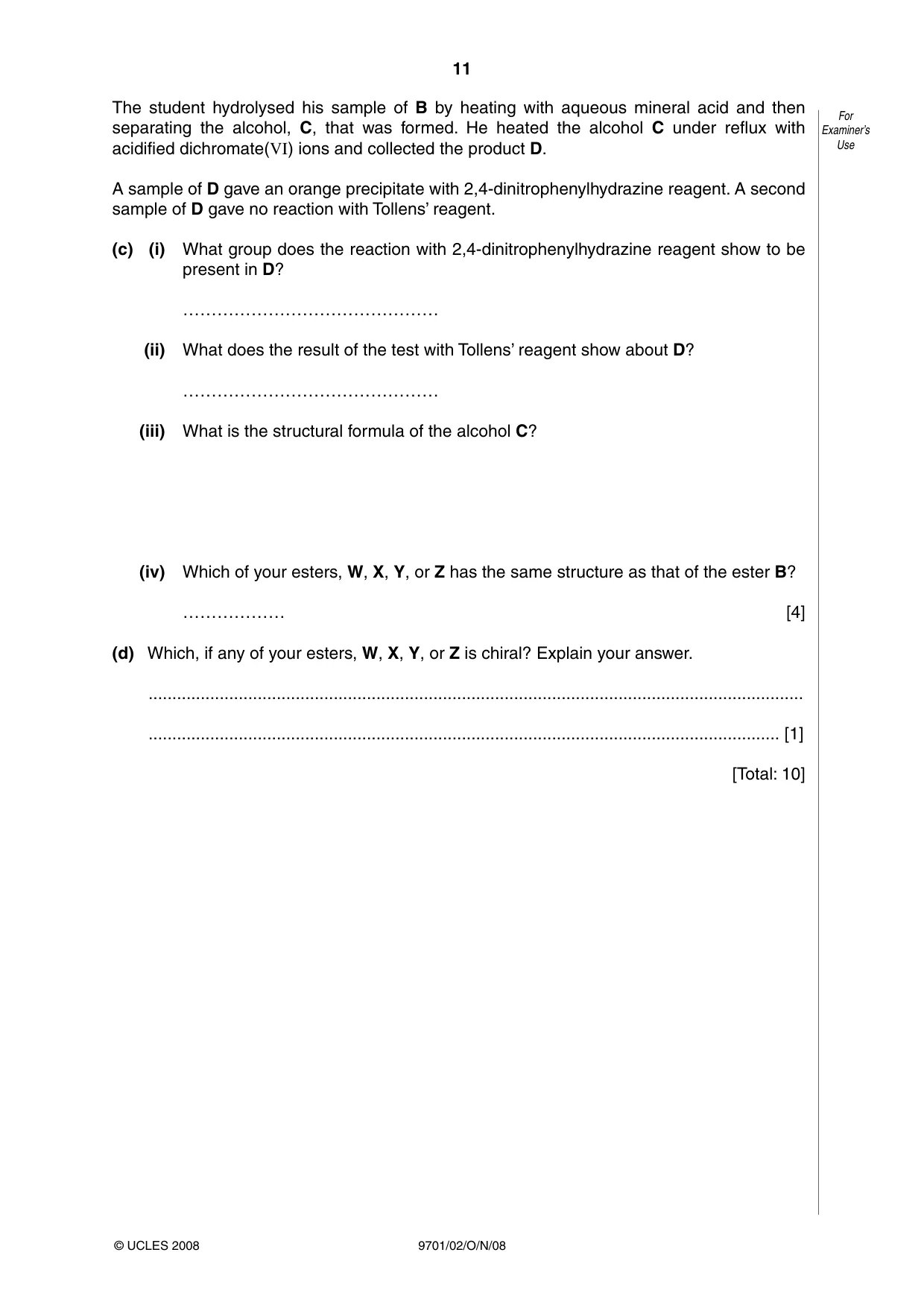
11 9701/02/O/N/08 For Examiner’s Use © UCLES 2008 The student hydrolysed his sample of B by heating with aqueous mineral acid and then separating the alcohol, C, that was formed. He heated the alcohol C under reflux with acidified dichromate(VI) ions and collected the product D. A sample of D gave an orange precipitate with 2,4-dinitrophenylhydrazine reagent. A second sample of D gave no reaction with Tollens’ reagent. (c) (i) What group does the reaction with 2,4-dinitrophenylhydrazine reagent show to be present in D? ……………………………………… (ii) What does the result of the test with Tollens’ reagent show about D? ……………………………………… (iii) What is the structural formula of the alcohol C? (iv) Which of your esters, W, X, Y, or Z has the same structure as that of the ester B? ……………… [4] (d) Which, if any of your esters, W, X, Y, or Z is chiral? Explain your answer. … … [1] [Total: 10]
Question paper, page 12
12 9701/02/O/N/08 BLANK PAGE Permission to reproduce items where third-party owned material protected by copyright is included has been sought and cleared where possible. Every reasonable effort has been made by the publisher (UCLES) to trace copyright holders, but if any items requiring clearance have unwittingly been included, the publisher will be pleased to make amends at the earliest possible opportunity. University of Cambridge International Examinations is part of the Cambridge Assessment Group. Cambridge Assessment is the brand name of University of Cambridge Local Examinations Syndicate (UCLES), which is itself a department of the University of Cambridge.
Mark scheme, page 1
UNIVERSITY OF CAMBRIDGE INTERNATIONAL EXAMINATIONS GCE Advanced Subsidiary Level and GCE Advanced Level MARK SCHEME for the October/November 2008 question paper 9701 CHEMISTRY 9701/02 Paper 2 (Theory 1), maximum raw mark 60 This mark scheme is published as an aid to teachers and candidates, to indicate the requirements of the examination. It shows the basis on which Examiners were instructed to award marks. It does not indicate the details of the discussions that took place at an Examiners’ meeting before marking began. All Examiners are instructed that alternative correct answers and unexpected approaches in candidates’ scripts must be given marks that fairly reflect the relevant knowledge and skills demonstrated. Mark schemes must be read in conjunction with the question papers and the report on the examination. • CIE will not enter into discussions or correspondence in connection with these mark schemes. CIE is publishing the mark schemes for the October/November 2008 question papers for most IGCSE, GCE Advanced Level and Advanced Subsidiary Level syllabuses and some Ordinary Level syllabuses.
Mark scheme, page 2
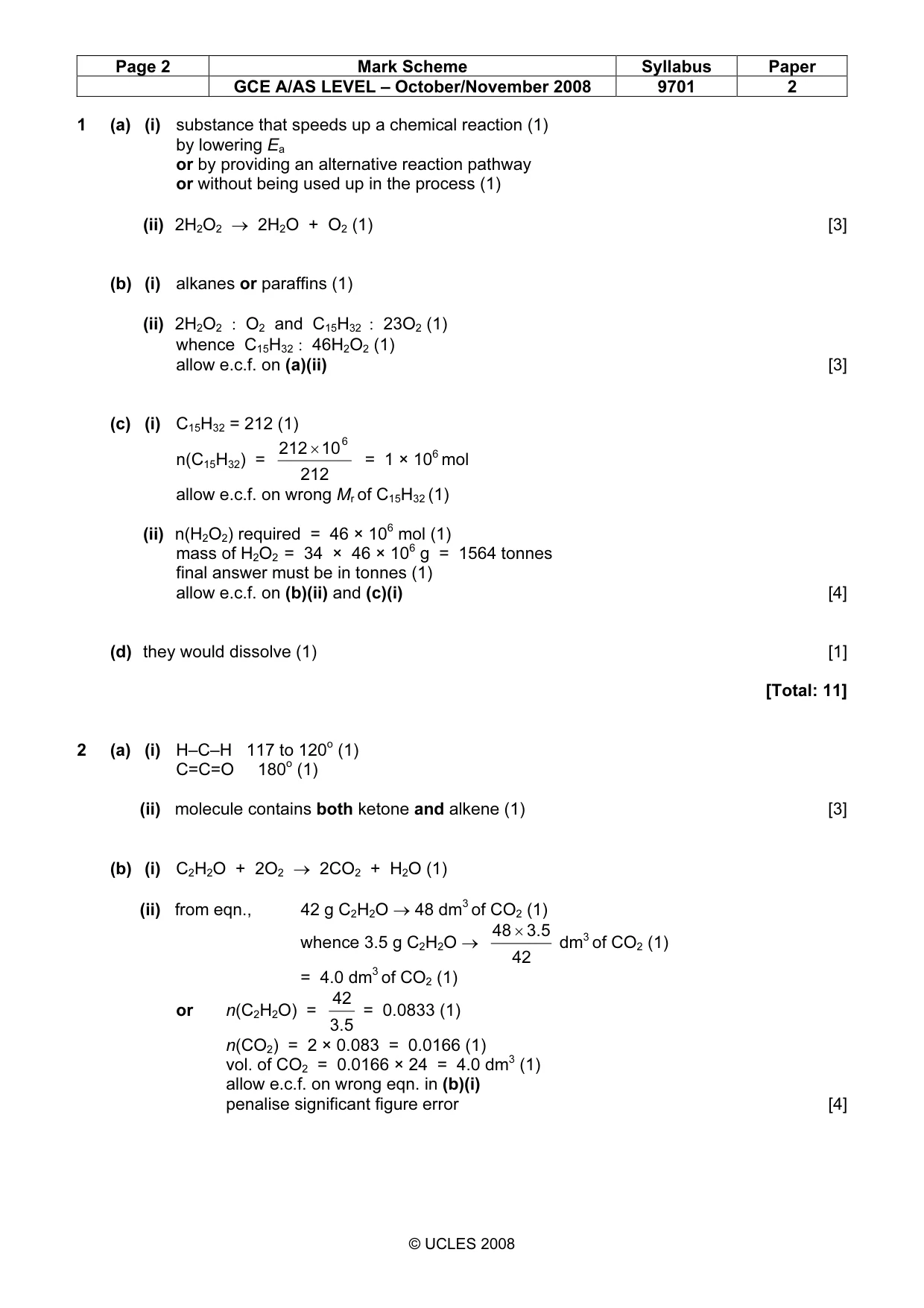
Page 2 Mark Scheme Syllabus Paper GCE A/AS LEVEL – October/November 2008 9701 2 © UCLES 2008 1 (a) (i) substance that speeds up a chemical reaction (1) by lowering Ea or by providing an alternative reaction pathway or without being used up in the process (1) (ii) 2H2O2 → 2H2O + O2 (1) [3] (b) (i) alkanes or paraffins (1) (ii) 2H2O2 : O2 and C15H32 : 23O2 (1) whence C15H32 : 46H2O2 (1) allow e.c.f. on (a)(ii) [3] (c) (i) C15H32 = 212 (1) n(C15H32) = 212 10 212 6 × = 1 × 10⁶ mol allow e.c.f. on wrong Mr of C15H32 (1) (ii) n(H2O2) required = 46 × 106 mol (1) mass of H2O2 = 34 × 46 × 106 g = 1564 tonnes final answer must be in tonnes (1) allow e.c.f. on (b)(ii) and (c)(i) [4] (d) they would dissolve (1) [1] [Total: 11] 2 (a) (i) H–C–H 117 to 120o (1) C=C=O 180o (1) (ii) molecule contains both ketone and alkene (1) [3] (b) (i) C2H2O + 2O2 → 2CO2 + H2O (1) (ii) from eqn., 42 g C2H2O → 48 dm3 of CO2 (1) whence 3.5 g C2H2O → 42 3.5 48 × dm3 of CO2 (1) = 4.0 dm3 of CO2 (1) or n(C2H2O) = 3.5 42 = 0.0833 (1) n(CO2) = 2 × 0.083 = 0.0166 (1) vol. of CO2 = 0.0166 × 24 = 4.0 dm3 (1) allow e.c.f. on wrong eqn. in (b)(i) penalise significant figure error [4]
Mark scheme, page 3
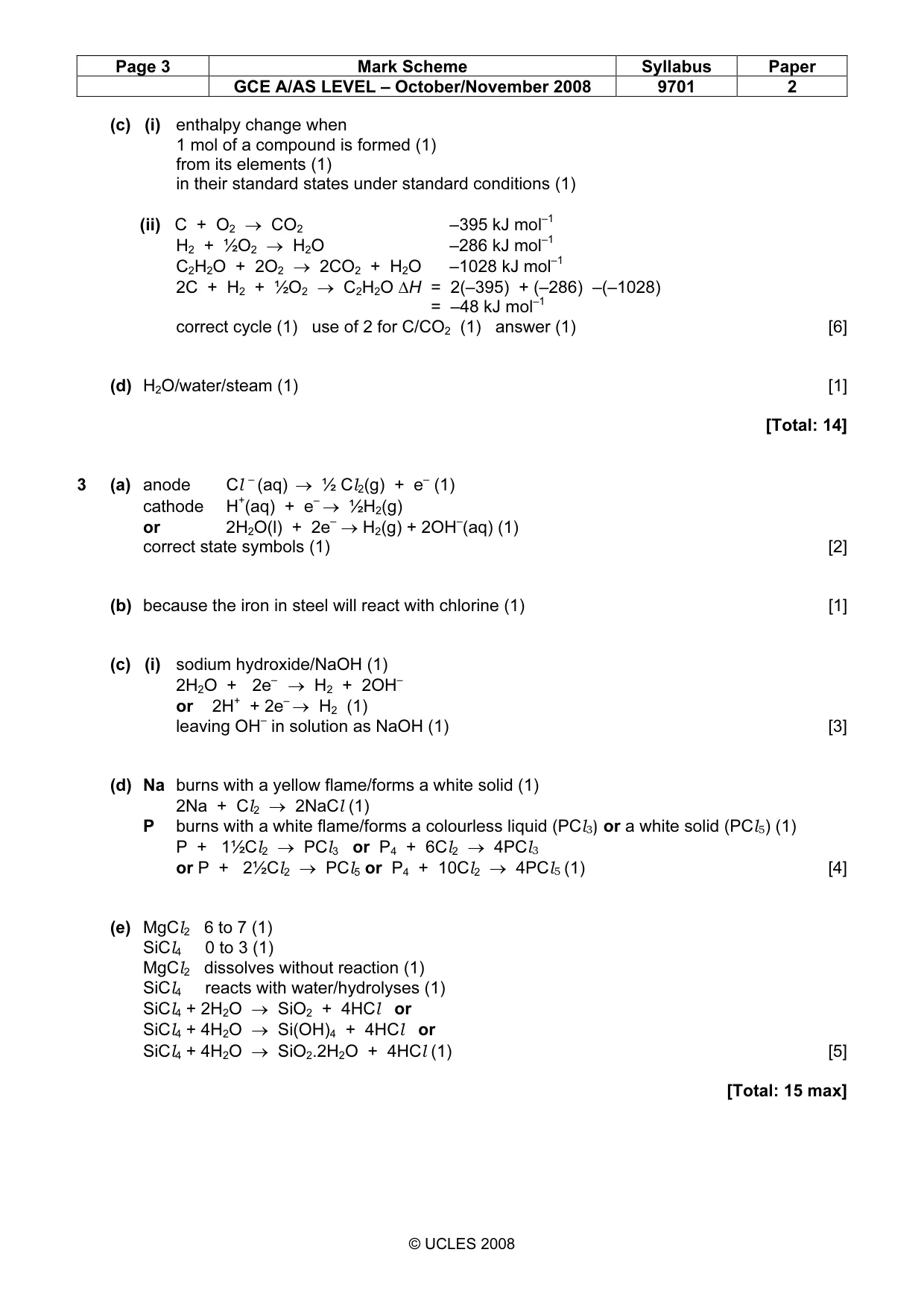
Page 3 Mark Scheme Syllabus Paper GCE A/AS LEVEL – October/November 2008 9701 2 © UCLES 2008 (c) (i) enthalpy change when 1 mol of a compound is formed (1) from its elements (1) in their standard states under standard conditions (1) (ii) C + O2 → CO2 –395 kJ mol–1 H2 + ½O2 → H2O –286 kJ mol–1 C2H2O + 2O2 → 2CO2 + H2O –1028 kJ mol–1 2C + H2 + ½O2 → C2H2O ∆H = 2(–395) + (–286) –(–1028) = –48 kJ mol–1 correct cycle (1) use of 2 for C/CO2 (1) answer (1) [6] (d) H2O/water/steam (1) [1] [Total: 14] 3 (a) anode Cl – (aq) → ½ Cl2(g) + e– (1) cathode H+(aq) + e– → ½H2(g) or 2H2O(l) + 2e– → H2(g) + 2OH–(aq) (1) correct state symbols (1) [2] (b) because the iron in steel will react with chlorine (1) [1] (c) (i) sodium hydroxide/NaOH (1) 2H2O + 2e– → H2 + 2OH– or 2H+ + 2e– → H2 (1) leaving OH– in solution as NaOH (1) [3] (d) Na burns with a yellow flame/forms a white solid (1) 2Na + Cl2 → 2NaCl (1) P burns with a white flame/forms a colourless liquid (PCl3) or a white solid (PCl5) (1) P + 1½Cl2 → PCl3 or P4 + 6Cl2 → 4PCl3 or P + 2½Cl2 → PCl5 or P4 + 10Cl2 → 4PCl5 (1) [4] (e) MgCl2 6 to 7 (1) SiCl4 0 to 3 (1) MgCl2 dissolves without reaction (1) SiCl4 reacts with water/hydrolyses (1) SiCl4 + 2H2O → SiO2 + 4HCl or SiCl4 + 4H2O → Si(OH)4 + 4HCl or SiCl4 + 4H2O → SiO2.2H2O + 4HCl (1) [5] [Total: 15 max]
Mark scheme, page 4
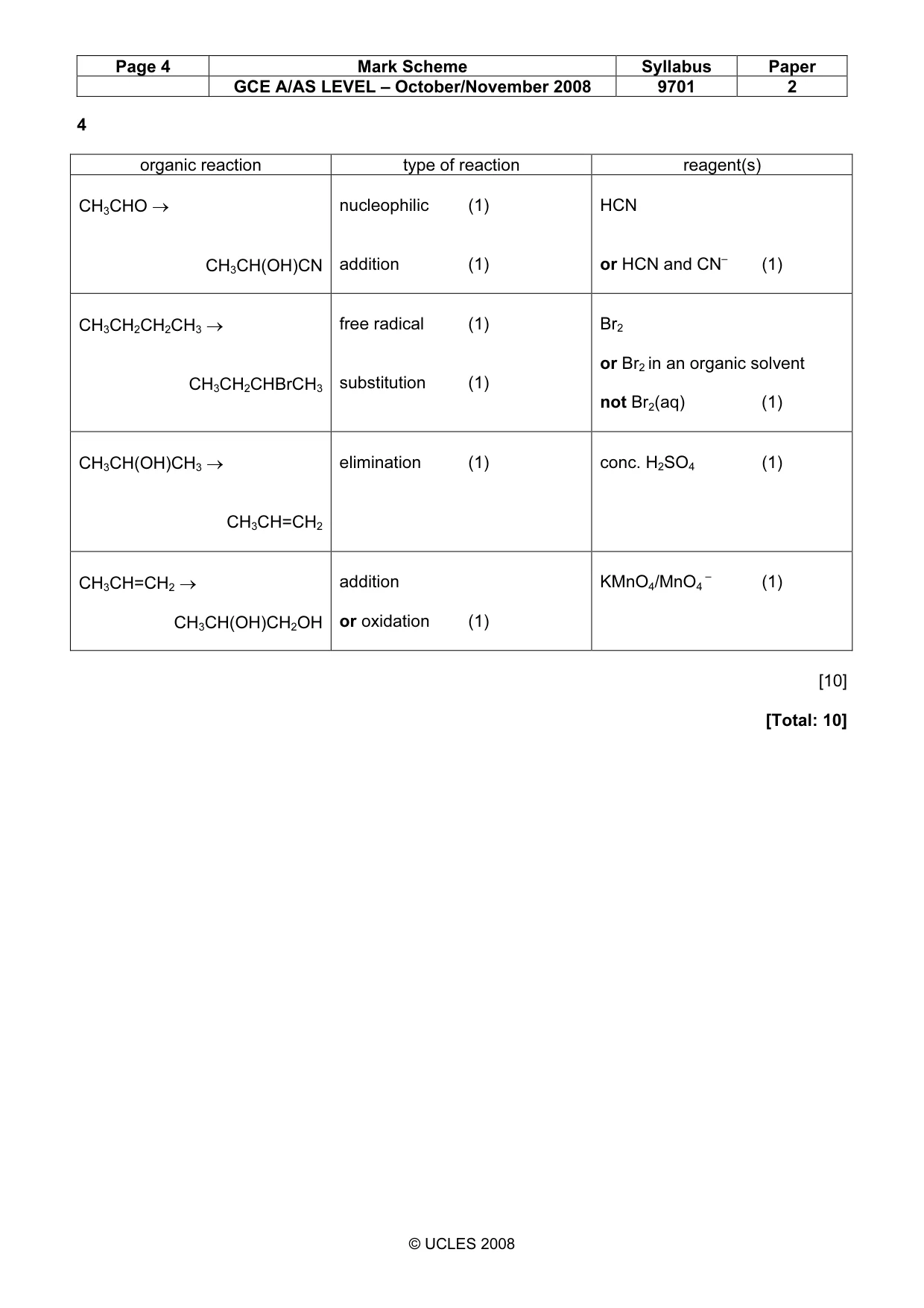
Page 4 Mark Scheme Syllabus Paper GCE A/AS LEVEL – October/November 2008 9701 2 © UCLES 2008 4 organic reaction type of reaction reagent(s) CH3CHO → CH3CH(OH)CN nucleophilic (1) addition (1) HCN or HCN and CN– (1) CH3CH2CH2CH3 → CH3CH2CHBrCH3 free radical (1) substitution (1) Br2 or Br2 in an organic solvent not Br2(aq) (1) CH3CH(OH)CH3 → CH3CH=CH2 elimination (1) conc. H2SO4 (1) CH3CH=CH2 → CH3CH(OH)CH2OH addition or oxidation (1) KMnO4/MnO4 – (1) [10] [Total: 10]
Mark scheme, page 5
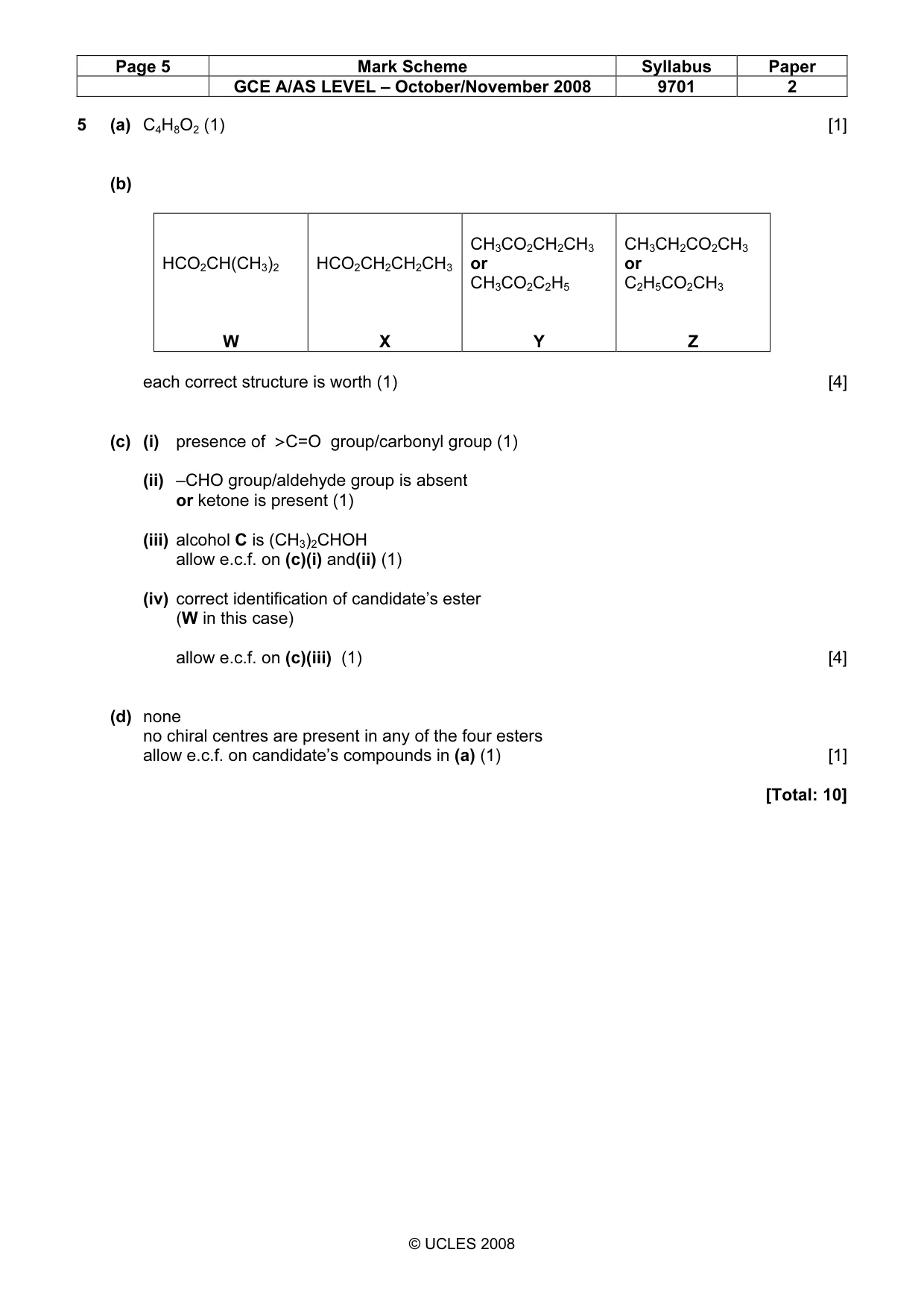
Page 5 Mark Scheme Syllabus Paper GCE A/AS LEVEL – October/November 2008 9701 2 © UCLES 2008 5 (a) C4H8O2 (1) [1] (b) HCO2CH(CH3)2 W HCO2CH2CH2CH3 X CH3CO2CH2CH3 or CH3CO2C2H5 Y CH3CH2CO2CH3 or C2H5CO2CH3 Z each correct structure is worth (1) [4] (c) (i) presence of >C=O group/carbonyl group (1) (ii) –CHO group/aldehyde group is absent or ketone is present (1) (iii) alcohol C is (CH3)2CHOH allow e.c.f. on (c)(i) and(ii) (1) (iv) correct identification of candidate’s ester (W in this case) allow e.c.f. on (c)(iii) (1) [4] (d) none no chiral centres are present in any of the four esters allow e.c.f. on candidate’s compounds in (a) (1) [1] [Total: 10]
What you needed in this session
Cambridge’s own grade thresholds for 2008 Oct/Nov, Paper 2 · Variant 1. A higher threshold means an easier paper — the bar moves with how the cohort did.