Cambridge A Level Chemistry 9701 — 2007 Oct/Nov Paper 2 · Variant 1
9701/21/O/N/07 · 60 marks · ≈68 min
The question paper and its mark scheme, free to read here and free to download. This is Cambridge’s own paper, exactly as it was sat.
Question paper12 pages
Mark scheme7 pages
Answers below. Sit the paper first if you are practising.
Paper as text
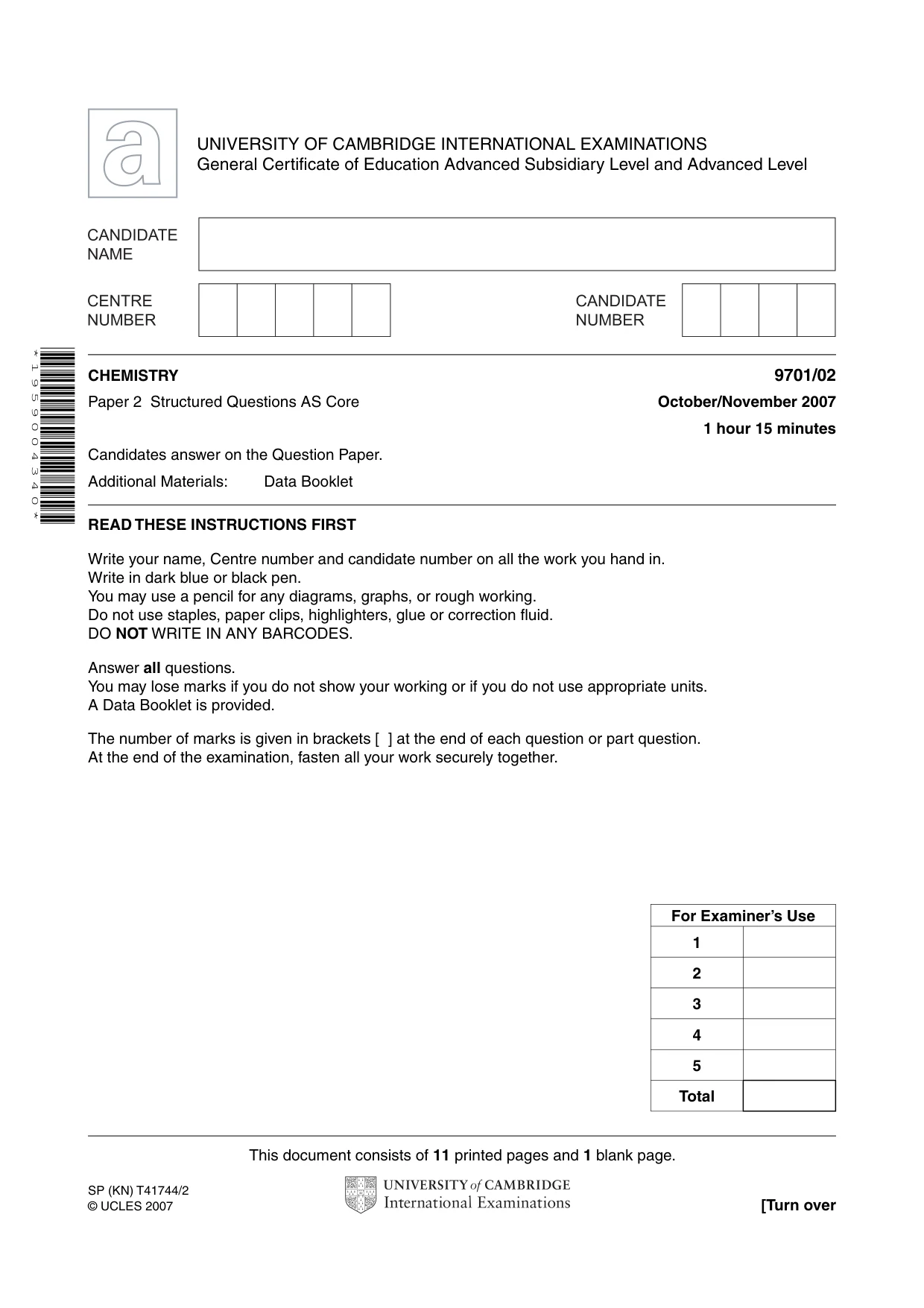
Question paper, page 1
For Examiner’s Use 1 2 3 4 5 Total This document consists of 11 printed pages and 1 blank page. SP (KN) T41744/2 © UCLES 2007 [Turn over UNIVERSITY OF CAMBRIDGE INTERNATIONAL EXAMINATIONS General Certificate of Education Advanced Subsidiary Level and Advanced Level READ THESE INSTRUCTIONS FIRST Write your name, Centre number and candidate number on all the work you hand in. Write in dark blue or black pen. You may use a pencil for any diagrams, graphs, or rough working. Do not use staples, paper clips, highlighters, glue or correction fluid. DO NOT WRITE IN ANY BARCODES. Answer all questions. You may lose marks if you do not show your working or if you do not use appropriate units. A Data Booklet is provided. The number of marks is given in brackets [ ] at the end of each question or part question. At the end of the examination, fasten all your work securely together. * 1 9 5 9 0 0 4 3 4 0 * CHEMISTRY 9701/02 Paper 2 Structured Questions AS Core October/November 2007 1 hour 15 minutes Candidates answer on the Question Paper. Additional Materials: Data Booklet
Question paper, page 2
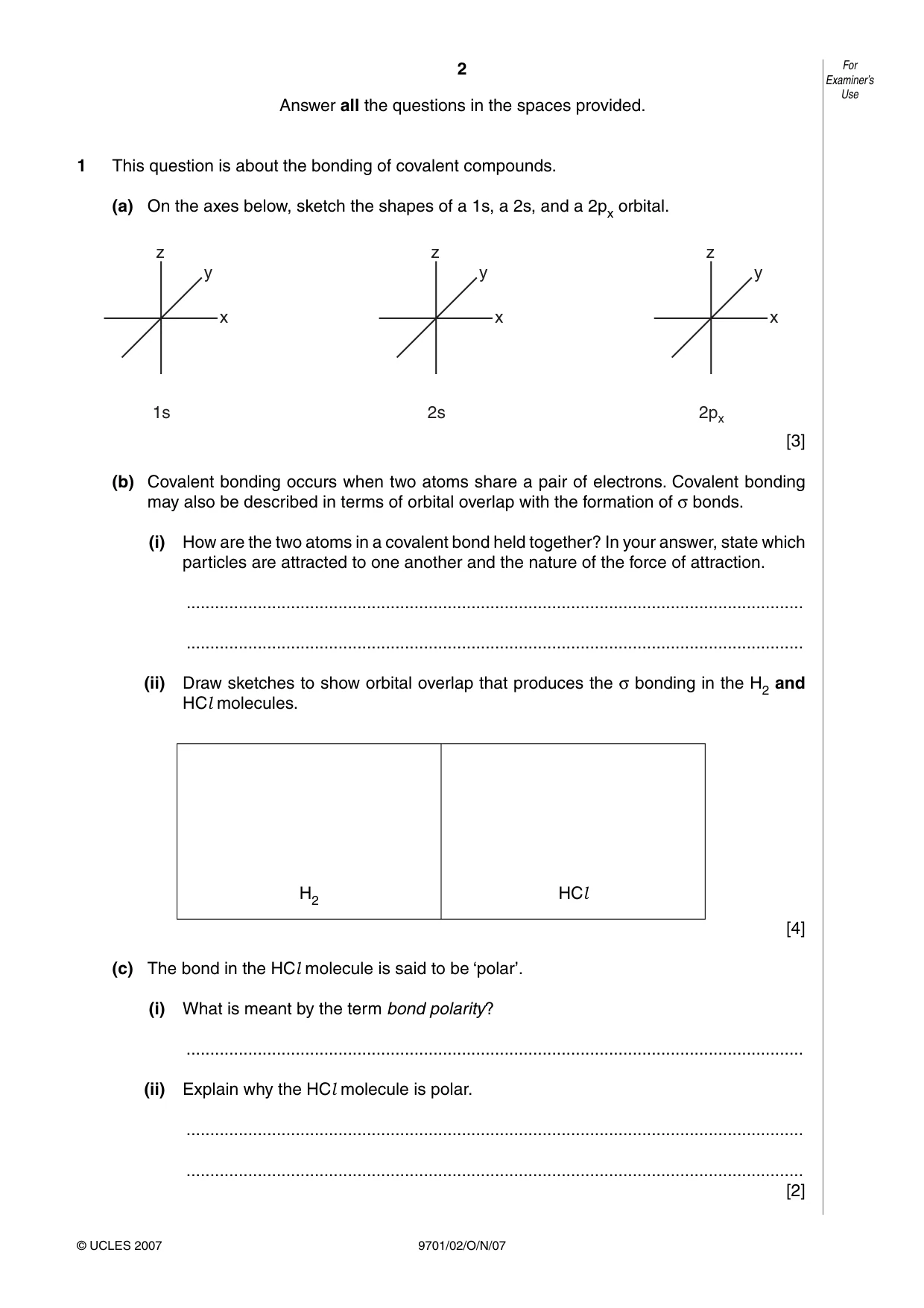
2 9701/02/O/N/07 For Examiner’s Use © UCLES 2007 Answer all the questions in the spaces provided. 1 This question is about the bonding of covalent compounds. (a) On the axes below, sketch the shapes of a 1s, a 2s, and a 2px orbital. z x y 1s z x y 2s z x y 2px [3] (b) Covalent bonding occurs when two atoms share a pair of electrons. Covalent bonding may also be described in terms of orbital overlap with the formation of σ bonds. (i) How are the two atoms in a covalent bond held together? In your answer, state which particles are attracted to one another and the nature of the force of attraction. … … (ii) Draw sketches to show orbital overlap that produces the σ bonding in the H2 and HCl molecules. H2 HCl [4] (c) The bond in the HCl molecule is said to be ‘polar’. (i) What is meant by the term bond polarity? … (ii) Explain why the HCl molecule is polar. … … [2]
Question paper, page 3
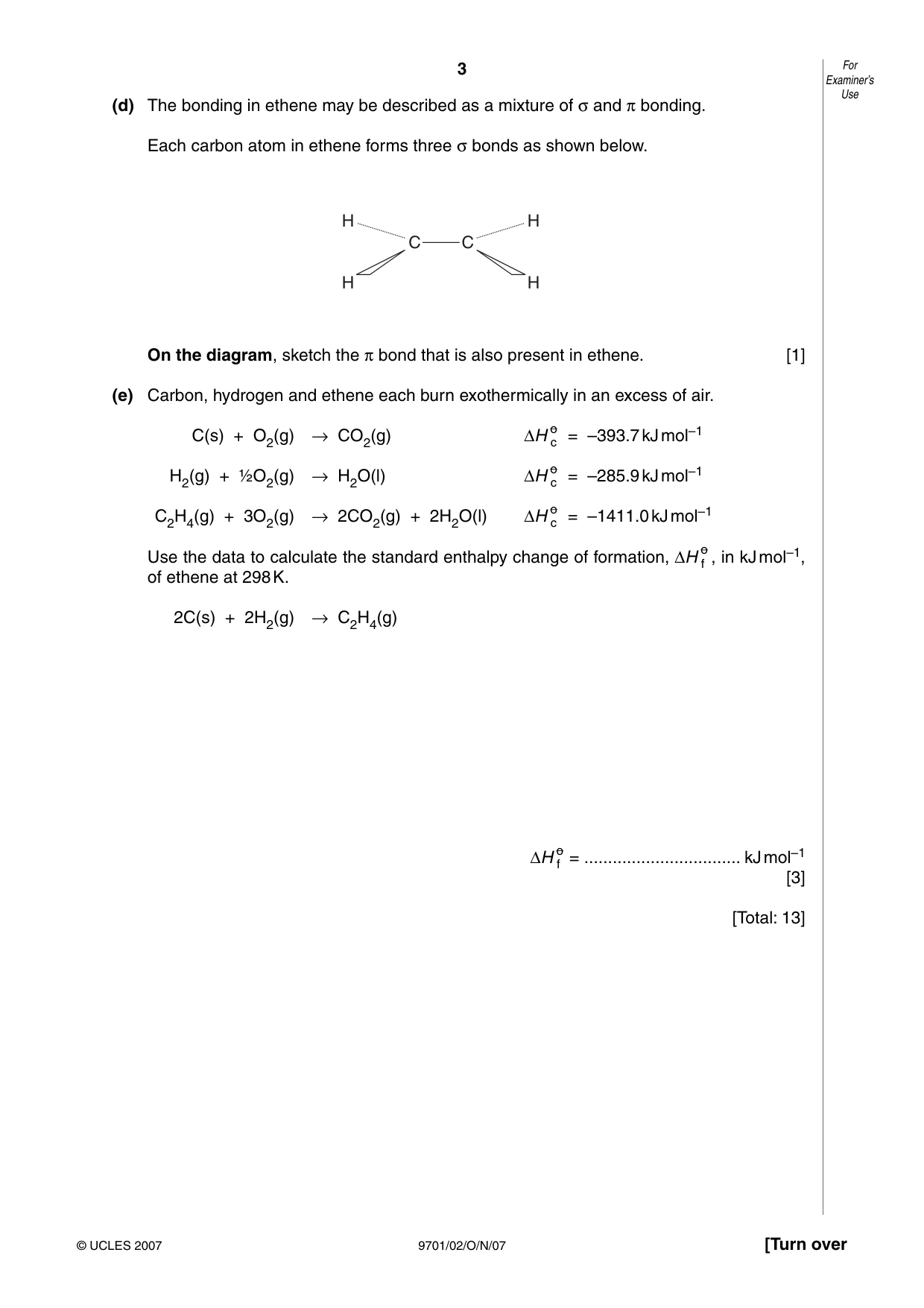
3 9701/02/O/N/07 [Turn over For Examiner’s Use © UCLES 2007 (d) The bonding in ethene may be described as a mixture of σ and π bonding. Each carbon atom in ethene forms three σ bonds as shown below. C H H H H C On the diagram, sketch the π bond that is also present in ethene. [1] (e) Carbon, hydrogen and ethene each burn exothermically in an excess of air. C(s) + O2(g) → CO2(g) ∆H o c = –393.7 kJ mol–1 H2(g) + ½O2(g) → H2O(l) ∆H o c = –285.9 kJ mol–1 C2H4(g) + 3O2(g) → 2CO2(g) + 2H2O(l) ∆H o c = –1411.0 kJ mol–1 Use the data to calculate the standard enthalpy change of formation, ∆H o f , in kJ mol–1, of ethene at 298 K. 2C(s) + 2H2(g) → C2H4(g) ∆H o f = … kJ mol–1 [3] [Total: 13]
Question paper, page 4
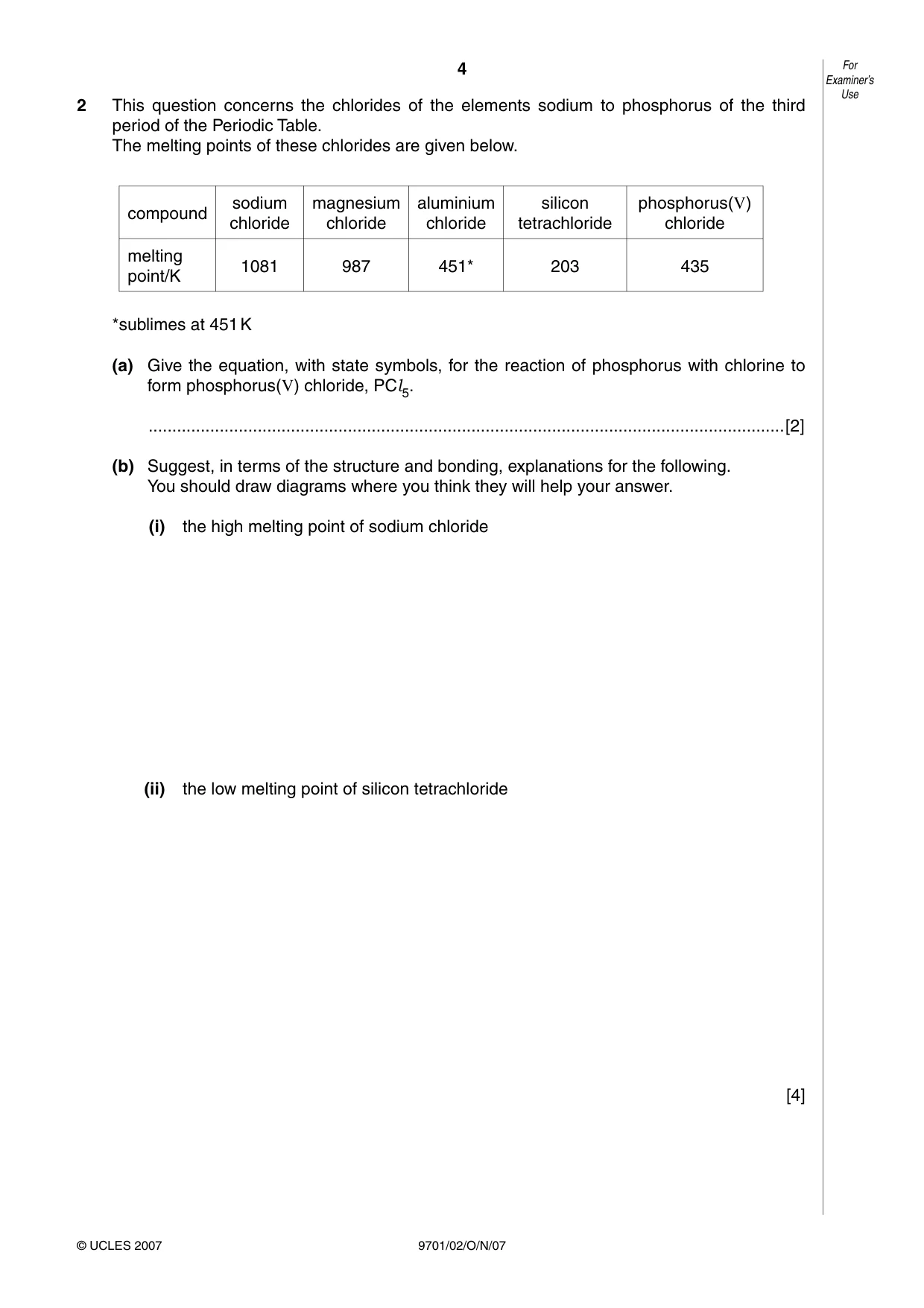
4 9701/02/O/N/07 For Examiner’s Use © UCLES 2007 2 This question concerns the chlorides of the elements sodium to phosphorus of the third period of the Periodic Table. The melting points of these chlorides are given below. compound sodium chloride magnesium chloride aluminium chloride silicon tetrachloride phosphorus(V) chloride melting point/K 1081 987 451* 203 435 *sublimes at 451 K (a) Give the equation, with state symbols, for the reaction of phosphorus with chlorine to form phosphorus(V) chloride, PCl5. …[2] (b) Suggest, in terms of the structure and bonding, explanations for the following. You should draw diagrams where you think they will help your answer. (i) the high melting point of sodium chloride (ii) the low melting point of silicon tetrachloride [4]
Question paper, page 5
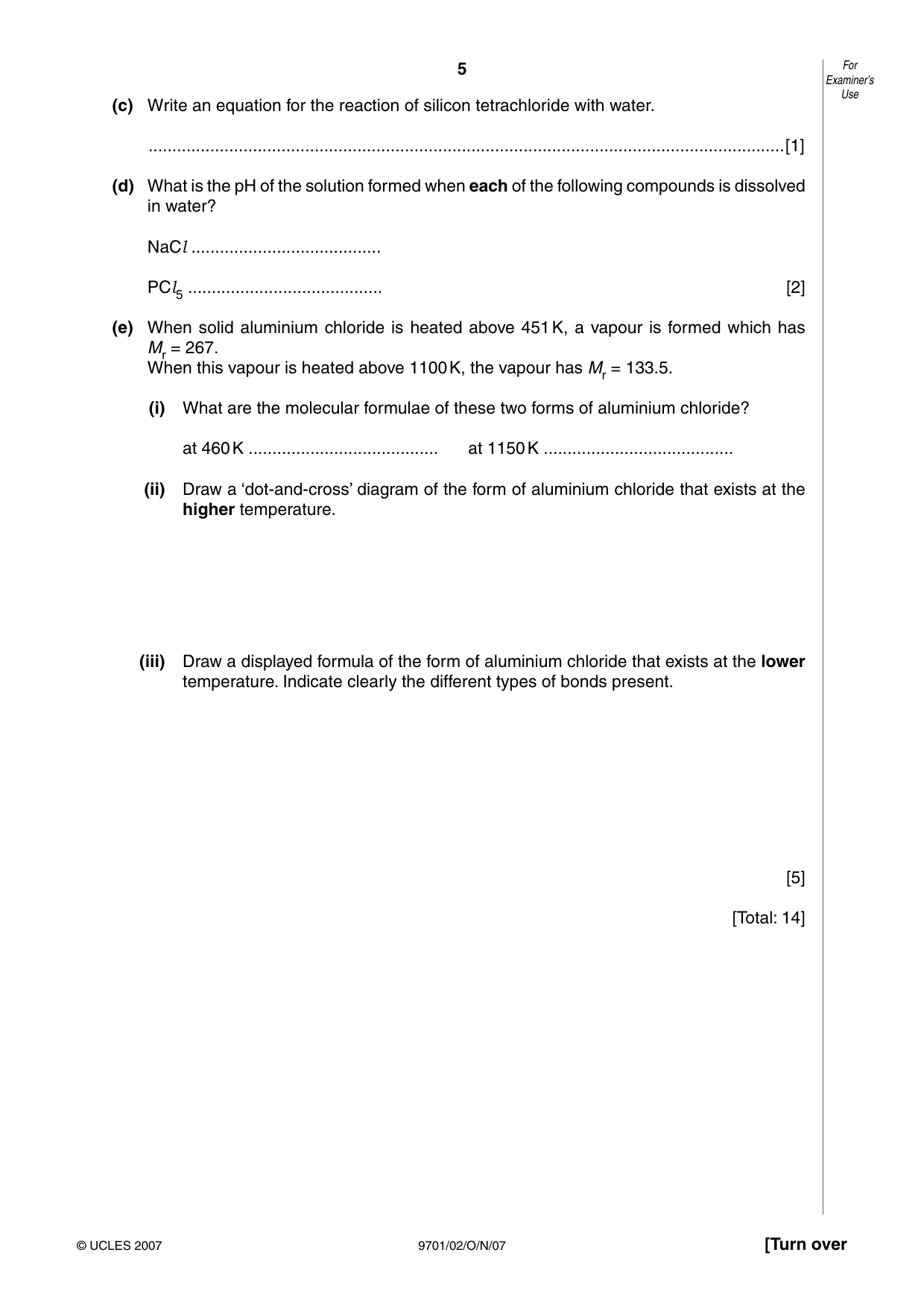
5 9701/02/O/N/07 [Turn over For Examiner’s Use © UCLES 2007 (c) Write an equation for the reaction of silicon tetrachloride with water. …[1] (d) What is the pH of the solution formed when each of the following compounds is dissolved in water? NaCl … PCl5 … [2] (e) When solid aluminium chloride is heated above 451 K, a vapour is formed which has Mr = 267. When this vapour is heated above 1100 K, the vapour has Mr = 133.5. (i) What are the molecular formulae of these two forms of aluminium chloride? at 460 K … at 1150 K … (ii) Draw a ‘dot-and-cross’ diagram of the form of aluminium chloride that exists at the higher temperature. (iii) Draw a displayed formula of the form of aluminium chloride that exists at the lower temperature. Indicate clearly the different types of bonds present. [5] [Total: 14]
Question paper, page 6
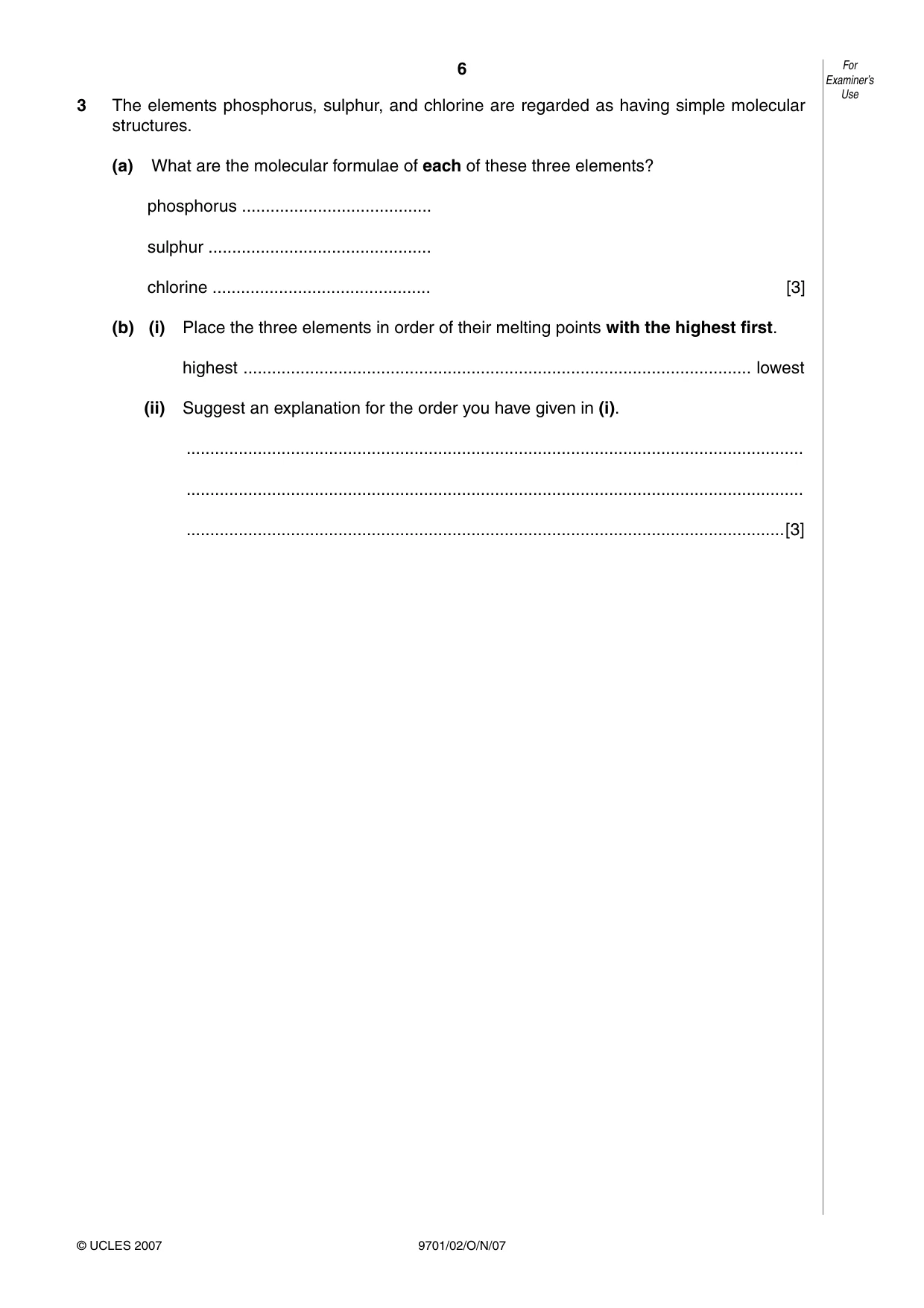
6 9701/02/O/N/07 For Examiner’s Use © UCLES 2007 3 The elements phosphorus, sulphur, and chlorine are regarded as having simple molecular structures. (a) What are the molecular formulae of each of these three elements? phosphorus … sulphur … chlorine … [3] (b) (i) Place the three elements in order of their melting points with the highest first. highest … lowest (ii) Suggest an explanation for the order you have given in (i). … … …[3]
Question paper, page 7
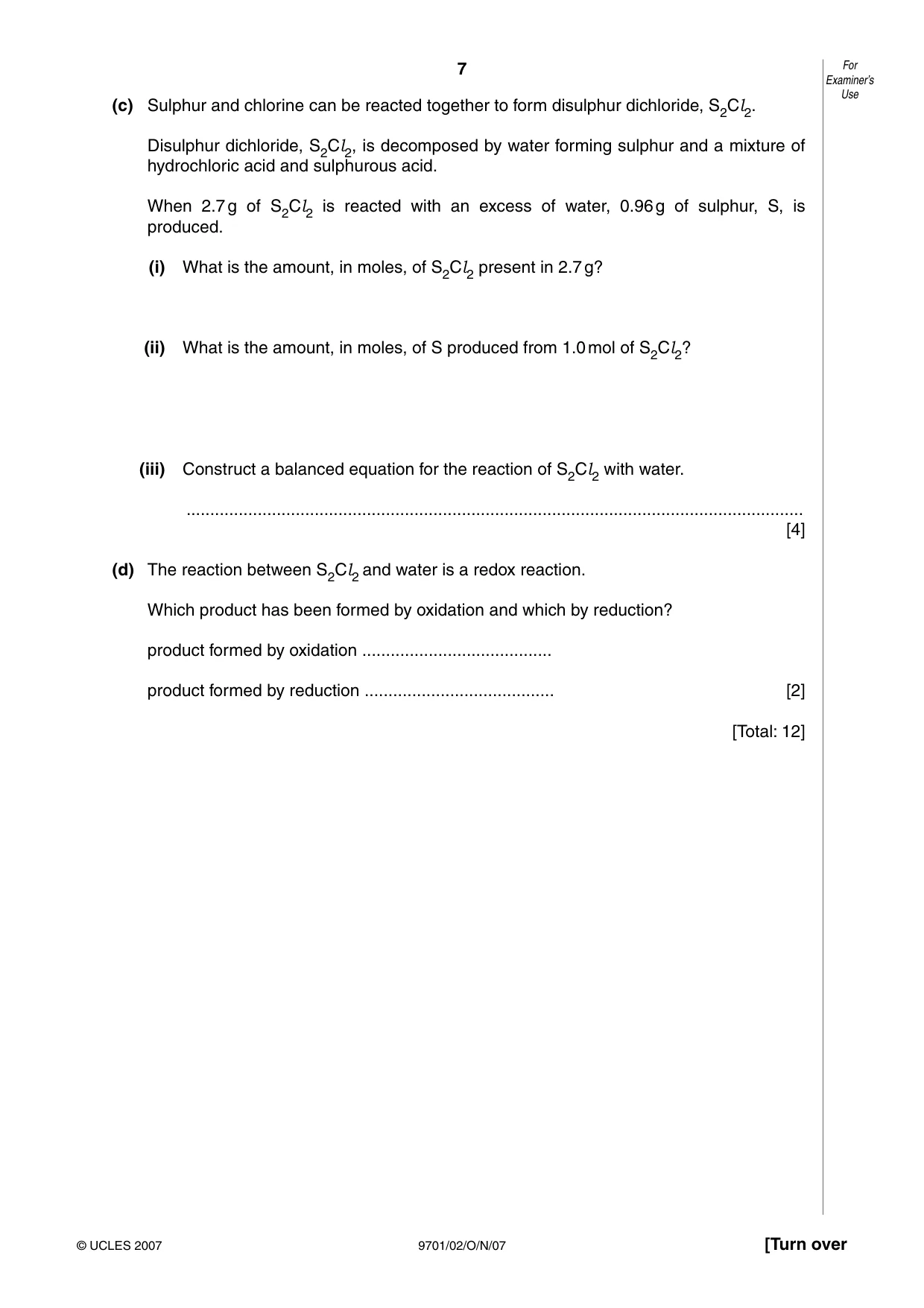
7 9701/02/O/N/07 [Turn over For Examiner’s Use © UCLES 2007 (c) Sulphur and chlorine can be reacted together to form disulphur dichloride, S2Cl2. Disulphur dichloride, S2Cl2, is decomposed by water forming sulphur and a mixture of hydrochloric acid and sulphurous acid. When 2.7 g of S2Cl2 is reacted with an excess of water, 0.96 g of sulphur, S, is produced. (i) What is the amount, in moles, of S2Cl2 present in 2.7 g? (ii) What is the amount, in moles, of S produced from 1.0 mol of S2Cl2? (iii) Construct a balanced equation for the reaction of S2Cl2 with water. … [4] (d) The reaction between S2Cl2 and water is a redox reaction. Which product has been formed by oxidation and which by reduction? product formed by oxidation … product formed by reduction … [2] [Total: 12]
Question paper, page 8
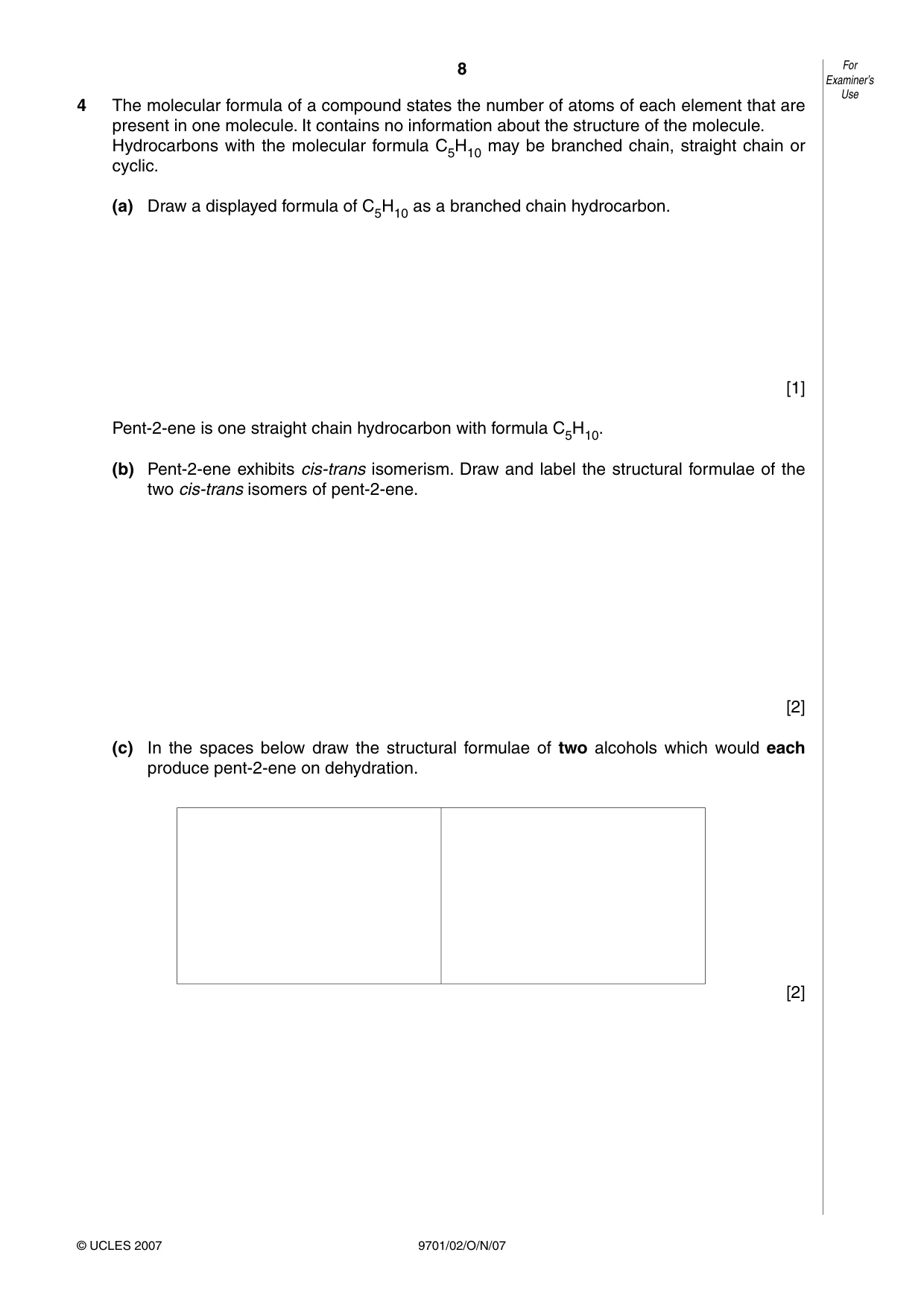
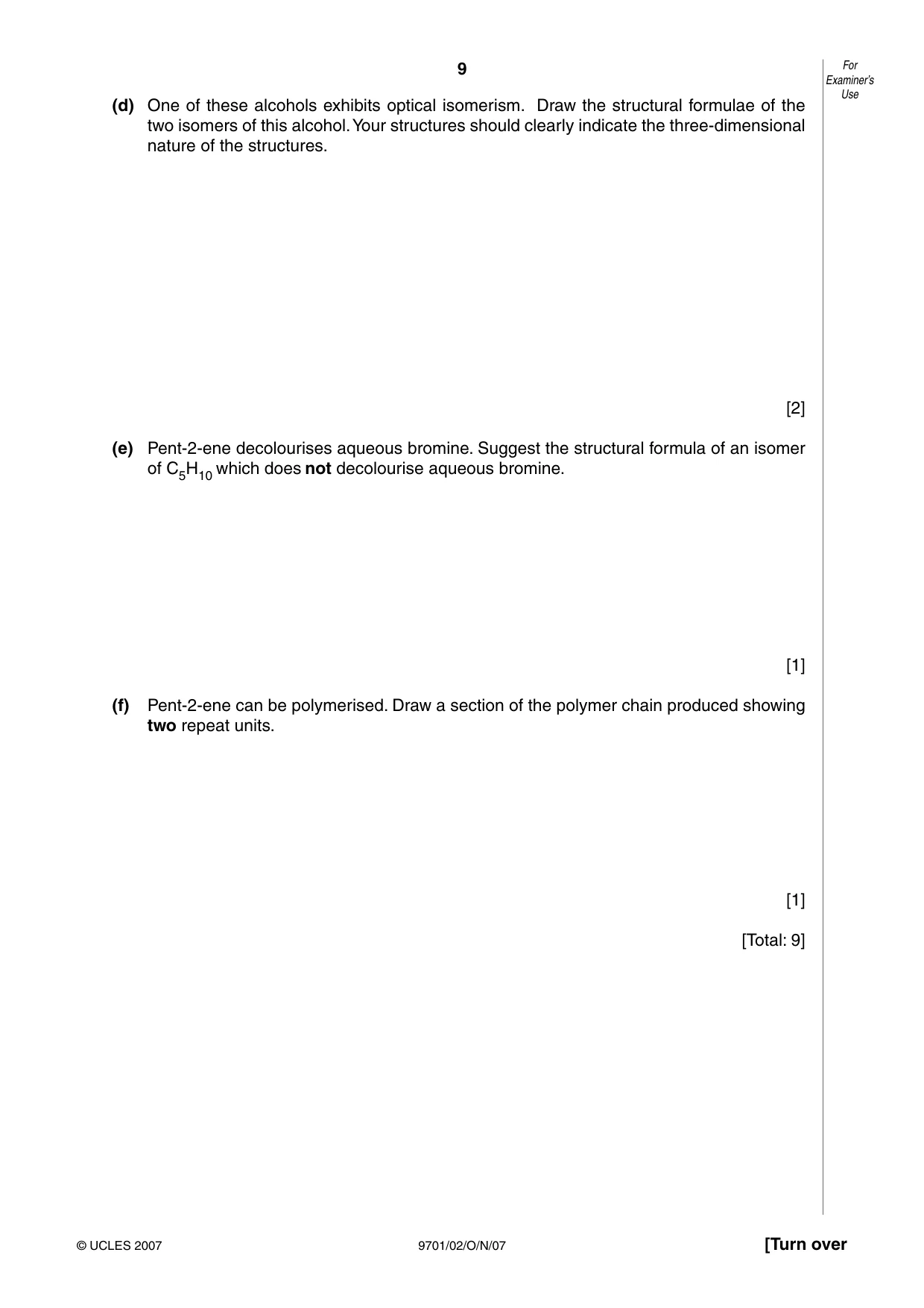
8 9701/02/O/N/07 For Examiner’s Use © UCLES 2007 4 The molecular formula of a compound states the number of atoms of each element that are present in one molecule. It contains no information about the structure of the molecule. Hydrocarbons with the molecular formula C5H10 may be branched chain, straight chain or cyclic. (a) Draw a displayed formula of C5H10 as a branched chain hydrocarbon. [1] Pent-2-ene is one straight chain hydrocarbon with formula C5H10. (b) Pent-2-ene exhibits cis-trans isomerism. Draw and label the structural formulae of the two cis-trans isomers of pent-2-ene. [2] (c) In the spaces below draw the structural formulae of two alcohols which would each produce pent-2-ene on dehydration. [2]
Question paper, page 9
9 9701/02/O/N/07 [Turn over For Examiner’s Use © UCLES 2007 (d) One of these alcohols exhibits optical isomerism. Draw the structural formulae of the two isomers of this alcohol. Your structures should clearly indicate the three-dimensional nature of the structures. [2] (e) Pent-2-ene decolourises aqueous bromine. Suggest the structural formula of an isomer of C5H10 which does not decolourise aqueous bromine. [1] (f) Pent-2-ene can be polymerised. Draw a section of the polymer chain produced showing two repeat units. [1] [Total: 9]
Question paper, page 10
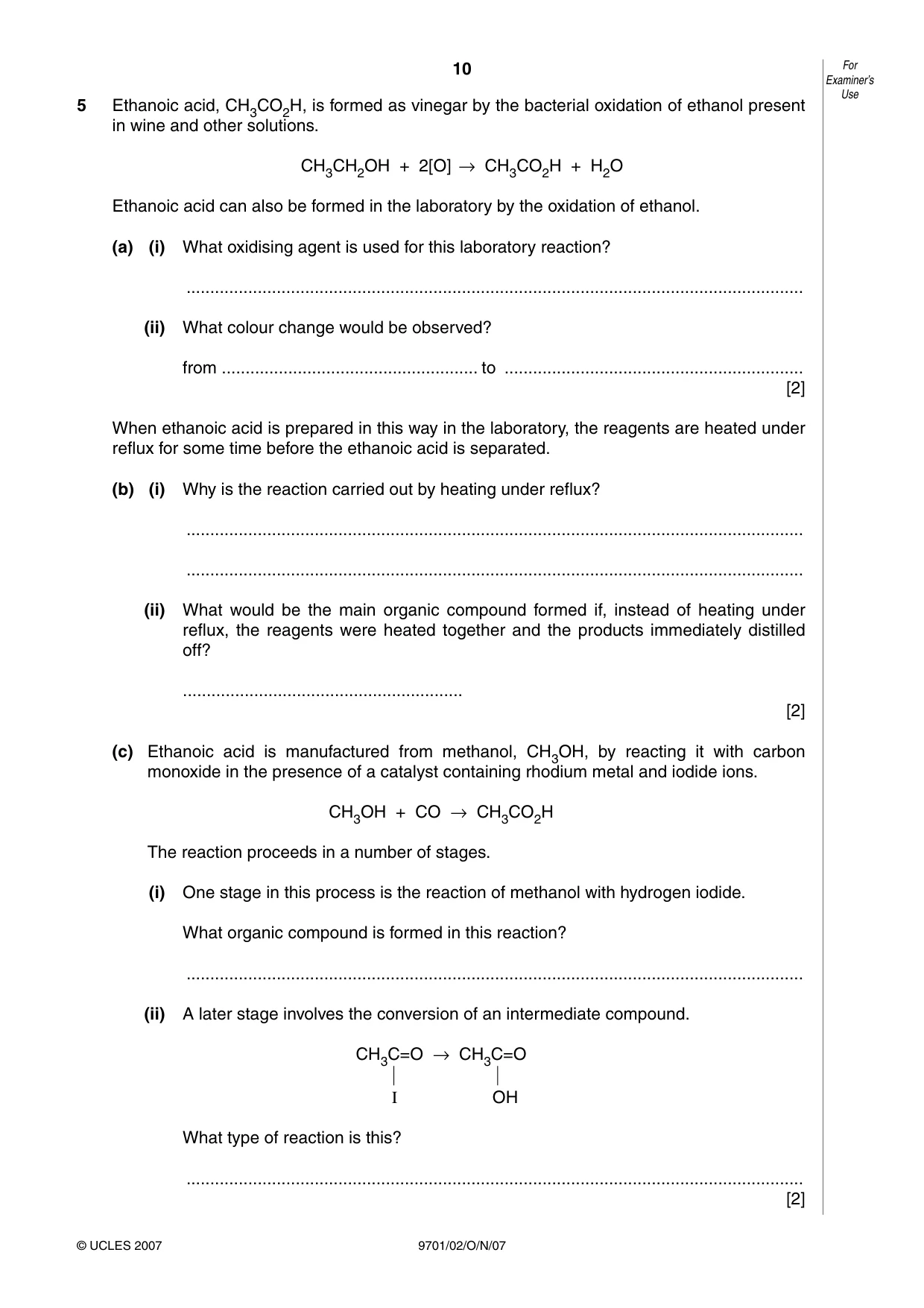
10 9701/02/O/N/07 For Examiner’s Use © UCLES 2007 5 Ethanoic acid, CH3CO2H, is formed as vinegar by the bacterial oxidation of ethanol present in wine and other solutions. CH3CH2OH + 2[O] → CH3CO2H + H2O Ethanoic acid can also be formed in the laboratory by the oxidation of ethanol. (a) (i) What oxidising agent is used for this laboratory reaction? … (ii) What colour change would be observed? from … to … [2] When ethanoic acid is prepared in this way in the laboratory, the reagents are heated under reflux for some time before the ethanoic acid is separated. (b) (i) Why is the reaction carried out by heating under reflux? … … (ii) What would be the main organic compound formed if, instead of heating under reflux, the reagents were heated together and the products immediately distilled off? … [2] (c) Ethanoic acid is manufactured from methanol, CH3OH, by reacting it with carbon monoxide in the presence of a catalyst containing rhodium metal and iodide ions. CH3OH + CO → CH 3CO2H The reaction proceeds in a number of stages. (i) One stage in this process is the reaction of methanol with hydrogen iodide. What organic compound is formed in this reaction? … (ii) A later stage involves the conversion of an intermediate compound. CH3C=O → CH3C=O I OH What type of reaction is this? … [2]
Question paper, page 11
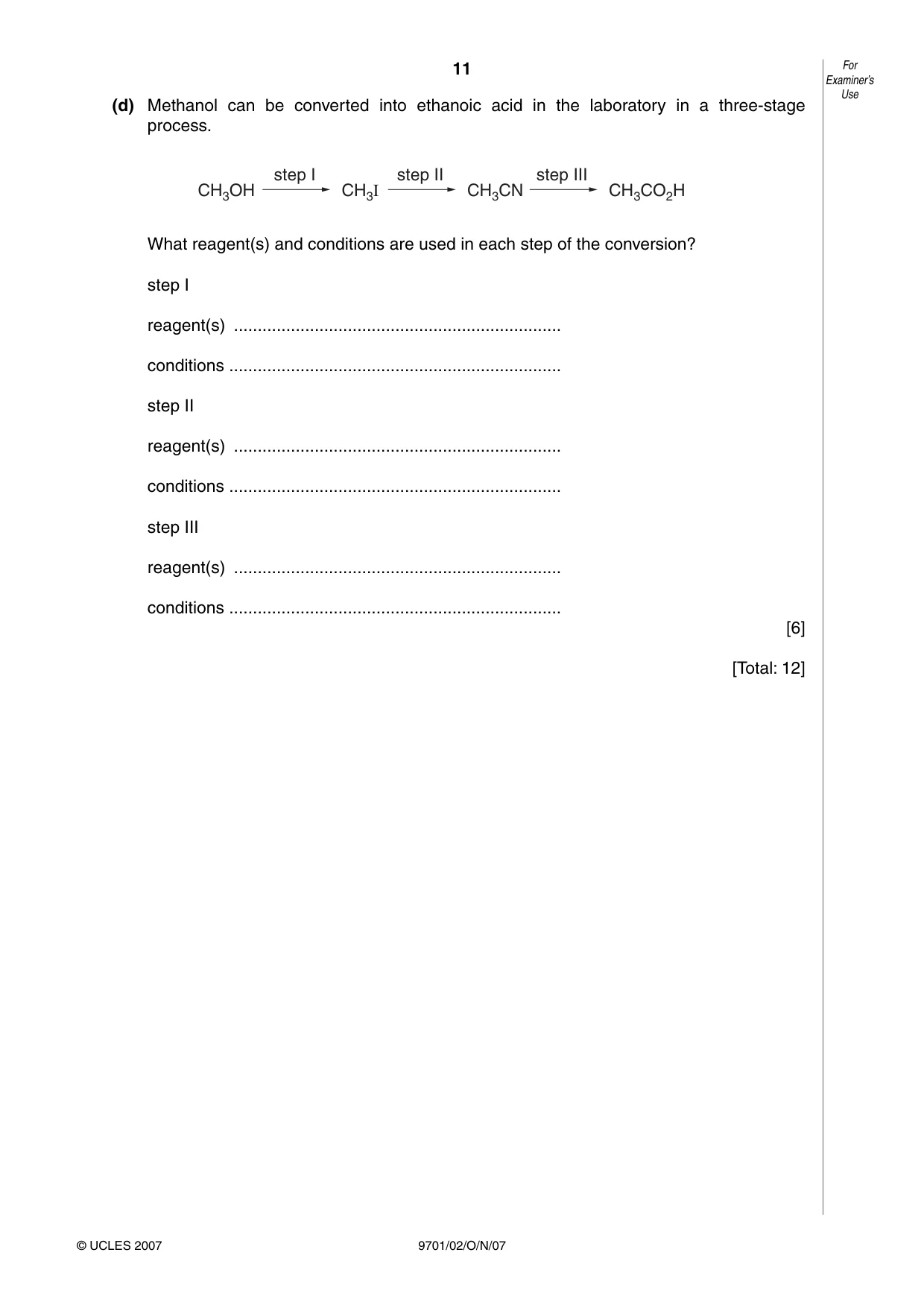
11 9701/02/O/N/07 For Examiner’s Use © UCLES 2007 (d) Methanol can be converted into ethanoic acid in the laboratory in a three-stage process. CH3OH step I CH3I step II CH3CN step III CH3CO2H What reagent(s) and conditions are used in each step of the conversion? step I reagent(s) … conditions … step II reagent(s) … conditions … step III reagent(s) … conditions … [6] [Total: 12]
Question paper, page 12
12 9701/02/O/N/07 BLANK PAGE Permission to reproduce items where third-party owned material protected by copyright is included has been sought and cleared where possible. Every reasonable effort has been made by the publisher (UCLES) to trace copyright holders, but if any items requiring clearance have unwittingly been included, the publisher will be pleased to make amends at the earliest possible opportunity. University of Cambridge International Examinations is part of the Cambridge Assessment Group. Cambridge Assessment is the brand name of University of Cambridge Local Examinations Syndicate (UCLES), which is itself a department of the University of Cambridge.
Mark scheme, page 1
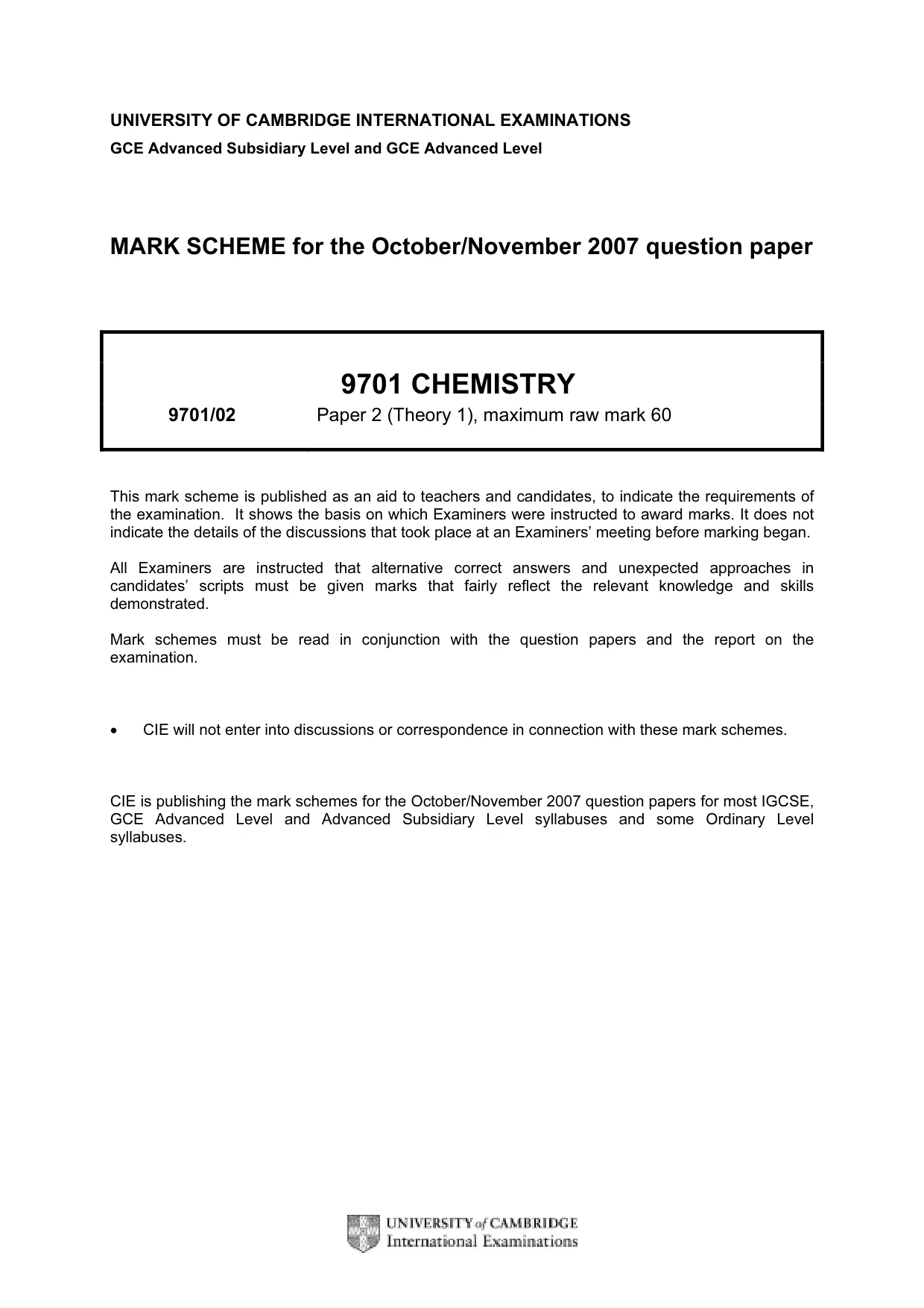
UNIVERSITY OF CAMBRIDGE INTERNATIONAL EXAMINATIONS GCE Advanced Subsidiary Level and GCE Advanced Level MARK SCHEME for the October/November 2007 question paper 9701 CHEMISTRY 9701/02 Paper 2 (Theory 1), maximum raw mark 60 This mark scheme is published as an aid to teachers and candidates, to indicate the requirements of the examination. It shows the basis on which Examiners were instructed to award marks. It does not indicate the details of the discussions that took place at an Examiners’ meeting before marking began. All Examiners are instructed that alternative correct answers and unexpected approaches in candidates’ scripts must be given marks that fairly reflect the relevant knowledge and skills demonstrated. Mark schemes must be read in conjunction with the question papers and the report on the examination. • CIE will not enter into discussions or correspondence in connection with these mark schemes. CIE is publishing the mark schemes for the October/November 2007 question papers for most IGCSE, GCE Advanced Level and Advanced Subsidiary Level syllabuses and some Ordinary Level syllabuses.
Mark scheme, page 2
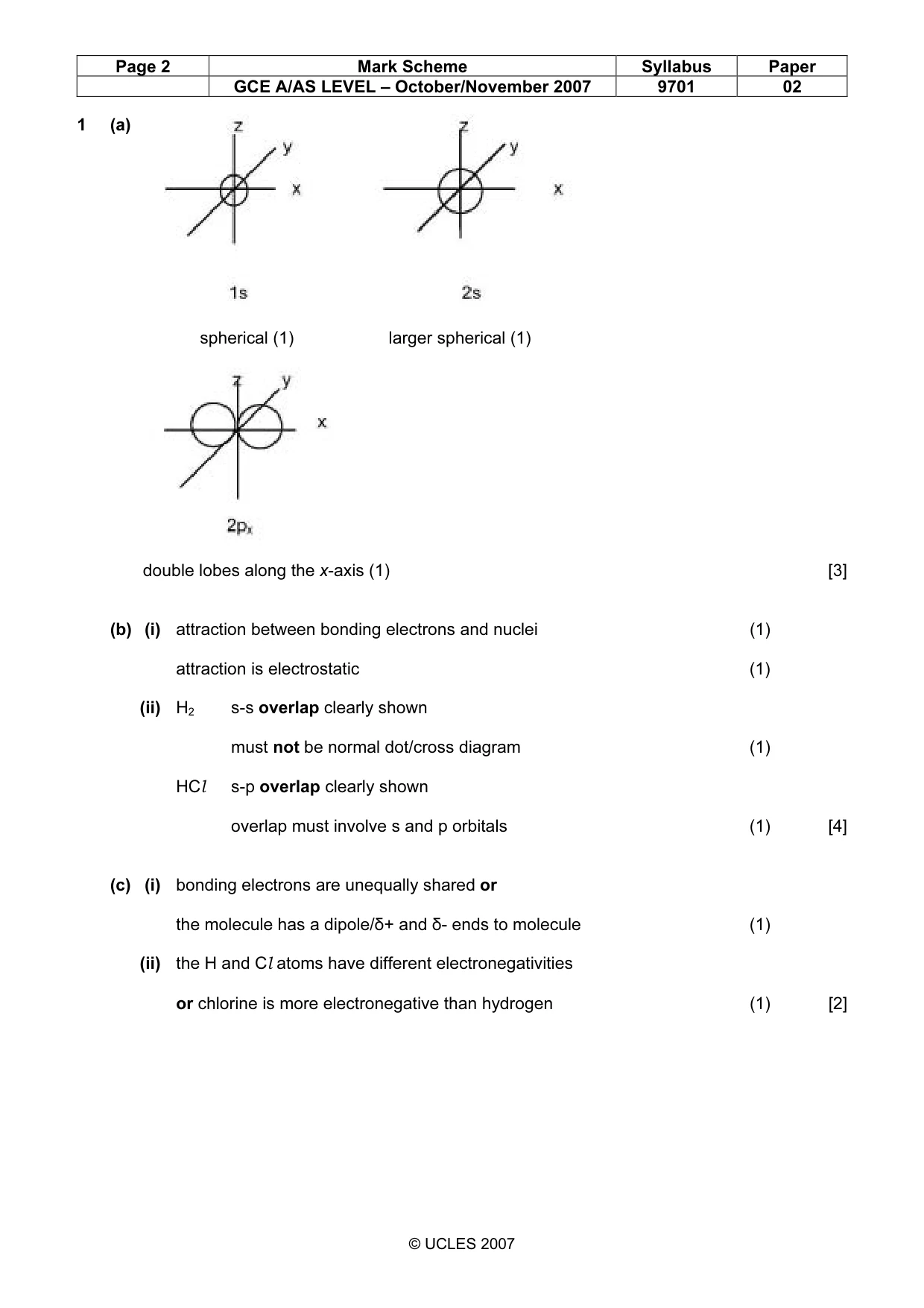
Page 2 Mark Scheme Syllabus Paper GCE A/AS LEVEL – October/November 2007 9701 02 © UCLES 2007 1 (a) spherical (1) larger spherical (1) double lobes along the x-axis (1) [3] (b) (i) attraction between bonding electrons and nuclei (1) attraction is electrostatic (1) (ii) H2 s-s overlap clearly shown must not be normal dot/cross diagram (1) HCl s-p overlap clearly shown overlap must involve s and p orbitals (1) [4] (c) (i) bonding electrons are unequally shared or the molecule has a dipole/δ+ and δ- ends to molecule (1) (ii) the H and Cl atoms have different electronegativities or chlorine is more electronegative than hydrogen (1) [2]
Mark scheme, page 3
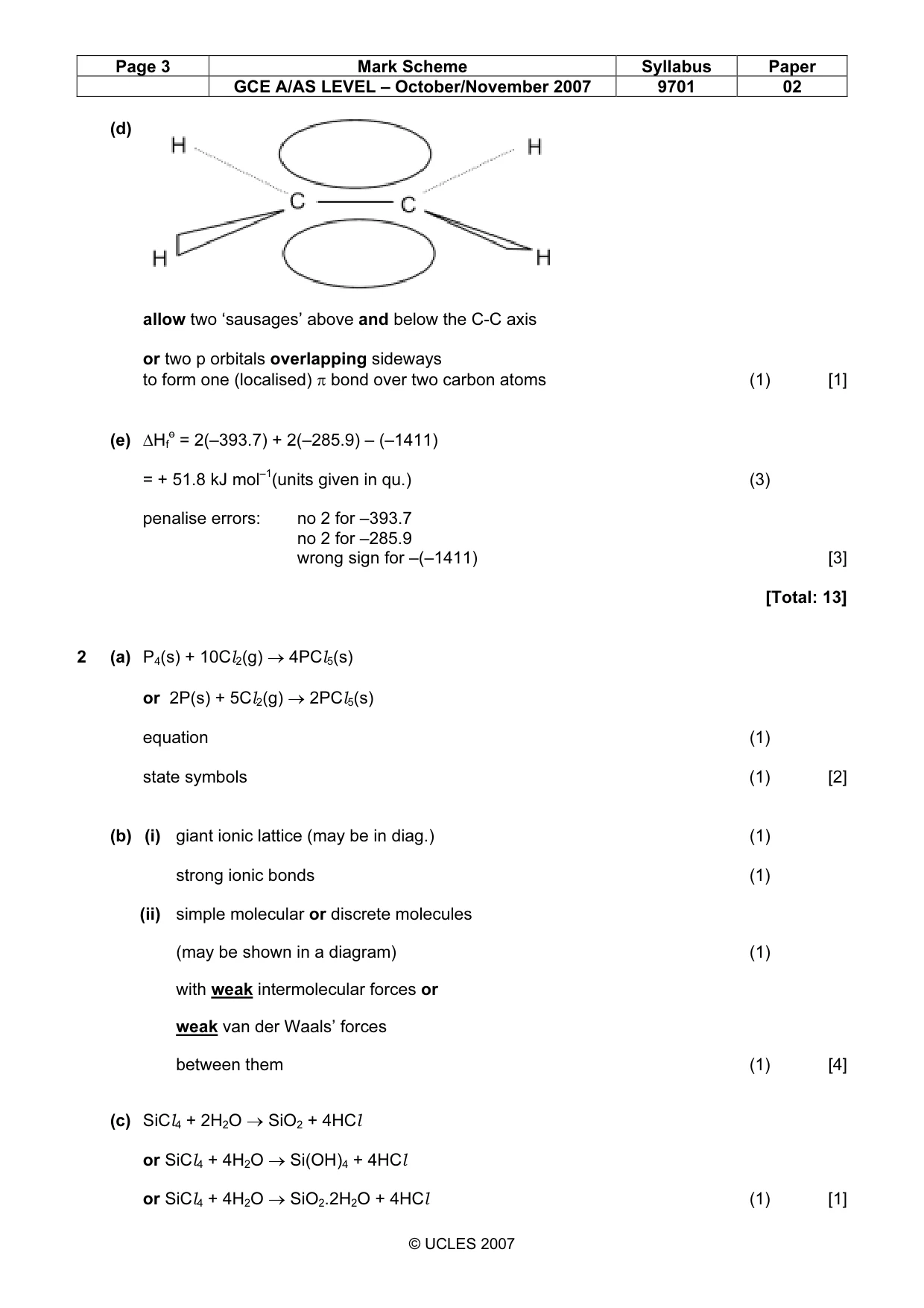
Page 3 Mark Scheme Syllabus Paper GCE A/AS LEVEL – October/November 2007 9701 02 © UCLES 2007 (d) allow two ‘sausages’ above and below the C-C axis or two p orbitals overlapping sideways to form one (localised) π bond over two carbon atoms (1) [1] (e) ∆Hf o = 2(–393.7) + 2(–285.9) – (–1411) = + 51.8 kJ mol–1(units given in qu.) (3) penalise errors: no 2 for –393.7 no 2 for –285.9 wrong sign for –(–1411) [3] [Total: 13] 2 (a) P4(s) + 10Cl2(g) → 4PCl5(s) or 2P(s) + 5Cl2(g) → 2PCl5(s) equation (1) state symbols (1) [2] (b) (i) giant ionic lattice (may be in diag.) (1) strong ionic bonds (1) (ii) simple molecular or discrete molecules (may be shown in a diagram) (1) with weak intermolecular forces or weak van der Waals’ forces between them (1) [4] (c) SiCl4 + 2H2O → SiO2 + 4HCl or SiCl4 + 4H2O → Si(OH)4 + 4HCl or SiCl4 + 4H2O → SiO2.2H2O + 4HCl (1) [1]
Mark scheme, page 4
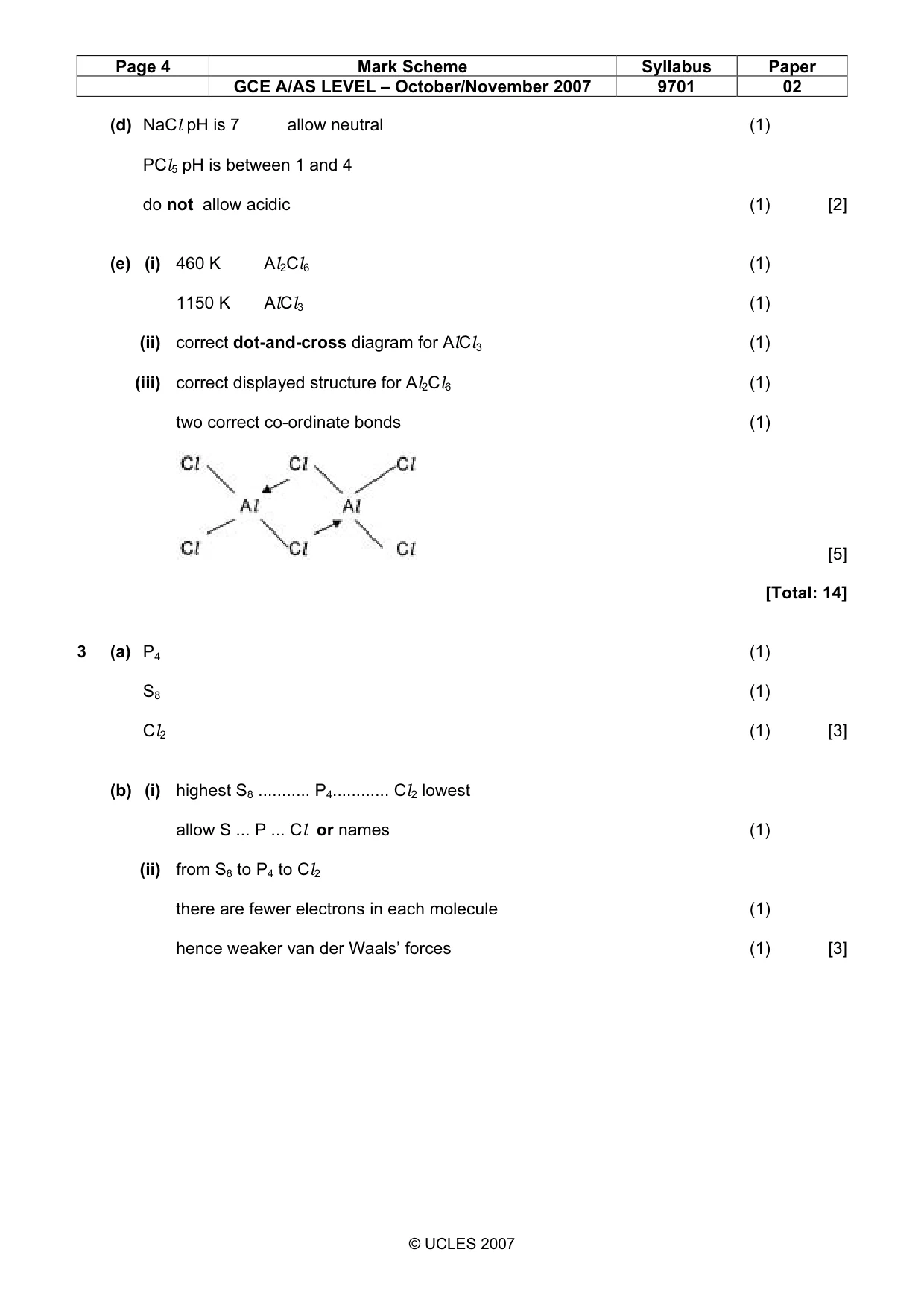
Page 4 Mark Scheme Syllabus Paper GCE A/AS LEVEL – October/November 2007 9701 02 © UCLES 2007 (d) NaCl pH is 7 allow neutral (1) PCl5 pH is between 1 and 4 do not allow acidic (1) [2] (e) (i) 460 K Al2Cl6 (1) 1150 K AlCl3 (1) (ii) correct dot-and-cross diagram for AlCl3 (1) (iii) correct displayed structure for Al2Cl6 (1) two correct co-ordinate bonds (1) [5] [Total: 14] 3 (a) P4 (1) S8 (1) Cl2 (1) [3] (b) (i) highest S8 … P4… Cl2 lowest allow S ... P ... Cl or names (1) (ii) from S8 to P4 to Cl2 there are fewer electrons in each molecule (1) hence weaker van der Waals’ forces (1) [3]
Mark scheme, page 5
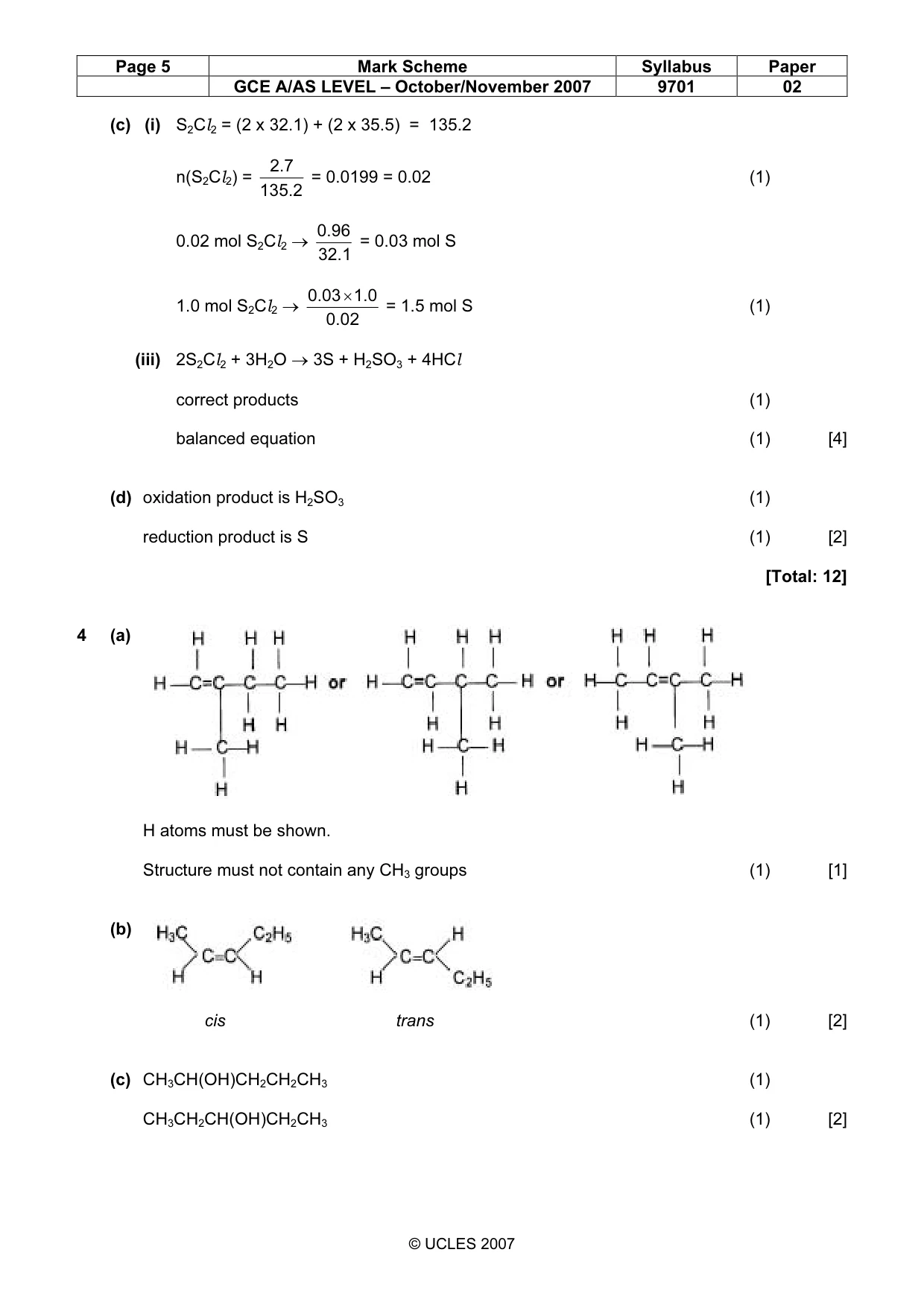
Page 5 Mark Scheme Syllabus Paper GCE A/AS LEVEL – October/November 2007 9701 02 © UCLES 2007 (c) (i) S2Cl2 = (2 x 32.1) + (2 x 35.5) = 135.2 n(S2Cl2) = 135.2 2.7 = 0.0199 = 0.02 (1) 0.02 mol S2Cl2 → 32.1 0.96 = 0.03 mol S 1.0 mol S2Cl2 → 0.02 1.0 0.03× = 1.5 mol S (1) (iii) 2S2Cl2 + 3H2O → 3S + H2SO3 + 4HCl correct products (1) balanced equation (1) [4] (d) oxidation product is H2SO3 (1) reduction product is S (1) [2] [Total: 12] 4 (a) H atoms must be shown. Structure must not contain any CH3 groups (1) [1] (b) cis trans (1) [2] (c) CH3CH(OH)CH2CH2CH3 (1) CH3CH2CH(OH)CH2CH3 (1) [2]
Mark scheme, page 6
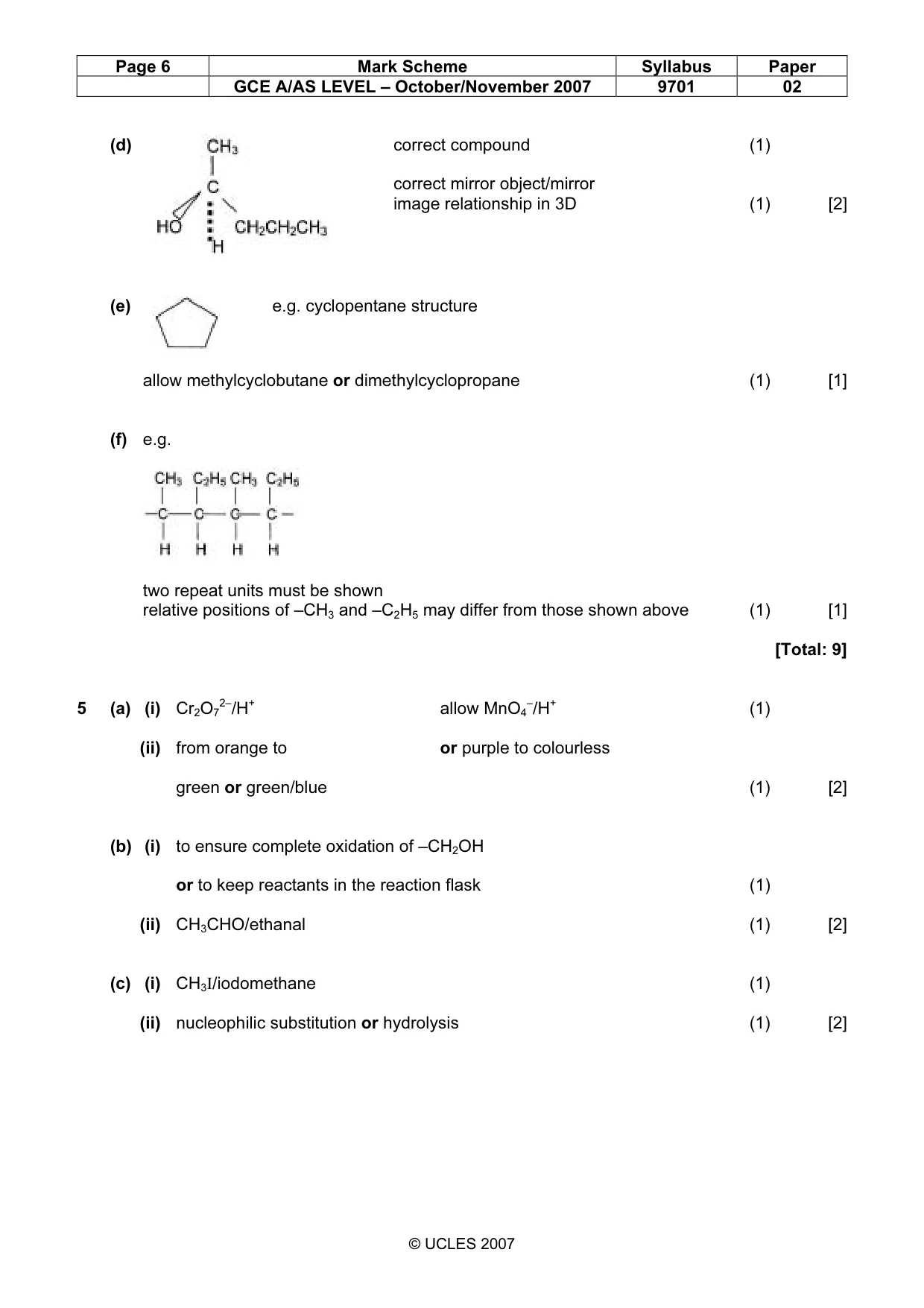
Page 6 Mark Scheme Syllabus Paper GCE A/AS LEVEL – October/November 2007 9701 02 © UCLES 2007 (d) correct compound (1) correct mirror object/mirror image relationship in 3D (1) [2] (e) e.g. cyclopentane structure allow methylcyclobutane or dimethylcyclopropane (1) [1] (f) e.g. two repeat units must be shown relative positions of –CH3 and –C2H5 may differ from those shown above (1) [1] [Total: 9] 5 (a) (i) Cr2O7 2–/H+ allow MnO4 –/H+ (1) (ii) from orange to or purple to colourless green or green/blue (1) [2] (b) (i) to ensure complete oxidation of –CH2OH or to keep reactants in the reaction flask (1) (ii) CH3CHO/ethanal (1) [2] (c) (i) CH3I/iodomethane (1) (ii) nucleophilic substitution or hydrolysis (1) [2]
Mark scheme, page 7
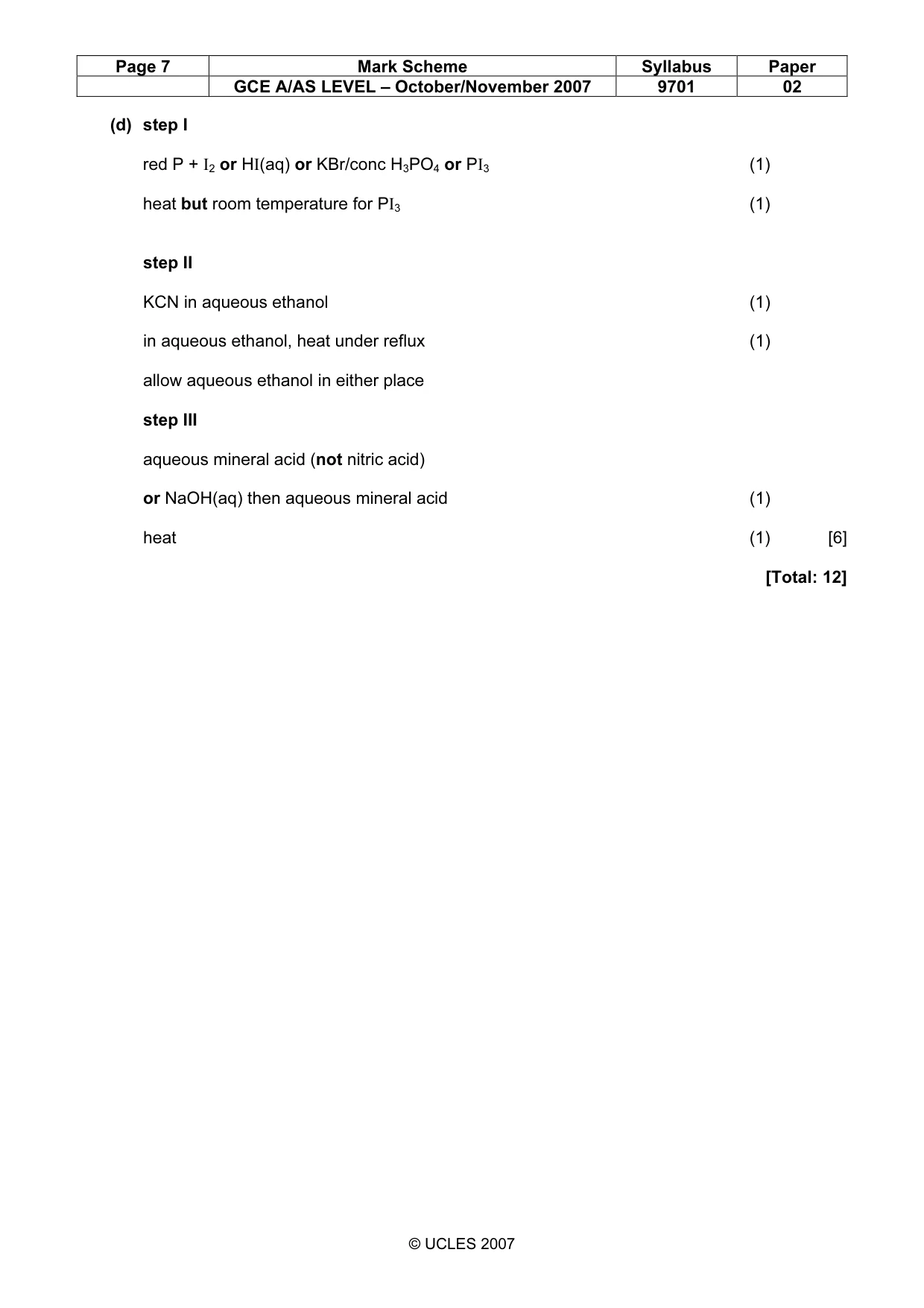
Page 7 Mark Scheme Syllabus Paper GCE A/AS LEVEL – October/November 2007 9701 02 © UCLES 2007 (d) step I red P + I2 or HI(aq) or KBr/conc H3PO4 or PI3 (1) heat but room temperature for PI3 (1) step II KCN in aqueous ethanol (1) in aqueous ethanol, heat under reflux (1) allow aqueous ethanol in either place step III aqueous mineral acid (not nitric acid) or NaOH(aq) then aqueous mineral acid (1) heat (1) [6] [Total: 12]
What you needed in this session
Cambridge’s own grade thresholds for 2007 Oct/Nov, Paper 2 · Variant 1. A higher threshold means an easier paper — the bar moves with how the cohort did.