Cambridge A Level Chemistry 9701 — 2007 May/June Paper 2 · Variant 1
9701/21/M/J/07 · 60 marks · ≈68 min
The question paper and its mark scheme, free to read here and free to download. This is Cambridge’s own paper, exactly as it was sat.
Question paper12 pages


Mark scheme5 pages
Answers below. Sit the paper first if you are practising.
Paper as text
Question paper, page 1
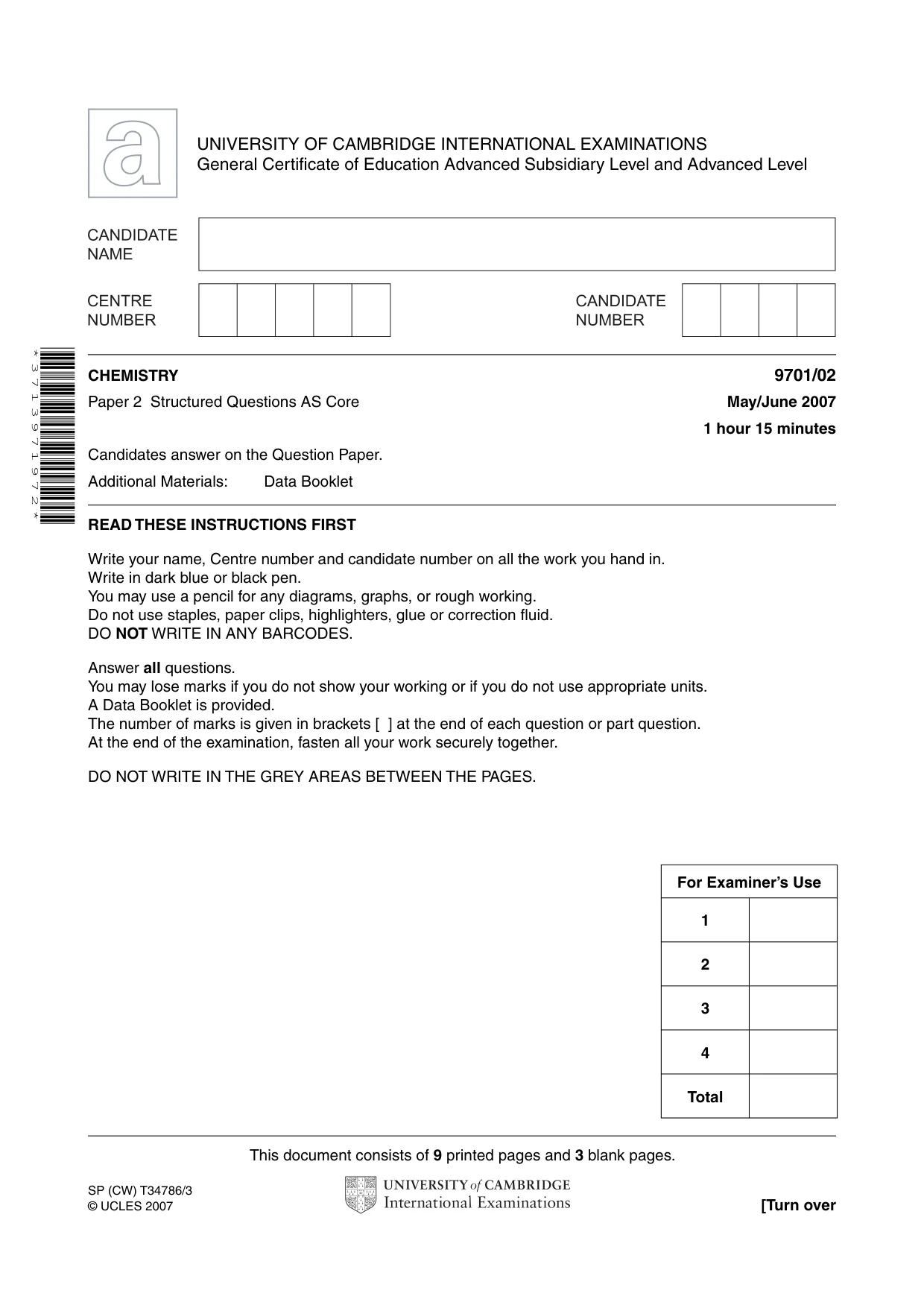
This document consists of 9 printed pages and 3 blank pages. SP (CW) T34786/3 © UCLES 2007 [Turn over UNIVERSITY OF CAMBRIDGE INTERNATIONAL EXAMINATIONS General Certificate of Education Advanced Subsidiary Level and Advanced Level READ THESE INSTRUCTIONS FIRST Write your name, Centre number and candidate number on all the work you hand in. Write in dark blue or black pen. You may use a pencil for any diagrams, graphs, or rough working. Do not use staples, paper clips, highlighters, glue or correction fluid. DO NOT WRITE IN ANY BARCODES. Answer all questions. You may lose marks if you do not show your working or if you do not use appropriate units. A Data Booklet is provided. The number of marks is given in brackets [ ] at the end of each question or part question. At the end of the examination, fasten all your work securely together. DO NOT WRITE IN THE GREY AREAS BETWEEN THE PAGES. * 3 7 1 3 9 7 1 9 7 2 * CHEMISTRY 9701/02 Paper 2 Structured Questions AS Core May/June 2007 1 hour 15 minutes Candidates answer on the Question Paper. Additional Materials: Data Booklet For Examiner’s Use 1 2 3 4 Total
Question paper, page 2
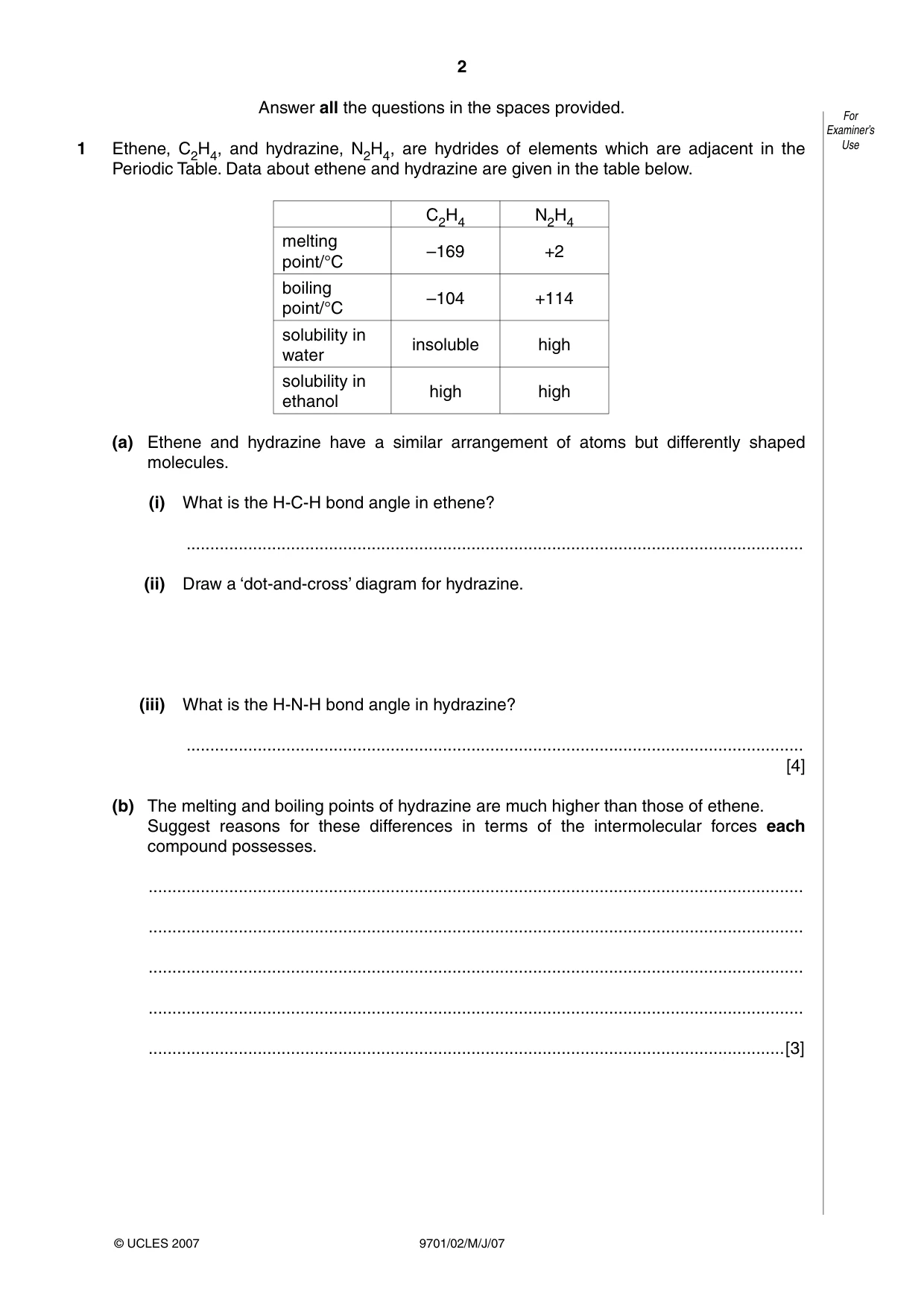
2 9701/02/M/J/07 © UCLES 2007 For Examiner’s Use Answer all the questions in the spaces provided. 1 Ethene, C2H4, and hydrazine, N2H4, are hydrides of elements which are adjacent in the Periodic Table. Data about ethene and hydrazine are given in the table below. C2H4 N2H4 melting point/°C –169 +2 boiling point/°C –104 +114 solubility in water insoluble high solubility in ethanol high high (a) Ethene and hydrazine have a similar arrangement of atoms but differently shaped molecules. (i) What is the H-C-H bond angle in ethene? … (ii) Draw a ‘dot-and-cross’ diagram for hydrazine. (iii) What is the H-N-H bond angle in hydrazine? … [4] (b) The melting and boiling points of hydrazine are much higher than those of ethene. Suggest reasons for these differences in terms of the intermolecular forces each compound possesses. … … … … …[3]
Question paper, page 3
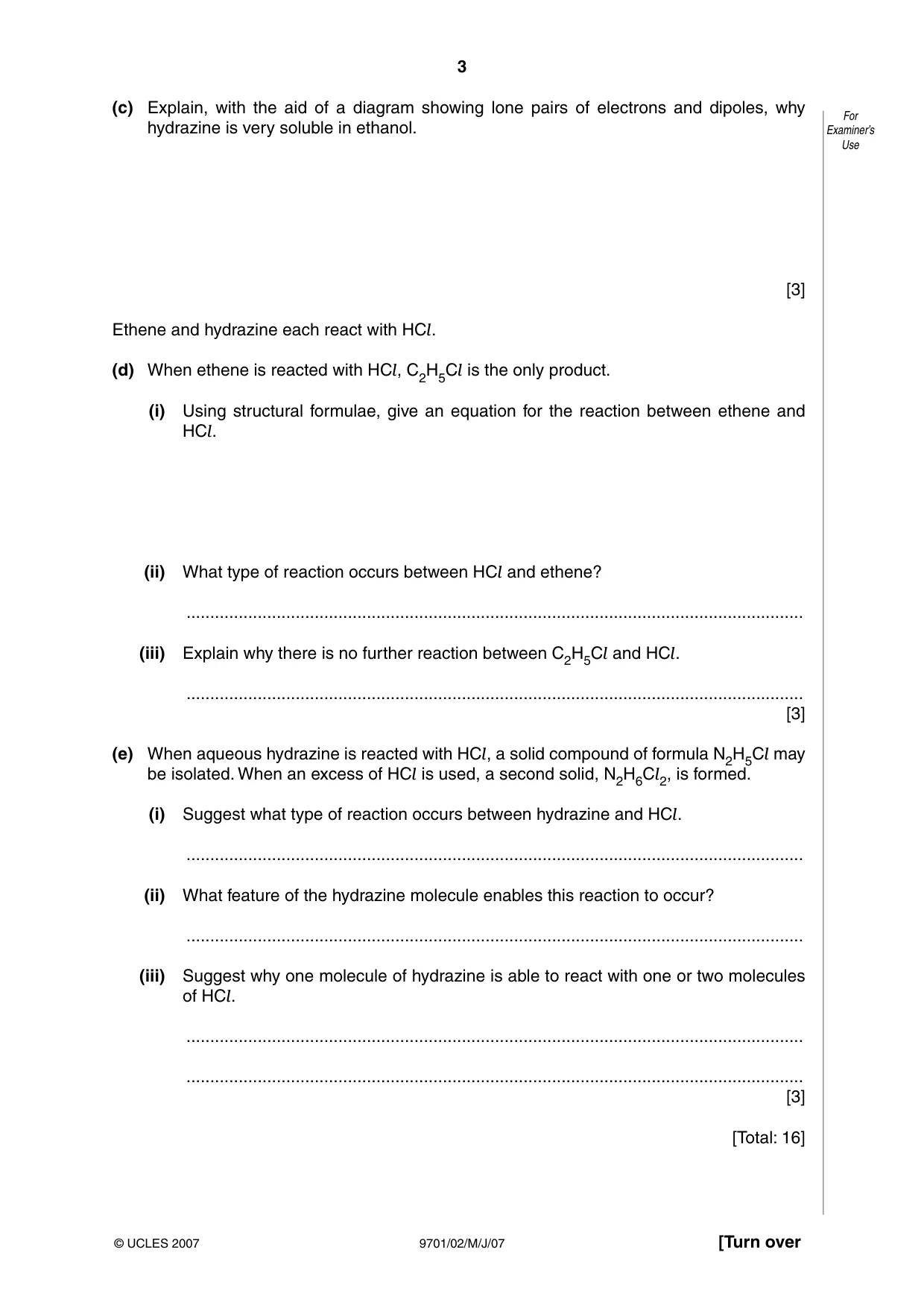
3 9701/02/M/J/07 © UCLES 2007 For Examiner’s Use [Turn over (c) Explain, with the aid of a diagram showing lone pairs of electrons and dipoles, why hydrazine is very soluble in ethanol. [3] Ethene and hydrazine each react with HCl. (d) When ethene is reacted with HCl, C2H5Cl is the only product. (i) Using structural formulae, give an equation for the reaction between ethene and HCl. (ii) What type of reaction occurs between HCl and ethene? … (iii) Explain why there is no further reaction between C2H5Cl and HCl. … [3] (e) When aqueous hydrazine is reacted with HCl, a solid compound of formula N2H5Cl may be isolated. When an excess of HCl is used, a second solid, N2H6Cl2, is formed. (i) Suggest what type of reaction occurs between hydrazine and HCl. … (ii) What feature of the hydrazine molecule enables this reaction to occur? … (iii) Suggest why one molecule of hydrazine is able to react with one or two molecules of HCl. … … [3] [Total: 16]
Question paper, page 4
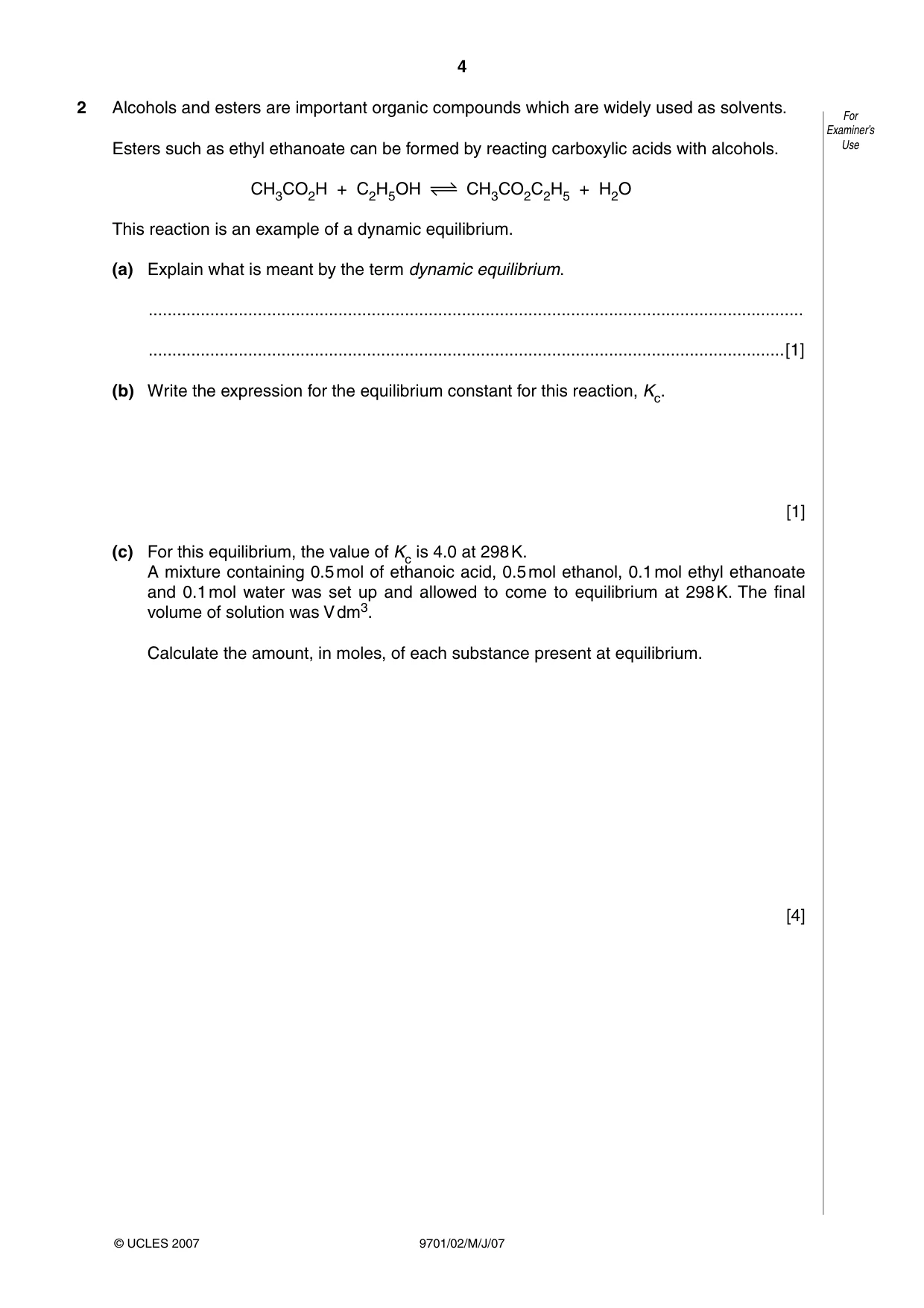
4 9701/02/M/J/07 © UCLES 2007 For Examiner’s Use 2 Alcohols and esters are important organic compounds which are widely used as solvents. Esters such as ethyl ethanoate can be formed by reacting carboxylic acids with alcohols. CH3CO2H + C2H5OH CH3CO2C2H5 + H2O This reaction is an example of a dynamic equilibrium. (a) Explain what is meant by the term dynamic equilibrium. … …[1] (b) Write the expression for the equilibrium constant for this reaction, Kc. [1] (c) For this equilibrium, the value of Kc is 4.0 at 298 K. A mixture containing 0.5 mol of ethanoic acid, 0.5 mol ethanol, 0.1 mol ethyl ethanoate and 0.1 mol water was set up and allowed to come to equilibrium at 298 K. The final volume of solution was V dm3. Calculate the amount, in moles, of each substance present at equilibrium. [4]
Question paper, page 5
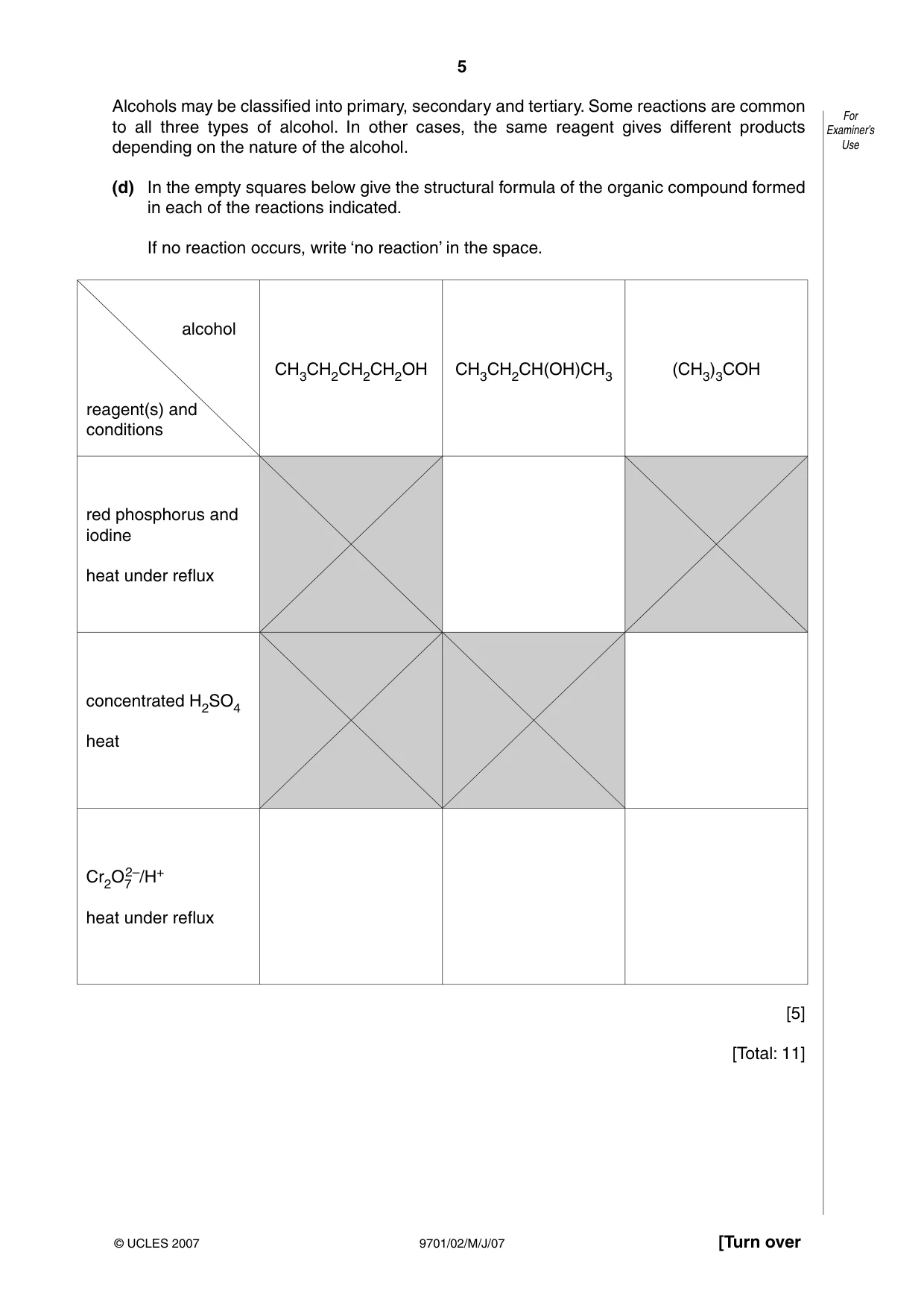
5 9701/02/M/J/07 © UCLES 2007 For Examiner’s Use [Turn over Alcohols may be classified into primary, secondary and tertiary. Some reactions are common to all three types of alcohol. In other cases, the same reagent gives different products depending on the nature of the alcohol. (d) In the empty squares below give the structural formula of the organic compound formed in each of the reactions indicated. If no reaction occurs, write ‘no reaction’ in the space. alcohol reagent(s) and conditions CH3CH2CH2CH2OH CH3CH2CH(OH)CH3 (CH3)3COH red phosphorus and iodine heat under reflux concentrated H2SO4 heat Cr2O7 2–/H+ heat under reflux [5] [Total: 11]
Question paper, page 6
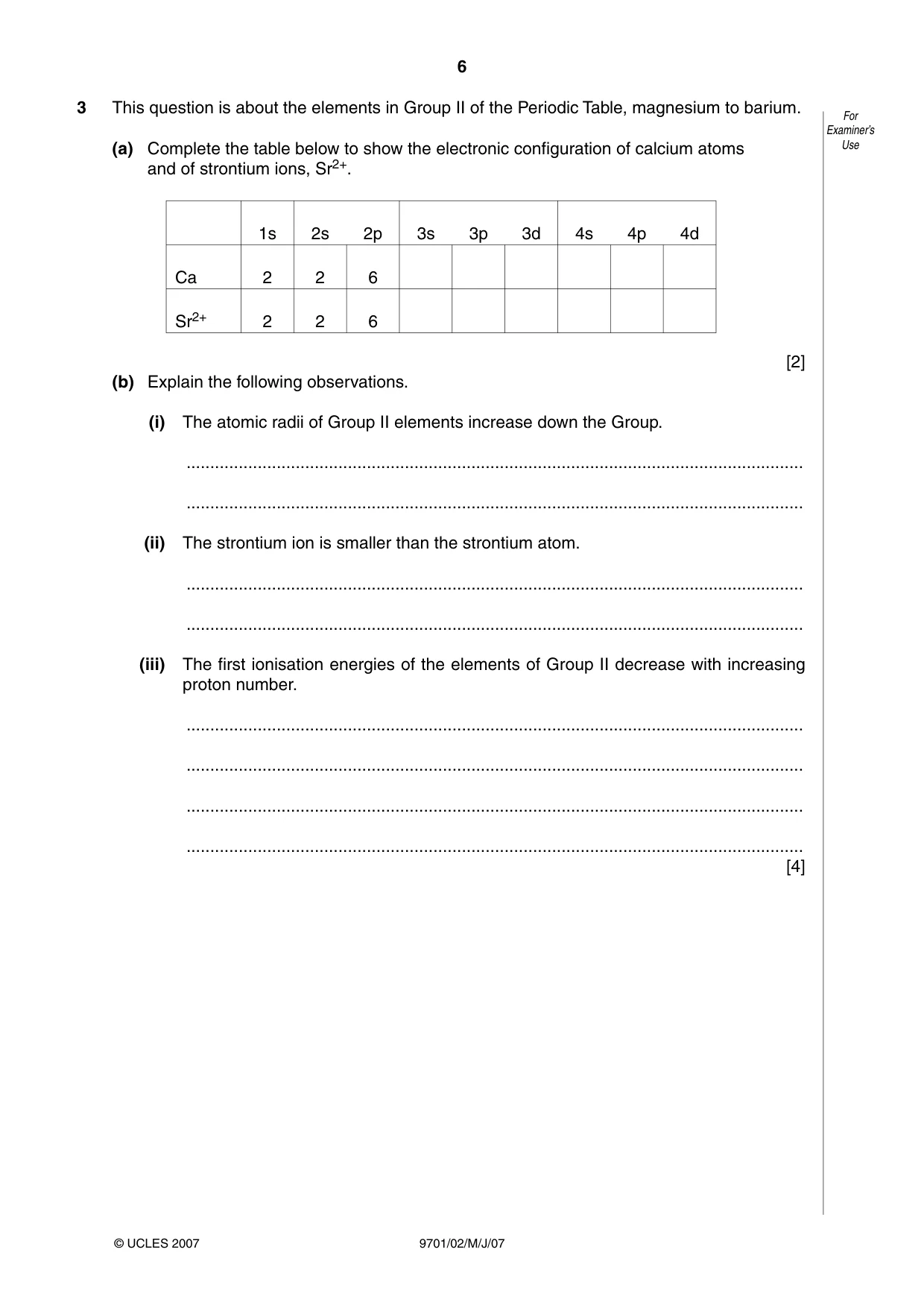
6 9701/02/M/J/07 © UCLES 2007 For Examiner’s Use 3 This question is about the elements in Group II of the Periodic Table, magnesium to barium. (a) Complete the table below to show the electronic configuration of calcium atoms and of strontium ions, Sr2+. 1s 2s 2p 3s 3p 3d 4s 4p 4d Ca 2 2 6 Sr2+ 2 2 6 [2] (b) Explain the following observations. (i) The atomic radii of Group II elements increase down the Group. … … (ii) The strontium ion is smaller than the strontium atom. … … (iii) The first ionisation energies of the elements of Group II decrease with increasing proton number. … … … … [4]
Question paper, page 7
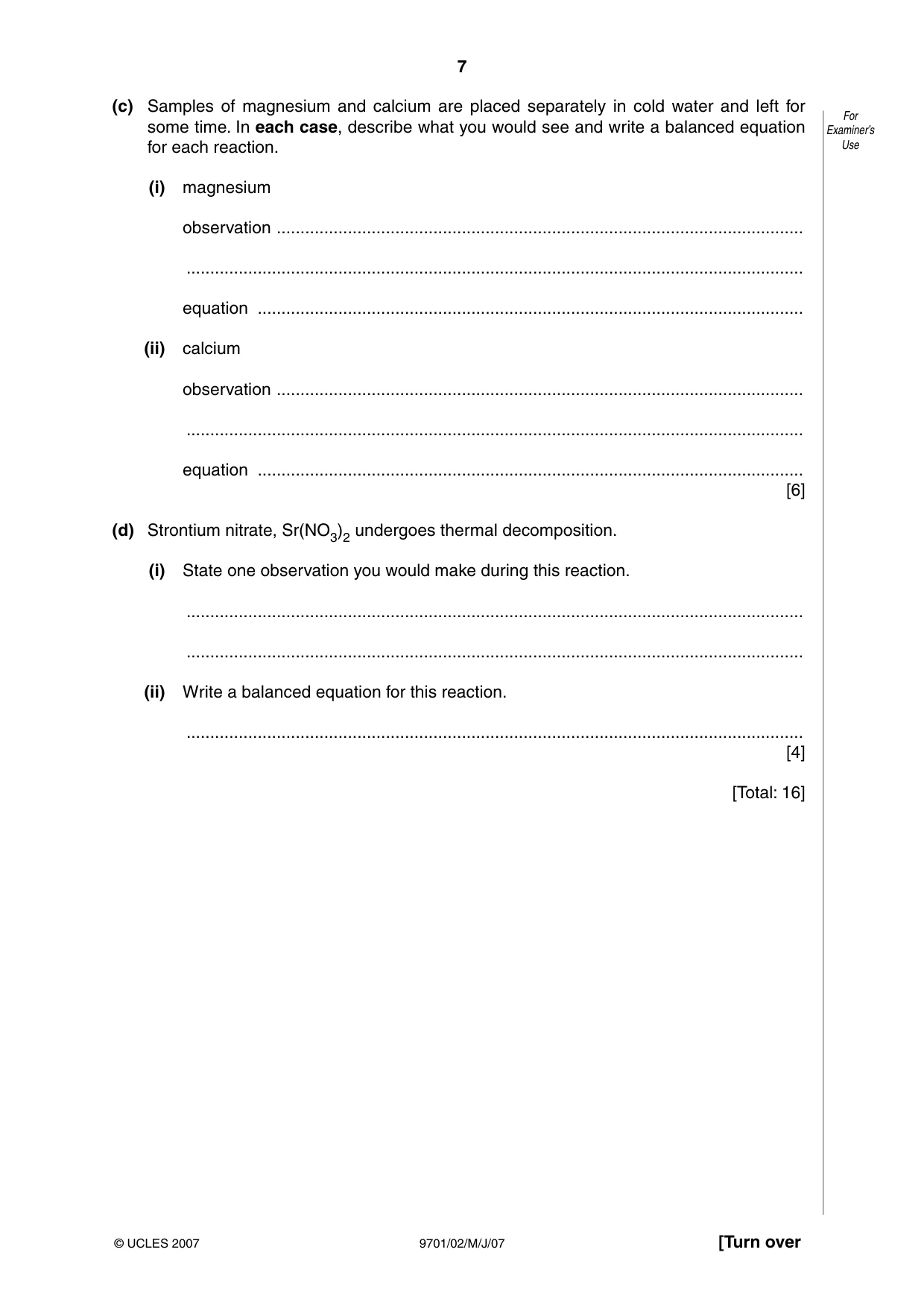
7 9701/02/M/J/07 © UCLES 2007 For Examiner’s Use [Turn over (c) Samples of magnesium and calcium are placed separately in cold water and left for some time. In each case, describe what you would see and write a balanced equation for each reaction. (i) magnesium observation … … equation … (ii) calcium observation … … equation … [6] (d) Strontium nitrate, Sr(NO3)2 undergoes thermal decomposition. (i) State one observation you would make during this reaction. … … (ii) Write a balanced equation for this reaction. … [4] [Total: 16]
Question paper, page 8
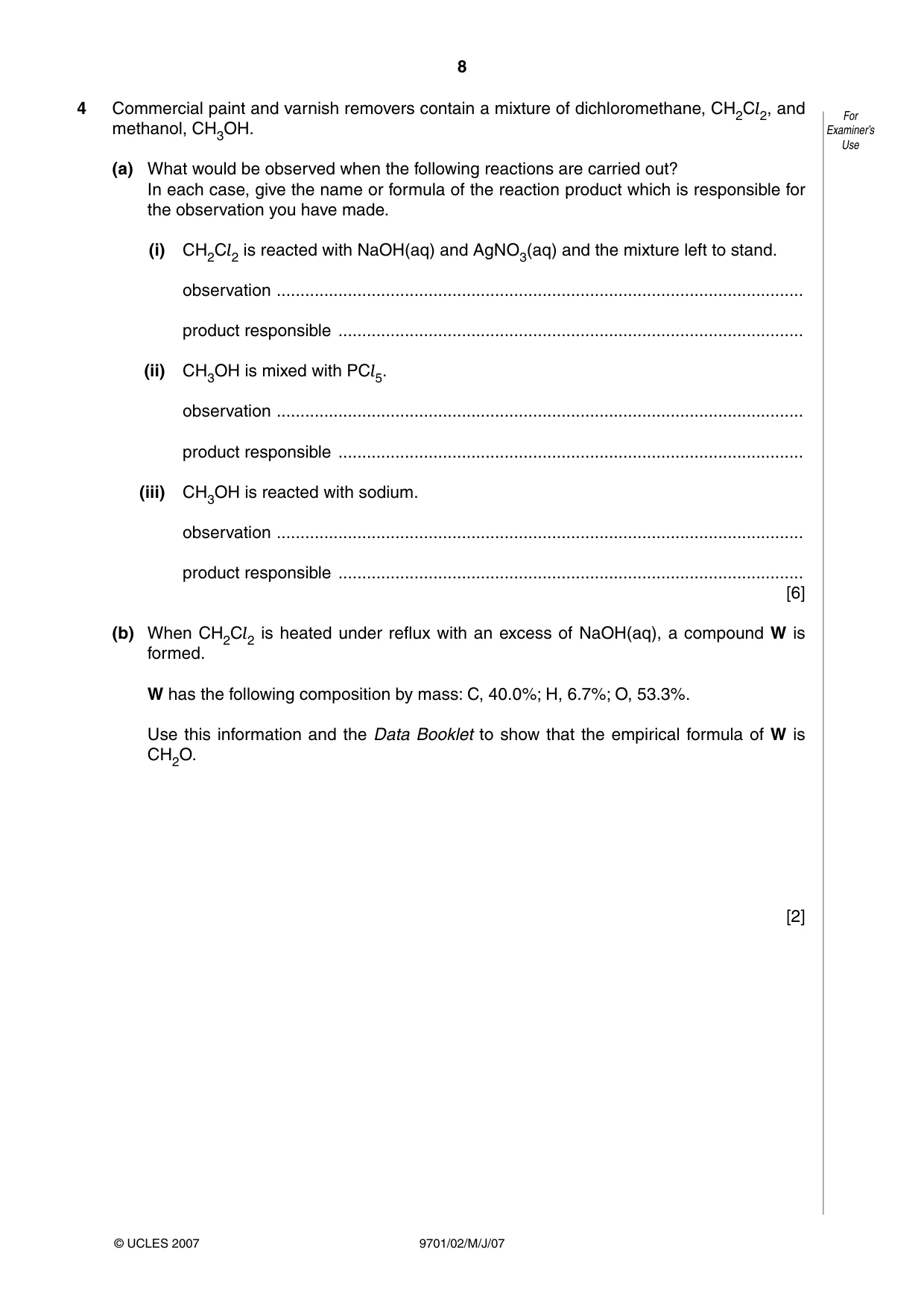
8 9701/02/M/J/07 © UCLES 2007 For Examiner’s Use 4 Commercial paint and varnish removers contain a mixture of dichloromethane, CH2Cl2, and methanol, CH3OH. (a) What would be observed when the following reactions are carried out? In each case, give the name or formula of the reaction product which is responsible for the observation you have made. (i) CH2Cl2 is reacted with NaOH(aq) and AgNO3(aq) and the mixture left to stand. observation … product responsible … (ii) CH3OH is mixed with PCl5. observation … product responsible … (iii) CH3OH is reacted with sodium. observation … product responsible … [6] (b) When CH2Cl2 is heated under reflux with an excess of NaOH(aq), a compound W is formed. W has the following composition by mass: C, 40.0%; H, 6.7%; O, 53.3%. Use this information and the Data Booklet to show that the empirical formula of W is CH2O. [2]
Question paper, page 9
9 9701/02/M/J/07 © UCLES 2007 For Examiner’s Use (c) Compounds with the empirical formula CH2O can have the molecular formula C2H4O2. Two possible structural formulae for compounds with molecular formula C2H4O2 are HCO2CH3 and H2C=C(OH)2. In the boxes below, draw displayed formulae for three further structural isomers with the molecular formula C2H4O2. Do not attempt to draw any structures containing rings or O–O bonds. X Y Z [3] (d) Identify which of your compounds, X, Y, or Z, will react with the following reagents. In each case, state what you would observe. (i) solid NaHCO3 compound … observation … (ii) Tollens’ reagent compound … observation … [4] (e) One of the three compounds, X, Y, or Z, shows stereoisomerism. Draw displayed, labelled structures of the stereoisomers of this compound. [2] [Total: 17]
Question paper, page 12
BLANK PAGE 12 9701/02/M/J/07 Permission to reproduce items where third-party owned material protected by copyright is included has been sought and cleared where possible. Every reasonable effort has been made by the publisher (UCLES) to trace copyright holders, but if any items requiring clearance have unwittingly been included, the publisher will be pleased to make amends at the earliest possible opportunity. University of Cambridge International Examinations is part of the Cambridge Assessment Group. Cambridge Assessment is the brand name of University of Cambridge Local Examinations Syndicate (UCLES), which is itself a department of the University of Cambridge.
Mark scheme, page 1
UNIVERSITY OF CAMBRIDGE INTERNATIONAL EXAMINATIONS GCE Advanced Subsidiary Level and GCE Advanced Level MARK SCHEME for the May/June 2007 question paper 9701 CHEMISTRY 9701/02 Paper 2 (AS Structured Questions), maximum raw mark 60 This mark scheme is published as an aid to teachers and candidates, to indicate the requirements of the examination. It shows the basis on which Examiners were instructed to award marks. It does not indicate the details of the discussions that took place at an Examiners’ meeting before marking began. All Examiners are instructed that alternative correct answers and unexpected approaches in candidates’ scripts must be given marks that fairly reflect the relevant knowledge and skills demonstrated. Mark schemes must be read in conjunction with the question papers and the report on the examination. • CIE will not enter into discussions or correspondence in connection with these mark schemes. CIE is publishing the mark schemes for the May/June 2007 question papers for most IGCSE, GCE Advanced Level and Advanced Subsidiary Level syllabuses and some Ordinary Level syllabuses.
Mark scheme, page 2
Page 2 Mark Scheme Syllabus Paper GCE A/AS LEVEL – May/June 2007 9701 02 © UCLES 2007 1 (a) (i) between 117° and 120° [1] (ii) 14 electrons must be shown single N-N bond [1] lone pair on each N atom [1] (iii) between 107° and 109° [1] [4] (b) ethene – van der Waals’ forces [1] hydrazine – hydrogen bonds [1] hydrogen bonds are stronger or van der Waals’ forces are weaker [1] [3] (c) correct dipole on OH and NH bonds [1] labelled hydrogen bond shown between an O atom of H2O and a H atom of N2H4 or between an N atom of N2H4 and a H atom of H2O [1] lone pair on O atom or on N atom in the H bond i.e. or [1] [3] (d) (i) CH2 = CH2 +HCl → CH3CH2Cl [1] (ii) electrophilic addition [1] (iii) there is no further unsaturation or CH3CH2Cl molecule is saturated or no possibility of addition or no free radicals are present [1] [3] (e) (i) acid – base/neutralization [1] (ii) N atom has a lone pair of electrons or N atom can behave as a base or N atom can form dative bond [1] (iii) each N atom has a lone pair or each nitrogen atom can behave as a base or each nitrogen atom can form a dative bond [1] [3] [Total: 16]
Mark scheme, page 3
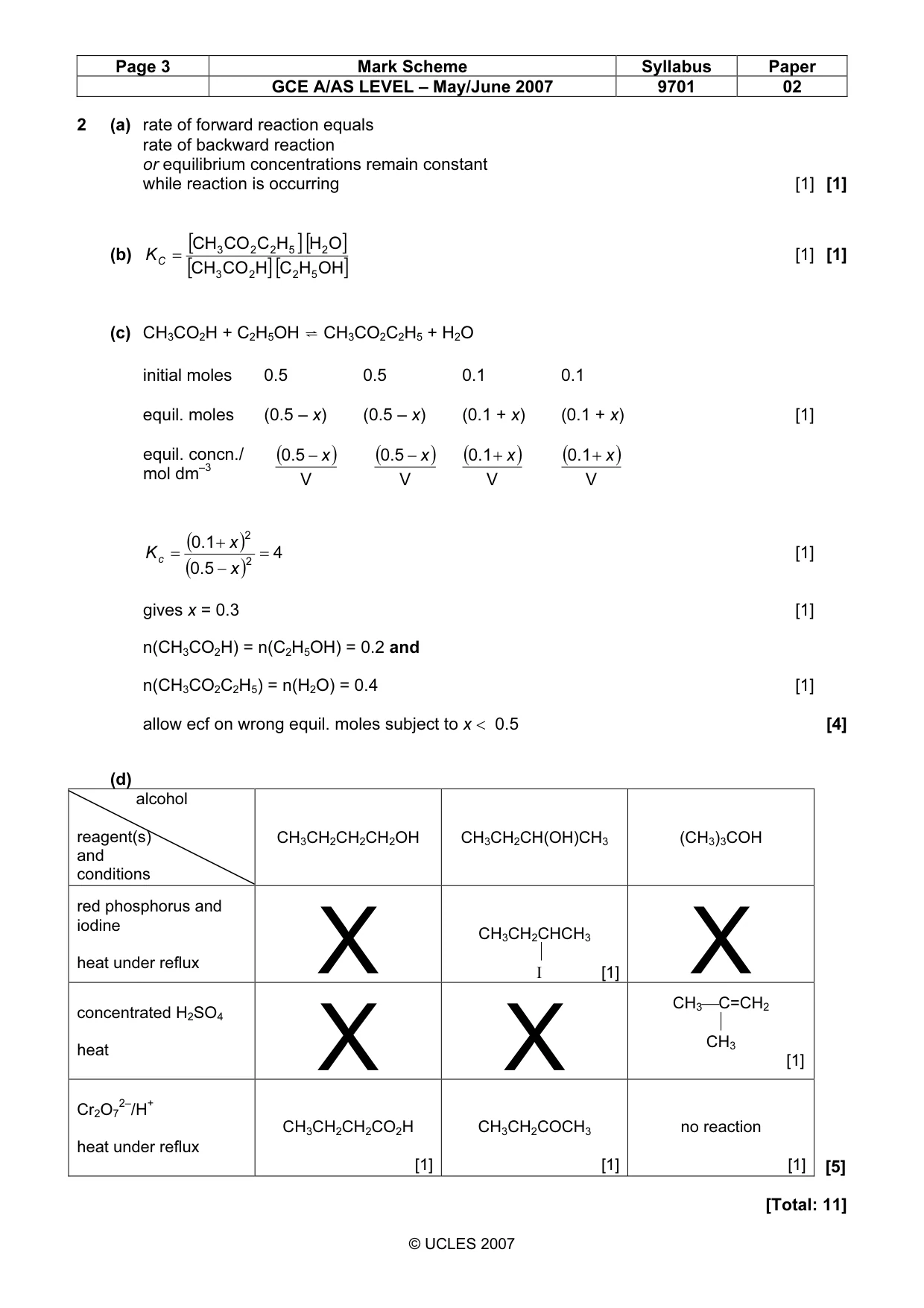
Page 3 Mark Scheme Syllabus Paper GCE A/AS LEVEL – May/June 2007 9701 02 © UCLES 2007 2 (a) rate of forward reaction equals rate of backward reaction or equilibrium concentrations remain constant while reaction is occurring [1] [1] (b) [ ][ ] [ ][ ] OH H C H CO CH O H H C CO CH 5 2 2 3 2 5 2 2 3 = C K [1] [1] (c) CH3CO2H + C2H5OH ⇋ CH3CO2C2H5 + H2O initial moles 0.5 0.5 0.1 0.1 equil. moles (0.5 – x) (0.5 – x) (0.1 + x) (0.1 + x) [1] equil. concn./ mol dm–3 ( ) V 0.5 x − ( ) V 0.5 x − ( ) V 0.1 x + ( ) V 0.1 x + ( ) ( ) 4 0.5 0.1 2 2 = − + = x x Kc [1] gives x = 0.3 [1] n(CH3CO2H) = n(C2H5OH) = 0.2 and n(CH3CO2C2H5) = n(H2O) = 0.4 [1] allow ecf on wrong equil. moles subject to x < 0.5 [4] (d) alcohol reagent(s) and conditions CH3CH2CH2CH2OH CH3CH2CH(OH)CH3 (CH3)3COH red phosphorus and iodine heat under reflux CH3CH2CHCH3 I [1] concentrated H2SO4 heat CH3C=CH2 CH3 [1] Cr2O7 2–/H+ heat under reflux CH3CH2CH2CO2H [1] CH3CH2COCH3 [1] no reaction [1] [5] [Total: 11]
Mark scheme, page 4
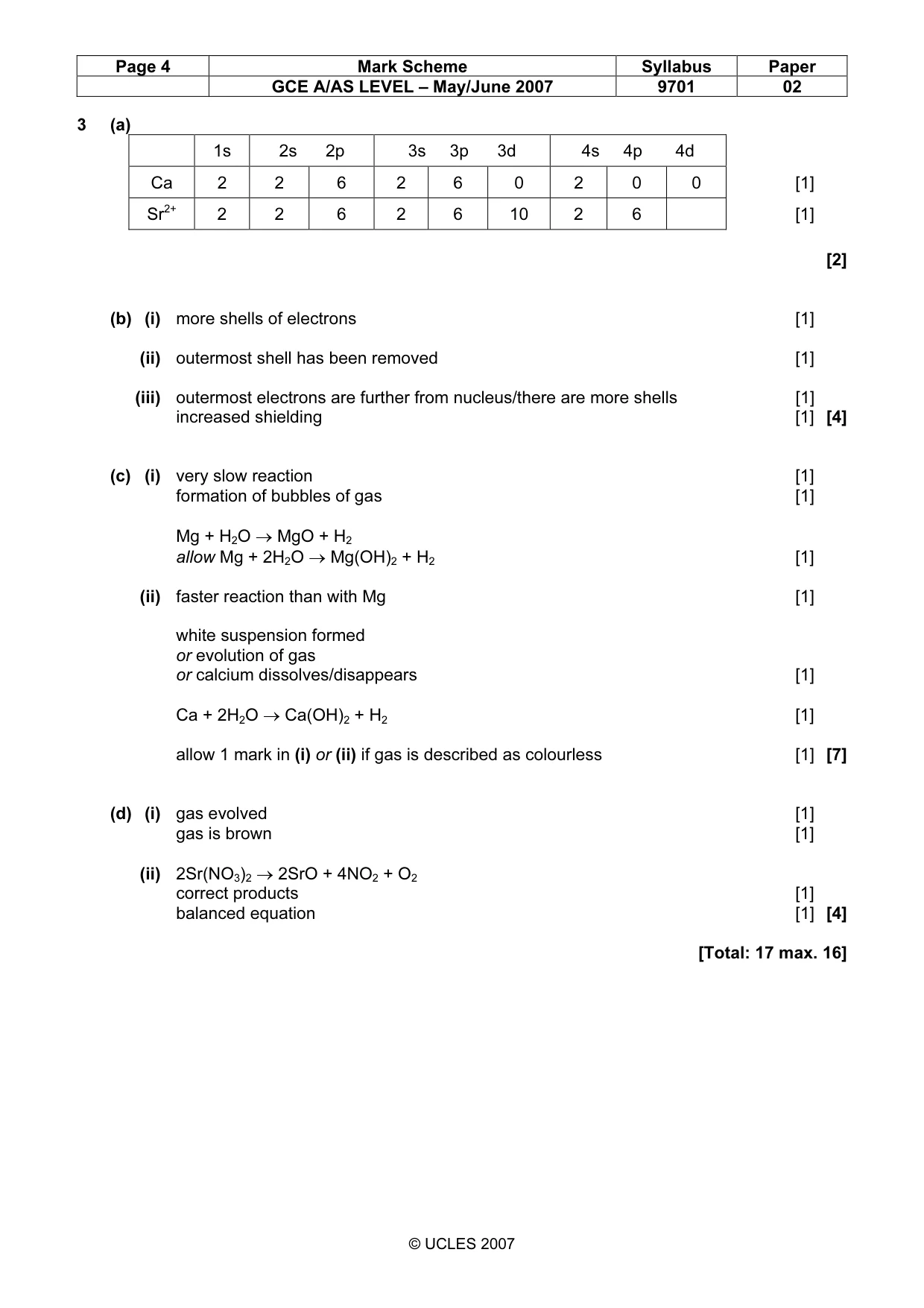
Page 4 Mark Scheme Syllabus Paper GCE A/AS LEVEL – May/June 2007 9701 02 © UCLES 2007 3 (a) 1s 2s 2p 3s 3p 3d 4s 4p 4d Ca 2 2 6 2 6 0 2 0 0 [1] Sr2+ 2 2 6 2 6 10 2 6 [1] [2] (b) (i) more shells of electrons [1] (ii) outermost shell has been removed [1] (iii) outermost electrons are further from nucleus/there are more shells [1] increased shielding [1] [4] (c) (i) very slow reaction [1] formation of bubbles of gas [1] Mg + H2O → MgO + H2 allow Mg + 2H2O → Mg(OH)2 + H2 [1] (ii) faster reaction than with Mg [1] white suspension formed or evolution of gas or calcium dissolves/disappears [1] Ca + 2H2O → Ca(OH)2 + H2 [1] allow 1 mark in (i) or (ii) if gas is described as colourless [1] [7] (d) (i) gas evolved [1] gas is brown [1] (ii) 2Sr(NO3)2 → 2SrO + 4NO2 + O2 correct products [1] balanced equation [1] [4] [Total: 17 max. 16]
Mark scheme, page 5
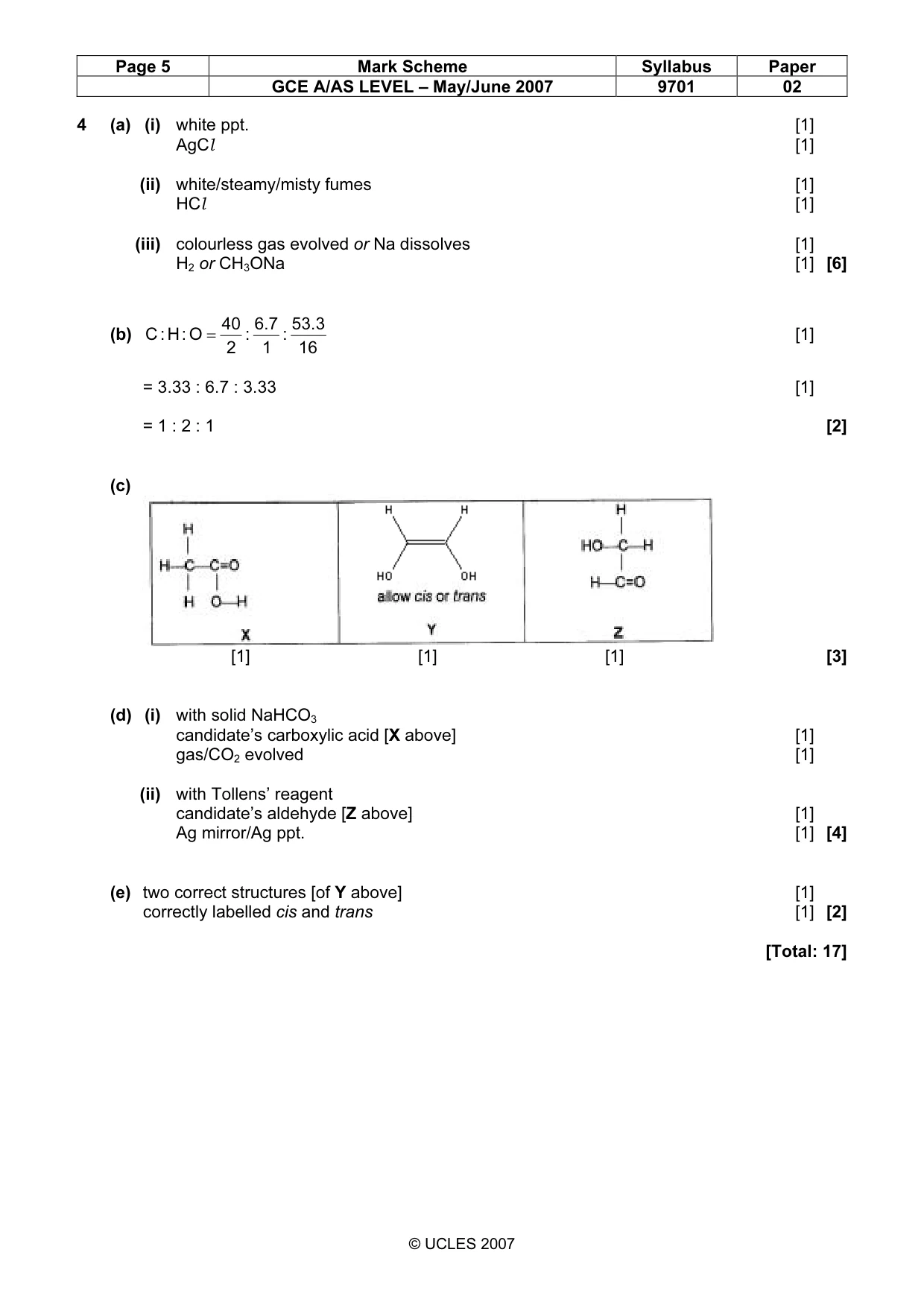
Page 5 Mark Scheme Syllabus Paper GCE A/AS LEVEL – May/June 2007 9701 02 © UCLES 2007 4 (a) (i) white ppt. [1] AgCl [1] (ii) white/steamy/misty fumes [1] HCl [1] (iii) colourless gas evolved or Na dissolves [1] H2 or CH3ONa [1] [6] (b) 16 53.3 : 1 6.7 : 2 40 O : H : C = [1] = 3.33 : 6.7 : 3.33 [1] = 1 : 2 : 1 [2] (c) [1] [1] [1] [3] (d) (i) with solid NaHCO3 candidate’s carboxylic acid [X above] [1] gas/CO2 evolved [1] (ii) with Tollens’ reagent candidate’s aldehyde [Z above] [1] Ag mirror/Ag ppt. [1] [4] (e) two correct structures [of Y above] [1] correctly labelled cis and trans [1] [2] [Total: 17]
What you needed in this session
Cambridge’s own grade thresholds for 2007 May/June, Paper 2 · Variant 1. A higher threshold means an easier paper — the bar moves with how the cohort did.