Cambridge A Level Chemistry 9701 — 2006 Oct/Nov Paper 2 · Variant 1
9701/21/O/N/06 · 60 marks · ≈68 min
The question paper and its mark scheme, free to read here and free to download. This is Cambridge’s own paper, exactly as it was sat.
Question paper12 pages
Mark scheme5 pages
Answers below. Sit the paper first if you are practising.
Paper as text
Question paper, page 1
This document consists of 11 printed pages and 1 blank page. SP (SC/MML) T27660/4 © UCLES 2006 [Turn over UNIVERSITY OF CAMBRIDGE INTERNATIONAL EXAMINATIONS General Certificate of Education Advanced Subsidiary Level and Advanced Level CHEMISTRY Paper 2 Structured Questions AS Core 9701/02 October/November 2006 1 hour 15 minutes Candidates answer on the Question Paper. Additional Materials: Data Booklet READ THESE INSTRUCTIONS FIRST Write your Centre number, candidate number and name on all work you hand in. Write in dark blue or black pen. You may use a pencil for any diagrams, graphs, or rough working. Do not use staples, paper clips, highlighters, glue or correction fluid. Answer all questions. You may lose marks if you do not show your working or if you do not use appropriate units. A Data Booklet is provided. The number of marks is given in brackets [ ] at the end of each question or part question. At the end of the examination, fasten all your work securely together. For Examiner’s Use 1 2 3 4 5 Total
Question paper, page 2
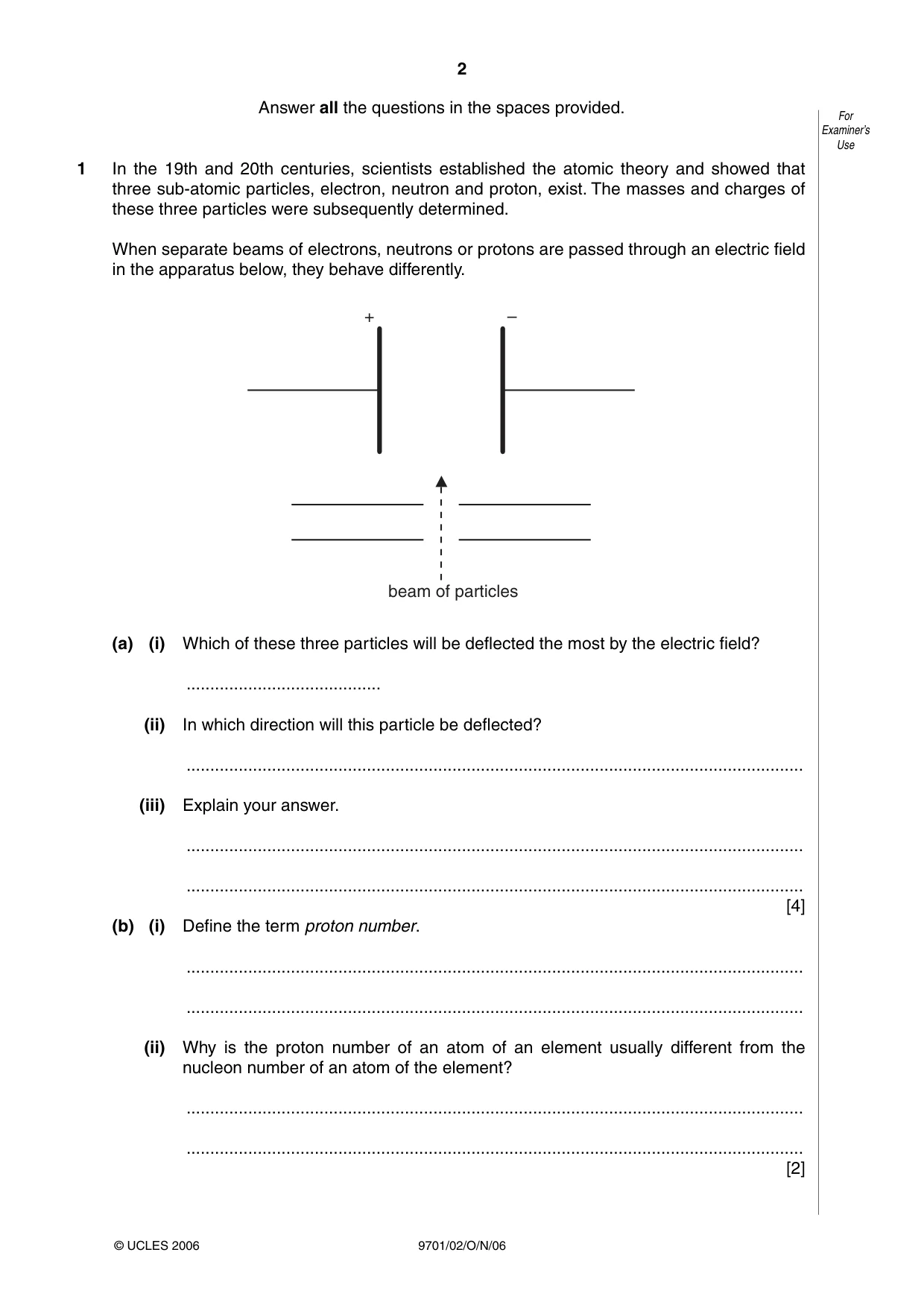
2 9701/02/O/N/06 For Examiner’s Use © UCLES 2006 Answer all the questions in the spaces provided. 1 In the 19th and 20th centuries, scientists established the atomic theory and showed that three sub-atomic particles, electron, neutron and proton, exist. The masses and charges of these three particles were subsequently determined. When separate beams of electrons, neutrons or protons are passed through an electric field in the apparatus below, they behave differently. + – beam of particles (a) (i) Which of these three particles will be deflected the most by the electric field? … (ii) In which direction will this particle be deflected? … (iii) Explain your answer. … … [4] (b) (i) Define the term proton number. … … (ii) Why is the proton number of an atom of an element usually different from the nucleon number of an atom of the element? … … [2]
Question paper, page 3
3 9701/02/O/N/06 [Turn over For Examiner’s Use © UCLES 2006 (c) Protons and neutrons have been used in nuclear reactions which result in the formation of artificial elements. In such processes, protons or neutrons are accelerated to high speeds and then fired like ‘bullets’ at the nucleus of an atom of an element. Suggest why neutrons are more effective than protons as ‘nuclear bullets’. … … [2] (d) In some cases, when neutrons are fired at atoms of an element, the neutrons become part of the nucleus of those atoms. What effect does the presence of an extra neutron have on the chemical properties of the new atoms formed? Explain your answer. … … … [2] [Total: 10]
Question paper, page 4
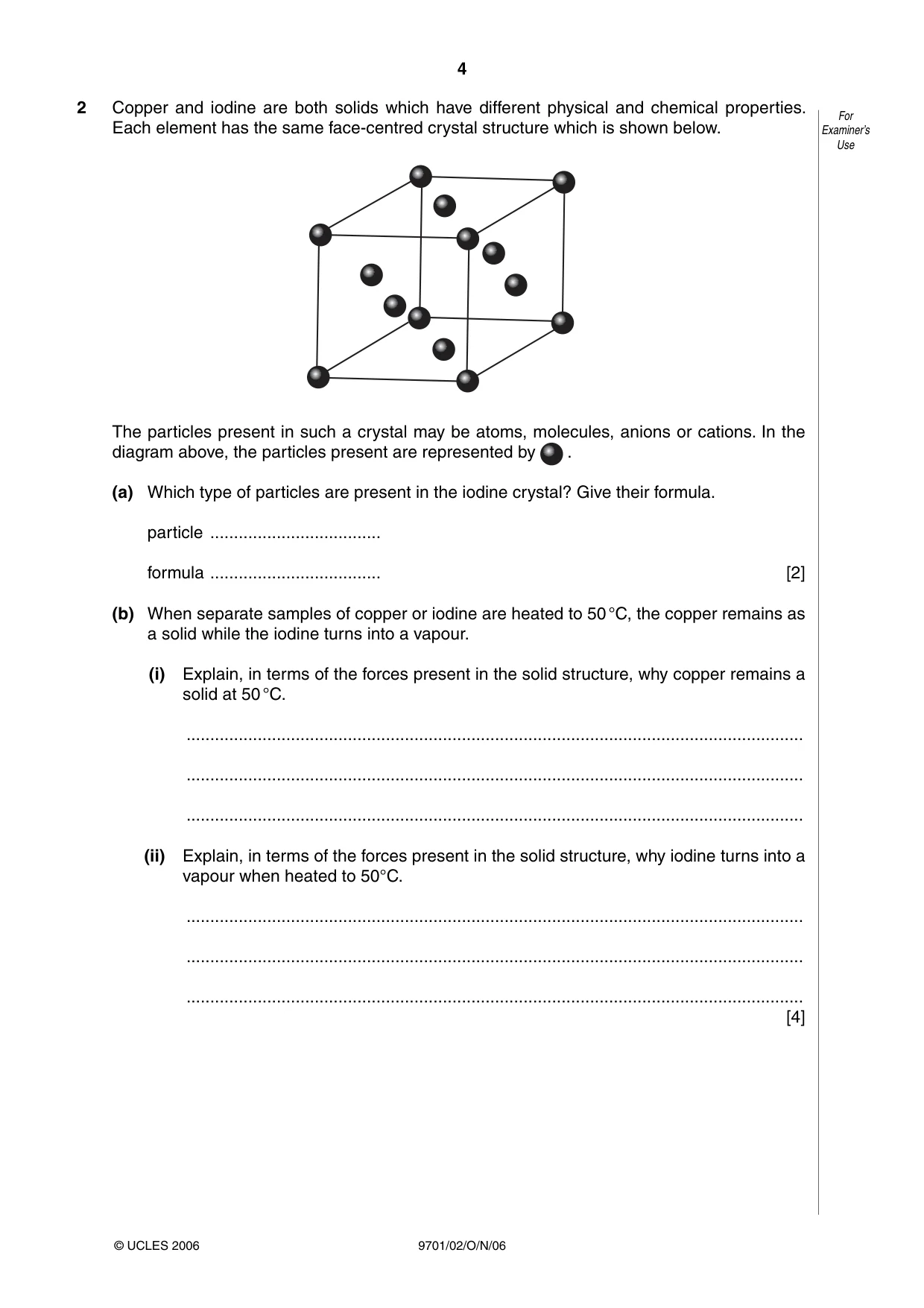
4 9701/02/O/N/06 For Examiner’s Use © UCLES 2006 2 Copper and iodine are both solids which have different physical and chemical properties. Each element has the same face-centred crystal structure which is shown below. The particles present in such a crystal may be atoms, molecules, anions or cations. In the diagram above, the particles present are represented by . (a) Which type of particles are present in the iodine crystal? Give their formula. particle … formula … [2] (b) When separate samples of copper or iodine are heated to 50 °C, the copper remains as a solid while the iodine turns into a vapour. (i) Explain, in terms of the forces present in the solid structure, why copper remains a solid at 50 °C. … … … (ii) Explain, in terms of the forces present in the solid structure, why iodine turns into a vapour when heated to 50°C. … … … [4]
Question paper, page 5
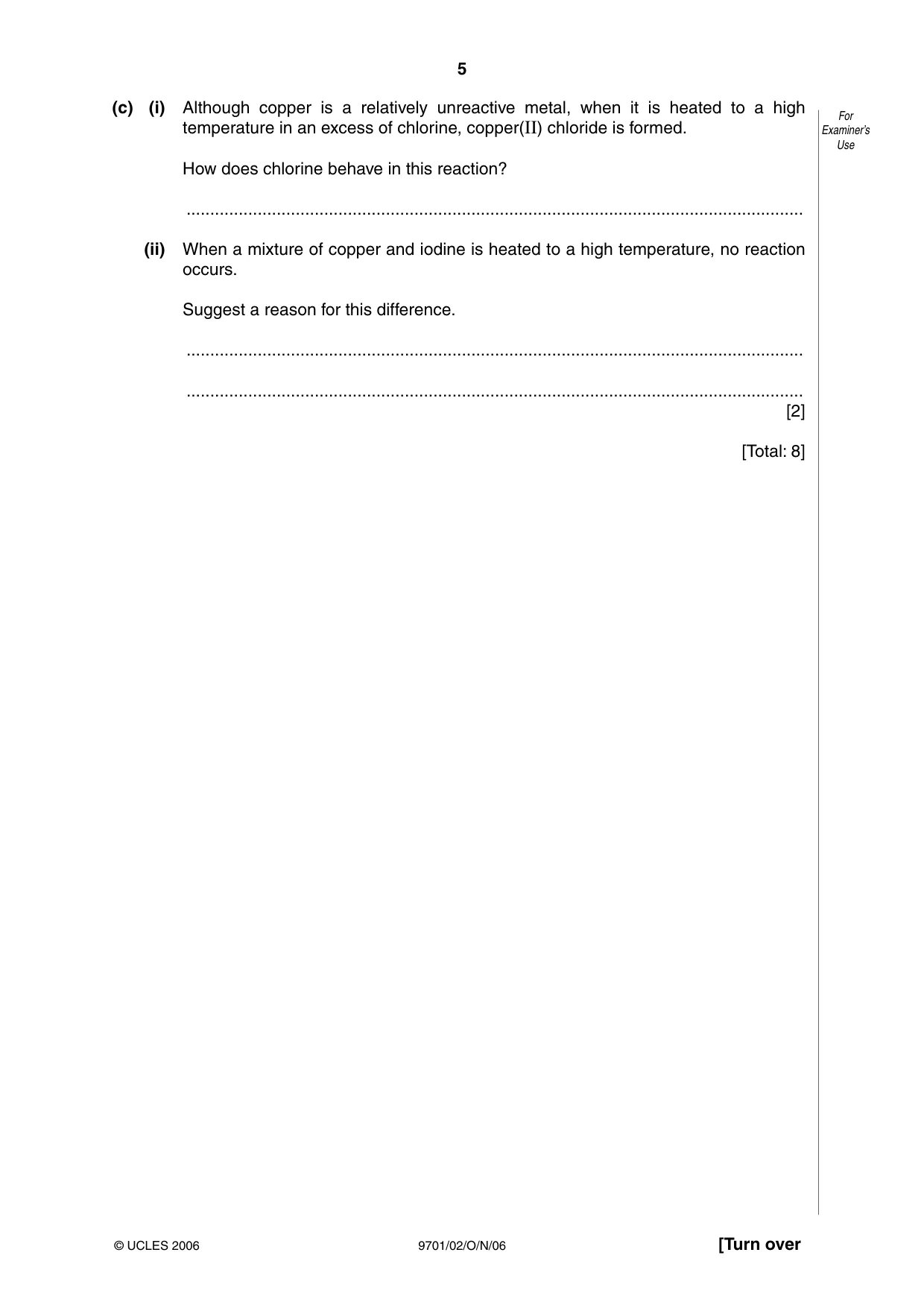
5 9701/02/O/N/06 [Turn over For Examiner’s Use © UCLES 2006 (c) (i) Although copper is a relatively unreactive metal, when it is heated to a high temperature in an excess of chlorine, copper(II) chloride is formed. How does chlorine behave in this reaction? … (ii) When a mixture of copper and iodine is heated to a high temperature, no reaction occurs. Suggest a reason for this difference. … … [2] [Total: 8]
Question paper, page 6
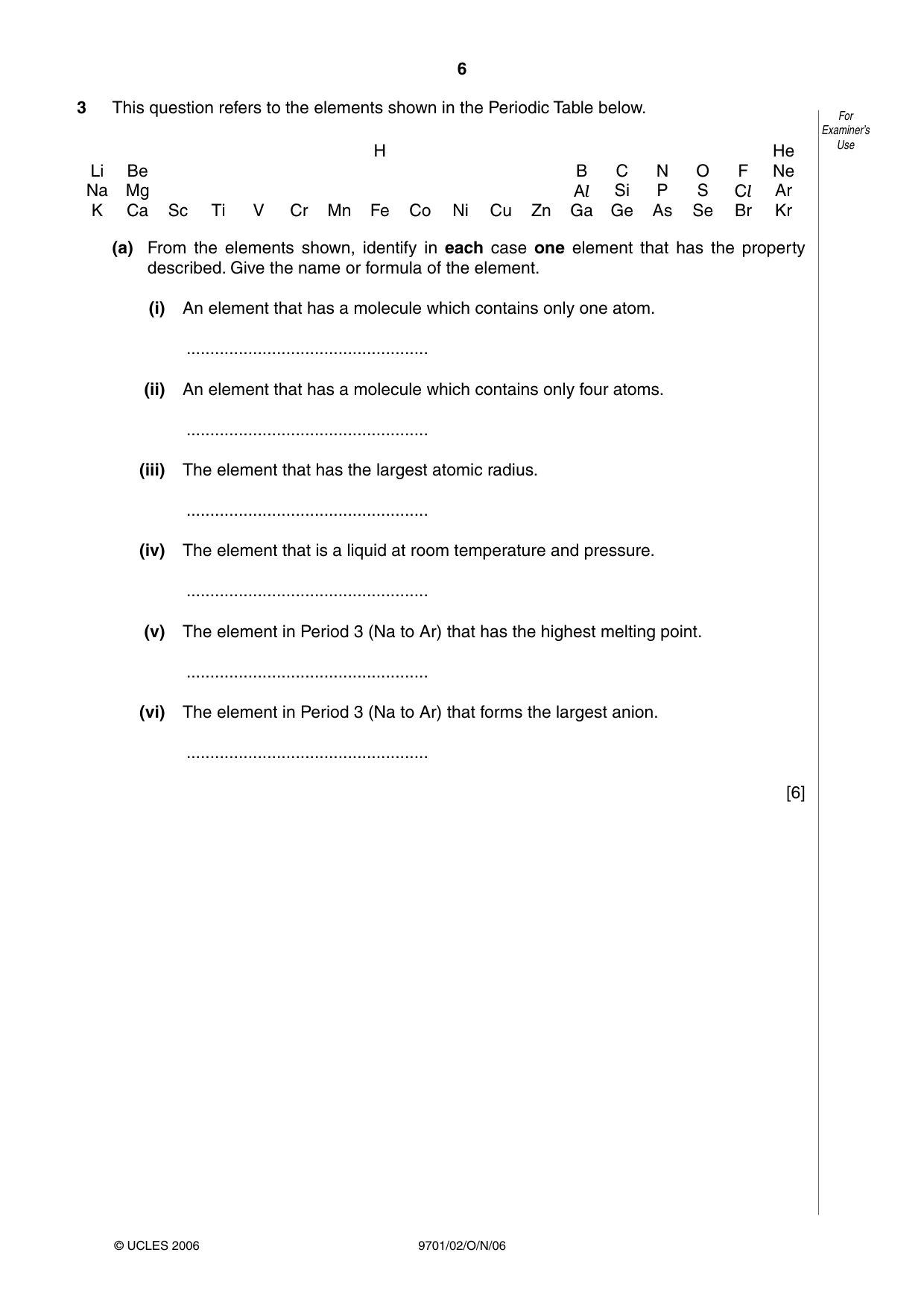
6 9701/02/O/N/06 For Examiner’s Use © UCLES 2006 3 This question refers to the elements shown in the Periodic Table below. H He Li Be B C N O F Ne Na Mg Al Si P S Cl Ar K Ca Sc Ti V Cr Mn Fe Co Ni Cu Zn Ga Ge As Se Br Kr (a) From the elements shown, identify in each case one element that has the property described. Give the name or formula of the element. (i) An element that has a molecule which contains only one atom. … (ii) An element that has a molecule which contains only four atoms. … (iii) The element that has the largest atomic radius. … (iv) The element that is a liquid at room temperature and pressure. … (v) The element in Period 3 (Na to Ar) that has the highest melting point. … (vi) The element in Period 3 (Na to Ar) that forms the largest anion. … [6]
Question paper, page 7
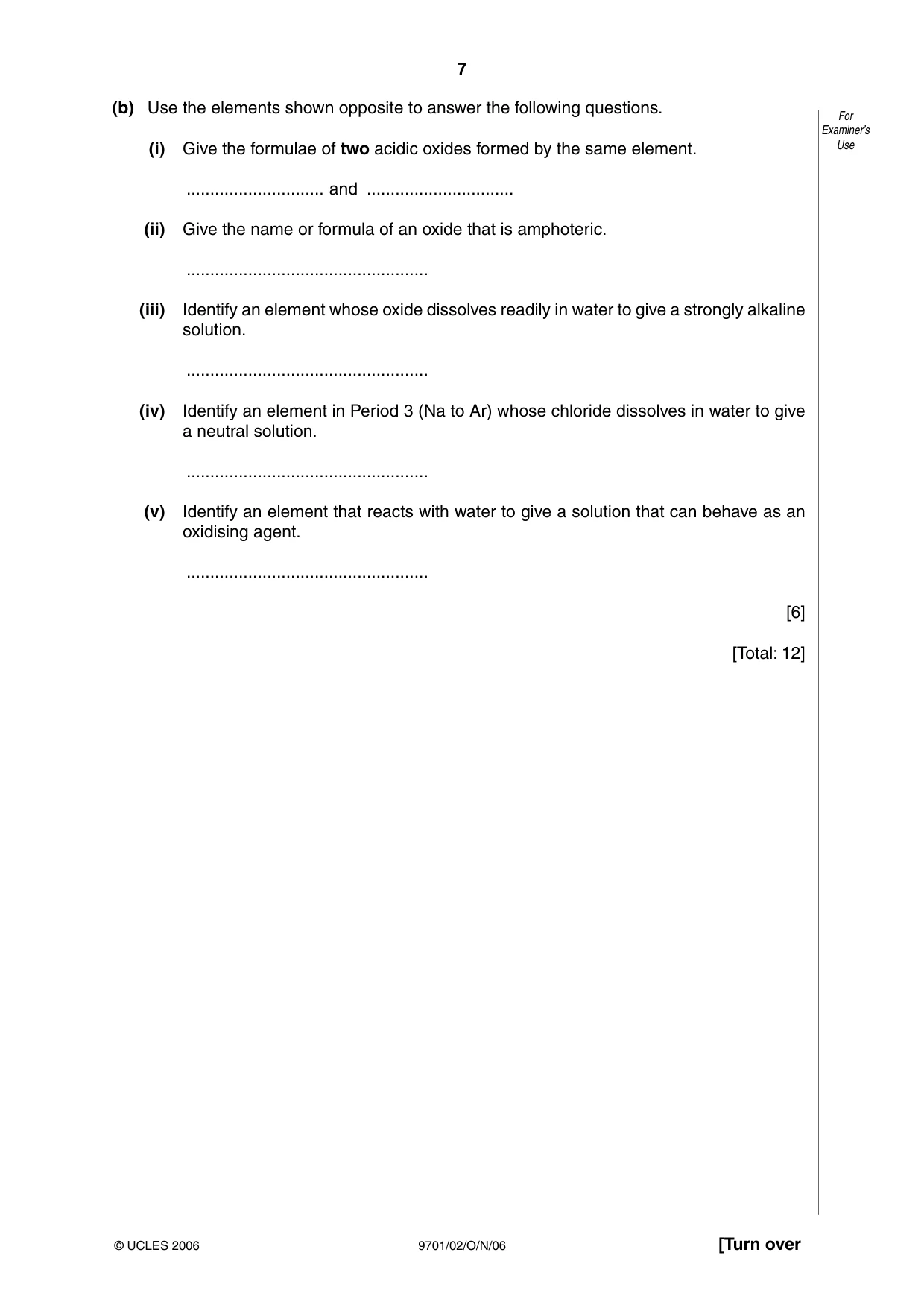
7 9701/02/O/N/06 [Turn over For Examiner’s Use © UCLES 2006 (b) Use the elements shown opposite to answer the following questions. (i) Give the formulae of two acidic oxides formed by the same element. … and … (ii) Give the name or formula of an oxide that is amphoteric. … (iii) Identify an element whose oxide dissolves readily in water to give a strongly alkaline solution. … (iv) Identify an element in Period 3 (Na to Ar) whose chloride dissolves in water to give a neutral solution. … (v) Identify an element that reacts with water to give a solution that can behave as an oxidising agent. … [6] [Total: 12]
Question paper, page 8
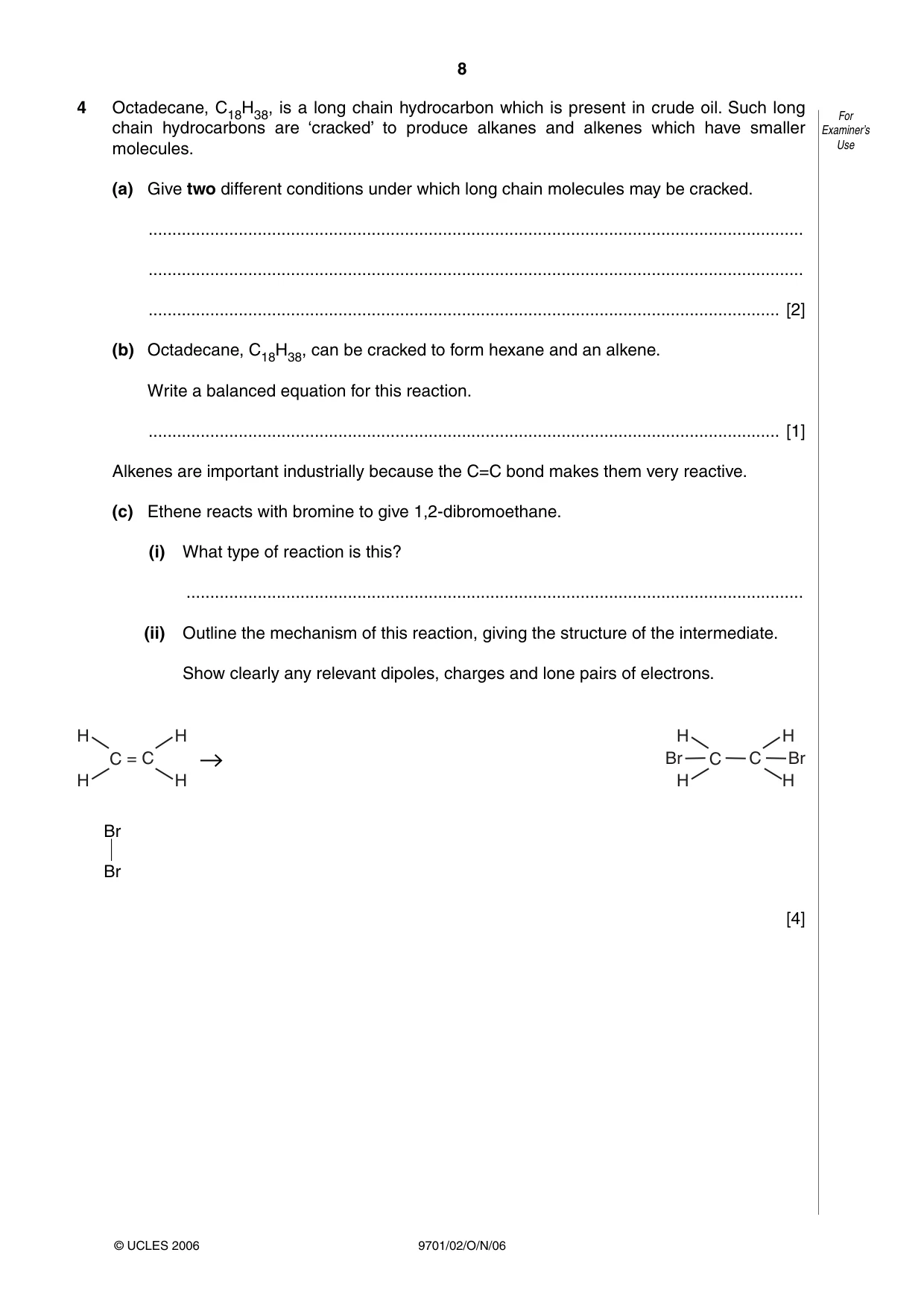
8 9701/02/O/N/06 For Examiner’s Use © UCLES 2006 4 Octadecane, C18H38, is a long chain hydrocarbon which is present in crude oil. Such long chain hydrocarbons are ‘cracked’ to produce alkanes and alkenes which have smaller molecules. (a) Give two different conditions under which long chain molecules may be cracked. … … … [2] (b) Octadecane, C18H38, can be cracked to form hexane and an alkene. Write a balanced equation for this reaction. … [1] Alkenes are important industrially because the C=C bond makes them very reactive. (c) Ethene reacts with bromine to give 1,2-dibromoethane. (i) What type of reaction is this? … (ii) Outline the mechanism of this reaction, giving the structure of the intermediate. Show clearly any relevant dipoles, charges and lone pairs of electrons. = C C H H H H C C H H H H Br Br Br Br [4]
Question paper, page 9
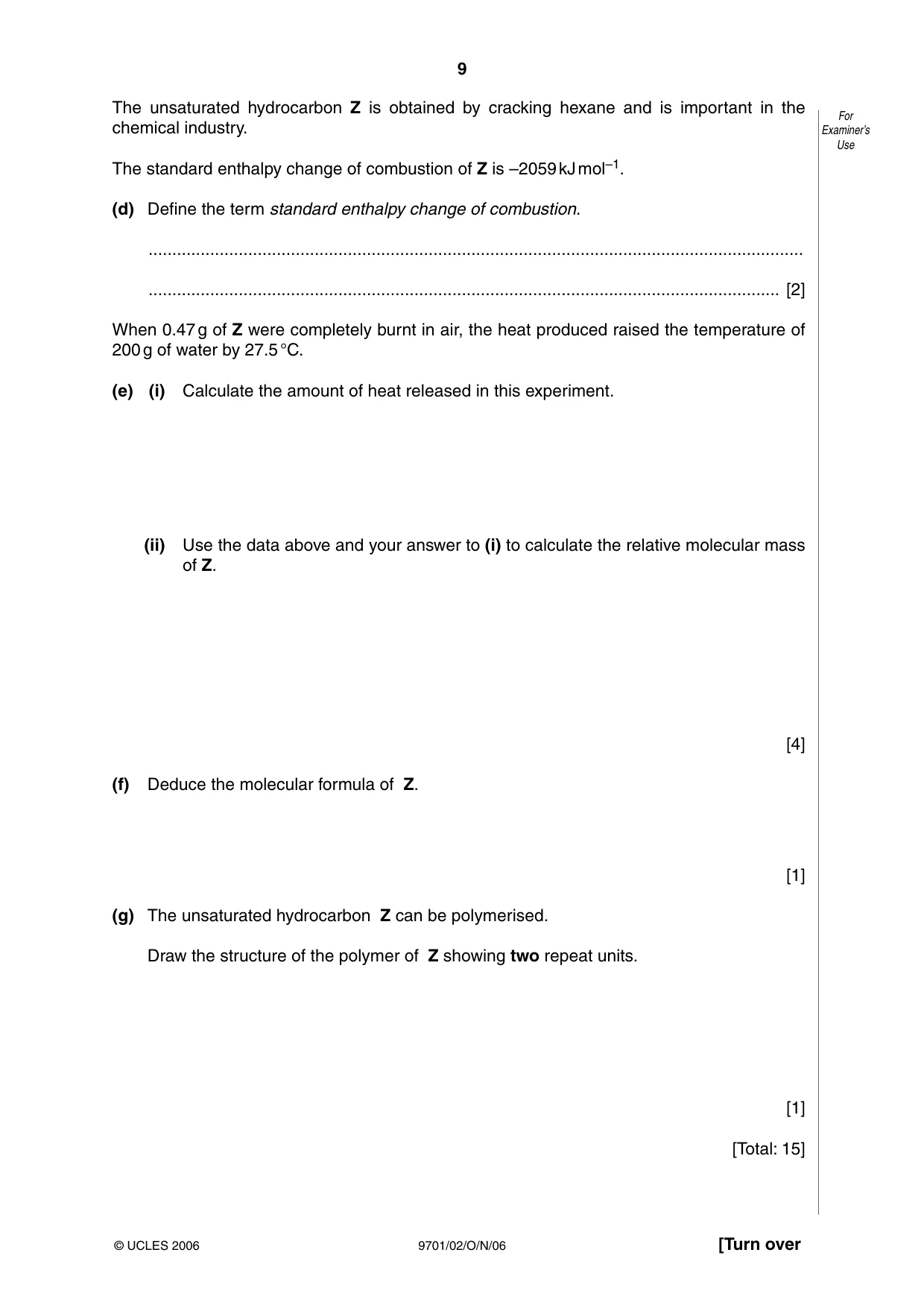
9 9701/02/O/N/06 [Turn over For Examiner’s Use © UCLES 2006 The unsaturated hydrocarbon Z is obtained by cracking hexane and is important in the chemical industry. The standard enthalpy change of combustion of Z is –2059 kJ mol–1. (d) Define the term standard enthalpy change of combustion. … … [2] When 0.47 g of Z were completely burnt in air, the heat produced raised the temperature of 200 g of water by 27.5 °C. (e) (i) Calculate the amount of heat released in this experiment. (ii) Use the data above and your answer to (i) to calculate the relative molecular mass of Z. [4] (f) Deduce the molecular formula of Z. [1] (g) The unsaturated hydrocarbon Z can be polymerised. Draw the structure of the polymer of Z showing two repeat units. [1] [Total: 15]
Question paper, page 10
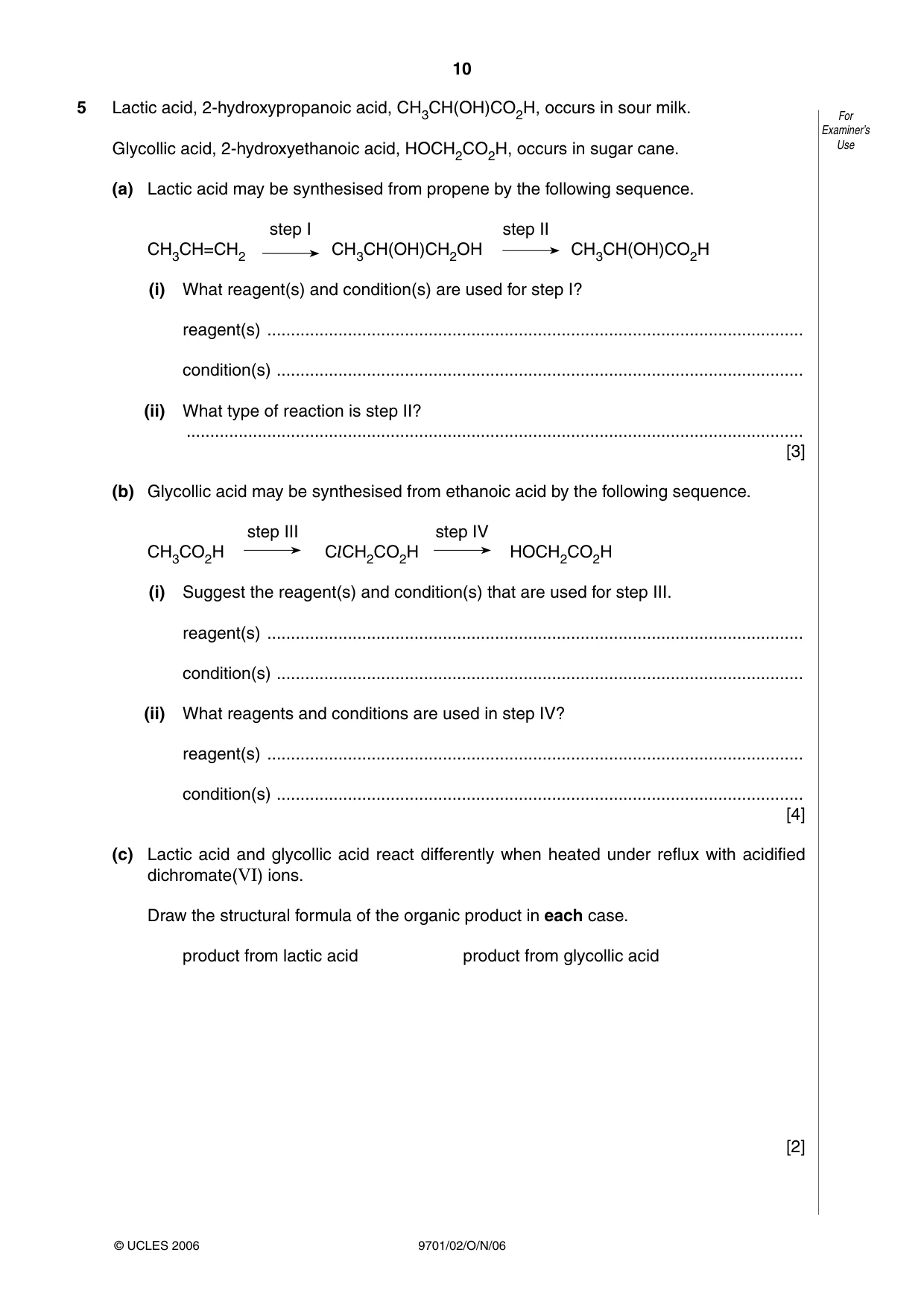
10 9701/02/O/N/06 For Examiner’s Use © UCLES 2006 5 Lactic acid, 2-hydroxypropanoic acid, CH3CH(OH)CO2H, occurs in sour milk. Glycollic acid, 2-hydroxyethanoic acid, HOCH2CO2H, occurs in sugar cane. (a) Lactic acid may be synthesised from propene by the following sequence. step I step II CH3CH=CH2 CH3CH(OH)CH2OH CH3CH(OH)CO2H (i) What reagent(s) and condition(s) are used for step I? reagent(s) … condition(s) … (ii) What type of reaction is step II? … [3] (b) Glycollic acid may be synthesised from ethanoic acid by the following sequence. step III step IV CH3CO2H ClCH2CO2H HOCH2CO2H (i) Suggest the reagent(s) and condition(s) that are used for step III. reagent(s) … condition(s) … (ii) What reagents and conditions are used in step IV? reagent(s) … condition(s) … [4] (c) Lactic acid and glycollic acid react differently when heated under reflux with acidified dichromate(VI) ions. Draw the structural formula of the organic product in each case. product from lactic acid product from glycollic acid [2]
Question paper, page 11
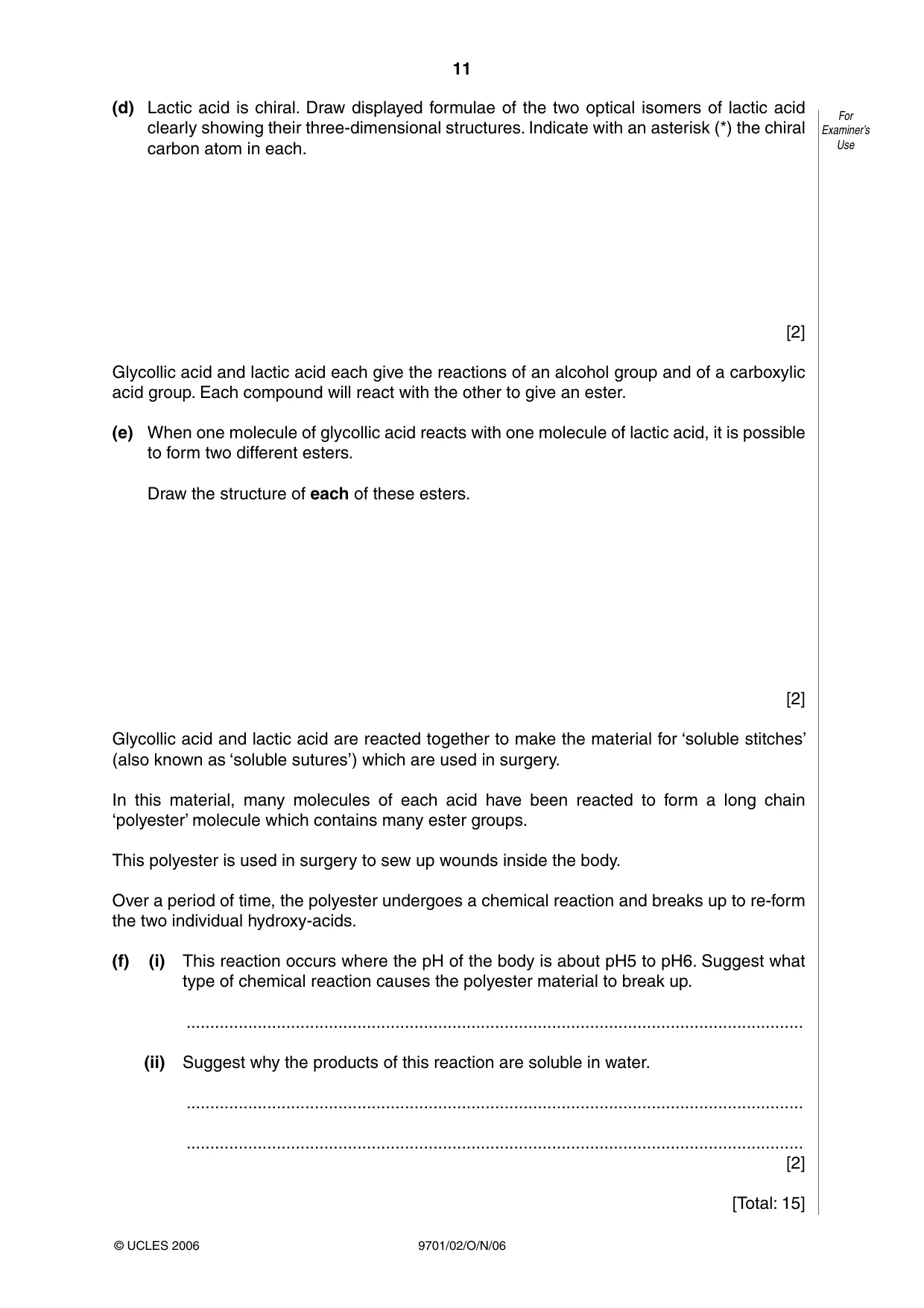
11 9701/02/O/N/06 For Examiner’s Use © UCLES 2006 (d) Lactic acid is chiral. Draw displayed formulae of the two optical isomers of lactic acid clearly showing their three-dimensional structures. Indicate with an asterisk (*) the chiral carbon atom in each. [2] Glycollic acid and lactic acid each give the reactions of an alcohol group and of a carboxylic acid group. Each compound will react with the other to give an ester. (e) When one molecule of glycollic acid reacts with one molecule of lactic acid, it is possible to form two different esters. Draw the structure of each of these esters. [2] Glycollic acid and lactic acid are reacted together to make the material for ‘soluble stitches’ (also known as ‘soluble sutures’) which are used in surgery. In this material, many molecules of each acid have been reacted to form a long chain ‘polyester’ molecule which contains many ester groups. This polyester is used in surgery to sew up wounds inside the body. Over a period of time, the polyester undergoes a chemical reaction and breaks up to re-form the two individual hydroxy-acids. (f) (i) This reaction occurs where the pH of the body is about pH5 to pH6. Suggest what type of chemical reaction causes the polyester material to break up. … (ii) Suggest why the products of this reaction are soluble in water. … … [2] [Total: 15]
Question paper, page 12
12 9701/02/O/N/06 © UCLES 2006 BLANK PAGE Permission to reproduce items where third-party owned material protected by copyright is included has been sought and cleared where possible. Every reasonable effort has been made by the publisher (UCLES) to trace copyright holders, but if any items requiring clearance have unwittingly been included, the publisher will be pleased to make amends at the earliest possible opportunity. University of Cambridge International Examinations is part of the University of Cambridge Local Examinations Syndicate (UCLES), which is itself a department of the University of Cambridge.
Mark scheme, page 1
UNIVERSITY OF CAMBRIDGE INTERNATIONAL EXAMINATIONS GCE Advanced Subsidiary Level and GCE Advanced Level MARK SCHEME for the October/November 2006 question paper 9701 CHEMISTRY 9701/02 Paper 2 (Theory 1), maximum raw mark 60 This mark scheme is published as an aid to teachers and students, to indicate the requirements of the examination. It shows the basis on which Examiners were instructed to award marks. It does not indicate the details of the discussions that took place at an Examiners’ meeting before marking began. All Examiners are instructed that alternative correct answers and unexpected approaches in candidates’ scripts must be given marks that fairly reflect the relevant knowledge and skills demonstrated. Mark schemes must be read in conjunction with the question papers and the report on the examination. The grade thresholds for various grades are published in the report on the examination for most IGCSE, GCE Advanced Level and Advanced Subsidiary Level syllabuses. • CIE will not enter into discussions or correspondence in connection with these mark schemes. CIE is publishing the mark schemes for the October/November 2006 question papers for most IGCSE, GCE Advanced Level and Advanced Subsidiary Level syllabuses and some Ordinary Level syllabuses.
Mark scheme, page 2
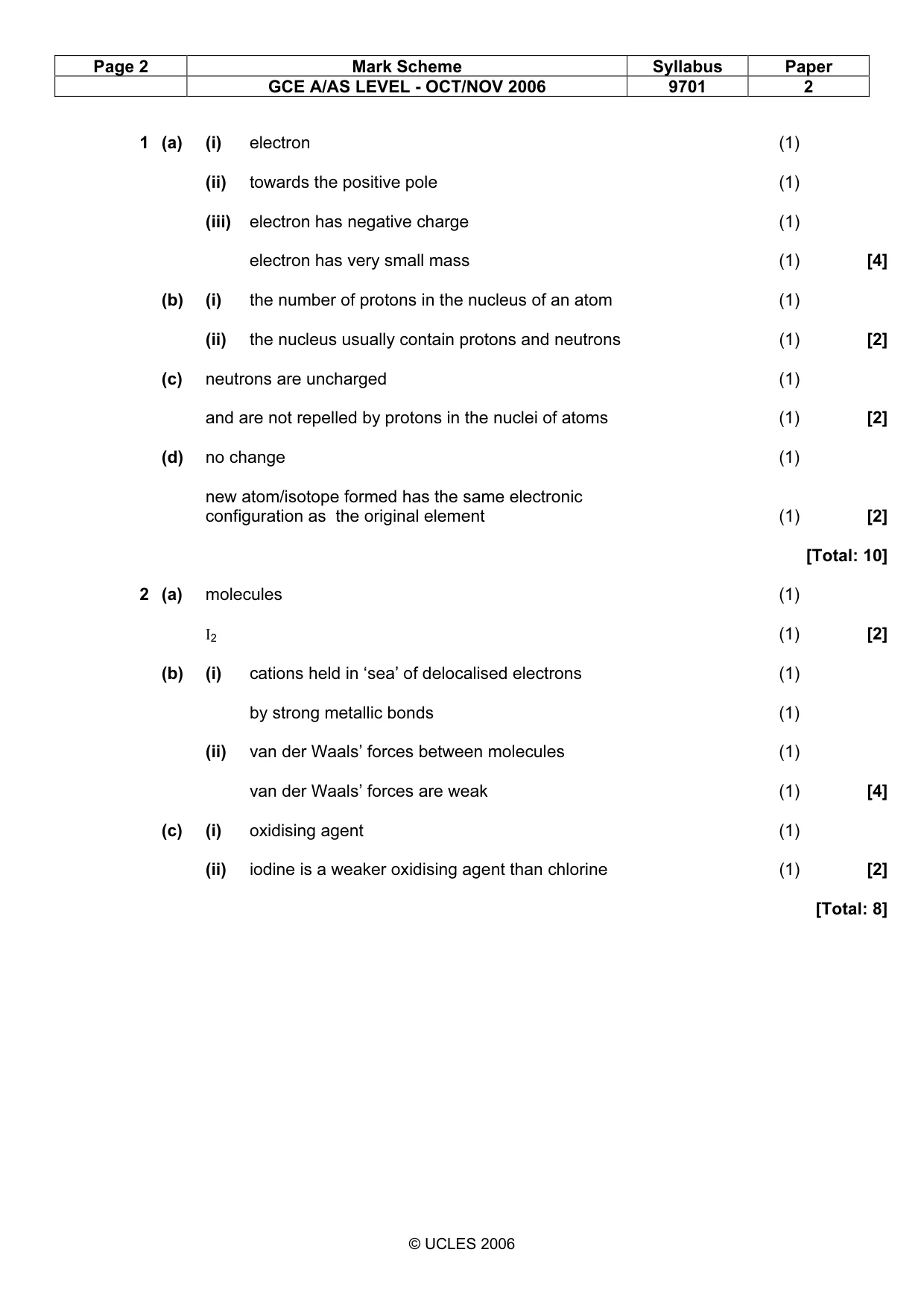
Page 2 Mark Scheme Syllabus Paper GCE A/AS LEVEL - OCT/NOV 2006 9701 2 © UCLES 2006 1 (a) (i) electron (1) (ii) towards the positive pole (1) (iii) electron has negative charge (1) electron has very small mass (1) [4] (b) (i) the number of protons in the nucleus of an atom (1) (ii) the nucleus usually contain protons and neutrons (1) [2] (c) neutrons are uncharged (1) and are not repelled by protons in the nuclei of atoms (1) [2] (d) no change (1) new atom/isotope formed has the same electronic configuration as the original element (1) [2] [Total: 10] 2 (a) molecules (1) I2 (1) [2] (b) (i) cations held in ‘sea’ of delocalised electrons (1) by strong metallic bonds (1) (ii) van der Waals’ forces between molecules (1) van der Waals’ forces are weak (1) [4] (c) (i) oxidising agent (1) (ii) iodine is a weaker oxidising agent than chlorine (1) [2] [Total: 8]
Mark scheme, page 3
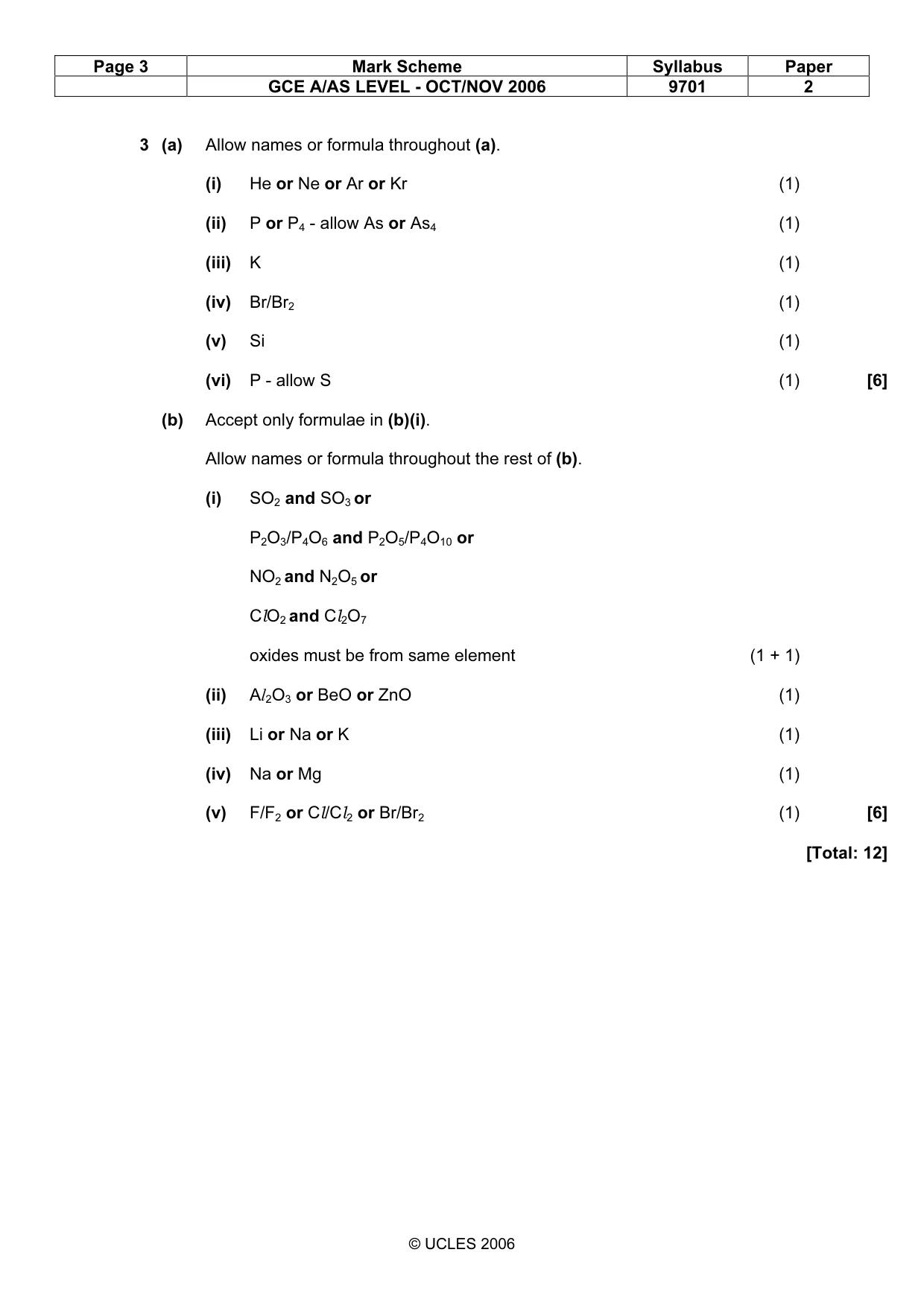
Page 3 Mark Scheme Syllabus Paper GCE A/AS LEVEL - OCT/NOV 2006 9701 2 © UCLES 2006 3 (a) Allow names or formula throughout (a). (i) He or Ne or Ar or Kr (1) (ii) P or P4 - allow As or As4 (1) (iii) K (1) (iv) Br/Br2 (1) (v) Si (1) (vi) P - allow S (1) [6] (b) Accept only formulae in (b)(i). Allow names or formula throughout the rest of (b). (i) SO2 and SO3 or P2O3/P4O6 and P2O5/P4O10 or NO2 and N2O5 or ClO2 and Cl2O7 oxides must be from same element (1 + 1) (ii) Al2O3 or BeO or ZnO (1) (iii) Li or Na or K (1) (iv) Na or Mg (1) (v) F/F2 or Cl/Cl2 or Br/Br2 (1) [6] [Total: 12]
Mark scheme, page 4
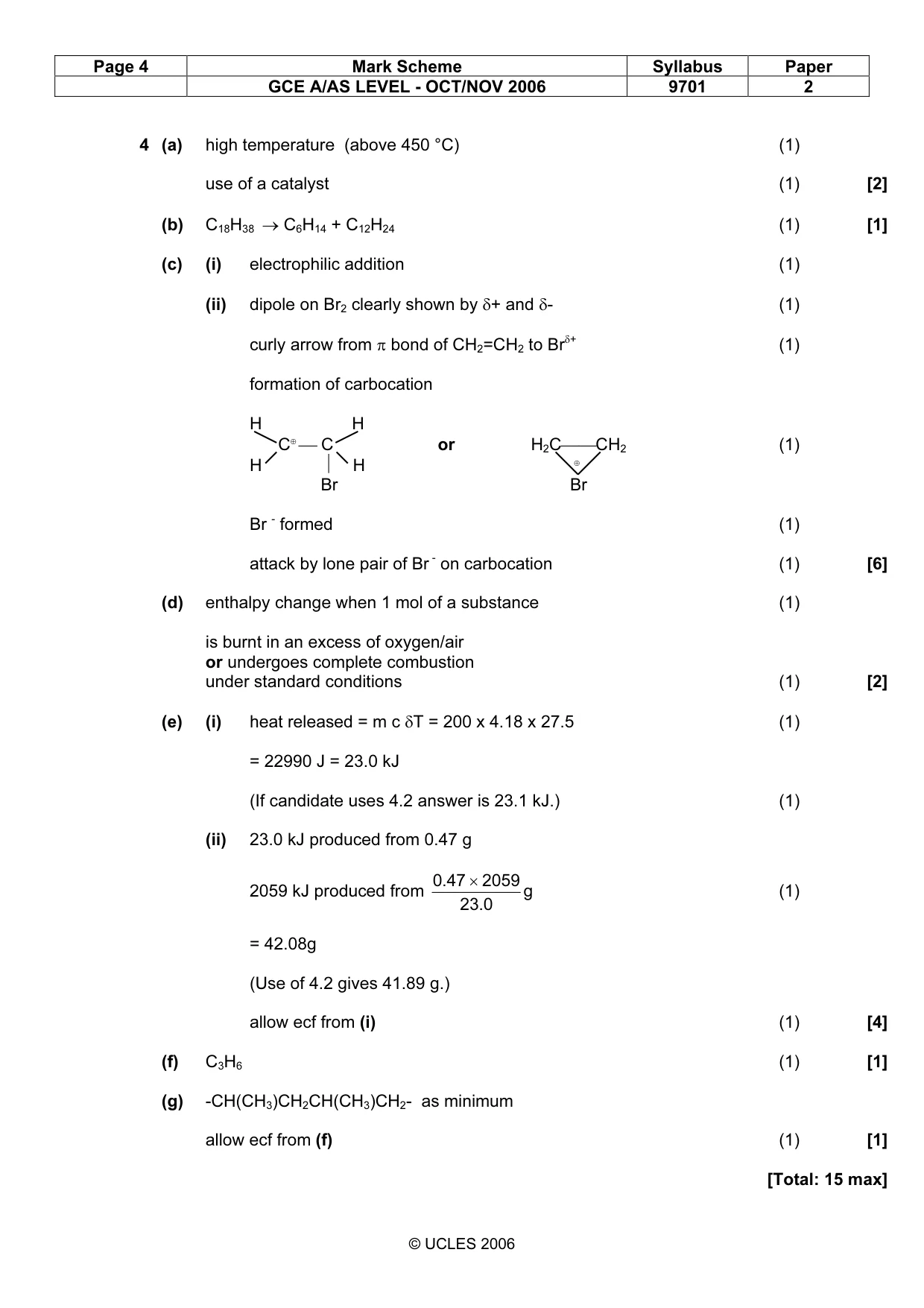
Page 4 Mark Scheme Syllabus Paper GCE A/AS LEVEL - OCT/NOV 2006 9701 2 © UCLES 2006 4 (a) high temperature (above 450 °C) (1) use of a catalyst (1) [2] (b) C18H38 → C6H14 + C12H24 (1) [1] (c) (i) electrophilic addition (1) (ii) dipole on Br2 clearly shown by δ+ and δ- (1) curly arrow from π bond of CH2=CH2 to Brδ+ (1) formation of carbocation H H C⊕ C or H2CCH2 (1) H H ⊕ Br Br Br - formed (1) attack by lone pair of Br - on carbocation (1) [6] (d) enthalpy change when 1 mol of a substance (1) is burnt in an excess of oxygen/air or undergoes complete combustion under standard conditions (1) [2] (e) (i) heat released = m c δT = 200 x 4.18 x 27.5 (1) = 22990 J = 23.0 kJ (If candidate uses 4.2 answer is 23.1 kJ.) (1) (ii) 23.0 kJ produced from 0.47 g 2059 kJ produced from 0 . 23 2059 47 . 0 × g (1) = 42.08g (Use of 4.2 gives 41.89 g.) allow ecf from (i) (1) [4] (f) C3H6 (1) [1] (g) -CH(CH3)CH2CH(CH3)CH2- as minimum allow ecf from (f) (1) [1] [Total: 15 max]
Mark scheme, page 5
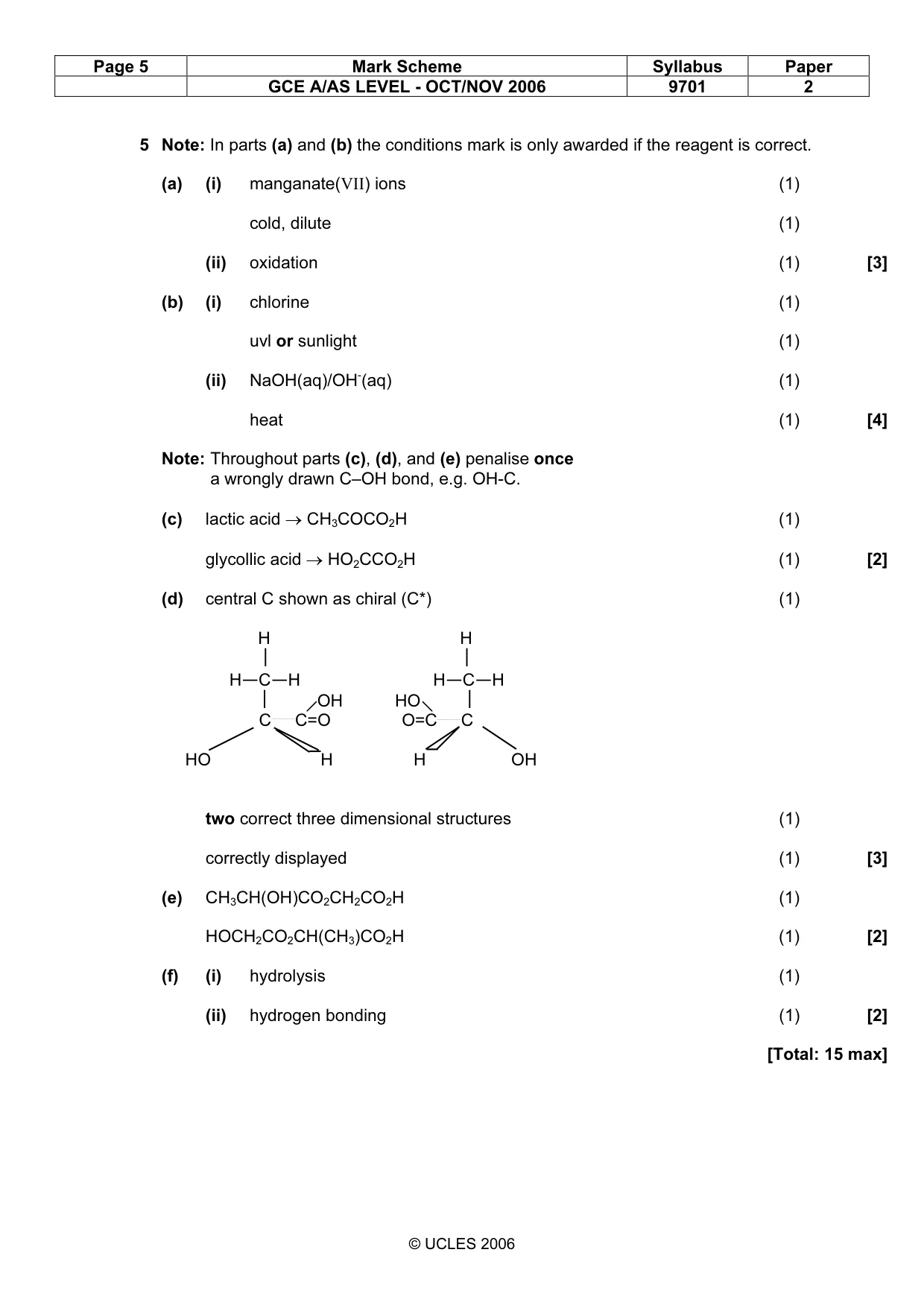
Page 5 Mark Scheme Syllabus Paper GCE A/AS LEVEL - OCT/NOV 2006 9701 2 © UCLES 2006 5 Note: In parts (a) and (b) the conditions mark is only awarded if the reagent is correct. (a) (i) manganate(VII) ions (1) cold, dilute (1) (ii) oxidation (1) [3] (b) (i) chlorine (1) uvl or sunlight (1) (ii) NaOH(aq)/OH-(aq) (1) heat (1) [4] Note: Throughout parts (c), (d), and (e) penalise once a wrongly drawn C–OH bond, e.g. OH-C. (c) lactic acid → CH3COCO2H (1) glycollic acid → HO2CCO2H (1) [2] (d) central C shown as chiral (C*) (1) H H H—C—H H—C—H OH HO C C=O O=C C HO H H OH two correct three dimensional structures (1) correctly displayed (1) [3] (e) CH3CH(OH)CO2CH2CO2H (1) HOCH2CO2CH(CH3)CO2H (1) [2] (f) (i) hydrolysis (1) (ii) hydrogen bonding (1) [2] [Total: 15 max]
What you needed in this session
Cambridge’s own grade thresholds for 2006 Oct/Nov, Paper 2 · Variant 1. A higher threshold means an easier paper — the bar moves with how the cohort did.