Cambridge A Level Chemistry 9701 — 2005 May/June Paper 2 · Variant 1
9701/21/M/J/05
The question paper and its mark scheme, free to read here and free to download. This is Cambridge’s own paper, exactly as it was sat.
Question paper12 pages
Mark scheme7 pages
Answers below. Sit the paper first if you are practising.
Paper as text
Question paper, page 1
This document consists of 10 printed pages and 2 blank pages. SP (MML 8078 3/04) S92060/2.1 © UCLES 2005 [Turn over UNIVERSITY OF CAMBRIDGE INTERNATIONAL EXAMINATIONS General Certificate of Education Advanced Subsidiary Level and Advanced Level CHEMISTRY Paper 2 Structured Questions AS Core 9701/02 May/June 2005 1 hour 15 minutes Candidates answer on the Question Paper. Additional Materials: Data Booklet READ THESE INSTRUCTIONS FIRST Write your name, Centre number and candidate number in the spaces at the top of this page. Write in dark blue or black pen in the spaces provided on the Question Paper. You may use a pencil for any diagrams, graphs, or rough working. Do not use staples, paper clips, highlighters, glue or correction fluid. Answer all questions. The number of marks is given in brackets [ ] at the end of each question or part question. You may lose marks if you do not show your working or if you do not use appropriate units. A Data Booklet is provided. You may use a calculator. DO NOT WRITE IN THE BARCODE. DO NOT WRITE IN THE GREY AREAS BETWEEN THE PAGES. For Examiner’s Use 4 3 2 1 5 TOTAL Candidate Name Centre Number Candidate Number
Question paper, page 2
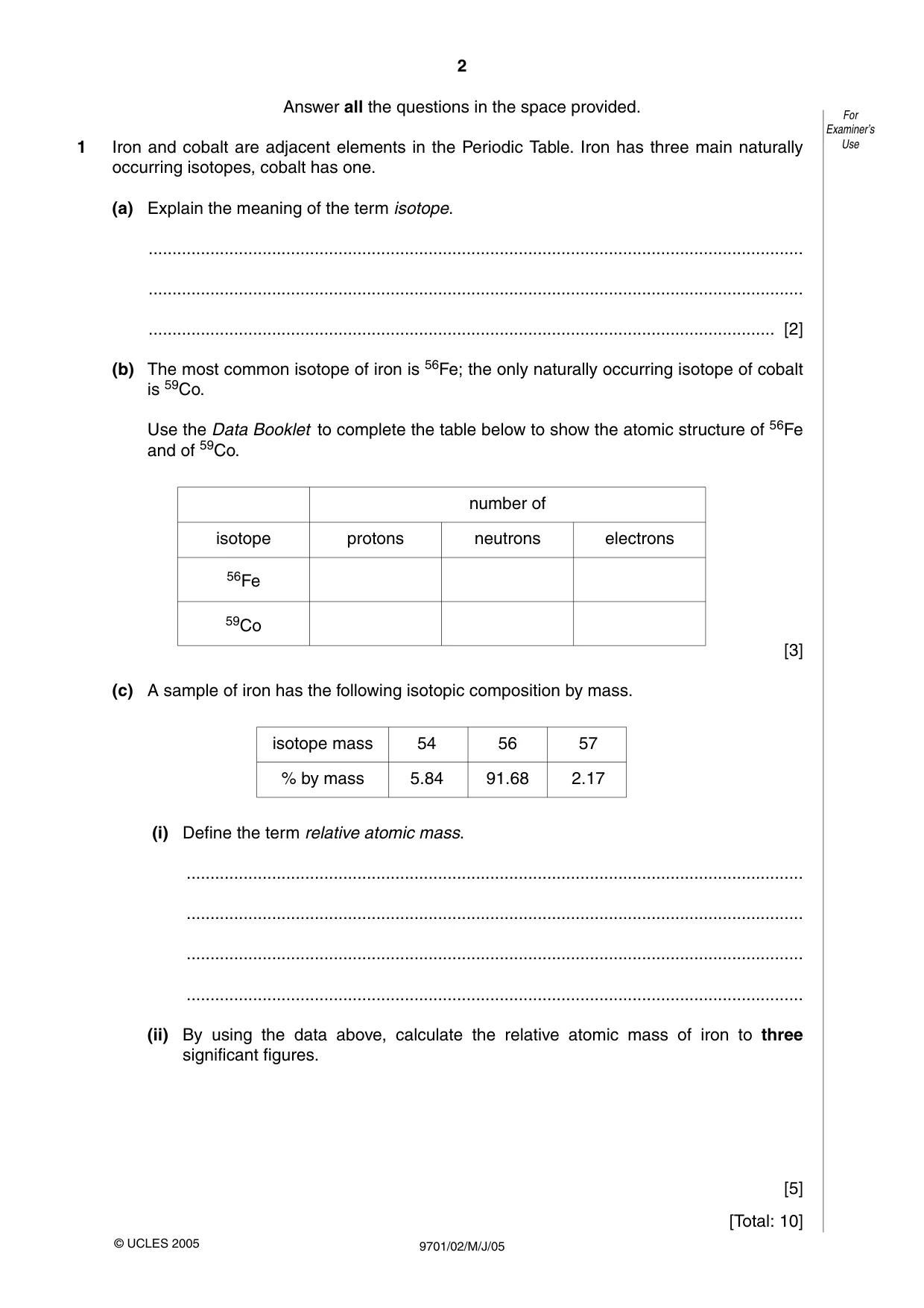
Answer all the questions in the space provided. 1 Iron and cobalt are adjacent elements in the Periodic Table. Iron has three main naturally occurring isotopes, cobalt has one. (a) Explain the meaning of the term isotope. … … … [2] (b) The most common isotope of iron is 56Fe; the only naturally occurring isotope of cobalt is 59Co. Use the Data Booklet to complete the table below to show the atomic structure of 56Fe and of 59Co. [3] (c) A sample of iron has the following isotopic composition by mass. (i) Define the term relative atomic mass. … … … … (ii) By using the data above, calculate the relative atomic mass of iron to three significant figures. [5] [Total: 10] 2 9701/02/M/J/05 © UCLES 2005 For Examiner’s Use isotope isotope mass 54 56 57 5.84 91.68 2.17 % by mass protons number of neutrons electrons 56Fe 59Co
Question paper, page 3
BLANK PAGE 3 9701/02/M/J/05 © UCLES 2005 [Turn over
Question paper, page 4
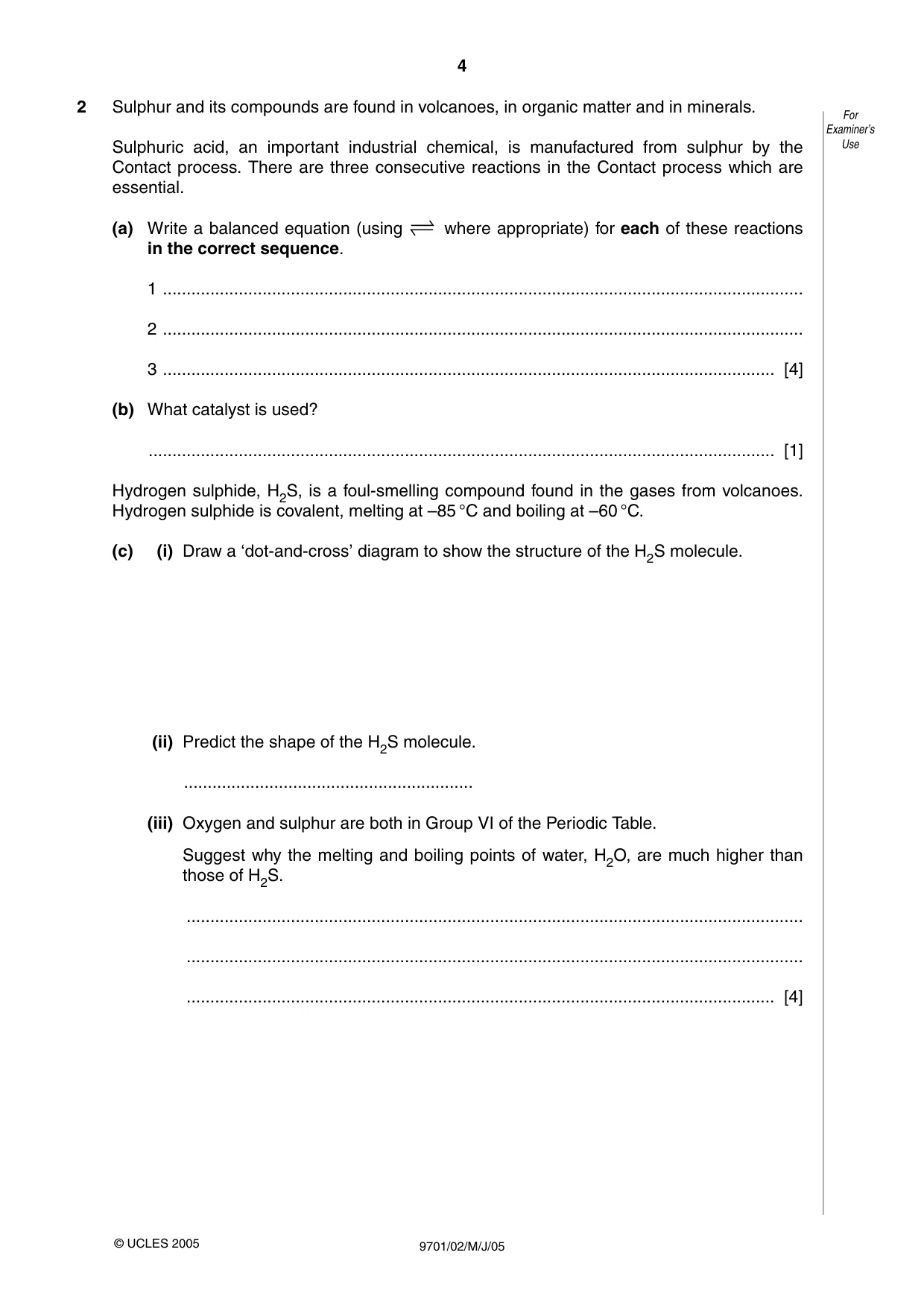
2 Sulphur and its compounds are found in volcanoes, in organic matter and in minerals. Sulphuric acid, an important industrial chemical, is manufactured from sulphur by the Contact process. There are three consecutive reactions in the Contact process which are essential. (a) Write a balanced equation (using where appropriate) for each of these reactions in the correct sequence. 1 … 2 … 3 … [4] (b) What catalyst is used? … [1] Hydrogen sulphide, H2S, is a foul-smelling compound found in the gases from volcanoes. Hydrogen sulphide is covalent, melting at –85 °C and boiling at –60 °C. (c) (i) Draw a ‘dot-and-cross’ diagram to show the structure of the H2S molecule. (ii) Predict the shape of the H2S molecule. … (iii) Oxygen and sulphur are both in Group VI of the Periodic Table. Suggest why the melting and boiling points of water, H2O, are much higher than those of H2S. … … … [4] 4 9701/02/M/J/05 © UCLES 2005 For Examiner’s Use
Question paper, page 5
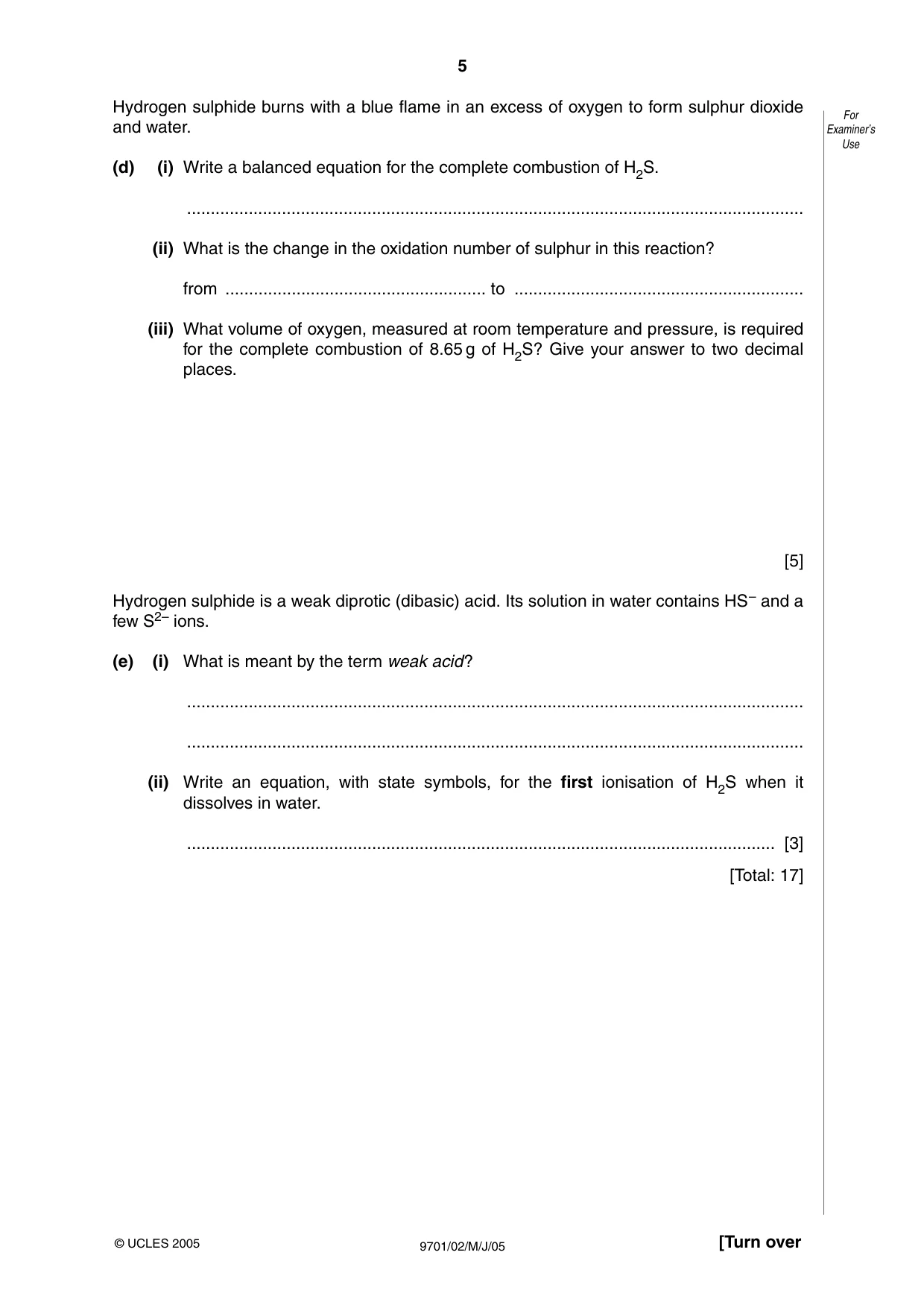
Hydrogen sulphide burns with a blue flame in an excess of oxygen to form sulphur dioxide and water. (d) (i) Write a balanced equation for the complete combustion of H2S. … (ii) What is the change in the oxidation number of sulphur in this reaction? from … to … (iii) What volume of oxygen, measured at room temperature and pressure, is required for the complete combustion of 8.65 g of H2S? Give your answer to two decimal places. [5] Hydrogen sulphide is a weak diprotic (dibasic) acid. Its solution in water contains HS– and a few S2– ions. (e) (i) What is meant by the term weak acid? … … (ii) Write an equation, with state symbols, for the first ionisation of H2S when it dissolves in water. … [3] [Total: 17] 5 [Turn over 9701/02/M/J/05 © UCLES 2005 For Examiner’s Use
Question paper, page 6
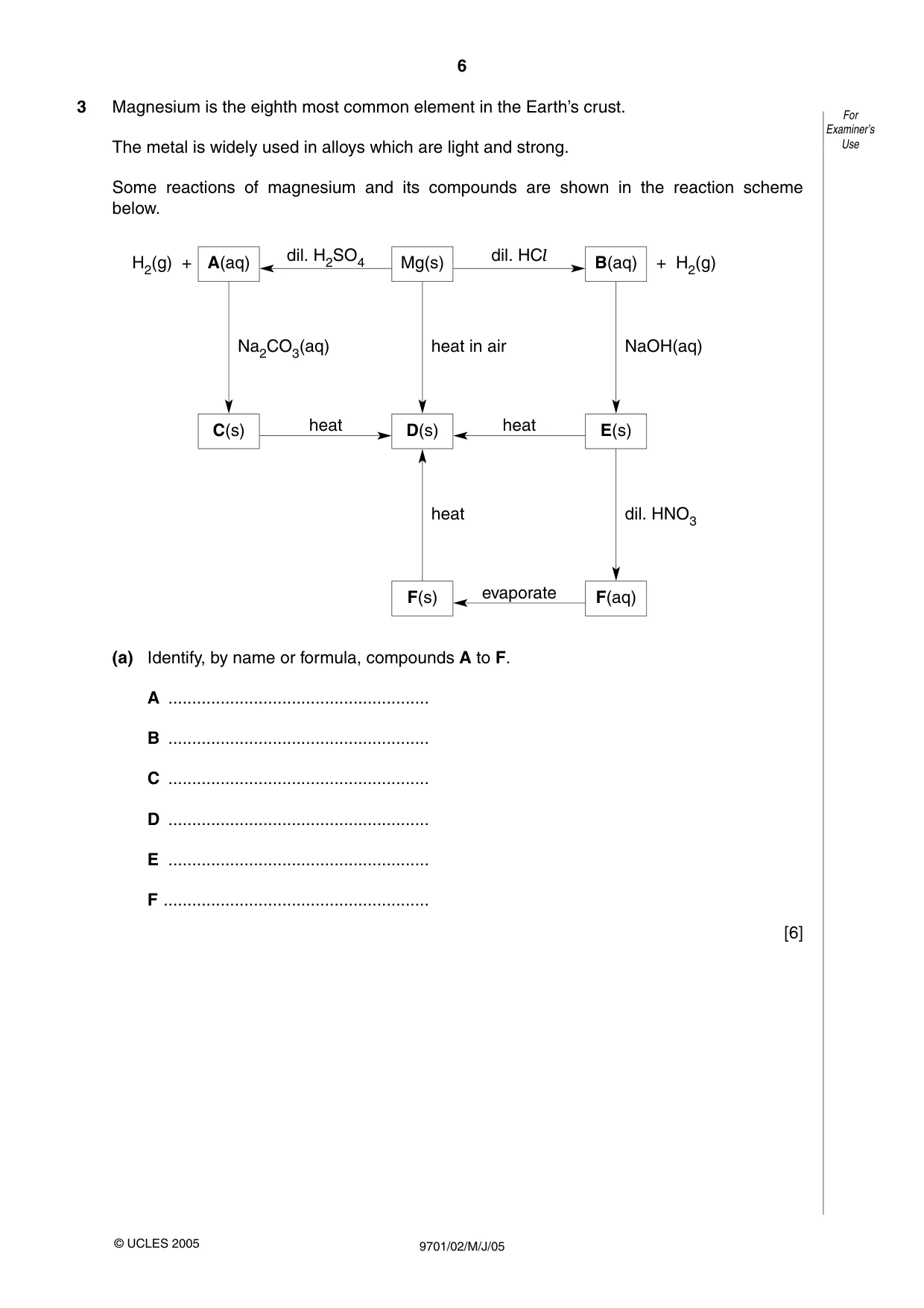
3 Magnesium is the eighth most common element in the Earth’s crust. The metal is widely used in alloys which are light and strong. Some reactions of magnesium and its compounds are shown in the reaction scheme below. (a) Identify, by name or formula, compounds A to F. A … B … C … D … E … F … [6] 6 9701/02/M/J/05 © UCLES 2005 For Examiner’s Use H2(g) + A(aq) C(s) dil. H2SO4 Na2CO3(aq) heat in air heat NaOH(aq) dil. HNO3 heat Mg(s) D(s) F(s) dil. HCl heat evaporate B(aq) E(s) F(aq) + H2(g)
Question paper, page 7
(b) (i) Construct balanced equations for the following reactions. magnesium to compound A … compound C to compound D … compound F to compound D … (ii) Suggest a balanced equation for the effect of heat on compound E. … [4] [Total: 10] 7 [Turn over 9701/02/M/J/05 © UCLES 2005 For Examiner’s Use
Question paper, page 8
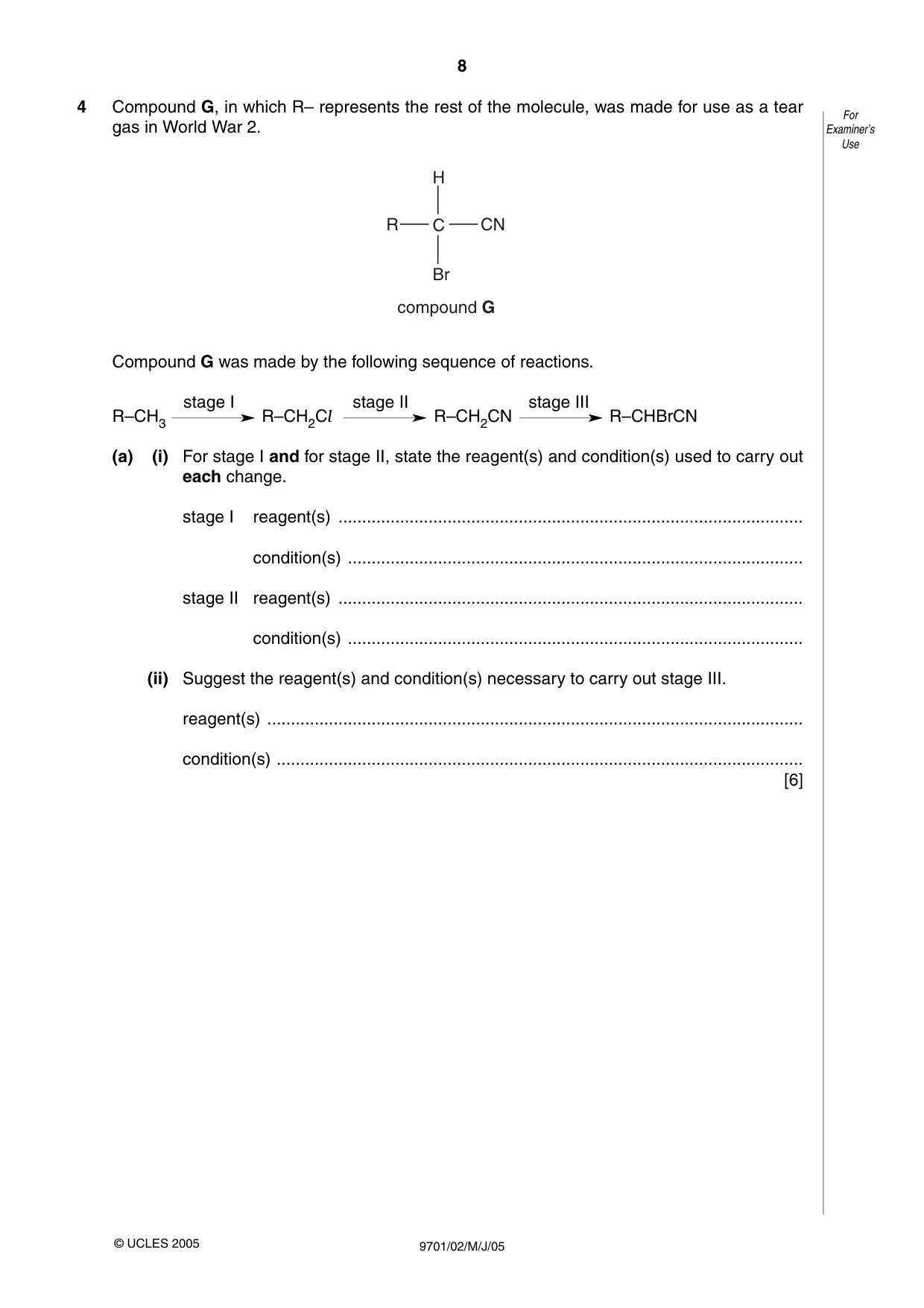
4 Compound G, in which R– represents the rest of the molecule, was made for use as a tear gas in World War 2. Compound G was made by the following sequence of reactions. stage I stage II stage III R–CH3 R–CH2Cl R–CH2CN R–CHBrCN (a) (i) For stage I and for stage II, state the reagent(s) and condition(s) used to carry out each change. stage I reagent(s) … condition(s) … stage II reagent(s) … condition(s) … (ii) Suggest the reagent(s) and condition(s) necessary to carry out stage III. reagent(s) … condition(s) … [6] R H C Br CN compound G 8 9701/02/M/J/05 © UCLES 2005 For Examiner’s Use
Question paper, page 9
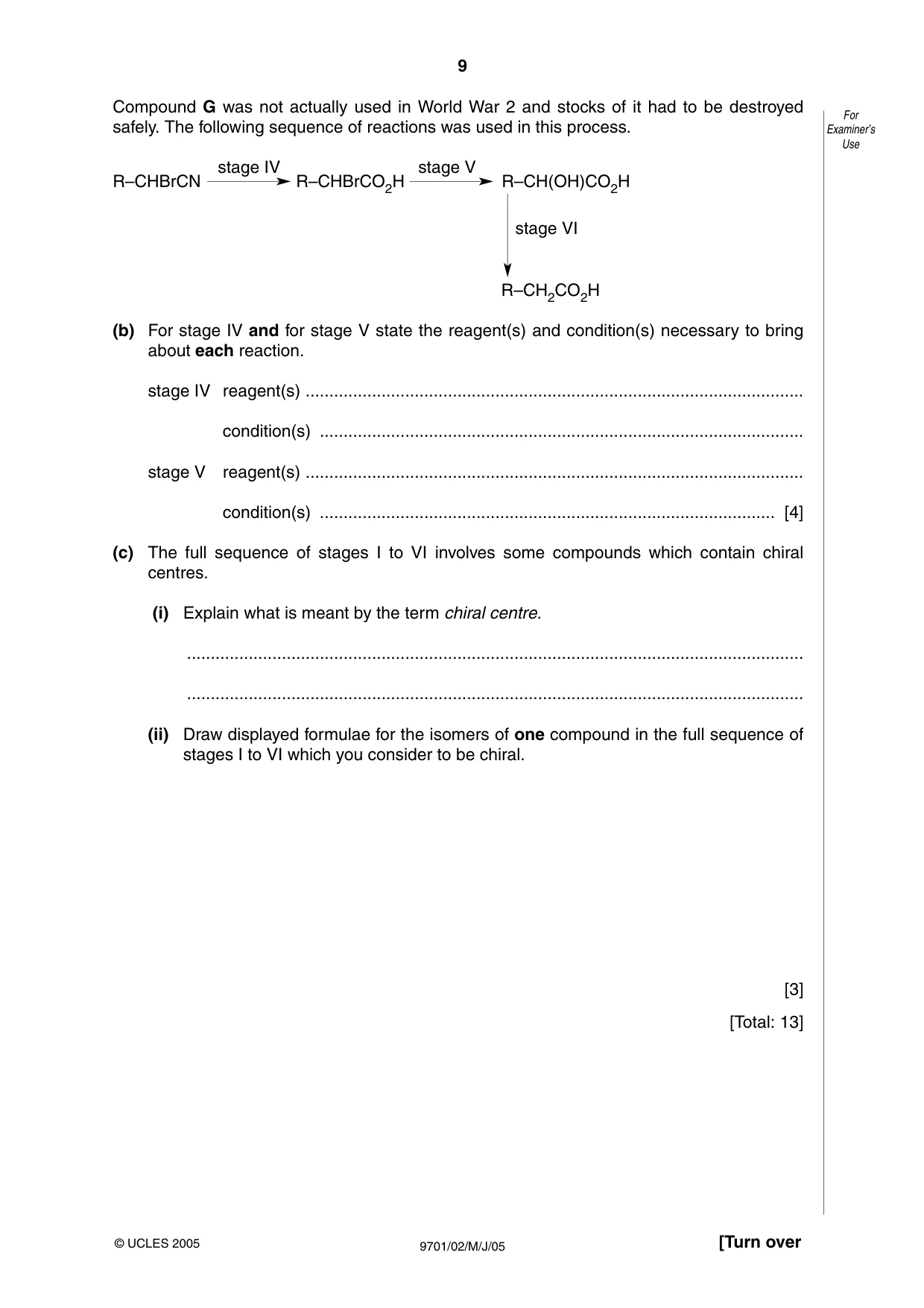
Compound G was not actually used in World War 2 and stocks of it had to be destroyed safely. The following sequence of reactions was used in this process. stage IV stage V R–CHBrCN R–CHBrCO2H R–CH(OH)CO2H stage VI R–CH2CO2H (b) For stage IV and for stage V state the reagent(s) and condition(s) necessary to bring about each reaction. stage IV reagent(s) … condition(s) … stage V reagent(s) … condition(s) … [4] (c) The full sequence of stages I to VI involves some compounds which contain chiral centres. (i) Explain what is meant by the term chiral centre. … … (ii) Draw displayed formulae for the isomers of one compound in the full sequence of stages I to VI which you consider to be chiral. [3] [Total: 13] 9 [Turn over 9701/02/M/J/05 © UCLES 2005 For Examiner’s Use
Question paper, page 10
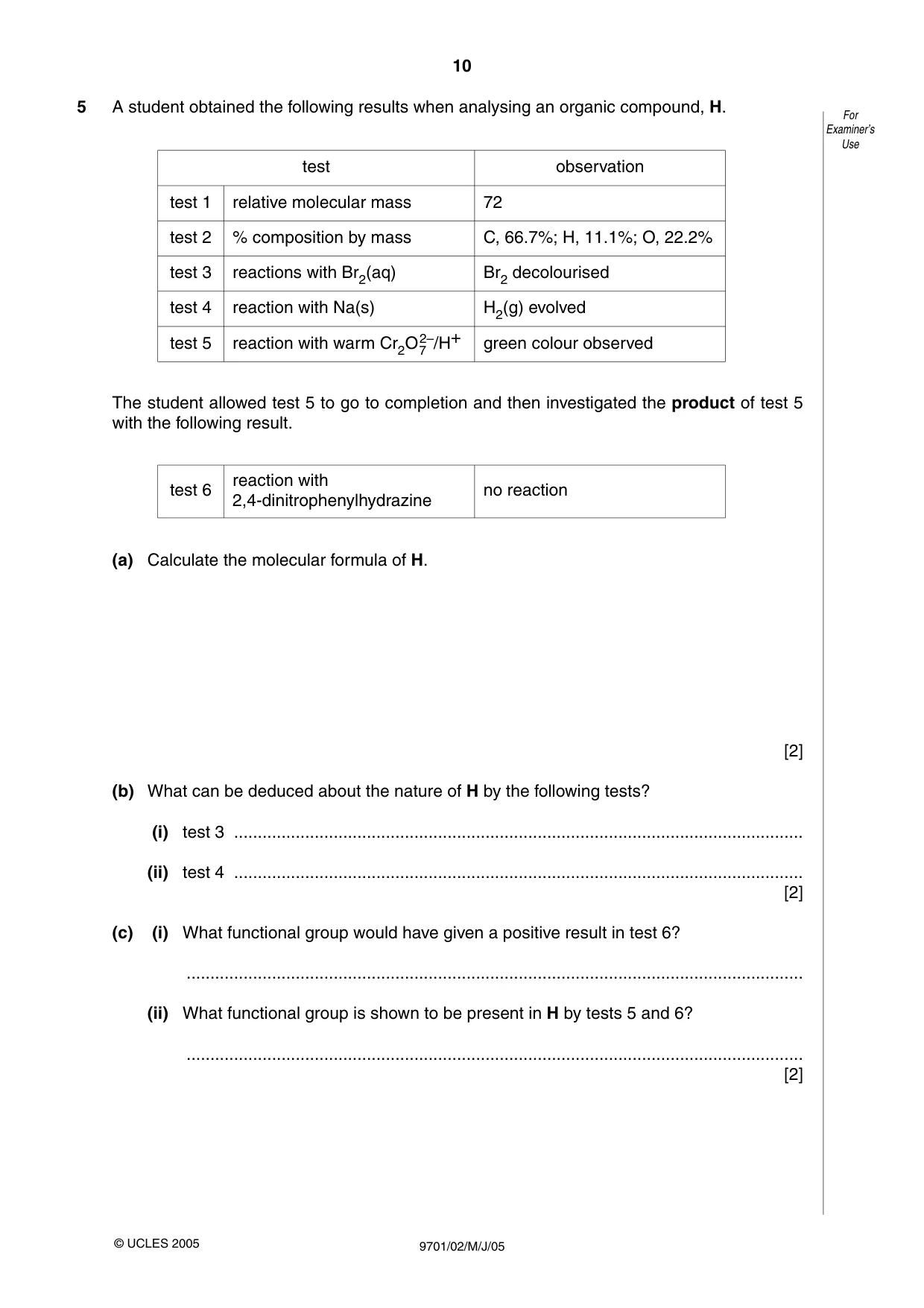
5 A student obtained the following results when analysing an organic compound, H. The student allowed test 5 to go to completion and then investigated the product of test 5 with the following result. (a) Calculate the molecular formula of H. [2] (b) What can be deduced about the nature of H by the following tests? (i) test 3 … (ii) test 4 … [2] (c) (i) What functional group would have given a positive result in test 6? … (ii) What functional group is shown to be present in H by tests 5 and 6? … [2] 10 9701/02/M/J/05 © UCLES 2005 For Examiner’s Use test observation test 1 test 2 test 3 test 4 test 5 test 6 relative molecular mass 72 C, 66.7%; H, 11.1%; O, 22.2% Br2 decolourised H2(g) evolved green colour observed no reaction % composition by mass reactions with Br2(aq) reaction with Na(s) reaction with warm Cr2O7 2–/H+ reaction with 2,4-dinitrophenylhydrazine
Question paper, page 11
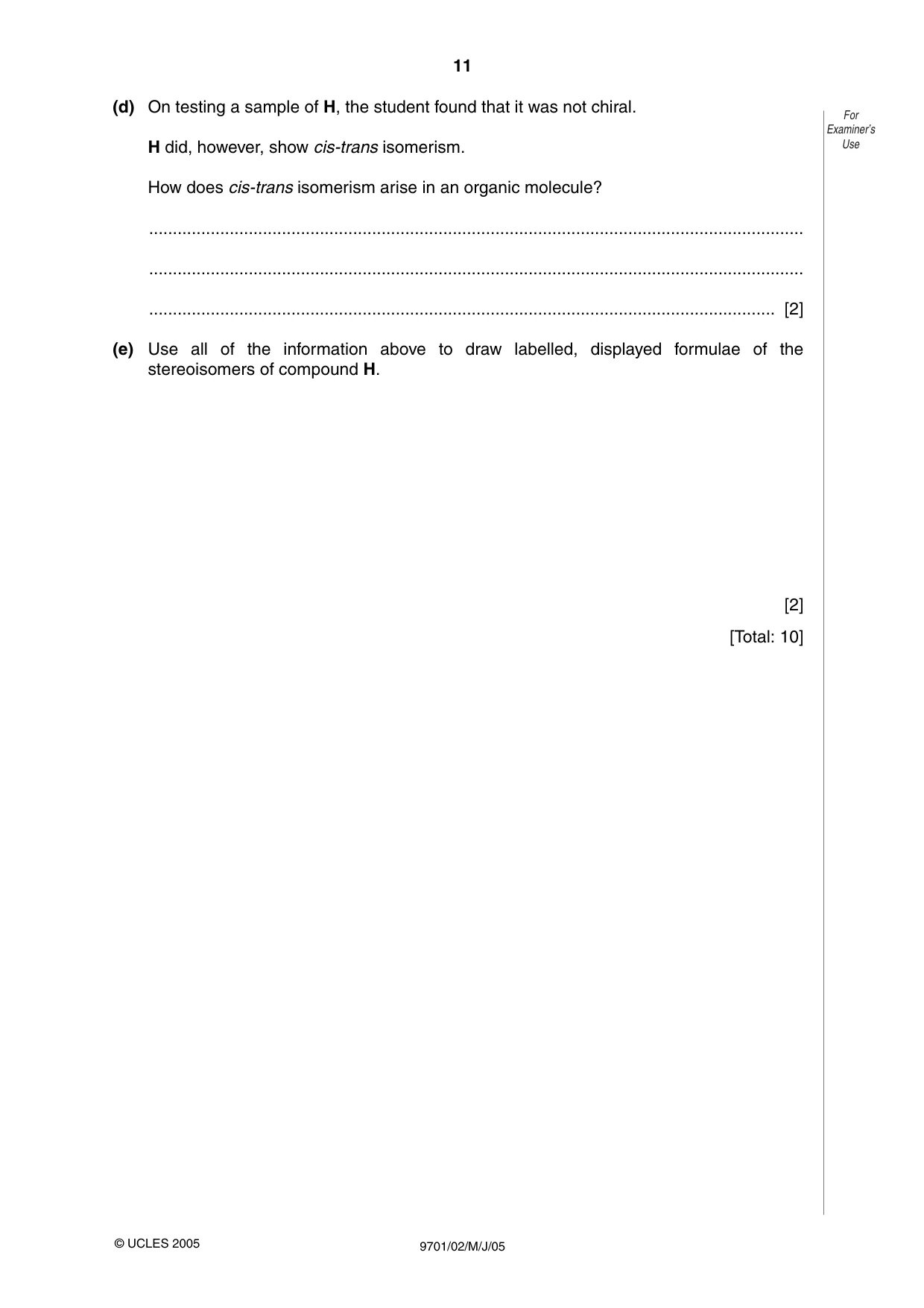
For Examiner’s Use (d) On testing a sample of H, the student found that it was not chiral. H did, however, show cis-trans isomerism. How does cis-trans isomerism arise in an organic molecule? … … … [2] (e) Use all of the information above to draw labelled, displayed formulae of the stereoisomers of compound H. [2] [Total: 10] 11 9701/02/M/J/05 © UCLES 2005
Question paper, page 12
BLANK PAGE 12 9701/02/M/J/05 Permission to reproduce items where third-party owned material protected by copyright is included has been sought and cleared where possible. Every reasonable effort has been made by the publisher (UCLES) to trace copyright holders, but if any items requiring clearance have unwittingly been included, the publisher will be pleased to make amends at the earliest possible opportunity. University of Cambridge International Examinations is part of the University of Cambridge Local Examinations Syndicate (UCLES), which is itself a department of the University of Cambridge.
Mark scheme, page 1
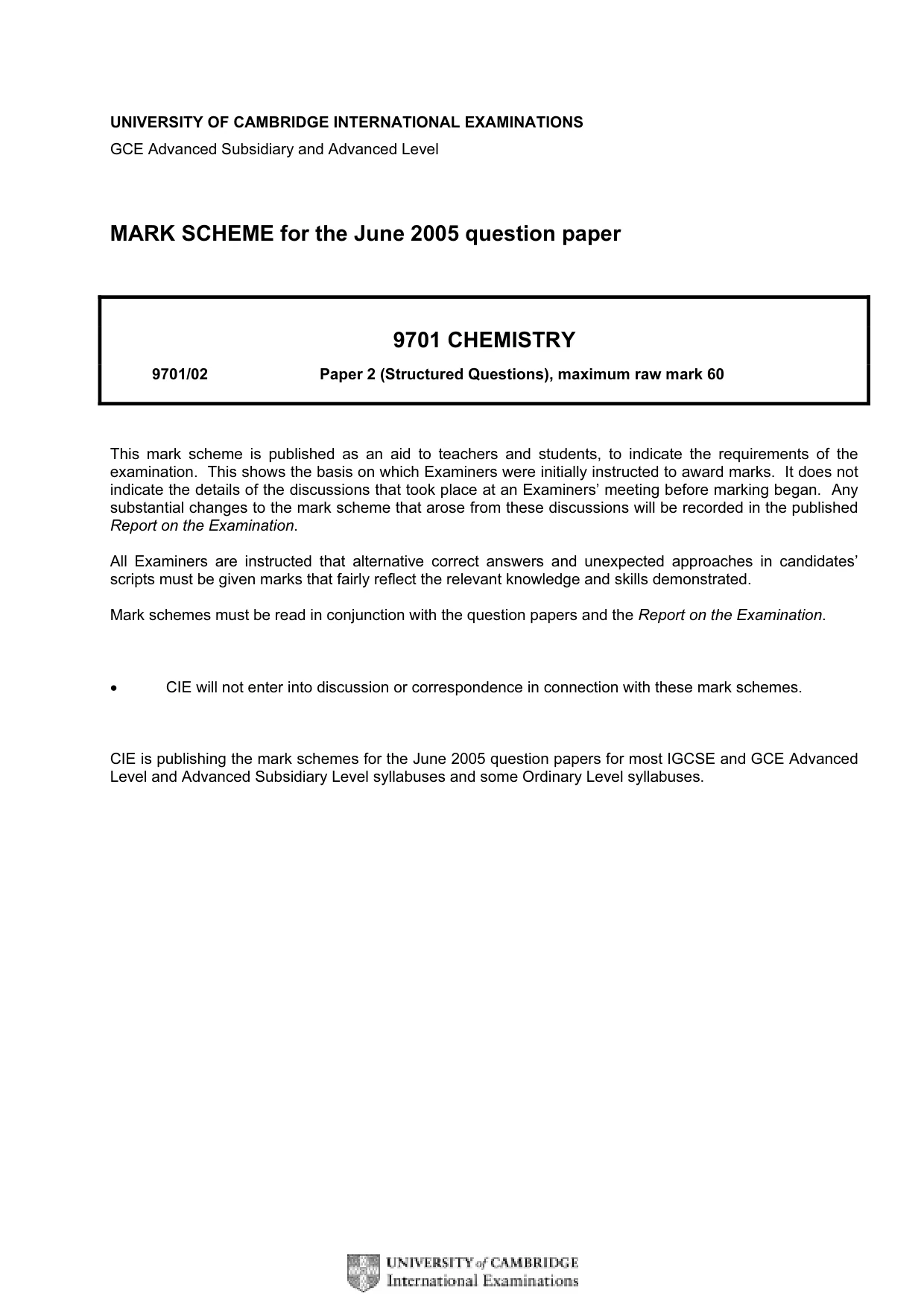
UNIVERSITY OF CAMBRIDGE INTERNATIONAL EXAMINATIONS GCE Advanced Subsidiary and Advanced Level MARK SCHEME for the June 2005 question paper 9701 CHEMISTRY 9701/02 Paper 2 (Structured Questions), maximum raw mark 60 This mark scheme is published as an aid to teachers and students, to indicate the requirements of the examination. This shows the basis on which Examiners were initially instructed to award marks. It does not indicate the details of the discussions that took place at an Examiners’ meeting before marking began. Any substantial changes to the mark scheme that arose from these discussions will be recorded in the published Report on the Examination. All Examiners are instructed that alternative correct answers and unexpected approaches in candidates’ scripts must be given marks that fairly reflect the relevant knowledge and skills demonstrated. Mark schemes must be read in conjunction with the question papers and the Report on the Examination. • CIE will not enter into discussion or correspondence in connection with these mark schemes. CIE is publishing the mark schemes for the June 2005 question papers for most IGCSE and GCE Advanced Level and Advanced Subsidiary Level syllabuses and some Ordinary Level syllabuses.
Mark scheme, page 2
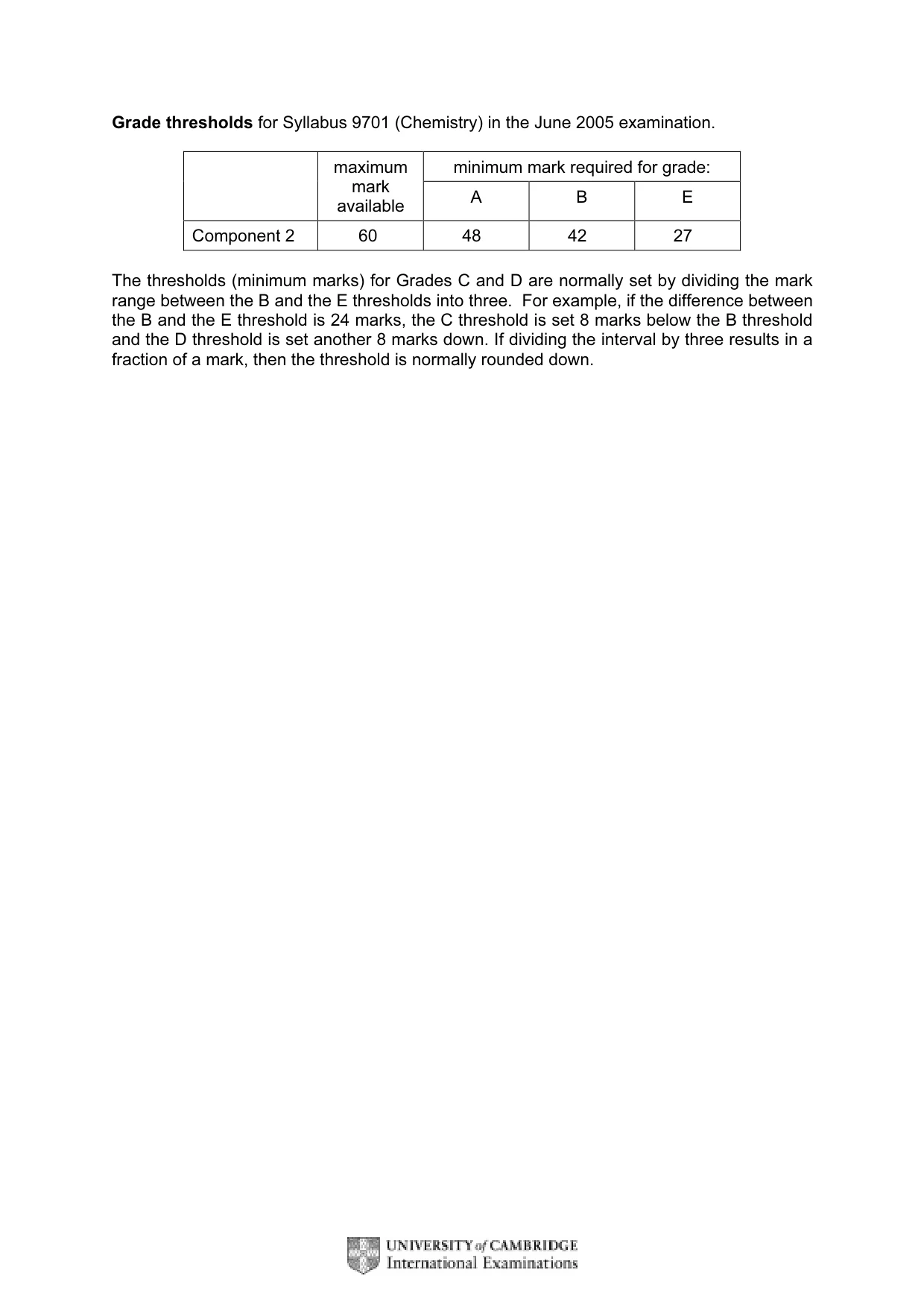
Grade thresholds for Syllabus 9701 (Chemistry) in the June 2005 examination. minimum mark required for grade: maximum mark available A B E Component 2 60 48 42 27 The thresholds (minimum marks) for Grades C and D are normally set by dividing the mark range between the B and the E thresholds into three. For example, if the difference between the B and the E threshold is 24 marks, the C threshold is set 8 marks below the B threshold and the D threshold is set another 8 marks down. If dividing the interval by three results in a fraction of a mark, then the threshold is normally rounded down.
Mark scheme, page 3
June 2005 GCE A AND AS LEVEL MARK SCHEME MAXIMUM MARK: 60 SYLLABUS/COMPONENT: 9701/02 CHEMISTRY Paper 2 (Structured Questions)
Mark scheme, page 4
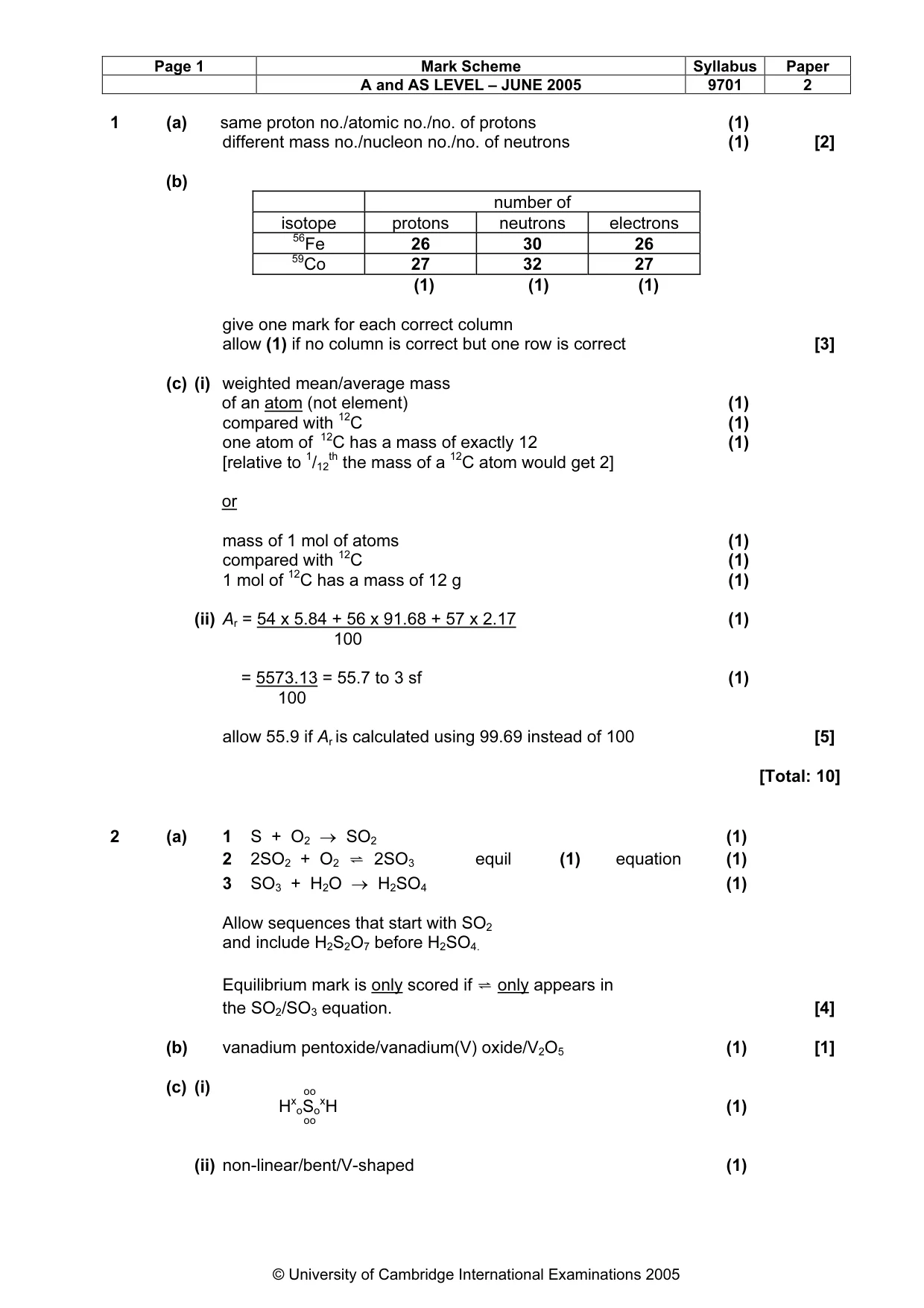
Page 1 Mark Scheme Syllabus Paper A and AS LEVEL – JUNE 2005 9701 2 © University of Cambridge International Examinations 2005 1 (a) same proton no./atomic no./no. of protons (1) different mass no./nucleon no./no. of neutrons (1) [2] (b) number of isotope protons neutrons electrons 56Fe 26 30 26 59Co 27 32 27 (1) (1) (1) give one mark for each correct column allow (1) if no column is correct but one row is correct [3] (c) (i) weighted mean/average mass of an atom (not element) (1) compared with 12C (1) one atom of 12C has a mass of exactly 12 (1) [relative to 1/12 th the mass of a 12C atom would get 2] or mass of 1 mol of atoms (1) compared with 12C (1) 1 mol of 12C has a mass of 12 g (1) (ii) Ar = 54 x 5.84 + 56 x 91.68 + 57 x 2.17 (1) 100 = 5573.13 = 55.7 to 3 sf (1) 100 allow 55.9 if Ar is calculated using 99.69 instead of 100 [5] [Total: 10] 2 (a) 1 S + O2 → SO2 (1) 2 2SO2 + O2 ⇋ 2SO3 equil (1) equation (1) 3 SO3 + H2O → H2SO4 (1) Allow sequences that start with SO2 and include H2S2O7 before H2SO4. Equilibrium mark is only scored if ⇋ only appears in the SO2/SO3 equation. [4] (b) vanadium pentoxide/vanadium(V) oxide/V2O5 (1) [1] (c) (i) oo Hx oSo xH (1) oo (ii) non-linear/bent/V-shaped (1)
Mark scheme, page 5
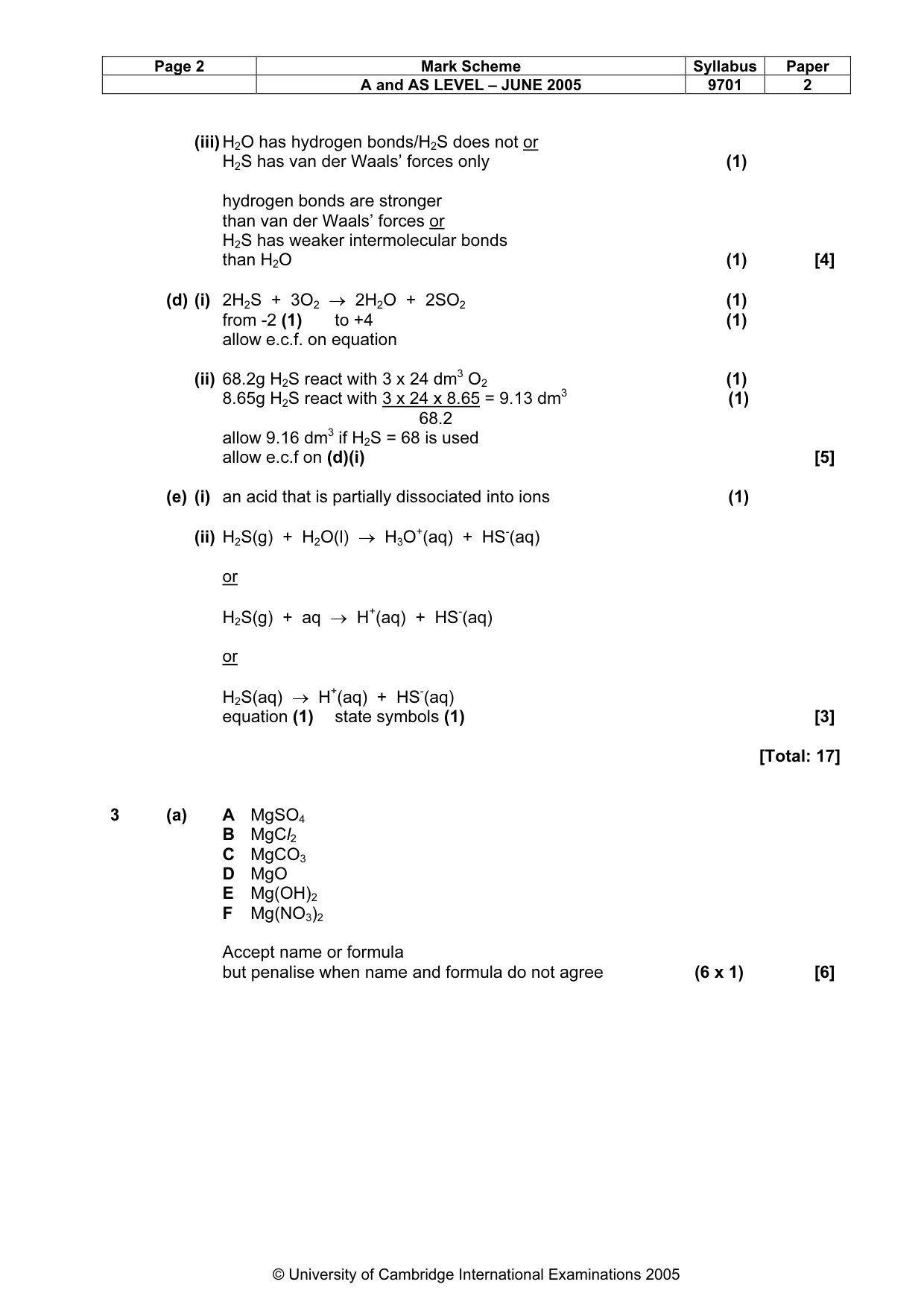
Page 2 Mark Scheme Syllabus Paper A and AS LEVEL – JUNE 2005 9701 2 © University of Cambridge International Examinations 2005 (iii) H2O has hydrogen bonds/H2S does not or H2S has van der Waals’ forces only (1) hydrogen bonds are stronger than van der Waals’ forces or H2S has weaker intermolecular bonds than H2O (1) [4] (d) (i) 2H2S + 3O2 → 2H2O + 2SO2 (1) from -2 (1) to +4 (1) allow e.c.f. on equation (ii) 68.2g H2S react with 3 x 24 dm3 O2 (1) 8.65g H2S react with 3 x 24 x 8.65 = 9.13 dm3 (1) 68.2 allow 9.16 dm3 if H2S = 68 is used allow e.c.f on (d)(i) [5] (e) (i) an acid that is partially dissociated into ions (1) (ii) H2S(g) + H2O(l) → H3O+(aq) + HS-(aq) or H2S(g) + aq → H+(aq) + HS-(aq) or H2S(aq) → H+(aq) + HS-(aq) equation (1) state symbols (1) [3] [Total: 17] 3 (a) A MgSO4 B MgCl2 C MgCO3 D MgO E Mg(OH)2 F Mg(NO3)2 Accept name or formula but penalise when name and formula do not agree (6 x 1) [6]
Mark scheme, page 6
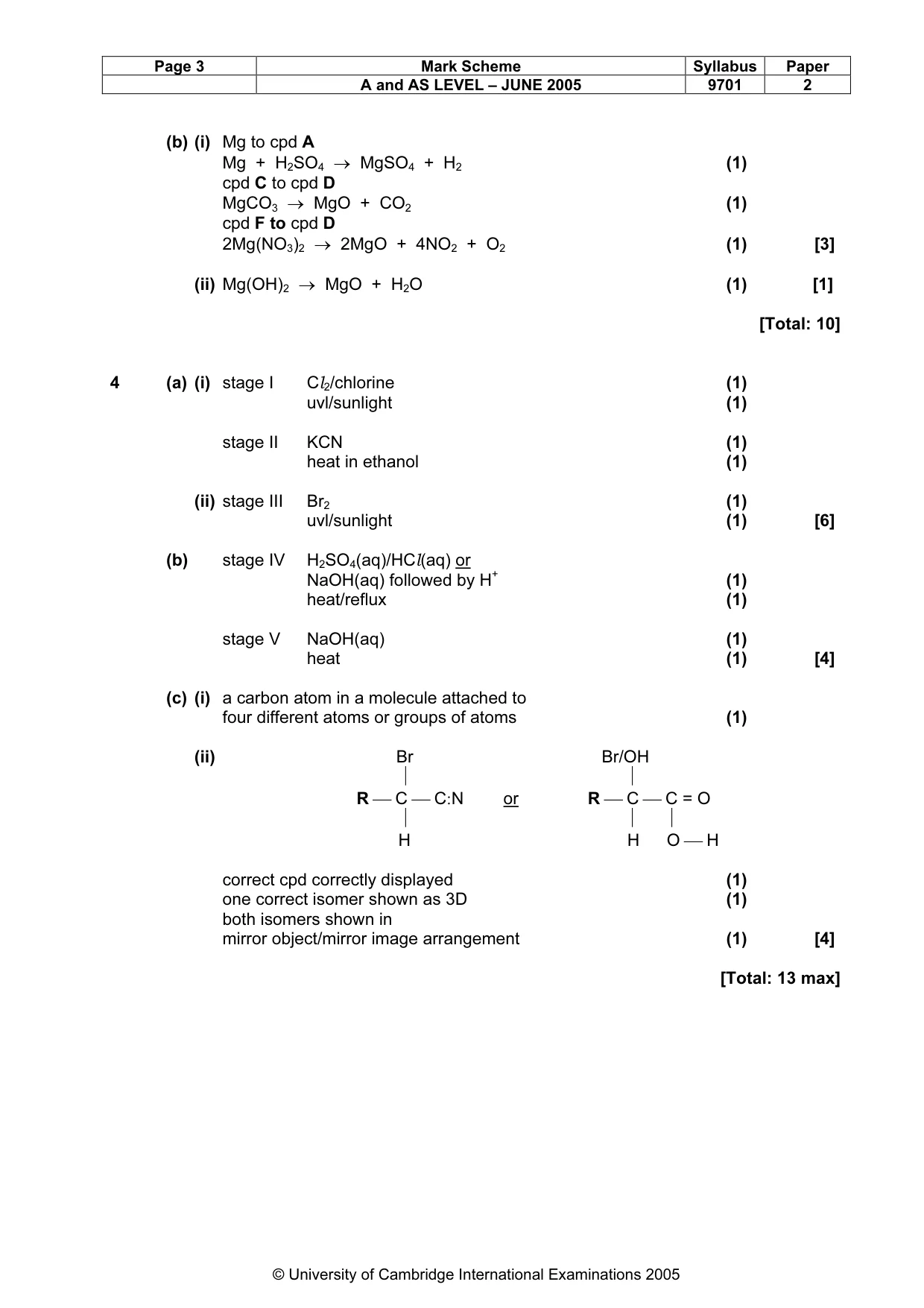
Page 3 Mark Scheme Syllabus Paper A and AS LEVEL – JUNE 2005 9701 2 © University of Cambridge International Examinations 2005 (b) (i) Mg to cpd A Mg + H2SO4 → MgSO4 + H2 (1) cpd C to cpd D MgCO3 → MgO + CO2 (1) cpd F to cpd D 2Mg(NO3)2 → 2MgO + 4NO2 + O2 (1) [3] (ii) Mg(OH)2 → MgO + H2O (1) [1] [Total: 10] 4 (a) (i) stage I Cl2/chlorine (1) uvl/sunlight (1) stage II KCN (1) heat in ethanol (1) (ii) stage III Br2 (1) uvl/sunlight (1) [6] (b) stage IV H2SO4(aq)/HCl(aq) or NaOH(aq) followed by H+ (1) heat/reflux (1) stage V NaOH(aq) (1) heat (1) [4] (c) (i) a carbon atom in a molecule attached to four different atoms or groups of atoms (1) (ii) Br Br/OH R C C:N or R C C = O H H O H correct cpd correctly displayed (1) one correct isomer shown as 3D (1) both isomers shown in mirror object/mirror image arrangement (1) [4] [Total: 13 max]
Mark scheme, page 7
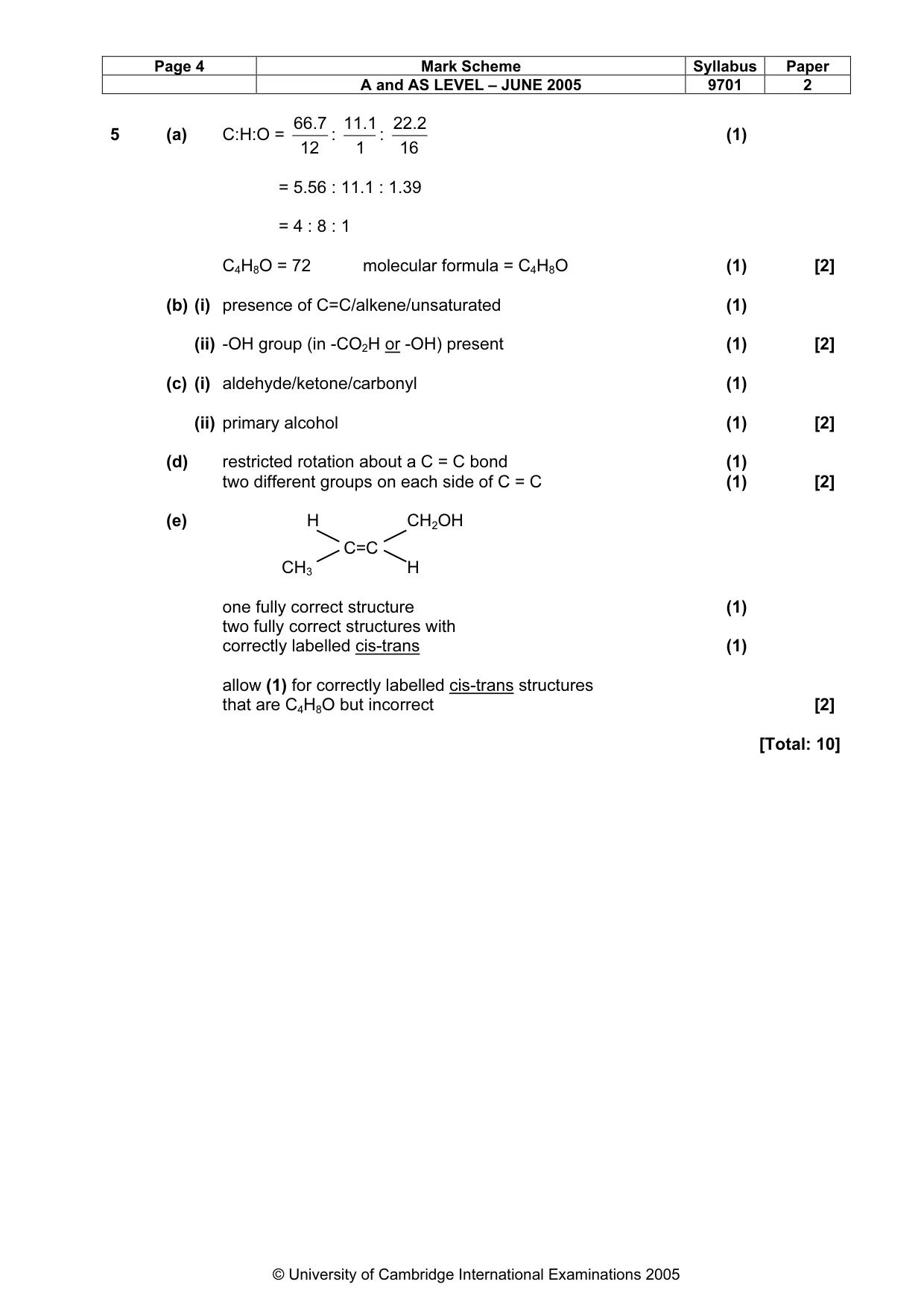
Page 4 Mark Scheme Syllabus Paper A and AS LEVEL – JUNE 2005 9701 2 © University of Cambridge International Examinations 2005 5 (a) C:H:O = 12 7 . 66 : 1 1 . 11 : 16 2 . 22 (1) = 5.56 : 11.1 : 1.39 = 4 : 8 : 1 C4H8O = 72 molecular formula = C4H8O (1) [2] (b) (i) presence of C=C/alkene/unsaturated (1) (ii) -OH group (in -CO2H or -OH) present (1) [2] (c) (i) aldehyde/ketone/carbonyl (1) (ii) primary alcohol (1) [2] (d) restricted rotation about a C = C bond (1) two different groups on each side of C = C (1) [2] (e) H CH2OH C=C CH3 H one fully correct structure (1) two fully correct structures with correctly labelled cis-trans (1) allow (1) for correctly labelled cis-trans structures that are C4H8O but incorrect [2] [Total: 10]