Cambridge A Level Chemistry 9701 — 2004 Oct/Nov Paper 2 · Variant 1
9701/21/O/N/04
The question paper and its mark scheme, free to read here and free to download. This is Cambridge’s own paper, exactly as it was sat.
Question paper12 pages
Mark scheme8 pages
Answers below. Sit the paper first if you are practising.
Paper as text
Question paper, page 1
This document consists of 11 printed pages and 1 blank page. SP (AT) S83011/2 © UCLES 2004 [Turn over UNIVERSITY OF CAMBRIDGE INTERNATIONAL EXAMINATIONS General Certificate of Education – Advanced Subsidiary Level and Advanced Level CHEMISTRY Paper 2 Structured Questions AS Core 9701/02 October/November 2004 1 hour 15 minutes Candidates answer on the Question Paper. Additional Materials: Data Booklet READ THESE INSTRUCTIONS FIRST Write your name, Centre number and candidate number in the spaces provided at the top of this page. Write in dark blue or black pen in the spaces provided on the Question Paper. You may use a pencil for any diagrams, graphs or rough working. Do not use staples, paper clips, highlighters, glue or correction fluid. Answer all questions. The number of marks is given in brackets [ ] at the end of each question or part question. You may lose marks if you do not show your working or if you do not use appropriate units. DO NOT WRITE IN THE BARCODE. DO NOT WRITE IN THE GREY AREAS BETWEEN THE PAGES. For Examiner’s Use 1 2 3 4 5 TOTAL Candidate Name Centre Number Candidate Number If you have been given a label, look at the details. If any details are incorrect or missing, please fill in your correct details in the space given on this page. Stick your personal label here, if provided.
Question paper, page 2
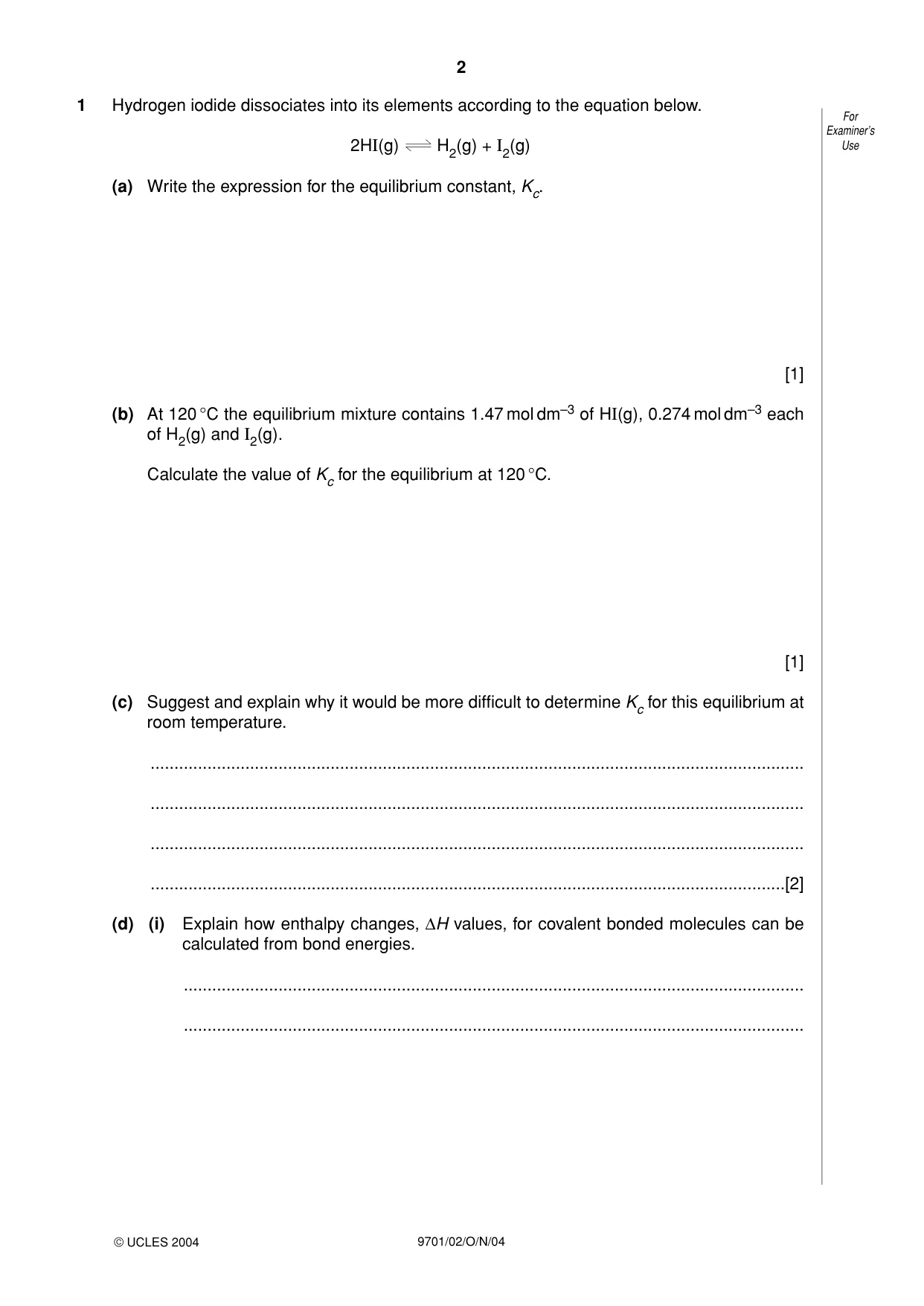
2 9701/02/O/N/04 1 Hydrogen iodide dissociates into its elements according to the equation below. 2HI(g) H2(g) + I2(g) (a) Write the expression for the equilibrium constant, Kc. [1] (b) At 120 °C the equilibrium mixture contains 1.47 mol dm–3 of HI(g), 0.274 mol dm–3 each of H2(g) and I2(g). Calculate the value of Kc for the equilibrium at 120 °C. [1] (c) Suggest and explain why it would be more difficult to determine Kc for this equilibrium at room temperature. … … … …[2] (d) (i) Explain how enthalpy changes, ∆H values, for covalent bonded molecules can be calculated from bond energies. … … For Examiner’s Use © UCLES 2004
Question paper, page 3
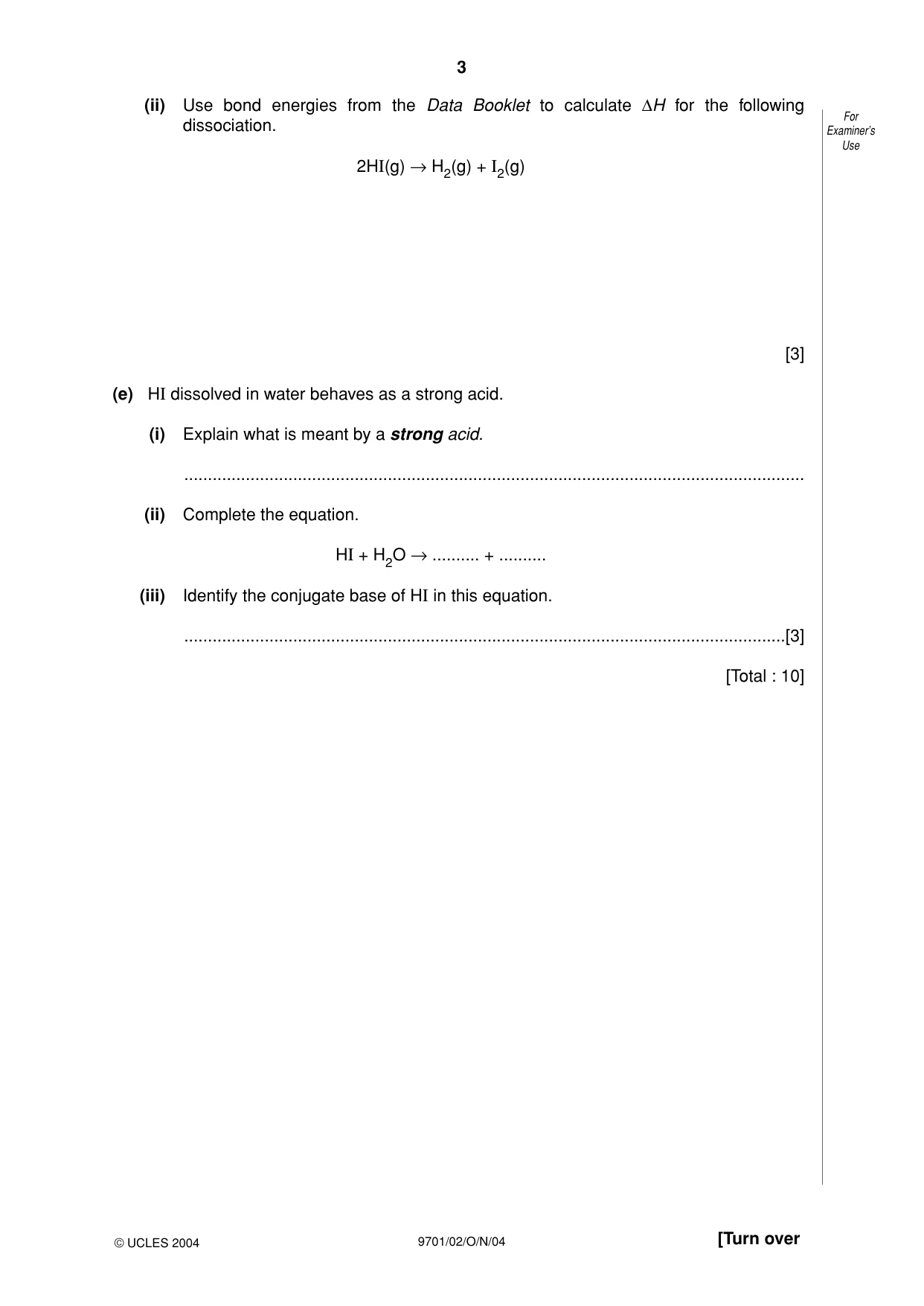
3 9701/02/O/N/04 [Turn over (ii) Use bond energies from the Data Booklet to calculate ∆H for the following dissociation. 2HI(g) →H2(g) + I2(g) [3] (e) HI dissolved in water behaves as a strong acid. (i) Explain what is meant by a strong acid. … (ii) Complete the equation. HI + H2O →… + … (iii) Identify the conjugate base of HI in this equation. …[3] [Total : 10] For Examiner’s Use © UCLES 2004
Question paper, page 4
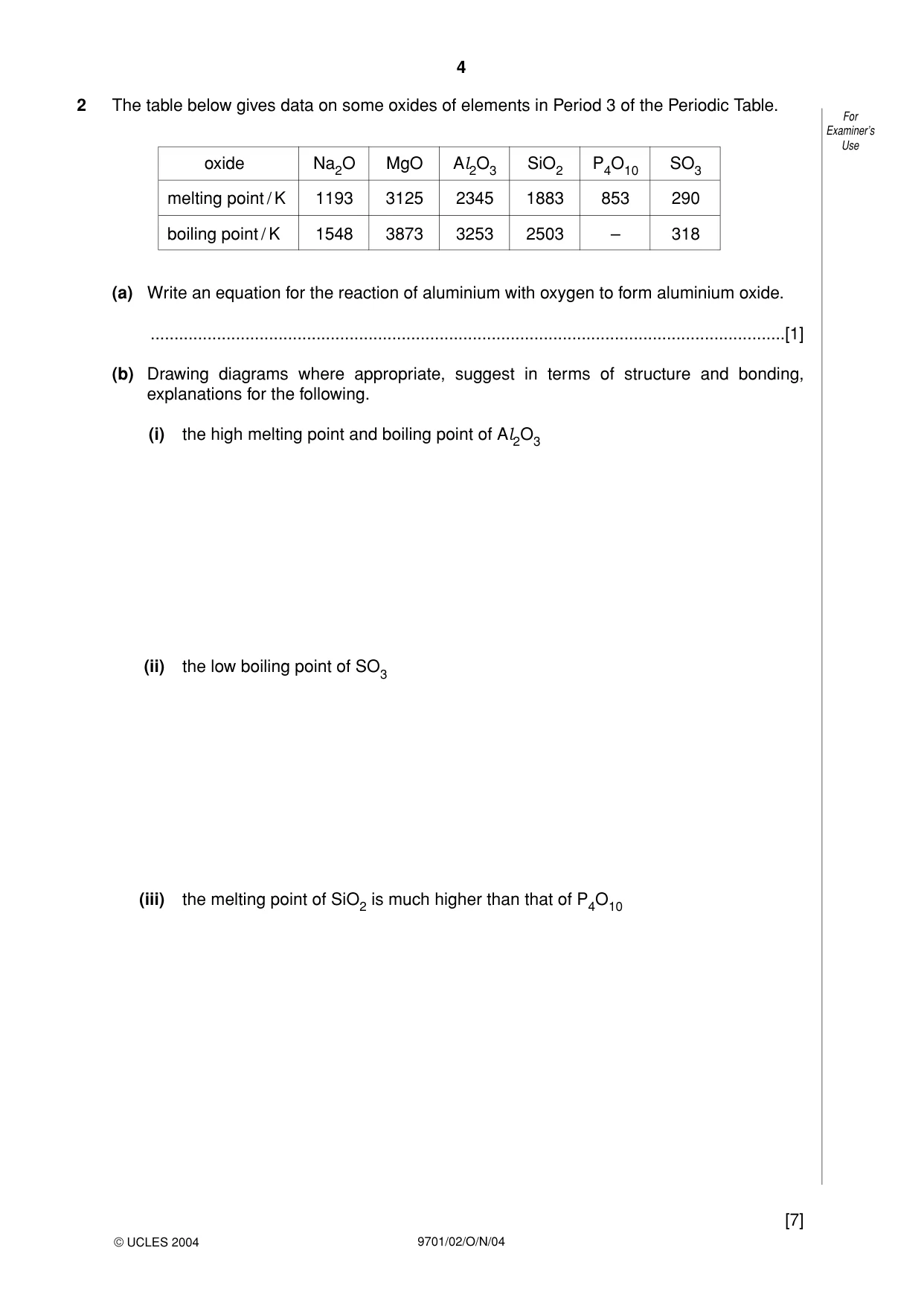
4 9701/02/O/N/04 2 The table below gives data on some oxides of elements in Period 3 of the Periodic Table. (a) Write an equation for the reaction of aluminium with oxygen to form aluminium oxide. …[1] (b) Drawing diagrams where appropriate, suggest in terms of structure and bonding, explanations for the following. (i) the high melting point and boiling point of Al2O3 (ii) the low boiling point of SO3 (iii) the melting point of SiO2 is much higher than that of P4O10 [7] For Examiner’s Use © UCLES 2004 oxide Na2O MgO Al2O3 SiO2 P4O10 SO3 melting point / K 1193 3125 2345 1883 853 290 boiling point / K 1548 3873 3253 2503 – 318
Question paper, page 5
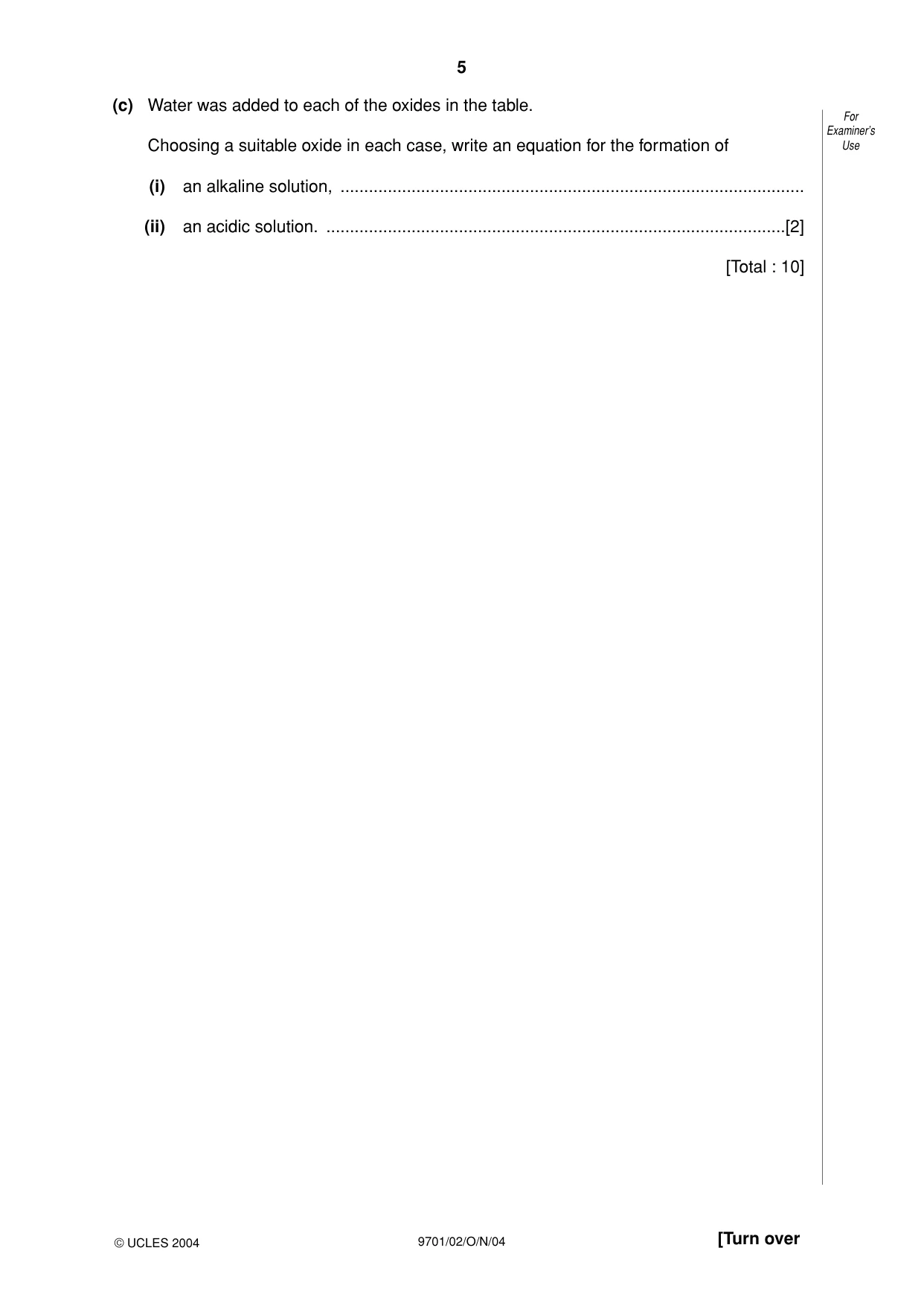
5 9701/02/O/N/04 [Turn over (c) Water was added to each of the oxides in the table. Choosing a suitable oxide in each case, write an equation for the formation of (i) an alkaline solution, … (ii) an acidic solution. …[2] [Total : 10] For Examiner’s Use © UCLES 2004
Question paper, page 6
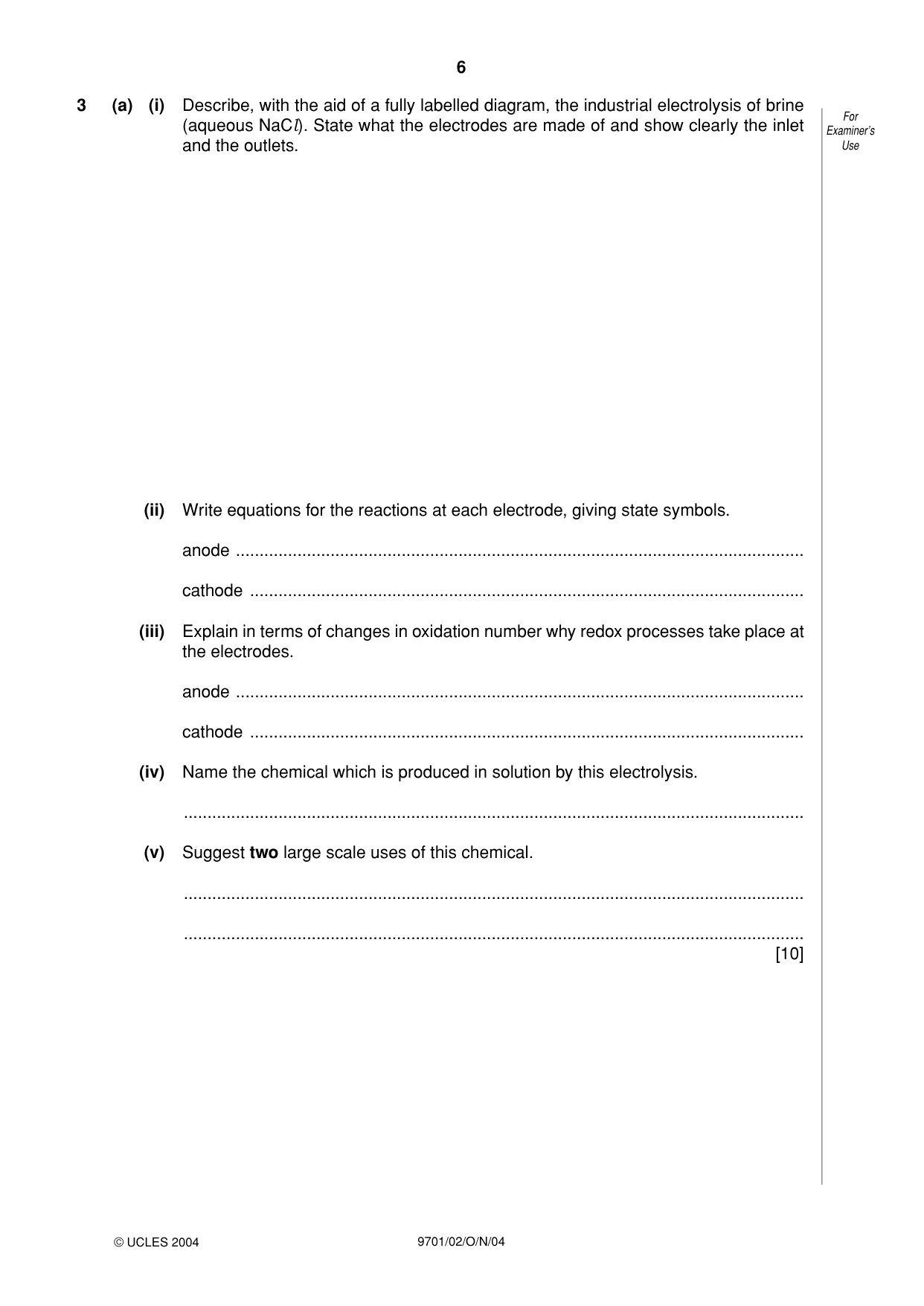
6 9701/02/O/N/04 For Examiner’s Use © UCLES 2004 3 (a) (i) Describe, with the aid of a fully labelled diagram, the industrial electrolysis of brine (aqueous NaCl). State what the electrodes are made of and show clearly the inlet and the outlets. (ii) Write equations for the reactions at each electrode, giving state symbols. anode … cathode … (iii) Explain in terms of changes in oxidation number why redox processes take place at the electrodes. anode … cathode … (iv) Name the chemical which is produced in solution by this electrolysis. … (v) Suggest two large scale uses of this chemical. … … [10]
Question paper, page 7
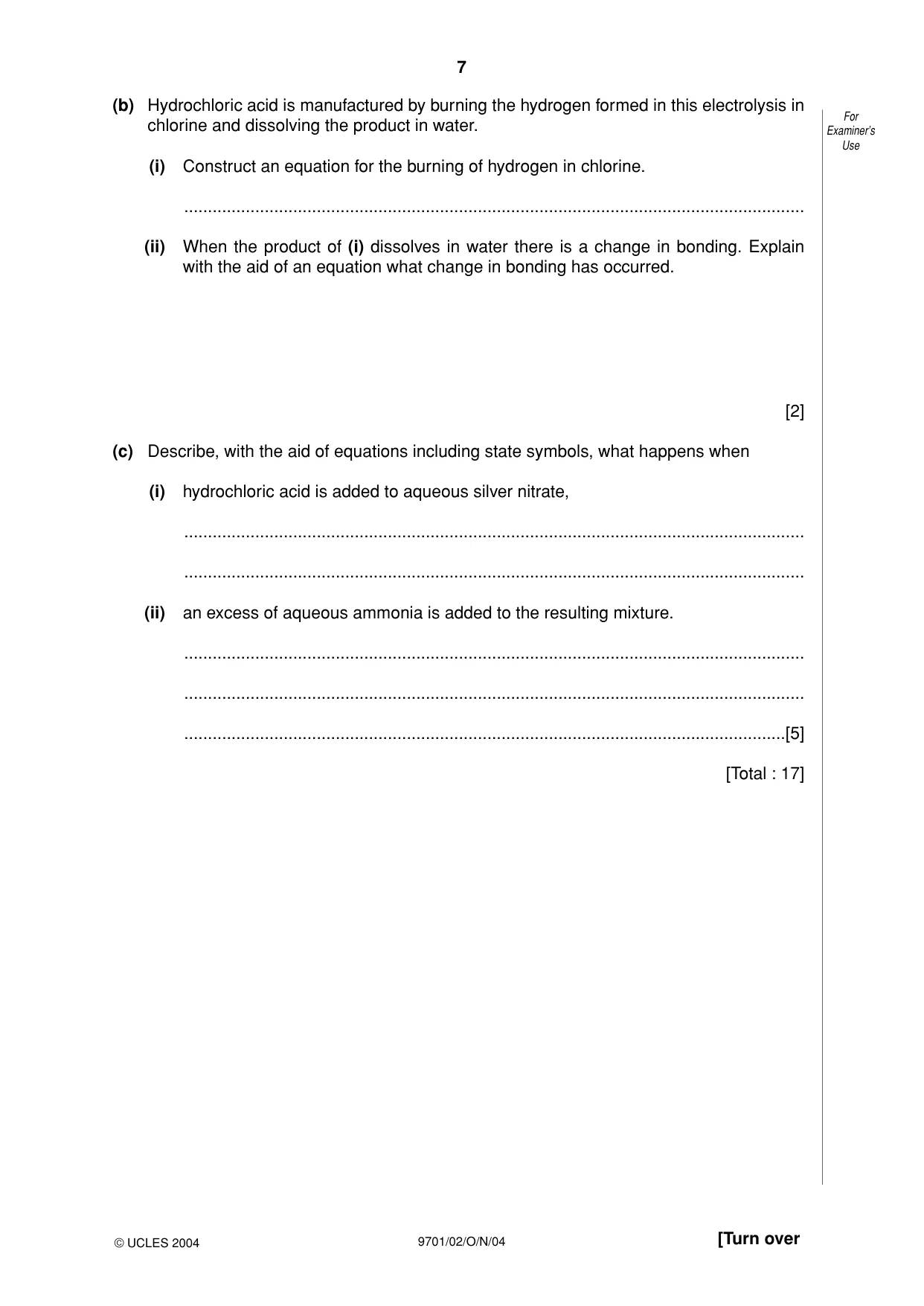
7 9701/02/O/N/04 [Turn over (b) Hydrochloric acid is manufactured by burning the hydrogen formed in this electrolysis in chlorine and dissolving the product in water. (i) Construct an equation for the burning of hydrogen in chlorine. … (ii) When the product of (i) dissolves in water there is a change in bonding. Explain with the aid of an equation what change in bonding has occurred. [2] (c) Describe, with the aid of equations including state symbols, what happens when (i) hydrochloric acid is added to aqueous silver nitrate, … … (ii) an excess of aqueous ammonia is added to the resulting mixture. … … …[5] [Total : 17] For Examiner’s Use © UCLES 2004
Question paper, page 8
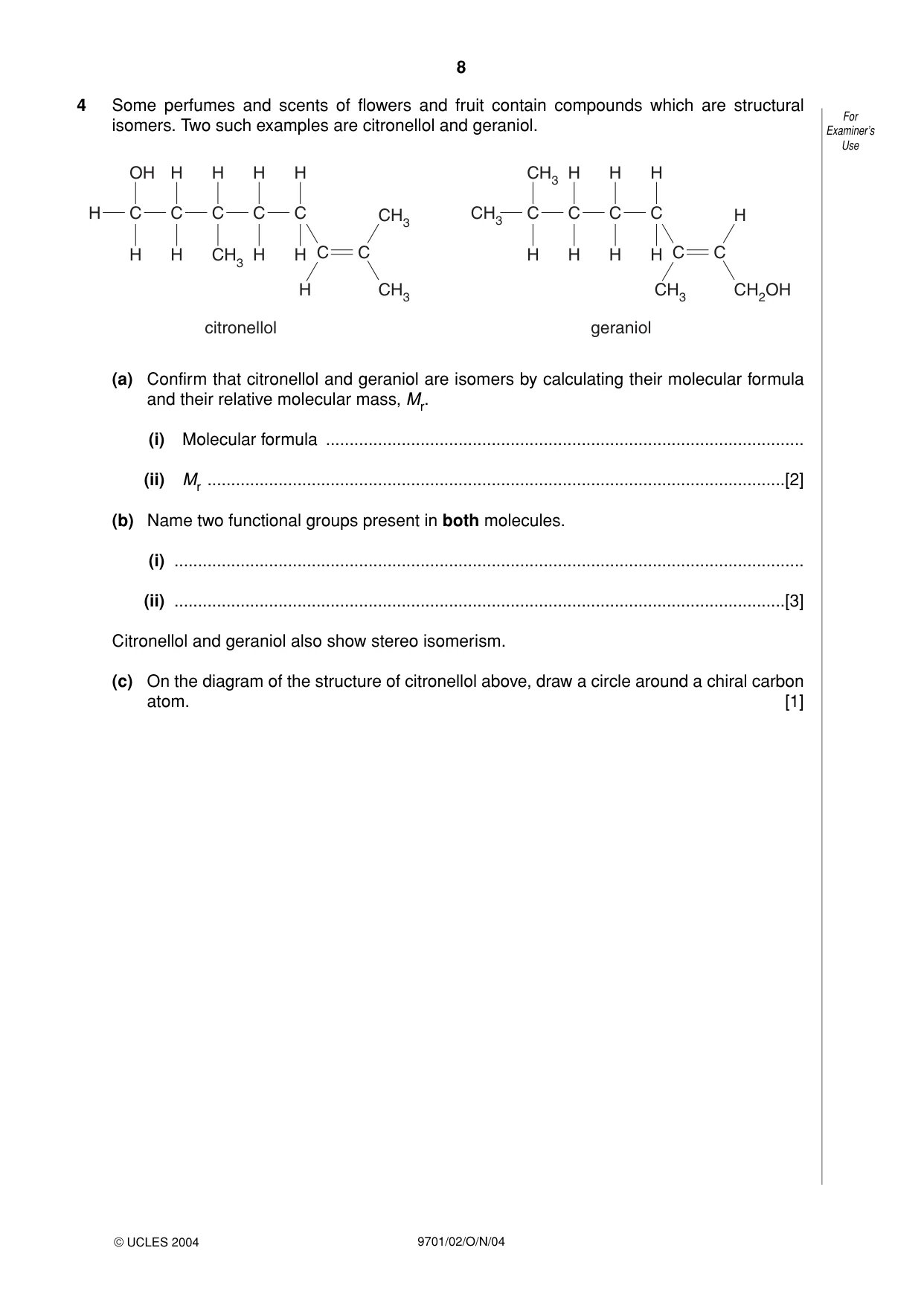
8 9701/02/O/N/04 4 Some perfumes and scents of flowers and fruit contain compounds which are structural isomers. Two such examples are citronellol and geraniol. (a) Confirm that citronellol and geraniol are isomers by calculating their molecular formula and their relative molecular mass, Mr. (i) Molecular formula … (ii) Mr …[2] (b) Name two functional groups present in both molecules. (i) … (ii) …[3] Citronellol and geraniol also show stereo isomerism. (c) On the diagram of the structure of citronellol above, draw a circle around a chiral carbon atom. [1] H C OH H C H H C C C H CH3 C H H C H H H CH3 CH3 citronellol CH3 C CH3 H C H H C C C H H C H H CH3 CH2OH H geraniol For Examiner’s Use © UCLES 2004
Question paper, page 9
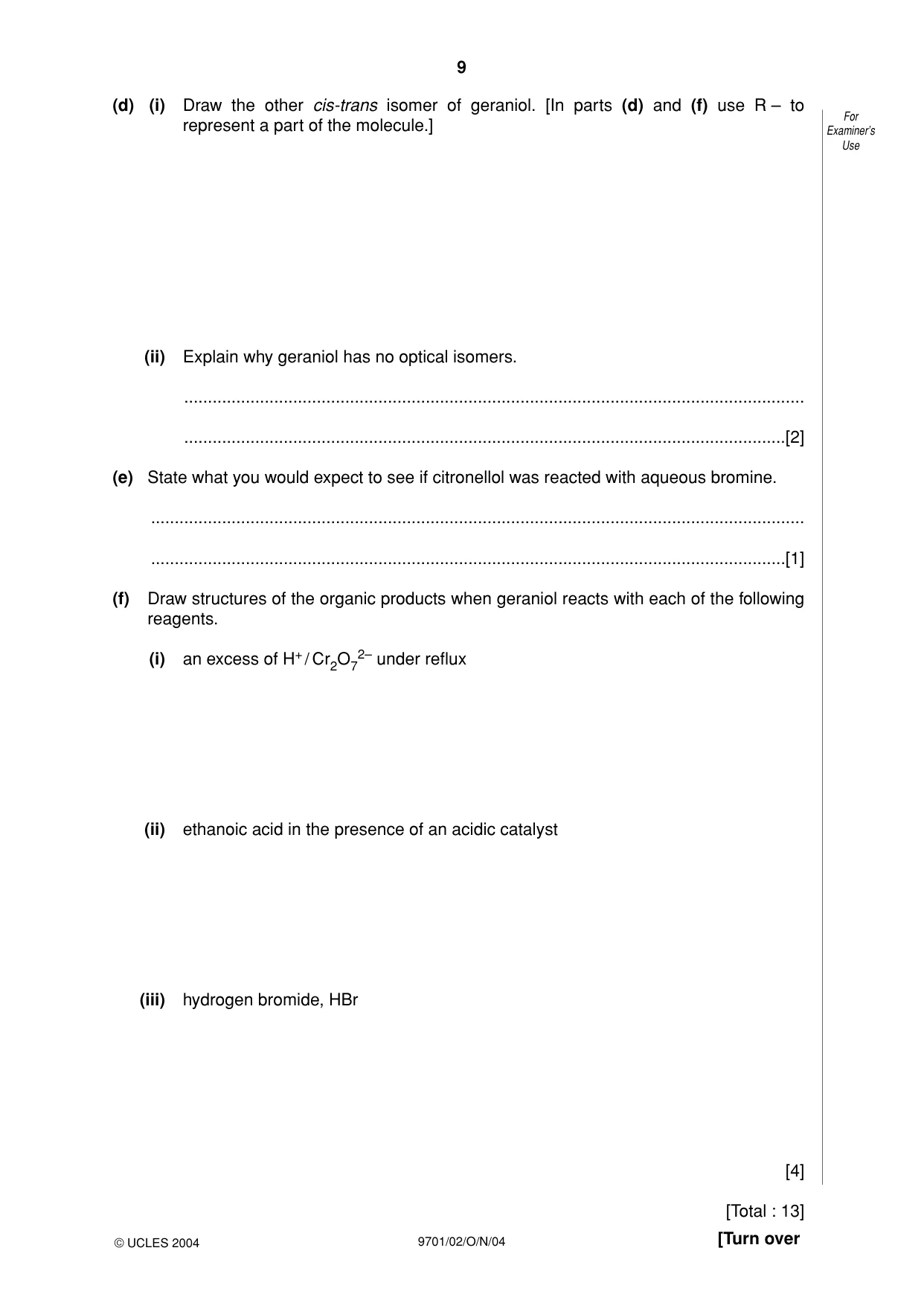
9 9701/02/O/N/04 [Turn over (d) (i) Draw the other cis-trans isomer of geraniol. [In parts (d) and (f) use R – to represent a part of the molecule.] (ii) Explain why geraniol has no optical isomers. … …[2] (e) State what you would expect to see if citronellol was reacted with aqueous bromine. … …[1] (f) Draw structures of the organic products when geraniol reacts with each of the following reagents. (i) an excess of H+/ Cr2O7 2– under reflux (ii) ethanoic acid in the presence of an acidic catalyst (iii) hydrogen bromide, HBr [4] [Total : 13] For Examiner’s Use © UCLES 2004
Question paper, page 10
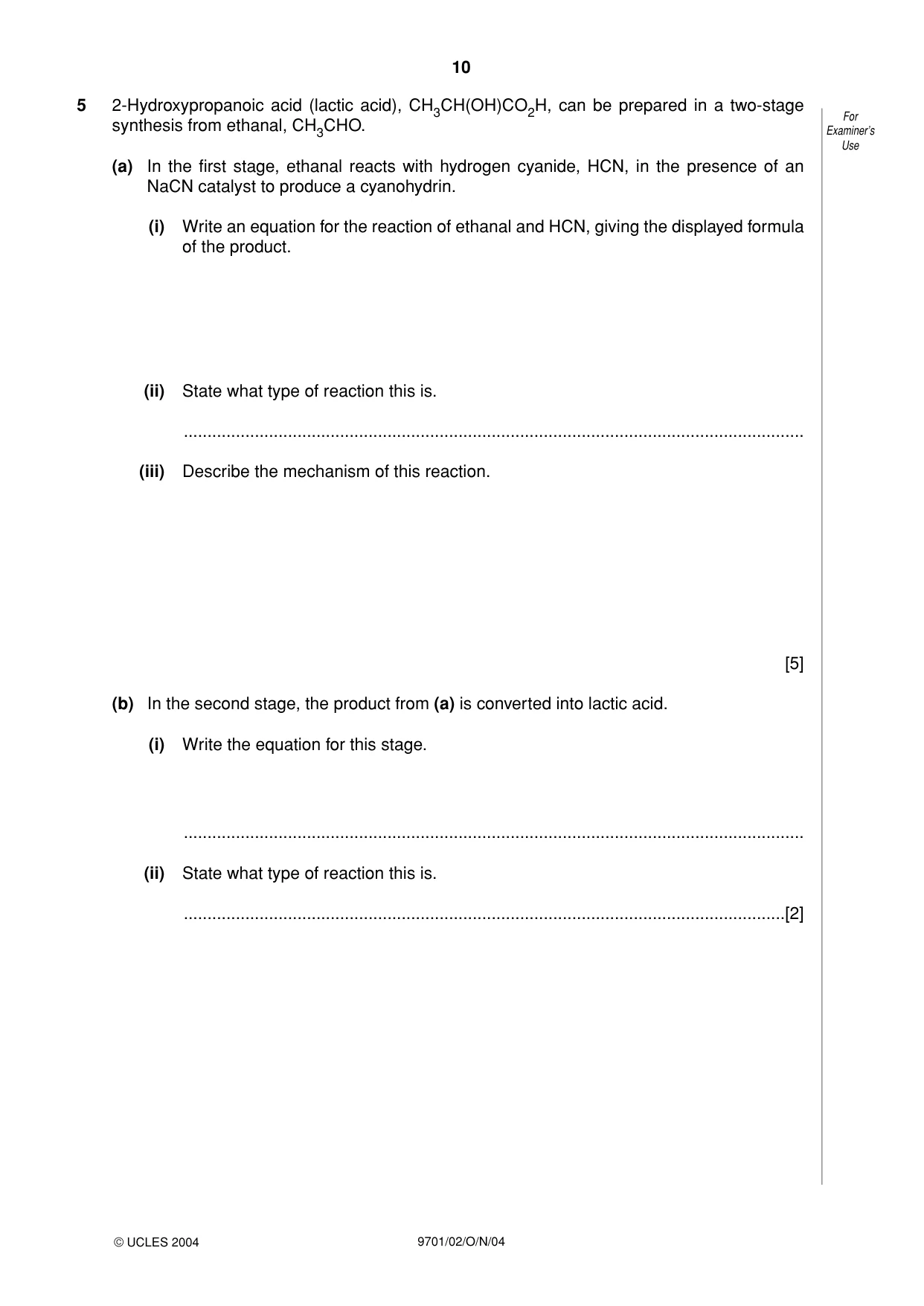
10 9701/02/O/N/04 5 2-Hydroxypropanoic acid (lactic acid), CH3CH(OH)CO2H, can be prepared in a two-stage synthesis from ethanal, CH3CHO. (a) In the first stage, ethanal reacts with hydrogen cyanide, HCN, in the presence of an NaCN catalyst to produce a cyanohydrin. (i) Write an equation for the reaction of ethanal and HCN, giving the displayed formula of the product. (ii) State what type of reaction this is. … (iii) Describe the mechanism of this reaction. [5] (b) In the second stage, the product from (a) is converted into lactic acid. (i) Write the equation for this stage. … (ii) State what type of reaction this is. …[2] For Examiner’s Use © UCLES 2004
Question paper, page 11
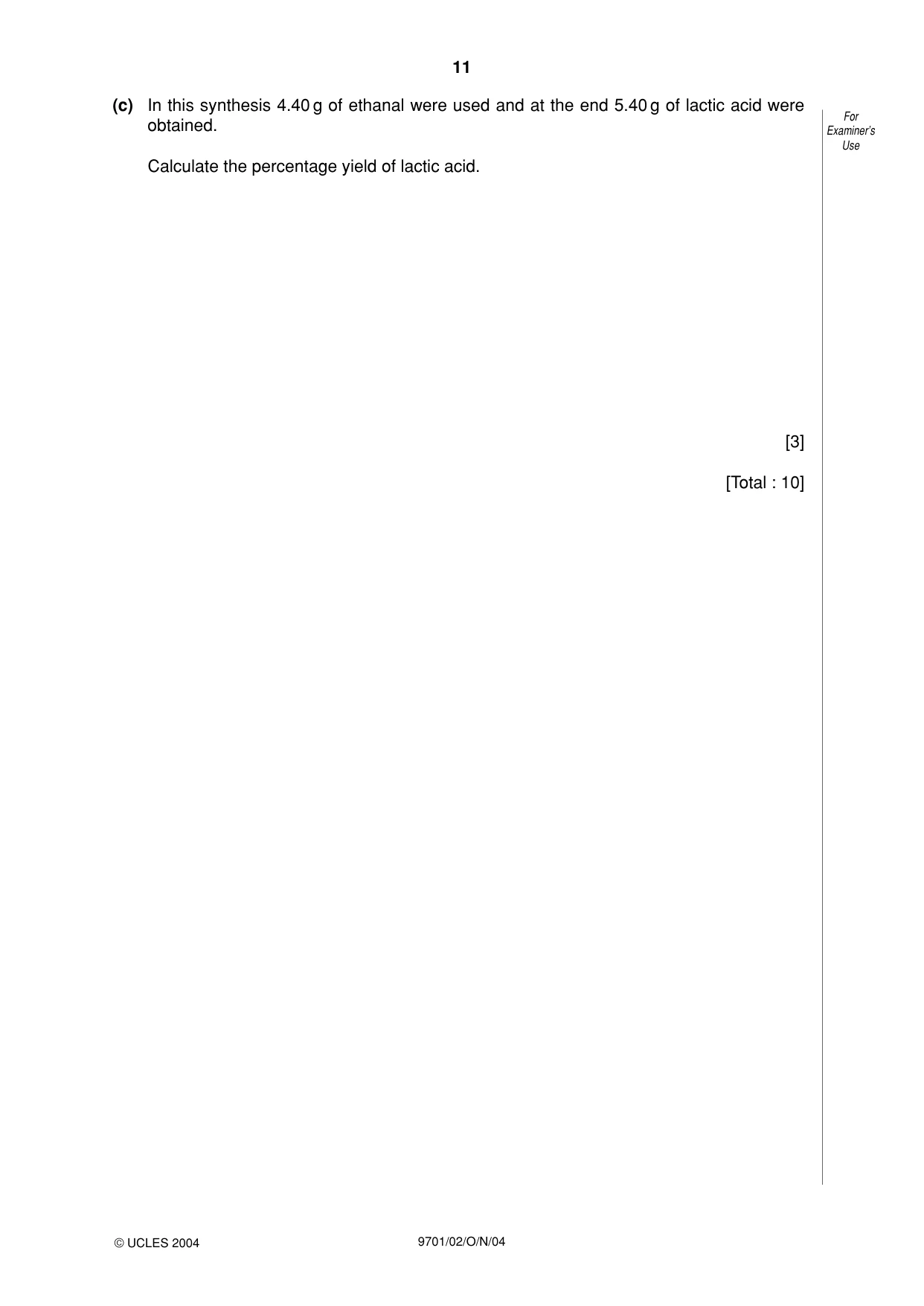
11 9701/02/O/N/04 (c) In this synthesis 4.40 g of ethanal were used and at the end 5.40 g of lactic acid were obtained. Calculate the percentage yield of lactic acid. [3] [Total : 10] For Examiner’s Use © UCLES 2004
Question paper, page 12
12 9701/02/O/N/04 BLANK PAGE University of Cambridge International Examinations is part of the University of Cambridge Local Examinations Syndicate (UCLES) which is itself a department of the University of Cambridge.
Mark scheme, page 1
UNIVERSITY OF CAMBRIDGE INTERNATIONAL EXAMINATIONS GCE Advanced Subsidiary and Advanced Level MARK SCHEME for the November 2004 question paper 9701 CHEMISTRY 9701/02 Paper 2 (Structured Questions), maximum raw mark 60 This mark scheme is published as an aid to teachers and students, to indicate the requirements of the examination. This shows the basis on which Examiners were initially instructed to award marks. It does not indicate the details of the discussions that took place at an Examiners’ meeting before marking began. Any substantial changes to the mark scheme that arose from these discussions will be recorded in the published Report on the Examination. All Examiners are instructed that alternative correct answers and unexpected approaches in candidates’ scripts must be given marks that fairly reflect the relevant knowledge and skills demonstrated. Mark schemes must be read in conjunction with the question papers and the Report on the Examination. • CIE will not enter into discussion or correspondence in connection with these mark schemes. CIE is publishing the mark schemes for the November 2004 question papers for most IGCSE and GCE Advanced Level syllabuses.
Mark scheme, page 2
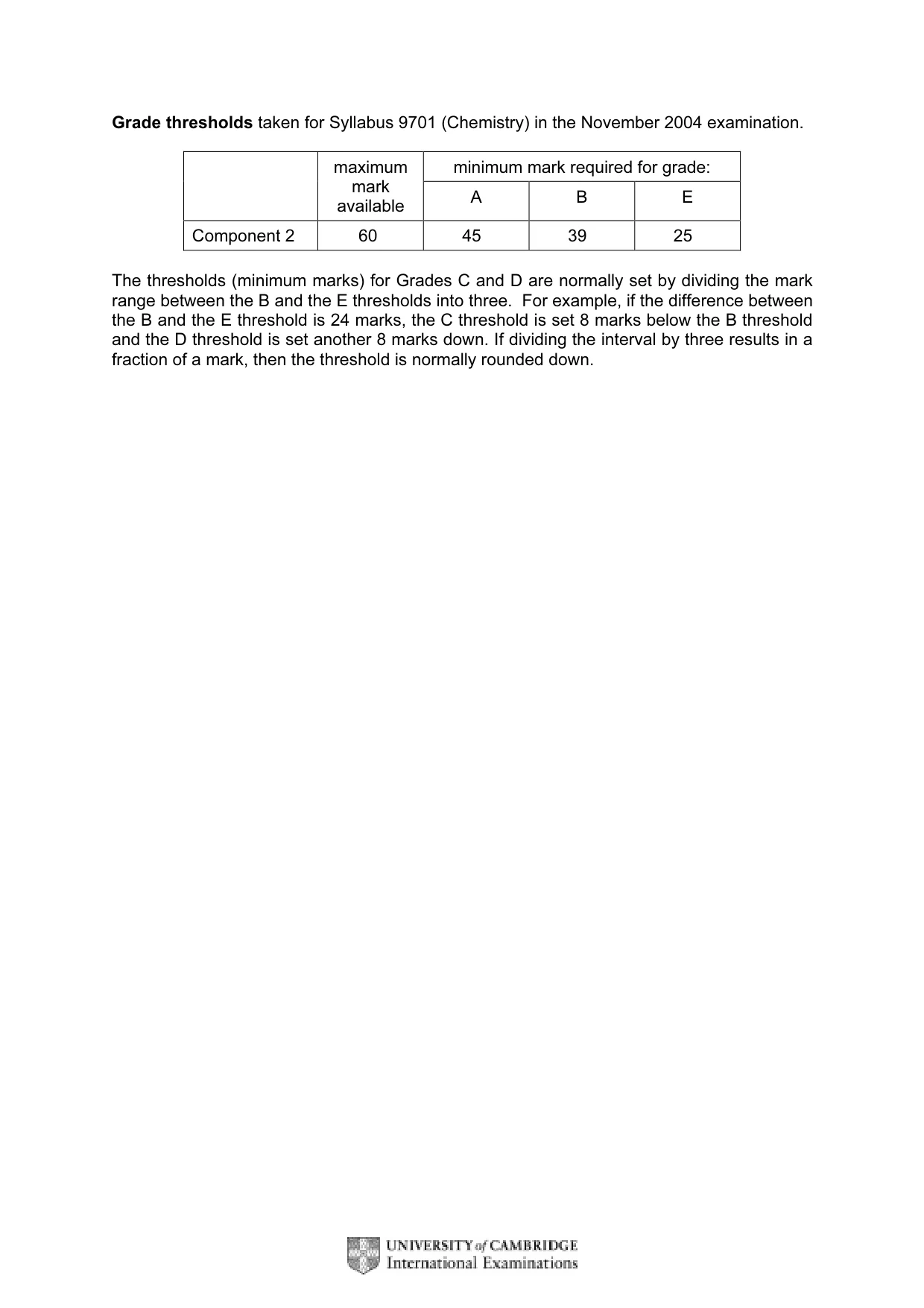
Grade thresholds taken for Syllabus 9701 (Chemistry) in the November 2004 examination. minimum mark required for grade: maximum mark available A B E Component 2 60 45 39 25 The thresholds (minimum marks) for Grades C and D are normally set by dividing the mark range between the B and the E thresholds into three. For example, if the difference between the B and the E threshold is 24 marks, the C threshold is set 8 marks below the B threshold and the D threshold is set another 8 marks down. If dividing the interval by three results in a fraction of a mark, then the threshold is normally rounded down.
Mark scheme, page 3
November 2004 GCE A AND AS LEVEL MARK SCHEME MAXIMUM MARK: 60 SYLLABUS/COMPONENT: 9701/02 CHEMISTRY Paper 2 (Structured Questions)
Mark scheme, page 4
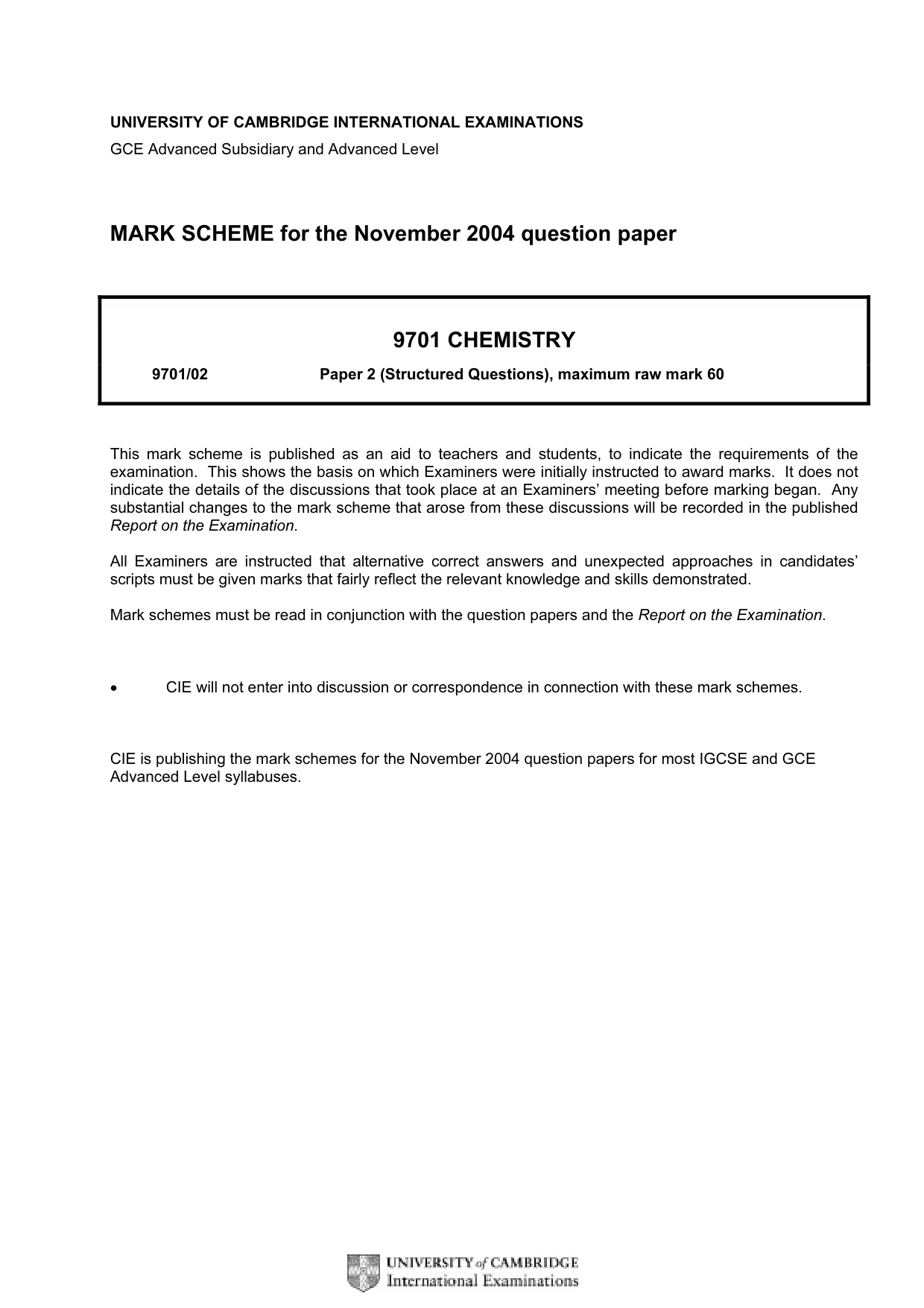
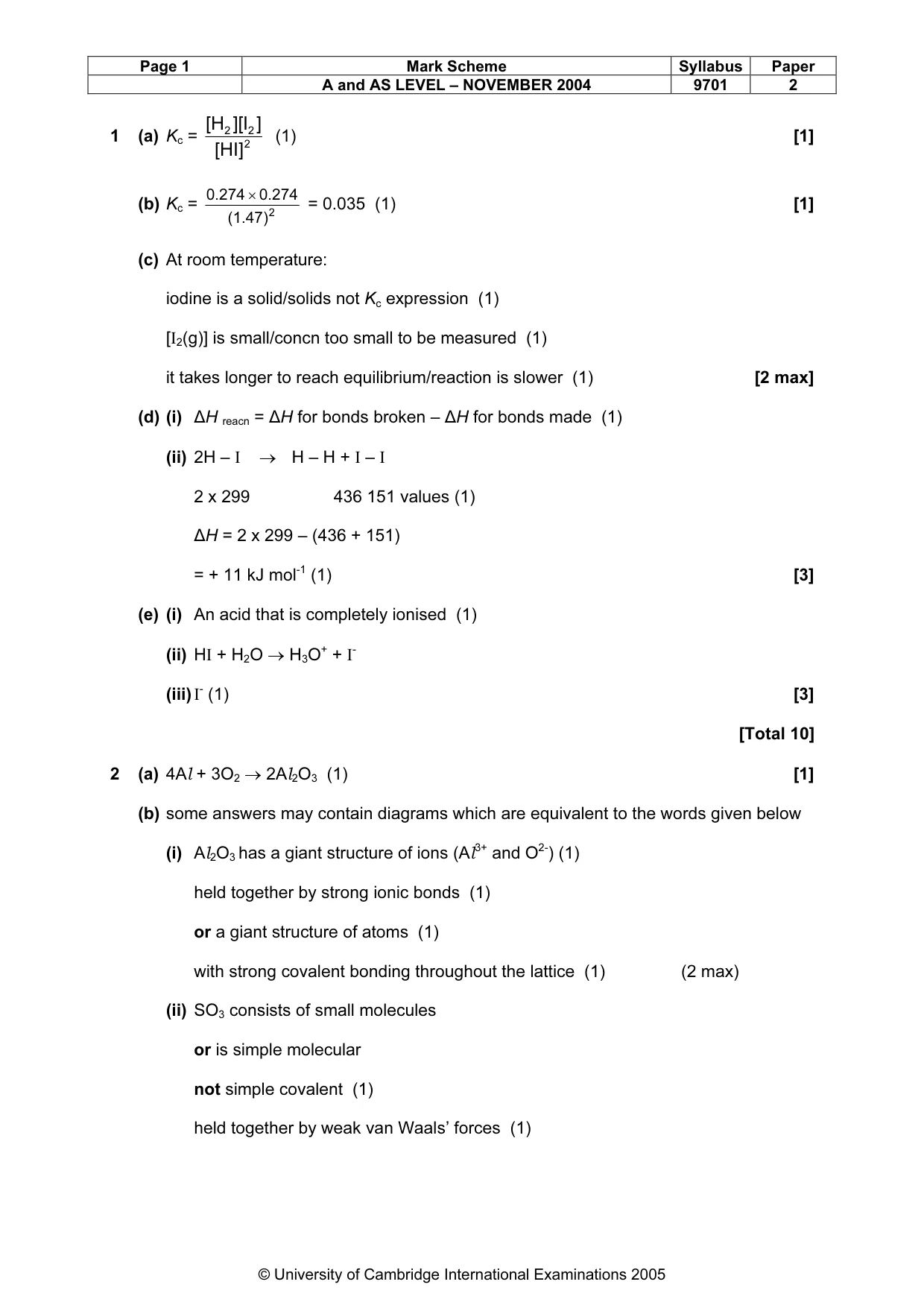
Page 1 Mark Scheme Syllabus Paper A and AS LEVEL – NOVEMBER 2004 9701 2 © University of Cambridge International Examinations 2005 1 (a) Kc = 2 2 2 [HI] ] ][I [H (1) [1] (b) Kc = 2 (1.47) 0.274 0.274 × = 0.035 (1) [1] (c) At room temperature: iodine is a solid/solids not Kc expression (1) [I2(g)] is small/concn too small to be measured (1) it takes longer to reach equilibrium/reaction is slower (1) [2 max] (d) (i) ∆H reacn = ∆H for bonds broken – ∆H for bonds made (1) (ii) 2H – I → H – H + I – I 2 x 299 436 151 values (1) ∆H = 2 x 299 – (436 + 151) = + 11 kJ mol-1 (1) [3] (e) (i) An acid that is completely ionised (1) (ii) HI + H2O → H3O+ + I- (iii) I- (1) [3] [Total 10] 2 (a) 4Al + 3O2 → 2Al2O3 (1) [1] (b) some answers may contain diagrams which are equivalent to the words given below (i) Al2O3 has a giant structure of ions (Al3+ and O2-) (1) held together by strong ionic bonds (1) or a giant structure of atoms (1) with strong covalent bonding throughout the lattice (1) (2 max) (ii) SO3 consists of small molecules or is simple molecular not simple covalent (1) held together by weak van Waals’ forces (1)
Mark scheme, page 5
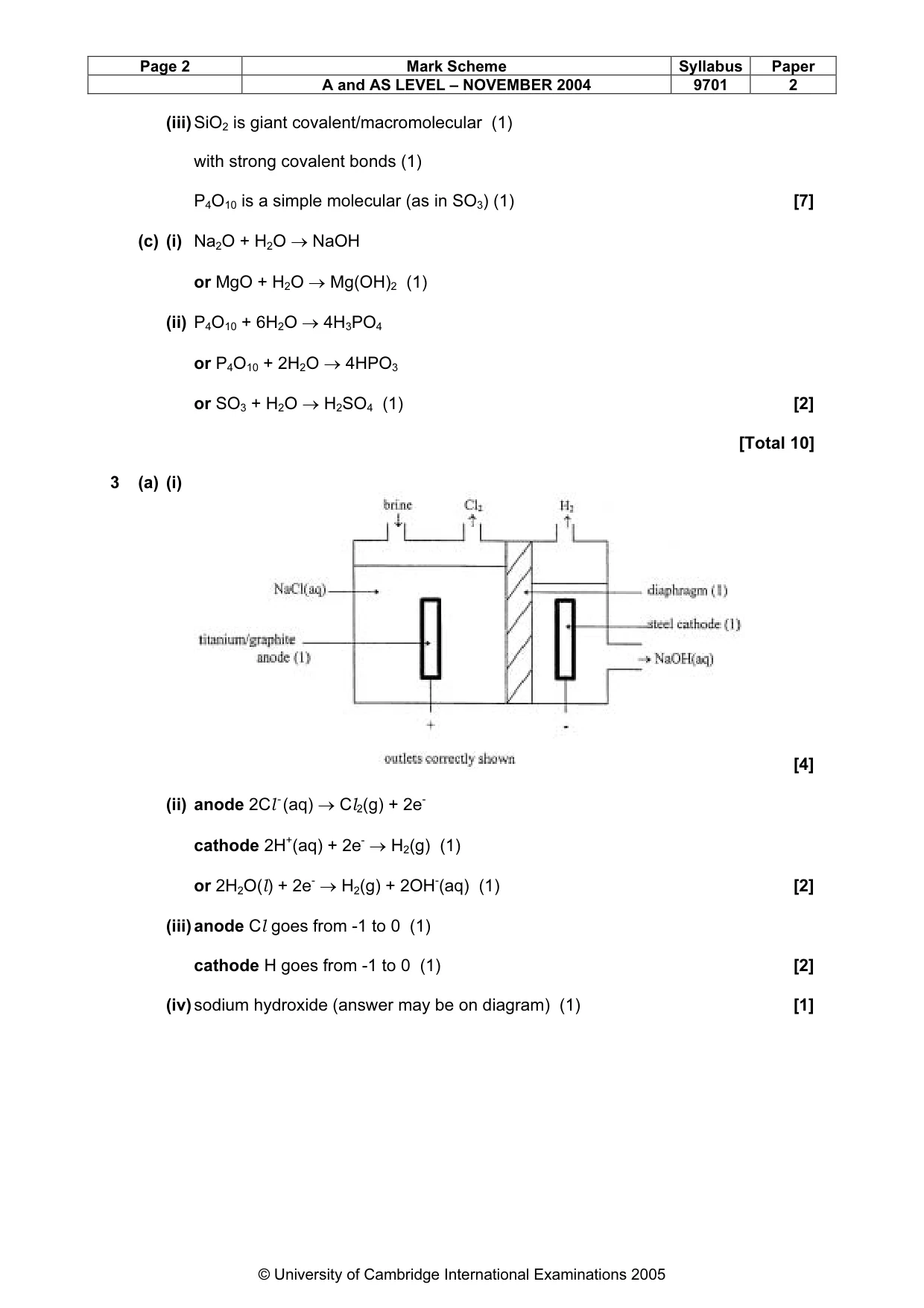
Page 2 Mark Scheme Syllabus Paper A and AS LEVEL – NOVEMBER 2004 9701 2 © University of Cambridge International Examinations 2005 (iii) SiO2 is giant covalent/macromolecular (1) with strong covalent bonds (1) P4O10 is a simple molecular (as in SO3) (1) [7] (c) (i) Na2O + H2O → NaOH or MgO + H2O → Mg(OH)2 (1) (ii) P4O10 + 6H2O → 4H3PO4 or P4O10 + 2H2O → 4HPO3 or SO3 + H2O → H2SO4 (1) [2] [Total 10] 3 (a) (i) [4] (ii) anode 2Cl -(aq) → Cl2(g) + 2e- cathode 2H+(aq) + 2e- → H2(g) (1) or 2H2O(l) + 2e- → H2(g) + 2OH-(aq) (1) [2] (iii) anode Cl goes from -1 to 0 (1) cathode H goes from -1 to 0 (1) [2] (iv) sodium hydroxide (answer may be on diagram) (1) [1]
Mark scheme, page 6
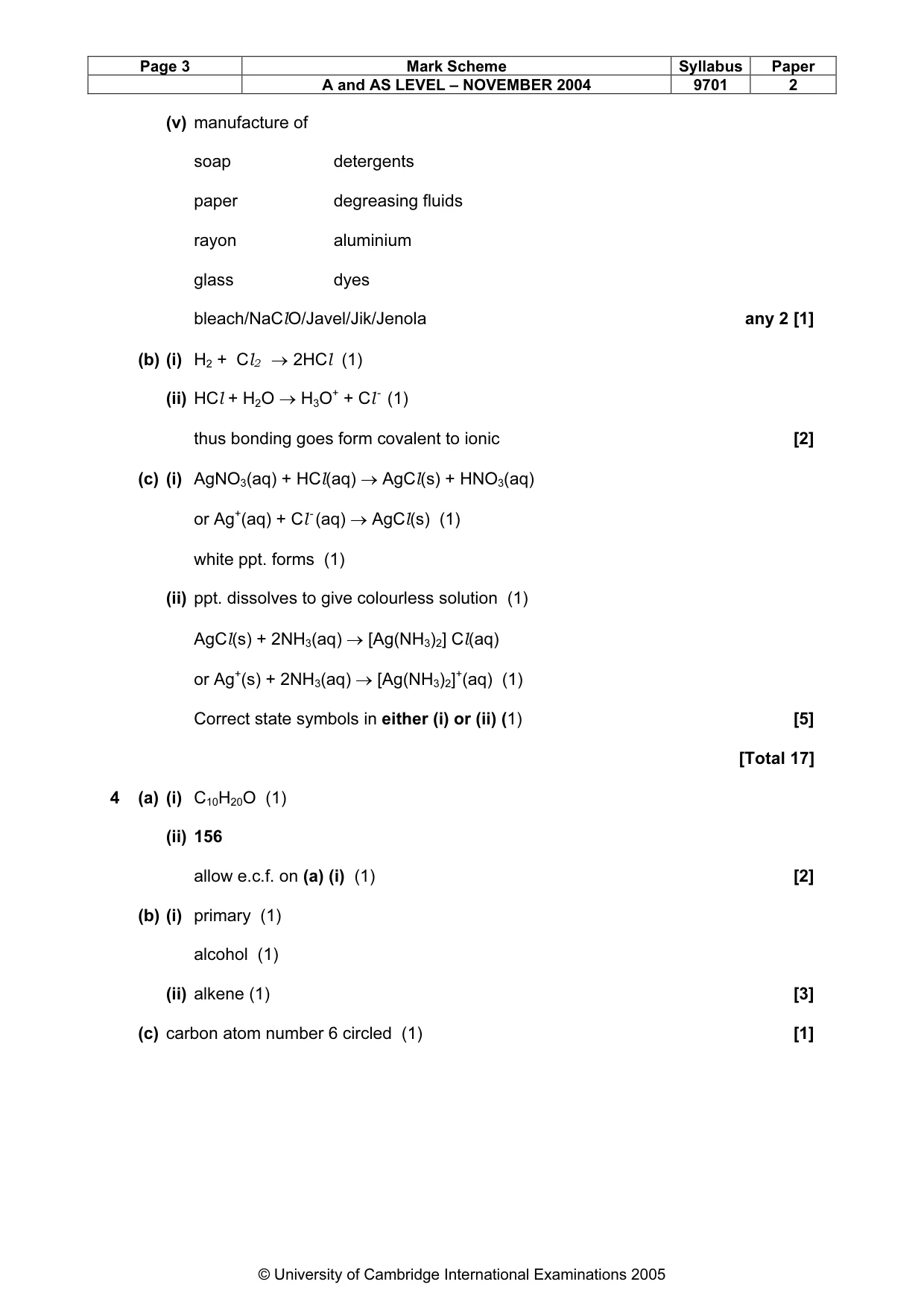
Page 3 Mark Scheme Syllabus Paper A and AS LEVEL – NOVEMBER 2004 9701 2 © University of Cambridge International Examinations 2005 (v) manufacture of soap detergents paper degreasing fluids rayon aluminium glass dyes bleach/NaClO/Javel/Jik/Jenola any 2 [1] (b) (i) H2 + Cl2 → 2HCl (1) (ii) HCl + H2O → H3O+ + Cl - (1) thus bonding goes form covalent to ionic [2] (c) (i) AgNO3(aq) + HCl(aq) → AgCl(s) + HNO3(aq) or Ag+(aq) + Cl -(aq) → AgCl(s) (1) white ppt. forms (1) (ii) ppt. dissolves to give colourless solution (1) AgCl(s) + 2NH3(aq) → [Ag(NH3)2] Cl(aq) or Ag+(s) + 2NH3(aq) → [Ag(NH3)2]+(aq) (1) Correct state symbols in either (i) or (ii) (1) [5] [Total 17] 4 (a) (i) C10H20O (1) (ii) 156 allow e.c.f. on (a) (i) (1) [2] (b) (i) primary (1) alcohol (1) (ii) alkene (1) [3] (c) carbon atom number 6 circled (1) [1]
Mark scheme, page 7
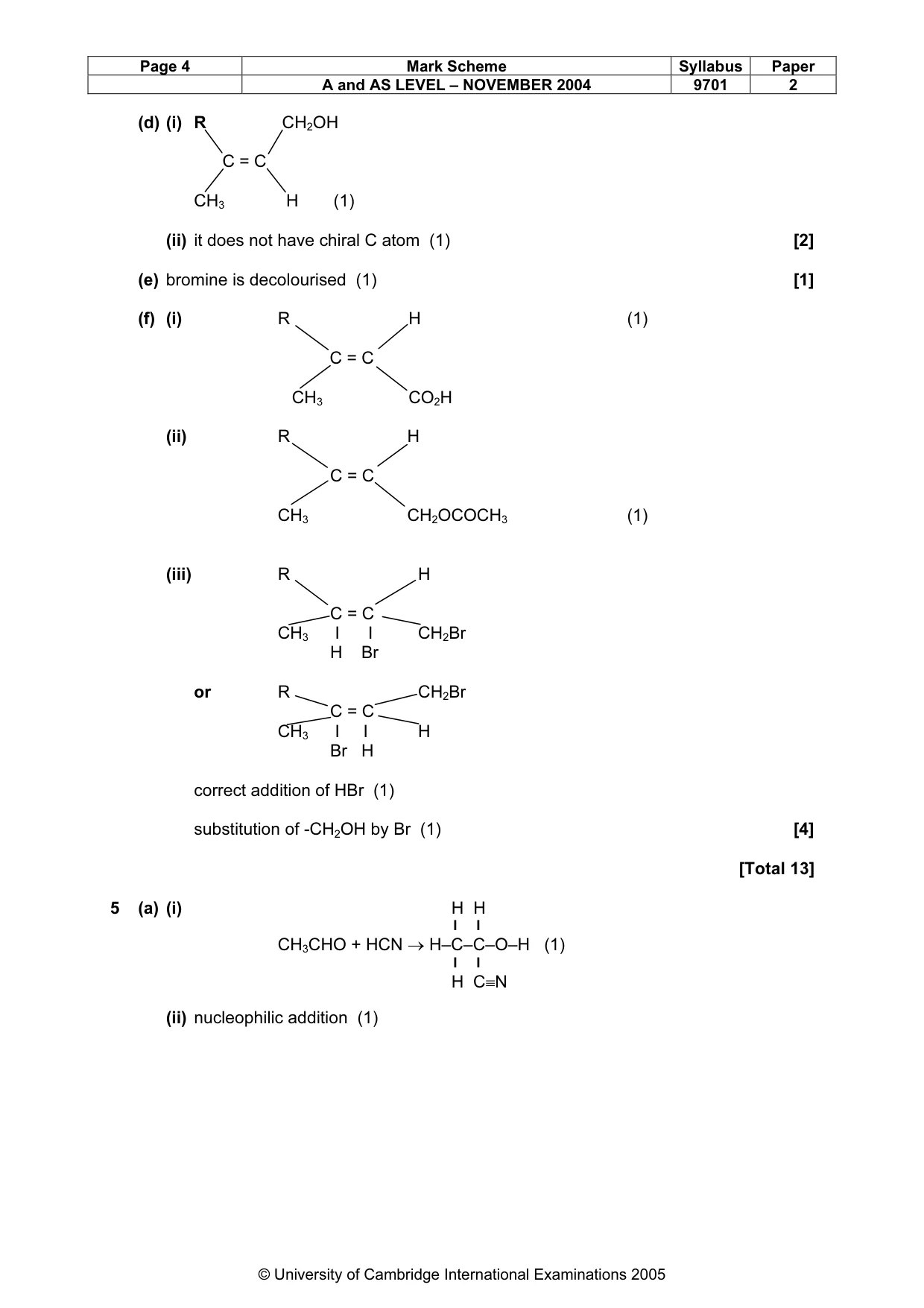
Page 4 Mark Scheme Syllabus Paper A and AS LEVEL – NOVEMBER 2004 9701 2 © University of Cambridge International Examinations 2005 (d) (i) R CH2OH C = C CH3 H (1) (ii) it does not have chiral C atom (1) [2] (e) bromine is decolourised (1) [1] (f) (i) R H (1) C = C CH3 CO2H (ii) R H C = C CH3 CH2OCOCH3 (1) (iii) R H C = C CH3 I I CH2Br H Br or R CH2Br C = C CH3 I I H Br H correct addition of HBr (1) substitution of -CH2OH by Br (1) [4] [Total 13] 5 (a) (i) H H I I CH3CHO + HCN → H–C–C–O–H (1) I I H C≡N (ii) nucleophilic addition (1)
Mark scheme, page 8
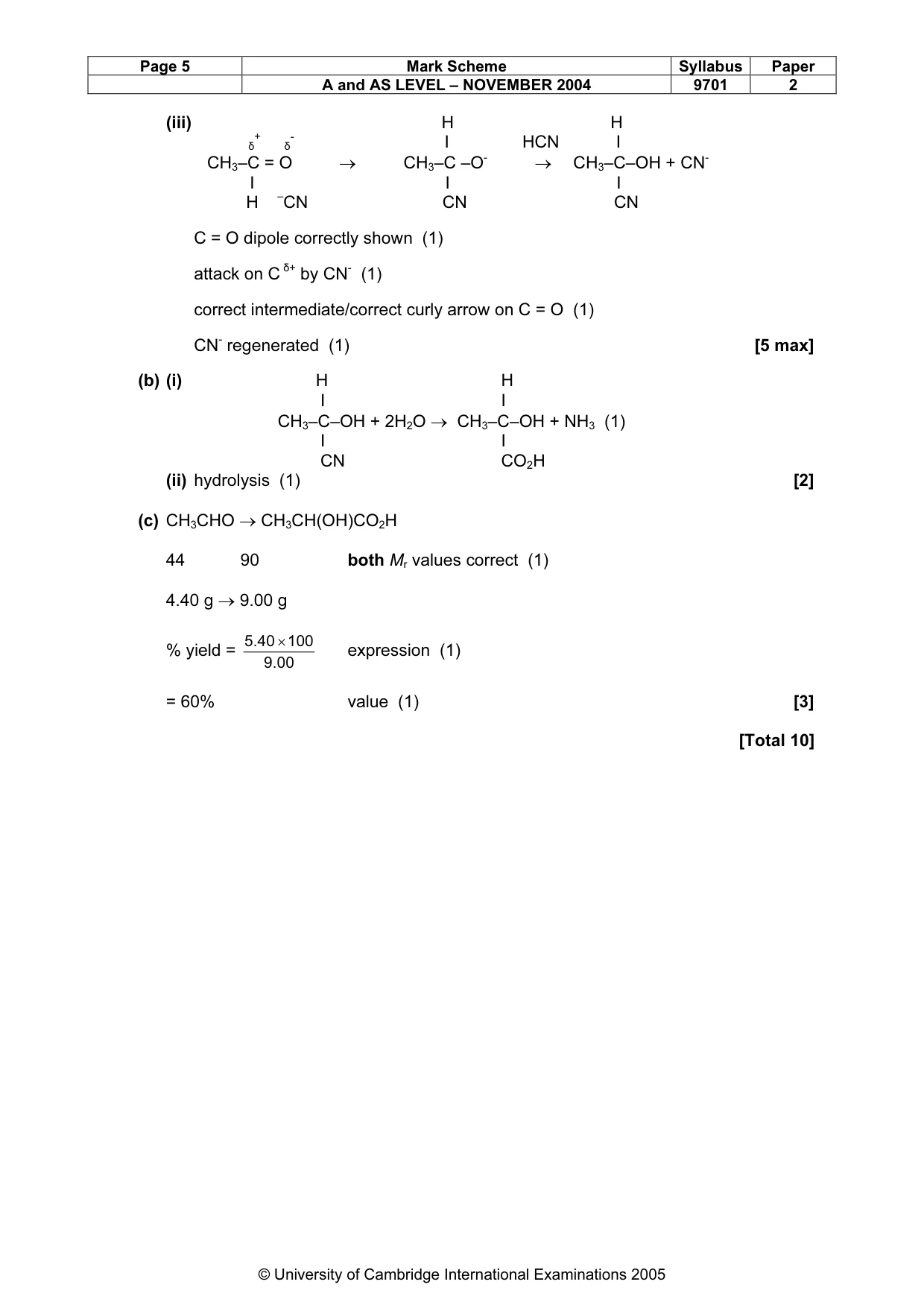
Page 5 Mark Scheme Syllabus Paper A and AS LEVEL – NOVEMBER 2004 9701 2 © University of Cambridge International Examinations 2005 (iii) H H δ + δ - I HCN I CH3–C = O → CH3–C –O- → CH3–C–OH + CN- I I I H –CN CN CN C = O dipole correctly shown (1) attack on C δ+ by CN- (1) correct intermediate/correct curly arrow on C = O (1) CN- regenerated (1) [5 max] (b) (i) H H I I CH3–C–OH + 2H2O → CH3–C–OH + NH3 (1) I I CN CO2H (ii) hydrolysis (1) [2] (c) CH3CHO → CH3CH(OH)CO2H 44 90 both Mr values correct (1) 4.40 g → 9.00 g % yield = 00 . 9 100 40 . 5 × expression (1) = 60% value (1) [3] [Total 10]