Cambridge A Level Chemistry 9701 — 2002 Oct/Nov Paper 6 · Variant 1
9701/61/O/N/02
The question paper and its mark scheme, free to read here and free to download. This is Cambridge’s own paper, exactly as it was sat.
Question paper14 pages

Mark scheme11 pages
Answers below. Sit the paper first if you are practising.
Paper as text
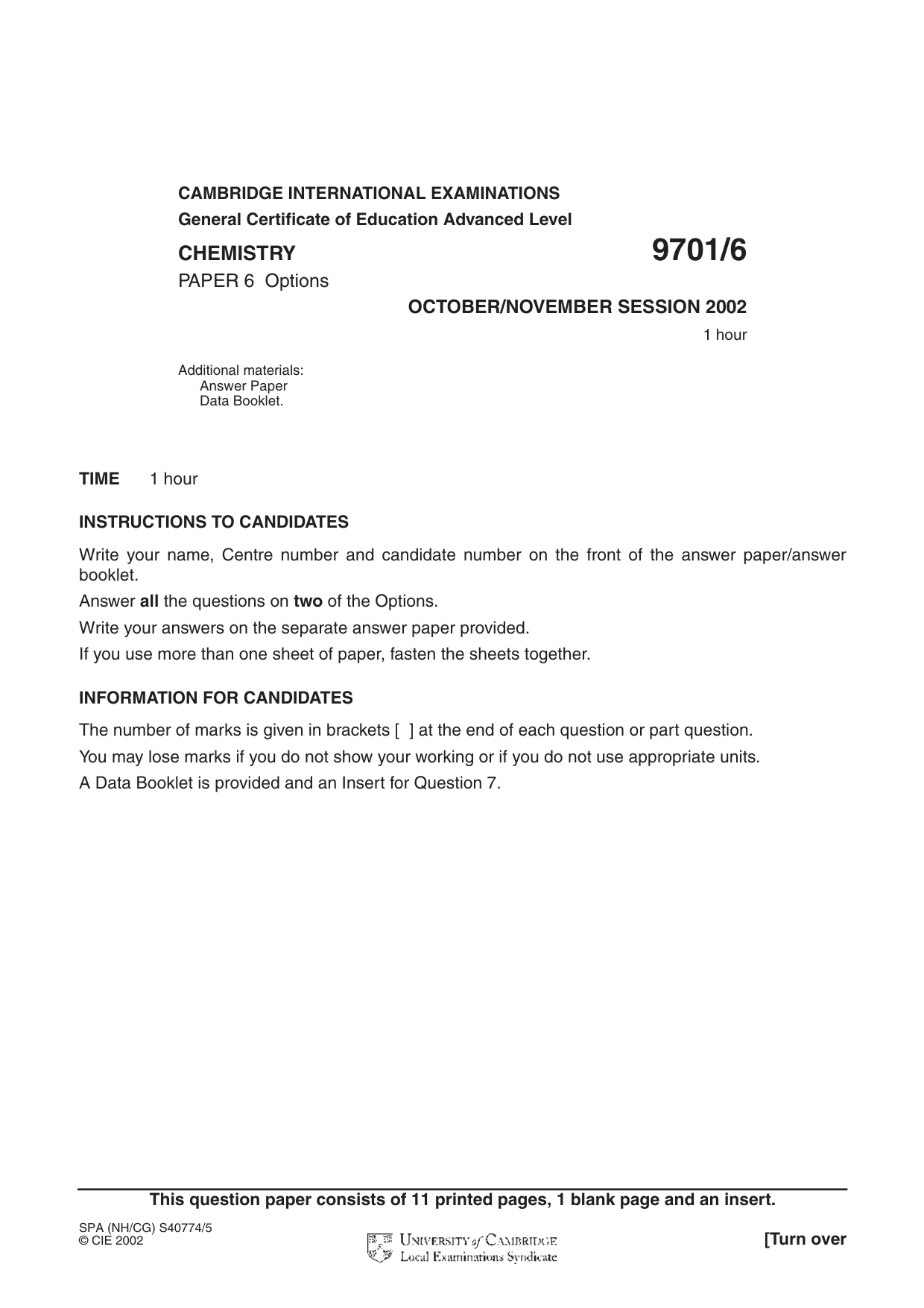
Question paper, page 1
TIME 1 hour INSTRUCTIONS TO CANDIDATES Write your name, Centre number and candidate number on the front of the answer paper/answer booklet. Answer all the questions on two of the Options. Write your answers on the separate answer paper provided. If you use more than one sheet of paper, fasten the sheets together. INFORMATION FOR CANDIDATES The number of marks is given in brackets [ ] at the end of each question or part question. You may lose marks if you do not show your working or if you do not use appropriate units. A Data Booklet is provided and an Insert for Question 7. CAMBRIDGE INTERNATIONAL EXAMINATIONS General Certificate of Education Advanced Level CHEMISTRY 9701/6 PAPER 6 Options OCTOBER/NOVEMBER SESSION 2002 1 hour Additional materials: Answer Paper Data Booklet. This question paper consists of 11 printed pages, 1 blank page and an insert. SPA (NH/CG) S40774/5 © CIE 2002 [Turn over
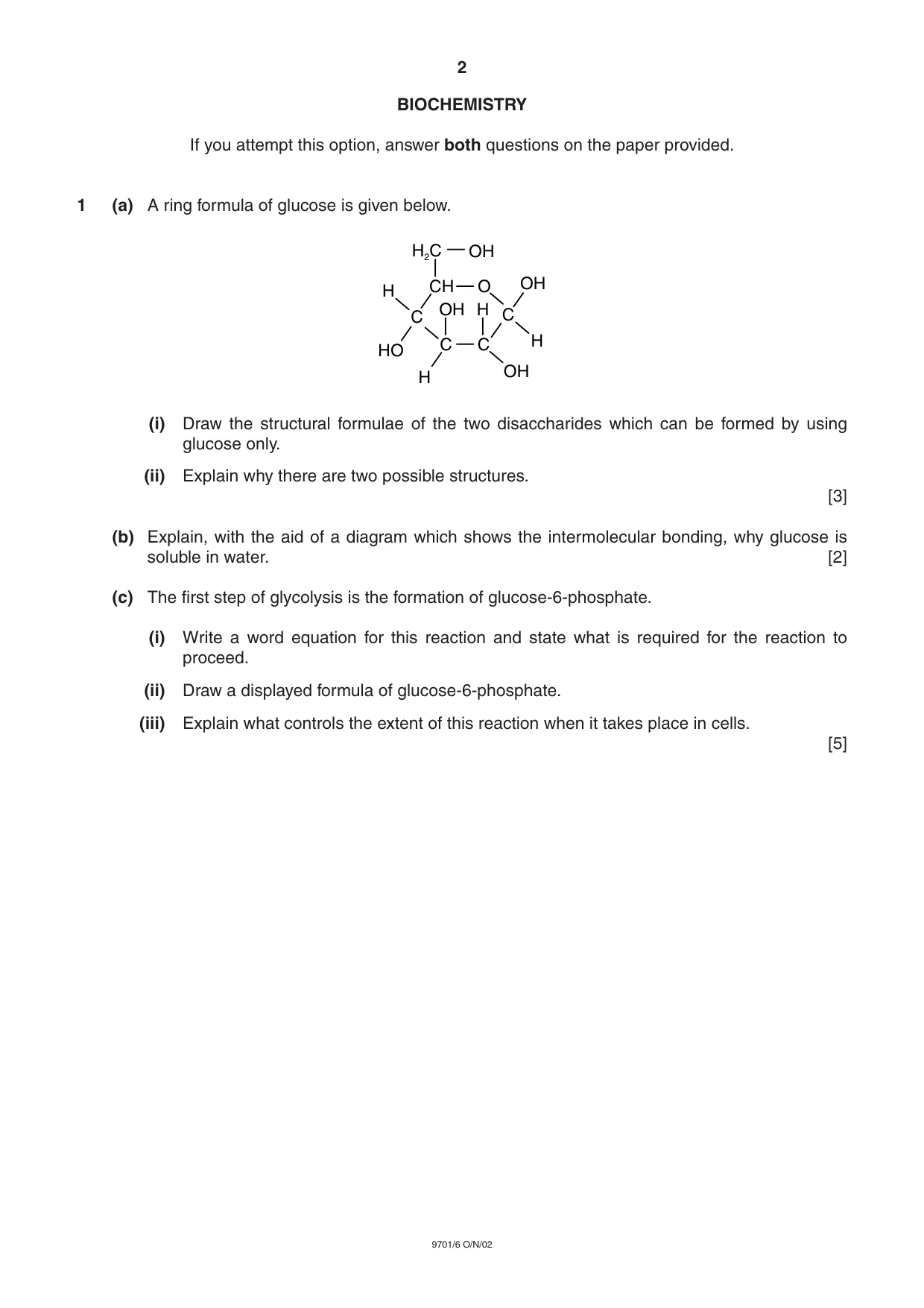
Question paper, page 2
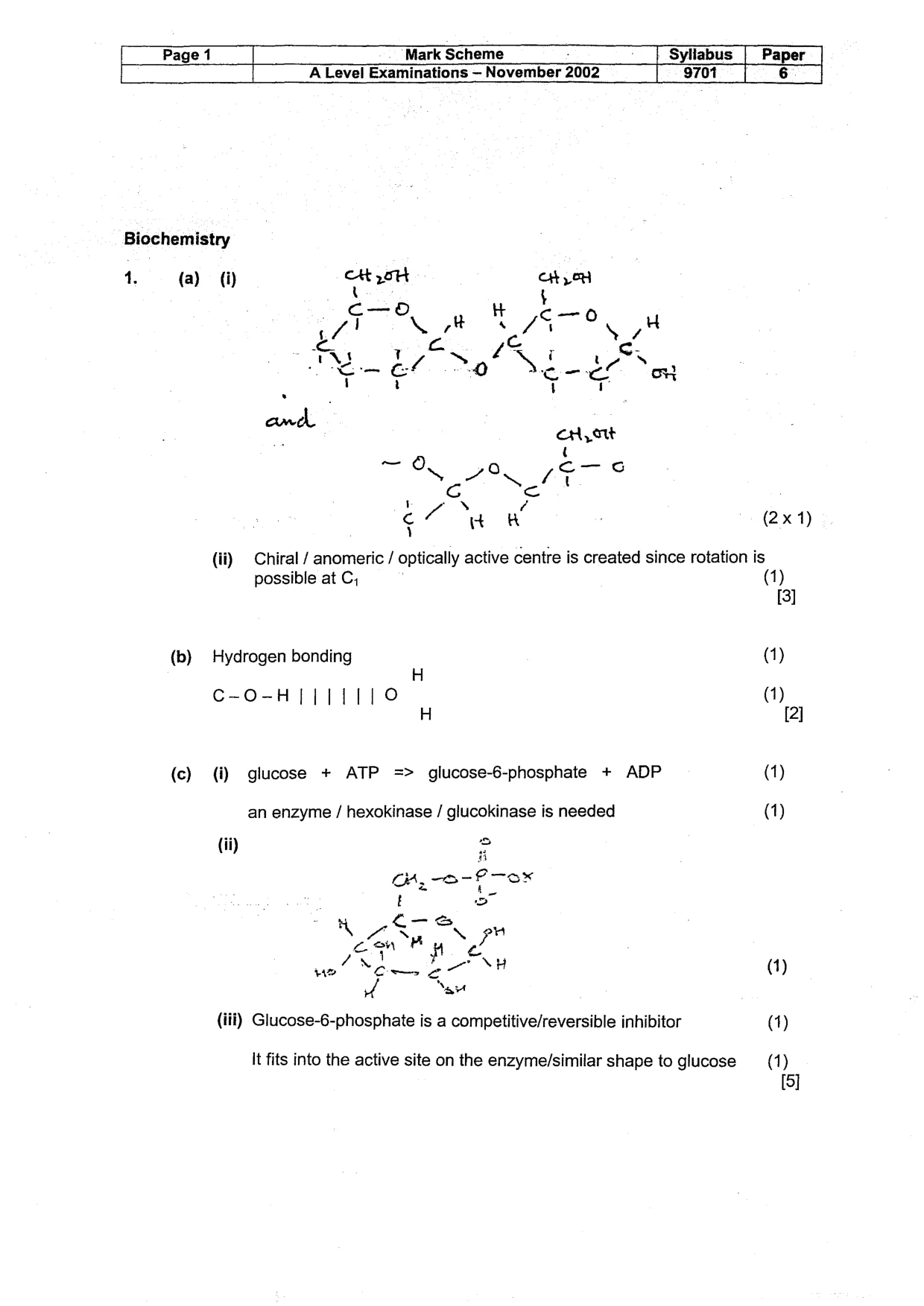
2 9701/6 O/N/02 BIOCHEMISTRY If you attempt this option, answer both questions on the paper provided. 1 (a) A ring formula of glucose is given below. (i) Draw the structural formulae of the two disaccharides which can be formed by using glucose only. (ii) Explain why there are two possible structures. [3] (b) Explain, with the aid of a diagram which shows the intermolecular bonding, why glucose is soluble in water. [2] (c) The first step of glycolysis is the formation of glucose-6-phosphate. (i) Write a word equation for this reaction and state what is required for the reaction to proceed. (ii) Draw a displayed formula of glucose-6-phosphate. (iii) Explain what controls the extent of this reaction when it takes place in cells. [5] H2C OH CH OH H C H OH C HO C H O OH H C
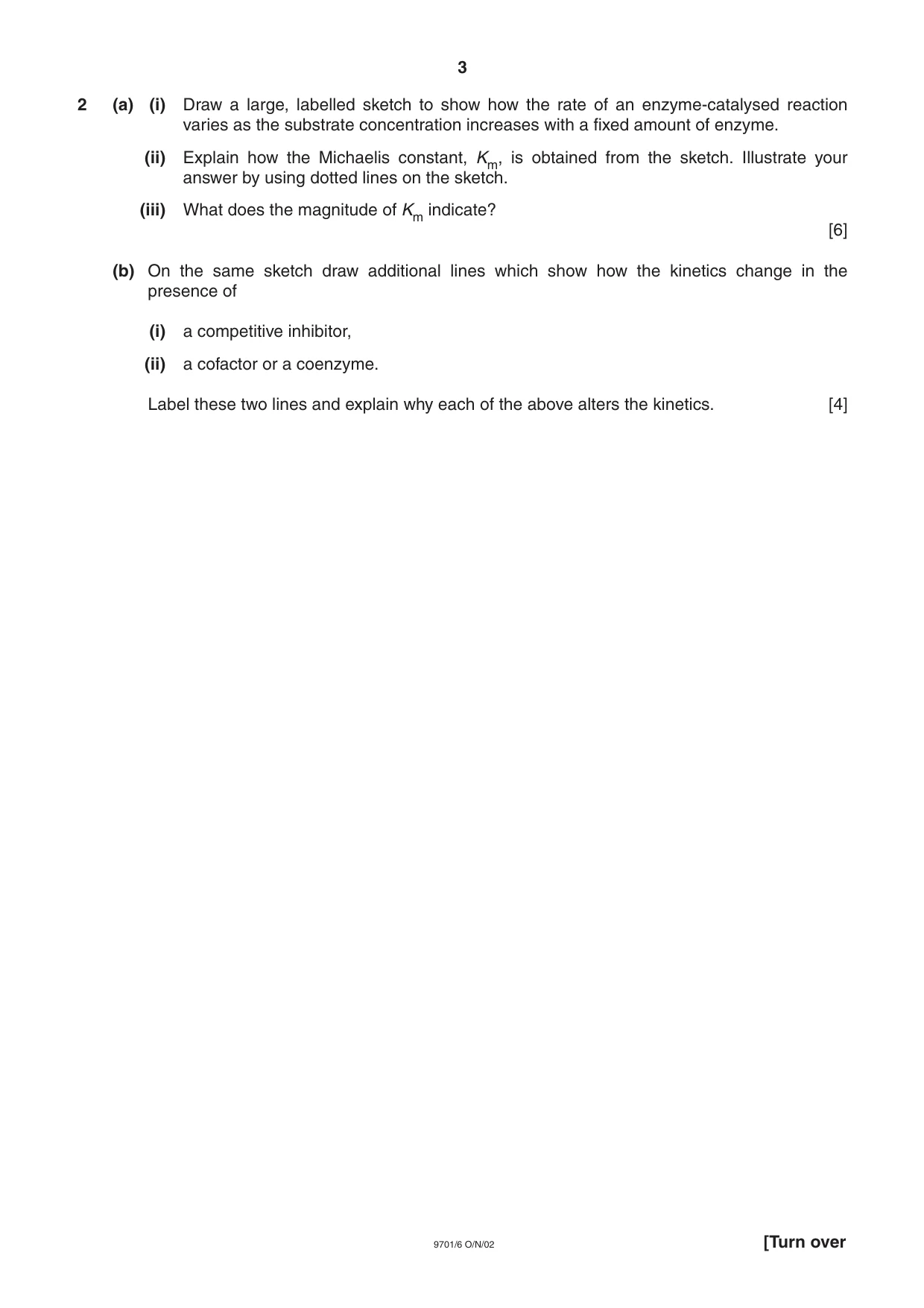
Question paper, page 3
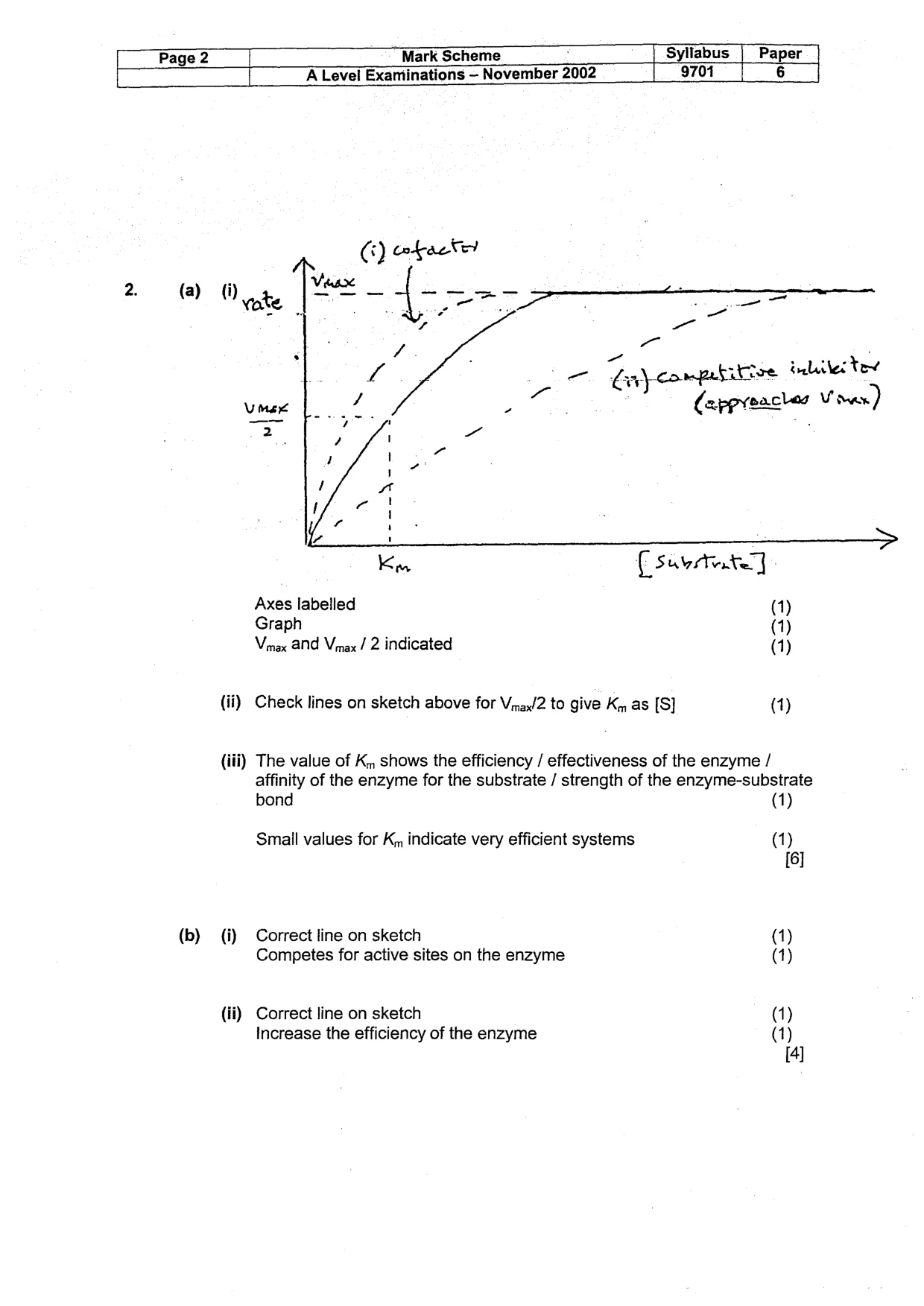
3 9701/6 O/N/02 [Turn over 2 (a) (i) Draw a large, labelled sketch to show how the rate of an enzyme-catalysed reaction varies as the substrate concentration increases with a fixed amount of enzyme. (ii) Explain how the Michaelis constant, Km, is obtained from the sketch. Illustrate your answer by using dotted lines on the sketch. (iii) What does the magnitude of Km indicate? [6] (b) On the same sketch draw additional lines which show how the kinetics change in the presence of (i) a competitive inhibitor, (ii) a cofactor or a coenzyme. Label these two lines and explain why each of the above alters the kinetics. [4]
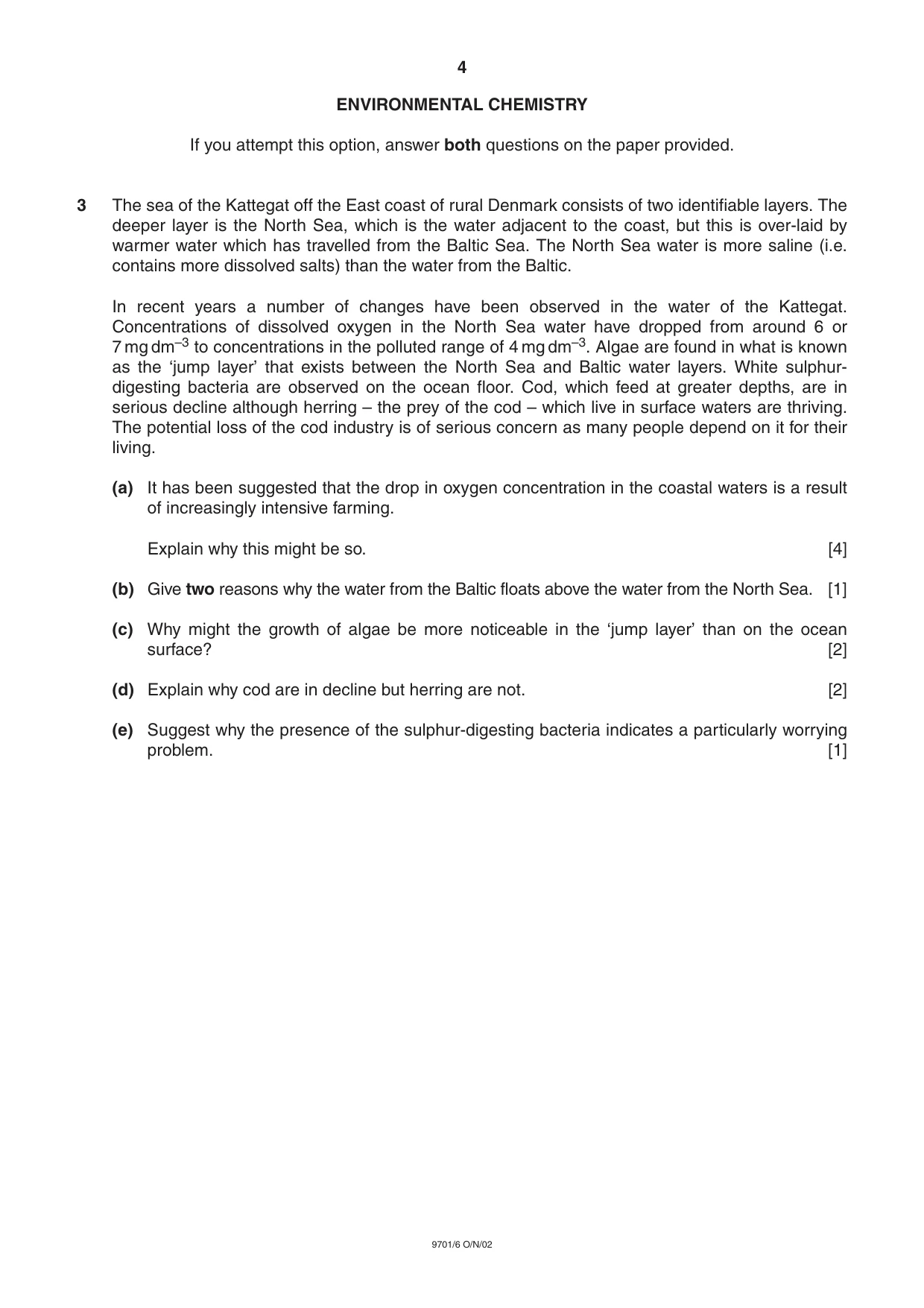
Question paper, page 4
4 9701/6 O/N/02 ENVIRONMENTAL CHEMISTRY If you attempt this option, answer both questions on the paper provided. 3 The sea of the Kattegat off the East coast of rural Denmark consists of two identifiable layers. The deeper layer is the North Sea, which is the water adjacent to the coast, but this is over-laid by warmer water which has travelled from the Baltic Sea. The North Sea water is more saline (i.e. contains more dissolved salts) than the water from the Baltic. In recent years a number of changes have been observed in the water of the Kattegat. Concentrations of dissolved oxygen in the North Sea water have dropped from around 6 or 7 mg dm–3 to concentrations in the polluted range of 4 mg dm–3. Algae are found in what is known as the ‘jump layer’ that exists between the North Sea and Baltic water layers. White sulphur- digesting bacteria are observed on the ocean floor. Cod, which feed at greater depths, are in serious decline although herring – the prey of the cod – which live in surface waters are thriving. The potential loss of the cod industry is of serious concern as many people depend on it for their living. (a) It has been suggested that the drop in oxygen concentration in the coastal waters is a result of increasingly intensive farming. Explain why this might be so. [4] (b) Give two reasons why the water from the Baltic floats above the water from the North Sea. [1] (c) Why might the growth of algae be more noticeable in the ‘jump layer’ than on the ocean surface? [2] (d) Explain why cod are in decline but herring are not. [2] (e) Suggest why the presence of the sulphur-digesting bacteria indicates a particularly worrying problem. [1]
Question paper, page 5
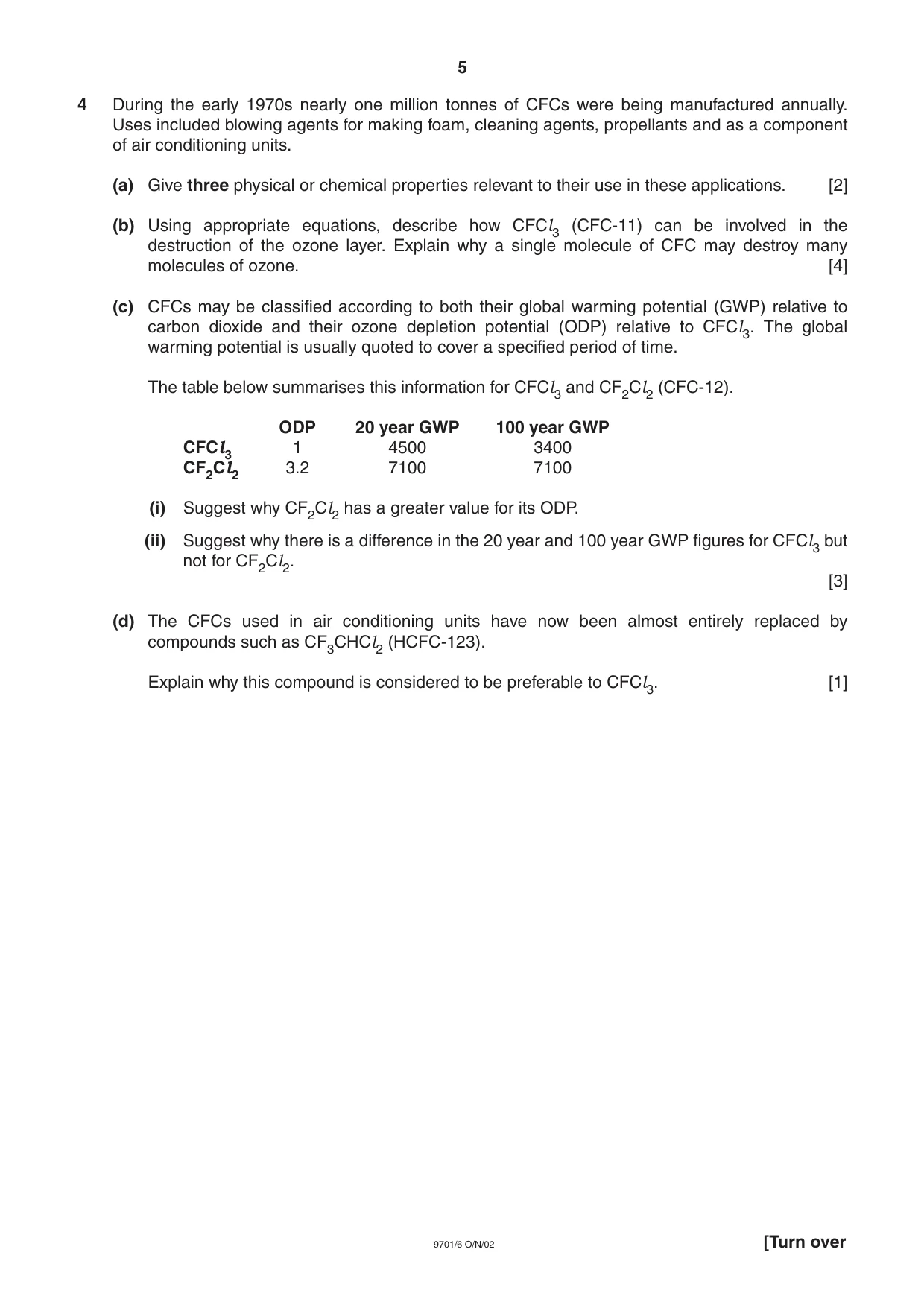
5 9701/6 O/N/02 [Turn over 4 During the early 1970s nearly one million tonnes of CFCs were being manufactured annually. Uses included blowing agents for making foam, cleaning agents, propellants and as a component of air conditioning units. (a) Give three physical or chemical properties relevant to their use in these applications. [2] (b) Using appropriate equations, describe how CFCl3 (CFC-11) can be involved in the destruction of the ozone layer. Explain why a single molecule of CFC may destroy many molecules of ozone. [4] (c) CFCs may be classified according to both their global warming potential (GWP) relative to carbon dioxide and their ozone depletion potential (ODP) relative to CFCl3. The global warming potential is usually quoted to cover a specified period of time. The table below summarises this information for CFCl3 and CF2Cl2 (CFC-12). ODP 20 year GWP 100 year GWP CFCl3 1 4500 3400 CF2Cl2 3.2 7100 7100 (i) Suggest why CF2Cl2 has a greater value for its ODP. (ii) Suggest why there is a difference in the 20 year and 100 year GWP figures for CFCl3 but not for CF2Cl2. [3] (d) The CFCs used in air conditioning units have now been almost entirely replaced by compounds such as CF3CHCl2 (HCFC-123). Explain why this compound is considered to be preferable to CFCl3. [1]
Question paper, page 6
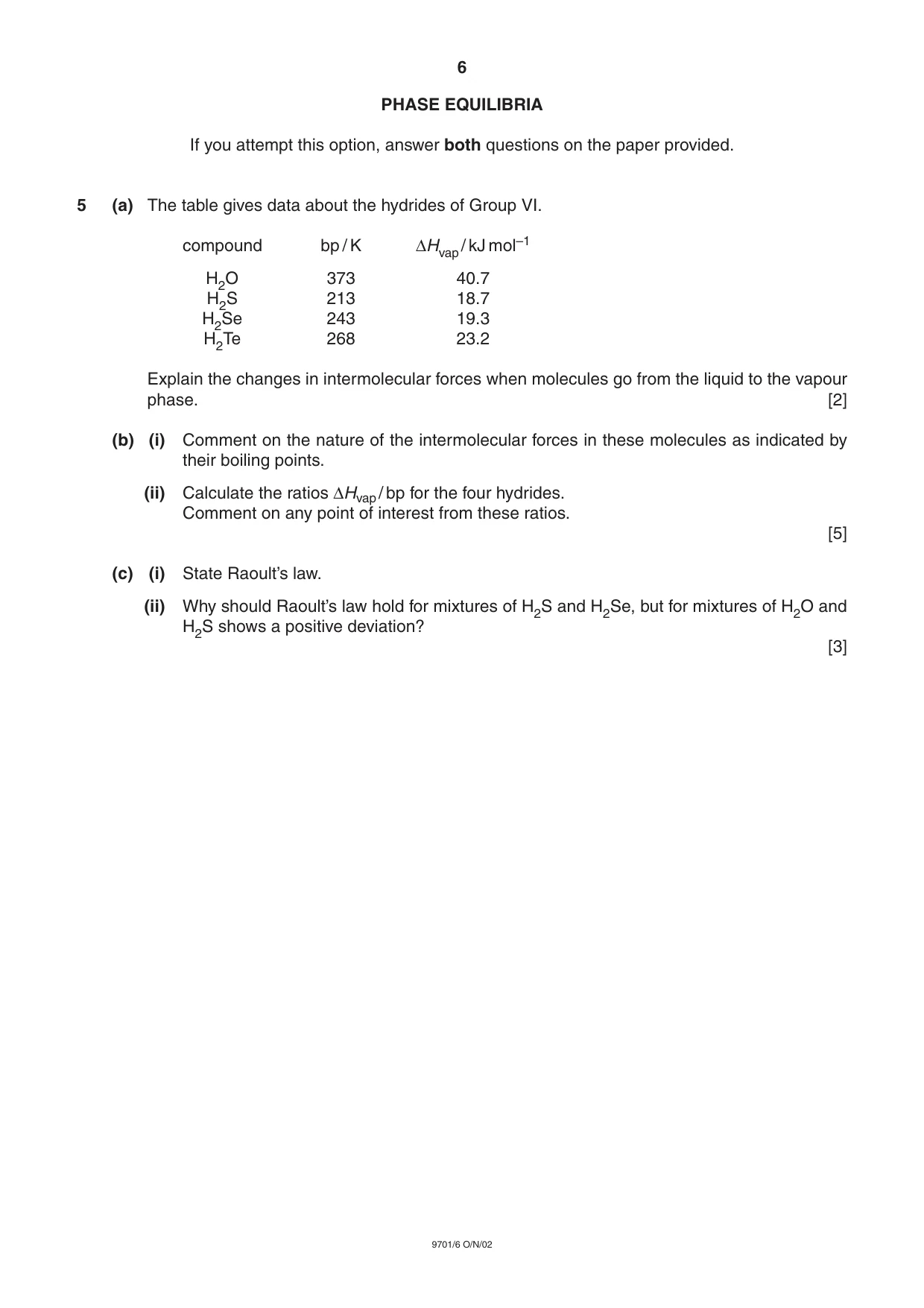
6 9701/6 O/N/02 PHASE EQUILIBRIA If you attempt this option, answer both questions on the paper provided. 5 (a) The table gives data about the hydrides of Group VI. compound bp / K ∆Hvap/ kJ mol–1 H2O 373 40.7 H2S 213 18.7 H2Se 243 19.3 H2Te 268 23.2 Explain the changes in intermolecular forces when molecules go from the liquid to the vapour phase. [2] (b) (i) Comment on the nature of the intermolecular forces in these molecules as indicated by their boiling points. (ii) Calculate the ratios ∆Hvap/ bp for the four hydrides. Comment on any point of interest from these ratios. [5] (c) (i) State Raoult’s law. (ii) Why should Raoult’s law hold for mixtures of H2S and H2Se, but for mixtures of H2O and H2S shows a positive deviation? [3]
Question paper, page 7
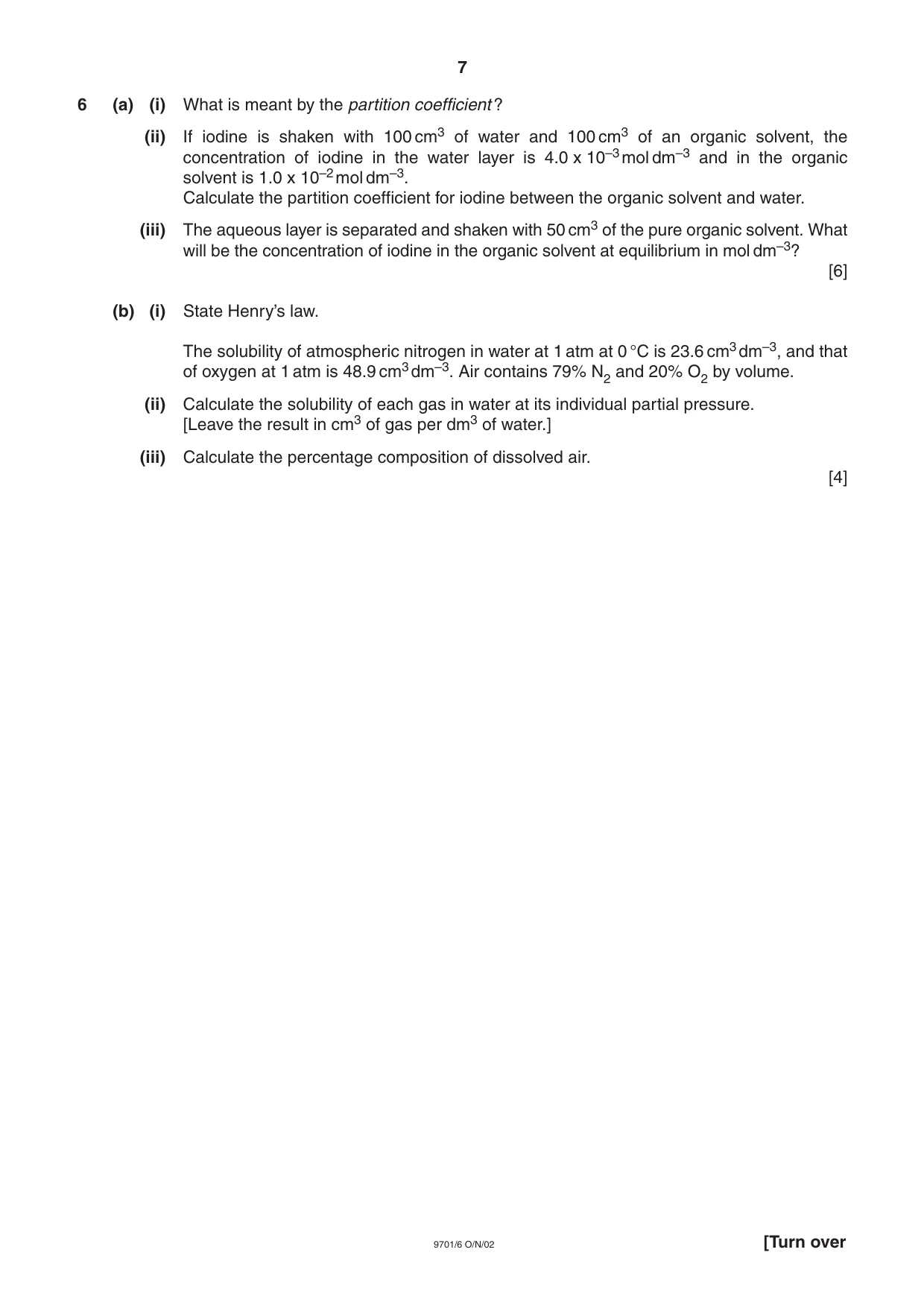
7 9701/6 O/N/02 [Turn over 6 (a) (i) What is meant by the partition coefficient ? (ii) If iodine is shaken with 100 cm3 of water and 100 cm3 of an organic solvent, the concentration of iodine in the water layer is 4.0 x 10⁻³mol dm–3 and in the organic solvent is 1.0 x 10⁻²mol dm–3. Calculate the partition coefficient for iodine between the organic solvent and water. (iii) The aqueous layer is separated and shaken with 50 cm3 of the pure organic solvent. What will be the concentration of iodine in the organic solvent at equilibrium in mol dm–3? [6] (b) (i) State Henry’s law. The solubility of atmospheric nitrogen in water at 1 atm at 0 °C is 23.6 cm3dm–3, and that of oxygen at 1 atm is 48.9 cm3dm–3. Air contains 79% N2 and 20% O2 by volume. (ii) Calculate the solubility of each gas in water at its individual partial pressure. [Leave the result in cm3 of gas per dm3 of water.] (iii) Calculate the percentage composition of dissolved air. [4]
Question paper, page 8
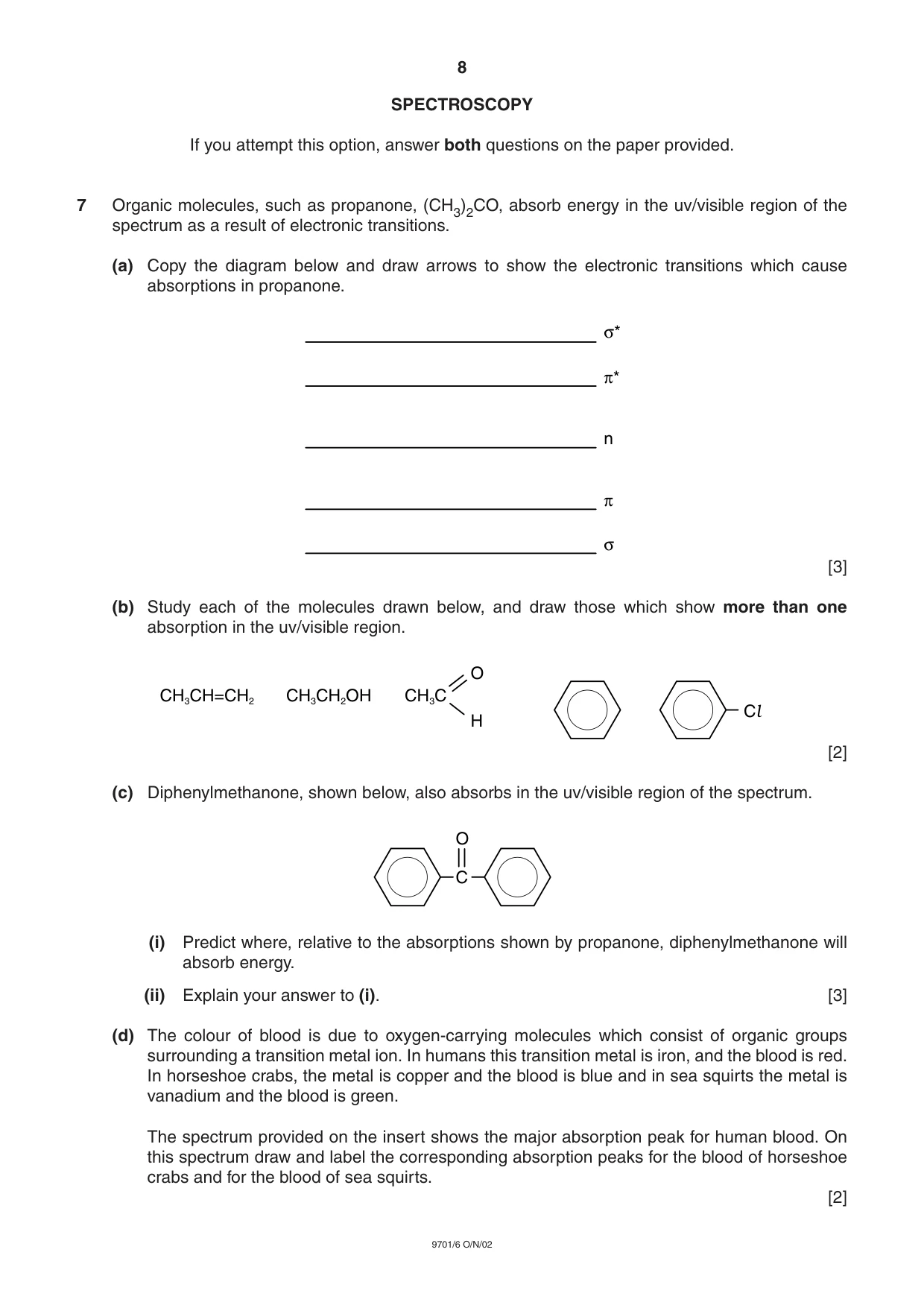
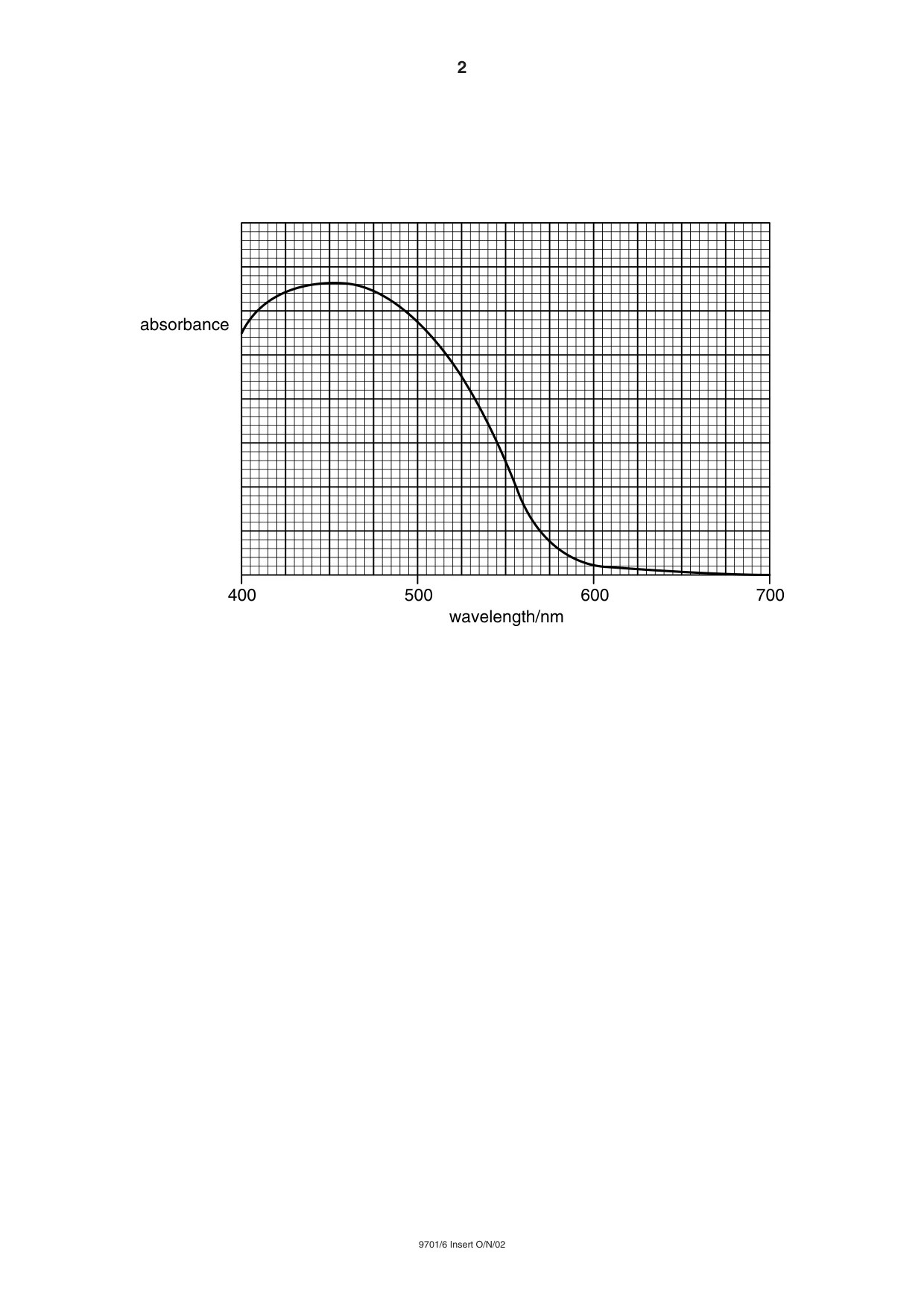
8 9701/6 O/N/02 SPECTROSCOPY If you attempt this option, answer both questions on the paper provided. 7 Organic molecules, such as propanone, (CH3)2CO, absorb energy in the uv/visible region of the spectrum as a result of electronic transitions. (a) Copy the diagram below and draw arrows to show the electronic transitions which cause absorptions in propanone. [3] (b) Study each of the molecules drawn below, and draw those which show more than one absorption in the uv/visible region. [2] (c) Diphenylmethanone, shown below, also absorbs in the uv/visible region of the spectrum. (i) Predict where, relative to the absorptions shown by propanone, diphenylmethanone will absorb energy. (ii) Explain your answer to (i). [3] (d) The colour of blood is due to oxygen-carrying molecules which consist of organic groups surrounding a transition metal ion. In humans this transition metal is iron, and the blood is red. In horseshoe crabs, the metal is copper and the blood is blue and in sea squirts the metal is vanadium and the blood is green. The spectrum provided on the insert shows the major absorption peak for human blood. On this spectrum draw and label the corresponding absorption peaks for the blood of horseshoe crabs and for the blood of sea squirts. [2] C O Cl CH3CH=CH2 CH3CH2OH CH3C O H π* π n σ* σ
Question paper, page 9
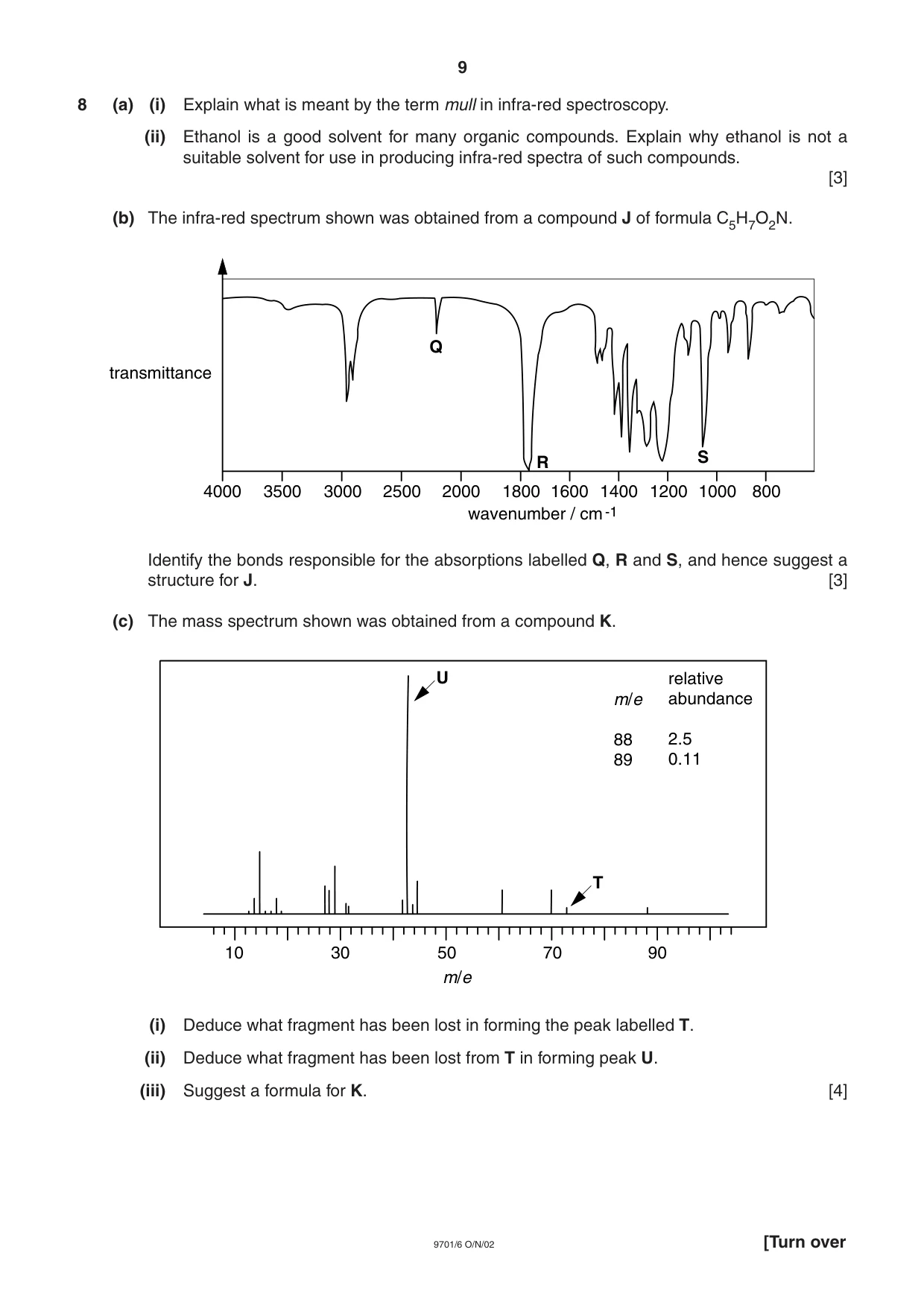
9 9701/6 O/N/02 [Turn over 8 (a) (i) Explain what is meant by the term mull in infra-red spectroscopy. (ii) Ethanol is a good solvent for many organic compounds. Explain why ethanol is not a suitable solvent for use in producing infra-red spectra of such compounds. [3] (b) The infra-red spectrum shown was obtained from a compound J of formula C5H7O2N. Identify the bonds responsible for the absorptions labelled Q, R and S, and hence suggest a structure for J. [3] (c) The mass spectrum shown was obtained from a compound K. (i) Deduce what fragment has been lost in forming the peak labelled T. (ii) Deduce what fragment has been lost from T in forming peak U. (iii) Suggest a formula for K. [4] 10 30 50 70 90 U m/e m/e 88 89 relative abundance 2.5 0.11 T 4000 3500 3000 2500 2000 1800 1600 1400 wavenumber / cm -1 transmittance 1200 1000 800 Q R S
Question paper, page 10
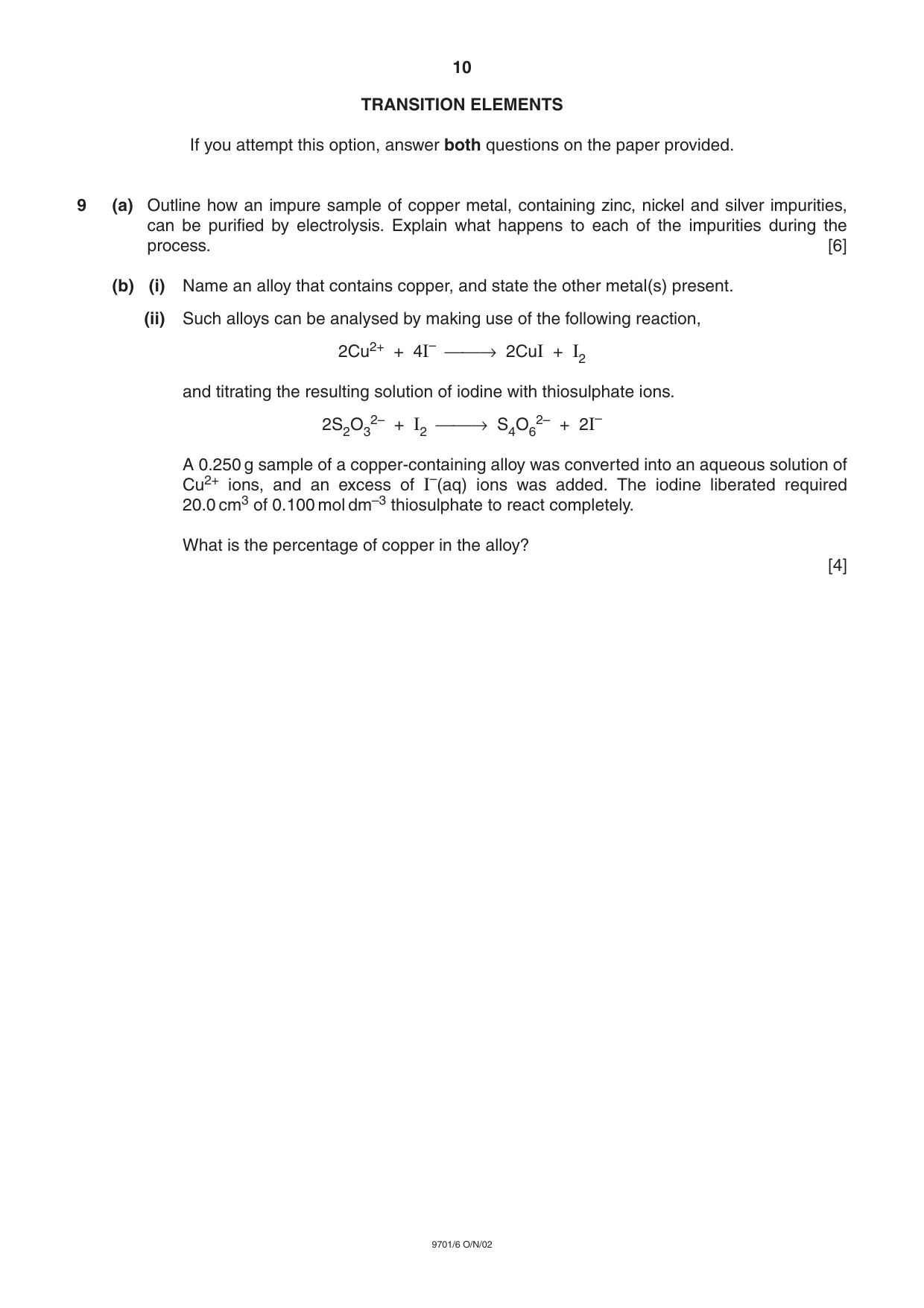
10 9701/6 O/N/02 TRANSITION ELEMENTS If you attempt this option, answer both questions on the paper provided. 9 (a) Outline how an impure sample of copper metal, containing zinc, nickel and silver impurities, can be purified by electrolysis. Explain what happens to each of the impurities during the process. [6] (b) (i) Name an alloy that contains copper, and state the other metal(s) present. (ii) Such alloys can be analysed by making use of the following reaction, 2Cu2+ + 4I– →2CuI + I2 and titrating the resulting solution of iodine with thiosulphate ions. 2S2O3 2– + I2 →S4O6 2– + 2I– A 0.250 g sample of a copper-containing alloy was converted into an aqueous solution of Cu2+ ions, and an excess of I–(aq) ions was added. The iodine liberated required 20.0 cm3 of 0.100 mol dm–3 thiosulphate to react completely. What is the percentage of copper in the alloy? [4]
Question paper, page 11
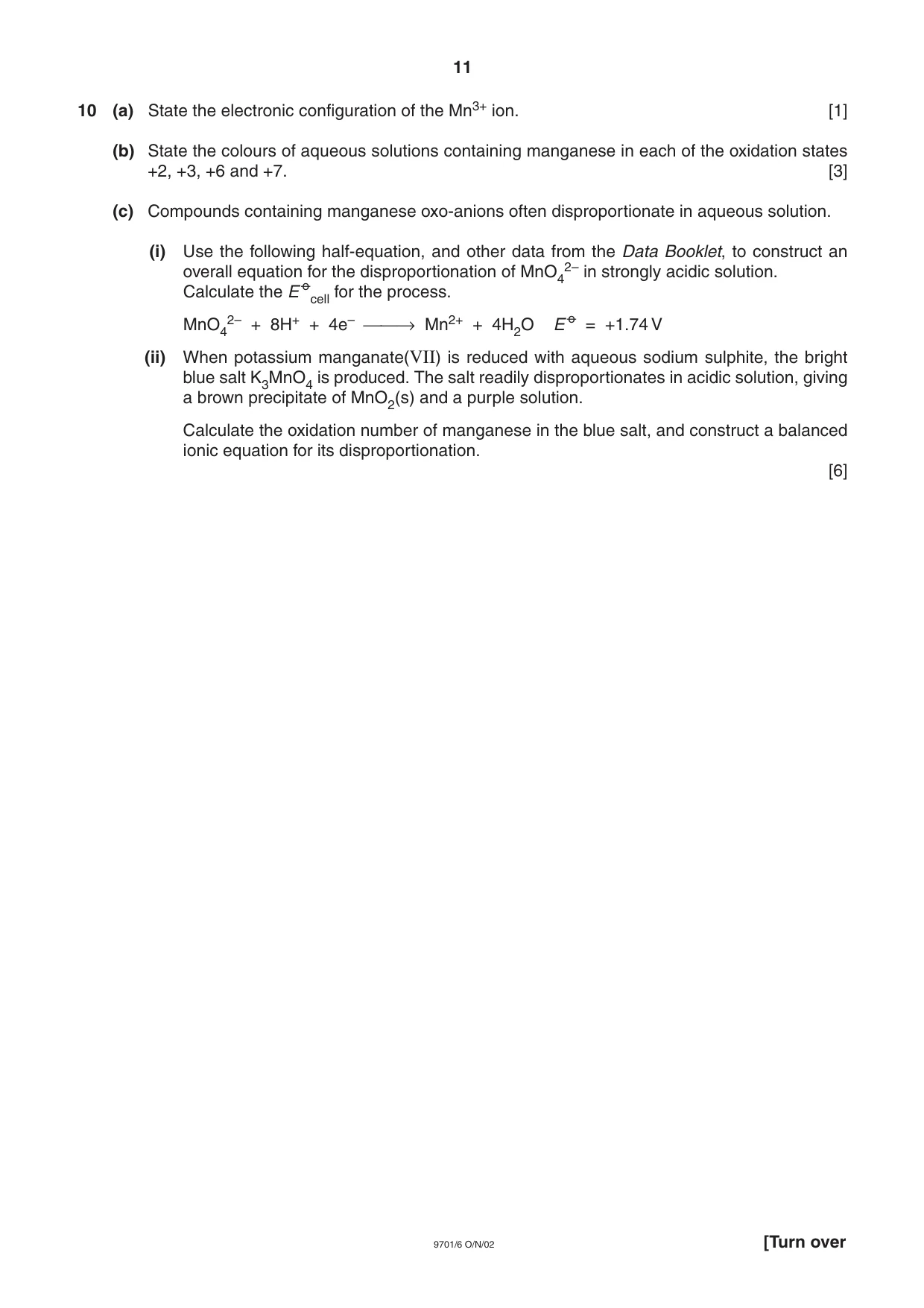
11 9701/6 O/N/02 [Turn over 10 (a) State the electronic configuration of the Mn3+ ion. [1] (b) State the colours of aqueous solutions containing manganese in each of the oxidation states +2, +3, +6 and +7. [3] (c) Compounds containing manganese oxo-anions often disproportionate in aqueous solution. (i) Use the following half-equation, and other data from the Data Booklet, to construct an overall equation for the disproportionation of MnO4 2– in strongly acidic solution. Calculate the E o– cell for the process. MnO4 2– + 8H+ + 4e– →Mn2+ + 4H2O E o– = +1.74 V (ii) When potassium manganate(VII) is reduced with aqueous sodium sulphite, the bright blue salt K3MnO4 is produced. The salt readily disproportionates in acidic solution, giving a brown precipitate of MnO2(s) and a purple solution. Calculate the oxidation number of manganese in the blue salt, and construct a balanced ionic equation for its disproportionation. [6]
Question paper, page 13
INSTRUCTIONS TO CANDIDATES This insert is for use with Question 7 (d) from the above question paper and should be attached to your answer for that question. CAMBRIDGE INTERNATIONAL EXAMINATIONS General Certificate of Education Advanced Level CHEMISTRY 9701/6 PAPER 6 Options INSERT This insert consists of 2 printed pages. SPA (NH/CG) S40774/2 © CIE 2002 [Turn over Candidate Centre Number Number Candidate Name
Question paper, page 14
2 9701/6 Insert O/N/02 400 absorbance wavelength/nm 500 600 700
Mark scheme, page 1
CAMBRIDGE INTERNATIONAL EXAMINATIONS NOVEMBER 2002 GCE Advanced Level ‘i UNIvERsITy of CAMBRIDGE Local Examinations Syndicate
Mark scheme, page 2
Page 1 Mark Scheme Syliabus | Paper A Level Examinations — November 2002 9701 6 Biochemistry 1 (a) (i) cH tt ct eu 4 c—oO # —_— VAN Se ‘ Ns Ar 1 FN 4 y bo Sy i and. cH out t i) 0 c—c NUZTN 1 on é cf ‘MR (2x1) (ii) Chiral / anomeric / optically active centre is created since rotation is possible at C, (1) [3] (b) Hydrogen bonding (1) H C-O-H]{III119 (1) [2] (c) (i) glucose + ATP => glucose-6-phosphate + ADP (1) an enzyme / hexokinase / glucokinase is needed (1) (ii) 2 Fa CA, -O- e oF i a Ae aN Fad x on # 2 we’ Son, boo MH (1) Lo Soe (iii) Glucose-6-phosphate is a competitive/reversible inhibitor (1) It fits into the active site on the enzyme/similar shape to glucose (1) 15]
Mark scheme, page 3
Page 2 Mark Scheme Syllabus Paper | A Level Examinations — November 2002 9701 2. (a) (b) “ . . . — Ea conpabittve blaler ter Cappreacios Vonwn) —> Axes labelled Graph Vinax ANd Vinax / 2 indicated (ii) Check lines on sketch above for Vinax/2 to give Kn as [S} ( Subtte | (1) (1) (1) (1) (iii) The value of K,, shows the efficiency / effectiveness of the enzyme / affinity of the enzyme for the substrate / strength of the enzyme-substrate bond Small values for K,, indicate very efficient systems (i) Correct line on sketch Competes for active sites on the enzyme (ii) Correct line on sketch Increase the efficiency of the enzyme (1) (1) [6] (1) (1) (1) (1) 4]
Mark scheme, page 4
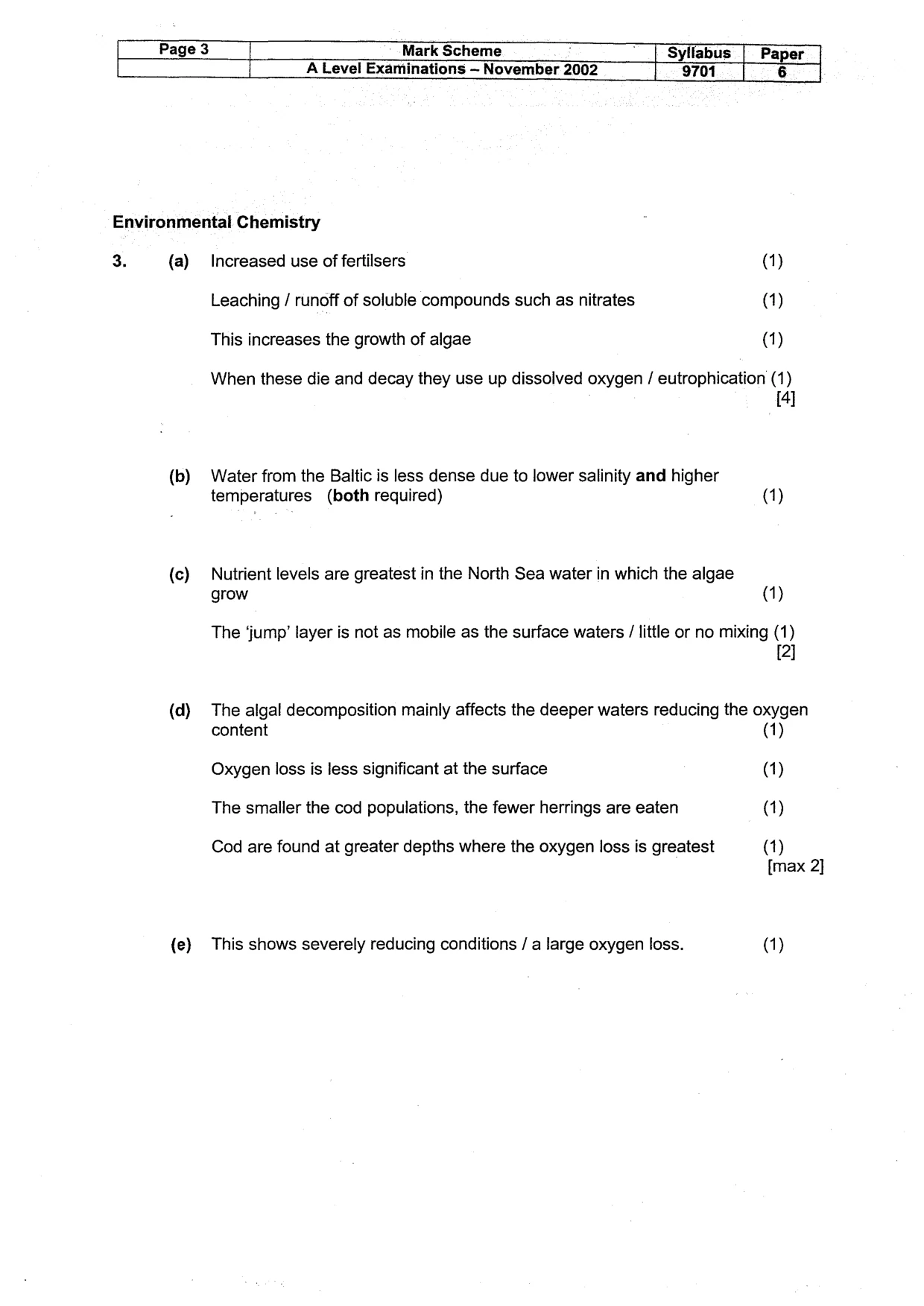
Page 3 Mark Scheme “| Sylfabus | Paper A Level Examinations — November 2002 9701 | 6 Environmental Chemistry 3. (a) (b) (c) (d) {e) Increased use of fertilsers (1) Leaching / runoff of soluble compounds such as nitrates (1) This increases the growth of algae (1) When these die and decay they use up dissolved oxygen / eutrophication (1) [4] Water from the Baltic is less dense due to lower salinity and higher temperatures (both required) (1) Nutrient levels are greatest in the North Sea water in which the algae grow (1) The ‘jump’ layer is not as mobile as the surface waters / little or no mixing (1) [2] The algal decomposition mainly affects the deeper waters reducing the oxygen content (1) Oxygen loss is less significant at the surface (1) The smaller the cod populations, the fewer herrings are eaten (1) Cod are found at greater depths where the oxygen loss is greatest (1) {max 2] This shows severely reducing conditions / a large oxygen loss. (1)
Mark scheme, page 5
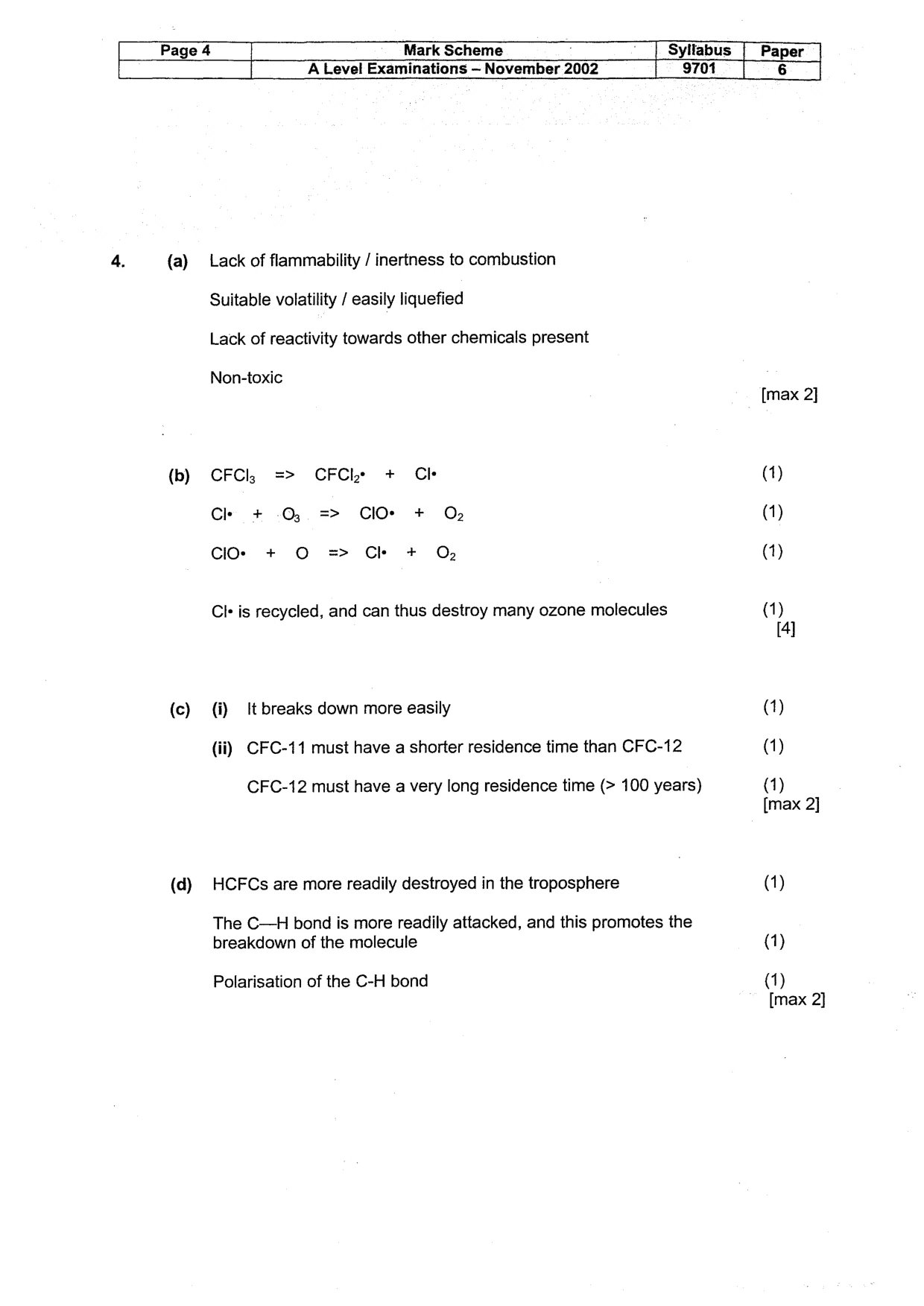
Page 4 I Mark Scheme Sylfabus '- Paper 6 I A Level Examinations — November 2002 9701 (a) (b) (c) (d) Lack of flammability / inertness to combustion Suitable volatility / easily liquefied Lack of reactivity towards other chemicals present Non-toxic [max 2] CFClz => CFCle + Cl (1) Clk + 0; => ClOe + OQ (1) clos + O => Clk + Og (1) Cl is recycled, and can thus destroy many ozone molecules (1) [4] (i) It breaks down more easily (1) (ii) CFC-11 must have a shorter residence time than CFC-12 (1) CFC-12 must have a very long residence time (> 100 years) (1) [max 2] HCFCs are more readily destroyed in the troposphere (1) The C—H bond is more readily attacked, and this promotes the breakdown of the molecule (1) Polarisation of the C-H bond (1) [max 2]
Mark scheme, page 6
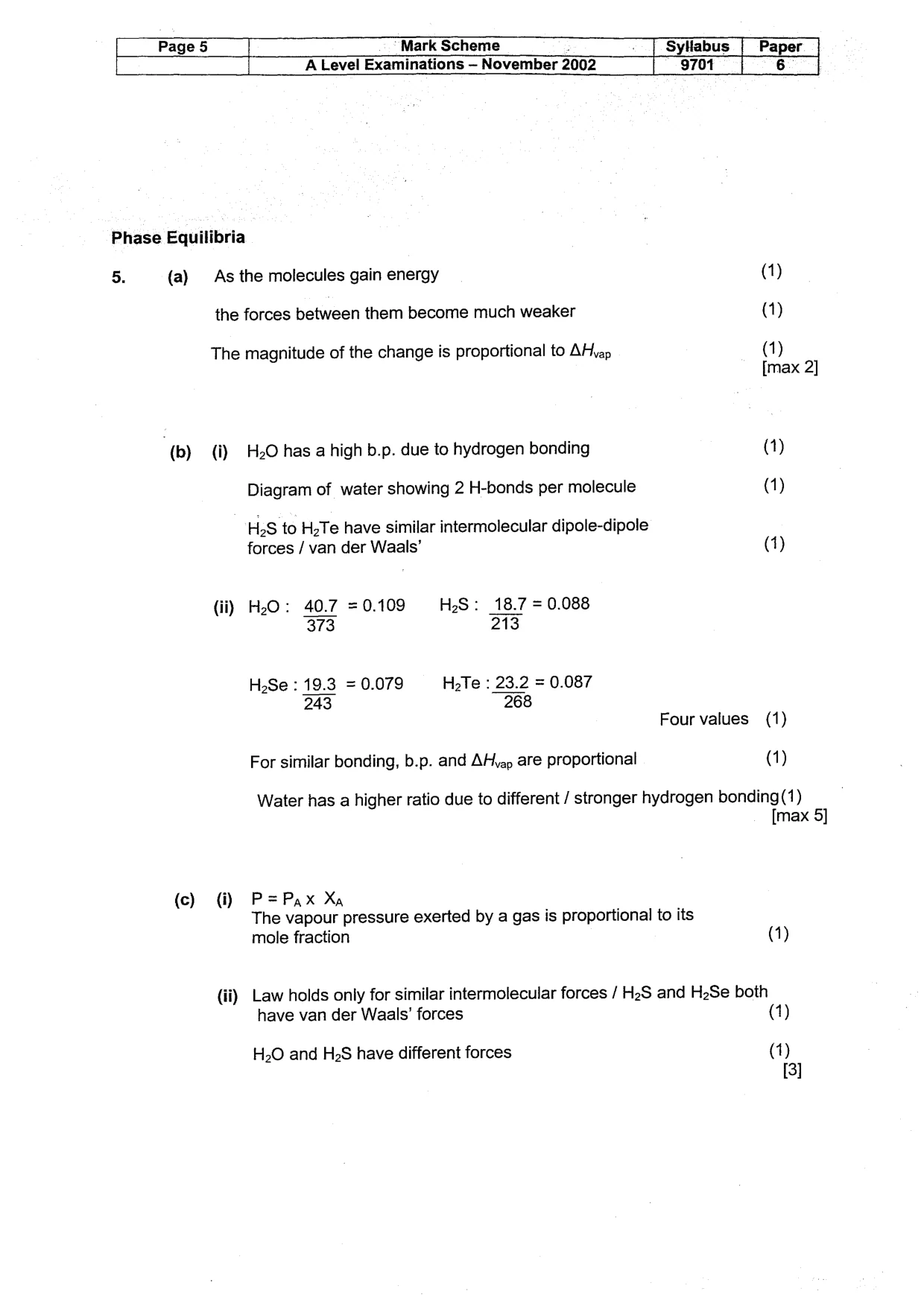
Page 5 Mark Scheme [_Sylabus | Paper A Level Examinations — November 2002 [9701 Phase Equilibria 5. (a) As the molecules gain energy (1) the forces between them become much weaker (1) The magnitude of the change is proportional to AH ap (1) [max 2] “(b) (i) H,0 has a high b.p. due to hydrogen bonding (1) Diagram of water showing 2 H-bonds per molecule (1) HS to H,Te have similar intermolecular dipole-dipole forces / van der Waals’ (1) (ii) HO: 40.7 =0.109 HS: 18.7 = 0.088 373 13 H,Se : 19.3 = 0.079 HzTe : 23.2 = 0.087 43 268 Four values (1) For similar bonding, b.p. and AHyap are proportional (1) Water has a higher ratio due to different / stronger hydrogen bonding(1) (c) (i) P=Pax Xa The vapour pressure exerted by a gas is proportional to its mole fraction [max 5] (1) (ii) Law holds only for similar intermolecular forces / H2S and H2Se both have van der Waals’ forces HO and HS have different forces (1) (1) [3]
Mark scheme, page 7
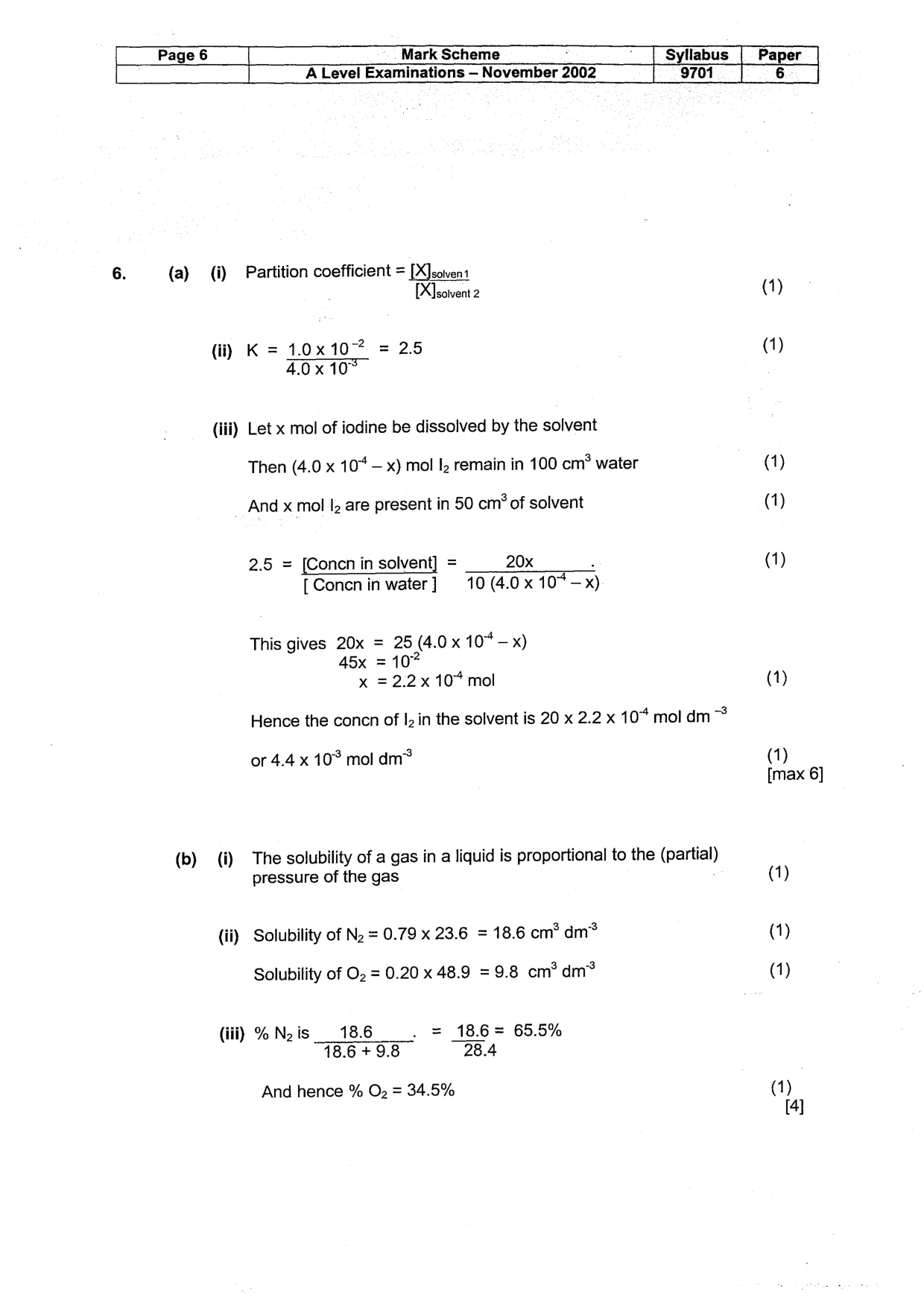
Page 6 Mark Scheme : . Syllabus | Paper A Level Examinations — November 2002 9701 6 (a @ (ii) Partition coefficient = [X]soiven1 DXlsoivent 2 K = 1.0x10% = 2.5 4.0 x 10° (iii) Let x mol of iodine be dissolved by the solvent (b) (i) (ii) Then (4.0 x 10“ — x) mol Iz remain in 100 cm° water And x mol Iz are present in 50 cm’ of solvent 2.5 = [Concn in solvent] = 20x ‘ [Concn in water] 10 (4.0 x 10*—x) This gives 20x = 25 (4.0 x 10% - x) 45x = 107 x =2.2x 10% mol Hence the concn of Iz in the solvent is 20 x 2.2 x 10% mol dm ~* or 4.4 x 10% mol dm® The solubility of a gas in a liquid is proportional to the (partial) pressure of the gas Solubility of Nz = 0.79 x 23.6 = 18.6 cm® dm* Solubility of O2 = 0.20 x 48.9 = 9.8 cm* dm* (iii) % Nois 18.6 - = 18.6 = 65.5% 18.6 +98 28.4 And hence % O2 = 34.5% (1) (1) (1) (1) (1) (1) (1) [max 6] (1) (1) (1) [4]
Mark scheme, page 8
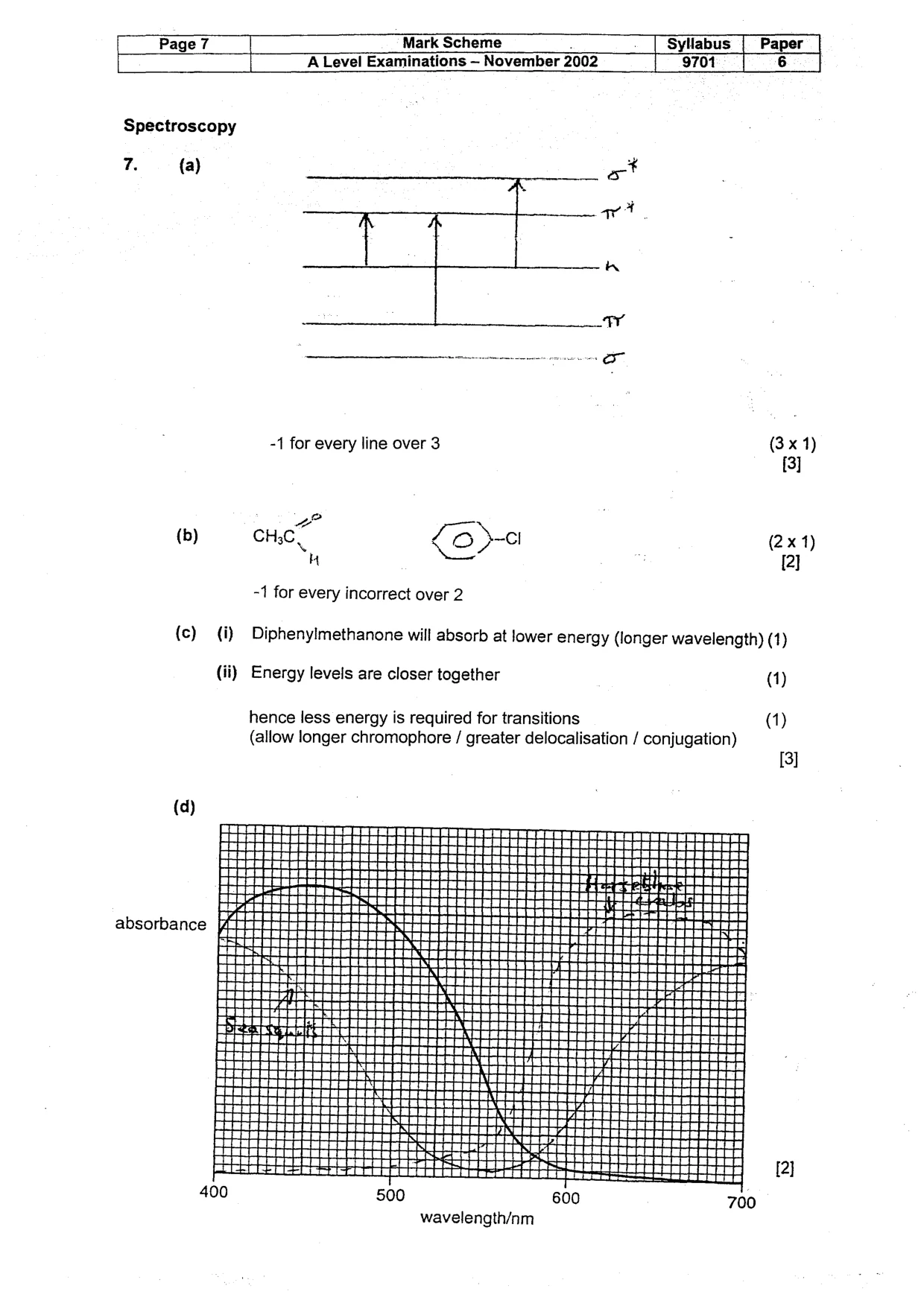
Page 7 Mark Scheme . Syllabus Paper A Level Examinations — November 2002 9701 6 Spectroscopy 7. (a) at wi f uN TY wi ie OF -1 for every line over 3 (3 x 1) [3] Ze (b) CHC, é Oc (2x1) H [2] -1 for every incorrect over 2 (c) (i) Diphenylmethanone will absorb at lower energy (longer wavelength) (1) (ii) Energy levels are closer together (1) hence less energy is required for transitions (1) (allow longer chromophore / greater delocalisation / conjugation) [3] (d) CH aueaee | EEE Ht absorbance TH +H t | - t CE Seeet rr +4 a aeuna a. fine = F i HH HEE t C + [2] 400 500 600 700 wavelength/nm
Mark scheme, page 9
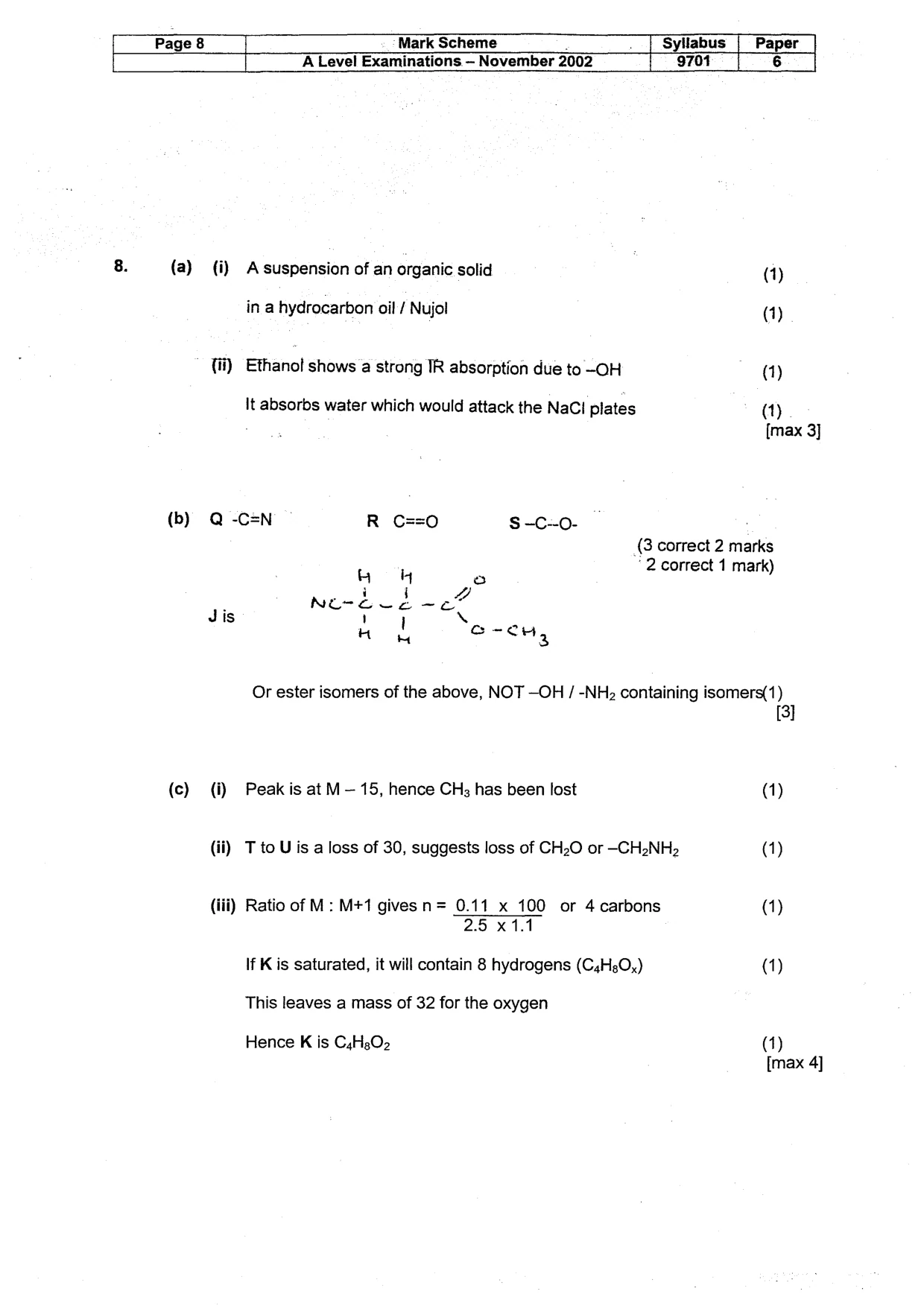
Page 8 Mark Scheme : Syllabus | Paper | A Level Examinations — November 2002 9701 6 | 8. (a) (i) A suspension of an organic solid (1) in a hydrocarbon oil / Nujol (1) (ii) Ethanol shows a strong IR absorption due to -OH (1) It absorbs water which would attack the NaCI plates (1) [max 3] (b) Q -C=N R C= S-C--O- (3 correct 2 marks HH s 2 correct 1 mark) - Newt d ~c% Jis ' 1 XN . Hoy o-cH, Or ester isomers of the above, NOT —OH / -NH2 containing isomers(1) [3] (c) (i) Peak is at M— 15, hence CHs has been lost (1) (ii) T to U is a loss of 30, suggests loss of CH2O or -CH2NH2 (1) (iii) Ratio of M: M+1 gives n= 0.11 x 100 or 4 carbons (1) 2.5 x1.1 If K is saturated, it will contain 8 hydrogens (C,HgO,) (1) This leaves a mass of 32 for the oxygen Hence K is C4HgO2 (1) [max 4]
Mark scheme, page 10
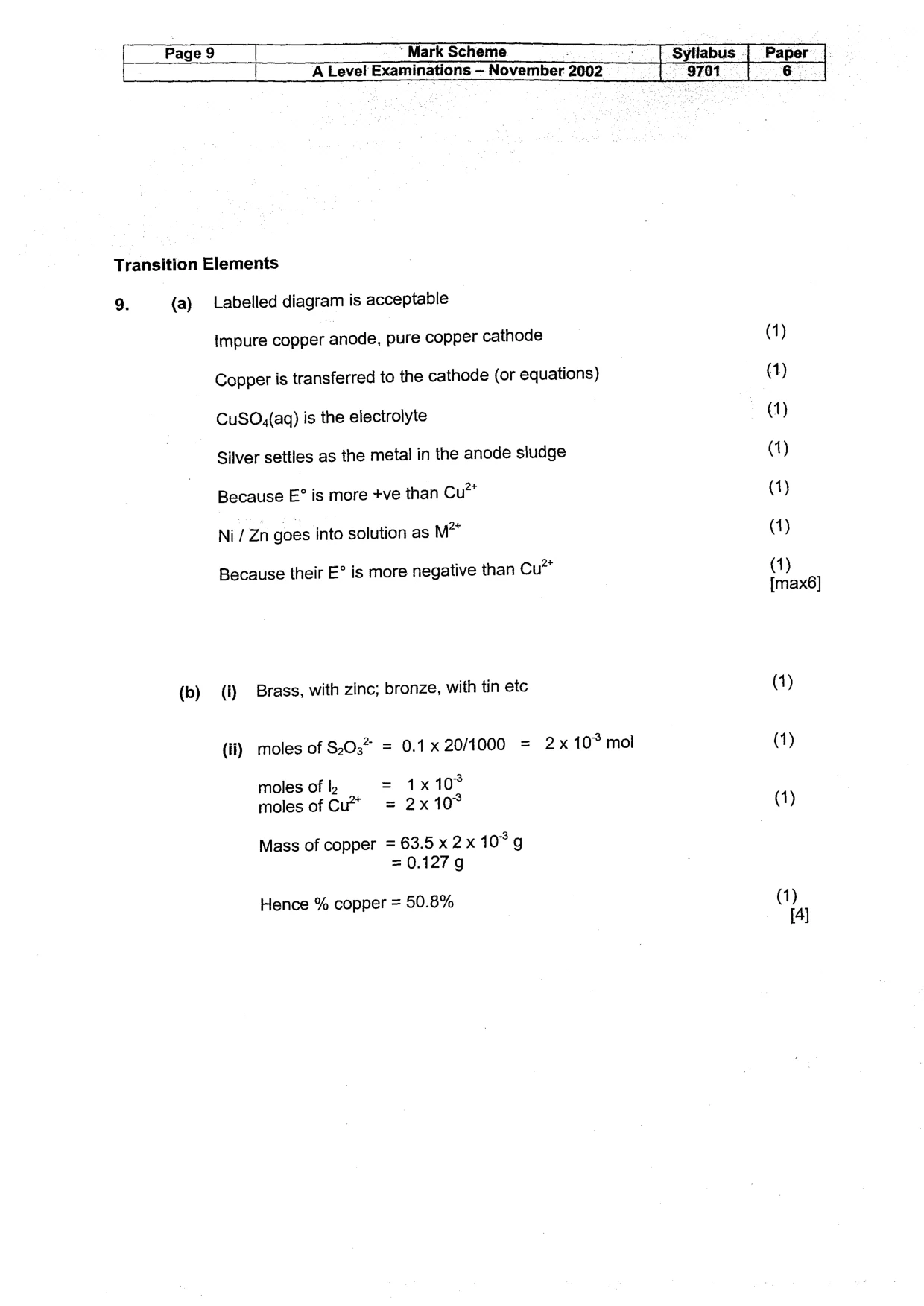
Page 9 Mark Scheme si yliabi pe A Level Examinations — November 2002 } aot = ‘ Transition Elements 9. (a) (b) Labelled diagram is acceptable Impure copper anode, pure copper cathode Copper is transferred to the cathode (or equations) CuSO,(aq) is the electrolyte Silver settles as the metal in the anode sludge Because E° is more +ve than Cu™* Ni/ Zn goes into solution as M* Because their E° is more negative than Cu** (i) Brass, with zinc; bronze, with tin etc (ii) moles of S037 = 0.1x 20/1000 = 2x10°*mol moles of ly = 1x 10° moles of Cu = 2x 10° Mass of copper = 63.5x 2x 10°g = 0.1279 Hence % copper = 50.8% (1) (1) (1) (1) (1) (1) (1) [max6] (1) (1) (1) (4)
Mark scheme, page 11
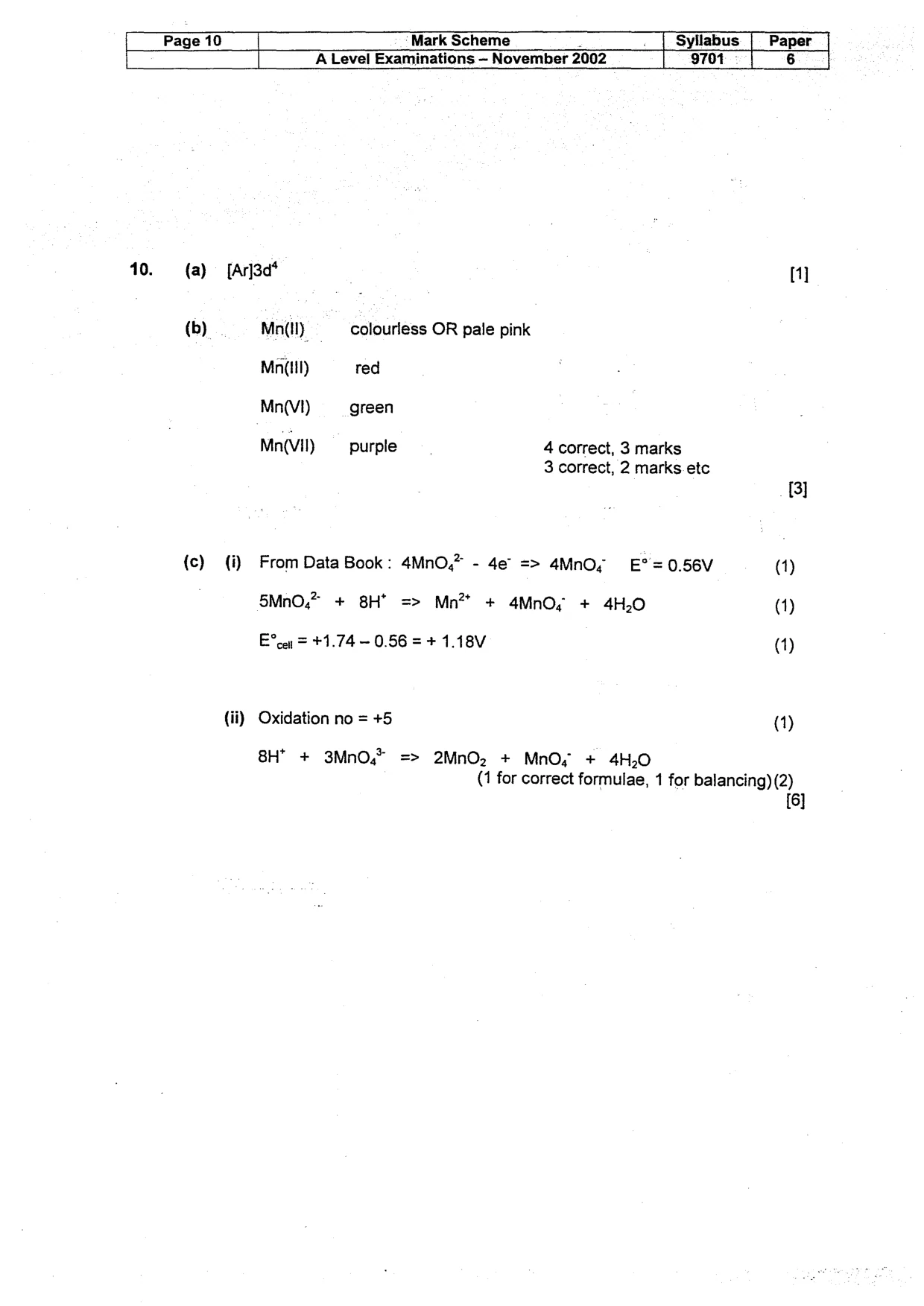
Page 10 Mark Scheme 5 __| Syllabus [Paper | A Level Examinations —- November 2002 9701 6 10. (a) [Ar]3d* (1) (b) Mni(ll) colourless OR pale pink Mni(ill) ted Mn(V1) green Mn(Vil) purple 4 correct, 3 marks 3 correct, 2 marks etc [3] {c) (i) From Data Book: 4MnO,? - 4e => 4MnO, E° = 0.56V (1) 5MnO,* + 8H’ => Mn** + 4MnO, + 4H,O (1) Econ = +1.74 — 0.56 = + 1.18V (1) (ii) Oxidation no = +5 (1) 8H’ + 3MnO,* => 2MnO, + MnO, + 4H,O (1 for correct formulae, 1 for balancing) (2) (6]