Cambridge A Level Chemistry 9701 — 2004 Oct/Nov Paper 6 · Variant 1
9701/61/O/N/04
The question paper and its mark scheme, free to read here and free to download. This is Cambridge’s own paper, exactly as it was sat.
Question paper8 pages
Mark scheme11 pages
Answers below. Sit the paper first if you are practising.
Paper as text
Question paper, page 1
This document consists of 8 printed pages. (SP) MML 6133 6/03 S66581/3 © UCLES 2004 [Turn over UNIVERSITY OF CAMBRIDGE INTERNATIONAL EXAMINATIONS General Certificate of Education Advanced Subsidiary Level and Advanced Level CHEMISTRY 9701/06 Paper 6 Options October/November 2004 1 hour Additional Materials: Answer paper Data Booklet Graph Paper (1 sheet) READ THESE INSTRUCTIONS FIRST Write your name, Centre number and candidate number on the front of any work handed in. Write in dark blue or black pen in the spaces provided on the Question Paper. You may use a pencil for any diagrams, graphs or rough working. Do not use staples, paper clips, highlighters, glue or correction fluid. Write your answers on the separate answer paper provided. Answer all questions on two of the Options. At the end of the examination, fasten all your work securely together. The number of marks is given in brackets [ ] at the end of each question or part question. You may use a calculator.
Question paper, page 2
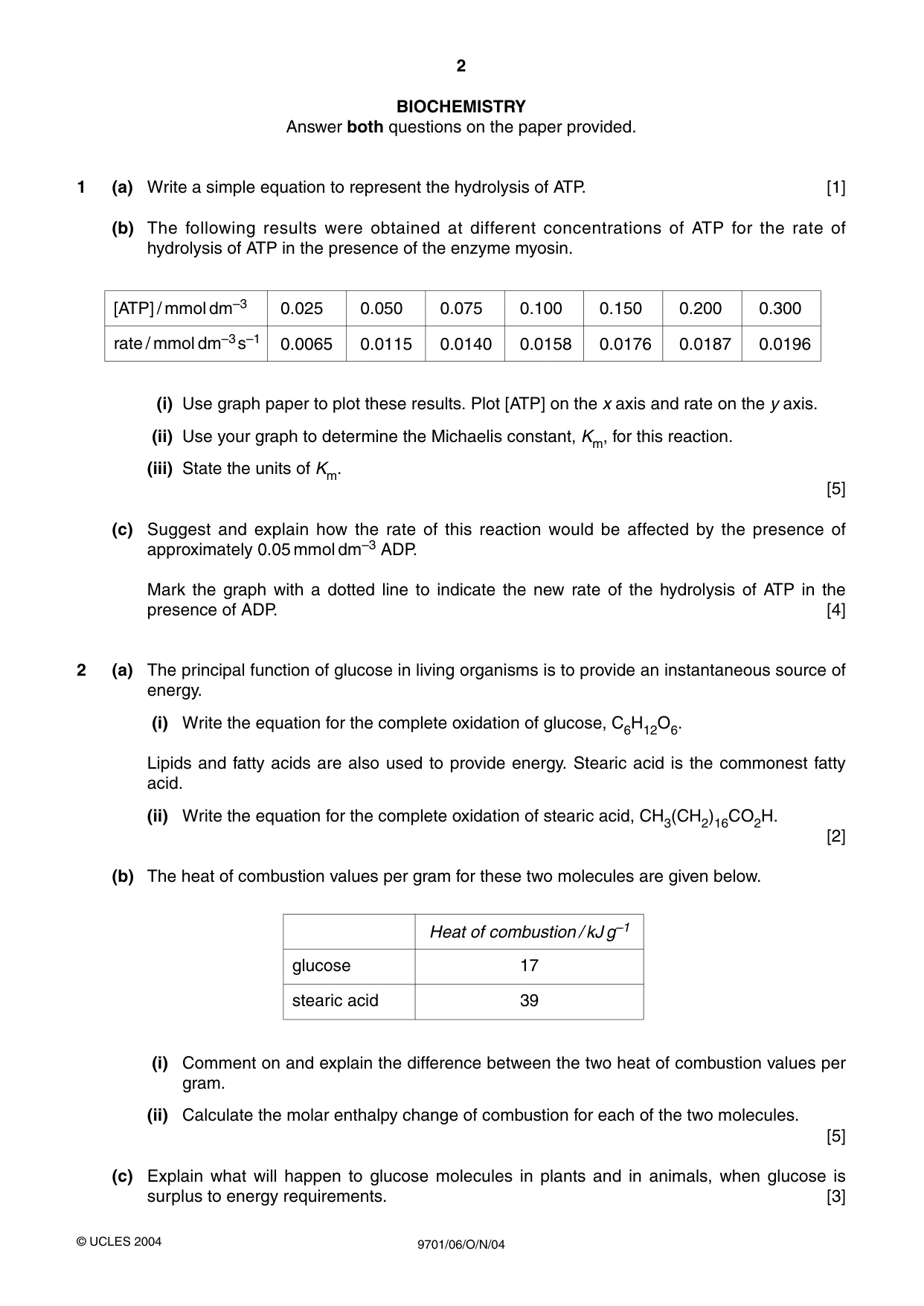
BIOCHEMISTRY Answer both questions on the paper provided. 1 (a) Write a simple equation to represent the hydrolysis of ATP. [1] (b) The following results were obtained at different concentrations of ATP for the rate of hydrolysis of ATP in the presence of the enzyme myosin. (i) Use graph paper to plot these results. Plot [ATP] on the x axis and rate on the y axis. (ii) Use your graph to determine the Michaelis constant, Km, for this reaction. (iii) State the units of Km. [5] (c) Suggest and explain how the rate of this reaction would be affected by the presence of approximately 0.05 mmol dm–3 ADP. Mark the graph with a dotted line to indicate the new rate of the hydrolysis of ATP in the presence of ADP. [4] 2 (a) The principal function of glucose in living organisms is to provide an instantaneous source of energy. (i) Write the equation for the complete oxidation of glucose, C6H12O6. Lipids and fatty acids are also used to provide energy. Stearic acid is the commonest fatty acid. (ii) Write the equation for the complete oxidation of stearic acid, CH3(CH2)16CO2H. [2] (b) The heat of combustion values per gram for these two molecules are given below. (i) Comment on and explain the difference between the two heat of combustion values per gram. (ii) Calculate the molar enthalpy change of combustion for each of the two molecules. [5] (c) Explain what will happen to glucose molecules in plants and in animals, when glucose is surplus to energy requirements. [3] 2 9701/06/O/N/04 © UCLES 2004 [ATP] / mmol dm–3 rate / mmol dm–3s–1 0.025 0.050 0.075 0.100 0.150 0.200 0.300 0.0065 0.0115 0.0140 0.0158 0.0176 0.0187 0.0196 Heat of combustion / kJ g–1 glucose 17 stearic acid 39
Question paper, page 3
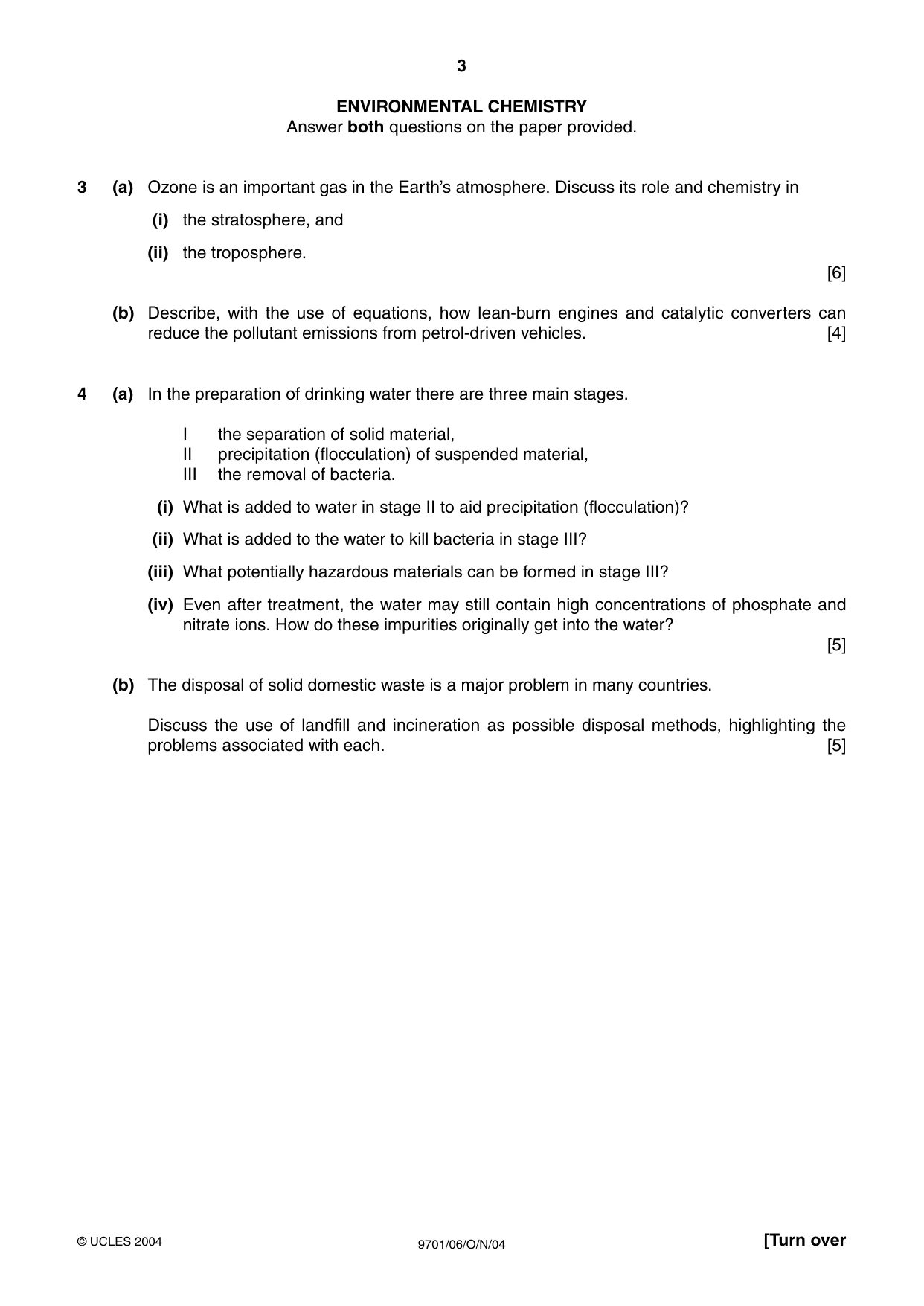
ENVIRONMENTAL CHEMISTRY Answer both questions on the paper provided. 3 (a) Ozone is an important gas in the Earth’s atmosphere. Discuss its role and chemistry in (i) the stratosphere, and (ii) the troposphere. [6] (b) Describe, with the use of equations, how lean-burn engines and catalytic converters can reduce the pollutant emissions from petrol-driven vehicles. [4] 4 (a) In the preparation of drinking water there are three main stages. I the separation of solid material, II precipitation (flocculation) of suspended material, III the removal of bacteria. (i) What is added to water in stage II to aid precipitation (flocculation)? (ii) What is added to the water to kill bacteria in stage III? (iii) What potentially hazardous materials can be formed in stage III? (iv) Even after treatment, the water may still contain high concentrations of phosphate and nitrate ions. How do these impurities originally get into the water? [5] (b) The disposal of solid domestic waste is a major problem in many countries. Discuss the use of landfill and incineration as possible disposal methods, highlighting the problems associated with each. [5] 3 [Turn over 9701/06/O/N/04 © UCLES 2004
Question paper, page 4
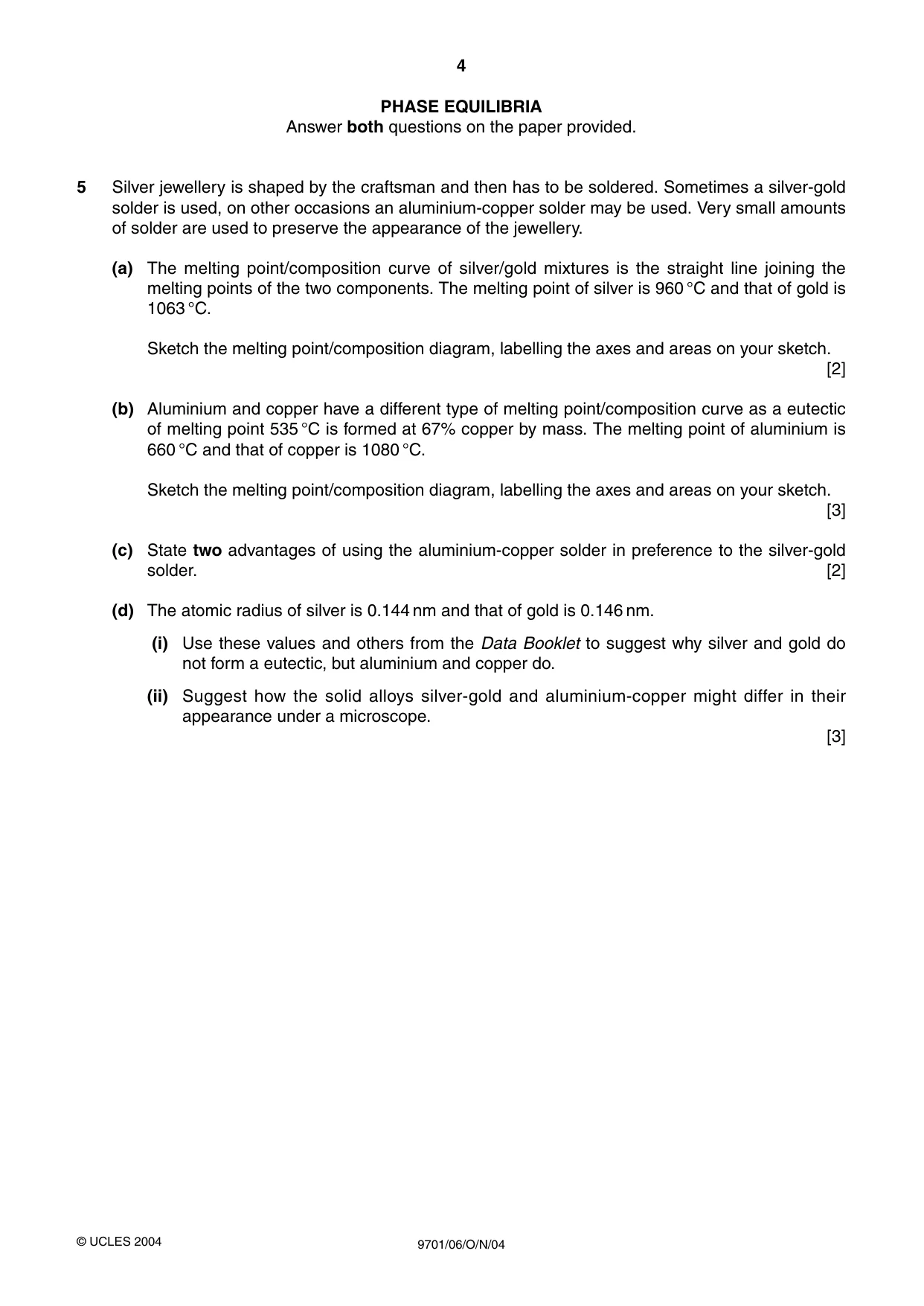
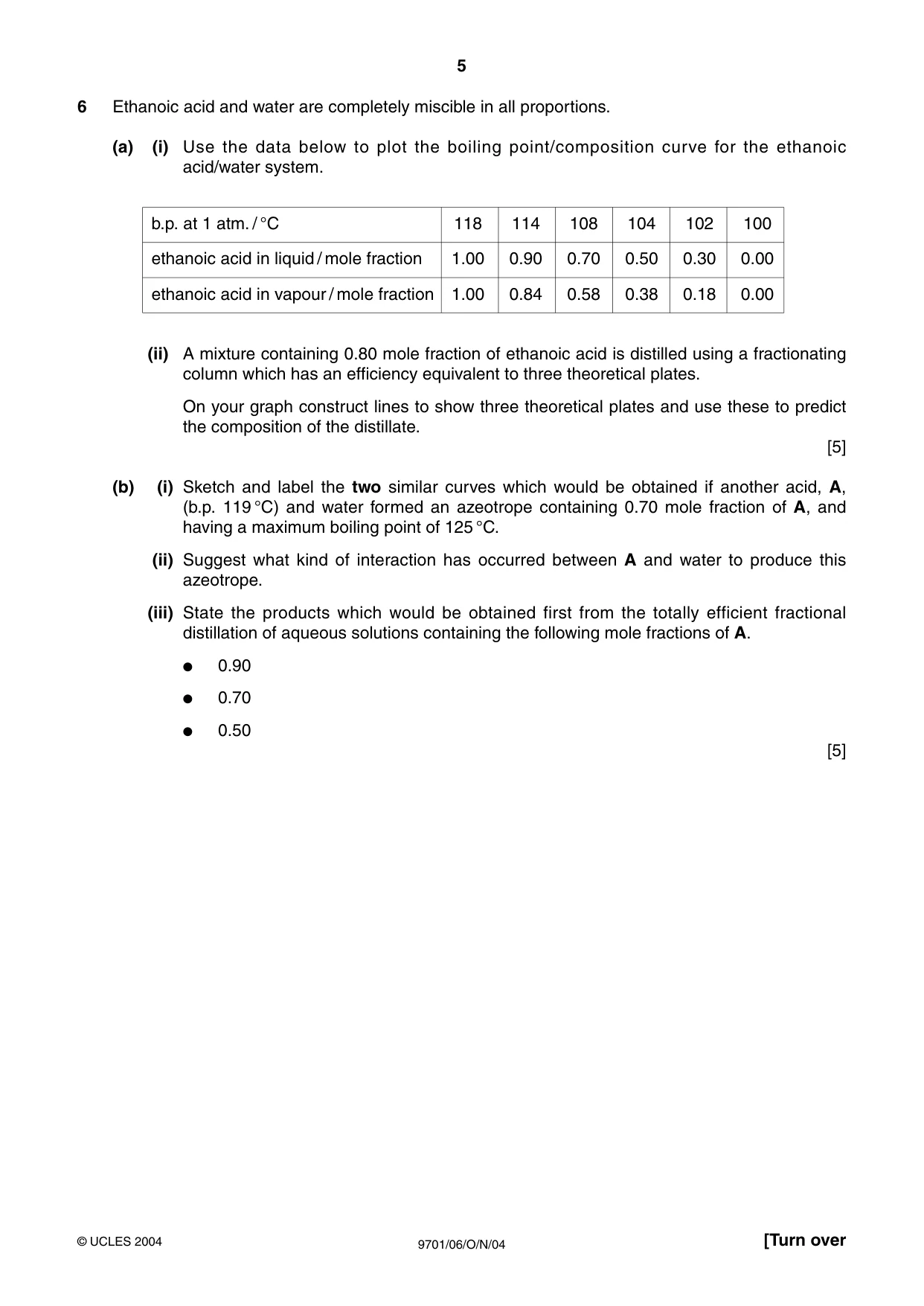
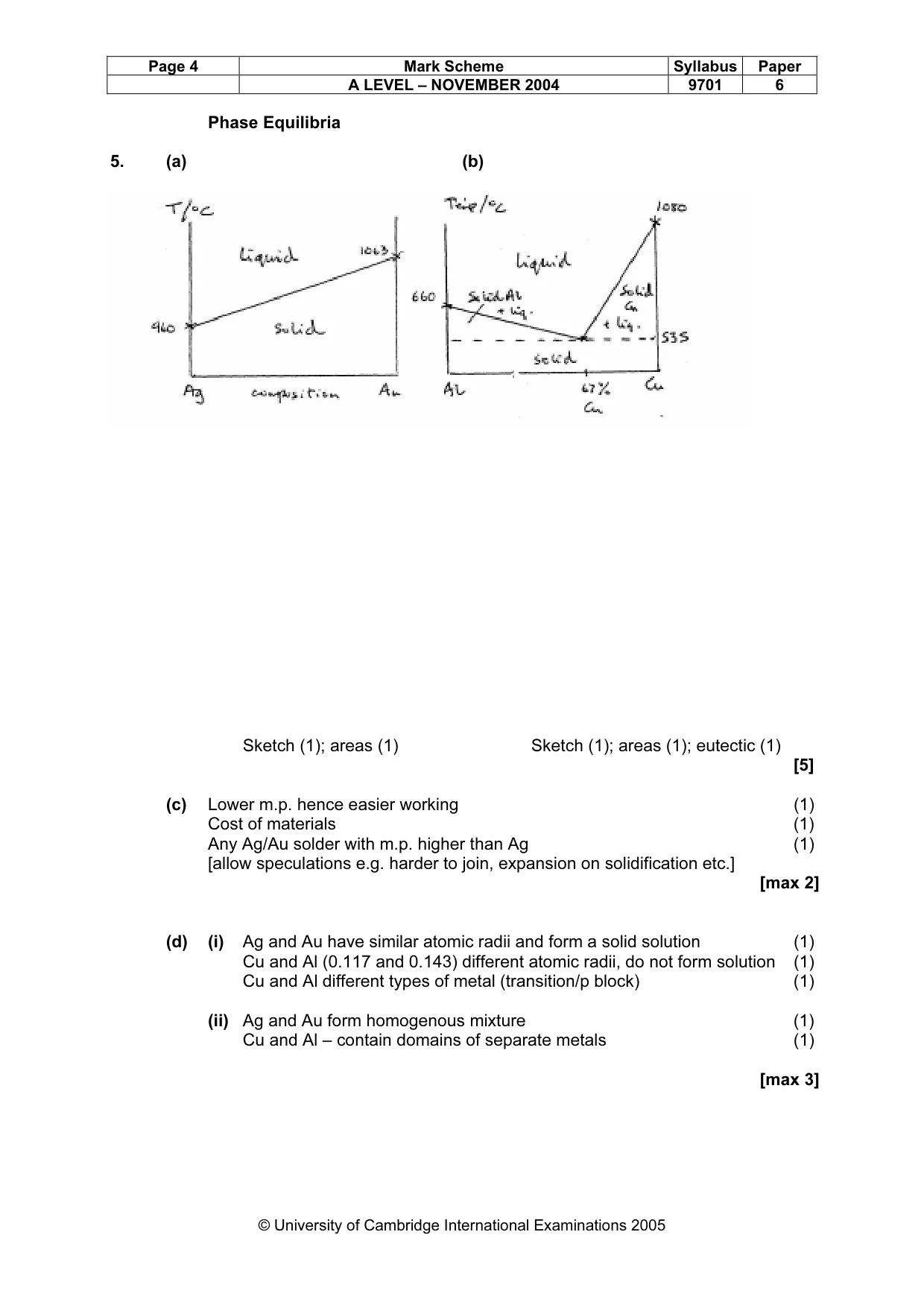
PHASE EQUILIBRIA Answer both questions on the paper provided. 5 Silver jewellery is shaped by the craftsman and then has to be soldered. Sometimes a silver-gold solder is used, on other occasions an aluminium-copper solder may be used. Very small amounts of solder are used to preserve the appearance of the jewellery. (a) The melting point/composition curve of silver/gold mixtures is the straight line joining the melting points of the two components. The melting point of silver is 960 °C and that of gold is 1063 °C. Sketch the melting point/composition diagram, labelling the axes and areas on your sketch. [2] (b) Aluminium and copper have a different type of melting point/composition curve as a eutectic of melting point 535 °C is formed at 67% copper by mass. The melting point of aluminium is 660 °C and that of copper is 1080 °C. Sketch the melting point/composition diagram, labelling the axes and areas on your sketch. [3] (c) State two advantages of using the aluminium-copper solder in preference to the silver-gold solder. [2] (d) The atomic radius of silver is 0.144 nm and that of gold is 0.146 nm. (i) Use these values and others from the Data Booklet to suggest why silver and gold do not form a eutectic, but aluminium and copper do. (ii) Suggest how the solid alloys silver-gold and aluminium-copper might differ in their appearance under a microscope. [3] 4 9701/06/O/N/04 © UCLES 2004
Question paper, page 5
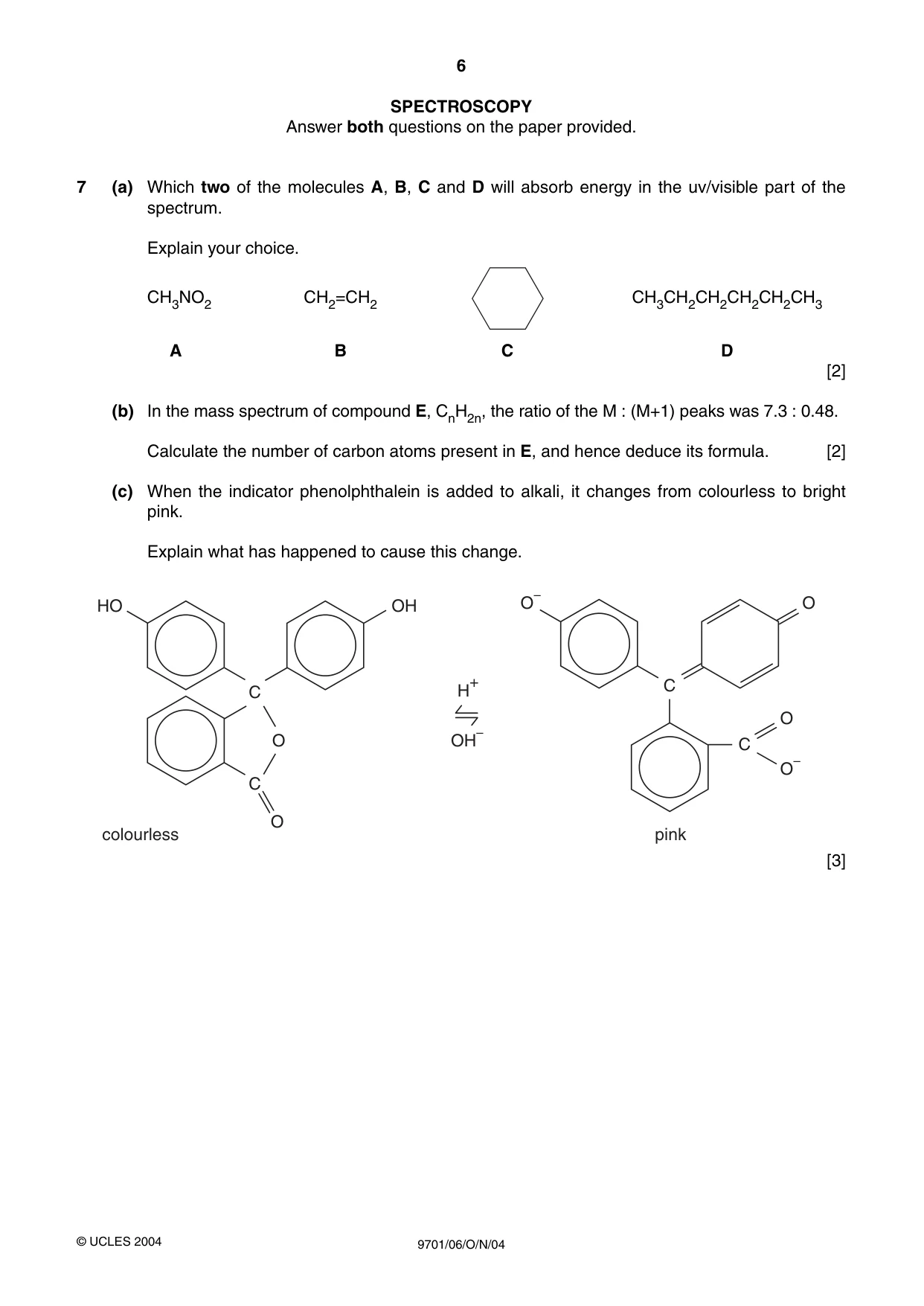
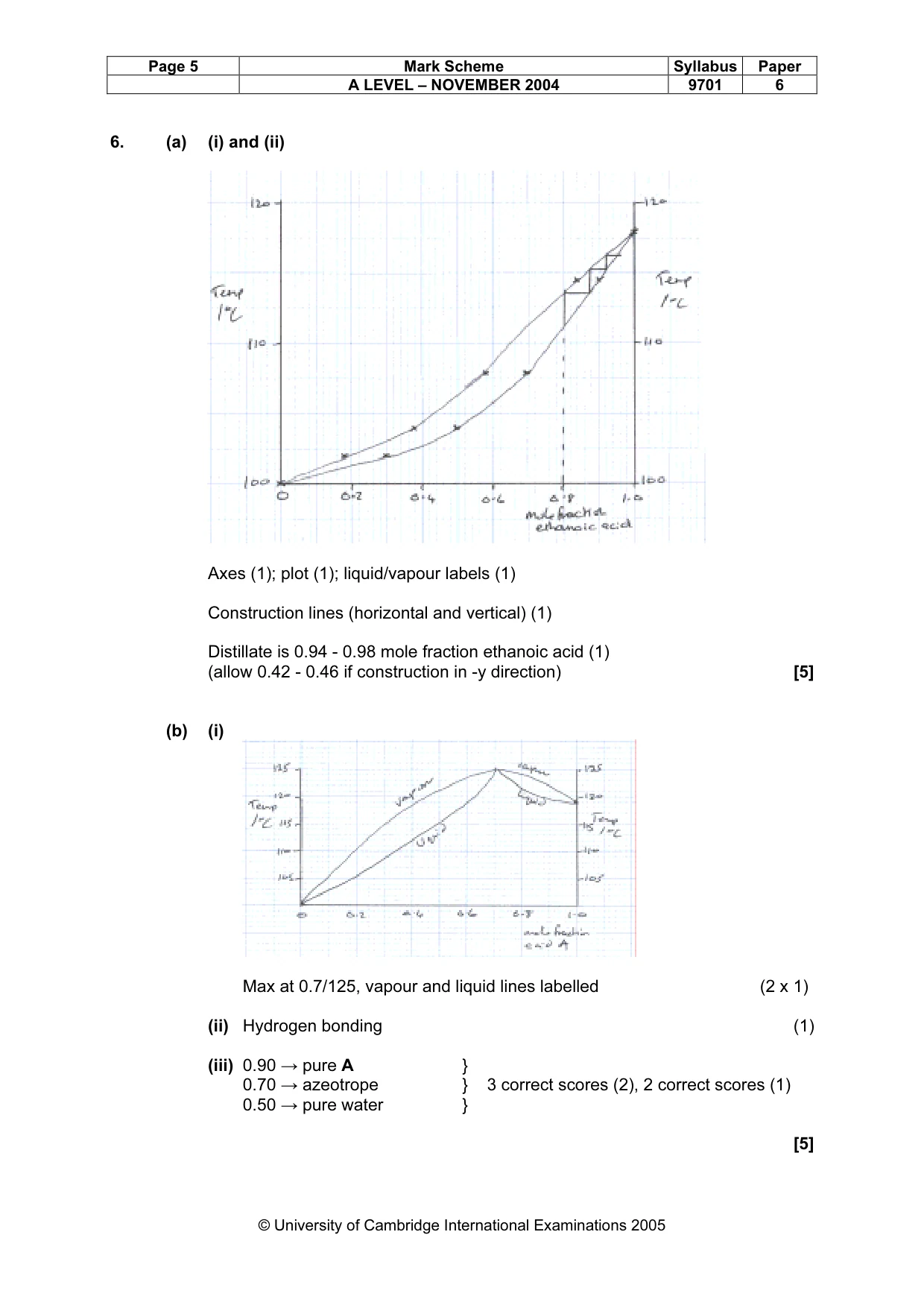
6 Ethanoic acid and water are completely miscible in all proportions. (a) (i) Use the data below to plot the boiling point/composition curve for the ethanoic acid/water system. (ii) A mixture containing 0.80 mole fraction of ethanoic acid is distilled using a fractionating column which has an efficiency equivalent to three theoretical plates. On your graph construct lines to show three theoretical plates and use these to predict the composition of the distillate. [5] (b) (i) Sketch and label the two similar curves which would be obtained if another acid, A, (b.p. 119 °C) and water formed an azeotrope containing 0.70 mole fraction of A, and having a maximum boiling point of 125 °C. (ii) Suggest what kind of interaction has occurred between A and water to produce this azeotrope. (iii) State the products which would be obtained first from the totally efficient fractional distillation of aqueous solutions containing the following mole fractions of A. ● 0.90 ● 0.70 ● 0.50 [5] 5 [Turn over 9701/06/O/N/04 © UCLES 2004 b.p. at 1 atm. / °C 118 114 108 104 102 100 1.00 0.90 0.70 0.50 0.30 0.00 1.00 0.84 0.58 0.38 0.18 0.00 ethanoic acid in liquid / mole fraction ethanoic acid in vapour / mole fraction
Question paper, page 6
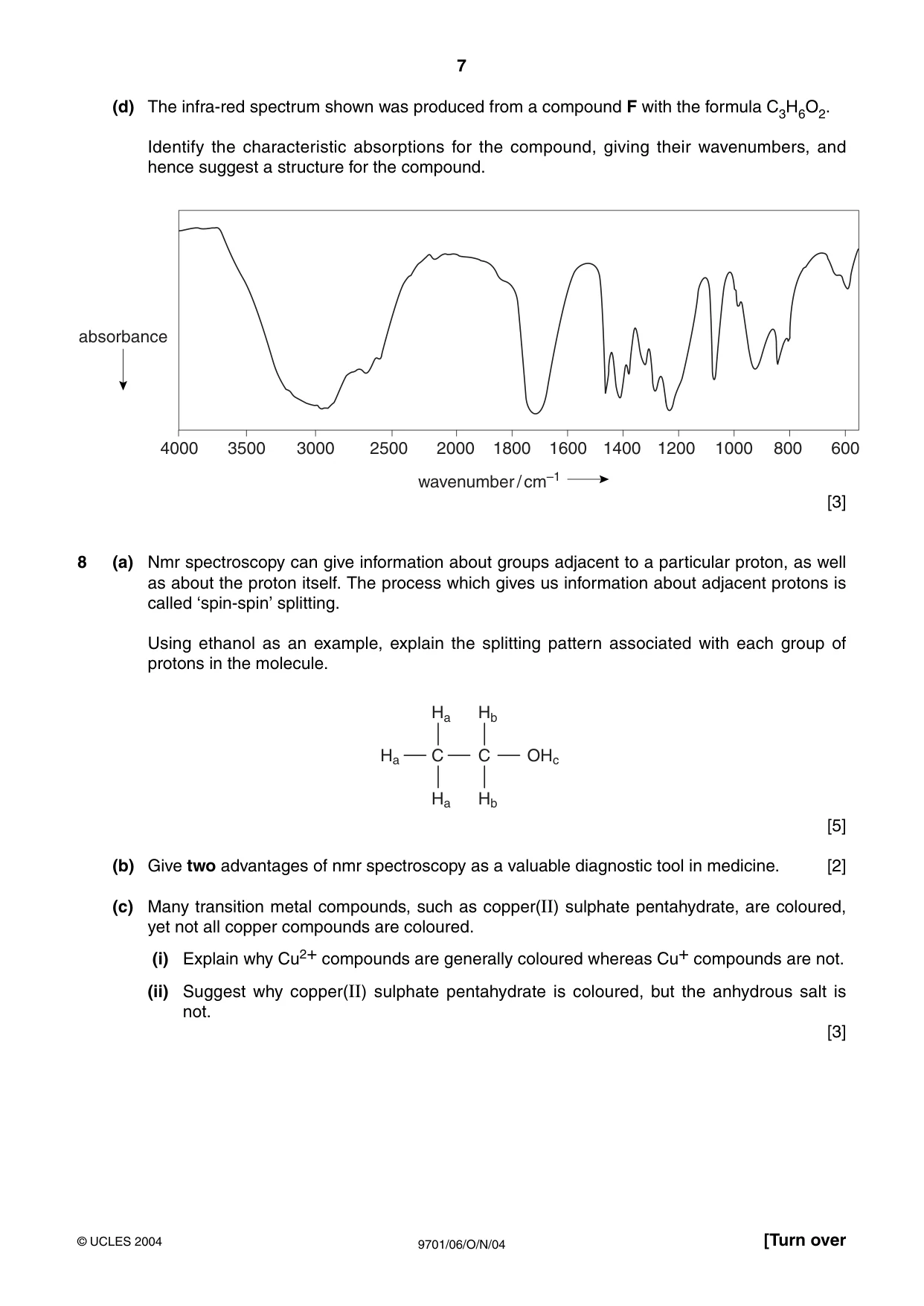
SPECTROSCOPY Answer both questions on the paper provided. 7 (a) Which two of the molecules A, B, C and D will absorb energy in the uv/visible part of the spectrum. Explain your choice. CH3NO2 CH2=CH2 CH3CH2CH2CH2CH2CH3 A B C D [2] (b) In the mass spectrum of compound E, CnH2n, the ratio of the M : (M+1) peaks was 7.3 : 0.48. Calculate the number of carbon atoms present in E, and hence deduce its formula. [2] (c) When the indicator phenolphthalein is added to alkali, it changes from colourless to bright pink. Explain what has happened to cause this change. [3] H+ OH– O O HO OH C C colourless pink C O O– O– O C 6 9701/06/O/N/04 © UCLES 2004
Question paper, page 7
(d) The infra-red spectrum shown was produced from a compound F with the formula C3H6O2. Identify the characteristic absorptions for the compound, giving their wavenumbers, and hence suggest a structure for the compound. [3] 8 (a) Nmr spectroscopy can give information about groups adjacent to a particular proton, as well as about the proton itself. The process which gives us information about adjacent protons is called ‘spin-spin’ splitting. Using ethanol as an example, explain the splitting pattern associated with each group of protons in the molecule. [5] (b) Give two advantages of nmr spectroscopy as a valuable diagnostic tool in medicine. [2] (c) Many transition metal compounds, such as copper(II) sulphate pentahydrate, are coloured, yet not all copper compounds are coloured. (i) Explain why Cu2+ compounds are generally coloured whereas Cu+ compounds are not. (ii) Suggest why copper(II) sulphate pentahydrate is coloured, but the anhydrous salt is not. [3] C C Ha Hb Ha Hb OHc Ha 7 [Turn over 9701/06/O/N/04 © UCLES 2004 4000 3500 3000 2500 800 600 1000 1200 1400 1600 1800 2000 wavenumber / cm–1 absorbance
Question paper, page 8
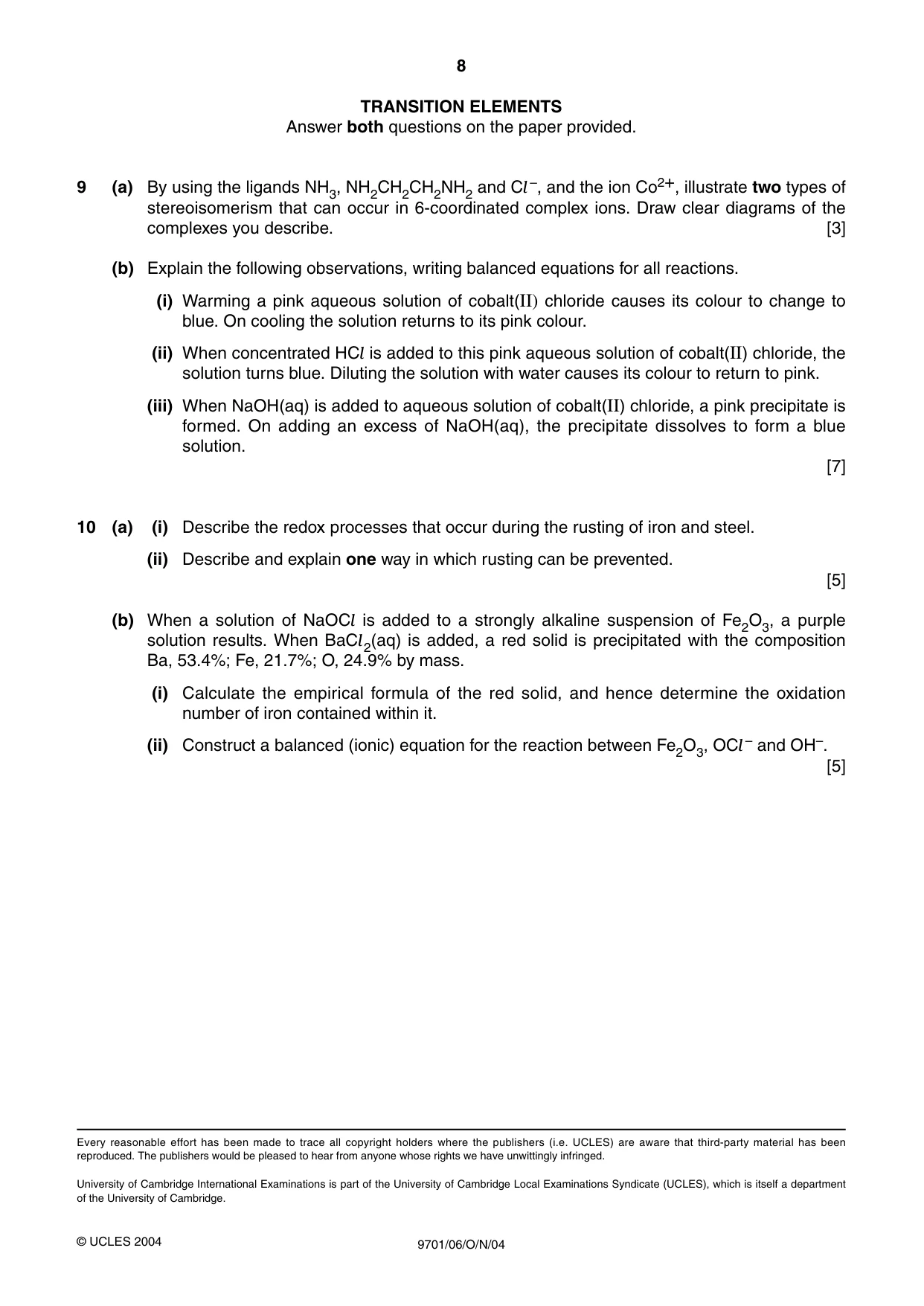
TRANSITION ELEMENTS Answer both questions on the paper provided. 9 (a) By using the ligands NH3, NH2CH2CH2NH2 and Cl –, and the ion Co2+, illustrate two types of stereoisomerism that can occur in 6-coordinated complex ions. Draw clear diagrams of the complexes you describe. [3] (b) Explain the following observations, writing balanced equations for all reactions. (i) Warming a pink aqueous solution of cobalt(II) chloride causes its colour to change to blue. On cooling the solution returns to its pink colour. (ii) When concentrated HCl is added to this pink aqueous solution of cobalt(II) chloride, the solution turns blue. Diluting the solution with water causes its colour to return to pink. (iii) When NaOH(aq) is added to aqueous solution of cobalt(II) chloride, a pink precipitate is formed. On adding an excess of NaOH(aq), the precipitate dissolves to form a blue solution. [7] 10 (a) (i) Describe the redox processes that occur during the rusting of iron and steel. (ii) Describe and explain one way in which rusting can be prevented. [5] (b) When a solution of NaOCl is added to a strongly alkaline suspension of Fe2O3, a purple solution results. When BaCl2(aq) is added, a red solid is precipitated with the composition Ba, 53.4%; Fe, 21.7%; O, 24.9% by mass. (i) Calculate the empirical formula of the red solid, and hence determine the oxidation number of iron contained within it. (ii) Construct a balanced (ionic) equation for the reaction between Fe2O3, OCl – and OH–. [5] Every reasonable effort has been made to trace all copyright holders where the publishers (i.e. UCLES) are aware that third-party material has been reproduced. The publishers would be pleased to hear from anyone whose rights we have unwittingly infringed. University of Cambridge International Examinations is part of the University of Cambridge Local Examinations Syndicate (UCLES), which is itself a department of the University of Cambridge. 8 9701/06/O/N/04 © UCLES 2004
Mark scheme, page 1
UNIVERSITY OF CAMBRIDGE INTERNATIONAL EXAMINATIONS GCE Advanced Level MARK SCHEME for the November 2004 question paper 9701 CHEMISTRY 9701/06 Paper 6 (Options), maximum raw mark 40 This mark scheme is published as an aid to teachers and students, to indicate the requirements of the examination. It shows the basis on which Examiners were initially instructed to award marks. It does not indicate the details of the discussions that took place at an Examiners’ meeting before marking began. Any substantial changes to the mark scheme that arose from these discussions will be recorded in the published Report on the Examination. All Examiners are instructed that alternative correct answers and unexpected approaches in candidates’ scripts must be given marks that fairly reflect the relevant knowledge and skills demonstrated. Mark schemes must be read in conjunction with the question papers and the Report on the Examination. • CIE will not enter into discussion or correspondence in connection with these mark schemes. CIE is publishing the mark schemes for the November 2004 question papers for most IGCSE and GCE Advanced Level syllabuses.
Mark scheme, page 2
Grade thresholds taken for Syllabus 9701 (Chemistry) in the November 2004 examination. minimum mark required for grade: maximum mark available A B E Component 6 40 27 24 13 The thresholds (minimum marks) for Grades C and D are normally set by dividing the mark range between the B and the E thresholds into three. For example, if the difference between the B and the E threshold is 24 marks, the C threshold is set 8 marks below the B threshold and the D threshold is set another 8 marks down. If dividing the interval by three results in a fraction of a mark, then the threshold is normally rounded down.
Mark scheme, page 3
November 2004 GCE A LEVEL MARK SCHEME MAXIMUM MARK: 40 SYLLABUS/COMPONENT: 9701/06 CHEMISTRY Paper 6 (Options)
Mark scheme, page 4
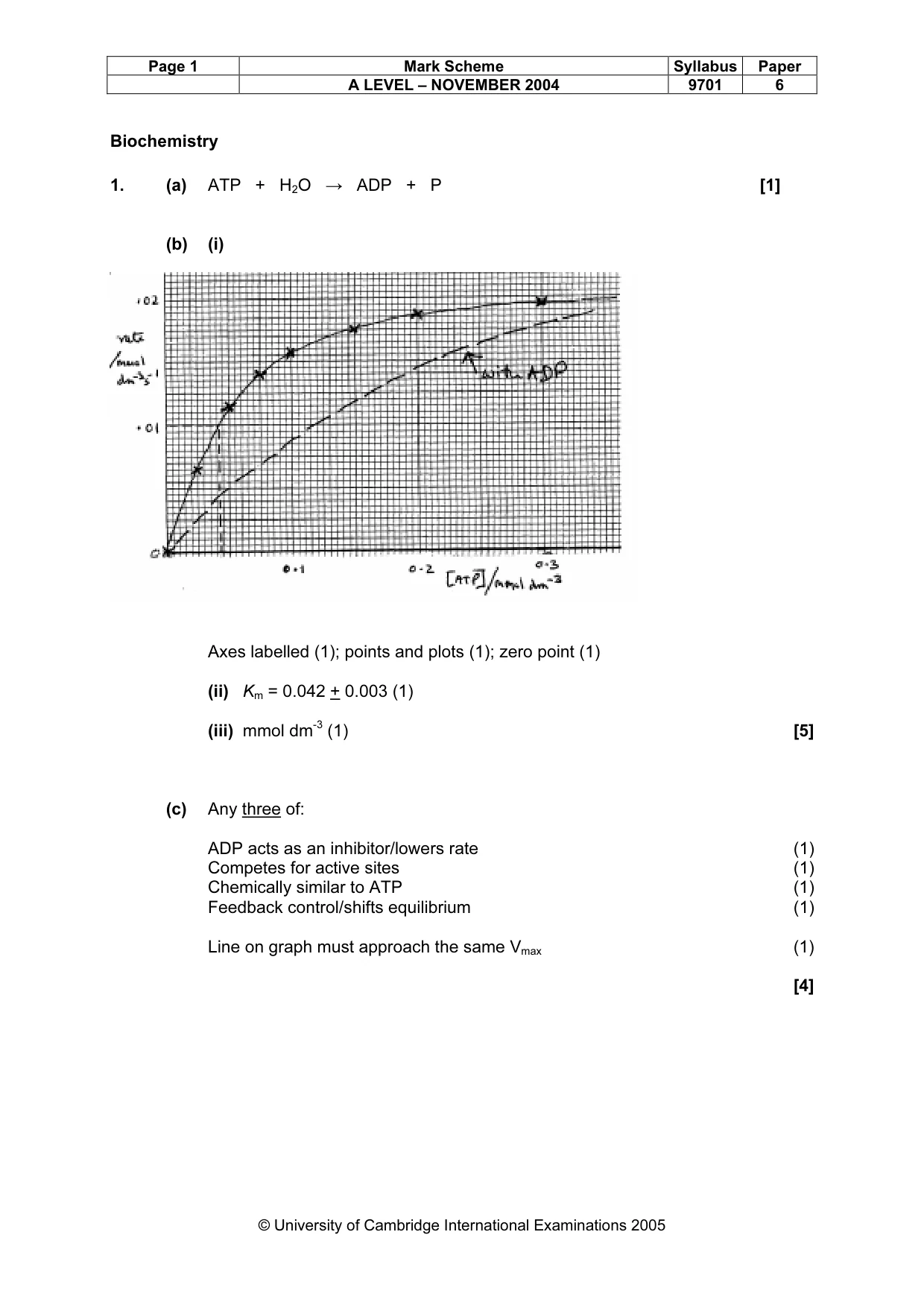
Page 1 Mark Scheme Syllabus Paper A LEVEL – NOVEMBER 2004 9701 6 © University of Cambridge International Examinations 2005 Biochemistry 1. (a) ATP + H2O → ADP + P [1] (b) (i) Axes labelled (1); points and plots (1); zero point (1) (ii) Km = 0.042 + 0.003 (1) (iii) mmol dm-3 (1) [5] (c) Any three of: ADP acts as an inhibitor/lowers rate (1) Competes for active sites (1) Chemically similar to ATP (1) Feedback control/shifts equilibrium (1) Line on graph must approach the same Vmax (1) [4]
Mark scheme, page 5
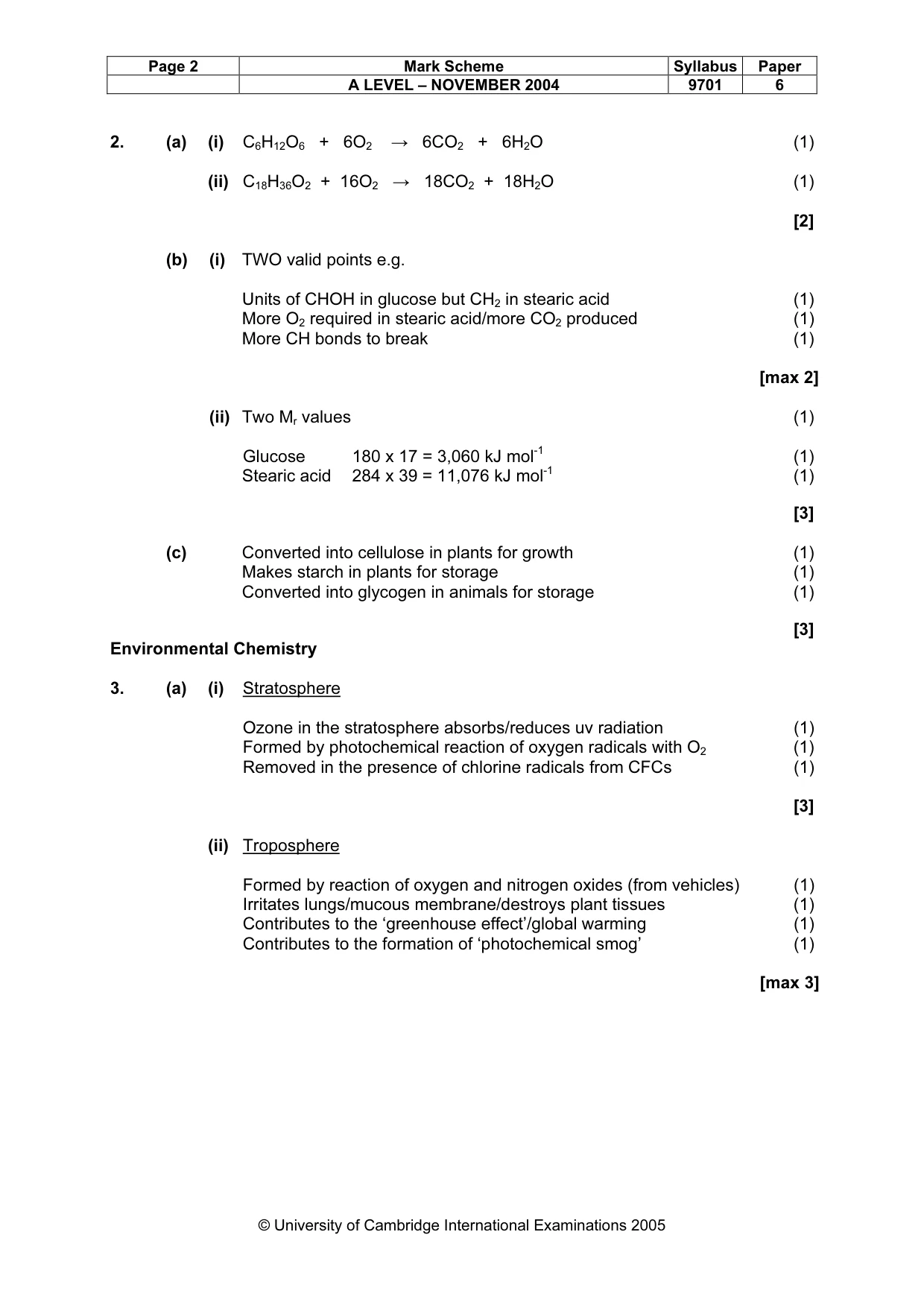
Page 2 Mark Scheme Syllabus Paper A LEVEL – NOVEMBER 2004 9701 6 © University of Cambridge International Examinations 2005 2. (a) (i) C6H12O6 + 6O2 → 6CO2 + 6H2O (1) (ii) C18H36O2 + 16O2 → 18CO2 + 18H2O (1) [2] (b) (i) TWO valid points e.g. Units of CHOH in glucose but CH2 in stearic acid (1) More O2 required in stearic acid/more CO2 produced (1) More CH bonds to break (1) [max 2] (ii) Two Mr values (1) Glucose 180 x 17 = 3,060 kJ mol-1 (1) Stearic acid 284 x 39 = 11,076 kJ mol-1 (1) [3] (c) Converted into cellulose in plants for growth (1) Makes starch in plants for storage (1) Converted into glycogen in animals for storage (1) [3] Environmental Chemistry 3. (a) (i) Stratosphere Ozone in the stratosphere absorbs/reduces uv radiation (1) Formed by photochemical reaction of oxygen radicals with O2 (1) Removed in the presence of chlorine radicals from CFCs (1) [3] (ii) Troposphere Formed by reaction of oxygen and nitrogen oxides (from vehicles) (1) Irritates lungs/mucous membrane/destroys plant tissues (1) Contributes to the ‘greenhouse effect’/global warming (1) Contributes to the formation of ‘photochemical smog’ (1) [max 3]
Mark scheme, page 6
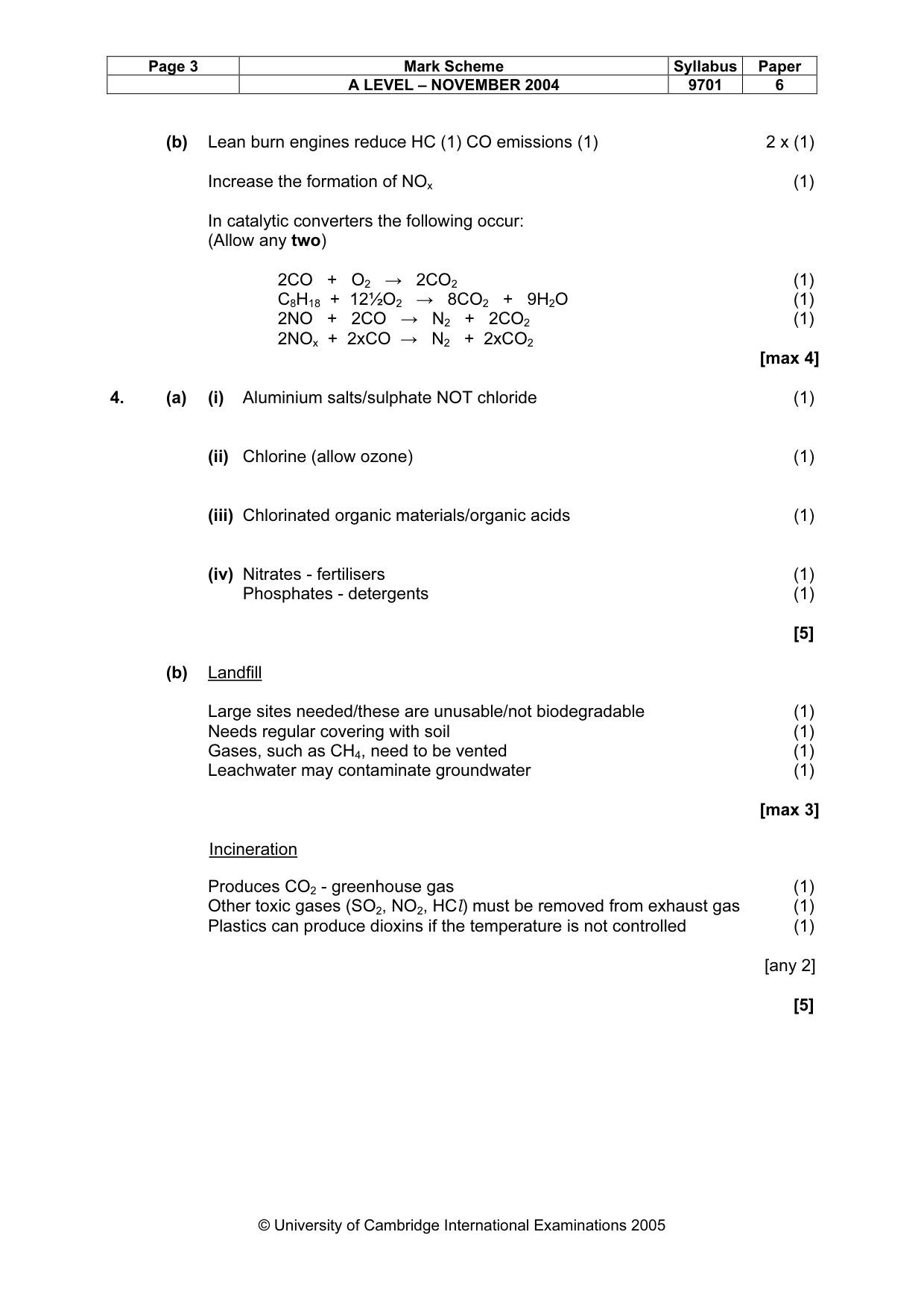
Page 3 Mark Scheme Syllabus Paper A LEVEL – NOVEMBER 2004 9701 6 © University of Cambridge International Examinations 2005 (b) Lean burn engines reduce HC (1) CO emissions (1) 2 x (1) Increase the formation of NOx (1) In catalytic converters the following occur: (Allow any two) 2CO + O2 → 2CO2 (1) C8H18 + 12½O2 → 8CO2 + 9H2O (1) 2NO + 2CO → N2 + 2CO2 (1) 2NOx + 2xCO → N2 + 2xCO2 [max 4] 4. (a) (i) Aluminium salts/sulphate NOT chloride (1) (ii) Chlorine (allow ozone) (1) (iii) Chlorinated organic materials/organic acids (1) (iv) Nitrates - fertilisers (1) Phosphates - detergents (1) [5] (b) Landfill Large sites needed/these are unusable/not biodegradable (1) Needs regular covering with soil (1) Gases, such as CH4, need to be vented (1) Leachwater may contaminate groundwater (1) [max 3] Incineration Produces CO2 - greenhouse gas (1) Other toxic gases (SO2, NO2, HCl) must be removed from exhaust gas (1) Plastics can produce dioxins if the temperature is not controlled (1) [any 2] [5]
Mark scheme, page 7
Page 4 Mark Scheme Syllabus Paper A LEVEL – NOVEMBER 2004 9701 6 © University of Cambridge International Examinations 2005 Phase Equilibria 5. (a) (b) Sketch (1); areas (1) Sketch (1); areas (1); eutectic (1) [5] (c) Lower m.p. hence easier working (1) Cost of materials (1) Any Ag/Au solder with m.p. higher than Ag (1) [allow speculations e.g. harder to join, expansion on solidification etc.] [max 2] (d) (i) Ag and Au have similar atomic radii and form a solid solution (1) Cu and Al (0.117 and 0.143) different atomic radii, do not form solution (1) Cu and Al different types of metal (transition/p block) (1) (ii) Ag and Au form homogenous mixture (1) Cu and Al – contain domains of separate metals (1) [max 3]
Mark scheme, page 8
Page 5 Mark Scheme Syllabus Paper A LEVEL – NOVEMBER 2004 9701 6 © University of Cambridge International Examinations 2005 6. (a) (i) and (ii) Axes (1); plot (1); liquid/vapour labels (1) Construction lines (horizontal and vertical) (1) Distillate is 0.94 - 0.98 mole fraction ethanoic acid (1) (allow 0.42 - 0.46 if construction in -y direction) [5] (b) (i) Max at 0.7/125, vapour and liquid lines labelled (2 x 1) (ii) Hydrogen bonding (1) (iii) 0.90 → pure A } 0.70 → azeotrope } 3 correct scores (2), 2 correct scores (1) 0.50 → pure water } [5]
Mark scheme, page 9
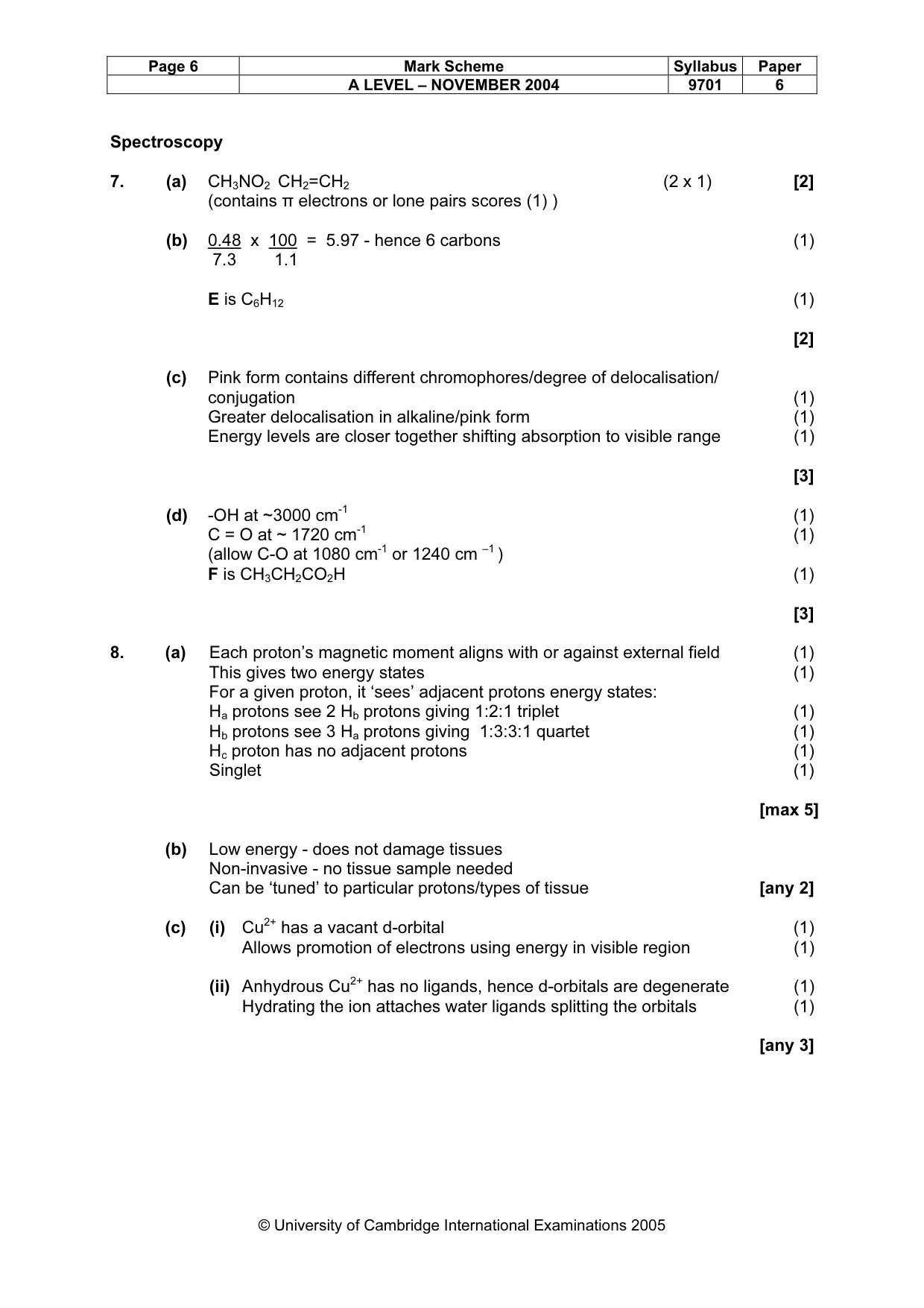
Page 6 Mark Scheme Syllabus Paper A LEVEL – NOVEMBER 2004 9701 6 © University of Cambridge International Examinations 2005 Spectroscopy 7. (a) CH3NO2 CH2=CH2 (2 x 1) [2] (contains π electrons or lone pairs scores (1) ) (b) 0.48 x 100 = 5.97 - hence 6 carbons (1) 7.3 1.1 E is C6H12 (1) [2] (c) Pink form contains different chromophores/degree of delocalisation/ conjugation (1) Greater delocalisation in alkaline/pink form (1) Energy levels are closer together shifting absorption to visible range (1) [3] (d) -OH at ~3000 cm-1 (1) C = O at ~ 1720 cm-1 (1) (allow C-O at 1080 cm-1 or 1240 cm –1 ) F is CH3CH2CO2H (1) [3] 8. (a) Each proton’s magnetic moment aligns with or against external field (1) This gives two energy states (1) For a given proton, it ‘sees’ adjacent protons energy states: Ha protons see 2 Hb protons giving 1:2:1 triplet (1) Hb protons see 3 Ha protons giving 1:3:3:1 quartet (1) Hc proton has no adjacent protons (1) Singlet (1) [max 5] (b) Low energy - does not damage tissues Non-invasive - no tissue sample needed Can be ‘tuned’ to particular protons/types of tissue [any 2] (c) (i) Cu2+ has a vacant d-orbital (1) Allows promotion of electrons using energy in visible region (1) (ii) Anhydrous Cu2+ has no ligands, hence d-orbitals are degenerate (1) Hydrating the ion attaches water ligands splitting the orbitals (1) [any 3]
Mark scheme, page 10
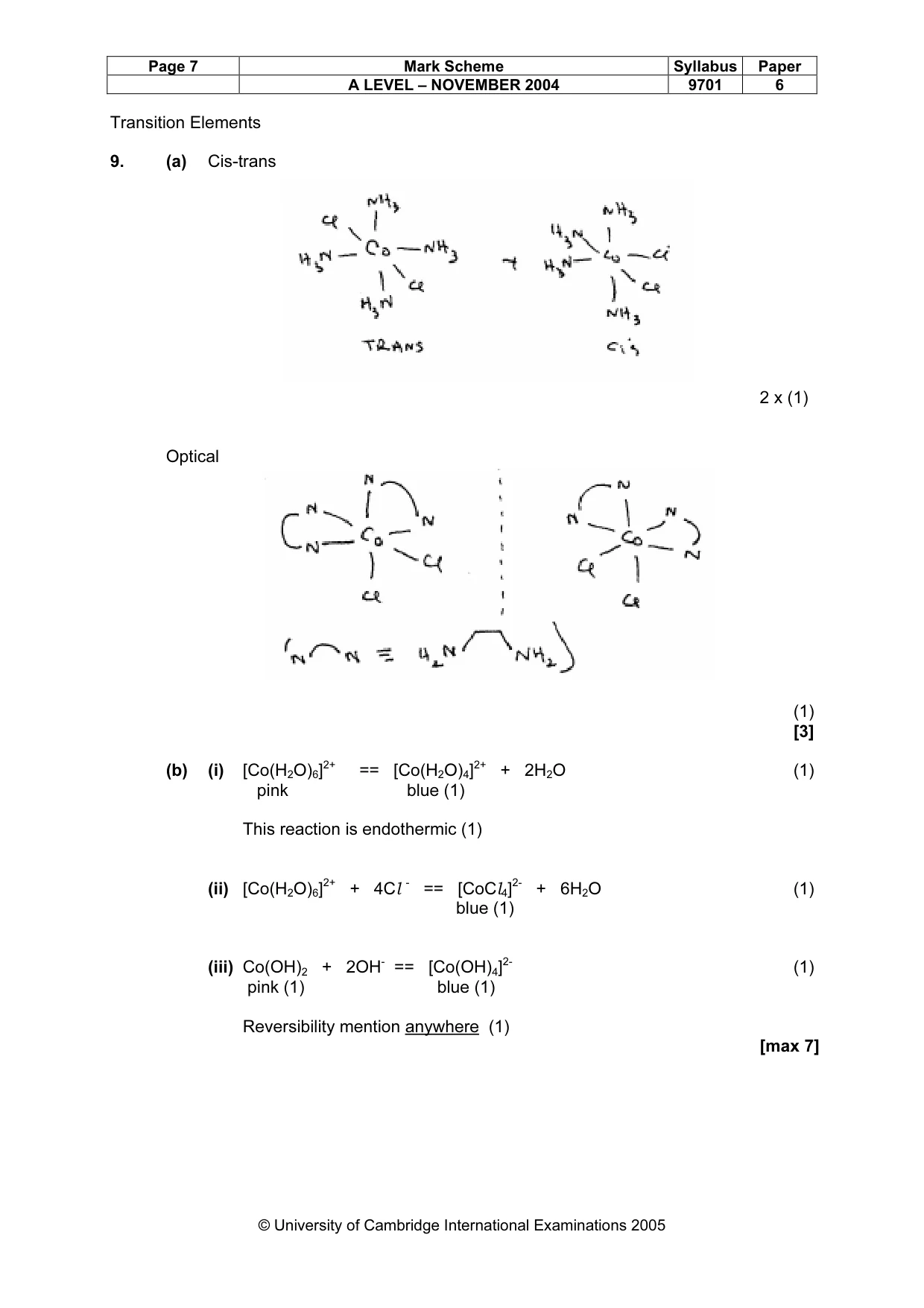
Page 7 Mark Scheme Syllabus Paper A LEVEL – NOVEMBER 2004 9701 6 © University of Cambridge International Examinations 2005 Transition Elements 9. (a) Cis-trans 2 x (1) Optical (1) [3] (b) (i) [Co(H2O)6]2+ == [Co(H2O)4]2+ + 2H2O (1) pink blue (1) This reaction is endothermic (1) (ii) [Co(H2O)6]2+ + 4Cl - == [CoCl4]2- + 6H2O (1) blue (1) (iii) Co(OH)2 + 2OH- == [Co(OH)4]2- (1) pink (1) blue (1) Reversibility mention anywhere (1) [max 7]
Mark scheme, page 11
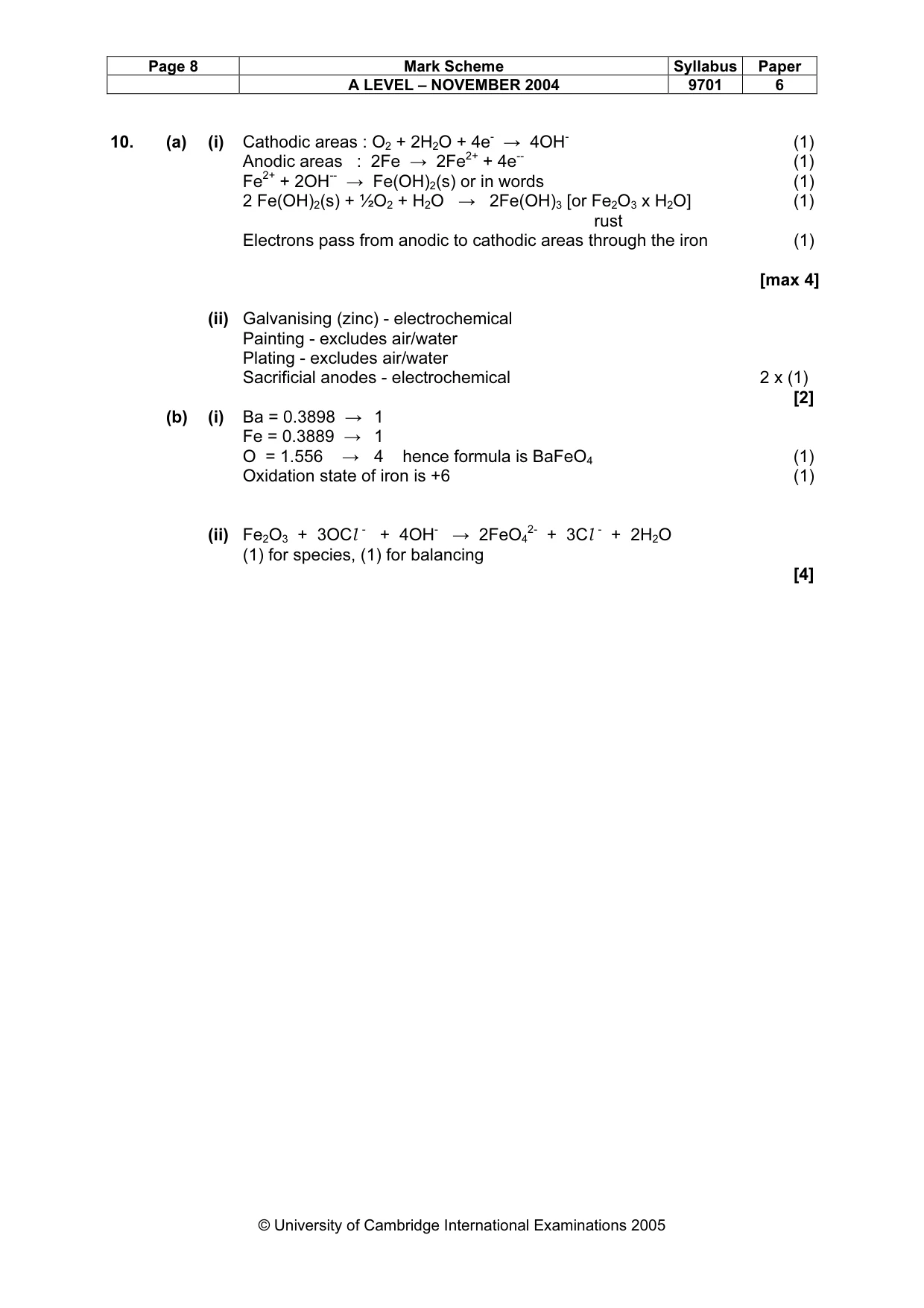
Page 8 Mark Scheme Syllabus Paper A LEVEL – NOVEMBER 2004 9701 6 © University of Cambridge International Examinations 2005 10. (a) (i) Cathodic areas : O2 + 2H2O + 4e- → 4OH- (1) Anodic areas : 2Fe → 2Fe2+ + 4e-- (1) Fe2+ + 2OH-- → Fe(OH)2(s) or in words (1) 2 Fe(OH)2(s) + ½O2 + H2O → 2Fe(OH)3 [or Fe2O3 x H2O] (1) rust Electrons pass from anodic to cathodic areas through the iron (1) [max 4] (ii) Galvanising (zinc) - electrochemical Painting - excludes air/water Plating - excludes air/water Sacrificial anodes - electrochemical 2 x (1) [2] (b) (i) Ba = 0.3898 → 1 Fe = 0.3889 → 1 O = 1.556 → 4 hence formula is BaFeO4 (1) Oxidation state of iron is +6 (1) (ii) Fe2O3 + 3OCl - + 4OH- → 2FeO4 2- + 3Cl - + 2H2O (1) for species, (1) for balancing [4]