Cambridge A Level Chemistry 9701 — 2006 Oct/Nov Paper 6 · Variant 1
9701/61/O/N/06 · 40 marks · ≈45 min
The question paper and its mark scheme, free to read here and free to download. This is Cambridge’s own paper, exactly as it was sat.
Question paper12 pages
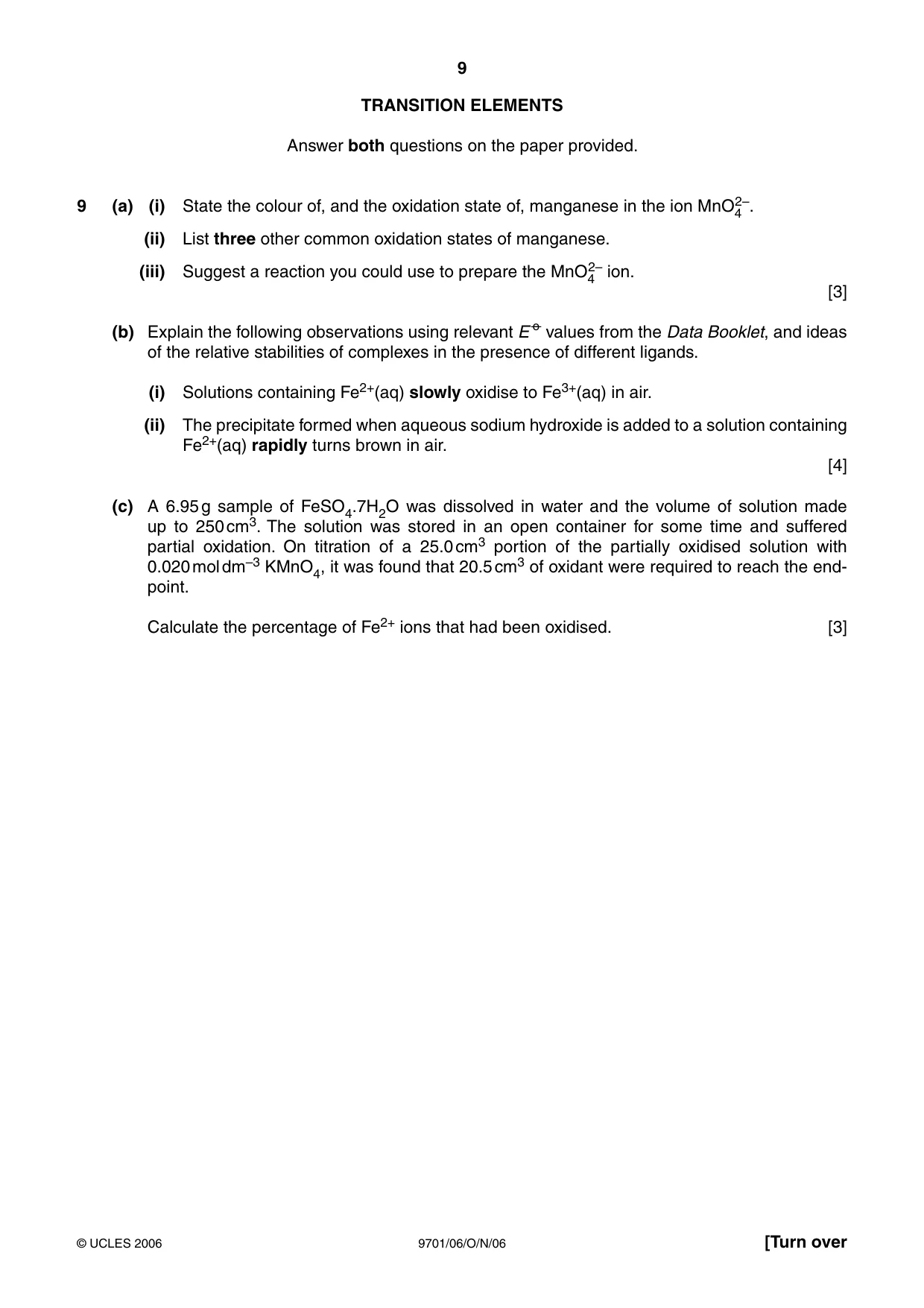

Mark scheme11 pages
Answers below. Sit the paper first if you are practising.
Paper as text
Question paper, page 1
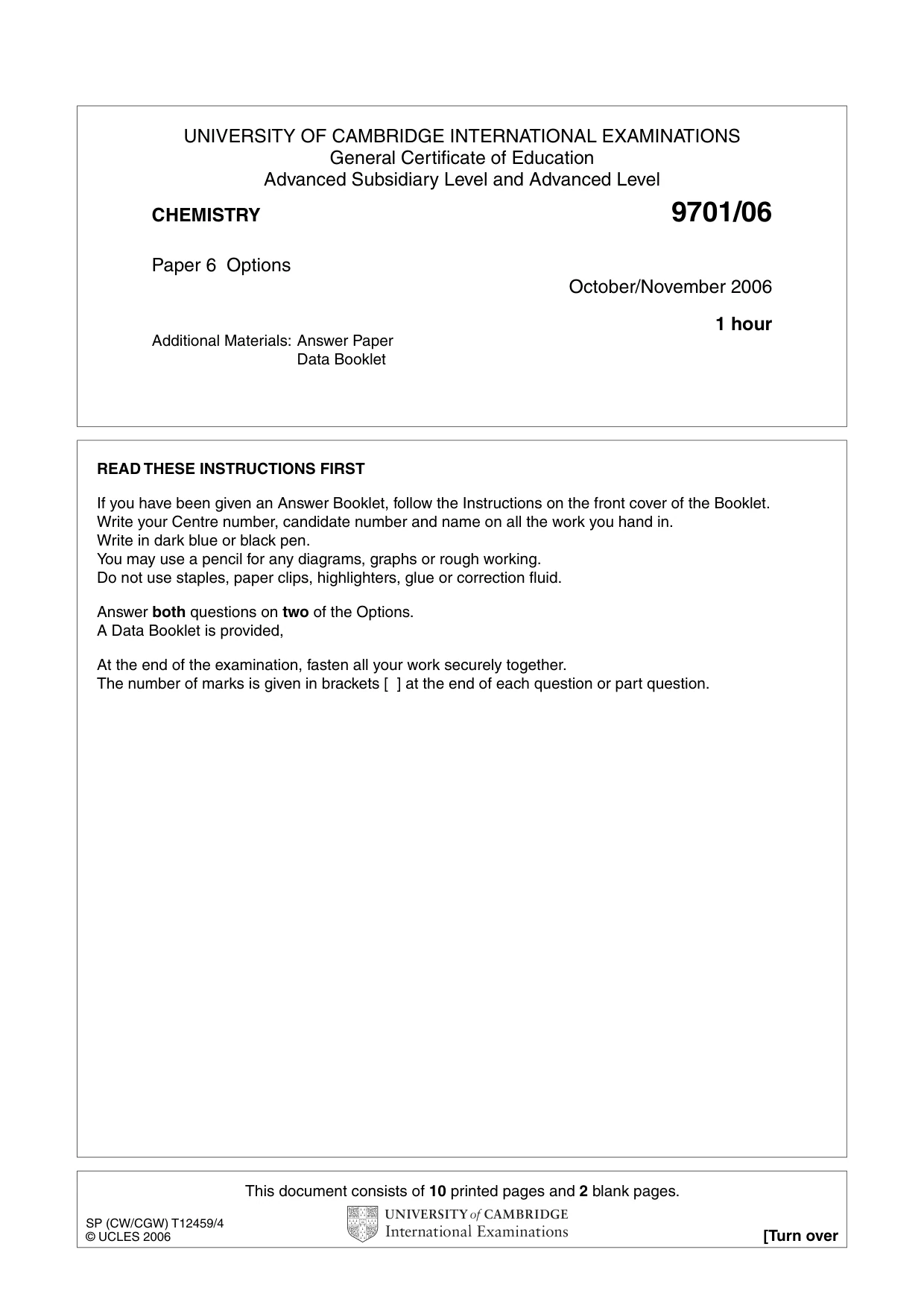
This document consists of 10 printed pages and 2 blank pages. SP (CW/CGW) T12459/4 © UCLES 2006 [Turn over UNIVERSITY OF CAMBRIDGE INTERNATIONAL EXAMINATIONS General Certificate of Education Advanced Subsidiary Level and Advanced Level CHEMISTRY 9701/06 Paper 6 Options October/November 2006 1 hour Additional Materials: Answer Paper Data Booklet READ THESE INSTRUCTIONS FIRST If you have been given an Answer Booklet, follow the Instructions on the front cover of the Booklet. Write your Centre number, candidate number and name on all the work you hand in. Write in dark blue or black pen. You may use a pencil for any diagrams, graphs or rough working. Do not use staples, paper clips, highlighters, glue or correction fluid. Answer both questions on two of the Options. A Data Booklet is provided, At the end of the examination, fasten all your work securely together. The number of marks is given in brackets [ ] at the end of each question or part question.
Question paper, page 2
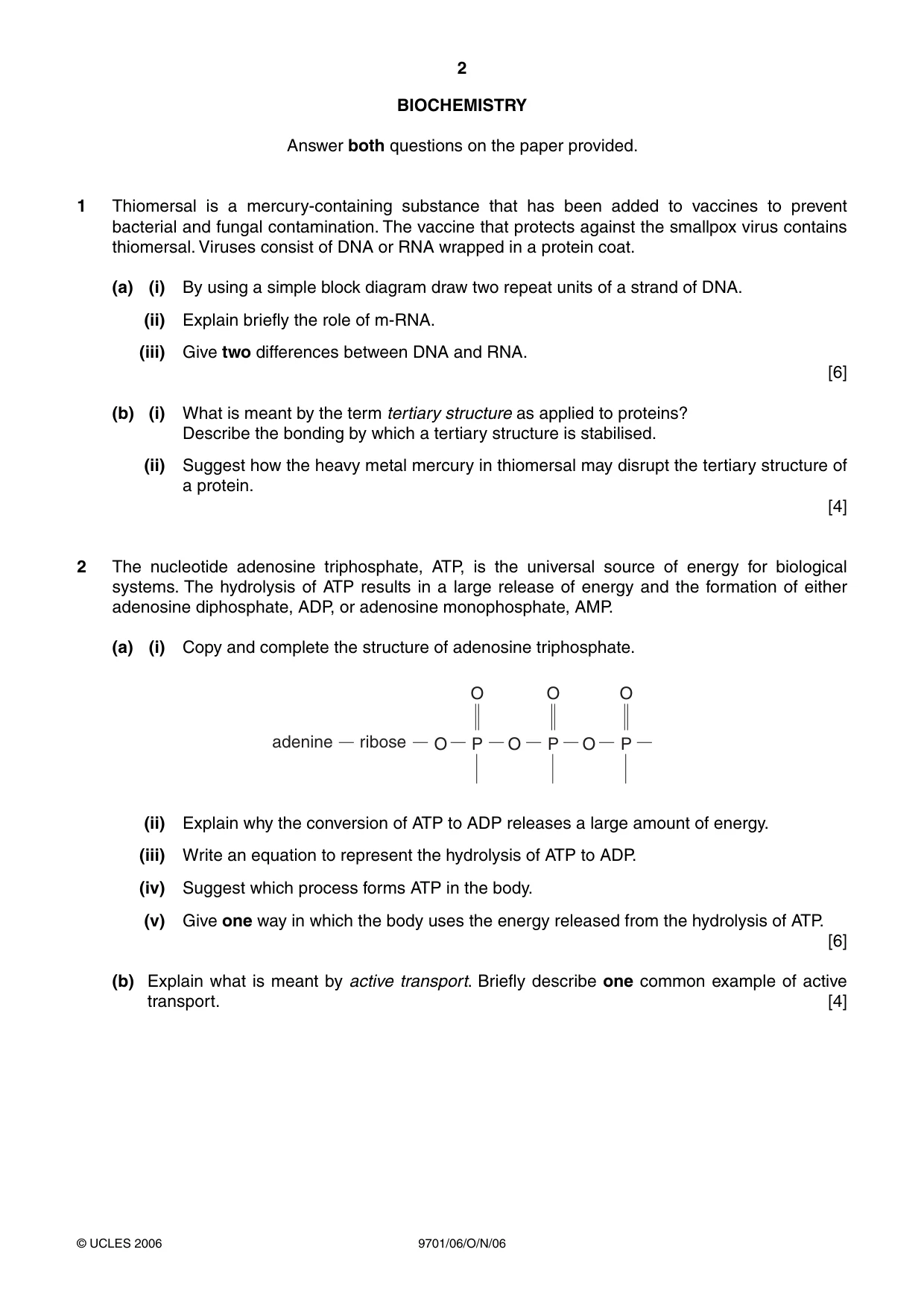
2 9701/06/O/N/06 © UCLES 2006 BIOCHEMISTRY Answer both questions on the paper provided. 1 Thiomersal is a mercury-containing substance that has been added to vaccines to prevent bacterial and fungal contamination. The vaccine that protects against the smallpox virus contains thiomersal. Viruses consist of DNA or RNA wrapped in a protein coat. (a) (i) By using a simple block diagram draw two repeat units of a strand of DNA. (ii) Explain briefly the role of m-RNA. (iii) Give two differences between DNA and RNA. [6] (b) (i) What is meant by the term tertiary structure as applied to proteins? Describe the bonding by which a tertiary structure is stabilised. (ii) Suggest how the heavy metal mercury in thiomersal may disrupt the tertiary structure of a protein. [4] 2 The nucleotide adenosine triphosphate, ATP, is the universal source of energy for biological systems. The hydrolysis of ATP results in a large release of energy and the formation of either adenosine diphosphate, ADP, or adenosine monophosphate, AMP. (a) (i) Copy and complete the structure of adenosine triphosphate. O P O O O P O O P ribose adenine (ii) Explain why the conversion of ATP to ADP releases a large amount of energy. (iii) Write an equation to represent the hydrolysis of ATP to ADP. (iv) Suggest which process forms ATP in the body. (v) Give one way in which the body uses the energy released from the hydrolysis of ATP. [6] (b) Explain what is meant by active transport. Briefly describe one common example of active transport. [4]
Question paper, page 3
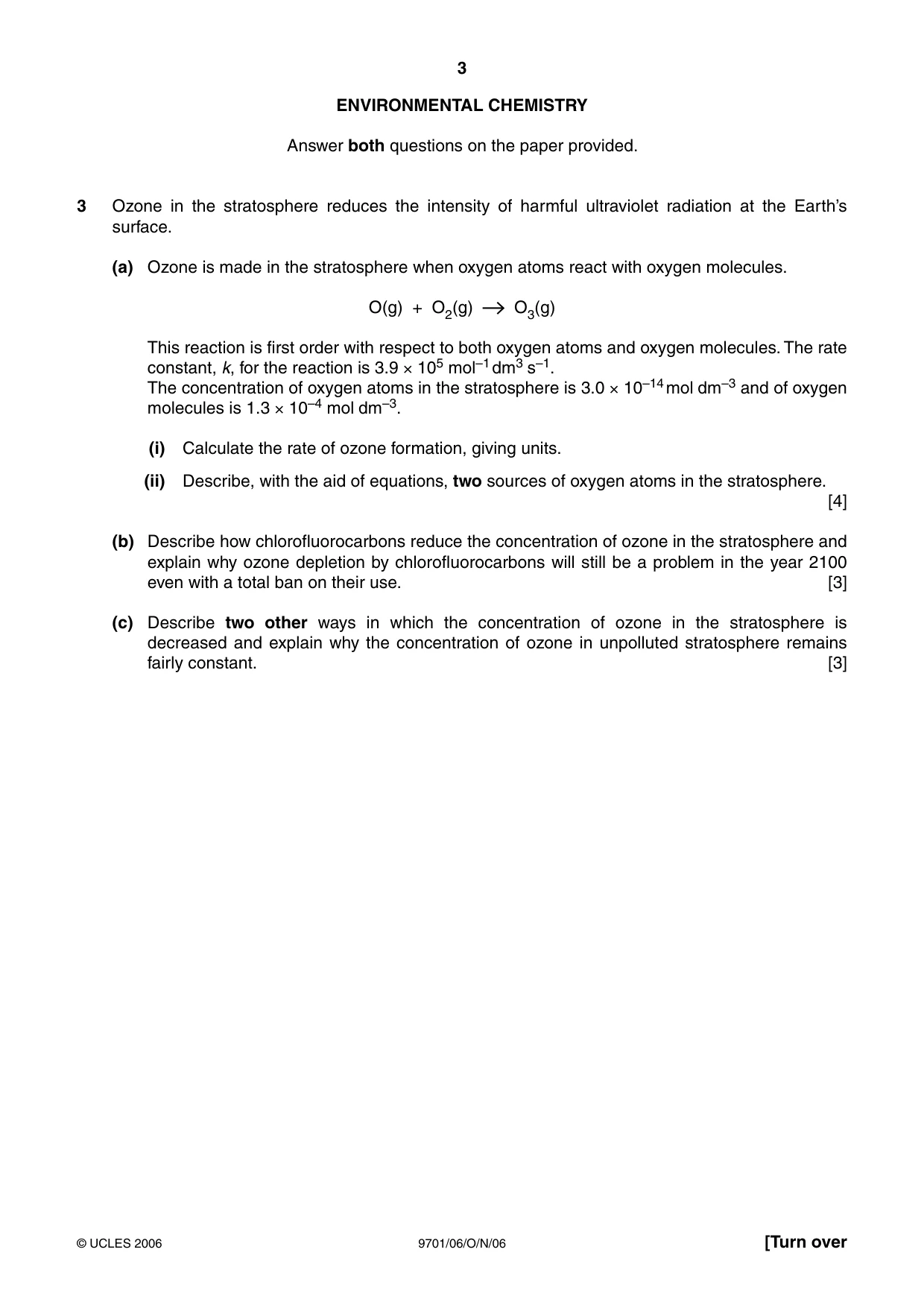
3 9701/06/O/N/06 [Turn over © UCLES 2006 ENVIRONMENTAL CHEMISTRY Answer both questions on the paper provided. 3 Ozone in the stratosphere reduces the intensity of harmful ultraviolet radiation at the Earth’s surface. (a) Ozone is made in the stratosphere when oxygen atoms react with oxygen molecules. O(g) + O2(g) O3(g) This reaction is first order with respect to both oxygen atoms and oxygen molecules. The rate constant, k, for the reaction is 3.9 × 10⁵ mol–1 dm3 s–1. The concentration of oxygen atoms in the stratosphere is 3.0 × 10⁻¹⁴ mol dm–3 and of oxygen molecules is 1.3 × 10⁻⁴ mol dm–3. (i) Calculate the rate of ozone formation, giving units. (ii) Describe, with the aid of equations, two sources of oxygen atoms in the stratosphere. [4] (b) Describe how chlorofluorocarbons reduce the concentration of ozone in the stratosphere and explain why ozone depletion by chlorofluorocarbons will still be a problem in the year 2100 even with a total ban on their use. [3] (c) Describe two other ways in which the concentration of ozone in the stratosphere is decreased and explain why the concentration of ozone in unpolluted stratosphere remains fairly constant. [3]
Question paper, page 4
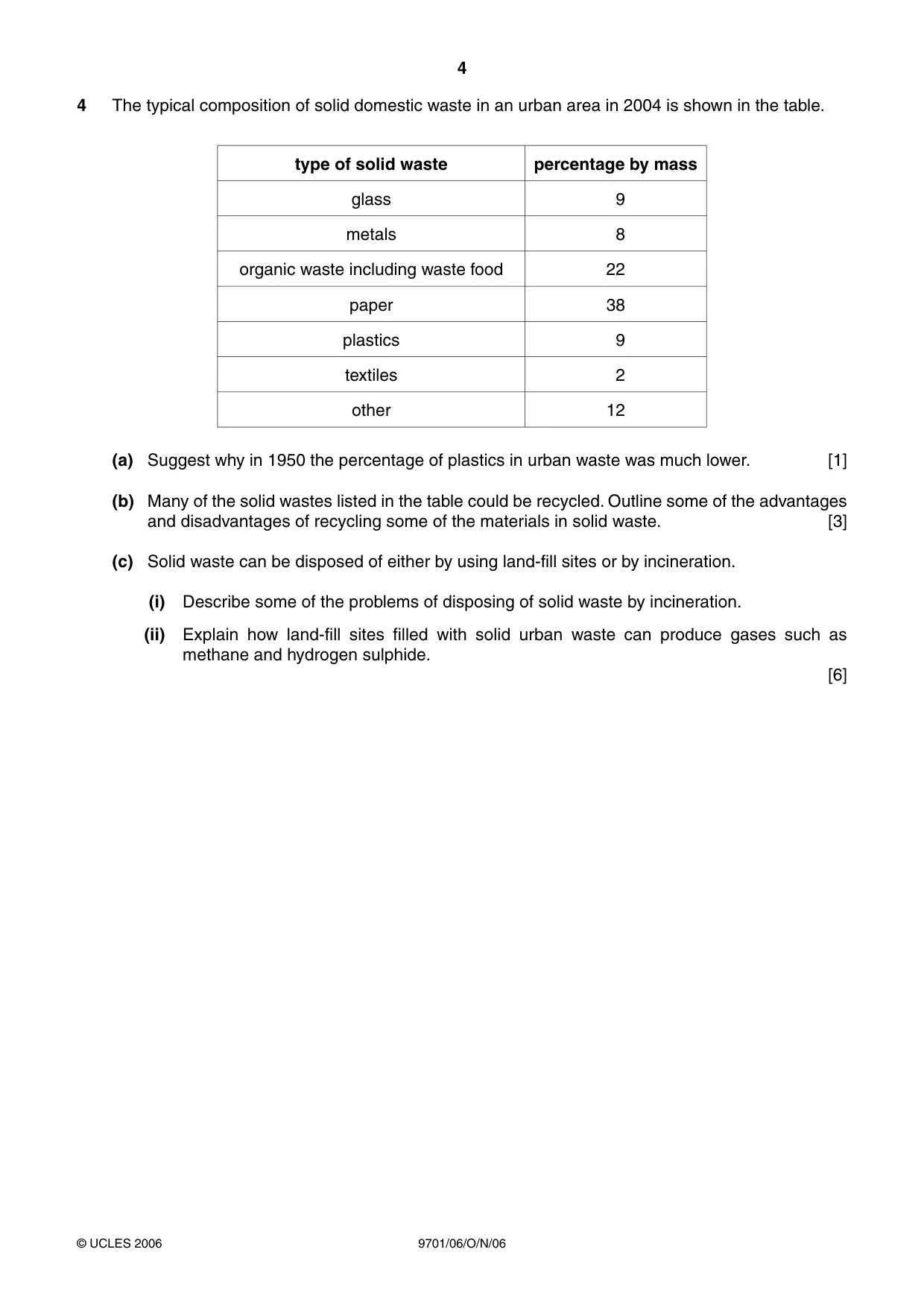
4 9701/06/O/N/06 © UCLES 2006 4 The typical composition of solid domestic waste in an urban area in 2004 is shown in the table. type of solid waste percentage by mass glass 9 metals 8 organic waste including waste food 22 paper 38 plastics 9 textiles 2 other 12 (a) Suggest why in 1950 the percentage of plastics in urban waste was much lower. [1] (b) Many of the solid wastes listed in the table could be recycled. Outline some of the advantages and disadvantages of recycling some of the materials in solid waste. [3] (c) Solid waste can be disposed of either by using land-fill sites or by incineration. (i) Describe some of the problems of disposing of solid waste by incineration. (ii) Explain how land-fill sites filled with solid urban waste can produce gases such as methane and hydrogen sulphide. [6]
Question paper, page 5
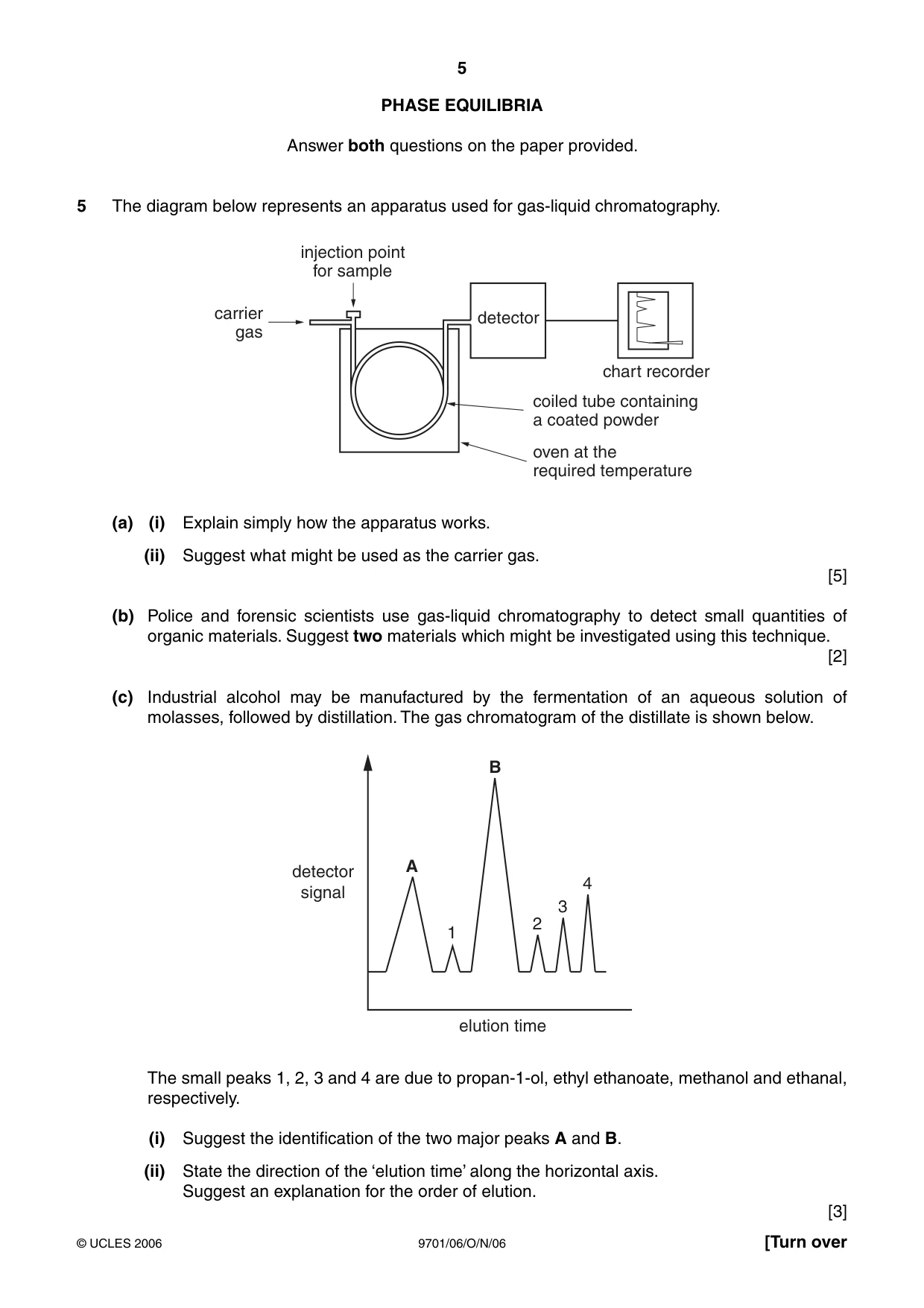
5 9701/06/O/N/06 [Turn over © UCLES 2006 PHASE EQUILIBRIA Answer both questions on the paper provided. 5 The diagram below represents an apparatus used for gas-liquid chromatography. detector chart recorder carrier gas injection point for sample coiled tube containing a coated powder oven at the required temperature (a) (i) Explain simply how the apparatus works. (ii) Suggest what might be used as the carrier gas. [5] (b) Police and forensic scientists use gas-liquid chromatography to detect small quantities of organic materials. Suggest two materials which might be investigated using this technique. [2] (c) Industrial alcohol may be manufactured by the fermentation of an aqueous solution of molasses, followed by distillation. The gas chromatogram of the distillate is shown below. A B 1 2 3 4 elution time detector signal The small peaks 1, 2, 3 and 4 are due to propan-1-ol, ethyl ethanoate, methanol and ethanal, respectively. (i) Suggest the identification of the two major peaks A and B. (ii) State the direction of the ‘elution time’ along the horizontal axis. Suggest an explanation for the order of elution. [3]
Question paper, page 6
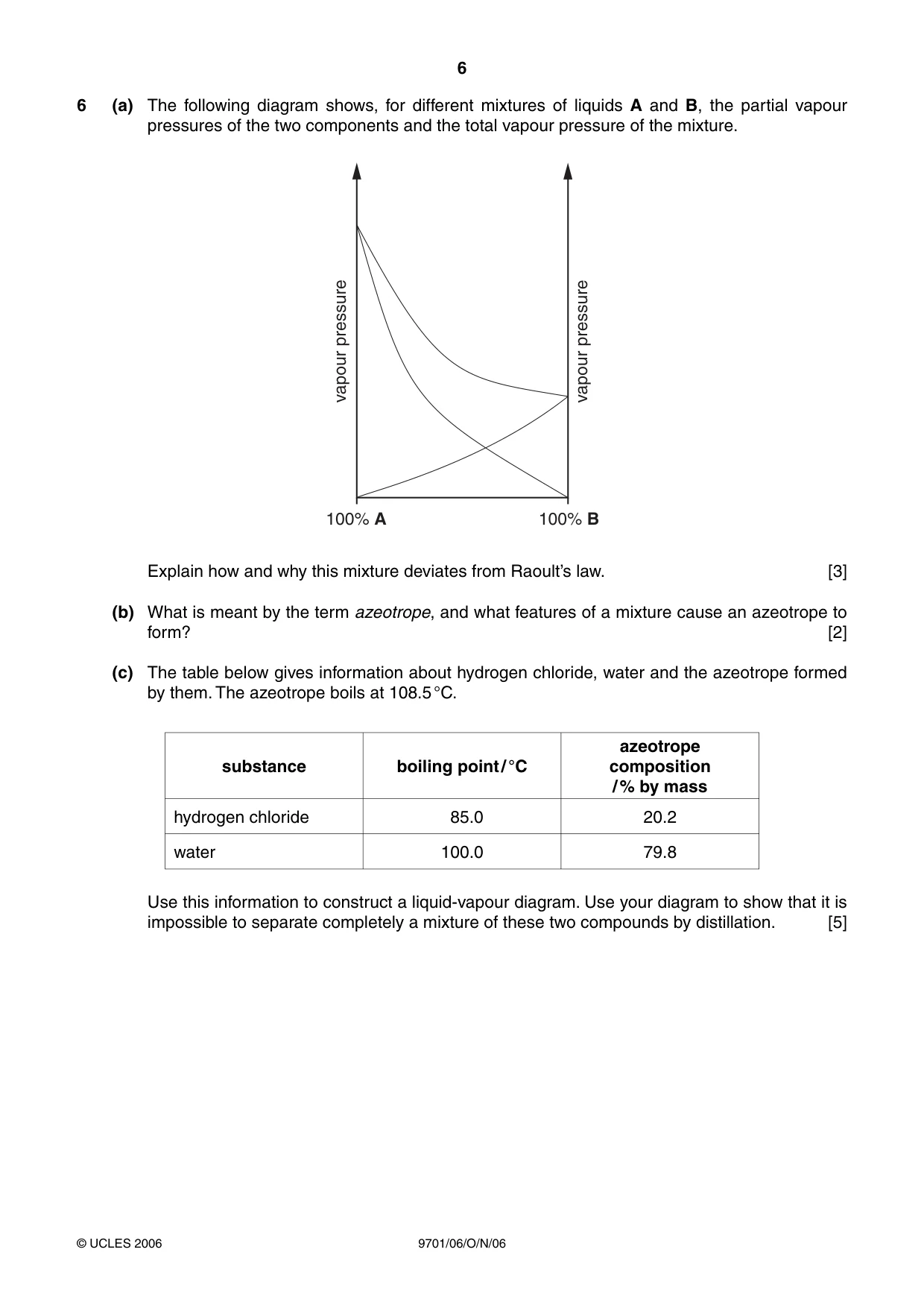
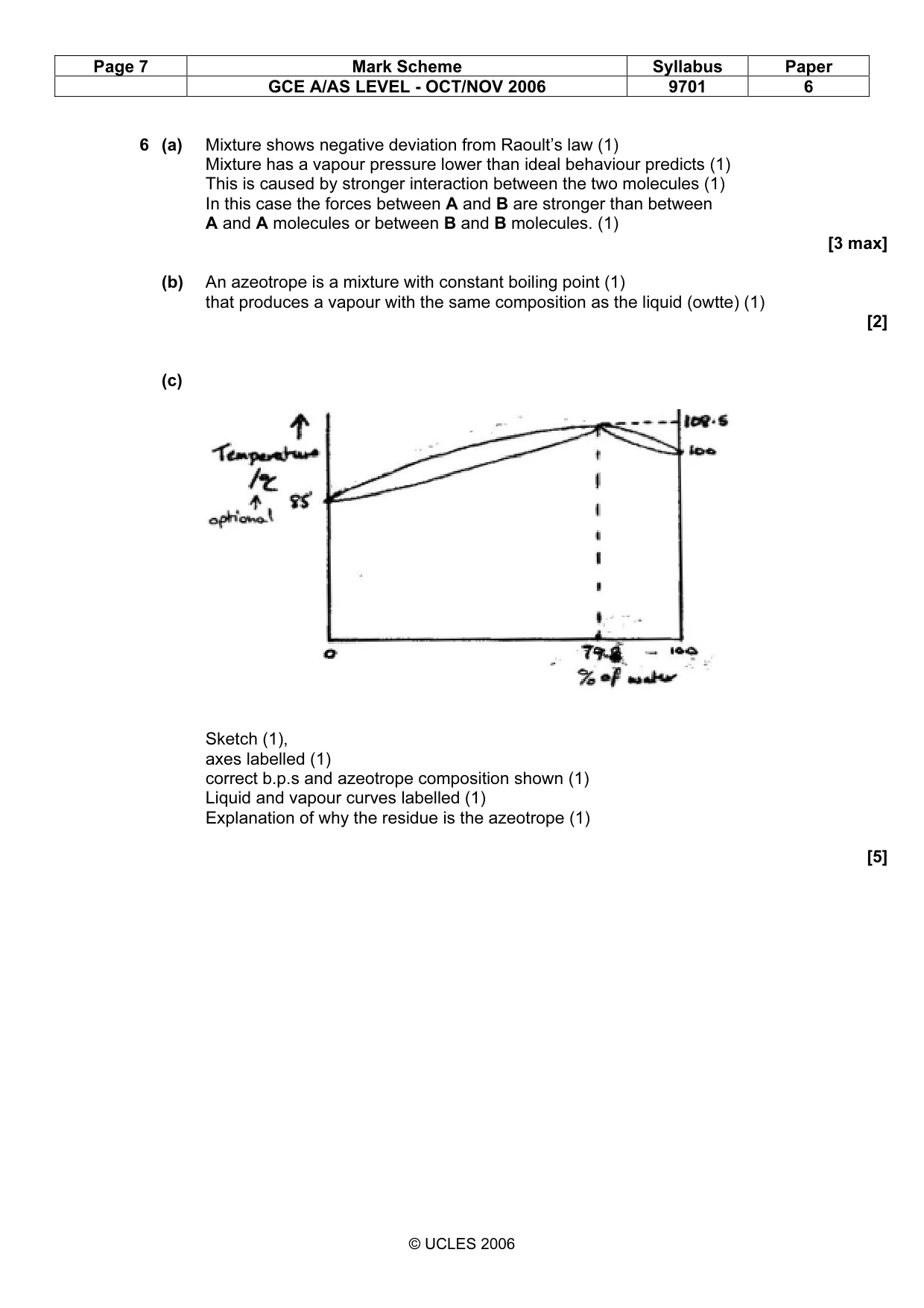
6 9701/06/O/N/06 © UCLES 2006 6 (a) The following diagram shows, for different mixtures of liquids A and B, the partial vapour pressures of the two components and the total vapour pressure of the mixture. vapour pressure 100% A 100% B vapour pressure Explain how and why this mixture deviates from Raoult’s law. [3] (b) What is meant by the term azeotrope, and what features of a mixture cause an azeotrope to form? [2] (c) The table below gives information about hydrogen chloride, water and the azeotrope formed by them. The azeotrope boils at 108.5 °C. substance boiling point / °C azeotrope composition / % by mass hydrogen chloride 85.0 20.2 water 100.0 79.8 Use this information to construct a liquid-vapour diagram. Use your diagram to show that it is impossible to separate completely a mixture of these two compounds by distillation. [5]
Question paper, page 7
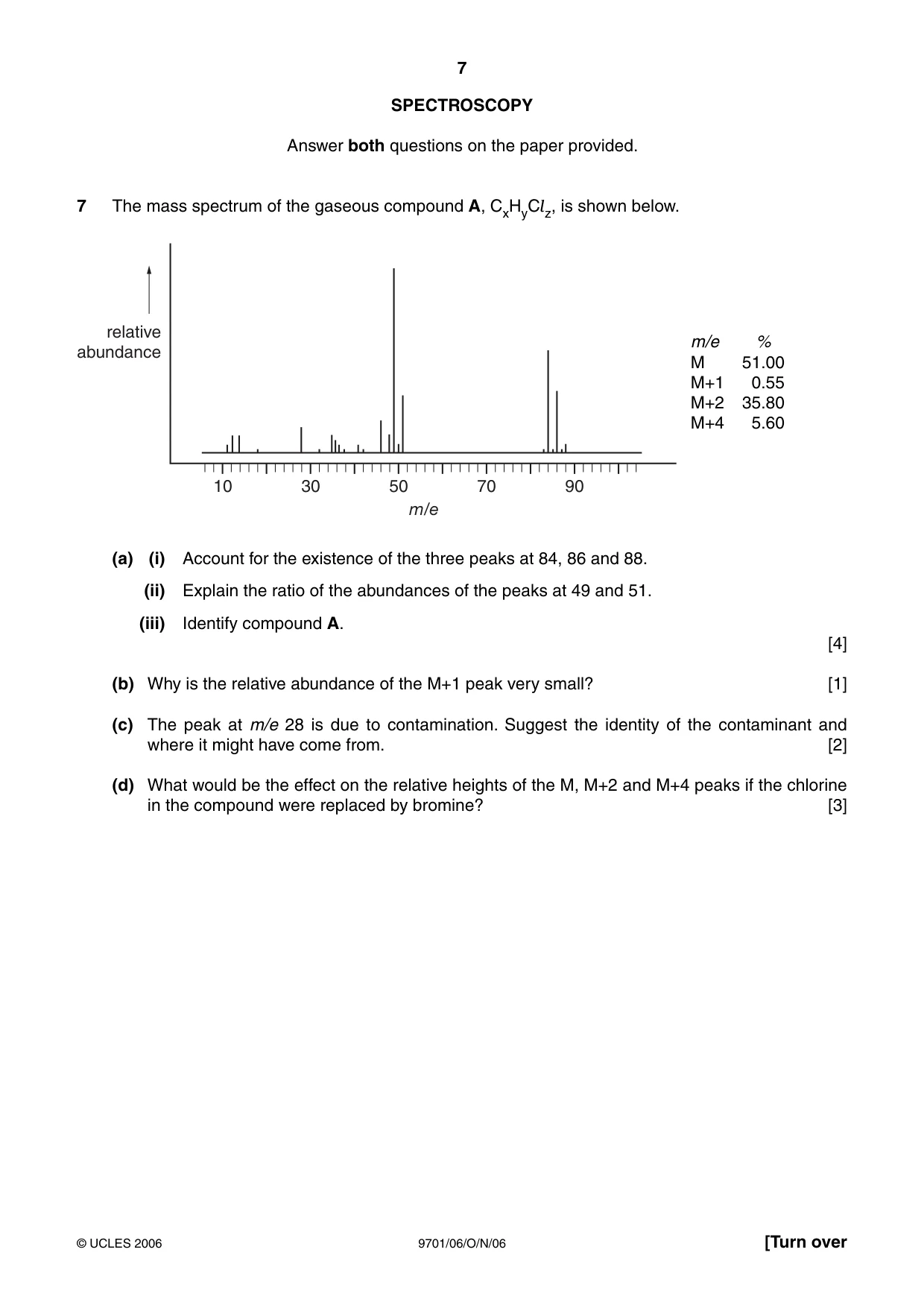
7 9701/06/O/N/06 [Turn over © UCLES 2006 SPECTROSCOPY Answer both questions on the paper provided. 7 The mass spectrum of the gaseous compound A, CxHyClz, is shown below. 10 relative abundance 30 m/e 50 70 90 m/e % M 51.00 M+1 0.55 M+2 35.80 M+4 5.60 (a) (i) Account for the existence of the three peaks at 84, 86 and 88. (ii) Explain the ratio of the abundances of the peaks at 49 and 51. (iii) Identify compound A. [4] (b) Why is the relative abundance of the M+1 peak very small? [1] (c) The peak at m/e 28 is due to contamination. Suggest the identity of the contaminant and where it might have come from. [2] (d) What would be the effect on the relative heights of the M, M+2 and M+4 peaks if the chlorine in the compound were replaced by bromine? [3]
Question paper, page 8
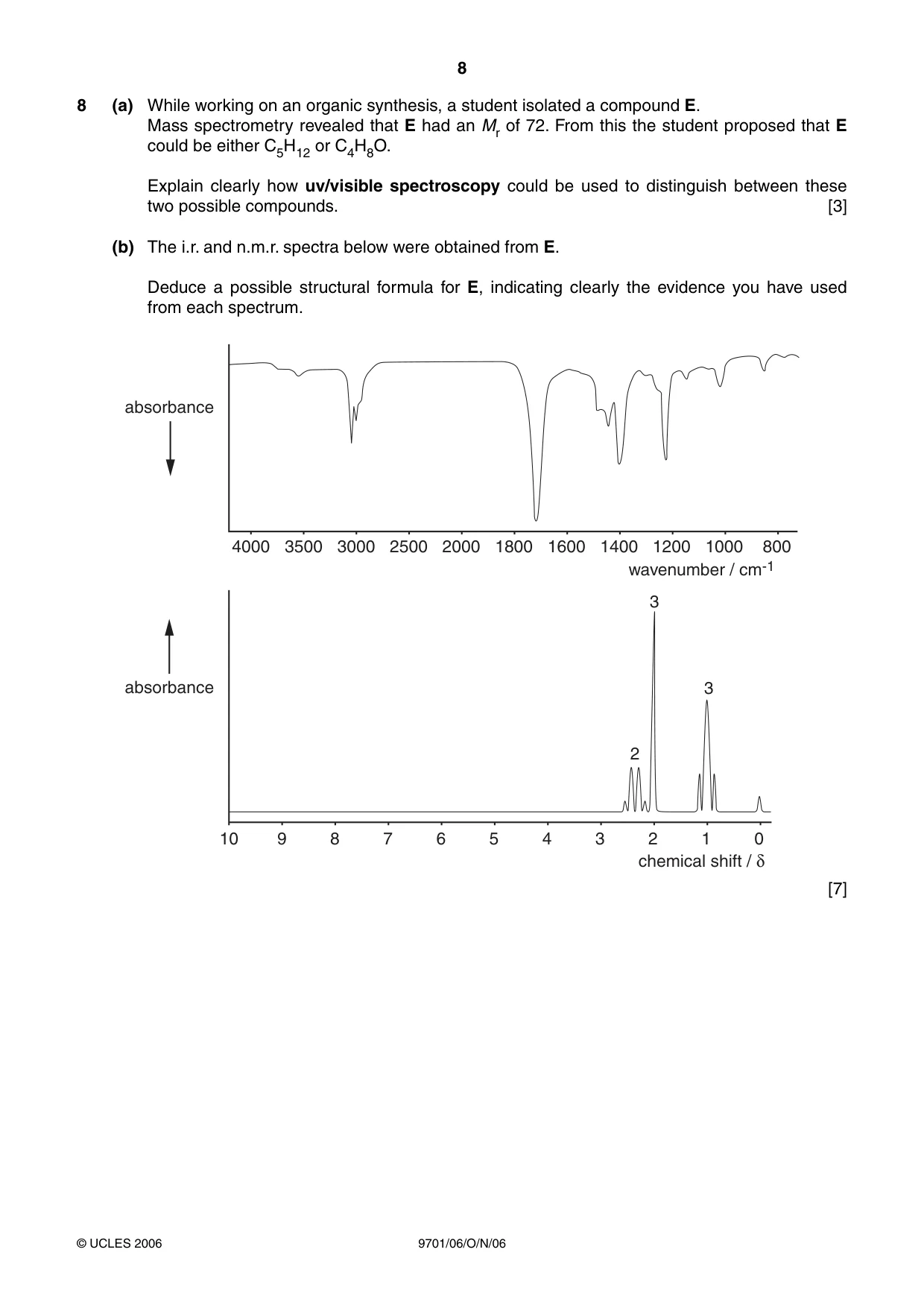
8 9701/06/O/N/06 © UCLES 2006 8 (a) While working on an organic synthesis, a student isolated a compound E. Mass spectrometry revealed that E had an Mr of 72. From this the student proposed that E could be either C5H12 or C4H8O. Explain clearly how uv/visible spectroscopy could be used to distinguish between these two possible compounds. [3] (b) The i.r. and n.m.r. spectra below were obtained from E. Deduce a possible structural formula for E, indicating clearly the evidence you have used from each spectrum. absorbance absorbance 4000 10 9 8 7 6 5 4 3 3 3 2 2 1 0 3500 3000 2500 2000 1800 wavenumber / cm-1 chemical shift / δ 1600 1400 1200 1000 800 [7]
Question paper, page 9
9 9701/06/O/N/06 [Turn over © UCLES 2006 TRANSITION ELEMENTS Answer both questions on the paper provided. 9 (a) (i) State the colour of, and the oxidation state of, manganese in the ion MnO4 2–. (ii) List three other common oxidation states of manganese. (iii) Suggest a reaction you could use to prepare the MnO4 2– ion. [3] (b) Explain the following observations using relevant E o–– values from the Data Booklet, and ideas of the relative stabilities of complexes in the presence of different ligands. (i) Solutions containing Fe2+(aq) slowly oxidise to Fe3+(aq) in air. (ii) The precipitate formed when aqueous sodium hydroxide is added to a solution containing Fe2+(aq) rapidly turns brown in air. [4] (c) A 6.95 g sample of FeSO4.7H2O was dissolved in water and the volume of solution made up to 250 cm3. The solution was stored in an open container for some time and suffered partial oxidation. On titration of a 25.0 cm3 portion of the partially oxidised solution with 0.020 mol dm–3 KMnO4, it was found that 20.5 cm3 of oxidant were required to reach the end- point. Calculate the percentage of Fe2+ ions that had been oxidised. [3]
Question paper, page 10
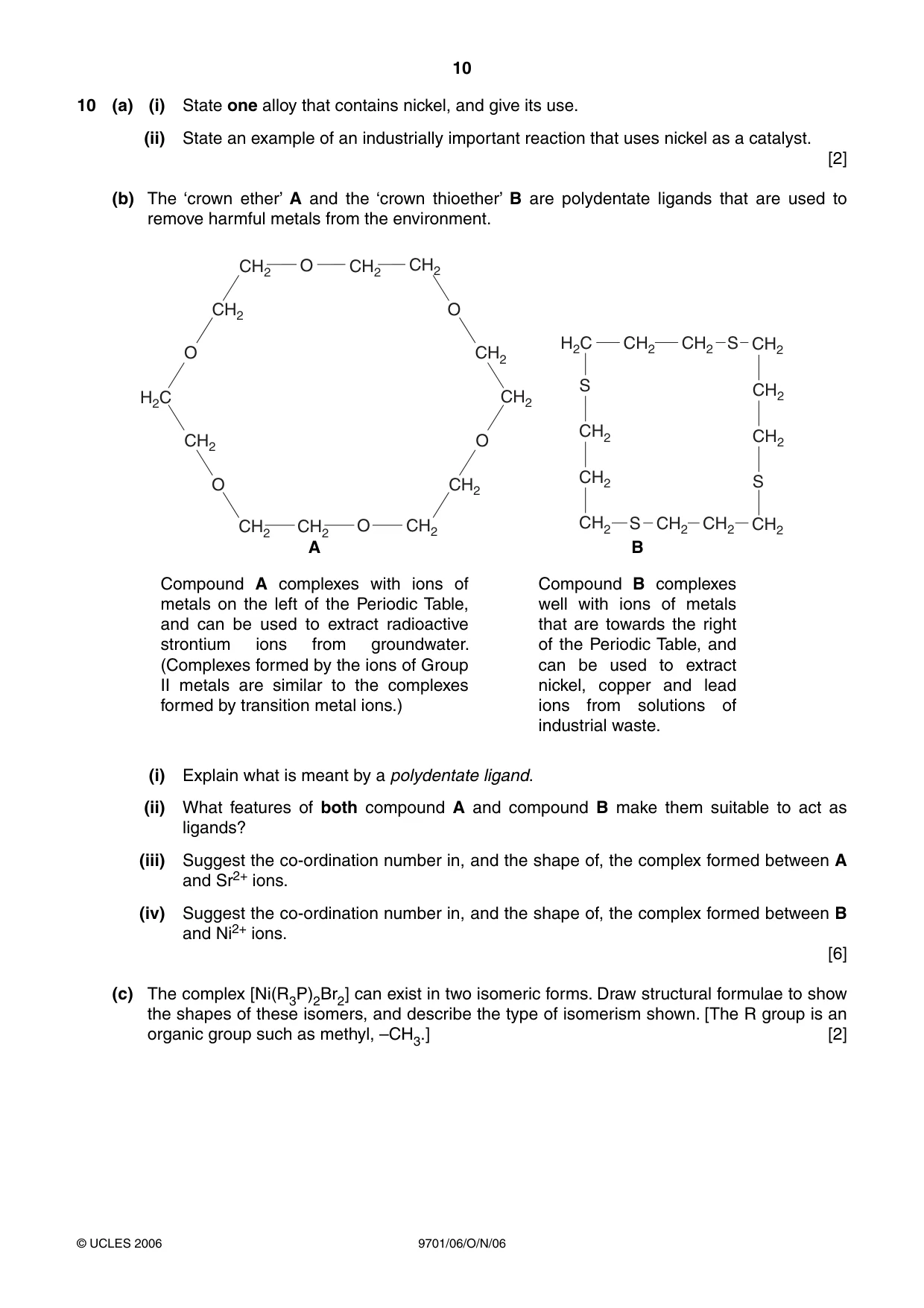
10 9701/06/O/N/06 © UCLES 2006 10 (a) (i) State one alloy that contains nickel, and give its use. (ii) State an example of an industrially important reaction that uses nickel as a catalyst. [2] (b) The ‘crown ether’ A and the ‘crown thioether’ B are polydentate ligands that are used to remove harmful metals from the environment. CH2 CH2 CH2 CH2 CH2 CH2 CH2 CH2 H2C O O O O O CH2 CH2 CH2 O H2C S CH2 CH2 CH2 CH2 S CH2 CH2 CH2 CH2 CH2 CH2 CH2 S S A B Compound A complexes with ions of metals on the left of the Periodic Table, and can be used to extract radioactive strontium ions from groundwater. (Complexes formed by the ions of Group II metals are similar to the complexes formed by transition metal ions.) Compound B complexes well with ions of metals that are towards the right of the Periodic Table, and can be used to extract nickel, copper and lead ions from solutions of industrial waste. (i) Explain what is meant by a polydentate ligand. (ii) What features of both compound A and compound B make them suitable to act as ligands? (iii) Suggest the co-ordination number in, and the shape of, the complex formed between A and Sr2+ ions. (iv) Suggest the co-ordination number in, and the shape of, the complex formed between B and Ni2+ ions. [6] (c) The complex [Ni(R3P)2Br2] can exist in two isomeric forms. Draw structural formulae to show the shapes of these isomers, and describe the type of isomerism shown. [The R group is an organic group such as methyl, –CH3.] [2]
Question paper, page 12
12 9701/06/O/N/06 BLANK PAGE Permission to reproduce items where third-party owned material protected by copyright is included has been sought and cleared where possible. Every reasonable effort has been made by the publisher (UCLES) to trace copyright holders, but if any items requiring clearance have unwittingly been included, the publisher will be pleased to make amends at the earliest possible opportunity. University of Cambridge International Examinations is part of the University of Cambridge Local Examinations Syndicate (UCLES), which is itself a department of the University of Cambridge.
Mark scheme, page 1
UNIVERSITY OF CAMBRIDGE INTERNATIONAL EXAMINATIONS GCE Advanced Subsidiary Level and GCE Advanced Level MARK SCHEME for the October/November 2006 question paper 9701 CHEMISTRY 9701/06 Paper 6, maximum raw mark 40 This mark scheme is published as an aid to teachers and students, to indicate the requirements of the examination. It shows the basis on which Examiners were instructed to award marks. It does not indicate the details of the discussions that took place at an Examiners’ meeting before marking began. All Examiners are instructed that alternative correct answers and unexpected approaches in candidates’ scripts must be given marks that fairly reflect the relevant knowledge and skills demonstrated. Mark schemes must be read in conjunction with the question papers and the report on the examination. The grade thresholds for various grades are published in the report on the examination for most IGCSE, GCE Advanced Level and Advanced Subsidiary Level syllabuses. • CIE will not enter into discussions or correspondence in connection with these mark schemes. CIE is publishing the mark schemes for the October/November 2006 question papers for most IGCSE, GCE Advanced Level and Advanced Subsidiary Level syllabuses and some Ordinary Level syllabuses.
Mark scheme, page 2
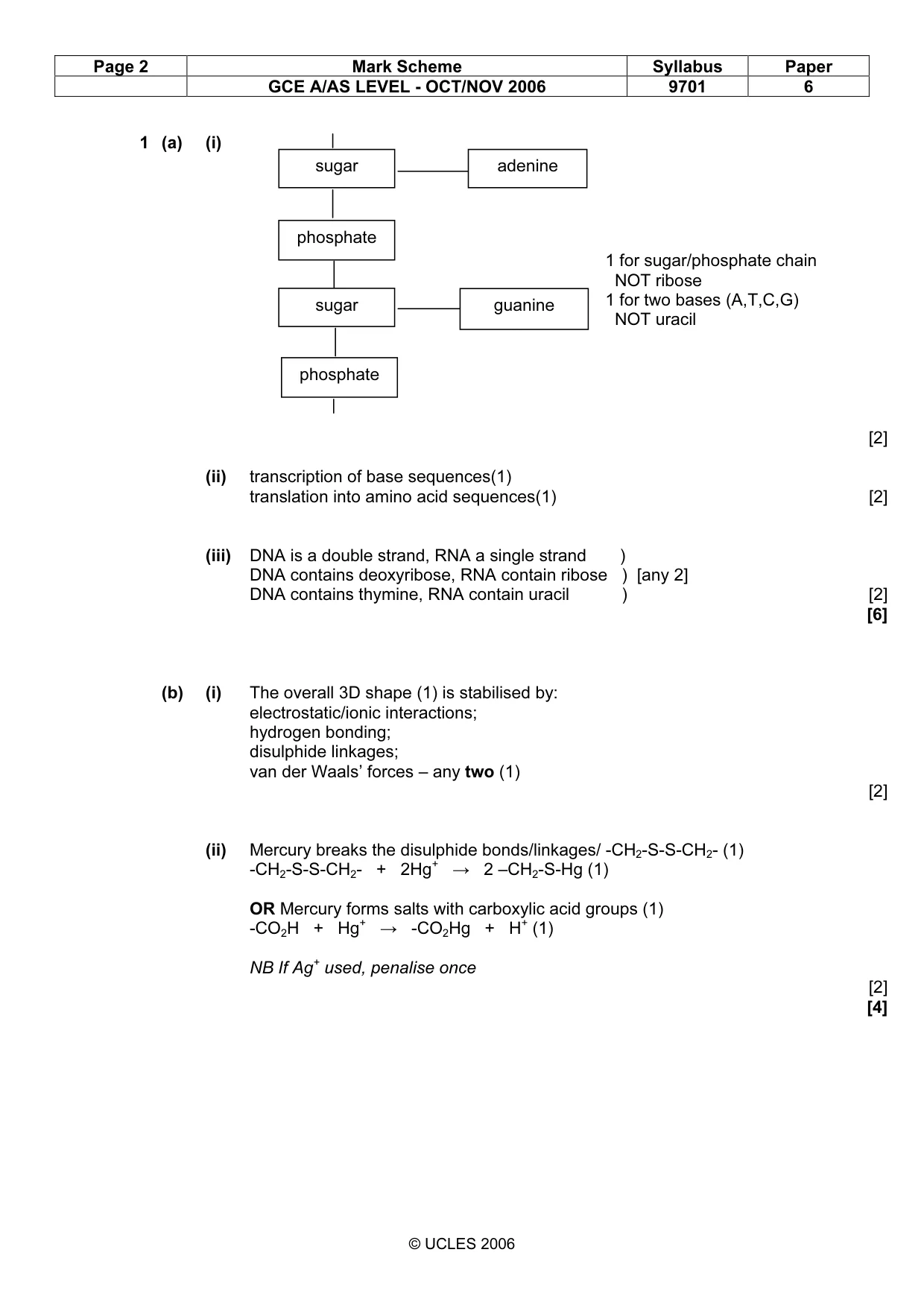
Page 2 Mark Scheme Syllabus Paper GCE A/AS LEVEL - OCT/NOV 2006 9701 6 © UCLES 2006 1 (a) (i) 1 for sugar/phosphate chain NOT ribose 1 for two bases (A,T,C,G) NOT uracil [2] (ii) transcription of base sequences(1) translation into amino acid sequences(1) [2] (iii) DNA is a double strand, RNA a single strand ) DNA contains deoxyribose, RNA contain ribose ) [any 2] DNA contains thymine, RNA contain uracil ) [2] [6] (b) (i) The overall 3D shape (1) is stabilised by: electrostatic/ionic interactions; hydrogen bonding; disulphide linkages; van der Waals’ forces – any two (1) [2] (ii) Mercury breaks the disulphide bonds/linkages/ -CH2-S-S-CH2- (1) -CH2-S-S-CH2- + 2Hg+ → 2 –CH2-S-Hg (1) OR Mercury forms salts with carboxylic acid groups (1) -CO2H + Hg+ → -CO2Hg + H+ (1) NB If Ag+ used, penalise once [2] [4] sugar phosphate sugar phosphate adenine guanine
Mark scheme, page 3
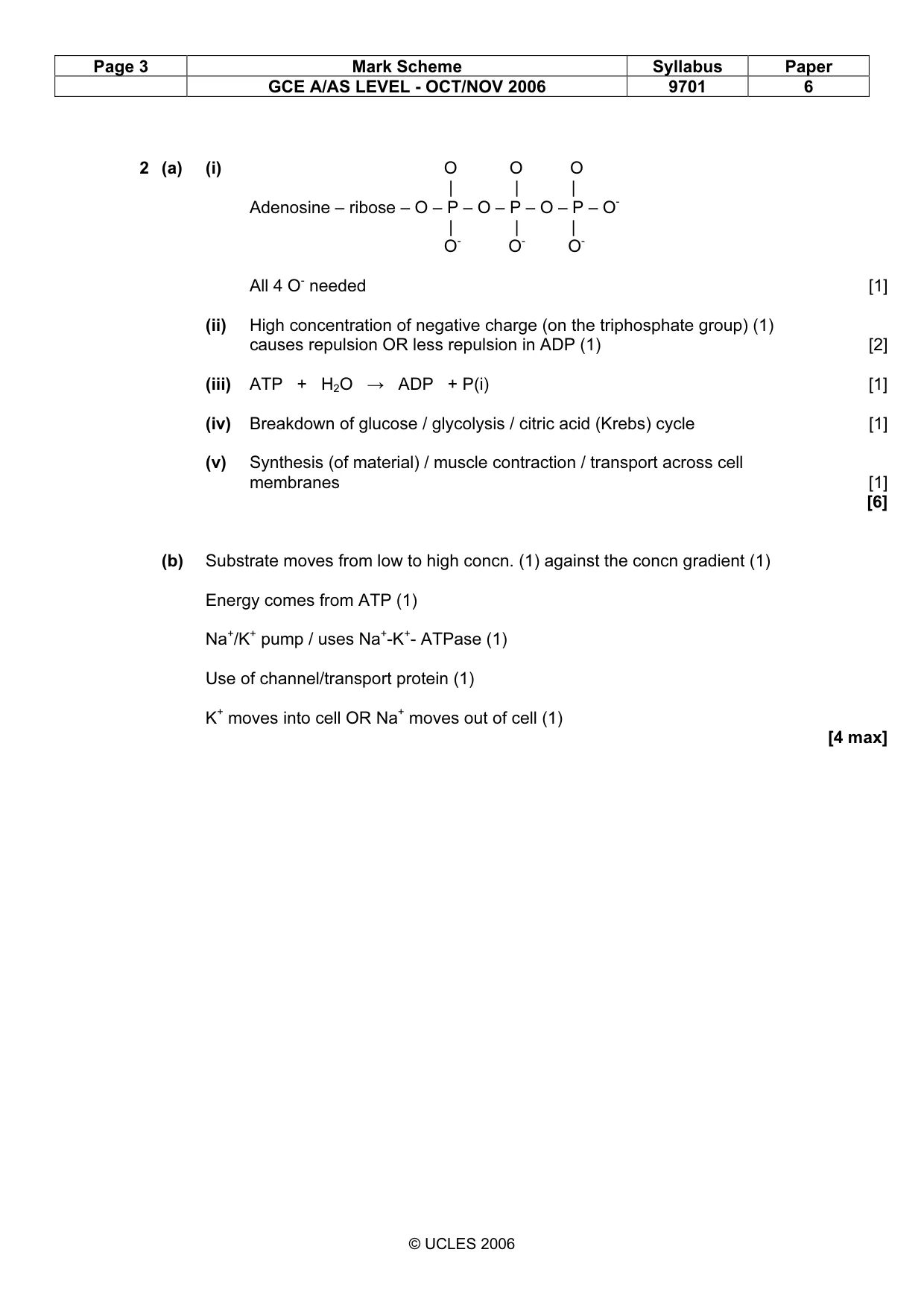
Page 3 Mark Scheme Syllabus Paper GCE A/AS LEVEL - OCT/NOV 2006 9701 6 © UCLES 2006 2 (a) (i) O O O | | | Adenosine – ribose – O – P – O – P – O – P – O- | | | O- O- O- All 4 O- needed [1] (ii) High concentration of negative charge (on the triphosphate group) (1) causes repulsion OR less repulsion in ADP (1) [2] (iii) ATP + H2O → ADP + P(i) [1] (iv) Breakdown of glucose / glycolysis / citric acid (Krebs) cycle [1] (v) Synthesis (of material) / muscle contraction / transport across cell membranes [1] [6] (b) Substrate moves from low to high concn. (1) against the concn gradient (1) Energy comes from ATP (1) Na+/K+ pump / uses Na+-K+- ATPase (1) Use of channel/transport protein (1) K+ moves into cell OR Na+ moves out of cell (1) [4 max]
Mark scheme, page 4
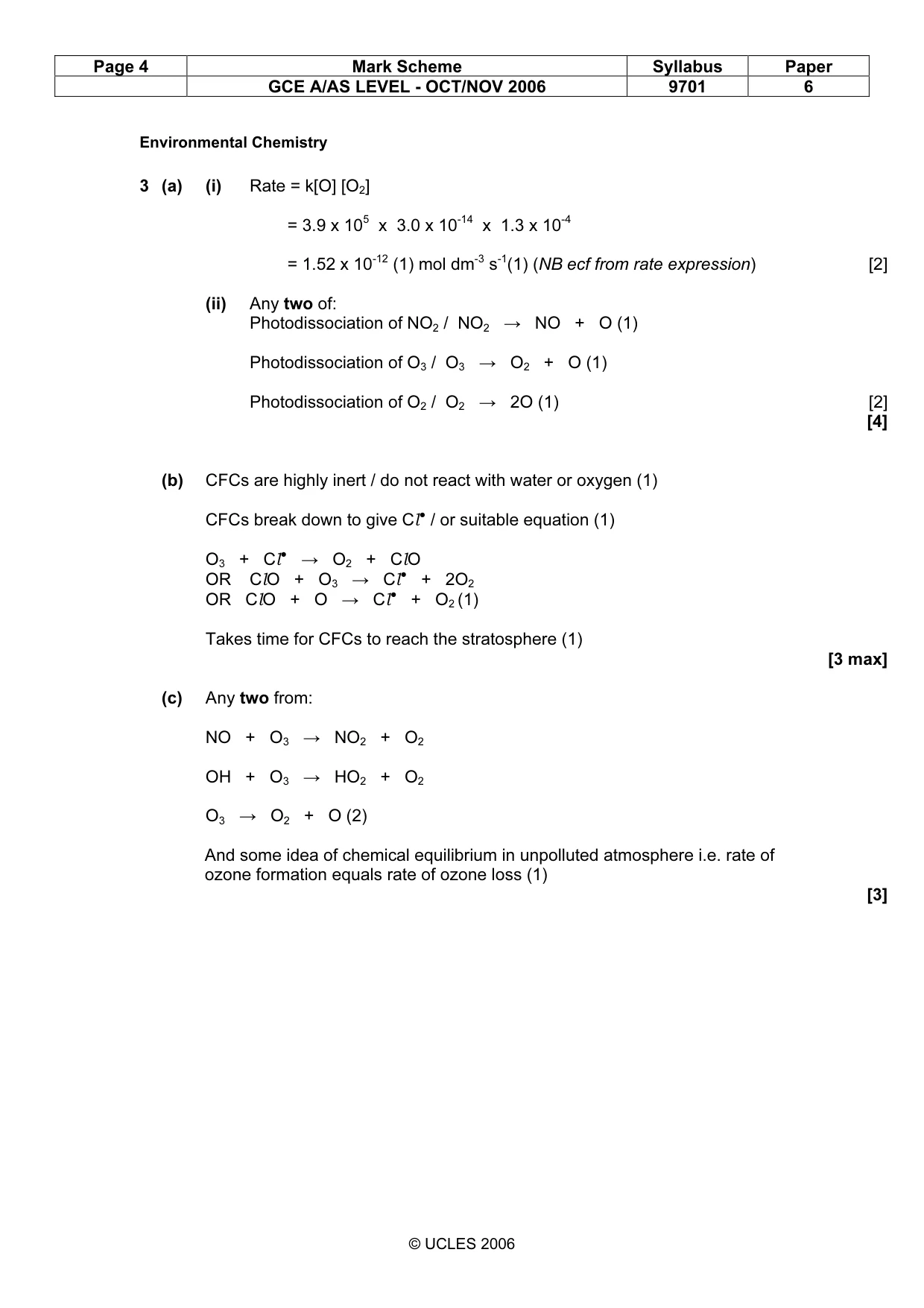
Page 4 Mark Scheme Syllabus Paper GCE A/AS LEVEL - OCT/NOV 2006 9701 6 © UCLES 2006 Environmental Chemistry 3 (a) (i) Rate = k[O] [O2] = 3.9 x 105 x 3.0 x 10-14 x 1.3 x 10-4 = 1.52 x 10⁻¹² (1) mol dm-3 s-1(1) (NB ecf from rate expression) [2] (ii) Any two of: Photodissociation of NO2 / NO2 → NO + O (1) Photodissociation of O3 / O3 → O2 + O (1) Photodissociation of O2 / O2 → 2O (1) [2] [4] (b) CFCs are highly inert / do not react with water or oxygen (1) CFCs break down to give Cl● / or suitable equation (1) O3 + Cl● → O2 + ClO OR ClO + O3 → Cl● + 2O2 OR ClO + O → Cl● + O2 (1) Takes time for CFCs to reach the stratosphere (1) [3 max] (c) Any two from: NO + O3 → NO2 + O2 OH + O3 → HO2 + O2 O3 → O2 + O (2) And some idea of chemical equilibrium in unpolluted atmosphere i.e. rate of ozone formation equals rate of ozone loss (1) [3]
Mark scheme, page 5
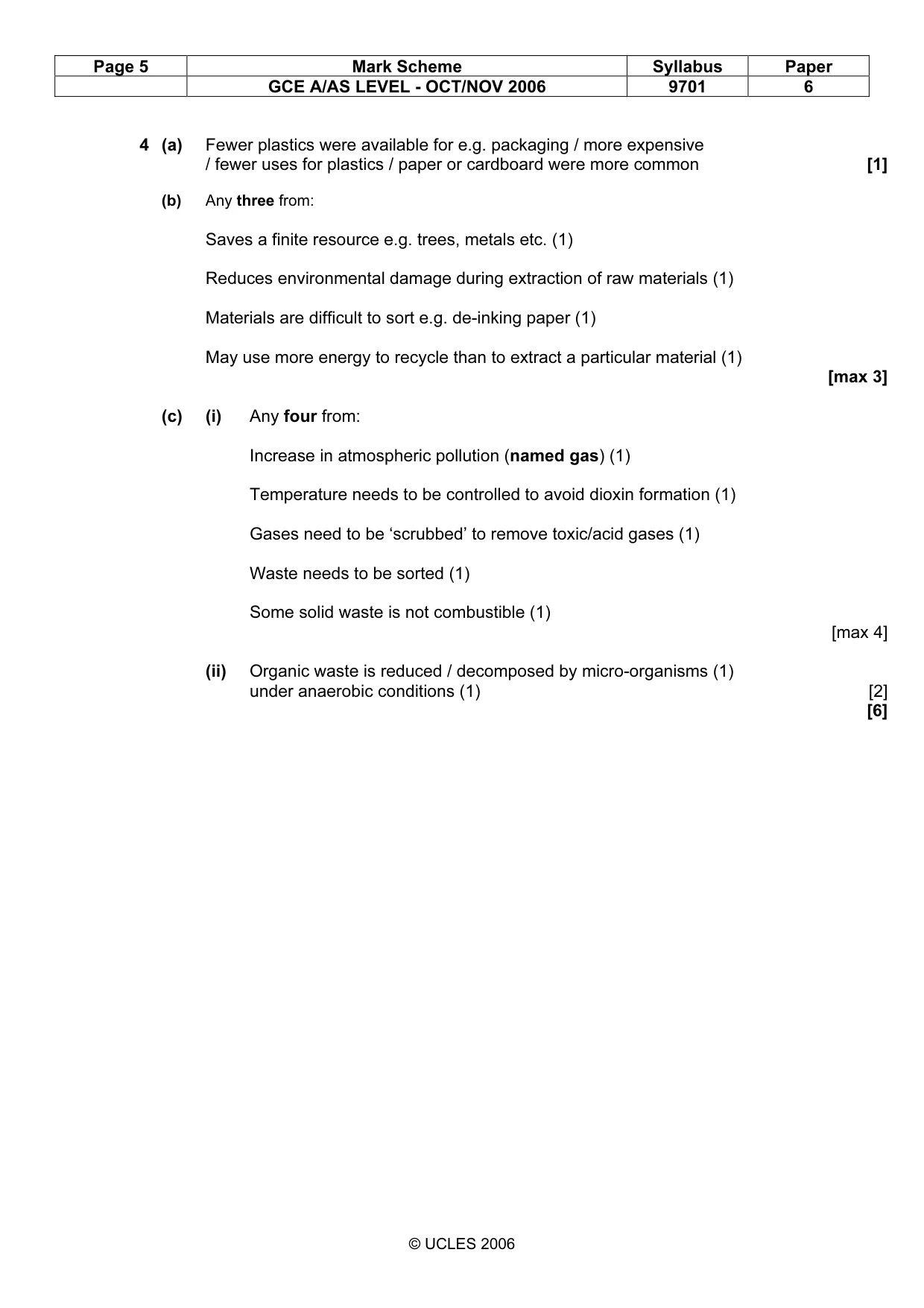
Page 5 Mark Scheme Syllabus Paper GCE A/AS LEVEL - OCT/NOV 2006 9701 6 © UCLES 2006 4 (a) Fewer plastics were available for e.g. packaging / more expensive / fewer uses for plastics / paper or cardboard were more common [1] (b) Any three from: Saves a finite resource e.g. trees, metals etc. (1) Reduces environmental damage during extraction of raw materials (1) Materials are difficult to sort e.g. de-inking paper (1) May use more energy to recycle than to extract a particular material (1) [max 3] (c) (i) Any four from: Increase in atmospheric pollution (named gas) (1) Temperature needs to be controlled to avoid dioxin formation (1) Gases need to be ‘scrubbed’ to remove toxic/acid gases (1) Waste needs to be sorted (1) Some solid waste is not combustible (1) [max 4] (ii) Organic waste is reduced / decomposed by micro-organisms (1) under anaerobic conditions (1) [2] [6]
Mark scheme, page 6
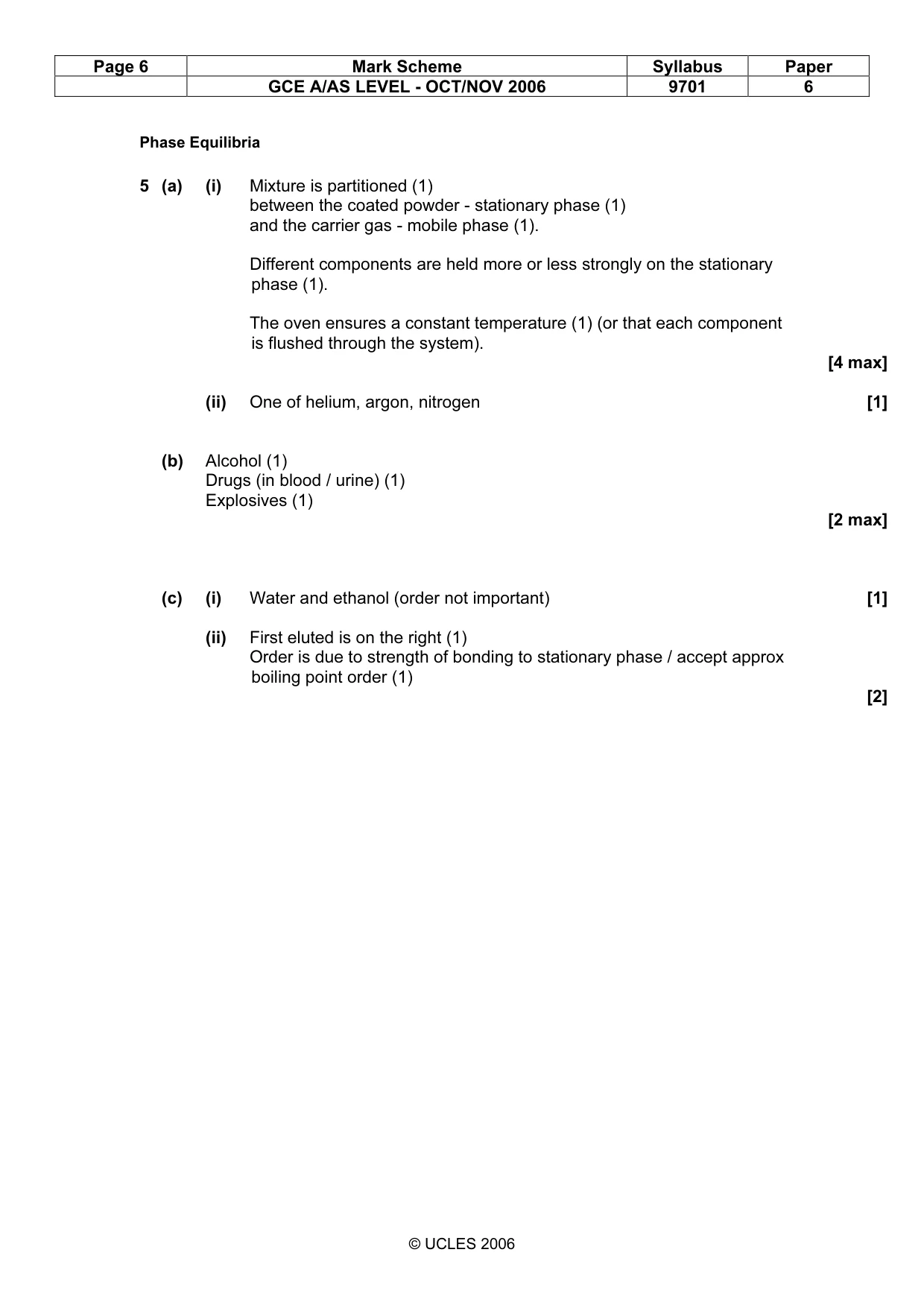
Page 6 Mark Scheme Syllabus Paper GCE A/AS LEVEL - OCT/NOV 2006 9701 6 © UCLES 2006 Phase Equilibria 5 (a) (i) Mixture is partitioned (1) between the coated powder - stationary phase (1) and the carrier gas - mobile phase (1). Different components are held more or less strongly on the stationary phase (1). The oven ensures a constant temperature (1) (or that each component is flushed through the system). [4 max] (ii) One of helium, argon, nitrogen [1] (b) Alcohol (1) Drugs (in blood / urine) (1) Explosives (1) [2 max] (c) (i) Water and ethanol (order not important) [1] (ii) First eluted is on the right (1) Order is due to strength of bonding to stationary phase / accept approx boiling point order (1) [2]
Mark scheme, page 7
Page 7 Mark Scheme Syllabus Paper GCE A/AS LEVEL - OCT/NOV 2006 9701 6 © UCLES 2006 6 (a) Mixture shows negative deviation from Raoult’s law (1) Mixture has a vapour pressure lower than ideal behaviour predicts (1) This is caused by stronger interaction between the two molecules (1) In this case the forces between A and B are stronger than between A and A molecules or between B and B molecules. (1) [3 max] (b) An azeotrope is a mixture with constant boiling point (1) that produces a vapour with the same composition as the liquid (owtte) (1) [2] (c) Sketch (1), axes labelled (1) correct b.p.s and azeotrope composition shown (1) Liquid and vapour curves labelled (1) Explanation of why the residue is the azeotrope (1) [5]
Mark scheme, page 8
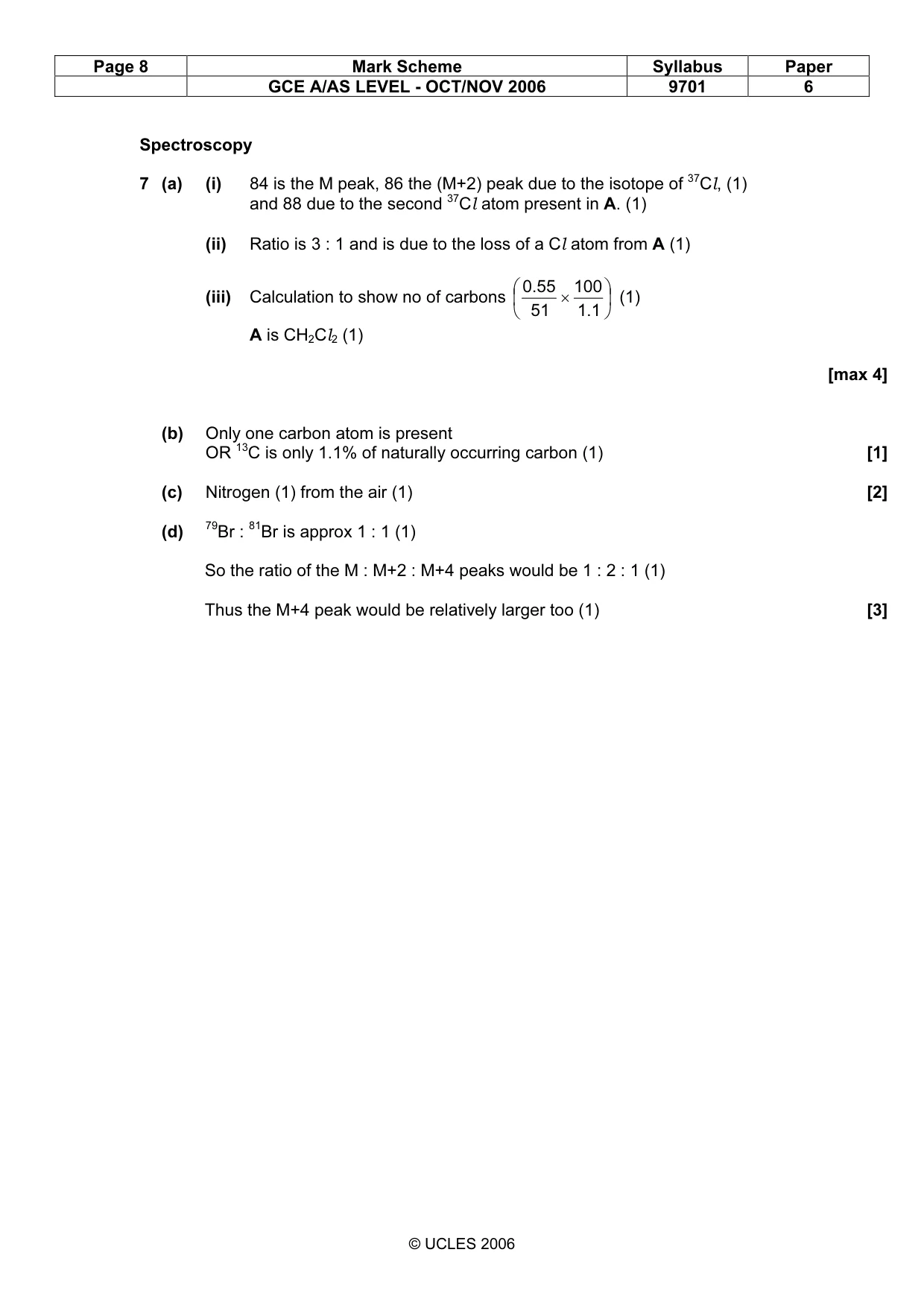
Page 8 Mark Scheme Syllabus Paper GCE A/AS LEVEL - OCT/NOV 2006 9701 6 © UCLES 2006 Spectroscopy 7 (a) (i) 84 is the M peak, 86 the (M+2) peak due to the isotope of 37Cl, (1) and 88 due to the second 37Cl atom present in A. (1) (ii) Ratio is 3 : 1 and is due to the loss of a Cl atom from A (1) (iii) Calculation to show no of carbons × 1 . 1 100 51 55 . 0 (1) A is CH2Cl2 (1) [max 4] (b) Only one carbon atom is present OR 13C is only 1.1% of naturally occurring carbon (1) [1] (c) Nitrogen (1) from the air (1) [2] (d) 79Br : 81Br is approx 1 : 1 (1) So the ratio of the M : M+2 : M+4 peaks would be 1 : 2 : 1 (1) Thus the M+4 peak would be relatively larger too (1) [3]
Mark scheme, page 9
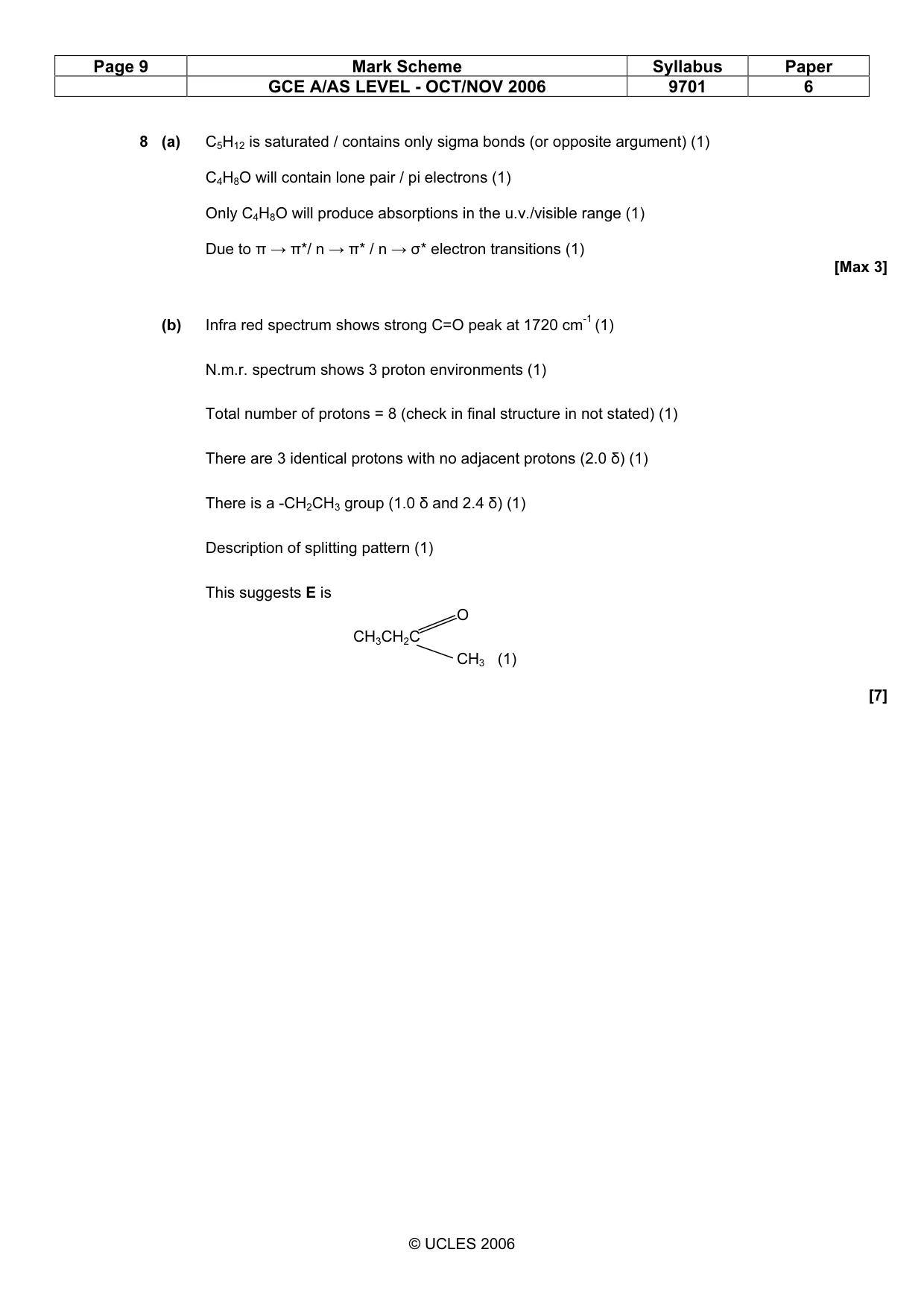
Page 9 Mark Scheme Syllabus Paper GCE A/AS LEVEL - OCT/NOV 2006 9701 6 © UCLES 2006 8 (a) C5H12 is saturated / contains only sigma bonds (or opposite argument) (1) C4H8O will contain lone pair / pi electrons (1) Only C4H8O will produce absorptions in the u.v./visible range (1) Due to π → π*/ n → π* / n → σ* electron transitions (1) [Max 3] (b) Infra red spectrum shows strong C=O peak at 1720 cm-1 (1) N.m.r. spectrum shows 3 proton environments (1) Total number of protons = 8 (check in final structure in not stated) (1) There are 3 identical protons with no adjacent protons (2.0 δ) (1) There is a -CH2CH3 group (1.0 δ and 2.4 δ) (1) Description of splitting pattern (1) This suggests E is O CH3CH2C CH3 (1) [7]
Mark scheme, page 10
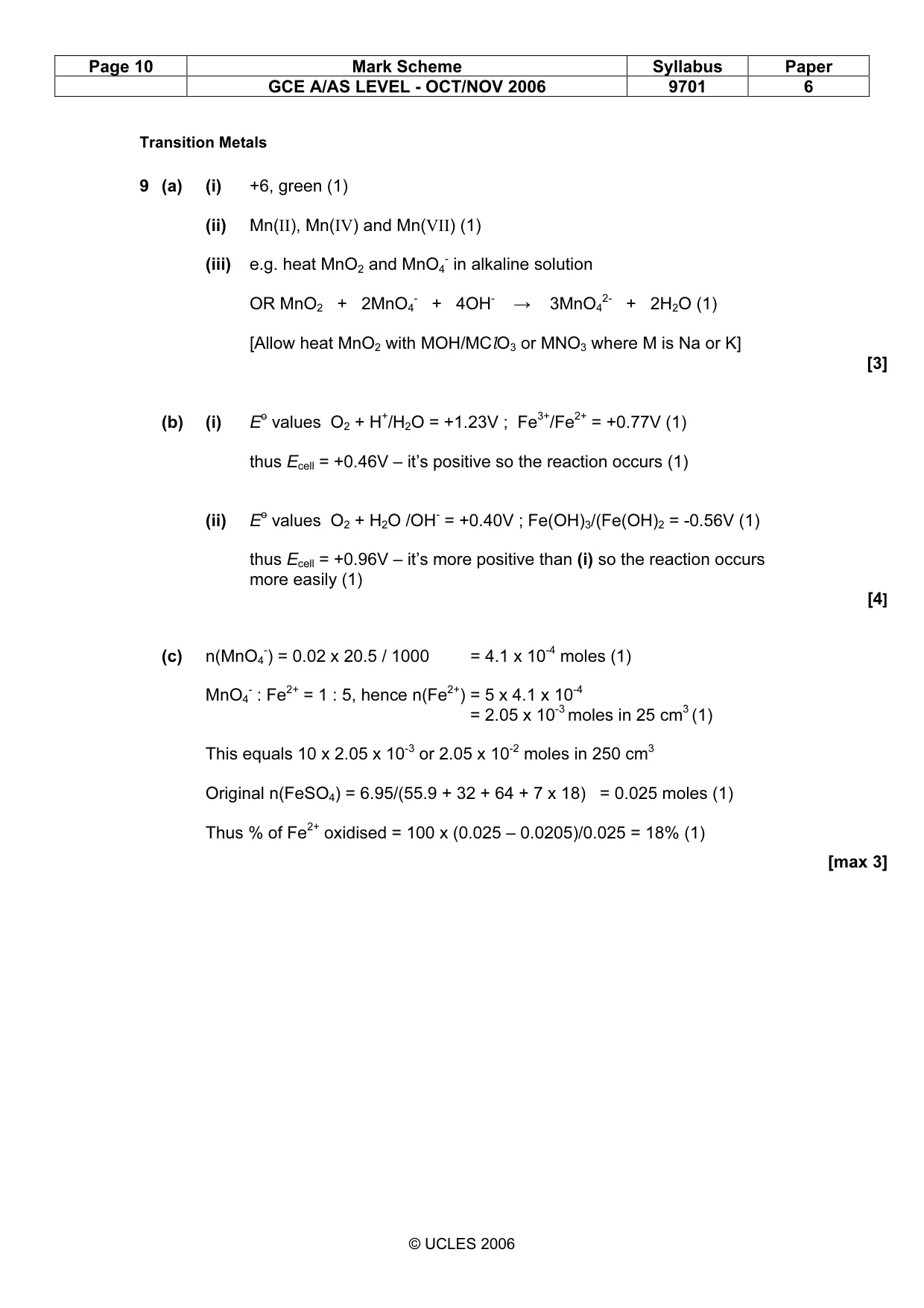
Page 10 Mark Scheme Syllabus Paper GCE A/AS LEVEL - OCT/NOV 2006 9701 6 © UCLES 2006 Transition Metals 9 (a) (i) +6, green (1) (ii) Mn(II), Mn(IV) and Mn(VII) (1) (iii) e.g. heat MnO2 and MnO4 - in alkaline solution OR MnO2 + 2MnO4 - + 4OH- → 3MnO4 2- + 2H2O (1) [Allow heat MnO2 with MOH/MClO3 or MNO3 where M is Na or K] [3] (b) (i) Eo values O2 + H+/H2O = +1.23V ; Fe3+/Fe2+ = +0.77V (1) thus Ecell = +0.46V – it’s positive so the reaction occurs (1) (ii) Eo values O2 + H2O /OH- = +0.40V ; Fe(OH)3/(Fe(OH)2 = -0.56V (1) thus Ecell = +0.96V – it’s more positive than (i) so the reaction occurs more easily (1) [4] (c) n(MnO4 -) = 0.02 x 20.5 / 1000 = 4.1 x 10⁻⁴ moles (1) MnO4 - : Fe2+ = 1 : 5, hence n(Fe2+) = 5 x 4.1 x 10-4 = 2.05 x 10⁻³ moles in 25 cm3 (1) This equals 10 x 2.05 x 10-3 or 2.05 x 10⁻² moles in 250 cm3 Original n(FeSO4) = 6.95/(55.9 + 32 + 64 + 7 x 18) = 0.025 moles (1) Thus % of Fe2+ oxidised = 100 x (0.025 – 0.0205)/0.025 = 18% (1) [max 3]
Mark scheme, page 11
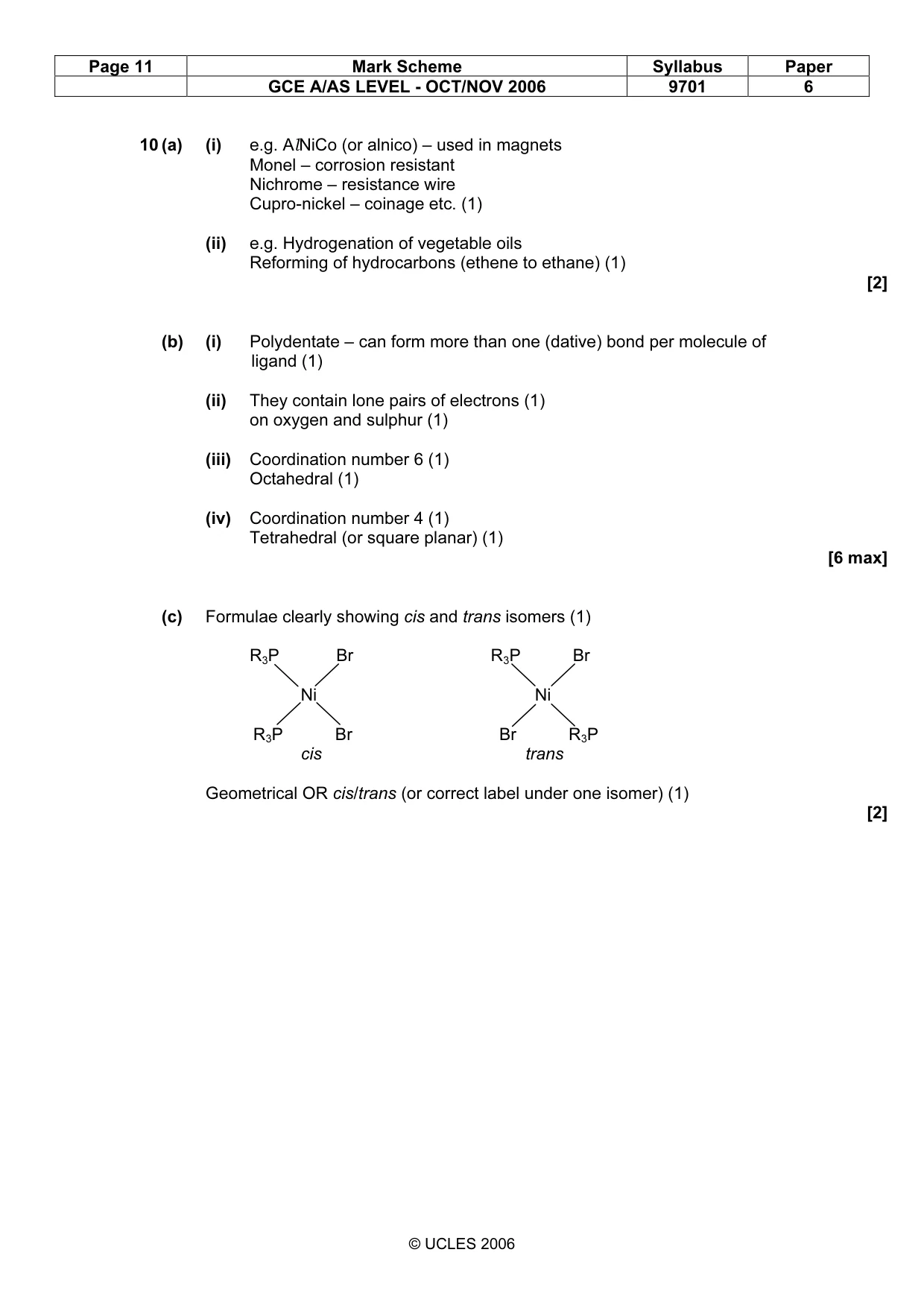
Page 11 Mark Scheme Syllabus Paper GCE A/AS LEVEL - OCT/NOV 2006 9701 6 © UCLES 2006 10 (a) (i) e.g. AlNiCo (or alnico) – used in magnets Monel – corrosion resistant Nichrome – resistance wire Cupro-nickel – coinage etc. (1) (ii) e.g. Hydrogenation of vegetable oils Reforming of hydrocarbons (ethene to ethane) (1) [2] (b) (i) Polydentate – can form more than one (dative) bond per molecule of ligand (1) (ii) They contain lone pairs of electrons (1) on oxygen and sulphur (1) (iii) Coordination number 6 (1) Octahedral (1) (iv) Coordination number 4 (1) Tetrahedral (or square planar) (1) [6 max] (c) Formulae clearly showing cis and trans isomers (1) R3P Br R3P Br Ni Ni R3P Br Br R3P cis trans Geometrical OR cis/trans (or correct label under one isomer) (1) [2]
What you needed in this session
Cambridge’s own grade thresholds for 2006 Oct/Nov, Paper 6 · Variant 1. A higher threshold means an easier paper — the bar moves with how the cohort did.