Cambridge A Level Chemistry 9701 — 2002 May/June Paper 6 · Variant 1
9701/61/M/J/02
The question paper and its mark scheme, free to read here and free to download. This is Cambridge’s own paper, exactly as it was sat.
Question paper12 pages

Mark scheme10 pages
Answers below. Sit the paper first if you are practising.
Paper as text
Question paper, page 1
TIME 1 hour INSTRUCTIONS TO CANDIDATES Write your name, Centre number and candidate number on the front of the answer paper/answer booklet. Write your answers on the separate answer paper provided. Answer all the questions on two of the Options. If you use more than one sheet of paper, fasten the sheets together. INFORMATION FOR CANDIDATES The number of marks is given in brackets [ ] at the end of each question or part question. You may lose marks if you do not show your working or if you do not use appropriate units. A data booklet is provided. This question paper consists of 11 printed pages and 1 blank page. MML 1439 4/01 S17224/1 © CIE 2002 [Turn over CAMBRIDGE INTERNATIONAL EXAMINATIONS General Certificate of Education Advanced Level CHEMISTRY 9701/6 PAPER 6 – OPTIONS MAY/JUNE SESSION 2002 1 hour Additional materials: Answer paper Data Booklet FOR EXAMINER’S USE UNIVERSITY of CAMBRIDGE Local Examinations Syndicate
Question paper, page 2
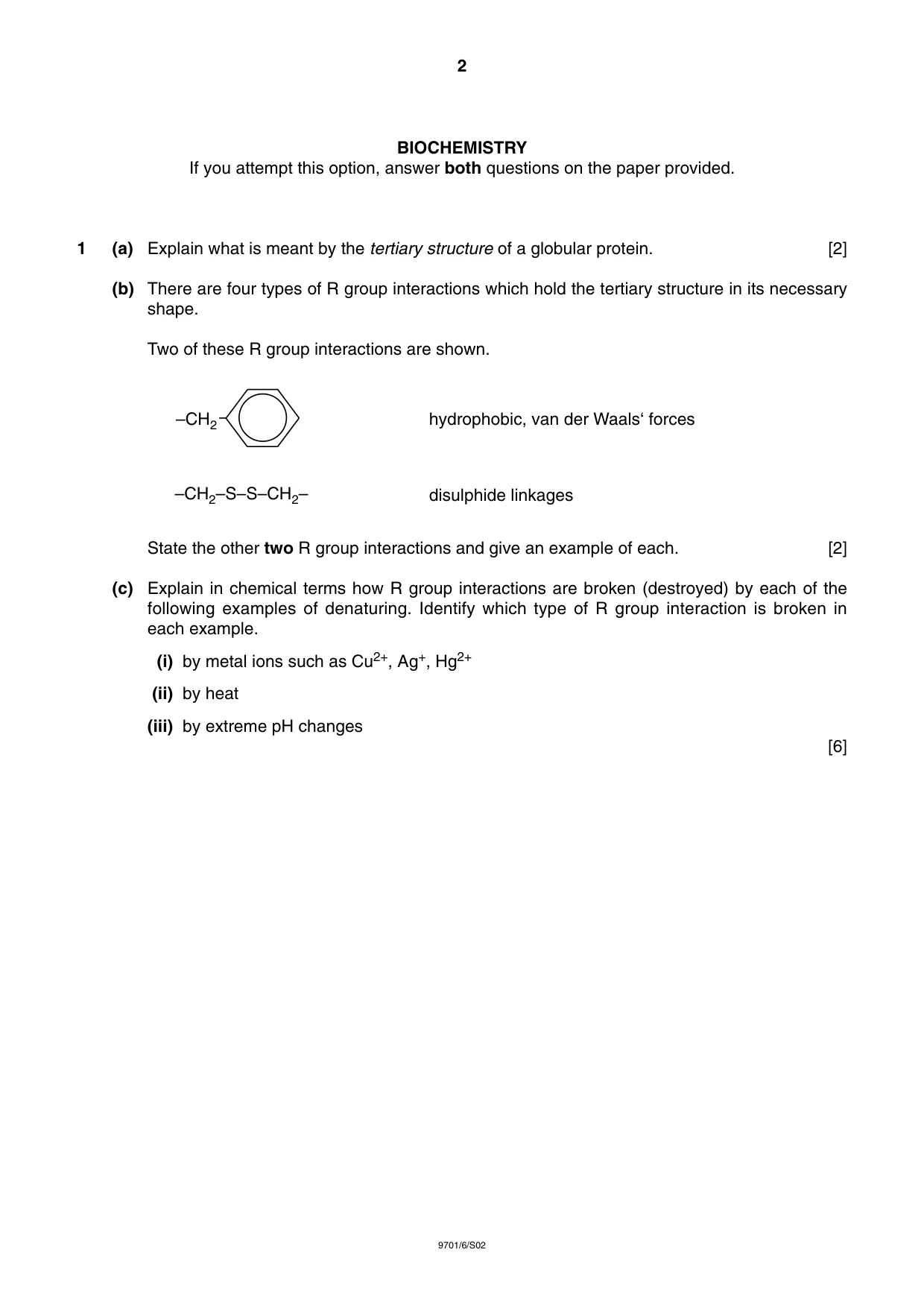
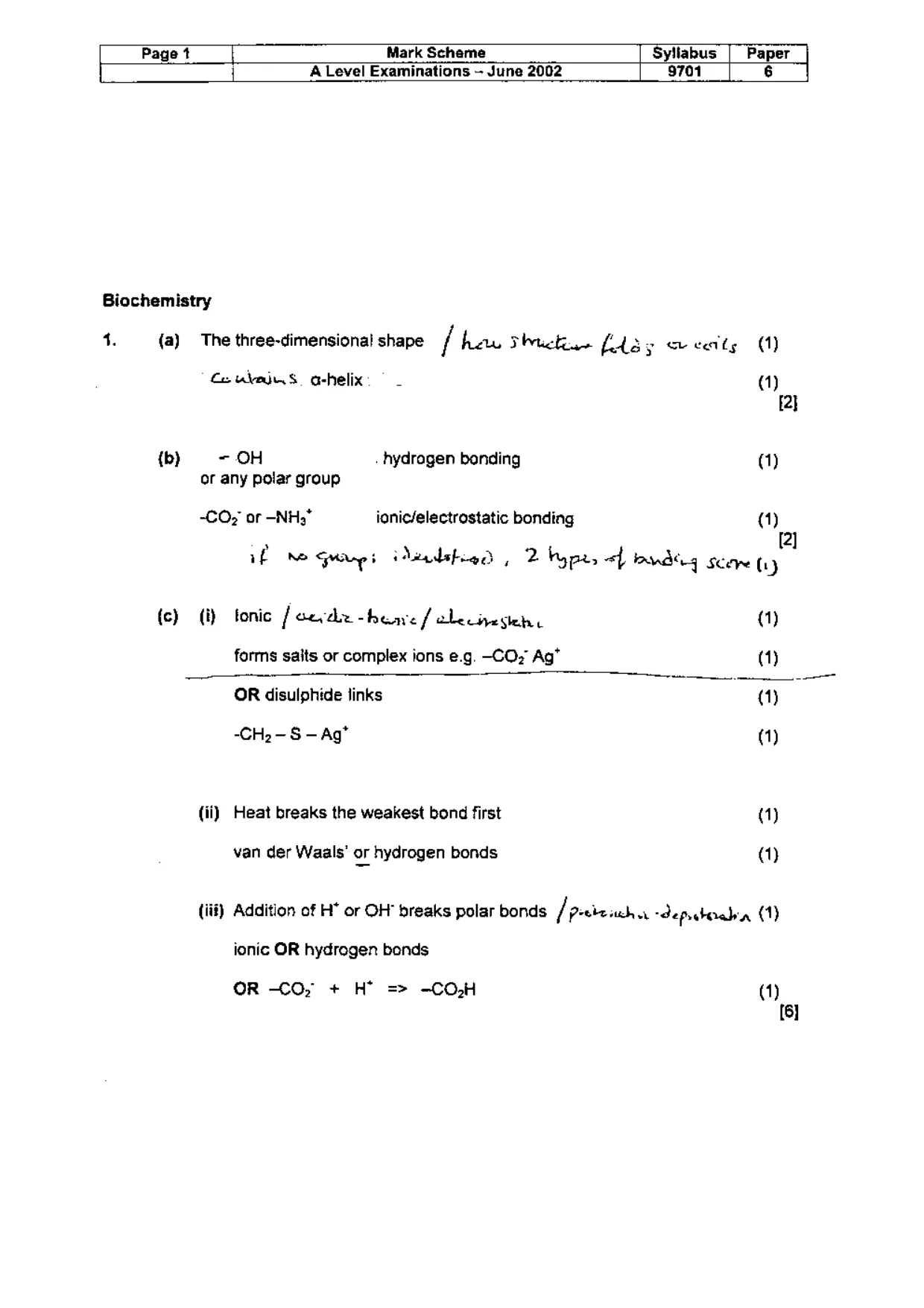
BIOCHEMISTRY If you attempt this option, answer both questions on the paper provided. 1 (a) Explain what is meant by the tertiary structure of a globular protein. [2] (b) There are four types of R group interactions which hold the tertiary structure in its necessary shape. Two of these R group interactions are shown. hydrophobic, van der Waals‘ forces disulphide linkages State the other two R group interactions and give an example of each. [2] (c) Explain in chemical terms how R group interactions are broken (destroyed) by each of the following examples of denaturing. Identify which type of R group interaction is broken in each example. (i) by metal ions such as Cu2+, Ag+, Hg2+ (ii) by heat (iii) by extreme pH changes [6] 2 9701/6/S02 –CH2 –CH2–S–S–CH2–
Question paper, page 3
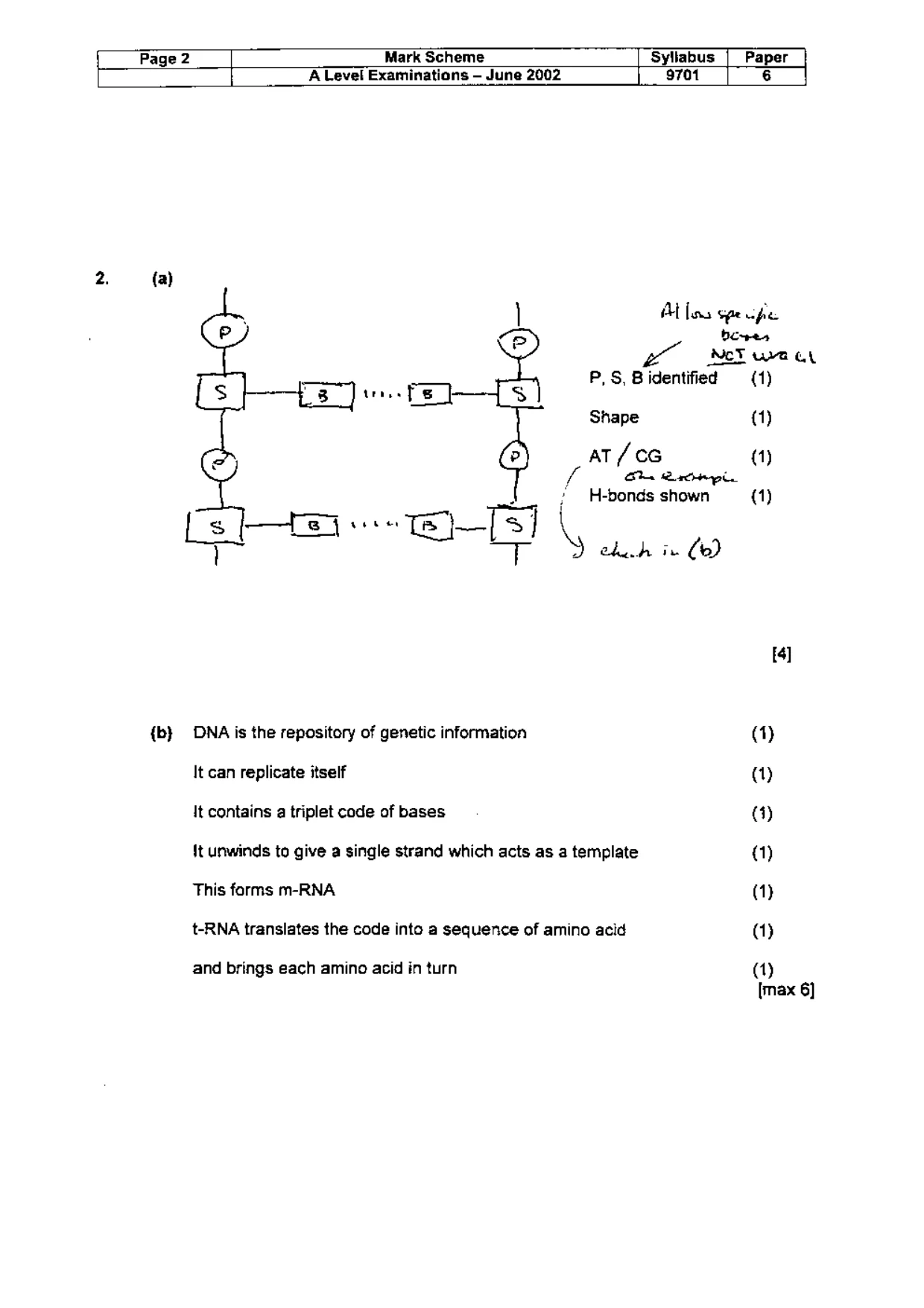
2 (a) Describe with the aid of a diagram the structure of DNA, deoxyribonucleic acid. [4] (b) (i) What is the function of DNA? (ii) In brief outline, describe its role in the synthesis of proteins. [6] 3 9701/6/S02 [Turn over
Question paper, page 4
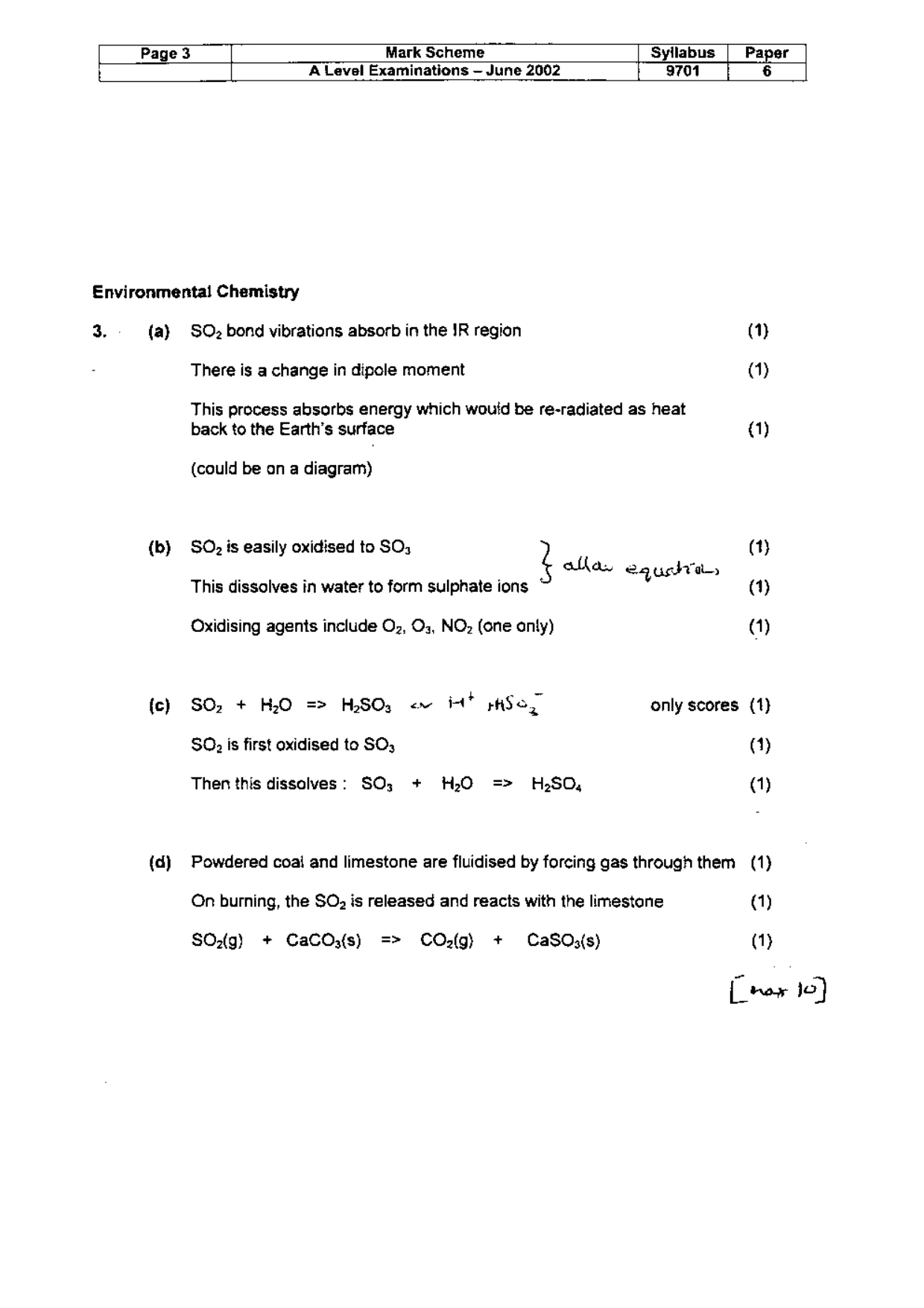
ENVIRONMENTAL CHEMISTRY If you attempt this option, answer both questions on the paper provided. 3 (a) It might be expected that sulphur dioxide would make a significant contribution to the greenhouse effect. Explain, in terms of its ir spectrum, why sulphur dioxide might be expected to contribute to the greenhouse effect. [4] (b) It has recently been reported that sulphate-rich mists above urban areas, produced from sulphur dioxide, reflect sunlight back into space more effectively than they absorb it. This suggests that emissions of sulphur dioxide may actually be contributing to a reduction in global warming. The aerosols which reflect sunlight are sulphate-rich. Explain how sulphur dioxide in the troposphere is converted into sulphate ions. [2] (c) Considerable efforts are however made to limit sulphur dioxide emissions. One reason is that sulphur dioxide contributes to acid rain. Using appropriate equations, explain how acid rain is produced. [1] (d) One method used by industry to remove sulphur from coal employs limestone-based fluidised beds. Supporting your answer with equations, explain this method. [3] 4 9701/6/S02
Question paper, page 5
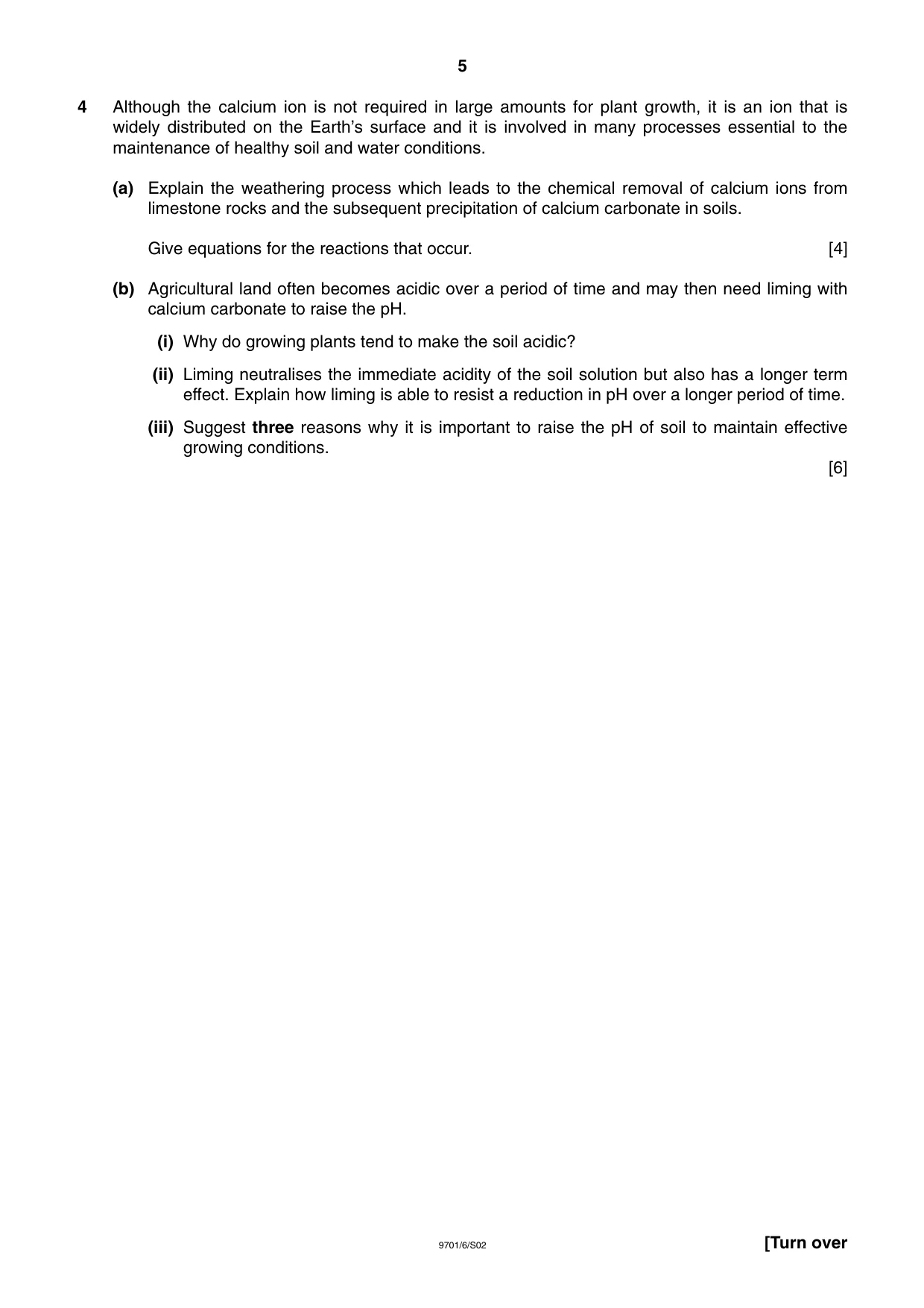
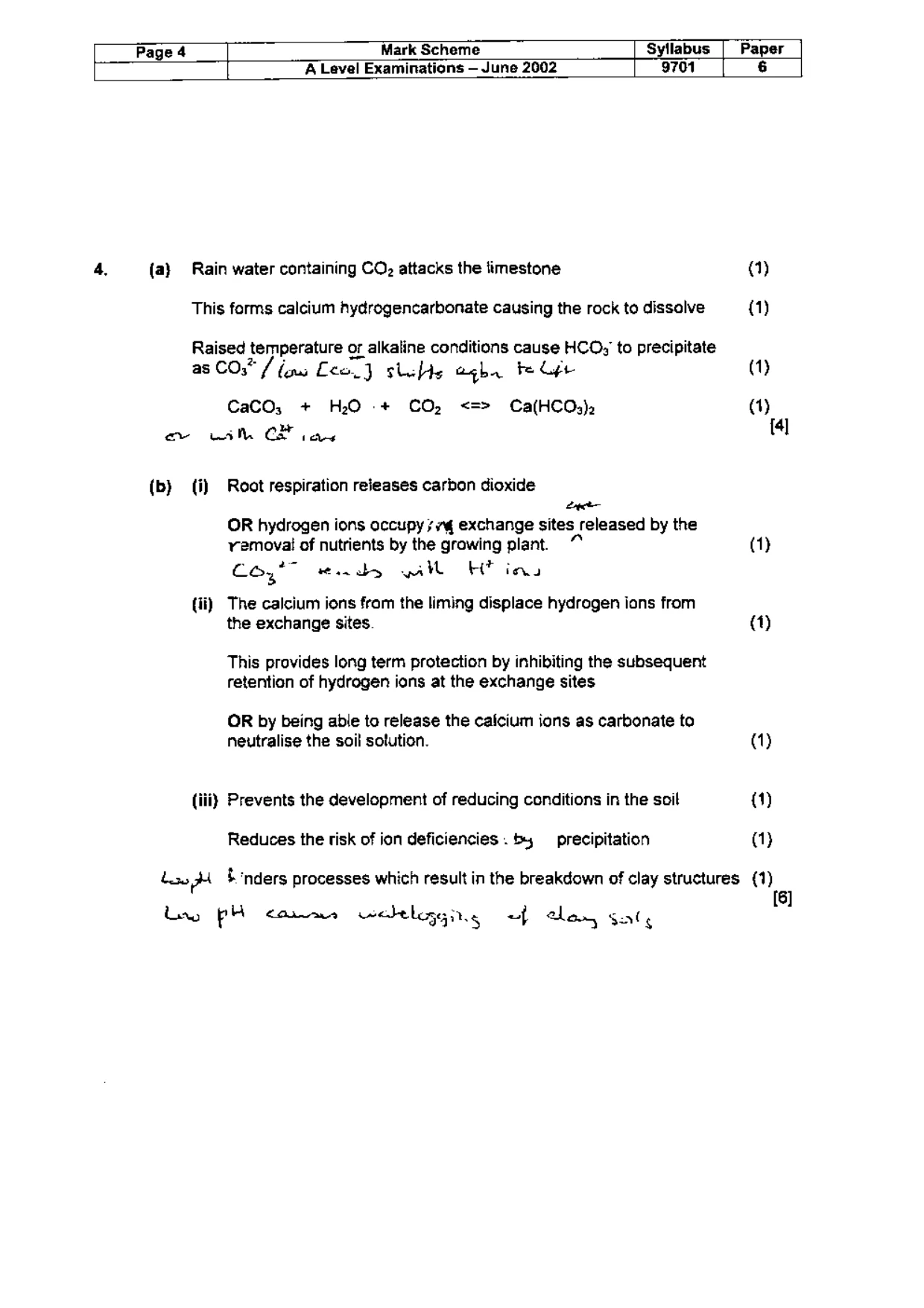
4 Although the calcium ion is not required in large amounts for plant growth, it is an ion that is widely distributed on the Earth’s surface and it is involved in many processes essential to the maintenance of healthy soil and water conditions. (a) Explain the weathering process which leads to the chemical removal of calcium ions from limestone rocks and the subsequent precipitation of calcium carbonate in soils. Give equations for the reactions that occur. [4] (b) Agricultural land often becomes acidic over a period of time and may then need liming with calcium carbonate to raise the pH. (i) Why do growing plants tend to make the soil acidic? (ii) Liming neutralises the immediate acidity of the soil solution but also has a longer term effect. Explain how liming is able to resist a reduction in pH over a longer period of time. (iii) Suggest three reasons why it is important to raise the pH of soil to maintain effective growing conditions. [6] 5 9701/6/S02 [Turn over
Question paper, page 6
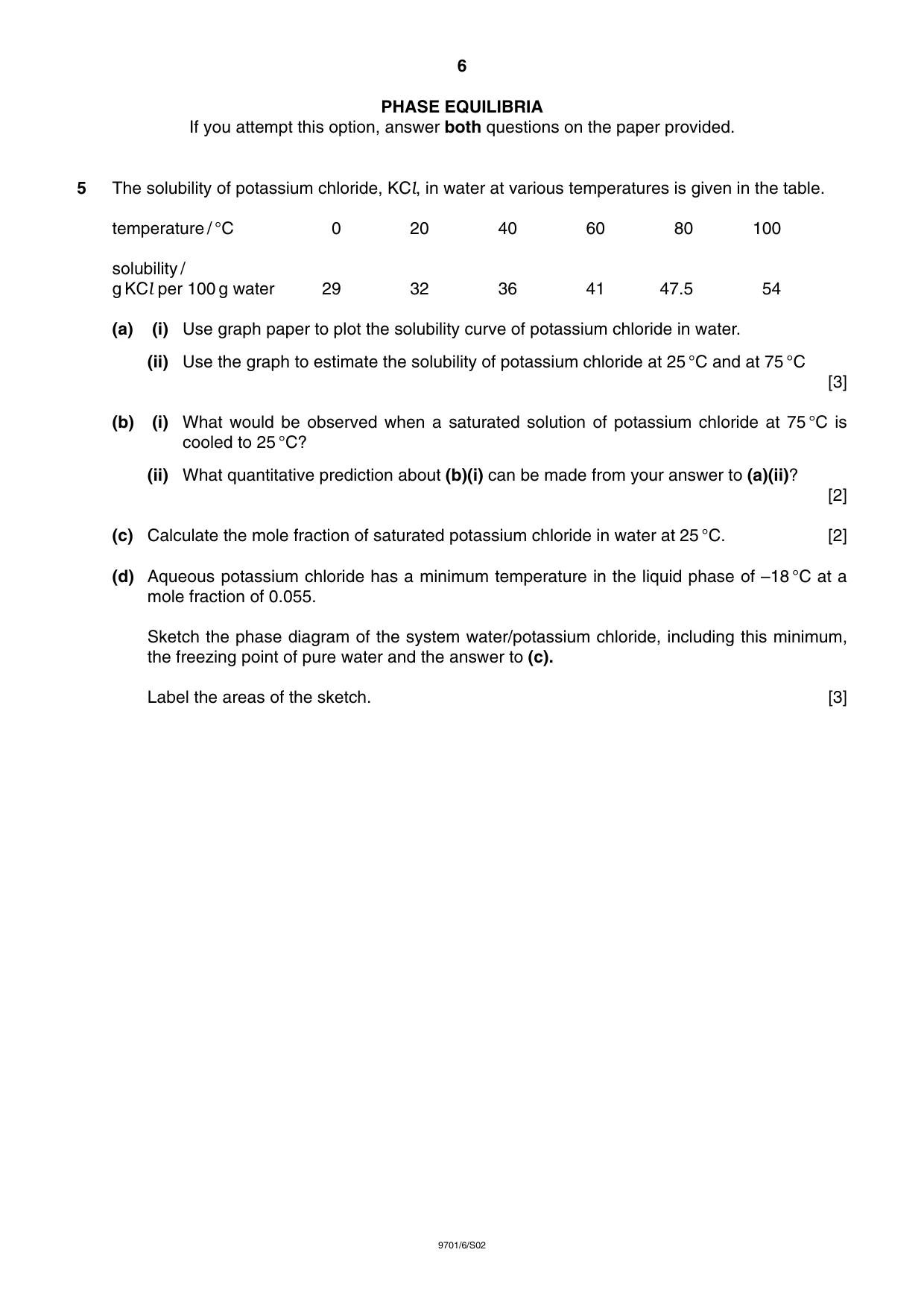
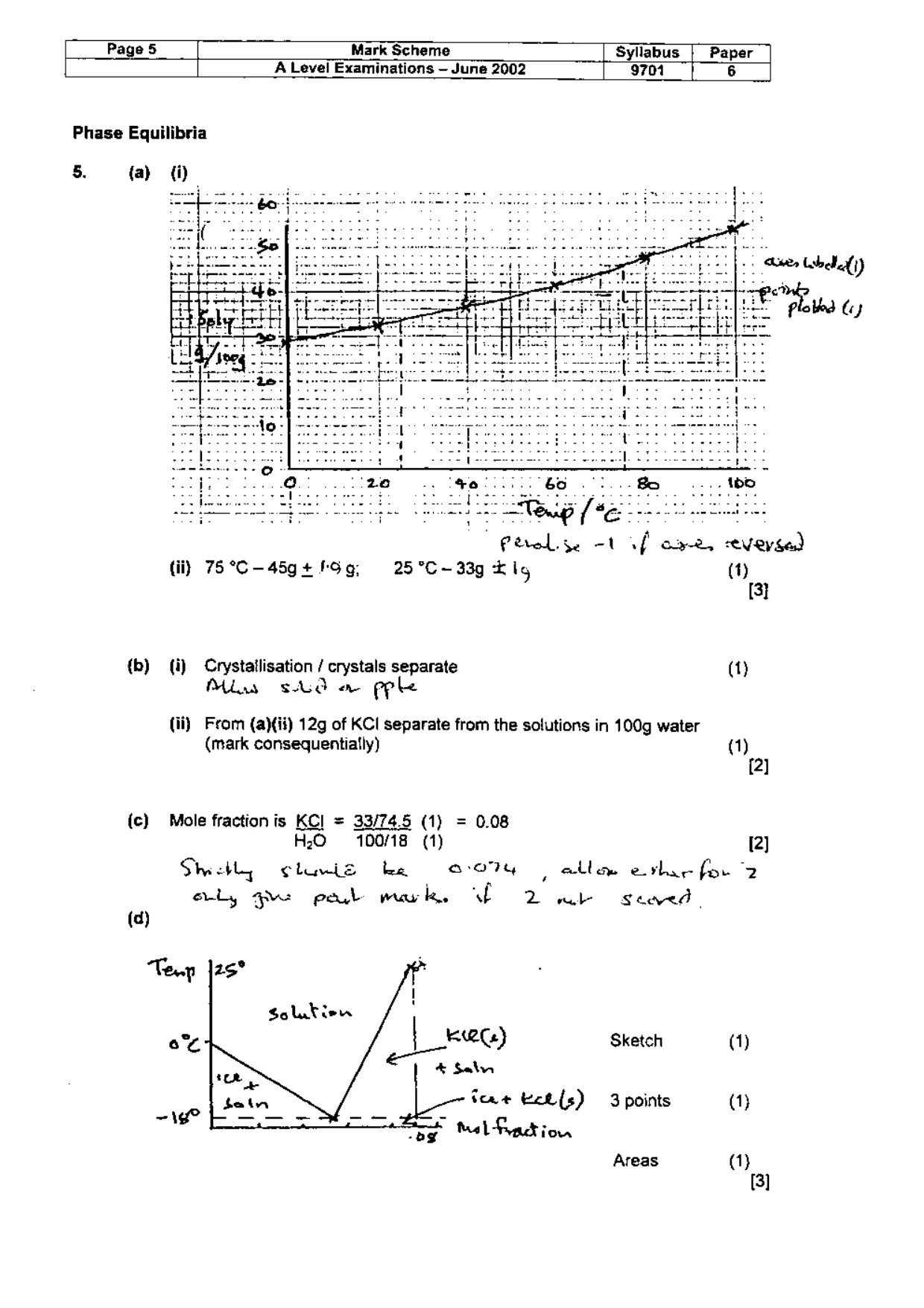
PHASE EQUILIBRIA If you attempt this option, answer both questions on the paper provided. 5 The solubility of potassium chloride, KCl, in water at various temperatures is given in the table. temperature / °C 0 20 40 60 80 100 solubility / g KCl per 100 g water 29 32 36 41 47.5 54 (a) (i) Use graph paper to plot the solubility curve of potassium chloride in water. (ii) Use the graph to estimate the solubility of potassium chloride at 25 °C and at 75 °C [3] (b) (i) What would be observed when a saturated solution of potassium chloride at 75 °C is cooled to 25 °C? (ii) What quantitative prediction about (b)(i) can be made from your answer to (a)(ii)? [2] (c) Calculate the mole fraction of saturated potassium chloride in water at 25 °C. [2] (d) Aqueous potassium chloride has a minimum temperature in the liquid phase of –18 °C at a mole fraction of 0.055. Sketch the phase diagram of the system water/potassium chloride, including this minimum, the freezing point of pure water and the answer to (c). Label the areas of the sketch. [3] 6 9701/6/S02
Question paper, page 7
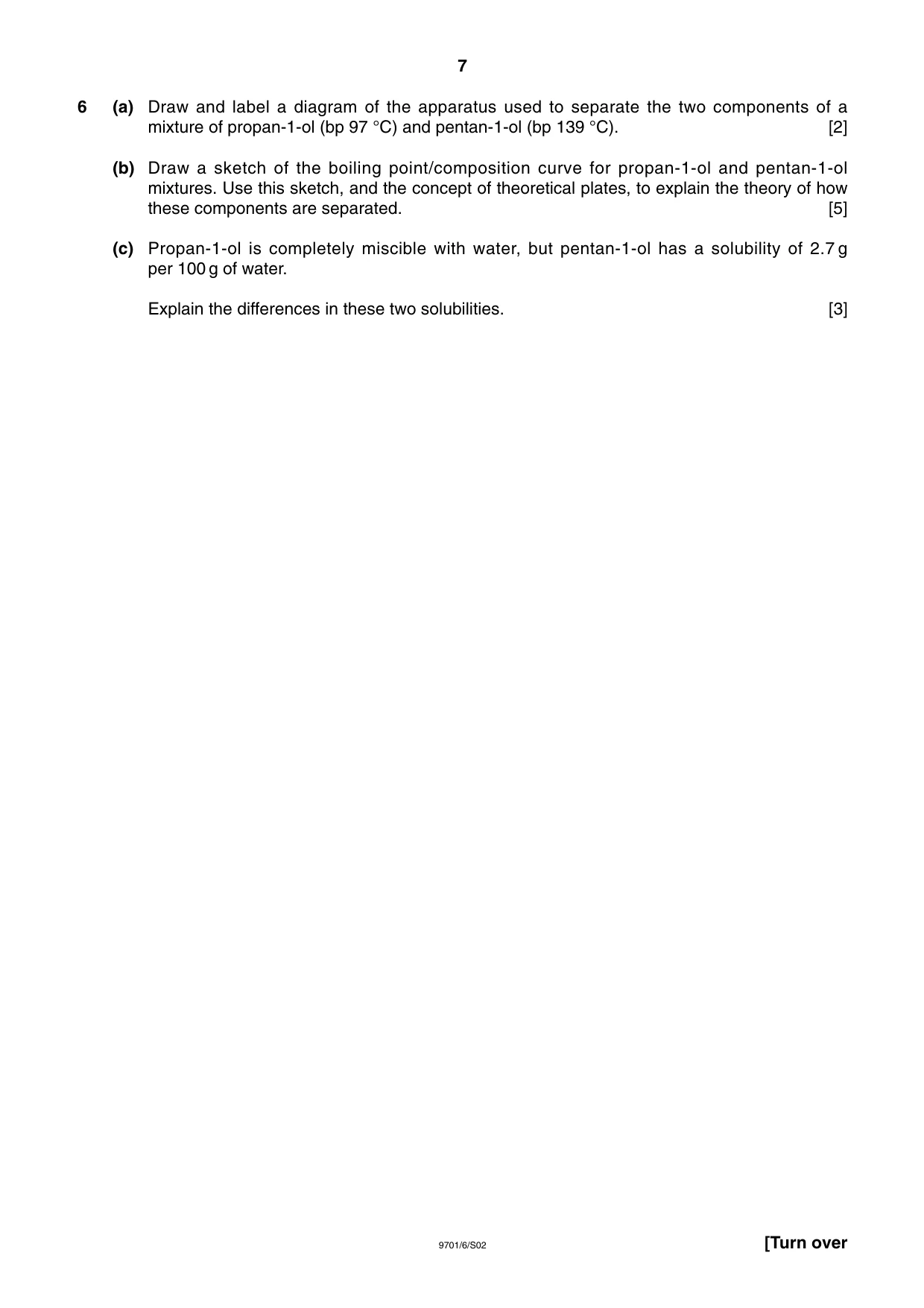
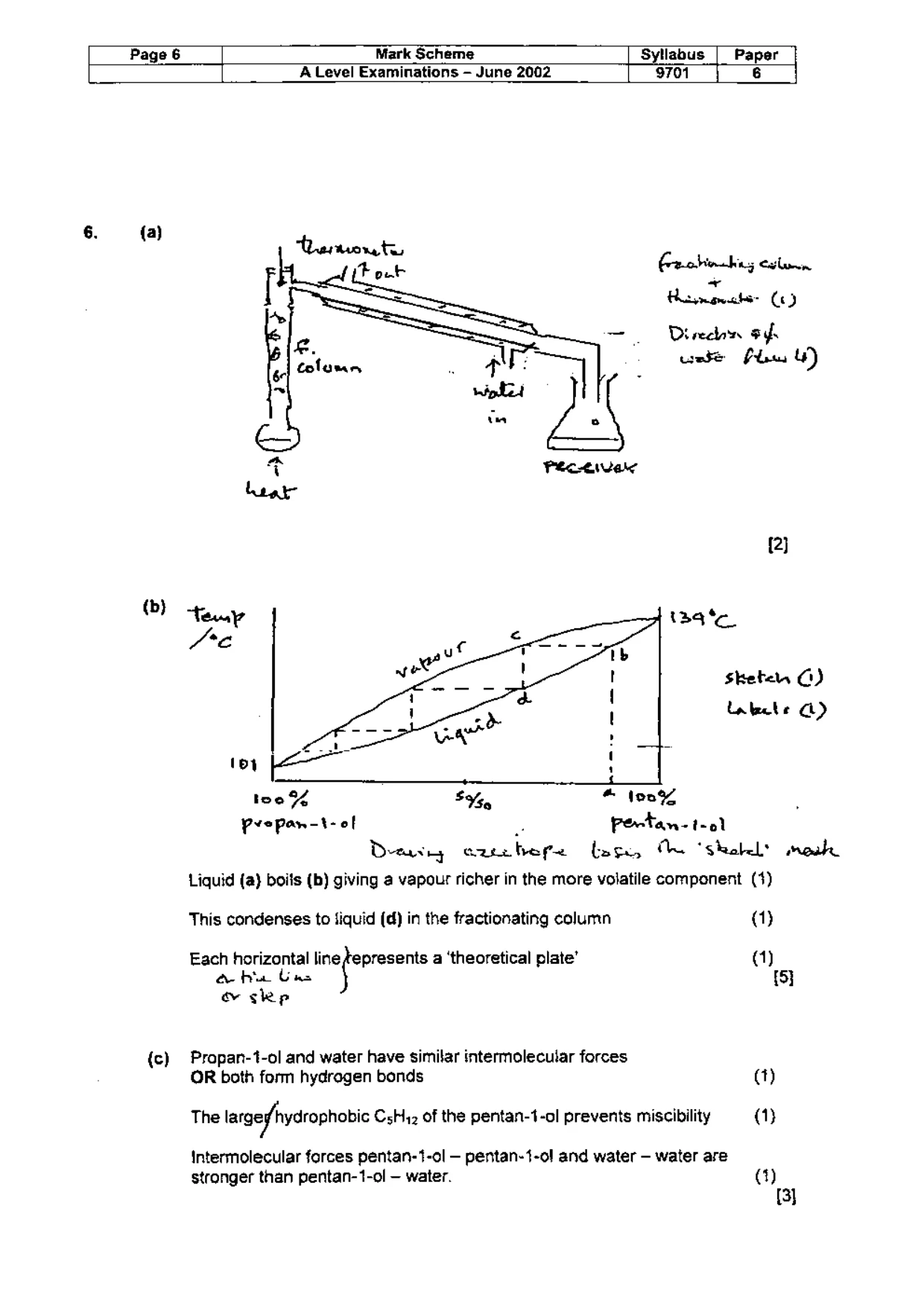
6 (a) Draw and label a diagram of the apparatus used to separate the two components of a mixture of propan-1-ol (bp 97 °C) and pentan-1-ol (bp 139 °C). [2] (b) Draw a sketch of the boiling point/composition curve for propan-1-ol and pentan-1-ol mixtures. Use this sketch, and the concept of theoretical plates, to explain the theory of how these components are separated. [5] (c) Propan-1-ol is completely miscible with water, but pentan-1-ol has a solubility of 2.7 g per 100 g of water. Explain the differences in these two solubilities. [3] 7 9701/6/S02 [Turn over
Question paper, page 8
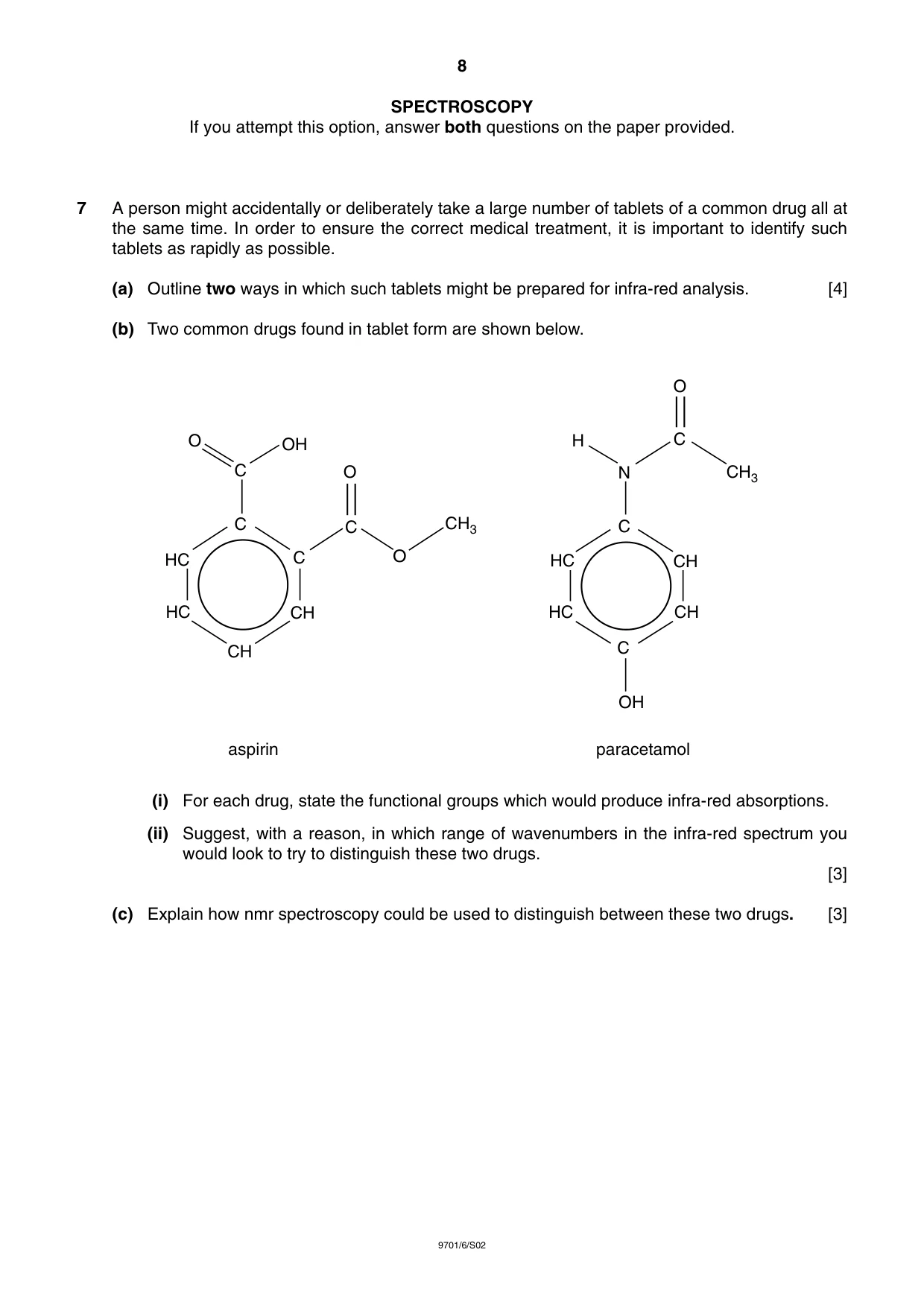
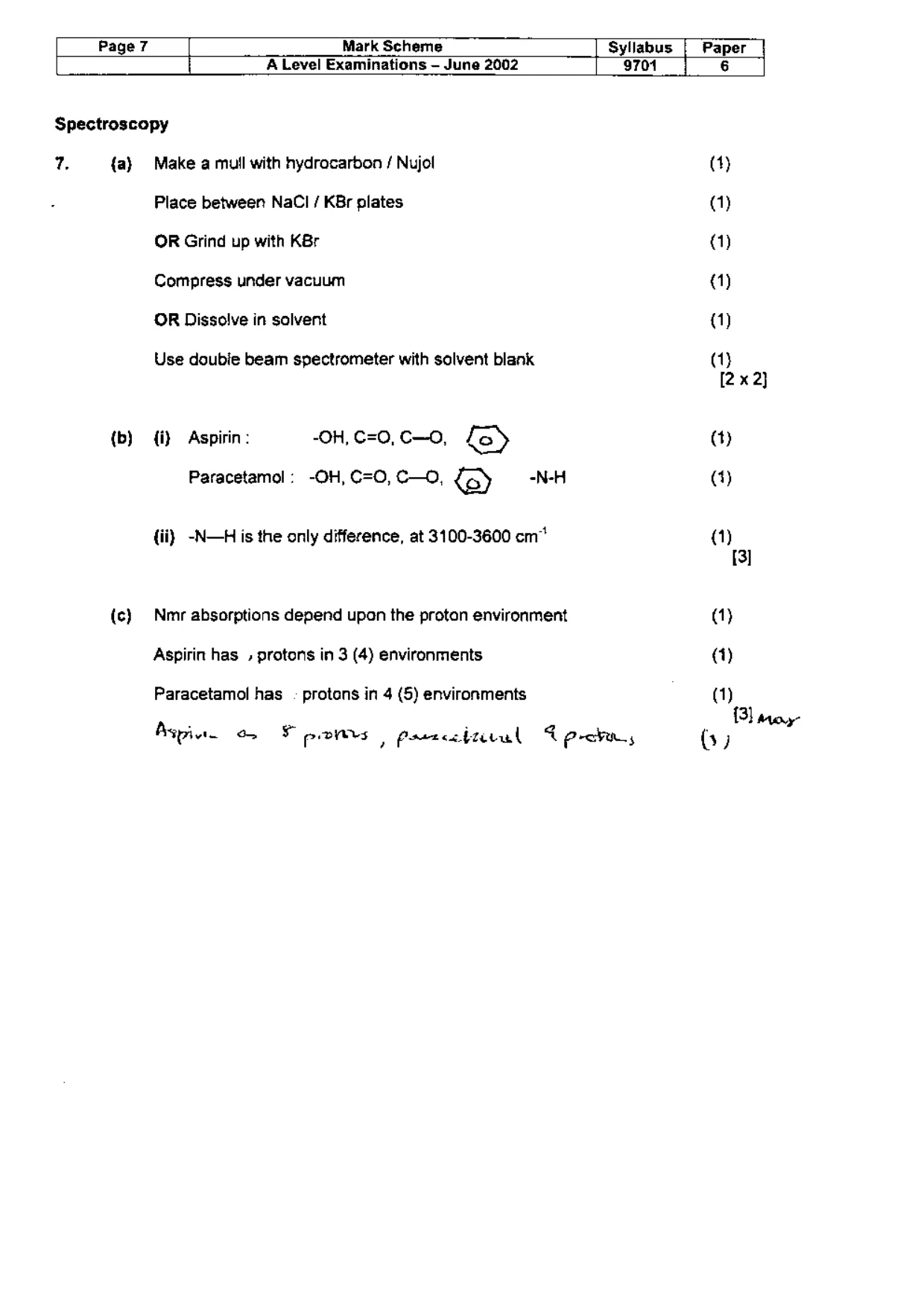
SPECTROSCOPY If you attempt this option, answer both questions on the paper provided. 7 A person might accidentally or deliberately take a large number of tablets of a common drug all at the same time. In order to ensure the correct medical treatment, it is important to identify such tablets as rapidly as possible. (a) Outline two ways in which such tablets might be prepared for infra-red analysis. [4] (b) Two common drugs found in tablet form are shown below. (i) For each drug, state the functional groups which would produce infra-red absorptions. (ii) Suggest, with a reason, in which range of wavenumbers in the infra-red spectrum you would look to try to distinguish these two drugs. [3] (c) Explain how nmr spectroscopy could be used to distinguish between these two drugs. [3] HC HC C C C C CH CH CH CH CH3 HC HC C C C O O O O OH OH N H CH3 aspirin paracetamol 8 9701/6/S02
Question paper, page 9
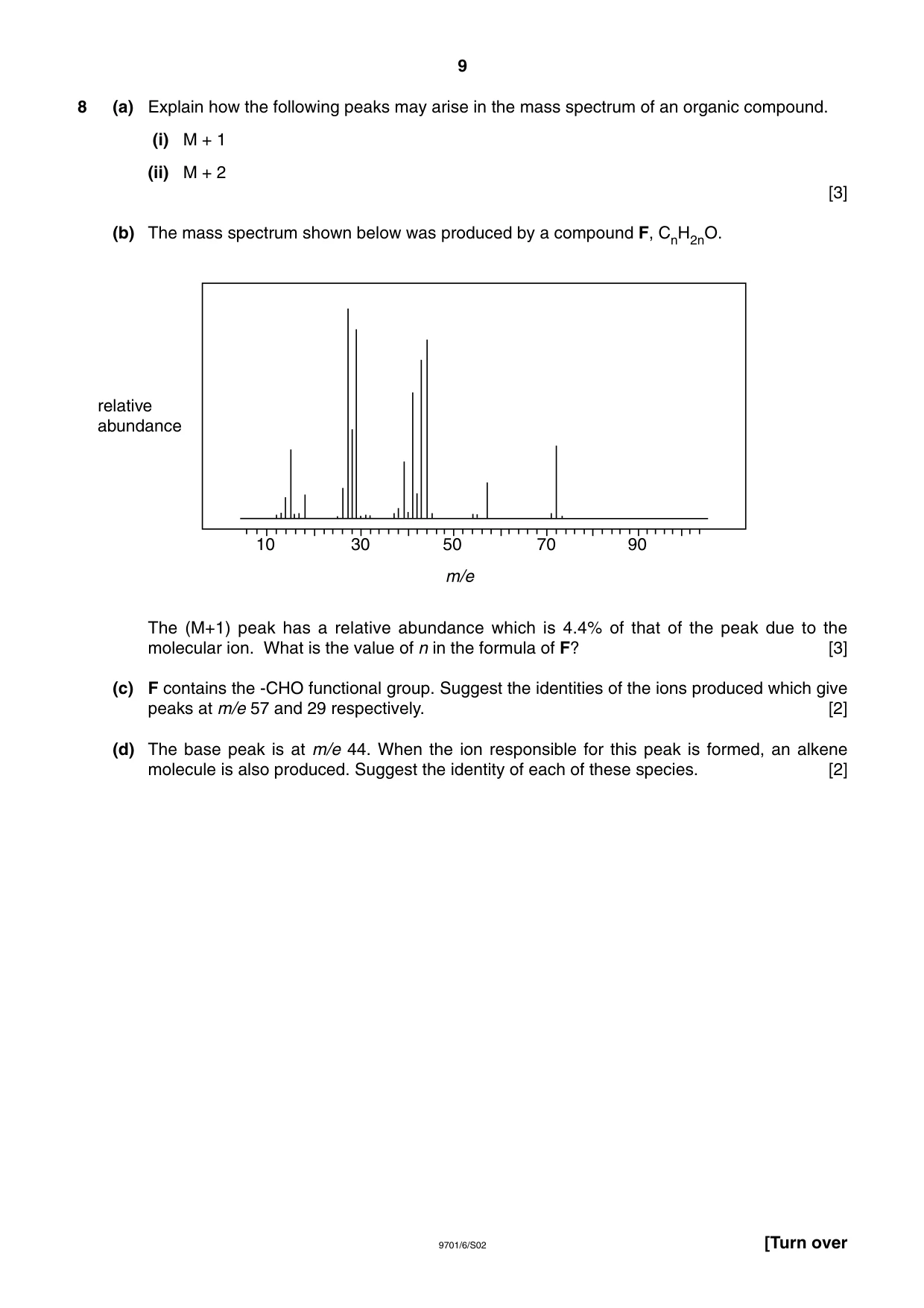
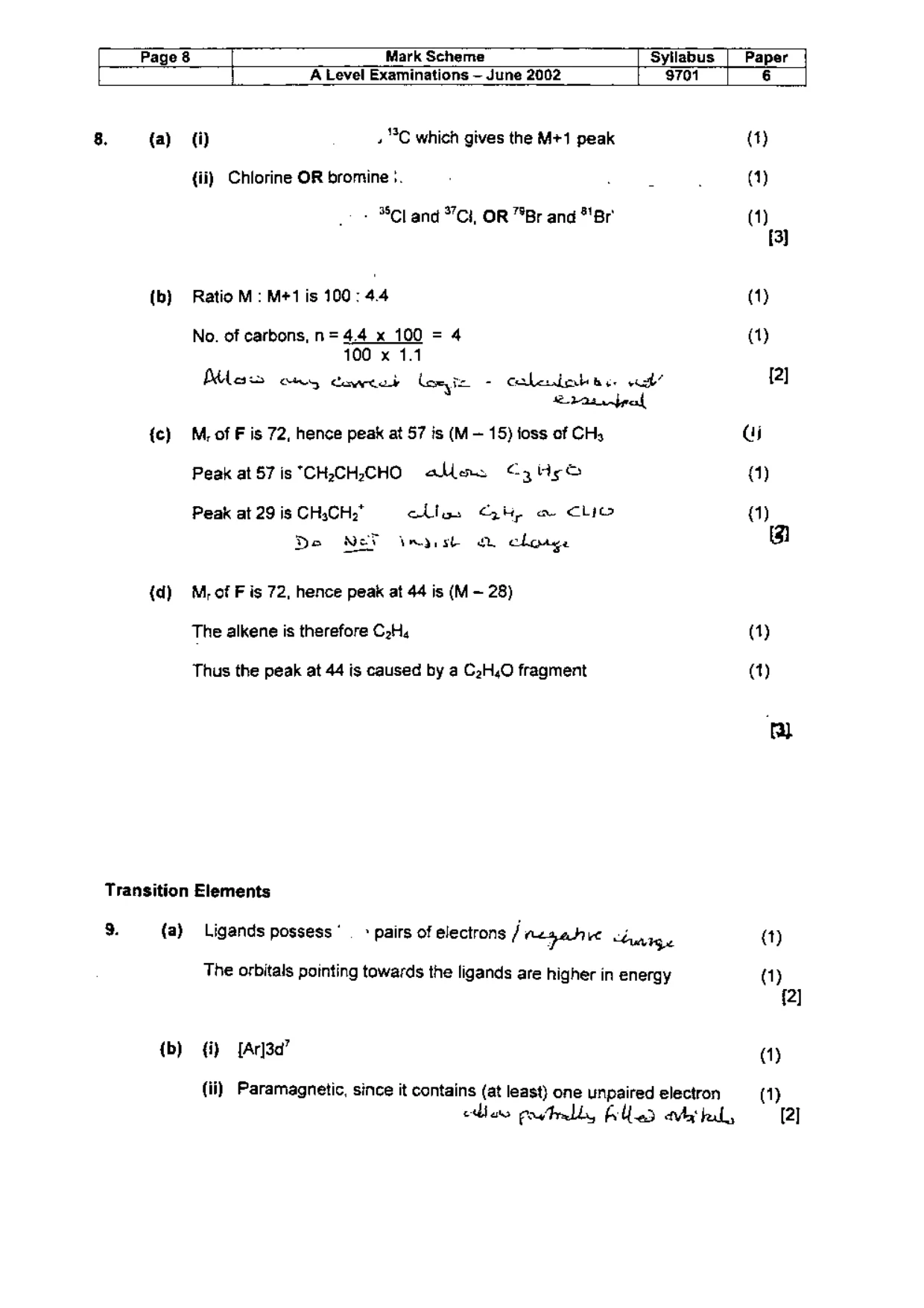
8 (a) Explain how the following peaks may arise in the mass spectrum of an organic compound. (i) M + 1 (ii) M + 2 [3] (b) The mass spectrum shown below was produced by a compound F, CnH2nO. The (M+1) peak has a relative abundance which is 4.4% of that of the peak due to the molecular ion. What is the value of n in the formula of F? [3] (c) F contains the -CHO functional group. Suggest the identities of the ions produced which give peaks at m/e 57 and 29 respectively. [2] (d) The base peak is at m/e 44. When the ion responsible for this peak is formed, an alkene molecule is also produced. Suggest the identity of each of these species. [2] 10 30 50 70 90 relative abundance m/e 9 9701/6/S02 [Turn over
Question paper, page 10
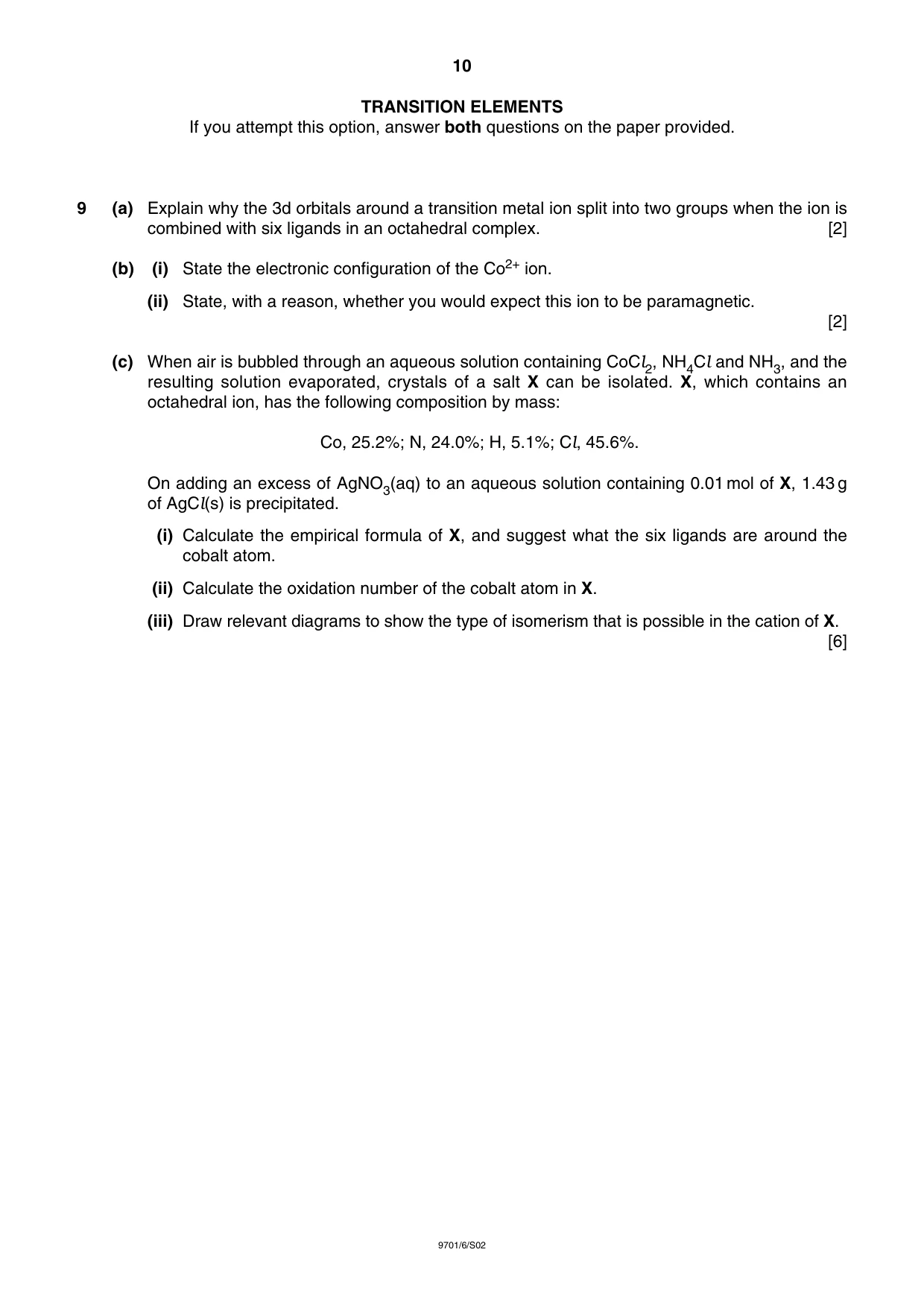
TRANSITION ELEMENTS If you attempt this option, answer both questions on the paper provided. 9 (a) Explain why the 3d orbitals around a transition metal ion split into two groups when the ion is combined with six ligands in an octahedral complex. [2] (b) (i) State the electronic configuration of the Co2+ ion. (ii) State, with a reason, whether you would expect this ion to be paramagnetic. [2] (c) When air is bubbled through an aqueous solution containing CoCl2, NH4Cl and NH3, and the resulting solution evaporated, crystals of a salt X can be isolated. X, which contains an octahedral ion, has the following composition by mass: Co, 25.2%; N, 24.0%; H, 5.1%; Cl, 45.6%. On adding an excess of AgNO3(aq) to an aqueous solution containing 0.01 mol of X, 1.43 g of AgCl(s) is precipitated. (i) Calculate the empirical formula of X, and suggest what the six ligands are around the cobalt atom. (ii) Calculate the oxidation number of the cobalt atom in X. (iii) Draw relevant diagrams to show the type of isomerism that is possible in the cation of X. [6] 10 9701/6/S02
Question paper, page 11
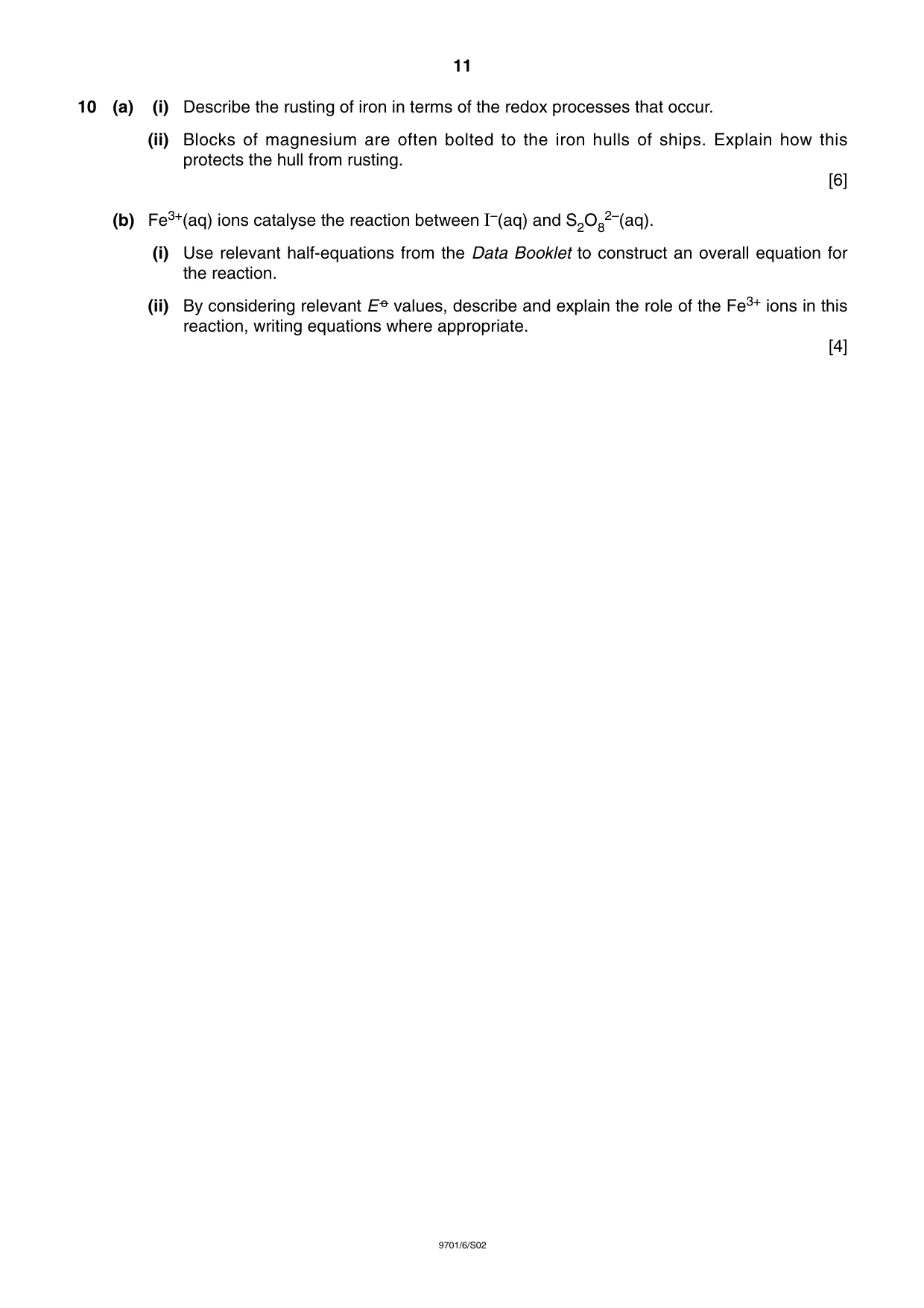
10 (a) (i) Describe the rusting of iron in terms of the redox processes that occur. (ii) Blocks of magnesium are often bolted to the iron hulls of ships. Explain how this protects the hull from rusting. [6] (b) Fe3+(aq) ions catalyse the reaction between I–(aq) and S2O8 2–(aq). (i) Use relevant half-equations from the Data Booklet to construct an overall equation for the reaction. (ii) By considering relevant E o– values, describe and explain the role of the Fe3+ ions in this reaction, writing equations where appropriate. [4] 11 9701/6/S02
Mark scheme, page 1
CAMBRIDGE INTERNATIONAL EXAMINATIONS JUNE 2002 GCE Advanced Level MAXIMUM MARK : 40 SYLLABUS/COMPONENT :9701 /6 CHEMISTRY (OPTIONS (A2)) RA UNiversiry of CAMBRIDGE 8 Local Examinations Syndicate
Mark scheme, page 2
Page 1 i Mark Scheme Sy!iabus Paper | | A Level Examinations —- June 2002 9701 Biochemistry 1. (a) The three-dimensional shape / haw Thich [Hy cals (1) {b) (c) Ce ules. a-helix - OH . hydrogen bonding or any polar group -COz of -NH,° ionic/electrostatic bonding a) 2} (1) (1) (2) if Ne Guiup i iAeadstiad , 2 ye at rundig Scere (1) (i) tonic f oevde -heawe / cleciveslene forms saits or complex ions e.g. -CO2 Ag* OR disulphide links -CH2-§ — Ag’ (ii) Heat breaks the weakest bond first van der Waals’ or hydrogen bonds ed (1) (1) (1) (1) (1) (1) (iii) Addition of H* or OH’ breaks polar bonds [Pereira “depaboabia (1) ionic OR hydrogen bonds OR -CO, + H* => -CO.H (1) (8}
Mark scheme, page 3
Page 2 Mark Scheme Syllabus | Paper — A Level Examinations — June 2002 9701 G 2 (a) Al [ons spe cfc PS bores a NT weet P, S, B identified (1) tne fs Ss Shape (1) AT / CG a) / Oh Quartile 4 ? H-bonds shown {1) [is |-tea + [9] ] TD ehh ie Ce) [4] {b} DNA is the repository of genetic information (1) It can replicate itself (1) Jt contains a triplet code of bases. (4) {t unwinds to give a single strand which acts as a template (1) This forms m-RNA (1) t-RNA translates the code into a sequence of amino acid (1) and brings each amino acid in turn (1) [max 6]
Mark scheme, page 4
Page 3 Mark Scheme Syilabus Paper t A Level Examinations — June 2002 9701 6 Environmental Chemistry 3. (a} SO, bond vibrations absorb in the IR region (1) There is a change in dipole moment (1) This process absorbs energy which wouid be re-radiated as heat back to the Earth’s surface (1) (could be on a diagram) (b) SO, is easily oxidised to SO; (1) alla, equsltay This dissolves in water to form sulphate ions (4) Oxidising agents include Oz, Oz, NOz (one only) () (c) SO, + H,O => H)SO,; <~ 4 + So. 7 only scores {1} $Oz is first oxidised to SO; (A) Ther this dissolves: SO; + H2O => H2SO, (1) (d) Powdered coai and limestone are fluidised by forcing gas through them (1) On burning, the SO; is released and reacts with the limestone (1) SO(g) + CaCOs{s) => CO2(g} + CaSOs(s) (1) [mer 6)
Mark scheme, page 5
Page 4 Mark Scheme | Syilabus Paper A Level Examinations — June 2002 [9701 6 (a} Rain water containing CO; attacks the timestone (1) This forms calcium hydrogencarbonate causing the rock to dissalve {1) Raised temperature or alkaline conditions cause HCO, to precipitate as COs" / fous Leo} slufte agha be dye (1) CaCO; + H,O + CO, <=> Ca(HCOs), (1) ae wh a, tl (b) (i) Root respiration reieases carbon dioxide all OR hydrogen ions occupy si exchange sites released by the yemoval of nutrients by the growing plant. “~ (1) Co,*” words with Hl ins (ii) The calcium ions from the liming displace hydrogen ions from the exchange sites. (A) This provides long term protection by inhibiting the subsequent retention of hydrogen ions at the exchange sites OR by being able to release the calcium ions as carbonate to neutralise the soil sotution. (1) (iii} Prevents the development of reducing conditions in the soit {1) Reduces the risk of ion deficiencies . 54 — precipitation (1} bout S nders processes which result in the breakdown of clay structures (1) 6 bay ph COs wehelagging =f han Sal, 6] a4
Mark scheme, page 6
Page 5 Mark Scheme | Syliabus Paper A Level Examinations - June 2002 [9701 6 Phase Equilibria 5. (a) fi) ies Labeda) plats ty (ii) 75 °C —45g + Fg; 25 °C ~ 33g & Ig (1) {b) (i) Crystailisation / crystals separate (1) Miss sda ppk (ii) From (a){ii) 12g of KCI separate from the solutions in 100g water (mark consequentially) (1) (2) (c) Mole fraction is KCl = 33/74.5 (1) = 0.08 HO 100/18 (1) (2] Shecbly clue be O:07G | alla evbie for 2 ely pe pal muk, oo2 wh sened (d) TVenp zs° 1 6% | Kes) Sketch (1) % Salvi scat Ectls) 3 points (1) ~\e? “ay Mal action Areas (1) (3)
Mark scheme, page 7
Page 6 Mark Scheme Syllabus | Paper [ A Level Examinations - June 2002 9701 6 (a) {2} 134% Shetern CG) Lalecte A) oe % 5%, * to0% Prepan-t-of - Pentan-t-ol Dee Hy CBE here tose, Mh. ‘Skolel? mek Liquid (a) boits (b) giving a vapour richer in the more volatile component (1) This condenses to liquid (d) in the fractionating column (1) Each horizontal line*epresents a ‘theoretical plate’ (1) a bua Gas {5} & skp {c) Propan-1-ol and water have similar intermolecular forces OR both form hydrogen bonds (1) The largey hydrophobic CsH,2 of the pentan-t-ol prevents miscibility (1} intermolecular forces pentan-1-ol — pentan-1-ol and water — water are stronger than pentan-1-ol — water. (4) (3}
Mark scheme, page 8
Page 7 Mark Scheme | Syllabus [ Paper A Level Examinations - June 2002 [9701 6 Spectroscopy 7. {a} Make a mull with hydrocarbon / Nujol (4) Place between NaCl / KBr plates (1) OR Grind up with KBr (1) Compress under vacuum (1) OR Dissolve in solvent (1) Use doubie beam spectrometer with solvent blank (1} [2 x 2} {b) {i} Aspirin: -OH, C=0,C—O0, fo (1) Paracetamol: -OH, C=O, C—O, (ey -N-H (4) {ii} -N—H is the only difference, at 3100-3600 cm* (1) [3] (c) Nmr absorptions depend upon the proton environment (1) Aspirin has » protons in 3 (4) environments (4) Paracetamol has - protons in 4 (5) environments (1) {3} May Aspinn 05 Spams | pacccitial Techn, Gy
Mark scheme, page 9
Page 8 Mark Scheme Syllabus | Paper A Level Examinations ~ June 2002 9701 6 8. (a) (i) . °C which gives the M+1 peak (1) {ii) Chlorine OR bromine ;. . (1) - SC] and "Ci, OR “Br and "Br (1) [3] (b) Ratio M: M+1 is 100: 4.4 (1) No. of carbons, n= 4.4 x 100 = 4 (1) 100 x 1.1 Bilas ony cowie bowie = Cobedob ee cob’ {2] 22a bal {c) M, of F is 72, hence peak at 57 is (M — 15) ioss of CH, Gi Peak at 87 is°CH,CH,CHO aliens Calico (1) Peak at 29 is CH:CH.* elias Gh, a CLIC (1) De NeT ingish 2 charge a {d) M, of F is 72, hence peak at 44 is (M — 28) The alkene is therefore C2H. (1) Thus the peak at 44 is caused by a C2H,O fragment (t) mR) Transition Elements 9. (a) Ligands possess‘ . + pairs of electrons / negahic havige (t) ‘The orbitals pointing towards the ligands are higher in energy (1) (2) {b) ¢i)[Ar]3a” (1) (ii) Paramagnetic, since it contains (at least) one unpaired electron (1) edie powhelly Ruled wvexkd, — [2]
Mark scheme, page 10
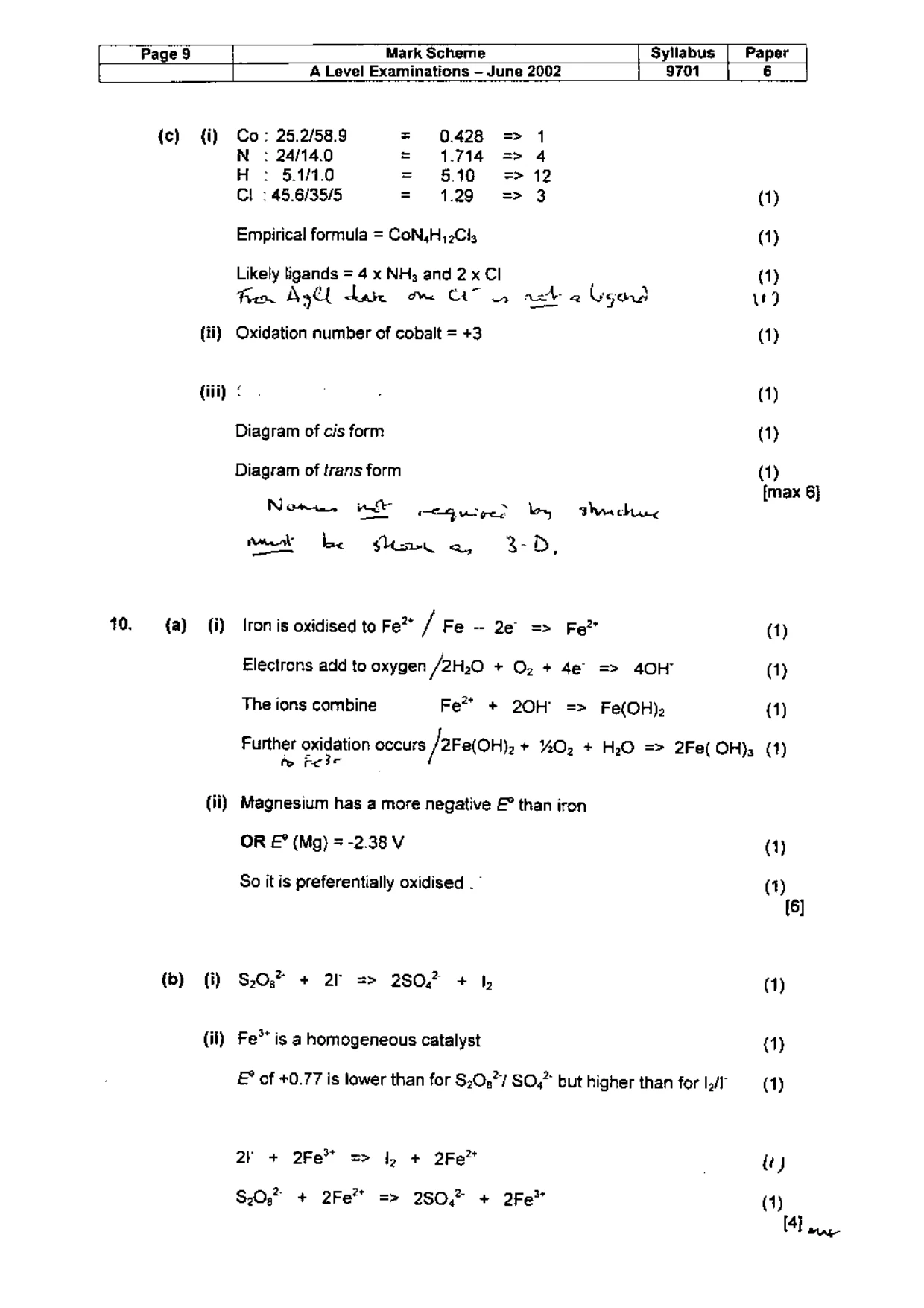
Page 9 Mark Scheme Syllabus Paper A Level Examinations — June 2002 9701 6 {c) {i) Co: 25.2/58.9 = 0428 => 1 N : 24/14.0 = 1.714 => 4 H : 5.1/1.0 = 510 => 12 Cl : 45.6/35/5 = 1.29 => 3 (1) Empirical formula = CoN,Hy2Cls (1) Likely ligands = 4 x NH; and 2 x Cl (1) Fan Agel chee om CAT ash a Goad WwW? (ii) Oxidation number of cobalt = +3 (1) (iii) < . (1) Diagram of cis form (1) Diagram of trans form (1) [max 6} Noma. nik meguiges by thudter matt be Sune ea, 3-D, 10. (a) (i) Ironis oxidised to Fe” / Fe - 2e => Fe (1) Electrons add to oxygen /2H:0 + 0. + 4e => 40H (1) The ions combine Fe* + 20H => Fe(OH), (1) Further oxidation occurs /2Fe(OH)2 + %O2 + HO => 2Fe( OH)s (1) fe rete (ii), Magnesium has a more negative E* than iron OR &° (Mg) = -2.38 V (1) So it is preferentially oxidised . (1) (6] (b) (i) S.0,7% + 2r => 2507 + 1 (1) (ii) Fe* is a homogeneous catalyst (1) © of +0.77 is tower than for S,0,7/ SO,” but higher than for I/ (1) 2h + 2Fe* => 1, + 2Fe iy S,0,7 + 2Fe => 20,7 + 2Fe” (1) (4} ue