Cambridge A Level Business (for first examination in 2016) 9609 — 2024 May/June Paper 4 · Variant 3
9609/43/M/J/24 · 40 marks · ≈45 min
The question paper and its mark scheme, free to read here and free to download. This is Cambridge’s own paper, exactly as it was sat.
Question paper4 pages

Mark scheme15 pages
Answers below. Sit the paper first if you are practising.
Paper as text
Question paper, page 1
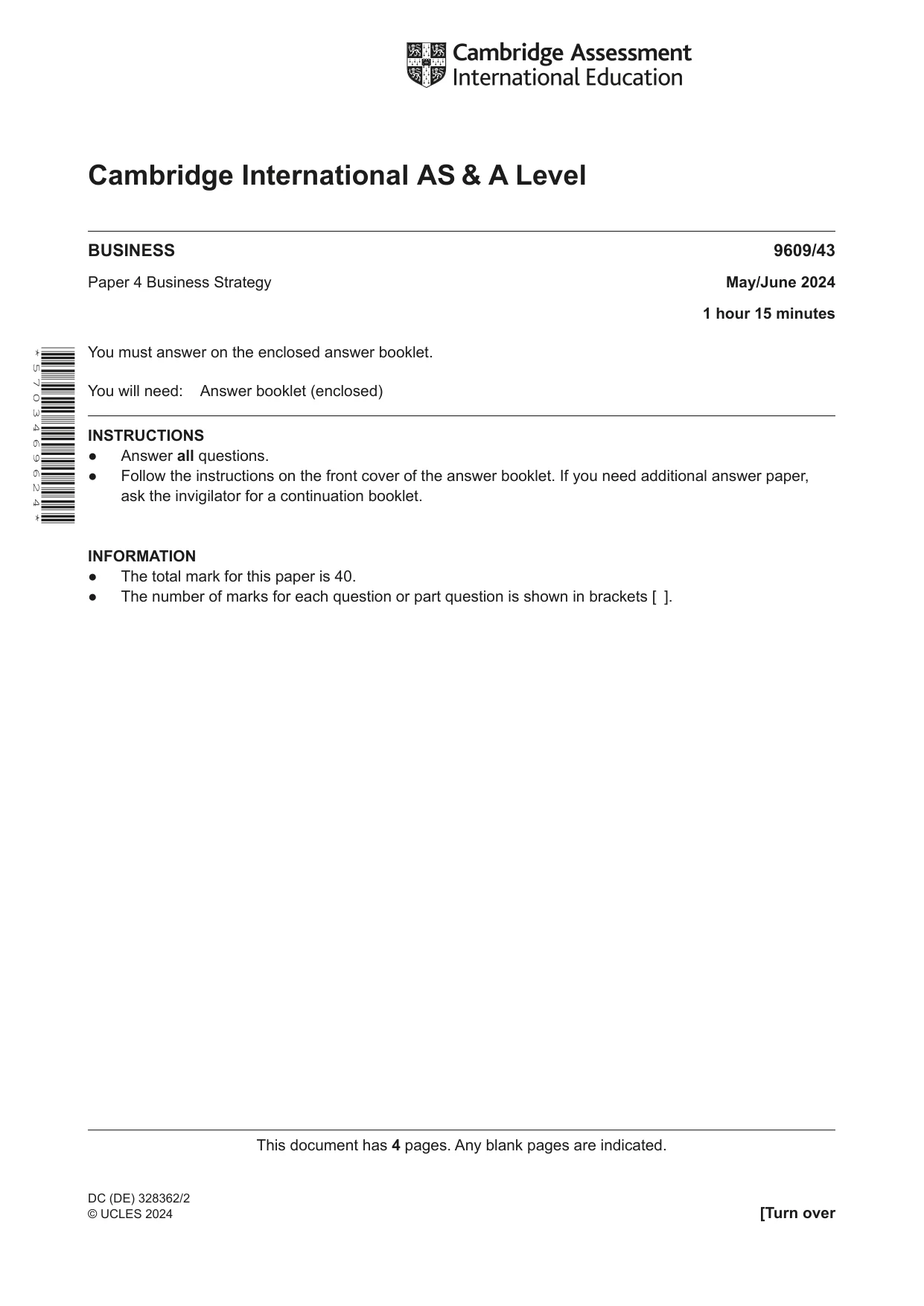
This document has 4 pages. Any blank pages are indicated. [Turn over * 5 7 0 3 4 6 9 6 2 4 * Cambridge International AS & A Level BUSINESS 9609/43 Paper 4 Business Strategy May/June 2024 1 hour 15 minutes You must answer on the enclosed answer booklet. You will need: Answer booklet (enclosed) INSTRUCTIONS ● Answer all questions. ● Follow the instructions on the front cover of the answer booklet. If you need additional answer paper, ask the invigilator for a continuation booklet. INFORMATION ● The total mark for this paper is 40. ● The number of marks for each question or part question is shown in brackets [ ]. DC (DE) 328362/2 © UCLES 2024
Question paper, page 2
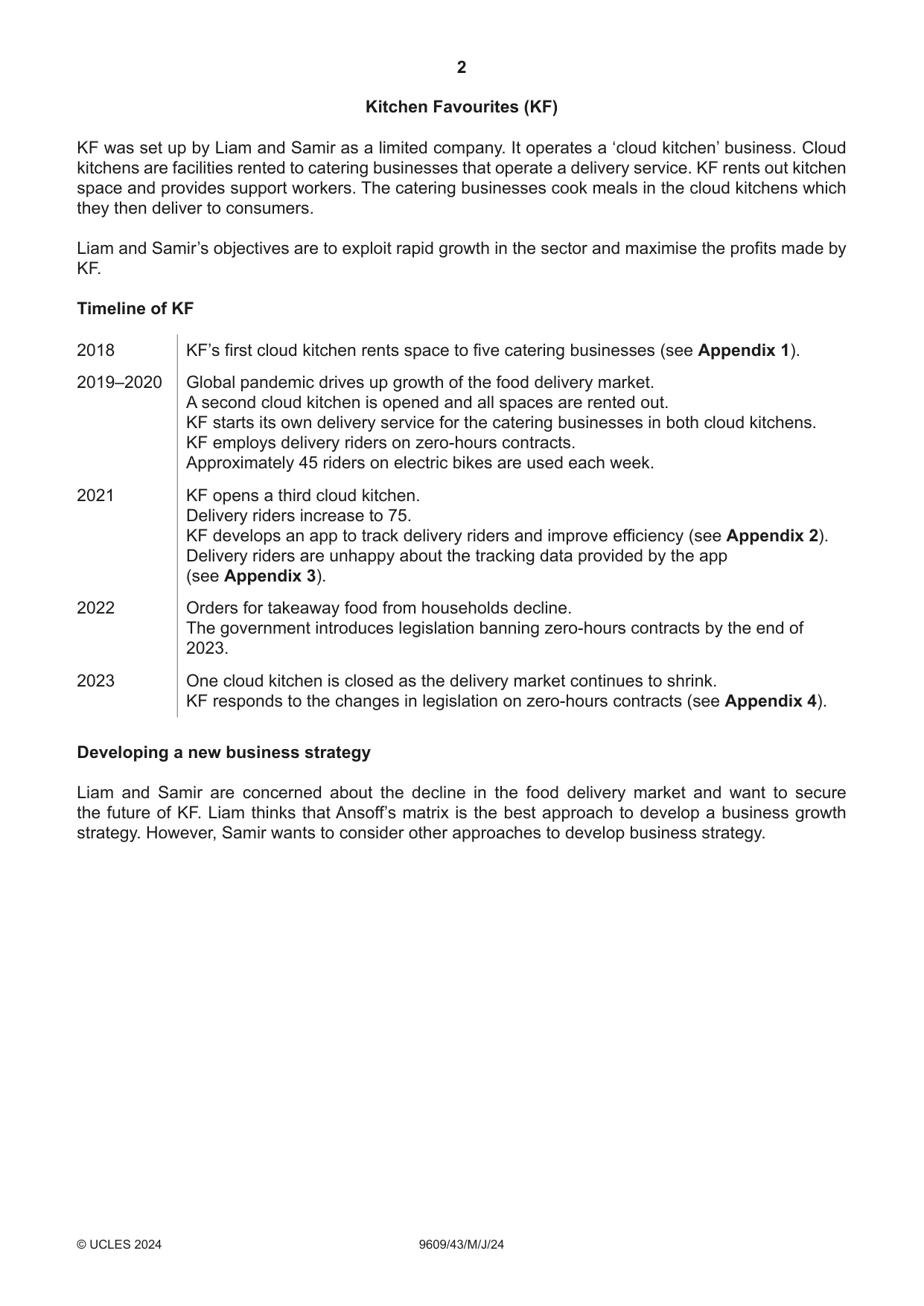
2 9609/43/M/J/24 © UCLES 2024 Kitchen Favourites (KF) KF was set up by Liam and Samir as a limited company. It operates a ‘cloud kitchen’ business. Cloud kitchens are facilities rented to catering businesses that operate a delivery service. KF rents out kitchen space and provides support workers. The catering businesses cook meals in the cloud kitchens which they then deliver to consumers. Liam and Samir’s objectives are to exploit rapid growth in the sector and maximise the profits made by KF. Timeline of KF 2018 KF’s first cloud kitchen rents space to five catering businesses (see Appendix 1). 2019–2020 Global pandemic drives up growth of the food delivery market. A second cloud kitchen is opened and all spaces are rented out. KF starts its own delivery service for the catering businesses in both cloud kitchens. KF employs delivery riders on zero-hours contracts. Approximately 45 riders on electric bikes are used each week. 2021 KF opens a third cloud kitchen. Delivery riders increase to 75. KF develops an app to track delivery riders and improve efficiency (see Appendix 2). Delivery riders are unhappy about the tracking data provided by the app (see Appendix 3). 2022 Orders for takeaway food from households decline. The government introduces legislation banning zero-hours contracts by the end of 2023. 2023 One cloud kitchen is closed as the delivery market continues to shrink. KF responds to the changes in legislation on zero-hours contracts (see Appendix 4). Developing a new business strategy Liam and Samir are concerned about the decline in the food delivery market and want to secure the future of KF. Liam thinks that Ansoff’s matrix is the best approach to develop a business growth strategy. However, Samir wants to consider other approaches to develop business strategy.
Question paper, page 3
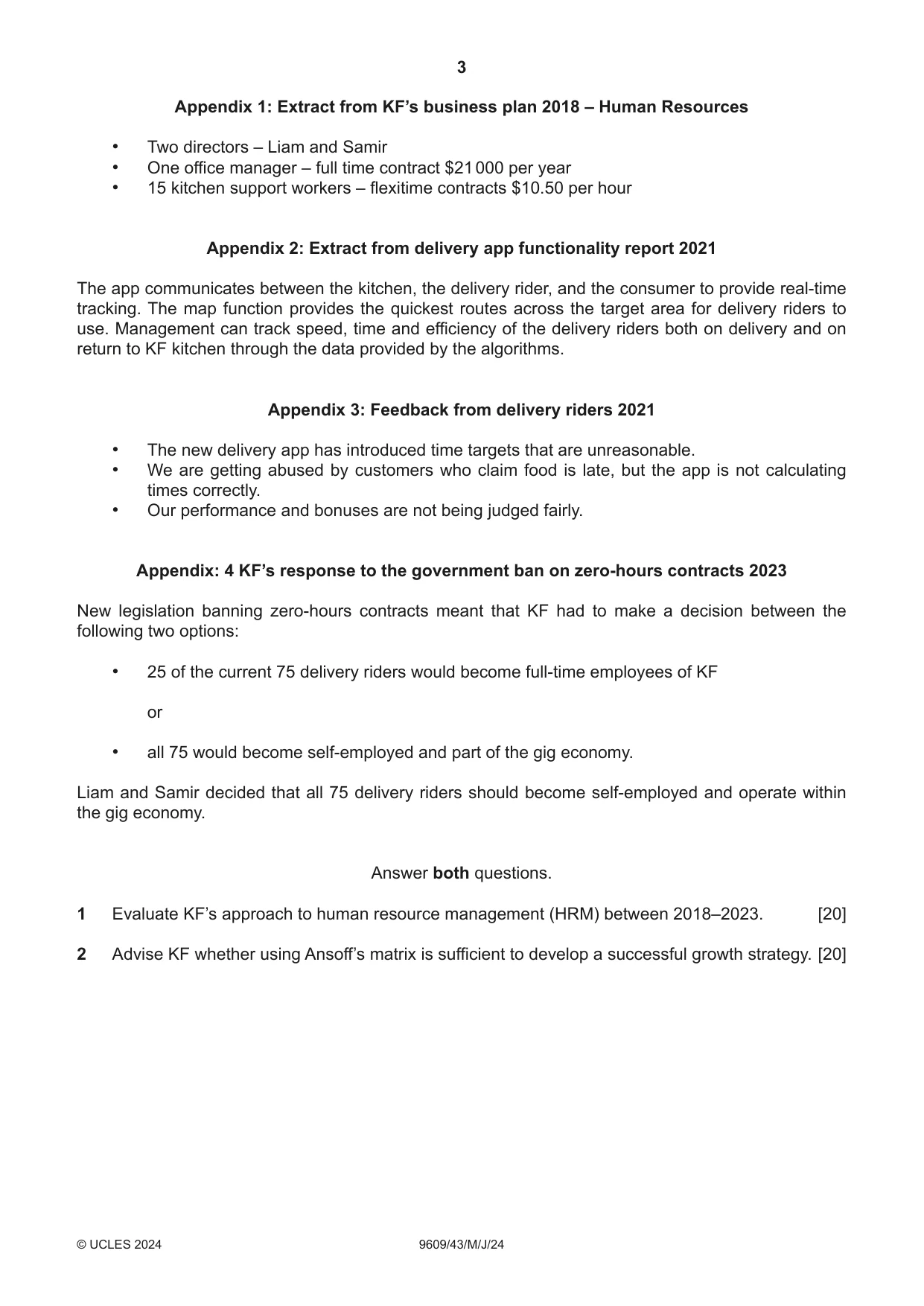
3 9609/43/M/J/24 © UCLES 2024 Appendix 1: Extract from KF’s business plan 2018 – Human Resources • Two directors – Liam and Samir • One office manager – full time contract $21 000 per year • 15 kitchen support workers – flexitime contracts $10.50 per hour Appendix 2: Extract from delivery app functionality report 2021 The app communicates between the kitchen, the delivery rider, and the consumer to provide real-time tracking. The map function provides the quickest routes across the target area for delivery riders to use. Management can track speed, time and efficiency of the delivery riders both on delivery and on return to KF kitchen through the data provided by the algorithms. Appendix 3: Feedback from delivery riders 2021 • The new delivery app has introduced time targets that are unreasonable. • We are getting abused by customers who claim food is late, but the app is not calculating times correctly. • Our performance and bonuses are not being judged fairly. Appendix: 4 KF’s response to the government ban on zero-hours contracts 2023 New legislation banning zero-hours contracts meant that KF had to make a decision between the following two options: • 25 of the current 75 delivery riders would become full-time employees of KF or • all 75 would become self-employed and part of the gig economy. Liam and Samir decided that all 75 delivery riders should become self-employed and operate within the gig economy. Answer both questions. 1 Evaluate KF’s approach to human resource management (HRM) between 2018–2023. [20] 2 Advise KF whether using Ansoff’s matrix is sufficient to develop a successful growth strategy. [20]
Question paper, page 4
4 9609/43/M/J/24 © UCLES 2024 Permission to reproduce items where third-party owned material protected by copyright is included has been sought and cleared where possible. Every reasonable effort has been made by the publisher (UCLES) to trace copyright holders, but if any items requiring clearance have unwittingly been included, the publisher will be pleased to make amends at the earliest possible opportunity. To avoid the issue of disclosure of answer-related information to candidates, all copyright acknowledgements are reproduced online in the Cambridge Assessment International Education Copyright Acknowledgements Booklet. This is produced for each series of examinations and is freely available to download at www.cambridgeinternational.org after the live examination series. Cambridge Assessment International Education is part of Cambridge Assessment. Cambridge Assessment is the brand name of the University of Cambridge Local Examinations Syndicate (UCLES), which is a department of the University of Cambridge. BLANK PAGE
Mark scheme, page 1
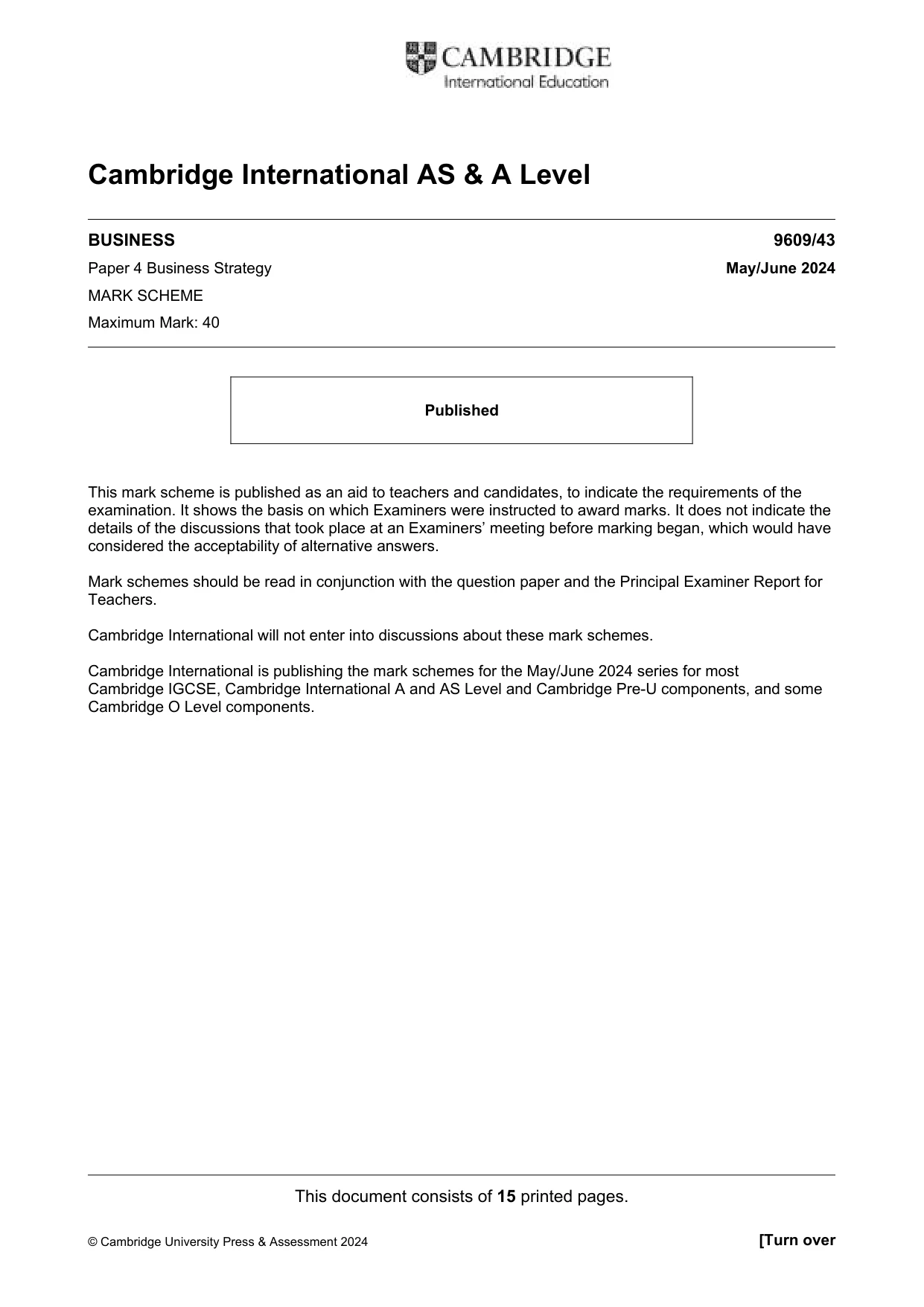
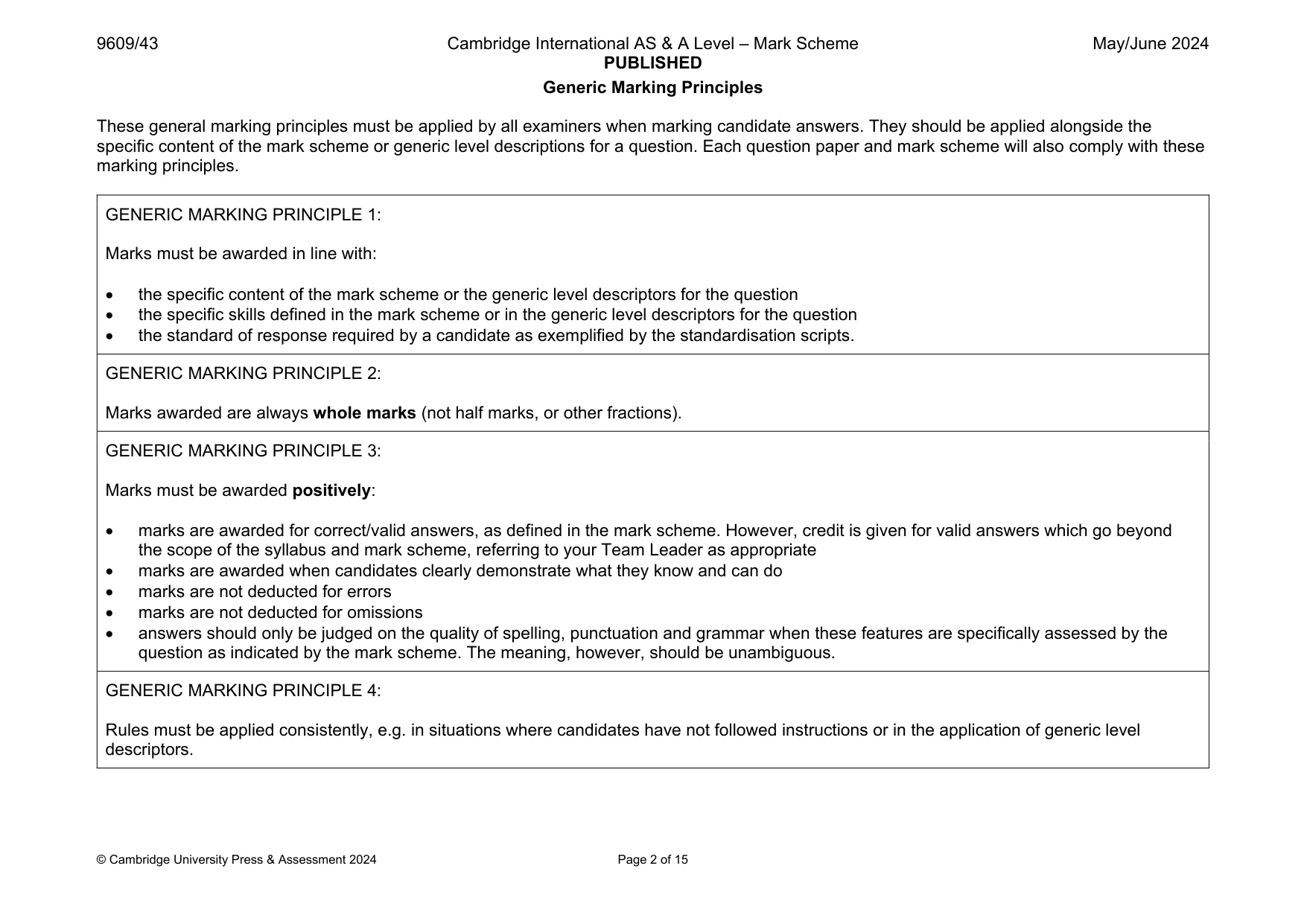
This document consists of 15 printed pages. © Cambridge University Press & Assessment 2024 [Turn over Cambridge International AS & A Level BUSINESS 9609/43 Paper 4 Business Strategy May/June 2024 MARK SCHEME Maximum Mark: 40 Published This mark scheme is published as an aid to teachers and candidates, to indicate the requirements of the examination. It shows the basis on which Examiners were instructed to award marks. It does not indicate the details of the discussions that took place at an Examiners’ meeting before marking began, which would have considered the acceptability of alternative answers. Mark schemes should be read in conjunction with the question paper and the Principal Examiner Report for Teachers. Cambridge International will not enter into discussions about these mark schemes. Cambridge International is publishing the mark schemes for the May/June 2024 series for most Cambridge IGCSE, Cambridge International A and AS Level and Cambridge Pre-U components, and some Cambridge O Level components.
Mark scheme, page 2
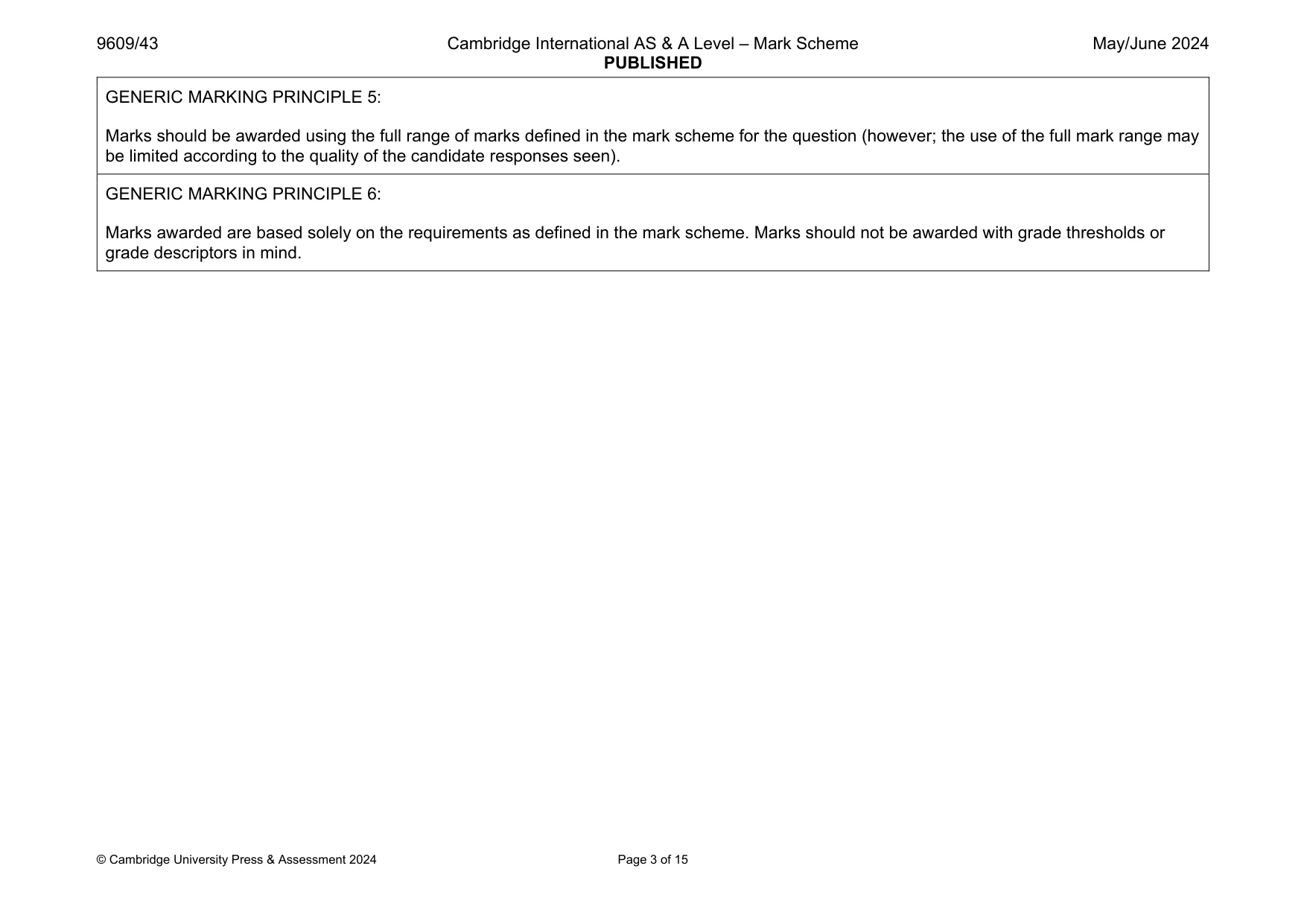
9609/43 Cambridge International AS & A Level – Mark Scheme PUBLISHED May/June 2024 © Cambridge University Press & Assessment 2024 Page 2 of 15 Generic Marking Principles These general marking principles must be applied by all examiners when marking candidate answers. They should be applied alongside the specific content of the mark scheme or generic level descriptions for a question. Each question paper and mark scheme will also comply with these marking principles. GENERIC MARKING PRINCIPLE 1: Marks must be awarded in line with: the specific content of the mark scheme or the generic level descriptors for the question the specific skills defined in the mark scheme or in the generic level descriptors for the question the standard of response required by a candidate as exemplified by the standardisation scripts. GENERIC MARKING PRINCIPLE 2: Marks awarded are always whole marks (not half marks, or other fractions). GENERIC MARKING PRINCIPLE 3: Marks must be awarded positively: marks are awarded for correct/valid answers, as defined in the mark scheme. However, credit is given for valid answers which go beyond the scope of the syllabus and mark scheme, referring to your Team Leader as appropriate marks are awarded when candidates clearly demonstrate what they know and can do marks are not deducted for errors marks are not deducted for omissions answers should only be judged on the quality of spelling, punctuation and grammar when these features are specifically assessed by the question as indicated by the mark scheme. The meaning, however, should be unambiguous. GENERIC MARKING PRINCIPLE 4: Rules must be applied consistently, e.g. in situations where candidates have not followed instructions or in the application of generic level descriptors.
Mark scheme, page 3
9609/43 Cambridge International AS & A Level – Mark Scheme PUBLISHED May/June 2024 © Cambridge University Press & Assessment 2024 Page 3 of 15 GENERIC MARKING PRINCIPLE 5: Marks should be awarded using the full range of marks defined in the mark scheme for the question (however; the use of the full mark range may be limited according to the quality of the candidate responses seen). GENERIC MARKING PRINCIPLE 6: Marks awarded are based solely on the requirements as defined in the mark scheme. Marks should not be awarded with grade thresholds or grade descriptors in mind.
Mark scheme, page 4
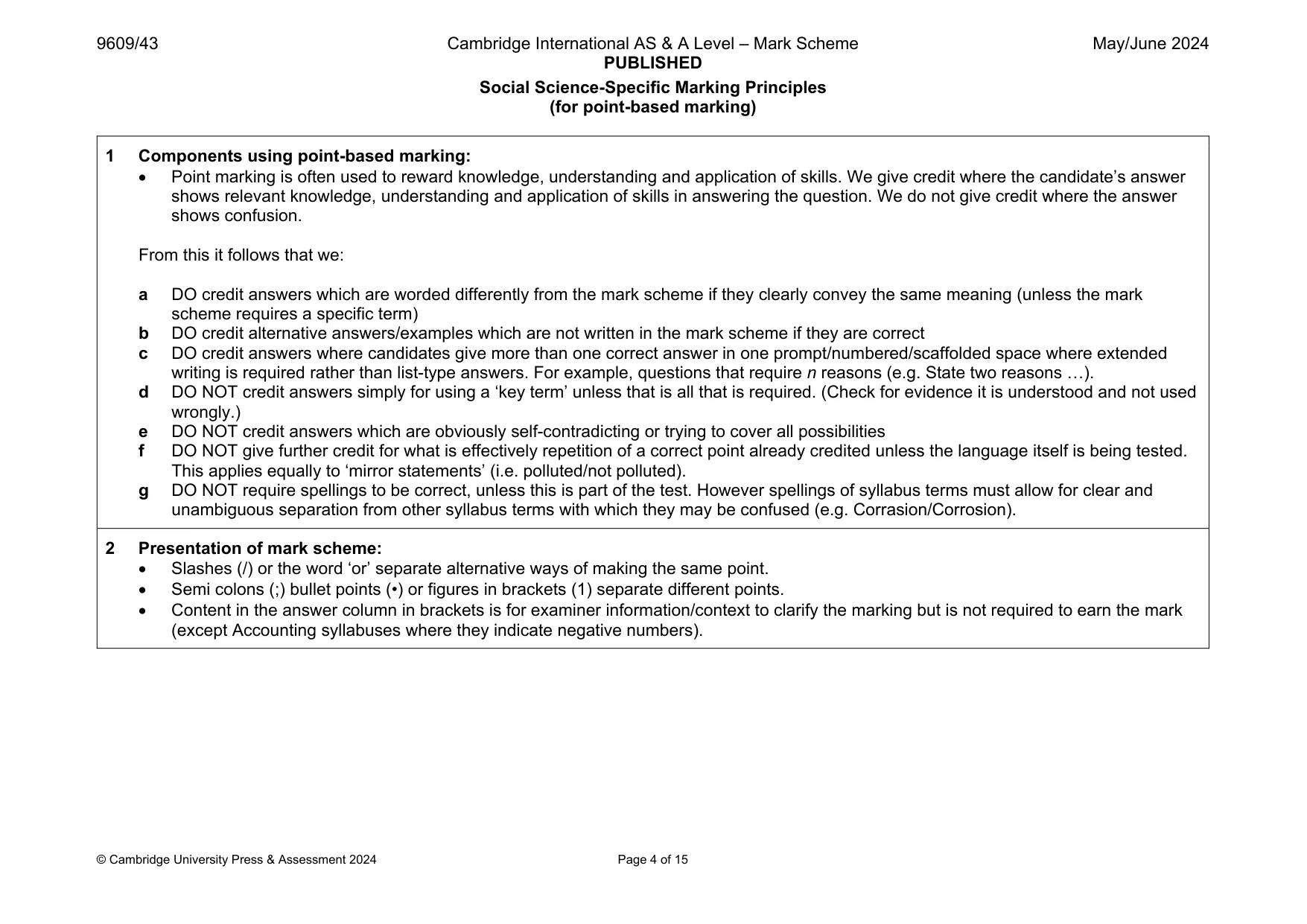
9609/43 Cambridge International AS & A Level – Mark Scheme PUBLISHED May/June 2024 © Cambridge University Press & Assessment 2024 Page 4 of 15 Social Science-Specific Marking Principles (for point-based marking) 1 Components using point-based marking: Point marking is often used to reward knowledge, understanding and application of skills. We give credit where the candidate’s answer shows relevant knowledge, understanding and application of skills in answering the question. We do not give credit where the answer shows confusion. From this it follows that we: a DO credit answers which are worded differently from the mark scheme if they clearly convey the same meaning (unless the mark scheme requires a specific term) b DO credit alternative answers/examples which are not written in the mark scheme if they are correct c DO credit answers where candidates give more than one correct answer in one prompt/numbered/scaffolded space where extended writing is required rather than list-type answers. For example, questions that require n reasons (e.g. State two reasons …). d DO NOT credit answers simply for using a ‘key term’ unless that is all that is required. (Check for evidence it is understood and not used wrongly.) e DO NOT credit answers which are obviously self-contradicting or trying to cover all possibilities f DO NOT give further credit for what is effectively repetition of a correct point already credited unless the language itself is being tested. This applies equally to ‘mirror statements’ (i.e. polluted/not polluted). g DO NOT require spellings to be correct, unless this is part of the test. However spellings of syllabus terms must allow for clear and unambiguous separation from other syllabus terms with which they may be confused (e.g. Corrasion/Corrosion). 2 Presentation of mark scheme: Slashes (/) or the word ‘or’ separate alternative ways of making the same point. Semi colons (;) bullet points (•) or figures in brackets (1) separate different points. Content in the answer column in brackets is for examiner information/context to clarify the marking but is not required to earn the mark (except Accounting syllabuses where they indicate negative numbers).
Mark scheme, page 5
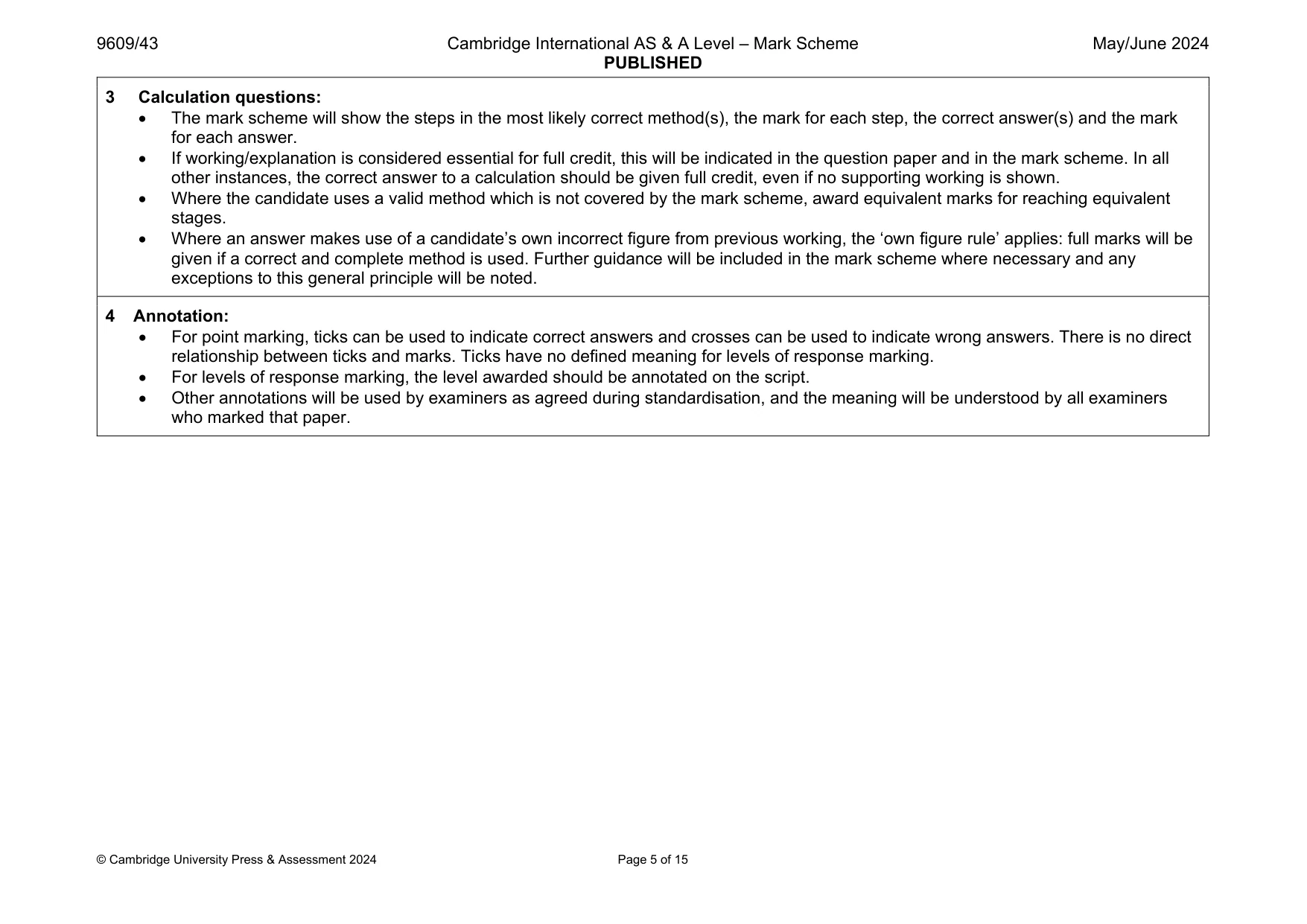
9609/43 Cambridge International AS & A Level – Mark Scheme PUBLISHED May/June 2024 © Cambridge University Press & Assessment 2024 Page 5 of 15 3 Calculation questions: The mark scheme will show the steps in the most likely correct method(s), the mark for each step, the correct answer(s) and the mark for each answer. If working/explanation is considered essential for full credit, this will be indicated in the question paper and in the mark scheme. In all other instances, the correct answer to a calculation should be given full credit, even if no supporting working is shown. Where the candidate uses a valid method which is not covered by the mark scheme, award equivalent marks for reaching equivalent stages. Where an answer makes use of a candidate’s own incorrect figure from previous working, the ‘own figure rule’ applies: full marks will be given if a correct and complete method is used. Further guidance will be included in the mark scheme where necessary and any exceptions to this general principle will be noted. 4 Annotation: For point marking, ticks can be used to indicate correct answers and crosses can be used to indicate wrong answers. There is no direct relationship between ticks and marks. Ticks have no defined meaning for levels of response marking. For levels of response marking, the level awarded should be annotated on the script. Other annotations will be used by examiners as agreed during standardisation, and the meaning will be understood by all examiners who marked that paper.
Mark scheme, page 6
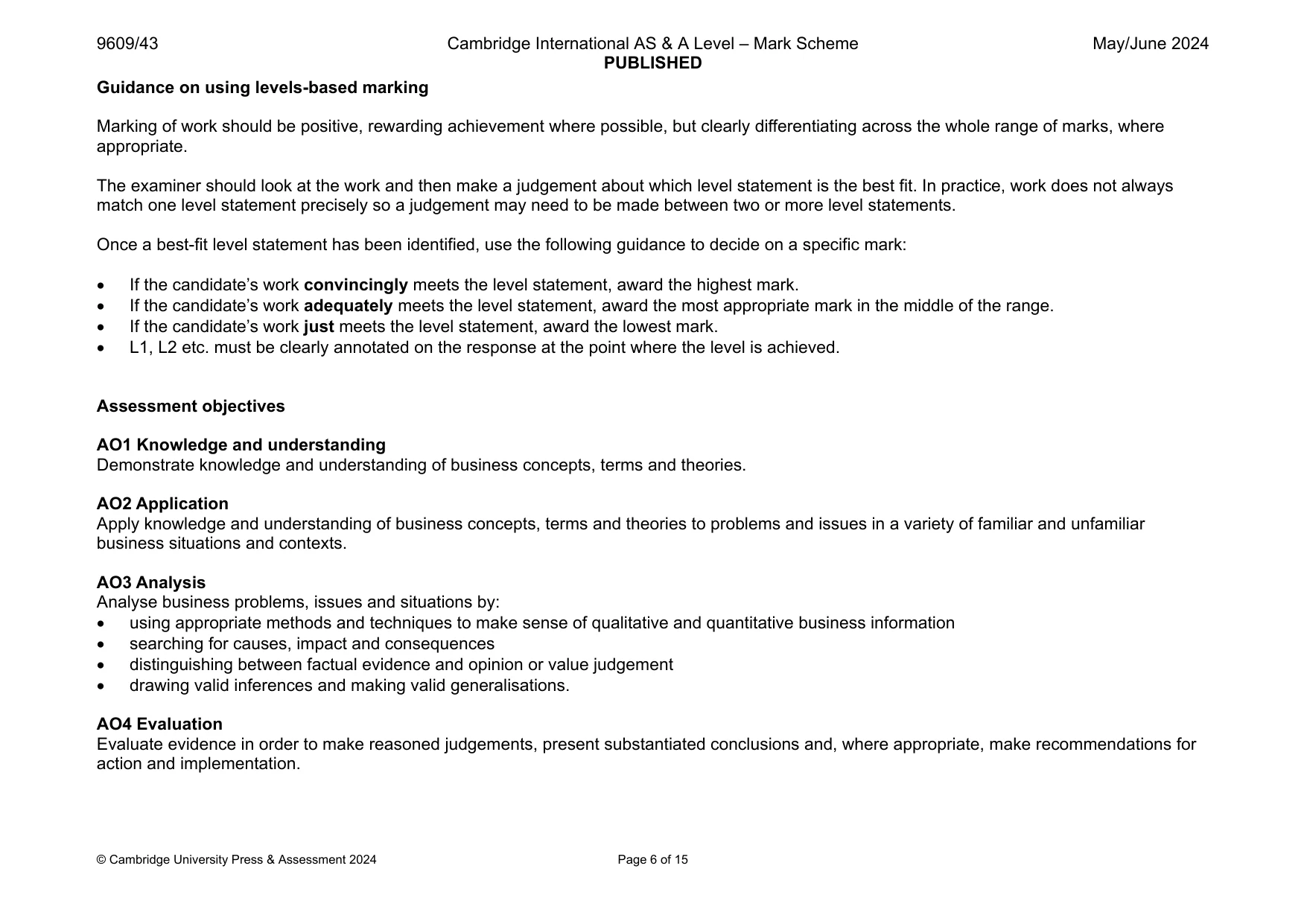
9609/43 Cambridge International AS & A Level – Mark Scheme PUBLISHED May/June 2024 © Cambridge University Press & Assessment 2024 Page 6 of 15 Guidance on using levels-based marking Marking of work should be positive, rewarding achievement where possible, but clearly differentiating across the whole range of marks, where appropriate. The examiner should look at the work and then make a judgement about which level statement is the best fit. In practice, work does not always match one level statement precisely so a judgement may need to be made between two or more level statements. Once a best-fit level statement has been identified, use the following guidance to decide on a specific mark: If the candidate’s work convincingly meets the level statement, award the highest mark. If the candidate’s work adequately meets the level statement, award the most appropriate mark in the middle of the range. If the candidate’s work just meets the level statement, award the lowest mark. L1, L2 etc. must be clearly annotated on the response at the point where the level is achieved. Assessment objectives AO1 Knowledge and understanding Demonstrate knowledge and understanding of business concepts, terms and theories. AO2 Application Apply knowledge and understanding of business concepts, terms and theories to problems and issues in a variety of familiar and unfamiliar business situations and contexts. AO3 Analysis Analyse business problems, issues and situations by: using appropriate methods and techniques to make sense of qualitative and quantitative business information searching for causes, impact and consequences distinguishing between factual evidence and opinion or value judgement drawing valid inferences and making valid generalisations. AO4 Evaluation Evaluate evidence in order to make reasoned judgements, present substantiated conclusions and, where appropriate, make recommendations for action and implementation.
Mark scheme, page 7
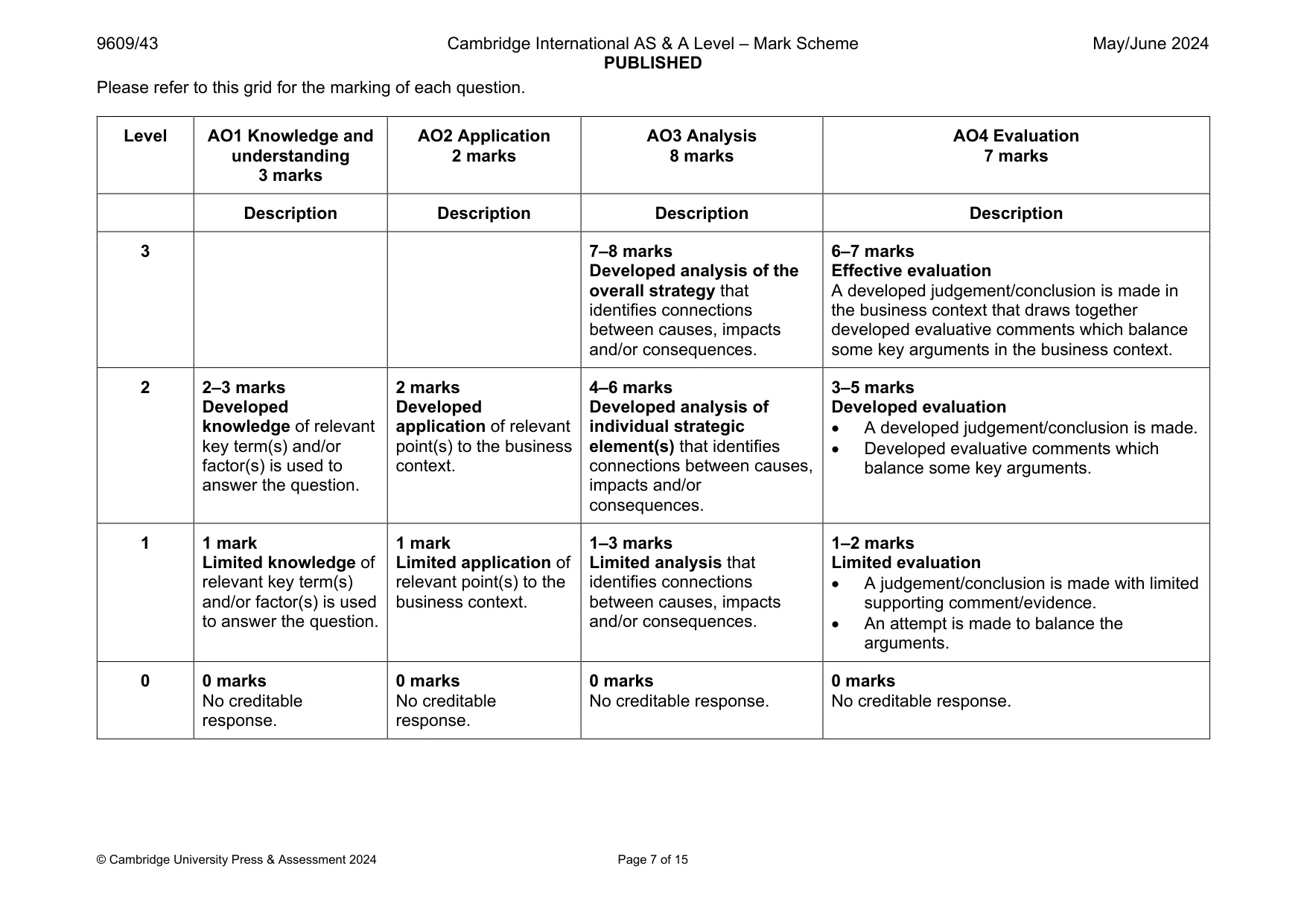
9609/43 Cambridge International AS & A Level – Mark Scheme PUBLISHED May/June 2024 © Cambridge University Press & Assessment 2024 Page 7 of 15 Please refer to this grid for the marking of each question. Level AO1 Knowledge and understanding 3 marks AO2 Application 2 marks AO3 Analysis 8 marks AO4 Evaluation 7 marks Description Description Description Description 3 7–8 marks Developed analysis of the overall strategy that identifies connections between causes, impacts and/or consequences. 6–7 marks Effective evaluation A developed judgement/conclusion is made in the business context that draws together developed evaluative comments which balance some key arguments in the business context. 2 2–3 marks Developed knowledge of relevant key term(s) and/or factor(s) is used to answer the question. 2 marks Developed application of relevant point(s) to the business context. 4–6 marks Developed analysis of individual strategic element(s) that identifies connections between causes, impacts and/or consequences. 3–5 marks Developed evaluation A developed judgement/conclusion is made. Developed evaluative comments which balance some key arguments. 1 1 mark Limited knowledge of relevant key term(s) and/or factor(s) is used to answer the question. 1 mark Limited application of relevant point(s) to the business context. 1–3 marks Limited analysis that identifies connections between causes, impacts and/or consequences. 1–2 marks Limited evaluation A judgement/conclusion is made with limited supporting comment/evidence. An attempt is made to balance the arguments. 0 0 marks No creditable response. 0 marks No creditable response. 0 marks No creditable response. 0 marks No creditable response.
Mark scheme, page 8
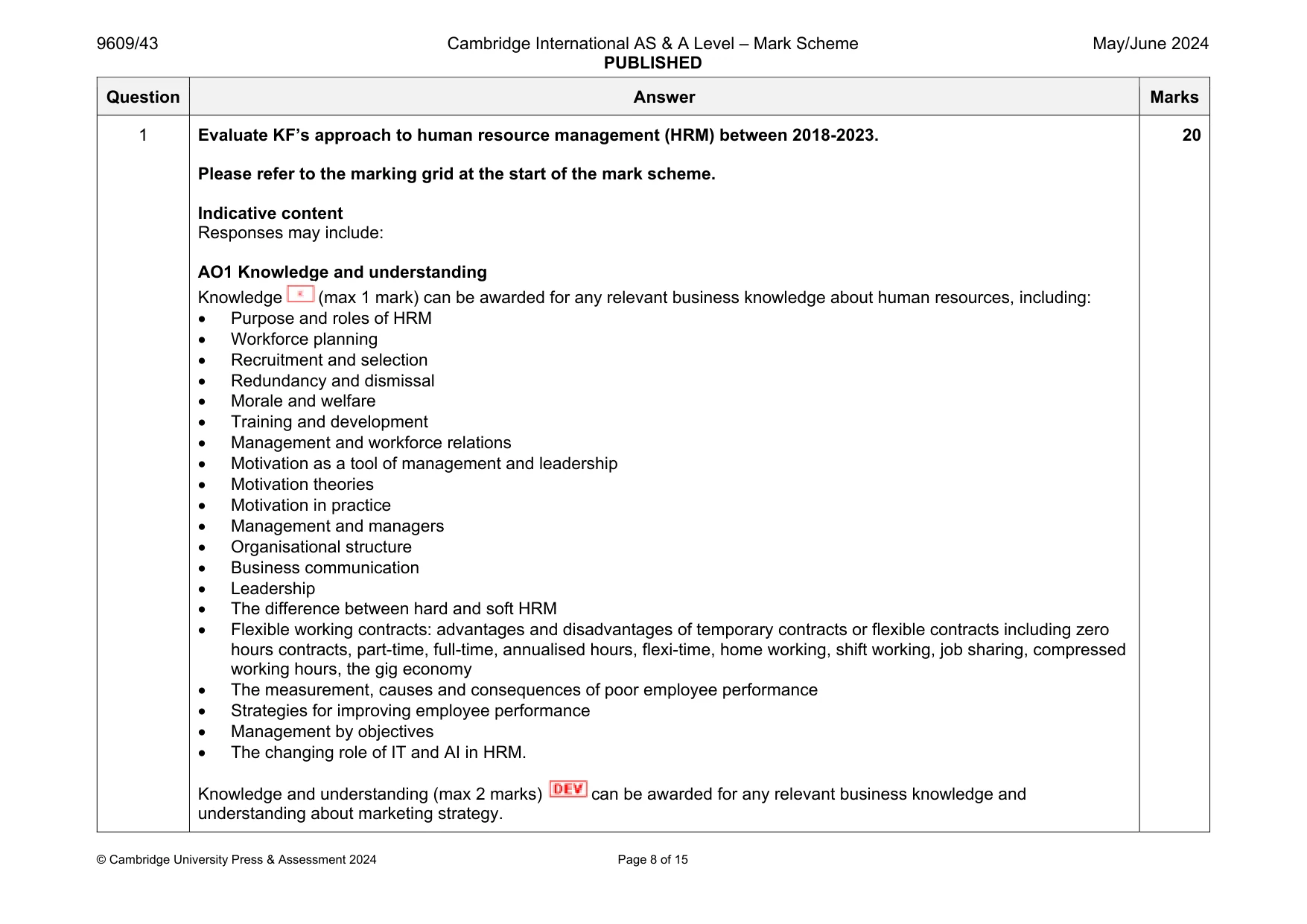
9609/43 Cambridge International AS & A Level – Mark Scheme PUBLISHED May/June 2024 © Cambridge University Press & Assessment 2024 Page 8 of 15 Question Answer Marks 1 Evaluate KF’s approach to human resource management (HRM) between 2018-2023. Please refer to the marking grid at the start of the mark scheme. Indicative content Responses may include: AO1 Knowledge and understanding Knowledge (max 1 mark) can be awarded for any relevant business knowledge about human resources, including: Purpose and roles of HRM Workforce planning Recruitment and selection Redundancy and dismissal Morale and welfare Training and development Management and workforce relations Motivation as a tool of management and leadership Motivation theories Motivation in practice Management and managers Organisational structure Business communication Leadership The difference between hard and soft HRM Flexible working contracts: advantages and disadvantages of temporary contracts or flexible contracts including zero hours contracts, part-time, full-time, annualised hours, flexi-time, home working, shift working, job sharing, compressed working hours, the gig economy The measurement, causes and consequences of poor employee performance Strategies for improving employee performance Management by objectives The changing role of IT and AI in HRM. Knowledge and understanding (max 2 marks) can be awarded for any relevant business knowledge and understanding about marketing strategy. 20
Mark scheme, page 9
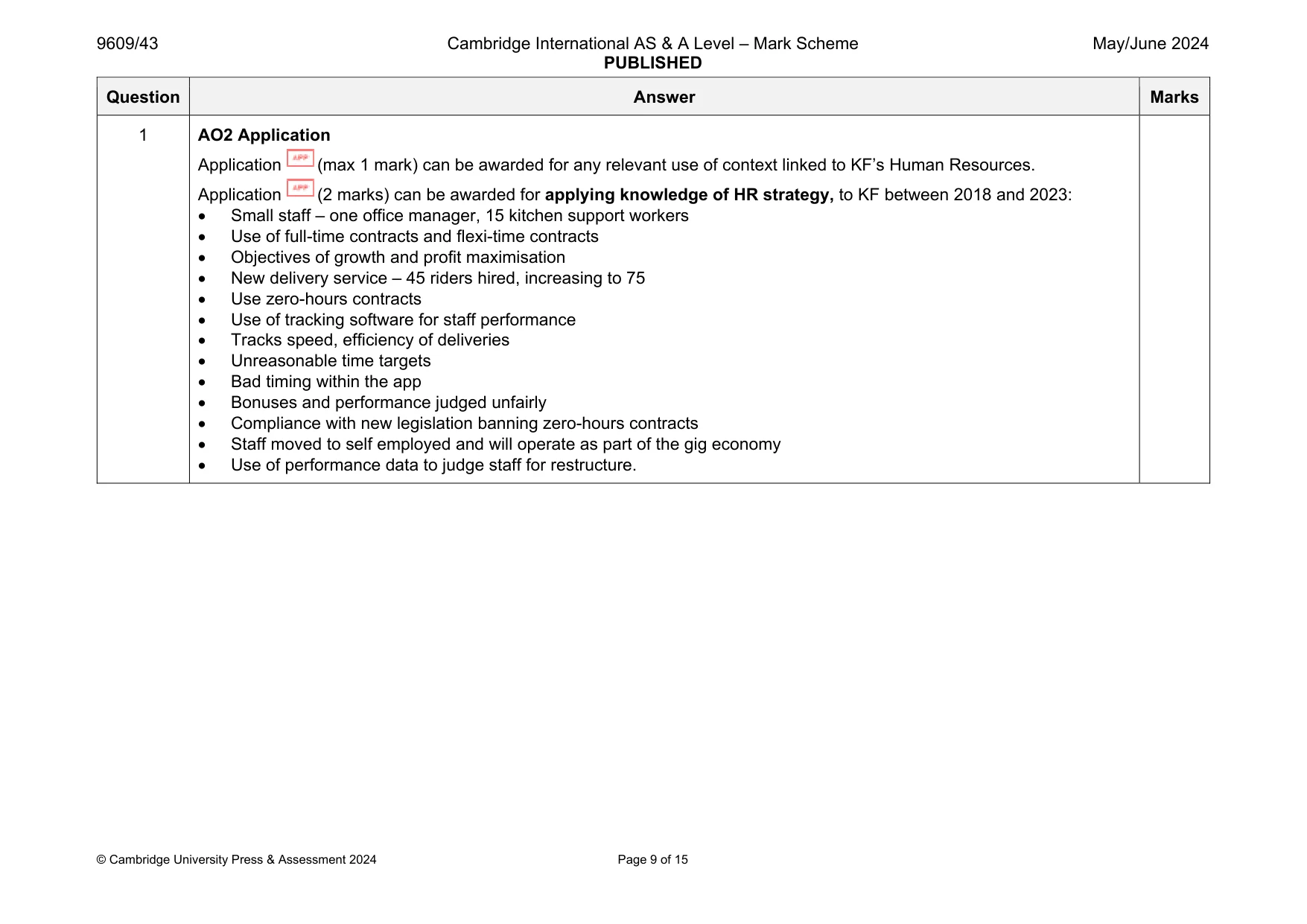
9609/43 Cambridge International AS & A Level – Mark Scheme PUBLISHED May/June 2024 © Cambridge University Press & Assessment 2024 Page 9 of 15 Question Answer Marks 1 AO2 Application Application (max 1 mark) can be awarded for any relevant use of context linked to KF’s Human Resources. Application (2 marks) can be awarded for applying knowledge of HR strategy, to KF between 2018 and 2023: Small staff – one office manager, 15 kitchen support workers Use of full-time contracts and flexi-time contracts Objectives of growth and profit maximisation New delivery service – 45 riders hired, increasing to 75 Use zero-hours contracts Use of tracking software for staff performance Tracks speed, efficiency of deliveries Unreasonable time targets Bad timing within the app Bonuses and performance judged unfairly Compliance with new legislation banning zero-hours contracts Staff moved to self employed and will operate as part of the gig economy Use of performance data to judge staff for restructure.
Mark scheme, page 10
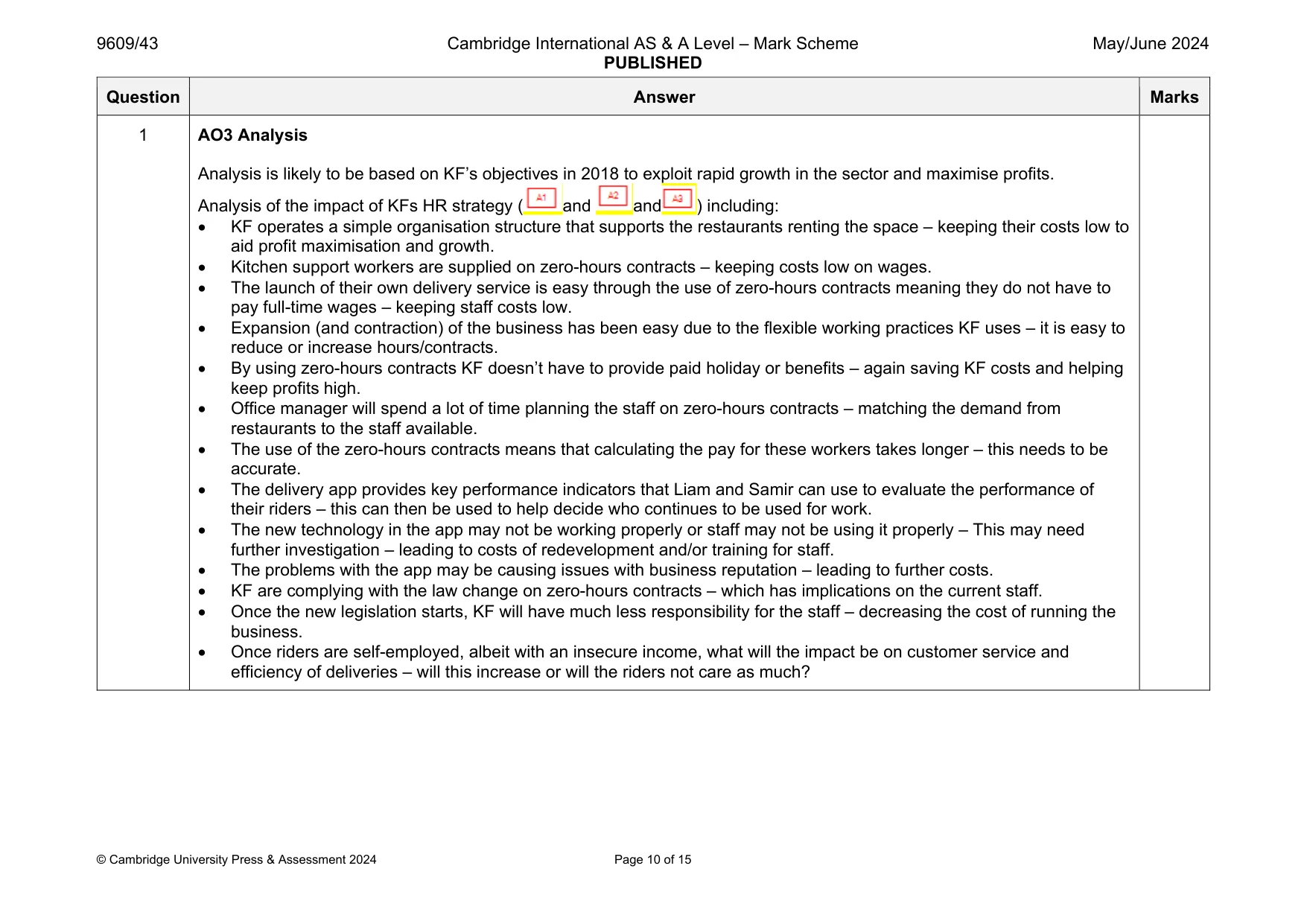
9609/43 Cambridge International AS & A Level – Mark Scheme PUBLISHED May/June 2024 © Cambridge University Press & Assessment 2024 Page 10 of 15 Question Answer Marks 1 AO3 Analysis Analysis is likely to be based on KF’s objectives in 2018 to exploit rapid growth in the sector and maximise profits. Analysis of the impact of KFs HR strategy ( and and ) including: KF operates a simple organisation structure that supports the restaurants renting the space – keeping their costs low to aid profit maximisation and growth. Kitchen support workers are supplied on zero-hours contracts – keeping costs low on wages. The launch of their own delivery service is easy through the use of zero-hours contracts meaning they do not have to pay full-time wages – keeping staff costs low. Expansion (and contraction) of the business has been easy due to the flexible working practices KF uses – it is easy to reduce or increase hours/contracts. By using zero-hours contracts KF doesn’t have to provide paid holiday or benefits – again saving KF costs and helping keep profits high. Office manager will spend a lot of time planning the staff on zero-hours contracts – matching the demand from restaurants to the staff available. The use of the zero-hours contracts means that calculating the pay for these workers takes longer – this needs to be accurate. The delivery app provides key performance indicators that Liam and Samir can use to evaluate the performance of their riders – this can then be used to help decide who continues to be used for work. The new technology in the app may not be working properly or staff may not be using it properly – This may need further investigation – leading to costs of redevelopment and/or training for staff. The problems with the app may be causing issues with business reputation – leading to further costs. KF are complying with the law change on zero-hours contracts – which has implications on the current staff. Once the new legislation starts, KF will have much less responsibility for the staff – decreasing the cost of running the business. Once riders are self-employed, albeit with an insecure income, what will the impact be on customer service and efficiency of deliveries – will this increase or will the riders not care as much?
Mark scheme, page 11
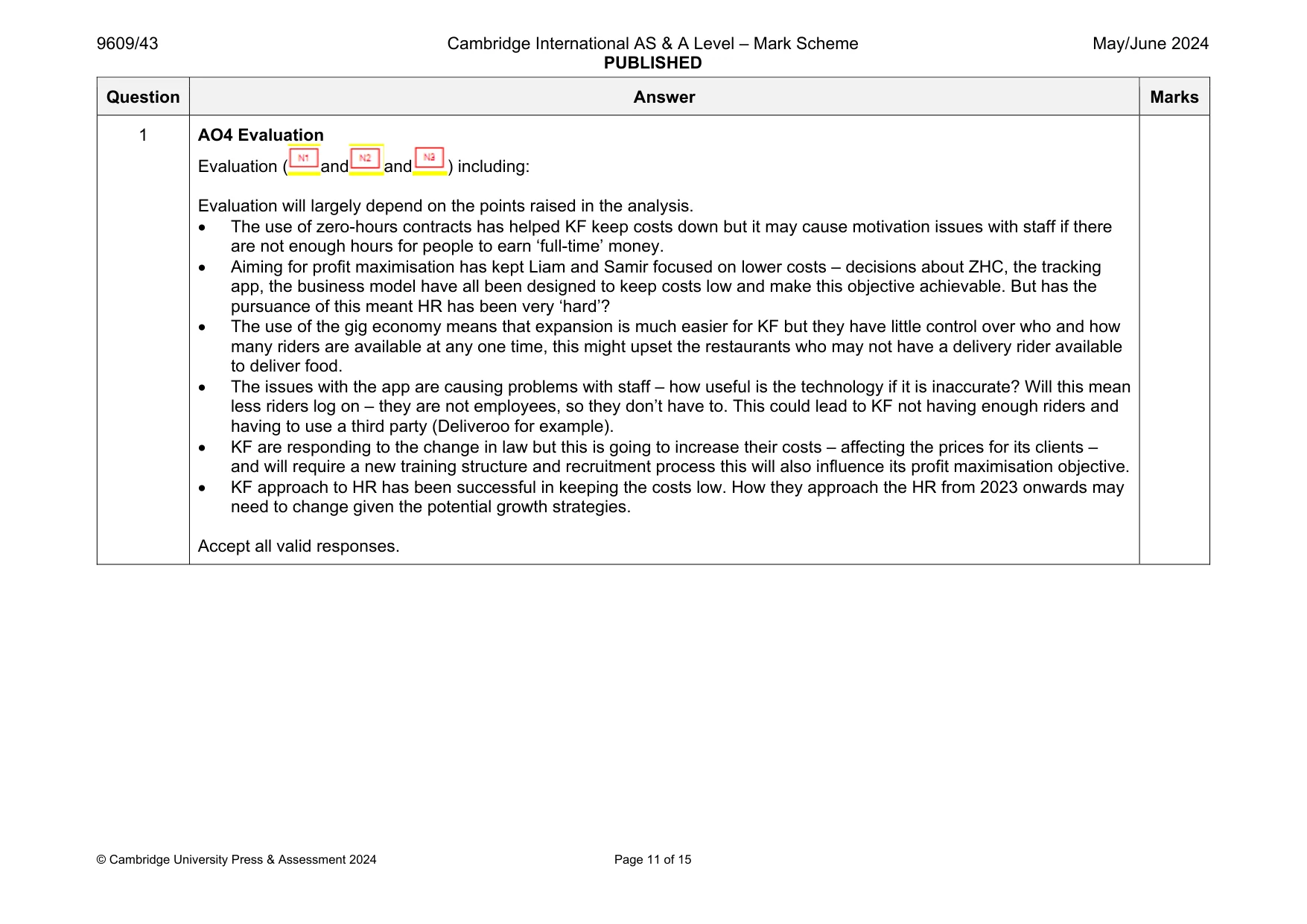
9609/43 Cambridge International AS & A Level – Mark Scheme PUBLISHED May/June 2024 © Cambridge University Press & Assessment 2024 Page 11 of 15 Question Answer Marks 1 AO4 Evaluation Evaluation ( and and ) including: Evaluation will largely depend on the points raised in the analysis. The use of zero-hours contracts has helped KF keep costs down but it may cause motivation issues with staff if there are not enough hours for people to earn ‘full-time’ money. Aiming for profit maximisation has kept Liam and Samir focused on lower costs – decisions about ZHC, the tracking app, the business model have all been designed to keep costs low and make this objective achievable. But has the pursuance of this meant HR has been very ‘hard’? The use of the gig economy means that expansion is much easier for KF but they have little control over who and how many riders are available at any one time, this might upset the restaurants who may not have a delivery rider available to deliver food. The issues with the app are causing problems with staff – how useful is the technology if it is inaccurate? Will this mean less riders log on – they are not employees, so they don’t have to. This could lead to KF not having enough riders and having to use a third party (Deliveroo for example). KF are responding to the change in law but this is going to increase their costs – affecting the prices for its clients – and will require a new training structure and recruitment process this will also influence its profit maximisation objective. KF approach to HR has been successful in keeping the costs low. How they approach the HR from 2023 onwards may need to change given the potential growth strategies. Accept all valid responses.
Mark scheme, page 12
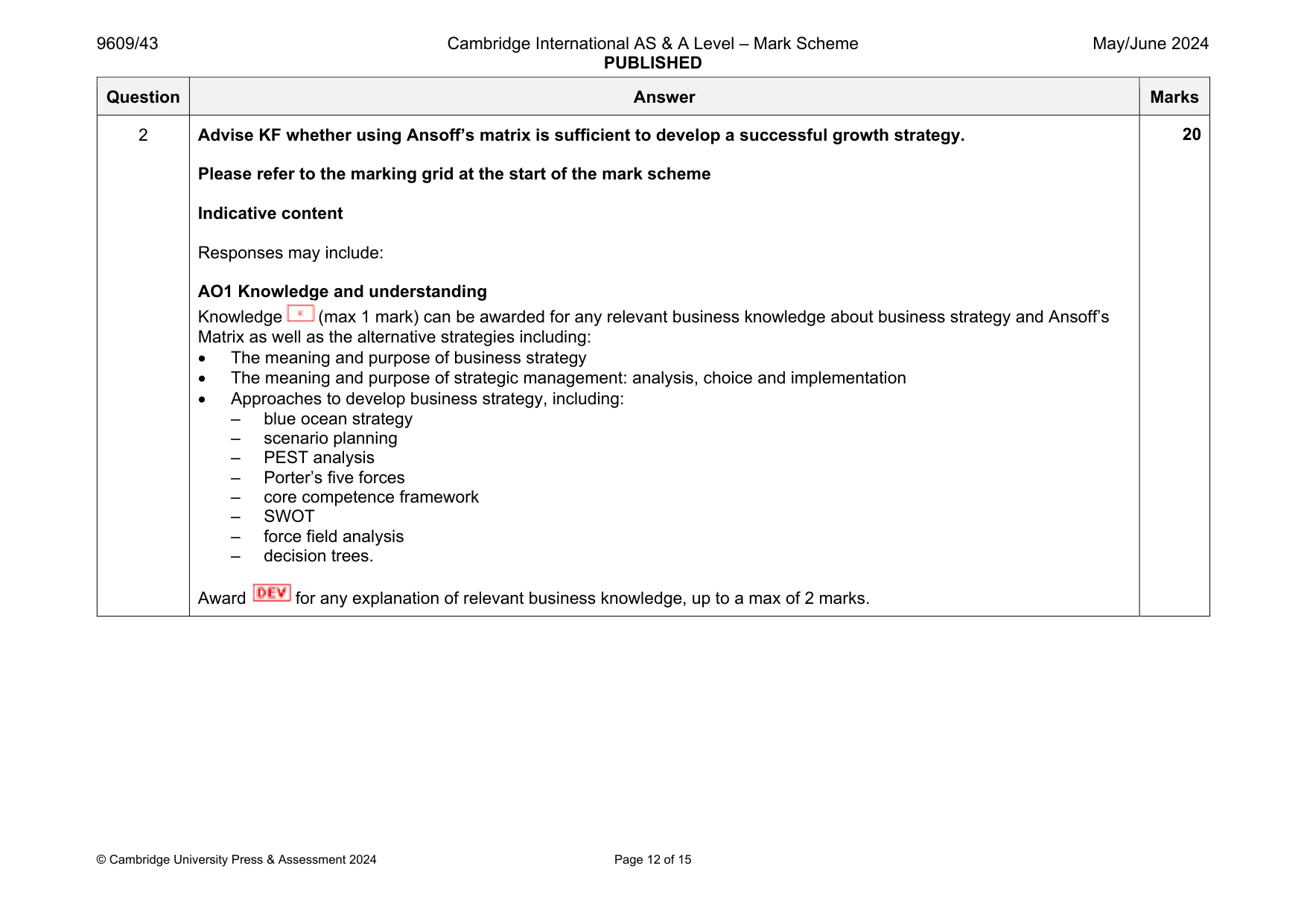
9609/43 Cambridge International AS & A Level – Mark Scheme PUBLISHED May/June 2024 © Cambridge University Press & Assessment 2024 Page 12 of 15 Question Answer Marks 2 Advise KF whether using Ansoff’s matrix is sufficient to develop a successful growth strategy. Please refer to the marking grid at the start of the mark scheme Indicative content Responses may include: AO1 Knowledge and understanding Knowledge (max 1 mark) can be awarded for any relevant business knowledge about business strategy and Ansoff’s Matrix as well as the alternative strategies including: The meaning and purpose of business strategy The meaning and purpose of strategic management: analysis, choice and implementation Approaches to develop business strategy, including: – blue ocean strategy – scenario planning – PEST analysis – Porter’s five forces – core competence framework – SWOT – force field analysis – decision trees. Award for any explanation of relevant business knowledge, up to a max of 2 marks. 20
Mark scheme, page 13
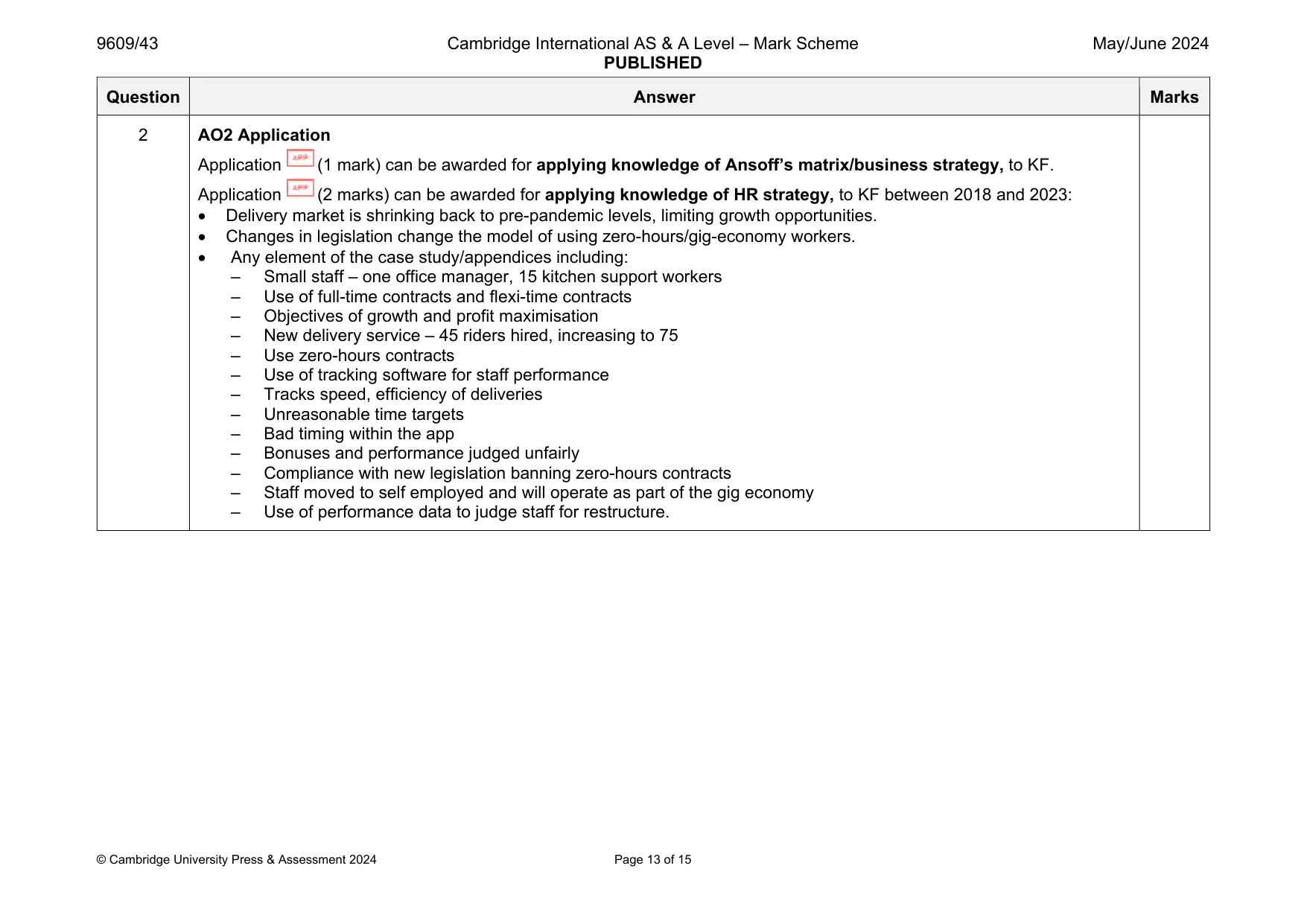
9609/43 Cambridge International AS & A Level – Mark Scheme PUBLISHED May/June 2024 © Cambridge University Press & Assessment 2024 Page 13 of 15 Question Answer Marks 2 AO2 Application Application (1 mark) can be awarded for applying knowledge of Ansoff’s matrix/business strategy, to KF. Application (2 marks) can be awarded for applying knowledge of HR strategy, to KF between 2018 and 2023: Delivery market is shrinking back to pre-pandemic levels, limiting growth opportunities. Changes in legislation change the model of using zero-hours/gig-economy workers. Any element of the case study/appendices including: – Small staff – one office manager, 15 kitchen support workers – Use of full-time contracts and flexi-time contracts – Objectives of growth and profit maximisation – New delivery service – 45 riders hired, increasing to 75 – Use zero-hours contracts – Use of tracking software for staff performance – Tracks speed, efficiency of deliveries – Unreasonable time targets – Bad timing within the app – Bonuses and performance judged unfairly – Compliance with new legislation banning zero-hours contracts – Staff moved to self employed and will operate as part of the gig economy – Use of performance data to judge staff for restructure.
Mark scheme, page 14
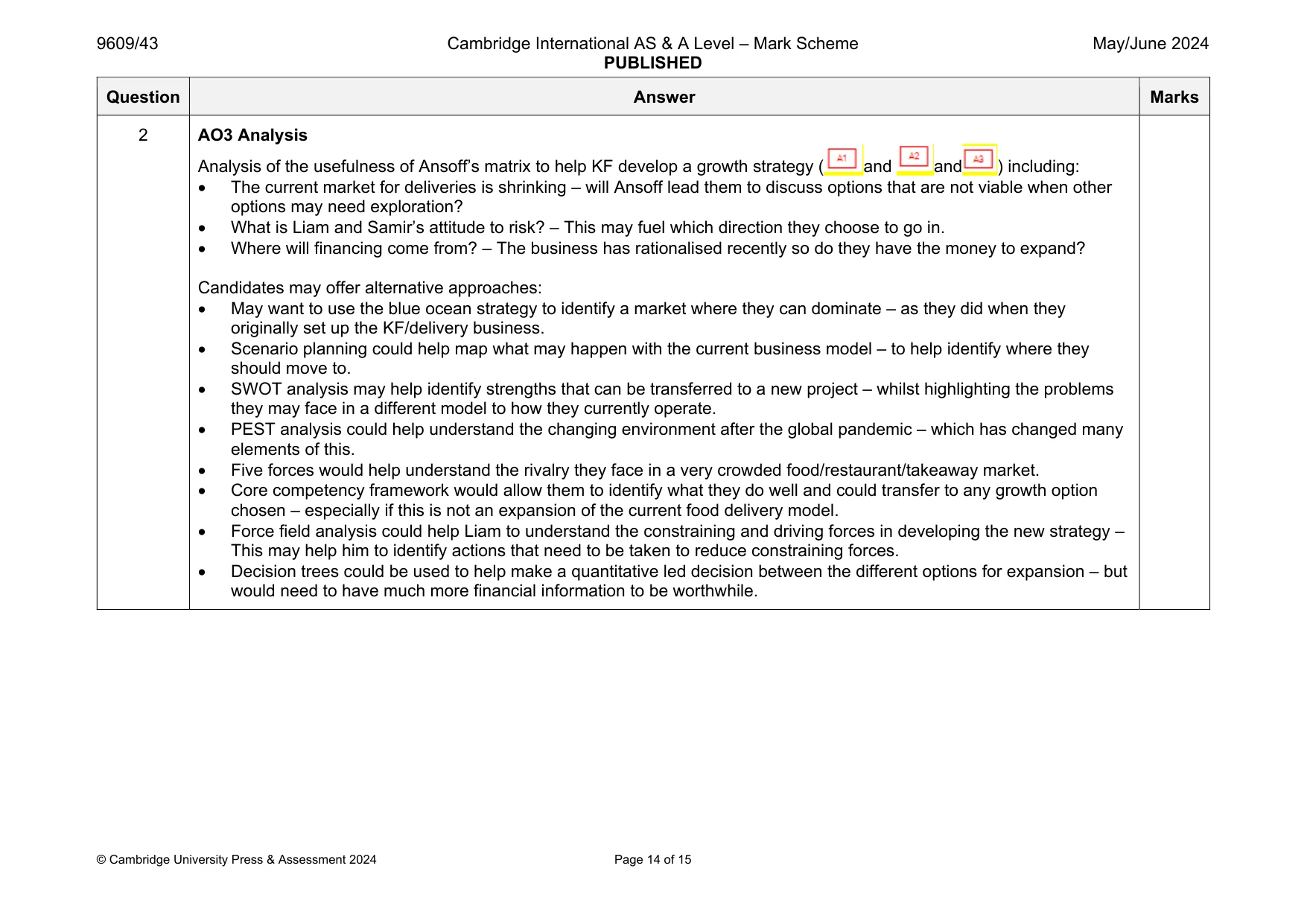
9609/43 Cambridge International AS & A Level – Mark Scheme PUBLISHED May/June 2024 © Cambridge University Press & Assessment 2024 Page 14 of 15 Question Answer Marks 2 AO3 Analysis Analysis of the usefulness of Ansoff’s matrix to help KF develop a growth strategy ( and and ) including: The current market for deliveries is shrinking – will Ansoff lead them to discuss options that are not viable when other options may need exploration? What is Liam and Samir’s attitude to risk? – This may fuel which direction they choose to go in. Where will financing come from? – The business has rationalised recently so do they have the money to expand? Candidates may offer alternative approaches: May want to use the blue ocean strategy to identify a market where they can dominate – as they did when they originally set up the KF/delivery business. Scenario planning could help map what may happen with the current business model – to help identify where they should move to. SWOT analysis may help identify strengths that can be transferred to a new project – whilst highlighting the problems they may face in a different model to how they currently operate. PEST analysis could help understand the changing environment after the global pandemic – which has changed many elements of this. Five forces would help understand the rivalry they face in a very crowded food/restaurant/takeaway market. Core competency framework would allow them to identify what they do well and could transfer to any growth option chosen – especially if this is not an expansion of the current food delivery model. Force field analysis could help Liam to understand the constraining and driving forces in developing the new strategy – This may help him to identify actions that need to be taken to reduce constraining forces. Decision trees could be used to help make a quantitative led decision between the different options for expansion – but would need to have much more financial information to be worthwhile.
Mark scheme, page 15
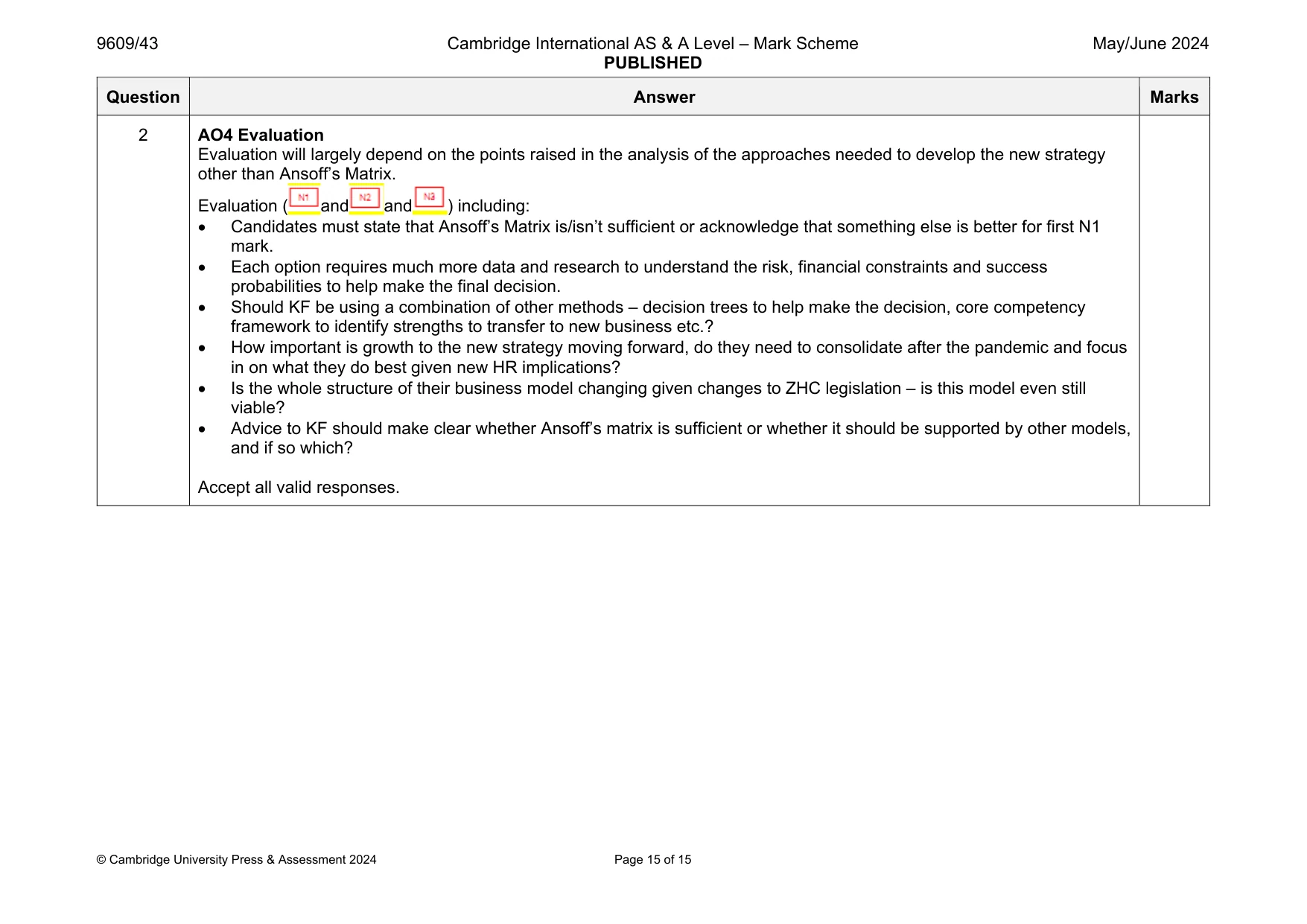
9609/43 Cambridge International AS & A Level – Mark Scheme PUBLISHED May/June 2024 © Cambridge University Press & Assessment 2024 Page 15 of 15 Question Answer Marks 2 AO4 Evaluation Evaluation will largely depend on the points raised in the analysis of the approaches needed to develop the new strategy other than Ansoff’s Matrix. Evaluation ( and and ) including: Candidates must state that Ansoff’s Matrix is/isn’t sufficient or acknowledge that something else is better for first N1 mark. Each option requires much more data and research to understand the risk, financial constraints and success probabilities to help make the final decision. Should KF be using a combination of other methods – decision trees to help make the decision, core competency framework to identify strengths to transfer to new business etc.? How important is growth to the new strategy moving forward, do they need to consolidate after the pandemic and focus in on what they do best given new HR implications? Is the whole structure of their business model changing given changes to ZHC legislation – is this model even still viable? Advice to KF should make clear whether Ansoff’s matrix is sufficient or whether it should be supported by other models, and if so which? Accept all valid responses.
What you needed in this session
Cambridge’s own grade thresholds for 2024 May/June, Paper 4 · Variant 3. A higher threshold means an easier paper — the bar moves with how the cohort did.