Cambridge A Level Business (for first examination in 2016) 9609 — 2024 May/June Paper 4 · Variant 1
9609/41/M/J/24 · 40 marks · ≈45 min
The question paper and its mark scheme, free to read here and free to download. This is Cambridge’s own paper, exactly as it was sat.
Question paper4 pages
Mark scheme13 pages
Answers below. Sit the paper first if you are practising.
Paper as text
Question paper, page 1
This document has 4 pages. [Turn over Cambridge International AS & A Level BUSINESS 9609/41 Paper 4 Business Strategy May/June 2024 1 hour 15 minutes You must answer on the enclosed answer booklet. You will need: Answer booklet (enclosed) INSTRUCTIONS ● Answer all questions. ● Follow the instructions on the front cover of the answer booklet. If you need additional answer paper, ask the invigilator for a continuation booklet. INFORMATION ● The total mark for this paper is 40. ● The number of marks for each question or part question is shown in brackets [ ]. DC (SL) 333961/1 © UCLES 2024 * 7 1 1 6 5 6 3 4 5 2 *
Question paper, page 2
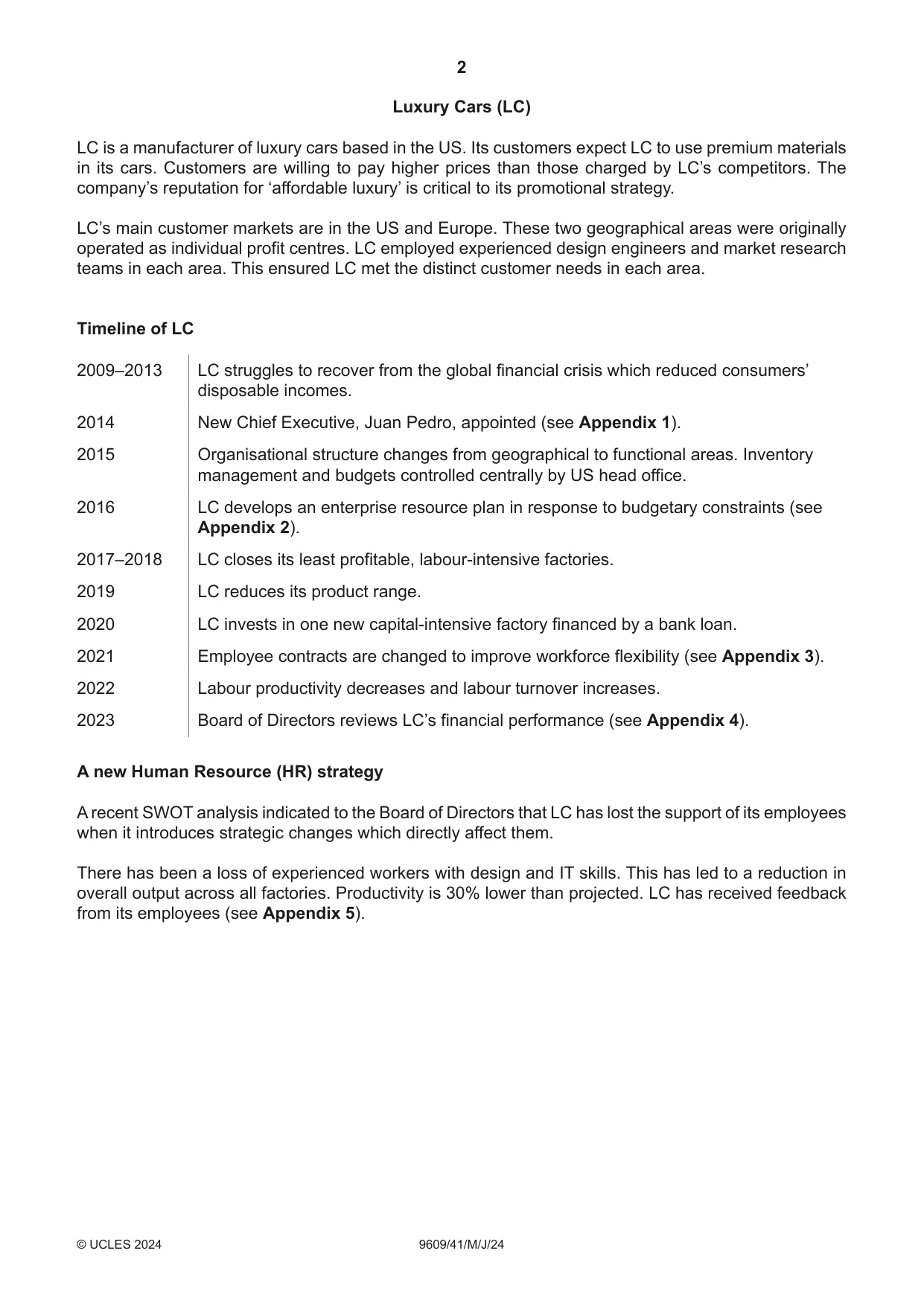
2 9609/41/M/J/24 © UCLES 2024 Luxury Cars (LC) LC is a manufacturer of luxury cars based in the US. Its customers expect LC to use premium materials in its cars. Customers are willing to pay higher prices than those charged by LC’s competitors. The company’s reputation for ‘affordable luxury’ is critical to its promotional strategy. LC’s main customer markets are in the US and Europe. These two geographical areas were originally operated as individual profit centres. LC employed experienced design engineers and market research teams in each area. This ensured LC met the distinct customer needs in each area. Timeline of LC 2009–2013 LC struggles to recover from the global financial crisis which reduced consumers’ disposable incomes. 2014 New Chief Executive, Juan Pedro, appointed (see Appendix 1). 2015 Organisational structure changes from geographical to functional areas. Inventory management and budgets controlled centrally by US head office. 2016 LC develops an enterprise resource plan in response to budgetary constraints (see Appendix 2). 2017–2018 LC closes its least profitable, labour-intensive factories. 2019 LC reduces its product range. 2020 LC invests in one new capital-intensive factory financed by a bank loan. 2021 Employee contracts are changed to improve workforce flexibility (see Appendix 3). 2022 Labour productivity decreases and labour turnover increases. 2023 Board of Directors reviews LC’s financial performance (see Appendix 4). A new Human Resource (HR) strategy A recent SWOT analysis indicated to the Board of Directors that LC has lost the support of its employees when it introduces strategic changes which directly affect them. There has been a loss of experienced workers with design and IT skills. This has led to a reduction in overall output across all factories. Productivity is 30% lower than projected. LC has received feedback from its employees (see Appendix 5).
Question paper, page 3
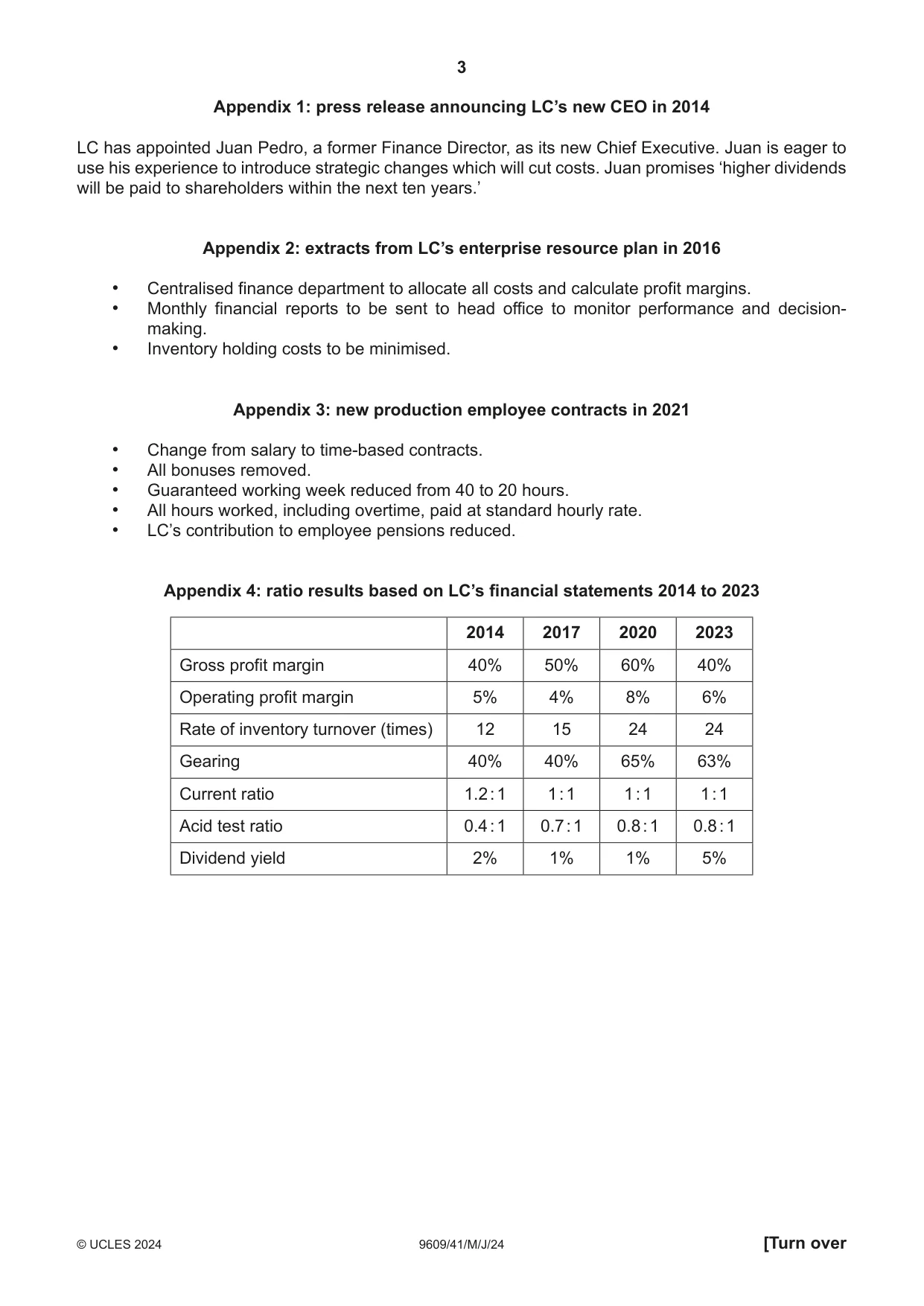
3 9609/41/M/J/24 © UCLES 2024 [Turn over Appendix 1: press release announcing LC’s new CEO in 2014 LC has appointed Juan Pedro, a former Finance Director, as its new Chief Executive. Juan is eager to use his experience to introduce strategic changes which will cut costs. Juan promises ‘higher dividends will be paid to shareholders within the next ten years.’ Appendix 2: extracts from LC’s enterprise resource plan in 2016 • Centralised finance department to allocate all costs and calculate profit margins. • Monthly financial reports to be sent to head office to monitor performance and decision- making. • Inventory holding costs to be minimised. Appendix 3: new production employee contracts in 2021 • Change from salary to time-based contracts. • All bonuses removed. • Guaranteed working week reduced from 40 to 20 hours. • All hours worked, including overtime, paid at standard hourly rate. • LC’s contribution to employee pensions reduced. Appendix 4: ratio results based on LC’s financial statements 2014 to 2023 2014 2017 2020 2023 Gross profit margin 40% 50% 60% 40% Operating profit margin 5% 4% 8% 6% Rate of inventory turnover (times) 12 15 24 24 Gearing 40% 40% 65% 63% Current ratio 1.2 : 1 1 : 1 1 : 1 1 : 1 Acid test ratio 0.4 : 1 0.7 : 1 0.8 : 1 0.8 : 1 Dividend yield 2% 1% 1% 5%
Question paper, page 4
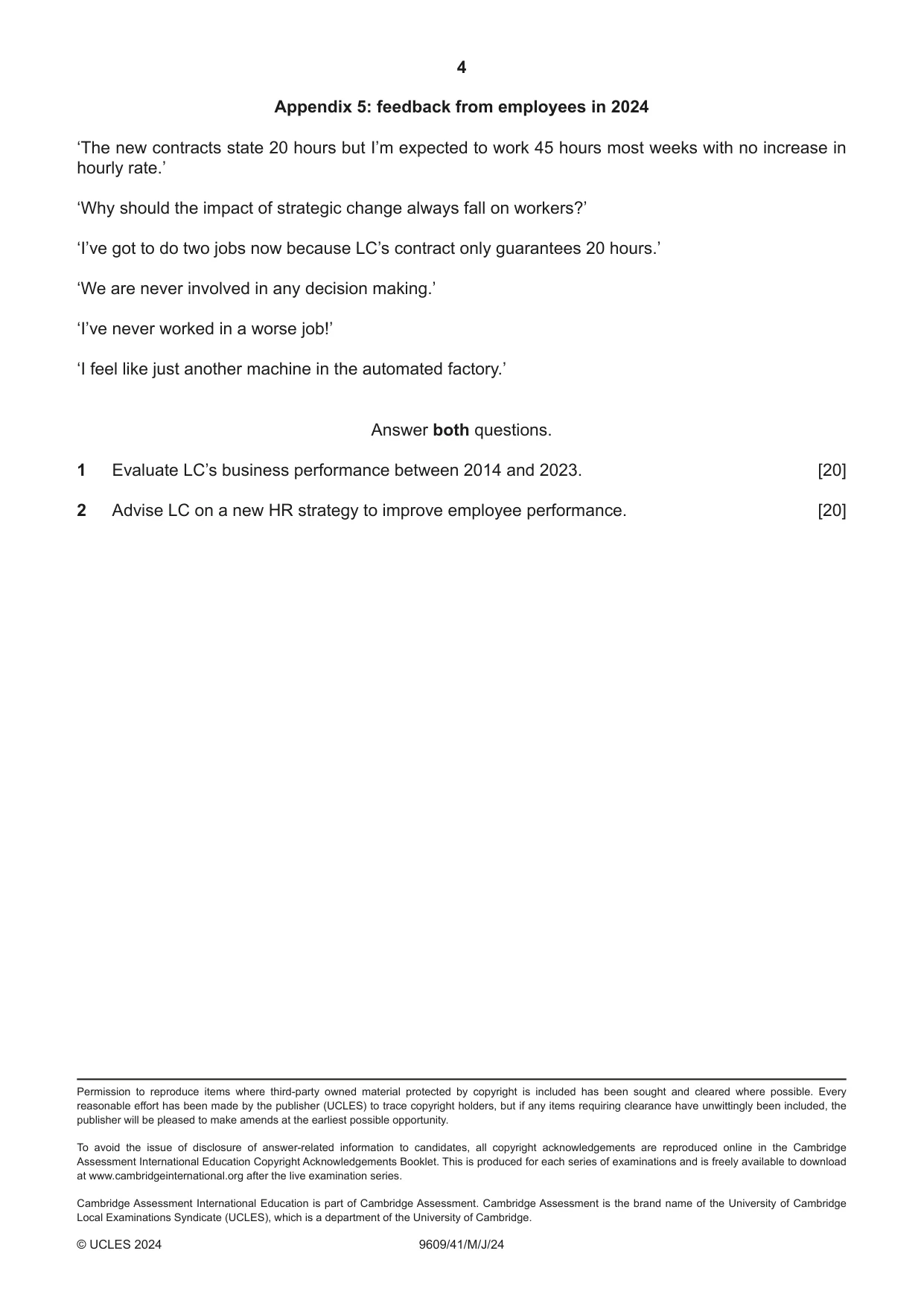
4 9609/41/M/J/24 © UCLES 2024 Permission to reproduce items where third-party owned material protected by copyright is included has been sought and cleared where possible. Every reasonable effort has been made by the publisher (UCLES) to trace copyright holders, but if any items requiring clearance have unwittingly been included, the publisher will be pleased to make amends at the earliest possible opportunity. To avoid the issue of disclosure of answer-related information to candidates, all copyright acknowledgements are reproduced online in the Cambridge Assessment International Education Copyright Acknowledgements Booklet. This is produced for each series of examinations and is freely available to download at www.cambridgeinternational.org after the live examination series. Cambridge Assessment International Education is part of Cambridge Assessment. Cambridge Assessment is the brand name of the University of Cambridge Local Examinations Syndicate (UCLES), which is a department of the University of Cambridge. Appendix 5: feedback from employees in 2024 ‘The new contracts state 20 hours but I’m expected to work 45 hours most weeks with no increase in hourly rate.’ ‘Why should the impact of strategic change always fall on workers?’ ‘I’ve got to do two jobs now because LC’s contract only guarantees 20 hours.’ ‘We are never involved in any decision making.’ ‘I’ve never worked in a worse job!’ ‘I feel like just another machine in the automated factory.’ Answer both questions. 1 Evaluate LC’s business performance between 2014 and 2023. [20] 2 Advise LC on a new HR strategy to improve employee performance. [20]
Mark scheme, page 1
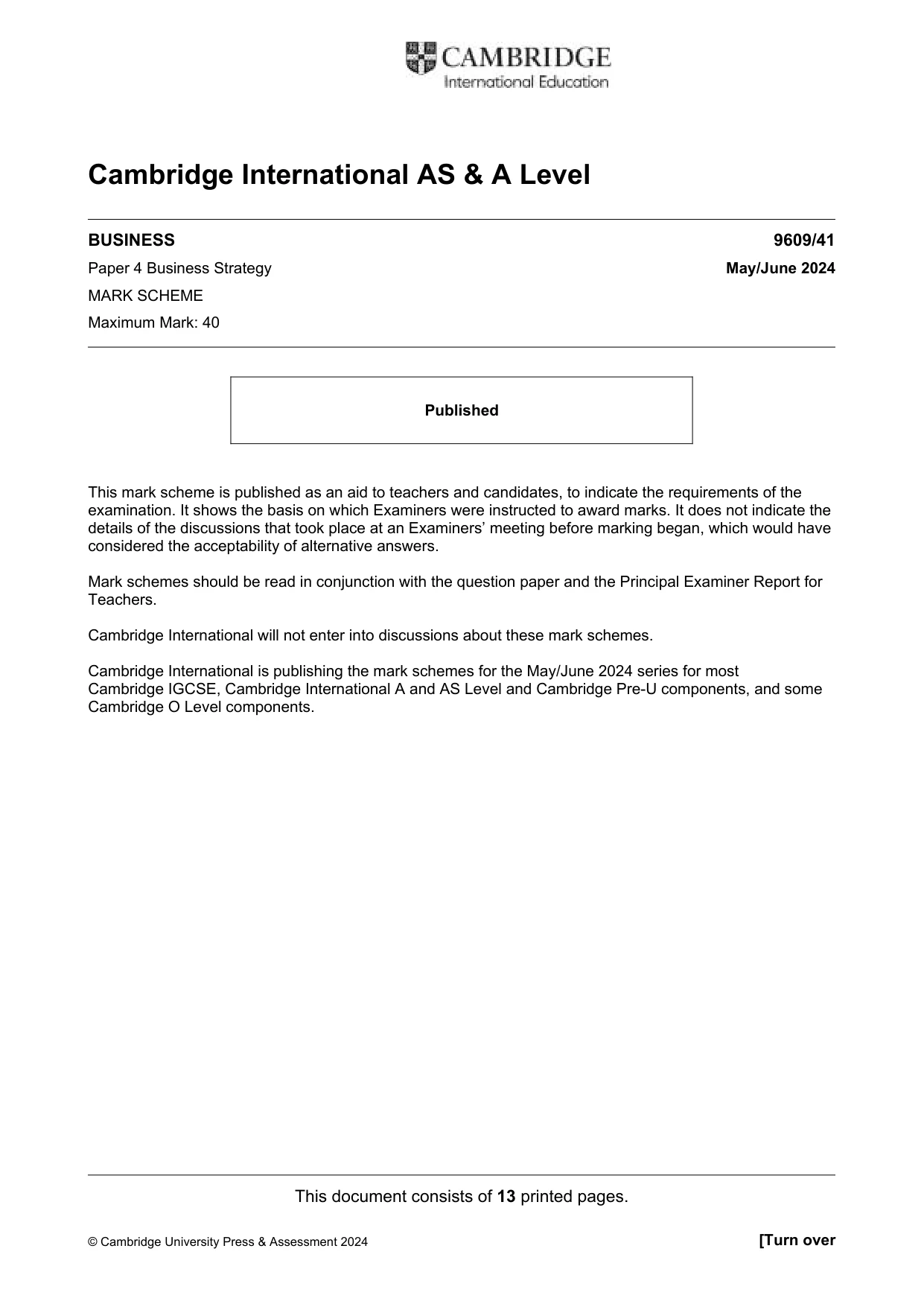
This document consists of 13 printed pages. © Cambridge University Press & Assessment 2024 [Turn over Cambridge International AS & A Level BUSINESS 9609/41 Paper 4 Business Strategy May/June 2024 MARK SCHEME Maximum Mark: 40 Published This mark scheme is published as an aid to teachers and candidates, to indicate the requirements of the examination. It shows the basis on which Examiners were instructed to award marks. It does not indicate the details of the discussions that took place at an Examiners’ meeting before marking began, which would have considered the acceptability of alternative answers. Mark schemes should be read in conjunction with the question paper and the Principal Examiner Report for Teachers. Cambridge International will not enter into discussions about these mark schemes. Cambridge International is publishing the mark schemes for the May/June 2024 series for most Cambridge IGCSE, Cambridge International A and AS Level and Cambridge Pre-U components, and some Cambridge O Level components.
Mark scheme, page 2
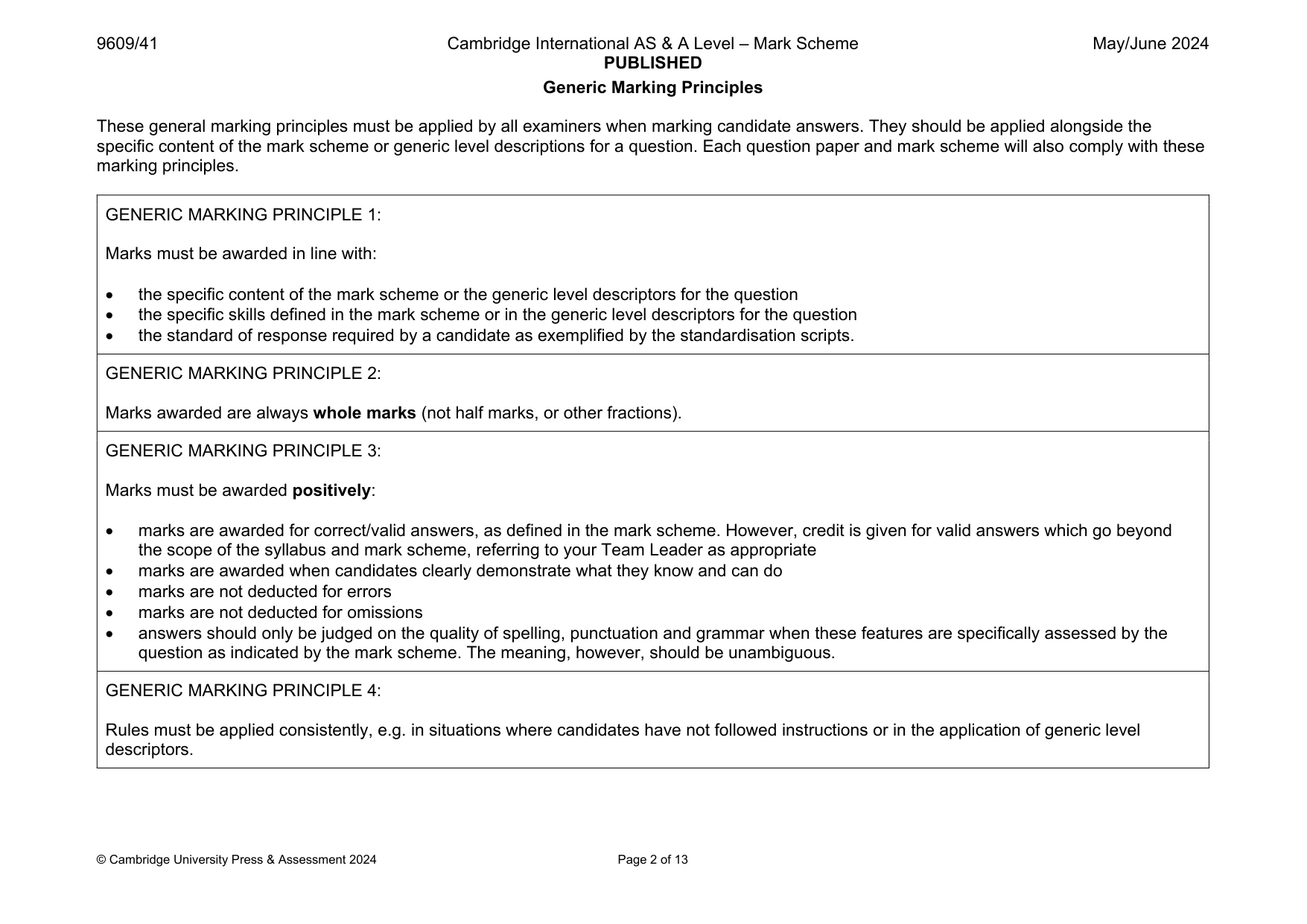
9609/41 Cambridge International AS & A Level – Mark Scheme PUBLISHED May/June 2024 © Cambridge University Press & Assessment 2024 Page 2 of 13 Generic Marking Principles These general marking principles must be applied by all examiners when marking candidate answers. They should be applied alongside the specific content of the mark scheme or generic level descriptions for a question. Each question paper and mark scheme will also comply with these marking principles. GENERIC MARKING PRINCIPLE 1: Marks must be awarded in line with: the specific content of the mark scheme or the generic level descriptors for the question the specific skills defined in the mark scheme or in the generic level descriptors for the question the standard of response required by a candidate as exemplified by the standardisation scripts. GENERIC MARKING PRINCIPLE 2: Marks awarded are always whole marks (not half marks, or other fractions). GENERIC MARKING PRINCIPLE 3: Marks must be awarded positively: marks are awarded for correct/valid answers, as defined in the mark scheme. However, credit is given for valid answers which go beyond the scope of the syllabus and mark scheme, referring to your Team Leader as appropriate marks are awarded when candidates clearly demonstrate what they know and can do marks are not deducted for errors marks are not deducted for omissions answers should only be judged on the quality of spelling, punctuation and grammar when these features are specifically assessed by the question as indicated by the mark scheme. The meaning, however, should be unambiguous. GENERIC MARKING PRINCIPLE 4: Rules must be applied consistently, e.g. in situations where candidates have not followed instructions or in the application of generic level descriptors.
Mark scheme, page 3
9609/41 Cambridge International AS & A Level – Mark Scheme PUBLISHED May/June 2024 © Cambridge University Press & Assessment 2024 Page 3 of 13 GENERIC MARKING PRINCIPLE 5: Marks should be awarded using the full range of marks defined in the mark scheme for the question (however; the use of the full mark range may be limited according to the quality of the candidate responses seen). GENERIC MARKING PRINCIPLE 6: Marks awarded are based solely on the requirements as defined in the mark scheme. Marks should not be awarded with grade thresholds or grade descriptors in mind.
Mark scheme, page 4
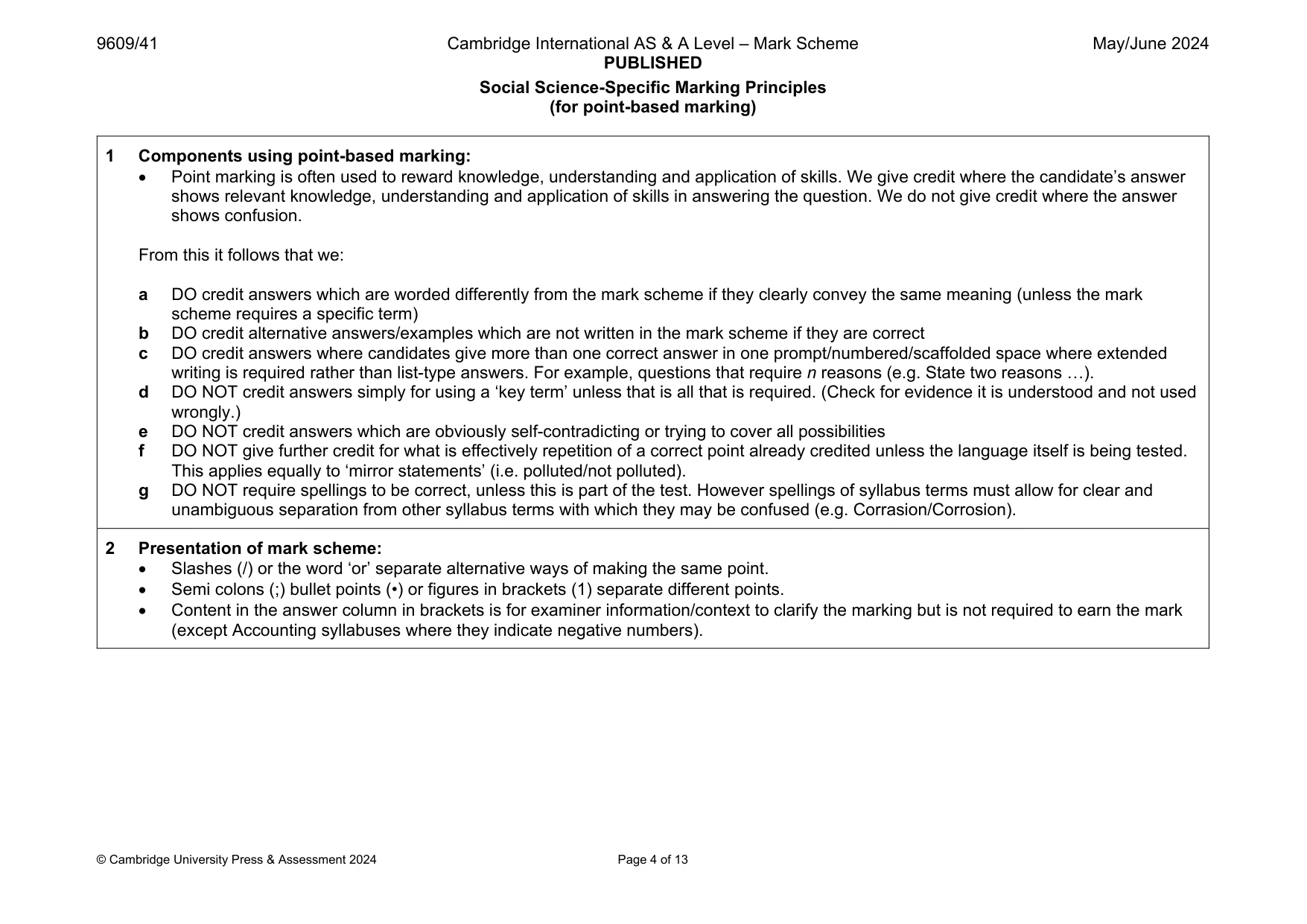
9609/41 Cambridge International AS & A Level – Mark Scheme PUBLISHED May/June 2024 © Cambridge University Press & Assessment 2024 Page 4 of 13 Social Science-Specific Marking Principles (for point-based marking) 1 Components using point-based marking: Point marking is often used to reward knowledge, understanding and application of skills. We give credit where the candidate’s answer shows relevant knowledge, understanding and application of skills in answering the question. We do not give credit where the answer shows confusion. From this it follows that we: a DO credit answers which are worded differently from the mark scheme if they clearly convey the same meaning (unless the mark scheme requires a specific term) b DO credit alternative answers/examples which are not written in the mark scheme if they are correct c DO credit answers where candidates give more than one correct answer in one prompt/numbered/scaffolded space where extended writing is required rather than list-type answers. For example, questions that require n reasons (e.g. State two reasons …). d DO NOT credit answers simply for using a ‘key term’ unless that is all that is required. (Check for evidence it is understood and not used wrongly.) e DO NOT credit answers which are obviously self-contradicting or trying to cover all possibilities f DO NOT give further credit for what is effectively repetition of a correct point already credited unless the language itself is being tested. This applies equally to ‘mirror statements’ (i.e. polluted/not polluted). g DO NOT require spellings to be correct, unless this is part of the test. However spellings of syllabus terms must allow for clear and unambiguous separation from other syllabus terms with which they may be confused (e.g. Corrasion/Corrosion). 2 Presentation of mark scheme: Slashes (/) or the word ‘or’ separate alternative ways of making the same point. Semi colons (;) bullet points (•) or figures in brackets (1) separate different points. Content in the answer column in brackets is for examiner information/context to clarify the marking but is not required to earn the mark (except Accounting syllabuses where they indicate negative numbers).
Mark scheme, page 5
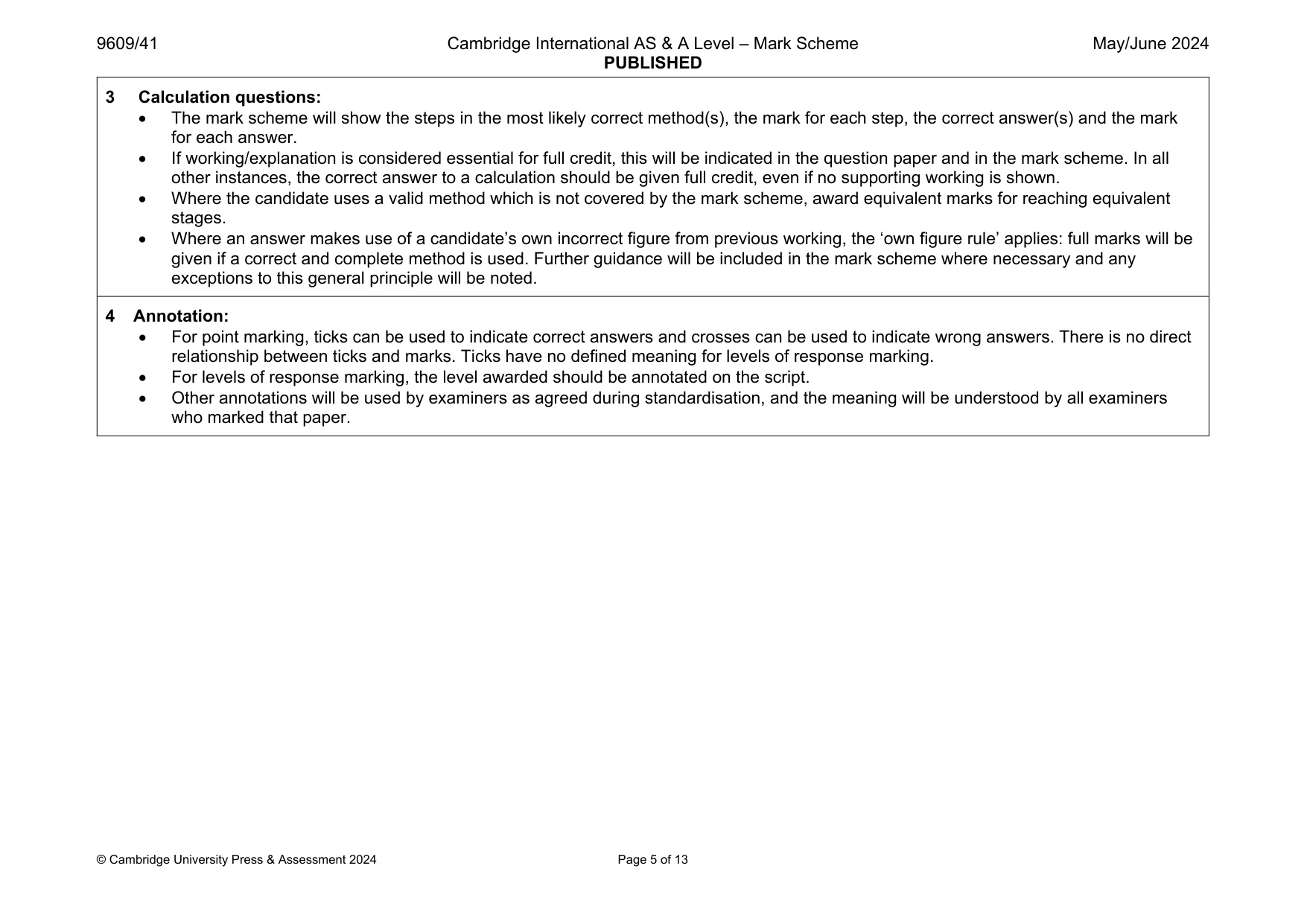
9609/41 Cambridge International AS & A Level – Mark Scheme PUBLISHED May/June 2024 © Cambridge University Press & Assessment 2024 Page 5 of 13 3 Calculation questions: The mark scheme will show the steps in the most likely correct method(s), the mark for each step, the correct answer(s) and the mark for each answer. If working/explanation is considered essential for full credit, this will be indicated in the question paper and in the mark scheme. In all other instances, the correct answer to a calculation should be given full credit, even if no supporting working is shown. Where the candidate uses a valid method which is not covered by the mark scheme, award equivalent marks for reaching equivalent stages. Where an answer makes use of a candidate’s own incorrect figure from previous working, the ‘own figure rule’ applies: full marks will be given if a correct and complete method is used. Further guidance will be included in the mark scheme where necessary and any exceptions to this general principle will be noted. 4 Annotation: For point marking, ticks can be used to indicate correct answers and crosses can be used to indicate wrong answers. There is no direct relationship between ticks and marks. Ticks have no defined meaning for levels of response marking. For levels of response marking, the level awarded should be annotated on the script. Other annotations will be used by examiners as agreed during standardisation, and the meaning will be understood by all examiners who marked that paper.
Mark scheme, page 6
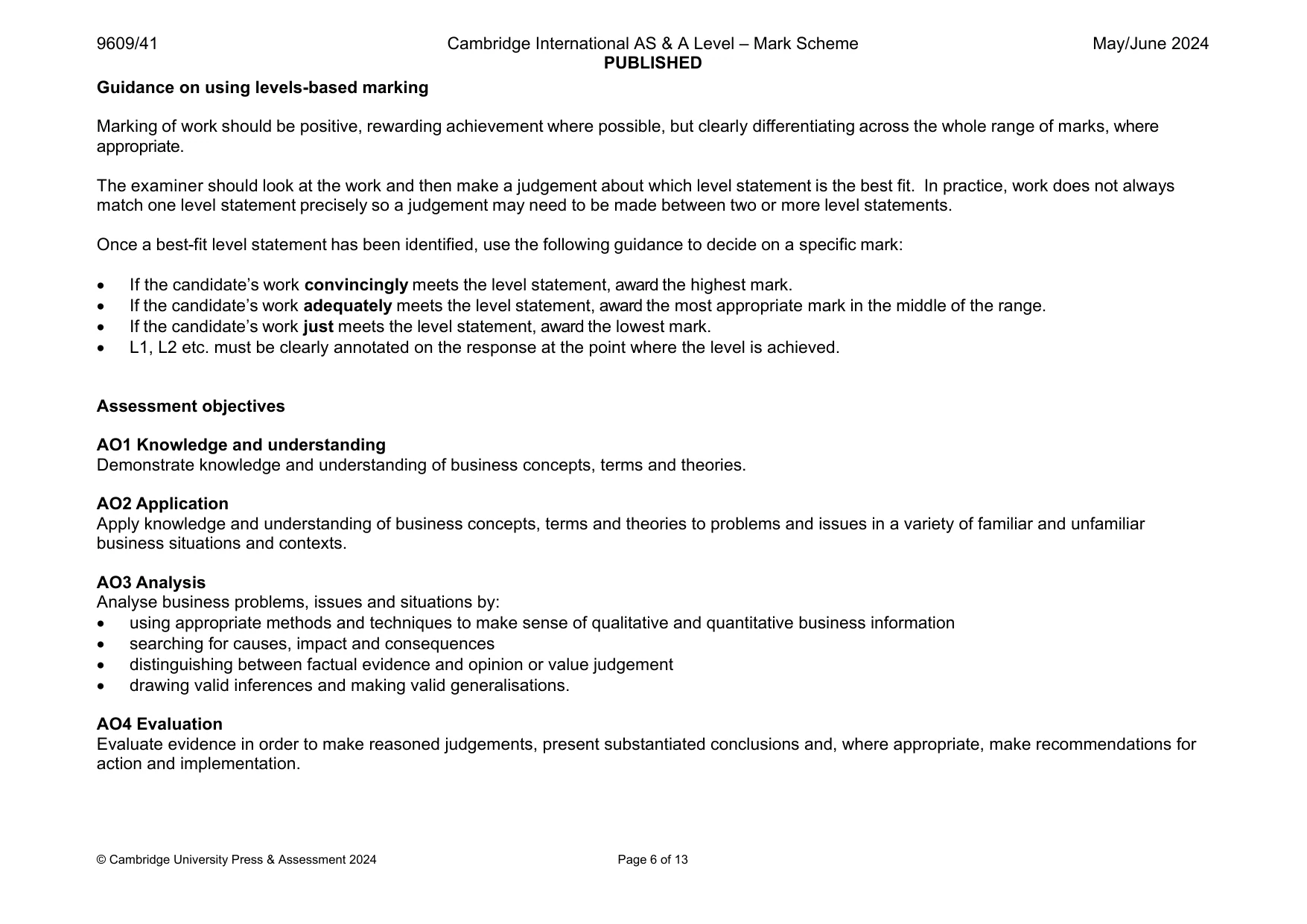
9609/41 Cambridge International AS & A Level – Mark Scheme PUBLISHED May/June 2024 © Cambridge University Press & Assessment 2024 Page 6 of 13 Guidance on using levels-based marking Marking of work should be positive, rewarding achievement where possible, but clearly differentiating across the whole range of marks, where appropriate. The examiner should look at the work and then make a judgement about which level statement is the best fit. In practice, work does not always match one level statement precisely so a judgement may need to be made between two or more level statements. Once a best-fit level statement has been identified, use the following guidance to decide on a specific mark: If the candidate’s work convincingly meets the level statement, award the highest mark. If the candidate’s work adequately meets the level statement, award the most appropriate mark in the middle of the range. If the candidate’s work just meets the level statement, award the lowest mark. L1, L2 etc. must be clearly annotated on the response at the point where the level is achieved. Assessment objectives AO1 Knowledge and understanding Demonstrate knowledge and understanding of business concepts, terms and theories. AO2 Application Apply knowledge and understanding of business concepts, terms and theories to problems and issues in a variety of familiar and unfamiliar business situations and contexts. AO3 Analysis Analyse business problems, issues and situations by: using appropriate methods and techniques to make sense of qualitative and quantitative business information searching for causes, impact and consequences distinguishing between factual evidence and opinion or value judgement drawing valid inferences and making valid generalisations. AO4 Evaluation Evaluate evidence in order to make reasoned judgements, present substantiated conclusions and, where appropriate, make recommendations for action and implementation.
Mark scheme, page 7
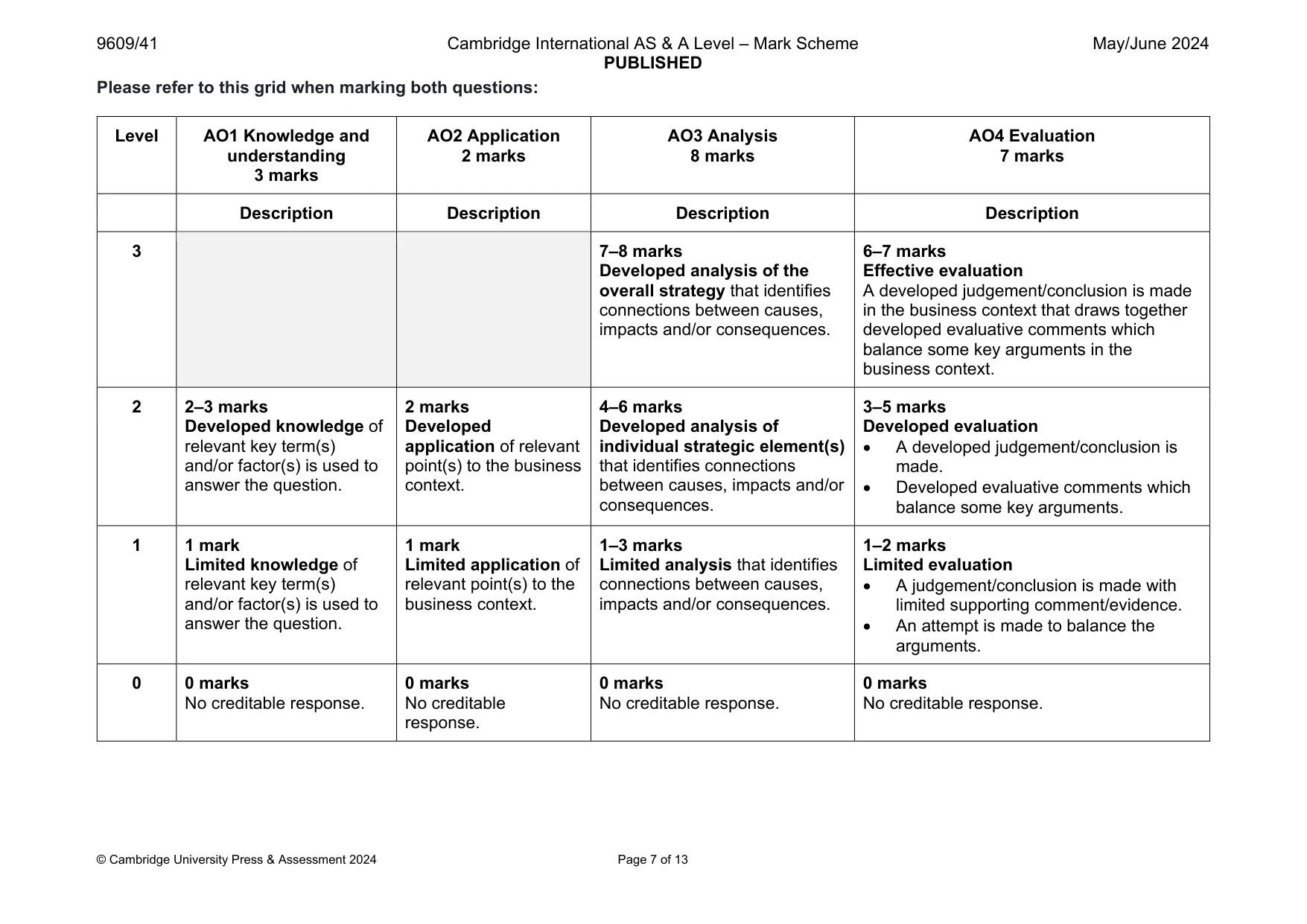
9609/41 Cambridge International AS & A Level – Mark Scheme PUBLISHED May/June 2024 © Cambridge University Press & Assessment 2024 Page 7 of 13 Please refer to this grid when marking both questions: Level AO1 Knowledge and understanding 3 marks AO2 Application 2 marks AO3 Analysis 8 marks AO4 Evaluation 7 marks Description Description Description Description 3 7–8 marks Developed analysis of the overall strategy that identifies connections between causes, impacts and/or consequences. 6–7 marks Effective evaluation A developed judgement/conclusion is made in the business context that draws together developed evaluative comments which balance some key arguments in the business context. 2 2–3 marks Developed knowledge of relevant key term(s) and/or factor(s) is used to answer the question. 2 marks Developed application of relevant point(s) to the business context. 4–6 marks Developed analysis of individual strategic element(s) that identifies connections between causes, impacts and/or consequences. 3–5 marks Developed evaluation A developed judgement/conclusion is made. Developed evaluative comments which balance some key arguments. 1 1 mark Limited knowledge of relevant key term(s) and/or factor(s) is used to answer the question. 1 mark Limited application of relevant point(s) to the business context. 1–3 marks Limited analysis that identifies connections between causes, impacts and/or consequences. 1–2 marks Limited evaluation A judgement/conclusion is made with limited supporting comment/evidence. An attempt is made to balance the arguments. 0 0 marks No creditable response. 0 marks No creditable response. 0 marks No creditable response. 0 marks No creditable response.
Mark scheme, page 8
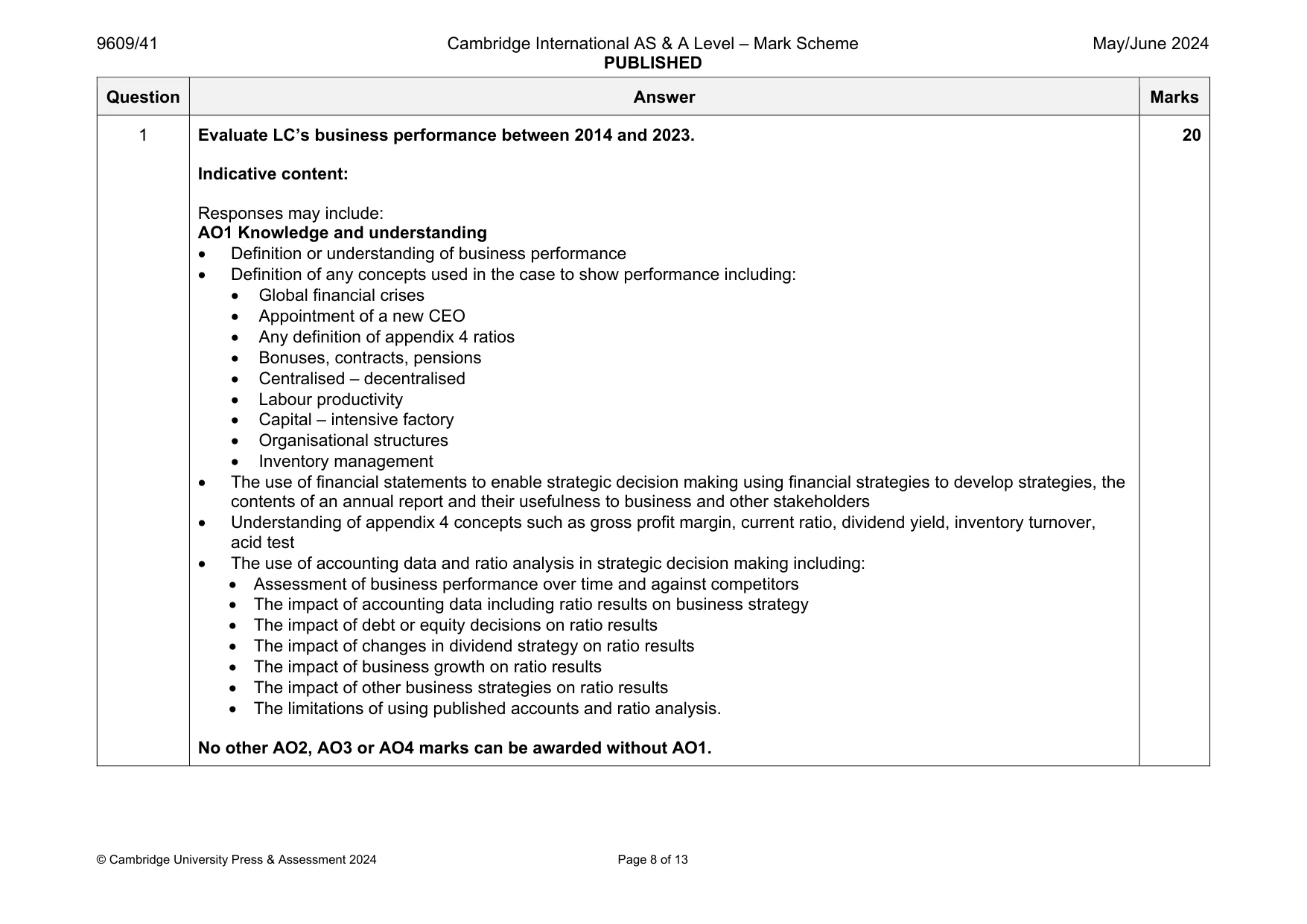
9609/41 Cambridge International AS & A Level – Mark Scheme PUBLISHED May/June 2024 © Cambridge University Press & Assessment 2024 Page 8 of 13 Question Answer Marks 1 Evaluate LC’s business performance between 2014 and 2023. Indicative content: Responses may include: AO1 Knowledge and understanding Definition or understanding of business performance Definition of any concepts used in the case to show performance including: Global financial crises Appointment of a new CEO Any definition of appendix 4 ratios Bonuses, contracts, pensions Centralised – decentralised Labour productivity Capital – intensive factory Organisational structures Inventory management The use of financial statements to enable strategic decision making using financial strategies to develop strategies, the contents of an annual report and their usefulness to business and other stakeholders Understanding of appendix 4 concepts such as gross profit margin, current ratio, dividend yield, inventory turnover, acid test The use of accounting data and ratio analysis in strategic decision making including: Assessment of business performance over time and against competitors The impact of accounting data including ratio results on business strategy The impact of debt or equity decisions on ratio results The impact of changes in dividend strategy on ratio results The impact of business growth on ratio results The impact of other business strategies on ratio results The limitations of using published accounts and ratio analysis. No other AO2, AO3 or AO4 marks can be awarded without AO1. 20
Mark scheme, page 9
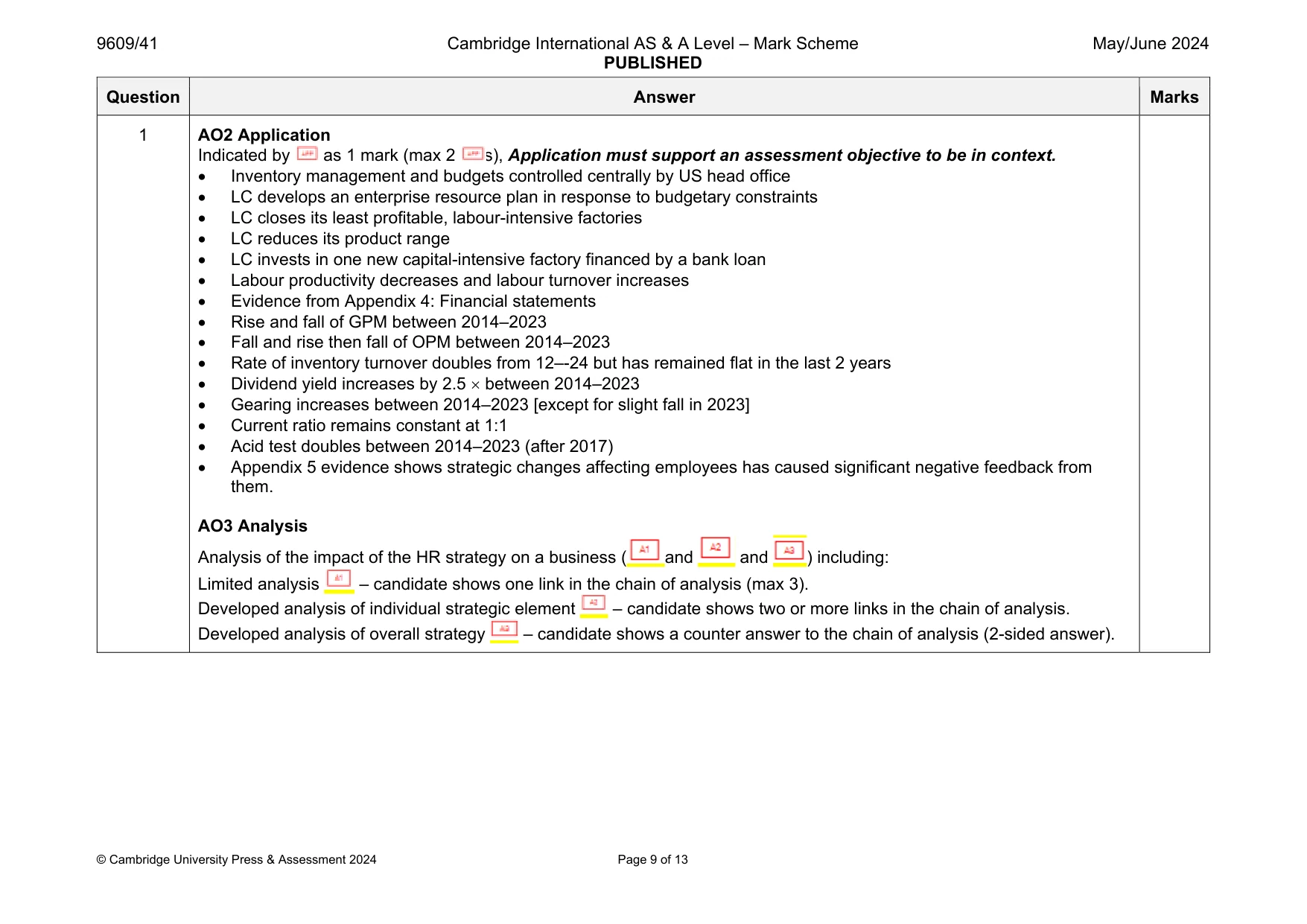
9609/41 Cambridge International AS & A Level – Mark Scheme PUBLISHED May/June 2024 © Cambridge University Press & Assessment 2024 Page 9 of 13 Question Answer Marks 1 AO2 Application Indicated by as 1 mark (max 2 s), Application must support an assessment objective to be in context. Inventory management and budgets controlled centrally by US head office LC develops an enterprise resource plan in response to budgetary constraints LC closes its least profitable, labour-intensive factories LC reduces its product range LC invests in one new capital-intensive factory financed by a bank loan Labour productivity decreases and labour turnover increases Evidence from Appendix 4: Financial statements Rise and fall of GPM between 2014–2023 Fall and rise then fall of OPM between 2014–2023 Rate of inventory turnover doubles from 12–-24 but has remained flat in the last 2 years Dividend yield increases by 2.5 between 2014–2023 Gearing increases between 2014–2023 [except for slight fall in 2023] Current ratio remains constant at 1:1 Acid test doubles between 2014–2023 (after 2017) Appendix 5 evidence shows strategic changes affecting employees has caused significant negative feedback from them. AO3 Analysis Analysis of the impact of the HR strategy on a business ( and and ) including: Limited analysis – candidate shows one link in the chain of analysis (max 3). Developed analysis of individual strategic element – candidate shows two or more links in the chain of analysis. Developed analysis of overall strategy – candidate shows a counter answer to the chain of analysis (2-sided answer).
Mark scheme, page 10
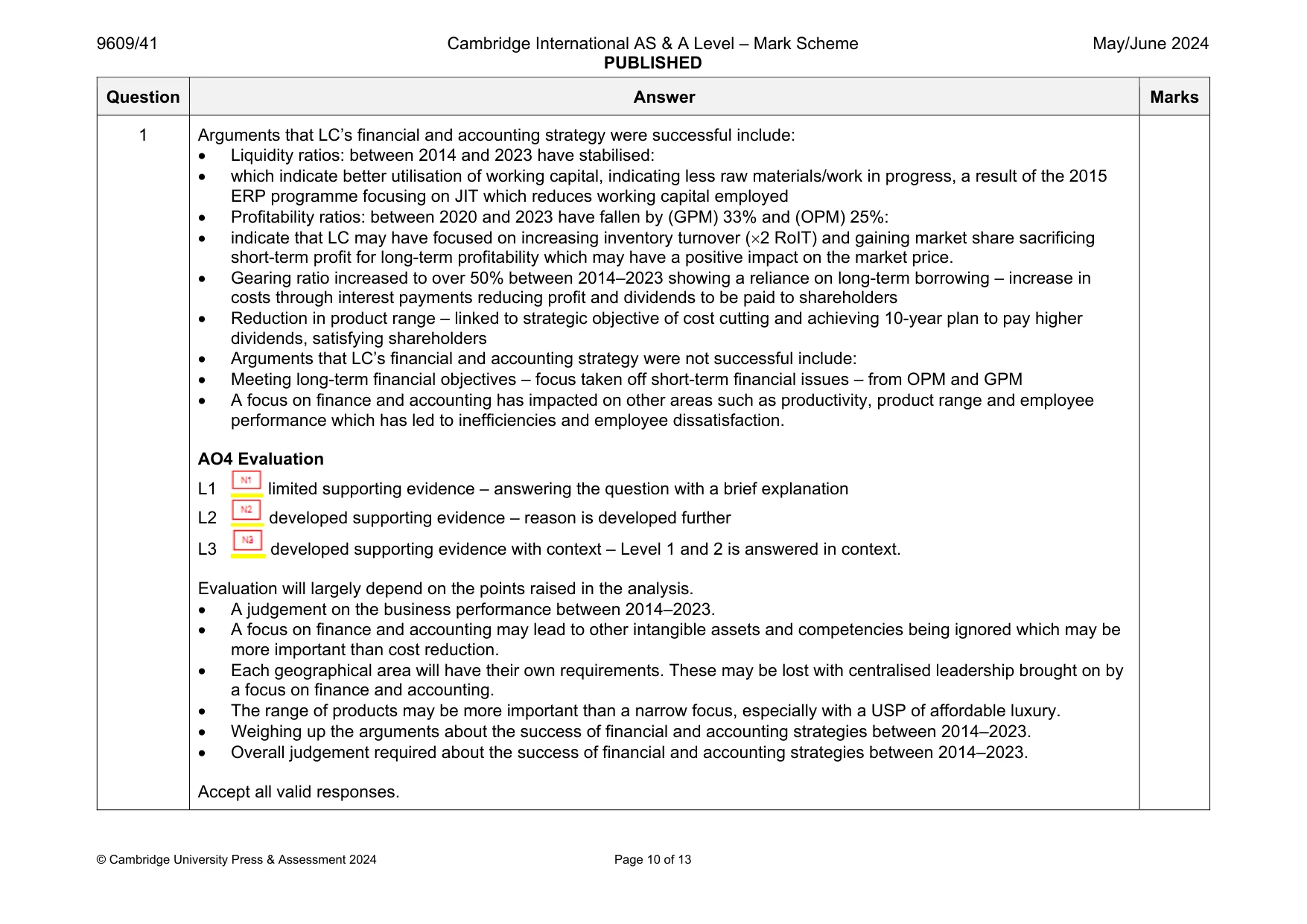
9609/41 Cambridge International AS & A Level – Mark Scheme PUBLISHED May/June 2024 © Cambridge University Press & Assessment 2024 Page 10 of 13 Question Answer Marks 1 Arguments that LC’s financial and accounting strategy were successful include: Liquidity ratios: between 2014 and 2023 have stabilised: which indicate better utilisation of working capital, indicating less raw materials/work in progress, a result of the 2015 ERP programme focusing on JIT which reduces working capital employed Profitability ratios: between 2020 and 2023 have fallen by (GPM) 33% and (OPM) 25%: indicate that LC may have focused on increasing inventory turnover (2 RoIT) and gaining market share sacrificing short-term profit for long-term profitability which may have a positive impact on the market price. Gearing ratio increased to over 50% between 2014–2023 showing a reliance on long-term borrowing – increase in costs through interest payments reducing profit and dividends to be paid to shareholders Reduction in product range – linked to strategic objective of cost cutting and achieving 10-year plan to pay higher dividends, satisfying shareholders Arguments that LC’s financial and accounting strategy were not successful include: Meeting long-term financial objectives – focus taken off short-term financial issues – from OPM and GPM A focus on finance and accounting has impacted on other areas such as productivity, product range and employee performance which has led to inefficiencies and employee dissatisfaction. AO4 Evaluation L1 limited supporting evidence – answering the question with a brief explanation L2 developed supporting evidence – reason is developed further L3 developed supporting evidence with context – Level 1 and 2 is answered in context. Evaluation will largely depend on the points raised in the analysis. A judgement on the business performance between 2014–2023. A focus on finance and accounting may lead to other intangible assets and competencies being ignored which may be more important than cost reduction. Each geographical area will have their own requirements. These may be lost with centralised leadership brought on by a focus on finance and accounting. The range of products may be more important than a narrow focus, especially with a USP of affordable luxury. Weighing up the arguments about the success of financial and accounting strategies between 2014–2023. Overall judgement required about the success of financial and accounting strategies between 2014–2023. Accept all valid responses.
Mark scheme, page 11
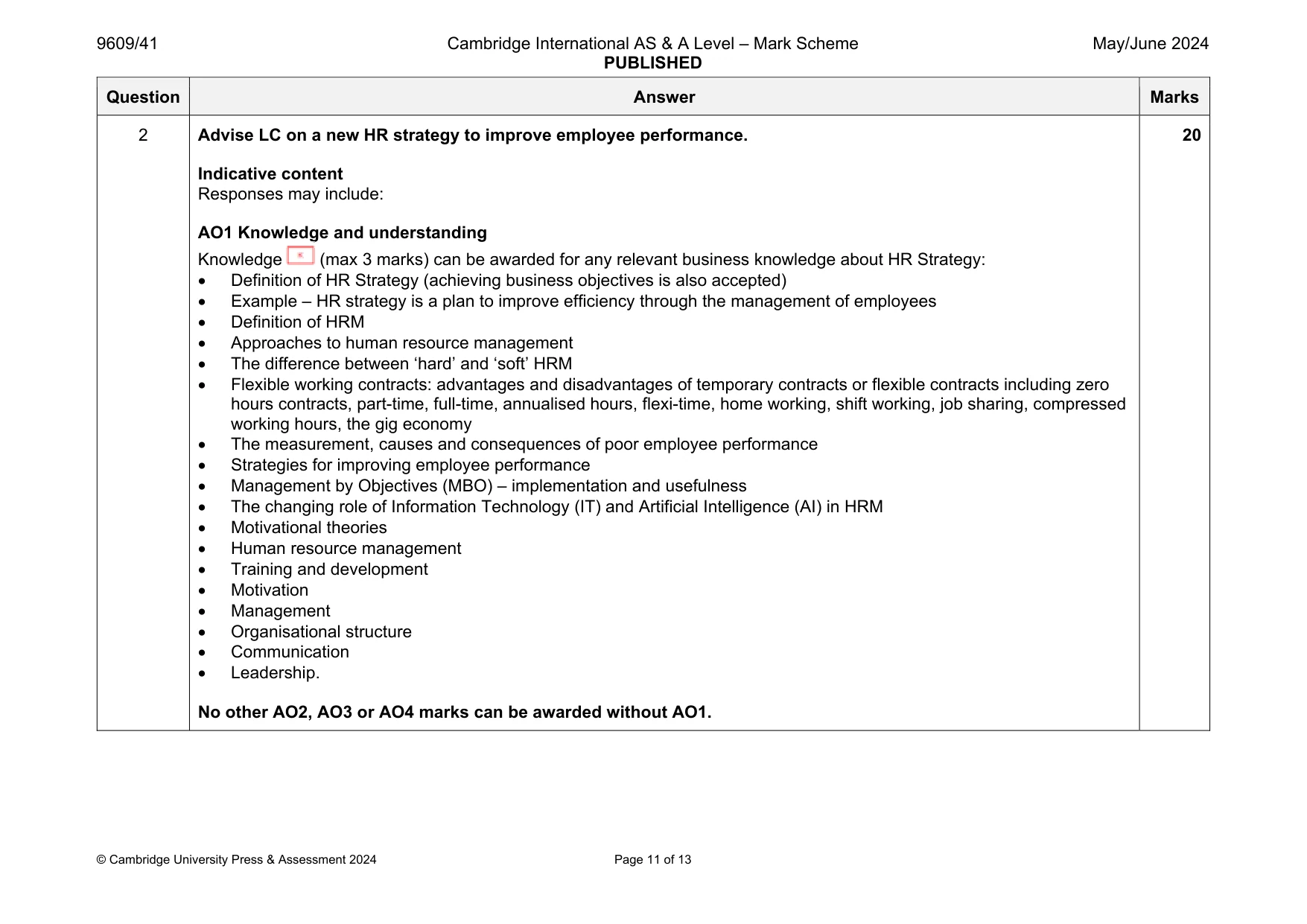
9609/41 Cambridge International AS & A Level – Mark Scheme PUBLISHED May/June 2024 © Cambridge University Press & Assessment 2024 Page 11 of 13 Question Answer Marks 2 Advise LC on a new HR strategy to improve employee performance. Indicative content Responses may include: AO1 Knowledge and understanding Knowledge (max 3 marks) can be awarded for any relevant business knowledge about HR Strategy: Definition of HR Strategy (achieving business objectives is also accepted) Example – HR strategy is a plan to improve efficiency through the management of employees Definition of HRM Approaches to human resource management The difference between ‘hard’ and ‘soft’ HRM Flexible working contracts: advantages and disadvantages of temporary contracts or flexible contracts including zero hours contracts, part-time, full-time, annualised hours, flexi-time, home working, shift working, job sharing, compressed working hours, the gig economy The measurement, causes and consequences of poor employee performance Strategies for improving employee performance Management by Objectives (MBO) – implementation and usefulness The changing role of Information Technology (IT) and Artificial Intelligence (AI) in HRM Motivational theories Human resource management Training and development Motivation Management Organisational structure Communication Leadership. No other AO2, AO3 or AO4 marks can be awarded without AO1. 20
Mark scheme, page 12
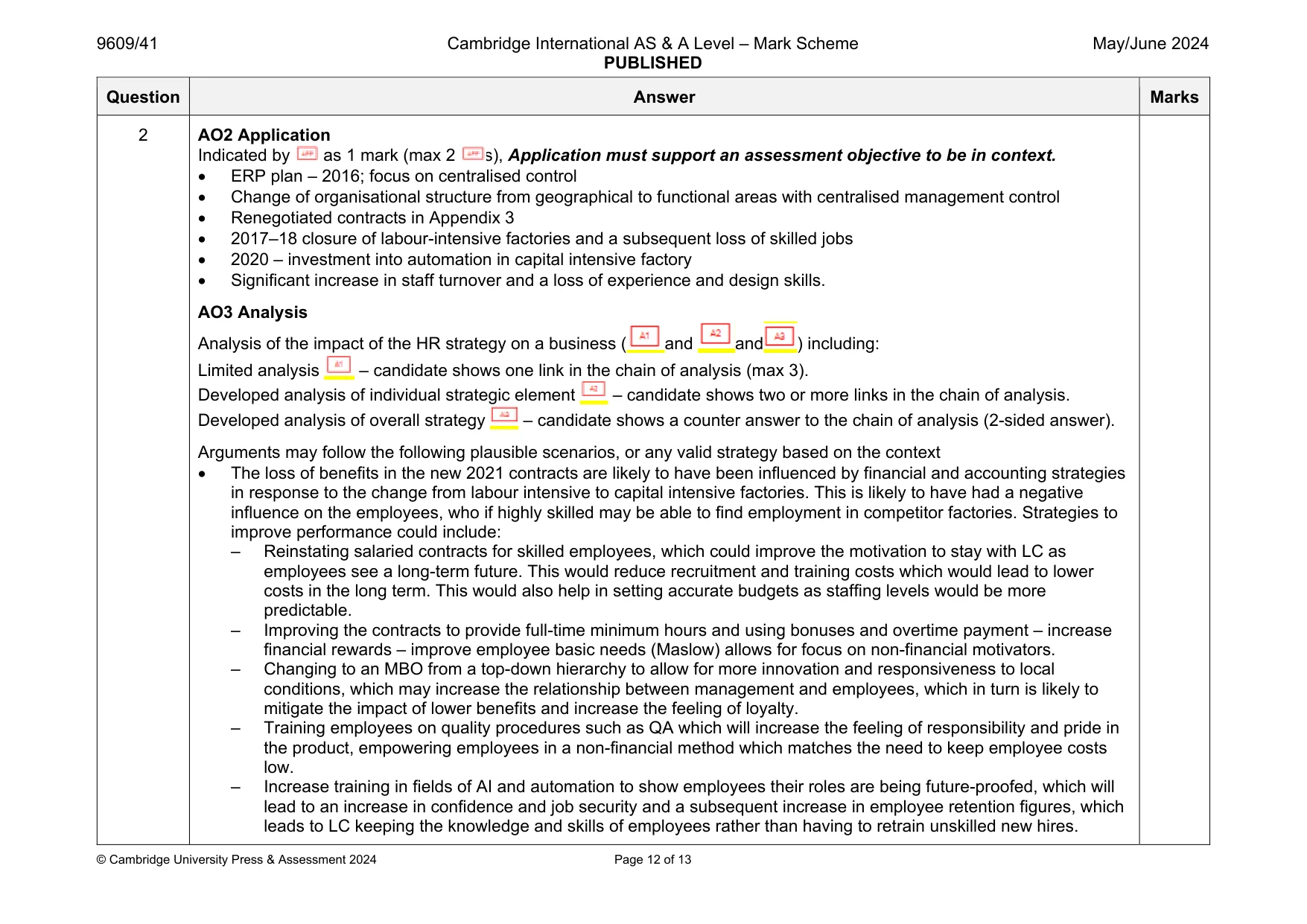
9609/41 Cambridge International AS & A Level – Mark Scheme PUBLISHED May/June 2024 © Cambridge University Press & Assessment 2024 Page 12 of 13 Question Answer Marks 2 AO2 Application Indicated by as 1 mark (max 2 s), Application must support an assessment objective to be in context. ERP plan – 2016; focus on centralised control Change of organisational structure from geographical to functional areas with centralised management control Renegotiated contracts in Appendix 3 2017–18 closure of labour-intensive factories and a subsequent loss of skilled jobs 2020 – investment into automation in capital intensive factory Significant increase in staff turnover and a loss of experience and design skills. AO3 Analysis Analysis of the impact of the HR strategy on a business ( and and ) including: Limited analysis – candidate shows one link in the chain of analysis (max 3). Developed analysis of individual strategic element – candidate shows two or more links in the chain of analysis. Developed analysis of overall strategy – candidate shows a counter answer to the chain of analysis (2-sided answer). Arguments may follow the following plausible scenarios, or any valid strategy based on the context The loss of benefits in the new 2021 contracts are likely to have been influenced by financial and accounting strategies in response to the change from labour intensive to capital intensive factories. This is likely to have had a negative influence on the employees, who if highly skilled may be able to find employment in competitor factories. Strategies to improve performance could include: – Reinstating salaried contracts for skilled employees, which could improve the motivation to stay with LC as employees see a long-term future. This would reduce recruitment and training costs which would lead to lower costs in the long term. This would also help in setting accurate budgets as staffing levels would be more predictable. – Improving the contracts to provide full-time minimum hours and using bonuses and overtime payment – increase financial rewards – improve employee basic needs (Maslow) allows for focus on non-financial motivators. – Changing to an MBO from a top-down hierarchy to allow for more innovation and responsiveness to local conditions, which may increase the relationship between management and employees, which in turn is likely to mitigate the impact of lower benefits and increase the feeling of loyalty. – Training employees on quality procedures such as QA which will increase the feeling of responsibility and pride in the product, empowering employees in a non-financial method which matches the need to keep employee costs low. – Increase training in fields of AI and automation to show employees their roles are being future-proofed, which will lead to an increase in confidence and job security and a subsequent increase in employee retention figures, which leads to LC keeping the knowledge and skills of employees rather than having to retrain unskilled new hires.
Mark scheme, page 13
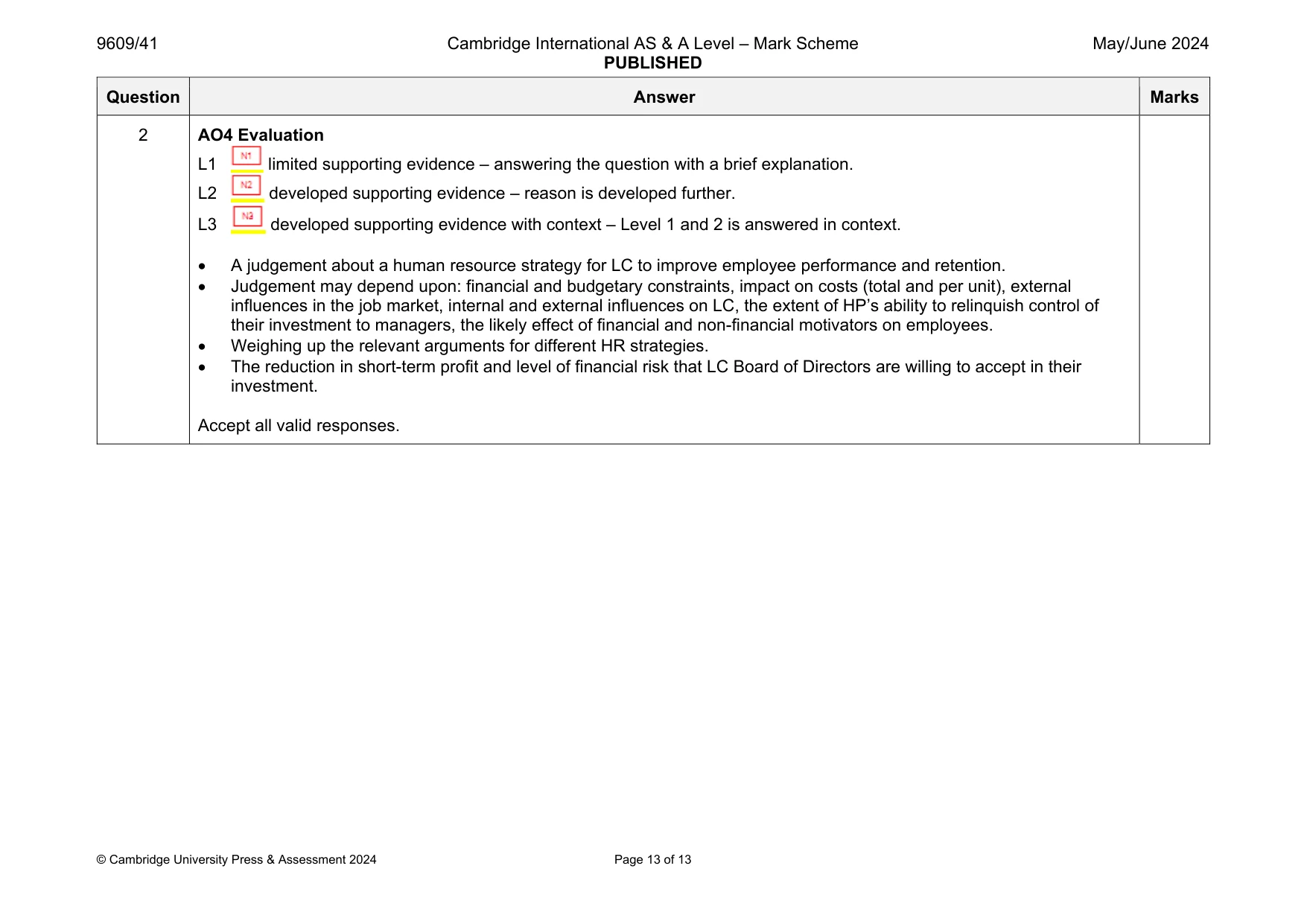
9609/41 Cambridge International AS & A Level – Mark Scheme PUBLISHED May/June 2024 © Cambridge University Press & Assessment 2024 Page 13 of 13 Question Answer Marks 2 AO4 Evaluation L1 limited supporting evidence – answering the question with a brief explanation. L2 developed supporting evidence – reason is developed further. L3 developed supporting evidence with context – Level 1 and 2 is answered in context. A judgement about a human resource strategy for LC to improve employee performance and retention. Judgement may depend upon: financial and budgetary constraints, impact on costs (total and per unit), external influences in the job market, internal and external influences on LC, the extent of HP’s ability to relinquish control of their investment to managers, the likely effect of financial and non-financial motivators on employees. Weighing up the relevant arguments for different HR strategies. The reduction in short-term profit and level of financial risk that LC Board of Directors are willing to accept in their investment. Accept all valid responses.
What you needed in this session
Cambridge’s own grade thresholds for 2024 May/June, Paper 4 · Variant 1. A higher threshold means an easier paper — the bar moves with how the cohort did.