Cambridge A Level Business (for first examination in 2016) 9609 — 2023 Oct/Nov Paper 4 · Variant 3
9609/43/O/N/23 · 2 questions · 40 marks · ≈45 min
The question paper and its mark scheme, free to read here and free to download. This is Cambridge’s own paper, exactly as it was sat.
Question paper4 pages

Mark scheme20 pages
Answers below. Sit the paper first if you are practising.
Questions as text
Q1 · Evaluate the extent to which RT’s operations strategy has supported the success of the…
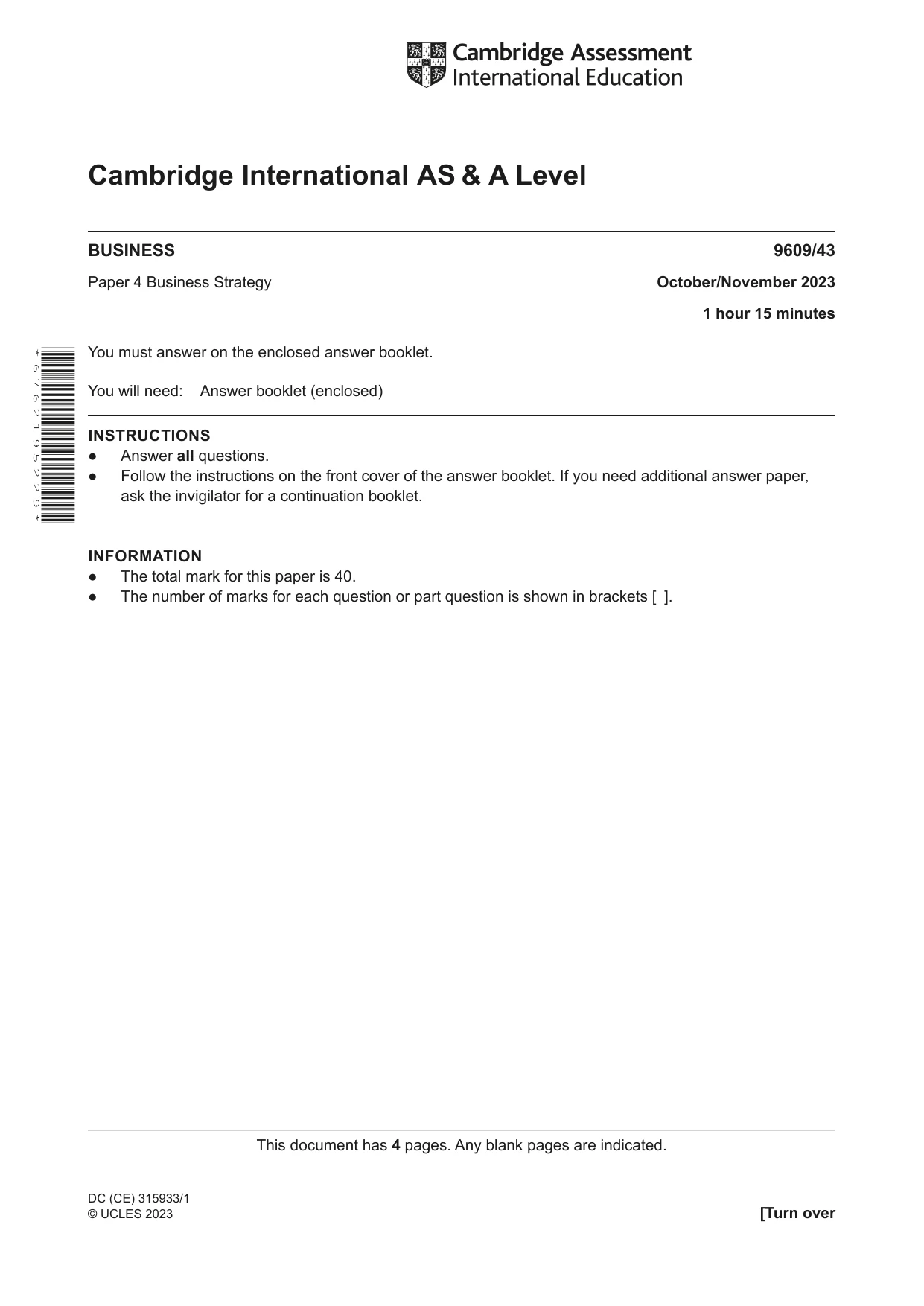
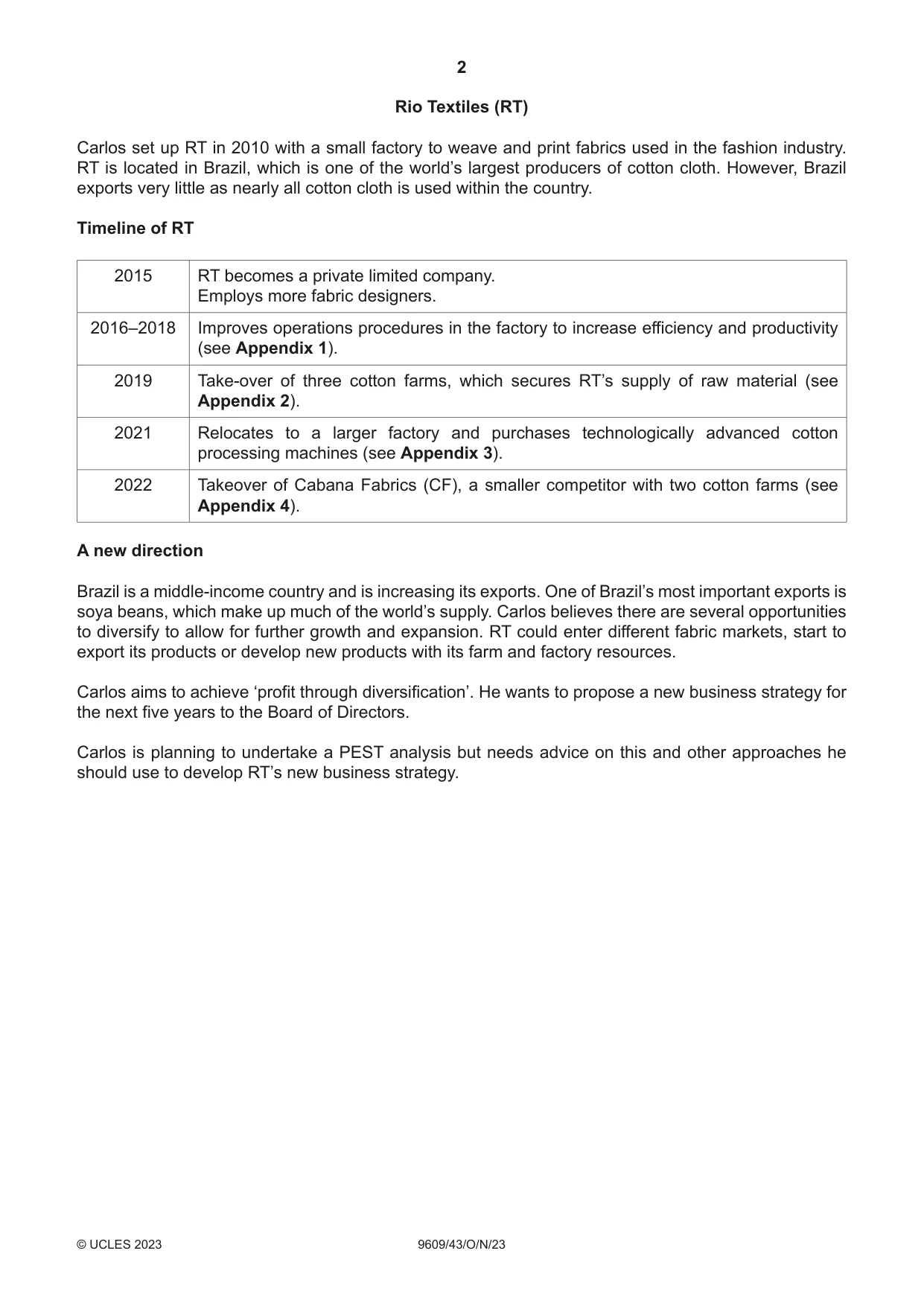
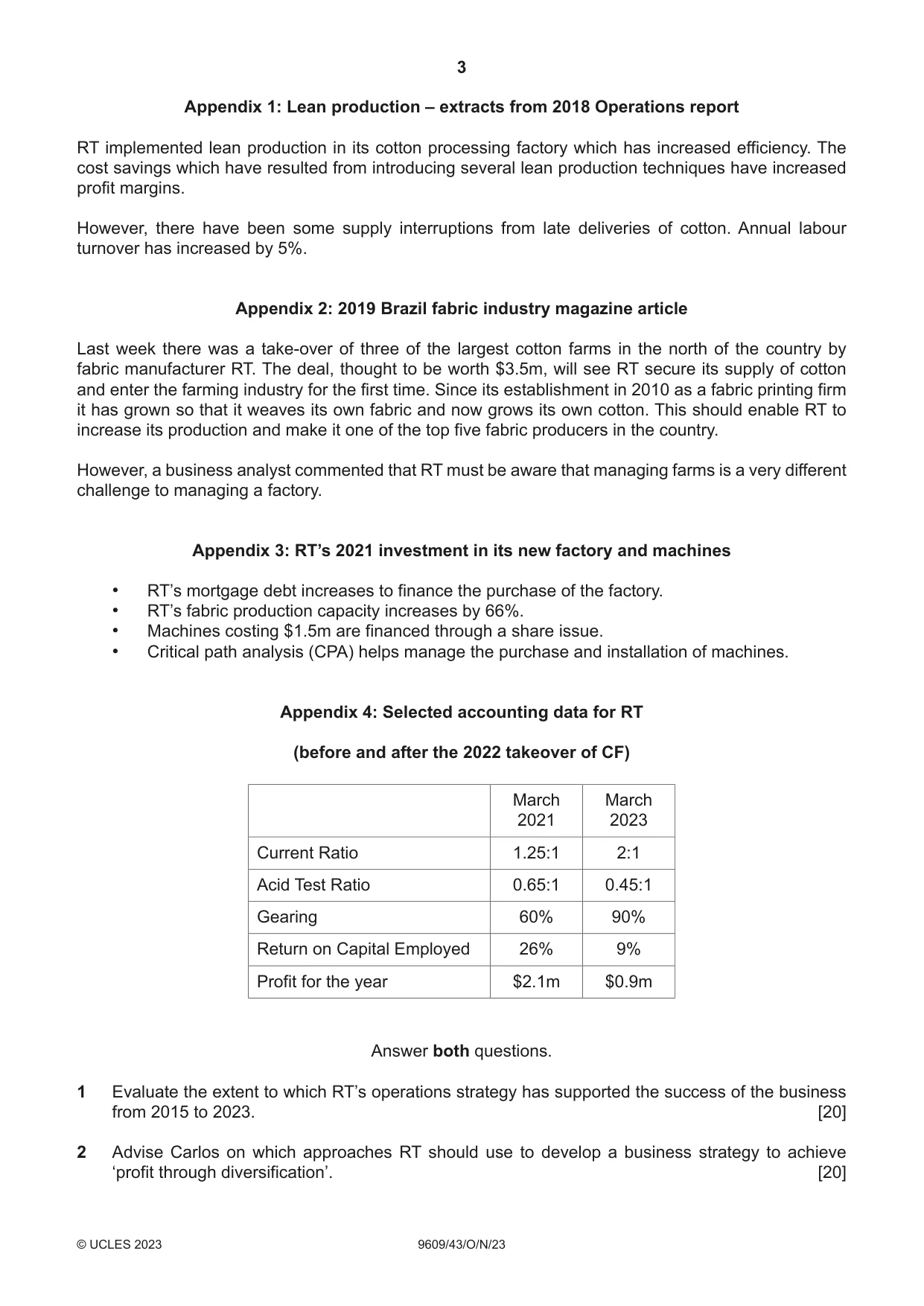
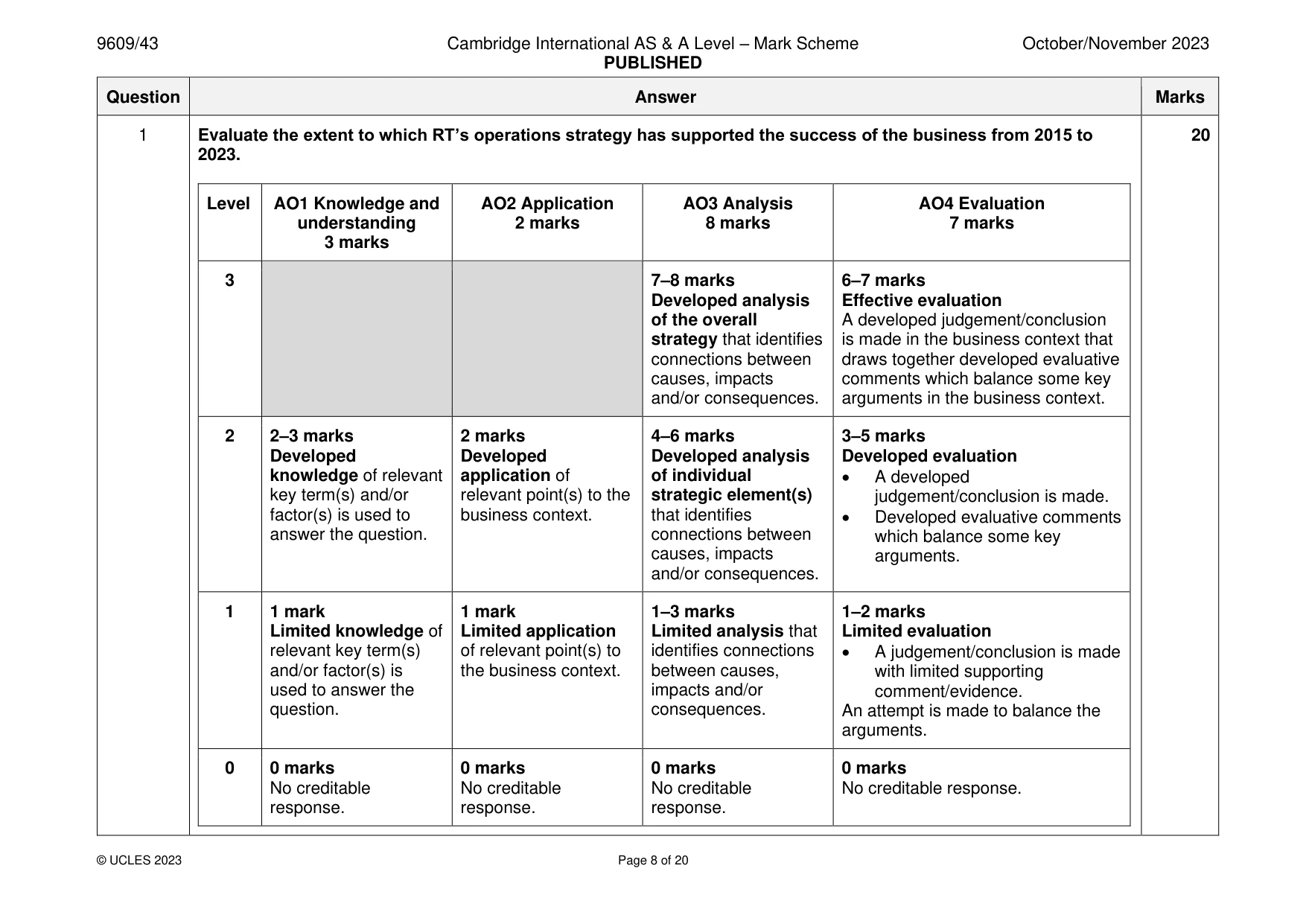
1 Evaluate the extent to which RT’s operations strategy has supported the success of the business from 2015 to 2023. [20]
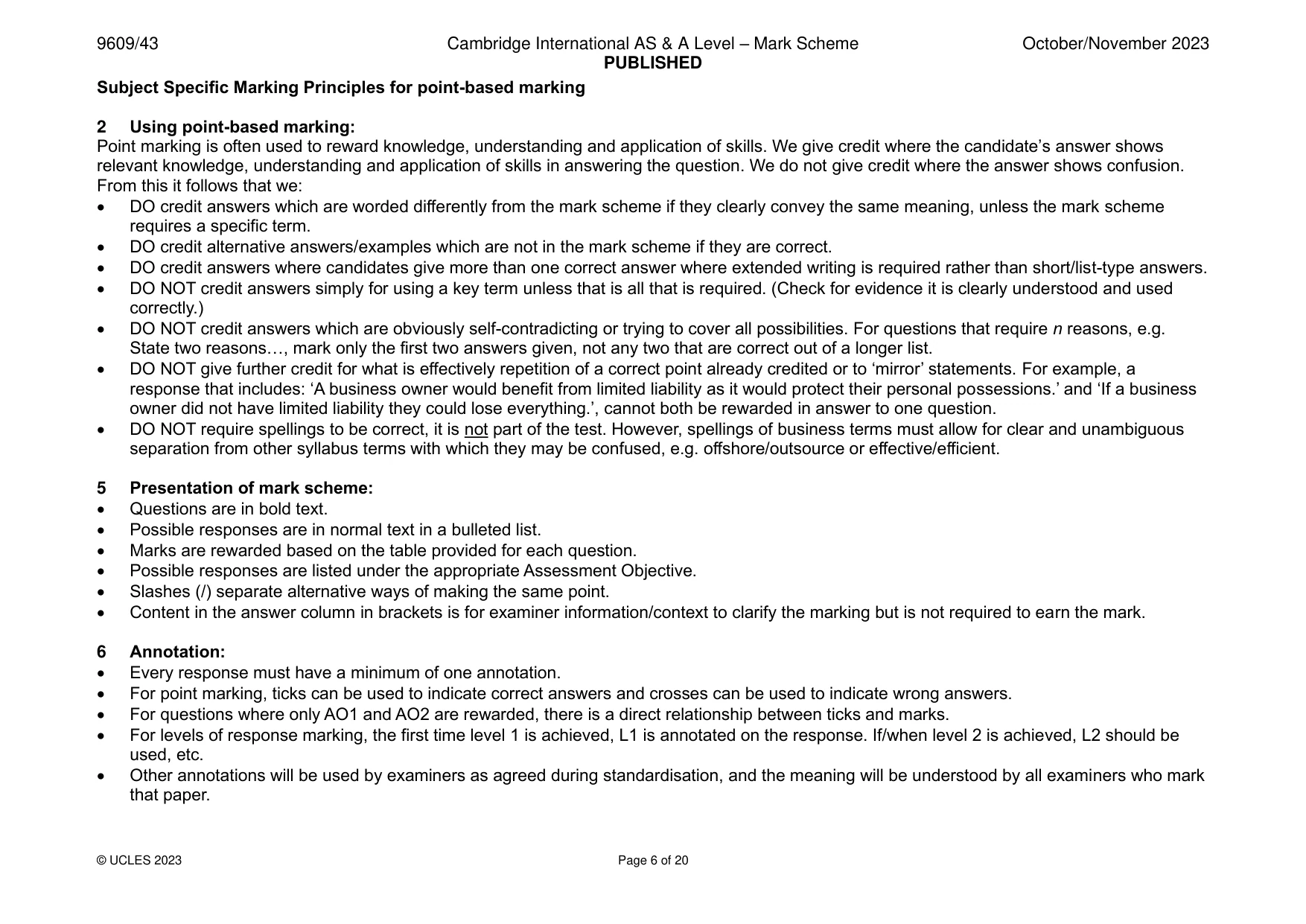
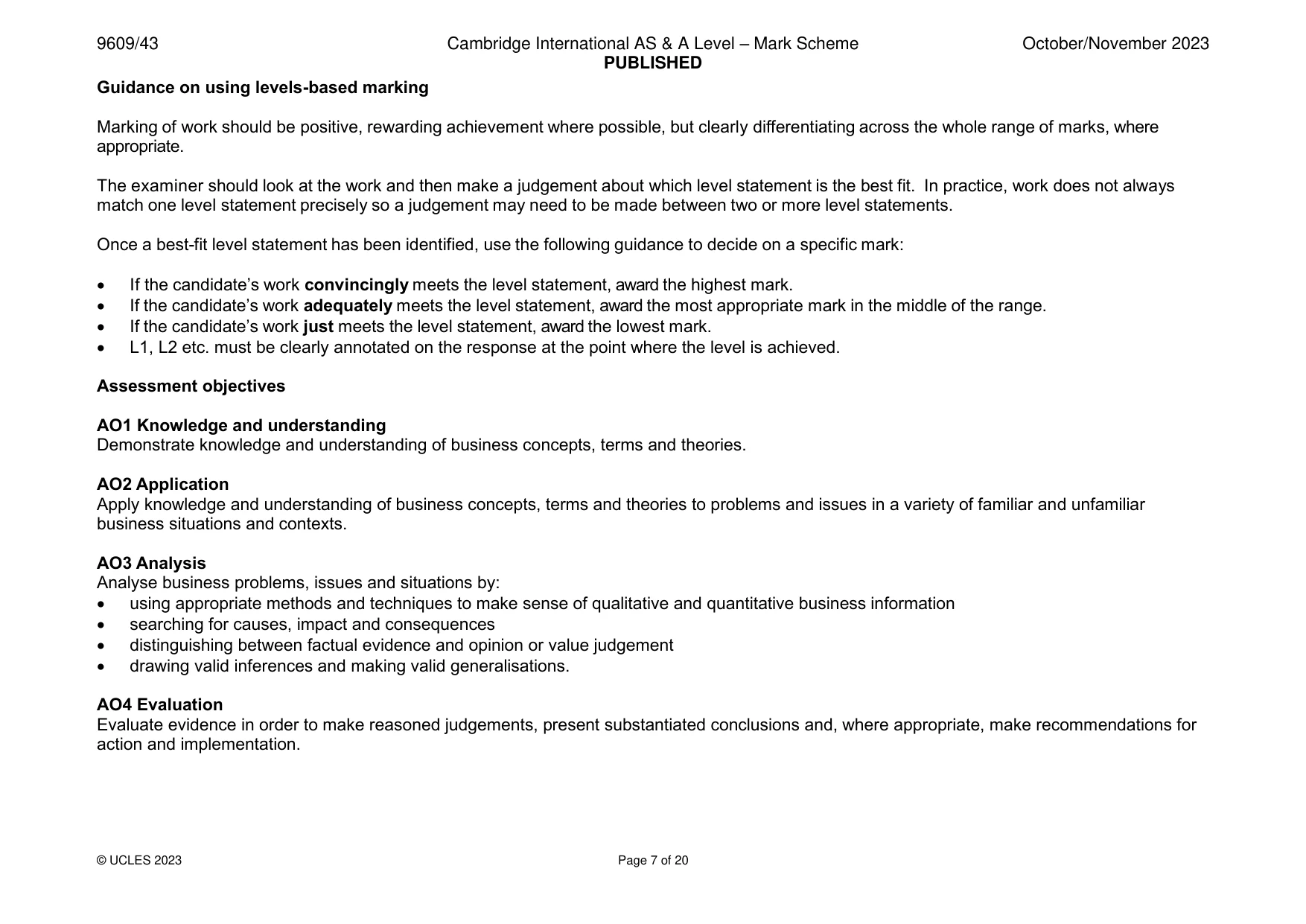
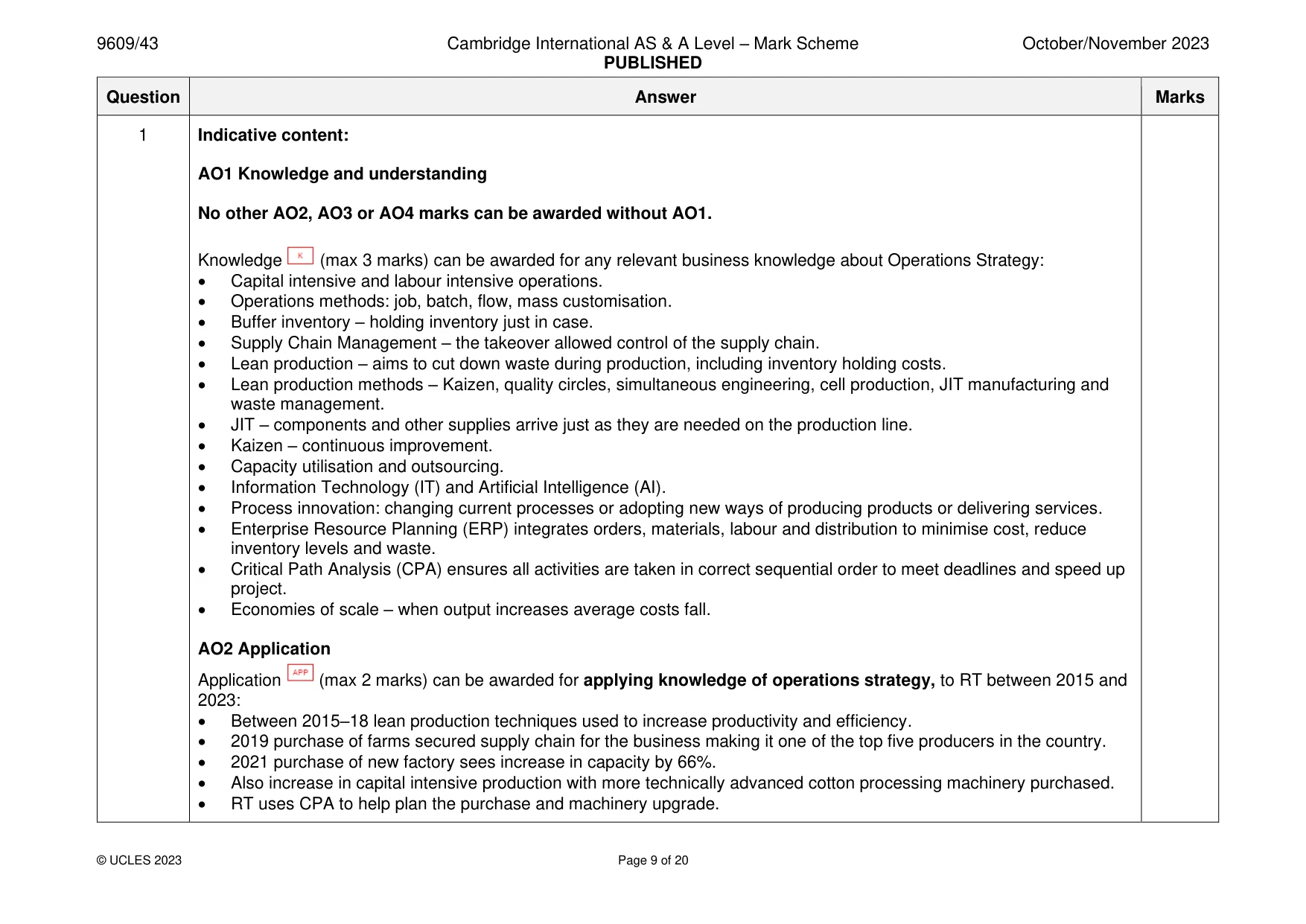
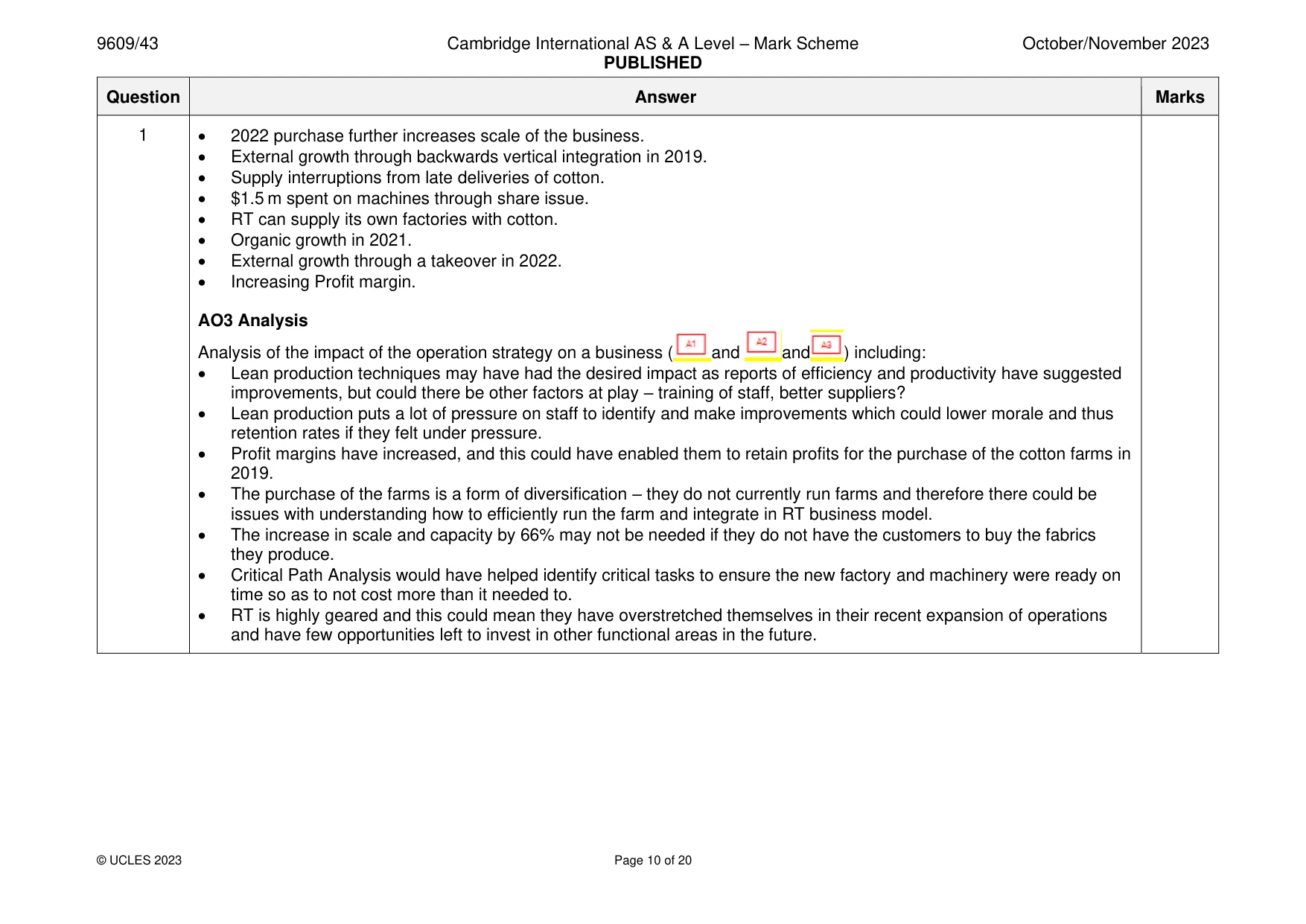
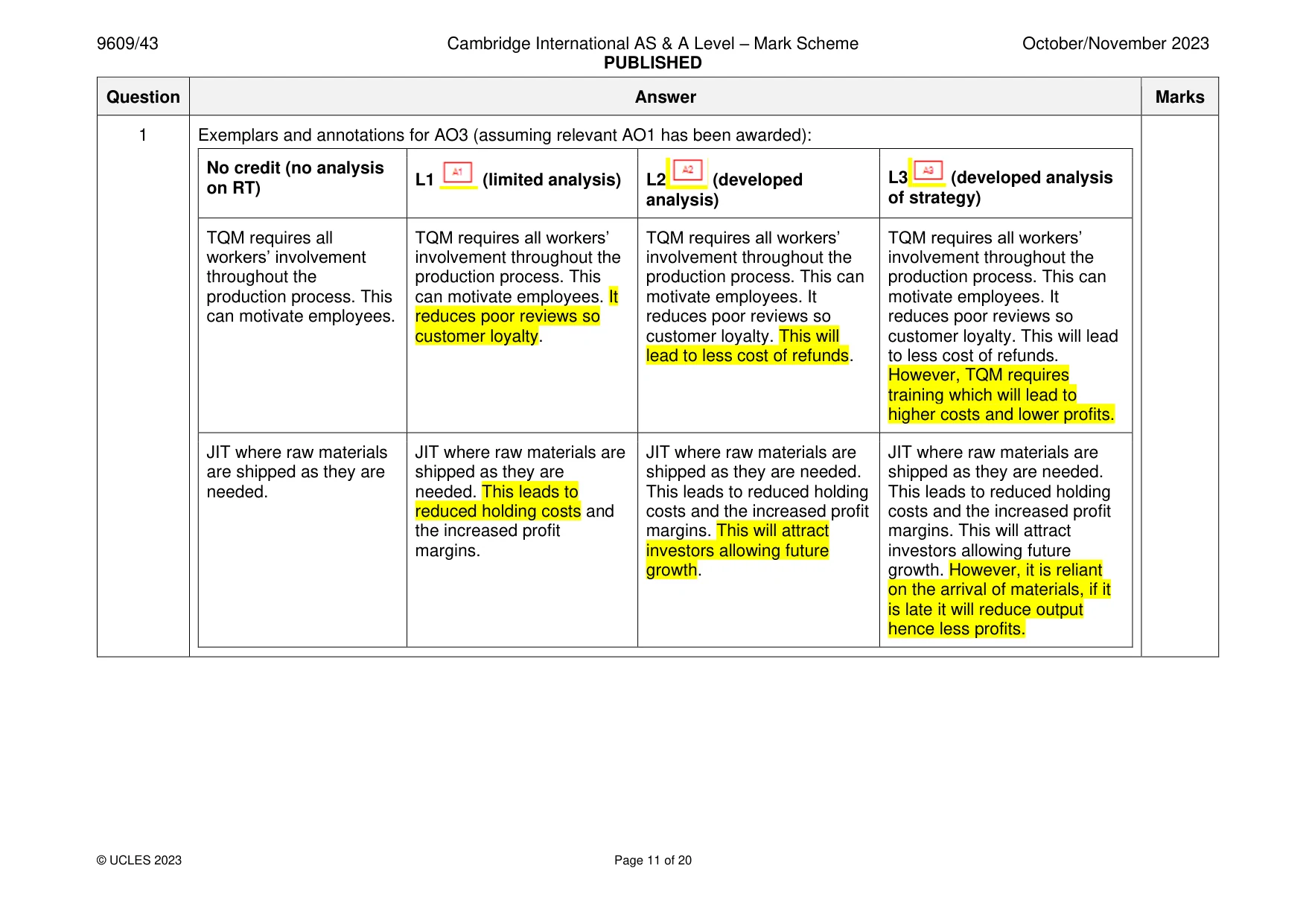
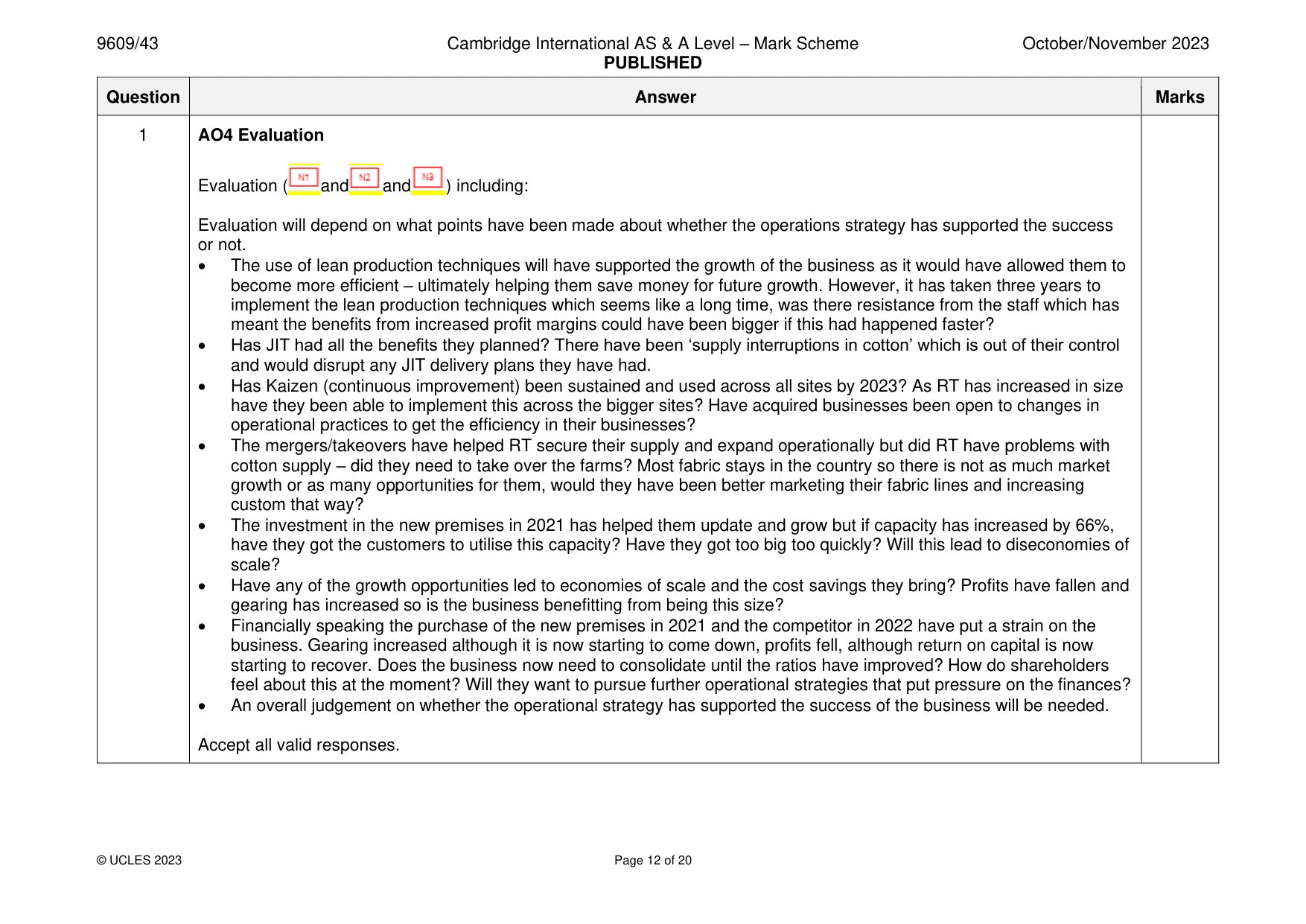
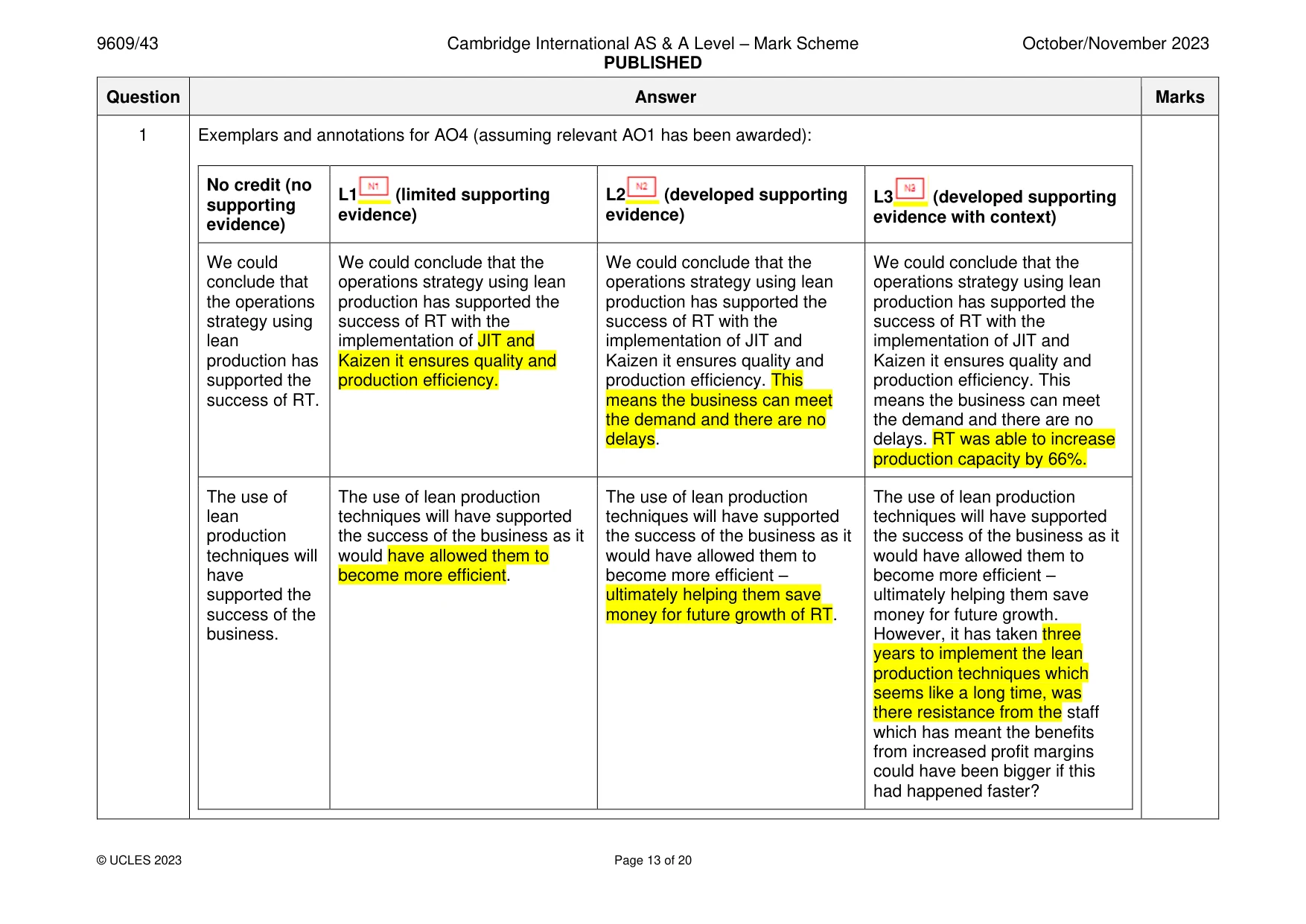
Mark scheme: Question Answer Marks 1 Evaluate the extent to which RT’s operations strategy has supported the success of the business from 2015 to 20 2023. Level AO1 Knowledge and AO2 Application AO3 Analysis AO4 Evaluation understanding 2 marks 8 marks 7 marks 3 marks 3 7–8 marks 6–7 marks Developed analysis Effective evaluation of the overall A developed judgement/conclusion strategy that identifies is made in the business context that connections between draws together developed evaluative causes, impacts comments which balance some key and/or consequences. arguments in the business context. 2 2–3 marks 2 marks 4–6 marks 3–5 marks Developed Developed Developed analysis Developed evaluation knowledge of relevant application of of individual • A developed key term(s) and/or relevant point(s) to the strategic element(s) judgement/conclusion is made. factor(s) is used to business context. that identifies • Developed evaluative comments answer the question. connections between which balance some key causes, impacts arguments. and/or consequences. 1 1 mark 1 mark 1–3 marks 1–2 marks Limited knowledge of Limited application Limited analysis that Limited evaluation relevant key term(s) of relevant point(s) to identifies connections • A judgement/conclusion is made and/or factor(s) is the business context. between causes, with limited supporting used to answer the impacts and/or comment/evidence. question. consequences. An attempt is made to balance the arguments. 0 0 marks 0 marks 0 marks 0 marks No creditable No creditable No creditable No creditable response. response. response. response. 1 Indicative content: AO1 Knowledge and understanding No other AO2, AO3 or AO4 marks can be awarded without AO1. Knowledge (max 3 marks) can be awarded for any relevant business knowledge about Operations Strategy: • Capital intensive and labour intensive operations. • Operations methods: job, batch, flow, mass customisation. • Buffer inventory – holding inventory just in case. • Supply Chain Management – the takeover allowed control of the supply chain. • Lean production – aims to cut down waste during production, including inventory holding costs. • Lean production methods – Kaizen, quality circles, simultaneous engineering, cell production, JIT manufacturing and waste management. • JIT – components and other supplies arrive just as they are needed on the production line. • Kaizen – continuous improvement. • Capacity utilisation and outsourcing. • Information Technology (IT) and Artificial Intelligence (AI). • Process innovation: changing current processes or adopting new ways of producing products or delivering services. • Enterprise Resource Planning (ERP) integrates orders, materials, labour and distribution to minimise cost, reduce inventory levels and waste. • Critical Path Analysis (CPA) ensures all activities are taken in correct sequential order to meet deadlines and speed up project. • Economies of scale – when output increases average costs fall. AO2 Application Application (max 2 marks) can be awarded for applying knowledge of operations strategy, to RT between 2015 and 2023: • Between 2015–18 lean production techniques used to increase productivity and efficiency. • 2019 purchase of farms secured supply chain for the business making it one of the top five producers in the country. • 2021 purchase of new factory sees increase in capacity by 66%. • Also increase in capital intensive production with more technically advanced cotton processing machinery purchased. • RT uses CPA to help plan the purchase and machinery upgrade. 1 • 2022 purchase further increases scale of the business. • External growth through backwards vertical integration in 2019. • Supply interruptions from late deliveries of cotton. • $1.5 m spent on machines through share issue. • RT can supply its own factories with cotton. • Organic growth in 2021. • External growth through a takeover in 2022. • Increasing Profit margin. AO3 Analysis Analysis of the impact of the operation strategy on a business ( and and ) including: • Lean production techniques may have had the desired impact as reports of efficiency and productivity have suggested improvements, but could there be other factors at play – training of staff, better suppliers? • Lean production puts a lot of pressure on staff to identify and make improvements which could lower morale and thus retention rates if they felt under pressure. • Profit margins have increased, and this could have enabled them to retain profits for the purchase of the cotton farms in 2019. • The purchase of the farms is a form of diversification – they do not currently run farms and therefore there could be issues with understanding how to efficiently run the farm and integrate in RT business model. • The increase in scale and capacity by 66% may not be needed if they do not have the customers to buy the fabrics they produce. • Critical Path Analysis would have helped identify critical tasks to ensure the new factory and machinery were ready on time so as to not cost more than it needed to. • RT is highly geared and this could mean they have overstretched themselves in their recent expansion of operations and have few opportunities left to invest in other functional areas in the future. 1 Exemplars and annotations for AO3 (assuming relevant AO1 has been awarded): No credit (no analysis L1 (limited analysis) L2 (developed L3 (developed analysis on RT) analysis) of strategy) TQM requires all TQM requires all workers’ TQM requires all workers’ TQM requires all workers’ workers’ involvement involvement throughout the involvement throughout the involvement throughout the throughout the production process. This production process. This can production process. This can production process. This can motivate employees. It motivate employees. It motivate employees. It can motivate employees. reduces poor reviews so reduces poor reviews so reduces poor reviews so customer loyalty. customer loyalty. This will customer loyalty. This will lead lead to less cost of refunds. to less cost of refunds. However, TQM requires training which will lead to higher costs and lower profits. JIT where raw materials JIT where raw materials are JIT where raw materials are JIT where raw materials are are shipped as they are shipped as they are shipped as they are needed. shipped as they are needed. needed. needed. This leads to This leads to reduced holding This leads to reduced holding reduced holding costs and costs and the increased profit costs and the increased profit the increased profit margins. This will attract margins. This will attract margins. investors allowing future investors allowing future growth. growth. However, it is reliant on the arrival of materials, if it is late it will reduce output hence less profits. 1 AO4 Evaluation Evaluation ( and and ) including: Evaluation will depend on what points have been made about whether the operations strategy has supported the success or not. • The use of lean production techniques will have supported the growth of the business as it would have allowed them to become more efficient – ultimately helping them save money for future growth. However, it has taken three years to implement the lean production techniques which seems like a long time, was there resistance from the staff which has meant the benefits from increased profit margins could have been bigger if this had happened faster? • Has JIT had all the benefits they planned? There have been ‘supply interruptions in cotton’ which is out of their control and would disrupt any JIT delivery plans they have had. • Has Kaizen (continuous improvement) been sustained and used across all sites by 2023? As RT has increased in size have they been able to implement this across the bigger sites? Have acquired businesses been open to changes in operational practices to get the efficiency in their businesses? • The mergers/takeovers have helped RT secure their supply and expand operationally but did RT have problems with cotton supply – did they need to take over the farms? Most fabric stays in the country so there is not as much market growth or as many opportunities for them, would they have been better marketing their fabric lines and increasing custom that way? • The investment in the new premises in 2021 has helped them update and grow but if capacity has increased by 66%, have they got the customers to utilise this capacity? Have they got too big too quickly? Will this lead to diseconomies of scale? • Have any of the growth opportunities led to economies of scale and the cost savings they bring? Profits have fallen and gearing has increased so is the business benefitting from being this size? • Financially speaking the purchase of the new premises in 2021 and the competitor in 2022 have put a strain on the business. Gearing increased although it is now starting to come down, profits fell, although return on capital is now starting to recover. Does the business now need to consolidate until the ratios have improved? How do shareholders feel about this at the moment? Will they want to pursue further operational strategies that put pressure on the finances? • An overall judgement on whether the operational strategy has supported the success of the business will be needed. Accept all valid responses. 1 Exemplars and annotations for AO4 (assuming relevant AO1 has been awarded): No credit (no L1 (limited supporting L2 (developed supporting L3 (developed supporting supporting evidence) evidence) evidence with context) evidence) We could We could conclude that the We could conclude that the We could conclude that the conclude that operations strategy using lean operations strategy using lean operations strategy using lean the operations production has supported the production has supported the production has supported the strategy using success of RT with the success of RT with the success of RT with the lean implementation of JIT and implementation of JIT and implementation of JIT and production has Kaizen it ensures quality and Kaizen it ensures quality and Kaizen it ensures quality and supported the production efficiency. production efficiency. This production efficiency. This success of RT. means the business can meet means the business can meet the demand and there are no the demand and there are no delays. delays. RT was able to increase production capacity by 66%. The use of The use of lean production The use of lean production The use of lean production lean techniques will have supported techniques will have supported techniques will have supported production the success of the business as it the success of the business as it the success of the business as it techniques will would have allowed them to would have allowed them to would have allowed them to have become more efficient. become more efficient – become more efficient – supported the ultimately helping them save ultimately helping them save success of the money for future growth of RT. money for future growth. business. However, it has taken three years to implement the lean production techniques which seems like a long time, was there resistance from the staff which has meant the benefits from increased profit margins could have been bigger if this had happened faster?
Q2 · Advise Carlos on which approaches RT should use to develop a business strategy to achieve…
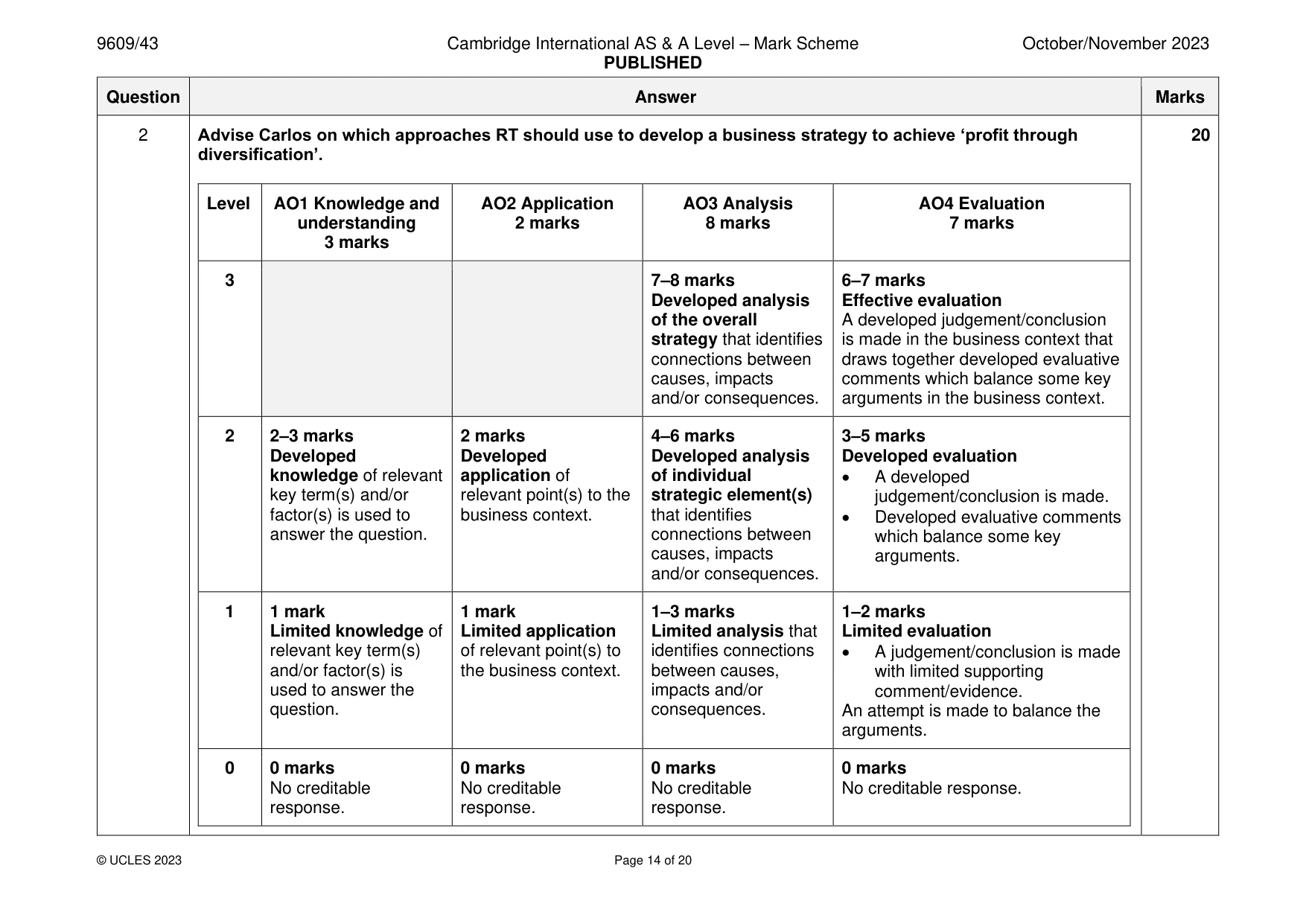
2 Advise Carlos on which approaches RT should use to develop a business strategy to achieve ‘profit through diversification’. [20]
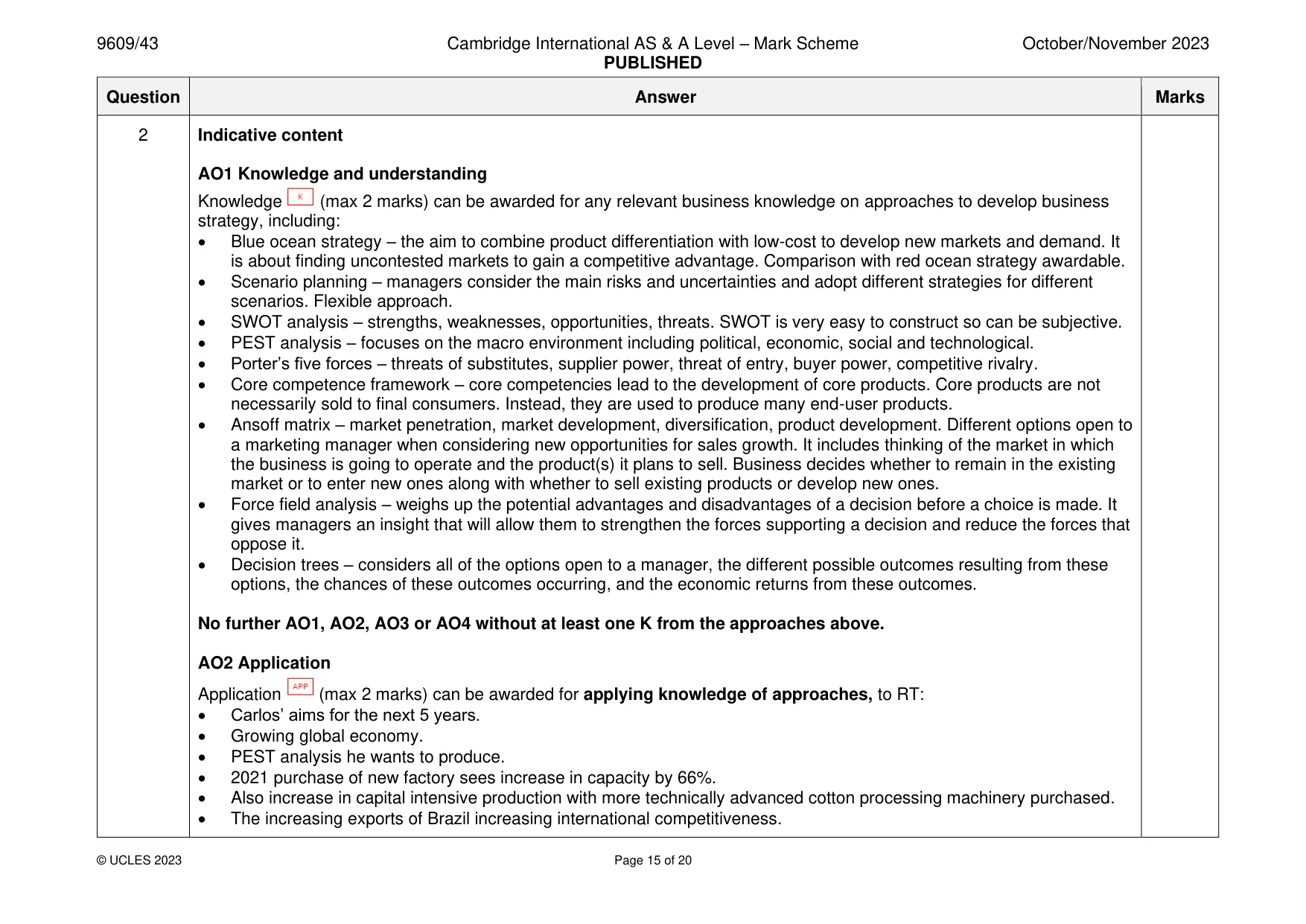
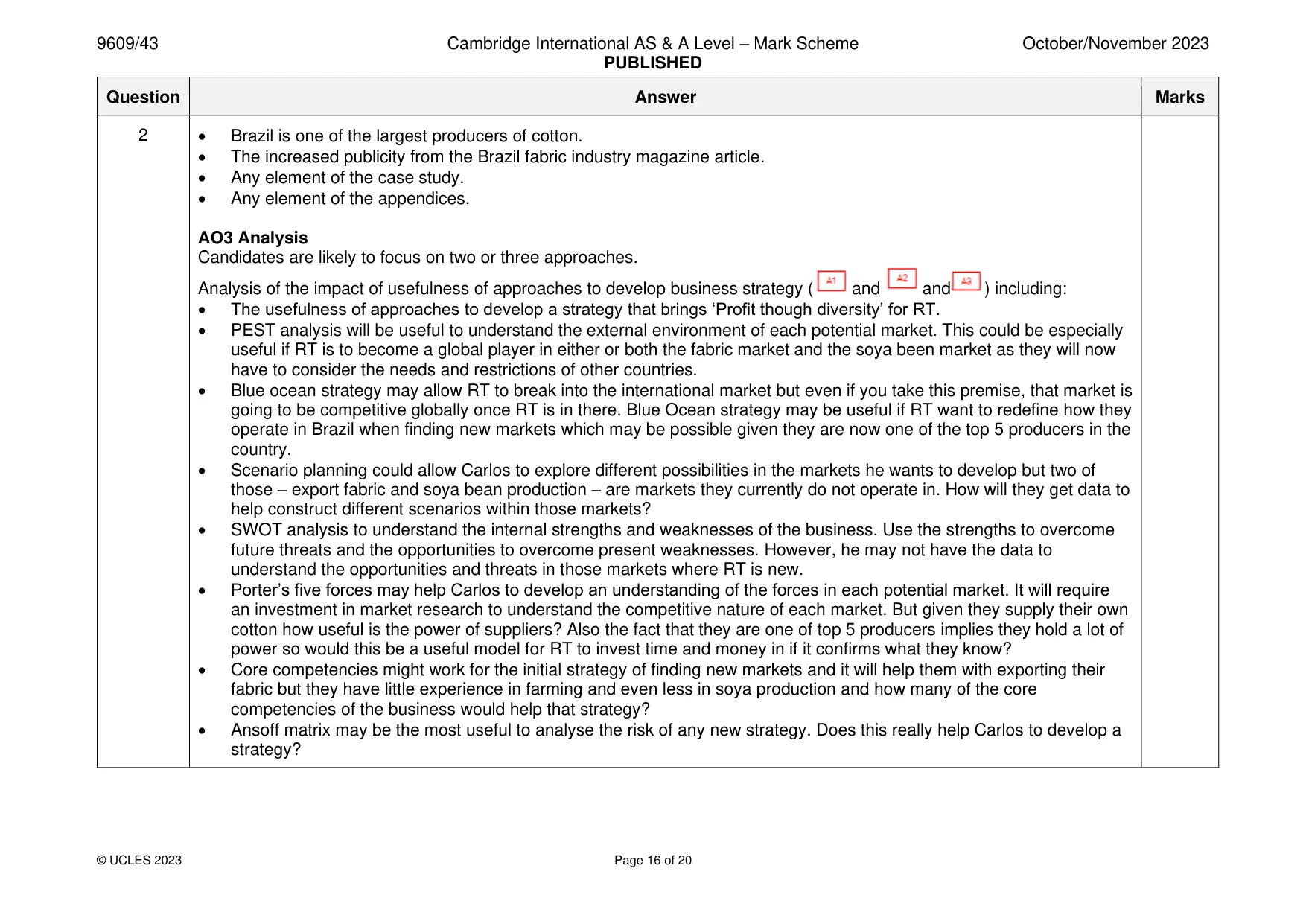
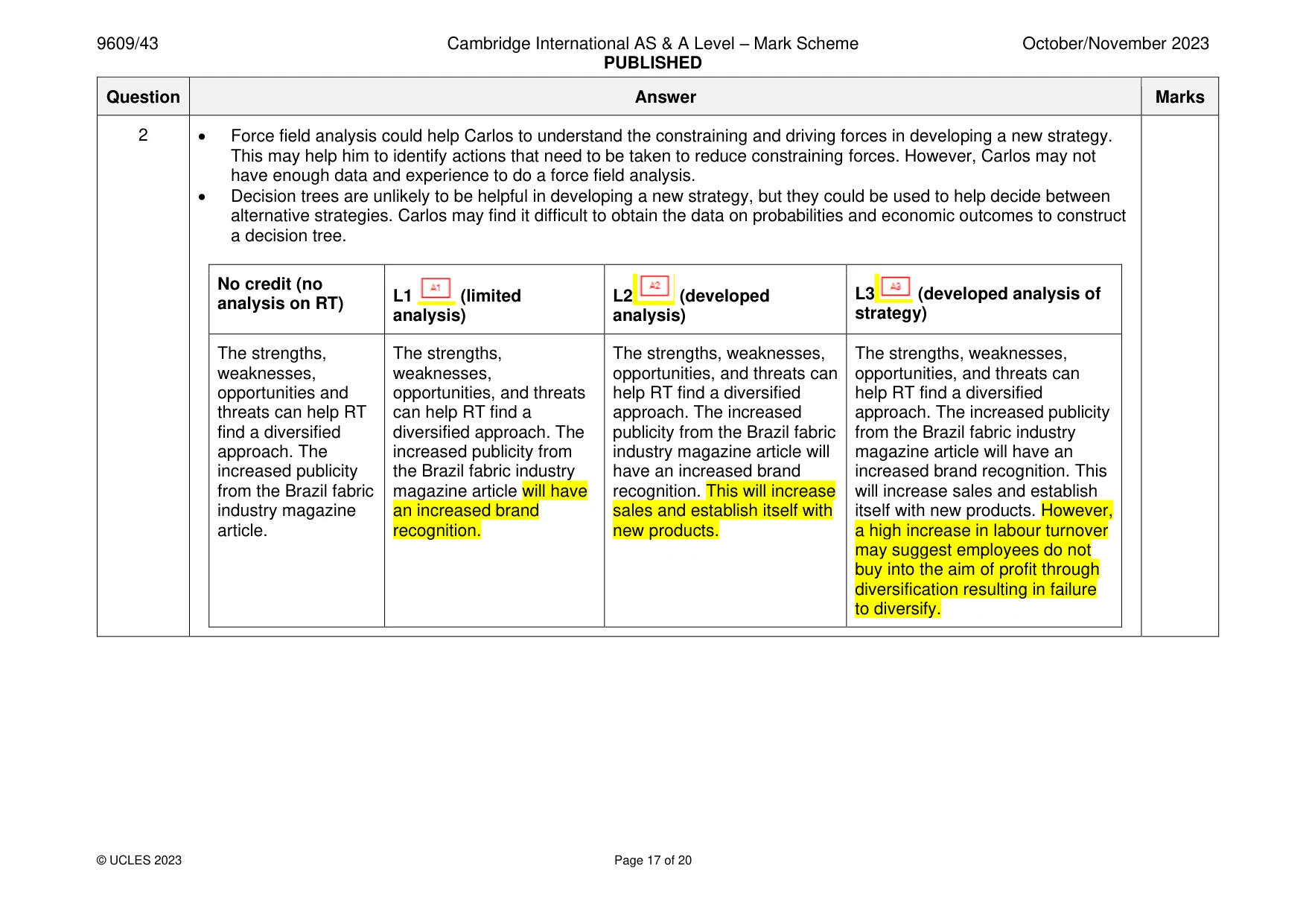
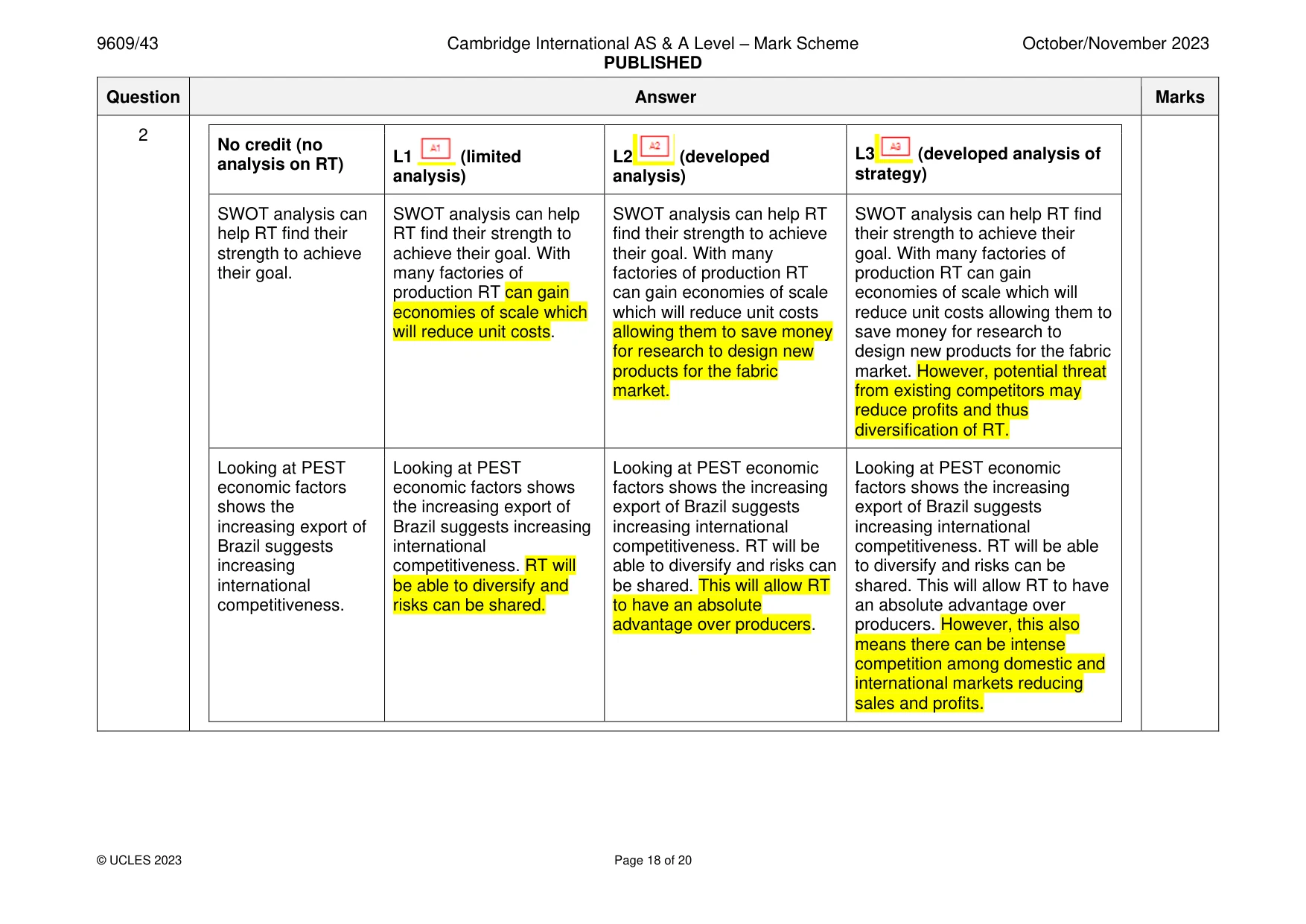
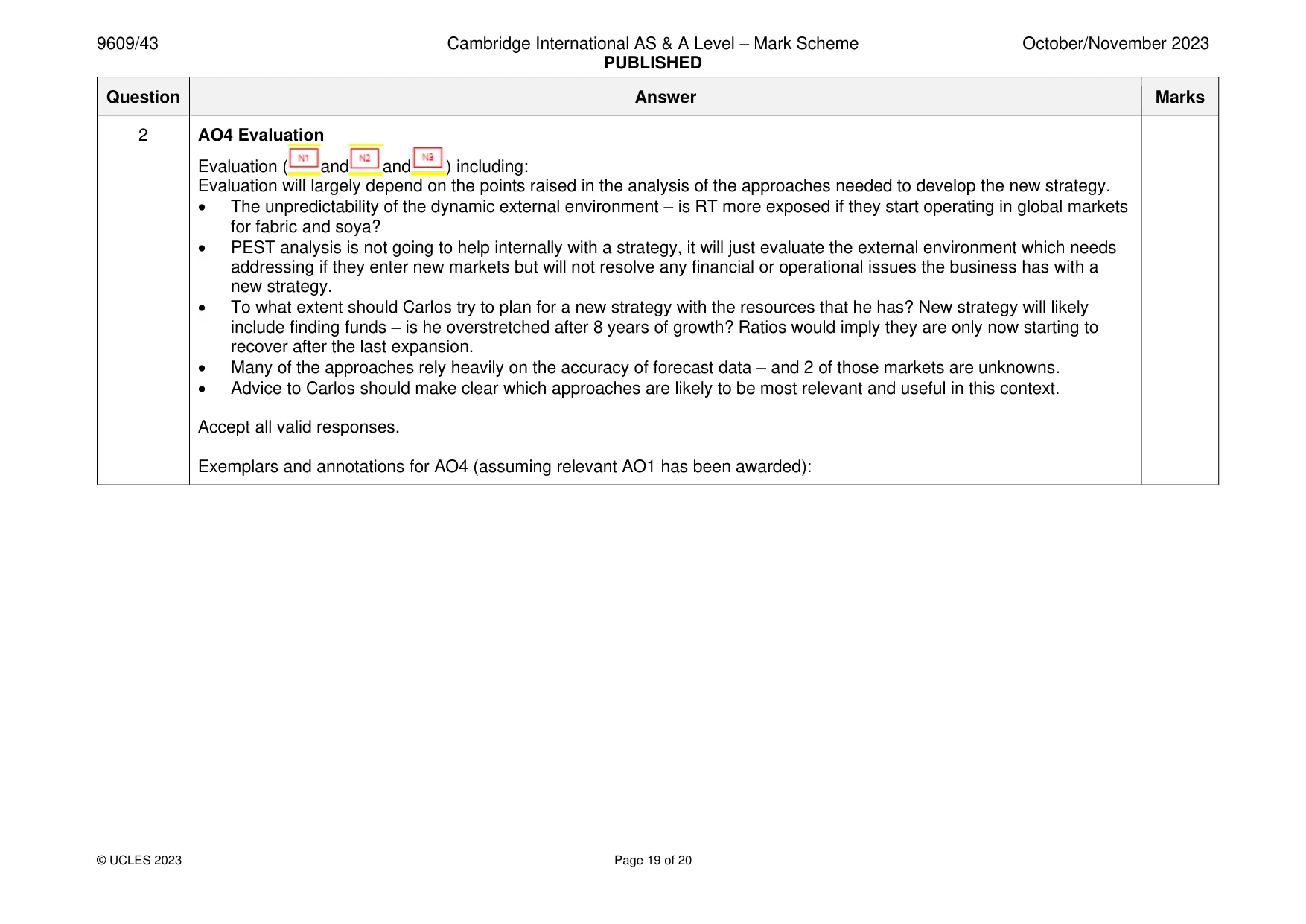
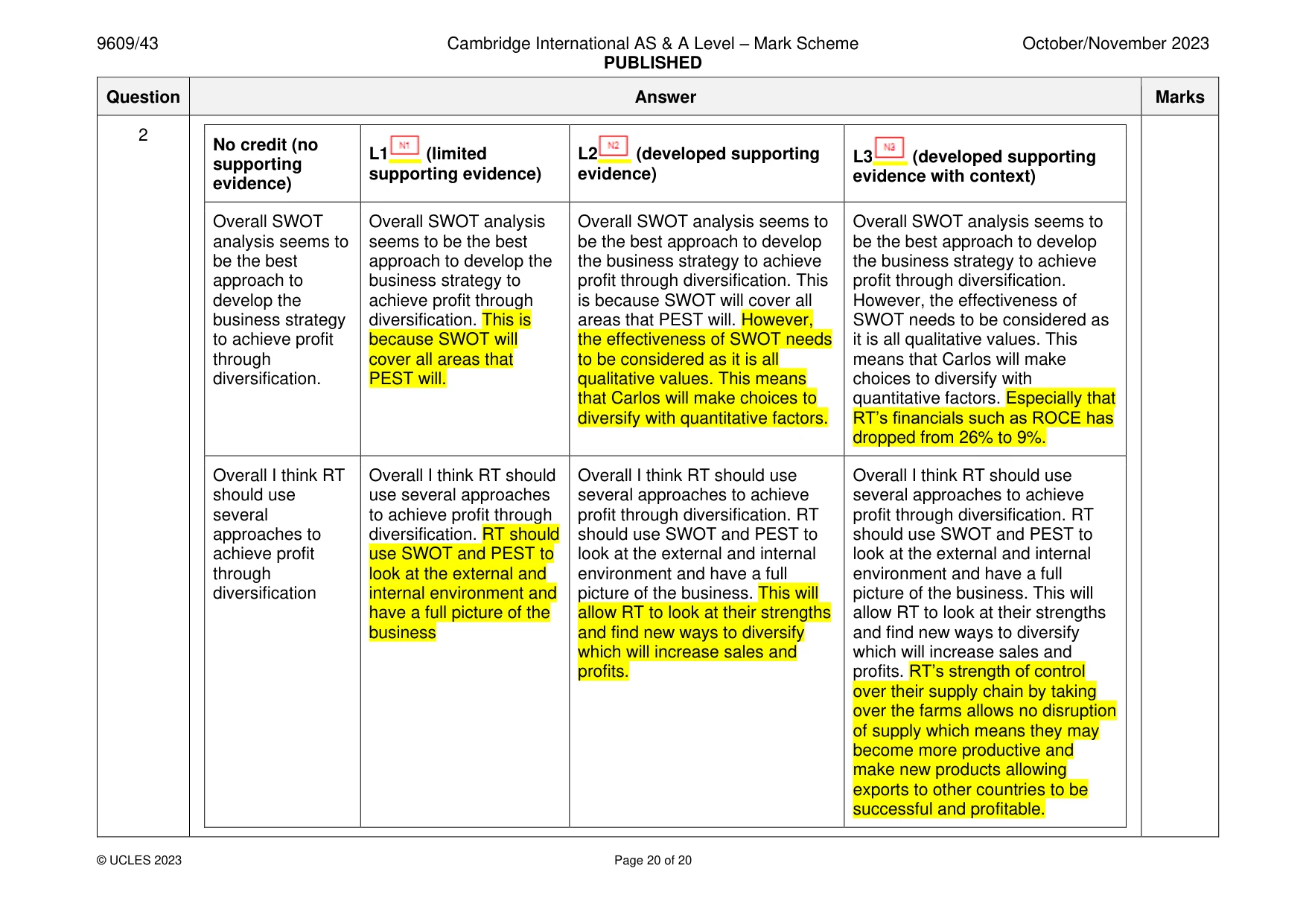
Mark scheme: 2 Advise Carlos on which approaches RT should use to develop a business strategy to achieve ‘profit through 20 diversification’. Level AO1 Knowledge and AO2 Application AO3 Analysis AO4 Evaluation understanding 2 marks 8 marks 7 marks 3 marks 3 7–8 marks 6–7 marks Developed analysis Effective evaluation of the overall A developed judgement/conclusion strategy that identifies is made in the business context that connections between draws together developed evaluative causes, impacts comments which balance some key and/or consequences. arguments in the business context. 2 2–3 marks 2 marks 4–6 marks 3–5 marks Developed Developed Developed analysis Developed evaluation knowledge of relevant application of of individual • A developed key term(s) and/or relevant point(s) to the strategic element(s) judgement/conclusion is made. factor(s) is used to business context. that identifies • Developed evaluative comments answer the question. connections between which balance some key causes, impacts arguments. and/or consequences. 1 1 mark 1 mark 1–3 marks 1–2 marks Limited knowledge of Limited application Limited analysis that Limited evaluation relevant key term(s) of relevant point(s) to identifies connections • A judgement/conclusion is made and/or factor(s) is the business context. between causes, with limited supporting used to answer the impacts and/or comment/evidence. question. consequences. An attempt is made to balance the arguments. 0 0 marks 0 marks 0 marks 0 marks No creditable No creditable No creditable No creditable response. response. response. response. 2 Indicative content AO1 Knowledge and understanding Knowledge (max 2 marks) can be awarded for any relevant business knowledge on approaches to develop business strategy, including: • Blue ocean strategy – the aim to combine product differentiation with low-cost to develop new markets and demand. It is about finding uncontested markets to gain a competitive advantage. Comparison with red ocean strategy awardable. • Scenario planning – managers consider the main risks and uncertainties and adopt different strategies for different scenarios. Flexible approach. • SWOT analysis – strengths, weaknesses, opportunities, threats. SWOT is very easy to construct so can be subjective. • PEST analysis – focuses on the macro environment including political, economic, social and technological. • Porter’s five forces – threats of substitutes, supplier power, threat of entry, buyer power, competitive rivalry. • Core competence framework – core competencies lead to the development of core products. Core products are not necessarily sold to final consumers. Instead, they are used to produce many end-user products. • Ansoff matrix – market penetration, market development, diversification, product development. Different options open to a marketing manager when considering new opportunities for sales growth. It includes thinking of the market in which the business is going to operate and the product(s) it plans to sell. Business decides whether to remain in the existing market or to enter new ones along with whether to sell existing products or develop new ones. • Force field analysis – weighs up the potential advantages and disadvantages of a decision before a choice is made. It gives managers an insight that will allow them to strengthen the forces supporting a decision and reduce the forces that oppose it. • Decision trees – considers all of the options open to a manager, the different possible outcomes resulting from these options, the chances of these outcomes occurring, and the economic returns from these outcomes. No further AO1, AO2, AO3 or AO4 without at least one K from the approaches above. AO2 Application Application (max 2 marks) can be awarded for applying knowledge of approaches, to RT: • Carlos’ aims for the next 5 years. • Growing global economy. • PEST analysis he wants to produce. • 2021 purchase of new factory sees increase in capacity by 66%. • Also increase in capital intensive production with more technically advanced cotton processing machinery purchased. • The increasing exports of Brazil increasing international competitiveness. 2 • Brazil is one of the largest producers of cotton. • The increased publicity from the Brazil fabric industry magazine article. • Any element of the case study. • Any element of the appendices. AO3 Analysis Candidates are likely to focus on two or three approaches. Analysis of the impact of usefulness of approaches to develop business strategy ( and and ) including: • The usefulness of approaches to develop a strategy that brings ‘Profit though diversity’ for RT. • PEST analysis will be useful to understand the external environment of each potential market. This could be especially useful if RT is to become a global player in either or both the fabric market and the soya been market as they will now have to consider the needs and restrictions of other countries. • Blue ocean strategy may allow RT to break into the international market but even if you take this premise, that market is going to be competitive globally once RT is in there. Blue Ocean strategy may be useful if RT want to redefine how they operate in Brazil when finding new markets which may be possible given they are now one of the top 5 producers in the country. • Scenario planning could allow Carlos to explore different possibilities in the markets he wants to develop but two of those – export fabric and soya bean production – are markets they currently do not operate in. How will they get data to help construct different scenarios within those markets? • SWOT analysis to understand the internal strengths and weaknesses of the business. Use the strengths to overcome future threats and the opportunities to overcome present weaknesses. However, he may not have the data to understand the opportunities and threats in those markets where RT is new. • Porter’s five forces may help Carlos to develop an understanding of the forces in each potential market. It will require an investment in market research to understand the competitive nature of each market. But given they supply their own cotton how useful is the power of suppliers? Also the fact that they are one of top 5 producers implies they hold a lot of power so would this be a useful model for RT to invest time and money in if it confirms what they know? • Core competencies might work for the initial strategy of finding new markets and it will help them with exporting their fabric but they have little experience in farming and even less in soya production and how many of the core competencies of the business would help that strategy? • Ansoff matrix may be the most useful to analyse the risk of any new strategy. Does this really help Carlos to develop a strategy? 2 • Force field analysis could help Carlos to understand the constraining and driving forces in developing a new strategy. This may help him to identify actions that need to be taken to reduce constraining forces. However, Carlos may not have enough data and experience to do a force field analysis. • Decision trees are unlikely to be helpful in developing a new strategy, but they could be used to help decide between alternative strategies. Carlos may find it difficult to obtain the data on probabilities and economic outcomes to construct a decision tree. No credit (no L1 (limited L2 (developed L3 (developed analysis of analysis on RT) analysis) analysis) strategy) The strengths, The strengths, The strengths, weaknesses, The strengths, weaknesses, weaknesses, weaknesses, opportunities, and threats can opportunities, and threats can opportunities and opportunities, and threats help RT find a diversified help RT find a diversified threats can help RT can help RT find a approach. The increased approach. The increased publicity find a diversified diversified approach. The publicity from the Brazil fabric from the Brazil fabric industry approach. The increased publicity from industry magazine article will magazine article will have an increased publicity the Brazil fabric industry have an increased brand increased brand recognition. This from the Brazil fabric magazine article will have recognition. This will increase will increase sales and establish industry magazine an increased brand sales and establish itself with itself with new products. However, article. recognition. new products. a high increase in labour turnover may suggest employees do not buy into the aim of profit through diversification resulting in failure to diversify. 2 No credit (no L1 (limited L2 (developed L3 (developed analysis of analysis on RT) analysis) analysis) strategy) SWOT analysis can SWOT analysis can help SWOT analysis can help RT SWOT analysis can help RT find help RT find their RT find their strength to find their strength to achieve their strength to achieve their strength to achieve achieve their goal. With their goal. With many goal. With many factories of their goal. many factories of factories of production RT production RT can gain production RT can gain can gain economies of scale economies of scale which will economies of scale which which will reduce unit costs reduce unit costs allowing them to will reduce unit costs. allowing them to save money save money for research to for research to design new design new products for the fabric products for the fabric market. However, potential threat market. from existing competitors may reduce profits and thus diversification of RT. Looking at PEST Looking at PEST Looking at PEST economic Looking at PEST economic economic factors economic factors shows factors shows the increasing factors shows the increasing shows the the increasing export of export of Brazil suggests export of Brazil suggests increasing export of Brazil suggests increasing increasing international increasing international Brazil suggests international competitiveness. RT will be competitiveness. RT will be able increasing competitiveness. RT will able to diversify and risks can to diversify and risks can be international be able to diversify and be shared. This will allow RT shared. This will allow RT to have competitiveness. risks can be shared. to have an absolute an absolute advantage over advantage over producers. producers. However, this also means there can be intense competition among domestic and international markets reducing sales and profits. 2 AO4 Evaluation Evaluation ( and and ) including: Evaluation will largely depend on the points raised in the analysis of the approaches needed to develop the new strategy. • The unpredictability of the dynamic external environment – is RT more exposed if they start operating in global markets for fabric and soya? • PEST analysis is not going to help internally with a strategy, it will just evaluate the external environment which needs addressing if they enter new markets but will not resolve any financial or operational issues the business has with a new strategy. • To what extent should Carlos try to plan for a new strategy with the resources that he has? New strategy will likely include finding funds – is he overstretched after 8 years of growth? Ratios would imply they are only now starting to recover after the last expansion. • Many of the approaches rely heavily on the accuracy of forecast data – and 2 of those markets are unknowns. • Advice to Carlos should make clear which approaches are likely to be most relevant and useful in this context. Accept all valid responses. Exemplars and annotations for AO4 (assuming relevant AO1 has been awarded): 2 No credit (no L1 (limited L2 (developed supporting L3 (developed supporting supporting supporting evidence) evidence) evidence with context) evidence) Overall SWOT Overall SWOT analysis Overall SWOT analysis seems to Overall SWOT analysis seems to analysis seems to seems to be the best be the best approach to develop be the best approach to develop be the best approach to develop the the business strategy to achieve the business strategy to achieve approach to business strategy to profit through diversification. This profit through diversification. develop the achieve profit through is because SWOT will cover all However, the effectiveness of business strategy diversification. This is areas that PEST will. However, SWOT needs to be considered as to achieve profit because SWOT will the effectiveness of SWOT needs it is all qualitative values. This through cover all areas that to be considered as it is all means that Carlos will make diversification. PEST will. qualitative values. This means choices to diversify with that Carlos will make choices to quantitative factors. Especially that diversify with quantitative factors. RT’s financials such as ROCE has dropped from 26% to 9%. Overall I think RT Overall I think RT should Overall I think RT should use Overall I think RT should use should use use several approaches several approaches to achieve several approaches to achieve several to achieve profit through profit through diversification. RT profit through diversification. RT approaches to diversification. RT should should use SWOT and PEST to should use SWOT and PEST to achieve profit use SWOT and PEST to look at the external and internal look at the external and internal through look at the external and environment and have a full environment and have a full diversification internal environment and picture of the business. This will picture of the business. This will have a full picture of the allow RT to look at their strengths allow RT to look at their strengths business and find new ways to diversify and find new ways to diversify which will increase sales and which will increase sales and profits. profits. RT’s strength of control over their supply chain by taking over the farms allows no disruption of supply which means they may become more productive and make new products allowing exports to other countries to be successful and profitable.
What was in this paper
The subtopics covered by these 2 questions, and how many questions each got. Open one in a new tab to see every Cambridge question on it.
What you needed in this session
Cambridge’s own grade thresholds for 2023 Oct/Nov, Paper 4 · Variant 3. A higher threshold means an easier paper — the bar moves with how the cohort did.