Cambridge A Level Business (for first examination in 2016) 9609 — 2023 Oct/Nov Paper 4 · Variant 2
9609/42/O/N/23 · 2 questions · 40 marks · ≈45 min
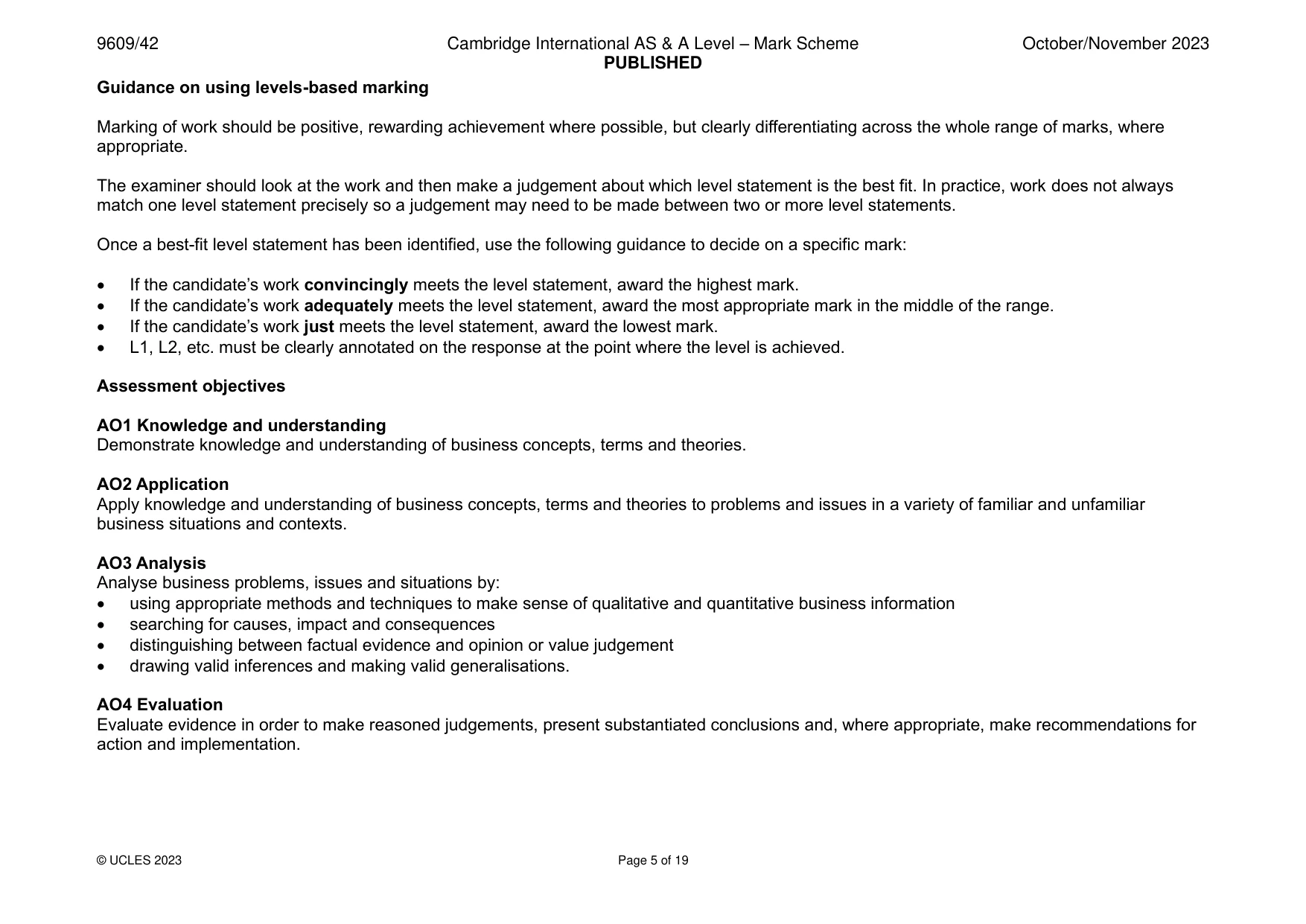
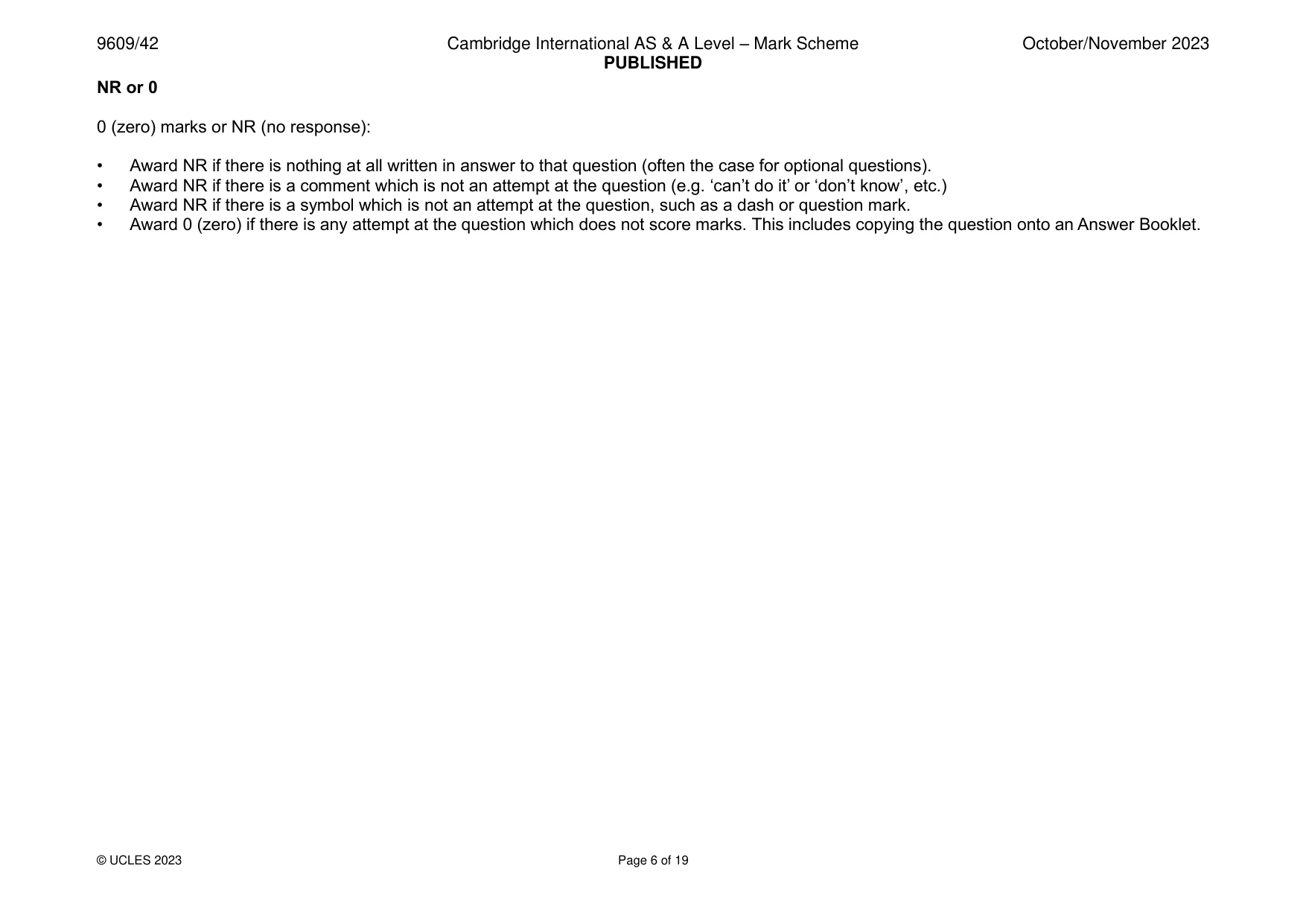
The question paper and its mark scheme, free to read here and free to download. This is Cambridge’s own paper, exactly as it was sat.
Question paper4 pages
Mark scheme19 pages
Answers below. Sit the paper first if you are practising.
Questions as text
Q1 · Evaluate the impact of FL’s corporate culture on the success of the business between 2015…
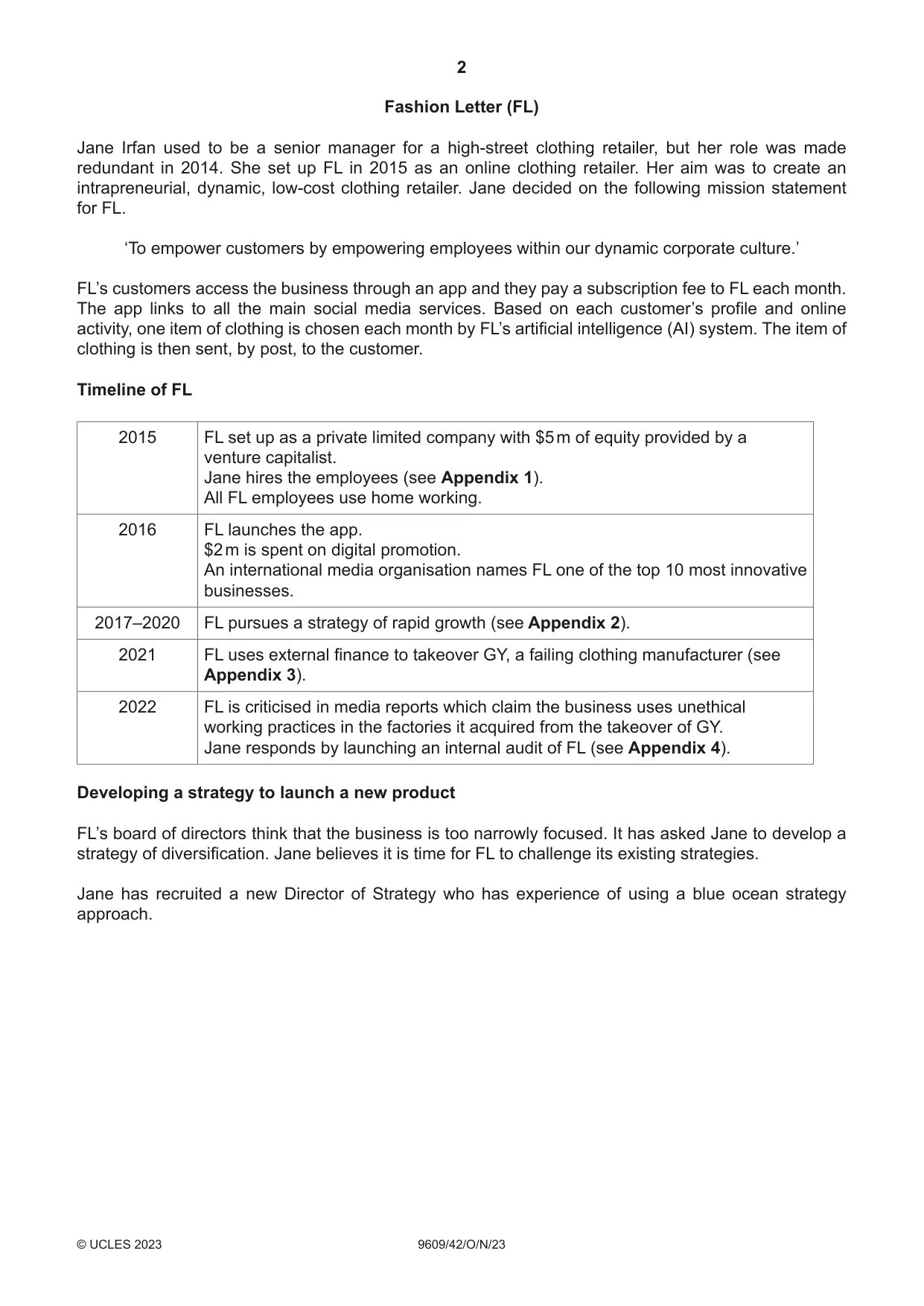
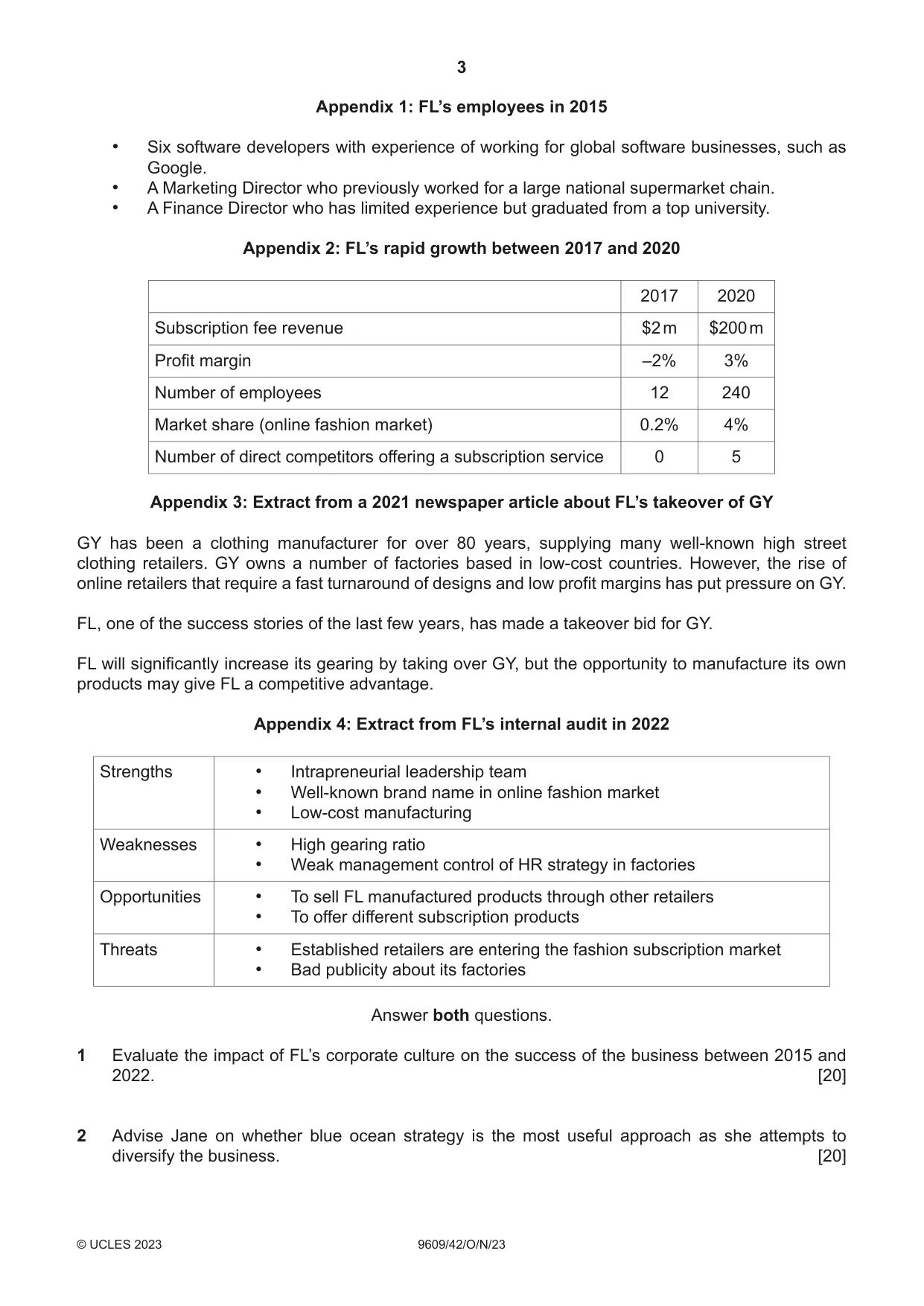
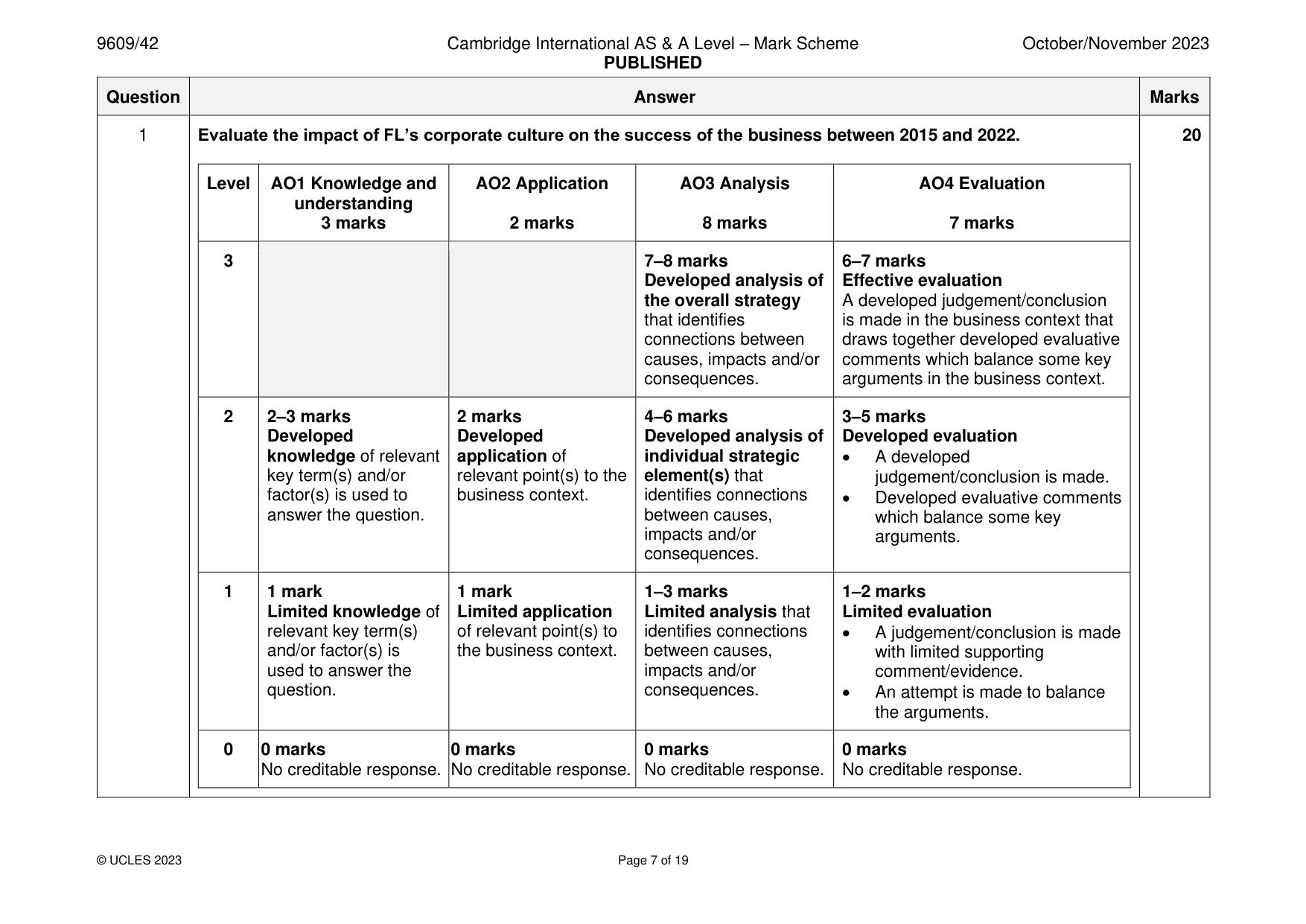
1 Evaluate the impact of FL’s corporate culture on the success of the business between 2015 and 2022. [20]
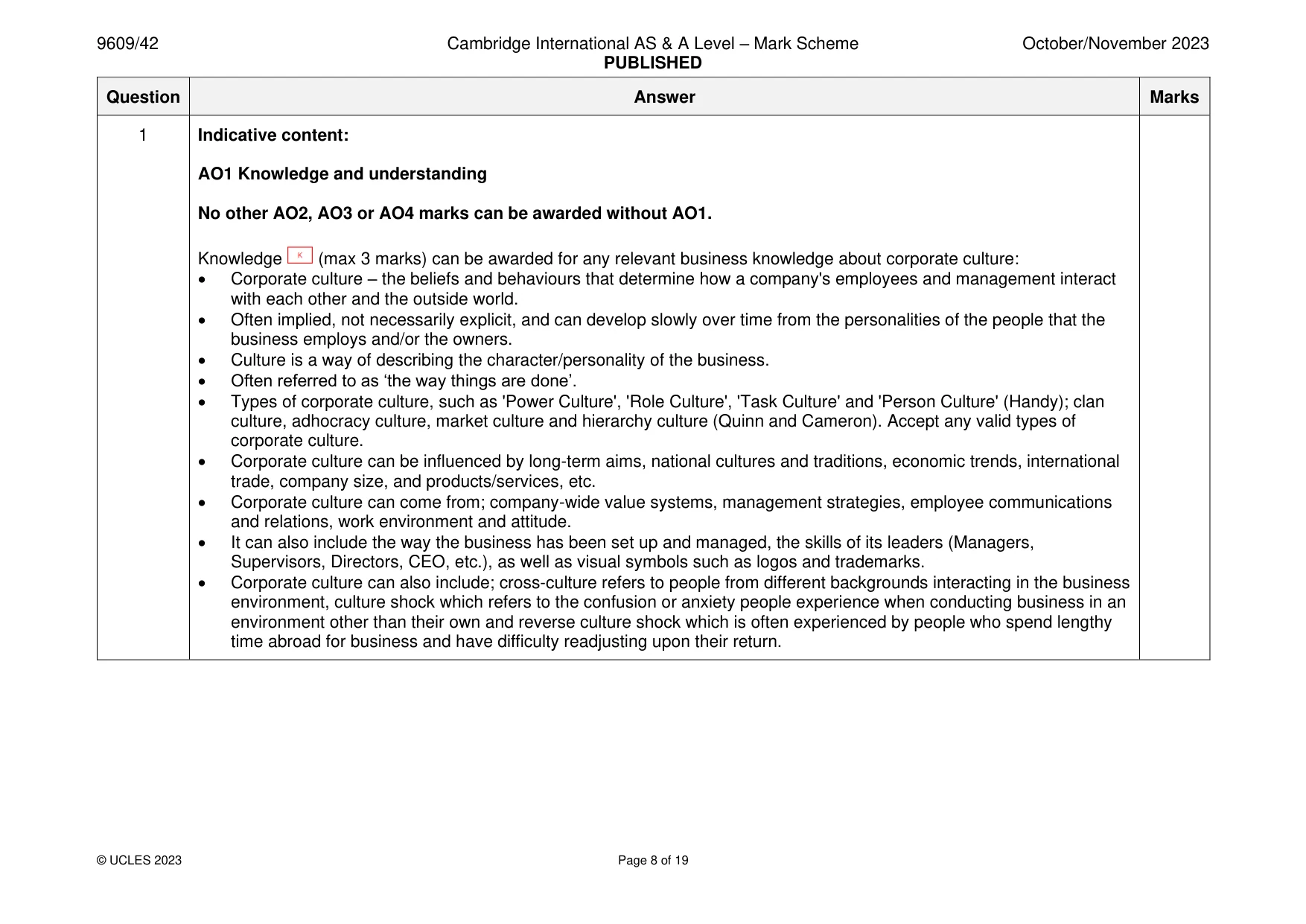
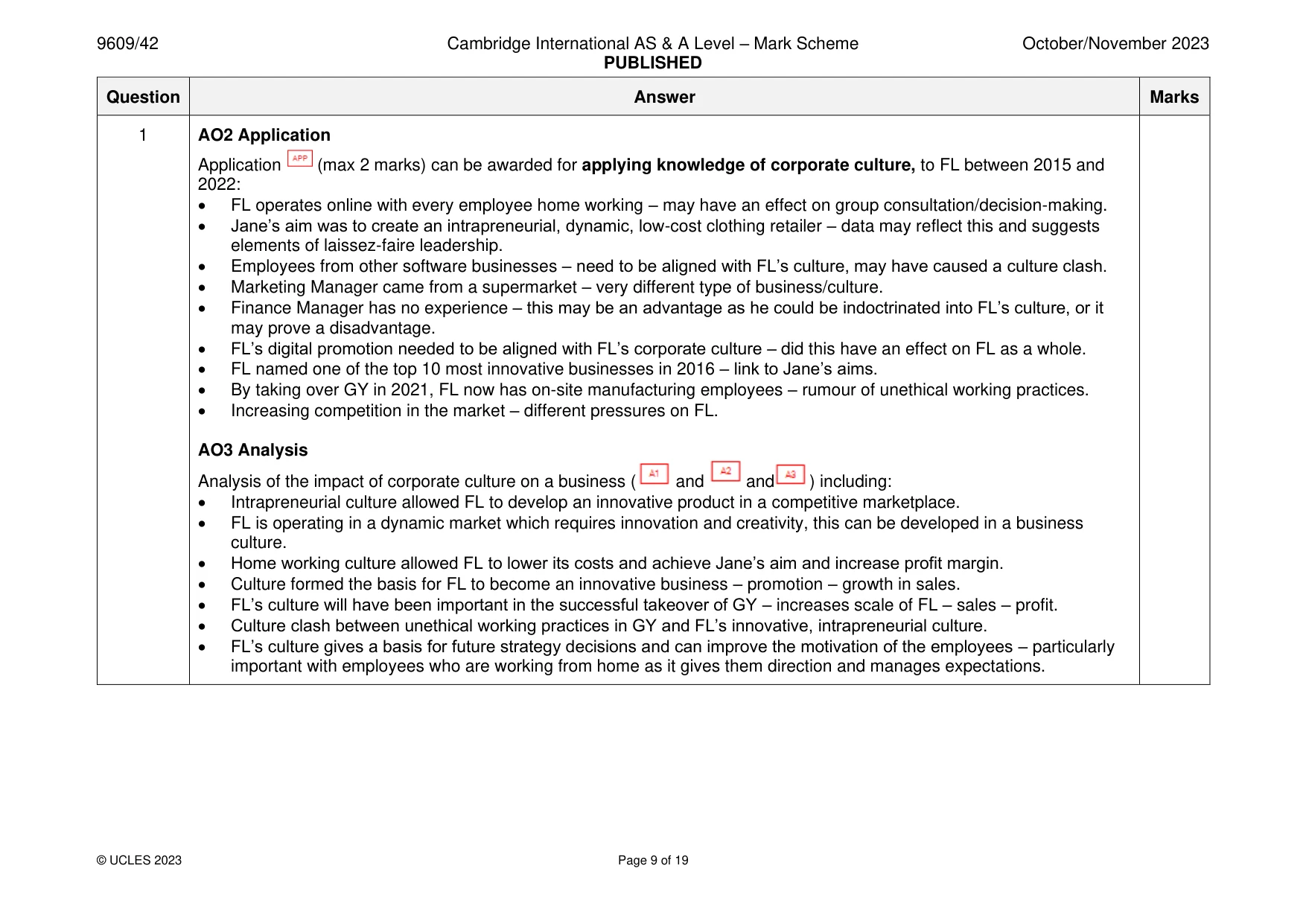
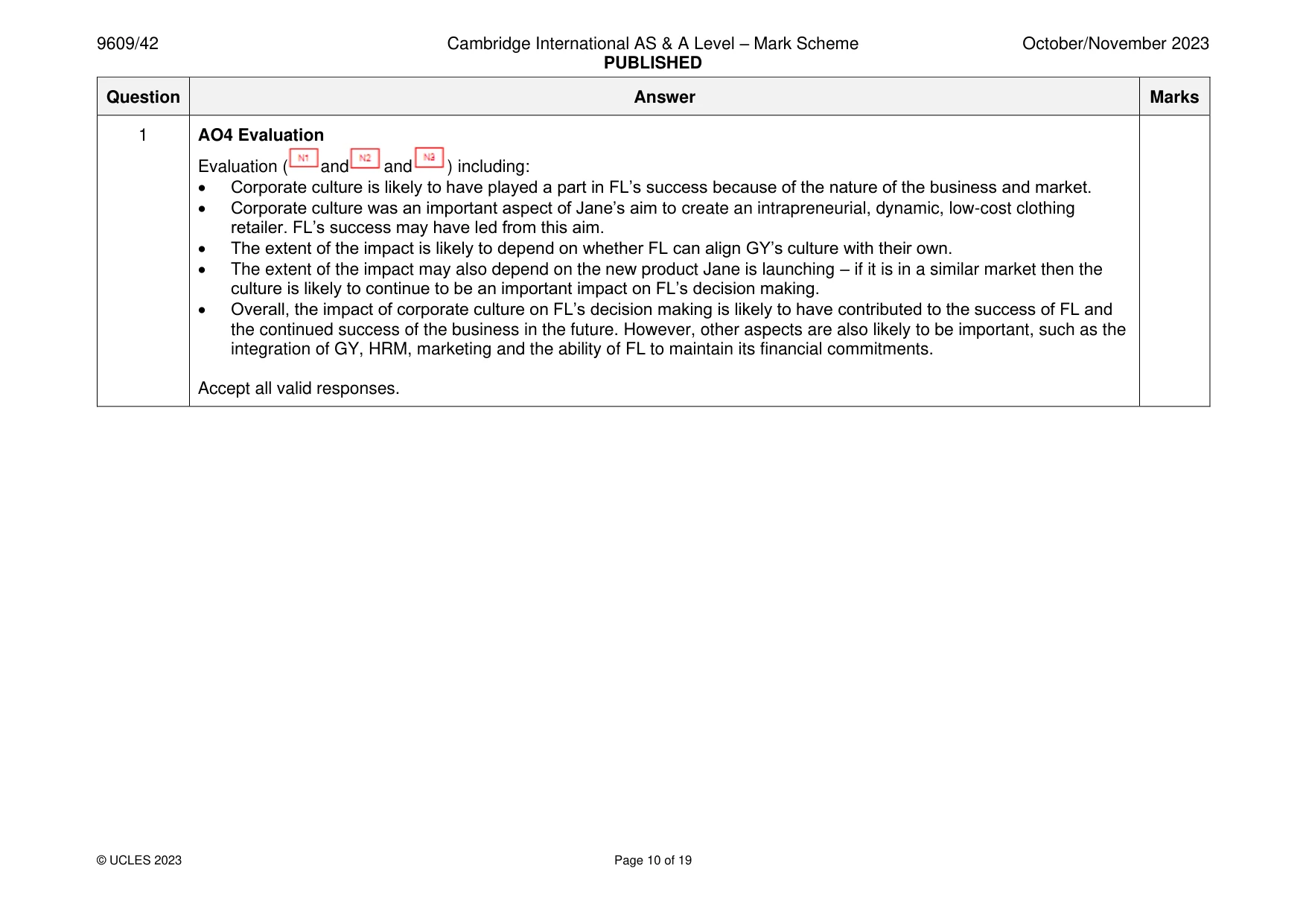
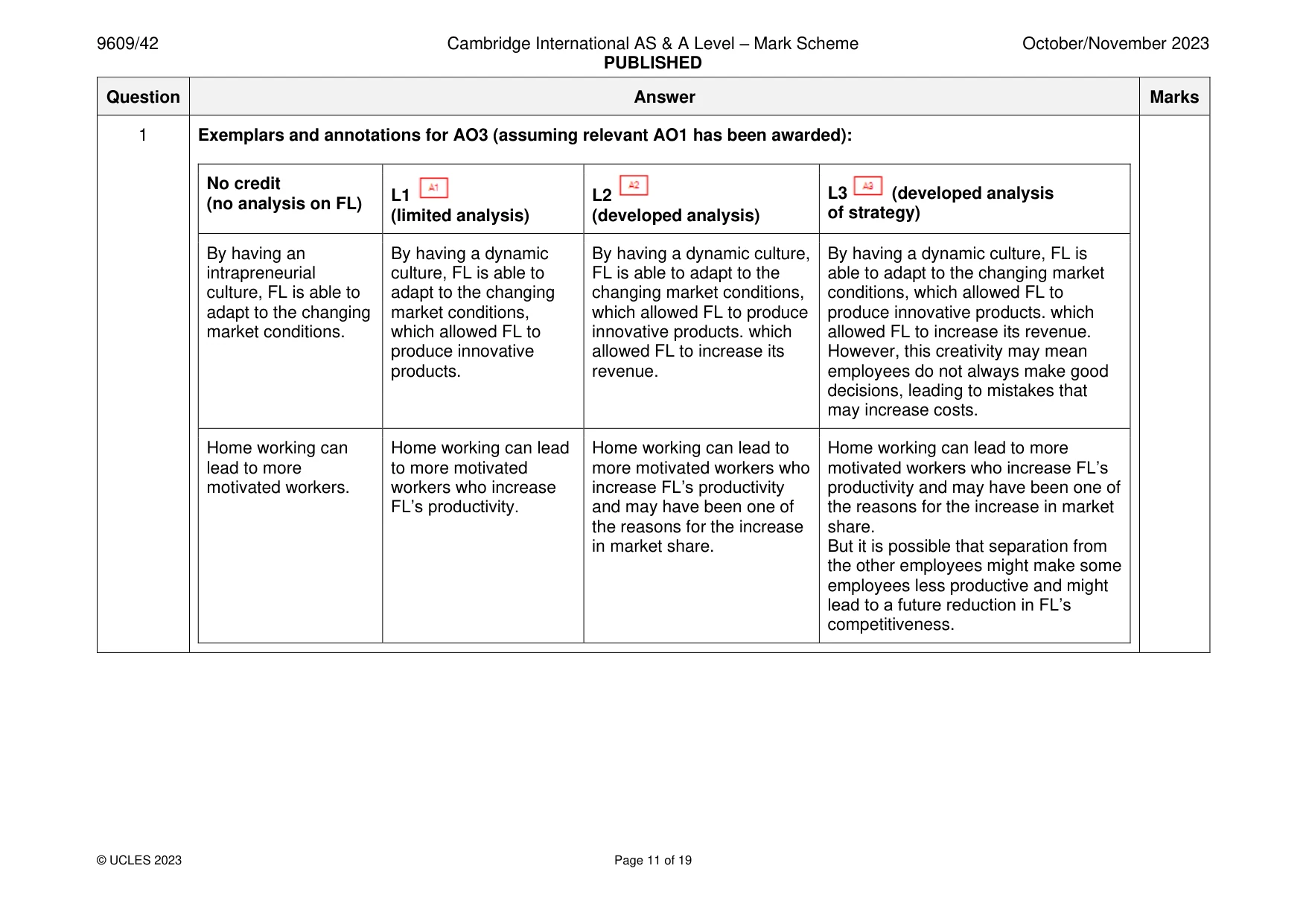
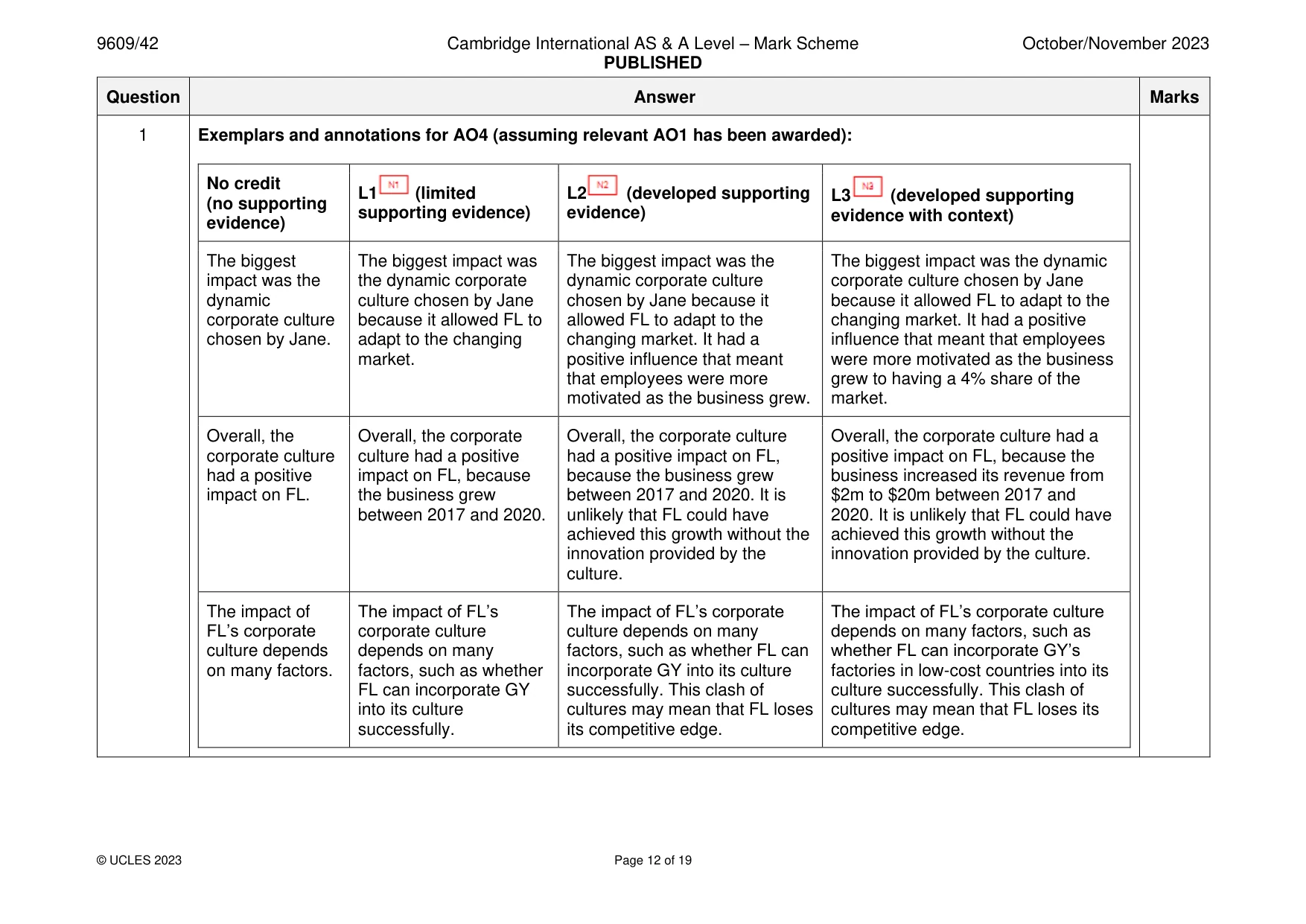
Mark scheme: Question Answer Marks 1 Evaluate the impact of FL’s corporate culture on the success of the business between 2015 and 2022. 20 Level AO1 Knowledge and AO2 Application AO3 Analysis AO4 Evaluation understanding 3 marks 2 marks 8 marks 7 marks 3 7–8 marks 6–7 marks Developed analysis of Effective evaluation the overall strategy A developed judgement/conclusion that identifies is made in the business context that connections between draws together developed evaluative causes, impacts and/or comments which balance some key consequences. arguments in the business context. 2 2–3 marks 2 marks 4–6 marks 3–5 marks Developed Developed Developed analysis of Developed evaluation knowledge of relevant application of individual strategic • A developed key term(s) and/or relevant point(s) to the element(s) that judgement/conclusion is made. factor(s) is used to business context. identifies connections • Developed evaluative comments answer the question. between causes, which balance some key impacts and/or arguments. consequences. 1 1 mark 1 mark 1–3 marks 1–2 marks Limited knowledge of Limited application Limited analysis that Limited evaluation relevant key term(s) of relevant point(s) to identifies connections • A judgement/conclusion is made and/or factor(s) is the business context. between causes, with limited supporting used to answer the impacts and/or comment/evidence. question. consequences. • An attempt is made to balance the arguments. 0 0 marks 0 marks 0 marks 0 marks No creditable response. No creditable response. No creditable response. No creditable response. 1 Indicative content: AO1 Knowledge and understanding No other AO2, AO3 or AO4 marks can be awarded without AO1. Knowledge (max 3 marks) can be awarded for any relevant business knowledge about corporate culture: • Corporate culture – the beliefs and behaviours that determine how a company's employees and management interact with each other and the outside world. • Often implied, not necessarily explicit, and can develop slowly over time from the personalities of the people that the business employs and/or the owners. • Culture is a way of describing the character/personality of the business. • Often referred to as ‘the way things are done’. • Types of corporate culture, such as 'Power Culture', 'Role Culture', 'Task Culture' and 'Person Culture' (Handy); clan culture, adhocracy culture, market culture and hierarchy culture (Quinn and Cameron). Accept any valid types of corporate culture. • Corporate culture can be influenced by long-term aims, national cultures and traditions, economic trends, international trade, company size, and products/services, etc. • Corporate culture can come from; company-wide value systems, management strategies, employee communications and relations, work environment and attitude. • It can also include the way the business has been set up and managed, the skills of its leaders (Managers, Supervisors, Directors, CEO, etc.), as well as visual symbols such as logos and trademarks. • Corporate culture can also include; cross-culture refers to people from different backgrounds interacting in the business environment, culture shock which refers to the confusion or anxiety people experience when conducting business in an environment other than their own and reverse culture shock which is often experienced by people who spend lengthy time abroad for business and have difficulty readjusting upon their return. 1 AO2 Application Application (max 2 marks) can be awarded for applying knowledge of corporate culture, to FL between 2015 and 2022: • FL operates online with every employee home working – may have an effect on group consultation/decision-making. • Jane’s aim was to create an intrapreneurial, dynamic, low-cost clothing retailer – data may reflect this and suggests elements of laissez-faire leadership. • Employees from other software businesses – need to be aligned with FL’s culture, may have caused a culture clash. • Marketing Manager came from a supermarket – very different type of business/culture. • Finance Manager has no experience – this may be an advantage as he could be indoctrinated into FL’s culture, or it may prove a disadvantage. • FL’s digital promotion needed to be aligned with FL’s corporate culture – did this have an effect on FL as a whole. • FL named one of the top 10 most innovative businesses in 2016 – link to Jane’s aims. • By taking over GY in 2021, FL now has on-site manufacturing employees – rumour of unethical working practices. • Increasing competition in the market – different pressures on FL. AO3 Analysis Analysis of the impact of corporate culture on a business ( and and ) including: • Intrapreneurial culture allowed FL to develop an innovative product in a competitive marketplace. • FL is operating in a dynamic market which requires innovation and creativity, this can be developed in a business culture. • Home working culture allowed FL to lower its costs and achieve Jane’s aim and increase profit margin. • Culture formed the basis for FL to become an innovative business – promotion – growth in sales. • FL’s culture will have been important in the successful takeover of GY – increases scale of FL – sales – profit. • Culture clash between unethical working practices in GY and FL’s innovative, intrapreneurial culture. • FL’s culture gives a basis for future strategy decisions and can improve the motivation of the employees – particularly important with employees who are working from home as it gives them direction and manages expectations. 1 AO4 Evaluation Evaluation ( and and ) including: • Corporate culture is likely to have played a part in FL’s success because of the nature of the business and market. • Corporate culture was an important aspect of Jane’s aim to create an intrapreneurial, dynamic, low-cost clothing retailer. FL’s success may have led from this aim. • The extent of the impact is likely to depend on whether FL can align GY’s culture with their own. • The extent of the impact may also depend on the new product Jane is launching – if it is in a similar market then the culture is likely to continue to be an important impact on FL’s decision making. • Overall, the impact of corporate culture on FL’s decision making is likely to have contributed to the success of FL and the continued success of the business in the future. However, other aspects are also likely to be important, such as the integration of GY, HRM, marketing and the ability of FL to maintain its financial commitments. Accept all valid responses. 1 Exemplars and annotations for AO3 (assuming relevant AO1 has been awarded): No credit L1 L2 L3 (developed analysis (no analysis on FL) (limited analysis) (developed analysis) of strategy) By having an By having a dynamic By having a dynamic culture, By having a dynamic culture, FL is intrapreneurial culture, FL is able to FL is able to adapt to the able to adapt to the changing market culture, FL is able to adapt to the changing changing market conditions, conditions, which allowed FL to adapt to the changing market conditions, which allowed FL to produce produce innovative products. which market conditions. which allowed FL to innovative products. which allowed FL to increase its revenue. produce innovative allowed FL to increase its However, this creativity may mean products. revenue. employees do not always make good decisions, leading to mistakes that may increase costs. Home working can Home working can lead Home working can lead to Home working can lead to more lead to more to more motivated more motivated workers who motivated workers who increase FL’s motivated workers. workers who increase increase FL’s productivity productivity and may have been one of FL’s productivity. and may have been one of the reasons for the increase in market the reasons for the increase share. in market share. But it is possible that separation from the other employees might make some employees less productive and might lead to a future reduction in FL’s competitiveness. 1 Exemplars and annotations for AO4 (assuming relevant AO1 has been awarded): No credit L1 (limited L2 (developed supporting L3 (developed supporting (no supporting supporting evidence) evidence) evidence with context) evidence) The biggest The biggest impact was The biggest impact was the The biggest impact was the dynamic impact was the the dynamic corporate dynamic corporate culture corporate culture chosen by Jane dynamic culture chosen by Jane chosen by Jane because it because it allowed FL to adapt to the corporate culture because it allowed FL to allowed FL to adapt to the changing market. It had a positive chosen by Jane. adapt to the changing changing market. It had a influence that meant that employees market. positive influence that meant were more motivated as the business that employees were more grew to having a 4% share of the motivated as the business grew. market. Overall, the Overall, the corporate Overall, the corporate culture Overall, the corporate culture had a corporate culture culture had a positive had a positive impact on FL, positive impact on FL, because the had a positive impact on FL, because because the business grew business increased its revenue from impact on FL. the business grew between 2017 and 2020. It is $2m to $20m between 2017 and between 2017 and 2020. unlikely that FL could have 2020. It is unlikely that FL could have achieved this growth without the achieved this growth without the innovation provided by the innovation provided by the culture. culture. The impact of The impact of FL’s The impact of FL’s corporate The impact of FL’s corporate culture FL’s corporate corporate culture culture depends on many depends on many factors, such as culture depends depends on many factors, such as whether FL can whether FL can incorporate GY’s on many factors. factors, such as whether incorporate GY into its culture factories in low-cost countries into its FL can incorporate GY successfully. This clash of culture successfully. This clash of into its culture cultures may mean that FL loses cultures may mean that FL loses its successfully. its competitive edge. competitive edge.
Q2 · Advise Jane on whether blue ocean strategy is the most useful approach as she attempts to…
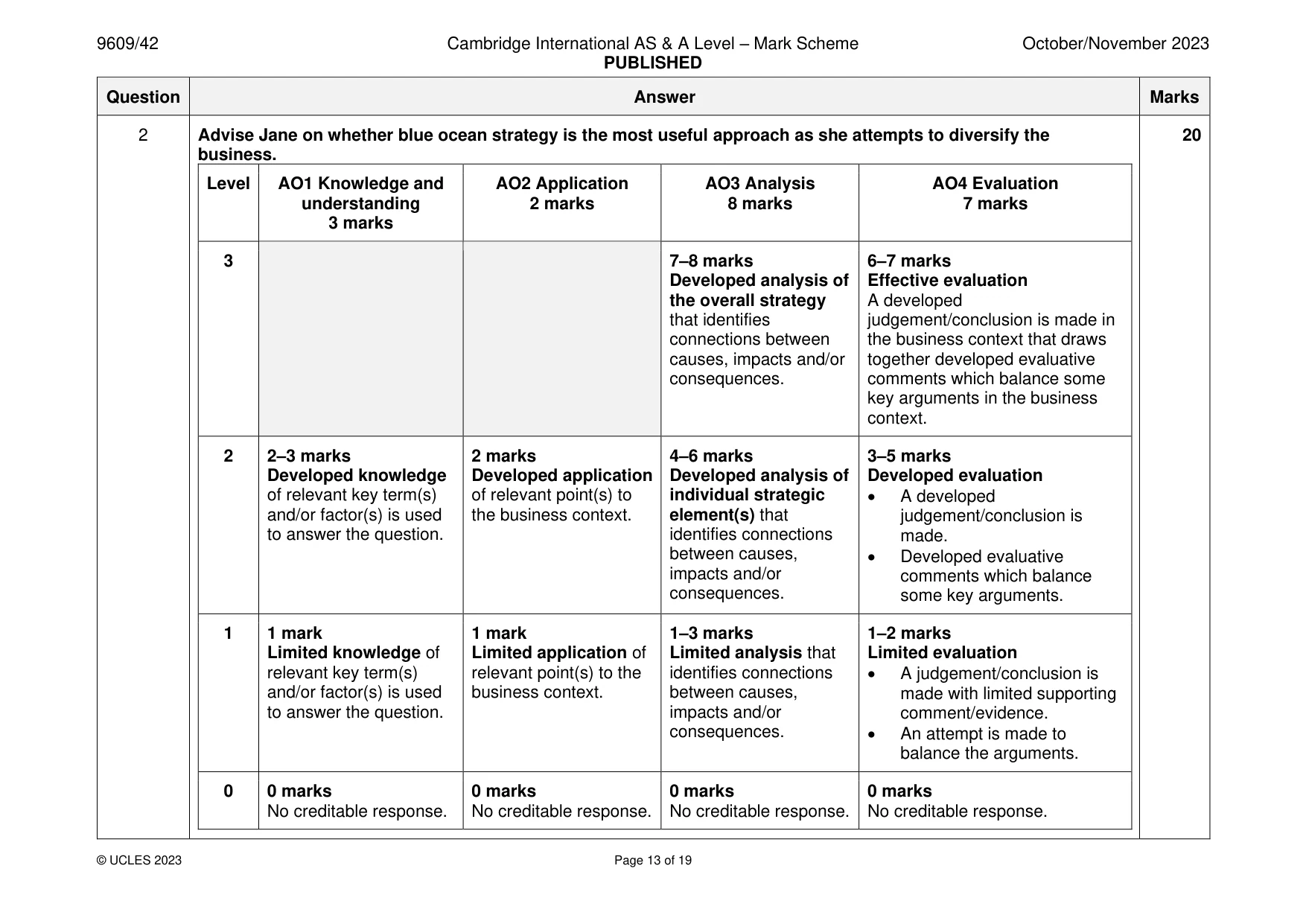
2 Advise Jane on whether blue ocean strategy is the most useful approach as she attempts to diversify the business. [20]
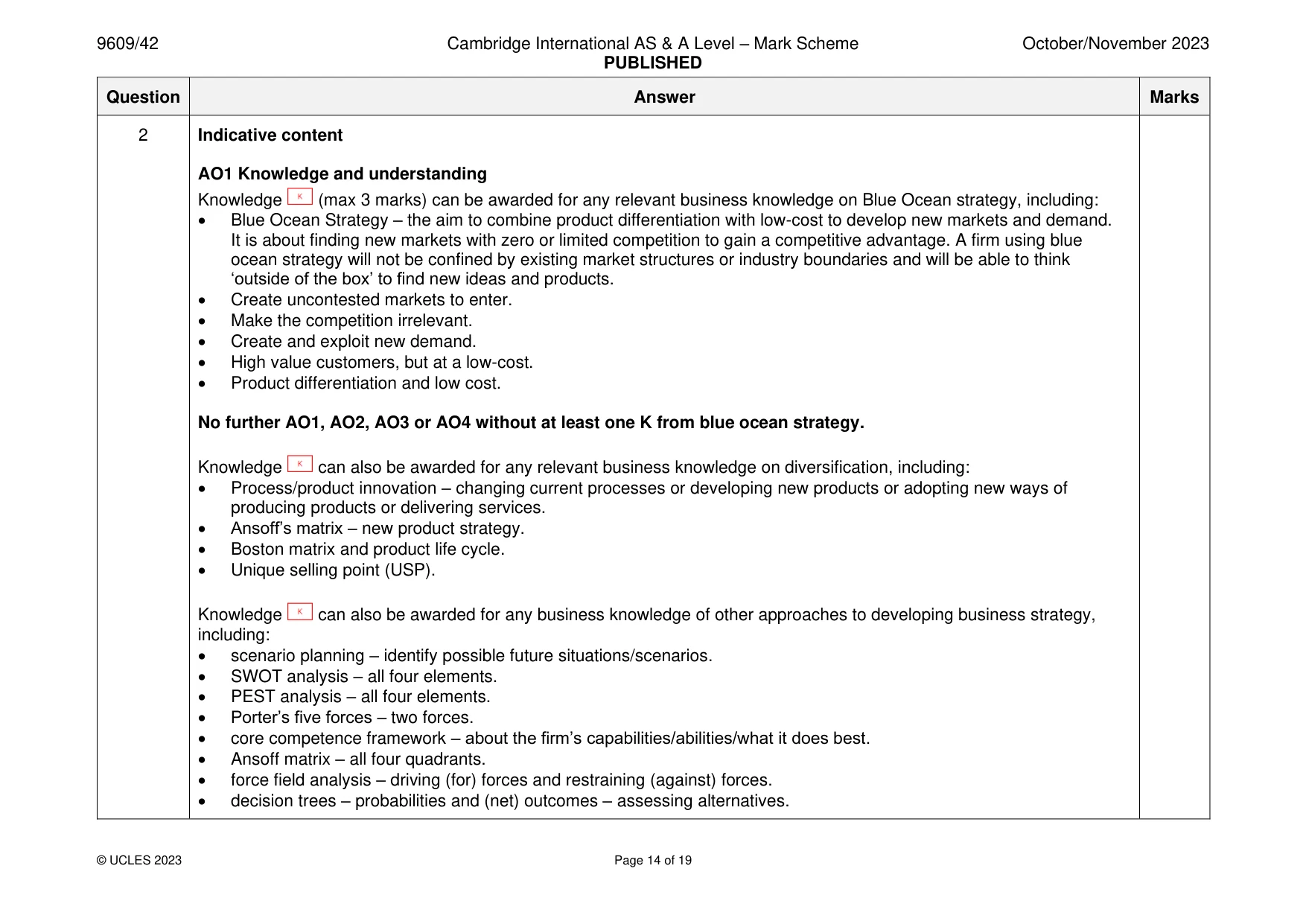
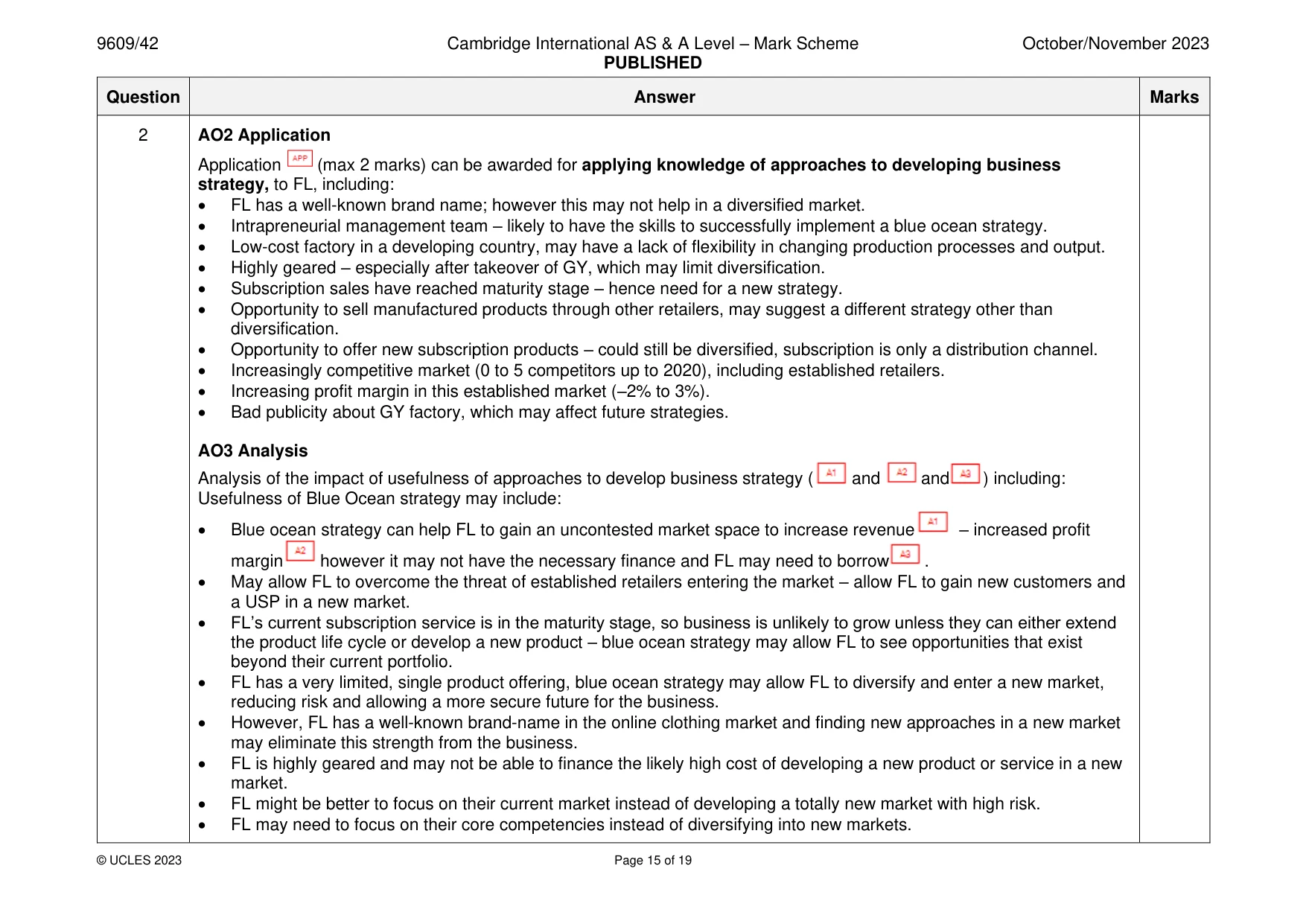
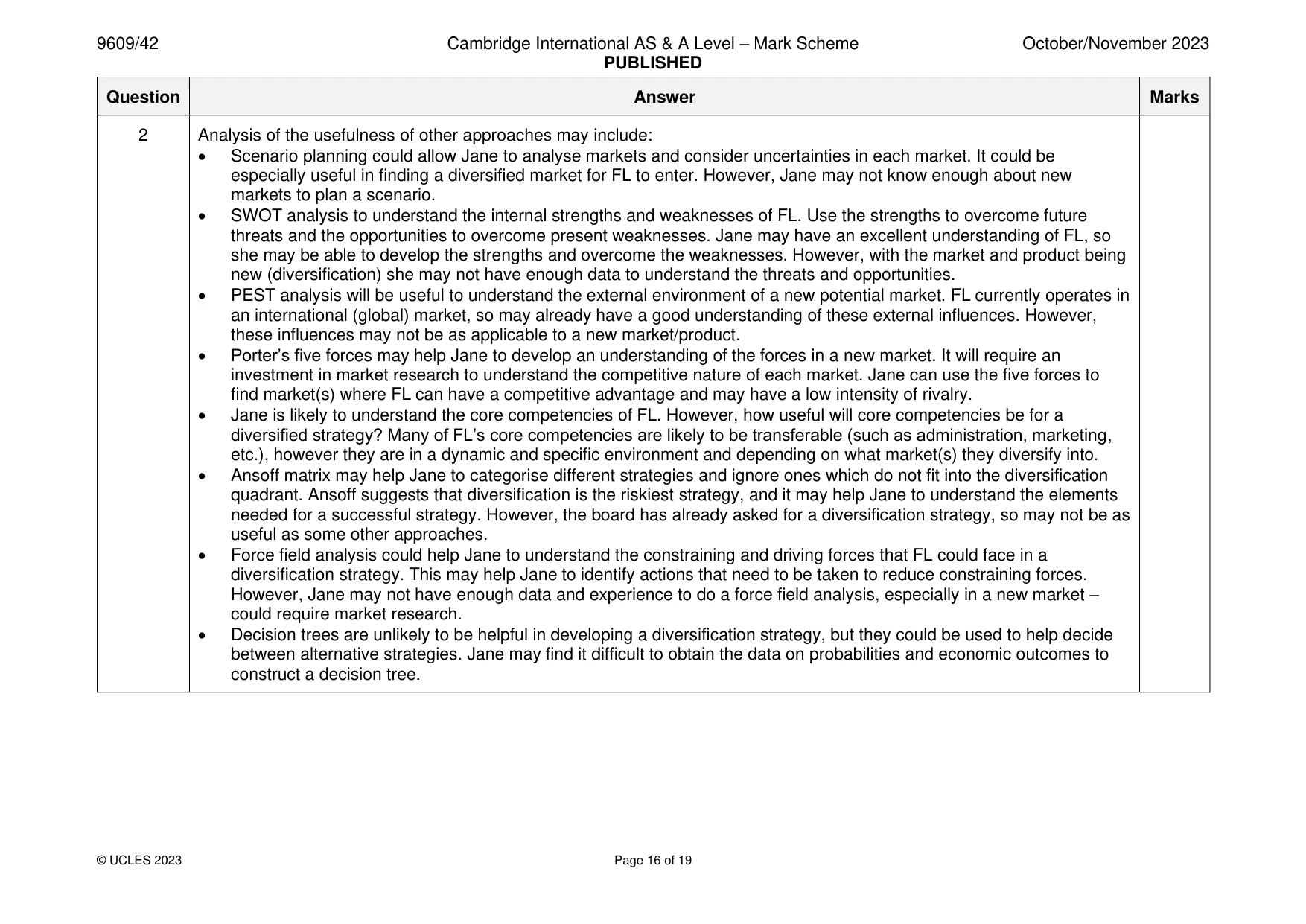
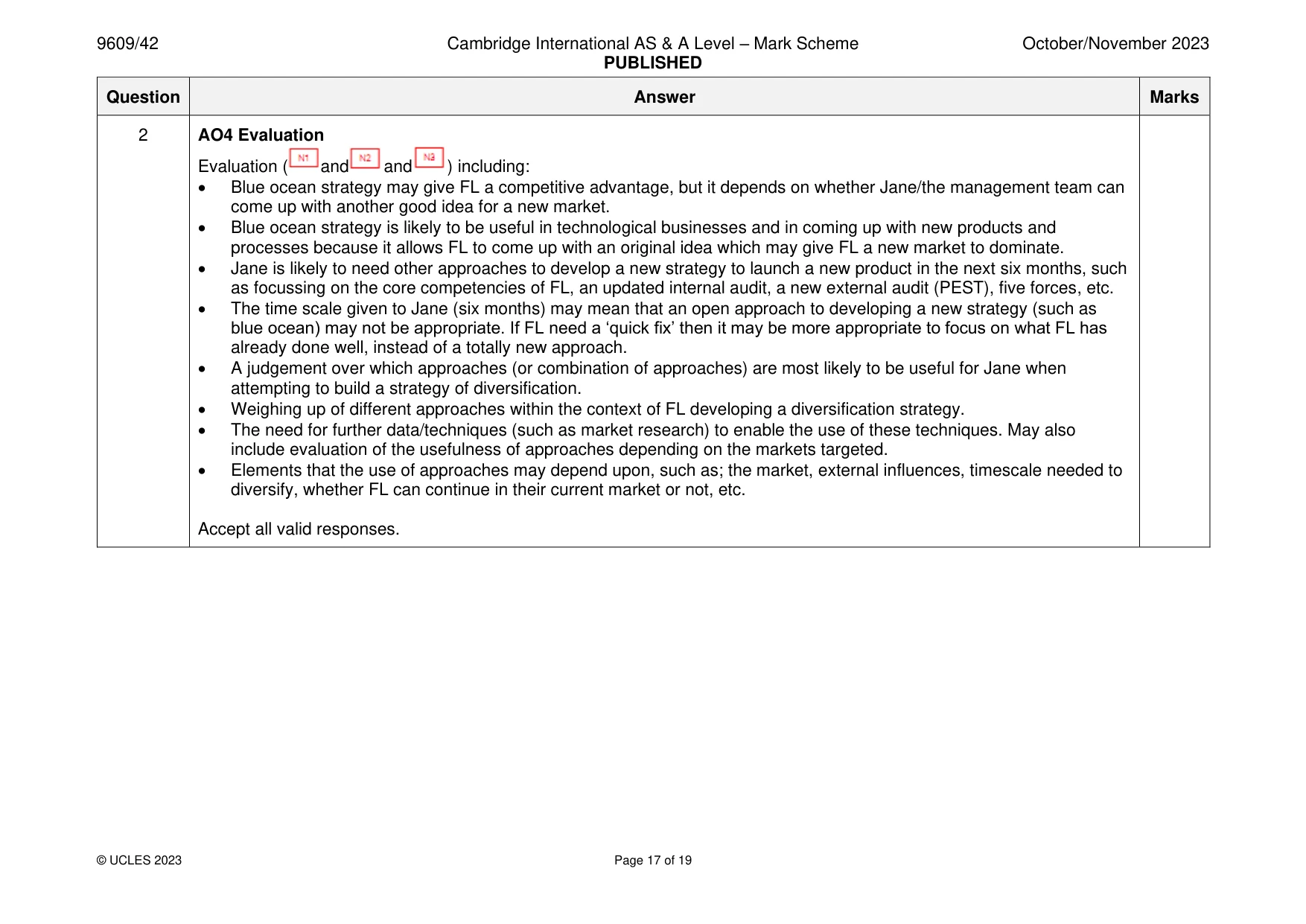
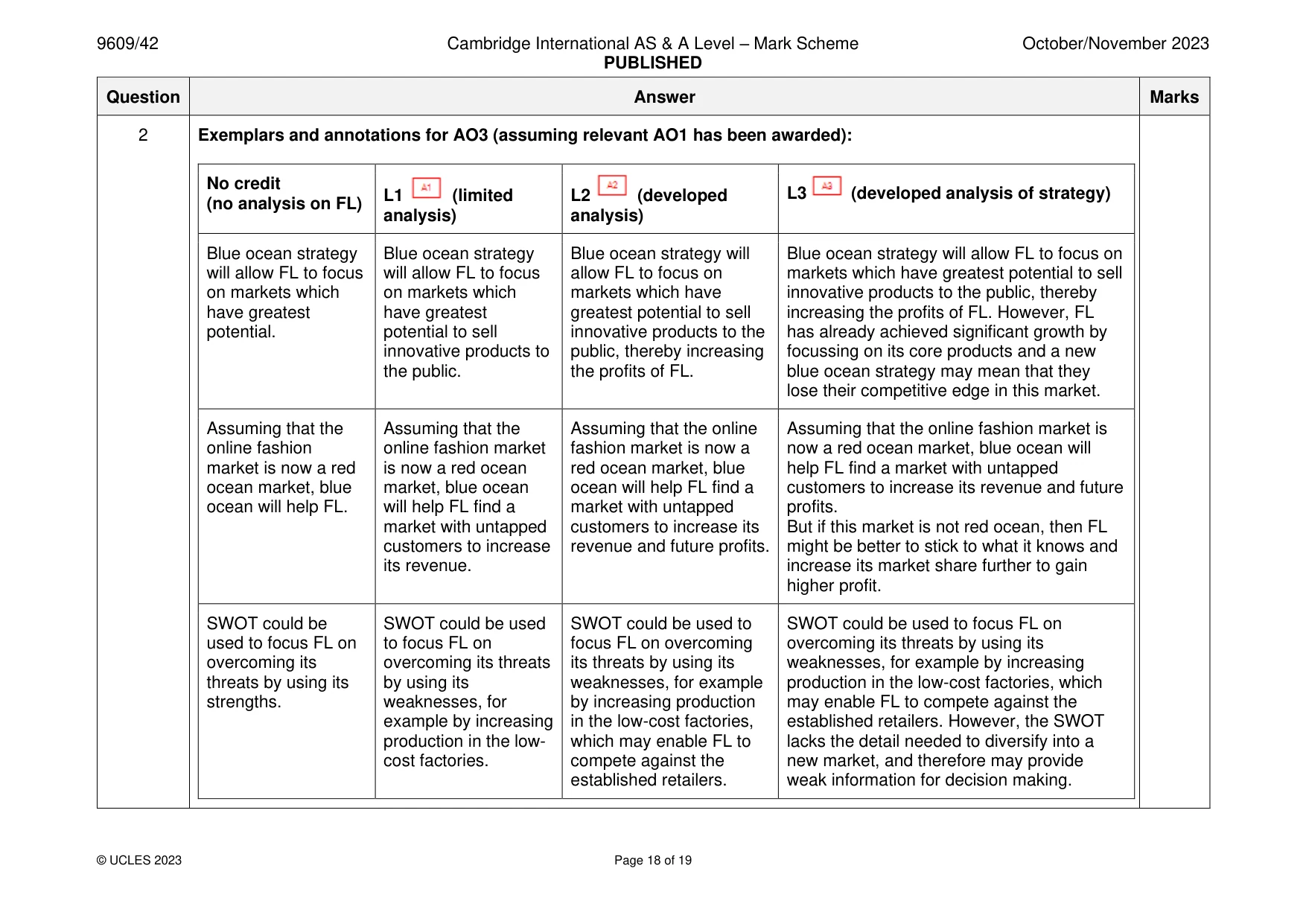
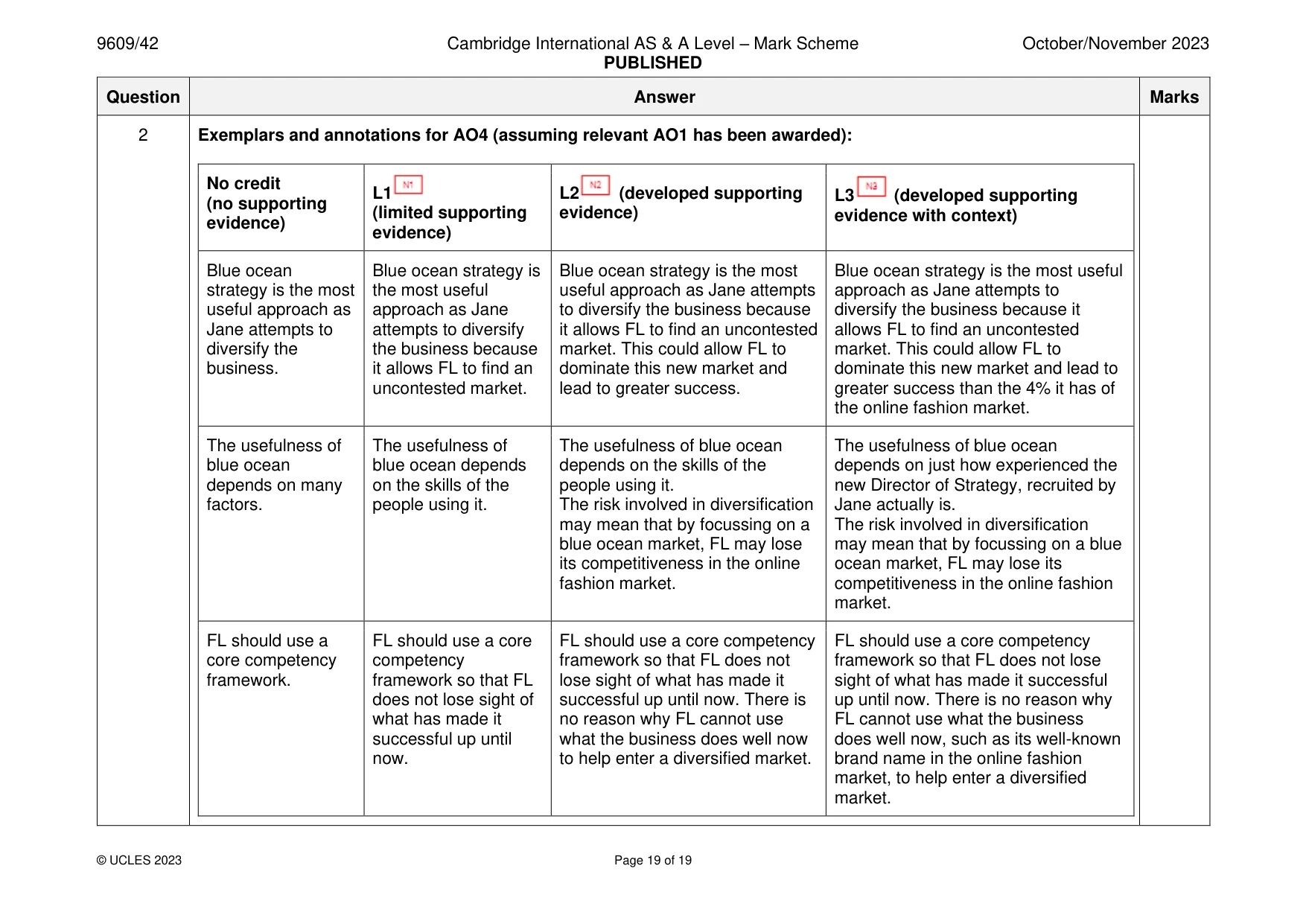
Mark scheme: 2 Advise Jane on whether blue ocean strategy is the most useful approach as she attempts to diversify the 20 business. Level AO1 Knowledge and AO2 Application AO3 Analysis AO4 Evaluation understanding 2 marks 8 marks 7 marks 3 marks 3 7–8 marks 6–7 marks Developed analysis of Effective evaluation the overall strategy A developed that identifies judgement/conclusion is made in connections between the business context that draws causes, impacts and/or together developed evaluative consequences. comments which balance some key arguments in the business context. 2 2–3 marks 2 marks 4–6 marks 3–5 marks Developed knowledge Developed application Developed analysis of Developed evaluation of relevant key term(s) of relevant point(s) to individual strategic • A developed and/or factor(s) is used the business context. element(s) that judgement/conclusion is to answer the question. identifies connections made. between causes, • Developed evaluative impacts and/or comments which balance consequences. some key arguments. 1 1 mark 1 mark 1–3 marks 1–2 marks Limited knowledge of Limited application of Limited analysis that Limited evaluation relevant key term(s) relevant point(s) to the identifies connections • A judgement/conclusion is and/or factor(s) is used business context. between causes, made with limited supporting to answer the question. impacts and/or comment/evidence. consequences. • An attempt is made to balance the arguments. 0 0 marks 0 marks 0 marks 0 marks No creditable response. No creditable response. No creditable response. No creditable response. 2 Indicative content AO1 Knowledge and understanding Knowledge (max 3 marks) can be awarded for any relevant business knowledge on Blue Ocean strategy, including: • Blue Ocean Strategy – the aim to combine product differentiation with low-cost to develop new markets and demand. It is about finding new markets with zero or limited competition to gain a competitive advantage. A firm using blue ocean strategy will not be confined by existing market structures or industry boundaries and will be able to think ‘outside of the box’ to find new ideas and products. • Create uncontested markets to enter. • Make the competition irrelevant. • Create and exploit new demand. • High value customers, but at a low-cost. • Product differentiation and low cost. No further AO1, AO2, AO3 or AO4 without at least one K from blue ocean strategy. Knowledge can also be awarded for any relevant business knowledge on diversification, including: • Process/product innovation – changing current processes or developing new products or adopting new ways of producing products or delivering services. • Ansoff’s matrix – new product strategy. • Boston matrix and product life cycle. • Unique selling point (USP). Knowledge can also be awarded for any business knowledge of other approaches to developing business strategy, including: • scenario planning – identify possible future situations/scenarios. • SWOT analysis – all four elements. • PEST analysis – all four elements. • Porter’s five forces – two forces. • core competence framework – about the firm’s capabilities/abilities/what it does best. • Ansoff matrix – all four quadrants. • force field analysis – driving (for) forces and restraining (against) forces. • decision trees – probabilities and (net) outcomes – assessing alternatives. 2 AO2 Application Application (max 2 marks) can be awarded for applying knowledge of approaches to developing business strategy, to FL, including: • FL has a well-known brand name; however this may not help in a diversified market. • Intrapreneurial management team – likely to have the skills to successfully implement a blue ocean strategy. • Low-cost factory in a developing country, may have a lack of flexibility in changing production processes and output. • Highly geared – especially after takeover of GY, which may limit diversification. • Subscription sales have reached maturity stage – hence need for a new strategy. • Opportunity to sell manufactured products through other retailers, may suggest a different strategy other than diversification. • Opportunity to offer new subscription products – could still be diversified, subscription is only a distribution channel. • Increasingly competitive market (0 to 5 competitors up to 2020), including established retailers. • Increasing profit margin in this established market (–2% to 3%). • Bad publicity about GY factory, which may affect future strategies. AO3 Analysis Analysis of the impact of usefulness of approaches to develop business strategy ( and and ) including: Usefulness of Blue Ocean strategy may include: • Blue ocean strategy can help FL to gain an uncontested market space to increase revenue – increased profit margin however it may not have the necessary finance and FL may need to borrow . • May allow FL to overcome the threat of established retailers entering the market – allow FL to gain new customers and a USP in a new market. • FL’s current subscription service is in the maturity stage, so business is unlikely to grow unless they can either extend the product life cycle or develop a new product – blue ocean strategy may allow FL to see opportunities that exist beyond their current portfolio. • FL has a very limited, single product offering, blue ocean strategy may allow FL to diversify and enter a new market, reducing risk and allowing a more secure future for the business. • However, FL has a well-known brand-name in the online clothing market and finding new approaches in a new market may eliminate this strength from the business. • FL is highly geared and may not be able to finance the likely high cost of developing a new product or service in a new market. • FL might be better to focus on their current market instead of developing a totally new market with high risk. • FL may need to focus on their core competencies instead of diversifying into new markets. 2 Analysis of the usefulness of other approaches may include: • Scenario planning could allow Jane to analyse markets and consider uncertainties in each market. It could be especially useful in finding a diversified market for FL to enter. However, Jane may not know enough about new markets to plan a scenario. • SWOT analysis to understand the internal strengths and weaknesses of FL. Use the strengths to overcome future threats and the opportunities to overcome present weaknesses. Jane may have an excellent understanding of FL, so she may be able to develop the strengths and overcome the weaknesses. However, with the market and product being new (diversification) she may not have enough data to understand the threats and opportunities. • PEST analysis will be useful to understand the external environment of a new potential market. FL currently operates in an international (global) market, so may already have a good understanding of these external influences. However, these influences may not be as applicable to a new market/product. • Porter’s five forces may help Jane to develop an understanding of the forces in a new market. It will require an investment in market research to understand the competitive nature of each market. Jane can use the five forces to find market(s) where FL can have a competitive advantage and may have a low intensity of rivalry. • Jane is likely to understand the core competencies of FL. However, how useful will core competencies be for a diversified strategy? Many of FL’s core competencies are likely to be transferable (such as administration, marketing, etc.), however they are in a dynamic and specific environment and depending on what market(s) they diversify into. • Ansoff matrix may help Jane to categorise different strategies and ignore ones which do not fit into the diversification quadrant. Ansoff suggests that diversification is the riskiest strategy, and it may help Jane to understand the elements needed for a successful strategy. However, the board has already asked for a diversification strategy, so may not be as useful as some other approaches. • Force field analysis could help Jane to understand the constraining and driving forces that FL could face in a diversification strategy. This may help Jane to identify actions that need to be taken to reduce constraining forces. However, Jane may not have enough data and experience to do a force field analysis, especially in a new market – could require market research. • Decision trees are unlikely to be helpful in developing a diversification strategy, but they could be used to help decide between alternative strategies. Jane may find it difficult to obtain the data on probabilities and economic outcomes to construct a decision tree. 2 AO4 Evaluation Evaluation ( and and ) including: • Blue ocean strategy may give FL a competitive advantage, but it depends on whether Jane/the management team can come up with another good idea for a new market. • Blue ocean strategy is likely to be useful in technological businesses and in coming up with new products and processes because it allows FL to come up with an original idea which may give FL a new market to dominate. • Jane is likely to need other approaches to develop a new strategy to launch a new product in the next six months, such as focussing on the core competencies of FL, an updated internal audit, a new external audit (PEST), five forces, etc. • The time scale given to Jane (six months) may mean that an open approach to developing a new strategy (such as blue ocean) may not be appropriate. If FL need a ‘quick fix’ then it may be more appropriate to focus on what FL has already done well, instead of a totally new approach. • A judgement over which approaches (or combination of approaches) are most likely to be useful for Jane when attempting to build a strategy of diversification. • Weighing up of different approaches within the context of FL developing a diversification strategy. • The need for further data/techniques (such as market research) to enable the use of these techniques. May also include evaluation of the usefulness of approaches depending on the markets targeted. • Elements that the use of approaches may depend upon, such as; the market, external influences, timescale needed to diversify, whether FL can continue in their current market or not, etc. Accept all valid responses. 2 Exemplars and annotations for AO3 (assuming relevant AO1 has been awarded): No credit L1 (limited L2 (developed L3 (developed analysis of strategy) (no analysis on FL) analysis) analysis) Blue ocean strategy Blue ocean strategy Blue ocean strategy will Blue ocean strategy will allow FL to focus on will allow FL to focus will allow FL to focus allow FL to focus on markets which have greatest potential to sell on markets which on markets which markets which have innovative products to the public, thereby have greatest have greatest greatest potential to sell increasing the profits of FL. However, FL potential. potential to sell innovative products to the has already achieved significant growth by innovative products to public, thereby increasing focussing on its core products and a new the public. the profits of FL. blue ocean strategy may mean that they lose their competitive edge in this market. Assuming that the Assuming that the Assuming that the online Assuming that the online fashion market is online fashion online fashion market fashion market is now a now a red ocean market, blue ocean will market is now a red is now a red ocean red ocean market, blue help FL find a market with untapped ocean market, blue market, blue ocean ocean will help FL find a customers to increase its revenue and future ocean will help FL. will help FL find a market with untapped profits. market with untapped customers to increase its But if this market is not red ocean, then FL customers to increase revenue and future profits. might be better to stick to what it knows and its revenue. increase its market share further to gain higher profit. SWOT could be SWOT could be used SWOT could be used to SWOT could be used to focus FL on used to focus FL on to focus FL on focus FL on overcoming overcoming its threats by using its overcoming its overcoming its threats its threats by using its weaknesses, for example by increasing threats by using its by using its weaknesses, for example production in the low-cost factories, which strengths. weaknesses, for by increasing production may enable FL to compete against the example by increasing in the low-cost factories, established retailers. However, the SWOT production in the low- which may enable FL to lacks the detail needed to diversify into a cost factories. compete against the new market, and therefore may provide established retailers. weak information for decision making. 2 Exemplars and annotations for AO4 (assuming relevant AO1 has been awarded): No credit L1 L2 (developed supporting L3 (developed supporting (no supporting (limited supporting evidence) evidence with context) evidence) evidence) Blue ocean Blue ocean strategy is Blue ocean strategy is the most Blue ocean strategy is the most useful strategy is the most the most useful useful approach as Jane attempts approach as Jane attempts to useful approach as approach as Jane to diversify the business because diversify the business because it Jane attempts to attempts to diversify it allows FL to find an uncontested allows FL to find an uncontested diversify the the business because market. This could allow FL to market. This could allow FL to business. it allows FL to find an dominate this new market and dominate this new market and lead to uncontested market. lead to greater success. greater success than the 4% it has of the online fashion market. The usefulness of The usefulness of The usefulness of blue ocean The usefulness of blue ocean blue ocean blue ocean depends depends on the skills of the depends on just how experienced the depends on many on the skills of the people using it. new Director of Strategy, recruited by factors. people using it. The risk involved in diversification Jane actually is. may mean that by focussing on a The risk involved in diversification blue ocean market, FL may lose may mean that by focussing on a blue its competitiveness in the online ocean market, FL may lose its fashion market. competitiveness in the online fashion market. FL should use a FL should use a core FL should use a core competency FL should use a core competency core competency competency framework so that FL does not framework so that FL does not lose framework. framework so that FL lose sight of what has made it sight of what has made it successful does not lose sight of successful up until now. There is up until now. There is no reason why what has made it no reason why FL cannot use FL cannot use what the business successful up until what the business does well now does well now, such as its well-known now. to help enter a diversified market. brand name in the online fashion market, to help enter a diversified market.
What was in this paper
The subtopics covered by these 2 questions, and how many questions each got. Open one in a new tab to see every Cambridge question on it.
What you needed in this session
Cambridge’s own grade thresholds for 2023 Oct/Nov, Paper 4 · Variant 2. A higher threshold means an easier paper — the bar moves with how the cohort did.