Cambridge A Level Business (for first examination in 2016) 9609 — 2021 Feb/March Paper 1 · Variant 2
9609/12/F/M/21 · 40 marks · ≈45 min
The question paper and its mark scheme, free to read here and free to download. This is Cambridge’s own paper, exactly as it was sat.
Question paper4 pages


Mark scheme16 pages
Answers below. Sit the paper first if you are practising.
Paper as text
Question paper, page 1
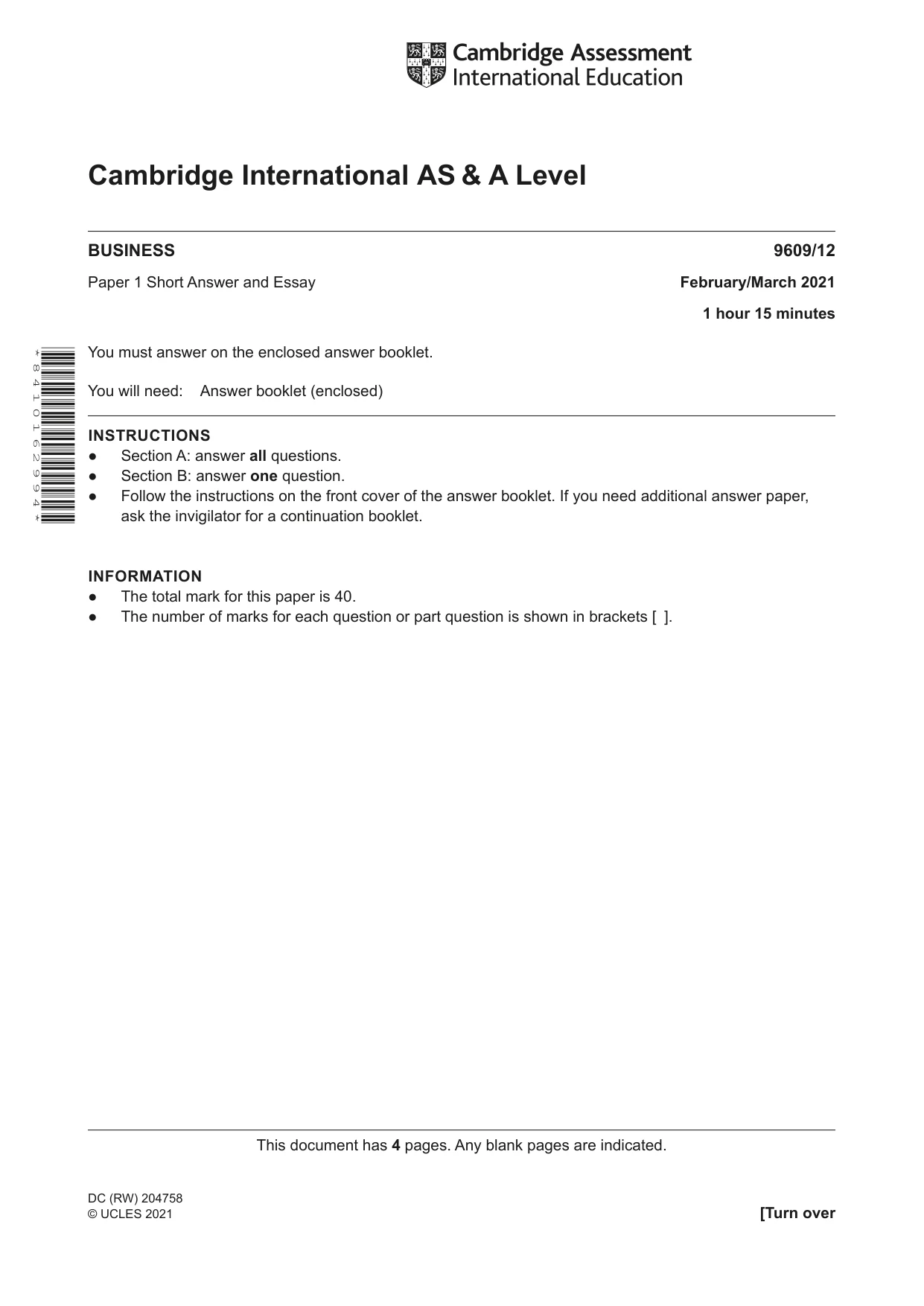
This document has 4 pages. Any blank pages are indicated. DC (RW) 204758 © UCLES 2021 [Turn over * 8 4 1 0 1 6 2 9 9 4 * Cambridge International AS & A Level BUSINESS 9609/12 Paper 1 Short Answer and Essay February/March 2021 1 hour 15 minutes You must answer on the enclosed answer booklet. You will need: Answer booklet (enclosed) INSTRUCTIONS ● Section A: answer all questions. ● Section B: answer one question. ● Follow the instructions on the front cover of the answer booklet. If you need additional answer paper, ask the invigilator for a continuation booklet. INFORMATION ● The total mark for this paper is 40. ● The number of marks for each question or part question is shown in brackets [ ].
Question paper, page 2
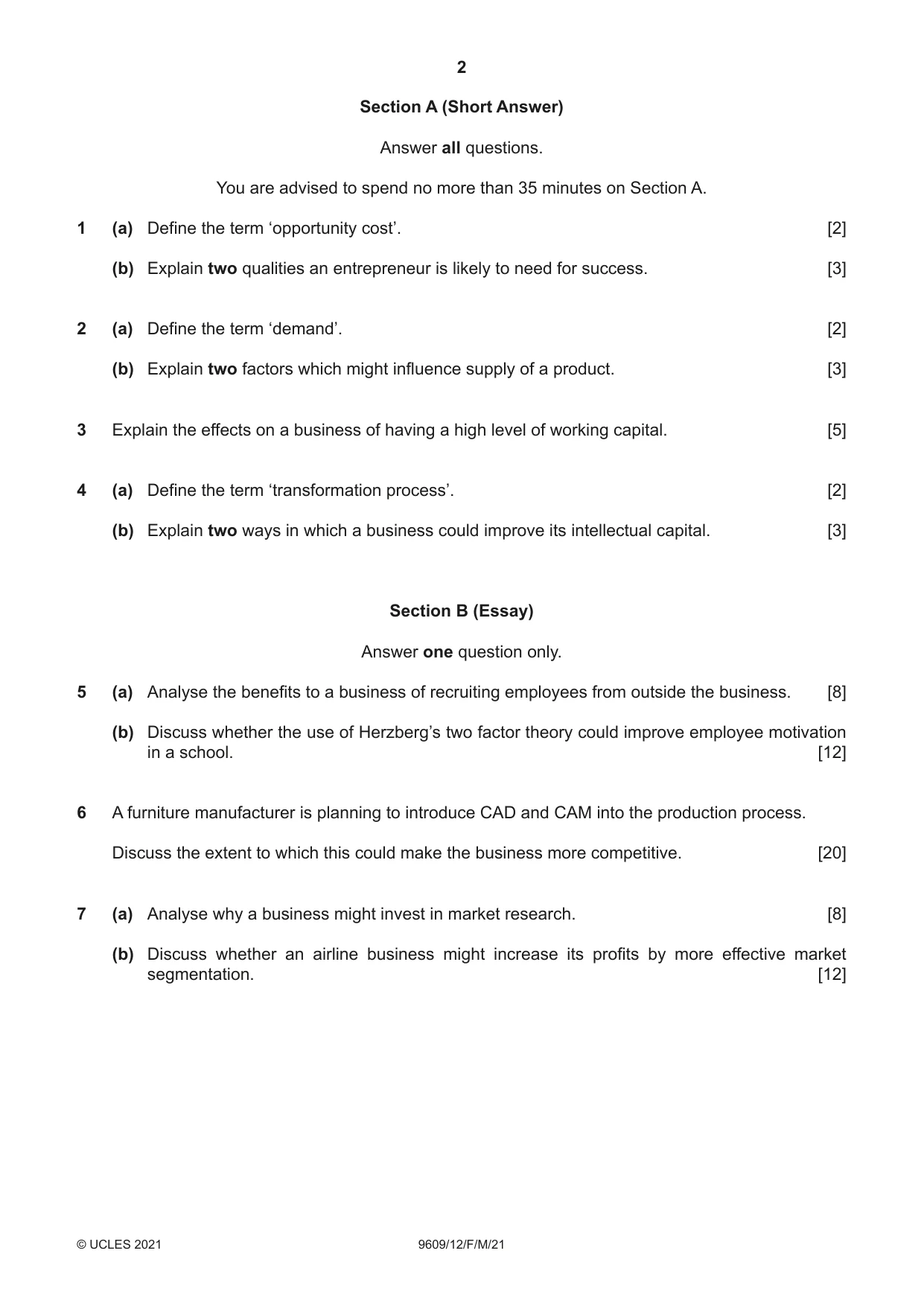
2 9609/12/F/M/21 © UCLES 2021 Section A (Short Answer) Answer all questions. You are advised to spend no more than 35 minutes on Section A. 1 (a) Define the term ‘opportunity cost’. [2] (b) Explain two qualities an entrepreneur is likely to need for success. [3] 2 (a) Define the term ‘demand’. [2] (b) Explain two factors which might influence supply of a product. [3] 3 Explain the effects on a business of having a high level of working capital. [5] 4 (a) Define the term ‘transformation process’. [2] (b) Explain two ways in which a business could improve its intellectual capital. [3] Section B (Essay) Answer one question only. 5 (a) Analyse the benefits to a business of recruiting employees from outside the business. [8] (b) Discuss whether the use of Herzberg’s two factor theory could improve employee motivation in a school. [12] 6 A furniture manufacturer is planning to introduce CAD and CAM into the production process. Discuss the extent to which this could make the business more competitive. [20] 7 (a) Analyse why a business might invest in market research. [8] (b) Discuss whether an airline business might increase its profits by more effective market segmentation. [12]
Question paper, page 3
3 9609/12/F/M/21 © UCLES 2021 BLANK PAGE
Question paper, page 4
4 9609/12/F/M/21 © UCLES 2021 Permission to reproduce items where third-party owned material protected by copyright is included has been sought and cleared where possible. Every reasonable effort has been made by the publisher (UCLES) to trace copyright holders, but if any items requiring clearance have unwittingly been included, the publisher will be pleased to make amends at the earliest possible opportunity. To avoid the issue of disclosure of answer-related information to candidates, all copyright acknowledgements are reproduced online in the Cambridge Assessment International Education Copyright Acknowledgements Booklet. This is produced for each series of examinations and is freely available to download at www.cambridgeinternational.org after the live examination series. Cambridge Assessment International Education is part of the Cambridge Assessment Group. Cambridge Assessment is the brand name of the University of Cambridge Local Examinations Syndicate (UCLES), which itself is a department of the University of Cambridge. BLANK PAGE
Mark scheme, page 1
This document consists of 16 printed pages. © UCLES 2021 [Turn over Cambridge International AS & A Level BUSINESS 9609/12 Paper 1 Short Answer and Essay March 2021 MARK SCHEME Maximum Mark: 40 Published This mark scheme is published as an aid to teachers and candidates, to indicate the requirements of the examination. It shows the basis on which Examiners were instructed to award marks. It does not indicate the details of the discussions that took place at an Examiners’ meeting before marking began, which would have considered the acceptability of alternative answers. Mark schemes should be read in conjunction with the question paper and the Principal Examiner Report for Teachers. Cambridge International will not enter into discussions about these mark schemes. Cambridge International is publishing the mark schemes for the March 2021 series for most Cambridge IGCSE™, Cambridge International A and AS Level components and some Cambridge O Level components.
Mark scheme, page 2
9609/12 Cambridge International AS & A Level – Mark Scheme PUBLISHED March 2021 © UCLES 2021 Page 2 of 16 Generic Marking Principles These general marking principles must be applied by all examiners when marking candidate answers. They should be applied alongside the specific content of the mark scheme or generic level descriptors for a question. Each question paper and mark scheme will also comply with these marking principles. GENERIC MARKING PRINCIPLE 1: Marks must be awarded in line with: • the specific content of the mark scheme or the generic level descriptors for the question • the specific skills defined in the mark scheme or in the generic level descriptors for the question • the standard of response required by a candidate as exemplified by the standardisation scripts. GENERIC MARKING PRINCIPLE 2: Marks awarded are always whole marks (not half marks, or other fractions). GENERIC MARKING PRINCIPLE 3: Marks must be awarded positively: • marks are awarded for correct/valid answers, as defined in the mark scheme. However, credit is given for valid answers which go beyond the scope of the syllabus and mark scheme, referring to your Team Leader as appropriate • marks are awarded when candidates clearly demonstrate what they know and can do • marks are not deducted for errors • marks are not deducted for omissions • answers should only be judged on the quality of spelling, punctuation and grammar when these features are specifically assessed by the question as indicated by the mark scheme. The meaning, however, should be unambiguous. GENERIC MARKING PRINCIPLE 4: Rules must be applied consistently, e.g. in situations where candidates have not followed instructions or in the application of generic level descriptors. GENERIC MARKING PRINCIPLE 5: Marks should be awarded using the full range of marks defined in the mark scheme for the question (however; the use of the full mark range may be limited according to the quality of the candidate responses seen). GENERIC MARKING PRINCIPLE 6: Marks awarded are based solely on the requirements as defined in the mark scheme. Marks should not be awarded with grade thresholds or grade descriptors in mind.
Mark scheme, page 3
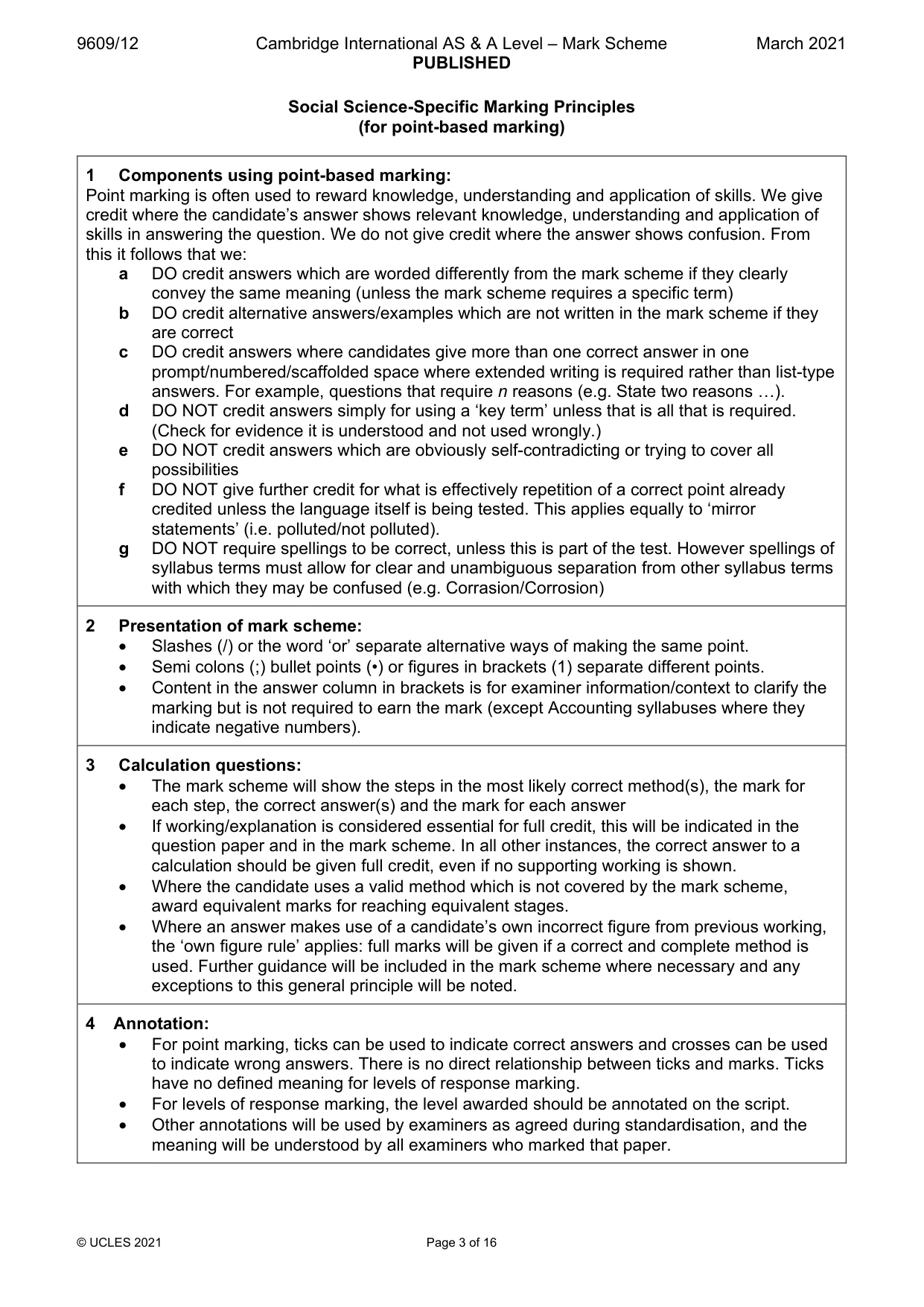
9609/12 Cambridge International AS & A Level – Mark Scheme PUBLISHED March 2021 © UCLES 2021 Page 3 of 16 Social Science-Specific Marking Principles (for point-based marking) 1 Components using point-based marking: Point marking is often used to reward knowledge, understanding and application of skills. We give credit where the candidate’s answer shows relevant knowledge, understanding and application of skills in answering the question. We do not give credit where the answer shows confusion. From this it follows that we: a DO credit answers which are worded differently from the mark scheme if they clearly convey the same meaning (unless the mark scheme requires a specific term) b DO credit alternative answers/examples which are not written in the mark scheme if they are correct c DO credit answers where candidates give more than one correct answer in one prompt/numbered/scaffolded space where extended writing is required rather than list-type answers. For example, questions that require n reasons (e.g. State two reasons …). d DO NOT credit answers simply for using a ‘key term’ unless that is all that is required. (Check for evidence it is understood and not used wrongly.) e DO NOT credit answers which are obviously self-contradicting or trying to cover all possibilities f DO NOT give further credit for what is effectively repetition of a correct point already credited unless the language itself is being tested. This applies equally to ‘mirror statements’ (i.e. polluted/not polluted). g DO NOT require spellings to be correct, unless this is part of the test. However spellings of syllabus terms must allow for clear and unambiguous separation from other syllabus terms with which they may be confused (e.g. Corrasion/Corrosion) 2 Presentation of mark scheme: • Slashes (/) or the word ‘or’ separate alternative ways of making the same point. • Semi colons (;) bullet points (•) or figures in brackets (1) separate different points. • Content in the answer column in brackets is for examiner information/context to clarify the marking but is not required to earn the mark (except Accounting syllabuses where they indicate negative numbers). 3 Calculation questions: • The mark scheme will show the steps in the most likely correct method(s), the mark for each step, the correct answer(s) and the mark for each answer • If working/explanation is considered essential for full credit, this will be indicated in the question paper and in the mark scheme. In all other instances, the correct answer to a calculation should be given full credit, even if no supporting working is shown. • Where the candidate uses a valid method which is not covered by the mark scheme, award equivalent marks for reaching equivalent stages. • Where an answer makes use of a candidate’s own incorrect figure from previous working, the ‘own figure rule’ applies: full marks will be given if a correct and complete method is used. Further guidance will be included in the mark scheme where necessary and any exceptions to this general principle will be noted. 4 Annotation: • For point marking, ticks can be used to indicate correct answers and crosses can be used to indicate wrong answers. There is no direct relationship between ticks and marks. Ticks have no defined meaning for levels of response marking. • For levels of response marking, the level awarded should be annotated on the script. • Other annotations will be used by examiners as agreed during standardisation, and the meaning will be understood by all examiners who marked that paper.
Mark scheme, page 4
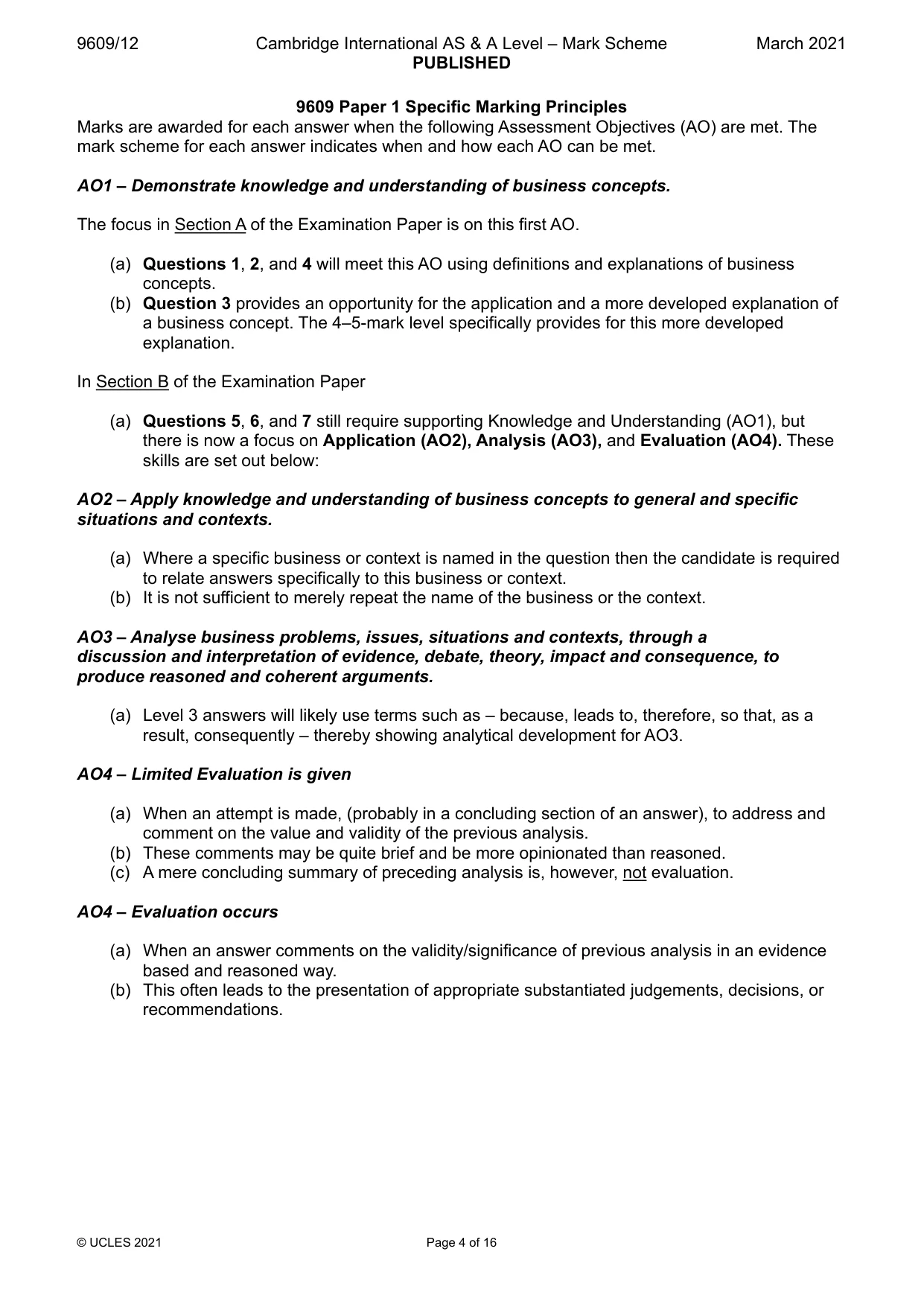
9609/12 Cambridge International AS & A Level – Mark Scheme PUBLISHED March 2021 © UCLES 2021 Page 4 of 16 9609 Paper 1 Specific Marking Principles Marks are awarded for each answer when the following Assessment Objectives (AO) are met. The mark scheme for each answer indicates when and how each AO can be met. AO1 – Demonstrate knowledge and understanding of business concepts. The focus in Section A of the Examination Paper is on this first AO. (a) Questions 1, 2, and 4 will meet this AO using definitions and explanations of business concepts. (b) Question 3 provides an opportunity for the application and a more developed explanation of a business concept. The 4–5-mark level specifically provides for this more developed explanation. In Section B of the Examination Paper (a) Questions 5, 6, and 7 still require supporting Knowledge and Understanding (AO1), but there is now a focus on Application (AO2), Analysis (AO3), and Evaluation (AO4). These skills are set out below: AO2 – Apply knowledge and understanding of business concepts to general and specific situations and contexts. (a) Where a specific business or context is named in the question then the candidate is required to relate answers specifically to this business or context. (b) It is not sufficient to merely repeat the name of the business or the context. AO3 – Analyse business problems, issues, situations and contexts, through a discussion and interpretation of evidence, debate, theory, impact and consequence, to produce reasoned and coherent arguments. (a) Level 3 answers will likely use terms such as – because, leads to, therefore, so that, as a result, consequently – thereby showing analytical development for AO3. AO4 – Limited Evaluation is given (a) When an attempt is made, (probably in a concluding section of an answer), to address and comment on the value and validity of the previous analysis. (b) These comments may be quite brief and be more opinionated than reasoned. (c) A mere concluding summary of preceding analysis is, however, not evaluation. AO4 – Evaluation occurs (a) When an answer comments on the validity/significance of previous analysis in an evidence based and reasoned way. (b) This often leads to the presentation of appropriate substantiated judgements, decisions, or recommendations.
Mark scheme, page 5
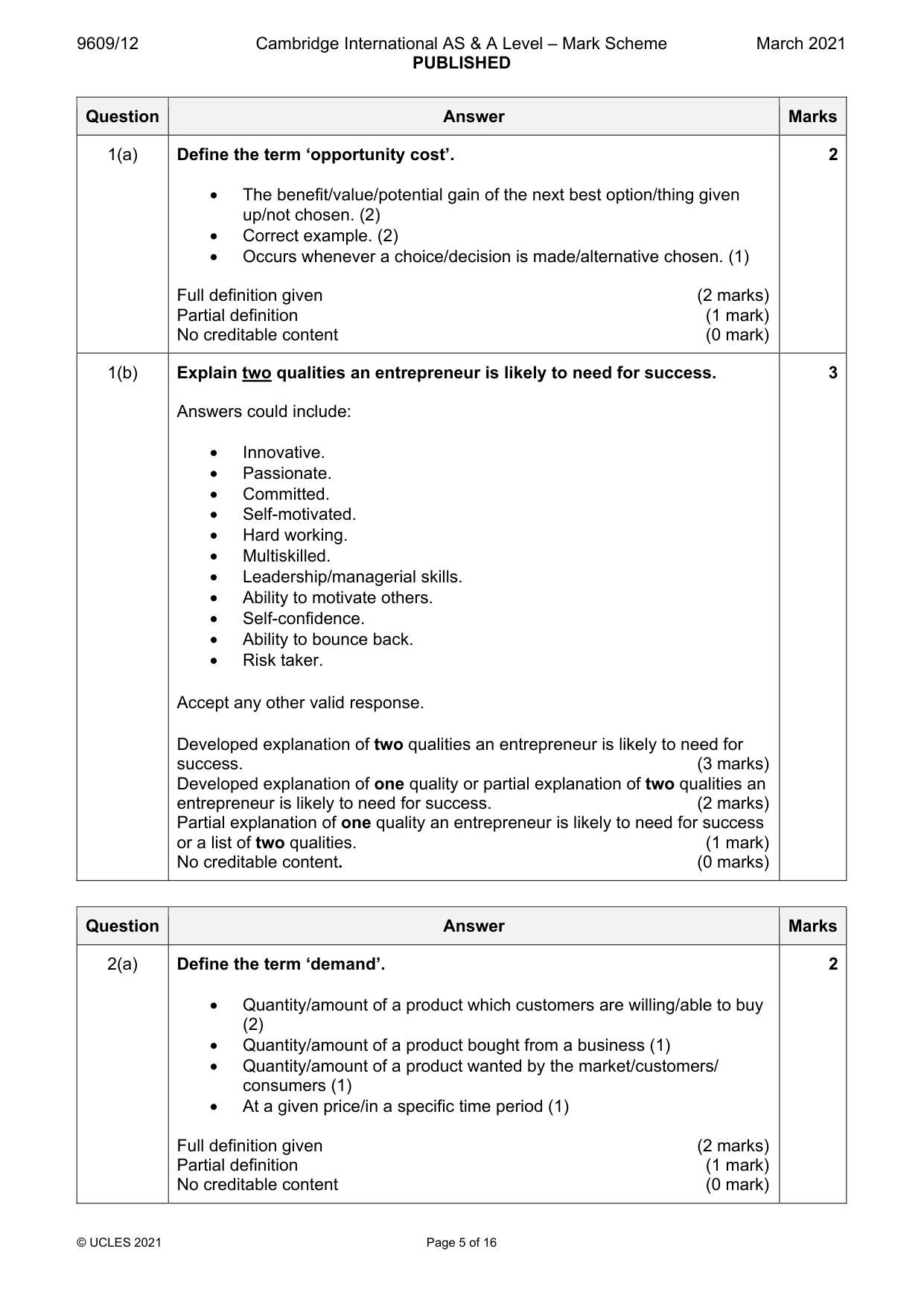
9609/12 Cambridge International AS & A Level – Mark Scheme PUBLISHED March 2021 © UCLES 2021 Page 5 of 16 Question Answer Marks 1(a) Define the term ‘opportunity cost’. • The benefit/value/potential gain of the next best option/thing given up/not chosen. (2) • Correct example. (2) • Occurs whenever a choice/decision is made/alternative chosen. (1) Full definition given (2 marks) Partial definition (1 mark) No creditable content (0 mark) 2 1(b) Explain two qualities an entrepreneur is likely to need for success. Answers could include: • Innovative. • Passionate. • Committed. • Self-motivated. • Hard working. • Multiskilled. • Leadership/managerial skills. • Ability to motivate others. • Self-confidence. • Ability to bounce back. • Risk taker. Accept any other valid response. Developed explanation of two qualities an entrepreneur is likely to need for success. (3 marks) Developed explanation of one quality or partial explanation of two qualities an entrepreneur is likely to need for success. (2 marks) Partial explanation of one quality an entrepreneur is likely to need for success or a list of two qualities. (1 mark) No creditable content. (0 marks) 3 Question Answer Marks 2(a) Define the term ‘demand’. • Quantity/amount of a product which customers are willing/able to buy (2) • Quantity/amount of a product bought from a business (1) • Quantity/amount of a product wanted by the market/customers/ consumers (1) • At a given price/in a specific time period (1) Full definition given (2 marks) Partial definition (1 mark) No creditable content (0 mark) 2
Mark scheme, page 6
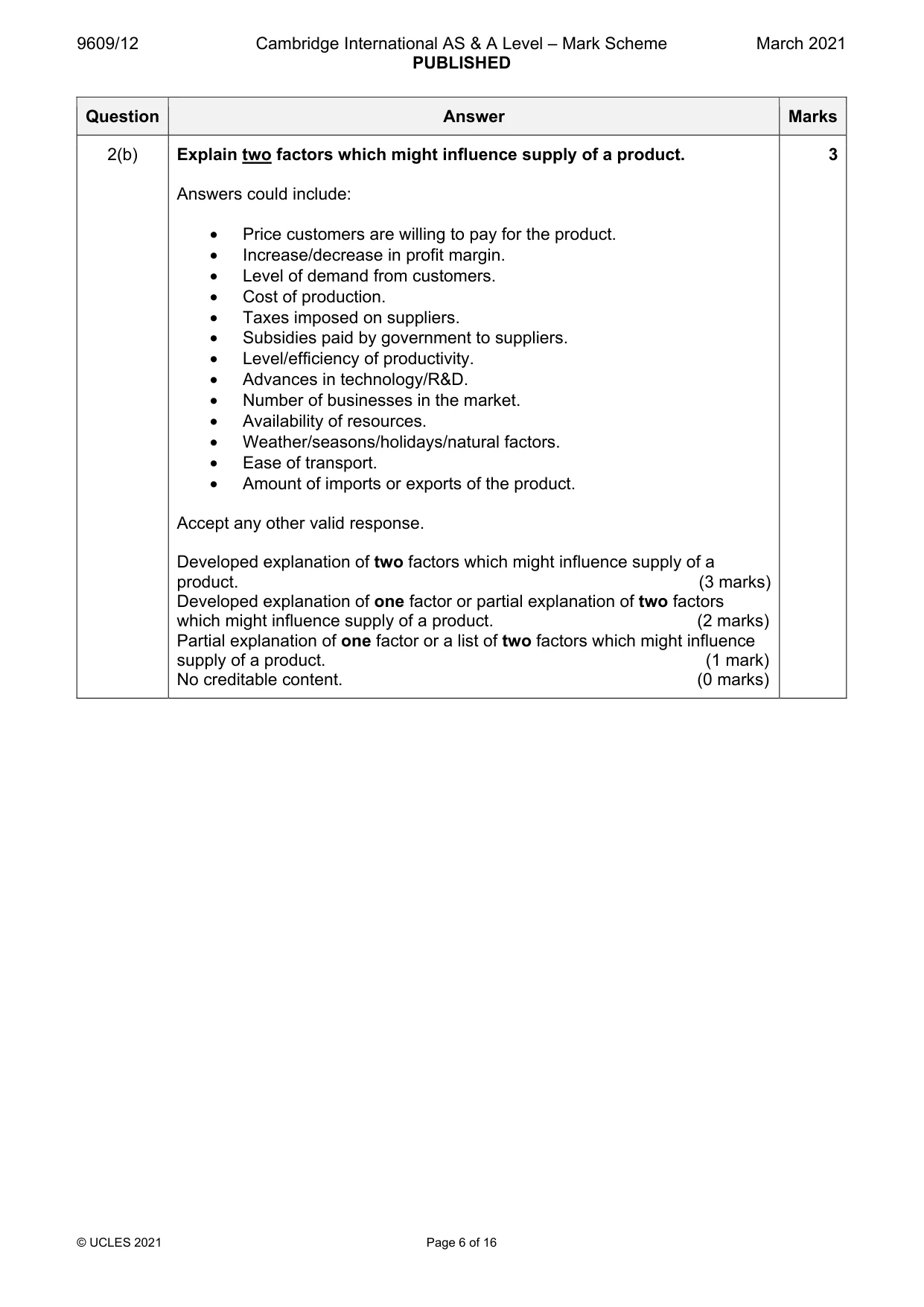
9609/12 Cambridge International AS & A Level – Mark Scheme PUBLISHED March 2021 © UCLES 2021 Page 6 of 16 Question Answer Marks 2(b) Explain two factors which might influence supply of a product. Answers could include: • Price customers are willing to pay for the product. • Increase/decrease in profit margin. • Level of demand from customers. • Cost of production. • Taxes imposed on suppliers. • Subsidies paid by government to suppliers. • Level/efficiency of productivity. • Advances in technology/R&D. • Number of businesses in the market. • Availability of resources. • Weather/seasons/holidays/natural factors. • Ease of transport. • Amount of imports or exports of the product. Accept any other valid response. Developed explanation of two factors which might influence supply of a product. (3 marks) Developed explanation of one factor or partial explanation of two factors which might influence supply of a product. (2 marks) Partial explanation of one factor or a list of two factors which might influence supply of a product. (1 mark) No creditable content. (0 marks) 3
Mark scheme, page 7
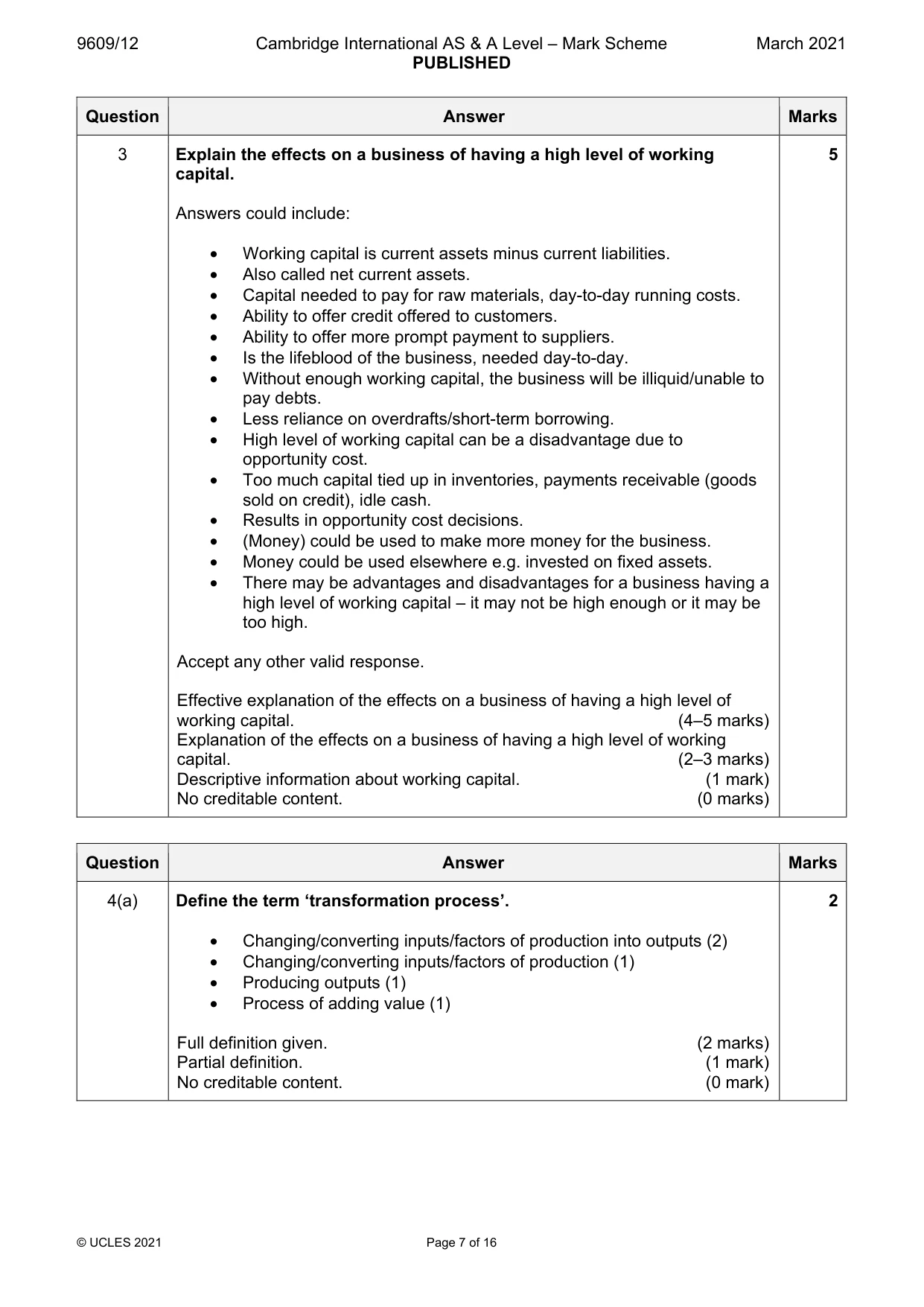
9609/12 Cambridge International AS & A Level – Mark Scheme PUBLISHED March 2021 © UCLES 2021 Page 7 of 16 Question Answer Marks 3 Explain the effects on a business of having a high level of working capital. Answers could include: • Working capital is current assets minus current liabilities. • Also called net current assets. • Capital needed to pay for raw materials, day-to-day running costs. • Ability to offer credit offered to customers. • Ability to offer more prompt payment to suppliers. • Is the lifeblood of the business, needed day-to-day. • Without enough working capital, the business will be illiquid/unable to pay debts. • Less reliance on overdrafts/short-term borrowing. • High level of working capital can be a disadvantage due to opportunity cost. • Too much capital tied up in inventories, payments receivable (goods sold on credit), idle cash. • Results in opportunity cost decisions. • (Money) could be used to make more money for the business. • Money could be used elsewhere e.g. invested on fixed assets. • There may be advantages and disadvantages for a business having a high level of working capital – it may not be high enough or it may be too high. Accept any other valid response. Effective explanation of the effects on a business of having a high level of working capital. (4–5 marks) Explanation of the effects on a business of having a high level of working capital. (2–3 marks) Descriptive information about working capital. (1 mark) No creditable content. (0 marks) 5 Question Answer Marks 4(a) Define the term ‘transformation process’. • Changing/converting inputs/factors of production into outputs (2) • Changing/converting inputs/factors of production (1) • Producing outputs (1) • Process of adding value (1) Full definition given. (2 marks) Partial definition. (1 mark) No creditable content. (0 mark) 2
Mark scheme, page 8
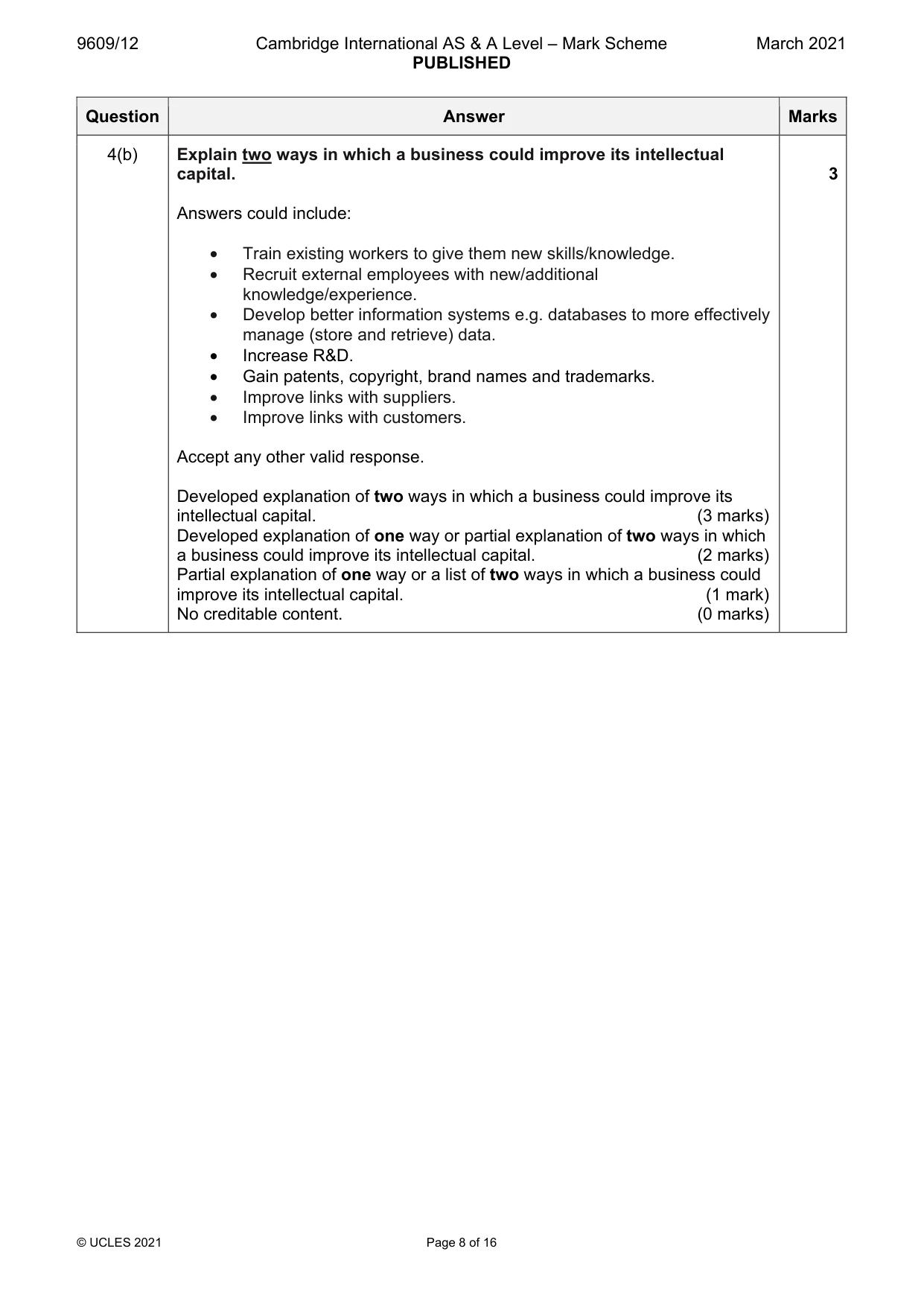
9609/12 Cambridge International AS & A Level – Mark Scheme PUBLISHED March 2021 © UCLES 2021 Page 8 of 16 Question Answer Marks 4(b) Explain two ways in which a business could improve its intellectual capital. Answers could include: • Train existing workers to give them new skills/knowledge. • Recruit external employees with new/additional knowledge/experience. • Develop better information systems e.g. databases to more effectively manage (store and retrieve) data. • Increase R&D. • Gain patents, copyright, brand names and trademarks. • Improve links with suppliers. • Improve links with customers. Accept any other valid response. Developed explanation of two ways in which a business could improve its intellectual capital. (3 marks) Developed explanation of one way or partial explanation of two ways in which a business could improve its intellectual capital. (2 marks) Partial explanation of one way or a list of two ways in which a business could improve its intellectual capital. (1 mark) No creditable content. (0 marks) 3
Mark scheme, page 9
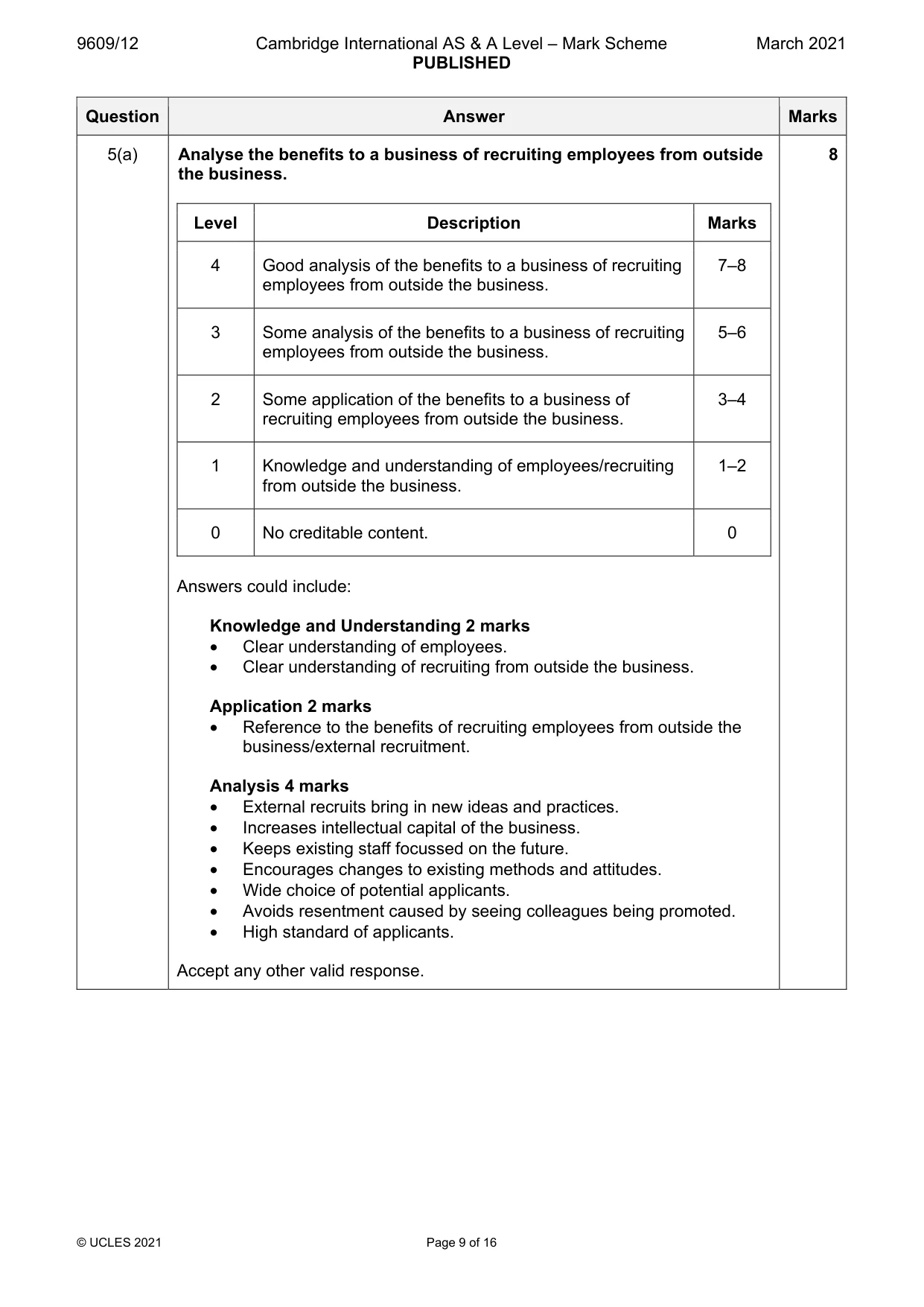
9609/12 Cambridge International AS & A Level – Mark Scheme PUBLISHED March 2021 © UCLES 2021 Page 9 of 16 Question Answer Marks 5(a) Analyse the benefits to a business of recruiting employees from outside the business. Level Description Marks 4 Good analysis of the benefits to a business of recruiting employees from outside the business. 7–8 3 Some analysis of the benefits to a business of recruiting employees from outside the business. 5–6 2 Some application of the benefits to a business of recruiting employees from outside the business. 3–4 1 Knowledge and understanding of employees/recruiting from outside the business. 1–2 0 No creditable content. 0 Answers could include: Knowledge and Understanding 2 marks • Clear understanding of employees. • Clear understanding of recruiting from outside the business. Application 2 marks • Reference to the benefits of recruiting employees from outside the business/external recruitment. Analysis 4 marks • External recruits bring in new ideas and practices. • Increases intellectual capital of the business. • Keeps existing staff focussed on the future. • Encourages changes to existing methods and attitudes. • Wide choice of potential applicants. • Avoids resentment caused by seeing colleagues being promoted. • High standard of applicants. Accept any other valid response. 8
Mark scheme, page 10
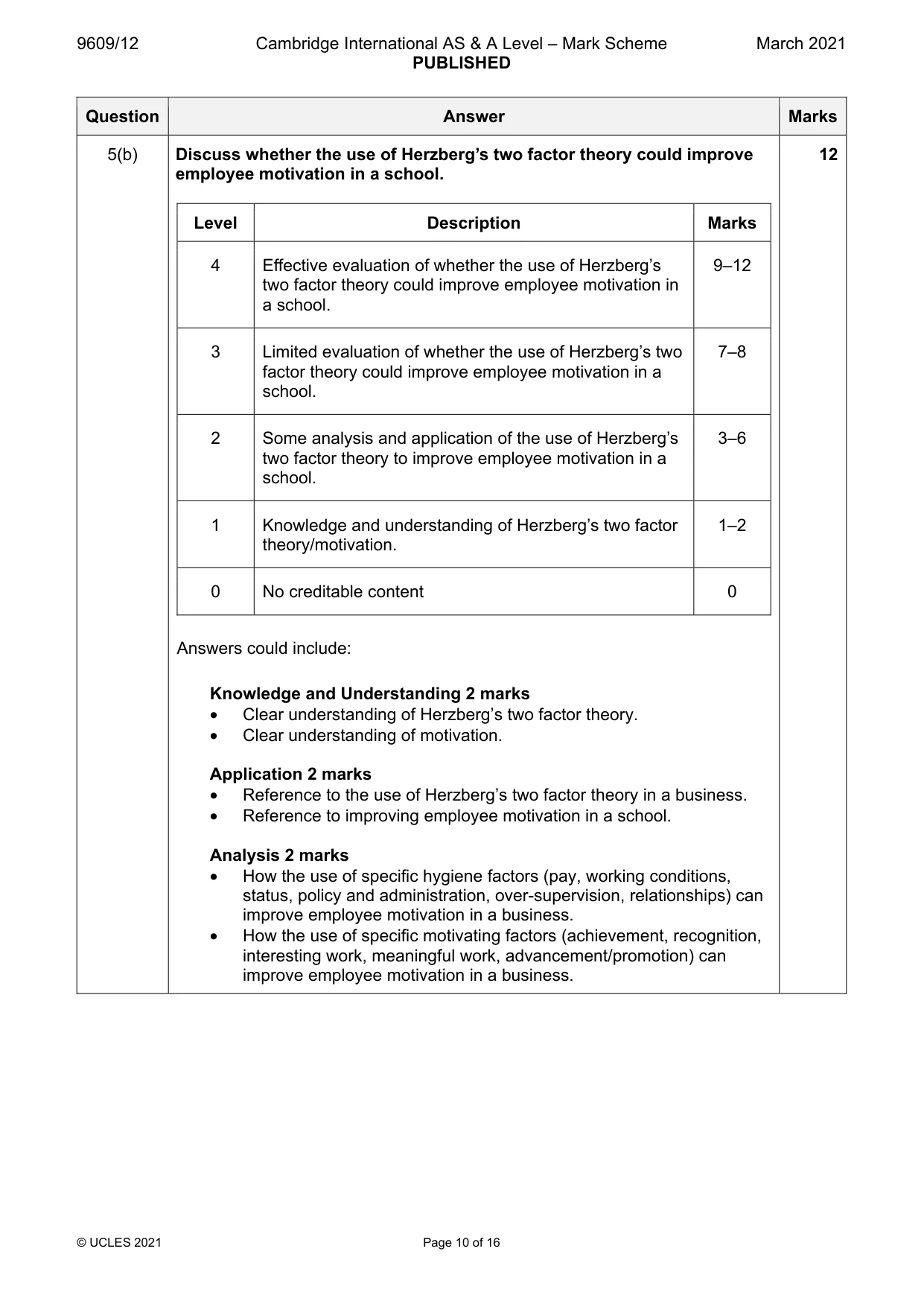
9609/12 Cambridge International AS & A Level – Mark Scheme PUBLISHED March 2021 © UCLES 2021 Page 10 of 16 Question Answer Marks 5(b) Discuss whether the use of Herzberg’s two factor theory could improve employee motivation in a school. Level Description Marks 4 Effective evaluation of whether the use of Herzberg’s two factor theory could improve employee motivation in a school. 9–12 3 Limited evaluation of whether the use of Herzberg’s two factor theory could improve employee motivation in a school. 7–8 2 Some analysis and application of the use of Herzberg’s two factor theory to improve employee motivation in a school. 3–6 1 Knowledge and understanding of Herzberg’s two factor theory/motivation. 1–2 0 No creditable content 0 Answers could include: Knowledge and Understanding 2 marks • Clear understanding of Herzberg’s two factor theory. • Clear understanding of motivation. Application 2 marks • Reference to the use of Herzberg’s two factor theory in a business. • Reference to improving employee motivation in a school. Analysis 2 marks • How the use of specific hygiene factors (pay, working conditions, status, policy and administration, over-supervision, relationships) can improve employee motivation in a business. • How the use of specific motivating factors (achievement, recognition, interesting work, meaningful work, advancement/promotion) can improve employee motivation in a business. 12
Mark scheme, page 11
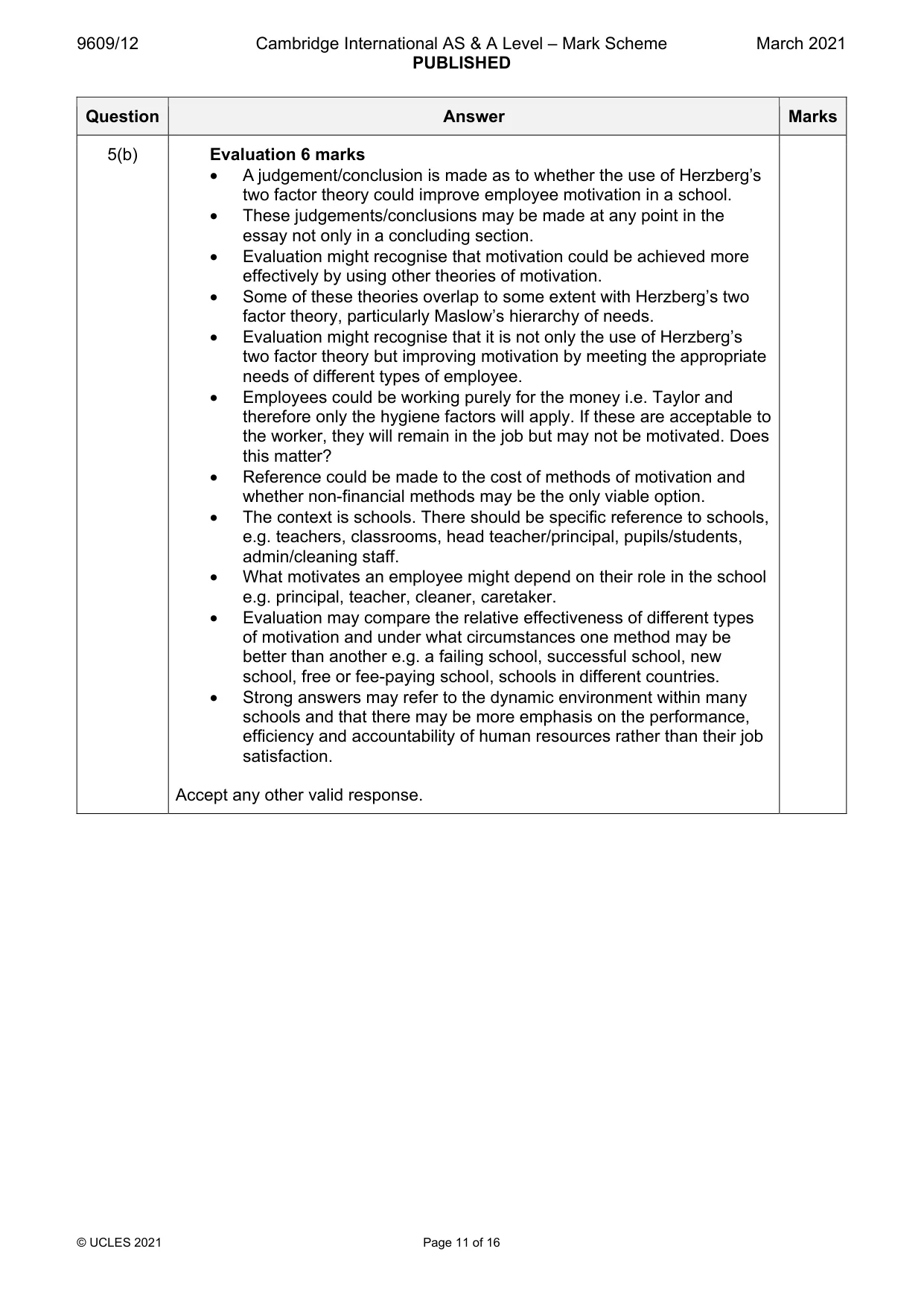
9609/12 Cambridge International AS & A Level – Mark Scheme PUBLISHED March 2021 © UCLES 2021 Page 11 of 16 Question Answer Marks 5(b) Evaluation 6 marks • A judgement/conclusion is made as to whether the use of Herzberg’s two factor theory could improve employee motivation in a school. • These judgements/conclusions may be made at any point in the essay not only in a concluding section. • Evaluation might recognise that motivation could be achieved more effectively by using other theories of motivation. • Some of these theories overlap to some extent with Herzberg’s two factor theory, particularly Maslow’s hierarchy of needs. • Evaluation might recognise that it is not only the use of Herzberg’s two factor theory but improving motivation by meeting the appropriate needs of different types of employee. • Employees could be working purely for the money i.e. Taylor and therefore only the hygiene factors will apply. If these are acceptable to the worker, they will remain in the job but may not be motivated. Does this matter? • Reference could be made to the cost of methods of motivation and whether non-financial methods may be the only viable option. • The context is schools. There should be specific reference to schools, e.g. teachers, classrooms, head teacher/principal, pupils/students, admin/cleaning staff. • What motivates an employee might depend on their role in the school e.g. principal, teacher, cleaner, caretaker. • Evaluation may compare the relative effectiveness of different types of motivation and under what circumstances one method may be better than another e.g. a failing school, successful school, new school, free or fee-paying school, schools in different countries. • Strong answers may refer to the dynamic environment within many schools and that there may be more emphasis on the performance, efficiency and accountability of human resources rather than their job satisfaction. Accept any other valid response.
Mark scheme, page 12
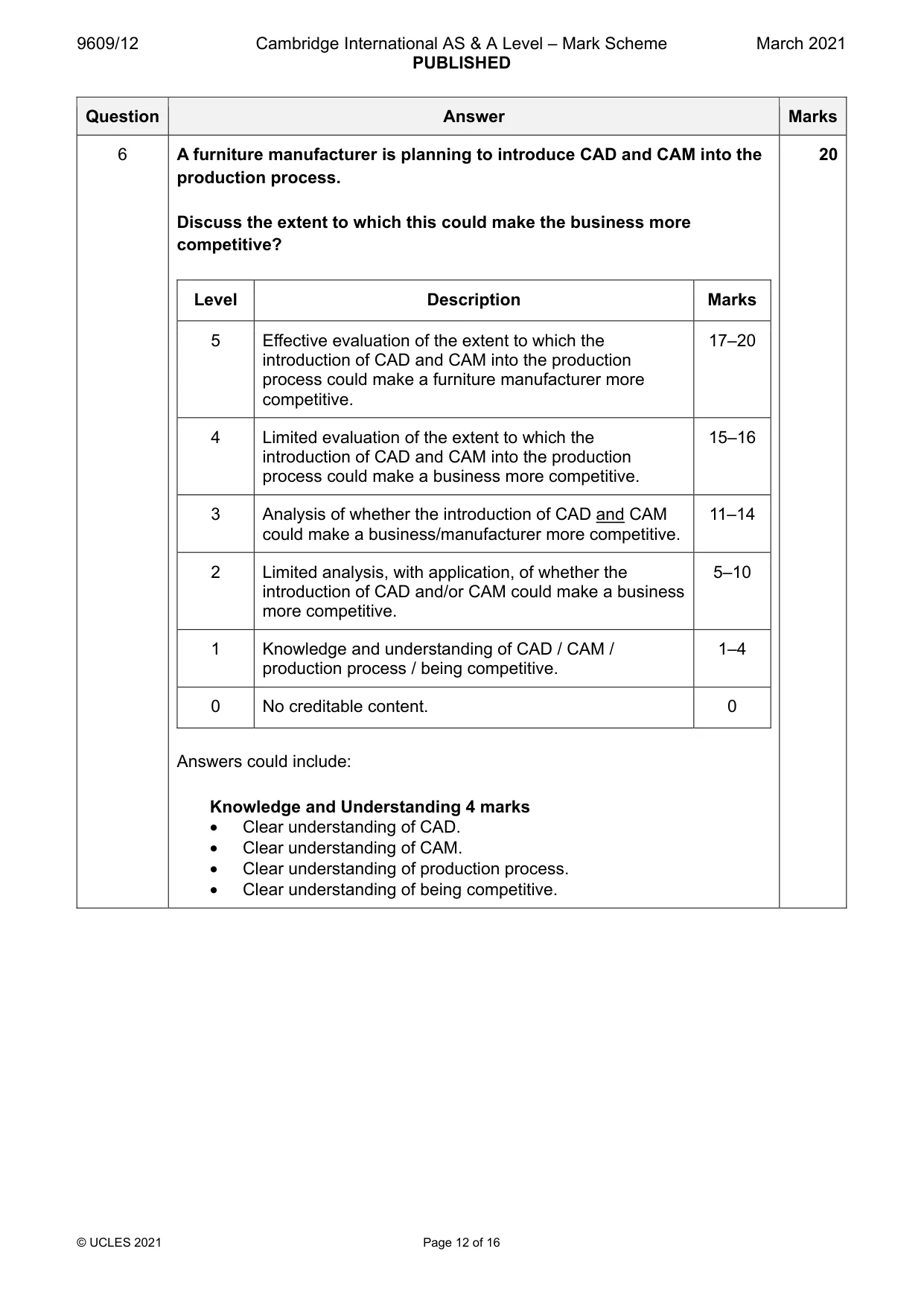
9609/12 Cambridge International AS & A Level – Mark Scheme PUBLISHED March 2021 © UCLES 2021 Page 12 of 16 Question Answer Marks 6 A furniture manufacturer is planning to introduce CAD and CAM into the production process. Discuss the extent to which this could make the business more competitive? Level Description Marks 5 Effective evaluation of the extent to which the introduction of CAD and CAM into the production process could make a furniture manufacturer more competitive. 17–20 4 Limited evaluation of the extent to which the introduction of CAD and CAM into the production process could make a business more competitive. 15–16 3 Analysis of whether the introduction of CAD and CAM could make a business/manufacturer more competitive. 11–14 2 Limited analysis, with application, of whether the introduction of CAD and/or CAM could make a business more competitive. 5–10 1 Knowledge and understanding of CAD / CAM / production process / being competitive. 1–4 0 No creditable content. 0 Answers could include: Knowledge and Understanding 4 marks • Clear understanding of CAD. • Clear understanding of CAM. • Clear understanding of production process. • Clear understanding of being competitive. 20
Mark scheme, page 13
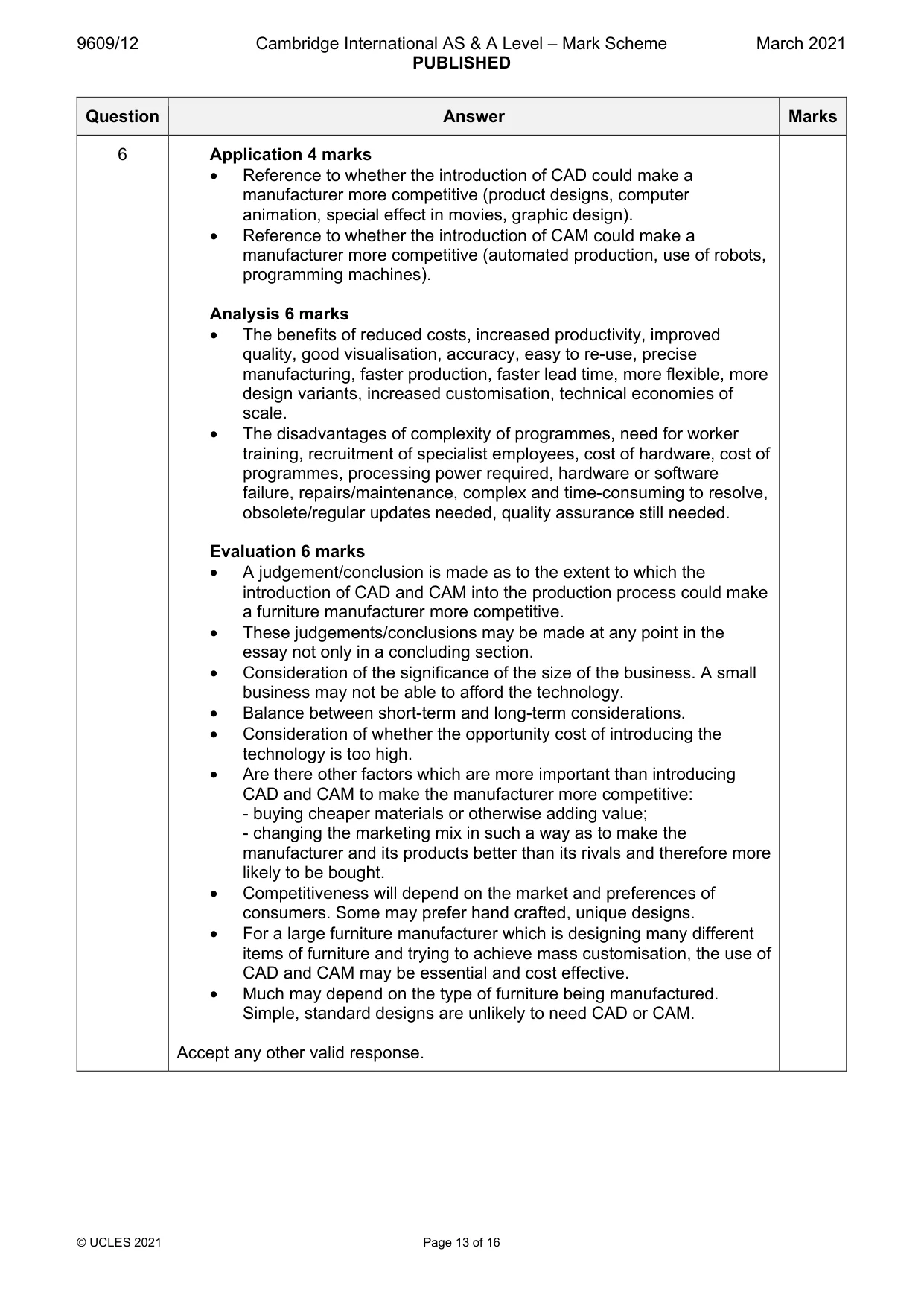
9609/12 Cambridge International AS & A Level – Mark Scheme PUBLISHED March 2021 © UCLES 2021 Page 13 of 16 Question Answer Marks 6 Application 4 marks • Reference to whether the introduction of CAD could make a manufacturer more competitive (product designs, computer animation, special effect in movies, graphic design). • Reference to whether the introduction of CAM could make a manufacturer more competitive (automated production, use of robots, programming machines). Analysis 6 marks • The benefits of reduced costs, increased productivity, improved quality, good visualisation, accuracy, easy to re-use, precise manufacturing, faster production, faster lead time, more flexible, more design variants, increased customisation, technical economies of scale. • The disadvantages of complexity of programmes, need for worker training, recruitment of specialist employees, cost of hardware, cost of programmes, processing power required, hardware or software failure, repairs/maintenance, complex and time-consuming to resolve, obsolete/regular updates needed, quality assurance still needed. Evaluation 6 marks • A judgement/conclusion is made as to the extent to which the introduction of CAD and CAM into the production process could make a furniture manufacturer more competitive. • These judgements/conclusions may be made at any point in the essay not only in a concluding section. • Consideration of the significance of the size of the business. A small business may not be able to afford the technology. • Balance between short-term and long-term considerations. • Consideration of whether the opportunity cost of introducing the technology is too high. • Are there other factors which are more important than introducing CAD and CAM to make the manufacturer more competitive: - buying cheaper materials or otherwise adding value; - changing the marketing mix in such a way as to make the manufacturer and its products better than its rivals and therefore more likely to be bought. • Competitiveness will depend on the market and preferences of consumers. Some may prefer hand crafted, unique designs. • For a large furniture manufacturer which is designing many different items of furniture and trying to achieve mass customisation, the use of CAD and CAM may be essential and cost effective. • Much may depend on the type of furniture being manufactured. Simple, standard designs are unlikely to need CAD or CAM. Accept any other valid response.
Mark scheme, page 14
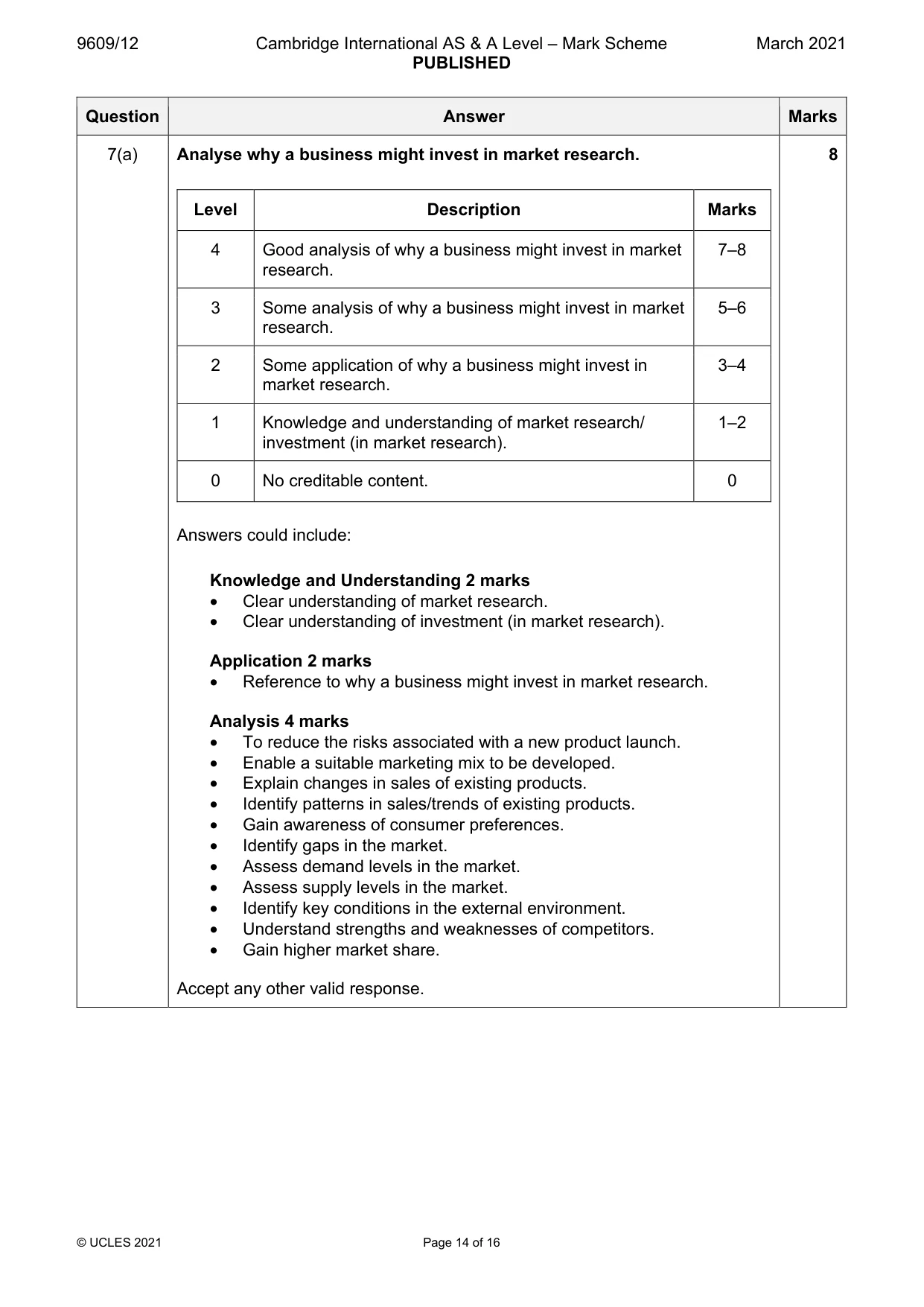
9609/12 Cambridge International AS & A Level – Mark Scheme PUBLISHED March 2021 © UCLES 2021 Page 14 of 16 Question Answer Marks 7(a) Analyse why a business might invest in market research. Level Description Marks 4 Good analysis of why a business might invest in market research. 7–8 3 Some analysis of why a business might invest in market research. 5–6 2 Some application of why a business might invest in market research. 3–4 1 Knowledge and understanding of market research/ investment (in market research). 1–2 0 No creditable content. 0 Answers could include: Knowledge and Understanding 2 marks • Clear understanding of market research. • Clear understanding of investment (in market research). Application 2 marks • Reference to why a business might invest in market research. Analysis 4 marks • To reduce the risks associated with a new product launch. • Enable a suitable marketing mix to be developed. • Explain changes in sales of existing products. • Identify patterns in sales/trends of existing products. • Gain awareness of consumer preferences. • Identify gaps in the market. • Assess demand levels in the market. • Assess supply levels in the market. • Identify key conditions in the external environment. • Understand strengths and weaknesses of competitors. • Gain higher market share. Accept any other valid response. 8
Mark scheme, page 15
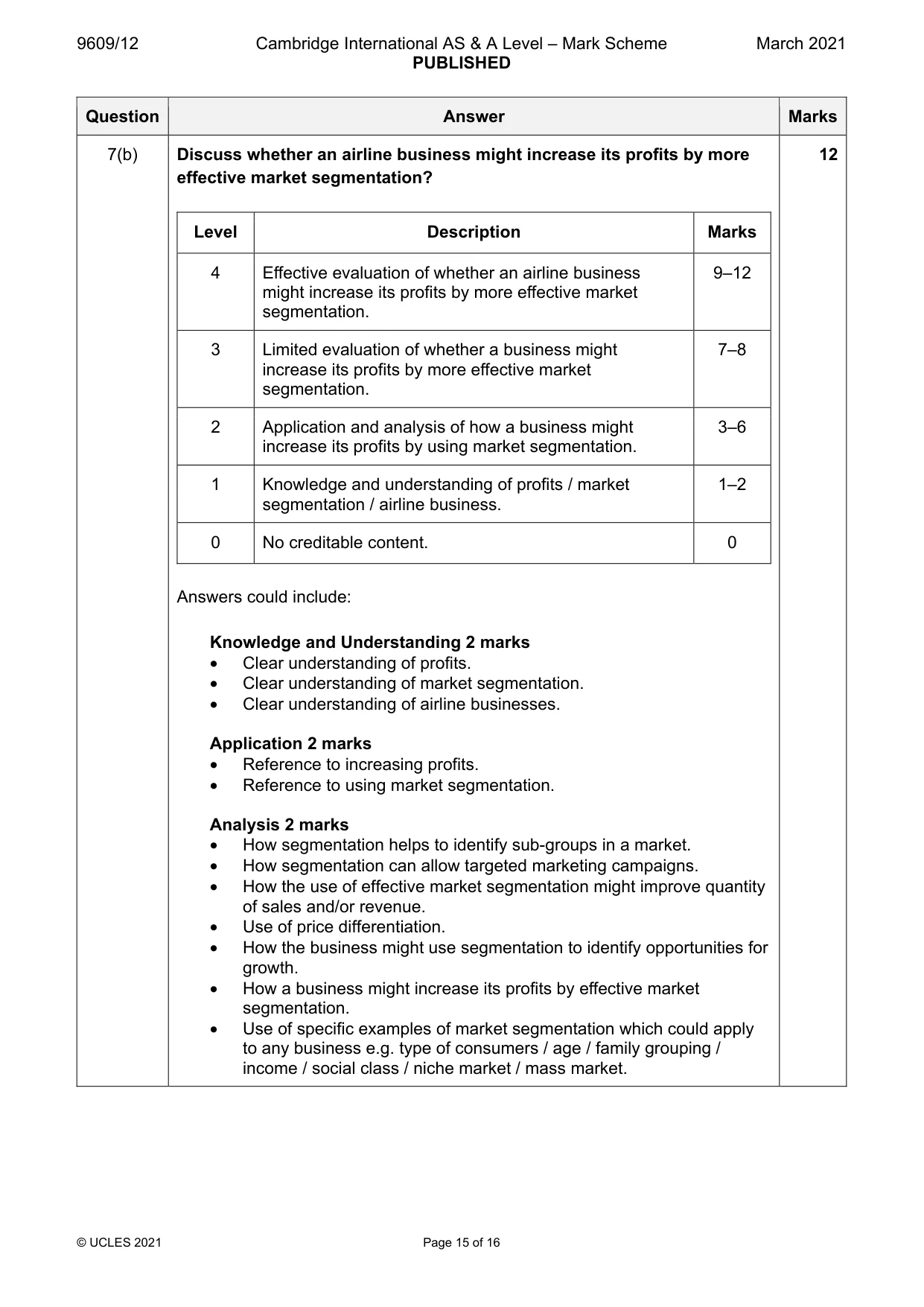
9609/12 Cambridge International AS & A Level – Mark Scheme PUBLISHED March 2021 © UCLES 2021 Page 15 of 16 Question Answer Marks 7(b) Discuss whether an airline business might increase its profits by more effective market segmentation? Level Description Marks 4 Effective evaluation of whether an airline business might increase its profits by more effective market segmentation. 9–12 3 Limited evaluation of whether a business might increase its profits by more effective market segmentation. 7–8 2 Application and analysis of how a business might increase its profits by using market segmentation. 3–6 1 Knowledge and understanding of profits / market segmentation / airline business. 1–2 0 No creditable content. 0 Answers could include: Knowledge and Understanding 2 marks • Clear understanding of profits. • Clear understanding of market segmentation. • Clear understanding of airline businesses. Application 2 marks • Reference to increasing profits. • Reference to using market segmentation. Analysis 2 marks • How segmentation helps to identify sub-groups in a market. • How segmentation can allow targeted marketing campaigns. • How the use of effective market segmentation might improve quantity of sales and/or revenue. • Use of price differentiation. • How the business might use segmentation to identify opportunities for growth. • How a business might increase its profits by effective market segmentation. • Use of specific examples of market segmentation which could apply to any business e.g. type of consumers / age / family grouping / income / social class / niche market / mass market. 12
Mark scheme, page 16
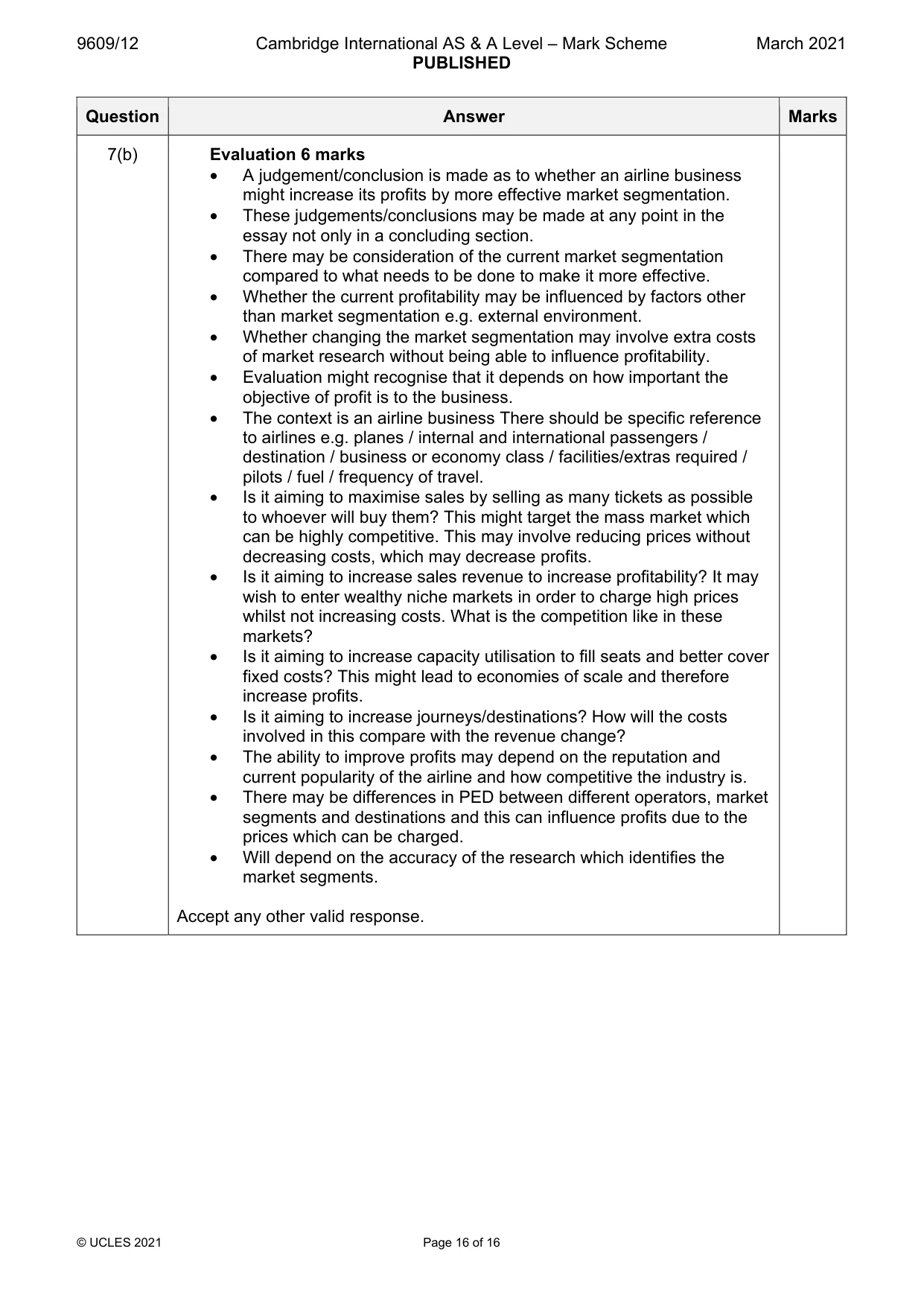
9609/12 Cambridge International AS & A Level – Mark Scheme PUBLISHED March 2021 © UCLES 2021 Page 16 of 16 Question Answer Marks 7(b) Evaluation 6 marks • A judgement/conclusion is made as to whether an airline business might increase its profits by more effective market segmentation. • These judgements/conclusions may be made at any point in the essay not only in a concluding section. • There may be consideration of the current market segmentation compared to what needs to be done to make it more effective. • Whether the current profitability may be influenced by factors other than market segmentation e.g. external environment. • Whether changing the market segmentation may involve extra costs of market research without being able to influence profitability. • Evaluation might recognise that it depends on how important the objective of profit is to the business. • The context is an airline business There should be specific reference to airlines e.g. planes / internal and international passengers / destination / business or economy class / facilities/extras required / pilots / fuel / frequency of travel. • Is it aiming to maximise sales by selling as many tickets as possible to whoever will buy them? This might target the mass market which can be highly competitive. This may involve reducing prices without decreasing costs, which may decrease profits. • Is it aiming to increase sales revenue to increase profitability? It may wish to enter wealthy niche markets in order to charge high prices whilst not increasing costs. What is the competition like in these markets? • Is it aiming to increase capacity utilisation to fill seats and better cover fixed costs? This might lead to economies of scale and therefore increase profits. • Is it aiming to increase journeys/destinations? How will the costs involved in this compare with the revenue change? • The ability to improve profits may depend on the reputation and current popularity of the airline and how competitive the industry is. • There may be differences in PED between different operators, market segments and destinations and this can influence profits due to the prices which can be charged. • Will depend on the accuracy of the research which identifies the market segments. Accept any other valid response.
What you needed in this session
Cambridge’s own grade thresholds for 2021 Feb/March, Paper 1 · Variant 2. A higher threshold means an easier paper — the bar moves with how the cohort did.