Cambridge A Level Business (for first examination in 2016) 9609 — 2020 Oct/Nov Paper 3 · Variant 2
9609/32/O/N/20 · 100 marks · ≈113 min
The question paper and its mark scheme, free to read here and free to download. This is Cambridge’s own paper, exactly as it was sat.
Question paper20 pages

















Mark scheme19 pages
Answers below. Sit the paper first if you are practising.


Paper as text
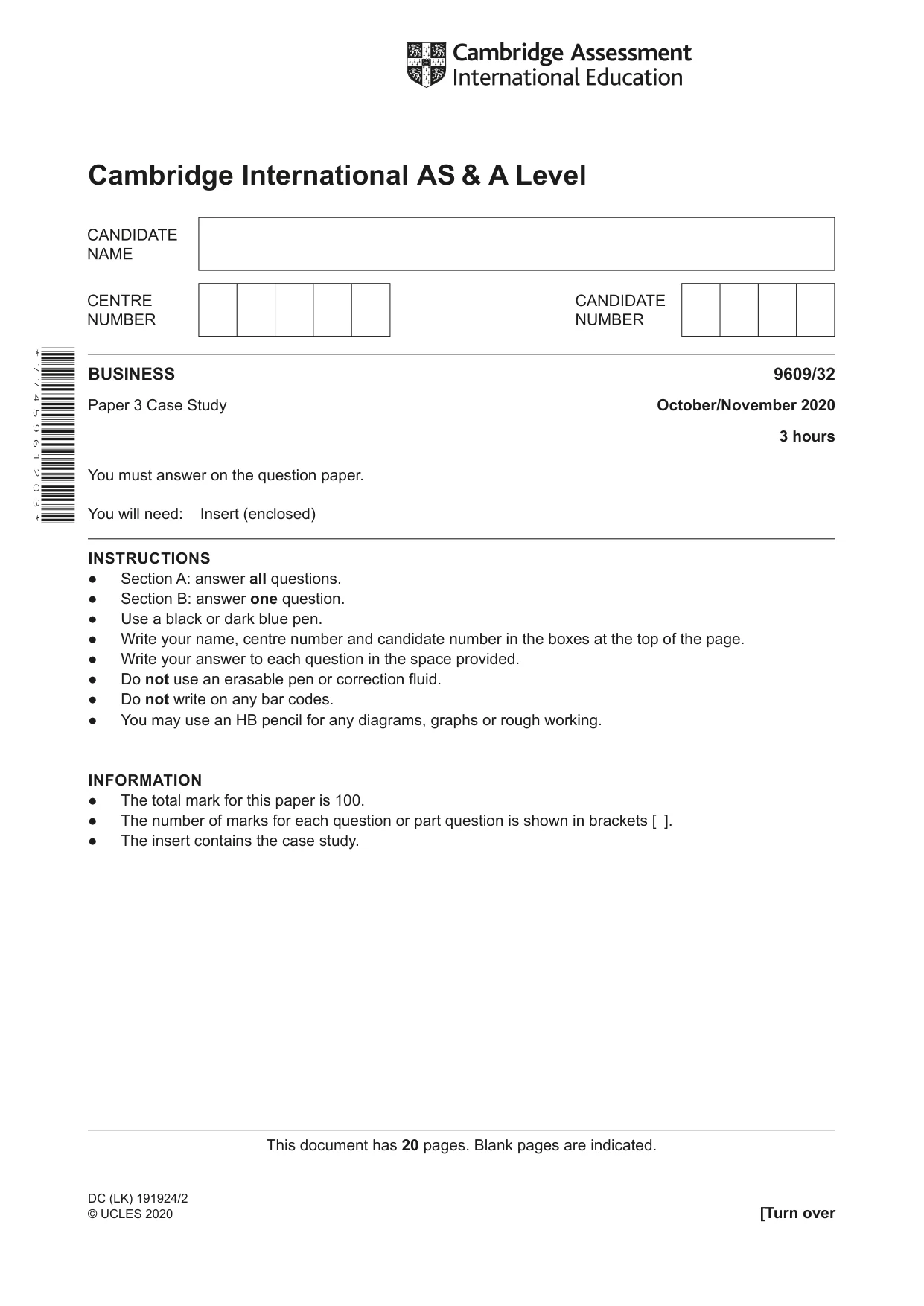
Question paper, page 1
Cambridge International AS & A Level BUSINESS 9609/32 Paper 3 Case Study October/November 2020 3 hours You must answer on the question paper. You will need: Insert (enclosed) INSTRUCTIONS ● Section A: answer all questions. ● Section B: answer one question. ● Use a black or dark blue pen. ● Write your name, centre number and candidate number in the boxes at the top of the page. ● Write your answer to each question in the space provided. ● Do not use an erasable pen or correction fluid. ● Do not write on any bar codes. ● You may use an HB pencil for any diagrams, graphs or rough working. INFORMATION ● The total mark for this paper is 100. ● The number of marks for each question or part question is shown in brackets [ ]. ● The insert contains the case study. This document has 20 pages. Blank pages are indicated. DC (LK) 191924/2 © UCLES 2020 [Turn over * 7 7 4 5 9 6 1 2 0 3 *
Question paper, page 2
2 9609/32/O/N/20 © UCLES 2020 Answer all questions in Section A and answer one question in Section B. You are advised to spend no more than 40 minutes on Section B. Section A Answer all questions in this section 1 Analyse how any two changes in the legal environment might affect GR. … … … … … … … … … … … … … … … … … … … … … … …
Question paper, page 3
3 9609/32/O/N/20 © UCLES 2020 [Turn over … … … … … … … … … … … … … … … … … … … … … … … … … … … … [10]
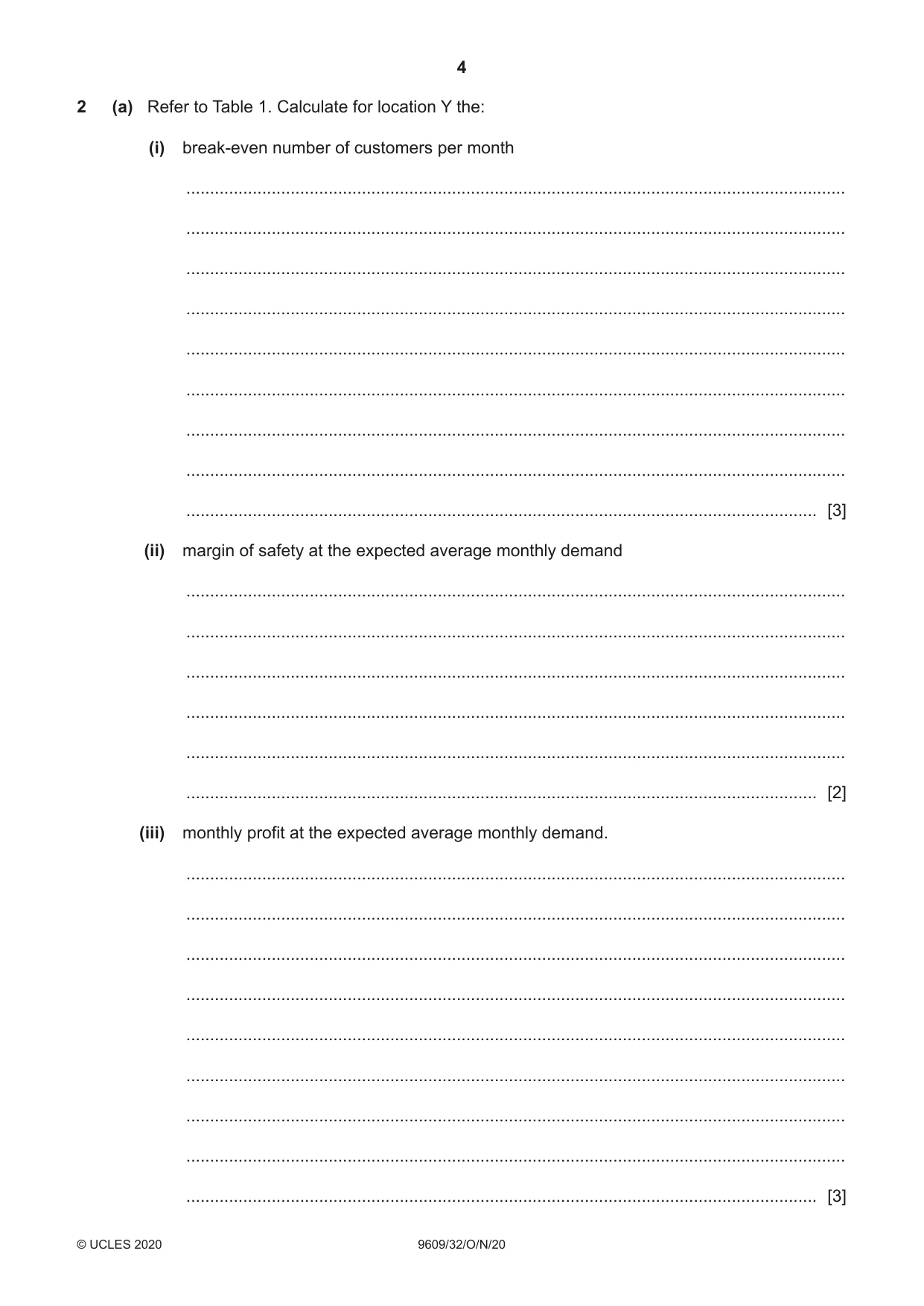
Question paper, page 4
4 9609/32/O/N/20 © UCLES 2020 2 (a) Refer to Table 1. Calculate for location Y the: (i) break-even number of customers per month … … … … … … … … … [3] (ii) margin of safety at the expected average monthly demand … … … … … … [2] (iii) monthly profit at the expected average monthly demand. … … … … … … … … … [3]
Question paper, page 5
5 9609/32/O/N/20 © UCLES 2020 [Turn over (b) Refer to your results from 2(a) and other information. Recommend to Leff which location to choose for the new restaurant. … … … … … … … … … … … … … … … … … … … … … … … … … … …
Question paper, page 6
6 9609/32/O/N/20 © UCLES 2020 … … … … … … … … … … … … … … … … … … … … … … … … … … … … [12]
Question paper, page 7
7 9609/32/O/N/20 © UCLES 2020 [Turn over 3 Discuss strategies for reducing human resource problems in GR’s restaurants without increasing unit costs. … … … … … … … … … … … … … … … … … … … … … … … … … … …
Question paper, page 8
8 9609/32/O/N/20 © UCLES 2020 … … … … … … … … … … … … … … … … … … … … … … … … … … … …
Question paper, page 9
9 9609/32/O/N/20 © UCLES 2020 [Turn over … … … … … … … … … … … … … … … … … … … … … … … … … … … … [16]
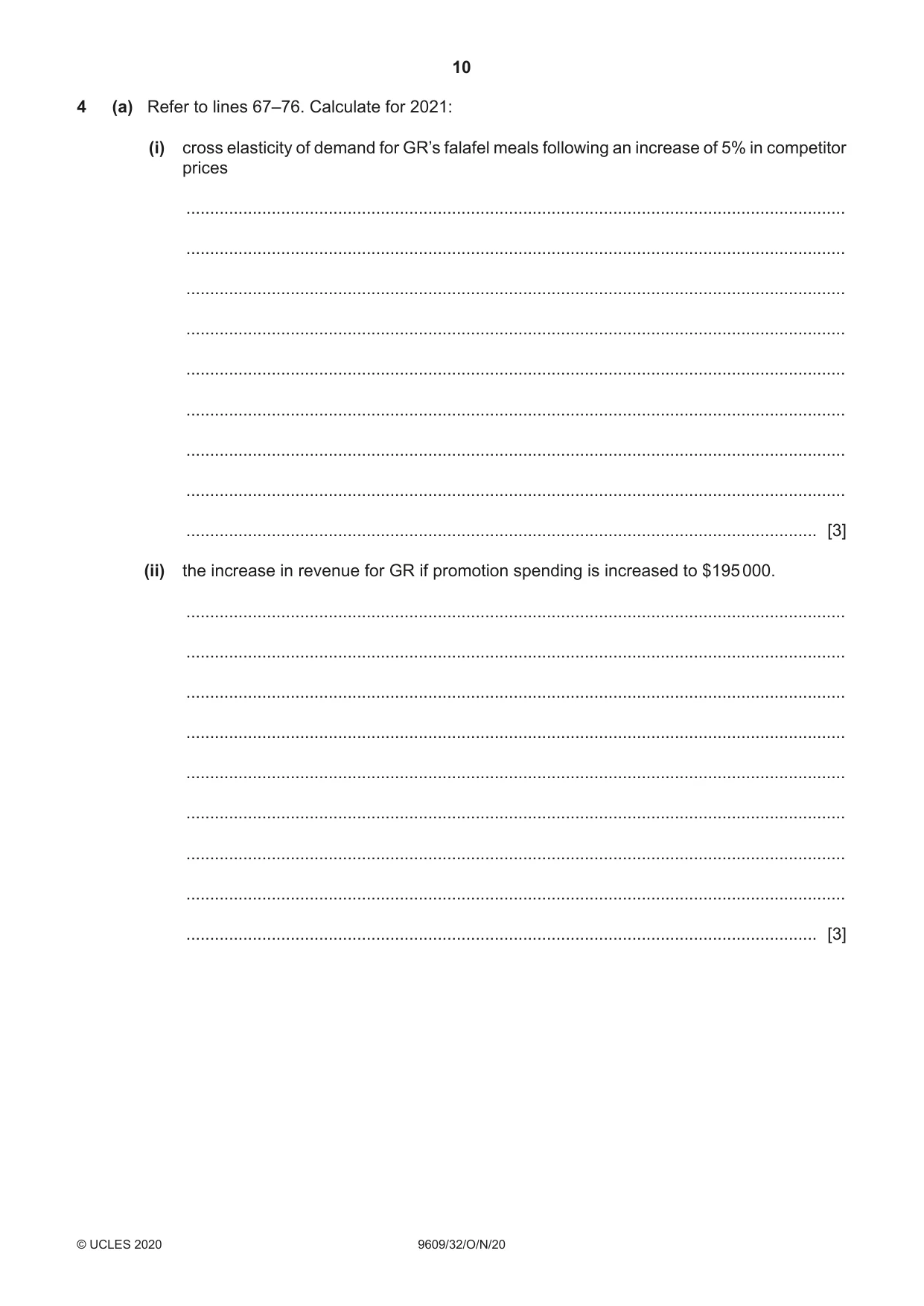
Question paper, page 10
10 9609/32/O/N/20 © UCLES 2020 4 (a) Refer to lines 67–76. Calculate for 2021: (i) cross elasticity of demand for GR’s falafel meals following an increase of 5% in competitor prices … … … … … … … … … [3] (ii) the increase in revenue for GR if promotion spending is increased to $195 000. … … … … … … … … … [3]
Question paper, page 11
11 9609/32/O/N/20 © UCLES 2020 [Turn over (b) Evaluate the usefulness of the elasticity concept to GR when planning its marketing strategy. … … … … … … … … … … … … … … … … … … … … … … … … … … …
Question paper, page 12
12 9609/32/O/N/20 © UCLES 2020 … … … … … … … … … … … … … … … … … … … … … … … … … … … … [12]
Question paper, page 13
13 9609/32/O/N/20 © UCLES 2020 [Turn over 5 Evaluate the benefits to GR of using budgets. … … … … … … … … … … … … … … … … … … … … … … … … … … …
Question paper, page 14
14 9609/32/O/N/20 © UCLES 2020 … … … … … … … … … … … … … … … … … … … … … … … … … … … …
Question paper, page 15
15 9609/32/O/N/20 © UCLES 2020 [Turn over … … … … … … … … … … … … … … … … … … … … … … … … … … … … [16]
Question paper, page 16
16 9609/32/O/N/20 © UCLES 2020 Section B Answer one question in this section 6 Evaluate the effectiveness of using SWOT analysis to ensure that GR’s growth strategies are appropriate. 7 Assume Leff chooses strategy 2. Evaluate how to implement this strategy effectively. Write the question number here: … … … … … … … … … … … … … … … … … … … … … … … …
Question paper, page 17
17 9609/32/O/N/20 © UCLES 2020 [Turn over … … … … … … … … … … … … … … … … … … … … … … … … … … … …
Question paper, page 18
18 9609/32/O/N/20 © UCLES 2020 … … … … … … … … … … … … … … … … … … … … … … … … … … … …
Question paper, page 19
19 9609/32/O/N/20 © UCLES 2020 … … … … … … … … … … … … … … … … … … … … … … … … … … … … [20]
Question paper, page 20
20 9609/32/O/N/20 © UCLES 2020 Permission to reproduce items where third-party owned material protected by copyright is included has been sought and cleared where possible. Every reasonable effort has been made by the publisher (UCLES) to trace copyright holders, but if any items requiring clearance have unwittingly been included, the publisher will be pleased to make amends at the earliest possible opportunity. To avoid the issue of disclosure of answer-related information to candidates, all copyright acknowledgements are reproduced online in the Cambridge Assessment International Education Copyright Acknowledgements Booklet. This is produced for each series of examinations and is freely available to download at www.cambridgeinternational.org after the live examination series. Cambridge Assessment International Education is part of the Cambridge Assessment Group. Cambridge Assessment is the brand name of the University of Cambridge Local Examinations Syndicate (UCLES), which itself is a department of the University of Cambridge. BLANK PAGE
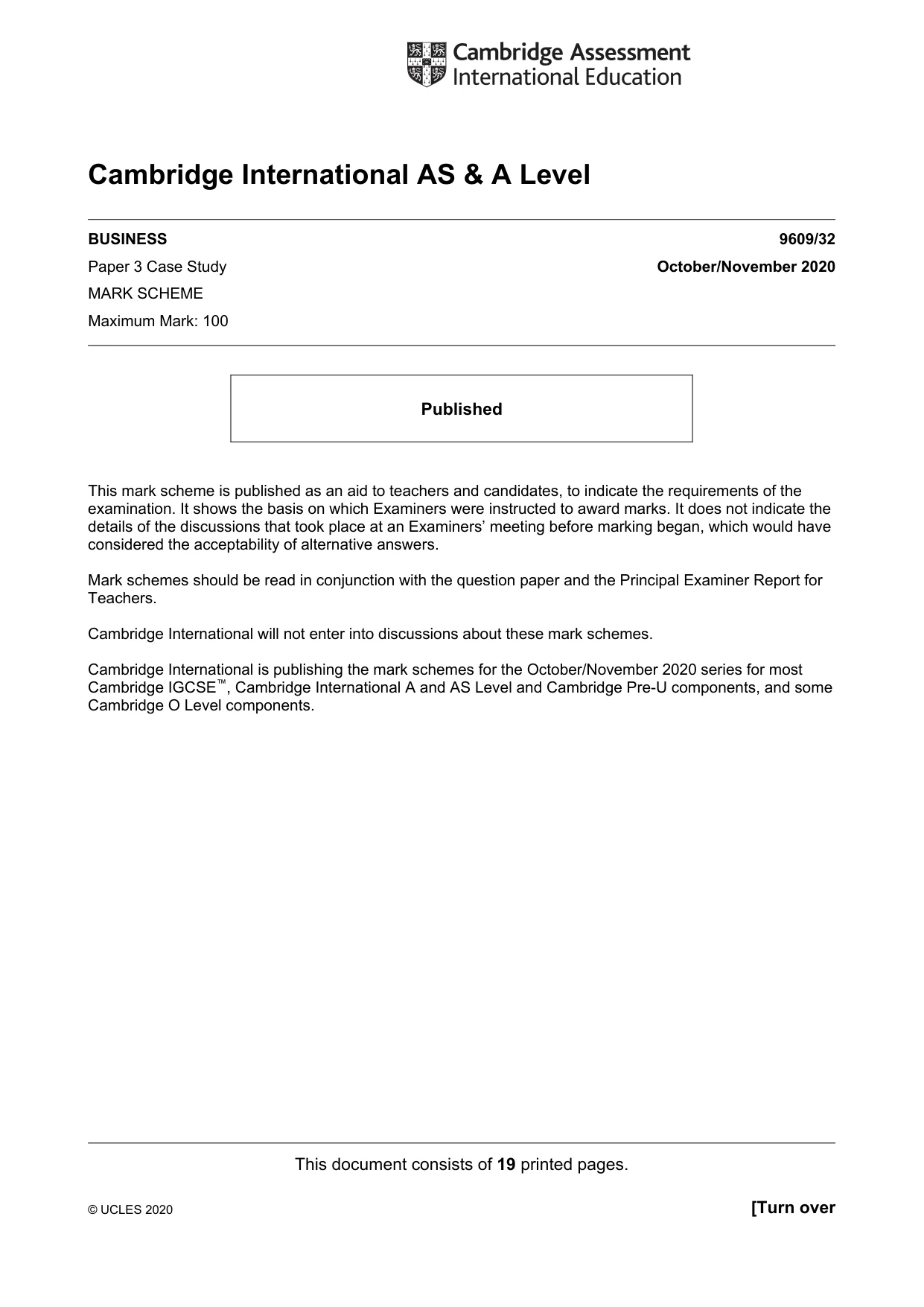
Mark scheme, page 1
This document consists of 19 printed pages. © UCLES 2020 [Turn over Cambridge International AS & A Level BUSINESS 9609/32 Paper 3 Case Study October/November 2020 MARK SCHEME Maximum Mark: 100 Published This mark scheme is published as an aid to teachers and candidates, to indicate the requirements of the examination. It shows the basis on which Examiners were instructed to award marks. It does not indicate the details of the discussions that took place at an Examiners’ meeting before marking began, which would have considered the acceptability of alternative answers. Mark schemes should be read in conjunction with the question paper and the Principal Examiner Report for Teachers. Cambridge International will not enter into discussions about these mark schemes. Cambridge International is publishing the mark schemes for the October/November 2020 series for most Cambridge IGCSE™, Cambridge International A and AS Level and Cambridge Pre-U components, and some Cambridge O Level components.
Mark scheme, page 2
9609/32 Cambridge International AS & A Level – Mark Scheme PUBLISHED October/November 2020 © UCLES 2020 Page 2 of 19 Generic Marking Principles These general marking principles must be applied by all examiners when marking candidate answers. They should be applied alongside the specific content of the mark scheme or generic level descriptors for a question. Each question paper and mark scheme will also comply with these marking principles. GENERIC MARKING PRINCIPLE 1: Marks must be awarded in line with: • the specific content of the mark scheme or the generic level descriptors for the question • the specific skills defined in the mark scheme or in the generic level descriptors for the question • the standard of response required by a candidate as exemplified by the standardisation scripts. GENERIC MARKING PRINCIPLE 2: Marks awarded are always whole marks (not half marks, or other fractions). GENERIC MARKING PRINCIPLE 3: Marks must be awarded positively: • marks are awarded for correct/valid answers, as defined in the mark scheme. However, credit is given for valid answers which go beyond the scope of the syllabus and mark scheme, referring to your Team Leader as appropriate • marks are awarded when candidates clearly demonstrate what they know and can do • marks are not deducted for errors • marks are not deducted for omissions • answers should only be judged on the quality of spelling, punctuation and grammar when these features are specifically assessed by the question as indicated by the mark scheme. The meaning, however, should be unambiguous. GENERIC MARKING PRINCIPLE 4: Rules must be applied consistently, e.g. in situations where candidates have not followed instructions or in the application of generic level descriptors. GENERIC MARKING PRINCIPLE 5: Marks should be awarded using the full range of marks defined in the mark scheme for the question (however; the use of the full mark range may be limited according to the quality of the candidate responses seen). GENERIC MARKING PRINCIPLE 6: Marks awarded are based solely on the requirements as defined in the mark scheme. Marks should not be awarded with grade thresholds or grade descriptors in mind.
Mark scheme, page 3
9609/32 Cambridge International AS & A Level – Mark Scheme PUBLISHED October/November 2020 © UCLES 2020 Page 3 of 19 General Marking Guidance This mark scheme includes a summary of appropriate content for answering each question. It should be emphasised, however, that this material is for illustrative purposes and is not intended to provide a definitive guide to acceptable answers. It is quite possible that among the scripts there will be some candidate answers that are not covered directly by the content of this mark scheme. In such cases, professional judgement should be exercised in assessing the merits of the answer and the senior examiners should be consulted if further guidance is required. Application marks are not awarded for repeating material from the case study. Application is awarded for answering in the context of the case or by using the information in the case to help answer the question.
Mark scheme, page 4
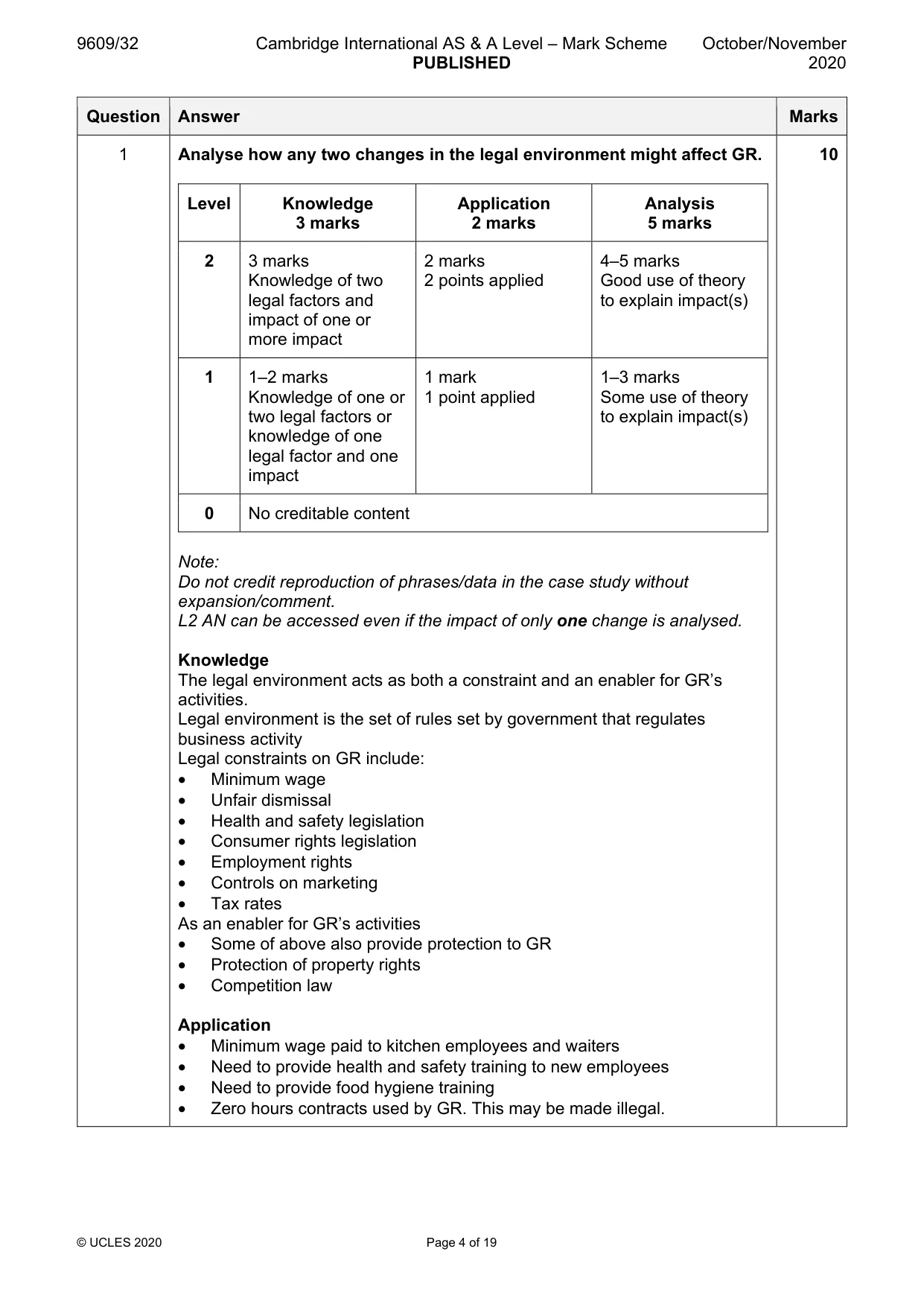
9609/32 Cambridge International AS & A Level – Mark Scheme PUBLISHED October/November 2020 © UCLES 2020 Page 4 of 19 Question Answer Marks 1 Analyse how any two changes in the legal environment might affect GR. Level Knowledge 3 marks Application 2 marks Analysis 5 marks 2 3 marks Knowledge of two legal factors and impact of one or more impact 2 marks 2 points applied 4–5 marks Good use of theory to explain impact(s) 1 1–2 marks Knowledge of one or two legal factors or knowledge of one legal factor and one impact 1 mark 1 point applied 1–3 marks Some use of theory to explain impact(s) 0 No creditable content Note: Do not credit reproduction of phrases/data in the case study without expansion/comment. L2 AN can be accessed even if the impact of only one change is analysed. Knowledge The legal environment acts as both a constraint and an enabler for GR’s activities. Legal environment is the set of rules set by government that regulates business activity Legal constraints on GR include: • Minimum wage • Unfair dismissal • Health and safety legislation • Consumer rights legislation • Employment rights • Controls on marketing • Tax rates As an enabler for GR’s activities • Some of above also provide protection to GR • Protection of property rights • Competition law Application • Minimum wage paid to kitchen employees and waiters • Need to provide health and safety training to new employees • Need to provide food hygiene training • Zero hours contracts used by GR. This may be made illegal. 10
Mark scheme, page 5
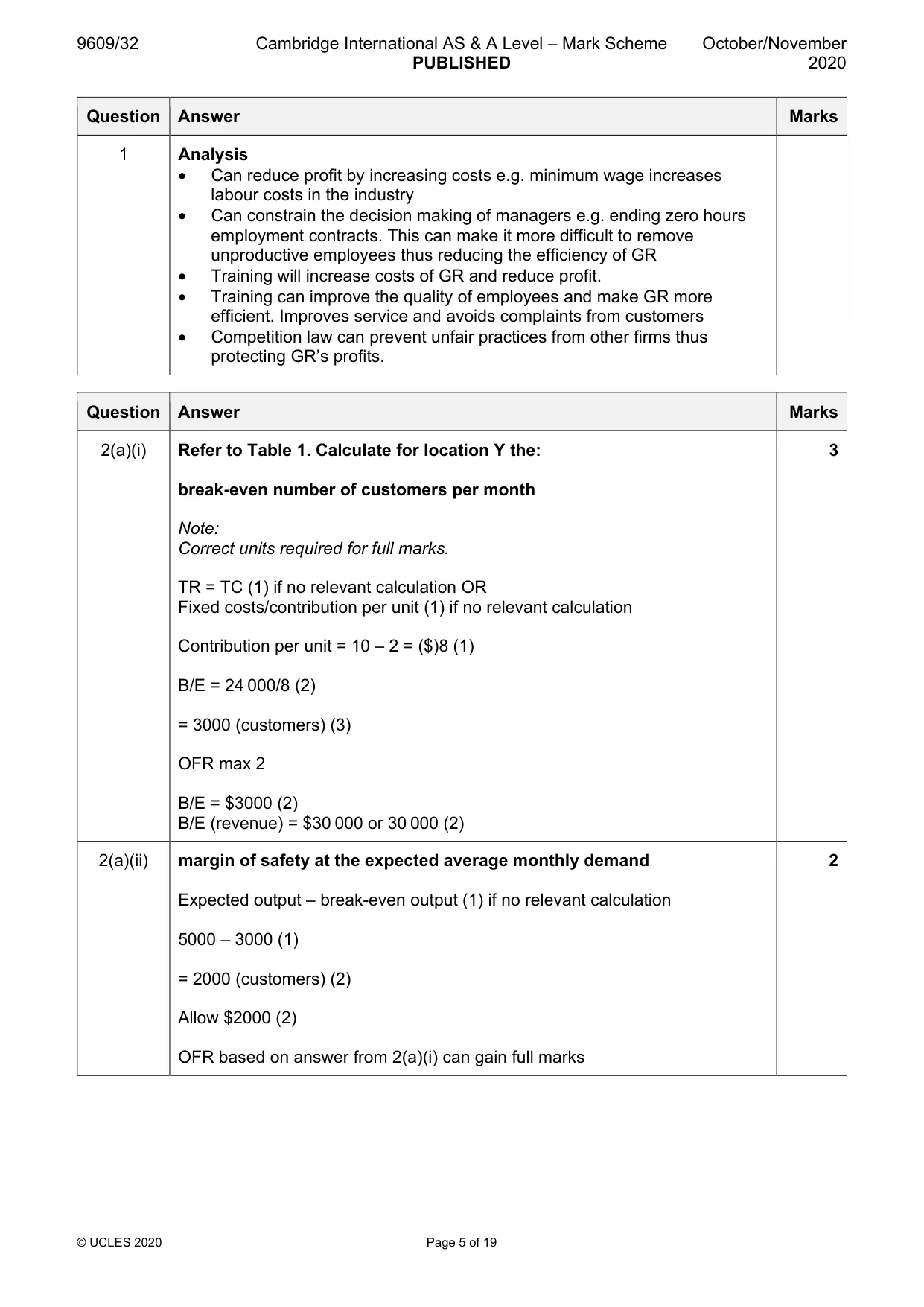
9609/32 Cambridge International AS & A Level – Mark Scheme PUBLISHED October/November 2020 © UCLES 2020 Page 5 of 19 Question Answer Marks 1 Analysis • Can reduce profit by increasing costs e.g. minimum wage increases labour costs in the industry • Can constrain the decision making of managers e.g. ending zero hours employment contracts. This can make it more difficult to remove unproductive employees thus reducing the efficiency of GR • Training will increase costs of GR and reduce profit. • Training can improve the quality of employees and make GR more efficient. Improves service and avoids complaints from customers • Competition law can prevent unfair practices from other firms thus protecting GR’s profits. Question Answer Marks 2(a)(i) Refer to Table 1. Calculate for location Y the: break-even number of customers per month Note: Correct units required for full marks. TR = TC (1) if no relevant calculation OR Fixed costs/contribution per unit (1) if no relevant calculation Contribution per unit = 10 – 2 = ($)8 (1) B/E = 24 000/8 (2) = 3000 (customers) (3) OFR max 2 B/E = $3000 (2) B/E (revenue) = $30 000 or 30 000 (2) 3 2(a)(ii) margin of safety at the expected average monthly demand Expected output – break-even output (1) if no relevant calculation 5000 – 3000 (1) = 2000 (customers) (2) Allow $2000 (2) OFR based on answer from 2(a)(i) can gain full marks 2
Mark scheme, page 6
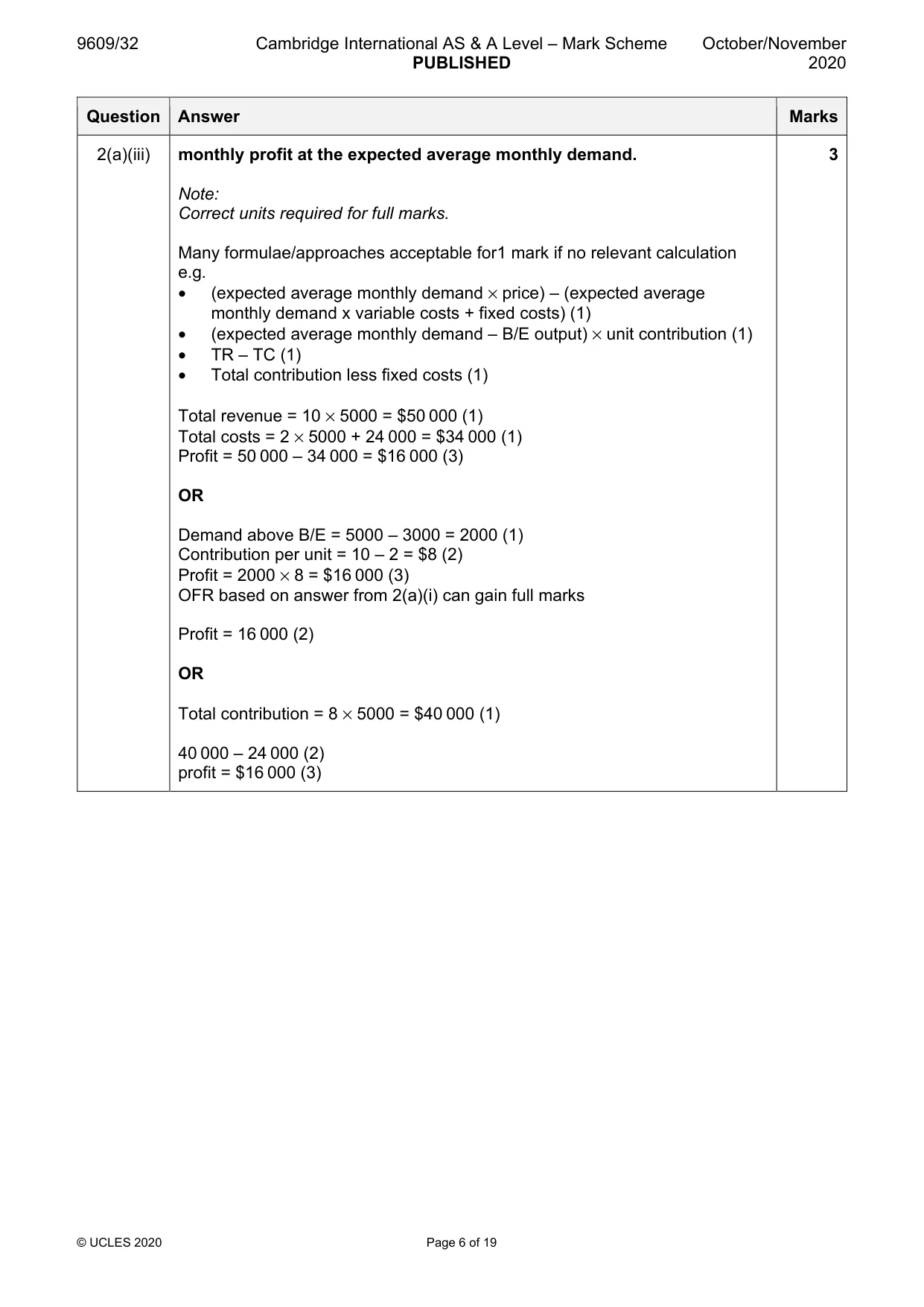
9609/32 Cambridge International AS & A Level – Mark Scheme PUBLISHED October/November 2020 © UCLES 2020 Page 6 of 19 Question Answer Marks 2(a)(iii) monthly profit at the expected average monthly demand. Note: Correct units required for full marks. Many formulae/approaches acceptable for1 mark if no relevant calculation e.g. • (expected average monthly demand × price) – (expected average monthly demand x variable costs + fixed costs) (1) • (expected average monthly demand – B/E output) × unit contribution (1) • TR – TC (1) • Total contribution less fixed costs (1) Total revenue = 10 × 5000 = $50 000 (1) Total costs = 2 × 5000 + 24 000 = $34 000 (1) Profit = 50 000 – 34 000 = $16 000 (3) OR Demand above B/E = 5000 – 3000 = 2000 (1) Contribution per unit = 10 – 2 = $8 (2) Profit = 2000 × 8 = $16 000 (3) OFR based on answer from 2(a)(i) can gain full marks Profit = 16 000 (2) OR Total contribution = 8 × 5000 = $40 000 (1) 40 000 – 24 000 (2) profit = $16 000 (3) 3
Mark scheme, page 7
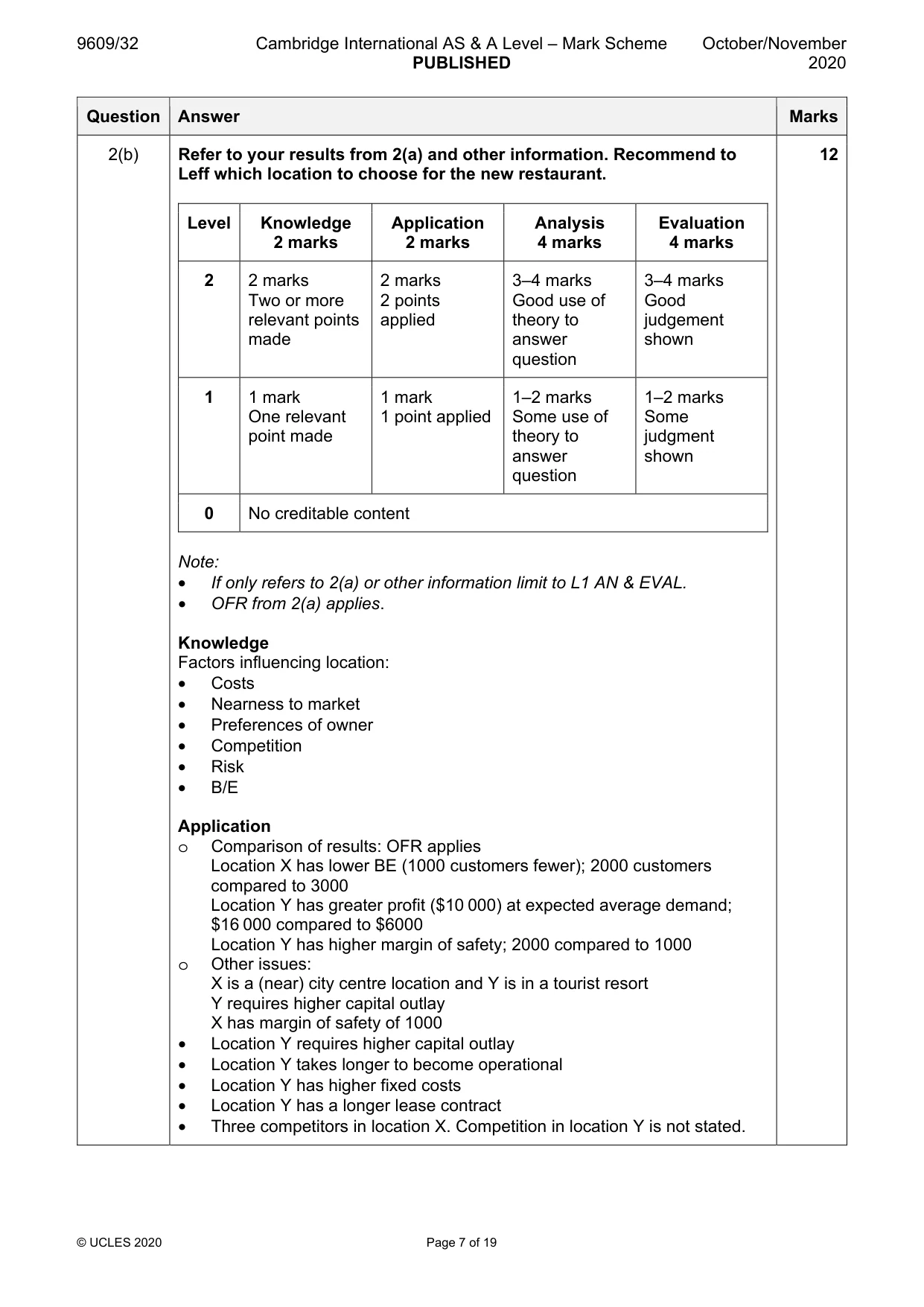
9609/32 Cambridge International AS & A Level – Mark Scheme PUBLISHED October/November 2020 © UCLES 2020 Page 7 of 19 Question Answer Marks 2(b) Refer to your results from 2(a) and other information. Recommend to Leff which location to choose for the new restaurant. Level Knowledge 2 marks Application 2 marks Analysis 4 marks Evaluation 4 marks 2 2 marks Two or more relevant points made 2 marks 2 points applied 3–4 marks Good use of theory to answer question 3–4 marks Good judgement shown 1 1 mark One relevant point made 1 mark 1 point applied 1–2 marks Some use of theory to answer question 1–2 marks Some judgment shown 0 No creditable content Note: • If only refers to 2(a) or other information limit to L1 AN & EVAL. • OFR from 2(a) applies. Knowledge Factors influencing location: • Costs • Nearness to market • Preferences of owner • Competition • Risk • B/E Application o Comparison of results: OFR applies Location X has lower BE (1000 customers fewer); 2000 customers compared to 3000 Location Y has greater profit ($10 000) at expected average demand; $16 000 compared to $6000 Location Y has higher margin of safety; 2000 compared to 1000 o Other issues: X is a (near) city centre location and Y is in a tourist resort Y requires higher capital outlay X has margin of safety of 1000 • Location Y requires higher capital outlay • Location Y takes longer to become operational • Location Y has higher fixed costs • Location Y has a longer lease contract • Three competitors in location X. Competition in location Y is not stated. 12
Mark scheme, page 8
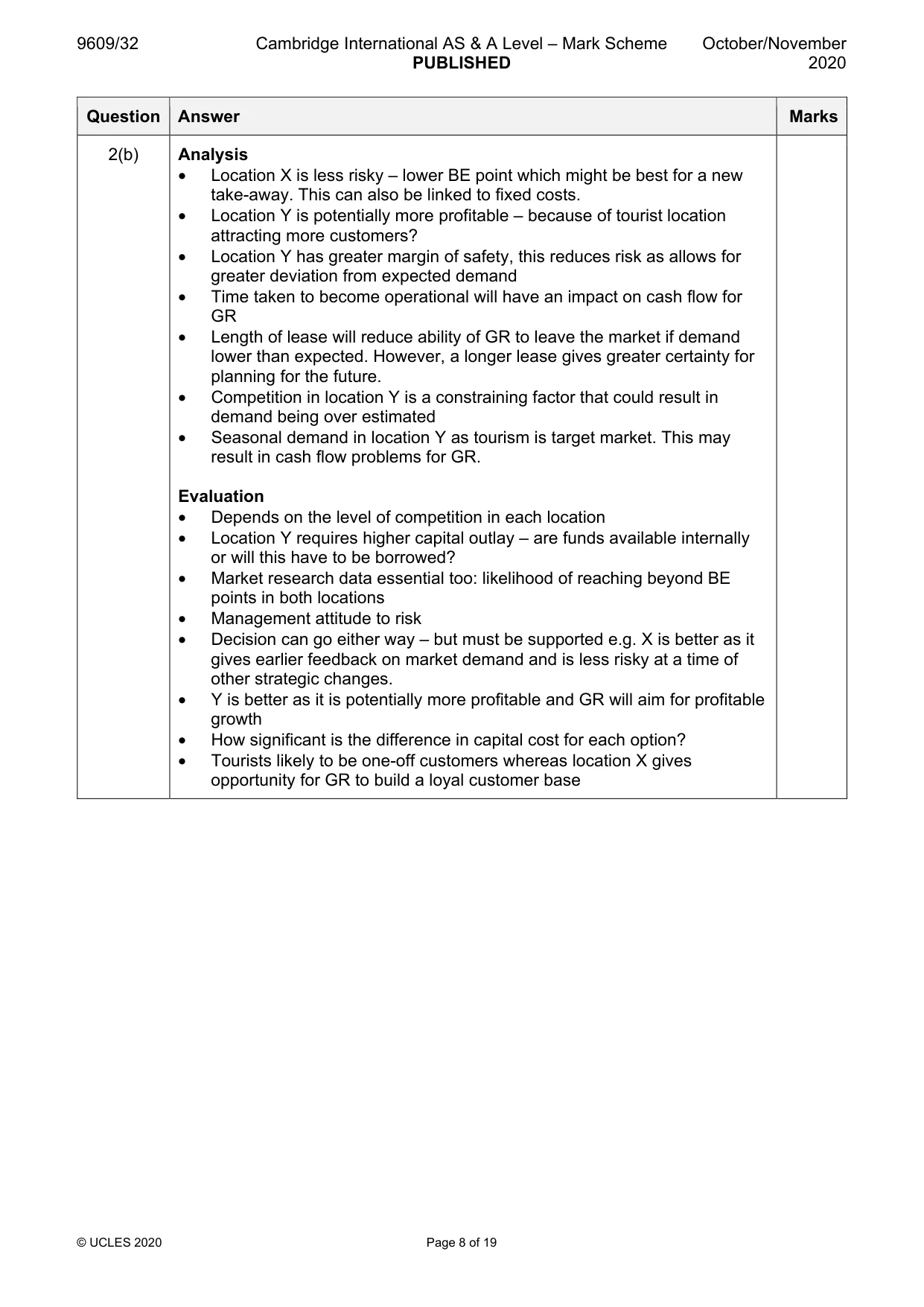
9609/32 Cambridge International AS & A Level – Mark Scheme PUBLISHED October/November 2020 © UCLES 2020 Page 8 of 19 Question Answer Marks 2(b) Analysis • Location X is less risky – lower BE point which might be best for a new take-away. This can also be linked to fixed costs. • Location Y is potentially more profitable – because of tourist location attracting more customers? • Location Y has greater margin of safety, this reduces risk as allows for greater deviation from expected demand • Time taken to become operational will have an impact on cash flow for GR • Length of lease will reduce ability of GR to leave the market if demand lower than expected. However, a longer lease gives greater certainty for planning for the future. • Competition in location Y is a constraining factor that could result in demand being over estimated • Seasonal demand in location Y as tourism is target market. This may result in cash flow problems for GR. Evaluation • Depends on the level of competition in each location • Location Y requires higher capital outlay – are funds available internally or will this have to be borrowed? • Market research data essential too: likelihood of reaching beyond BE points in both locations • Management attitude to risk • Decision can go either way – but must be supported e.g. X is better as it gives earlier feedback on market demand and is less risky at a time of other strategic changes. • Y is better as it is potentially more profitable and GR will aim for profitable growth • How significant is the difference in capital cost for each option? • Tourists likely to be one-off customers whereas location X gives opportunity for GR to build a loyal customer base
Mark scheme, page 9
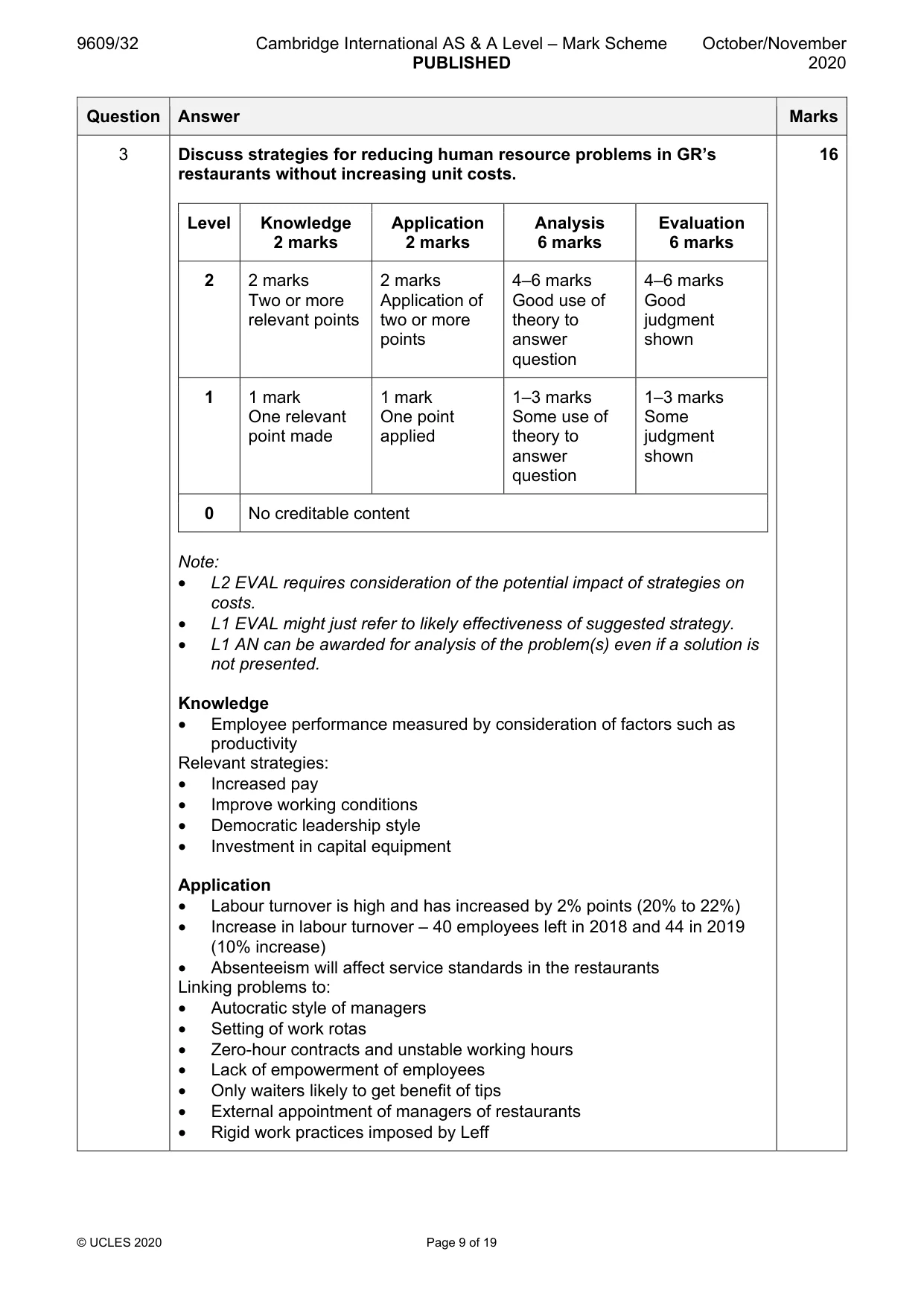
9609/32 Cambridge International AS & A Level – Mark Scheme PUBLISHED October/November 2020 © UCLES 2020 Page 9 of 19 Question Answer Marks 3 Discuss strategies for reducing human resource problems in GR’s restaurants without increasing unit costs. Level Knowledge 2 marks Application 2 marks Analysis 6 marks Evaluation 6 marks 2 2 marks Two or more relevant points 2 marks Application of two or more points 4–6 marks Good use of theory to answer question 4–6 marks Good judgment shown 1 1 mark One relevant point made 1 mark One point applied 1–3 marks Some use of theory to answer question 1–3 marks Some judgment shown 0 No creditable content Note: • L2 EVAL requires consideration of the potential impact of strategies on costs. • L1 EVAL might just refer to likely effectiveness of suggested strategy. • L1 AN can be awarded for analysis of the problem(s) even if a solution is not presented. Knowledge • Employee performance measured by consideration of factors such as productivity Relevant strategies: • Increased pay • Improve working conditions • Democratic leadership style • Investment in capital equipment Application • Labour turnover is high and has increased by 2% points (20% to 22%) • Increase in labour turnover – 40 employees left in 2018 and 44 in 2019 (10% increase) • Absenteeism will affect service standards in the restaurants Linking problems to: • Autocratic style of managers • Setting of work rotas • Zero-hour contracts and unstable working hours • Lack of empowerment of employees • Only waiters likely to get benefit of tips • External appointment of managers of restaurants • Rigid work practices imposed by Leff 16
Mark scheme, page 10
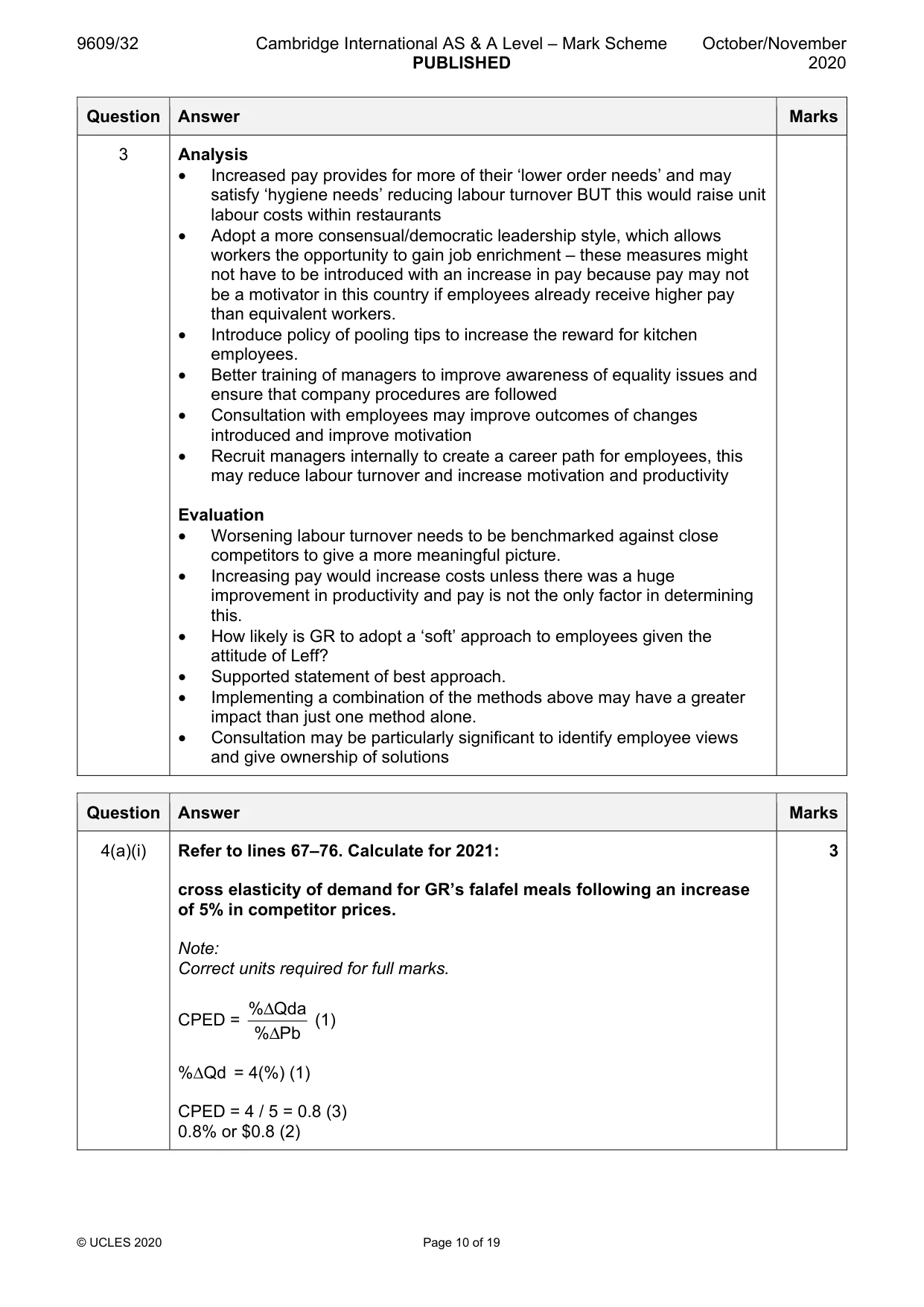
9609/32 Cambridge International AS & A Level – Mark Scheme PUBLISHED October/November 2020 © UCLES 2020 Page 10 of 19 Question Answer Marks 3 Analysis • Increased pay provides for more of their ‘lower order needs’ and may satisfy ‘hygiene needs’ reducing labour turnover BUT this would raise unit labour costs within restaurants • Adopt a more consensual/democratic leadership style, which allows workers the opportunity to gain job enrichment – these measures might not have to be introduced with an increase in pay because pay may not be a motivator in this country if employees already receive higher pay than equivalent workers. • Introduce policy of pooling tips to increase the reward for kitchen employees. • Better training of managers to improve awareness of equality issues and ensure that company procedures are followed • Consultation with employees may improve outcomes of changes introduced and improve motivation • Recruit managers internally to create a career path for employees, this may reduce labour turnover and increase motivation and productivity Evaluation • Worsening labour turnover needs to be benchmarked against close competitors to give a more meaningful picture. • Increasing pay would increase costs unless there was a huge improvement in productivity and pay is not the only factor in determining this. • How likely is GR to adopt a ‘soft’ approach to employees given the attitude of Leff? • Supported statement of best approach. • Implementing a combination of the methods above may have a greater impact than just one method alone. • Consultation may be particularly significant to identify employee views and give ownership of solutions Question Answer Marks 4(a)(i) Refer to lines 67–76. Calculate for 2021: cross elasticity of demand for GR’s falafel meals following an increase of 5% in competitor prices. Note: Correct units required for full marks. CPED = % Qda % Pb Δ Δ (1) %∆Qd = 4(%) (1) CPED = 4 / 5 = 0.8 (3) 0.8% or $0.8 (2) 3
Mark scheme, page 11
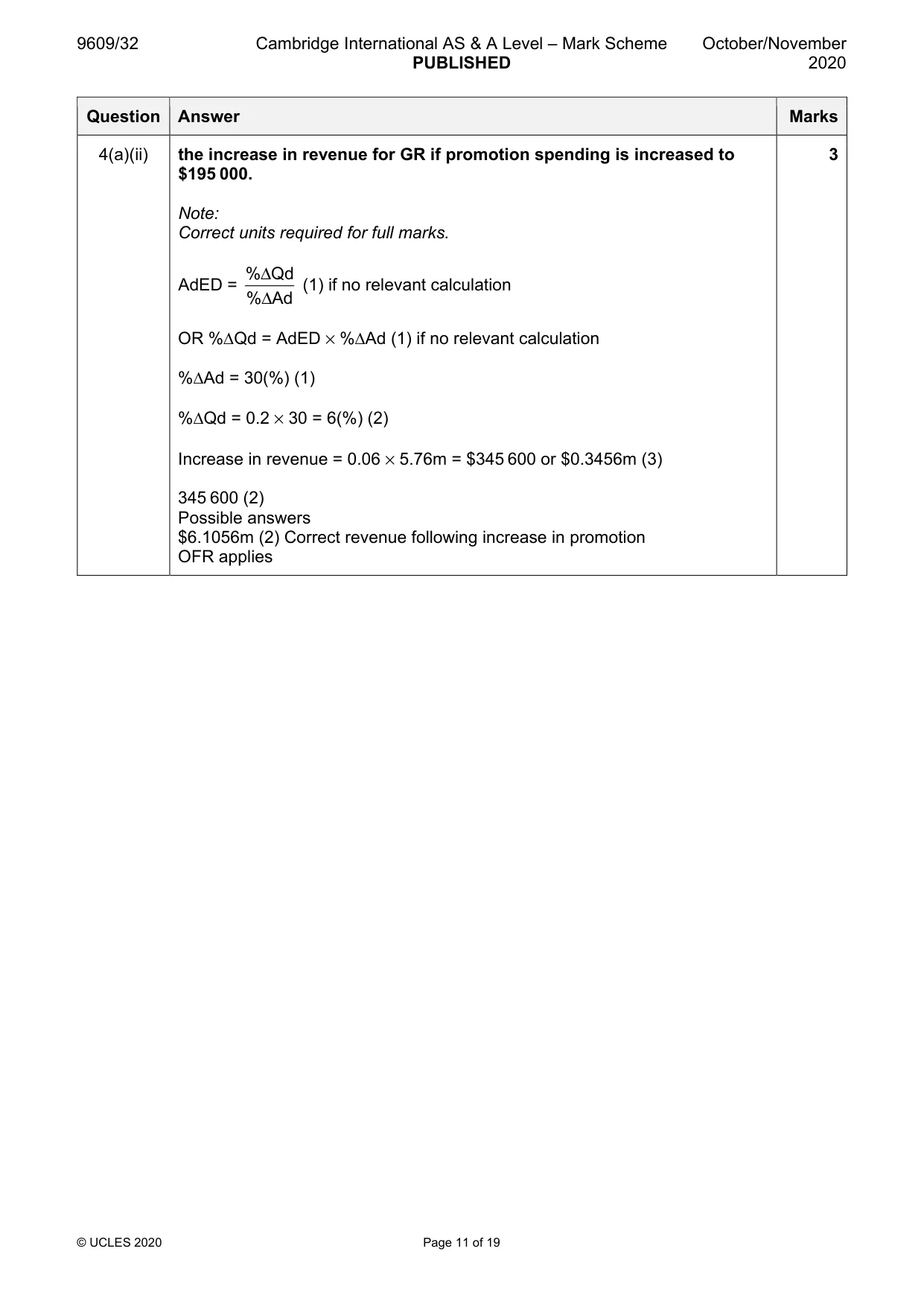
9609/32 Cambridge International AS & A Level – Mark Scheme PUBLISHED October/November 2020 © UCLES 2020 Page 11 of 19 Question Answer Marks 4(a)(ii) the increase in revenue for GR if promotion spending is increased to $195 000. Note: Correct units required for full marks. AdED = % Qd % Ad Δ Δ (1) if no relevant calculation OR %∆Qd = AdED × %∆Ad (1) if no relevant calculation %∆Ad = 30(%) (1) %∆Qd = 0.2 × 30 = 6(%) (2) Increase in revenue = 0.06 × 5.76m = $345 600 or $0.3456m (3) 345 600 (2) Possible answers $6.1056m (2) Correct revenue following increase in promotion OFR applies 3
Mark scheme, page 12
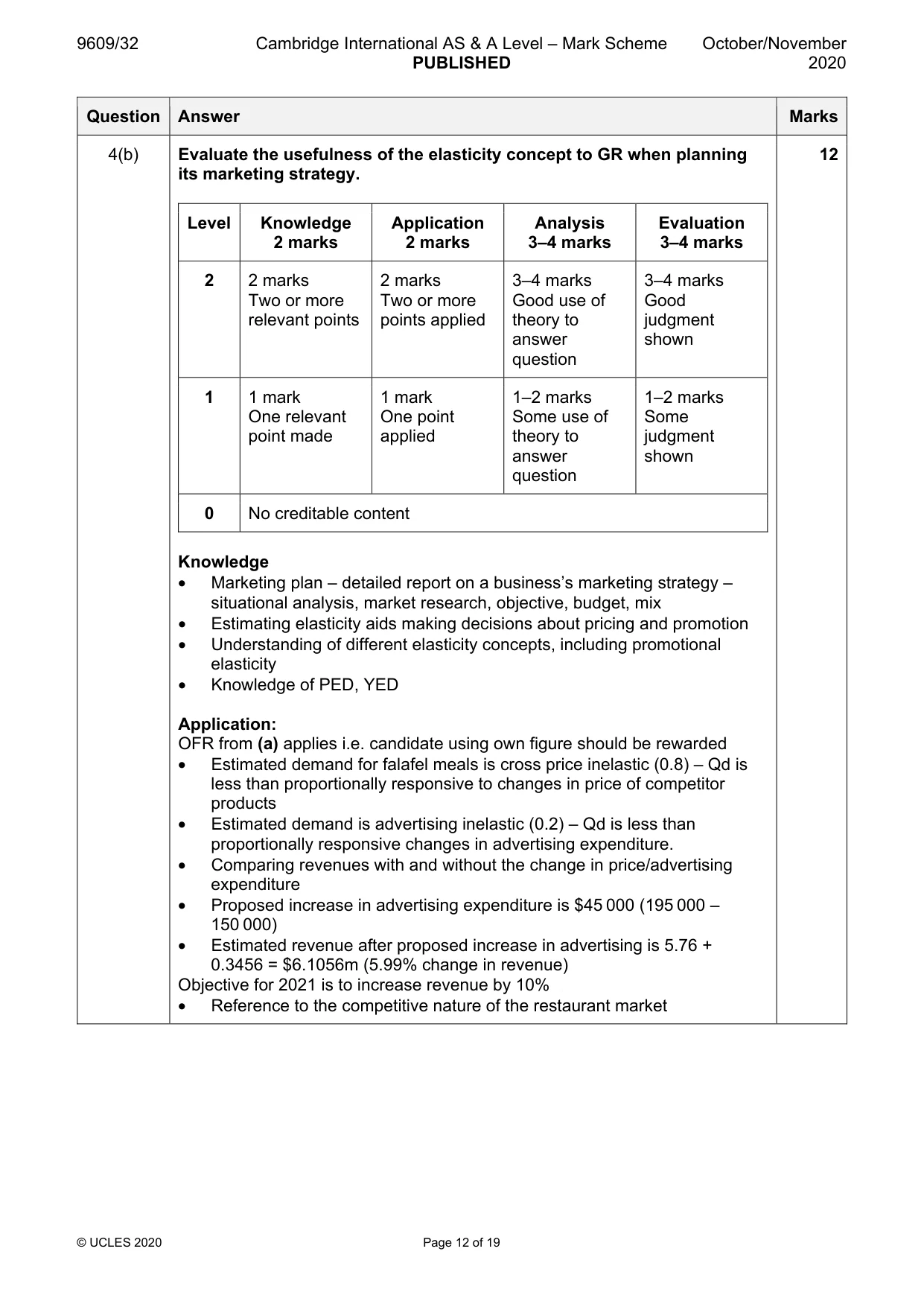
9609/32 Cambridge International AS & A Level – Mark Scheme PUBLISHED October/November 2020 © UCLES 2020 Page 12 of 19 Question Answer Marks 4(b) Evaluate the usefulness of the elasticity concept to GR when planning its marketing strategy. Level Knowledge 2 marks Application 2 marks Analysis 3–4 marks Evaluation 3–4 marks 2 2 marks Two or more relevant points 2 marks Two or more points applied 3–4 marks Good use of theory to answer question 3–4 marks Good judgment shown 1 1 mark One relevant point made 1 mark One point applied 1–2 marks Some use of theory to answer question 1–2 marks Some judgment shown 0 No creditable content Knowledge • Marketing plan – detailed report on a business’s marketing strategy – situational analysis, market research, objective, budget, mix • Estimating elasticity aids making decisions about pricing and promotion • Understanding of different elasticity concepts, including promotional elasticity • Knowledge of PED, YED Application: OFR from (a) applies i.e. candidate using own figure should be rewarded • Estimated demand for falafel meals is cross price inelastic (0.8) – Qd is less than proportionally responsive to changes in price of competitor products • Estimated demand is advertising inelastic (0.2) – Qd is less than proportionally responsive changes in advertising expenditure. • Comparing revenues with and without the change in price/advertising expenditure • Proposed increase in advertising expenditure is $45 000 (195 000 – 150 000) • Estimated revenue after proposed increase in advertising is 5.76 + 0.3456 = $6.1056m (5.99% change in revenue) Objective for 2021 is to increase revenue by 10% • Reference to the competitive nature of the restaurant market 12
Mark scheme, page 13
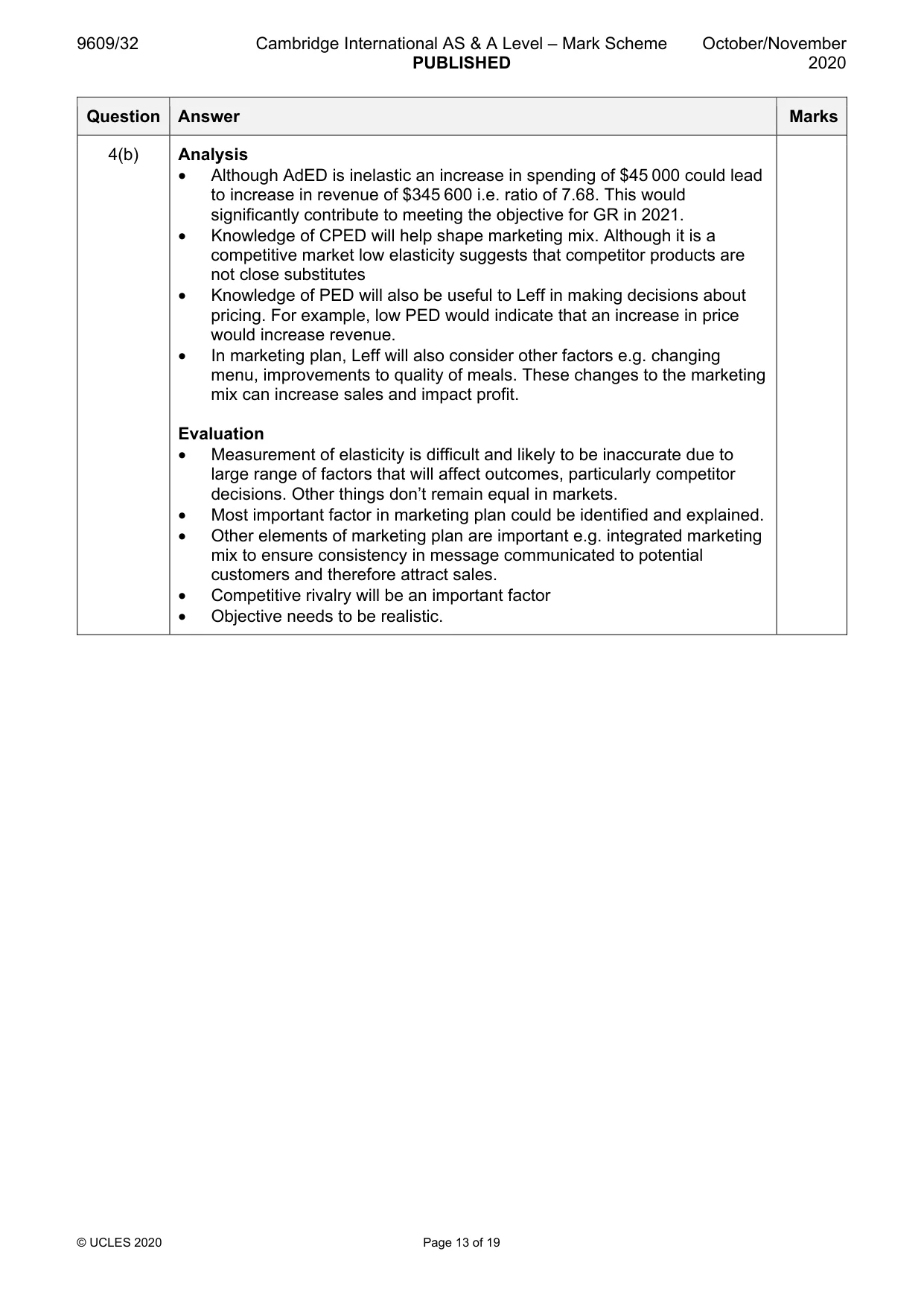
9609/32 Cambridge International AS & A Level – Mark Scheme PUBLISHED October/November 2020 © UCLES 2020 Page 13 of 19 Question Answer Marks 4(b) Analysis • Although AdED is inelastic an increase in spending of $45 000 could lead to increase in revenue of $345 600 i.e. ratio of 7.68. This would significantly contribute to meeting the objective for GR in 2021. • Knowledge of CPED will help shape marketing mix. Although it is a competitive market low elasticity suggests that competitor products are not close substitutes • Knowledge of PED will also be useful to Leff in making decisions about pricing. For example, low PED would indicate that an increase in price would increase revenue. • In marketing plan, Leff will also consider other factors e.g. changing menu, improvements to quality of meals. These changes to the marketing mix can increase sales and impact profit. Evaluation • Measurement of elasticity is difficult and likely to be inaccurate due to large range of factors that will affect outcomes, particularly competitor decisions. Other things don’t remain equal in markets. • Most important factor in marketing plan could be identified and explained. • Other elements of marketing plan are important e.g. integrated marketing mix to ensure consistency in message communicated to potential customers and therefore attract sales. • Competitive rivalry will be an important factor • Objective needs to be realistic.
Mark scheme, page 14
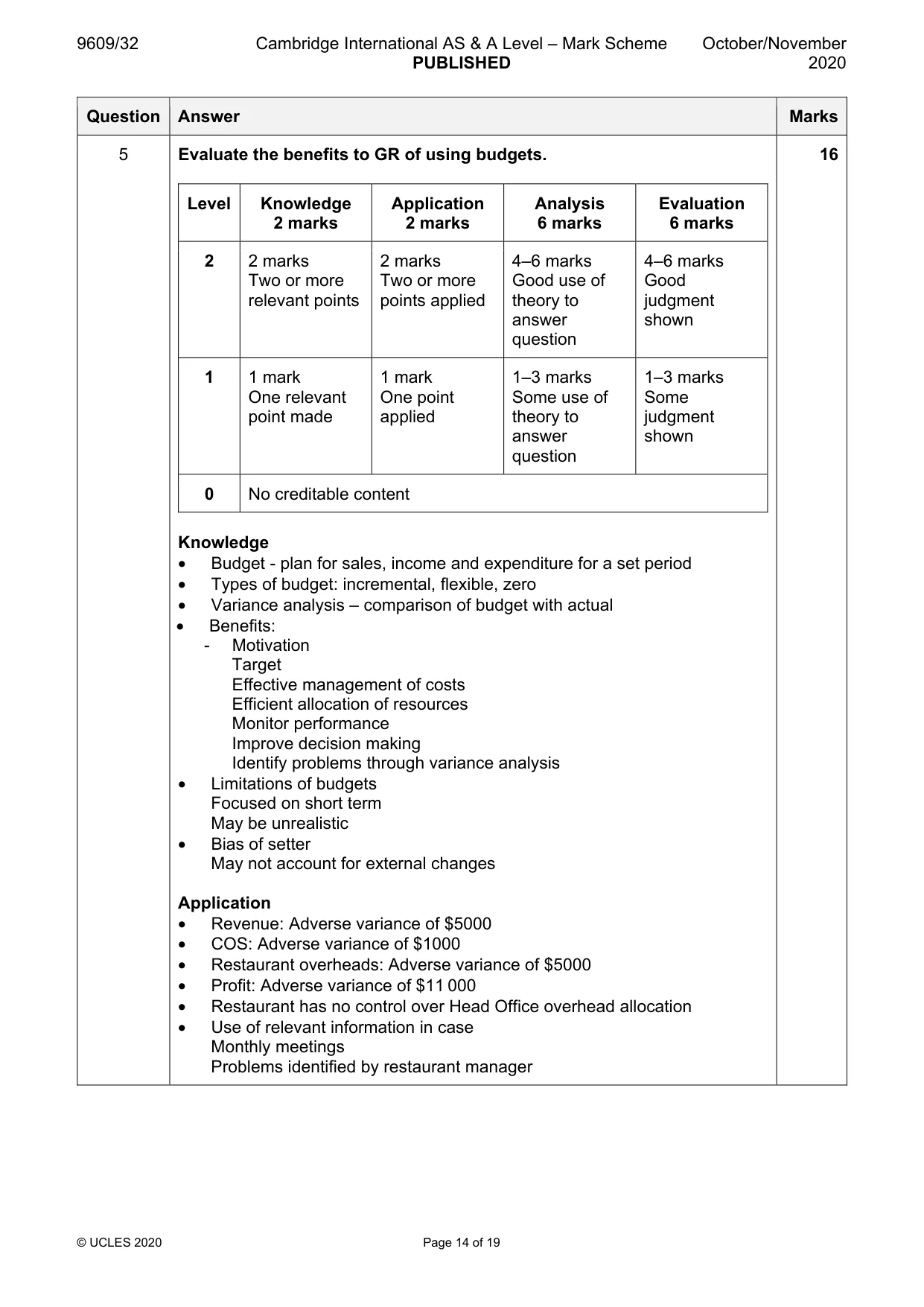
9609/32 Cambridge International AS & A Level – Mark Scheme PUBLISHED October/November 2020 © UCLES 2020 Page 14 of 19 Question Answer Marks 5 Evaluate the benefits to GR of using budgets. Level Knowledge 2 marks Application 2 marks Analysis 6 marks Evaluation 6 marks 2 2 marks Two or more relevant points 2 marks Two or more points applied 4–6 marks Good use of theory to answer question 4–6 marks Good judgment shown 1 1 mark One relevant point made 1 mark One point applied 1–3 marks Some use of theory to answer question 1–3 marks Some judgment shown 0 No creditable content Knowledge • Budget - plan for sales, income and expenditure for a set period • Types of budget: incremental, flexible, zero • Variance analysis – comparison of budget with actual • Benefits: - Motivation Target Effective management of costs Efficient allocation of resources Monitor performance Improve decision making Identify problems through variance analysis • Limitations of budgets Focused on short term May be unrealistic • Bias of setter May not account for external changes Application • Revenue: Adverse variance of $5000 • COS: Adverse variance of $1000 • Restaurant overheads: Adverse variance of $5000 • Profit: Adverse variance of $11 000 • Restaurant has no control over Head Office overhead allocation • Use of relevant information in case Monthly meetings Problems identified by restaurant manager 16
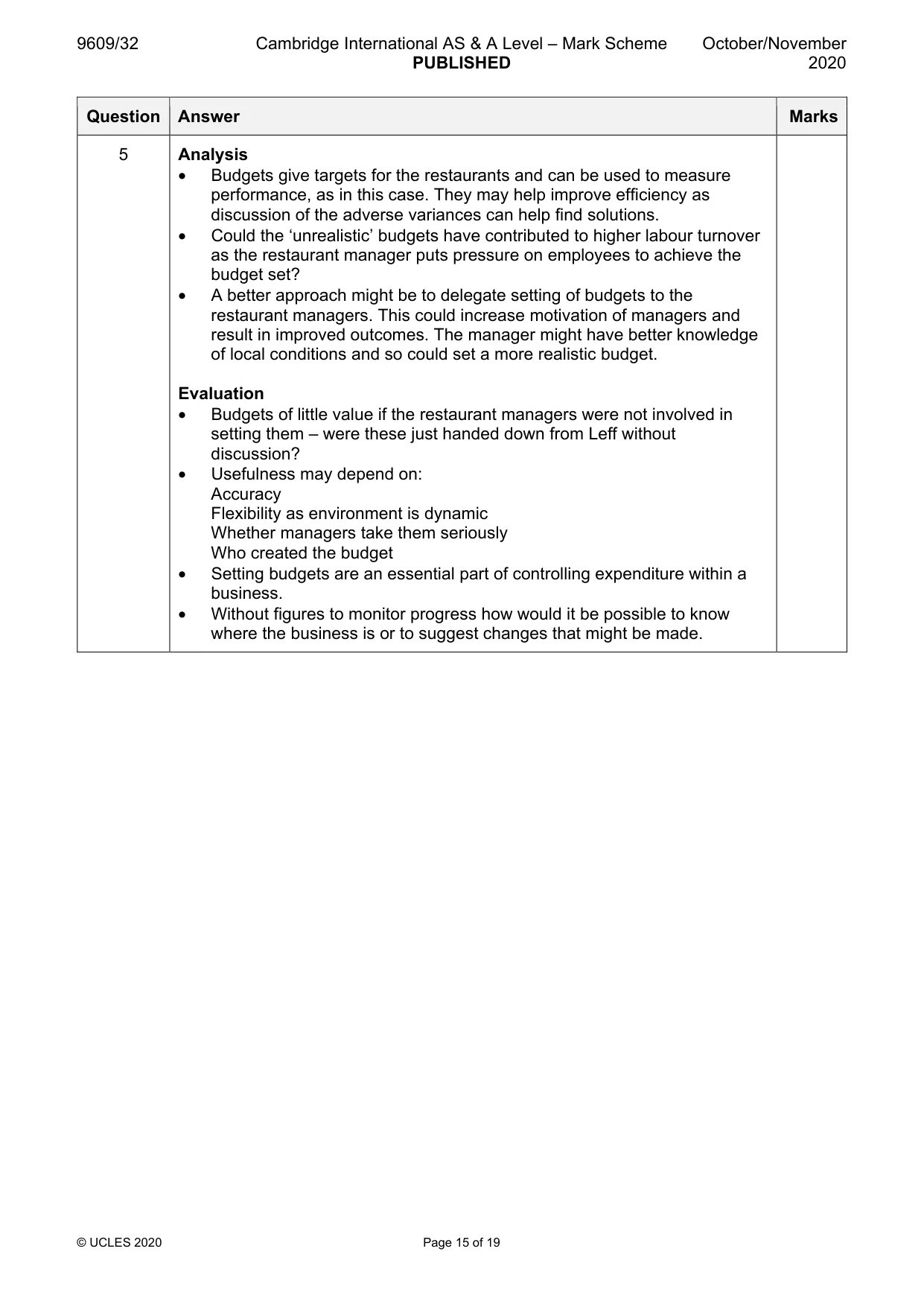
Mark scheme, page 15
9609/32 Cambridge International AS & A Level – Mark Scheme PUBLISHED October/November 2020 © UCLES 2020 Page 15 of 19 Question Answer Marks 5 Analysis • Budgets give targets for the restaurants and can be used to measure performance, as in this case. They may help improve efficiency as discussion of the adverse variances can help find solutions. • Could the ‘unrealistic’ budgets have contributed to higher labour turnover as the restaurant manager puts pressure on employees to achieve the budget set? • A better approach might be to delegate setting of budgets to the restaurant managers. This could increase motivation of managers and result in improved outcomes. The manager might have better knowledge of local conditions and so could set a more realistic budget. Evaluation • Budgets of little value if the restaurant managers were not involved in setting them – were these just handed down from Leff without discussion? • Usefulness may depend on: Accuracy Flexibility as environment is dynamic Whether managers take them seriously Who created the budget • Setting budgets are an essential part of controlling expenditure within a business. • Without figures to monitor progress how would it be possible to know where the business is or to suggest changes that might be made.
Mark scheme, page 16
9609/32 Cambridge International AS & A Level – Mark Scheme PUBLISHED October/November 2020 © UCLES 2020 Page 16 of 19 Questions 6 and 7 use this marking grid: Level Knowledge 3 marks Application 3 marks Analysis 4 marks Evaluation 10 marks 3 7–10 marks Good judgment shown throughout with well supported conclusion/ recommendation, focused on GR 2 3 marks Good under- standing shown 3 marks Good application to GR 3–4 marks Good use of reasoned argument or use of theory to explain points made to explain points made 4–6 marks Some judgment shown in the main body of the answer and an attempt to support conclusion/recommendation, focused on GR OR effective and well supported conclusion/recommendation, focused on GR 1 1–2 marks Some under- standing shown 1–2 marks Some application to GR 1–2 marks Limited use of reasoned argument or use of theory to support points made 1–3 marks Limited attempt to show judgment either within the answer OR a weakly supported conclusion/recommendation with some focus on GR 0 No creditable content
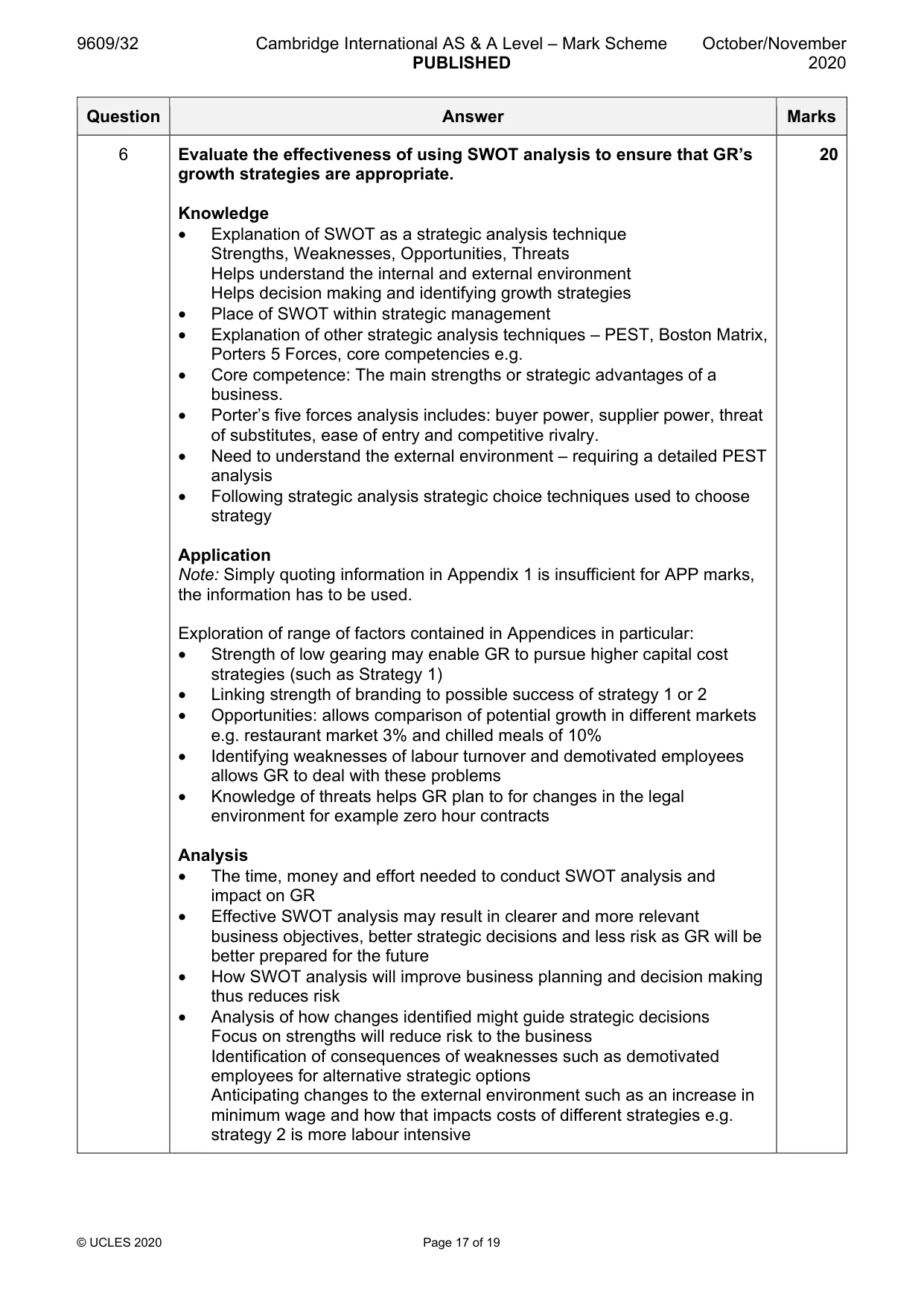
Mark scheme, page 17
9609/32 Cambridge International AS & A Level – Mark Scheme PUBLISHED October/November 2020 © UCLES 2020 Page 17 of 19 Question Answer Marks 6 Evaluate the effectiveness of using SWOT analysis to ensure that GR’s growth strategies are appropriate. Knowledge • Explanation of SWOT as a strategic analysis technique Strengths, Weaknesses, Opportunities, Threats Helps understand the internal and external environment Helps decision making and identifying growth strategies • Place of SWOT within strategic management • Explanation of other strategic analysis techniques – PEST, Boston Matrix, Porters 5 Forces, core competencies e.g. • Core competence: The main strengths or strategic advantages of a business. • Porter’s five forces analysis includes: buyer power, supplier power, threat of substitutes, ease of entry and competitive rivalry. • Need to understand the external environment – requiring a detailed PEST analysis • Following strategic analysis strategic choice techniques used to choose strategy Application Note: Simply quoting information in Appendix 1 is insufficient for APP marks, the information has to be used. Exploration of range of factors contained in Appendices in particular: • Strength of low gearing may enable GR to pursue higher capital cost strategies (such as Strategy 1) • Linking strength of branding to possible success of strategy 1 or 2 • Opportunities: allows comparison of potential growth in different markets e.g. restaurant market 3% and chilled meals of 10% • Identifying weaknesses of labour turnover and demotivated employees allows GR to deal with these problems • Knowledge of threats helps GR plan to for changes in the legal environment for example zero hour contracts Analysis • The time, money and effort needed to conduct SWOT analysis and impact on GR • Effective SWOT analysis may result in clearer and more relevant business objectives, better strategic decisions and less risk as GR will be better prepared for the future • How SWOT analysis will improve business planning and decision making thus reduces risk • Analysis of how changes identified might guide strategic decisions Focus on strengths will reduce risk to the business Identification of consequences of weaknesses such as demotivated employees for alternative strategic options Anticipating changes to the external environment such as an increase in minimum wage and how that impacts costs of different strategies e.g. strategy 2 is more labour intensive 20
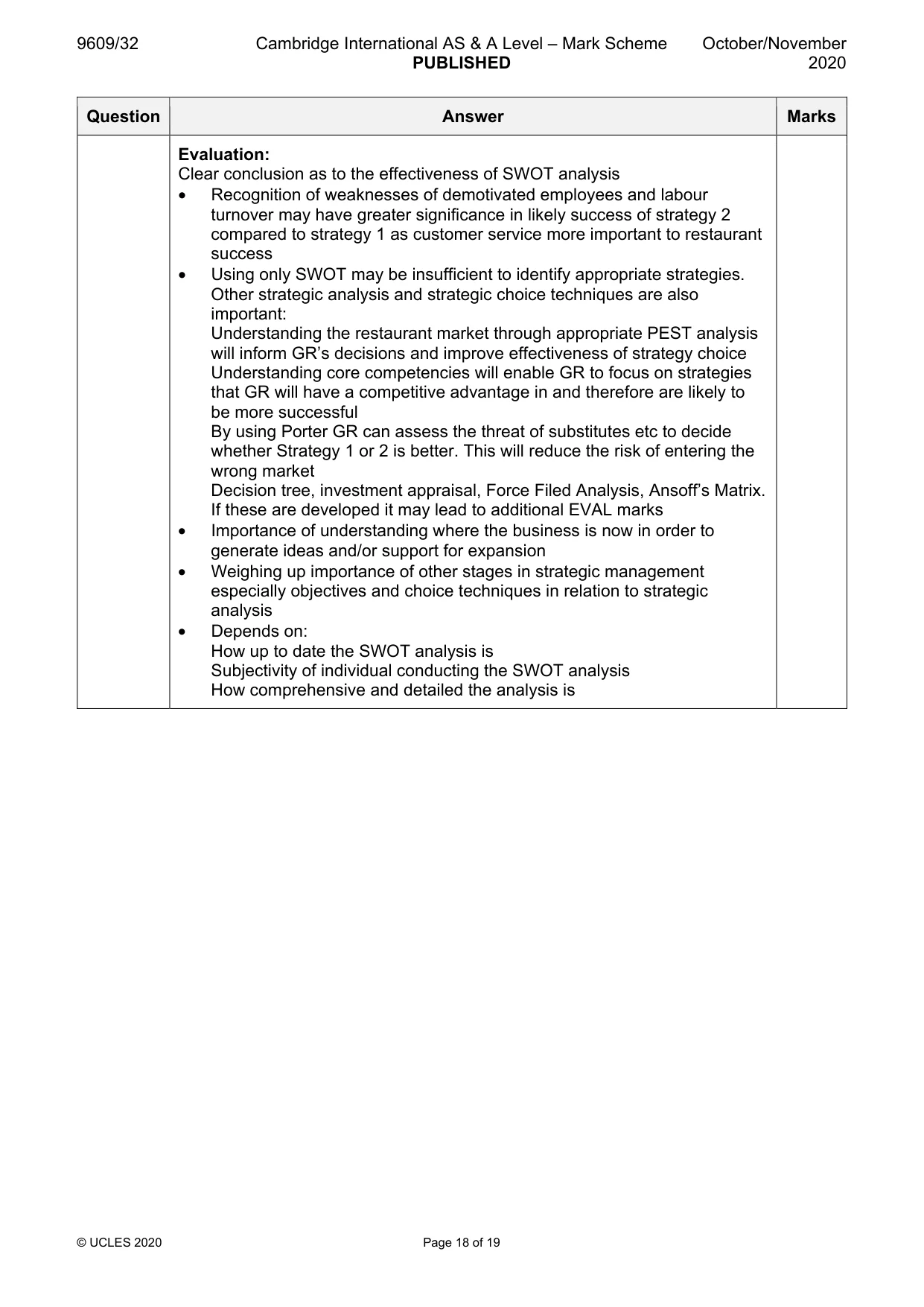
Mark scheme, page 18
9609/32 Cambridge International AS & A Level – Mark Scheme PUBLISHED October/November 2020 © UCLES 2020 Page 18 of 19 Question Answer Marks Evaluation: Clear conclusion as to the effectiveness of SWOT analysis • Recognition of weaknesses of demotivated employees and labour turnover may have greater significance in likely success of strategy 2 compared to strategy 1 as customer service more important to restaurant success • Using only SWOT may be insufficient to identify appropriate strategies. Other strategic analysis and strategic choice techniques are also important: Understanding the restaurant market through appropriate PEST analysis will inform GR’s decisions and improve effectiveness of strategy choice Understanding core competencies will enable GR to focus on strategies that GR will have a competitive advantage in and therefore are likely to be more successful By using Porter GR can assess the threat of substitutes etc to decide whether Strategy 1 or 2 is better. This will reduce the risk of entering the wrong market Decision tree, investment appraisal, Force Filed Analysis, Ansoff’s Matrix. If these are developed it may lead to additional EVAL marks • Importance of understanding where the business is now in order to generate ideas and/or support for expansion • Weighing up importance of other stages in strategic management especially objectives and choice techniques in relation to strategic analysis • Depends on: How up to date the SWOT analysis is Subjectivity of individual conducting the SWOT analysis How comprehensive and detailed the analysis is
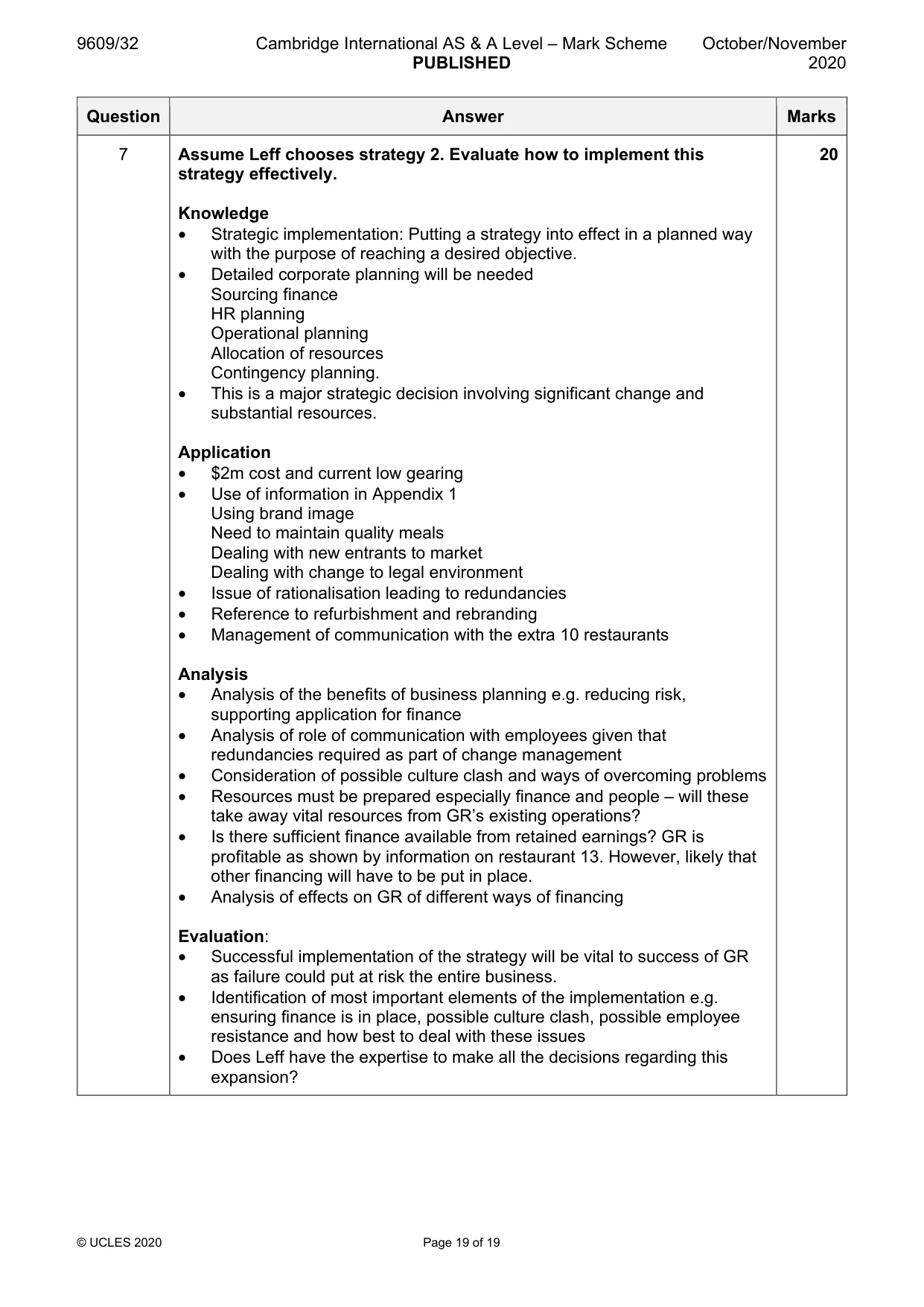
Mark scheme, page 19
9609/32 Cambridge International AS & A Level – Mark Scheme PUBLISHED October/November 2020 © UCLES 2020 Page 19 of 19 Question Answer Marks 7 Assume Leff chooses strategy 2. Evaluate how to implement this strategy effectively. Knowledge • Strategic implementation: Putting a strategy into effect in a planned way with the purpose of reaching a desired objective. • Detailed corporate planning will be needed Sourcing finance HR planning Operational planning Allocation of resources Contingency planning. • This is a major strategic decision involving significant change and substantial resources. Application • $2m cost and current low gearing • Use of information in Appendix 1 Using brand image Need to maintain quality meals Dealing with new entrants to market Dealing with change to legal environment • Issue of rationalisation leading to redundancies • Reference to refurbishment and rebranding • Management of communication with the extra 10 restaurants Analysis • Analysis of the benefits of business planning e.g. reducing risk, supporting application for finance • Analysis of role of communication with employees given that redundancies required as part of change management • Consideration of possible culture clash and ways of overcoming problems • Resources must be prepared especially finance and people – will these take away vital resources from GR’s existing operations? • Is there sufficient finance available from retained earnings? GR is profitable as shown by information on restaurant 13. However, likely that other financing will have to be put in place. • Analysis of effects on GR of different ways of financing Evaluation: • Successful implementation of the strategy will be vital to success of GR as failure could put at risk the entire business. • Identification of most important elements of the implementation e.g. ensuring finance is in place, possible culture clash, possible employee resistance and how best to deal with these issues • Does Leff have the expertise to make all the decisions regarding this expansion? 20
What you needed in this session
Cambridge’s own grade thresholds for 2020 Oct/Nov, Paper 3 · Variant 2. A higher threshold means an easier paper — the bar moves with how the cohort did.