Cambridge A Level Business (for first examination in 2016) 9609 — 2020 Oct/Nov Paper 3 · Variant 3
9609/33/O/N/20 · 100 marks · ≈113 min
The question paper and its mark scheme, free to read here and free to download. This is Cambridge’s own paper, exactly as it was sat.
Question paper20 pages












Mark scheme19 pages
Answers below. Sit the paper first if you are practising.

Paper as text
Question paper, page 1
Cambridge International AS & A Level This document has 20 pages. Blank pages are indicated. BUSINESS 9609/33 Paper 3 Case Study October/November 2020 3 hours You must answer on the question paper. You will need: Insert (enclosed) INSTRUCTIONS ● Section A: answer all questions. ● Section B: answer one question. ● Use a black or dark blue pen. ● Write your name, centre number and candidate number in the boxes at the top of the page. ● Write your answer to each question in the space provided. ● Do not use an erasable pen or correction fluid. ● Do not write on any bar codes. ● You may use an HB pencil for any diagrams, graphs or rough working. INFORMATION ● The total mark for this paper is 100. ● The number of marks for each question or part question is shown in brackets [ ]. ● The insert contains the case study. * 1 5 9 1 0 1 4 4 1 0 * DC (CJ) 191716/1 © UCLES 2020 [Turn over
Question paper, page 2
2 9609/33/O/N/20 © UCLES 2020 Answer all questions in Section A and answer one question in Section B. You are advised to spend no more than 40 minutes on Section B. Section A Answer all questions in this section. 1 Analyse the benefits to C4T of its two social objectives (lines 5–7). … … … … … … … … … … … … … … … … … … … … … … …
Question paper, page 3
3 9609/33/O/N/20 © UCLES 2020 [Turn over … … … … … … … … … … … … … … … … … … … … … … … … … … … … [10]
Question paper, page 4
4 9609/33/O/N/20 © UCLES 2020 2 (a) Refer to Table 1. Calculate the forecast profit margin for the reusable bottles. … … … … … … … … … [3] (b) Refer to lines 44–49. Calculate the gearing ratio assuming the extra $0.5m finance for the factory extension is raised through a bank loan. … … … … … … … … … [3]
Question paper, page 5
5 9609/33/O/N/20 © UCLES 2020 [Turn over (c) Refer to your results in 2(a), 2(b) and any other information. Recommend whether C4T should accept the offer from the venture capitalist. Justify your recommendation. … … … … … … … … … … … … … … … … … … … … … … … … … … …
Question paper, page 6
6 9609/33/O/N/20 © UCLES 2020 … … … … … … … … … … … … … … … … … … … … … … … … … … … … [12]
Question paper, page 7
7 9609/33/O/N/20 © UCLES 2020 [Turn over 3 C4T plans to launch souvenir reusable bottles made from recycled plastic. Evaluate the importance of C4T’s brand image for the success of this launch. … … … … … … … … … … … … … … … … … … … … … … … … … … …
Question paper, page 8
8 9609/33/O/N/20 © UCLES 2020 … … … … … … … … … … … … … … … … … … … … … … … … … … … …
Question paper, page 9
9 9609/33/O/N/20 © UCLES 2020 [Turn over … … … … … … … … … … … … … … … … … … … … … … … … … … … … [16]
Question paper, page 10
10 9609/33/O/N/20 © UCLES 2020 4 (a) Refer to Table 2. Calculate the: (i) forecast total contribution from the proposed special order of laptop cases … … … … … … … … … … … … … … … [5] (ii) forecast 2021 capacity utilisation for laptop cases without the special order. … … … … … … … … … [3]
Question paper, page 11
11 9609/33/O/N/20 © UCLES 2020 [Turn over (b) Refer to your results from 4(a) and any other information. Recommend whether C4T should accept the special order. Justify your recommendation. … … … … … … … … … … … … … … … … … … … … … … … … … … …
Question paper, page 12
12 9609/33/O/N/20 © UCLES 2020 … … … … … … … … … … … … … … … … … … … … … … … … … … … … [12]
Question paper, page 13
13 9609/33/O/N/20 © UCLES 2020 [Turn over 5 Evaluate the importance of workforce planning to C4T’s future success. … … … … … … … … … … … … … … … … … … … … … … … … … … …
Question paper, page 14
14 9609/33/O/N/20 © UCLES 2020 … … … … … … … … … … … … … … … … … … … … … … … … … … … …
Question paper, page 15
15 9609/33/O/N/20 © UCLES 2020 [Turn over … … … … … … … … … … … … … … … … … … … … … … … … … … … … [16]
Question paper, page 16
16 9609/33/O/N/20 © UCLES 2020 Section B Answer one question from this section. 6 Evaluate whether the data in Table 3 is sufficient for the managers of C4T as they make the strategic choice between option 1 and option 2. 7 Assume option 2 is chosen. Evaluate the importance of a strategic business plan to the successful implementation of this option. Write the question number here: … … … … … … … … … … … … … … … … … … … … … … …
Question paper, page 17
17 9609/33/O/N/20 © UCLES 2020 [Turn over … … … … … … … … … … … … … … … … … … … … … … … … … … … …
Question paper, page 18
18 9609/33/O/N/20 © UCLES 2020 … … … … … … … … … … … … … … … … … … … … … … … … … … … …
Question paper, page 19
19 9609/33/O/N/20 © UCLES 2020 … … … … … … … … … … … … … … … … … … … … … … … … … … … … [20]
Question paper, page 20
20 9609/33/O/N/20 © UCLES 2020 Permission to reproduce items where third-party owned material protected by copyright is included has been sought and cleared where possible. Every reasonable effort has been made by the publisher (UCLES) to trace copyright holders, but if any items requiring clearance have unwittingly been included, the publisher will be pleased to make amends at the earliest possible opportunity. To avoid the issue of disclosure of answer-related information to candidates, all copyright acknowledgements are reproduced online in the Cambridge Assessment International Education Copyright Acknowledgements Booklet. This is produced for each series of examinations and is freely available to download at www.cambridgeinternational.org after the live examination series. Cambridge Assessment International Education is part of the Cambridge Assessment Group. Cambridge Assessment is the brand name of the University of Cambridge Local Examinations Syndicate (UCLES), which itself is a department of the University of Cambridge. BLANK PAGE
Mark scheme, page 1
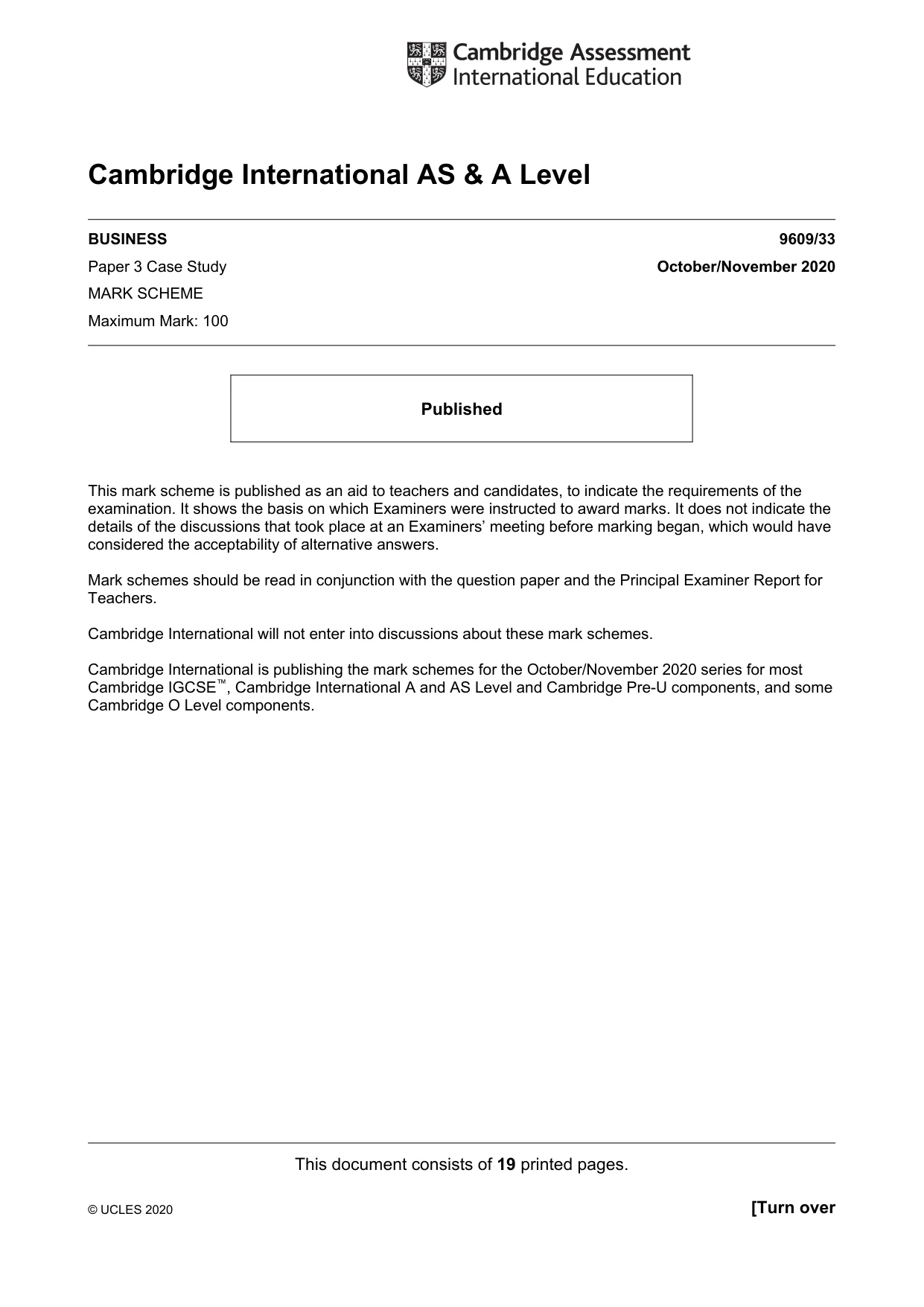
This document consists of 19 printed pages. © UCLES 2020 [Turn over Cambridge International AS & A Level BUSINESS 9609/33 Paper 3 Case Study October/November 2020 MARK SCHEME Maximum Mark: 100 Published This mark scheme is published as an aid to teachers and candidates, to indicate the requirements of the examination. It shows the basis on which Examiners were instructed to award marks. It does not indicate the details of the discussions that took place at an Examiners’ meeting before marking began, which would have considered the acceptability of alternative answers. Mark schemes should be read in conjunction with the question paper and the Principal Examiner Report for Teachers. Cambridge International will not enter into discussions about these mark schemes. Cambridge International is publishing the mark schemes for the October/November 2020 series for most Cambridge IGCSE™, Cambridge International A and AS Level and Cambridge Pre-U components, and some Cambridge O Level components.
Mark scheme, page 2
9609/33 Cambridge International AS & A Level – Mark Scheme PUBLISHED October/November 2020 © UCLES 2020 Page 2 of 19 Generic Marking Principles These general marking principles must be applied by all examiners when marking candidate answers. They should be applied alongside the specific content of the mark scheme or generic level descriptors for a question. Each question paper and mark scheme will also comply with these marking principles. GENERIC MARKING PRINCIPLE 1: Marks must be awarded in line with: • the specific content of the mark scheme or the generic level descriptors for the question • the specific skills defined in the mark scheme or in the generic level descriptors for the question • the standard of response required by a candidate as exemplified by the standardisation scripts. GENERIC MARKING PRINCIPLE 2: Marks awarded are always whole marks (not half marks, or other fractions). GENERIC MARKING PRINCIPLE 3: Marks must be awarded positively: • marks are awarded for correct/valid answers, as defined in the mark scheme. However, credit is given for valid answers which go beyond the scope of the syllabus and mark scheme, referring to your Team Leader as appropriate • marks are awarded when candidates clearly demonstrate what they know and can do • marks are not deducted for errors • marks are not deducted for omissions • answers should only be judged on the quality of spelling, punctuation and grammar when these features are specifically assessed by the question as indicated by the mark scheme. The meaning, however, should be unambiguous. GENERIC MARKING PRINCIPLE 4: Rules must be applied consistently, e.g. in situations where candidates have not followed instructions or in the application of generic level descriptors. GENERIC MARKING PRINCIPLE 5: Marks should be awarded using the full range of marks defined in the mark scheme for the question (however; the use of the full mark range may be limited according to the quality of the candidate responses seen). GENERIC MARKING PRINCIPLE 6: Marks awarded are based solely on the requirements as defined in the mark scheme. Marks should not be awarded with grade thresholds or grade descriptors in mind.
Mark scheme, page 3
9609/33 Cambridge International AS & A Level – Mark Scheme PUBLISHED October/November 2020 © UCLES 2020 Page 3 of 19 General Marking Guidance This mark scheme includes a summary of appropriate content for answering each question. It should be emphasised, however, that this material is for illustrative purposes and is not intended to provide a definitive guide to acceptable answers. It is quite possible that among the scripts there will be some candidate answers that are not covered directly by the content of this mark scheme. In such cases, professional judgement should be exercised in assessing the merits of the answer and the senior examiners should be consulted if further guidance is required. Application marks are not awarded for repeating material from the case study. Application is rewarded for answering in the context of the case or by using the information in the case to help answer the question.
Mark scheme, page 4
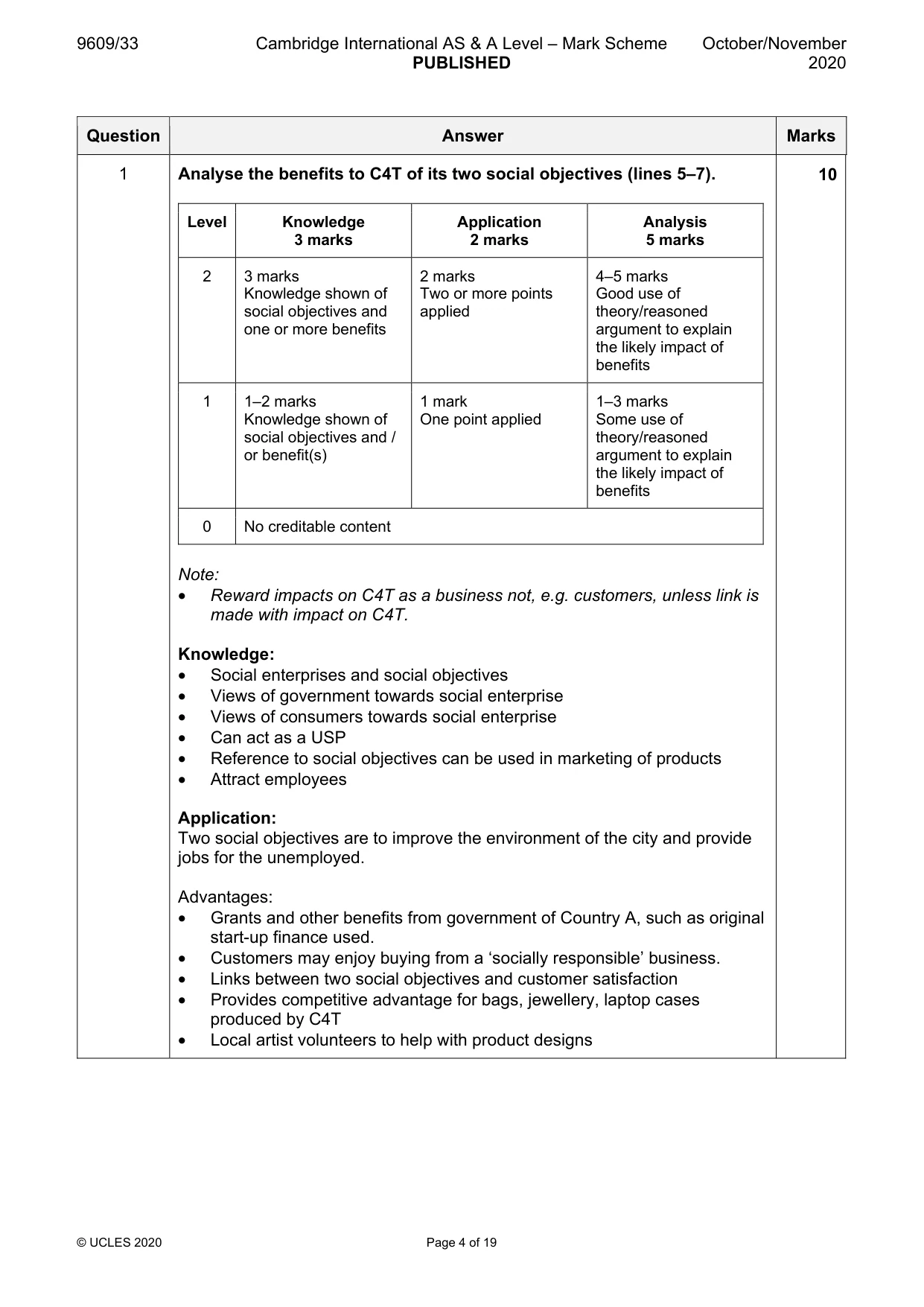
9609/33 Cambridge International AS & A Level – Mark Scheme PUBLISHED October/November 2020 © UCLES 2020 Page 4 of 19 Question Answer Marks 1 Analyse the benefits to C4T of its two social objectives (lines 5–7). Level Knowledge 3 marks Application 2 marks Analysis 5 marks 2 3 marks Knowledge shown of social objectives and one or more benefits 2 marks Two or more points applied 4–5 marks Good use of theory/reasoned argument to explain the likely impact of benefits 1 1–2 marks Knowledge shown of social objectives and / or benefit(s) 1 mark One point applied 1–3 marks Some use of theory/reasoned argument to explain the likely impact of benefits 0 No creditable content Note: • Reward impacts on C4T as a business not, e.g. customers, unless link is made with impact on C4T. Knowledge: • Social enterprises and social objectives • Views of government towards social enterprise • Views of consumers towards social enterprise • Can act as a USP • Reference to social objectives can be used in marketing of products • Attract employees Application: Two social objectives are to improve the environment of the city and provide jobs for the unemployed. Advantages: • Grants and other benefits from government of Country A, such as original start-up finance used. • Customers may enjoy buying from a ‘socially responsible’ business. • Links between two social objectives and customer satisfaction • Provides competitive advantage for bags, jewellery, laptop cases produced by C4T • Local artist volunteers to help with product designs 10
Mark scheme, page 5
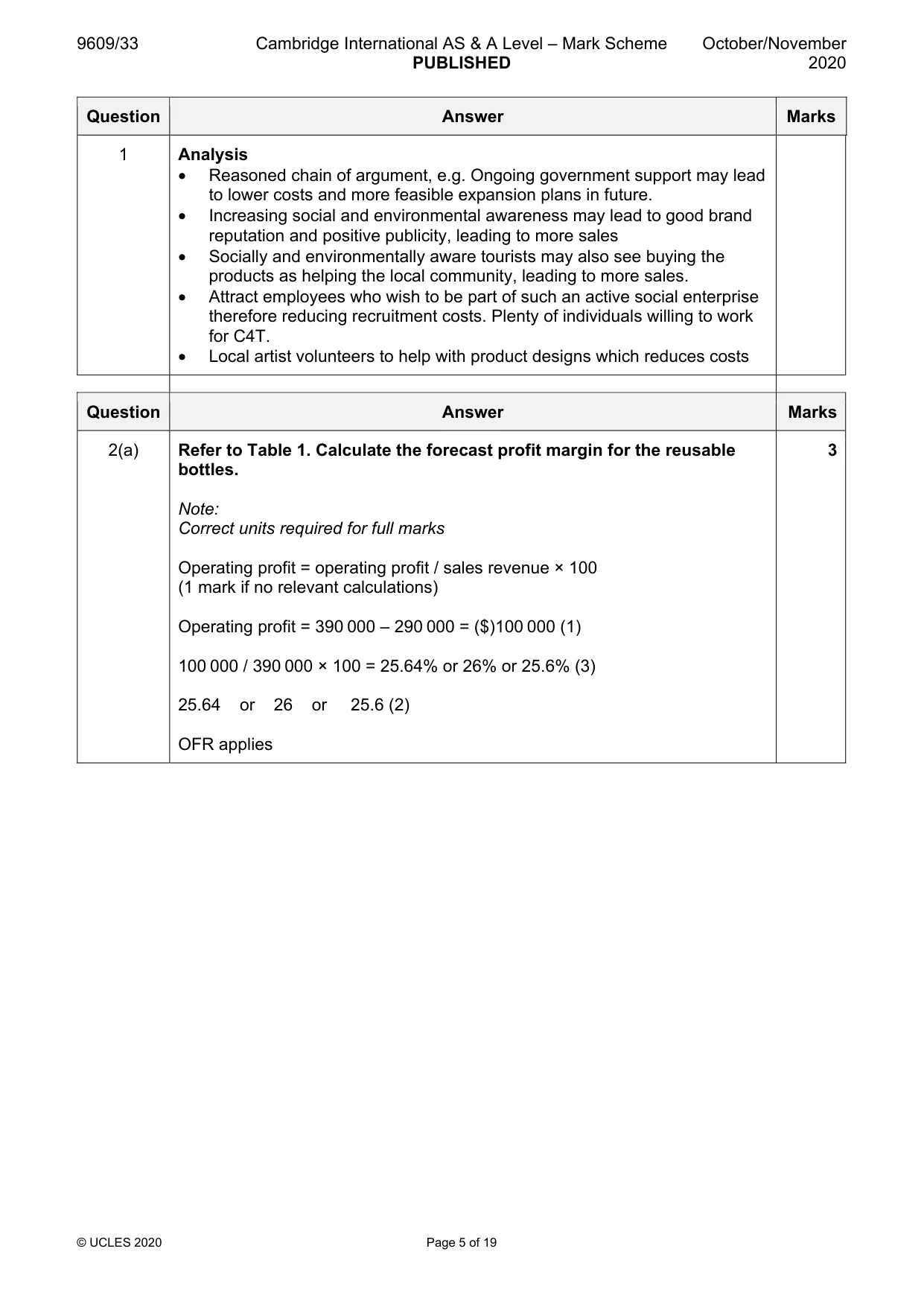
9609/33 Cambridge International AS & A Level – Mark Scheme PUBLISHED October/November 2020 © UCLES 2020 Page 5 of 19 Question Answer Marks 1 Analysis • Reasoned chain of argument, e.g. Ongoing government support may lead to lower costs and more feasible expansion plans in future. • Increasing social and environmental awareness may lead to good brand reputation and positive publicity, leading to more sales • Socially and environmentally aware tourists may also see buying the products as helping the local community, leading to more sales. • Attract employees who wish to be part of such an active social enterprise therefore reducing recruitment costs. Plenty of individuals willing to work for C4T. • Local artist volunteers to help with product designs which reduces costs Question Answer Marks 2(a) Refer to Table 1. Calculate the forecast profit margin for the reusable bottles. Note: Correct units required for full marks Operating profit = operating profit / sales revenue × 100 (1 mark if no relevant calculations) Operating profit = 390 000 – 290 000 = ($)100 000 (1) 100 000 / 390 000 × 100 = 25.64% or 26% or 25.6% (3) 25.64 or 26 or 25.6 (2) OFR applies 3
Mark scheme, page 6
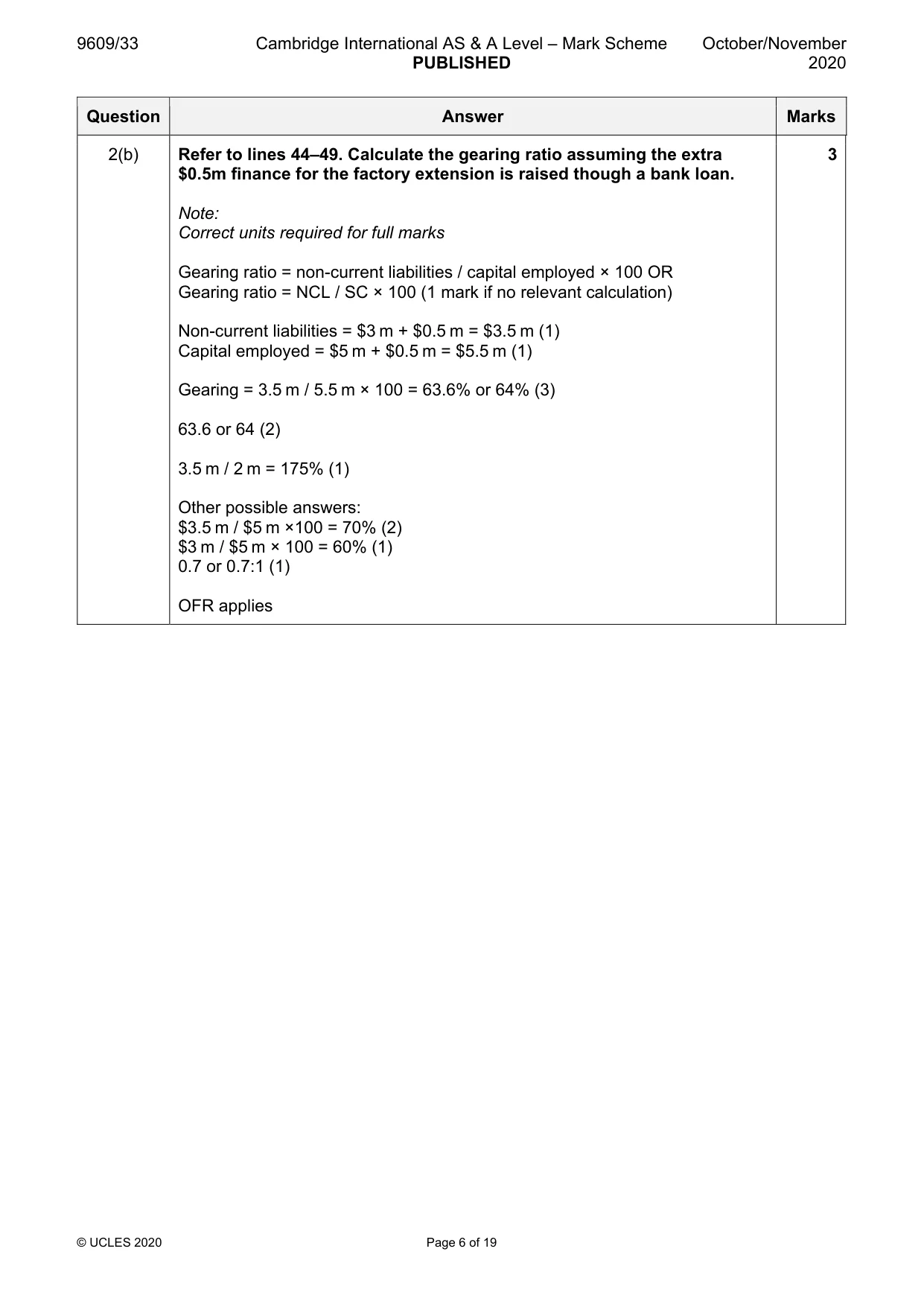
9609/33 Cambridge International AS & A Level – Mark Scheme PUBLISHED October/November 2020 © UCLES 2020 Page 6 of 19 Question Answer Marks 2(b) Refer to lines 44–49. Calculate the gearing ratio assuming the extra $0.5m finance for the factory extension is raised though a bank loan. Note: Correct units required for full marks Gearing ratio = non-current liabilities / capital employed × 100 OR Gearing ratio = NCL / SC × 100 (1 mark if no relevant calculation) Non-current liabilities = $3 m + $0.5 m = $3.5 m (1) Capital employed = $5 m + $0.5 m = $5.5 m (1) Gearing = 3.5 m / 5.5 m × 100 = 63.6% or 64% (3) 63.6 or 64 (2) 3.5 m / 2 m = 175% (1) Other possible answers: $3.5 m / $5 m ×100 = 70% (2) $3 m / $5 m × 100 = 60% (1) 0.7 or 0.7:1 (1) OFR applies 3
Mark scheme, page 7
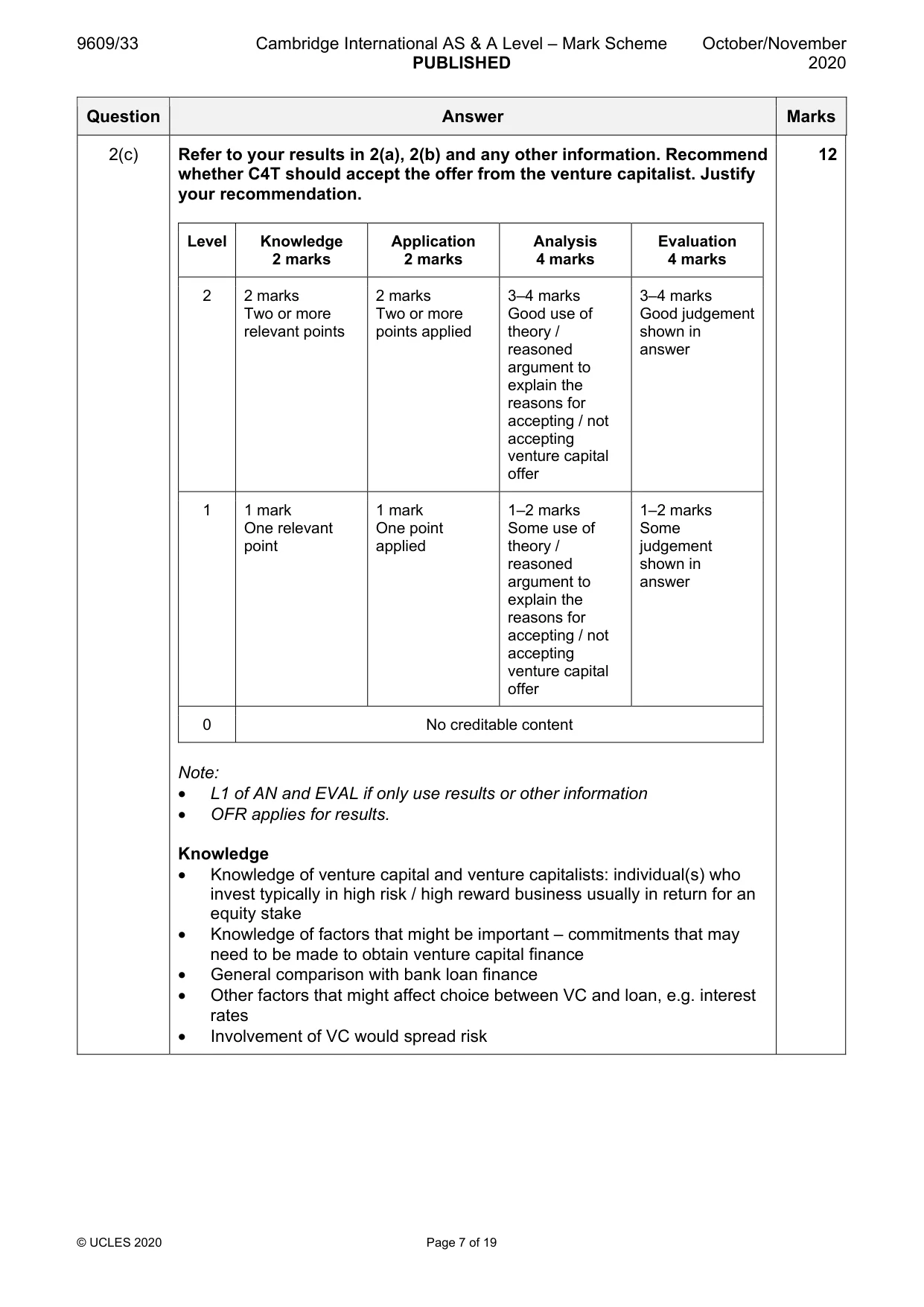
9609/33 Cambridge International AS & A Level – Mark Scheme PUBLISHED October/November 2020 © UCLES 2020 Page 7 of 19 Question Answer Marks 2(c) Refer to your results in 2(a), 2(b) and any other information. Recommend whether C4T should accept the offer from the venture capitalist. Justify your recommendation. Level Knowledge 2 marks Application 2 marks Analysis 4 marks Evaluation 4 marks 2 2 marks Two or more relevant points 2 marks Two or more points applied 3–4 marks Good use of theory / reasoned argument to explain the reasons for accepting / not accepting venture capital offer 3–4 marks Good judgement shown in answer 1 1 mark One relevant point 1 mark One point applied 1–2 marks Some use of theory / reasoned argument to explain the reasons for accepting / not accepting venture capital offer 1–2 marks Some judgement shown in answer 0 No creditable content Note: • L1 of AN and EVAL if only use results or other information • OFR applies for results. Knowledge • Knowledge of venture capital and venture capitalists: individual(s) who invest typically in high risk / high reward business usually in return for an equity stake • Knowledge of factors that might be important – commitments that may need to be made to obtain venture capital finance • General comparison with bank loan finance • Other factors that might affect choice between VC and loan, e.g. interest rates • Involvement of VC would spread risk 12
Mark scheme, page 8
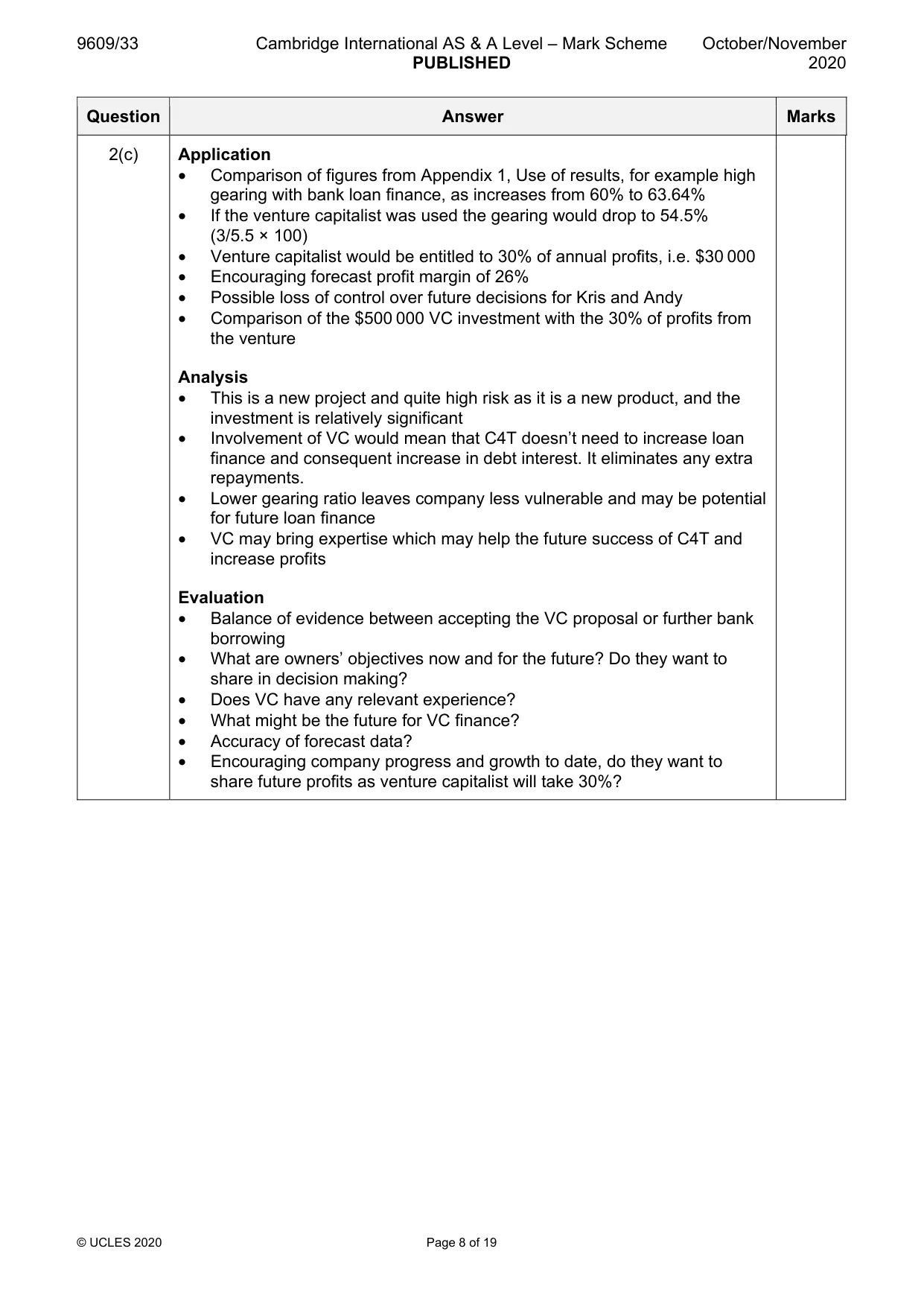
9609/33 Cambridge International AS & A Level – Mark Scheme PUBLISHED October/November 2020 © UCLES 2020 Page 8 of 19 Question Answer Marks 2(c) Application • Comparison of figures from Appendix 1, Use of results, for example high gearing with bank loan finance, as increases from 60% to 63.64% • If the venture capitalist was used the gearing would drop to 54.5% (3/5.5 × 100) • Venture capitalist would be entitled to 30% of annual profits, i.e. $30 000 • Encouraging forecast profit margin of 26% • Possible loss of control over future decisions for Kris and Andy • Comparison of the $500 000 VC investment with the 30% of profits from the venture Analysis • This is a new project and quite high risk as it is a new product, and the investment is relatively significant • Involvement of VC would mean that C4T doesn’t need to increase loan finance and consequent increase in debt interest. It eliminates any extra repayments. • Lower gearing ratio leaves company less vulnerable and may be potential for future loan finance • VC may bring expertise which may help the future success of C4T and increase profits Evaluation • Balance of evidence between accepting the VC proposal or further bank borrowing • What are owners’ objectives now and for the future? Do they want to share in decision making? • Does VC have any relevant experience? • What might be the future for VC finance? • Accuracy of forecast data? • Encouraging company progress and growth to date, do they want to share future profits as venture capitalist will take 30%?
Mark scheme, page 9
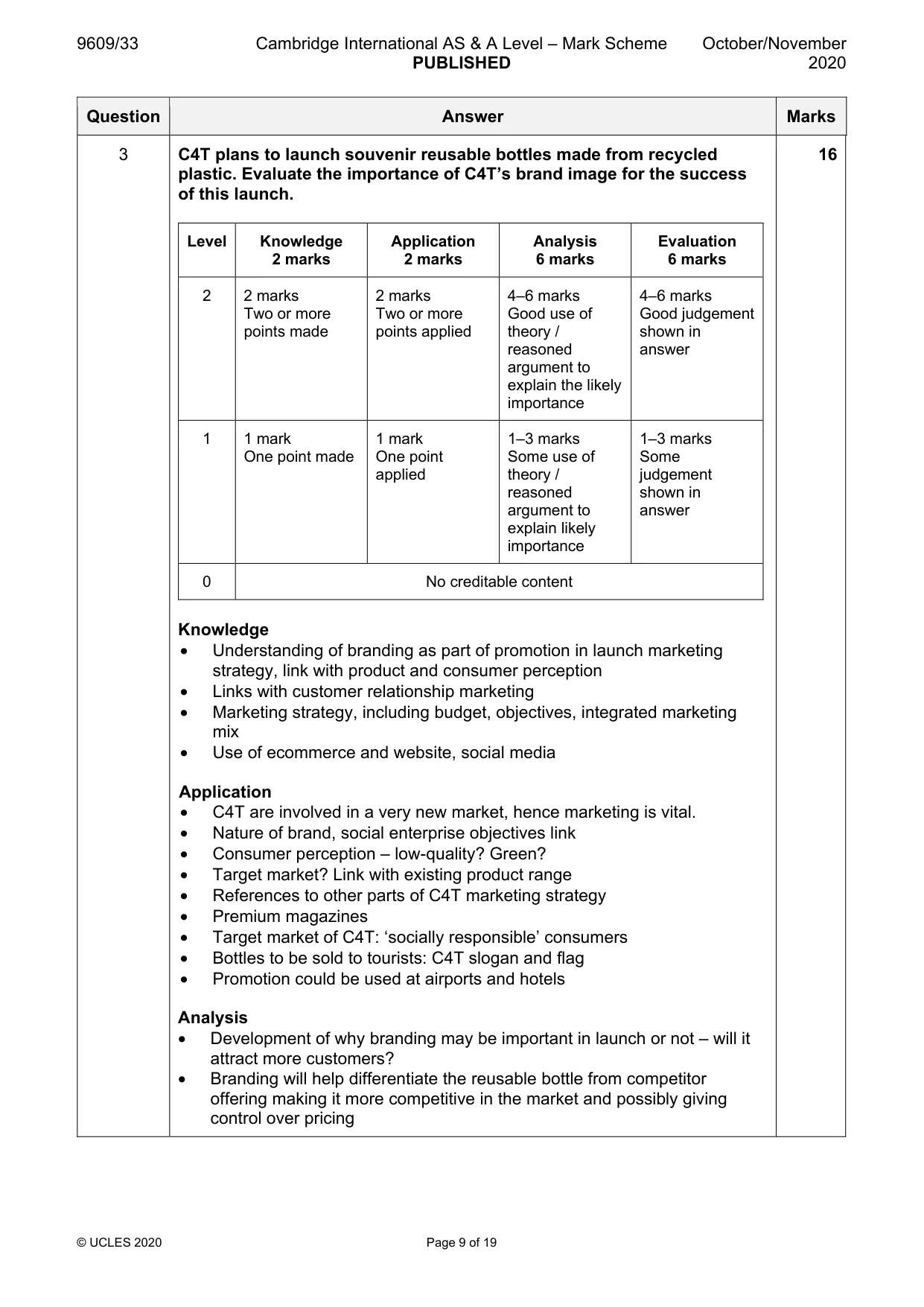
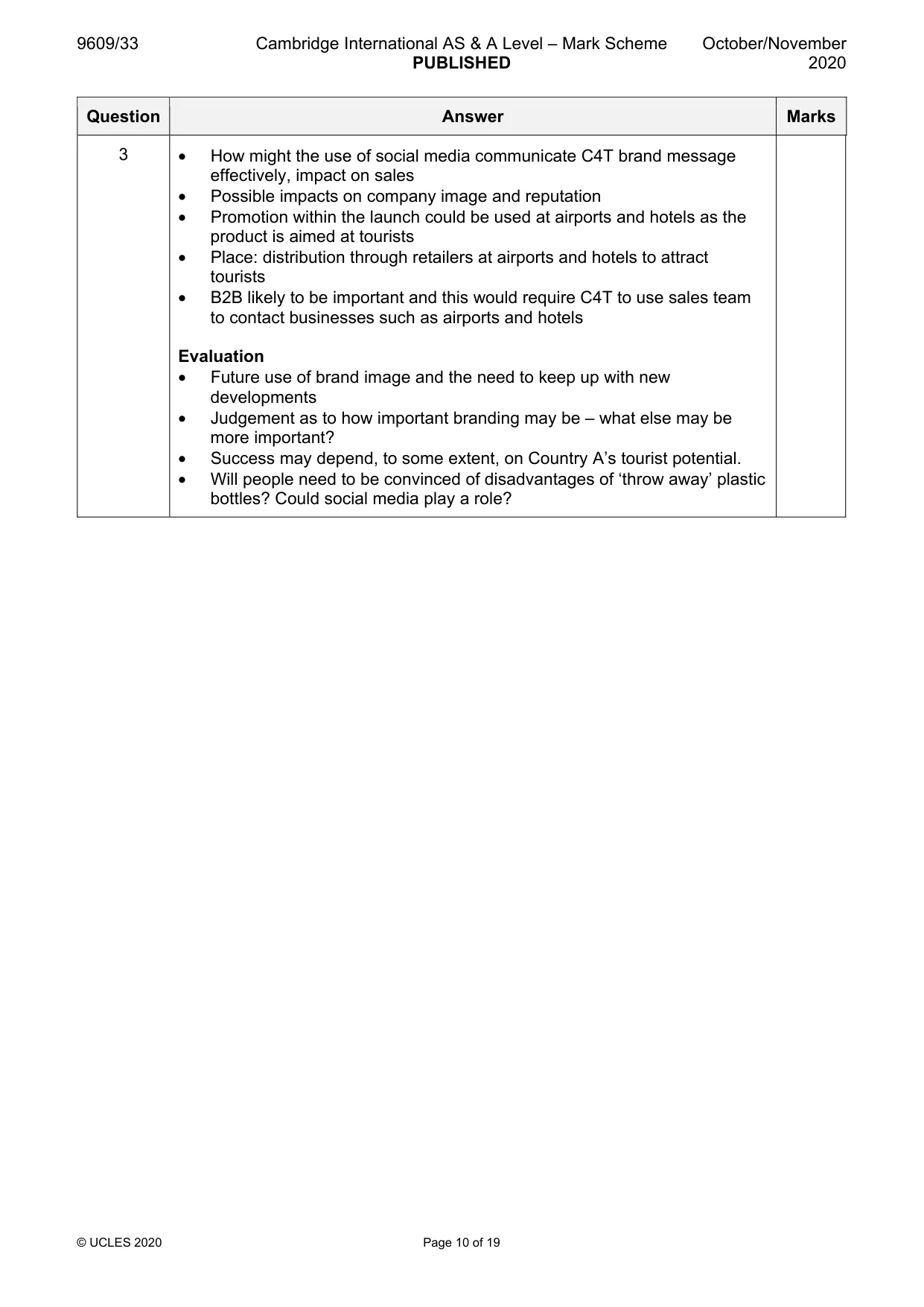
9609/33 Cambridge International AS & A Level – Mark Scheme PUBLISHED October/November 2020 © UCLES 2020 Page 9 of 19 Question Answer Marks 3 C4T plans to launch souvenir reusable bottles made from recycled plastic. Evaluate the importance of C4T’s brand image for the success of this launch. Level Knowledge 2 marks Application 2 marks Analysis 6 marks Evaluation 6 marks 2 2 marks Two or more points made 2 marks Two or more points applied 4–6 marks Good use of theory / reasoned argument to explain the likely importance 4–6 marks Good judgement shown in answer 1 1 mark One point made 1 mark One point applied 1–3 marks Some use of theory / reasoned argument to explain likely importance 1–3 marks Some judgement shown in answer 0 No creditable content Knowledge • Understanding of branding as part of promotion in launch marketing strategy, link with product and consumer perception • Links with customer relationship marketing • Marketing strategy, including budget, objectives, integrated marketing mix • Use of ecommerce and website, social media Application • C4T are involved in a very new market, hence marketing is vital. • Nature of brand, social enterprise objectives link • Consumer perception – low-quality? Green? • Target market? Link with existing product range • References to other parts of C4T marketing strategy • Premium magazines • Target market of C4T: ‘socially responsible’ consumers • Bottles to be sold to tourists: C4T slogan and flag • Promotion could be used at airports and hotels Analysis • Development of why branding may be important in launch or not – will it attract more customers? • Branding will help differentiate the reusable bottle from competitor offering making it more competitive in the market and possibly giving control over pricing 16
Mark scheme, page 10
9609/33 Cambridge International AS & A Level – Mark Scheme PUBLISHED October/November 2020 © UCLES 2020 Page 10 of 19 Question Answer Marks 3 • How might the use of social media communicate C4T brand message effectively, impact on sales • Possible impacts on company image and reputation • Promotion within the launch could be used at airports and hotels as the product is aimed at tourists • Place: distribution through retailers at airports and hotels to attract tourists • B2B likely to be important and this would require C4T to use sales team to contact businesses such as airports and hotels Evaluation • Future use of brand image and the need to keep up with new developments • Judgement as to how important branding may be – what else may be more important? • Success may depend, to some extent, on Country A’s tourist potential. • Will people need to be convinced of disadvantages of ‘throw away’ plastic bottles? Could social media play a role?
Mark scheme, page 11
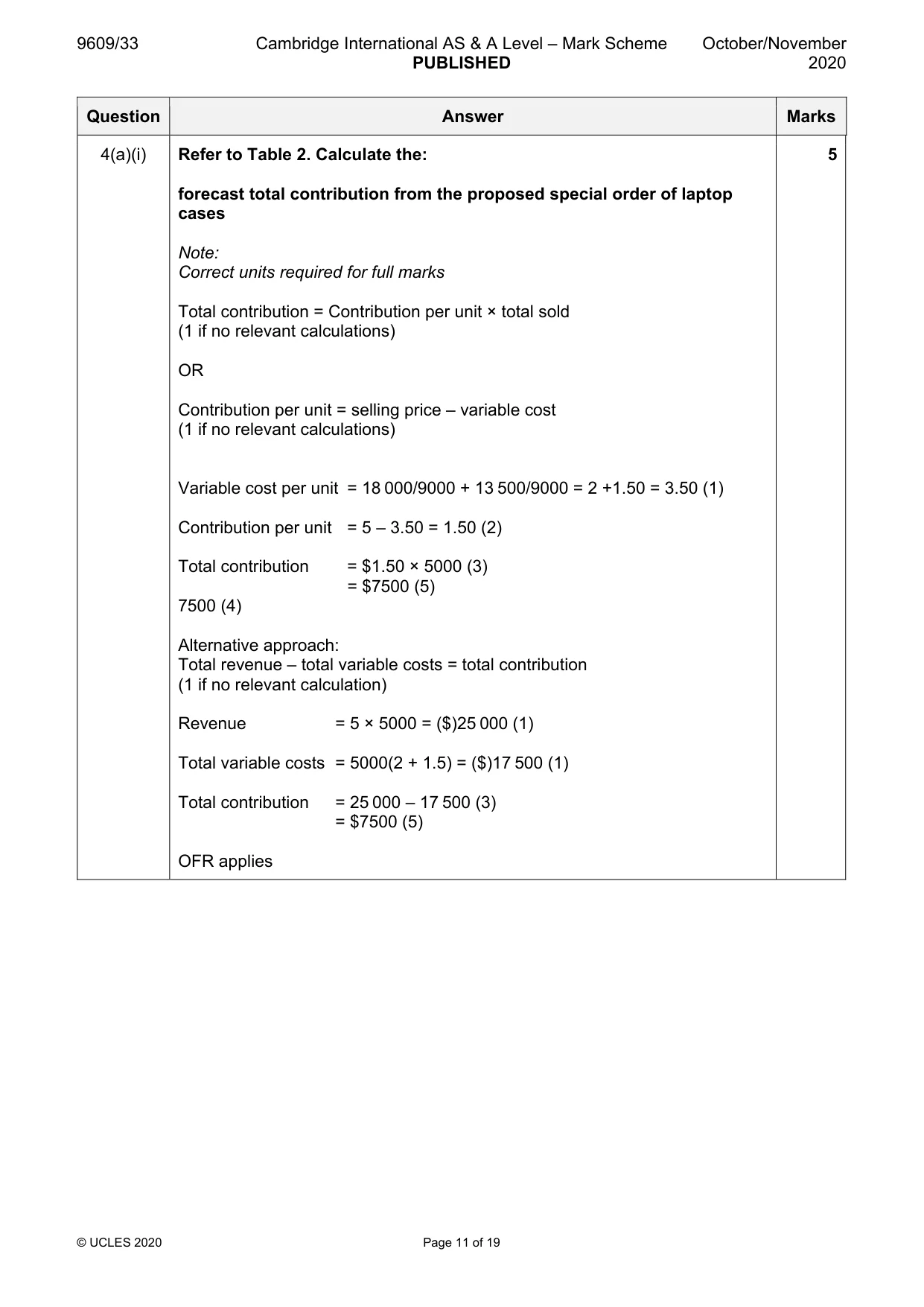
9609/33 Cambridge International AS & A Level – Mark Scheme PUBLISHED October/November 2020 © UCLES 2020 Page 11 of 19 Question Answer Marks 4(a)(i) Refer to Table 2. Calculate the: forecast total contribution from the proposed special order of laptop cases Note: Correct units required for full marks Total contribution = Contribution per unit × total sold (1 if no relevant calculations) OR Contribution per unit = selling price – variable cost (1 if no relevant calculations) Variable cost per unit = 18 000/9000 + 13 500/9000 = 2 +1.50 = 3.50 (1) Contribution per unit = 5 – 3.50 = 1.50 (2) Total contribution = $1.50 × 5000 (3) = $7500 (5) 7500 (4) Alternative approach: Total revenue – total variable costs = total contribution (1 if no relevant calculation) Revenue = 5 × 5000 = ($)25 000 (1) Total variable costs = 5000(2 + 1.5) = ($)17 500 (1) Total contribution = 25 000 – 17 500 (3) = $7500 (5) OFR applies 5
Mark scheme, page 12
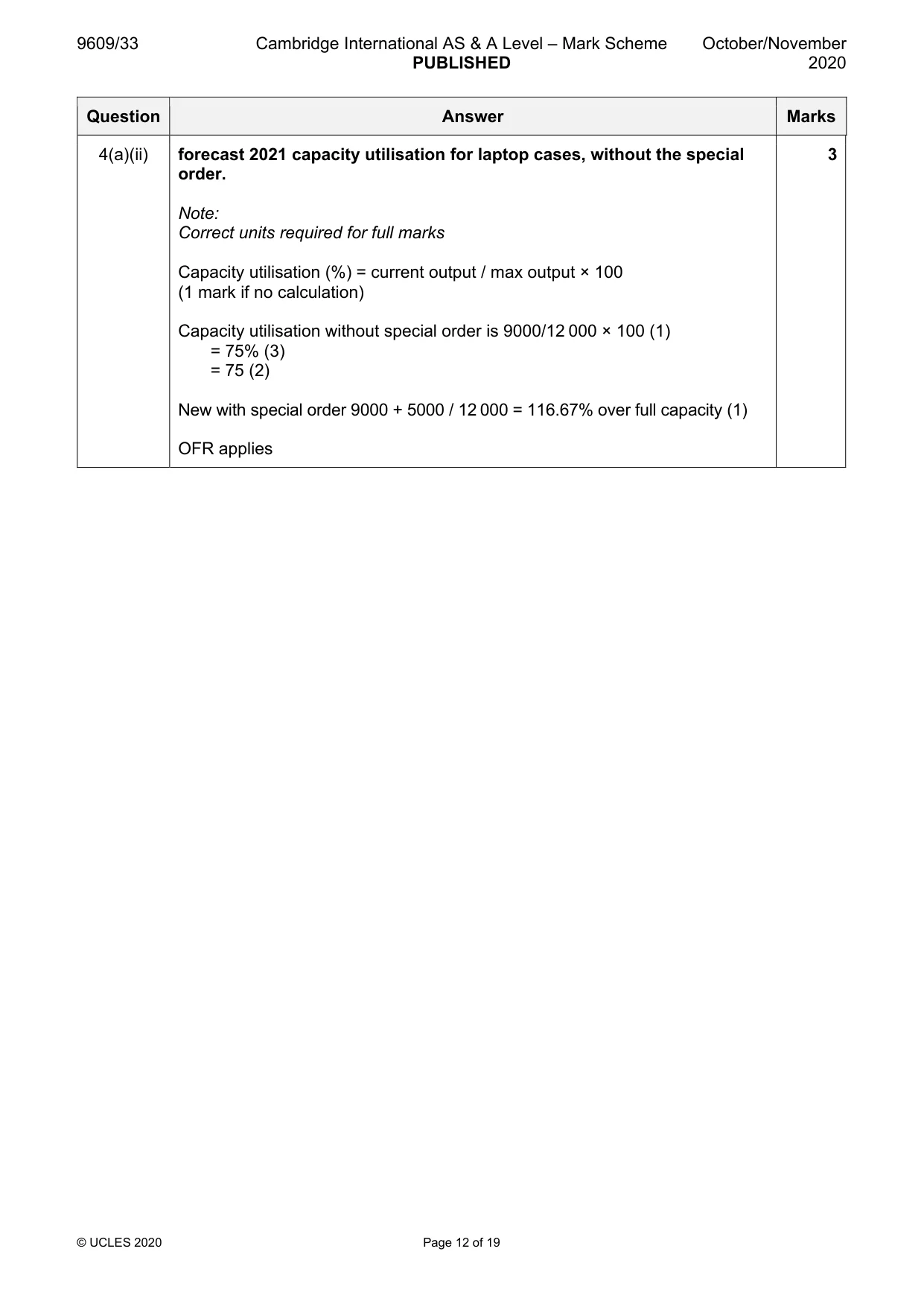
9609/33 Cambridge International AS & A Level – Mark Scheme PUBLISHED October/November 2020 © UCLES 2020 Page 12 of 19 Question Answer Marks 4(a)(ii) forecast 2021 capacity utilisation for laptop cases, without the special order. Note: Correct units required for full marks Capacity utilisation (%) = current output / max output × 100 (1 mark if no calculation) Capacity utilisation without special order is 9000/12 000 × 100 (1) = 75% (3) = 75 (2) New with special order 9000 + 5000 / 12 000 = 116.67% over full capacity (1) OFR applies 3
Mark scheme, page 13
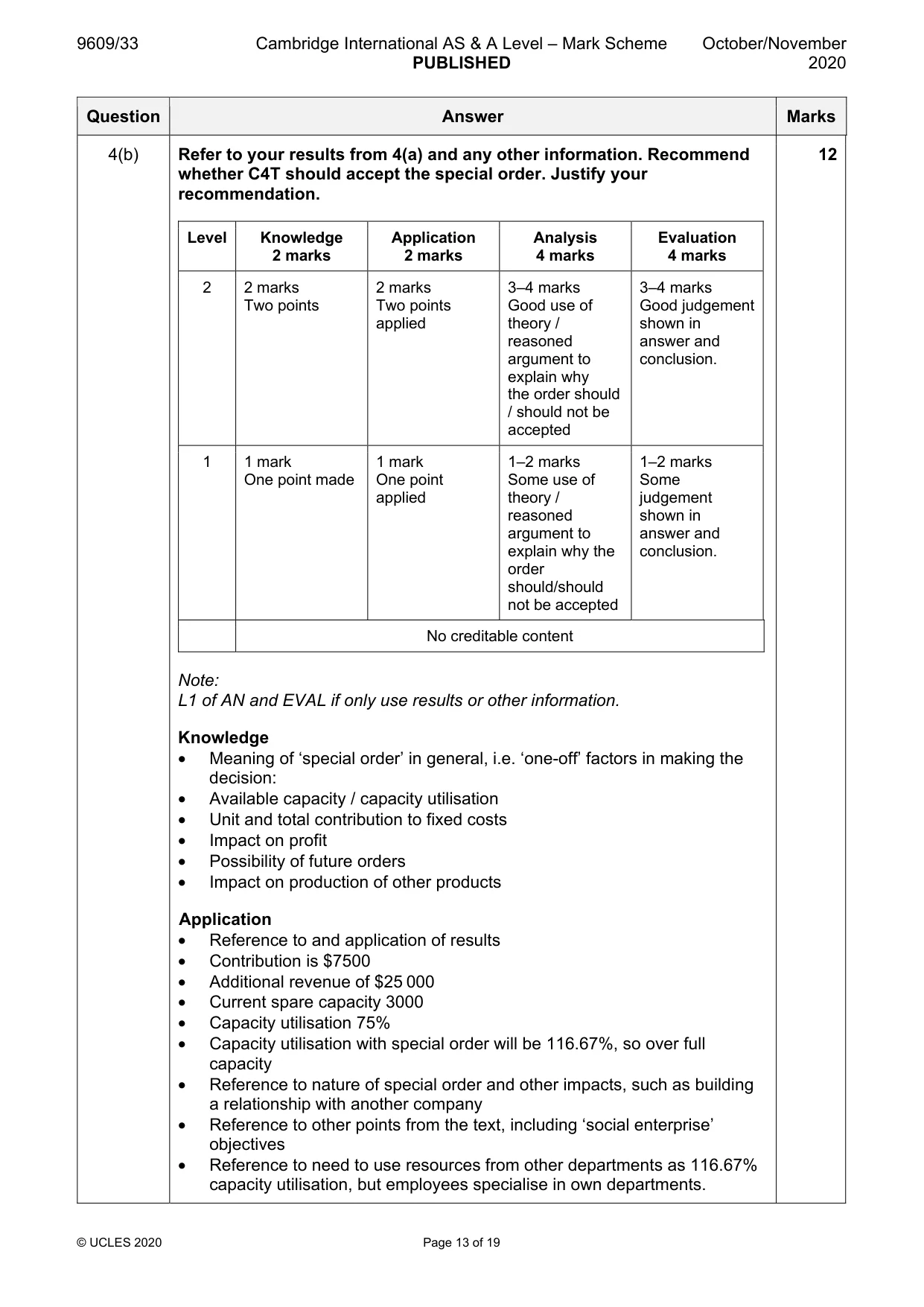
9609/33 Cambridge International AS & A Level – Mark Scheme PUBLISHED October/November 2020 © UCLES 2020 Page 13 of 19 Question Answer Marks 4(b) Refer to your results from 4(a) and any other information. Recommend whether C4T should accept the special order. Justify your recommendation. Level Knowledge 2 marks Application 2 marks Analysis 4 marks Evaluation 4 marks 2 2 marks Two points 2 marks Two points applied 3–4 marks Good use of theory / reasoned argument to explain why the order should / should not be accepted 3–4 marks Good judgement shown in answer and conclusion. 1 1 mark One point made 1 mark One point applied 1–2 marks Some use of theory / reasoned argument to explain why the order should/should not be accepted 1–2 marks Some judgement shown in answer and conclusion. No creditable content Note: L1 of AN and EVAL if only use results or other information. Knowledge • Meaning of ‘special order’ in general, i.e. ‘one-off’ factors in making the decision: • Available capacity / capacity utilisation • Unit and total contribution to fixed costs • Impact on profit • Possibility of future orders • Impact on production of other products Application • Reference to and application of results • Contribution is $7500 • Additional revenue of $25 000 • Current spare capacity 3000 • Capacity utilisation 75% • Capacity utilisation with special order will be 116.67%, so over full capacity • Reference to nature of special order and other impacts, such as building a relationship with another company • Reference to other points from the text, including ‘social enterprise’ objectives • Reference to need to use resources from other departments as 116.67% capacity utilisation, but employees specialise in own departments. 12
Mark scheme, page 14
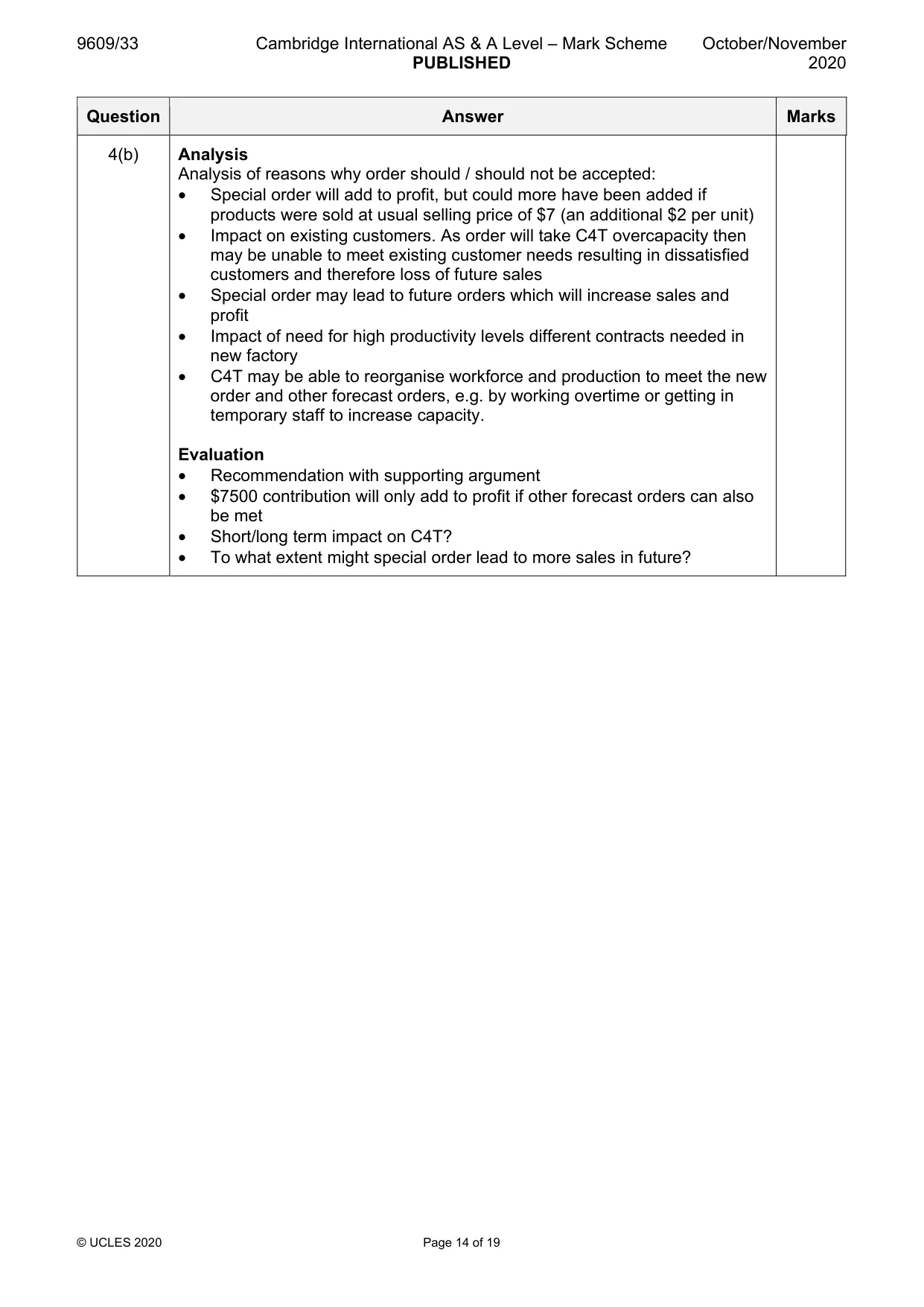
9609/33 Cambridge International AS & A Level – Mark Scheme PUBLISHED October/November 2020 © UCLES 2020 Page 14 of 19 Question Answer Marks 4(b) Analysis Analysis of reasons why order should / should not be accepted: • Special order will add to profit, but could more have been added if products were sold at usual selling price of $7 (an additional $2 per unit) • Impact on existing customers. As order will take C4T overcapacity then may be unable to meet existing customer needs resulting in dissatisfied customers and therefore loss of future sales • Special order may lead to future orders which will increase sales and profit • Impact of need for high productivity levels different contracts needed in new factory • C4T may be able to reorganise workforce and production to meet the new order and other forecast orders, e.g. by working overtime or getting in temporary staff to increase capacity. Evaluation • Recommendation with supporting argument • $7500 contribution will only add to profit if other forecast orders can also be met • Short/long term impact on C4T? • To what extent might special order lead to more sales in future?
Mark scheme, page 15
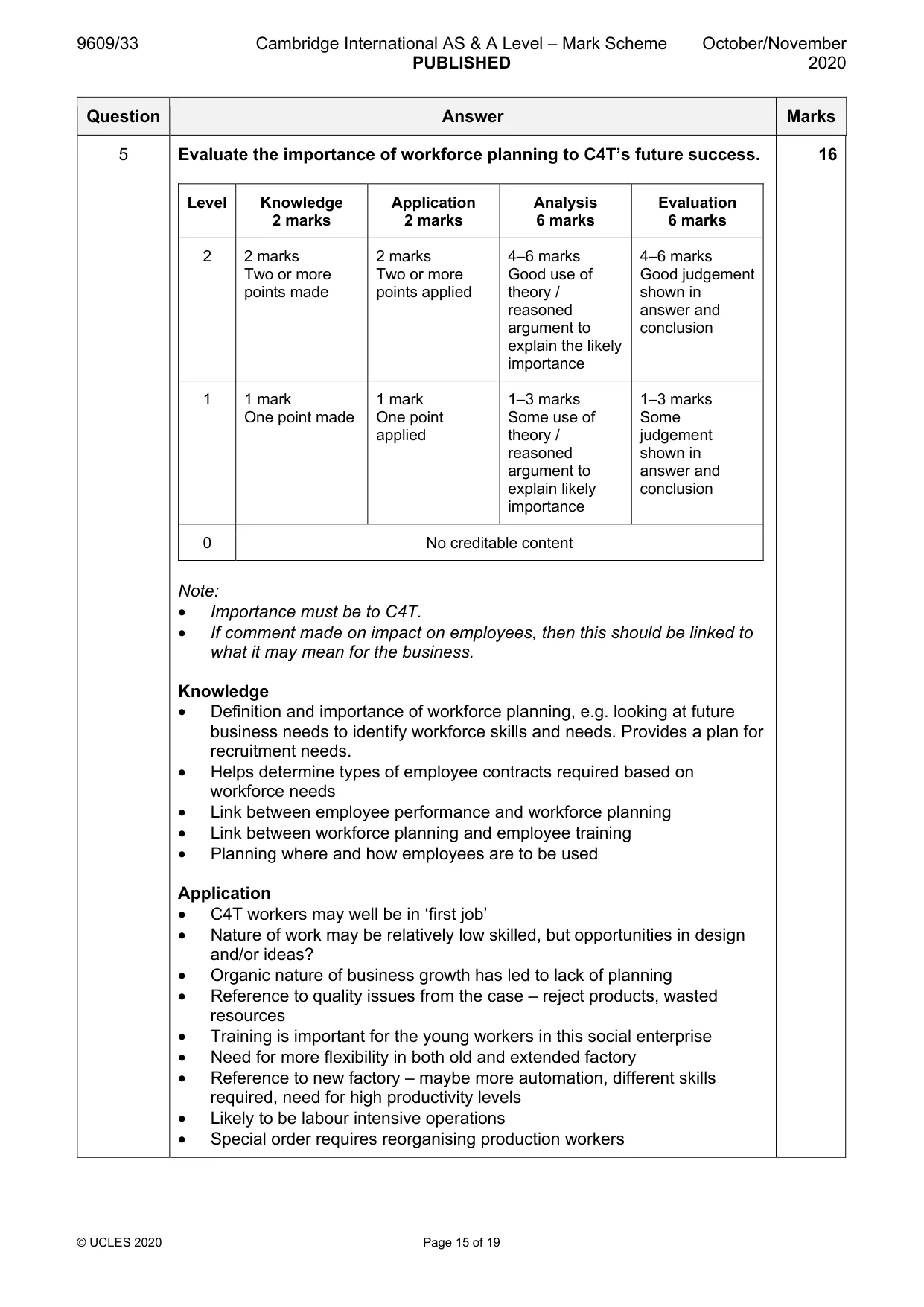
9609/33 Cambridge International AS & A Level – Mark Scheme PUBLISHED October/November 2020 © UCLES 2020 Page 15 of 19 Question Answer Marks 5 Evaluate the importance of workforce planning to C4T’s future success. Level Knowledge 2 marks Application 2 marks Analysis 6 marks Evaluation 6 marks 2 2 marks Two or more points made 2 marks Two or more points applied 4–6 marks Good use of theory / reasoned argument to explain the likely importance 4–6 marks Good judgement shown in answer and conclusion 1 1 mark One point made 1 mark One point applied 1–3 marks Some use of theory / reasoned argument to explain likely importance 1–3 marks Some judgement shown in answer and conclusion 0 No creditable content Note: • Importance must be to C4T. • If comment made on impact on employees, then this should be linked to what it may mean for the business. Knowledge • Definition and importance of workforce planning, e.g. looking at future business needs to identify workforce skills and needs. Provides a plan for recruitment needs. • Helps determine types of employee contracts required based on workforce needs • Link between employee performance and workforce planning • Link between workforce planning and employee training • Planning where and how employees are to be used Application • C4T workers may well be in ‘first job’ • Nature of work may be relatively low skilled, but opportunities in design and/or ideas? • Organic nature of business growth has led to lack of planning • Reference to quality issues from the case – reject products, wasted resources • Training is important for the young workers in this social enterprise • Need for more flexibility in both old and extended factory • Reference to new factory – maybe more automation, different skills required, need for high productivity levels • Likely to be labour intensive operations • Special order requires reorganising production workers 16
Mark scheme, page 16
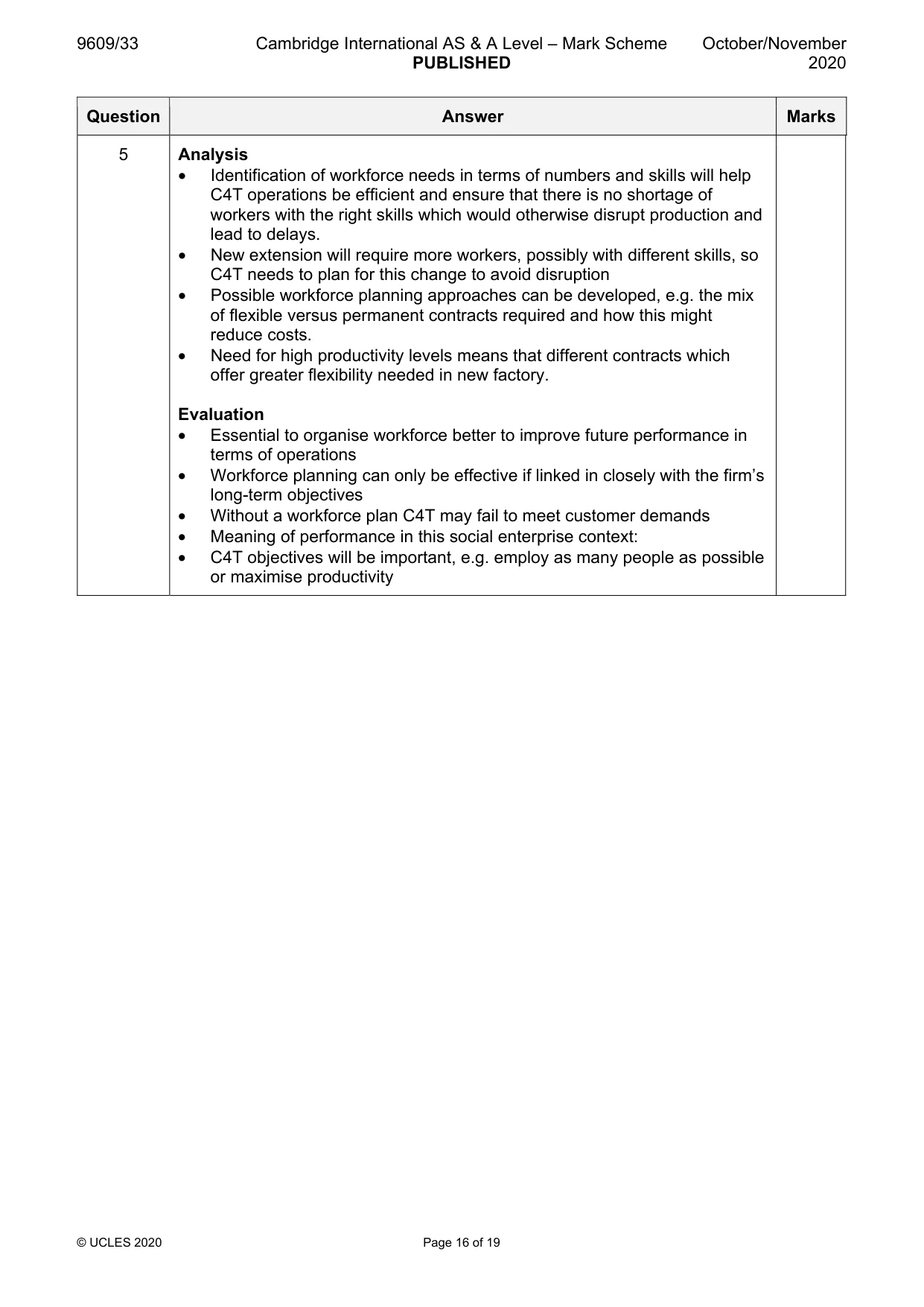
9609/33 Cambridge International AS & A Level – Mark Scheme PUBLISHED October/November 2020 © UCLES 2020 Page 16 of 19 Question Answer Marks 5 Analysis • Identification of workforce needs in terms of numbers and skills will help C4T operations be efficient and ensure that there is no shortage of workers with the right skills which would otherwise disrupt production and lead to delays. • New extension will require more workers, possibly with different skills, so C4T needs to plan for this change to avoid disruption • Possible workforce planning approaches can be developed, e.g. the mix of flexible versus permanent contracts required and how this might reduce costs. • Need for high productivity levels means that different contracts which offer greater flexibility needed in new factory. Evaluation • Essential to organise workforce better to improve future performance in terms of operations • Workforce planning can only be effective if linked in closely with the firm’s long-term objectives • Without a workforce plan C4T may fail to meet customer demands • Meaning of performance in this social enterprise context: • C4T objectives will be important, e.g. employ as many people as possible or maximise productivity
Mark scheme, page 17
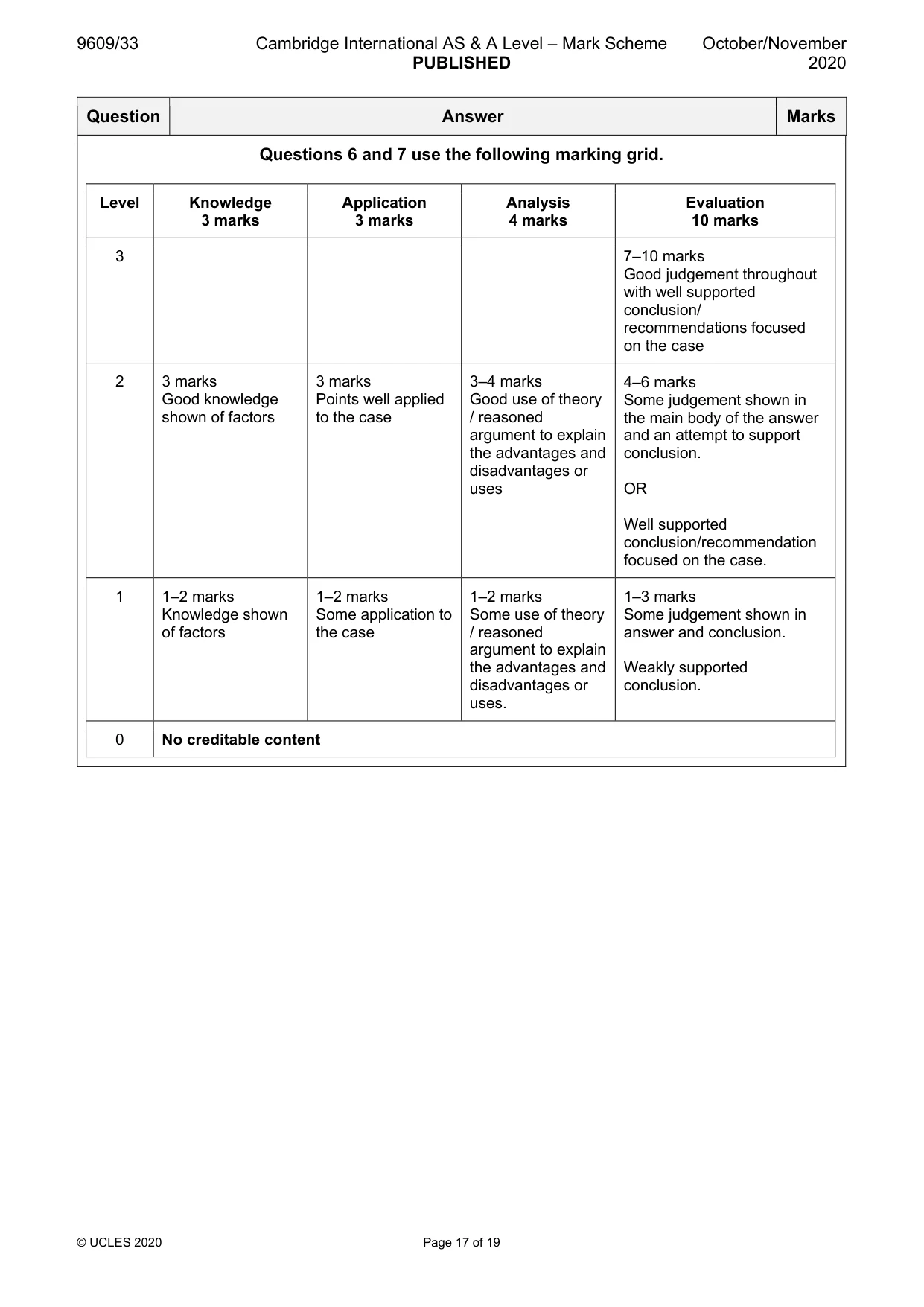
9609/33 Cambridge International AS & A Level – Mark Scheme PUBLISHED October/November 2020 © UCLES 2020 Page 17 of 19 Question Answer Marks Questions 6 and 7 use the following marking grid. Level Knowledge 3 marks Application 3 marks Analysis 4 marks Evaluation 10 marks 3 7–10 marks Good judgement throughout with well supported conclusion/ recommendations focused on the case 2 3 marks Good knowledge shown of factors 3 marks Points well applied to the case 3–4 marks Good use of theory / reasoned argument to explain the advantages and disadvantages or uses 4–6 marks Some judgement shown in the main body of the answer and an attempt to support conclusion. OR Well supported conclusion/recommendation focused on the case. 1 1–2 marks Knowledge shown of factors 1–2 marks Some application to the case 1–2 marks Some use of theory / reasoned argument to explain the advantages and disadvantages or uses. 1–3 marks Some judgement shown in answer and conclusion. Weakly supported conclusion. 0 No creditable content
Mark scheme, page 18
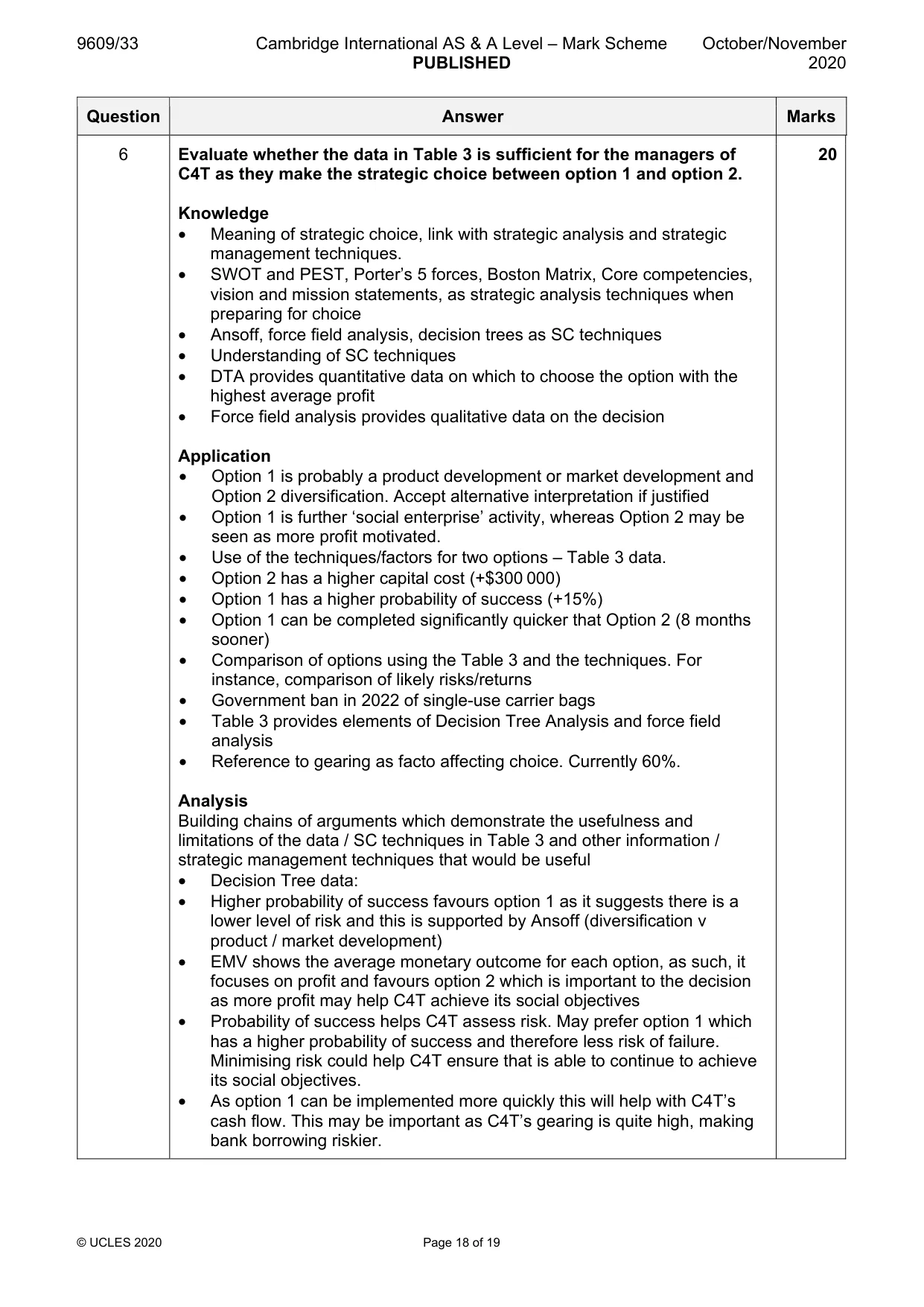
9609/33 Cambridge International AS & A Level – Mark Scheme PUBLISHED October/November 2020 © UCLES 2020 Page 18 of 19 Question Answer Marks 6 Evaluate whether the data in Table 3 is sufficient for the managers of C4T as they make the strategic choice between option 1 and option 2. Knowledge • Meaning of strategic choice, link with strategic analysis and strategic management techniques. • SWOT and PEST, Porter’s 5 forces, Boston Matrix, Core competencies, vision and mission statements, as strategic analysis techniques when preparing for choice • Ansoff, force field analysis, decision trees as SC techniques • Understanding of SC techniques • DTA provides quantitative data on which to choose the option with the highest average profit • Force field analysis provides qualitative data on the decision Application • Option 1 is probably a product development or market development and Option 2 diversification. Accept alternative interpretation if justified • Option 1 is further ‘social enterprise’ activity, whereas Option 2 may be seen as more profit motivated. • Use of the techniques/factors for two options – Table 3 data. • Option 2 has a higher capital cost (+$300 000) • Option 1 has a higher probability of success (+15%) • Option 1 can be completed significantly quicker that Option 2 (8 months sooner) • Comparison of options using the Table 3 and the techniques. For instance, comparison of likely risks/returns • Government ban in 2022 of single-use carrier bags • Table 3 provides elements of Decision Tree Analysis and force field analysis • Reference to gearing as facto affecting choice. Currently 60%. Analysis Building chains of arguments which demonstrate the usefulness and limitations of the data / SC techniques in Table 3 and other information / strategic management techniques that would be useful • Decision Tree data: • Higher probability of success favours option 1 as it suggests there is a lower level of risk and this is supported by Ansoff (diversification v product / market development) • EMV shows the average monetary outcome for each option, as such, it focuses on profit and favours option 2 which is important to the decision as more profit may help C4T achieve its social objectives • Probability of success helps C4T assess risk. May prefer option 1 which has a higher probability of success and therefore less risk of failure. Minimising risk could help C4T ensure that is able to continue to achieve its social objectives. • As option 1 can be implemented more quickly this will help with C4T’s cash flow. This may be important as C4T’s gearing is quite high, making bank borrowing riskier. 20
Mark scheme, page 19
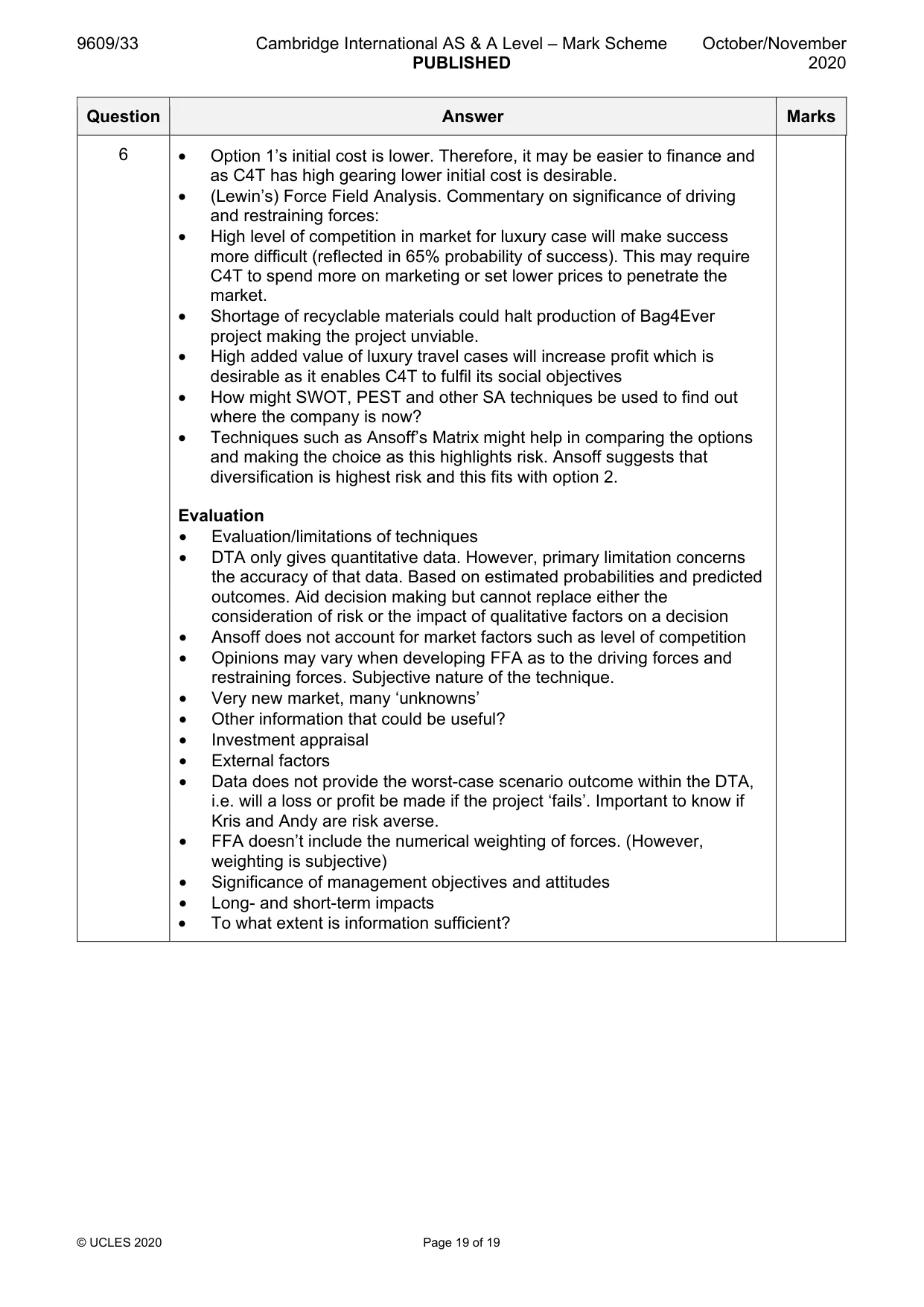
9609/33 Cambridge International AS & A Level – Mark Scheme PUBLISHED October/November 2020 © UCLES 2020 Page 19 of 19 Question Answer Marks 6 • Option 1’s initial cost is lower. Therefore, it may be easier to finance and as C4T has high gearing lower initial cost is desirable. • (Lewin’s) Force Field Analysis. Commentary on significance of driving and restraining forces: • High level of competition in market for luxury case will make success more difficult (reflected in 65% probability of success). This may require C4T to spend more on marketing or set lower prices to penetrate the market. • Shortage of recyclable materials could halt production of Bag4Ever project making the project unviable. • High added value of luxury travel cases will increase profit which is desirable as it enables C4T to fulfil its social objectives • How might SWOT, PEST and other SA techniques be used to find out where the company is now? • Techniques such as Ansoff’s Matrix might help in comparing the options and making the choice as this highlights risk. Ansoff suggests that diversification is highest risk and this fits with option 2. Evaluation • Evaluation/limitations of techniques • DTA only gives quantitative data. However, primary limitation concerns the accuracy of that data. Based on estimated probabilities and predicted outcomes. Aid decision making but cannot replace either the consideration of risk or the impact of qualitative factors on a decision • Ansoff does not account for market factors such as level of competition • Opinions may vary when developing FFA as to the driving forces and restraining forces. Subjective nature of the technique. • Very new market, many ‘unknowns’ • Other information that could be useful? • Investment appraisal • External factors • Data does not provide the worst-case scenario outcome within the DTA, i.e. will a loss or profit be made if the project ‘fails’. Important to know if Kris and Andy are risk averse. • FFA doesn’t include the numerical weighting of forces. (However, weighting is subjective) • Significance of management objectives and attitudes • Long- and short-term impacts • To what extent is information sufficient?
What you needed in this session
Cambridge’s own grade thresholds for 2020 Oct/Nov, Paper 3 · Variant 3. A higher threshold means an easier paper — the bar moves with how the cohort did.