Cambridge A Level Business (for first examination in 2016) 9609 — 2024 Feb/March Paper 3 · Variant 2
9609/32/F/M/24 · 60 marks · ≈68 min
The question paper and its mark scheme, free to read here and free to download. This is Cambridge’s own paper, exactly as it was sat.
Question paper12 pages









Mark scheme22 pages
Answers below. Sit the paper first if you are practising.
Paper as text
Question paper, page 1
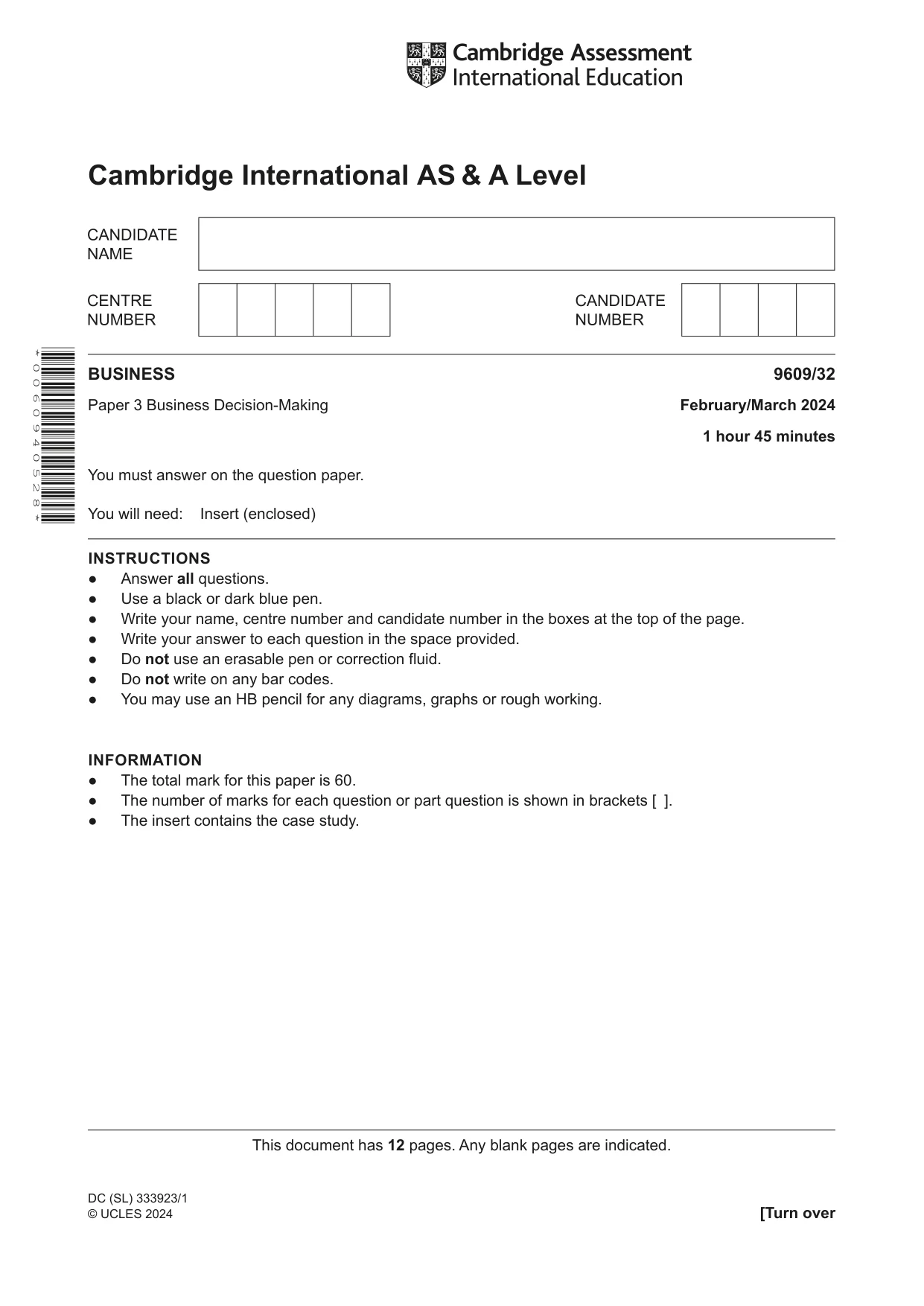
This document has 12 pages. Any blank pages are indicated. [Turn over Cambridge International AS & A Level BUSINESS 9609/32 Paper 3 Business Decision-Making February/March 2024 1 hour 45 minutes You must answer on the question paper. You will need: Insert (enclosed) INSTRUCTIONS ● Answer all questions. ● Use a black or dark blue pen. ● Write your name, centre number and candidate number in the boxes at the top of the page. ● Write your answer to each question in the space provided. ● Do not use an erasable pen or correction fluid. ● Do not write on any bar codes. ● You may use an HB pencil for any diagrams, graphs or rough working. INFORMATION ● The total mark for this paper is 60. ● The number of marks for each question or part question is shown in brackets [ ]. ● The insert contains the case study. * 0 0 6 0 9 4 0 5 2 8 * DC (SL) 333923/1 © UCLES 2024
Question paper, page 2
2 9609/32/F/M/24 © UCLES 2024 Answer all questions. 1 Analyse two benefits to CD resulting from internal economies of scale. … … … … … … … … … … … … … … … … … … … … … … … … [8]
Question paper, page 3
3 9609/32/F/M/24 © UCLES 2024 [Turn over 2 Analyse two advantages to CD of changing to a geographical organisational structure. … … … … … … … … … … … … … … … … … … … … … … … … [8]
Question paper, page 4
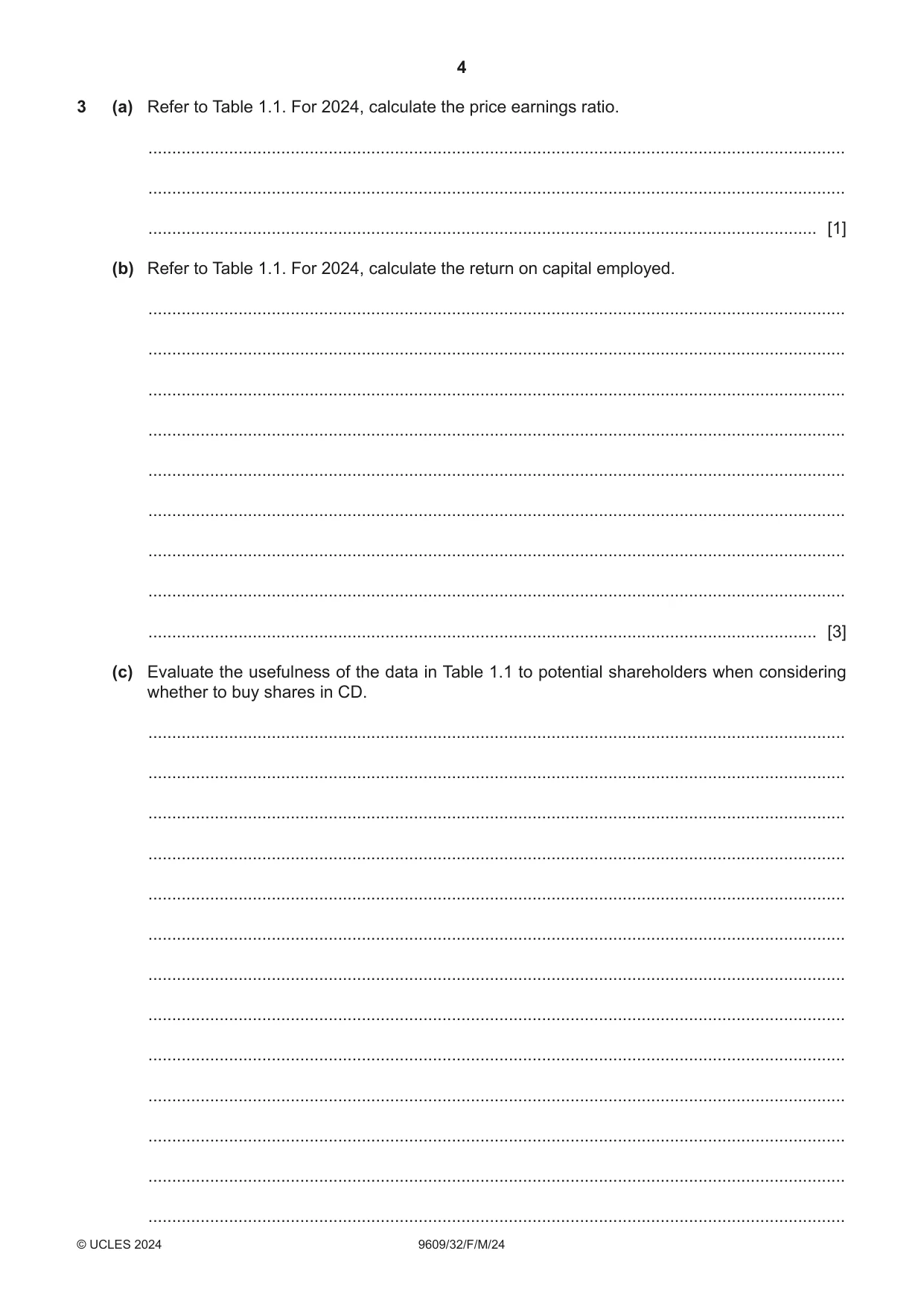
4 9609/32/F/M/24 © UCLES 2024 3 (a) Refer to Table 1.1. For 2024, calculate the price earnings ratio. … … … [1] (b) Refer to Table 1.1. For 2024, calculate the return on capital employed. … … … … … … … … … [3] (c) Evaluate the usefulness of the data in Table 1.1 to potential shareholders when considering whether to buy shares in CD. … … … … … … … … … … … … …
Question paper, page 5
5 9609/32/F/M/24 © UCLES 2024 [Turn over … … … … … … … … … … … … … … … … … … … … … … … [12]
Question paper, page 6
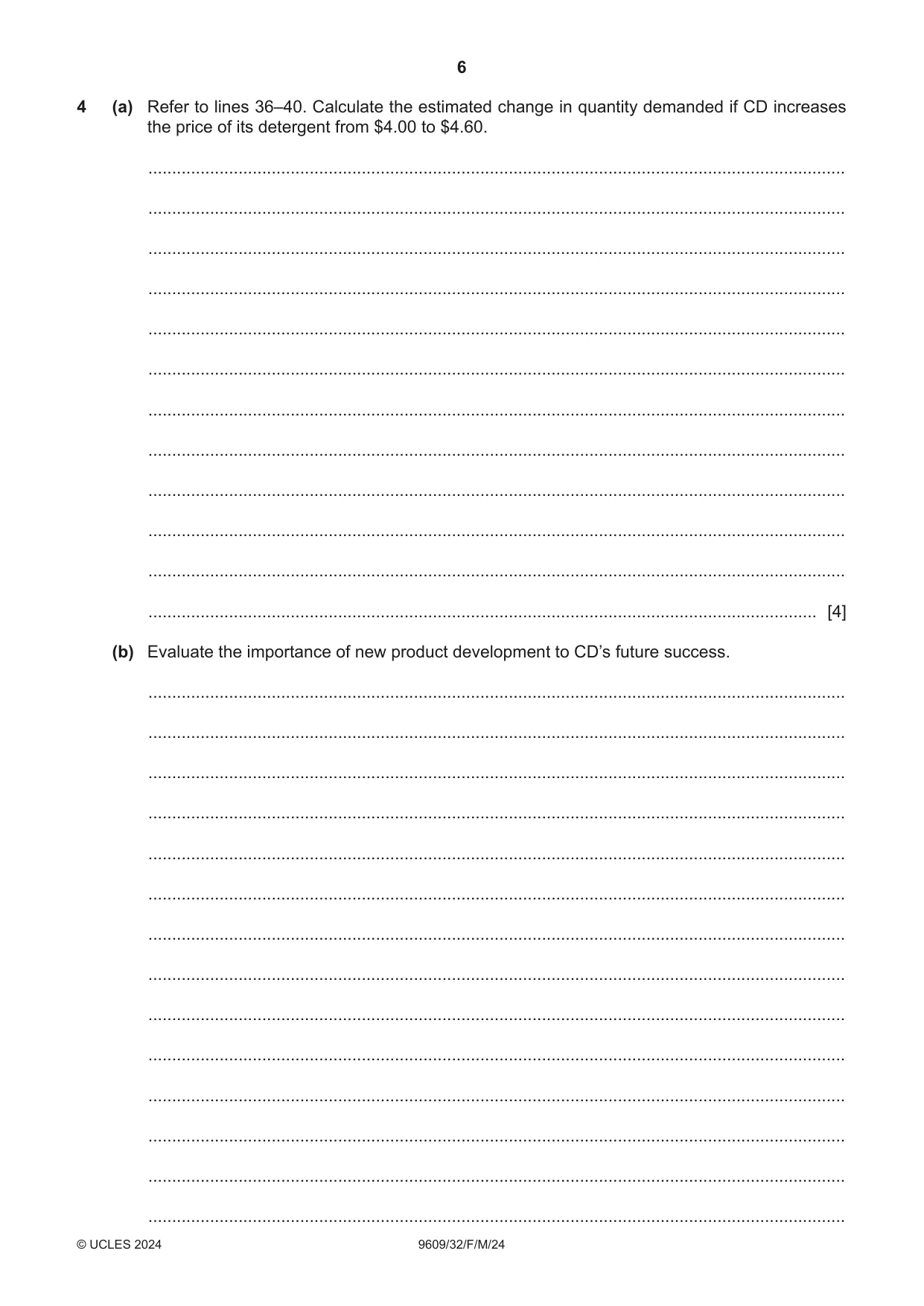
6 9609/32/F/M/24 © UCLES 2024 4 (a) Refer to lines 36–40. Calculate the estimated change in quantity demanded if CD increases the price of its detergent from $4.00 to $4.60. … … … … … … … … … … … … [4] (b) Evaluate the importance of new product development to CD’s future success. … … … … … … … … … … … … … …
Question paper, page 7
7 9609/32/F/M/24 © UCLES 2024 [Turn over … … … … … … … … … … … … … … … … … … … … … … [12]
Question paper, page 8
8 9609/32/F/M/24 © UCLES 2024 5 Evaluate the impact on CD of the appreciation of country K’s exchange rate. … … … … … … … … … … … … … … … … … … … … … … … … … … …
Question paper, page 9
9 9609/32/F/M/24 © UCLES 2024 … … … … … … … … … [12]
Question paper, page 10
10 9609/32/F/M/24 © UCLES 2024 BLANK PAGE
Question paper, page 11
11 9609/32/F/M/24 © UCLES 2024 BLANK PAGE
Question paper, page 12
12 9609/32/F/M/24 © UCLES 2024 Permission to reproduce items where third-party owned material protected by copyright is included has been sought and cleared where possible. Every reasonable effort has been made by the publisher (UCLES) to trace copyright holders, but if any items requiring clearance have unwittingly been included, the publisher will be pleased to make amends at the earliest possible opportunity. To avoid the issue of disclosure of answer-related information to candidates, all copyright acknowledgements are reproduced online in the Cambridge Assessment International Education Copyright Acknowledgements Booklet. This is produced for each series of examinations and is freely available to download at www.cambridgeinternational.org after the live examination series. Cambridge Assessment International Education is part of Cambridge Assessment. Cambridge Assessment is the brand name of the University of Cambridge Local Examinations Syndicate (UCLES), which is a department of the University of Cambridge. BLANK PAGE
Mark scheme, page 1
This document consists of 22 printed pages. © Cambridge University Press & Assessment 2024 [Turn over Cambridge International AS & A Level BUSINESS 9609/32 Paper 3 Business Decision-Making February/March 2024 MARK SCHEME Maximum Mark: 60 Published This mark scheme is published as an aid to teachers and candidates, to indicate the requirements of the examination. It shows the basis on which Examiners were instructed to award marks. It does not indicate the details of the discussions that took place at an Examiners’ meeting before marking began, which would have considered the acceptability of alternative answers. Mark schemes should be read in conjunction with the question paper and the Principal Examiner Report for Teachers. Cambridge International will not enter into discussions about these mark schemes. Cambridge International is publishing the mark schemes for the February/March 2024 series for most Cambridge IGCSE, Cambridge International A and AS Level components, and some Cambridge O Level components.
Mark scheme, page 2
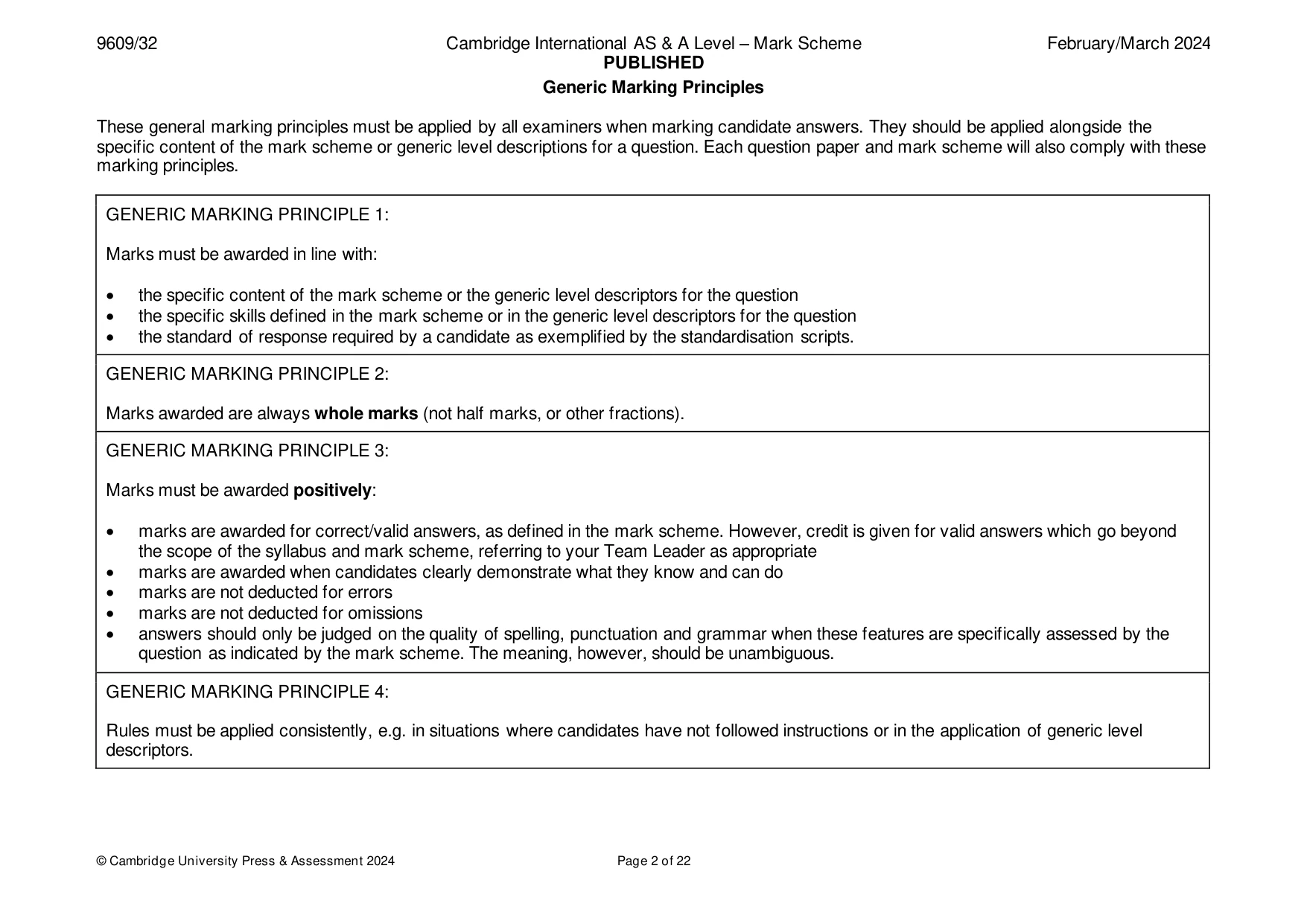
9609/32 Cambridge International AS & A Level – Mark Scheme PUBLISHED February/March 2024 © Cambridge University Press & Assessment 2024 Page 2 of 22 Generic Marking Principles These general marking principles must be applied by all examiners when marking candidate answers. They should be applied alongside the specific content of the mark scheme or generic level descriptions for a question. Each question paper and mark scheme will also comply with these marking principles. GENERIC MARKING PRINCIPLE 1: Marks must be awarded in line with: • the specific content of the mark scheme or the generic level descriptors for the question • the specific skills defined in the mark scheme or in the generic level descriptors for the question • the standard of response required by a candidate as exemplified by the standardisation scripts. GENERIC MARKING PRINCIPLE 2: Marks awarded are always whole marks (not half marks, or other fractions). GENERIC MARKING PRINCIPLE 3: Marks must be awarded positively: • marks are awarded for correct/valid answers, as defined in the mark scheme. However, credit is given for valid answers which go beyond the scope of the syllabus and mark scheme, referring to your Team Leader as appropriate • marks are awarded when candidates clearly demonstrate what they know and can do • marks are not deducted for errors • marks are not deducted for omissions • answers should only be judged on the quality of spelling, punctuation and grammar when these features are specifically assessed by the question as indicated by the mark scheme. The meaning, however, should be unambiguous. GENERIC MARKING PRINCIPLE 4: Rules must be applied consistently, e.g. in situations where candidates have not followed instructions or in the application of generic level descriptors.
Mark scheme, page 3
9609/32 Cambridge International AS & A Level – Mark Scheme PUBLISHED February/March 2024 © Cambridge University Press & Assessment 2024 Page 3 of 22 GENERIC MARKING PRINCIPLE 5: Marks should be awarded using the full range of marks defined in the mark scheme for the question (however; the use of the full mark range may be limited according to the quality of the candidate responses seen). GENERIC MARKING PRINCIPLE 6: Marks awarded are based solely on the requirements as defined in the mark scheme. Marks should not be awarded with grade thresholds or grade descriptors in mind.
Mark scheme, page 4
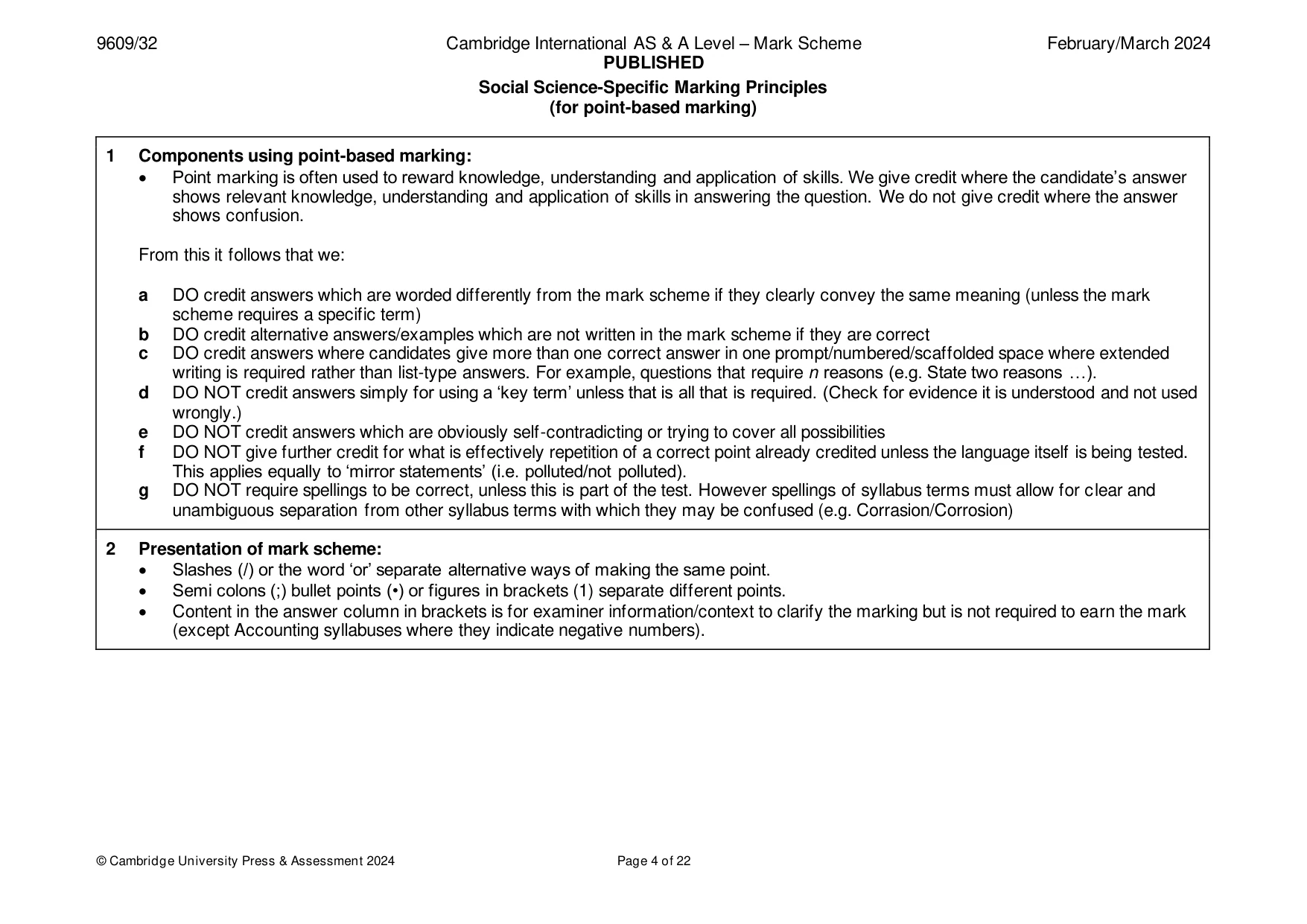
9609/32 Cambridge International AS & A Level – Mark Scheme PUBLISHED February/March 2024 © Cambridge University Press & Assessment 2024 Page 4 of 22 Social Science-Specific Marking Principles (for point-based marking) 1 Components using point-based marking: • Point marking is often used to reward knowledge, understanding and application of skills. We give credit where the candidate’s answer shows relevant knowledge, understanding and application of skills in answering the question. We do not give credit where the answer shows confusion. From this it follows that we: a DO credit answers which are worded differently from the mark scheme if they clearly convey the same meaning (unless the mark scheme requires a specific term) b DO credit alternative answers/examples which are not written in the mark scheme if they are correct c DO credit answers where candidates give more than one correct answer in one prompt/numbered/scaffolded space where extended writing is required rather than list-type answers. For example, questions that require n reasons (e.g. State two reasons …). d DO NOT credit answers simply for using a ‘key term’ unless that is all that is required. (Check for evidence it is understood and not used wrongly.) e DO NOT credit answers which are obviously self-contradicting or trying to cover all possibilities f DO NOT give further credit for what is effectively repetition of a correct point already credited unless the language itself is being tested. This applies equally to ‘mirror statements’ (i.e. polluted/not polluted). g DO NOT require spellings to be correct, unless this is part of the test. However spellings of syllabus terms must allow for clear and unambiguous separation from other syllabus terms with which they may be confused (e.g. Corrasion/Corrosion) 2 Presentation of mark scheme: • Slashes (/) or the word ‘or’ separate alternative ways of making the same point. • Semi colons (;) bullet points (•) or figures in brackets (1) separate different points. • Content in the answer column in brackets is for examiner information/context to clarify the marking but is not required to earn the mark (except Accounting syllabuses where they indicate negative numbers).
Mark scheme, page 5
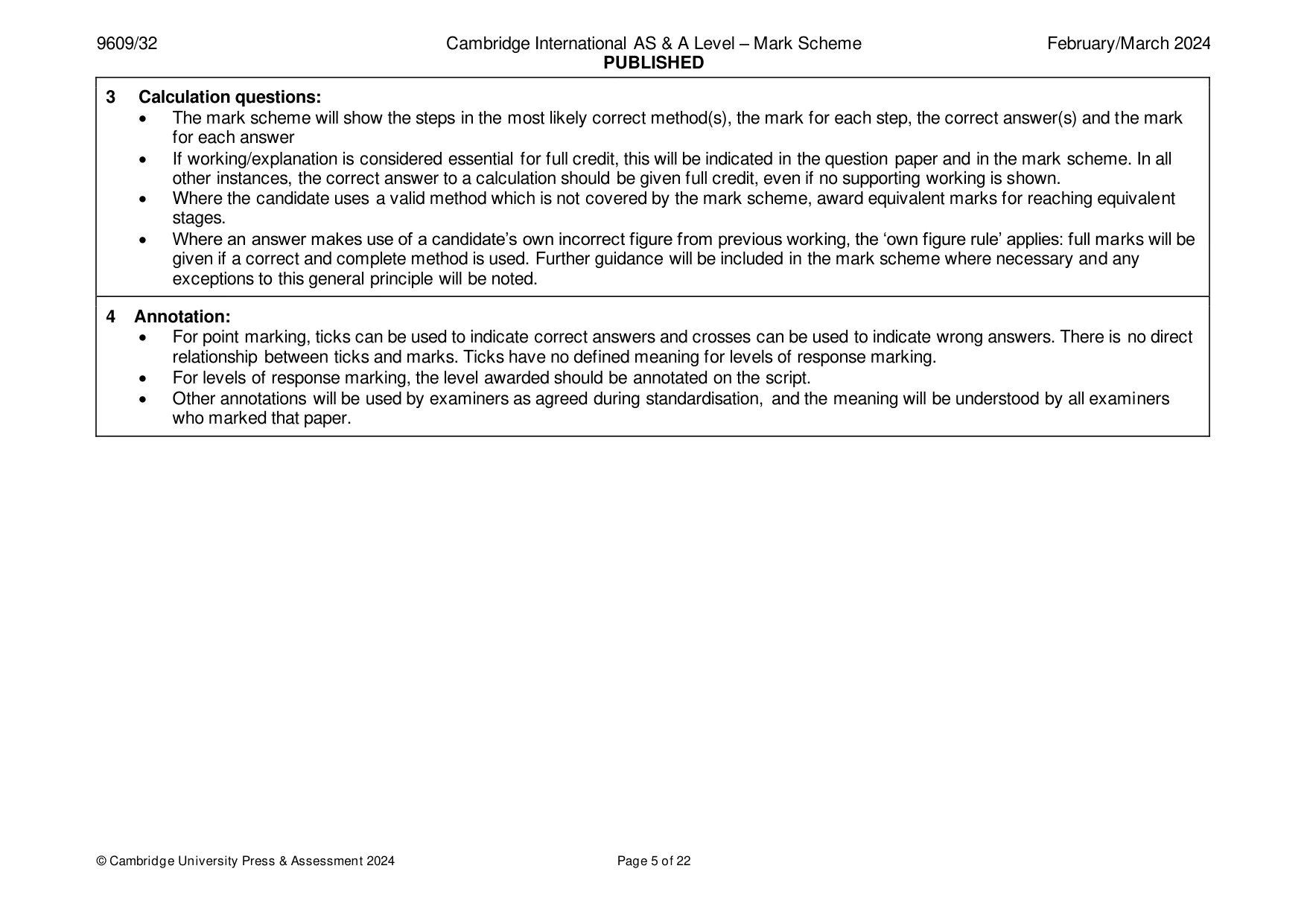
9609/32 Cambridge International AS & A Level – Mark Scheme PUBLISHED February/March 2024 © Cambridge University Press & Assessment 2024 Page 5 of 22 3 Calculation questions: • The mark scheme will show the steps in the most likely correct method(s), the mark for each step, the correct answer(s) and the mark for each answer • If working/explanation is considered essential for full credit, this will be indicated in the question paper and in the mark scheme. In all other instances, the correct answer to a calculation should be given full credit, even if no supporting working is shown. • Where the candidate uses a valid method which is not covered by the mark scheme, award equivalent marks for reaching equivalent stages. • Where an answer makes use of a candidate’s own incorrect figure from previous working, the ‘own figure rule’ applies: full marks will be given if a correct and complete method is used. Further guidance will be included in the mark scheme where necessary and any exceptions to this general principle will be noted. 4 Annotation: • For point marking, ticks can be used to indicate correct answers and crosses can be used to indicate wrong answers. There is no direct relationship between ticks and marks. Ticks have no defined meaning for levels of response marking. • For levels of response marking, the level awarded should be annotated on the script. • Other annotations will be used by examiners as agreed during standardisation, and the meaning will be understood by all examiners who marked that paper.
Mark scheme, page 6
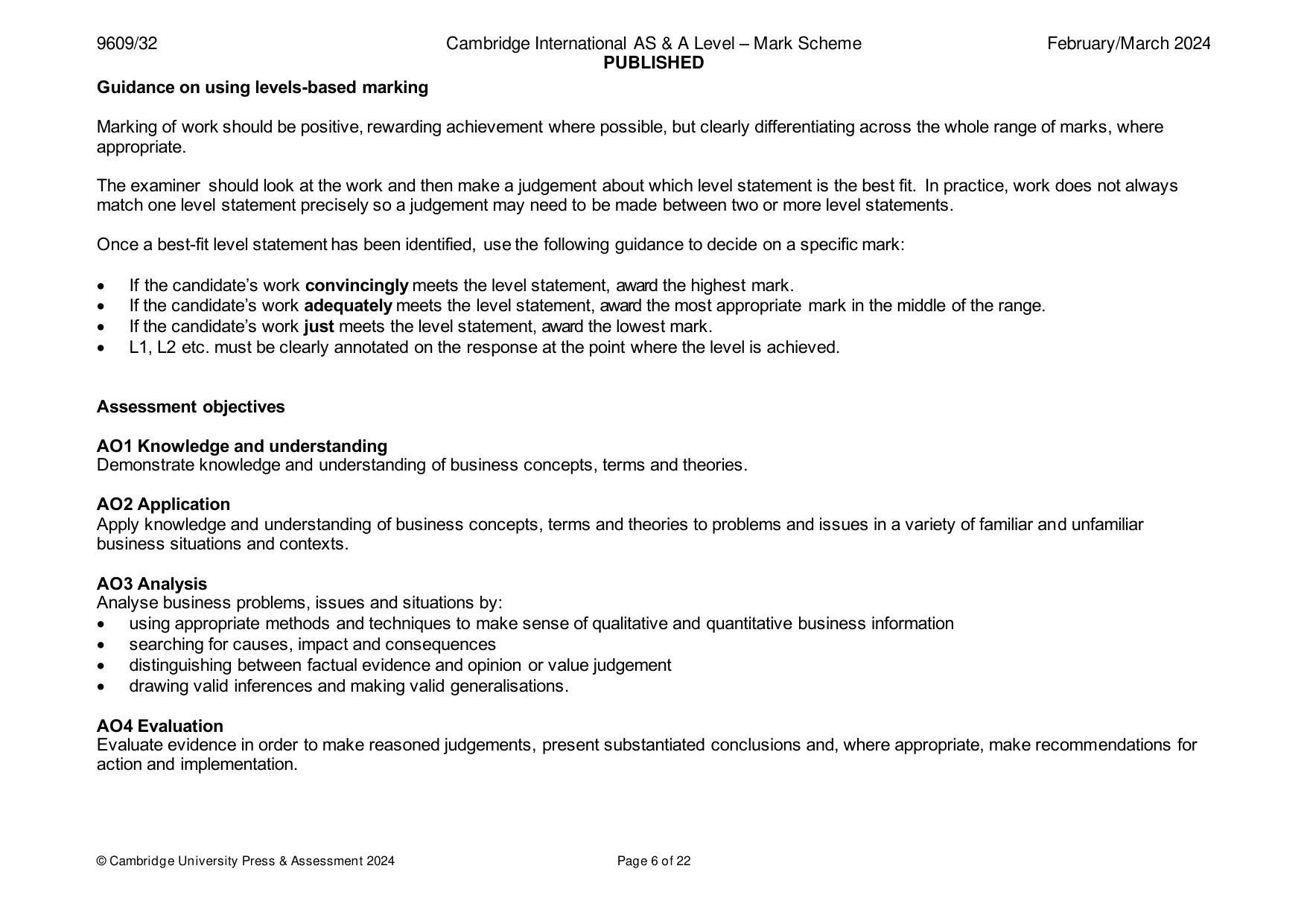
9609/32 Cambridge International AS & A Level – Mark Scheme PUBLISHED February/March 2024 © Cambridge University Press & Assessment 2024 Page 6 of 22 Guidance on using levels-based marking Marking of work should be positive, rewarding achievement where possible, but clearly differentiating across the whole range of marks, where appropriate. The examiner should look at the work and then make a judgement about which level statement is the best fit. In practice, work does not always match one level statement precisely so a judgement may need to be made between two or more level statements. Once a best-fit level statement has been identified, use the following guidance to decide on a specific mark: • If the candidate’s work convincingly meets the level statement, award the highest mark. • If the candidate’s work adequately meets the level statement, award the most appropriate mark in the middle of the range. • If the candidate’s work just meets the level statement, award the lowest mark. • L1, L2 etc. must be clearly annotated on the response at the point where the level is achieved. Assessment objectives AO1 Knowledge and understanding Demonstrate knowledge and understanding of business concepts, terms and theories. AO2 Application Apply knowledge and understanding of business concepts, terms and theories to problems and issues in a variety of familiar and unfamiliar business situations and contexts. AO3 Analysis Analyse business problems, issues and situations by: • using appropriate methods and techniques to make sense of qualitative and quantitative business information • searching for causes, impact and consequences • distinguishing between factual evidence and opinion or value judgement • drawing valid inferences and making valid generalisations. AO4 Evaluation Evaluate evidence in order to make reasoned judgements, present substantiated conclusions and, where appropriate, make recommendations for action and implementation.
Mark scheme, page 7
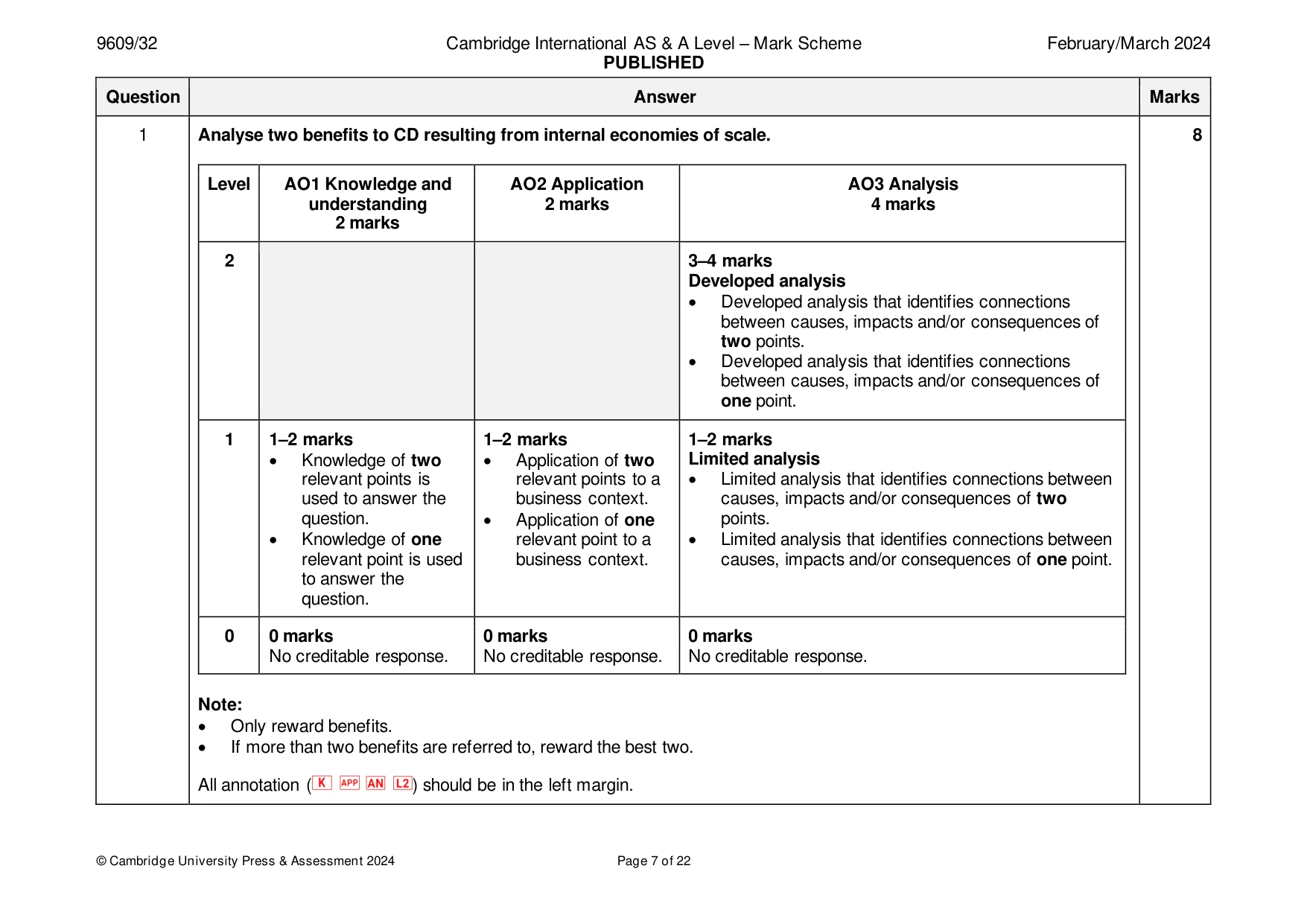
9609/32 Cambridge International AS & A Level – Mark Scheme PUBLISHED February/March 2024 © Cambridge University Press & Assessment 2024 Page 7 of 22 Question Answer Marks 1 Analyse two benefits to CD resulting from internal economies of scale. Level AO1 Knowledge and understanding 2 marks AO2 Application 2 marks AO3 Analysis 4 marks 2 3–4 marks Developed analysis • Developed analysis that identifies connections between causes, impacts and/or consequences of two points. • Developed analysis that identifies connections between causes, impacts and/or consequences of one point. 1 1–2 marks • Knowledge of two relevant points is used to answer the question. • Knowledge of one relevant point is used to answer the question. 1–2 marks • Application of two relevant points to a business context. • Application of one relevant point to a business context. 1–2 marks Limited analysis • Limited analysis that identifies connections between causes, impacts and/or consequences of two points. • Limited analysis that identifies connections between causes, impacts and/or consequences of one point. 0 0 marks No creditable response. 0 marks No creditable response. 0 marks No creditable response. Note: • Only reward benefits. • If more than two benefits are referred to, reward the best two. All annotation ( ) should be in the left margin. 8
Mark scheme, page 8
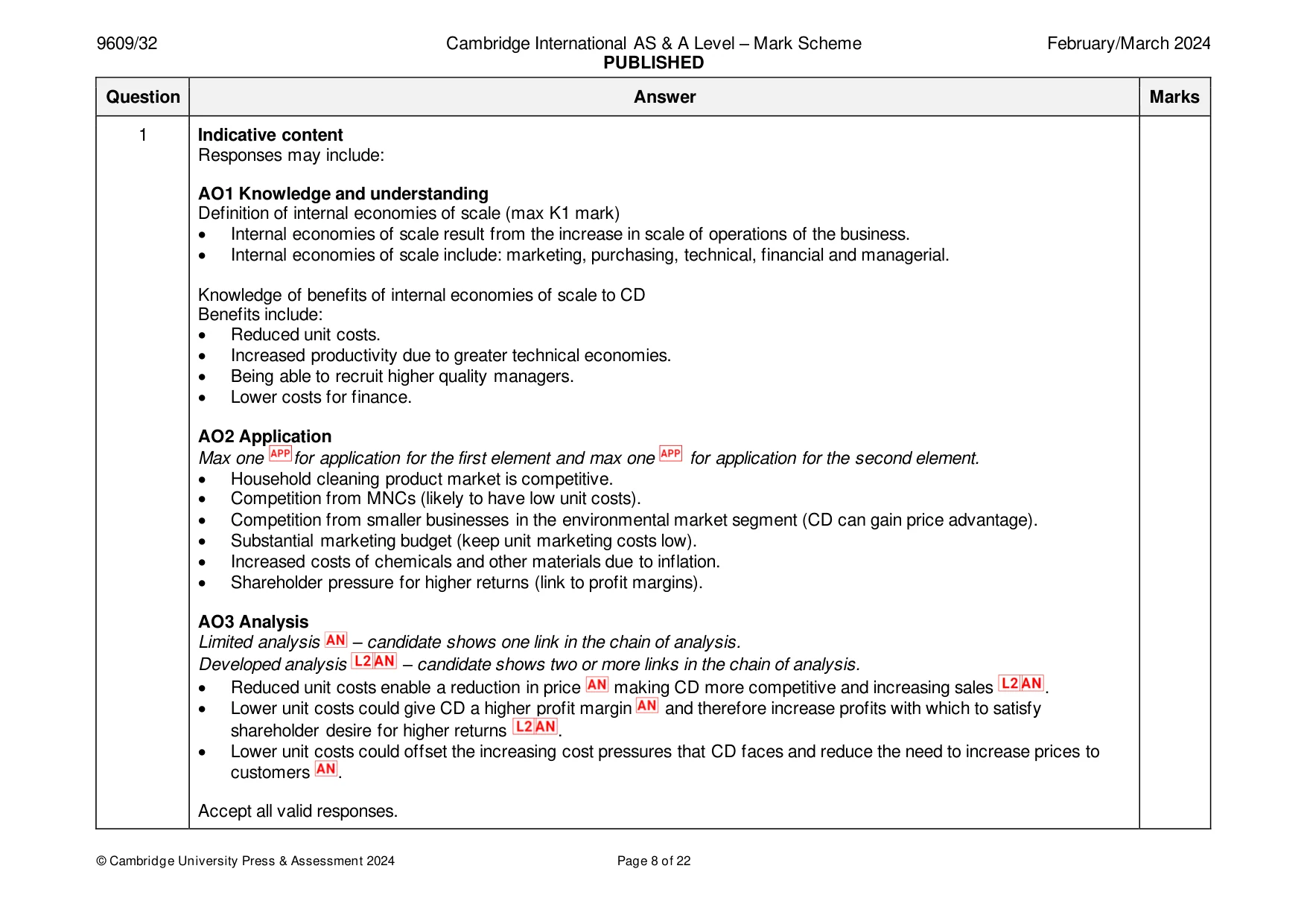
9609/32 Cambridge International AS & A Level – Mark Scheme PUBLISHED February/March 2024 © Cambridge University Press & Assessment 2024 Page 8 of 22 Question Answer Marks 1 Indicative content Responses may include: AO1 Knowledge and understanding Definition of internal economies of scale (max K1 mark) • Internal economies of scale result from the increase in scale of operations of the business. • Internal economies of scale include: marketing, purchasing, technical, financial and managerial. Knowledge of benefits of internal economies of scale to CD Benefits include: • Reduced unit costs. • Increased productivity due to greater technical economies. • Being able to recruit higher quality managers. • Lower costs for finance. AO2 Application Max one for application for the first element and max one for application for the second element. • Household cleaning product market is competitive. • Competition from MNCs (likely to have low unit costs). • Competition from smaller businesses in the environmental market segment (CD can gain price advantage). • Substantial marketing budget (keep unit marketing costs low). • Increased costs of chemicals and other materials due to inflation. • Shareholder pressure for higher returns (link to profit margins). AO3 Analysis Limited analysis – candidate shows one link in the chain of analysis. Developed analysis – candidate shows two or more links in the chain of analysis. • Reduced unit costs enable a reduction in price making CD more competitive and increasing sales . • Lower unit costs could give CD a higher profit margin and therefore increase profits with which to satisfy shareholder desire for higher returns . • Lower unit costs could offset the increasing cost pressures that CD faces and reduce the need to increase prices to customers . Accept all valid responses.
Mark scheme, page 9
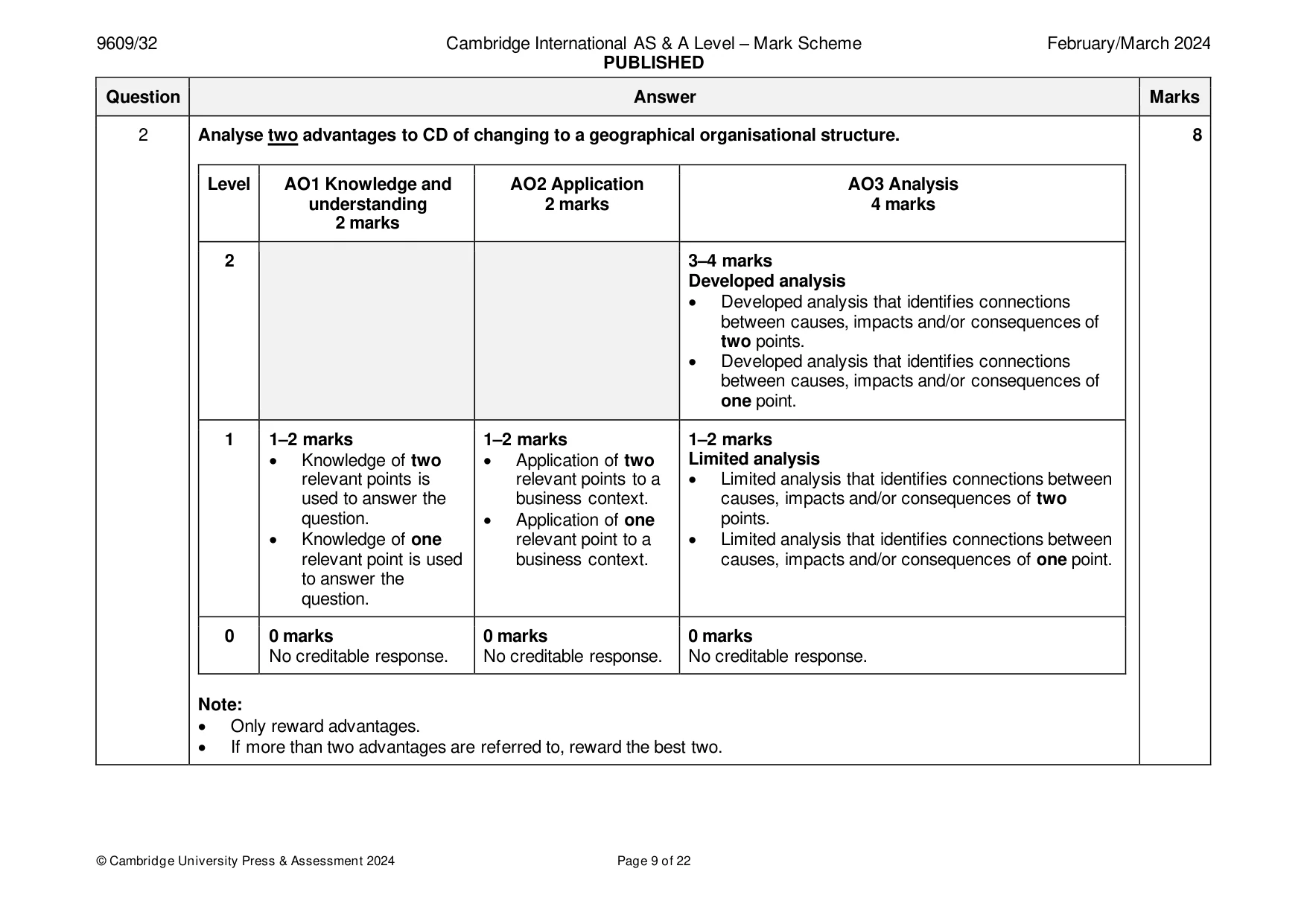
9609/32 Cambridge International AS & A Level – Mark Scheme PUBLISHED February/March 2024 © Cambridge University Press & Assessment 2024 Page 9 of 22 Question Answer Marks 2 Analyse two advantages to CD of changing to a geographical organisational structure. Level AO1 Knowledge and understanding 2 marks AO2 Application 2 marks AO3 Analysis 4 marks 2 3–4 marks Developed analysis • Developed analysis that identifies connections between causes, impacts and/or consequences of two points. • Developed analysis that identifies connections between causes, impacts and/or consequences of one point. 1 1–2 marks • Knowledge of two relevant points is used to answer the question. • Knowledge of one relevant point is used to answer the question. 1–2 marks • Application of two relevant points to a business context. • Application of one relevant point to a business context. 1–2 marks Limited analysis • Limited analysis that identifies connections between causes, impacts and/or consequences of two points. • Limited analysis that identifies connections between causes, impacts and/or consequences of one point. 0 0 marks No creditable response. 0 marks No creditable response. 0 marks No creditable response. Note: • Only reward advantages. • If more than two advantages are referred to, reward the best two. 8
Mark scheme, page 10
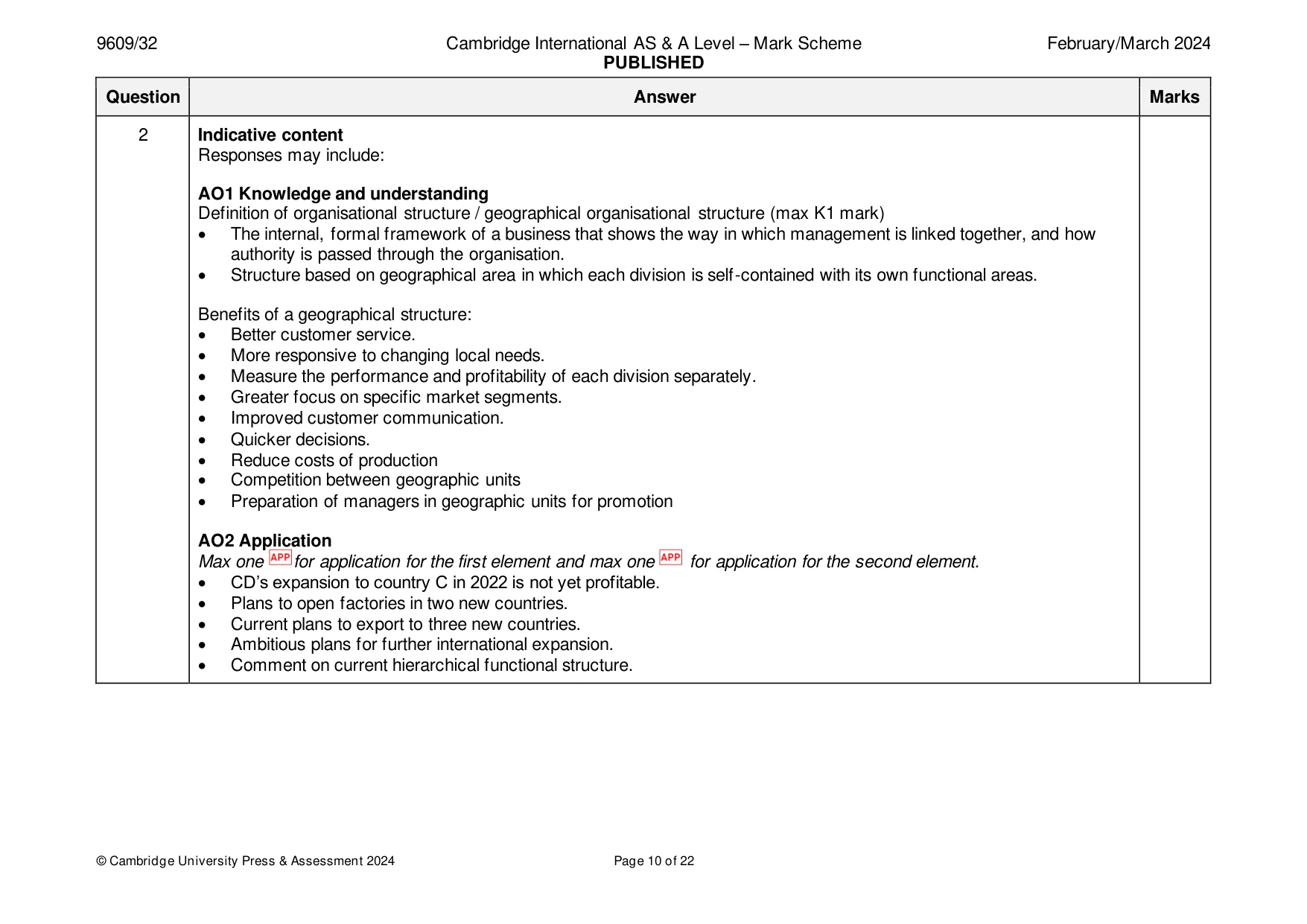
9609/32 Cambridge International AS & A Level – Mark Scheme PUBLISHED February/March 2024 © Cambridge University Press & Assessment 2024 Page 10 of 22 Question Answer Marks 2 Indicative content Responses may include: AO1 Knowledge and understanding Definition of organisational structure / geographical organisational structure (max K1 mark) • The internal, formal framework of a business that shows the way in which management is linked together, and how authority is passed through the organisation. • Structure based on geographical area in which each division is self-contained with its own functional areas. Benefits of a geographical structure: • Better customer service. • More responsive to changing local needs. • Measure the performance and profitability of each division separately. • Greater focus on specific market segments. • Improved customer communication. • Quicker decisions. • Reduce costs of production • Competition between geographic units • Preparation of managers in geographic units for promotion AO2 Application Max one for application for the first element and max one for application for the second element. • CD’s expansion to country C in 2022 is not yet profitable. • Plans to open factories in two new countries. • Current plans to export to three new countries. • Ambitious plans for further international expansion. • Comment on current hierarchical functional structure.
Mark scheme, page 11
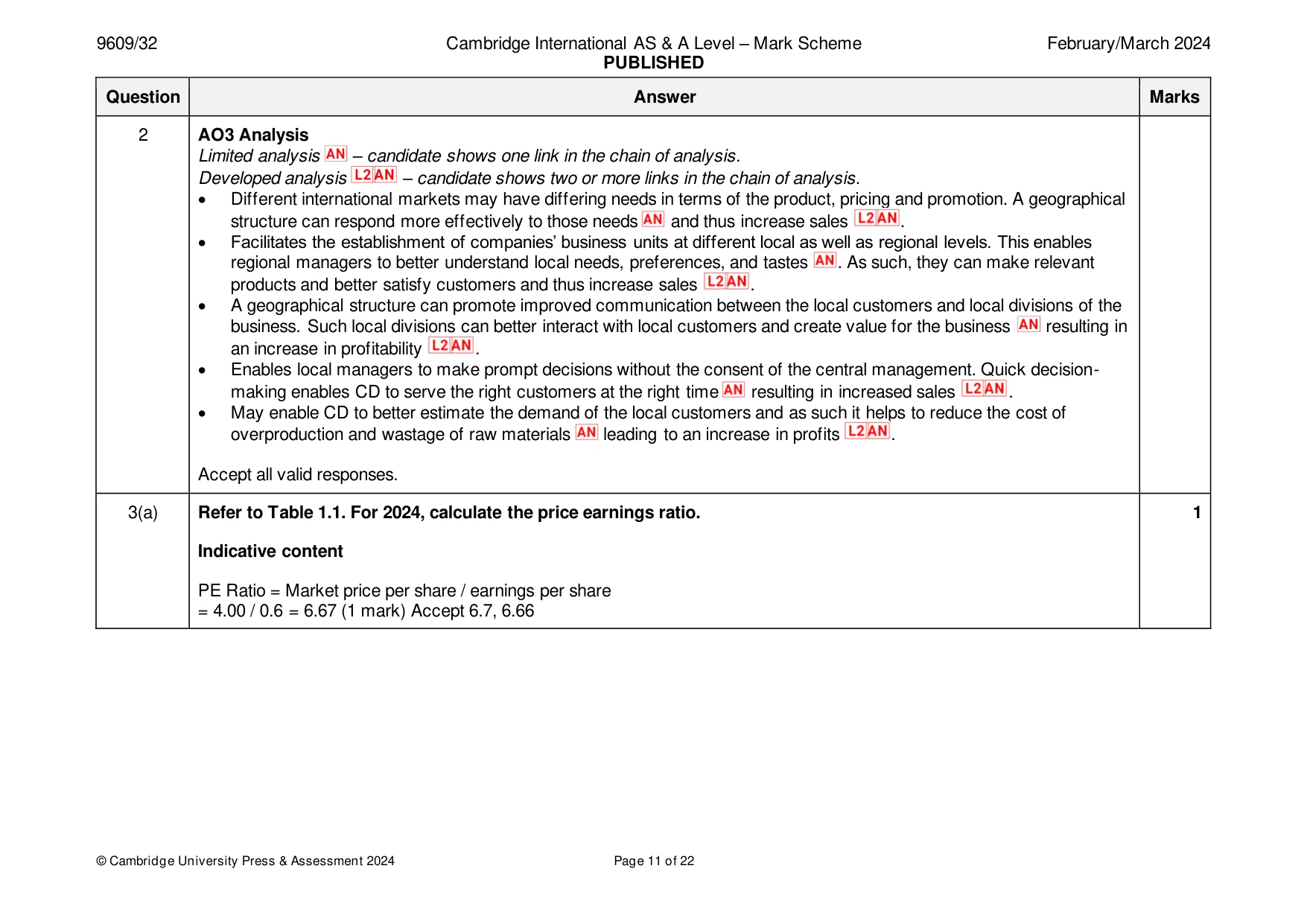
9609/32 Cambridge International AS & A Level – Mark Scheme PUBLISHED February/March 2024 © Cambridge University Press & Assessment 2024 Page 11 of 22 Question Answer Marks 2 AO3 Analysis Limited analysis – candidate shows one link in the chain of analysis. Developed analysis – candidate shows two or more links in the chain of analysis. • Different international markets may have differing needs in terms of the product, pricing and promotion. A geographical structure can respond more effectively to those needs and thus increase sales . • Facilitates the establishment of companies’ business units at different local as well as regional levels. This enables regional managers to better understand local needs, preferences, and tastes . As such, they can make relevant products and better satisfy customers and thus increase sales . • A geographical structure can promote improved communication between the local customers and local divisions of the business. Such local divisions can better interact with local customers and create value for the business resulting in an increase in profitability . • Enables local managers to make prompt decisions without the consent of the central management. Quick decision- making enables CD to serve the right customers at the right time resulting in increased sales . • May enable CD to better estimate the demand of the local customers and as such it helps to reduce the cost of overproduction and wastage of raw materials leading to an increase in profits . Accept all valid responses. 3(a) Refer to Table 1.1. For 2024, calculate the price earnings ratio. Indicative content PE Ratio = Market price per share / earnings per share = 4.00 / 0.6 = 6.67 (1 mark) Accept 6.7, 6.66 1
Mark scheme, page 12
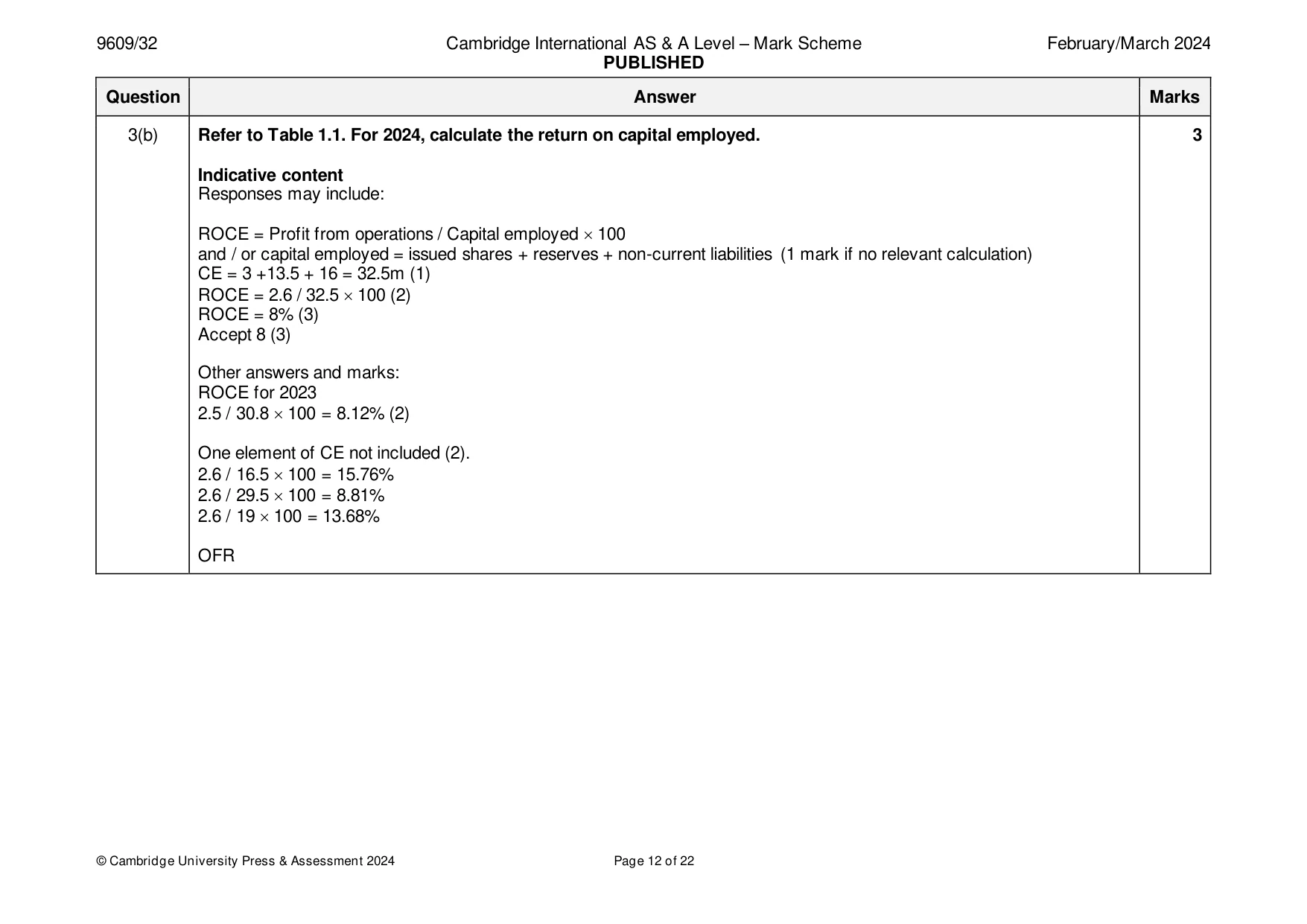
9609/32 Cambridge International AS & A Level – Mark Scheme PUBLISHED February/March 2024 © Cambridge University Press & Assessment 2024 Page 12 of 22 Question Answer Marks 3(b) Refer to Table 1.1. For 2024, calculate the return on capital employed. Indicative content Responses may include: ROCE = Profit from operations / Capital employed 100 and / or capital employed = issued shares + reserves + non-current liabilities (1 mark if no relevant calculation) CE = 3 +13.5 + 16 = 32.5m (1) ROCE = 2.6 / 32.5 100 (2) ROCE = 8% (3) Accept 8 (3) Other answers and marks: ROCE for 2023 2.5 / 30.8 100 = 8.12% (2) One element of CE not included (2). 2.6 / 16.5 100 = 15.76% 2.6 / 29.5 100 = 8.81% 2.6 / 19 100 = 13.68% OFR 3
Mark scheme, page 13
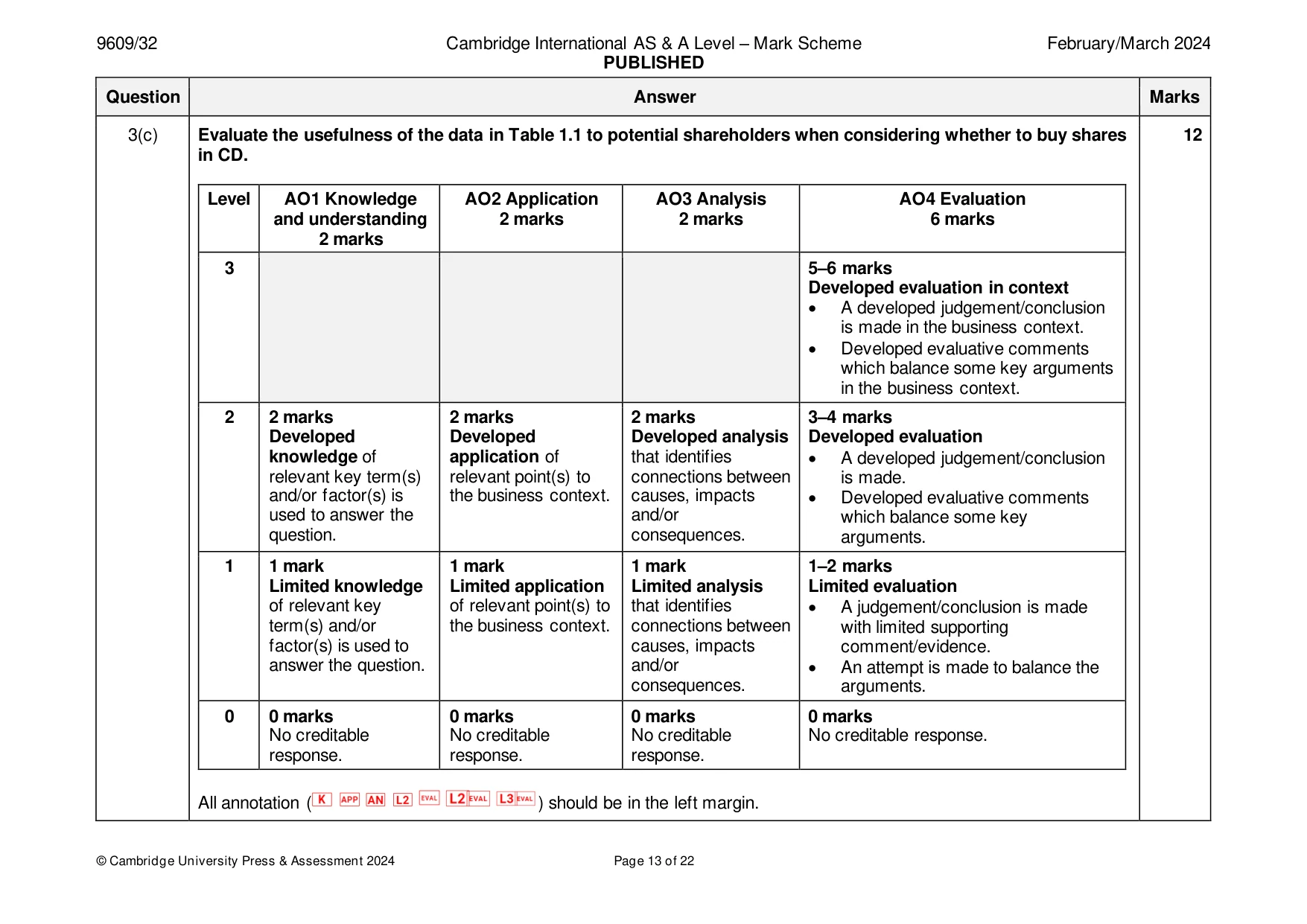
9609/32 Cambridge International AS & A Level – Mark Scheme PUBLISHED February/March 2024 © Cambridge University Press & Assessment 2024 Page 13 of 22 Question Answer Marks 3(c) Evaluate the usefulness of the data in Table 1.1 to potential shareholders when considering whether to buy shares in CD. Level AO1 Knowledge and understanding 2 marks AO2 Application 2 marks AO3 Analysis 2 marks AO4 Evaluation 6 marks 3 5–6 marks Developed evaluation in context • A developed judgement/conclusion is made in the business context. • Developed evaluative comments which balance some key arguments in the business context. 2 2 marks Developed knowledge of relevant key term(s) and/or factor(s) is used to answer the question. 2 marks Developed application of relevant point(s) to the business context. 2 marks Developed analysis that identifies connections between causes, impacts and/or consequences. 3–4 marks Developed evaluation • A developed judgement/conclusion is made. • Developed evaluative comments which balance some key arguments. 1 1 mark Limited knowledge of relevant key term(s) and/or factor(s) is used to answer the question. 1 mark Limited application of relevant point(s) to the business context. 1 mark Limited analysis that identifies connections between causes, impacts and/or consequences. 1–2 marks Limited evaluation • A judgement/conclusion is made with limited supporting comment/evidence. • An attempt is made to balance the arguments. 0 0 marks No creditable response. 0 marks No creditable response. 0 marks No creditable response. 0 marks No creditable response. All annotation ( ) should be in the left margin. 12
Mark scheme, page 14
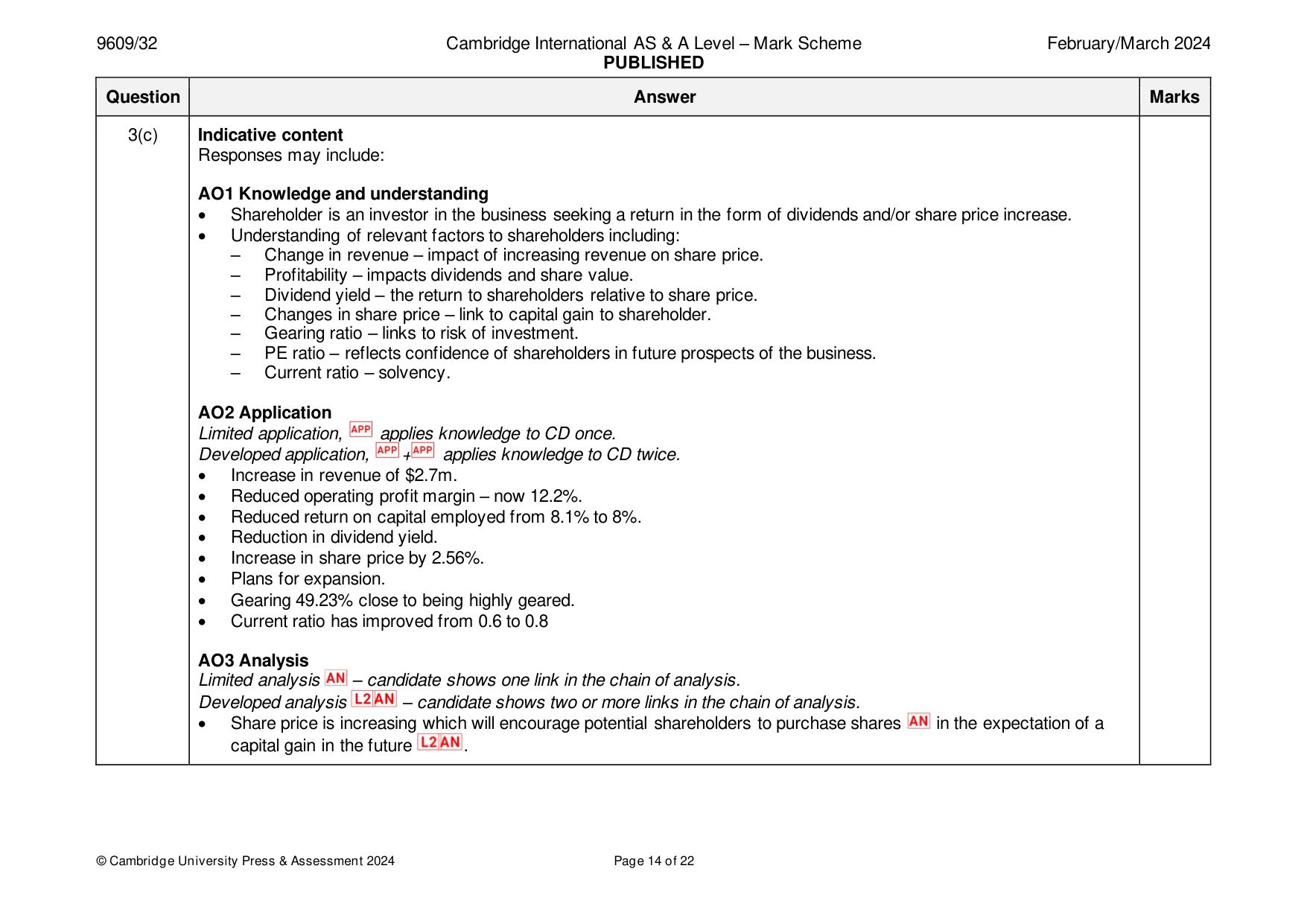
9609/32 Cambridge International AS & A Level – Mark Scheme PUBLISHED February/March 2024 © Cambridge University Press & Assessment 2024 Page 14 of 22 Question Answer Marks 3(c) Indicative content Responses may include: AO1 Knowledge and understanding • Shareholder is an investor in the business seeking a return in the form of dividends and/or share price increase. • Understanding of relevant factors to shareholders including: – Change in revenue – impact of increasing revenue on share price. – Profitability – impacts dividends and share value. – Dividend yield – the return to shareholders relative to share price. – Changes in share price – link to capital gain to shareholder. – Gearing ratio – links to risk of investment. – PE ratio – reflects confidence of shareholders in future prospects of the business. – Current ratio – solvency. AO2 Application Limited application, applies knowledge to CD once. Developed application, + applies knowledge to CD twice. • Increase in revenue of $2.7m. • Reduced operating profit margin – now 12.2%. • Reduced return on capital employed from 8.1% to 8%. • Reduction in dividend yield. • Increase in share price by 2.56%. • Plans for expansion. • Gearing 49.23% close to being highly geared. • Current ratio has improved from 0.6 to 0.8 AO3 Analysis Limited analysis – candidate shows one link in the chain of analysis. Developed analysis – candidate shows two or more links in the chain of analysis. • Share price is increasing which will encourage potential shareholders to purchase shares in the expectation of a capital gain in the future .
Mark scheme, page 15
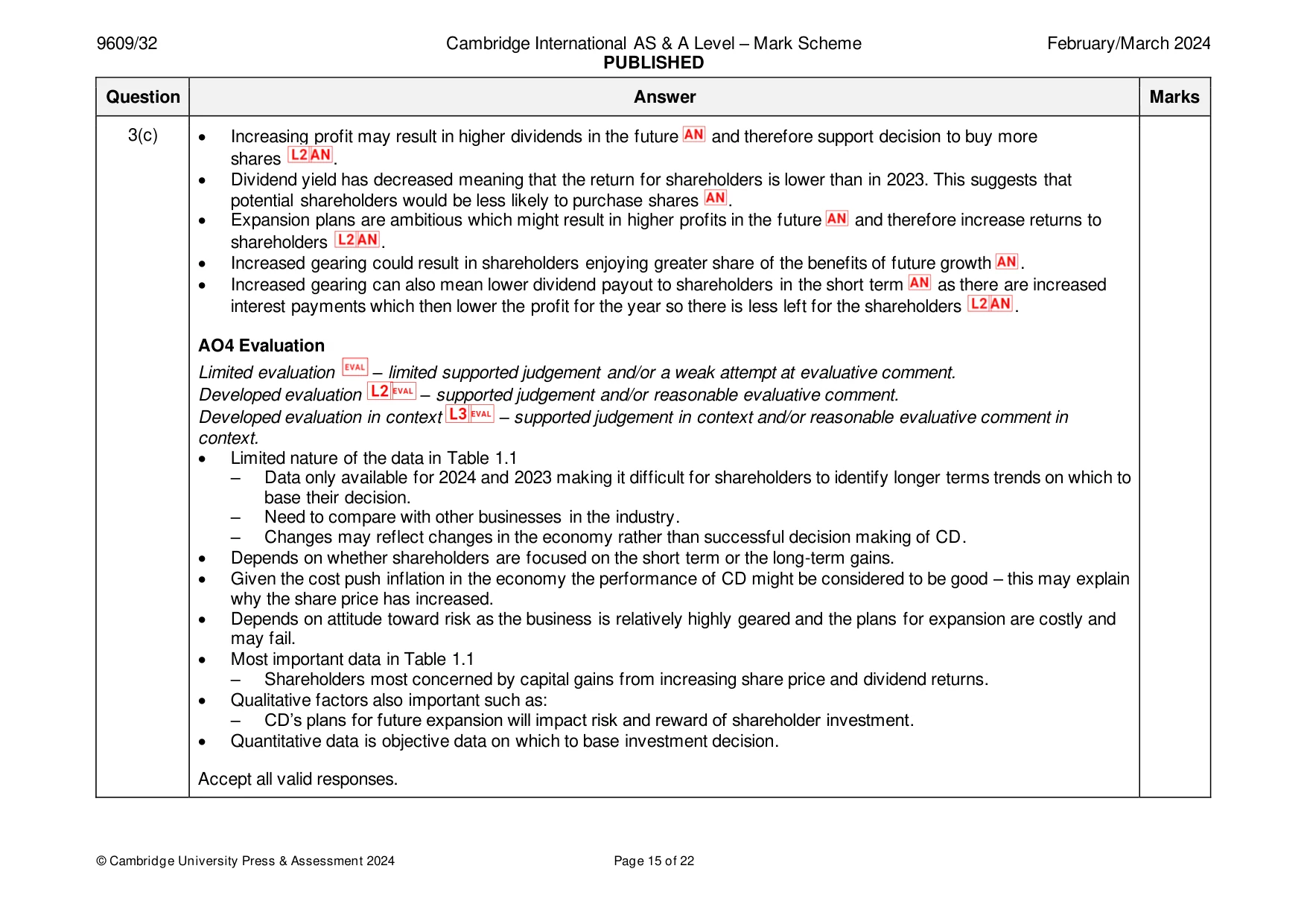
9609/32 Cambridge International AS & A Level – Mark Scheme PUBLISHED February/March 2024 © Cambridge University Press & Assessment 2024 Page 15 of 22 Question Answer Marks 3(c) • Increasing profit may result in higher dividends in the future and therefore support decision to buy more shares . • Dividend yield has decreased meaning that the return for shareholders is lower than in 2023. This suggests that potential shareholders would be less likely to purchase shares . • Expansion plans are ambitious which might result in higher profits in the future and therefore increase returns to shareholders . • Increased gearing could result in shareholders enjoying greater share of the benefits of future growth . • Increased gearing can also mean lower dividend payout to shareholders in the short term as there are increased interest payments which then lower the profit for the year so there is less left for the shareholders . AO4 Evaluation Limited evaluation – limited supported judgement and/or a weak attempt at evaluative comment. Developed evaluation – supported judgement and/or reasonable evaluative comment. Developed evaluation in context – supported judgement in context and/or reasonable evaluative comment in context. • Limited nature of the data in Table 1.1 – Data only available for 2024 and 2023 making it difficult for shareholders to identify longer terms trends on which to base their decision. – Need to compare with other businesses in the industry. – Changes may reflect changes in the economy rather than successful decision making of CD. • Depends on whether shareholders are focused on the short term or the long-term gains. • Given the cost push inflation in the economy the performance of CD might be considered to be good – this may explain why the share price has increased. • Depends on attitude toward risk as the business is relatively highly geared and the plans for expansion are costly and may fail. • Most important data in Table 1.1 – Shareholders most concerned by capital gains from increasing share price and dividend returns. • Qualitative factors also important such as: – CD’s plans for future expansion will impact risk and reward of shareholder investment. • Quantitative data is objective data on which to base investment decision. Accept all valid responses.
Mark scheme, page 16
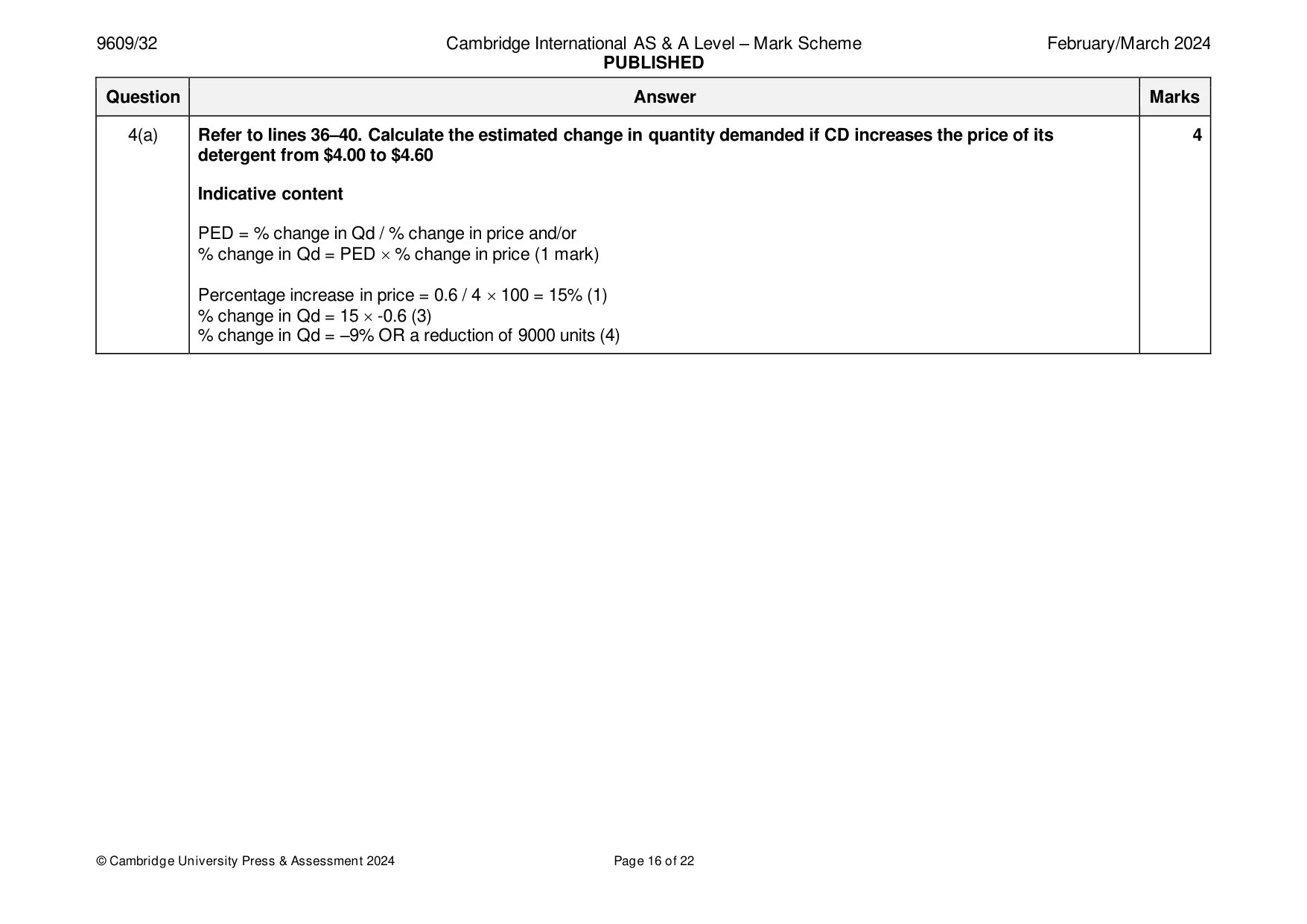
9609/32 Cambridge International AS & A Level – Mark Scheme PUBLISHED February/March 2024 © Cambridge University Press & Assessment 2024 Page 16 of 22 Question Answer Marks 4(a) Refer to lines 36–40. Calculate the estimated change in quantity demanded if CD increases the price of its detergent from $4.00 to $4.60 Indicative content PED = % change in Qd / % change in price and/or % change in Qd = PED % change in price (1 mark) Percentage increase in price = 0.6 / 4 100 = 15% (1) % change in Qd = 15 -0.6 (3) % change in Qd = –9% OR a reduction of 9000 units (4) 4
Mark scheme, page 17
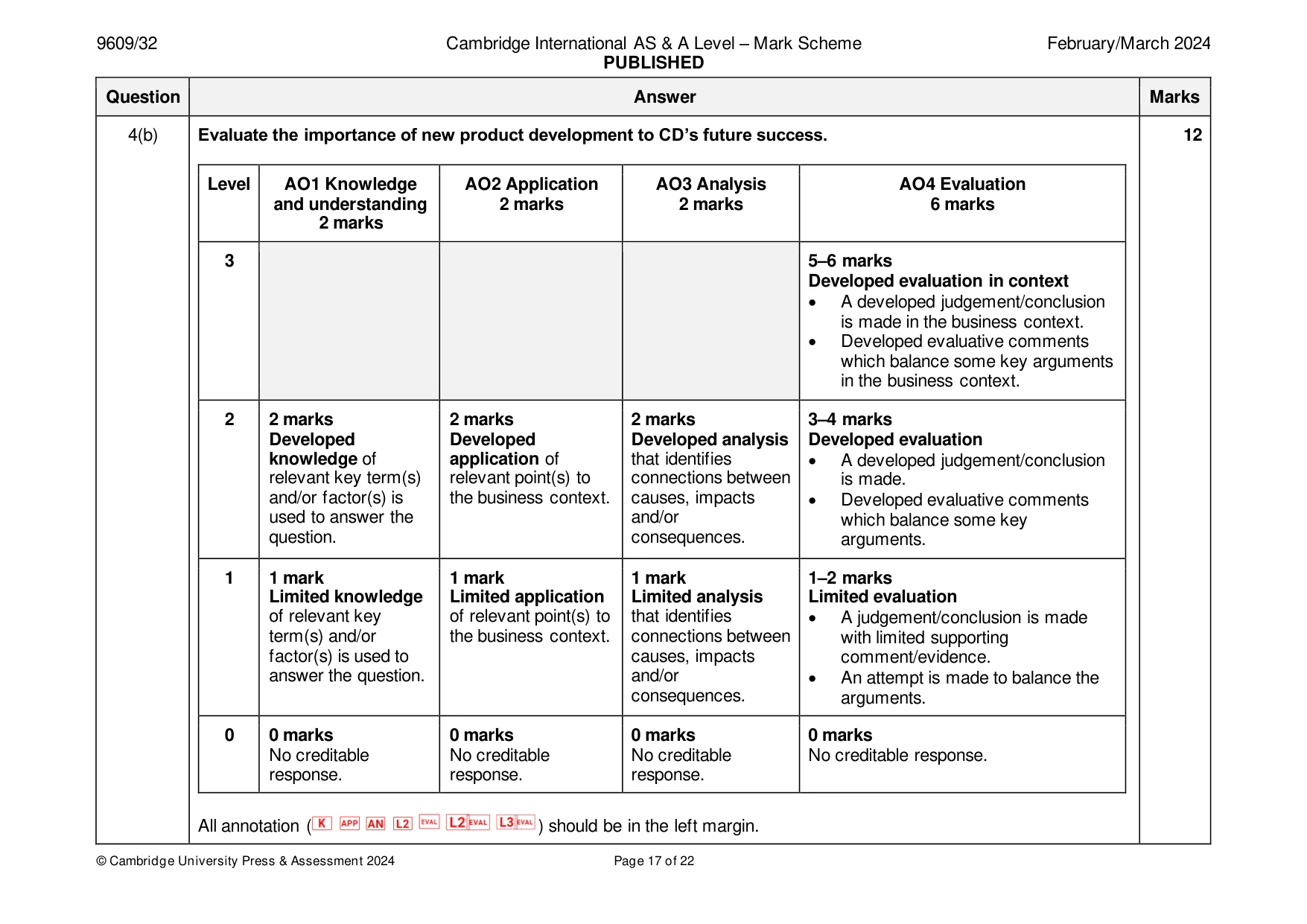
9609/32 Cambridge International AS & A Level – Mark Scheme PUBLISHED February/March 2024 © Cambridge University Press & Assessment 2024 Page 17 of 22 Question Answer Marks 4(b) Evaluate the importance of new product development to CD’s future success. Level AO1 Knowledge and understanding 2 marks AO2 Application 2 marks AO3 Analysis 2 marks AO4 Evaluation 6 marks 3 5–6 marks Developed evaluation in context • A developed judgement/conclusion is made in the business context. • Developed evaluative comments which balance some key arguments in the business context. 2 2 marks Developed knowledge of relevant key term(s) and/or factor(s) is used to answer the question. 2 marks Developed application of relevant point(s) to the business context. 2 marks Developed analysis that identifies connections between causes, impacts and/or consequences. 3–4 marks Developed evaluation • A developed judgement/conclusion is made. • Developed evaluative comments which balance some key arguments. 1 1 mark Limited knowledge of relevant key term(s) and/or factor(s) is used to answer the question. 1 mark Limited application of relevant point(s) to the business context. 1 mark Limited analysis that identifies connections between causes, impacts and/or consequences. 1–2 marks Limited evaluation • A judgement/conclusion is made with limited supporting comment/evidence. • An attempt is made to balance the arguments. 0 0 marks No creditable response. 0 marks No creditable response. 0 marks No creditable response. 0 marks No creditable response. All annotation ( ) should be in the left margin. 12
Mark scheme, page 18
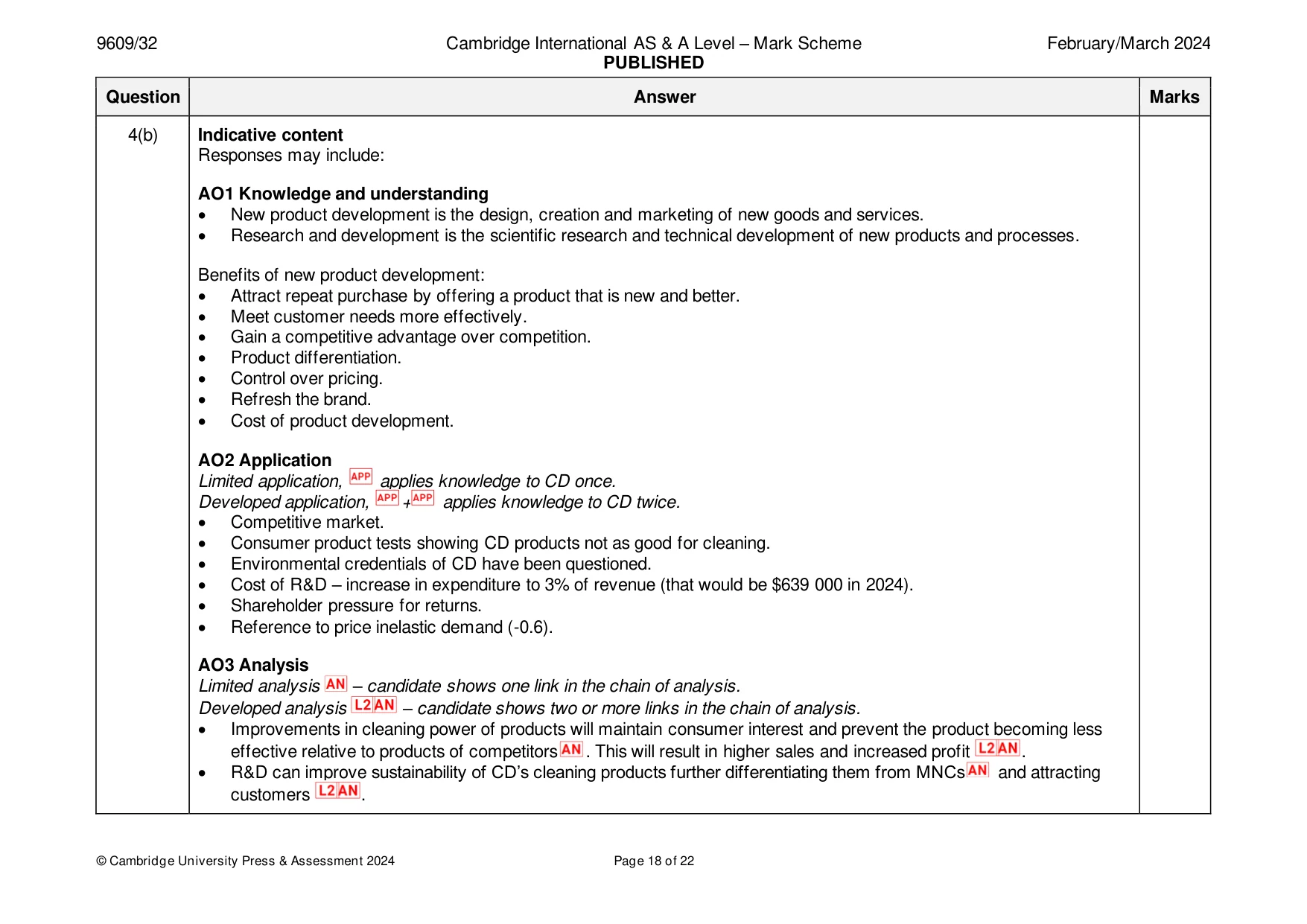
9609/32 Cambridge International AS & A Level – Mark Scheme PUBLISHED February/March 2024 © Cambridge University Press & Assessment 2024 Page 18 of 22 Question Answer Marks 4(b) Indicative content Responses may include: AO1 Knowledge and understanding • New product development is the design, creation and marketing of new goods and services. • Research and development is the scientific research and technical development of new products and processes. Benefits of new product development: • Attract repeat purchase by offering a product that is new and better. • Meet customer needs more effectively. • Gain a competitive advantage over competition. • Product differentiation. • Control over pricing. • Refresh the brand. • Cost of product development. AO2 Application Limited application, applies knowledge to CD once. Developed application, + applies knowledge to CD twice. • Competitive market. • Consumer product tests showing CD products not as good for cleaning. • Environmental credentials of CD have been questioned. • Cost of R&D – increase in expenditure to 3% of revenue (that would be $639 000 in 2024). • Shareholder pressure for returns. • Reference to price inelastic demand (-0.6). AO3 Analysis Limited analysis – candidate shows one link in the chain of analysis. Developed analysis – candidate shows two or more links in the chain of analysis. • Improvements in cleaning power of products will maintain consumer interest and prevent the product becoming less effective relative to products of competitors . This will result in higher sales and increased profit . • R&D can improve sustainability of CD’s cleaning products further differentiating them from MNCs and attracting customers .
Mark scheme, page 19
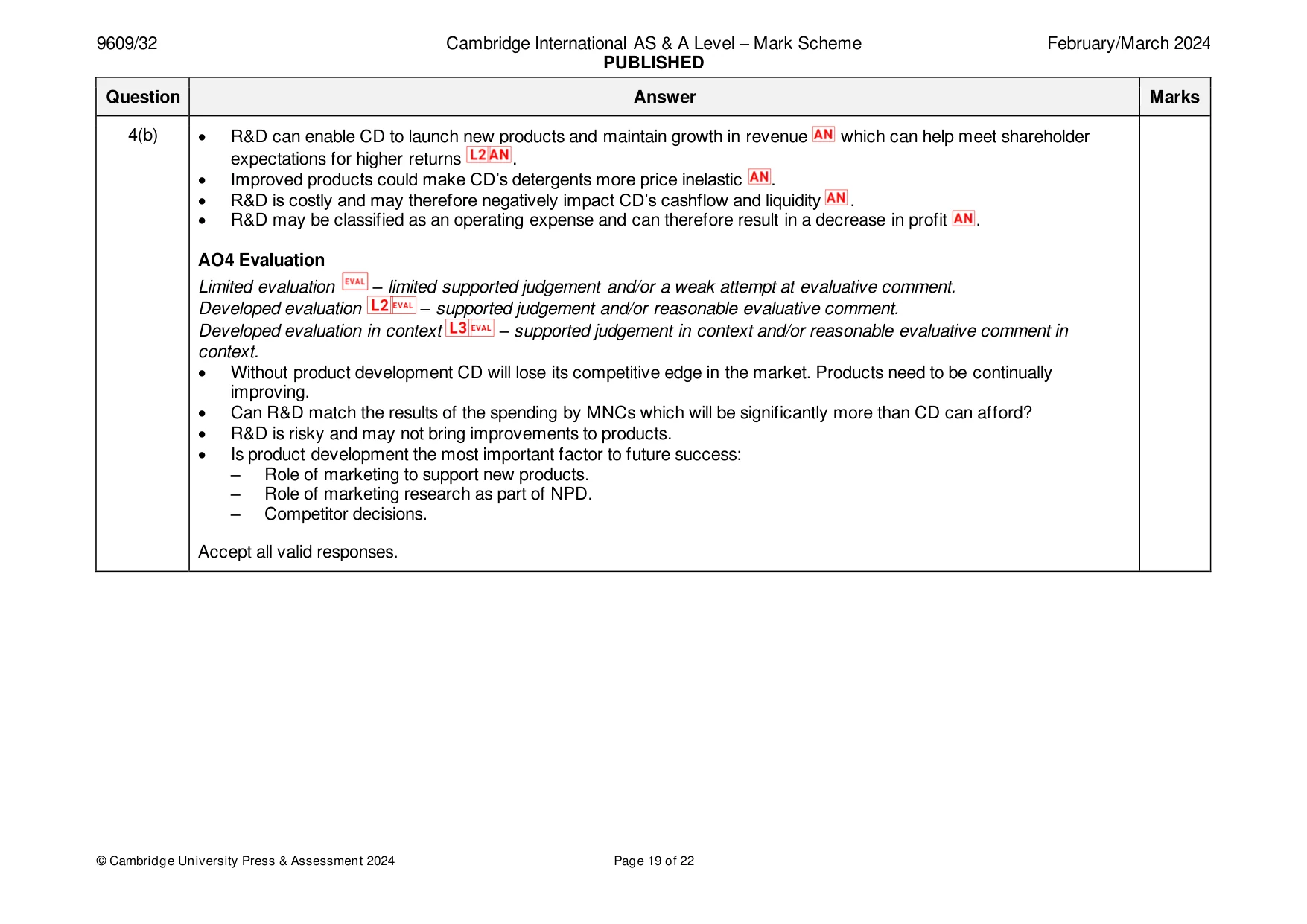
9609/32 Cambridge International AS & A Level – Mark Scheme PUBLISHED February/March 2024 © Cambridge University Press & Assessment 2024 Page 19 of 22 Question Answer Marks 4(b) • R&D can enable CD to launch new products and maintain growth in revenue which can help meet shareholder expectations for higher returns . • Improved products could make CD’s detergents more price inelastic . • R&D is costly and may therefore negatively impact CD’s cashflow and liquidity . • R&D may be classified as an operating expense and can therefore result in a decrease in profit . AO4 Evaluation Limited evaluation – limited supported judgement and/or a weak attempt at evaluative comment. Developed evaluation – supported judgement and/or reasonable evaluative comment. Developed evaluation in context – supported judgement in context and/or reasonable evaluative comment in context. • Without product development CD will lose its competitive edge in the market. Products need to be continually improving. • Can R&D match the results of the spending by MNCs which will be significantly more than CD can afford? • R&D is risky and may not bring improvements to products. • Is product development the most important factor to future success: – Role of marketing to support new products. – Role of marketing research as part of NPD. – Competitor decisions. Accept all valid responses.
Mark scheme, page 20
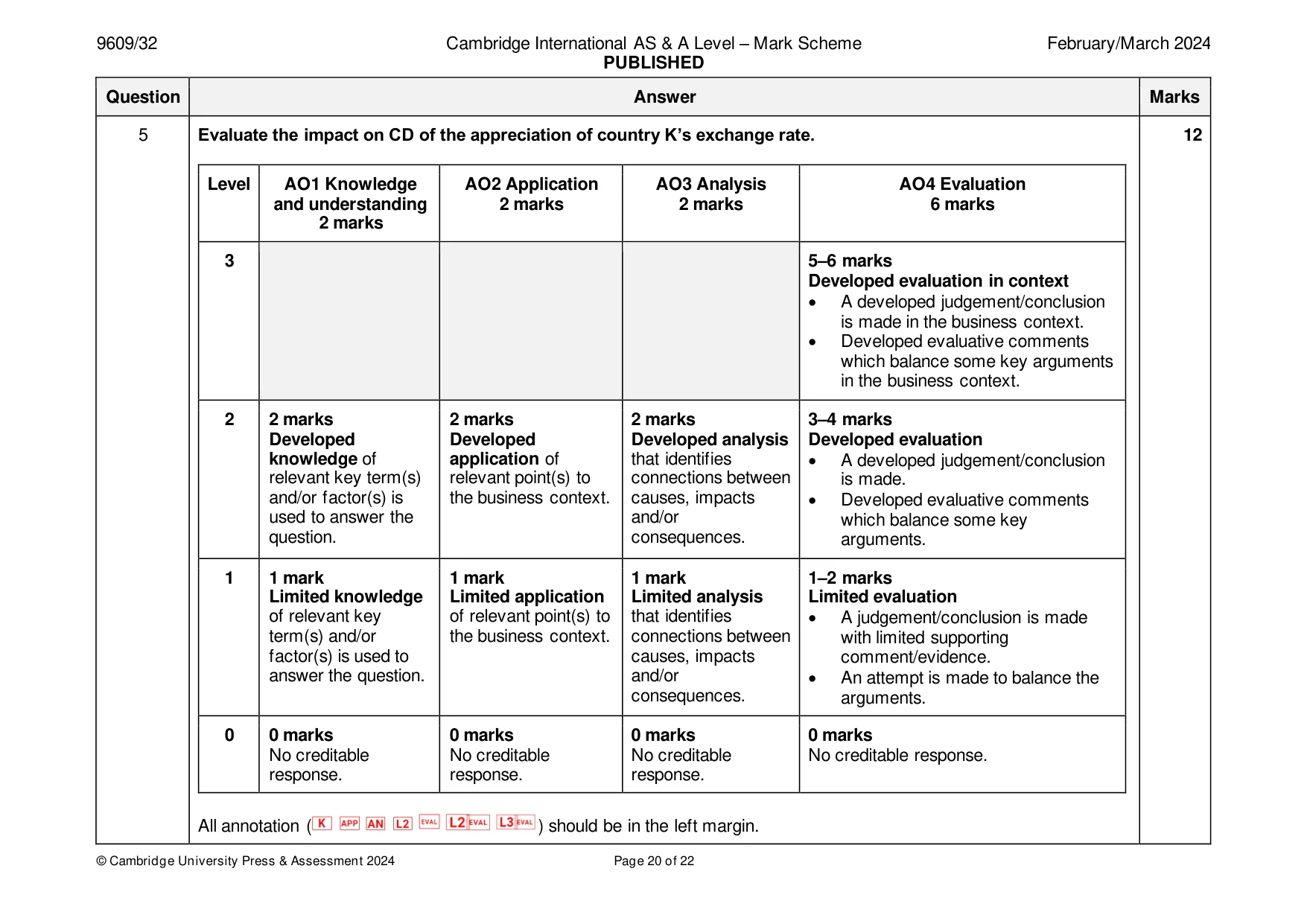
9609/32 Cambridge International AS & A Level – Mark Scheme PUBLISHED February/March 2024 © Cambridge University Press & Assessment 2024 Page 20 of 22 Question Answer Marks 5 Evaluate the impact on CD of the appreciation of country K’s exchange rate. Level AO1 Knowledge and understanding 2 marks AO2 Application 2 marks AO3 Analysis 2 marks AO4 Evaluation 6 marks 3 5–6 marks Developed evaluation in context • A developed judgement/conclusion is made in the business context. • Developed evaluative comments which balance some key arguments in the business context. 2 2 marks Developed knowledge of relevant key term(s) and/or factor(s) is used to answer the question. 2 marks Developed application of relevant point(s) to the business context. 2 marks Developed analysis that identifies connections between causes, impacts and/or consequences. 3–4 marks Developed evaluation • A developed judgement/conclusion is made. • Developed evaluative comments which balance some key arguments. 1 1 mark Limited knowledge of relevant key term(s) and/or factor(s) is used to answer the question. 1 mark Limited application of relevant point(s) to the business context. 1 mark Limited analysis that identifies connections between causes, impacts and/or consequences. 1–2 marks Limited evaluation • A judgement/conclusion is made with limited supporting comment/evidence. • An attempt is made to balance the arguments. 0 0 marks No creditable response. 0 marks No creditable response. 0 marks No creditable response. 0 marks No creditable response. All annotation ( ) should be in the left margin. 12
Mark scheme, page 21
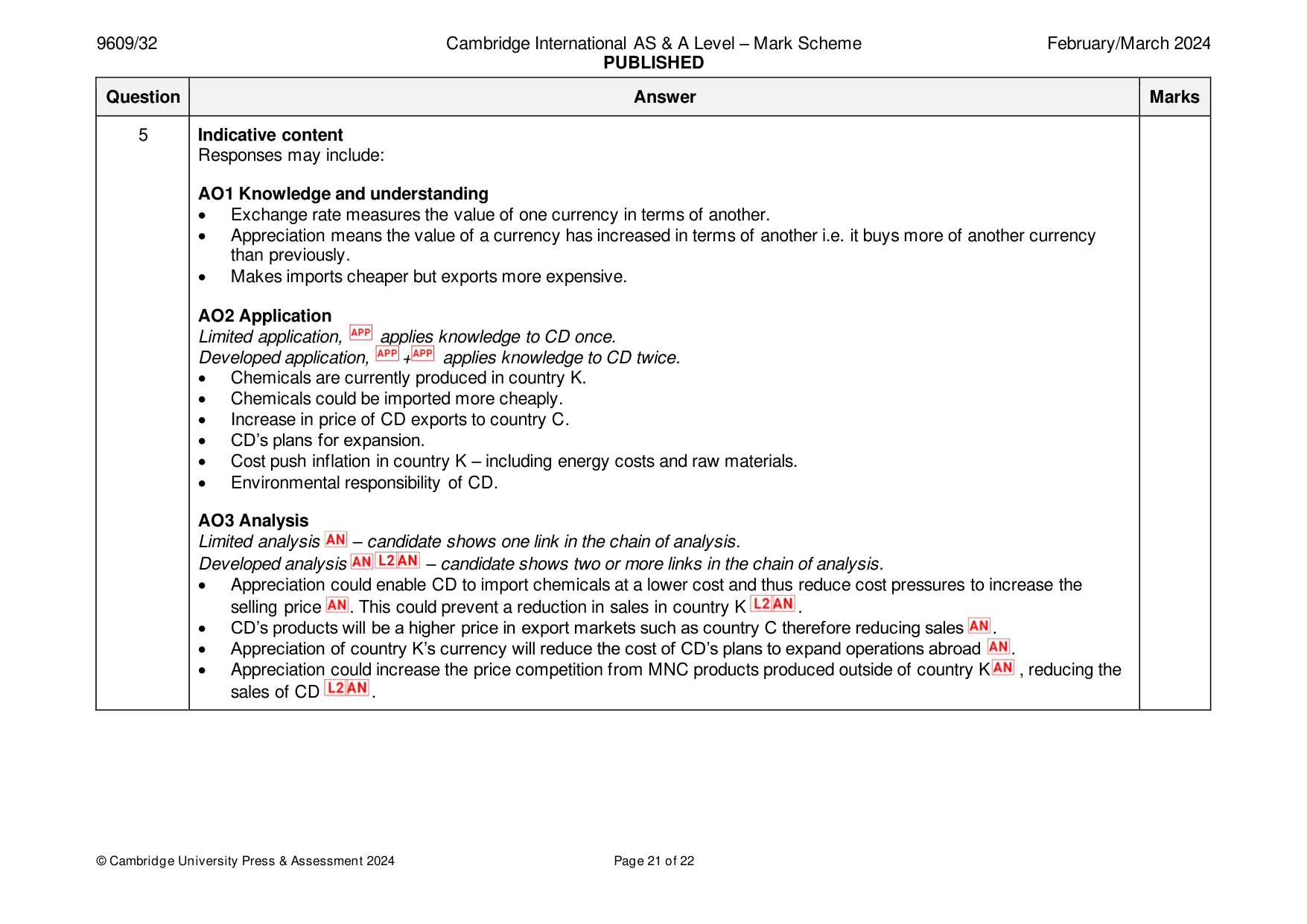
9609/32 Cambridge International AS & A Level – Mark Scheme PUBLISHED February/March 2024 © Cambridge University Press & Assessment 2024 Page 21 of 22 Question Answer Marks 5 Indicative content Responses may include: AO1 Knowledge and understanding • Exchange rate measures the value of one currency in terms of another. • Appreciation means the value of a currency has increased in terms of another i.e. it buys more of another currency than previously. • Makes imports cheaper but exports more expensive. AO2 Application Limited application, applies knowledge to CD once. Developed application, + applies knowledge to CD twice. • Chemicals are currently produced in country K. • Chemicals could be imported more cheaply. • Increase in price of CD exports to country C. • CD’s plans for expansion. • Cost push inflation in country K – including energy costs and raw materials. • Environmental responsibility of CD. AO3 Analysis Limited analysis – candidate shows one link in the chain of analysis. Developed analysis – candidate shows two or more links in the chain of analysis. • Appreciation could enable CD to import chemicals at a lower cost and thus reduce cost pressures to increase the selling price . This could prevent a reduction in sales in country K . • CD’s products will be a higher price in export markets such as country C therefore reducing sales . • Appreciation of country K’s currency will reduce the cost of CD’s plans to expand operations abroad . • Appreciation could increase the price competition from MNC products produced outside of country K , reducing the sales of CD .
Mark scheme, page 22
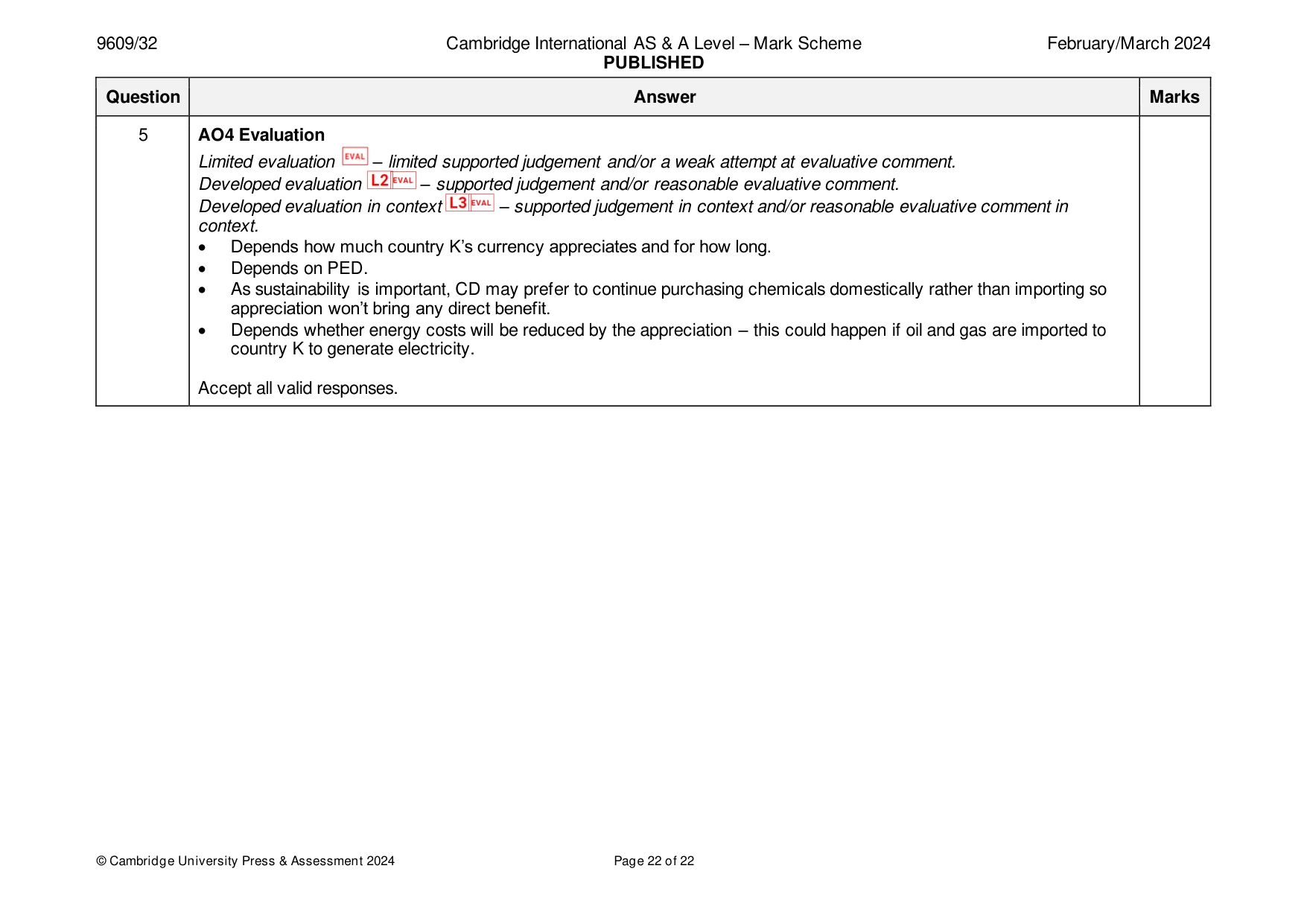
9609/32 Cambridge International AS & A Level – Mark Scheme PUBLISHED February/March 2024 © Cambridge University Press & Assessment 2024 Page 22 of 22 Question Answer Marks 5 AO4 Evaluation Limited evaluation – limited supported judgement and/or a weak attempt at evaluative comment. Developed evaluation – supported judgement and/or reasonable evaluative comment. Developed evaluation in context – supported judgement in context and/or reasonable evaluative comment in context. • Depends how much country K’s currency appreciates and for how long. • Depends on PED. • As sustainability is important, CD may prefer to continue purchasing chemicals domestically rather than importing so appreciation won’t bring any direct benefit. • Depends whether energy costs will be reduced by the appreciation – this could happen if oil and gas are imported to country K to generate electricity. Accept all valid responses.
What you needed in this session
Cambridge’s own grade thresholds for 2024 Feb/March, Paper 3 · Variant 2. A higher threshold means an easier paper — the bar moves with how the cohort did.