Cambridge A Level Business (for first examination in 2016) 9609 — 2020 Oct/Nov Paper 3 · Variant 1
9609/31/O/N/20 · 100 marks · ≈113 min
The question paper and its mark scheme, free to read here and free to download. This is Cambridge’s own paper, exactly as it was sat.
Question paper20 pages











Mark scheme18 pages
Answers below. Sit the paper first if you are practising.

Paper as text
Question paper, page 1
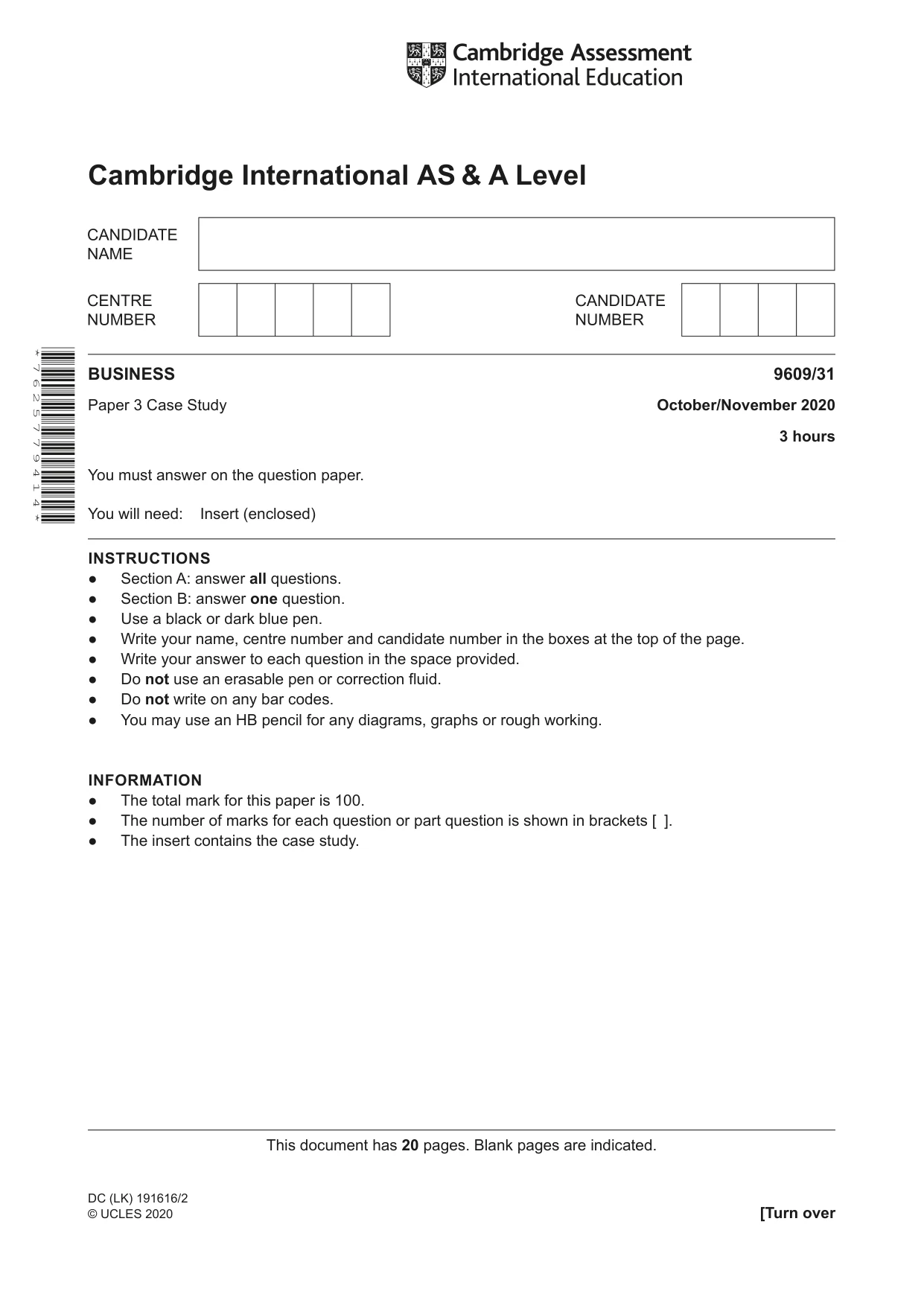
Cambridge International AS & A Level BUSINESS 9609/31 Paper 3 Case Study October/November 2020 3 hours You must answer on the question paper. You will need: Insert (enclosed) INSTRUCTIONS ● Section A: answer all questions. ● Section B: answer one question. ● Use a black or dark blue pen. ● Write your name, centre number and candidate number in the boxes at the top of the page. ● Write your answer to each question in the space provided. ● Do not use an erasable pen or correction fluid. ● Do not write on any bar codes. ● You may use an HB pencil for any diagrams, graphs or rough working. INFORMATION ● The total mark for this paper is 100. ● The number of marks for each question or part question is shown in brackets [ ]. ● The insert contains the case study. This document has 20 pages. Blank pages are indicated. DC (LK) 191616/2 © UCLES 2020 [Turn over * 7 6 2 5 7 7 9 4 1 4 *
Question paper, page 2
2 9609/31/O/N/20 © UCLES 2020 Answer all questions in Section A and answer one question in Section B. You are advised to spend no more than 40 minutes on Section B. Section A Answer all questions in this section 1 Analyse the possible disadvantages for country Q of NH opening hotels there. … … … … … … … … … … … … … … … … … … … … … … …
Question paper, page 3
3 9609/31/O/N/20 © UCLES 2020 [Turn over … … … … … … … … … … … … … … … … … … … … … … … … … … … … [10]
Question paper, page 4
4 9609/31/O/N/20 © UCLES 2020 2 (a) Refer to Table 1. Calculate for 2019 the: (i) overall average capacity utilisation for NH … … … … … … [2] (ii) variance in total sales revenue per night for NH’s basic hotels. … … … … … … … … … … … … [4]
Question paper, page 5
5 9609/31/O/N/20 © UCLES 2020 [Turn over (b) Discuss whether introducing lean production will improve NH’s profits. … … … … … … … … … … … … … … … … … … … … … … … … … … …
Question paper, page 6
6 9609/31/O/N/20 © UCLES 2020 … … … … … … … … … … … … … … … … … … … … … … … … … … … … [12]
Question paper, page 7
7 9609/31/O/N/20 © UCLES 2020 [Turn over 3 Recommend a strategy that could improve the motivation of employees of NH. Justify your recommendation. … … … … … … … … … … … … … … … … … … … … … … … … … … …
Question paper, page 8
8 9609/31/O/N/20 © UCLES 2020 … … … … … … … … … … … … … … … … … … … … … … … … … … … …
Question paper, page 9
9 9609/31/O/N/20 © UCLES 2020 [Turn over … … … … … … … … … … … … … … … … … … … … … … … … … … … … [16]
Question paper, page 10
10 9609/31/O/N/20 © UCLES 2020 4 (a) Refer to Table 4 and Table 5 and lines 82–92. Assume NH takes over EatBest in 2021 and no other factors change. Calculate the forecast: (i) profit before tax for the year ended 31 October 2021 … … … … … … … … … [3] (ii) net assets at 31 October 2021. … … … … … … … … … … … … … … … [5]
Question paper, page 11
11 9609/31/O/N/20 © UCLES 2020 [Turn over (b) Refer to your answers to 4(a) and any other information. Discuss whether NH’s shareholders should support the proposed takeover of EatBest. … … … … … … … … … … … … … … … … … … … … … … … … … …
Question paper, page 12
12 9609/31/O/N/20 © UCLES 2020 … … … … … … … … … … … … … … … … … … … … … … … … … … … … [12]
Question paper, page 13
13 9609/31/O/N/20 © UCLES 2020 [Turn over 5 Recommend a possible marketing plan to achieve Jolin’s objectives (lines 80–81). Justify your recommendation. … … … … … … … … … … … … … … … … … … … … … … … … … … …
Question paper, page 14
14 9609/31/O/N/20 © UCLES 2020 … … … … … … … … … … … … … … … … … … … … … … … … … … … …
Question paper, page 15
15 9609/31/O/N/20 © UCLES 2020 [Turn over … … … … … … … … … … … … … … … … … … … … … … … … … … … … [16]
Question paper, page 16
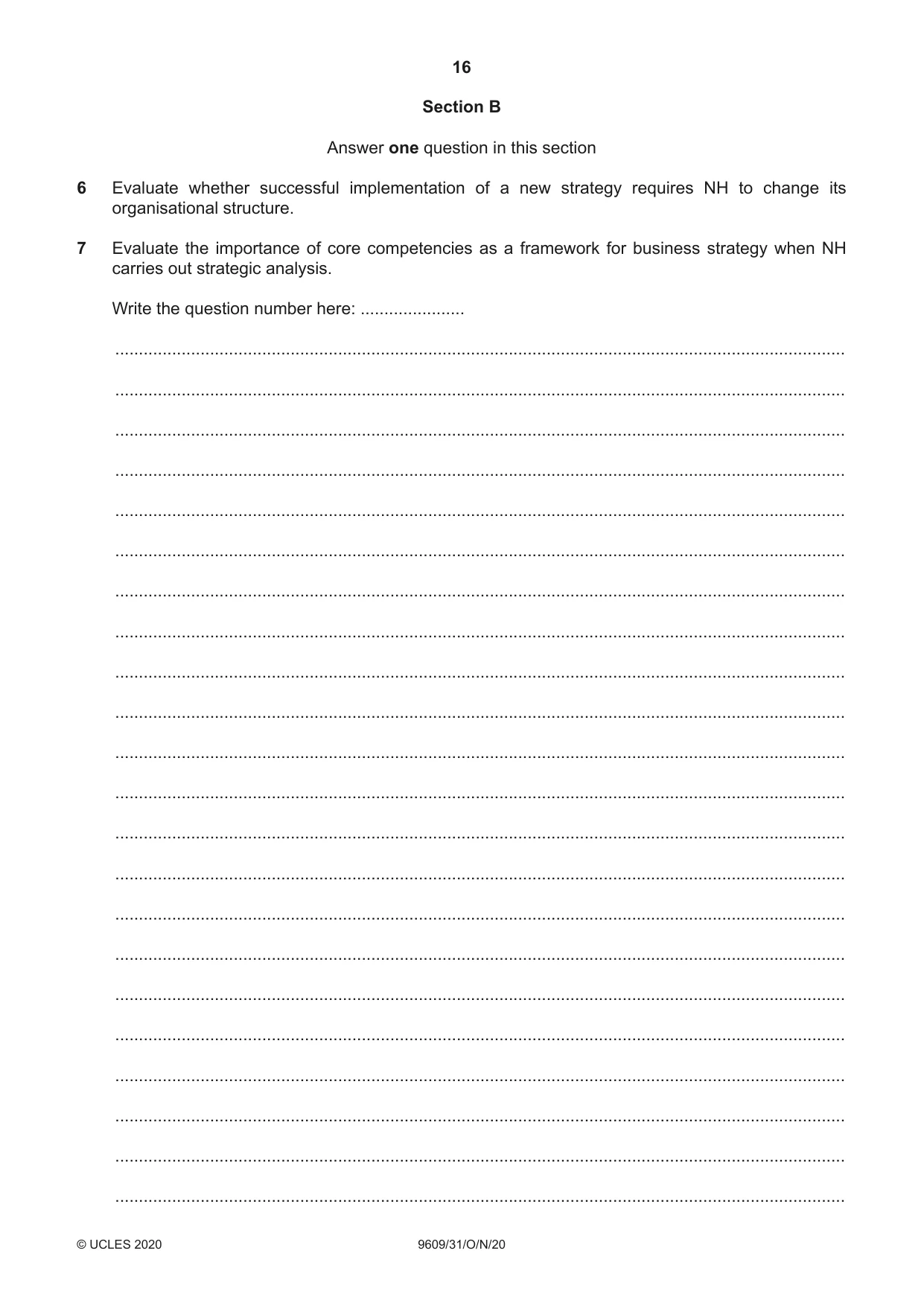
16 9609/31/O/N/20 © UCLES 2020 Section B Answer one question in this section 6 Evaluate whether successful implementation of a new strategy requires NH to change its organisational structure. 7 Evaluate the importance of core competencies as a framework for business strategy when NH carries out strategic analysis. Write the question number here: … … … … … … … … … … … … … … … … … … … … … … …
Question paper, page 17
17 9609/31/O/N/20 © UCLES 2020 [Turn over … … … … … … … … … … … … … … … … … … … … … … … … … … … …
Question paper, page 18
18 9609/31/O/N/20 © UCLES 2020 … … … … … … … … … … … … … … … … … … … … … … … … … … … …
Question paper, page 19
19 9609/31/O/N/20 © UCLES 2020 … … … … … … … … … … … … … … … … … … … … … … … … … … … … [20]
Question paper, page 20
20 9609/31/O/N/20 © UCLES 2020 Permission to reproduce items where third-party owned material protected by copyright is included has been sought and cleared where possible. Every reasonable effort has been made by the publisher (UCLES) to trace copyright holders, but if any items requiring clearance have unwittingly been included, the publisher will be pleased to make amends at the earliest possible opportunity. To avoid the issue of disclosure of answer-related information to candidates, all copyright acknowledgements are reproduced online in the Cambridge Assessment International Education Copyright Acknowledgements Booklet. This is produced for each series of examinations and is freely available to download at www.cambridgeinternational.org after the live examination series. Cambridge Assessment International Education is part of the Cambridge Assessment Group. Cambridge Assessment is the brand name of the University of Cambridge Local Examinations Syndicate (UCLES), which itself is a department of the University of Cambridge. BLANK PAGE
Mark scheme, page 1
This document consists of 18 printed pages. © UCLES 2020 [Turn over Cambridge International AS & A Level BUSINESS 9609/31 Paper 3 Case Study October/November 2020 MARK SCHEME Maximum Mark: 100 Published This mark scheme is published as an aid to teachers and candidates, to indicate the requirements of the examination. It shows the basis on which Examiners were instructed to award marks. It does not indicate the details of the discussions that took place at an Examiners’ meeting before marking began, which would have considered the acceptability of alternative answers. Mark schemes should be read in conjunction with the question paper and the Principal Examiner Report for Teachers. Cambridge International will not enter into discussions about these mark schemes. Cambridge International is publishing the mark schemes for the October/November 2020 series for most Cambridge IGCSE™, Cambridge International A and AS Level and Cambridge Pre-U components, and some Cambridge O Level components.
Mark scheme, page 2
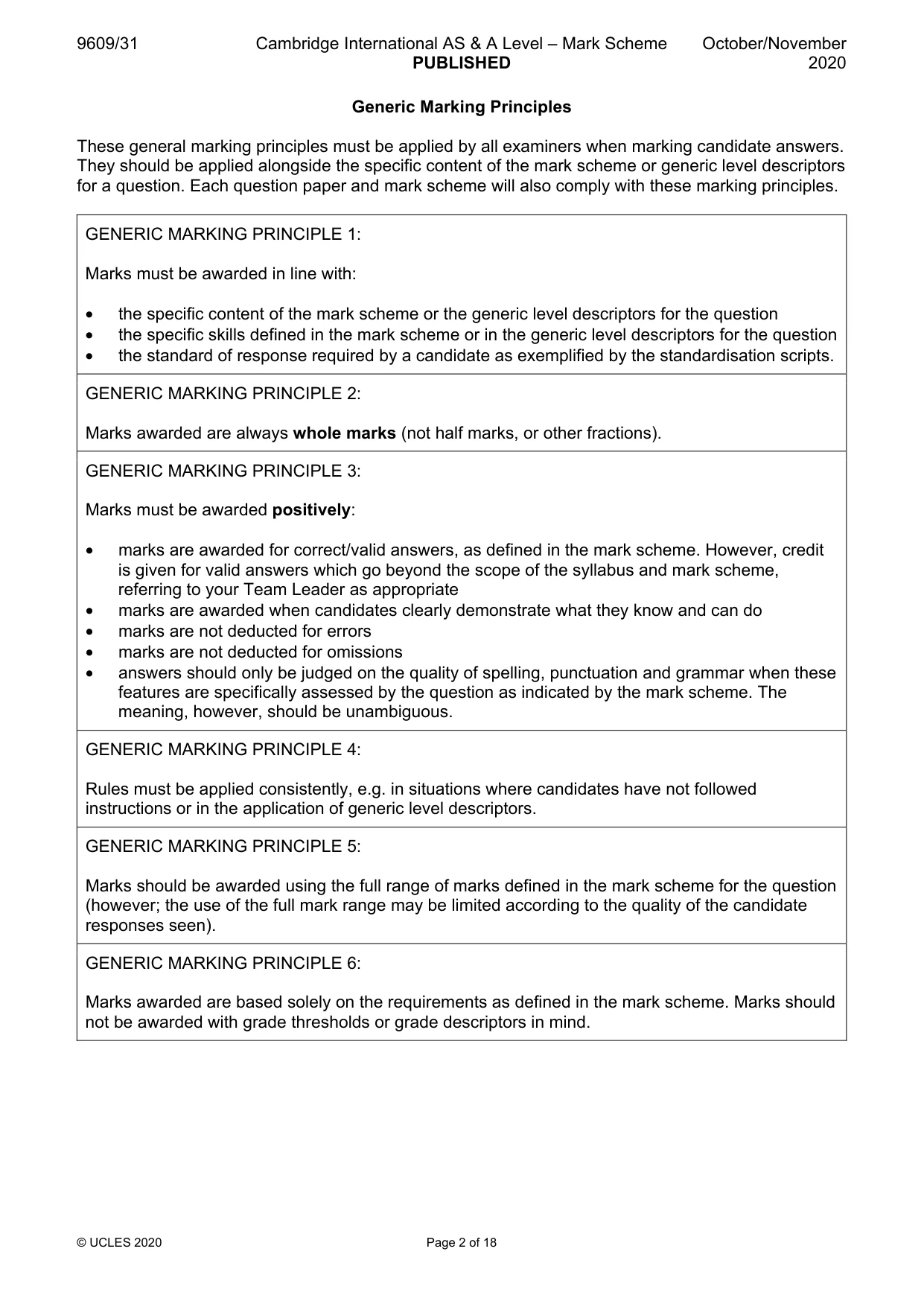
9609/31 Cambridge International AS & A Level – Mark Scheme PUBLISHED October/November 2020 © UCLES 2020 Page 2 of 18 Generic Marking Principles These general marking principles must be applied by all examiners when marking candidate answers. They should be applied alongside the specific content of the mark scheme or generic level descriptors for a question. Each question paper and mark scheme will also comply with these marking principles. GENERIC MARKING PRINCIPLE 1: Marks must be awarded in line with: • the specific content of the mark scheme or the generic level descriptors for the question • the specific skills defined in the mark scheme or in the generic level descriptors for the question • the standard of response required by a candidate as exemplified by the standardisation scripts. GENERIC MARKING PRINCIPLE 2: Marks awarded are always whole marks (not half marks, or other fractions). GENERIC MARKING PRINCIPLE 3: Marks must be awarded positively: • marks are awarded for correct/valid answers, as defined in the mark scheme. However, credit is given for valid answers which go beyond the scope of the syllabus and mark scheme, referring to your Team Leader as appropriate • marks are awarded when candidates clearly demonstrate what they know and can do • marks are not deducted for errors • marks are not deducted for omissions • answers should only be judged on the quality of spelling, punctuation and grammar when these features are specifically assessed by the question as indicated by the mark scheme. The meaning, however, should be unambiguous. GENERIC MARKING PRINCIPLE 4: Rules must be applied consistently, e.g. in situations where candidates have not followed instructions or in the application of generic level descriptors. GENERIC MARKING PRINCIPLE 5: Marks should be awarded using the full range of marks defined in the mark scheme for the question (however; the use of the full mark range may be limited according to the quality of the candidate responses seen). GENERIC MARKING PRINCIPLE 6: Marks awarded are based solely on the requirements as defined in the mark scheme. Marks should not be awarded with grade thresholds or grade descriptors in mind.
Mark scheme, page 3
9609/31 Cambridge International AS & A Level – Mark Scheme PUBLISHED October/November 2020 © UCLES 2020 Page 3 of 18 General Marking Guidance This mark scheme includes a summary of appropriate content for answering each question. It should be emphasised, however, that this material is for illustrative purposes and is not intended to provide a definitive guide to acceptable answers. It is quite possible that among the scripts there will be some candidate answers that are not covered directly by the content of this mark scheme. In such cases, professional judgement should be exercised in assessing the merits of the answer and the senior examiners should be consulted if further guidance is required. Application marks are not awarded for repeating material from the case study. Application is awarded for answering in the context of the case or by using the information in the case to help answer the question.
Mark scheme, page 4
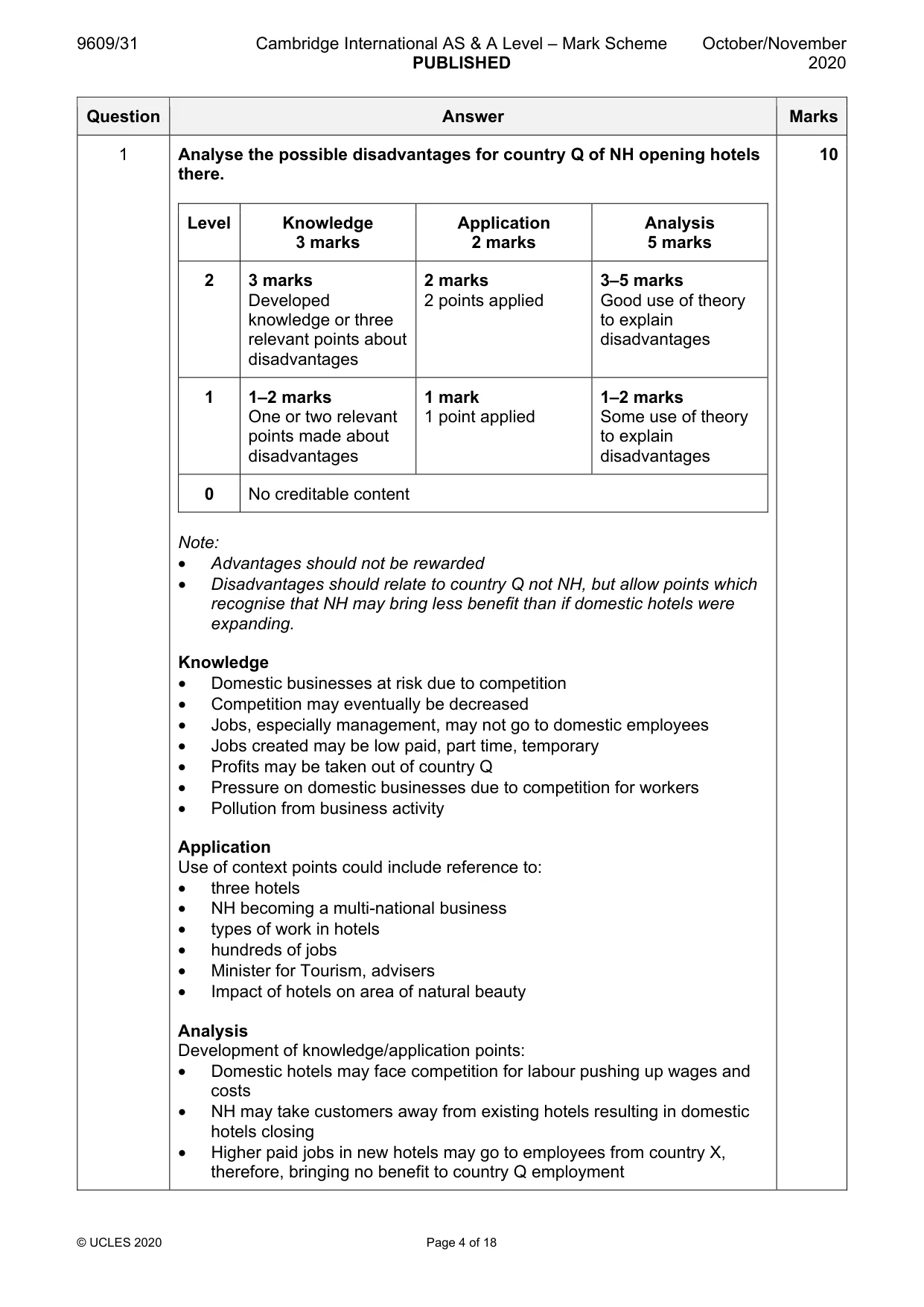
9609/31 Cambridge International AS & A Level – Mark Scheme PUBLISHED October/November 2020 © UCLES 2020 Page 4 of 18 Question Answer Marks 1 Analyse the possible disadvantages for country Q of NH opening hotels there. Level Knowledge 3 marks Application 2 marks Analysis 5 marks 2 3 marks Developed knowledge or three relevant points about disadvantages 2 marks 2 points applied 3–5 marks Good use of theory to explain disadvantages 1 1–2 marks One or two relevant points made about disadvantages 1 mark 1 point applied 1–2 marks Some use of theory to explain disadvantages 0 No creditable content Note: • Advantages should not be rewarded • Disadvantages should relate to country Q not NH, but allow points which recognise that NH may bring less benefit than if domestic hotels were expanding. Knowledge • Domestic businesses at risk due to competition • Competition may eventually be decreased • Jobs, especially management, may not go to domestic employees • Jobs created may be low paid, part time, temporary • Profits may be taken out of country Q • Pressure on domestic businesses due to competition for workers • Pollution from business activity Application Use of context points could include reference to: • three hotels • NH becoming a multi-national business • types of work in hotels • hundreds of jobs • Minister for Tourism, advisers • Impact of hotels on area of natural beauty Analysis Development of knowledge/application points: • Domestic hotels may face competition for labour pushing up wages and costs • NH may take customers away from existing hotels resulting in domestic hotels closing • Higher paid jobs in new hotels may go to employees from country X, therefore, bringing no benefit to country Q employment 10
Mark scheme, page 5
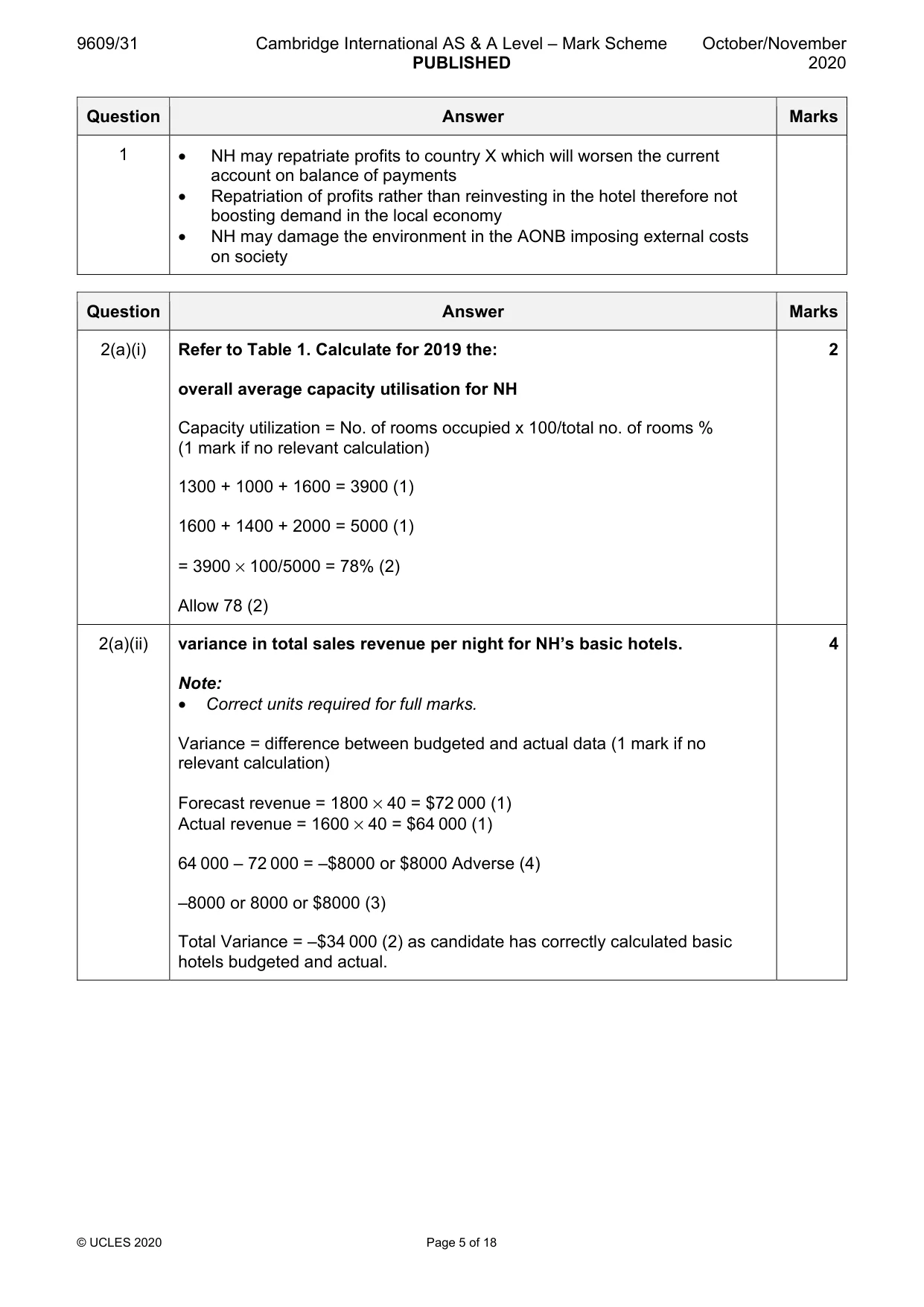
9609/31 Cambridge International AS & A Level – Mark Scheme PUBLISHED October/November 2020 © UCLES 2020 Page 5 of 18 Question Answer Marks 1 • NH may repatriate profits to country X which will worsen the current account on balance of payments • Repatriation of profits rather than reinvesting in the hotel therefore not boosting demand in the local economy • NH may damage the environment in the AONB imposing external costs on society Question Answer Marks 2(a)(i) Refer to Table 1. Calculate for 2019 the: overall average capacity utilisation for NH Capacity utilization = No. of rooms occupied x 100/total no. of rooms % (1 mark if no relevant calculation) 1300 + 1000 + 1600 = 3900 (1) 1600 + 1400 + 2000 = 5000 (1) = 3900 × 100/5000 = 78% (2) Allow 78 (2) 2 2(a)(ii) variance in total sales revenue per night for NH’s basic hotels. Note: • Correct units required for full marks. Variance = difference between budgeted and actual data (1 mark if no relevant calculation) Forecast revenue = 1800 × 40 = $72 000 (1) Actual revenue = 1600 × 40 = $64 000 (1) 64 000 – 72 000 = –$8000 or $8000 Adverse (4) –8000 or 8000 or $8000 (3) Total Variance = –$34 000 (2) as candidate has correctly calculated basic hotels budgeted and actual. 4
Mark scheme, page 6
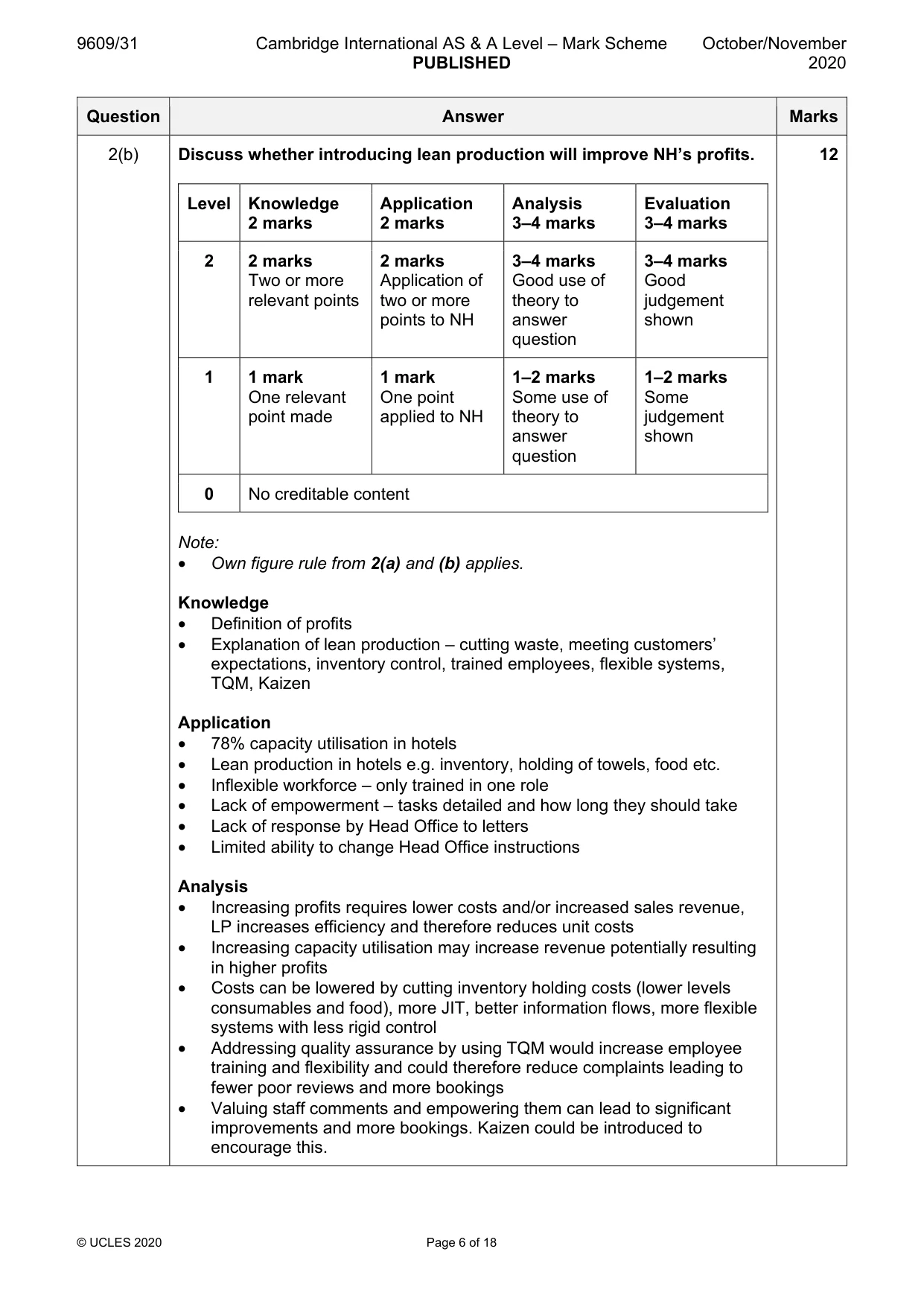
9609/31 Cambridge International AS & A Level – Mark Scheme PUBLISHED October/November 2020 © UCLES 2020 Page 6 of 18 Question Answer Marks 2(b) Discuss whether introducing lean production will improve NH’s profits. Level Knowledge 2 marks Application 2 marks Analysis 3–4 marks Evaluation 3–4 marks 2 2 marks Two or more relevant points 2 marks Application of two or more points to NH 3–4 marks Good use of theory to answer question 3–4 marks Good judgement shown 1 1 mark One relevant point made 1 mark One point applied to NH 1–2 marks Some use of theory to answer question 1–2 marks Some judgement shown 0 No creditable content Note: • Own figure rule from 2(a) and (b) applies. Knowledge • Definition of profits • Explanation of lean production – cutting waste, meeting customers’ expectations, inventory control, trained employees, flexible systems, TQM, Kaizen Application • 78% capacity utilisation in hotels • Lean production in hotels e.g. inventory, holding of towels, food etc. • Inflexible workforce – only trained in one role • Lack of empowerment – tasks detailed and how long they should take • Lack of response by Head Office to letters • Limited ability to change Head Office instructions Analysis • Increasing profits requires lower costs and/or increased sales revenue, LP increases efficiency and therefore reduces unit costs • Increasing capacity utilisation may increase revenue potentially resulting in higher profits • Costs can be lowered by cutting inventory holding costs (lower levels consumables and food), more JIT, better information flows, more flexible systems with less rigid control • Addressing quality assurance by using TQM would increase employee training and flexibility and could therefore reduce complaints leading to fewer poor reviews and more bookings • Valuing staff comments and empowering them can lead to significant improvements and more bookings. Kaizen could be introduced to encourage this. 12
Mark scheme, page 7
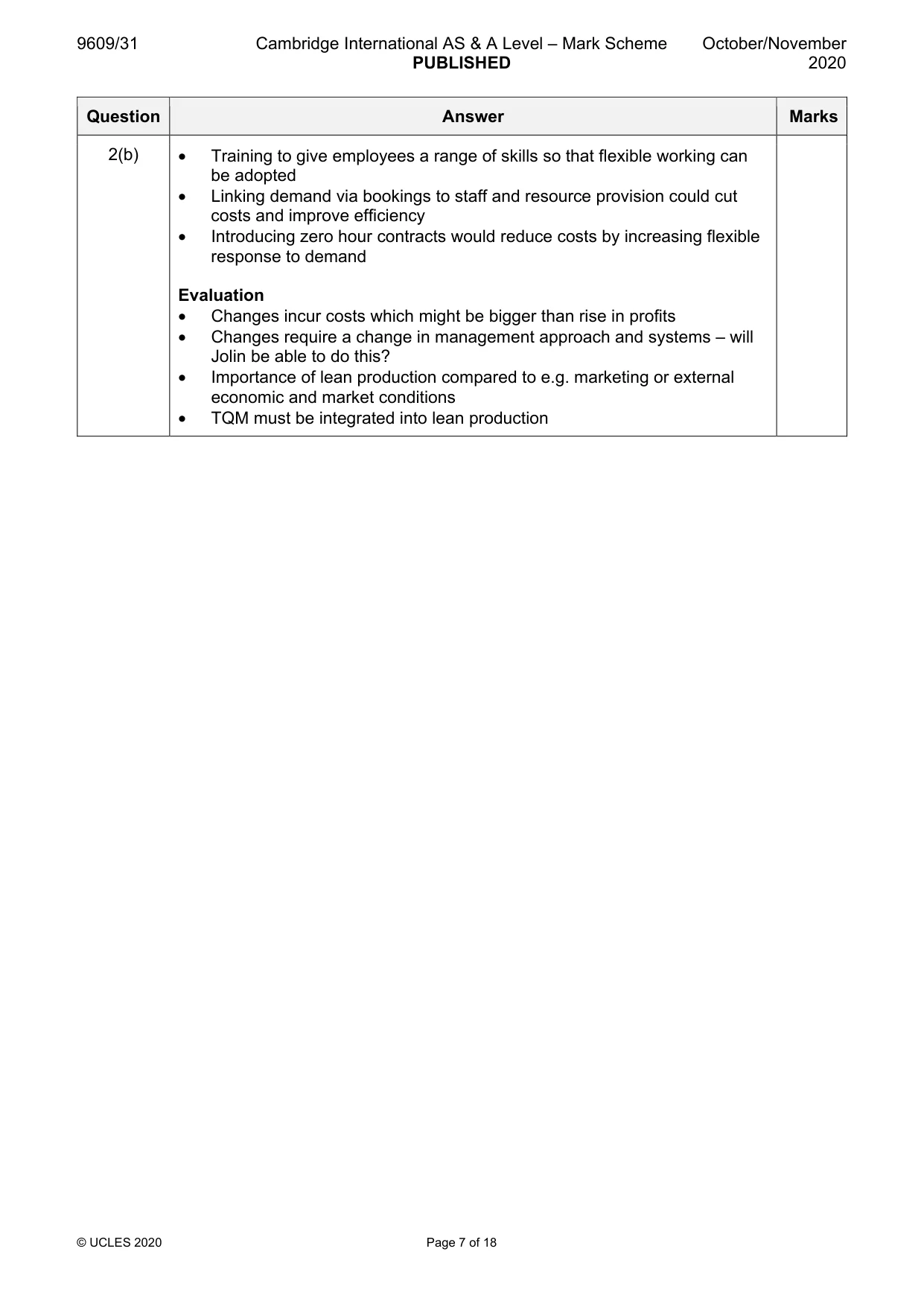
9609/31 Cambridge International AS & A Level – Mark Scheme PUBLISHED October/November 2020 © UCLES 2020 Page 7 of 18 Question Answer Marks 2(b) • Training to give employees a range of skills so that flexible working can be adopted • Linking demand via bookings to staff and resource provision could cut costs and improve efficiency • Introducing zero hour contracts would reduce costs by increasing flexible response to demand Evaluation • Changes incur costs which might be bigger than rise in profits • Changes require a change in management approach and systems – will Jolin be able to do this? • Importance of lean production compared to e.g. marketing or external economic and market conditions • TQM must be integrated into lean production
Mark scheme, page 8
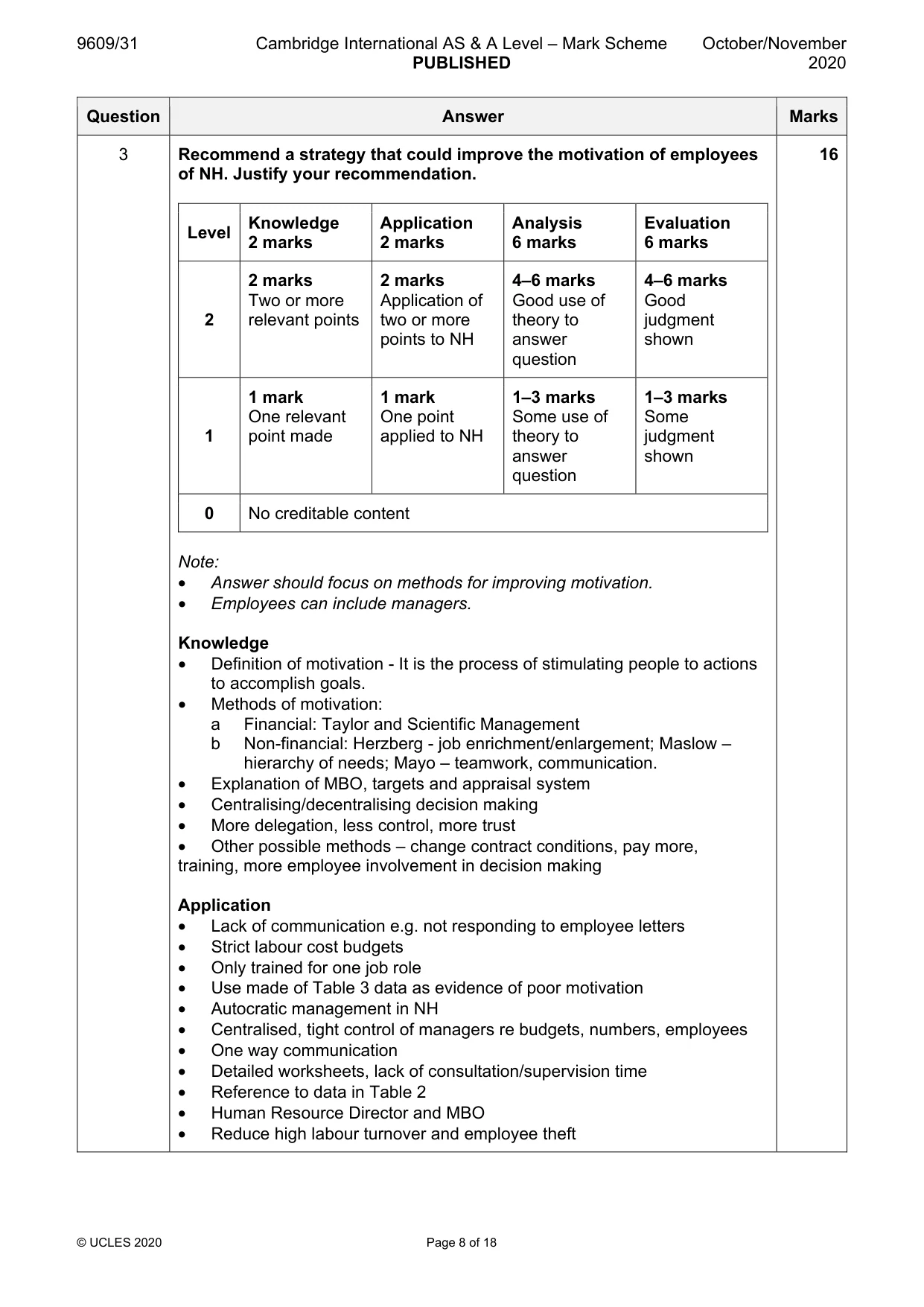
9609/31 Cambridge International AS & A Level – Mark Scheme PUBLISHED October/November 2020 © UCLES 2020 Page 8 of 18 Question Answer Marks 3 Recommend a strategy that could improve the motivation of employees of NH. Justify your recommendation. Level Knowledge 2 marks Application 2 marks Analysis 6 marks Evaluation 6 marks 2 2 marks Two or more relevant points 2 marks Application of two or more points to NH 4–6 marks Good use of theory to answer question 4–6 marks Good judgment shown 1 1 mark One relevant point made 1 mark One point applied to NH 1–3 marks Some use of theory to answer question 1–3 marks Some judgment shown 0 No creditable content Note: • Answer should focus on methods for improving motivation. • Employees can include managers. Knowledge • Definition of motivation - It is the process of stimulating people to actions to accomplish goals. • Methods of motivation: a Financial: Taylor and Scientific Management b Non-financial: Herzberg - job enrichment/enlargement; Maslow – hierarchy of needs; Mayo – teamwork, communication. • Explanation of MBO, targets and appraisal system • Centralising/decentralising decision making • More delegation, less control, more trust • Other possible methods – change contract conditions, pay more, training, more employee involvement in decision making Application • Lack of communication e.g. not responding to employee letters • Strict labour cost budgets • Only trained for one job role • Use made of Table 3 data as evidence of poor motivation • Autocratic management in NH • Centralised, tight control of managers re budgets, numbers, employees • One way communication • Detailed worksheets, lack of consultation/supervision time • Reference to data in Table 2 • Human Resource Director and MBO • Reduce high labour turnover and employee theft 16
Mark scheme, page 9
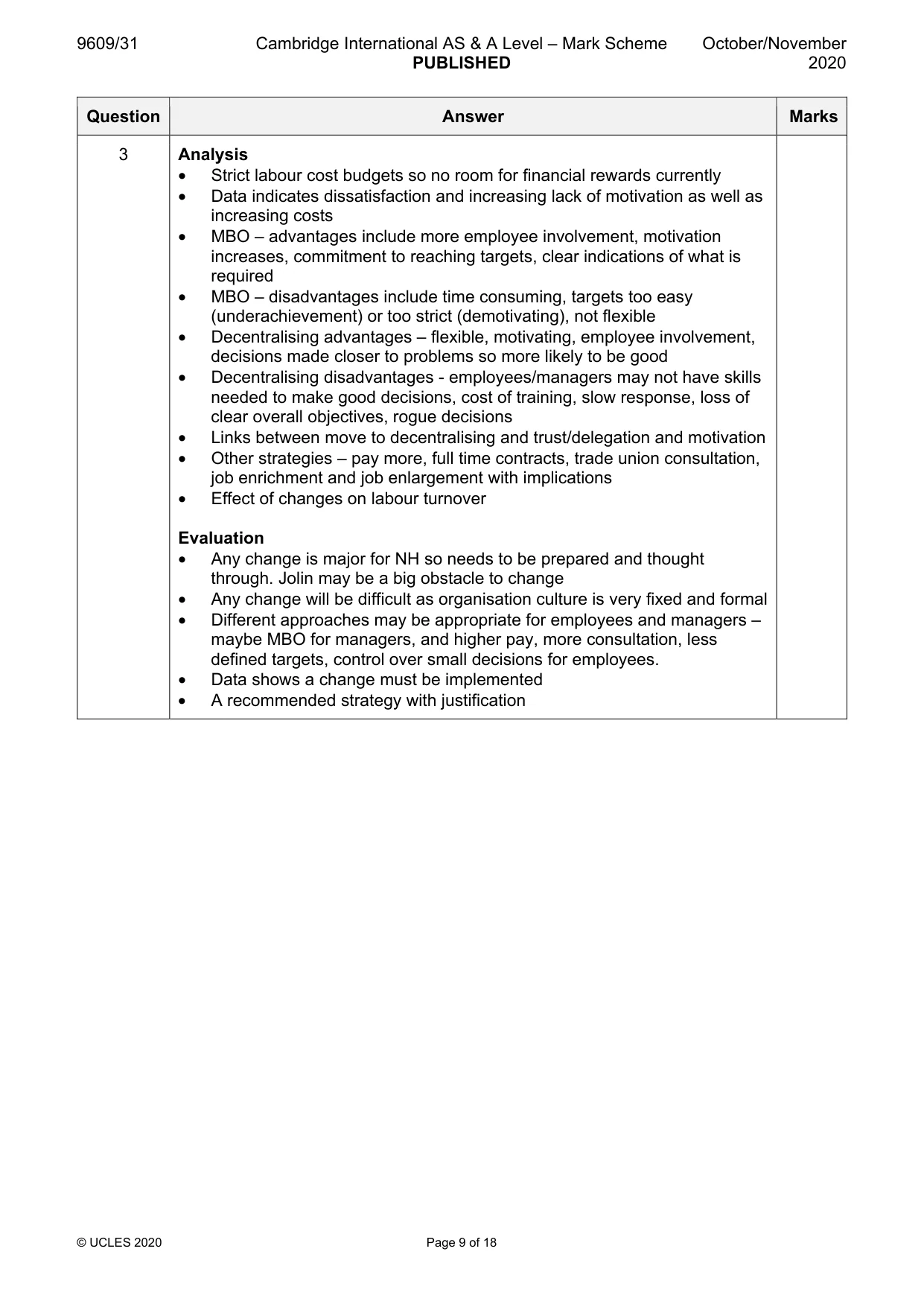
9609/31 Cambridge International AS & A Level – Mark Scheme PUBLISHED October/November 2020 © UCLES 2020 Page 9 of 18 Question Answer Marks 3 Analysis • Strict labour cost budgets so no room for financial rewards currently • Data indicates dissatisfaction and increasing lack of motivation as well as increasing costs • MBO – advantages include more employee involvement, motivation increases, commitment to reaching targets, clear indications of what is required • MBO – disadvantages include time consuming, targets too easy (underachievement) or too strict (demotivating), not flexible • Decentralising advantages – flexible, motivating, employee involvement, decisions made closer to problems so more likely to be good • Decentralising disadvantages - employees/managers may not have skills needed to make good decisions, cost of training, slow response, loss of clear overall objectives, rogue decisions • Links between move to decentralising and trust/delegation and motivation • Other strategies – pay more, full time contracts, trade union consultation, job enrichment and job enlargement with implications • Effect of changes on labour turnover Evaluation • Any change is major for NH so needs to be prepared and thought through. Jolin may be a big obstacle to change • Any change will be difficult as organisation culture is very fixed and formal • Different approaches may be appropriate for employees and managers – maybe MBO for managers, and higher pay, more consultation, less defined targets, control over small decisions for employees. • Data shows a change must be implemented • A recommended strategy with justification
Mark scheme, page 10
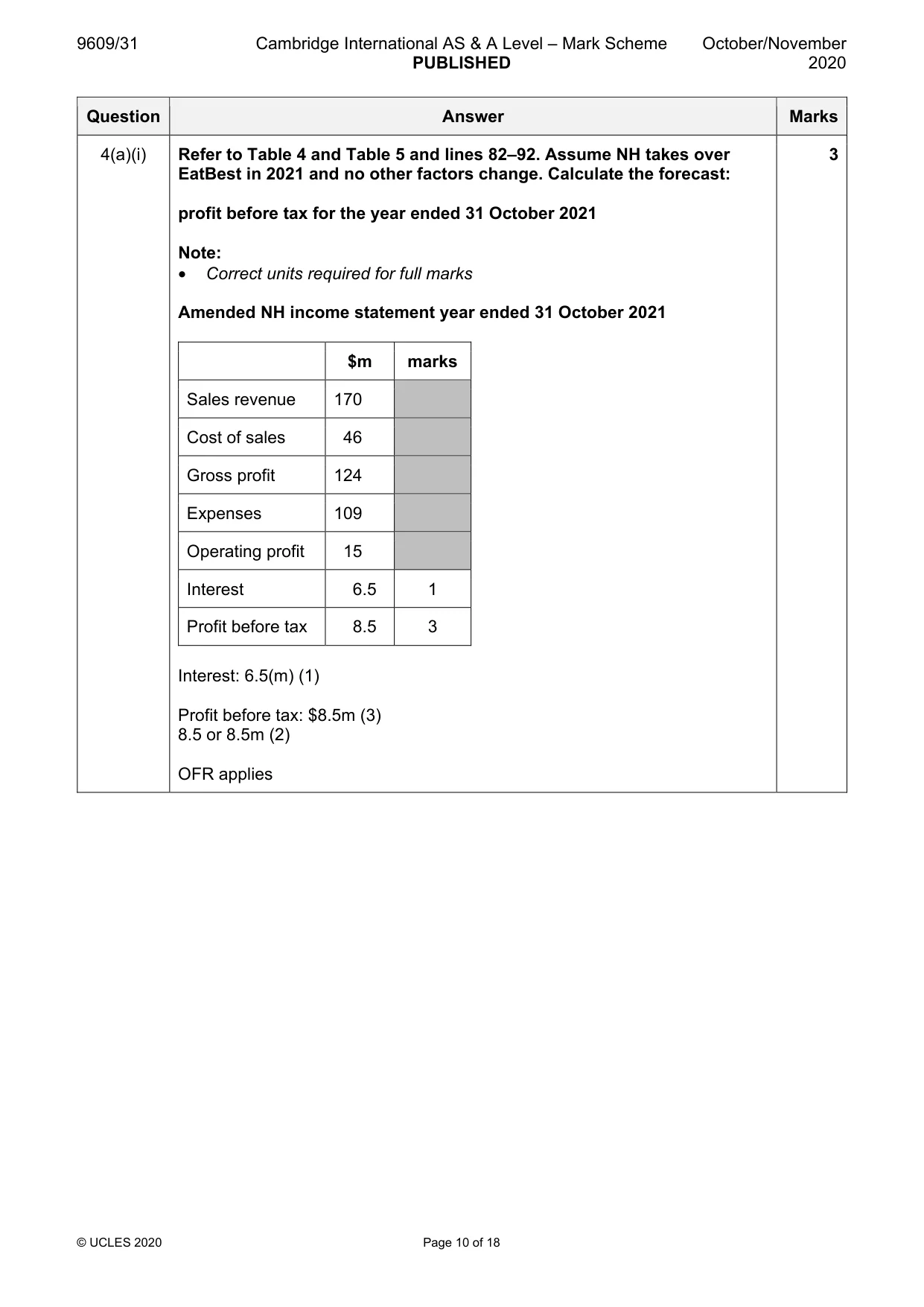
9609/31 Cambridge International AS & A Level – Mark Scheme PUBLISHED October/November 2020 © UCLES 2020 Page 10 of 18 Question Answer Marks 4(a)(i) Refer to Table 4 and Table 5 and lines 82–92. Assume NH takes over EatBest in 2021 and no other factors change. Calculate the forecast: profit before tax for the year ended 31 October 2021 Note: • Correct units required for full marks Amended NH income statement year ended 31 October 2021 $m marks Sales revenue 170 Cost of sales 46 Gross profit 124 Expenses 109 Operating profit 15 Interest 6.5 1 Profit before tax 8.5 3 Interest: 6.5(m) (1) Profit before tax: $8.5m (3) 8.5 or 8.5m (2) OFR applies 3
Mark scheme, page 11
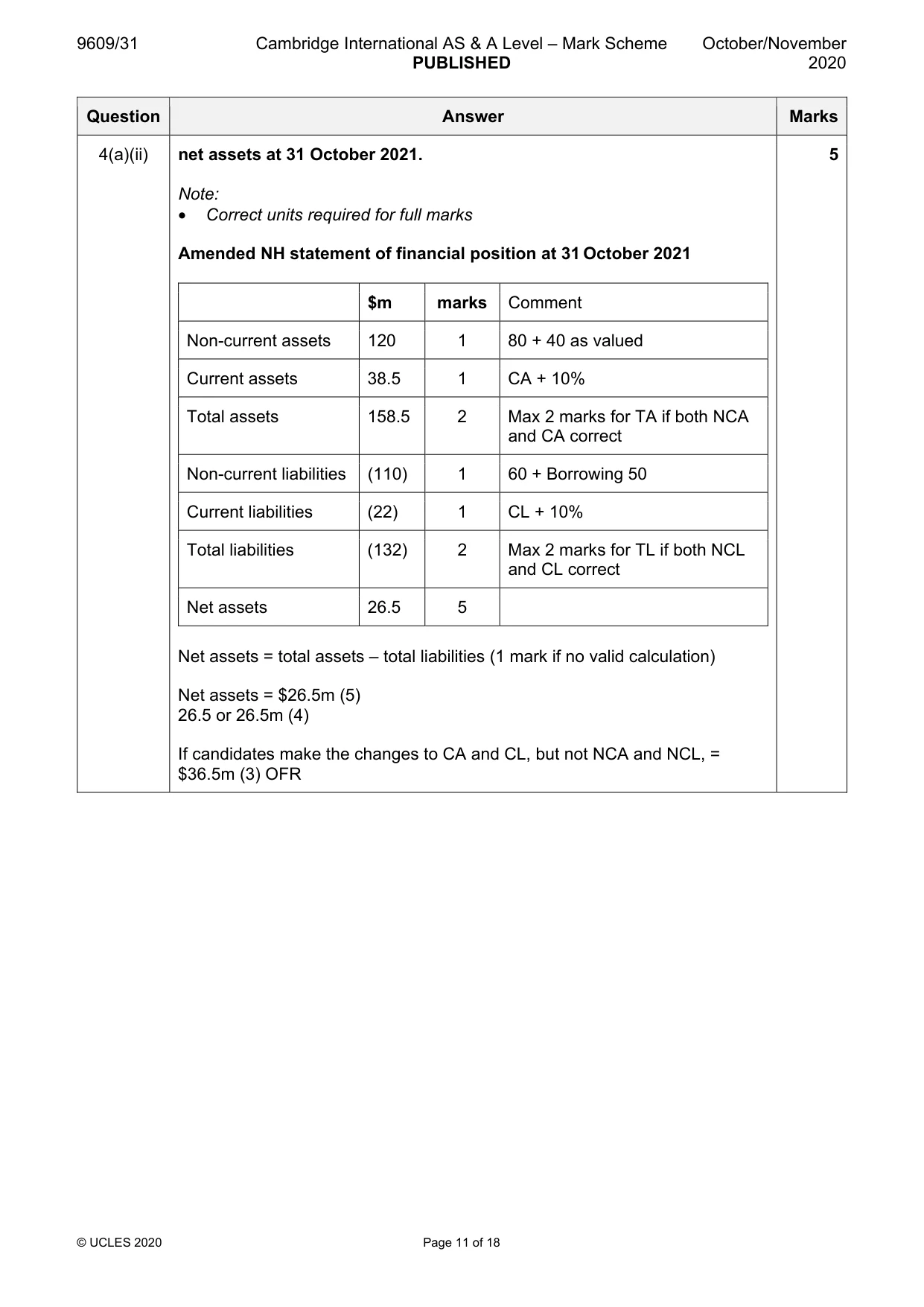
9609/31 Cambridge International AS & A Level – Mark Scheme PUBLISHED October/November 2020 © UCLES 2020 Page 11 of 18 Question Answer Marks 4(a)(ii) net assets at 31 October 2021. Note: • Correct units required for full marks Amended NH statement of financial position at 31 October 2021 $m marks Comment Non-current assets 120 1 80 + 40 as valued Current assets 38.5 1 CA + 10% Total assets 158.5 2 Max 2 marks for TA if both NCA and CA correct Non-current liabilities (110) 1 60 + Borrowing 50 Current liabilities (22) 1 CL + 10% Total liabilities (132) 2 Max 2 marks for TL if both NCL and CL correct Net assets 26.5 5 Net assets = total assets – total liabilities (1 mark if no valid calculation) Net assets = $26.5m (5) 26.5 or 26.5m (4) If candidates make the changes to CA and CL, but not NCA and NCL, = $36.5m (3) OFR 5
Mark scheme, page 12
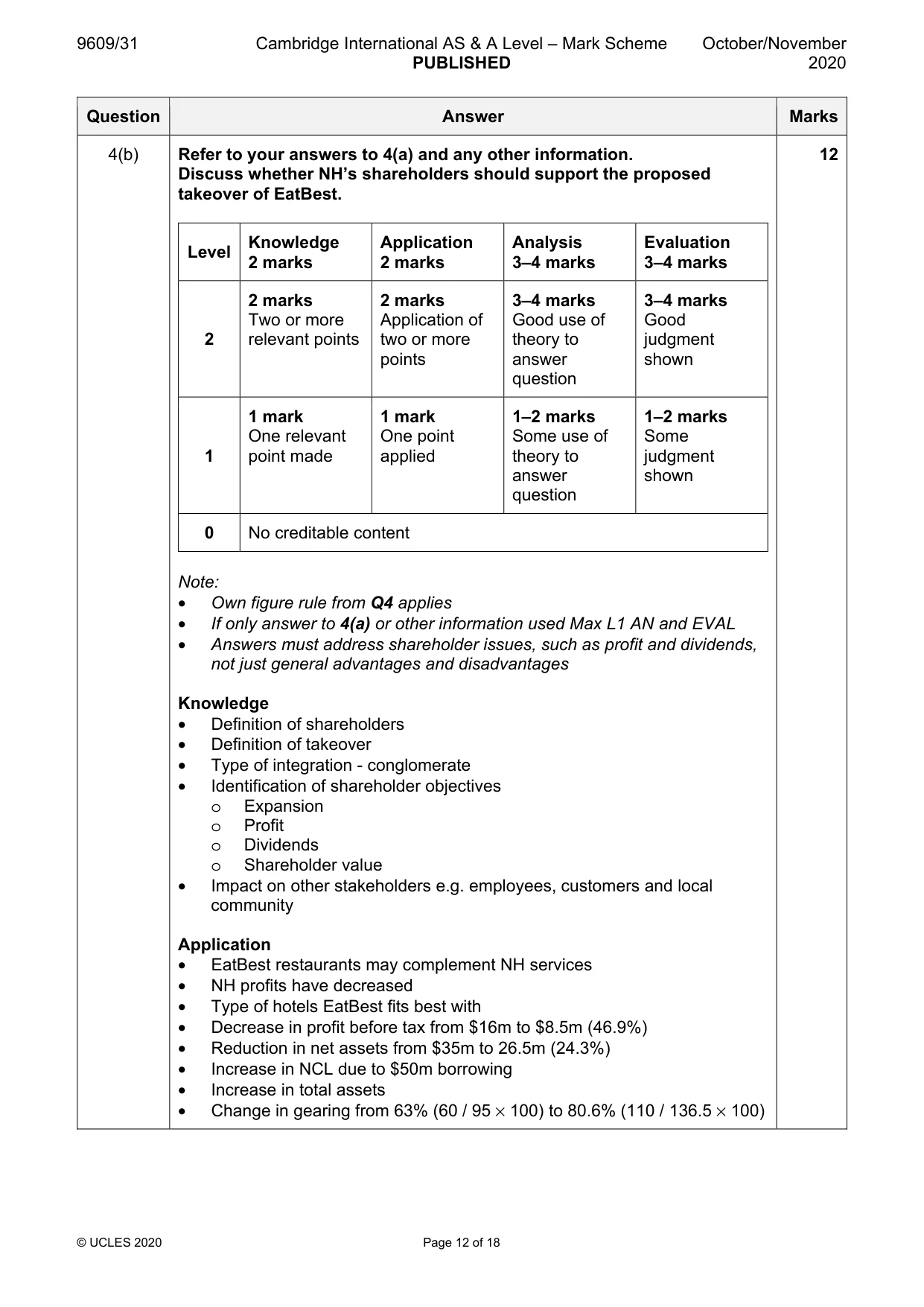
9609/31 Cambridge International AS & A Level – Mark Scheme PUBLISHED October/November 2020 © UCLES 2020 Page 12 of 18 Question Answer Marks 4(b) Refer to your answers to 4(a) and any other information. Discuss whether NH’s shareholders should support the proposed takeover of EatBest. Level Knowledge 2 marks Application 2 marks Analysis 3–4 marks Evaluation 3–4 marks 2 2 marks Two or more relevant points 2 marks Application of two or more points 3–4 marks Good use of theory to answer question 3–4 marks Good judgment shown 1 1 mark One relevant point made 1 mark One point applied 1–2 marks Some use of theory to answer question 1–2 marks Some judgment shown 0 No creditable content Note: • Own figure rule from Q4 applies • If only answer to 4(a) or other information used Max L1 AN and EVAL • Answers must address shareholder issues, such as profit and dividends, not just general advantages and disadvantages Knowledge • Definition of shareholders • Definition of takeover • Type of integration - conglomerate • Identification of shareholder objectives o Expansion o Profit o Dividends o Shareholder value • Impact on other stakeholders e.g. employees, customers and local community Application • EatBest restaurants may complement NH services • NH profits have decreased • Type of hotels EatBest fits best with • Decrease in profit before tax from $16m to $8.5m (46.9%) • Reduction in net assets from $35m to 26.5m (24.3%) • Increase in NCL due to $50m borrowing • Increase in total assets • Change in gearing from 63% (60 / 95 × 100) to 80.6% (110 / 136.5 × 100) 12
Mark scheme, page 13
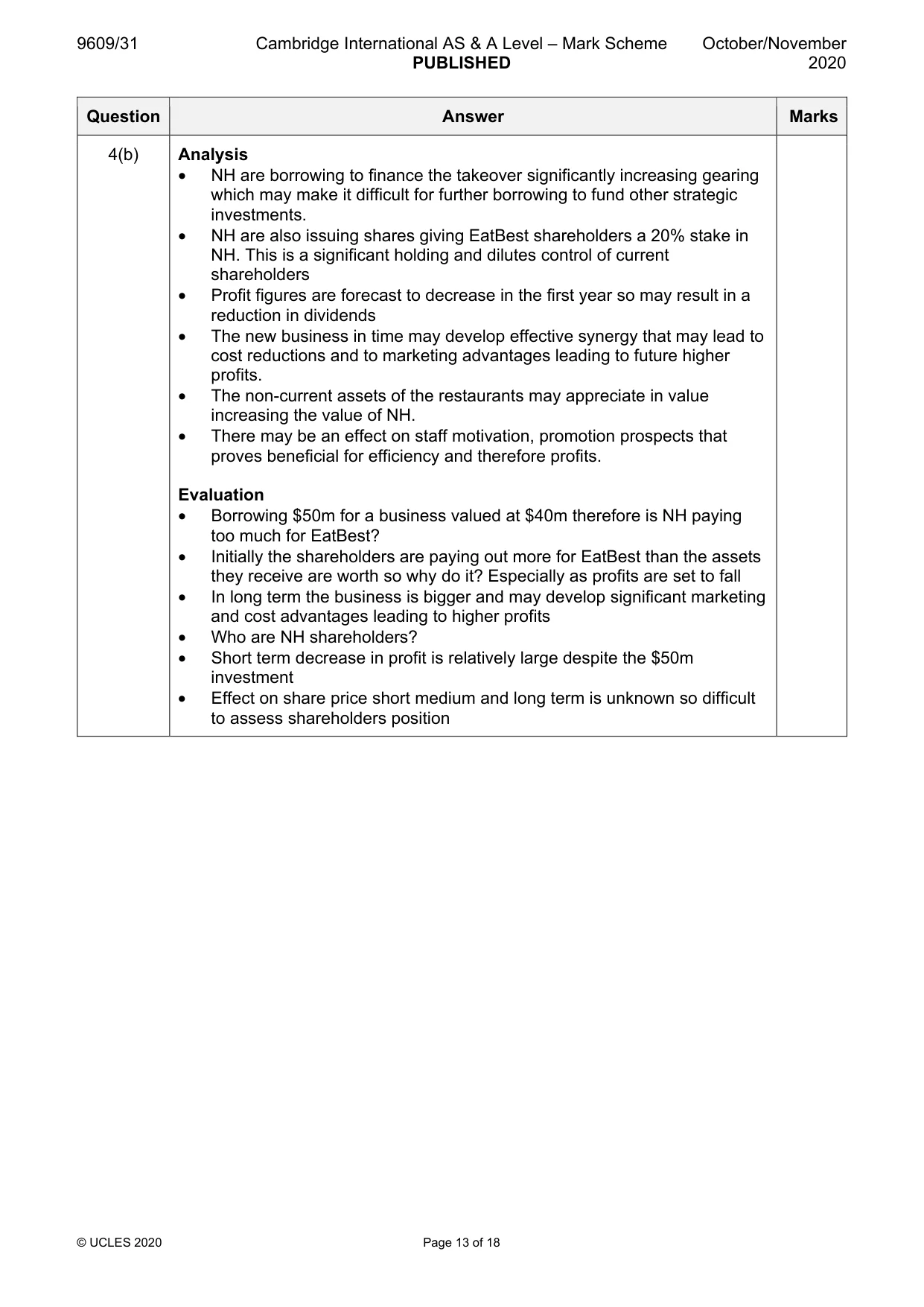
9609/31 Cambridge International AS & A Level – Mark Scheme PUBLISHED October/November 2020 © UCLES 2020 Page 13 of 18 Question Answer Marks 4(b) Analysis • NH are borrowing to finance the takeover significantly increasing gearing which may make it difficult for further borrowing to fund other strategic investments. • NH are also issuing shares giving EatBest shareholders a 20% stake in NH. This is a significant holding and dilutes control of current shareholders • Profit figures are forecast to decrease in the first year so may result in a reduction in dividends • The new business in time may develop effective synergy that may lead to cost reductions and to marketing advantages leading to future higher profits. • The non-current assets of the restaurants may appreciate in value increasing the value of NH. • There may be an effect on staff motivation, promotion prospects that proves beneficial for efficiency and therefore profits. Evaluation • Borrowing $50m for a business valued at $40m therefore is NH paying too much for EatBest? • Initially the shareholders are paying out more for EatBest than the assets they receive are worth so why do it? Especially as profits are set to fall • In long term the business is bigger and may develop significant marketing and cost advantages leading to higher profits • Who are NH shareholders? • Short term decrease in profit is relatively large despite the $50m investment • Effect on share price short medium and long term is unknown so difficult to assess shareholders position
Mark scheme, page 14
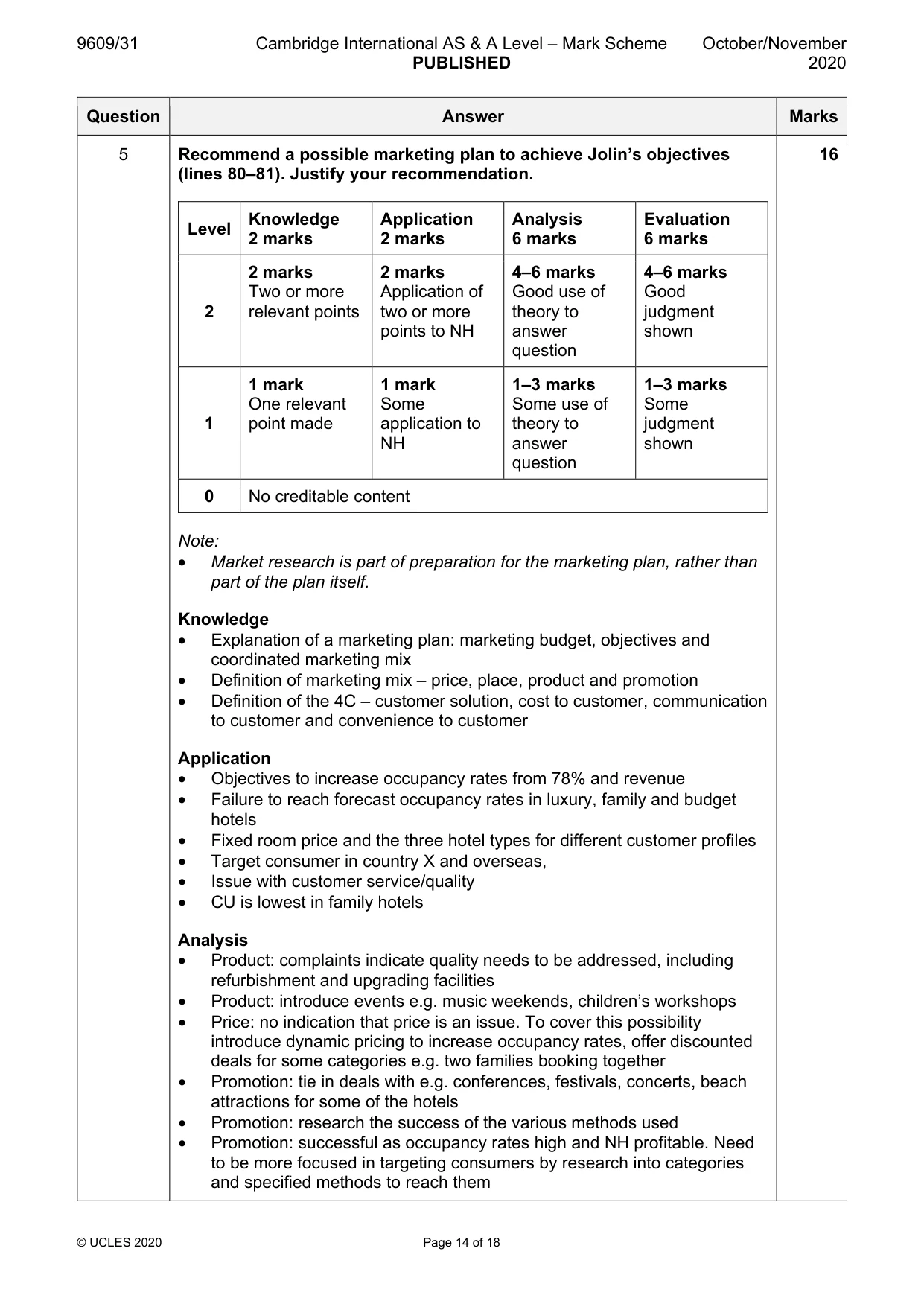
9609/31 Cambridge International AS & A Level – Mark Scheme PUBLISHED October/November 2020 © UCLES 2020 Page 14 of 18 Question Answer Marks 5 Recommend a possible marketing plan to achieve Jolin’s objectives (lines 80–81). Justify your recommendation. Level Knowledge 2 marks Application 2 marks Analysis 6 marks Evaluation 6 marks 2 2 marks Two or more relevant points 2 marks Application of two or more points to NH 4–6 marks Good use of theory to answer question 4–6 marks Good judgment shown 1 1 mark One relevant point made 1 mark Some application to NH 1–3 marks Some use of theory to answer question 1–3 marks Some judgment shown 0 No creditable content Note: • Market research is part of preparation for the marketing plan, rather than part of the plan itself. Knowledge • Explanation of a marketing plan: marketing budget, objectives and coordinated marketing mix • Definition of marketing mix – price, place, product and promotion • Definition of the 4C – customer solution, cost to customer, communication to customer and convenience to customer Application • Objectives to increase occupancy rates from 78% and revenue • Failure to reach forecast occupancy rates in luxury, family and budget hotels • Fixed room price and the three hotel types for different customer profiles • Target consumer in country X and overseas, • Issue with customer service/quality • CU is lowest in family hotels Analysis • Product: complaints indicate quality needs to be addressed, including refurbishment and upgrading facilities • Product: introduce events e.g. music weekends, children’s workshops • Price: no indication that price is an issue. To cover this possibility introduce dynamic pricing to increase occupancy rates, offer discounted deals for some categories e.g. two families booking together • Promotion: tie in deals with e.g. conferences, festivals, concerts, beach attractions for some of the hotels • Promotion: research the success of the various methods used • Promotion: successful as occupancy rates high and NH profitable. Need to be more focused in targeting consumers by research into categories and specified methods to reach them 16
Mark scheme, page 15
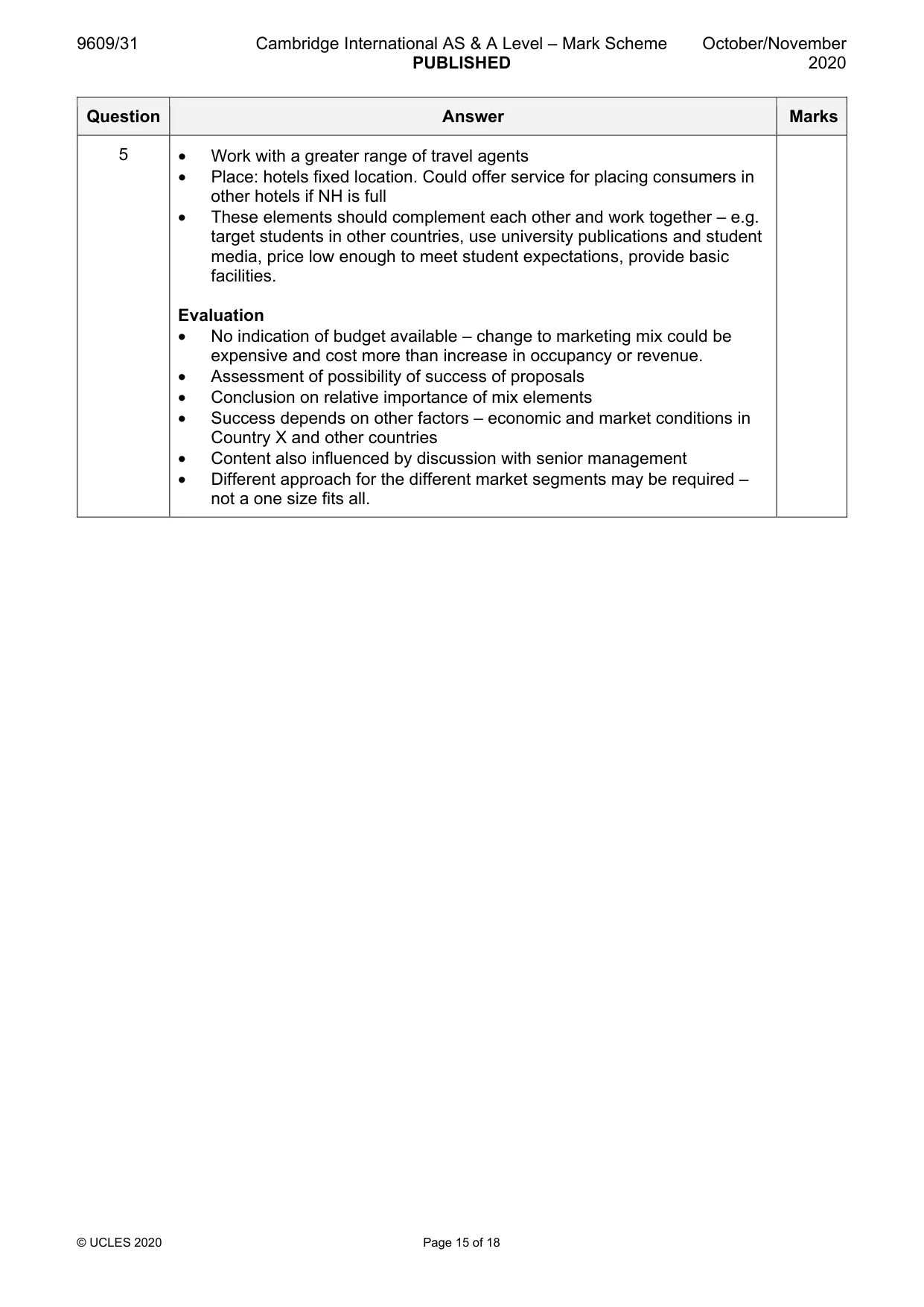
9609/31 Cambridge International AS & A Level – Mark Scheme PUBLISHED October/November 2020 © UCLES 2020 Page 15 of 18 Question Answer Marks 5 • Work with a greater range of travel agents • Place: hotels fixed location. Could offer service for placing consumers in other hotels if NH is full • These elements should complement each other and work together – e.g. target students in other countries, use university publications and student media, price low enough to meet student expectations, provide basic facilities. Evaluation • No indication of budget available – change to marketing mix could be expensive and cost more than increase in occupancy or revenue. • Assessment of possibility of success of proposals • Conclusion on relative importance of mix elements • Success depends on other factors – economic and market conditions in Country X and other countries • Content also influenced by discussion with senior management • Different approach for the different market segments may be required – not a one size fits all.
Mark scheme, page 16
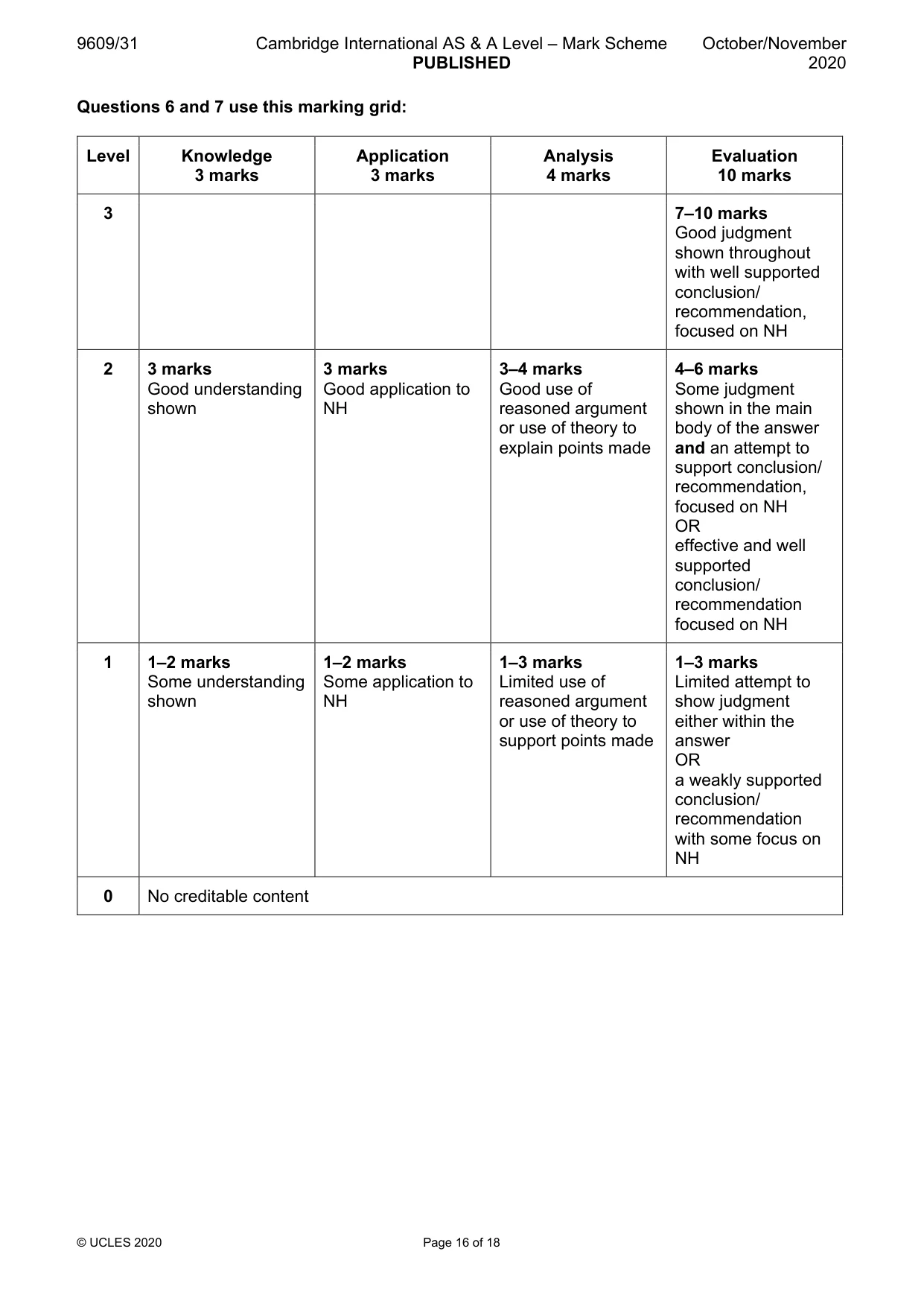
9609/31 Cambridge International AS & A Level – Mark Scheme PUBLISHED October/November 2020 © UCLES 2020 Page 16 of 18 Questions 6 and 7 use this marking grid: Level Knowledge 3 marks Application 3 marks Analysis 4 marks Evaluation 10 marks 3 7–10 marks Good judgment shown throughout with well supported conclusion/ recommendation, focused on NH 2 3 marks Good understanding shown 3 marks Good application to NH 3–4 marks Good use of reasoned argument or use of theory to explain points made 4–6 marks Some judgment shown in the main body of the answer and an attempt to support conclusion/ recommendation, focused on NH OR effective and well supported conclusion/ recommendation focused on NH 1 1–2 marks Some understanding shown 1–2 marks Some application to NH 1–3 marks Limited use of reasoned argument or use of theory to support points made 1–3 marks Limited attempt to show judgment either within the answer OR a weakly supported conclusion/ recommendation with some focus on NH 0 No creditable content
Mark scheme, page 17
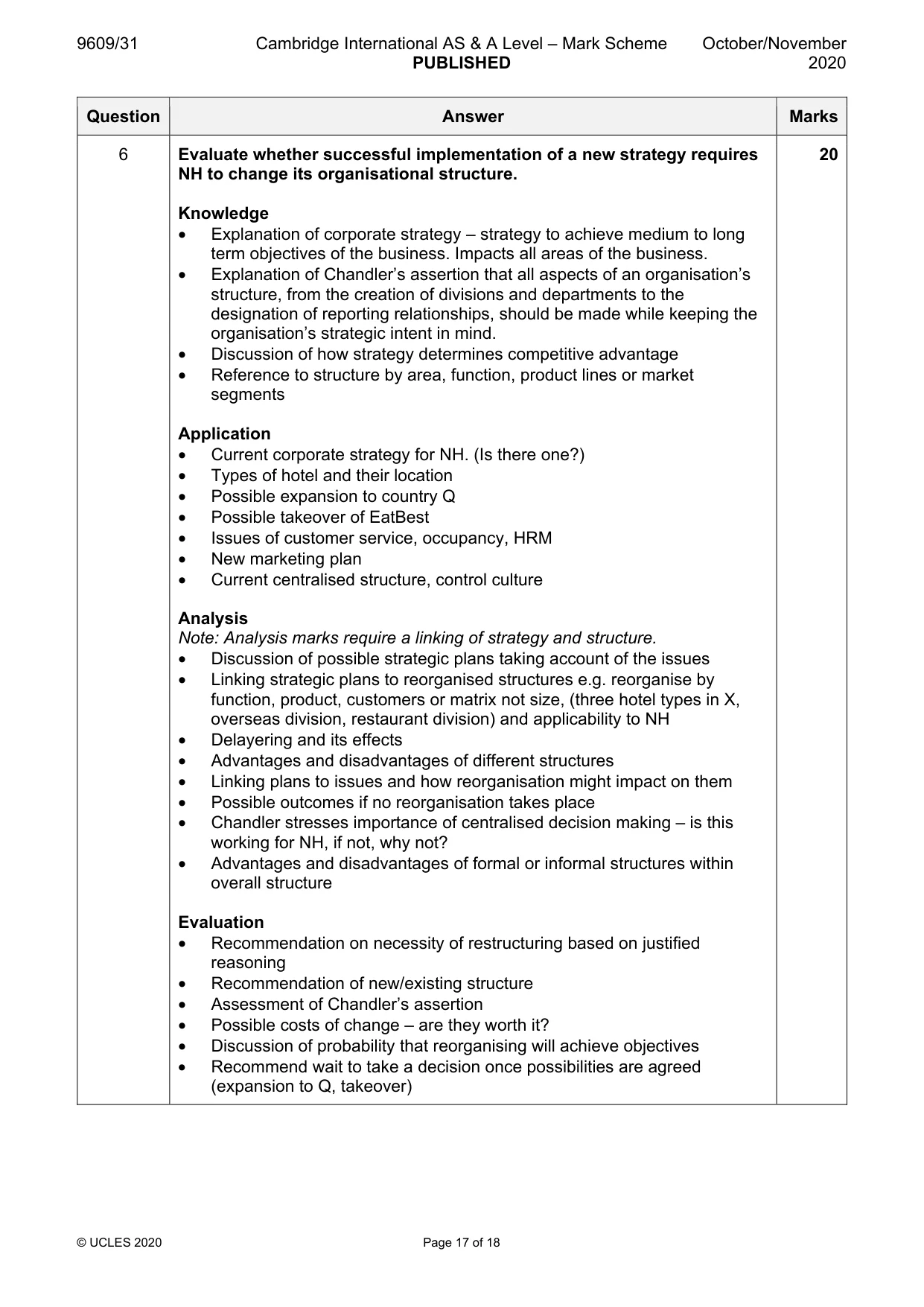
9609/31 Cambridge International AS & A Level – Mark Scheme PUBLISHED October/November 2020 © UCLES 2020 Page 17 of 18 Question Answer Marks 6 Evaluate whether successful implementation of a new strategy requires NH to change its organisational structure. Knowledge • Explanation of corporate strategy – strategy to achieve medium to long term objectives of the business. Impacts all areas of the business. • Explanation of Chandler’s assertion that all aspects of an organisation’s structure, from the creation of divisions and departments to the designation of reporting relationships, should be made while keeping the organisation’s strategic intent in mind. • Discussion of how strategy determines competitive advantage • Reference to structure by area, function, product lines or market segments Application • Current corporate strategy for NH. (Is there one?) • Types of hotel and their location • Possible expansion to country Q • Possible takeover of EatBest • Issues of customer service, occupancy, HRM • New marketing plan • Current centralised structure, control culture Analysis Note: Analysis marks require a linking of strategy and structure. • Discussion of possible strategic plans taking account of the issues • Linking strategic plans to reorganised structures e.g. reorganise by function, product, customers or matrix not size, (three hotel types in X, overseas division, restaurant division) and applicability to NH • Delayering and its effects • Advantages and disadvantages of different structures • Linking plans to issues and how reorganisation might impact on them • Possible outcomes if no reorganisation takes place • Chandler stresses importance of centralised decision making – is this working for NH, if not, why not? • Advantages and disadvantages of formal or informal structures within overall structure Evaluation • Recommendation on necessity of restructuring based on justified reasoning • Recommendation of new/existing structure • Assessment of Chandler’s assertion • Possible costs of change – are they worth it? • Discussion of probability that reorganising will achieve objectives • Recommend wait to take a decision once possibilities are agreed (expansion to Q, takeover) 20
Mark scheme, page 18
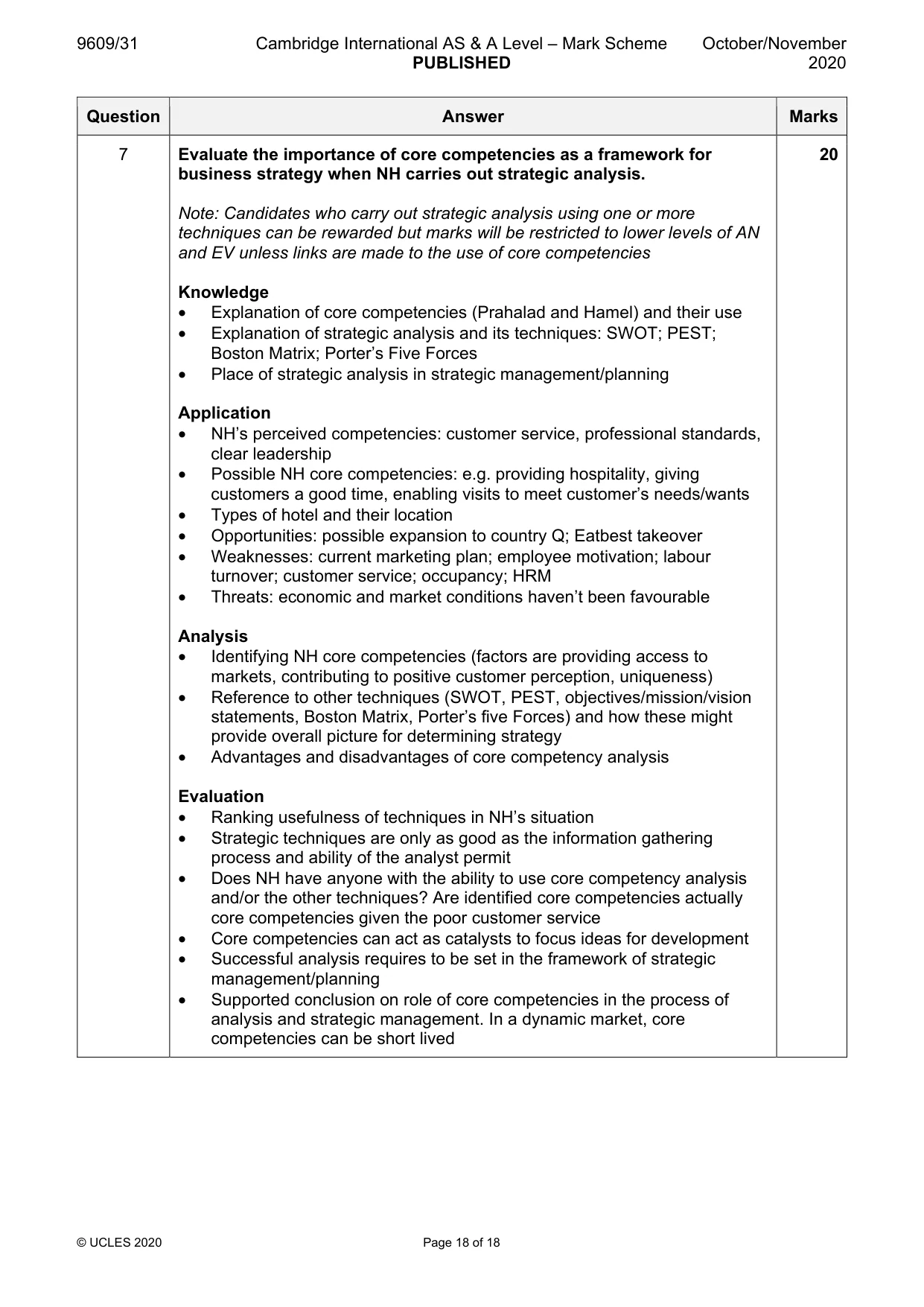
9609/31 Cambridge International AS & A Level – Mark Scheme PUBLISHED October/November 2020 © UCLES 2020 Page 18 of 18 Question Answer Marks 7 Evaluate the importance of core competencies as a framework for business strategy when NH carries out strategic analysis. Note: Candidates who carry out strategic analysis using one or more techniques can be rewarded but marks will be restricted to lower levels of AN and EV unless links are made to the use of core competencies Knowledge • Explanation of core competencies (Prahalad and Hamel) and their use • Explanation of strategic analysis and its techniques: SWOT; PEST; Boston Matrix; Porter’s Five Forces • Place of strategic analysis in strategic management/planning Application • NH’s perceived competencies: customer service, professional standards, clear leadership • Possible NH core competencies: e.g. providing hospitality, giving customers a good time, enabling visits to meet customer’s needs/wants • Types of hotel and their location • Opportunities: possible expansion to country Q; Eatbest takeover • Weaknesses: current marketing plan; employee motivation; labour turnover; customer service; occupancy; HRM • Threats: economic and market conditions haven’t been favourable Analysis • Identifying NH core competencies (factors are providing access to markets, contributing to positive customer perception, uniqueness) • Reference to other techniques (SWOT, PEST, objectives/mission/vision statements, Boston Matrix, Porter’s five Forces) and how these might provide overall picture for determining strategy • Advantages and disadvantages of core competency analysis Evaluation • Ranking usefulness of techniques in NH’s situation • Strategic techniques are only as good as the information gathering process and ability of the analyst permit • Does NH have anyone with the ability to use core competency analysis and/or the other techniques? Are identified core competencies actually core competencies given the poor customer service • Core competencies can act as catalysts to focus ideas for development • Successful analysis requires to be set in the framework of strategic management/planning • Supported conclusion on role of core competencies in the process of analysis and strategic management. In a dynamic market, core competencies can be short lived 20
What you needed in this session
Cambridge’s own grade thresholds for 2020 Oct/Nov, Paper 3 · Variant 1. A higher threshold means an easier paper — the bar moves with how the cohort did.