Cambridge A Level Business (for first examination in 2016) 9609 — 2020 May/June Paper 3 · Variant 2
9609/32/M/J/20
The question paper and its mark scheme, free to read here and free to download. This is Cambridge’s own paper, exactly as it was sat.
Question paper20 pages











Mark scheme17 pages
Answers below. Sit the paper first if you are practising.

Paper as text
Question paper, page 1
Cambridge International AS & A Level DC (ST) 189353/2 © UCLES 2020 [Turn over This document has 20 pages. Blank pages are indicated. BUSINESS 9609/32 Paper 3 Case Study May/June 2020 3 hours You must answer on the question paper. You will need: Insert (enclosed) INSTRUCTIONS ● Section A: answer all questions. ● Section B: answer one question. ● Use a black or dark blue pen. ● Write your name, centre number and candidate number in the boxes at the top of the page. ● Write your answer to each question in the space provided. ● Do not use an erasable pen or correction fluid. ● Do not write on any bar codes. ● You may use an HB pencil for any diagrams, graphs or rough working. INFORMATION ● The total mark for this paper is 100. ● The number of marks for each question or part question is shown in brackets [ ]. ● The insert contains the case study. * 2 7 9 8 3 4 6 6 7 5 *
Question paper, page 2
2 9609/32/M/J/20 © UCLES 2020 Answer all questions in Section A and answer one question in Section B. You are advised to spend no more than 40 minutes on Section B. Section A Answer all questions in this section. 1 Analyse the likely impact on HBG’s costs and revenues of increasing its focus on corporate social responsibility (CSR). … … … … … … … … … … … … … … … … … … … … … … …
Question paper, page 3
3 9609/32/M/J/20 © UCLES 2020 [Turn over … … … … … … … … … … … … … … … … … … … … … … … … … … … … [10]
Question paper, page 4
4 9609/32/M/J/20 © UCLES 2020 2 (a) Refer to Table 2. Calculate the: (i) contribution of the café … … … … … … [3] (ii) profit made by the gift shop. … … … … … … [3]
Question paper, page 5
5 9609/32/M/J/20 © UCLES 2020 [Turn over (b) Refer to your answers for 2(a) and any other information. Recommend whether HBG should close Oldbury Castle Café. Justify your recommendation. … … … … … … … … … … … … … … … … … … … … … … … … … … …
Question paper, page 6
6 9609/32/M/J/20 © UCLES 2020 … … … … … … … … … … … … … … … … … … … … … … … … … … … … [12]
Question paper, page 7
7 9609/32/M/J/20 © UCLES 2020 [Turn over 3 Discuss whether introducing a decentralised organisational structure will benefit HBG. … … … … … … … … … … … … … … … … … … … … … … … … … … …
Question paper, page 8
8 9609/32/M/J/20 © UCLES 2020 … … … … … … … … … … … … … … … … … … … … … … … … … … … …
Question paper, page 9
9 9609/32/M/J/20 © UCLES 2020 [Turn over … … … … … … … … … … … … … … … … … … … … … … … … … … … … [16]
Question paper, page 10
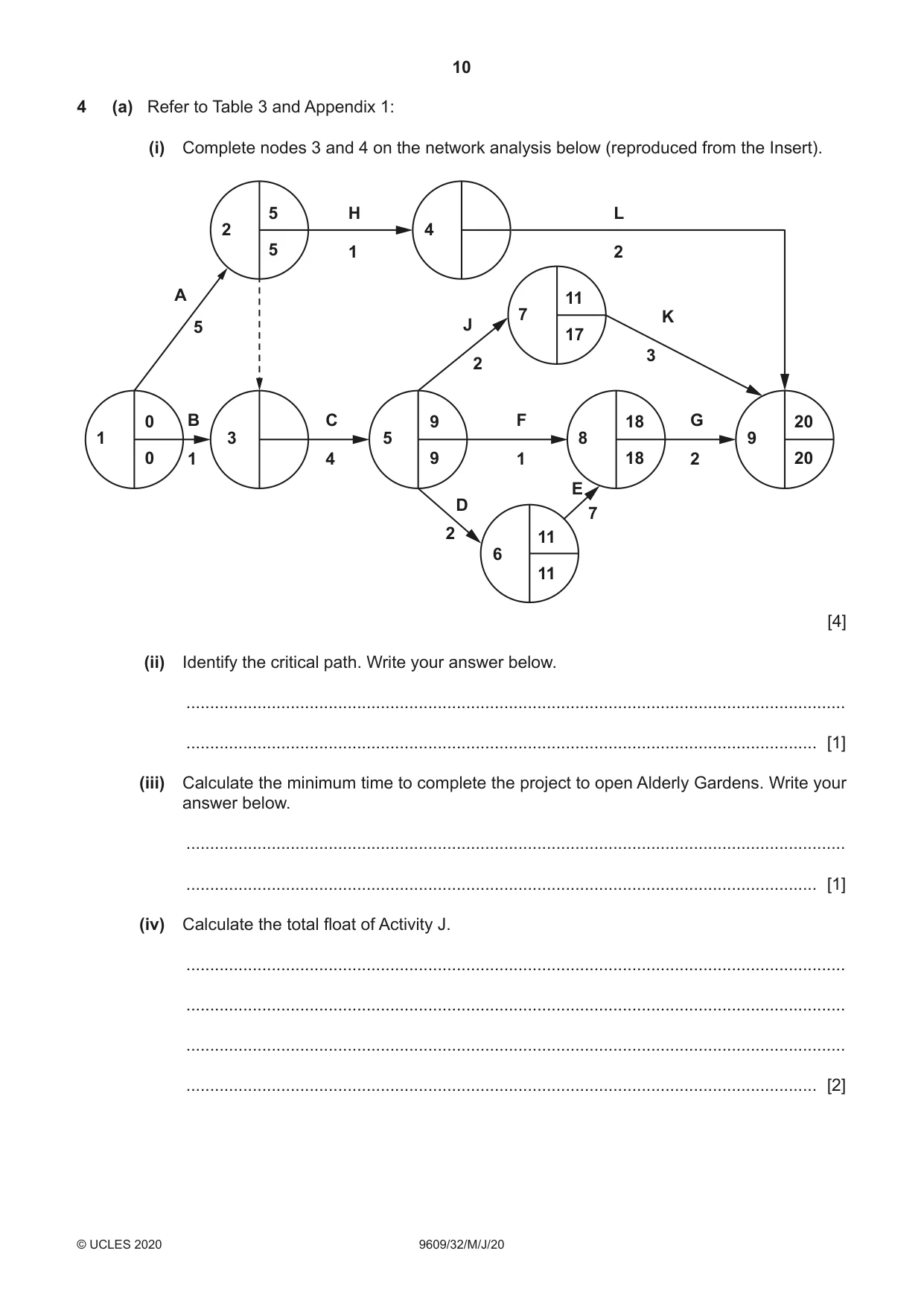
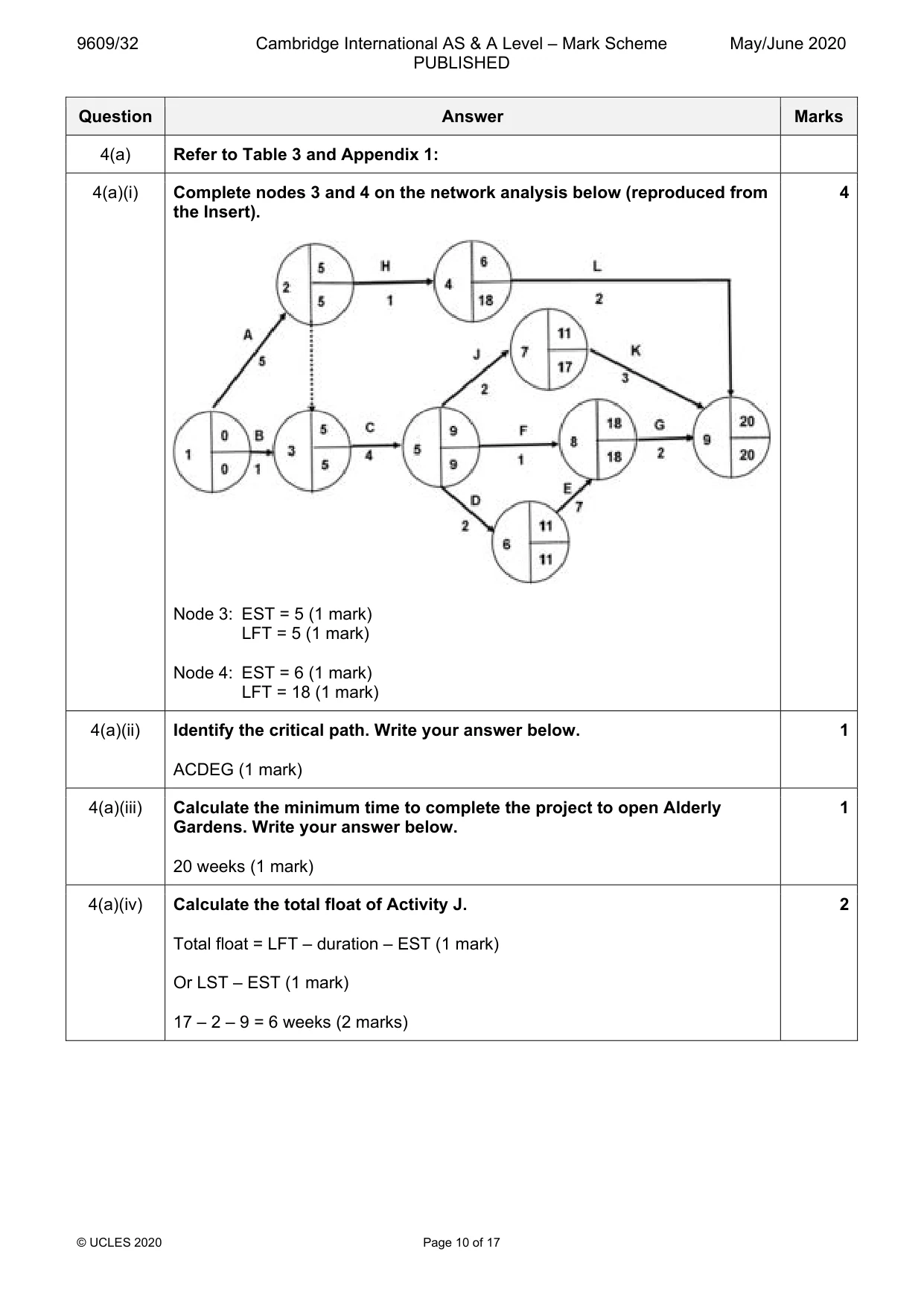
10 9609/32/M/J/20 © UCLES 2020 4 (a) Refer to Table 3 and Appendix 1: (i) Complete nodes 3 and 4 on the network analysis below (reproduced from the Insert). A 2 4 5 5 1 3 0 0 5 9 9 6 11 11 7 11 17 8 18 18 9 20 20 5 H 1 B 1 C 4 F D E 1 7 G 2 J 2 2 L 2 K 3 [4] (ii) Identify the critical path. Write your answer below. … … [1] (iii) Calculate the minimum time to complete the project to open Alderly Gardens. Write your answer below. … … [1] (iv) Calculate the total float of Activity J. … … … … [2]
Question paper, page 11
11 9609/32/M/J/20 © UCLES 2020 [Turn over (b) Evaluate the usefulness of network analysis to HBG when making operational decisions. … … … … … … … … … … … … … … … … … … … … … … … … … … …
Question paper, page 12
12 9609/32/M/J/20 © UCLES 2020 … … … … … … … … … … … … … … … … … … … … … … … … … … … … [12]
Question paper, page 13
13 9609/32/M/J/20 © UCLES 2020 [Turn over 5 Recommend the changes that HBG should make to its marketing strategy to achieve its objectives of increasing membership and visitor numbers. Justify your recommendation. … … … … … … … … … … … … … … … … … … … … … … … … … … …
Question paper, page 14
14 9609/32/M/J/20 © UCLES 2020 … … … … … … … … … … … … … … … … … … … … … … … … … … … …
Question paper, page 15
15 9609/32/M/J/20 © UCLES 2020 [Turn over … … … … … … … … … … … … … … … … … … … … … … … … … … … … [16]
Question paper, page 16
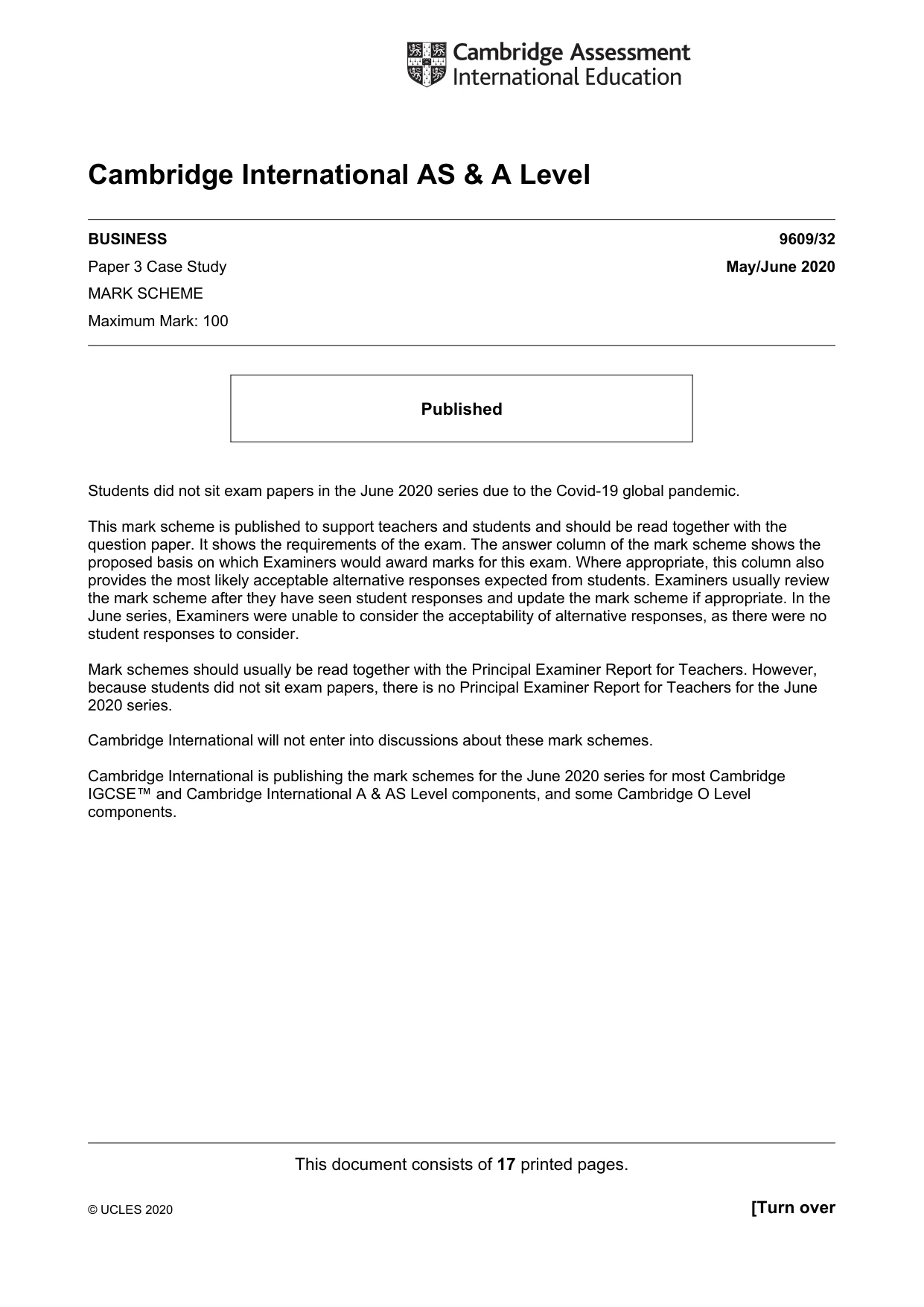
16 9609/32/M/J/20 © UCLES 2020 Section B Answer one question in this section. 6 Evaluate whether SWOT analysis is sufficient to make sure that HBG’s future strategies are the most appropriate ones for the organisation. 7 Evaluate the importance to HBG of developing a change culture in order to implement Eusebio’s four strategic changes (lines 46 to 49). Write the question number here: … … … … … … … … … … … … … … … … … … … … … … …
Question paper, page 17
17 9609/32/M/J/20 © UCLES 2020 [Turn over … … … … … … … … … … … … … … … … … … … … … … … … … … … …
Question paper, page 18
18 9609/32/M/J/20 © UCLES 2020 … … … … … … … … … … … … … … … … … … … … … … … … … … … …
Question paper, page 19
19 9609/32/M/J/20 © UCLES 2020 … … … … … … … … … … … … … … … … … … … … … … … … … … … … [20]
Question paper, page 20
20 9609/32/M/J/20 © UCLES 2020 Permission to reproduce items where third-party owned material protected by copyright is included has been sought and cleared where possible. Every reasonable effort has been made by the publisher (UCLES) to trace copyright holders, but if any items requiring clearance have unwittingly been included, the publisher will be pleased to make amends at the earliest possible opportunity. To avoid the issue of disclosure of answer-related information to candidates, all copyright acknowledgements are reproduced online in the Cambridge Assessment International Education Copyright Acknowledgements Booklet. This is produced for each series of examinations and is freely available to download at www.cambridgeinternational.org after the live examination series. Cambridge Assessment International Education is part of the Cambridge Assessment Group. Cambridge Assessment is the brand name of the University of Cambridge Local Examinations Syndicate (UCLES), which itself is a department of the University of Cambridge. BLANK PAGE
Mark scheme, page 1
This document consists of 17 printed pages. © UCLES 2020 [Turn over Cambridge International AS & A Level BUSINESS 9609/32 Paper 3 Case Study May/June 2020 MARK SCHEME Maximum Mark: 100 Published Students did not sit exam papers in the June 2020 series due to the Covid-19 global pandemic. This mark scheme is published to support teachers and students and should be read together with the question paper. It shows the requirements of the exam. The answer column of the mark scheme shows the proposed basis on which Examiners would award marks for this exam. Where appropriate, this column also provides the most likely acceptable alternative responses expected from students. Examiners usually review the mark scheme after they have seen student responses and update the mark scheme if appropriate. In the June series, Examiners were unable to consider the acceptability of alternative responses, as there were no student responses to consider. Mark schemes should usually be read together with the Principal Examiner Report for Teachers. However, because students did not sit exam papers, there is no Principal Examiner Report for Teachers for the June 2020 series. Cambridge International will not enter into discussions about these mark schemes. Cambridge International is publishing the mark schemes for the June 2020 series for most Cambridge IGCSE™ and Cambridge International A & AS Level components, and some Cambridge O Level components.
Mark scheme, page 2
9609/32 Cambridge International AS & A Level – Mark Scheme PUBLISHED May/June 2020 © UCLES 2020 Page 2 of 17 Generic Marking Principles These general marking principles must be applied by all examiners when marking candidate answers. They should be applied alongside the specific content of the mark scheme or generic level descriptors for a question. Each question paper and mark scheme will also comply with these marking principles. GENERIC MARKING PRINCIPLE 1: Marks must be awarded in line with: • the specific content of the mark scheme or the generic level descriptors for the question • the specific skills defined in the mark scheme or in the generic level descriptors for the question • the standard of response required by a candidate as exemplified by the standardisation scripts. GENERIC MARKING PRINCIPLE 2: Marks awarded are always whole marks (not half marks, or other fractions). GENERIC MARKING PRINCIPLE 3: Marks must be awarded positively: • marks are awarded for correct/valid answers, as defined in the mark scheme. However, credit is given for valid answers which go beyond the scope of the syllabus and mark scheme, referring to your Team Leader as appropriate • marks are awarded when candidates clearly demonstrate what they know and can do • marks are not deducted for errors • marks are not deducted for omissions • answers should only be judged on the quality of spelling, punctuation and grammar when these features are specifically assessed by the question as indicated by the mark scheme. The meaning, however, should be unambiguous. GENERIC MARKING PRINCIPLE 4: Rules must be applied consistently e.g. in situations where candidates have not followed instructions or in the application of generic level descriptors. GENERIC MARKING PRINCIPLE 5: Marks should be awarded using the full range of marks defined in the mark scheme for the question (however; the use of the full mark range may be limited according to the quality of the candidate responses seen). GENERIC MARKING PRINCIPLE 6: Marks awarded are based solely on the requirements as defined in the mark scheme. Marks should not be awarded with grade thresholds or grade descriptors in mind.
Mark scheme, page 3
9609/32 Cambridge International AS & A Level – Mark Scheme PUBLISHED May/June 2020 © UCLES 2020 Page 3 of 17 Paper 3 General Marking Guidance • Marking should be positive: marks should not be subtracted for errors or inaccuracies. • When examiners are in doubt regarding the application of the mark scheme to a candidate’s response, the team leader must be consulted. • Crossed out work must be marked UNLESS the candidate has replaced it with an alternative response. • In numerical answers units are required. • Errors that are carried forward (e.g. when an incorrect numerical answer to one part of a question is used as the starting point for a calculation in the next part of the question) should not be compounded – use the ‘own figure rule’. • Poor spelling, handwriting or grammar should not be penalised as long as the answer makes sense. • The main RM Assessor annotations to be used are K (Knowledge), APP (Application), AN (Analysis), EVAL (Evaluation). For each of these four annotations, the number of marks awarded for that assessment objective must match the number of times that annotation is on the answer. • Only award EVAL if the candidate has also demonstrated APP. • No knowledge demonstrated, then no marks. • Blank pages on a script should be annotated as SEEN. • A blank space, dash, question mark constitutes a ‘no response’. • In Section B, candidates answer either Question 6 or Question 7. The Section B question that the candidate does not answer must be entered as ‘no response’. • Blank pages, or pages that contain crossed out material, must be annotated using ‘seen’. • Accept Any Reasonable Answer when awarding marks. This mark scheme includes a summary of appropriate content for answering each question. It should be emphasised, however, that this material is for illustrative purposes and is not intended to provide a definitive guide to acceptable answers. It is quite possible that among the scripts there will be some candidate answers that are not covered directly by the content of this mark scheme. In such cases, professional judgement should be exercised in assessing the merits of the answer and the senior examiners should be consulted if further guidance is required. Application marks are not awarded for repeating material from the case study. Application is by answering in the context of the case or by using the information in the case to help answer the question.
Mark scheme, page 4
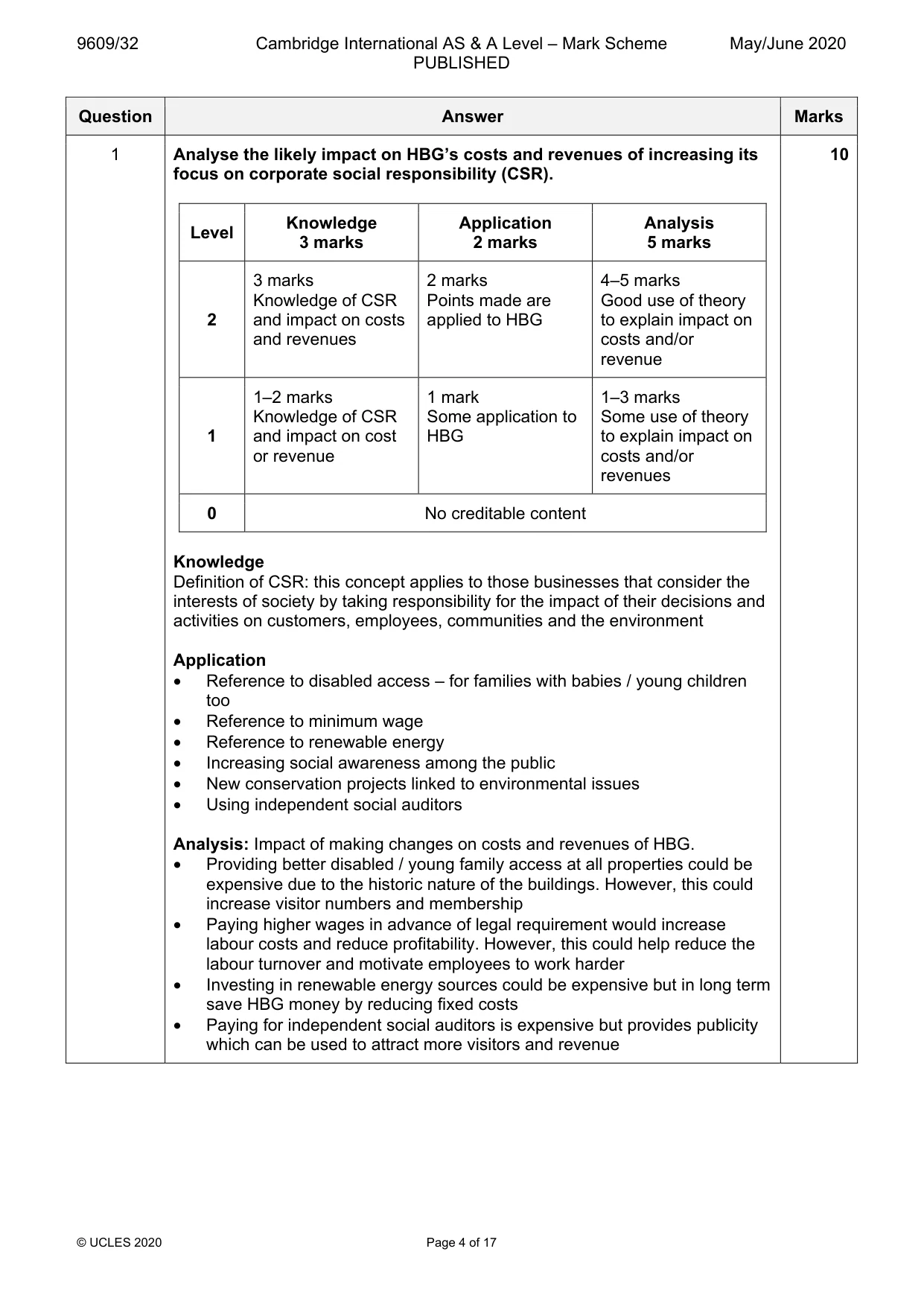
9609/32 Cambridge International AS & A Level – Mark Scheme PUBLISHED May/June 2020 © UCLES 2020 Page 4 of 17 Question Answer Marks 1 Analyse the likely impact on HBG’s costs and revenues of increasing its focus on corporate social responsibility (CSR). Level Knowledge 3 marks Application 2 marks Analysis 5 marks 2 3 marks Knowledge of CSR and impact on costs and revenues 2 marks Points made are applied to HBG 4–5 marks Good use of theory to explain impact on costs and/or revenue 1 1–2 marks Knowledge of CSR and impact on cost or revenue 1 mark Some application to HBG 1–3 marks Some use of theory to explain impact on costs and/or revenues 0 No creditable content Knowledge Definition of CSR: this concept applies to those businesses that consider the interests of society by taking responsibility for the impact of their decisions and activities on customers, employees, communities and the environment Application • Reference to disabled access – for families with babies / young children too • Reference to minimum wage • Reference to renewable energy • Increasing social awareness among the public • New conservation projects linked to environmental issues • Using independent social auditors Analysis: Impact of making changes on costs and revenues of HBG. • Providing better disabled / young family access at all properties could be expensive due to the historic nature of the buildings. However, this could increase visitor numbers and membership • Paying higher wages in advance of legal requirement would increase labour costs and reduce profitability. However, this could help reduce the labour turnover and motivate employees to work harder • Investing in renewable energy sources could be expensive but in long term save HBG money by reducing fixed costs • Paying for independent social auditors is expensive but provides publicity which can be used to attract more visitors and revenue 10
Mark scheme, page 5
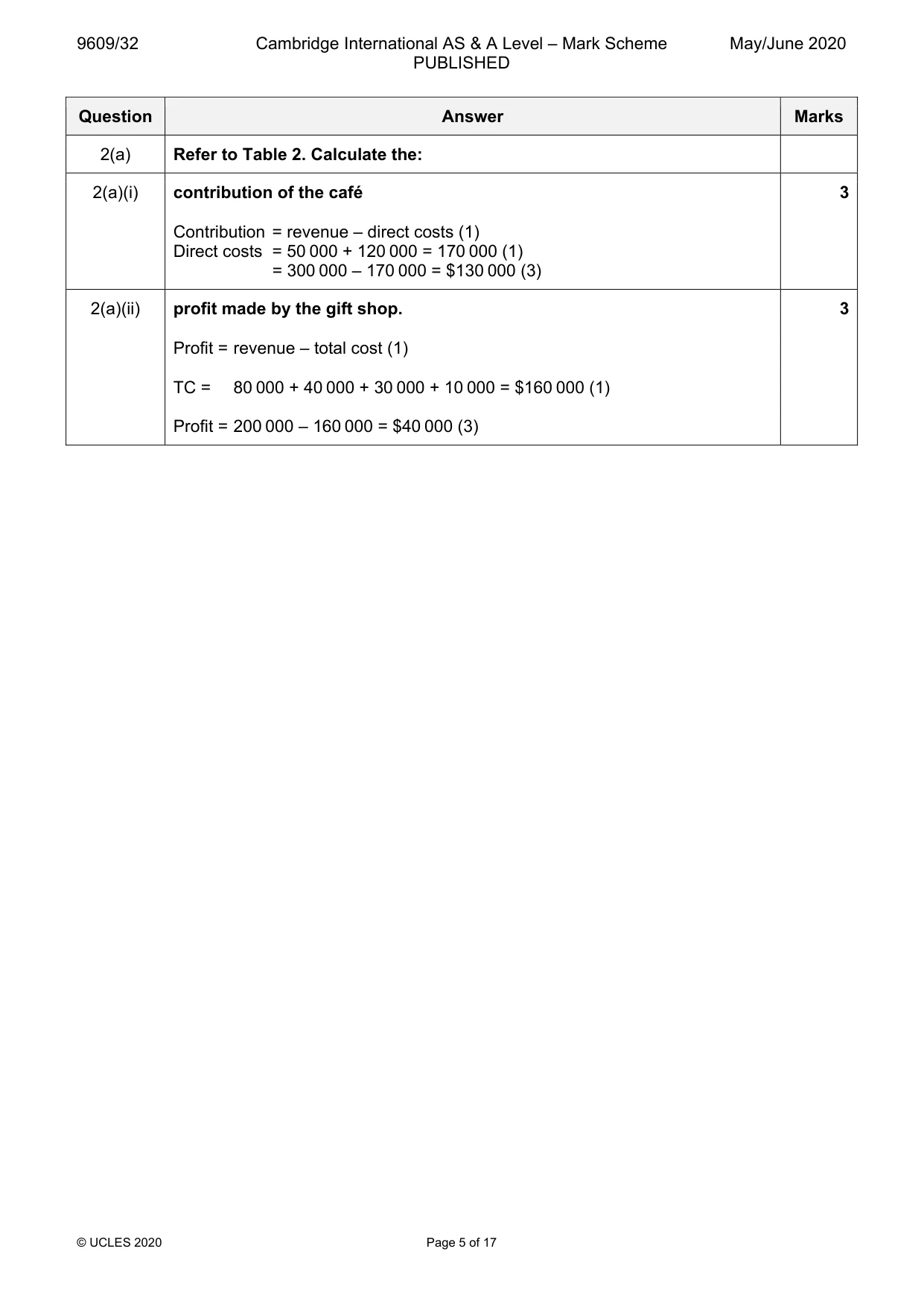
9609/32 Cambridge International AS & A Level – Mark Scheme PUBLISHED May/June 2020 © UCLES 2020 Page 5 of 17 Question Answer Marks 2(a) Refer to Table 2. Calculate the: 2(a)(i) contribution of the café Contribution = revenue – direct costs (1) Direct costs = 50 000 + 120 000 = 170 000 (1) = 300 000 – 170 000 = $130 000 (3) 3 2(a)(ii) profit made by the gift shop. Profit = revenue – total cost (1) TC = 80 000 + 40 000 + 30 000 + 10 000 = $160 000 (1) Profit = 200 000 – 160 000 = $40 000 (3) 3
Mark scheme, page 6
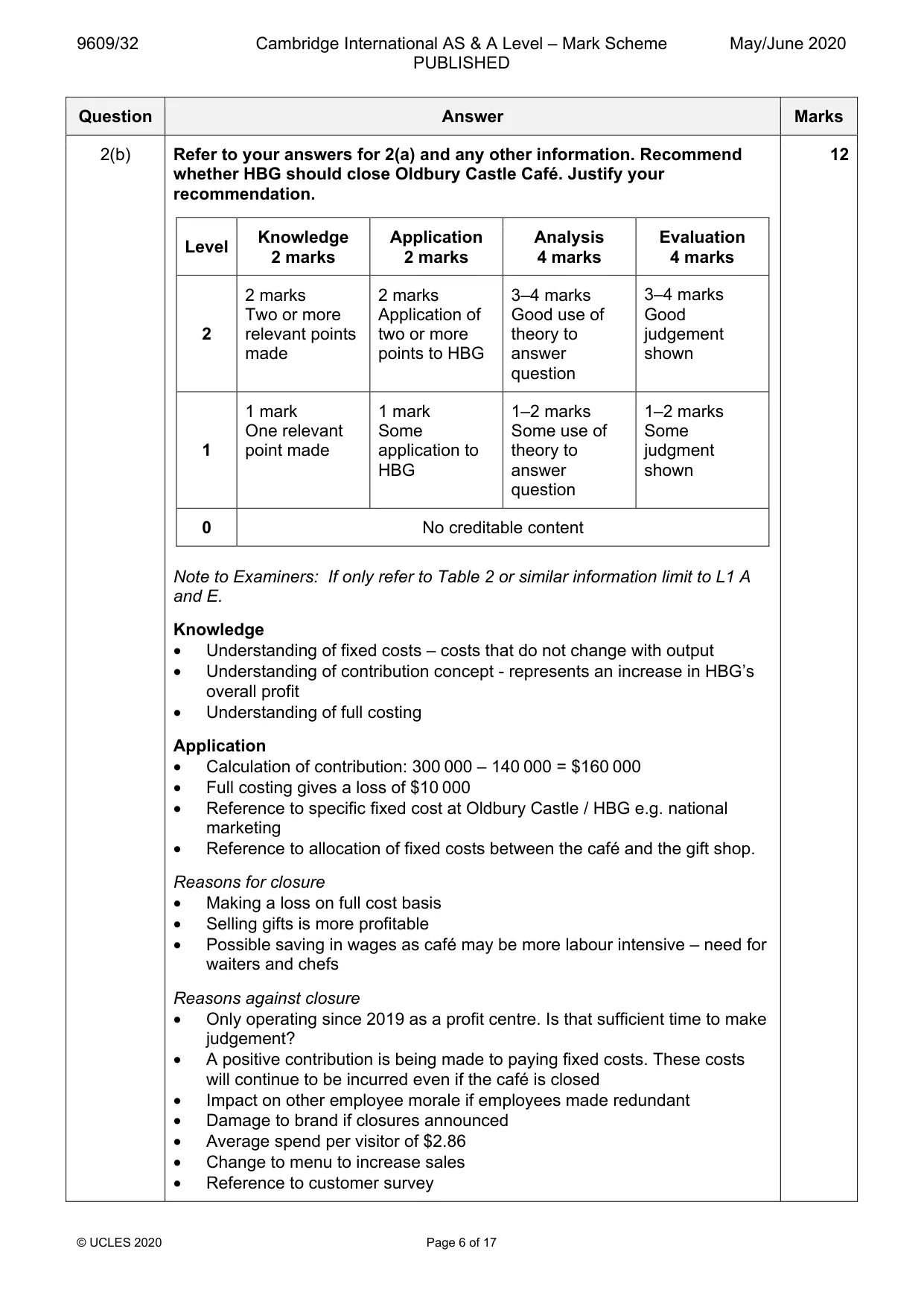
9609/32 Cambridge International AS & A Level – Mark Scheme PUBLISHED May/June 2020 © UCLES 2020 Page 6 of 17 Question Answer Marks 2(b) Refer to your answers for 2(a) and any other information. Recommend whether HBG should close Oldbury Castle Café. Justify your recommendation. Level Knowledge 2 marks Application 2 marks Analysis 4 marks Evaluation 4 marks 2 2 marks Two or more relevant points made 2 marks Application of two or more points to HBG 3–4 marks Good use of theory to answer question 3–4 marks Good judgement shown 1 1 mark One relevant point made 1 mark Some application to HBG 1–2 marks Some use of theory to answer question 1–2 marks Some judgment shown 0 No creditable content Note to Examiners: If only refer to Table 2 or similar information limit to L1 A and E. Knowledge • Understanding of fixed costs – costs that do not change with output • Understanding of contribution concept - represents an increase in HBG’s overall profit • Understanding of full costing Application • Calculation of contribution: 300 000 – 140 000 = $160 000 • Full costing gives a loss of $10 000 • Reference to specific fixed cost at Oldbury Castle / HBG e.g. national marketing • Reference to allocation of fixed costs between the café and the gift shop. Reasons for closure • Making a loss on full cost basis • Selling gifts is more profitable • Possible saving in wages as café may be more labour intensive – need for waiters and chefs Reasons against closure • Only operating since 2019 as a profit centre. Is that sufficient time to make judgement? • A positive contribution is being made to paying fixed costs. These costs will continue to be incurred even if the café is closed • Impact on other employee morale if employees made redundant • Damage to brand if closures announced • Average spend per visitor of $2.86 • Change to menu to increase sales • Reference to customer survey 12
Mark scheme, page 7
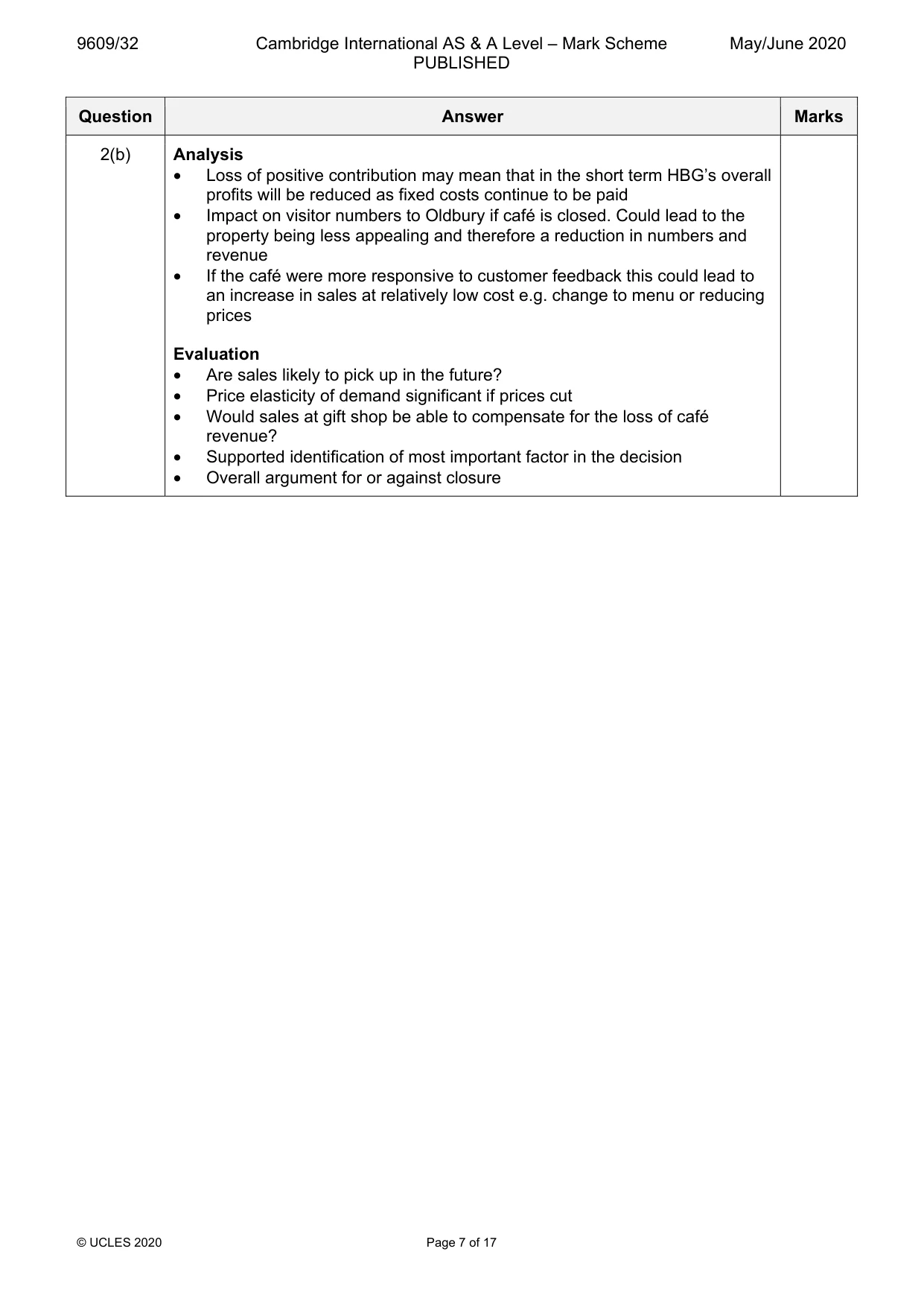
9609/32 Cambridge International AS & A Level – Mark Scheme PUBLISHED May/June 2020 © UCLES 2020 Page 7 of 17 Question Answer Marks 2(b) Analysis • Loss of positive contribution may mean that in the short term HBG’s overall profits will be reduced as fixed costs continue to be paid • Impact on visitor numbers to Oldbury if café is closed. Could lead to the property being less appealing and therefore a reduction in numbers and revenue • If the café were more responsive to customer feedback this could lead to an increase in sales at relatively low cost e.g. change to menu or reducing prices Evaluation • Are sales likely to pick up in the future? • Price elasticity of demand significant if prices cut • Would sales at gift shop be able to compensate for the loss of café revenue? • Supported identification of most important factor in the decision • Overall argument for or against closure
Mark scheme, page 8
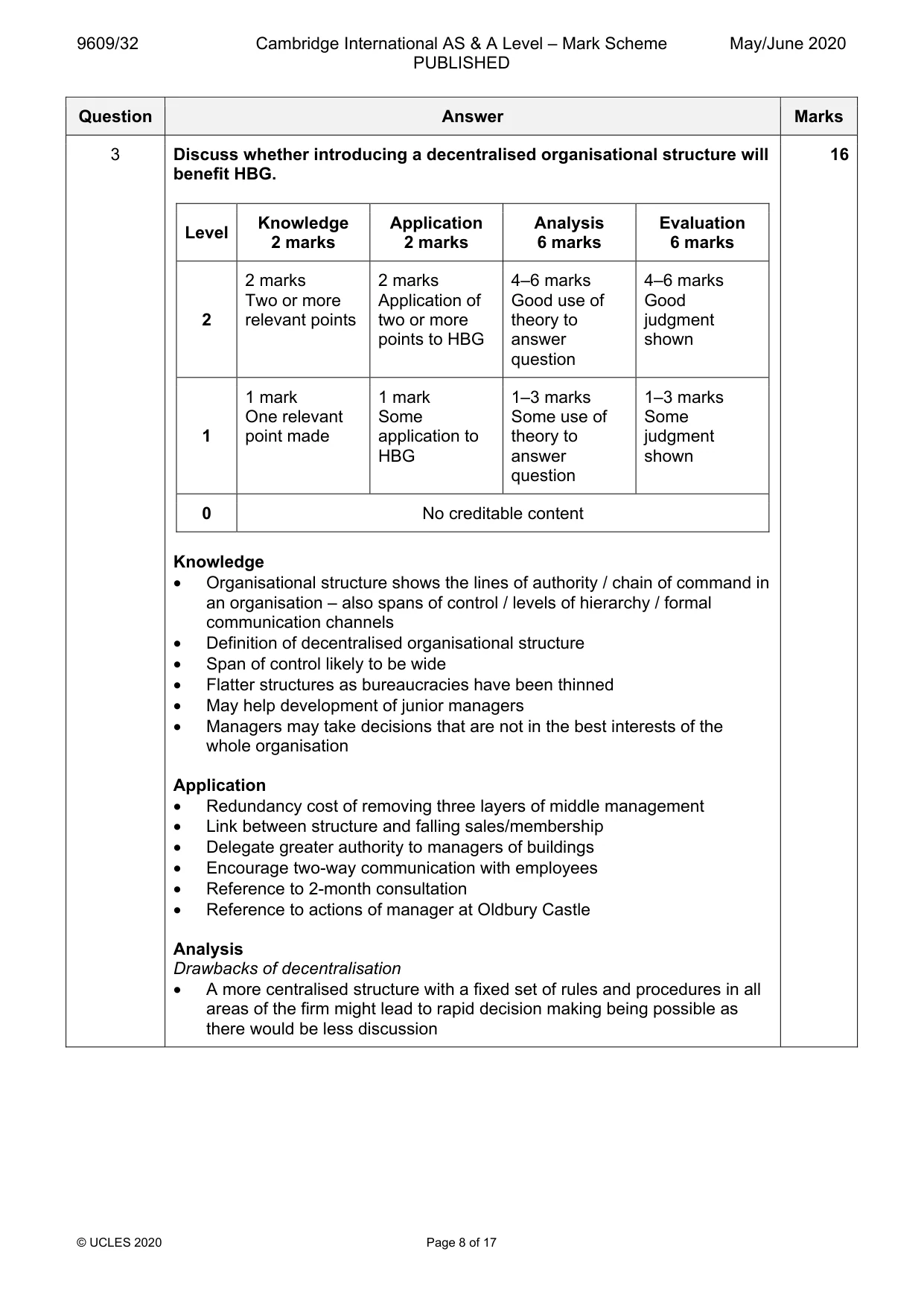
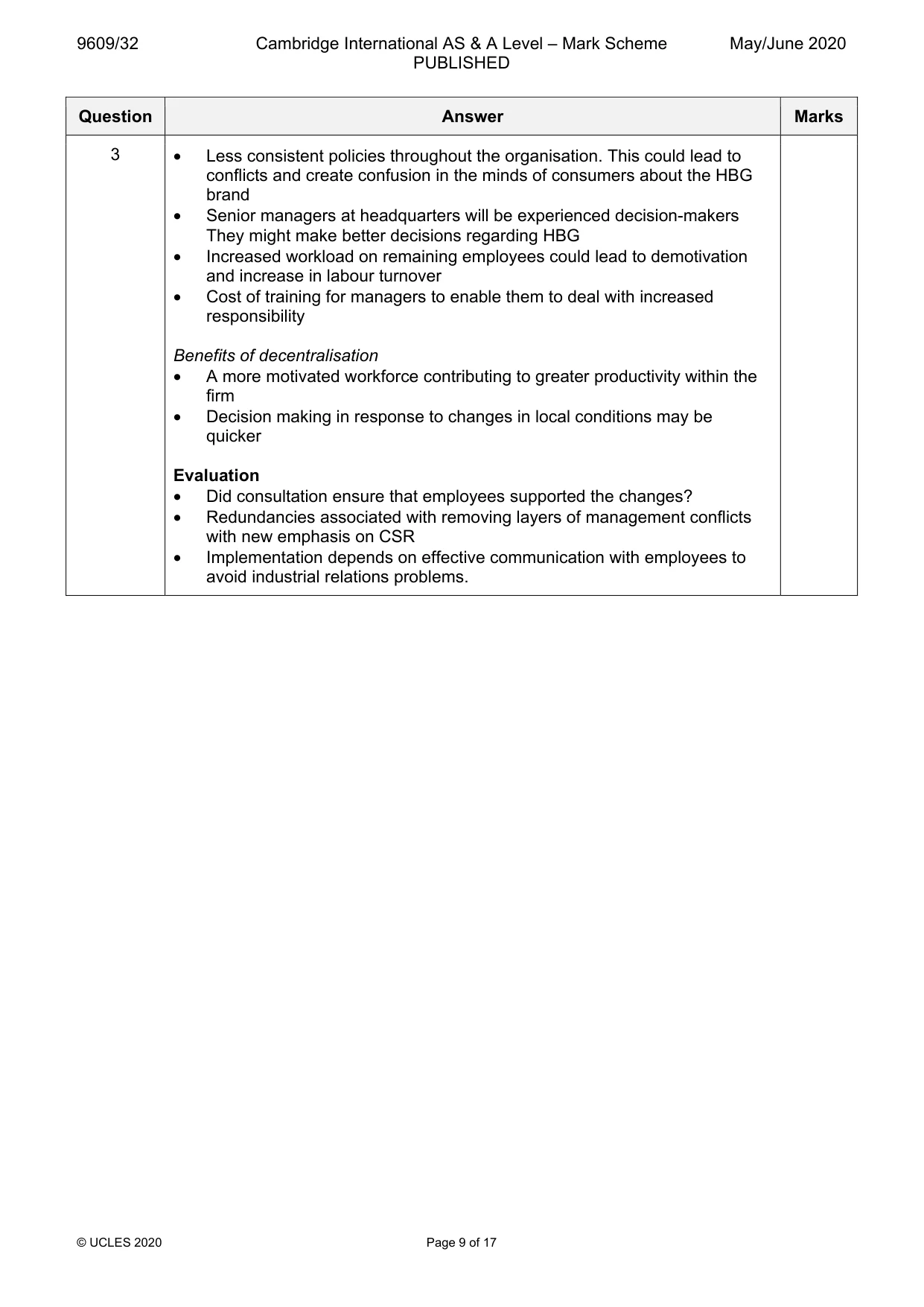
9609/32 Cambridge International AS & A Level – Mark Scheme PUBLISHED May/June 2020 © UCLES 2020 Page 8 of 17 Question Answer Marks 3 Discuss whether introducing a decentralised organisational structure will benefit HBG. Level Knowledge 2 marks Application 2 marks Analysis 6 marks Evaluation 6 marks 2 2 marks Two or more relevant points 2 marks Application of two or more points to HBG 4–6 marks Good use of theory to answer question 4–6 marks Good judgment shown 1 1 mark One relevant point made 1 mark Some application to HBG 1–3 marks Some use of theory to answer question 1–3 marks Some judgment shown 0 No creditable content Knowledge • Organisational structure shows the lines of authority / chain of command in an organisation – also spans of control / levels of hierarchy / formal communication channels • Definition of decentralised organisational structure • Span of control likely to be wide • Flatter structures as bureaucracies have been thinned • May help development of junior managers • Managers may take decisions that are not in the best interests of the whole organisation Application • Redundancy cost of removing three layers of middle management • Link between structure and falling sales/membership • Delegate greater authority to managers of buildings • Encourage two-way communication with employees • Reference to 2-month consultation • Reference to actions of manager at Oldbury Castle Analysis Drawbacks of decentralisation • A more centralised structure with a fixed set of rules and procedures in all areas of the firm might lead to rapid decision making being possible as there would be less discussion 16
Mark scheme, page 9
9609/32 Cambridge International AS & A Level – Mark Scheme PUBLISHED May/June 2020 © UCLES 2020 Page 9 of 17 Question Answer Marks 3 • Less consistent policies throughout the organisation. This could lead to conflicts and create confusion in the minds of consumers about the HBG brand • Senior managers at headquarters will be experienced decision-makers They might make better decisions regarding HBG • Increased workload on remaining employees could lead to demotivation and increase in labour turnover • Cost of training for managers to enable them to deal with increased responsibility Benefits of decentralisation • A more motivated workforce contributing to greater productivity within the firm • Decision making in response to changes in local conditions may be quicker Evaluation • Did consultation ensure that employees supported the changes? • Redundancies associated with removing layers of management conflicts with new emphasis on CSR • Implementation depends on effective communication with employees to avoid industrial relations problems.
Mark scheme, page 10
9609/32 Cambridge International AS & A Level – Mark Scheme PUBLISHED May/June 2020 © UCLES 2020 Page 10 of 17 Question Answer Marks 4(a) Refer to Table 3 and Appendix 1: 4(a)(i) Complete nodes 3 and 4 on the network analysis below (reproduced from the Insert). Node 3: EST = 5 (1 mark) LFT = 5 (1 mark) Node 4: EST = 6 (1 mark) LFT = 18 (1 mark) 4 4(a)(ii) Identify the critical path. Write your answer below. ACDEG (1 mark) 1 4(a)(iii) Calculate the minimum time to complete the project to open Alderly Gardens. Write your answer below. 20 weeks (1 mark) 1 4(a)(iv) Calculate the total float of Activity J. Total float = LFT – duration – EST (1 mark) Or LST – EST (1 mark) 17 – 2 – 9 = 6 weeks (2 marks) 2
Mark scheme, page 11
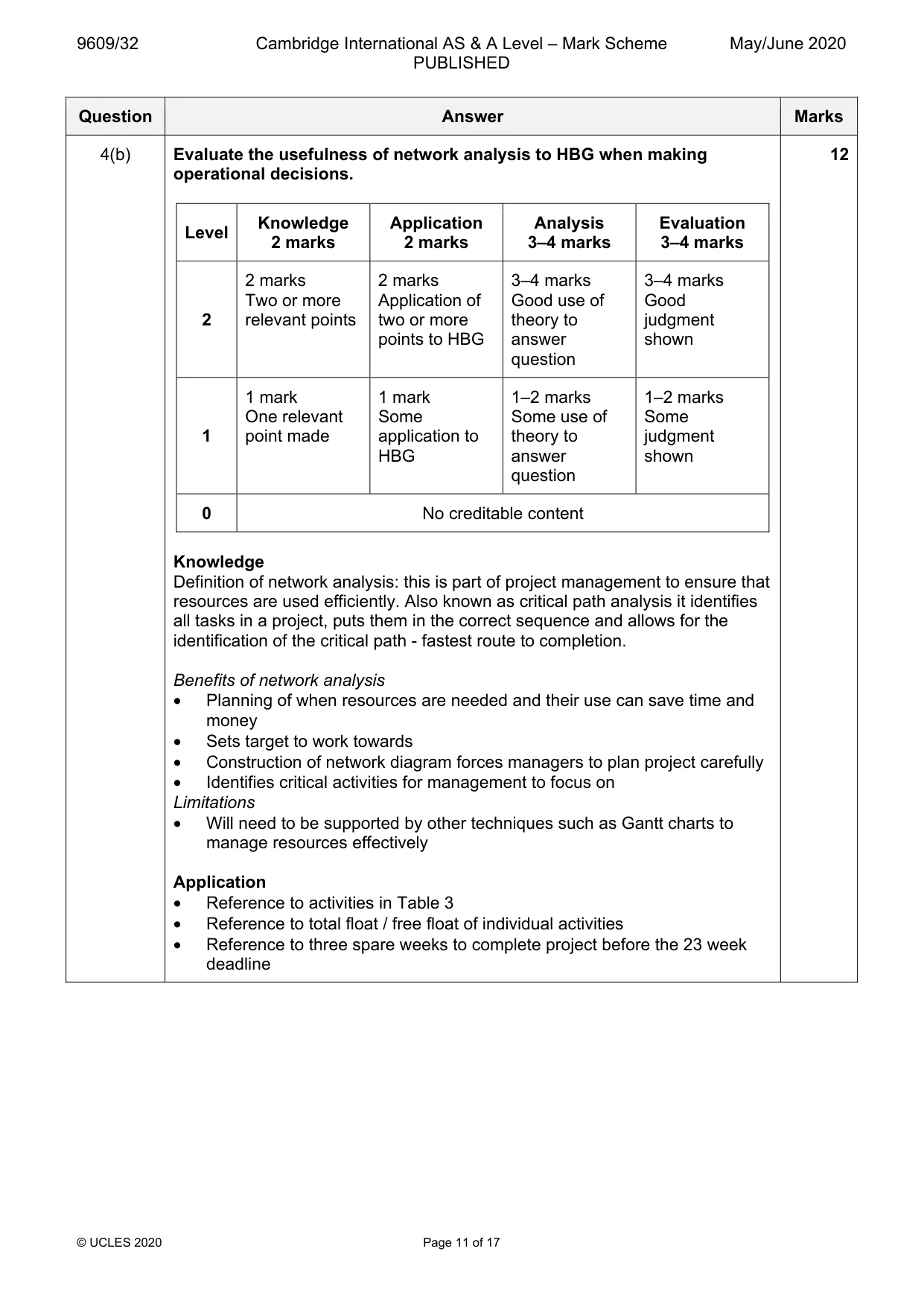
9609/32 Cambridge International AS & A Level – Mark Scheme PUBLISHED May/June 2020 © UCLES 2020 Page 11 of 17 Question Answer Marks 4(b) Evaluate the usefulness of network analysis to HBG when making operational decisions. Level Knowledge 2 marks Application 2 marks Analysis 3–4 marks Evaluation 3–4 marks 2 2 marks Two or more relevant points 2 marks Application of two or more points to HBG 3–4 marks Good use of theory to answer question 3–4 marks Good judgment shown 1 1 mark One relevant point made 1 mark Some application to HBG 1–2 marks Some use of theory to answer question 1–2 marks Some judgment shown 0 No creditable content Knowledge Definition of network analysis: this is part of project management to ensure that resources are used efficiently. Also known as critical path analysis it identifies all tasks in a project, puts them in the correct sequence and allows for the identification of the critical path - fastest route to completion. Benefits of network analysis • Planning of when resources are needed and their use can save time and money • Sets target to work towards • Construction of network diagram forces managers to plan project carefully • Identifies critical activities for management to focus on Limitations • Will need to be supported by other techniques such as Gantt charts to manage resources effectively Application • Reference to activities in Table 3 • Reference to total float / free float of individual activities • Reference to three spare weeks to complete project before the 23 week deadline 12
Mark scheme, page 12
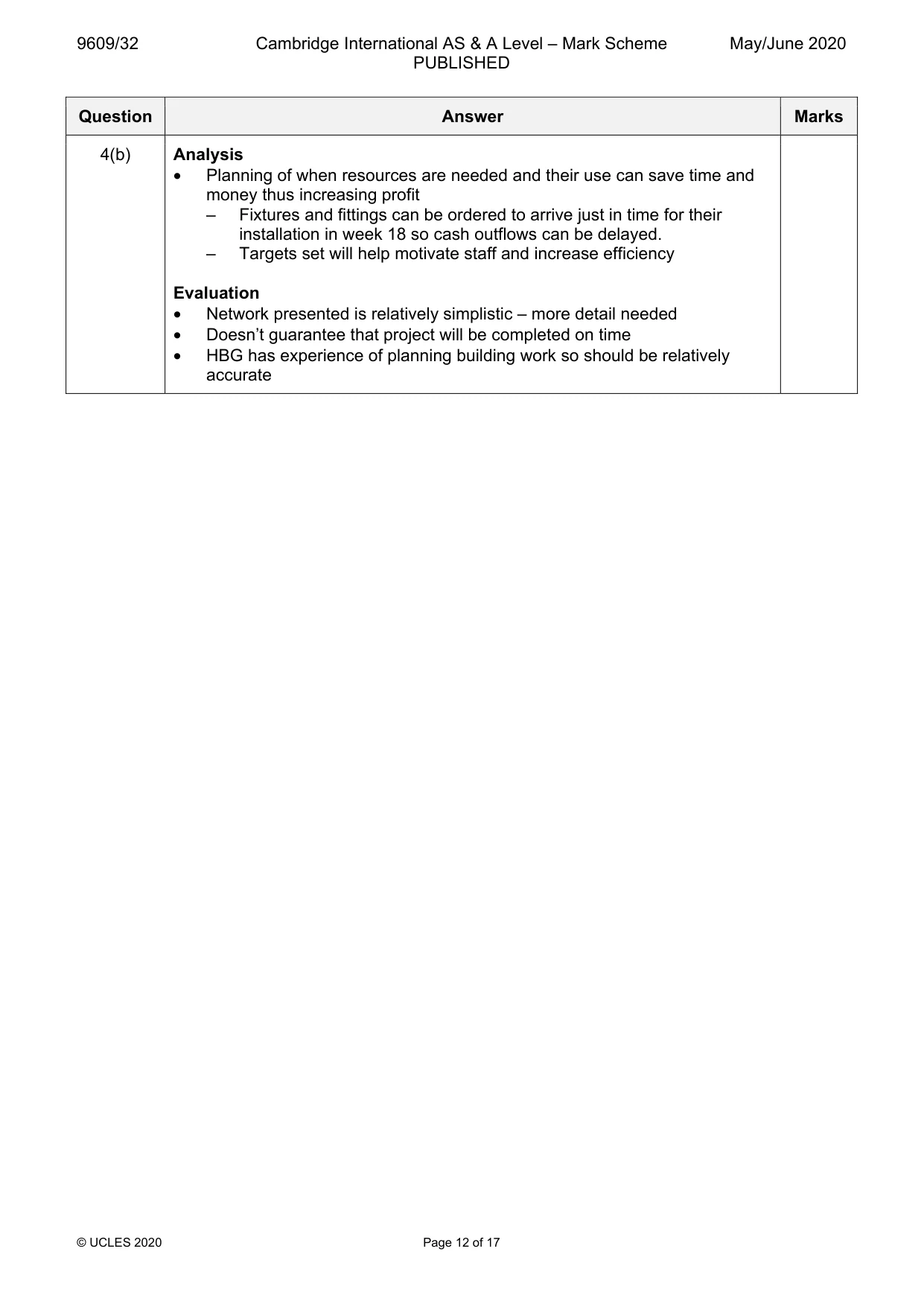
9609/32 Cambridge International AS & A Level – Mark Scheme PUBLISHED May/June 2020 © UCLES 2020 Page 12 of 17 Question Answer Marks 4(b) Analysis • Planning of when resources are needed and their use can save time and money thus increasing profit – Fixtures and fittings can be ordered to arrive just in time for their installation in week 18 so cash outflows can be delayed. – Targets set will help motivate staff and increase efficiency Evaluation • Network presented is relatively simplistic – more detail needed • Doesn’t guarantee that project will be completed on time • HBG has experience of planning building work so should be relatively accurate
Mark scheme, page 13
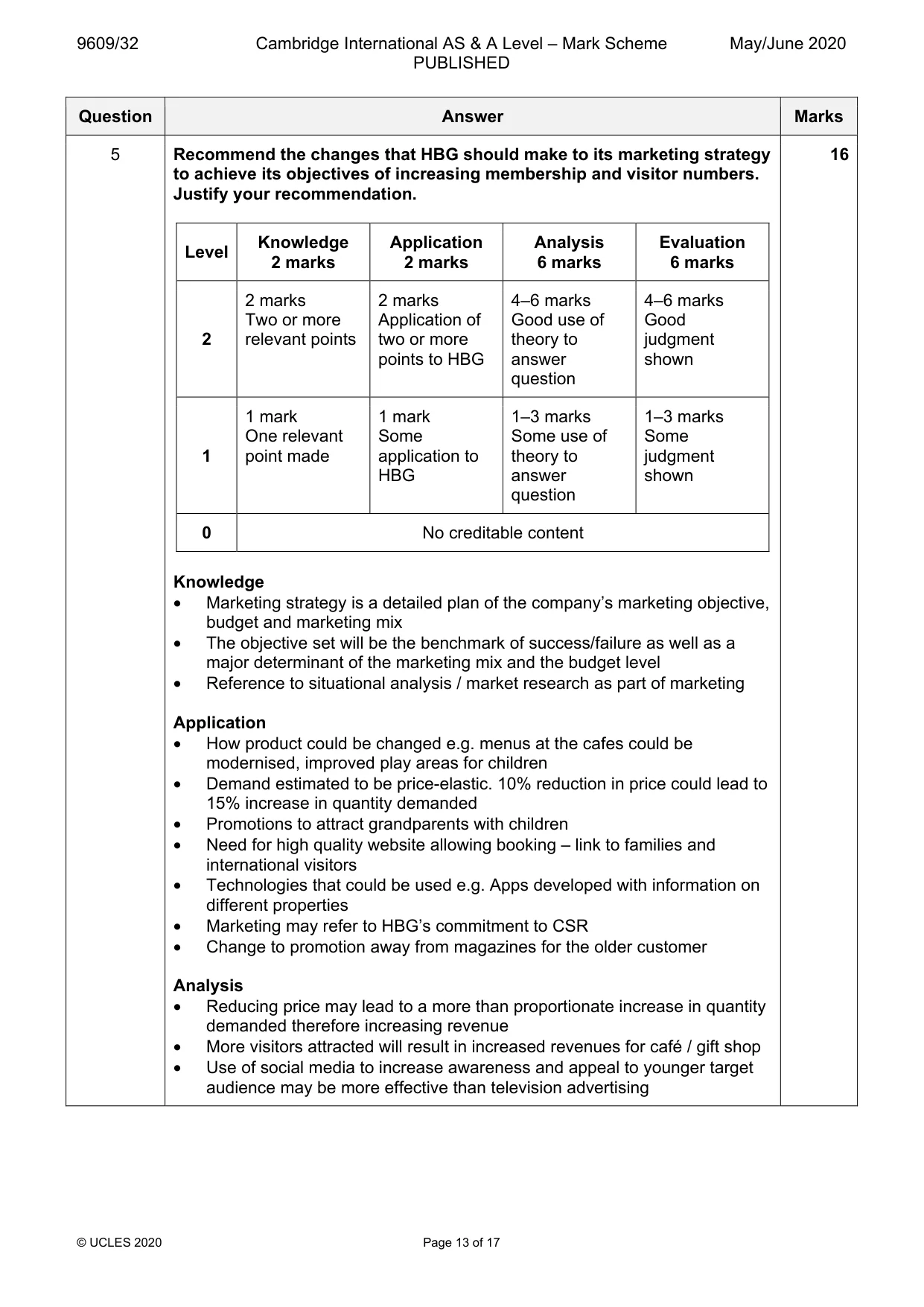
9609/32 Cambridge International AS & A Level – Mark Scheme PUBLISHED May/June 2020 © UCLES 2020 Page 13 of 17 Question Answer Marks 5 Recommend the changes that HBG should make to its marketing strategy to achieve its objectives of increasing membership and visitor numbers. Justify your recommendation. Level Knowledge 2 marks Application 2 marks Analysis 6 marks Evaluation 6 marks 2 2 marks Two or more relevant points 2 marks Application of two or more points to HBG 4–6 marks Good use of theory to answer question 4–6 marks Good judgment shown 1 1 mark One relevant point made 1 mark Some application to HBG 1–3 marks Some use of theory to answer question 1–3 marks Some judgment shown 0 No creditable content Knowledge • Marketing strategy is a detailed plan of the company’s marketing objective, budget and marketing mix • The objective set will be the benchmark of success/failure as well as a major determinant of the marketing mix and the budget level • Reference to situational analysis / market research as part of marketing Application • How product could be changed e.g. menus at the cafes could be modernised, improved play areas for children • Demand estimated to be price-elastic. 10% reduction in price could lead to 15% increase in quantity demanded • Promotions to attract grandparents with children • Need for high quality website allowing booking – link to families and international visitors • Technologies that could be used e.g. Apps developed with information on different properties • Marketing may refer to HBG’s commitment to CSR • Change to promotion away from magazines for the older customer Analysis • Reducing price may lead to a more than proportionate increase in quantity demanded therefore increasing revenue • More visitors attracted will result in increased revenues for café / gift shop • Use of social media to increase awareness and appeal to younger target audience may be more effective than television advertising 16
Mark scheme, page 14
9609/32 Cambridge International AS & A Level – Mark Scheme PUBLISHED May/June 2020 © UCLES 2020 Page 14 of 17 Question Answer Marks 5 Evaluation • Justification of most important element of marketing mix • Changes depend on sufficient budget being made available • Most important group to target • Danger of changes alienating older customers
Mark scheme, page 15
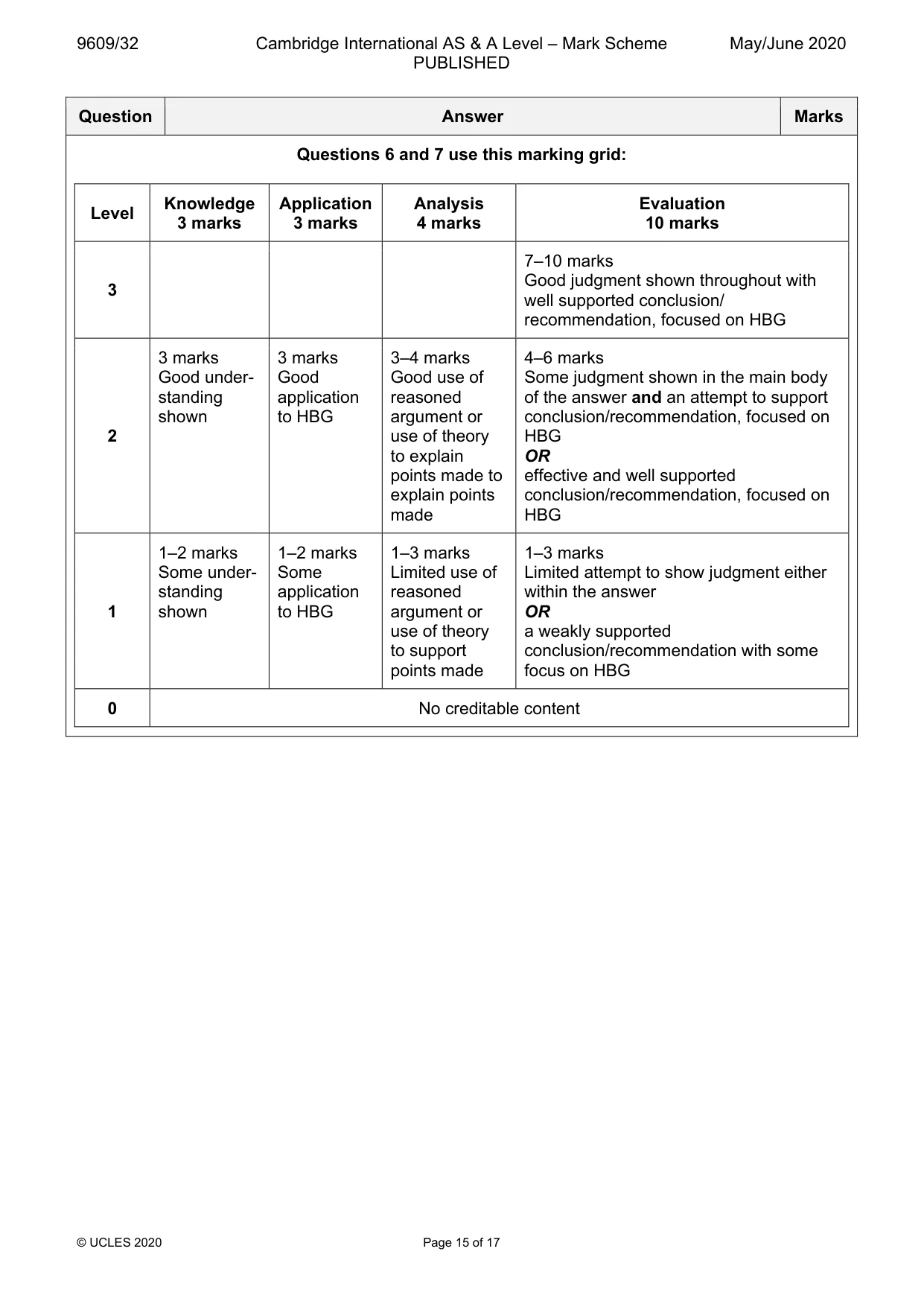
9609/32 Cambridge International AS & A Level – Mark Scheme PUBLISHED May/June 2020 © UCLES 2020 Page 15 of 17 Question Answer Marks Questions 6 and 7 use this marking grid: Level Knowledge 3 marks Application 3 marks Analysis 4 marks Evaluation 10 marks 3 7–10 marks Good judgment shown throughout with well supported conclusion/ recommendation, focused on HBG 2 3 marks Good under- standing shown 3 marks Good application to HBG 3–4 marks Good use of reasoned argument or use of theory to explain points made to explain points made 4–6 marks Some judgment shown in the main body of the answer and an attempt to support conclusion/recommendation, focused on HBG OR effective and well supported conclusion/recommendation, focused on HBG 1 1–2 marks Some under- standing shown 1–2 marks Some application to HBG 1–3 marks Limited use of reasoned argument or use of theory to support points made 1–3 marks Limited attempt to show judgment either within the answer OR a weakly supported conclusion/recommendation with some focus on HBG 0 No creditable content
Mark scheme, page 16
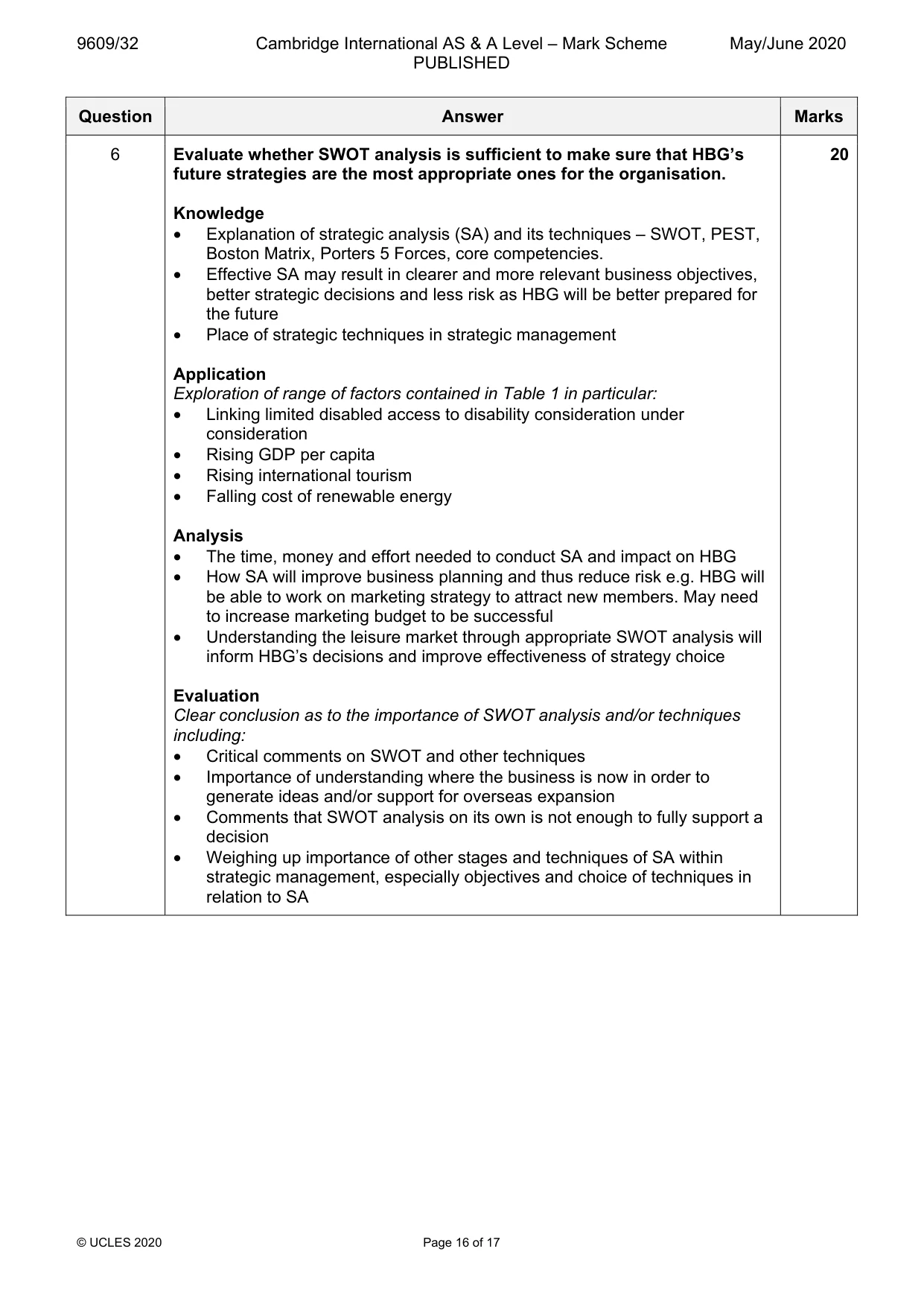
9609/32 Cambridge International AS & A Level – Mark Scheme PUBLISHED May/June 2020 © UCLES 2020 Page 16 of 17 Question Answer Marks 6 Evaluate whether SWOT analysis is sufficient to make sure that HBG’s future strategies are the most appropriate ones for the organisation. Knowledge • Explanation of strategic analysis (SA) and its techniques – SWOT, PEST, Boston Matrix, Porters 5 Forces, core competencies. • Effective SA may result in clearer and more relevant business objectives, better strategic decisions and less risk as HBG will be better prepared for the future • Place of strategic techniques in strategic management Application Exploration of range of factors contained in Table 1 in particular: • Linking limited disabled access to disability consideration under consideration • Rising GDP per capita • Rising international tourism • Falling cost of renewable energy Analysis • The time, money and effort needed to conduct SA and impact on HBG • How SA will improve business planning and thus reduce risk e.g. HBG will be able to work on marketing strategy to attract new members. May need to increase marketing budget to be successful • Understanding the leisure market through appropriate SWOT analysis will inform HBG’s decisions and improve effectiveness of strategy choice Evaluation Clear conclusion as to the importance of SWOT analysis and/or techniques including: • Critical comments on SWOT and other techniques • Importance of understanding where the business is now in order to generate ideas and/or support for overseas expansion • Comments that SWOT analysis on its own is not enough to fully support a decision • Weighing up importance of other stages and techniques of SA within strategic management, especially objectives and choice of techniques in relation to SA 20
Mark scheme, page 17
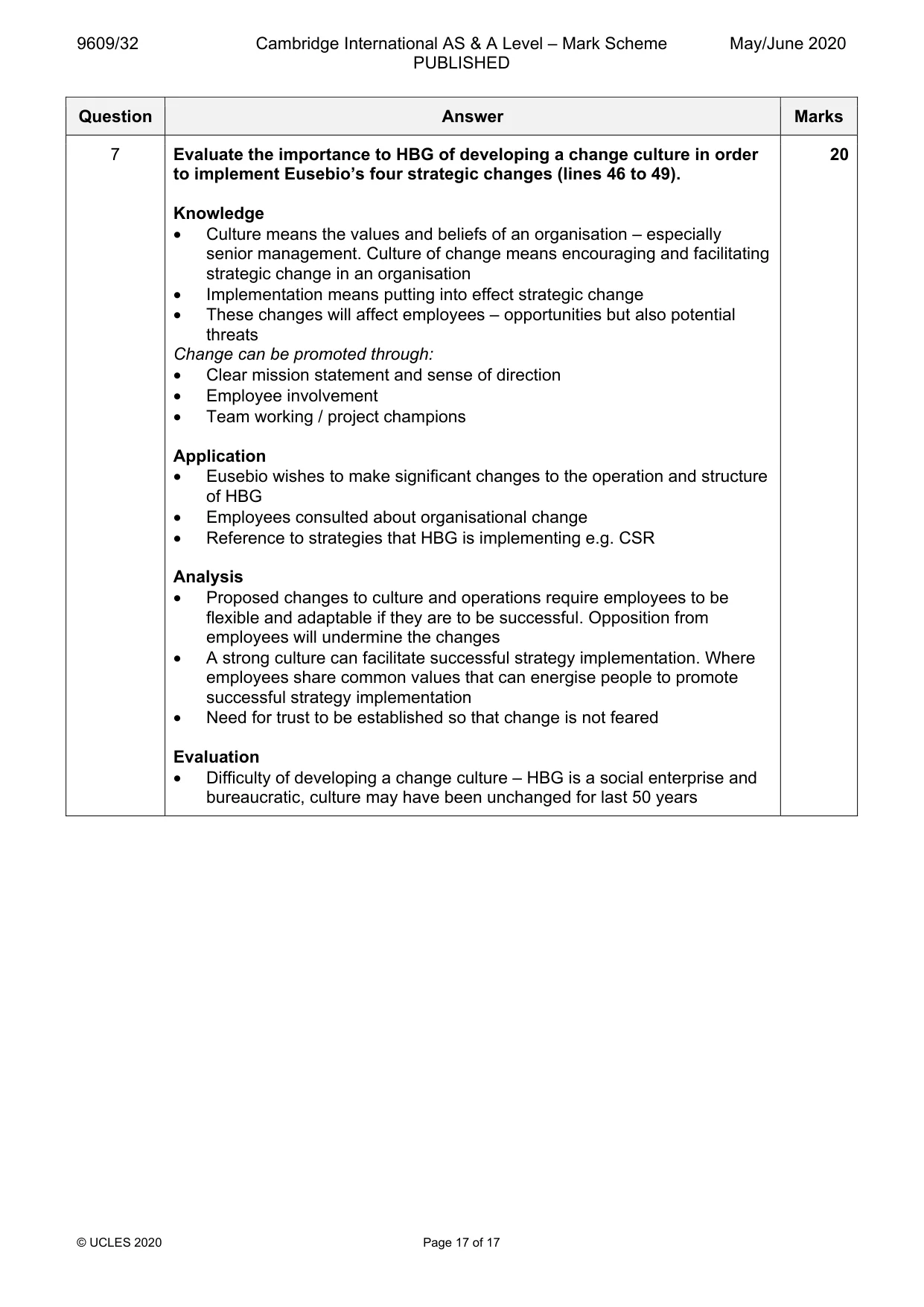
9609/32 Cambridge International AS & A Level – Mark Scheme PUBLISHED May/June 2020 © UCLES 2020 Page 17 of 17 Question Answer Marks 7 Evaluate the importance to HBG of developing a change culture in order to implement Eusebio’s four strategic changes (lines 46 to 49). Knowledge • Culture means the values and beliefs of an organisation – especially senior management. Culture of change means encouraging and facilitating strategic change in an organisation • Implementation means putting into effect strategic change • These changes will affect employees – opportunities but also potential threats Change can be promoted through: • Clear mission statement and sense of direction • Employee involvement • Team working / project champions Application • Eusebio wishes to make significant changes to the operation and structure of HBG • Employees consulted about organisational change • Reference to strategies that HBG is implementing e.g. CSR Analysis • Proposed changes to culture and operations require employees to be flexible and adaptable if they are to be successful. Opposition from employees will undermine the changes • A strong culture can facilitate successful strategy implementation. Where employees share common values that can energise people to promote successful strategy implementation • Need for trust to be established so that change is not feared Evaluation • Difficulty of developing a change culture – HBG is a social enterprise and bureaucratic, culture may have been unchanged for last 50 years 20