Cambridge A Level Business (for first examination in 2016) 9609 — 2020 May/June Paper 3 · Variant 1
9609/31/M/J/20
The question paper and its mark scheme, free to read here and free to download. This is Cambridge’s own paper, exactly as it was sat.
Question paper20 pages












Mark scheme17 pages
Answers below. Sit the paper first if you are practising.
Paper as text
Question paper, page 1
Cambridge International AS & A Level This document has 20 pages. Blank pages are indicated. BUSINESS 9609/31 Paper 3 Case Study May/June 2020 3 hours You must answer on the question paper. You will need: Insert (enclosed) INSTRUCTIONS ● Section A: answer all questions. ● Section B: answer one question. ● Use a black or dark blue pen. ● Write your name, centre number and candidate number in the boxes at the top of the page. ● Write your answer to each question in the space provided. ● Do not use an erasable pen or correction fluid. ● Do not write on any bar codes. ● You may use an HB pencil for any diagrams, graphs or rough working. INFORMATION ● The total mark for this paper is 100. ● The number of marks for each question or part question is shown in brackets [ ]. ● The insert contains the case study. * 6 6 0 1 9 7 8 8 9 1 * DC (CJ) 190248/4 © UCLES 2020 [Turn over
Question paper, page 2
2 9609/31/M/J/20 © UCLES 2020 Answer all questions in Section A and answer one question in Section B. You are advised to spend no more than 40 minutes on Section B. Section A Answer all questions in this section 1 Analyse the benefits to JGS of outsourcing. … … … … … … … … … … … … … … … … … … … … … … …
Question paper, page 3
3 9609/31/M/J/20 © UCLES 2020 [Turn over … … … … … … … … … … … … … … … … … … … … … … … … … … … … [10]
Question paper, page 4
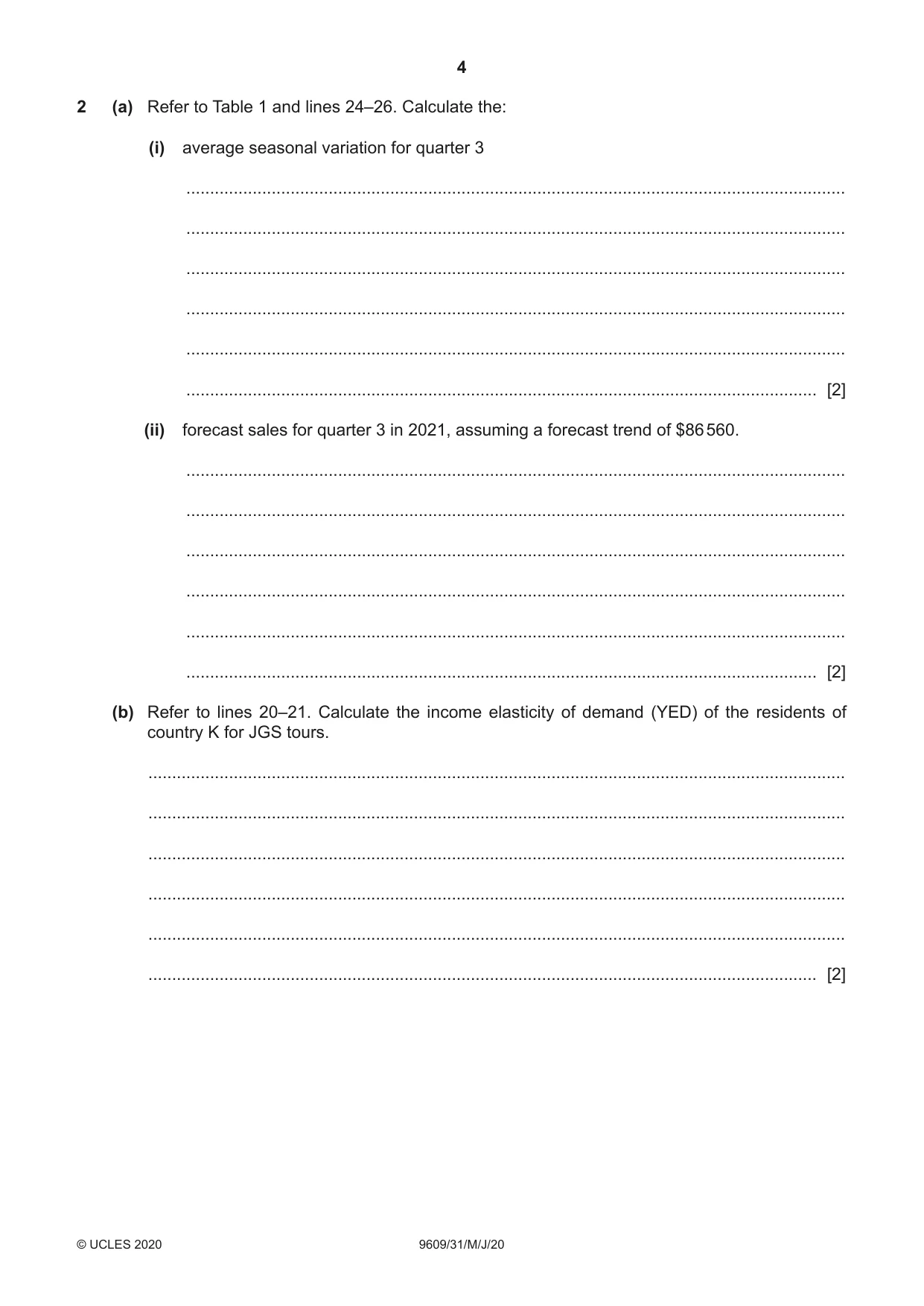
4 9609/31/M/J/20 © UCLES 2020 2 (a) Refer to Table 1 and lines 24–26. Calculate the: (i) average seasonal variation for quarter 3 … … … … … … [2] (ii) forecast sales for quarter 3 in 2021, assuming a forecast trend of $86 560. … … … … … … [2] (b) Refer to lines 20–21. Calculate the income elasticity of demand (YED) of the residents of country K for JGS tours. … … … … … … [2]
Question paper, page 5
5 9609/31/M/J/20 © UCLES 2020 [Turn over (c) Refer to your answers to 2(a) and (b) and any other information. Discuss whether sales forecasts based on past sales of JGS are likely to be accurate. … … … … … … … … … … … … … … … … … … … … … … … … … … …
Question paper, page 6
6 9609/31/M/J/20 © UCLES 2020 … … … … … … … … … … … … … … … … … … … … … … … … … … … … [12]
Question paper, page 7
7 9609/31/M/J/20 © UCLES 2020 [Turn over 3 JGS is planning to increase the number of employees. Recommend an appropriate organisational structure for JGS. Justify your recommendation. … … … … … … … … … … … … … … … … … … … … … … … … … … …
Question paper, page 8
8 9609/31/M/J/20 © UCLES 2020 … … … … … … … … … … … … … … … … … … … … … … … … … … … …
Question paper, page 9
9 9609/31/M/J/20 © UCLES 2020 [Turn over … … … … … … … … … … … … … … … … … … … … … … … … … … … … [16]
Question paper, page 10
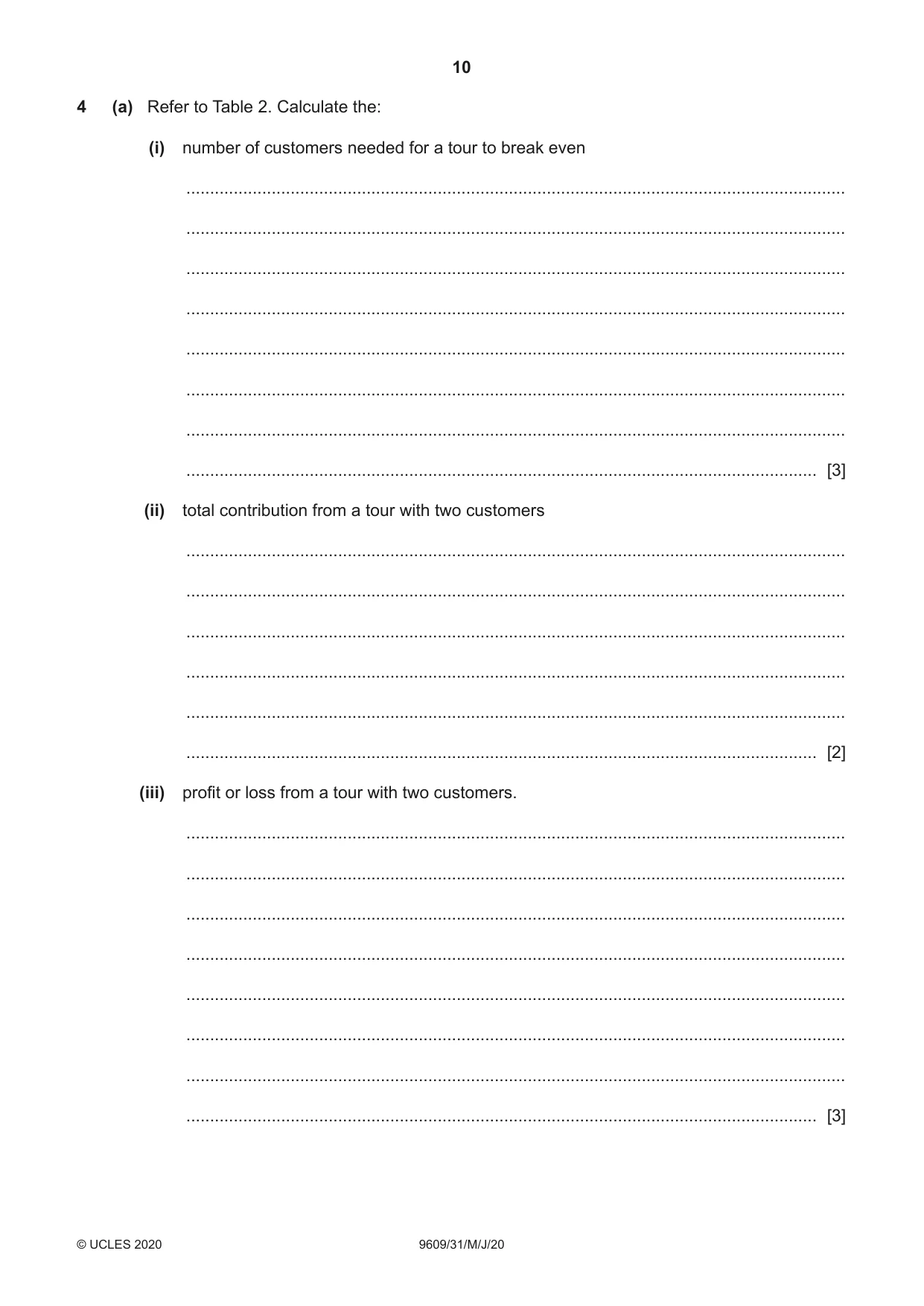
10 9609/31/M/J/20 © UCLES 2020 4 (a) Refer to Table 2. Calculate the: (i) number of customers needed for a tour to break even … … … … … … … … [3] (ii) total contribution from a tour with two customers … … … … … … [2] (iii) profit or loss from a tour with two customers. … … … … … … … … [3]
Question paper, page 11
11 9609/31/M/J/20 © UCLES 2020 [Turn over (b) Refer to your answers to 4(a) and any other information. Recommend whether a tour should go ahead with only two customers booked on it. Justify your recommendation. … … … … … … … … … … … … … … … … … … … … … … … … … … …
Question paper, page 12
12 9609/31/M/J/20 © UCLES 2020 … … … … … … … … … … … … … … … … … … … … … … … … … … … … [12]
Question paper, page 13
13 9609/31/M/J/20 © UCLES 2020 [Turn over 5 Discuss whether JGS should maintain high standards of corporate social responsibility (CSR). … … … … … … … … … … … … … … … … … … … … … … … … … … …
Question paper, page 14
14 9609/31/M/J/20 © UCLES 2020 … … … … … … … … … … … … … … … … … … … … … … … … … … … …
Question paper, page 15
15 9609/31/M/J/20 © UCLES 2020 [Turn over … … … … … … … … … … … … … … … … … … … … … … … … … … … … [16]
Question paper, page 16
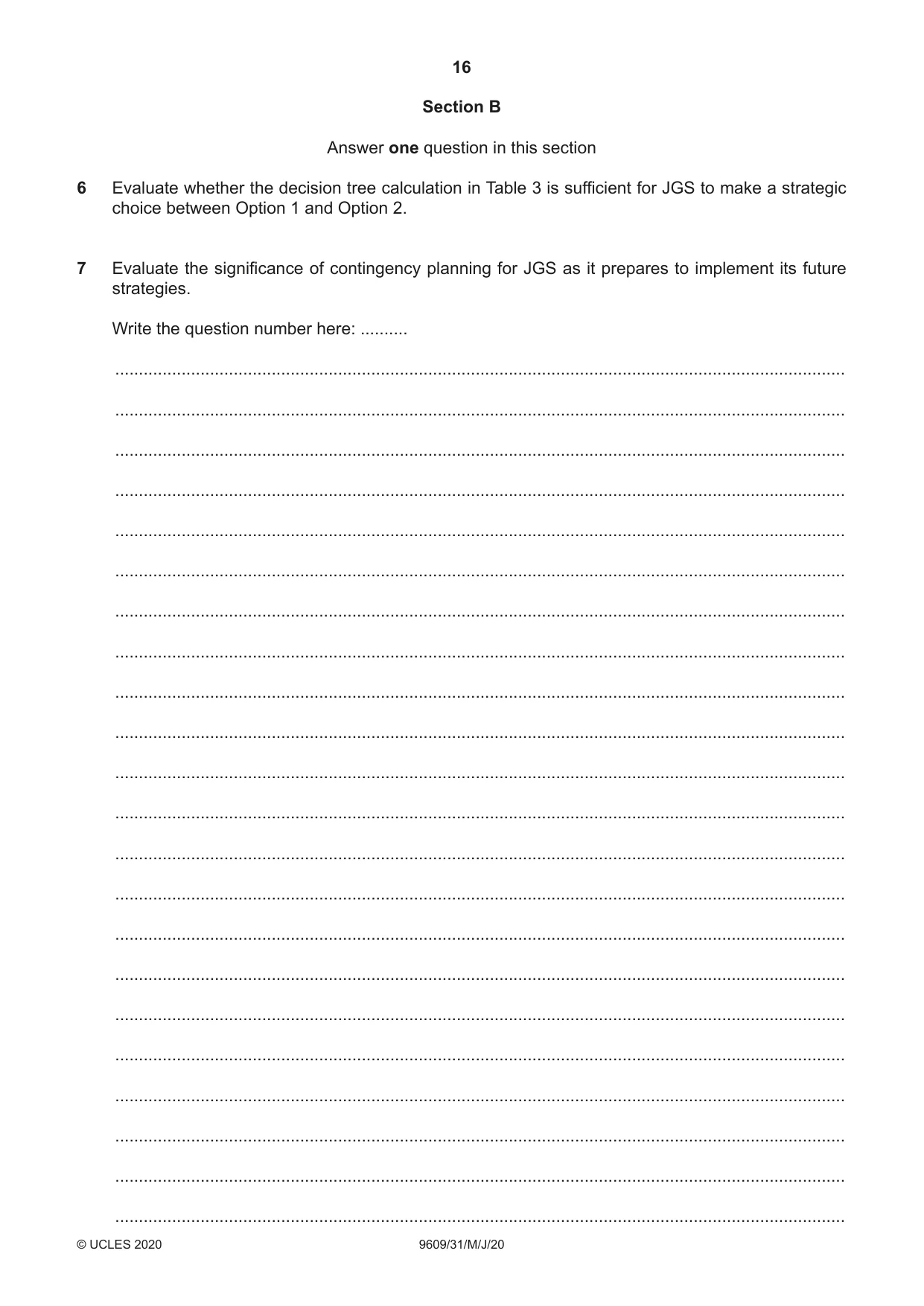
16 9609/31/M/J/20 © UCLES 2020 Section B Answer one question in this section 6 Evaluate whether the decision tree calculation in Table 3 is sufficient for JGS to make a strategic choice between Option 1 and Option 2. 7 Evaluate the significance of contingency planning for JGS as it prepares to implement its future strategies. Write the question number here: … … … … … … … … … … … … … … … … … … … … … … …
Question paper, page 17
17 9609/31/M/J/20 © UCLES 2020 [Turn over … … … … … … … … … … … … … … … … … … … … … … … … … … … …
Question paper, page 18
18 9609/31/M/J/20 © UCLES 2020 … … … … … … … … … … … … … … … … … … … … … … … … … … … …
Question paper, page 19
19 9609/31/M/J/20 © UCLES 2020 … … … … … … … … … … … … … … … … … … … … … … … … … … … … [20]
Question paper, page 20
20 9609/31/M/J/20 © UCLES 2020 Permission to reproduce items where third-party owned material protected by copyright is included has been sought and cleared where possible. Every reasonable effort has been made by the publisher (UCLES) to trace copyright holders, but if any items requiring clearance have unwittingly been included, the publisher will be pleased to make amends at the earliest possible opportunity. To avoid the issue of disclosure of answer-related information to candidates, all copyright acknowledgements are reproduced online in the Cambridge Assessment International Education Copyright Acknowledgements Booklet. This is produced for each series of examinations and is freely available to download at www.cambridgeinternational.org after the live examination series. Cambridge Assessment International Education is part of the Cambridge Assessment Group. Cambridge Assessment is the brand name of the University of Cambridge Local Examinations Syndicate (UCLES), which itself is a department of the University of Cambridge. BLANK PAGE
Mark scheme, page 1
This document consists of 17 printed pages. © UCLES 2020 [Turn over Cambridge International AS & A Level BUSINESS 9609/31 Paper 3 Case Study May/June 2020 MARK SCHEME Maximum Mark: 100 Published Students did not sit exam papers in the June 2020 series due to the Covid-19 global pandemic. This mark scheme is published to support teachers and students and should be read together with the question paper. It shows the requirements of the exam. The answer column of the mark scheme shows the proposed basis on which Examiners would award marks for this exam. Where appropriate, this column also provides the most likely acceptable alternative responses expected from students. Examiners usually review the mark scheme after they have seen student responses and update the mark scheme if appropriate. In the June series, Examiners were unable to consider the acceptability of alternative responses, as there were no student responses to consider. Mark schemes should usually be read together with the Principal Examiner Report for Teachers. However, because students did not sit exam papers, there is no Principal Examiner Report for Teachers for the June 2020 series. Cambridge International will not enter into discussions about these mark schemes. Cambridge International is publishing the mark schemes for the June 2020 series for most Cambridge IGCSE™ and Cambridge International A & AS Level components, and some Cambridge O Level components.
Mark scheme, page 2
9609/31 Cambridge International AS & A Level – Mark Scheme PUBLISHED May/June 2020 © UCLES 2020 Page 2 of 17 Generic Marking Principles These general marking principles must be applied by all examiners when marking candidate answers. They should be applied alongside the specific content of the mark scheme or generic level descriptors for a question. Each question paper and mark scheme will also comply with these marking principles. GENERIC MARKING PRINCIPLE 1: Marks must be awarded in line with: • the specific content of the mark scheme or the generic level descriptors for the question • the specific skills defined in the mark scheme or in the generic level descriptors for the question • the standard of response required by a candidate as exemplified by the standardisation scripts. GENERIC MARKING PRINCIPLE 2: Marks awarded are always whole marks (not half marks, or other fractions). GENERIC MARKING PRINCIPLE 3: Marks must be awarded positively: • marks are awarded for correct/valid answers, as defined in the mark scheme. However, credit is given for valid answers which go beyond the scope of the syllabus and mark scheme, referring to your Team Leader as appropriate • marks are awarded when candidates clearly demonstrate what they know and can do • marks are not deducted for errors • marks are not deducted for omissions • answers should only be judged on the quality of spelling, punctuation and grammar when these features are specifically assessed by the question as indicated by the mark scheme. The meaning, however, should be unambiguous. GENERIC MARKING PRINCIPLE 4: Rules must be applied consistently e.g. in situations where candidates have not followed instructions or in the application of generic level descriptors. GENERIC MARKING PRINCIPLE 5: Marks should be awarded using the full range of marks defined in the mark scheme for the question (however; the use of the full mark range may be limited according to the quality of the candidate responses seen). GENERIC MARKING PRINCIPLE 6: Marks awarded are based solely on the requirements as defined in the mark scheme. Marks should not be awarded with grade thresholds or grade descriptors in mind.
Mark scheme, page 3
9609/31 Cambridge International AS & A Level – Mark Scheme PUBLISHED May/June 2020 © UCLES 2020 Page 3 of 17 General Marking Guidance • Marking should be positive: marks should not be subtracted for errors or inaccuracies. • When examiners are in doubt regarding the application of the mark scheme to a candidate’s response, the team leader must be consulted. • Crossed out work should be marked UNLESS the candidate has replaced it with an alternative response. • Errors that are carried forward (e.g. when an incorrect numerical answer to one part of a question is used as the starting point for a calculation in the next part of the question) should not be compounded – use the ‘own figure rule’. • Poor spelling, handwriting or grammar should not be penalised as long as the answer makes sense. • Poor grammar or spelling is not to be penalised, nor is it to be used as an excuse for rewarding unclear reasoning or explanations. • Answers that contain poor handwriting are not to be penalised. Examiners should mark what they can read and make a note to that effect. Where this is a significant factor CIE should be notified. • An answer consisting of a list should be assessed. It is unlikely that such a response will score highly in the levels in each Assessment Objective. • If an answer does not fit on the lined paper it should be assessed as if it did. • In numerical answers units are to be preferred but are not required. • The main Scoris annotations to be used are K (Knowledge), APP (Application), AN (Analysis), EVAL (Evaluation). For each of these four annotations, the number of marks awarded for that assessment objective must match the number of times that annotation is on the answer. • Only award EVAL if the candidate has also demonstrated APP. • Blank pages on a script should be annotated as SEEN. • A blank space, dash, question mark and a response that bears no relation to the question constitutes a ‘no response’. • In Section B, candidates answer either Question 6 or Question 7. The Section B question that the candidate does not answer must be entered as ‘no response’. • Blank pages, or pages that contain crossed out material, must be annotated using ‘seen’. • Accept Any Reasonable Answer when awarding marks This mark scheme includes a summary of appropriate content for answering each question. It should be emphasised, however, that this material is for illustrative purposes and is not intended to provide a definitive guide to acceptable answers. It is quite possible that among the scripts there will be some candidate answers that are not covered directly by the content of this mark scheme. In such cases, professional judgement should be exercised in assessing the merits of the answer and the senior examiners should be consulted if further guidance is required. Application marks are not awarded for repeating material from the case study. Application is by answering in the context of the case or by using the information in the case to help answer the question.
Mark scheme, page 4
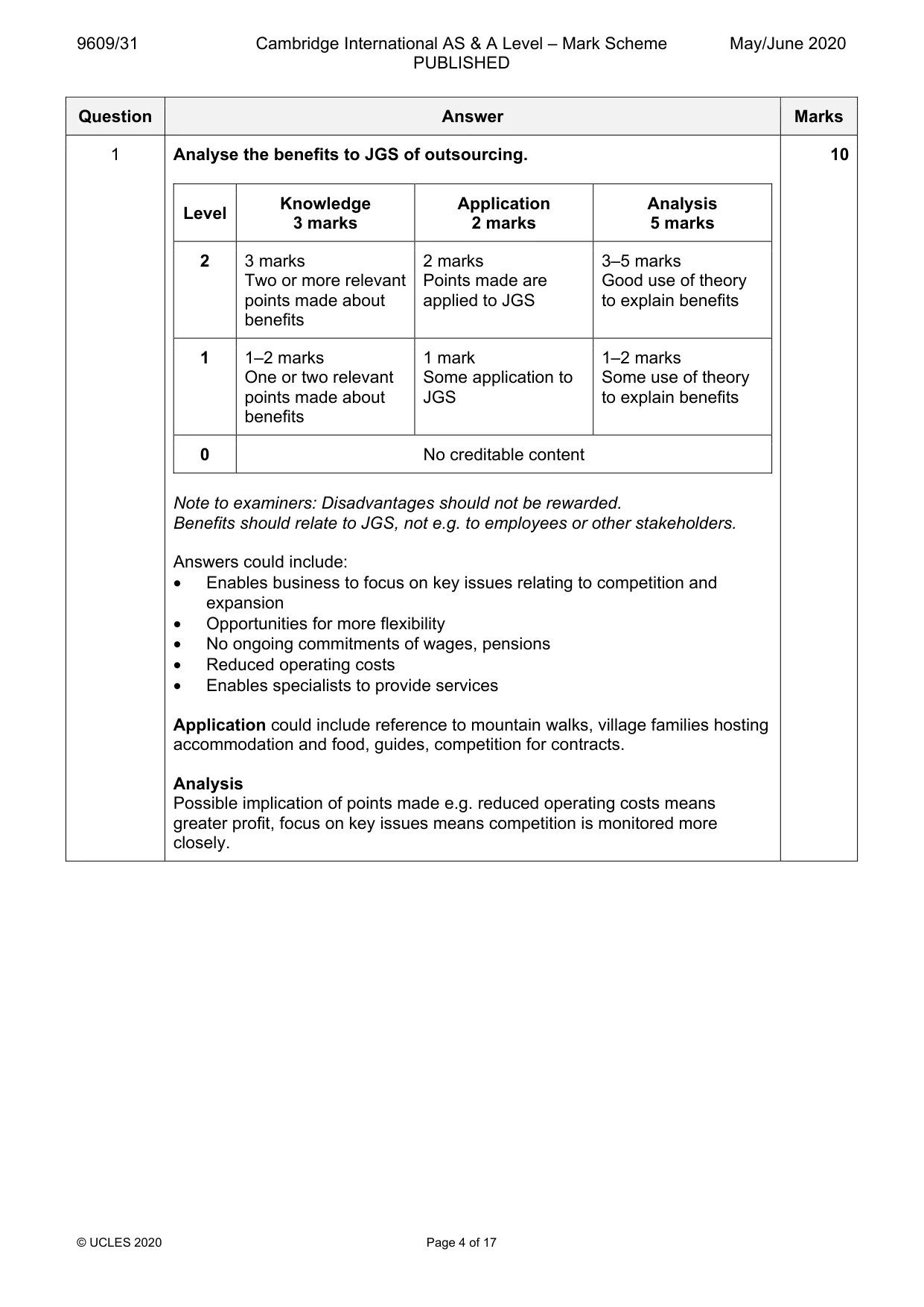
9609/31 Cambridge International AS & A Level – Mark Scheme PUBLISHED May/June 2020 © UCLES 2020 Page 4 of 17 Question Answer Marks 1 Analyse the benefits to JGS of outsourcing. Level Knowledge 3 marks Application 2 marks Analysis 5 marks 2 3 marks Two or more relevant points made about benefits 2 marks Points made are applied to JGS 3–5 marks Good use of theory to explain benefits 1 1–2 marks One or two relevant points made about benefits 1 mark Some application to JGS 1–2 marks Some use of theory to explain benefits 0 No creditable content Note to examiners: Disadvantages should not be rewarded. Benefits should relate to JGS, not e.g. to employees or other stakeholders. Answers could include: • Enables business to focus on key issues relating to competition and expansion • Opportunities for more flexibility • No ongoing commitments of wages, pensions • Reduced operating costs • Enables specialists to provide services Application could include reference to mountain walks, village families hosting accommodation and food, guides, competition for contracts. Analysis Possible implication of points made e.g. reduced operating costs means greater profit, focus on key issues means competition is monitored more closely. 10
Mark scheme, page 5
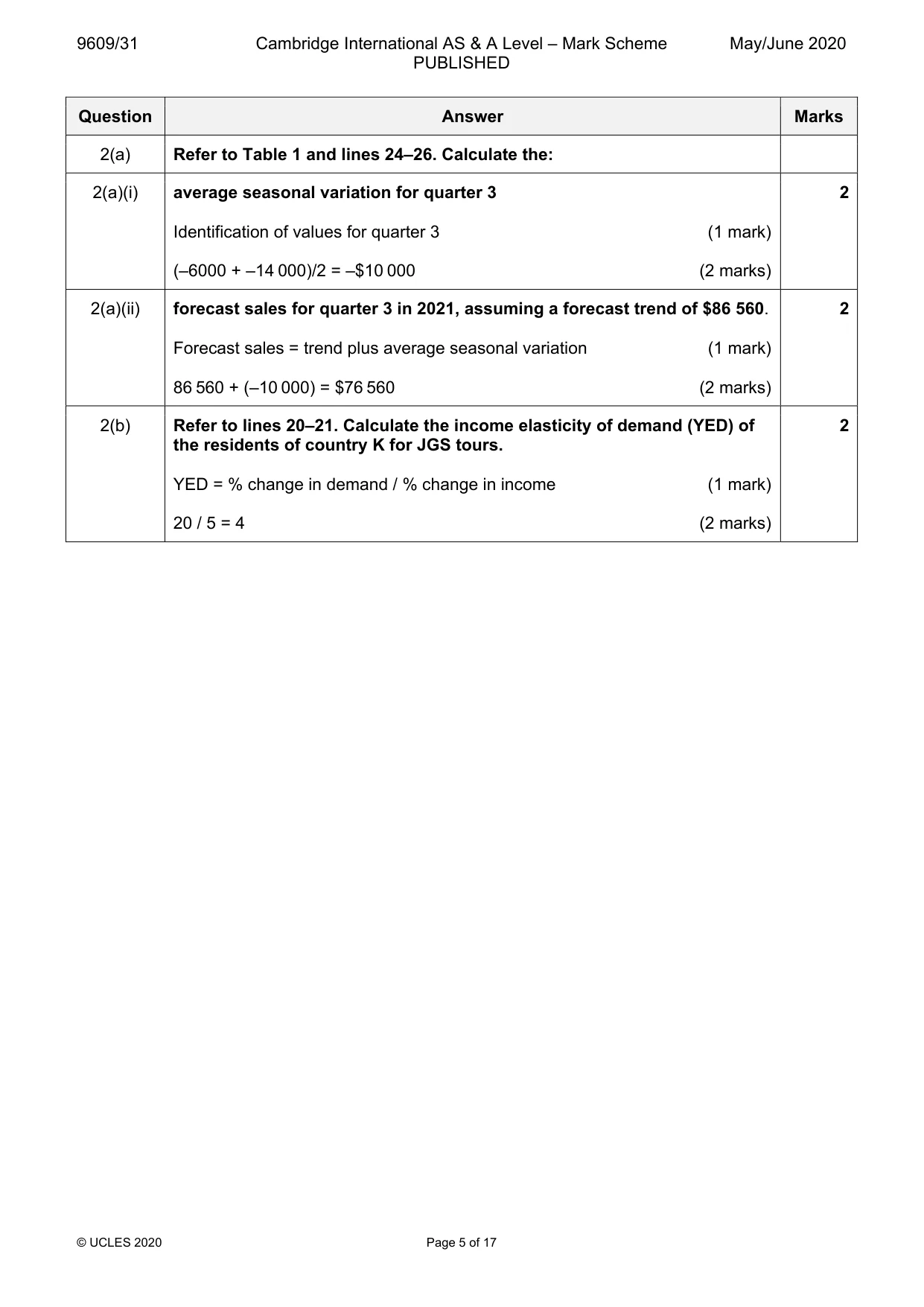
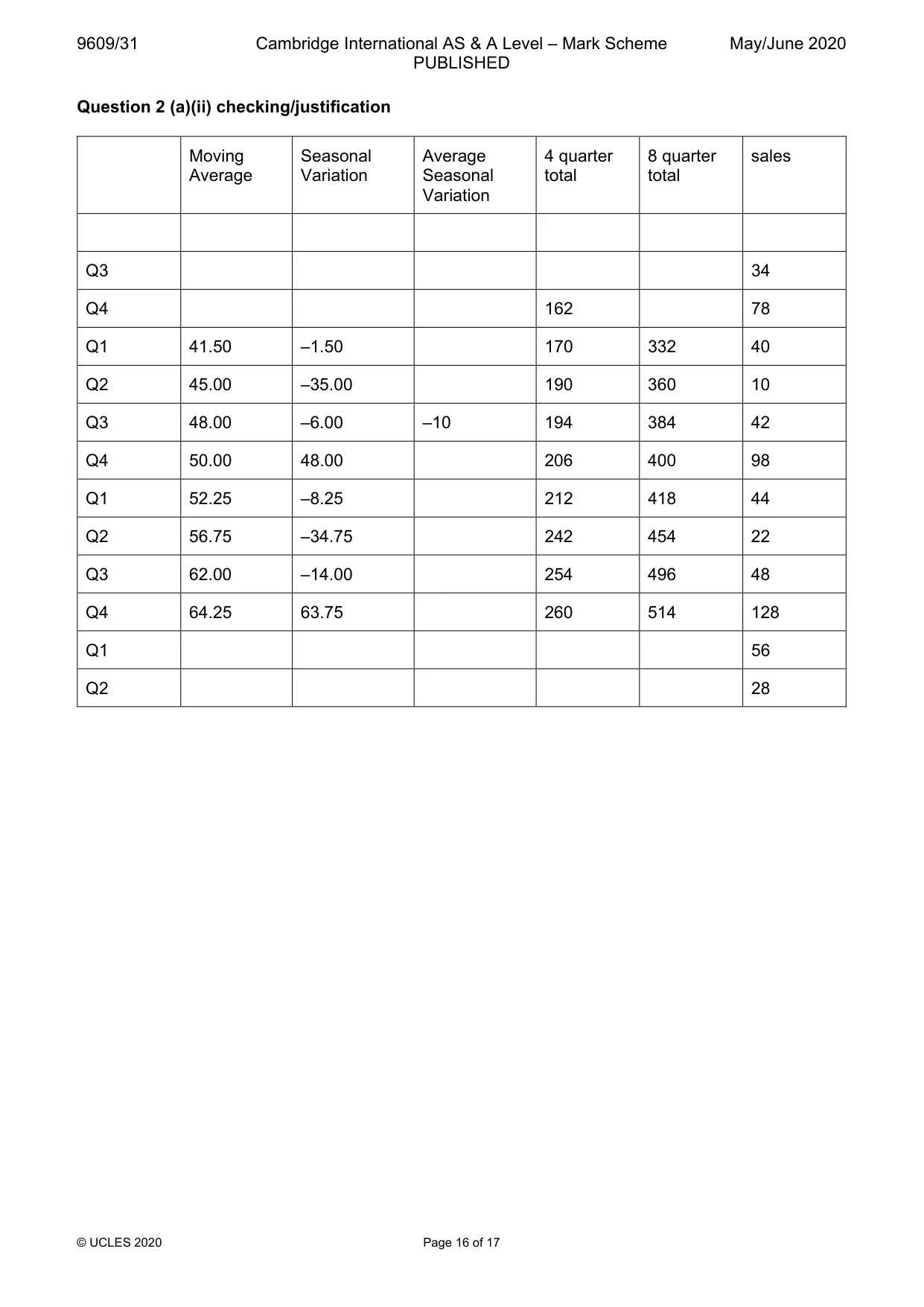
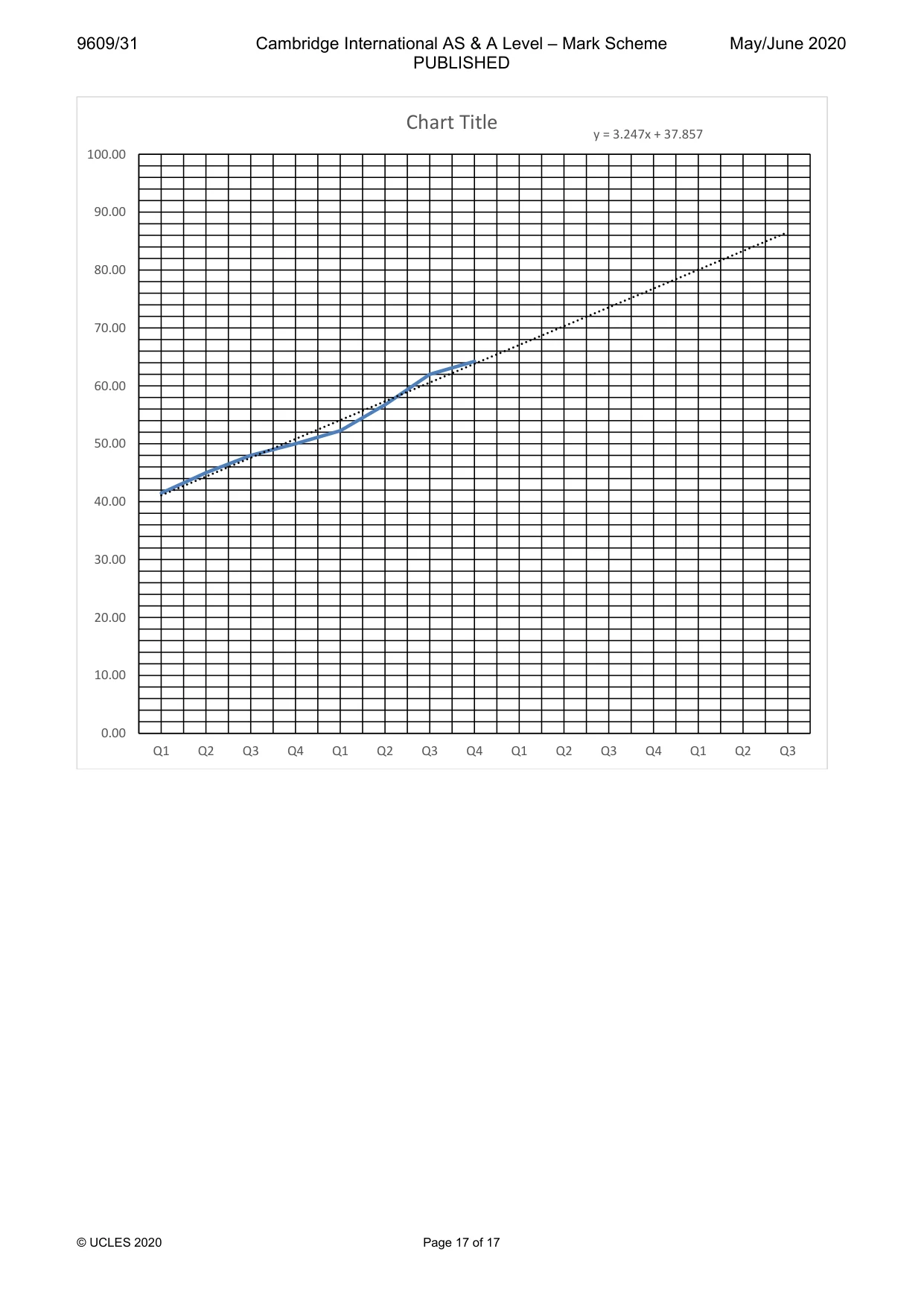
9609/31 Cambridge International AS & A Level – Mark Scheme PUBLISHED May/June 2020 © UCLES 2020 Page 5 of 17 Question Answer Marks 2(a) Refer to Table 1 and lines 24–26. Calculate the: 2(a)(i) average seasonal variation for quarter 3 Identification of values for quarter 3 (1 mark) (–6000 + –14 000)/2 = –$10 000 (2 marks) 2 2(a)(ii) forecast sales for quarter 3 in 2021, assuming a forecast trend of $86 560. Forecast sales = trend plus average seasonal variation (1 mark) 86 560 + (–10 000) = $76 560 (2 marks) 2 2(b) Refer to lines 20–21. Calculate the income elasticity of demand (YED) of the residents of country K for JGS tours. YED = % change in demand / % change in income (1 mark) 20 / 5 = 4 (2 marks) 2
Mark scheme, page 6
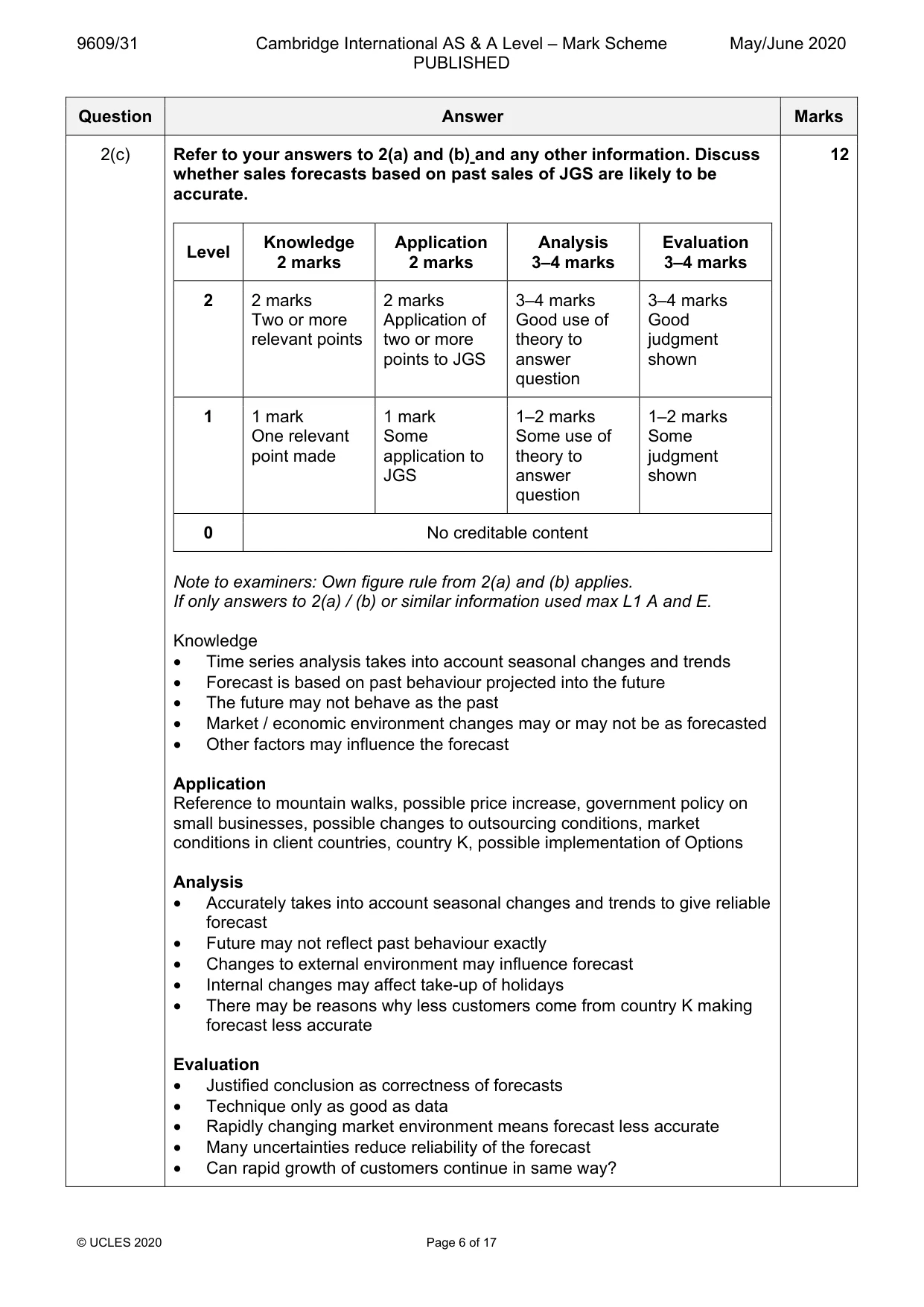
9609/31 Cambridge International AS & A Level – Mark Scheme PUBLISHED May/June 2020 © UCLES 2020 Page 6 of 17 Question Answer Marks 2(c) Refer to your answers to 2(a) and (b) and any other information. Discuss whether sales forecasts based on past sales of JGS are likely to be accurate. Level Knowledge 2 marks Application 2 marks Analysis 3–4 marks Evaluation 3–4 marks 2 2 marks Two or more relevant points 2 marks Application of two or more points to JGS 3–4 marks Good use of theory to answer question 3–4 marks Good judgment shown 1 1 mark One relevant point made 1 mark Some application to JGS 1–2 marks Some use of theory to answer question 1–2 marks Some judgment shown 0 No creditable content Note to examiners: Own figure rule from 2(a) and (b) applies. If only answers to 2(a) / (b) or similar information used max L1 A and E. Knowledge • Time series analysis takes into account seasonal changes and trends • Forecast is based on past behaviour projected into the future • The future may not behave as the past • Market / economic environment changes may or may not be as forecasted • Other factors may influence the forecast Application Reference to mountain walks, possible price increase, government policy on small businesses, possible changes to outsourcing conditions, market conditions in client countries, country K, possible implementation of Options Analysis • Accurately takes into account seasonal changes and trends to give reliable forecast • Future may not reflect past behaviour exactly • Changes to external environment may influence forecast • Internal changes may affect take-up of holidays • There may be reasons why less customers come from country K making forecast less accurate Evaluation • Justified conclusion as correctness of forecasts • Technique only as good as data • Rapidly changing market environment means forecast less accurate • Many uncertainties reduce reliability of the forecast • Can rapid growth of customers continue in same way? 12
Mark scheme, page 7
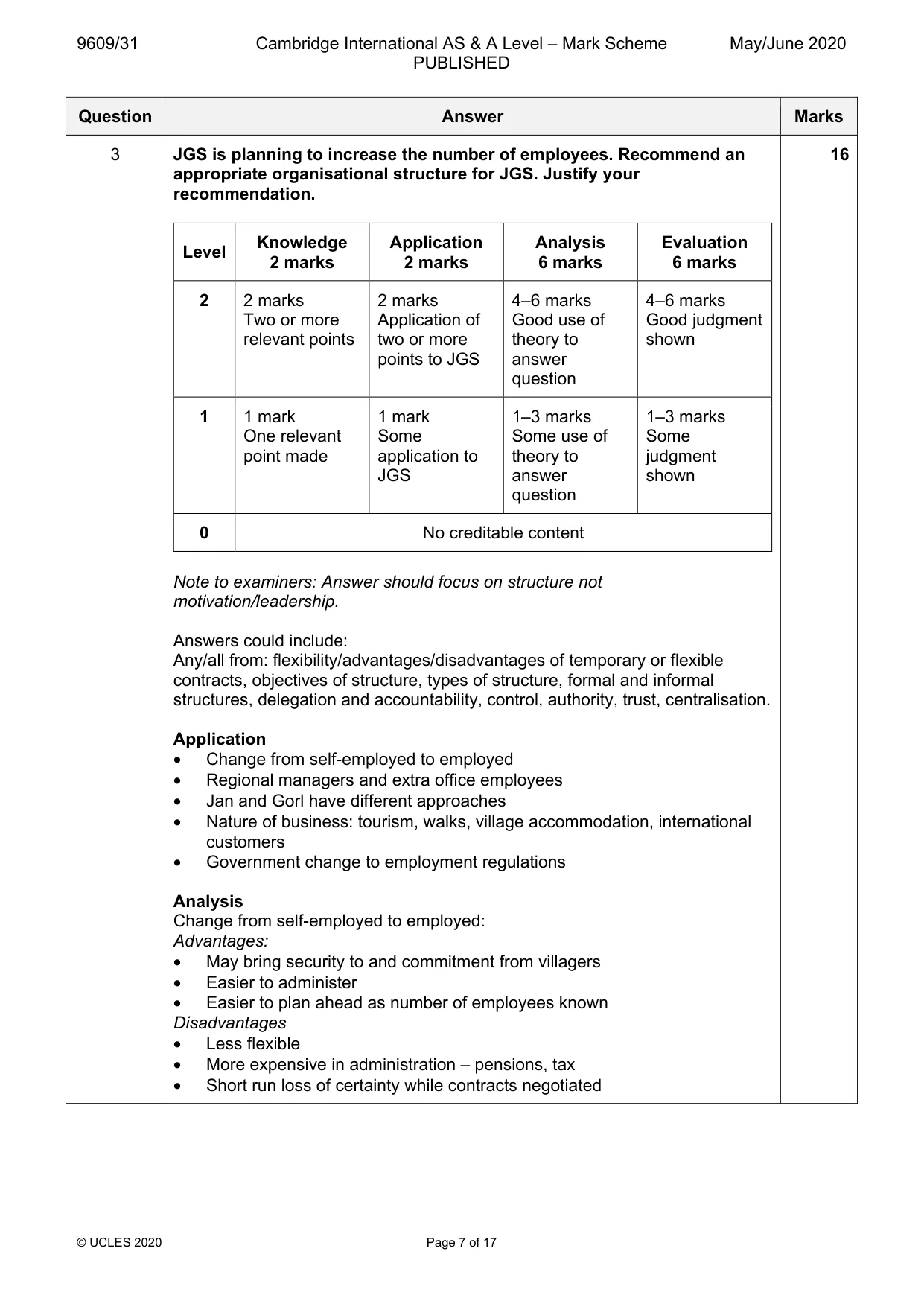
9609/31 Cambridge International AS & A Level – Mark Scheme PUBLISHED May/June 2020 © UCLES 2020 Page 7 of 17 Question Answer Marks 3 JGS is planning to increase the number of employees. Recommend an appropriate organisational structure for JGS. Justify your recommendation. Level Knowledge 2 marks Application 2 marks Analysis 6 marks Evaluation 6 marks 2 2 marks Two or more relevant points 2 marks Application of two or more points to JGS 4–6 marks Good use of theory to answer question 4–6 marks Good judgment shown 1 1 mark One relevant point made 1 mark Some application to JGS 1–3 marks Some use of theory to answer question 1–3 marks Some judgment shown 0 No creditable content Note to examiners: Answer should focus on structure not motivation/leadership. Answers could include: Any/all from: flexibility/advantages/disadvantages of temporary or flexible contracts, objectives of structure, types of structure, formal and informal structures, delegation and accountability, control, authority, trust, centralisation. Application • Change from self-employed to employed • Regional managers and extra office employees • Jan and Gorl have different approaches • Nature of business: tourism, walks, village accommodation, international customers • Government change to employment regulations Analysis Change from self-employed to employed: Advantages: • May bring security to and commitment from villagers • Easier to administer • Easier to plan ahead as number of employees known Disadvantages • Less flexible • More expensive in administration – pensions, tax • Short run loss of certainty while contracts negotiated 16
Mark scheme, page 8
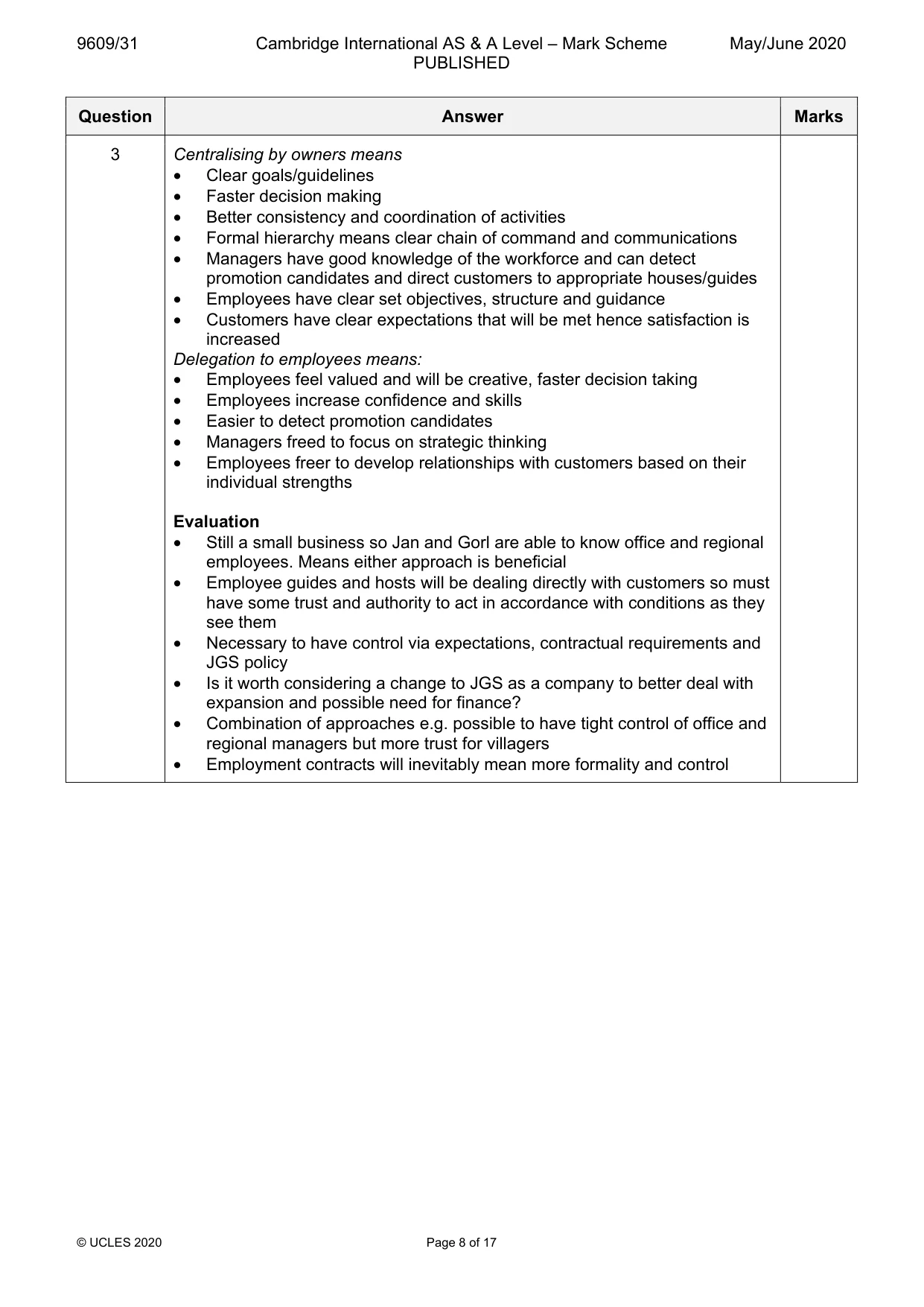
9609/31 Cambridge International AS & A Level – Mark Scheme PUBLISHED May/June 2020 © UCLES 2020 Page 8 of 17 Question Answer Marks 3 Centralising by owners means • Clear goals/guidelines • Faster decision making • Better consistency and coordination of activities • Formal hierarchy means clear chain of command and communications • Managers have good knowledge of the workforce and can detect promotion candidates and direct customers to appropriate houses/guides • Employees have clear set objectives, structure and guidance • Customers have clear expectations that will be met hence satisfaction is increased Delegation to employees means: • Employees feel valued and will be creative, faster decision taking • Employees increase confidence and skills • Easier to detect promotion candidates • Managers freed to focus on strategic thinking • Employees freer to develop relationships with customers based on their individual strengths Evaluation • Still a small business so Jan and Gorl are able to know office and regional employees. Means either approach is beneficial • Employee guides and hosts will be dealing directly with customers so must have some trust and authority to act in accordance with conditions as they see them • Necessary to have control via expectations, contractual requirements and JGS policy • Is it worth considering a change to JGS as a company to better deal with expansion and possible need for finance? • Combination of approaches e.g. possible to have tight control of office and regional managers but more trust for villagers • Employment contracts will inevitably mean more formality and control
Mark scheme, page 9
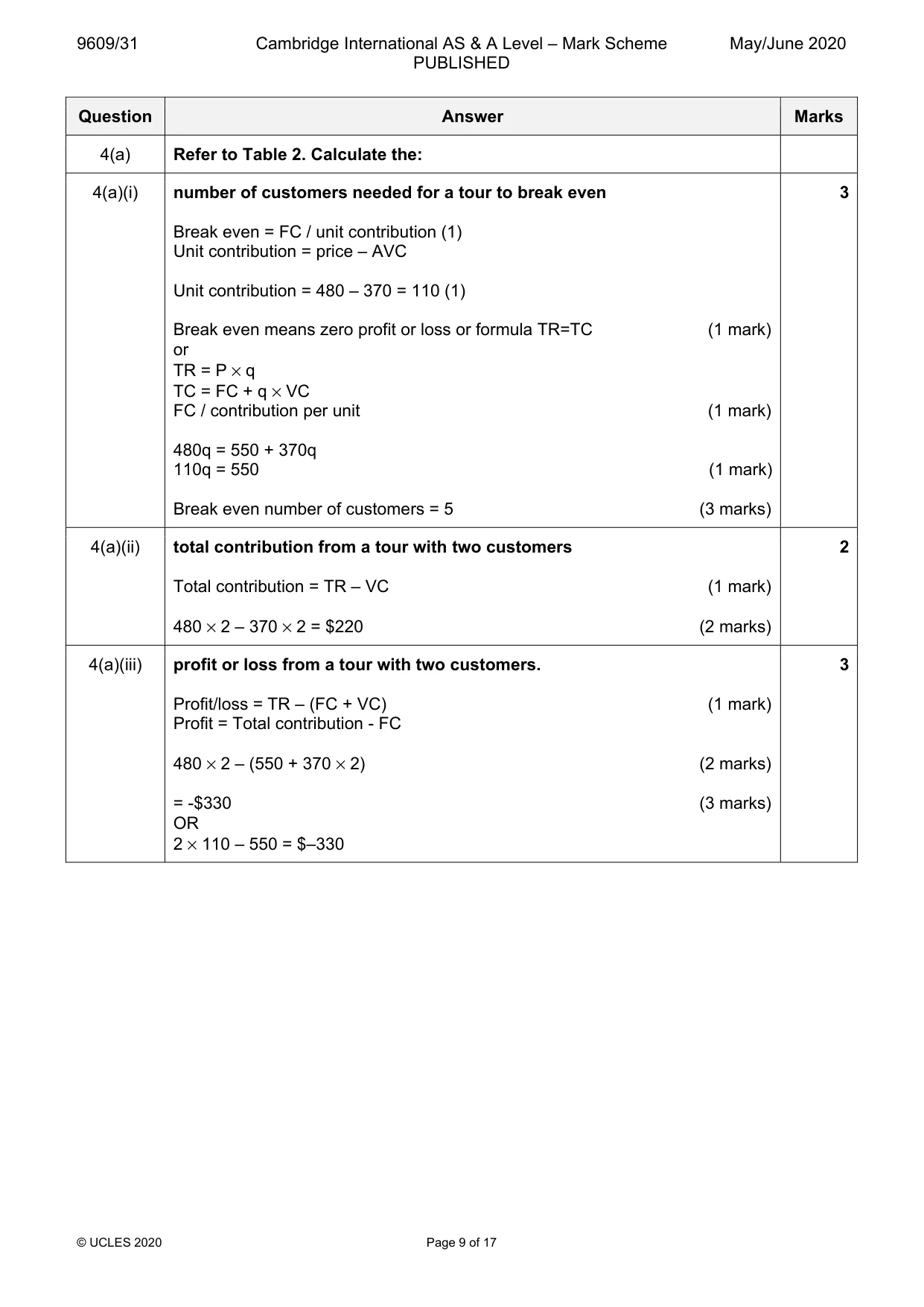
9609/31 Cambridge International AS & A Level – Mark Scheme PUBLISHED May/June 2020 © UCLES 2020 Page 9 of 17 Question Answer Marks 4(a) Refer to Table 2. Calculate the: 4(a)(i) number of customers needed for a tour to break even Break even = FC / unit contribution (1) Unit contribution = price – AVC Unit contribution = 480 – 370 = 110 (1) Break even means zero profit or loss or formula TR=TC (1 mark) or TR = P × q TC = FC + q × VC FC / contribution per unit (1 mark) 480q = 550 + 370q 110q = 550 (1 mark) Break even number of customers = 5 (3 marks) 3 4(a)(ii) total contribution from a tour with two customers Total contribution = TR – VC (1 mark) 480 × 2 – 370 × 2 = $220 (2 marks) 2 4(a)(iii) profit or loss from a tour with two customers. Profit/loss = TR – (FC + VC) (1 mark) Profit = Total contribution - FC 480 × 2 – (550 + 370 × 2) (2 marks) = -$330 (3 marks) OR 2 × 110 – 550 = $–330 3
Mark scheme, page 10
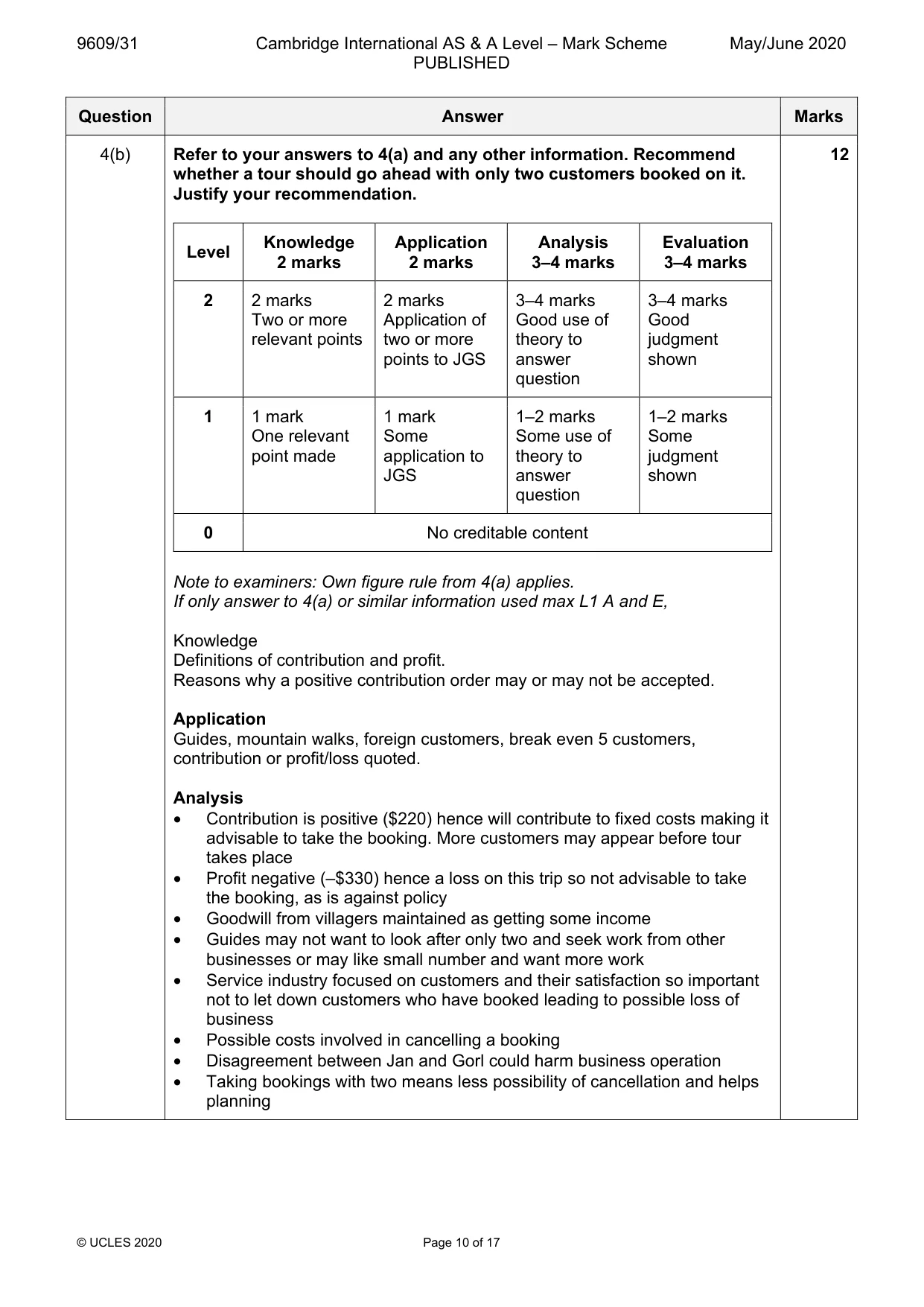
9609/31 Cambridge International AS & A Level – Mark Scheme PUBLISHED May/June 2020 © UCLES 2020 Page 10 of 17 Question Answer Marks 4(b) Refer to your answers to 4(a) and any other information. Recommend whether a tour should go ahead with only two customers booked on it. Justify your recommendation. Level Knowledge 2 marks Application 2 marks Analysis 3–4 marks Evaluation 3–4 marks 2 2 marks Two or more relevant points 2 marks Application of two or more points to JGS 3–4 marks Good use of theory to answer question 3–4 marks Good judgment shown 1 1 mark One relevant point made 1 mark Some application to JGS 1–2 marks Some use of theory to answer question 1–2 marks Some judgment shown 0 No creditable content Note to examiners: Own figure rule from 4(a) applies. If only answer to 4(a) or similar information used max L1 A and E, Knowledge Definitions of contribution and profit. Reasons why a positive contribution order may or may not be accepted. Application Guides, mountain walks, foreign customers, break even 5 customers, contribution or profit/loss quoted. Analysis • Contribution is positive ($220) hence will contribute to fixed costs making it advisable to take the booking. More customers may appear before tour takes place • Profit negative (–$330) hence a loss on this trip so not advisable to take the booking, as is against policy • Goodwill from villagers maintained as getting some income • Guides may not want to look after only two and seek work from other businesses or may like small number and want more work • Service industry focused on customers and their satisfaction so important not to let down customers who have booked leading to possible loss of business • Possible costs involved in cancelling a booking • Disagreement between Jan and Gorl could harm business operation • Taking bookings with two means less possibility of cancellation and helps planning 12
Mark scheme, page 11
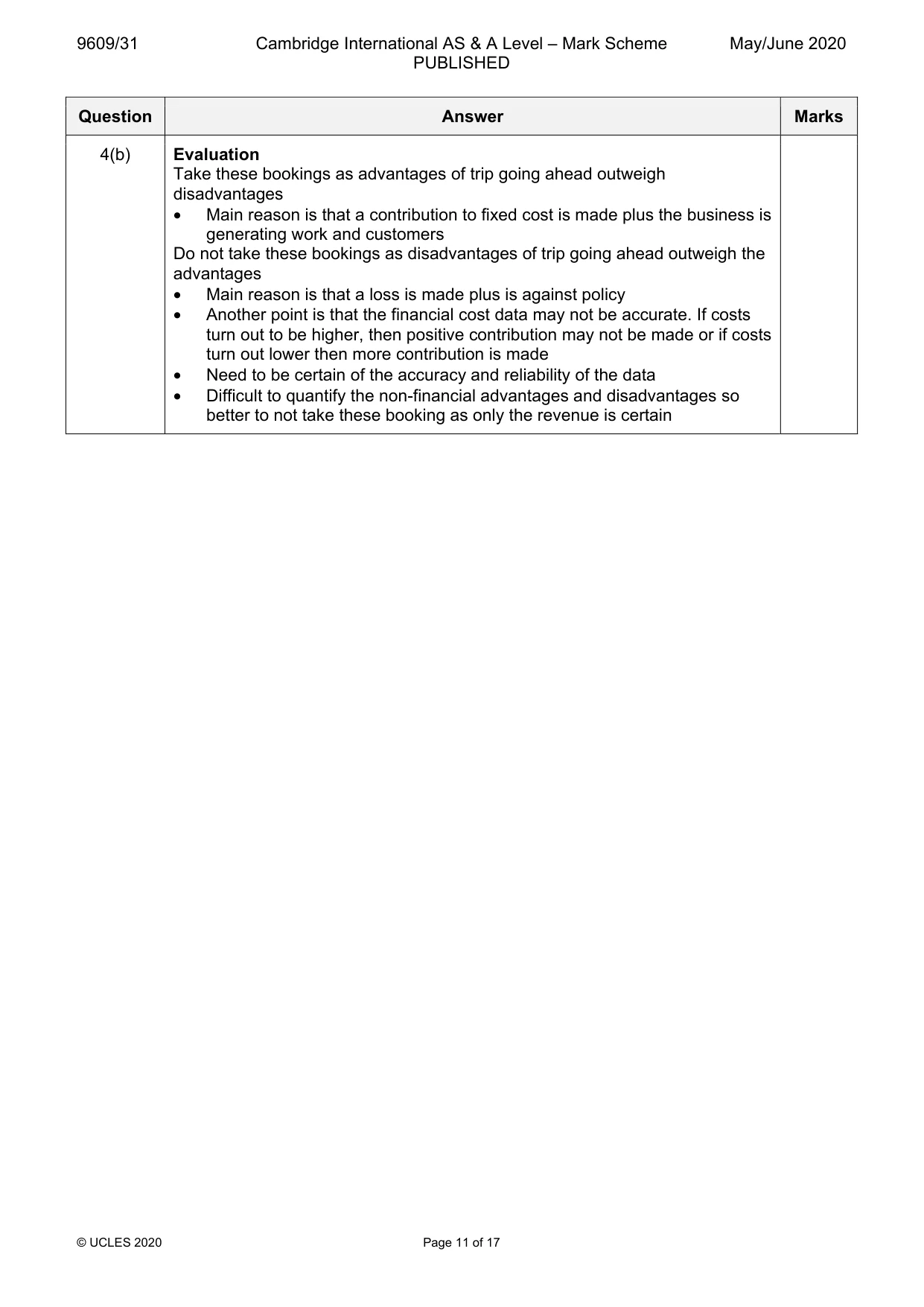
9609/31 Cambridge International AS & A Level – Mark Scheme PUBLISHED May/June 2020 © UCLES 2020 Page 11 of 17 Question Answer Marks 4(b) Evaluation Take these bookings as advantages of trip going ahead outweigh disadvantages • Main reason is that a contribution to fixed cost is made plus the business is generating work and customers Do not take these bookings as disadvantages of trip going ahead outweigh the advantages • Main reason is that a loss is made plus is against policy • Another point is that the financial cost data may not be accurate. If costs turn out to be higher, then positive contribution may not be made or if costs turn out lower then more contribution is made • Need to be certain of the accuracy and reliability of the data • Difficult to quantify the non-financial advantages and disadvantages so better to not take these booking as only the revenue is certain
Mark scheme, page 12
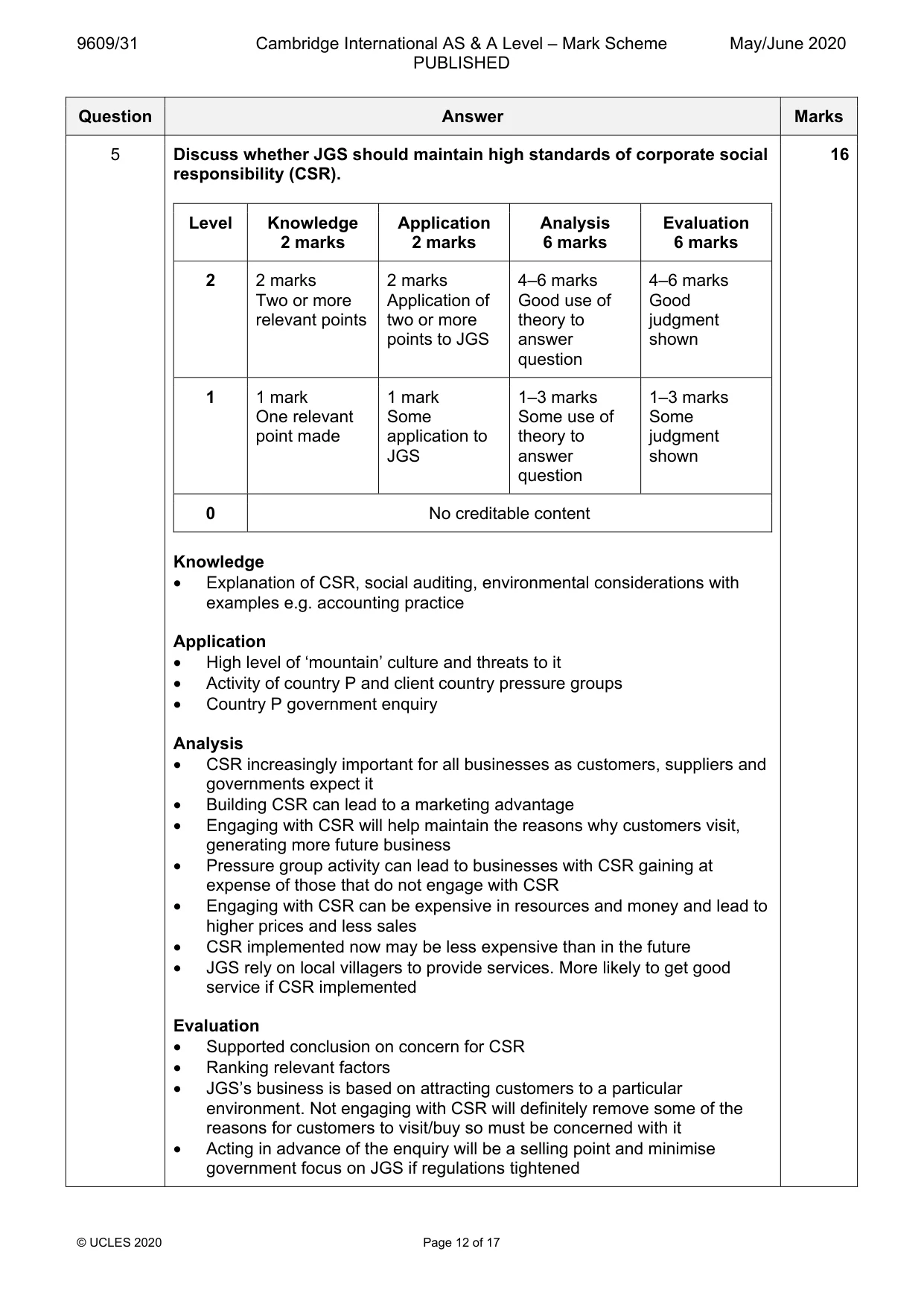
9609/31 Cambridge International AS & A Level – Mark Scheme PUBLISHED May/June 2020 © UCLES 2020 Page 12 of 17 Question Answer Marks 5 Discuss whether JGS should maintain high standards of corporate social responsibility (CSR). Level Knowledge 2 marks Application 2 marks Analysis 6 marks Evaluation 6 marks 2 2 marks Two or more relevant points 2 marks Application of two or more points to JGS 4–6 marks Good use of theory to answer question 4–6 marks Good judgment shown 1 1 mark One relevant point made 1 mark Some application to JGS 1–3 marks Some use of theory to answer question 1–3 marks Some judgment shown 0 No creditable content Knowledge • Explanation of CSR, social auditing, environmental considerations with examples e.g. accounting practice Application • High level of ‘mountain’ culture and threats to it • Activity of country P and client country pressure groups • Country P government enquiry Analysis • CSR increasingly important for all businesses as customers, suppliers and governments expect it • Building CSR can lead to a marketing advantage • Engaging with CSR will help maintain the reasons why customers visit, generating more future business • Pressure group activity can lead to businesses with CSR gaining at expense of those that do not engage with CSR • Engaging with CSR can be expensive in resources and money and lead to higher prices and less sales • CSR implemented now may be less expensive than in the future • JGS rely on local villagers to provide services. More likely to get good service if CSR implemented Evaluation • Supported conclusion on concern for CSR • Ranking relevant factors • JGS’s business is based on attracting customers to a particular environment. Not engaging with CSR will definitely remove some of the reasons for customers to visit/buy so must be concerned with it • Acting in advance of the enquiry will be a selling point and minimise government focus on JGS if regulations tightened 16
Mark scheme, page 13
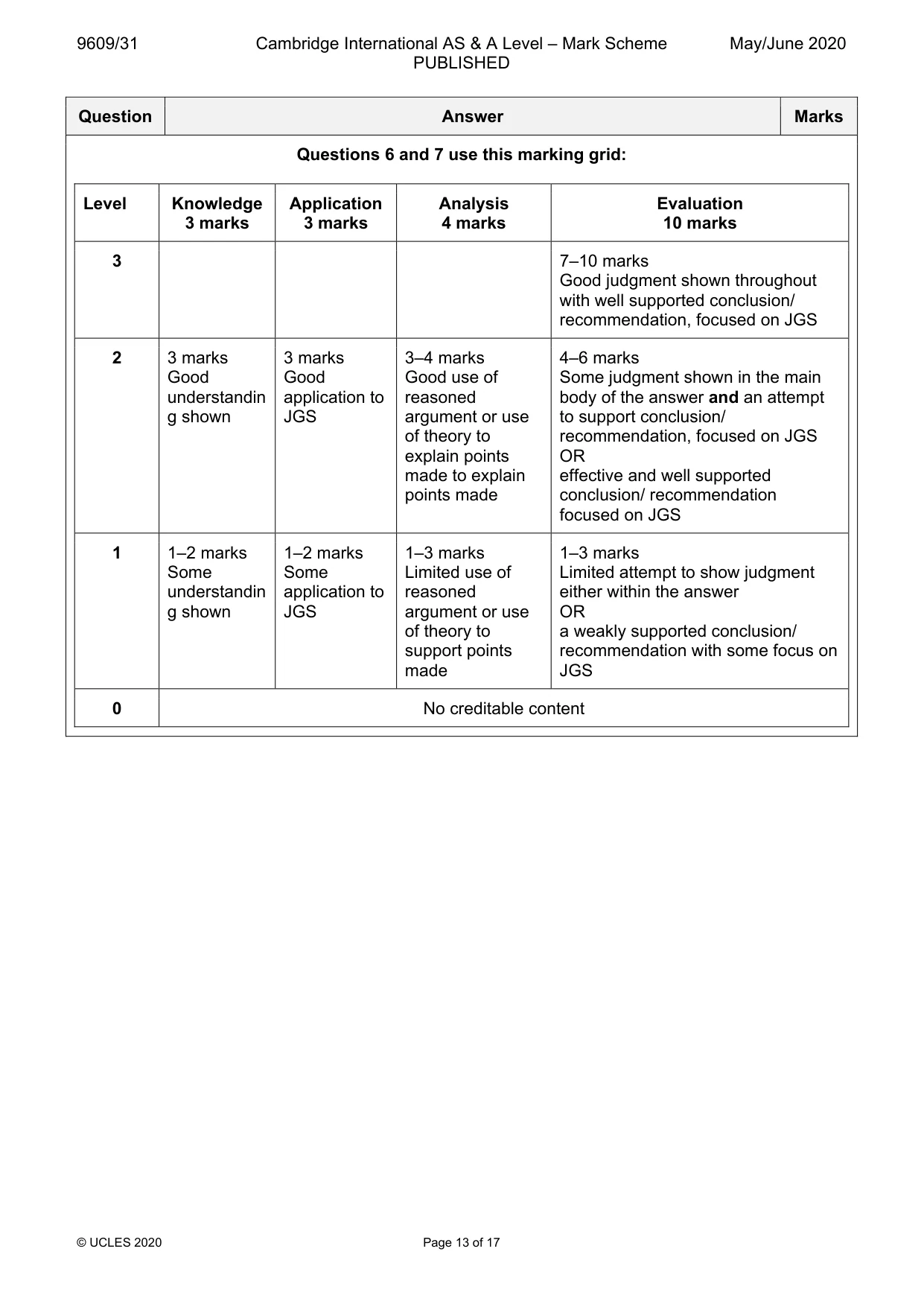
9609/31 Cambridge International AS & A Level – Mark Scheme PUBLISHED May/June 2020 © UCLES 2020 Page 13 of 17 Question Answer Marks Questions 6 and 7 use this marking grid: Level Knowledge 3 marks Application 3 marks Analysis 4 marks Evaluation 10 marks 3 7–10 marks Good judgment shown throughout with well supported conclusion/ recommendation, focused on JGS 2 3 marks Good understandin g shown 3 marks Good application to JGS 3–4 marks Good use of reasoned argument or use of theory to explain points made to explain points made 4–6 marks Some judgment shown in the main body of the answer and an attempt to support conclusion/ recommendation, focused on JGS OR effective and well supported conclusion/ recommendation focused on JGS 1 1–2 marks Some understandin g shown 1–2 marks Some application to JGS 1–3 marks Limited use of reasoned argument or use of theory to support points made 1–3 marks Limited attempt to show judgment either within the answer OR a weakly supported conclusion/ recommendation with some focus on JGS 0 No creditable content
Mark scheme, page 14
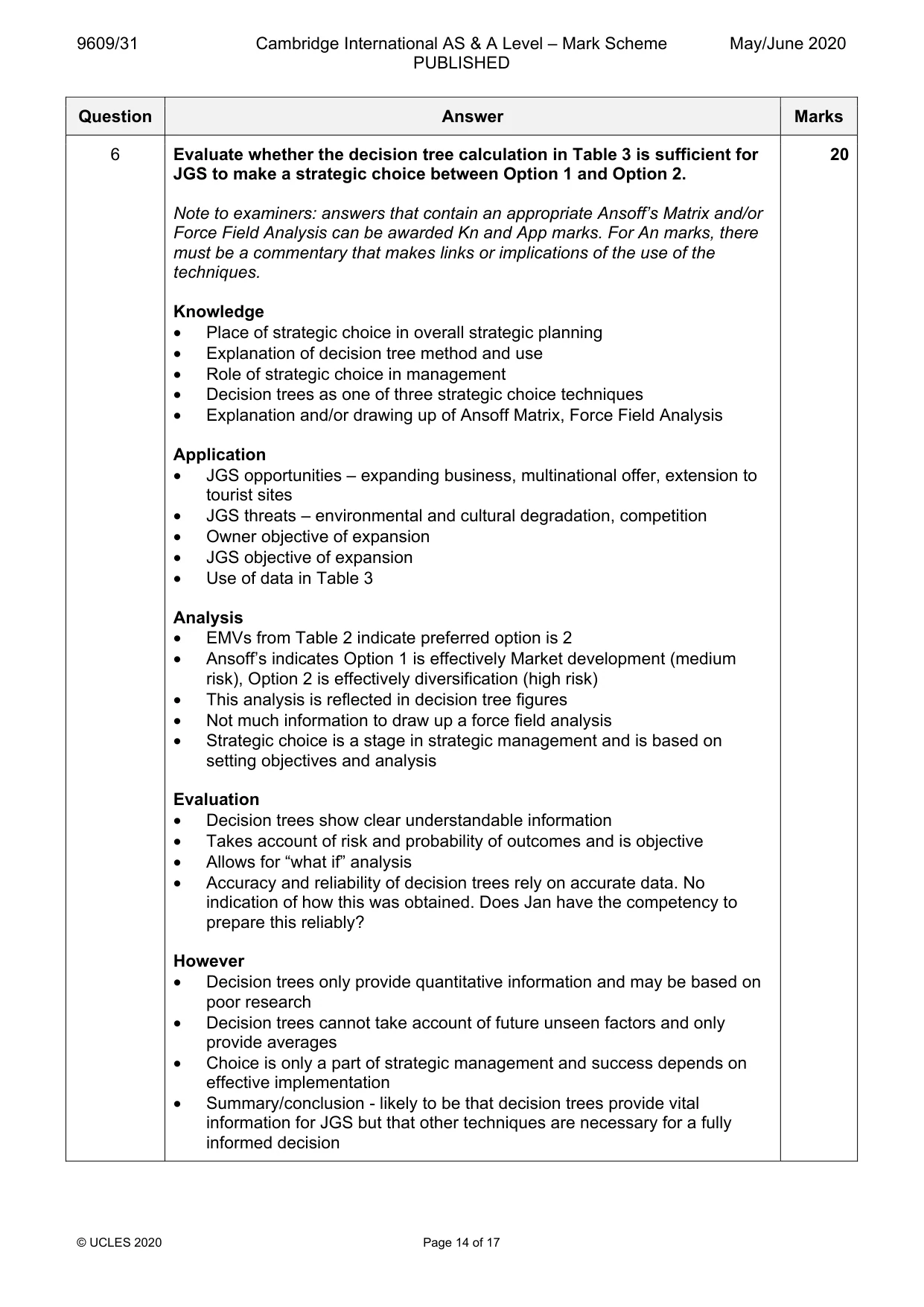
9609/31 Cambridge International AS & A Level – Mark Scheme PUBLISHED May/June 2020 © UCLES 2020 Page 14 of 17 Question Answer Marks 6 Evaluate whether the decision tree calculation in Table 3 is sufficient for JGS to make a strategic choice between Option 1 and Option 2. Note to examiners: answers that contain an appropriate Ansoff’s Matrix and/or Force Field Analysis can be awarded Kn and App marks. For An marks, there must be a commentary that makes links or implications of the use of the techniques. Knowledge • Place of strategic choice in overall strategic planning • Explanation of decision tree method and use • Role of strategic choice in management • Decision trees as one of three strategic choice techniques • Explanation and/or drawing up of Ansoff Matrix, Force Field Analysis Application • JGS opportunities – expanding business, multinational offer, extension to tourist sites • JGS threats – environmental and cultural degradation, competition • Owner objective of expansion • JGS objective of expansion • Use of data in Table 3 Analysis • EMVs from Table 2 indicate preferred option is 2 • Ansoff’s indicates Option 1 is effectively Market development (medium risk), Option 2 is effectively diversification (high risk) • This analysis is reflected in decision tree figures • Not much information to draw up a force field analysis • Strategic choice is a stage in strategic management and is based on setting objectives and analysis Evaluation • Decision trees show clear understandable information • Takes account of risk and probability of outcomes and is objective • Allows for “what if” analysis • Accuracy and reliability of decision trees rely on accurate data. No indication of how this was obtained. Does Jan have the competency to prepare this reliably? However • Decision trees only provide quantitative information and may be based on poor research • Decision trees cannot take account of future unseen factors and only provide averages • Choice is only a part of strategic management and success depends on effective implementation • Summary/conclusion - likely to be that decision trees provide vital information for JGS but that other techniques are necessary for a fully informed decision 20
Mark scheme, page 15
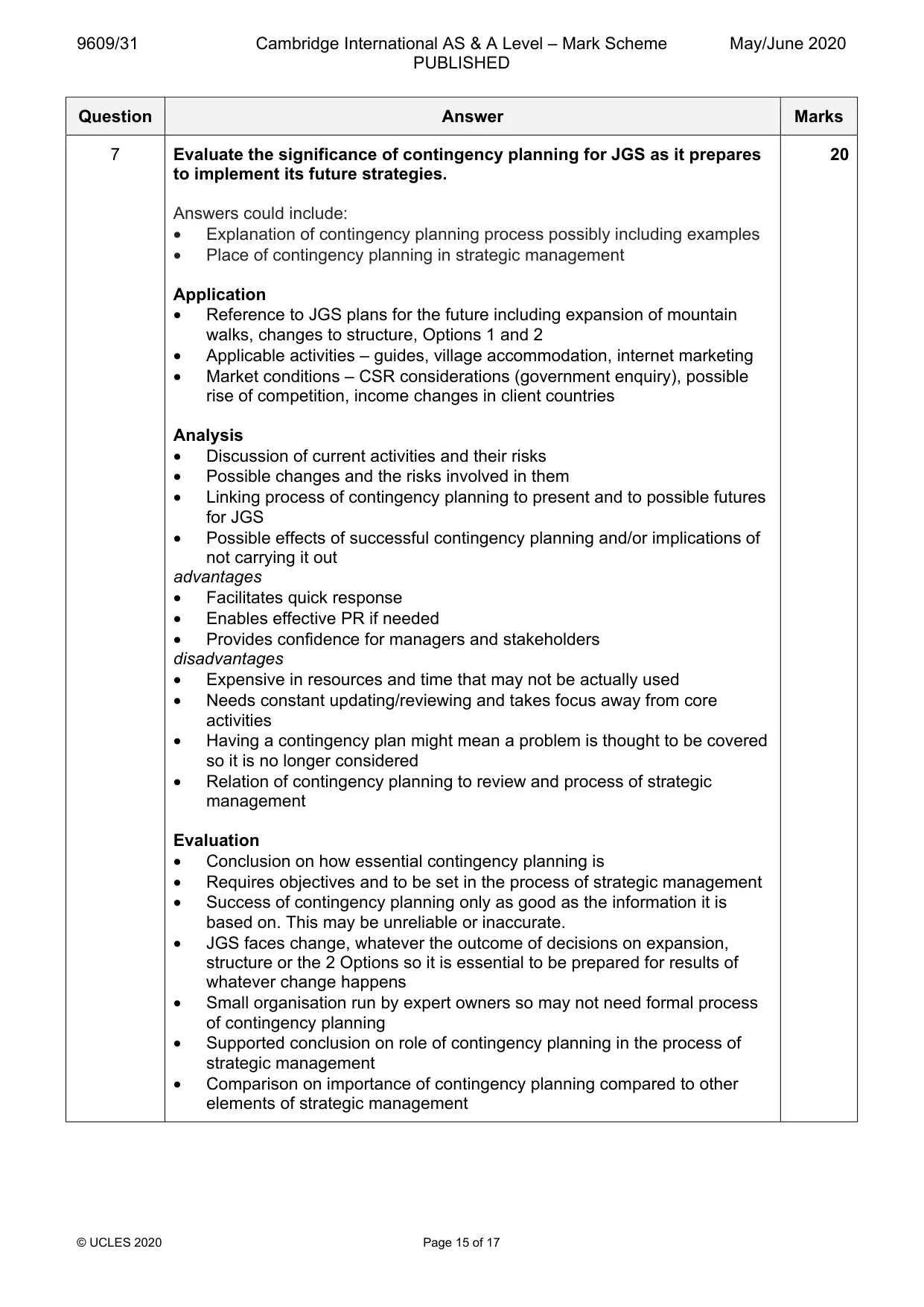
9609/31 Cambridge International AS & A Level – Mark Scheme PUBLISHED May/June 2020 © UCLES 2020 Page 15 of 17 Question Answer Marks 7 Evaluate the significance of contingency planning for JGS as it prepares to implement its future strategies. Answers could include: • Explanation of contingency planning process possibly including examples • Place of contingency planning in strategic management Application • Reference to JGS plans for the future including expansion of mountain walks, changes to structure, Options 1 and 2 • Applicable activities – guides, village accommodation, internet marketing • Market conditions – CSR considerations (government enquiry), possible rise of competition, income changes in client countries Analysis • Discussion of current activities and their risks • Possible changes and the risks involved in them • Linking process of contingency planning to present and to possible futures for JGS • Possible effects of successful contingency planning and/or implications of not carrying it out advantages • Facilitates quick response • Enables effective PR if needed • Provides confidence for managers and stakeholders disadvantages • Expensive in resources and time that may not be actually used • Needs constant updating/reviewing and takes focus away from core activities • Having a contingency plan might mean a problem is thought to be covered so it is no longer considered • Relation of contingency planning to review and process of strategic management Evaluation • Conclusion on how essential contingency planning is • Requires objectives and to be set in the process of strategic management • Success of contingency planning only as good as the information it is based on. This may be unreliable or inaccurate. • JGS faces change, whatever the outcome of decisions on expansion, structure or the 2 Options so it is essential to be prepared for results of whatever change happens • Small organisation run by expert owners so may not need formal process of contingency planning • Supported conclusion on role of contingency planning in the process of strategic management • Comparison on importance of contingency planning compared to other elements of strategic management 20
Mark scheme, page 16
9609/31 Cambridge International AS & A Level – Mark Scheme PUBLISHED May/June 2020 © UCLES 2020 Page 16 of 17 Question 2 (a)(ii) checking/justification Moving Average Seasonal Variation Average Seasonal Variation 4 quarter total 8 quarter total sales Q3 34 Q4 162 78 Q1 41.50 –1.50 170 332 40 Q2 45.00 –35.00 190 360 10 Q3 48.00 –6.00 –10 194 384 42 Q4 50.00 48.00 206 400 98 Q1 52.25 –8.25 212 418 44 Q2 56.75 –34.75 242 454 22 Q3 62.00 –14.00 254 496 48 Q4 64.25 63.75 260 514 128 Q1 56 Q2 28
Mark scheme, page 17
9609/31 Cambridge International AS & A Level – Mark Scheme PUBLISHED May/June 2020 © UCLES 2020 Page 17 of 17 y = 3.247x + 37.857 0.00 10.00 20.00 30.00 40.00 50.00 60.00 70.00 80.00 90.00 100.00 Q1 Q2 Q3 Q4 Q1 Q2 Q3 Q4 Q1 Q2 Q3 Q4 Q1 Q2 Q3 Chart Title