Cambridge A Level Business (for first examination in 2016) 9609 — 2020 May/June Paper 3 · Variant 3
9609/33/M/J/20
The question paper and its mark scheme, free to read here and free to download. This is Cambridge’s own paper, exactly as it was sat.
Question paper20 pages

















Mark scheme15 pages
Answers below. Sit the paper first if you are practising.


Paper as text
Question paper, page 1
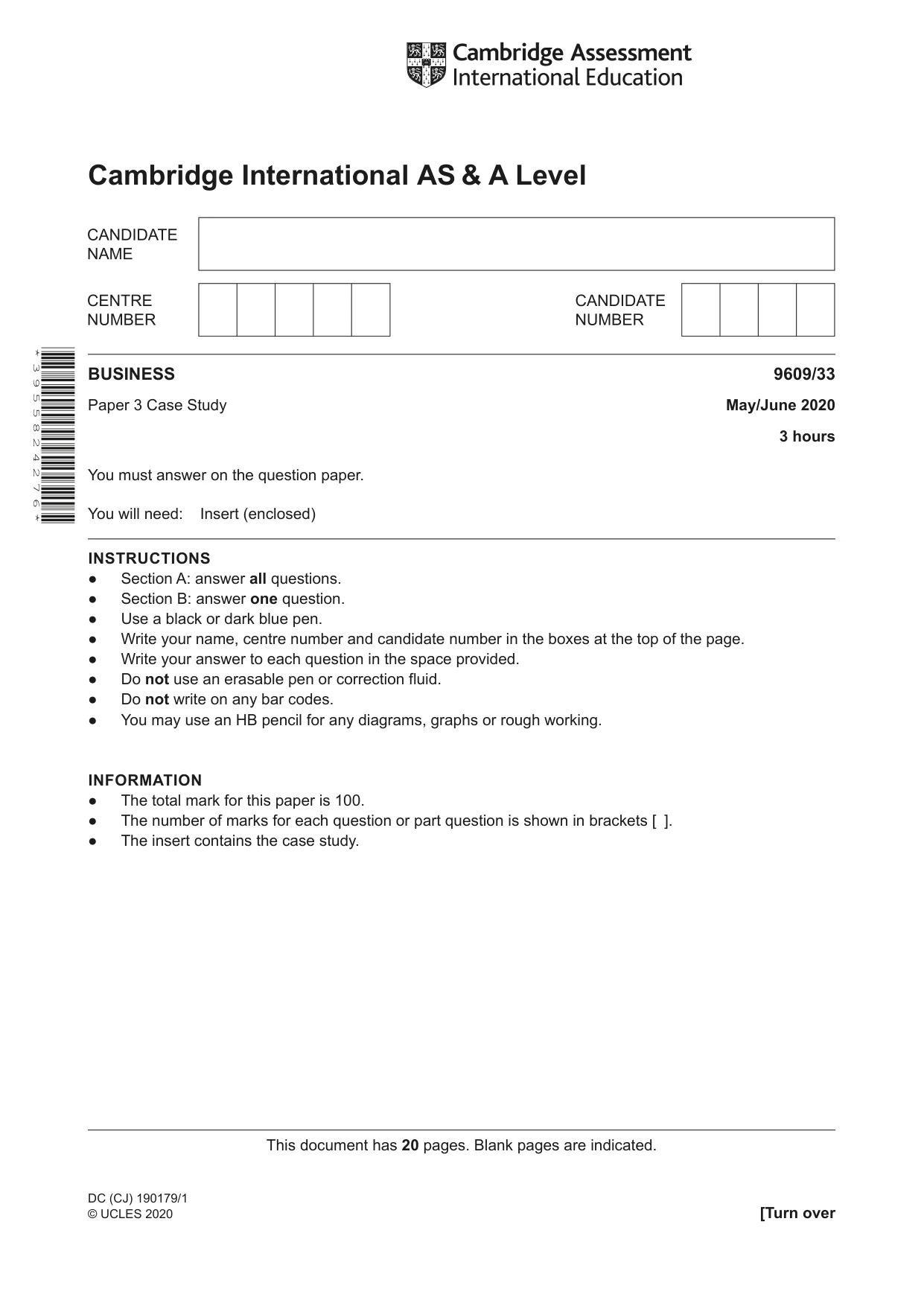
Cambridge International AS & A Level This document has 20 pages. Blank pages are indicated. BUSINESS 9609/33 Paper 3 Case Study May/June 2020 3 hours You must answer on the question paper. You will need: Insert (enclosed) INSTRUCTIONS ● Section A: answer all questions. ● Section B: answer one question. ● Use a black or dark blue pen. ● Write your name, centre number and candidate number in the boxes at the top of the page. ● Write your answer to each question in the space provided. ● Do not use an erasable pen or correction fluid. ● Do not write on any bar codes. ● You may use an HB pencil for any diagrams, graphs or rough working. INFORMATION ● The total mark for this paper is 100. ● The number of marks for each question or part question is shown in brackets [ ]. ● The insert contains the case study. * 3 9 5 5 8 2 4 2 7 6 * DC (CJ) 190179/1 © UCLES 2020 [Turn over
Question paper, page 2
2 9609/33/M/J/20 © UCLES 2020 Answer all questions in Section A and answer one question in Section B. You are advised to spend no more than 40 minutes on Section B. Section A Answer all questions in this section. 1 Analyse the advantages and disadvantages to PAC of country X’s exchange rate appreciating against other currencies (lines 12 to 17). … … … … … … … … … … … … … … … … … … … … … … …
Question paper, page 3
3 9609/33/M/J/20 © UCLES 2020 [Turn over … … … … … … … … … … … … … … … … … … … … … … … … … … … … [10]
Question paper, page 4
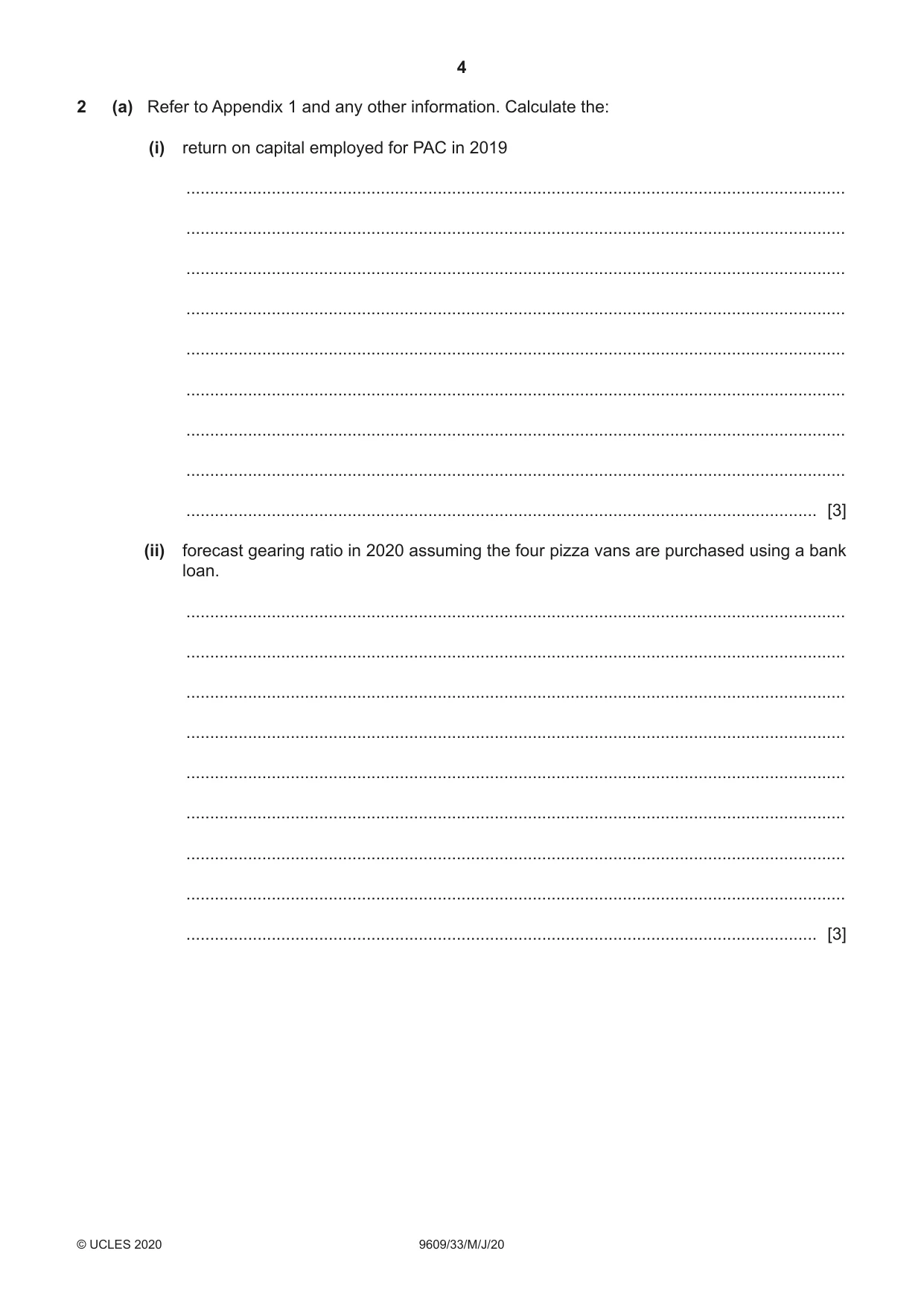
4 9609/33/M/J/20 © UCLES 2020 2 (a) Refer to Appendix 1 and any other information. Calculate the: (i) return on capital employed for PAC in 2019 … … … … … … … … … [3] (ii) forecast gearing ratio in 2020 assuming the four pizza vans are purchased using a bank loan. … … … … … … … … … [3]
Question paper, page 5
5 9609/33/M/J/20 © UCLES 2020 [Turn over (b) Refer to your answers to 2(a) and any other information. Discuss whether PAC is right to finance the pizza van project using a bank loan. … … … … … … … … … … … … … … … … … … … … … … … … … … …
Question paper, page 6
6 9609/33/M/J/20 © UCLES 2020 … … … … … … … … … … … … … … … … … … … … … … … … … … … … [12]
Question paper, page 7
7 9609/33/M/J/20 © UCLES 2020 [Turn over 3 PAC requires a marketing strategy for its new ‘healthy life’ menu. Evaluate the importance of social media and other online methods of promotion to this strategy. … … … … … … … … … … … … … … … … … … … … … … … … … … …
Question paper, page 8
8 9609/33/M/J/20 © UCLES 2020 … … … … … … … … … … … … … … … … … … … … … … … … … … … …
Question paper, page 9
9 9609/33/M/J/20 © UCLES 2020 [Turn over … … … … … … … … … … … … … … … … … … … … … … … … … … … … [16]
Question paper, page 10
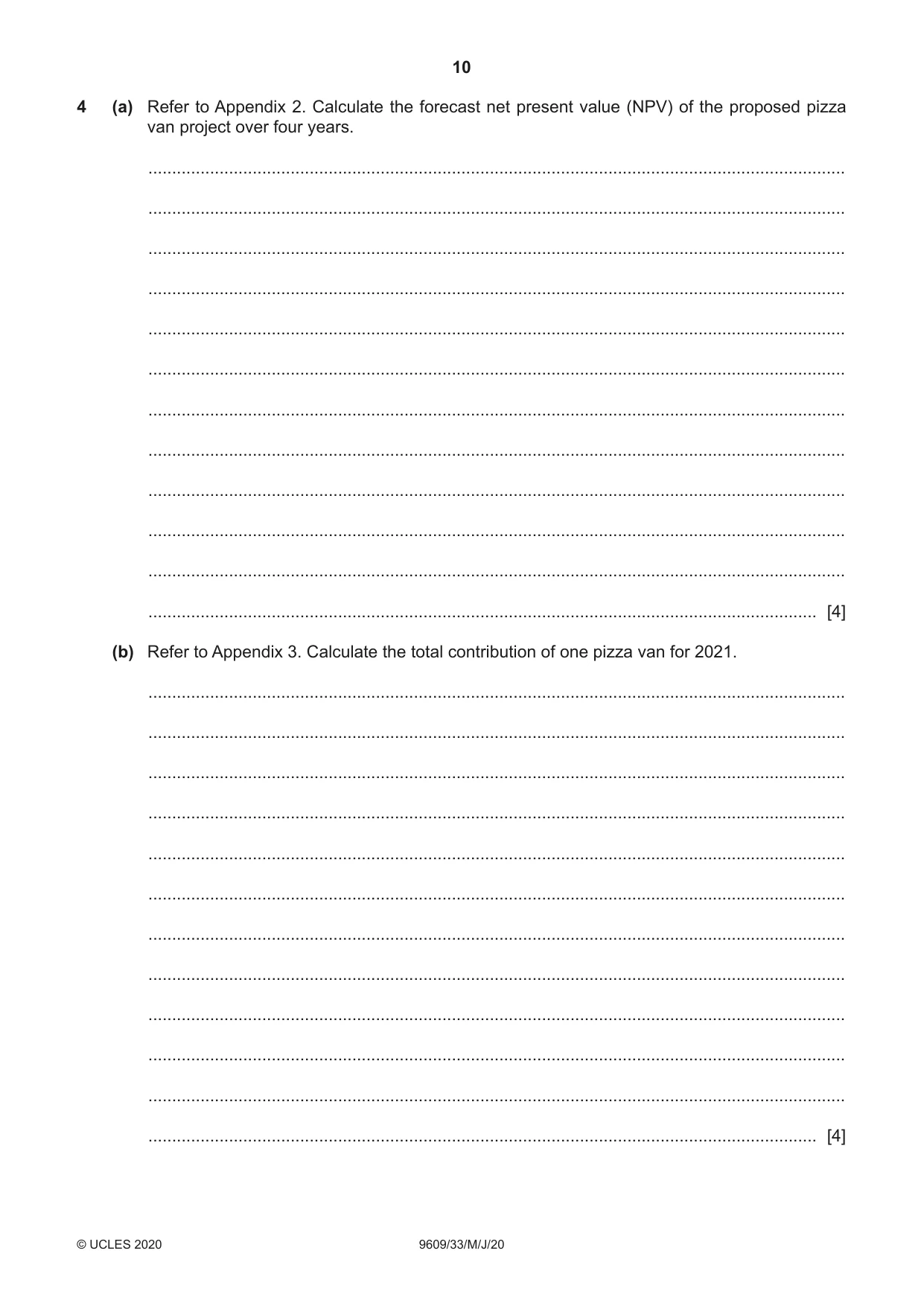
10 9609/33/M/J/20 © UCLES 2020 4 (a) Refer to Appendix 2. Calculate the forecast net present value (NPV) of the proposed pizza van project over four years. … … … … … … … … … … … … [4] (b) Refer to Appendix 3. Calculate the total contribution of one pizza van for 2021. … … … … … … … … … … … … [4]
Question paper, page 11
11 9609/33/M/J/20 © UCLES 2020 [Turn over (c) Refer to your answers to 4(a) and 4(b) and any other information. Discuss whether the pizza van project is likely to improve profitability for PAC. … … … … … … … … … … … … … … … … … … … … … … … … … … …
Question paper, page 12
12 9609/33/M/J/20 © UCLES 2020 … … … … … … … … … … … … … … … … … … … … … … … … … … … … [12]
Question paper, page 13
13 9609/33/M/J/20 © UCLES 2020 [Turn over 5 Recommend ways in which Paulo might solve the current quality problems in some PAC restaurants. Justify your recommendation. … … … … … … … … … … … … … … … … … … … … … … … … … … …
Question paper, page 14
14 9609/33/M/J/20 © UCLES 2020 … … … … … … … … … … … … … … … … … … … … … … … … … … … …
Question paper, page 15
15 9609/33/M/J/20 © UCLES 2020 [Turn over … … … … … … … … … … … … … … … … … … … … … … … … … … … … [16]
Question paper, page 16
16 9609/33/M/J/20 © UCLES 2020 Section B Answer one question from this section. 6 Evaluate the usefulness of the information in Appendix 4 for the directors of PAC as they make the strategic choice between Option 1 and Option 2. 7 Evaluate the importance to PAC of contingency planning as part of strategic implementation if Option 2 is chosen. Write the question number here: … … … … … … … … … … … … … … … … … … … … … … …
Question paper, page 17
17 9609/33/M/J/20 © UCLES 2020 [Turn over … … … … … … … … … … … … … … … … … … … … … … … … … … … …
Question paper, page 18
18 9609/33/M/J/20 © UCLES 2020 … … … … … … … … … … … … … … … … … … … … … … … … … … … …
Question paper, page 19
19 9609/33/M/J/20 © UCLES 2020 … … … … … … … … … … … … … … … … … … … … … … … … … … … … [20]
Question paper, page 20
20 9609/33/M/J/20 © UCLES 2020 Permission to reproduce items where third-party owned material protected by copyright is included has been sought and cleared where possible. Every reasonable effort has been made by the publisher (UCLES) to trace copyright holders, but if any items requiring clearance have unwittingly been included, the publisher will be pleased to make amends at the earliest possible opportunity. To avoid the issue of disclosure of answer-related information to candidates, all copyright acknowledgements are reproduced online in the Cambridge Assessment International Education Copyright Acknowledgements Booklet. This is produced for each series of examinations and is freely available to download at www.cambridgeinternational.org after the live examination series. Cambridge Assessment International Education is part of the Cambridge Assessment Group. Cambridge Assessment is the brand name of the University of Cambridge Local Examinations Syndicate (UCLES), which itself is a department of the University of Cambridge. BLANK PAGE
Mark scheme, page 1
This document consists of 15 printed pages. © UCLES 2020 [Turn over Cambridge International AS & A Level BUSINESS 9609/33 Paper 3 Case Study May/June 2020 MARK SCHEME Maximum Mark: 100 Published Students did not sit exam papers in the June 2020 series due to the Covid-19 global pandemic. This mark scheme is published to support teachers and students and should be read together with the question paper. It shows the requirements of the exam. The answer column of the mark scheme shows the proposed basis on which Examiners would award marks for this exam. Where appropriate, this column also provides the most likely acceptable alternative responses expected from students. Examiners usually review the mark scheme after they have seen student responses and update the mark scheme if appropriate. In the June series, Examiners were unable to consider the acceptability of alternative responses, as there were no student responses to consider. Mark schemes should usually be read together with the Principal Examiner Report for Teachers. However, because students did not sit exam papers, there is no Principal Examiner Report for Teachers for the June 2020 series. Cambridge International will not enter into discussions about these mark schemes. Cambridge International is publishing the mark schemes for the June 2020 series for most Cambridge IGCSE™ and Cambridge International A & AS Level components, and some Cambridge O Level components.
Mark scheme, page 2
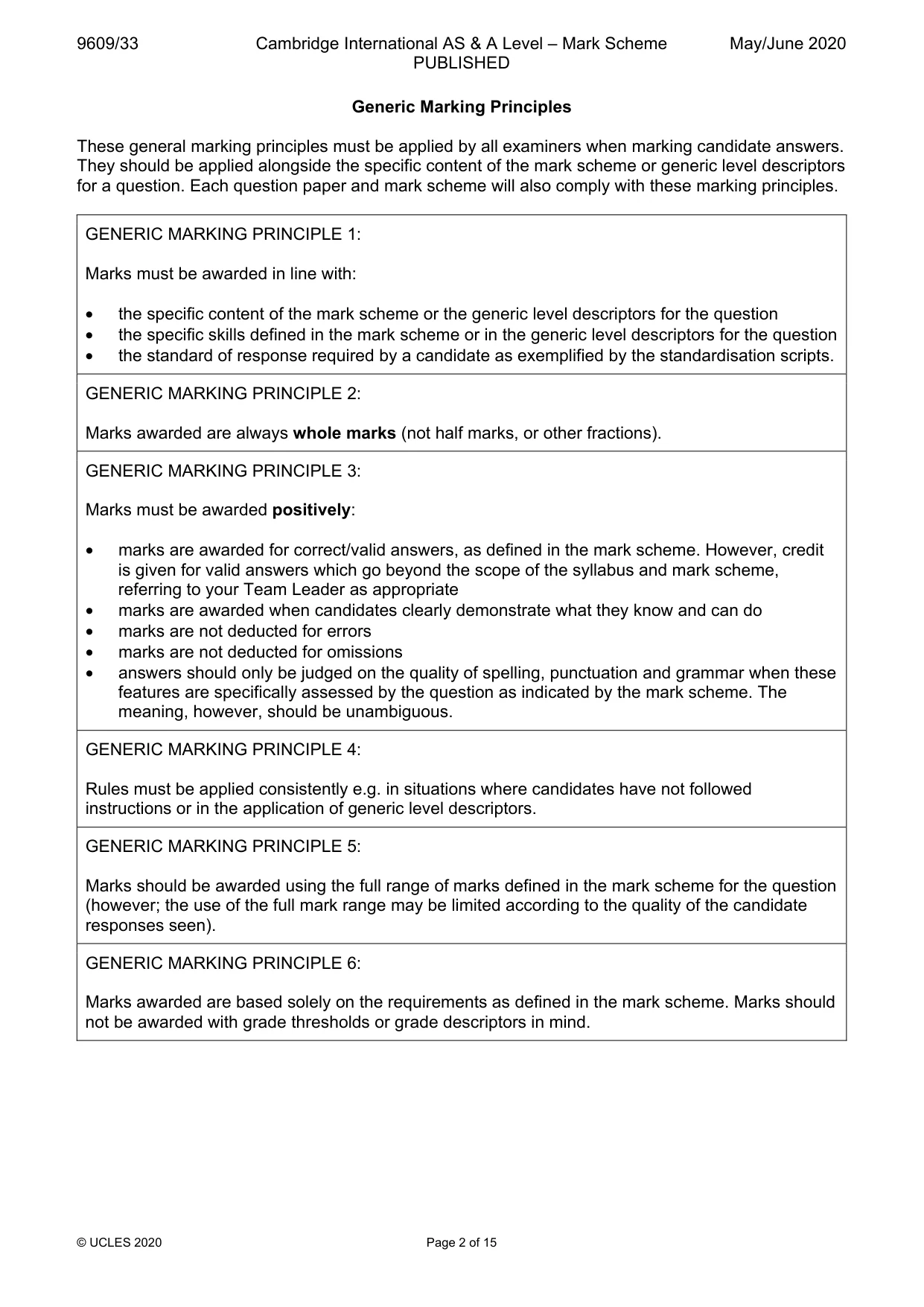
9609/33 Cambridge International AS & A Level – Mark Scheme PUBLISHED May/June 2020 © UCLES 2020 Page 2 of 15 Generic Marking Principles These general marking principles must be applied by all examiners when marking candidate answers. They should be applied alongside the specific content of the mark scheme or generic level descriptors for a question. Each question paper and mark scheme will also comply with these marking principles. GENERIC MARKING PRINCIPLE 1: Marks must be awarded in line with: • the specific content of the mark scheme or the generic level descriptors for the question • the specific skills defined in the mark scheme or in the generic level descriptors for the question • the standard of response required by a candidate as exemplified by the standardisation scripts. GENERIC MARKING PRINCIPLE 2: Marks awarded are always whole marks (not half marks, or other fractions). GENERIC MARKING PRINCIPLE 3: Marks must be awarded positively: • marks are awarded for correct/valid answers, as defined in the mark scheme. However, credit is given for valid answers which go beyond the scope of the syllabus and mark scheme, referring to your Team Leader as appropriate • marks are awarded when candidates clearly demonstrate what they know and can do • marks are not deducted for errors • marks are not deducted for omissions • answers should only be judged on the quality of spelling, punctuation and grammar when these features are specifically assessed by the question as indicated by the mark scheme. The meaning, however, should be unambiguous. GENERIC MARKING PRINCIPLE 4: Rules must be applied consistently e.g. in situations where candidates have not followed instructions or in the application of generic level descriptors. GENERIC MARKING PRINCIPLE 5: Marks should be awarded using the full range of marks defined in the mark scheme for the question (however; the use of the full mark range may be limited according to the quality of the candidate responses seen). GENERIC MARKING PRINCIPLE 6: Marks awarded are based solely on the requirements as defined in the mark scheme. Marks should not be awarded with grade thresholds or grade descriptors in mind.
Mark scheme, page 3
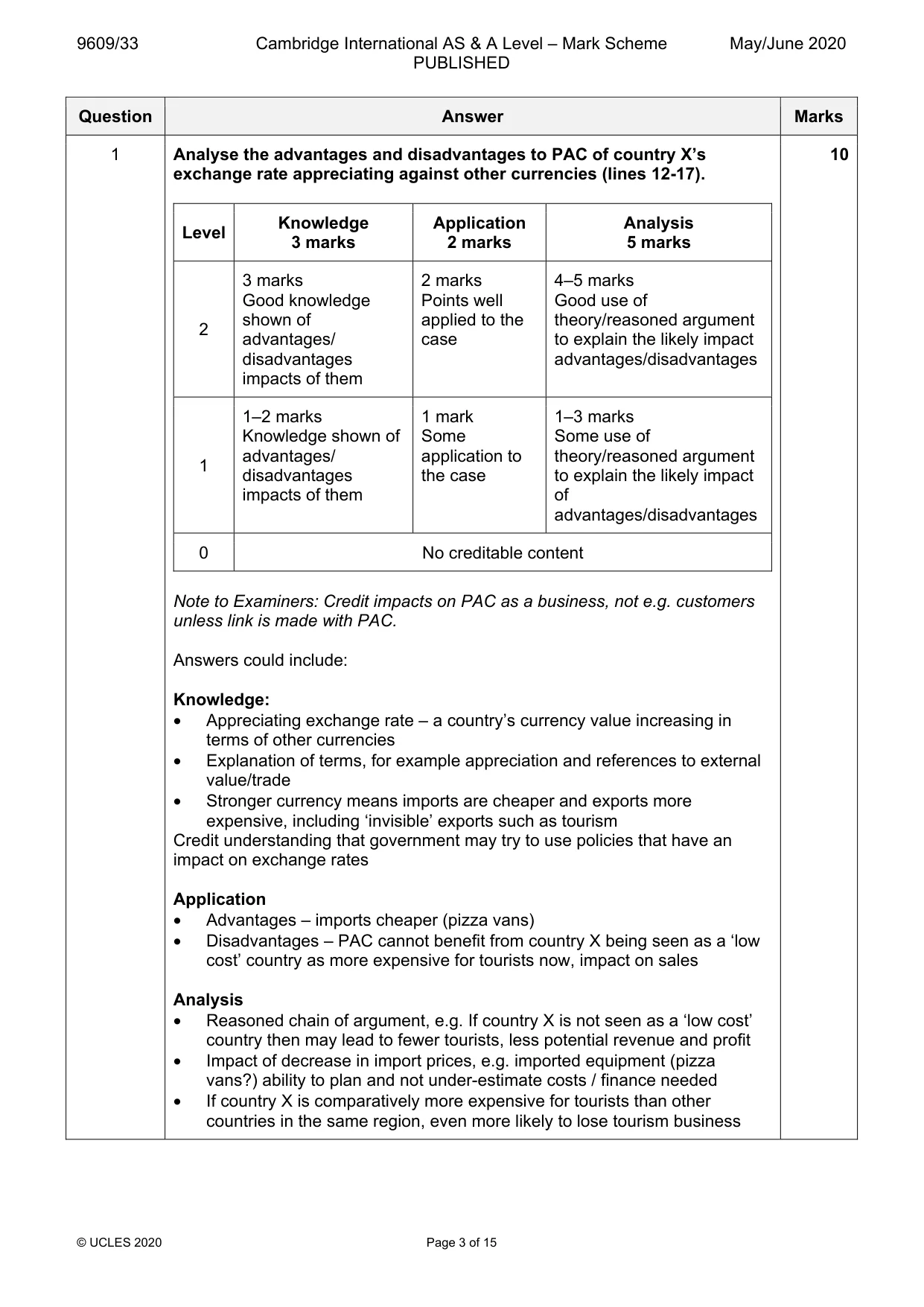
9609/33 Cambridge International AS & A Level – Mark Scheme PUBLISHED May/June 2020 © UCLES 2020 Page 3 of 15 Question Answer Marks 1 Analyse the advantages and disadvantages to PAC of country X’s exchange rate appreciating against other currencies (lines 12-17). Level Knowledge 3 marks Application 2 marks Analysis 5 marks 2 3 marks Good knowledge shown of advantages/ disadvantages impacts of them 2 marks Points well applied to the case 4–5 marks Good use of theory/reasoned argument to explain the likely impact advantages/disadvantages 1 1–2 marks Knowledge shown of advantages/ disadvantages impacts of them 1 mark Some application to the case 1–3 marks Some use of theory/reasoned argument to explain the likely impact of advantages/disadvantages 0 No creditable content Note to Examiners: Credit impacts on PAC as a business, not e.g. customers unless link is made with PAC. Answers could include: Knowledge: • Appreciating exchange rate – a country’s currency value increasing in terms of other currencies • Explanation of terms, for example appreciation and references to external value/trade • Stronger currency means imports are cheaper and exports more expensive, including ‘invisible’ exports such as tourism Credit understanding that government may try to use policies that have an impact on exchange rates Application • Advantages – imports cheaper (pizza vans) • Disadvantages – PAC cannot benefit from country X being seen as a ‘low cost’ country as more expensive for tourists now, impact on sales Analysis • Reasoned chain of argument, e.g. If country X is not seen as a ‘low cost’ country then may lead to fewer tourists, less potential revenue and profit • Impact of decrease in import prices, e.g. imported equipment (pizza vans?) ability to plan and not under-estimate costs / finance needed • If country X is comparatively more expensive for tourists than other countries in the same region, even more likely to lose tourism business 10
Mark scheme, page 4
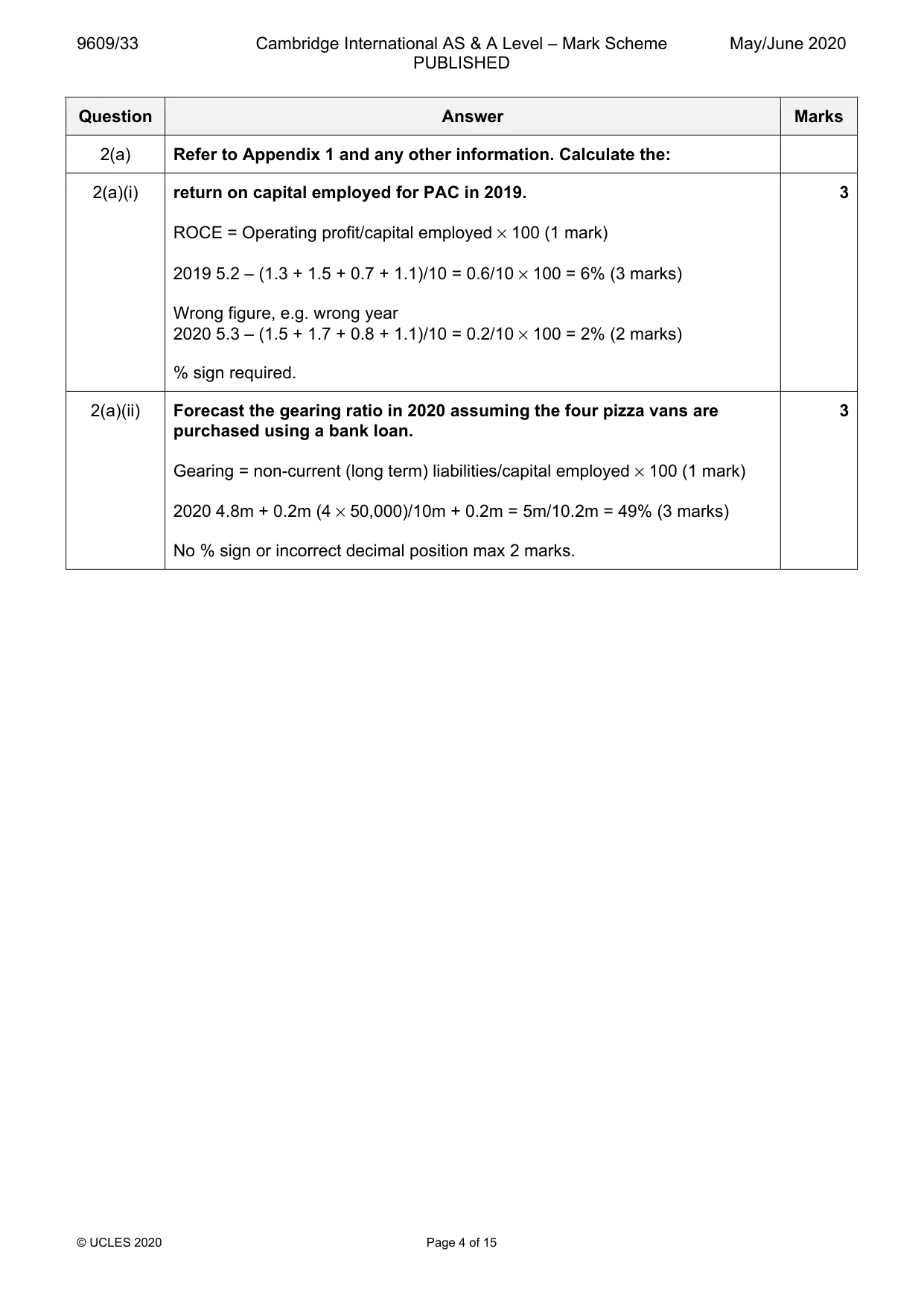
9609/33 Cambridge International AS & A Level – Mark Scheme PUBLISHED May/June 2020 © UCLES 2020 Page 4 of 15 Question Answer Marks 2(a) Refer to Appendix 1 and any other information. Calculate the: 2(a)(i) return on capital employed for PAC in 2019. ROCE = Operating profit/capital employed × 100 (1 mark) 2019 5.2 – (1.3 + 1.5 + 0.7 + 1.1)/10 = 0.6/10 × 100 = 6% (3 marks) Wrong figure, e.g. wrong year 2020 5.3 – (1.5 + 1.7 + 0.8 + 1.1)/10 = 0.2/10 × 100 = 2% (2 marks) % sign required. 3 2(a)(ii) Forecast the gearing ratio in 2020 assuming the four pizza vans are purchased using a bank loan. Gearing = non-current (long term) liabilities/capital employed × 100 (1 mark) 2020 4.8m + 0.2m (4 × 50,000)/10m + 0.2m = 5m/10.2m = 49% (3 marks) No % sign or incorrect decimal position max 2 marks. 3
Mark scheme, page 5
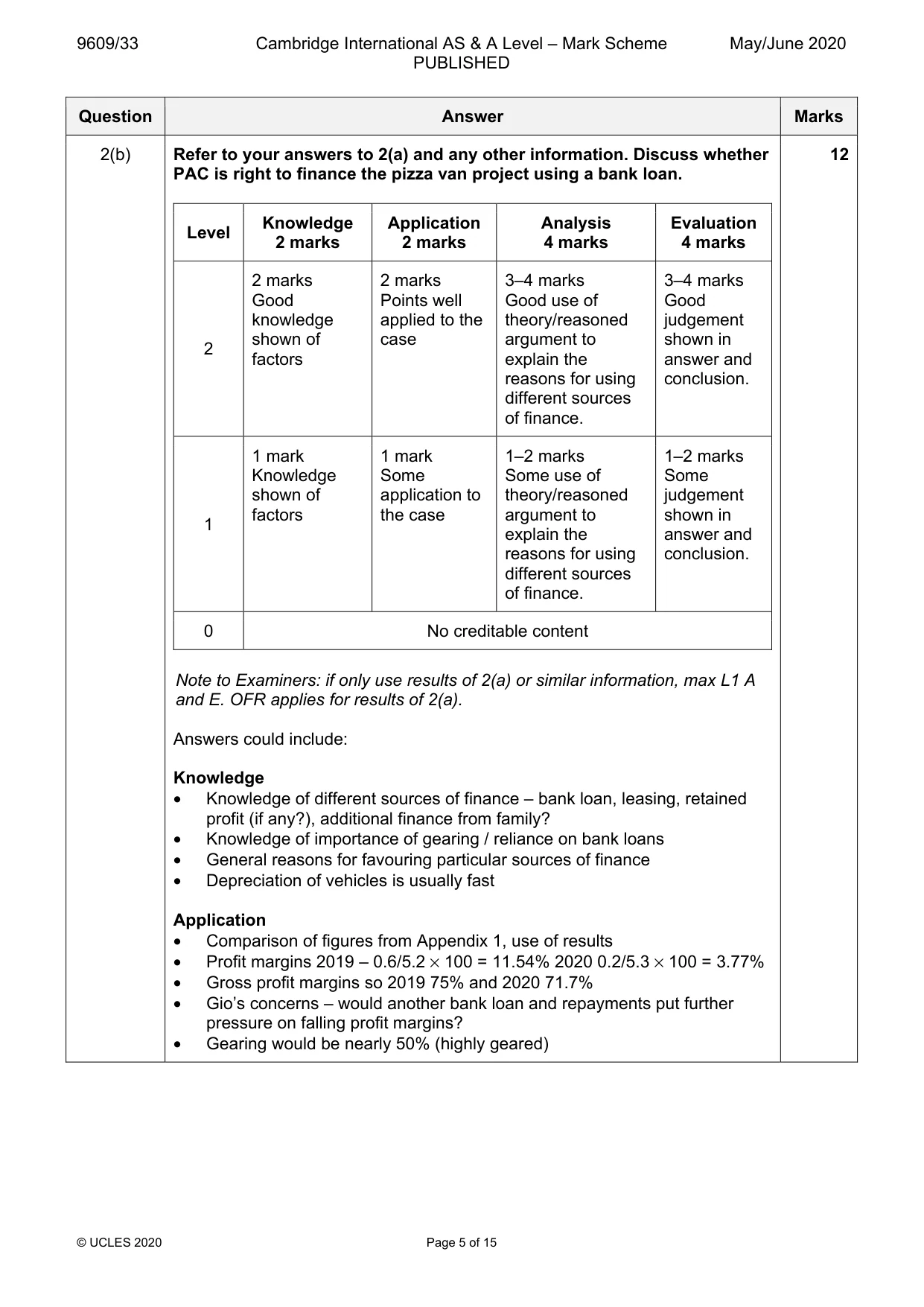
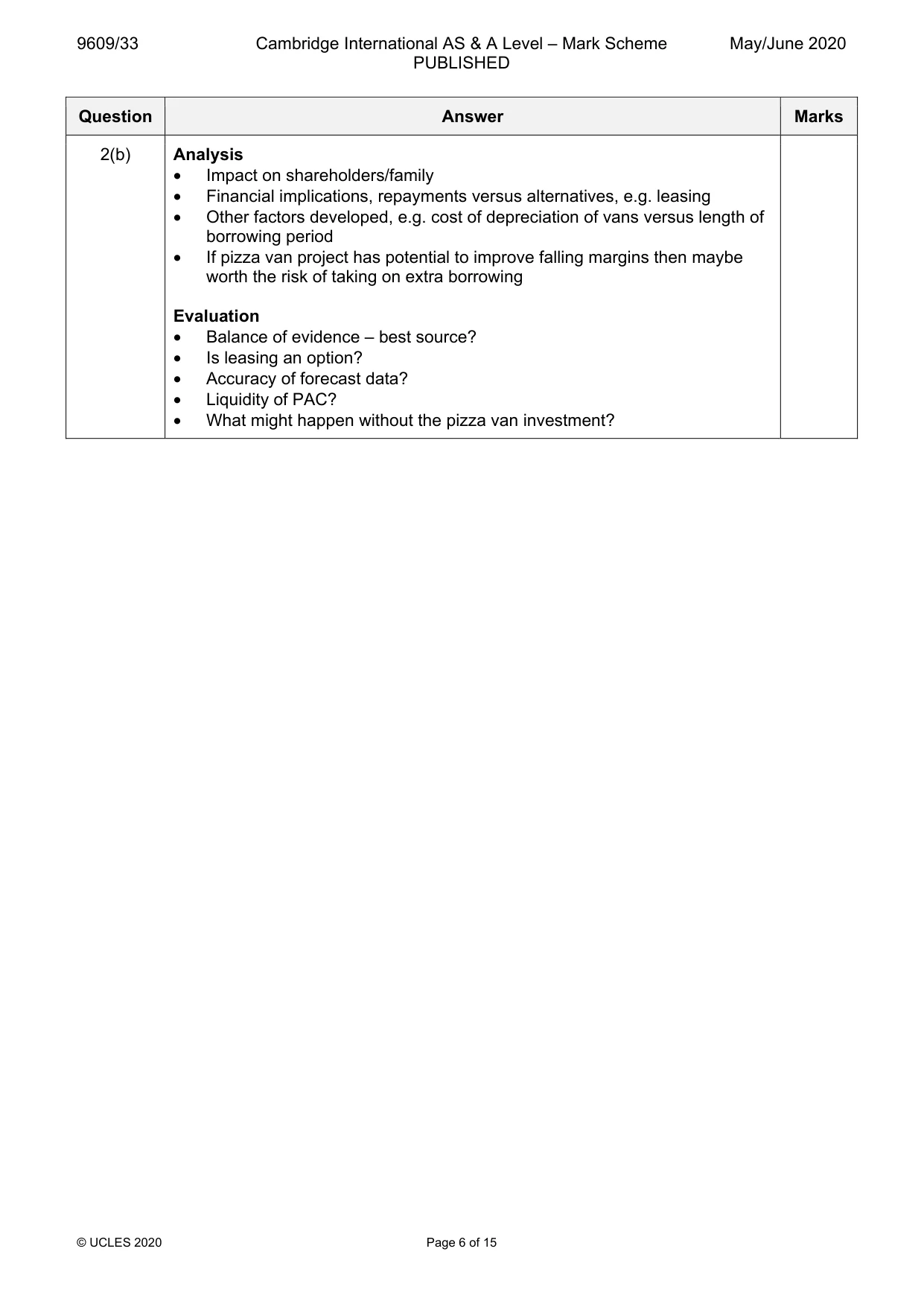
9609/33 Cambridge International AS & A Level – Mark Scheme PUBLISHED May/June 2020 © UCLES 2020 Page 5 of 15 Question Answer Marks 2(b) Refer to your answers to 2(a) and any other information. Discuss whether PAC is right to finance the pizza van project using a bank loan. Level Knowledge 2 marks Application 2 marks Analysis 4 marks Evaluation 4 marks 2 2 marks Good knowledge shown of factors 2 marks Points well applied to the case 3–4 marks Good use of theory/reasoned argument to explain the reasons for using different sources of finance. 3–4 marks Good judgement shown in answer and conclusion. 1 1 mark Knowledge shown of factors 1 mark Some application to the case 1–2 marks Some use of theory/reasoned argument to explain the reasons for using different sources of finance. 1–2 marks Some judgement shown in answer and conclusion. 0 No creditable content Note to Examiners: if only use results of 2(a) or similar information, max L1 A and E. OFR applies for results of 2(a). Answers could include: Knowledge • Knowledge of different sources of finance – bank loan, leasing, retained profit (if any?), additional finance from family? • Knowledge of importance of gearing / reliance on bank loans • General reasons for favouring particular sources of finance • Depreciation of vehicles is usually fast Application • Comparison of figures from Appendix 1, use of results • Profit margins 2019 – 0.6/5.2 × 100 = 11.54% 2020 0.2/5.3 × 100 = 3.77% • Gross profit margins so 2019 75% and 2020 71.7% • Gio’s concerns – would another bank loan and repayments put further pressure on falling profit margins? • Gearing would be nearly 50% (highly geared) 12
Mark scheme, page 6
9609/33 Cambridge International AS & A Level – Mark Scheme PUBLISHED May/June 2020 © UCLES 2020 Page 6 of 15 Question Answer Marks 2(b) Analysis • Impact on shareholders/family • Financial implications, repayments versus alternatives, e.g. leasing • Other factors developed, e.g. cost of depreciation of vans versus length of borrowing period • If pizza van project has potential to improve falling margins then maybe worth the risk of taking on extra borrowing Evaluation • Balance of evidence – best source? • Is leasing an option? • Accuracy of forecast data? • Liquidity of PAC? • What might happen without the pizza van investment?
Mark scheme, page 7
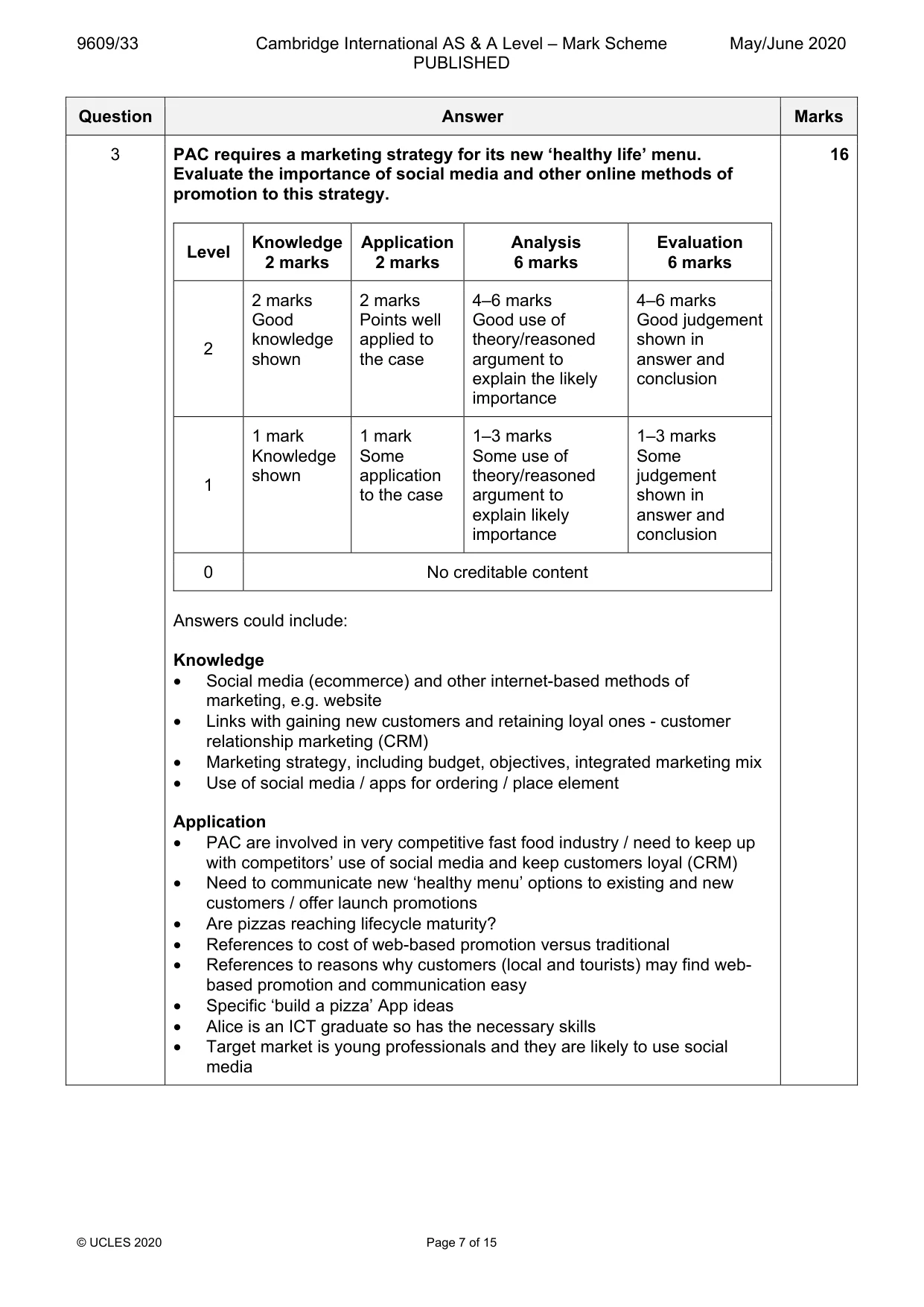
9609/33 Cambridge International AS & A Level – Mark Scheme PUBLISHED May/June 2020 © UCLES 2020 Page 7 of 15 Question Answer Marks 3 PAC requires a marketing strategy for its new ‘healthy life’ menu. Evaluate the importance of social media and other online methods of promotion to this strategy. Level Knowledge 2 marks Application 2 marks Analysis 6 marks Evaluation 6 marks 2 2 marks Good knowledge shown 2 marks Points well applied to the case 4–6 marks Good use of theory/reasoned argument to explain the likely importance 4–6 marks Good judgement shown in answer and conclusion 1 1 mark Knowledge shown 1 mark Some application to the case 1–3 marks Some use of theory/reasoned argument to explain likely importance 1–3 marks Some judgement shown in answer and conclusion 0 No creditable content Answers could include: Knowledge • Social media (ecommerce) and other internet-based methods of marketing, e.g. website • Links with gaining new customers and retaining loyal ones - customer relationship marketing (CRM) • Marketing strategy, including budget, objectives, integrated marketing mix • Use of social media / apps for ordering / place element Application • PAC are involved in very competitive fast food industry / need to keep up with competitors’ use of social media and keep customers loyal (CRM) • Need to communicate new ‘healthy menu’ options to existing and new customers / offer launch promotions • Are pizzas reaching lifecycle maturity? • References to cost of web-based promotion versus traditional • References to reasons why customers (local and tourists) may find web- based promotion and communication easy • Specific ‘build a pizza’ App ideas • Alice is an ICT graduate so has the necessary skills • Target market is young professionals and they are likely to use social media 16
Mark scheme, page 8
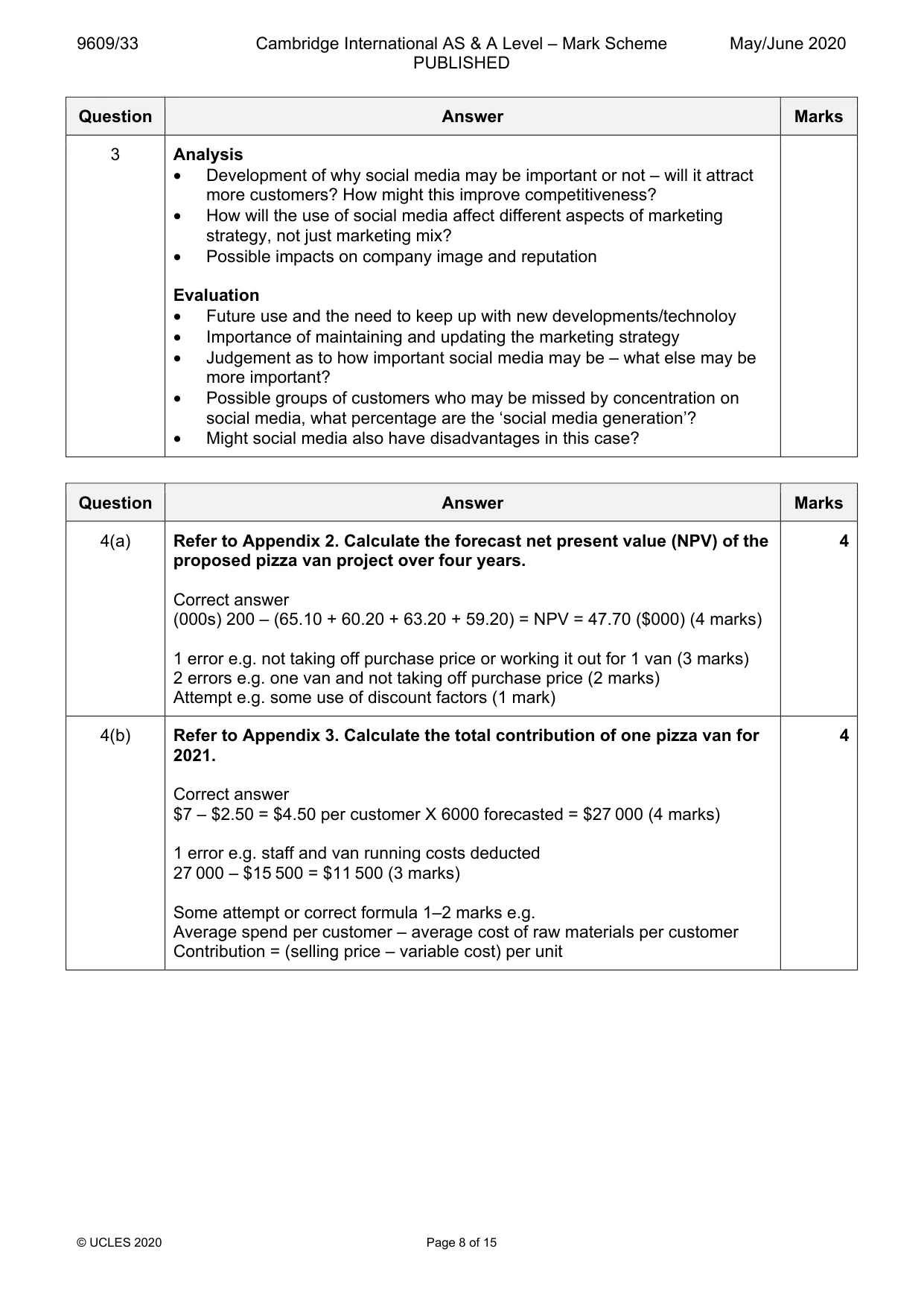
9609/33 Cambridge International AS & A Level – Mark Scheme PUBLISHED May/June 2020 © UCLES 2020 Page 8 of 15 Question Answer Marks 3 Analysis • Development of why social media may be important or not – will it attract more customers? How might this improve competitiveness? • How will the use of social media affect different aspects of marketing strategy, not just marketing mix? • Possible impacts on company image and reputation Evaluation • Future use and the need to keep up with new developments/technoloy • Importance of maintaining and updating the marketing strategy • Judgement as to how important social media may be – what else may be more important? • Possible groups of customers who may be missed by concentration on social media, what percentage are the ‘social media generation’? • Might social media also have disadvantages in this case? Question Answer Marks 4(a) Refer to Appendix 2. Calculate the forecast net present value (NPV) of the proposed pizza van project over four years. Correct answer (000s) 200 – (65.10 + 60.20 + 63.20 + 59.20) = NPV = 47.70 ($000) (4 marks) 1 error e.g. not taking off purchase price or working it out for 1 van (3 marks) 2 errors e.g. one van and not taking off purchase price (2 marks) Attempt e.g. some use of discount factors (1 mark) 4 4(b) Refer to Appendix 3. Calculate the total contribution of one pizza van for 2021. Correct answer $7 – $2.50 = $4.50 per customer X 6000 forecasted = $27 000 (4 marks) 1 error e.g. staff and van running costs deducted 27 000 – $15 500 = $11 500 (3 marks) Some attempt or correct formula 1–2 marks e.g. Average spend per customer – average cost of raw materials per customer Contribution = (selling price – variable cost) per unit 4
Mark scheme, page 9
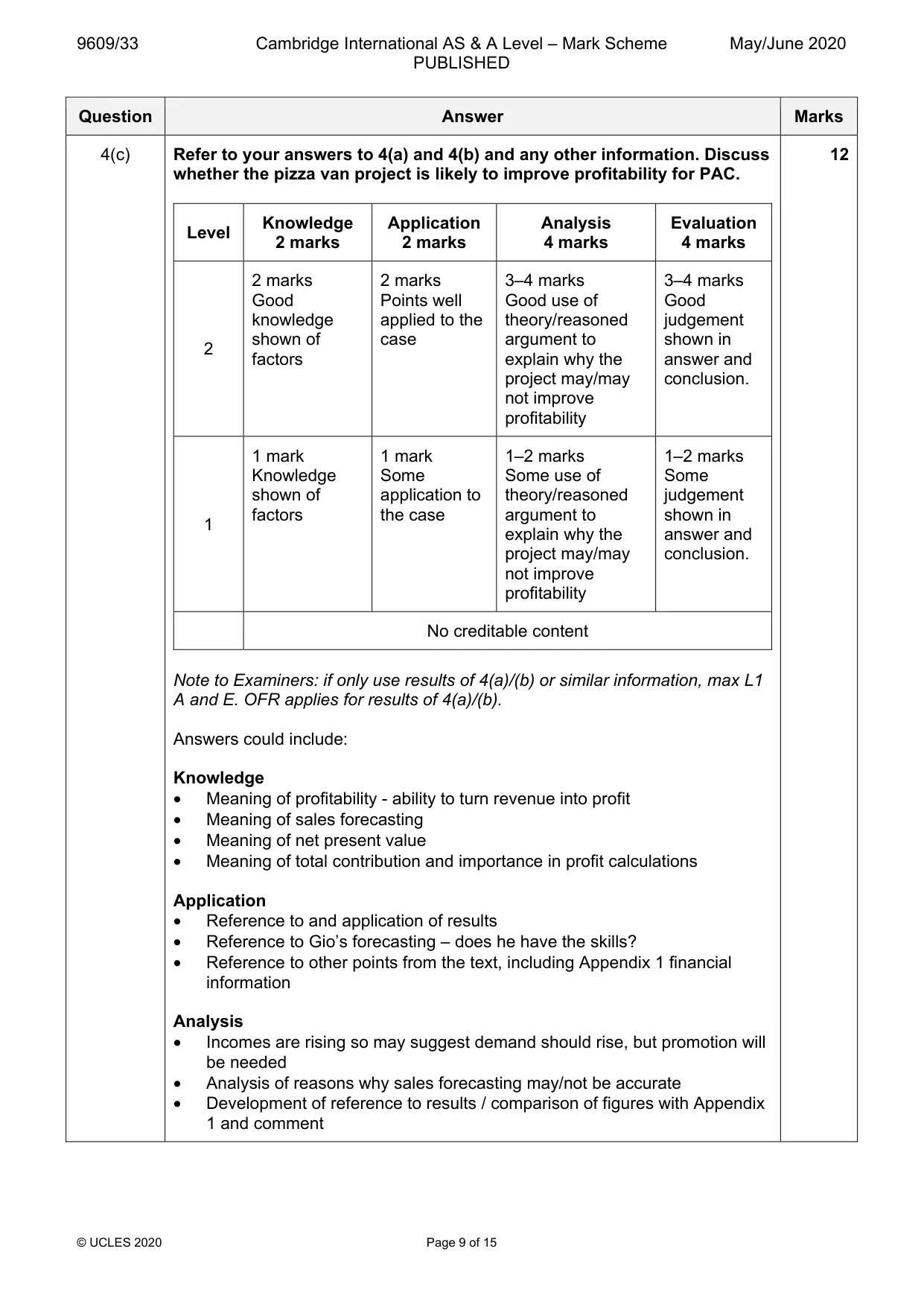
9609/33 Cambridge International AS & A Level – Mark Scheme PUBLISHED May/June 2020 © UCLES 2020 Page 9 of 15 Question Answer Marks 4(c) Refer to your answers to 4(a) and 4(b) and any other information. Discuss whether the pizza van project is likely to improve profitability for PAC. Level Knowledge 2 marks Application 2 marks Analysis 4 marks Evaluation 4 marks 2 2 marks Good knowledge shown of factors 2 marks Points well applied to the case 3–4 marks Good use of theory/reasoned argument to explain why the project may/may not improve profitability 3–4 marks Good judgement shown in answer and conclusion. 1 1 mark Knowledge shown of factors 1 mark Some application to the case 1–2 marks Some use of theory/reasoned argument to explain why the project may/may not improve profitability 1–2 marks Some judgement shown in answer and conclusion. No creditable content Note to Examiners: if only use results of 4(a)/(b) or similar information, max L1 A and E. OFR applies for results of 4(a)/(b). Answers could include: Knowledge • Meaning of profitability - ability to turn revenue into profit • Meaning of sales forecasting • Meaning of net present value • Meaning of total contribution and importance in profit calculations Application • Reference to and application of results • Reference to Gio’s forecasting – does he have the skills? • Reference to other points from the text, including Appendix 1 financial information Analysis • Incomes are rising so may suggest demand should rise, but promotion will be needed • Analysis of reasons why sales forecasting may/not be accurate • Development of reference to results / comparison of figures with Appendix 1 and comment 12
Mark scheme, page 10
9609/33 Cambridge International AS & A Level – Mark Scheme PUBLISHED May/June 2020 © UCLES 2020 Page 10 of 15 Question Answer Marks 4(c) Evaluation • Improve profitability or not? • Short/long term? • To what extent might sales forecasts prove inaccurate? Why?
Mark scheme, page 11
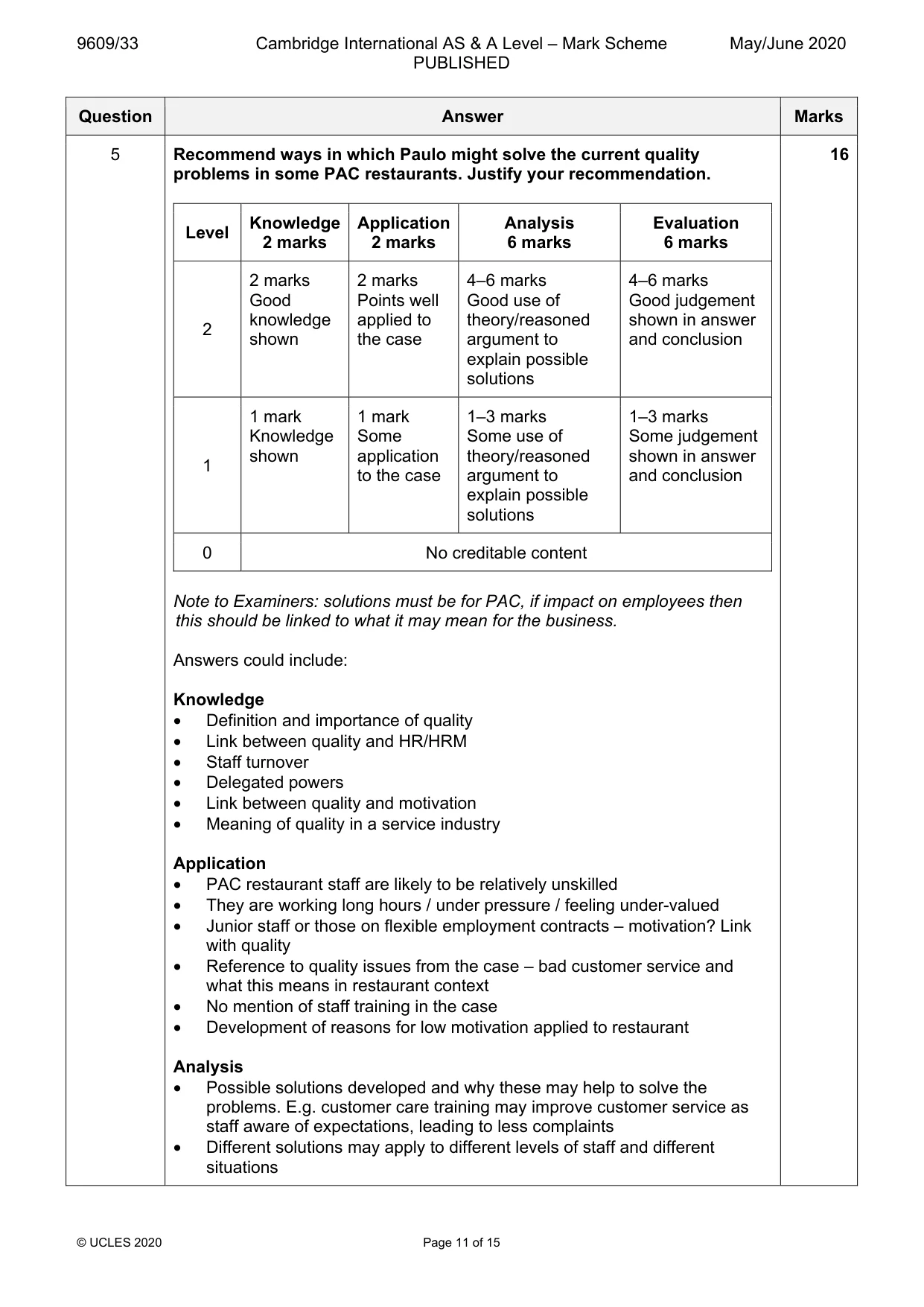
9609/33 Cambridge International AS & A Level – Mark Scheme PUBLISHED May/June 2020 © UCLES 2020 Page 11 of 15 Question Answer Marks 5 Recommend ways in which Paulo might solve the current quality problems in some PAC restaurants. Justify your recommendation. Level Knowledge 2 marks Application 2 marks Analysis 6 marks Evaluation 6 marks 2 2 marks Good knowledge shown 2 marks Points well applied to the case 4–6 marks Good use of theory/reasoned argument to explain possible solutions 4–6 marks Good judgement shown in answer and conclusion 1 1 mark Knowledge shown 1 mark Some application to the case 1–3 marks Some use of theory/reasoned argument to explain possible solutions 1–3 marks Some judgement shown in answer and conclusion 0 No creditable content Note to Examiners: solutions must be for PAC, if impact on employees then this should be linked to what it may mean for the business. Answers could include: Knowledge • Definition and importance of quality • Link between quality and HR/HRM • Staff turnover • Delegated powers • Link between quality and motivation • Meaning of quality in a service industry Application • PAC restaurant staff are likely to be relatively unskilled • They are working long hours / under pressure / feeling under-valued • Junior staff or those on flexible employment contracts – motivation? Link with quality • Reference to quality issues from the case – bad customer service and what this means in restaurant context • No mention of staff training in the case • Development of reasons for low motivation applied to restaurant Analysis • Possible solutions developed and why these may help to solve the problems. E.g. customer care training may improve customer service as staff aware of expectations, leading to less complaints • Different solutions may apply to different levels of staff and different situations 16
Mark scheme, page 12
9609/33 Cambridge International AS & A Level – Mark Scheme PUBLISHED May/June 2020 © UCLES 2020 Page 12 of 15 Question Answer Marks 5 • How could food poisoning have been prevented? • Could ERP software help with staffing, take some pressure off? • TQM related solutions Evaluation • Essential to solve problems as customers may be lost / company could be sued • Long term effect of better staff motivation / lower staff turnover • Management delegation issues • Relationship with management team issues • Are some complaints inevitable in a busy restaurant context?
Mark scheme, page 13
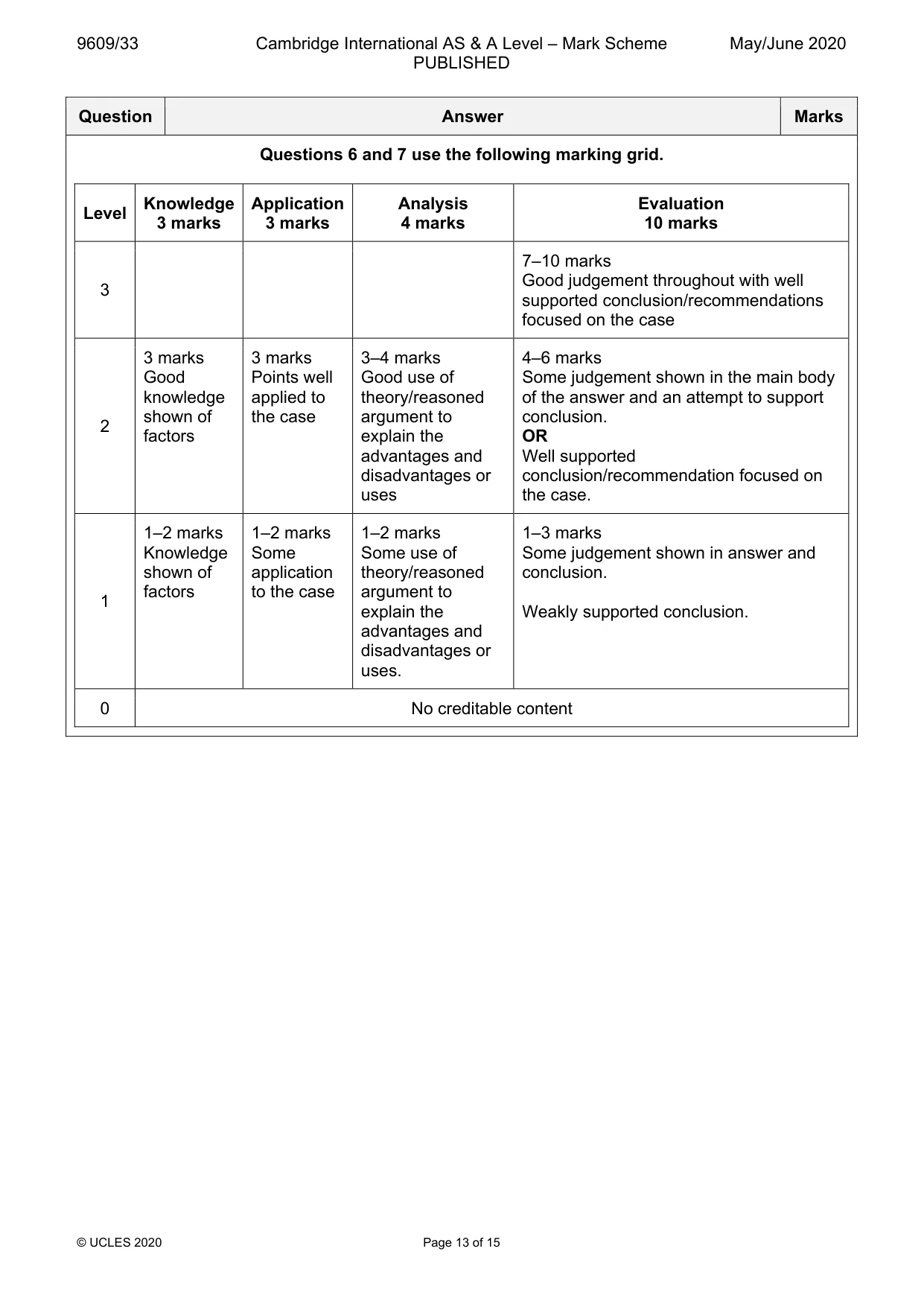
9609/33 Cambridge International AS & A Level – Mark Scheme PUBLISHED May/June 2020 © UCLES 2020 Page 13 of 15 Question Answer Marks Questions 6 and 7 use the following marking grid. Level Knowledge 3 marks Application 3 marks Analysis 4 marks Evaluation 10 marks 3 7–10 marks Good judgement throughout with well supported conclusion/recommendations focused on the case 2 3 marks Good knowledge shown of factors 3 marks Points well applied to the case 3–4 marks Good use of theory/reasoned argument to explain the advantages and disadvantages or uses 4–6 marks Some judgement shown in the main body of the answer and an attempt to support conclusion. OR Well supported conclusion/recommendation focused on the case. 1 1–2 marks Knowledge shown of factors 1–2 marks Some application to the case 1–2 marks Some use of theory/reasoned argument to explain the advantages and disadvantages or uses. 1–3 marks Some judgement shown in answer and conclusion. Weakly supported conclusion. 0 No creditable content
Mark scheme, page 14
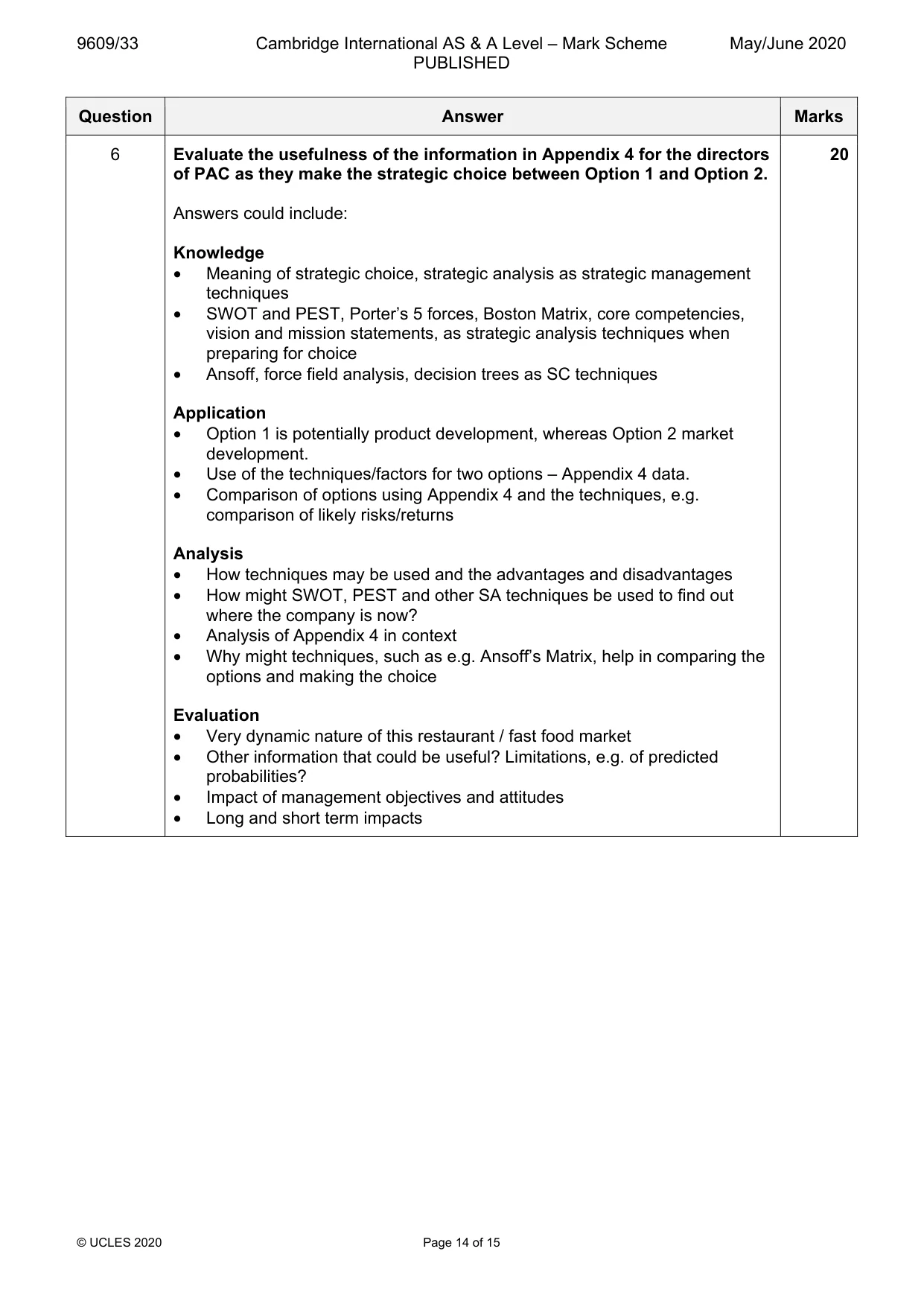
9609/33 Cambridge International AS & A Level – Mark Scheme PUBLISHED May/June 2020 © UCLES 2020 Page 14 of 15 Question Answer Marks 6 Evaluate the usefulness of the information in Appendix 4 for the directors of PAC as they make the strategic choice between Option 1 and Option 2. Answers could include: Knowledge • Meaning of strategic choice, strategic analysis as strategic management techniques • SWOT and PEST, Porter’s 5 forces, Boston Matrix, core competencies, vision and mission statements, as strategic analysis techniques when preparing for choice • Ansoff, force field analysis, decision trees as SC techniques Application • Option 1 is potentially product development, whereas Option 2 market development. • Use of the techniques/factors for two options – Appendix 4 data. • Comparison of options using Appendix 4 and the techniques, e.g. comparison of likely risks/returns Analysis • How techniques may be used and the advantages and disadvantages • How might SWOT, PEST and other SA techniques be used to find out where the company is now? • Analysis of Appendix 4 in context • Why might techniques, such as e.g. Ansoff’s Matrix, help in comparing the options and making the choice Evaluation • Very dynamic nature of this restaurant / fast food market • Other information that could be useful? Limitations, e.g. of predicted probabilities? • Impact of management objectives and attitudes • Long and short term impacts 20
Mark scheme, page 15
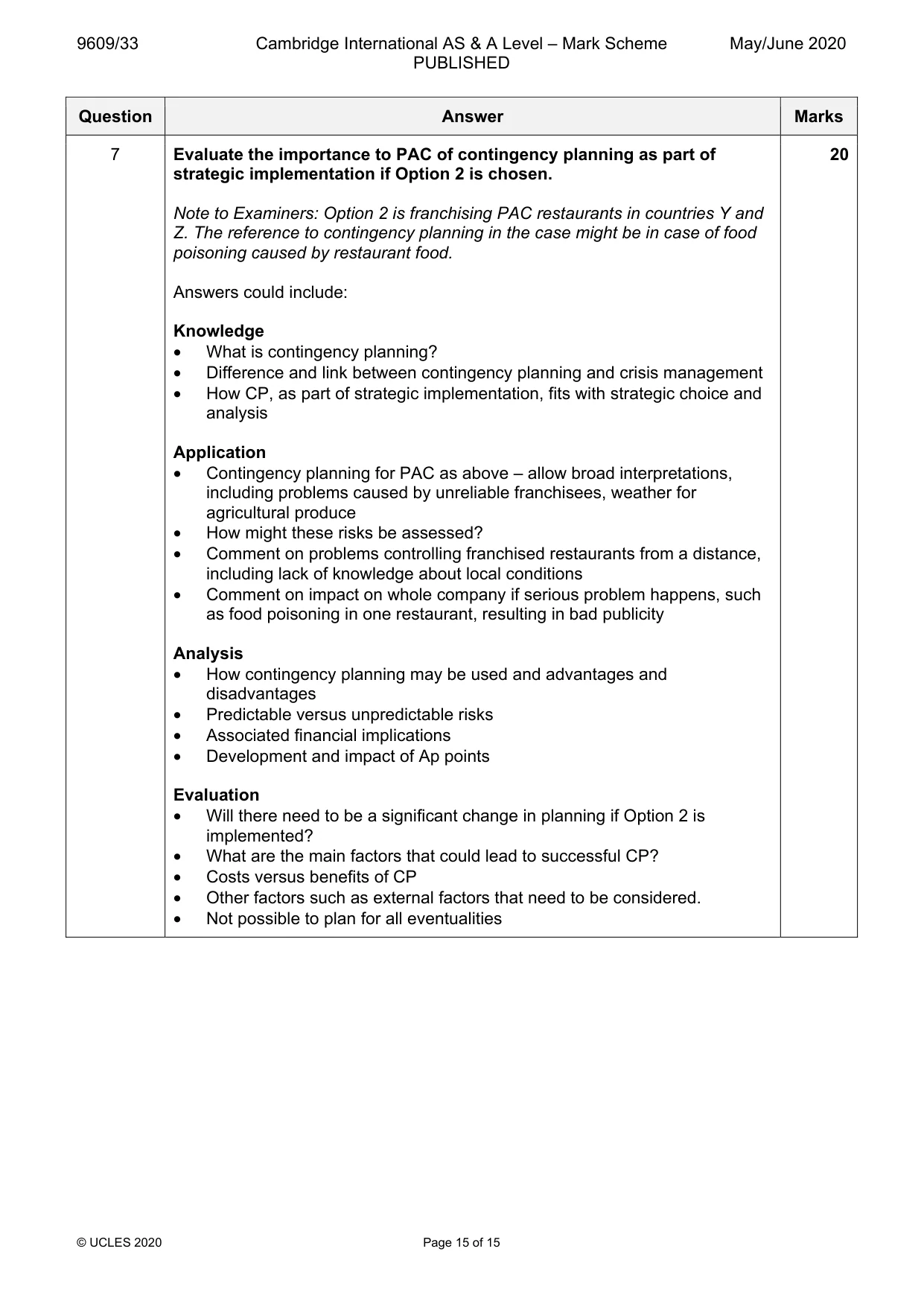
9609/33 Cambridge International AS & A Level – Mark Scheme PUBLISHED May/June 2020 © UCLES 2020 Page 15 of 15 Question Answer Marks 7 Evaluate the importance to PAC of contingency planning as part of strategic implementation if Option 2 is chosen. Note to Examiners: Option 2 is franchising PAC restaurants in countries Y and Z. The reference to contingency planning in the case might be in case of food poisoning caused by restaurant food. Answers could include: Knowledge • What is contingency planning? • Difference and link between contingency planning and crisis management • How CP, as part of strategic implementation, fits with strategic choice and analysis Application • Contingency planning for PAC as above – allow broad interpretations, including problems caused by unreliable franchisees, weather for agricultural produce • How might these risks be assessed? • Comment on problems controlling franchised restaurants from a distance, including lack of knowledge about local conditions • Comment on impact on whole company if serious problem happens, such as food poisoning in one restaurant, resulting in bad publicity Analysis • How contingency planning may be used and advantages and disadvantages • Predictable versus unpredictable risks • Associated financial implications • Development and impact of Ap points Evaluation • Will there need to be a significant change in planning if Option 2 is implemented? • What are the main factors that could lead to successful CP? • Costs versus benefits of CP • Other factors such as external factors that need to be considered. • Not possible to plan for all eventualities 20