Cambridge A Level Business (for first examination in 2016) 9609 — 2020 Feb/March Paper 1 · Variant 2
9609/12/F/M/20 · 40 marks · ≈45 min
The question paper and its mark scheme, free to read here and free to download. This is Cambridge’s own paper, exactly as it was sat.
Question paper4 pages


Mark scheme17 pages
Answers below. Sit the paper first if you are practising.
Paper as text
Question paper, page 1
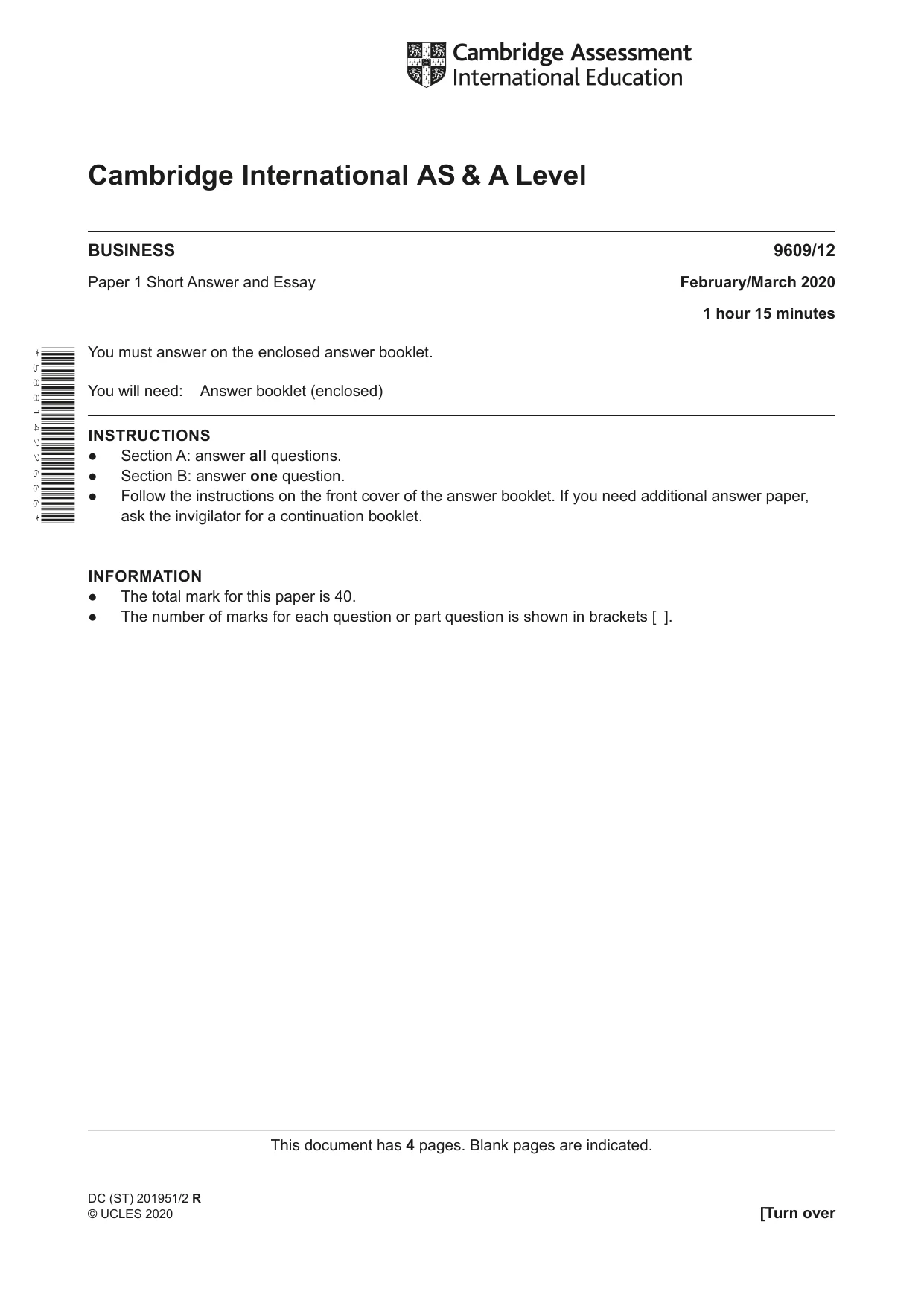
Cambridge International AS & A Level This document has 4 pages. Blank pages are indicated. DC (ST) 201951/2 R © UCLES 2020 [Turn over * 5 8 8 1 4 2 2 6 6 6 * BUSINESS 9609/12 Paper 1 Short Answer and Essay February/March 2020 1 hour 15 minutes You must answer on the enclosed answer booklet. You will need: Answer booklet (enclosed) INSTRUCTIONS ● Section A: answer all questions. ● Section B: answer one question. ● Follow the instructions on the front cover of the answer booklet. If you need additional answer paper, ask the invigilator for a continuation booklet. INFORMATION ● The total mark for this paper is 40. ● The number of marks for each question or part question is shown in brackets [ ].
Question paper, page 2
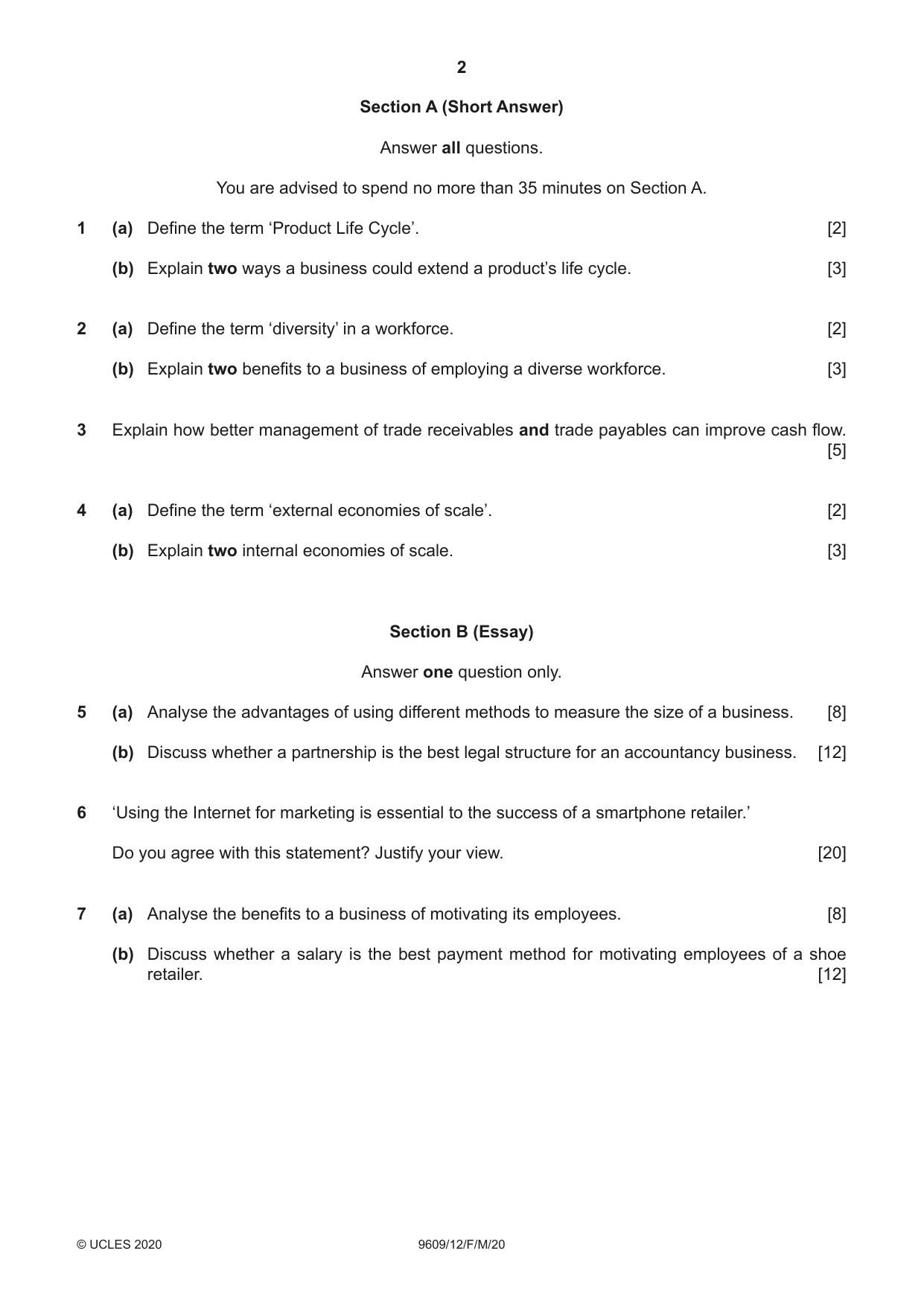
2 9609/12/F/M/20 © UCLES 2020 Section A (Short Answer) Answer all questions. You are advised to spend no more than 35 minutes on Section A. 1 (a) Define the term ‘Product Life Cycle’. [2] (b) Explain two ways a business could extend a product’s life cycle. [3] 2 (a) Define the term ‘diversity’ in a workforce. [2] (b) Explain two benefits to a business of employing a diverse workforce. [3] 3 Explain how better management of trade receivables and trade payables can improve cash flow. [5] 4 (a) Define the term ‘external economies of scale’. [2] (b) Explain two internal economies of scale. [3] Section B (Essay) Answer one question only. 5 (a) Analyse the advantages of using different methods to measure the size of a business. [8] (b) Discuss whether a partnership is the best legal structure for an accountancy business. [12] 6 ‘Using the Internet for marketing is essential to the success of a smartphone retailer.’ Do you agree with this statement? Justify your view. [20] 7 (a) Analyse the benefits to a business of motivating its employees. [8] (b) Discuss whether a salary is the best payment method for motivating employees of a shoe retailer. [12]
Question paper, page 3
3 9609/12/F/M/20 © UCLES 2020 BLANK PAGE
Question paper, page 4
4 9609/12/F/M/20 © UCLES 2020 Permission to reproduce items where third-party owned material protected by copyright is included has been sought and cleared where possible. Every reasonable effort has been made by the publisher (UCLES) to trace copyright holders, but if any items requiring clearance have unwittingly been included, the publisher will be pleased to make amends at the earliest possible opportunity. To avoid the issue of disclosure of answer-related information to candidates, all copyright acknowledgements are reproduced online in the Cambridge Assessment International Education Copyright Acknowledgements Booklet. This is produced for each series of examinations and is freely available to download at www.cambridgeinternational.org after the live examination series. Cambridge Assessment International Education is part of the Cambridge Assessment Group. Cambridge Assessment is the brand name of the University of Cambridge Local Examinations Syndicate (UCLES), which itself is a department of the University of Cambridge. BLANK PAGE
Mark scheme, page 1
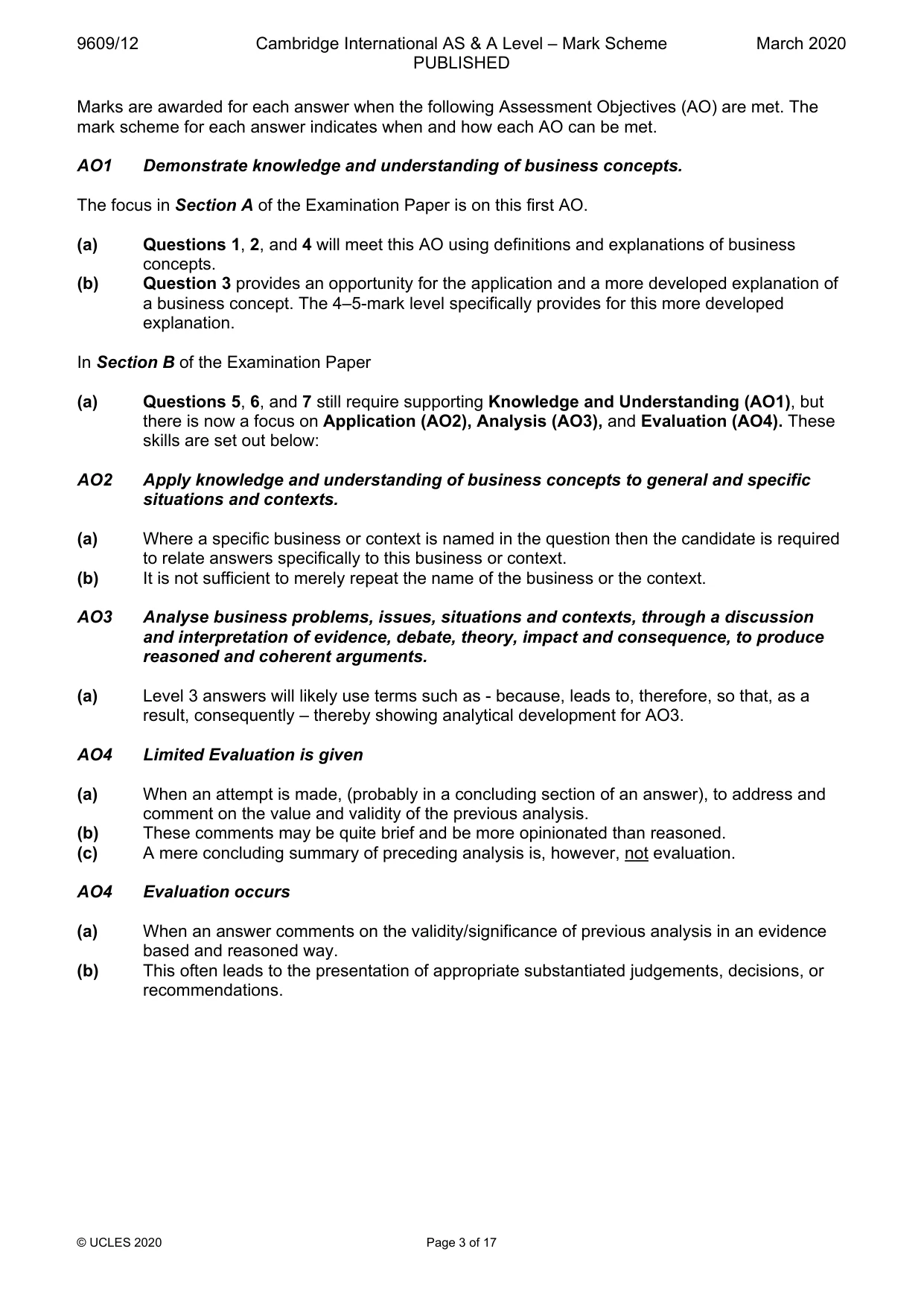
This document consists of 17 printed pages. © UCLES 2020 [Turn over Cambridge International AS & A Level BUSINESS 9609/12 Paper 1 Short Answer and Essay March 2020 MARK SCHEME Maximum Mark: 40 Published This mark scheme is published as an aid to teachers and candidates, to indicate the requirements of the examination. It shows the basis on which Examiners were instructed to award marks. It does not indicate the details of the discussions that took place at an Examiners’ meeting before marking began, which would have considered the acceptability of alternative answers. Mark schemes should be read in conjunction with the question paper and the Principal Examiner Report for Teachers. Cambridge International will not enter into discussions about these mark schemes. Cambridge International is publishing the mark schemes for the March 2020 series for most Cambridge IGCSE™, Cambridge International A and AS Level components and some Cambridge O Level components.
Mark scheme, page 2
9609/12 Cambridge International AS & A Level – Mark Scheme PUBLISHED March 2020 © UCLES 2020 Page 2 of 17 Generic Marking Principles These general marking principles must be applied by all examiners when marking candidate answers. They should be applied alongside the specific content of the mark scheme or generic level descriptors for a question. Each question paper and mark scheme will also comply with these marking principles. GENERIC MARKING PRINCIPLE 1: Marks must be awarded in line with: • the specific content of the mark scheme or the generic level descriptors for the question • the specific skills defined in the mark scheme or in the generic level descriptors for the question • the standard of response required by a candidate as exemplified by the standardisation scripts. GENERIC MARKING PRINCIPLE 2: Marks awarded are always whole marks (not half marks, or other fractions). GENERIC MARKING PRINCIPLE 3: Marks must be awarded positively: • marks are awarded for correct/valid answers, as defined in the mark scheme. However, credit is given for valid answers which go beyond the scope of the syllabus and mark scheme, referring to your Team Leader as appropriate • marks are awarded when candidates clearly demonstrate what they know and can do • marks are not deducted for errors • marks are not deducted for omissions • answers should only be judged on the quality of spelling, punctuation and grammar when these features are specifically assessed by the question as indicated by the mark scheme. The meaning, however, should be unambiguous. GENERIC MARKING PRINCIPLE 4: Rules must be applied consistently e.g. in situations where candidates have not followed instructions or in the application of generic level descriptors. GENERIC MARKING PRINCIPLE 5: Marks should be awarded using the full range of marks defined in the mark scheme for the question (however; the use of the full mark range may be limited according to the quality of the candidate responses seen). GENERIC MARKING PRINCIPLE 6: Marks awarded are based solely on the requirements as defined in the mark scheme. Marks should not be awarded with grade thresholds or grade descriptors in mind.
Mark scheme, page 3
9609/12 Cambridge International AS & A Level – Mark Scheme PUBLISHED March 2020 © UCLES 2020 Page 3 of 17 Marks are awarded for each answer when the following Assessment Objectives (AO) are met. The mark scheme for each answer indicates when and how each AO can be met. AO1 Demonstrate knowledge and understanding of business concepts. The focus in Section A of the Examination Paper is on this first AO. (a) Questions 1, 2, and 4 will meet this AO using definitions and explanations of business concepts. (b) Question 3 provides an opportunity for the application and a more developed explanation of a business concept. The 4–5-mark level specifically provides for this more developed explanation. In Section B of the Examination Paper (a) Questions 5, 6, and 7 still require supporting Knowledge and Understanding (AO1), but there is now a focus on Application (AO2), Analysis (AO3), and Evaluation (AO4). These skills are set out below: AO2 Apply knowledge and understanding of business concepts to general and specific situations and contexts. (a) Where a specific business or context is named in the question then the candidate is required to relate answers specifically to this business or context. (b) It is not sufficient to merely repeat the name of the business or the context. AO3 Analyse business problems, issues, situations and contexts, through a discussion and interpretation of evidence, debate, theory, impact and consequence, to produce reasoned and coherent arguments. (a) Level 3 answers will likely use terms such as - because, leads to, therefore, so that, as a result, consequently – thereby showing analytical development for AO3. AO4 Limited Evaluation is given (a) When an attempt is made, (probably in a concluding section of an answer), to address and comment on the value and validity of the previous analysis. (b) These comments may be quite brief and be more opinionated than reasoned. (c) A mere concluding summary of preceding analysis is, however, not evaluation. AO4 Evaluation occurs (a) When an answer comments on the validity/significance of previous analysis in an evidence based and reasoned way. (b) This often leads to the presentation of appropriate substantiated judgements, decisions, or recommendations.
Mark scheme, page 4
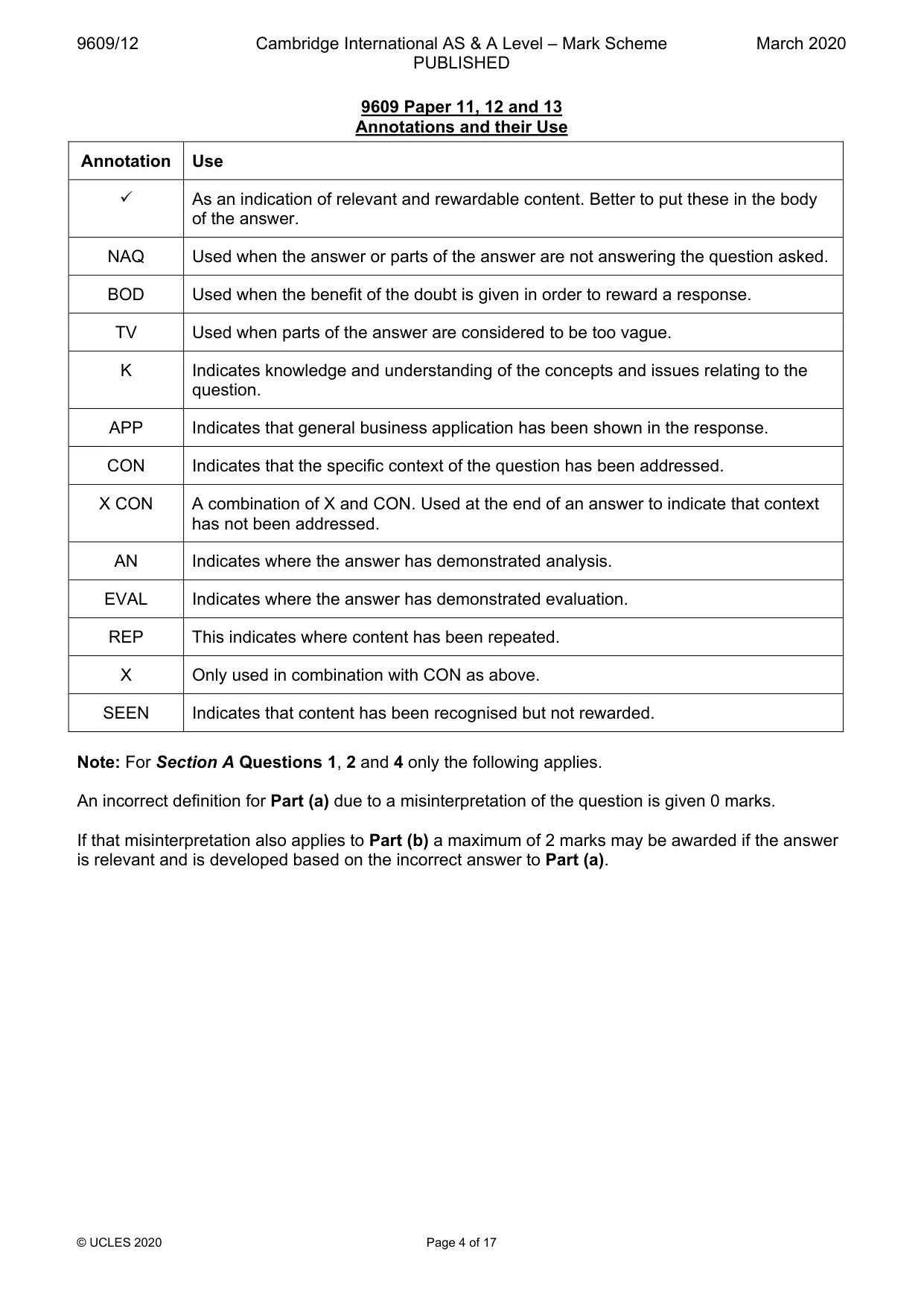
9609/12 Cambridge International AS & A Level – Mark Scheme PUBLISHED March 2020 © UCLES 2020 Page 4 of 17 9609 Paper 11, 12 and 13 Annotations and their Use Annotation Use As an indication of relevant and rewardable content. Better to put these in the body of the answer. NAQ Used when the answer or parts of the answer are not answering the question asked. BOD Used when the benefit of the doubt is given in order to reward a response. TV Used when parts of the answer are considered to be too vague. K Indicates knowledge and understanding of the concepts and issues relating to the question. APP Indicates that general business application has been shown in the response. CON Indicates that the specific context of the question has been addressed. X CON A combination of X and CON. Used at the end of an answer to indicate that context has not been addressed. AN Indicates where the answer has demonstrated analysis. EVAL Indicates where the answer has demonstrated evaluation. REP This indicates where content has been repeated. X Only used in combination with CON as above. SEEN Indicates that content has been recognised but not rewarded. Note: For Section A Questions 1, 2 and 4 only the following applies. An incorrect definition for Part (a) due to a misinterpretation of the question is given 0 marks. If that misinterpretation also applies to Part (b) a maximum of 2 marks may be awarded if the answer is relevant and is developed based on the incorrect answer to Part (a).
Mark scheme, page 5
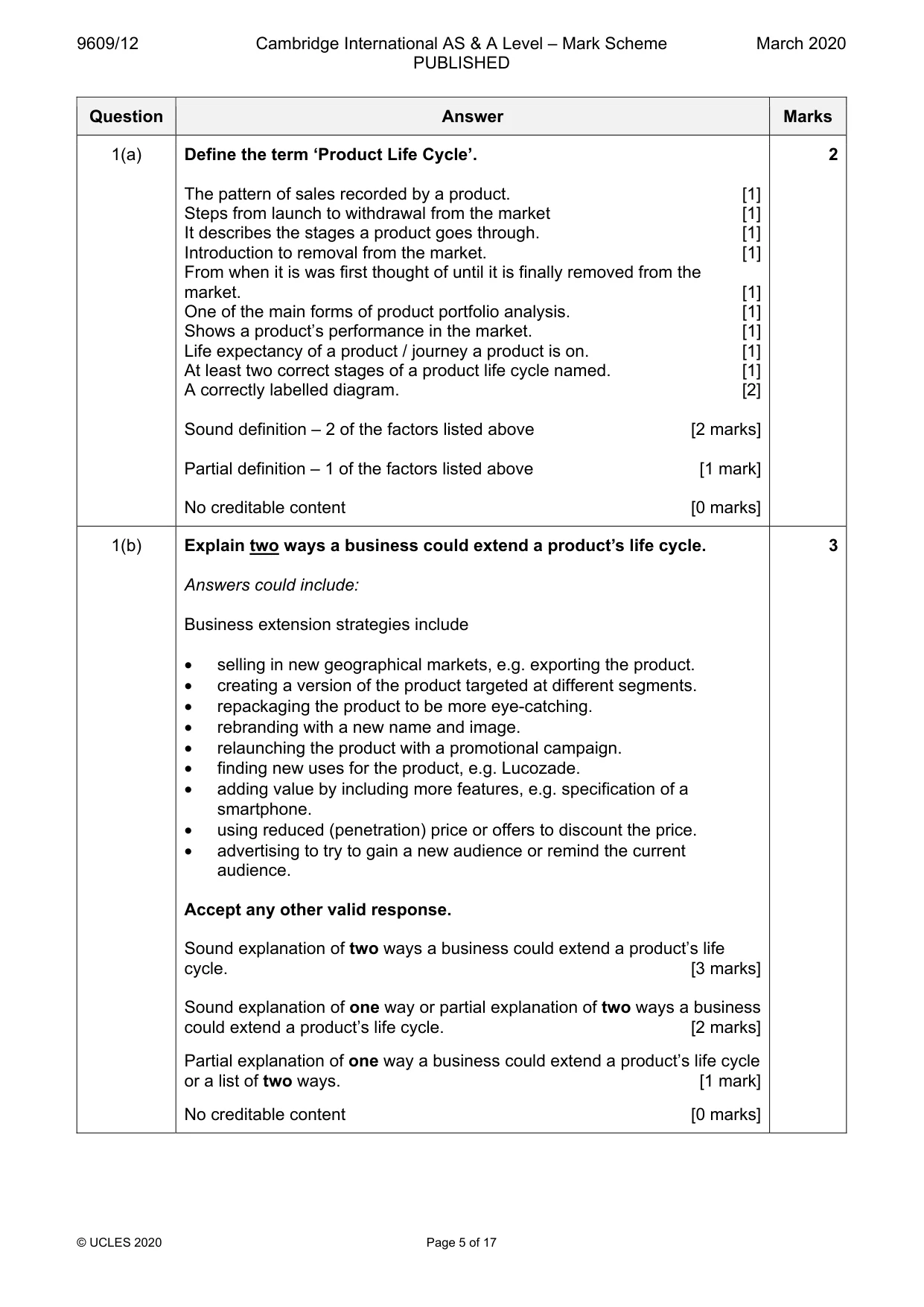
9609/12 Cambridge International AS & A Level – Mark Scheme PUBLISHED March 2020 © UCLES 2020 Page 5 of 17 Question Answer Marks 1(a) Define the term ‘Product Life Cycle’. The pattern of sales recorded by a product. [1] Steps from launch to withdrawal from the market [1] It describes the stages a product goes through. [1] Introduction to removal from the market. [1] From when it is was first thought of until it is finally removed from the market. [1] One of the main forms of product portfolio analysis. [1] Shows a product’s performance in the market. [1] Life expectancy of a product / journey a product is on. [1] At least two correct stages of a product life cycle named. [1] A correctly labelled diagram. [2] Sound definition – 2 of the factors listed above [2 marks] Partial definition – 1 of the factors listed above [1 mark] No creditable content [0 marks] 2 1(b) Explain two ways a business could extend a product’s life cycle. Answers could include: Business extension strategies include • selling in new geographical markets, e.g. exporting the product. • creating a version of the product targeted at different segments. • repackaging the product to be more eye-catching. • rebranding with a new name and image. • relaunching the product with a promotional campaign. • finding new uses for the product, e.g. Lucozade. • adding value by including more features, e.g. specification of a smartphone. • using reduced (penetration) price or offers to discount the price. • advertising to try to gain a new audience or remind the current audience. Accept any other valid response. Sound explanation of two ways a business could extend a product’s life cycle. [3 marks] Sound explanation of one way or partial explanation of two ways a business could extend a product’s life cycle. [2 marks] Partial explanation of one way a business could extend a product’s life cycle or a list of two ways. [1 mark] No creditable content [0 marks] 3
Mark scheme, page 6
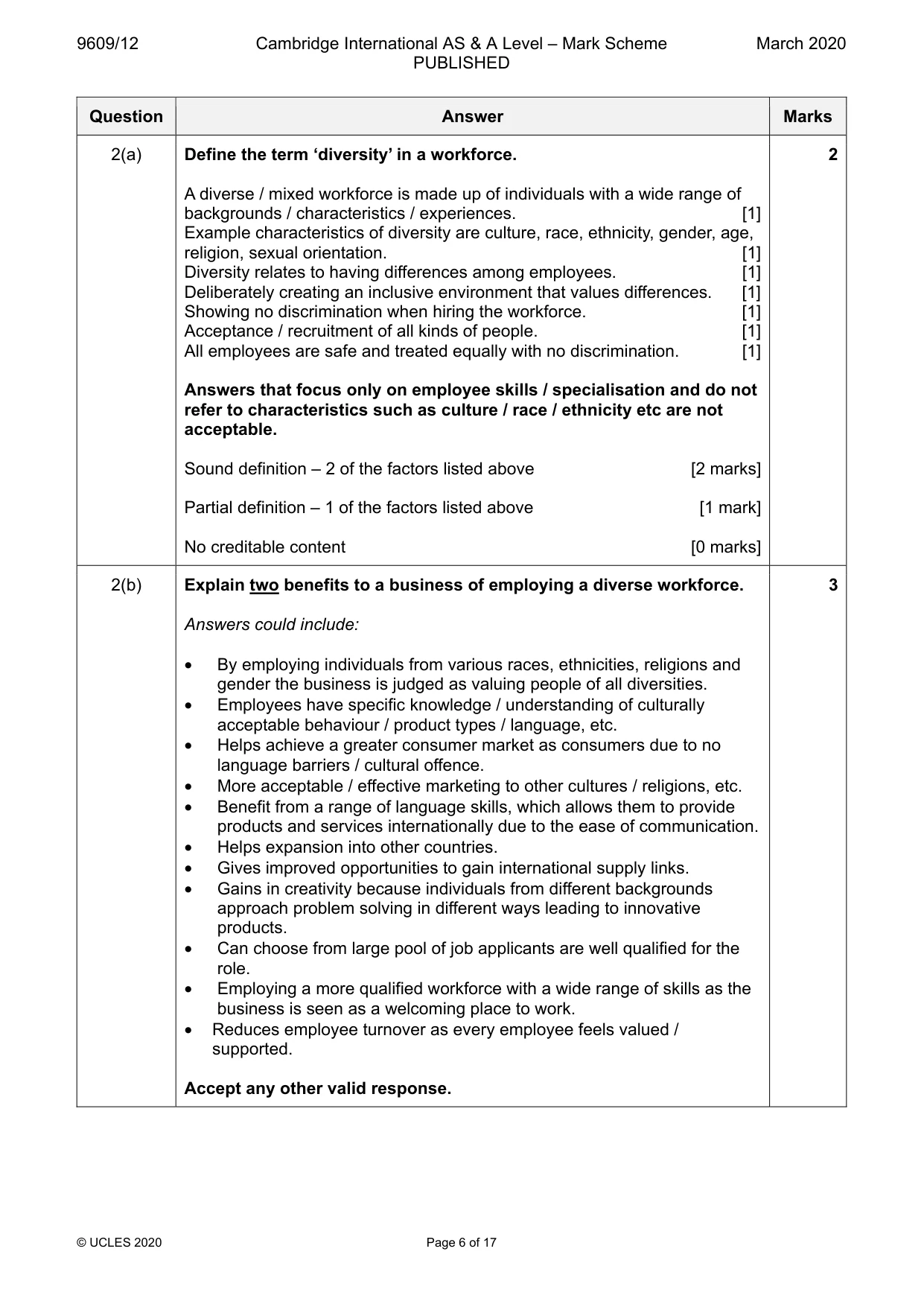
9609/12 Cambridge International AS & A Level – Mark Scheme PUBLISHED March 2020 © UCLES 2020 Page 6 of 17 Question Answer Marks 2(a) Define the term ‘diversity’ in a workforce. A diverse / mixed workforce is made up of individuals with a wide range of backgrounds / characteristics / experiences. [1] Example characteristics of diversity are culture, race, ethnicity, gender, age, religion, sexual orientation. [1] Diversity relates to having differences among employees. [1] Deliberately creating an inclusive environment that values differences. [1] Showing no discrimination when hiring the workforce. [1] Acceptance / recruitment of all kinds of people. [1] All employees are safe and treated equally with no discrimination. [1] Answers that focus only on employee skills / specialisation and do not refer to characteristics such as culture / race / ethnicity etc are not acceptable. Sound definition – 2 of the factors listed above [2 marks] Partial definition – 1 of the factors listed above [1 mark] No creditable content [0 marks] 2 2(b) Explain two benefits to a business of employing a diverse workforce. Answers could include: • By employing individuals from various races, ethnicities, religions and gender the business is judged as valuing people of all diversities. • Employees have specific knowledge / understanding of culturally acceptable behaviour / product types / language, etc. • Helps achieve a greater consumer market as consumers due to no language barriers / cultural offence. • More acceptable / effective marketing to other cultures / religions, etc. • Benefit from a range of language skills, which allows them to provide products and services internationally due to the ease of communication. • Helps expansion into other countries. • Gives improved opportunities to gain international supply links. • Gains in creativity because individuals from different backgrounds approach problem solving in different ways leading to innovative products. • Can choose from large pool of job applicants are well qualified for the role. • Employing a more qualified workforce with a wide range of skills as the business is seen as a welcoming place to work. • Reduces employee turnover as every employee feels valued / supported. Accept any other valid response. 3
Mark scheme, page 7
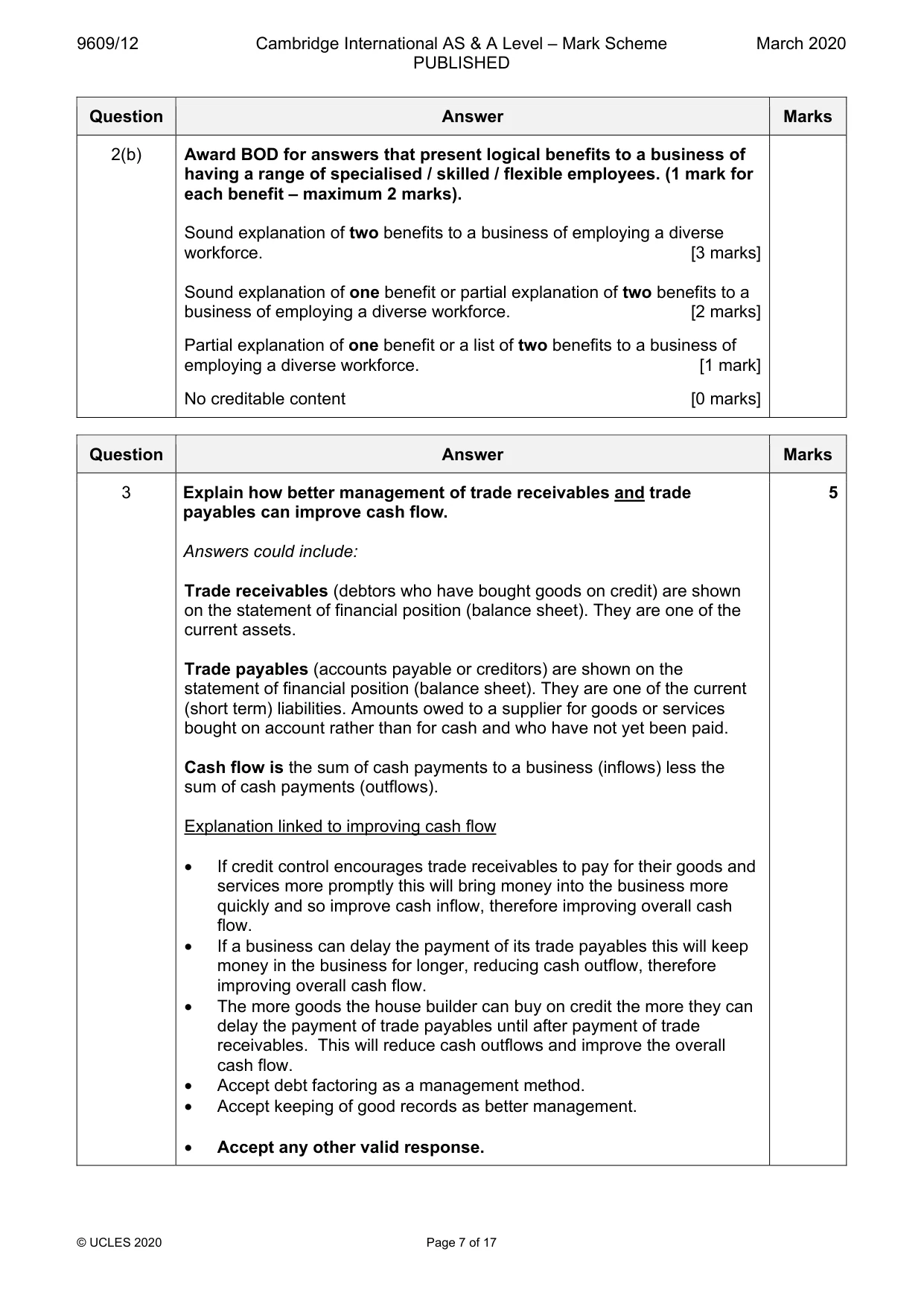
9609/12 Cambridge International AS & A Level – Mark Scheme PUBLISHED March 2020 © UCLES 2020 Page 7 of 17 Question Answer Marks 2(b) Award BOD for answers that present logical benefits to a business of having a range of specialised / skilled / flexible employees. (1 mark for each benefit – maximum 2 marks). Sound explanation of two benefits to a business of employing a diverse workforce. [3 marks] Sound explanation of one benefit or partial explanation of two benefits to a business of employing a diverse workforce. [2 marks] Partial explanation of one benefit or a list of two benefits to a business of employing a diverse workforce. [1 mark] No creditable content [0 marks] Question Answer Marks 3 Explain how better management of trade receivables and trade payables can improve cash flow. Answers could include: Trade receivables (debtors who have bought goods on credit) are shown on the statement of financial position (balance sheet). They are one of the current assets. Trade payables (accounts payable or creditors) are shown on the statement of financial position (balance sheet). They are one of the current (short term) liabilities. Amounts owed to a supplier for goods or services bought on account rather than for cash and who have not yet been paid. Cash flow is the sum of cash payments to a business (inflows) less the sum of cash payments (outflows). Explanation linked to improving cash flow • If credit control encourages trade receivables to pay for their goods and services more promptly this will bring money into the business more quickly and so improve cash inflow, therefore improving overall cash flow. • If a business can delay the payment of its trade payables this will keep money in the business for longer, reducing cash outflow, therefore improving overall cash flow. • The more goods the house builder can buy on credit the more they can delay the payment of trade payables until after payment of trade receivables. This will reduce cash outflows and improve the overall cash flow. • Accept debt factoring as a management method. • Accept keeping of good records as better management. • Accept any other valid response. 5
Mark scheme, page 8
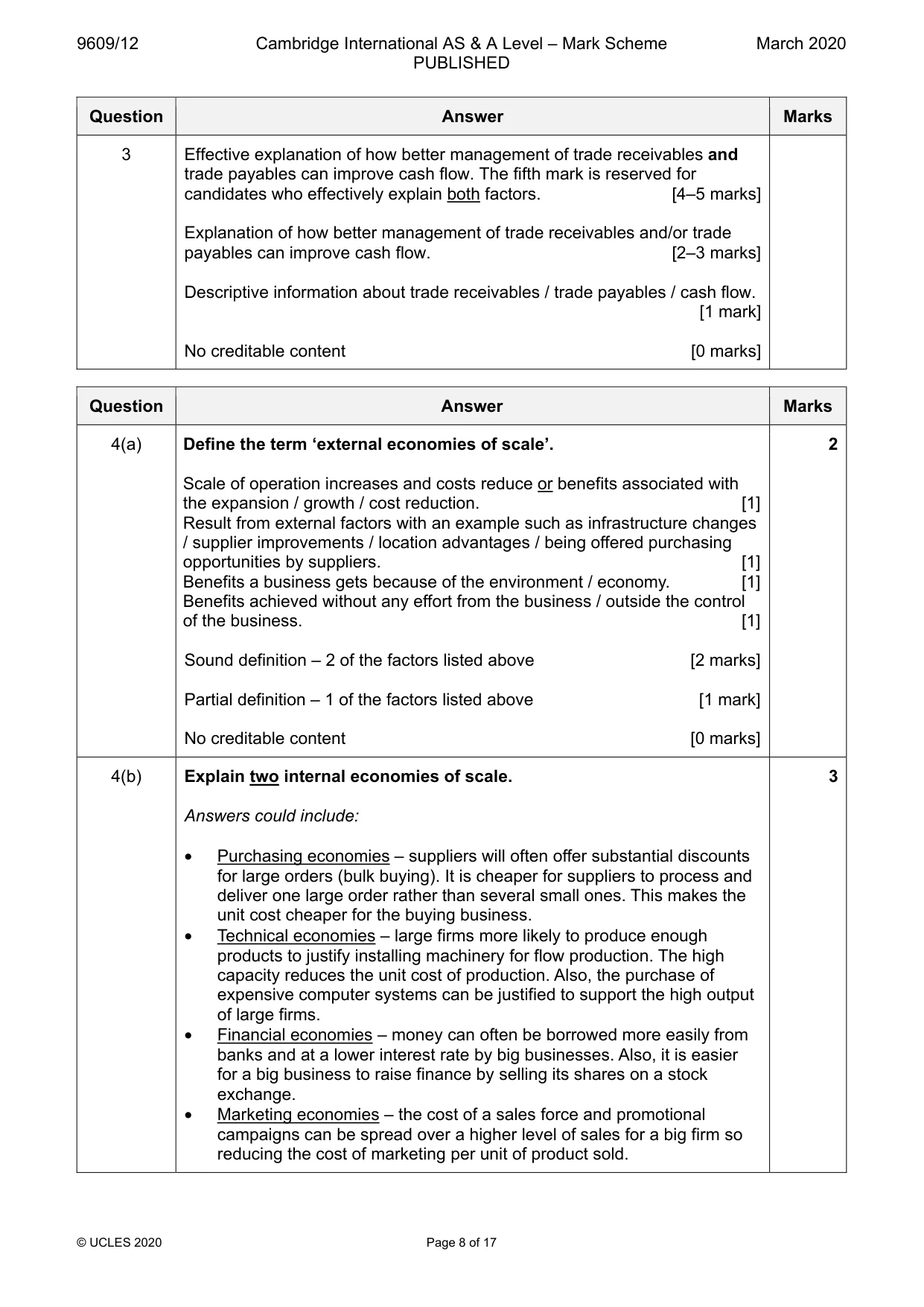
9609/12 Cambridge International AS & A Level – Mark Scheme PUBLISHED March 2020 © UCLES 2020 Page 8 of 17 Question Answer Marks 3 Effective explanation of how better management of trade receivables and trade payables can improve cash flow. The fifth mark is reserved for candidates who effectively explain both factors. [4–5 marks] Explanation of how better management of trade receivables and/or trade payables can improve cash flow. [2–3 marks] Descriptive information about trade receivables / trade payables / cash flow. [1 mark] No creditable content [0 marks] Question Answer Marks 4(a) Define the term ‘external economies of scale’. Scale of operation increases and costs reduce or benefits associated with the expansion / growth / cost reduction. [1] Result from external factors with an example such as infrastructure changes / supplier improvements / location advantages / being offered purchasing opportunities by suppliers. [1] Benefits a business gets because of the environment / economy. [1] Benefits achieved without any effort from the business / outside the control of the business. [1] Sound definition – 2 of the factors listed above [2 marks] Partial definition – 1 of the factors listed above [1 mark] No creditable content [0 marks] 2 4(b) Explain two internal economies of scale. Answers could include: • Purchasing economies – suppliers will often offer substantial discounts for large orders (bulk buying). It is cheaper for suppliers to process and deliver one large order rather than several small ones. This makes the unit cost cheaper for the buying business. • Technical economies – large firms more likely to produce enough products to justify installing machinery for flow production. The high capacity reduces the unit cost of production. Also, the purchase of expensive computer systems can be justified to support the high output of large firms. • Financial economies – money can often be borrowed more easily from banks and at a lower interest rate by big businesses. Also, it is easier for a big business to raise finance by selling its shares on a stock exchange. • Marketing economies – the cost of a sales force and promotional campaigns can be spread over a higher level of sales for a big firm so reducing the cost of marketing per unit of product sold. 3
Mark scheme, page 9
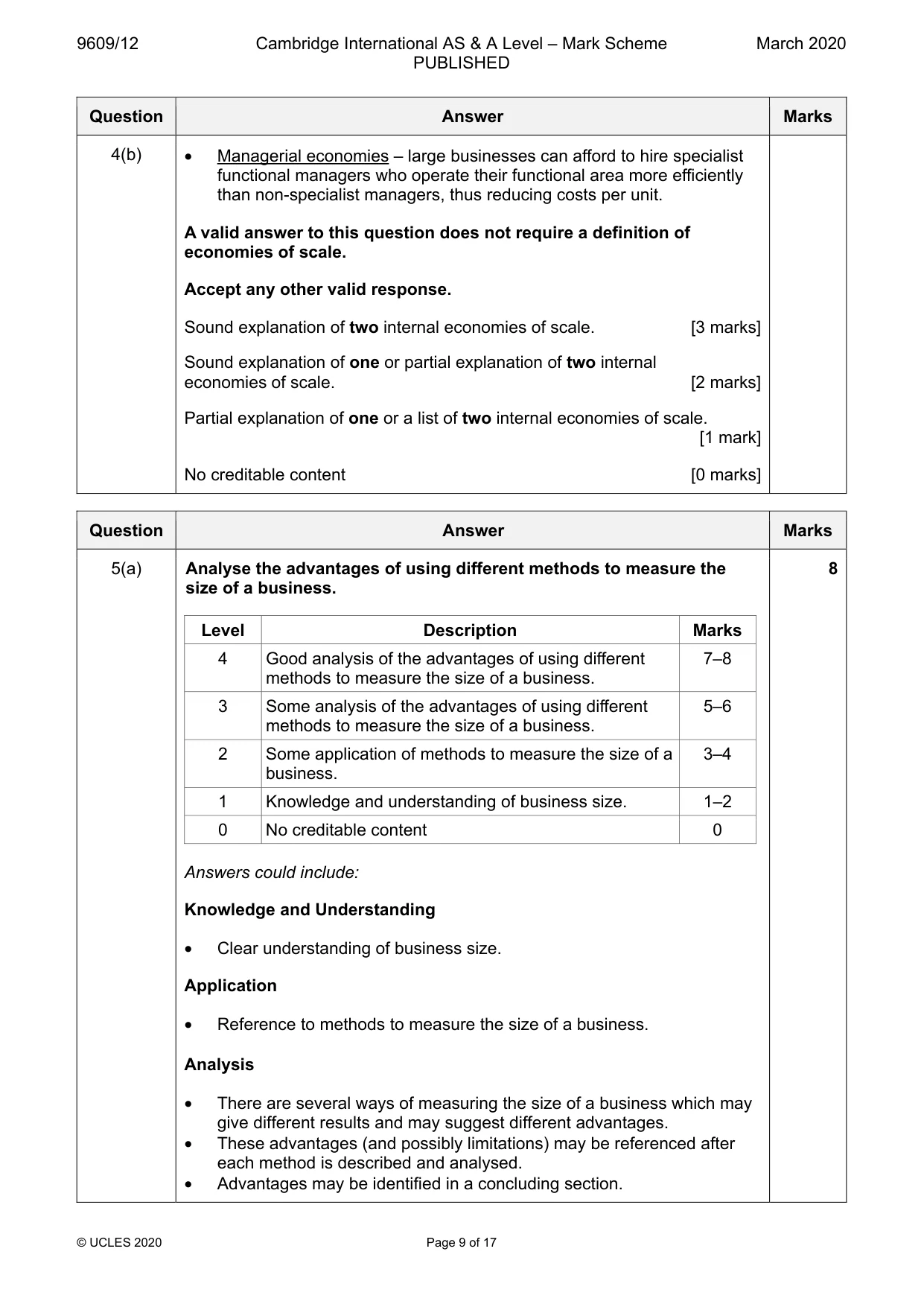
9609/12 Cambridge International AS & A Level – Mark Scheme PUBLISHED March 2020 © UCLES 2020 Page 9 of 17 Question Answer Marks 4(b) • Managerial economies – large businesses can afford to hire specialist functional managers who operate their functional area more efficiently than non-specialist managers, thus reducing costs per unit. A valid answer to this question does not require a definition of economies of scale. Accept any other valid response. Sound explanation of two internal economies of scale. [3 marks] Sound explanation of one or partial explanation of two internal economies of scale. [2 marks] Partial explanation of one or a list of two internal economies of scale. [1 mark] No creditable content [0 marks] Question Answer Marks 5(a) Analyse the advantages of using different methods to measure the size of a business. Level Description Marks 4 Good analysis of the advantages of using different methods to measure the size of a business. 7–8 3 Some analysis of the advantages of using different methods to measure the size of a business. 5–6 2 Some application of methods to measure the size of a business. 3–4 1 Knowledge and understanding of business size. 1–2 0 No creditable content 0 Answers could include: Knowledge and Understanding • Clear understanding of business size. Application • Reference to methods to measure the size of a business. Analysis • There are several ways of measuring the size of a business which may give different results and may suggest different advantages. • These advantages (and possibly limitations) may be referenced after each method is described and analysed. • Advantages may be identified in a concluding section. 8
Mark scheme, page 10
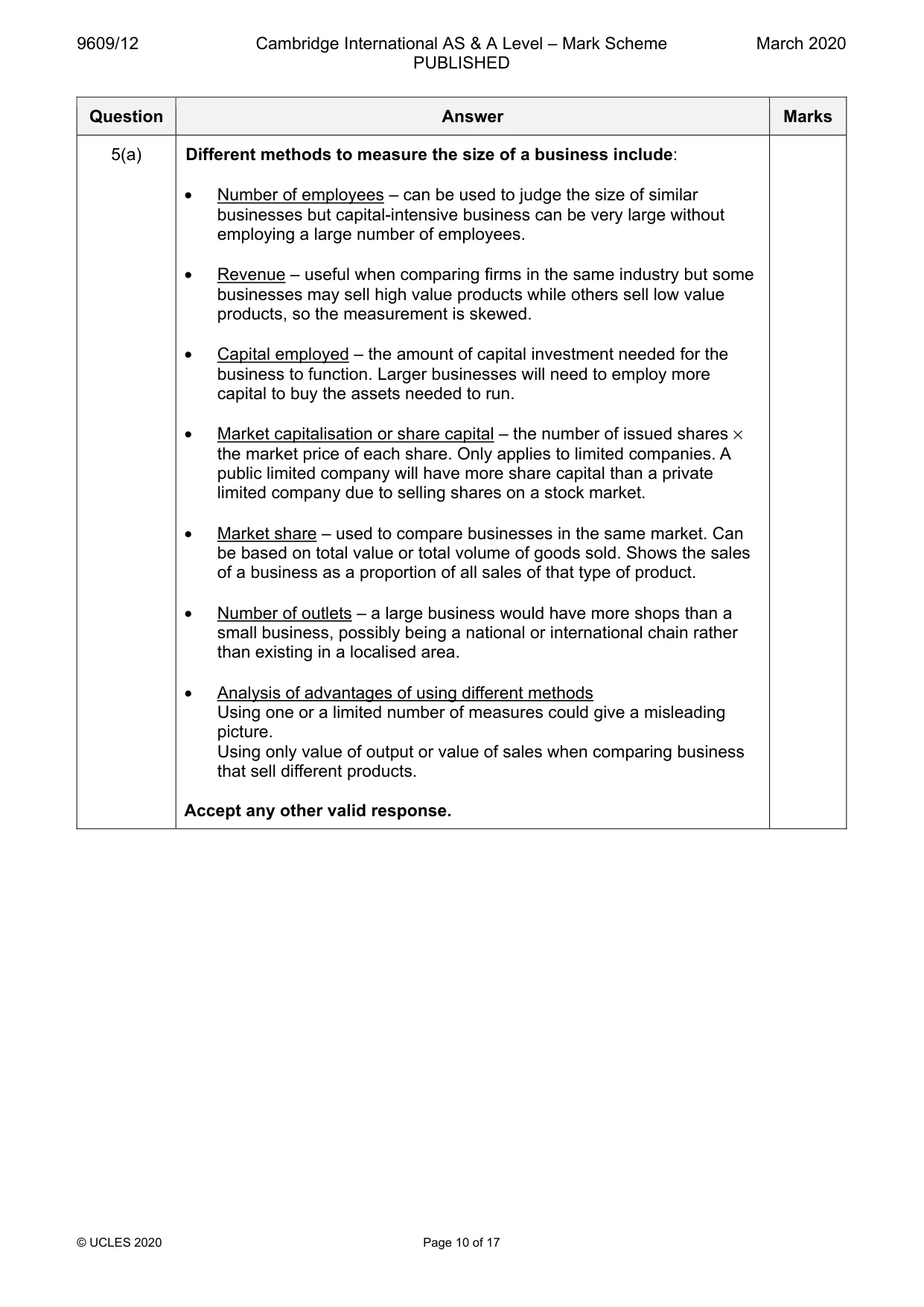
9609/12 Cambridge International AS & A Level – Mark Scheme PUBLISHED March 2020 © UCLES 2020 Page 10 of 17 Question Answer Marks 5(a) Different methods to measure the size of a business include: • Number of employees – can be used to judge the size of similar businesses but capital-intensive business can be very large without employing a large number of employees. • Revenue – useful when comparing firms in the same industry but some businesses may sell high value products while others sell low value products, so the measurement is skewed. • Capital employed – the amount of capital investment needed for the business to function. Larger businesses will need to employ more capital to buy the assets needed to run. • Market capitalisation or share capital – the number of issued shares × the market price of each share. Only applies to limited companies. A public limited company will have more share capital than a private limited company due to selling shares on a stock market. • Market share – used to compare businesses in the same market. Can be based on total value or total volume of goods sold. Shows the sales of a business as a proportion of all sales of that type of product. • Number of outlets – a large business would have more shops than a small business, possibly being a national or international chain rather than existing in a localised area. • Analysis of advantages of using different methods Using one or a limited number of measures could give a misleading picture. Using only value of output or value of sales when comparing business that sell different products. Accept any other valid response.
Mark scheme, page 11
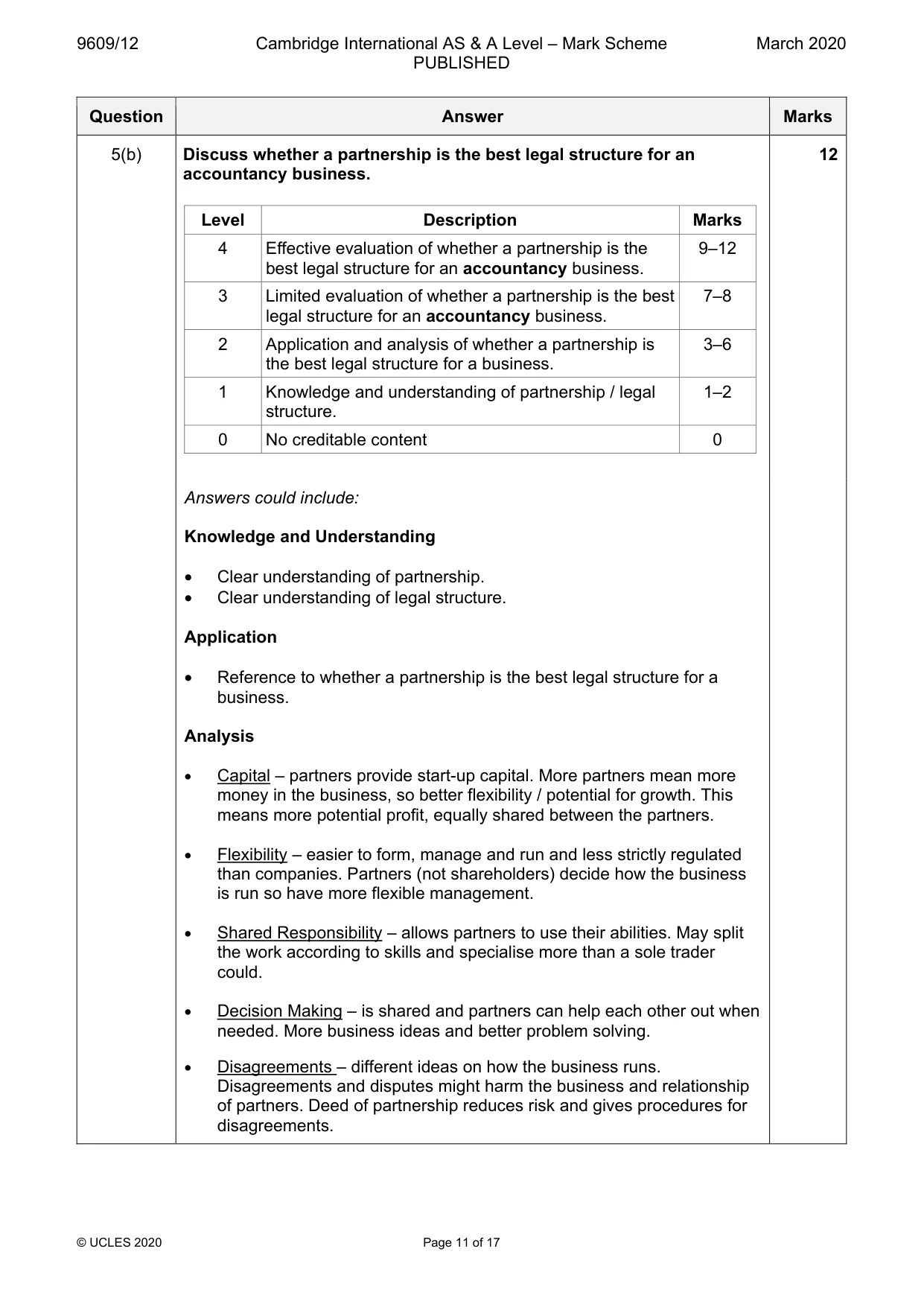
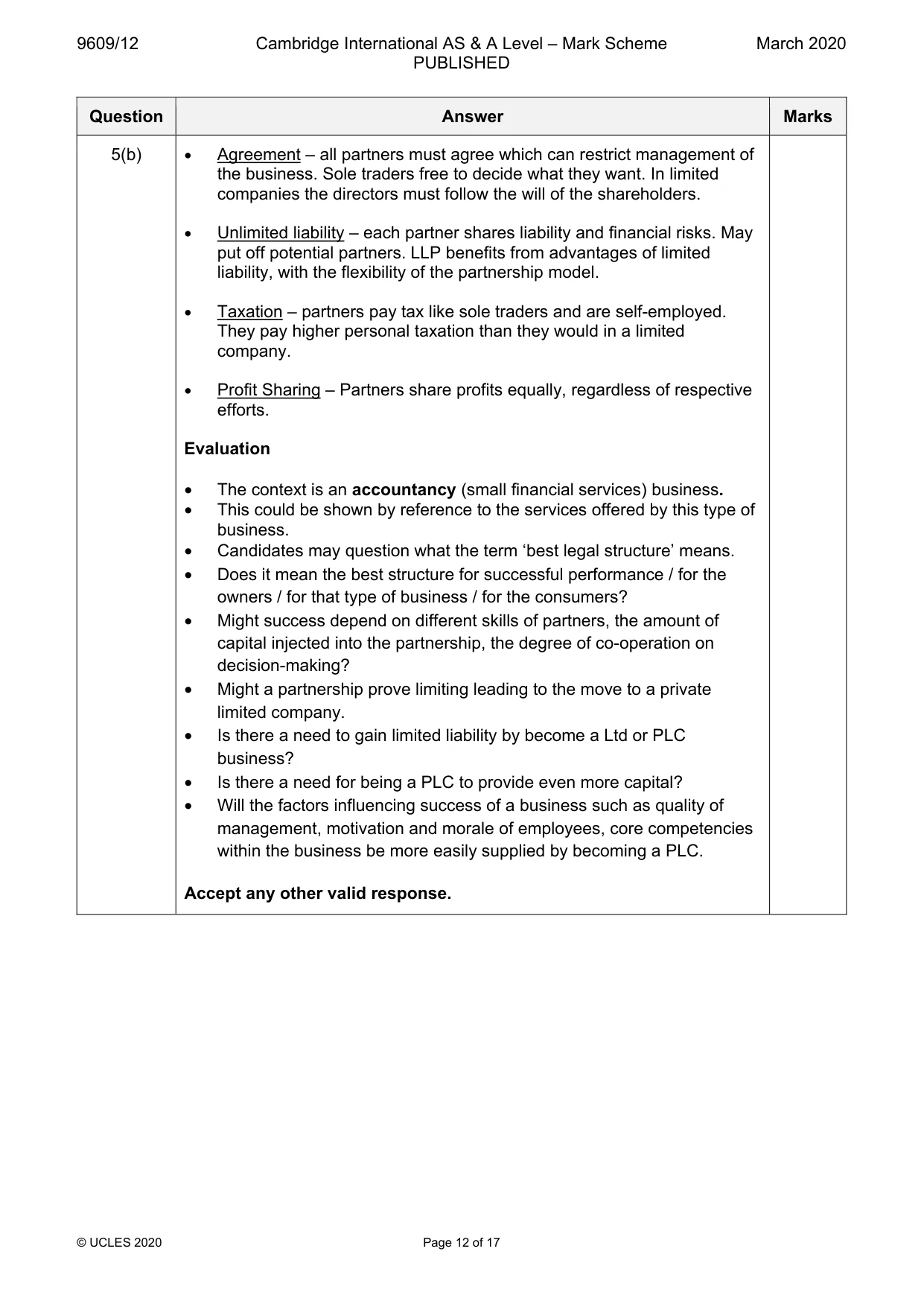
9609/12 Cambridge International AS & A Level – Mark Scheme PUBLISHED March 2020 © UCLES 2020 Page 11 of 17 Question Answer Marks 5(b) Discuss whether a partnership is the best legal structure for an accountancy business. Level Description Marks 4 Effective evaluation of whether a partnership is the best legal structure for an accountancy business. 9–12 3 Limited evaluation of whether a partnership is the best legal structure for an accountancy business. 7–8 2 Application and analysis of whether a partnership is the best legal structure for a business. 3–6 1 Knowledge and understanding of partnership / legal structure. 1–2 0 No creditable content 0 12 Answers could include: Knowledge and Understanding • Clear understanding of partnership. • Clear understanding of legal structure. Application • Reference to whether a partnership is the best legal structure for a business. Analysis • Capital – partners provide start-up capital. More partners mean more money in the business, so better flexibility / potential for growth. This means more potential profit, equally shared between the partners. • Flexibility – easier to form, manage and run and less strictly regulated than companies. Partners (not shareholders) decide how the business is run so have more flexible management. • Shared Responsibility – allows partners to use their abilities. May split the work according to skills and specialise more than a sole trader could. • Decision Making – is shared and partners can help each other out when needed. More business ideas and better problem solving. • Disagreements – different ideas on how the business runs. Disagreements and disputes might harm the business and relationship of partners. Deed of partnership reduces risk and gives procedures for disagreements.
Mark scheme, page 12
9609/12 Cambridge International AS & A Level – Mark Scheme PUBLISHED March 2020 © UCLES 2020 Page 12 of 17 Question Answer Marks 5(b) • Agreement – all partners must agree which can restrict management of the business. Sole traders free to decide what they want. In limited companies the directors must follow the will of the shareholders. • Unlimited liability – each partner shares liability and financial risks. May put off potential partners. LLP benefits from advantages of limited liability, with the flexibility of the partnership model. • Taxation – partners pay tax like sole traders and are self-employed. They pay higher personal taxation than they would in a limited company. • Profit Sharing – Partners share profits equally, regardless of respective efforts. Evaluation • The context is an accountancy (small financial services) business. • This could be shown by reference to the services offered by this type of business. • Candidates may question what the term ‘best legal structure’ means. • Does it mean the best structure for successful performance / for the owners / for that type of business / for the consumers? • Might success depend on different skills of partners, the amount of capital injected into the partnership, the degree of co-operation on decision-making? • Might a partnership prove limiting leading to the move to a private limited company. • Is there a need to gain limited liability by become a Ltd or PLC business? • Is there a need for being a PLC to provide even more capital? • Will the factors influencing success of a business such as quality of management, motivation and morale of employees, core competencies within the business be more easily supplied by becoming a PLC. Accept any other valid response.
Mark scheme, page 13
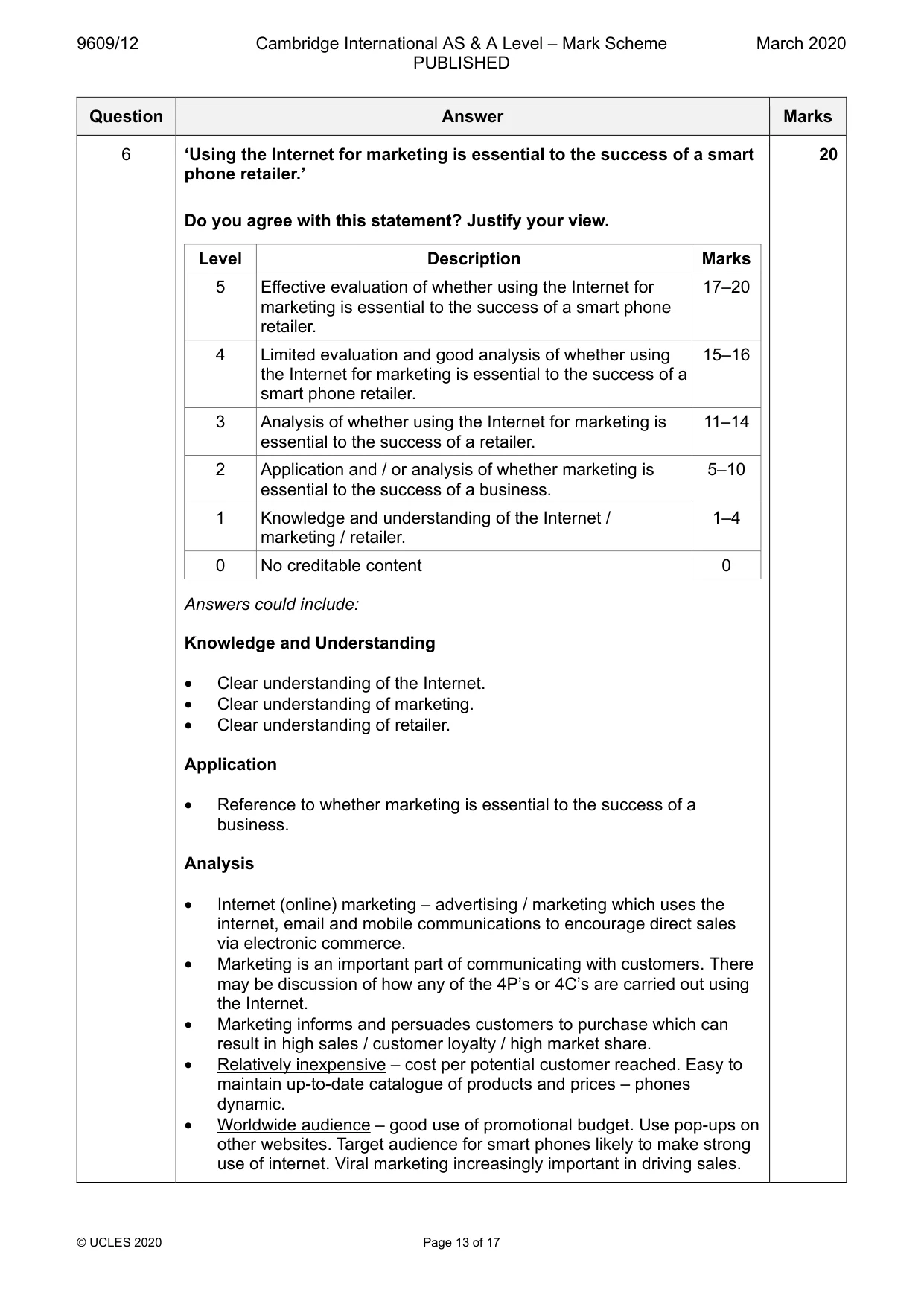
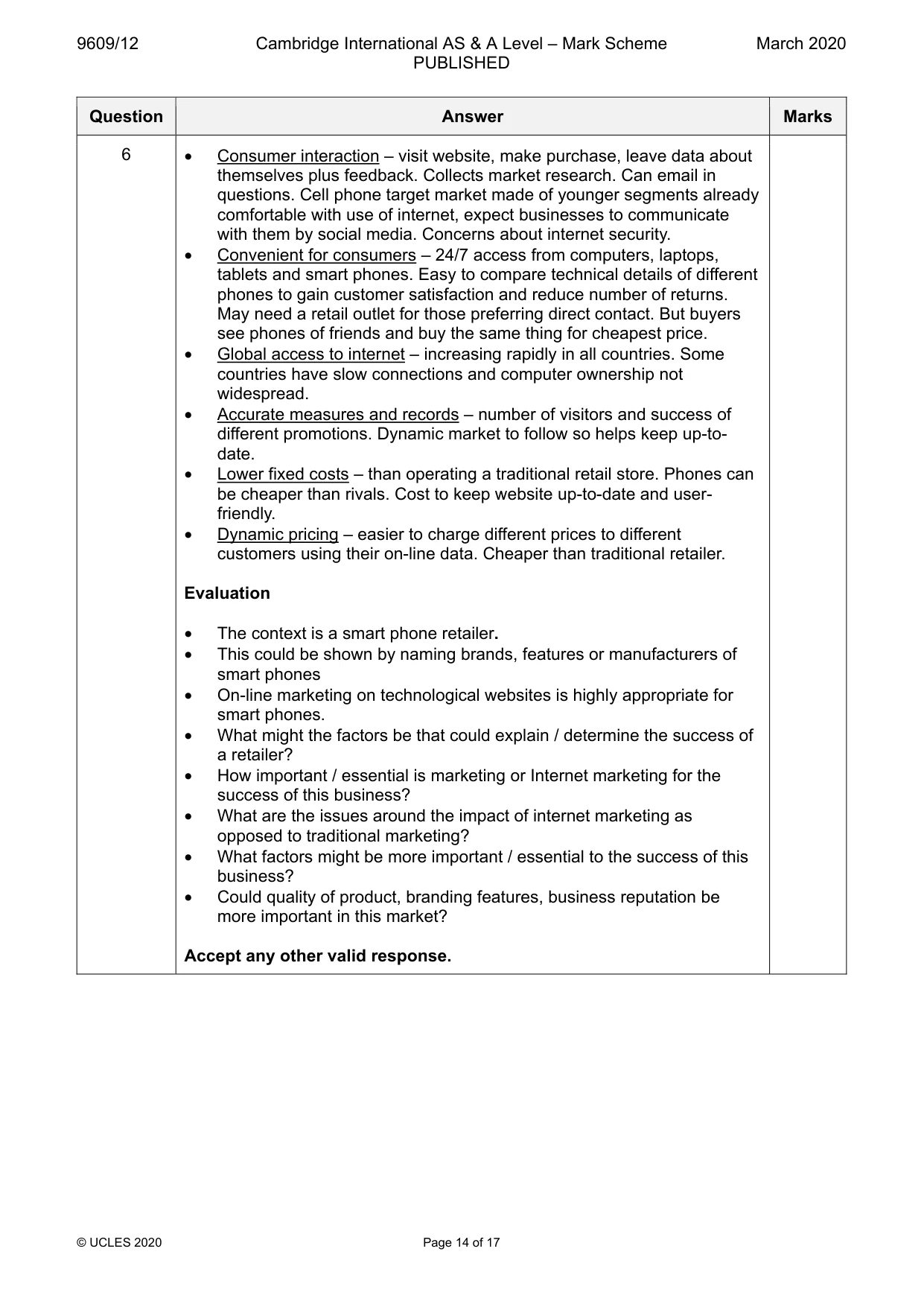
9609/12 Cambridge International AS & A Level – Mark Scheme PUBLISHED March 2020 © UCLES 2020 Page 13 of 17 Question Answer Marks 6 ‘Using the Internet for marketing is essential to the success of a smart phone retailer.’ Do you agree with this statement? Justify your view. Level Description Marks 5 Effective evaluation of whether using the Internet for marketing is essential to the success of a smart phone retailer. 17–20 4 Limited evaluation and good analysis of whether using the Internet for marketing is essential to the success of a smart phone retailer. 15–16 3 Analysis of whether using the Internet for marketing is essential to the success of a retailer. 11–14 2 Application and / or analysis of whether marketing is essential to the success of a business. 5–10 1 Knowledge and understanding of the Internet / marketing / retailer. 1–4 0 No creditable content 0 Answers could include: Knowledge and Understanding • Clear understanding of the Internet. • Clear understanding of marketing. • Clear understanding of retailer. Application • Reference to whether marketing is essential to the success of a business. Analysis • Internet (online) marketing – advertising / marketing which uses the internet, email and mobile communications to encourage direct sales via electronic commerce. • Marketing is an important part of communicating with customers. There may be discussion of how any of the 4P’s or 4C’s are carried out using the Internet. • Marketing informs and persuades customers to purchase which can result in high sales / customer loyalty / high market share. • Relatively inexpensive – cost per potential customer reached. Easy to maintain up-to-date catalogue of products and prices – phones dynamic. • Worldwide audience – good use of promotional budget. Use pop-ups on other websites. Target audience for smart phones likely to make strong use of internet. Viral marketing increasingly important in driving sales. 20
Mark scheme, page 14
9609/12 Cambridge International AS & A Level – Mark Scheme PUBLISHED March 2020 © UCLES 2020 Page 14 of 17 Question Answer Marks 6 • Consumer interaction – visit website, make purchase, leave data about themselves plus feedback. Collects market research. Can email in questions. Cell phone target market made of younger segments already comfortable with use of internet, expect businesses to communicate with them by social media. Concerns about internet security. • Convenient for consumers – 24/7 access from computers, laptops, tablets and smart phones. Easy to compare technical details of different phones to gain customer satisfaction and reduce number of returns. May need a retail outlet for those preferring direct contact. But buyers see phones of friends and buy the same thing for cheapest price. • Global access to internet – increasing rapidly in all countries. Some countries have slow connections and computer ownership not widespread. • Accurate measures and records – number of visitors and success of different promotions. Dynamic market to follow so helps keep up-to- date. • Lower fixed costs – than operating a traditional retail store. Phones can be cheaper than rivals. Cost to keep website up-to-date and user- friendly. • Dynamic pricing – easier to charge different prices to different customers using their on-line data. Cheaper than traditional retailer. Evaluation • The context is a smart phone retailer. • This could be shown by naming brands, features or manufacturers of smart phones • On-line marketing on technological websites is highly appropriate for smart phones. • What might the factors be that could explain / determine the success of a retailer? • How important / essential is marketing or Internet marketing for the success of this business? • What are the issues around the impact of internet marketing as opposed to traditional marketing? • What factors might be more important / essential to the success of this business? • Could quality of product, branding features, business reputation be more important in this market? Accept any other valid response.
Mark scheme, page 15
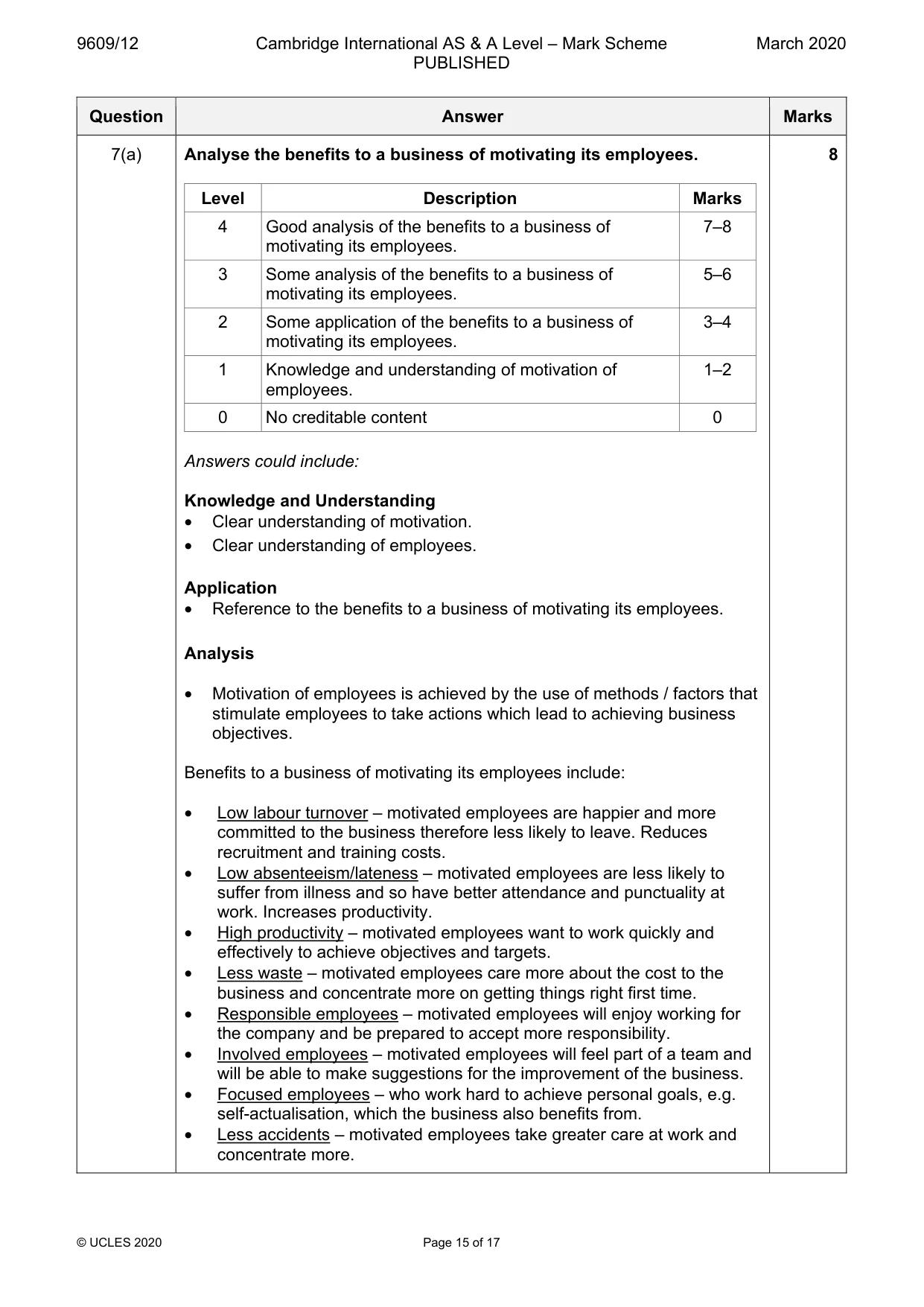
9609/12 Cambridge International AS & A Level – Mark Scheme PUBLISHED March 2020 © UCLES 2020 Page 15 of 17 Question Answer Marks 7(a) Analyse the benefits to a business of motivating its employees. Level Description Marks 4 Good analysis of the benefits to a business of motivating its employees. 7–8 3 Some analysis of the benefits to a business of motivating its employees. 5–6 2 Some application of the benefits to a business of motivating its employees. 3–4 1 Knowledge and understanding of motivation of employees. 1–2 0 No creditable content 0 Answers could include: Knowledge and Understanding • Clear understanding of motivation. • Clear understanding of employees. Application • Reference to the benefits to a business of motivating its employees. Analysis • Motivation of employees is achieved by the use of methods / factors that stimulate employees to take actions which lead to achieving business objectives. Benefits to a business of motivating its employees include: • Low labour turnover – motivated employees are happier and more committed to the business therefore less likely to leave. Reduces recruitment and training costs. • Low absenteeism/lateness – motivated employees are less likely to suffer from illness and so have better attendance and punctuality at work. Increases productivity. • High productivity – motivated employees want to work quickly and effectively to achieve objectives and targets. • Less waste – motivated employees care more about the cost to the business and concentrate more on getting things right first time. • Responsible employees – motivated employees will enjoy working for the company and be prepared to accept more responsibility. • Involved employees – motivated employees will feel part of a team and will be able to make suggestions for the improvement of the business. • Focused employees – who work hard to achieve personal goals, e.g. self-actualisation, which the business also benefits from. • Less accidents – motivated employees take greater care at work and concentrate more. 8
Mark scheme, page 16
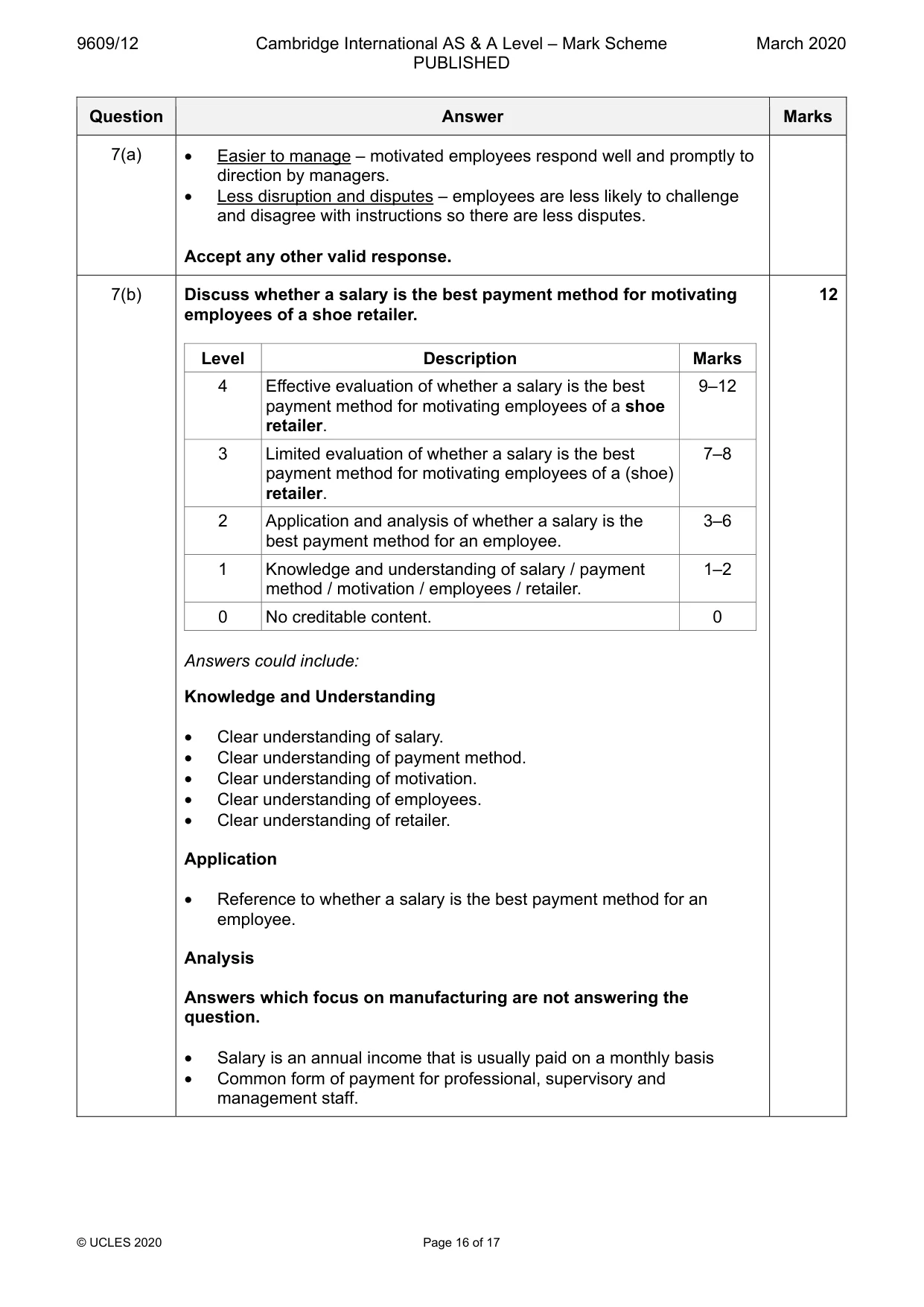
9609/12 Cambridge International AS & A Level – Mark Scheme PUBLISHED March 2020 © UCLES 2020 Page 16 of 17 Question Answer Marks 7(a) • Easier to manage – motivated employees respond well and promptly to direction by managers. • Less disruption and disputes – employees are less likely to challenge and disagree with instructions so there are less disputes. Accept any other valid response. 7(b) Discuss whether a salary is the best payment method for motivating employees of a shoe retailer. Level Description Marks 4 Effective evaluation of whether a salary is the best payment method for motivating employees of a shoe retailer. 9–12 3 Limited evaluation of whether a salary is the best payment method for motivating employees of a (shoe) retailer. 7–8 2 Application and analysis of whether a salary is the best payment method for an employee. 3–6 1 Knowledge and understanding of salary / payment method / motivation / employees / retailer. 1–2 0 No creditable content. 0 Answers could include: Knowledge and Understanding • Clear understanding of salary. • Clear understanding of payment method. • Clear understanding of motivation. • Clear understanding of employees. • Clear understanding of retailer. Application • Reference to whether a salary is the best payment method for an employee. Analysis Answers which focus on manufacturing are not answering the question. • Salary is an annual income that is usually paid on a monthly basis • Common form of payment for professional, supervisory and management staff. 12
Mark scheme, page 17
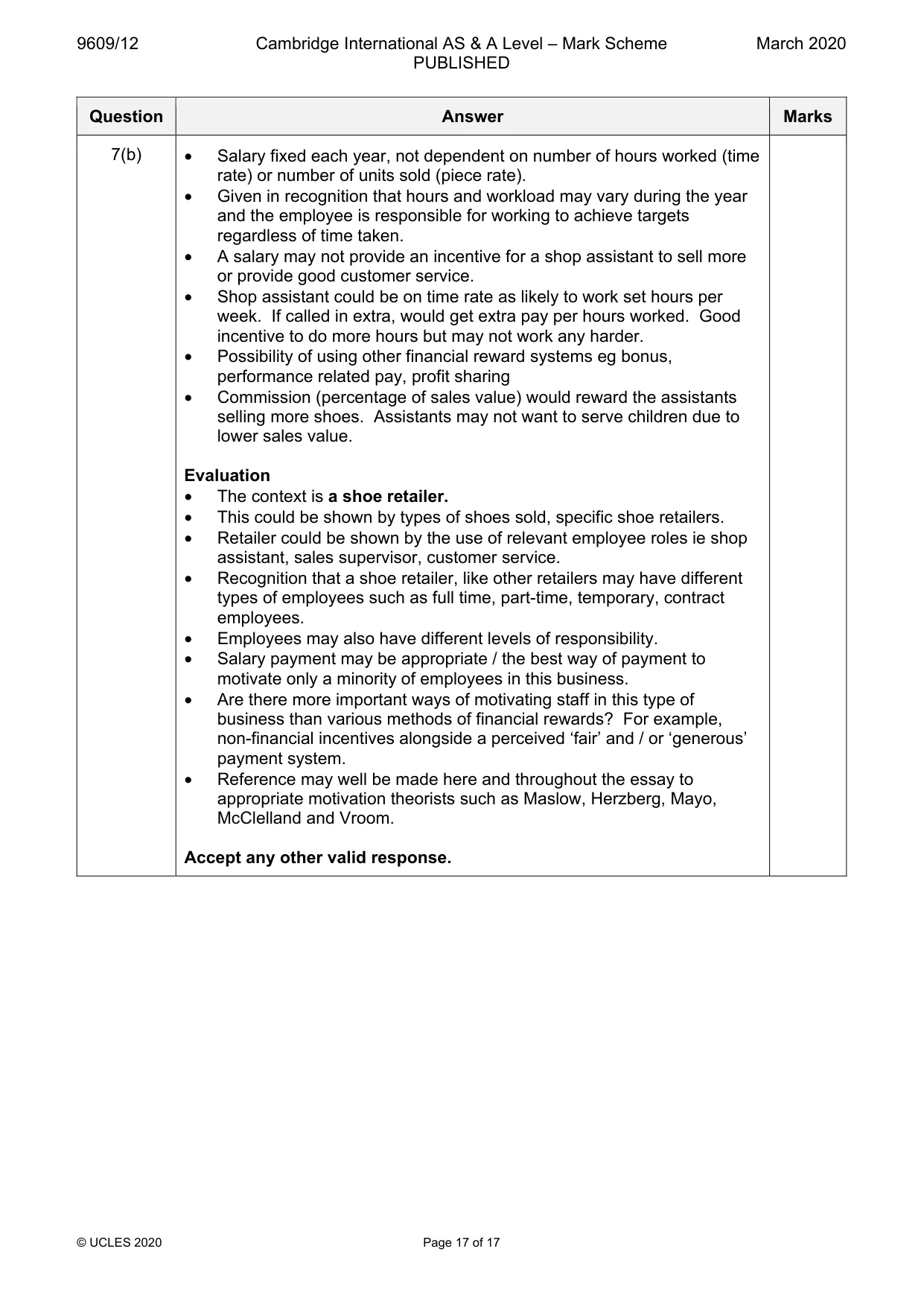
9609/12 Cambridge International AS & A Level – Mark Scheme PUBLISHED March 2020 © UCLES 2020 Page 17 of 17 Question Answer Marks 7(b) • Salary fixed each year, not dependent on number of hours worked (time rate) or number of units sold (piece rate). • Given in recognition that hours and workload may vary during the year and the employee is responsible for working to achieve targets regardless of time taken. • A salary may not provide an incentive for a shop assistant to sell more or provide good customer service. • Shop assistant could be on time rate as likely to work set hours per week. If called in extra, would get extra pay per hours worked. Good incentive to do more hours but may not work any harder. • Possibility of using other financial reward systems eg bonus, performance related pay, profit sharing • Commission (percentage of sales value) would reward the assistants selling more shoes. Assistants may not want to serve children due to lower sales value. Evaluation • The context is a shoe retailer. • This could be shown by types of shoes sold, specific shoe retailers. • Retailer could be shown by the use of relevant employee roles ie shop assistant, sales supervisor, customer service. • Recognition that a shoe retailer, like other retailers may have different types of employees such as full time, part-time, temporary, contract employees. • Employees may also have different levels of responsibility. • Salary payment may be appropriate / the best way of payment to motivate only a minority of employees in this business. • Are there more important ways of motivating staff in this type of business than various methods of financial rewards? For example, non-financial incentives alongside a perceived ‘fair’ and / or ‘generous’ payment system. • Reference may well be made here and throughout the essay to appropriate motivation theorists such as Maslow, Herzberg, Mayo, McClelland and Vroom. Accept any other valid response.
What you needed in this session
Cambridge’s own grade thresholds for 2020 Feb/March, Paper 1 · Variant 2. A higher threshold means an easier paper — the bar moves with how the cohort did.