Cambridge A Level Business (for first examination in 2016) 9609 — 2019 Oct/Nov Paper 3 · Variant 2
9609/32/O/N/19 · 100 marks · ≈113 min
The question paper and its mark scheme, free to read here and free to download. This is Cambridge’s own paper, exactly as it was sat.
Question paper20 pages



















Mark scheme20 pages
Answers below. Sit the paper first if you are practising.





Paper as text
Question paper, page 1
This document consists of 19 printed pages, 1 blank page and 1 Insert. DC (LK) 171030/2 © UCLES 2019 [Turn over * 4 6 1 4 0 1 7 7 7 9 * BUSINESS 9609/32 Paper 3 Case Study October/November 2019 3 hours Candidates answer on the Question Paper. No Additional Materials are required. READ THESE INSTRUCTIONS FIRST Write your centre number, candidate number and name in the spaces at the top of this page. If you need additional answer paper ask the invigilator for a continuation booklet. Write in dark blue or black pen. You may use an HB pencil for any diagrams, graphs or rough working. Do not use staples, paper clips, glue or correction fluid. DO NOT WRITE IN ANY BARCODES. Section A Answer all questions. Section B Answer one question. You are advised to spend no more than 40 minutes on Section B. Refer to the Insert for the case study for this Paper. At the end of the examination, fasten all your work securely together. The number of marks is given in brackets [ ] at the end of each question or part question. Cambridge Assessment International Education Cambridge International Advanced Subsidiary and Advanced Level
Question paper, page 2
2 9609/32/O/N/19 © UCLES 2019 Section A Answer all questions in this section. 1 Analyse the likely impact on AEV’s profit of intervention by governments in the car market. … … … … … … … … … … … … … … … … … … … … … … … … …
Question paper, page 3
3 9609/32/O/N/19 © UCLES 2019 [Turn over … … … … … … … … … … … … … … … … … … … … … … … … … … … … [10]
Question paper, page 4
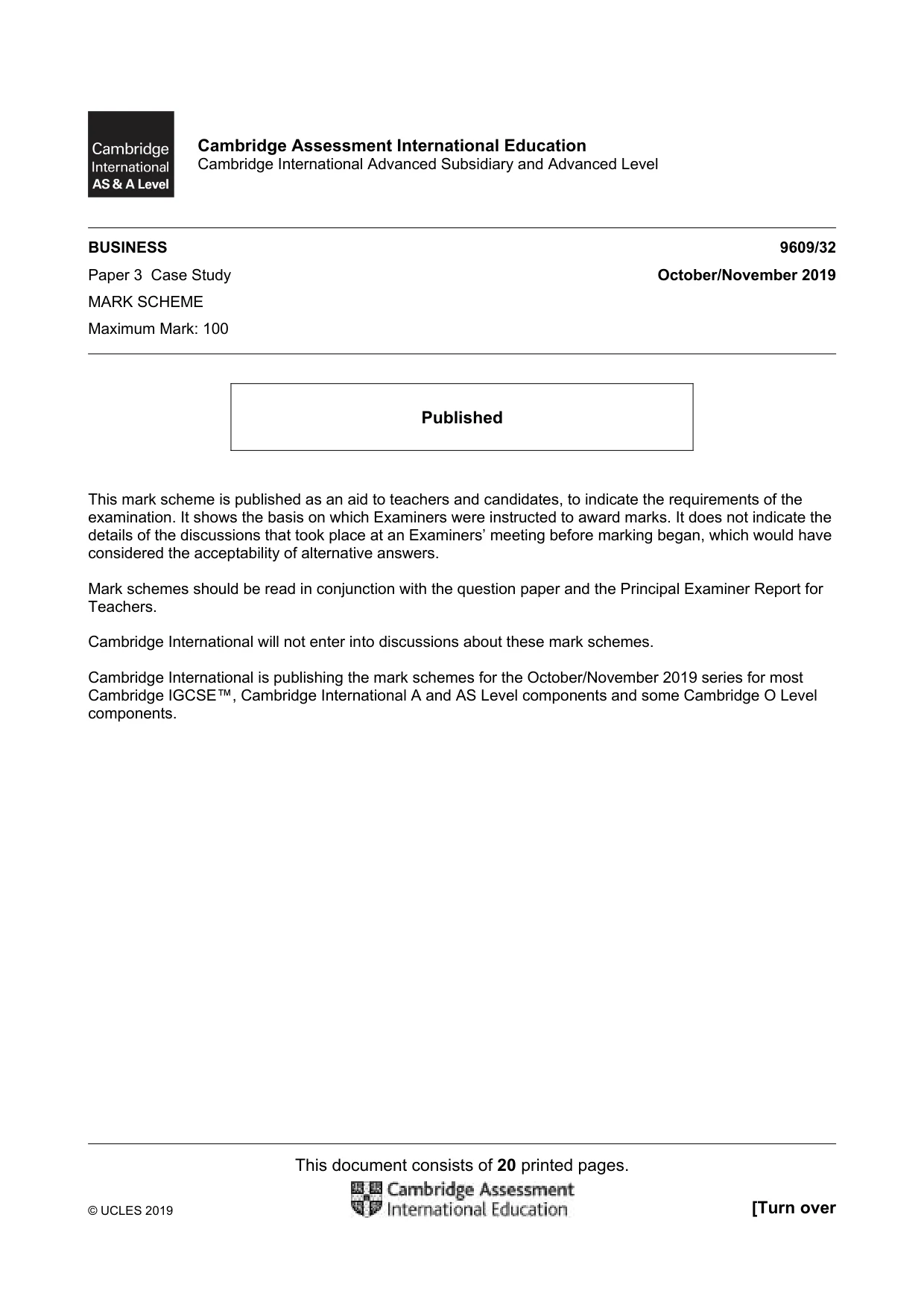
4 9609/32/O/N/19 © UCLES 2019 2 (a) Refer to Appendix 1. Calculate for 2019: (i) the dividend yield … … … … … … … … [3] (ii) the price earnings ratio … … … … … … … … [4] (iii) the return on capital employed (ROCE). … … … … … … … … [3]
Question paper, page 5
5 9609/32/O/N/19 © UCLES 2019 [Turn over (b) Refer to 2(a) and any other information. Recommend whether potential investors should purchase shares in AEV. Justify your recommendation. … … … … … … … … … … … … … … … … … … … … … … … … … … …
Question paper, page 6
6 9609/32/O/N/19 © UCLES 2019 … … … … … … … … … … … … … … … … … … … … … … … … … … … … [12]
Question paper, page 7
7 9609/32/O/N/19 © UCLES 2019 [Turn over 3 ‘AEV is unable to meet this demand due to a lack of capacity and supply constraints’ (Lines 47–48). Other than expansion of CellX, discuss ways in which the Operations Management Department of AEV could solve this problem. … … … … … … … … … … … … … … … … … … … … … … … … …
Question paper, page 8
8 9609/32/O/N/19 © UCLES 2019 … … … … … … … … … … … … … … … … … … … … … … … … … … … …
Question paper, page 9
9 9609/32/O/N/19 © UCLES 2019 [Turn over … … … … … … … … … … … … … … … … … … … … … … … … … … … … [16]
Question paper, page 10
10 9609/32/O/N/19 © UCLES 2019 4 (a) Refer to Table 1. Calculate the difference in labour turnover between 2017 and 2018. … … … … … … … … … … … … [4]
Question paper, page 11
11 9609/32/O/N/19 © UCLES 2019 [Turn over (b) Discuss the importance of human resource management to the success of the planned expansion of the CellX manufacturing centre. … … … … … … … … … … … … … … … … … … … … … … … … … … …
Question paper, page 12
12 9609/32/O/N/19 © UCLES 2019 … … … … … … … … … … … … … … … … … … … … … … … … … … … … [12]
Question paper, page 13
13 9609/32/O/N/19 © UCLES 2019 [Turn over 5 Discuss the significance of product development to AEV’s future success. … … … … … … … … … … … … … … … … … … … … … … … … … … …
Question paper, page 14
14 9609/32/O/N/19 © UCLES 2019 … … … … … … … … … … … … … … … … … … … … … … … … … … … …
Question paper, page 15
15 9609/32/O/N/19 © UCLES 2019 [Turn over … … … … … … … … … … … … … … … … … … … … … … … … … … … … [16]
Question paper, page 16
16 9609/32/O/N/19 © UCLES 2019 Section B Answer one question in this section. 6 Evaluate the importance of business planning to AEV’s future profitability. 7 Recommend which one of the two strategic options AEV should choose. Justify your recommendation. Your answer must include an evaluation of strategic choice techniques. Write the question number here: … … … … … … … … … … … … … … … … … … … … … … … …
Question paper, page 17
17 9609/32/O/N/19 © UCLES 2019 [Turn over … … … … … … … … … … … … … … … … … … … … … … … … … … … …
Question paper, page 18
18 9609/32/O/N/19 © UCLES 2019 … … … … … … … … … … … … … … … … … … … … … … … … … … … …
Question paper, page 19
19 9609/32/O/N/19 © UCLES 2019 … … … … … … … … … … … … … … … … … … … … … … … … … … … … [20]
Question paper, page 20
20 9609/32/O/N/19 © UCLES 2019 Permission to reproduce items where third-party owned material protected by copyright is included has been sought and cleared where possible. Every reasonable effort has been made by the publisher (UCLES) to trace copyright holders, but if any items requiring clearance have unwittingly been included, the publisher will be pleased to make amends at the earliest possible opportunity. To avoid the issue of disclosure of answer-related information to candidates, all copyright acknowledgements are reproduced online in the Cambridge Assessment International Education Copyright Acknowledgements Booklet. This is produced for each series of examinations and is freely available to download at www.cambridgeinternational.org after the live examination series. Cambridge Assessment International Education is part of the Cambridge Assessment Group. Cambridge Assessment is the brand name of the University of Cambridge Local Examinations Syndicate (UCLES), which itself is a department of the University of Cambridge. BLANK PAGE
Mark scheme, page 1
This document consists of 20 printed pages. © UCLES 2019 [Turn over Cambridge Assessment International Education Cambridge International Advanced Subsidiary and Advanced Level BUSINESS 9609/32 Paper 3 Case Study October/November 2019 MARK SCHEME Maximum Mark: 100 Published This mark scheme is published as an aid to teachers and candidates, to indicate the requirements of the examination. It shows the basis on which Examiners were instructed to award marks. It does not indicate the details of the discussions that took place at an Examiners’ meeting before marking began, which would have considered the acceptability of alternative answers. Mark schemes should be read in conjunction with the question paper and the Principal Examiner Report for Teachers. Cambridge International will not enter into discussions about these mark schemes. Cambridge International is publishing the mark schemes for the October/November 2019 series for most Cambridge IGCSE™, Cambridge International A and AS Level components and some Cambridge O Level components.
Mark scheme, page 2
9609/32 Cambridge International AS/A Level – Mark Scheme PUBLISHED October/November 2019 © UCLES 2019 Page 2 of 20 Generic Marking Principles These general marking principles must be applied by all examiners when marking candidate answers. They should be applied alongside the specific content of the mark scheme or generic level descriptors for a question. Each question paper and mark scheme will also comply with these marking principles. GENERIC MARKING PRINCIPLE 1: Marks must be awarded in line with: • the specific content of the mark scheme or the generic level descriptors for the question • the specific skills defined in the mark scheme or in the generic level descriptors for the question • the standard of response required by a candidate as exemplified by the standardisation scripts. GENERIC MARKING PRINCIPLE 2: Marks awarded are always whole marks (not half marks, or other fractions). GENERIC MARKING PRINCIPLE 3: Marks must be awarded positively: • marks are awarded for correct/valid answers, as defined in the mark scheme. However, credit is given for valid answers which go beyond the scope of the syllabus and mark scheme, referring to your Team Leader as appropriate • marks are awarded when candidates clearly demonstrate what they know and can do • marks are not deducted for errors • marks are not deducted for omissions • answers should only be judged on the quality of spelling, punctuation and grammar when these features are specifically assessed by the question as indicated by the mark scheme. The meaning, however, should be unambiguous. GENERIC MARKING PRINCIPLE 4: Rules must be applied consistently e.g. in situations where candidates have not followed instructions or in the application of generic level descriptors. GENERIC MARKING PRINCIPLE 5: Marks should be awarded using the full range of marks defined in the mark scheme for the question (however; the use of the full mark range may be limited according to the quality of the candidate responses seen). GENERIC MARKING PRINCIPLE 6: Marks awarded are based solely on the requirements as defined in the mark scheme. Marks should not be awarded with grade thresholds or grade descriptors in mind.
Mark scheme, page 3
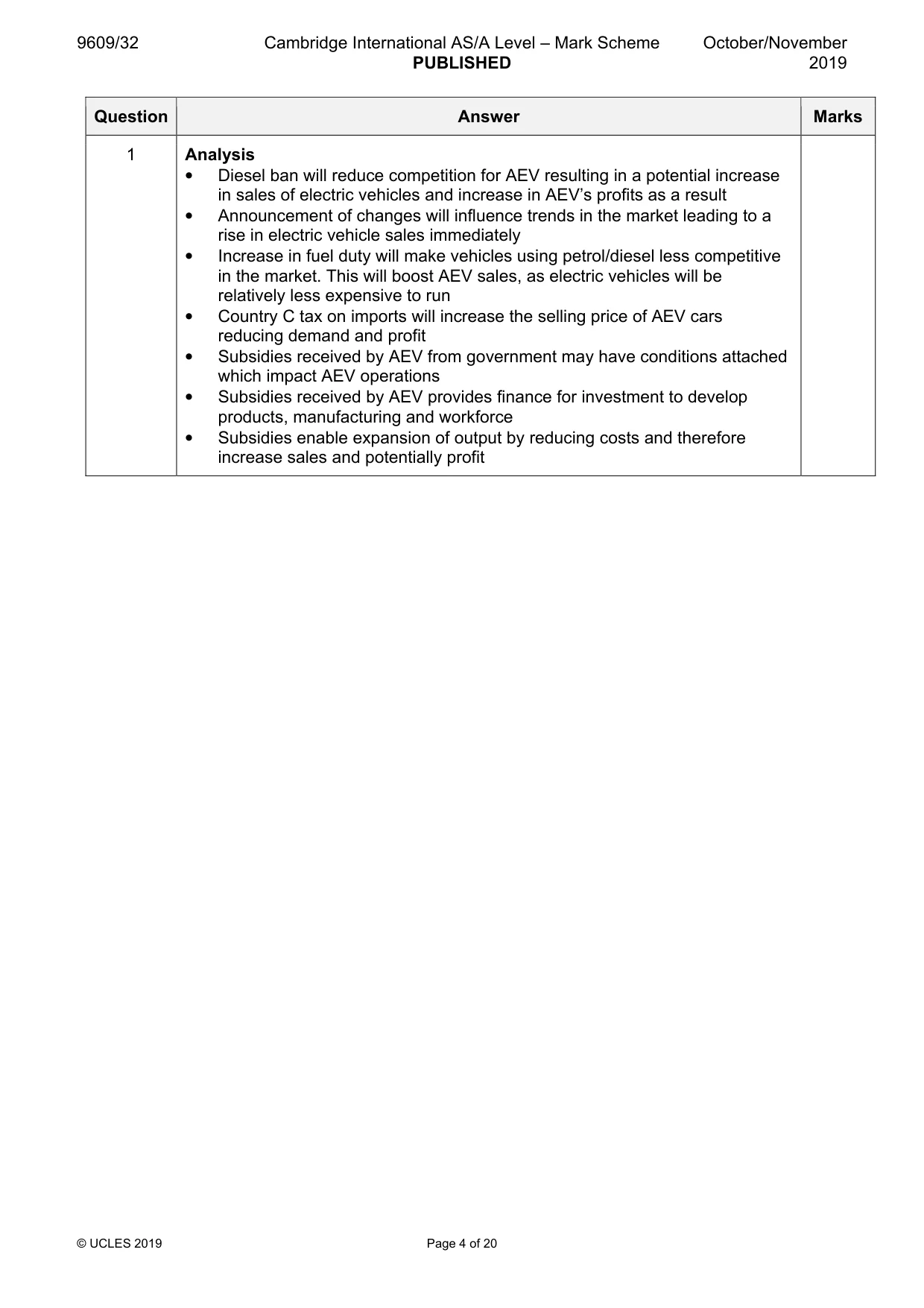
9609/32 Cambridge International AS/A Level – Mark Scheme PUBLISHED October/November 2019 © UCLES 2019 Page 3 of 20 Question Answer Marks 1 Analyse the likely impact on AEV’s profit of intervention by governments in the car market. Level Knowledge 3 marks Application 2 marks Analysis 5 marks 2 3 marks Understanding of impact/intervention 2 marks Points applied to AEV 4–5 marks Good use of theory and/or reasoned argument to explain impact on profit 1 1–2 marks Identification of intervention and/or impact 1 mark Point applied to AEV 1–3 marks Some use of theory and/or reasoned argument to explain impact Examiner note: Link to profit necessary for L2 AN Knowledge • Definition of profit: revenue less costs • Understanding of types of government intervention: – Regulation. Rules that businesses have to abide by in a market and constrain business activity – Indirect taxation (to correct market failure). Increase costs of supply to business – Subsidies/government grants. Reduce the costs of production and encourage an increase in output • Understanding of impact of subsidies on AEV, e.g. increase in AEV sales related to indirect tax on diesel cars Application • Ban on sale of diesel cars from 2030 will give AEV a competitive advantage over non-electric cars in the market OR government regulations on diesel cars and ban will increase competition in electric vehicle market • Increase in fuel duty on petrol in 2019 will benefit AEV • Benefit is in long term as some regulations will come into force in 2030 • AEV vehicles with zero emissions will not be subject to the regulations • AEV has received $1 bn in government grants since 2010 • Government action to increase availability of charging points for electric cars • 30% tax on imports of cars in country C 10
Mark scheme, page 4
9609/32 Cambridge International AS/A Level – Mark Scheme PUBLISHED October/November 2019 © UCLES 2019 Page 4 of 20 Question Answer Marks 1 Analysis • Diesel ban will reduce competition for AEV resulting in a potential increase in sales of electric vehicles and increase in AEV’s profits as a result • Announcement of changes will influence trends in the market leading to a rise in electric vehicle sales immediately • Increase in fuel duty will make vehicles using petrol/diesel less competitive in the market. This will boost AEV sales, as electric vehicles will be relatively less expensive to run • Country C tax on imports will increase the selling price of AEV cars reducing demand and profit • Subsidies received by AEV from government may have conditions attached which impact AEV operations • Subsidies received by AEV provides finance for investment to develop products, manufacturing and workforce • Subsidies enable expansion of output by reducing costs and therefore increase sales and potentially profit
Mark scheme, page 5
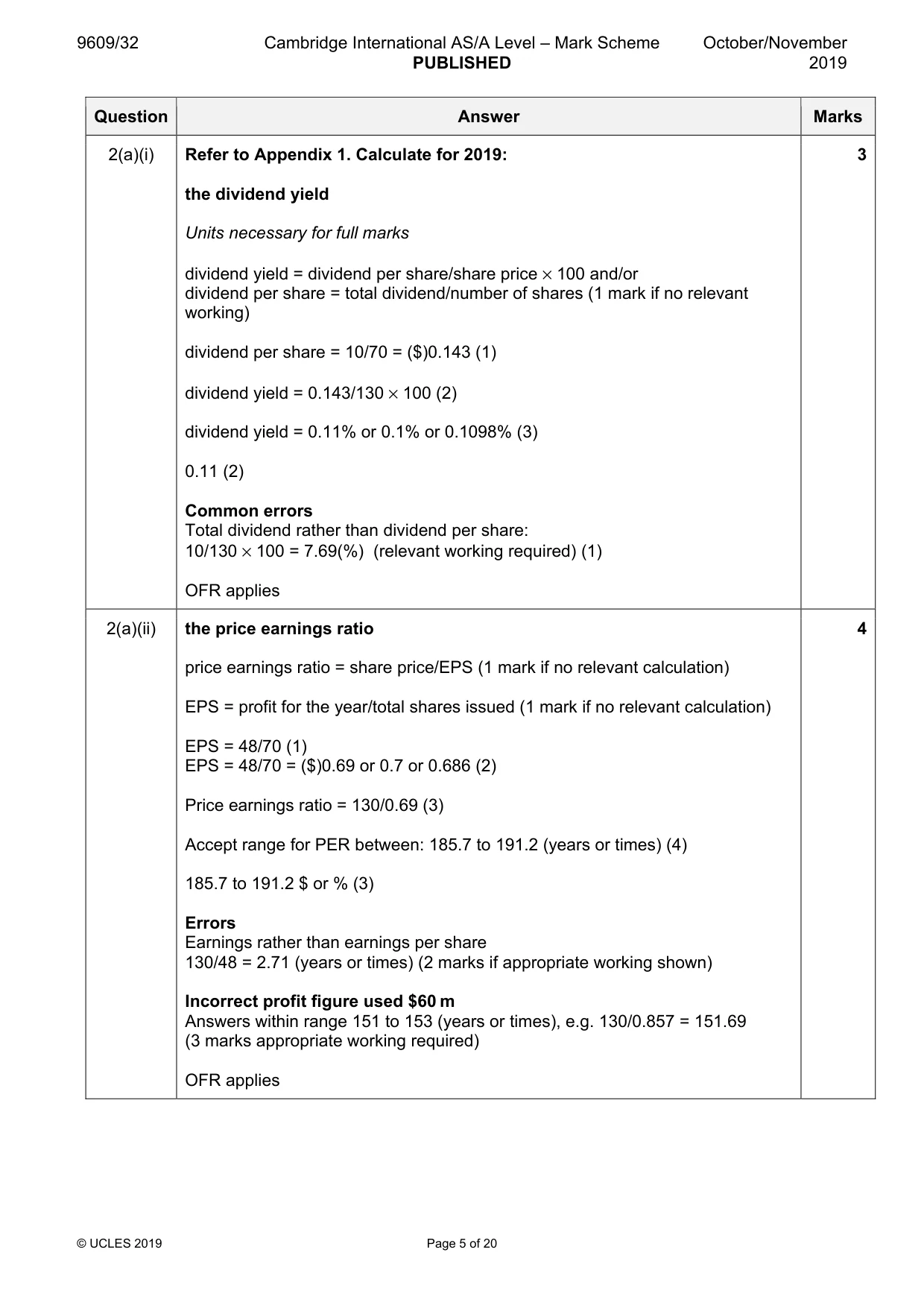
9609/32 Cambridge International AS/A Level – Mark Scheme PUBLISHED October/November 2019 © UCLES 2019 Page 5 of 20 Question Answer Marks 2(a)(i) Refer to Appendix 1. Calculate for 2019: the dividend yield Units necessary for full marks dividend yield = dividend per share/share price × 100 and/or dividend per share = total dividend/number of shares (1 mark if no relevant working) dividend per share = 10/70 = ($)0.143 (1) dividend yield = 0.143/130 × 100 (2) dividend yield = 0.11% or 0.1% or 0.1098% (3) 0.11 (2) Common errors Total dividend rather than dividend per share: 10/130 × 100 = 7.69(%) (relevant working required) (1) OFR applies 3 2(a)(ii) the price earnings ratio price earnings ratio = share price/EPS (1 mark if no relevant calculation) EPS = profit for the year/total shares issued (1 mark if no relevant calculation) EPS = 48/70 (1) EPS = 48/70 = ($)0.69 or 0.7 or 0.686 (2) Price earnings ratio = 130/0.69 (3) Accept range for PER between: 185.7 to 191.2 (years or times) (4) 185.7 to 191.2 $ or % (3) Errors Earnings rather than earnings per share 130/48 = 2.71 (years or times) (2 marks if appropriate working shown) Incorrect profit figure used $60 m Answers within range 151 to 153 (years or times), e.g. 130/0.857 = 151.69 (3 marks appropriate working required) OFR applies 4
Mark scheme, page 6
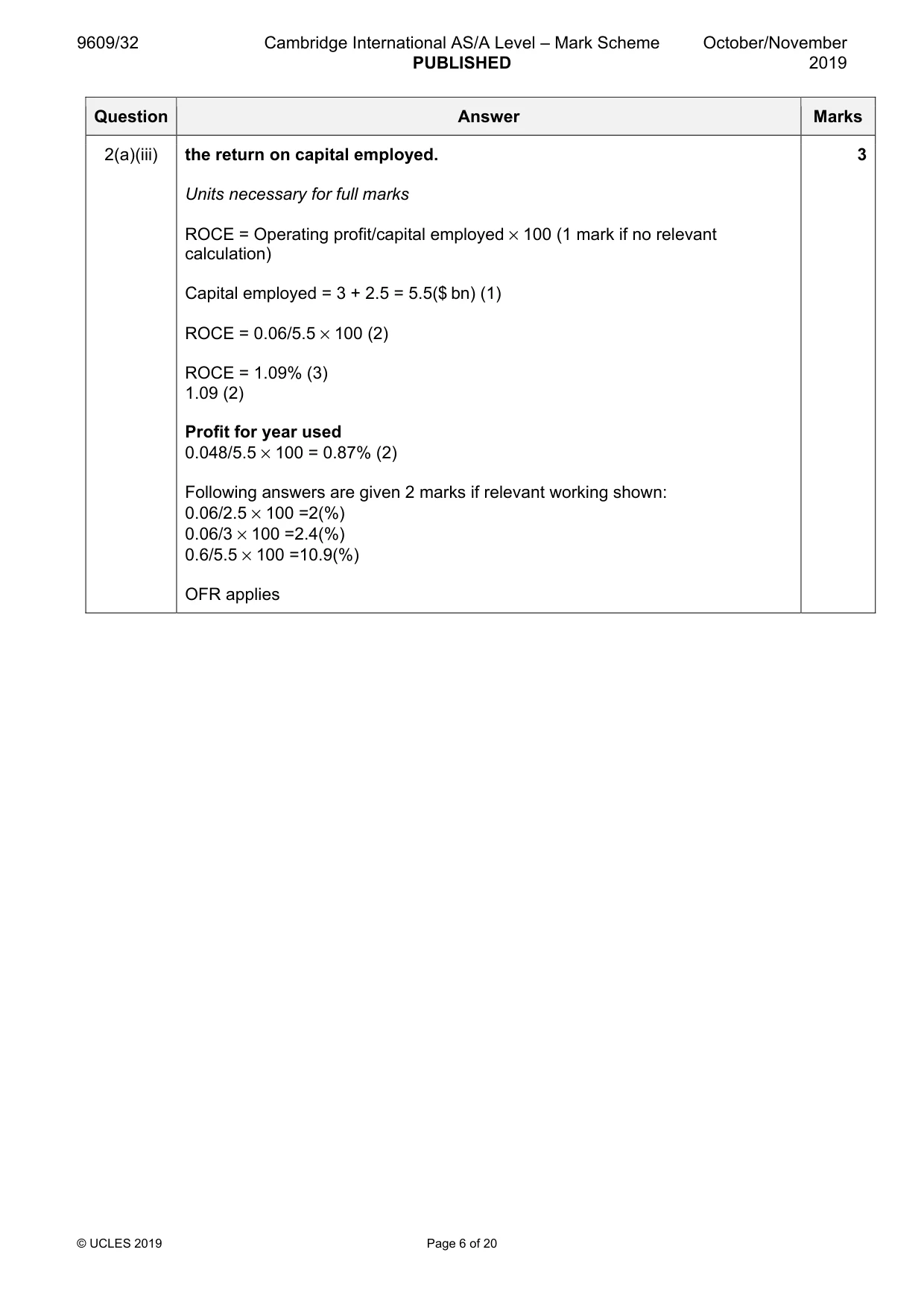
9609/32 Cambridge International AS/A Level – Mark Scheme PUBLISHED October/November 2019 © UCLES 2019 Page 6 of 20 Question Answer Marks 2(a)(iii) the return on capital employed. Units necessary for full marks ROCE = Operating profit/capital employed × 100 (1 mark if no relevant calculation) Capital employed = 3 + 2.5 = 5.5($ bn) (1) ROCE = 0.06/5.5 × 100 (2) ROCE = 1.09% (3) 1.09 (2) Profit for year used 0.048/5.5 × 100 = 0.87% (2) Following answers are given 2 marks if relevant working shown: 0.06/2.5 × 100 =2(%) 0.06/3 × 100 =2.4(%) 0.6/5.5 × 100 =10.9(%) OFR applies 3
Mark scheme, page 7
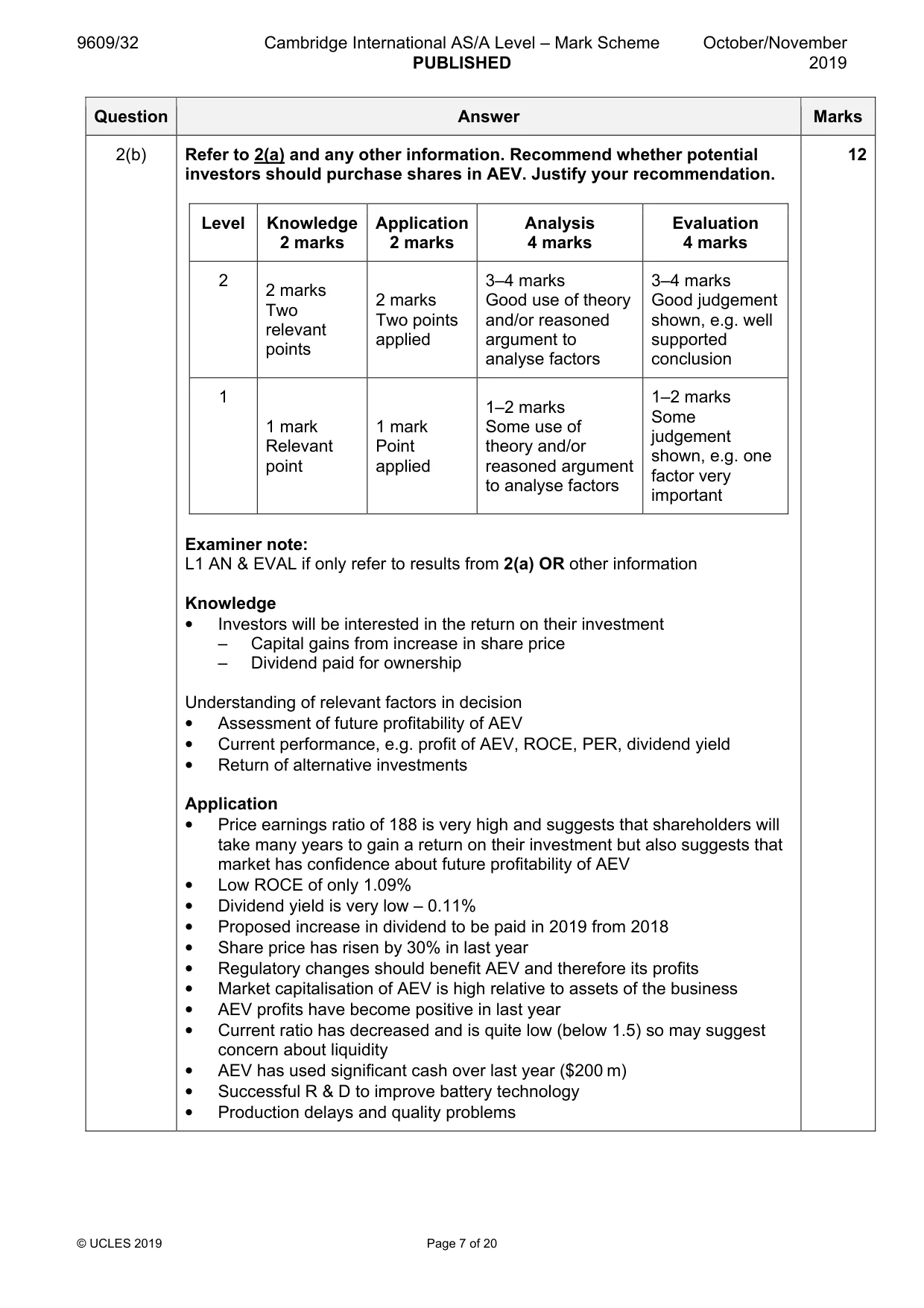
9609/32 Cambridge International AS/A Level – Mark Scheme PUBLISHED October/November 2019 © UCLES 2019 Page 7 of 20 Question Answer Marks 2(b) Refer to 2(a) and any other information. Recommend whether potential investors should purchase shares in AEV. Justify your recommendation. Level Knowledge 2 marks Application 2 marks Analysis 4 marks Evaluation 4 marks 2 2 marks Two relevant points 2 marks Two points applied 3–4 marks Good use of theory and/or reasoned argument to analyse factors 3–4 marks Good judgement shown, e.g. well supported conclusion 1 1 mark Relevant point 1 mark Point applied 1–2 marks Some use of theory and/or reasoned argument to analyse factors 1–2 marks Some judgement shown, e.g. one factor very important Examiner note: L1 AN & EVAL if only refer to results from 2(a) OR other information Knowledge • Investors will be interested in the return on their investment – Capital gains from increase in share price – Dividend paid for ownership Understanding of relevant factors in decision • Assessment of future profitability of AEV • Current performance, e.g. profit of AEV, ROCE, PER, dividend yield • Return of alternative investments Application • Price earnings ratio of 188 is very high and suggests that shareholders will take many years to gain a return on their investment but also suggests that market has confidence about future profitability of AEV • Low ROCE of only 1.09% • Dividend yield is very low – 0.11% • Proposed increase in dividend to be paid in 2019 from 2018 • Share price has risen by 30% in last year • Regulatory changes should benefit AEV and therefore its profits • Market capitalisation of AEV is high relative to assets of the business • AEV profits have become positive in last year • Current ratio has decreased and is quite low (below 1.5) so may suggest concern about liquidity • AEV has used significant cash over last year ($200 m) • Successful R & D to improve battery technology • Production delays and quality problems 12
Mark scheme, page 8
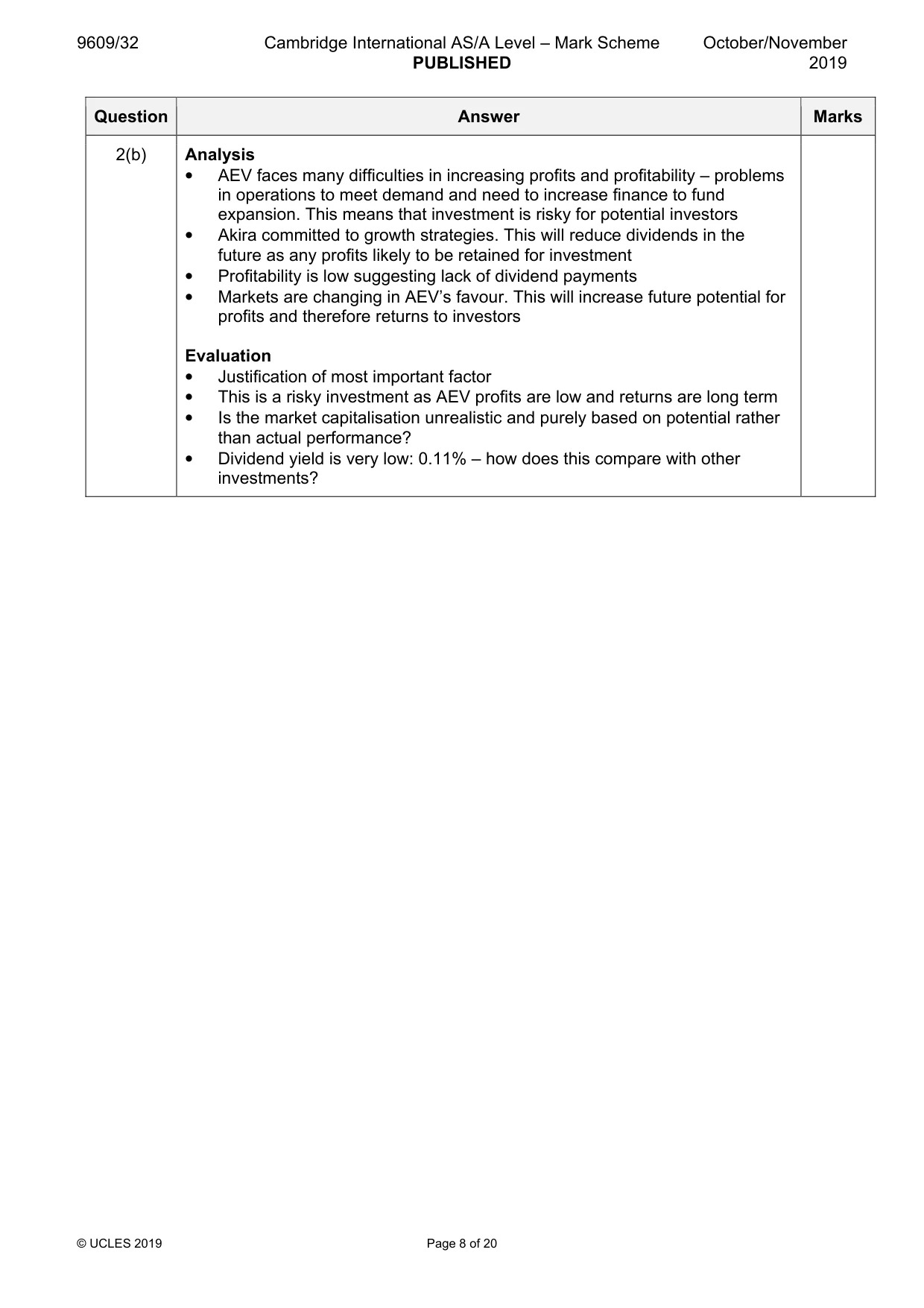
9609/32 Cambridge International AS/A Level – Mark Scheme PUBLISHED October/November 2019 © UCLES 2019 Page 8 of 20 Question Answer Marks 2(b) Analysis • AEV faces many difficulties in increasing profits and profitability – problems in operations to meet demand and need to increase finance to fund expansion. This means that investment is risky for potential investors • Akira committed to growth strategies. This will reduce dividends in the future as any profits likely to be retained for investment • Profitability is low suggesting lack of dividend payments • Markets are changing in AEV’s favour. This will increase future potential for profits and therefore returns to investors Evaluation • Justification of most important factor • This is a risky investment as AEV profits are low and returns are long term • Is the market capitalisation unrealistic and purely based on potential rather than actual performance? • Dividend yield is very low: 0.11% – how does this compare with other investments?
Mark scheme, page 9
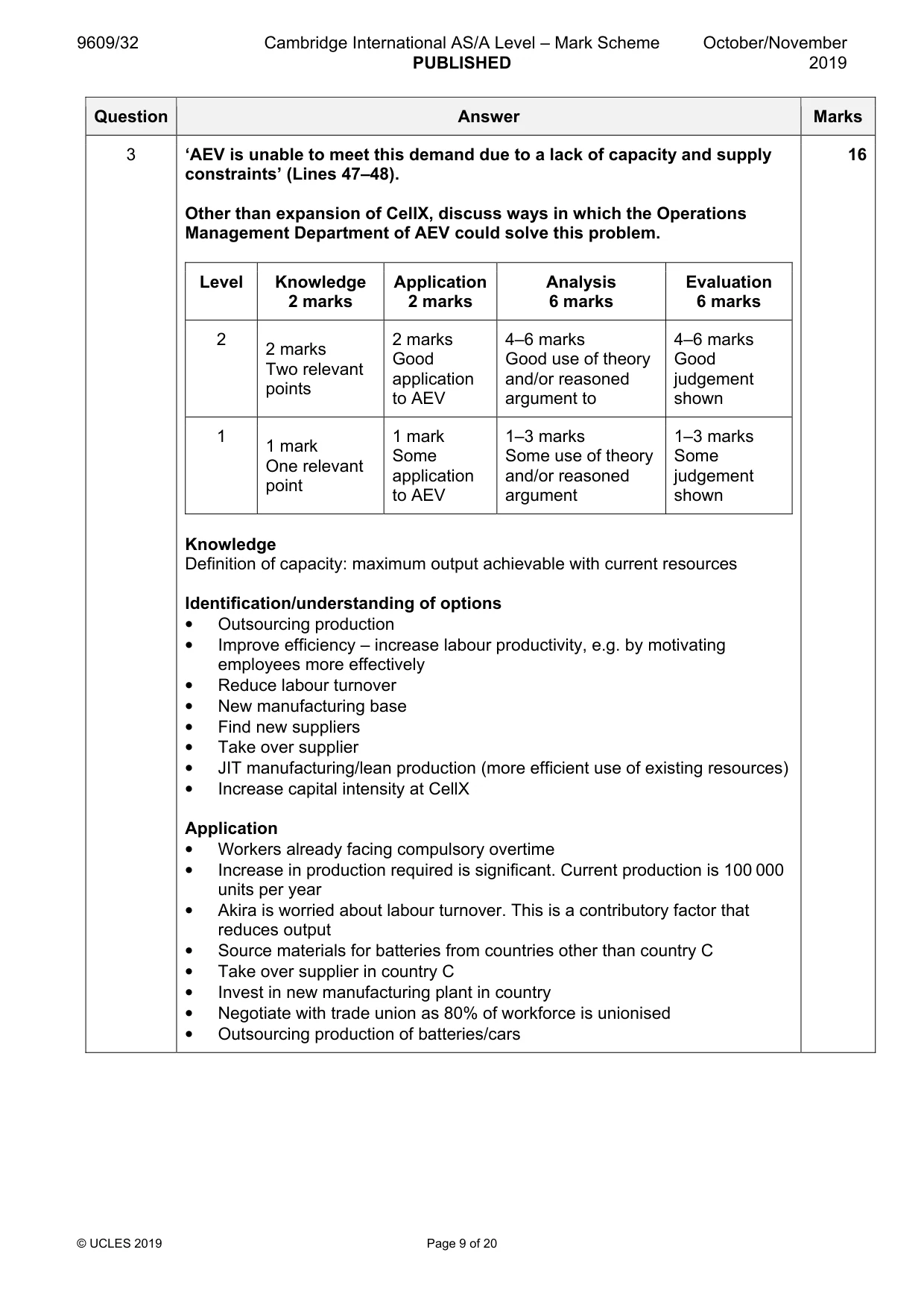
9609/32 Cambridge International AS/A Level – Mark Scheme PUBLISHED October/November 2019 © UCLES 2019 Page 9 of 20 Question Answer Marks 3 ‘AEV is unable to meet this demand due to a lack of capacity and supply constraints’ (Lines 47–48). Other than expansion of CellX, discuss ways in which the Operations Management Department of AEV could solve this problem. Level Knowledge 2 marks Application 2 marks Analysis 6 marks Evaluation 6 marks 2 2 marks Two relevant points 2 marks Good application to AEV 4–6 marks Good use of theory and/or reasoned argument to 4–6 marks Good judgement shown 1 1 mark One relevant point 1 mark Some application to AEV 1–3 marks Some use of theory and/or reasoned argument 1–3 marks Some judgement shown Knowledge Definition of capacity: maximum output achievable with current resources Identification/understanding of options • Outsourcing production • Improve efficiency – increase labour productivity, e.g. by motivating employees more effectively • Reduce labour turnover • New manufacturing base • Find new suppliers • Take over supplier • JIT manufacturing/lean production (more efficient use of existing resources) • Increase capital intensity at CellX Application • Workers already facing compulsory overtime • Increase in production required is significant. Current production is 100 000 units per year • Akira is worried about labour turnover. This is a contributory factor that reduces output • Source materials for batteries from countries other than country C • Take over supplier in country C • Invest in new manufacturing plant in country • Negotiate with trade union as 80% of workforce is unionised • Outsourcing production of batteries/cars 16
Mark scheme, page 10
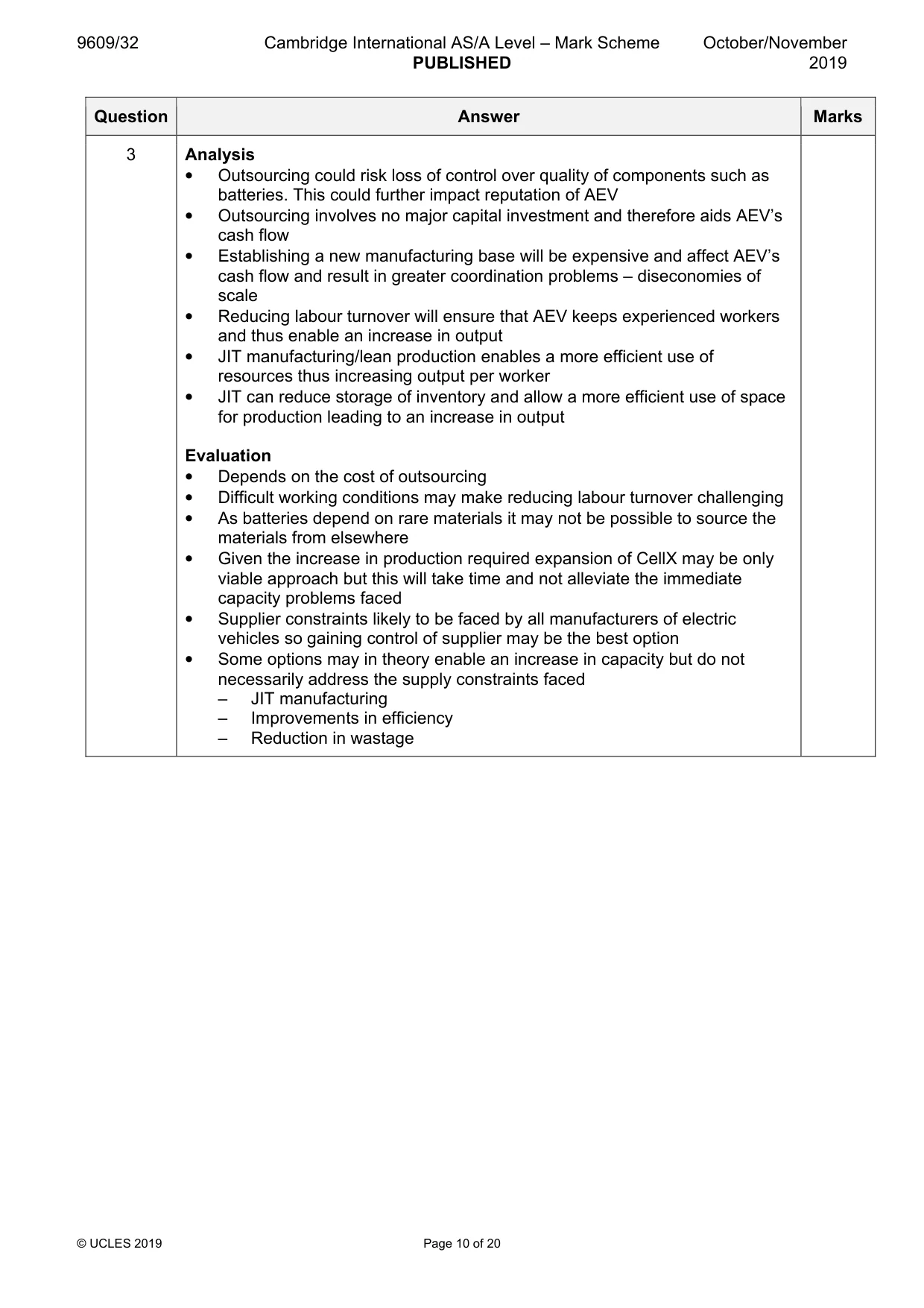
9609/32 Cambridge International AS/A Level – Mark Scheme PUBLISHED October/November 2019 © UCLES 2019 Page 10 of 20 Question Answer Marks 3 Analysis • Outsourcing could risk loss of control over quality of components such as batteries. This could further impact reputation of AEV • Outsourcing involves no major capital investment and therefore aids AEV’s cash flow • Establishing a new manufacturing base will be expensive and affect AEV’s cash flow and result in greater coordination problems – diseconomies of scale • Reducing labour turnover will ensure that AEV keeps experienced workers and thus enable an increase in output • JIT manufacturing/lean production enables a more efficient use of resources thus increasing output per worker • JIT can reduce storage of inventory and allow a more efficient use of space for production leading to an increase in output Evaluation • Depends on the cost of outsourcing • Difficult working conditions may make reducing labour turnover challenging • As batteries depend on rare materials it may not be possible to source the materials from elsewhere • Given the increase in production required expansion of CellX may be only viable approach but this will take time and not alleviate the immediate capacity problems faced • Supplier constraints likely to be faced by all manufacturers of electric vehicles so gaining control of supplier may be the best option • Some options may in theory enable an increase in capacity but do not necessarily address the supply constraints faced – JIT manufacturing – Improvements in efficiency – Reduction in wastage
Mark scheme, page 11
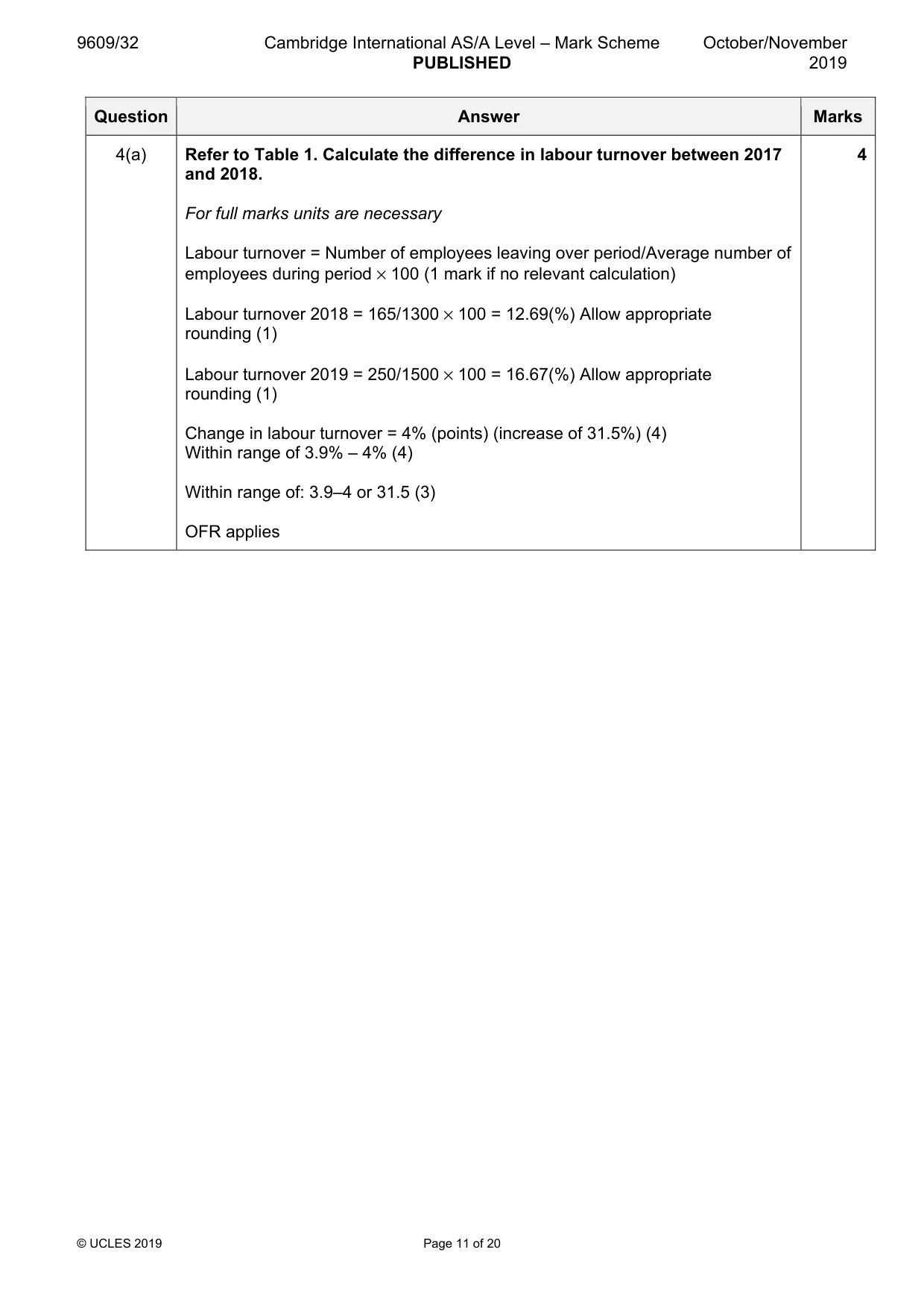
9609/32 Cambridge International AS/A Level – Mark Scheme PUBLISHED October/November 2019 © UCLES 2019 Page 11 of 20 Question Answer Marks 4(a) Refer to Table 1. Calculate the difference in labour turnover between 2017 and 2018. For full marks units are necessary Labour turnover = Number of employees leaving over period/Average number of employees during period × 100 (1 mark if no relevant calculation) Labour turnover 2018 = 165/1300 × 100 = 12.69(%) Allow appropriate rounding (1) Labour turnover 2019 = 250/1500 × 100 = 16.67(%) Allow appropriate rounding (1) Change in labour turnover = 4% (points) (increase of 31.5%) (4) Within range of 3.9% – 4% (4) Within range of: 3.9–4 or 31.5 (3) OFR applies 4
Mark scheme, page 12
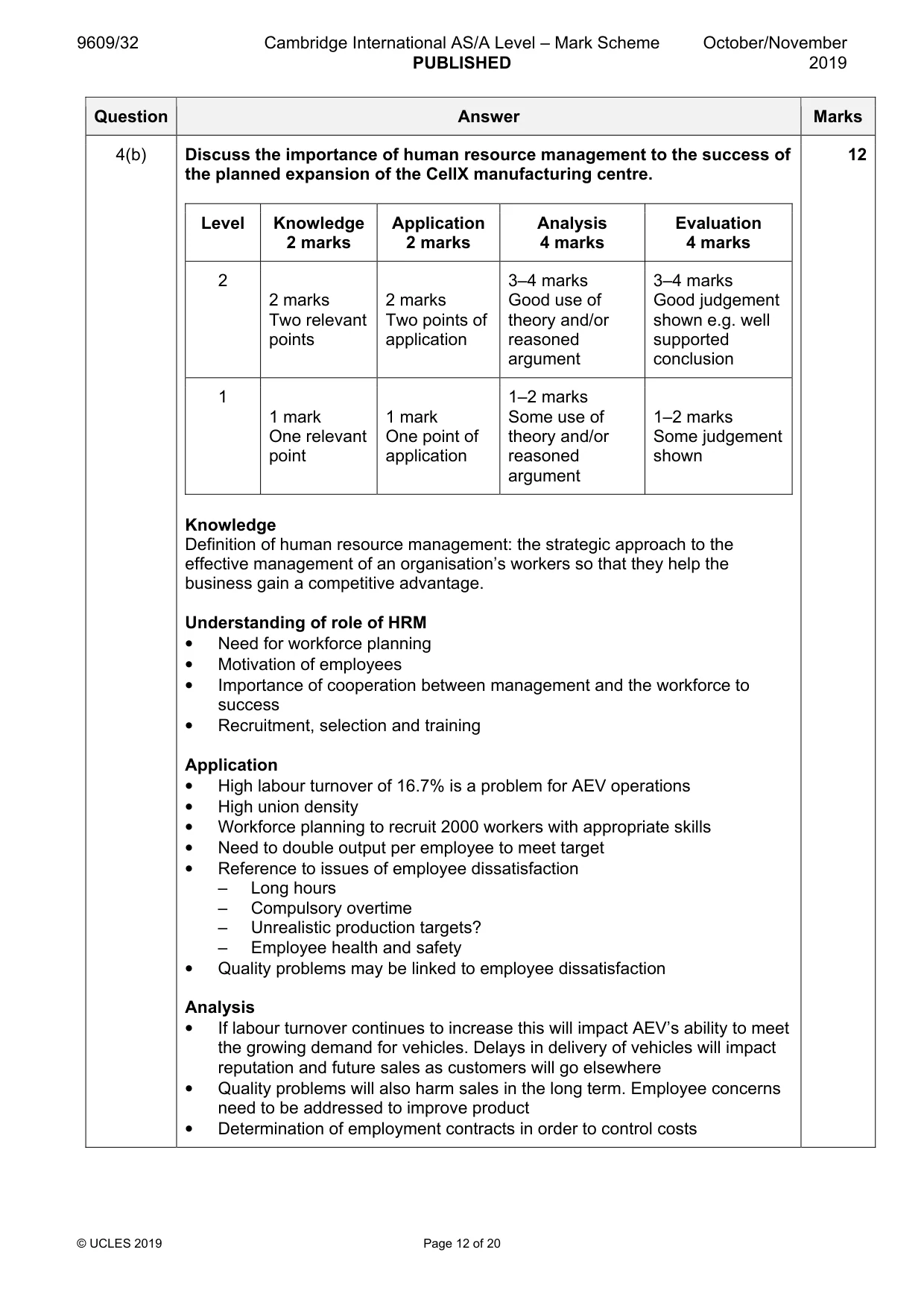
9609/32 Cambridge International AS/A Level – Mark Scheme PUBLISHED October/November 2019 © UCLES 2019 Page 12 of 20 Question Answer Marks 4(b) Discuss the importance of human resource management to the success of the planned expansion of the CellX manufacturing centre. Level Knowledge 2 marks Application 2 marks Analysis 4 marks Evaluation 4 marks 2 2 marks Two relevant points 2 marks Two points of application 3–4 marks Good use of theory and/or reasoned argument 3–4 marks Good judgement shown e.g. well supported conclusion 1 1 mark One relevant point 1 mark One point of application 1–2 marks Some use of theory and/or reasoned argument 1–2 marks Some judgement shown Knowledge Definition of human resource management: the strategic approach to the effective management of an organisation’s workers so that they help the business gain a competitive advantage. Understanding of role of HRM • Need for workforce planning • Motivation of employees • Importance of cooperation between management and the workforce to success • Recruitment, selection and training Application • High labour turnover of 16.7% is a problem for AEV operations • High union density • Workforce planning to recruit 2000 workers with appropriate skills • Need to double output per employee to meet target • Reference to issues of employee dissatisfaction – Long hours – Compulsory overtime – Unrealistic production targets? – Employee health and safety • Quality problems may be linked to employee dissatisfaction Analysis • If labour turnover continues to increase this will impact AEV’s ability to meet the growing demand for vehicles. Delays in delivery of vehicles will impact reputation and future sales as customers will go elsewhere • Quality problems will also harm sales in the long term. Employee concerns need to be addressed to improve product • Determination of employment contracts in order to control costs 12
Mark scheme, page 13
9609/32 Cambridge International AS/A Level – Mark Scheme PUBLISHED October/November 2019 © UCLES 2019 Page 13 of 20 Question Answer Marks 4(b) Evaluation • Justification of most important issue • Success of expanded CellX depends crucially on employees. HRM is critical in terms of planning and execution of the expansion • There are other factors that will also determine success, e.g. supplies of raw materials from country C for the batteries • Depends on availability of finance
Mark scheme, page 14
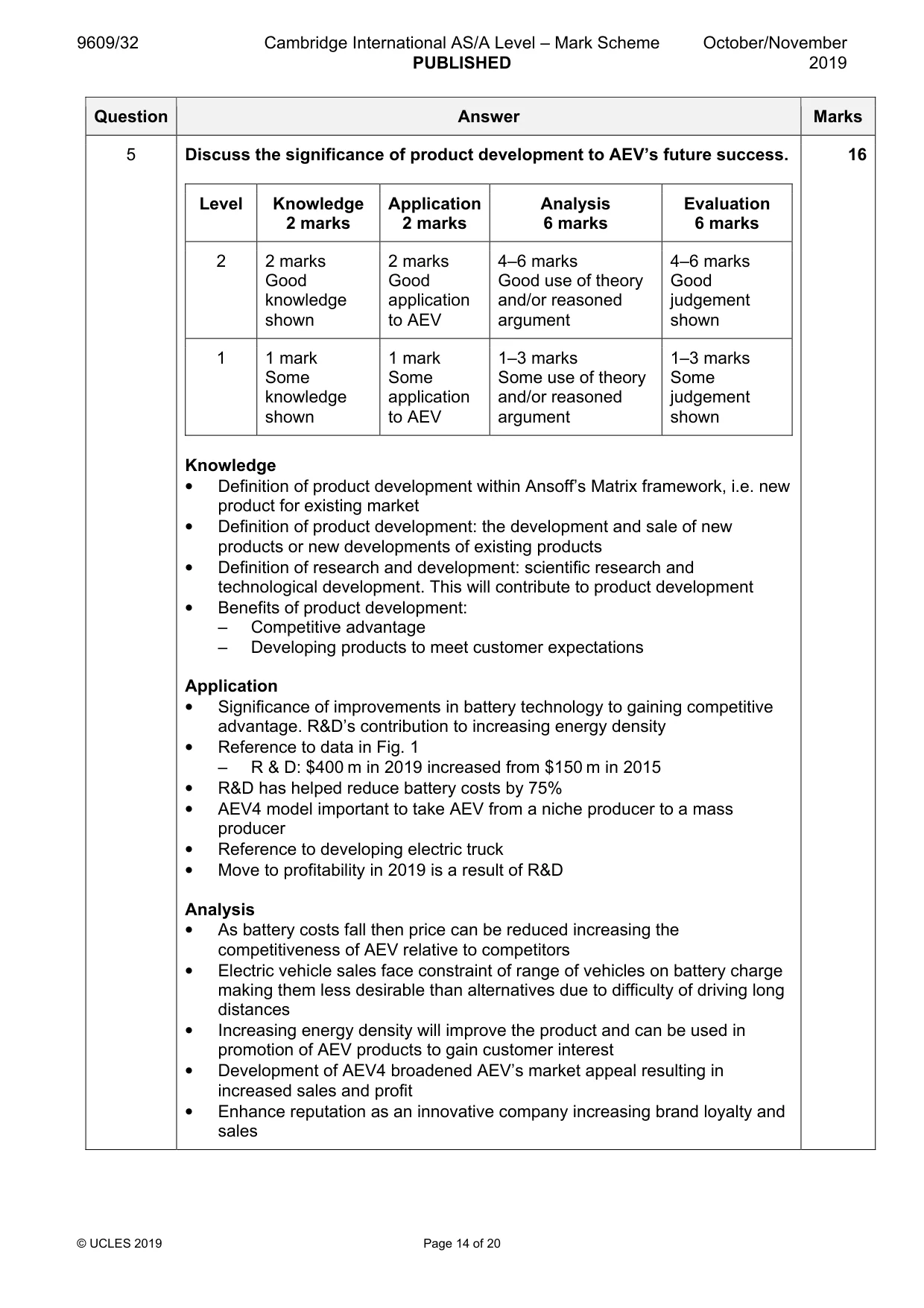
9609/32 Cambridge International AS/A Level – Mark Scheme PUBLISHED October/November 2019 © UCLES 2019 Page 14 of 20 Question Answer Marks 5 Discuss the significance of product development to AEV’s future success. Level Knowledge 2 marks Application 2 marks Analysis 6 marks Evaluation 6 marks 2 2 marks Good knowledge shown 2 marks Good application to AEV 4–6 marks Good use of theory and/or reasoned argument 4–6 marks Good judgement shown 1 1 mark Some knowledge shown 1 mark Some application to AEV 1–3 marks Some use of theory and/or reasoned argument 1–3 marks Some judgement shown Knowledge • Definition of product development within Ansoff’s Matrix framework, i.e. new product for existing market • Definition of product development: the development and sale of new products or new developments of existing products • Definition of research and development: scientific research and technological development. This will contribute to product development • Benefits of product development: – Competitive advantage – Developing products to meet customer expectations Application • Significance of improvements in battery technology to gaining competitive advantage. R&D’s contribution to increasing energy density • Reference to data in Fig. 1 – R & D: $400 m in 2019 increased from $150 m in 2015 • R&D has helped reduce battery costs by 75% • AEV4 model important to take AEV from a niche producer to a mass producer • Reference to developing electric truck • Move to profitability in 2019 is a result of R&D Analysis • As battery costs fall then price can be reduced increasing the competitiveness of AEV relative to competitors • Electric vehicle sales face constraint of range of vehicles on battery charge making them less desirable than alternatives due to difficulty of driving long distances • Increasing energy density will improve the product and can be used in promotion of AEV products to gain customer interest • Development of AEV4 broadened AEV’s market appeal resulting in increased sales and profit • Enhance reputation as an innovative company increasing brand loyalty and sales 16
Mark scheme, page 15
9609/32 Cambridge International AS/A Level – Mark Scheme PUBLISHED October/November 2019 © UCLES 2019 Page 15 of 20 Question Answer Marks 5 Evaluation • Product development essential in this market as without it product unable to compete with existing technologies • Cost of research is high and not guaranteed to be successful • First mover advantage may be important • Dynamic nature of the car market requires AEV to be constantly developing its products to maintain a competitive edge • Other factors will be important to future success, e.g. government policy
Mark scheme, page 16
9609/32 Cambridge International AS/A Level – Mark Scheme PUBLISHED October/November 2019 © UCLES 2019 Page 16 of 20 Questions 6 and 7 use this marking grid: Level Knowledge 3 marks Application 3 marks Analysis 4 marks Evaluation 10 marks 3 7–10 marks Good judgement shown throughout with well supported conclusion/recommendation, focused on the business in the case 2 3 marks Good understanding shown 3 marks Good application to the case 3–4 marks Good use of reasoned argument or use of theory to explain points made 4–6 marks Some judgement shown in the main body of the answer and an attempt to support conclusion/recommendation, focused on the business in the case OR effective and well supported conclusion/ recommendation, focused on the business in the case 1 1–2 marks Some understanding shown 1–2 marks Some application to the case 1–2 marks Limited use of reasoned argument or use of theory to support points made 1–3 marks Limited attempt to show judgement either within the answer OR a weakly supported conclusion/ recommendation with some focus on the business in the case 0 No creditable content
Mark scheme, page 17
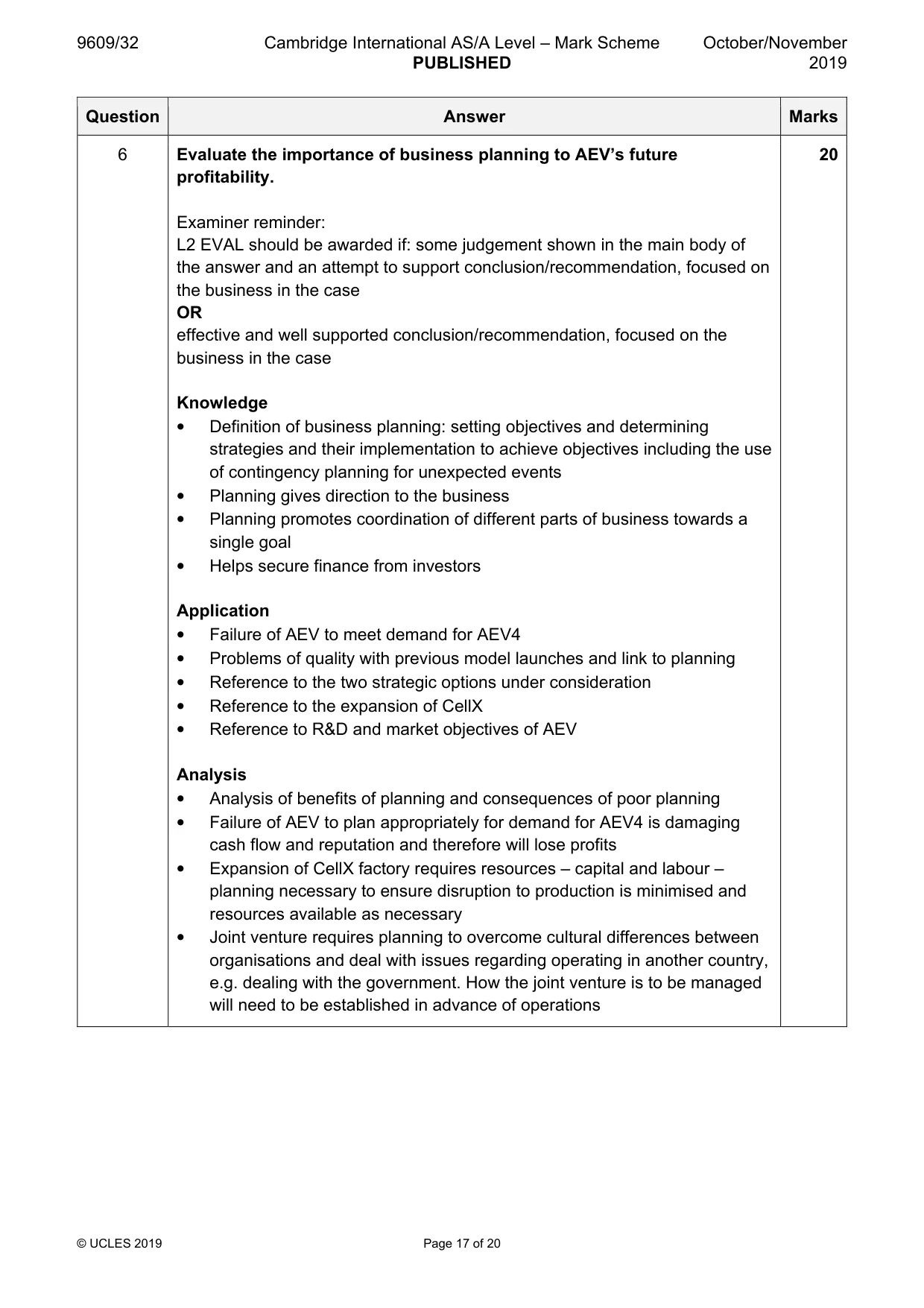
9609/32 Cambridge International AS/A Level – Mark Scheme PUBLISHED October/November 2019 © UCLES 2019 Page 17 of 20 Question Answer Marks 6 Evaluate the importance of business planning to AEV’s future profitability. Examiner reminder: L2 EVAL should be awarded if: some judgement shown in the main body of the answer and an attempt to support conclusion/recommendation, focused on the business in the case OR effective and well supported conclusion/recommendation, focused on the business in the case Knowledge • Definition of business planning: setting objectives and determining strategies and their implementation to achieve objectives including the use of contingency planning for unexpected events • Planning gives direction to the business • Planning promotes coordination of different parts of business towards a single goal • Helps secure finance from investors Application • Failure of AEV to meet demand for AEV4 • Problems of quality with previous model launches and link to planning • Reference to the two strategic options under consideration • Reference to the expansion of CellX • Reference to R&D and market objectives of AEV Analysis • Analysis of benefits of planning and consequences of poor planning • Failure of AEV to plan appropriately for demand for AEV4 is damaging cash flow and reputation and therefore will lose profits • Expansion of CellX factory requires resources – capital and labour – planning necessary to ensure disruption to production is minimised and resources available as necessary • Joint venture requires planning to overcome cultural differences between organisations and deal with issues regarding operating in another country, e.g. dealing with the government. How the joint venture is to be managed will need to be established in advance of operations 20
Mark scheme, page 18
9609/32 Cambridge International AS/A Level – Mark Scheme PUBLISHED October/November 2019 © UCLES 2019 Page 18 of 20 Question Answer Marks 6 Evaluation • AEV operates in a dynamic market and therefore planning is essential to ensure the effective use of resources to meet changes in the market • Planning needs to be reviewed in light of changes in the market, e.g. considering impacts of changes in the law and to be constantly updated • Planning is important but without effective implementation success less likely • Planning more likely to be effective if it is agreed so communication with, and involvement of, employees are important
Mark scheme, page 19
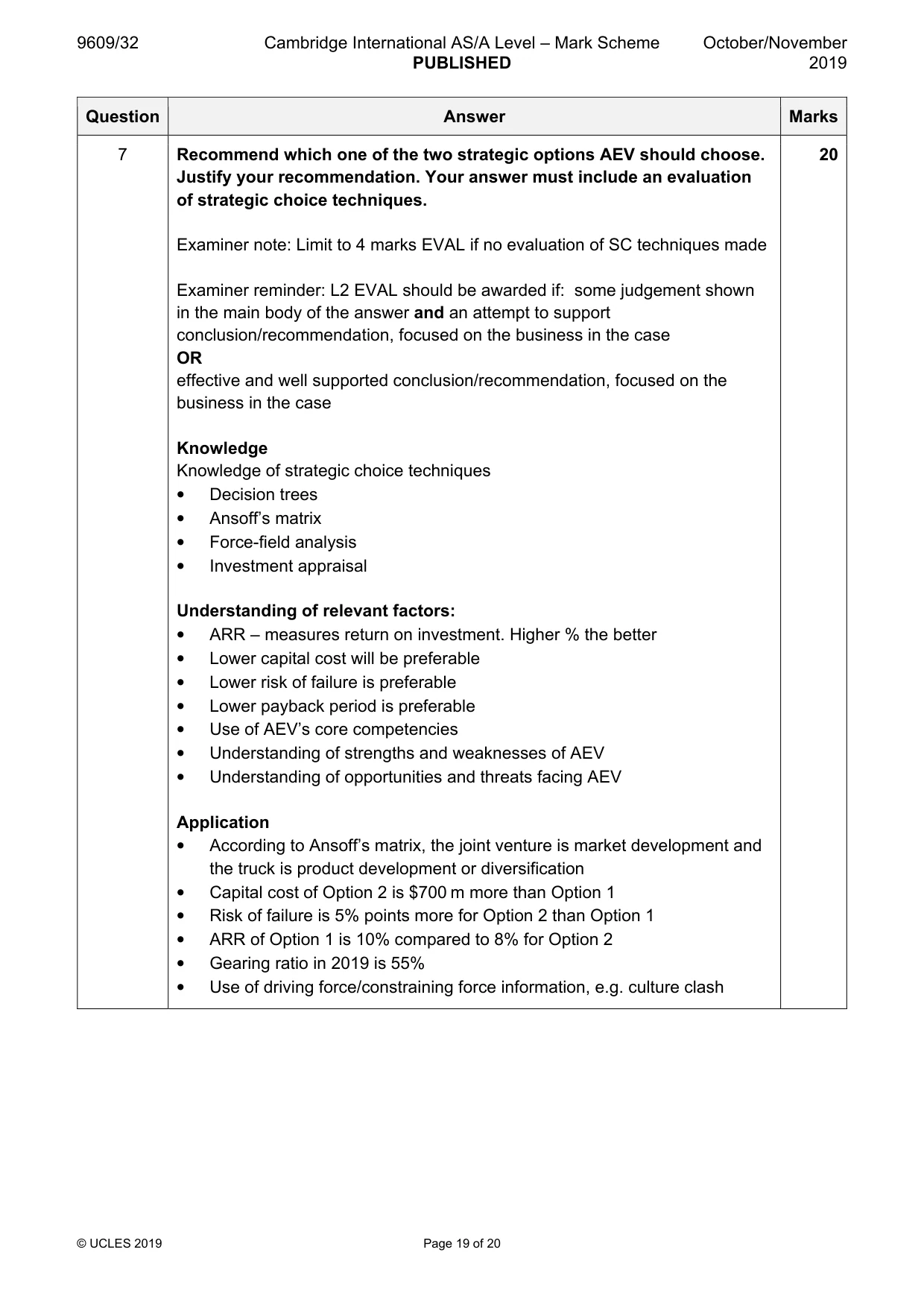
9609/32 Cambridge International AS/A Level – Mark Scheme PUBLISHED October/November 2019 © UCLES 2019 Page 19 of 20 Question Answer Marks 7 Recommend which one of the two strategic options AEV should choose. Justify your recommendation. Your answer must include an evaluation of strategic choice techniques. Examiner note: Limit to 4 marks EVAL if no evaluation of SC techniques made Examiner reminder: L2 EVAL should be awarded if: some judgement shown in the main body of the answer and an attempt to support conclusion/recommendation, focused on the business in the case OR effective and well supported conclusion/recommendation, focused on the business in the case Knowledge Knowledge of strategic choice techniques • Decision trees • Ansoff’s matrix • Force-field analysis • Investment appraisal Understanding of relevant factors: • ARR – measures return on investment. Higher % the better • Lower capital cost will be preferable • Lower risk of failure is preferable • Lower payback period is preferable • Use of AEV’s core competencies • Understanding of strengths and weaknesses of AEV • Understanding of opportunities and threats facing AEV Application • According to Ansoff’s matrix, the joint venture is market development and the truck is product development or diversification • Capital cost of Option 2 is $700 m more than Option 1 • Risk of failure is 5% points more for Option 2 than Option 1 • ARR of Option 1 is 10% compared to 8% for Option 2 • Gearing ratio in 2019 is 55% • Use of driving force/constraining force information, e.g. culture clash 20
Mark scheme, page 20
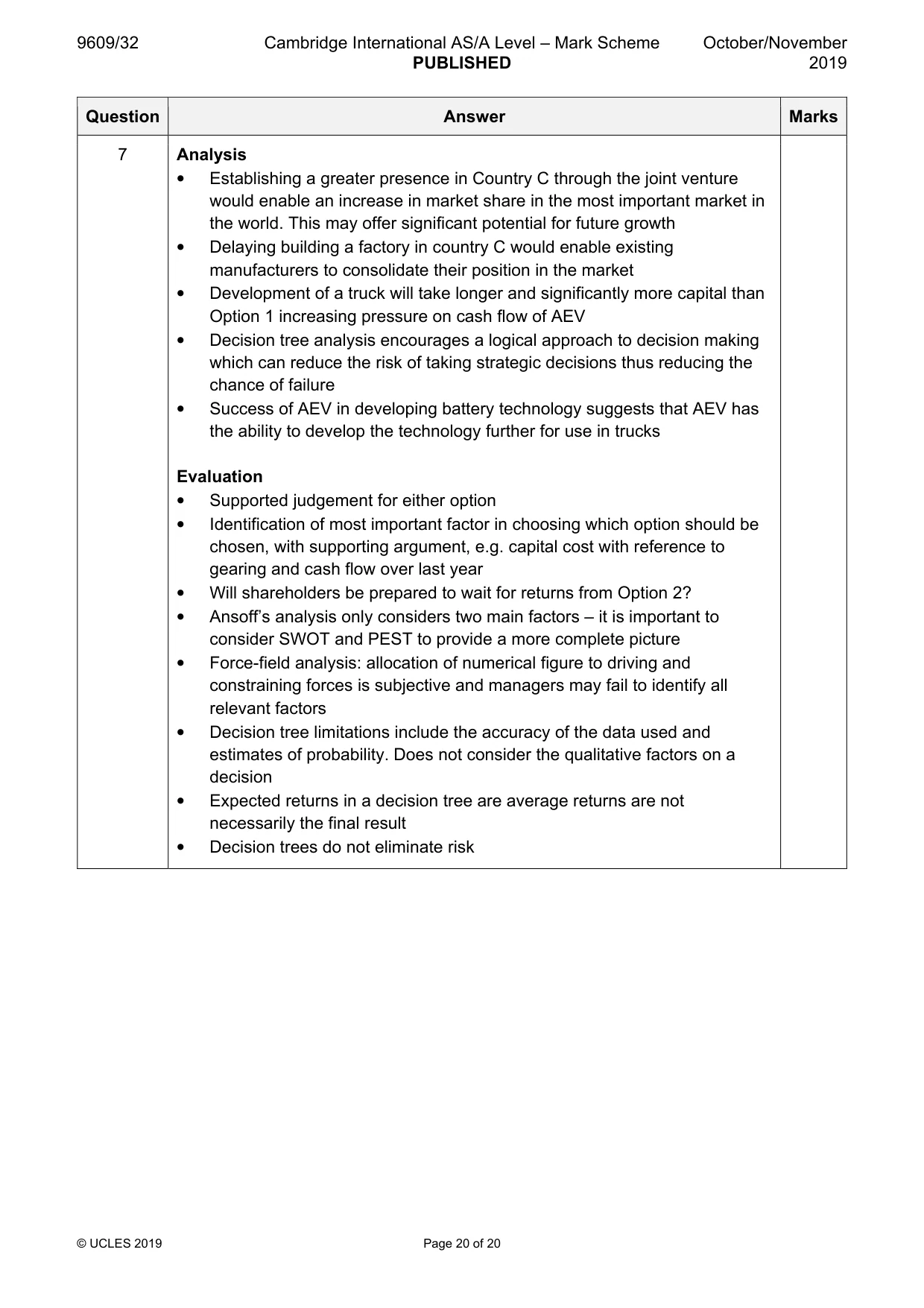
9609/32 Cambridge International AS/A Level – Mark Scheme PUBLISHED October/November 2019 © UCLES 2019 Page 20 of 20 Question Answer Marks 7 Analysis • Establishing a greater presence in Country C through the joint venture would enable an increase in market share in the most important market in the world. This may offer significant potential for future growth • Delaying building a factory in country C would enable existing manufacturers to consolidate their position in the market • Development of a truck will take longer and significantly more capital than Option 1 increasing pressure on cash flow of AEV • Decision tree analysis encourages a logical approach to decision making which can reduce the risk of taking strategic decisions thus reducing the chance of failure • Success of AEV in developing battery technology suggests that AEV has the ability to develop the technology further for use in trucks Evaluation • Supported judgement for either option • Identification of most important factor in choosing which option should be chosen, with supporting argument, e.g. capital cost with reference to gearing and cash flow over last year • Will shareholders be prepared to wait for returns from Option 2? • Ansoff’s analysis only considers two main factors – it is important to consider SWOT and PEST to provide a more complete picture • Force-field analysis: allocation of numerical figure to driving and constraining forces is subjective and managers may fail to identify all relevant factors • Decision tree limitations include the accuracy of the data used and estimates of probability. Does not consider the qualitative factors on a decision • Expected returns in a decision tree are average returns are not necessarily the final result • Decision trees do not eliminate risk
What you needed in this session
Cambridge’s own grade thresholds for 2019 Oct/Nov, Paper 3 · Variant 2. A higher threshold means an easier paper — the bar moves with how the cohort did.