Cambridge A Level Business (for first examination in 2016) 9609 — 2019 Oct/Nov Paper 3 · Variant 1
9609/31/O/N/19 · 100 marks · ≈113 min
The question paper and its mark scheme, free to read here and free to download. This is Cambridge’s own paper, exactly as it was sat.
Question paper20 pages
















Mark scheme19 pages
Answers below. Sit the paper first if you are practising.

Paper as text
Question paper, page 1
This document consists of 20 printed pages and 1 Insert. DC (ST) 169859/2 © UCLES 2019 [Turn over * 3 9 5 6 9 7 7 6 4 2 * BUSINESS 9609/31 Paper 3 Case Study October/November 2019 3 hours Candidates answer on the Question Paper. No Additional Materials are required. READ THESE INSTRUCTIONS FIRST Write your centre number, candidate number and name in the spaces at the top of this page. If you need additional answer paper ask the invigilator for a continuation booklet. Write in dark blue or black pen. You may use an HB pencil for any diagrams, graphs or rough working. Do not use staples, paper clips, glue or correction fluid. DO NOT WRITE IN ANY BARCODES. Section A Answer all questions. Section B Answer one question. You are advised to spend no more than 40 minutes on Section B. Refer to the Insert for the case study for this Paper. At the end of the examination, fasten all your work securely together. The number of marks is given in brackets [ ] at the end of each question or part question. Cambridge Assessment International Education Cambridge International Advanced Subsidiary and Advanced Level
Question paper, page 2
2 9609/31/O/N/19 © UCLES 2019 Section A Answer all questions in this section. 1 Analyse the advantages to QH of its HRM policy. … … … … … … … … … … … … … … … … … … … … … … … … …
Question paper, page 3
3 9609/31/O/N/19 © UCLES 2019 [Turn over … … … … … … … … … … … … … … … … … … … … … … … … … … … … [10]
Question paper, page 4
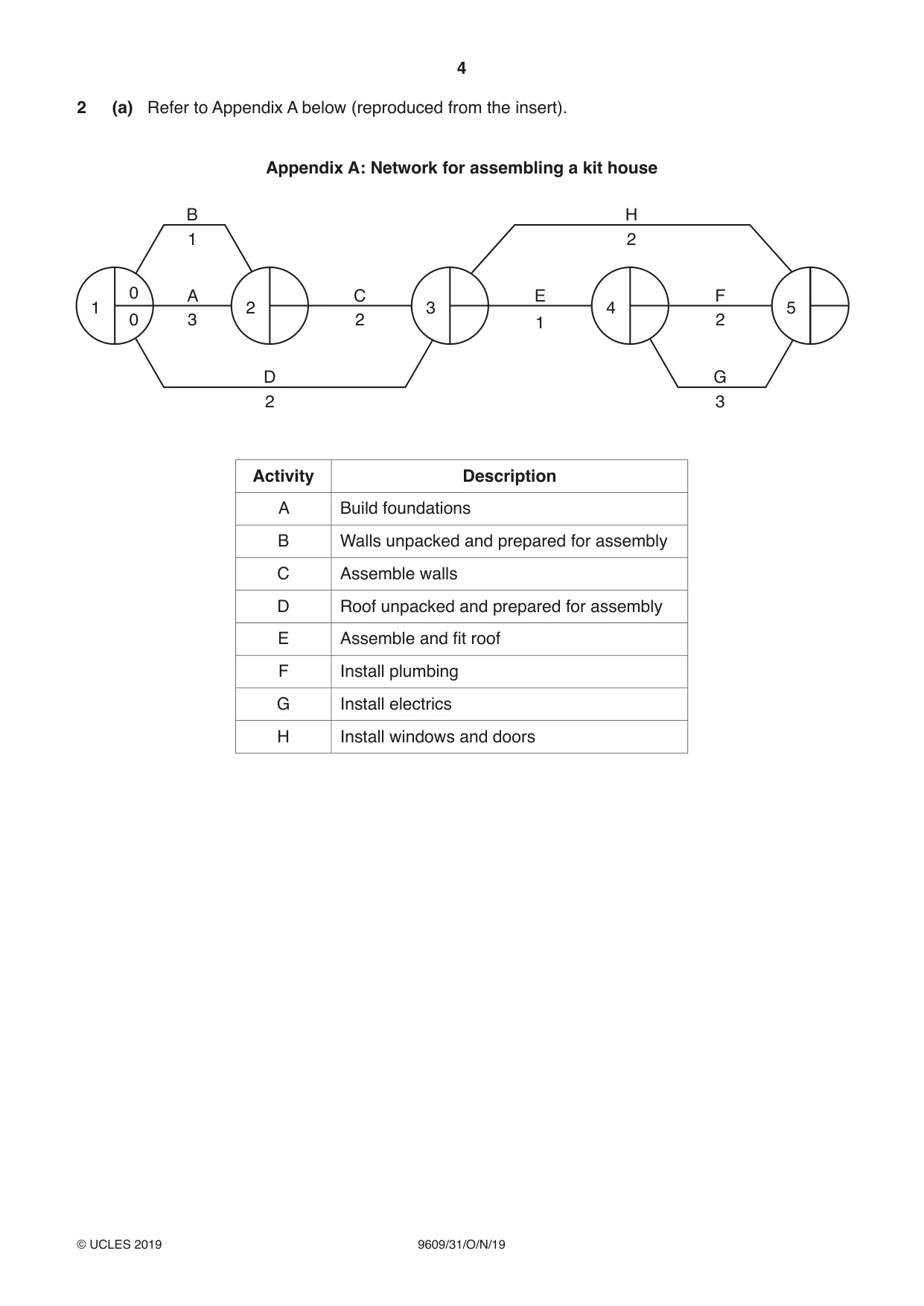
4 9609/31/O/N/19 © UCLES 2019 2 (a) Refer to Appendix A below (reproduced from the insert). Appendix A: Network for assembling a kit house 1 0 3 0 A 1 B H 2 2 D 2 3 2 C 3 1 E 4 2 G F 5 Activity Description A Build foundations B Walls unpacked and prepared for assembly C Assemble walls D Roof unpacked and prepared for assembly E Assemble and fit roof F Install plumbing G Install electrics H Install windows and doors
Question paper, page 5
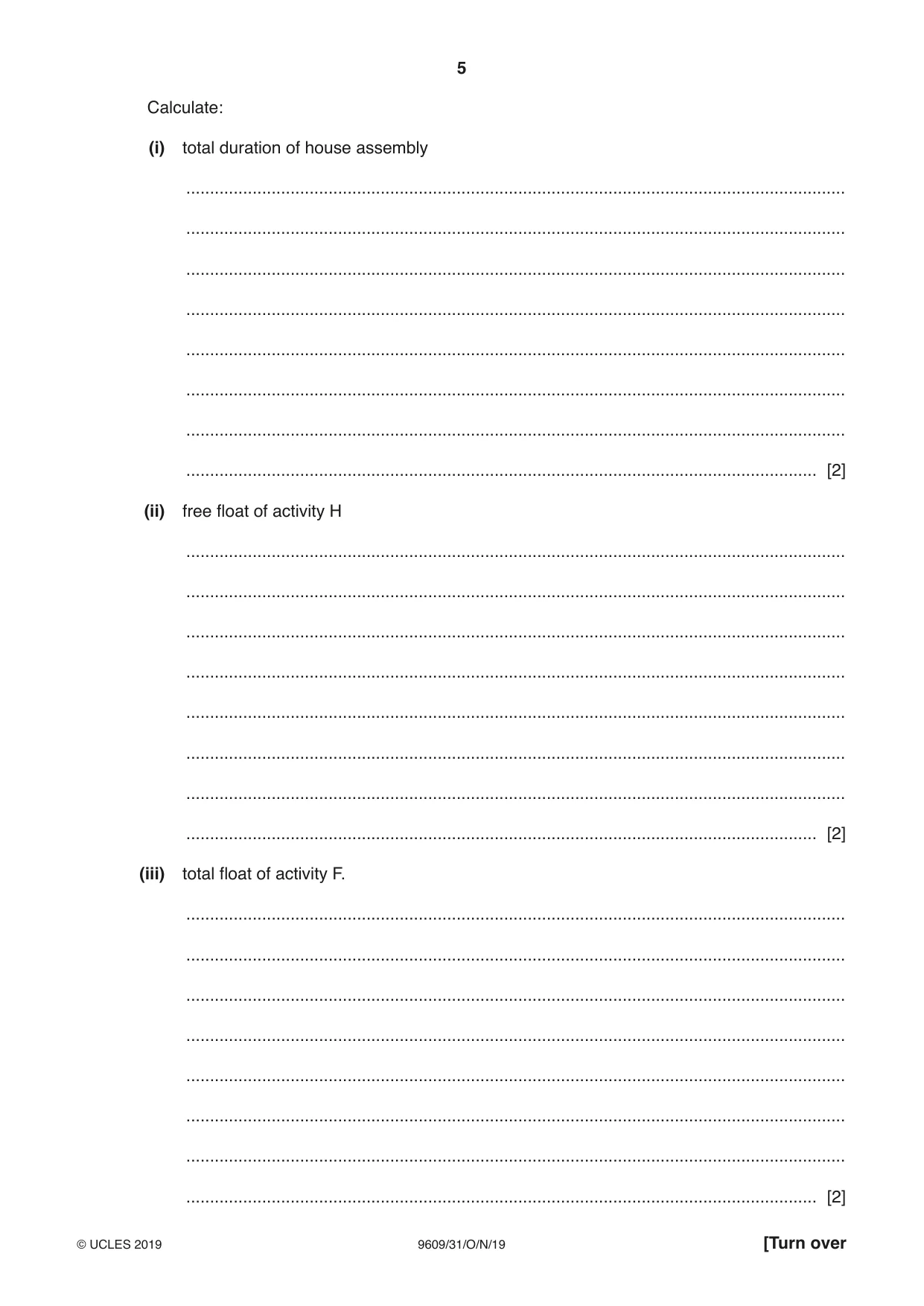
5 9609/31/O/N/19 © UCLES 2019 [Turn over Calculate: (i) total duration of house assembly … … … … … … … … [2] (ii) free float of activity H … … … … … … … … [2] (iii) total float of activity F. … … … … … … … … [2]
Question paper, page 6
6 9609/31/O/N/19 © UCLES 2019 (b) Evaluate the role of critical path analysis (CPA) in meeting QH’s quality targets. … … … … … … … … … … … … … … … … … … … … … … … … … … …
Question paper, page 7
7 9609/31/O/N/19 © UCLES 2019 [Turn over … … … … … … … … … … … … … … … … … … … … … … … … … … … … [12]
Question paper, page 8
8 9609/31/O/N/19 © UCLES 2019 3 Discuss the possible effects on QH of the changes to the macroeconomic policies as announced by the Finance Minister of Country Z. … … … … … … … … … … … … … … … … … … … … … … … … … … …
Question paper, page 9
9 9609/31/O/N/19 © UCLES 2019 [Turn over … … … … … … … … … … … … … … … … … … … … … … … … … … … …
Question paper, page 10
10 9609/31/O/N/19 © UCLES 2019 … … … … … … … … … … … … … … … … … … … … … … … … … … … … [16]
Question paper, page 11
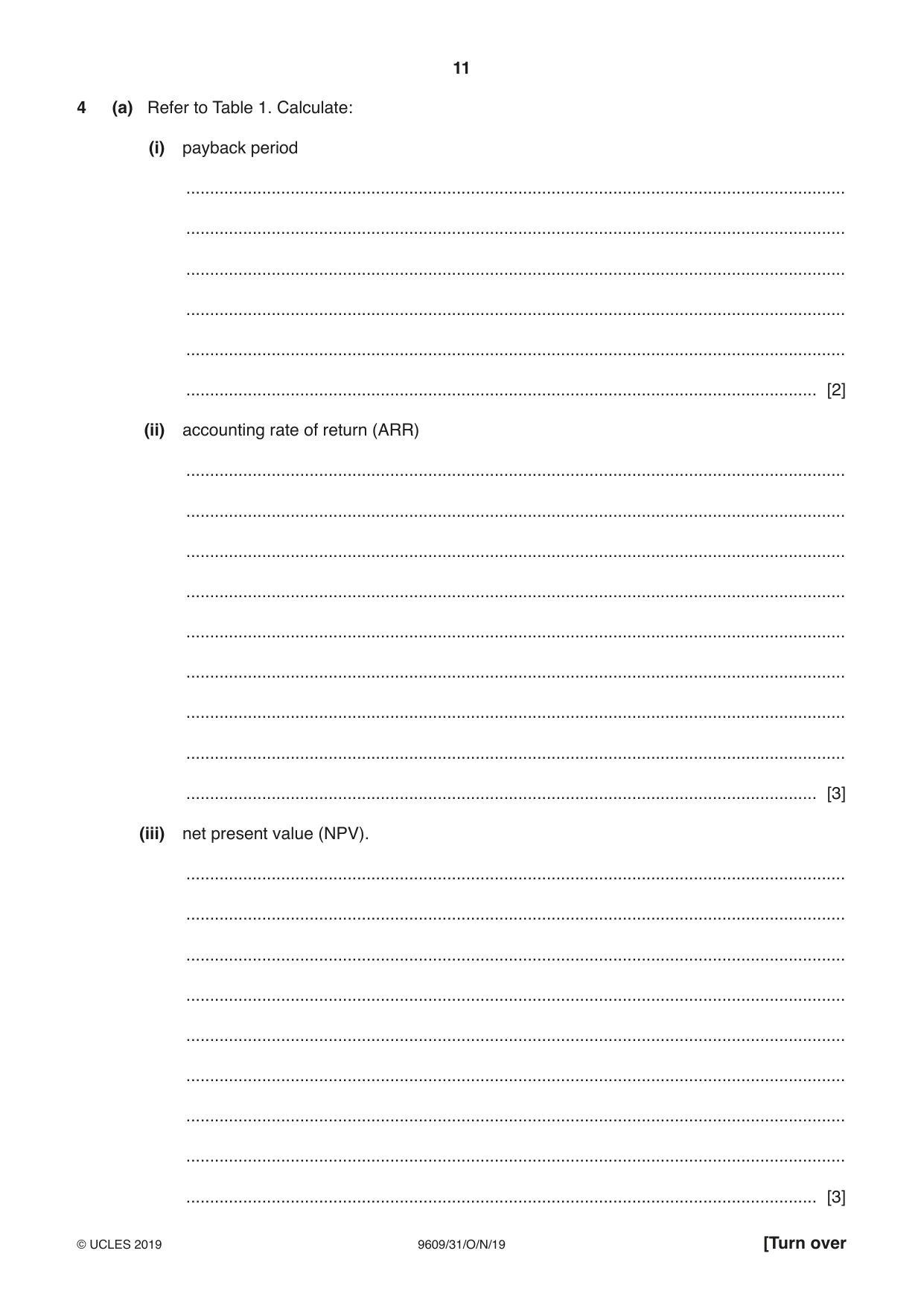
11 9609/31/O/N/19 © UCLES 2019 [Turn over 4 (a) Refer to Table 1. Calculate: (i) payback period … … … … … … [2] (ii) accounting rate of return (ARR) … … … … … … … … … [3] (iii) net present value (NPV). … … … … … … … … … [3]
Question paper, page 12
12 9609/31/O/N/19 © UCLES 2019 (b) Refer to your results from 4(a) and any other information. Discuss whether QH should purchase the new machinery. … … … … … … … … … … … … … … … … … … … … … … … … … … …
Question paper, page 13
13 9609/31/O/N/19 © UCLES 2019 [Turn over … … … … … … … … … … … … … … … … … … … … … … … … … … … … [12]
Question paper, page 14
14 9609/31/O/N/19 © UCLES 2019 5 Recommend which method of market entry QH should use to start selling houses in the European market. … … … … … … … … … … … … … … … … … … … … … … … … … … …
Question paper, page 15
15 9609/31/O/N/19 © UCLES 2019 [Turn over … … … … … … … … … … … … … … … … … … … … … … … … … … … …
Question paper, page 16
16 9609/31/O/N/19 © UCLES 2019 … … … … … … … … … … … … … … … … … … … … … … … … … … … … [16]
Question paper, page 17
17 9609/31/O/N/19 © UCLES 2019 [Turn over Section B Answer one question in this section. 6 Evaluate whether the strategic analysis undertaken by Artur is sufficient to provide QH with a framework for business strategy. 7 Assume QH has decided to manufacture and sell steel framed houses. Evaluate the importance of developing a strategy to manage this change. Write the question number here: … … … … … … … … … … … … … … … … … … … … … … …
Question paper, page 18
18 9609/31/O/N/19 © UCLES 2019 … … … … … … … … … … … … … … … … … … … … … … … … … … … …
Question paper, page 19
19 9609/31/O/N/19 © UCLES 2019 … … … … … … … … … … … … … … … … … … … … … … … … … … … … [Turn over
Question paper, page 20
20 9609/31/O/N/19 © UCLES 2019 Permission to reproduce items where third-party owned material protected by copyright is included has been sought and cleared where possible. Every reasonable effort has been made by the publisher (UCLES) to trace copyright holders, but if any items requiring clearance have unwittingly been included, the publisher will be pleased to make amends at the earliest possible opportunity. To avoid the issue of disclosure of answer-related information to candidates, all copyright acknowledgements are reproduced online in the Cambridge Assessment International Education Copyright Acknowledgements Booklet. This is produced for each series of examinations and is freely available to download at www.cambridgeinternational.org after the live examination series. Cambridge Assessment International Education is part of the Cambridge Assessment Group. Cambridge Assessment is the brand name of the University of Cambridge Local Examinations Syndicate (UCLES), which itself is a department of the University of Cambridge. … … … … … … … … … … … … … … … … … … … … … … … … [20]
Mark scheme, page 1
This document consists of 19 printed pages. © UCLES 2019 [Turn over Cambridge Assessment International Education Cambridge International Advanced Subsidiary and Advanced Level BUSINESS 9609/31 Paper 3 Case Study October/November 2019 MARK SCHEME Maximum Mark: 100 Published This mark scheme is published as an aid to teachers and candidates, to indicate the requirements of the examination. It shows the basis on which Examiners were instructed to award marks. It does not indicate the details of the discussions that took place at an Examiners’ meeting before marking began, which would have considered the acceptability of alternative answers. Mark schemes should be read in conjunction with the question paper and the Principal Examiner Report for Teachers. Cambridge International will not enter into discussions about these mark schemes. Cambridge International is publishing the mark schemes for the October/November 2019 series for most Cambridge IGCSE™, Cambridge International A and AS Level components and some Cambridge O Level components.
Mark scheme, page 2
9609/31 Cambridge International AS/A Level – Mark Scheme PUBLISHED October/November 2019 © UCLES 2019 Page 2 of 19 Generic Marking Principles These general marking principles must be applied by all examiners when marking candidate answers. They should be applied alongside the specific content of the mark scheme or generic level descriptors for a question. Each question paper and mark scheme will also comply with these marking principles. GENERIC MARKING PRINCIPLE 1: Marks must be awarded in line with: • the specific content of the mark scheme or the generic level descriptors for the question • the specific skills defined in the mark scheme or in the generic level descriptors for the question • the standard of response required by a candidate as exemplified by the standardisation scripts. GENERIC MARKING PRINCIPLE 2: Marks awarded are always whole marks (not half marks, or other fractions). GENERIC MARKING PRINCIPLE 3: Marks must be awarded positively: • marks are awarded for correct/valid answers, as defined in the mark scheme. However, credit is given for valid answers which go beyond the scope of the syllabus and mark scheme, referring to your Team Leader as appropriate • marks are awarded when candidates clearly demonstrate what they know and can do • marks are not deducted for errors • marks are not deducted for omissions • answers should only be judged on the quality of spelling, punctuation and grammar when these features are specifically assessed by the question as indicated by the mark scheme. The meaning, however, should be unambiguous. GENERIC MARKING PRINCIPLE 4: Rules must be applied consistently e.g. in situations where candidates have not followed instructions or in the application of generic level descriptors. GENERIC MARKING PRINCIPLE 5: Marks should be awarded using the full range of marks defined in the mark scheme for the question (however; the use of the full mark range may be limited according to the quality of the candidate responses seen). GENERIC MARKING PRINCIPLE 6: Marks awarded are based solely on the requirements as defined in the mark scheme. Marks should not be awarded with grade thresholds or grade descriptors in mind.
Mark scheme, page 3
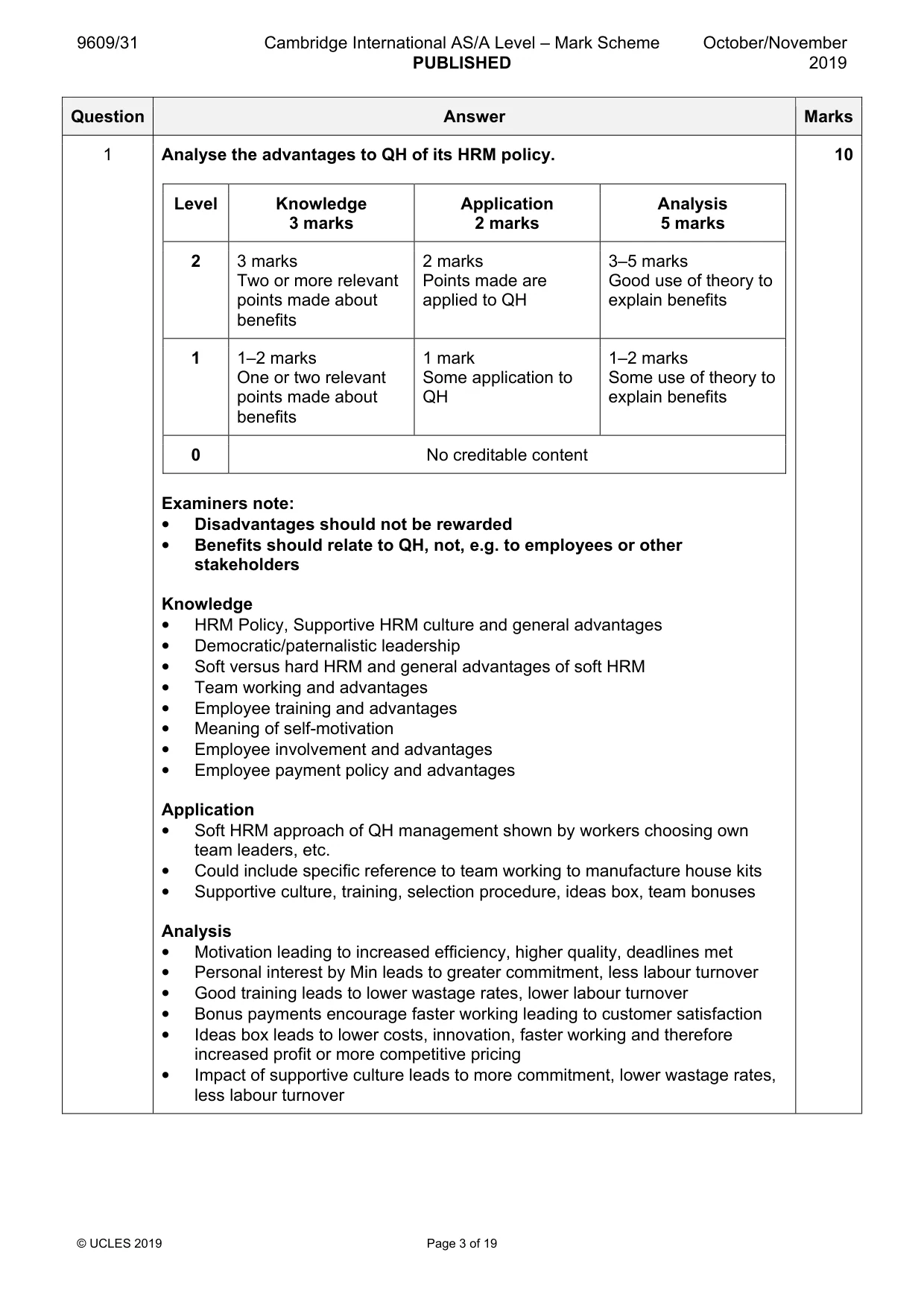
9609/31 Cambridge International AS/A Level – Mark Scheme PUBLISHED October/November 2019 © UCLES 2019 Page 3 of 19 Question Answer Marks 1 Analyse the advantages to QH of its HRM policy. Level Knowledge 3 marks Application 2 marks Analysis 5 marks 2 3 marks Two or more relevant points made about benefits 2 marks Points made are applied to QH 3–5 marks Good use of theory to explain benefits 1 1–2 marks One or two relevant points made about benefits 1 mark Some application to QH 1–2 marks Some use of theory to explain benefits 0 No creditable content Examiners note: • Disadvantages should not be rewarded • Benefits should relate to QH, not, e.g. to employees or other stakeholders Knowledge • HRM Policy, Supportive HRM culture and general advantages • Democratic/paternalistic leadership • Soft versus hard HRM and general advantages of soft HRM • Team working and advantages • Employee training and advantages • Meaning of self-motivation • Employee involvement and advantages • Employee payment policy and advantages Application • Soft HRM approach of QH management shown by workers choosing own team leaders, etc. • Could include specific reference to team working to manufacture house kits • Supportive culture, training, selection procedure, ideas box, team bonuses Analysis • Motivation leading to increased efficiency, higher quality, deadlines met • Personal interest by Min leads to greater commitment, less labour turnover • Good training leads to lower wastage rates, lower labour turnover • Bonus payments encourage faster working leading to customer satisfaction • Ideas box leads to lower costs, innovation, faster working and therefore increased profit or more competitive pricing • Impact of supportive culture leads to more commitment, lower wastage rates, less labour turnover 10
Mark scheme, page 4
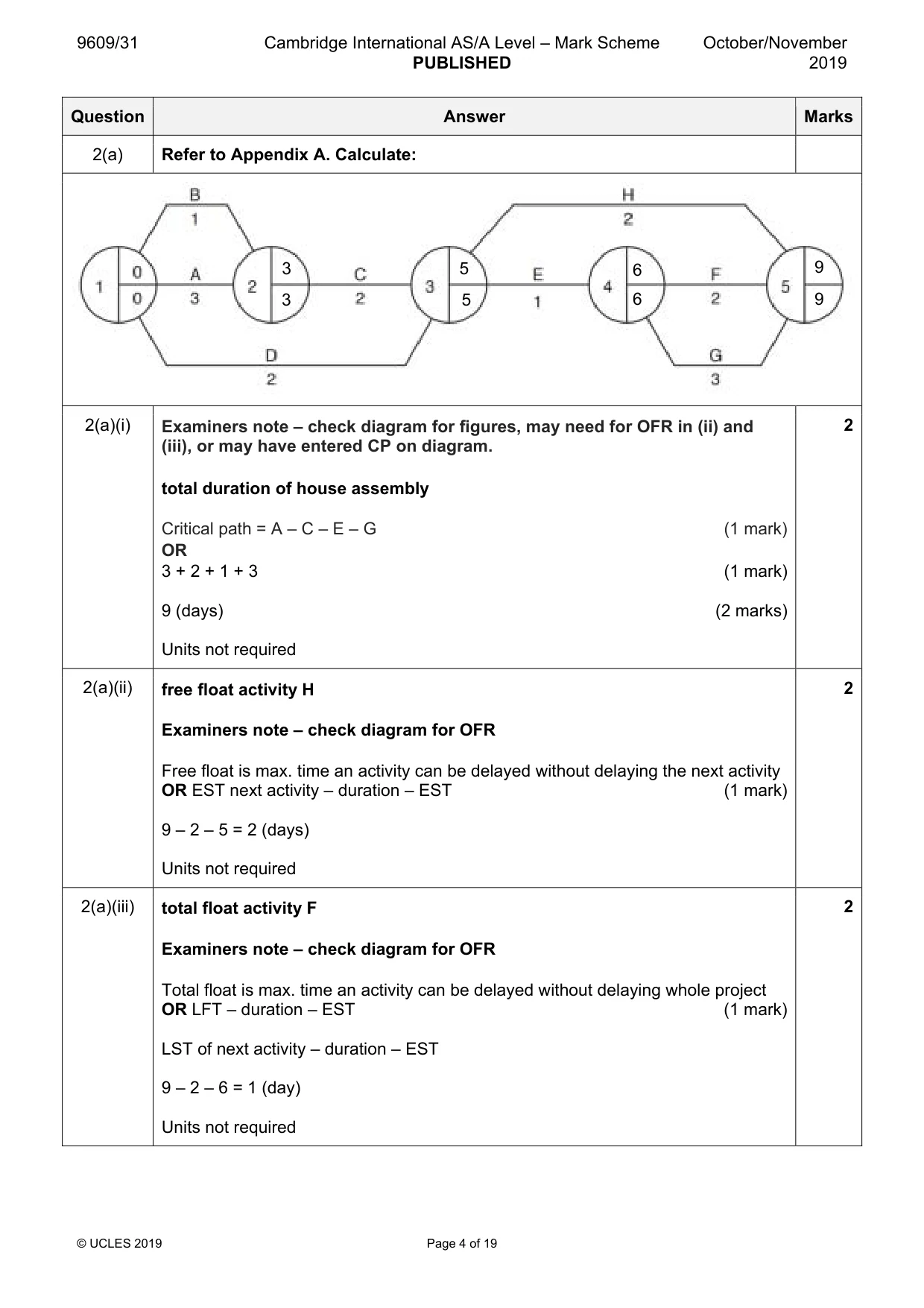
9609/31 Cambridge International AS/A Level – Mark Scheme PUBLISHED October/November 2019 © UCLES 2019 Page 4 of 19 Question Answer Marks 2(a) Refer to Appendix A. Calculate: 2(a)(i) Examiners note – check diagram for figures, may need for OFR in (ii) and (iii), or may have entered CP on diagram. total duration of house assembly Critical path = A – C – E – G (1 mark) OR 3 + 2 + 1 + 3 (1 mark) 9 (days) (2 marks) Units not required 2 2(a)(ii) free float activity H Examiners note – check diagram for OFR Free float is max. time an activity can be delayed without delaying the next activity OR EST next activity – duration – EST (1 mark) 9 – 2 – 5 = 2 (days) Units not required 2 2(a)(iii) total float activity F Examiners note – check diagram for OFR Total float is max. time an activity can be delayed without delaying whole project OR LFT – duration – EST (1 mark) LST of next activity – duration – EST 9 – 2 – 6 = 1 (day) Units not required 2 3 5 6 9 9 6 5 3
Mark scheme, page 5
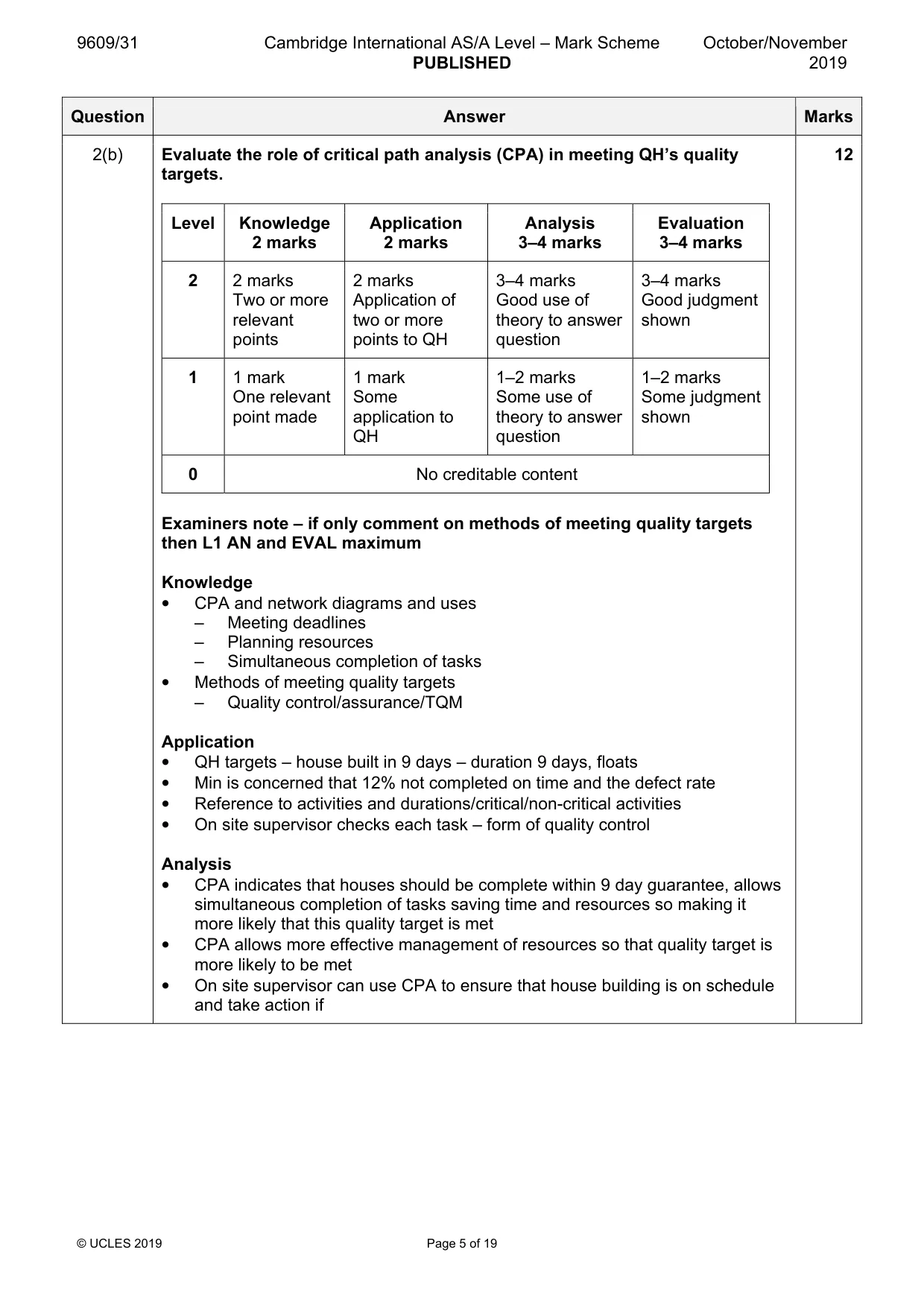
9609/31 Cambridge International AS/A Level – Mark Scheme PUBLISHED October/November 2019 © UCLES 2019 Page 5 of 19 Question Answer Marks 2(b) Evaluate the role of critical path analysis (CPA) in meeting QH’s quality targets. Level Knowledge 2 marks Application 2 marks Analysis 3–4 marks Evaluation 3–4 marks 2 2 marks Two or more relevant points 2 marks Application of two or more points to QH 3–4 marks Good use of theory to answer question 3–4 marks Good judgment shown 1 1 mark One relevant point made 1 mark Some application to QH 1–2 marks Some use of theory to answer question 1–2 marks Some judgment shown 0 No creditable content Examiners note – if only comment on methods of meeting quality targets then L1 AN and EVAL maximum Knowledge • CPA and network diagrams and uses – Meeting deadlines – Planning resources – Simultaneous completion of tasks • Methods of meeting quality targets – Quality control/assurance/TQM Application • QH targets – house built in 9 days – duration 9 days, floats • Min is concerned that 12% not completed on time and the defect rate • Reference to activities and durations/critical/non-critical activities • On site supervisor checks each task – form of quality control Analysis • CPA indicates that houses should be complete within 9 day guarantee, allows simultaneous completion of tasks saving time and resources so making it more likely that this quality target is met • CPA allows more effective management of resources so that quality target is more likely to be met • On site supervisor can use CPA to ensure that house building is on schedule and take action if 12
Mark scheme, page 6
9609/31 Cambridge International AS/A Level – Mark Scheme PUBLISHED October/November 2019 © UCLES 2019 Page 6 of 19 Question Answer Marks 2(b) Evaluation • There are quality standards but these are not well explained nor specific. No explicit reference in the CPA. How much time does quality assurance take? Is it included in the timings? • CPA minimum duration is the target so any holdup will mean target not met so is the target too strict? Is 12% reasonable? • CPA does not address targets re defects • No indication that bonuses are impacted by defect rates • May need different quality control/assurance methods not related to CPA, e.g. workers at each stage check quality (profit centres?) • Is the information in the CPA (duration of activities) accurate?
Mark scheme, page 7
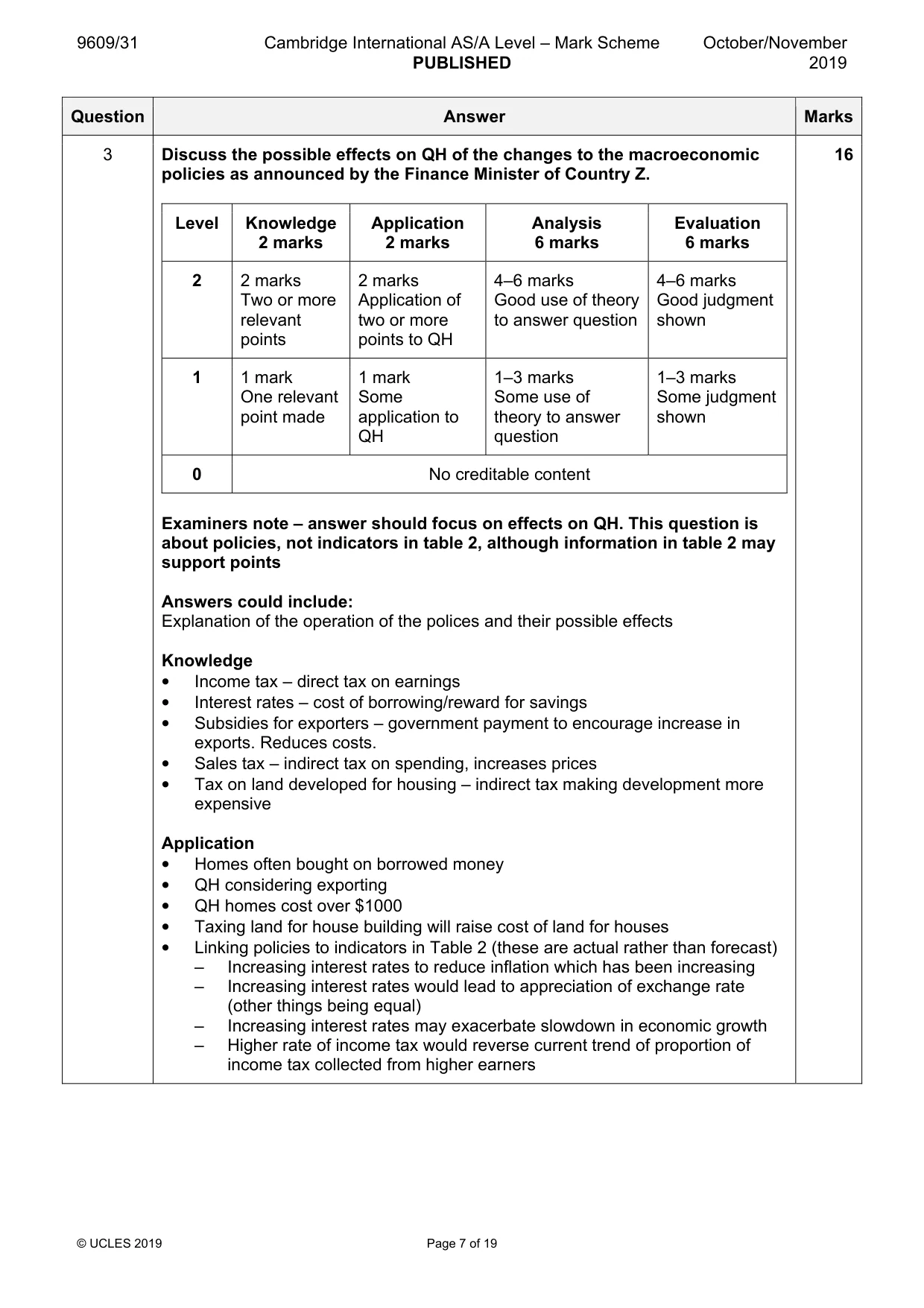
9609/31 Cambridge International AS/A Level – Mark Scheme PUBLISHED October/November 2019 © UCLES 2019 Page 7 of 19 Question Answer Marks 3 Discuss the possible effects on QH of the changes to the macroeconomic policies as announced by the Finance Minister of Country Z. Level Knowledge 2 marks Application 2 marks Analysis 6 marks Evaluation 6 marks 2 2 marks Two or more relevant points 2 marks Application of two or more points to QH 4–6 marks Good use of theory to answer question 4–6 marks Good judgment shown 1 1 mark One relevant point made 1 mark Some application to QH 1–3 marks Some use of theory to answer question 1–3 marks Some judgment shown 0 No creditable content Examiners note – answer should focus on effects on QH. This question is about policies, not indicators in table 2, although information in table 2 may support points Answers could include: Explanation of the operation of the polices and their possible effects Knowledge • Income tax – direct tax on earnings • Interest rates – cost of borrowing/reward for savings • Subsidies for exporters – government payment to encourage increase in exports. Reduces costs. • Sales tax – indirect tax on spending, increases prices • Tax on land developed for housing – indirect tax making development more expensive Application • Homes often bought on borrowed money • QH considering exporting • QH homes cost over $1000 • Taxing land for house building will raise cost of land for houses • Linking policies to indicators in Table 2 (these are actual rather than forecast) – Increasing interest rates to reduce inflation which has been increasing – Increasing interest rates would lead to appreciation of exchange rate (other things being equal) – Increasing interest rates may exacerbate slowdown in economic growth – Higher rate of income tax would reverse current trend of proportion of income tax collected from higher earners 16
Mark scheme, page 8
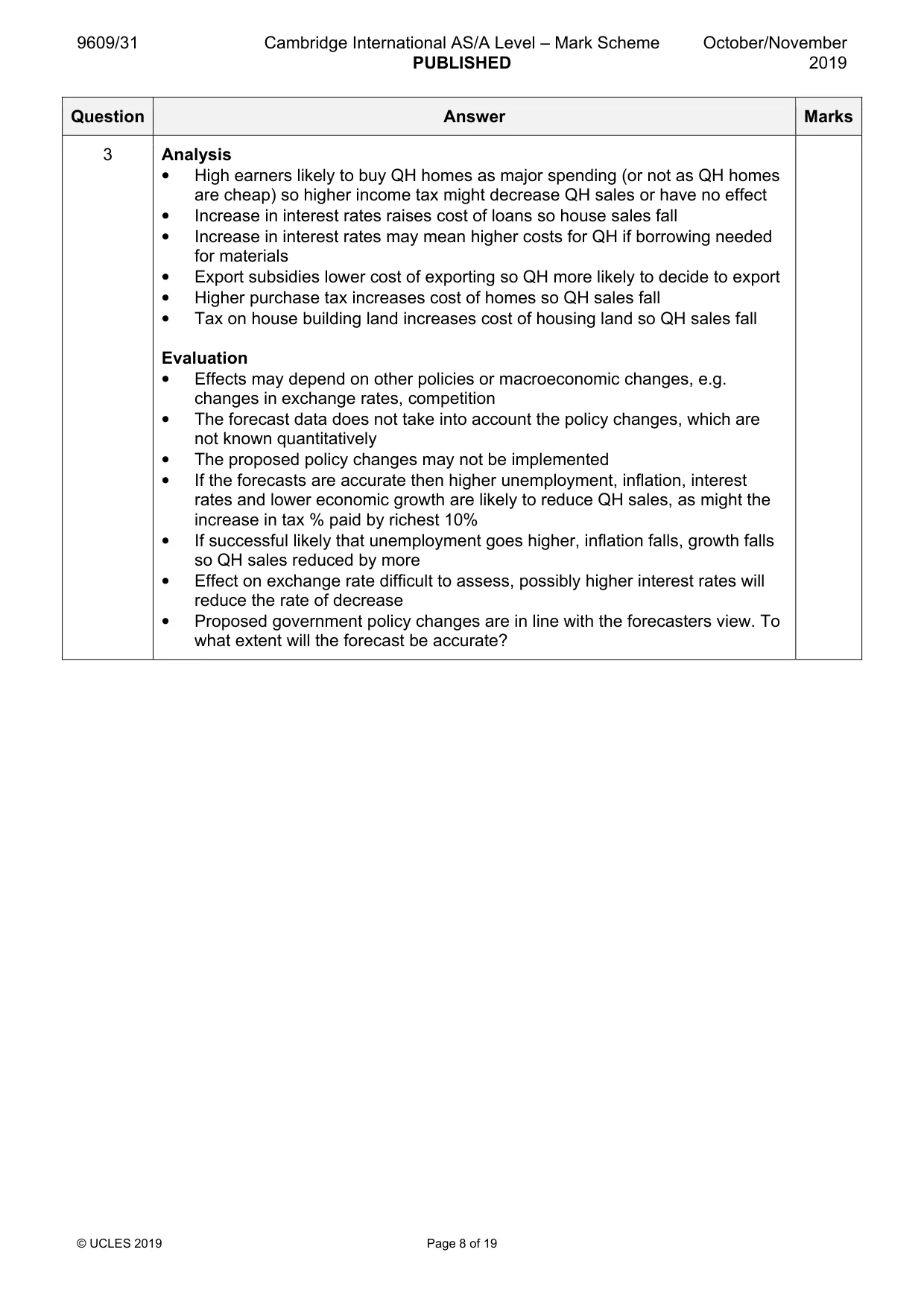
9609/31 Cambridge International AS/A Level – Mark Scheme PUBLISHED October/November 2019 © UCLES 2019 Page 8 of 19 Question Answer Marks 3 Analysis • High earners likely to buy QH homes as major spending (or not as QH homes are cheap) so higher income tax might decrease QH sales or have no effect • Increase in interest rates raises cost of loans so house sales fall • Increase in interest rates may mean higher costs for QH if borrowing needed for materials • Export subsidies lower cost of exporting so QH more likely to decide to export • Higher purchase tax increases cost of homes so QH sales fall • Tax on house building land increases cost of housing land so QH sales fall Evaluation • Effects may depend on other policies or macroeconomic changes, e.g. changes in exchange rates, competition • The forecast data does not take into account the policy changes, which are not known quantitatively • The proposed policy changes may not be implemented • If the forecasts are accurate then higher unemployment, inflation, interest rates and lower economic growth are likely to reduce QH sales, as might the increase in tax % paid by richest 10% • If successful likely that unemployment goes higher, inflation falls, growth falls so QH sales reduced by more • Effect on exchange rate difficult to assess, possibly higher interest rates will reduce the rate of decrease • Proposed government policy changes are in line with the forecasters view. To what extent will the forecast be accurate?
Mark scheme, page 9
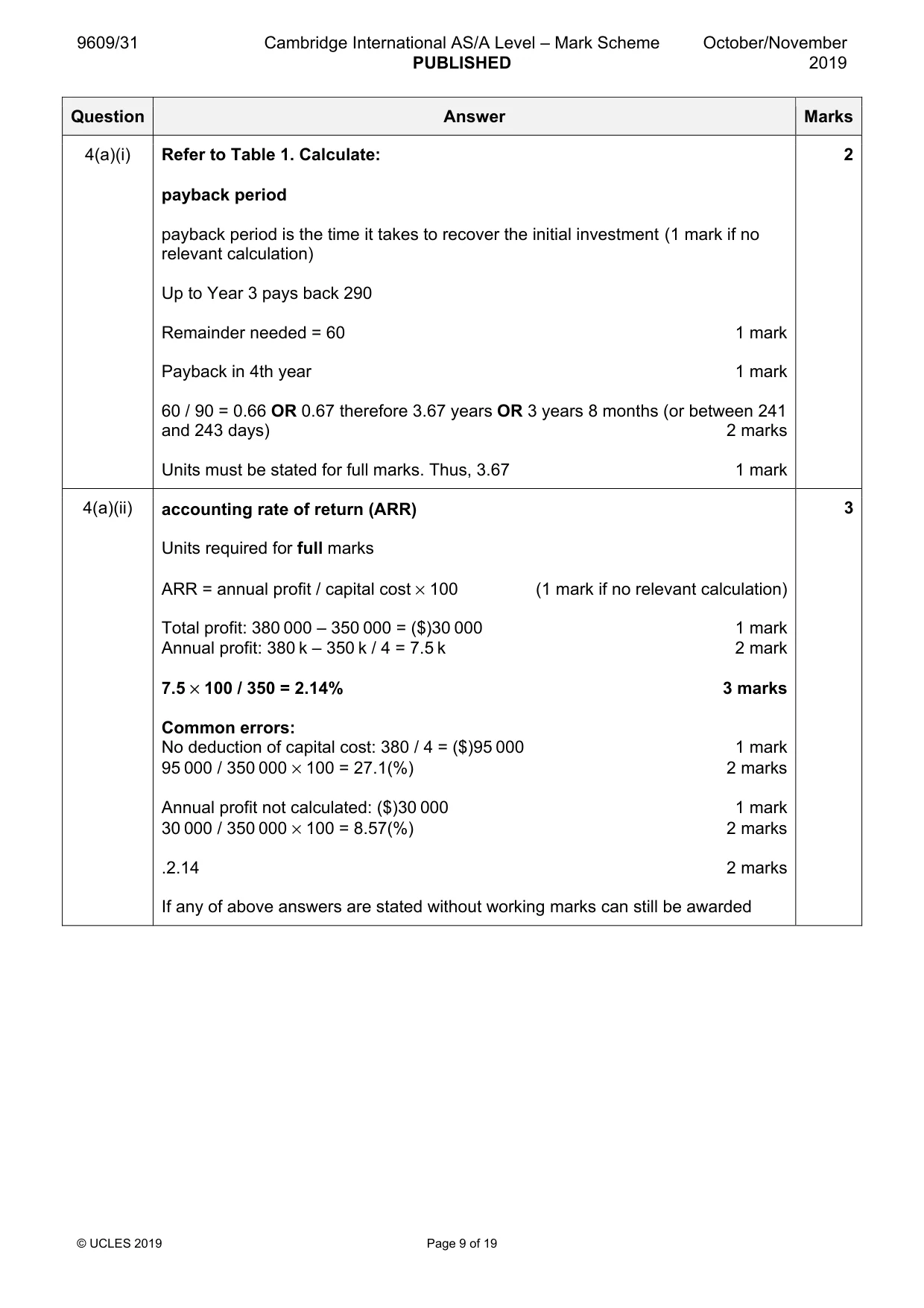
9609/31 Cambridge International AS/A Level – Mark Scheme PUBLISHED October/November 2019 © UCLES 2019 Page 9 of 19 Question Answer Marks 4(a)(i) Refer to Table 1. Calculate: payback period payback period is the time it takes to recover the initial investment (1 mark if no relevant calculation) Up to Year 3 pays back 290 Remainder needed = 60 1 mark Payback in 4th year 1 mark 60 / 90 = 0.66 OR 0.67 therefore 3.67 years OR 3 years 8 months (or between 241 and 243 days) 2 marks Units must be stated for full marks. Thus, 3.67 1 mark 2 4(a)(ii) accounting rate of return (ARR) Units required for full marks ARR = annual profit / capital cost × 100 (1 mark if no relevant calculation) Total profit: 380 000 – 350 000 = ($)30 000 1 mark Annual profit: 380 k – 350 k / 4 = 7.5 k 2 mark 7.5 × 100 / 350 = 2.14% 3 marks Common errors: No deduction of capital cost: 380 / 4 = ($)95 000 1 mark 95 000 / 350 000 × 100 = 27.1(%) 2 marks Annual profit not calculated: ($)30 000 1 mark 30 000 / 350 000 × 100 = 8.57(%) 2 marks .2.14 2 marks If any of above answers are stated without working marks can still be awarded 3
Mark scheme, page 10
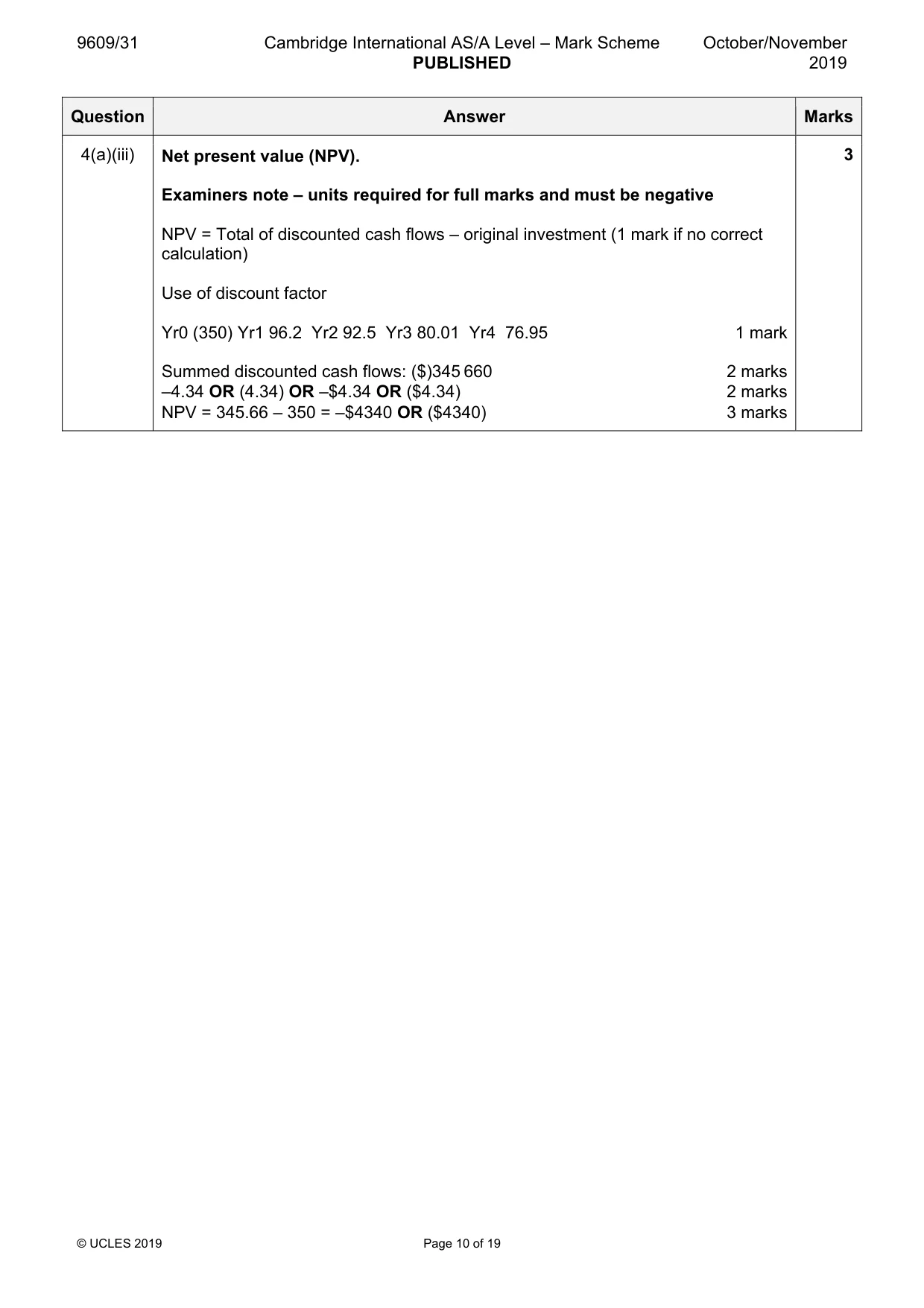
9609/31 Cambridge International AS/A Level – Mark Scheme PUBLISHED October/November 2019 © UCLES 2019 Page 10 of 19 Question Answer Marks 4(a)(iii) Net present value (NPV). Examiners note – units required for full marks and must be negative NPV = Total of discounted cash flows – original investment (1 mark if no correct calculation) Use of discount factor Yr0 (350) Yr1 96.2 Yr2 92.5 Yr3 80.01 Yr4 76.95 1 mark Summed discounted cash flows: ($)345 660 2 marks –4.34 OR (4.34) OR –$4.34 OR ($4.34) 2 marks NPV = 345.66 – 350 = –$4340 OR ($4340) 3 marks 3
Mark scheme, page 11
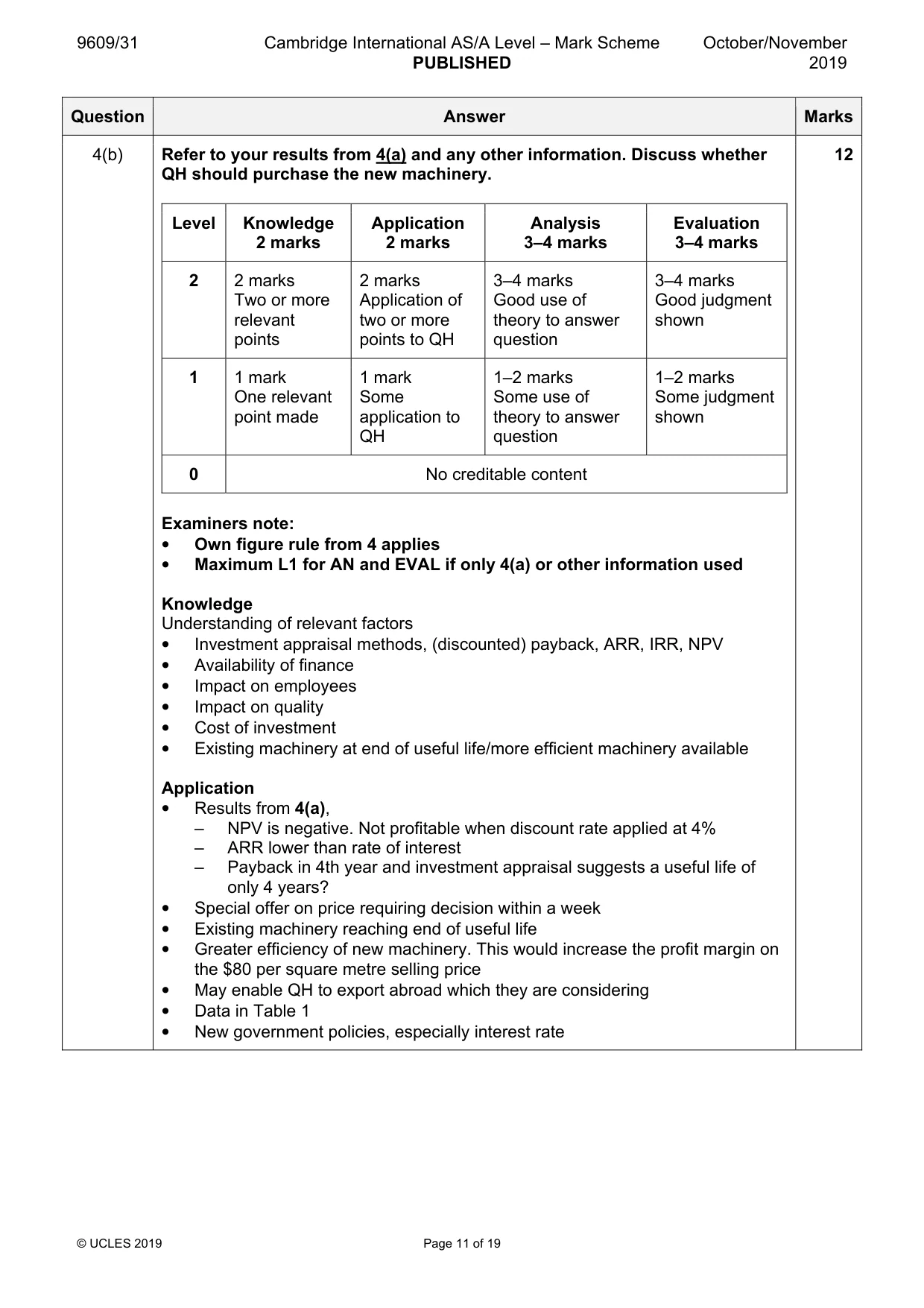
9609/31 Cambridge International AS/A Level – Mark Scheme PUBLISHED October/November 2019 © UCLES 2019 Page 11 of 19 Question Answer Marks 4(b) Refer to your results from 4(a) and any other information. Discuss whether QH should purchase the new machinery. Level Knowledge 2 marks Application 2 marks Analysis 3–4 marks Evaluation 3–4 marks 2 2 marks Two or more relevant points 2 marks Application of two or more points to QH 3–4 marks Good use of theory to answer question 3–4 marks Good judgment shown 1 1 mark One relevant point made 1 mark Some application to QH 1–2 marks Some use of theory to answer question 1–2 marks Some judgment shown 0 No creditable content Examiners note: • Own figure rule from 4 applies • Maximum L1 for AN and EVAL if only 4(a) or other information used Knowledge Understanding of relevant factors • Investment appraisal methods, (discounted) payback, ARR, IRR, NPV • Availability of finance • Impact on employees • Impact on quality • Cost of investment • Existing machinery at end of useful life/more efficient machinery available Application • Results from 4(a), – NPV is negative. Not profitable when discount rate applied at 4% – ARR lower than rate of interest – Payback in 4th year and investment appraisal suggests a useful life of only 4 years? • Special offer on price requiring decision within a week • Existing machinery reaching end of useful life • Greater efficiency of new machinery. This would increase the profit margin on the $80 per square metre selling price • May enable QH to export abroad which they are considering • Data in Table 1 • New government policies, especially interest rate 12
Mark scheme, page 12
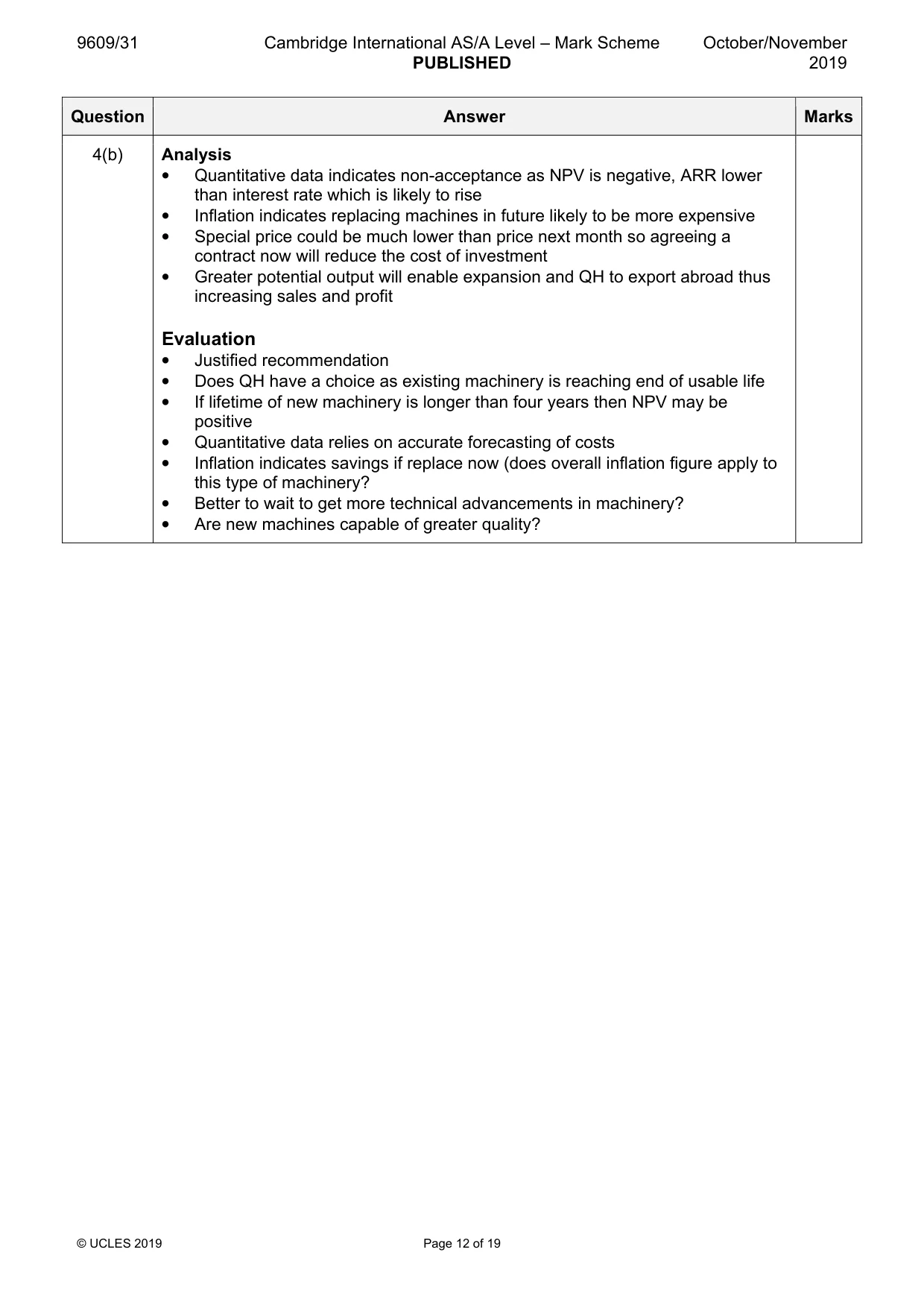
9609/31 Cambridge International AS/A Level – Mark Scheme PUBLISHED October/November 2019 © UCLES 2019 Page 12 of 19 Question Answer Marks 4(b) Analysis • Quantitative data indicates non-acceptance as NPV is negative, ARR lower than interest rate which is likely to rise • Inflation indicates replacing machines in future likely to be more expensive • Special price could be much lower than price next month so agreeing a contract now will reduce the cost of investment • Greater potential output will enable expansion and QH to export abroad thus increasing sales and profit Evaluation • Justified recommendation • Does QH have a choice as existing machinery is reaching end of usable life • If lifetime of new machinery is longer than four years then NPV may be positive • Quantitative data relies on accurate forecasting of costs • Inflation indicates savings if replace now (does overall inflation figure apply to this type of machinery? • Better to wait to get more technical advancements in machinery? • Are new machines capable of greater quality?
Mark scheme, page 13
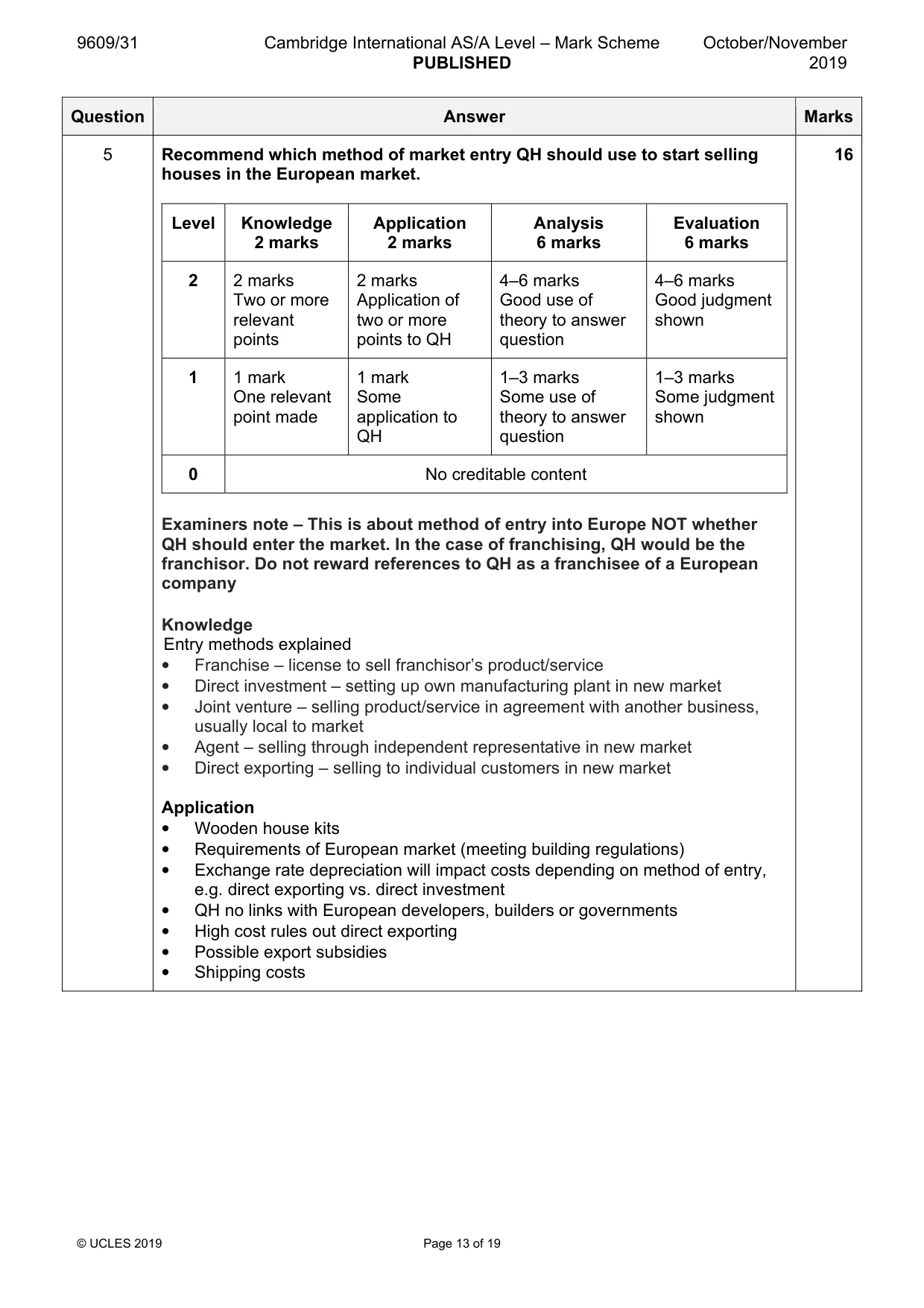
9609/31 Cambridge International AS/A Level – Mark Scheme PUBLISHED October/November 2019 © UCLES 2019 Page 13 of 19 Question Answer Marks 5 Recommend which method of market entry QH should use to start selling houses in the European market. Level Knowledge 2 marks Application 2 marks Analysis 6 marks Evaluation 6 marks 2 2 marks Two or more relevant points 2 marks Application of two or more points to QH 4–6 marks Good use of theory to answer question 4–6 marks Good judgment shown 1 1 mark One relevant point made 1 mark Some application to QH 1–3 marks Some use of theory to answer question 1–3 marks Some judgment shown 0 No creditable content Examiners note – This is about method of entry into Europe NOT whether QH should enter the market. In the case of franchising, QH would be the franchisor. Do not reward references to QH as a franchisee of a European company Knowledge Entry methods explained • Franchise – license to sell franchisor’s product/service • Direct investment – setting up own manufacturing plant in new market • Joint venture – selling product/service in agreement with another business, usually local to market • Agent – selling through independent representative in new market • Direct exporting – selling to individual customers in new market Application • Wooden house kits • Requirements of European market (meeting building regulations) • Exchange rate depreciation will impact costs depending on method of entry, e.g. direct exporting vs. direct investment • QH no links with European developers, builders or governments • High cost rules out direct exporting • Possible export subsidies • Shipping costs 16
Mark scheme, page 14
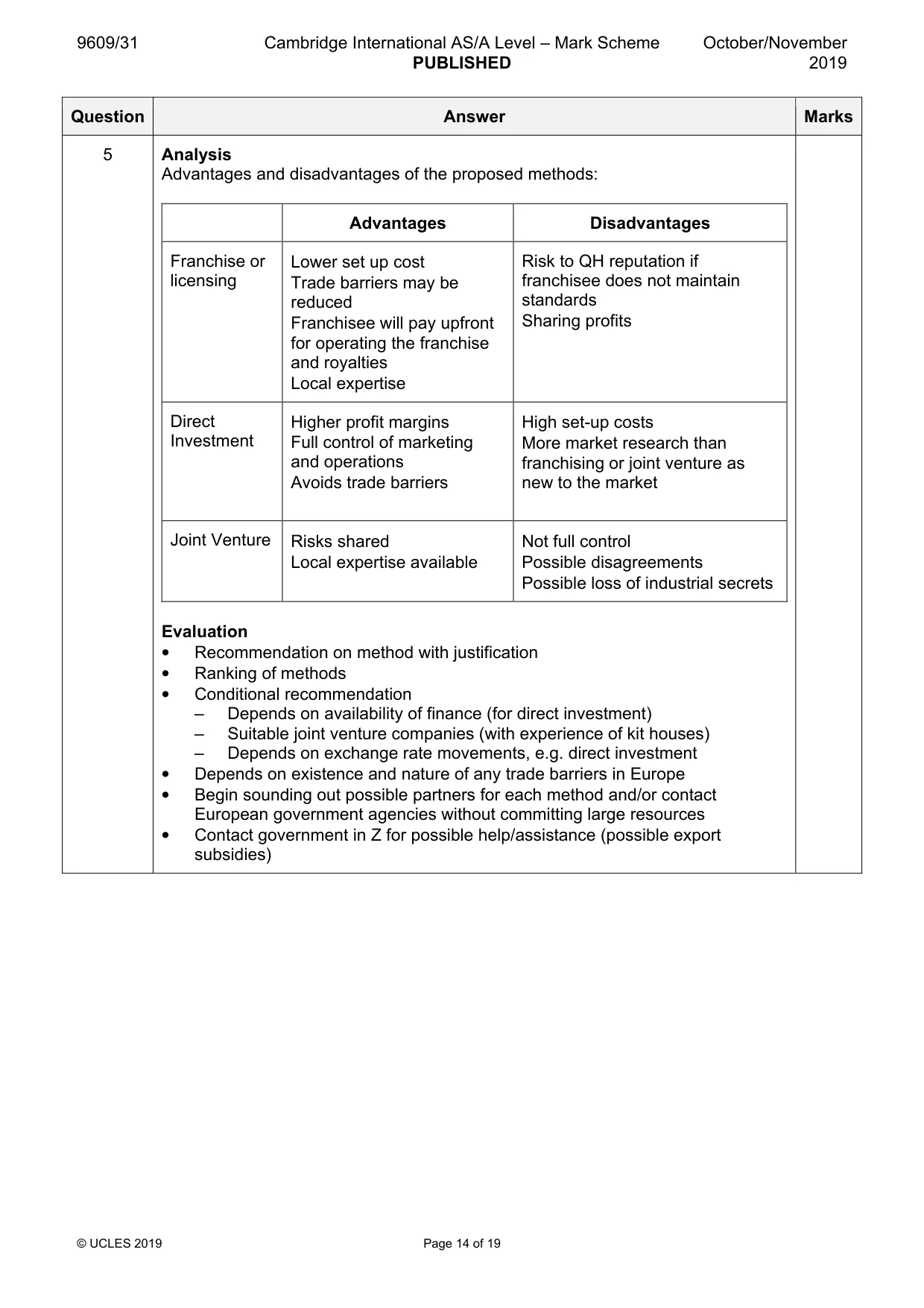
9609/31 Cambridge International AS/A Level – Mark Scheme PUBLISHED October/November 2019 © UCLES 2019 Page 14 of 19 Question Answer Marks 5 Analysis Advantages and disadvantages of the proposed methods: Advantages Disadvantages Franchise or licensing Lower set up cost Trade barriers may be reduced Franchisee will pay upfront for operating the franchise and royalties Local expertise Risk to QH reputation if franchisee does not maintain standards Sharing profits Direct Investment Higher profit margins Full control of marketing and operations Avoids trade barriers High set-up costs More market research than franchising or joint venture as new to the market Joint Venture Risks shared Local expertise available Not full control Possible disagreements Possible loss of industrial secrets Evaluation • Recommendation on method with justification • Ranking of methods • Conditional recommendation – Depends on availability of finance (for direct investment) – Suitable joint venture companies (with experience of kit houses) – Depends on exchange rate movements, e.g. direct investment • Depends on existence and nature of any trade barriers in Europe • Begin sounding out possible partners for each method and/or contact European government agencies without committing large resources • Contact government in Z for possible help/assistance (possible export subsidies)
Mark scheme, page 15
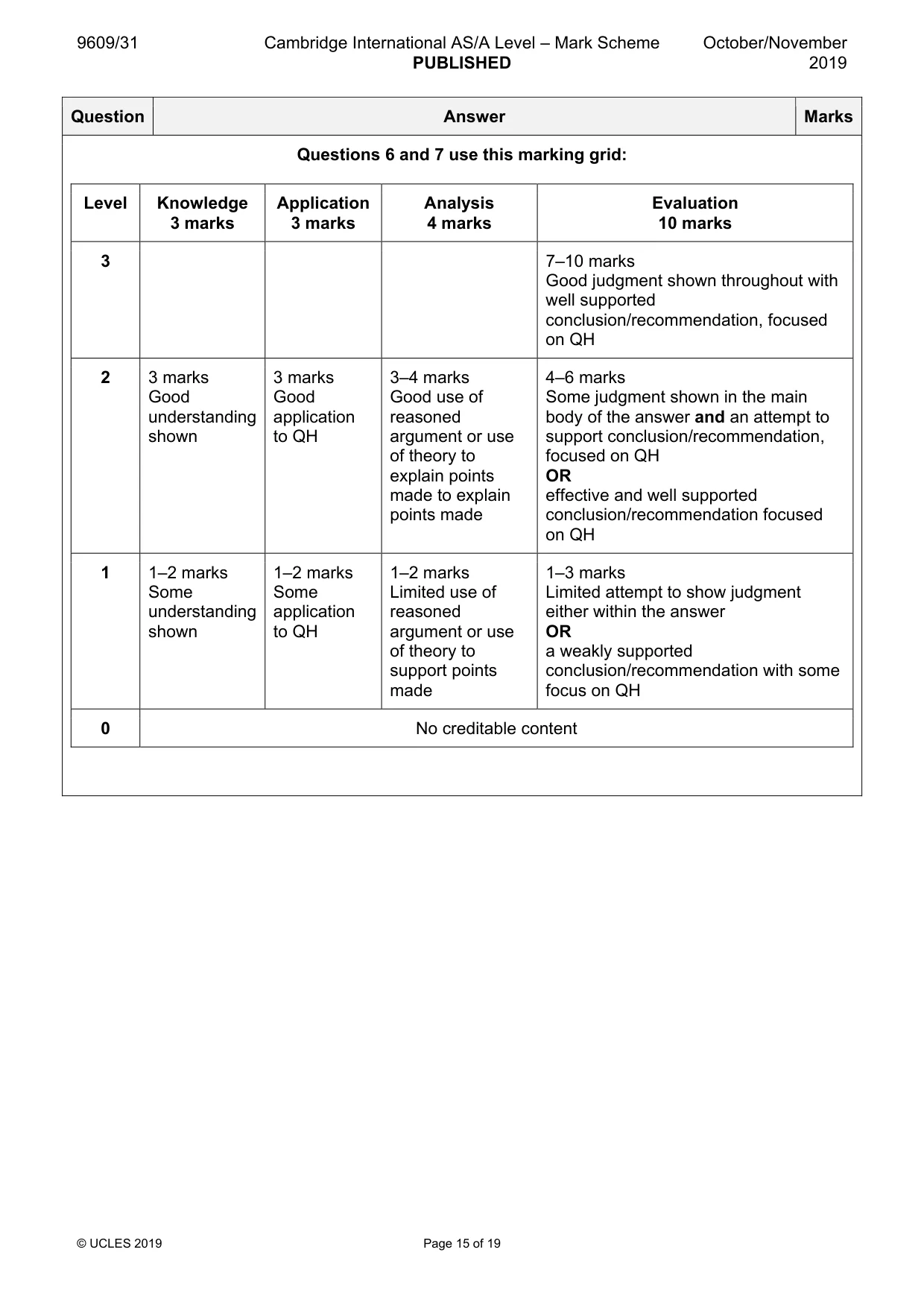
9609/31 Cambridge International AS/A Level – Mark Scheme PUBLISHED October/November 2019 © UCLES 2019 Page 15 of 19 Question Answer Marks Questions 6 and 7 use this marking grid: Level Knowledge 3 marks Application 3 marks Analysis 4 marks Evaluation 10 marks 3 7–10 marks Good judgment shown throughout with well supported conclusion/recommendation, focused on QH 2 3 marks Good understanding shown 3 marks Good application to QH 3–4 marks Good use of reasoned argument or use of theory to explain points made to explain points made 4–6 marks Some judgment shown in the main body of the answer and an attempt to support conclusion/recommendation, focused on QH OR effective and well supported conclusion/recommendation focused on QH 1 1–2 marks Some understanding shown 1–2 marks Some application to QH 1–2 marks Limited use of reasoned argument or use of theory to support points made 1–3 marks Limited attempt to show judgment either within the answer OR a weakly supported conclusion/recommendation with some focus on QH 0 No creditable content
Mark scheme, page 16
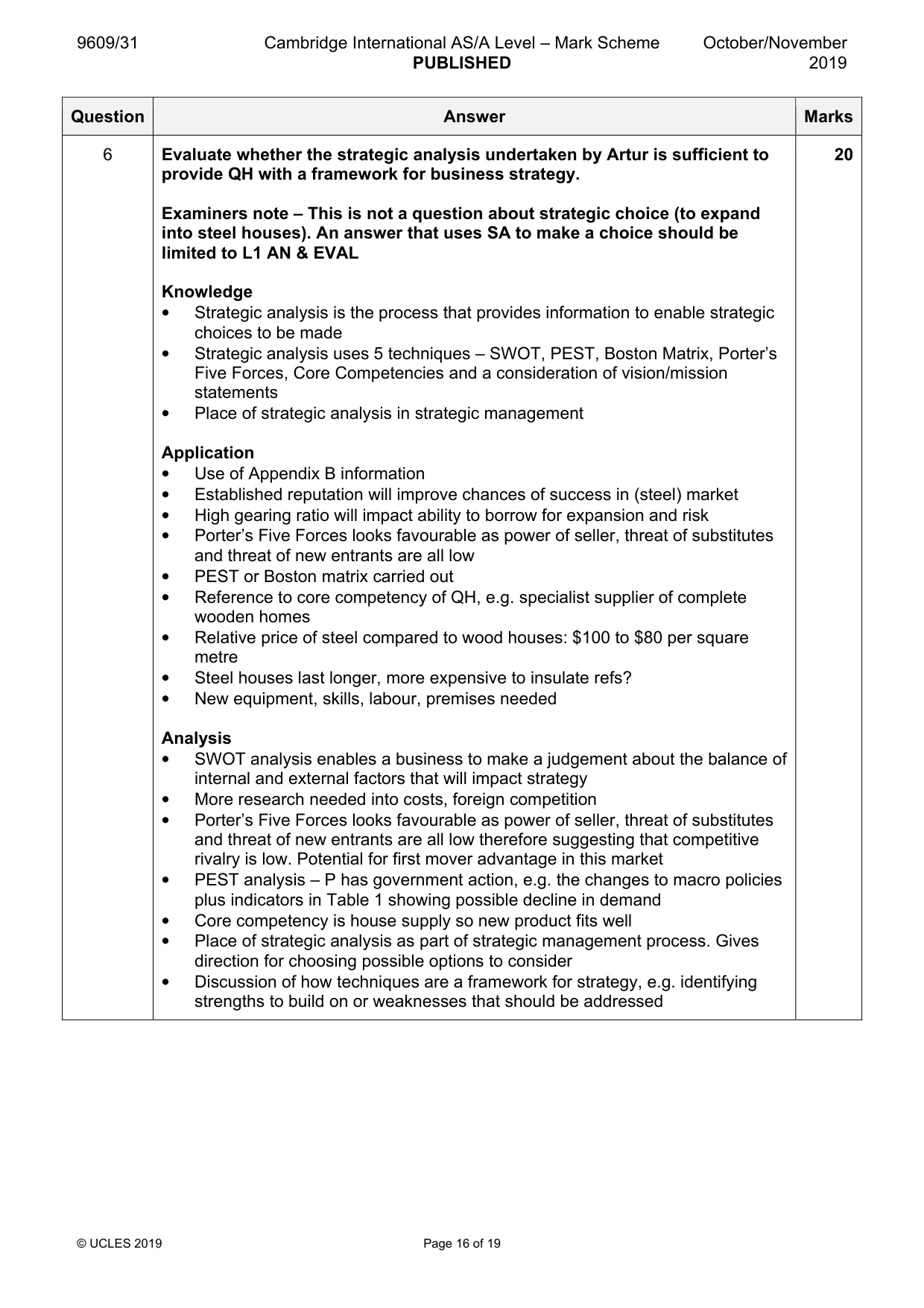
9609/31 Cambridge International AS/A Level – Mark Scheme PUBLISHED October/November 2019 © UCLES 2019 Page 16 of 19 Question Answer Marks 6 Evaluate whether the strategic analysis undertaken by Artur is sufficient to provide QH with a framework for business strategy. Examiners note – This is not a question about strategic choice (to expand into steel houses). An answer that uses SA to make a choice should be limited to L1 AN & EVAL Knowledge • Strategic analysis is the process that provides information to enable strategic choices to be made • Strategic analysis uses 5 techniques – SWOT, PEST, Boston Matrix, Porter’s Five Forces, Core Competencies and a consideration of vision/mission statements • Place of strategic analysis in strategic management Application • Use of Appendix B information • Established reputation will improve chances of success in (steel) market • High gearing ratio will impact ability to borrow for expansion and risk • Porter’s Five Forces looks favourable as power of seller, threat of substitutes and threat of new entrants are all low • PEST or Boston matrix carried out • Reference to core competency of QH, e.g. specialist supplier of complete wooden homes • Relative price of steel compared to wood houses: $100 to $80 per square metre • Steel houses last longer, more expensive to insulate refs? • New equipment, skills, labour, premises needed Analysis • SWOT analysis enables a business to make a judgement about the balance of internal and external factors that will impact strategy • More research needed into costs, foreign competition • Porter’s Five Forces looks favourable as power of seller, threat of substitutes and threat of new entrants are all low therefore suggesting that competitive rivalry is low. Potential for first mover advantage in this market • PEST analysis – P has government action, e.g. the changes to macro policies plus indicators in Table 1 showing possible decline in demand • Core competency is house supply so new product fits well • Place of strategic analysis as part of strategic management process. Gives direction for choosing possible options to consider • Discussion of how techniques are a framework for strategy, e.g. identifying strengths to build on or weaknesses that should be addressed 20
Mark scheme, page 17
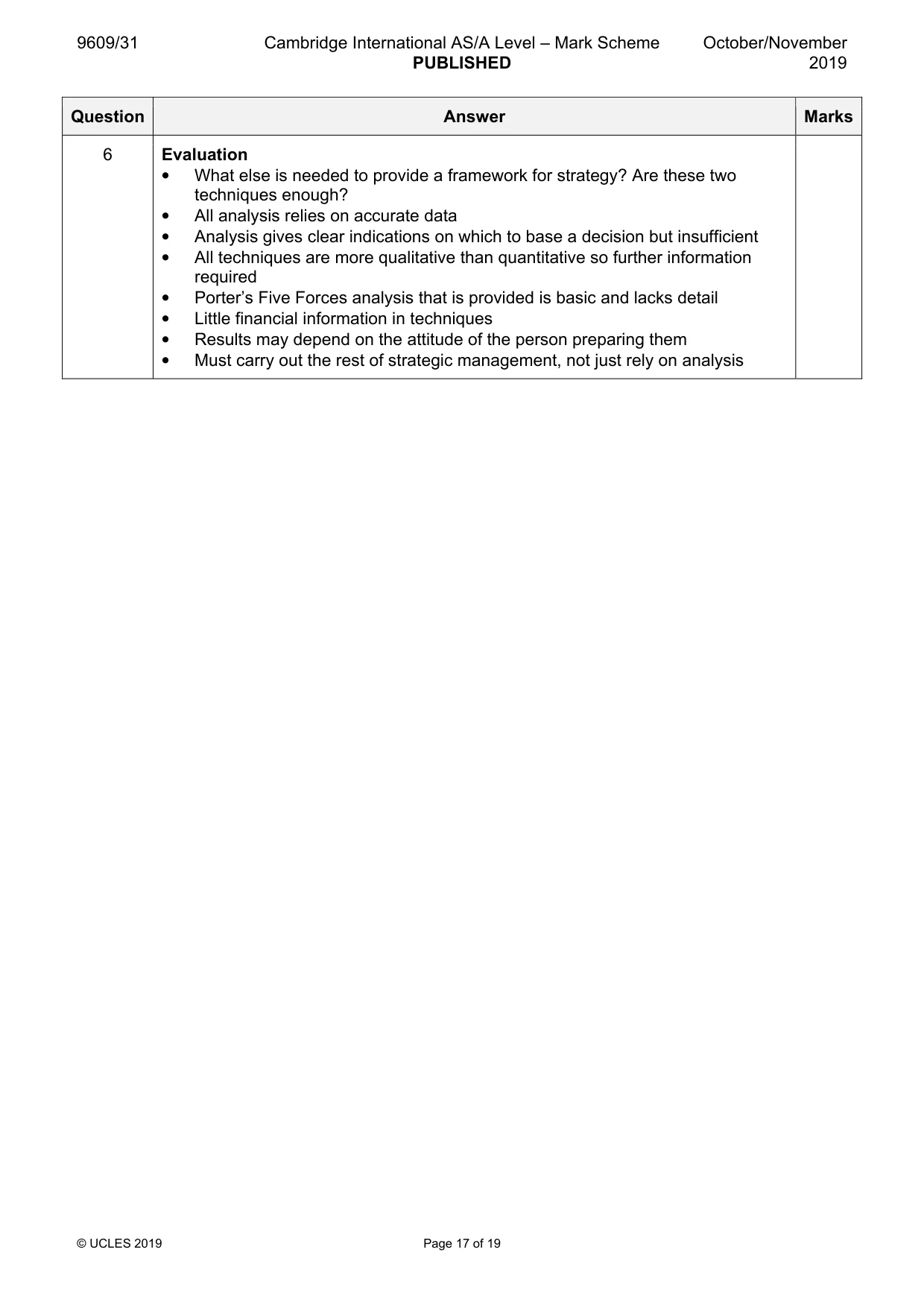
9609/31 Cambridge International AS/A Level – Mark Scheme PUBLISHED October/November 2019 © UCLES 2019 Page 17 of 19 Question Answer Marks 6 Evaluation • What else is needed to provide a framework for strategy? Are these two techniques enough? • All analysis relies on accurate data • Analysis gives clear indications on which to base a decision but insufficient • All techniques are more qualitative than quantitative so further information required • Porter’s Five Forces analysis that is provided is basic and lacks detail • Little financial information in techniques • Results may depend on the attitude of the person preparing them • Must carry out the rest of strategic management, not just rely on analysis
Mark scheme, page 18
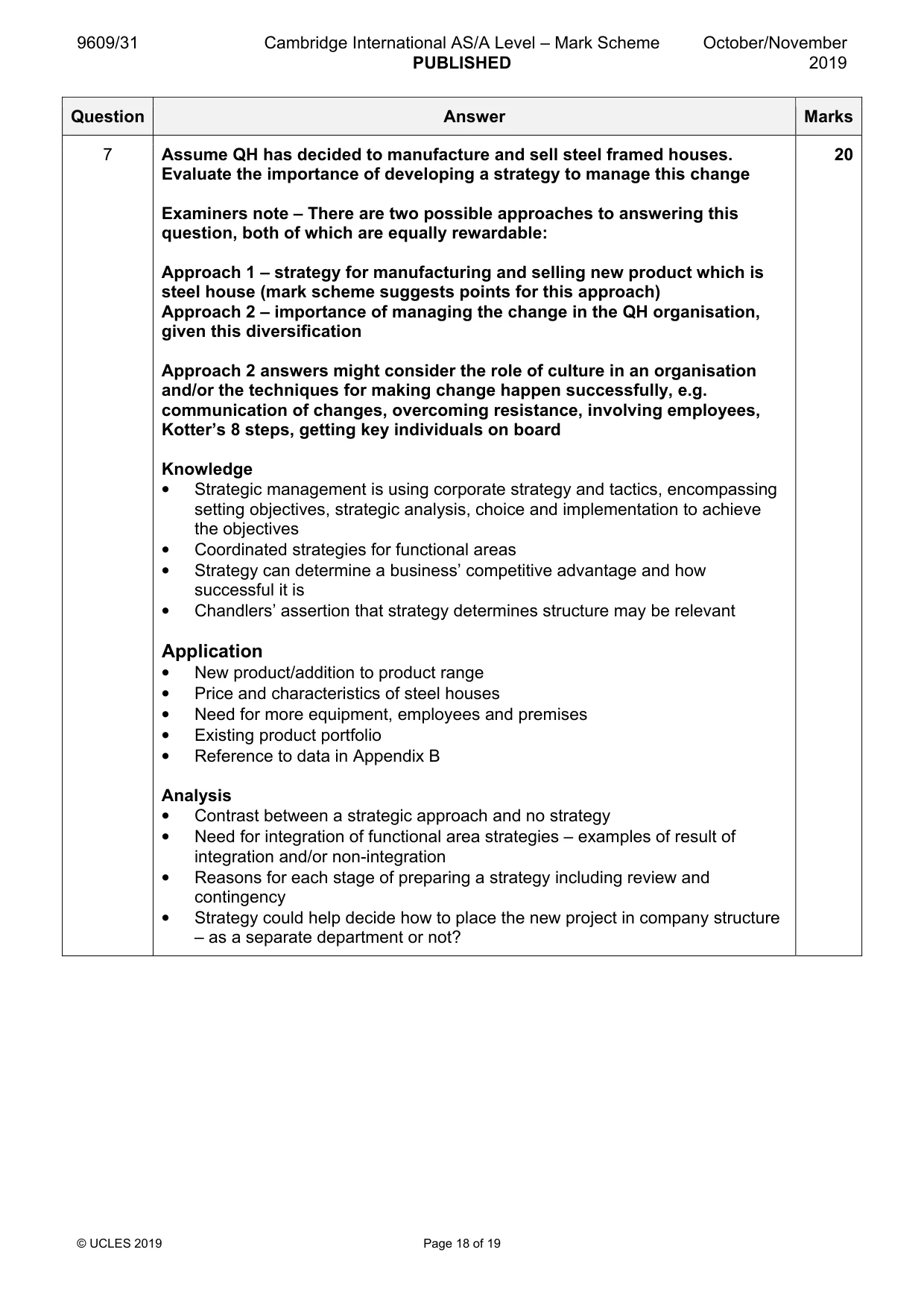
9609/31 Cambridge International AS/A Level – Mark Scheme PUBLISHED October/November 2019 © UCLES 2019 Page 18 of 19 Question Answer Marks 7 Assume QH has decided to manufacture and sell steel framed houses. Evaluate the importance of developing a strategy to manage this change Examiners note – There are two possible approaches to answering this question, both of which are equally rewardable: Approach 1 – strategy for manufacturing and selling new product which is steel house (mark scheme suggests points for this approach) Approach 2 – importance of managing the change in the QH organisation, given this diversification Approach 2 answers might consider the role of culture in an organisation and/or the techniques for making change happen successfully, e.g. communication of changes, overcoming resistance, involving employees, Kotter’s 8 steps, getting key individuals on board Knowledge • Strategic management is using corporate strategy and tactics, encompassing setting objectives, strategic analysis, choice and implementation to achieve the objectives • Coordinated strategies for functional areas • Strategy can determine a business’ competitive advantage and how successful it is • Chandlers’ assertion that strategy determines structure may be relevant Application • New product/addition to product range • Price and characteristics of steel houses • Need for more equipment, employees and premises • Existing product portfolio • Reference to data in Appendix B Analysis • Contrast between a strategic approach and no strategy • Need for integration of functional area strategies – examples of result of integration and/or non-integration • Reasons for each stage of preparing a strategy including review and contingency • Strategy could help decide how to place the new project in company structure – as a separate department or not? 20
Mark scheme, page 19
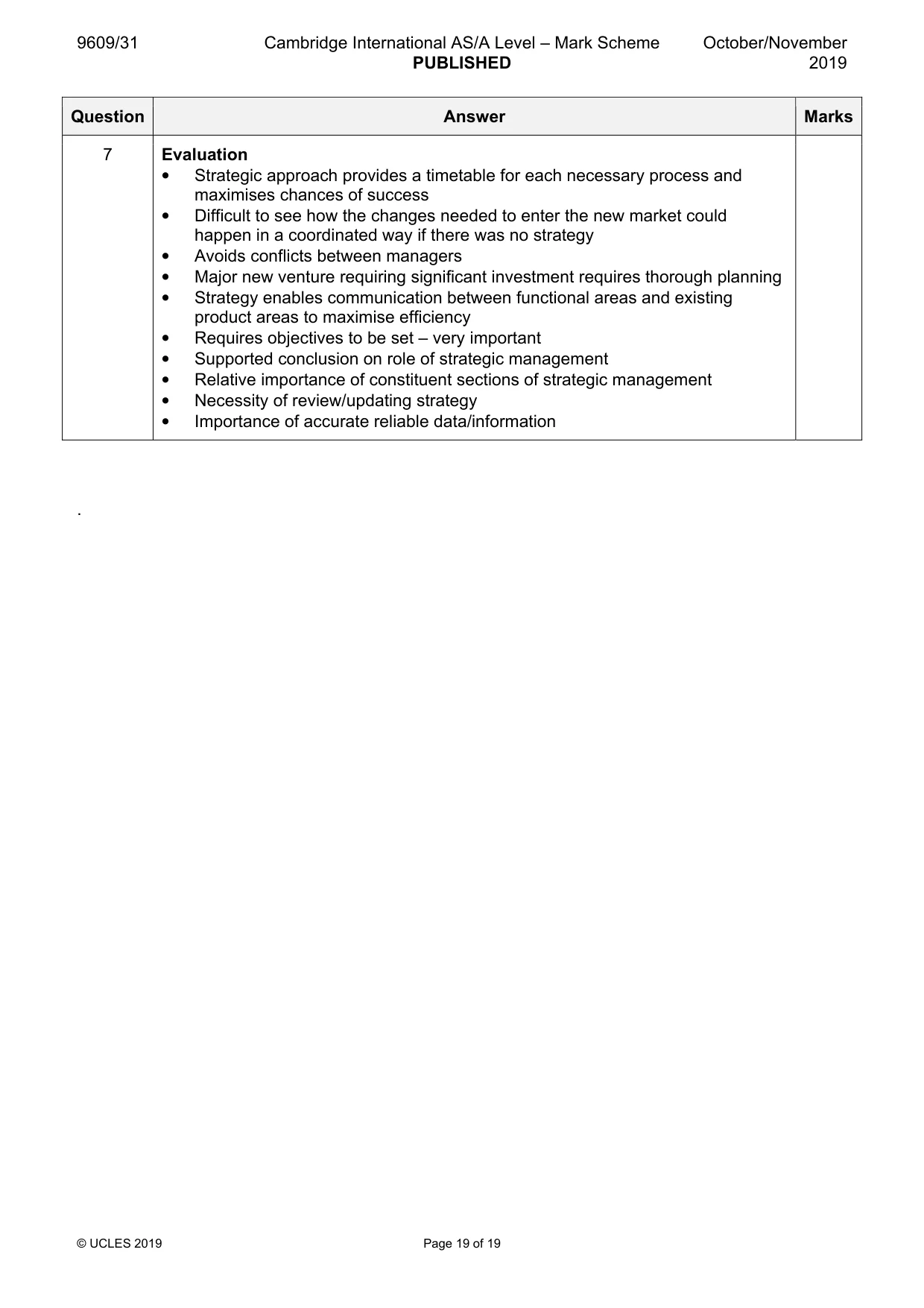
9609/31 Cambridge International AS/A Level – Mark Scheme PUBLISHED October/November 2019 © UCLES 2019 Page 19 of 19 Question Answer Marks 7 Evaluation • Strategic approach provides a timetable for each necessary process and maximises chances of success • Difficult to see how the changes needed to enter the new market could happen in a coordinated way if there was no strategy • Avoids conflicts between managers • Major new venture requiring significant investment requires thorough planning • Strategy enables communication between functional areas and existing product areas to maximise efficiency • Requires objectives to be set – very important • Supported conclusion on role of strategic management • Relative importance of constituent sections of strategic management • Necessity of review/updating strategy • Importance of accurate reliable data/information .
What you needed in this session
Cambridge’s own grade thresholds for 2019 Oct/Nov, Paper 3 · Variant 1. A higher threshold means an easier paper — the bar moves with how the cohort did.