Cambridge A Level Business (for first examination in 2016) 9609 — 2019 Oct/Nov Paper 3 · Variant 3
9609/33/O/N/19 · 100 marks · ≈113 min
The question paper and its mark scheme, free to read here and free to download. This is Cambridge’s own paper, exactly as it was sat.
Question paper20 pages
















Mark scheme15 pages
Answers below. Sit the paper first if you are practising.

Paper as text
Question paper, page 1
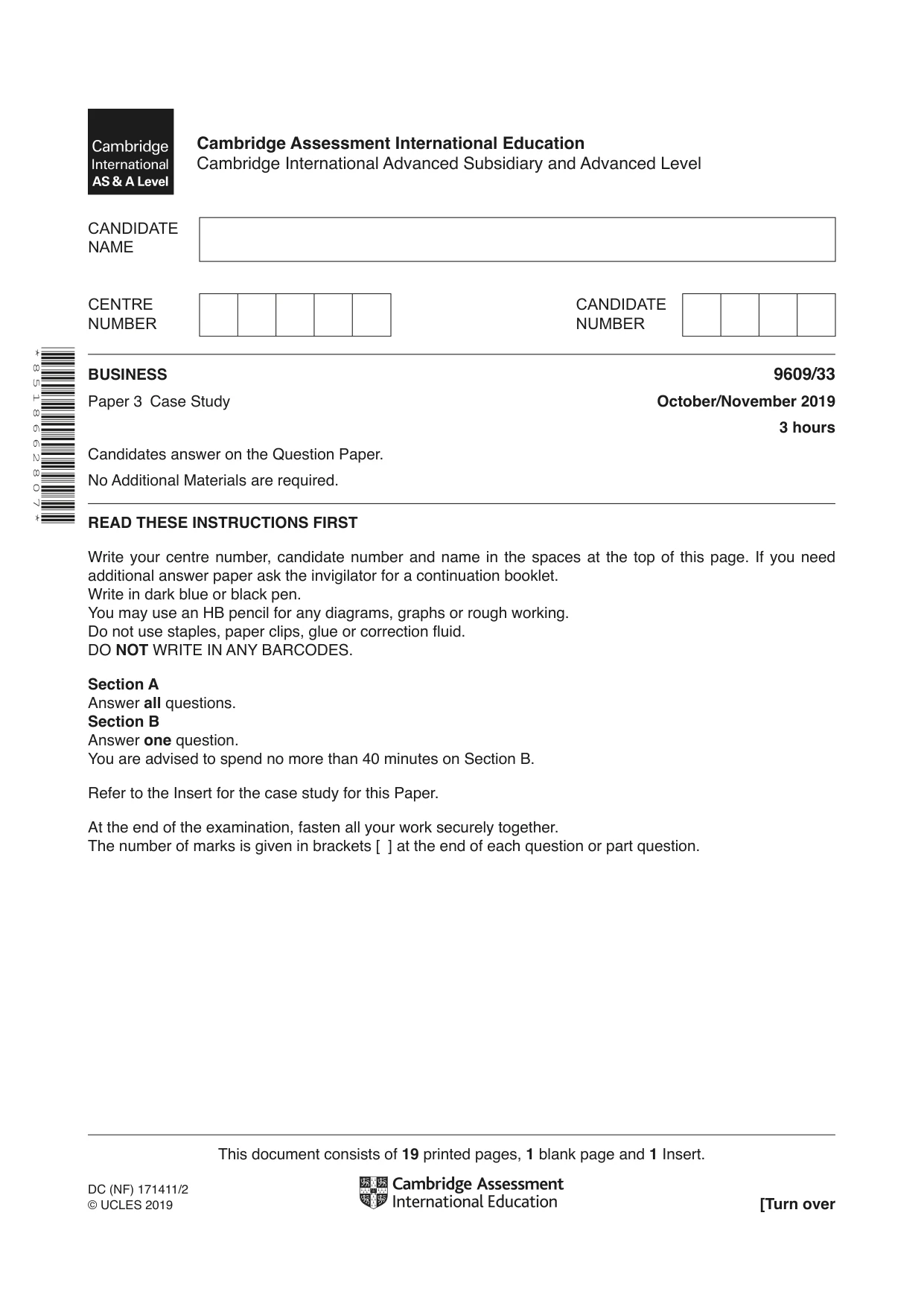
* 8 5 1 8 6 6 2 8 0 7 * Cambridge Assessment International Education Cambridge International Advanced Subsidiary and Advanced Level This document consists of 19 printed pages, 1 blank page and 1 Insert. DC (NF) 171411/2 © UCLES 2019 [Turn over CANDIDATE NAME CENTRE NUMBER CANDIDATE NUMBER BUSINESS 9609/33 Paper 3 Case Study October/November 2019 3 hours Candidates answer on the Question Paper. No Additional Materials are required. READ THESE INSTRUCTIONS FIRST Write your centre number, candidate number and name in the spaces at the top of this page. If you need additional answer paper ask the invigilator for a continuation booklet. Write in dark blue or black pen. You may use an HB pencil for any diagrams, graphs or rough working. Do not use staples, paper clips, glue or correction fluid. DO NOT WRITE IN ANY BARCODES. Section A Answer all questions. Section B Answer one question. You are advised to spend no more than 40 minutes on Section B. Refer to the Insert for the case study for this Paper. At the end of the examination, fasten all your work securely together. The number of marks is given in brackets [ ] at the end of each question or part question.
Question paper, page 2
2 9609/33/O/N/19 © UCLES 2019 Section A Answer all questions in this section. 1 Analyse the threats to CSP of the changes in the energy market and government policy. … … … … … … … … … … … … … … … … … … … … … … … … …
Question paper, page 3
3 9609/33/O/N/19 © UCLES 2019 [Turn over … … … … … … … … … … … … … … … … … … … … … … … … … … … … [10]
Question paper, page 4
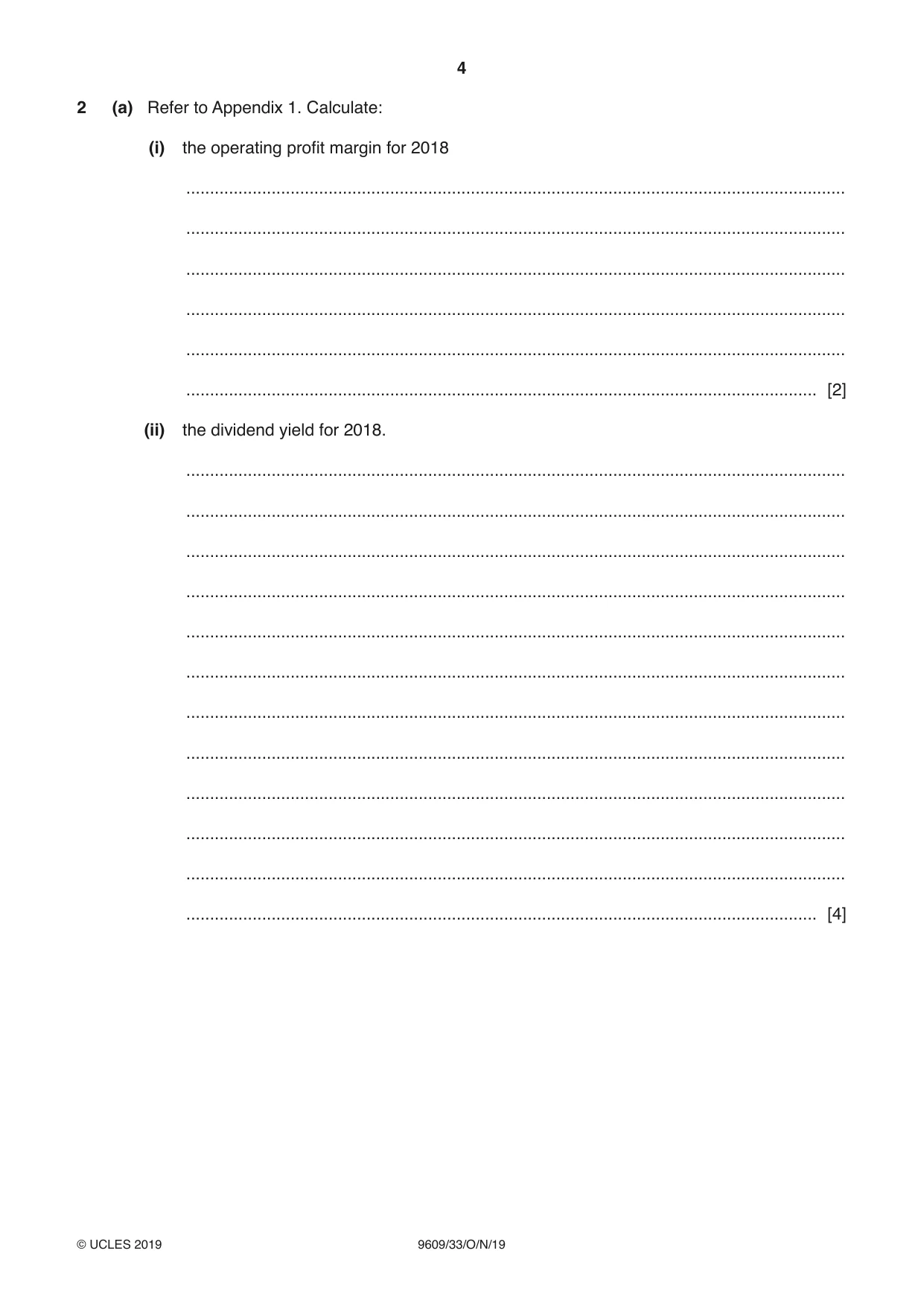
4 9609/33/O/N/19 © UCLES 2019 2 (a) Refer to Appendix 1. Calculate: (i) the operating profit margin for 2018 … … … … … … [2] (ii) the dividend yield for 2018. … … … … … … … … … … … … [4]
Question paper, page 5
5 9609/33/O/N/19 © UCLES 2019 [Turn over (b) Refer to your results in 2(a) and any other information. Recommend to CSP’s shareholders whether they should sell their shares in the company. … … … … … … … … … … … … … … … … … … … … … … … … … … …
Question paper, page 6
6 9609/33/O/N/19 © UCLES 2019 … … … … … … … … … … … … … … … … … … … … … … … … … … … … [12]
Question paper, page 7
7 9609/33/O/N/19 © UCLES 2019 [Turn over 3 Evaluate the Marketing Director’s view that: ‘the greener energy mission statement is the most important factor in the success of our solar panel marketing’ (lines 10–11). … … … … … … … … … … … … … … … … … … … … … … … … … … …
Question paper, page 8
8 9609/33/O/N/19 © UCLES 2019 … … … … … … … … … … … … … … … … … … … … … … … … … … … …
Question paper, page 9
9 9609/33/O/N/19 © UCLES 2019 [Turn over … … … … … … … … … … … … … … … … … … … … … … … … … … … … [16]
Question paper, page 10
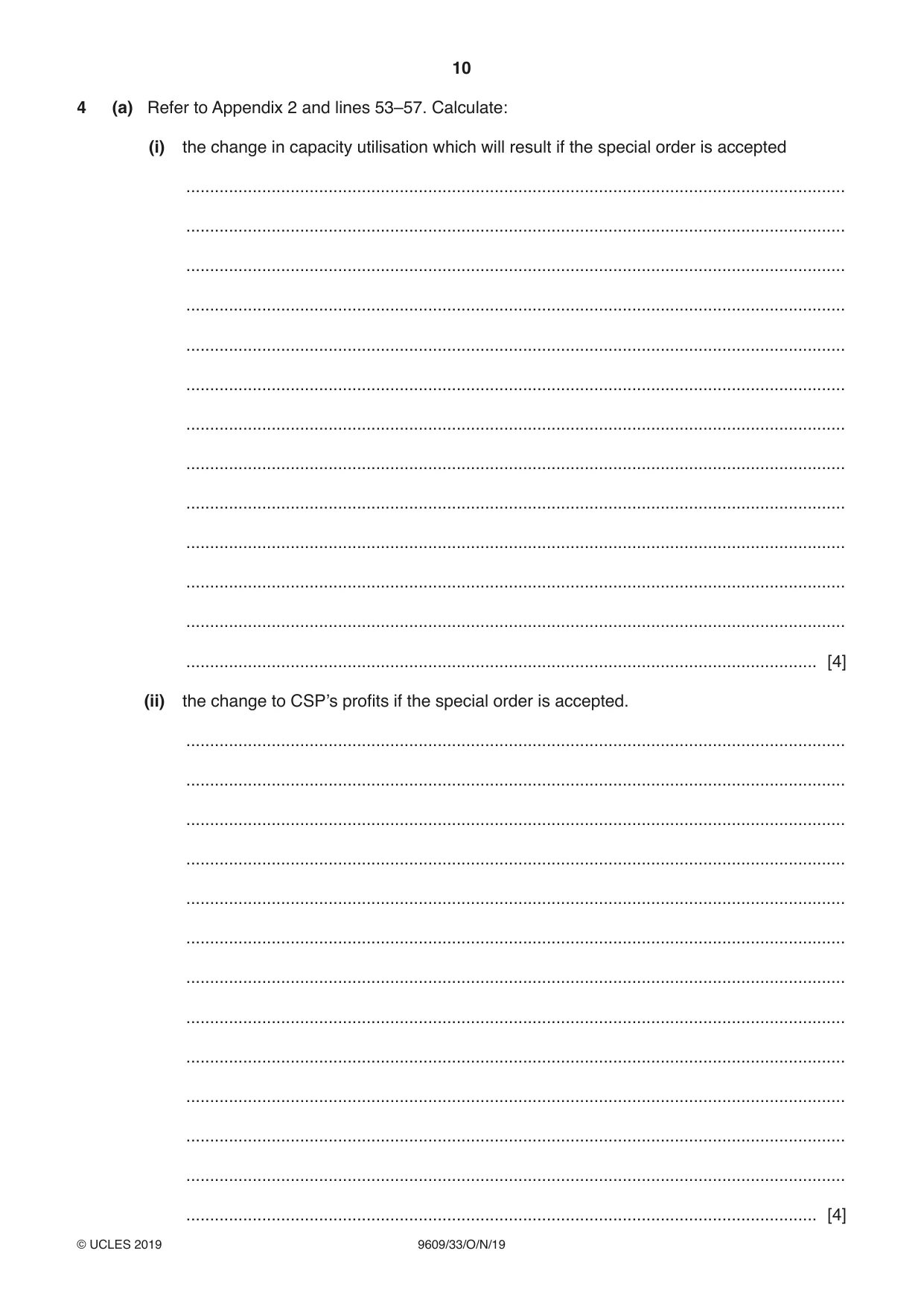
10 9609/33/O/N/19 © UCLES 2019 4 (a) Refer to Appendix 2 and lines 53–57. Calculate: (i) the change in capacity utilisation which will result if the special order is accepted … … … … … … … … … … … … … [4] (ii) the change to CSP’s profits if the special order is accepted. … … … … … … … … … … … … … [4]
Question paper, page 11
11 9609/33/O/N/19 © UCLES 2019 [Turn over (b) Refer to your results from 4(a) and any other information. Recommend whether CSP should accept the special order from X Tours. … … … … … … … … … … … … … … … … … … … … … … … … … … …
Question paper, page 12
12 9609/33/O/N/19 © UCLES 2019 … … … … … … … … … … … … … … … … … … … … … … … … … … … … [12]
Question paper, page 13
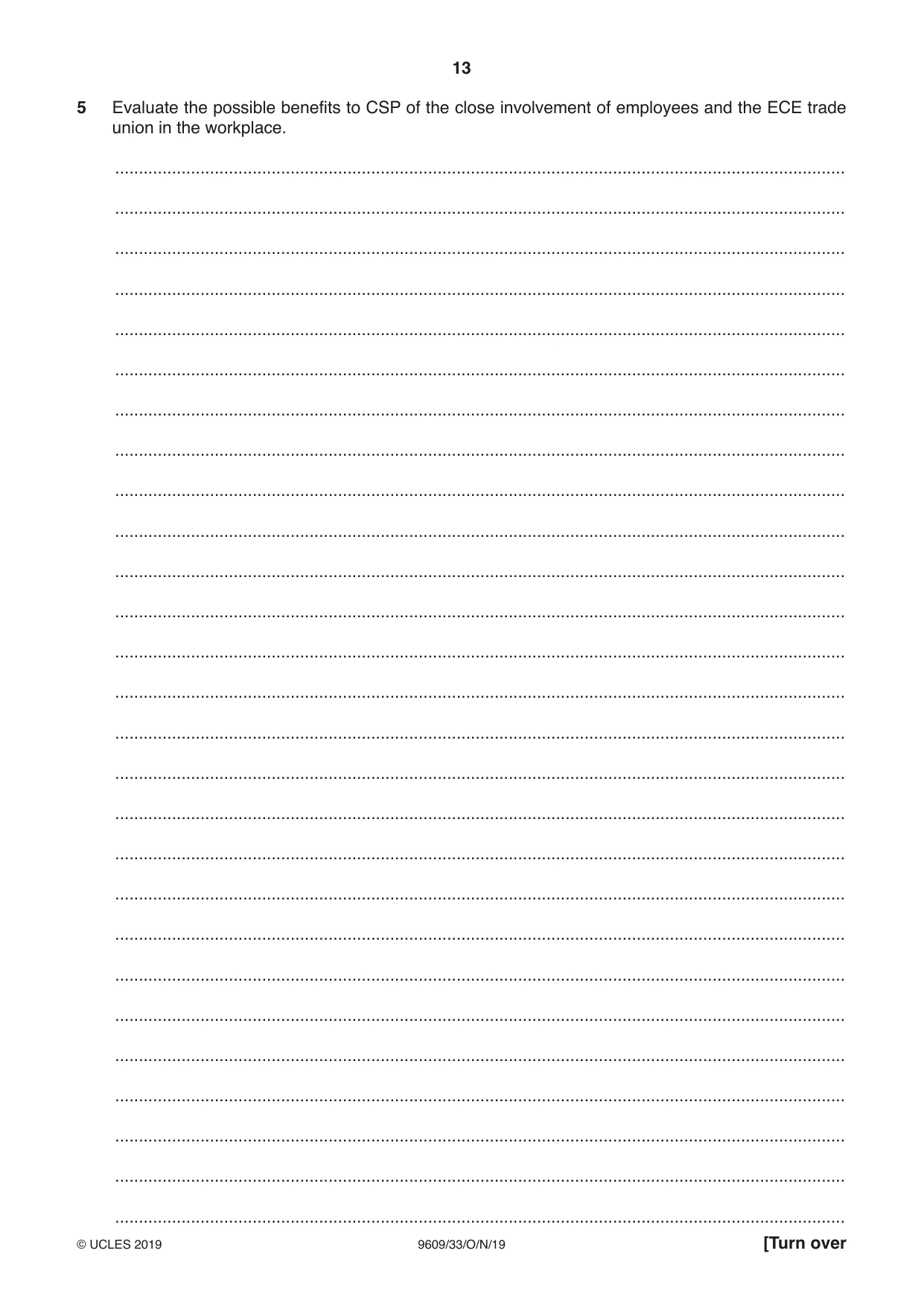
13 9609/33/O/N/19 © UCLES 2019 [Turn over 5 Evaluate the possible benefits to CSP of the close involvement of employees and the ECE trade union in the workplace. … … … … … … … … … … … … … … … … … … … … … … … … … … …
Question paper, page 14
14 9609/33/O/N/19 © UCLES 2019 … … … … … … … … … … … … … … … … … … … … … … … … … … … …
Question paper, page 15
15 9609/33/O/N/19 © UCLES 2019 [Turn over … … … … … … … … … … … … … … … … … … … … … … … … … … … … [16]
Question paper, page 16
16 9609/33/O/N/19 © UCLES 2019 Section B Answer one question from this section. 6 Discuss the usefulness of strategic choice techniques for the directors of CSP when making a choice between options A and B. 7 Evaluate the importance of contingency planning for CSP. Write the question number here: … … … … … … … … … … … … … … … … … … … … … … … …
Question paper, page 17
17 9609/33/O/N/19 © UCLES 2019 [Turn over … … … … … … … … … … … … … … … … … … … … … … … … … … … …
Question paper, page 18
18 9609/33/O/N/19 © UCLES 2019 … … … … … … … … … … … … … … … … … … … … … … … … … … … …
Question paper, page 19
19 9609/33/O/N/19 © UCLES 2019 … … … … … … … … … … … … … … … … … … … … … … … … … … … … [20]
Question paper, page 20
20 9609/33/O/N/19 © UCLES 2019 Permission to reproduce items where third-party owned material protected by copyright is included has been sought and cleared where possible. Every reasonable effort has been made by the publisher (UCLES) to trace copyright holders, but if any items requiring clearance have unwittingly been included, the publisher will be pleased to make amends at the earliest possible opportunity. To avoid the issue of disclosure of answer-related information to candidates, all copyright acknowledgements are reproduced online in the Cambridge Assessment International Education Copyright Acknowledgements Booklet. This is produced for each series of examinations and is freely available to download at www.cambridgeinternational.org after the live examination series. Cambridge Assessment International Education is part of the Cambridge Assessment Group. Cambridge Assessment is the brand name of the University of Cambridge Local Examinations Syndicate (UCLES), which itself is a department of the University of Cambridge. BLANK PAGE
Mark scheme, page 1
This document consists of 15 printed pages. © UCLES 2019 [Turn over Cambridge Assessment International Education Cambridge International Advanced Subsidiary and Advanced Level BUSINESS 9609/33 Paper 3 Case Study October/November 2019 MARK SCHEME Maximum Mark: 100 Published This mark scheme is published as an aid to teachers and candidates, to indicate the requirements of the examination. It shows the basis on which Examiners were instructed to award marks. It does not indicate the details of the discussions that took place at an Examiners’ meeting before marking began, which would have considered the acceptability of alternative answers. Mark schemes should be read in conjunction with the question paper and the Principal Examiner Report for Teachers. Cambridge International will not enter into discussions about these mark schemes. Cambridge International is publishing the mark schemes for the October/November 2019 series for most Cambridge IGCSE™, Cambridge International A and AS Level components and some Cambridge O Level components.
Mark scheme, page 2
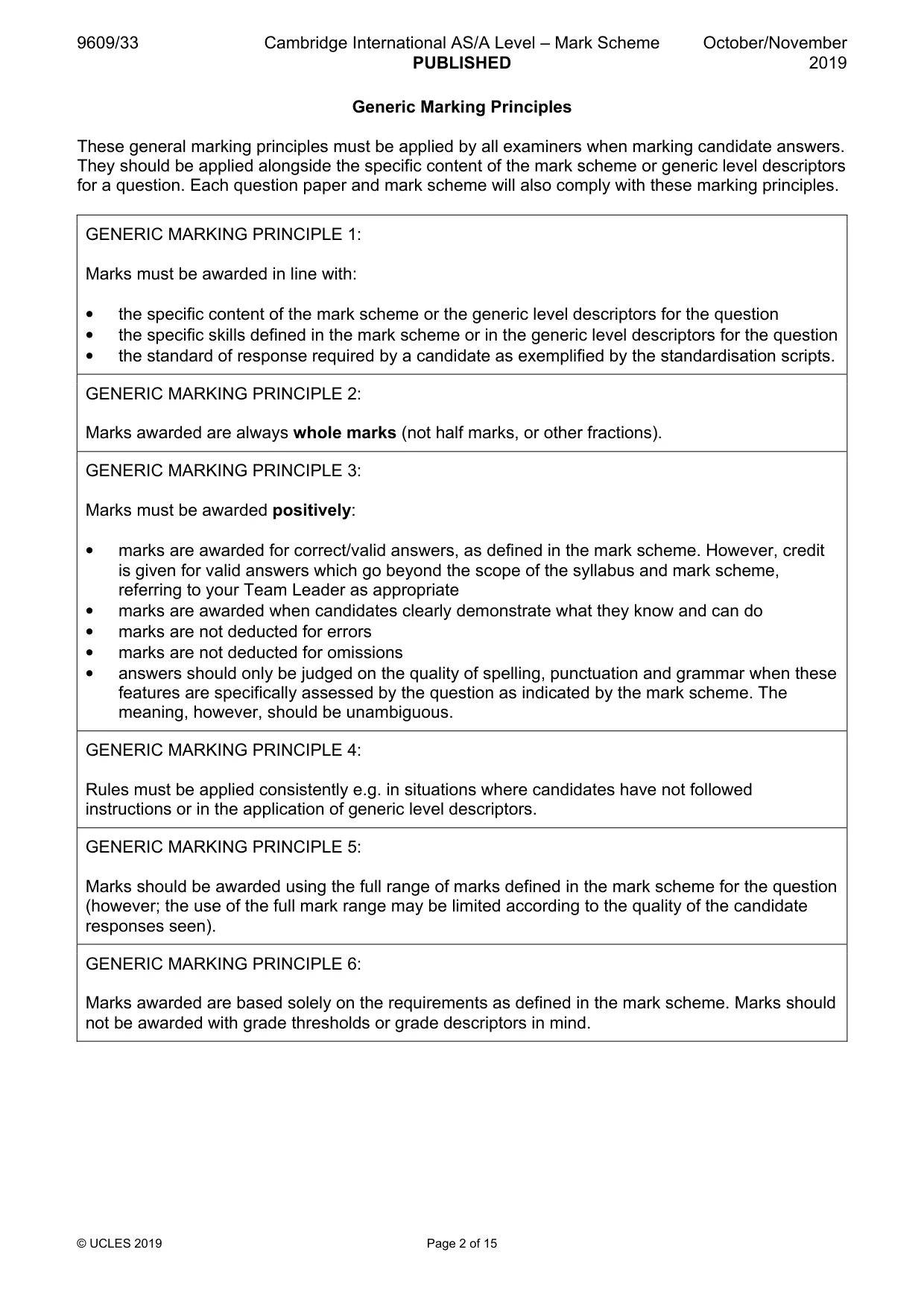
9609/33 Cambridge International AS/A Level – Mark Scheme PUBLISHED October/November 2019 © UCLES 2019 Page 2 of 15 Generic Marking Principles These general marking principles must be applied by all examiners when marking candidate answers. They should be applied alongside the specific content of the mark scheme or generic level descriptors for a question. Each question paper and mark scheme will also comply with these marking principles. GENERIC MARKING PRINCIPLE 1: Marks must be awarded in line with: • the specific content of the mark scheme or the generic level descriptors for the question • the specific skills defined in the mark scheme or in the generic level descriptors for the question • the standard of response required by a candidate as exemplified by the standardisation scripts. GENERIC MARKING PRINCIPLE 2: Marks awarded are always whole marks (not half marks, or other fractions). GENERIC MARKING PRINCIPLE 3: Marks must be awarded positively: • marks are awarded for correct/valid answers, as defined in the mark scheme. However, credit is given for valid answers which go beyond the scope of the syllabus and mark scheme, referring to your Team Leader as appropriate • marks are awarded when candidates clearly demonstrate what they know and can do • marks are not deducted for errors • marks are not deducted for omissions • answers should only be judged on the quality of spelling, punctuation and grammar when these features are specifically assessed by the question as indicated by the mark scheme. The meaning, however, should be unambiguous. GENERIC MARKING PRINCIPLE 4: Rules must be applied consistently e.g. in situations where candidates have not followed instructions or in the application of generic level descriptors. GENERIC MARKING PRINCIPLE 5: Marks should be awarded using the full range of marks defined in the mark scheme for the question (however; the use of the full mark range may be limited according to the quality of the candidate responses seen). GENERIC MARKING PRINCIPLE 6: Marks awarded are based solely on the requirements as defined in the mark scheme. Marks should not be awarded with grade thresholds or grade descriptors in mind.
Mark scheme, page 3
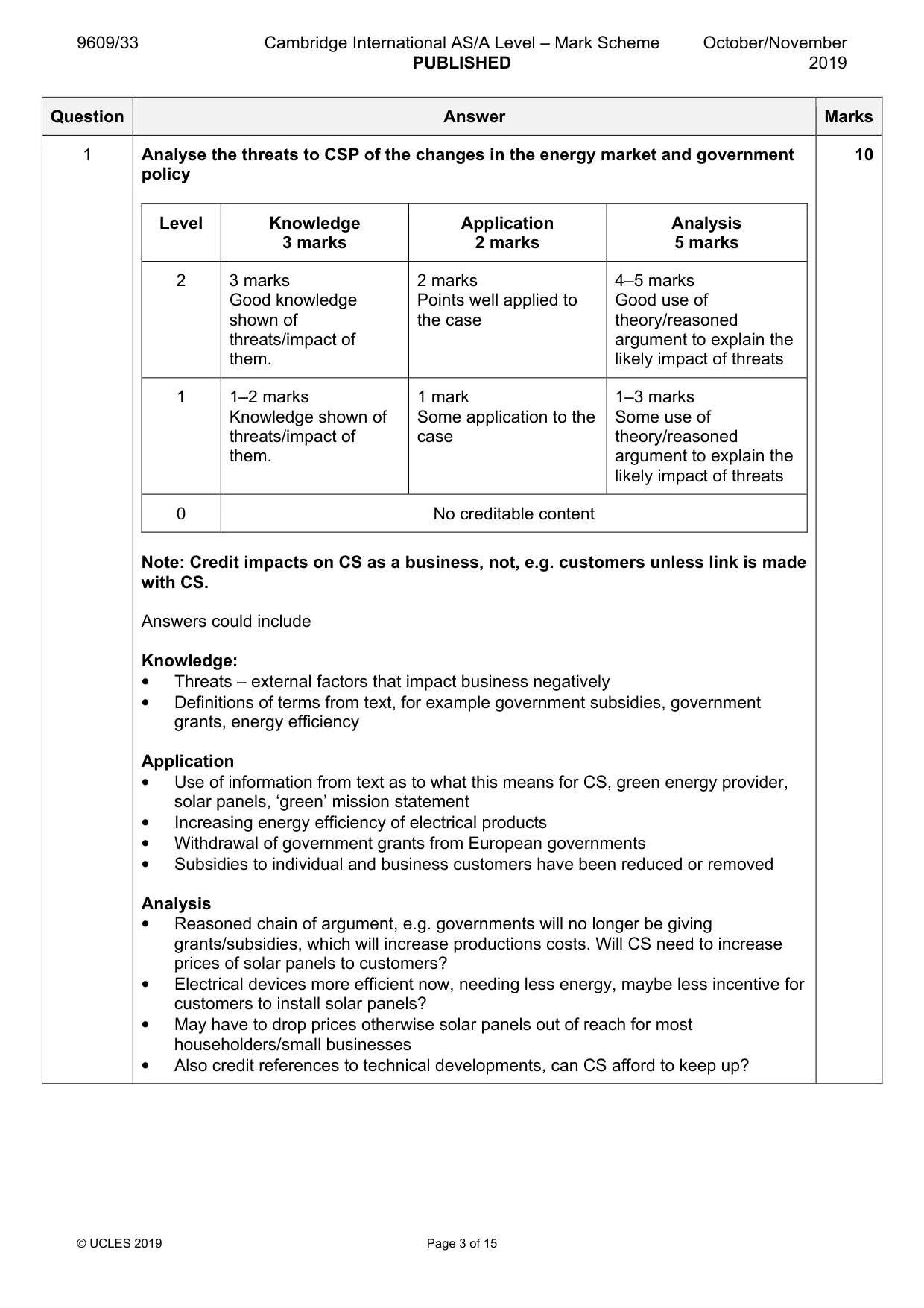
9609/33 Cambridge International AS/A Level – Mark Scheme PUBLISHED October/November 2019 © UCLES 2019 Page 3 of 15 Question Answer Marks 1 Analyse the threats to CSP of the changes in the energy market and government policy Level Knowledge 3 marks Application 2 marks Analysis 5 marks 2 3 marks Good knowledge shown of threats/impact of them. 2 marks Points well applied to the case 4–5 marks Good use of theory/reasoned argument to explain the likely impact of threats 1 1–2 marks Knowledge shown of threats/impact of them. 1 mark Some application to the case 1–3 marks Some use of theory/reasoned argument to explain the likely impact of threats 0 No creditable content Note: Credit impacts on CS as a business, not, e.g. customers unless link is made with CS. Answers could include Knowledge: • Threats – external factors that impact business negatively • Definitions of terms from text, for example government subsidies, government grants, energy efficiency Application • Use of information from text as to what this means for CS, green energy provider, solar panels, ‘green’ mission statement • Increasing energy efficiency of electrical products • Withdrawal of government grants from European governments • Subsidies to individual and business customers have been reduced or removed Analysis • Reasoned chain of argument, e.g. governments will no longer be giving grants/subsidies, which will increase productions costs. Will CS need to increase prices of solar panels to customers? • Electrical devices more efficient now, needing less energy, maybe less incentive for customers to install solar panels? • May have to drop prices otherwise solar panels out of reach for most householders/small businesses • Also credit references to technical developments, can CS afford to keep up? 10
Mark scheme, page 4
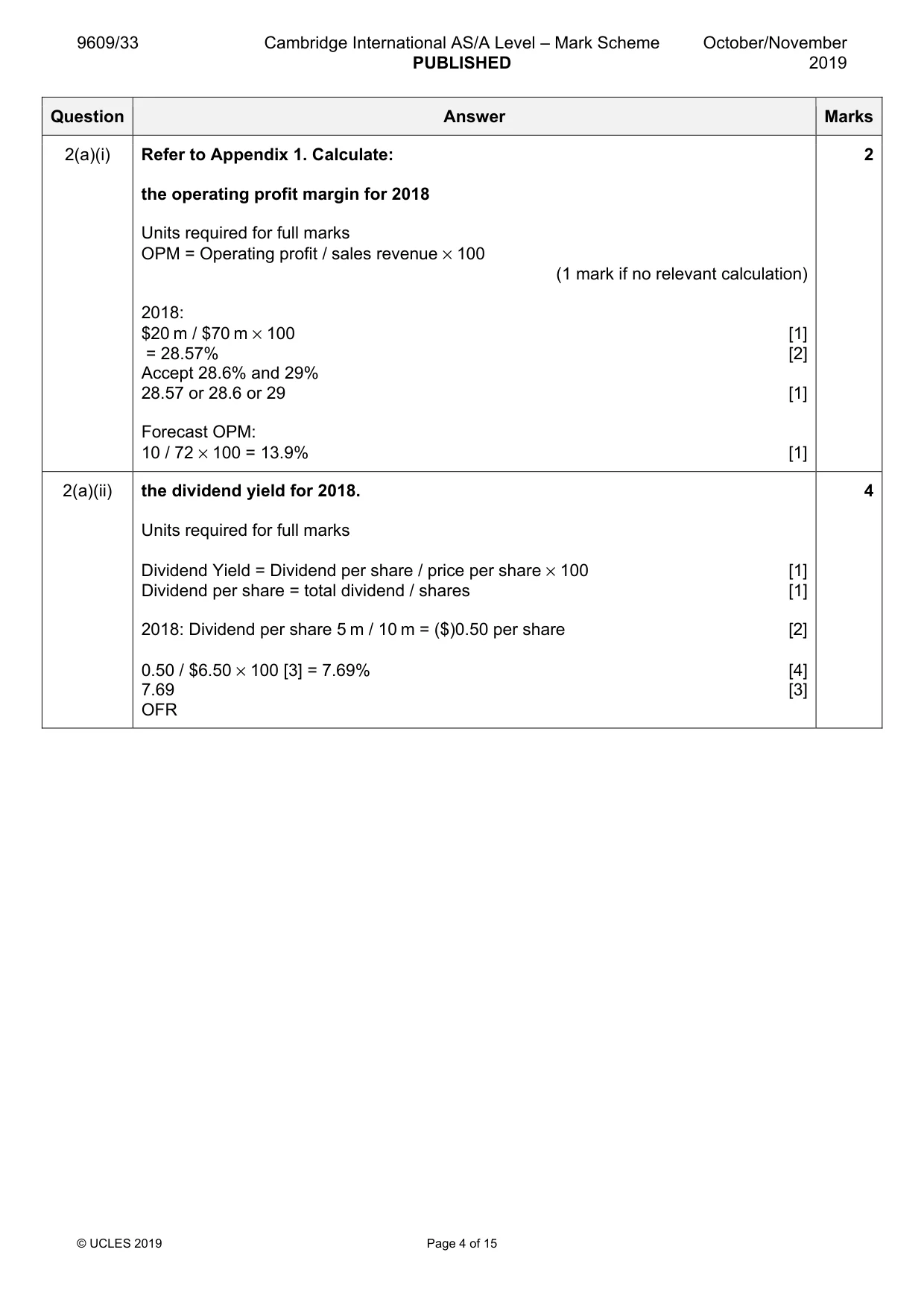
9609/33 Cambridge International AS/A Level – Mark Scheme PUBLISHED October/November 2019 © UCLES 2019 Page 4 of 15 Question Answer Marks 2(a)(i) Refer to Appendix 1. Calculate: the operating profit margin for 2018 Units required for full marks OPM = Operating profit / sales revenue × 100 (1 mark if no relevant calculation) 2018: $20 m / $70 m × 100 [1] = 28.57% [2] Accept 28.6% and 29% 28.57 or 28.6 or 29 [1] Forecast OPM: 10 / 72 × 100 = 13.9% [1] 2 2(a)(ii) the dividend yield for 2018. Units required for full marks Dividend Yield = Dividend per share / price per share × 100 [1] Dividend per share = total dividend / shares [1] 2018: Dividend per share 5 m / 10 m = ($)0.50 per share [2] 0.50 / $6.50 × 100 [3] = 7.69% [4] 7.69 [3] OFR 4
Mark scheme, page 5
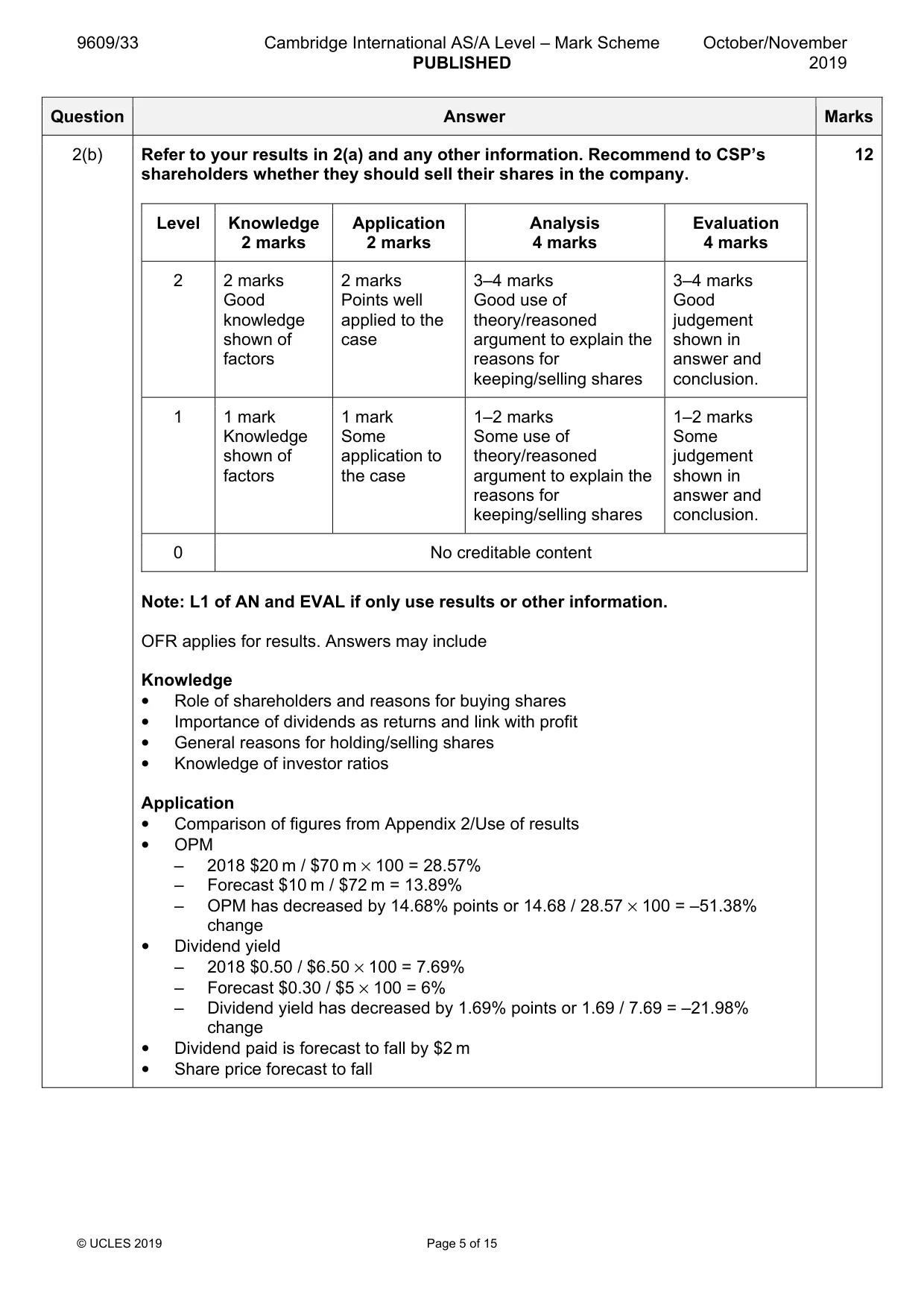
9609/33 Cambridge International AS/A Level – Mark Scheme PUBLISHED October/November 2019 © UCLES 2019 Page 5 of 15 Question Answer Marks 2(b) Refer to your results in 2(a) and any other information. Recommend to CSP’s shareholders whether they should sell their shares in the company. Level Knowledge 2 marks Application 2 marks Analysis 4 marks Evaluation 4 marks 2 2 marks Good knowledge shown of factors 2 marks Points well applied to the case 3–4 marks Good use of theory/reasoned argument to explain the reasons for keeping/selling shares 3–4 marks Good judgement shown in answer and conclusion. 1 1 mark Knowledge shown of factors 1 mark Some application to the case 1–2 marks Some use of theory/reasoned argument to explain the reasons for keeping/selling shares 1–2 marks Some judgement shown in answer and conclusion. 0 No creditable content Note: L1 of AN and EVAL if only use results or other information. OFR applies for results. Answers may include Knowledge • Role of shareholders and reasons for buying shares • Importance of dividends as returns and link with profit • General reasons for holding/selling shares • Knowledge of investor ratios Application • Comparison of figures from Appendix 2/Use of results • OPM – 2018 $20 m / $70 m × 100 = 28.57% – Forecast $10 m / $72 m = 13.89% – OPM has decreased by 14.68% points or 14.68 / 28.57 × 100 = –51.38% change • Dividend yield – 2018 $0.50 / $6.50 × 100 = 7.69% – Forecast $0.30 / $5 × 100 = 6% – Dividend yield has decreased by 1.69% points or 1.69 / 7.69 = –21.98% change • Dividend paid is forecast to fall by $2 m • Share price forecast to fall 12
Mark scheme, page 6
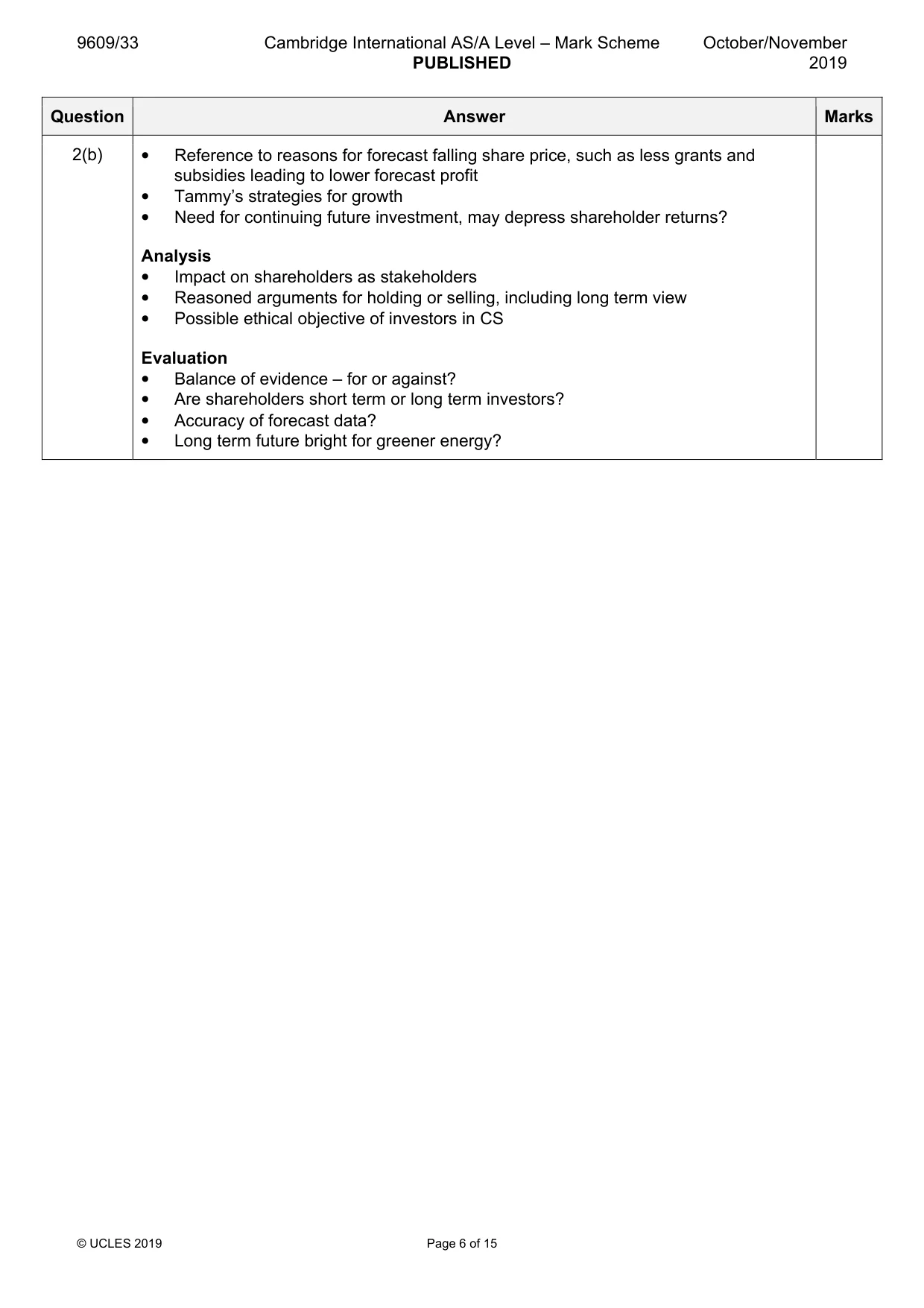
9609/33 Cambridge International AS/A Level – Mark Scheme PUBLISHED October/November 2019 © UCLES 2019 Page 6 of 15 Question Answer Marks 2(b) • Reference to reasons for forecast falling share price, such as less grants and subsidies leading to lower forecast profit • Tammy’s strategies for growth • Need for continuing future investment, may depress shareholder returns? Analysis • Impact on shareholders as stakeholders • Reasoned arguments for holding or selling, including long term view • Possible ethical objective of investors in CS Evaluation • Balance of evidence – for or against? • Are shareholders short term or long term investors? • Accuracy of forecast data? • Long term future bright for greener energy?
Mark scheme, page 7
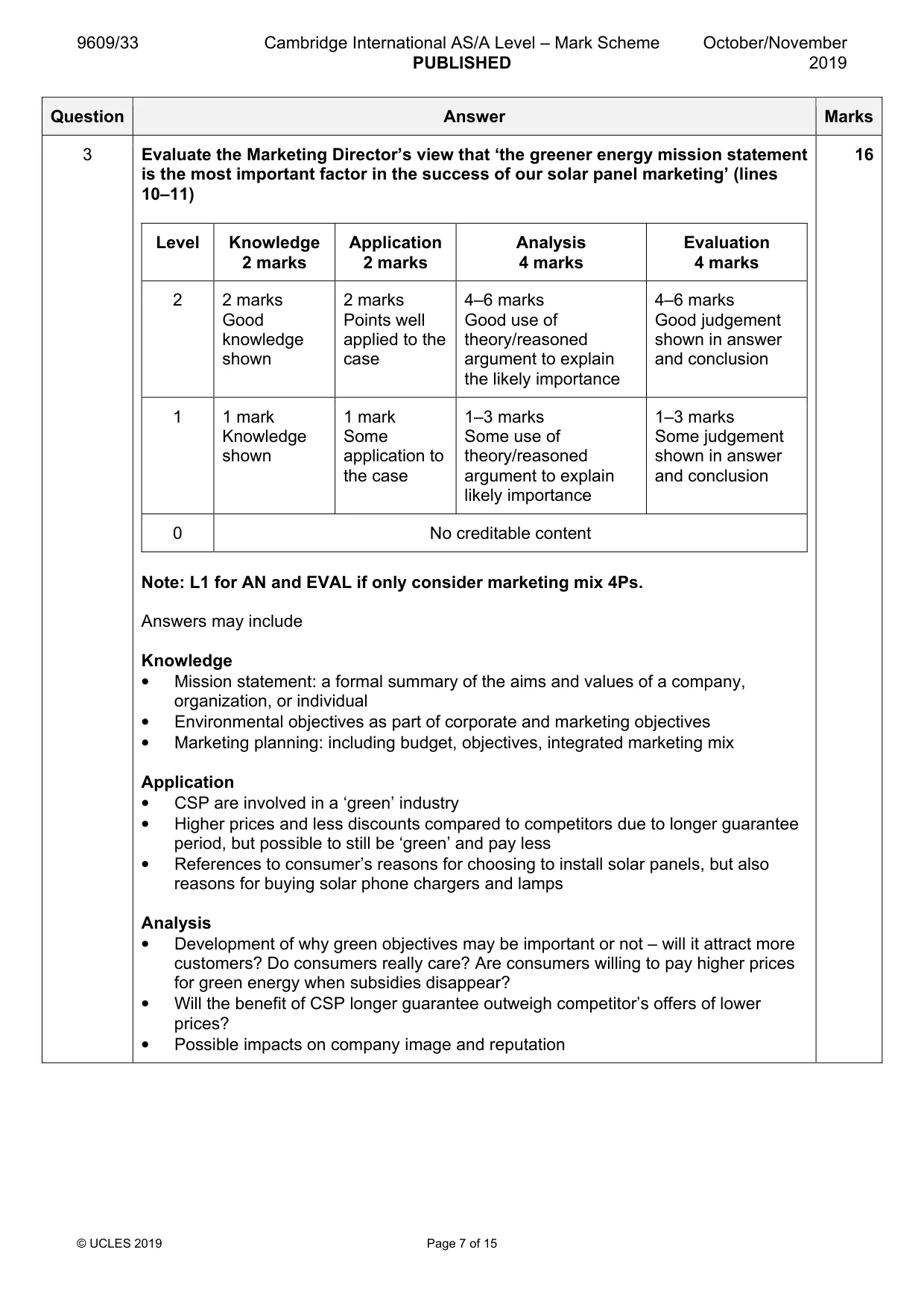
9609/33 Cambridge International AS/A Level – Mark Scheme PUBLISHED October/November 2019 © UCLES 2019 Page 7 of 15 Question Answer Marks 3 Evaluate the Marketing Director’s view that ‘the greener energy mission statement is the most important factor in the success of our solar panel marketing’ (lines 10–11) Level Knowledge 2 marks Application 2 marks Analysis 4 marks Evaluation 4 marks 2 2 marks Good knowledge shown 2 marks Points well applied to the case 4–6 marks Good use of theory/reasoned argument to explain the likely importance 4–6 marks Good judgement shown in answer and conclusion 1 1 mark Knowledge shown 1 mark Some application to the case 1–3 marks Some use of theory/reasoned argument to explain likely importance 1–3 marks Some judgement shown in answer and conclusion 0 No creditable content Note: L1 for AN and EVAL if only consider marketing mix 4Ps. Answers may include Knowledge • Mission statement: a formal summary of the aims and values of a company, organization, or individual • Environmental objectives as part of corporate and marketing objectives • Marketing planning: including budget, objectives, integrated marketing mix Application • CSP are involved in a ‘green’ industry • Higher prices and less discounts compared to competitors due to longer guarantee period, but possible to still be ‘green’ and pay less • References to consumer’s reasons for choosing to install solar panels, but also reasons for buying solar phone chargers and lamps Analysis • Development of why green objectives may be important or not – will it attract more customers? Do consumers really care? Are consumers willing to pay higher prices for green energy when subsidies disappear? • Will the benefit of CSP longer guarantee outweigh competitor’s offers of lower prices? • Possible impacts on company image and reputation 16
Mark scheme, page 8
9609/33 Cambridge International AS/A Level – Mark Scheme PUBLISHED October/November 2019 © UCLES 2019 Page 8 of 15 Question Answer Marks 3 Evaluation • Future use if green energy becomes the ‘norm’ • Judgement as to how important ‘green’ may be – is price more important? • Risks over long term as more competition in ‘green’ technology and need to stay ‘ahead of the game’
Mark scheme, page 9
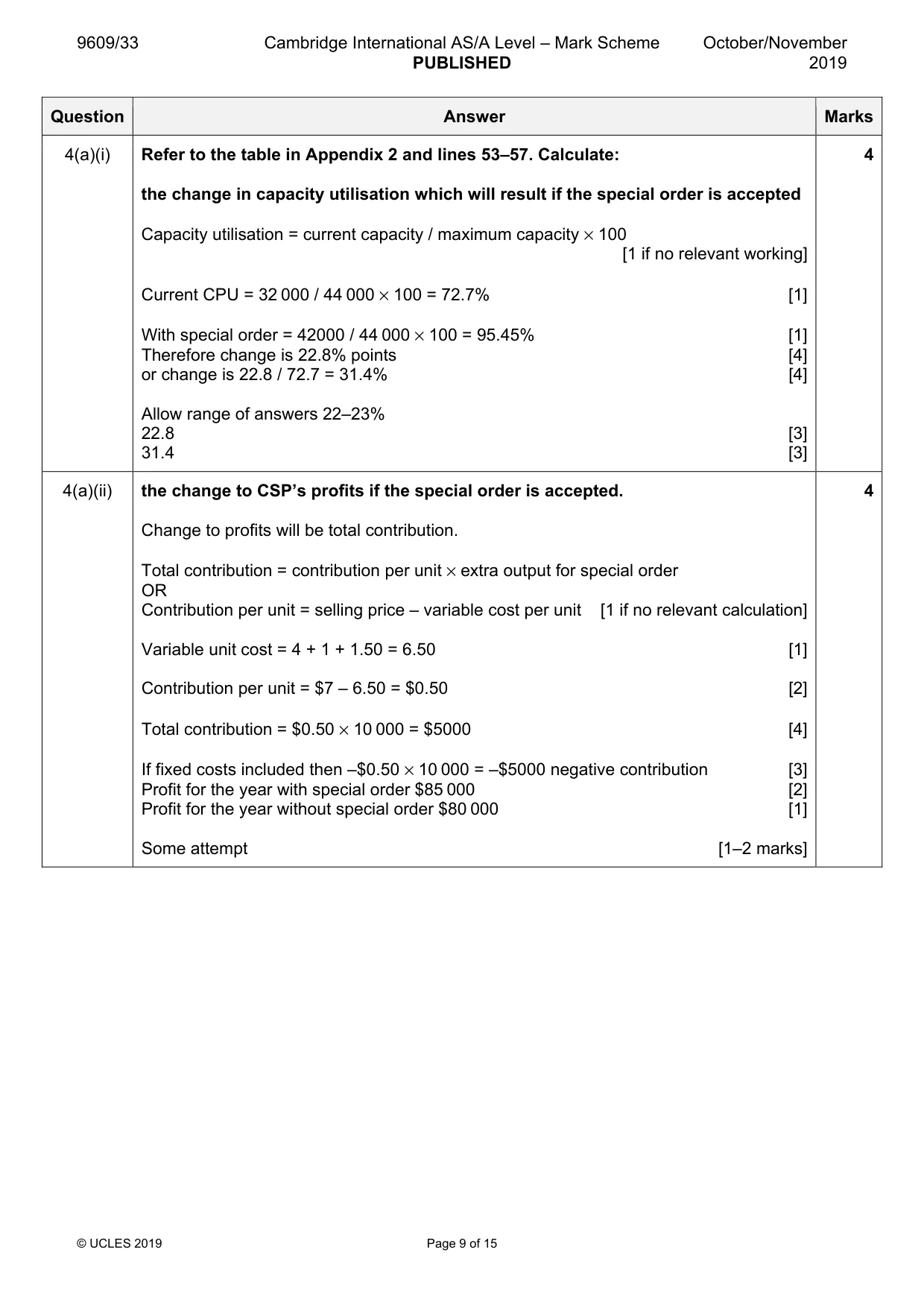
9609/33 Cambridge International AS/A Level – Mark Scheme PUBLISHED October/November 2019 © UCLES 2019 Page 9 of 15 Question Answer Marks 4(a)(i) Refer to the table in Appendix 2 and lines 53–57. Calculate: the change in capacity utilisation which will result if the special order is accepted Capacity utilisation = current capacity / maximum capacity × 100 [1 if no relevant working] Current CPU = 32 000 / 44 000 × 100 = 72.7% [1] With special order = 42000 / 44 000 × 100 = 95.45% [1] Therefore change is 22.8% points [4] or change is 22.8 / 72.7 = 31.4% [4] Allow range of answers 22–23% 22.8 [3] 31.4 [3] 4 4(a)(ii) the change to CSP’s profits if the special order is accepted. Change to profits will be total contribution. Total contribution = contribution per unit × extra output for special order OR Contribution per unit = selling price – variable cost per unit [1 if no relevant calculation] Variable unit cost = 4 + 1 + 1.50 = 6.50 [1] Contribution per unit = $7 – 6.50 = $0.50 [2] Total contribution = $0.50 × 10 000 = $5000 [4] If fixed costs included then –$0.50 × 10 000 = –$5000 negative contribution [3] Profit for the year with special order $85 000 [2] Profit for the year without special order $80 000 [1] Some attempt [1–2 marks] 4
Mark scheme, page 10
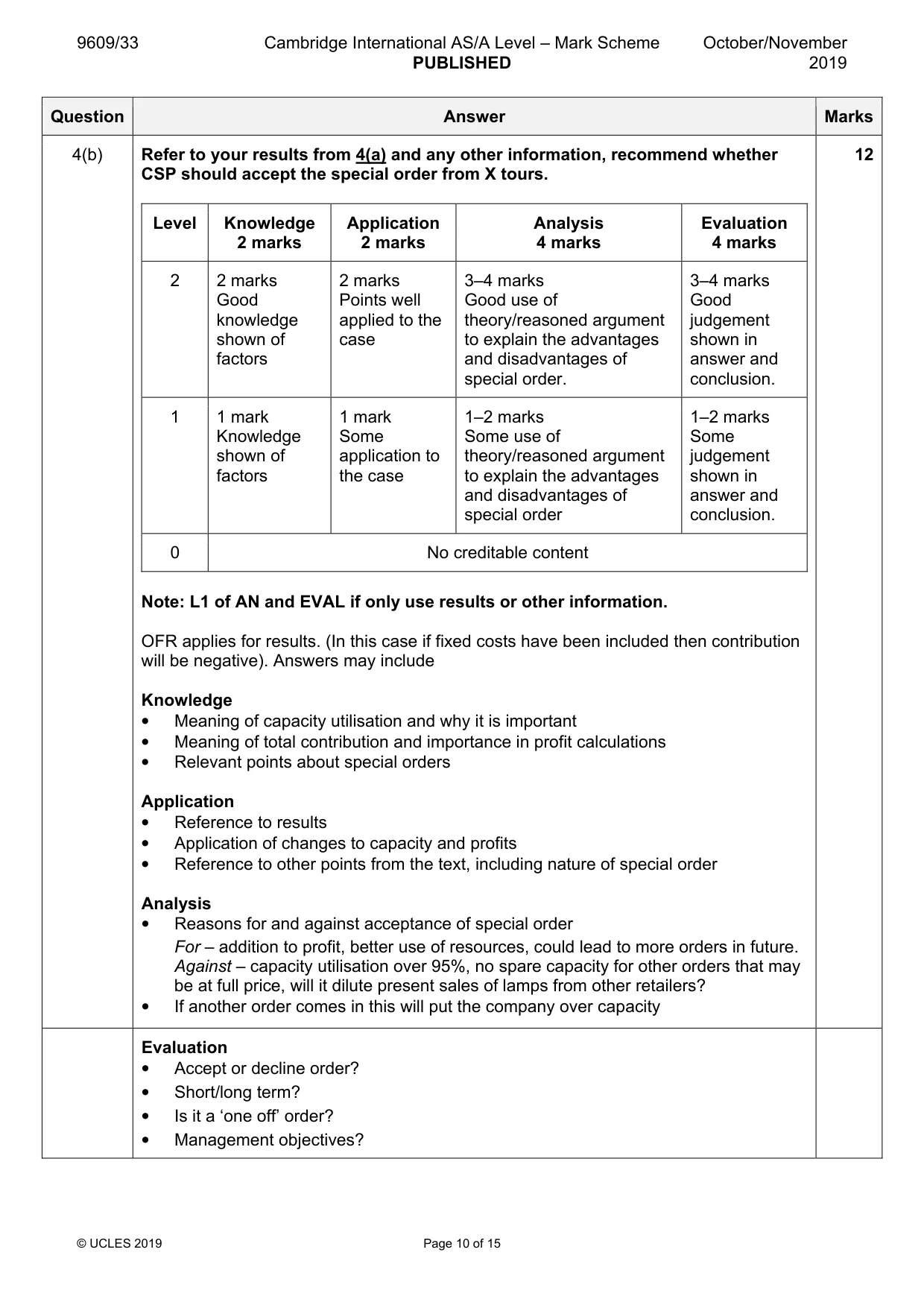
9609/33 Cambridge International AS/A Level – Mark Scheme PUBLISHED October/November 2019 © UCLES 2019 Page 10 of 15 Question Answer Marks 4(b) Refer to your results from 4(a) and any other information, recommend whether CSP should accept the special order from X tours. Level Knowledge 2 marks Application 2 marks Analysis 4 marks Evaluation 4 marks 2 2 marks Good knowledge shown of factors 2 marks Points well applied to the case 3–4 marks Good use of theory/reasoned argument to explain the advantages and disadvantages of special order. 3–4 marks Good judgement shown in answer and conclusion. 1 1 mark Knowledge shown of factors 1 mark Some application to the case 1–2 marks Some use of theory/reasoned argument to explain the advantages and disadvantages of special order 1–2 marks Some judgement shown in answer and conclusion. 0 No creditable content Note: L1 of AN and EVAL if only use results or other information. OFR applies for results. (In this case if fixed costs have been included then contribution will be negative). Answers may include Knowledge • Meaning of capacity utilisation and why it is important • Meaning of total contribution and importance in profit calculations • Relevant points about special orders Application • Reference to results • Application of changes to capacity and profits • Reference to other points from the text, including nature of special order Analysis • Reasons for and against acceptance of special order For – addition to profit, better use of resources, could lead to more orders in future. Against – capacity utilisation over 95%, no spare capacity for other orders that may be at full price, will it dilute present sales of lamps from other retailers? • If another order comes in this will put the company over capacity 12 Evaluation • Accept or decline order? • Short/long term? • Is it a ‘one off’ order? • Management objectives?
Mark scheme, page 11
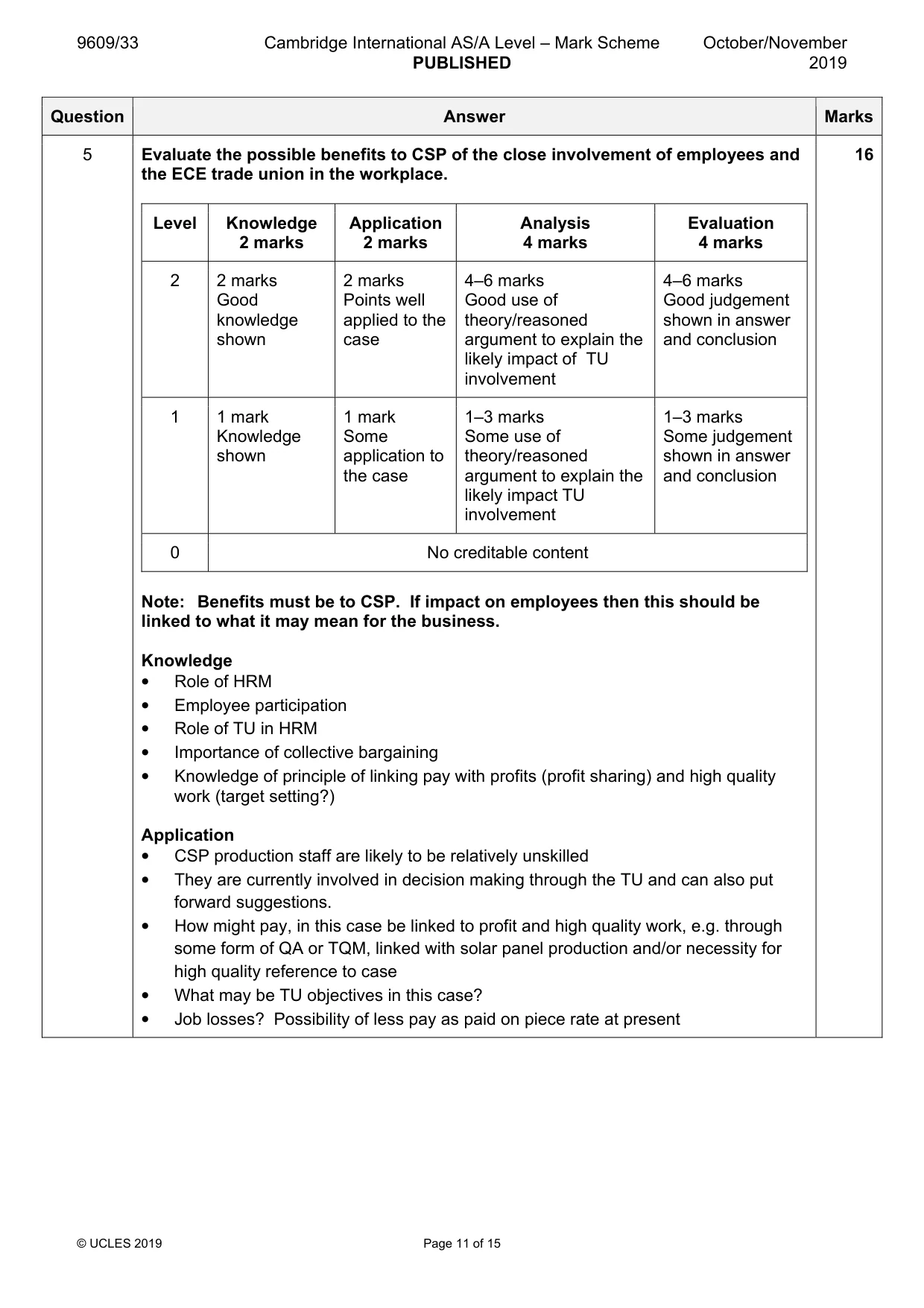
9609/33 Cambridge International AS/A Level – Mark Scheme PUBLISHED October/November 2019 © UCLES 2019 Page 11 of 15 Question Answer Marks 5 Evaluate the possible benefits to CSP of the close involvement of employees and the ECE trade union in the workplace. Level Knowledge 2 marks Application 2 marks Analysis 4 marks Evaluation 4 marks 2 2 marks Good knowledge shown 2 marks Points well applied to the case 4–6 marks Good use of theory/reasoned argument to explain the likely impact of TU involvement 4–6 marks Good judgement shown in answer and conclusion 1 1 mark Knowledge shown 1 mark Some application to the case 1–3 marks Some use of theory/reasoned argument to explain the likely impact TU involvement 1–3 marks Some judgement shown in answer and conclusion 0 No creditable content Note: Benefits must be to CSP. If impact on employees then this should be linked to what it may mean for the business. Knowledge • Role of HRM • Employee participation • Role of TU in HRM • Importance of collective bargaining • Knowledge of principle of linking pay with profits (profit sharing) and high quality work (target setting?) Application • CSP production staff are likely to be relatively unskilled • They are currently involved in decision making through the TU and can also put forward suggestions. • How might pay, in this case be linked to profit and high quality work, e.g. through some form of QA or TQM, linked with solar panel production and/or necessity for high quality reference to case • What may be TU objectives in this case? • Job losses? Possibility of less pay as paid on piece rate at present 16
Mark scheme, page 12
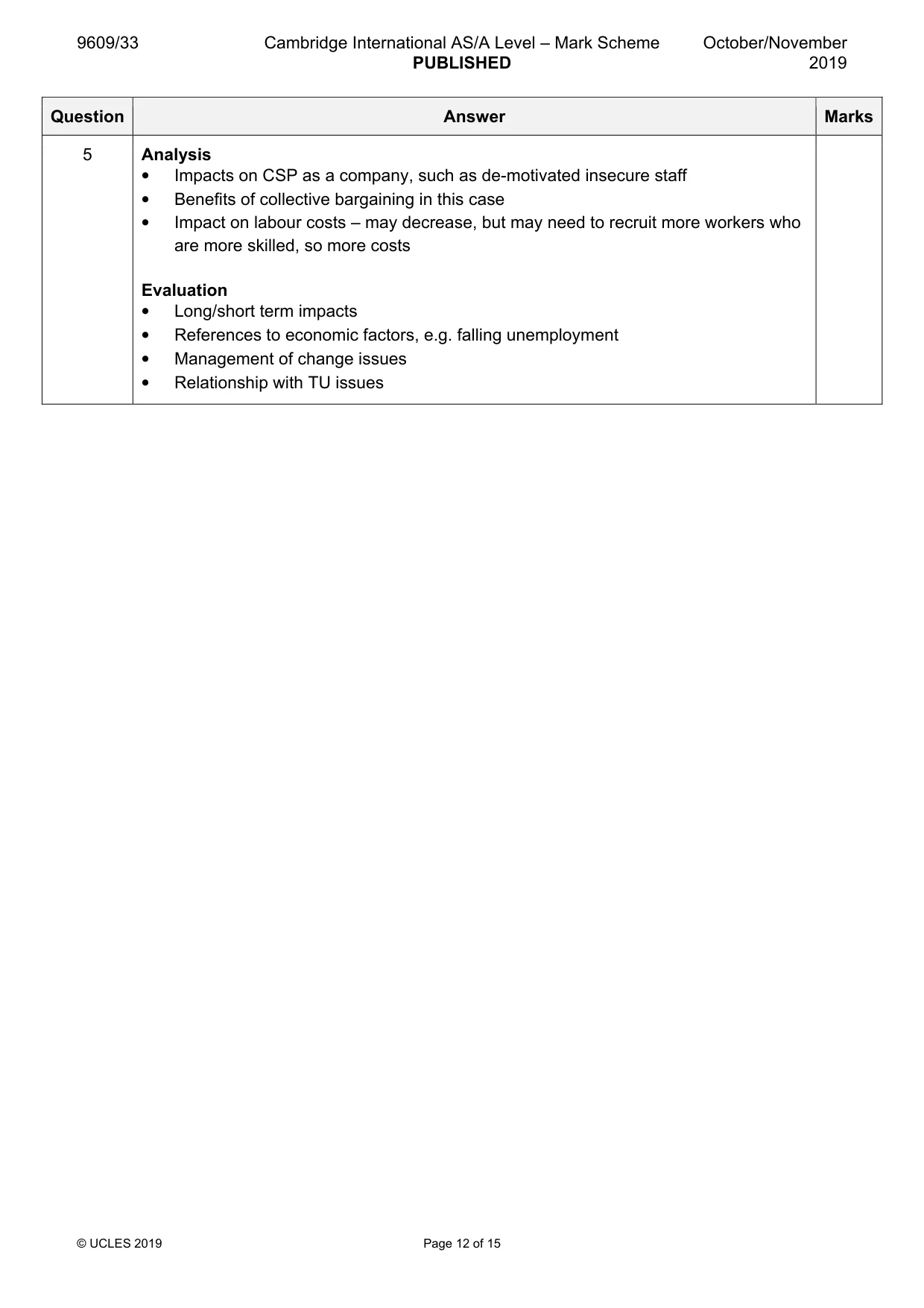
9609/33 Cambridge International AS/A Level – Mark Scheme PUBLISHED October/November 2019 © UCLES 2019 Page 12 of 15 Question Answer Marks 5 Analysis • Impacts on CSP as a company, such as de-motivated insecure staff • Benefits of collective bargaining in this case • Impact on labour costs – may decrease, but may need to recruit more workers who are more skilled, so more costs Evaluation • Long/short term impacts • References to economic factors, e.g. falling unemployment • Management of change issues • Relationship with TU issues
Mark scheme, page 13
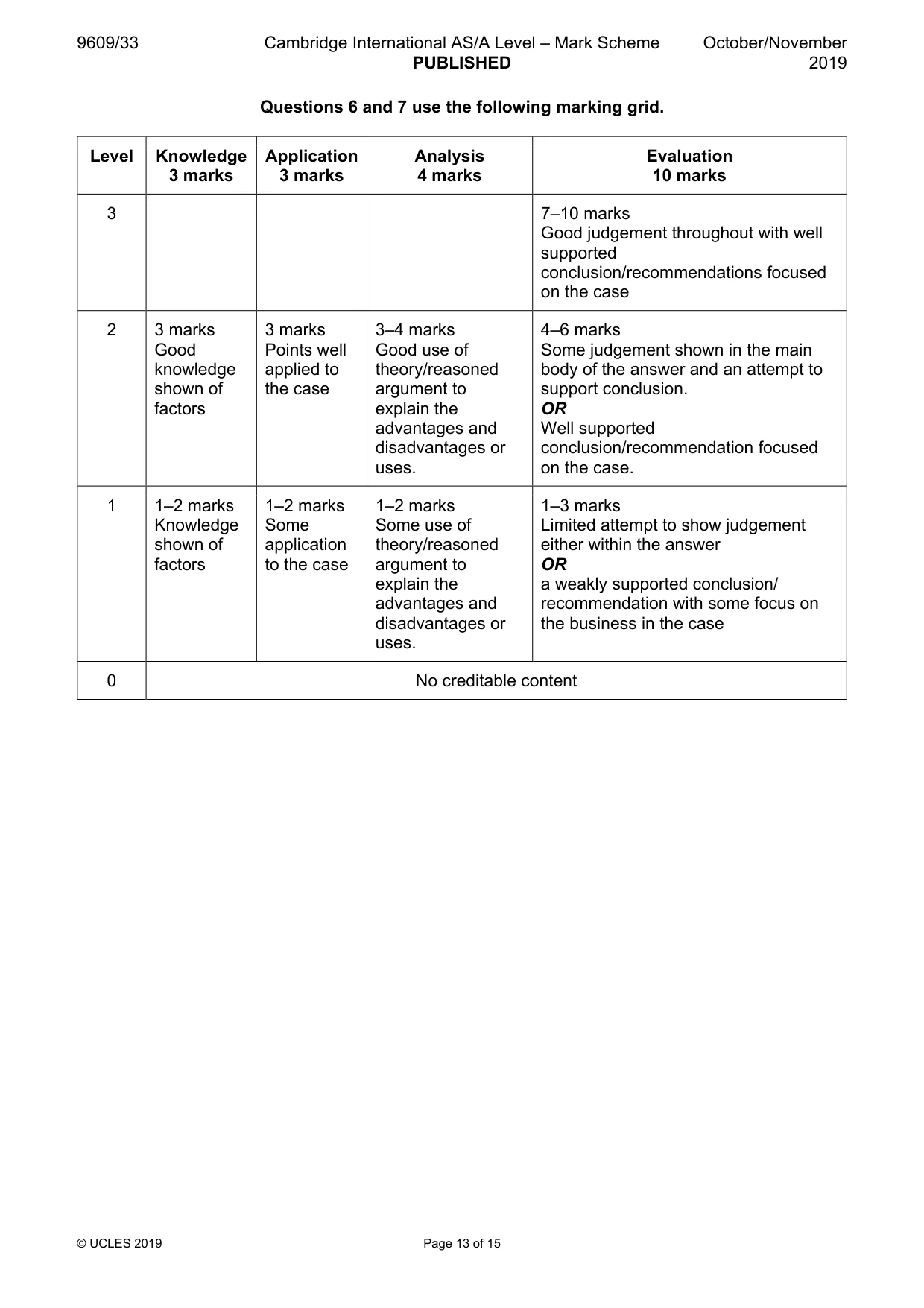
9609/33 Cambridge International AS/A Level – Mark Scheme PUBLISHED October/November 2019 © UCLES 2019 Page 13 of 15 Questions 6 and 7 use the following marking grid. Level Knowledge 3 marks Application 3 marks Analysis 4 marks Evaluation 10 marks 3 7–10 marks Good judgement throughout with well supported conclusion/recommendations focused on the case 2 3 marks Good knowledge shown of factors 3 marks Points well applied to the case 3–4 marks Good use of theory/reasoned argument to explain the advantages and disadvantages or uses. 4–6 marks Some judgement shown in the main body of the answer and an attempt to support conclusion. OR Well supported conclusion/recommendation focused on the case. 1 1–2 marks Knowledge shown of factors 1–2 marks Some application to the case 1–2 marks Some use of theory/reasoned argument to explain the advantages and disadvantages or uses. 1–3 marks Limited attempt to show judgement either within the answer OR a weakly supported conclusion/ recommendation with some focus on the business in the case 0 No creditable content
Mark scheme, page 14
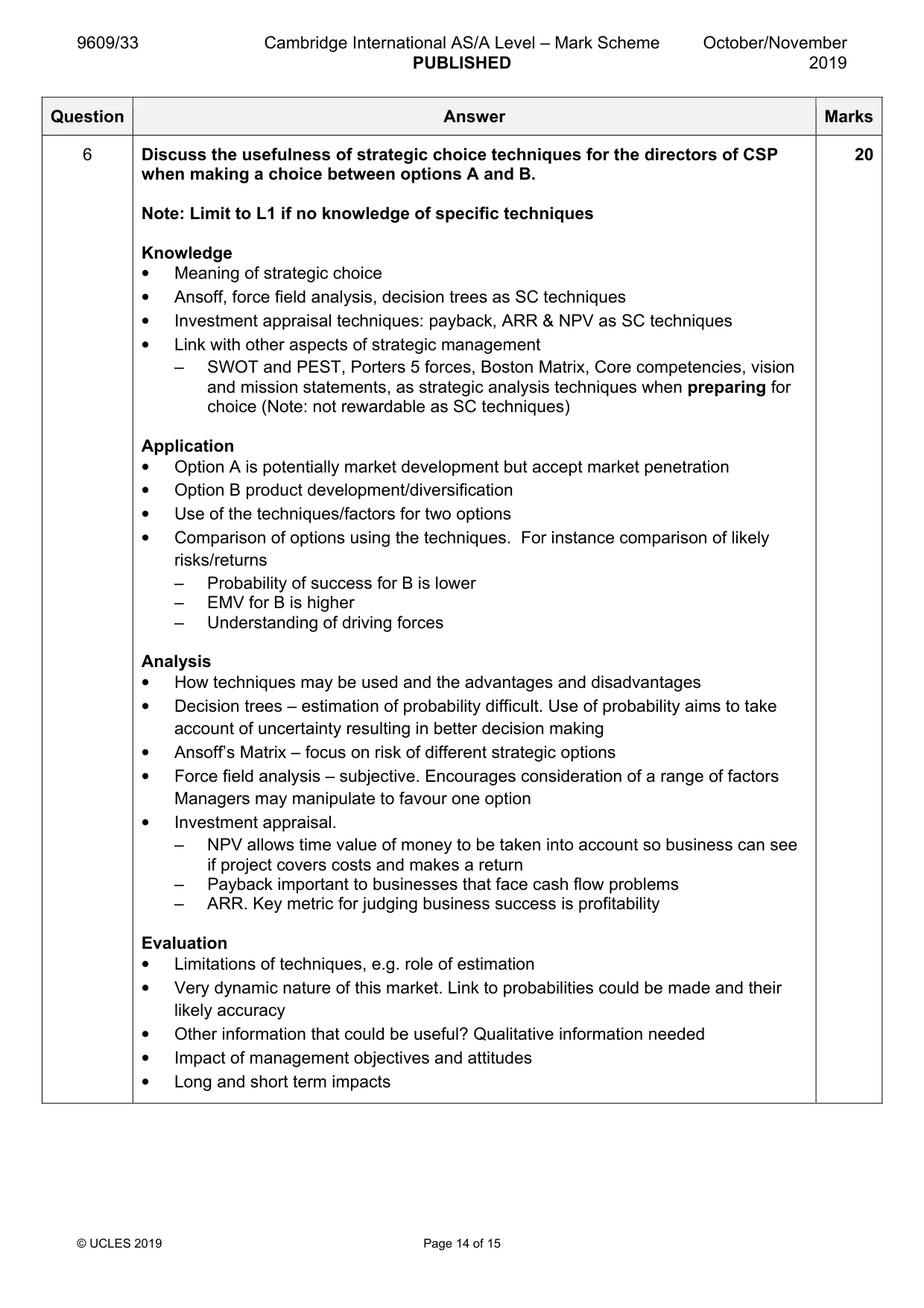
9609/33 Cambridge International AS/A Level – Mark Scheme PUBLISHED October/November 2019 © UCLES 2019 Page 14 of 15 Question Answer Marks 6 Discuss the usefulness of strategic choice techniques for the directors of CSP when making a choice between options A and B. Note: Limit to L1 if no knowledge of specific techniques Knowledge • Meaning of strategic choice • Ansoff, force field analysis, decision trees as SC techniques • Investment appraisal techniques: payback, ARR & NPV as SC techniques • Link with other aspects of strategic management – SWOT and PEST, Porters 5 forces, Boston Matrix, Core competencies, vision and mission statements, as strategic analysis techniques when preparing for choice (Note: not rewardable as SC techniques) Application • Option A is potentially market development but accept market penetration • Option B product development/diversification • Use of the techniques/factors for two options • Comparison of options using the techniques. For instance comparison of likely risks/returns – Probability of success for B is lower – EMV for B is higher – Understanding of driving forces Analysis • How techniques may be used and the advantages and disadvantages • Decision trees – estimation of probability difficult. Use of probability aims to take account of uncertainty resulting in better decision making • Ansoff’s Matrix – focus on risk of different strategic options • Force field analysis – subjective. Encourages consideration of a range of factors Managers may manipulate to favour one option • Investment appraisal. – NPV allows time value of money to be taken into account so business can see if project covers costs and makes a return – Payback important to businesses that face cash flow problems – ARR. Key metric for judging business success is profitability Evaluation • Limitations of techniques, e.g. role of estimation • Very dynamic nature of this market. Link to probabilities could be made and their likely accuracy • Other information that could be useful? Qualitative information needed • Impact of management objectives and attitudes • Long and short term impacts 20
Mark scheme, page 15
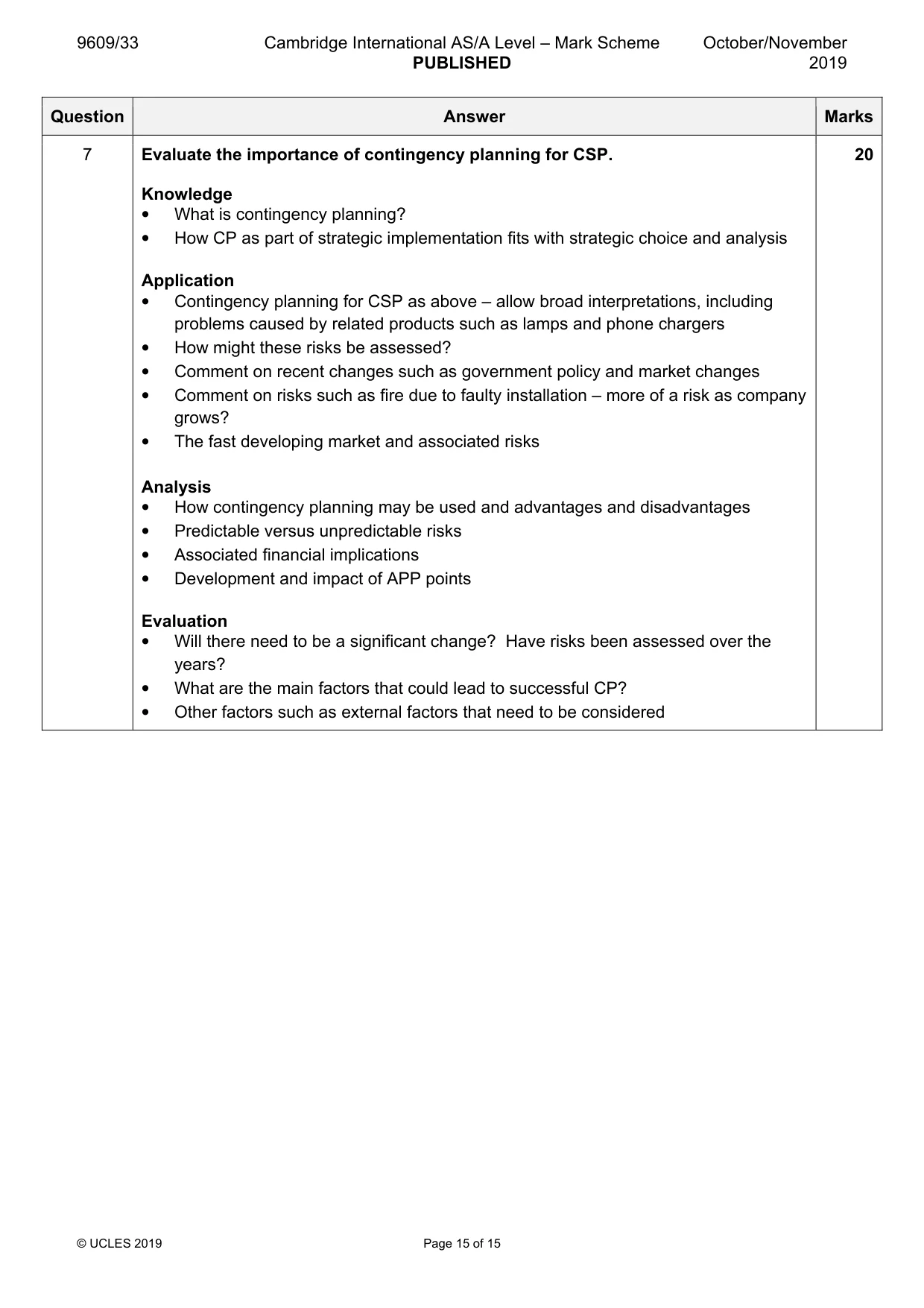
9609/33 Cambridge International AS/A Level – Mark Scheme PUBLISHED October/November 2019 © UCLES 2019 Page 15 of 15 Question Answer Marks 7 Evaluate the importance of contingency planning for CSP. Knowledge • What is contingency planning? • How CP as part of strategic implementation fits with strategic choice and analysis Application • Contingency planning for CSP as above – allow broad interpretations, including problems caused by related products such as lamps and phone chargers • How might these risks be assessed? • Comment on recent changes such as government policy and market changes • Comment on risks such as fire due to faulty installation – more of a risk as company grows? • The fast developing market and associated risks Analysis • How contingency planning may be used and advantages and disadvantages • Predictable versus unpredictable risks • Associated financial implications • Development and impact of APP points Evaluation • Will there need to be a significant change? Have risks been assessed over the years? • What are the main factors that could lead to successful CP? • Other factors such as external factors that need to be considered 20
What you needed in this session
Cambridge’s own grade thresholds for 2019 Oct/Nov, Paper 3 · Variant 3. A higher threshold means an easier paper — the bar moves with how the cohort did.