Cambridge A Level Business (for first examination in 2016) 9609 — 2019 May/June Paper 3 · Variant 2
9609/32/M/J/19 · 100 marks · ≈113 min
The question paper and its mark scheme, free to read here and free to download. This is Cambridge’s own paper, exactly as it was sat.
Question paper20 pages












Mark scheme19 pages
Answers below. Sit the paper first if you are practising.
Paper as text
Question paper, page 1
This document consists of 19 printed pages, 1 blank page and 1 Insert. DC (CE) 170863/2 © UCLES 2019 [Turn over * 9 8 9 1 4 8 3 0 5 1 * BUSINESS 9609/32 Paper 3 Case Study May/June 2019 3 hours Candidates answer on the Question Paper. No Additional Materials are required. READ THESE INSTRUCTIONS FIRST Write your centre number, candidate number and name in the spaces at the top of this page. If you need additional answer paper ask the invigilator for a continuation booklet. Write in dark blue or black pen. You may use an HB pencil for any diagrams, graphs or rough working. Do not use staples, paper clips, glue or correction fluid. DO NOT WRITE IN ANY BARCODES. Section A Answer all questions. Section B Answer one question. You are advised to spend no more than 40 minutes on Section B. Refer to the Insert for the case study for this Paper. At the end of the examination, fasten all your work securely together. The number of marks is given in brackets [ ] at the end of each question or part question. Cambridge Assessment International Education Cambridge International Advanced Subsidiary and Advanced Level
Question paper, page 2
2 9609/32/M/J/19 © UCLES 2019 Section A Answer all questions in this section. 1 Analyse how SWF might benefit from introducing a quality assurance system. … … … … … … … … … … … … … … … … … … … … … … … … …
Question paper, page 3
3 9609/32/M/J/19 © UCLES 2019 [Turn over … … … … … … … … … … … … … … … … … … … … … … … … … … … … [10]
Question paper, page 4
4 9609/32/M/J/19 © UCLES 2019 2 (a) Refer to lines 37– 48 and Table 2. Calculate, for the purchase of the automated milking machinery, the: (i) accounting rate of return (ARR) … … … … … … … … … … … …[3] (ii) net present value (NPV) at a discount rate of 10%. … … … … … … … … … … … … [3]
Question paper, page 5
5 9609/32/M/J/19 © UCLES 2019 [Turn over (b) Recommend to SWF whether the new automated milking machinery should be purchased. Justify your recommendation. … … … … … … … … … … … … … … … … … … … … … … … … … … …
Question paper, page 6
6 9609/32/M/J/19 © UCLES 2019 … … … … … … … … … … … … … … … … … … … … … … … … … … … … [12]
Question paper, page 7
7 9609/32/M/J/19 © UCLES 2019 [Turn over 3 Assess the likely impact on SWF’s profitability of the changing external environment. … … … … … … … … … … … … … … … … … … … … … … … … … … …
Question paper, page 8
8 9609/32/M/J/19 © UCLES 2019 … … … … … … … … … … … … … … … … … … … … … … … … … … … …
Question paper, page 9
9 9609/32/M/J/19 © UCLES 2019 [Turn over … … … … … … … … … … … … … … … … … … … … … … … … … … … … [16]
Question paper, page 10
10 9609/32/M/J/19 © UCLES 2019 4 (a) Refer to the table in Appendix 1. Calculate: (i) the centred quarterly moving average for quarter 3, 2018 … … … … … … … … … [3] (ii) the seasonal variation for quarter 3, 2015. … … … … … … [2] (b) Refer to the table and graph in Appendix 1. Calculate SWF’s forecast sales for Quarter 3 in 2019. … … … … … … … … … [3]
Question paper, page 11
11 9609/32/M/J/19 © UCLES 2019 [Turn over (c) Refer to your result from 4(b). Discuss the usefulness of sales forecasts to SWF when making marketing and operational decisions. … … … … … … … … … … … … … … … … … … … … … … … … … … …
Question paper, page 12
12 9609/32/M/J/19 © UCLES 2019 … … … … … … … … … … … … … … … … … … … … … … … … … … … … [12]
Question paper, page 13
13 9609/32/M/J/19 © UCLES 2019 [Turn over 5 The Board of Directors is to consider changes to the organisational structure of SWF needed during a period of business growth. Recommend changes to the organisational structure of SWF. Justify the changes you recommend. … … … … … … … … … … … … … … … … … … … … … … … … … …
Question paper, page 14
14 9609/32/M/J/19 © UCLES 2019 … … … … … … … … … … … … … … … … … … … … … … … … … … … …
Question paper, page 15
15 9609/32/M/J/19 © UCLES 2019 [Turn over … … … … … … … … … … … … … … … … … … … … … … … … … … … … [16]
Question paper, page 16
16 9609/32/M/J/19 © UCLES 2019 Section B Answer one question in this section. 6 Evaluate the usefulness of strategic analysis techniques when making decisions about the future direction of SWF. 7 Discuss the importance of contingency planning to the future success of SWF. Write the question number here: … … … … … … … … … … … … … … … … … … … … … … …
Question paper, page 17
17 9609/32/M/J/19 © UCLES 2019 [Turn over … … … … … … … … … … … … … … … … … … … … … … … … … … … …
Question paper, page 18
18 9609/32/M/J/19 © UCLES 2019 … … … … … … … … … … … … … … … … … … … … … … … … … … … …
Question paper, page 19
19 9609/32/M/J/19 © UCLES 2019 … … … … … … … … … … … … … … … … … … … … … … … … … … … …[20]
Question paper, page 20
20 9609/32/M/J/19 © UCLES 2019 Permission to reproduce items where third-party owned material protected by copyright is included has been sought and cleared where possible. Every reasonable effort has been made by the publisher (UCLES) to trace copyright holders, but if any items requiring clearance have unwittingly been included, the publisher will be pleased to make amends at the earliest possible opportunity. To avoid the issue of disclosure of answer-related information to candidates, all copyright acknowledgements are reproduced online in the Cambridge Assessment International Education Copyright Acknowledgements Booklet. This is produced for each series of examinations and is freely available to download at www.cambridgeinternational.org after the live examination series. Cambridge Assessment International Education is part of the Cambridge Assessment Group. Cambridge Assessment is the brand name of the University of Cambridge Local Examinations Syndicate (UCLES), which itself is a department of the University of Cambridge. BLANK PAGE
Mark scheme, page 1
This document consists of 19 printed pages. © UCLES 2019 [Turn over Cambridge Assessment International Education Cambridge International Advanced Subsidiary and Advanced Level BUSINESS 9609/32 Paper 3 Case Study May/June 2019 MARK SCHEME Maximum Mark: 100 Published This mark scheme is published as an aid to teachers and candidates, to indicate the requirements of the examination. It shows the basis on which Examiners were instructed to award marks. It does not indicate the details of the discussions that took place at an Examiners’ meeting before marking began, which would have considered the acceptability of alternative answers. Mark schemes should be read in conjunction with the question paper and the Principal Examiner Report for Teachers. Cambridge International will not enter into discussions about these mark schemes. Cambridge International is publishing the mark schemes for the May/June 2019 series for most Cambridge IGCSE™, Cambridge International A and AS Level and Cambridge Pre-U components, and some Cambridge O Level components.
Mark scheme, page 2
9609/32 Cambridge International AS/A Level – Mark Scheme PUBLISHED May/June 2019 © UCLES 2019 Page 2 of 19 Generic Marking Principles These general marking principles must be applied by all examiners when marking candidate answers. They should be applied alongside the specific content of the mark scheme or generic level descriptors for a question. Each question paper and mark scheme will also comply with these marking principles. GENERIC MARKING PRINCIPLE 1: Marks must be awarded in line with: • the specific content of the mark scheme or the generic level descriptors for the question • the specific skills defined in the mark scheme or in the generic level descriptors for the question • the standard of response required by a candidate as exemplified by the standardisation scripts. GENERIC MARKING PRINCIPLE 2: Marks awarded are always whole marks (not half marks, or other fractions). GENERIC MARKING PRINCIPLE 3: Marks must be awarded positively: • marks are awarded for correct/valid answers, as defined in the mark scheme. However, credit is given for valid answers which go beyond the scope of the syllabus and mark scheme, referring to your Team Leader as appropriate • marks are awarded when candidates clearly demonstrate what they know and can do • marks are not deducted for errors • marks are not deducted for omissions • answers should only be judged on the quality of spelling, punctuation and grammar when these features are specifically assessed by the question as indicated by the mark scheme. The meaning, however, should be unambiguous. GENERIC MARKING PRINCIPLE 4: Rules must be applied consistently e.g. in situations where candidates have not followed instructions or in the application of generic level descriptors. GENERIC MARKING PRINCIPLE 5: Marks should be awarded using the full range of marks defined in the mark scheme for the question (however; the use of the full mark range may be limited according to the quality of the candidate responses seen). GENERIC MARKING PRINCIPLE 6: Marks awarded are based solely on the requirements as defined in the mark scheme. Marks should not be awarded with grade thresholds or grade descriptors in mind.
Mark scheme, page 3
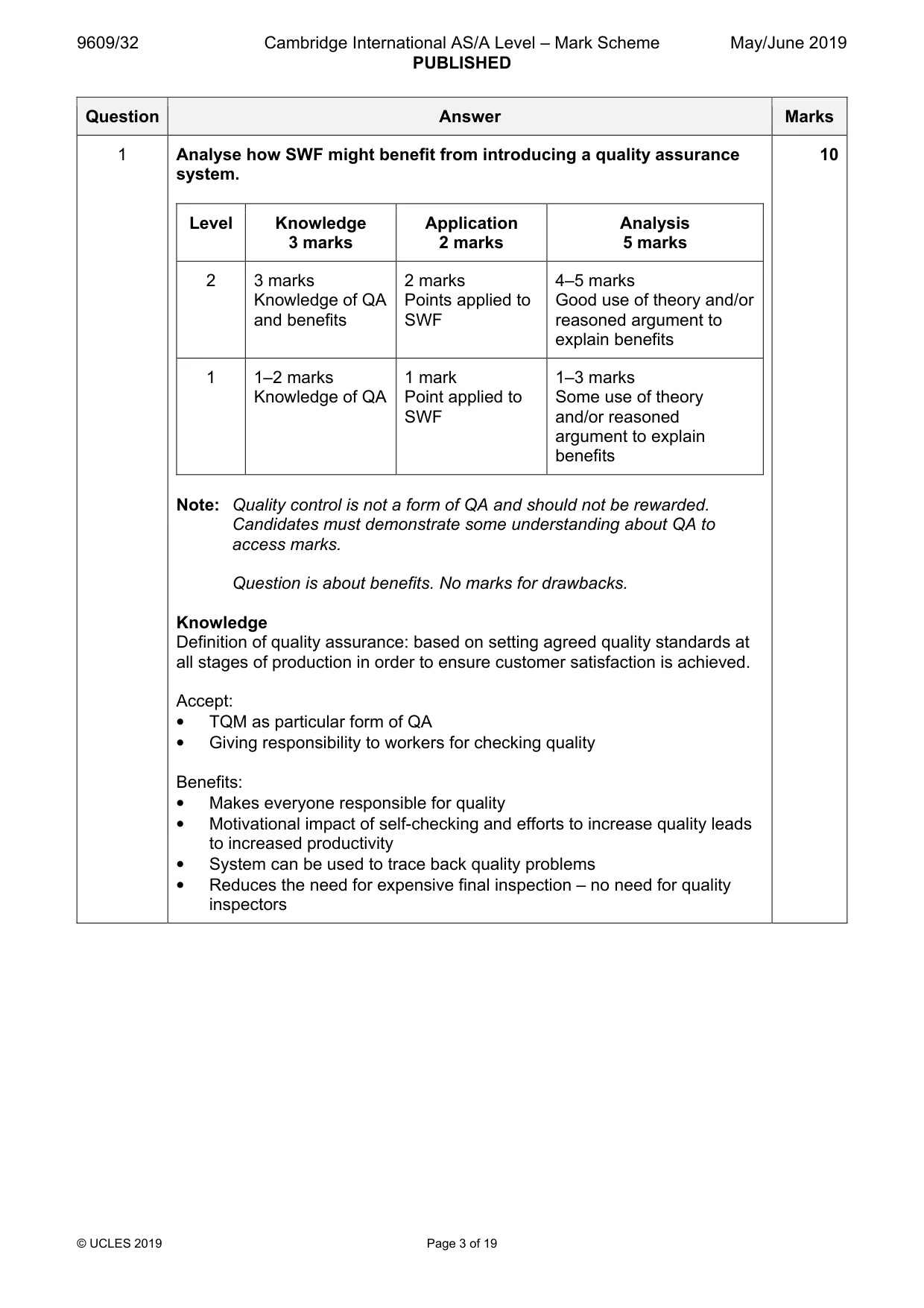
9609/32 Cambridge International AS/A Level – Mark Scheme PUBLISHED May/June 2019 © UCLES 2019 Page 3 of 19 Question Answer Marks 1 Analyse how SWF might benefit from introducing a quality assurance system. Level Knowledge 3 marks Application 2 marks Analysis 5 marks 2 3 marks Knowledge of QA and benefits 2 marks Points applied to SWF 4–5 marks Good use of theory and/or reasoned argument to explain benefits 1 1–2 marks Knowledge of QA 1 mark Point applied to SWF 1–3 marks Some use of theory and/or reasoned argument to explain benefits Note: Quality control is not a form of QA and should not be rewarded. Candidates must demonstrate some understanding about QA to access marks. Question is about benefits. No marks for drawbacks. Knowledge Definition of quality assurance: based on setting agreed quality standards at all stages of production in order to ensure customer satisfaction is achieved. Accept: • TQM as particular form of QA • Giving responsibility to workers for checking quality Benefits: • Makes everyone responsible for quality • Motivational impact of self-checking and efforts to increase quality leads to increased productivity • System can be used to trace back quality problems • Reduces the need for expensive final inspection – no need for quality inspectors 10
Mark scheme, page 4
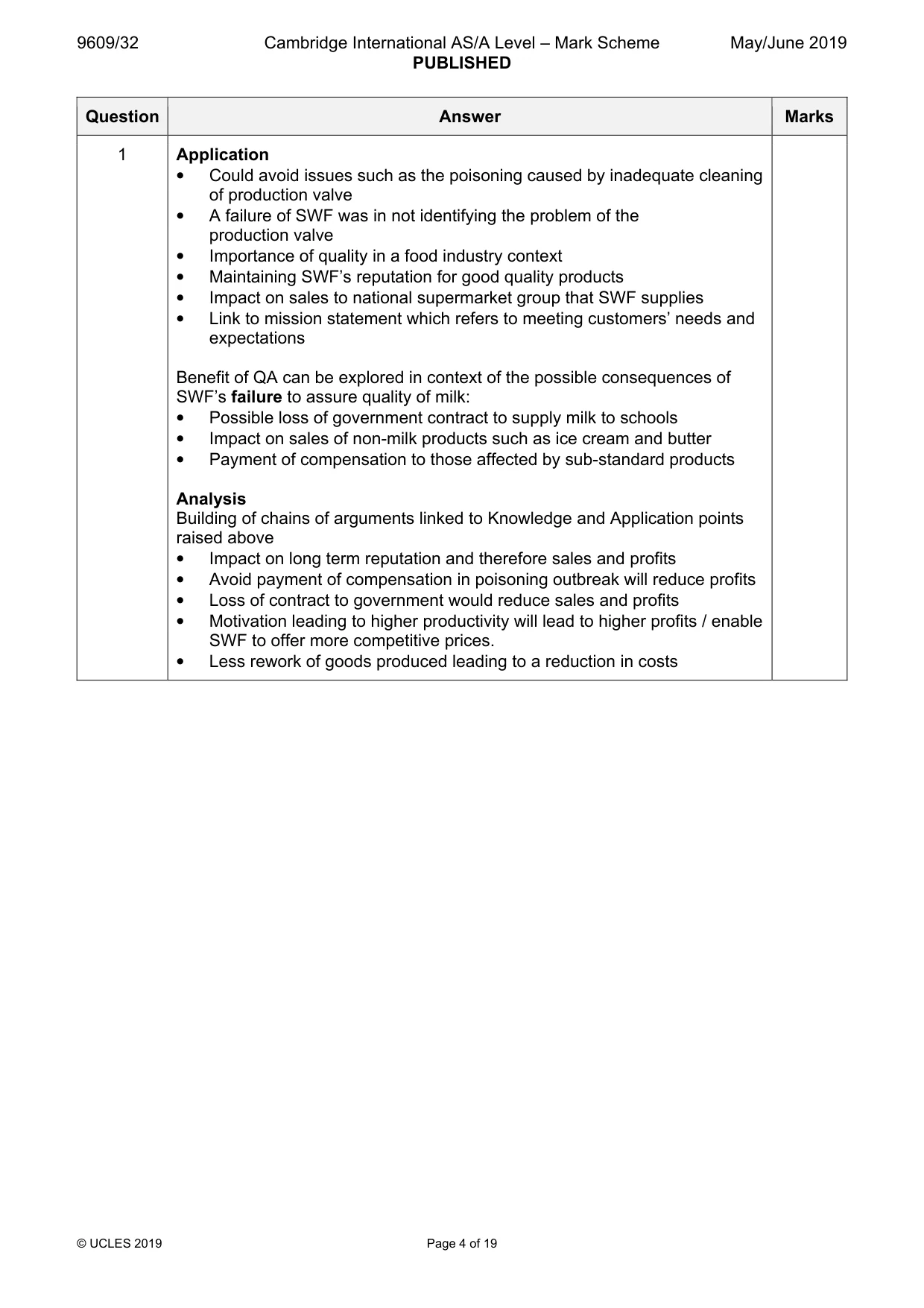
9609/32 Cambridge International AS/A Level – Mark Scheme PUBLISHED May/June 2019 © UCLES 2019 Page 4 of 19 Question Answer Marks 1 Application • Could avoid issues such as the poisoning caused by inadequate cleaning of production valve • A failure of SWF was in not identifying the problem of the production valve • Importance of quality in a food industry context • Maintaining SWF’s reputation for good quality products • Impact on sales to national supermarket group that SWF supplies • Link to mission statement which refers to meeting customers’ needs and expectations Benefit of QA can be explored in context of the possible consequences of SWF’s failure to assure quality of milk: • Possible loss of government contract to supply milk to schools • Impact on sales of non-milk products such as ice cream and butter • Payment of compensation to those affected by sub-standard products Analysis Building of chains of arguments linked to Knowledge and Application points raised above • Impact on long term reputation and therefore sales and profits • Avoid payment of compensation in poisoning outbreak will reduce profits • Loss of contract to government would reduce sales and profits • Motivation leading to higher productivity will lead to higher profits / enable SWF to offer more competitive prices. • Less rework of goods produced leading to a reduction in costs
Mark scheme, page 5
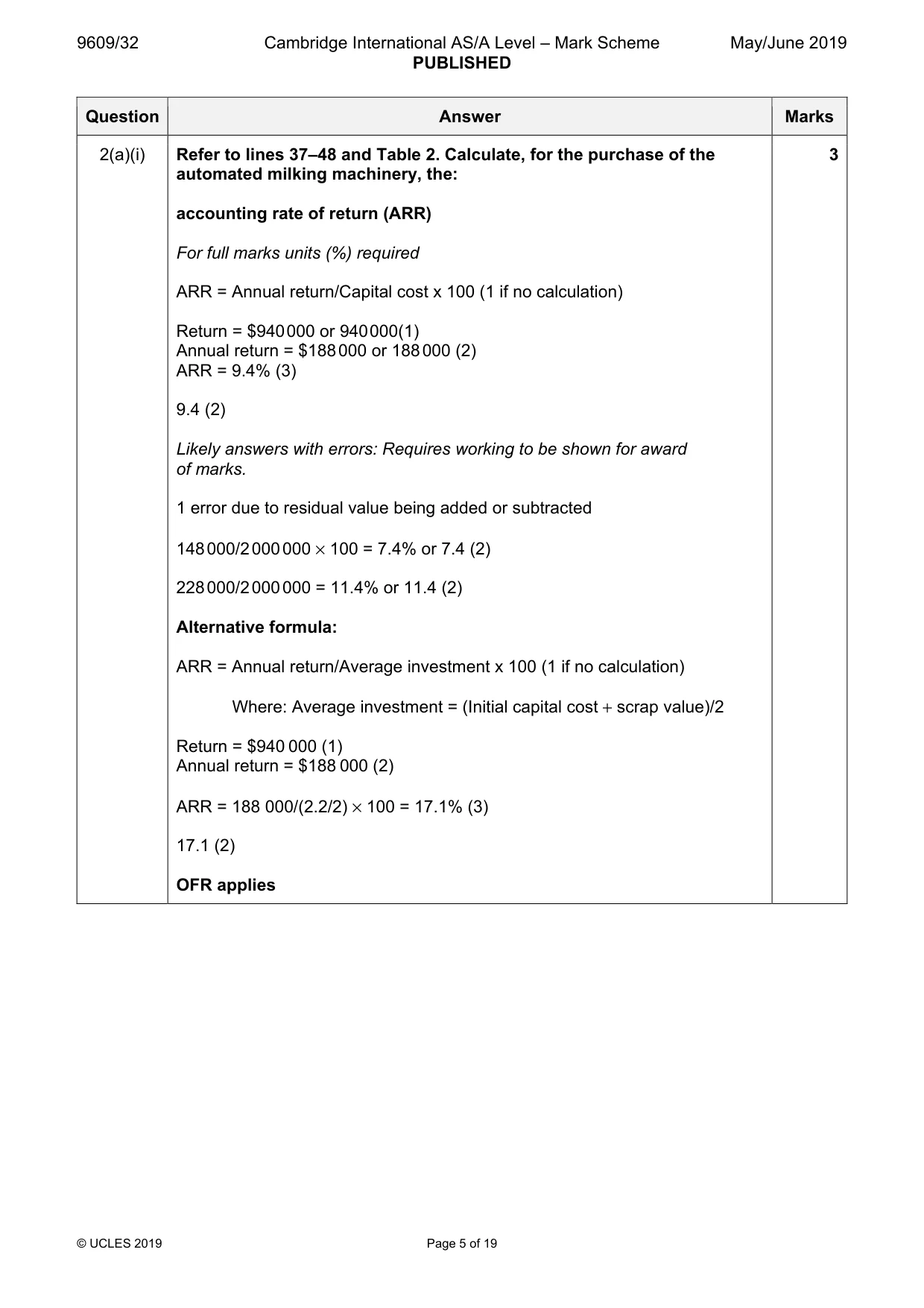
9609/32 Cambridge International AS/A Level – Mark Scheme PUBLISHED May/June 2019 © UCLES 2019 Page 5 of 19 Question Answer Marks 2(a)(i) Refer to lines 37–48 and Table 2. Calculate, for the purchase of the automated milking machinery, the: accounting rate of return (ARR) For full marks units (%) required ARR = Annual return/Capital cost x 100 (1 if no calculation) Return = $940 000 or 940 000(1) Annual return = $188 000 or 188 000 (2) ARR = 9.4% (3) 9.4 (2) Likely answers with errors: Requires working to be shown for award of marks. 1 error due to residual value being added or subtracted 148 000/2 000 000 × 100 = 7.4% or 7.4 (2) 228 000/2 000 000 = 11.4% or 11.4 (2) Alternative formula: ARR = Annual return/Average investment x 100 (1 if no calculation) Where: Average investment = (Initial capital cost + scrap value)/2 Return = $940 000 (1) Annual return = $188 000 (2) ARR = 188 000/(2.2/2) × 100 = 17.1% (3) 17.1 (2) OFR applies 3
Mark scheme, page 6
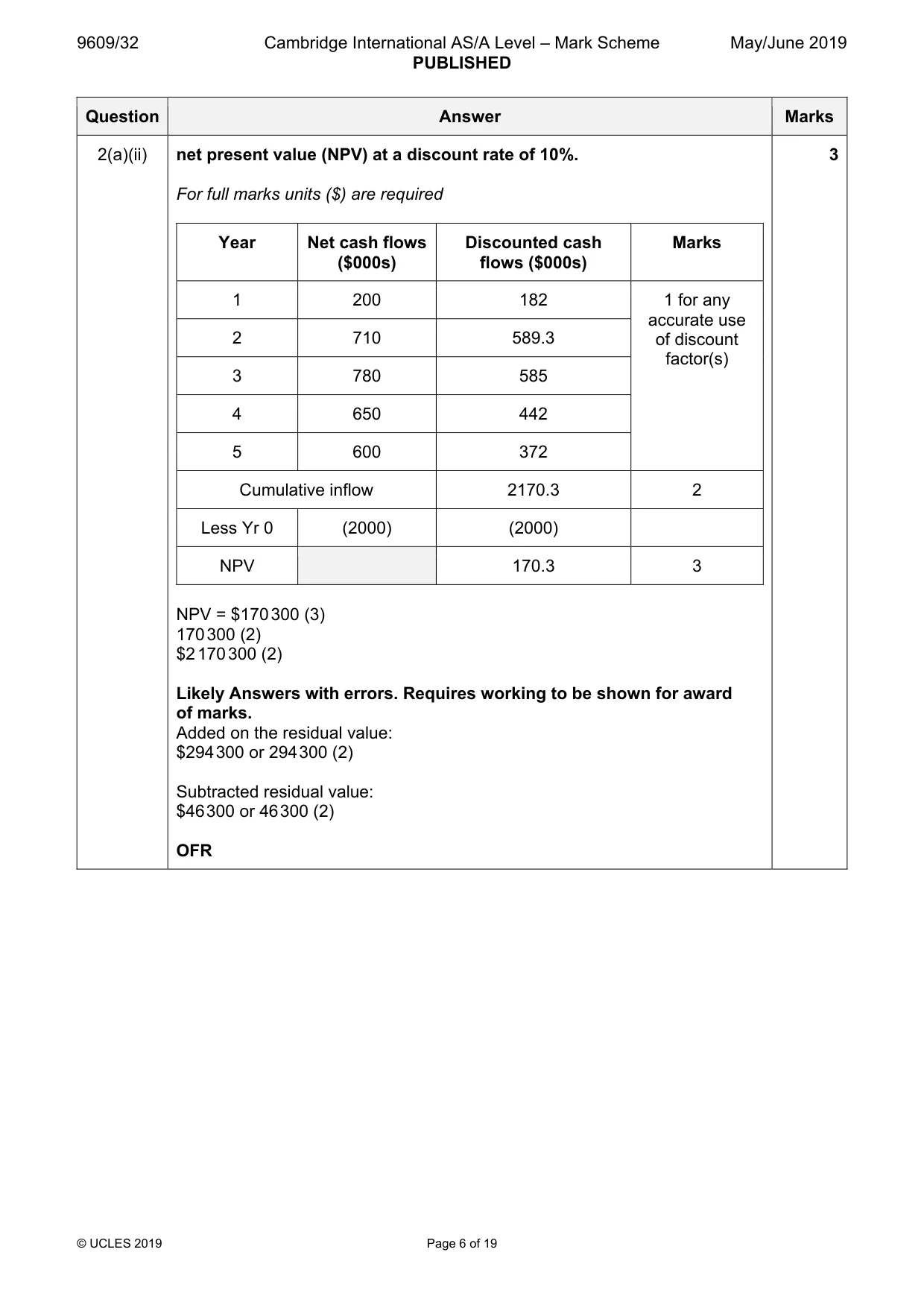
9609/32 Cambridge International AS/A Level – Mark Scheme PUBLISHED May/June 2019 © UCLES 2019 Page 6 of 19 Question Answer Marks 2(a)(ii) net present value (NPV) at a discount rate of 10%. For full marks units ($) are required Year Net cash flows ($000s) Discounted cash flows ($000s) Marks 1 200 182 1 for any accurate use of discount factor(s) 2 710 589.3 3 780 585 4 650 442 5 600 372 Cumulative inflow 2170.3 2 Less Yr 0 (2000) (2000) NPV 170.3 3 NPV = $170 300 (3) 170 300 (2) $2 170 300 (2) Likely Answers with errors. Requires working to be shown for award of marks. Added on the residual value: $294 300 or 294 300 (2) Subtracted residual value: $46 300 or 46 300 (2) OFR 3
Mark scheme, page 7
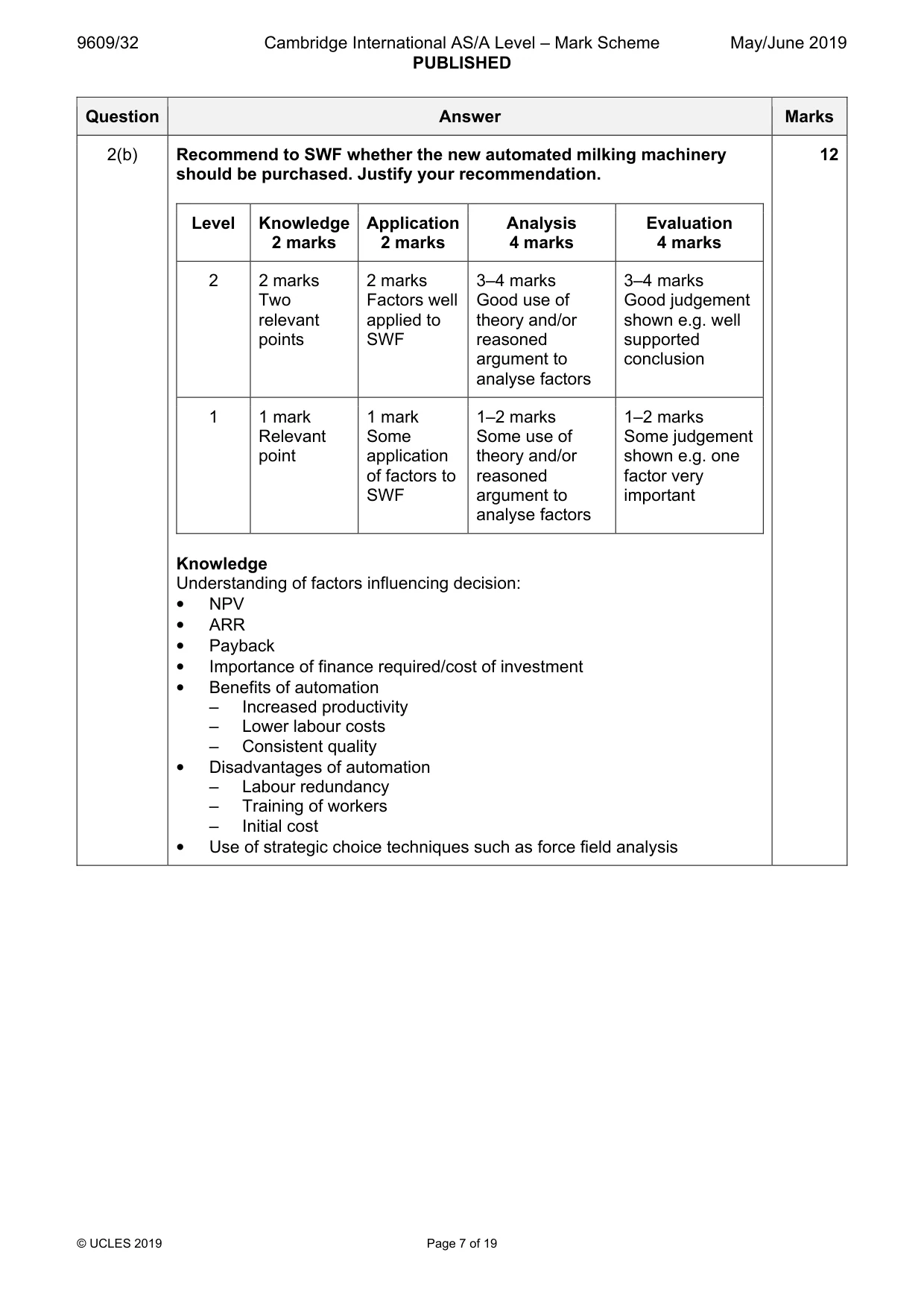
9609/32 Cambridge International AS/A Level – Mark Scheme PUBLISHED May/June 2019 © UCLES 2019 Page 7 of 19 Question Answer Marks 2(b) Recommend to SWF whether the new automated milking machinery should be purchased. Justify your recommendation. Level Knowledge 2 marks Application 2 marks Analysis 4 marks Evaluation 4 marks 2 2 marks Two relevant points 2 marks Factors well applied to SWF 3–4 marks Good use of theory and/or reasoned argument to analyse factors 3–4 marks Good judgement shown e.g. well supported conclusion 1 1 mark Relevant point 1 mark Some application of factors to SWF 1–2 marks Some use of theory and/or reasoned argument to analyse factors 1–2 marks Some judgement shown e.g. one factor very important Knowledge Understanding of factors influencing decision: • NPV • ARR • Payback • Importance of finance required/cost of investment • Benefits of automation – Increased productivity – Lower labour costs – Consistent quality • Disadvantages of automation – Labour redundancy – Training of workers – Initial cost • Use of strategic choice techniques such as force field analysis 12
Mark scheme, page 8
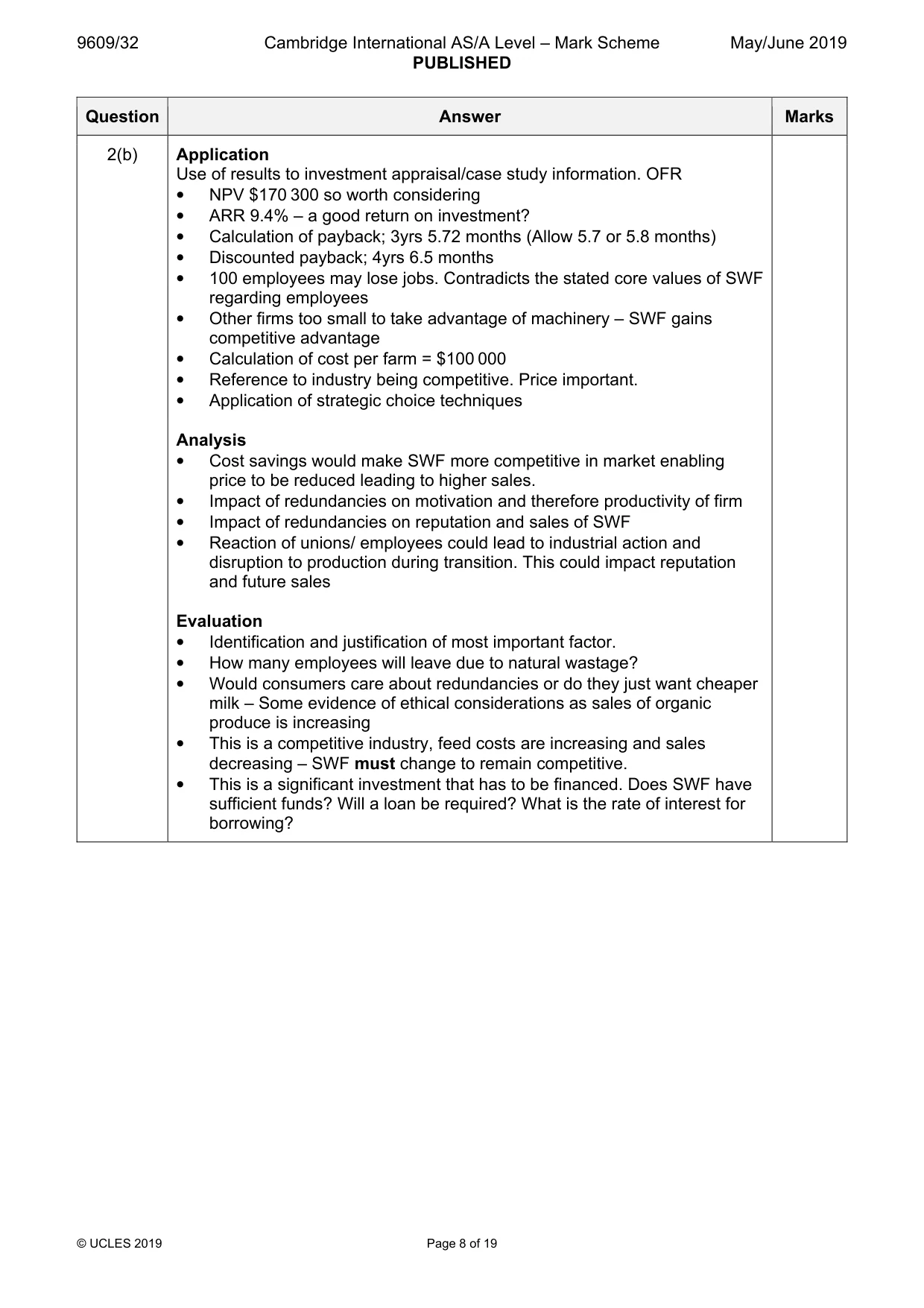
9609/32 Cambridge International AS/A Level – Mark Scheme PUBLISHED May/June 2019 © UCLES 2019 Page 8 of 19 Question Answer Marks 2(b) Application Use of results to investment appraisal/case study information. OFR • NPV $170 300 so worth considering • ARR 9.4% – a good return on investment? • Calculation of payback; 3yrs 5.72 months (Allow 5.7 or 5.8 months) • Discounted payback; 4yrs 6.5 months • 100 employees may lose jobs. Contradicts the stated core values of SWF regarding employees • Other firms too small to take advantage of machinery – SWF gains competitive advantage • Calculation of cost per farm = $100 000 • Reference to industry being competitive. Price important. • Application of strategic choice techniques Analysis • Cost savings would make SWF more competitive in market enabling price to be reduced leading to higher sales. • Impact of redundancies on motivation and therefore productivity of firm • Impact of redundancies on reputation and sales of SWF • Reaction of unions/ employees could lead to industrial action and disruption to production during transition. This could impact reputation and future sales Evaluation • Identification and justification of most important factor. • How many employees will leave due to natural wastage? • Would consumers care about redundancies or do they just want cheaper milk – Some evidence of ethical considerations as sales of organic produce is increasing • This is a competitive industry, feed costs are increasing and sales decreasing – SWF must change to remain competitive. • This is a significant investment that has to be financed. Does SWF have sufficient funds? Will a loan be required? What is the rate of interest for borrowing?
Mark scheme, page 9
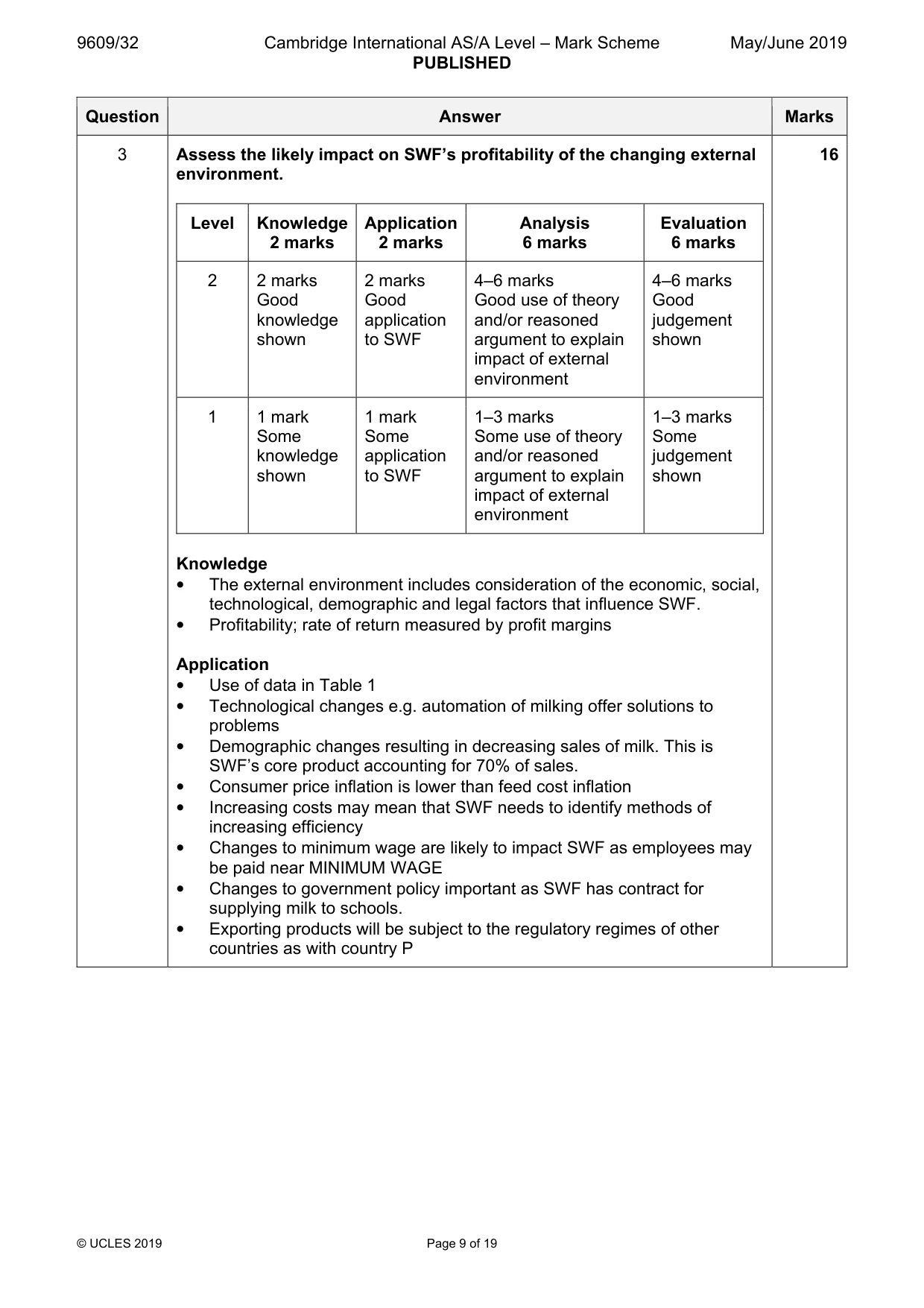
9609/32 Cambridge International AS/A Level – Mark Scheme PUBLISHED May/June 2019 © UCLES 2019 Page 9 of 19 Question Answer Marks 3 Assess the likely impact on SWF’s profitability of the changing external environment. Level Knowledge 2 marks Application 2 marks Analysis 6 marks Evaluation 6 marks 2 2 marks Good knowledge shown 2 marks Good application to SWF 4–6 marks Good use of theory and/or reasoned argument to explain impact of external environment 4–6 marks Good judgement shown 1 1 mark Some knowledge shown 1 mark Some application to SWF 1–3 marks Some use of theory and/or reasoned argument to explain impact of external environment 1–3 marks Some judgement shown Knowledge • The external environment includes consideration of the economic, social, technological, demographic and legal factors that influence SWF. • Profitability; rate of return measured by profit margins Application • Use of data in Table 1 • Technological changes e.g. automation of milking offer solutions to problems • Demographic changes resulting in decreasing sales of milk. This is SWF’s core product accounting for 70% of sales. • Consumer price inflation is lower than feed cost inflation • Increasing costs may mean that SWF needs to identify methods of increasing efficiency • Changes to minimum wage are likely to impact SWF as employees may be paid near MINIMUM WAGE • Changes to government policy important as SWF has contract for supplying milk to schools. • Exporting products will be subject to the regulatory regimes of other countries as with country P 16
Mark scheme, page 10
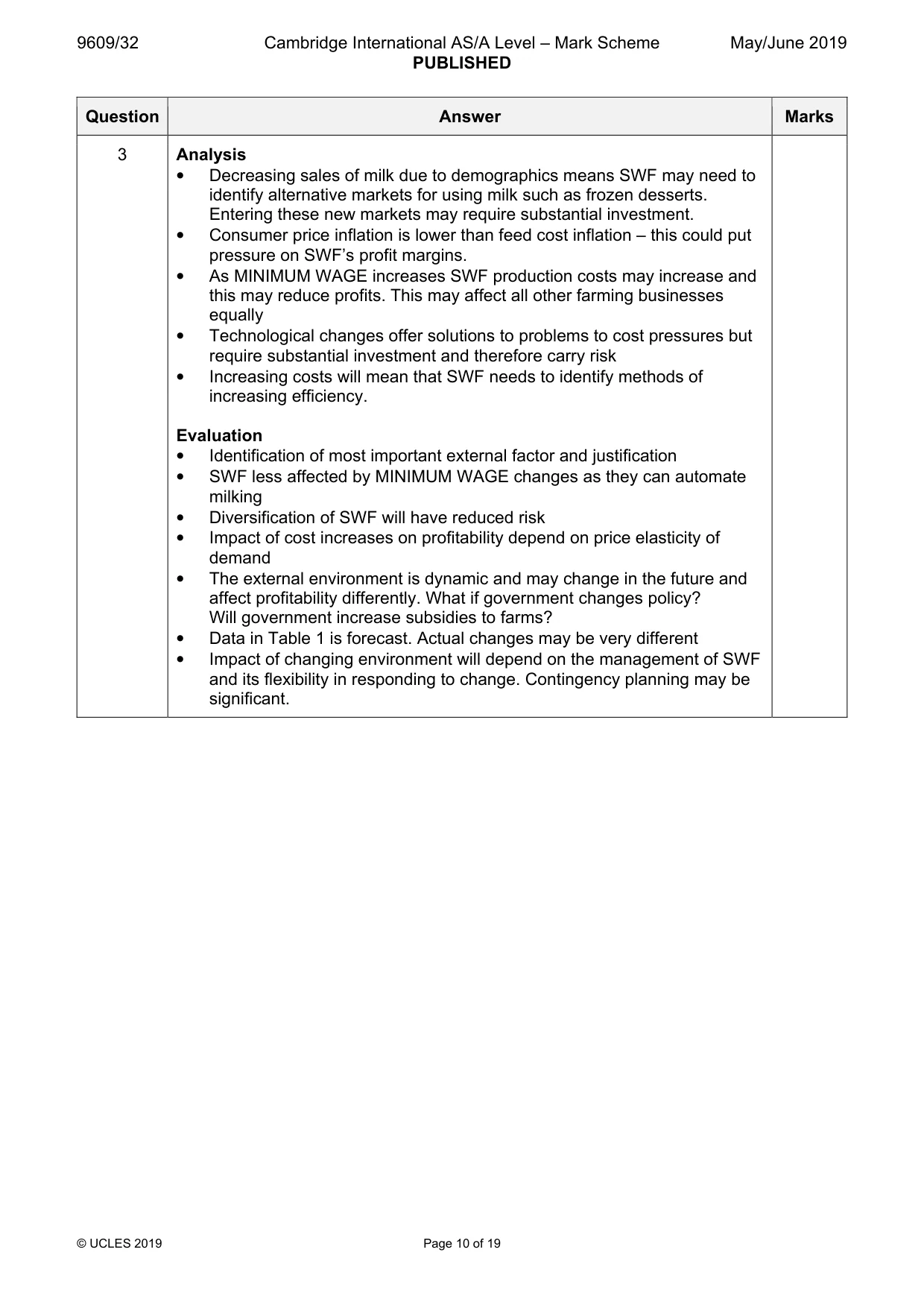
9609/32 Cambridge International AS/A Level – Mark Scheme PUBLISHED May/June 2019 © UCLES 2019 Page 10 of 19 Question Answer Marks 3 Analysis • Decreasing sales of milk due to demographics means SWF may need to identify alternative markets for using milk such as frozen desserts. Entering these new markets may require substantial investment. • Consumer price inflation is lower than feed cost inflation – this could put pressure on SWF’s profit margins. • As MINIMUM WAGE increases SWF production costs may increase and this may reduce profits. This may affect all other farming businesses equally • Technological changes offer solutions to problems to cost pressures but require substantial investment and therefore carry risk • Increasing costs will mean that SWF needs to identify methods of increasing efficiency. Evaluation • Identification of most important external factor and justification • SWF less affected by MINIMUM WAGE changes as they can automate milking • Diversification of SWF will have reduced risk • Impact of cost increases on profitability depend on price elasticity of demand • The external environment is dynamic and may change in the future and affect profitability differently. What if government changes policy? Will government increase subsidies to farms? • Data in Table 1 is forecast. Actual changes may be very different • Impact of changing environment will depend on the management of SWF and its flexibility in responding to change. Contingency planning may be significant.
Mark scheme, page 11
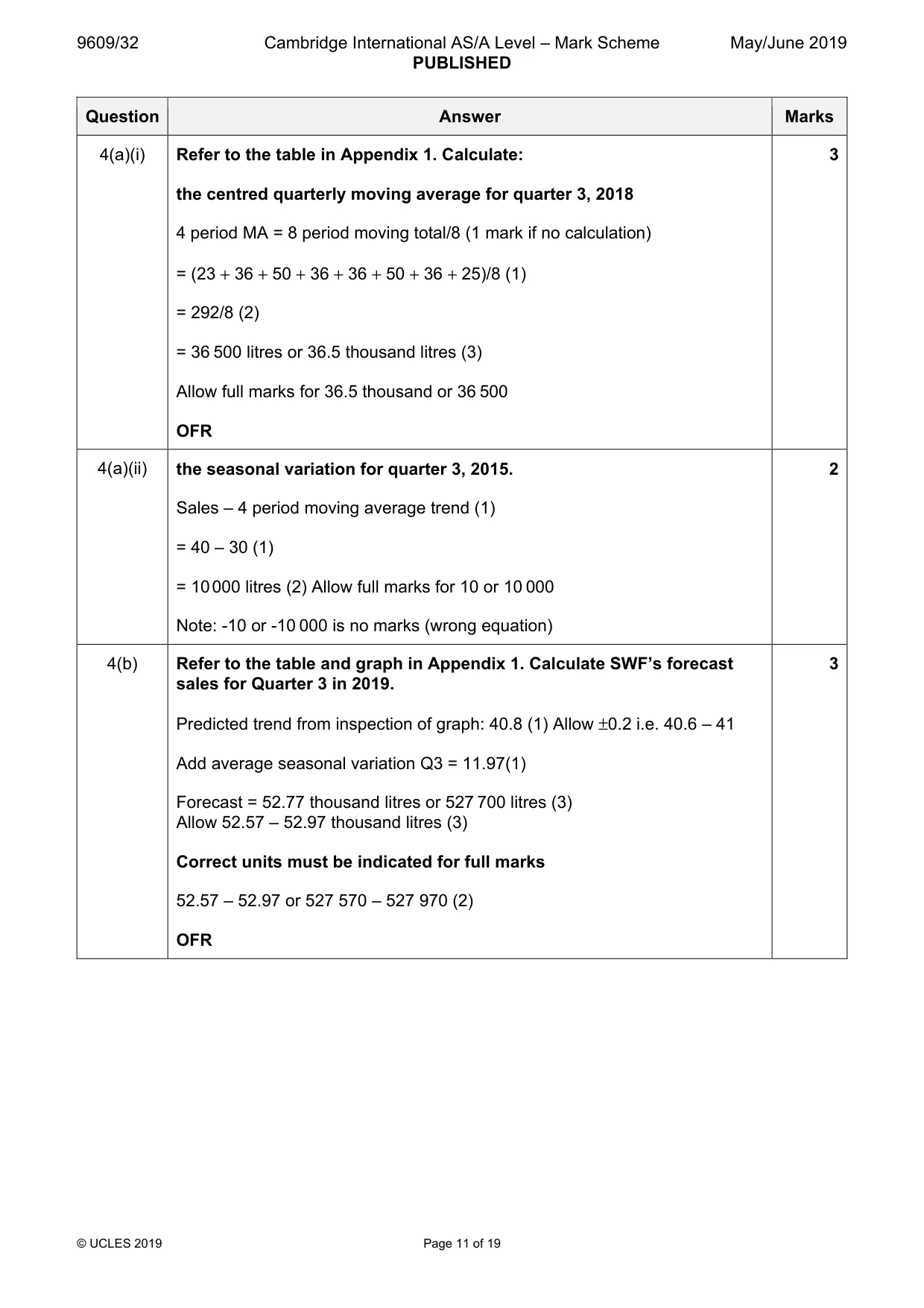
9609/32 Cambridge International AS/A Level – Mark Scheme PUBLISHED May/June 2019 © UCLES 2019 Page 11 of 19 Question Answer Marks 4(a)(i) Refer to the table in Appendix 1. Calculate: the centred quarterly moving average for quarter 3, 2018 4 period MA = 8 period moving total/8 (1 mark if no calculation) = (23 + 36 + 50 + 36 + 36 + 50 + 36 + 25)/8 (1) = 292/8 (2) = 36 500 litres or 36.5 thousand litres (3) Allow full marks for 36.5 thousand or 36 500 OFR 3 4(a)(ii) the seasonal variation for quarter 3, 2015. Sales – 4 period moving average trend (1) = 40 – 30 (1) = 10 000 litres (2) Allow full marks for 10 or 10 000 Note: -10 or -10 000 is no marks (wrong equation) 2 4(b) Refer to the table and graph in Appendix 1. Calculate SWF’s forecast sales for Quarter 3 in 2019. Predicted trend from inspection of graph: 40.8 (1) Allow ±0.2 i.e. 40.6 – 41 Add average seasonal variation Q3 = 11.97(1) Forecast = 52.77 thousand litres or 527 700 litres (3) Allow 52.57 – 52.97 thousand litres (3) Correct units must be indicated for full marks 52.57 – 52.97 or 527 570 – 527 970 (2) OFR 3
Mark scheme, page 12
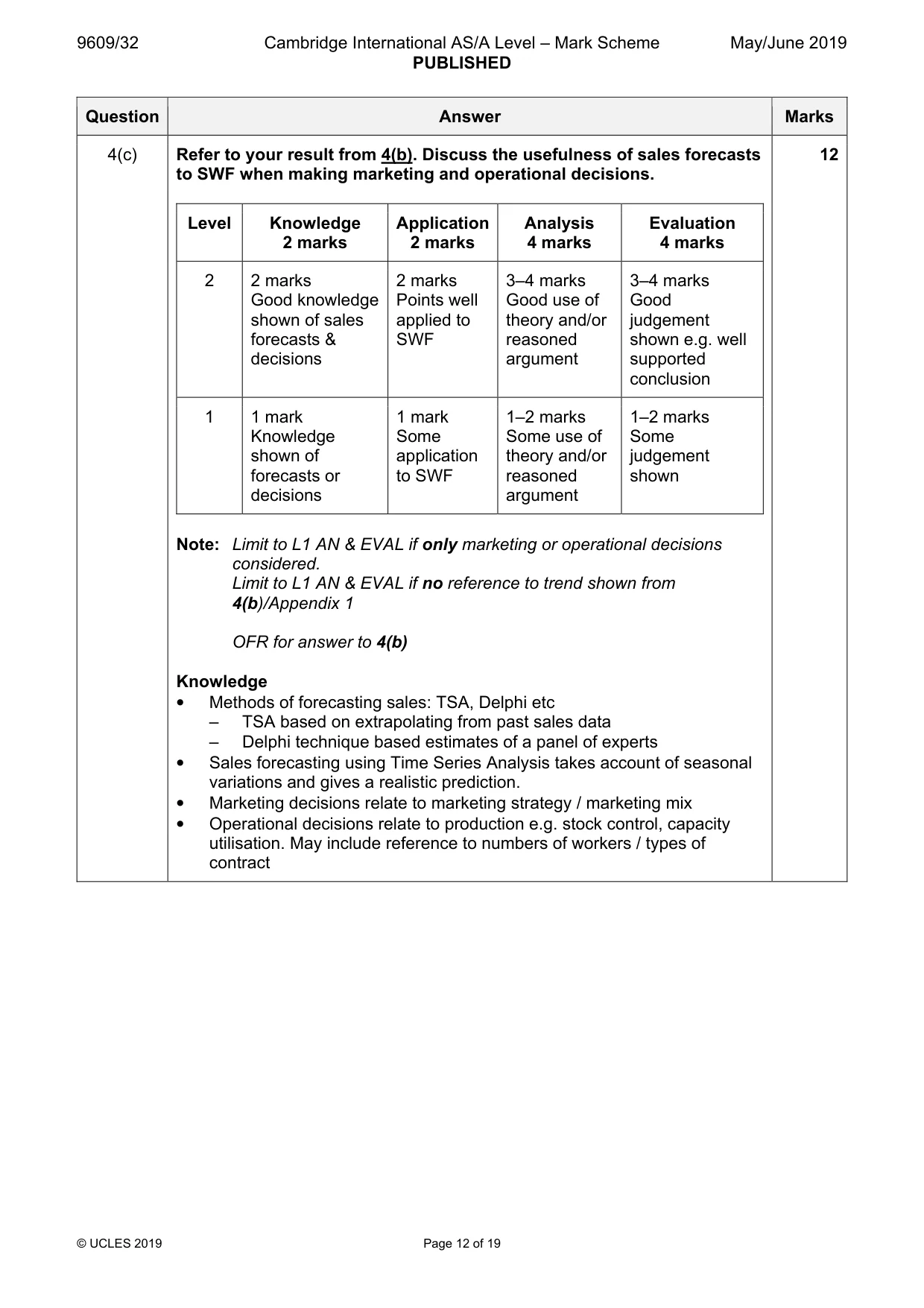
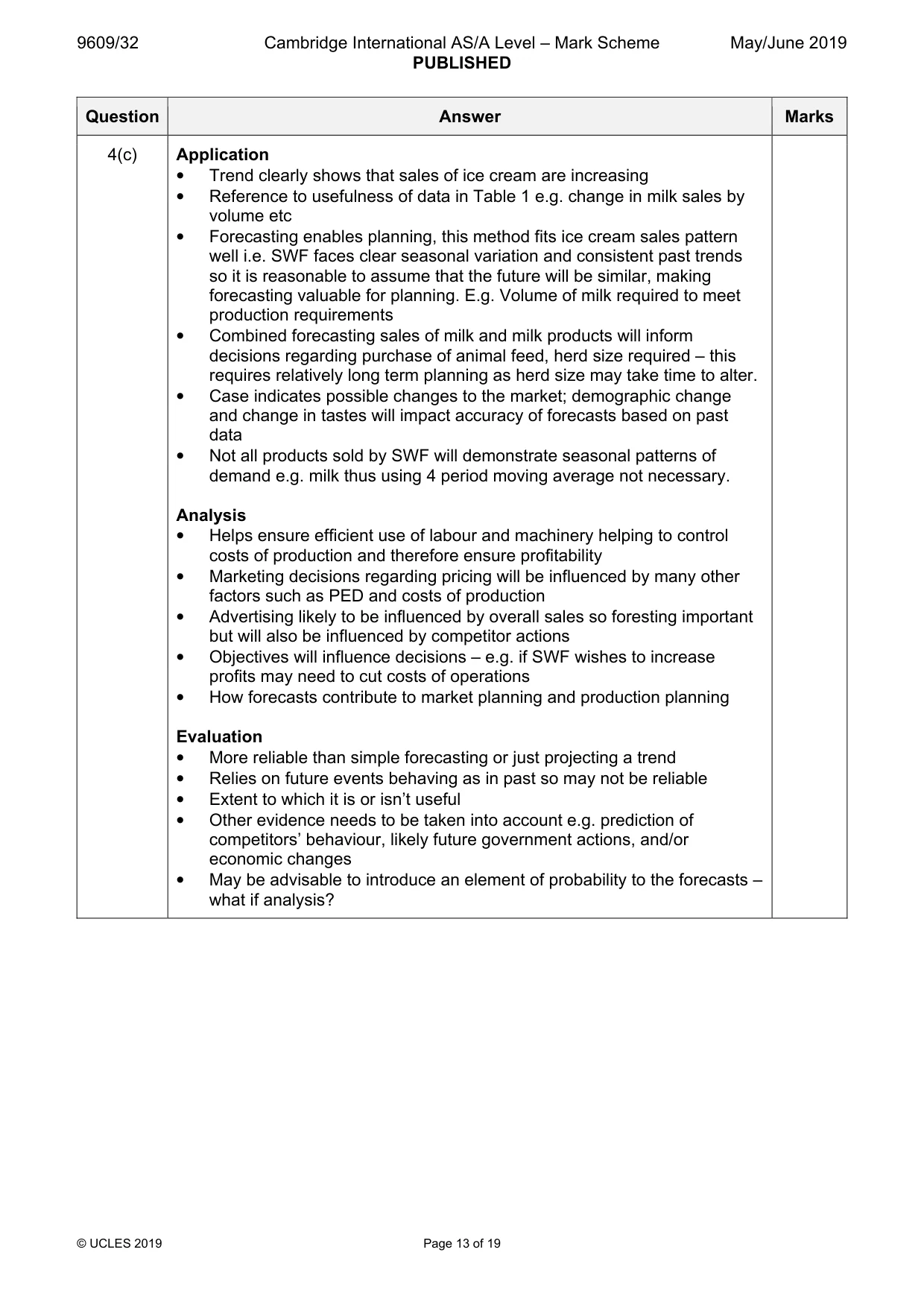
9609/32 Cambridge International AS/A Level – Mark Scheme PUBLISHED May/June 2019 © UCLES 2019 Page 12 of 19 Question Answer Marks 4(c) Refer to your result from 4(b). Discuss the usefulness of sales forecasts to SWF when making marketing and operational decisions. Level Knowledge 2 marks Application 2 marks Analysis 4 marks Evaluation 4 marks 2 2 marks Good knowledge shown of sales forecasts & decisions 2 marks Points well applied to SWF 3–4 marks Good use of theory and/or reasoned argument 3–4 marks Good judgement shown e.g. well supported conclusion 1 1 mark Knowledge shown of forecasts or decisions 1 mark Some application to SWF 1–2 marks Some use of theory and/or reasoned argument 1–2 marks Some judgement shown Note: Limit to L1 AN & EVAL if only marketing or operational decisions considered. Limit to L1 AN & EVAL if no reference to trend shown from 4(b)/Appendix 1 OFR for answer to 4(b) Knowledge • Methods of forecasting sales: TSA, Delphi etc – TSA based on extrapolating from past sales data – Delphi technique based estimates of a panel of experts • Sales forecasting using Time Series Analysis takes account of seasonal variations and gives a realistic prediction. • Marketing decisions relate to marketing strategy / marketing mix • Operational decisions relate to production e.g. stock control, capacity utilisation. May include reference to numbers of workers / types of contract 12
Mark scheme, page 13
9609/32 Cambridge International AS/A Level – Mark Scheme PUBLISHED May/June 2019 © UCLES 2019 Page 13 of 19 Question Answer Marks 4(c) Application • Trend clearly shows that sales of ice cream are increasing • Reference to usefulness of data in Table 1 e.g. change in milk sales by volume etc • Forecasting enables planning, this method fits ice cream sales pattern well i.e. SWF faces clear seasonal variation and consistent past trends so it is reasonable to assume that the future will be similar, making forecasting valuable for planning. E.g. Volume of milk required to meet production requirements • Combined forecasting sales of milk and milk products will inform decisions regarding purchase of animal feed, herd size required – this requires relatively long term planning as herd size may take time to alter. • Case indicates possible changes to the market; demographic change and change in tastes will impact accuracy of forecasts based on past data • Not all products sold by SWF will demonstrate seasonal patterns of demand e.g. milk thus using 4 period moving average not necessary. Analysis • Helps ensure efficient use of labour and machinery helping to control costs of production and therefore ensure profitability • Marketing decisions regarding pricing will be influenced by many other factors such as PED and costs of production • Advertising likely to be influenced by overall sales so foresting important but will also be influenced by competitor actions • Objectives will influence decisions – e.g. if SWF wishes to increase profits may need to cut costs of operations • How forecasts contribute to market planning and production planning Evaluation • More reliable than simple forecasting or just projecting a trend • Relies on future events behaving as in past so may not be reliable • Extent to which it is or isn’t useful • Other evidence needs to be taken into account e.g. prediction of competitors’ behaviour, likely future government actions, and/or economic changes • May be advisable to introduce an element of probability to the forecasts – what if analysis?
Mark scheme, page 14
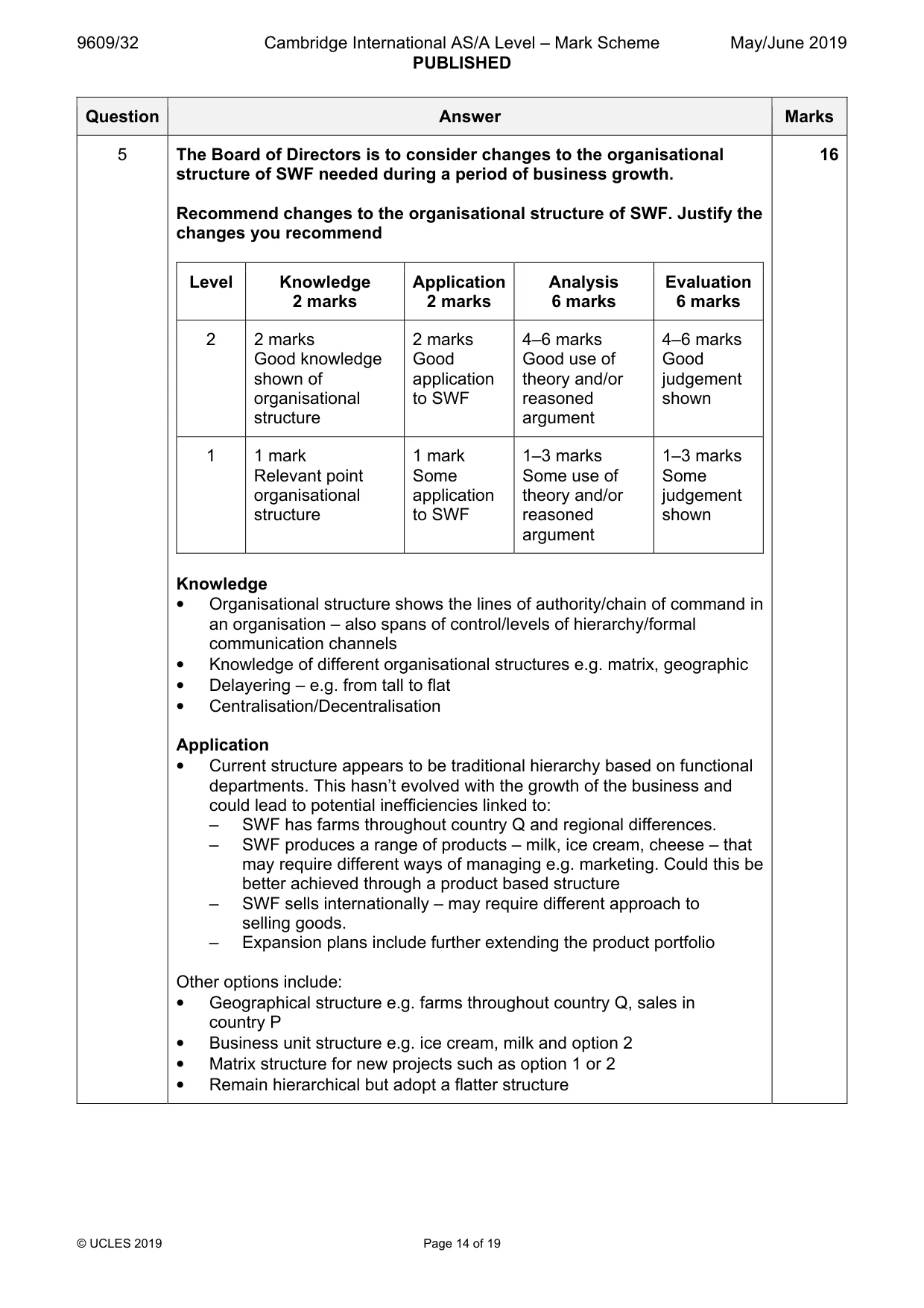
9609/32 Cambridge International AS/A Level – Mark Scheme PUBLISHED May/June 2019 © UCLES 2019 Page 14 of 19 Question Answer Marks 5 The Board of Directors is to consider changes to the organisational structure of SWF needed during a period of business growth. Recommend changes to the organisational structure of SWF. Justify the changes you recommend Level Knowledge 2 marks Application 2 marks Analysis 6 marks Evaluation 6 marks 2 2 marks Good knowledge shown of organisational structure 2 marks Good application to SWF 4–6 marks Good use of theory and/or reasoned argument 4–6 marks Good judgement shown 1 1 mark Relevant point organisational structure 1 mark Some application to SWF 1–3 marks Some use of theory and/or reasoned argument 1–3 marks Some judgement shown Knowledge • Organisational structure shows the lines of authority/chain of command in an organisation – also spans of control/levels of hierarchy/formal communication channels • Knowledge of different organisational structures e.g. matrix, geographic • Delayering – e.g. from tall to flat • Centralisation/Decentralisation Application • Current structure appears to be traditional hierarchy based on functional departments. This hasn’t evolved with the growth of the business and could lead to potential inefficiencies linked to: – SWF has farms throughout country Q and regional differences. – SWF produces a range of products – milk, ice cream, cheese – that may require different ways of managing e.g. marketing. Could this be better achieved through a product based structure – SWF sells internationally – may require different approach to selling goods. – Expansion plans include further extending the product portfolio Other options include: • Geographical structure e.g. farms throughout country Q, sales in country P • Business unit structure e.g. ice cream, milk and option 2 • Matrix structure for new projects such as option 1 or 2 • Remain hierarchical but adopt a flatter structure 16
Mark scheme, page 15
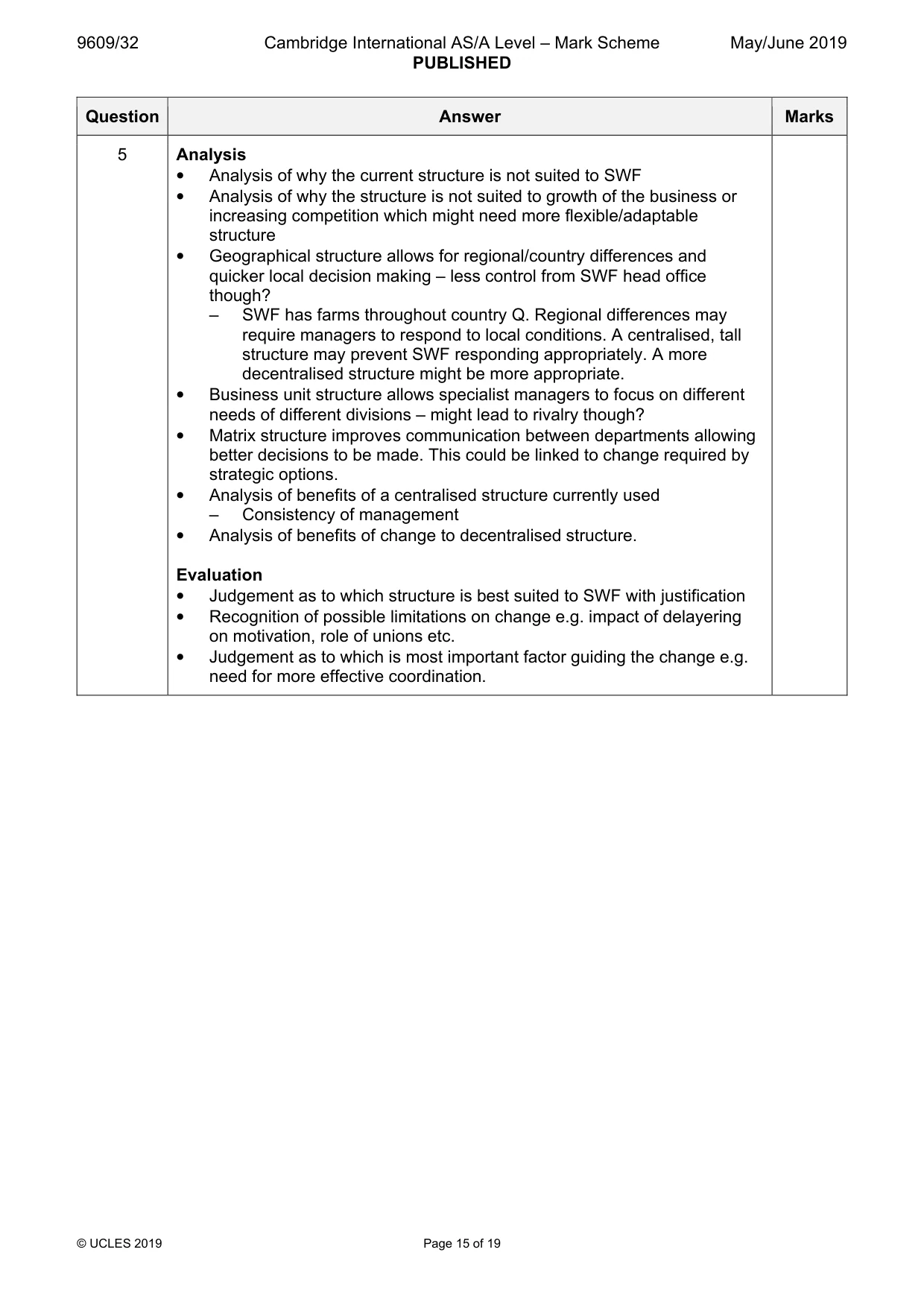
9609/32 Cambridge International AS/A Level – Mark Scheme PUBLISHED May/June 2019 © UCLES 2019 Page 15 of 19 Question Answer Marks 5 Analysis • Analysis of why the current structure is not suited to SWF • Analysis of why the structure is not suited to growth of the business or increasing competition which might need more flexible/adaptable structure • Geographical structure allows for regional/country differences and quicker local decision making – less control from SWF head office though? – SWF has farms throughout country Q. Regional differences may require managers to respond to local conditions. A centralised, tall structure may prevent SWF responding appropriately. A more decentralised structure might be more appropriate. • Business unit structure allows specialist managers to focus on different needs of different divisions – might lead to rivalry though? • Matrix structure improves communication between departments allowing better decisions to be made. This could be linked to change required by strategic options. • Analysis of benefits of a centralised structure currently used – Consistency of management • Analysis of benefits of change to decentralised structure. Evaluation • Judgement as to which structure is best suited to SWF with justification • Recognition of possible limitations on change e.g. impact of delayering on motivation, role of unions etc. • Judgement as to which is most important factor guiding the change e.g. need for more effective coordination.
Mark scheme, page 16
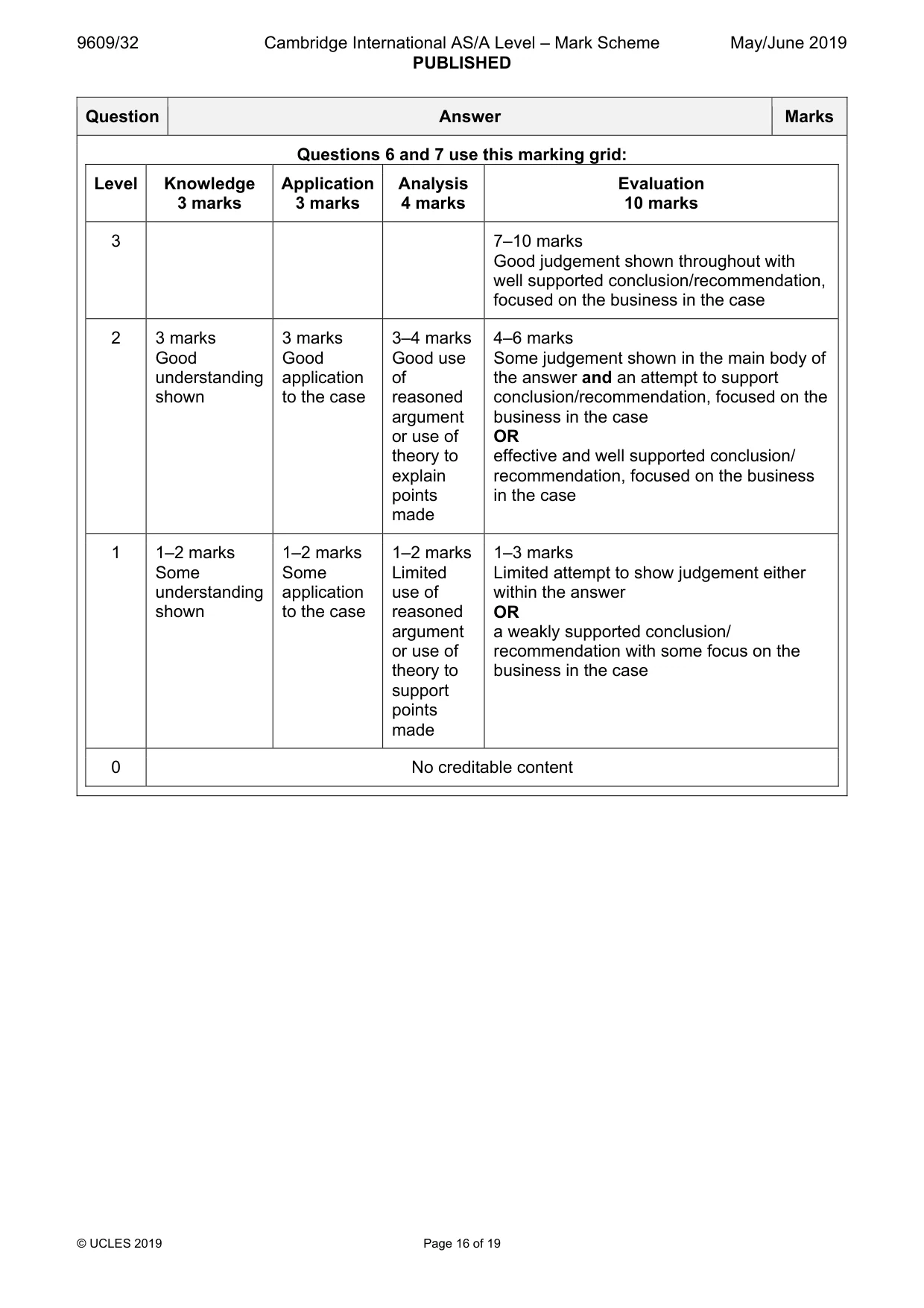
9609/32 Cambridge International AS/A Level – Mark Scheme PUBLISHED May/June 2019 © UCLES 2019 Page 16 of 19 Question Answer Marks Questions 6 and 7 use this marking grid: Level Knowledge 3 marks Application 3 marks Analysis 4 marks Evaluation 10 marks 3 7–10 marks Good judgement shown throughout with well supported conclusion/recommendation, focused on the business in the case 2 3 marks Good understanding shown 3 marks Good application to the case 3–4 marks Good use of reasoned argument or use of theory to explain points made 4–6 marks Some judgement shown in the main body of the answer and an attempt to support conclusion/recommendation, focused on the business in the case OR effective and well supported conclusion/ recommendation, focused on the business in the case 1 1–2 marks Some understanding shown 1–2 marks Some application to the case 1–2 marks Limited use of reasoned argument or use of theory to support points made 1–3 marks Limited attempt to show judgement either within the answer OR a weakly supported conclusion/ recommendation with some focus on the business in the case 0 No creditable content
Mark scheme, page 17
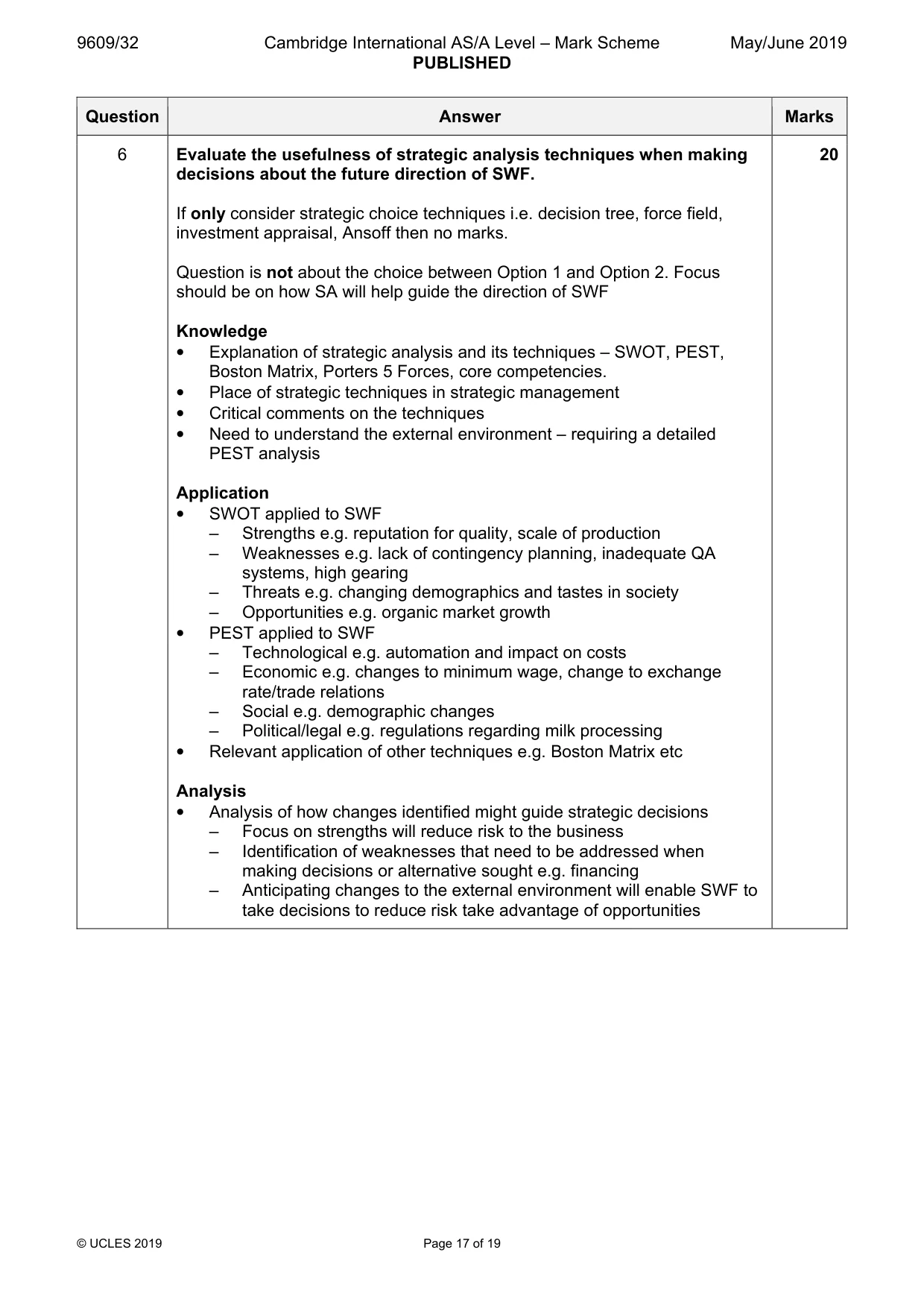
9609/32 Cambridge International AS/A Level – Mark Scheme PUBLISHED May/June 2019 © UCLES 2019 Page 17 of 19 Question Answer Marks 6 Evaluate the usefulness of strategic analysis techniques when making decisions about the future direction of SWF. If only consider strategic choice techniques i.e. decision tree, force field, investment appraisal, Ansoff then no marks. Question is not about the choice between Option 1 and Option 2. Focus should be on how SA will help guide the direction of SWF Knowledge • Explanation of strategic analysis and its techniques – SWOT, PEST, Boston Matrix, Porters 5 Forces, core competencies. • Place of strategic techniques in strategic management • Critical comments on the techniques • Need to understand the external environment – requiring a detailed PEST analysis Application • SWOT applied to SWF – Strengths e.g. reputation for quality, scale of production – Weaknesses e.g. lack of contingency planning, inadequate QA systems, high gearing – Threats e.g. changing demographics and tastes in society – Opportunities e.g. organic market growth • PEST applied to SWF – Technological e.g. automation and impact on costs – Economic e.g. changes to minimum wage, change to exchange rate/trade relations – Social e.g. demographic changes – Political/legal e.g. regulations regarding milk processing • Relevant application of other techniques e.g. Boston Matrix etc Analysis • Analysis of how changes identified might guide strategic decisions – Focus on strengths will reduce risk to the business – Identification of weaknesses that need to be addressed when making decisions or alternative sought e.g. financing – Anticipating changes to the external environment will enable SWF to take decisions to reduce risk take advantage of opportunities 20
Mark scheme, page 18
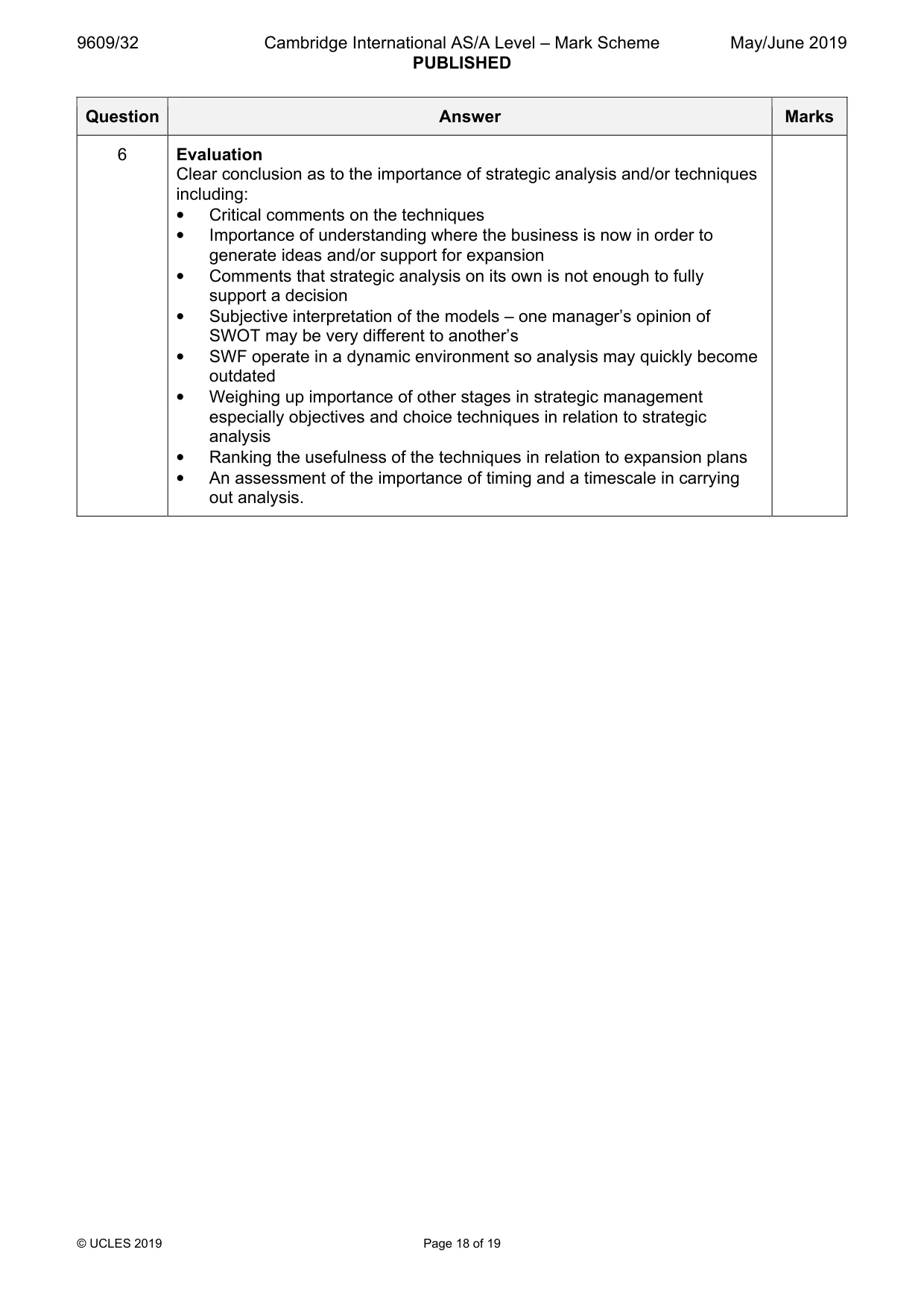
9609/32 Cambridge International AS/A Level – Mark Scheme PUBLISHED May/June 2019 © UCLES 2019 Page 18 of 19 Question Answer Marks 6 Evaluation Clear conclusion as to the importance of strategic analysis and/or techniques including: • Critical comments on the techniques • Importance of understanding where the business is now in order to generate ideas and/or support for expansion • Comments that strategic analysis on its own is not enough to fully support a decision • Subjective interpretation of the models – one manager’s opinion of SWOT may be very different to another’s • SWF operate in a dynamic environment so analysis may quickly become outdated • Weighing up importance of other stages in strategic management especially objectives and choice techniques in relation to strategic analysis • Ranking the usefulness of the techniques in relation to expansion plans • An assessment of the importance of timing and a timescale in carrying out analysis.
Mark scheme, page 19
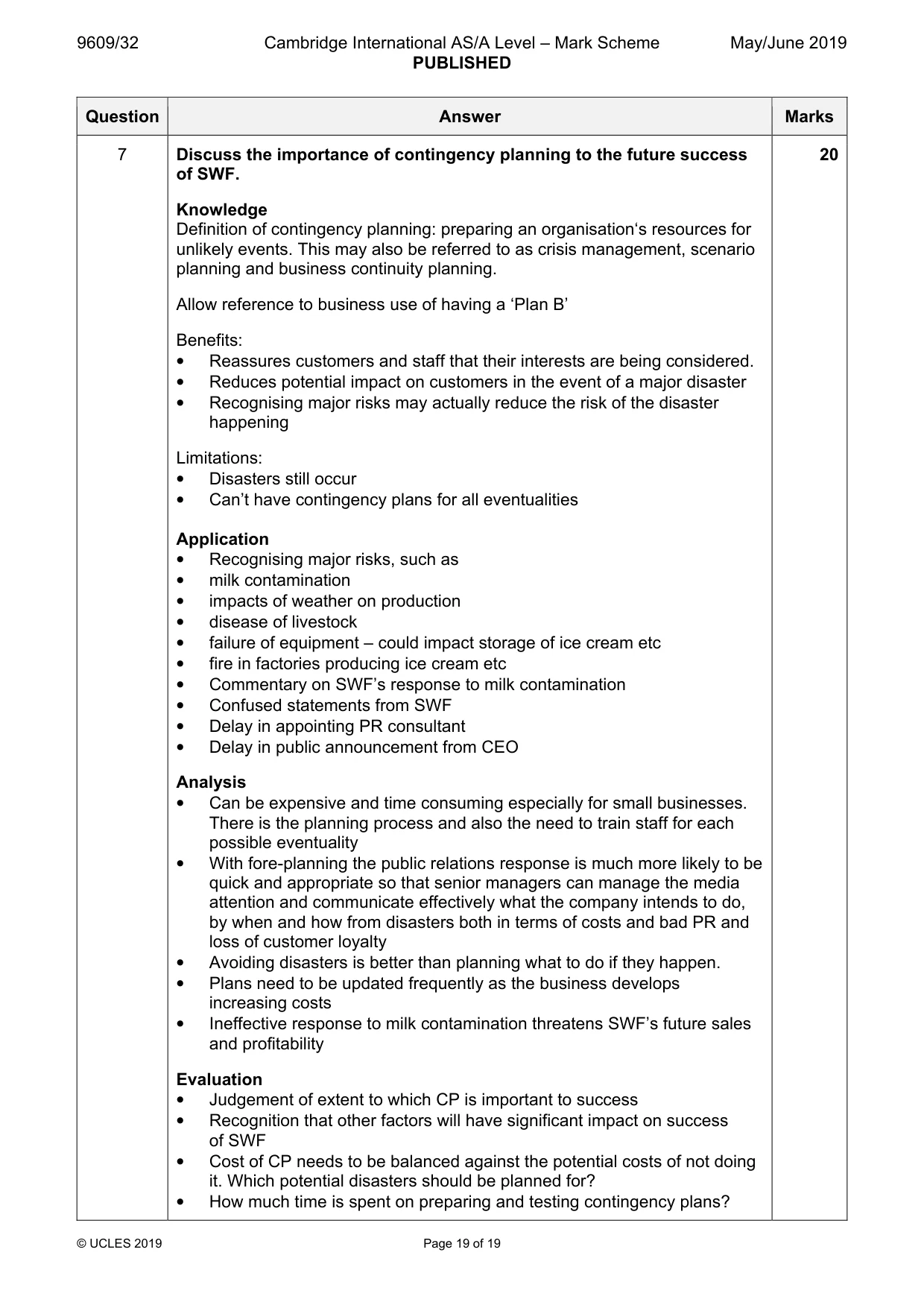
9609/32 Cambridge International AS/A Level – Mark Scheme PUBLISHED May/June 2019 © UCLES 2019 Page 19 of 19 Question Answer Marks 7 Discuss the importance of contingency planning to the future success of SWF. Knowledge Definition of contingency planning: preparing an organisation‘s resources for unlikely events. This may also be referred to as crisis management, scenario planning and business continuity planning. Allow reference to business use of having a ‘Plan B’ Benefits: • Reassures customers and staff that their interests are being considered. • Reduces potential impact on customers in the event of a major disaster • Recognising major risks may actually reduce the risk of the disaster happening Limitations: • Disasters still occur • Can’t have contingency plans for all eventualities Application • Recognising major risks, such as • milk contamination • impacts of weather on production • disease of livestock • failure of equipment – could impact storage of ice cream etc • fire in factories producing ice cream etc • Commentary on SWF’s response to milk contamination • Confused statements from SWF • Delay in appointing PR consultant • Delay in public announcement from CEO Analysis • Can be expensive and time consuming especially for small businesses. There is the planning process and also the need to train staff for each possible eventuality • With fore-planning the public relations response is much more likely to be quick and appropriate so that senior managers can manage the media attention and communicate effectively what the company intends to do, by when and how from disasters both in terms of costs and bad PR and loss of customer loyalty • Avoiding disasters is better than planning what to do if they happen. • Plans need to be updated frequently as the business develops increasing costs • Ineffective response to milk contamination threatens SWF’s future sales and profitability Evaluation • Judgement of extent to which CP is important to success • Recognition that other factors will have significant impact on success of SWF • Cost of CP needs to be balanced against the potential costs of not doing it. Which potential disasters should be planned for? • How much time is spent on preparing and testing contingency plans? 20
What you needed in this session
Cambridge’s own grade thresholds for 2019 May/June, Paper 3 · Variant 2. A higher threshold means an easier paper — the bar moves with how the cohort did.