Cambridge A Level Business (for first examination in 2016) 9609 — 2019 May/June Paper 3 · Variant 3
9609/33/M/J/19 · 100 marks · ≈113 min
The question paper and its mark scheme, free to read here and free to download. This is Cambridge’s own paper, exactly as it was sat.
Question paper20 pages

















Mark scheme19 pages
Answers below. Sit the paper first if you are practising.
Paper as text
Question paper, page 1
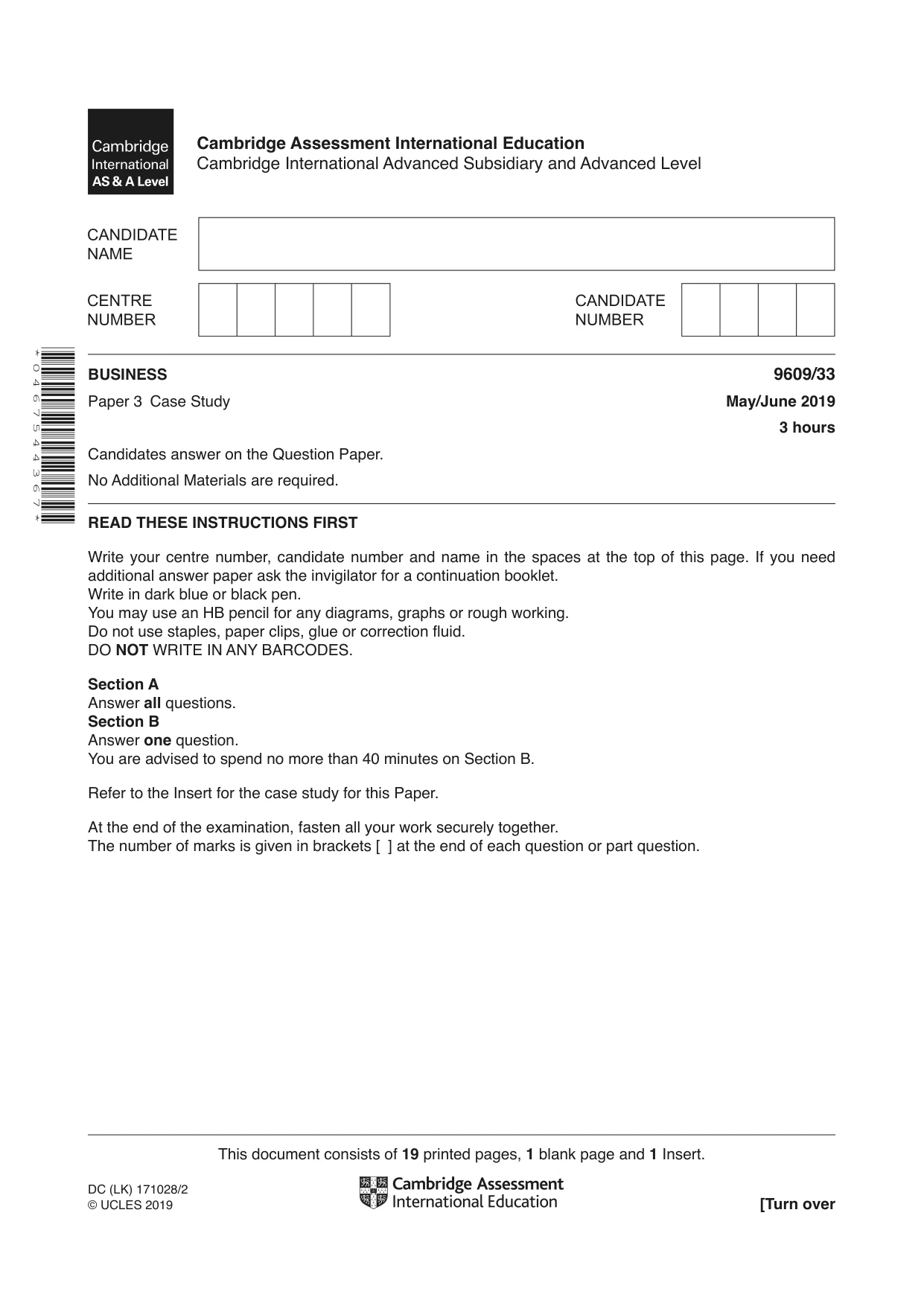
This document consists of 19 printed pages, 1 blank page and 1 Insert. DC (LK) 171028/2 © UCLES 2019 [Turn over * 0 4 6 7 5 4 4 3 6 7 * BUSINESS 9609/33 Paper 3 Case Study May/June 2019 3 hours Candidates answer on the Question Paper. No Additional Materials are required. READ THESE INSTRUCTIONS FIRST Write your centre number, candidate number and name in the spaces at the top of this page. If you need additional answer paper ask the invigilator for a continuation booklet. Write in dark blue or black pen. You may use an HB pencil for any diagrams, graphs or rough working. Do not use staples, paper clips, glue or correction fluid. DO NOT WRITE IN ANY BARCODES. Section A Answer all questions. Section B Answer one question. You are advised to spend no more than 40 minutes on Section B. Refer to the Insert for the case study for this Paper. At the end of the examination, fasten all your work securely together. The number of marks is given in brackets [ ] at the end of each question or part question. Cambridge Assessment International Education Cambridge International Advanced Subsidiary and Advanced Level
Question paper, page 2
2 9609/33/M/J/19 © UCLES 2019 Section A Answer all questions in this section. 1 Analyse the risks to AC of the economic forecasts in Appendix 2. … … … … … … … … … … … … … … … … … … … … … … … … …
Question paper, page 3
3 9609/33/M/J/19 © UCLES 2019 [Turn over … … … … … … … … … … … … … … … … … … … … … … … … … … … … [10]
Question paper, page 4
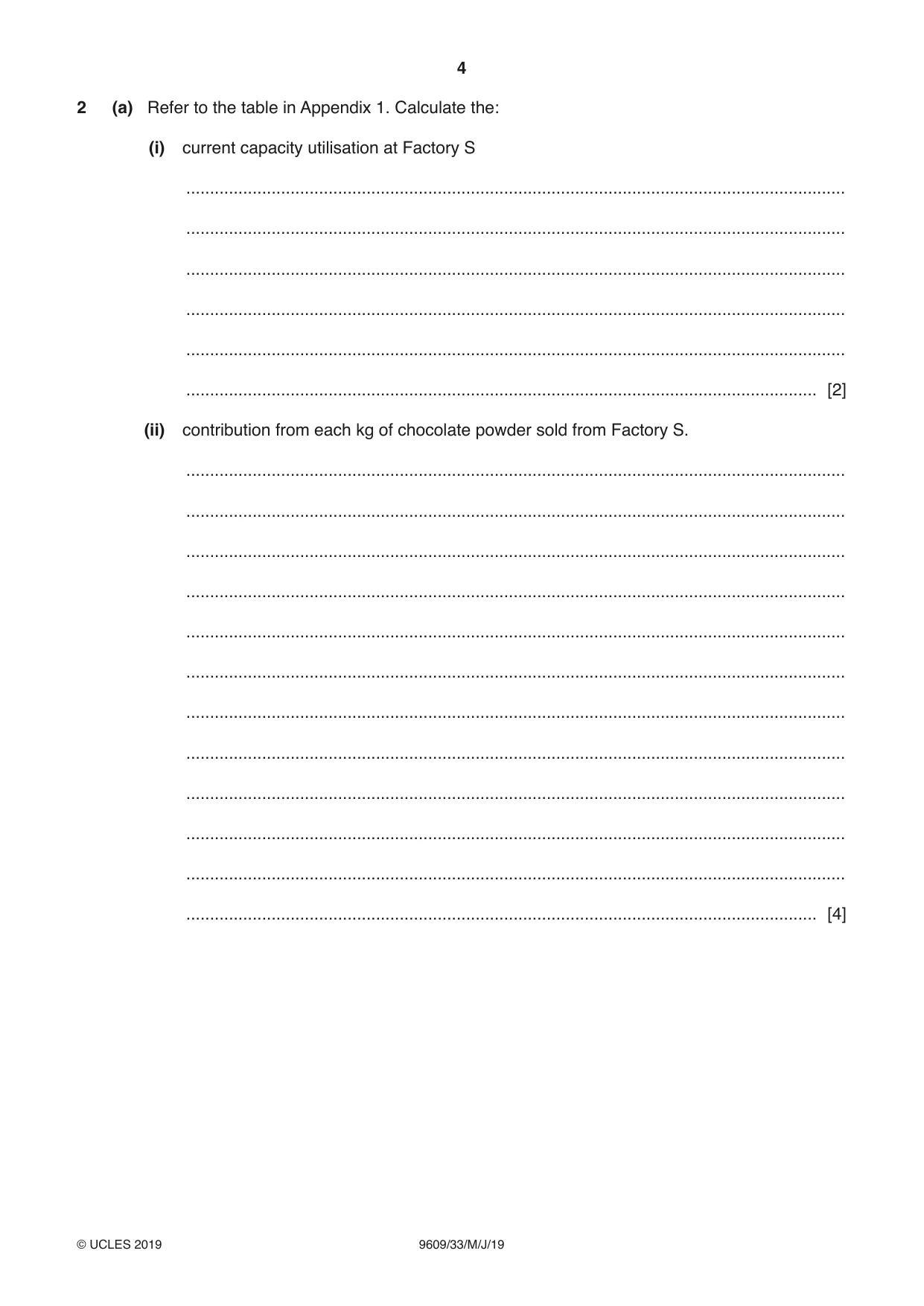
4 9609/33/M/J/19 © UCLES 2019 2 (a) Refer to the table in Appendix 1. Calculate the: (i) current capacity utilisation at Factory S … … … … … … [2] (ii) contribution from each kg of chocolate powder sold from Factory S. … … … … … … … … … … … … [4]
Question paper, page 5
5 9609/33/M/J/19 © UCLES 2019 [Turn over (b) Refer to your results in 2(a) and other information. Recommend whether AC should close Factory N. Justify your recommendation. … … … … … … … … … … … … … … … … … … … … … … … … … … …
Question paper, page 6
6 9609/33/M/J/19 © UCLES 2019 … … … … … … … … … … … … … … … … … … … … … … … … … … … … [12]
Question paper, page 7
7 9609/33/M/J/19 © UCLES 2019 [Turn over 3 Evaluate the importance of the ethical ‘fair trade’ principle to the success of the marketing strategy for AC’s chocolate powder. … … … … … … … … … … … … … … … … … … … … … … … … … … …
Question paper, page 8
8 9609/33/M/J/19 © UCLES 2019 … … … … … … … … … … … … … … … … … … … … … … … … … … … …
Question paper, page 9
9 9609/33/M/J/19 © UCLES 2019 [Turn over … … … … … … … … … … … … … … … … … … … … … … … … … … … … [16]
Question paper, page 10
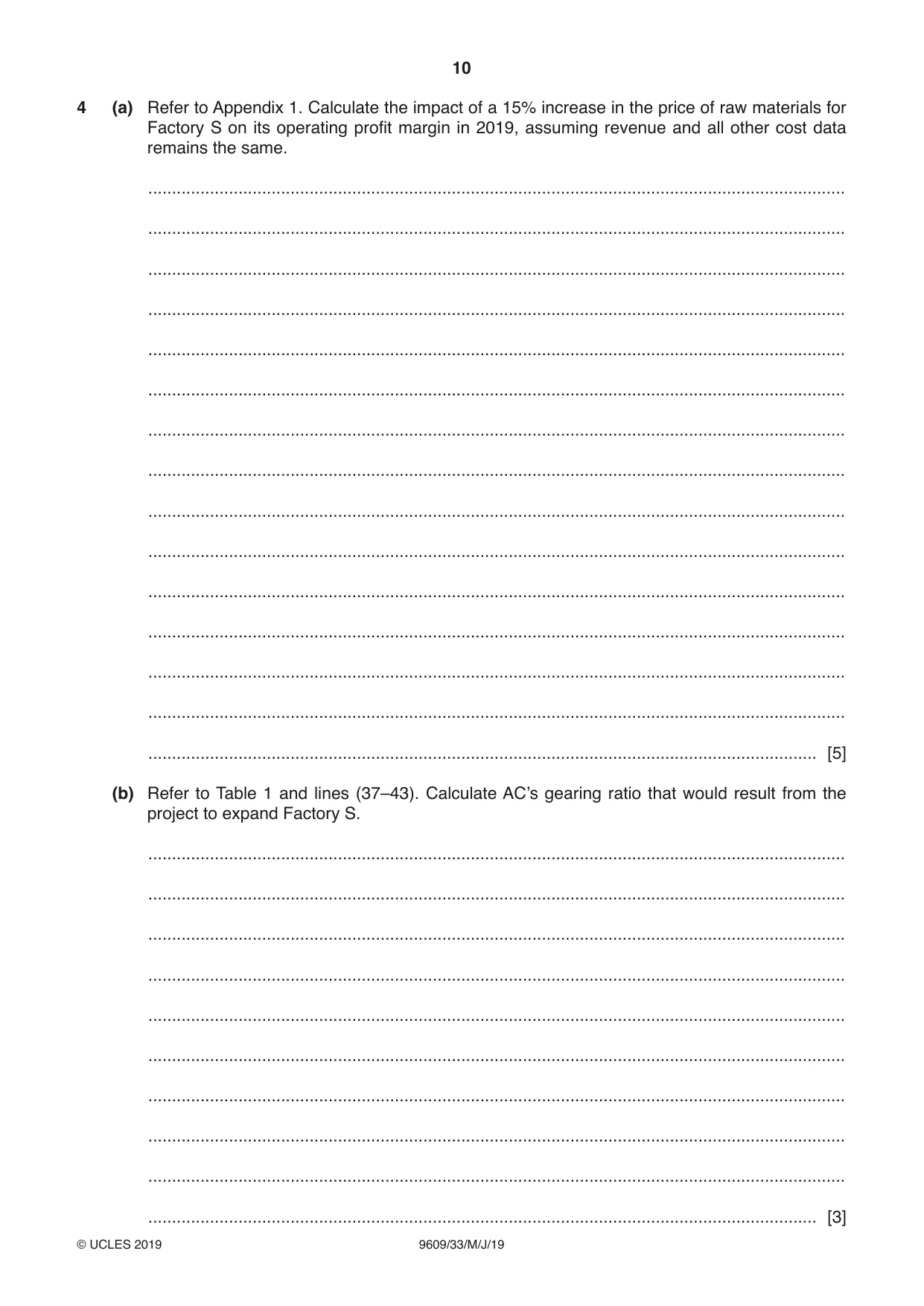
10 9609/33/M/J/19 © UCLES 2019 4 (a) Refer to Appendix 1. Calculate the impact of a 15% increase in the price of raw materials for Factory S on its operating profit margin in 2019, assuming revenue and all other cost data remains the same. … … … … … … … … … … … … … … … [5] (b) Refer to Table 1 and lines (37–43). Calculate AC’s gearing ratio that would result from the project to expand Factory S. … … … … … … … … … … [3]
Question paper, page 11
11 9609/33/M/J/19 © UCLES 2019 [Turn over (c) Refer to your results from 4(a) and other information. Evaluate whether the Lukwesa family should convert the business into a public limited company. … … … … … … … … … … … … … … … … … … … … … … … … … … …
Question paper, page 12
12 9609/33/M/J/19 © UCLES 2019 … … … … … … … … … … … … … … … … … … … … … … … … … … … … [12]
Question paper, page 13
13 9609/33/M/J/19 © UCLES 2019 [Turn over 5 Evaluate the possible impact on AC of more flexible employment contracts. … … … … … … … … … … … … … … … … … … … … … … … … … … …
Question paper, page 14
14 9609/33/M/J/19 © UCLES 2019 … … … … … … … … … … … … … … … … … … … … … … … … … … … …
Question paper, page 15
15 9609/33/M/J/19 © UCLES 2019 [Turn over … … … … … … … … … … … … … … … … … … … … … … … … … … … … [16]
Question paper, page 16
16 9609/33/M/J/19 © UCLES 2019 Section B Answer one question from this section. 6 Discuss the usefulness of strategic choice techniques for the directors of AC, as they decide between Option A and Option B. 7 Assume AC’s directors choose Option A. Evaluate the importance of business planning to the successful implementation of this strategy. Write the question number here: … … … … … … … … … … … … … … … … … … … … … … …
Question paper, page 17
17 9609/33/M/J/19 © UCLES 2019 [Turn over … … … … … … … … … … … … … … … … … … … … … … … … … … … …
Question paper, page 18
18 9609/33/M/J/19 © UCLES 2019 … … … … … … … … … … … … … … … … … … … … … … … … … … … …
Question paper, page 19
19 9609/33/M/J/19 © UCLES 2019 … … … … … … … … … … … … … … … … … … … … … … … … … … … … [20]
Question paper, page 20
20 9609/33/M/J/19 © UCLES 2019 Permission to reproduce items where third-party owned material protected by copyright is included has been sought and cleared where possible. Every reasonable effort has been made by the publisher (UCLES) to trace copyright holders, but if any items requiring clearance have unwittingly been included, the publisher will be pleased to make amends at the earliest possible opportunity. To avoid the issue of disclosure of answer-related information to candidates, all copyright acknowledgements are reproduced online in the Cambridge Assessment International Education Copyright Acknowledgements Booklet. This is produced for each series of examinations and is freely available to download at www.cambridgeinternational.org after the live examination series. Cambridge Assessment International Education is part of the Cambridge Assessment Group. Cambridge Assessment is the brand name of the University of Cambridge Local Examinations Syndicate (UCLES), which itself is a department of the University of Cambridge. BLANK PAGE
Mark scheme, page 1
Cambridge Assessment International Education Cambridge International Advanced Subsidiary and Advanced Level BUSINESS 9609/33 Paper 3 Case Study May/June 2019 MARK SCHEME Maximum Mark: 100 Published This mark scheme is published as an aid to teachers and candidates, to indicate the requirements of the examination. It shows the basis on which Examiners were instructed to award marks. It does not indicate the details of the discussions that took place at an Examiners’ meeting before marking began, which would have considered the acceptability of alternative answers. Mark schemes should be read in conjunction with the question paper and the Principal Examiner Report for Teachers. Cambridge International will not enter into discussions about these mark schemes. Cambridge International is publishing the mark schemes for the May/June 2019 series for most Cambridge IGCSE™, Cambridge International A and AS Level and Cambridge Pre-U components, and some Cambridge O Level components.
Mark scheme, page 2
Generic Marking Principles These general marking principles must be applied by all examiners when marking candidate answers. They should be applied alongside the specific content of the mark scheme or generic level descriptors for a question. Each question paper and mark scheme will also comply with these marking principles. GENERIC MARKING PRINCIPLE 1: Marks must be awarded in line with: • the specific content of the mark scheme or the generic level descriptors for the question • the specific skills defined in the mark scheme or in the generic level descriptors for the question • the standard of response required by a candidate as exemplified by the standardisation scripts. GENERIC MARKING PRINCIPLE 2: Marks awarded are always whole marks (not half marks, or other fractions). GENERIC MARKING PRINCIPLE 3: Marks must be awarded positively: • marks are awarded for correct/valid answers, as defined in the mark scheme. However, credit is given for valid answers which go beyond the scope of the syllabus and mark scheme, referring to your Team Leader as appropriate • marks are awarded when candidates clearly demonstrate what they know and can do • marks are not deducted for errors • marks are not deducted for omissions • answers should only be judged on the quality of spelling, punctuation and grammar when these features are specifically assessed by the question as indicated by the mark scheme. The meaning, however, should be unambiguous. GENERIC MARKING PRINCIPLE 4: Rules must be applied consistently e.g. in situations where candidates have not followed instructions or in the application of generic level descriptors. GENERIC MARKING PRINCIPLE 5: Marks should be awarded using the full range of marks defined in the mark scheme for the question (however; the use of the full mark range may be limited according to the quality of the candidate responses seen). GENERIC MARKING PRINCIPLE 6: Marks awarded are based solely on the requirements as defined in the mark scheme. Marks should not be awarded with grade thresholds or grade descriptors in mind.
Mark scheme, page 3
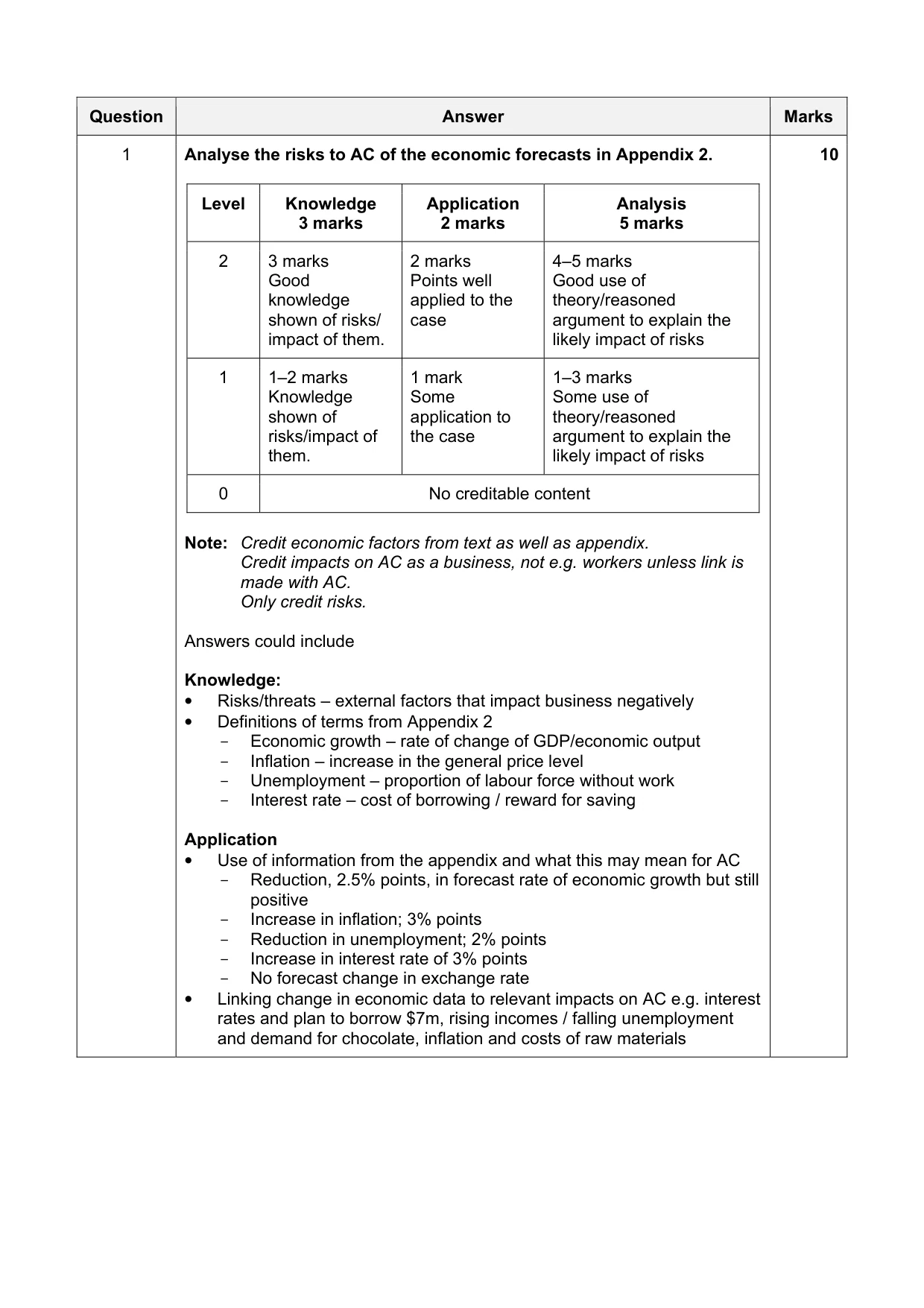
Question Answer Marks 1 Analyse the risks to AC of the economic forecasts in Appendix 2. Level Knowledge 3 marks Application 2 marks Analysis 5 marks 2 3 marks Good knowledge shown of risks/ impact of them. 2 marks Points well applied to the case 4–5 marks Good use of theory/reasoned argument to explain the likely impact of risks 1 1–2 marks Knowledge shown of risks/impact of them. 1 mark Some application to the case 1–3 marks Some use of theory/reasoned argument to explain the likely impact of risks 0 No creditable content Note: Credit economic factors from text as well as appendix. Credit impacts on AC as a business, not e.g. workers unless link is made with AC. Only credit risks. Answers could include Knowledge: • Risks/threats – external factors that impact business negatively • Definitions of terms from Appendix 2 - Economic growth – rate of change of GDP/economic output - Inflation – increase in the general price level - Unemployment – proportion of labour force without work - Interest rate – cost of borrowing / reward for saving Application • Use of information from the appendix and what this may mean for AC - Reduction, 2.5% points, in forecast rate of economic growth but still positive - Increase in inflation; 3% points - Reduction in unemployment; 2% points - Increase in interest rate of 3% points - No forecast change in exchange rate • Linking change in economic data to relevant impacts on AC e.g. interest rates and plan to borrow $7m, rising incomes / falling unemployment and demand for chocolate, inflation and costs of raw materials 10
Mark scheme, page 4
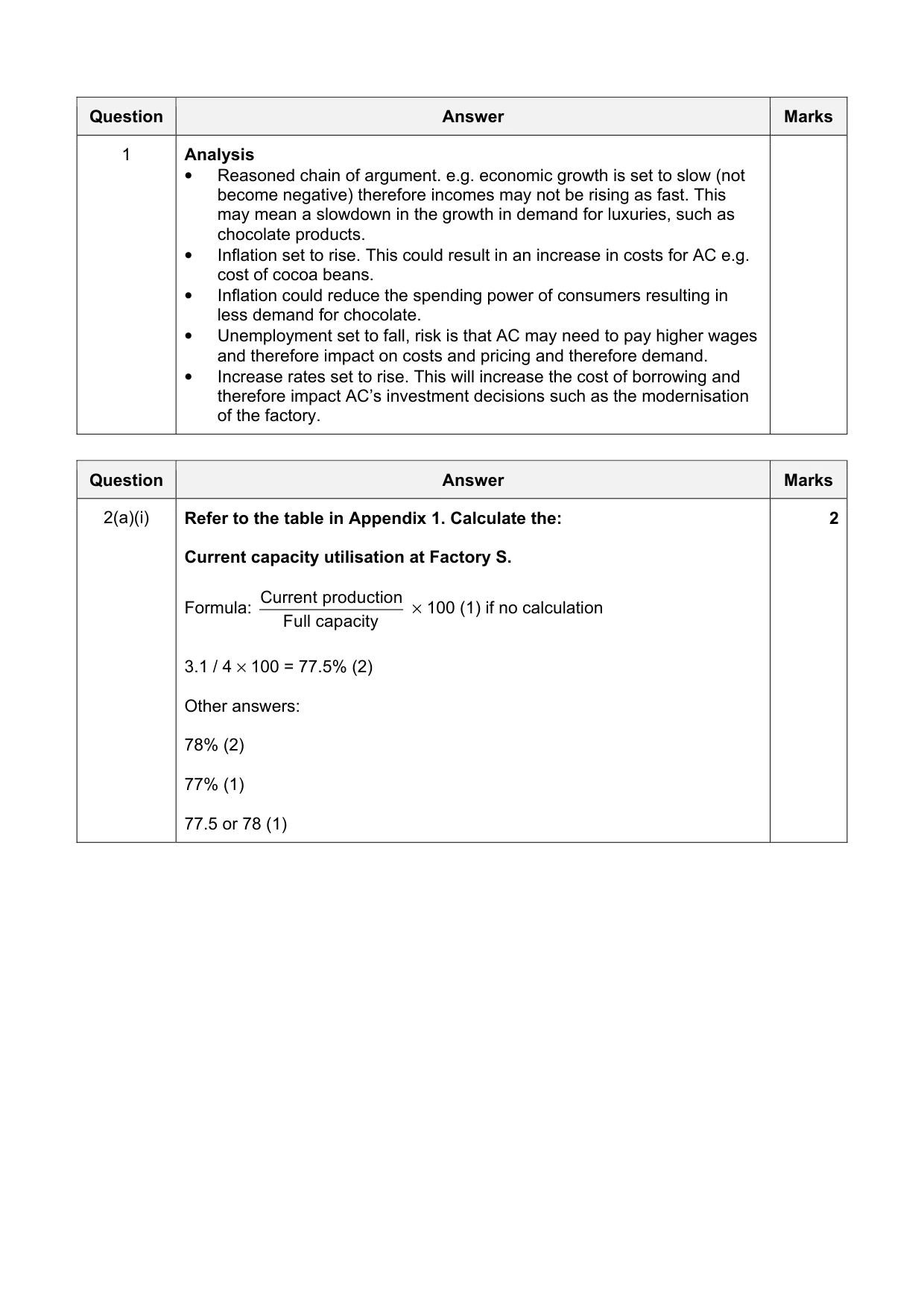
Question Answer Marks 1 Analysis • Reasoned chain of argument. e.g. economic growth is set to slow (not become negative) therefore incomes may not be rising as fast. This may mean a slowdown in the growth in demand for luxuries, such as chocolate products. • Inflation set to rise. This could result in an increase in costs for AC e.g. cost of cocoa beans. • Inflation could reduce the spending power of consumers resulting in less demand for chocolate. • Unemployment set to fall, risk is that AC may need to pay higher wages and therefore impact on costs and pricing and therefore demand. • Increase rates set to rise. This will increase the cost of borrowing and therefore impact AC’s investment decisions such as the modernisation of the factory. Question Answer Marks 2(a)(i) Refer to the table in Appendix 1. Calculate the: Current capacity utilisation at Factory S. Formula: Current production Full capacity × 100 (1) if no calculation 3.1 / 4 × 100 = 77.5% (2) Other answers: 78% (2) 77% (1) 77.5 or 78 (1) 2
Mark scheme, page 5
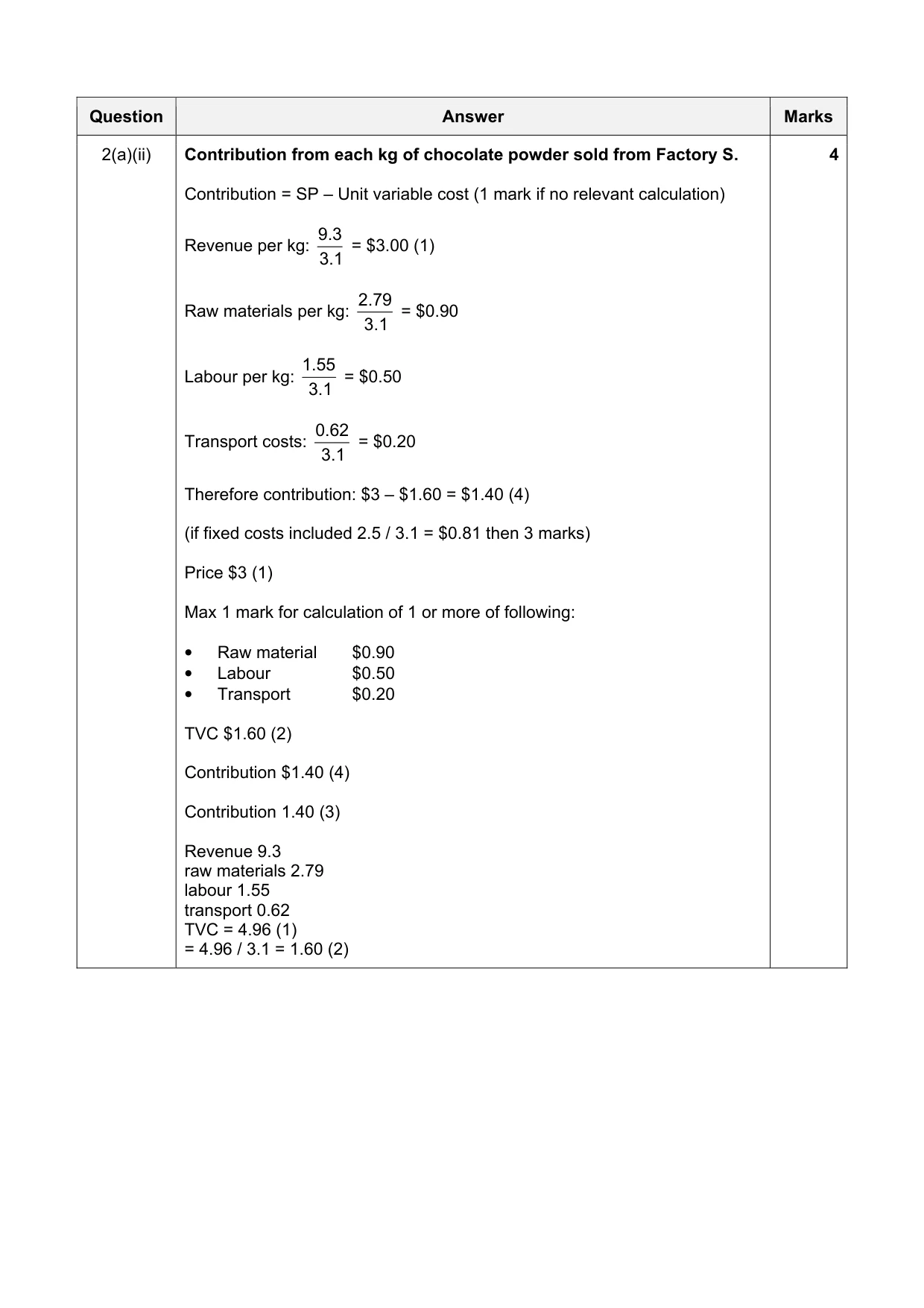
Question Answer Marks 2(a)(ii) Contribution from each kg of chocolate powder sold from Factory S. Contribution = SP – Unit variable cost (1 mark if no relevant calculation) Revenue per kg: 9.3 3.1 = $3.00 (1) Raw materials per kg: 2.79 3.1 = $0.90 Labour per kg: 1.55 3.1 = $0.50 Transport costs: 0.62 3.1 = $0.20 Therefore contribution: $3 – $1.60 = $1.40 (4) (if fixed costs included 2.5 / 3.1 = $0.81 then 3 marks) Price $3 (1) Max 1 mark for calculation of 1 or more of following: • Raw material $0.90 • Labour $0.50 • Transport $0.20 TVC $1.60 (2) Contribution $1.40 (4) Contribution 1.40 (3) Revenue 9.3 raw materials 2.79 labour 1.55 transport 0.62 TVC = 4.96 (1) = 4.96 / 3.1 = 1.60 (2) 4
Mark scheme, page 6
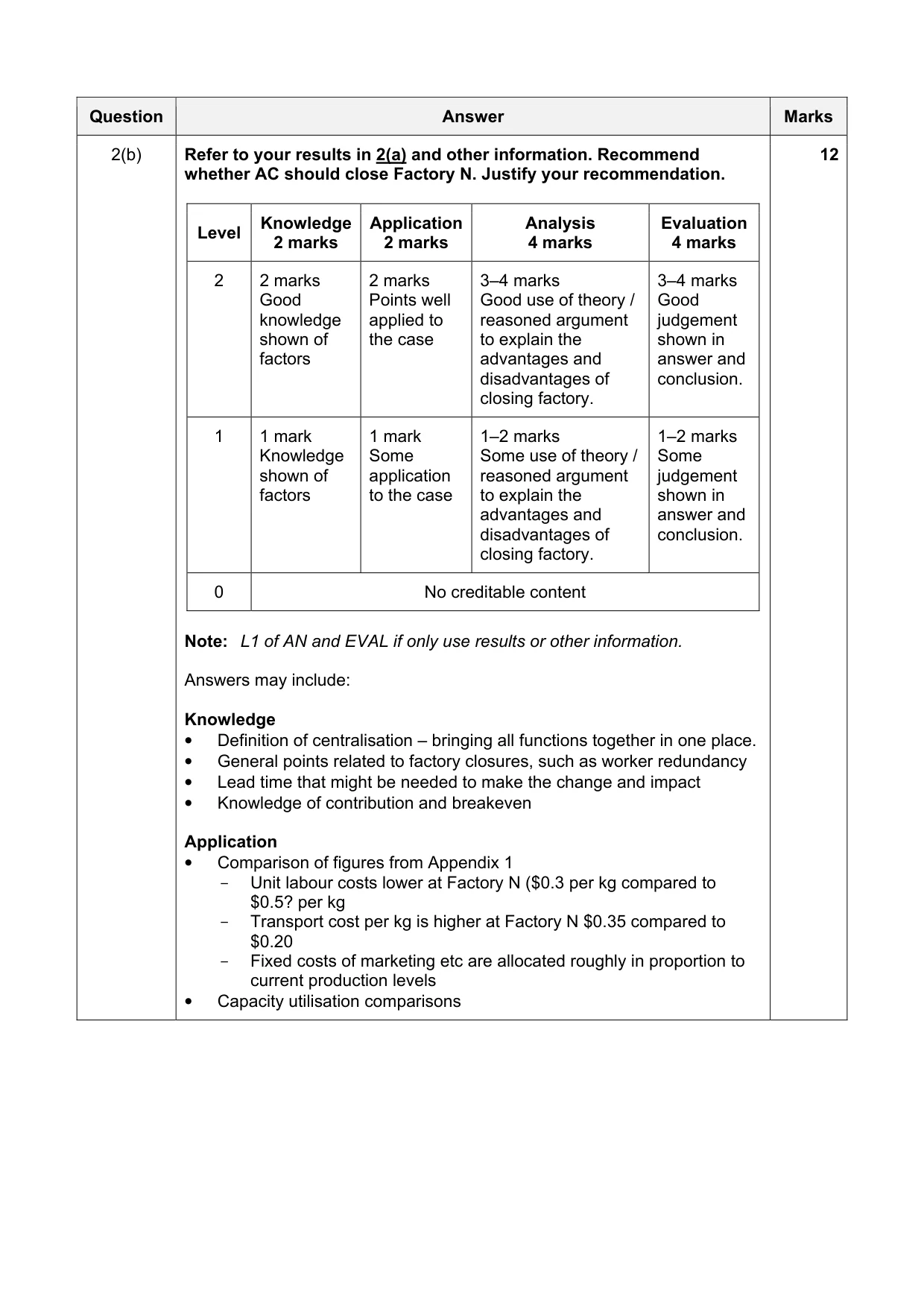
Question Answer Marks 2(b) Refer to your results in 2(a) and other information. Recommend whether AC should close Factory N. Justify your recommendation. Level Knowledge 2 marks Application 2 marks Analysis 4 marks Evaluation 4 marks 2 2 marks Good knowledge shown of factors 2 marks Points well applied to the case 3–4 marks Good use of theory / reasoned argument to explain the advantages and disadvantages of closing factory. 3–4 marks Good judgement shown in answer and conclusion. 1 1 mark Knowledge shown of factors 1 mark Some application to the case 1–2 marks Some use of theory / reasoned argument to explain the advantages and disadvantages of closing factory. 1–2 marks Some judgement shown in answer and conclusion. 0 No creditable content Note: L1 of AN and EVAL if only use results or other information. Answers may include: Knowledge • Definition of centralisation – bringing all functions together in one place. • General points related to factory closures, such as worker redundancy • Lead time that might be needed to make the change and impact • Knowledge of contribution and breakeven Application • Comparison of figures from Appendix 1 - Unit labour costs lower at Factory N ($0.3 per kg compared to $0.5? per kg - Transport cost per kg is higher at Factory N $0.35 compared to $0.20 - Fixed costs of marketing etc are allocated roughly in proportion to current production levels • Capacity utilisation comparisons 12
Mark scheme, page 7
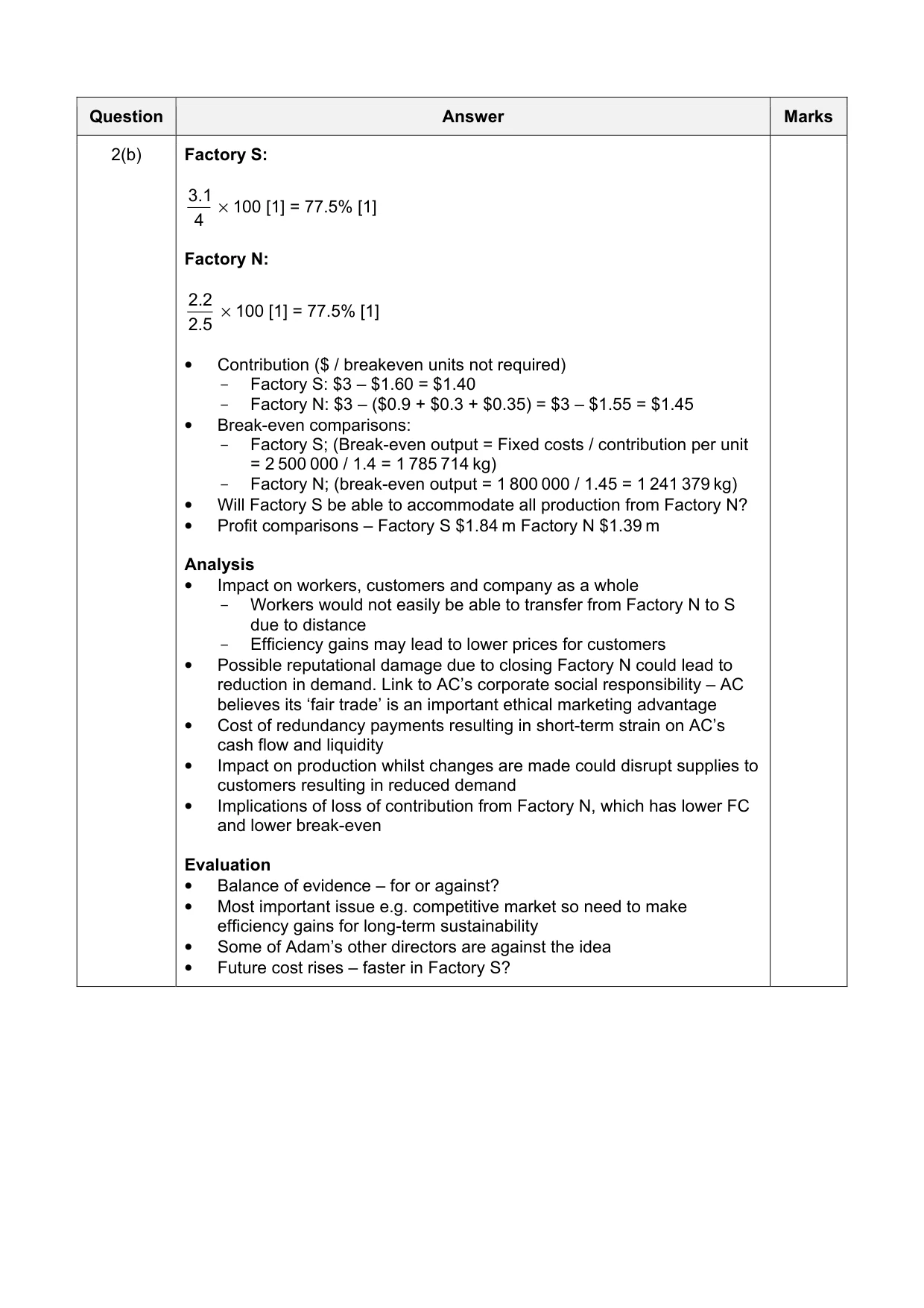
Question Answer Marks 2(b) Factory S: 3.1 4 × 100 [1] = 77.5% [1] Factory N: 2.2 2.5 × 100 [1] = 77.5% [1] • Contribution ($ / breakeven units not required) - Factory S: $3 – $1.60 = $1.40 - Factory N: $3 – ($0.9 + $0.3 + $0.35) = $3 – $1.55 = $1.45 • Break-even comparisons: - Factory S; (Break-even output = Fixed costs / contribution per unit = 2 500 000 / 1.4 = 1 785 714 kg) - Factory N; (break-even output = 1 800 000 / 1.45 = 1 241 379 kg) • Will Factory S be able to accommodate all production from Factory N? • Profit comparisons – Factory S $1.84 m Factory N $1.39 m Analysis • Impact on workers, customers and company as a whole - Workers would not easily be able to transfer from Factory N to S due to distance - Efficiency gains may lead to lower prices for customers • Possible reputational damage due to closing Factory N could lead to reduction in demand. Link to AC’s corporate social responsibility – AC believes its ‘fair trade’ is an important ethical marketing advantage • Cost of redundancy payments resulting in short-term strain on AC’s cash flow and liquidity • Impact on production whilst changes are made could disrupt supplies to customers resulting in reduced demand • Implications of loss of contribution from Factory N, which has lower FC and lower break-even Evaluation • Balance of evidence – for or against? • Most important issue e.g. competitive market so need to make efficiency gains for long-term sustainability • Some of Adam’s other directors are against the idea • Future cost rises – faster in Factory S?
Mark scheme, page 8
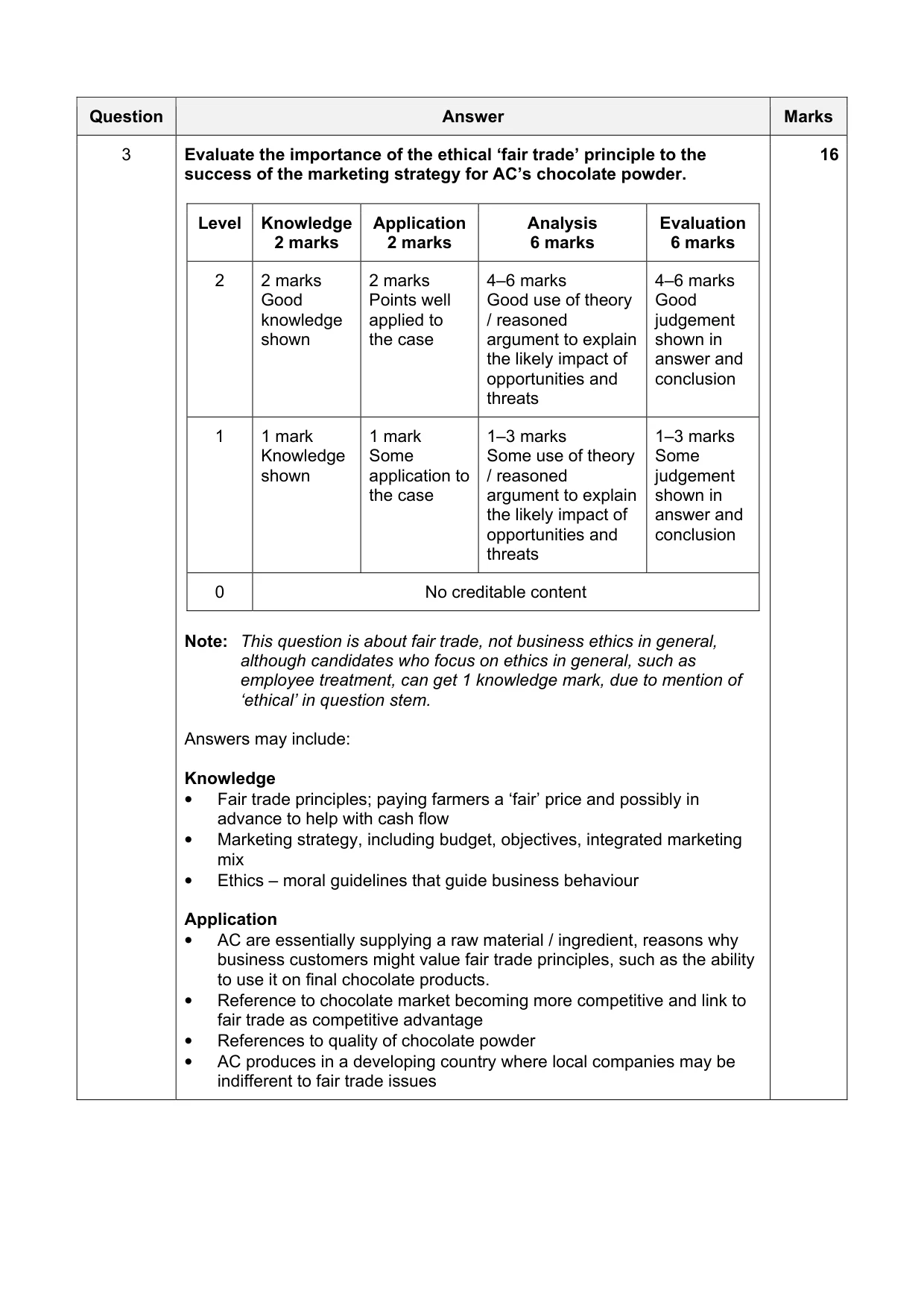
Question Answer Marks 3 Evaluate the importance of the ethical ‘fair trade’ principle to the success of the marketing strategy for AC’s chocolate powder. Level Knowledge 2 marks Application 2 marks Analysis 6 marks Evaluation 6 marks 2 2 marks Good knowledge shown 2 marks Points well applied to the case 4–6 marks Good use of theory / reasoned argument to explain the likely impact of opportunities and threats 4–6 marks Good judgement shown in answer and conclusion 1 1 mark Knowledge shown 1 mark Some application to the case 1–3 marks Some use of theory / reasoned argument to explain the likely impact of opportunities and threats 1–3 marks Some judgement shown in answer and conclusion 0 No creditable content Note: This question is about fair trade, not business ethics in general, although candidates who focus on ethics in general, such as employee treatment, can get 1 knowledge mark, due to mention of ‘ethical’ in question stem. Answers may include: Knowledge • Fair trade principles; paying farmers a ‘fair’ price and possibly in advance to help with cash flow • Marketing strategy, including budget, objectives, integrated marketing mix • Ethics – moral guidelines that guide business behaviour Application • AC are essentially supplying a raw material / ingredient, reasons why business customers might value fair trade principles, such as the ability to use it on final chocolate products. • Reference to chocolate market becoming more competitive and link to fair trade as competitive advantage • References to quality of chocolate powder • AC produces in a developing country where local companies may be indifferent to fair trade issues 16
Mark scheme, page 9
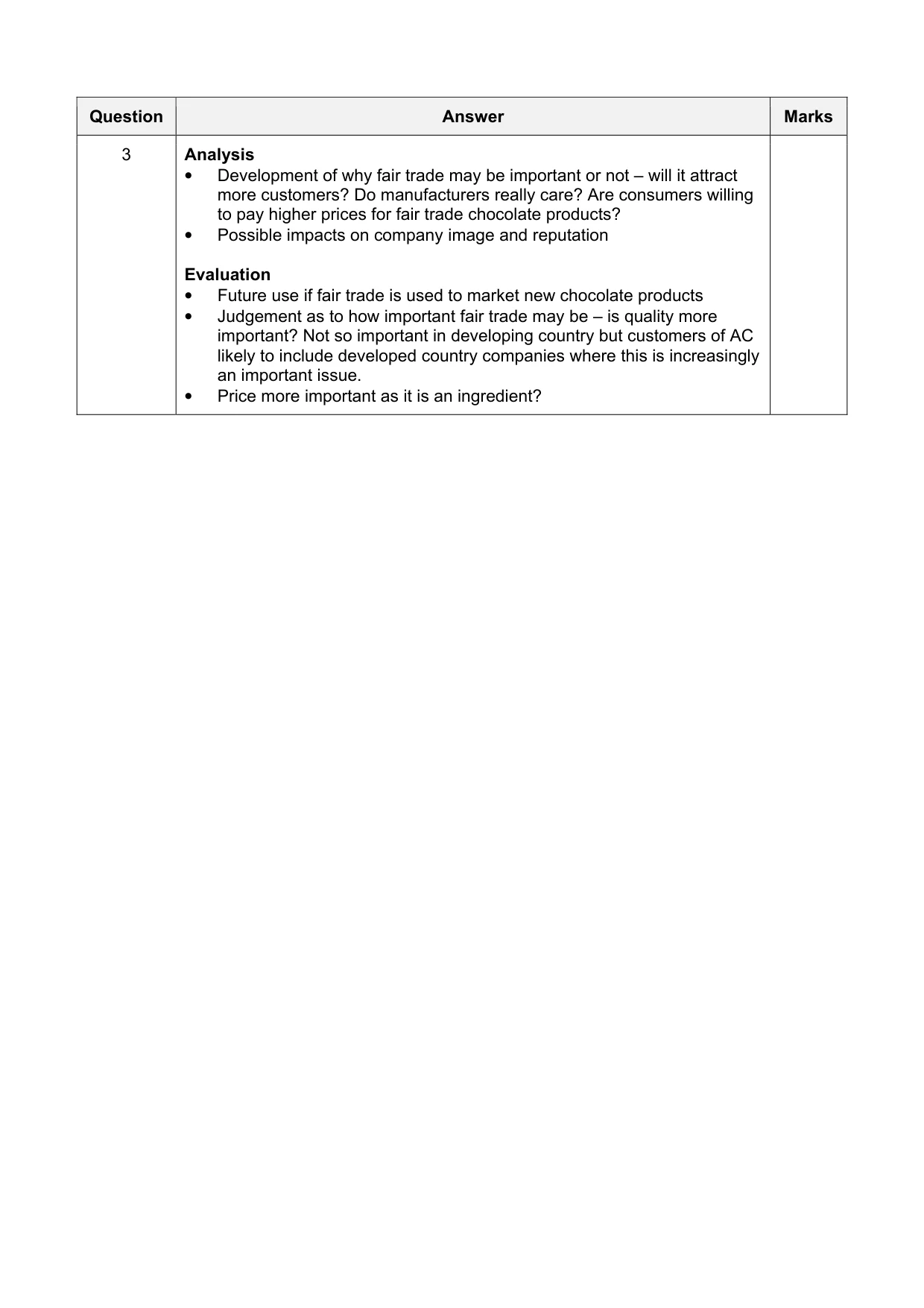
Question Answer Marks 3 Analysis • Development of why fair trade may be important or not – will it attract more customers? Do manufacturers really care? Are consumers willing to pay higher prices for fair trade chocolate products? • Possible impacts on company image and reputation Evaluation • Future use if fair trade is used to market new chocolate products • Judgement as to how important fair trade may be – is quality more important? Not so important in developing country but customers of AC likely to include developed country companies where this is increasingly an important issue. • Price more important as it is an ingredient?
Mark scheme, page 10
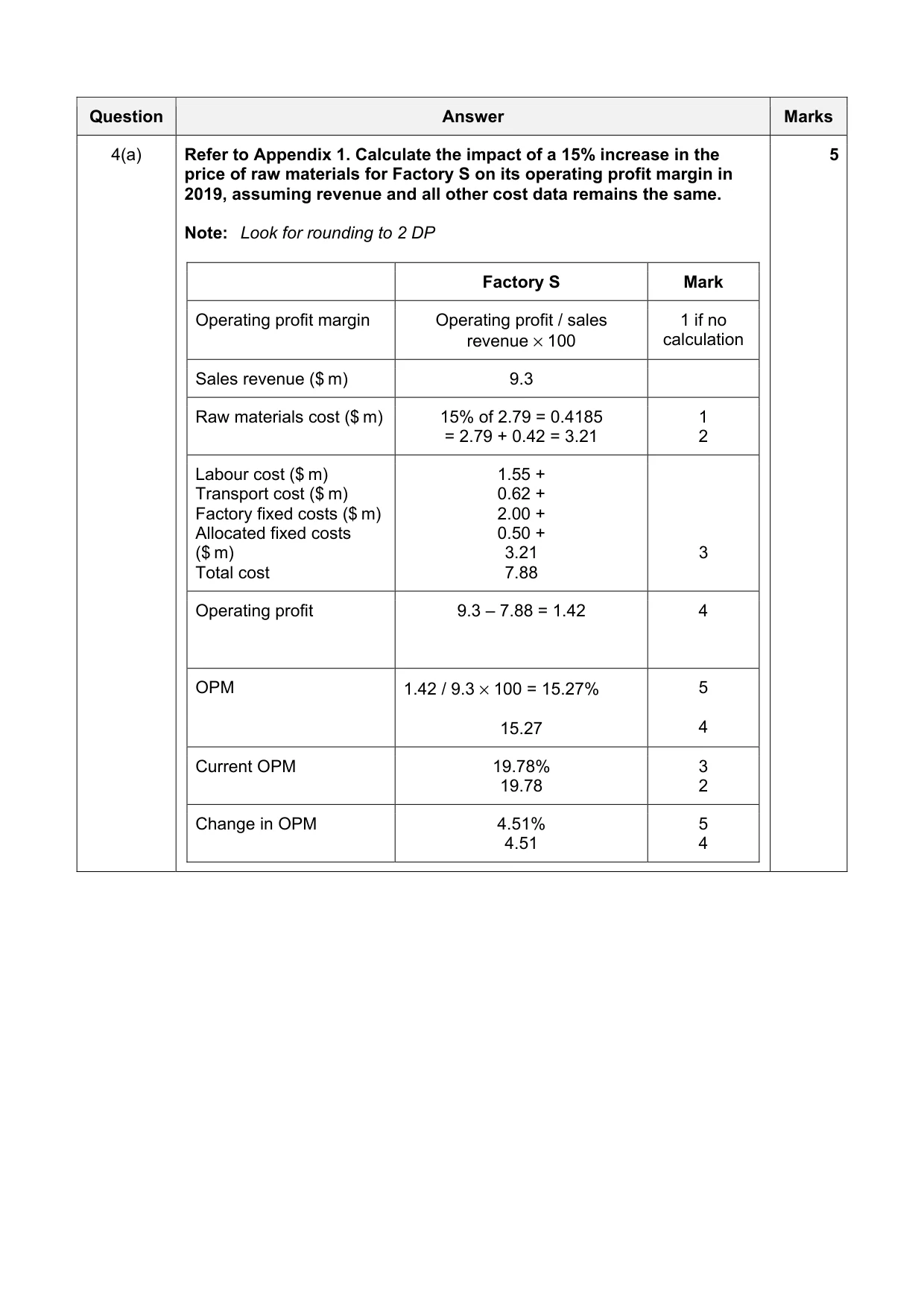
Question Answer Marks 4(a) Refer to Appendix 1. Calculate the impact of a 15% increase in the price of raw materials for Factory S on its operating profit margin in 2019, assuming revenue and all other cost data remains the same. Note: Look for rounding to 2 DP Factory S Mark Operating profit margin Operating profit / sales revenue × 100 1 if no calculation Sales revenue ($ m) 9.3 Raw materials cost ($ m) 15% of 2.79 = 0.4185 = 2.79 + 0.42 = 3.21 1 2 Labour cost ($ m) Transport cost ($ m) Factory fixed costs ($ m) Allocated fixed costs ($ m) Total cost 1.55 + 0.62 + 2.00 + 0.50 + 3.21 7.88 3 Operating profit 9.3 – 7.88 = 1.42 4 OPM 1.42 / 9.3 × 100 = 15.27% 15.27 5 4 Current OPM 19.78% 19.78 3 2 Change in OPM 4.51% 4.51 5 4 5
Mark scheme, page 11
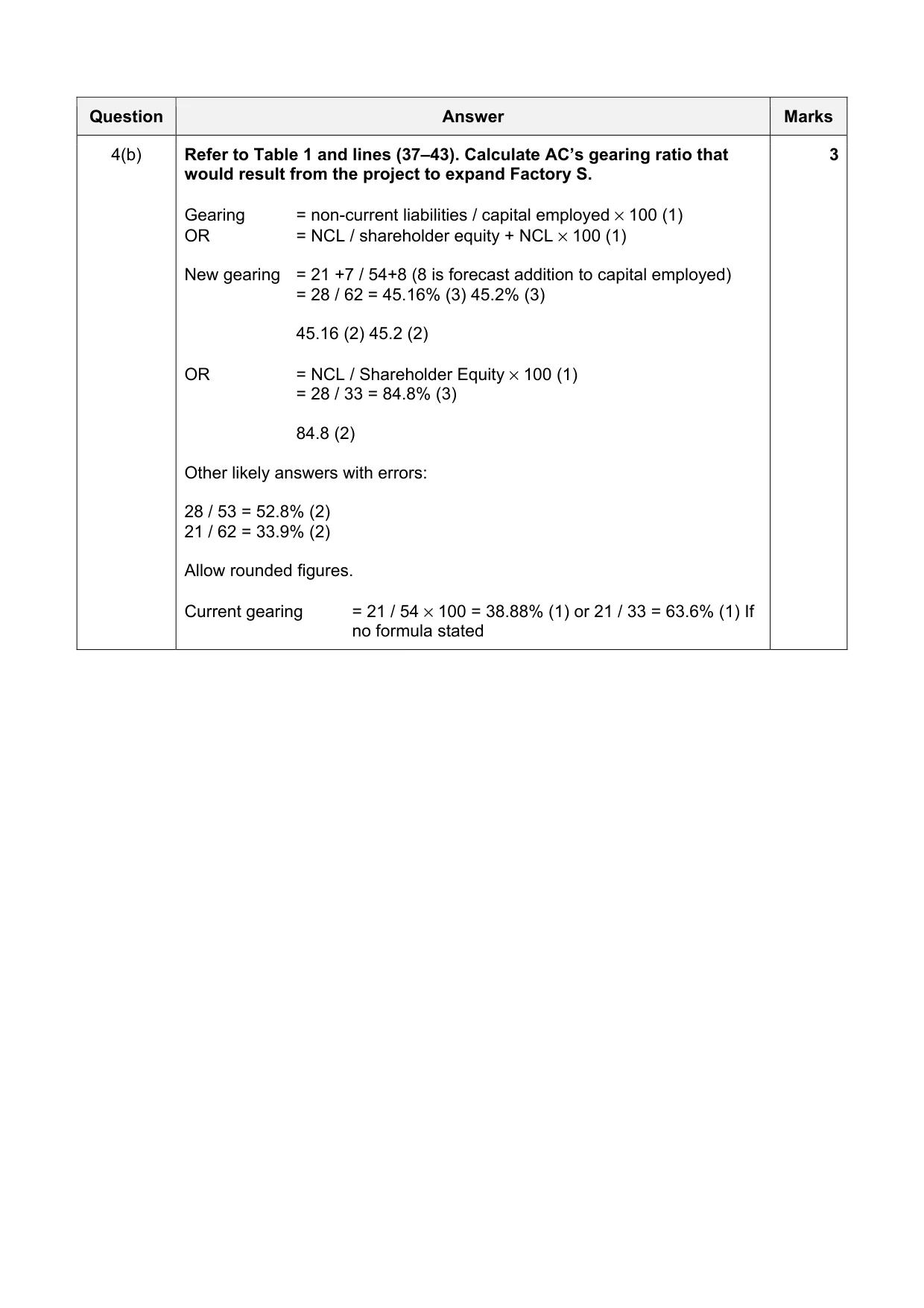
Question Answer Marks 4(b) Refer to Table 1 and lines (37–43). Calculate AC’s gearing ratio that would result from the project to expand Factory S. Gearing = non-current liabilities / capital employed × 100 (1) OR = NCL / shareholder equity + NCL × 100 (1) New gearing = 21 +7 / 54+8 (8 is forecast addition to capital employed) = 28 / 62 = 45.16% (3) 45.2% (3) 45.16 (2) 45.2 (2) OR = NCL / Shareholder Equity × 100 (1) = 28 / 33 = 84.8% (3) 84.8 (2) Other likely answers with errors: 28 / 53 = 52.8% (2) 21 / 62 = 33.9% (2) Allow rounded figures. Current gearing = 21 / 54 × 100 = 38.88% (1) or 21 / 33 = 63.6% (1) If no formula stated 3
Mark scheme, page 12
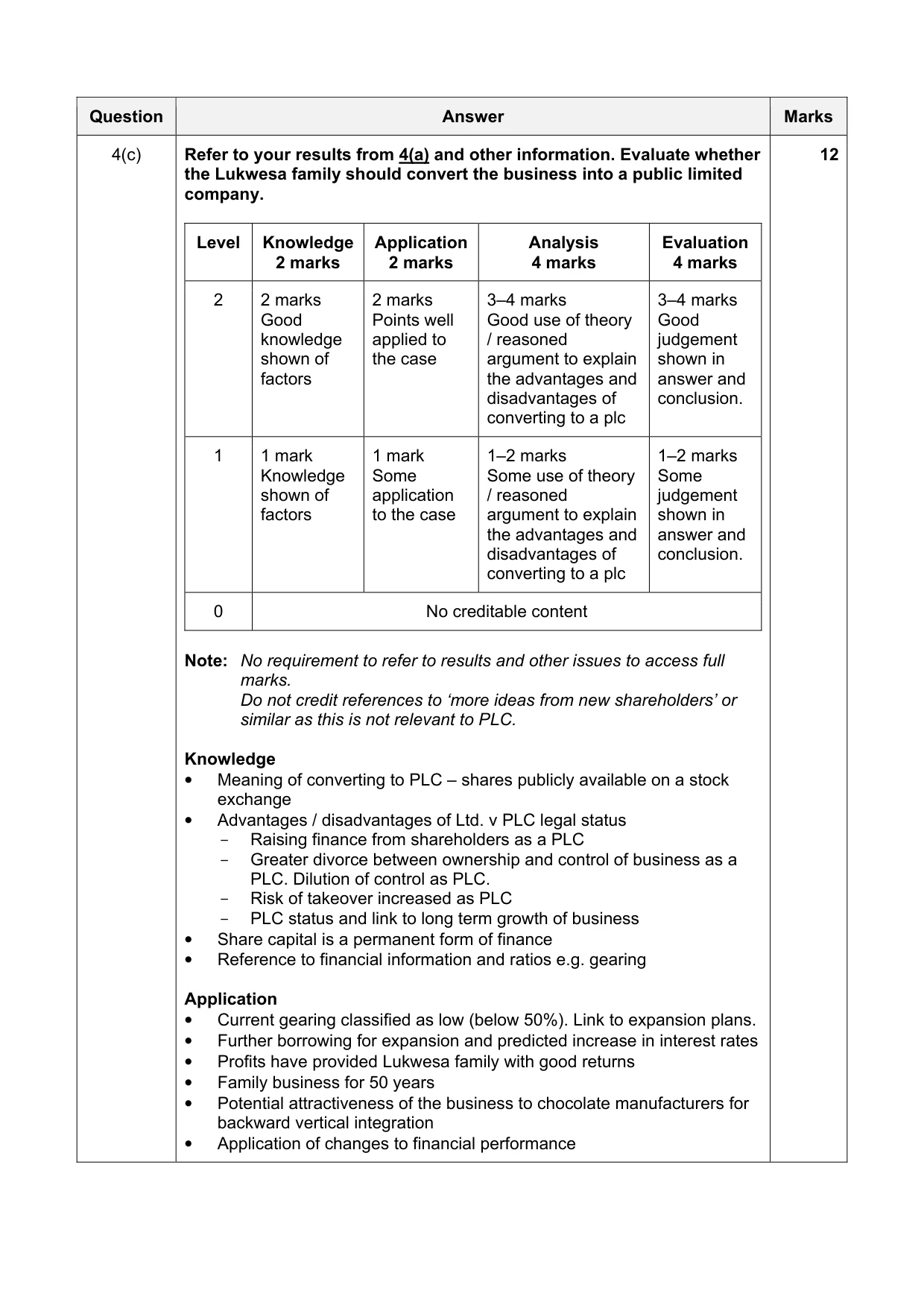
Question Answer Marks 4(c) Refer to your results from 4(a) and other information. Evaluate whether the Lukwesa family should convert the business into a public limited company. Level Knowledge 2 marks Application 2 marks Analysis 4 marks Evaluation 4 marks 2 2 marks Good knowledge shown of factors 2 marks Points well applied to the case 3–4 marks Good use of theory / reasoned argument to explain the advantages and disadvantages of converting to a plc 3–4 marks Good judgement shown in answer and conclusion. 1 1 mark Knowledge shown of factors 1 mark Some application to the case 1–2 marks Some use of theory / reasoned argument to explain the advantages and disadvantages of converting to a plc 1–2 marks Some judgement shown in answer and conclusion. 0 No creditable content Note: No requirement to refer to results and other issues to access full marks. Do not credit references to ‘more ideas from new shareholders’ or similar as this is not relevant to PLC. Knowledge • Meaning of converting to PLC – shares publicly available on a stock exchange • Advantages / disadvantages of Ltd. v PLC legal status - Raising finance from shareholders as a PLC - Greater divorce between ownership and control of business as a PLC. Dilution of control as PLC. - Risk of takeover increased as PLC - PLC status and link to long term growth of business • Share capital is a permanent form of finance • Reference to financial information and ratios e.g. gearing Application • Current gearing classified as low (below 50%). Link to expansion plans. • Further borrowing for expansion and predicted increase in interest rates • Profits have provided Lukwesa family with good returns • Family business for 50 years • Potential attractiveness of the business to chocolate manufacturers for backward vertical integration • Application of changes to financial performance 12
Mark scheme, page 13
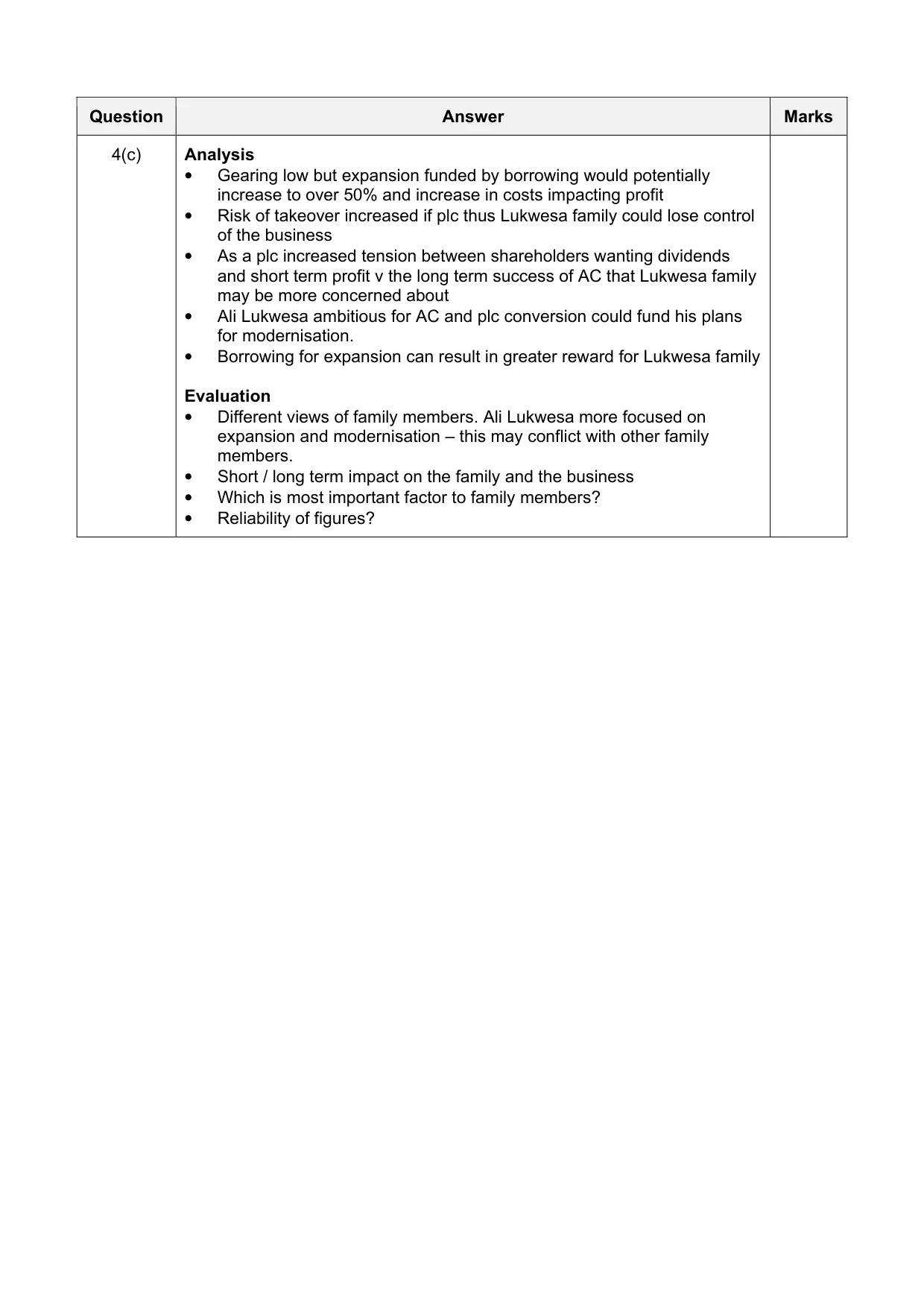
Question Answer Marks 4(c) Analysis • Gearing low but expansion funded by borrowing would potentially increase to over 50% and increase in costs impacting profit • Risk of takeover increased if plc thus Lukwesa family could lose control of the business • As a plc increased tension between shareholders wanting dividends and short term profit v the long term success of AC that Lukwesa family may be more concerned about • Ali Lukwesa ambitious for AC and plc conversion could fund his plans for modernisation. • Borrowing for expansion can result in greater reward for Lukwesa family Evaluation • Different views of family members. Ali Lukwesa more focused on expansion and modernisation – this may conflict with other family members. • Short / long term impact on the family and the business • Which is most important factor to family members? • Reliability of figures?
Mark scheme, page 14
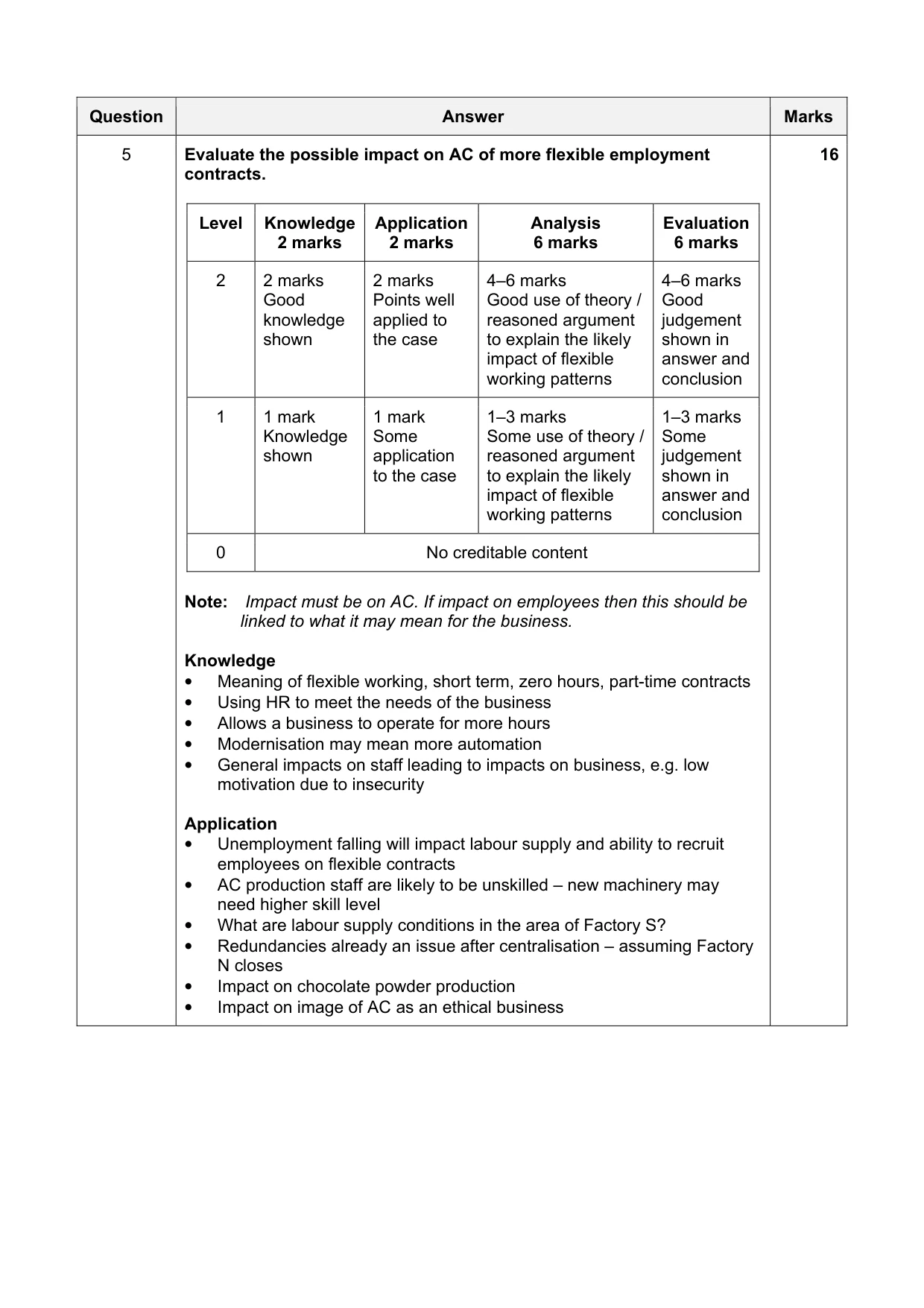
Question Answer Marks 5 Evaluate the possible impact on AC of more flexible employment contracts. Level Knowledge 2 marks Application 2 marks Analysis 6 marks Evaluation 6 marks 2 2 marks Good knowledge shown 2 marks Points well applied to the case 4–6 marks Good use of theory / reasoned argument to explain the likely impact of flexible working patterns 4–6 marks Good judgement shown in answer and conclusion 1 1 mark Knowledge shown 1 mark Some application to the case 1–3 marks Some use of theory / reasoned argument to explain the likely impact of flexible working patterns 1–3 marks Some judgement shown in answer and conclusion 0 No creditable content Note: Impact must be on AC. If impact on employees then this should be linked to what it may mean for the business. Knowledge • Meaning of flexible working, short term, zero hours, part-time contracts • Using HR to meet the needs of the business • Allows a business to operate for more hours • Modernisation may mean more automation • General impacts on staff leading to impacts on business, e.g. low motivation due to insecurity Application • Unemployment falling will impact labour supply and ability to recruit employees on flexible contracts • AC production staff are likely to be unskilled – new machinery may need higher skill level • What are labour supply conditions in the area of Factory S? • Redundancies already an issue after centralisation – assuming Factory N closes • Impact on chocolate powder production • Impact on image of AC as an ethical business 16
Mark scheme, page 15
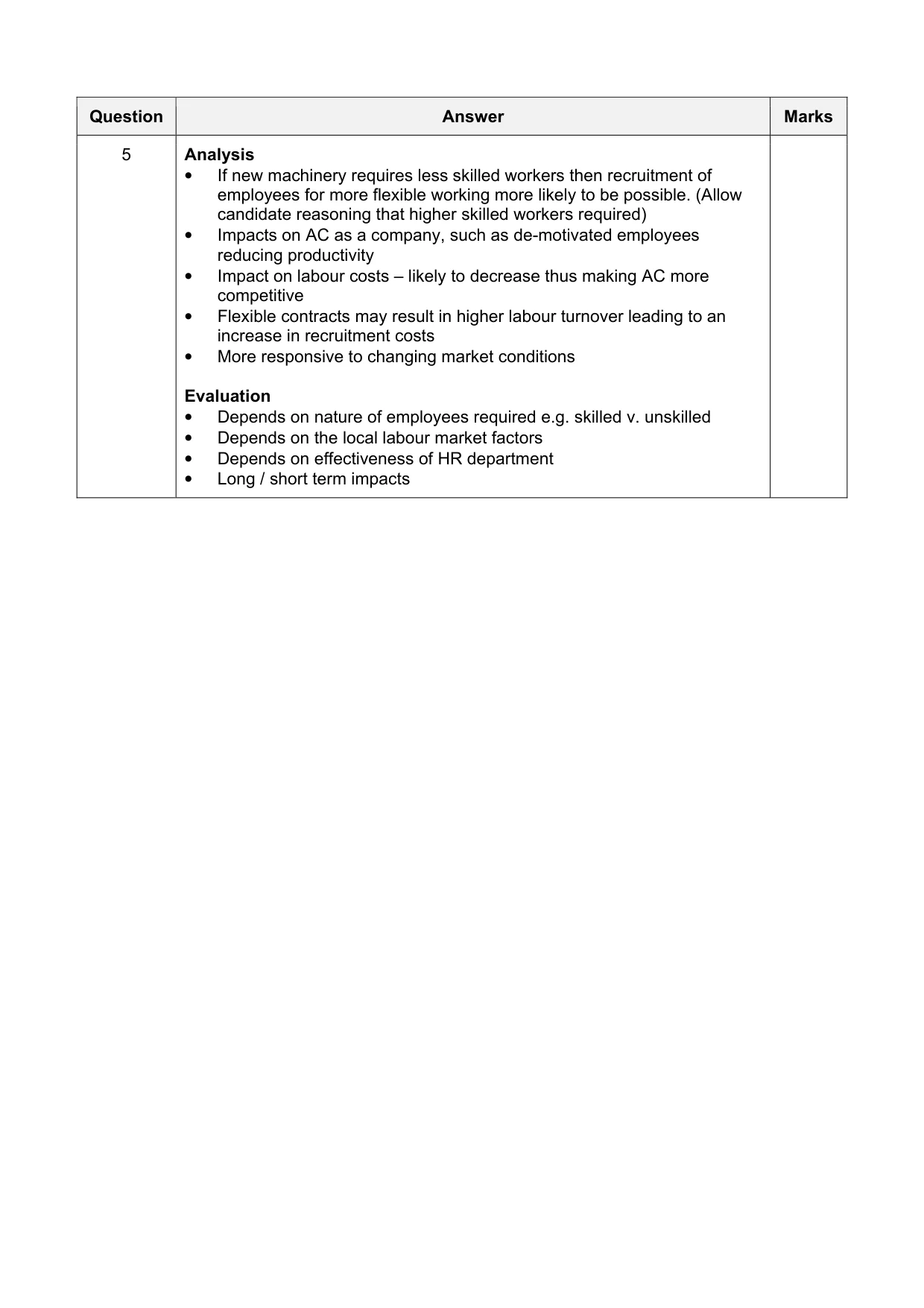
Question Answer Marks 5 Analysis • If new machinery requires less skilled workers then recruitment of employees for more flexible working more likely to be possible. (Allow candidate reasoning that higher skilled workers required) • Impacts on AC as a company, such as de-motivated employees reducing productivity • Impact on labour costs – likely to decrease thus making AC more competitive • Flexible contracts may result in higher labour turnover leading to an increase in recruitment costs • More responsive to changing market conditions Evaluation • Depends on nature of employees required e.g. skilled v. unskilled • Depends on the local labour market factors • Depends on effectiveness of HR department • Long / short term impacts
Mark scheme, page 16
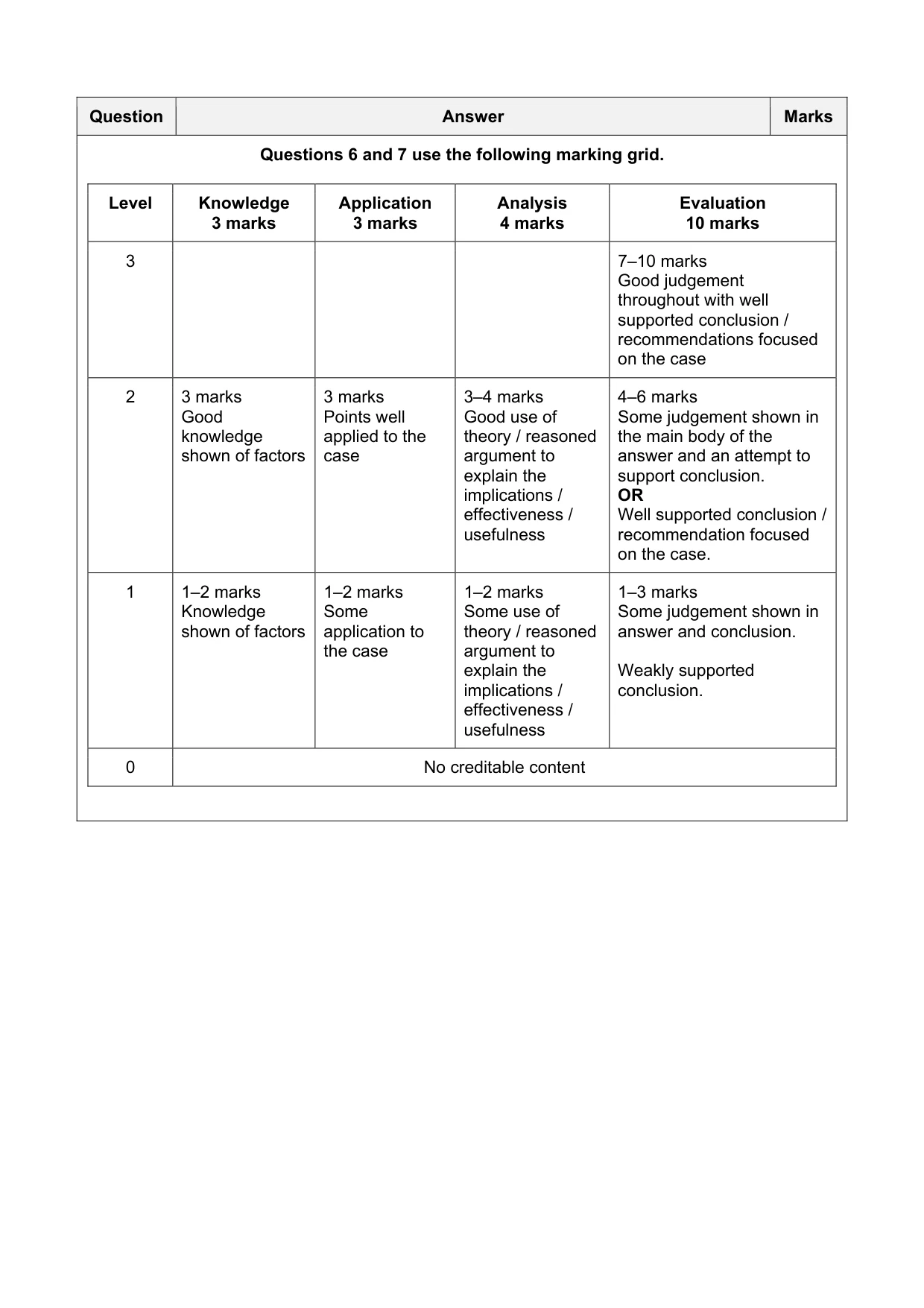
Question Answer Marks Questions 6 and 7 use the following marking grid. Level Knowledge 3 marks Application 3 marks Analysis 4 marks Evaluation 10 marks 3 7–10 marks Good judgement throughout with well supported conclusion / recommendations focused on the case 2 3 marks Good knowledge shown of factors 3 marks Points well applied to the case 3–4 marks Good use of theory / reasoned argument to explain the implications / effectiveness / usefulness 4–6 marks Some judgement shown in the main body of the answer and an attempt to support conclusion. OR Well supported conclusion / recommendation focused on the case. 1 1–2 marks Knowledge shown of factors 1–2 marks Some application to the case 1–2 marks Some use of theory / reasoned argument to explain the implications / effectiveness / usefulness 1–3 marks Some judgement shown in answer and conclusion. Weakly supported conclusion. 0 No creditable content
Mark scheme, page 17
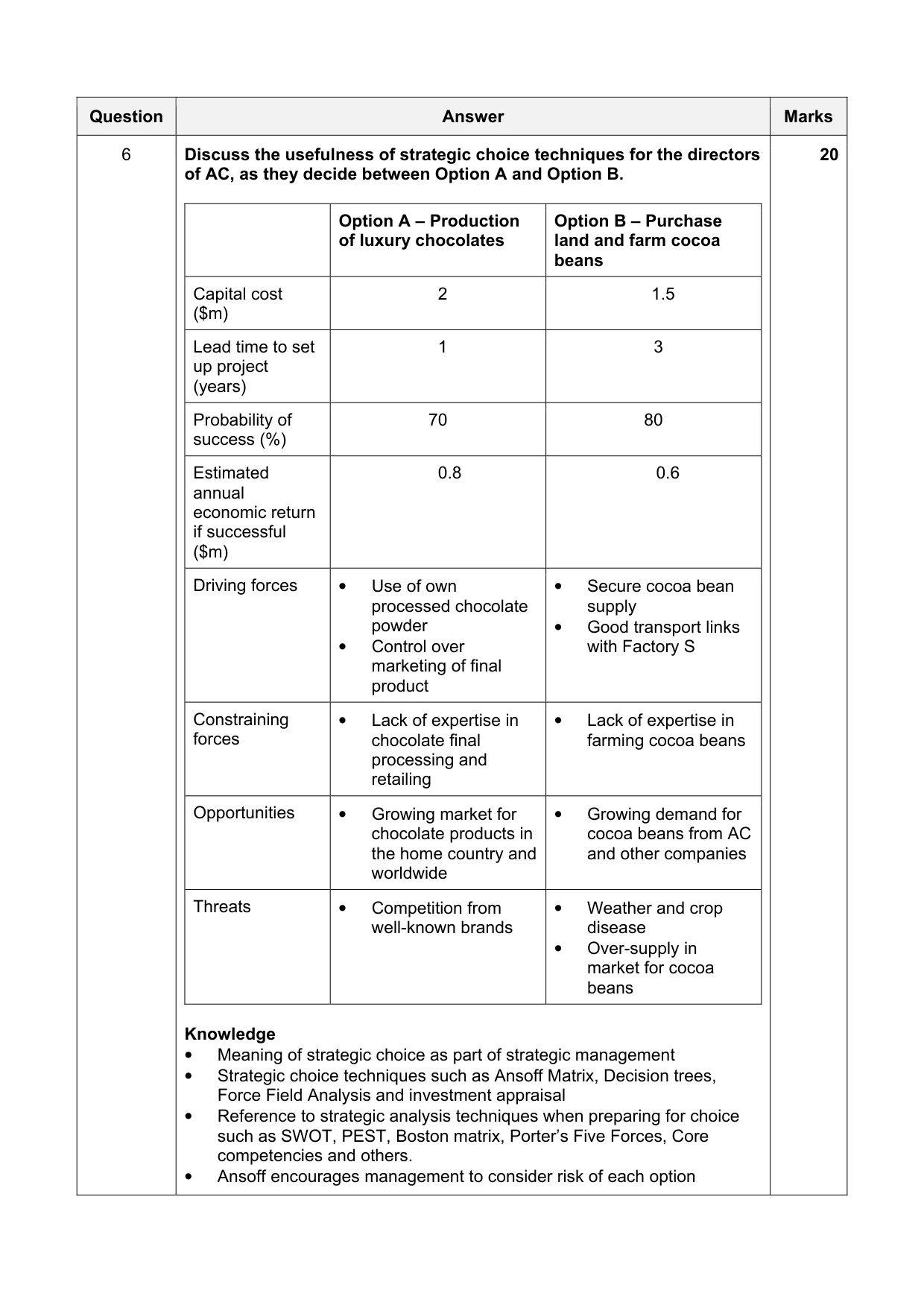
Question Answer Marks 6 Discuss the usefulness of strategic choice techniques for the directors of AC, as they decide between Option A and Option B. Option A – Production of luxury chocolates Option B – Purchase land and farm cocoa beans Capital cost ($m) 2 1.5 Lead time to set up project (years) 1 3 Probability of success (%) 70 80 Estimated annual economic return if successful ($m) 0.8 0.6 Driving forces • Use of own processed chocolate powder • Control over marketing of final product • Secure cocoa bean supply • Good transport links with Factory S Constraining forces • Lack of expertise in chocolate final processing and retailing • Lack of expertise in farming cocoa beans Opportunities • Growing market for chocolate products in the home country and worldwide • Growing demand for cocoa beans from AC and other companies Threats • Competition from well-known brands • Weather and crop disease • Over-supply in market for cocoa beans Knowledge • Meaning of strategic choice as part of strategic management • Strategic choice techniques such as Ansoff Matrix, Decision trees, Force Field Analysis and investment appraisal • Reference to strategic analysis techniques when preparing for choice such as SWOT, PEST, Boston matrix, Porter’s Five Forces, Core competencies and others. • Ansoff encourages management to consider risk of each option 20
Mark scheme, page 18
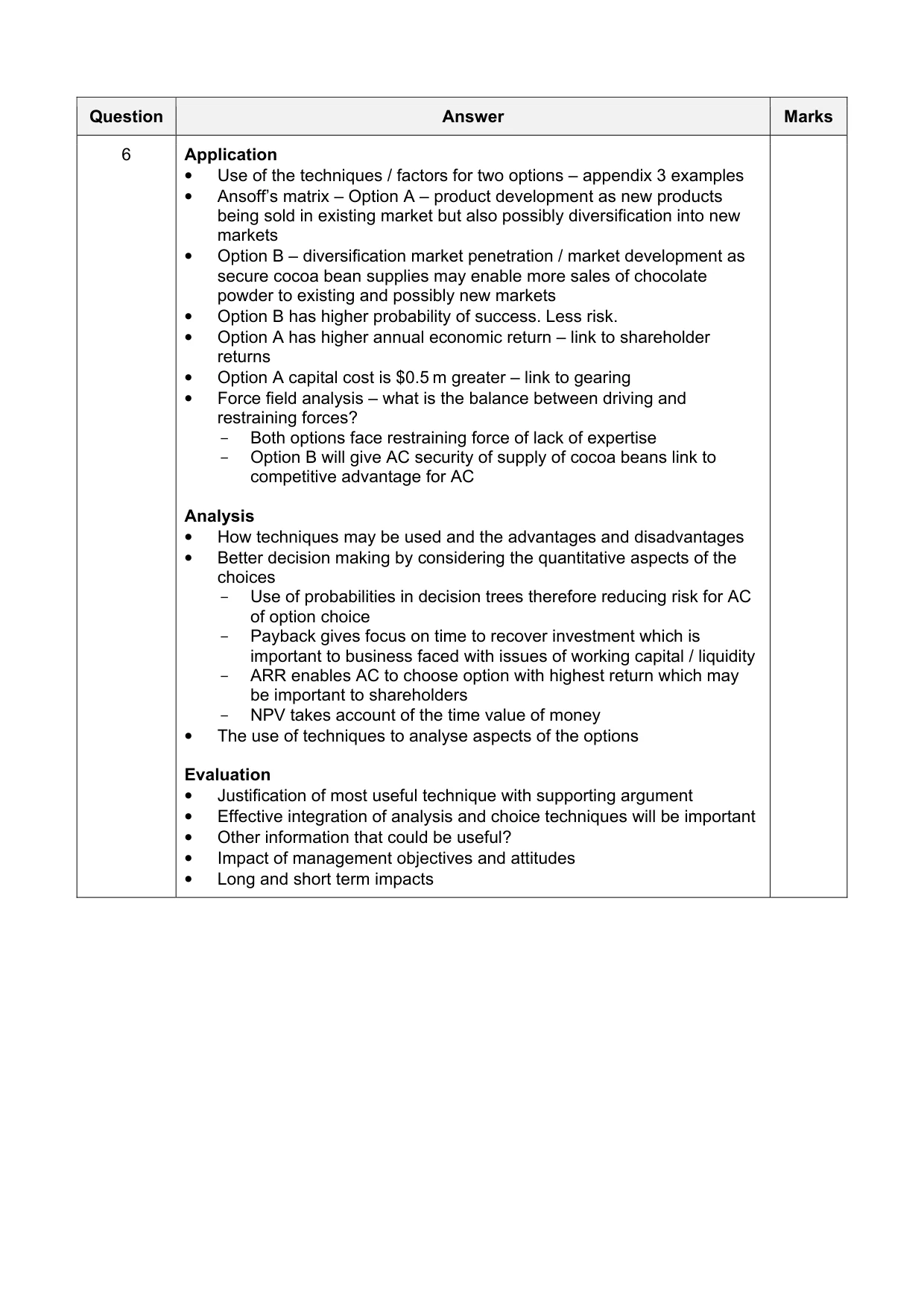
Question Answer Marks 6 Application • Use of the techniques / factors for two options – appendix 3 examples • Ansoff’s matrix – Option A – product development as new products being sold in existing market but also possibly diversification into new markets • Option B – diversification market penetration / market development as secure cocoa bean supplies may enable more sales of chocolate powder to existing and possibly new markets • Option B has higher probability of success. Less risk. • Option A has higher annual economic return – link to shareholder returns • Option A capital cost is $0.5 m greater – link to gearing • Force field analysis – what is the balance between driving and restraining forces? - Both options face restraining force of lack of expertise - Option B will give AC security of supply of cocoa beans link to competitive advantage for AC Analysis • How techniques may be used and the advantages and disadvantages • Better decision making by considering the quantitative aspects of the choices - Use of probabilities in decision trees therefore reducing risk for AC of option choice - Payback gives focus on time to recover investment which is important to business faced with issues of working capital / liquidity - ARR enables AC to choose option with highest return which may be important to shareholders - NPV takes account of the time value of money • The use of techniques to analyse aspects of the options Evaluation • Justification of most useful technique with supporting argument • Effective integration of analysis and choice techniques will be important • Other information that could be useful? • Impact of management objectives and attitudes • Long and short term impacts
Mark scheme, page 19
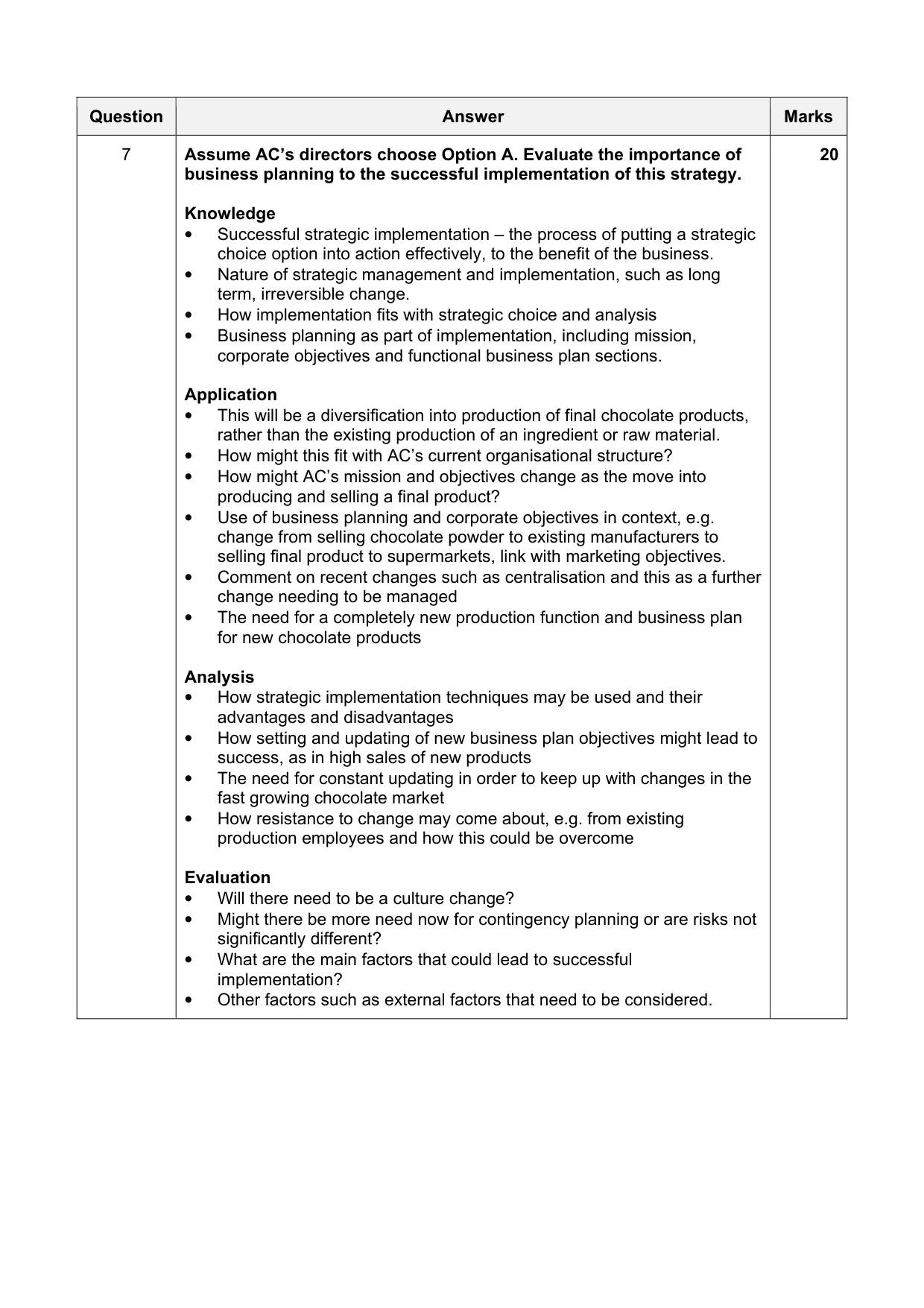
Question Answer Marks 7 Assume AC’s directors choose Option A. Evaluate the importance of business planning to the successful implementation of this strategy. Knowledge • Successful strategic implementation – the process of putting a strategic choice option into action effectively, to the benefit of the business. • Nature of strategic management and implementation, such as long term, irreversible change. • How implementation fits with strategic choice and analysis • Business planning as part of implementation, including mission, corporate objectives and functional business plan sections. Application • This will be a diversification into production of final chocolate products, rather than the existing production of an ingredient or raw material. • How might this fit with AC’s current organisational structure? • How might AC’s mission and objectives change as the move into producing and selling a final product? • Use of business planning and corporate objectives in context, e.g. change from selling chocolate powder to existing manufacturers to selling final product to supermarkets, link with marketing objectives. • Comment on recent changes such as centralisation and this as a further change needing to be managed • The need for a completely new production function and business plan for new chocolate products Analysis • How strategic implementation techniques may be used and their advantages and disadvantages • How setting and updating of new business plan objectives might lead to success, as in high sales of new products • The need for constant updating in order to keep up with changes in the fast growing chocolate market • How resistance to change may come about, e.g. from existing production employees and how this could be overcome Evaluation • Will there need to be a culture change? • Might there be more need now for contingency planning or are risks not significantly different? • What are the main factors that could lead to successful implementation? • Other factors such as external factors that need to be considered. 20
What you needed in this session
Cambridge’s own grade thresholds for 2019 May/June, Paper 3 · Variant 3. A higher threshold means an easier paper — the bar moves with how the cohort did.