Cambridge A Level Business (for first examination in 2016) 9609 — 2019 May/June Paper 3 · Variant 1
9609/31/M/J/19 · 100 marks · ≈113 min
The question paper and its mark scheme, free to read here and free to download. This is Cambridge’s own paper, exactly as it was sat.
Question paper20 pages



















Mark scheme16 pages
Answers below. Sit the paper first if you are practising.
Paper as text
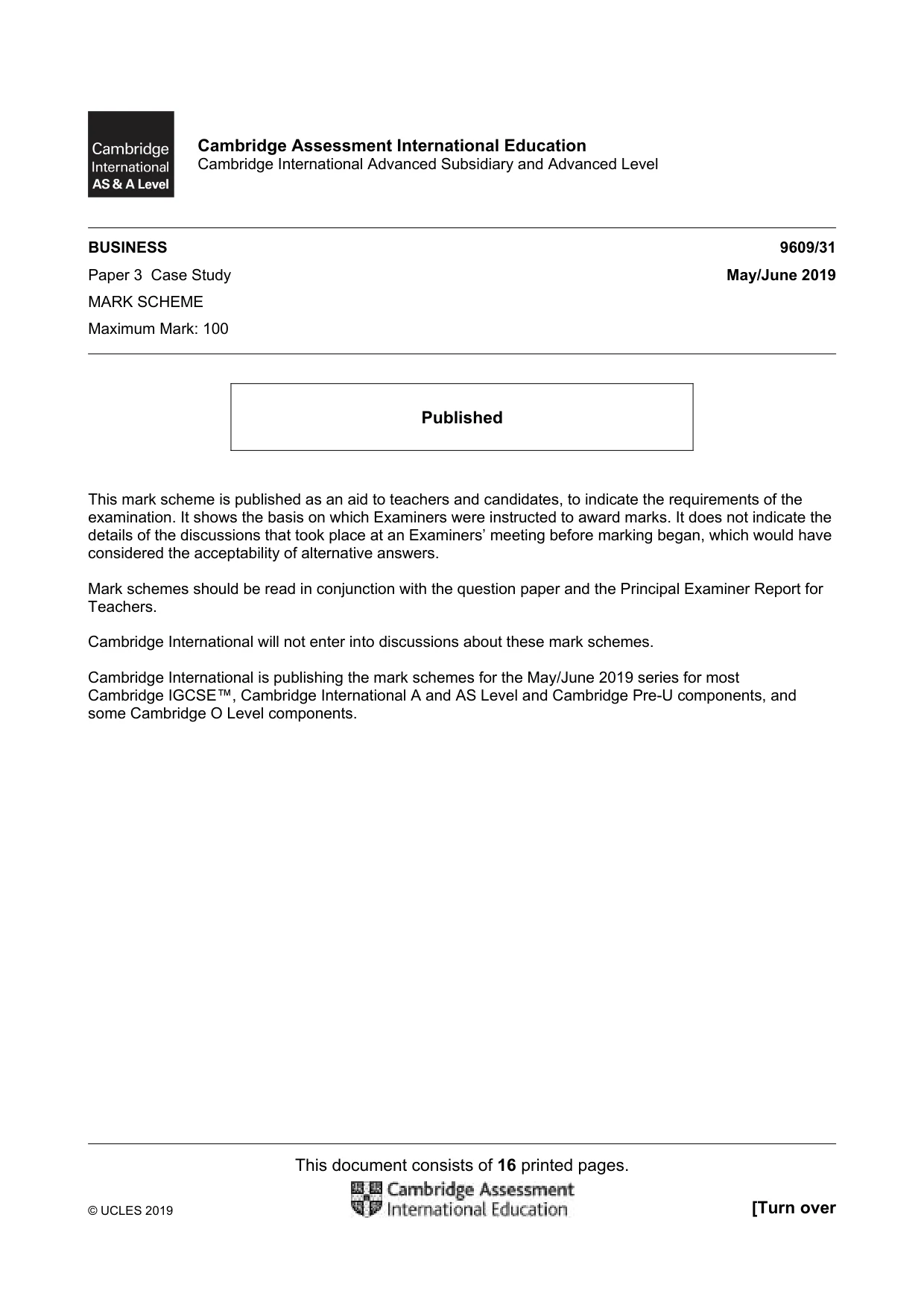
Question paper, page 1
This document consists of 20 printed pages and 1 Insert. DC (ST) 169866/2 © UCLES 2019 [Turn over * 8 7 2 3 7 0 5 0 5 3 * BUSINESS 9609/31 Paper 3 Case Study May/June 2019 3 hours Candidates answer on the Question Paper. No Additional Materials are required. READ THESE INSTRUCTIONS FIRST Write your centre number, candidate number and name in the spaces at the top of this page. If you need additional answer paper ask the invigilator for a continuation booklet. Write in dark blue or black pen. You may use an HB pencil for any diagrams, graphs or rough working. Do not use staples, paper clips, glue or correction fluid. DO NOT WRITE IN ANY BARCODES. Section A Answer all questions. Section B Answer one question. You are advised to spend no more than 40 minutes on Section B. Refer to the Insert for the case study for this Paper. At the end of the examination, fasten all your work securely together. The number of marks is given in brackets [ ] at the end of each question or part question. Cambridge Assessment International Education Cambridge International Advanced Subsidiary and Advanced Level
Question paper, page 2
2 9609/31/M/J/19 © UCLES 2019 Section A Answer all questions in this section. 1 Analyse the benefits to BSJ of implementing a corporate social responsibility policy for the purchase of raw materials. … … … … … … … … … … … … … … … … … … … … … … … … …
Question paper, page 3
3 9609/31/M/J/19 © UCLES 2019 [Turn over … … … … … … … … … … … … … … … … … … … … … … … … … … … … [10]
Question paper, page 4
4 9609/31/M/J/19 © UCLES 2019 2 Refer to Table 1. (a) Construct a network diagram, including the earliest start times (EST) and latest finishing times (LFT) of all the activities. [6]
Question paper, page 5
5 9609/31/M/J/19 © UCLES 2019 [Turn over (b) Calculate the following: (i) minimum project duration … … … [1] (ii) free float for activity D. … … … … … … [2]
Question paper, page 6
6 9609/31/M/J/19 © UCLES 2019 (c) BSJ currently has problems meeting deadlines for jewellery trade fairs (lines 36–42). Evaluate the usefulness of critical path analysis to BSJ in helping the company meet these deadlines. … … … … … … … … … … … … … … … … … … … … … … … … … …
Question paper, page 7
7 9609/31/M/J/19 © UCLES 2019 [Turn over … … … … … … … … … … … … … … … … … … … … … … … … … … … … [12]
Question paper, page 8
8 9609/31/M/J/19 © UCLES 2019 3 Discuss whether improving internal communication will be enough to ensure BSJ overcomes its quality problems. … … … … … … … … … … … … … … … … … … … … … … … … … … …
Question paper, page 9
9 9609/31/M/J/19 © UCLES 2019 [Turn over … … … … … … … … … … … … … … … … … … … … … … … … … … … …
Question paper, page 10
10 9609/31/M/J/19 © UCLES 2019 … … … … … … … … … … … … … … … … … … … … … … … … … … … … [16]
Question paper, page 11
11 9609/31/M/J/19 © UCLES 2019 [Turn over 4 (a) Refer to Appendix 1. Calculate the following: (i) gearing ratio … … … … … … [2] (ii) return on capital employed. … … … … … … … … … [3]
Question paper, page 12
12 9609/31/M/J/19 © UCLES 2019 (b) Refer to your answer to 4(a) and any other information. Recommend whether BSJ’s shareholders should accept the takeover offer from Gonfo. Justify your recommendation. … … … … … … … … … … … … … … … … … … … … … … … … … … …
Question paper, page 13
13 9609/31/M/J/19 © UCLES 2019 [Turn over … … … … … … … … … … … … … … … … … … … … … … … … … … … … [12]
Question paper, page 14
14 9609/31/M/J/19 © UCLES 2019 5 Discuss the factors which will influence the method of entry into international markets if Option A is chosen. … … … … … … … … … … … … … … … … … … … … … … … … … … …
Question paper, page 15
15 9609/31/M/J/19 © UCLES 2019 [Turn over … … … … … … … … … … … … … … … … … … … … … … … … … … … …
Question paper, page 16
16 9609/31/M/J/19 © UCLES 2019 … … … … … … … … … … … … … … … … … … … … … … … … … … … … [16]
Question paper, page 17
17 9609/31/M/J/19 © UCLES 2019 [Turn over Section B Answer one question in this section. 6 Evaluate the usefulness of strategic analysis techniques, other than SWOT analysis, to BSJ’s directors as they consider Option A and Option B. 7 Assume the directors choose Option B. Discuss the importance to BSJ of effective strategic implementation of this option. Write the question number here: … … … … … … … … … … … … … … … … … … … … … … … …
Question paper, page 18
18 9609/31/M/J/19 © UCLES 2019 … … … … … … … … … … … … … … … … … … … … … … … … … … … … …
Question paper, page 19
19 9609/31/M/J/19 © UCLES 2019 [Turn over … … … … … … … … … … … … … … … … … … … … … … … … … … … … …
Question paper, page 20
20 9609/31/M/J/19 © UCLES 2019 Permission to reproduce items where third-party owned material protected by copyright is included has been sought and cleared where possible. Every reasonable effort has been made by the publisher (UCLES) to trace copyright holders, but if any items requiring clearance have unwittingly been included, the publisher will be pleased to make amends at the earliest possible opportunity. To avoid the issue of disclosure of answer-related information to candidates, all copyright acknowledgements are reproduced online in the Cambridge Assessment International Education Copyright Acknowledgements Booklet. This is produced for each series of examinations and is freely available to download at www.cambridgeinternational.org after the live examination series. Cambridge Assessment International Education is part of the Cambridge Assessment Group. Cambridge Assessment is the brand name of the University of Cambridge Local Examinations Syndicate (UCLES), which itself is a department of the University of Cambridge. … … … … … … … … … … … … … … … … … … … … … … … … … [20]
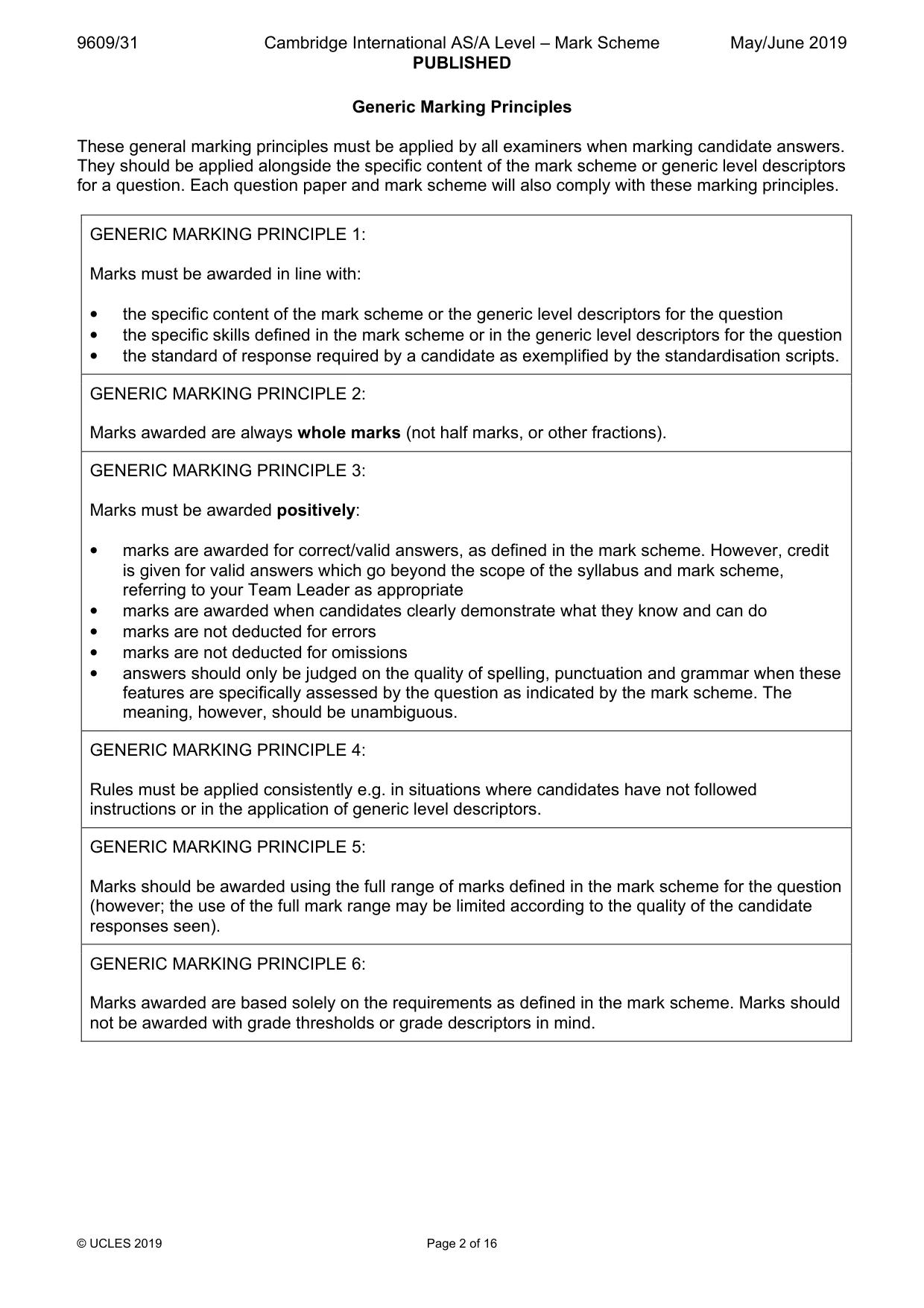
Mark scheme, page 1
This document consists of 16 printed pages. © UCLES 2019 [Turn over Cambridge Assessment International Education Cambridge International Advanced Subsidiary and Advanced Level BUSINESS 9609/31 Paper 3 Case Study May/June 2019 MARK SCHEME Maximum Mark: 100 Published This mark scheme is published as an aid to teachers and candidates, to indicate the requirements of the examination. It shows the basis on which Examiners were instructed to award marks. It does not indicate the details of the discussions that took place at an Examiners’ meeting before marking began, which would have considered the acceptability of alternative answers. Mark schemes should be read in conjunction with the question paper and the Principal Examiner Report for Teachers. Cambridge International will not enter into discussions about these mark schemes. Cambridge International is publishing the mark schemes for the May/June 2019 series for most Cambridge IGCSE™, Cambridge International A and AS Level and Cambridge Pre-U components, and some Cambridge O Level components.
Mark scheme, page 2
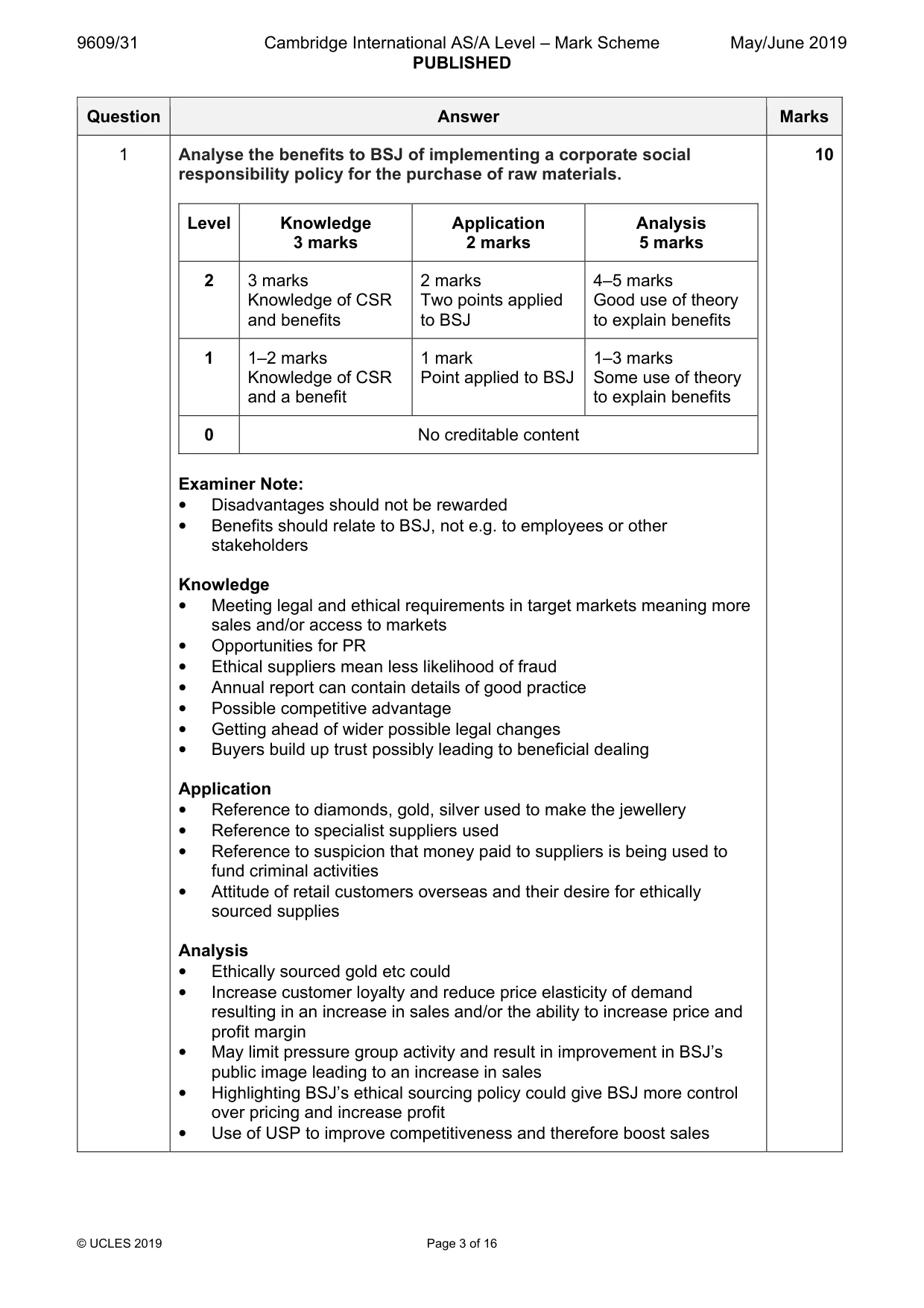
9609/31 Cambridge International AS/A Level – Mark Scheme PUBLISHED May/June 2019 © UCLES 2019 Page 2 of 16 Generic Marking Principles These general marking principles must be applied by all examiners when marking candidate answers. They should be applied alongside the specific content of the mark scheme or generic level descriptors for a question. Each question paper and mark scheme will also comply with these marking principles. GENERIC MARKING PRINCIPLE 1: Marks must be awarded in line with: • the specific content of the mark scheme or the generic level descriptors for the question • the specific skills defined in the mark scheme or in the generic level descriptors for the question • the standard of response required by a candidate as exemplified by the standardisation scripts. GENERIC MARKING PRINCIPLE 2: Marks awarded are always whole marks (not half marks, or other fractions). GENERIC MARKING PRINCIPLE 3: Marks must be awarded positively: • marks are awarded for correct/valid answers, as defined in the mark scheme. However, credit is given for valid answers which go beyond the scope of the syllabus and mark scheme, referring to your Team Leader as appropriate • marks are awarded when candidates clearly demonstrate what they know and can do • marks are not deducted for errors • marks are not deducted for omissions • answers should only be judged on the quality of spelling, punctuation and grammar when these features are specifically assessed by the question as indicated by the mark scheme. The meaning, however, should be unambiguous. GENERIC MARKING PRINCIPLE 4: Rules must be applied consistently e.g. in situations where candidates have not followed instructions or in the application of generic level descriptors. GENERIC MARKING PRINCIPLE 5: Marks should be awarded using the full range of marks defined in the mark scheme for the question (however; the use of the full mark range may be limited according to the quality of the candidate responses seen). GENERIC MARKING PRINCIPLE 6: Marks awarded are based solely on the requirements as defined in the mark scheme. Marks should not be awarded with grade thresholds or grade descriptors in mind.
Mark scheme, page 3
9609/31 Cambridge International AS/A Level – Mark Scheme PUBLISHED May/June 2019 © UCLES 2019 Page 3 of 16 Question Answer Marks 1 Analyse the benefits to BSJ of implementing a corporate social responsibility policy for the purchase of raw materials. Level Knowledge 3 marks Application 2 marks Analysis 5 marks 2 3 marks Knowledge of CSR and benefits 2 marks Two points applied to BSJ 4–5 marks Good use of theory to explain benefits 1 1–2 marks Knowledge of CSR and a benefit 1 mark Point applied to BSJ 1–3 marks Some use of theory to explain benefits 0 No creditable content Examiner Note: • Disadvantages should not be rewarded • Benefits should relate to BSJ, not e.g. to employees or other stakeholders Knowledge • Meeting legal and ethical requirements in target markets meaning more sales and/or access to markets • Opportunities for PR • Ethical suppliers mean less likelihood of fraud • Annual report can contain details of good practice • Possible competitive advantage • Getting ahead of wider possible legal changes • Buyers build up trust possibly leading to beneficial dealing Application • Reference to diamonds, gold, silver used to make the jewellery • Reference to specialist suppliers used • Reference to suspicion that money paid to suppliers is being used to fund criminal activities • Attitude of retail customers overseas and their desire for ethically sourced supplies Analysis • Ethically sourced gold etc could • Increase customer loyalty and reduce price elasticity of demand resulting in an increase in sales and/or the ability to increase price and profit margin • May limit pressure group activity and result in improvement in BSJ’s public image leading to an increase in sales • Highlighting BSJ’s ethical sourcing policy could give BSJ more control over pricing and increase profit • Use of USP to improve competitiveness and therefore boost sales 10
Mark scheme, page 4
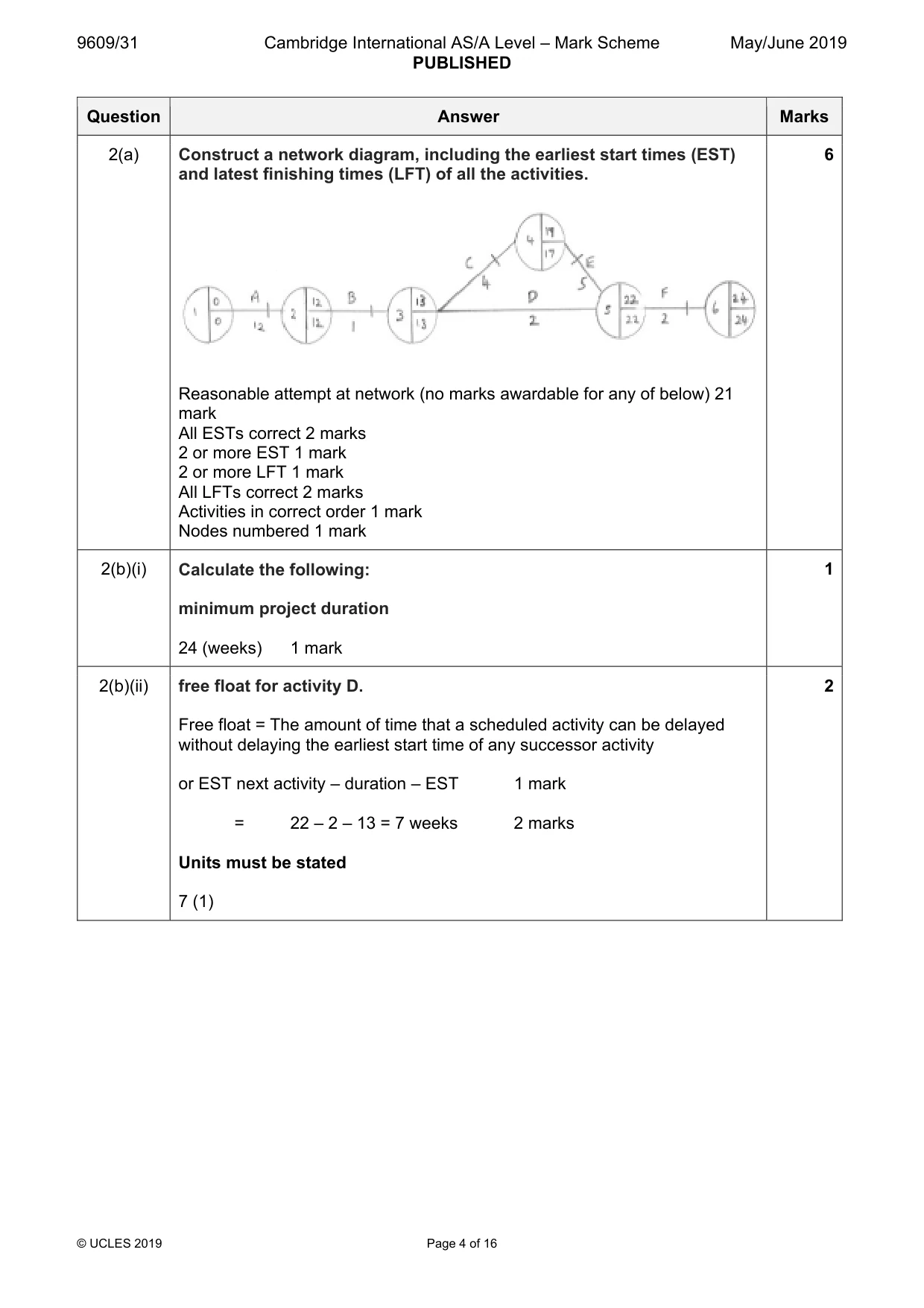
9609/31 Cambridge International AS/A Level – Mark Scheme PUBLISHED May/June 2019 © UCLES 2019 Page 4 of 16 Question Answer Marks 2(a) Construct a network diagram, including the earliest start times (EST) and latest finishing times (LFT) of all the activities. Reasonable attempt at network (no marks awardable for any of below) 21 mark All ESTs correct 2 marks 2 or more EST 1 mark 2 or more LFT 1 mark All LFTs correct 2 marks Activities in correct order 1 mark Nodes numbered 1 mark 6 2(b)(i) Calculate the following: minimum project duration 24 (weeks) 1 mark 1 2(b)(ii) free float for activity D. Free float = The amount of time that a scheduled activity can be delayed without delaying the earliest start time of any successor activity or EST next activity – duration – EST 1 mark = 22 – 2 – 13 = 7 weeks 2 marks Units must be stated 7 (1) 2
Mark scheme, page 5
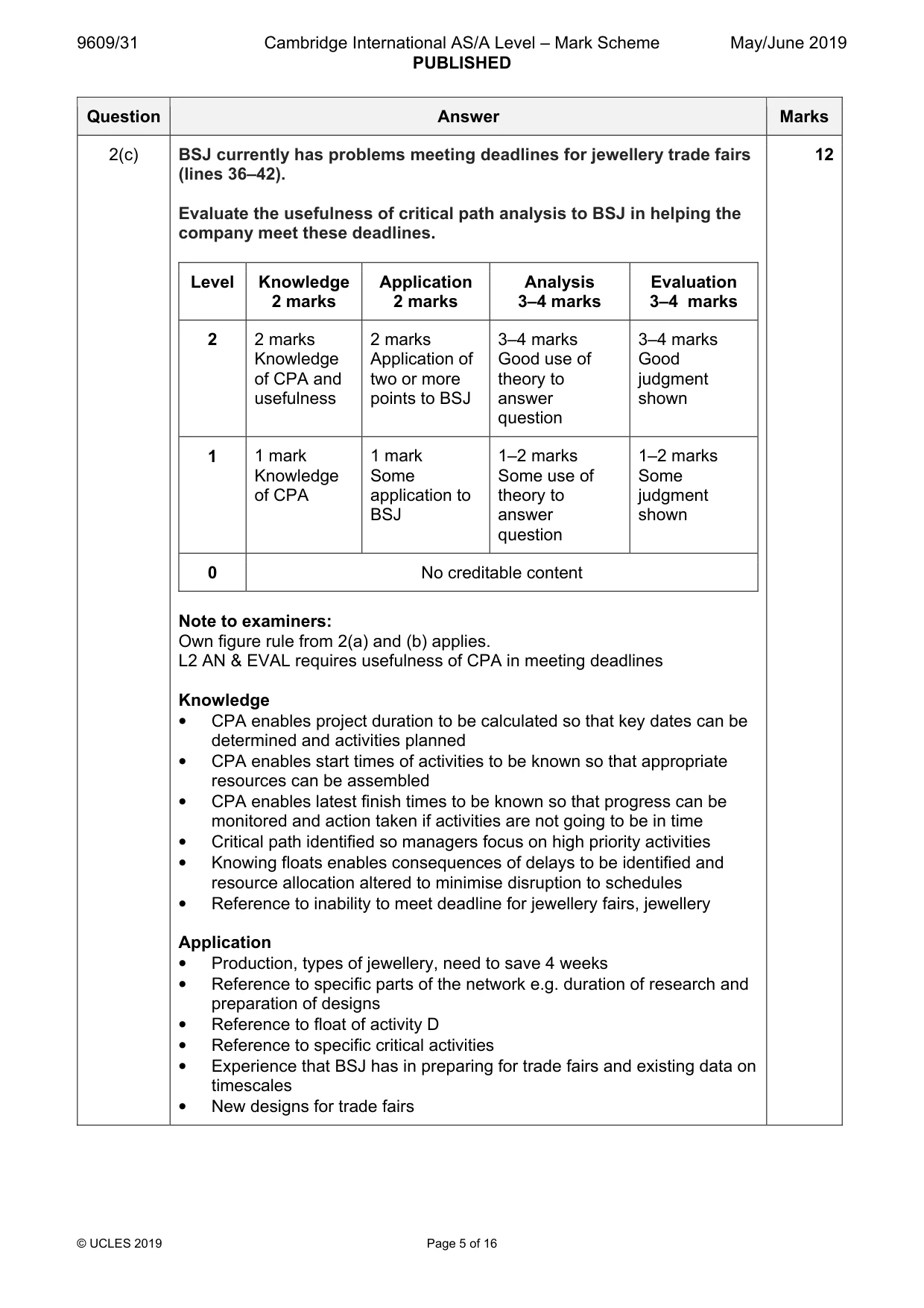
9609/31 Cambridge International AS/A Level – Mark Scheme PUBLISHED May/June 2019 © UCLES 2019 Page 5 of 16 Question Answer Marks 2(c) BSJ currently has problems meeting deadlines for jewellery trade fairs (lines 36–42). Evaluate the usefulness of critical path analysis to BSJ in helping the company meet these deadlines. Level Knowledge 2 marks Application 2 marks Analysis 3–4 marks Evaluation 3–4 marks 2 2 marks Knowledge of CPA and usefulness 2 marks Application of two or more points to BSJ 3–4 marks Good use of theory to answer question 3–4 marks Good judgment shown 1 1 mark Knowledge of CPA 1 mark Some application to BSJ 1–2 marks Some use of theory to answer question 1–2 marks Some judgment shown 0 No creditable content Note to examiners: Own figure rule from 2(a) and (b) applies. L2 AN & EVAL requires usefulness of CPA in meeting deadlines Knowledge • CPA enables project duration to be calculated so that key dates can be determined and activities planned • CPA enables start times of activities to be known so that appropriate resources can be assembled • CPA enables latest finish times to be known so that progress can be monitored and action taken if activities are not going to be in time • Critical path identified so managers focus on high priority activities • Knowing floats enables consequences of delays to be identified and resource allocation altered to minimise disruption to schedules • Reference to inability to meet deadline for jewellery fairs, jewellery Application • Production, types of jewellery, need to save 4 weeks • Reference to specific parts of the network e.g. duration of research and preparation of designs • Reference to float of activity D • Reference to specific critical activities • Experience that BSJ has in preparing for trade fairs and existing data on timescales • New designs for trade fairs 12
Mark scheme, page 6
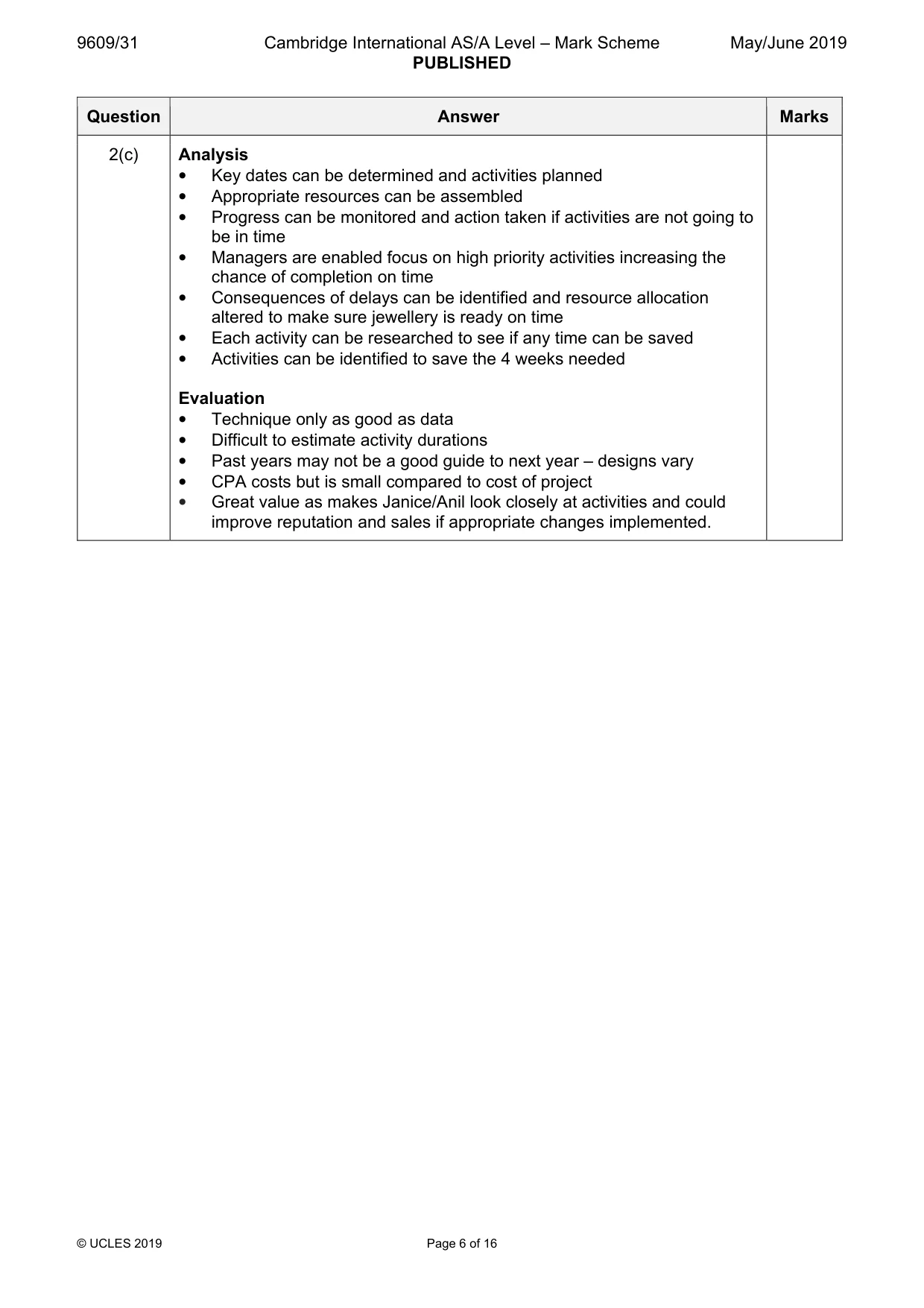
9609/31 Cambridge International AS/A Level – Mark Scheme PUBLISHED May/June 2019 © UCLES 2019 Page 6 of 16 Question Answer Marks 2(c) Analysis • Key dates can be determined and activities planned • Appropriate resources can be assembled • Progress can be monitored and action taken if activities are not going to be in time • Managers are enabled focus on high priority activities increasing the chance of completion on time • Consequences of delays can be identified and resource allocation altered to make sure jewellery is ready on time • Each activity can be researched to see if any time can be saved • Activities can be identified to save the 4 weeks needed Evaluation • Technique only as good as data • Difficult to estimate activity durations • Past years may not be a good guide to next year – designs vary • CPA costs but is small compared to cost of project • Great value as makes Janice/Anil look closely at activities and could improve reputation and sales if appropriate changes implemented.
Mark scheme, page 7
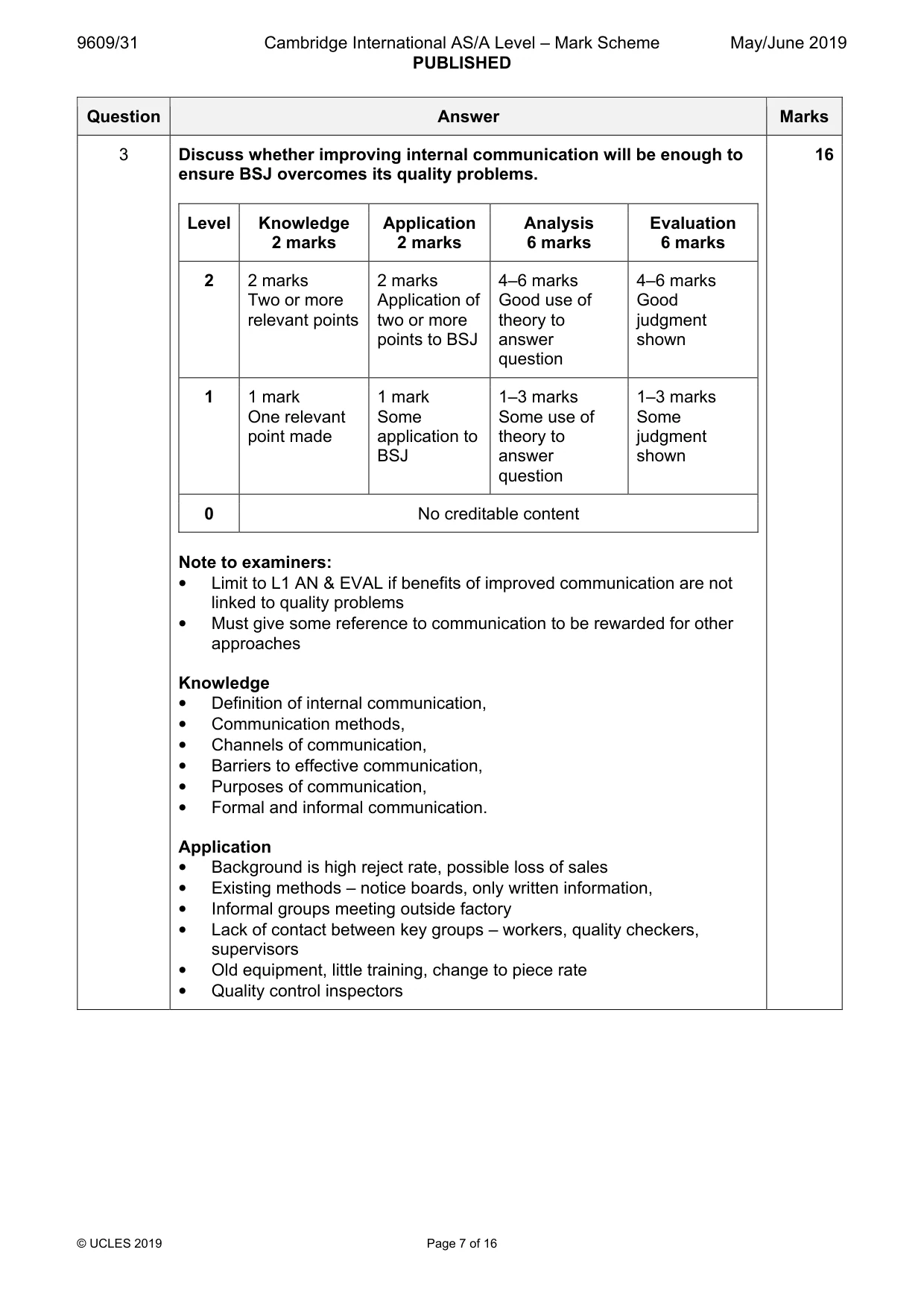
9609/31 Cambridge International AS/A Level – Mark Scheme PUBLISHED May/June 2019 © UCLES 2019 Page 7 of 16 Question Answer Marks 3 Discuss whether improving internal communication will be enough to ensure BSJ overcomes its quality problems. Level Knowledge 2 marks Application 2 marks Analysis 6 marks Evaluation 6 marks 2 2 marks Two or more relevant points 2 marks Application of two or more points to BSJ 4–6 marks Good use of theory to answer question 4–6 marks Good judgment shown 1 1 mark One relevant point made 1 mark Some application to BSJ 1–3 marks Some use of theory to answer question 1–3 marks Some judgment shown 0 No creditable content Note to examiners: • Limit to L1 AN & EVAL if benefits of improved communication are not linked to quality problems • Must give some reference to communication to be rewarded for other approaches Knowledge • Definition of internal communication, • Communication methods, • Channels of communication, • Barriers to effective communication, • Purposes of communication, • Formal and informal communication. Application • Background is high reject rate, possible loss of sales • Existing methods – notice boards, only written information, • Informal groups meeting outside factory • Lack of contact between key groups – workers, quality checkers, supervisors • Old equipment, little training, change to piece rate • Quality control inspectors 16
Mark scheme, page 8
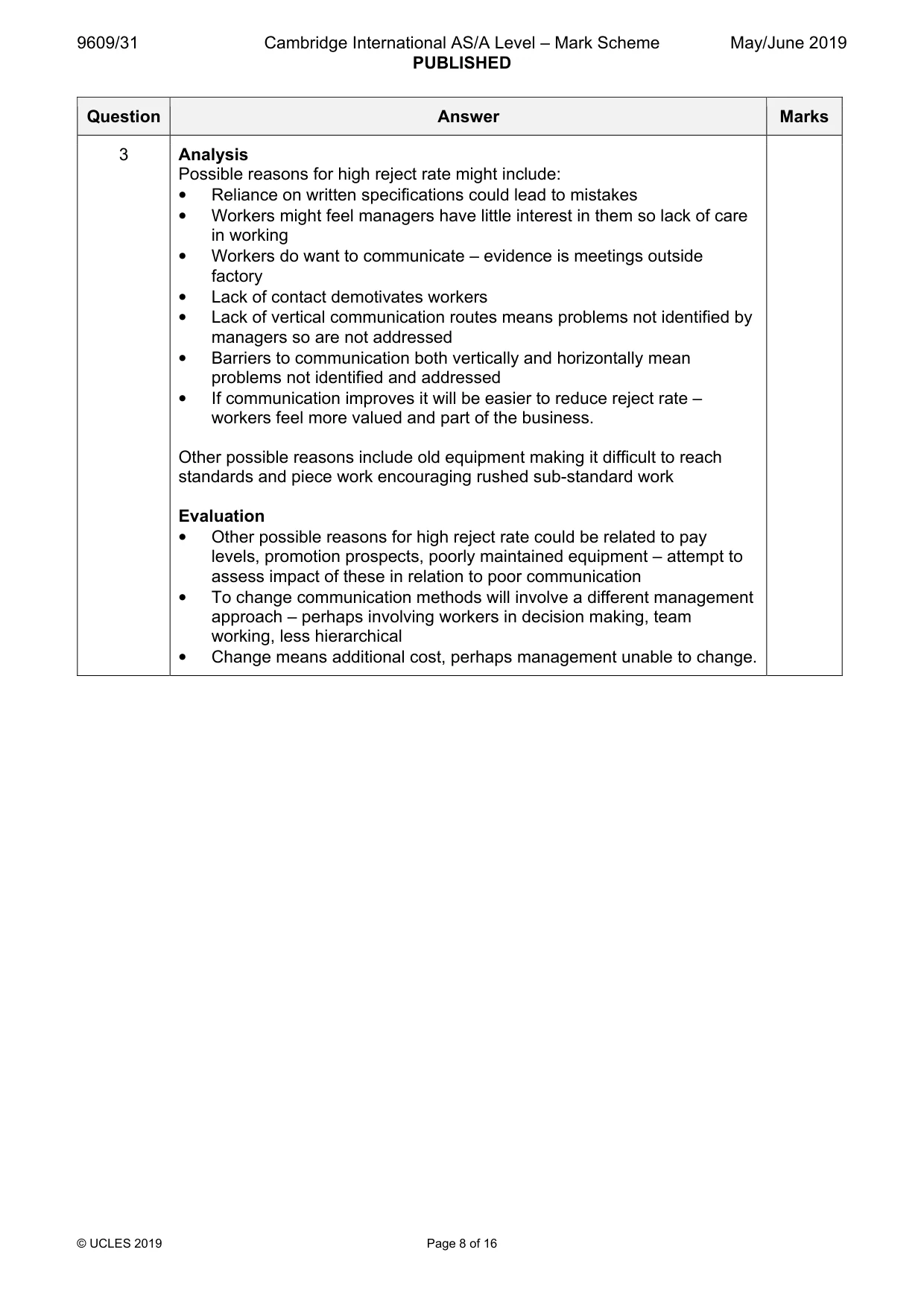
9609/31 Cambridge International AS/A Level – Mark Scheme PUBLISHED May/June 2019 © UCLES 2019 Page 8 of 16 Question Answer Marks 3 Analysis Possible reasons for high reject rate might include: • Reliance on written specifications could lead to mistakes • Workers might feel managers have little interest in them so lack of care in working • Workers do want to communicate – evidence is meetings outside factory • Lack of contact demotivates workers • Lack of vertical communication routes means problems not identified by managers so are not addressed • Barriers to communication both vertically and horizontally mean problems not identified and addressed • If communication improves it will be easier to reduce reject rate – workers feel more valued and part of the business. Other possible reasons include old equipment making it difficult to reach standards and piece work encouraging rushed sub-standard work Evaluation • Other possible reasons for high reject rate could be related to pay levels, promotion prospects, poorly maintained equipment – attempt to assess impact of these in relation to poor communication • To change communication methods will involve a different management approach – perhaps involving workers in decision making, team working, less hierarchical • Change means additional cost, perhaps management unable to change.
Mark scheme, page 9
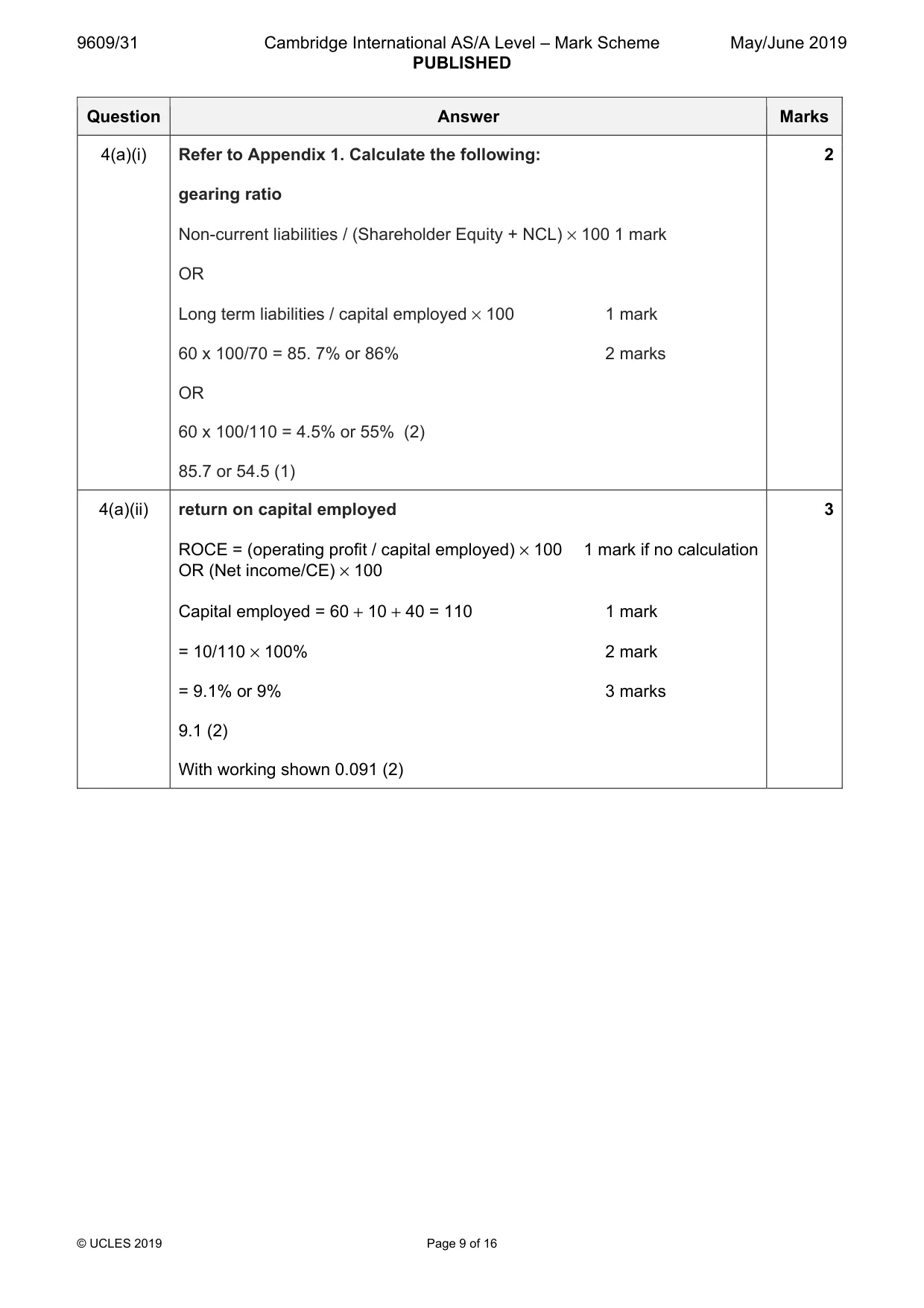
9609/31 Cambridge International AS/A Level – Mark Scheme PUBLISHED May/June 2019 © UCLES 2019 Page 9 of 16 Question Answer Marks 4(a)(i) Refer to Appendix 1. Calculate the following: gearing ratio Non-current liabilities / (Shareholder Equity + NCL) × 100 1 mark OR Long term liabilities / capital employed × 100 1 mark 60 x 100/70 = 85. 7% or 86% 2 marks OR 60 x 100/110 = 4.5% or 55% (2) 85.7 or 54.5 (1) 2 4(a)(ii) return on capital employed ROCE = (operating profit / capital employed) × 100 1 mark if no calculation OR (Net income/CE) × 100 Capital employed = 60 + 10 + 40 = 110 1 mark = 10/110 × 100% 2 mark = 9.1% or 9% 3 marks 9.1 (2) With working shown 0.091 (2) 3
Mark scheme, page 10
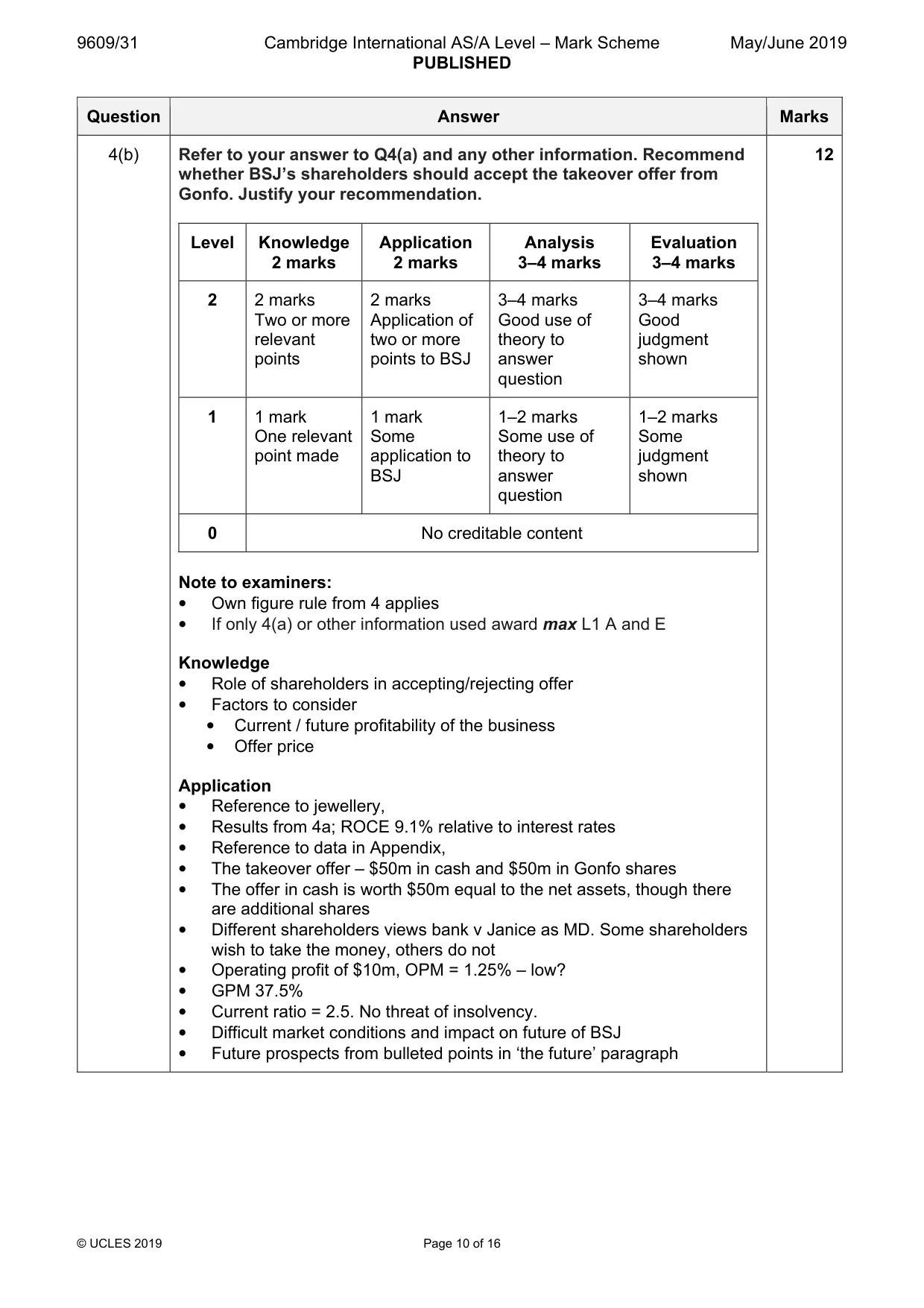
9609/31 Cambridge International AS/A Level – Mark Scheme PUBLISHED May/June 2019 © UCLES 2019 Page 10 of 16 Question Answer Marks 4(b) Refer to your answer to Q4(a) and any other information. Recommend whether BSJ’s shareholders should accept the takeover offer from Gonfo. Justify your recommendation. Level Knowledge 2 marks Application 2 marks Analysis 3–4 marks Evaluation 3–4 marks 2 2 marks Two or more relevant points 2 marks Application of two or more points to BSJ 3–4 marks Good use of theory to answer question 3–4 marks Good judgment shown 1 1 mark One relevant point made 1 mark Some application to BSJ 1–2 marks Some use of theory to answer question 1–2 marks Some judgment shown 0 No creditable content Note to examiners: • Own figure rule from 4 applies • If only 4(a) or other information used award max L1 A and E Knowledge • Role of shareholders in accepting/rejecting offer • Factors to consider • Current / future profitability of the business • Offer price Application • Reference to jewellery, • Results from 4a; ROCE 9.1% relative to interest rates • Reference to data in Appendix, • The takeover offer – $50m in cash and $50m in Gonfo shares • The offer in cash is worth $50m equal to the net assets, though there are additional shares • Different shareholders views bank v Janice as MD. Some shareholders wish to take the money, others do not • Operating profit of $10m, OPM = 1.25% – low? • GPM 37.5% • Current ratio = 2.5. No threat of insolvency. • Difficult market conditions and impact on future of BSJ • Future prospects from bulleted points in ‘the future’ paragraph 12
Mark scheme, page 11
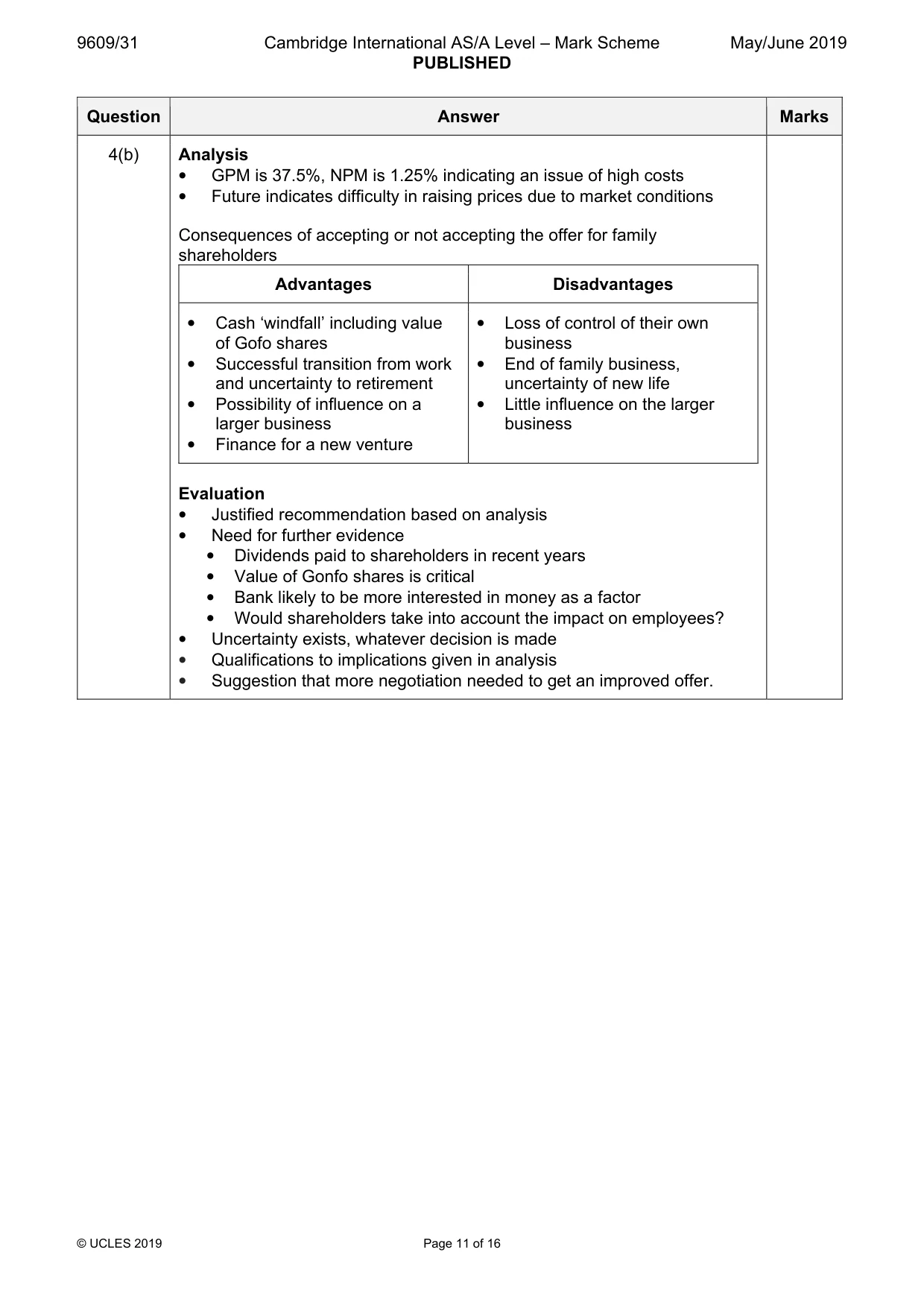
9609/31 Cambridge International AS/A Level – Mark Scheme PUBLISHED May/June 2019 © UCLES 2019 Page 11 of 16 Question Answer Marks 4(b) Analysis • GPM is 37.5%, NPM is 1.25% indicating an issue of high costs • Future indicates difficulty in raising prices due to market conditions Consequences of accepting or not accepting the offer for family shareholders Advantages Disadvantages • Cash ‘windfall’ including value of Gofo shares • Successful transition from work and uncertainty to retirement • Possibility of influence on a larger business • Finance for a new venture • Loss of control of their own business • End of family business, uncertainty of new life • Little influence on the larger business Evaluation • Justified recommendation based on analysis • Need for further evidence • Dividends paid to shareholders in recent years • Value of Gonfo shares is critical • Bank likely to be more interested in money as a factor • Would shareholders take into account the impact on employees? • Uncertainty exists, whatever decision is made • Qualifications to implications given in analysis • Suggestion that more negotiation needed to get an improved offer.
Mark scheme, page 12
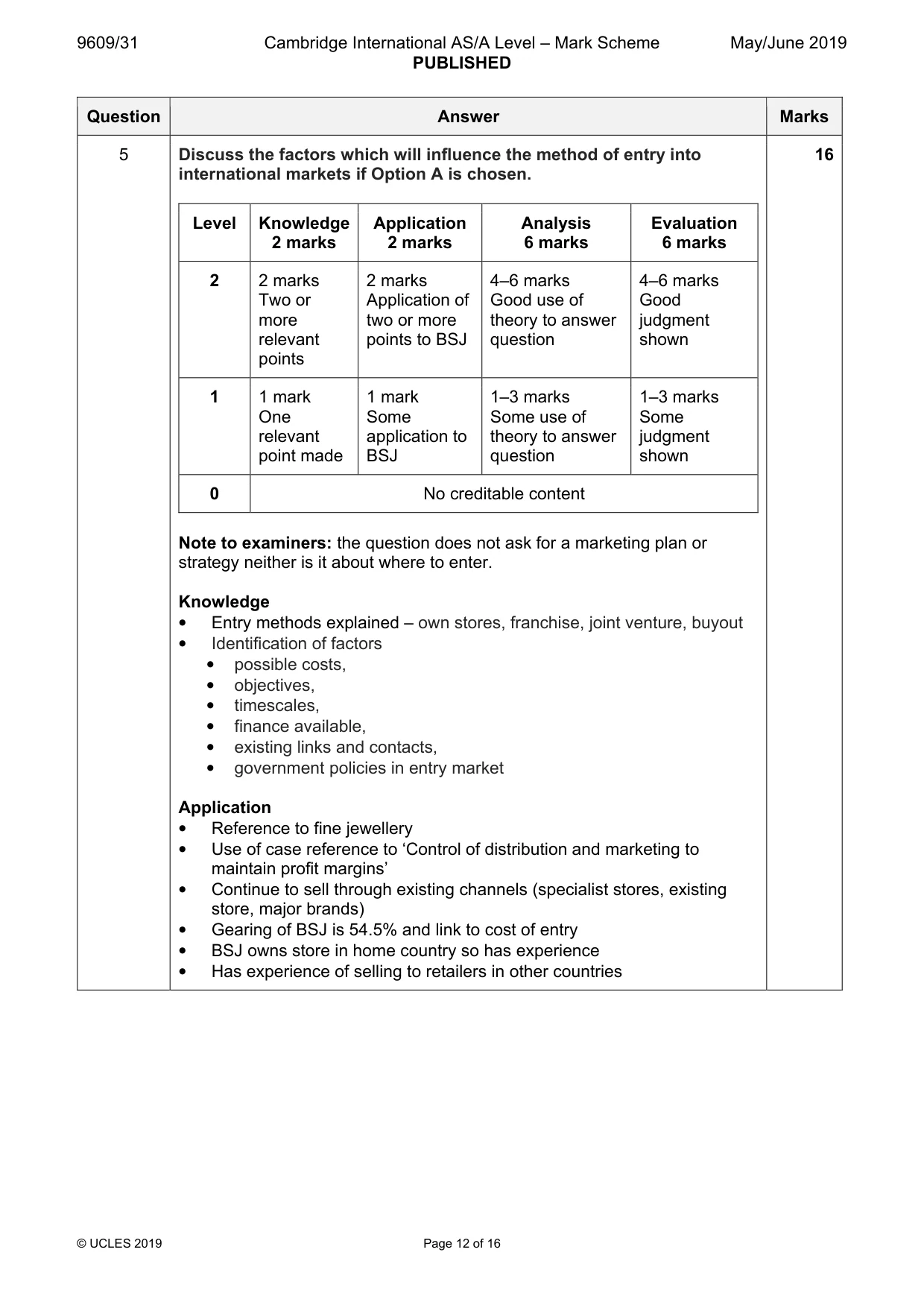
9609/31 Cambridge International AS/A Level – Mark Scheme PUBLISHED May/June 2019 © UCLES 2019 Page 12 of 16 Question Answer Marks 5 Discuss the factors which will influence the method of entry into international markets if Option A is chosen. Level Knowledge 2 marks Application 2 marks Analysis 6 marks Evaluation 6 marks 2 2 marks Two or more relevant points 2 marks Application of two or more points to BSJ 4–6 marks Good use of theory to answer question 4–6 marks Good judgment shown 1 1 mark One relevant point made 1 mark Some application to BSJ 1–3 marks Some use of theory to answer question 1–3 marks Some judgment shown 0 No creditable content Note to examiners: the question does not ask for a marketing plan or strategy neither is it about where to enter. Knowledge • Entry methods explained – own stores, franchise, joint venture, buyout • Identification of factors • possible costs, • objectives, • timescales, • finance available, • existing links and contacts, • government policies in entry market Application • Reference to fine jewellery • Use of case reference to ‘Control of distribution and marketing to maintain profit margins’ • Continue to sell through existing channels (specialist stores, existing store, major brands) • Gearing of BSJ is 54.5% and link to cost of entry • BSJ owns store in home country so has experience • Has experience of selling to retailers in other countries 16
Mark scheme, page 13
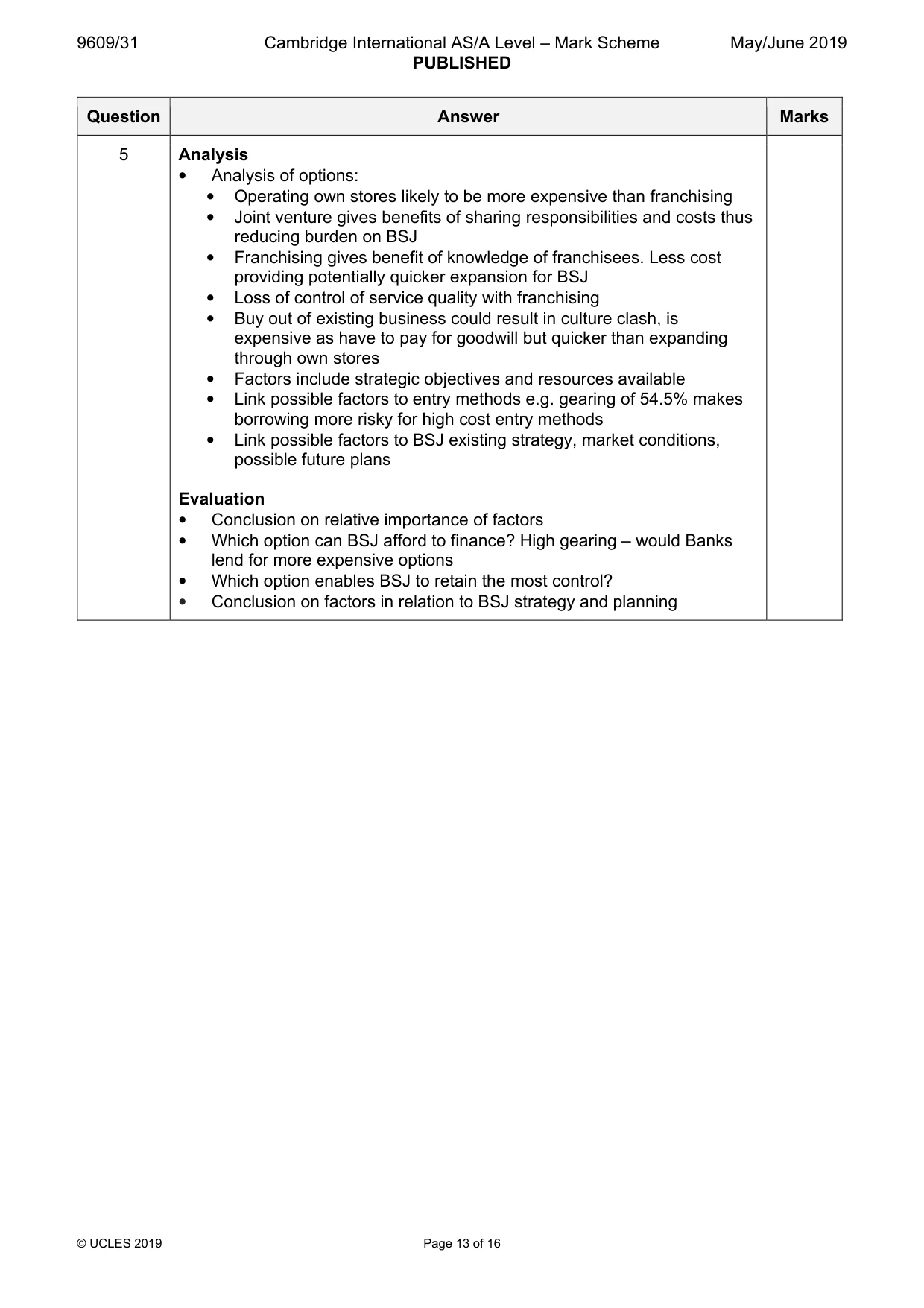
9609/31 Cambridge International AS/A Level – Mark Scheme PUBLISHED May/June 2019 © UCLES 2019 Page 13 of 16 Question Answer Marks 5 Analysis • Analysis of options: • Operating own stores likely to be more expensive than franchising • Joint venture gives benefits of sharing responsibilities and costs thus reducing burden on BSJ • Franchising gives benefit of knowledge of franchisees. Less cost providing potentially quicker expansion for BSJ • Loss of control of service quality with franchising • Buy out of existing business could result in culture clash, is expensive as have to pay for goodwill but quicker than expanding through own stores • Factors include strategic objectives and resources available • Link possible factors to entry methods e.g. gearing of 54.5% makes borrowing more risky for high cost entry methods • Link possible factors to BSJ existing strategy, market conditions, possible future plans Evaluation • Conclusion on relative importance of factors • Which option can BSJ afford to finance? High gearing – would Banks lend for more expensive options • Which option enables BSJ to retain the most control? • Conclusion on factors in relation to BSJ strategy and planning
Mark scheme, page 14
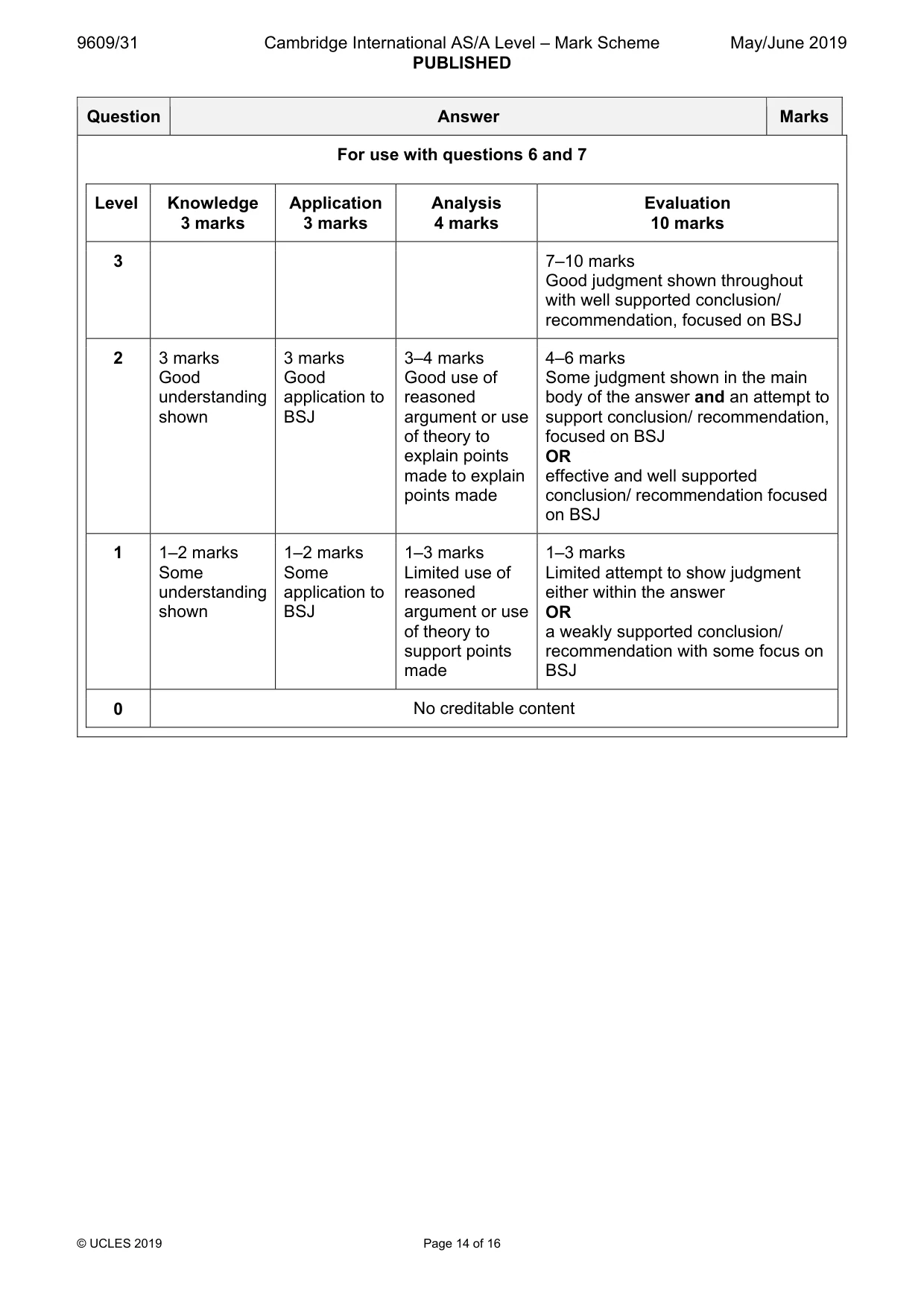
9609/31 Cambridge International AS/A Level – Mark Scheme PUBLISHED May/June 2019 © UCLES 2019 Page 14 of 16 Question Answer Marks For use with questions 6 and 7 Level Knowledge 3 marks Application 3 marks Analysis 4 marks Evaluation 10 marks 3 7–10 marks Good judgment shown throughout with well supported conclusion/ recommendation, focused on BSJ 2 3 marks Good understanding shown 3 marks Good application to BSJ 3–4 marks Good use of reasoned argument or use of theory to explain points made to explain points made 4–6 marks Some judgment shown in the main body of the answer and an attempt to support conclusion/ recommendation, focused on BSJ OR effective and well supported conclusion/ recommendation focused on BSJ 1 1–2 marks Some understanding shown 1–2 marks Some application to BSJ 1–3 marks Limited use of reasoned argument or use of theory to support points made 1–3 marks Limited attempt to show judgment either within the answer OR a weakly supported conclusion/ recommendation with some focus on BSJ 0 No creditable content
Mark scheme, page 15
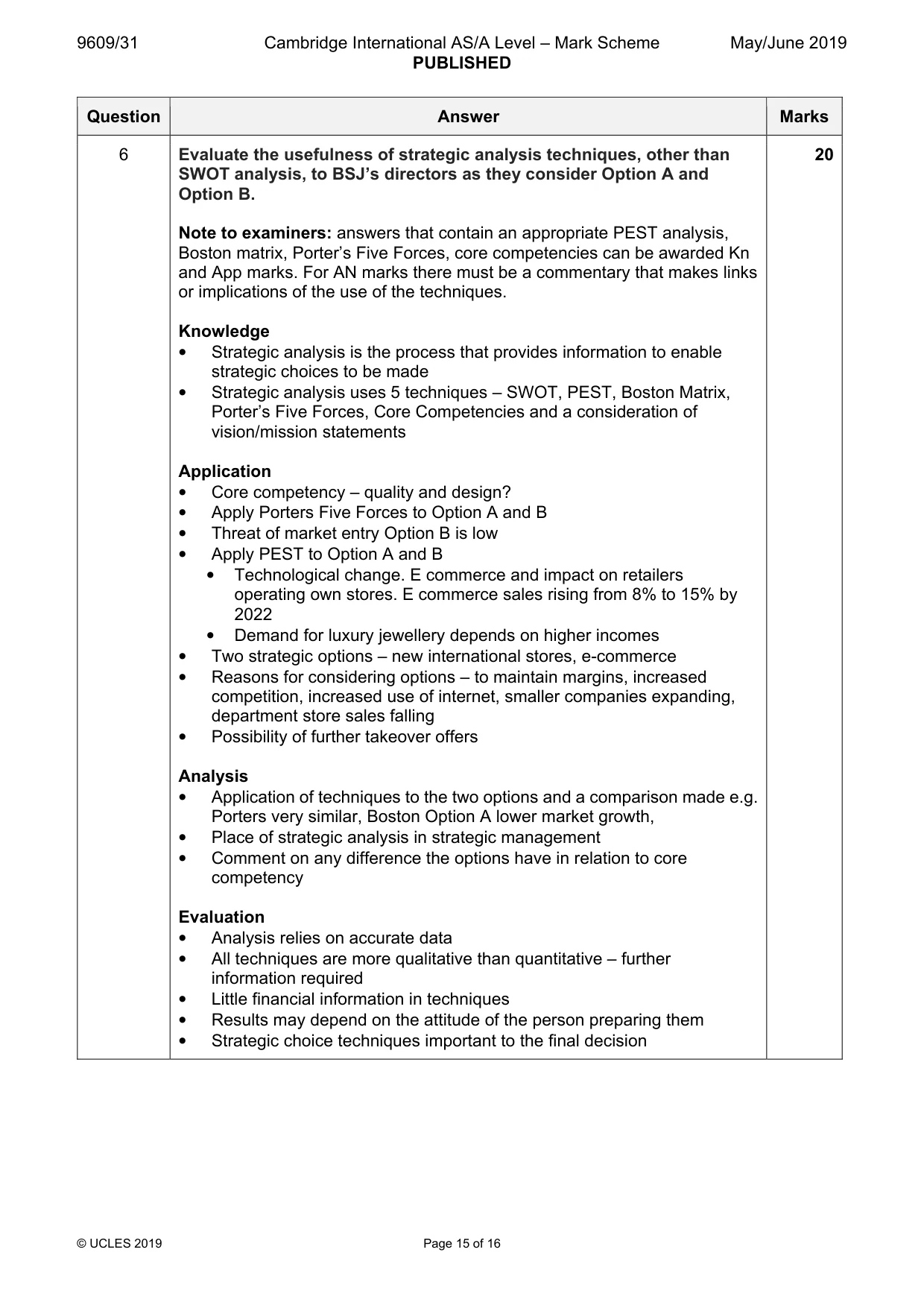
9609/31 Cambridge International AS/A Level – Mark Scheme PUBLISHED May/June 2019 © UCLES 2019 Page 15 of 16 Question Answer Marks 6 Evaluate the usefulness of strategic analysis techniques, other than SWOT analysis, to BSJ’s directors as they consider Option A and Option B. Note to examiners: answers that contain an appropriate PEST analysis, Boston matrix, Porter’s Five Forces, core competencies can be awarded Kn and App marks. For AN marks there must be a commentary that makes links or implications of the use of the techniques. Knowledge • Strategic analysis is the process that provides information to enable strategic choices to be made • Strategic analysis uses 5 techniques – SWOT, PEST, Boston Matrix, Porter’s Five Forces, Core Competencies and a consideration of vision/mission statements Application • Core competency – quality and design? • Apply Porters Five Forces to Option A and B • Threat of market entry Option B is low • Apply PEST to Option A and B • Technological change. E commerce and impact on retailers operating own stores. E commerce sales rising from 8% to 15% by 2022 • Demand for luxury jewellery depends on higher incomes • Two strategic options – new international stores, e-commerce • Reasons for considering options – to maintain margins, increased competition, increased use of internet, smaller companies expanding, department store sales falling • Possibility of further takeover offers Analysis • Application of techniques to the two options and a comparison made e.g. Porters very similar, Boston Option A lower market growth, • Place of strategic analysis in strategic management • Comment on any difference the options have in relation to core competency Evaluation • Analysis relies on accurate data • All techniques are more qualitative than quantitative – further information required • Little financial information in techniques • Results may depend on the attitude of the person preparing them • Strategic choice techniques important to the final decision 20
Mark scheme, page 16
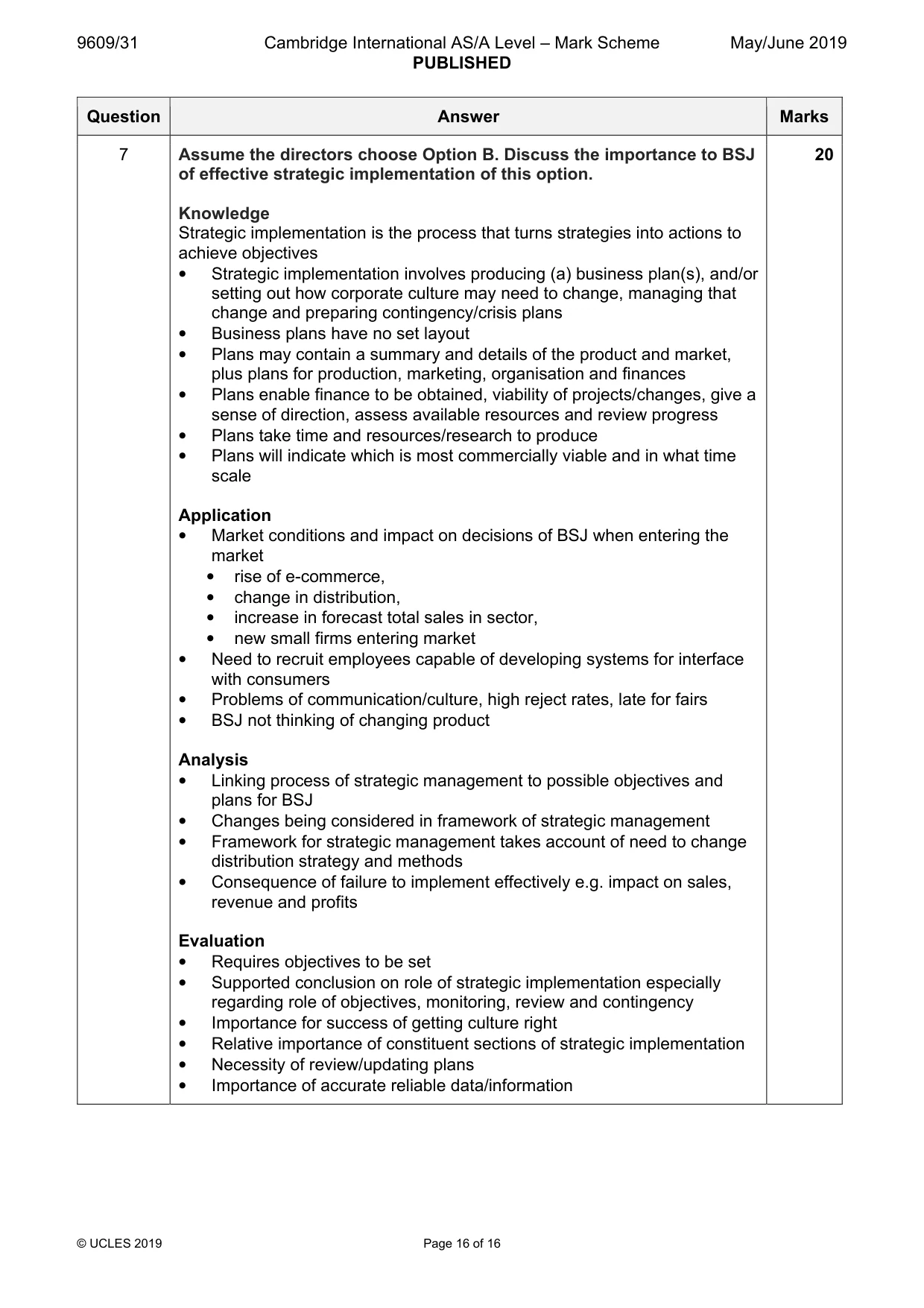
9609/31 Cambridge International AS/A Level – Mark Scheme PUBLISHED May/June 2019 © UCLES 2019 Page 16 of 16 Question Answer Marks 7 Assume the directors choose Option B. Discuss the importance to BSJ of effective strategic implementation of this option. Knowledge Strategic implementation is the process that turns strategies into actions to achieve objectives • Strategic implementation involves producing (a) business plan(s), and/or setting out how corporate culture may need to change, managing that change and preparing contingency/crisis plans • Business plans have no set layout • Plans may contain a summary and details of the product and market, plus plans for production, marketing, organisation and finances • Plans enable finance to be obtained, viability of projects/changes, give a sense of direction, assess available resources and review progress • Plans take time and resources/research to produce • Plans will indicate which is most commercially viable and in what time scale Application • Market conditions and impact on decisions of BSJ when entering the market • rise of e-commerce, • change in distribution, • increase in forecast total sales in sector, • new small firms entering market • Need to recruit employees capable of developing systems for interface with consumers • Problems of communication/culture, high reject rates, late for fairs • BSJ not thinking of changing product Analysis • Linking process of strategic management to possible objectives and plans for BSJ • Changes being considered in framework of strategic management • Framework for strategic management takes account of need to change distribution strategy and methods • Consequence of failure to implement effectively e.g. impact on sales, revenue and profits Evaluation • Requires objectives to be set • Supported conclusion on role of strategic implementation especially regarding role of objectives, monitoring, review and contingency • Importance for success of getting culture right • Relative importance of constituent sections of strategic implementation • Necessity of review/updating plans • Importance of accurate reliable data/information 20
What you needed in this session
Cambridge’s own grade thresholds for 2019 May/June, Paper 3 · Variant 1. A higher threshold means an easier paper — the bar moves with how the cohort did.