Cambridge A Level Business (for first examination in 2016) 9609 — 2019 Feb/March Paper 1 · Variant 2
9609/12/F/M/19 · 40 marks · ≈45 min
The question paper and its mark scheme, free to read here and free to download. This is Cambridge’s own paper, exactly as it was sat.
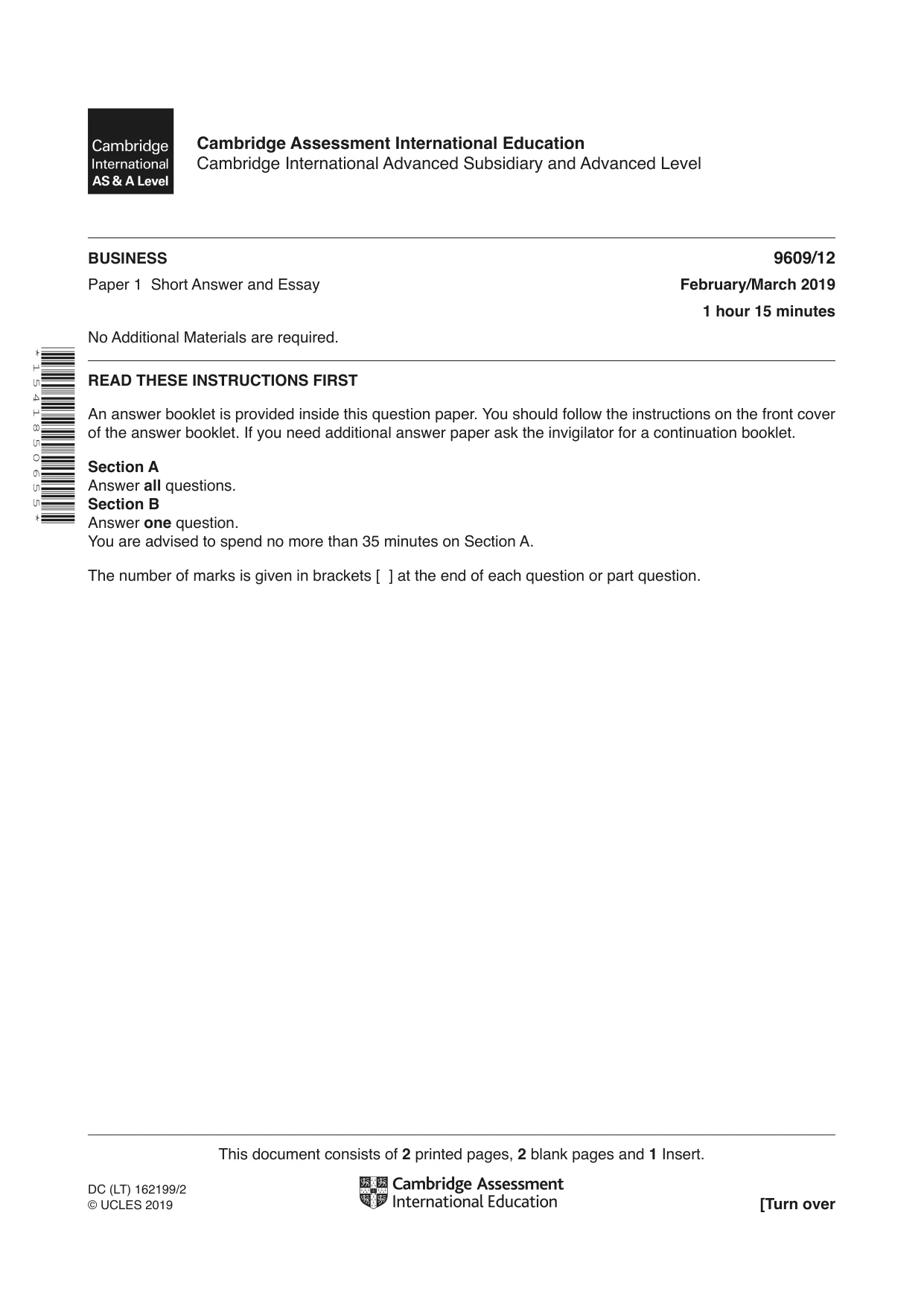
Question paper4 pages
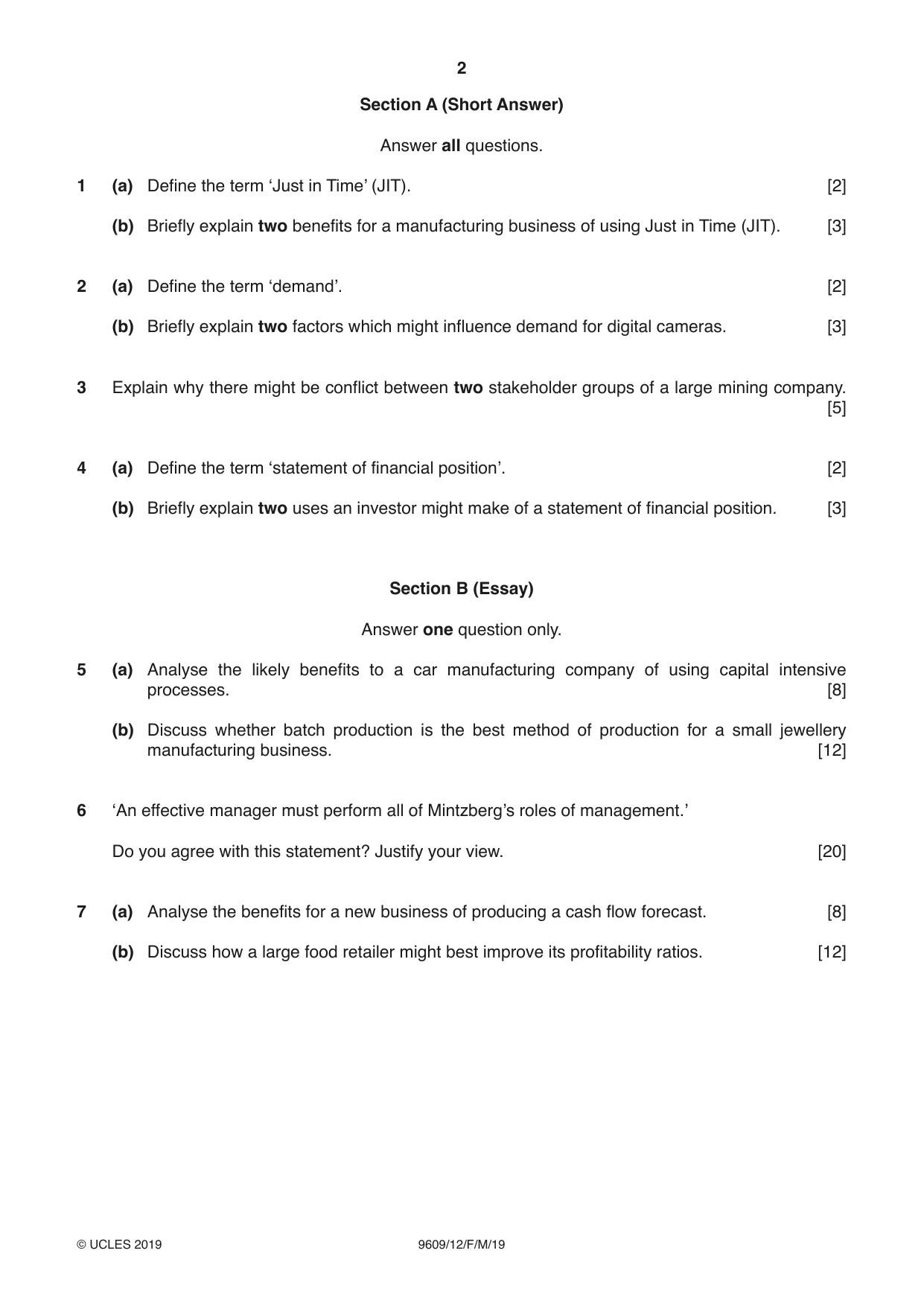


Mark scheme14 pages
Answers below. Sit the paper first if you are practising.


Paper as text
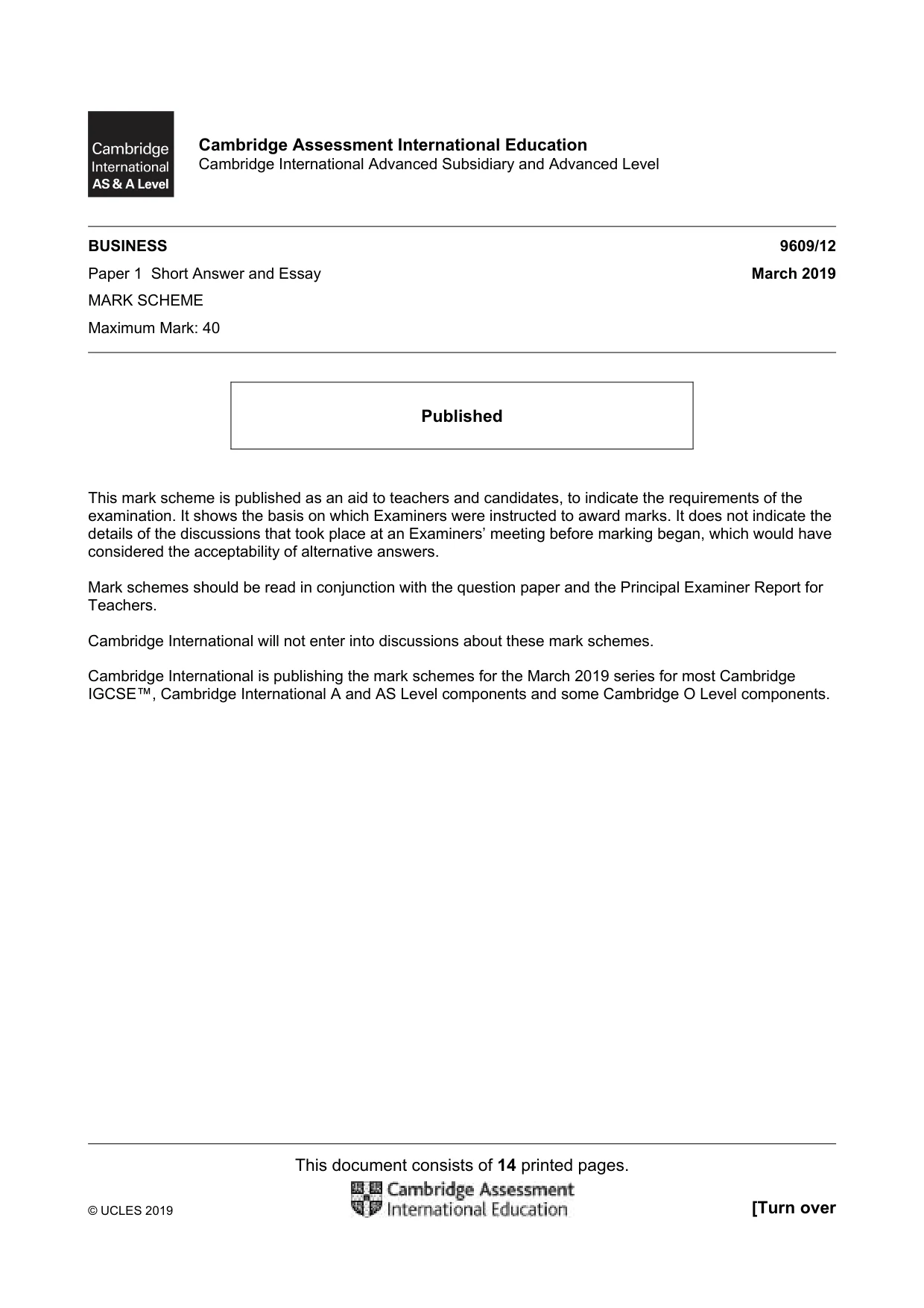
Question paper, page 1
This document consists of 2 printed pages, 2 blank pages and 1 Insert. DC (LT) 162199/2 © UCLES 2019 [Turn over Cambridge Assessment International Education Cambridge International Advanced Subsidiary and Advanced Level * 1 5 4 1 8 5 0 6 5 5 * BUSINESS 9609/12 Paper 1 Short Answer and Essay February/March 2019 1 hour 15 minutes No Additional Materials are required. READ THESE INSTRUCTIONS FIRST An answer booklet is provided inside this question paper. You should follow the instructions on the front cover of the answer booklet. If you need additional answer paper ask the invigilator for a continuation booklet. Section A Answer all questions. Section B Answer one question. You are advised to spend no more than 35 minutes on Section A. The number of marks is given in brackets [ ] at the end of each question or part question.
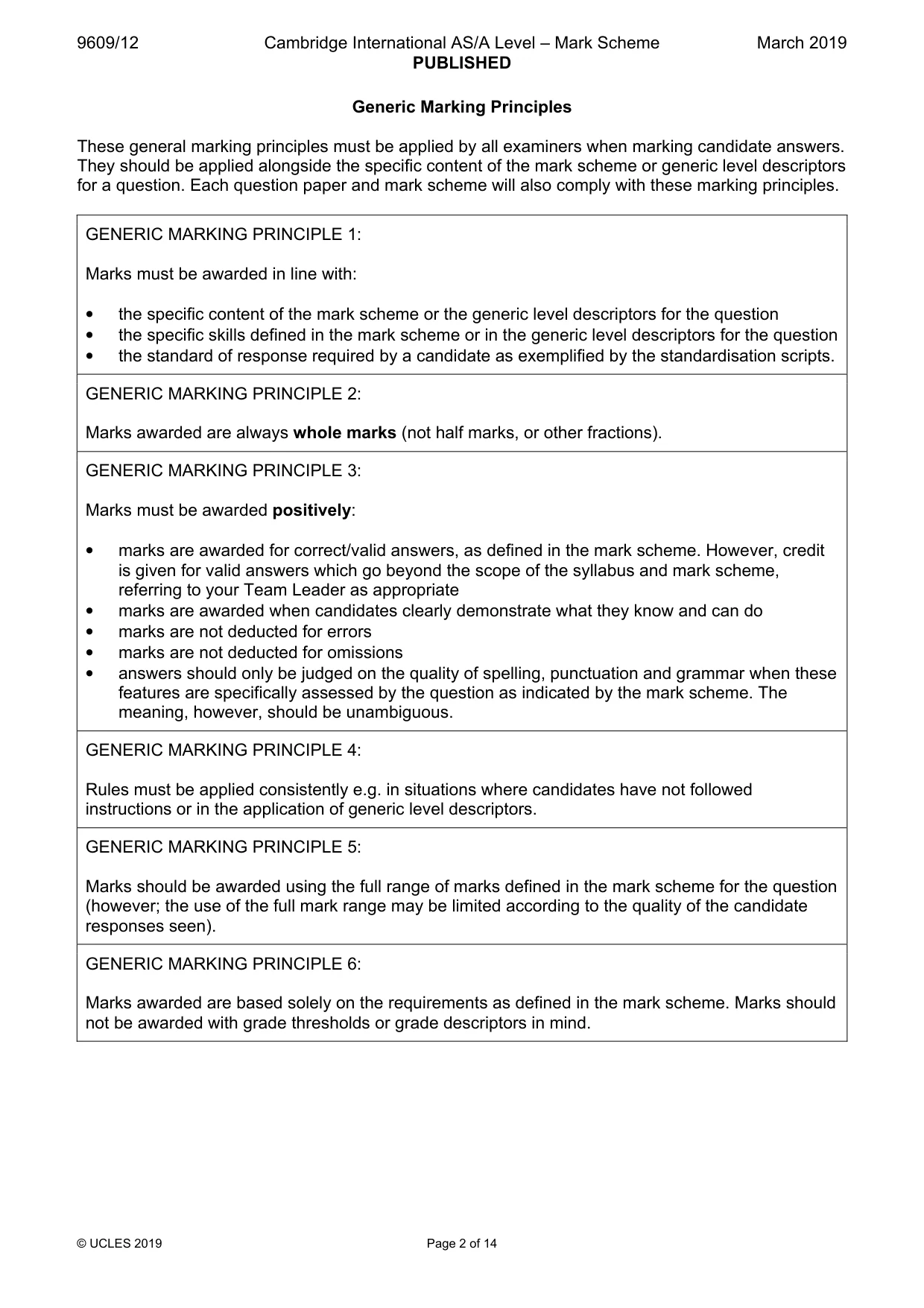
Question paper, page 2
2 9609/12/F/M/19 © UCLES 2019 Section A (Short Answer) Answer all questions. 1 (a) Define the term ‘Just in Time’ (JIT). [2] (b) Briefly explain two benefits for a manufacturing business of using Just in Time (JIT). [3] 2 (a) Define the term ‘demand’. [2] (b) Briefly explain two factors which might influence demand for digital cameras. [3] 3 Explain why there might be conflict between two stakeholder groups of a large mining company. [5] 4 (a) Define the term ‘statement of financial position’. [2] (b) Briefly explain two uses an investor might make of a statement of financial position. [3] Section B (Essay) Answer one question only. 5 (a) Analyse the likely benefits to a car manufacturing company of using capital intensive processes. [8] (b) Discuss whether batch production is the best method of production for a small jewellery manufacturing business. [12] 6 ‘An effective manager must perform all of Mintzberg’s roles of management.’ Do you agree with this statement? Justify your view. [20] 7 (a) Analyse the benefits for a new business of producing a cash flow forecast. [8] (b) Discuss how a large food retailer might best improve its profitability ratios. [12]
Question paper, page 3
3 9609/12/F/M/19 © UCLES 2019 BLANK PAGE
Question paper, page 4
4 9609/12/F/M/19 © UCLES 2019 BLANK PAGE Permission to reproduce items where third-party owned material protected by copyright is included has been sought and cleared where possible. Every reasonable effort has been made by the publisher (UCLES) to trace copyright holders, but if any items requiring clearance have unwittingly been included, the publisher will be pleased to make amends at the earliest possible opportunity. To avoid the issue of disclosure of answer-related information to candidates, all copyright acknowledgements are reproduced online in the Cambridge Assessment International Education Copyright Acknowledgements Booklet. This is produced for each series of examinations and is freely available to download at www.cambridgeinternational.org after the live examination series. Cambridge Assessment International Education is part of the Cambridge Assessment Group. Cambridge Assessment is the brand name of the University of Cambridge Local Examinations Syndicate (UCLES), which itself is a department of the University of Cambridge.
Mark scheme, page 1
This document consists of 14 printed pages. © UCLES 2019 [Turn over Cambridge Assessment International Education Cambridge International Advanced Subsidiary and Advanced Level BUSINESS 9609/12 Paper 1 Short Answer and Essay March 2019 MARK SCHEME Maximum Mark: 40 Published This mark scheme is published as an aid to teachers and candidates, to indicate the requirements of the examination. It shows the basis on which Examiners were instructed to award marks. It does not indicate the details of the discussions that took place at an Examiners’ meeting before marking began, which would have considered the acceptability of alternative answers. Mark schemes should be read in conjunction with the question paper and the Principal Examiner Report for Teachers. Cambridge International will not enter into discussions about these mark schemes. Cambridge International is publishing the mark schemes for the March 2019 series for most Cambridge IGCSE™, Cambridge International A and AS Level components and some Cambridge O Level components.
Mark scheme, page 2
9609/12 Cambridge International AS/A Level – Mark Scheme PUBLISHED March 2019 © UCLES 2019 Page 2 of 14 Generic Marking Principles These general marking principles must be applied by all examiners when marking candidate answers. They should be applied alongside the specific content of the mark scheme or generic level descriptors for a question. Each question paper and mark scheme will also comply with these marking principles. GENERIC MARKING PRINCIPLE 1: Marks must be awarded in line with: • the specific content of the mark scheme or the generic level descriptors for the question • the specific skills defined in the mark scheme or in the generic level descriptors for the question • the standard of response required by a candidate as exemplified by the standardisation scripts. GENERIC MARKING PRINCIPLE 2: Marks awarded are always whole marks (not half marks, or other fractions). GENERIC MARKING PRINCIPLE 3: Marks must be awarded positively: • marks are awarded for correct/valid answers, as defined in the mark scheme. However, credit is given for valid answers which go beyond the scope of the syllabus and mark scheme, referring to your Team Leader as appropriate • marks are awarded when candidates clearly demonstrate what they know and can do • marks are not deducted for errors • marks are not deducted for omissions • answers should only be judged on the quality of spelling, punctuation and grammar when these features are specifically assessed by the question as indicated by the mark scheme. The meaning, however, should be unambiguous. GENERIC MARKING PRINCIPLE 4: Rules must be applied consistently e.g. in situations where candidates have not followed instructions or in the application of generic level descriptors. GENERIC MARKING PRINCIPLE 5: Marks should be awarded using the full range of marks defined in the mark scheme for the question (however; the use of the full mark range may be limited according to the quality of the candidate responses seen). GENERIC MARKING PRINCIPLE 6: Marks awarded are based solely on the requirements as defined in the mark scheme. Marks should not be awarded with grade thresholds or grade descriptors in mind.
Mark scheme, page 3
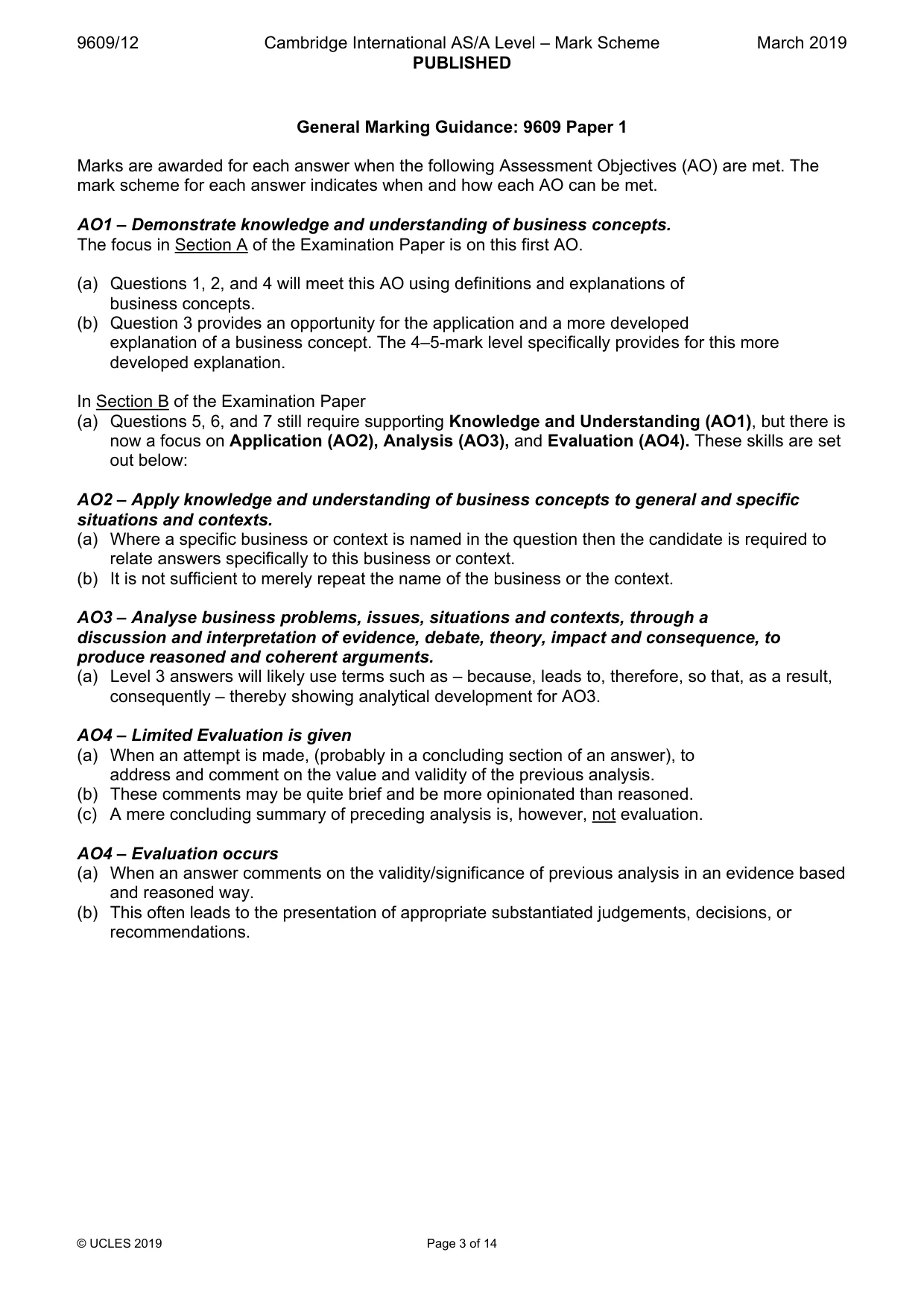
9609/12 Cambridge International AS/A Level – Mark Scheme PUBLISHED March 2019 © UCLES 2019 Page 3 of 14 General Marking Guidance: 9609 Paper 1 Marks are awarded for each answer when the following Assessment Objectives (AO) are met. The mark scheme for each answer indicates when and how each AO can be met. AO1 – Demonstrate knowledge and understanding of business concepts. The focus in Section A of the Examination Paper is on this first AO. (a) Questions 1, 2, and 4 will meet this AO using definitions and explanations of business concepts. (b) Question 3 provides an opportunity for the application and a more developed explanation of a business concept. The 4–5-mark level specifically provides for this more developed explanation. In Section B of the Examination Paper (a) Questions 5, 6, and 7 still require supporting Knowledge and Understanding (AO1), but there is now a focus on Application (AO2), Analysis (AO3), and Evaluation (AO4). These skills are set out below: AO2 – Apply knowledge and understanding of business concepts to general and specific situations and contexts. (a) Where a specific business or context is named in the question then the candidate is required to relate answers specifically to this business or context. (b) It is not sufficient to merely repeat the name of the business or the context. AO3 – Analyse business problems, issues, situations and contexts, through a discussion and interpretation of evidence, debate, theory, impact and consequence, to produce reasoned and coherent arguments. (a) Level 3 answers will likely use terms such as – because, leads to, therefore, so that, as a result, consequently – thereby showing analytical development for AO3. AO4 – Limited Evaluation is given (a) When an attempt is made, (probably in a concluding section of an answer), to address and comment on the value and validity of the previous analysis. (b) These comments may be quite brief and be more opinionated than reasoned. (c) A mere concluding summary of preceding analysis is, however, not evaluation. AO4 – Evaluation occurs (a) When an answer comments on the validity/significance of previous analysis in an evidence based and reasoned way. (b) This often leads to the presentation of appropriate substantiated judgements, decisions, or recommendations.
Mark scheme, page 4
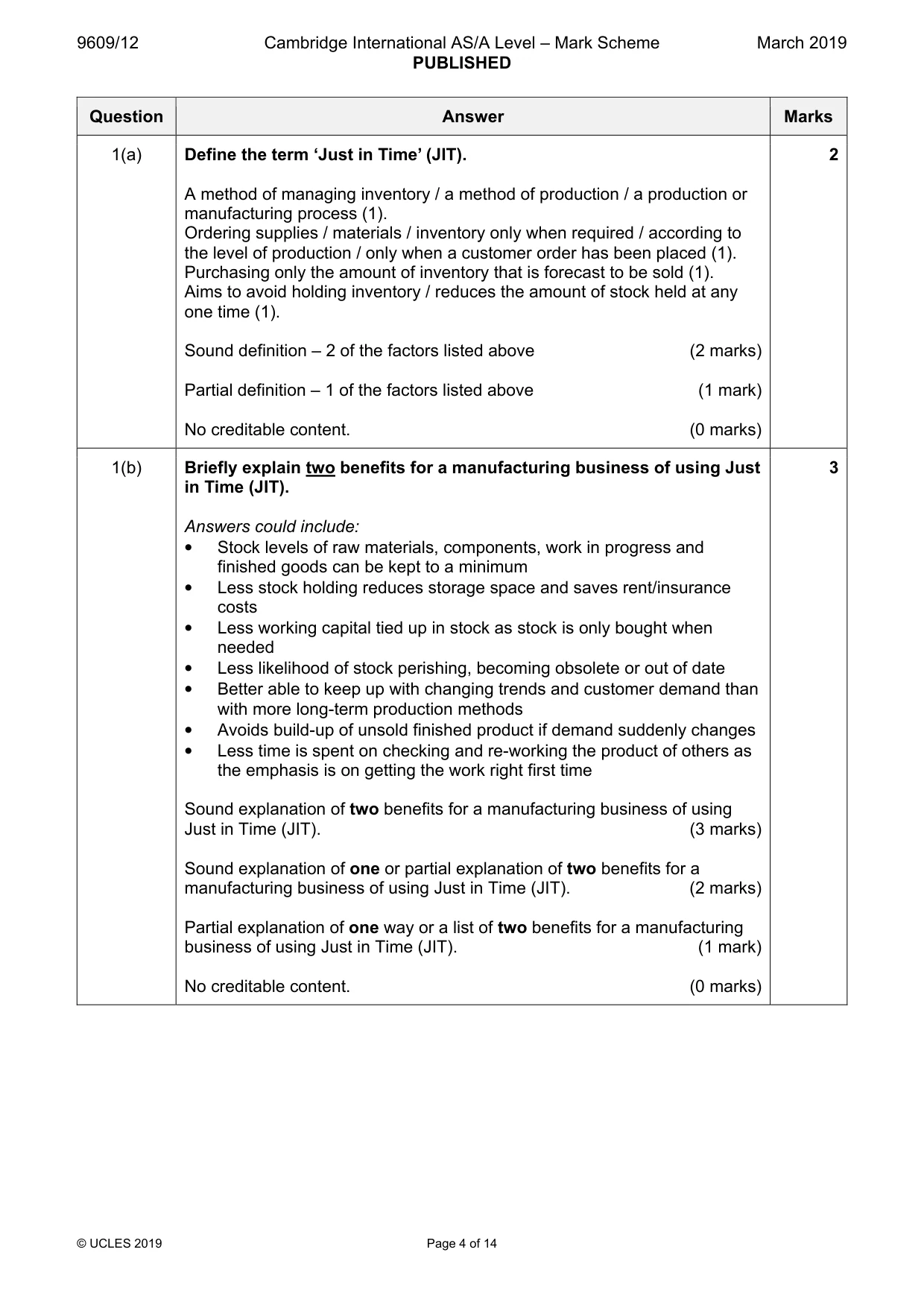
9609/12 Cambridge International AS/A Level – Mark Scheme PUBLISHED March 2019 © UCLES 2019 Page 4 of 14 Question Answer Marks 1(a) Define the term ‘Just in Time’ (JIT). A method of managing inventory / a method of production / a production or manufacturing process (1). Ordering supplies / materials / inventory only when required / according to the level of production / only when a customer order has been placed (1). Purchasing only the amount of inventory that is forecast to be sold (1). Aims to avoid holding inventory / reduces the amount of stock held at any one time (1). Sound definition – 2 of the factors listed above (2 marks) Partial definition – 1 of the factors listed above (1 mark) No creditable content. (0 marks) 2 1(b) Briefly explain two benefits for a manufacturing business of using Just in Time (JIT). Answers could include: • Stock levels of raw materials, components, work in progress and finished goods can be kept to a minimum • Less stock holding reduces storage space and saves rent/insurance costs • Less working capital tied up in stock as stock is only bought when needed • Less likelihood of stock perishing, becoming obsolete or out of date • Better able to keep up with changing trends and customer demand than with more long-term production methods • Avoids build-up of unsold finished product if demand suddenly changes • Less time is spent on checking and re-working the product of others as the emphasis is on getting the work right first time Sound explanation of two benefits for a manufacturing business of using Just in Time (JIT). (3 marks) Sound explanation of one or partial explanation of two benefits for a manufacturing business of using Just in Time (JIT). (2 marks) Partial explanation of one way or a list of two benefits for a manufacturing business of using Just in Time (JIT). (1 mark) No creditable content. (0 marks) 3
Mark scheme, page 5
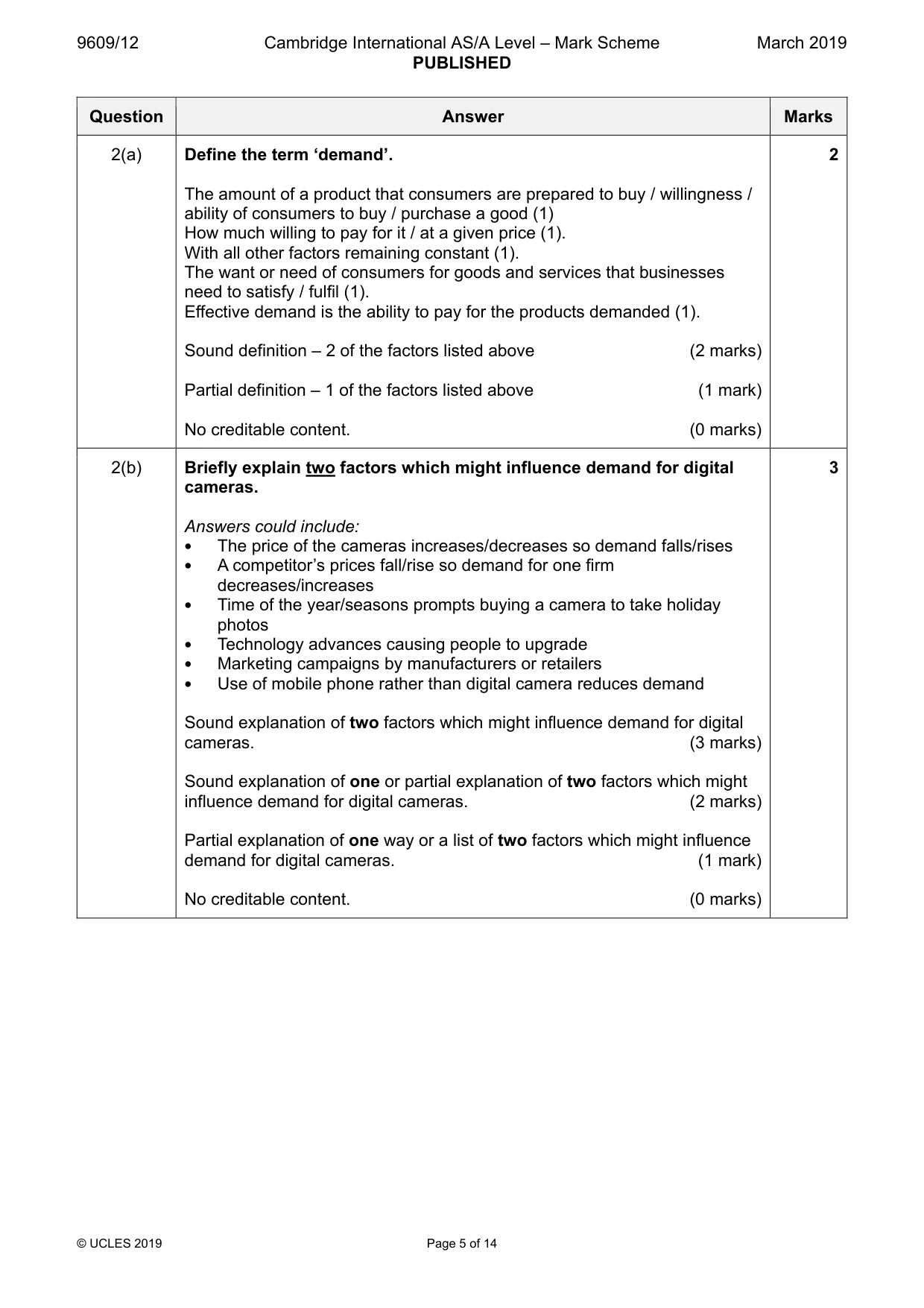
9609/12 Cambridge International AS/A Level – Mark Scheme PUBLISHED March 2019 © UCLES 2019 Page 5 of 14 Question Answer Marks 2(a) Define the term ‘demand’. The amount of a product that consumers are prepared to buy / willingness / ability of consumers to buy / purchase a good (1) How much willing to pay for it / at a given price (1). With all other factors remaining constant (1). The want or need of consumers for goods and services that businesses need to satisfy / fulfil (1). Effective demand is the ability to pay for the products demanded (1). Sound definition – 2 of the factors listed above (2 marks) Partial definition – 1 of the factors listed above (1 mark) No creditable content. (0 marks) 2 2(b) Briefly explain two factors which might influence demand for digital cameras. Answers could include: • The price of the cameras increases/decreases so demand falls/rises • A competitor’s prices fall/rise so demand for one firm decreases/increases • Time of the year/seasons prompts buying a camera to take holiday photos • Technology advances causing people to upgrade • Marketing campaigns by manufacturers or retailers • Use of mobile phone rather than digital camera reduces demand Sound explanation of two factors which might influence demand for digital cameras. (3 marks) Sound explanation of one or partial explanation of two factors which might influence demand for digital cameras. (2 marks) Partial explanation of one way or a list of two factors which might influence demand for digital cameras. (1 mark) No creditable content. (0 marks) 3
Mark scheme, page 6
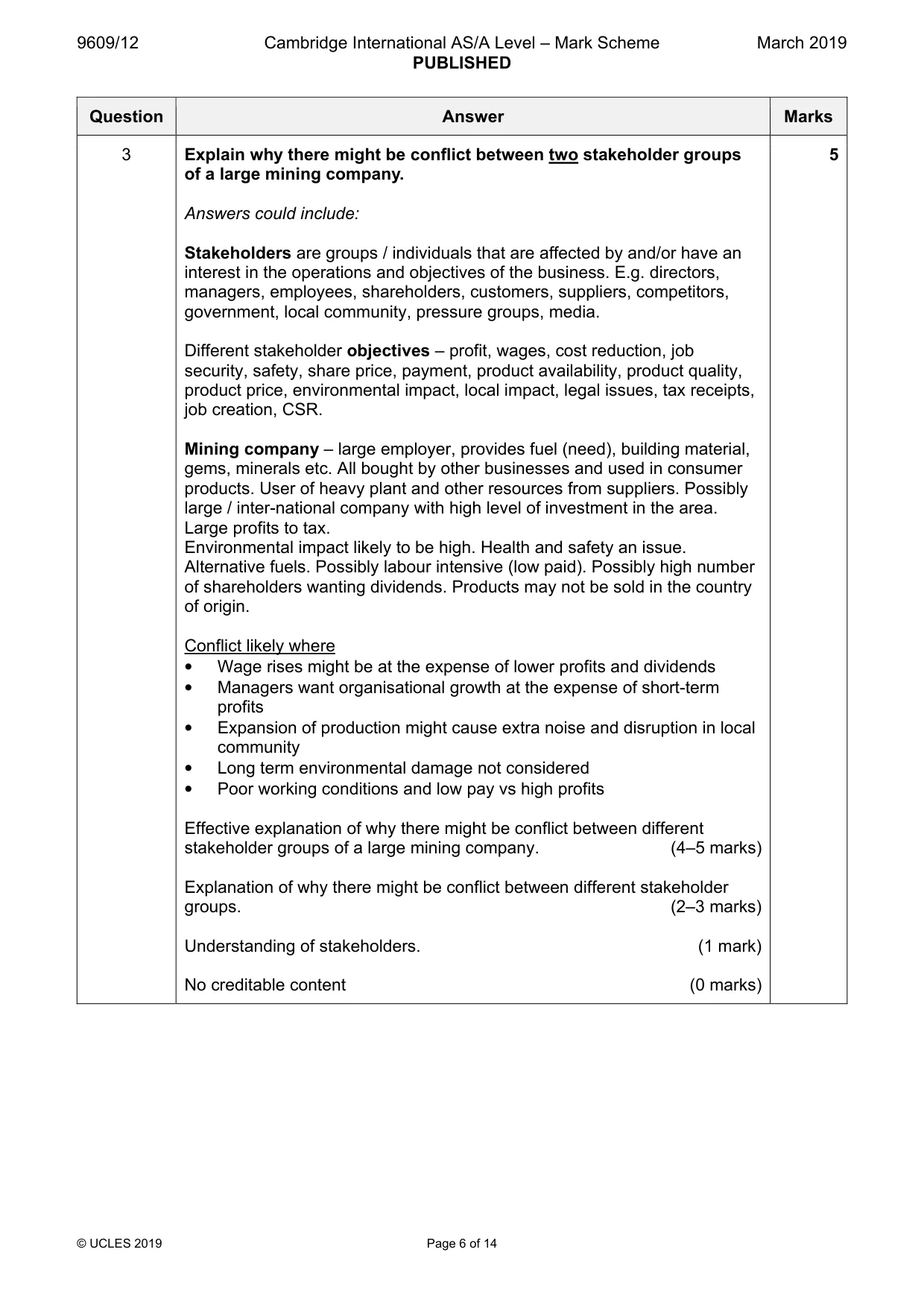
9609/12 Cambridge International AS/A Level – Mark Scheme PUBLISHED March 2019 © UCLES 2019 Page 6 of 14 Question Answer Marks 3 Explain why there might be conflict between two stakeholder groups of a large mining company. Answers could include: Stakeholders are groups / individuals that are affected by and/or have an interest in the operations and objectives of the business. E.g. directors, managers, employees, shareholders, customers, suppliers, competitors, government, local community, pressure groups, media. Different stakeholder objectives – profit, wages, cost reduction, job security, safety, share price, payment, product availability, product quality, product price, environmental impact, local impact, legal issues, tax receipts, job creation, CSR. Mining company – large employer, provides fuel (need), building material, gems, minerals etc. All bought by other businesses and used in consumer products. User of heavy plant and other resources from suppliers. Possibly large / inter-national company with high level of investment in the area. Large profits to tax. Environmental impact likely to be high. Health and safety an issue. Alternative fuels. Possibly labour intensive (low paid). Possibly high number of shareholders wanting dividends. Products may not be sold in the country of origin. Conflict likely where • Wage rises might be at the expense of lower profits and dividends • Managers want organisational growth at the expense of short-term profits • Expansion of production might cause extra noise and disruption in local community • Long term environmental damage not considered • Poor working conditions and low pay vs high profits Effective explanation of why there might be conflict between different stakeholder groups of a large mining company. (4–5 marks) Explanation of why there might be conflict between different stakeholder groups. (2–3 marks) Understanding of stakeholders. (1 mark) No creditable content (0 marks) 5
Mark scheme, page 7
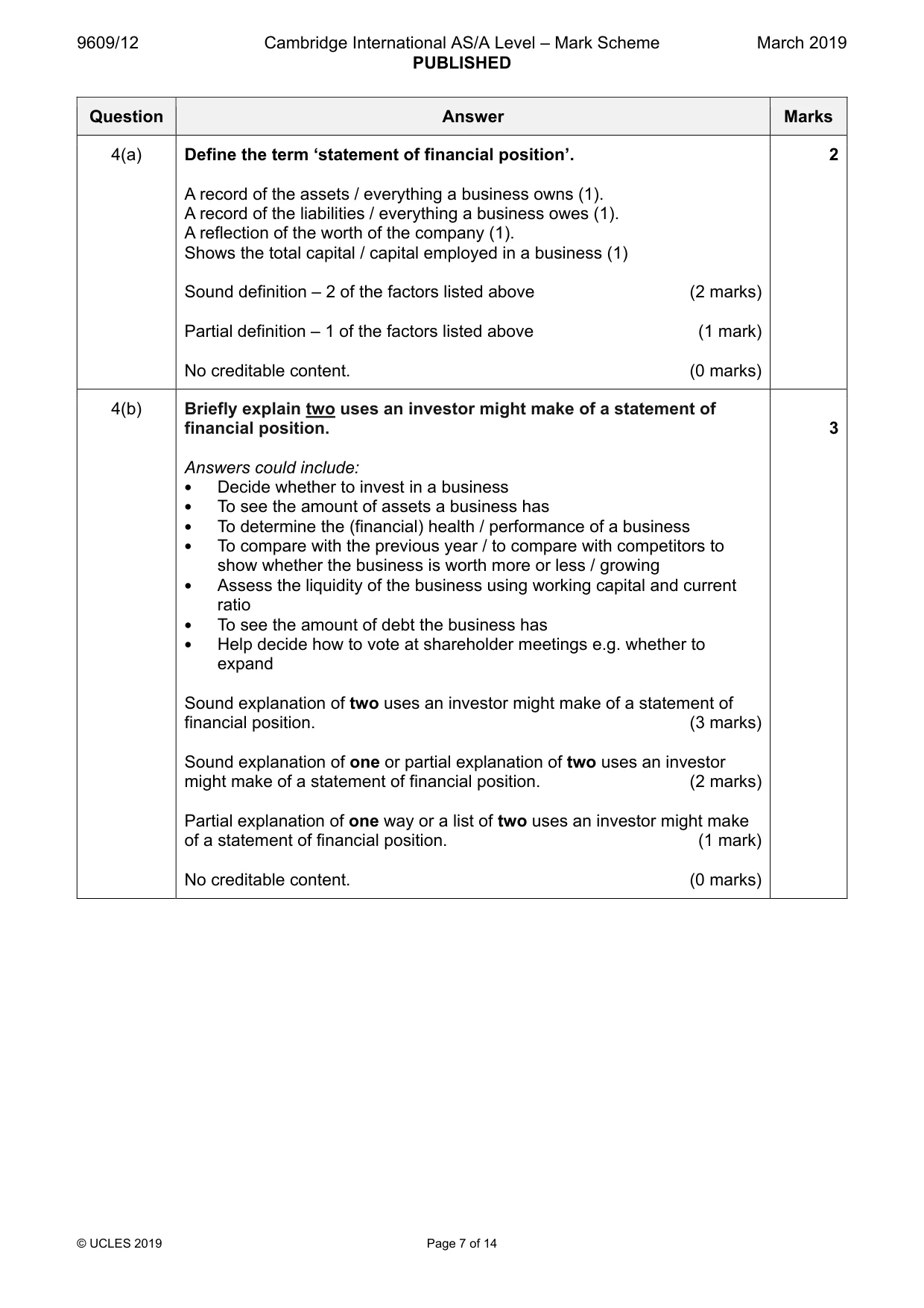
9609/12 Cambridge International AS/A Level – Mark Scheme PUBLISHED March 2019 © UCLES 2019 Page 7 of 14 Question Answer Marks 4(a) Define the term ‘statement of financial position’. A record of the assets / everything a business owns (1). A record of the liabilities / everything a business owes (1). A reflection of the worth of the company (1). Shows the total capital / capital employed in a business (1) Sound definition – 2 of the factors listed above (2 marks) Partial definition – 1 of the factors listed above (1 mark) No creditable content. (0 marks) 2 4(b) Briefly explain two uses an investor might make of a statement of financial position. Answers could include: • Decide whether to invest in a business • To see the amount of assets a business has • To determine the (financial) health / performance of a business • To compare with the previous year / to compare with competitors to show whether the business is worth more or less / growing • Assess the liquidity of the business using working capital and current ratio • To see the amount of debt the business has • Help decide how to vote at shareholder meetings e.g. whether to expand Sound explanation of two uses an investor might make of a statement of financial position. (3 marks) Sound explanation of one or partial explanation of two uses an investor might make of a statement of financial position. (2 marks) Partial explanation of one way or a list of two uses an investor might make of a statement of financial position. (1 mark) No creditable content. (0 marks) 3
Mark scheme, page 8
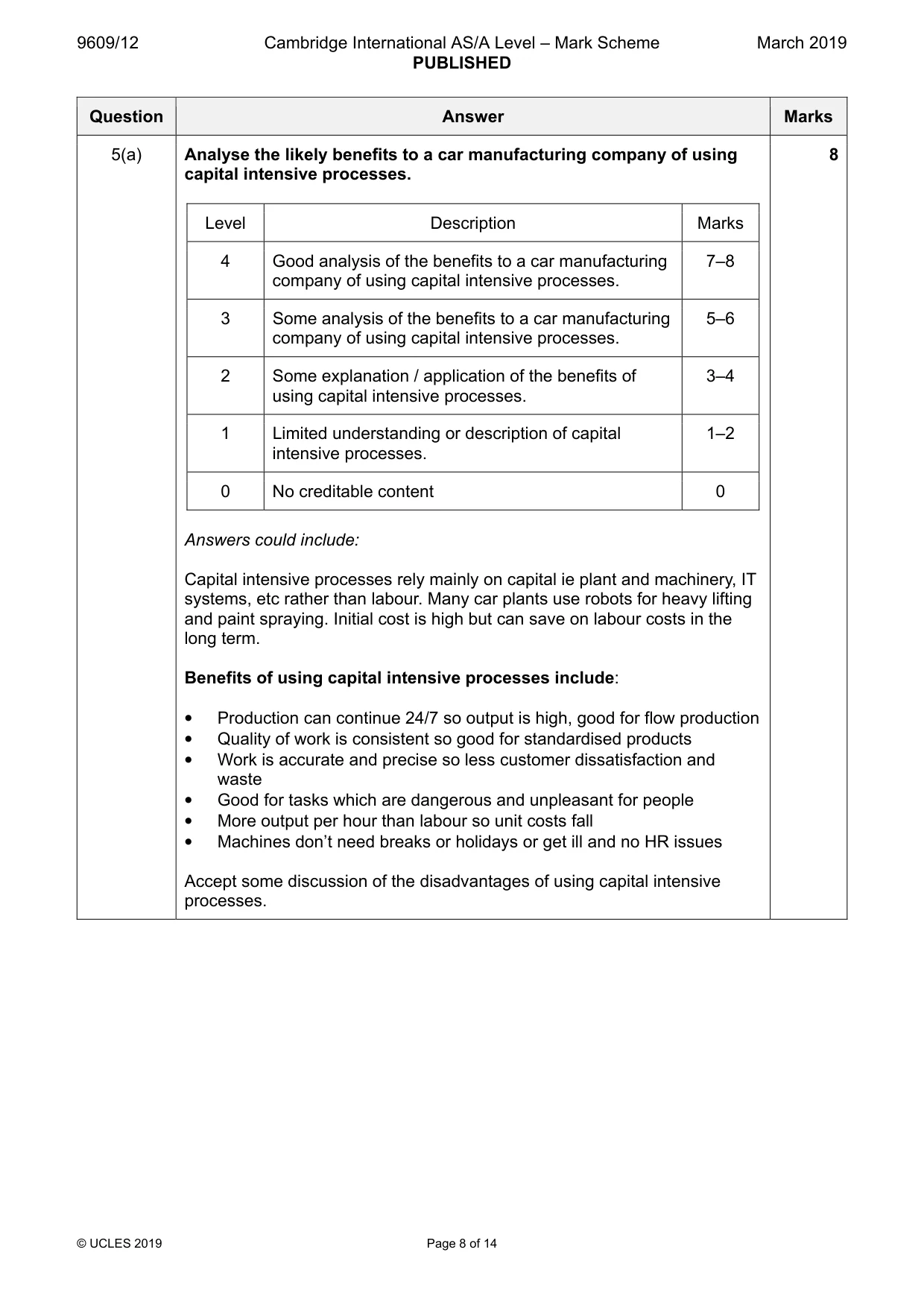
9609/12 Cambridge International AS/A Level – Mark Scheme PUBLISHED March 2019 © UCLES 2019 Page 8 of 14 Question Answer Marks 5(a) Analyse the likely benefits to a car manufacturing company of using capital intensive processes. Level Description Marks 4 Good analysis of the benefits to a car manufacturing company of using capital intensive processes. 7–8 3 Some analysis of the benefits to a car manufacturing company of using capital intensive processes. 5–6 2 Some explanation / application of the benefits of using capital intensive processes. 3–4 1 Limited understanding or description of capital intensive processes. 1–2 0 No creditable content 0 Answers could include: Capital intensive processes rely mainly on capital ie plant and machinery, IT systems, etc rather than labour. Many car plants use robots for heavy lifting and paint spraying. Initial cost is high but can save on labour costs in the long term. Benefits of using capital intensive processes include: • Production can continue 24/7 so output is high, good for flow production • Quality of work is consistent so good for standardised products • Work is accurate and precise so less customer dissatisfaction and waste • Good for tasks which are dangerous and unpleasant for people • More output per hour than labour so unit costs fall • Machines don’t need breaks or holidays or get ill and no HR issues Accept some discussion of the disadvantages of using capital intensive processes. 8
Mark scheme, page 9
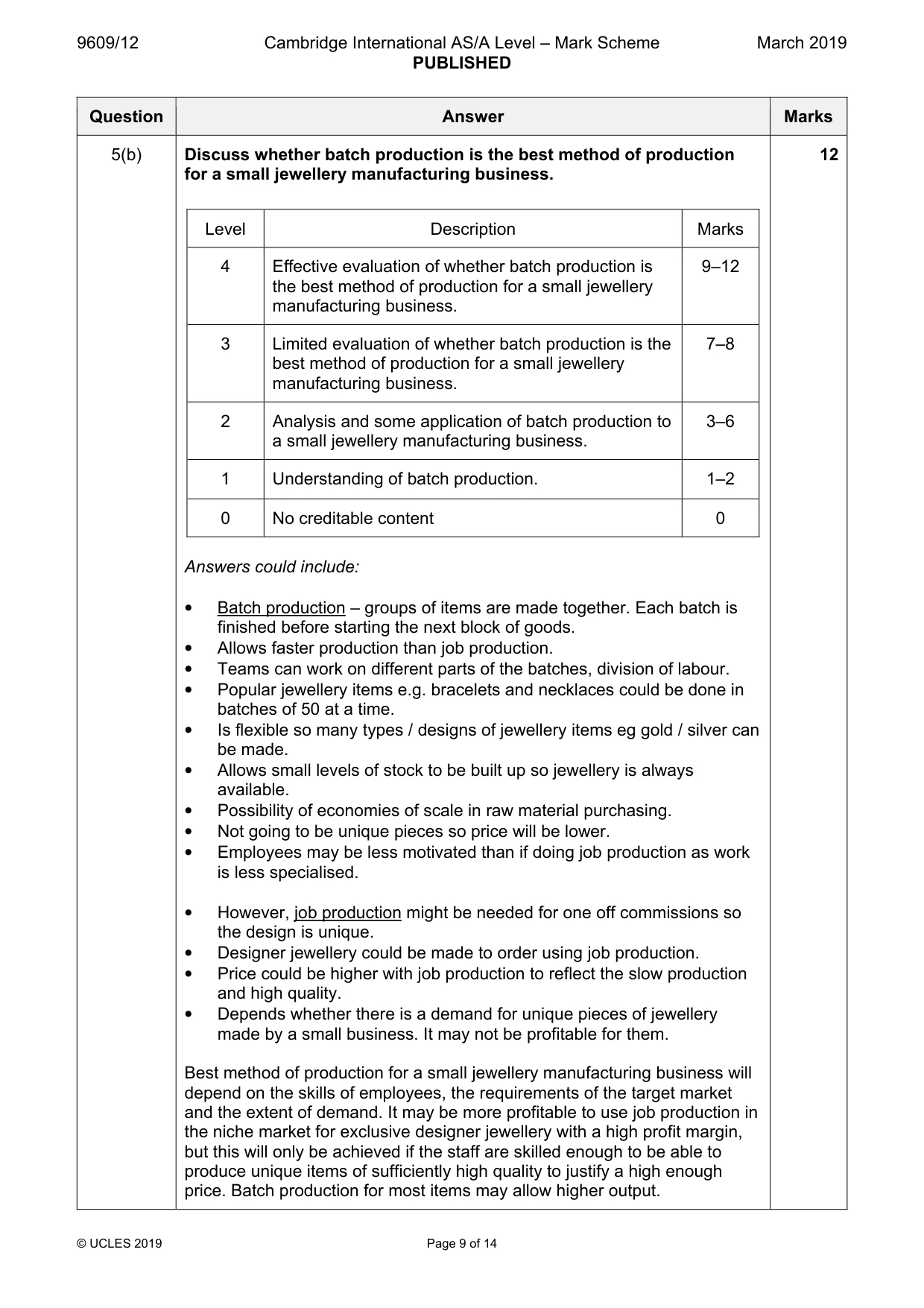
9609/12 Cambridge International AS/A Level – Mark Scheme PUBLISHED March 2019 © UCLES 2019 Page 9 of 14 Question Answer Marks 5(b) Discuss whether batch production is the best method of production for a small jewellery manufacturing business. Answers could include: • Batch production – groups of items are made together. Each batch is finished before starting the next block of goods. • Allows faster production than job production. • Teams can work on different parts of the batches, division of labour. • Popular jewellery items e.g. bracelets and necklaces could be done in batches of 50 at a time. • Is flexible so many types / designs of jewellery items eg gold / silver can be made. • Allows small levels of stock to be built up so jewellery is always available. • Possibility of economies of scale in raw material purchasing. • Not going to be unique pieces so price will be lower. • Employees may be less motivated than if doing job production as work is less specialised. • However, job production might be needed for one off commissions so the design is unique. • Designer jewellery could be made to order using job production. • Price could be higher with job production to reflect the slow production and high quality. • Depends whether there is a demand for unique pieces of jewellery made by a small business. It may not be profitable for them. Best method of production for a small jewellery manufacturing business will depend on the skills of employees, the requirements of the target market and the extent of demand. It may be more profitable to use job production in the niche market for exclusive designer jewellery with a high profit margin, but this will only be achieved if the staff are skilled enough to be able to produce unique items of sufficiently high quality to justify a high enough price. Batch production for most items may allow higher output. Level Description Marks 4 Effective evaluation of whether batch production is the best method of production for a small jewellery manufacturing business. 9–12 3 Limited evaluation of whether batch production is the best method of production for a small jewellery manufacturing business. 7–8 2 Analysis and some application of batch production to a small jewellery manufacturing business. 3–6 1 Understanding of batch production. 1–2 0 No creditable content 0 12
Mark scheme, page 10
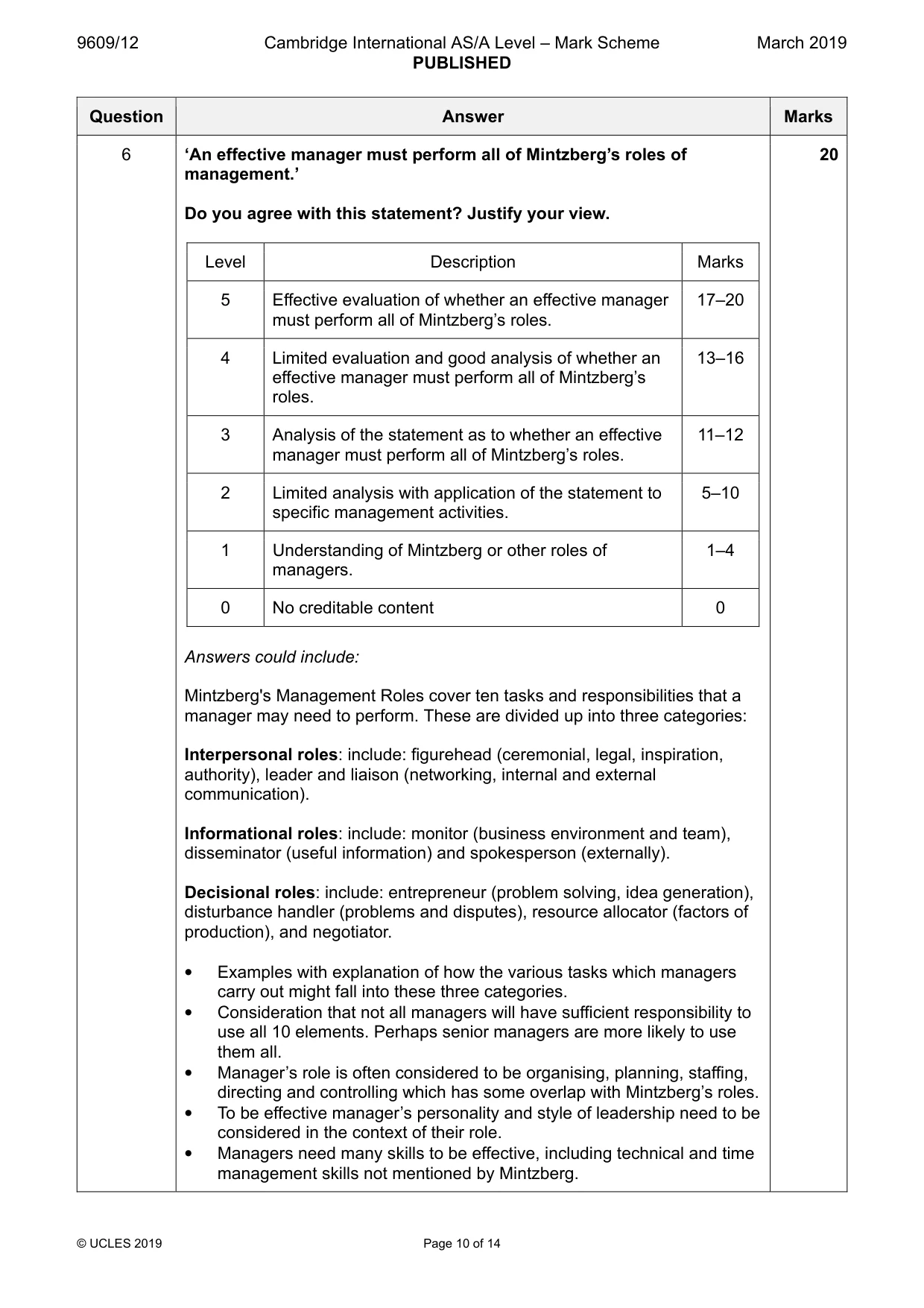
9609/12 Cambridge International AS/A Level – Mark Scheme PUBLISHED March 2019 © UCLES 2019 Page 10 of 14 Question Answer Marks 6 ‘An effective manager must perform all of Mintzberg’s roles of management.’ Do you agree with this statement? Justify your view. Level Description Marks 5 Effective evaluation of whether an effective manager must perform all of Mintzberg’s roles. 17–20 4 Limited evaluation and good analysis of whether an effective manager must perform all of Mintzberg’s roles. 13–16 3 Analysis of the statement as to whether an effective manager must perform all of Mintzberg’s roles. 11–12 2 Limited analysis with application of the statement to specific management activities. 5–10 1 Understanding of Mintzberg or other roles of managers. 1–4 0 No creditable content 0 Answers could include: Mintzberg's Management Roles cover ten tasks and responsibilities that a manager may need to perform. These are divided up into three categories: Interpersonal roles: include: figurehead (ceremonial, legal, inspiration, authority), leader and liaison (networking, internal and external communication). Informational roles: include: monitor (business environment and team), disseminator (useful information) and spokesperson (externally). Decisional roles: include: entrepreneur (problem solving, idea generation), disturbance handler (problems and disputes), resource allocator (factors of production), and negotiator. • Examples with explanation of how the various tasks which managers carry out might fall into these three categories. • Consideration that not all managers will have sufficient responsibility to use all 10 elements. Perhaps senior managers are more likely to use them all. • Manager’s role is often considered to be organising, planning, staffing, directing and controlling which has some overlap with Mintzberg’s roles. • To be effective manager’s personality and style of leadership need to be considered in the context of their role. • Managers need many skills to be effective, including technical and time management skills not mentioned by Mintzberg. 20
Mark scheme, page 11
9609/12 Cambridge International AS/A Level – Mark Scheme PUBLISHED March 2019 © UCLES 2019 Page 11 of 14 Question Answer Marks 6 • Effectiveness of any manager depends on a complex set of skills and styles being used appropriately in a wide range of different tasks which may be routine or non-routine and may depend on the different roles and responsibilities of the manager and their position in the hierarchy.
Mark scheme, page 12
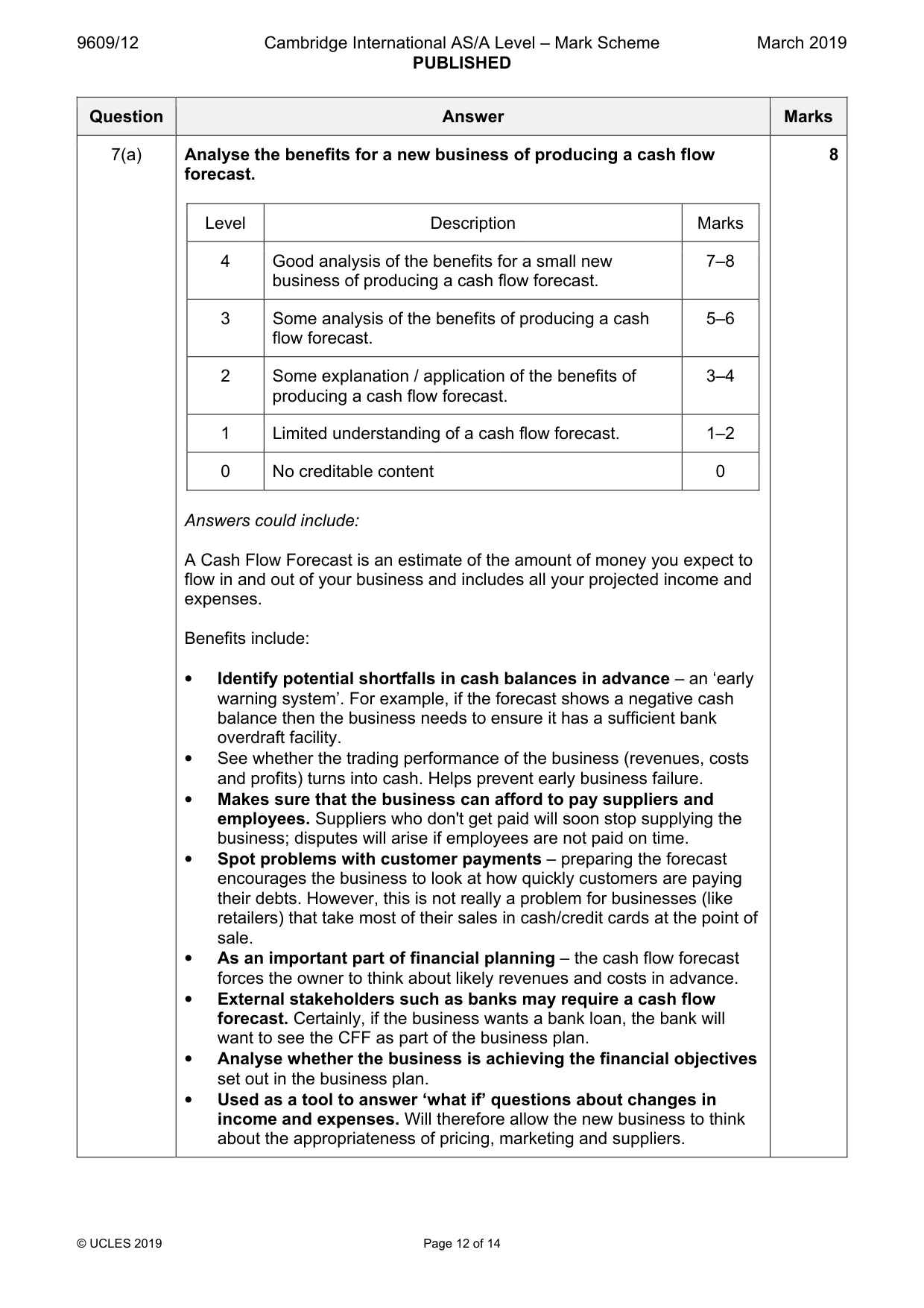
9609/12 Cambridge International AS/A Level – Mark Scheme PUBLISHED March 2019 © UCLES 2019 Page 12 of 14 Question Answer Marks 7(a) Analyse the benefits for a new business of producing a cash flow forecast. Level Description Marks 4 Good analysis of the benefits for a small new business of producing a cash flow forecast. 7–8 3 Some analysis of the benefits of producing a cash flow forecast. 5–6 2 Some explanation / application of the benefits of producing a cash flow forecast. 3–4 1 Limited understanding of a cash flow forecast. 1–2 0 No creditable content 0 Answers could include: A Cash Flow Forecast is an estimate of the amount of money you expect to flow in and out of your business and includes all your projected income and expenses. Benefits include: • Identify potential shortfalls in cash balances in advance – an ‘early warning system’. For example, if the forecast shows a negative cash balance then the business needs to ensure it has a sufficient bank overdraft facility. • See whether the trading performance of the business (revenues, costs and profits) turns into cash. Helps prevent early business failure. • Makes sure that the business can afford to pay suppliers and employees. Suppliers who don't get paid will soon stop supplying the business; disputes will arise if employees are not paid on time. • Spot problems with customer payments – preparing the forecast encourages the business to look at how quickly customers are paying their debts. However, this is not really a problem for businesses (like retailers) that take most of their sales in cash/credit cards at the point of sale. • As an important part of financial planning – the cash flow forecast forces the owner to think about likely revenues and costs in advance. • External stakeholders such as banks may require a cash flow forecast. Certainly, if the business wants a bank loan, the bank will want to see the CFF as part of the business plan. • Analyse whether the business is achieving the financial objectives set out in the business plan. • Used as a tool to answer ‘what if’ questions about changes in income and expenses. Will therefore allow the new business to think about the appropriateness of pricing, marketing and suppliers. 8
Mark scheme, page 13
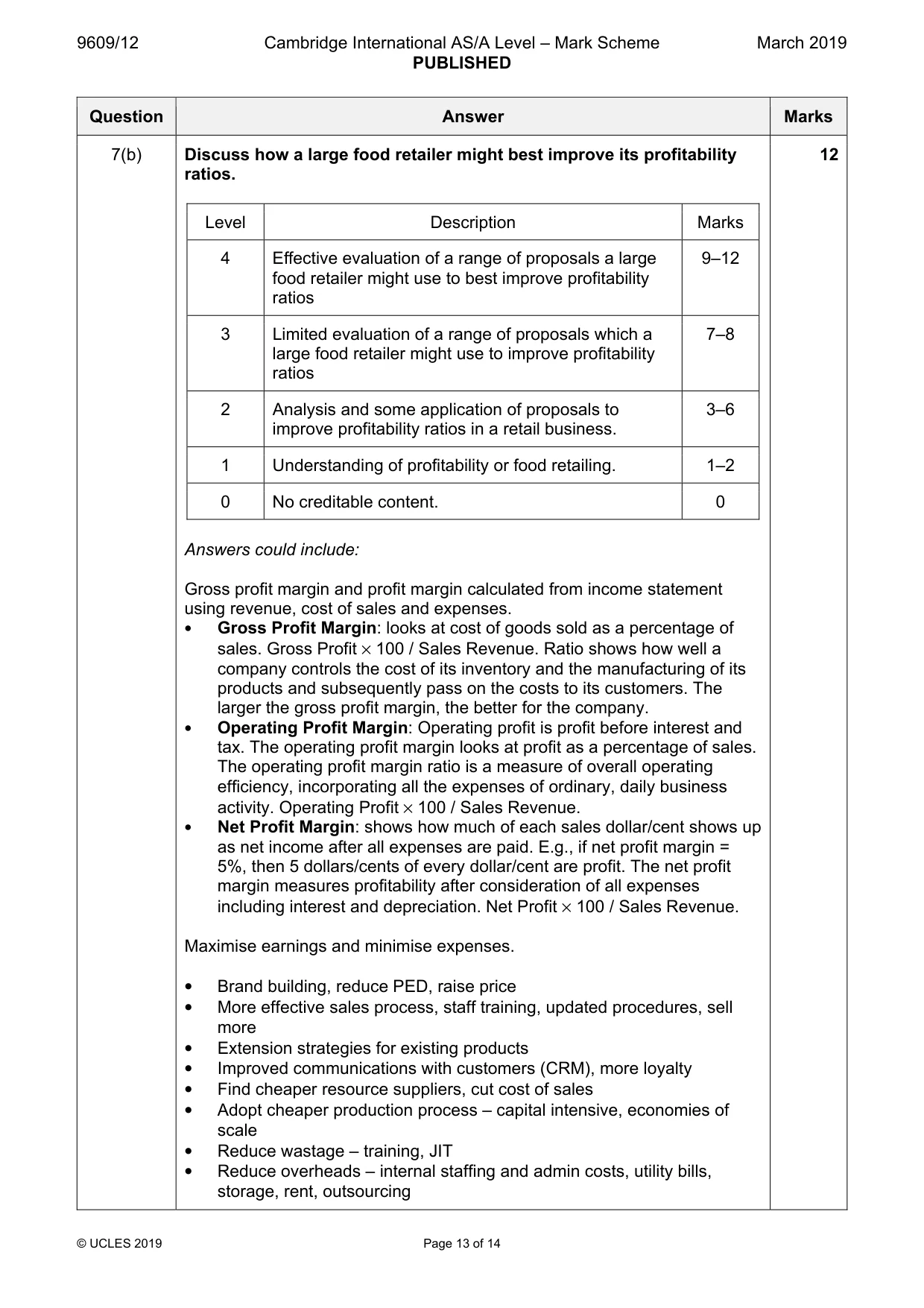
9609/12 Cambridge International AS/A Level – Mark Scheme PUBLISHED March 2019 © UCLES 2019 Page 13 of 14 Question Answer Marks 7(b) Discuss how a large food retailer might best improve its profitability ratios. Level Description Marks 4 Effective evaluation of a range of proposals a large food retailer might use to best improve profitability ratios 9–12 3 Limited evaluation of a range of proposals which a large food retailer might use to improve profitability ratios 7–8 2 Analysis and some application of proposals to improve profitability ratios in a retail business. 3–6 1 Understanding of profitability or food retailing. 1–2 0 No creditable content. 0 Answers could include: Gross profit margin and profit margin calculated from income statement using revenue, cost of sales and expenses. • Gross Profit Margin: looks at cost of goods sold as a percentage of sales. Gross Profit × 100 / Sales Revenue. Ratio shows how well a company controls the cost of its inventory and the manufacturing of its products and subsequently pass on the costs to its customers. The larger the gross profit margin, the better for the company. • Operating Profit Margin: Operating profit is profit before interest and tax. The operating profit margin looks at profit as a percentage of sales. The operating profit margin ratio is a measure of overall operating efficiency, incorporating all the expenses of ordinary, daily business activity. Operating Profit × 100 / Sales Revenue. • Net Profit Margin: shows how much of each sales dollar/cent shows up as net income after all expenses are paid. E.g., if net profit margin = 5%, then 5 dollars/cents of every dollar/cent are profit. The net profit margin measures profitability after consideration of all expenses including interest and depreciation. Net Profit × 100 / Sales Revenue. Maximise earnings and minimise expenses. • Brand building, reduce PED, raise price • More effective sales process, staff training, updated procedures, sell more • Extension strategies for existing products • Improved communications with customers (CRM), more loyalty • Find cheaper resource suppliers, cut cost of sales • Adopt cheaper production process – capital intensive, economies of scale • Reduce wastage – training, JIT • Reduce overheads – internal staffing and admin costs, utility bills, storage, rent, outsourcing 12
Mark scheme, page 14
9609/12 Cambridge International AS/A Level – Mark Scheme PUBLISHED March 2019 © UCLES 2019 Page 14 of 14 Question Answer Marks 7(b) However – • Cost of marketing, training, updating, buying new plant. • Loss of time, quality, staff • Disruption caused by change. Evaluation: Link to best way(s) for a large food retailer – perishable stock, need for good supply/stock levels, competition/customer loyalty, potential for market growth.
What you needed in this session
Cambridge’s own grade thresholds for 2019 Feb/March, Paper 1 · Variant 2. A higher threshold means an easier paper — the bar moves with how the cohort did.