Cambridge A Level Business (for first examination in 2016) 9609 — 2018 Oct/Nov Paper 3 · Variant 2
9609/32/O/N/18 · 100 marks · ≈113 min
The question paper and its mark scheme, free to read here and free to download. This is Cambridge’s own paper, exactly as it was sat.
Question paper20 pages



















Mark scheme22 pages
Answers below. Sit the paper first if you are practising.


Paper as text
Question paper, page 1
This document consists of 20 printed pages and 1 Insert. DC (RCL (GO)) 153643/2 © UCLES 2018 [Turn over Cambridge International Examinations Cambridge International Advanced Level * 8 5 9 5 7 5 4 0 4 8 * BUSINESS 9609/32 Paper 3 Case Study October/November 2018 3 hours Candidates answer on the Question Paper. No Additional Materials are required. READ THESE INSTRUCTIONS FIRST Write your Centre number, candidate number and name in the spaces at the top of this page. If you need additional answer paper ask the invigilator for a continuation booklet. Write in dark blue or black pen. You may use an HB pencil for any diagrams, graphs or rough working. Do not use staples, paper clips, glue or correction fluid. DO NOT WRITE IN ANY BARCODES. Section A Answer all questions. Section B Answer one question. You are advised to spend no more than 40 minutes on Section B. Refer to the Insert for the case study for this Paper. At the end of the examination, fasten all your work securely together. The number of marks is given in brackets [ ] at the end of each question or part question.
Question paper, page 2
2 9609/32/O/N/18 © UCLES 2018 Section A Answer all questions in this section. 1 Analyse the benefits to DLR of the elasticity concept when developing the new marketing plan. … … … … … … … … … … … … … … … … … … … … … … … … …
Question paper, page 3
3 9609/32/O/N/18 © UCLES 2018 [Turn over … … … … … … … … … … … … … … … … … … … … … … … … … … … … [10]
Question paper, page 4
4 9609/32/O/N/18 © UCLES 2018 2 (a) Refer to Appendix A and lines 74–79. Produce a forecast Income Statement for the year ending 30 September 2019. Assume no other changes. … … … … … … … … … … … … … … … … … … … … … … … … … … … [6]
Question paper, page 5
5 9609/32/O/N/18 © UCLES 2018 [Turn over (b) Using your result to 2(a) calculate the forecast gross profit margin for 2019. … … … … … … … … … [2]
Question paper, page 6
6 9609/32/O/N/18 © UCLES 2018 (c) Discuss the usefulness of forecast Income Statements to the directors of DLR. … … … … … … … … … … … … … … … … … … … … … … … … … … …
Question paper, page 7
7 9609/32/O/N/18 © UCLES 2018 [Turn over … … … … … … … … … … … … … … … … … … … … … … … … … … … … [12]
Question paper, page 8
8 9609/32/O/N/18 © UCLES 2018 3 Recommend changes the Human Resources Director could make to DLR’s human resource strategy. Justify your recommendation. … … … … … … … … … … … … … … … … … … … … … … … … … … …
Question paper, page 9
9 9609/32/O/N/18 © UCLES 2018 [Turn over … … … … … … … … … … … … … … … … … … … … … … … … … … … …
Question paper, page 10
10 9609/32/O/N/18 © UCLES 2018 … … … … … … … … … … … … … … … … … … … … … … … … … … … … [16]
Question paper, page 11
11 9609/32/O/N/18 © UCLES 2018 [Turn over 4 (a) Refer to Table 1. Calculate for 2018: (i) capacity utilisation … … … … … … … … … [2] (ii) the number of apartments that must be occupied each day for DLR to break even. … … … … … … … … … … … … … … … … [4]
Question paper, page 12
12 9609/32/O/N/18 © UCLES 2018 (b) Discuss the importance to DLR of increasing capacity utilisation. … … … … … … … … … … … … … … … … … … … … … … … … … … …
Question paper, page 13
13 9609/32/O/N/18 © UCLES 2018 [Turn over … … … … … … … … … … … … … … … … … … … … … … … … … … … … [12]
Question paper, page 14
14 9609/32/O/N/18 © UCLES 2018 5 Assess the extent to which any two of the forecast changes in Table 3 could influence DLR’s future decision-making. … … … … … … … … … … … … … … … … … … … … … … … … … … …
Question paper, page 15
15 9609/32/O/N/18 © UCLES 2018 [Turn over … … … … … … … … … … … … … … … … … … … … … … … … … … … …
Question paper, page 16
16 9609/32/O/N/18 © UCLES 2018 … … … … … … … … … … … … … … … … … … … … … … … … … … … … [16]
Question paper, page 17
17 9609/32/O/N/18 © UCLES 2018 [Turn over Section B Answer one question from this section. 6 Discuss the importance to DLR’s future profitability of business planning. 7 Discuss whether DLR’s use of strategic choice techniques can eliminate risk when taking strategic decisions. Write the question number here: … … … … … … … … … … … … … … … … … … … … … … … …
Question paper, page 18
18 9609/32/O/N/18 © UCLES 2018 … … … … … … … … … … … … … … … … … … … … … … … … … … … …
Question paper, page 19
19 9609/32/O/N/18 © UCLES 2018 [Turn over … … … … … … … … … … … … … … … … … … … … … … … … … … … …
Question paper, page 20
20 9609/32/O/N/18 © UCLES 2018 Permission to reproduce items where third-party owned material protected by copyright is included has been sought and cleared where possible. Every reasonable effort has been made by the publisher (UCLES) to trace copyright holders, but if any items requiring clearance have unwittingly been included, the publisher will be pleased to make amends at the earliest possible opportunity. To avoid the issue of disclosure of answer-related information to candidates, all copyright acknowledgements are reproduced online in the Cambridge International Examinations Copyright Acknowledgements Booklet. This is produced for each series of examinations and is freely available to download at www.cie.org.uk after the live examination series. Cambridge International Examinations is part of the Cambridge Assessment Group. Cambridge Assessment is the brand name of University of Cambridge Local Examinations Syndicate (UCLES), which is itself a department of the University of Cambridge. … … … … … … … … … … … … … … … … … … … … … … …[20]
Mark scheme, page 1
This document consists of 22 printed pages. © UCLES 2018 [Turn over Cambridge Assessment International Education Cambridge International Advanced Subsidiary and Advanced Level BUSINESS 9609/32 Paper 3 Case Study October/November 2018 MARK SCHEME Maximum Mark: 100 Published This mark scheme is published as an aid to teachers and candidates, to indicate the requirements of the examination. It shows the basis on which Examiners were instructed to award marks. It does not indicate the details of the discussions that took place at an Examiners’ meeting before marking began, which would have considered the acceptability of alternative answers. Mark schemes should be read in conjunction with the question paper and the Principal Examiner Report for Teachers. Cambridge International will not enter into discussions about these mark schemes. Cambridge International is publishing the mark schemes for the October/November 2018 series for most Cambridge IGCSE™, Cambridge International A and AS Level components and some Cambridge O Level components.
Mark scheme, page 2
9609/32 Cambridge International AS/A Level – Mark Scheme PUBLISHED October/November 2018 © UCLES 2018 Page 2 of 22 Generic Marking Principles These general marking principles must be applied by all examiners when marking candidate answers. They should be applied alongside the specific content of the mark scheme or generic level descriptors for a question. Each question paper and mark scheme will also comply with these marking principles. GENERIC MARKING PRINCIPLE 1: Marks must be awarded in line with: • the specific content of the mark scheme or the generic level descriptors for the question • the specific skills defined in the mark scheme or in the generic level descriptors for the question • the standard of response required by a candidate as exemplified by the standardisation scripts. GENERIC MARKING PRINCIPLE 2: Marks awarded are always whole marks (not half marks, or other fractions). GENERIC MARKING PRINCIPLE 3: Marks must be awarded positively: • marks are awarded for correct/valid answers, as defined in the mark scheme. However, credit is given for valid answers which go beyond the scope of the syllabus and mark scheme, referring to your Team Leader as appropriate • marks are awarded when candidates clearly demonstrate what they know and can do • marks are not deducted for errors • marks are not deducted for omissions • answers should only be judged on the quality of spelling, punctuation and grammar when these features are specifically assessed by the question as indicated by the mark scheme. The meaning, however, should be unambiguous. GENERIC MARKING PRINCIPLE 4: Rules must be applied consistently e.g. in situations where candidates have not followed instructions or in the application of generic level descriptors. GENERIC MARKING PRINCIPLE 5: Marks should be awarded using the full range of marks defined in the mark scheme for the question (however; the use of the full mark range may be limited according to the quality of the candidate responses seen). GENERIC MARKING PRINCIPLE 6: Marks awarded are based solely on the requirements as defined in the mark scheme. Marks should not be awarded with grade thresholds or grade descriptors in mind.
Mark scheme, page 3
9609/32 Cambridge International AS/A Level – Mark Scheme PUBLISHED October/November 2018 © UCLES 2018 Page 3 of 22 General Marking Guidance • Marking should be positive: marks should not be subtracted for errors or inaccuracies. • When examiners are in doubt regarding the application of the mark scheme to a candidate’s response, the team leader must be consulted. • Crossed out work should be marked UNLESS the candidate has replaced it with an alternative response. • Errors that are carried forward (e.g. when an incorrect numerical answer to one part of a question is used as the starting point for a calculation in the next part of the question) should not be compounded – use the ‘own figure rule’. • Poor spelling, handwriting or grammar should not be penalised as long as the answer makes sense. • The main RM Assessor annotations to be used are K (Knowledge), APP (Application), AN (Analysis), EVAL (Evaluation). For each of these four annotations, the number of marks awarded for that assessment objective must match the number of times that annotation is on the answer. • Only award EVAL if the candidate has also demonstrated APP. • If there is no relevant K (Knowledge) no marks can be awarded. • Blank pages on a script should be annotated as SEEN. • A blank space, dash, question mark and a response that bears no relation to the question constitutes a ‘no response’. • In Section B, candidates answer either Question 6 or Question 7. The Section B question that the candidate does not answer must be entered as ‘no response’. • Blank pages, or pages that contain crossed out material, must be annotated using ‘seen’. • Accept any reasonable answer (ARA) when awarding marks. The suggestions for content in the mark scheme are neither exhaustive nor required. This mark scheme includes a summary of appropriate content for answering each question. It should be emphasised, however, that this material is for illustrative purposes and is not intended to provide a definitive guide to acceptable answers. It is quite possible that among the scripts there will be some candidate answers that are not covered directly by the content of this mark scheme. In such cases, professional judgement should be exercised in assessing the merits of the answer and the senior examiners should be consulted if further guidance is required. Application marks are not awarded for repeating material from the case study. Application is by answering in the context of the case or by using the information in the case to help answer the question. • The words that are written in an answer should be assessed. Where candidates’ answers do not state an intended meaning but this meaning is very clearly discernible credit may be given by discretion. • In numerical answers, units are required. • Answers that contain poor handwriting are not to be penalised. Examiners should mark what they can read and make a note to that effect. Where this is a significant factor Cambridge should be notified. • An answer consisting of a list should be assessed. It is unlikely that such a response will score highly in the levels in each Assessment Objective. • If an answer does not fit on the lined paper it should still be assessed as if it did.
Mark scheme, page 4
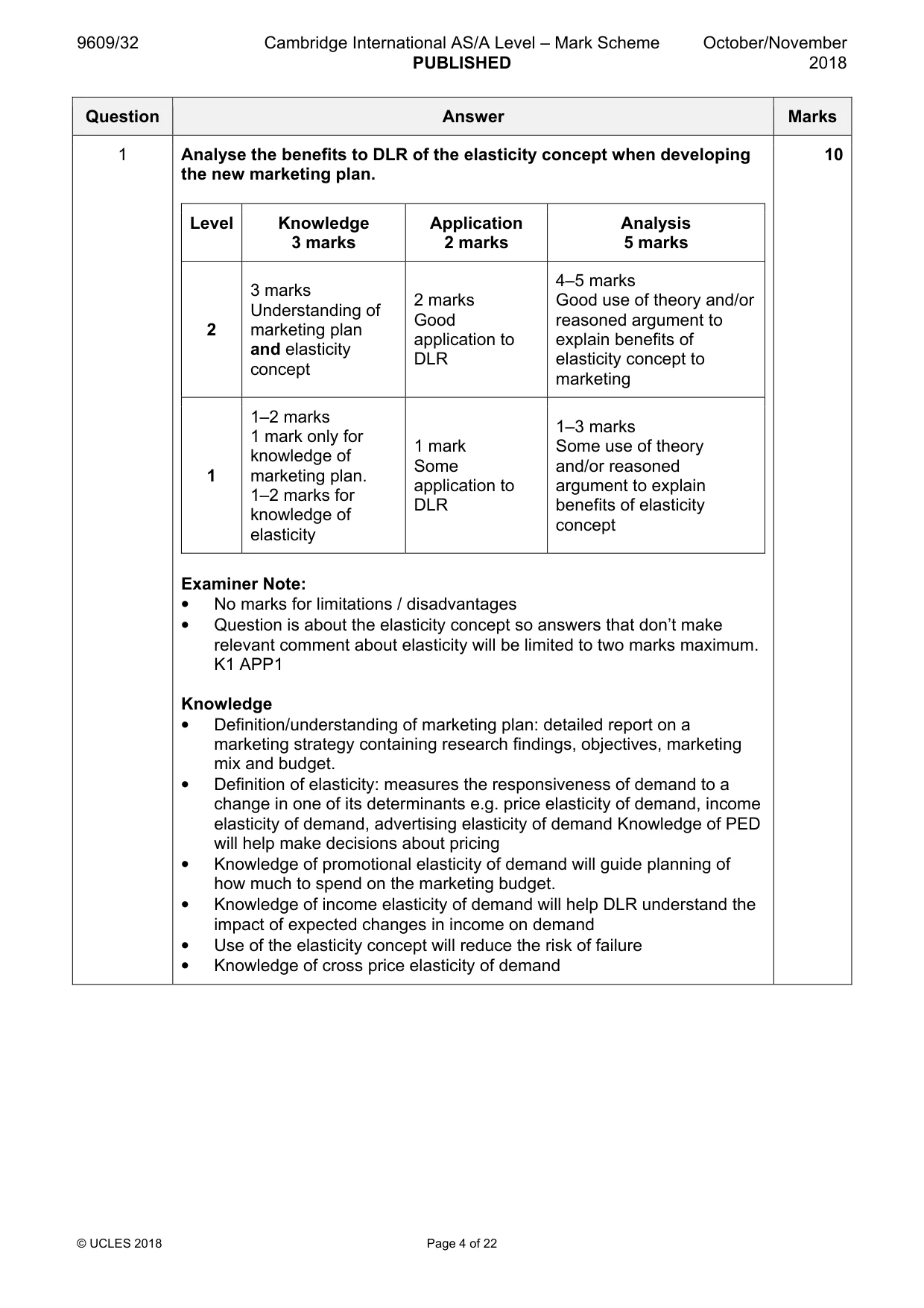
9609/32 Cambridge International AS/A Level – Mark Scheme PUBLISHED October/November 2018 © UCLES 2018 Page 4 of 22 Question Answer Marks 1 Analyse the benefits to DLR of the elasticity concept when developing the new marketing plan. Level Knowledge 3 marks Application 2 marks Analysis 5 marks 2 3 marks Understanding of marketing plan and elasticity concept 2 marks Good application to DLR 4–5 marks Good use of theory and/or reasoned argument to explain benefits of elasticity concept to marketing 1 1–2 marks 1 mark only for knowledge of marketing plan. 1–2 marks for knowledge of elasticity 1 mark Some application to DLR 1–3 marks Some use of theory and/or reasoned argument to explain benefits of elasticity concept Examiner Note: • No marks for limitations / disadvantages • Question is about the elasticity concept so answers that don’t make relevant comment about elasticity will be limited to two marks maximum. K1 APP1 Knowledge • Definition/understanding of marketing plan: detailed report on a marketing strategy containing research findings, objectives, marketing mix and budget. • Definition of elasticity: measures the responsiveness of demand to a change in one of its determinants e.g. price elasticity of demand, income elasticity of demand, advertising elasticity of demand Knowledge of PED will help make decisions about pricing • Knowledge of promotional elasticity of demand will guide planning of how much to spend on the marketing budget. • Knowledge of income elasticity of demand will help DLR understand the impact of expected changes in income on demand • Use of the elasticity concept will reduce the risk of failure • Knowledge of cross price elasticity of demand 10
Mark scheme, page 5
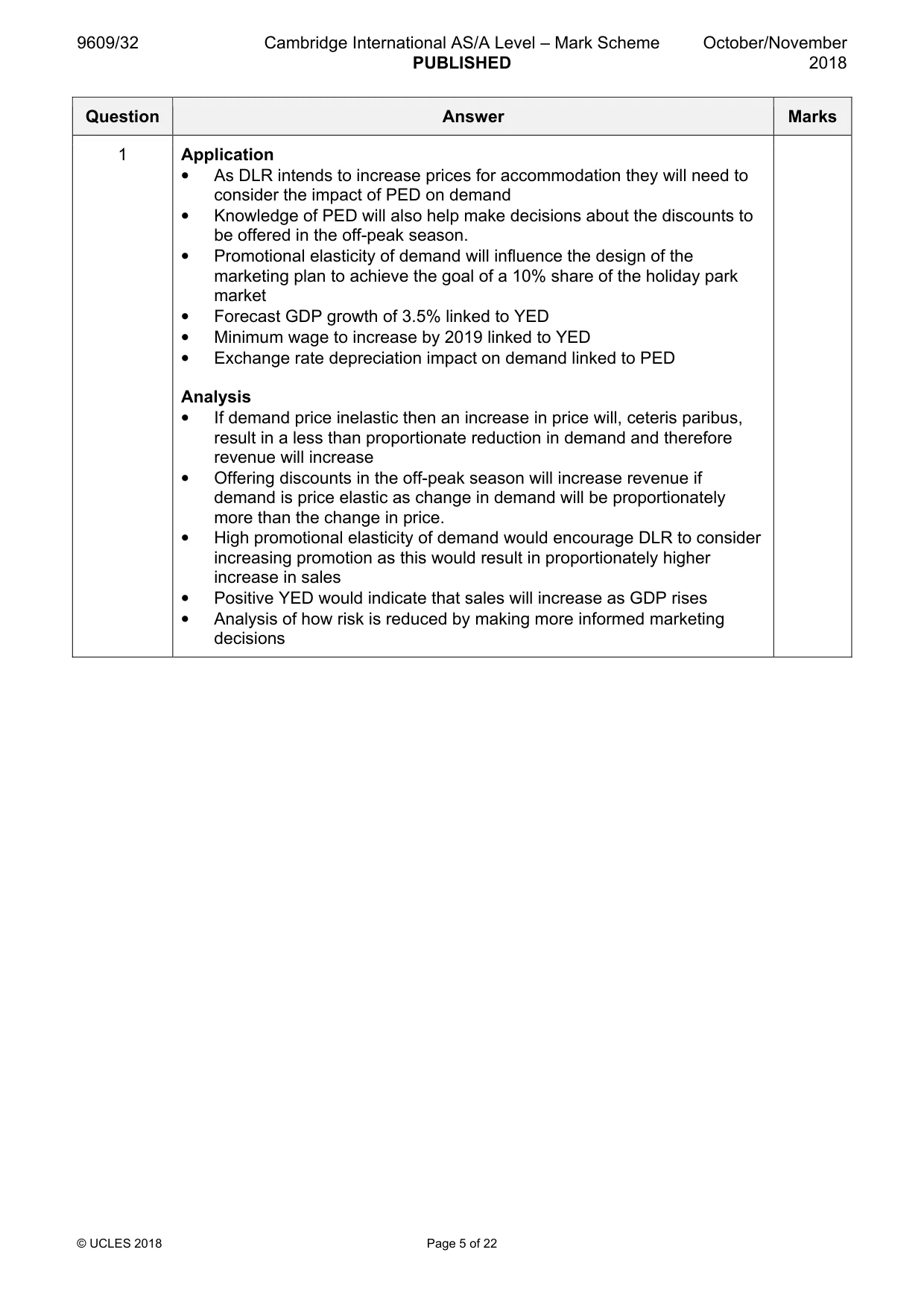
9609/32 Cambridge International AS/A Level – Mark Scheme PUBLISHED October/November 2018 © UCLES 2018 Page 5 of 22 Question Answer Marks 1 Application • As DLR intends to increase prices for accommodation they will need to consider the impact of PED on demand • Knowledge of PED will also help make decisions about the discounts to be offered in the off-peak season. • Promotional elasticity of demand will influence the design of the marketing plan to achieve the goal of a 10% share of the holiday park market • Forecast GDP growth of 3.5% linked to YED • Minimum wage to increase by 2019 linked to YED • Exchange rate depreciation impact on demand linked to PED Analysis • If demand price inelastic then an increase in price will, ceteris paribus, result in a less than proportionate reduction in demand and therefore revenue will increase • Offering discounts in the off-peak season will increase revenue if demand is price elastic as change in demand will be proportionately more than the change in price. • High promotional elasticity of demand would encourage DLR to consider increasing promotion as this would result in proportionately higher increase in sales • Positive YED would indicate that sales will increase as GDP rises • Analysis of how risk is reduced by making more informed marketing decisions
Mark scheme, page 6
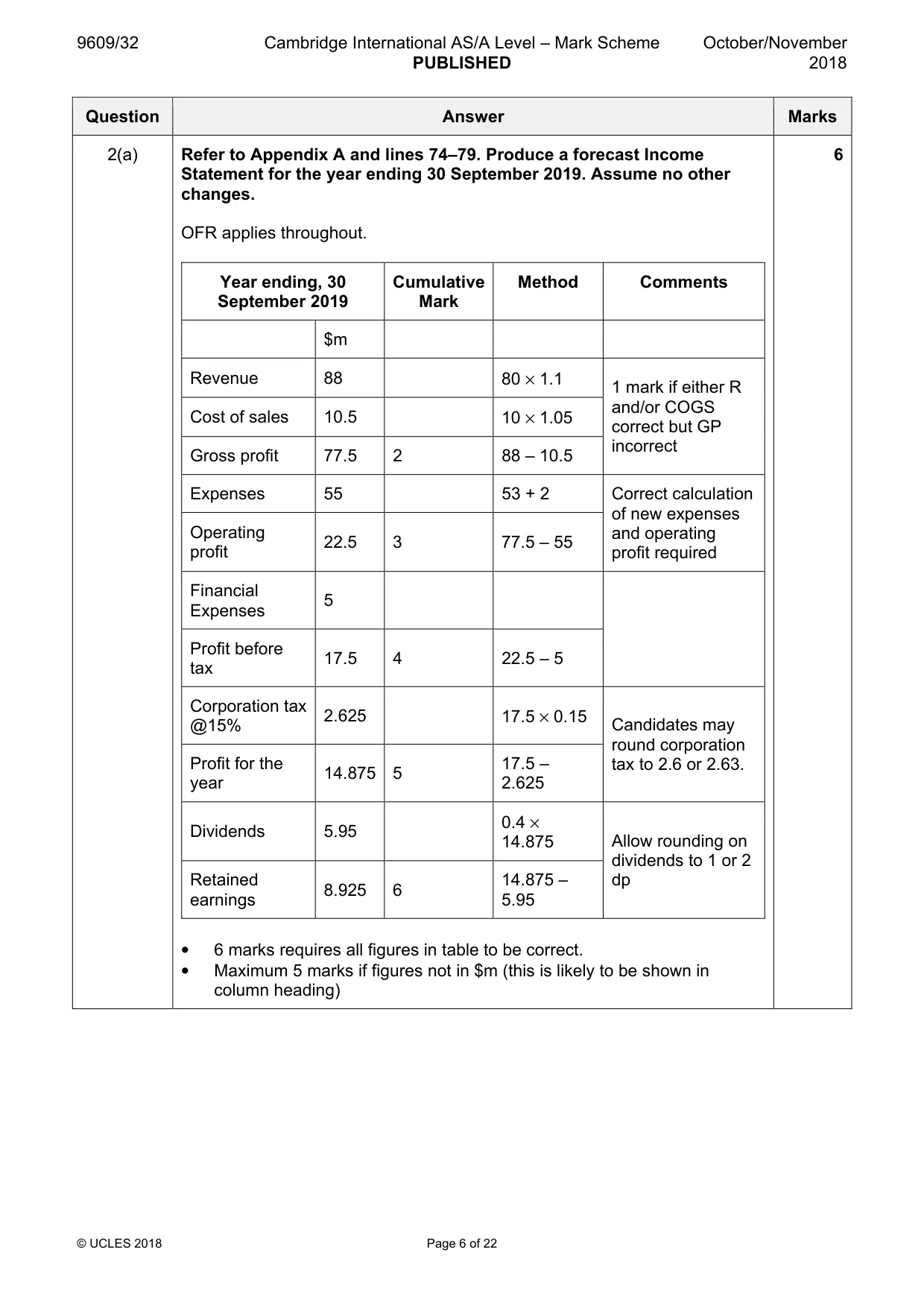
9609/32 Cambridge International AS/A Level – Mark Scheme PUBLISHED October/November 2018 © UCLES 2018 Page 6 of 22 Question Answer Marks 2(a) Refer to Appendix A and lines 74–79. Produce a forecast Income Statement for the year ending 30 September 2019. Assume no other changes. OFR applies throughout. Year ending, 30 September 2019 Cumulative Mark Method Comments $m Revenue 88 80 × 1.1 1 mark if either R and/or COGS correct but GP incorrect Cost of sales 10.5 10 × 1.05 Gross profit 77.5 2 88 – 10.5 Expenses 55 53 + 2 Correct calculation of new expenses and operating profit required Operating profit 22.5 3 77.5 – 55 Financial Expenses 5 Profit before tax 17.5 4 22.5 – 5 Corporation tax @15% 2.625 17.5 × 0.15 Candidates may round corporation tax to 2.6 or 2.63. Profit for the year 14.875 5 17.5 – 2.625 Dividends 5.95 0.4 × 14.875 Allow rounding on dividends to 1 or 2 dp Retained earnings 8.925 6 14.875 – 5.95 • 6 marks requires all figures in table to be correct. • Maximum 5 marks if figures not in $m (this is likely to be shown in column heading) 6
Mark scheme, page 7
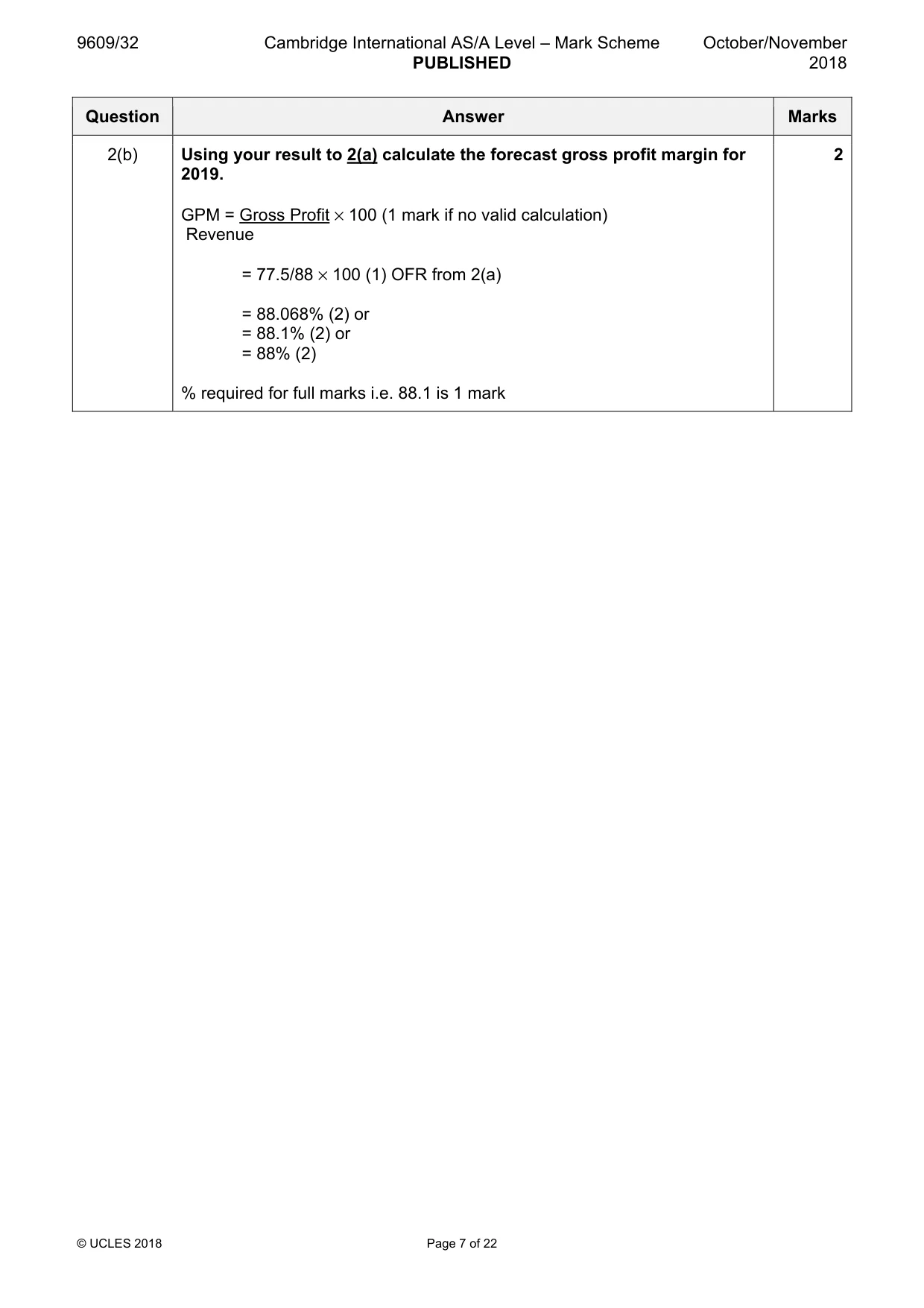
9609/32 Cambridge International AS/A Level – Mark Scheme PUBLISHED October/November 2018 © UCLES 2018 Page 7 of 22 Question Answer Marks 2(b) Using your result to 2(a) calculate the forecast gross profit margin for 2019. GPM = Gross Profit × 100 (1 mark if no valid calculation) Revenue = 77.5/88 × 100 (1) OFR from 2(a) = 88.068% (2) or = 88.1% (2) or = 88% (2) % required for full marks i.e. 88.1 is 1 mark 2
Mark scheme, page 8
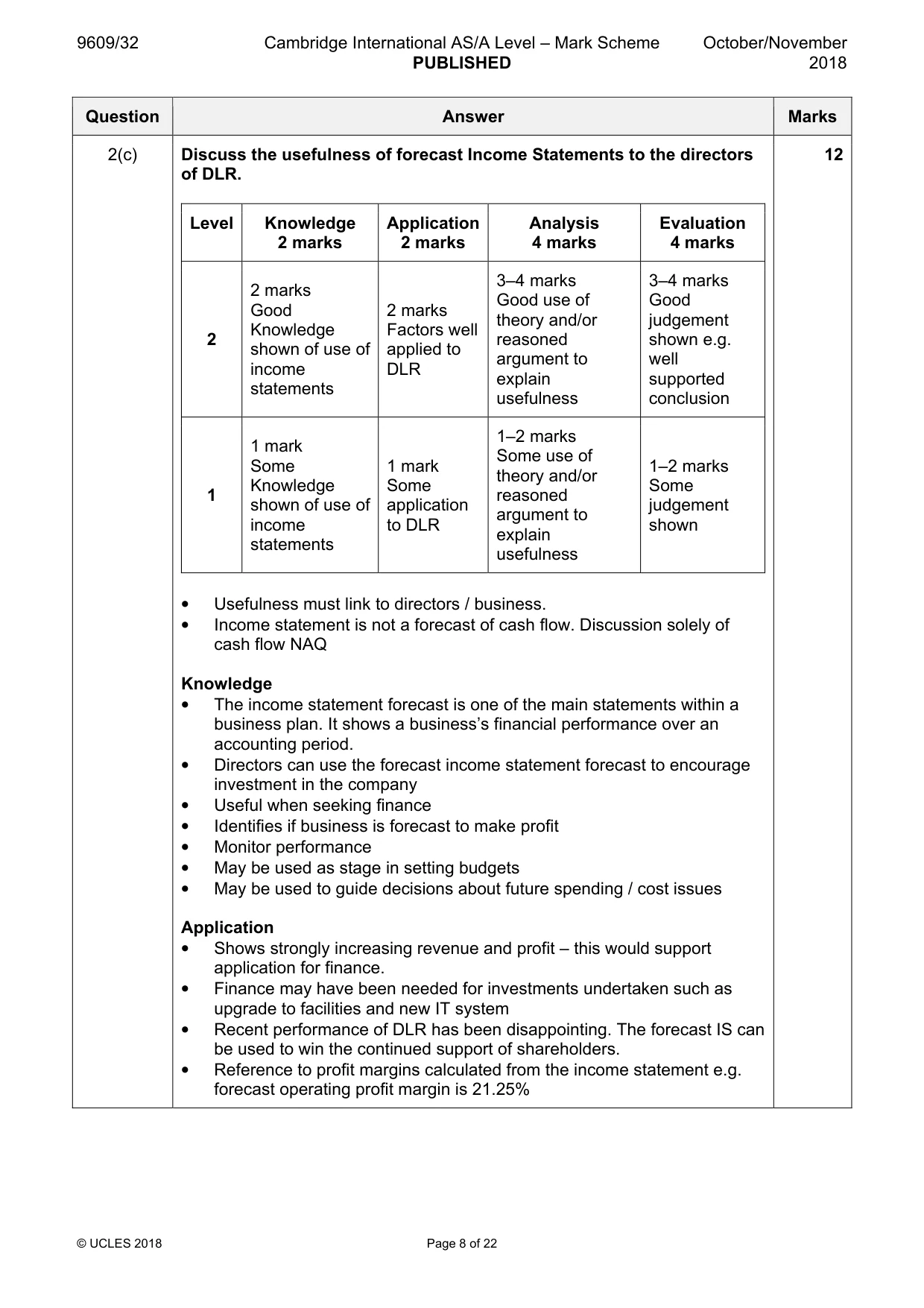
9609/32 Cambridge International AS/A Level – Mark Scheme PUBLISHED October/November 2018 © UCLES 2018 Page 8 of 22 Question Answer Marks 2(c) Discuss the usefulness of forecast Income Statements to the directors of DLR. Level Knowledge 2 marks Application 2 marks Analysis 4 marks Evaluation 4 marks 2 2 marks Good Knowledge shown of use of income statements 2 marks Factors well applied to DLR 3–4 marks Good use of theory and/or reasoned argument to explain usefulness 3–4 marks Good judgement shown e.g. well supported conclusion 1 1 mark Some Knowledge shown of use of income statements 1 mark Some application to DLR 1–2 marks Some use of theory and/or reasoned argument to explain usefulness 1–2 marks Some judgement shown • Usefulness must link to directors / business. • Income statement is not a forecast of cash flow. Discussion solely of cash flow NAQ Knowledge • The income statement forecast is one of the main statements within a business plan. It shows a business’s financial performance over an accounting period. • Directors can use the forecast income statement forecast to encourage investment in the company • Useful when seeking finance • Identifies if business is forecast to make profit • Monitor performance • May be used as stage in setting budgets • May be used to guide decisions about future spending / cost issues Application • Shows strongly increasing revenue and profit – this would support application for finance. • Finance may have been needed for investments undertaken such as upgrade to facilities and new IT system • Recent performance of DLR has been disappointing. The forecast IS can be used to win the continued support of shareholders. • Reference to profit margins calculated from the income statement e.g. forecast operating profit margin is 21.25% 12
Mark scheme, page 9
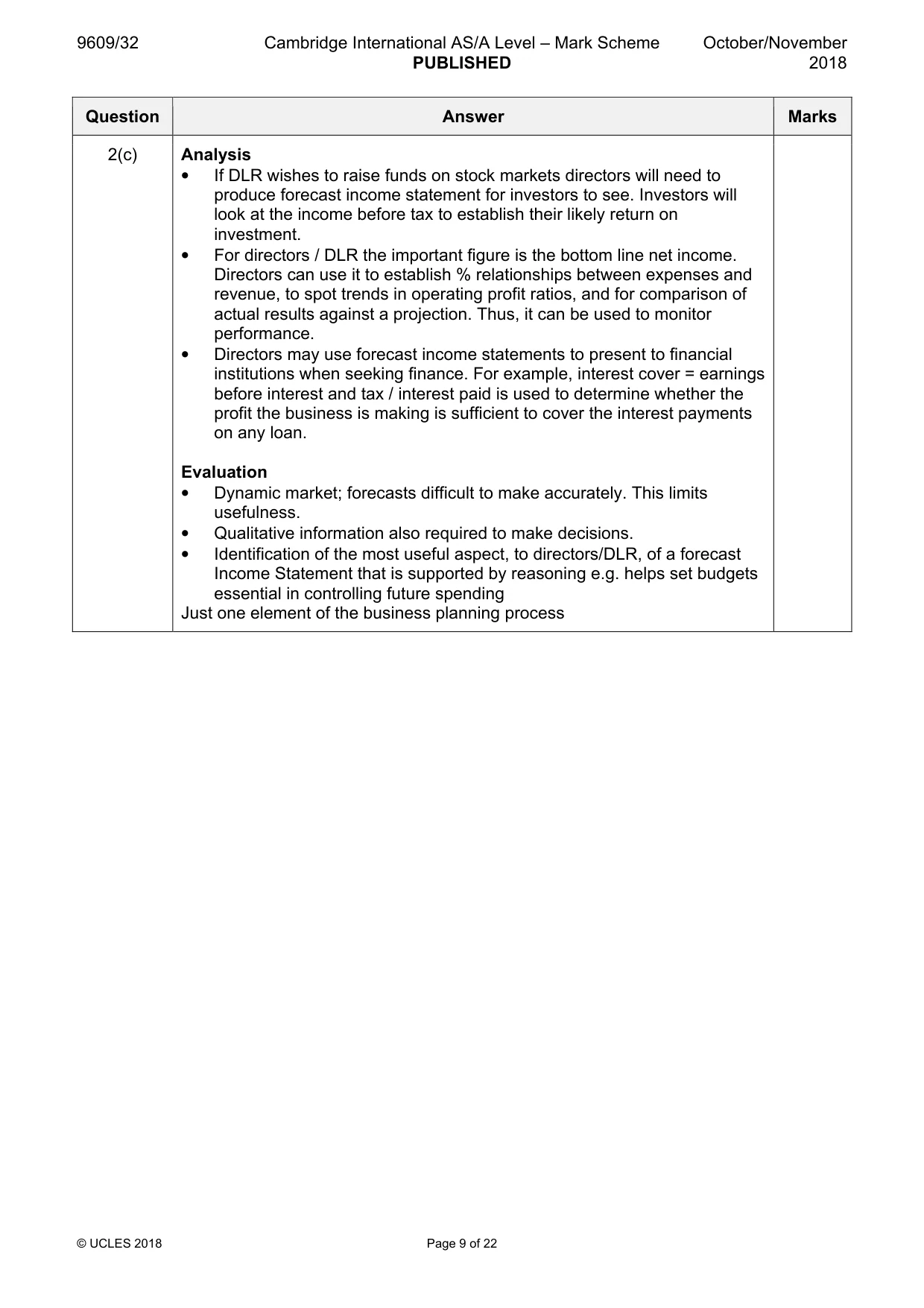
9609/32 Cambridge International AS/A Level – Mark Scheme PUBLISHED October/November 2018 © UCLES 2018 Page 9 of 22 Question Answer Marks 2(c) Analysis • If DLR wishes to raise funds on stock markets directors will need to produce forecast income statement for investors to see. Investors will look at the income before tax to establish their likely return on investment. • For directors / DLR the important figure is the bottom line net income. Directors can use it to establish % relationships between expenses and revenue, to spot trends in operating profit ratios, and for comparison of actual results against a projection. Thus, it can be used to monitor performance. • Directors may use forecast income statements to present to financial institutions when seeking finance. For example, interest cover = earnings before interest and tax / interest paid is used to determine whether the profit the business is making is sufficient to cover the interest payments on any loan. Evaluation • Dynamic market; forecasts difficult to make accurately. This limits usefulness. • Qualitative information also required to make decisions. • Identification of the most useful aspect, to directors/DLR, of a forecast Income Statement that is supported by reasoning e.g. helps set budgets essential in controlling future spending Just one element of the business planning process
Mark scheme, page 10
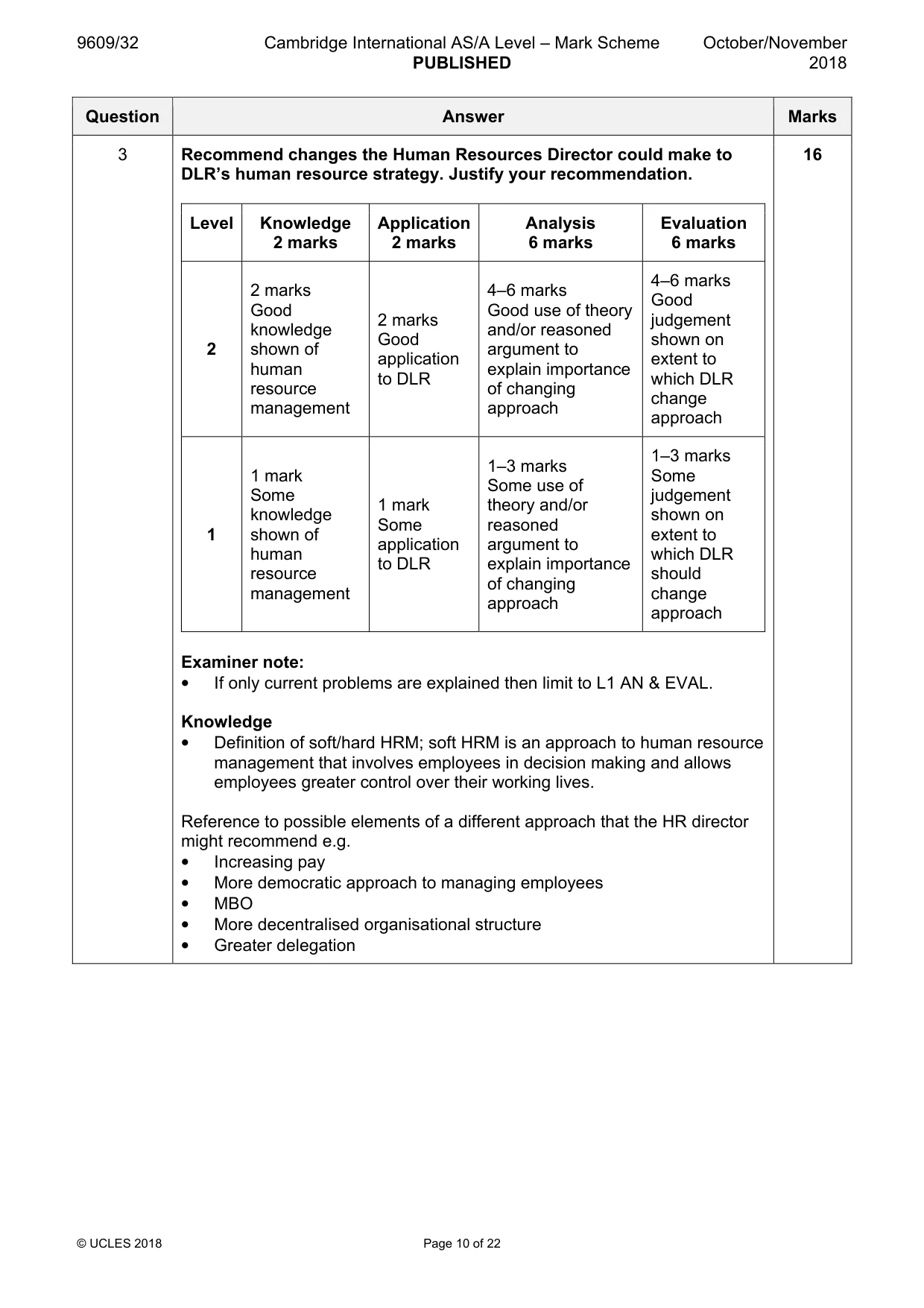
9609/32 Cambridge International AS/A Level – Mark Scheme PUBLISHED October/November 2018 © UCLES 2018 Page 10 of 22 Question Answer Marks 3 Recommend changes the Human Resources Director could make to DLR’s human resource strategy. Justify your recommendation. Level Knowledge 2 marks Application 2 marks Analysis 6 marks Evaluation 6 marks 2 2 marks Good knowledge shown of human resource management 2 marks Good application to DLR 4–6 marks Good use of theory and/or reasoned argument to explain importance of changing approach 4–6 marks Good judgement shown on extent to which DLR change approach 1 1 mark Some knowledge shown of human resource management 1 mark Some application to DLR 1–3 marks Some use of theory and/or reasoned argument to explain importance of changing approach 1–3 marks Some judgement shown on extent to which DLR should change approach Examiner note: • If only current problems are explained then limit to L1 AN & EVAL. Knowledge • Definition of soft/hard HRM; soft HRM is an approach to human resource management that involves employees in decision making and allows employees greater control over their working lives. Reference to possible elements of a different approach that the HR director might recommend e.g. • Increasing pay • More democratic approach to managing employees • MBO • More decentralised organisational structure • Greater delegation 16
Mark scheme, page 11
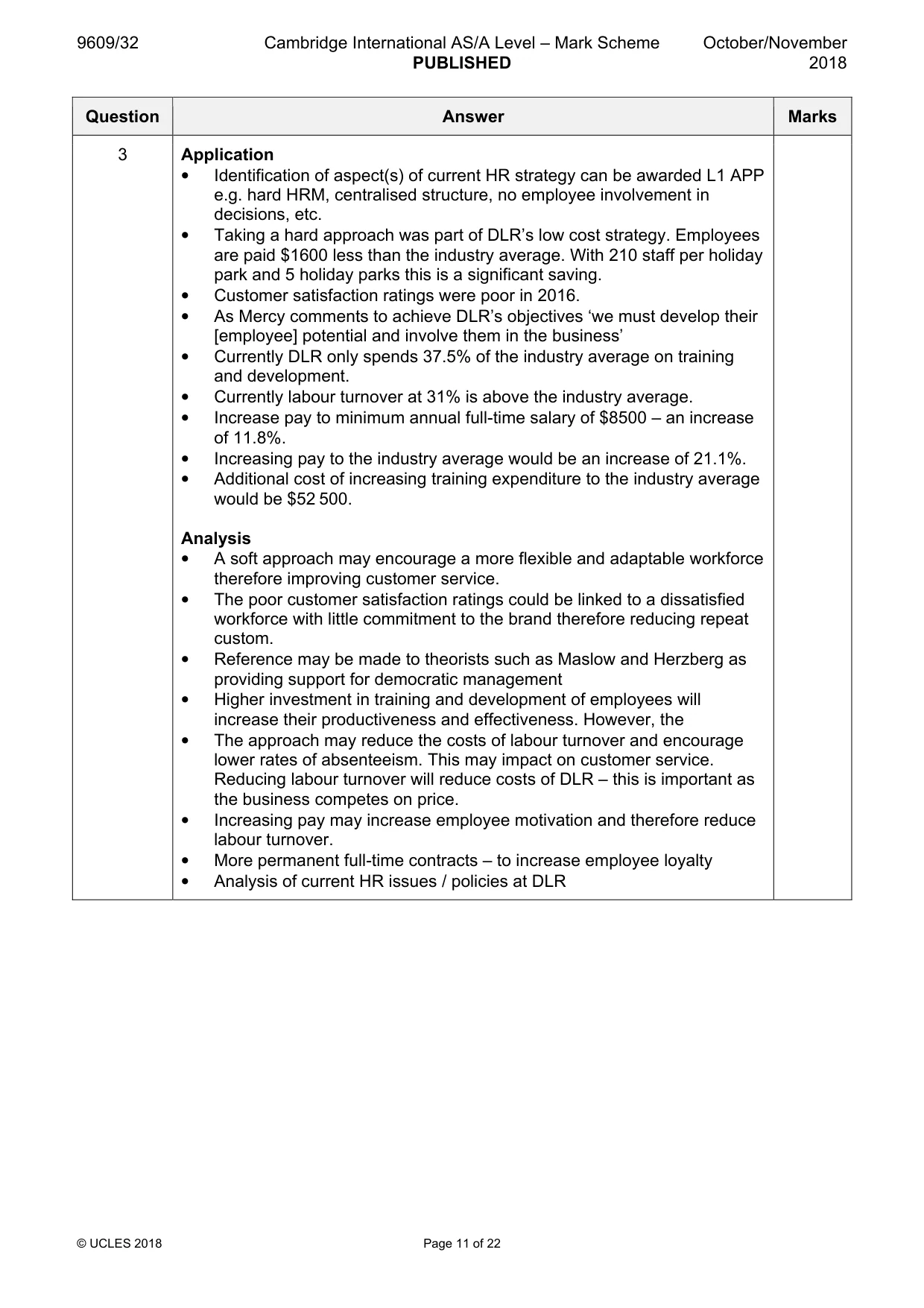
9609/32 Cambridge International AS/A Level – Mark Scheme PUBLISHED October/November 2018 © UCLES 2018 Page 11 of 22 Question Answer Marks 3 Application • Identification of aspect(s) of current HR strategy can be awarded L1 APP e.g. hard HRM, centralised structure, no employee involvement in decisions, etc. • Taking a hard approach was part of DLR’s low cost strategy. Employees are paid $1600 less than the industry average. With 210 staff per holiday park and 5 holiday parks this is a significant saving. • Customer satisfaction ratings were poor in 2016. • As Mercy comments to achieve DLR’s objectives ‘we must develop their [employee] potential and involve them in the business’ • Currently DLR only spends 37.5% of the industry average on training and development. • Currently labour turnover at 31% is above the industry average. • Increase pay to minimum annual full-time salary of $8500 – an increase of 11.8%. • Increasing pay to the industry average would be an increase of 21.1%. • Additional cost of increasing training expenditure to the industry average would be $52 500. Analysis • A soft approach may encourage a more flexible and adaptable workforce therefore improving customer service. • The poor customer satisfaction ratings could be linked to a dissatisfied workforce with little commitment to the brand therefore reducing repeat custom. • Reference may be made to theorists such as Maslow and Herzberg as providing support for democratic management • Higher investment in training and development of employees will increase their productiveness and effectiveness. However, the • The approach may reduce the costs of labour turnover and encourage lower rates of absenteeism. This may impact on customer service. Reducing labour turnover will reduce costs of DLR – this is important as the business competes on price. • Increasing pay may increase employee motivation and therefore reduce labour turnover. • More permanent full-time contracts – to increase employee loyalty • Analysis of current HR issues / policies at DLR
Mark scheme, page 12
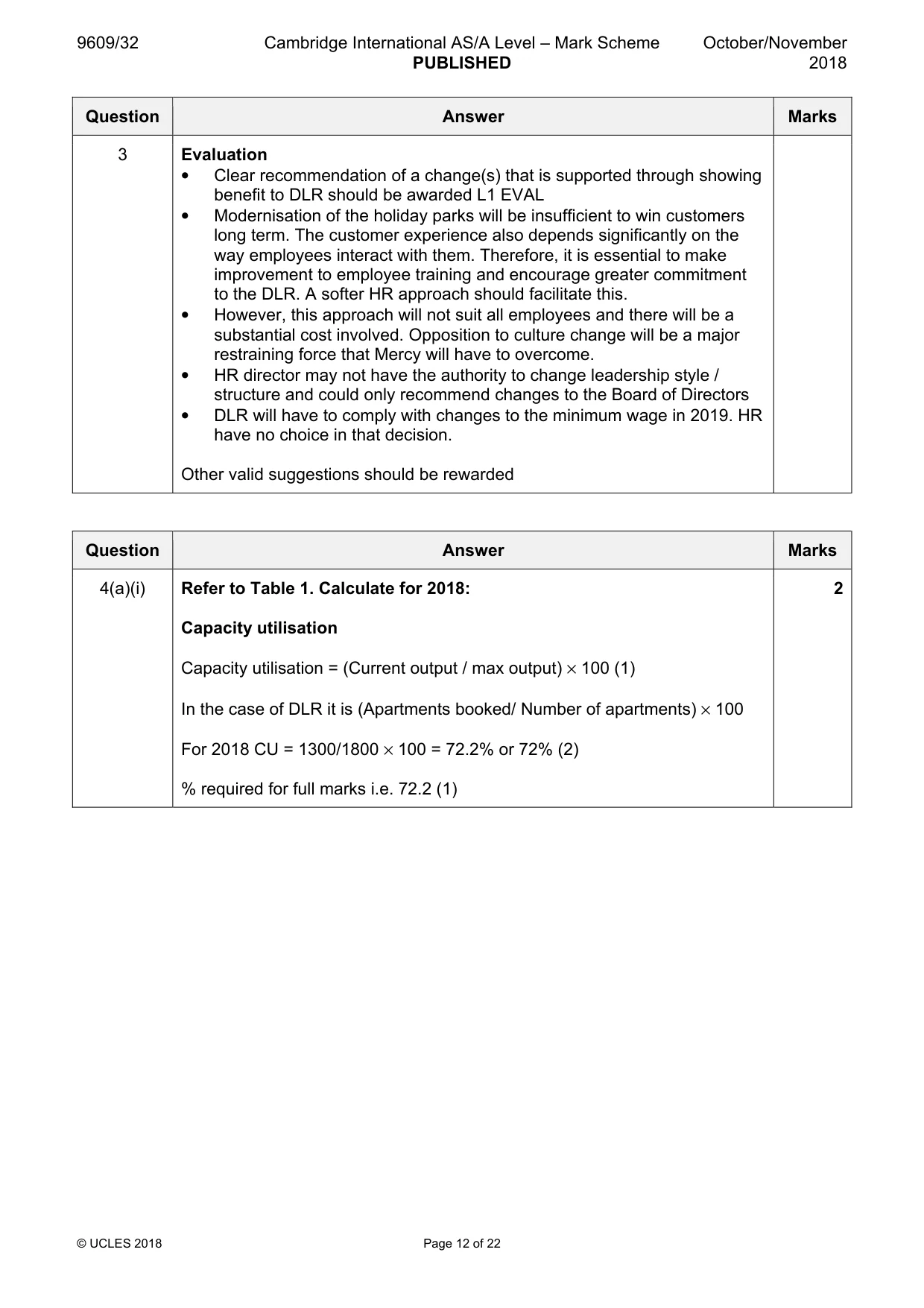
9609/32 Cambridge International AS/A Level – Mark Scheme PUBLISHED October/November 2018 © UCLES 2018 Page 12 of 22 Question Answer Marks 3 Evaluation • Clear recommendation of a change(s) that is supported through showing benefit to DLR should be awarded L1 EVAL • Modernisation of the holiday parks will be insufficient to win customers long term. The customer experience also depends significantly on the way employees interact with them. Therefore, it is essential to make improvement to employee training and encourage greater commitment to the DLR. A softer HR approach should facilitate this. • However, this approach will not suit all employees and there will be a substantial cost involved. Opposition to culture change will be a major restraining force that Mercy will have to overcome. • HR director may not have the authority to change leadership style / structure and could only recommend changes to the Board of Directors • DLR will have to comply with changes to the minimum wage in 2019. HR have no choice in that decision. Other valid suggestions should be rewarded Question Answer Marks 4(a)(i) Refer to Table 1. Calculate for 2018: Capacity utilisation Capacity utilisation = (Current output / max output) × 100 (1) In the case of DLR it is (Apartments booked/ Number of apartments) × 100 For 2018 CU = 1300/1800 × 100 = 72.2% or 72% (2) % required for full marks i.e. 72.2 (1) 2
Mark scheme, page 13
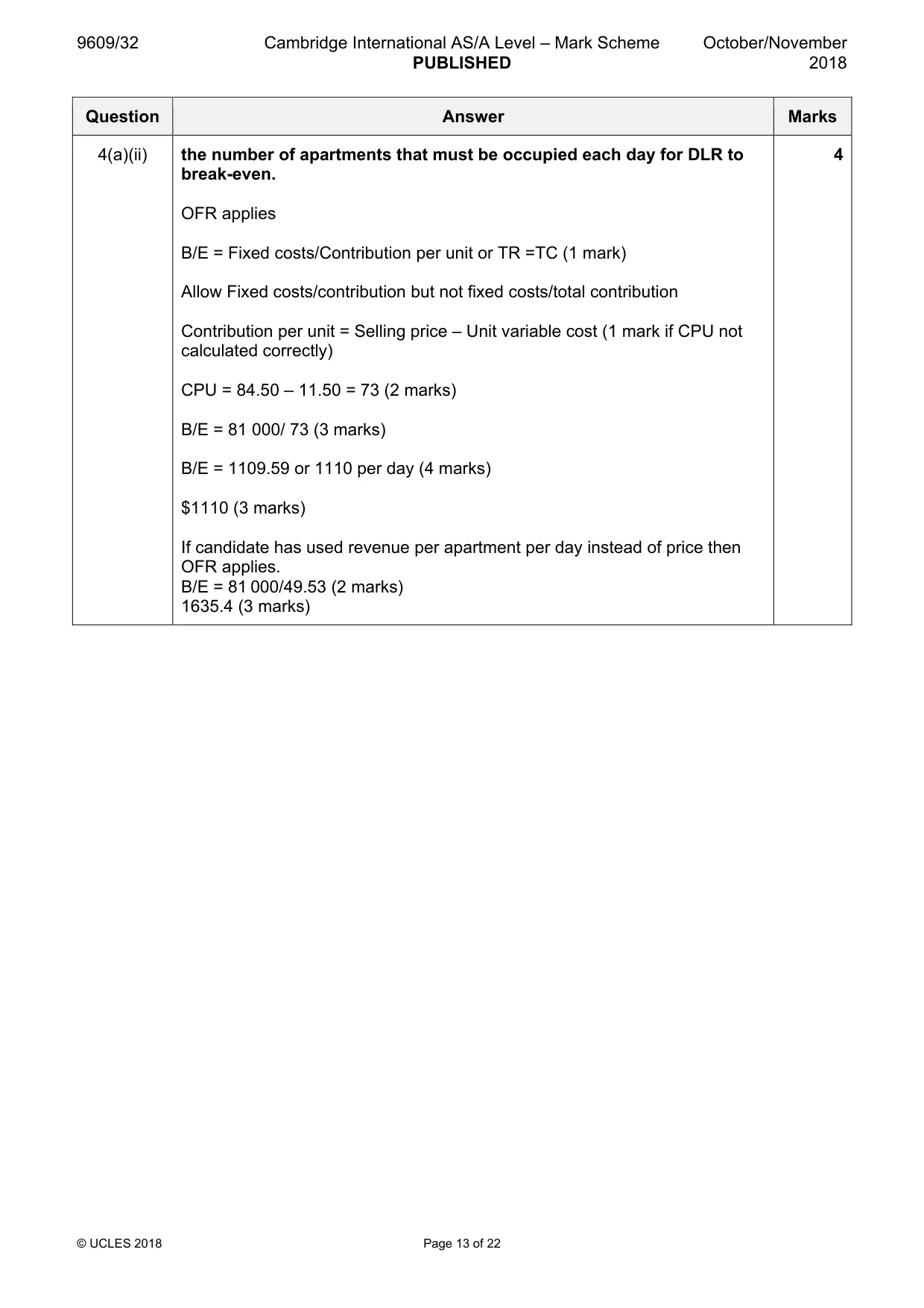
9609/32 Cambridge International AS/A Level – Mark Scheme PUBLISHED October/November 2018 © UCLES 2018 Page 13 of 22 Question Answer Marks 4(a)(ii) the number of apartments that must be occupied each day for DLR to break-even. OFR applies B/E = Fixed costs/Contribution per unit or TR =TC (1 mark) Allow Fixed costs/contribution but not fixed costs/total contribution Contribution per unit = Selling price – Unit variable cost (1 mark if CPU not calculated correctly) CPU = 84.50 – 11.50 = 73 (2 marks) B/E = 81 000/ 73 (3 marks) B/E = 1109.59 or 1110 per day (4 marks) $1110 (3 marks) If candidate has used revenue per apartment per day instead of price then OFR applies. B/E = 81 000/49.53 (2 marks) 1635.4 (3 marks) 4
Mark scheme, page 14
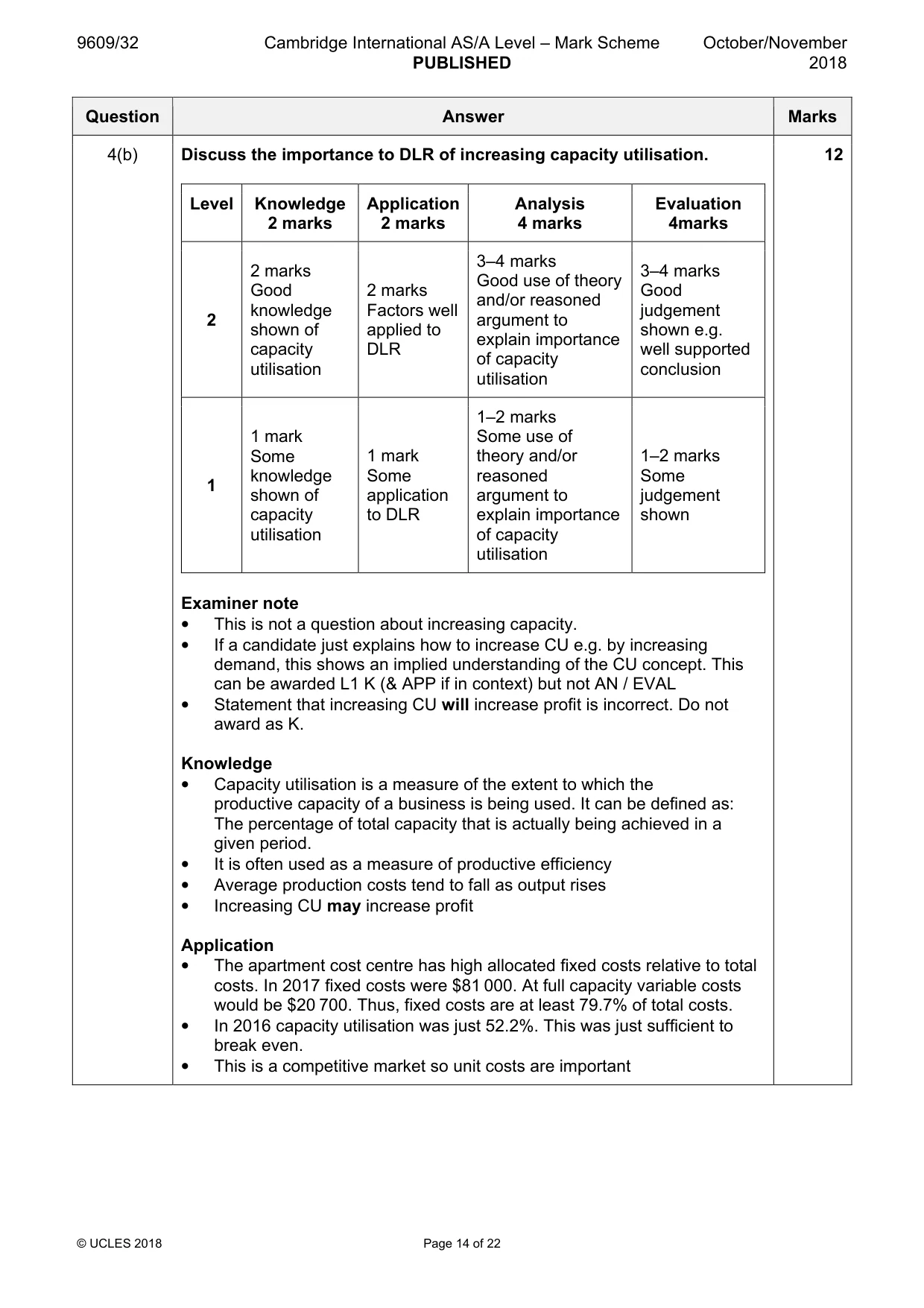
9609/32 Cambridge International AS/A Level – Mark Scheme PUBLISHED October/November 2018 © UCLES 2018 Page 14 of 22 Question Answer Marks 4(b) Discuss the importance to DLR of increasing capacity utilisation. Level Knowledge 2 marks Application 2 marks Analysis 4 marks Evaluation 4marks 2 2 marks Good knowledge shown of capacity utilisation 2 marks Factors well applied to DLR 3–4 marks Good use of theory and/or reasoned argument to explain importance of capacity utilisation 3–4 marks Good judgement shown e.g. well supported conclusion 1 1 mark Some knowledge shown of capacity utilisation 1 mark Some application to DLR 1–2 marks Some use of theory and/or reasoned argument to explain importance of capacity utilisation 1–2 marks Some judgement shown Examiner note • This is not a question about increasing capacity. • If a candidate just explains how to increase CU e.g. by increasing demand, this shows an implied understanding of the CU concept. This can be awarded L1 K (& APP if in context) but not AN / EVAL • Statement that increasing CU will increase profit is incorrect. Do not award as K. Knowledge • Capacity utilisation is a measure of the extent to which the productive capacity of a business is being used. It can be defined as: The percentage of total capacity that is actually being achieved in a given period. • It is often used as a measure of productive efficiency • Average production costs tend to fall as output rises • Increasing CU may increase profit Application • The apartment cost centre has high allocated fixed costs relative to total costs. In 2017 fixed costs were $81 000. At full capacity variable costs would be $20 700. Thus, fixed costs are at least 79.7% of total costs. • In 2016 capacity utilisation was just 52.2%. This was just sufficient to break even. • This is a competitive market so unit costs are important 12
Mark scheme, page 15
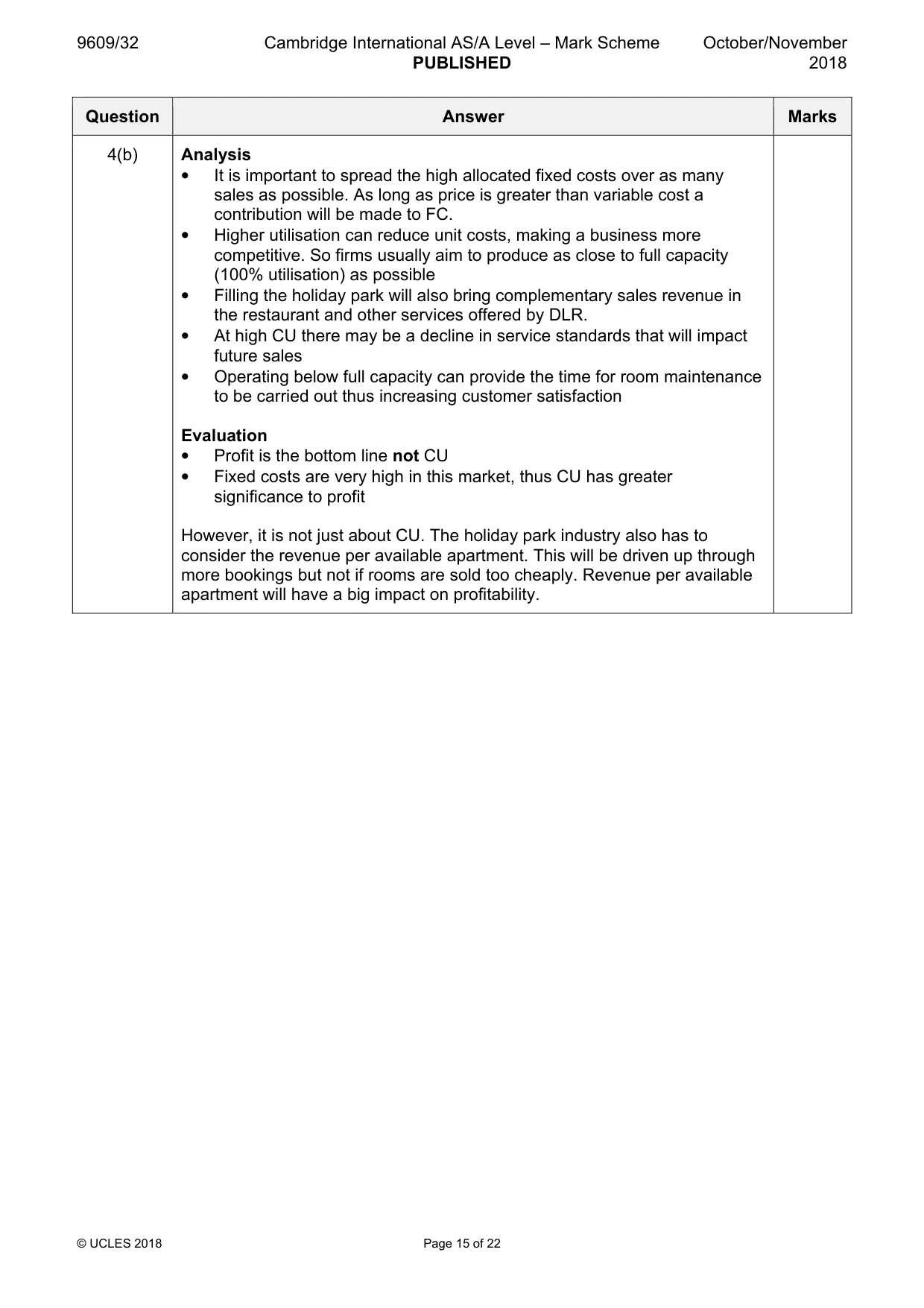
9609/32 Cambridge International AS/A Level – Mark Scheme PUBLISHED October/November 2018 © UCLES 2018 Page 15 of 22 Question Answer Marks 4(b) Analysis • It is important to spread the high allocated fixed costs over as many sales as possible. As long as price is greater than variable cost a contribution will be made to FC. • Higher utilisation can reduce unit costs, making a business more competitive. So firms usually aim to produce as close to full capacity (100% utilisation) as possible • Filling the holiday park will also bring complementary sales revenue in the restaurant and other services offered by DLR. • At high CU there may be a decline in service standards that will impact future sales • Operating below full capacity can provide the time for room maintenance to be carried out thus increasing customer satisfaction Evaluation • Profit is the bottom line not CU • Fixed costs are very high in this market, thus CU has greater significance to profit However, it is not just about CU. The holiday park industry also has to consider the revenue per available apartment. This will be driven up through more bookings but not if rooms are sold too cheaply. Revenue per available apartment will have a big impact on profitability.
Mark scheme, page 16
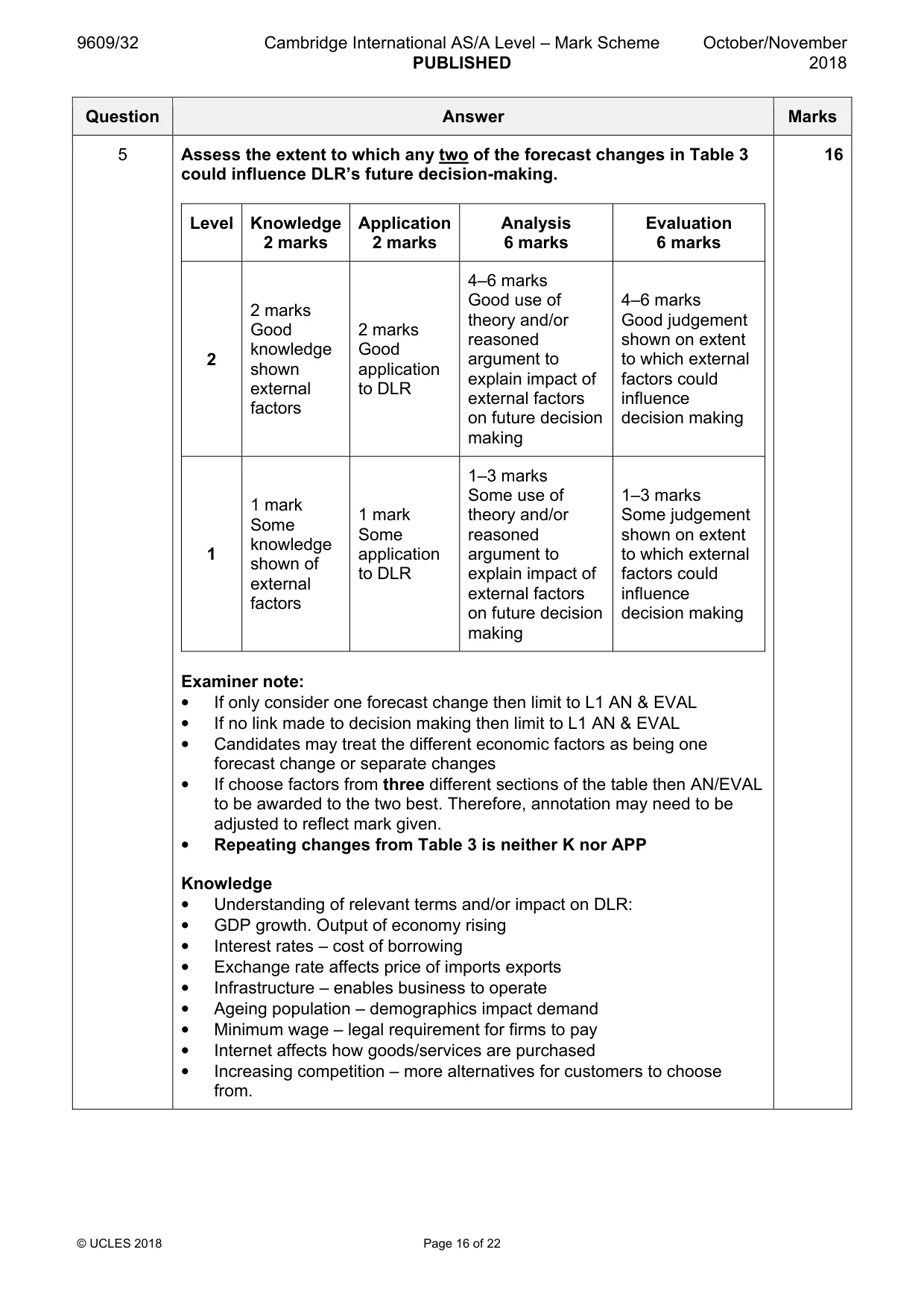
9609/32 Cambridge International AS/A Level – Mark Scheme PUBLISHED October/November 2018 © UCLES 2018 Page 16 of 22 Question Answer Marks 5 Assess the extent to which any two of the forecast changes in Table 3 could influence DLR’s future decision-making. Level Knowledge 2 marks Application 2 marks Analysis 6 marks Evaluation 6 marks 2 2 marks Good knowledge shown external factors 2 marks Good application to DLR 4–6 marks Good use of theory and/or reasoned argument to explain impact of external factors on future decision making 4–6 marks Good judgement shown on extent to which external factors could influence decision making 1 1 mark Some knowledge shown of external factors 1 mark Some application to DLR 1–3 marks Some use of theory and/or reasoned argument to explain impact of external factors on future decision making 1–3 marks Some judgement shown on extent to which external factors could influence decision making Examiner note: • If only consider one forecast change then limit to L1 AN & EVAL • If no link made to decision making then limit to L1 AN & EVAL • Candidates may treat the different economic factors as being one forecast change or separate changes • If choose factors from three different sections of the table then AN/EVAL to be awarded to the two best. Therefore, annotation may need to be adjusted to reflect mark given. • Repeating changes from Table 3 is neither K nor APP Knowledge • Understanding of relevant terms and/or impact on DLR: • GDP growth. Output of economy rising • Interest rates – cost of borrowing • Exchange rate affects price of imports exports • Infrastructure – enables business to operate • Ageing population – demographics impact demand • Minimum wage – legal requirement for firms to pay • Internet affects how goods/services are purchased • Increasing competition – more alternatives for customers to choose from. 16
Mark scheme, page 17
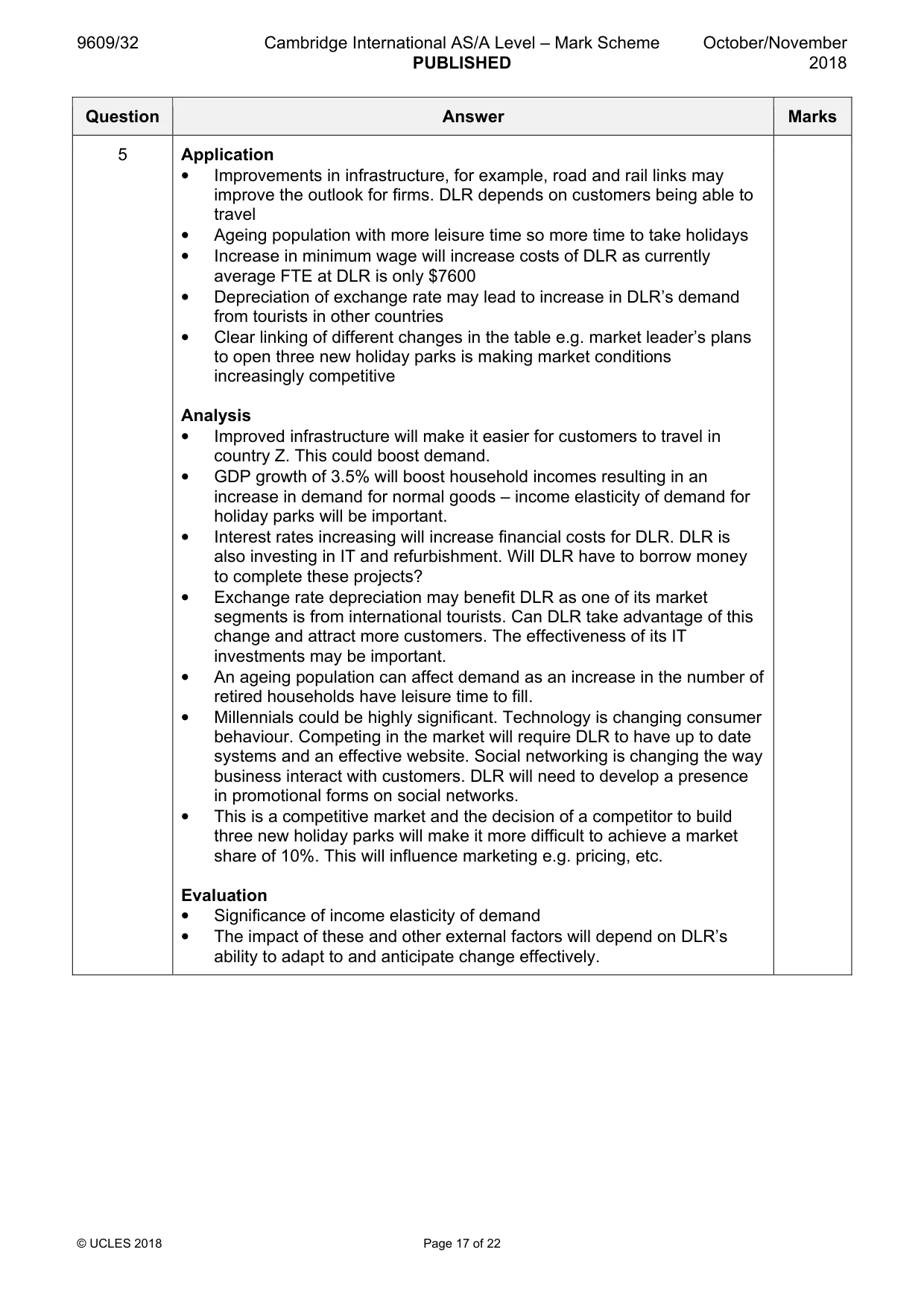
9609/32 Cambridge International AS/A Level – Mark Scheme PUBLISHED October/November 2018 © UCLES 2018 Page 17 of 22 Question Answer Marks 5 Application • Improvements in infrastructure, for example, road and rail links may improve the outlook for firms. DLR depends on customers being able to travel • Ageing population with more leisure time so more time to take holidays • Increase in minimum wage will increase costs of DLR as currently average FTE at DLR is only $7600 • Depreciation of exchange rate may lead to increase in DLR’s demand from tourists in other countries • Clear linking of different changes in the table e.g. market leader’s plans to open three new holiday parks is making market conditions increasingly competitive Analysis • Improved infrastructure will make it easier for customers to travel in country Z. This could boost demand. • GDP growth of 3.5% will boost household incomes resulting in an increase in demand for normal goods – income elasticity of demand for holiday parks will be important. • Interest rates increasing will increase financial costs for DLR. DLR is also investing in IT and refurbishment. Will DLR have to borrow money to complete these projects? • Exchange rate depreciation may benefit DLR as one of its market segments is from international tourists. Can DLR take advantage of this change and attract more customers. The effectiveness of its IT investments may be important. • An ageing population can affect demand as an increase in the number of retired households have leisure time to fill. • Millennials could be highly significant. Technology is changing consumer behaviour. Competing in the market will require DLR to have up to date systems and an effective website. Social networking is changing the way business interact with customers. DLR will need to develop a presence in promotional forms on social networks. • This is a competitive market and the decision of a competitor to build three new holiday parks will make it more difficult to achieve a market share of 10%. This will influence marketing e.g. pricing, etc. Evaluation • Significance of income elasticity of demand • The impact of these and other external factors will depend on DLR’s ability to adapt to and anticipate change effectively.
Mark scheme, page 18
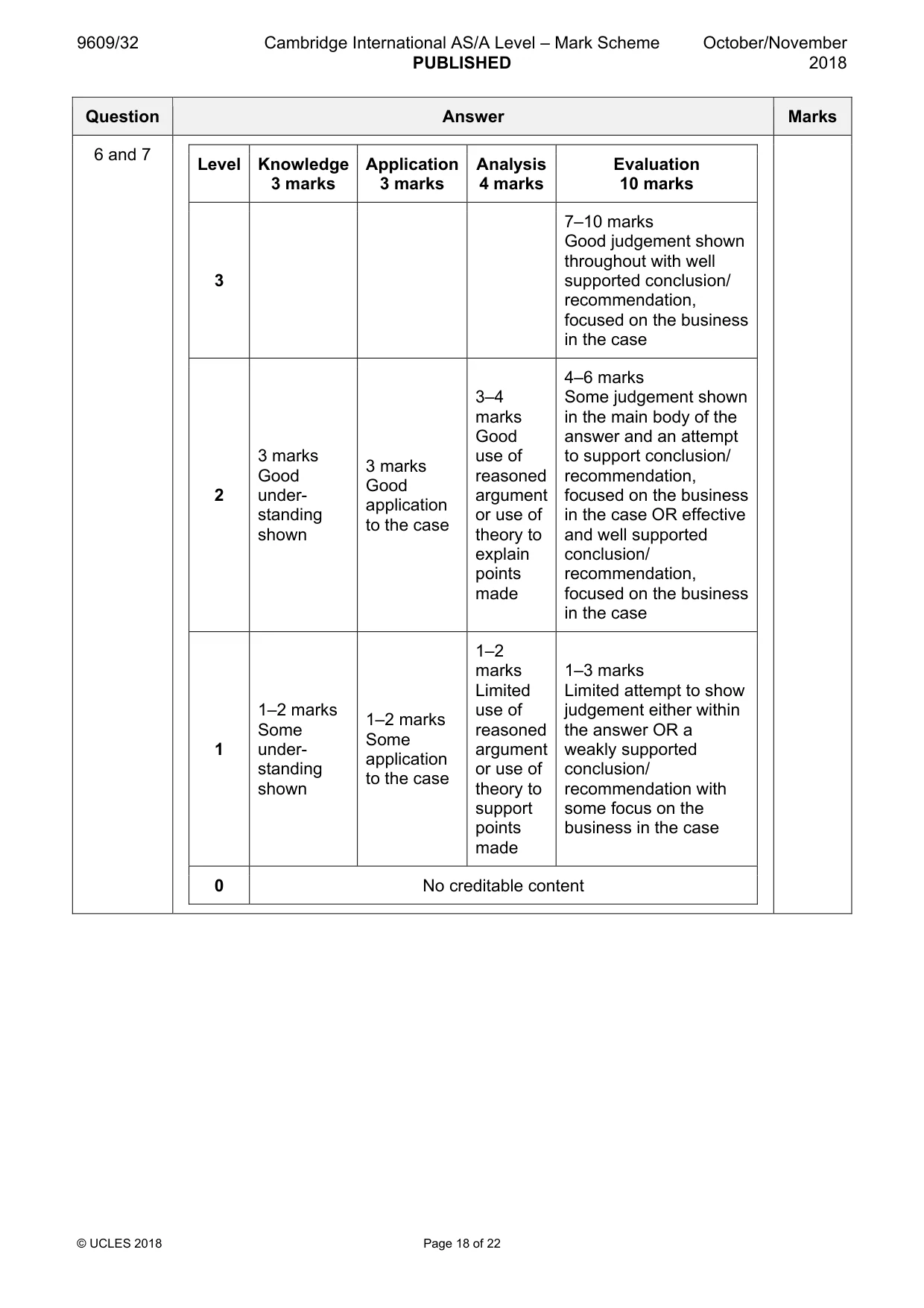
9609/32 Cambridge International AS/A Level – Mark Scheme PUBLISHED October/November 2018 © UCLES 2018 Page 18 of 22 Question Answer Marks 6 and 7 Level Knowledge 3 marks Application 3 marks Analysis 4 marks Evaluation 10 marks 3 7–10 marks Good judgement shown throughout with well supported conclusion/ recommendation, focused on the business in the case 2 3 marks Good under- standing shown 3 marks Good application to the case 3–4 marks Good use of reasoned argument or use of theory to explain points made 4–6 marks Some judgement shown in the main body of the answer and an attempt to support conclusion/ recommendation, focused on the business in the case OR effective and well supported conclusion/ recommendation, focused on the business in the case 1 1–2 marks Some under- standing shown 1–2 marks Some application to the case 1–2 marks Limited use of reasoned argument or use of theory to support points made 1–3 marks Limited attempt to show judgement either within the answer OR a weakly supported conclusion/ recommendation with some focus on the business in the case 0 No creditable content
Mark scheme, page 19
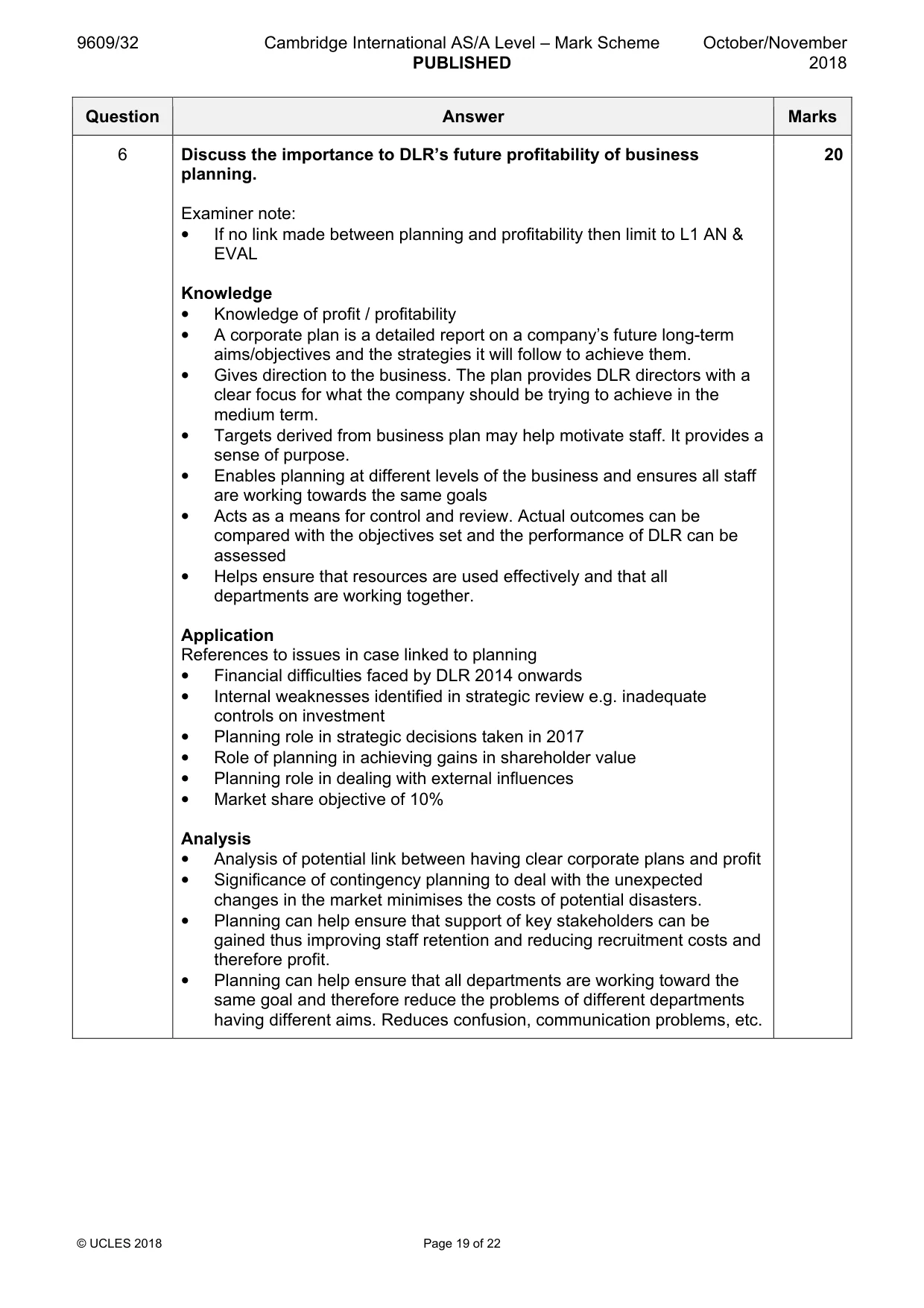
9609/32 Cambridge International AS/A Level – Mark Scheme PUBLISHED October/November 2018 © UCLES 2018 Page 19 of 22 Question Answer Marks 6 Discuss the importance to DLR’s future profitability of business planning. Examiner note: • If no link made between planning and profitability then limit to L1 AN & EVAL Knowledge • Knowledge of profit / profitability • A corporate plan is a detailed report on a company’s future long-term aims/objectives and the strategies it will follow to achieve them. • Gives direction to the business. The plan provides DLR directors with a clear focus for what the company should be trying to achieve in the medium term. • Targets derived from business plan may help motivate staff. It provides a sense of purpose. • Enables planning at different levels of the business and ensures all staff are working towards the same goals • Acts as a means for control and review. Actual outcomes can be compared with the objectives set and the performance of DLR can be assessed • Helps ensure that resources are used effectively and that all departments are working together. Application References to issues in case linked to planning • Financial difficulties faced by DLR 2014 onwards • Internal weaknesses identified in strategic review e.g. inadequate controls on investment • Planning role in strategic decisions taken in 2017 • Role of planning in achieving gains in shareholder value • Planning role in dealing with external influences • Market share objective of 10% Analysis • Analysis of potential link between having clear corporate plans and profit • Significance of contingency planning to deal with the unexpected changes in the market minimises the costs of potential disasters. • Planning can help ensure that support of key stakeholders can be gained thus improving staff retention and reducing recruitment costs and therefore profit. • Planning can help ensure that all departments are working toward the same goal and therefore reduce the problems of different departments having different aims. Reduces confusion, communication problems, etc. 20
Mark scheme, page 20
9609/32 Cambridge International AS/A Level – Mark Scheme PUBLISHED October/November 2018 © UCLES 2018 Page 20 of 22 Question Answer Marks 6 Evaluation • Needs to be flexible and adaptable to meet new situations. • The nature of a dynamic business environment and need therefore to adjust plans accordingly. Holiday park industry is competitive. Therefore, corporate plans will need to be updated frequently • The planning process itself is useful. It encourages directors and managers to consider the current situation of the firm and to set objectives accordingly. • Best-laid plans can be made obsolete by unexpected internal or external change
Mark scheme, page 21
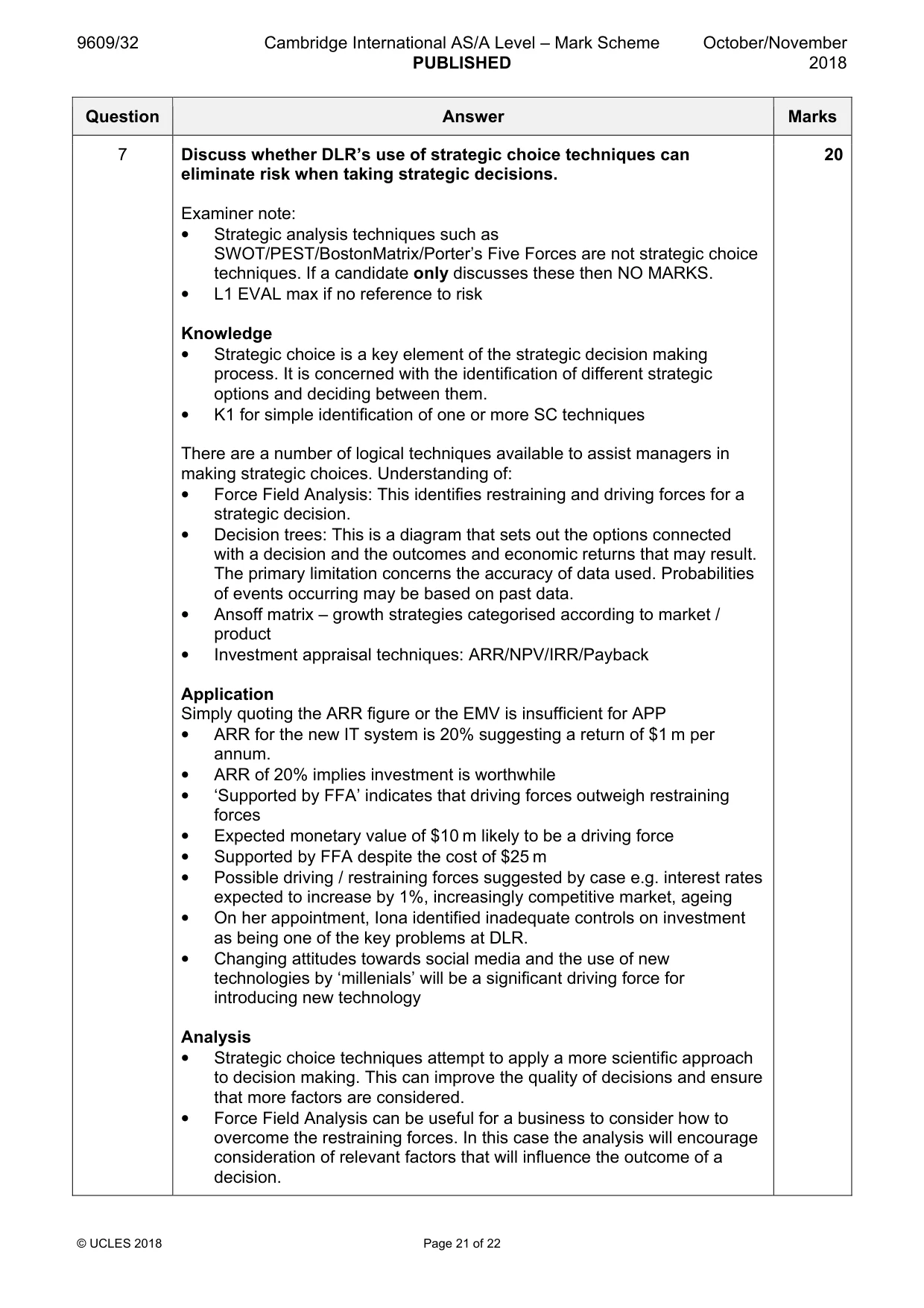
9609/32 Cambridge International AS/A Level – Mark Scheme PUBLISHED October/November 2018 © UCLES 2018 Page 21 of 22 Question Answer Marks 7 Discuss whether DLR’s use of strategic choice techniques can eliminate risk when taking strategic decisions. Examiner note: • Strategic analysis techniques such as SWOT/PEST/BostonMatrix/Porter’s Five Forces are not strategic choice techniques. If a candidate only discusses these then NO MARKS. • L1 EVAL max if no reference to risk Knowledge • Strategic choice is a key element of the strategic decision making process. It is concerned with the identification of different strategic options and deciding between them. • K1 for simple identification of one or more SC techniques There are a number of logical techniques available to assist managers in making strategic choices. Understanding of: • Force Field Analysis: This identifies restraining and driving forces for a strategic decision. • Decision trees: This is a diagram that sets out the options connected with a decision and the outcomes and economic returns that may result. The primary limitation concerns the accuracy of data used. Probabilities of events occurring may be based on past data. • Ansoff matrix – growth strategies categorised according to market / product • Investment appraisal techniques: ARR/NPV/IRR/Payback Application Simply quoting the ARR figure or the EMV is insufficient for APP • ARR for the new IT system is 20% suggesting a return of $1 m per annum. • ARR of 20% implies investment is worthwhile • ‘Supported by FFA’ indicates that driving forces outweigh restraining forces • Expected monetary value of $10 m likely to be a driving force • Supported by FFA despite the cost of $25 m • Possible driving / restraining forces suggested by case e.g. interest rates expected to increase by 1%, increasingly competitive market, ageing • On her appointment, Iona identified inadequate controls on investment as being one of the key problems at DLR. • Changing attitudes towards social media and the use of new technologies by ‘millenials’ will be a significant driving force for introducing new technology Analysis • Strategic choice techniques attempt to apply a more scientific approach to decision making. This can improve the quality of decisions and ensure that more factors are considered. • Force Field Analysis can be useful for a business to consider how to overcome the restraining forces. In this case the analysis will encourage consideration of relevant factors that will influence the outcome of a decision. 20
Mark scheme, page 22
9609/32 Cambridge International AS/A Level – Mark Scheme PUBLISHED October/November 2018 © UCLES 2018 Page 22 of 22 Question Answer Marks 7 Evaluation • For all of these techniques issues of estimation are very important. Strategic choice techniques are fallible. • Strategic choice techniques depend on preceding strategic analysis having been completed. A good PEST analysis helps identify potential risks and guides the strategic direction of the business • Risk cannot be eliminated but use of techniques can reduce risk • In conclusion they aid the decision making process but cannot replace either the consideration of risk or the impact of non-numerical, qualitative factors on a decision.
What you needed in this session
Cambridge’s own grade thresholds for 2018 Oct/Nov, Paper 3 · Variant 2. A higher threshold means an easier paper — the bar moves with how the cohort did.