Cambridge A Level Business (for first examination in 2016) 9609 — 2018 Oct/Nov Paper 3 · Variant 1
9609/31/O/N/18 · 100 marks · ≈113 min
The question paper and its mark scheme, free to read here and free to download. This is Cambridge’s own paper, exactly as it was sat.
Question paper20 pages

















Mark scheme18 pages
Answers below. Sit the paper first if you are practising.


Paper as text
Question paper, page 1
This document consists of 19 printed pages, 1 blank page and 1 Insert. DC (RCL (GO)) 152087/1 © UCLES 2018 [Turn over Cambridge International Examinations Cambridge International Advanced Level * 8 4 3 1 2 7 0 4 1 3 * BUSINESS 9609/31 Paper 3 Case Study October/November 2018 3 hours Candidates answer on the Question Paper. No Additional Materials are required. READ THESE INSTRUCTIONS FIRST Write your Centre number, candidate number and name in the spaces at the top of this page. If you need additional answer paper ask the invigilator for a continuation booklet. Write in dark blue or black pen. You may use an HB pencil for any diagrams, graphs or rough working. Do not use staples, paper clips, glue or correction fluid. DO NOT WRITE IN ANY BARCODES. Section A Answer all questions. Section B Answer one question. You are advised to spend no more than 40 minutes on Section B. Refer to the Insert for the case study for this Paper. At the end of the examination, fasten all your work securely together. The number of marks is given in brackets [ ] at the end of each question or part question.
Question paper, page 2
2 9609/31/O/N/18 © UCLES 2018 Section A Answer all questions in this section. 1 Analyse the advantages to SU of its workers being in a trade union. … … … … … … … … … … … … … … … … … … … … … … … … …
Question paper, page 3
3 9609/31/O/N/18 © UCLES 2018 [Turn over … … … … … … … … … … … … … … … … … … … … … … … … … … … … [10]
Question paper, page 4
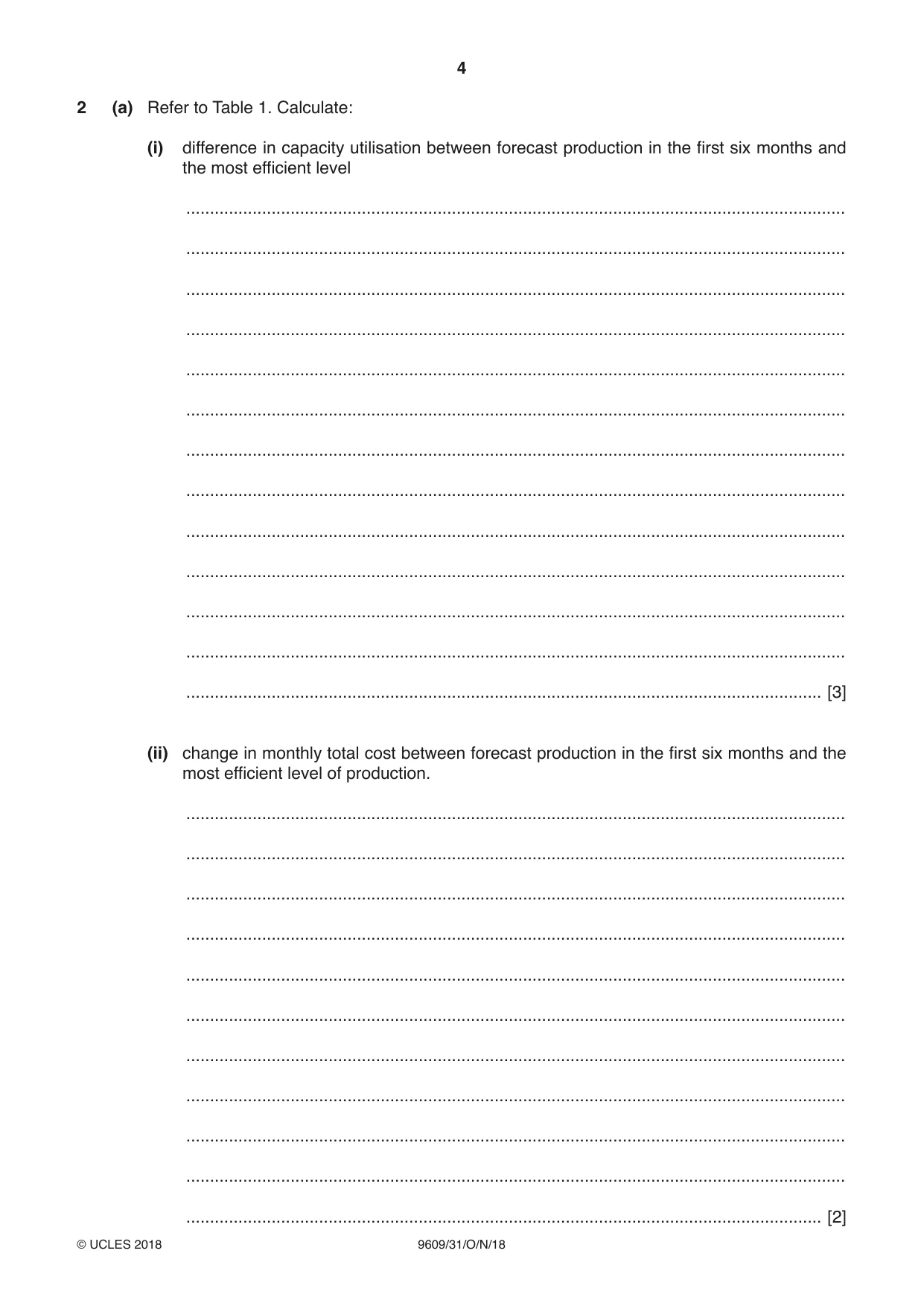
4 9609/31/O/N/18 © UCLES 2018 2 (a) Refer to Table 1. Calculate: (i) difference in capacity utilisation between forecast production in the first six months and the most efficient level … … … … … … … … … … … … … [3] (ii) change in monthly total cost between forecast production in the first six months and the most efficient level of production. … … … … … … … … … … … [2]
Question paper, page 5
5 9609/31/O/N/18 © UCLES 2018 [Turn over (b) Refer to your results to 2(a) and any other information. Discuss the value of implementing ERP in the new factory. … … … … … … … … … … … … … … … … … … … … … … … … … … …
Question paper, page 6
6 9609/31/O/N/18 © UCLES 2018 … … … … … … … … … … … … … … … … … … … … … … … … … … … … [12]
Question paper, page 7
7 9609/31/O/N/18 © UCLES 2018 [Turn over 3 Recommend an appropriate organisation structure for SU. … … … … … … … … … … … … … … … … … … … … … … … … … … …
Question paper, page 8
8 9609/31/O/N/18 © UCLES 2018 … … … … … … … … … … … … … … … … … … … … … … … … … … … …
Question paper, page 9
9 9609/31/O/N/18 © UCLES 2018 [Turn over … … … … … … … … … … … … … … … … … … … … … … … … … … … … [16]
Question paper, page 10
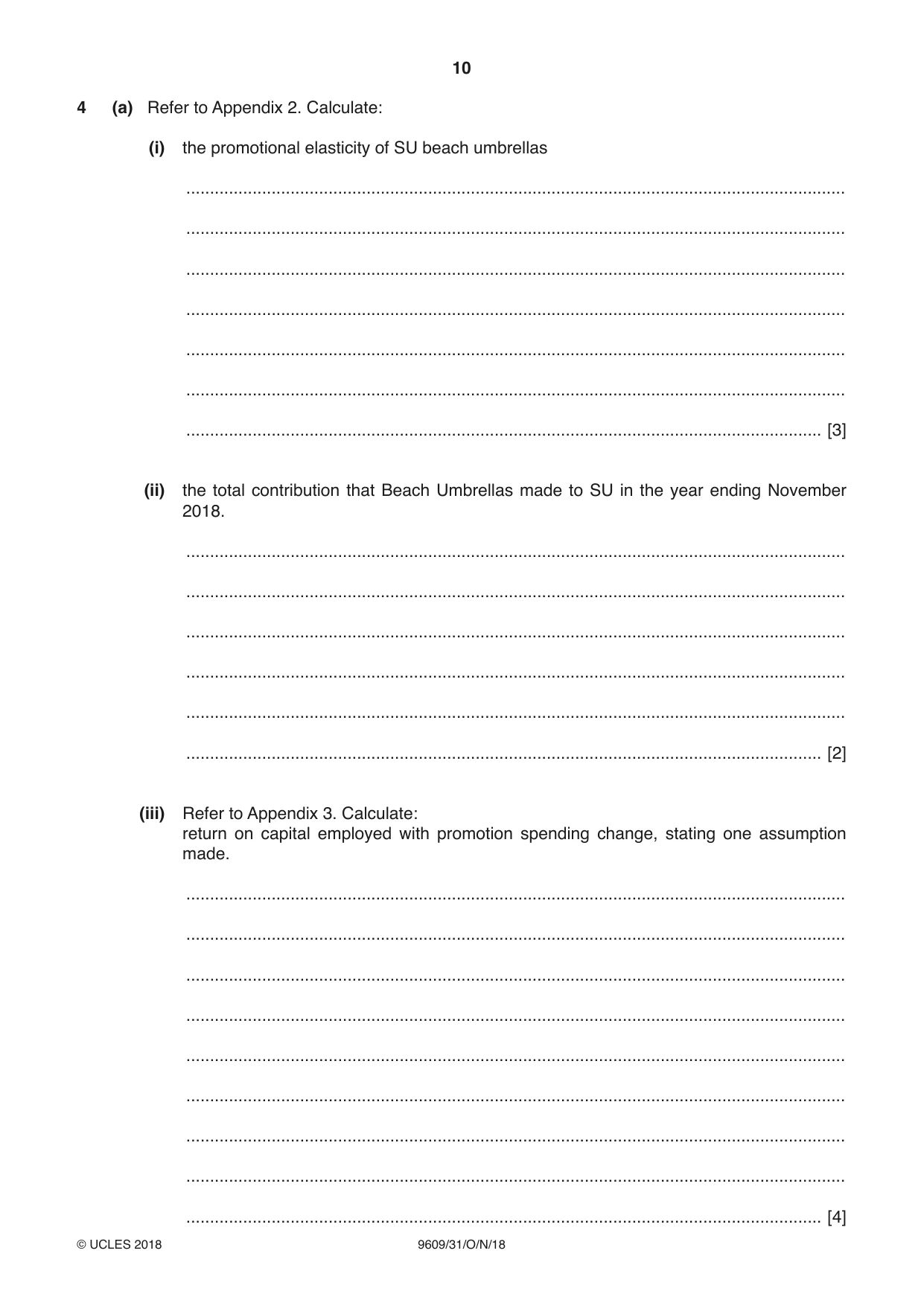
10 9609/31/O/N/18 © UCLES 2018 4 (a) Refer to Appendix 2. Calculate: (i) the promotional elasticity of SU beach umbrellas … … … … … … … [3] (ii) the total contribution that Beach Umbrellas made to SU in the year ending November 2018. … … … … … … [2] (iii) Refer to Appendix 3. Calculate: return on capital employed with promotion spending change, stating one assumption made. … … … … … … … … … [4]
Question paper, page 11
11 9609/31/O/N/18 © UCLES 2018 [Turn over (b) Refer to your results from 4(a) and any other information. Discuss whether SU should continue to manufacture and sell beach umbrellas. … … … … … … … … … … … … … … … … … … … … … … … … … … …
Question paper, page 12
12 9609/31/O/N/18 © UCLES 2018 … … … … … … … … … … … … … … … … … … … … … … … … … … … … [12]
Question paper, page 13
13 9609/31/O/N/18 © UCLES 2018 [Turn over 5 Discuss the role of product development to the future success of SU. … … … … … … … … … … … … … … … … … … … … … … … … … … …
Question paper, page 14
14 9609/31/O/N/18 © UCLES 2018 … … … … … … … … … … … … … … … … … … … … … … … … … … … …
Question paper, page 15
15 9609/31/O/N/18 © UCLES 2018 [Turn over … … … … … … … … … … … … … … … … … … … … … … … … … … … … [16]
Question paper, page 16
16 9609/31/O/N/18 © UCLES 2018 Section B Answer one question in this section. 6 Evaluate the importance of strategic implementation for the success of Options 1 and 2. 7 Evaluate strategic choice techniques SU might use when deciding between Option 1 and Option 2. Write the question number here: … … … … … … … … … … … … … … … … … … … … … … … …
Question paper, page 17
17 9609/31/O/N/18 © UCLES 2018 [Turn over … … … … … … … … … … … … … … … … … … … … … … … … … … … …
Question paper, page 18
18 9609/31/O/N/18 © UCLES 2018 … … … … … … … … … … … … … … … … … … … … … … … … … … … …
Question paper, page 19
19 9609/31/O/N/18 © UCLES 2018 … … … … … … … … … … … … … … … … … … … … … … … … … … … …[20]
Question paper, page 20
20 9609/31/O/N/18 © UCLES 2018 Permission to reproduce items where third-party owned material protected by copyright is included has been sought and cleared where possible. Every reasonable effort has been made by the publisher (UCLES) to trace copyright holders, but if any items requiring clearance have unwittingly been included, the publisher will be pleased to make amends at the earliest possible opportunity. To avoid the issue of disclosure of answer-related information to candidates, all copyright acknowledgements are reproduced online in the Cambridge International Examinations Copyright Acknowledgements Booklet. This is produced for each series of examinations and is freely available to download at www.cie.org.uk after the live examination series. Cambridge International Examinations is part of the Cambridge Assessment Group. Cambridge Assessment is the brand name of University of Cambridge Local Examinations Syndicate (UCLES), which is itself a department of the University of Cambridge. BLANK PAGE
Mark scheme, page 1
This document consists of 18 printed pages. © UCLES 2018 [Turn over Cambridge Assessment International Education Cambridge International Advanced Subsidiary and Advanced Level BUSINESS 9609/31 Paper 3 Case Study October/November 2018 MARK SCHEME Maximum Mark: 100 Published This mark scheme is published as an aid to teachers and candidates, to indicate the requirements of the examination. It shows the basis on which Examiners were instructed to award marks. It does not indicate the details of the discussions that took place at an Examiners’ meeting before marking began, which would have considered the acceptability of alternative answers. Mark schemes should be read in conjunction with the question paper and the Principal Examiner Report for Teachers. Cambridge International will not enter into discussions about these mark schemes. Cambridge International is publishing the mark schemes for the October/November 2018 series for most Cambridge IGCSE™, Cambridge International A and AS Level components and some Cambridge O Level components.
Mark scheme, page 2
9609/31 Cambridge International AS/A Level – Mark Scheme PUBLISHED October/November 2018 © UCLES 2018 Page 2 of 18 Generic Marking Principles These general marking principles must be applied by all examiners when marking candidate answers. They should be applied alongside the specific content of the mark scheme or generic level descriptors for a question. Each question paper and mark scheme will also comply with these marking principles. GENERIC MARKING PRINCIPLE 1: Marks must be awarded in line with: • the specific content of the mark scheme or the generic level descriptors for the question • the specific skills defined in the mark scheme or in the generic level descriptors for the question • the standard of response required by a candidate as exemplified by the standardisation scripts. GENERIC MARKING PRINCIPLE 2: Marks awarded are always whole marks (not half marks, or other fractions). GENERIC MARKING PRINCIPLE 3: Marks must be awarded positively: • marks are awarded for correct/valid answers, as defined in the mark scheme. However, credit is given for valid answers which go beyond the scope of the syllabus and mark scheme, referring to your Team Leader as appropriate • marks are awarded when candidates clearly demonstrate what they know and can do • marks are not deducted for errors • marks are not deducted for omissions • answers should only be judged on the quality of spelling, punctuation and grammar when these features are specifically assessed by the question as indicated by the mark scheme. The meaning, however, should be unambiguous. GENERIC MARKING PRINCIPLE 4: Rules must be applied consistently e.g. in situations where candidates have not followed instructions or in the application of generic level descriptors. GENERIC MARKING PRINCIPLE 5: Marks should be awarded using the full range of marks defined in the mark scheme for the question (however; the use of the full mark range may be limited according to the quality of the candidate responses seen). GENERIC MARKING PRINCIPLE 6: Marks awarded are based solely on the requirements as defined in the mark scheme. Marks should not be awarded with grade thresholds or grade descriptors in mind.
Mark scheme, page 3
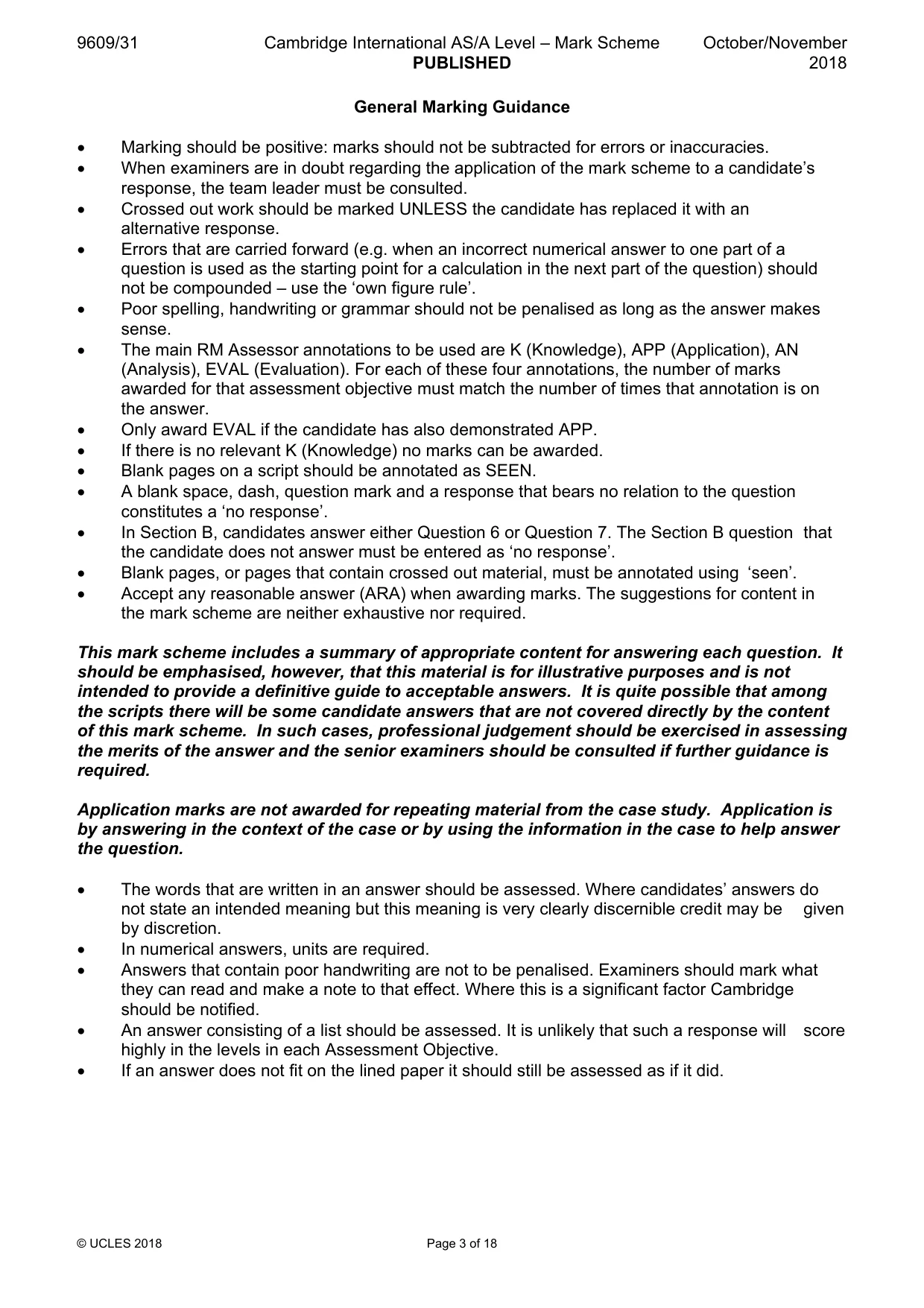
9609/31 Cambridge International AS/A Level – Mark Scheme PUBLISHED October/November 2018 © UCLES 2018 Page 3 of 18 General Marking Guidance • Marking should be positive: marks should not be subtracted for errors or inaccuracies. • When examiners are in doubt regarding the application of the mark scheme to a candidate’s response, the team leader must be consulted. • Crossed out work should be marked UNLESS the candidate has replaced it with an alternative response. • Errors that are carried forward (e.g. when an incorrect numerical answer to one part of a question is used as the starting point for a calculation in the next part of the question) should not be compounded – use the ‘own figure rule’. • Poor spelling, handwriting or grammar should not be penalised as long as the answer makes sense. • The main RM Assessor annotations to be used are K (Knowledge), APP (Application), AN (Analysis), EVAL (Evaluation). For each of these four annotations, the number of marks awarded for that assessment objective must match the number of times that annotation is on the answer. • Only award EVAL if the candidate has also demonstrated APP. • If there is no relevant K (Knowledge) no marks can be awarded. • Blank pages on a script should be annotated as SEEN. • A blank space, dash, question mark and a response that bears no relation to the question constitutes a ‘no response’. • In Section B, candidates answer either Question 6 or Question 7. The Section B question that the candidate does not answer must be entered as ‘no response’. • Blank pages, or pages that contain crossed out material, must be annotated using ‘seen’. • Accept any reasonable answer (ARA) when awarding marks. The suggestions for content in the mark scheme are neither exhaustive nor required. This mark scheme includes a summary of appropriate content for answering each question. It should be emphasised, however, that this material is for illustrative purposes and is not intended to provide a definitive guide to acceptable answers. It is quite possible that among the scripts there will be some candidate answers that are not covered directly by the content of this mark scheme. In such cases, professional judgement should be exercised in assessing the merits of the answer and the senior examiners should be consulted if further guidance is required. Application marks are not awarded for repeating material from the case study. Application is by answering in the context of the case or by using the information in the case to help answer the question. • The words that are written in an answer should be assessed. Where candidates’ answers do not state an intended meaning but this meaning is very clearly discernible credit may be given by discretion. • In numerical answers, units are required. • Answers that contain poor handwriting are not to be penalised. Examiners should mark what they can read and make a note to that effect. Where this is a significant factor Cambridge should be notified. • An answer consisting of a list should be assessed. It is unlikely that such a response will score highly in the levels in each Assessment Objective. • If an answer does not fit on the lined paper it should still be assessed as if it did.
Mark scheme, page 4
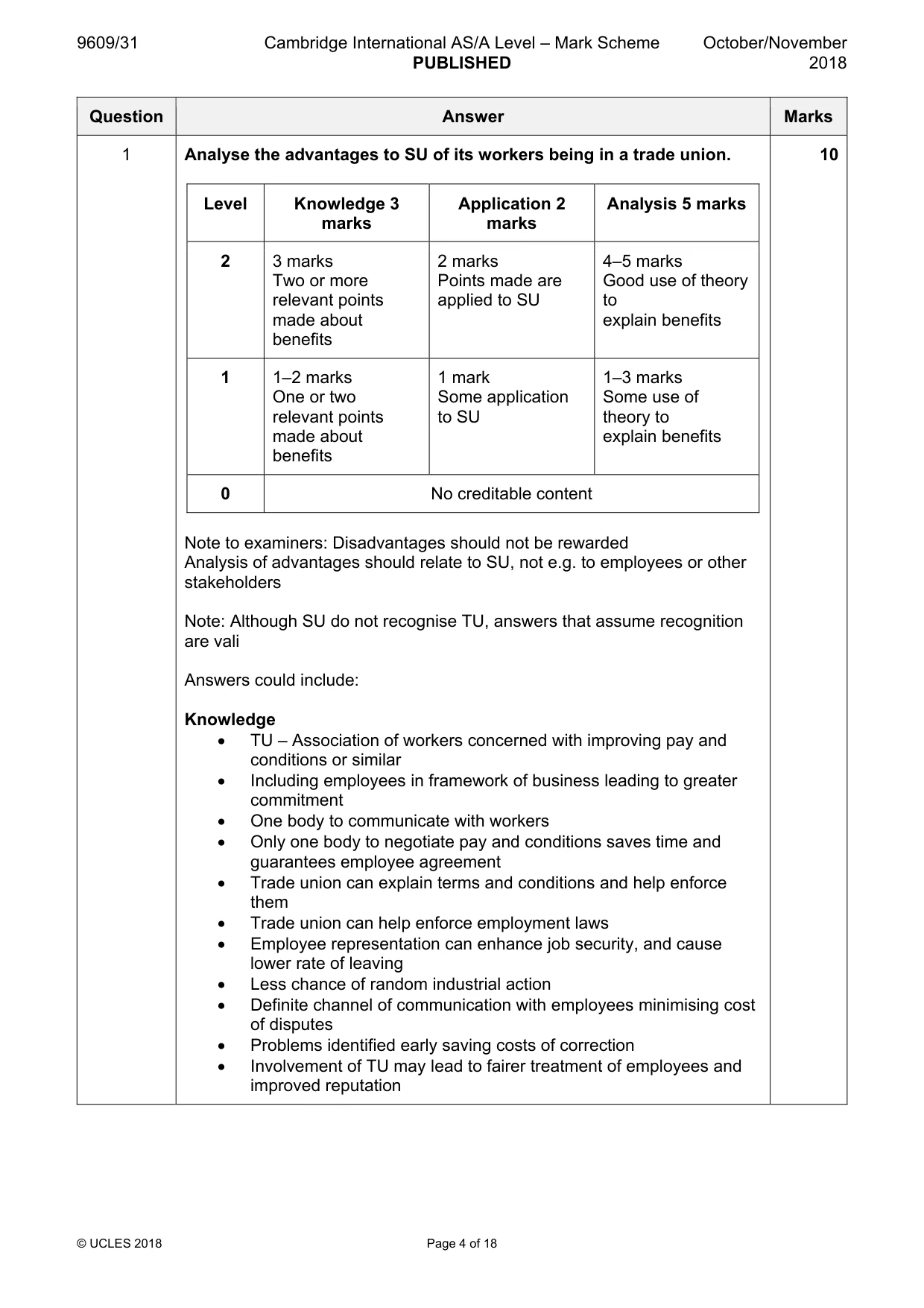
9609/31 Cambridge International AS/A Level – Mark Scheme PUBLISHED October/November 2018 © UCLES 2018 Page 4 of 18 Question Answer Marks 1 Analyse the advantages to SU of its workers being in a trade union. Level Knowledge 3 marks Application 2 marks Analysis 5 marks 2 3 marks Two or more relevant points made about benefits 2 marks Points made are applied to SU 4–5 marks Good use of theory to explain benefits 1 1–2 marks One or two relevant points made about benefits 1 mark Some application to SU 1–3 marks Some use of theory to explain benefits 0 No creditable content Note to examiners: Disadvantages should not be rewarded Analysis of advantages should relate to SU, not e.g. to employees or other stakeholders Note: Although SU do not recognise TU, answers that assume recognition are vali Answers could include: Knowledge • TU – Association of workers concerned with improving pay and conditions or similar • Including employees in framework of business leading to greater commitment • One body to communicate with workers • Only one body to negotiate pay and conditions saves time and guarantees employee agreement • Trade union can explain terms and conditions and help enforce them • Trade union can help enforce employment laws • Employee representation can enhance job security, and cause lower rate of leaving • Less chance of random industrial action • Definite channel of communication with employees minimising cost of disputes • Problems identified early saving costs of correction • Involvement of TU may lead to fairer treatment of employees and improved reputation 10
Mark scheme, page 5
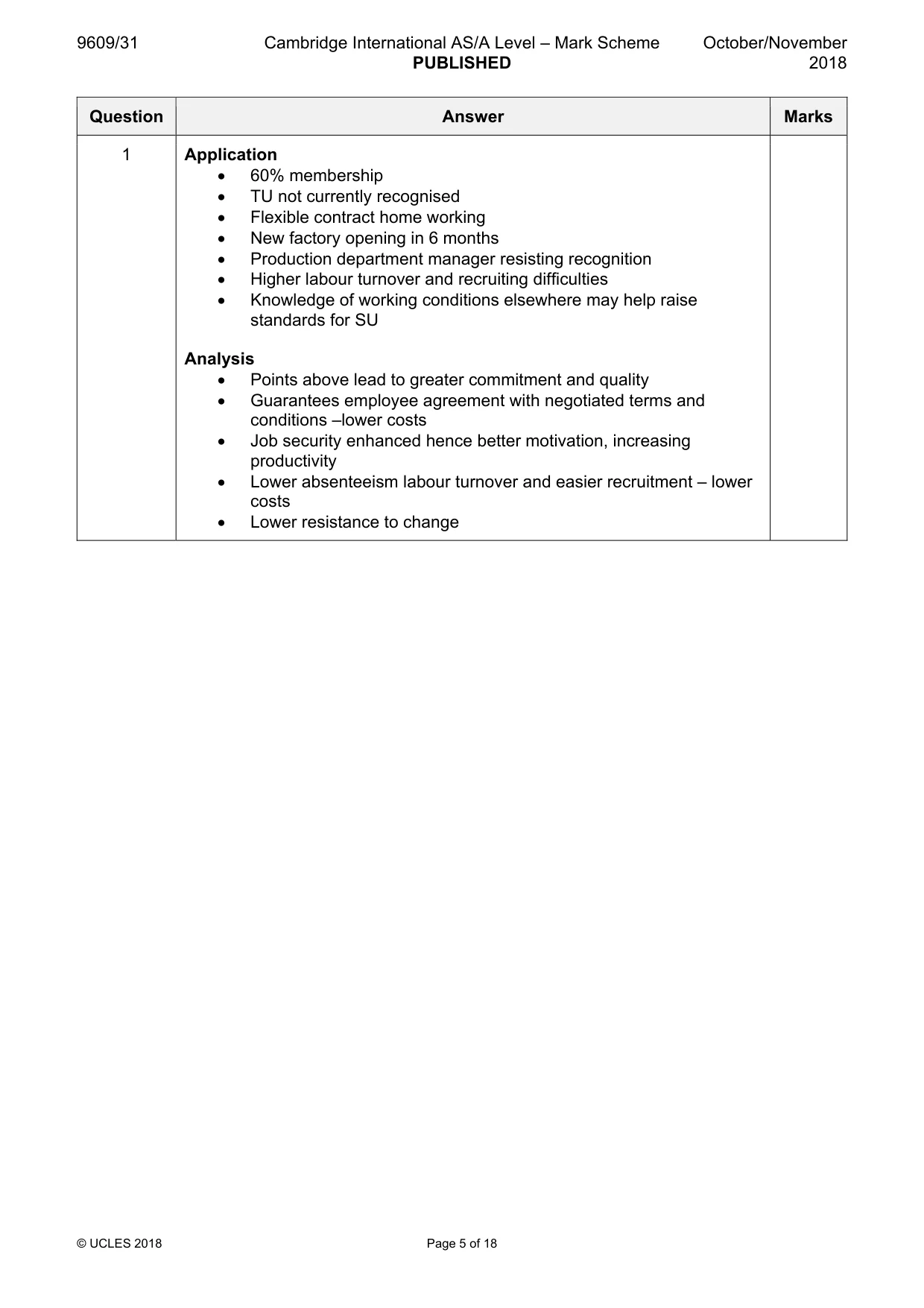
9609/31 Cambridge International AS/A Level – Mark Scheme PUBLISHED October/November 2018 © UCLES 2018 Page 5 of 18 Question Answer Marks 1 Application • 60% membership • TU not currently recognised • Flexible contract home working • New factory opening in 6 months • Production department manager resisting recognition • Higher labour turnover and recruiting difficulties • Knowledge of working conditions elsewhere may help raise standards for SU Analysis • Points above lead to greater commitment and quality • Guarantees employee agreement with negotiated terms and conditions –lower costs • Job security enhanced hence better motivation, increasing productivity • Lower absenteeism labour turnover and easier recruitment – lower costs • Lower resistance to change
Mark scheme, page 6
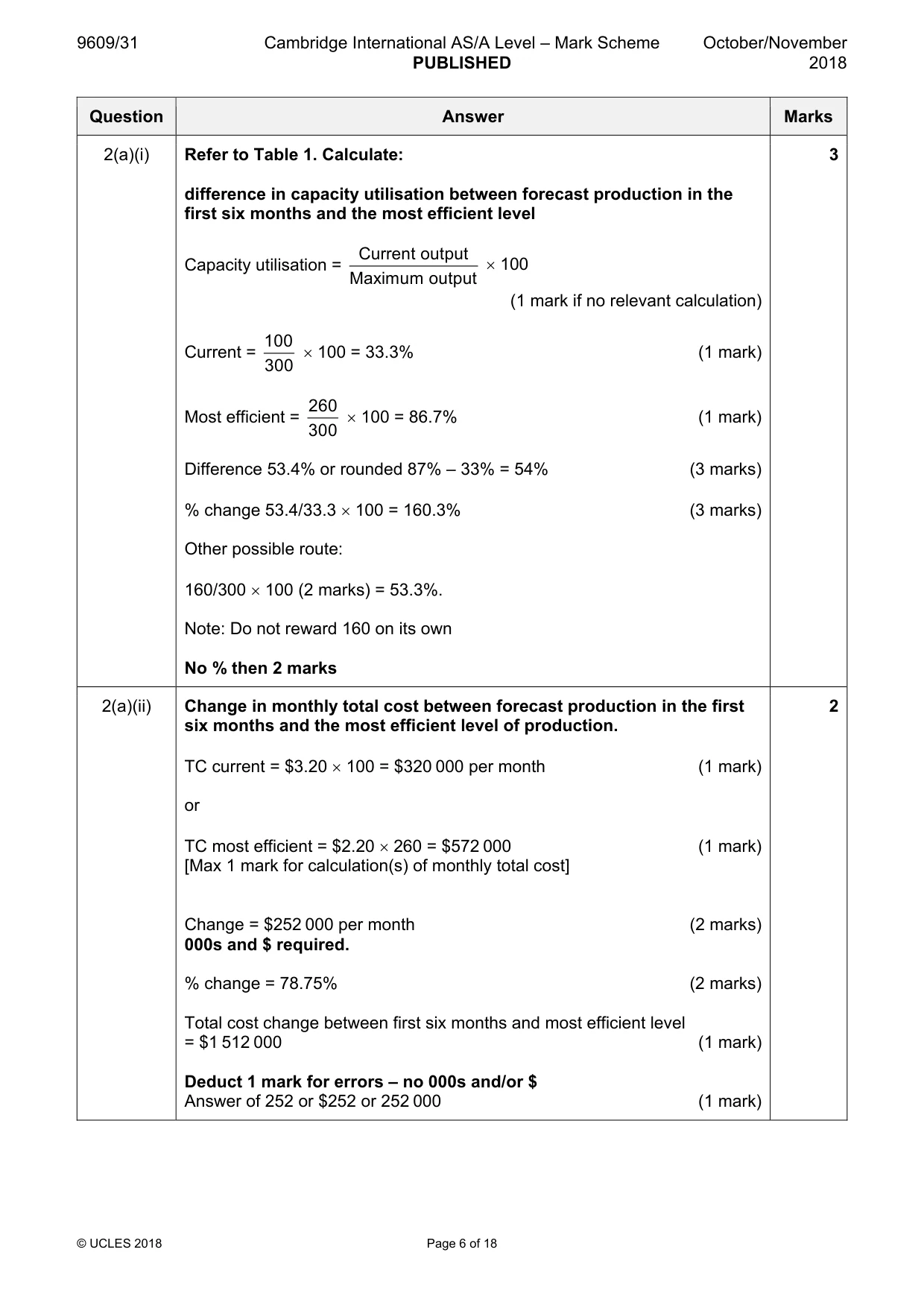
9609/31 Cambridge International AS/A Level – Mark Scheme PUBLISHED October/November 2018 © UCLES 2018 Page 6 of 18 Question Answer Marks 2(a)(i) Refer to Table 1. Calculate: difference in capacity utilisation between forecast production in the first six months and the most efficient level Capacity utilisation = Current output Maximum output × 100 (1 mark if no relevant calculation) Current = 100 300 × 100 = 33.3% (1 mark) Most efficient = 260 300 × 100 = 86.7% (1 mark) Difference 53.4% or rounded 87% – 33% = 54% (3 marks) % change 53.4/33.3 × 100 = 160.3% (3 marks) Other possible route: 160/300 × 100 (2 marks) = 53.3%. Note: Do not reward 160 on its own No % then 2 marks 3 2(a)(ii) Change in monthly total cost between forecast production in the first six months and the most efficient level of production. TC current = $3.20 × 100 = $320 000 per month (1 mark) or TC most efficient = $2.20 × 260 = $572 000 (1 mark) [Max 1 mark for calculation(s) of monthly total cost] Change = $252 000 per month (2 marks) 000s and $ required. % change = 78.75% (2 marks) Total cost change between first six months and most efficient level = $1 512 000 (1 mark) Deduct 1 mark for errors – no 000s and/or $ Answer of 252 or $252 or 252 000 (1 mark) 2
Mark scheme, page 7
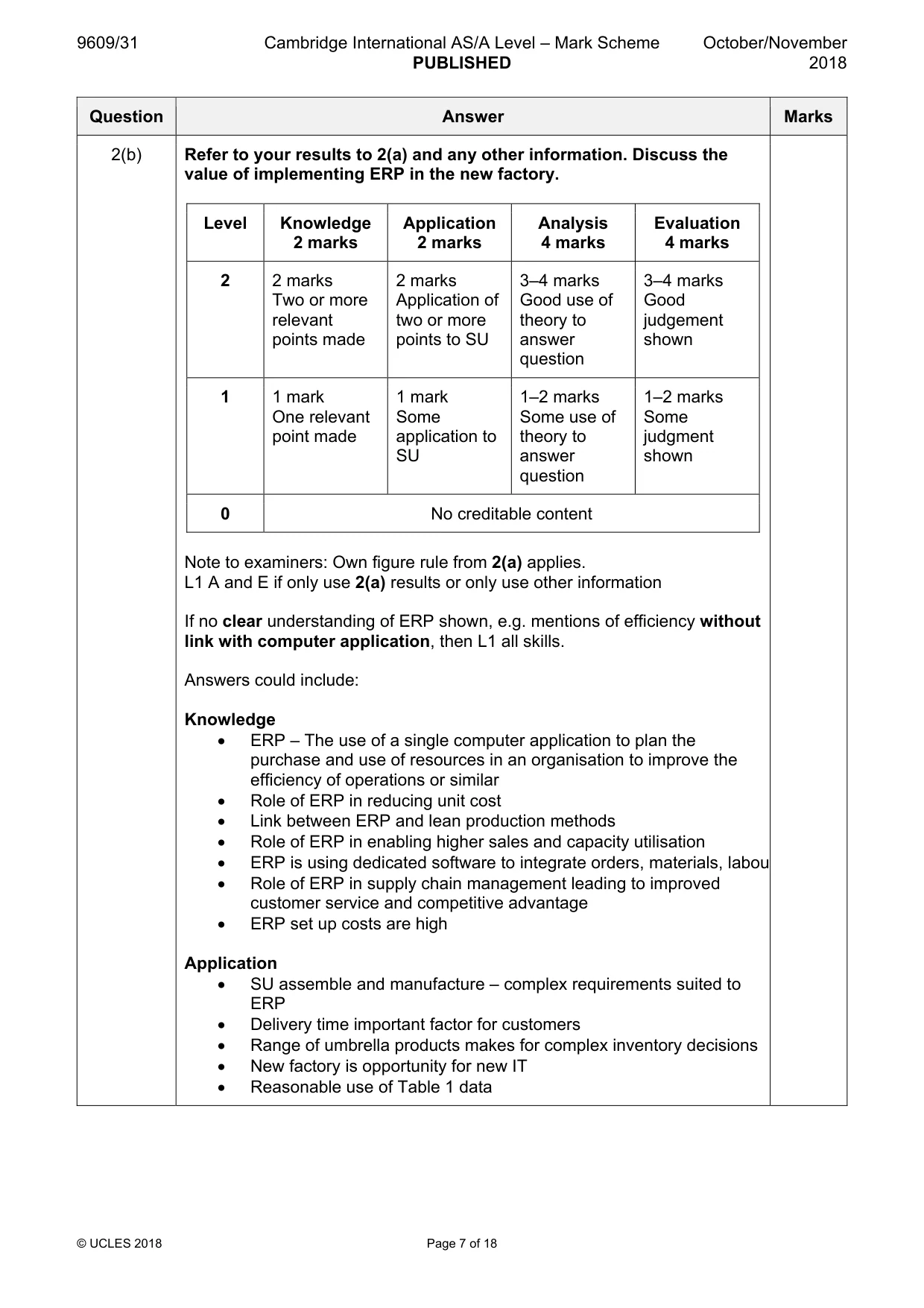
9609/31 Cambridge International AS/A Level – Mark Scheme PUBLISHED October/November 2018 © UCLES 2018 Page 7 of 18 Question Answer Marks 2(b) Refer to your results to 2(a) and any other information. Discuss the value of implementing ERP in the new factory. Level Knowledge 2 marks Application 2 marks Analysis 4 marks Evaluation 4 marks 2 2 marks Two or more relevant points made 2 marks Application of two or more points to SU 3–4 marks Good use of theory to answer question 3–4 marks Good judgement shown 1 1 mark One relevant point made 1 mark Some application to SU 1–2 marks Some use of theory to answer question 1–2 marks Some judgment shown 0 No creditable content Note to examiners: Own figure rule from 2(a) applies. L1 A and E if only use 2(a) results or only use other information If no clear understanding of ERP shown, e.g. mentions of efficiency without link with computer application, then L1 all skills. Answers could include: Knowledge • ERP – The use of a single computer application to plan the purchase and use of resources in an organisation to improve the efficiency of operations or similar • Role of ERP in reducing unit cost • Link between ERP and lean production methods • Role of ERP in enabling higher sales and capacity utilisation • ERP is using dedicated software to integrate orders, materials, labou • Role of ERP in supply chain management leading to improved customer service and competitive advantage • ERP set up costs are high Application • SU assemble and manufacture – complex requirements suited to ERP • Delivery time important factor for customers • Range of umbrella products makes for complex inventory decisions • New factory is opportunity for new IT • Reasonable use of Table 1 data
Mark scheme, page 8
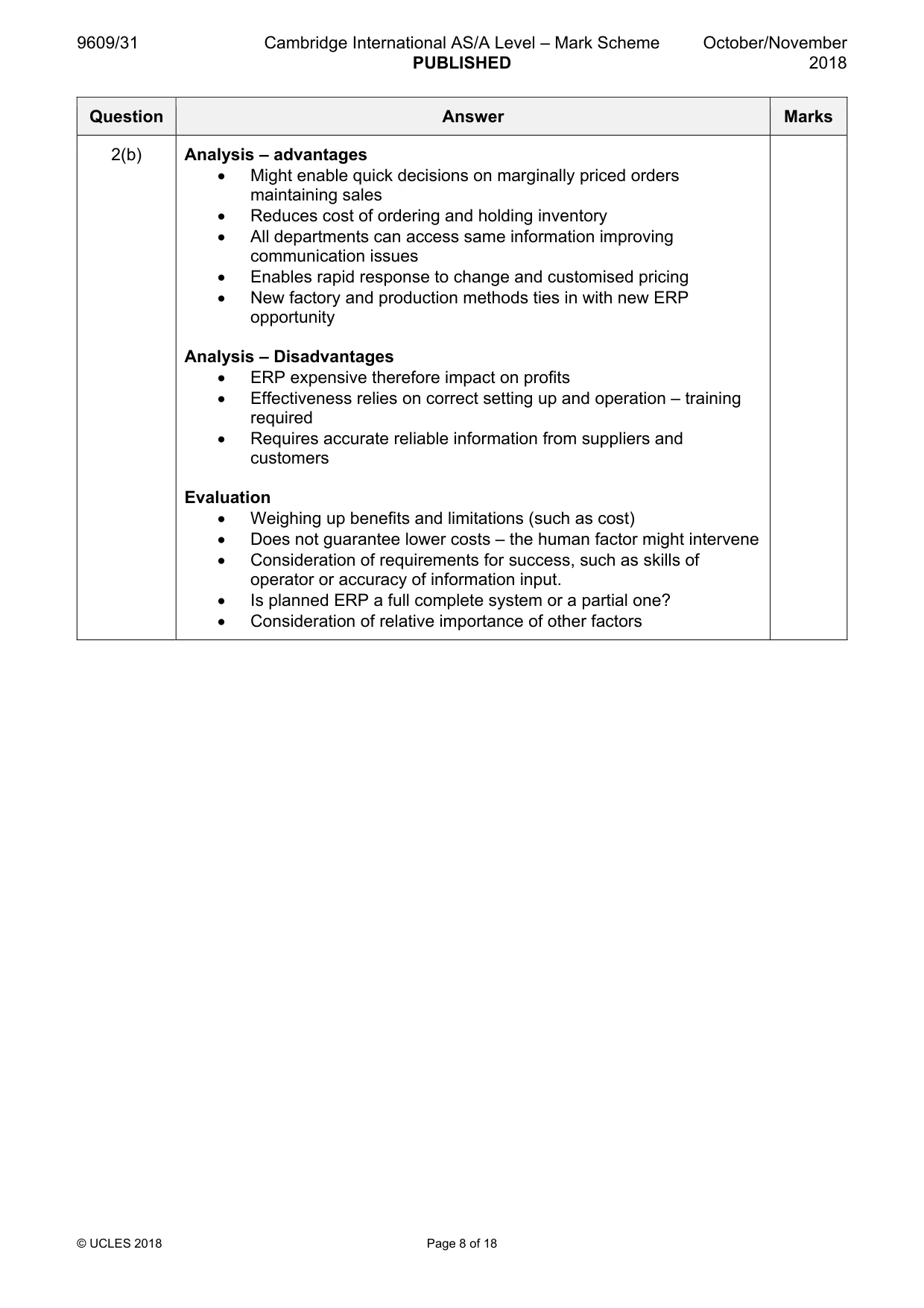
9609/31 Cambridge International AS/A Level – Mark Scheme PUBLISHED October/November 2018 © UCLES 2018 Page 8 of 18 Question Answer Marks 2(b) Analysis – advantages • Might enable quick decisions on marginally priced orders maintaining sales • Reduces cost of ordering and holding inventory • All departments can access same information improving communication issues • Enables rapid response to change and customised pricing • New factory and production methods ties in with new ERP opportunity Analysis – Disadvantages • ERP expensive therefore impact on profits • Effectiveness relies on correct setting up and operation – training required • Requires accurate reliable information from suppliers and customers Evaluation • Weighing up benefits and limitations (such as cost) • Does not guarantee lower costs – the human factor might intervene • Consideration of requirements for success, such as skills of operator or accuracy of information input. • Is planned ERP a full complete system or a partial one? • Consideration of relative importance of other factors
Mark scheme, page 9
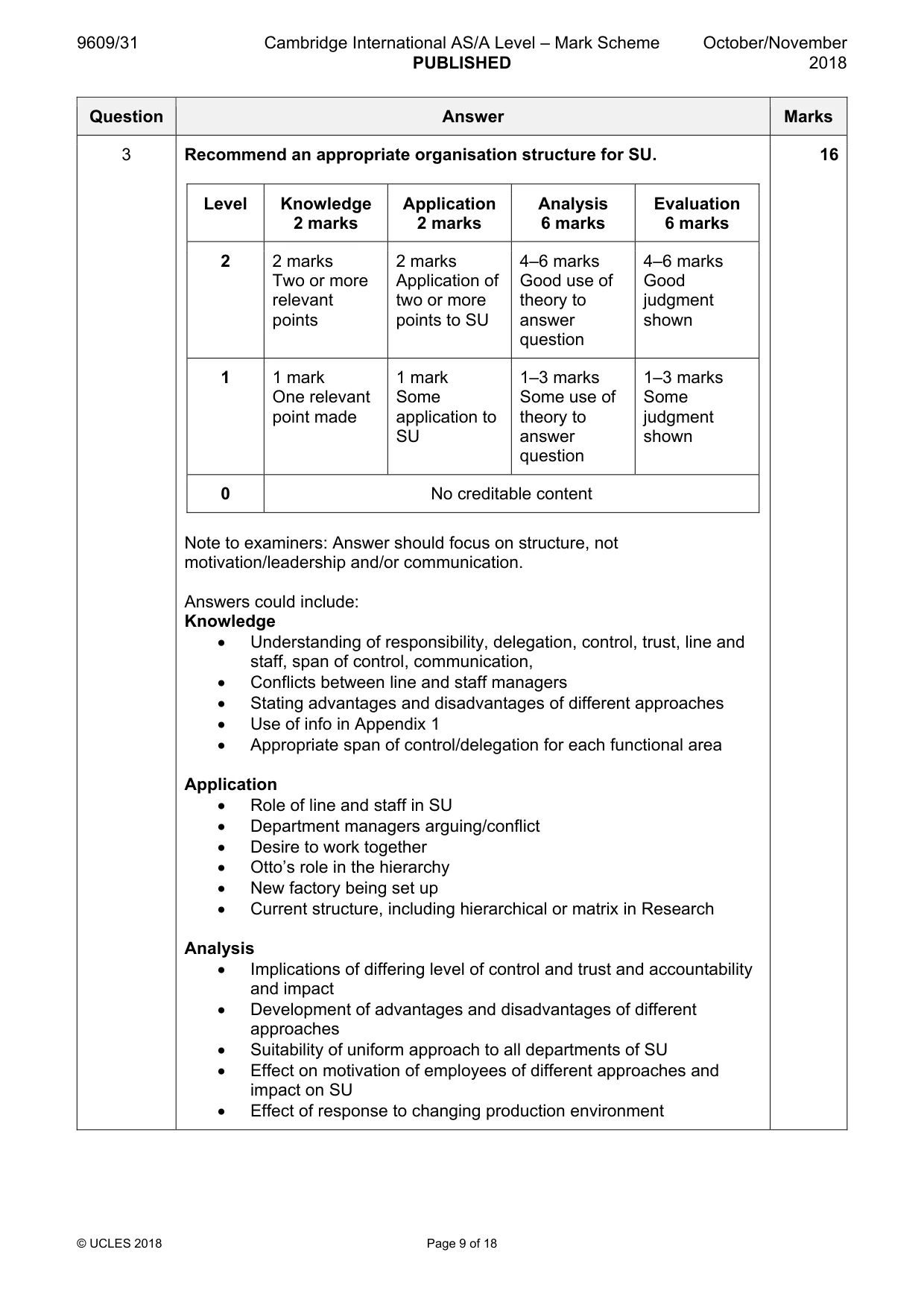
9609/31 Cambridge International AS/A Level – Mark Scheme PUBLISHED October/November 2018 © UCLES 2018 Page 9 of 18 Question Answer Marks 3 Recommend an appropriate organisation structure for SU. Level Knowledge 2 marks Application 2 marks Analysis 6 marks Evaluation 6 marks 2 2 marks Two or more relevant points 2 marks Application of two or more points to SU 4–6 marks Good use of theory to answer question 4–6 marks Good judgment shown 1 1 mark One relevant point made 1 mark Some application to SU 1–3 marks Some use of theory to answer question 1–3 marks Some judgment shown 0 No creditable content Note to examiners: Answer should focus on structure, not motivation/leadership and/or communication. Answers could include: Knowledge • Understanding of responsibility, delegation, control, trust, line and staff, span of control, communication, • Conflicts between line and staff managers • Stating advantages and disadvantages of different approaches • Use of info in Appendix 1 • Appropriate span of control/delegation for each functional area Application • Role of line and staff in SU • Department managers arguing/conflict • Desire to work together • Otto’s role in the hierarchy • New factory being set up • Current structure, including hierarchical or matrix in Research Analysis • Implications of differing level of control and trust and accountability and impact • Development of advantages and disadvantages of different approaches • Suitability of uniform approach to all departments of SU • Effect on motivation of employees of different approaches and impact on SU • Effect of response to changing production environment 16
Mark scheme, page 10
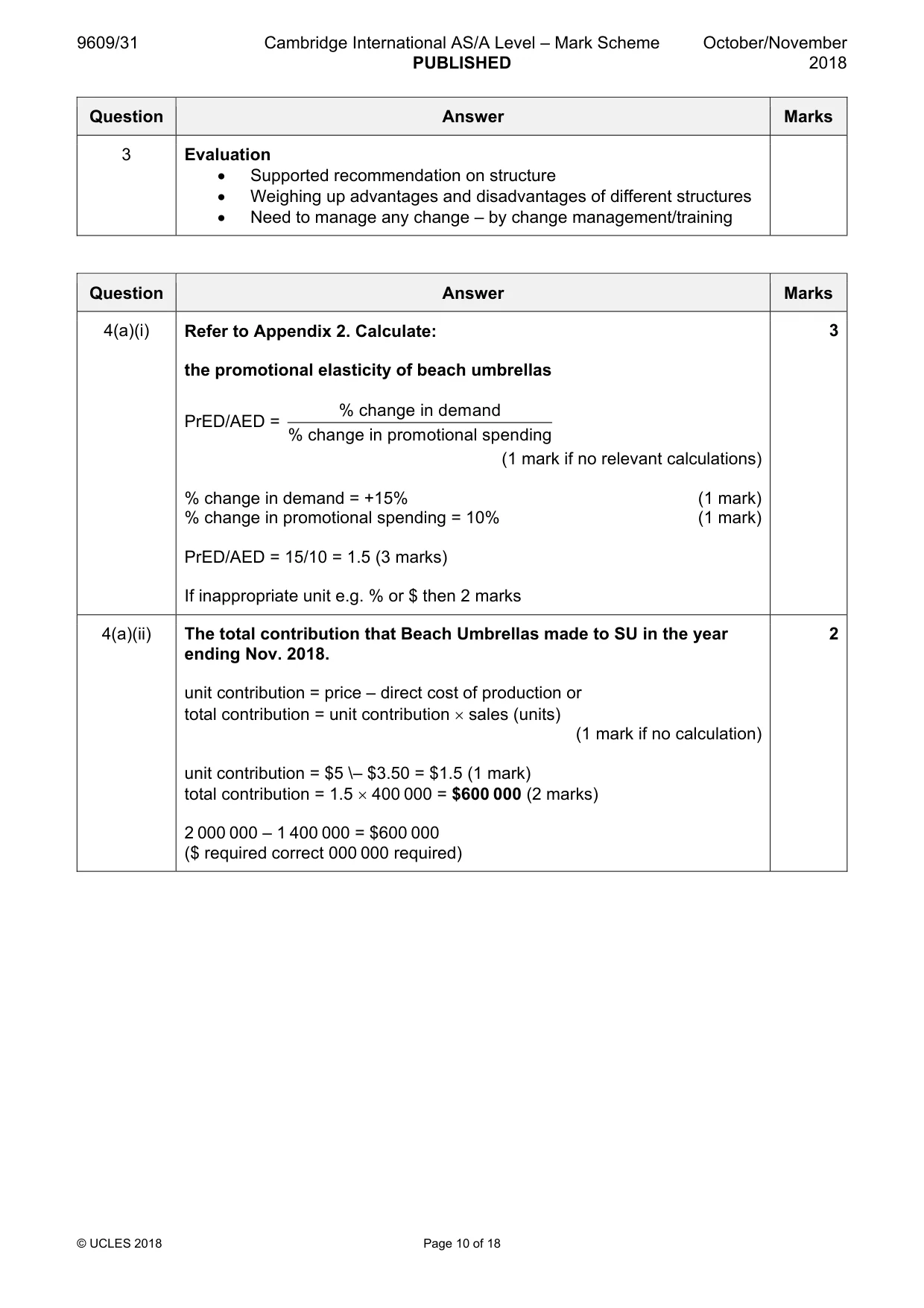
9609/31 Cambridge International AS/A Level – Mark Scheme PUBLISHED October/November 2018 © UCLES 2018 Page 10 of 18 Question Answer Marks 3 Evaluation • Supported recommendation on structure • Weighing up advantages and disadvantages of different structures • Need to manage any change – by change management/training Question Answer Marks 4(a)(i) Refer to Appendix 2. Calculate: the promotional elasticity of beach umbrellas PrED/AED = % change in demand % change in promotional spending (1 mark if no relevant calculations) % change in demand = +15% (1 mark) % change in promotional spending = 10% (1 mark) PrED/AED = 15/10 = 1.5 (3 marks) If inappropriate unit e.g. % or $ then 2 marks 3 4(a)(ii) The total contribution that Beach Umbrellas made to SU in the year ending Nov. 2018. unit contribution = price – direct cost of production or total contribution = unit contribution × sales (units) (1 mark if no calculation) unit contribution = $5 \– $3.50 = $1.5 (1 mark) total contribution = 1.5 × 400 000 = $600 000 (2 marks) 2 000 000 – 1 400 000 = $600 000 ($ required correct 000 000 required) 2
Mark scheme, page 11
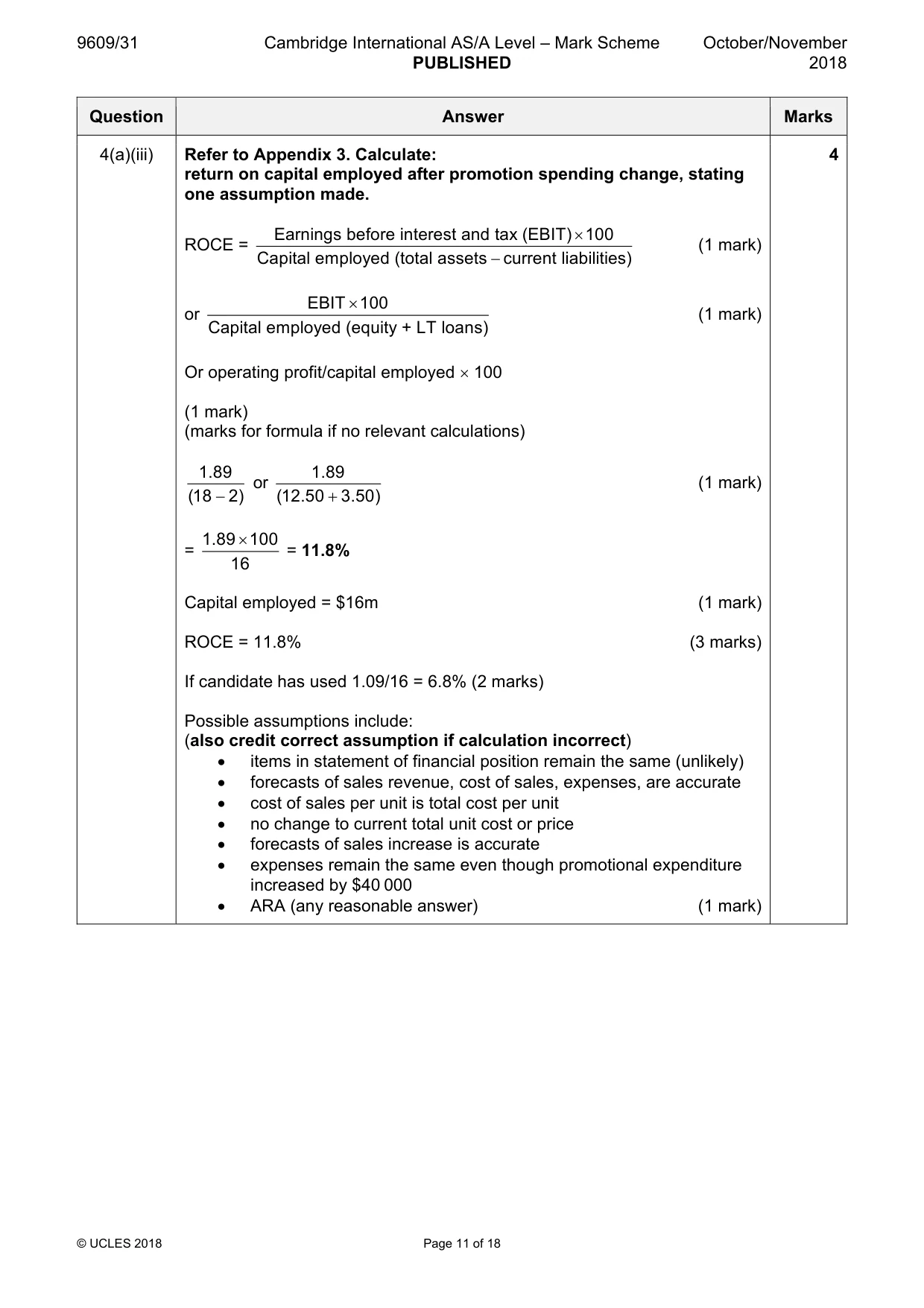
9609/31 Cambridge International AS/A Level – Mark Scheme PUBLISHED October/November 2018 © UCLES 2018 Page 11 of 18 Question Answer Marks 4(a)(iii) Refer to Appendix 3. Calculate: return on capital employed after promotion spending change, stating one assumption made. ROCE = Earnings before interest and tax (EBIT) 100 Capital employed (total assets current liabilities) × − (1 mark) or EBIT 100 Capital employed (equity + LT loans) × (1 mark) Or operating profit/capital employed × 100 (1 mark) (marks for formula if no relevant calculations) 1.89 (18 2) − or 1.89 (12.50 3.50) + (1 mark) = 1.89 100 16 × = 11.8% Capital employed = $16m (1 mark) ROCE = 11.8% (3 marks) If candidate has used 1.09/16 = 6.8% (2 marks) Possible assumptions include: (also credit correct assumption if calculation incorrect) • items in statement of financial position remain the same (unlikely) • forecasts of sales revenue, cost of sales, expenses, are accurate • cost of sales per unit is total cost per unit • no change to current total unit cost or price • forecasts of sales increase is accurate • expenses remain the same even though promotional expenditure increased by $40 000 • ARA (any reasonable answer) (1 mark) 4
Mark scheme, page 12
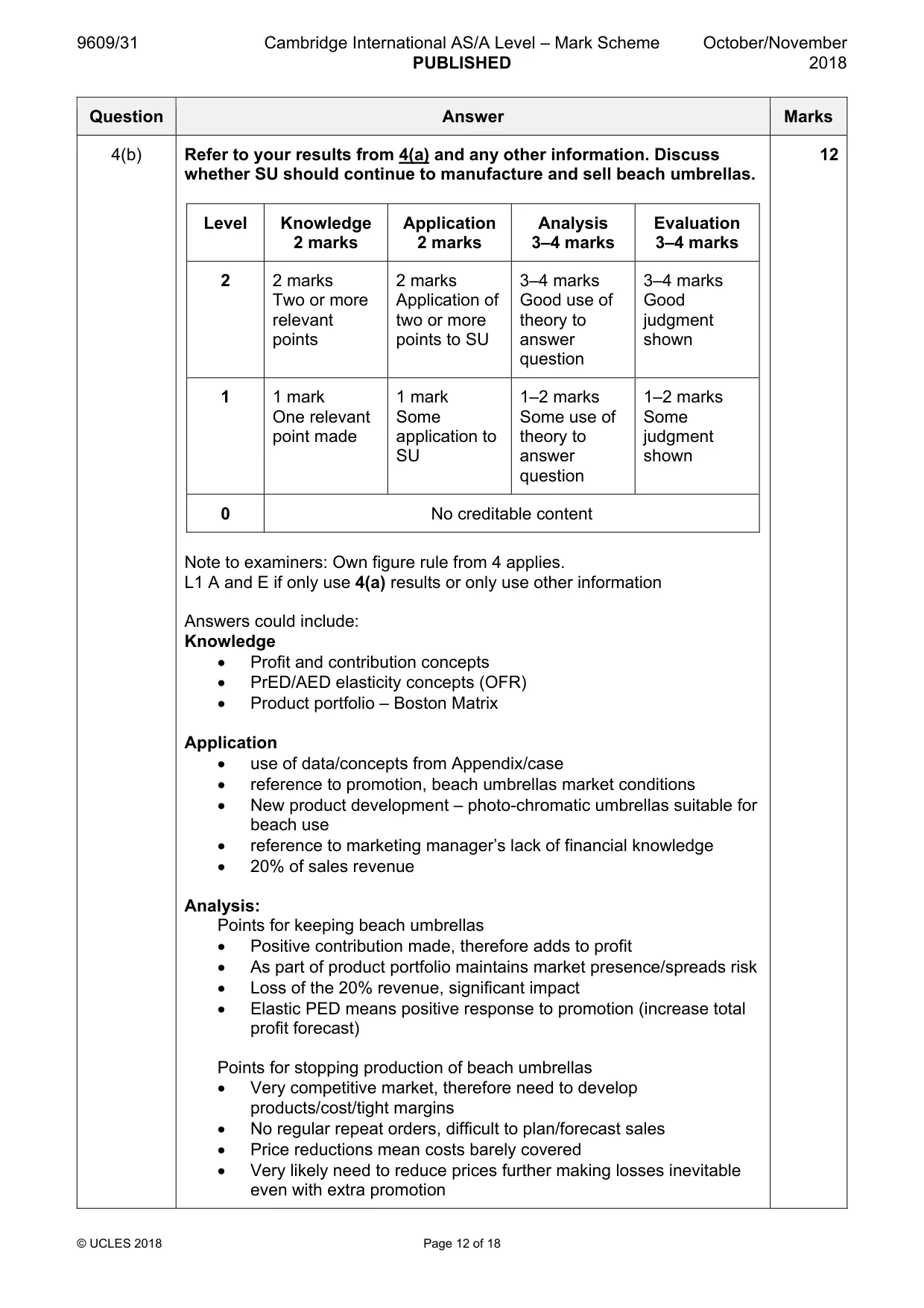
9609/31 Cambridge International AS/A Level – Mark Scheme PUBLISHED October/November 2018 © UCLES 2018 Page 12 of 18 Question Answer Marks 4(b) Refer to your results from 4(a) and any other information. Discuss whether SU should continue to manufacture and sell beach umbrellas. Level Knowledge 2 marks Application 2 marks Analysis 3–4 marks Evaluation 3–4 marks 2 2 marks Two or more relevant points 2 marks Application of two or more points to SU 3–4 marks Good use of theory to answer question 3–4 marks Good judgment shown 1 1 mark One relevant point made 1 mark Some application to SU 1–2 marks Some use of theory to answer question 1–2 marks Some judgment shown 0 No creditable content Note to examiners: Own figure rule from 4 applies. L1 A and E if only use 4(a) results or only use other information Answers could include: Knowledge • Profit and contribution concepts • PrED/AED elasticity concepts (OFR) • Product portfolio – Boston Matrix Application • use of data/concepts from Appendix/case • reference to promotion, beach umbrellas market conditions • New product development – photo-chromatic umbrellas suitable for beach use • reference to marketing manager’s lack of financial knowledge • 20% of sales revenue Analysis: Points for keeping beach umbrellas • Positive contribution made, therefore adds to profit • As part of product portfolio maintains market presence/spreads risk • Loss of the 20% revenue, significant impact • Elastic PED means positive response to promotion (increase total profit forecast) Points for stopping production of beach umbrellas • Very competitive market, therefore need to develop products/cost/tight margins • No regular repeat orders, difficult to plan/forecast sales • Price reductions mean costs barely covered • Very likely need to reduce prices further making losses inevitable even with extra promotion 12
Mark scheme, page 13
9609/31 Cambridge International AS/A Level – Mark Scheme PUBLISHED October/November 2018 © UCLES 2018 Page 13 of 18 Question Answer Marks 4(b) Evaluation • Price reductions means costs barely covered • Very likely need to reduce prices further making losses inevitable even with extra promotion • Comments re accuracy of data and implicit assumptions made • Uncertainty re possible competitor actions • Money is spent on promotion (certain) before any possible returns making need for speedy reaction a high priority • Is no change to unit cost sustainable? • Need to stay in beach umbrella market in view of new product development
Mark scheme, page 14
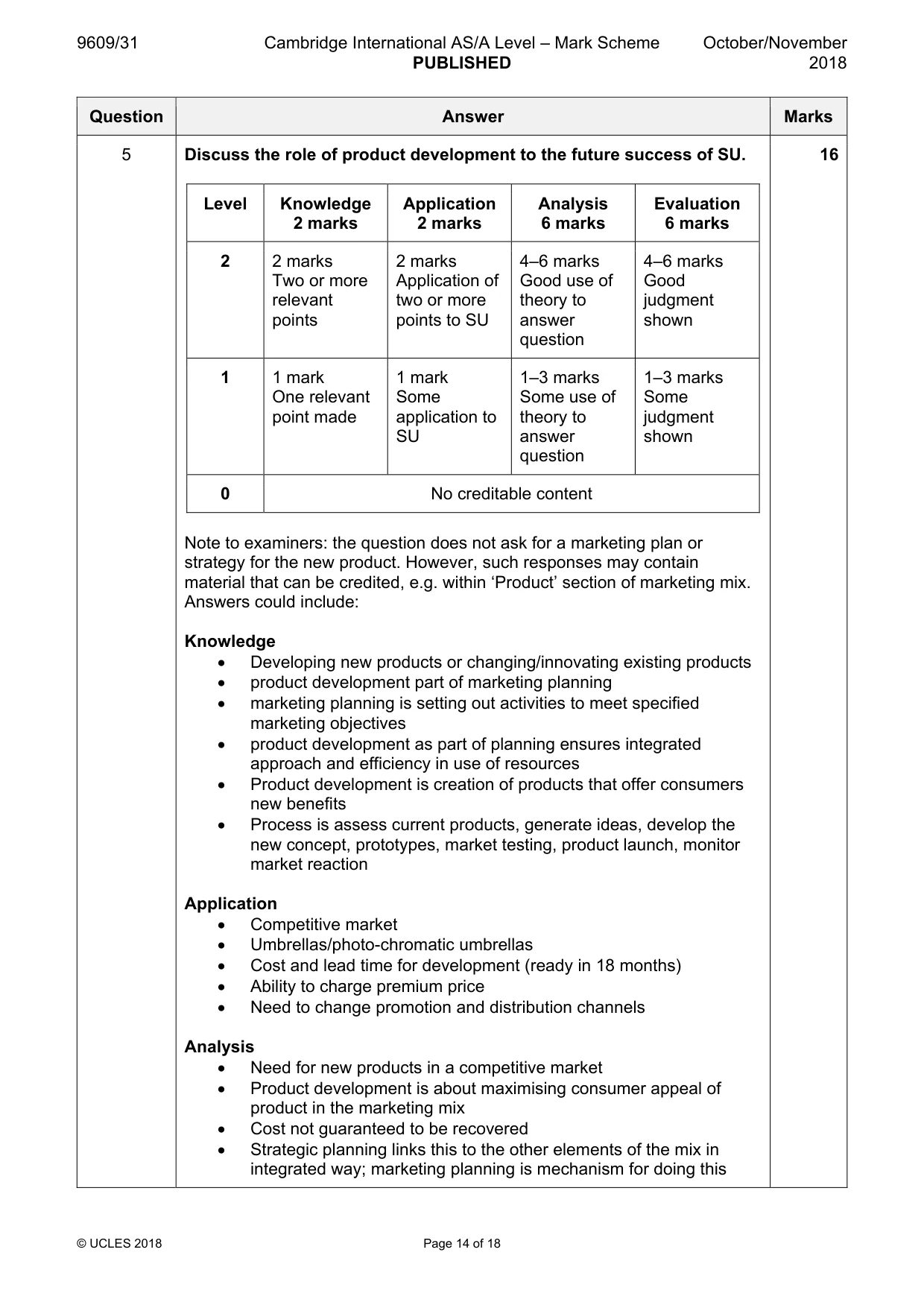
9609/31 Cambridge International AS/A Level – Mark Scheme PUBLISHED October/November 2018 © UCLES 2018 Page 14 of 18 Question Answer Marks 5 Discuss the role of product development to the future success of SU. Level Knowledge 2 marks Application 2 marks Analysis 6 marks Evaluation 6 marks 2 2 marks Two or more relevant points 2 marks Application of two or more points to SU 4–6 marks Good use of theory to answer question 4–6 marks Good judgment shown 1 1 mark One relevant point made 1 mark Some application to SU 1–3 marks Some use of theory to answer question 1–3 marks Some judgment shown 0 No creditable content Note to examiners: the question does not ask for a marketing plan or strategy for the new product. However, such responses may contain material that can be credited, e.g. within ‘Product’ section of marketing mix. Answers could include: Knowledge • Developing new products or changing/innovating existing products • product development part of marketing planning • marketing planning is setting out activities to meet specified marketing objectives • product development as part of planning ensures integrated approach and efficiency in use of resources • Product development is creation of products that offer consumers new benefits • Process is assess current products, generate ideas, develop the new concept, prototypes, market testing, product launch, monitor market reaction Application • Competitive market • Umbrellas/photo-chromatic umbrellas • Cost and lead time for development (ready in 18 months) • Ability to charge premium price • Need to change promotion and distribution channels Analysis • Need for new products in a competitive market • Product development is about maximising consumer appeal of product in the marketing mix • Cost not guaranteed to be recovered • Strategic planning links this to the other elements of the mix in integrated way; marketing planning is mechanism for doing this 16
Mark scheme, page 15
9609/31 Cambridge International AS/A Level – Mark Scheme PUBLISHED October/November 2018 © UCLES 2018 Page 15 of 18 Question Answer Marks 5 Evaluation • conclusion on relative importance of product development vis-a-vis other factors • will require objectives to be set • will need information on costings, research into market
Mark scheme, page 16
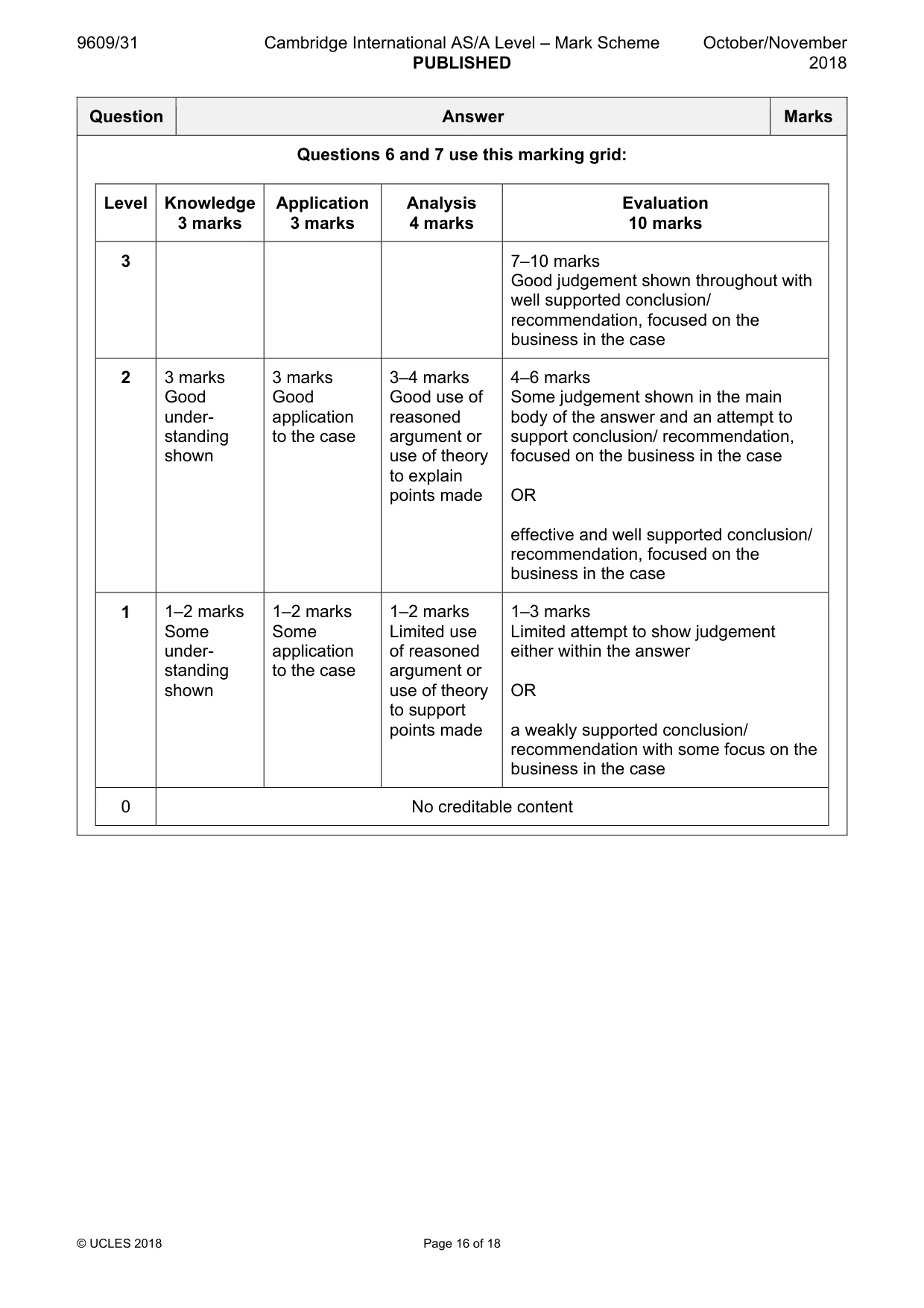
9609/31 Cambridge International AS/A Level – Mark Scheme PUBLISHED October/November 2018 © UCLES 2018 Page 16 of 18 Question Answer Marks Questions 6 and 7 use this marking grid: Level Knowledge 3 marks Application 3 marks Analysis 4 marks Evaluation 10 marks 3 7–10 marks Good judgement shown throughout with well supported conclusion/ recommendation, focused on the business in the case 2 3 marks Good under- standing shown 3 marks Good application to the case 3–4 marks Good use of reasoned argument or use of theory to explain points made 4–6 marks Some judgement shown in the main body of the answer and an attempt to support conclusion/ recommendation, focused on the business in the case OR effective and well supported conclusion/ recommendation, focused on the business in the case 1 1–2 marks Some under- standing shown 1–2 marks Some application to the case 1–2 marks Limited use of reasoned argument or use of theory to support points made 1–3 marks Limited attempt to show judgement either within the answer OR a weakly supported conclusion/ recommendation with some focus on the business in the case 0 No creditable content
Mark scheme, page 17
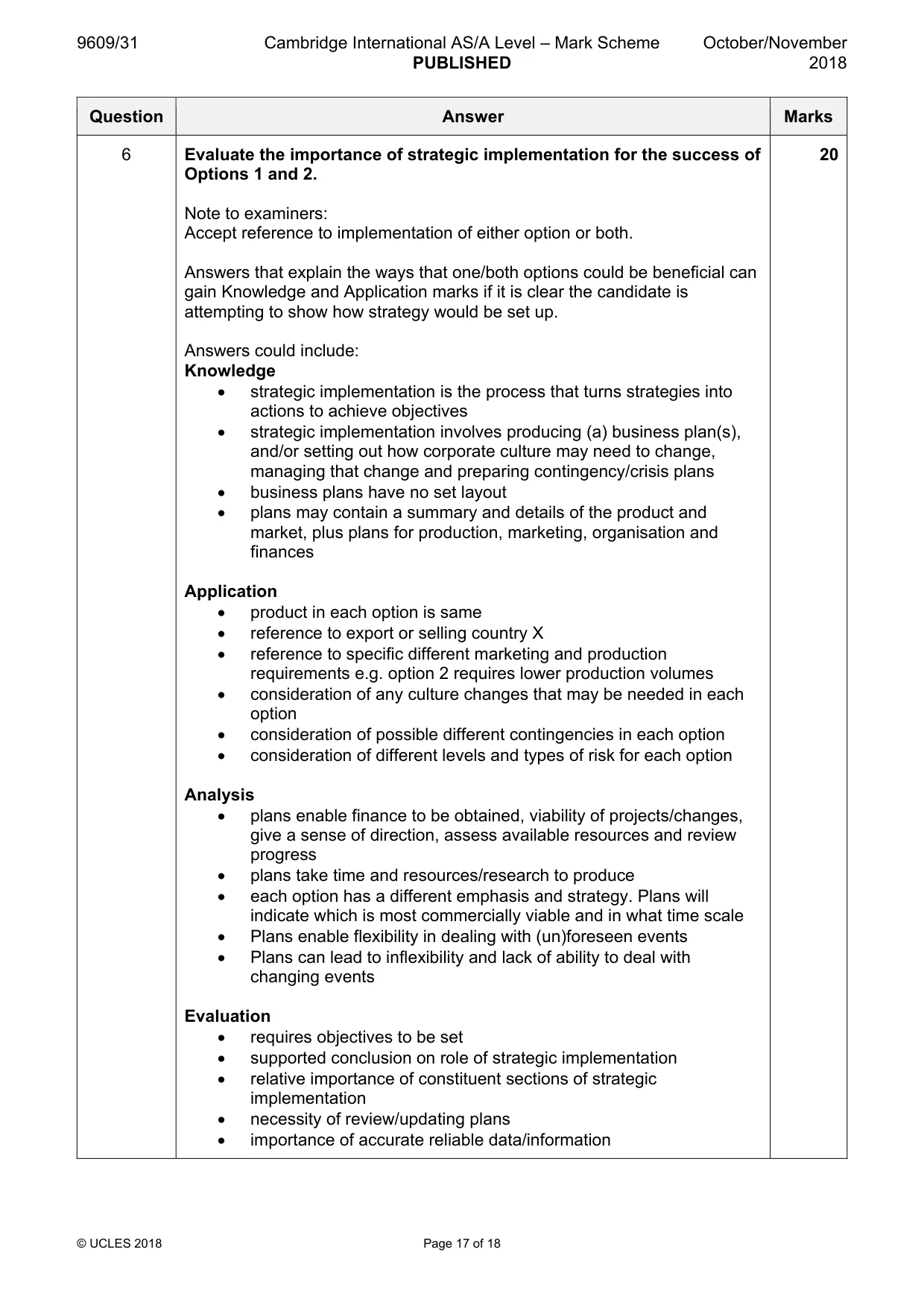
9609/31 Cambridge International AS/A Level – Mark Scheme PUBLISHED October/November 2018 © UCLES 2018 Page 17 of 18 Question Answer Marks 6 Evaluate the importance of strategic implementation for the success of Options 1 and 2. Note to examiners: Accept reference to implementation of either option or both. Answers that explain the ways that one/both options could be beneficial can gain Knowledge and Application marks if it is clear the candidate is attempting to show how strategy would be set up. Answers could include: Knowledge • strategic implementation is the process that turns strategies into actions to achieve objectives • strategic implementation involves producing (a) business plan(s), and/or setting out how corporate culture may need to change, managing that change and preparing contingency/crisis plans • business plans have no set layout • plans may contain a summary and details of the product and market, plus plans for production, marketing, organisation and finances Application • product in each option is same • reference to export or selling country X • reference to specific different marketing and production requirements e.g. option 2 requires lower production volumes • consideration of any culture changes that may be needed in each option • consideration of possible different contingencies in each option • consideration of different levels and types of risk for each option Analysis • plans enable finance to be obtained, viability of projects/changes, give a sense of direction, assess available resources and review progress • plans take time and resources/research to produce • each option has a different emphasis and strategy. Plans will indicate which is most commercially viable and in what time scale • Plans enable flexibility in dealing with (un)foreseen events • Plans can lead to inflexibility and lack of ability to deal with changing events Evaluation • requires objectives to be set • supported conclusion on role of strategic implementation • relative importance of constituent sections of strategic implementation • necessity of review/updating plans • importance of accurate reliable data/information 20
Mark scheme, page 18
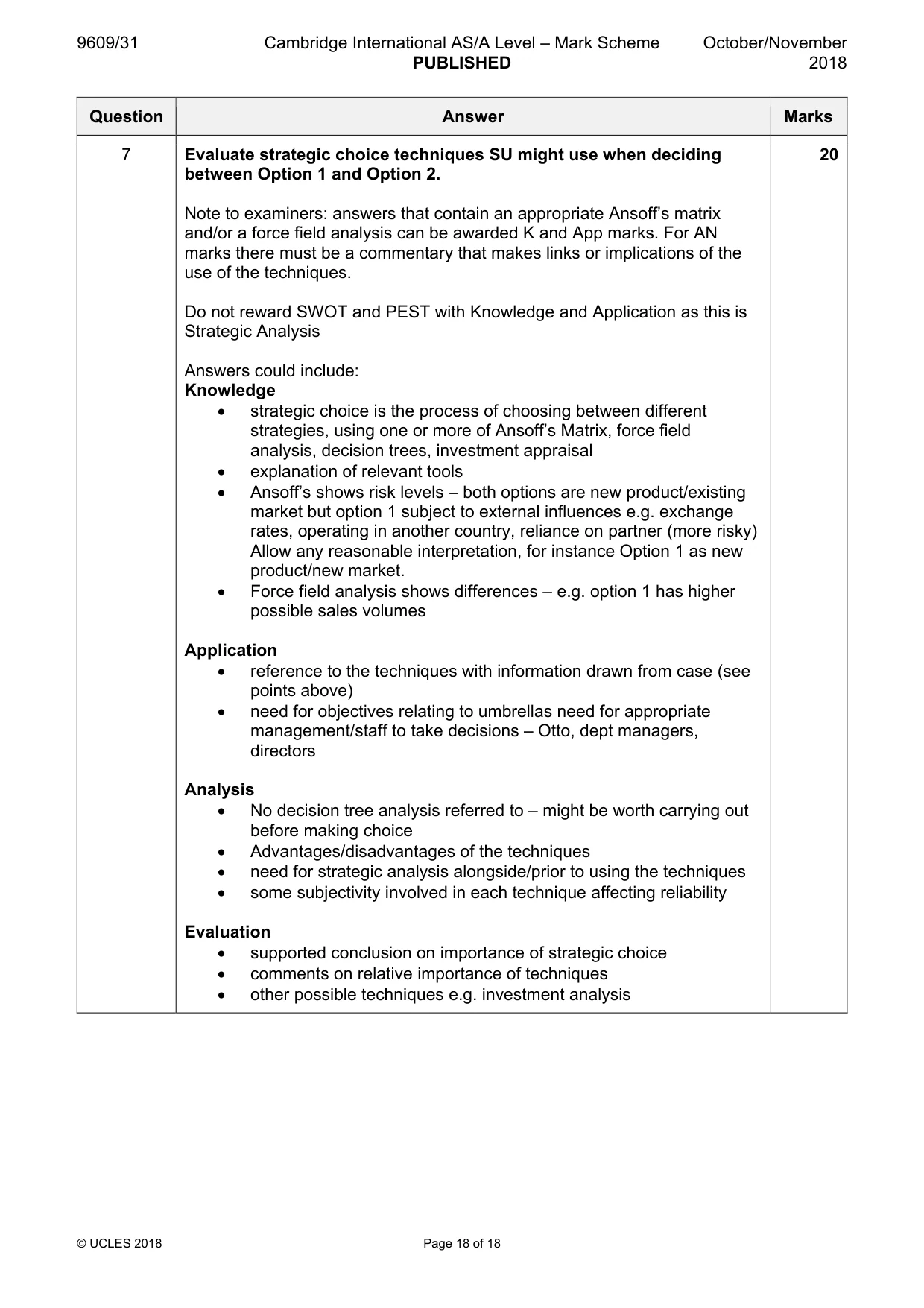
9609/31 Cambridge International AS/A Level – Mark Scheme PUBLISHED October/November 2018 © UCLES 2018 Page 18 of 18 Question Answer Marks 7 Evaluate strategic choice techniques SU might use when deciding between Option 1 and Option 2. Note to examiners: answers that contain an appropriate Ansoff’s matrix and/or a force field analysis can be awarded K and App marks. For AN marks there must be a commentary that makes links or implications of the use of the techniques. Do not reward SWOT and PEST with Knowledge and Application as this is Strategic Analysis Answers could include: Knowledge • strategic choice is the process of choosing between different strategies, using one or more of Ansoff’s Matrix, force field analysis, decision trees, investment appraisal • explanation of relevant tools • Ansoff’s shows risk levels – both options are new product/existing market but option 1 subject to external influences e.g. exchange rates, operating in another country, reliance on partner (more risky) Allow any reasonable interpretation, for instance Option 1 as new product/new market. • Force field analysis shows differences – e.g. option 1 has higher possible sales volumes Application • reference to the techniques with information drawn from case (see points above) • need for objectives relating to umbrellas need for appropriate management/staff to take decisions – Otto, dept managers, directors Analysis • No decision tree analysis referred to – might be worth carrying out before making choice • Advantages/disadvantages of the techniques • need for strategic analysis alongside/prior to using the techniques • some subjectivity involved in each technique affecting reliability Evaluation • supported conclusion on importance of strategic choice • comments on relative importance of techniques • other possible techniques e.g. investment analysis 20
What you needed in this session
Cambridge’s own grade thresholds for 2018 Oct/Nov, Paper 3 · Variant 1. A higher threshold means an easier paper — the bar moves with how the cohort did.