Cambridge A Level Business (for first examination in 2016) 9609 — 2018 Oct/Nov Paper 3 · Variant 3
9609/33/O/N/18 · 100 marks · ≈113 min
The question paper and its mark scheme, free to read here and free to download. This is Cambridge’s own paper, exactly as it was sat.
Question paper20 pages












Mark scheme17 pages
Answers below. Sit the paper first if you are practising.
Paper as text
Question paper, page 1
This document consists of 20 printed pages and 1 Insert. DC (RCL (GO)) 152092/3 © UCLES 2018 [Turn over Cambridge International Examinations Cambridge International Advanced Level * 4 3 6 9 3 4 5 8 5 5 * CANDIDATE NAME CENTRE NUMBER CANDIDATE NUMBER BUSINESS 9609/33 Paper 3 Case Study October/November 2018 3 hours Candidates answer on the Question Paper. No Additional Materials are required. READ THESE INSTRUCTIONS FIRST Write your Centre number, candidate number and name in the spaces at the top of this page. If you need additional answer paper ask the invigilator for a continuation booklet. Write in dark blue or black pen. You may use an HB pencil for any diagrams, graphs or rough working. Do not use staples, paper clips, glue or correction fluid. DO NOT WRITE IN ANY BARCODES. Section A Answer all questions. Section B Answer one question. You are advised to spend no more than 40 minutes on Section B. Refer to the Insert for the case study for this Paper. At the end of the examination, fasten all your work securely together. The number of marks is given in brackets [ ] at the end of each question or part question.
Question paper, page 2
2 9609/33/O/N/18 © UCLES 2018 Section A Answer all questions in this section. 1 Analyse how the proposed changes in the fiscal policy of the Government in country X could affect BKC. … … … … … … … … … … … … … … … … … … … … … … … … …
Question paper, page 3
3 9609/33/O/N/18 © UCLES 2018 [Turn over … … … … … … … … … … … … … … … … … … … … … … … … … … … … [10]
Question paper, page 4
4 9609/33/O/N/18 © UCLES 2018 2 (a) Refer to Appendix 1. (i) Draw a network diagram for the new factory project. [4]
Question paper, page 5
5 9609/33/O/N/18 © UCLES 2018 [Turn over (ii) Identify all the earliest start times (ESTs) and latest finish times (LFTs) of the activities. … … … … … … … … … … … … [4]
Question paper, page 6
6 9609/33/O/N/18 © UCLES 2018 (b) Discuss whether the Operations Director is right to be confident that the new factory project will be completed in 23 weeks. … … … … … … … … … … … … … … … … … … … … … … … … … … …
Question paper, page 7
7 9609/33/O/N/18 © UCLES 2018 [Turn over … … … … … … … … … … … … … … … … … … … … … … … … … … … … [12]
Question paper, page 8
8 9609/33/O/N/18 © UCLES 2018 3 Evaluate the implications of increasing globalisation for BKC’s future marketing plans. … … … … … … … … … … … … … … … … … … … … … … … … … … …
Question paper, page 9
9 9609/33/O/N/18 © UCLES 2018 [Turn over … … … … … … … … … … … … … … … … … … … … … … … … … … … …
Question paper, page 10
10 9609/33/O/N/18 © UCLES 2018 … … … … … … … … … … … … … … … … … … … … … … … … … … … … [16]
Question paper, page 11
11 9609/33/O/N/18 © UCLES 2018 [Turn over 4 (a) Refer to Table 1. Calculate for 2018: (i) inventory turnover ratio … … … … … … … … … … … … [3] (ii) days’ sales in receivables. … … … … … … … … … … … … … [3]
Question paper, page 12
12 9609/33/O/N/18 © UCLES 2018 (b) Refer to your results from 4(a) and other information. Recommend two ways in which BKC could improve its financial efficiency. Justify your recommendation. … … … … … … … … … … … … … … … … … … … … … … … … … … …
Question paper, page 13
13 9609/33/O/N/18 © UCLES 2018 [Turn over … … … … … … … … … … … … … … … … … … … … … … … … … … … … [12]
Question paper, page 14
14 9609/33/O/N/18 © UCLES 2018 5 Assess how BKC could best improve communication with employees and customers. … … … … … … … … … … … … … … … … … … … … … … … … … … …
Question paper, page 15
15 9609/33/O/N/18 © UCLES 2018 [Turn over … … … … … … … … … … … … … … … … … … … … … … … … … … … …
Question paper, page 16
16 9609/33/O/N/18 © UCLES 2018 … … … … … … … … … … … … … … … … … … … … … … … … … … … … [16]
Question paper, page 17
17 9609/33/O/N/18 © UCLES 2018 [Turn over Section B Answer one question from this section. 6 Evaluate the importance of strategic analysis to BKC when planning to achieve its new long term objective. 7 Evaluate whether the information in Appendix 2 is sufficient to allow the Board of BKC to make the strategic choice between strategy 1 and strategy 2. Write the question number here: … … … … … … … … … … … … … … … … … … … … … … …
Question paper, page 18
18 9609/33/O/N/18 © UCLES 2018 … … … … … … … … … … … … … … … … … … … … … … … … … … … …
Question paper, page 19
19 9609/33/O/N/18 © UCLES 2018 [Turn over … … … … … … … … … … … … … … … … … … … … … … … … … … … …
Question paper, page 20
20 9609/33/O/N/18 © UCLES 2018 Permission to reproduce items where third-party owned material protected by copyright is included has been sought and cleared where possible. Every reasonable effort has been made by the publisher (UCLES) to trace copyright holders, but if any items requiring clearance have unwittingly been included, the publisher will be pleased to make amends at the earliest possible opportunity. To avoid the issue of disclosure of answer-related information to candidates, all copyright acknowledgements are reproduced online in the Cambridge International Examinations Copyright Acknowledgements Booklet. This is produced for each series of examinations and is freely available to download at www.cie.org.uk after the live examination series. Cambridge International Examinations is part of the Cambridge Assessment Group. Cambridge Assessment is the brand name of University of Cambridge Local Examinations Syndicate (UCLES), which is itself a department of the University of Cambridge. … … … … … … … … … … … … … … … … … … … … … … …[20]
Mark scheme, page 1
This document consists of 17 printed pages. © UCLES 2018 [Turn over Cambridge Assessment International Education Cambridge International Advanced Subsidiary and Advanced Level BUSINESS 9609/33 Paper 3 Case Study October/November 2018 MARK SCHEME Maximum Mark: 100 Published This mark scheme is published as an aid to teachers and candidates, to indicate the requirements of the examination. It shows the basis on which Examiners were instructed to award marks. It does not indicate the details of the discussions that took place at an Examiners’ meeting before marking began, which would have considered the acceptability of alternative answers. Mark schemes should be read in conjunction with the question paper and the Principal Examiner Report for Teachers. Cambridge International will not enter into discussions about these mark schemes. Cambridge International is publishing the mark schemes for the October/November 2018 series for most Cambridge IGCSE™, Cambridge International A and AS Level components and some Cambridge O Level components.
Mark scheme, page 2
9609/33 Cambridge International AS/A Level – Mark Scheme PUBLISHED October/November 2018 © UCLES 2018 Page 2 of 17 Generic Marking Principles These general marking principles must be applied by all examiners when marking candidate answers. They should be applied alongside the specific content of the mark scheme or generic level descriptors for a question. Each question paper and mark scheme will also comply with these marking principles. GENERIC MARKING PRINCIPLE 1: Marks must be awarded in line with: • the specific content of the mark scheme or the generic level descriptors for the question • the specific skills defined in the mark scheme or in the generic level descriptors for the question • the standard of response required by a candidate as exemplified by the standardisation scripts. GENERIC MARKING PRINCIPLE 2: Marks awarded are always whole marks (not half marks, or other fractions). GENERIC MARKING PRINCIPLE 3: Marks must be awarded positively: • marks are awarded for correct/valid answers, as defined in the mark scheme. However, credit is given for valid answers which go beyond the scope of the syllabus and mark scheme, referring to your Team Leader as appropriate • marks are awarded when candidates clearly demonstrate what they know and can do • marks are not deducted for errors • marks are not deducted for omissions • answers should only be judged on the quality of spelling, punctuation and grammar when these features are specifically assessed by the question as indicated by the mark scheme. The meaning, however, should be unambiguous. GENERIC MARKING PRINCIPLE 4: Rules must be applied consistently e.g. in situations where candidates have not followed instructions or in the application of generic level descriptors. GENERIC MARKING PRINCIPLE 5: Marks should be awarded using the full range of marks defined in the mark scheme for the question (however; the use of the full mark range may be limited according to the quality of the candidate responses seen). GENERIC MARKING PRINCIPLE 6: Marks awarded are based solely on the requirements as defined in the mark scheme. Marks should not be awarded with grade thresholds or grade descriptors in mind.
Mark scheme, page 3
9609/33 Cambridge International AS/A Level – Mark Scheme PUBLISHED October/November 2018 © UCLES 2018 Page 3 of 17 General Marking Guidance • Marking should be positive: marks should not be subtracted for errors or inaccuracies. • When examiners are in doubt regarding the application of the mark scheme to a candidate’s response, the team leader must be consulted. • Crossed out work should be marked UNLESS the candidate has replaced it with an alternative response. • Errors that are carried forward (e.g. when an incorrect numerical answer to one part of a question is used as the starting point for a calculation in the next part of the question) should not be compounded – use the ‘own figure rule’. • Poor spelling, handwriting or grammar should not be penalised as long as the answer makes sense. • The main RM Assessor annotations to be used are K (Knowledge), APP (Application), AN (Analysis), EVAL (Evaluation). For each of these four annotations, the number of marks awarded for that assessment objective must match the number of times that annotation is on the answer. • Only award EVAL if the candidate has also demonstrated APP. • If there is no relevant K (Knowledge) no marks can be awarded. • Blank pages on a script should be annotated as SEEN. • A blank space, dash, question mark and a response that bears no relation to the question constitutes a ‘no response’. • In Section B, candidates answer either Question 6 or Question 7. The Section B question that the candidate does not answer must be entered as ‘no response’. • Blank pages, or pages that contain crossed out material, must be annotated using ‘seen’. • Accept any reasonable answer (ARA) when awarding marks. The suggestions for content in the mark scheme are neither exhaustive nor required. This mark scheme includes a summary of appropriate content for answering each question. It should be emphasised, however, that this material is for illustrative purposes and is not intended to provide a definitive guide to acceptable answers. It is quite possible that among the scripts there will be some candidate answers that are not covered directly by the content of this mark scheme. In such cases, professional judgement should be exercised in assessing the merits of the answer and the senior examiners should be consulted if further guidance is required. Application marks are not awarded for repeating material from the case study. Application is by answering in the context of the case or by using the information in the case to help answer the question. • The words that are written in an answer should be assessed. Where candidates’ answers do not state an intended meaning but this meaning is very clearly discernible credit may be given by discretion. • In numerical answers, units are required. • Answers that contain poor handwriting are not to be penalised. Examiners should mark what they can read and make a note to that effect. Where this is a significant factor Cambridge should be notified. • An answer consisting of a list should be assessed. It is unlikely that such a response will score highly in the levels in each Assessment Objective. • If an answer does not fit on the lined paper it should still be assessed as if it did.
Mark scheme, page 4
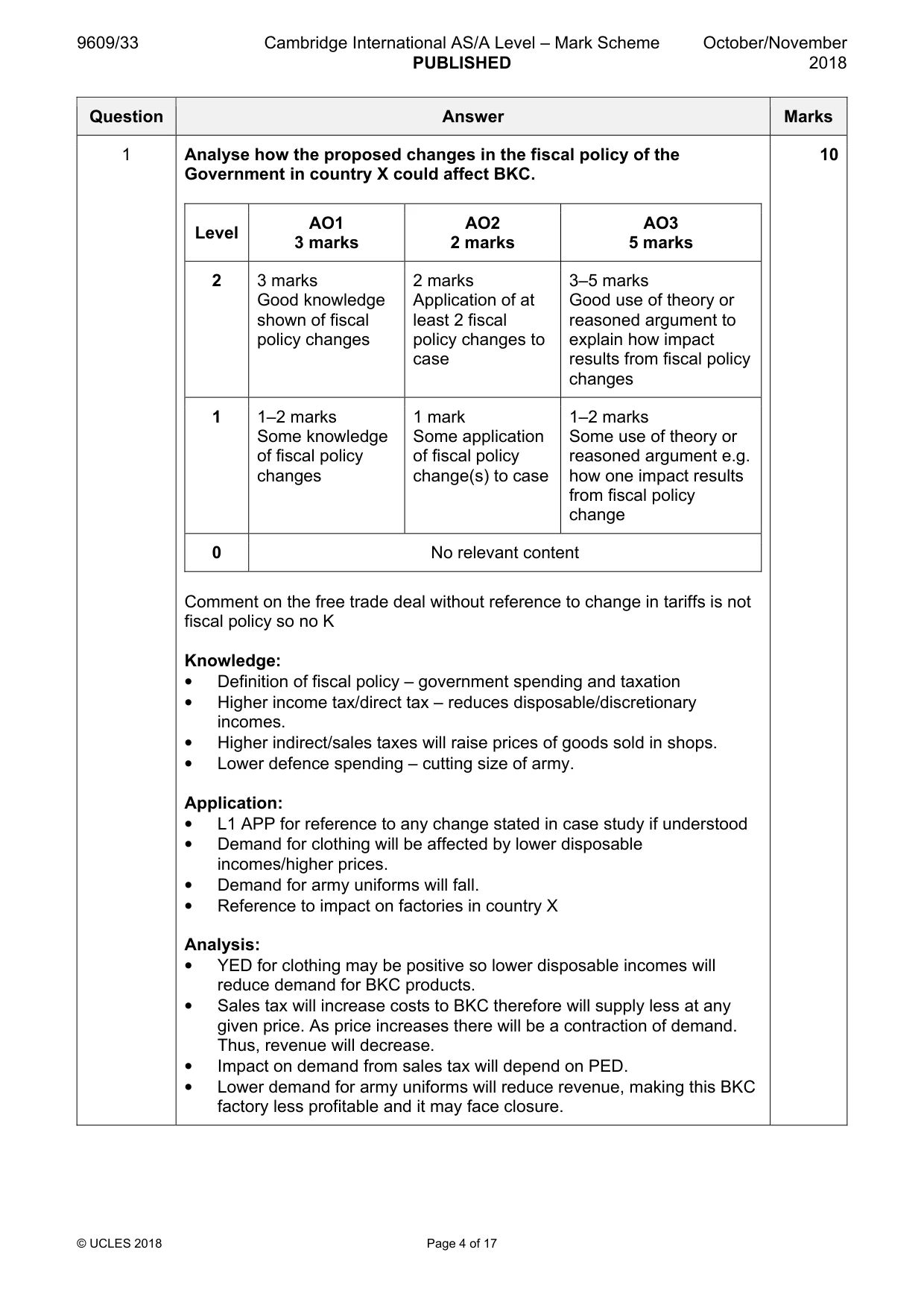
9609/33 Cambridge International AS/A Level – Mark Scheme PUBLISHED October/November 2018 © UCLES 2018 Page 4 of 17 Question Answer Marks 1 Analyse how the proposed changes in the fiscal policy of the Government in country X could affect BKC. Level AO1 3 marks AO2 2 marks AO3 5 marks 2 3 marks Good knowledge shown of fiscal policy changes 2 marks Application of at least 2 fiscal policy changes to case 3–5 marks Good use of theory or reasoned argument to explain how impact results from fiscal policy changes 1 1–2 marks Some knowledge of fiscal policy changes 1 mark Some application of fiscal policy change(s) to case 1–2 marks Some use of theory or reasoned argument e.g. how one impact results from fiscal policy change 0 No relevant content Comment on the free trade deal without reference to change in tariffs is not fiscal policy so no K Knowledge: • Definition of fiscal policy – government spending and taxation • Higher income tax/direct tax – reduces disposable/discretionary incomes. • Higher indirect/sales taxes will raise prices of goods sold in shops. • Lower defence spending – cutting size of army. Application: • L1 APP for reference to any change stated in case study if understood • Demand for clothing will be affected by lower disposable incomes/higher prices. • Demand for army uniforms will fall. • Reference to impact on factories in country X Analysis: • YED for clothing may be positive so lower disposable incomes will reduce demand for BKC products. • Sales tax will increase costs to BKC therefore will supply less at any given price. As price increases there will be a contraction of demand. Thus, revenue will decrease. • Impact on demand from sales tax will depend on PED. • Lower demand for army uniforms will reduce revenue, making this BKC factory less profitable and it may face closure. 10
Mark scheme, page 5
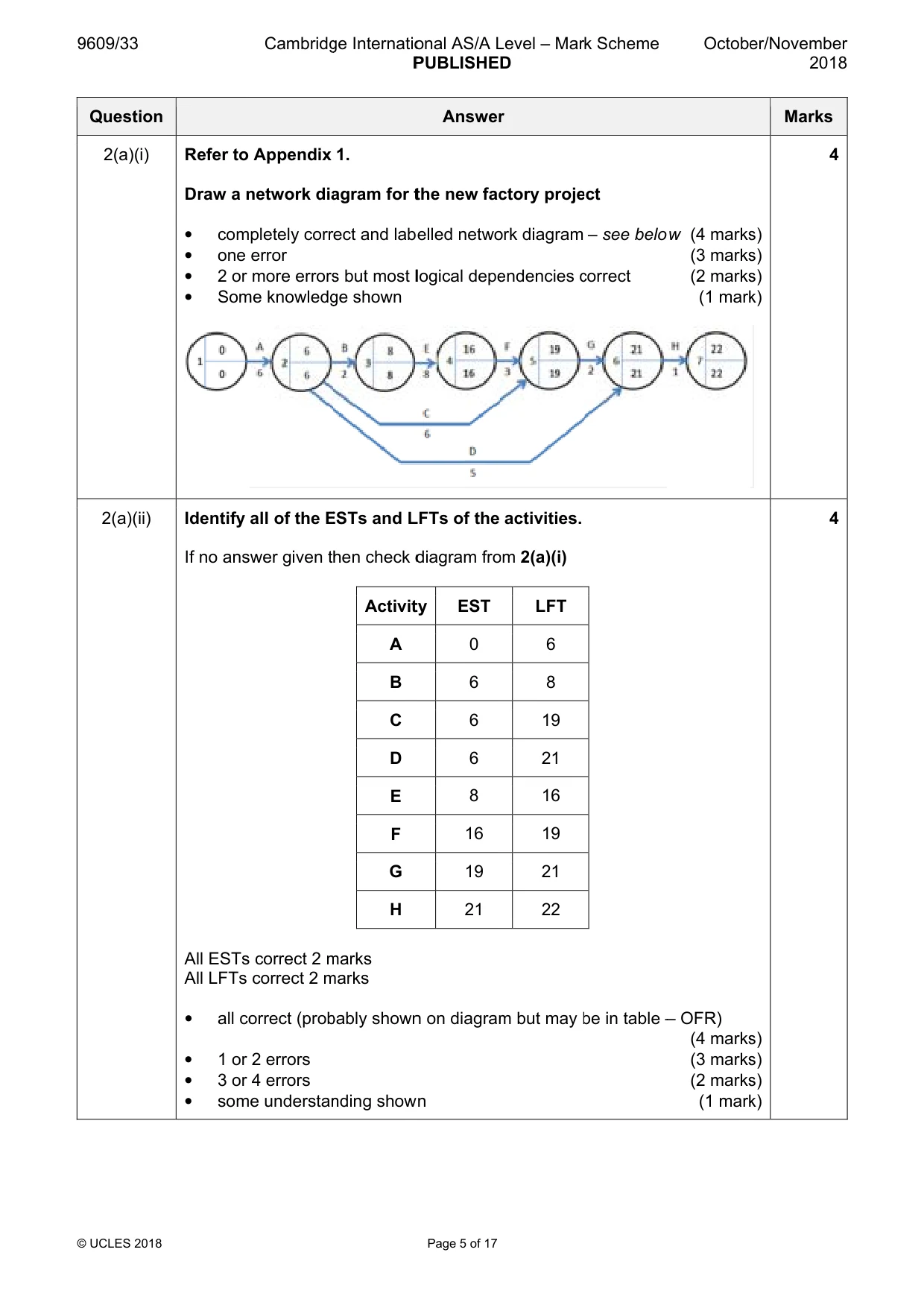
9 © 9609/33 © UCLES 2018 Question 2(a)(i) 2(a)(ii) Refer to Draw a n • com • one • 2 or • Som Identify If no answ All ESTs All LFTs • all co • 1 or • 3 or • some Cambridg Appendix network dia pletely corr error more errors me knowledg all of the E wer given th correct 2 m correct 2 m orrect (prob 2 errors 4 errors e understan ge Internatio P 1. agram for t ect and labe s but most l ge shown ESTs and L hen check d Activit A B C D E F G H marks marks bably shown nding show onal AS/A L PUBLISHED Page 5 of 17 Answer the new fac elled netwo logical depe LFTs of the diagram fro ty EST 0 6 6 6 8 16 19 21 n on diagram n Level – Mar D r ctory proje ork diagram endencies c activities. om 2(a)(i) LFT 6 8 19 21 16 19 21 22 m but may b k Scheme ect – see belo correct be in table – Octobe w (4 marks (3 marks (2 marks (1 mark – OFR) (4 marks (3 marks (2 marks (1 mark er/Novembe 201 Marks s) s) s) k) 4 s) s) s) k) 4 er 18 4 4
Mark scheme, page 6
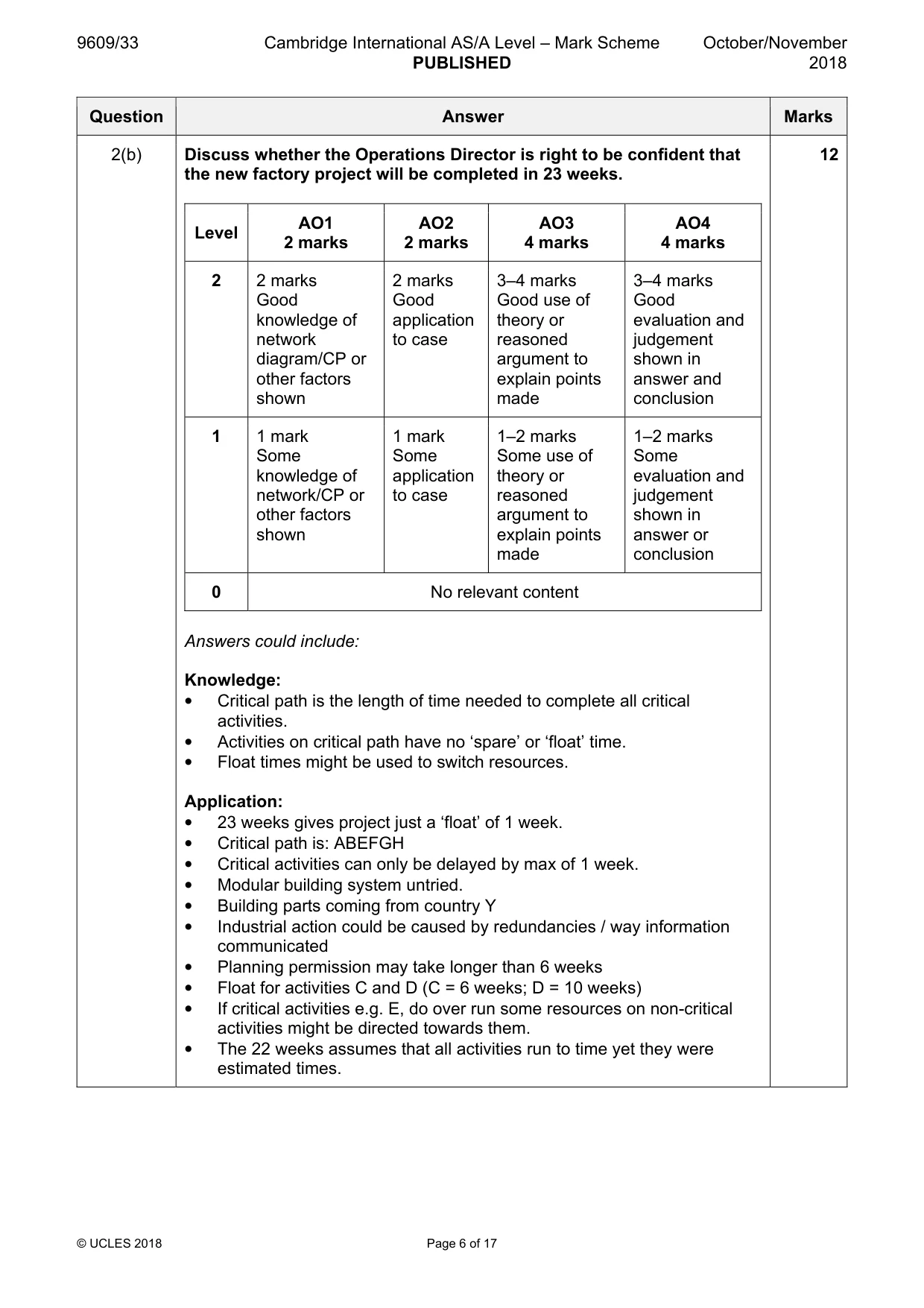
9609/33 Cambridge International AS/A Level – Mark Scheme PUBLISHED October/November 2018 © UCLES 2018 Page 6 of 17 Question Answer Marks 2(b) Discuss whether the Operations Director is right to be confident that the new factory project will be completed in 23 weeks. Level AO1 2 marks AO2 2 marks AO3 4 marks AO4 4 marks 2 2 marks Good knowledge of network diagram/CP or other factors shown 2 marks Good application to case 3–4 marks Good use of theory or reasoned argument to explain points made 3–4 marks Good evaluation and judgement shown in answer and conclusion 1 1 mark Some knowledge of network/CP or other factors shown 1 mark Some application to case 1–2 marks Some use of theory or reasoned argument to explain points made 1–2 marks Some evaluation and judgement shown in answer or conclusion 0 No relevant content Answers could include: Knowledge: • Critical path is the length of time needed to complete all critical activities. • Activities on critical path have no ‘spare’ or ‘float’ time. • Float times might be used to switch resources. Application: • 23 weeks gives project just a ‘float’ of 1 week. • Critical path is: ABEFGH • Critical activities can only be delayed by max of 1 week. • Modular building system untried. • Building parts coming from country Y • Industrial action could be caused by redundancies / way information communicated • Planning permission may take longer than 6 weeks • Float for activities C and D (C = 6 weeks; D = 10 weeks) • If critical activities e.g. E, do over run some resources on non-critical activities might be directed towards them. • The 22 weeks assumes that all activities run to time yet they were estimated times. 12
Mark scheme, page 7
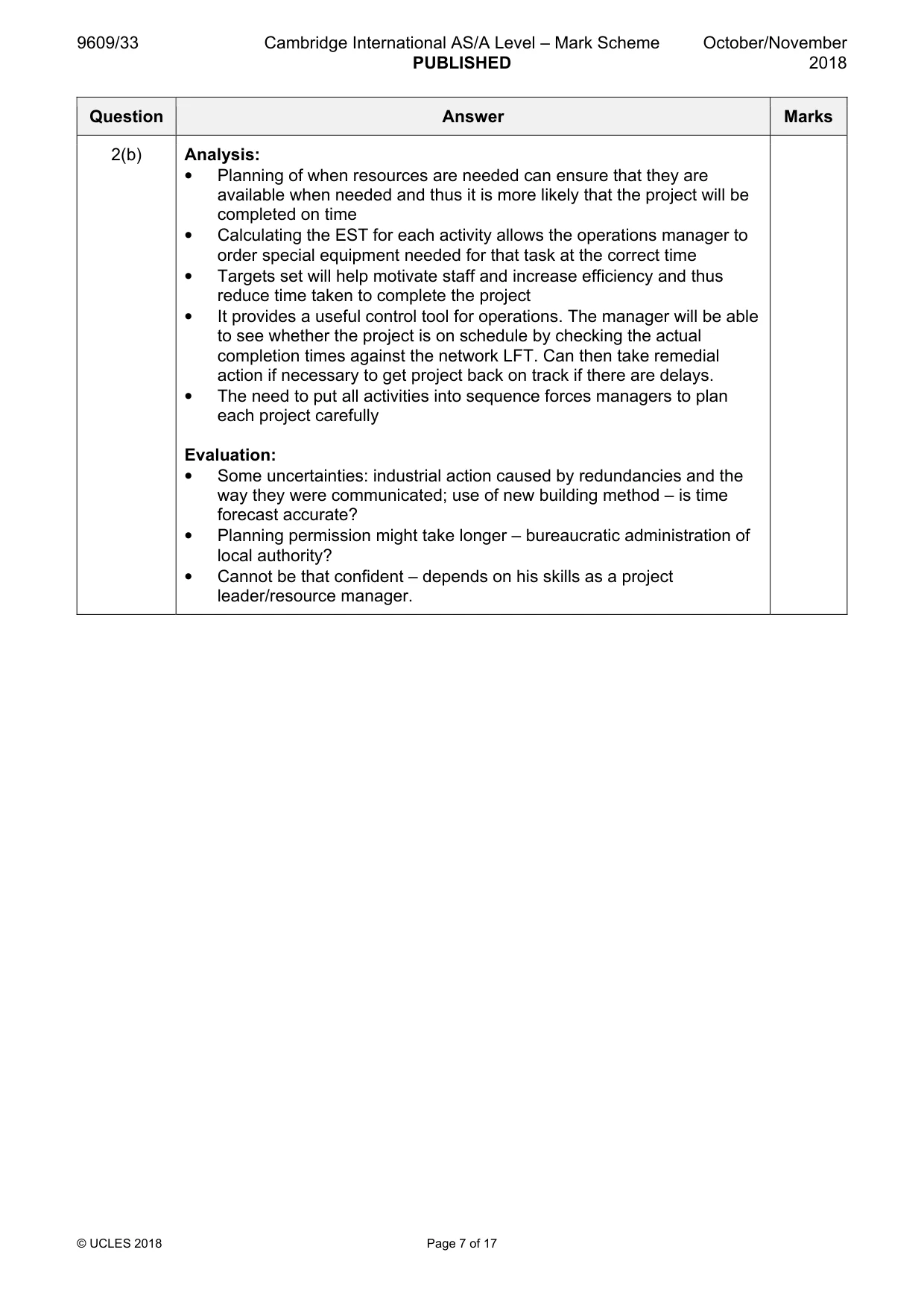
9609/33 Cambridge International AS/A Level – Mark Scheme PUBLISHED October/November 2018 © UCLES 2018 Page 7 of 17 Question Answer Marks 2(b) Analysis: • Planning of when resources are needed can ensure that they are available when needed and thus it is more likely that the project will be completed on time • Calculating the EST for each activity allows the operations manager to order special equipment needed for that task at the correct time • Targets set will help motivate staff and increase efficiency and thus reduce time taken to complete the project • It provides a useful control tool for operations. The manager will be able to see whether the project is on schedule by checking the actual completion times against the network LFT. Can then take remedial action if necessary to get project back on track if there are delays. • The need to put all activities into sequence forces managers to plan each project carefully Evaluation: • Some uncertainties: industrial action caused by redundancies and the way they were communicated; use of new building method – is time forecast accurate? • Planning permission might take longer – bureaucratic administration of local authority? • Cannot be that confident – depends on his skills as a project leader/resource manager.
Mark scheme, page 8
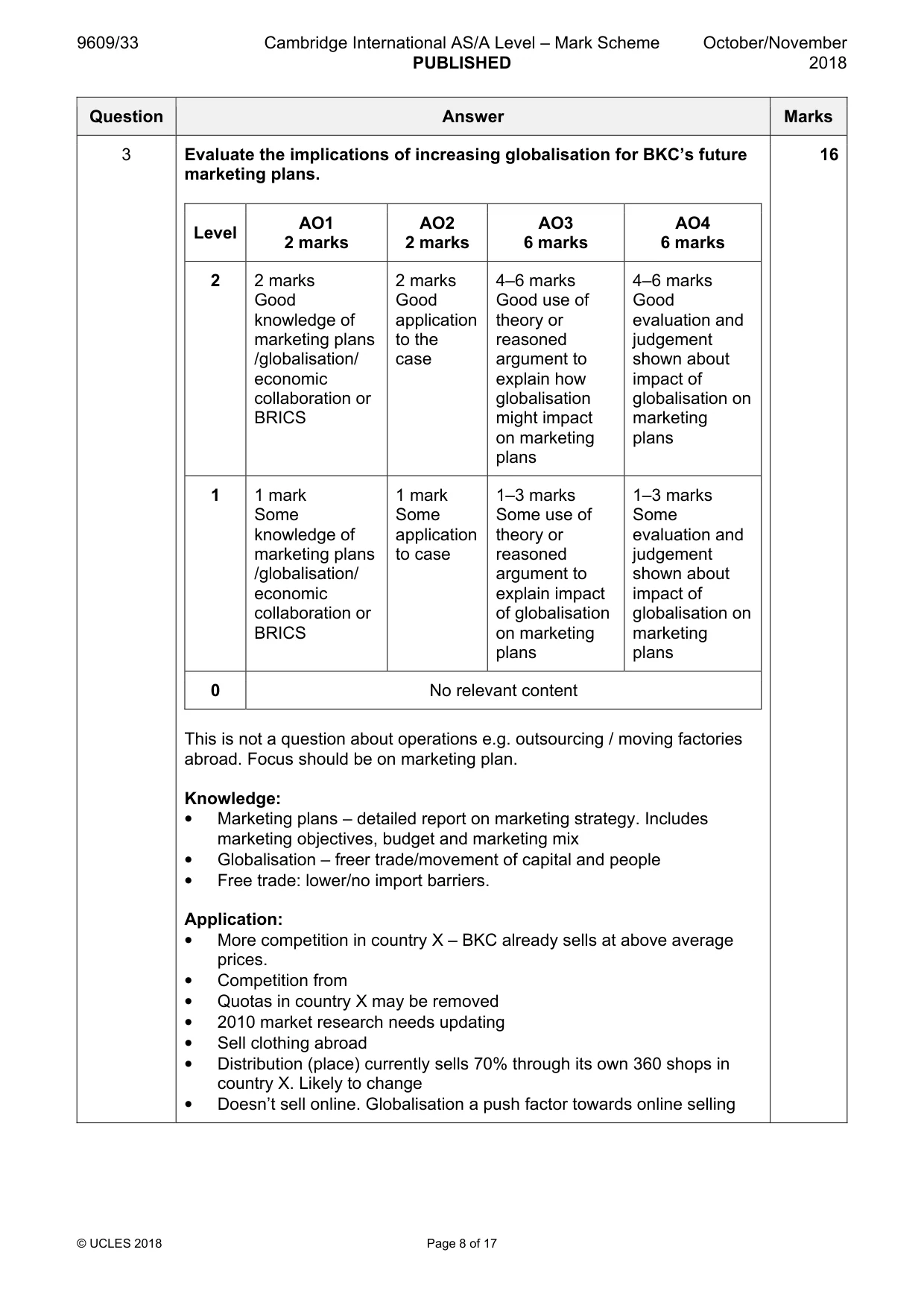
9609/33 Cambridge International AS/A Level – Mark Scheme PUBLISHED October/November 2018 © UCLES 2018 Page 8 of 17 Question Answer Marks 3 Evaluate the implications of increasing globalisation for BKC’s future marketing plans. Level AO1 2 marks AO2 2 marks AO3 6 marks AO4 6 marks 2 2 marks Good knowledge of marketing plans /globalisation/ economic collaboration or BRICS 2 marks Good application to the case 4–6 marks Good use of theory or reasoned argument to explain how globalisation might impact on marketing plans 4–6 marks Good evaluation and judgement shown about impact of globalisation on marketing plans 1 1 mark Some knowledge of marketing plans /globalisation/ economic collaboration or BRICS 1 mark Some application to case 1–3 marks Some use of theory or reasoned argument to explain impact of globalisation on marketing plans 1–3 marks Some evaluation and judgement shown about impact of globalisation on marketing plans 0 No relevant content This is not a question about operations e.g. outsourcing / moving factories abroad. Focus should be on marketing plan. Knowledge: • Marketing plans – detailed report on marketing strategy. Includes marketing objectives, budget and marketing mix • Globalisation – freer trade/movement of capital and people • Free trade: lower/no import barriers. Application: • More competition in country X – BKC already sells at above average prices. • Competition from • Quotas in country X may be removed • 2010 market research needs updating • Sell clothing abroad • Distribution (place) currently sells 70% through its own 360 shops in country X. Likely to change • Doesn’t sell online. Globalisation a push factor towards online selling 16
Mark scheme, page 9
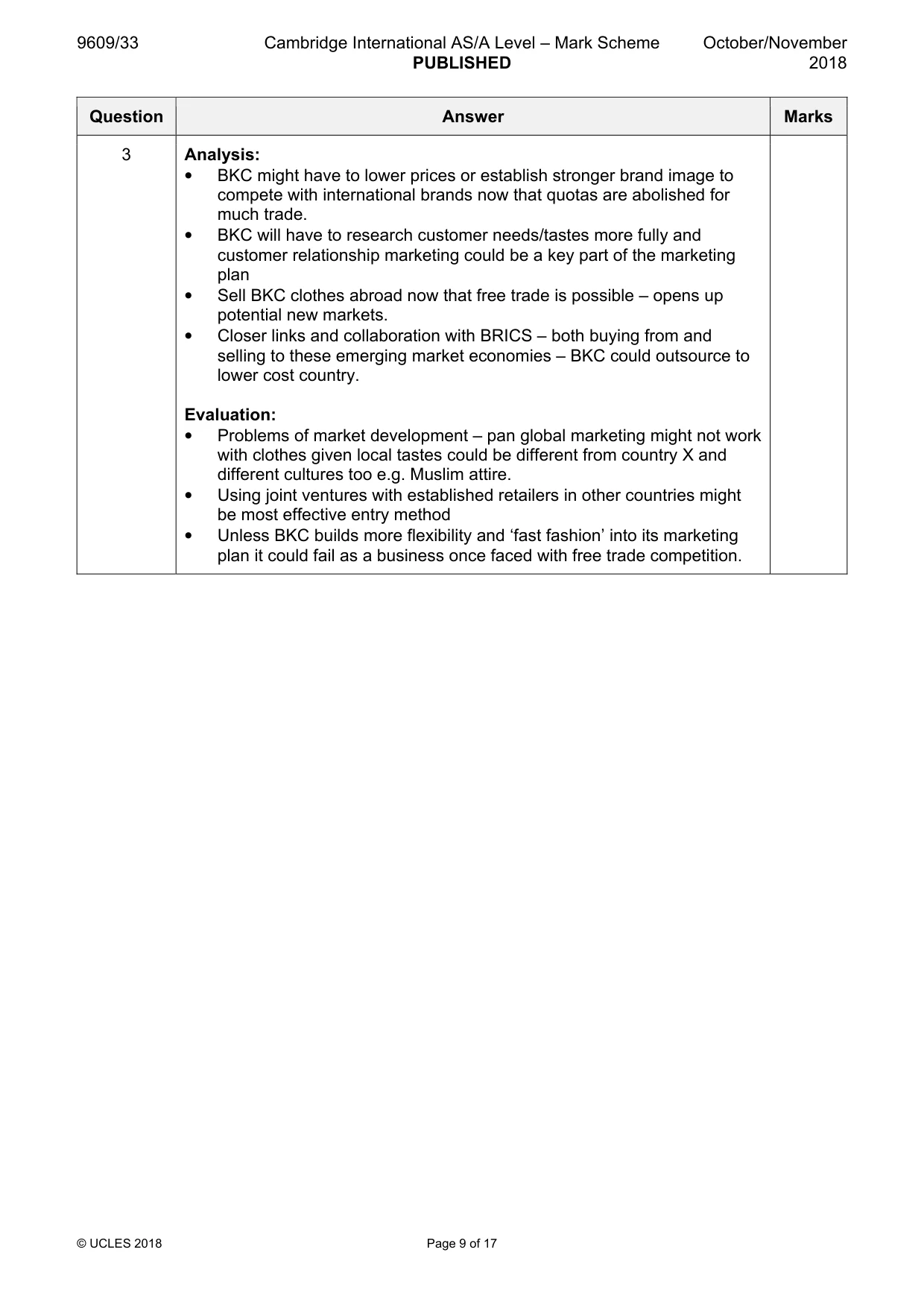
9609/33 Cambridge International AS/A Level – Mark Scheme PUBLISHED October/November 2018 © UCLES 2018 Page 9 of 17 Question Answer Marks 3 Analysis: • BKC might have to lower prices or establish stronger brand image to compete with international brands now that quotas are abolished for much trade. • BKC will have to research customer needs/tastes more fully and customer relationship marketing could be a key part of the marketing plan • Sell BKC clothes abroad now that free trade is possible – opens up potential new markets. • Closer links and collaboration with BRICS – both buying from and selling to these emerging market economies – BKC could outsource to lower cost country. Evaluation: • Problems of market development – pan global marketing might not work with clothes given local tastes could be different from country X and different cultures too e.g. Muslim attire. • Using joint ventures with established retailers in other countries might be most effective entry method • Unless BKC builds more flexibility and ‘fast fashion’ into its marketing plan it could fail as a business once faced with free trade competition.
Mark scheme, page 10
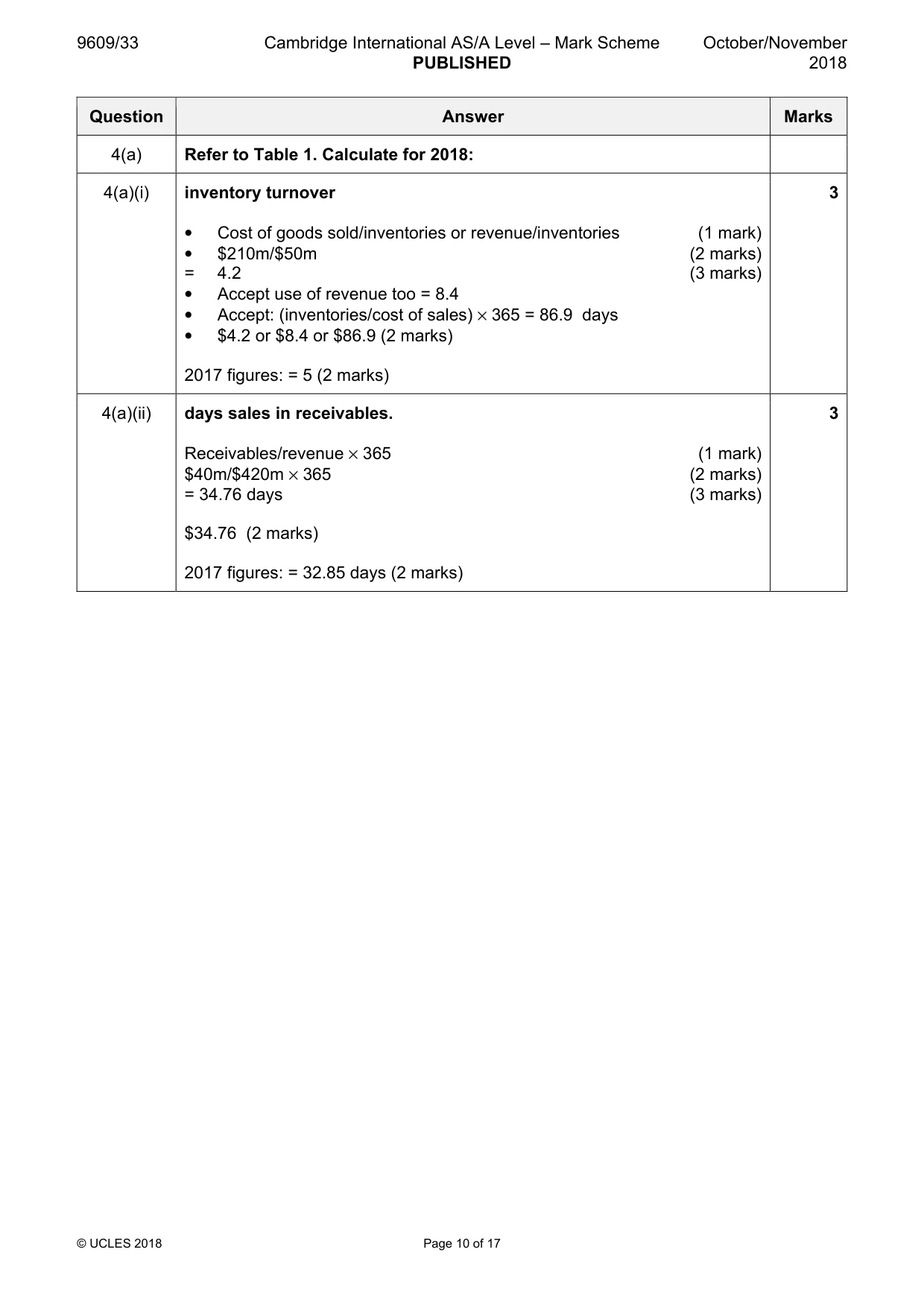
9609/33 Cambridge International AS/A Level – Mark Scheme PUBLISHED October/November 2018 © UCLES 2018 Page 10 of 17 Question Answer Marks 4(a) Refer to Table 1. Calculate for 2018: 4(a)(i) inventory turnover • Cost of goods sold/inventories or revenue/inventories (1 mark) • $210m/$50m (2 marks) = 4.2 (3 marks) • Accept use of revenue too = 8.4 • Accept: (inventories/cost of sales) × 365 = 86.9 days • $4.2 or $8.4 or $86.9 (2 marks) 2017 figures: = 5 (2 marks) 3 4(a)(ii) days sales in receivables. Receivables/revenue × 365 (1 mark) $40m/$420m × 365 (2 marks) = 34.76 days (3 marks) $34.76 (2 marks) 2017 figures: = 32.85 days (2 marks) 3
Mark scheme, page 11
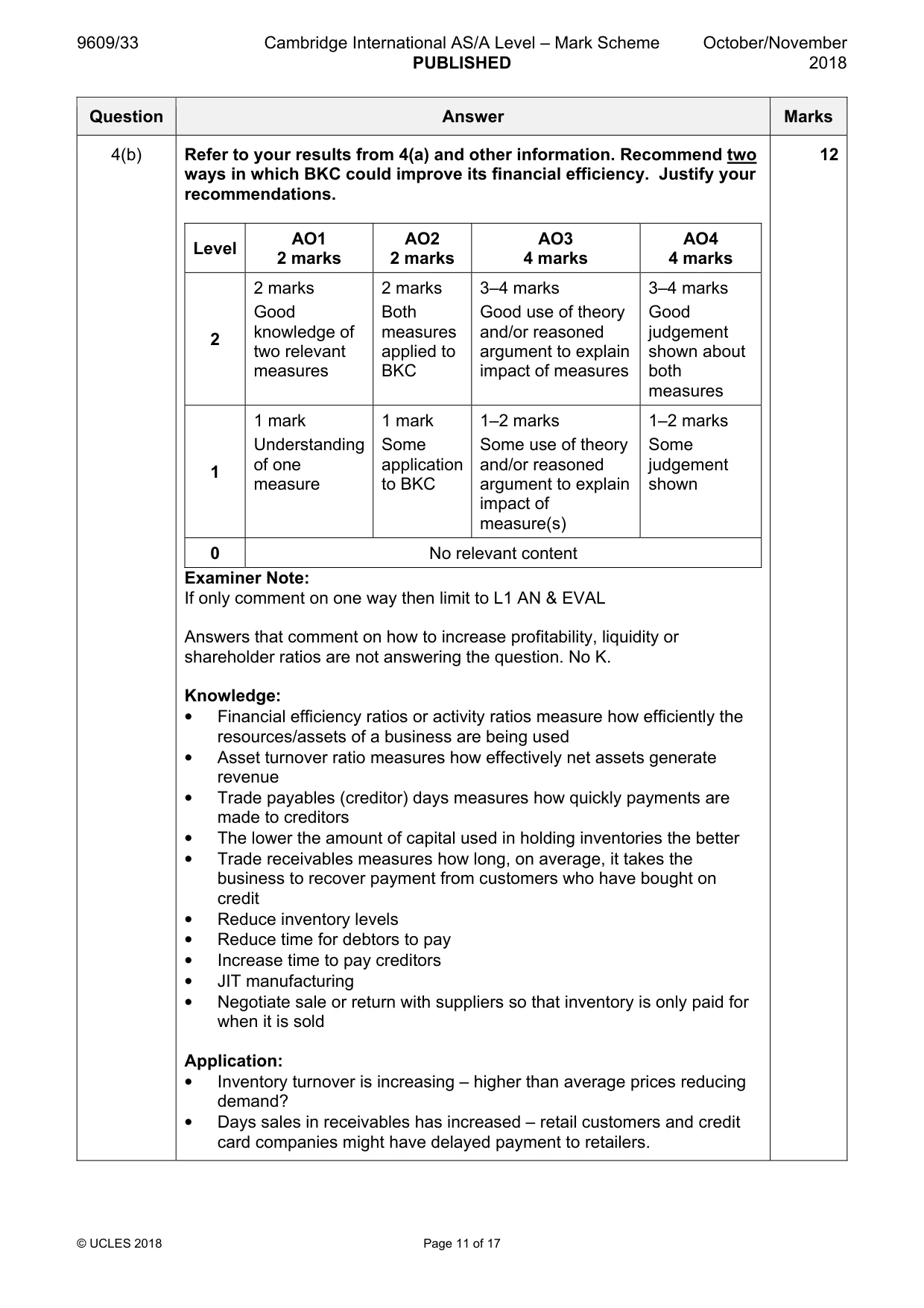
9609/33 Cambridge International AS/A Level – Mark Scheme PUBLISHED October/November 2018 © UCLES 2018 Page 11 of 17 Question Answer Marks 4(b) Refer to your results from 4(a) and other information. Recommend two ways in which BKC could improve its financial efficiency. Justify your recommendations. Level AO1 2 marks AO2 2 marks AO3 4 marks AO4 4 marks 2 2 marks Good knowledge of two relevant measures 2 marks Both measures applied to BKC 3–4 marks Good use of theory and/or reasoned argument to explain impact of measures 3–4 marks Good judgement shown about both measures 1 1 mark Understanding of one measure 1 mark Some application to BKC 1–2 marks Some use of theory and/or reasoned argument to explain impact of measure(s) 1–2 marks Some judgement shown 0 No relevant content Examiner Note: If only comment on one way then limit to L1 AN & EVAL Answers that comment on how to increase profitability, liquidity or shareholder ratios are not answering the question. No K. Knowledge: • Financial efficiency ratios or activity ratios measure how efficiently the resources/assets of a business are being used • Asset turnover ratio measures how effectively net assets generate revenue • Trade payables (creditor) days measures how quickly payments are made to creditors • The lower the amount of capital used in holding inventories the better • Trade receivables measures how long, on average, it takes the business to recover payment from customers who have bought on credit • Reduce inventory levels • Reduce time for debtors to pay • Increase time to pay creditors • JIT manufacturing • Negotiate sale or return with suppliers so that inventory is only paid for when it is sold Application: • Inventory turnover is increasing – higher than average prices reducing demand? • Days sales in receivables has increased – retail customers and credit card companies might have delayed payment to retailers. 12
Mark scheme, page 12
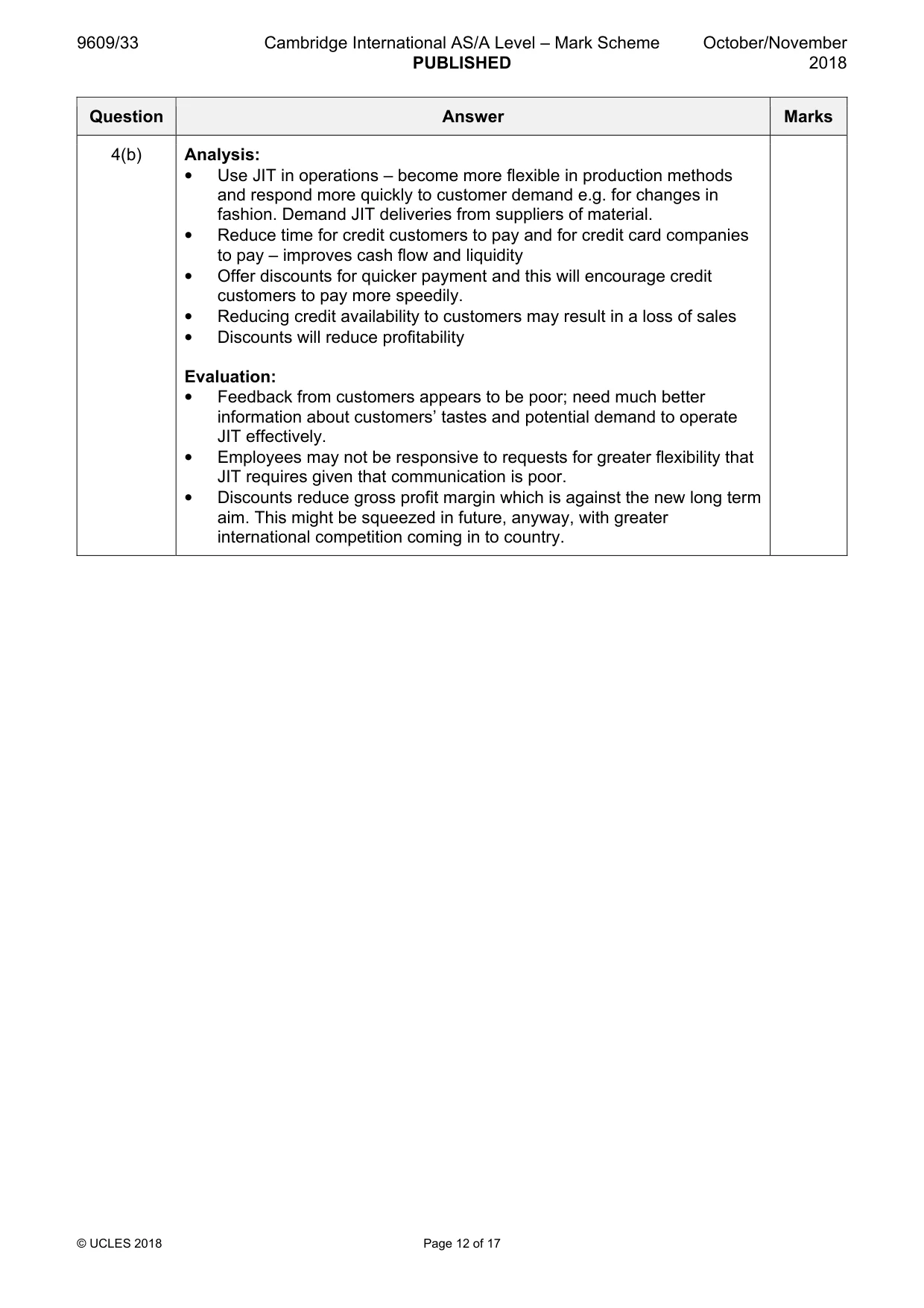
9609/33 Cambridge International AS/A Level – Mark Scheme PUBLISHED October/November 2018 © UCLES 2018 Page 12 of 17 Question Answer Marks 4(b) Analysis: • Use JIT in operations – become more flexible in production methods and respond more quickly to customer demand e.g. for changes in fashion. Demand JIT deliveries from suppliers of material. • Reduce time for credit customers to pay and for credit card companies to pay – improves cash flow and liquidity • Offer discounts for quicker payment and this will encourage credit customers to pay more speedily. • Reducing credit availability to customers may result in a loss of sales • Discounts will reduce profitability Evaluation: • Feedback from customers appears to be poor; need much better information about customers’ tastes and potential demand to operate JIT effectively. • Employees may not be responsive to requests for greater flexibility that JIT requires given that communication is poor. • Discounts reduce gross profit margin which is against the new long term aim. This might be squeezed in future, anyway, with greater international competition coming in to country.
Mark scheme, page 13
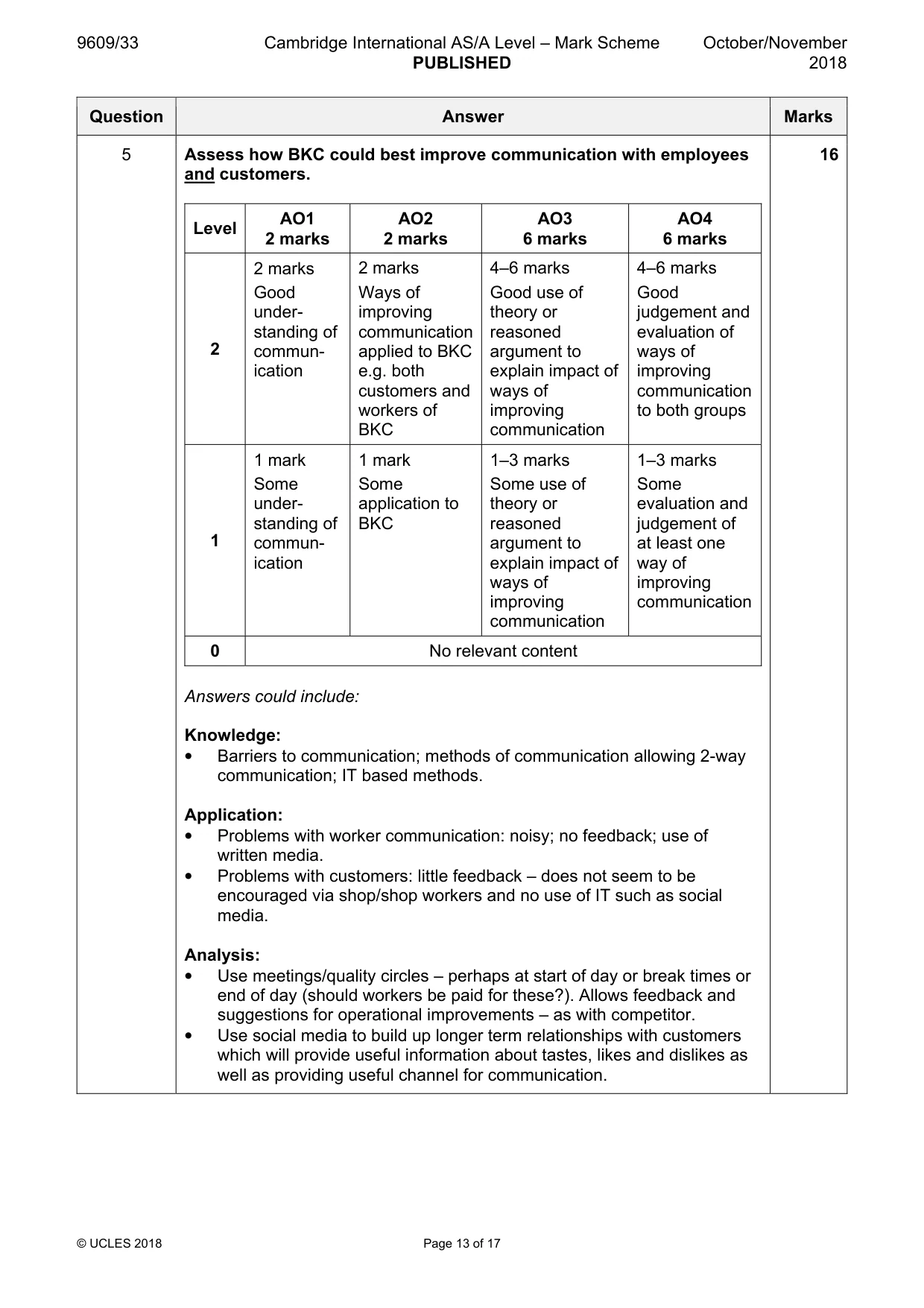
9609/33 Cambridge International AS/A Level – Mark Scheme PUBLISHED October/November 2018 © UCLES 2018 Page 13 of 17 Question Answer Marks 5 Assess how BKC could best improve communication with employees and customers. Level AO1 2 marks AO2 2 marks AO3 6 marks AO4 6 marks 2 2 marks Good under- standing of commun- ication 2 marks Ways of improving communication applied to BKC e.g. both customers and workers of BKC 4–6 marks Good use of theory or reasoned argument to explain impact of ways of improving communication 4–6 marks Good judgement and evaluation of ways of improving communication to both groups 1 1 mark Some under- standing of commun- ication 1 mark Some application to BKC 1–3 marks Some use of theory or reasoned argument to explain impact of ways of improving communication 1–3 marks Some evaluation and judgement of at least one way of improving communication 0 No relevant content Answers could include: Knowledge: • Barriers to communication; methods of communication allowing 2-way communication; IT based methods. Application: • Problems with worker communication: noisy; no feedback; use of written media. • Problems with customers: little feedback – does not seem to be encouraged via shop/shop workers and no use of IT such as social media. Analysis: • Use meetings/quality circles – perhaps at start of day or break times or end of day (should workers be paid for these?). Allows feedback and suggestions for operational improvements – as with competitor. • Use social media to build up longer term relationships with customers which will provide useful information about tastes, likes and dislikes as well as providing useful channel for communication. 16
Mark scheme, page 14
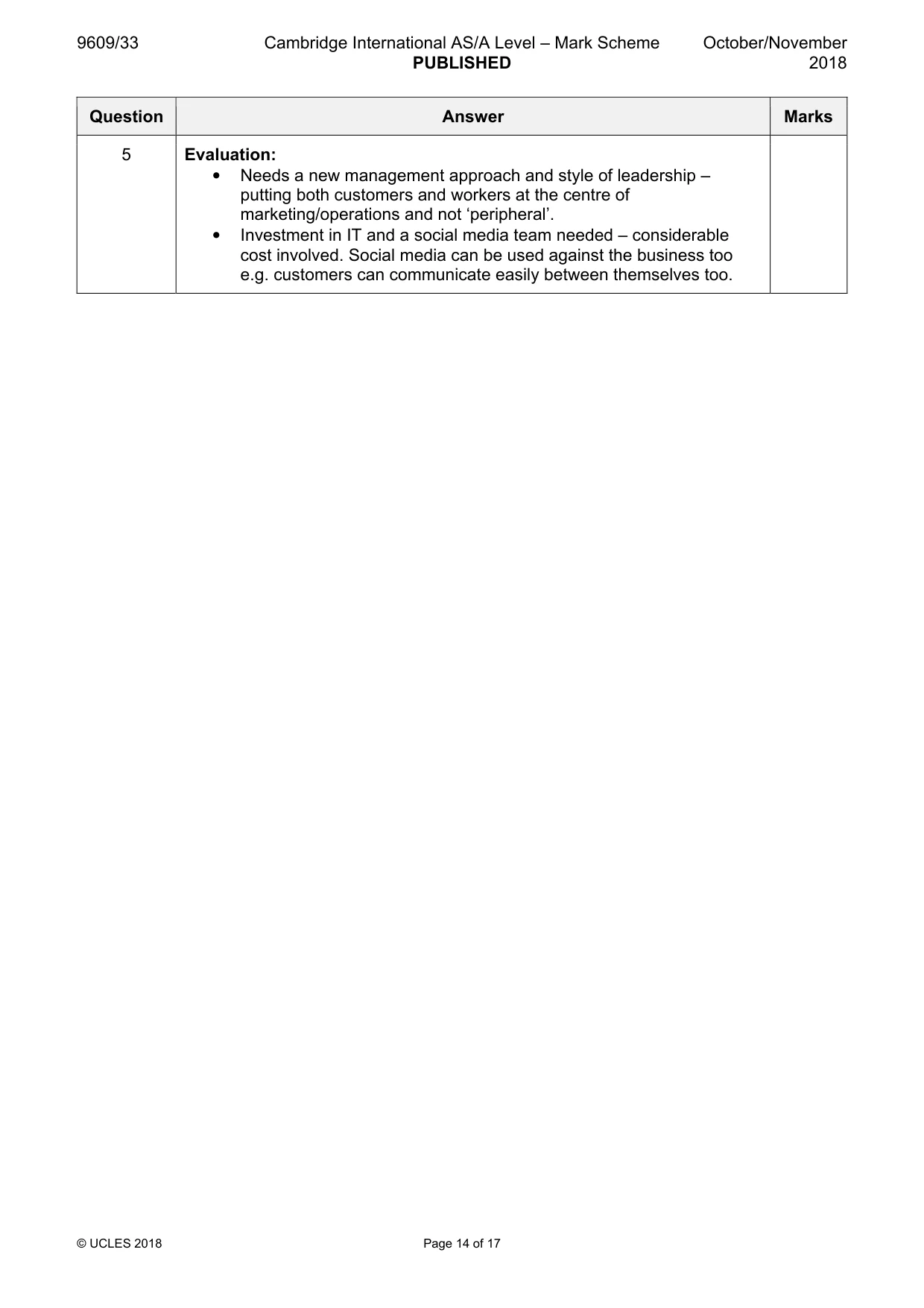
9609/33 Cambridge International AS/A Level – Mark Scheme PUBLISHED October/November 2018 © UCLES 2018 Page 14 of 17 Question Answer Marks 5 Evaluation: • Needs a new management approach and style of leadership – putting both customers and workers at the centre of marketing/operations and not ‘peripheral’. • Investment in IT and a social media team needed – considerable cost involved. Social media can be used against the business too e.g. customers can communicate easily between themselves too.
Mark scheme, page 15
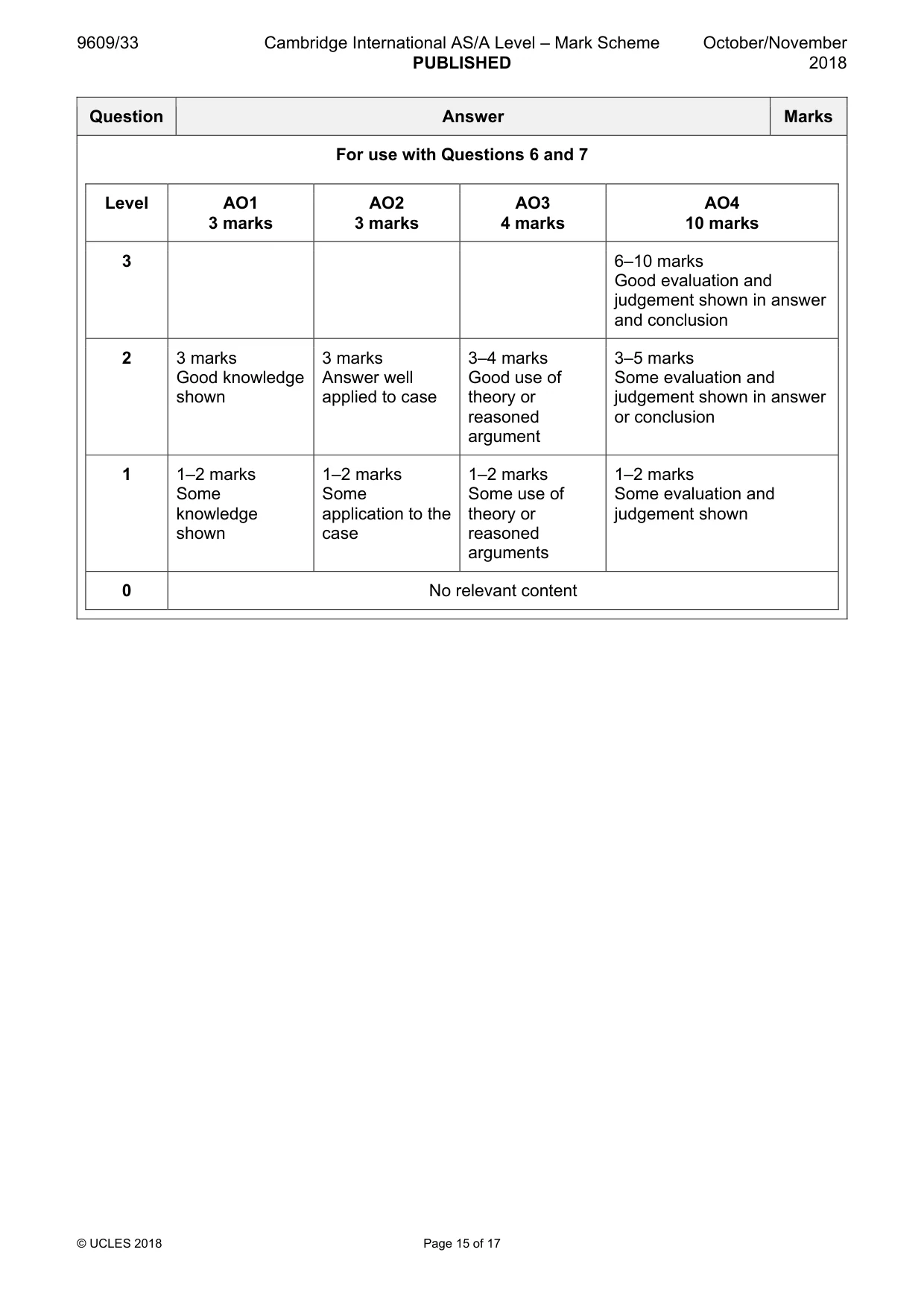
9609/33 Cambridge International AS/A Level – Mark Scheme PUBLISHED October/November 2018 © UCLES 2018 Page 15 of 17 Question Answer Marks For use with Questions 6 and 7 Level AO1 3 marks AO2 3 marks AO3 4 marks AO4 10 marks 3 6–10 marks Good evaluation and judgement shown in answer and conclusion 2 3 marks Good knowledge shown 3 marks Answer well applied to case 3–4 marks Good use of theory or reasoned argument 3–5 marks Some evaluation and judgement shown in answer or conclusion 1 1–2 marks Some knowledge shown 1–2 marks Some application to the case 1–2 marks Some use of theory or reasoned arguments 1–2 marks Some evaluation and judgement shown 0 No relevant content
Mark scheme, page 16
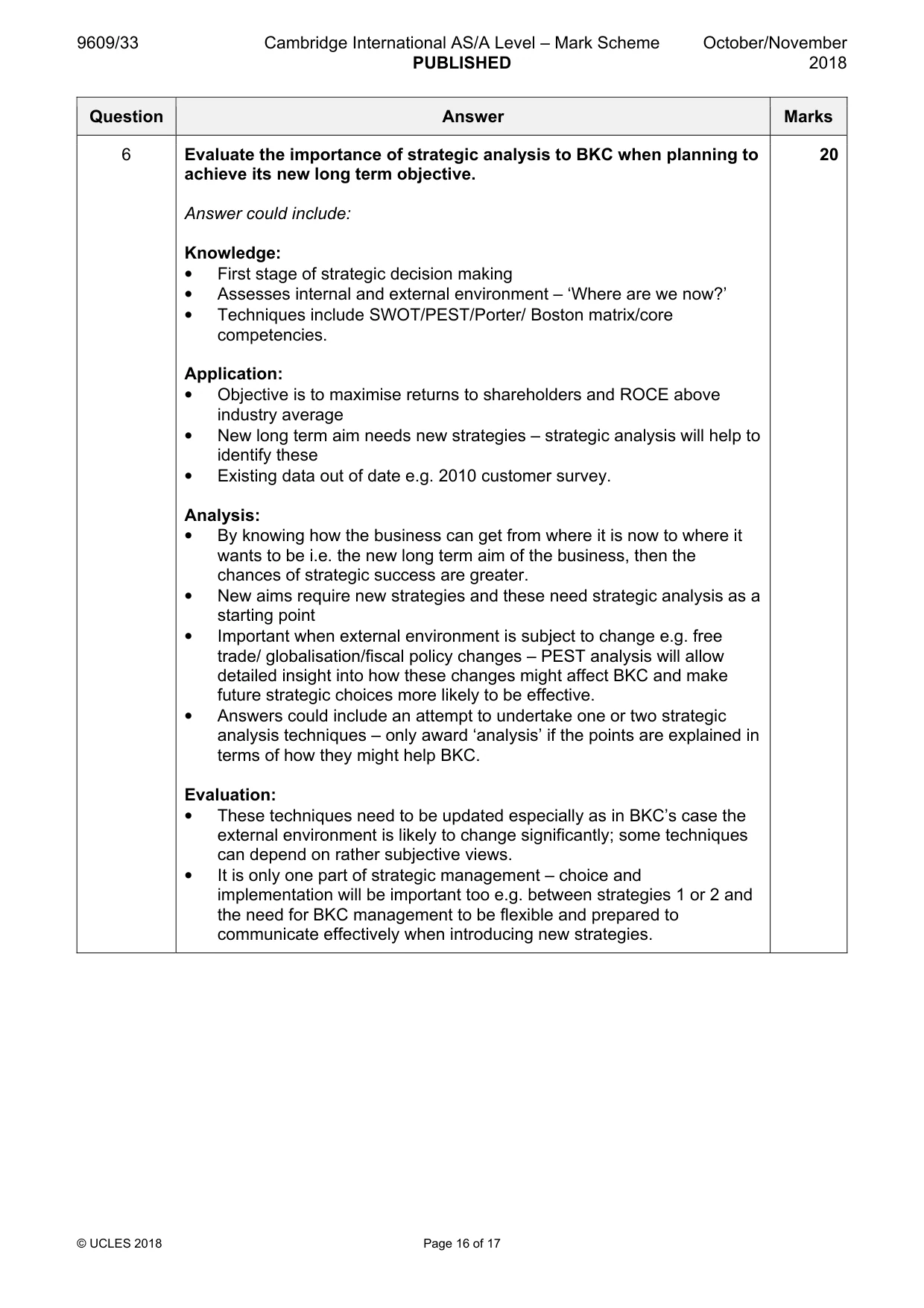
9609/33 Cambridge International AS/A Level – Mark Scheme PUBLISHED October/November 2018 © UCLES 2018 Page 16 of 17 Question Answer Marks 6 Evaluate the importance of strategic analysis to BKC when planning to achieve its new long term objective. Answer could include: Knowledge: • First stage of strategic decision making • Assesses internal and external environment – ‘Where are we now?’ • Techniques include SWOT/PEST/Porter/ Boston matrix/core competencies. Application: • Objective is to maximise returns to shareholders and ROCE above industry average • New long term aim needs new strategies – strategic analysis will help to identify these • Existing data out of date e.g. 2010 customer survey. Analysis: • By knowing how the business can get from where it is now to where it wants to be i.e. the new long term aim of the business, then the chances of strategic success are greater. • New aims require new strategies and these need strategic analysis as a starting point • Important when external environment is subject to change e.g. free trade/ globalisation/fiscal policy changes – PEST analysis will allow detailed insight into how these changes might affect BKC and make future strategic choices more likely to be effective. • Answers could include an attempt to undertake one or two strategic analysis techniques – only award ‘analysis’ if the points are explained in terms of how they might help BKC. Evaluation: • These techniques need to be updated especially as in BKC’s case the external environment is likely to change significantly; some techniques can depend on rather subjective views. • It is only one part of strategic management – choice and implementation will be important too e.g. between strategies 1 or 2 and the need for BKC management to be flexible and prepared to communicate effectively when introducing new strategies. 20
Mark scheme, page 17
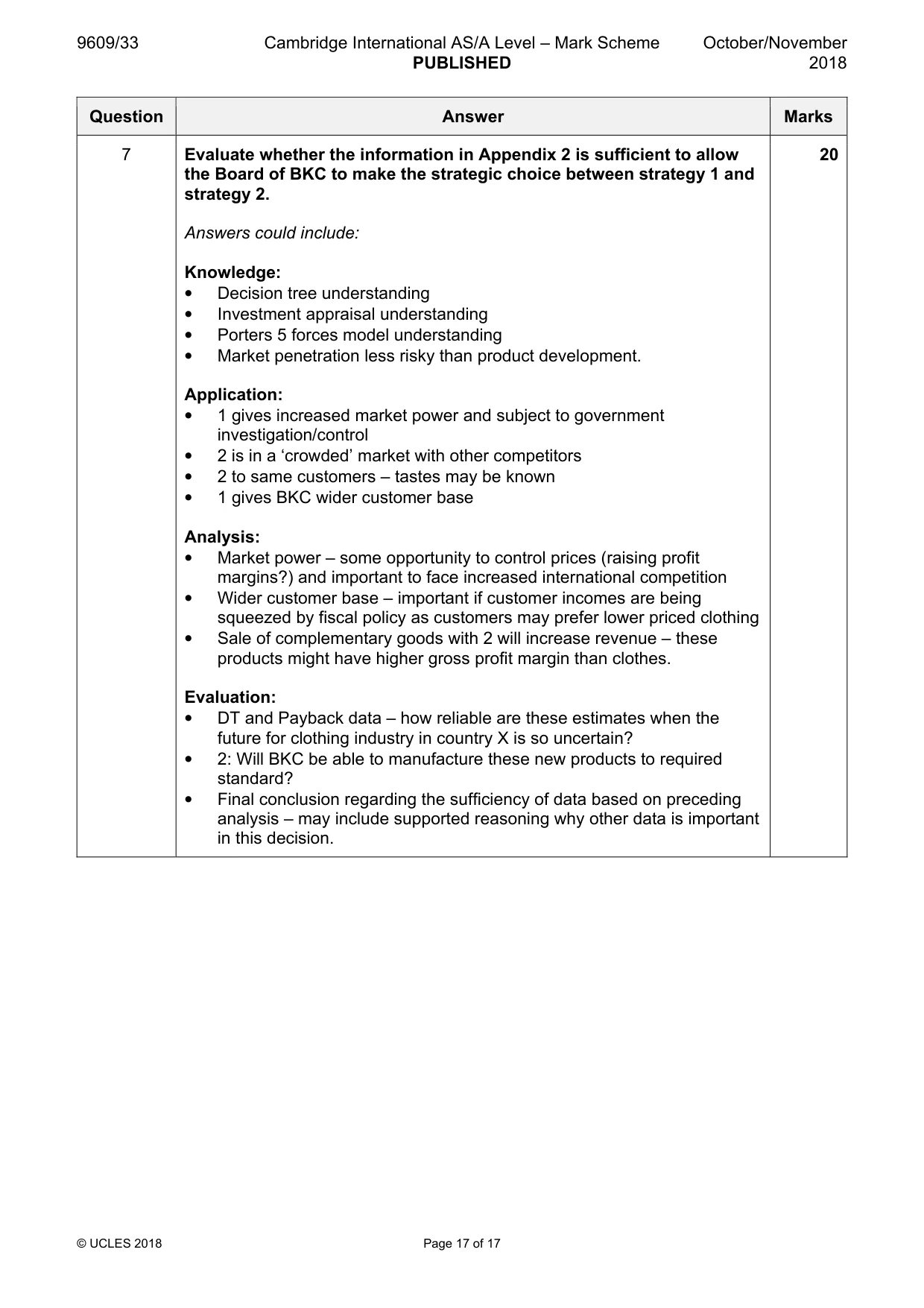
9609/33 Cambridge International AS/A Level – Mark Scheme PUBLISHED October/November 2018 © UCLES 2018 Page 17 of 17 Question Answer Marks 7 Evaluate whether the information in Appendix 2 is sufficient to allow the Board of BKC to make the strategic choice between strategy 1 and strategy 2. Answers could include: Knowledge: • Decision tree understanding • Investment appraisal understanding • Porters 5 forces model understanding • Market penetration less risky than product development. Application: • 1 gives increased market power and subject to government investigation/control • 2 is in a ‘crowded’ market with other competitors • 2 to same customers – tastes may be known • 1 gives BKC wider customer base Analysis: • Market power – some opportunity to control prices (raising profit margins?) and important to face increased international competition • Wider customer base – important if customer incomes are being squeezed by fiscal policy as customers may prefer lower priced clothing • Sale of complementary goods with 2 will increase revenue – these products might have higher gross profit margin than clothes. Evaluation: • DT and Payback data – how reliable are these estimates when the future for clothing industry in country X is so uncertain? • 2: Will BKC be able to manufacture these new products to required standard? • Final conclusion regarding the sufficiency of data based on preceding analysis – may include supported reasoning why other data is important in this decision. 20
What you needed in this session
Cambridge’s own grade thresholds for 2018 Oct/Nov, Paper 3 · Variant 3. A higher threshold means an easier paper — the bar moves with how the cohort did.