Cambridge A Level Business (for first examination in 2016) 9609 — 2017 Oct/Nov Paper 3 · Variant 2
9609/32/O/N/17 · 100 marks · ≈113 min
The question paper and its mark scheme, free to read here and free to download. This is Cambridge’s own paper, exactly as it was sat.
Question paper8 pages


Mark scheme19 pages
Answers below. Sit the paper first if you are practising.

Paper as text
Question paper, page 1
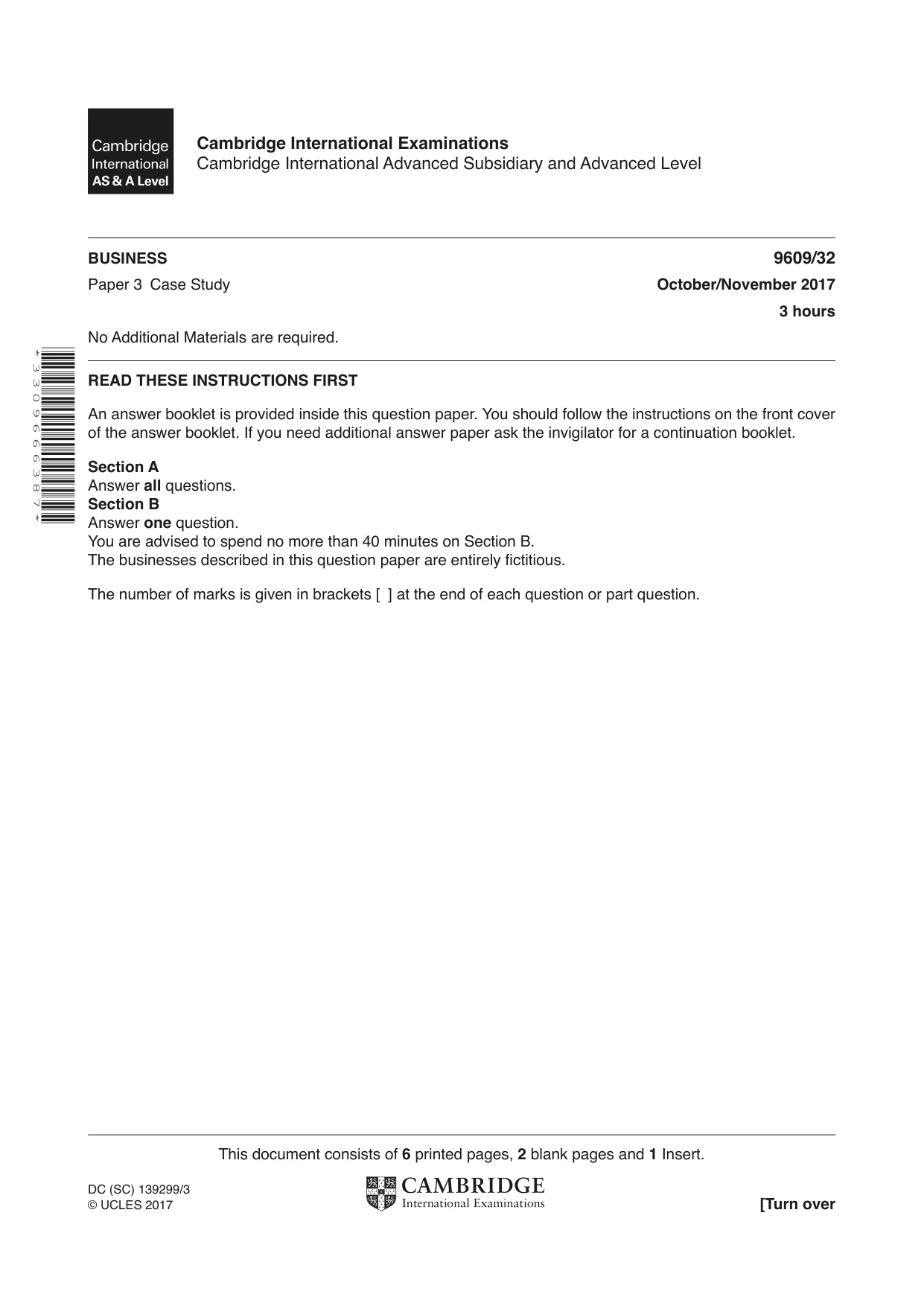
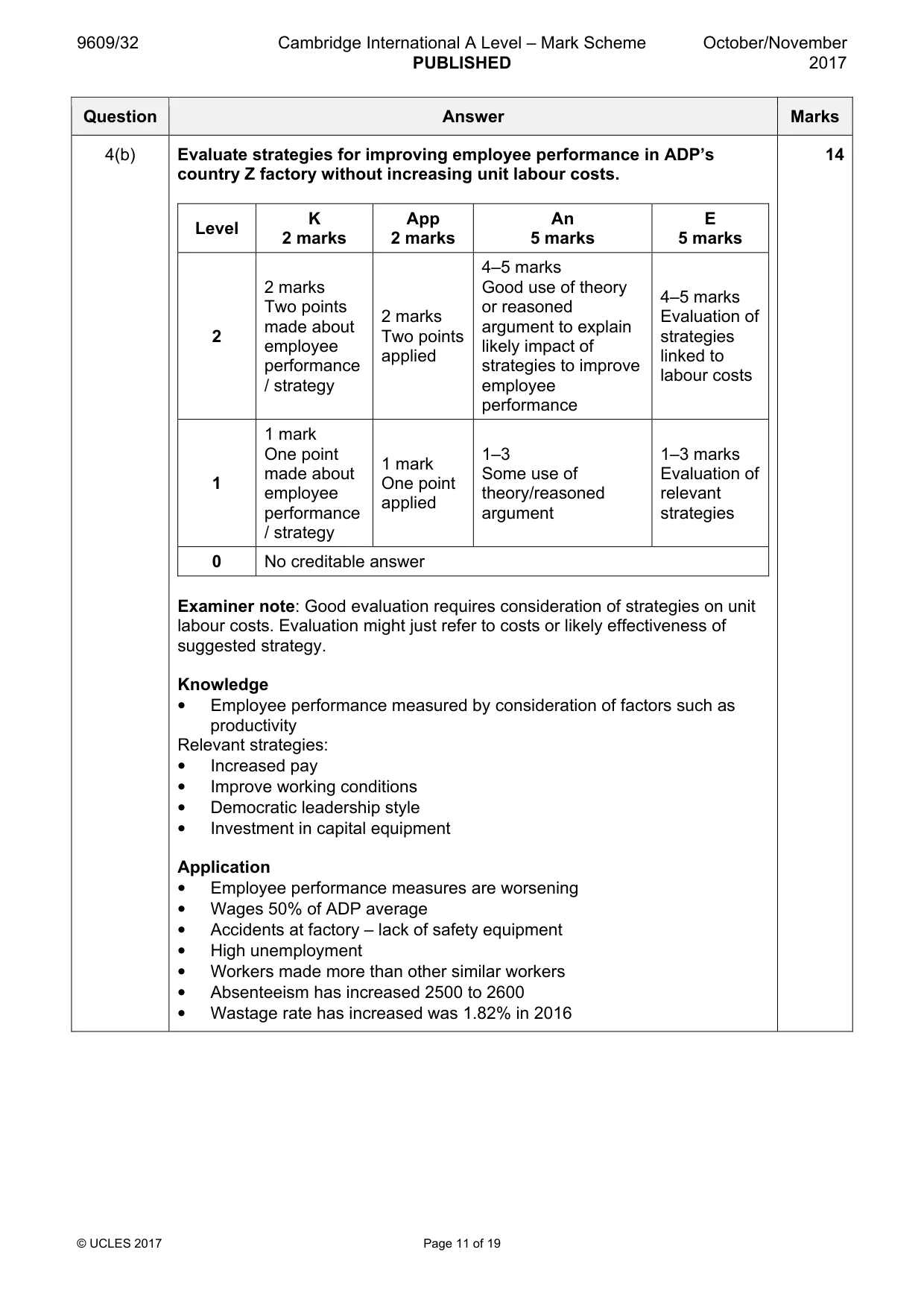
* 3 3 0 9 6 6 6 3 8 7 * This document consists of 6 printed pages, 2 blank pages and 1 Insert. DC (SC) 139299/3 © UCLES 2017 [Turn over Cambridge International Examinations Cambridge International Advanced Subsidiary and Advanced Level BUSINESS 9609/32 Paper 3 Case Study October/November 2017 3 hours No Additional Materials are required. READ THESE INSTRUCTIONS FIRST An answer booklet is provided inside this question paper. You should follow the instructions on the front cover of the answer booklet. If you need additional answer paper ask the invigilator for a continuation booklet. Section A Answer all questions. Section B Answer one question. You are advised to spend no more than 40 minutes on Section B. The businesses described in this question paper are entirely fictitious. The number of marks is given in brackets [ ] at the end of each question or part question.
Question paper, page 2
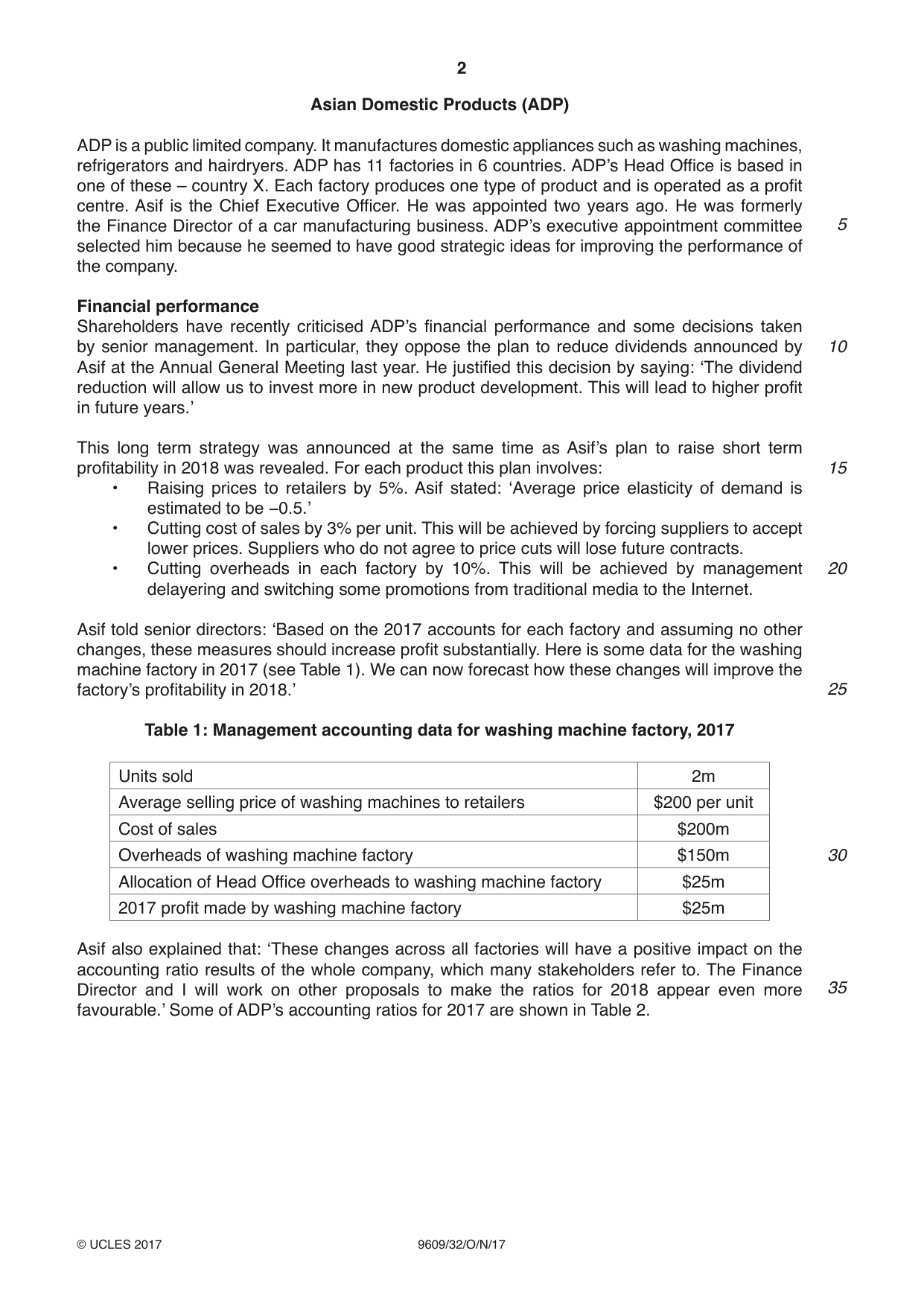
2 9609/32/O/N/17 © UCLES 2017 Asian Domestic Products (ADP) ADP is a public limited company. It manufactures domestic appliances such as washing machines, refrigerators and hairdryers. ADP has 11 factories in 6 countries. ADP’s Head Office is based in one of these – country X. Each factory produces one type of product and is operated as a profit centre. Asif is the Chief Executive Officer. He was appointed two years ago. He was formerly the Finance Director of a car manufacturing business. ADP’s executive appointment committee selected him because he seemed to have good strategic ideas for improving the performance of the company. Financial performance Shareholders have recently criticised ADP’s financial performance and some decisions taken by senior management. In particular, they oppose the plan to reduce dividends announced by Asif at the Annual General Meeting last year. He justified this decision by saying: ‘The dividend reduction will allow us to invest more in new product development. This will lead to higher profit in future years.’ This long term strategy was announced at the same time as Asif’s plan to raise short term profitability in 2018 was revealed. For each product this plan involves: • Raising prices to retailers by 5%. Asif stated: ‘Average price elasticity of demand is estimated to be −0.5.’ • Cutting cost of sales by 3% per unit. This will be achieved by forcing suppliers to accept lower prices. Suppliers who do not agree to price cuts will lose future contracts. • Cutting overheads in each factory by 10%. This will be achieved by management delayering and switching some promotions from traditional media to the Internet. Asif told senior directors: ‘Based on the 2017 accounts for each factory and assuming no other changes, these measures should increase profit substantially. Here is some data for the washing machine factory in 2017 (see Table 1). We can now forecast how these changes will improve the factory’s profitability in 2018.’ Table 1: Management accounting data for washing machine factory, 2017 Units sold 2m Average selling price of washing machines to retailers $200 per unit Cost of sales $200m Overheads of washing machine factory $150m Allocation of Head Office overheads to washing machine factory $25m 2017 profit made by washing machine factory $25m Asif also explained that: ‘These changes across all factories will have a positive impact on the accounting ratio results of the whole company, which many stakeholders refer to. The Finance Director and I will work on other proposals to make the ratios for 2018 appear even more favourable.’ Some of ADP’s accounting ratios for 2017 are shown in Table 2. 5 10 15 20 25 30 35
Question paper, page 3
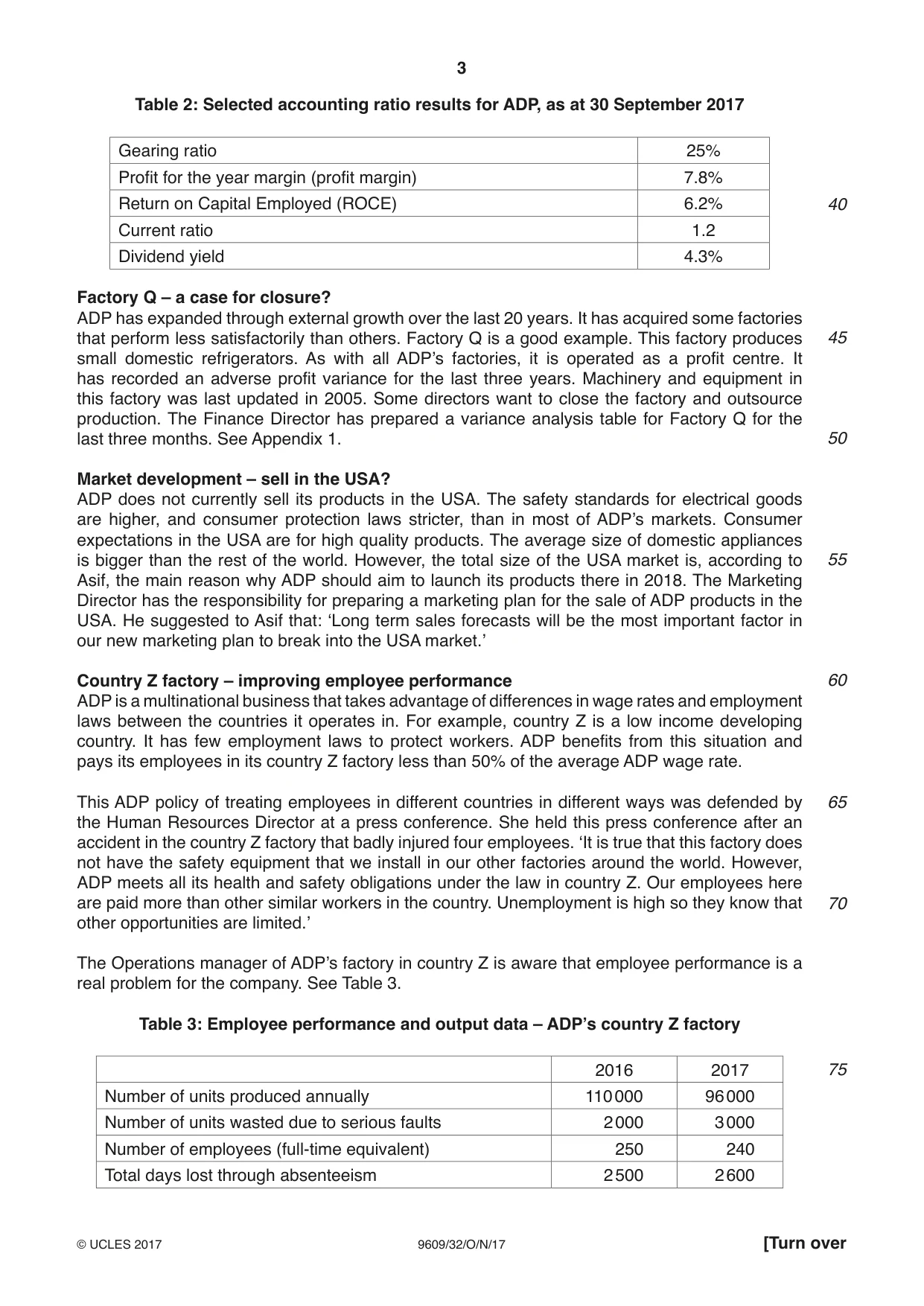
3 9609/32/O/N/17 © UCLES 2017 [Turn over Table 2: Selected accounting ratio results for ADP, as at 30 September 2017 Gearing ratio 25% Profit for the year margin (profit margin) 7.8% Return on Capital Employed (ROCE) 6.2% Current ratio 1.2 Dividend yield 4.3% Factory Q – a case for closure? ADP has expanded through external growth over the last 20 years. It has acquired some factories that perform less satisfactorily than others. Factory Q is a good example. This factory produces small domestic refrigerators. As with all ADP’s factories, it is operated as a profit centre. It has recorded an adverse profit variance for the last three years. Machinery and equipment in this factory was last updated in 2005. Some directors want to close the factory and outsource production. The Finance Director has prepared a variance analysis table for Factory Q for the last three months. See Appendix 1. Market development – sell in the USA? ADP does not currently sell its products in the USA. The safety standards for electrical goods are higher, and consumer protection laws stricter, than in most of ADP’s markets. Consumer expectations in the USA are for high quality products. The average size of domestic appliances is bigger than the rest of the world. However, the total size of the USA market is, according to Asif, the main reason why ADP should aim to launch its products there in 2018. The Marketing Director has the responsibility for preparing a marketing plan for the sale of ADP products in the USA. He suggested to Asif that: ‘Long term sales forecasts will be the most important factor in our new marketing plan to break into the USA market.’ Country Z factory – improving employee performance ADP is a multinational business that takes advantage of differences in wage rates and employment laws between the countries it operates in. For example, country Z is a low income developing country. It has few employment laws to protect workers. ADP benefits from this situation and pays its employees in its country Z factory less than 50% of the average ADP wage rate. This ADP policy of treating employees in different countries in different ways was defended by the Human Resources Director at a press conference. She held this press conference after an accident in the country Z factory that badly injured four employees. ‘It is true that this factory does not have the safety equipment that we install in our other factories around the world. However, ADP meets all its health and safety obligations under the law in country Z. Our employees here are paid more than other similar workers in the country. Unemployment is high so they know that other opportunities are limited.’ The Operations manager of ADP’s factory in country Z is aware that employee performance is a real problem for the company. See Table 3. Table 3: Employee performance and output data – ADP’s country Z factory 2016 2017 Number of units produced annually 110 000 96 000 Number of units wasted due to serious faults 2 000 3 000 Number of employees (full-time equivalent) 250 240 Total days lost through absenteeism 2 500 2 600 40 45 50 55 60 65 70 75
Question paper, page 4
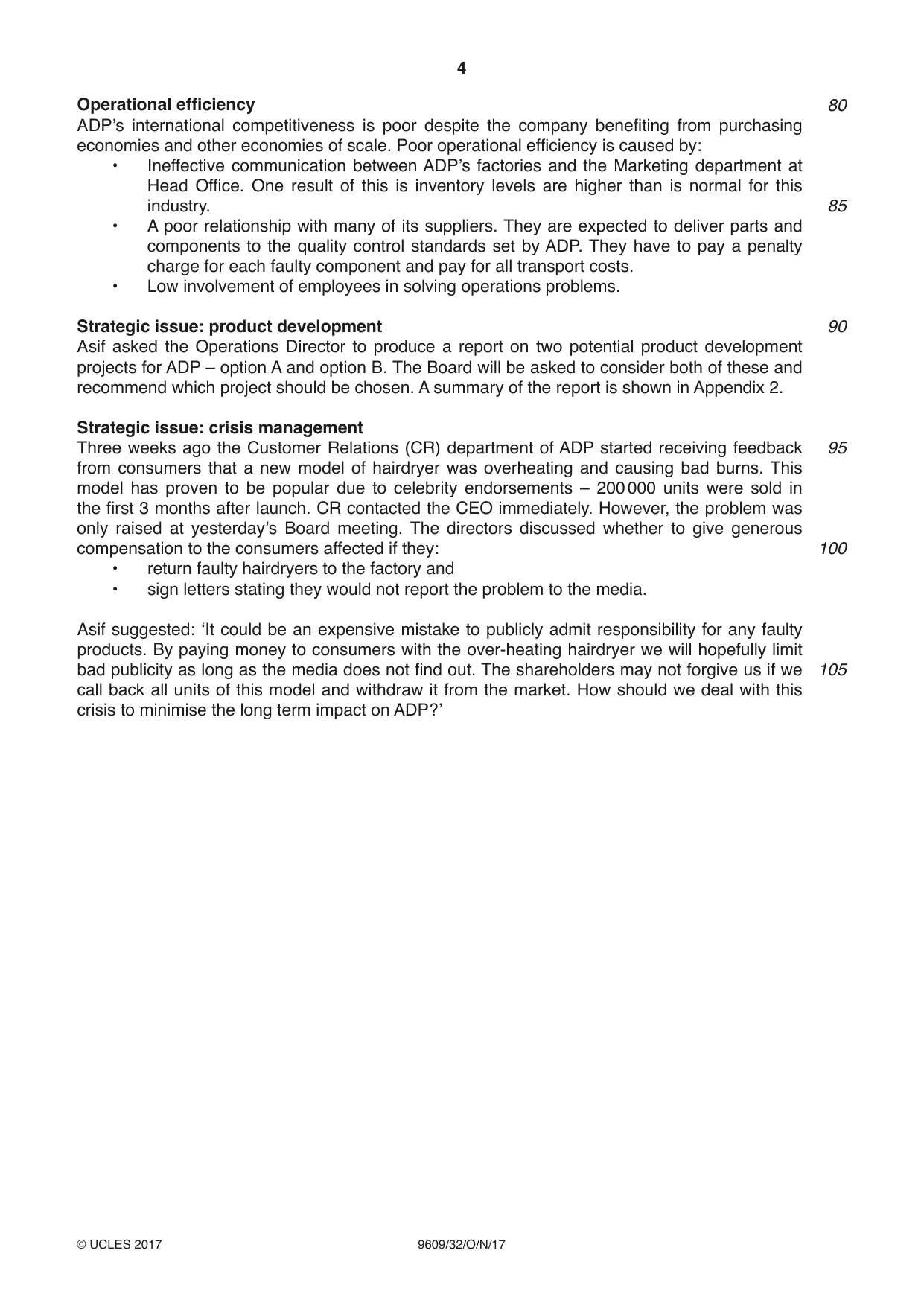
4 9609/32/O/N/17 © UCLES 2017 Operational efficiency ADP’s international competitiveness is poor despite the company benefiting from purchasing economies and other economies of scale. Poor operational efficiency is caused by: • Ineffective communication between ADP’s factories and the Marketing department at Head Office. One result of this is inventory levels are higher than is normal for this industry. • A poor relationship with many of its suppliers. They are expected to deliver parts and components to the quality control standards set by ADP. They have to pay a penalty charge for each faulty component and pay for all transport costs. • Low involvement of employees in solving operations problems. Strategic issue: product development Asif asked the Operations Director to produce a report on two potential product development projects for ADP – option A and option B. The Board will be asked to consider both of these and recommend which project should be chosen. A summary of the report is shown in Appendix 2. Strategic issue: crisis management Three weeks ago the Customer Relations (CR) department of ADP started receiving feedback from consumers that a new model of hairdryer was overheating and causing bad burns. This model has proven to be popular due to celebrity endorsements – 200 000 units were sold in the first 3 months after launch. CR contacted the CEO immediately. However, the problem was only raised at yesterday’s Board meeting. The directors discussed whether to give generous compensation to the consumers affected if they: • return faulty hairdryers to the factory and • sign letters stating they would not report the problem to the media. Asif suggested: ‘It could be an expensive mistake to publicly admit responsibility for any faulty products. By paying money to consumers with the over-heating hairdryer we will hopefully limit bad publicity as long as the media does not find out. The shareholders may not forgive us if we call back all units of this model and withdraw it from the market. How should we deal with this crisis to minimise the long term impact on ADP?’ 80 85 90 95 100 105
Question paper, page 5
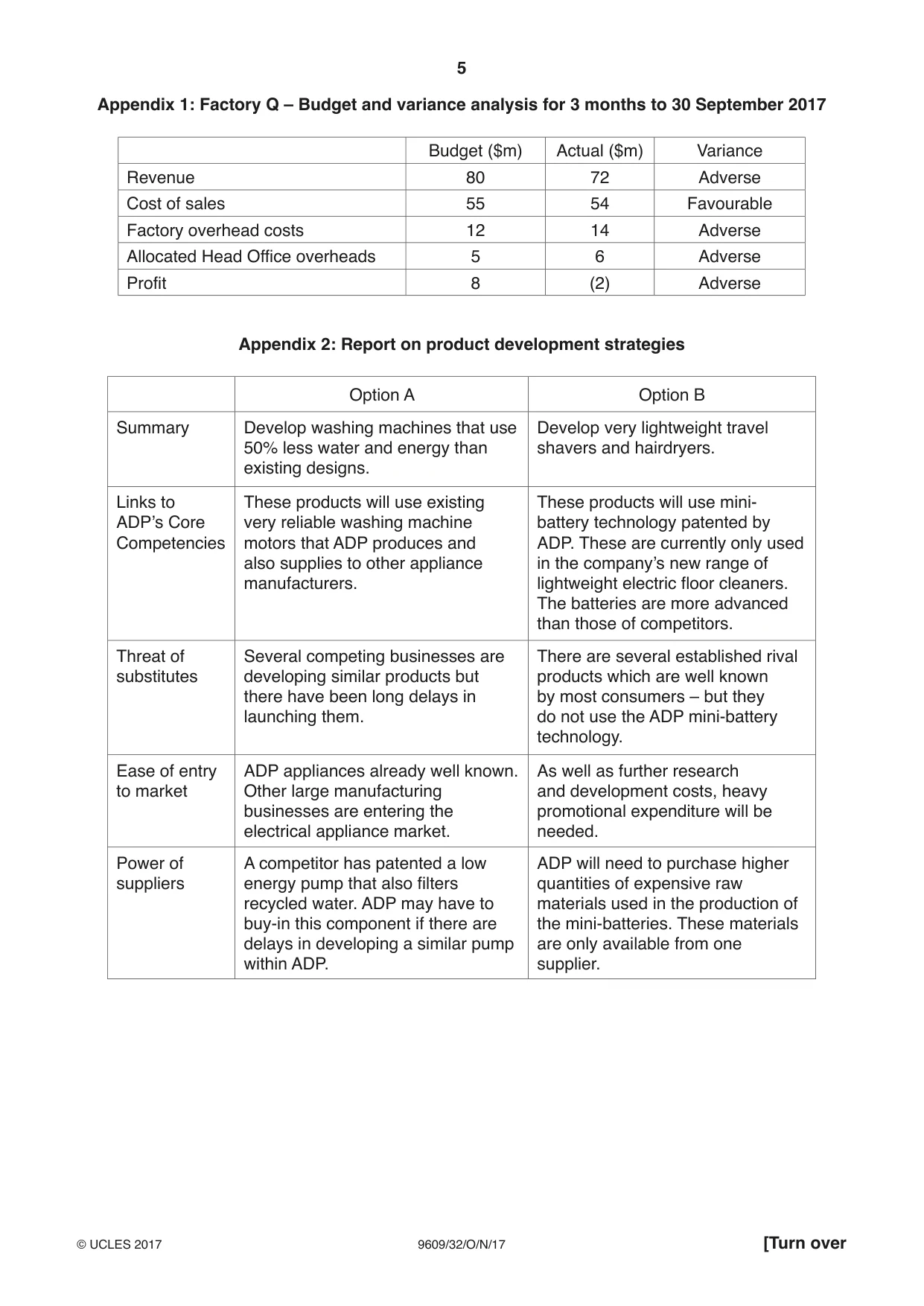
5 9609/32/O/N/17 © UCLES 2017 [Turn over Appendix 1: Factory Q – Budget and variance analysis for 3 months to 30 September 2017 Budget ($m) Actual ($m) Variance Revenue 80 72 Adverse Cost of sales 55 54 Favourable Factory overhead costs 12 14 Adverse Allocated Head Office overheads 5 6 Adverse Profit 8 (2) Adverse Appendix 2: Report on product development strategies Option A Option B Summary Develop washing machines that use 50% less water and energy than existing designs. Develop very lightweight travel shavers and hairdryers. Links to ADP’s Core Competencies These products will use existing very reliable washing machine motors that ADP produces and also supplies to other appliance manufacturers. These products will use mini- battery technology patented by ADP. These are currently only used in the company’s new range of lightweight electric floor cleaners. The batteries are more advanced than those of competitors. Threat of substitutes Several competing businesses are developing similar products but there have been long delays in launching them. There are several established rival products which are well known by most consumers – but they do not use the ADP mini-battery technology. Ease of entry to market ADP appliances already well known. Other large manufacturing businesses are entering the electrical appliance market. As well as further research and development costs, heavy promotional expenditure will be needed. Power of suppliers A competitor has patented a low energy pump that also filters recycled water. ADP may have to buy-in this component if there are delays in developing a similar pump within ADP. ADP will need to purchase higher quantities of expensive raw materials used in the production of the mini-batteries. These materials are only available from one supplier.
Question paper, page 6
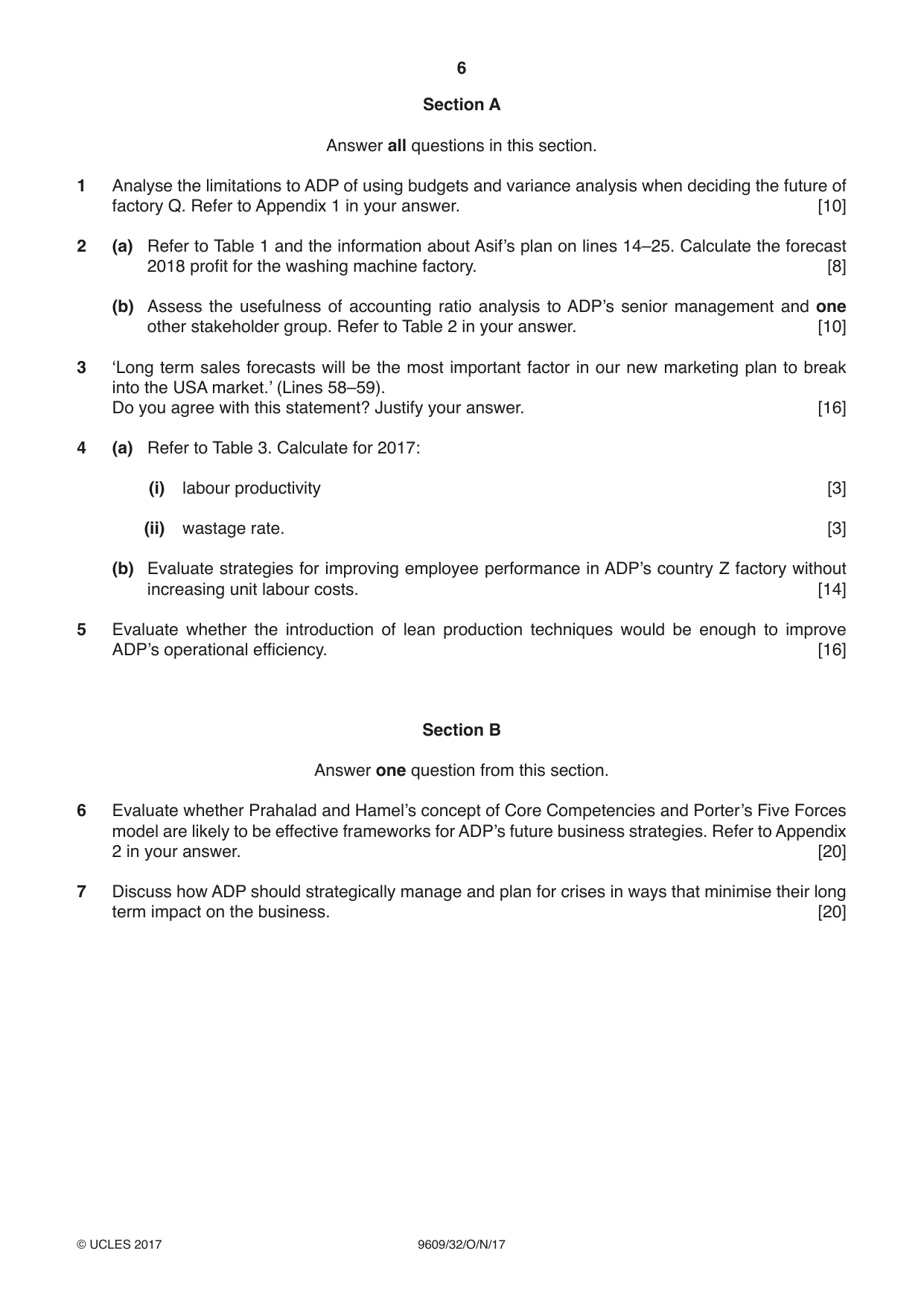
6 9609/32/O/N/17 © UCLES 2017 Section A Answer all questions in this section. 1 Analyse the limitations to ADP of using budgets and variance analysis when deciding the future of factory Q. Refer to Appendix 1 in your answer. [10] 2 (a) Refer to Table 1 and the information about Asif’s plan on lines 14–25. Calculate the forecast 2018 profit for the washing machine factory. [8] (b) Assess the usefulness of accounting ratio analysis to ADP’s senior management and one other stakeholder group. Refer to Table 2 in your answer. [10] 3 ‘Long term sales forecasts will be the most important factor in our new marketing plan to break into the USA market.’ (Lines 58–59). Do you agree with this statement? Justify your answer. [16] 4 (a) Refer to Table 3. Calculate for 2017: (i) labour productivity [3] (ii) wastage rate. [3] (b) Evaluate strategies for improving employee performance in ADP’s country Z factory without increasing unit labour costs. [14] 5 Evaluate whether the introduction of lean production techniques would be enough to improve ADP’s operational efficiency. [16] Section B Answer one question from this section. 6 Evaluate whether Prahalad and Hamel’s concept of Core Competencies and Porter’s Five Forces model are likely to be effective frameworks for ADP’s future business strategies. Refer to Appendix 2 in your answer. [20] 7 Discuss how ADP should strategically manage and plan for crises in ways that minimise their long term impact on the business. [20]
Question paper, page 7
7 9609/32/O/N/17 © UCLES 2017 BLANK PAGE
Question paper, page 8
8 9609/32/O/N/17 © UCLES 2017 BLANK PAGE Permission to reproduce items where third-party owned material protected by copyright is included has been sought and cleared where possible. Every reasonable effort has been made by the publisher (UCLES) to trace copyright holders, but if any items requiring clearance have unwittingly been included, the publisher will be pleased to make amends at the earliest possible opportunity. To avoid the issue of disclosure of answer-related information to candidates, all copyright acknowledgements are reproduced online in the Cambridge International Examinations Copyright Acknowledgements Booklet. This is produced for each series of examinations and is freely available to download at www.cie.org.uk after the live examination series. Cambridge International Examinations is part of the Cambridge Assessment Group. Cambridge Assessment is the brand name of University of Cambridge Local Examinations Syndicate (UCLES), which is itself a department of the University of Cambridge.
Mark scheme, page 1
® IGCSE is a registered trademark. This document consists of 19 printed pages. © UCLES 2017 [Turn over Cambridge Assessment International Education Cambridge International Advanced Level BUSINESS 9609/32 Paper 3 Case Study October/November 2017 MARK SCHEME Maximum Mark: 100 Published This mark scheme is published as an aid to teachers and candidates, to indicate the requirements of the examination. It shows the basis on which Examiners were instructed to award marks. It does not indicate the details of the discussions that took place at an Examiners’ meeting before marking began, which would have considered the acceptability of alternative answers. Mark schemes should be read in conjunction with the question paper and the Principal Examiner Report for Teachers. Cambridge International will not enter into discussions about these mark schemes. Cambridge International is publishing the mark schemes for the October/November 2017 series for most Cambridge IGCSE®, Cambridge International A and AS Level components and some Cambridge O Level components.
Mark scheme, page 2
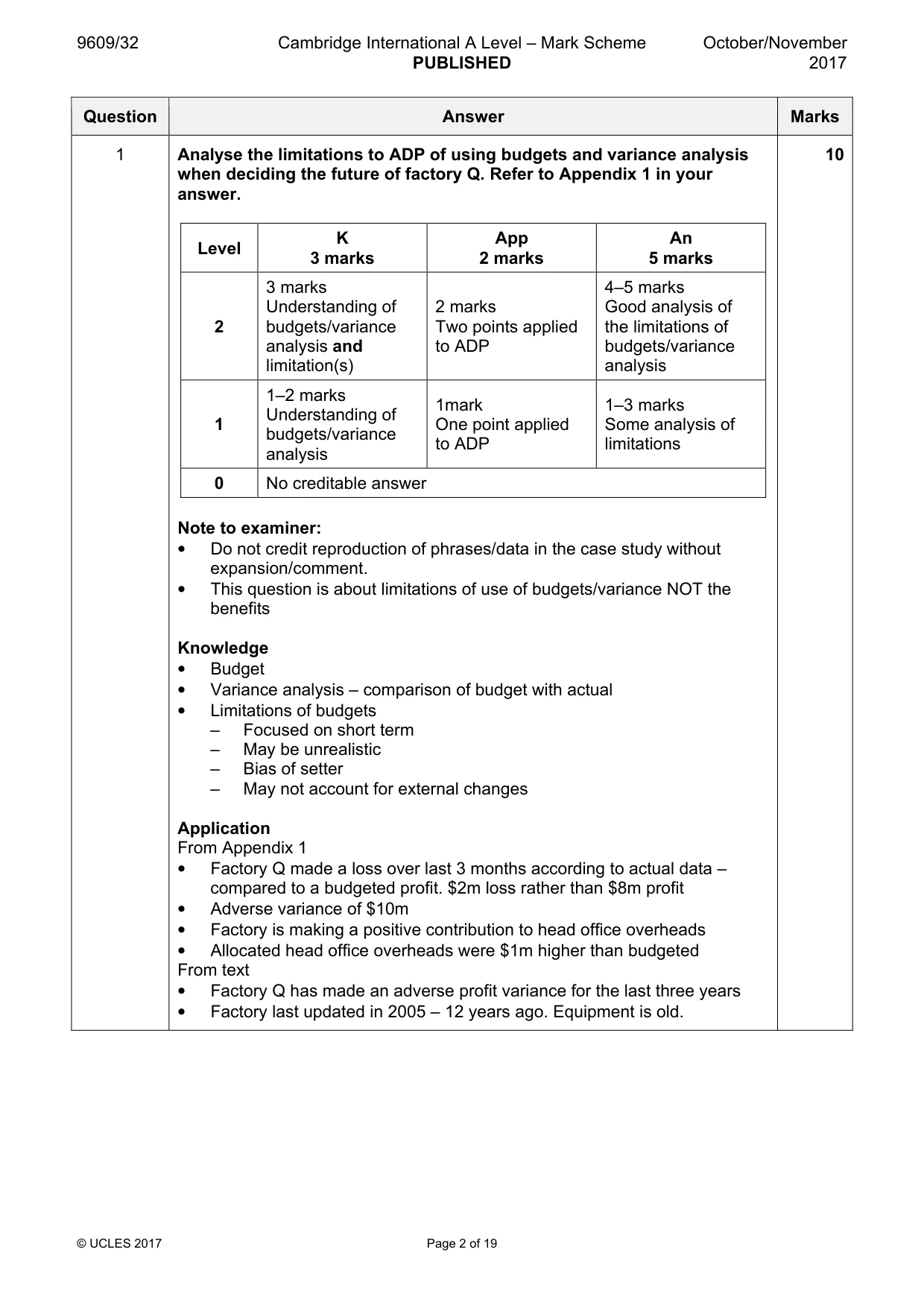
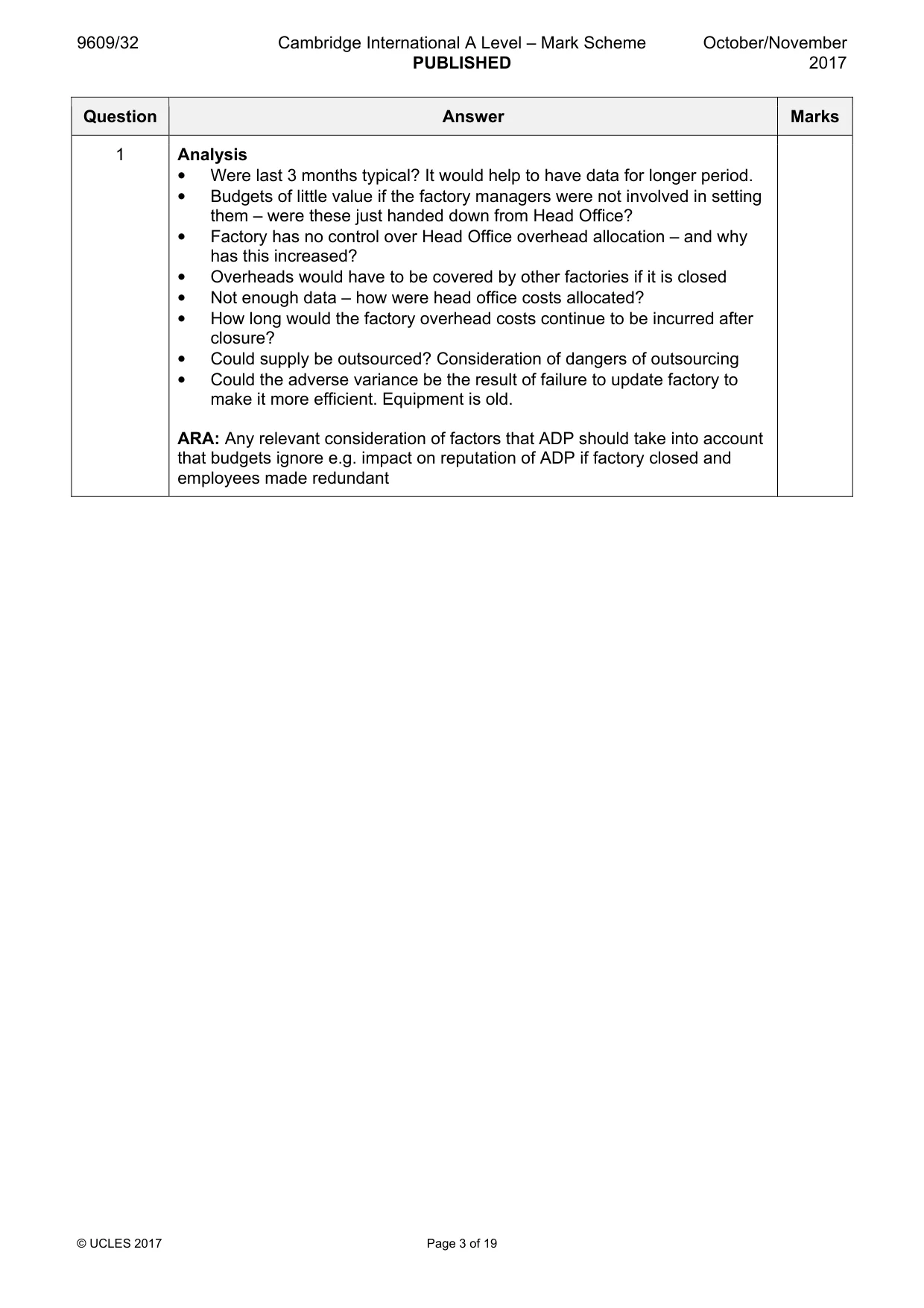
9609/32 Cambridge International A Level – Mark Scheme PUBLISHED October/November 2017 © UCLES 2017 Page 2 of 19 Question Answer Marks 1 Analyse the limitations to ADP of using budgets and variance analysis when deciding the future of factory Q. Refer to Appendix 1 in your answer. Level K 3 marks App 2 marks An 5 marks 2 3 marks Understanding of budgets/variance analysis and limitation(s) 2 marks Two points applied to ADP 4–5 marks Good analysis of the limitations of budgets/variance analysis 1 1–2 marks Understanding of budgets/variance analysis 1mark One point applied to ADP 1–3 marks Some analysis of limitations 0 No creditable answer Note to examiner: • Do not credit reproduction of phrases/data in the case study without expansion/comment. • This question is about limitations of use of budgets/variance NOT the benefits Knowledge • Budget • Variance analysis – comparison of budget with actual • Limitations of budgets – Focused on short term – May be unrealistic – Bias of setter – May not account for external changes Application From Appendix 1 • Factory Q made a loss over last 3 months according to actual data – compared to a budgeted profit. $2m loss rather than $8m profit • Adverse variance of $10m • Factory is making a positive contribution to head office overheads • Allocated head office overheads were $1m higher than budgeted From text • Factory Q has made an adverse profit variance for the last three years • Factory last updated in 2005 – 12 years ago. Equipment is old. 10
Mark scheme, page 3
9609/32 Cambridge International A Level – Mark Scheme PUBLISHED October/November 2017 © UCLES 2017 Page 3 of 19 Question Answer Marks 1 Analysis • Were last 3 months typical? It would help to have data for longer period. • Budgets of little value if the factory managers were not involved in setting them – were these just handed down from Head Office? • Factory has no control over Head Office overhead allocation – and why has this increased? • Overheads would have to be covered by other factories if it is closed • Not enough data – how were head office costs allocated? • How long would the factory overhead costs continue to be incurred after closure? • Could supply be outsourced? Consideration of dangers of outsourcing • Could the adverse variance be the result of failure to update factory to make it more efficient. Equipment is old. ARA: Any relevant consideration of factors that ADP should take into account that budgets ignore e.g. impact on reputation of ADP if factory closed and employees made redundant
Mark scheme, page 4
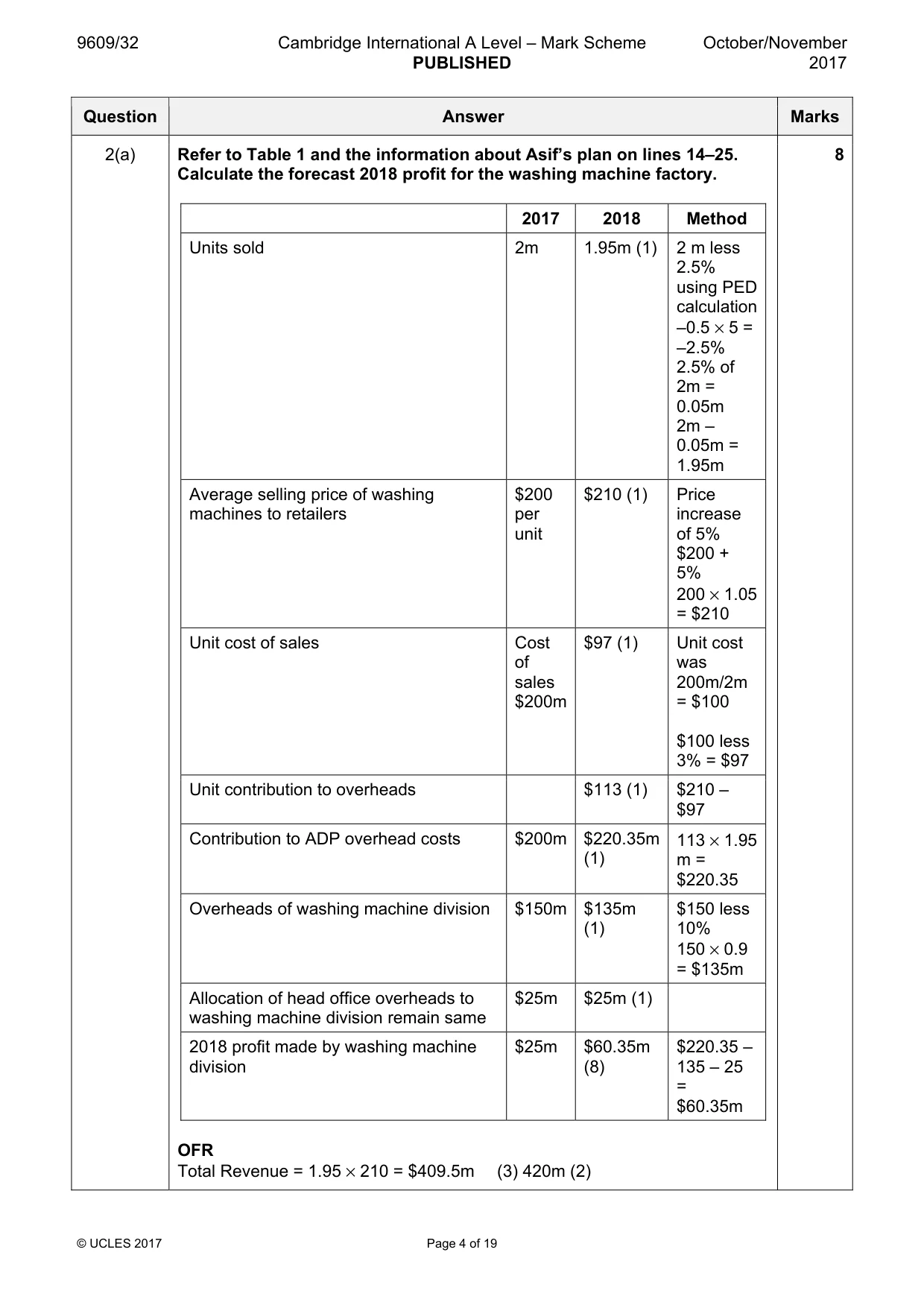
9609/32 Cambridge International A Level – Mark Scheme PUBLISHED October/November 2017 © UCLES 2017 Page 4 of 19 Question Answer Marks 2(a) Refer to Table 1 and the information about Asif’s plan on lines 14–25. Calculate the forecast 2018 profit for the washing machine factory. 2017 2018 Method Units sold 2m 1.95m (1) 2 m less 2.5% using PED calculation –0.5 × 5 = –2.5% 2.5% of 2m = 0.05m 2m – 0.05m = 1.95m Average selling price of washing machines to retailers $200 per unit $210 (1) Price increase of 5% $200 + 5% 200 × 1.05 = $210 Unit cost of sales Cost of sales $200m $97 (1) Unit cost was 200m/2m = $100 $100 less 3% = $97 Unit contribution to overheads $113 (1) $210 – $97 Contribution to ADP overhead costs $200m $220.35m (1) 113 × 1.95 m = $220.35 Overheads of washing machine division $150m $135m (1) $150 less 10% 150 × 0.9 = $135m Allocation of head office overheads to washing machine division remain same $25m $25m (1) 2018 profit made by washing machine division $25m $60.35m (8) $220.35 – 135 – 25 = $60.35m OFR Total Revenue = 1.95 × 210 = $409.5m (3) 420m (2) 8
Mark scheme, page 5
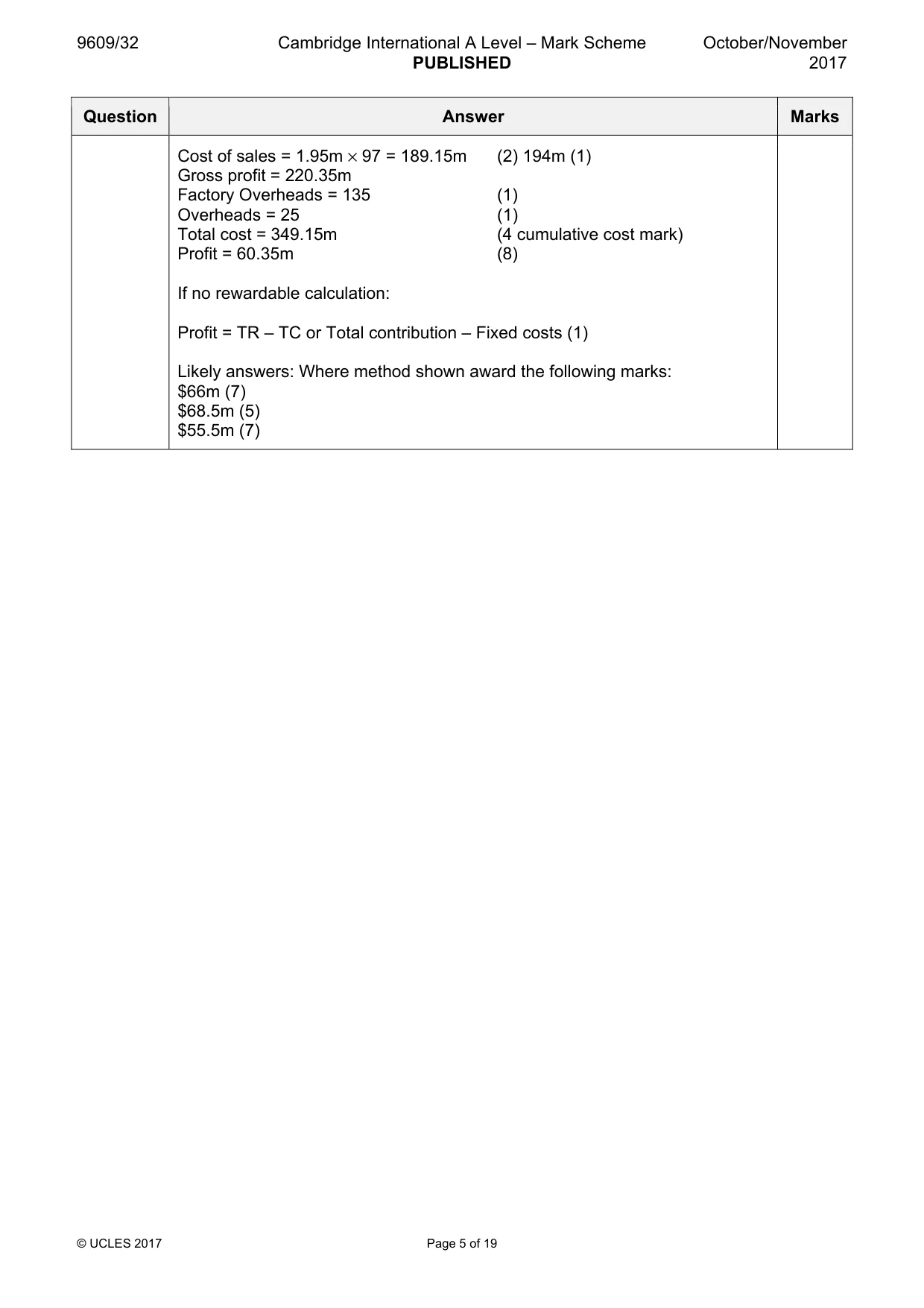
9609/32 Cambridge International A Level – Mark Scheme PUBLISHED October/November 2017 © UCLES 2017 Page 5 of 19 Question Answer Marks Cost of sales = 1.95m × 97 = 189.15m (2) 194m (1) Gross profit = 220.35m Factory Overheads = 135 (1) Overheads = 25 (1) Total cost = 349.15m (4 cumulative cost mark) Profit = 60.35m (8) If no rewardable calculation: Profit = TR – TC or Total contribution – Fixed costs (1) Likely answers: Where method shown award the following marks: $66m (7) $68.5m (5) $55.5m (7)
Mark scheme, page 6
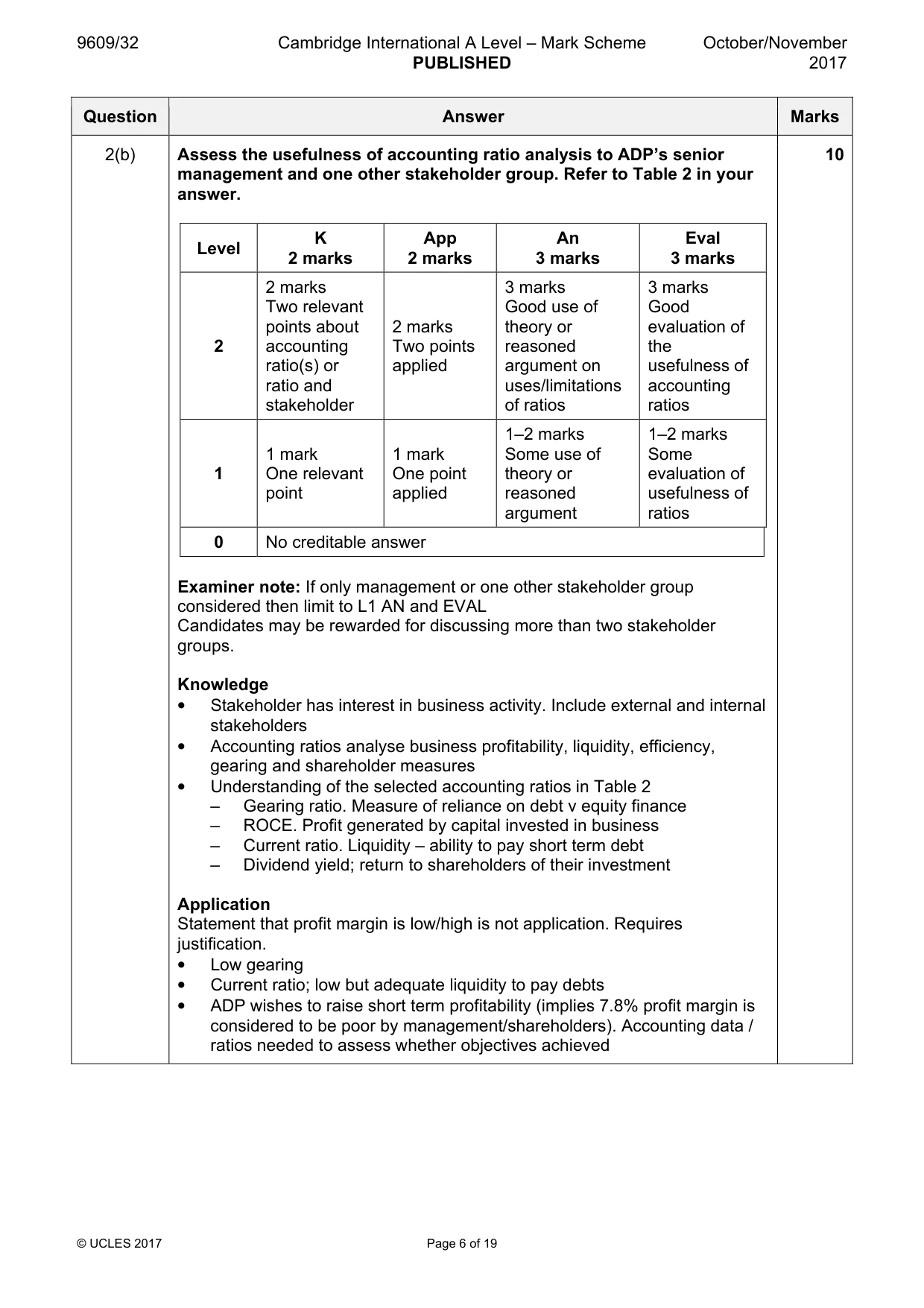
9609/32 Cambridge International A Level – Mark Scheme PUBLISHED October/November 2017 © UCLES 2017 Page 6 of 19 Question Answer Marks 2(b) Assess the usefulness of accounting ratio analysis to ADP’s senior management and one other stakeholder group. Refer to Table 2 in your answer. Level K 2 marks App 2 marks An 3 marks Eval 3 marks 2 2 marks Two relevant points about accounting ratio(s) or ratio and stakeholder 2 marks Two points applied 3 marks Good use of theory or reasoned argument on uses/limitations of ratios 3 marks Good evaluation of the usefulness of accounting ratios 1 1 mark One relevant point 1 mark One point applied 1–2 marks Some use of theory or reasoned argument 1–2 marks Some evaluation of usefulness of ratios 0 No creditable answer Examiner note: If only management or one other stakeholder group considered then limit to L1 AN and EVAL Candidates may be rewarded for discussing more than two stakeholder groups. Knowledge • Stakeholder has interest in business activity. Include external and internal stakeholders • Accounting ratios analyse business profitability, liquidity, efficiency, gearing and shareholder measures • Understanding of the selected accounting ratios in Table 2 – Gearing ratio. Measure of reliance on debt v equity finance – ROCE. Profit generated by capital invested in business – Current ratio. Liquidity – ability to pay short term debt – Dividend yield; return to shareholders of their investment Application Statement that profit margin is low/high is not application. Requires justification. • Low gearing • Current ratio; low but adequate liquidity to pay debts • ADP wishes to raise short term profitability (implies 7.8% profit margin is considered to be poor by management/shareholders). Accounting data / ratios needed to assess whether objectives achieved 10
Mark scheme, page 7
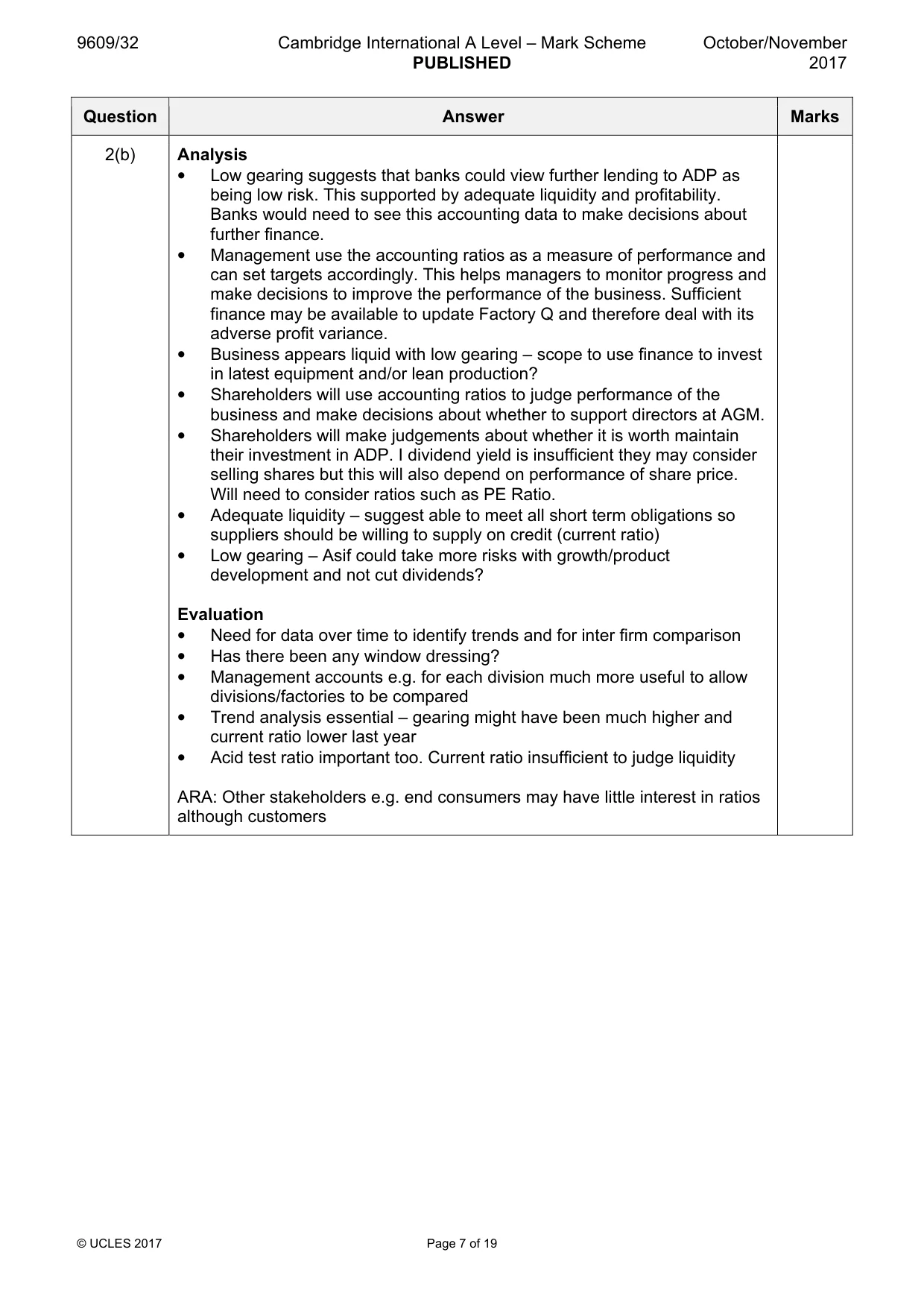
9609/32 Cambridge International A Level – Mark Scheme PUBLISHED October/November 2017 © UCLES 2017 Page 7 of 19 Question Answer Marks 2(b) Analysis • Low gearing suggests that banks could view further lending to ADP as being low risk. This supported by adequate liquidity and profitability. Banks would need to see this accounting data to make decisions about further finance. • Management use the accounting ratios as a measure of performance and can set targets accordingly. This helps managers to monitor progress and make decisions to improve the performance of the business. Sufficient finance may be available to update Factory Q and therefore deal with its adverse profit variance. • Business appears liquid with low gearing – scope to use finance to invest in latest equipment and/or lean production? • Shareholders will use accounting ratios to judge performance of the business and make decisions about whether to support directors at AGM. • Shareholders will make judgements about whether it is worth maintain their investment in ADP. I dividend yield is insufficient they may consider selling shares but this will also depend on performance of share price. Will need to consider ratios such as PE Ratio. • Adequate liquidity – suggest able to meet all short term obligations so suppliers should be willing to supply on credit (current ratio) • Low gearing – Asif could take more risks with growth/product development and not cut dividends? Evaluation • Need for data over time to identify trends and for inter firm comparison • Has there been any window dressing? • Management accounts e.g. for each division much more useful to allow divisions/factories to be compared • Trend analysis essential – gearing might have been much higher and current ratio lower last year • Acid test ratio important too. Current ratio insufficient to judge liquidity ARA: Other stakeholders e.g. end consumers may have little interest in ratios although customers
Mark scheme, page 8
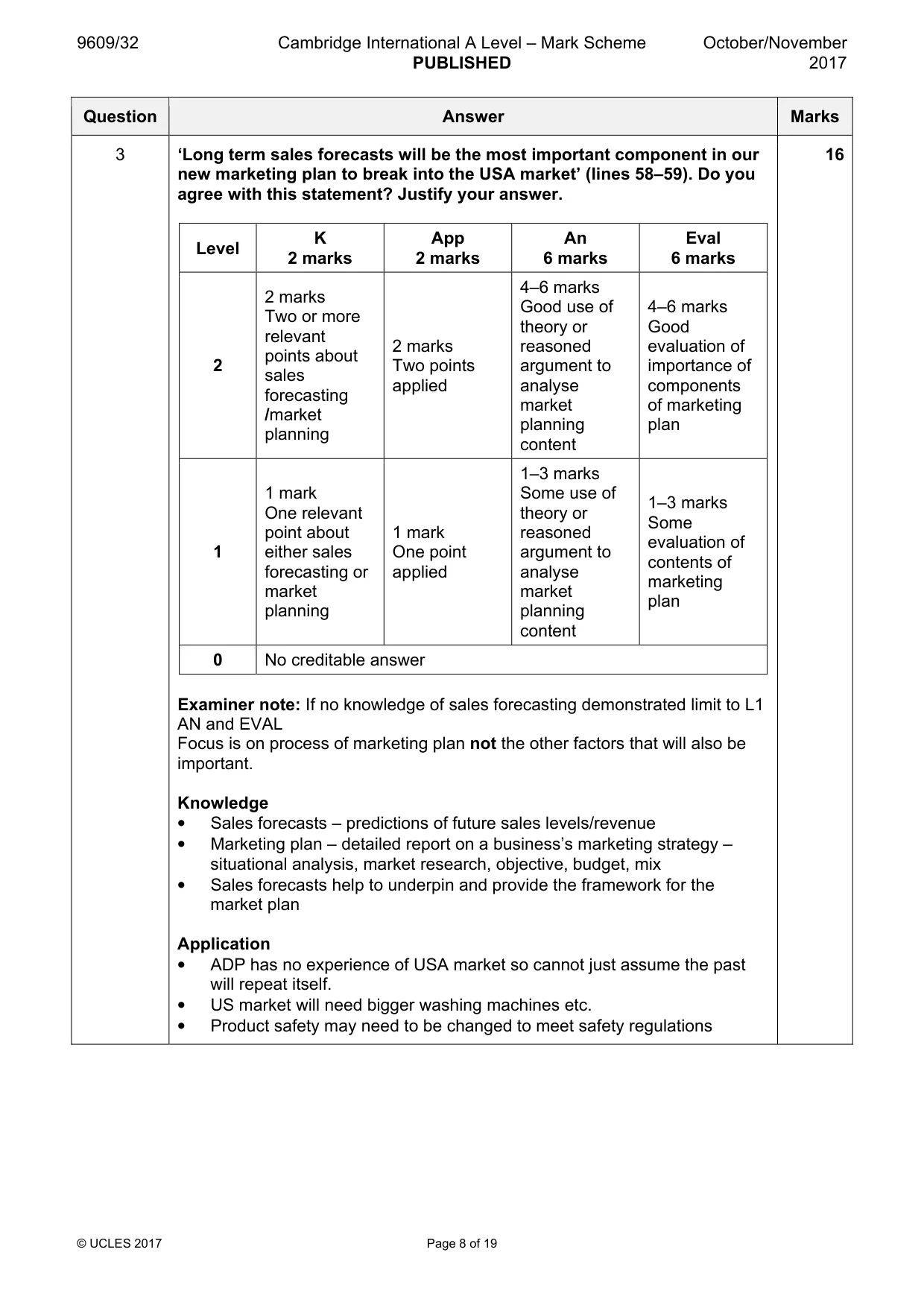
9609/32 Cambridge International A Level – Mark Scheme PUBLISHED October/November 2017 © UCLES 2017 Page 8 of 19 Question Answer Marks 3 ‘Long term sales forecasts will be the most important component in our new marketing plan to break into the USA market’ (lines 58–59). Do you agree with this statement? Justify your answer. Level K 2 marks App 2 marks An 6 marks Eval 6 marks 2 2 marks Two or more relevant points about sales forecasting /market planning 2 marks Two points applied 4–6 marks Good use of theory or reasoned argument to analyse market planning content 4–6 marks Good evaluation of importance of components of marketing plan 1 1 mark One relevant point about either sales forecasting or market planning 1 mark One point applied 1–3 marks Some use of theory or reasoned argument to analyse market planning content 1–3 marks Some evaluation of contents of marketing plan 0 No creditable answer Examiner note: If no knowledge of sales forecasting demonstrated limit to L1 AN and EVAL Focus is on process of marketing plan not the other factors that will also be important. Knowledge • Sales forecasts – predictions of future sales levels/revenue • Marketing plan – detailed report on a business’s marketing strategy – situational analysis, market research, objective, budget, mix • Sales forecasts help to underpin and provide the framework for the market plan Application • ADP has no experience of USA market so cannot just assume the past will repeat itself. • US market will need bigger washing machines etc. • Product safety may need to be changed to meet safety regulations 16
Mark scheme, page 9
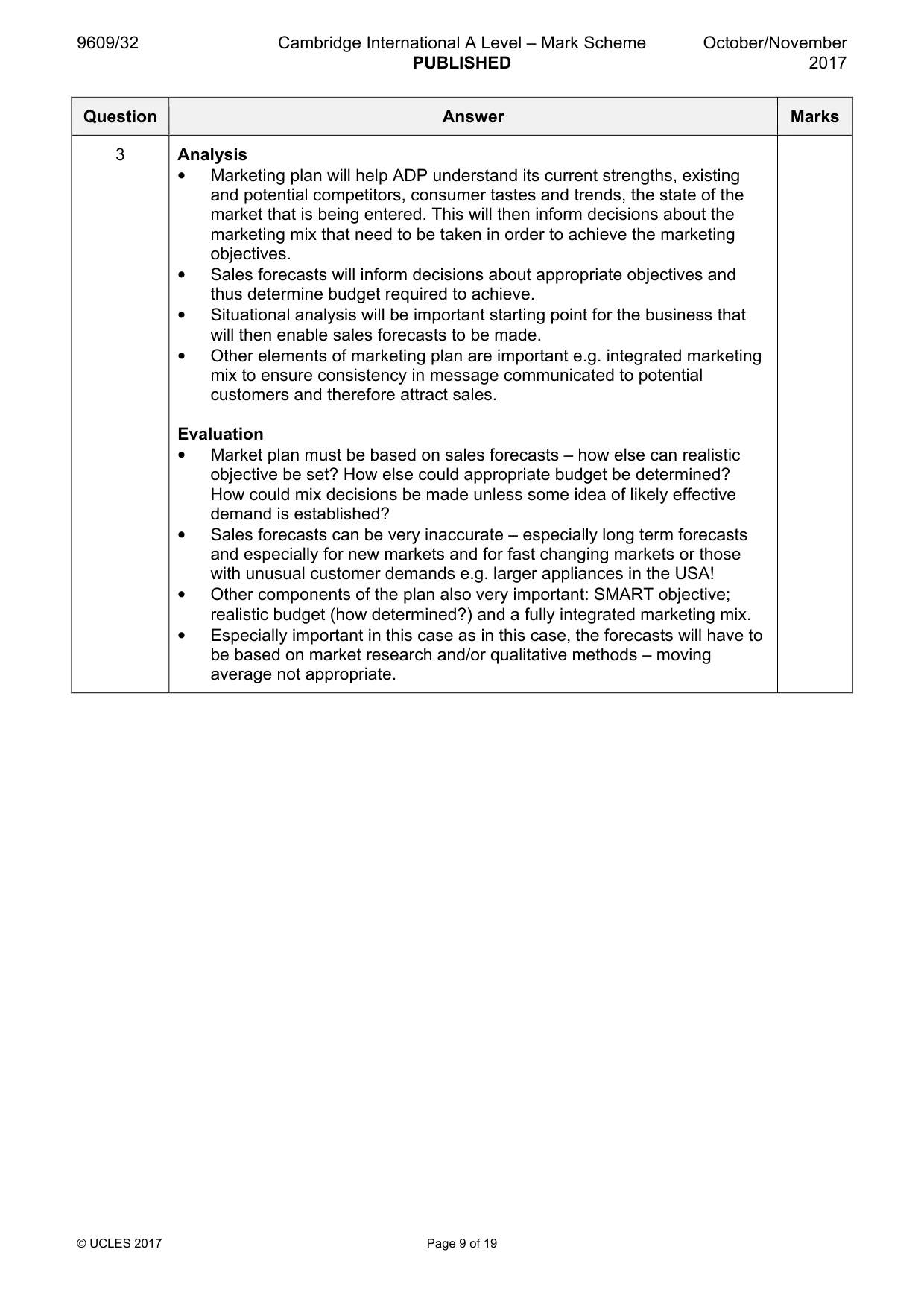
9609/32 Cambridge International A Level – Mark Scheme PUBLISHED October/November 2017 © UCLES 2017 Page 9 of 19 Question Answer Marks 3 Analysis • Marketing plan will help ADP understand its current strengths, existing and potential competitors, consumer tastes and trends, the state of the market that is being entered. This will then inform decisions about the marketing mix that need to be taken in order to achieve the marketing objectives. • Sales forecasts will inform decisions about appropriate objectives and thus determine budget required to achieve. • Situational analysis will be important starting point for the business that will then enable sales forecasts to be made. • Other elements of marketing plan are important e.g. integrated marketing mix to ensure consistency in message communicated to potential customers and therefore attract sales. Evaluation • Market plan must be based on sales forecasts – how else can realistic objective be set? How else could appropriate budget be determined? How could mix decisions be made unless some idea of likely effective demand is established? • Sales forecasts can be very inaccurate – especially long term forecasts and especially for new markets and for fast changing markets or those with unusual customer demands e.g. larger appliances in the USA! • Other components of the plan also very important: SMART objective; realistic budget (how determined?) and a fully integrated marketing mix. • Especially important in this case as in this case, the forecasts will have to be based on market research and/or qualitative methods – moving average not appropriate.
Mark scheme, page 10
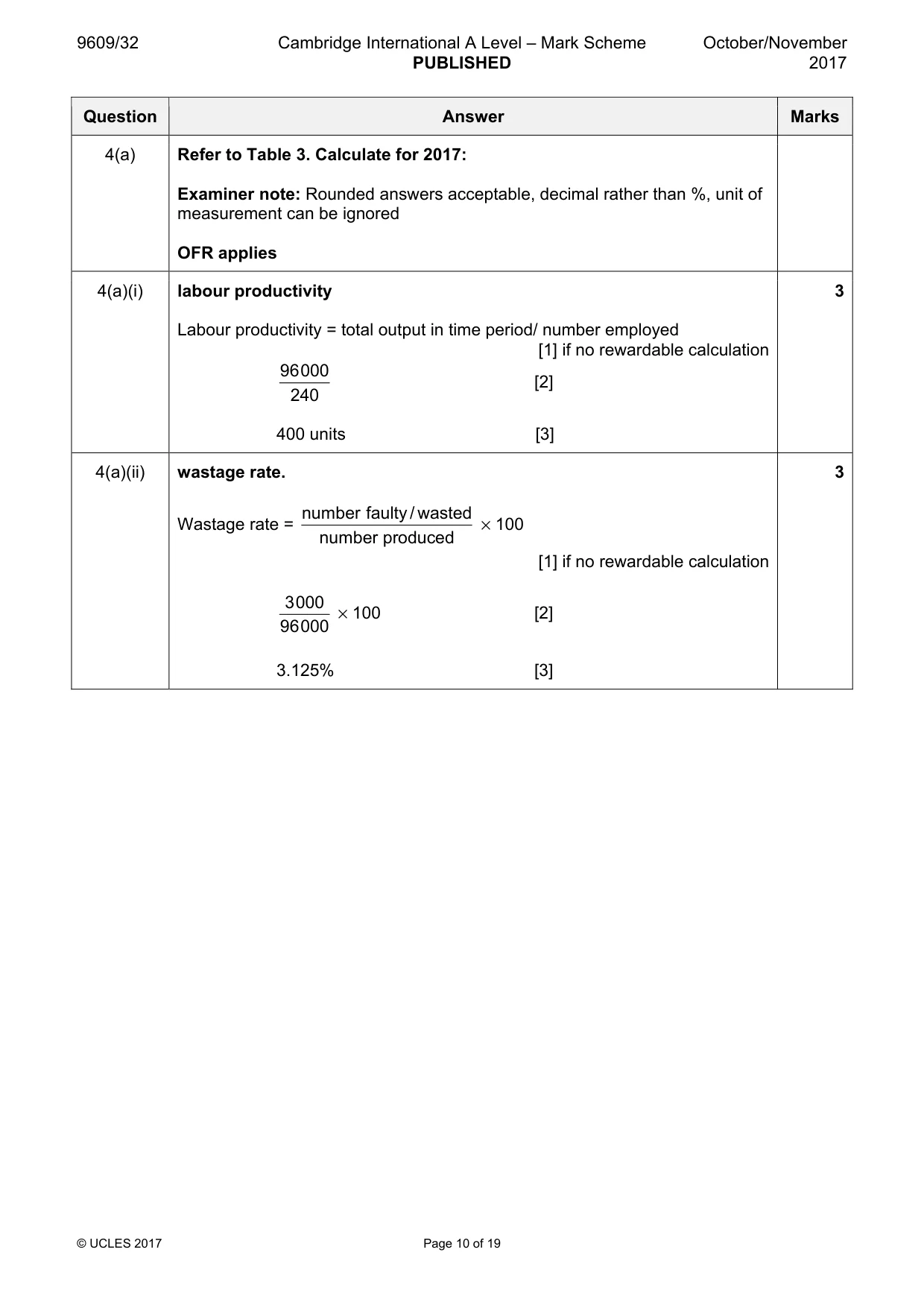
9609/32 Cambridge International A Level – Mark Scheme PUBLISHED October/November 2017 © UCLES 2017 Page 10 of 19 Question Answer Marks 4(a) Refer to Table 3. Calculate for 2017: Examiner note: Rounded answers acceptable, decimal rather than %, unit of measurement can be ignored OFR applies 4(a)(i) labour productivity Labour productivity = total output in time period/ number employed [1] if no rewardable calculation 96000 240 [2] 400 units [3] 3 4(a)(ii) wastage rate. Wastage rate = number faulty/ wasted number produced × 100 [1] if no rewardable calculation 3000 96000 × 100 [2] 3.125% [3] 3
Mark scheme, page 11
9609/32 Cambridge International A Level – Mark Scheme PUBLISHED October/November 2017 © UCLES 2017 Page 11 of 19 Question Answer Marks 4(b) Evaluate strategies for improving employee performance in ADP’s country Z factory without increasing unit labour costs. Level K 2 marks App 2 marks An 5 marks E 5 marks 2 2 marks Two points made about employee performance / strategy 2 marks Two points applied 4–5 marks Good use of theory or reasoned argument to explain likely impact of strategies to improve employee performance 4–5 marks Evaluation of strategies linked to labour costs 1 1 mark One point made about employee performance / strategy 1 mark One point applied 1–3 Some use of theory/reasoned argument 1–3 marks Evaluation of relevant strategies 0 No creditable answer Examiner note: Good evaluation requires consideration of strategies on unit labour costs. Evaluation might just refer to costs or likely effectiveness of suggested strategy. Knowledge • Employee performance measured by consideration of factors such as productivity Relevant strategies: • Increased pay • Improve working conditions • Democratic leadership style • Investment in capital equipment Application • Employee performance measures are worsening • Wages 50% of ADP average • Accidents at factory – lack of safety equipment • High unemployment • Workers made more than other similar workers • Absenteeism has increased 2500 to 2600 • Wastage rate has increased was 1.82% in 2016 14
Mark scheme, page 12
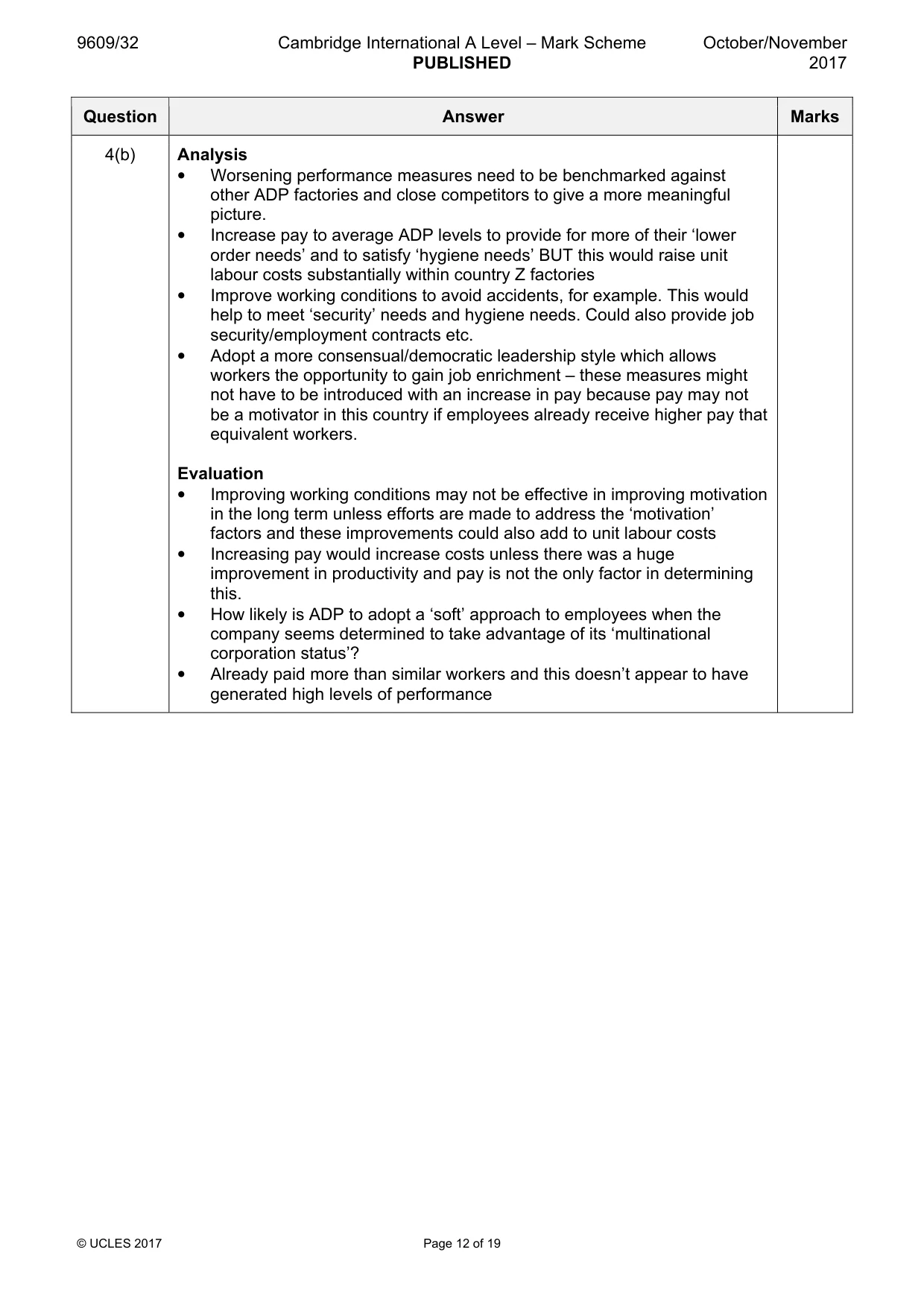
9609/32 Cambridge International A Level – Mark Scheme PUBLISHED October/November 2017 © UCLES 2017 Page 12 of 19 Question Answer Marks 4(b) Analysis • Worsening performance measures need to be benchmarked against other ADP factories and close competitors to give a more meaningful picture. • Increase pay to average ADP levels to provide for more of their ‘lower order needs’ and to satisfy ‘hygiene needs’ BUT this would raise unit labour costs substantially within country Z factories • Improve working conditions to avoid accidents, for example. This would help to meet ‘security’ needs and hygiene needs. Could also provide job security/employment contracts etc. • Adopt a more consensual/democratic leadership style which allows workers the opportunity to gain job enrichment – these measures might not have to be introduced with an increase in pay because pay may not be a motivator in this country if employees already receive higher pay that equivalent workers. Evaluation • Improving working conditions may not be effective in improving motivation in the long term unless efforts are made to address the ‘motivation’ factors and these improvements could also add to unit labour costs • Increasing pay would increase costs unless there was a huge improvement in productivity and pay is not the only factor in determining this. • How likely is ADP to adopt a ‘soft’ approach to employees when the company seems determined to take advantage of its ‘multinational corporation status’? • Already paid more than similar workers and this doesn’t appear to have generated high levels of performance
Mark scheme, page 13
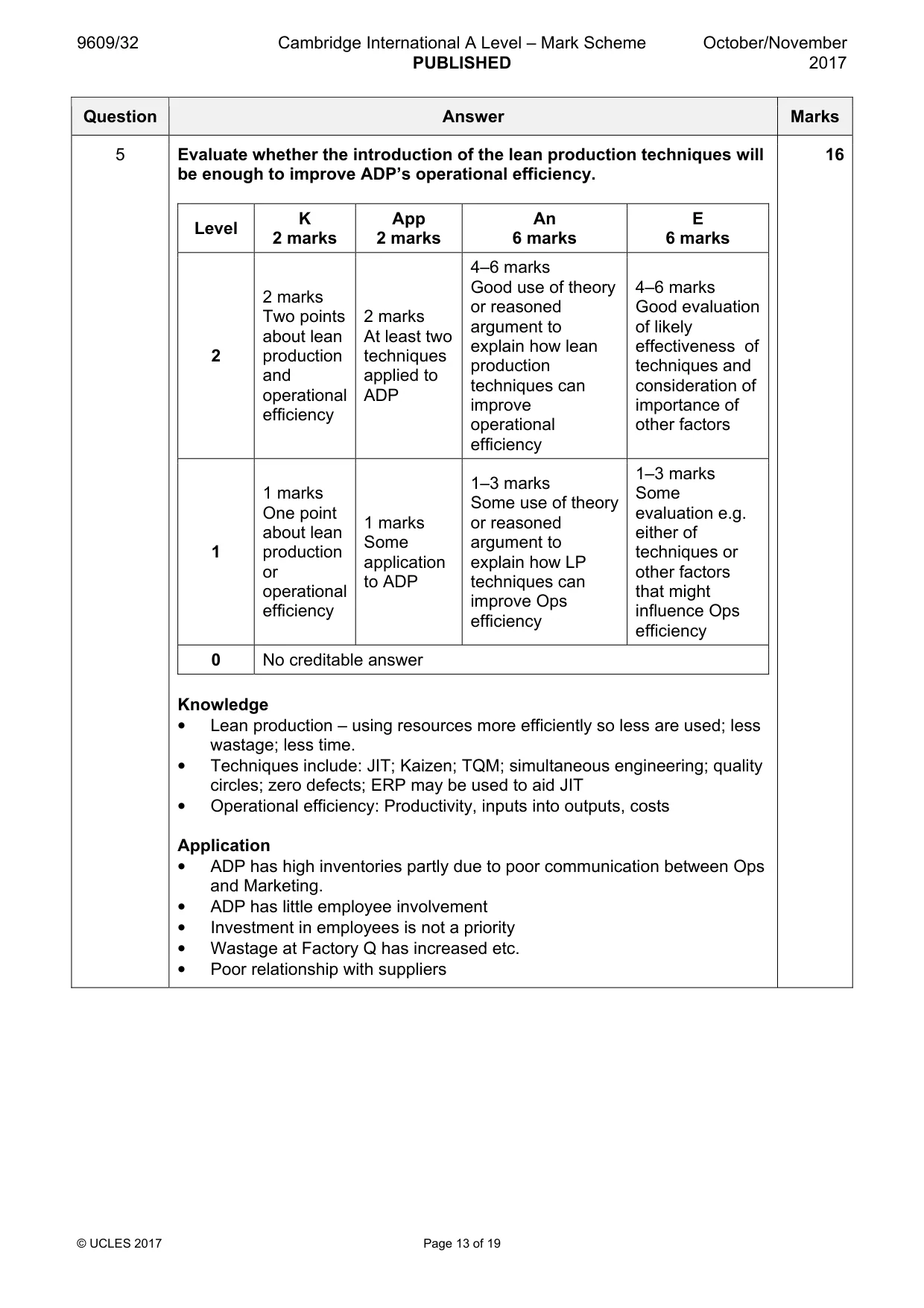
9609/32 Cambridge International A Level – Mark Scheme PUBLISHED October/November 2017 © UCLES 2017 Page 13 of 19 Question Answer Marks 5 Evaluate whether the introduction of the lean production techniques will be enough to improve ADP’s operational efficiency. Level K 2 marks App 2 marks An 6 marks E 6 marks 2 2 marks Two points about lean production and operational efficiency 2 marks At least two techniques applied to ADP 4–6 marks Good use of theory or reasoned argument to explain how lean production techniques can improve operational efficiency 4–6 marks Good evaluation of likely effectiveness of techniques and consideration of importance of other factors 1 1 marks One point about lean production or operational efficiency 1 marks Some application to ADP 1–3 marks Some use of theory or reasoned argument to explain how LP techniques can improve Ops efficiency 1–3 marks Some evaluation e.g. either of techniques or other factors that might influence Ops efficiency 0 No creditable answer Knowledge • Lean production – using resources more efficiently so less are used; less wastage; less time. • Techniques include: JIT; Kaizen; TQM; simultaneous engineering; quality circles; zero defects; ERP may be used to aid JIT • Operational efficiency: Productivity, inputs into outputs, costs Application • ADP has high inventories partly due to poor communication between Ops and Marketing. • ADP has little employee involvement • Investment in employees is not a priority • Wastage at Factory Q has increased etc. • Poor relationship with suppliers 16
Mark scheme, page 14
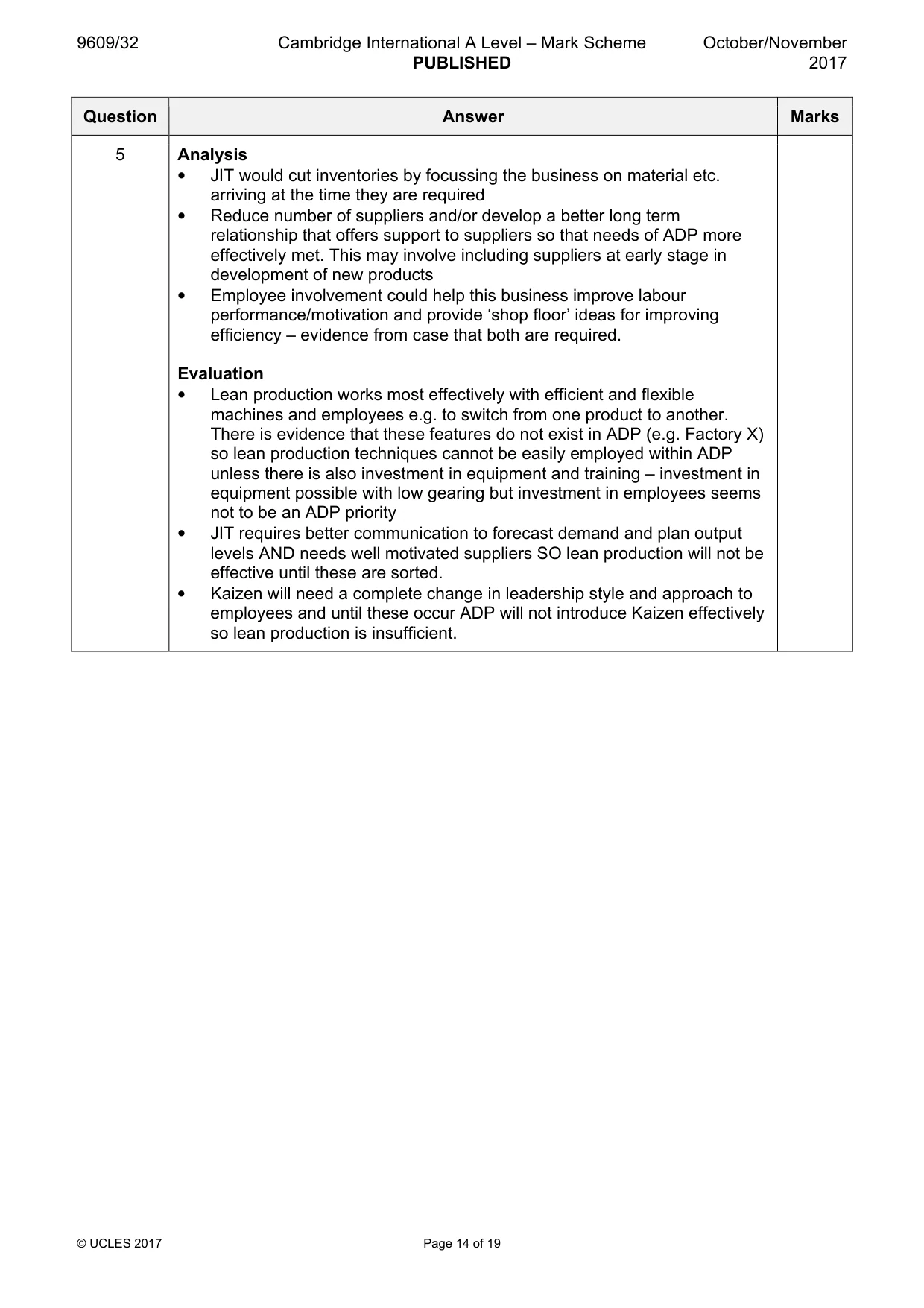
9609/32 Cambridge International A Level – Mark Scheme PUBLISHED October/November 2017 © UCLES 2017 Page 14 of 19 Question Answer Marks 5 Analysis • JIT would cut inventories by focussing the business on material etc. arriving at the time they are required • Reduce number of suppliers and/or develop a better long term relationship that offers support to suppliers so that needs of ADP more effectively met. This may involve including suppliers at early stage in development of new products • Employee involvement could help this business improve labour performance/motivation and provide ‘shop floor’ ideas for improving efficiency – evidence from case that both are required. Evaluation • Lean production works most effectively with efficient and flexible machines and employees e.g. to switch from one product to another. There is evidence that these features do not exist in ADP (e.g. Factory X) so lean production techniques cannot be easily employed within ADP unless there is also investment in equipment and training – investment in equipment possible with low gearing but investment in employees seems not to be an ADP priority • JIT requires better communication to forecast demand and plan output levels AND needs well motivated suppliers SO lean production will not be effective until these are sorted. • Kaizen will need a complete change in leadership style and approach to employees and until these occur ADP will not introduce Kaizen effectively so lean production is insufficient.
Mark scheme, page 15
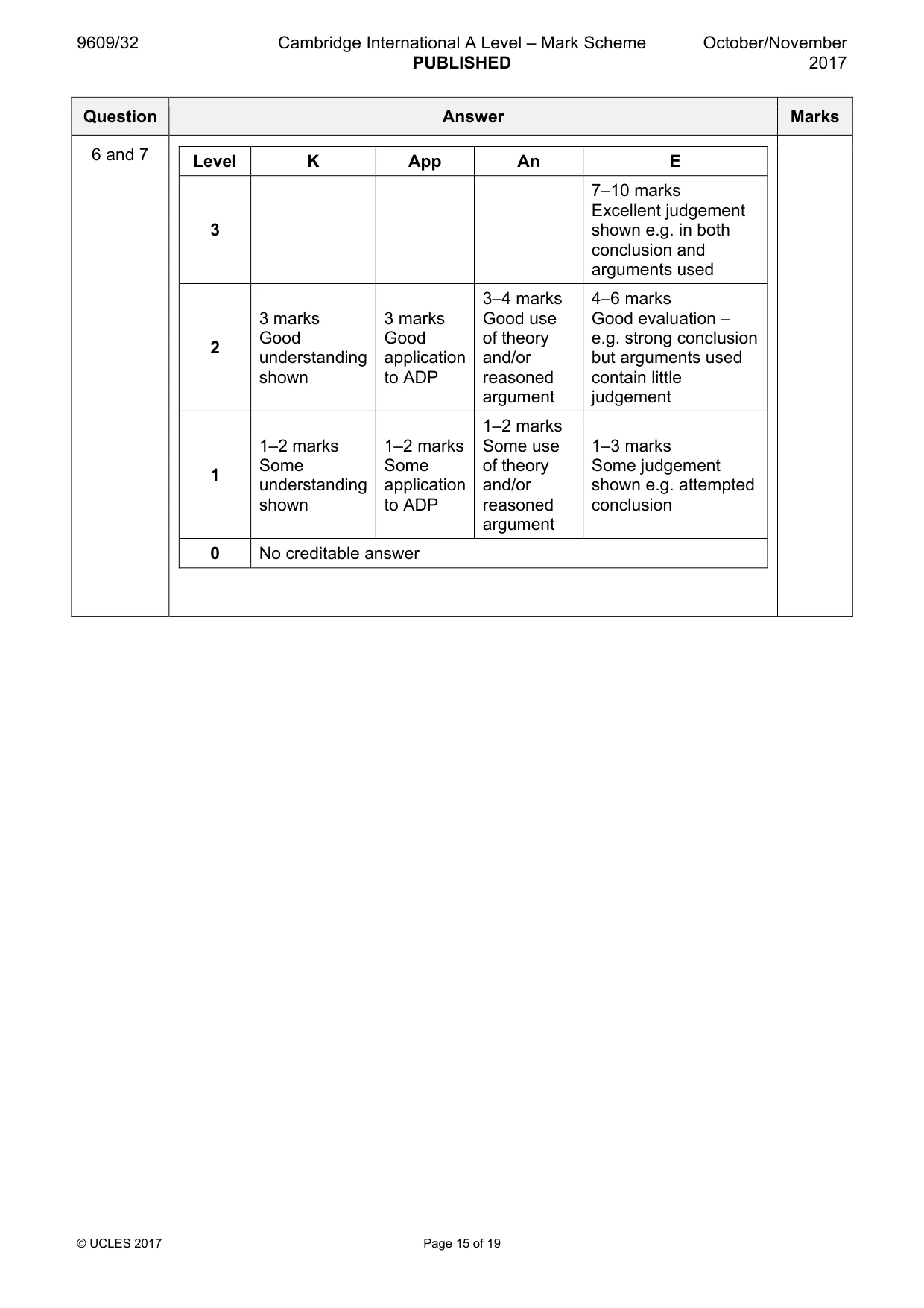
9609/32 Cambridge International A Level – Mark Scheme PUBLISHED October/November 2017 © UCLES 2017 Page 15 of 19 Question Answer Marks 6 and 7 Level K App An E 3 7–10 marks Excellent judgement shown e.g. in both conclusion and arguments used 2 3 marks Good understanding shown 3 marks Good application to ADP 3–4 marks Good use of theory and/or reasoned argument 4–6 marks Good evaluation – e.g. strong conclusion but arguments used contain little judgement 1 1–2 marks Some understanding shown 1–2 marks Some application to ADP 1–2 marks Some use of theory and/or reasoned argument 1–3 marks Some judgement shown e.g. attempted conclusion 0 No creditable answer
Mark scheme, page 16
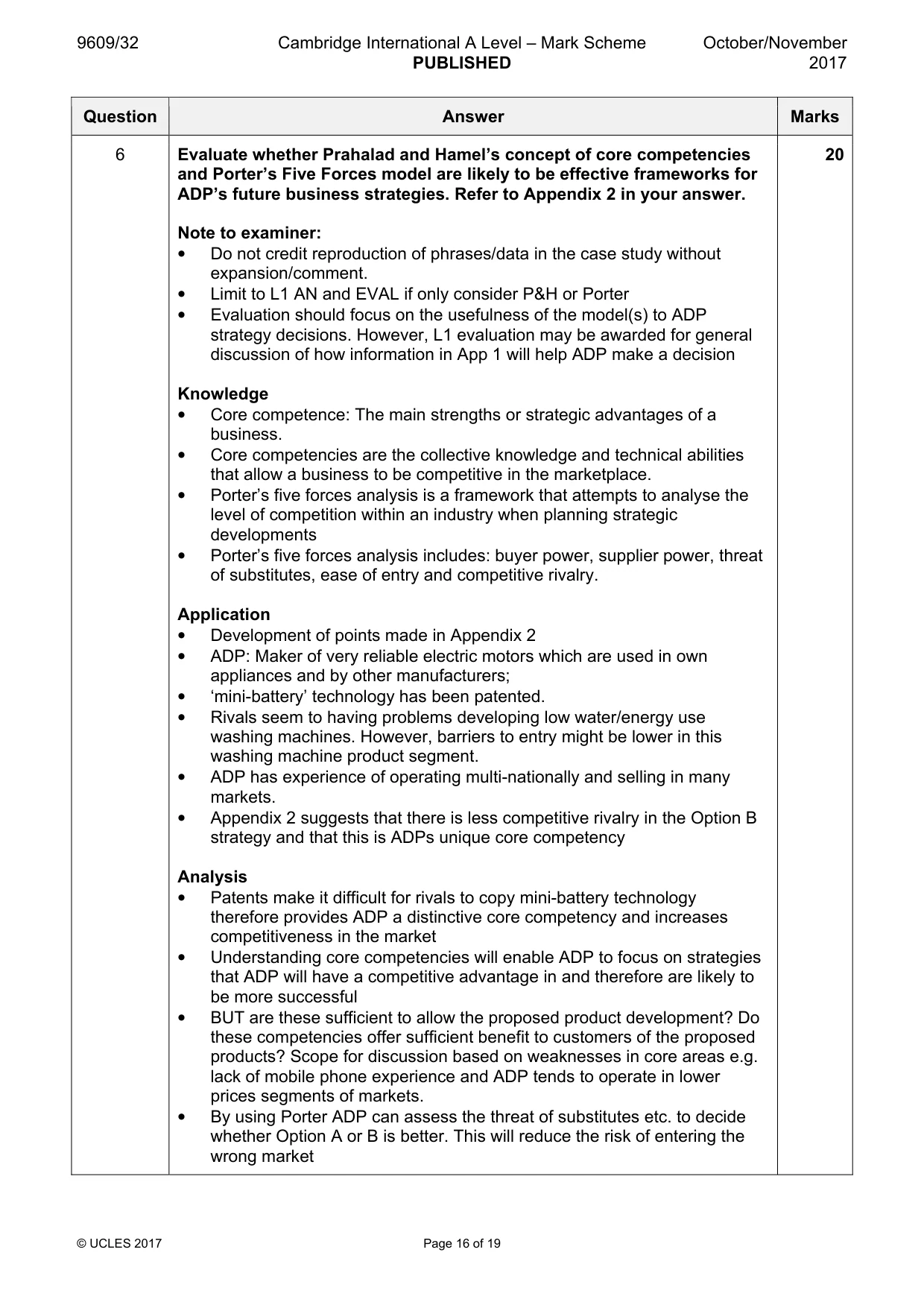
9609/32 Cambridge International A Level – Mark Scheme PUBLISHED October/November 2017 © UCLES 2017 Page 16 of 19 Question Answer Marks 6 Evaluate whether Prahalad and Hamel’s concept of core competencies and Porter’s Five Forces model are likely to be effective frameworks for ADP’s future business strategies. Refer to Appendix 2 in your answer. Note to examiner: • Do not credit reproduction of phrases/data in the case study without expansion/comment. • Limit to L1 AN and EVAL if only consider P&H or Porter • Evaluation should focus on the usefulness of the model(s) to ADP strategy decisions. However, L1 evaluation may be awarded for general discussion of how information in App 1 will help ADP make a decision Knowledge • Core competence: The main strengths or strategic advantages of a business. • Core competencies are the collective knowledge and technical abilities that allow a business to be competitive in the marketplace. • Porter’s five forces analysis is a framework that attempts to analyse the level of competition within an industry when planning strategic developments • Porter’s five forces analysis includes: buyer power, supplier power, threat of substitutes, ease of entry and competitive rivalry. Application • Development of points made in Appendix 2 • ADP: Maker of very reliable electric motors which are used in own appliances and by other manufacturers; • ‘mini-battery’ technology has been patented. • Rivals seem to having problems developing low water/energy use washing machines. However, barriers to entry might be lower in this washing machine product segment. • ADP has experience of operating multi-nationally and selling in many markets. • Appendix 2 suggests that there is less competitive rivalry in the Option B strategy and that this is ADPs unique core competency Analysis • Patents make it difficult for rivals to copy mini-battery technology therefore provides ADP a distinctive core competency and increases competitiveness in the market • Understanding core competencies will enable ADP to focus on strategies that ADP will have a competitive advantage in and therefore are likely to be more successful • BUT are these sufficient to allow the proposed product development? Do these competencies offer sufficient benefit to customers of the proposed products? Scope for discussion based on weaknesses in core areas e.g. lack of mobile phone experience and ADP tends to operate in lower prices segments of markets. • By using Porter ADP can assess the threat of substitutes etc. to decide whether Option A or B is better. This will reduce the risk of entering the wrong market 20
Mark scheme, page 17
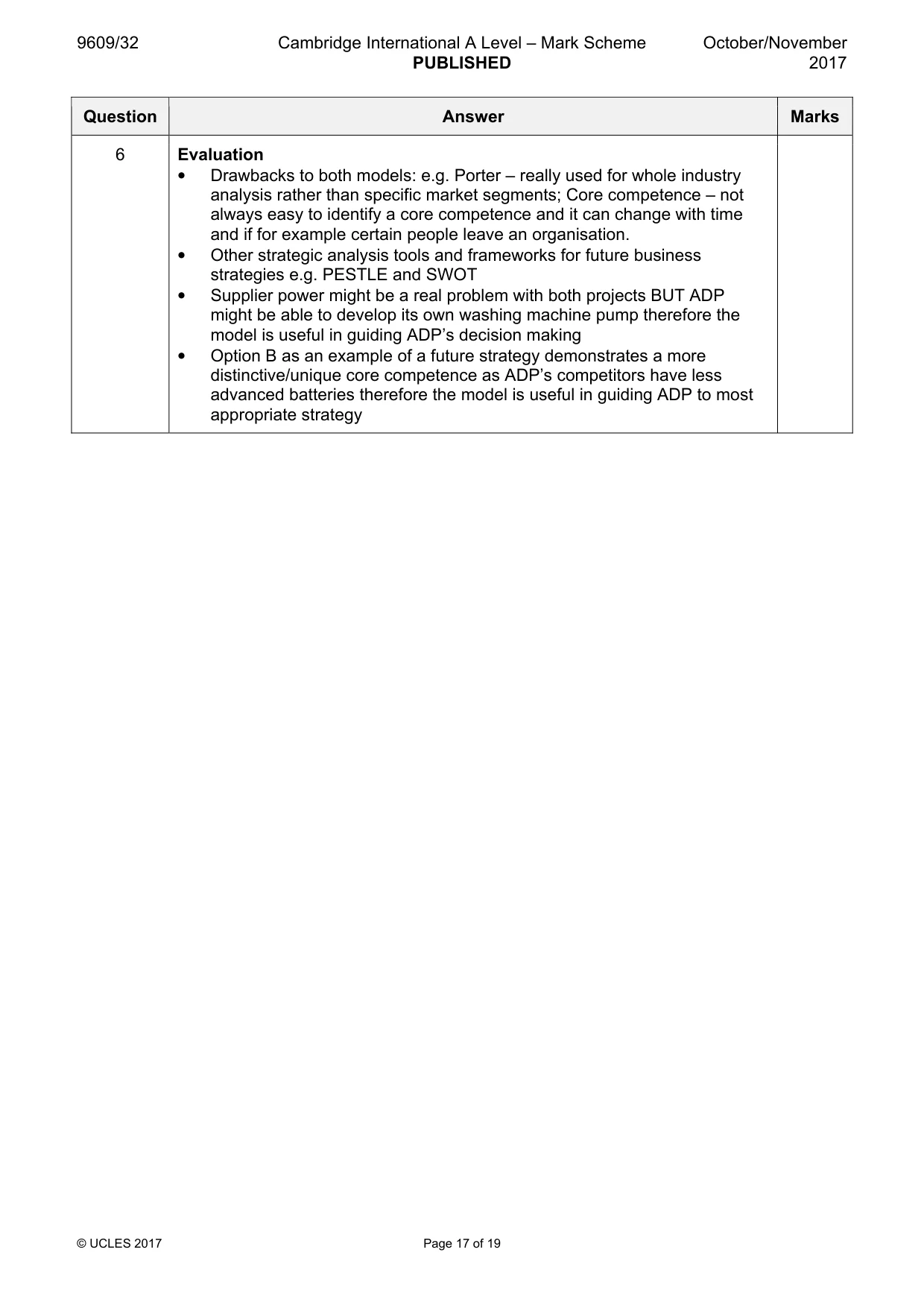
9609/32 Cambridge International A Level – Mark Scheme PUBLISHED October/November 2017 © UCLES 2017 Page 17 of 19 Question Answer Marks 6 Evaluation • Drawbacks to both models: e.g. Porter – really used for whole industry analysis rather than specific market segments; Core competence – not always easy to identify a core competence and it can change with time and if for example certain people leave an organisation. • Other strategic analysis tools and frameworks for future business strategies e.g. PESTLE and SWOT • Supplier power might be a real problem with both projects BUT ADP might be able to develop its own washing machine pump therefore the model is useful in guiding ADP’s decision making • Option B as an example of a future strategy demonstrates a more distinctive/unique core competence as ADP’s competitors have less advanced batteries therefore the model is useful in guiding ADP to most appropriate strategy
Mark scheme, page 18
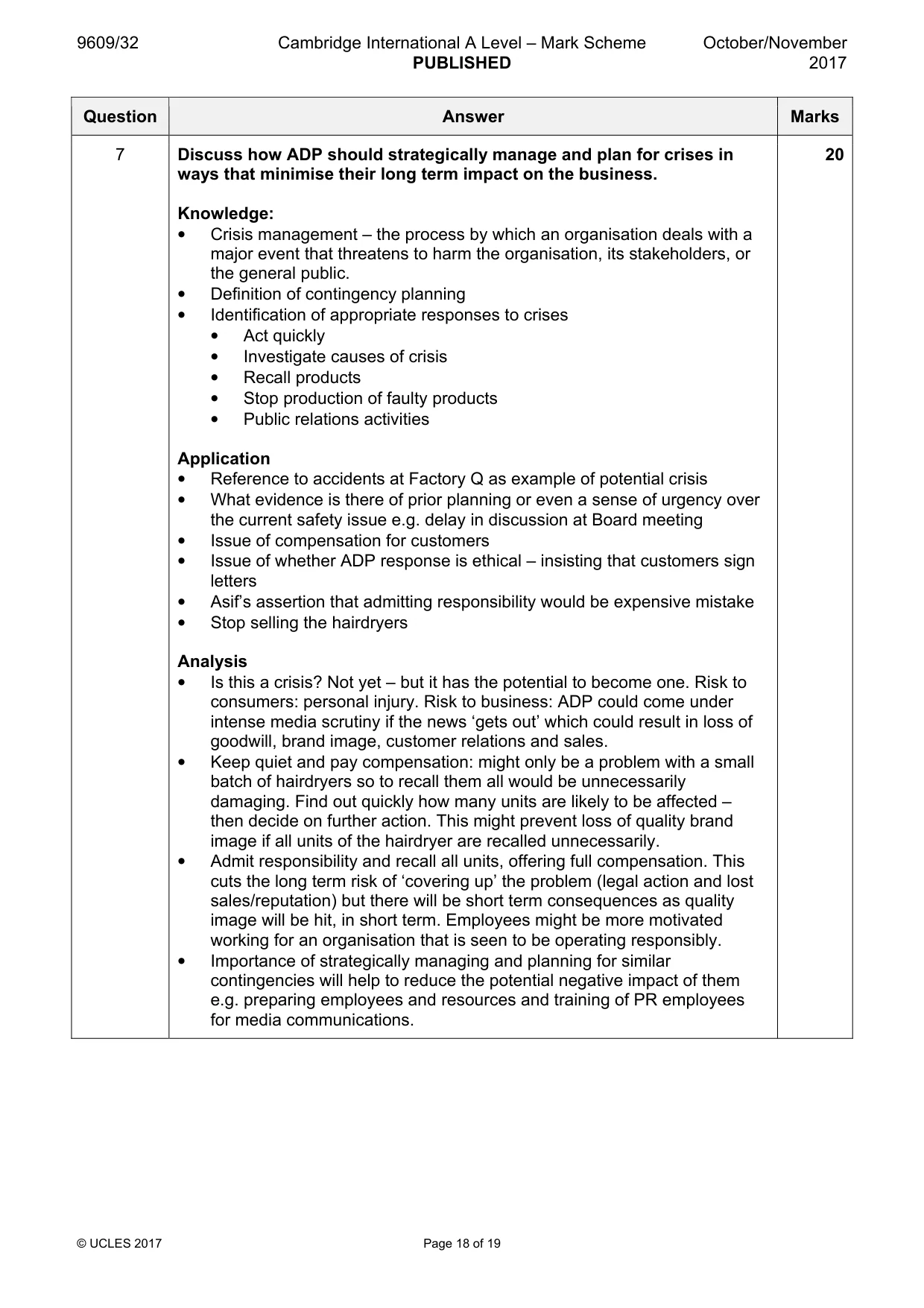
9609/32 Cambridge International A Level – Mark Scheme PUBLISHED October/November 2017 © UCLES 2017 Page 18 of 19 Question Answer Marks 7 Discuss how ADP should strategically manage and plan for crises in ways that minimise their long term impact on the business. Knowledge: • Crisis management – the process by which an organisation deals with a major event that threatens to harm the organisation, its stakeholders, or the general public. • Definition of contingency planning • Identification of appropriate responses to crises • Act quickly • Investigate causes of crisis • Recall products • Stop production of faulty products • Public relations activities Application • Reference to accidents at Factory Q as example of potential crisis • What evidence is there of prior planning or even a sense of urgency over the current safety issue e.g. delay in discussion at Board meeting • Issue of compensation for customers • Issue of whether ADP response is ethical – insisting that customers sign letters • Asif’s assertion that admitting responsibility would be expensive mistake • Stop selling the hairdryers Analysis • Is this a crisis? Not yet – but it has the potential to become one. Risk to consumers: personal injury. Risk to business: ADP could come under intense media scrutiny if the news ‘gets out’ which could result in loss of goodwill, brand image, customer relations and sales. • Keep quiet and pay compensation: might only be a problem with a small batch of hairdryers so to recall them all would be unnecessarily damaging. Find out quickly how many units are likely to be affected – then decide on further action. This might prevent loss of quality brand image if all units of the hairdryer are recalled unnecessarily. • Admit responsibility and recall all units, offering full compensation. This cuts the long term risk of ‘covering up’ the problem (legal action and lost sales/reputation) but there will be short term consequences as quality image will be hit, in short term. Employees might be more motivated working for an organisation that is seen to be operating responsibly. • Importance of strategically managing and planning for similar contingencies will help to reduce the potential negative impact of them e.g. preparing employees and resources and training of PR employees for media communications. 20
Mark scheme, page 19
9609/32 Cambridge International A Level – Mark Scheme PUBLISHED October/November 2017 © UCLES 2017 Page 19 of 19 Question Answer Marks 7 Evaluation • ADP senior management not very stakeholder responsible e.g. workers in country Z and suppliers not happy so this is likely to influence the decision made. • Contingency planning and crisis management have costs associated with them – need to be compared with potential cost of not strategically managing/planning for negative events • Contrasting short term versus long term impact • Would help to know cost of recall
What you needed in this session
Cambridge’s own grade thresholds for 2017 Oct/Nov, Paper 3 · Variant 2. A higher threshold means an easier paper — the bar moves with how the cohort did.