Cambridge A Level Business (for first examination in 2016) 9609 — 2017 Oct/Nov Paper 3 · Variant 1
9609/31/O/N/17 · 100 marks · ≈113 min
The question paper and its mark scheme, free to read here and free to download. This is Cambridge’s own paper, exactly as it was sat.
Question paper8 pages


Mark scheme12 pages
Answers below. Sit the paper first if you are practising.
Paper as text
Question paper, page 1
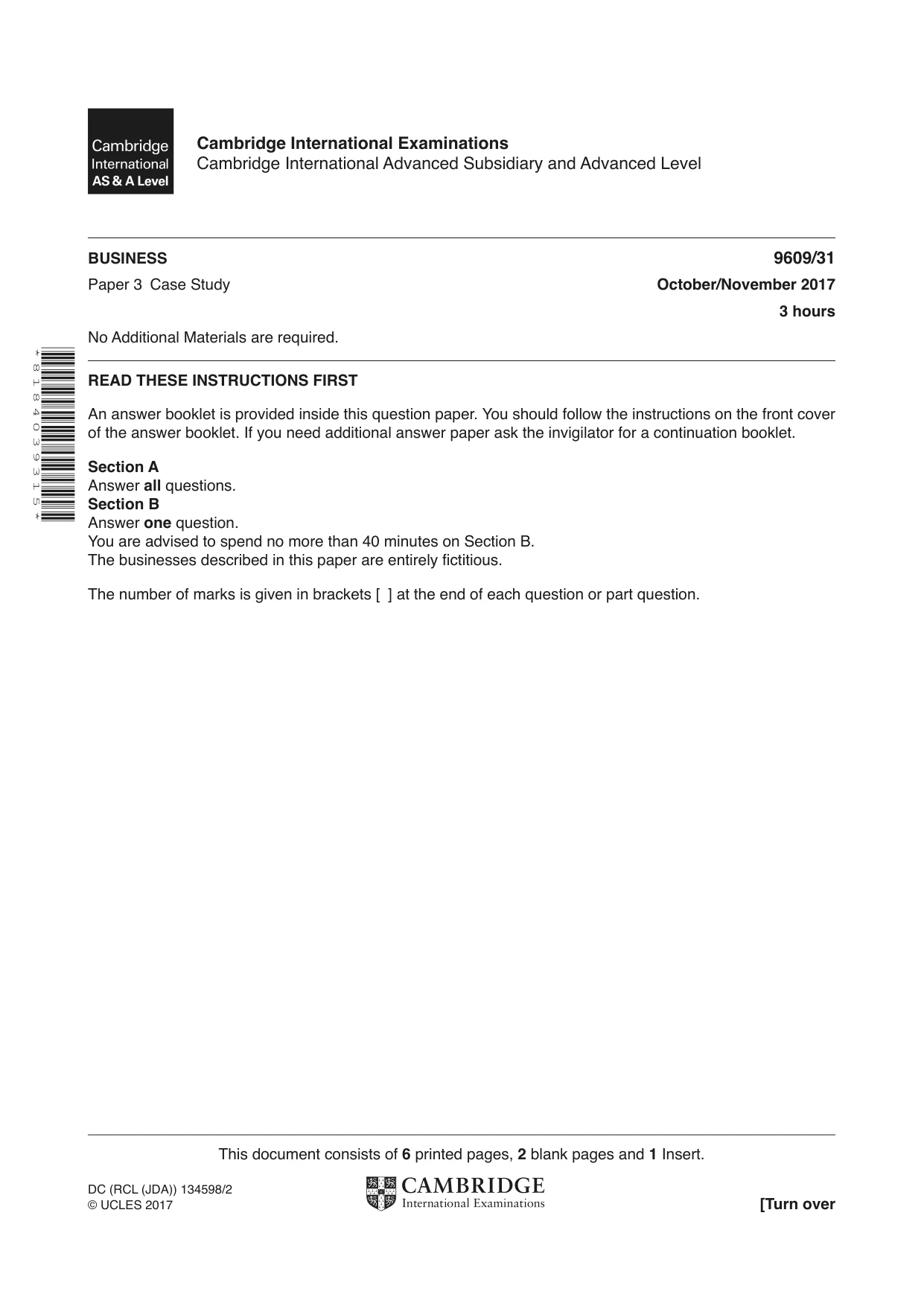
This document consists of 6 printed pages, 2 blank pages and 1 Insert. DC (RCL (JDA)) 134598/2 © UCLES 2017 [Turn over Cambridge International Examinations Cambridge International Advanced Subsidiary and Advanced Level * 8 1 8 4 0 3 9 3 1 5 * BUSINESS 9609/31 Paper 3 Case Study October/November 2017 3 hours No Additional Materials are required. READ THESE INSTRUCTIONS FIRST An answer booklet is provided inside this question paper. You should follow the instructions on the front cover of the answer booklet. If you need additional answer paper ask the invigilator for a continuation booklet. Section A Answer all questions. Section B Answer one question. You are advised to spend no more than 40 minutes on Section B. The businesses described in this paper are entirely fictitious. The number of marks is given in brackets [ ] at the end of each question or part question.
Question paper, page 2
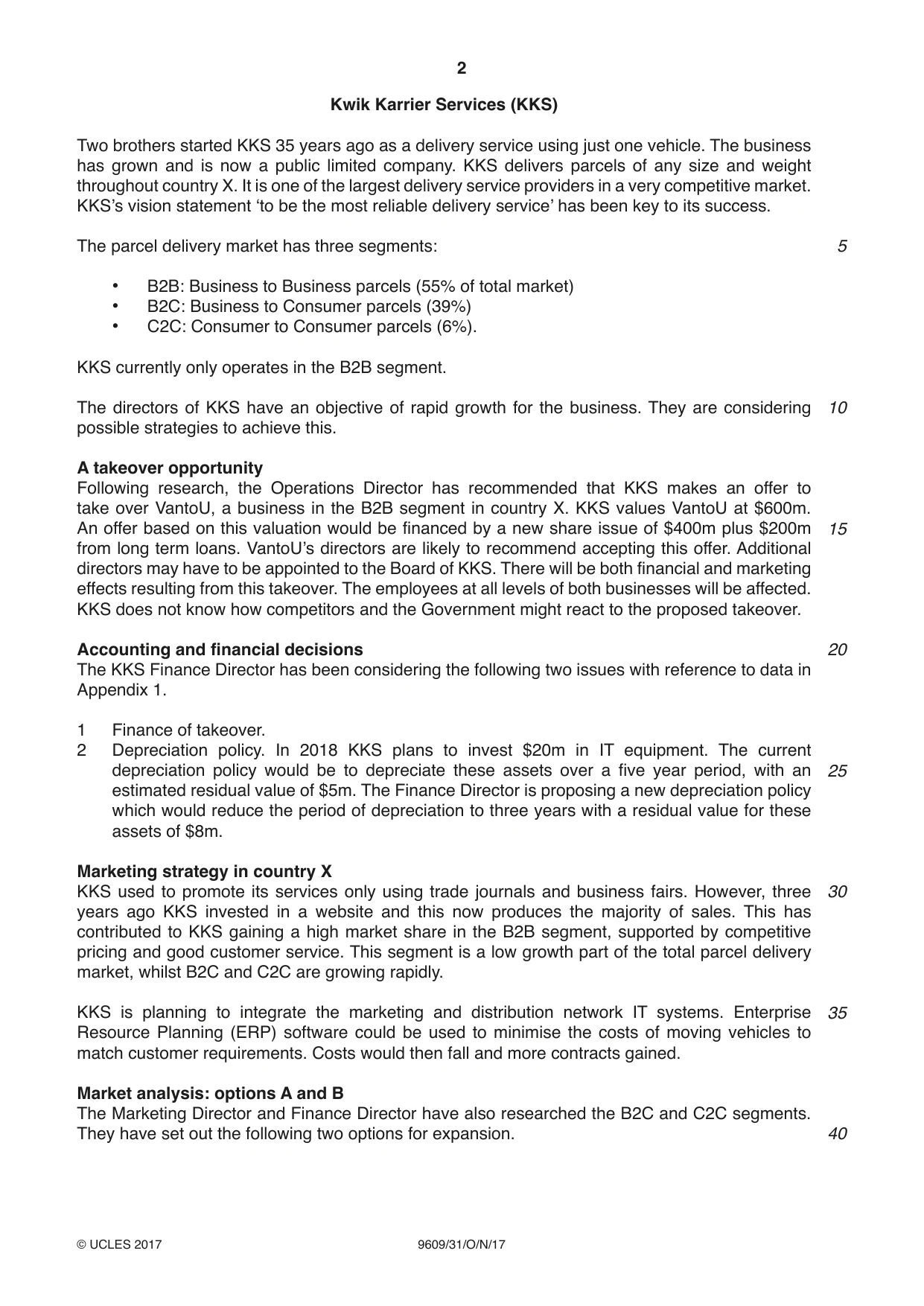
2 9609/31/O/N/17 © UCLES 2017 Kwik Karrier Services (KKS) Two brothers started KKS 35 years ago as a delivery service using just one vehicle. The business has grown and is now a public limited company. KKS delivers parcels of any size and weight throughout country X. It is one of the largest delivery service providers in a very competitive market. KKS’s vision statement ‘to be the most reliable delivery service’ has been key to its success. The parcel delivery market has three segments: • B2B: Business to Business parcels (55% of total market) • B2C: Business to Consumer parcels (39%) • C2C: Consumer to Consumer parcels (6%). KKS currently only operates in the B2B segment. The directors of KKS have an objective of rapid growth for the business. They are considering possible strategies to achieve this. A takeover opportunity Following research, the Operations Director has recommended that KKS makes an offer to take over VantoU, a business in the B2B segment in country X. KKS values VantoU at $600m. An offer based on this valuation would be financed by a new share issue of $400m plus $200m from long term loans. VantoU’s directors are likely to recommend accepting this offer. Additional directors may have to be appointed to the Board of KKS. There will be both financial and marketing effects resulting from this takeover. The employees at all levels of both businesses will be affected. KKS does not know how competitors and the Government might react to the proposed takeover. Accounting and financial decisions The KKS Finance Director has been considering the following two issues with reference to data in Appendix 1. 1 Finance of takeover. 2 Depreciation policy. In 2018 KKS plans to invest $20m in IT equipment. The current depreciation policy would be to depreciate these assets over a five year period, with an estimated residual value of $5m. The Finance Director is proposing a new depreciation policy which would reduce the period of depreciation to three years with a residual value for these assets of $8m. Marketing strategy in country X KKS used to promote its services only using trade journals and business fairs. However, three years ago KKS invested in a website and this now produces the majority of sales. This has contributed to KKS gaining a high market share in the B2B segment, supported by competitive pricing and good customer service. This segment is a low growth part of the total parcel delivery market, whilst B2C and C2C are growing rapidly. KKS is planning to integrate the marketing and distribution network IT systems. Enterprise Resource Planning (ERP) software could be used to minimise the costs of moving vehicles to match customer requirements. Costs would then fall and more contracts gained. Market analysis: options A and B The Marketing Director and Finance Director have also researched the B2C and C2C segments. They have set out the following two options for expansion. 5 10 15 20 25 30 35 40
Question paper, page 3
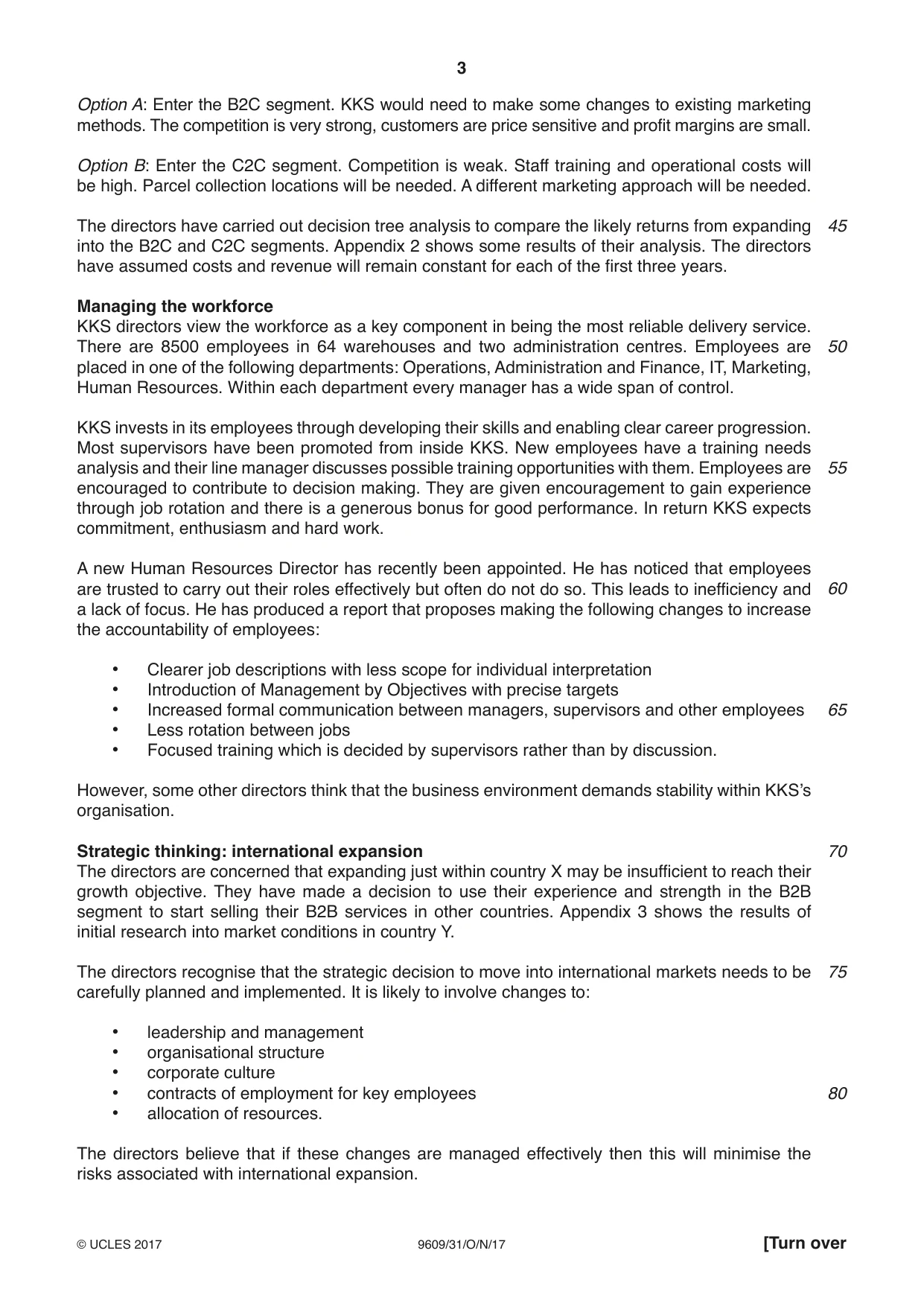
3 9609/31/O/N/17 © UCLES 2017 [Turn over Option A: Enter the B2C segment. KKS would need to make some changes to existing marketing methods. The competition is very strong, customers are price sensitive and profit margins are small. Option B: Enter the C2C segment. Competition is weak. Staff training and operational costs will be high. Parcel collection locations will be needed. A different marketing approach will be needed. The directors have carried out decision tree analysis to compare the likely returns from expanding into the B2C and C2C segments. Appendix 2 shows some results of their analysis. The directors have assumed costs and revenue will remain constant for each of the first three years. Managing the workforce KKS directors view the workforce as a key component in being the most reliable delivery service. There are 8500 employees in 64 warehouses and two administration centres. Employees are placed in one of the following departments: Operations, Administration and Finance, IT, Marketing, Human Resources. Within each department every manager has a wide span of control. KKS invests in its employees through developing their skills and enabling clear career progression. Most supervisors have been promoted from inside KKS. New employees have a training needs analysis and their line manager discusses possible training opportunities with them. Employees are encouraged to contribute to decision making. They are given encouragement to gain experience through job rotation and there is a generous bonus for good performance. In return KKS expects commitment, enthusiasm and hard work. A new Human Resources Director has recently been appointed. He has noticed that employees are trusted to carry out their roles effectively but often do not do so. This leads to inefficiency and a lack of focus. He has produced a report that proposes making the following changes to increase the accountability of employees: • Clearer job descriptions with less scope for individual interpretation • Introduction of Management by Objectives with precise targets • Increased formal communication between managers, supervisors and other employees • Less rotation between jobs • Focused training which is decided by supervisors rather than by discussion. However, some other directors think that the business environment demands stability within KKS’s organisation. Strategic thinking: international expansion The directors are concerned that expanding just within country X may be insufficient to reach their growth objective. They have made a decision to use their experience and strength in the B2B segment to start selling their B2B services in other countries. Appendix 3 shows the results of initial research into market conditions in country Y. The directors recognise that the strategic decision to move into international markets needs to be carefully planned and implemented. It is likely to involve changes to: • leadership and management • organisational structure • corporate culture • contracts of employment for key employees • allocation of resources. The directors believe that if these changes are managed effectively then this will minimise the risks associated with international expansion. 45 50 55 60 65 70 75 80
Question paper, page 4
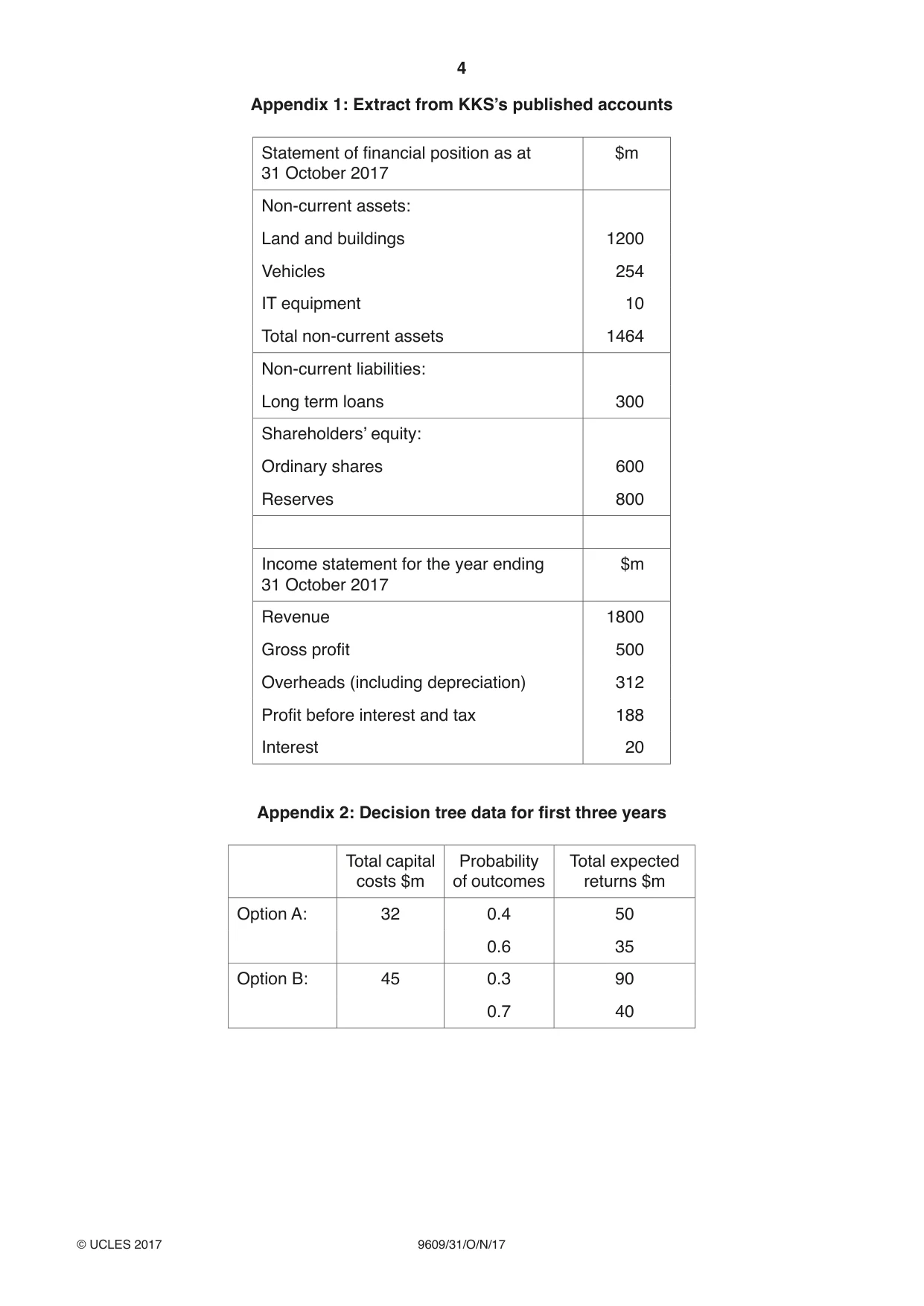
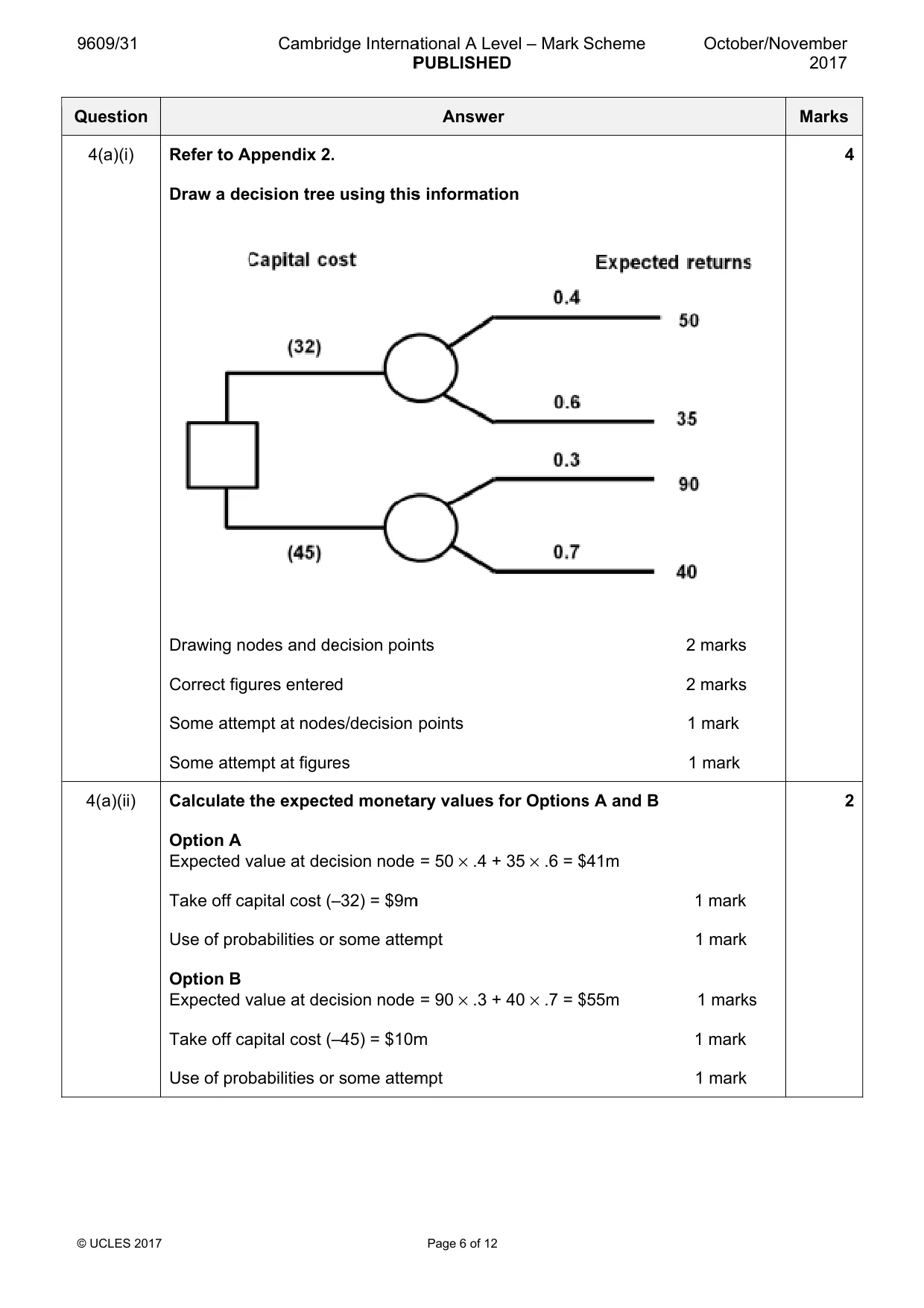
4 9609/31/O/N/17 © UCLES 2017 Appendix 1: Extract from KKS’s published accounts Statement of financial position as at 31 October 2017 $m Non-current assets: Land and buildings 1200 Vehicles 254 IT equipment 10 Total non-current assets 1464 Non-current liabilities: Long term loans 300 Shareholders’ equity: Ordinary shares 600 Reserves 800 Income statement for the year ending 31 October 2017 $m Revenue 1800 Gross profit 500 Overheads (including depreciation) 312 Profit before interest and tax 188 Interest 20 Appendix 2: Decision tree data for first three years Total capital costs $m Probability of outcomes Total expected returns $m Option A: 32 0.4 50 0.6 35 Option B: 45 0.3 90 0.7 40
Question paper, page 5
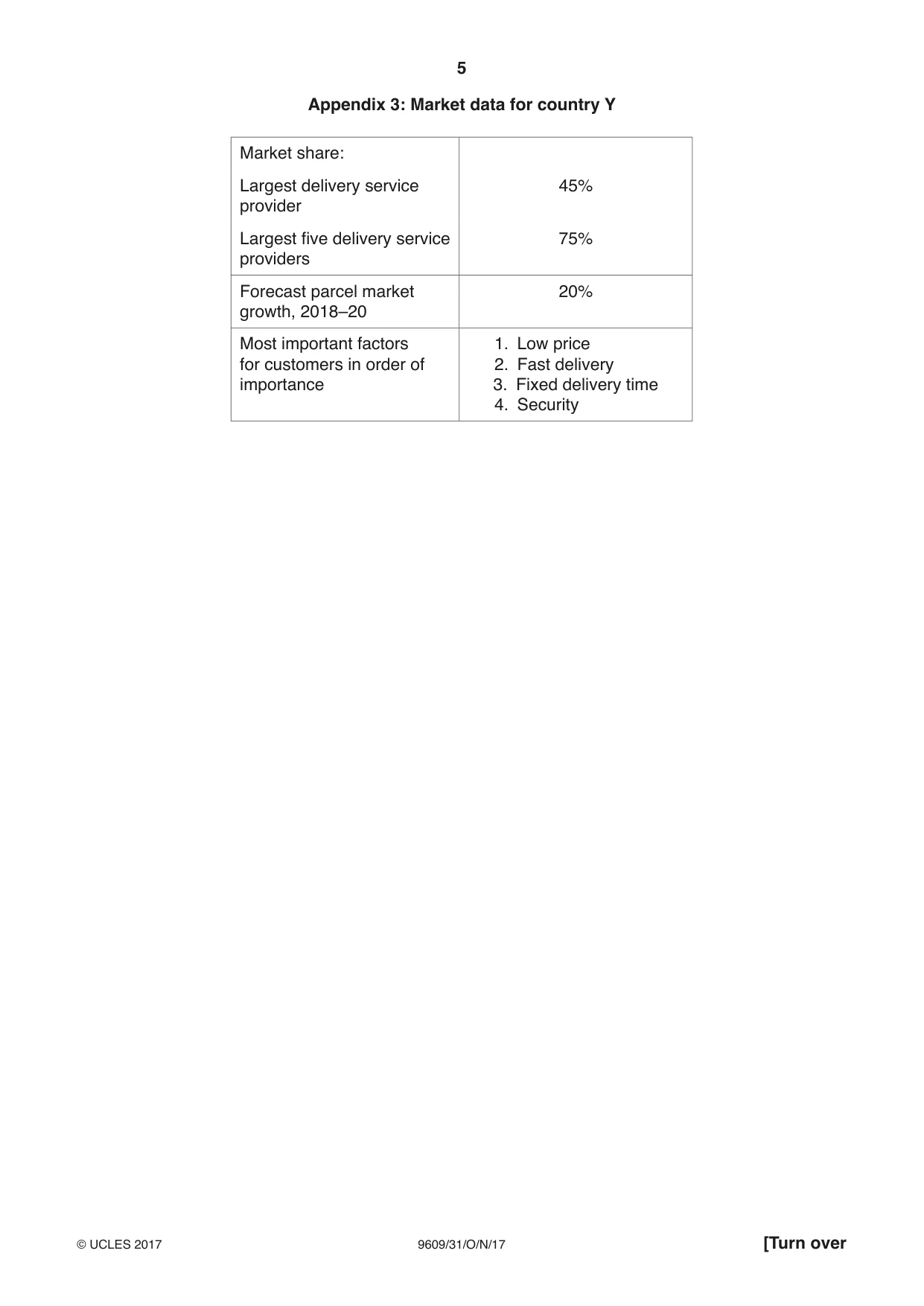
5 9609/31/O/N/17 © UCLES 2017 [Turn over Appendix 3: Market data for country Y Market share: Largest delivery service provider 45% Largest five delivery service providers 75% Forecast parcel market growth, 2018–20 20% Most important factors for customers in order of importance 1. Low price 2. Fast delivery 3. Fixed delivery time 4. Security
Question paper, page 6
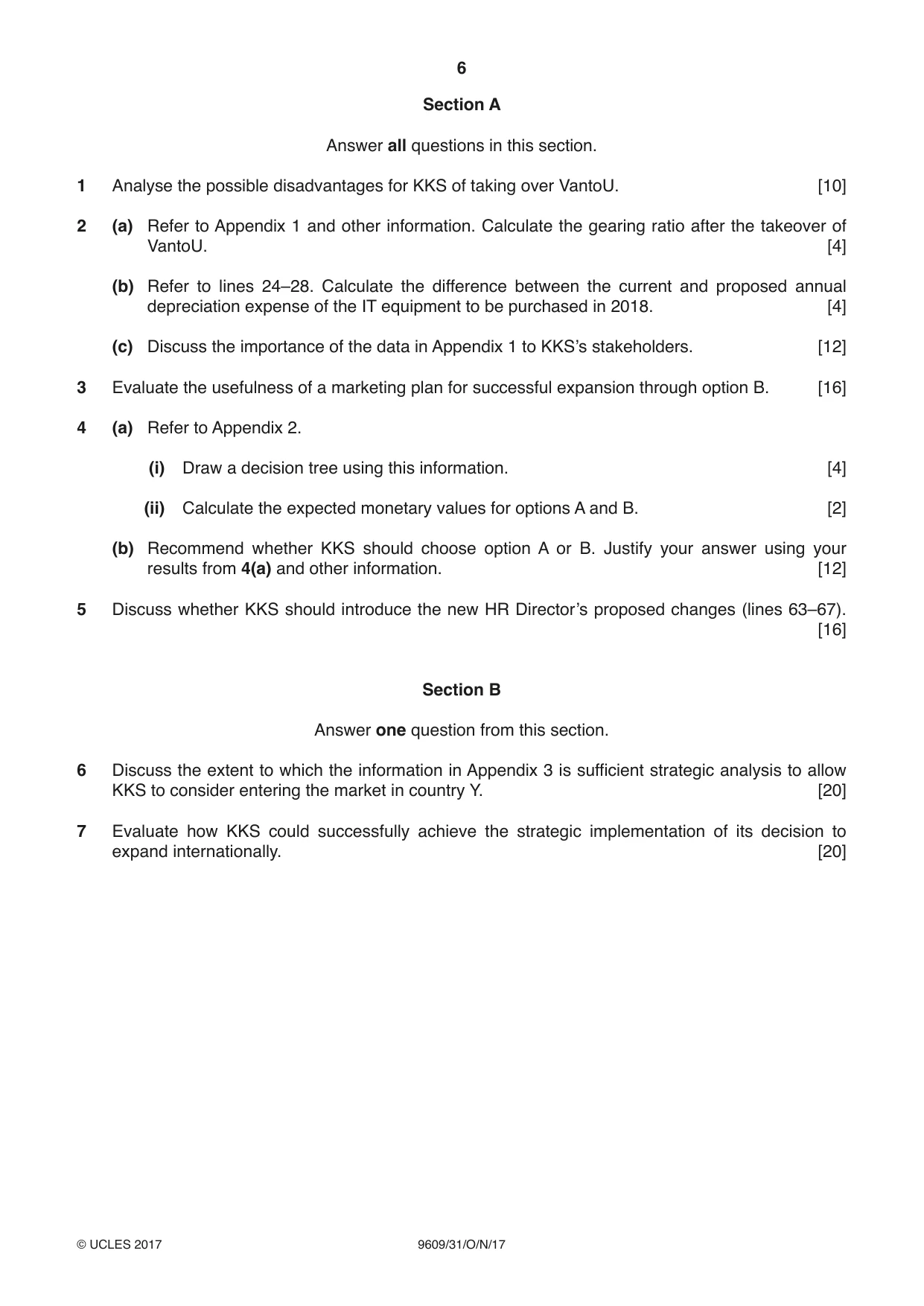
6 9609/31/O/N/17 © UCLES 2017 Section A Answer all questions in this section. 1 Analyse the possible disadvantages for KKS of taking over VantoU. [10] 2 (a) Refer to Appendix 1 and other information. Calculate the gearing ratio after the takeover of VantoU. [4] (b) Refer to lines 24–28. Calculate the difference between the current and proposed annual depreciation expense of the IT equipment to be purchased in 2018. [4] (c) Discuss the importance of the data in Appendix 1 to KKS’s stakeholders. [12] 3 Evaluate the usefulness of a marketing plan for successful expansion through option B. [16] 4 (a) Refer to Appendix 2. (i) Draw a decision tree using this information. [4] (ii) Calculate the expected monetary values for options A and B. [2] (b) Recommend whether KKS should choose option A or B. Justify your answer using your results from 4(a) and other information. [12] 5 Discuss whether KKS should introduce the new HR Director’s proposed changes (lines 63–67). [16] Section B Answer one question from this section. 6 Discuss the extent to which the information in Appendix 3 is sufficient strategic analysis to allow KKS to consider entering the market in country Y. [20] 7 Evaluate how KKS could successfully achieve the strategic implementation of its decision to expand internationally. [20]
Question paper, page 7
7 9609/31/O/N/17 © UCLES 2017 BLANK PAGE
Question paper, page 8
8 9609/31/O/N/17 © UCLES 2017 Permission to reproduce items where third-party owned material protected by copyright is included has been sought and cleared where possible. Every reasonable effort has been made by the publisher (UCLES) to trace copyright holders, but if any items requiring clearance have unwittingly been included, the publisher will be pleased to make amends at the earliest possible opportunity. To avoid the issue of disclosure of answer-related information to candidates, all copyright acknowledgements are reproduced online in the Cambridge International Examinations Copyright Acknowledgements Booklet. This is produced for each series of examinations and is freely available to download at www.cie.org.uk after the live examination series. Cambridge International Examinations is part of the Cambridge Assessment Group. Cambridge Assessment is the brand name of University of Cambridge Local Examinations Syndicate (UCLES), which is itself a department of the University of Cambridge. BLANK PAGE
Mark scheme, page 1
® IGCSE is a registered trademark. This document consists of 12 printed pages. © UCLES 2017 [Turn over Cambridge Assessment International Education Cambridge International Advanced Level BUSINESS 9609/31 Paper 3 Case Study October/November 2017 MARK SCHEME Maximum Mark: 100 Published This mark scheme is published as an aid to teachers and candidates, to indicate the requirements of the examination. It shows the basis on which Examiners were instructed to award marks. It does not indicate the details of the discussions that took place at an Examiners’ meeting before marking began, which would have considered the acceptability of alternative answers. Mark schemes should be read in conjunction with the question paper and the Principal Examiner Report for Teachers. Cambridge International will not enter into discussions about these mark schemes. Cambridge International is publishing the mark schemes for the October/November 2017 series for most Cambridge IGCSE®, Cambridge International A and AS Level components and some Cambridge O Level components.
Mark scheme, page 2
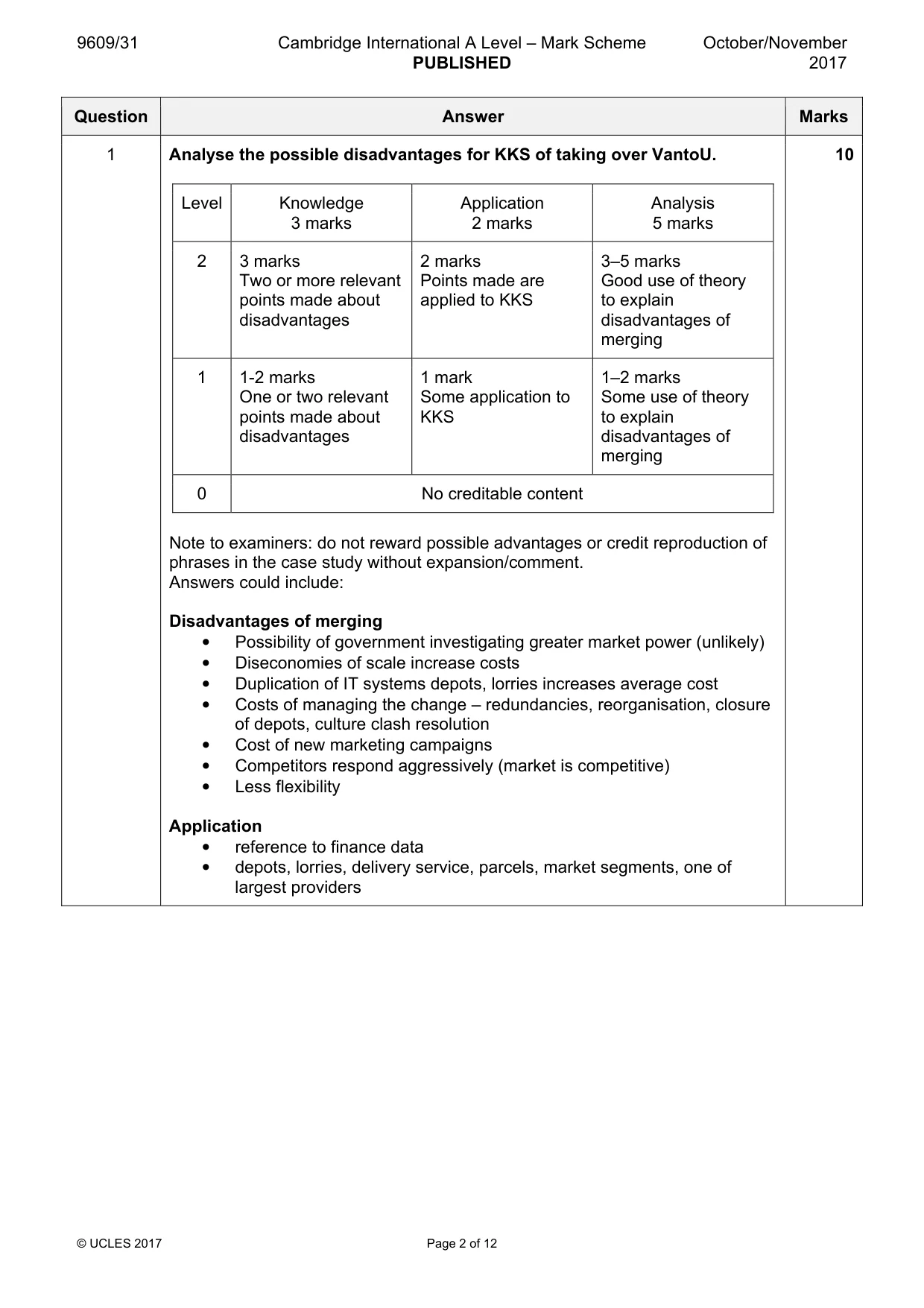
9609/31 Cambridge International A Level – Mark Scheme PUBLISHED October/November 2017 © UCLES 2017 Page 2 of 12 Question Answer Marks 1 Analyse the possible disadvantages for KKS of taking over VantoU. Level Knowledge 3 marks Application 2 marks Analysis 5 marks 2 3 marks Two or more relevant points made about disadvantages 2 marks Points made are applied to KKS 3–5 marks Good use of theory to explain disadvantages of merging 1 1-2 marks One or two relevant points made about disadvantages 1 mark Some application to KKS 1–2 marks Some use of theory to explain disadvantages of merging 0 No creditable content Note to examiners: do not reward possible advantages or credit reproduction of phrases in the case study without expansion/comment. Answers could include: Disadvantages of merging • Possibility of government investigating greater market power (unlikely) • Diseconomies of scale increase costs • Duplication of IT systems depots, lorries increases average cost • Costs of managing the change – redundancies, reorganisation, closure of depots, culture clash resolution • Cost of new marketing campaigns • Competitors respond aggressively (market is competitive) • Less flexibility Application • reference to finance data • depots, lorries, delivery service, parcels, market segments, one of largest providers 10
Mark scheme, page 3
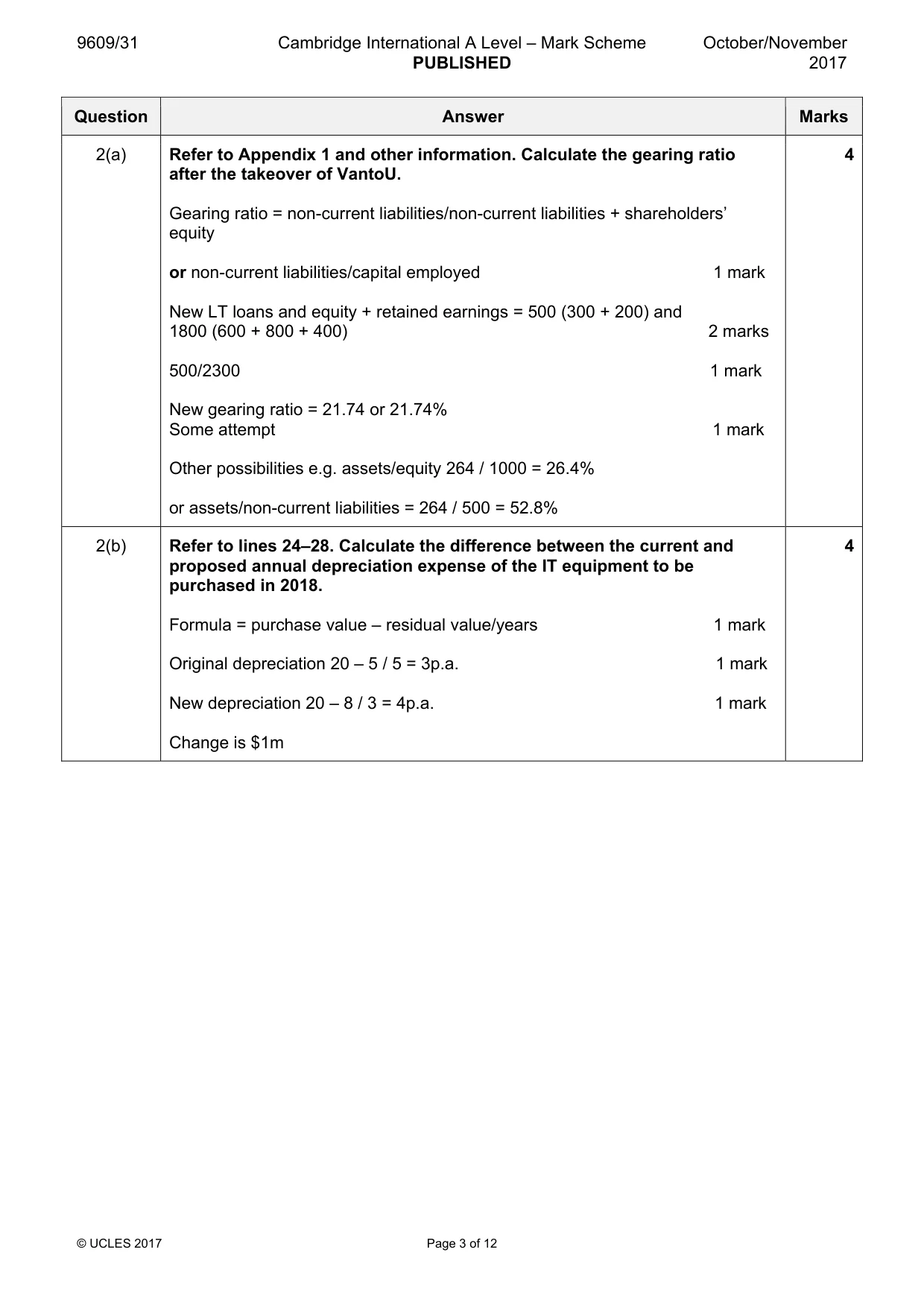
9609/31 Cambridge International A Level – Mark Scheme PUBLISHED October/November 2017 © UCLES 2017 Page 3 of 12 Question Answer Marks 2(a) Refer to Appendix 1 and other information. Calculate the gearing ratio after the takeover of VantoU. Gearing ratio = non-current liabilities/non-current liabilities + shareholders’ equity or non-current liabilities/capital employed 1 mark New LT loans and equity + retained earnings = 500 (300 + 200) and 1800 (600 + 800 + 400) 2 marks 500/2300 1 mark New gearing ratio = 21.74 or 21.74% Some attempt 1 mark Other possibilities e.g. assets/equity 264 / 1000 = 26.4% or assets/non-current liabilities = 264 / 500 = 52.8% 4 2(b) Refer to lines 24–28. Calculate the difference between the current and proposed annual depreciation expense of the IT equipment to be purchased in 2018. Formula = purchase value – residual value/years 1 mark Original depreciation 20 – 5 / 5 = 3p.a. 1 mark New depreciation 20 – 8 / 3 = 4p.a. 1 mark Change is $1m 4
Mark scheme, page 4
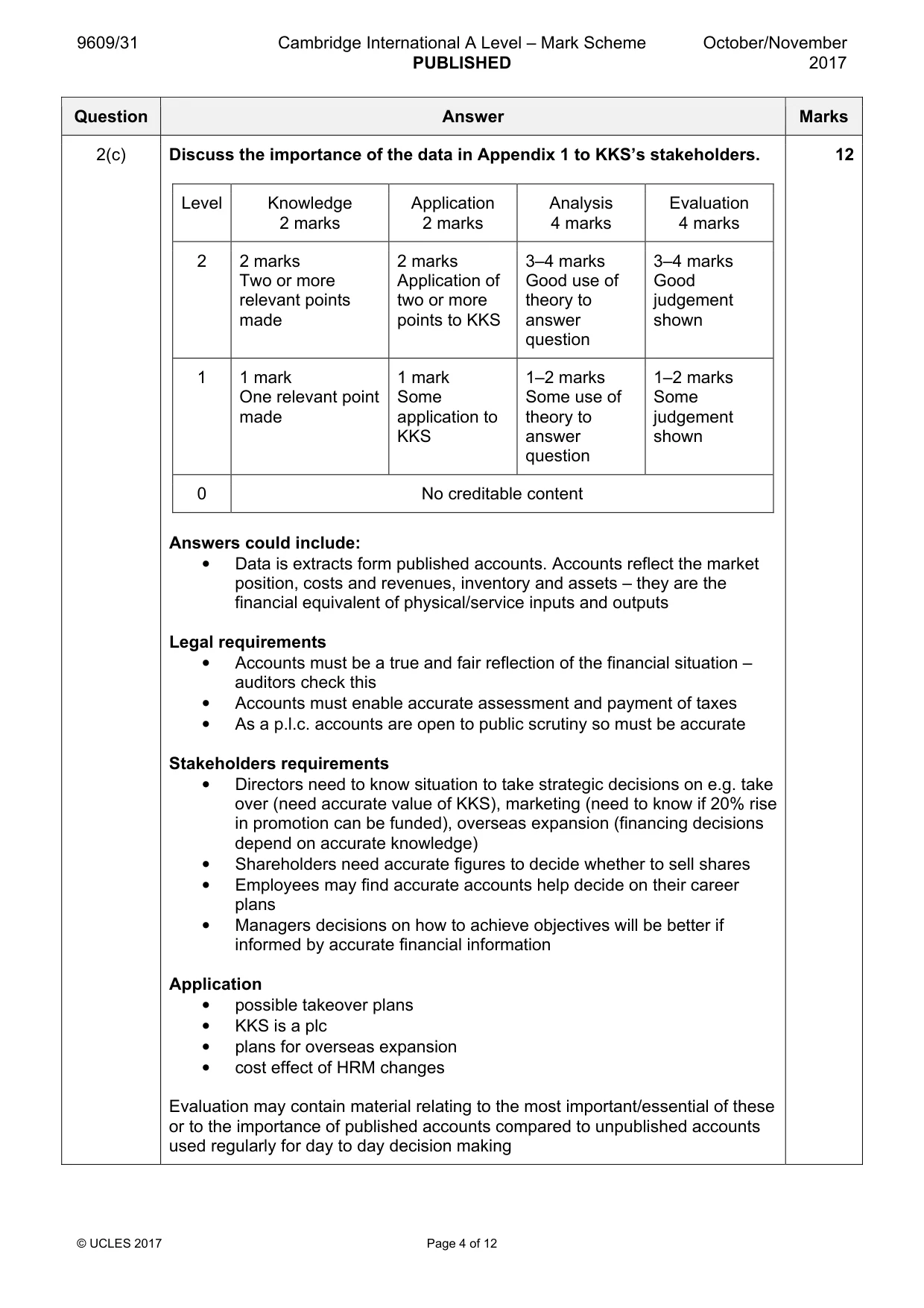
9609/31 Cambridge International A Level – Mark Scheme PUBLISHED October/November 2017 © UCLES 2017 Page 4 of 12 Question Answer Marks 2(c) Discuss the importance of the data in Appendix 1 to KKS’s stakeholders. Level Knowledge 2 marks Application 2 marks Analysis 4 marks Evaluation 4 marks 2 2 marks Two or more relevant points made 2 marks Application of two or more points to KKS 3–4 marks Good use of theory to answer question 3–4 marks Good judgement shown 1 1 mark One relevant point made 1 mark Some application to KKS 1–2 marks Some use of theory to answer question 1–2 marks Some judgement shown 0 No creditable content Answers could include: • Data is extracts form published accounts. Accounts reflect the market position, costs and revenues, inventory and assets – they are the financial equivalent of physical/service inputs and outputs Legal requirements • Accounts must be a true and fair reflection of the financial situation – auditors check this • Accounts must enable accurate assessment and payment of taxes • As a p.l.c. accounts are open to public scrutiny so must be accurate Stakeholders requirements • Directors need to know situation to take strategic decisions on e.g. take over (need accurate value of KKS), marketing (need to know if 20% rise in promotion can be funded), overseas expansion (financing decisions depend on accurate knowledge) • Shareholders need accurate figures to decide whether to sell shares • Employees may find accurate accounts help decide on their career plans • Managers decisions on how to achieve objectives will be better if informed by accurate financial information Application • possible takeover plans • KKS is a plc • plans for overseas expansion • cost effect of HRM changes Evaluation may contain material relating to the most important/essential of these or to the importance of published accounts compared to unpublished accounts used regularly for day to day decision making 12
Mark scheme, page 5
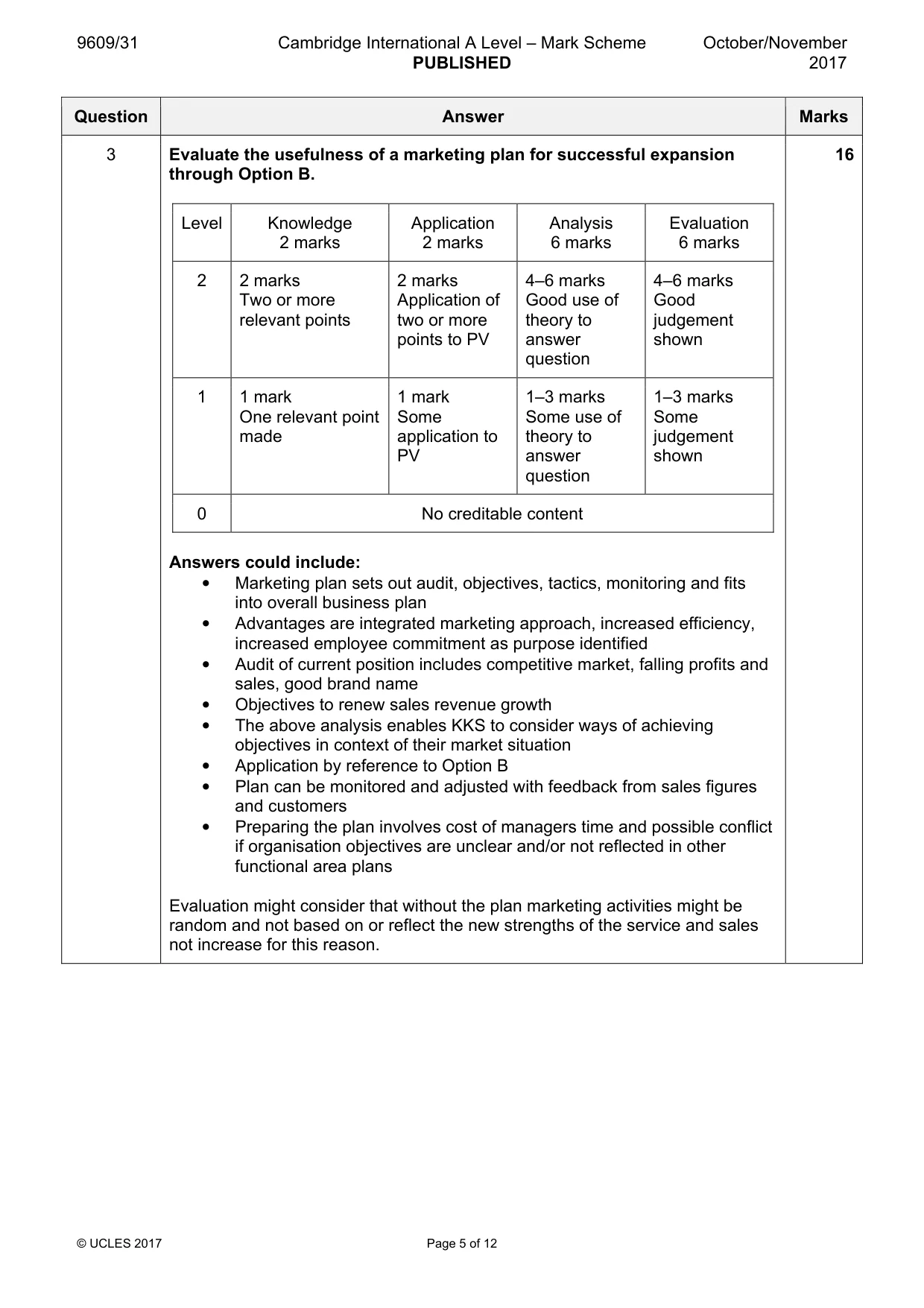
9609/31 Cambridge International A Level – Mark Scheme PUBLISHED October/November 2017 © UCLES 2017 Page 5 of 12 Question Answer Marks 3 Evaluate the usefulness of a marketing plan for successful expansion through Option B. Level Knowledge 2 marks Application 2 marks Analysis 6 marks Evaluation 6 marks 2 2 marks Two or more relevant points 2 marks Application of two or more points to PV 4–6 marks Good use of theory to answer question 4–6 marks Good judgement shown 1 1 mark One relevant point made 1 mark Some application to PV 1–3 marks Some use of theory to answer question 1–3 marks Some judgement shown 0 No creditable content Answers could include: • Marketing plan sets out audit, objectives, tactics, monitoring and fits into overall business plan • Advantages are integrated marketing approach, increased efficiency, increased employee commitment as purpose identified • Audit of current position includes competitive market, falling profits and sales, good brand name • Objectives to renew sales revenue growth • The above analysis enables KKS to consider ways of achieving objectives in context of their market situation • Application by reference to Option B • Plan can be monitored and adjusted with feedback from sales figures and customers • Preparing the plan involves cost of managers time and possible conflict if organisation objectives are unclear and/or not reflected in other functional area plans Evaluation might consider that without the plan marketing activities might be random and not based on or reflect the new strengths of the service and sales not increase for this reason. 16
Mark scheme, page 6
9 © Q 9609/31 © UCLES 2017 Question 4(a)(i) 4(a)(ii) Refer to A Draw a de Drawing no Correct figu Some attem Some attem Calculate t Option A Expected v Take off ca Use of prob Option B Expected v Take off ca Use of prob Cambrid Appendix 2. cision tree odes and de ures entere mpt at node mpt at figure the expect value at dec apital cost (– babilities or value at dec apital cost (– babilities or dge Interna P e using this ecision poin d es/decision es ed moneta cision node –32) = $9m r some attem cision node –45) = $10m r some attem ational A Lev PUBLISHED Page 6 of 12 Answer s informatio nts points ary values f = 50 × .4 + m mpt = 90 × .3 + m mpt vel – Mark D r on for Options 35 × .6 = $ 40 × .7 = $ Scheme s A and B $41m $55m Octobe 2 marks 2 marks 1 mark 1 mark 1 mark 1 mark 1 marks 1 mark 1 mark er/Novembe 201 Mark s er 17 ks 4 2
Mark scheme, page 7
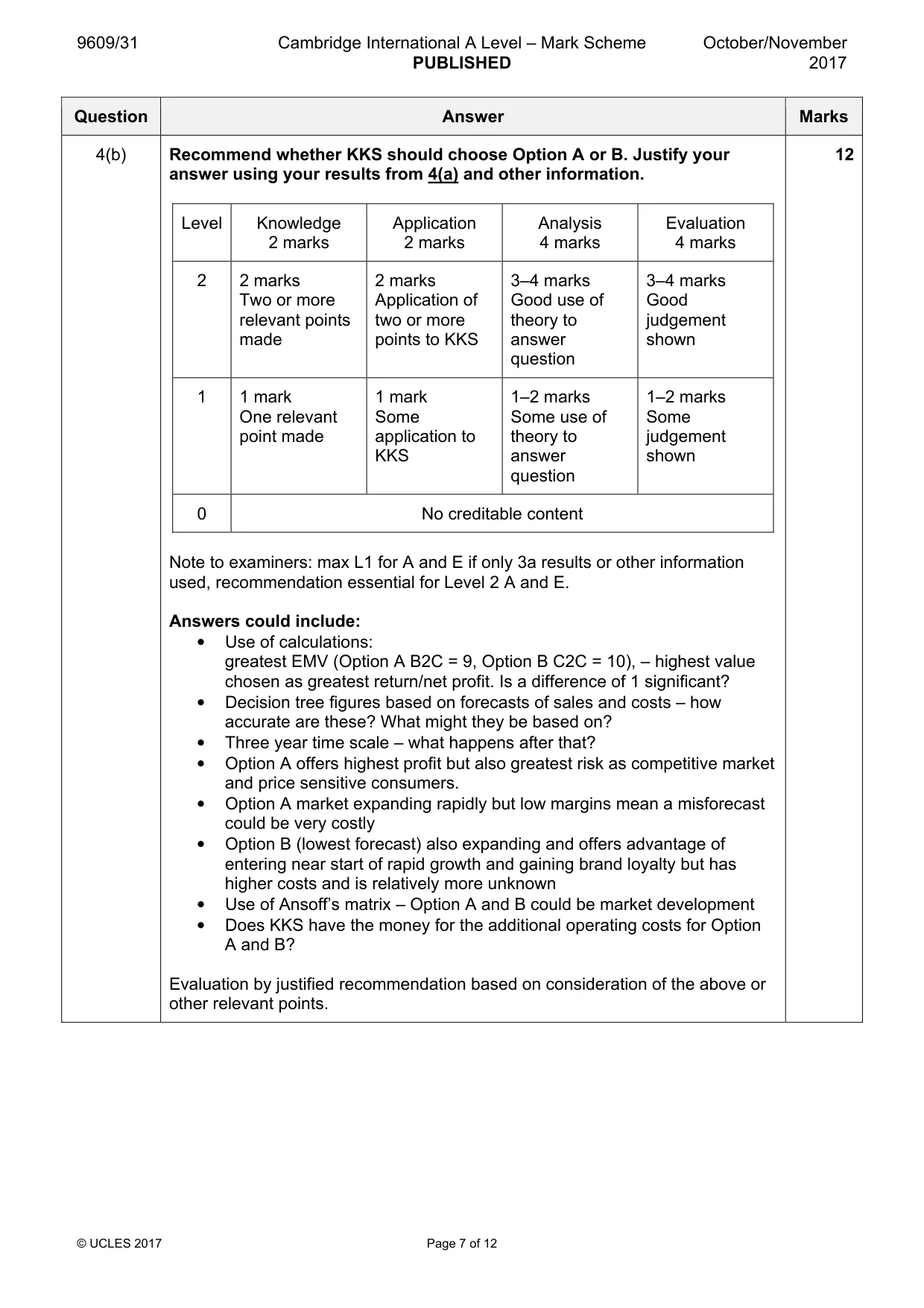
9609/31 Cambridge International A Level – Mark Scheme PUBLISHED October/November 2017 © UCLES 2017 Page 7 of 12 Question Answer Marks 4(b) Recommend whether KKS should choose Option A or B. Justify your answer using your results from 4(a) and other information. Level Knowledge 2 marks Application 2 marks Analysis 4 marks Evaluation 4 marks 2 2 marks Two or more relevant points made 2 marks Application of two or more points to KKS 3–4 marks Good use of theory to answer question 3–4 marks Good judgement shown 1 1 mark One relevant point made 1 mark Some application to KKS 1–2 marks Some use of theory to answer question 1–2 marks Some judgement shown 0 No creditable content Note to examiners: max L1 for A and E if only 3a results or other information used, recommendation essential for Level 2 A and E. Answers could include: • Use of calculations: greatest EMV (Option A B2C = 9, Option B C2C = 10), – highest value chosen as greatest return/net profit. Is a difference of 1 significant? • Decision tree figures based on forecasts of sales and costs – how accurate are these? What might they be based on? • Three year time scale – what happens after that? • Option A offers highest profit but also greatest risk as competitive market and price sensitive consumers. • Option A market expanding rapidly but low margins mean a misforecast could be very costly • Option B (lowest forecast) also expanding and offers advantage of entering near start of rapid growth and gaining brand loyalty but has higher costs and is relatively more unknown • Use of Ansoff’s matrix – Option A and B could be market development • Does KKS have the money for the additional operating costs for Option A and B? Evaluation by justified recommendation based on consideration of the above or other relevant points. 12
Mark scheme, page 8
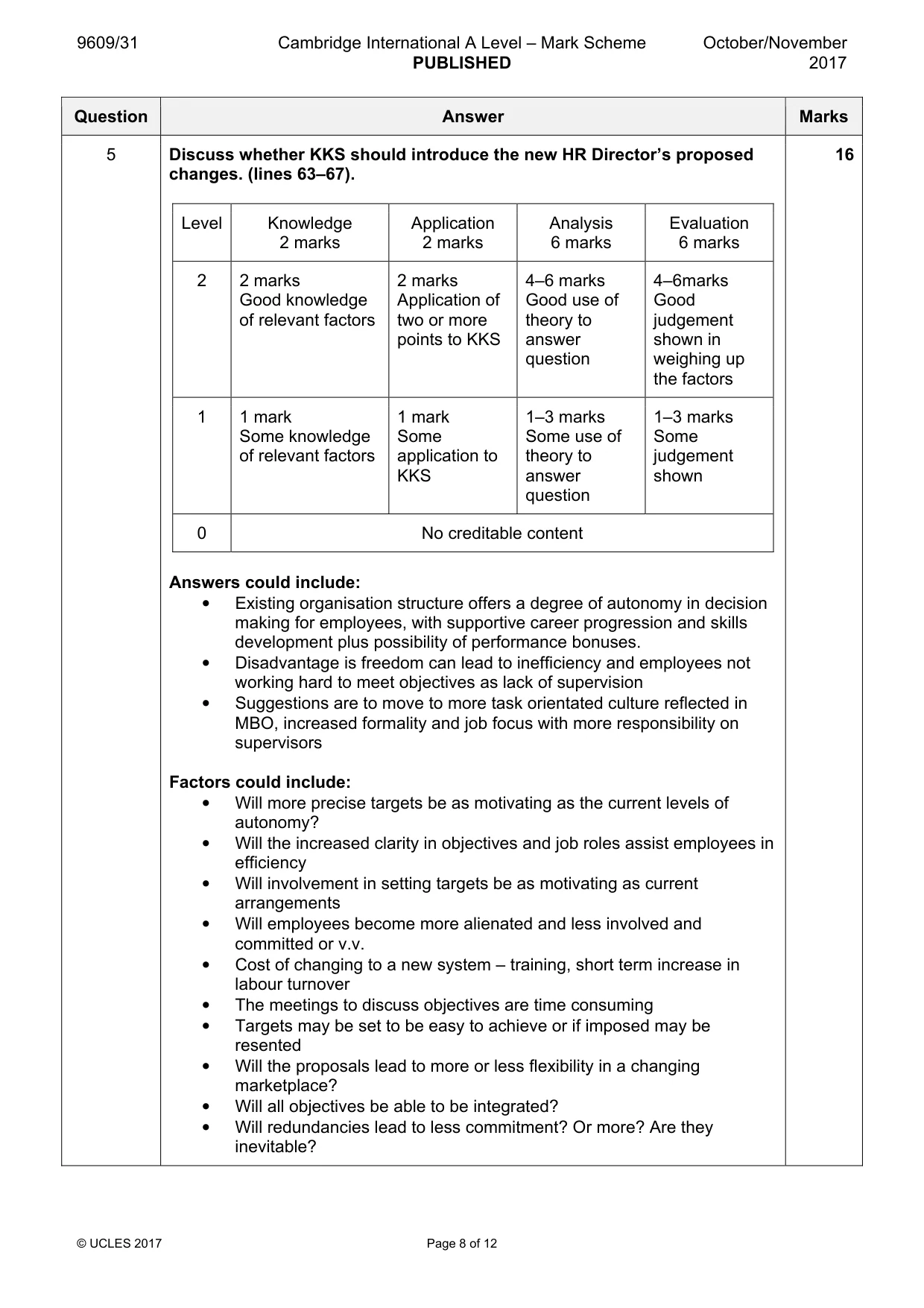
9609/31 Cambridge International A Level – Mark Scheme PUBLISHED October/November 2017 © UCLES 2017 Page 8 of 12 Question Answer Marks 5 Discuss whether KKS should introduce the new HR Director’s proposed changes. (lines 63–67). Level Knowledge 2 marks Application 2 marks Analysis 6 marks Evaluation 6 marks 2 2 marks Good knowledge of relevant factors 2 marks Application of two or more points to KKS 4–6 marks Good use of theory to answer question 4–6marks Good judgement shown in weighing up the factors 1 1 mark Some knowledge of relevant factors 1 mark Some application to KKS 1–3 marks Some use of theory to answer question 1–3 marks Some judgement shown 0 No creditable content Answers could include: • Existing organisation structure offers a degree of autonomy in decision making for employees, with supportive career progression and skills development plus possibility of performance bonuses. • Disadvantage is freedom can lead to inefficiency and employees not working hard to meet objectives as lack of supervision • Suggestions are to move to more task orientated culture reflected in MBO, increased formality and job focus with more responsibility on supervisors Factors could include: • Will more precise targets be as motivating as the current levels of autonomy? • Will the increased clarity in objectives and job roles assist employees in efficiency • Will involvement in setting targets be as motivating as current arrangements • Will employees become more alienated and less involved and committed or v.v. • Cost of changing to a new system – training, short term increase in labour turnover • The meetings to discuss objectives are time consuming • Targets may be set to be easy to achieve or if imposed may be resented • Will the proposals lead to more or less flexibility in a changing marketplace? • Will all objectives be able to be integrated? • Will redundancies lead to less commitment? Or more? Are they inevitable? 16
Mark scheme, page 9
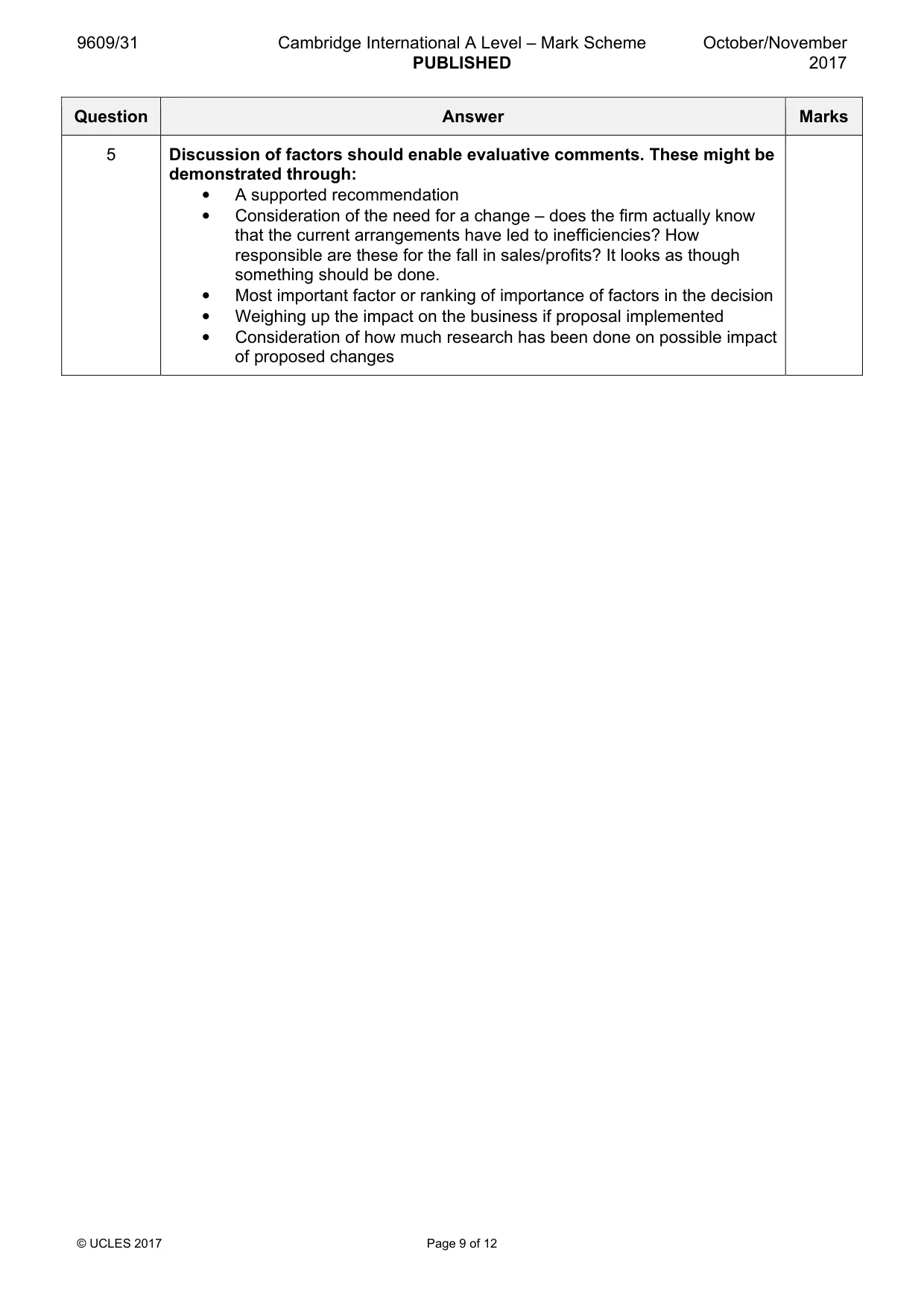
9609/31 Cambridge International A Level – Mark Scheme PUBLISHED October/November 2017 © UCLES 2017 Page 9 of 12 Question Answer Marks 5 Discussion of factors should enable evaluative comments. These might be demonstrated through: • A supported recommendation • Consideration of the need for a change – does the firm actually know that the current arrangements have led to inefficiencies? How responsible are these for the fall in sales/profits? It looks as though something should be done. • Most important factor or ranking of importance of factors in the decision • Weighing up the impact on the business if proposal implemented • Consideration of how much research has been done on possible impact of proposed changes
Mark scheme, page 10
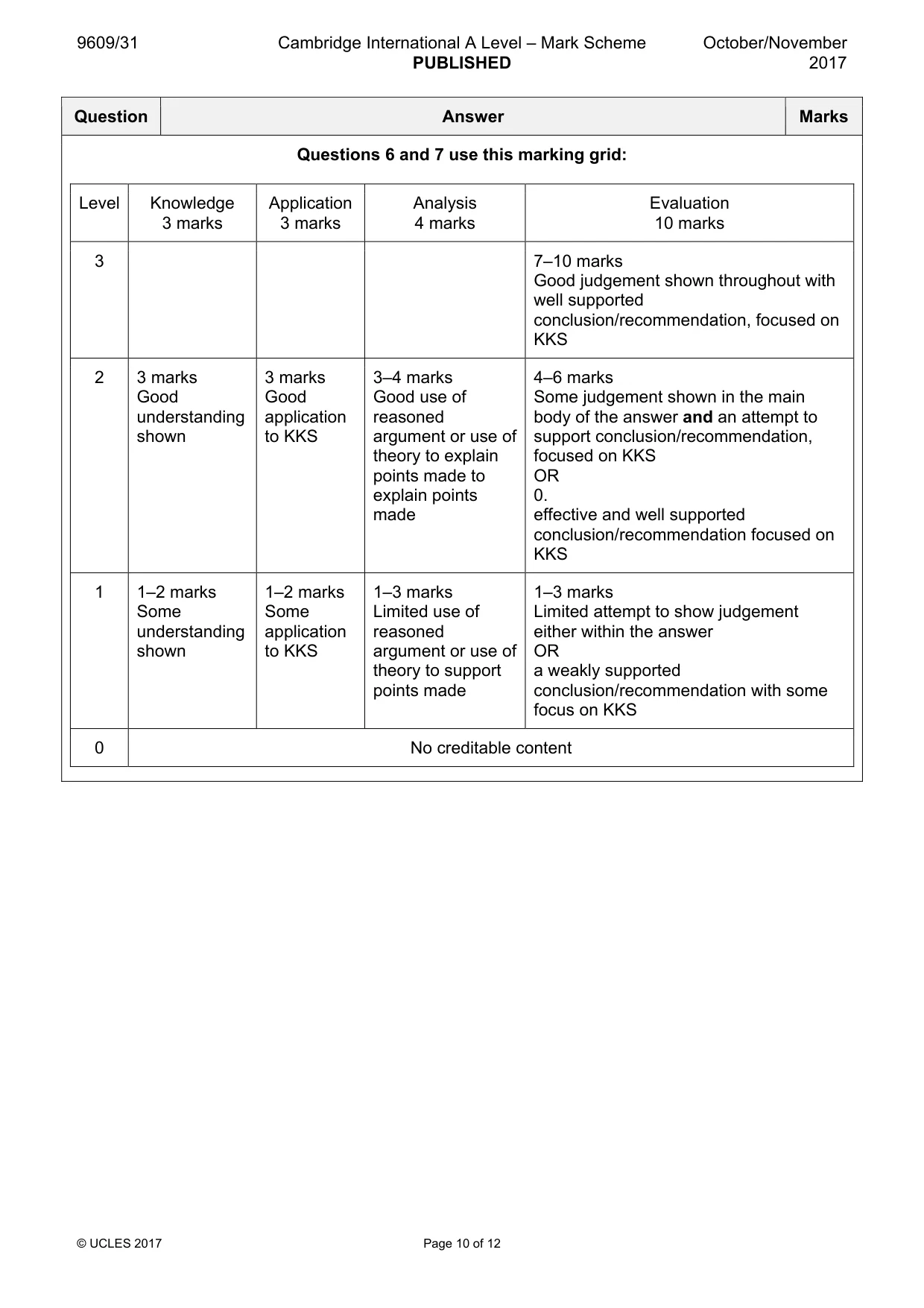
9609/31 Cambridge International A Level – Mark Scheme PUBLISHED October/November 2017 © UCLES 2017 Page 10 of 12 Question Answer Marks Questions 6 and 7 use this marking grid: Level Knowledge 3 marks Application 3 marks Analysis 4 marks Evaluation 10 marks 3 7–10 marks Good judgement shown throughout with well supported conclusion/recommendation, focused on KKS 2 3 marks Good understanding shown 3 marks Good application to KKS 3–4 marks Good use of reasoned argument or use of theory to explain points made to explain points made 4–6 marks Some judgement shown in the main body of the answer and an attempt to support conclusion/recommendation, focused on KKS OR 0. effective and well supported conclusion/recommendation focused on KKS 1 1–2 marks Some understanding shown 1–2 marks Some application to KKS 1–3 marks Limited use of reasoned argument or use of theory to support points made 1–3 marks Limited attempt to show judgement either within the answer OR a weakly supported conclusion/recommendation with some focus on KKS 0 No creditable content
Mark scheme, page 11
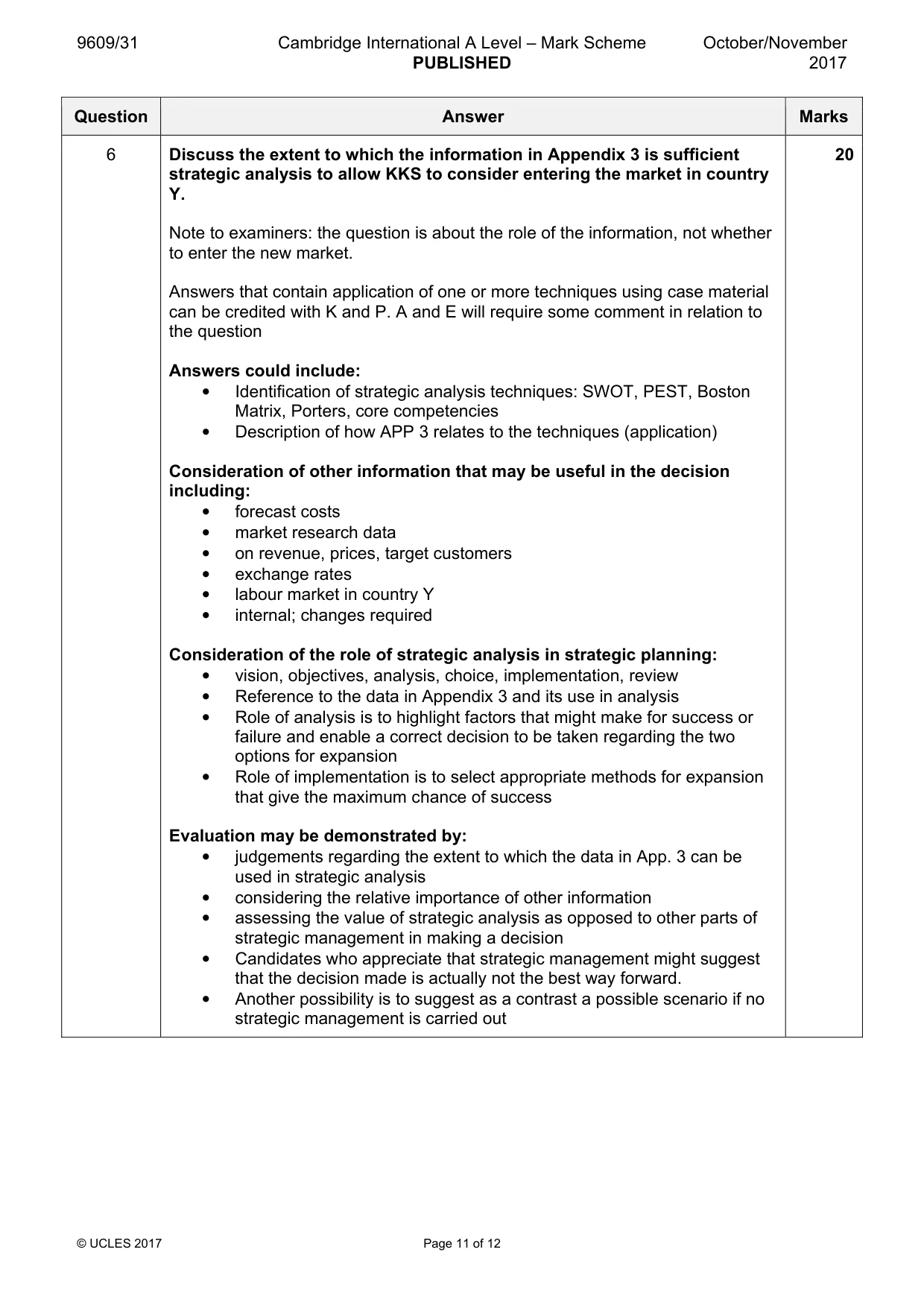
9609/31 Cambridge International A Level – Mark Scheme PUBLISHED October/November 2017 © UCLES 2017 Page 11 of 12 Question Answer Marks 6 Discuss the extent to which the information in Appendix 3 is sufficient strategic analysis to allow KKS to consider entering the market in country Y. Note to examiners: the question is about the role of the information, not whether to enter the new market. Answers that contain application of one or more techniques using case material can be credited with K and P. A and E will require some comment in relation to the question Answers could include: • Identification of strategic analysis techniques: SWOT, PEST, Boston Matrix, Porters, core competencies • Description of how APP 3 relates to the techniques (application) Consideration of other information that may be useful in the decision including: • forecast costs • market research data • on revenue, prices, target customers • exchange rates • labour market in country Y • internal; changes required Consideration of the role of strategic analysis in strategic planning: • vision, objectives, analysis, choice, implementation, review • Reference to the data in Appendix 3 and its use in analysis • Role of analysis is to highlight factors that might make for success or failure and enable a correct decision to be taken regarding the two options for expansion • Role of implementation is to select appropriate methods for expansion that give the maximum chance of success Evaluation may be demonstrated by: • judgements regarding the extent to which the data in App. 3 can be used in strategic analysis • considering the relative importance of other information • assessing the value of strategic analysis as opposed to other parts of strategic management in making a decision • Candidates who appreciate that strategic management might suggest that the decision made is actually not the best way forward. • Another possibility is to suggest as a contrast a possible scenario if no strategic management is carried out 20
Mark scheme, page 12
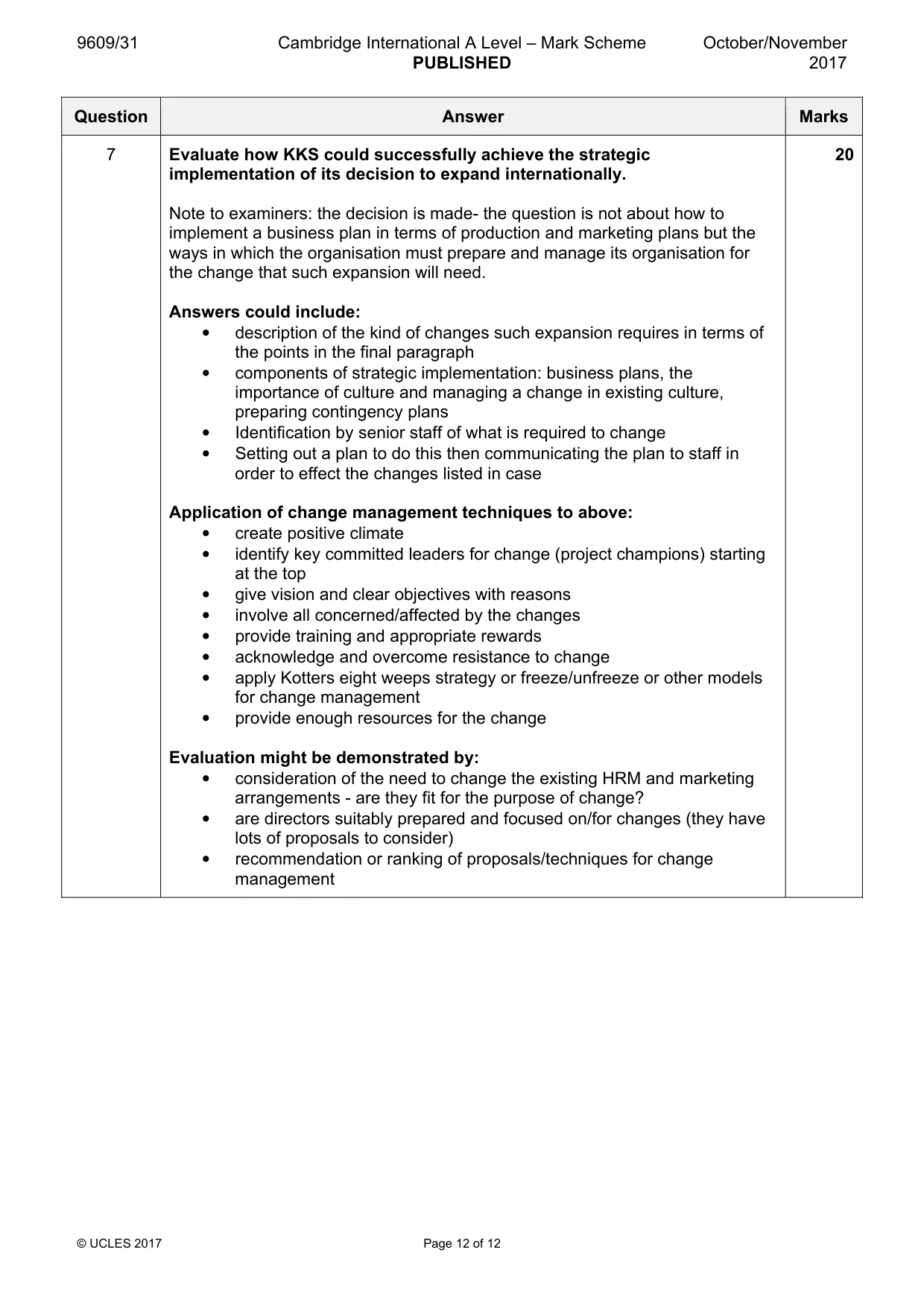
9609/31 Cambridge International A Level – Mark Scheme PUBLISHED October/November 2017 © UCLES 2017 Page 12 of 12 Question Answer Marks 7 Evaluate how KKS could successfully achieve the strategic implementation of its decision to expand internationally. Note to examiners: the decision is made- the question is not about how to implement a business plan in terms of production and marketing plans but the ways in which the organisation must prepare and manage its organisation for the change that such expansion will need. Answers could include: • description of the kind of changes such expansion requires in terms of the points in the final paragraph • components of strategic implementation: business plans, the importance of culture and managing a change in existing culture, preparing contingency plans • Identification by senior staff of what is required to change • Setting out a plan to do this then communicating the plan to staff in order to effect the changes listed in case Application of change management techniques to above: • create positive climate • identify key committed leaders for change (project champions) starting at the top • give vision and clear objectives with reasons • involve all concerned/affected by the changes • provide training and appropriate rewards • acknowledge and overcome resistance to change • apply Kotters eight weeps strategy or freeze/unfreeze or other models for change management • provide enough resources for the change Evaluation might be demonstrated by: • consideration of the need to change the existing HRM and marketing arrangements - are they fit for the purpose of change? • are directors suitably prepared and focused on/for changes (they have lots of proposals to consider) • recommendation or ranking of proposals/techniques for change management 20
What you needed in this session
Cambridge’s own grade thresholds for 2017 Oct/Nov, Paper 3 · Variant 1. A higher threshold means an easier paper — the bar moves with how the cohort did.