Cambridge A Level Business (for first examination in 2016) 9609 — 2017 Oct/Nov Paper 3 · Variant 3
9609/33/O/N/17 · 100 marks · ≈113 min
The question paper and its mark scheme, free to read here and free to download. This is Cambridge’s own paper, exactly as it was sat.
Question paper8 pages


Mark scheme13 pages
Answers below. Sit the paper first if you are practising.
Paper as text
Question paper, page 1
This document consists of 6 printed pages, 2 blank pages and 1 Insert. DC (RCL (KM)) 134597/2 © UCLES 2017 [Turn over Cambridge International Examinations Cambridge International Advanced Subsidiary and Advanced Level * 1 4 4 7 2 5 4 2 6 9 * BUSINESS 9609/33 Paper 3 Case Study October/November 2017 3 hours No Additional Materials are required. READ THESE INSTRUCTIONS FIRST An answer booklet is provided inside this question paper. You should follow the instructions on the front cover of the answer booklet. If you need additional answer paper ask the invigilator for a continuation booklet. Section A Answer all questions. Section B Answer one question. You are advised to spend no more than 40 minutes on Section B. The businesses described in this question paper are entirely fictitious. The number of marks is given in brackets [ ] at the end of each question or part question.
Question paper, page 2
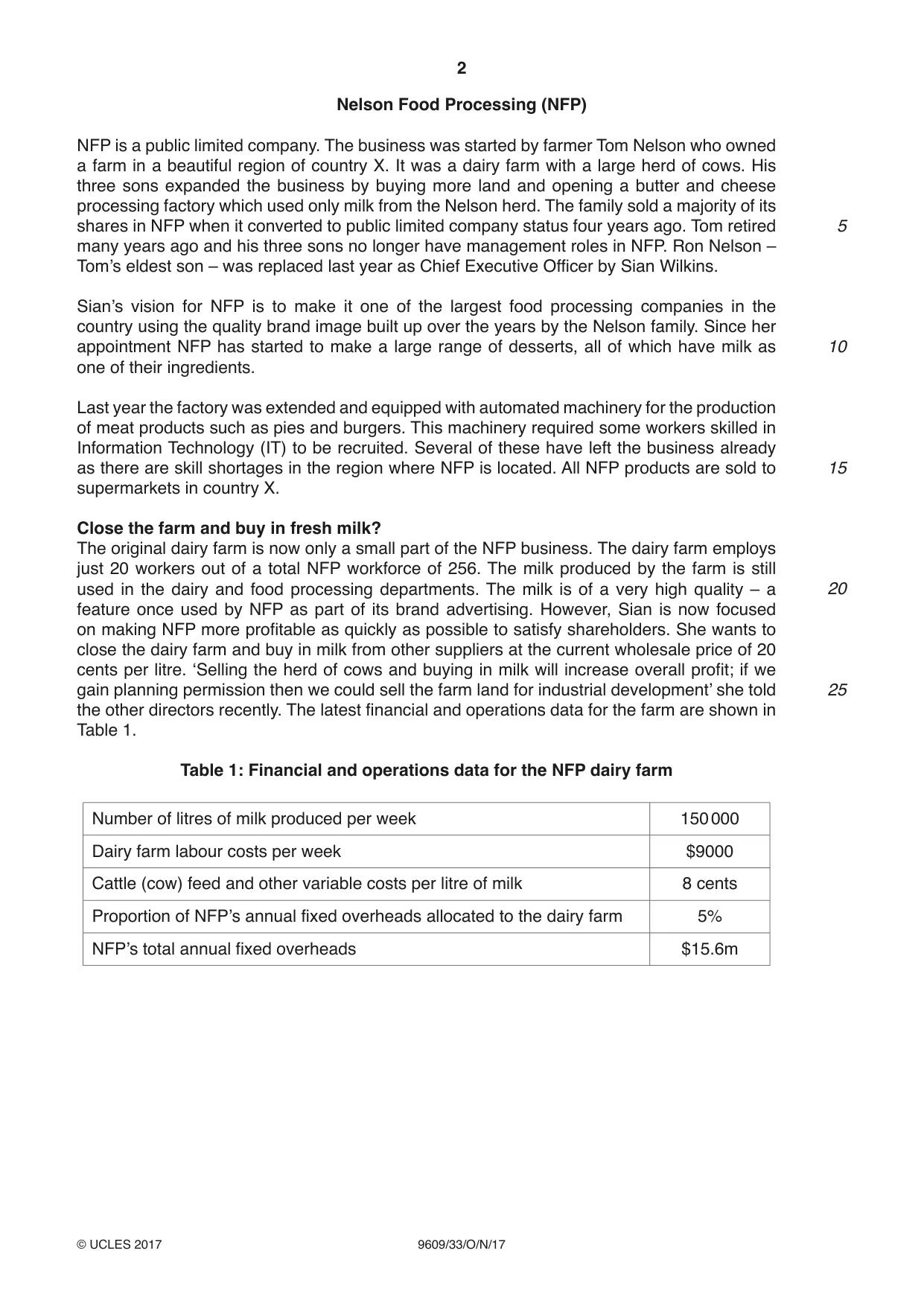
2 9609/33/O/N/17 © UCLES 2017 Nelson Food Processing (NFP) NFP is a public limited company. The business was started by farmer Tom Nelson who owned a farm in a beautiful region of country X. It was a dairy farm with a large herd of cows. His three sons expanded the business by buying more land and opening a butter and cheese processing factory which used only milk from the Nelson herd. The family sold a majority of its shares in NFP when it converted to public limited company status four years ago. Tom retired many years ago and his three sons no longer have management roles in NFP. Ron Nelson – Tom’s eldest son – was replaced last year as Chief Executive Officer by Sian Wilkins. Sian’s vision for NFP is to make it one of the largest food processing companies in the country using the quality brand image built up over the years by the Nelson family. Since her appointment NFP has started to make a large range of desserts, all of which have milk as one of their ingredients. Last year the factory was extended and equipped with automated machinery for the production of meat products such as pies and burgers. This machinery required some workers skilled in Information Technology (IT) to be recruited. Several of these have left the business already as there are skill shortages in the region where NFP is located. All NFP products are sold to supermarkets in country X. Close the farm and buy in fresh milk? The original dairy farm is now only a small part of the NFP business. The dairy farm employs just 20 workers out of a total NFP workforce of 256. The milk produced by the farm is still used in the dairy and food processing departments. The milk is of a very high quality – a feature once used by NFP as part of its brand advertising. However, Sian is now focused on making NFP more profitable as quickly as possible to satisfy shareholders. She wants to close the dairy farm and buy in milk from other suppliers at the current wholesale price of 20 cents per litre. ‘Selling the herd of cows and buying in milk will increase overall profit; if we gain planning permission then we could sell the farm land for industrial development’ she told the other directors recently. The latest financial and operations data for the farm are shown in Table 1. Table 1: Financial and operations data for the NFP dairy farm Number of litres of milk produced per week 150 000 Dairy farm labour costs per week $9000 Cattle (cow) feed and other variable costs per litre of milk 8 cents Proportion of NFP’s annual fixed overheads allocated to the dairy farm 5% NFP’s total annual fixed overheads $15.6m 5 10 15 20 25
Question paper, page 3
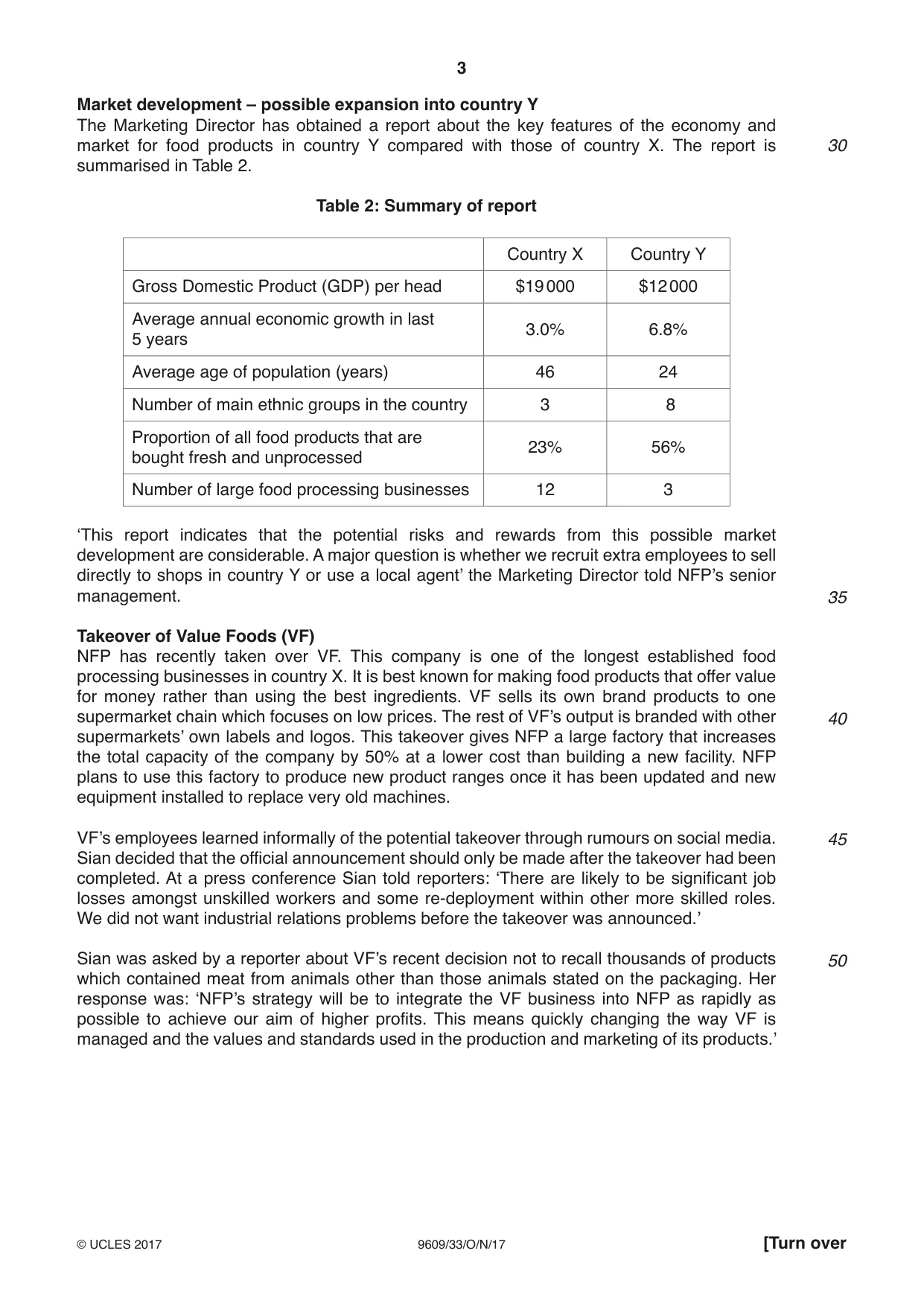
3 9609/33/O/N/17 © UCLES 2017 [Turn over Market development – possible expansion into country Y The Marketing Director has obtained a report about the key features of the economy and market for food products in country Y compared with those of country X. The report is summarised in Table 2. Table 2: Summary of report Country X Country Y Gross Domestic Product (GDP) per head $19 000 $12 000 Average annual economic growth in last 5 years 3.0% 6.8% Average age of population (years) 46 24 Number of main ethnic groups in the country 3 8 Proportion of all food products that are bought fresh and unprocessed 23% 56% Number of large food processing businesses 12 3 ‘This report indicates that the potential risks and rewards from this possible market development are considerable. A major question is whether we recruit extra employees to sell directly to shops in country Y or use a local agent’ the Marketing Director told NFP’s senior management. Takeover of Value Foods (VF) NFP has recently taken over VF. This company is one of the longest established food processing businesses in country X. It is best known for making food products that offer value for money rather than using the best ingredients. VF sells its own brand products to one supermarket chain which focuses on low prices. The rest of VF’s output is branded with other supermarkets’ own labels and logos. This takeover gives NFP a large factory that increases the total capacity of the company by 50% at a lower cost than building a new facility. NFP plans to use this factory to produce new product ranges once it has been updated and new equipment installed to replace very old machines. VF’s employees learned informally of the potential takeover through rumours on social media. Sian decided that the official announcement should only be made after the takeover had been completed. At a press conference Sian told reporters: ‘There are likely to be significant job losses amongst unskilled workers and some re-deployment within other more skilled roles. We did not want industrial relations problems before the takeover was announced.’ Sian was asked by a reporter about VF’s recent decision not to recall thousands of products which contained meat from animals other than those animals stated on the packaging. Her response was: ‘NFP’s strategy will be to integrate the VF business into NFP as rapidly as possible to achieve our aim of higher profits. This means quickly changing the way VF is managed and the values and standards used in the production and marketing of its products.’ 30 35 40 45 50
Question paper, page 4
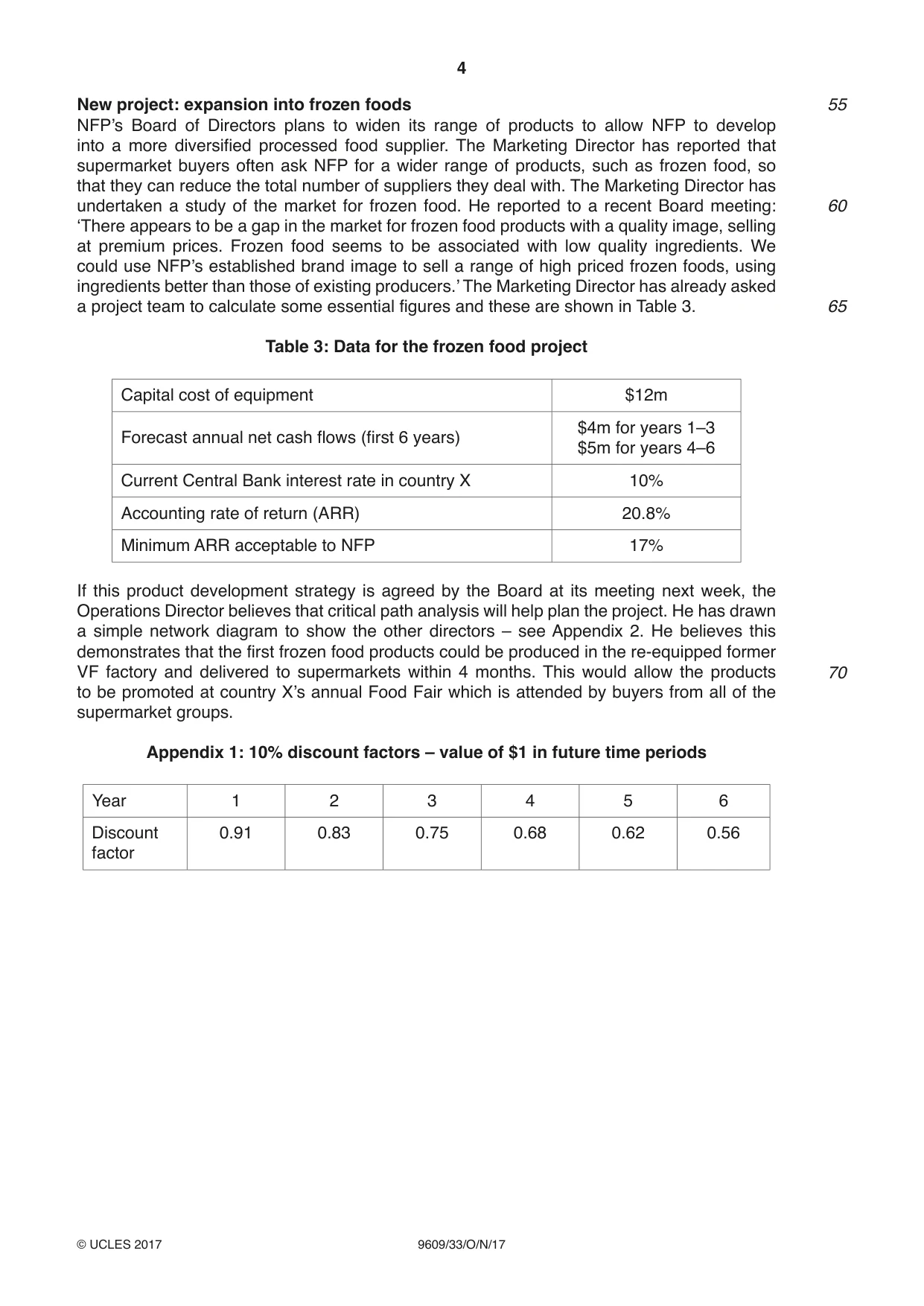
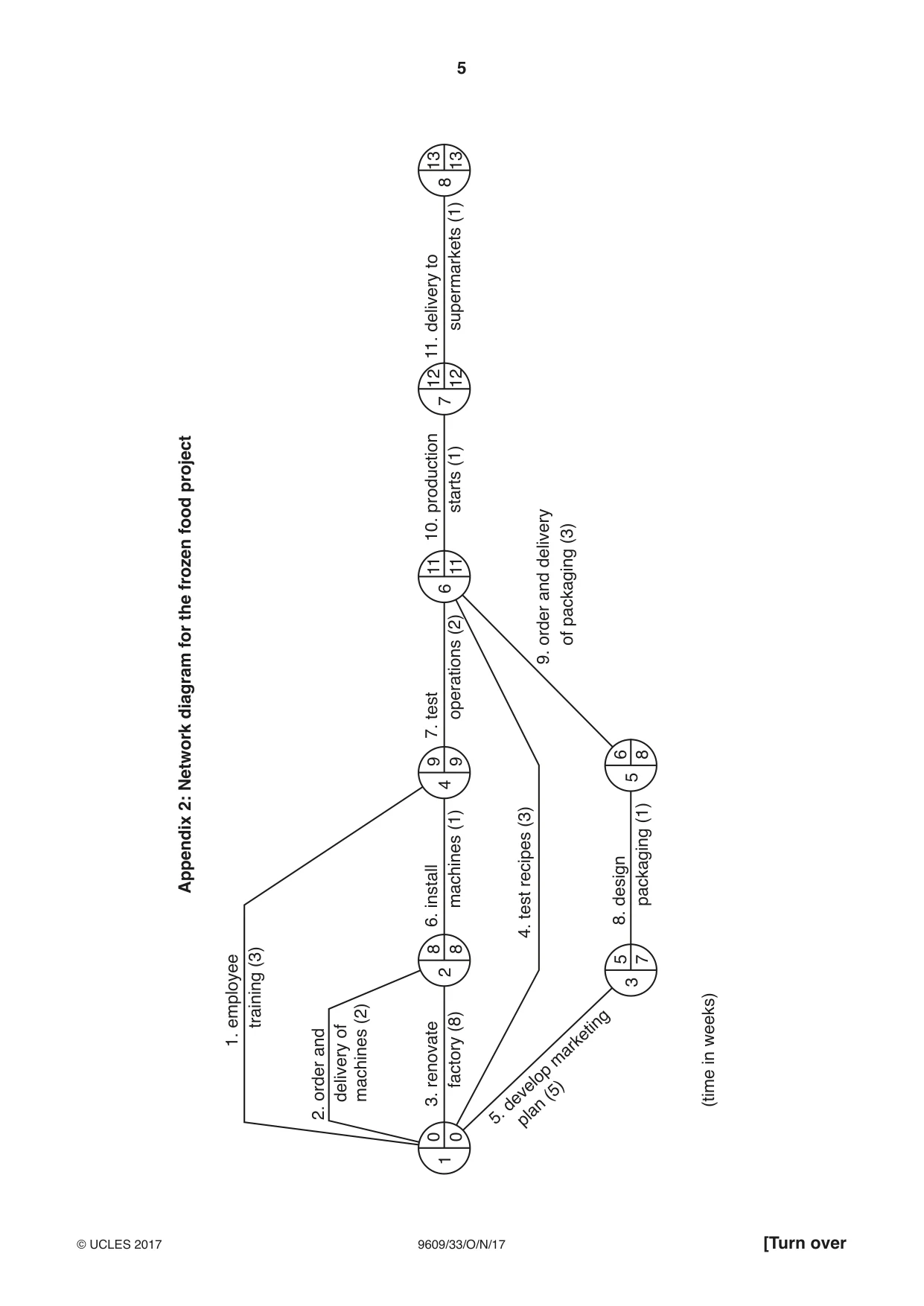
4 9609/33/O/N/17 © UCLES 2017 New project: expansion into frozen foods NFP’s Board of Directors plans to widen its range of products to allow NFP to develop into a more diversified processed food supplier. The Marketing Director has reported that supermarket buyers often ask NFP for a wider range of products, such as frozen food, so that they can reduce the total number of suppliers they deal with. The Marketing Director has undertaken a study of the market for frozen food. He reported to a recent Board meeting: ‘There appears to be a gap in the market for frozen food products with a quality image, selling at premium prices. Frozen food seems to be associated with low quality ingredients. We could use NFP’s established brand image to sell a range of high priced frozen foods, using ingredients better than those of existing producers.’ The Marketing Director has already asked a project team to calculate some essential figures and these are shown in Table 3. Table 3: Data for the frozen food project Capital cost of equipment $12m Forecast annual net cash flows (first 6 years) $4m for years 1–3 $5m for years 4–6 Current Central Bank interest rate in country X 10% Accounting rate of return (ARR) 20.8% Minimum ARR acceptable to NFP 17% If this product development strategy is agreed by the Board at its meeting next week, the Operations Director believes that critical path analysis will help plan the project. He has drawn a simple network diagram to show the other directors – see Appendix 2. He believes this demonstrates that the first frozen food products could be produced in the re-equipped former VF factory and delivered to supermarkets within 4 months. This would allow the products to be promoted at country X’s annual Food Fair which is attended by buyers from all of the supermarket groups. Appendix 1: 10% discount factors – value of $1 in future time periods Year 1 2 3 4 5 6 Discount factor 0.91 0.83 0.75 0.68 0.62 0.56 55 60 65 70
Question paper, page 5
5 9609/33/O/N/17 © UCLES 2017 [Turn over Appendix 2: Network diagram for the frozen food project 0 0 1 8 8 2 3. renovate factory (8) 2. order and delivery of machines (2) 1. employee training (3) 9. order and delivery of packaging (3) 4. test recipes (3) 8. design packaging (1) (time in weeks) 5. develop marketing plan (5) 6. install machines (1) 9 9 4 7. test operations (2) 11 11 6 6 8 5 5 7 3 10. production starts (1) 12 12 7 11. delivery to supermarkets (1) 13 13 8
Question paper, page 6
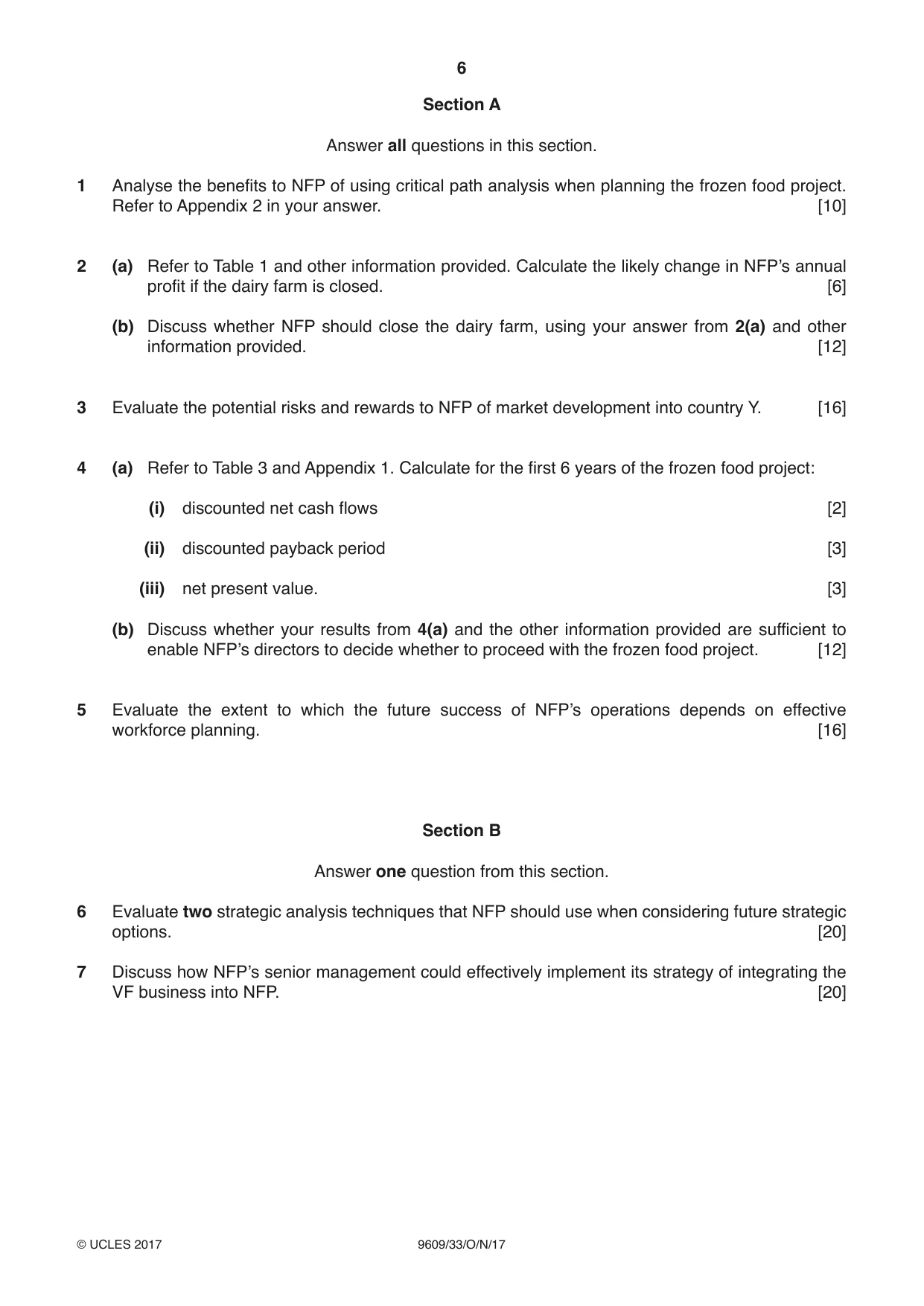
6 9609/33/O/N/17 © UCLES 2017 Section A Answer all questions in this section. 1 Analyse the benefits to NFP of using critical path analysis when planning the frozen food project. Refer to Appendix 2 in your answer. [10] 2 (a) Refer to Table 1 and other information provided. Calculate the likely change in NFP’s annual profit if the dairy farm is closed. [6] (b) Discuss whether NFP should close the dairy farm, using your answer from 2(a) and other information provided. [12] 3 Evaluate the potential risks and rewards to NFP of market development into country Y. [16] 4 (a) Refer to Table 3 and Appendix 1. Calculate for the first 6 years of the frozen food project: (i) discounted net cash flows [2] (ii) discounted payback period [3] (iii) net present value. [3] (b) Discuss whether your results from 4(a) and the other information provided are sufficient to enable NFP’s directors to decide whether to proceed with the frozen food project. [12] 5 Evaluate the extent to which the future success of NFP’s operations depends on effective workforce planning. [16] Section B Answer one question from this section. 6 Evaluate two strategic analysis techniques that NFP should use when considering future strategic options. [20] 7 Discuss how NFP’s senior management could effectively implement its strategy of integrating the VF business into NFP. [20]
Question paper, page 7
7 9609/33/O/N/17 © UCLES 2017 BLANK PAGE
Question paper, page 8
8 9609/33/O/N/17 © UCLES 2017 BLANK PAGE Permission to reproduce items where third-party owned material protected by copyright is included has been sought and cleared where possible. Every reasonable effort has been made by the publisher (UCLES) to trace copyright holders, but if any items requiring clearance have unwittingly been included, the publisher will be pleased to make amends at the earliest possible opportunity. To avoid the issue of disclosure of answer-related information to candidates, all copyright acknowledgements are reproduced online in the Cambridge International Examinations Copyright Acknowledgements Booklet. This is produced for each series of examinations and is freely available to download at www.cie.org.uk after the live examination series. Cambridge International Examinations is part of the Cambridge Assessment Group. Cambridge Assessment is the brand name of University of Cambridge Local Examinations Syndicate (UCLES), which is itself a department of the University of Cambridge.
Mark scheme, page 1
® IGCSE is a registered trademark. This document consists of 13 printed pages. © UCLES 2017 [Turn over Cambridge Assessment International Education Cambridge International Advanced Level BUSINESS 9609/33 Paper 3 Case Study October/November 2017 MARK SCHEME Maximum Mark: 100 Published This mark scheme is published as an aid to teachers and candidates, to indicate the requirements of the examination. It shows the basis on which Examiners were instructed to award marks. It does not indicate the details of the discussions that took place at an Examiners’ meeting before marking began, which would have considered the acceptability of alternative answers. Mark schemes should be read in conjunction with the question paper and the Principal Examiner Report for Teachers. Cambridge International will not enter into discussions about these mark schemes. Cambridge International is publishing the mark schemes for the October/November 2017 series for most Cambridge IGCSE®, Cambridge International A and AS Level components and some Cambridge O Level components.
Mark scheme, page 2
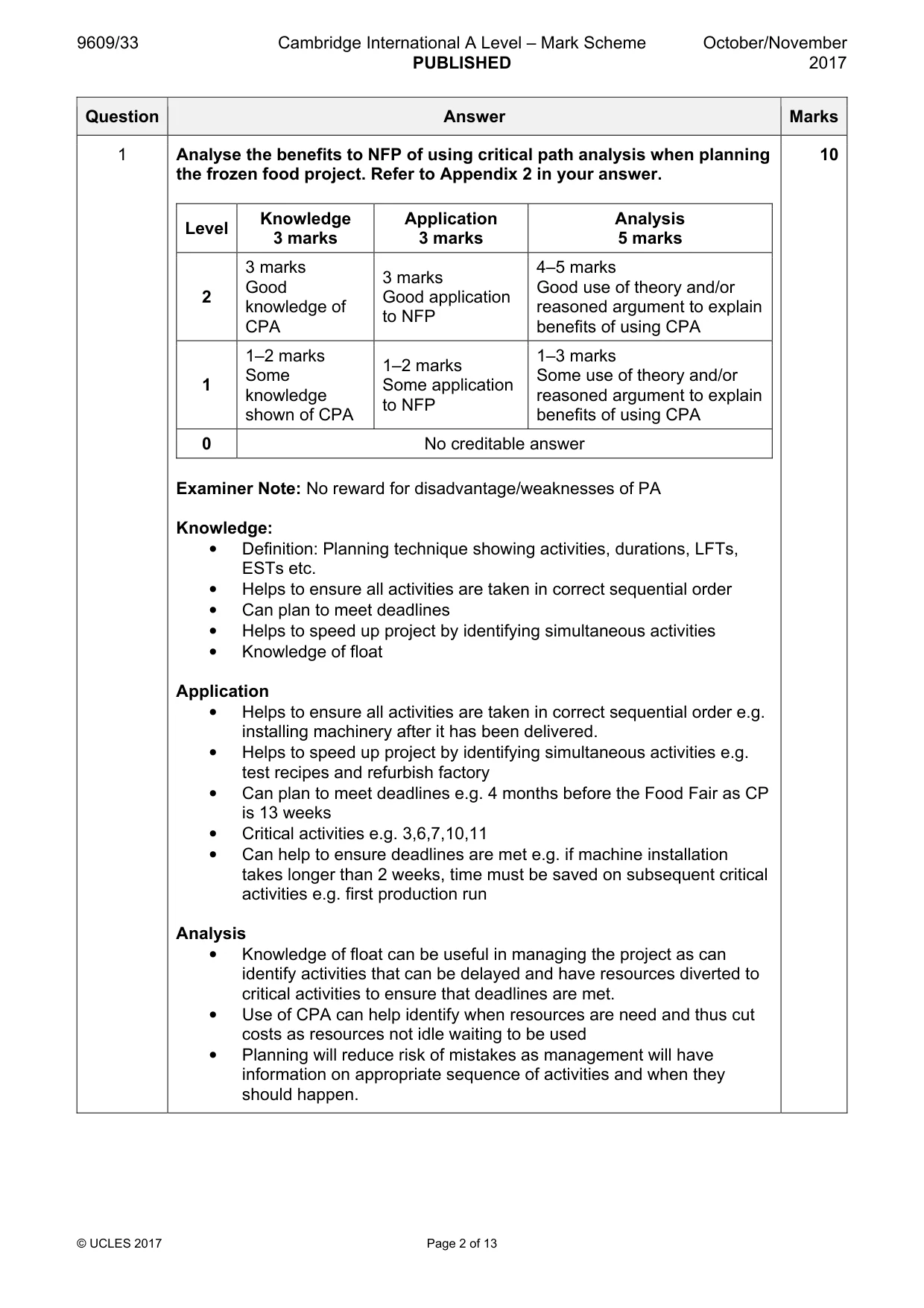
9609/33 Cambridge International A Level – Mark Scheme PUBLISHED October/November 2017 © UCLES 2017 Page 2 of 13 Question Answer Marks 1 Analyse the benefits to NFP of using critical path analysis when planning the frozen food project. Refer to Appendix 2 in your answer. Level Knowledge 3 marks Application 3 marks Analysis 5 marks 2 3 marks Good knowledge of CPA 3 marks Good application to NFP 4–5 marks Good use of theory and/or reasoned argument to explain benefits of using CPA 1 1–2 marks Some knowledge shown of CPA 1–2 marks Some application to NFP 1–3 marks Some use of theory and/or reasoned argument to explain benefits of using CPA 0 No creditable answer Examiner Note: No reward for disadvantage/weaknesses of PA Knowledge: • Definition: Planning technique showing activities, durations, LFTs, ESTs etc. • Helps to ensure all activities are taken in correct sequential order • Can plan to meet deadlines • Helps to speed up project by identifying simultaneous activities • Knowledge of float Application • Helps to ensure all activities are taken in correct sequential order e.g. installing machinery after it has been delivered. • Helps to speed up project by identifying simultaneous activities e.g. test recipes and refurbish factory • Can plan to meet deadlines e.g. 4 months before the Food Fair as CP is 13 weeks • Critical activities e.g. 3,6,7,10,11 • Can help to ensure deadlines are met e.g. if machine installation takes longer than 2 weeks, time must be saved on subsequent critical activities e.g. first production run Analysis • Knowledge of float can be useful in managing the project as can identify activities that can be delayed and have resources diverted to critical activities to ensure that deadlines are met. • Use of CPA can help identify when resources are need and thus cut costs as resources not idle waiting to be used • Planning will reduce risk of mistakes as management will have information on appropriate sequence of activities and when they should happen. 10
Mark scheme, page 3
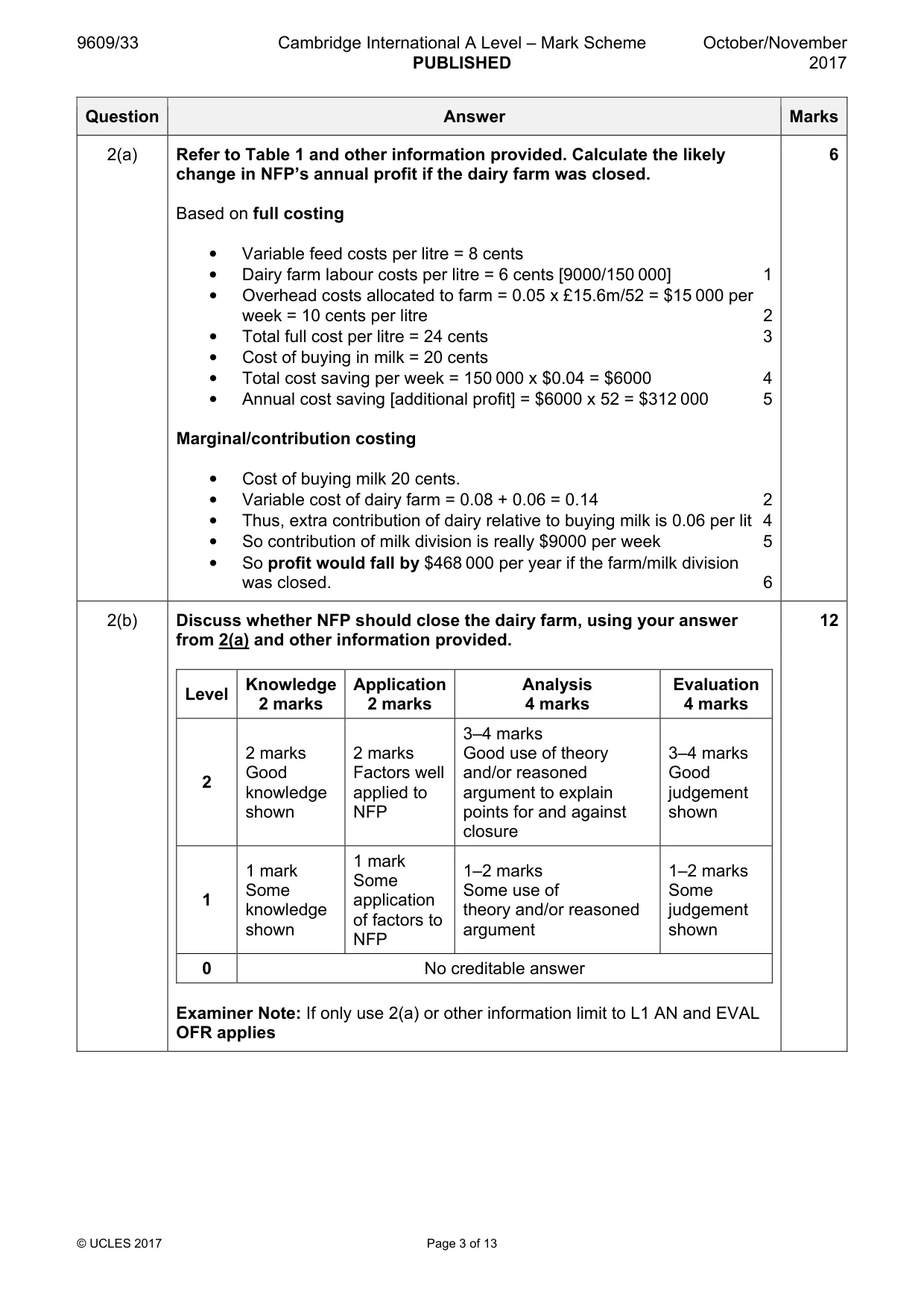
9609/33 Cambridge International A Level – Mark Scheme PUBLISHED October/November 2017 © UCLES 2017 Page 3 of 13 Question Answer Marks 2(a) Refer to Table 1 and other information provided. Calculate the likely change in NFP’s annual profit if the dairy farm was closed. Based on full costing • Variable feed costs per litre = 8 cents • Dairy farm labour costs per litre = 6 cents [9000/150 000] 1 • Overhead costs allocated to farm = 0.05 x £15.6m/52 = $15 000 per week = 10 cents per litre 2 • Total full cost per litre = 24 cents 3 • Cost of buying in milk = 20 cents • Total cost saving per week = 150 000 x $0.04 = $6000 4 • Annual cost saving [additional profit] = $6000 x 52 = $312 000 5 Marginal/contribution costing • Cost of buying milk 20 cents. • Variable cost of dairy farm = 0.08 + 0.06 = 0.14 2 • Thus, extra contribution of dairy relative to buying milk is 0.06 per lit 4 • So contribution of milk division is really $9000 per week 5 • So profit would fall by $468 000 per year if the farm/milk division was closed. 6 6 2(b) Discuss whether NFP should close the dairy farm, using your answer from 2(a) and other information provided. Level Knowledge 2 marks Application 2 marks Analysis 4 marks Evaluation 4 marks 2 2 marks Good knowledge shown 2 marks Factors well applied to NFP 3–4 marks Good use of theory and/or reasoned argument to explain points for and against closure 3–4 marks Good judgement shown 1 1 mark Some knowledge shown 1 mark Some application of factors to NFP 1–2 marks Some use of theory and/or reasoned argument 1–2 marks Some judgement shown 0 No creditable answer Examiner Note: If only use 2(a) or other information limit to L1 AN and EVAL OFR applies 12
Mark scheme, page 4
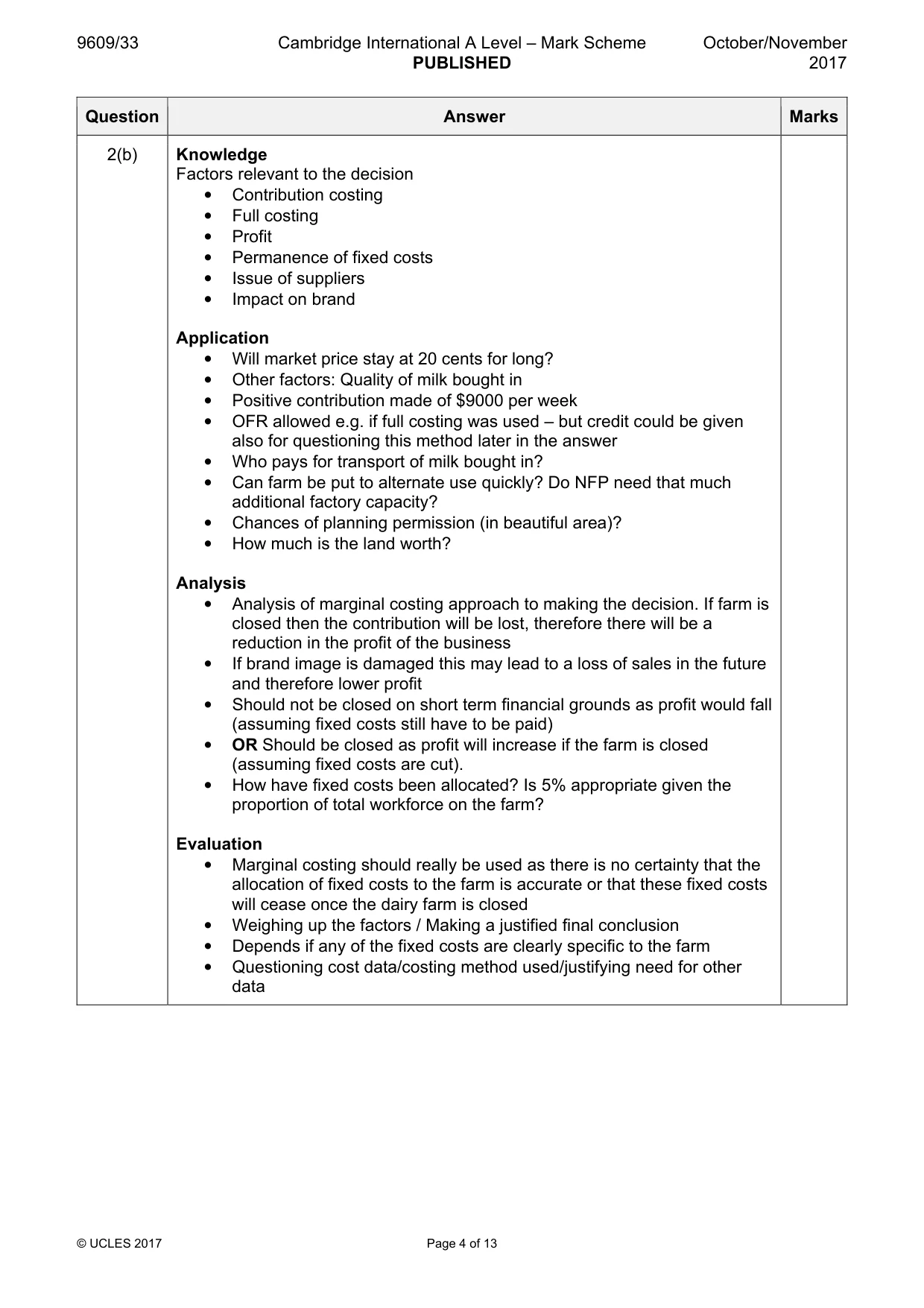
9609/33 Cambridge International A Level – Mark Scheme PUBLISHED October/November 2017 © UCLES 2017 Page 4 of 13 Question Answer Marks 2(b) Knowledge Factors relevant to the decision • Contribution costing • Full costing • Profit • Permanence of fixed costs • Issue of suppliers • Impact on brand Application • Will market price stay at 20 cents for long? • Other factors: Quality of milk bought in • Positive contribution made of $9000 per week • OFR allowed e.g. if full costing was used – but credit could be given also for questioning this method later in the answer • Who pays for transport of milk bought in? • Can farm be put to alternate use quickly? Do NFP need that much additional factory capacity? • Chances of planning permission (in beautiful area)? • How much is the land worth? Analysis • Analysis of marginal costing approach to making the decision. If farm is closed then the contribution will be lost, therefore there will be a reduction in the profit of the business • If brand image is damaged this may lead to a loss of sales in the future and therefore lower profit • Should not be closed on short term financial grounds as profit would fall (assuming fixed costs still have to be paid) • OR Should be closed as profit will increase if the farm is closed (assuming fixed costs are cut). • How have fixed costs been allocated? Is 5% appropriate given the proportion of total workforce on the farm? Evaluation • Marginal costing should really be used as there is no certainty that the allocation of fixed costs to the farm is accurate or that these fixed costs will cease once the dairy farm is closed • Weighing up the factors / Making a justified final conclusion • Depends if any of the fixed costs are clearly specific to the farm • Questioning cost data/costing method used/justifying need for other data
Mark scheme, page 5
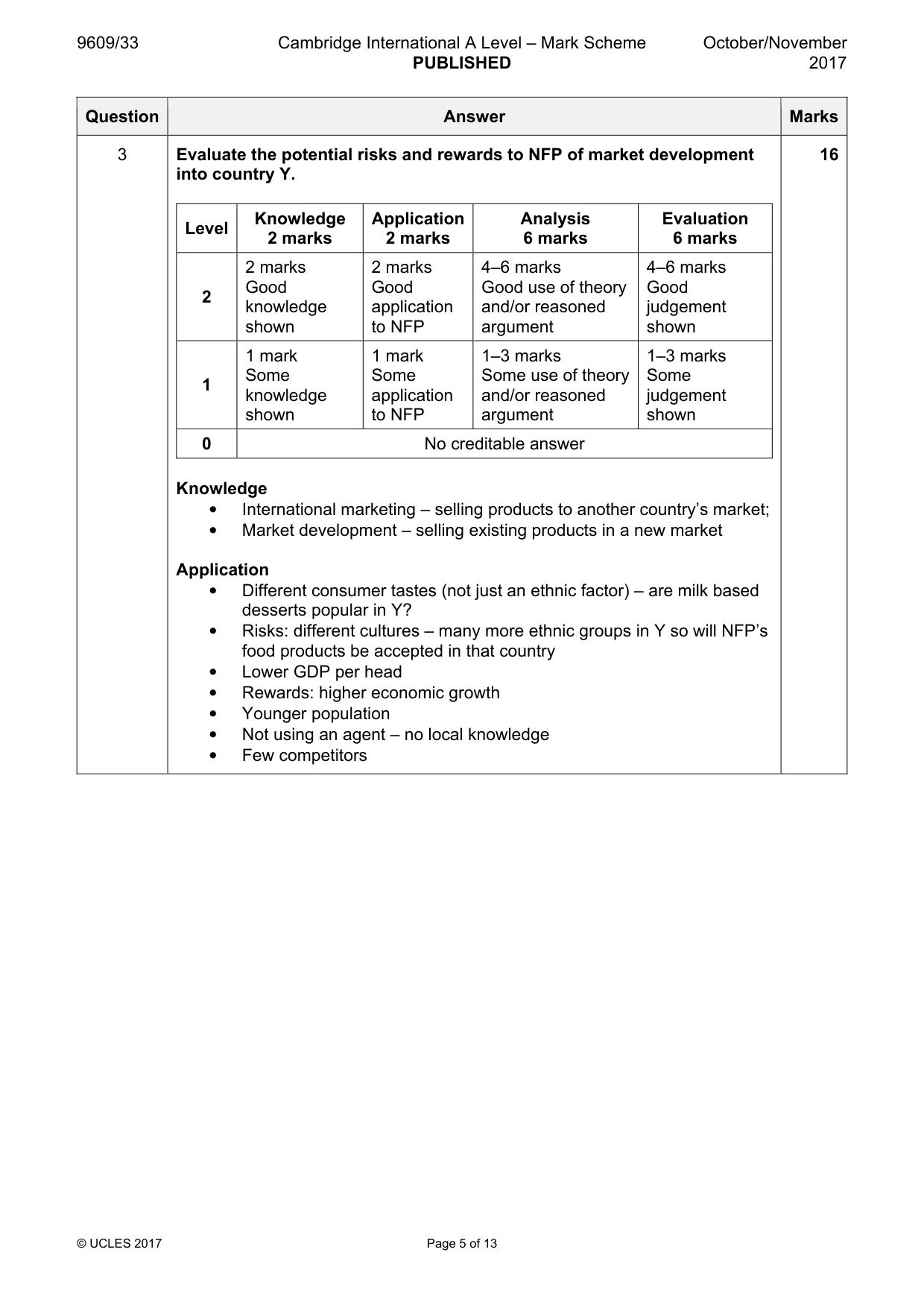
9609/33 Cambridge International A Level – Mark Scheme PUBLISHED October/November 2017 © UCLES 2017 Page 5 of 13 Question Answer Marks 3 Evaluate the potential risks and rewards to NFP of market development into country Y. Level Knowledge 2 marks Application 2 marks Analysis 6 marks Evaluation 6 marks 2 2 marks Good knowledge shown 2 marks Good application to NFP 4–6 marks Good use of theory and/or reasoned argument 4–6 marks Good judgement shown 1 1 mark Some knowledge shown 1 mark Some application to NFP 1–3 marks Some use of theory and/or reasoned argument 1–3 marks Some judgement shown 0 No creditable answer Knowledge • International marketing – selling products to another country’s market; • Market development – selling existing products in a new market Application • Different consumer tastes (not just an ethnic factor) – are milk based desserts popular in Y? • Risks: different cultures – many more ethnic groups in Y so will NFP’s food products be accepted in that country • Lower GDP per head • Rewards: higher economic growth • Younger population • Not using an agent – no local knowledge • Few competitors 16
Mark scheme, page 6
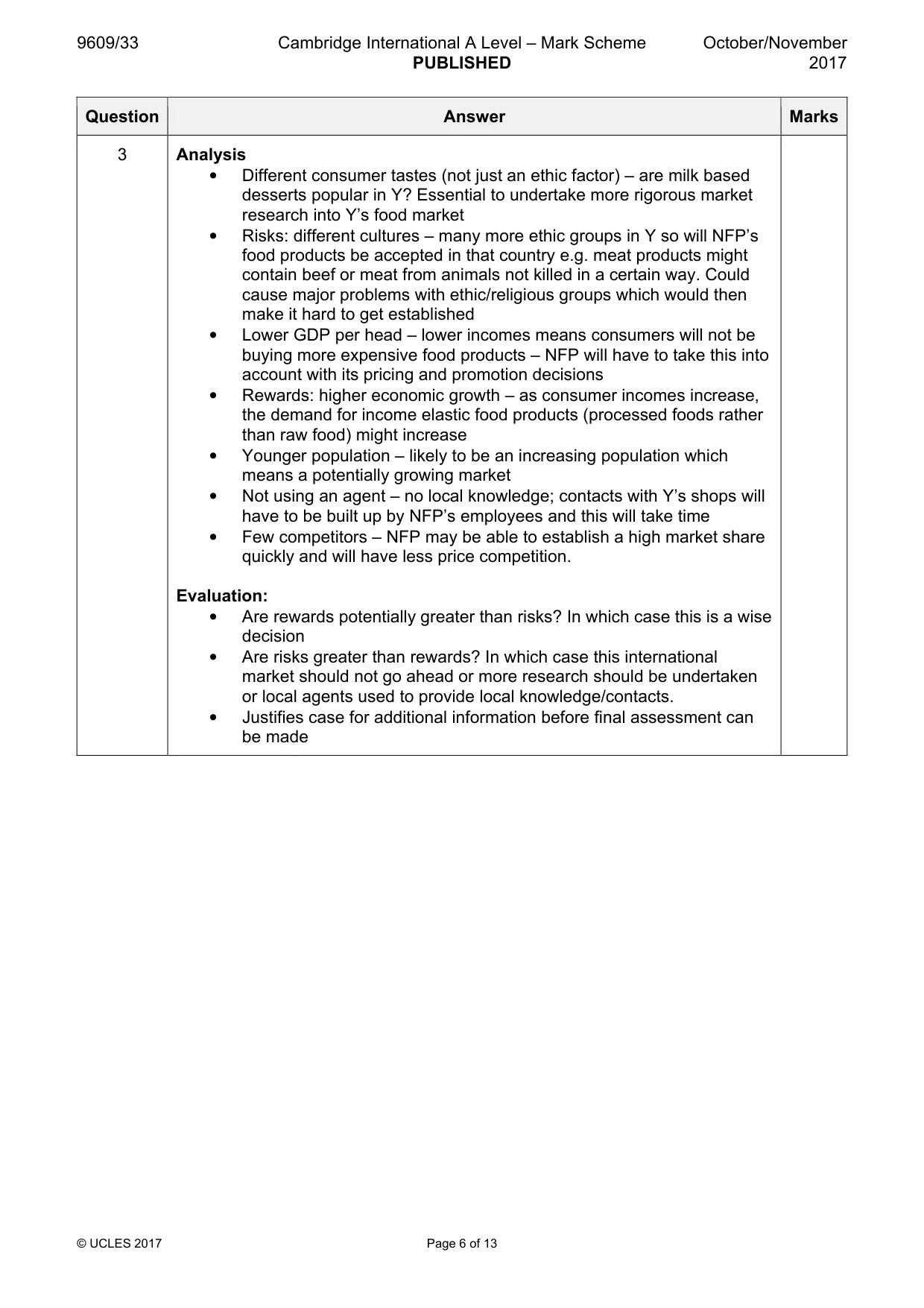
9609/33 Cambridge International A Level – Mark Scheme PUBLISHED October/November 2017 © UCLES 2017 Page 6 of 13 Question Answer Marks 3 Analysis • Different consumer tastes (not just an ethic factor) – are milk based desserts popular in Y? Essential to undertake more rigorous market research into Y’s food market • Risks: different cultures – many more ethic groups in Y so will NFP’s food products be accepted in that country e.g. meat products might contain beef or meat from animals not killed in a certain way. Could cause major problems with ethic/religious groups which would then make it hard to get established • Lower GDP per head – lower incomes means consumers will not be buying more expensive food products – NFP will have to take this into account with its pricing and promotion decisions • Rewards: higher economic growth – as consumer incomes increase, the demand for income elastic food products (processed foods rather than raw food) might increase • Younger population – likely to be an increasing population which means a potentially growing market • Not using an agent – no local knowledge; contacts with Y’s shops will have to be built up by NFP’s employees and this will take time • Few competitors – NFP may be able to establish a high market share quickly and will have less price competition. Evaluation: • Are rewards potentially greater than risks? In which case this is a wise decision • Are risks greater than rewards? In which case this international market should not go ahead or more research should be undertaken or local agents used to provide local knowledge/contacts. • Justifies case for additional information before final assessment can be made
Mark scheme, page 7
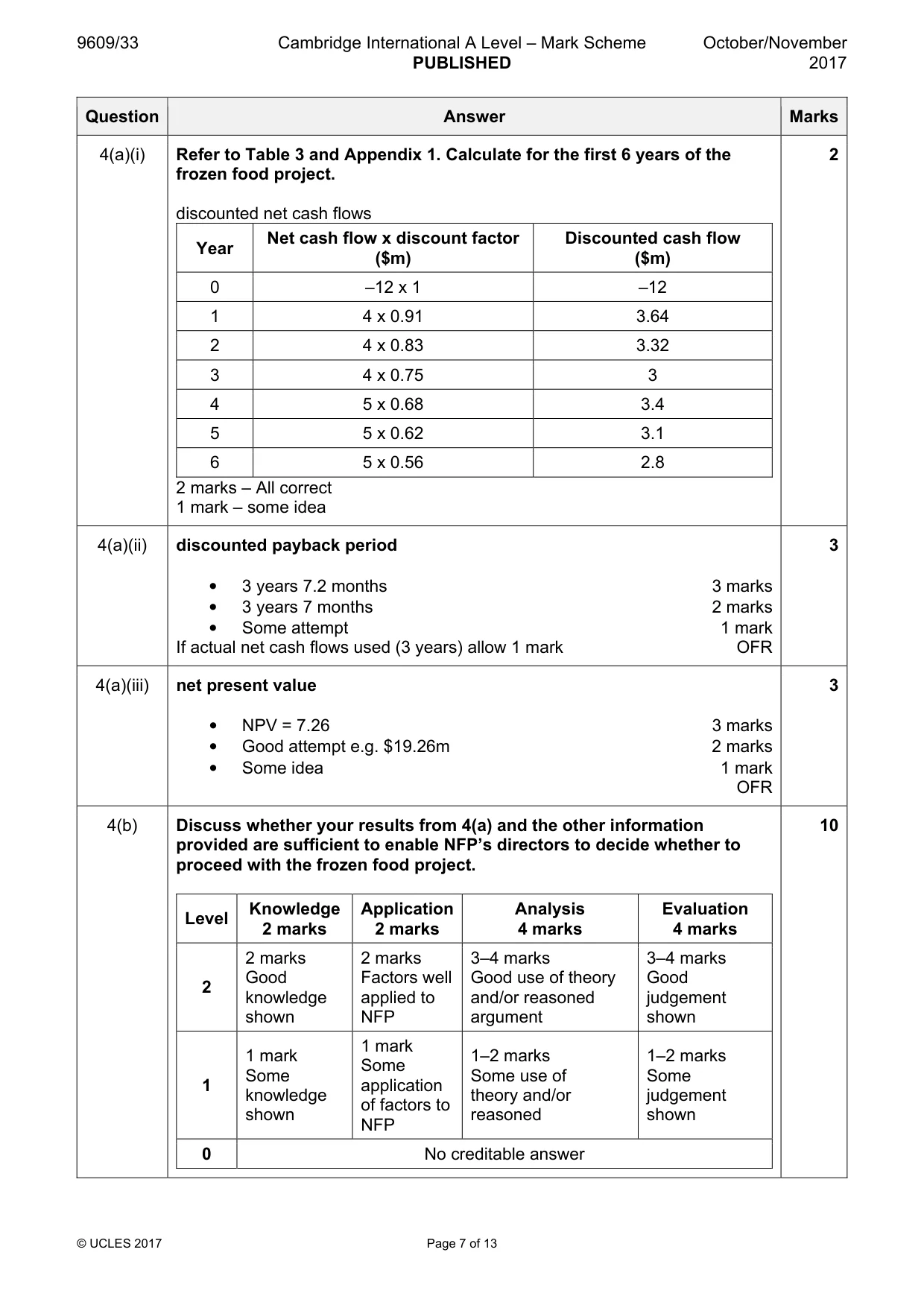
9609/33 Cambridge International A Level – Mark Scheme PUBLISHED October/November 2017 © UCLES 2017 Page 7 of 13 Question Answer Marks 4(a)(i) Refer to Table 3 and Appendix 1. Calculate for the first 6 years of the frozen food project. discounted net cash flows Year Net cash flow x discount factor ($m) Discounted cash flow ($m) 0 –12 x 1 –12 1 4 x 0.91 3.64 2 4 x 0.83 3.32 3 4 x 0.75 3 4 5 x 0.68 3.4 5 5 x 0.62 3.1 6 5 x 0.56 2.8 2 marks – All correct 1 mark – some idea 2 4(a)(ii) discounted payback period • 3 years 7.2 months 3 marks • 3 years 7 months 2 marks • Some attempt 1 mark If actual net cash flows used (3 years) allow 1 mark OFR 3 4(a)(iii) net present value • NPV = 7.26 3 marks • Good attempt e.g. $19.26m 2 marks • Some idea 1 mark OFR 3 4(b) Discuss whether your results from 4(a) and the other information provided are sufficient to enable NFP’s directors to decide whether to proceed with the frozen food project. Level Knowledge 2 marks Application 2 marks Analysis 4 marks Evaluation 4 marks 2 2 marks Good knowledge shown 2 marks Factors well applied to NFP 3–4 marks Good use of theory and/or reasoned argument 3–4 marks Good judgement shown 1 1 mark Some knowledge shown 1 mark Some application of factors to NFP 1–2 marks Some use of theory and/or reasoned 1–2 marks Some judgement shown 0 No creditable answer 10
Mark scheme, page 8
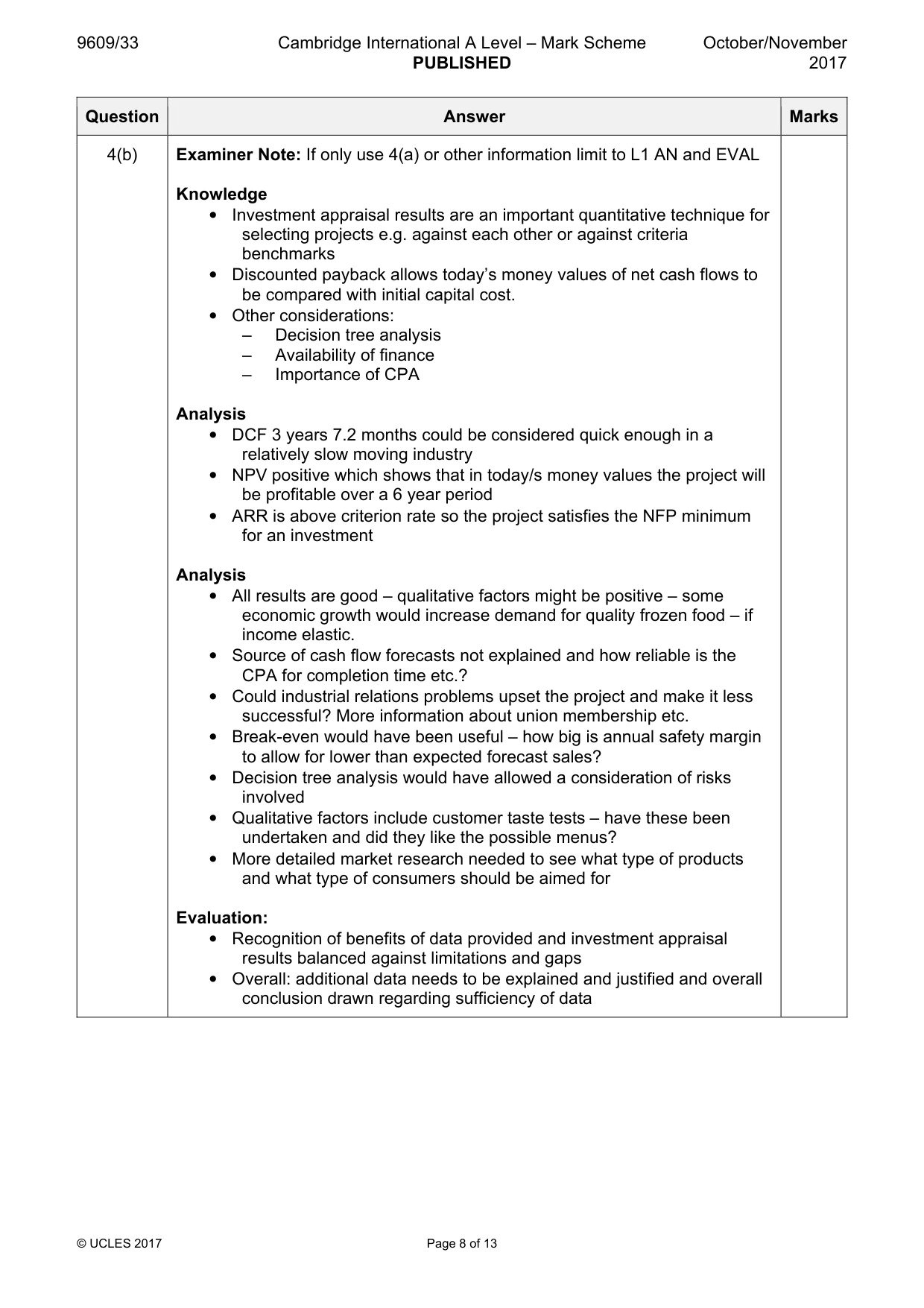
9609/33 Cambridge International A Level – Mark Scheme PUBLISHED October/November 2017 © UCLES 2017 Page 8 of 13 Question Answer Marks 4(b) Examiner Note: If only use 4(a) or other information limit to L1 AN and EVAL Knowledge • Investment appraisal results are an important quantitative technique for selecting projects e.g. against each other or against criteria benchmarks • Discounted payback allows today’s money values of net cash flows to be compared with initial capital cost. • Other considerations: – Decision tree analysis – Availability of finance – Importance of CPA Analysis • DCF 3 years 7.2 months could be considered quick enough in a relatively slow moving industry • NPV positive which shows that in today/s money values the project will be profitable over a 6 year period • ARR is above criterion rate so the project satisfies the NFP minimum for an investment Analysis • All results are good – qualitative factors might be positive – some economic growth would increase demand for quality frozen food – if income elastic. • Source of cash flow forecasts not explained and how reliable is the CPA for completion time etc.? • Could industrial relations problems upset the project and make it less successful? More information about union membership etc. • Break-even would have been useful – how big is annual safety margin to allow for lower than expected forecast sales? • Decision tree analysis would have allowed a consideration of risks involved • Qualitative factors include customer taste tests – have these been undertaken and did they like the possible menus? • More detailed market research needed to see what type of products and what type of consumers should be aimed for Evaluation: • Recognition of benefits of data provided and investment appraisal results balanced against limitations and gaps • Overall: additional data needs to be explained and justified and overall conclusion drawn regarding sufficiency of data
Mark scheme, page 9
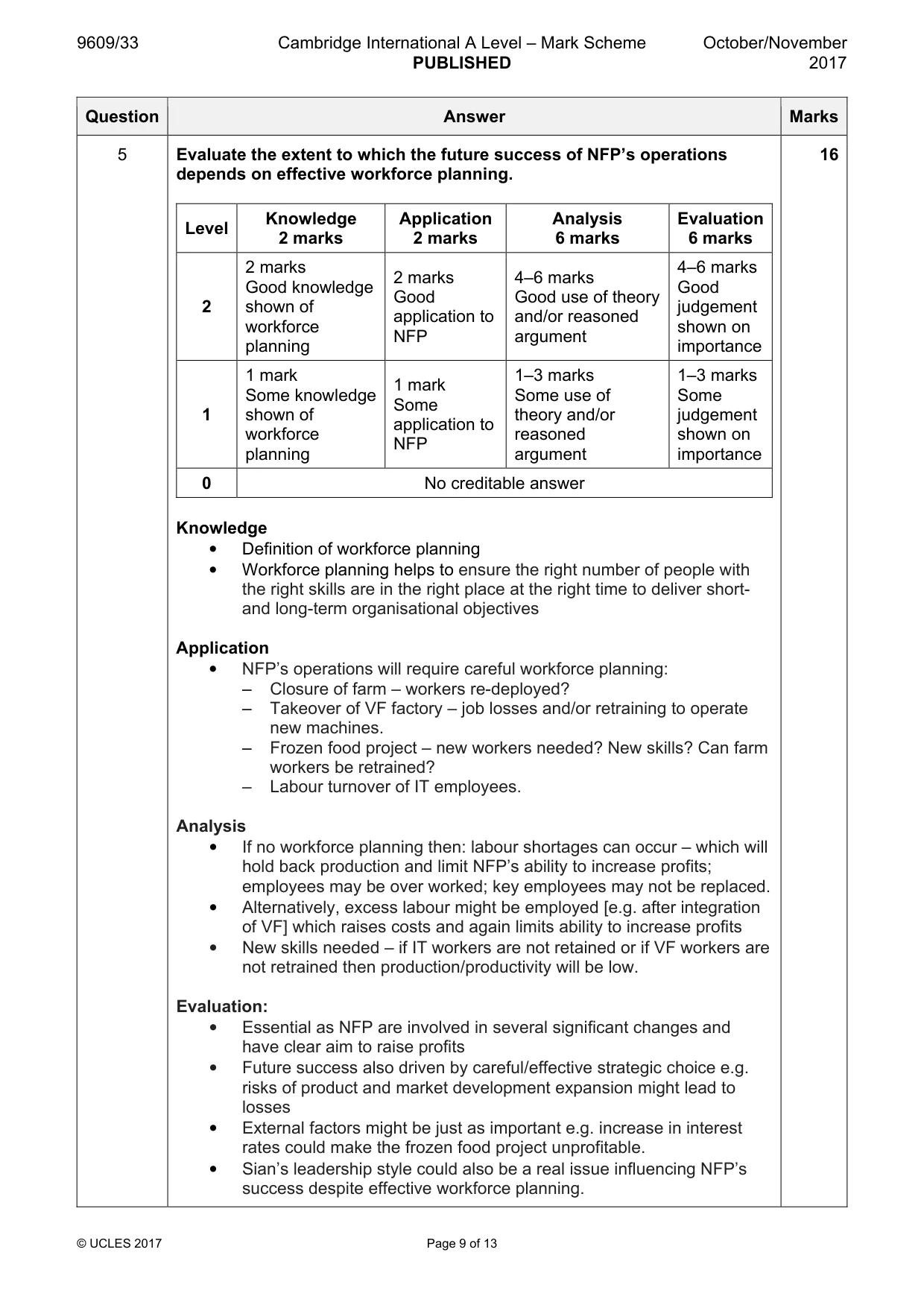
9609/33 Cambridge International A Level – Mark Scheme PUBLISHED October/November 2017 © UCLES 2017 Page 9 of 13 Question Answer Marks 5 Evaluate the extent to which the future success of NFP’s operations depends on effective workforce planning. Level Knowledge 2 marks Application 2 marks Analysis 6 marks Evaluation 6 marks 2 2 marks Good knowledge shown of workforce planning 2 marks Good application to NFP 4–6 marks Good use of theory and/or reasoned argument 4–6 marks Good judgement shown on importance 1 1 mark Some knowledge shown of workforce planning 1 mark Some application to NFP 1–3 marks Some use of theory and/or reasoned argument 1–3 marks Some judgement shown on importance 0 No creditable answer Knowledge • Definition of workforce planning • Workforce planning helps to ensure the right number of people with the right skills are in the right place at the right time to deliver short- and long-term organisational objectives Application • NFP’s operations will require careful workforce planning: – Closure of farm – workers re-deployed? – Takeover of VF factory – job losses and/or retraining to operate new machines. – Frozen food project – new workers needed? New skills? Can farm workers be retrained? – Labour turnover of IT employees. Analysis • If no workforce planning then: labour shortages can occur – which will hold back production and limit NFP’s ability to increase profits; employees may be over worked; key employees may not be replaced. • Alternatively, excess labour might be employed [e.g. after integration of VF] which raises costs and again limits ability to increase profits • New skills needed – if IT workers are not retained or if VF workers are not retrained then production/productivity will be low. Evaluation: • Essential as NFP are involved in several significant changes and have clear aim to raise profits • Future success also driven by careful/effective strategic choice e.g. risks of product and market development expansion might lead to losses • External factors might be just as important e.g. increase in interest rates could make the frozen food project unprofitable. • Sian’s leadership style could also be a real issue influencing NFP’s success despite effective workforce planning. 16
Mark scheme, page 10
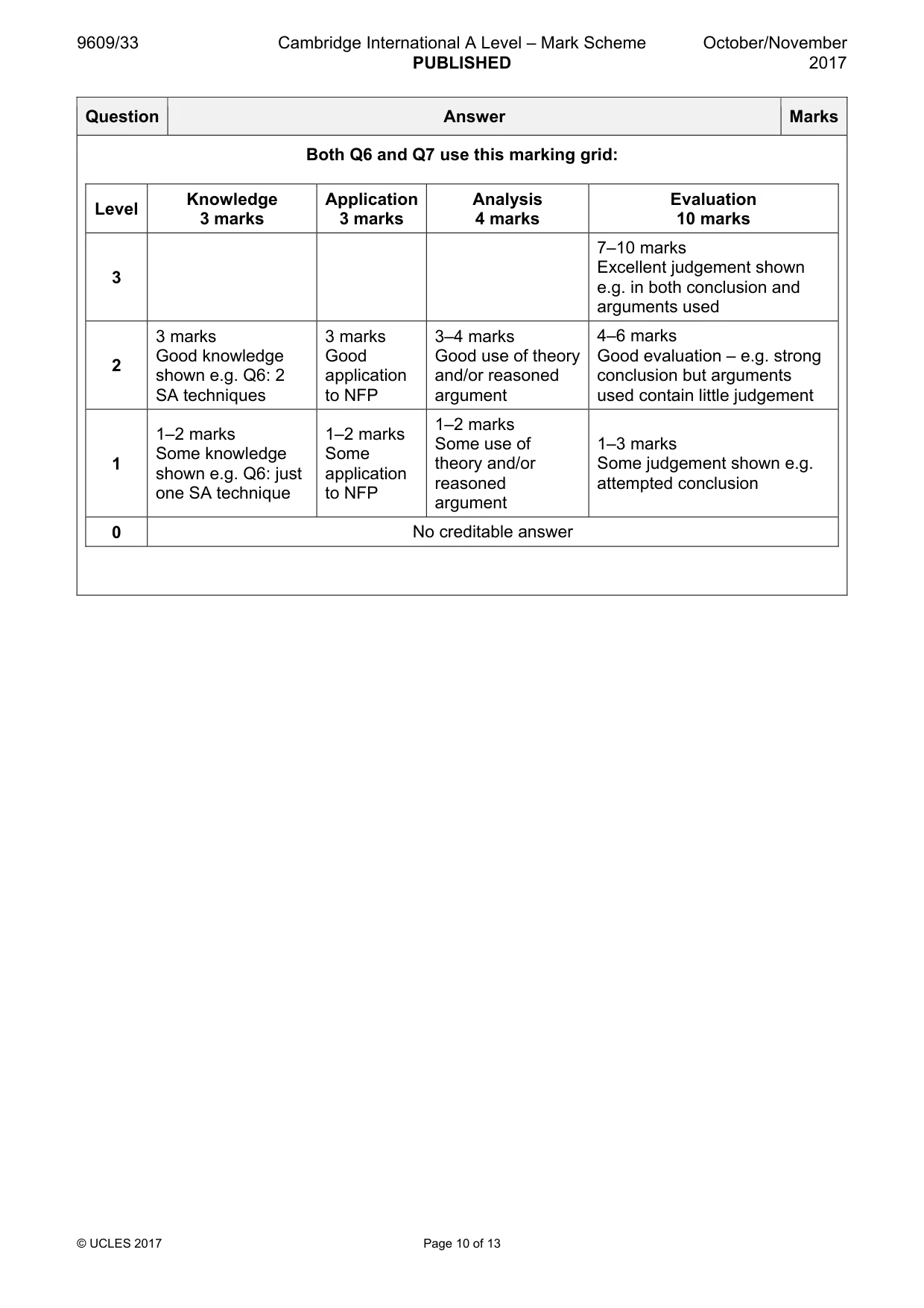
9609/33 Cambridge International A Level – Mark Scheme PUBLISHED October/November 2017 © UCLES 2017 Page 10 of 13 Question Answer Marks Both Q6 and Q7 use this marking grid: Level Knowledge 3 marks Application 3 marks Analysis 4 marks Evaluation 10 marks 3 7–10 marks Excellent judgement shown e.g. in both conclusion and arguments used 2 3 marks Good knowledge shown e.g. Q6: 2 SA techniques 3 marks Good application to NFP 3–4 marks Good use of theory and/or reasoned argument 4–6 marks Good evaluation – e.g. strong conclusion but arguments used contain little judgement 1 1–2 marks Some knowledge shown e.g. Q6: just one SA technique 1–2 marks Some application to NFP 1–2 marks Some use of theory and/or reasoned argument 1–3 marks Some judgement shown e.g. attempted conclusion 0 No creditable answer
Mark scheme, page 11
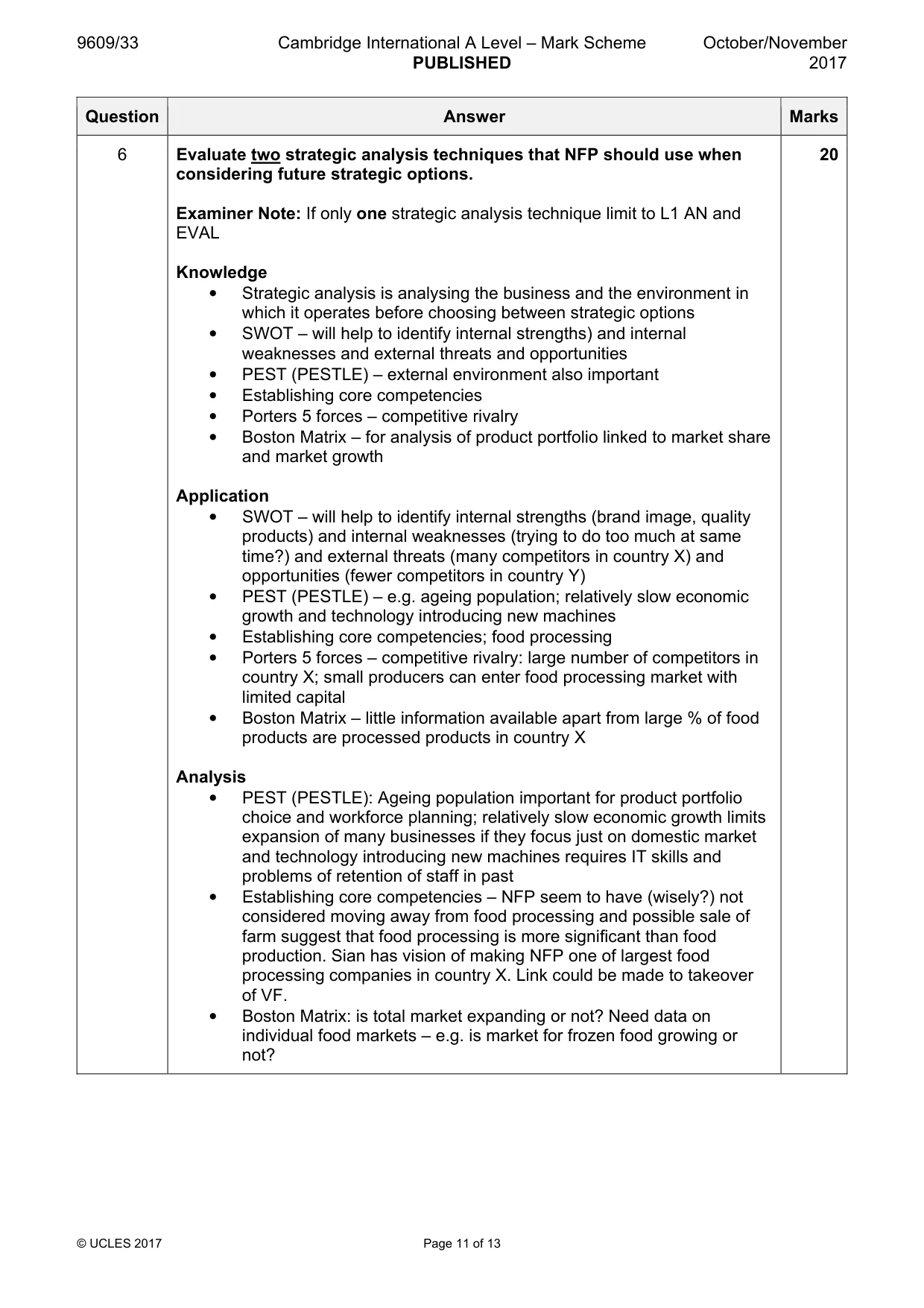
9609/33 Cambridge International A Level – Mark Scheme PUBLISHED October/November 2017 © UCLES 2017 Page 11 of 13 Question Answer Marks 6 Evaluate two strategic analysis techniques that NFP should use when considering future strategic options. Examiner Note: If only one strategic analysis technique limit to L1 AN and EVAL Knowledge • Strategic analysis is analysing the business and the environment in which it operates before choosing between strategic options • SWOT – will help to identify internal strengths) and internal weaknesses and external threats and opportunities • PEST (PESTLE) – external environment also important • Establishing core competencies • Porters 5 forces – competitive rivalry • Boston Matrix – for analysis of product portfolio linked to market share and market growth Application • SWOT – will help to identify internal strengths (brand image, quality products) and internal weaknesses (trying to do too much at same time?) and external threats (many competitors in country X) and opportunities (fewer competitors in country Y) • PEST (PESTLE) – e.g. ageing population; relatively slow economic growth and technology introducing new machines • Establishing core competencies; food processing • Porters 5 forces – competitive rivalry: large number of competitors in country X; small producers can enter food processing market with limited capital • Boston Matrix – little information available apart from large % of food products are processed products in country X Analysis • PEST (PESTLE): Ageing population important for product portfolio choice and workforce planning; relatively slow economic growth limits expansion of many businesses if they focus just on domestic market and technology introducing new machines requires IT skills and problems of retention of staff in past • Establishing core competencies – NFP seem to have (wisely?) not considered moving away from food processing and possible sale of farm suggest that food processing is more significant than food production. Sian has vision of making NFP one of largest food processing companies in country X. Link could be made to takeover of VF. • Boston Matrix: is total market expanding or not? Need data on individual food markets – e.g. is market for frozen food growing or not? 20
Mark scheme, page 12
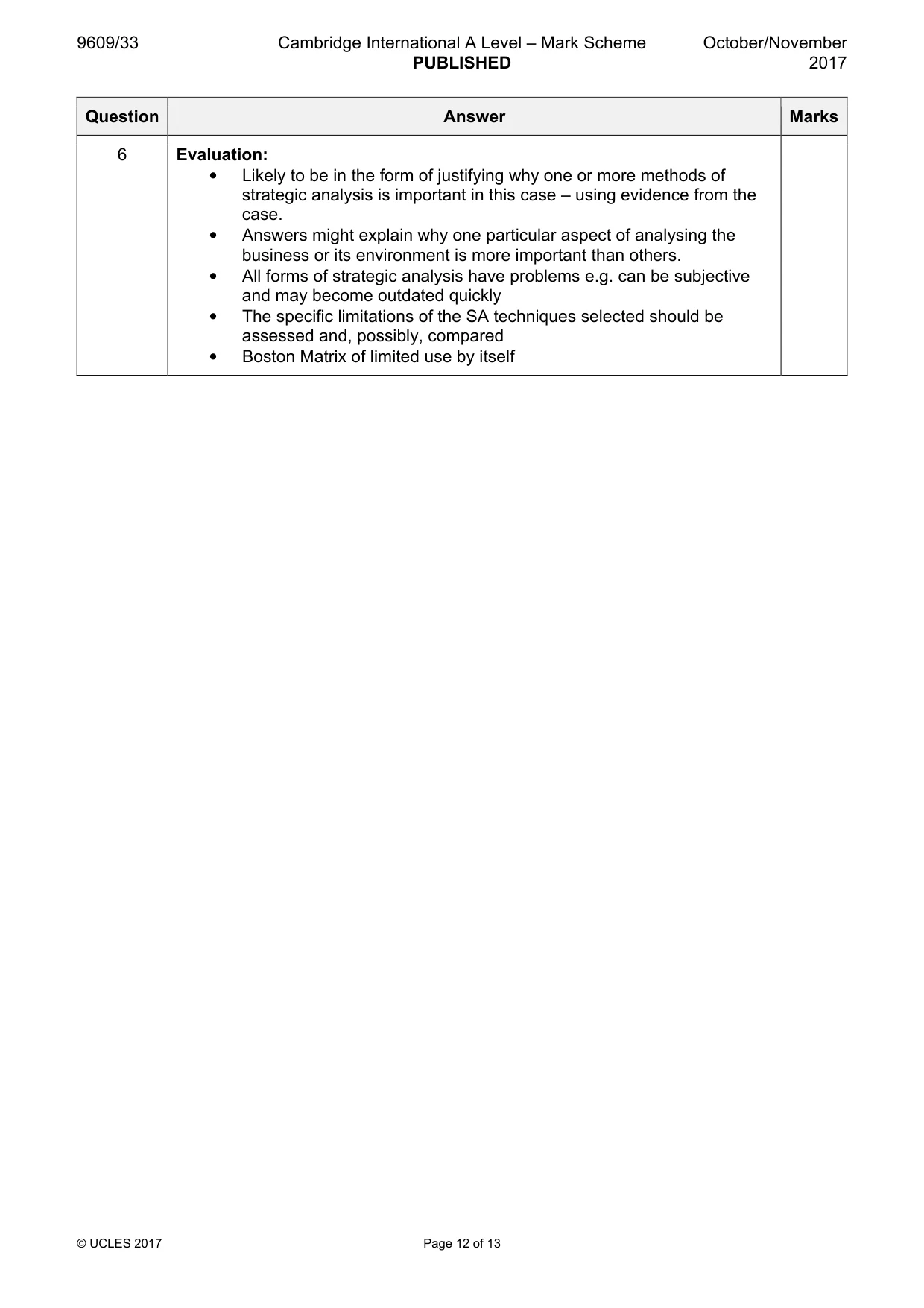
9609/33 Cambridge International A Level – Mark Scheme PUBLISHED October/November 2017 © UCLES 2017 Page 12 of 13 Question Answer Marks 6 Evaluation: • Likely to be in the form of justifying why one or more methods of strategic analysis is important in this case – using evidence from the case. • Answers might explain why one particular aspect of analysing the business or its environment is more important than others. • All forms of strategic analysis have problems e.g. can be subjective and may become outdated quickly • The specific limitations of the SA techniques selected should be assessed and, possibly, compared • Boston Matrix of limited use by itself
Mark scheme, page 13
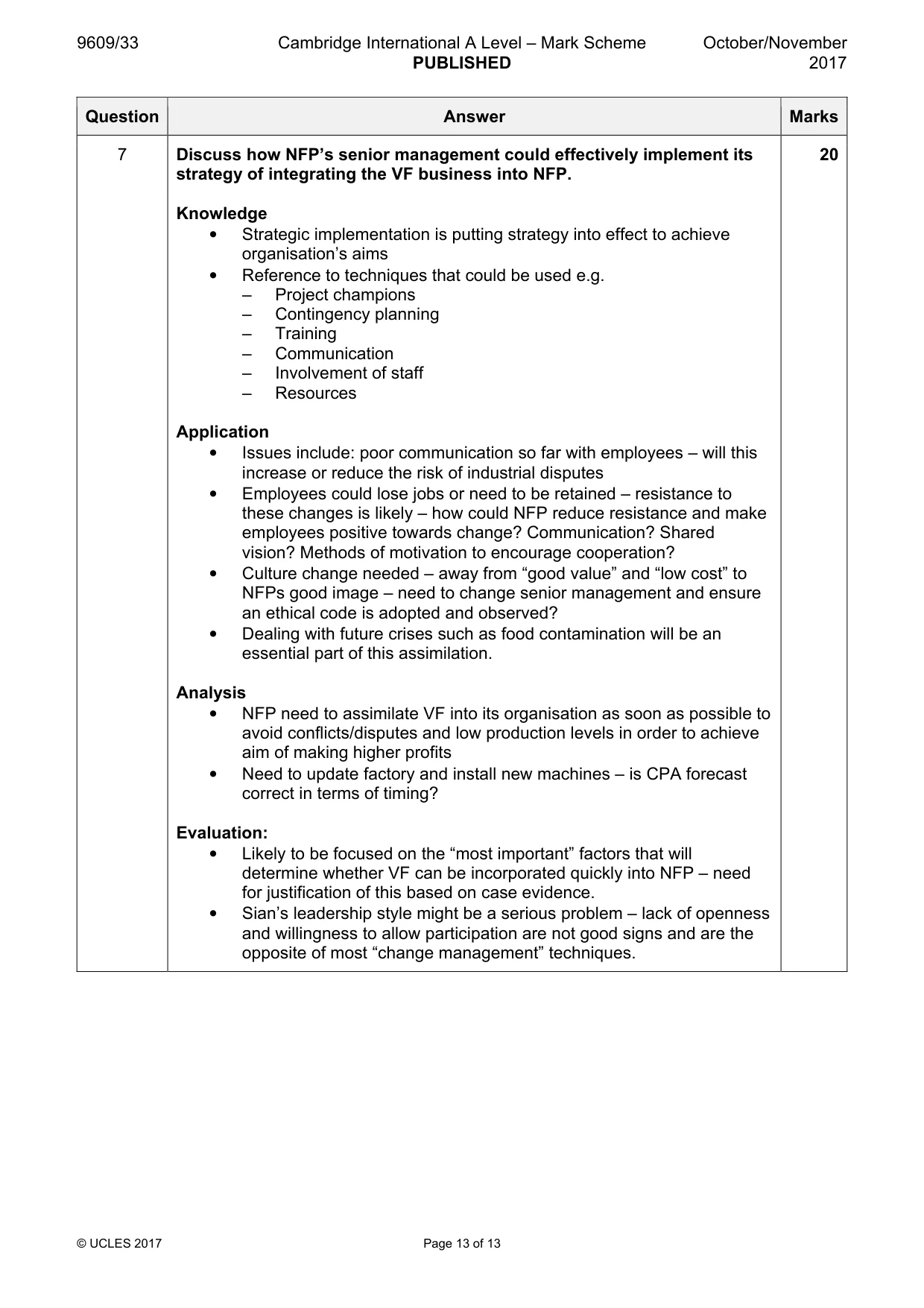
9609/33 Cambridge International A Level – Mark Scheme PUBLISHED October/November 2017 © UCLES 2017 Page 13 of 13 Question Answer Marks 7 Discuss how NFP’s senior management could effectively implement its strategy of integrating the VF business into NFP. Knowledge • Strategic implementation is putting strategy into effect to achieve organisation’s aims • Reference to techniques that could be used e.g. – Project champions – Contingency planning – Training – Communication – Involvement of staff – Resources Application • Issues include: poor communication so far with employees – will this increase or reduce the risk of industrial disputes • Employees could lose jobs or need to be retained – resistance to these changes is likely – how could NFP reduce resistance and make employees positive towards change? Communication? Shared vision? Methods of motivation to encourage cooperation? • Culture change needed – away from “good value” and “low cost” to NFPs good image – need to change senior management and ensure an ethical code is adopted and observed? • Dealing with future crises such as food contamination will be an essential part of this assimilation. Analysis • NFP need to assimilate VF into its organisation as soon as possible to avoid conflicts/disputes and low production levels in order to achieve aim of making higher profits • Need to update factory and install new machines – is CPA forecast correct in terms of timing? Evaluation: • Likely to be focused on the “most important” factors that will determine whether VF can be incorporated quickly into NFP – need for justification of this based on case evidence. • Sian’s leadership style might be a serious problem – lack of openness and willingness to allow participation are not good signs and are the opposite of most “change management” techniques. 20
What you needed in this session
Cambridge’s own grade thresholds for 2017 Oct/Nov, Paper 3 · Variant 3. A higher threshold means an easier paper — the bar moves with how the cohort did.