Cambridge A Level Business (for first examination in 2016) 9609 — 2017 May/June Paper 3 · Variant 2
9609/32/M/J/17
The question paper and its mark scheme, free to read here and free to download. This is Cambridge’s own paper, exactly as it was sat.
Question paper8 pages



Mark scheme16 pages
Answers below. Sit the paper first if you are practising.
Paper as text
Question paper, page 1
* 6 0 1 4 0 3 7 9 9 1 * This document consists of 5 printed pages, 3 blank pages and 1 Insert. DC (CW/FC) 134464/2 © UCLES 2017 [Turn over Cambridge International Examinations Cambridge International Advanced Subsidiary and Advanced Level BUSINESS 9609/32 Paper 3 Case Study May/June 2017 3 hours No Additional Materials are required. READ THESE INSTRUCTIONS FIRST An answer booklet is provided inside this question paper. You should follow the instructions on the front cover of the answer booklet. If you need additional answer paper ask the invigilator for a continuation booklet. Section A Answer all questions. Section B Answer one question. You are advised to spend no more than 40 minutes on Section B. The businesses described in this question paper are entirely fictitious. The number of marks is given in brackets [ ] at the end of each question or part question.
Question paper, page 2
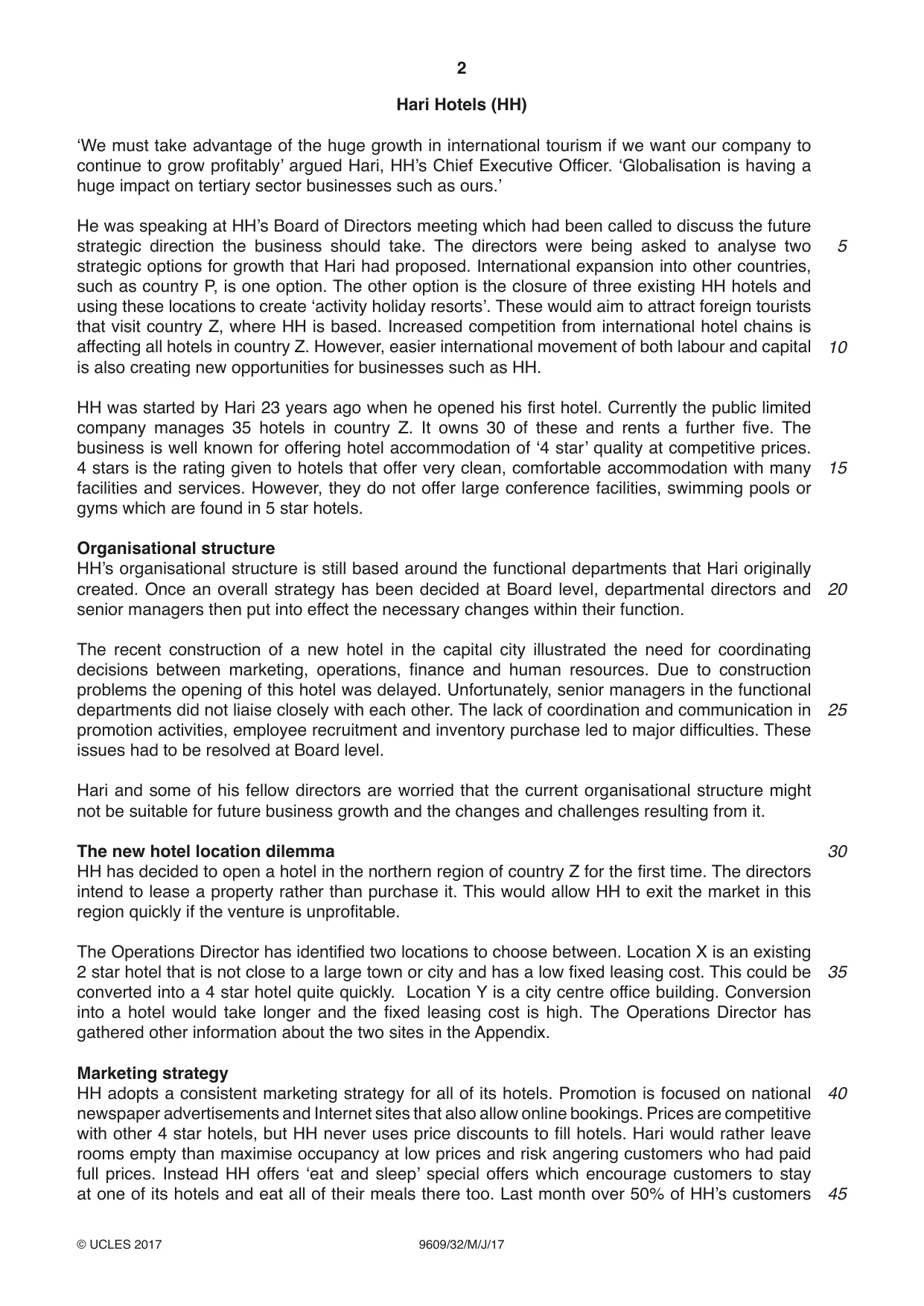
2 9609/32/M/J/17 © UCLES 2017 Hari Hotels (HH) ‘We must take advantage of the huge growth in international tourism if we want our company to continue to grow profitably’ argued Hari, HH’s Chief Executive Officer. ‘Globalisation is having a huge impact on tertiary sector businesses such as ours.’ He was speaking at HH’s Board of Directors meeting which had been called to discuss the future strategic direction the business should take. The directors were being asked to analyse two strategic options for growth that Hari had proposed. International expansion into other countries, such as country P, is one option. The other option is the closure of three existing HH hotels and using these locations to create ‘activity holiday resorts’. These would aim to attract foreign tourists that visit country Z, where HH is based. Increased competition from international hotel chains is affecting all hotels in country Z. However, easier international movement of both labour and capital is also creating new opportunities for businesses such as HH. HH was started by Hari 23 years ago when he opened his first hotel. Currently the public limited company manages 35 hotels in country Z. It owns 30 of these and rents a further five. The business is well known for offering hotel accommodation of ‘4 star’ quality at competitive prices. 4 stars is the rating given to hotels that offer very clean, comfortable accommodation with many facilities and services. However, they do not offer large conference facilities, swimming pools or gyms which are found in 5 star hotels. Organisational structure HH’s organisational structure is still based around the functional departments that Hari originally created. Once an overall strategy has been decided at Board level, departmental directors and senior managers then put into effect the necessary changes within their function. The recent construction of a new hotel in the capital city illustrated the need for coordinating decisions between marketing, operations, finance and human resources. Due to construction problems the opening of this hotel was delayed. Unfortunately, senior managers in the functional departments did not liaise closely with each other. The lack of coordination and communication in promotion activities, employee recruitment and inventory purchase led to major difficulties. These issues had to be resolved at Board level. Hari and some of his fellow directors are worried that the current organisational structure might not be suitable for future business growth and the changes and challenges resulting from it. The new hotel location dilemma HH has decided to open a hotel in the northern region of country Z for the first time. The directors intend to lease a property rather than purchase it. This would allow HH to exit the market in this region quickly if the venture is unprofitable. The Operations Director has identified two locations to choose between. Location X is an existing 2 star hotel that is not close to a large town or city and has a low fixed leasing cost. This could be converted into a 4 star hotel quite quickly. Location Y is a city centre office building. Conversion into a hotel would take longer and the fixed leasing cost is high. The Operations Director has gathered other information about the two sites in the Appendix. Marketing strategy HH adopts a consistent marketing strategy for all of its hotels. Promotion is focused on national newspaper advertisements and Internet sites that also allow online bookings. Prices are competitive with other 4 star hotels, but HH never uses price discounts to fill hotels. Hari would rather leave rooms empty than maximise occupancy at low prices and risk angering customers who had paid full prices. Instead HH offers ‘eat and sleep’ special offers which encourage customers to stay at one of its hotels and eat all of their meals there too. Last month over 50% of HH’s customers 5 10 15 20 25 30 35 40 45
Question paper, page 3
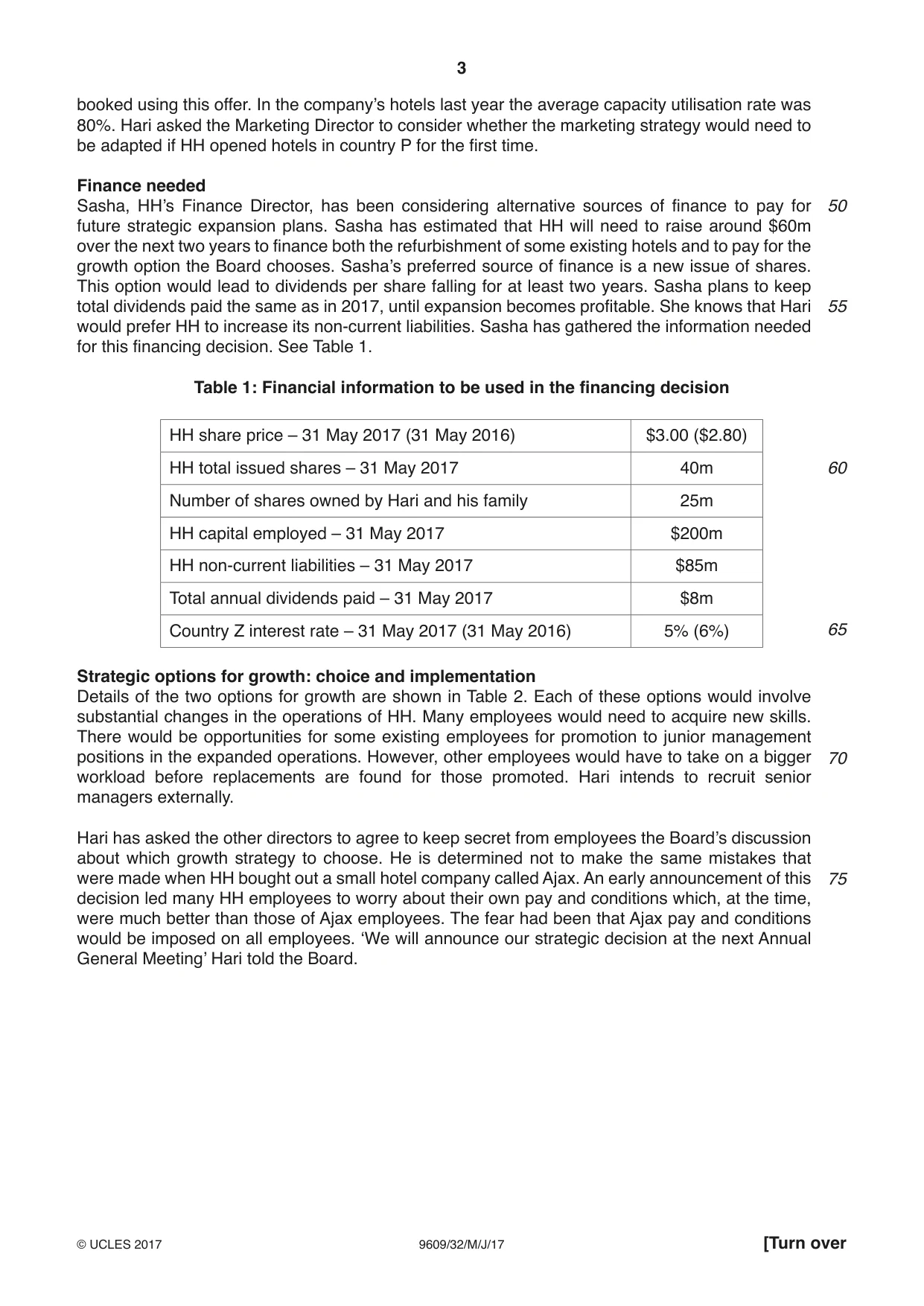
3 9609/32/M/J/17 © UCLES 2017 [Turn over booked using this offer. In the company’s hotels last year the average capacity utilisation rate was 80%. Hari asked the Marketing Director to consider whether the marketing strategy would need to be adapted if HH opened hotels in country P for the first time. Finance needed Sasha, HH’s Finance Director, has been considering alternative sources of finance to pay for future strategic expansion plans. Sasha has estimated that HH will need to raise around $60m over the next two years to finance both the refurbishment of some existing hotels and to pay for the growth option the Board chooses. Sasha’s preferred source of finance is a new issue of shares. This option would lead to dividends per share falling for at least two years. Sasha plans to keep total dividends paid the same as in 2017, until expansion becomes profitable. She knows that Hari would prefer HH to increase its non-current liabilities. Sasha has gathered the information needed for this financing decision. See Table 1. Table 1: Financial information to be used in the financing decision HH share price – 31 May 2017 (31 May 2016) $3.00 ($2.80) HH total issued shares – 31 May 2017 40m Number of shares owned by Hari and his family 25m HH capital employed – 31 May 2017 $200m HH non-current liabilities – 31 May 2017 $85m Total annual dividends paid – 31 May 2017 $8m Country Z interest rate – 31 May 2017 (31 May 2016) 5% (6%) Strategic options for growth: choice and implementation Details of the two options for growth are shown in Table 2. Each of these options would involve substantial changes in the operations of HH. Many employees would need to acquire new skills. There would be opportunities for some existing employees for promotion to junior management positions in the expanded operations. However, other employees would have to take on a bigger workload before replacements are found for those promoted. Hari intends to recruit senior managers externally. Hari has asked the other directors to agree to keep secret from employees the Board’s discussion about which growth strategy to choose. He is determined not to make the same mistakes that were made when HH bought out a small hotel company called Ajax. An early announcement of this decision led many HH employees to worry about their own pay and conditions which, at the time, were much better than those of Ajax employees. The fear had been that Ajax pay and conditions would be imposed on all employees. ‘We will announce our strategic decision at the next Annual General Meeting’ Hari told the Board. 50 55 60 65 70 75
Question paper, page 4
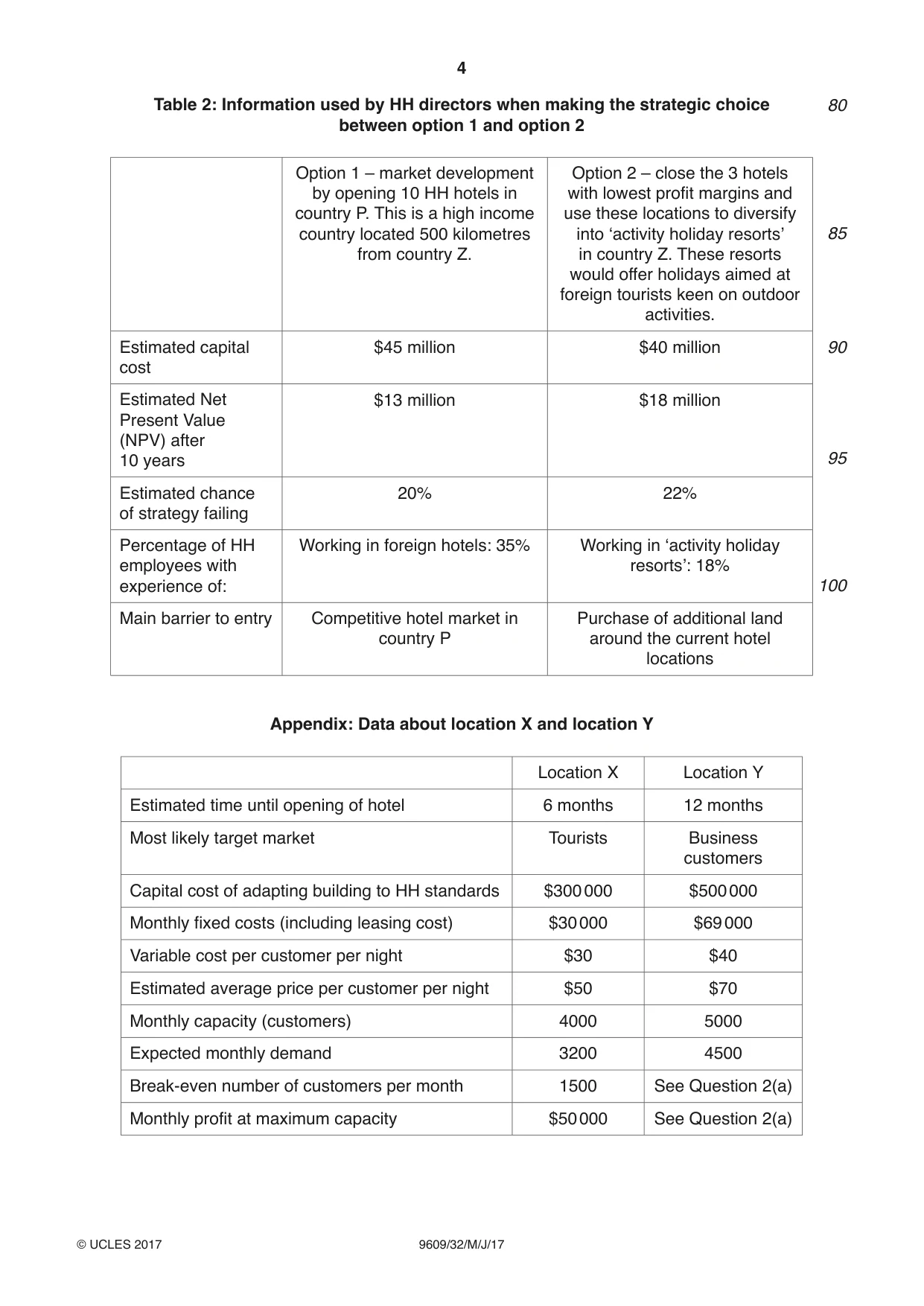
4 9609/32/M/J/17 © UCLES 2017 Table 2: Information used by HH directors when making the strategic choice between option 1 and option 2 Option 1 – market development by opening 10 HH hotels in country P. This is a high income country located 500 kilometres from country Z. Option 2 – close the 3 hotels with lowest profit margins and use these locations to diversify into ‘activity holiday resorts’ in country Z. These resorts would offer holidays aimed at foreign tourists keen on outdoor activities. Estimated capital cost $45 million $40 million Estimated Net Present Value (NPV) after 10 years $13 million $18 million Estimated chance of strategy failing 20% 22% Percentage of HH employees with experience of: Working in foreign hotels: 35% Working in ‘activity holiday resorts’: 18% Main barrier to entry Competitive hotel market in country P Purchase of additional land around the current hotel locations Appendix: Data about location X and location Y Location X Location Y Estimated time until opening of hotel 6 months 12 months Most likely target market Tourists Business customers Capital cost of adapting building to HH standards $300 000 $500 000 Monthly fixed costs (including leasing cost) $30 000 $69 000 Variable cost per customer per night $30 $40 Estimated average price per customer per night $50 $70 Monthly capacity (customers) 4000 5000 Expected monthly demand 3200 4500 Break-even number of customers per month 1500 See Question 2(a) Monthly profit at maximum capacity $50 000 See Question 2(a) 80 85 90 95 100
Question paper, page 5
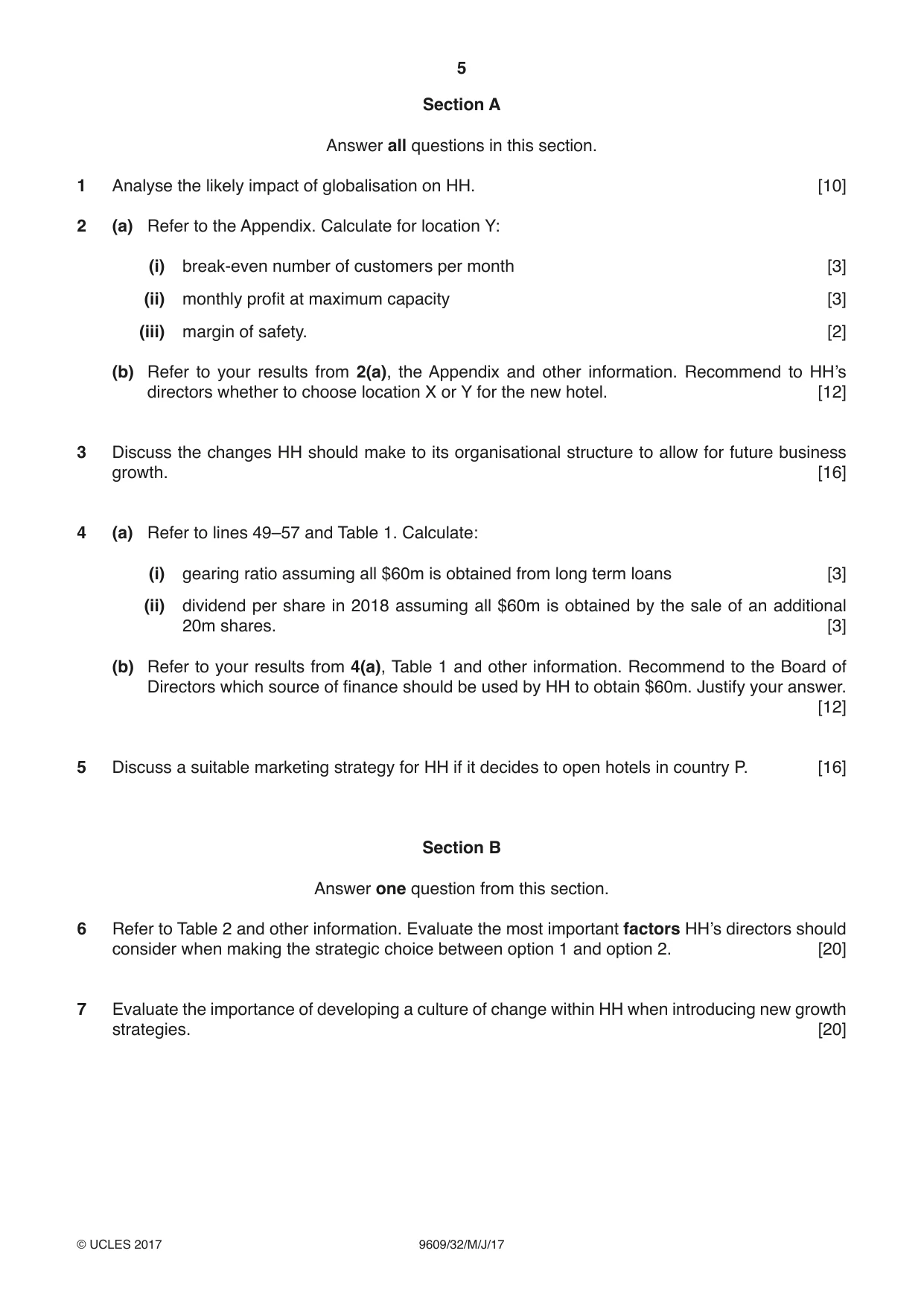
5 9609/32/M/J/17 © UCLES 2017 Section A Answer all questions in this section. 1 Analyse the likely impact of globalisation on HH. [10] 2 (a) Refer to the Appendix. Calculate for location Y: (i) break-even number of customers per month [3] (ii) monthly profit at maximum capacity [3] (iii) margin of safety. [2] (b) Refer to your results from 2(a), the Appendix and other information. Recommend to HH’s directors whether to choose location X or Y for the new hotel. [12] 3 Discuss the changes HH should make to its organisational structure to allow for future business growth. [16] 4 (a) Refer to lines 49–57 and Table 1. Calculate: (i) gearing ratio assuming all $60m is obtained from long term loans [3] (ii) dividend per share in 2018 assuming all $60m is obtained by the sale of an additional 20m shares. [3] (b) Refer to your results from 4(a), Table 1 and other information. Recommend to the Board of Directors which source of finance should be used by HH to obtain $60m. Justify your answer. [12] 5 Discuss a suitable marketing strategy for HH if it decides to open hotels in country P. [16] Section B Answer one question from this section. 6 Refer to Table 2 and other information. Evaluate the most important factors HH’s directors should consider when making the strategic choice between option 1 and option 2. [20] 7 Evaluate the importance of developing a culture of change within HH when introducing new growth strategies. [20]
Question paper, page 6
6 9609/32/M/J/17 © UCLES 2017 BLANK PAGE
Question paper, page 7
7 9609/32/M/J/17 © UCLES 2017 BLANK PAGE
Question paper, page 8
8 9609/32/M/J/17 © UCLES 2017 Permission to reproduce items where third-party owned material protected by copyright is included has been sought and cleared where possible. Every reasonable effort has been made by the publisher (UCLES) to trace copyright holders, but if any items requiring clearance have unwittingly been included, the publisher will be pleased to make amends at the earliest possible opportunity. To avoid the issue of disclosure of answer-related information to candidates, all copyright acknowledgements are reproduced online in the Cambridge International Examinations Copyright Acknowledgements Booklet. This is produced for each series of examinations and is freely available to download at www.cie.org.uk after the live examination series. Cambridge International Examinations is part of the Cambridge Assessment Group. Cambridge Assessment is the brand name of University of Cambridge Local Examinations Syndicate (UCLES), which is itself a department of the University of Cambridge. BLANK PAGE
Mark scheme, page 1
® IGCSE is a registered trademark. This document consists of 16 printed pages. © UCLES 2017 [Turn over Cambridge International Examinations Cambridge International Advanced Level BUSINESS 9609/32 Paper 3 Case Study May/June 2017 MARK SCHEME Maximum Mark: 100 Published This mark scheme is published as an aid to teachers and candidates, to indicate the requirements of the examination. It shows the basis on which Examiners were instructed to award marks. It does not indicate the details of the discussions that took place at an Examiners’ meeting before marking began, which would have considered the acceptability of alternative answers. Mark schemes should be read in conjunction with the question paper and the Principal Examiner Report for Teachers. Cambridge will not enter into discussions about these mark schemes. Cambridge is publishing the mark schemes for the May/June 2017 series for most Cambridge IGCSE®, Cambridge International A and AS Level and Cambridge Pre-U components, and some Cambridge O Level components.
Mark scheme, page 2
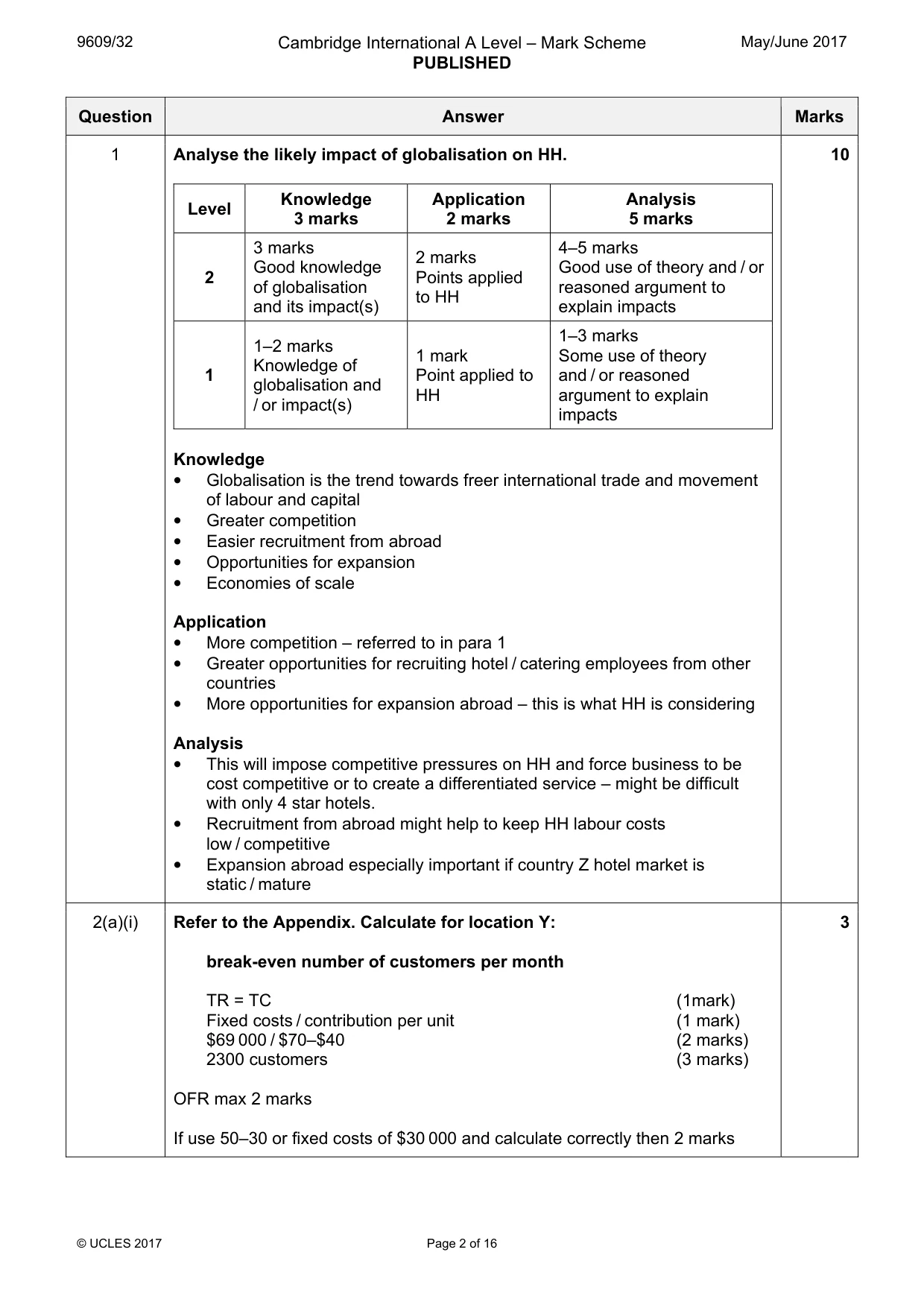
9609/32 Cambridge International A Level – Mark Scheme PUBLISHED May/June 2017 © UCLES 2017 Page 2 of 16 Question Answer Marks 1 Analyse the likely impact of globalisation on HH. Level Knowledge 3 marks Application 2 marks Analysis 5 marks 2 3 marks Good knowledge of globalisation and its impact(s) 2 marks Points applied to HH 4–5 marks Good use of theory and / or reasoned argument to explain impacts 1 1–2 marks Knowledge of globalisation and / or impact(s) 1 mark Point applied to HH 1–3 marks Some use of theory and / or reasoned argument to explain impacts Knowledge • Globalisation is the trend towards freer international trade and movement of labour and capital • Greater competition • Easier recruitment from abroad • Opportunities for expansion • Economies of scale Application • More competition – referred to in para 1 • Greater opportunities for recruiting hotel / catering employees from other countries • More opportunities for expansion abroad – this is what HH is considering Analysis • This will impose competitive pressures on HH and force business to be cost competitive or to create a differentiated service – might be difficult with only 4 star hotels. • Recruitment from abroad might help to keep HH labour costs low / competitive • Expansion abroad especially important if country Z hotel market is static / mature 10 2(a)(i) Refer to the Appendix. Calculate for location Y: break-even number of customers per month TR = TC (1mark) Fixed costs / contribution per unit (1 mark) $69 000 / $70–$40 (2 marks) 2300 customers (3 marks) OFR max 2 marks If use 50–30 or fixed costs of $30 000 and calculate correctly then 2 marks 3
Mark scheme, page 3
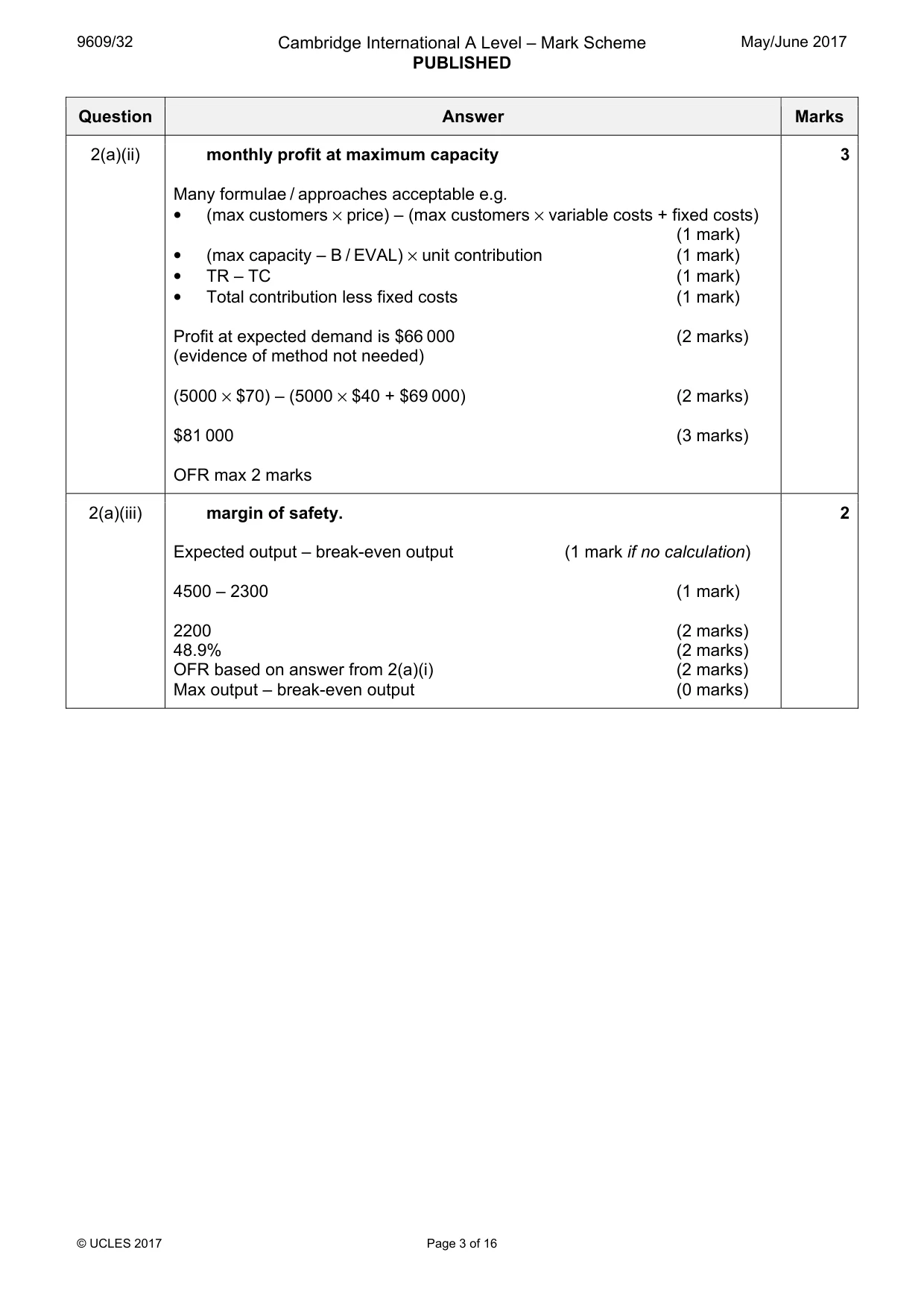
9609/32 Cambridge International A Level – Mark Scheme PUBLISHED May/June 2017 © UCLES 2017 Page 3 of 16 Question Answer Marks 2(a)(ii) monthly profit at maximum capacity Many formulae / approaches acceptable e.g. • (max customers × price) – (max customers × variable costs + fixed costs) (1 mark) • (max capacity – B / EVAL) × unit contribution (1 mark) • TR – TC (1 mark) • Total contribution less fixed costs (1 mark) Profit at expected demand is $66 000 (2 marks) (evidence of method not needed) (5000 × $70) – (5000 × $40 + $69 000) (2 marks) $81 000 (3 marks) OFR max 2 marks 3 2(a)(iii) margin of safety. Expected output – break-even output (1 mark if no calculation) 4500 – 2300 (1 mark) 2200 (2 marks) 48.9% (2 marks) OFR based on answer from 2(a)(i) (2 marks) Max output – break-even output (0 marks) 2
Mark scheme, page 4
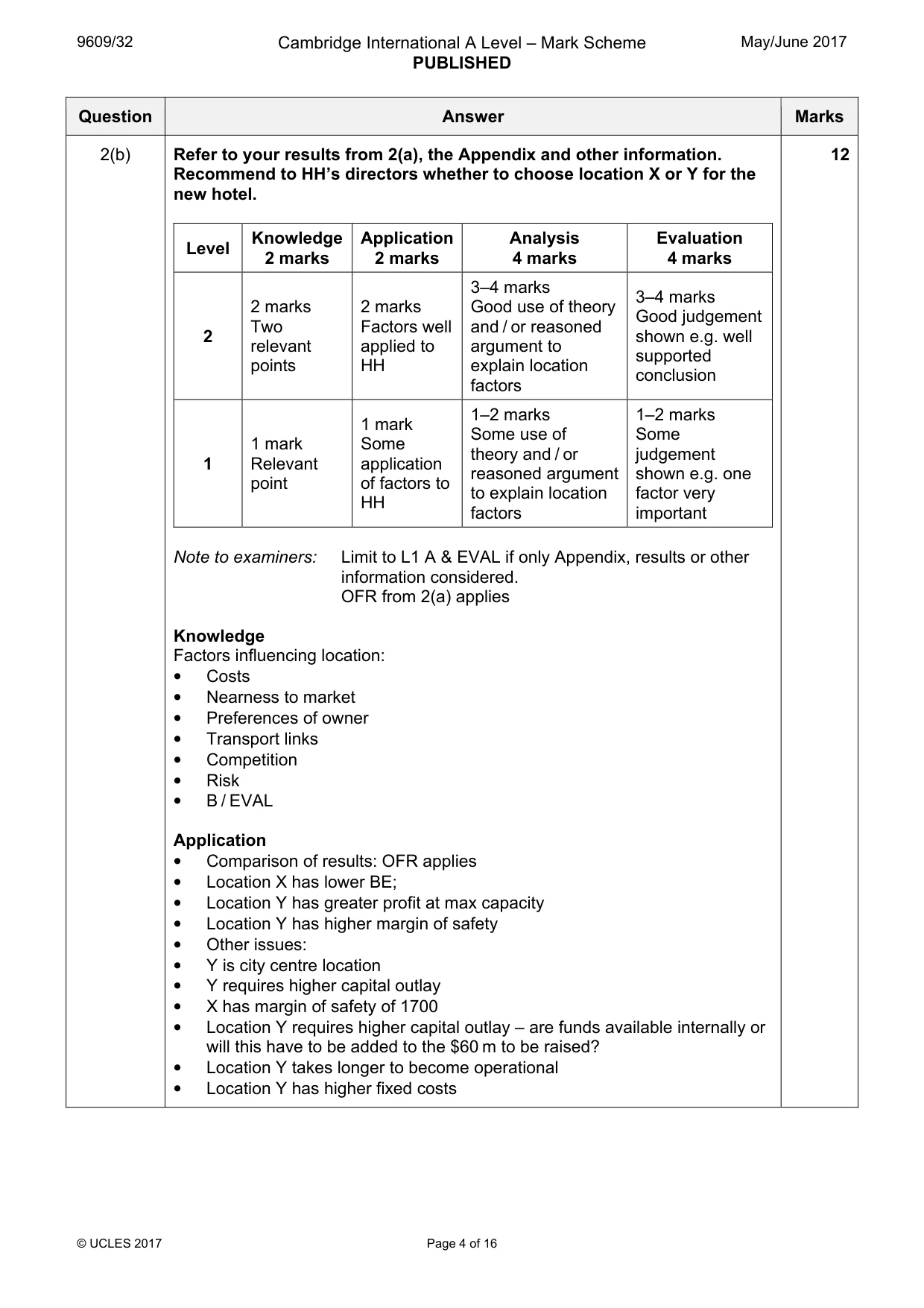
9609/32 Cambridge International A Level – Mark Scheme PUBLISHED May/June 2017 © UCLES 2017 Page 4 of 16 Question Answer Marks 2(b) Refer to your results from 2(a), the Appendix and other information. Recommend to HH’s directors whether to choose location X or Y for the new hotel. Level Knowledge 2 marks Application 2 marks Analysis 4 marks Evaluation 4 marks 2 2 marks Two relevant points 2 marks Factors well applied to HH 3–4 marks Good use of theory and / or reasoned argument to explain location factors 3–4 marks Good judgement shown e.g. well supported conclusion 1 1 mark Relevant point 1 mark Some application of factors to HH 1–2 marks Some use of theory and / or reasoned argument to explain location factors 1–2 marks Some judgement shown e.g. one factor very important Note to examiners: Limit to L1 A & EVAL if only Appendix, results or other information considered. OFR from 2(a) applies Knowledge Factors influencing location: • Costs • Nearness to market • Preferences of owner • Transport links • Competition • Risk • B / EVAL Application • Comparison of results: OFR applies • Location X has lower BE; • Location Y has greater profit at max capacity • Location Y has higher margin of safety • Other issues: • Y is city centre location • Y requires higher capital outlay • X has margin of safety of 1700 • Location Y requires higher capital outlay – are funds available internally or will this have to be added to the $60 m to be raised? • Location Y takes longer to become operational • Location Y has higher fixed costs 12
Mark scheme, page 5
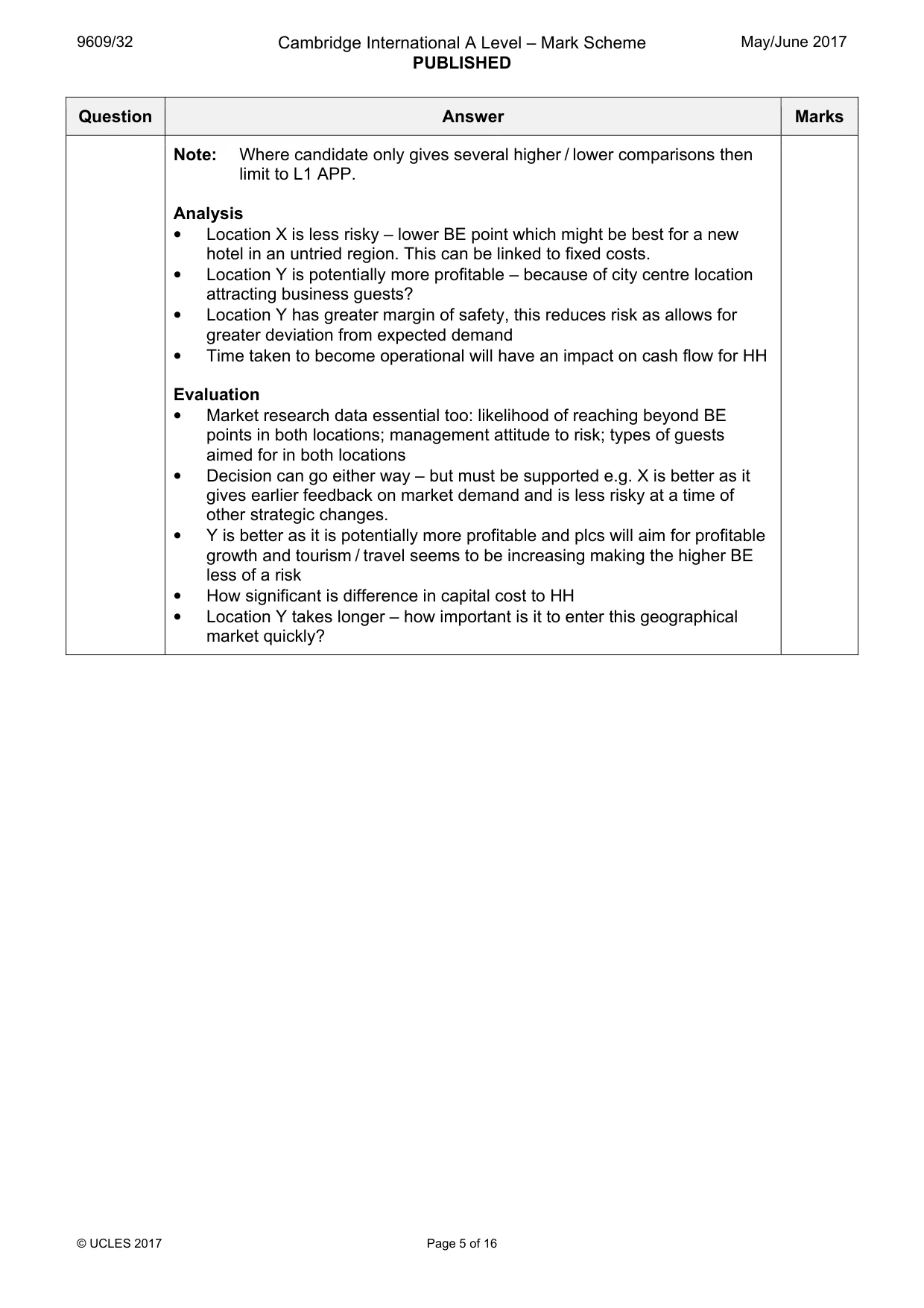
9609/32 Cambridge International A Level – Mark Scheme PUBLISHED May/June 2017 © UCLES 2017 Page 5 of 16 Question Answer Marks Note: Where candidate only gives several higher / lower comparisons then limit to L1 APP. Analysis • Location X is less risky – lower BE point which might be best for a new hotel in an untried region. This can be linked to fixed costs. • Location Y is potentially more profitable – because of city centre location attracting business guests? • Location Y has greater margin of safety, this reduces risk as allows for greater deviation from expected demand • Time taken to become operational will have an impact on cash flow for HH Evaluation • Market research data essential too: likelihood of reaching beyond BE points in both locations; management attitude to risk; types of guests aimed for in both locations • Decision can go either way – but must be supported e.g. X is better as it gives earlier feedback on market demand and is less risky at a time of other strategic changes. • Y is better as it is potentially more profitable and plcs will aim for profitable growth and tourism / travel seems to be increasing making the higher BE less of a risk • How significant is difference in capital cost to HH • Location Y takes longer – how important is it to enter this geographical market quickly?
Mark scheme, page 6
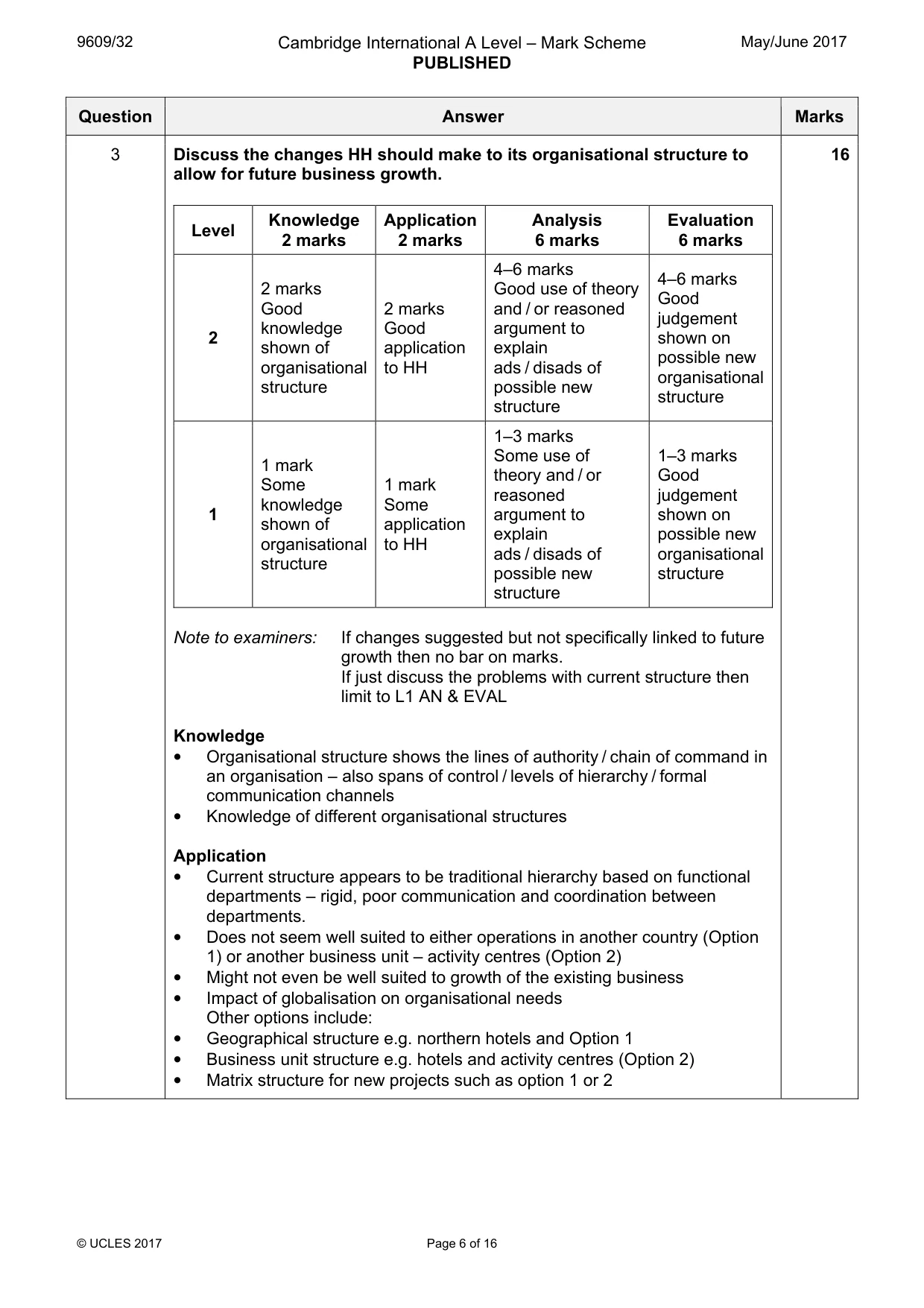
9609/32 Cambridge International A Level – Mark Scheme PUBLISHED May/June 2017 © UCLES 2017 Page 6 of 16 Question Answer Marks 3 Discuss the changes HH should make to its organisational structure to allow for future business growth. Level Knowledge 2 marks Application 2 marks Analysis 6 marks Evaluation 6 marks 2 2 marks Good knowledge shown of organisational structure 2 marks Good application to HH 4–6 marks Good use of theory and / or reasoned argument to explain ads / disads of possible new structure 4–6 marks Good judgement shown on possible new organisational structure 1 1 mark Some knowledge shown of organisational structure 1 mark Some application to HH 1–3 marks Some use of theory and / or reasoned argument to explain ads / disads of possible new structure 1–3 marks Good judgement shown on possible new organisational structure Note to examiners: If changes suggested but not specifically linked to future growth then no bar on marks. If just discuss the problems with current structure then limit to L1 AN & EVAL Knowledge • Organisational structure shows the lines of authority / chain of command in an organisation – also spans of control / levels of hierarchy / formal communication channels • Knowledge of different organisational structures Application • Current structure appears to be traditional hierarchy based on functional departments – rigid, poor communication and coordination between departments. • Does not seem well suited to either operations in another country (Option 1) or another business unit – activity centres (Option 2) • Might not even be well suited to growth of the existing business • Impact of globalisation on organisational needs Other options include: • Geographical structure e.g. northern hotels and Option 1 • Business unit structure e.g. hotels and activity centres (Option 2) • Matrix structure for new projects such as option 1 or 2 16
Mark scheme, page 7
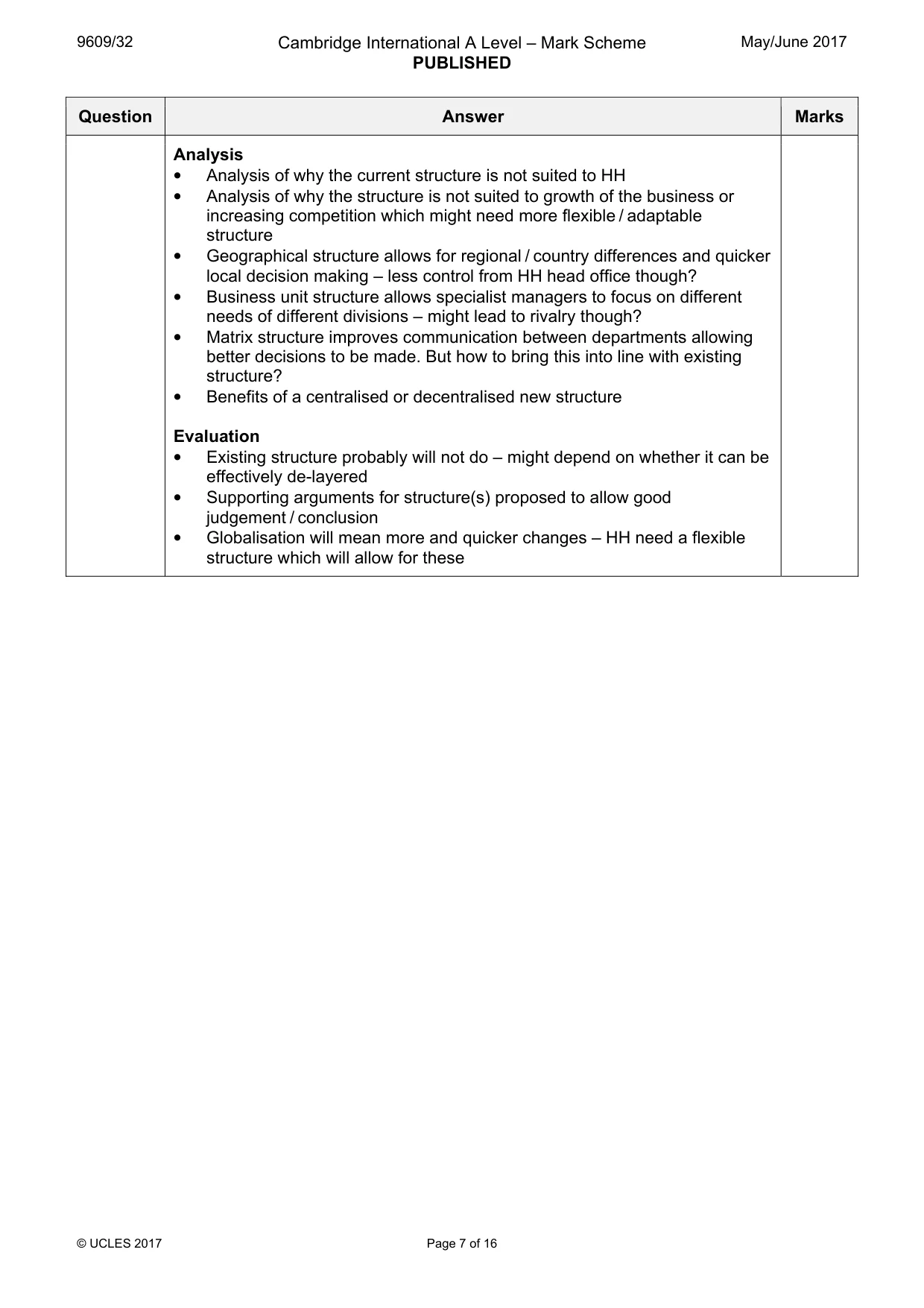
9609/32 Cambridge International A Level – Mark Scheme PUBLISHED May/June 2017 © UCLES 2017 Page 7 of 16 Question Answer Marks Analysis • Analysis of why the current structure is not suited to HH • Analysis of why the structure is not suited to growth of the business or increasing competition which might need more flexible / adaptable structure • Geographical structure allows for regional / country differences and quicker local decision making – less control from HH head office though? • Business unit structure allows specialist managers to focus on different needs of different divisions – might lead to rivalry though? • Matrix structure improves communication between departments allowing better decisions to be made. But how to bring this into line with existing structure? • Benefits of a centralised or decentralised new structure Evaluation • Existing structure probably will not do – might depend on whether it can be effectively de-layered • Supporting arguments for structure(s) proposed to allow good judgement / conclusion • Globalisation will mean more and quicker changes – HH need a flexible structure which will allow for these
Mark scheme, page 8
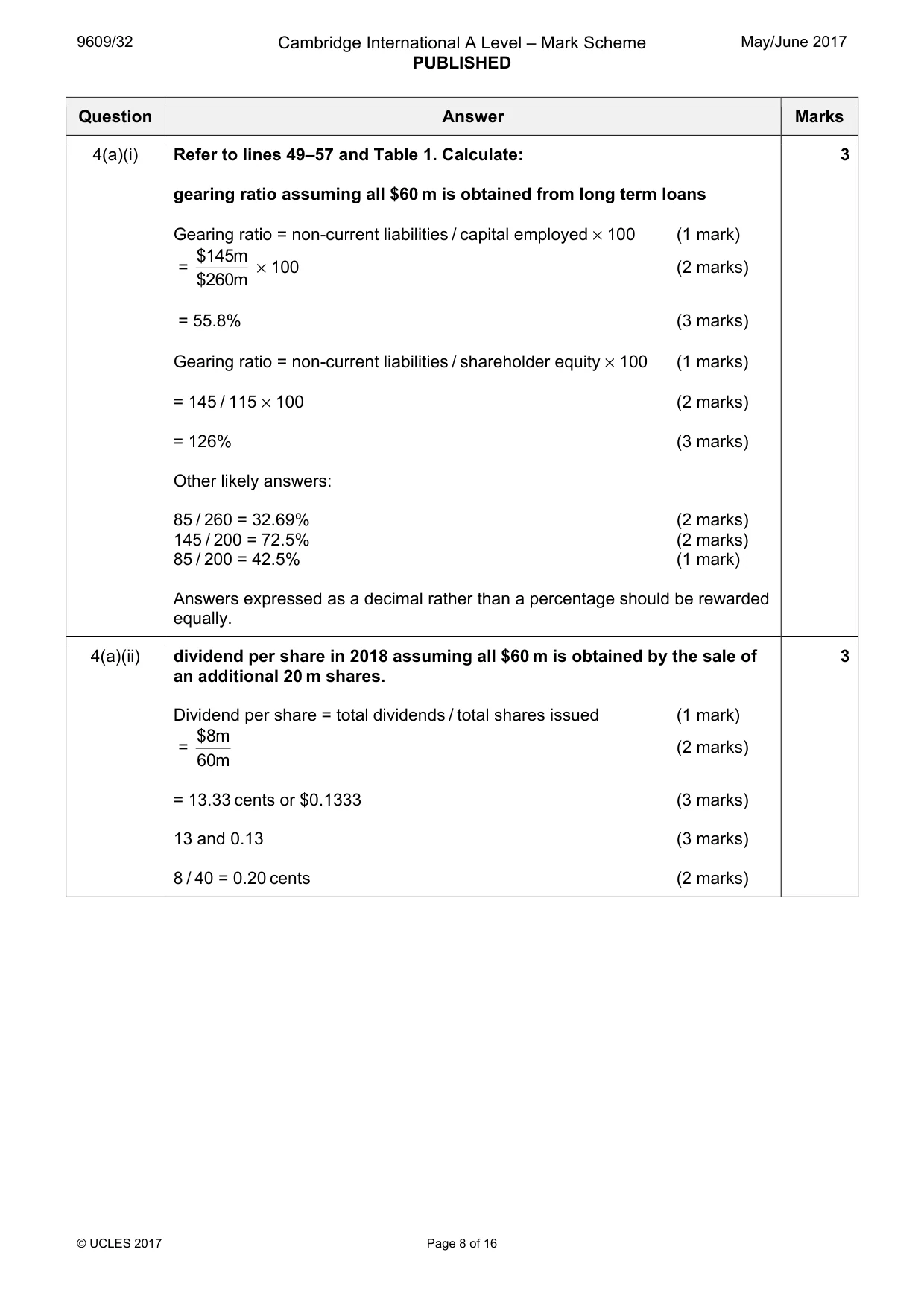
9609/32 Cambridge International A Level – Mark Scheme PUBLISHED May/June 2017 © UCLES 2017 Page 8 of 16 Question Answer Marks 4(a)(i) Refer to lines 49–57 and Table 1. Calculate: gearing ratio assuming all $60 m is obtained from long term loans Gearing ratio = non-current liabilities / capital employed × 100 (1 mark) = $145m $260m × 100 (2 marks) = 55.8% (3 marks) Gearing ratio = non-current liabilities / shareholder equity × 100 (1 marks) = 145 / 115 × 100 (2 marks) = 126% (3 marks) Other likely answers: 85 / 260 = 32.69% (2 marks) 145 / 200 = 72.5% (2 marks) 85 / 200 = 42.5% (1 mark) Answers expressed as a decimal rather than a percentage should be rewarded equally. 3 4(a)(ii) dividend per share in 2018 assuming all $60 m is obtained by the sale of an additional 20 m shares. Dividend per share = total dividends / total shares issued (1 mark) = $8m 60m (2 marks) = 13.33 cents or $0.1333 (3 marks) 13 and 0.13 (3 marks) 8 / 40 = 0.20 cents (2 marks) 3
Mark scheme, page 9
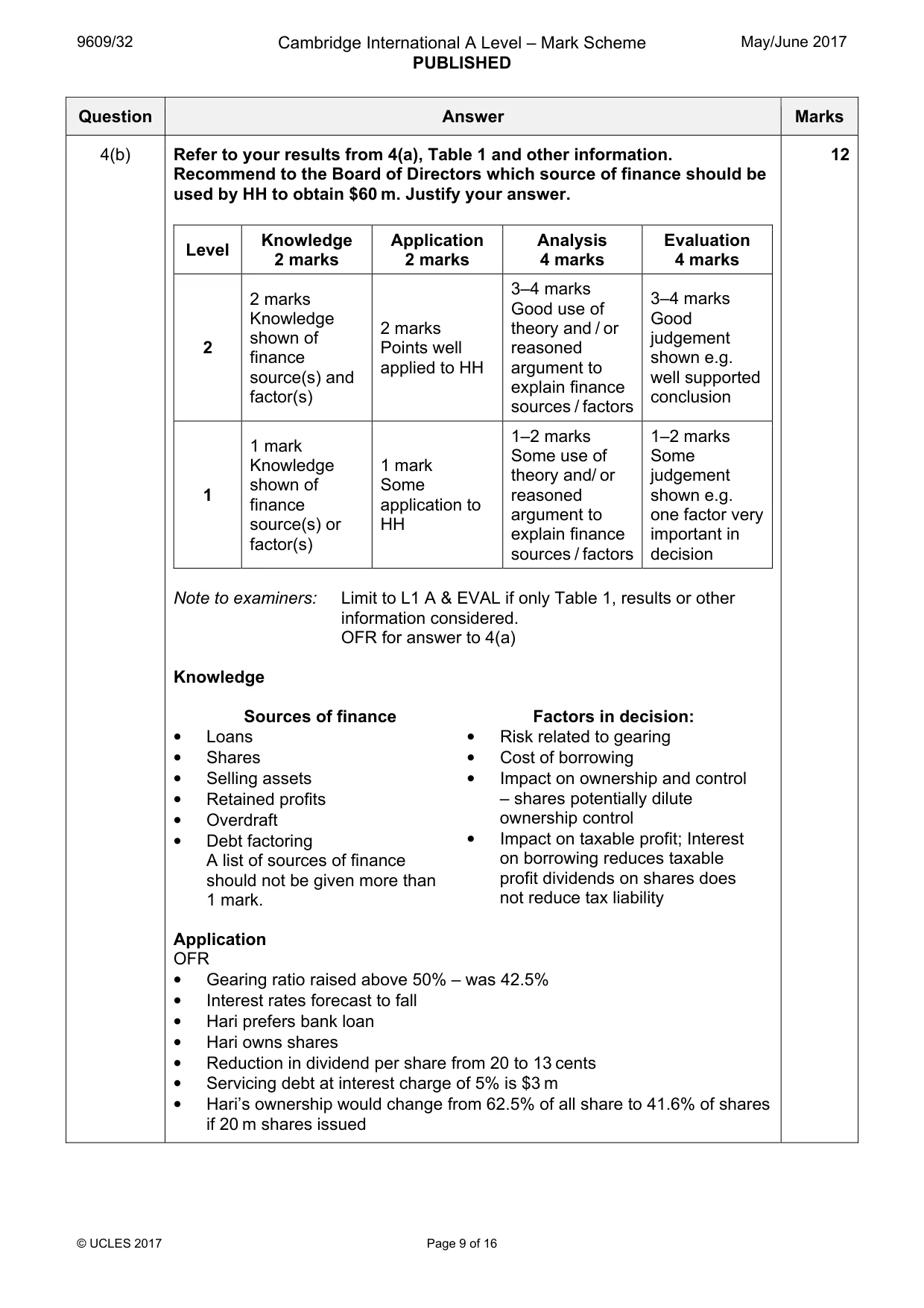
9609/32 Cambridge International A Level – Mark Scheme PUBLISHED May/June 2017 © UCLES 2017 Page 9 of 16 Question Answer Marks 4(b) Refer to your results from 4(a), Table 1 and other information. Recommend to the Board of Directors which source of finance should be used by HH to obtain $60 m. Justify your answer. Level Knowledge 2 marks Application 2 marks Analysis 4 marks Evaluation 4 marks 2 2 marks Knowledge shown of finance source(s) and factor(s) 2 marks Points well applied to HH 3–4 marks Good use of theory and / or reasoned argument to explain finance sources / factors 3–4 marks Good judgement shown e.g. well supported conclusion 1 1 mark Knowledge shown of finance source(s) or factor(s) 1 mark Some application to HH 1–2 marks Some use of theory and/ or reasoned argument to explain finance sources / factors 1–2 marks Some judgement shown e.g. one factor very important in decision Note to examiners: Limit to L1 A & EVAL if only Table 1, results or other information considered. OFR for answer to 4(a) Knowledge Sources of finance • Loans • Shares • Selling assets • Retained profits • Overdraft • Debt factoring A list of sources of finance should not be given more than 1 mark. Factors in decision: • Risk related to gearing • Cost of borrowing • Impact on ownership and control – shares potentially dilute ownership control • Impact on taxable profit; Interest on borrowing reduces taxable profit dividends on shares does not reduce tax liability Application OFR • Gearing ratio raised above 50% – was 42.5% • Interest rates forecast to fall • Hari prefers bank loan • Hari owns shares • Reduction in dividend per share from 20 to 13 cents • Servicing debt at interest charge of 5% is $3 m • Hari’s ownership would change from 62.5% of all share to 41.6% of shares if 20 m shares issued 12
Mark scheme, page 10
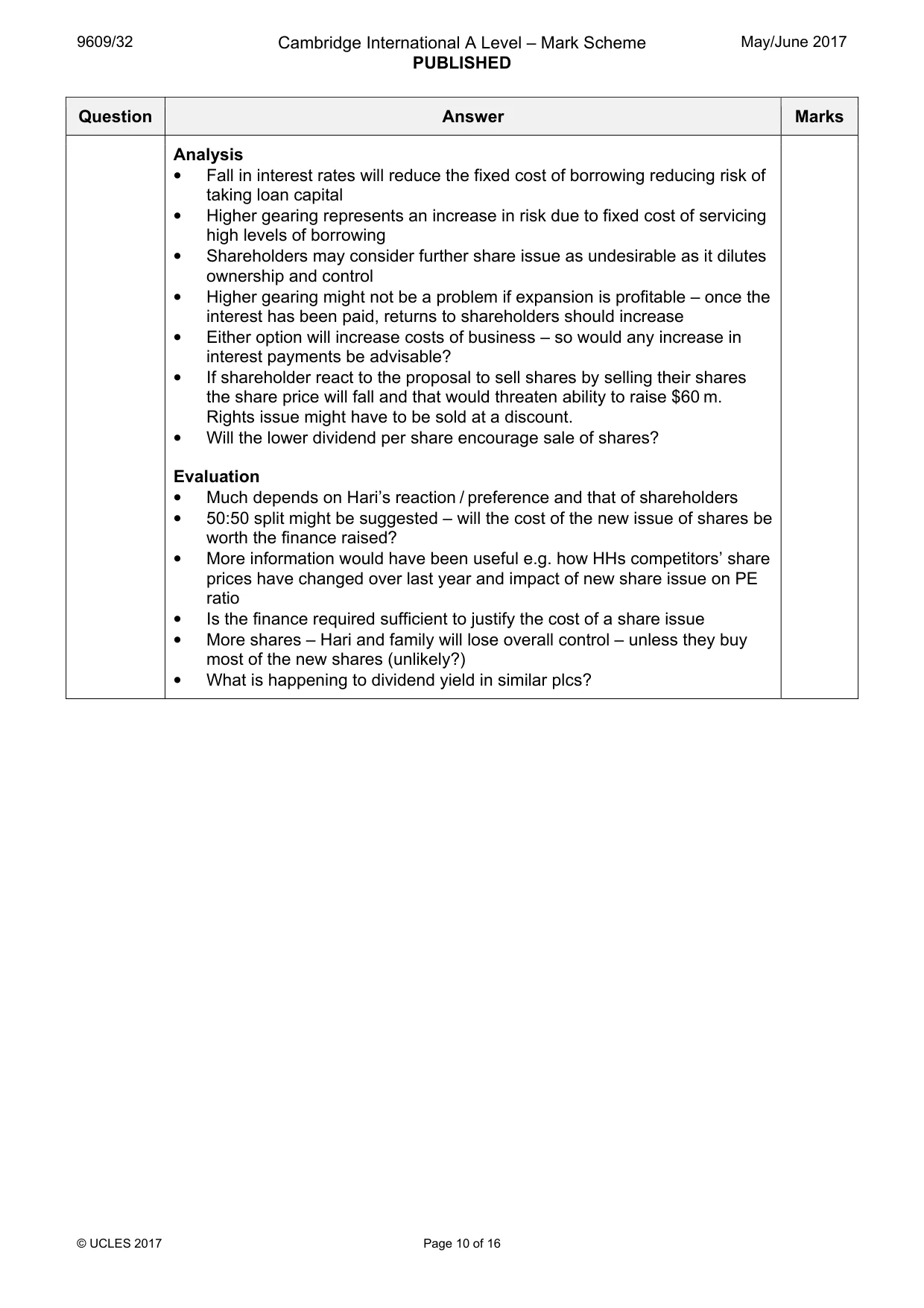
9609/32 Cambridge International A Level – Mark Scheme PUBLISHED May/June 2017 © UCLES 2017 Page 10 of 16 Question Answer Marks Analysis • Fall in interest rates will reduce the fixed cost of borrowing reducing risk of taking loan capital • Higher gearing represents an increase in risk due to fixed cost of servicing high levels of borrowing • Shareholders may consider further share issue as undesirable as it dilutes ownership and control • Higher gearing might not be a problem if expansion is profitable – once the interest has been paid, returns to shareholders should increase • Either option will increase costs of business – so would any increase in interest payments be advisable? • If shareholder react to the proposal to sell shares by selling their shares the share price will fall and that would threaten ability to raise $60 m. Rights issue might have to be sold at a discount. • Will the lower dividend per share encourage sale of shares? Evaluation • Much depends on Hari’s reaction / preference and that of shareholders • 50:50 split might be suggested – will the cost of the new issue of shares be worth the finance raised? • More information would have been useful e.g. how HHs competitors’ share prices have changed over last year and impact of new share issue on PE ratio • Is the finance required sufficient to justify the cost of a share issue • More shares – Hari and family will lose overall control – unless they buy most of the new shares (unlikely?) • What is happening to dividend yield in similar plcs?
Mark scheme, page 11
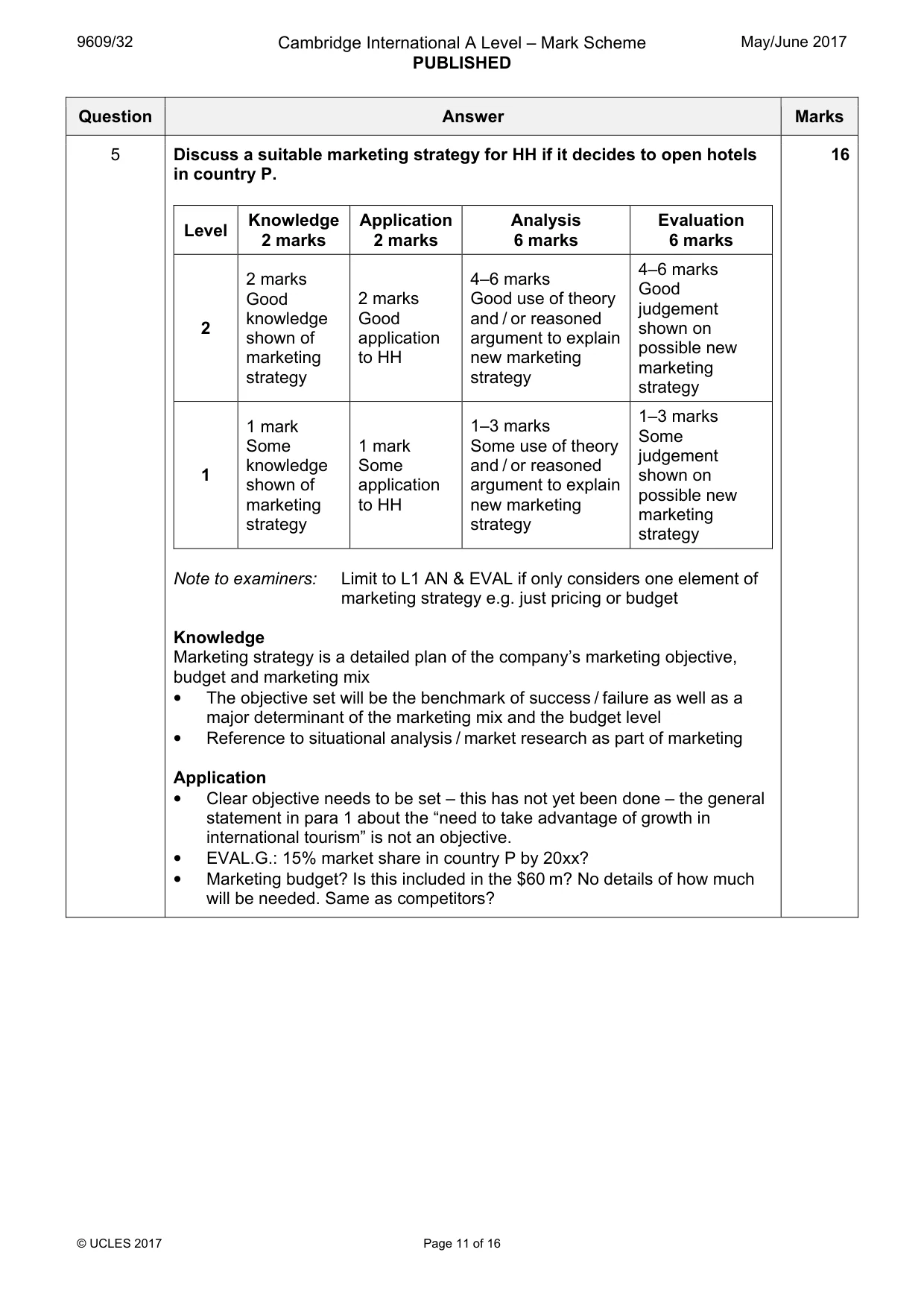
9609/32 Cambridge International A Level – Mark Scheme PUBLISHED May/June 2017 © UCLES 2017 Page 11 of 16 Question Answer Marks 5 Discuss a suitable marketing strategy for HH if it decides to open hotels in country P. Level Knowledge 2 marks Application 2 marks Analysis 6 marks Evaluation 6 marks 2 2 marks Good knowledge shown of marketing strategy 2 marks Good application to HH 4–6 marks Good use of theory and / or reasoned argument to explain new marketing strategy 4–6 marks Good judgement shown on possible new marketing strategy 1 1 mark Some knowledge shown of marketing strategy 1 mark Some application to HH 1–3 marks Some use of theory and / or reasoned argument to explain new marketing strategy 1–3 marks Some judgement shown on possible new marketing strategy Note to examiners: Limit to L1 AN & EVAL if only considers one element of marketing strategy e.g. just pricing or budget Knowledge Marketing strategy is a detailed plan of the company’s marketing objective, budget and marketing mix • The objective set will be the benchmark of success / failure as well as a major determinant of the marketing mix and the budget level • Reference to situational analysis / market research as part of marketing Application • Clear objective needs to be set – this has not yet been done – the general statement in para 1 about the “need to take advantage of growth in international tourism” is not an objective. • EVAL.G.: 15% market share in country P by 20xx? • Marketing budget? Is this included in the $60 m? No details of how much will be needed. Same as competitors? 16
Mark scheme, page 12
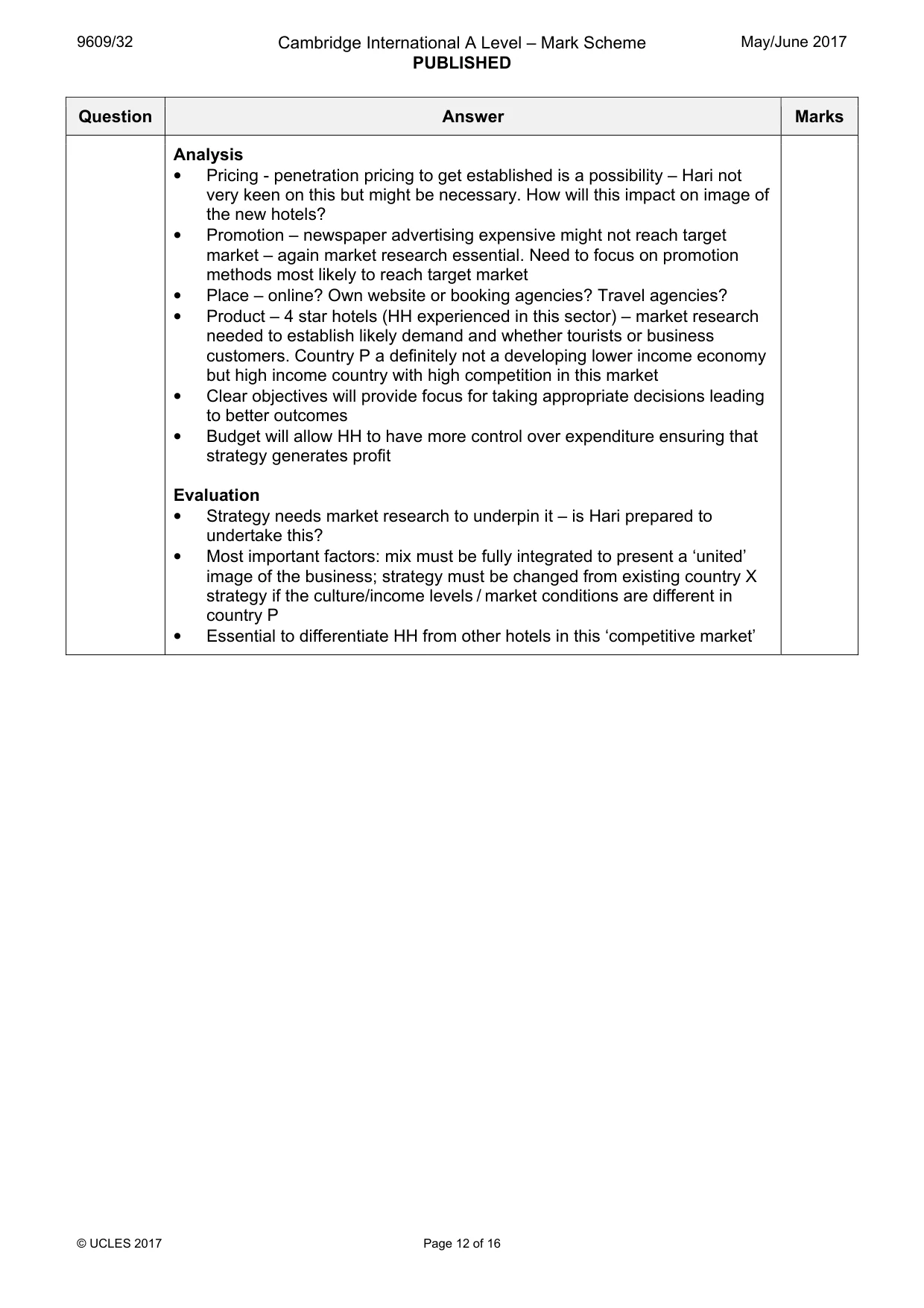
9609/32 Cambridge International A Level – Mark Scheme PUBLISHED May/June 2017 © UCLES 2017 Page 12 of 16 Question Answer Marks Analysis • Pricing - penetration pricing to get established is a possibility – Hari not very keen on this but might be necessary. How will this impact on image of the new hotels? • Promotion – newspaper advertising expensive might not reach target market – again market research essential. Need to focus on promotion methods most likely to reach target market • Place – online? Own website or booking agencies? Travel agencies? • Product – 4 star hotels (HH experienced in this sector) – market research needed to establish likely demand and whether tourists or business customers. Country P a definitely not a developing lower income economy but high income country with high competition in this market • Clear objectives will provide focus for taking appropriate decisions leading to better outcomes • Budget will allow HH to have more control over expenditure ensuring that strategy generates profit Evaluation • Strategy needs market research to underpin it – is Hari prepared to undertake this? • Most important factors: mix must be fully integrated to present a ‘united’ image of the business; strategy must be changed from existing country X strategy if the culture/income levels / market conditions are different in country P • Essential to differentiate HH from other hotels in this ‘competitive market’
Mark scheme, page 13
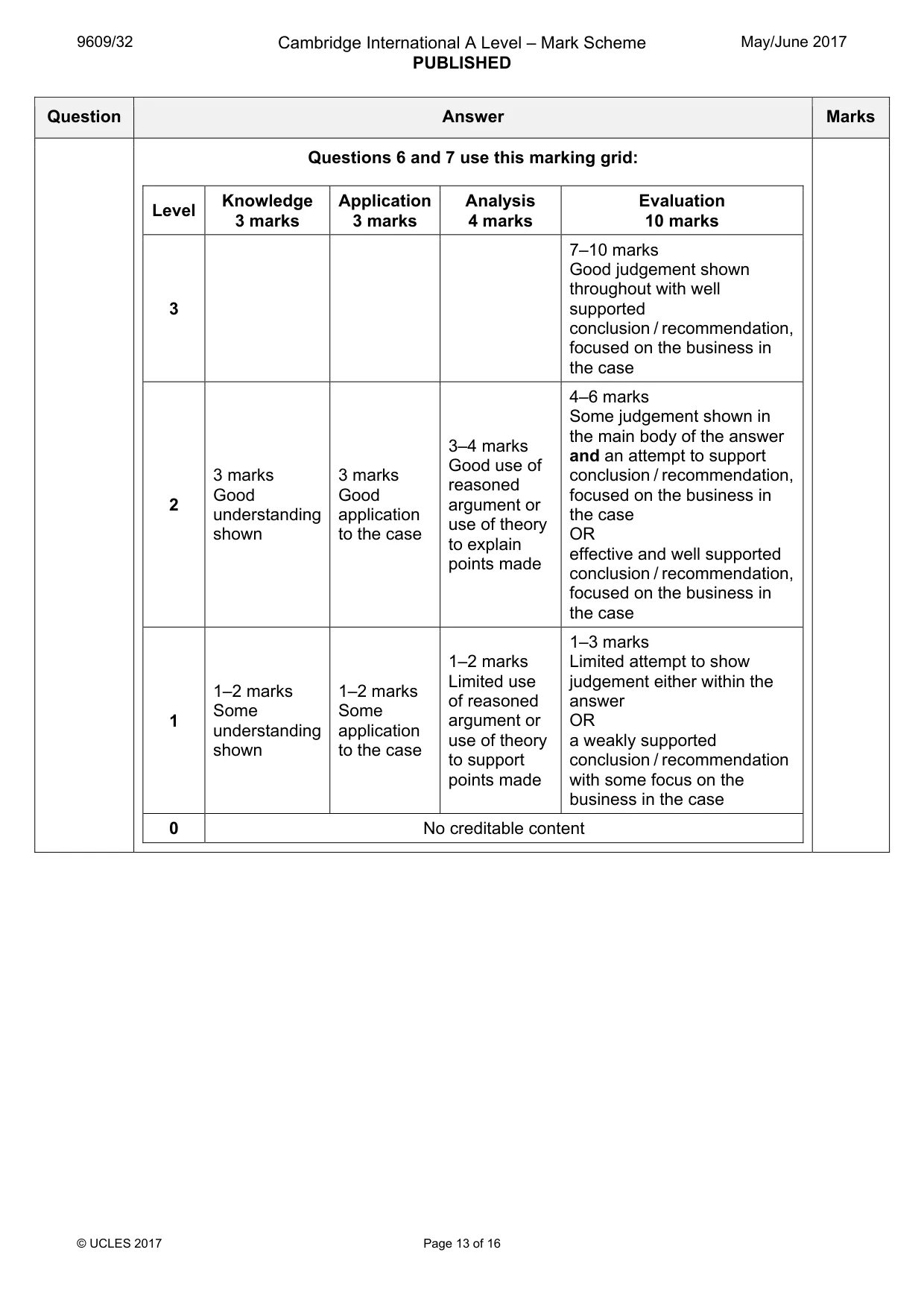
9609/32 Cambridge International A Level – Mark Scheme PUBLISHED May/June 2017 © UCLES 2017 Page 13 of 16 Question Answer Marks Questions 6 and 7 use this marking grid: Level Knowledge 3 marks Application 3 marks Analysis 4 marks Evaluation 10 marks 3 7–10 marks Good judgement shown throughout with well supported conclusion / recommendation, focused on the business in the case 2 3 marks Good understanding shown 3 marks Good application to the case 3–4 marks Good use of reasoned argument or use of theory to explain points made 4–6 marks Some judgement shown in the main body of the answer and an attempt to support conclusion / recommendation, focused on the business in the case OR effective and well supported conclusion / recommendation, focused on the business in the case 1 1–2 marks Some understanding shown 1–2 marks Some application to the case 1–2 marks Limited use of reasoned argument or use of theory to support points made 1–3 marks Limited attempt to show judgement either within the answer OR a weakly supported conclusion / recommendation with some focus on the business in the case 0 No creditable content
Mark scheme, page 14
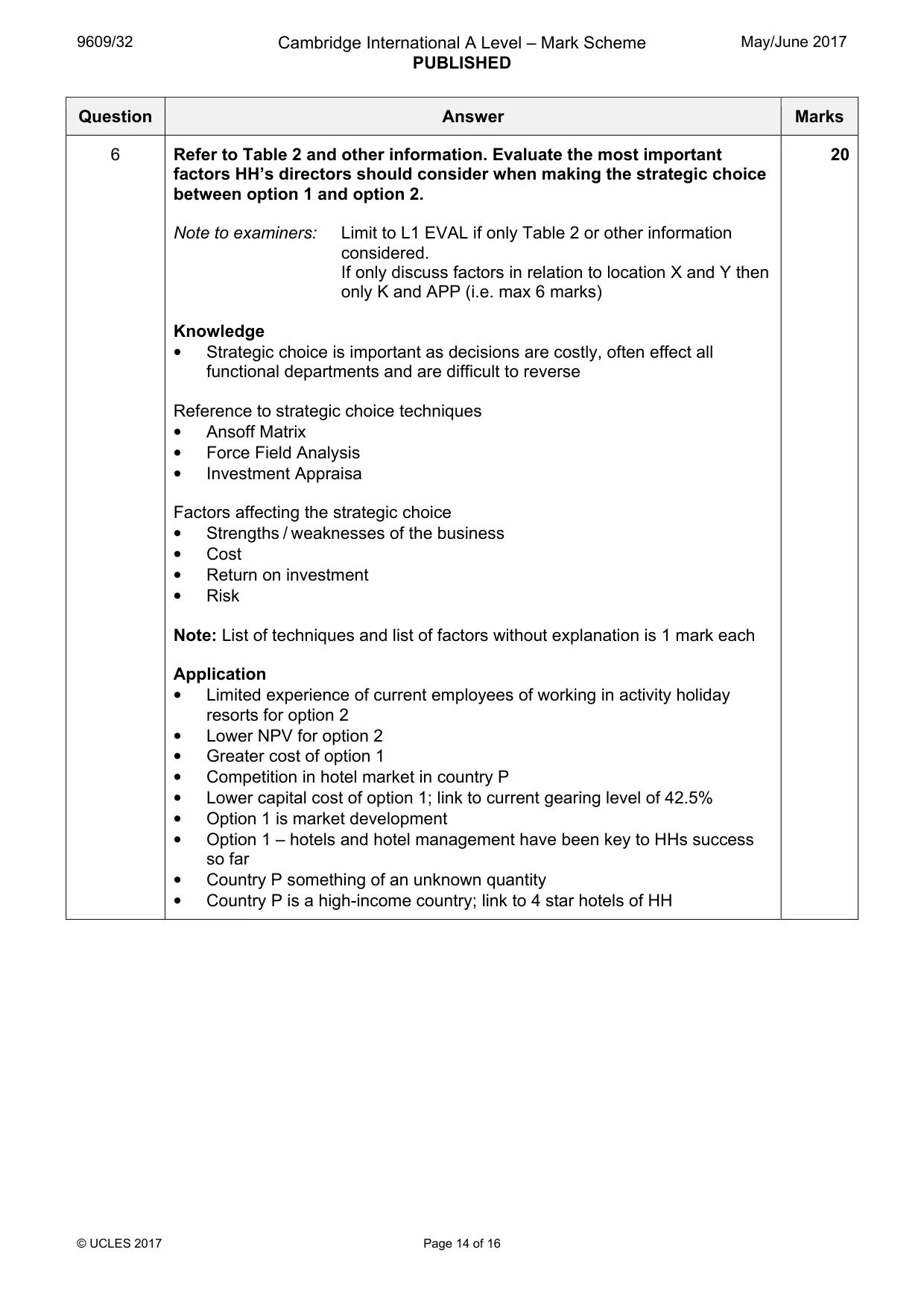
9609/32 Cambridge International A Level – Mark Scheme PUBLISHED May/June 2017 © UCLES 2017 Page 14 of 16 Question Answer Marks 6 Refer to Table 2 and other information. Evaluate the most important factors HH’s directors should consider when making the strategic choice between option 1 and option 2. Note to examiners: Limit to L1 EVAL if only Table 2 or other information considered. If only discuss factors in relation to location X and Y then only K and APP (i.e. max 6 marks) Knowledge • Strategic choice is important as decisions are costly, often effect all functional departments and are difficult to reverse Reference to strategic choice techniques • Ansoff Matrix • Force Field Analysis • Investment Appraisa Factors affecting the strategic choice • Strengths / weaknesses of the business • Cost • Return on investment • Risk Note: List of techniques and list of factors without explanation is 1 mark each Application • Limited experience of current employees of working in activity holiday resorts for option 2 • Lower NPV for option 2 • Greater cost of option 1 • Competition in hotel market in country P • Lower capital cost of option 1; link to current gearing level of 42.5% • Option 1 is market development • Option 1 – hotels and hotel management have been key to HHs success so far • Country P something of an unknown quantity • Country P is a high-income country; link to 4 star hotels of HH 20
Mark scheme, page 15
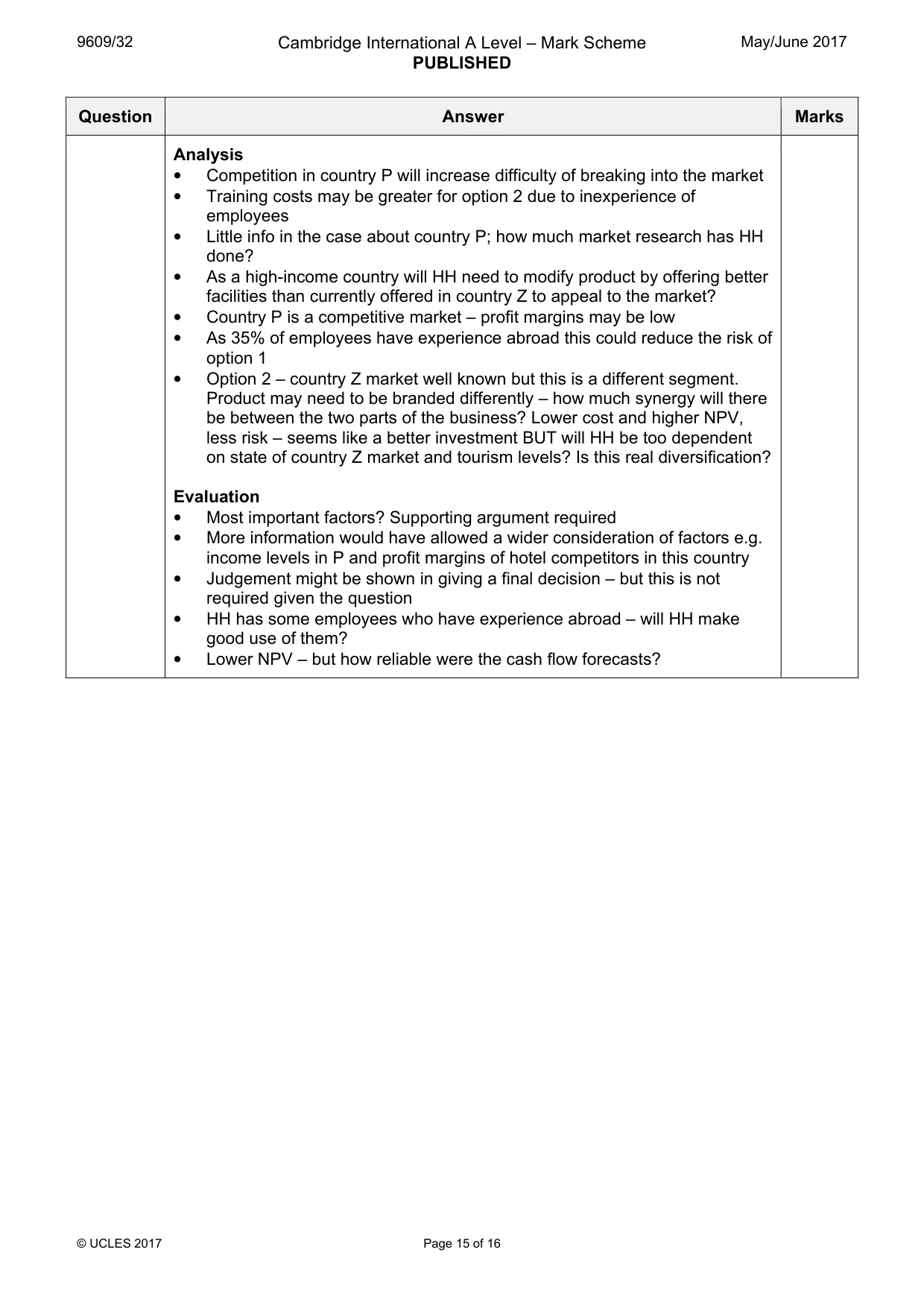
9609/32 Cambridge International A Level – Mark Scheme PUBLISHED May/June 2017 © UCLES 2017 Page 15 of 16 Question Answer Marks Analysis • Competition in country P will increase difficulty of breaking into the market • Training costs may be greater for option 2 due to inexperience of employees • Little info in the case about country P; how much market research has HH done? • As a high-income country will HH need to modify product by offering better facilities than currently offered in country Z to appeal to the market? • Country P is a competitive market – profit margins may be low • As 35% of employees have experience abroad this could reduce the risk of option 1 • Option 2 – country Z market well known but this is a different segment. Product may need to be branded differently – how much synergy will there be between the two parts of the business? Lower cost and higher NPV, less risk – seems like a better investment BUT will HH be too dependent on state of country Z market and tourism levels? Is this real diversification? Evaluation • Most important factors? Supporting argument required • More information would have allowed a wider consideration of factors e.g. income levels in P and profit margins of hotel competitors in this country • Judgement might be shown in giving a final decision – but this is not required given the question • HH has some employees who have experience abroad – will HH make good use of them? • Lower NPV – but how reliable were the cash flow forecasts?
Mark scheme, page 16
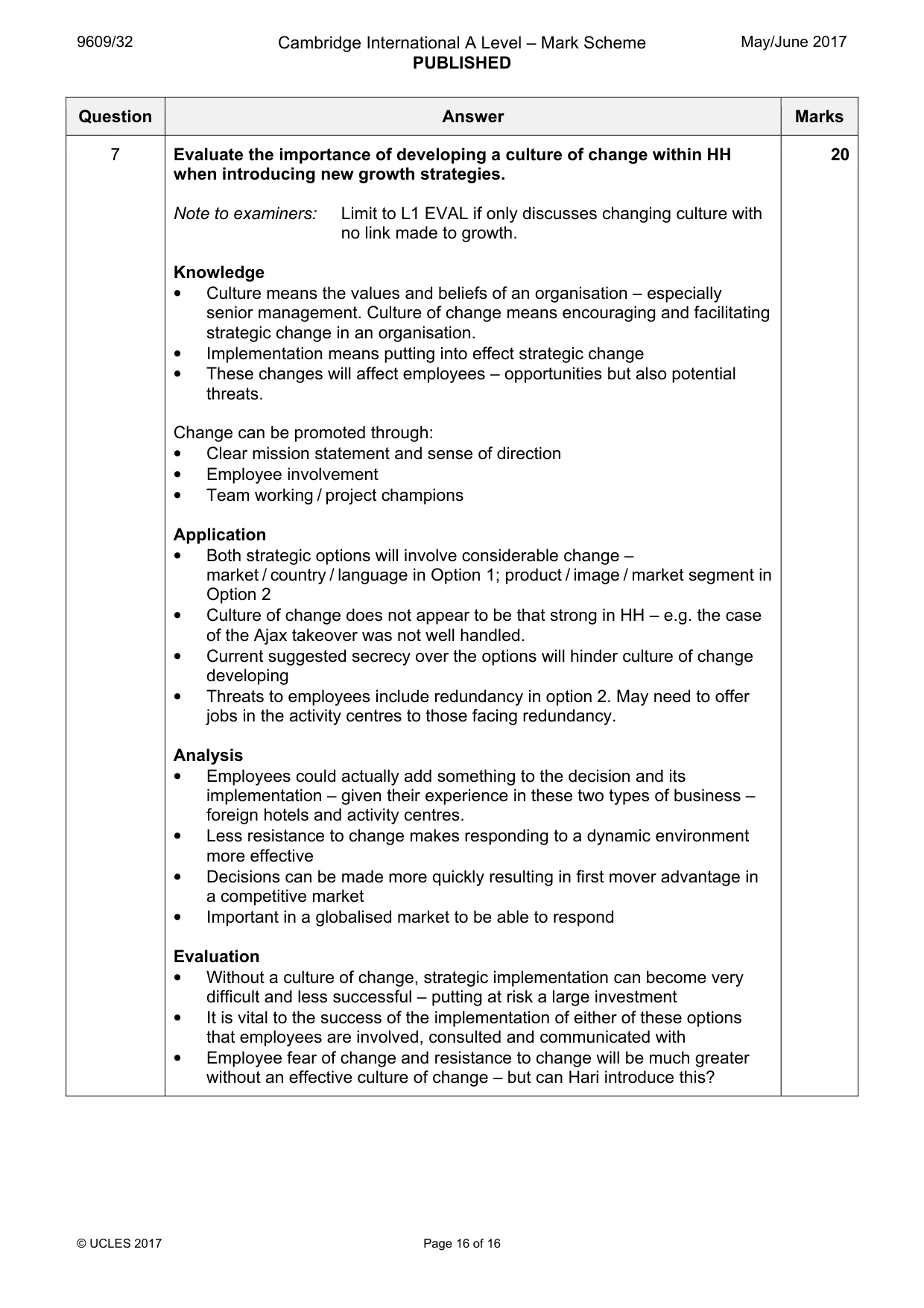
9609/32 Cambridge International A Level – Mark Scheme PUBLISHED May/June 2017 © UCLES 2017 Page 16 of 16 Question Answer Marks 7 Evaluate the importance of developing a culture of change within HH when introducing new growth strategies. Note to examiners: Limit to L1 EVAL if only discusses changing culture with no link made to growth. Knowledge • Culture means the values and beliefs of an organisation – especially senior management. Culture of change means encouraging and facilitating strategic change in an organisation. • Implementation means putting into effect strategic change • These changes will affect employees – opportunities but also potential threats. Change can be promoted through: • Clear mission statement and sense of direction • Employee involvement • Team working / project champions Application • Both strategic options will involve considerable change – market / country / language in Option 1; product / image / market segment in Option 2 • Culture of change does not appear to be that strong in HH – e.g. the case of the Ajax takeover was not well handled. • Current suggested secrecy over the options will hinder culture of change developing • Threats to employees include redundancy in option 2. May need to offer jobs in the activity centres to those facing redundancy. Analysis • Employees could actually add something to the decision and its implementation – given their experience in these two types of business – foreign hotels and activity centres. • Less resistance to change makes responding to a dynamic environment more effective • Decisions can be made more quickly resulting in first mover advantage in a competitive market • Important in a globalised market to be able to respond Evaluation • Without a culture of change, strategic implementation can become very difficult and less successful – putting at risk a large investment • It is vital to the success of the implementation of either of these options that employees are involved, consulted and communicated with • Employee fear of change and resistance to change will be much greater without an effective culture of change – but can Hari introduce this? 20