Cambridge A Level Business (for first examination in 2016) 9609 — 2017 May/June Paper 3 · Variant 3
9609/33/M/J/17
The question paper and its mark scheme, free to read here and free to download. This is Cambridge’s own paper, exactly as it was sat.
Question paper8 pages

Mark scheme12 pages
Answers below. Sit the paper first if you are practising.
Paper as text
Question paper, page 1
This document consists of 7 printed pages, 1 blank page and 1 Insert. DC (NH/SG) 132265/2 © UCLES 2017 [Turn over * 9 5 1 4 0 2 4 1 9 2 * BUSINESS 9609/33 Paper 3 Case Study May/June 2017 3 hours No Additional Materials are required. READ THESE INSTRUCTIONS FIRST An answer booklet is provided inside this question paper. You should follow the instructions on the front cover of the answer booklet. If you need additional answer paper ask the invigilator for a continuation booklet. Section A Answer all questions. Section B Answer one question. You are advised to spend no more than 40 minutes on Section B. The businesses described in this question paper are entirely fictitious. The number of marks is given in brackets [ ] at the end of each question or part question. Cambridge International Examinations Cambridge International Advanced Subsidiary and Advanced Level
Question paper, page 2
2 9609/33/M/J/17 © UCLES 2017 Pedro Vela Shoes (PV) Pedro Vela started PV which is now a successful business making shoes. By the time Pedro was 35 PV was a private limited company with a factory making a range of shoes. 80% of sales are now exported via agents or direct to multinational shoe retailers. PV is one of many shoe manufacturers in one region of the country. PV benefits from reliable suppliers of machinery and raw materials. PV’s market position PV has operated successfully for 14 years but for the last three years profits have been falling. Competition is increasing in all the markets PV operates in. Costs of production are also increasing and larger shoe manufacturers are taking over smaller businesses. Pedro has prepared a detailed report that analyses the market position of PV and the reasons for falling profits. The report concludes with an outline of possible actions that might be taken. Pedro does not want to sell PV. Marketing Major multinational shoe retailers have buyers located in the same region as PV’s factory. In addition there are independent agents who arrange to supply both domestic and international shoe retailers. Pedro makes sure that he keeps good contacts with as many agents and buyers as possible, regularly inviting them to the factory and sending them samples. The market is changing and retailers are increasingly interested in smaller orders, shorter delivery times, higher quality and more differentiated products. The buyer for a major retailer warned Pedro: ‘I like your products and the designs and quality are good, but we cannot keep on ordering from a business that does not meet agreed delivery dates. Also, price is becoming a crucial factor in our decision to buy.’ 20% of PV’s output is sold within the domestic market to a small number of retail outlets. There is increasing competition from cheaper imported shoes. Pedro has attempted to forecast future sales for export. He has used past sales data (see Appendix 1). He predicts that PV is likely to increase export sales and will continue to be successful despite the buyer’s warning. Production PV’s shoes are made using batch production with each employee specialising in one task. The leather and fabric parts of the shoes are cut out and shaped before being stitched and glued together. Other components, including shoelaces, are added. Checks for quality are only done after this stage, just before the shoes are packaged in boxes. The boxes are supplied and printed by outside printing firms. Pedro’s report showed that production problems contributed to falling profits. He identified two objectives (that should help to cut costs): • Reduce the percentage of finished shoes failing to meet quality standards to 5% • Reduce inventory levels. Last year the factory’s average capacity utilisation was 95%. Material waste was high and 20% of finished shoes failed to meet quality standards. PV holds a high level of inventory (of raw materials and components) in order to enable manufacture of many designs and meet increases in orders quickly. Pedro thinks there may be more efficient and effective ways of working. 5 10 15 20 25 30 35 40
Question paper, page 3
3 9609/33/M/J/17 © UCLES 2017 [Turn over Outsourcing The readily accessible network of suppliers is a major strength for PV. It enables PV to obtain materials and outsource production of many components. This leads to an efficient supply chain. However, it has made PV dependent on some key suppliers. Pedro is worried that costs are outside his control. He knows he needs to communicate with his suppliers more frequently. Investment Pedro’s report identified a significant problem: the age and condition of the machinery used in production. PV is still using the machines that were put into the factory when it was first set up. This is leading to higher maintenance costs and possibly contributing to delays and lower quality. Investment in replacement machinery would solve these problems. Pedro has researched the cost of this and estimated the financial benefits that replacement might achieve (see Appendix 2). Shoe making machinery is likely to have a working life of at least ten years. This makes it difficult to forecast future cash flows and set a lifetime for this investment project. Pedro has decided that five years is a cautious estimate of useful life. He has also chosen not to give any residual value for the machines. He now has to decide whether to make this investment and obtain the finance needed for this investment. Human Resources Pedro assumes that all of PV’s 117 employees are good at their work. There are two senior managers responsible for shoe production. Pedro consults them but he makes all the major decisions. The managers then communicate with workers and make sure Pedro’s decisions are implemented. This means decisions are implemented quickly and workers know exactly what they are required to do. One of the senior managers has recently been to see Pedro about employee attitudes and said: ‘The workers know that they are paid at the average basic wage rate for the industry. However, other local firms are increasingly offering more opportunities for bonuses or payments for faster working and better promotion possibilities. Despite labour turnover currently being low we cannot assume that our employees are very satisfied. Increasing numbers of workers have told me that they are thinking of leaving the business. What can we do to prevent labour problems becoming significant?’ Future options PV faces a difficult time and Pedro is aware that he must act to ensure future success. Pedro believes that he needs to rethink his marketing strategy. He has investigated two options. Each option will cost money and his accountant tells him that finance is only available for investing in one of these options. He intends to use the SWOT and PEST analysis from his report to help him decide (see Appendix 4). Option A Enter the niche market of exclusive designer shoes. These shoes would sell at a premium price with a high mark-up. They would be distributed through carefully chosen retail outlets. Pedro is aware that research must be undertaken before entering this market. Option B Change the marketing strategy to increase sales in the domestic market by opening PV’s own shoe shops. This would reduce PV’s reliance on the export market. 45 50 55 60 65 70 75 80
Question paper, page 4
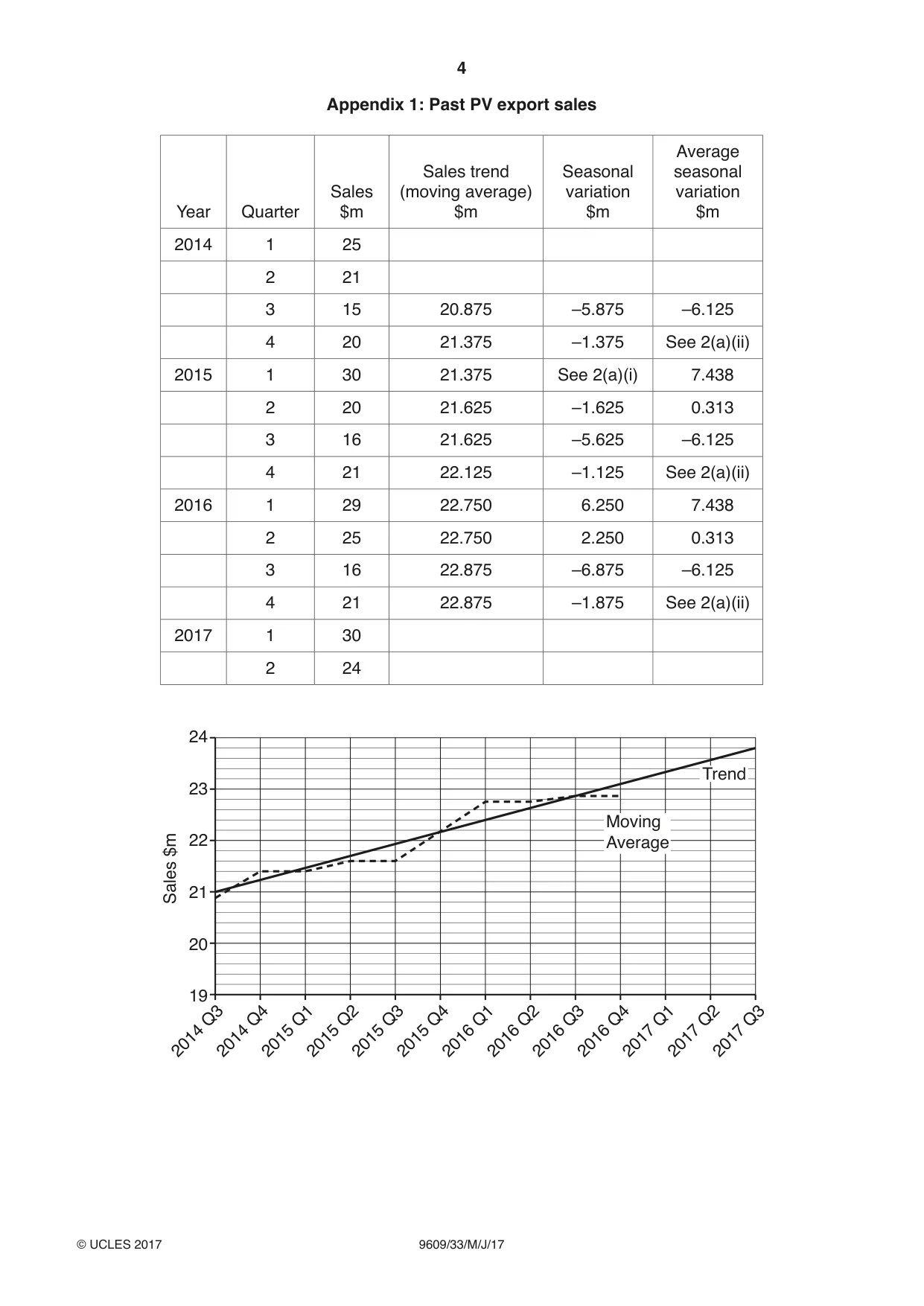
4 9609/33/M/J/17 © UCLES 2017 Appendix 1: Past PV export sales Year Quarter Sales $m Sales trend (moving average) $m Seasonal variation $m Average seasonal variation $m 2014 1 25 2 21 3 15 20.875 –5.875 –6.125 4 20 21.375 –1.375 See 2(a)(ii) 2015 1 30 21.375 See 2(a)(i) 7.438 2 20 21.625 –1.625 0.313 3 16 21.625 –5.625 –6.125 4 21 22.125 –1.125 See 2(a)(ii) 2016 1 29 22.750 6.250 7.438 2 25 22.750 2.250 0.313 3 16 22.875 –6.875 –6.125 4 21 22.875 –1.875 See 2(a)(ii) 2017 1 30 2 24 2014 Q3 2014 Q4 2015 Q1 2015 Q2 2015 Q3 2015 Q4 2016 Q1 2016 Q2 2016 Q3 2016 Q4 2017 Q1 2017 Q2 2017 Q3 24 23 22 21 20 19 Sales $m Trend Moving Average
Question paper, page 5
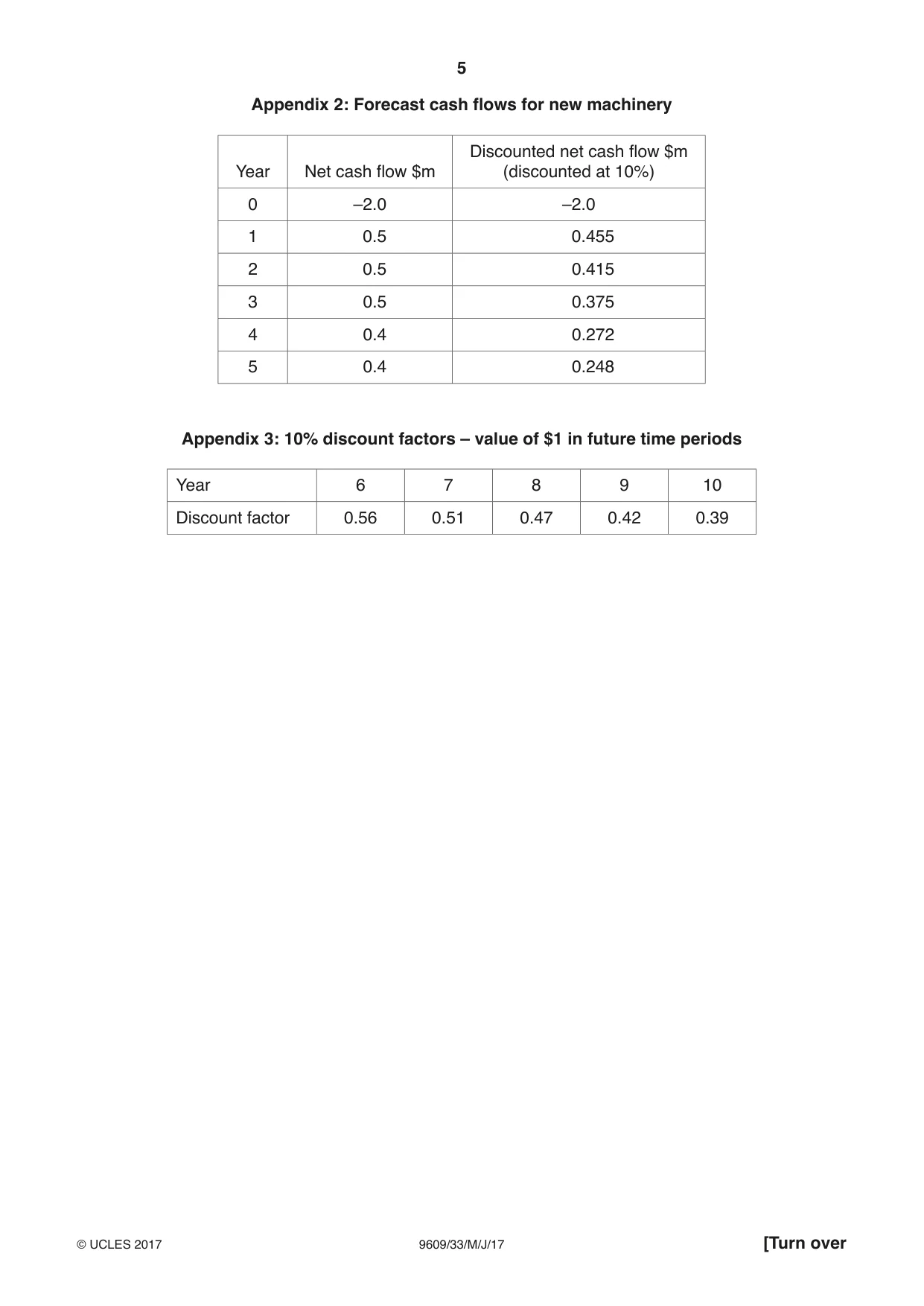
5 9609/33/M/J/17 © UCLES 2017 [Turn over Appendix 2: Forecast cash flows for new machinery Year Net cash flow $m Discounted net cash flow $m (discounted at 10%) 0 –2.0 –2.0 1 0.5 0.455 2 0.5 0.415 3 0.5 0.375 4 0.4 0.272 5 0.4 0.248 Appendix 3: 10% discount factors – value of $1 in future time periods Year 6 7 8 9 10 Discount factor 0.56 0.51 0.47 0.42 0.39
Question paper, page 6
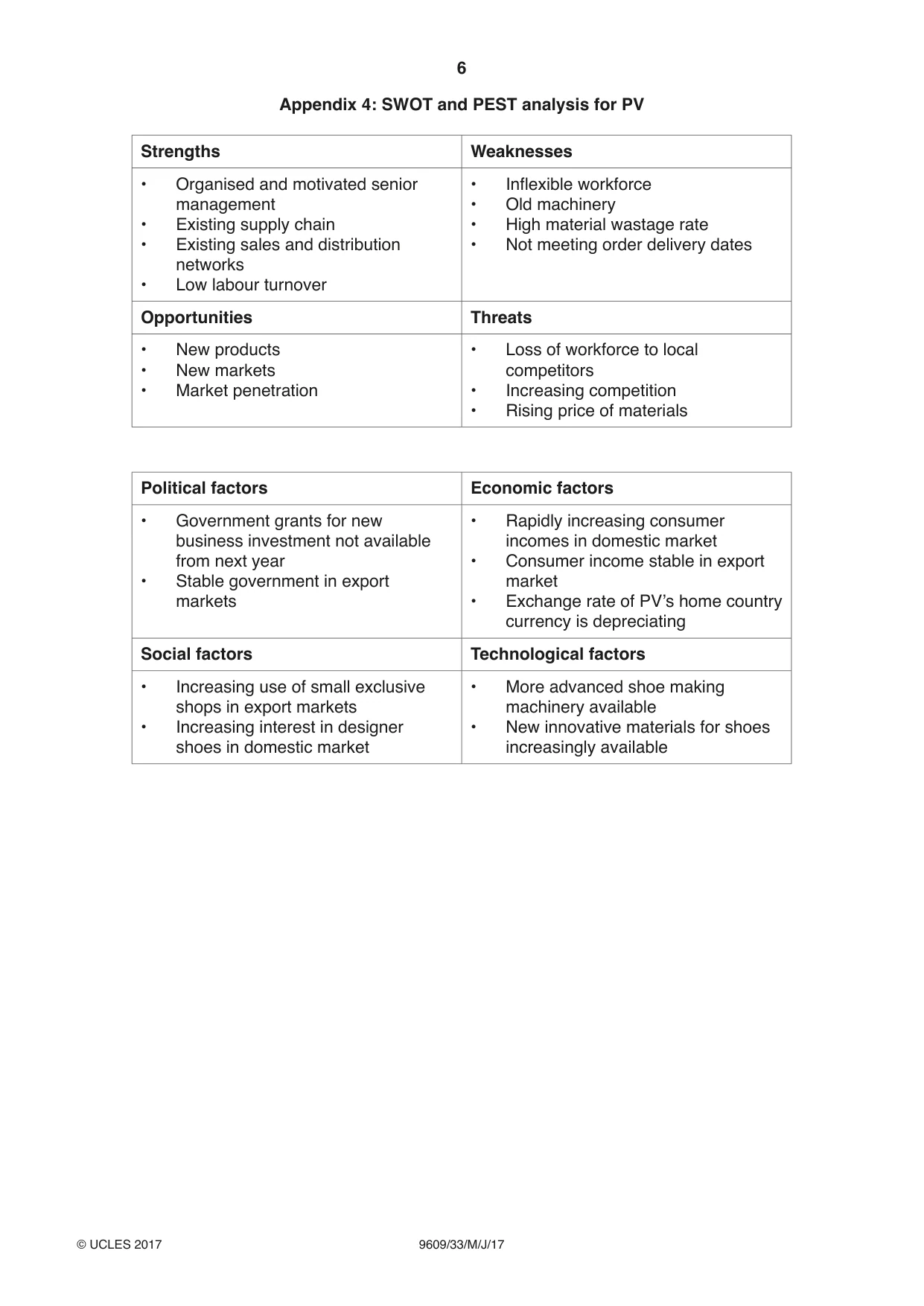
6 9609/33/M/J/17 © UCLES 2017 Appendix 4: SWOT and PEST analysis for PV Strengths Weaknesses • Organised and motivated senior management • Existing supply chain • Existing sales and distribution networks • Low labour turnover • Inflexible workforce • Old machinery • High material wastage rate • Not meeting order delivery dates Opportunities Threats • New products • New markets • Market penetration • Loss of workforce to local competitors • Increasing competition • Rising price of materials Political factors Economic factors • Government grants for new business investment not available from next year • Stable government in export markets • Rapidly increasing consumer incomes in domestic market • Consumer income stable in export market • Exchange rate of PV’s home country currency is depreciating Social factors Technological factors • Increasing use of small exclusive shops in export markets • Increasing interest in designer shoes in domestic market • More advanced shoe making machinery available • New innovative materials for shoes increasingly available
Question paper, page 7
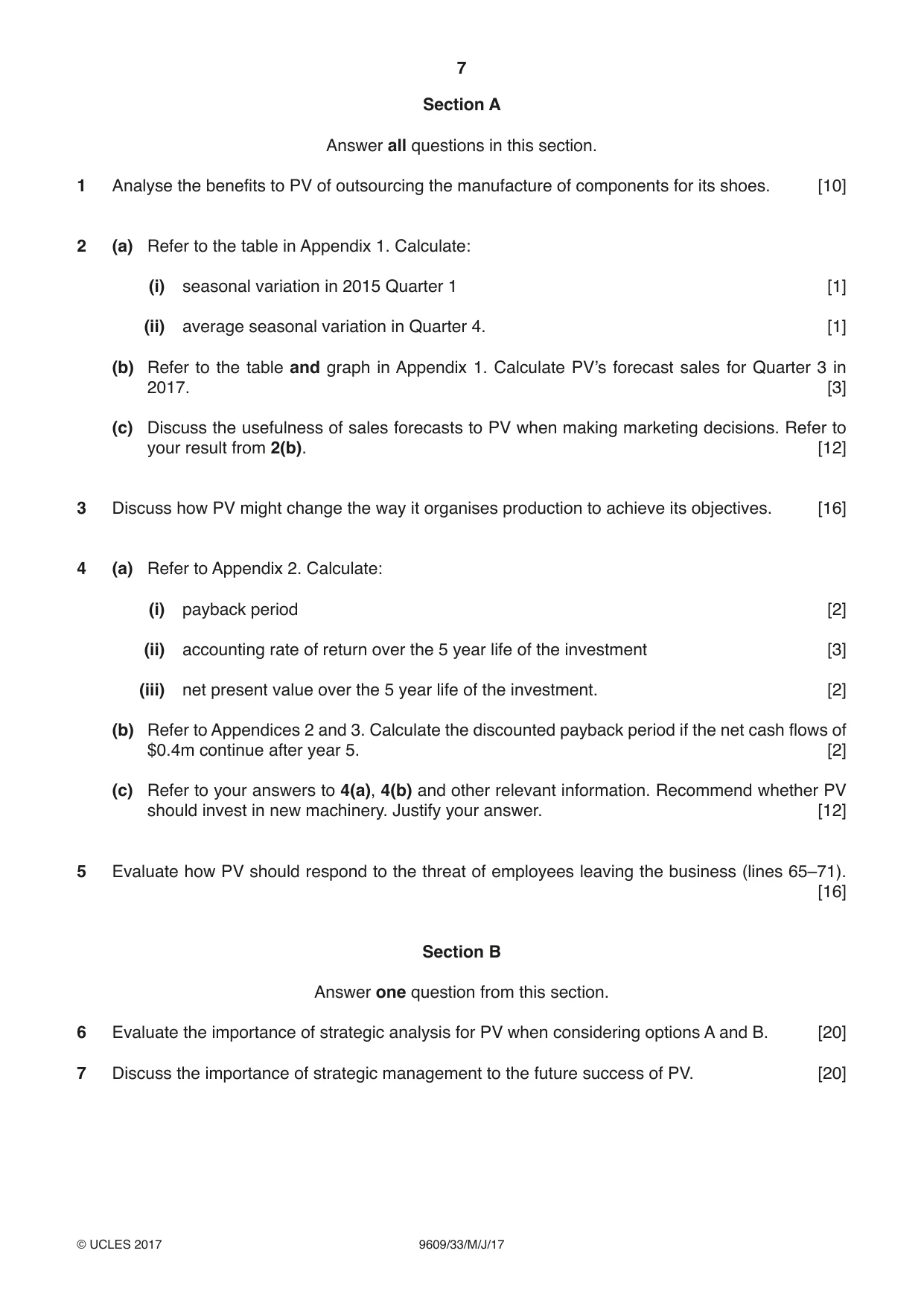
7 9609/33/M/J/17 © UCLES 2017 Section A Answer all questions in this section. 1 Analyse the benefits to PV of outsourcing the manufacture of components for its shoes. [10] 2 (a) Refer to the table in Appendix 1. Calculate: (i) seasonal variation in 2015 Quarter 1 [1] (ii) average seasonal variation in Quarter 4. [1] (b) Refer to the table and graph in Appendix 1. Calculate PV’s forecast sales for Quarter 3 in 2017. [3] (c) Discuss the usefulness of sales forecasts to PV when making marketing decisions. Refer to your result from 2(b). [12] 3 Discuss how PV might change the way it organises production to achieve its objectives. [16] 4 (a) Refer to Appendix 2. Calculate: (i) payback period [2] (ii) accounting rate of return over the 5 year life of the investment [3] (iii) net present value over the 5 year life of the investment. [2] (b) Refer to Appendices 2 and 3. Calculate the discounted payback period if the net cash flows of $0.4m continue after year 5. [2] (c) Refer to your answers to 4(a), 4(b) and other relevant information. Recommend whether PV should invest in new machinery. Justify your answer. [12] 5 Evaluate how PV should respond to the threat of employees leaving the business (lines 65–71). [16] Section B Answer one question from this section. 6 Evaluate the importance of strategic analysis for PV when considering options A and B. [20] 7 Discuss the importance of strategic management to the future success of PV. [20]
Question paper, page 8
8 9609/33/M/J/17 © UCLES 2017 BLANK PAGE Permission to reproduce items where third-party owned material protected by copyright is included has been sought and cleared where possible. Every reasonable effort has been made by the publisher (UCLES) to trace copyright holders, but if any items requiring clearance have unwittingly been included, the publisher will be pleased to make amends at the earliest possible opportunity. To avoid the issue of disclosure of answer-related information to candidates, all copyright acknowledgements are reproduced online in the Cambridge International Examinations Copyright Acknowledgements Booklet. This is produced for each series of examinations and is freely available to download at www.cie.org.uk after the live examination series. Cambridge International Examinations is part of the Cambridge Assessment Group. Cambridge Assessment is the brand name of University of Cambridge Local Examinations Syndicate (UCLES), which is itself a department of the University of Cambridge.
Mark scheme, page 1
® IGCSE is a registered trademark. This document consists of 12 printed pages. © UCLES 2017 [Turn over Cambridge International Examinations Cambridge International Advanced Level BUSINESS 9609/33 Paper 3 Case Study May/June 2017 MARK SCHEME Maximum Mark: 100 Published This mark scheme is published as an aid to teachers and candidates, to indicate the requirements of the examination. It shows the basis on which Examiners were instructed to award marks. It does not indicate the details of the discussions that took place at an Examiners’ meeting before marking began, which would have considered the acceptability of alternative answers. Mark schemes should be read in conjunction with the question paper and the Principal Examiner Report for Teachers. Cambridge will not enter into discussions about these mark schemes. Cambridge is publishing the mark schemes for the May/June 2017 series for most Cambridge IGCSE®, Cambridge International A and AS Level and Cambridge Pre-U components, and some Cambridge O Level components.
Mark scheme, page 2
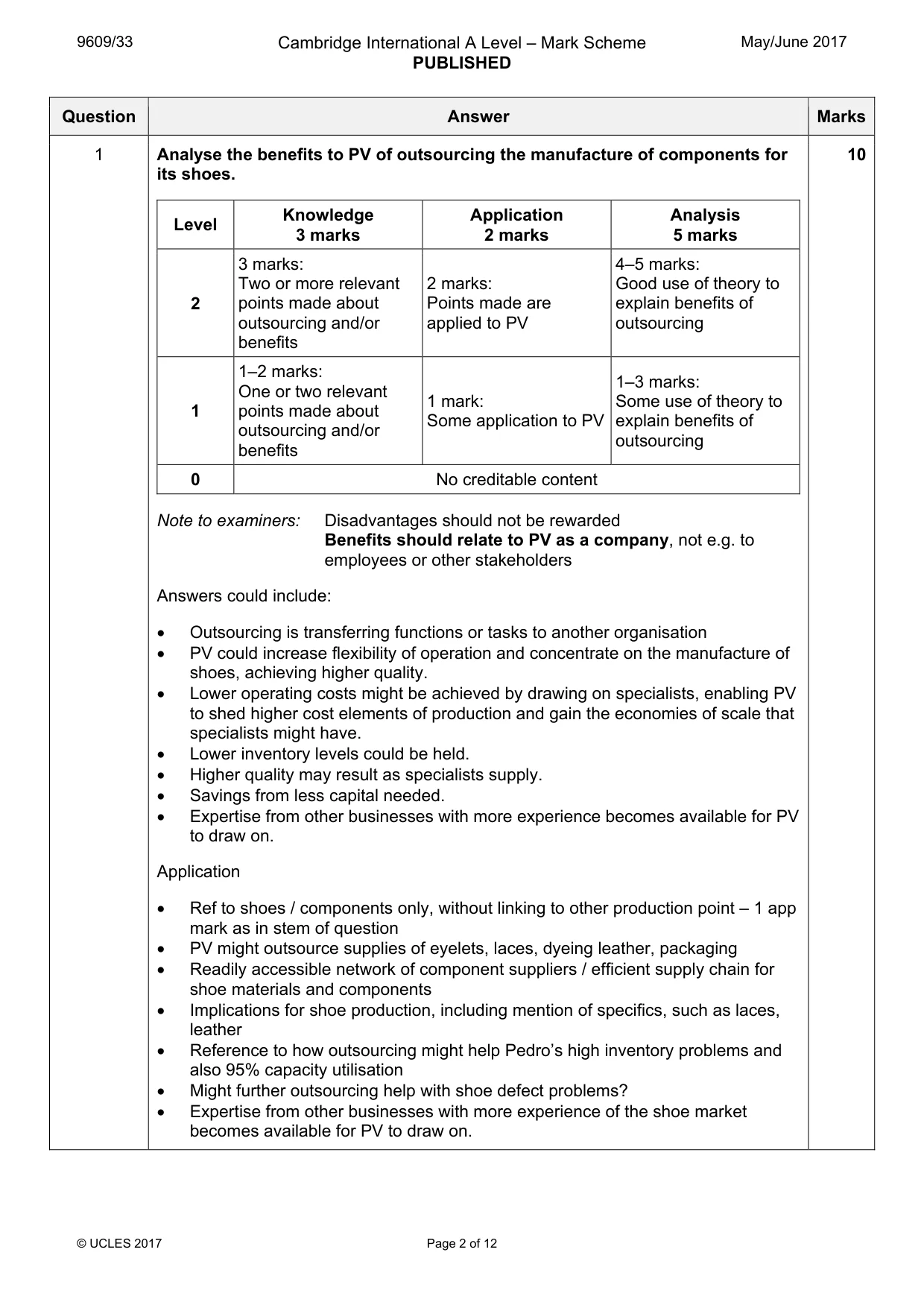
9609/33 Cambridge International A Level – Mark Scheme PUBLISHED May/June 2017 © UCLES 2017 Page 2 of 12 Question Answer Marks 1 Analyse the benefits to PV of outsourcing the manufacture of components for its shoes. Level Knowledge 3 marks Application 2 marks Analysis 5 marks 2 3 marks: Two or more relevant points made about outsourcing and/or benefits 2 marks: Points made are applied to PV 4–5 marks: Good use of theory to explain benefits of outsourcing 1 1–2 marks: One or two relevant points made about outsourcing and/or benefits 1 mark: Some application to PV 1–3 marks: Some use of theory to explain benefits of outsourcing 0 No creditable content Note to examiners: Disadvantages should not be rewarded Benefits should relate to PV as a company, not e.g. to employees or other stakeholders Answers could include: • Outsourcing is transferring functions or tasks to another organisation • PV could increase flexibility of operation and concentrate on the manufacture of shoes, achieving higher quality. • Lower operating costs might be achieved by drawing on specialists, enabling PV to shed higher cost elements of production and gain the economies of scale that specialists might have. • Lower inventory levels could be held. • Higher quality may result as specialists supply. • Savings from less capital needed. • Expertise from other businesses with more experience becomes available for PV to draw on. Application • Ref to shoes / components only, without linking to other production point – 1 app mark as in stem of question • PV might outsource supplies of eyelets, laces, dyeing leather, packaging • Readily accessible network of component suppliers / efficient supply chain for shoe materials and components • Implications for shoe production, including mention of specifics, such as laces, leather • Reference to how outsourcing might help Pedro’s high inventory problems and also 95% capacity utilisation • Might further outsourcing help with shoe defect problems? • Expertise from other businesses with more experience of the shoe market becomes available for PV to draw on. 10
Mark scheme, page 3
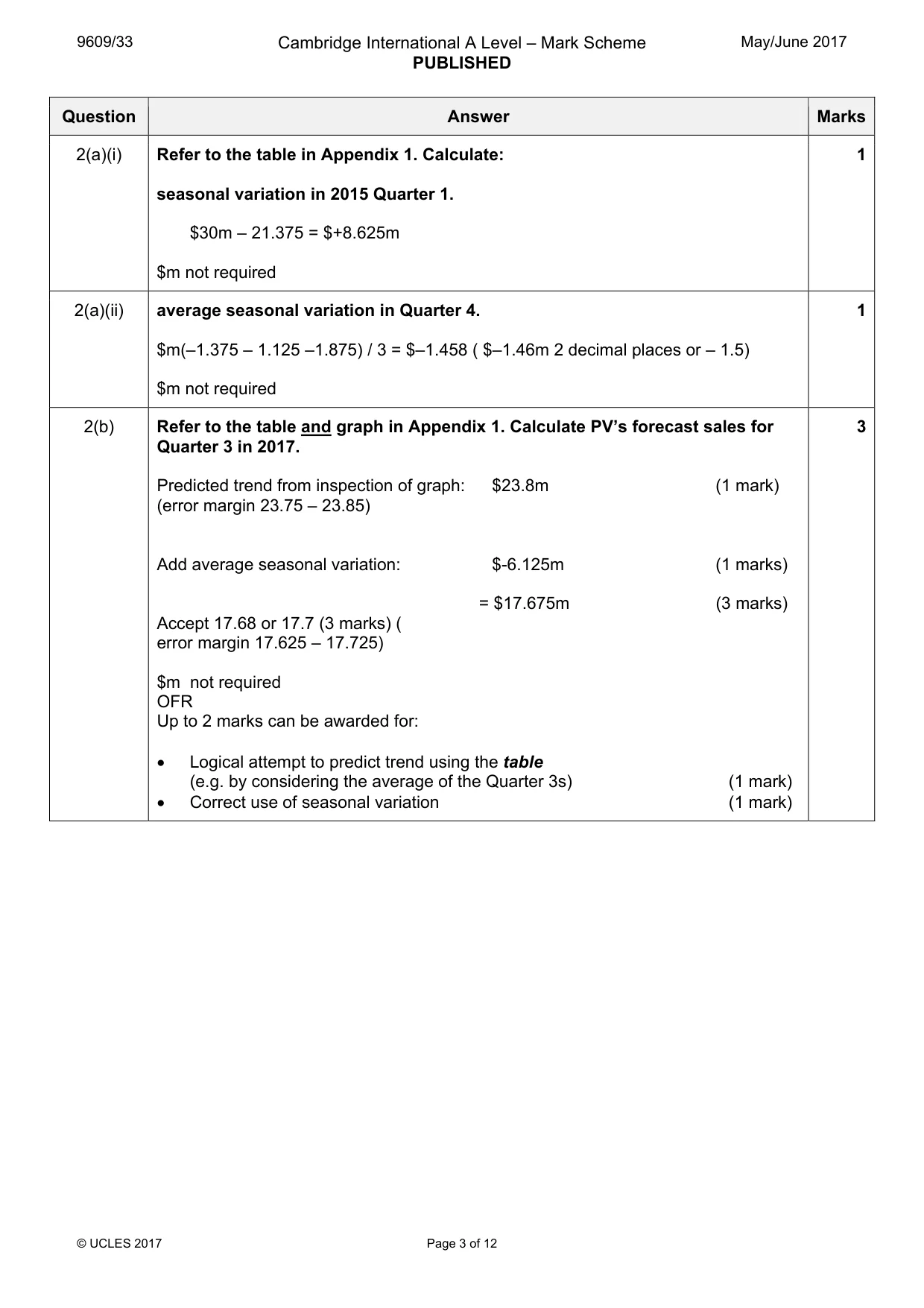
9609/33 Cambridge International A Level – Mark Scheme PUBLISHED May/June 2017 © UCLES 2017 Page 3 of 12 Question Answer Marks 2(a)(i) Refer to the table in Appendix 1. Calculate: seasonal variation in 2015 Quarter 1. $30m – 21.375 = $+8.625m $m not required 1 2(a)(ii) average seasonal variation in Quarter 4. $m(–1.375 – 1.125 –1.875) / 3 = $–1.458 ( $–1.46m 2 decimal places or – 1.5) $m not required 1 2(b) Refer to the table and graph in Appendix 1. Calculate PV’s forecast sales for Quarter 3 in 2017. Predicted trend from inspection of graph: $23.8m (1 mark) (error margin 23.75 – 23.85) Add average seasonal variation: $-6.125m (1 marks) = $17.675m (3 marks) Accept 17.68 or 17.7 (3 marks) ( error margin 17.625 – 17.725) $m not required OFR Up to 2 marks can be awarded for: • Logical attempt to predict trend using the table (e.g. by considering the average of the Quarter 3s) (1 mark) • Correct use of seasonal variation (1 mark) 3
Mark scheme, page 4
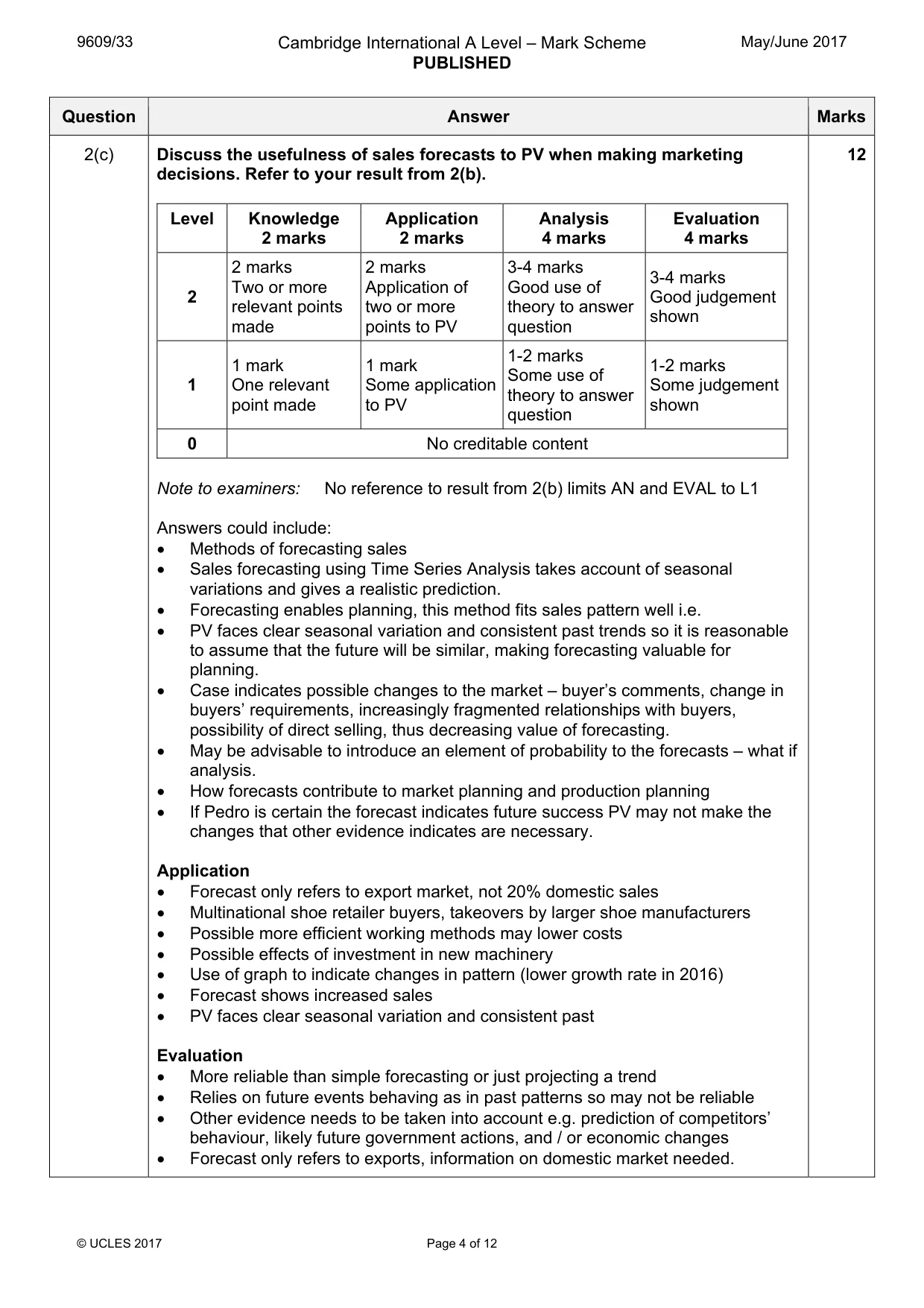
9609/33 Cambridge International A Level – Mark Scheme PUBLISHED May/June 2017 © UCLES 2017 Page 4 of 12 Question Answer Marks 2(c) Discuss the usefulness of sales forecasts to PV when making marketing decisions. Refer to your result from 2(b). Level Knowledge 2 marks Application 2 marks Analysis 4 marks Evaluation 4 marks 2 2 marks Two or more relevant points made 2 marks Application of two or more points to PV 3-4 marks Good use of theory to answer question 3-4 marks Good judgement shown 1 1 mark One relevant point made 1 mark Some application to PV 1-2 marks Some use of theory to answer question 1-2 marks Some judgement shown 0 No creditable content Note to examiners: No reference to result from 2(b) limits AN and EVAL to L1 Answers could include: • Methods of forecasting sales • Sales forecasting using Time Series Analysis takes account of seasonal variations and gives a realistic prediction. • Forecasting enables planning, this method fits sales pattern well i.e. • PV faces clear seasonal variation and consistent past trends so it is reasonable to assume that the future will be similar, making forecasting valuable for planning. • Case indicates possible changes to the market – buyer’s comments, change in buyers’ requirements, increasingly fragmented relationships with buyers, possibility of direct selling, thus decreasing value of forecasting. • May be advisable to introduce an element of probability to the forecasts – what if analysis. • How forecasts contribute to market planning and production planning • If Pedro is certain the forecast indicates future success PV may not make the changes that other evidence indicates are necessary. Application • Forecast only refers to export market, not 20% domestic sales • Multinational shoe retailer buyers, takeovers by larger shoe manufacturers • Possible more efficient working methods may lower costs • Possible effects of investment in new machinery • Use of graph to indicate changes in pattern (lower growth rate in 2016) • Forecast shows increased sales • PV faces clear seasonal variation and consistent past Evaluation • More reliable than simple forecasting or just projecting a trend • Relies on future events behaving as in past patterns so may not be reliable • Other evidence needs to be taken into account e.g. prediction of competitors’ behaviour, likely future government actions, and / or economic changes • Forecast only refers to exports, information on domestic market needed. 12
Mark scheme, page 5
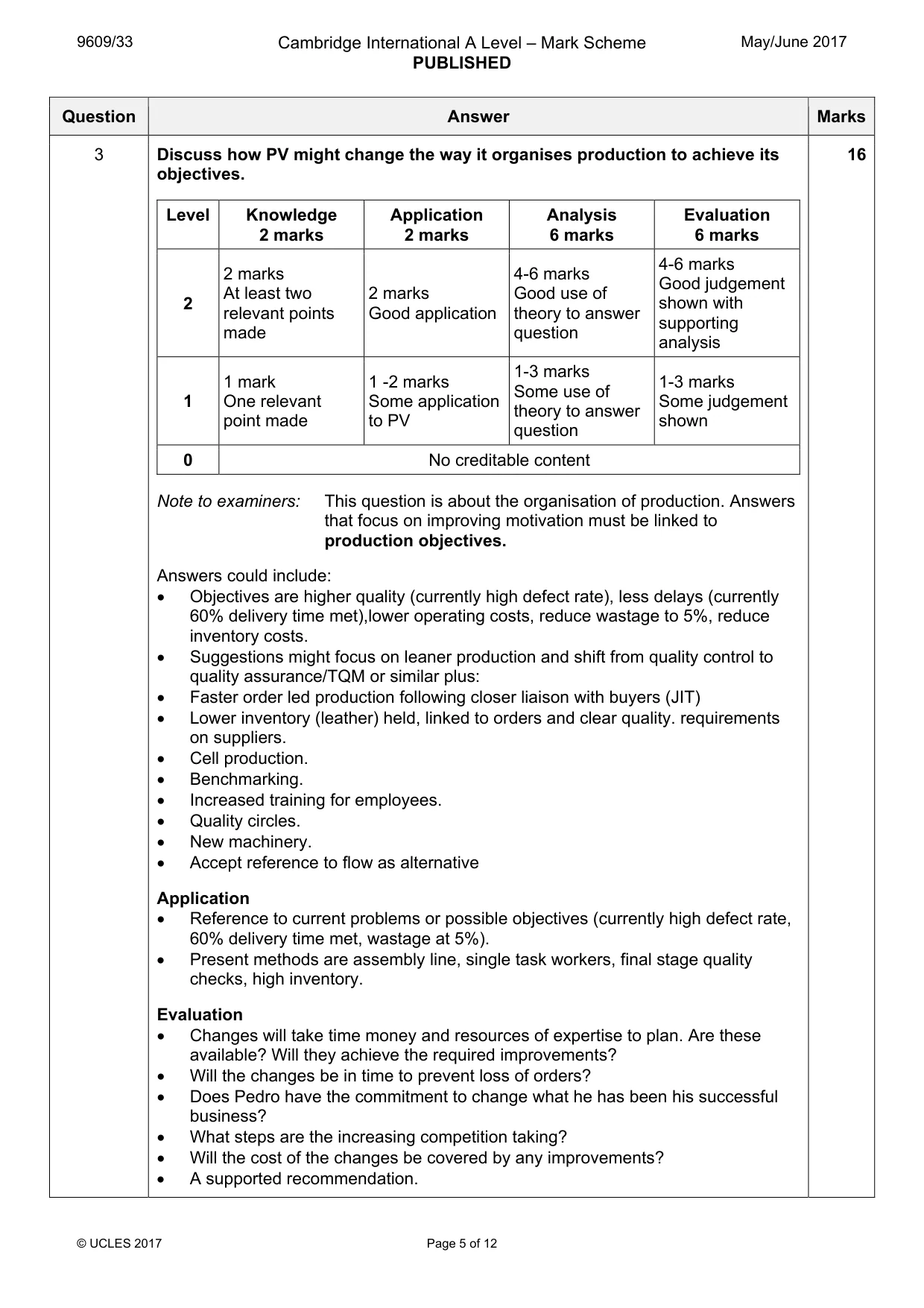
9609/33 Cambridge International A Level – Mark Scheme PUBLISHED May/June 2017 © UCLES 2017 Page 5 of 12 Question Answer Marks 3 Discuss how PV might change the way it organises production to achieve its objectives. Level Knowledge 2 marks Application 2 marks Analysis 6 marks Evaluation 6 marks 2 2 marks At least two relevant points made 2 marks Good application 4-6 marks Good use of theory to answer question 4-6 marks Good judgement shown with supporting analysis 1 1 mark One relevant point made 1 -2 marks Some application to PV 1-3 marks Some use of theory to answer question 1-3 marks Some judgement shown 0 No creditable content Note to examiners: This question is about the organisation of production. Answers that focus on improving motivation must be linked to production objectives. Answers could include: • Objectives are higher quality (currently high defect rate), less delays (currently 60% delivery time met),lower operating costs, reduce wastage to 5%, reduce inventory costs. • Suggestions might focus on leaner production and shift from quality control to quality assurance/TQM or similar plus: • Faster order led production following closer liaison with buyers (JIT) • Lower inventory (leather) held, linked to orders and clear quality. requirements on suppliers. • Cell production. • Benchmarking. • Increased training for employees. • Quality circles. • New machinery. • Accept reference to flow as alternative Application • Reference to current problems or possible objectives (currently high defect rate, 60% delivery time met, wastage at 5%). • Present methods are assembly line, single task workers, final stage quality checks, high inventory. Evaluation • Changes will take time money and resources of expertise to plan. Are these available? Will they achieve the required improvements? • Will the changes be in time to prevent loss of orders? • Does Pedro have the commitment to change what he has been his successful business? • What steps are the increasing competition taking? • Will the cost of the changes be covered by any improvements? • A supported recommendation. 16
Mark scheme, page 6
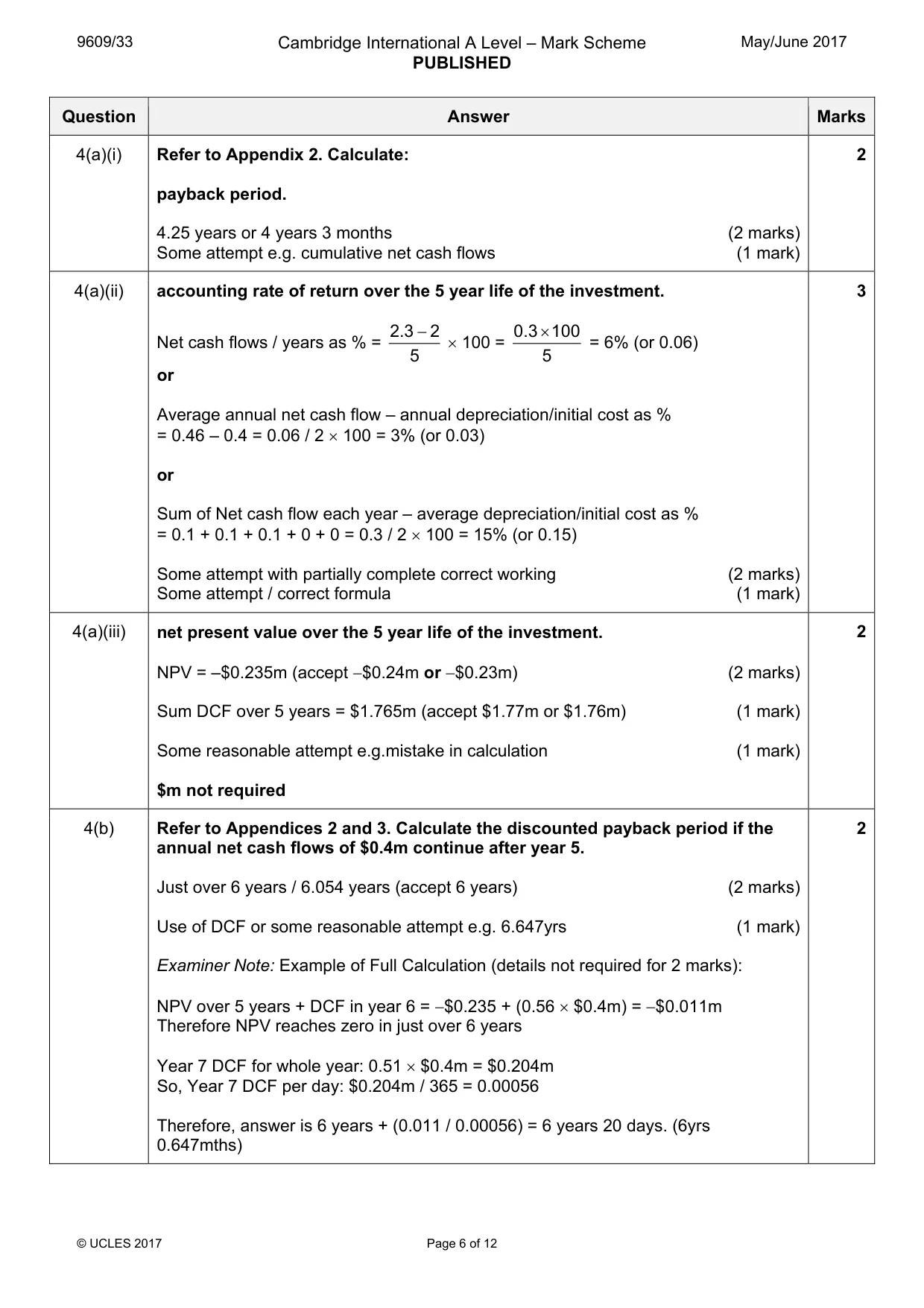
9609/33 Cambridge International A Level – Mark Scheme PUBLISHED May/June 2017 © UCLES 2017 Page 6 of 12 Question Answer Marks 4(a)(i) Refer to Appendix 2. Calculate: payback period. 4.25 years or 4 years 3 months (2 marks) Some attempt e.g. cumulative net cash flows (1 mark) 2 4(a)(ii) accounting rate of return over the 5 year life of the investment. Net cash flows / years as % = 2.3 2 5 − × 100 = 0.3 100 5 × = 6% (or 0.06) or Average annual net cash flow – annual depreciation/initial cost as % = 0.46 – 0.4 = 0.06 / 2 × 100 = 3% (or 0.03) or Sum of Net cash flow each year – average depreciation/initial cost as % = 0.1 + 0.1 + 0.1 + 0 + 0 = 0.3 / 2 × 100 = 15% (or 0.15) Some attempt with partially complete correct working (2 marks) Some attempt / correct formula (1 mark) 3 4(a)(iii) net present value over the 5 year life of the investment. NPV = –$0.235m (accept −$0.24m or −$0.23m) (2 marks) Sum DCF over 5 years = $1.765m (accept $1.77m or $1.76m) (1 mark) Some reasonable attempt e.g.mistake in calculation (1 mark) $m not required 2 4(b) Refer to Appendices 2 and 3. Calculate the discounted payback period if the annual net cash flows of $0.4m continue after year 5. Just over 6 years / 6.054 years (accept 6 years) (2 marks) Use of DCF or some reasonable attempt e.g. 6.647yrs (1 mark) Examiner Note: Example of Full Calculation (details not required for 2 marks): NPV over 5 years + DCF in year 6 = −$0.235 + (0.56 × $0.4m) = −$0.011m Therefore NPV reaches zero in just over 6 years Year 7 DCF for whole year: 0.51 × $0.4m = $0.204m So, Year 7 DCF per day: $0.204m / 365 = 0.00056 Therefore, answer is 6 years + (0.011 / 0.00056) = 6 years 20 days. (6yrs 0.647mths) 2
Mark scheme, page 7
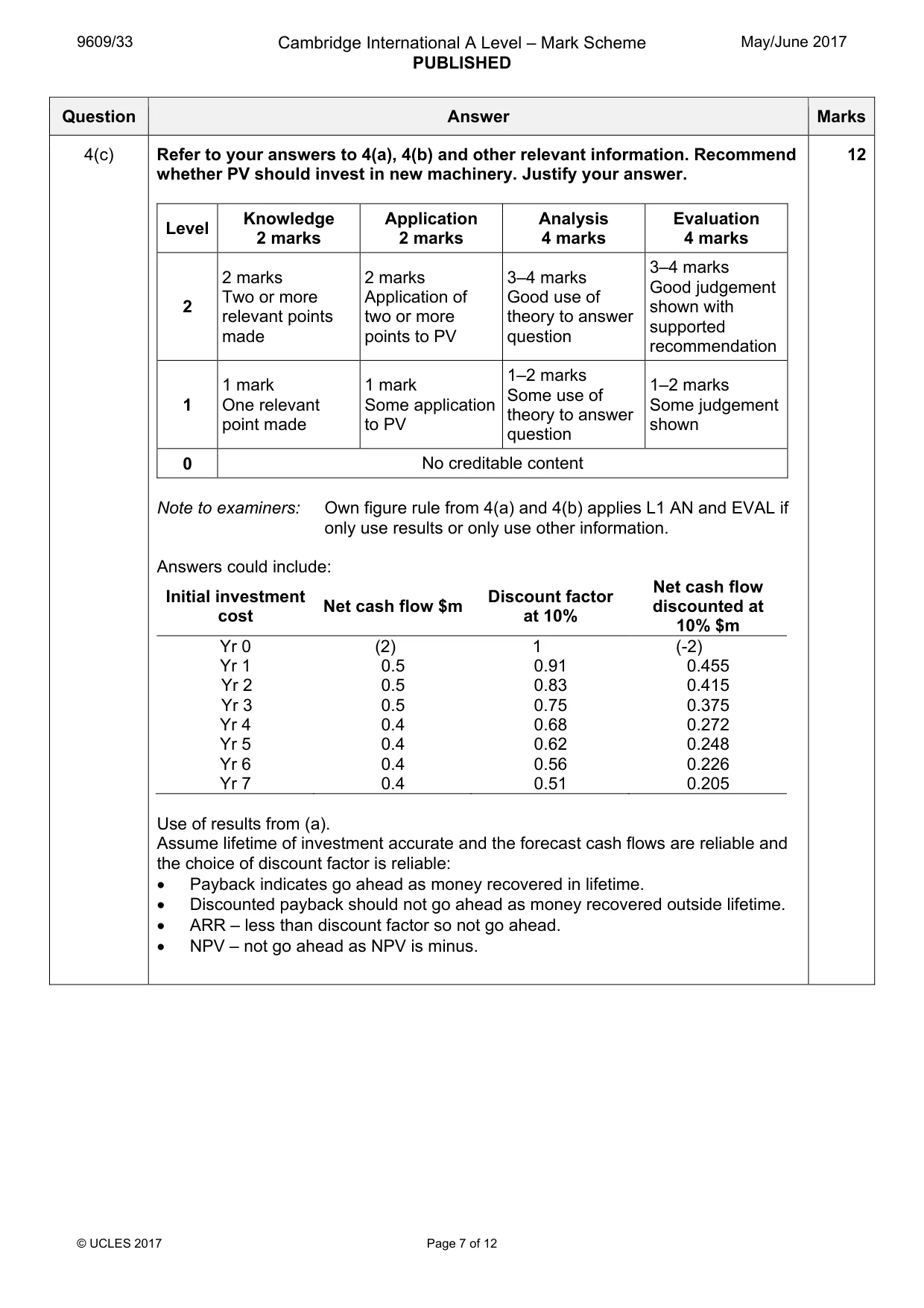
9609/33 Cambridge International A Level – Mark Scheme PUBLISHED May/June 2017 © UCLES 2017 Page 7 of 12 Question Answer Marks 4(c) Refer to your answers to 4(a), 4(b) and other relevant information. Recommend whether PV should invest in new machinery. Justify your answer. Level Knowledge 2 marks Application 2 marks Analysis 4 marks Evaluation 4 marks 2 2 marks Two or more relevant points made 2 marks Application of two or more points to PV 3–4 marks Good use of theory to answer question 3–4 marks Good judgement shown with supported recommendation 1 1 mark One relevant point made 1 mark Some application to PV 1–2 marks Some use of theory to answer question 1–2 marks Some judgement shown 0 No creditable content Note to examiners: Own figure rule from 4(a) and 4(b) applies L1 AN and EVAL if only use results or only use other information. Answers could include: Initial investment cost Net cash flow $m Discount factor at 10% Net cash flow discounted at 10% $m Yr 0 (2) 1 (-2) Yr 1 0.5 0.91 0.455 Yr 2 0.5 0.83 0.415 Yr 3 0.5 0.75 0.375 Yr 4 0.4 0.68 0.272 Yr 5 0.4 0.62 0.248 Yr 6 0.4 0.56 0.226 Yr 7 0.4 0.51 0.205 Use of results from (a). Assume lifetime of investment accurate and the forecast cash flows are reliable and the choice of discount factor is reliable: • Payback indicates go ahead as money recovered in lifetime. • Discounted payback should not go ahead as money recovered outside lifetime. • ARR – less than discount factor so not go ahead. • NPV – not go ahead as NPV is minus. 12
Mark scheme, page 8
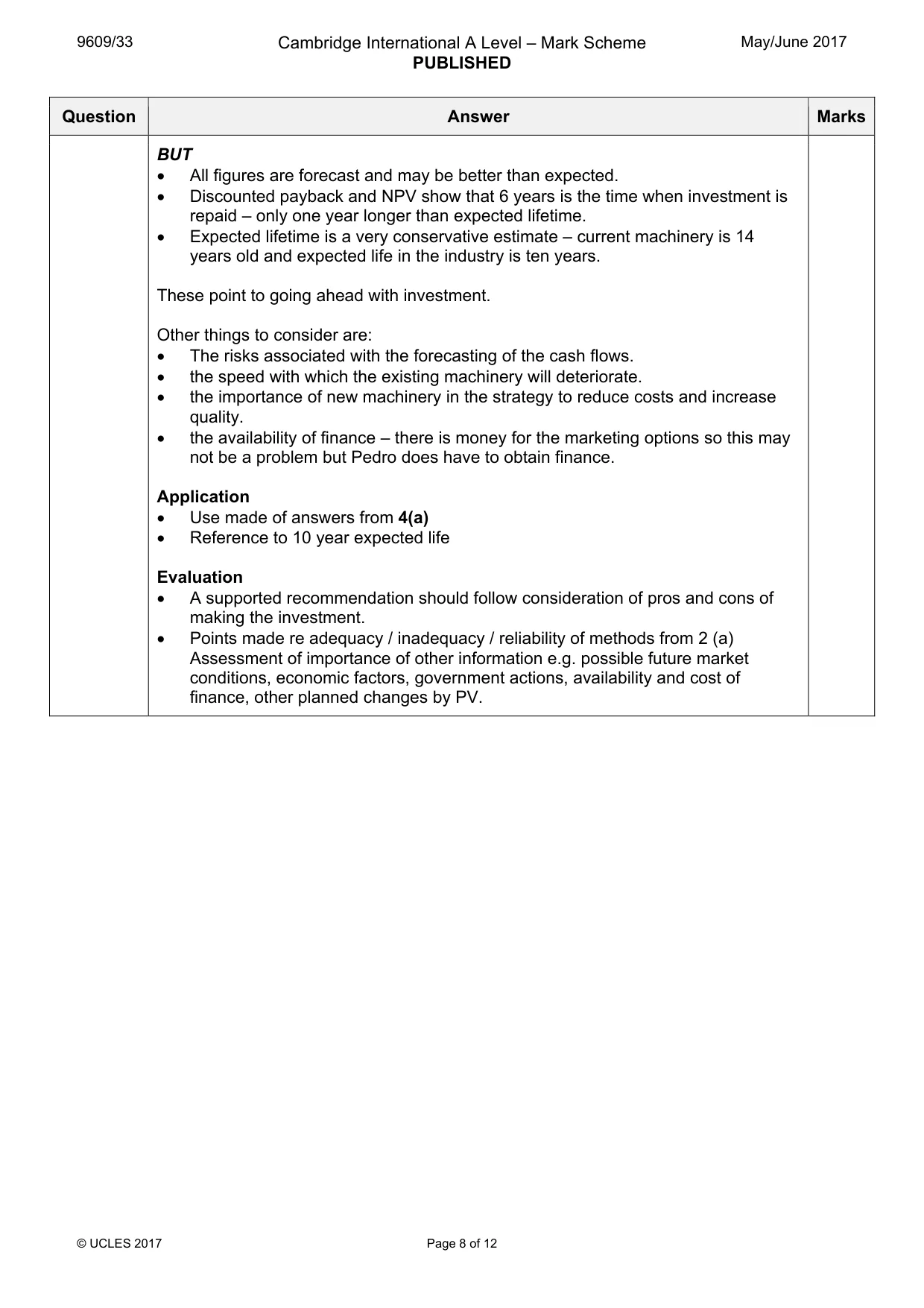
9609/33 Cambridge International A Level – Mark Scheme PUBLISHED May/June 2017 © UCLES 2017 Page 8 of 12 Question Answer Marks BUT • All figures are forecast and may be better than expected. • Discounted payback and NPV show that 6 years is the time when investment is repaid – only one year longer than expected lifetime. • Expected lifetime is a very conservative estimate – current machinery is 14 years old and expected life in the industry is ten years. These point to going ahead with investment. Other things to consider are: • The risks associated with the forecasting of the cash flows. • the speed with which the existing machinery will deteriorate. • the importance of new machinery in the strategy to reduce costs and increase quality. • the availability of finance – there is money for the marketing options so this may not be a problem but Pedro does have to obtain finance. Application • Use made of answers from 4(a) • Reference to 10 year expected life Evaluation • A supported recommendation should follow consideration of pros and cons of making the investment. • Points made re adequacy / inadequacy / reliability of methods from 2 (a) Assessment of importance of other information e.g. possible future market conditions, economic factors, government actions, availability and cost of finance, other planned changes by PV.
Mark scheme, page 9
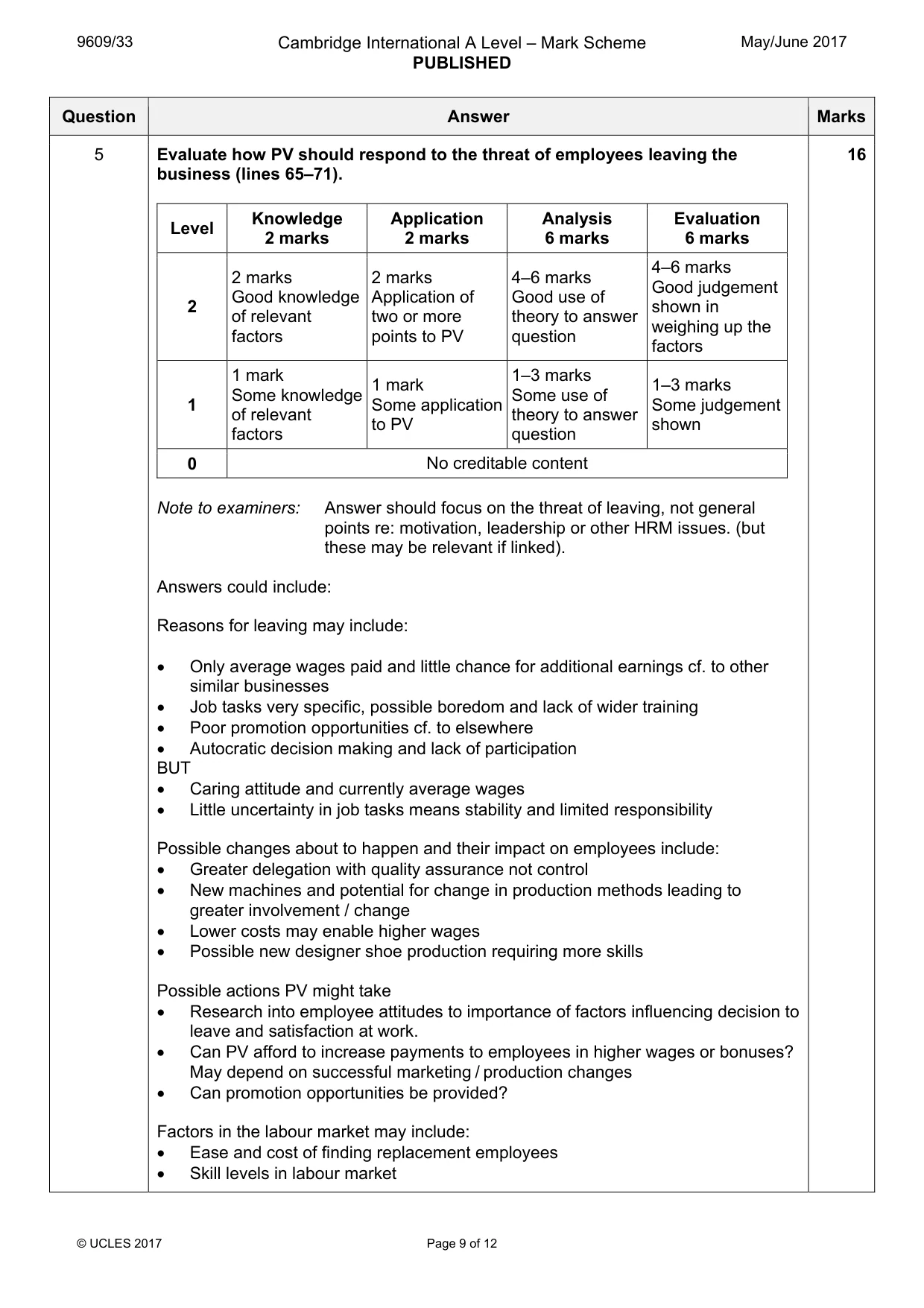
9609/33 Cambridge International A Level – Mark Scheme PUBLISHED May/June 2017 © UCLES 2017 Page 9 of 12 Question Answer Marks 5 Evaluate how PV should respond to the threat of employees leaving the business (lines 65–71). Level Knowledge 2 marks Application 2 marks Analysis 6 marks Evaluation 6 marks 2 2 marks Good knowledge of relevant factors 2 marks Application of two or more points to PV 4–6 marks Good use of theory to answer question 4–6 marks Good judgement shown in weighing up the factors 1 1 mark Some knowledge of relevant factors 1 mark Some application to PV 1–3 marks Some use of theory to answer question 1–3 marks Some judgement shown 0 No creditable content Note to examiners: Answer should focus on the threat of leaving, not general points re: motivation, leadership or other HRM issues. (but these may be relevant if linked). Answers could include: Reasons for leaving may include: • Only average wages paid and little chance for additional earnings cf. to other similar businesses • Job tasks very specific, possible boredom and lack of wider training • Poor promotion opportunities cf. to elsewhere • Autocratic decision making and lack of participation BUT • Caring attitude and currently average wages • Little uncertainty in job tasks means stability and limited responsibility Possible changes about to happen and their impact on employees include: • Greater delegation with quality assurance not control • New machines and potential for change in production methods leading to greater involvement / change • Lower costs may enable higher wages • Possible new designer shoe production requiring more skills Possible actions PV might take • Research into employee attitudes to importance of factors influencing decision to leave and satisfaction at work. • Can PV afford to increase payments to employees in higher wages or bonuses? May depend on successful marketing / production changes • Can promotion opportunities be provided? Factors in the labour market may include: • Ease and cost of finding replacement employees • Skill levels in labour market 16
Mark scheme, page 10
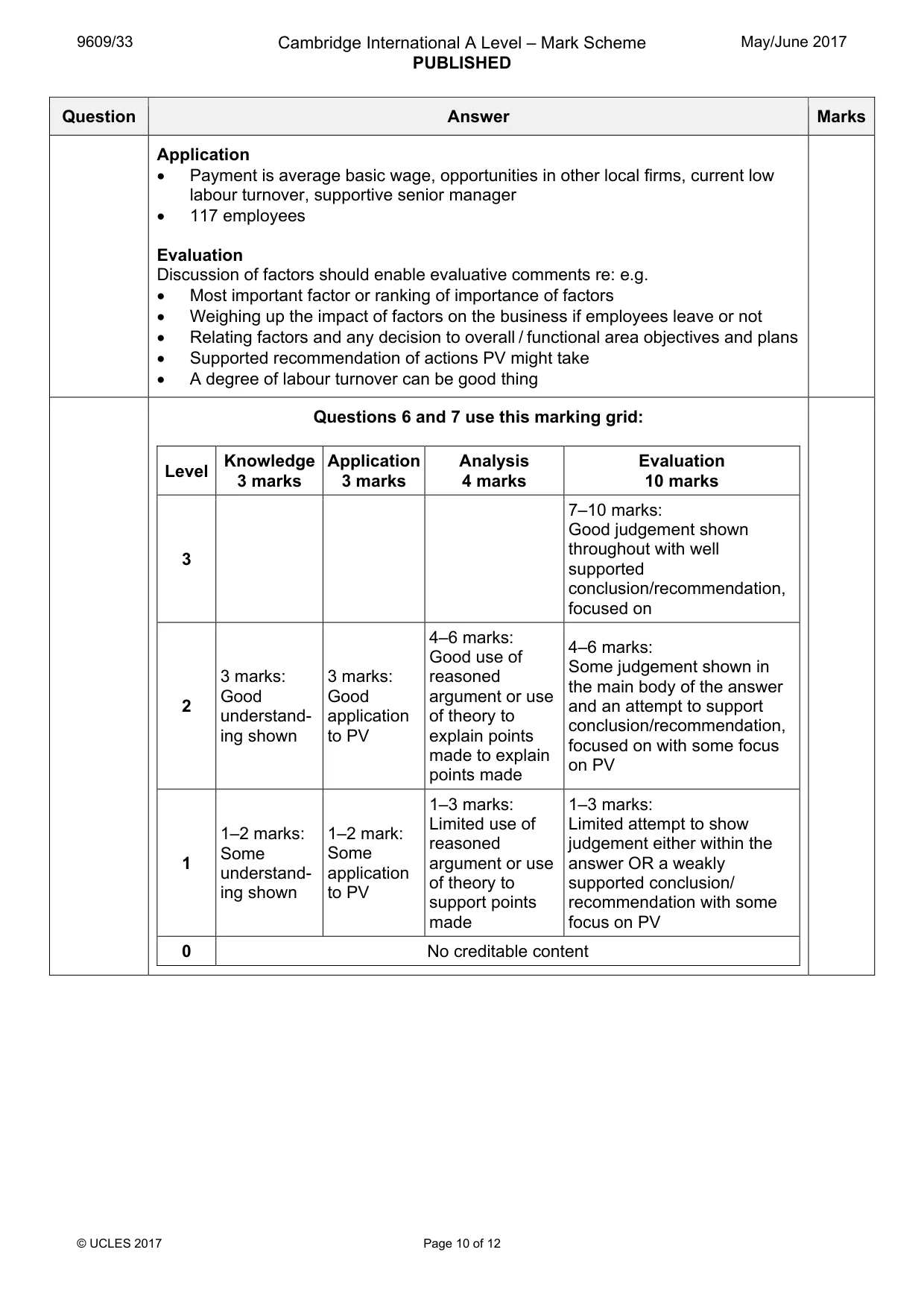
9609/33 Cambridge International A Level – Mark Scheme PUBLISHED May/June 2017 © UCLES 2017 Page 10 of 12 Question Answer Marks Application • Payment is average basic wage, opportunities in other local firms, current low labour turnover, supportive senior manager • 117 employees Evaluation Discussion of factors should enable evaluative comments re: e.g. • Most important factor or ranking of importance of factors • Weighing up the impact of factors on the business if employees leave or not • Relating factors and any decision to overall / functional area objectives and plans • Supported recommendation of actions PV might take • A degree of labour turnover can be good thing Questions 6 and 7 use this marking grid: Level Knowledge 3 marks Application 3 marks Analysis 4 marks Evaluation 10 marks 3 7–10 marks: Good judgement shown throughout with well supported conclusion/recommendation, focused on 2 3 marks: Good understand- ing shown 3 marks: Good application to PV 4–6 marks: Good use of reasoned argument or use of theory to explain points made to explain points made 4–6 marks: Some judgement shown in the main body of the answer and an attempt to support conclusion/recommendation, focused on with some focus on PV 1 1–2 marks: Some understand- ing shown 1–2 mark: Some application to PV 1–3 marks: Limited use of reasoned argument or use of theory to support points made 1–3 marks: Limited attempt to show judgement either within the answer OR a weakly supported conclusion/ recommendation with some focus on PV 0 No creditable content
Mark scheme, page 11
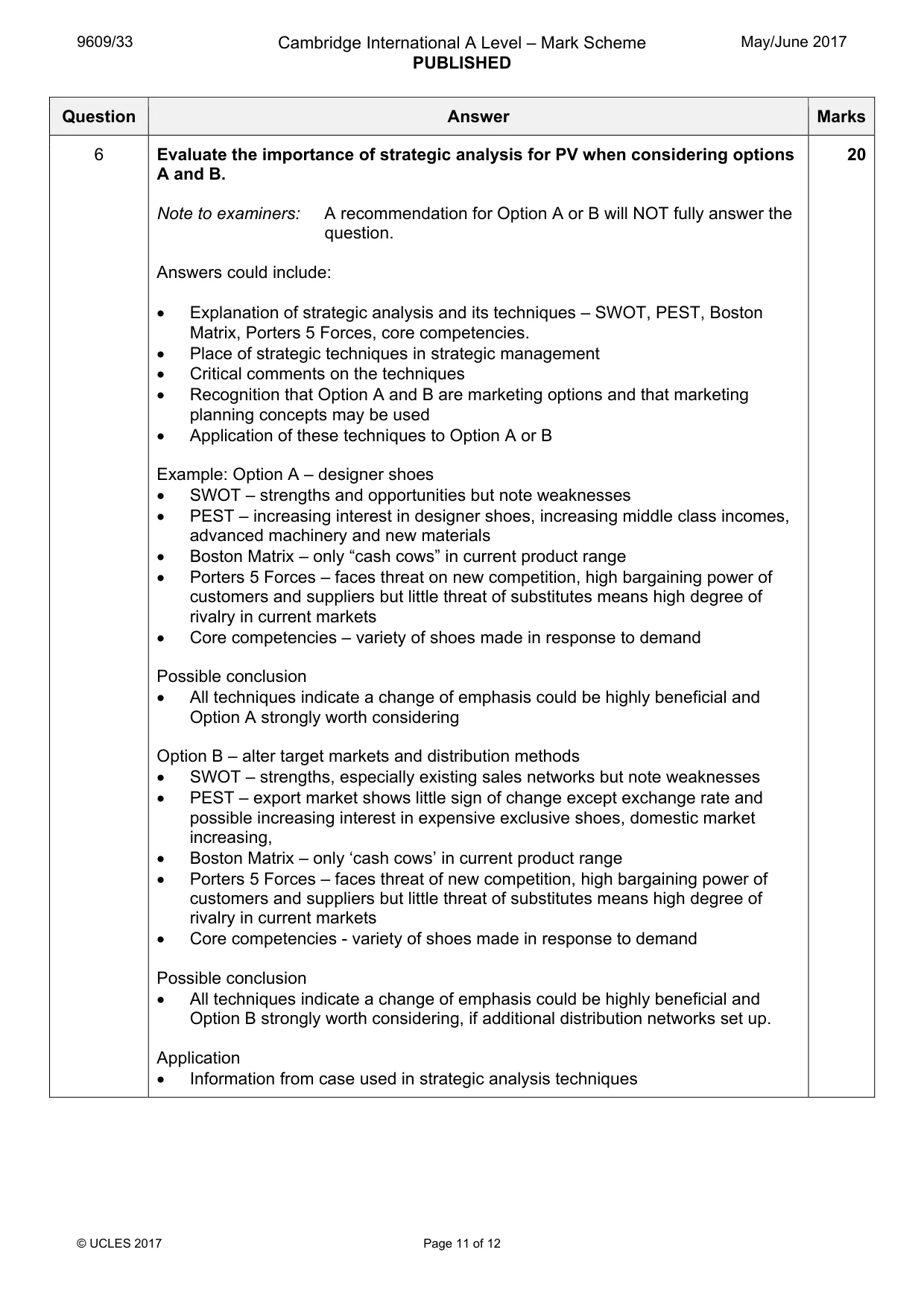
9609/33 Cambridge International A Level – Mark Scheme PUBLISHED May/June 2017 © UCLES 2017 Page 11 of 12 Question Answer Marks 6 Evaluate the importance of strategic analysis for PV when considering options A and B. Note to examiners: A recommendation for Option A or B will NOT fully answer the question. Answers could include: • Explanation of strategic analysis and its techniques – SWOT, PEST, Boston Matrix, Porters 5 Forces, core competencies. • Place of strategic techniques in strategic management • Critical comments on the techniques • Recognition that Option A and B are marketing options and that marketing planning concepts may be used • Application of these techniques to Option A or B Example: Option A – designer shoes • SWOT – strengths and opportunities but note weaknesses • PEST – increasing interest in designer shoes, increasing middle class incomes, advanced machinery and new materials • Boston Matrix – only “cash cows” in current product range • Porters 5 Forces – faces threat on new competition, high bargaining power of customers and suppliers but little threat of substitutes means high degree of rivalry in current markets • Core competencies – variety of shoes made in response to demand Possible conclusion • All techniques indicate a change of emphasis could be highly beneficial and Option A strongly worth considering Option B – alter target markets and distribution methods • SWOT – strengths, especially existing sales networks but note weaknesses • PEST – export market shows little sign of change except exchange rate and possible increasing interest in expensive exclusive shoes, domestic market increasing, • Boston Matrix – only ‘cash cows’ in current product range • Porters 5 Forces – faces threat of new competition, high bargaining power of customers and suppliers but little threat of substitutes means high degree of rivalry in current markets • Core competencies - variety of shoes made in response to demand Possible conclusion • All techniques indicate a change of emphasis could be highly beneficial and Option B strongly worth considering, if additional distribution networks set up. Application • Information from case used in strategic analysis techniques 20
Mark scheme, page 12
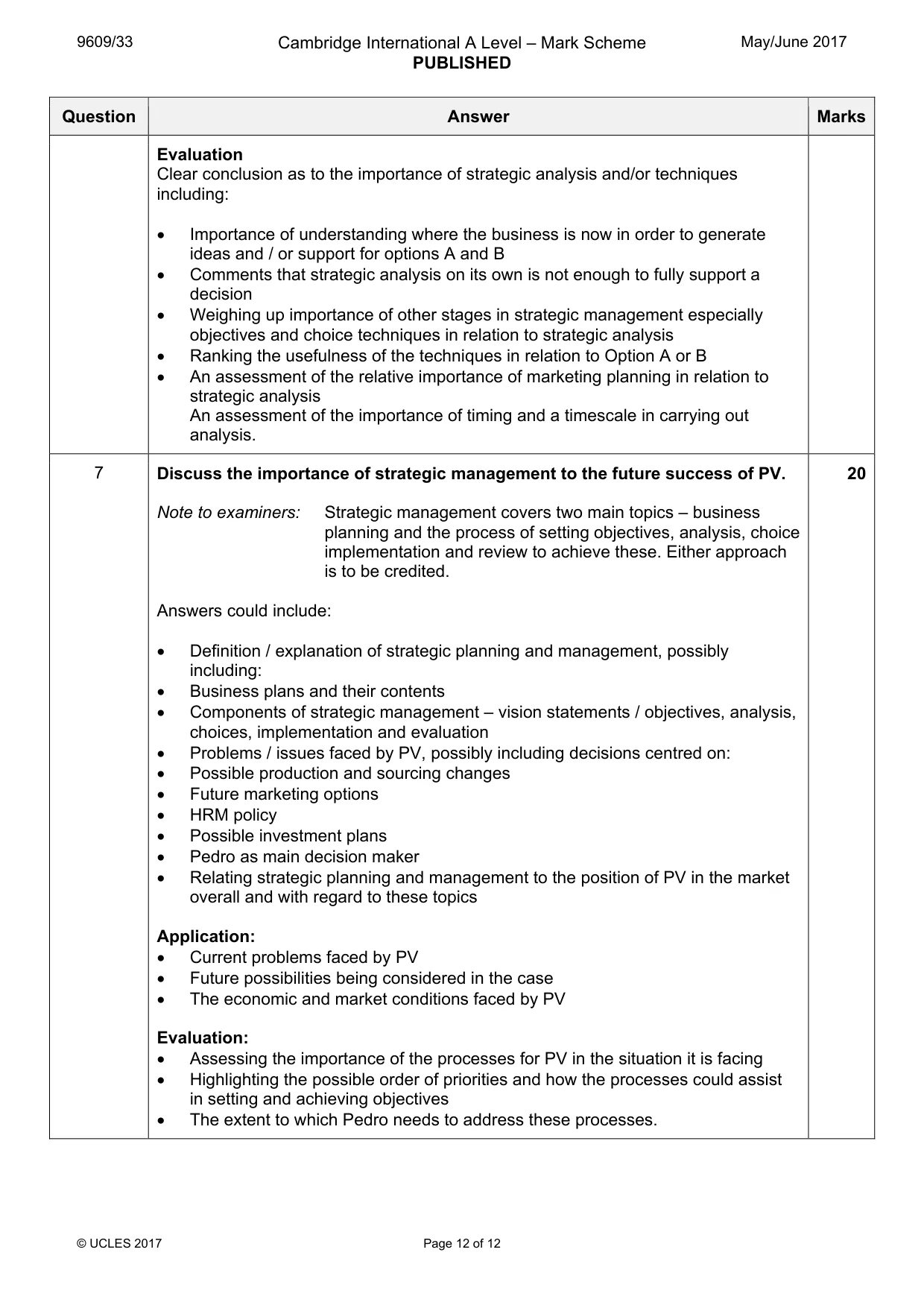
9609/33 Cambridge International A Level – Mark Scheme PUBLISHED May/June 2017 © UCLES 2017 Page 12 of 12 Question Answer Marks Evaluation Clear conclusion as to the importance of strategic analysis and/or techniques including: • Importance of understanding where the business is now in order to generate ideas and / or support for options A and B • Comments that strategic analysis on its own is not enough to fully support a decision • Weighing up importance of other stages in strategic management especially objectives and choice techniques in relation to strategic analysis • Ranking the usefulness of the techniques in relation to Option A or B • An assessment of the relative importance of marketing planning in relation to strategic analysis An assessment of the importance of timing and a timescale in carrying out analysis. 7 Discuss the importance of strategic management to the future success of PV. Note to examiners: Strategic management covers two main topics – business planning and the process of setting objectives, analysis, choice implementation and review to achieve these. Either approach is to be credited. Answers could include: • Definition / explanation of strategic planning and management, possibly including: • Business plans and their contents • Components of strategic management – vision statements / objectives, analysis, choices, implementation and evaluation • Problems / issues faced by PV, possibly including decisions centred on: • Possible production and sourcing changes • Future marketing options • HRM policy • Possible investment plans • Pedro as main decision maker • Relating strategic planning and management to the position of PV in the market overall and with regard to these topics Application: • Current problems faced by PV • Future possibilities being considered in the case • The economic and market conditions faced by PV Evaluation: • Assessing the importance of the processes for PV in the situation it is facing • Highlighting the possible order of priorities and how the processes could assist in setting and achieving objectives • The extent to which Pedro needs to address these processes. 20