Cambridge A Level Business (for first examination in 2016) 9609 — 2017 May/June Paper 3 · Variant 1
9609/31/M/J/17
The question paper and its mark scheme, free to read here and free to download. This is Cambridge’s own paper, exactly as it was sat.
Question paper8 pages


Mark scheme12 pages
Answers below. Sit the paper first if you are practising.
Paper as text
Question paper, page 1
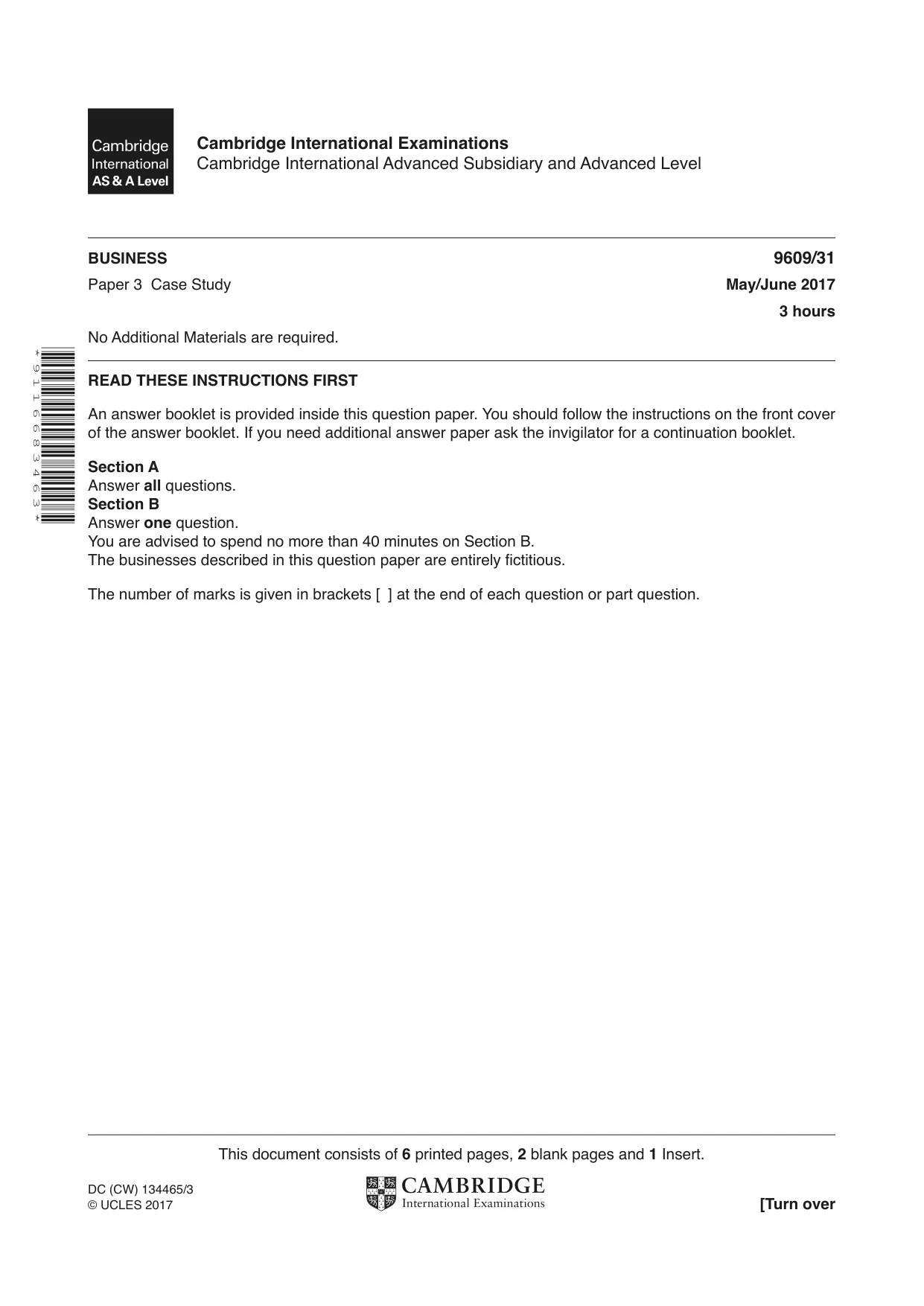
* 9 1 1 6 6 8 3 4 6 3 * This document consists of 6 printed pages, 2 blank pages and 1 Insert. DC (CW) 134465/3 © UCLES 2017 [Turn over Cambridge International Examinations Cambridge International Advanced Subsidiary and Advanced Level BUSINESS 9609/31 Paper 3 Case Study May/June 2017 3 hours No Additional Materials are required. READ THESE INSTRUCTIONS FIRST An answer booklet is provided inside this question paper. You should follow the instructions on the front cover of the answer booklet. If you need additional answer paper ask the invigilator for a continuation booklet. Section A Answer all questions. Section B Answer one question. You are advised to spend no more than 40 minutes on Section B. The businesses described in this question paper are entirely fictitious. The number of marks is given in brackets [ ] at the end of each question or part question.
Question paper, page 2
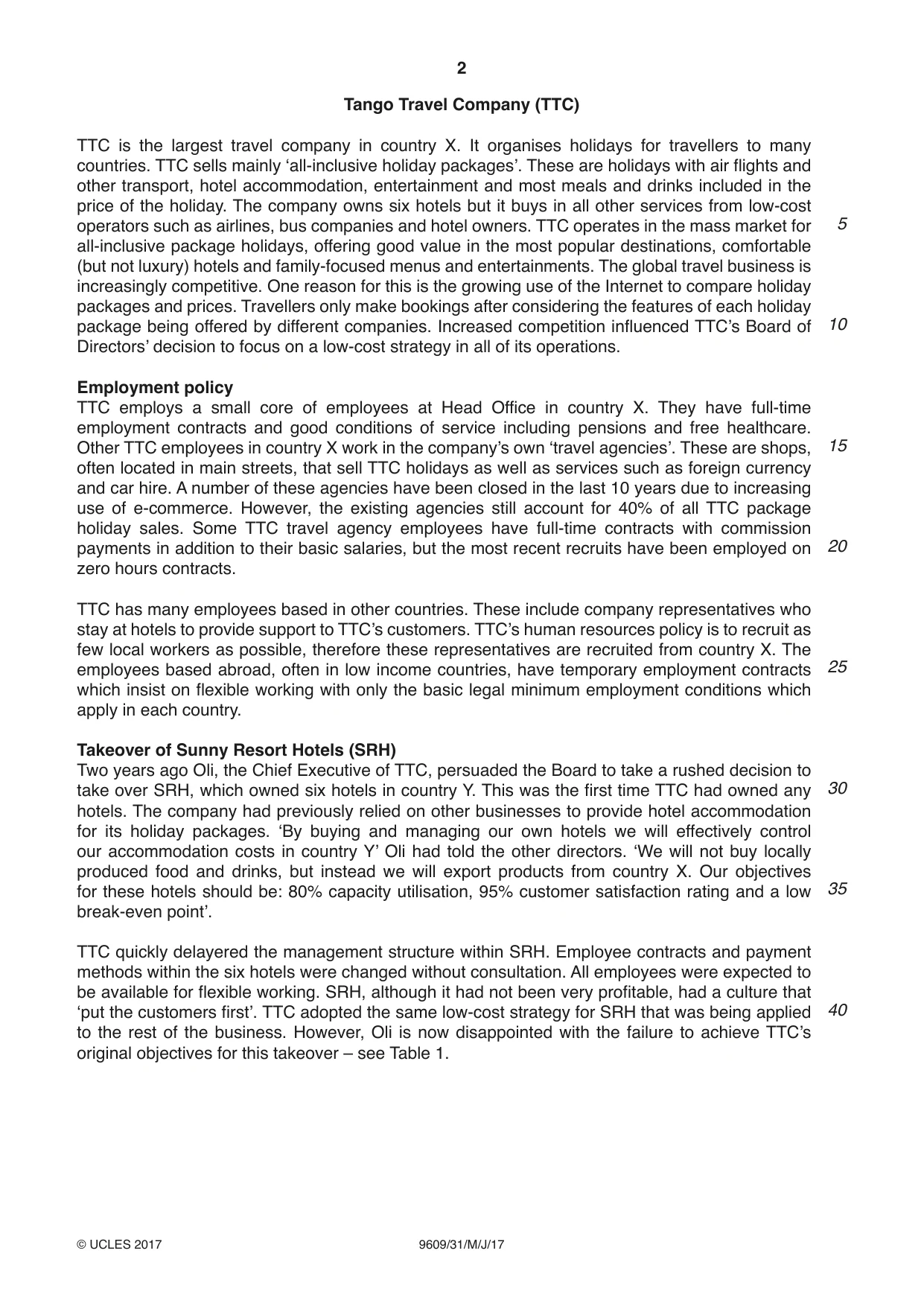
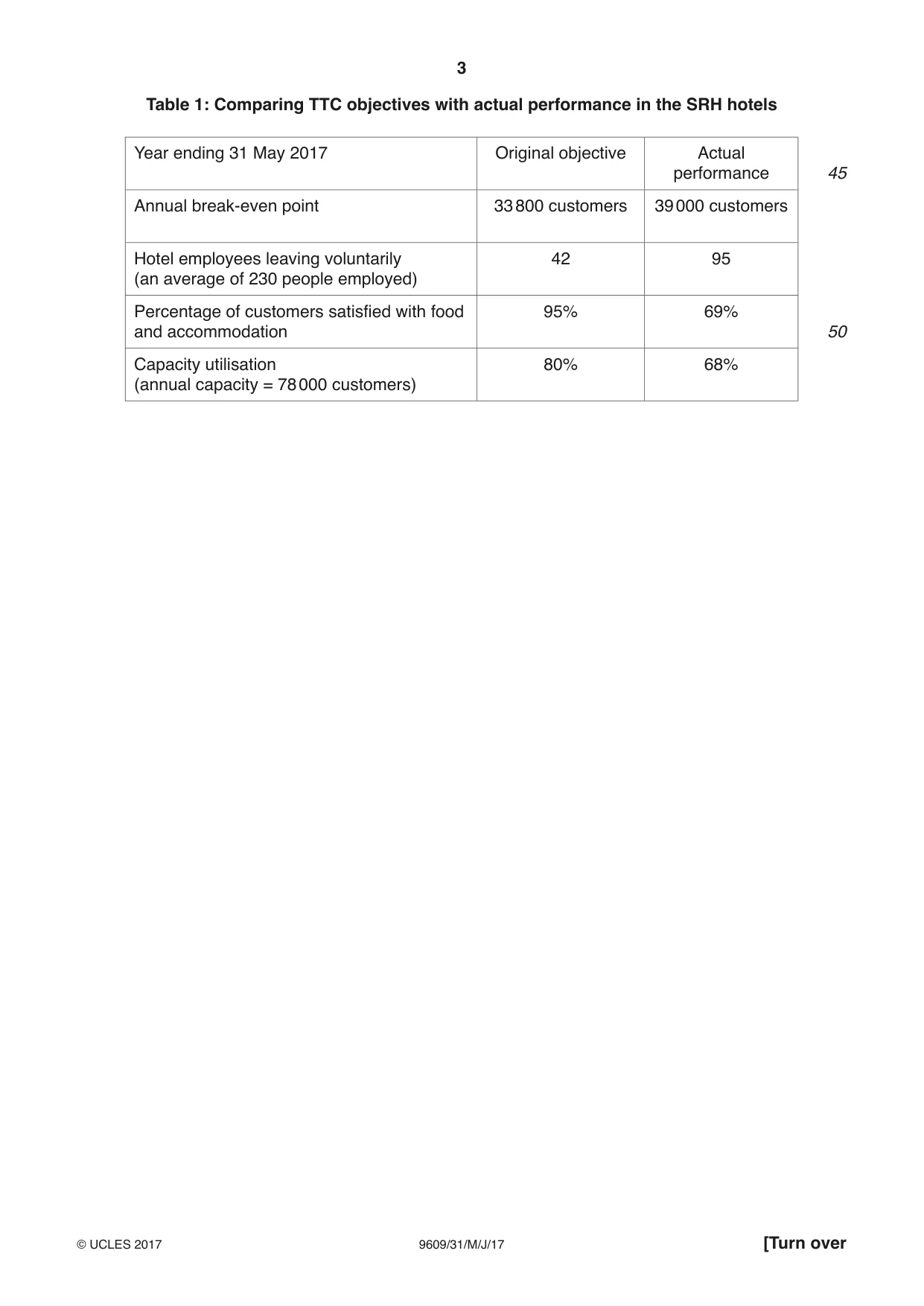
2 9609/31/M/J/17 © UCLES 2017 Tango Travel Company (TTC) TTC is the largest travel company in country X. It organises holidays for travellers to many countries. TTC sells mainly ‘all-inclusive holiday packages’. These are holidays with air flights and other transport, hotel accommodation, entertainment and most meals and drinks included in the price of the holiday. The company owns six hotels but it buys in all other services from low-cost operators such as airlines, bus companies and hotel owners. TTC operates in the mass market for all-inclusive package holidays, offering good value in the most popular destinations, comfortable (but not luxury) hotels and family-focused menus and entertainments. The global travel business is increasingly competitive. One reason for this is the growing use of the Internet to compare holiday packages and prices. Travellers only make bookings after considering the features of each holiday package being offered by different companies. Increased competition influenced TTC’s Board of Directors’ decision to focus on a low-cost strategy in all of its operations. Employment policy TTC employs a small core of employees at Head Office in country X. They have full-time employment contracts and good conditions of service including pensions and free healthcare. Other TTC employees in country X work in the company’s own ‘travel agencies’. These are shops, often located in main streets, that sell TTC holidays as well as services such as foreign currency and car hire. A number of these agencies have been closed in the last 10 years due to increasing use of e-commerce. However, the existing agencies still account for 40% of all TTC package holiday sales. Some TTC travel agency employees have full-time contracts with commission payments in addition to their basic salaries, but the most recent recruits have been employed on zero hours contracts. TTC has many employees based in other countries. These include company representatives who stay at hotels to provide support to TTC’s customers. TTC’s human resources policy is to recruit as few local workers as possible, therefore these representatives are recruited from country X. The employees based abroad, often in low income countries, have temporary employment contracts which insist on flexible working with only the basic legal minimum employment conditions which apply in each country. Takeover of Sunny Resort Hotels (SRH) Two years ago Oli, the Chief Executive of TTC, persuaded the Board to take a rushed decision to take over SRH, which owned six hotels in country Y. This was the first time TTC had owned any hotels. The company had previously relied on other businesses to provide hotel accommodation for its holiday packages. ‘By buying and managing our own hotels we will effectively control our accommodation costs in country Y’ Oli had told the other directors. ‘We will not buy locally produced food and drinks, but instead we will export products from country X. Our objectives for these hotels should be: 80% capacity utilisation, 95% customer satisfaction rating and a low break-even point’. TTC quickly delayered the management structure within SRH. Employee contracts and payment methods within the six hotels were changed without consultation. All employees were expected to be available for flexible working. SRH, although it had not been very profitable, had a culture that ‘put the customers first’. TTC adopted the same low-cost strategy for SRH that was being applied to the rest of the business. However, Oli is now disappointed with the failure to achieve TTC’s original objectives for this takeover – see Table 1. 5 10 15 20 25 30 35 40
Question paper, page 3
3 9609/31/M/J/17 © UCLES 2017 [Turn over Table 1: Comparing TTC objectives with actual performance in the SRH hotels Year ending 31 May 2017 Original objective Actual performance Annual break-even point 33 800 customers 39 000 customers Hotel employees leaving voluntarily (an average of 230 people employed) 42 95 Percentage of customers satisfied with food and accommodation 95% 69% Capacity utilisation (annual capacity = 78 000 customers) 80% 68% 45 50
Question paper, page 4
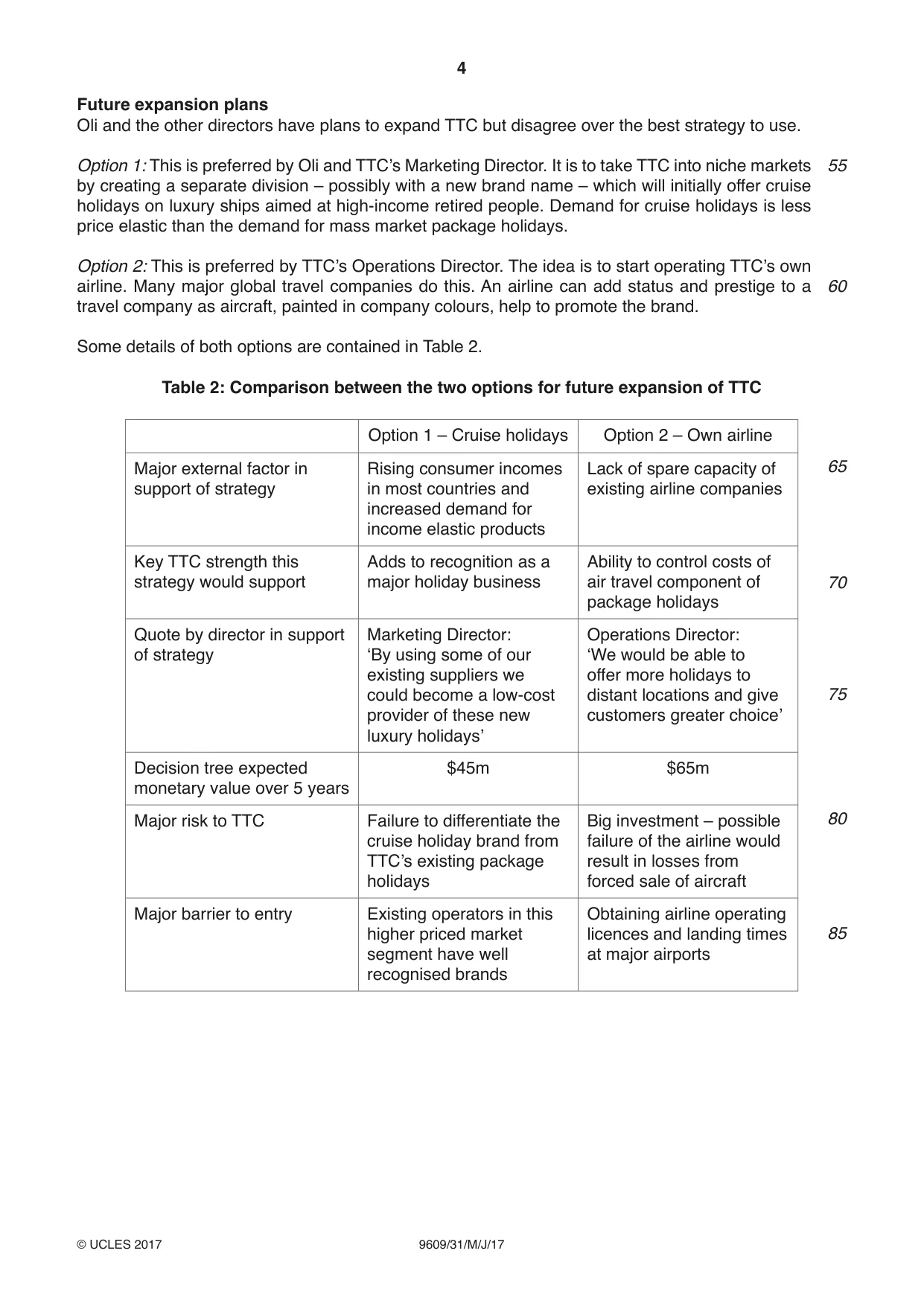
4 9609/31/M/J/17 © UCLES 2017 Future expansion plans Oli and the other directors have plans to expand TTC but disagree over the best strategy to use. Option 1: This is preferred by Oli and TTC’s Marketing Director. It is to take TTC into niche markets by creating a separate division – possibly with a new brand name – which will initially offer cruise holidays on luxury ships aimed at high-income retired people. Demand for cruise holidays is less price elastic than the demand for mass market package holidays. Option 2: This is preferred by TTC’s Operations Director. The idea is to start operating TTC’s own airline. Many major global travel companies do this. An airline can add status and prestige to a travel company as aircraft, painted in company colours, help to promote the brand. Some details of both options are contained in Table 2. Table 2: Comparison between the two options for future expansion of TTC Option 1 – Cruise holidays Option 2 – Own airline Major external factor in support of strategy Rising consumer incomes in most countries and increased demand for income elastic products Lack of spare capacity of existing airline companies Key TTC strength this strategy would support Adds to recognition as a major holiday business Ability to control costs of air travel component of package holidays Quote by director in support of strategy Marketing Director: ‘By using some of our existing suppliers we could become a low-cost provider of these new luxury holidays’ Operations Director: ‘We would be able to offer more holidays to distant locations and give customers greater choice’ Decision tree expected monetary value over 5 years $45m $65m Major risk to TTC Failure to differentiate the cruise holiday brand from TTC’s existing package holidays Big investment – possible failure of the airline would result in losses from forced sale of aircraft Major barrier to entry Existing operators in this higher priced market segment have well recognised brands Obtaining airline operating licences and landing times at major airports 55 60 65 70 75 80 85
Question paper, page 5
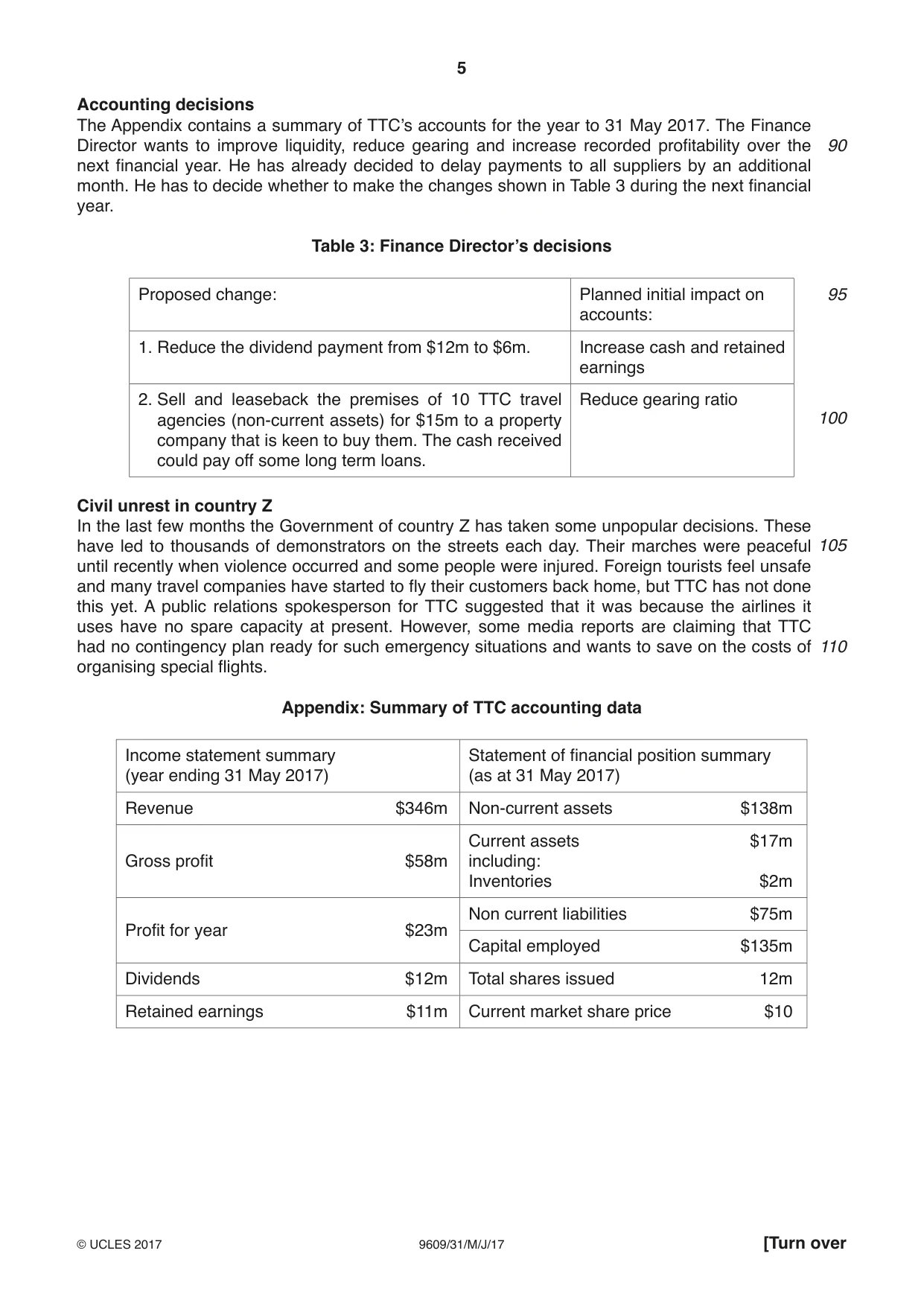
5 9609/31/M/J/17 © UCLES 2017 [Turn over Accounting decisions The Appendix contains a summary of TTC’s accounts for the year to 31 May 2017. The Finance Director wants to improve liquidity, reduce gearing and increase recorded profitability over the next financial year. He has already decided to delay payments to all suppliers by an additional month. He has to decide whether to make the changes shown in Table 3 during the next financial year. Table 3: Finance Director’s decisions Proposed change: Planned initial impact on accounts: 1. Reduce the dividend payment from $12m to $6m. Increase cash and retained earnings 2. Sell and leaseback the premises of 10 TTC travel agencies (non-current assets) for $15m to a property company that is keen to buy them. The cash received could pay off some long term loans. Reduce gearing ratio Civil unrest in country Z In the last few months the Government of country Z has taken some unpopular decisions. These have led to thousands of demonstrators on the streets each day. Their marches were peaceful until recently when violence occurred and some people were injured. Foreign tourists feel unsafe and many travel companies have started to fly their customers back home, but TTC has not done this yet. A public relations spokesperson for TTC suggested that it was because the airlines it uses have no spare capacity at present. However, some media reports are claiming that TTC had no contingency plan ready for such emergency situations and wants to save on the costs of organising special flights. Appendix: Summary of TTC accounting data Income statement summary (year ending 31 May 2017) Statement of financial position summary (as at 31 May 2017) Revenue $346m Non-current assets $138m Gross profit $58m Current assets $17m including: Inventories $2m Profit for year $23m Non current liabilities $75m Capital employed $135m Dividends $12m Total shares issued 12m Retained earnings $11m Current market share price $10 90 95 100 105 110
Question paper, page 6
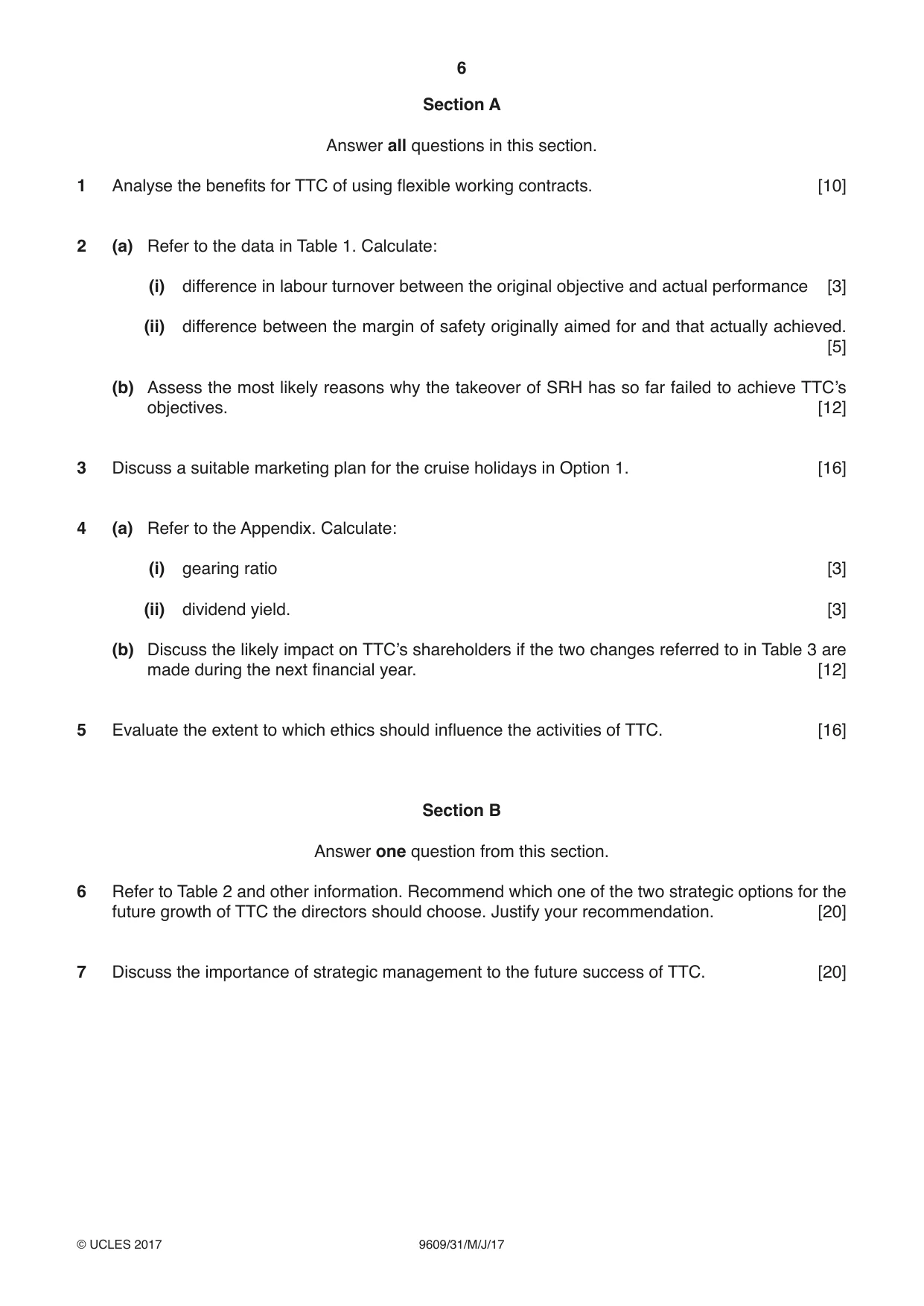
6 9609/31/M/J/17 © UCLES 2017 Section A Answer all questions in this section. 1 Analyse the benefits for TTC of using flexible working contracts. [10] 2 (a) Refer to the data in Table 1. Calculate: (i) difference in labour turnover between the original objective and actual performance [3] (ii) difference between the margin of safety originally aimed for and that actually achieved. [5] (b) Assess the most likely reasons why the takeover of SRH has so far failed to achieve TTC’s objectives. [12] 3 Discuss a suitable marketing plan for the cruise holidays in Option 1. [16] 4 (a) Refer to the Appendix. Calculate: (i) gearing ratio [3] (ii) dividend yield. [3] (b) Discuss the likely impact on TTC’s shareholders if the two changes referred to in Table 3 are made during the next financial year. [12] 5 Evaluate the extent to which ethics should influence the activities of TTC. [16] Section B Answer one question from this section. 6 Refer to Table 2 and other information. Recommend which one of the two strategic options for the future growth of TTC the directors should choose. Justify your recommendation. [20] 7 Discuss the importance of strategic management to the future success of TTC. [20]
Question paper, page 7
7 9609/31/M/J/17 © UCLES 2017 BLANK PAGE
Question paper, page 8
8 9609/31/M/J/17 © UCLES 2017 Permission to reproduce items where third-party owned material protected by copyright is included has been sought and cleared where possible. Every reasonable effort has been made by the publisher (UCLES) to trace copyright holders, but if any items requiring clearance have unwittingly been included, the publisher will be pleased to make amends at the earliest possible opportunity. To avoid the issue of disclosure of answer-related information to candidates, all copyright acknowledgements are reproduced online in the Cambridge International Examinations Copyright Acknowledgements Booklet. This is produced for each series of examinations and is freely available to download at www.cie.org.uk after the live examination series. Cambridge International Examinations is part of the Cambridge Assessment Group. Cambridge Assessment is the brand name of University of Cambridge Local Examinations Syndicate (UCLES), which is itself a department of the University of Cambridge. BLANK PAGE
Mark scheme, page 1
® IGCSE is a registered trademark. This document consists of 12 printed pages. © UCLES 2017 [Turn over Cambridge International Examinations Cambridge International Advanced Level BUSINESS 9609/31 Paper 3 Case Study May/June 2017 MARK SCHEME Maximum Mark: 100 Published This mark scheme is published as an aid to teachers and candidates, to indicate the requirements of the examination. It shows the basis on which Examiners were instructed to award marks. It does not indicate the details of the discussions that took place at an Examiners’ meeting before marking began, which would have considered the acceptability of alternative answers. Mark schemes should be read in conjunction with the question paper and the Principal Examiner Report for Teachers. Cambridge will not enter into discussions about these mark schemes. Cambridge is publishing the mark schemes for the May/June 2017 series for most Cambridge IGCSE®, Cambridge International A and AS Level and Cambridge Pre-U components, and some Cambridge O Level components.
Mark scheme, page 2
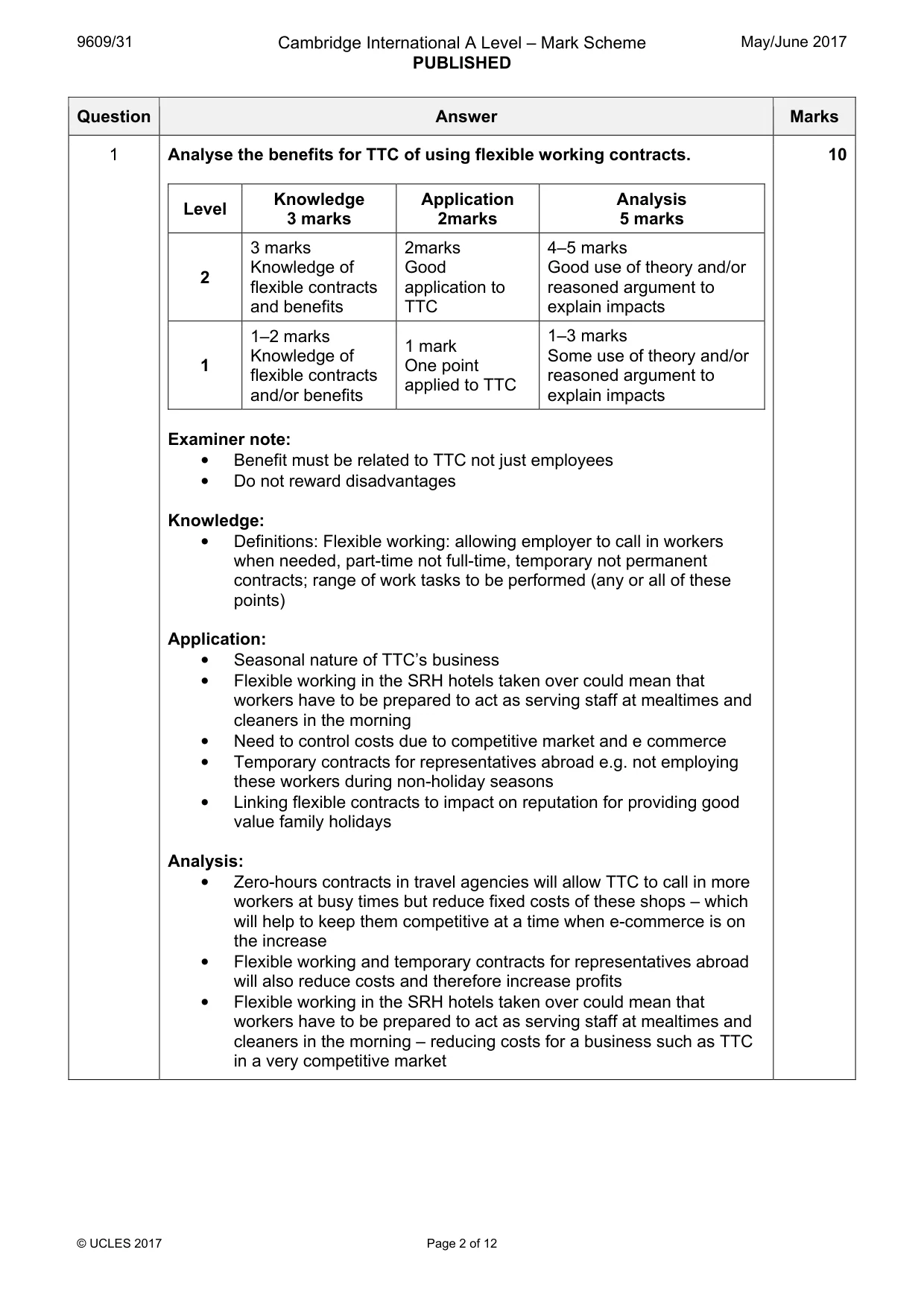
9609/31 Cambridge International A Level – Mark Scheme PUBLISHED May/June 2017 © UCLES 2017 Page 2 of 12 Question Answer Marks 1 Analyse the benefits for TTC of using flexible working contracts. Level Knowledge 3 marks Application 2marks Analysis 5 marks 2 3 marks Knowledge of flexible contracts and benefits 2marks Good application to TTC 4–5 marks Good use of theory and/or reasoned argument to explain impacts 1 1–2 marks Knowledge of flexible contracts and/or benefits 1 mark One point applied to TTC 1–3 marks Some use of theory and/or reasoned argument to explain impacts Examiner note: • Benefit must be related to TTC not just employees • Do not reward disadvantages Knowledge: • Definitions: Flexible working: allowing employer to call in workers when needed, part-time not full-time, temporary not permanent contracts; range of work tasks to be performed (any or all of these points) Application: • Seasonal nature of TTC’s business • Flexible working in the SRH hotels taken over could mean that workers have to be prepared to act as serving staff at mealtimes and cleaners in the morning • Need to control costs due to competitive market and e commerce • Temporary contracts for representatives abroad e.g. not employing these workers during non-holiday seasons • Linking flexible contracts to impact on reputation for providing good value family holidays Analysis: • Zero-hours contracts in travel agencies will allow TTC to call in more workers at busy times but reduce fixed costs of these shops – which will help to keep them competitive at a time when e-commerce is on the increase • Flexible working and temporary contracts for representatives abroad will also reduce costs and therefore increase profits • Flexible working in the SRH hotels taken over could mean that workers have to be prepared to act as serving staff at mealtimes and cleaners in the morning – reducing costs for a business such as TTC in a very competitive market 10
Mark scheme, page 3
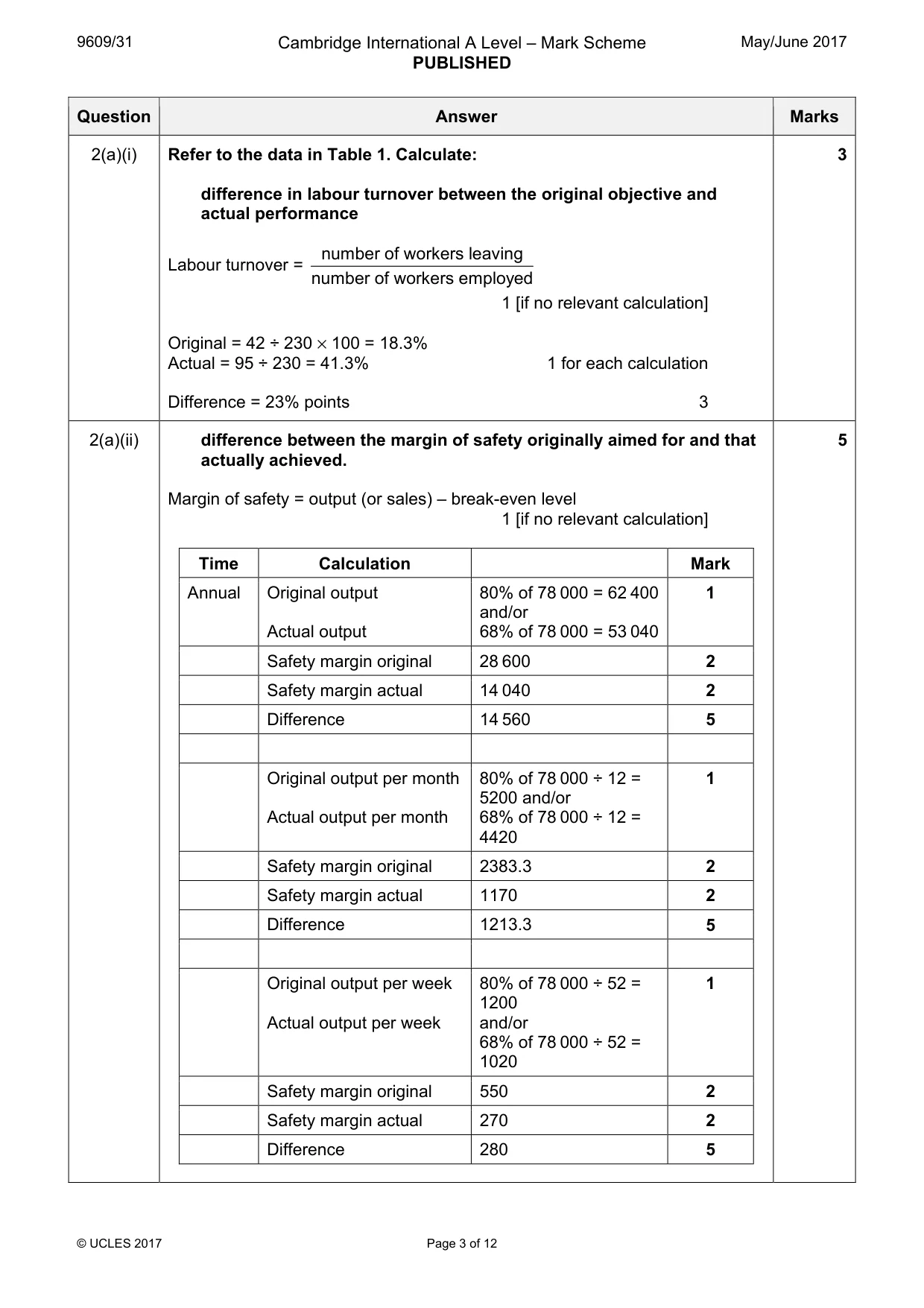
9609/31 Cambridge International A Level – Mark Scheme PUBLISHED May/June 2017 © UCLES 2017 Page 3 of 12 Question Answer Marks 2(a)(i) Refer to the data in Table 1. Calculate: difference in labour turnover between the original objective and actual performance Labour turnover = number of workers leaving number of workers employed 1 [if no relevant calculation] Original = 42 ÷ 230 × 100 = 18.3% Actual = 95 ÷ 230 = 41.3% 1 for each calculation Difference = 23% points 3 3 2(a)(ii) difference between the margin of safety originally aimed for and that actually achieved. Margin of safety = output (or sales) – break-even level 1 [if no relevant calculation] Time Calculation Mark Annual Original output Actual output 80% of 78 000 = 62 400 and/or 68% of 78 000 = 53 040 1 Safety margin original 28 600 2 Safety margin actual 14 040 2 Difference 14 560 5 Original output per month Actual output per month 80% of 78 000 ÷ 12 = 5200 and/or 68% of 78 000 ÷ 12 = 4420 1 Safety margin original 2383.3 2 Safety margin actual 1170 2 Difference 1213.3 5 Original output per week Actual output per week 80% of 78 000 ÷ 52 = 1200 and/or 68% of 78 000 ÷ 52 = 1020 1 Safety margin original 550 2 Safety margin actual 270 2 Difference 280 5 5
Mark scheme, page 4
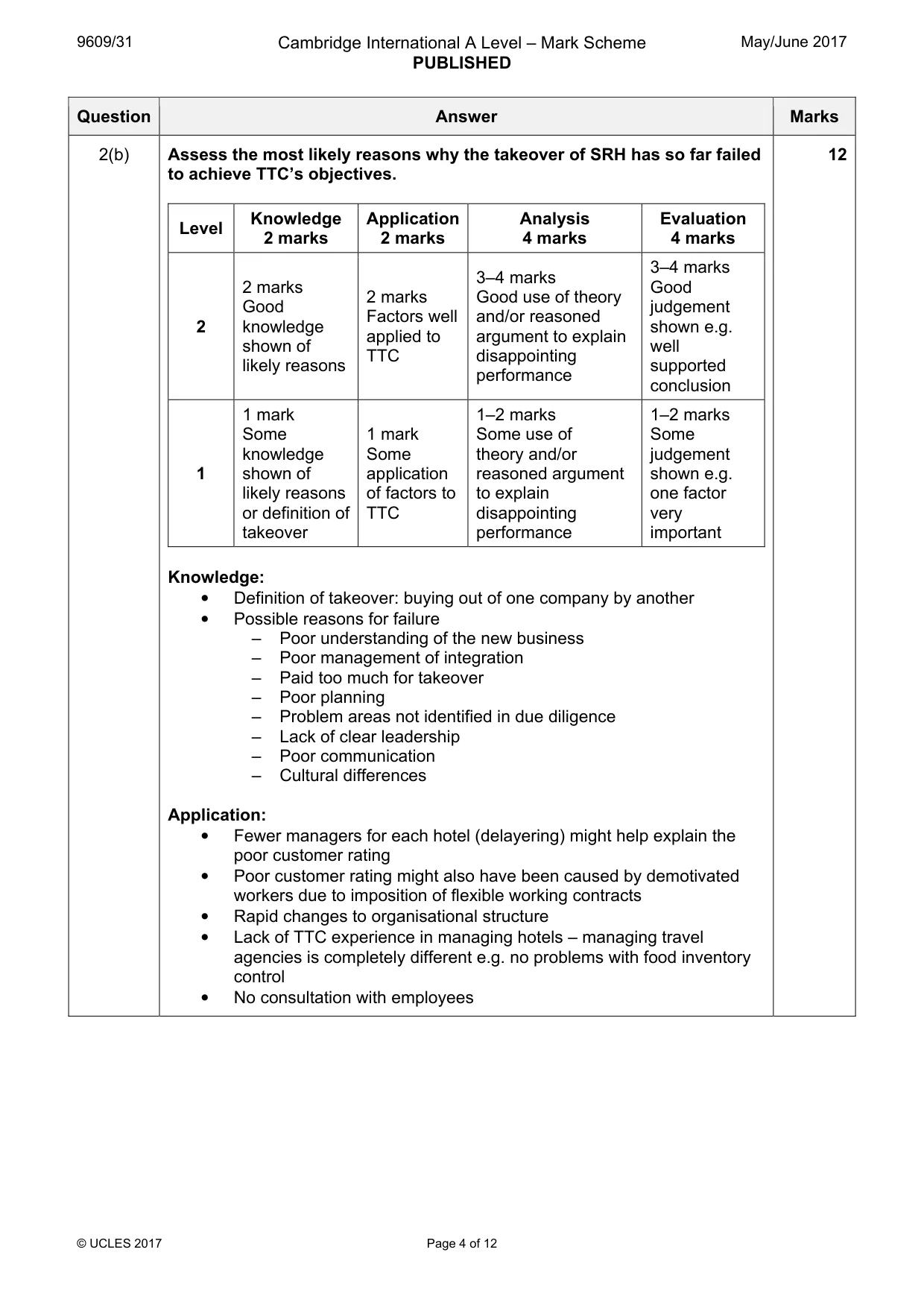
9609/31 Cambridge International A Level – Mark Scheme PUBLISHED May/June 2017 © UCLES 2017 Page 4 of 12 Question Answer Marks 2(b) Assess the most likely reasons why the takeover of SRH has so far failed to achieve TTC’s objectives. Level Knowledge 2 marks Application 2 marks Analysis 4 marks Evaluation 4 marks 2 2 marks Good knowledge shown of likely reasons 2 marks Factors well applied to TTC 3–4 marks Good use of theory and/or reasoned argument to explain disappointing performance 3–4 marks Good judgement shown e.g. well supported conclusion 1 1 mark Some knowledge shown of likely reasons or definition of takeover 1 mark Some application of factors to TTC 1–2 marks Some use of theory and/or reasoned argument to explain disappointing performance 1–2 marks Some judgement shown e.g. one factor very important Knowledge: • Definition of takeover: buying out of one company by another • Possible reasons for failure – Poor understanding of the new business – Poor management of integration – Paid too much for takeover – Poor planning – Problem areas not identified in due diligence – Lack of clear leadership – Poor communication – Cultural differences Application: • Fewer managers for each hotel (delayering) might help explain the poor customer rating • Poor customer rating might also have been caused by demotivated workers due to imposition of flexible working contracts • Rapid changes to organisational structure • Lack of TTC experience in managing hotels – managing travel agencies is completely different e.g. no problems with food inventory control • No consultation with employees 12
Mark scheme, page 5
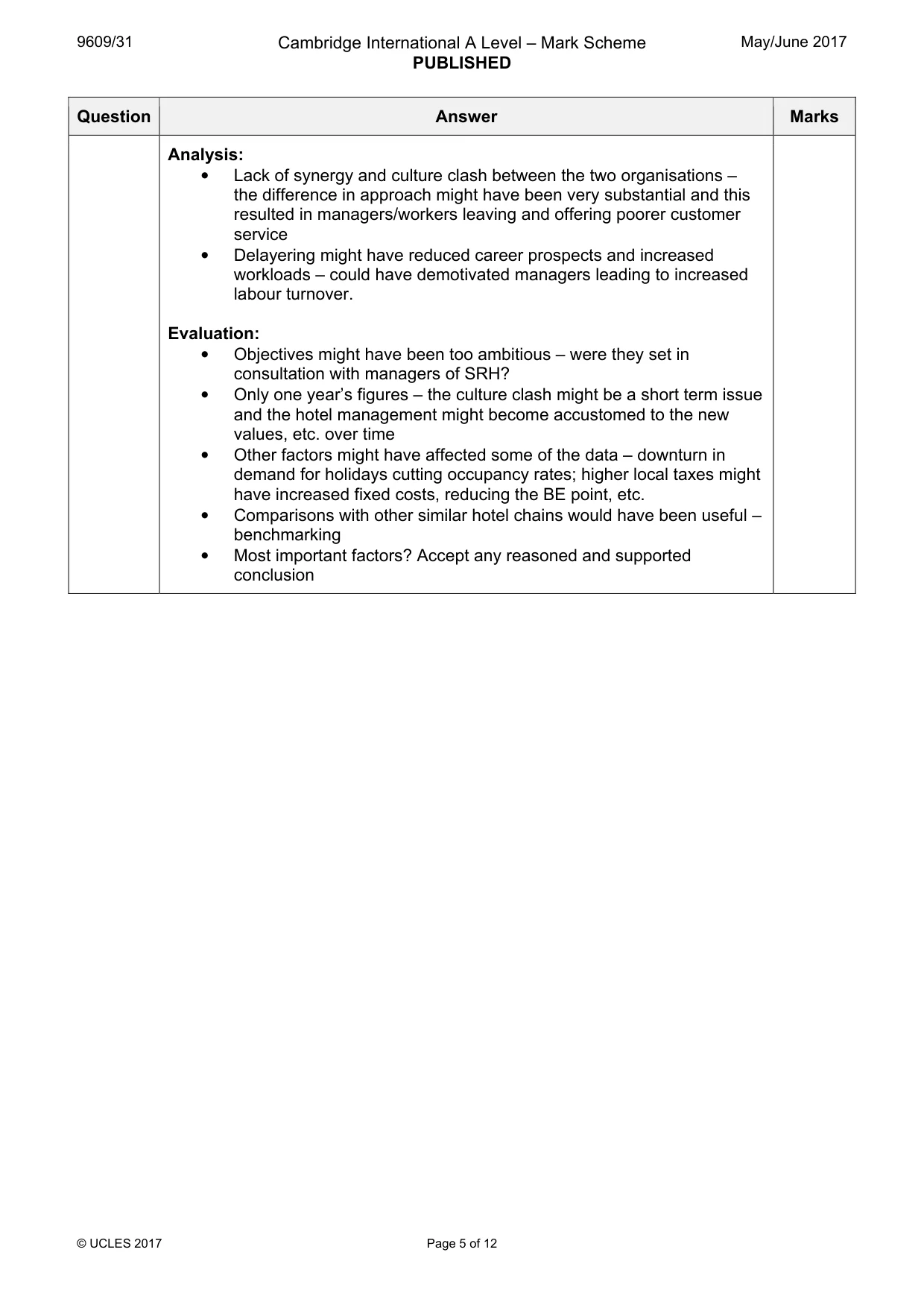
9609/31 Cambridge International A Level – Mark Scheme PUBLISHED May/June 2017 © UCLES 2017 Page 5 of 12 Question Answer Marks Analysis: • Lack of synergy and culture clash between the two organisations – the difference in approach might have been very substantial and this resulted in managers/workers leaving and offering poorer customer service • Delayering might have reduced career prospects and increased workloads – could have demotivated managers leading to increased labour turnover. Evaluation: • Objectives might have been too ambitious – were they set in consultation with managers of SRH? • Only one year’s figures – the culture clash might be a short term issue and the hotel management might become accustomed to the new values, etc. over time • Other factors might have affected some of the data – downturn in demand for holidays cutting occupancy rates; higher local taxes might have increased fixed costs, reducing the BE point, etc. • Comparisons with other similar hotel chains would have been useful – benchmarking • Most important factors? Accept any reasoned and supported conclusion
Mark scheme, page 6
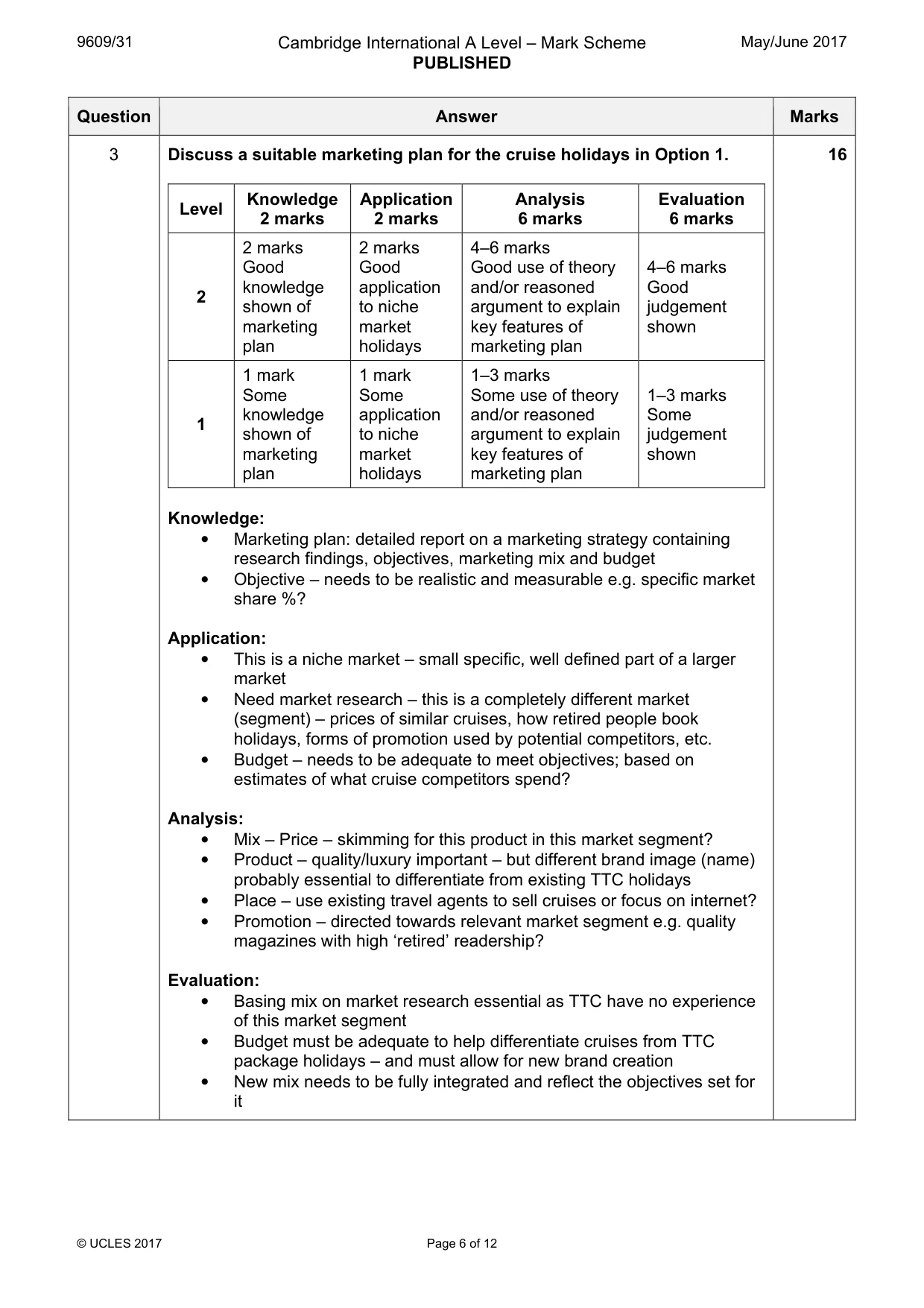
9609/31 Cambridge International A Level – Mark Scheme PUBLISHED May/June 2017 © UCLES 2017 Page 6 of 12 Question Answer Marks 3 Discuss a suitable marketing plan for the cruise holidays in Option 1. Level Knowledge 2 marks Application 2 marks Analysis 6 marks Evaluation 6 marks 2 2 marks Good knowledge shown of marketing plan 2 marks Good application to niche market holidays 4–6 marks Good use of theory and/or reasoned argument to explain key features of marketing plan 4–6 marks Good judgement shown 1 1 mark Some knowledge shown of marketing plan 1 mark Some application to niche market holidays 1–3 marks Some use of theory and/or reasoned argument to explain key features of marketing plan 1–3 marks Some judgement shown Knowledge: • Marketing plan: detailed report on a marketing strategy containing research findings, objectives, marketing mix and budget • Objective – needs to be realistic and measurable e.g. specific market share %? Application: • This is a niche market – small specific, well defined part of a larger market • Need market research – this is a completely different market (segment) – prices of similar cruises, how retired people book holidays, forms of promotion used by potential competitors, etc. • Budget – needs to be adequate to meet objectives; based on estimates of what cruise competitors spend? Analysis: • Mix – Price – skimming for this product in this market segment? • Product – quality/luxury important – but different brand image (name) probably essential to differentiate from existing TTC holidays • Place – use existing travel agents to sell cruises or focus on internet? • Promotion – directed towards relevant market segment e.g. quality magazines with high ‘retired’ readership? Evaluation: • Basing mix on market research essential as TTC have no experience of this market segment • Budget must be adequate to help differentiate cruises from TTC package holidays – and must allow for new brand creation • New mix needs to be fully integrated and reflect the objectives set for it 16
Mark scheme, page 7
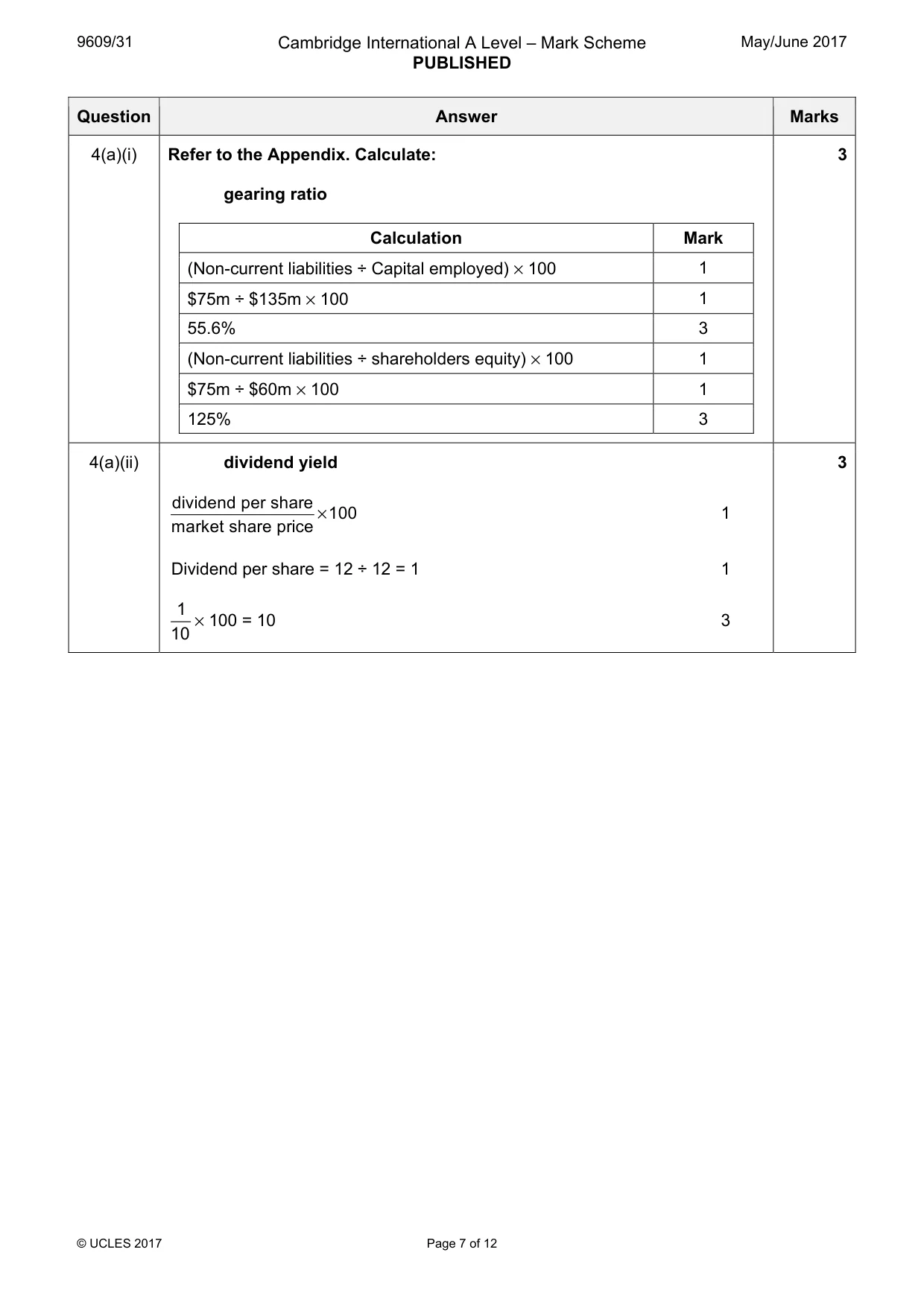
9609/31 Cambridge International A Level – Mark Scheme PUBLISHED May/June 2017 © UCLES 2017 Page 7 of 12 Question Answer Marks 4(a)(i) Refer to the Appendix. Calculate: gearing ratio Calculation Mark (Non-current liabilities ÷ Capital employed) × 100 1 $75m ÷ $135m × 100 1 55.6% 3 (Non-current liabilities ÷ shareholders equity) × 100 1 $75m ÷ $60m × 100 1 125% 3 3 4(a)(ii) dividend yield × dividend per share 100 market share price 1 Dividend per share = 12 ÷ 12 = 1 1 1 10 × 100 = 10 3 3
Mark scheme, page 8
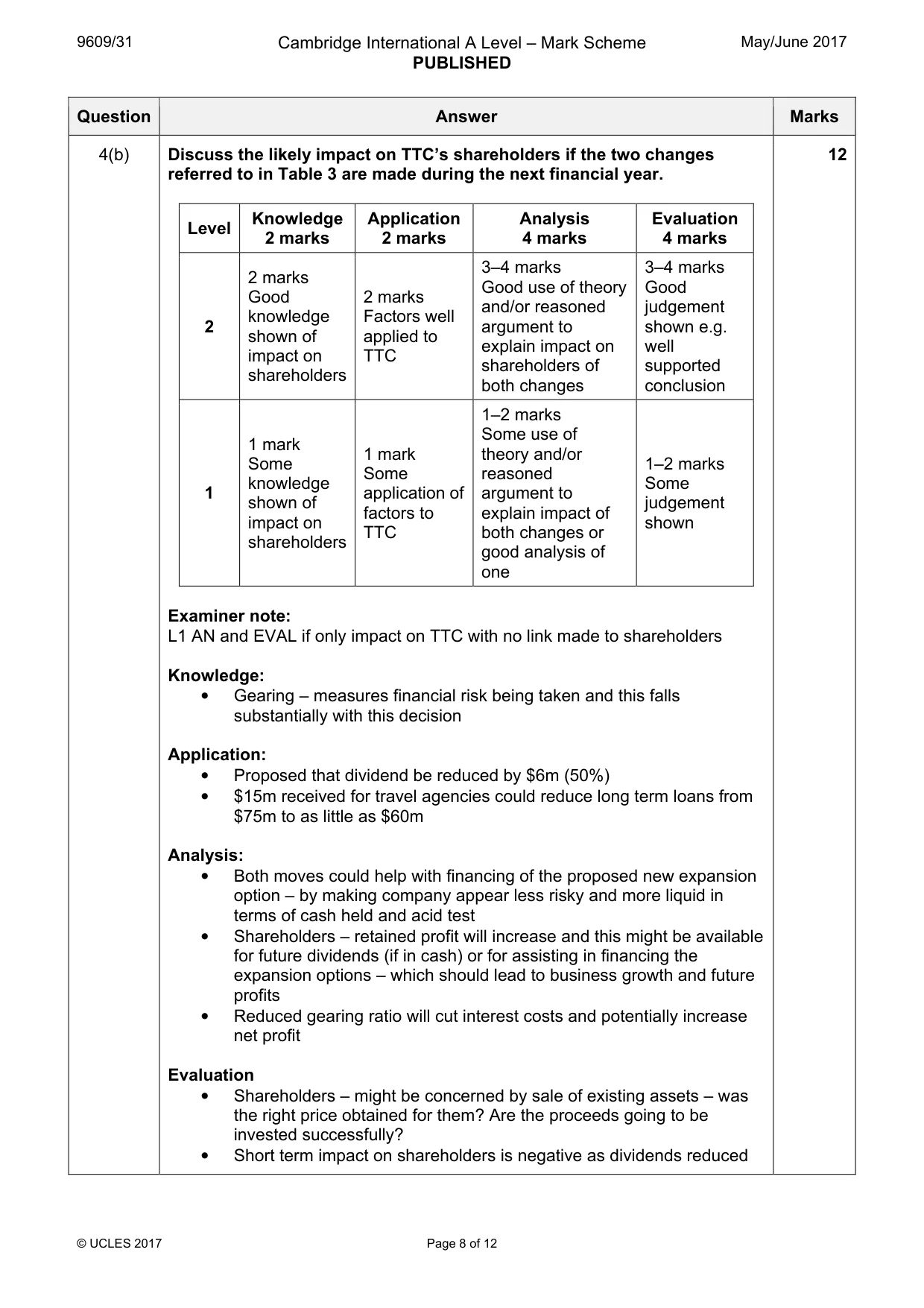
9609/31 Cambridge International A Level – Mark Scheme PUBLISHED May/June 2017 © UCLES 2017 Page 8 of 12 Question Answer Marks 4(b) Discuss the likely impact on TTC’s shareholders if the two changes referred to in Table 3 are made during the next financial year. Level Knowledge 2 marks Application 2 marks Analysis 4 marks Evaluation 4 marks 2 2 marks Good knowledge shown of impact on shareholders 2 marks Factors well applied to TTC 3–4 marks Good use of theory and/or reasoned argument to explain impact on shareholders of both changes 3–4 marks Good judgement shown e.g. well supported conclusion 1 1 mark Some knowledge shown of impact on shareholders 1 mark Some application of factors to TTC 1–2 marks Some use of theory and/or reasoned argument to explain impact of both changes or good analysis of one 1–2 marks Some judgement shown Examiner note: L1 AN and EVAL if only impact on TTC with no link made to shareholders Knowledge: • Gearing – measures financial risk being taken and this falls substantially with this decision Application: • Proposed that dividend be reduced by $6m (50%) • $15m received for travel agencies could reduce long term loans from $75m to as little as $60m Analysis: • Both moves could help with financing of the proposed new expansion option – by making company appear less risky and more liquid in terms of cash held and acid test • Shareholders – retained profit will increase and this might be available for future dividends (if in cash) or for assisting in financing the expansion options – which should lead to business growth and future profits • Reduced gearing ratio will cut interest costs and potentially increase net profit Evaluation • Shareholders – might be concerned by sale of existing assets – was the right price obtained for them? Are the proceeds going to be invested successfully? • Short term impact on shareholders is negative as dividends reduced 12
Mark scheme, page 9
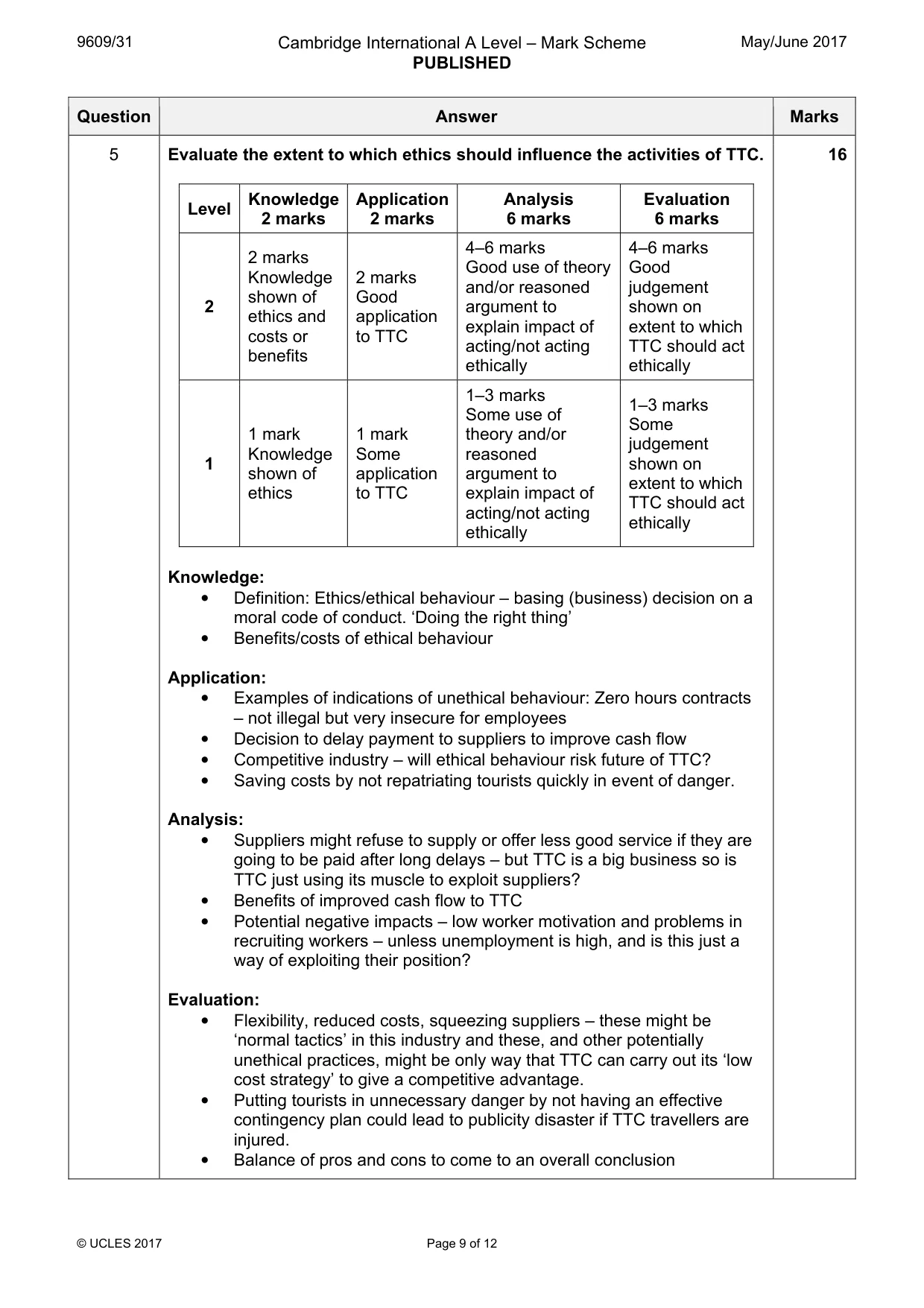
9609/31 Cambridge International A Level – Mark Scheme PUBLISHED May/June 2017 © UCLES 2017 Page 9 of 12 Question Answer Marks 5 Evaluate the extent to which ethics should influence the activities of TTC. Level Knowledge 2 marks Application 2 marks Analysis 6 marks Evaluation 6 marks 2 2 marks Knowledge shown of ethics and costs or benefits 2 marks Good application to TTC 4–6 marks Good use of theory and/or reasoned argument to explain impact of acting/not acting ethically 4–6 marks Good judgement shown on extent to which TTC should act ethically 1 1 mark Knowledge shown of ethics 1 mark Some application to TTC 1–3 marks Some use of theory and/or reasoned argument to explain impact of acting/not acting ethically 1–3 marks Some judgement shown on extent to which TTC should act ethically Knowledge: • Definition: Ethics/ethical behaviour – basing (business) decision on a moral code of conduct. ‘Doing the right thing’ • Benefits/costs of ethical behaviour Application: • Examples of indications of unethical behaviour: Zero hours contracts – not illegal but very insecure for employees • Decision to delay payment to suppliers to improve cash flow • Competitive industry – will ethical behaviour risk future of TTC? • Saving costs by not repatriating tourists quickly in event of danger. Analysis: • Suppliers might refuse to supply or offer less good service if they are going to be paid after long delays – but TTC is a big business so is TTC just using its muscle to exploit suppliers? • Benefits of improved cash flow to TTC • Potential negative impacts – low worker motivation and problems in recruiting workers – unless unemployment is high, and is this just a way of exploiting their position? Evaluation: • Flexibility, reduced costs, squeezing suppliers – these might be ‘normal tactics’ in this industry and these, and other potentially unethical practices, might be only way that TTC can carry out its ‘low cost strategy’ to give a competitive advantage. • Putting tourists in unnecessary danger by not having an effective contingency plan could lead to publicity disaster if TTC travellers are injured. • Balance of pros and cons to come to an overall conclusion 16
Mark scheme, page 10
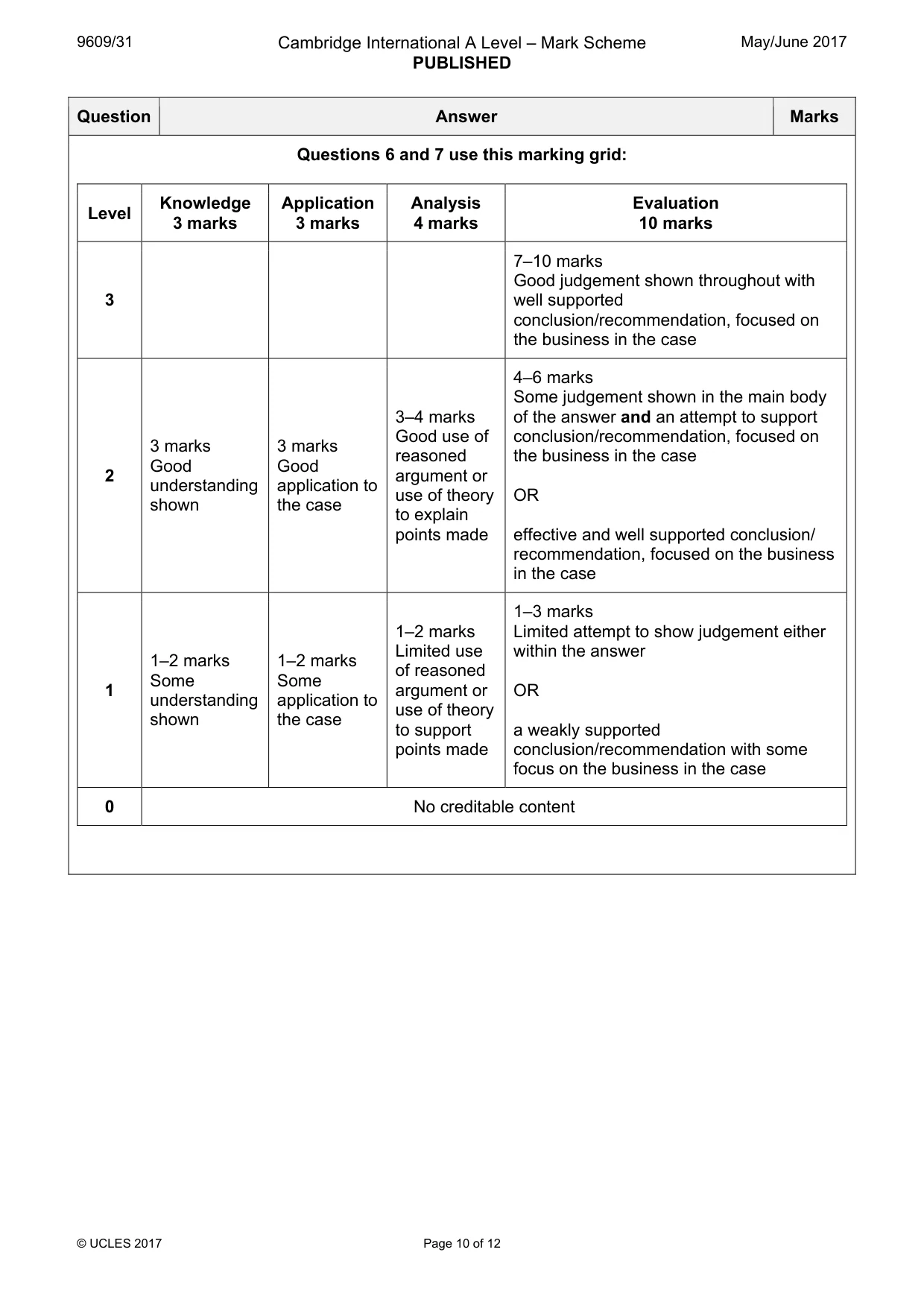
9609/31 Cambridge International A Level – Mark Scheme PUBLISHED May/June 2017 © UCLES 2017 Page 10 of 12 Question Answer Marks Questions 6 and 7 use this marking grid: Level Knowledge 3 marks Application 3 marks Analysis 4 marks Evaluation 10 marks 3 7–10 marks Good judgement shown throughout with well supported conclusion/recommendation, focused on the business in the case 2 3 marks Good understanding shown 3 marks Good application to the case 3–4 marks Good use of reasoned argument or use of theory to explain points made 4–6 marks Some judgement shown in the main body of the answer and an attempt to support conclusion/recommendation, focused on the business in the case OR effective and well supported conclusion/ recommendation, focused on the business in the case 1 1–2 marks Some understanding shown 1–2 marks Some application to the case 1–2 marks Limited use of reasoned argument or use of theory to support points made 1–3 marks Limited attempt to show judgement either within the answer OR a weakly supported conclusion/recommendation with some focus on the business in the case 0 No creditable content
Mark scheme, page 11
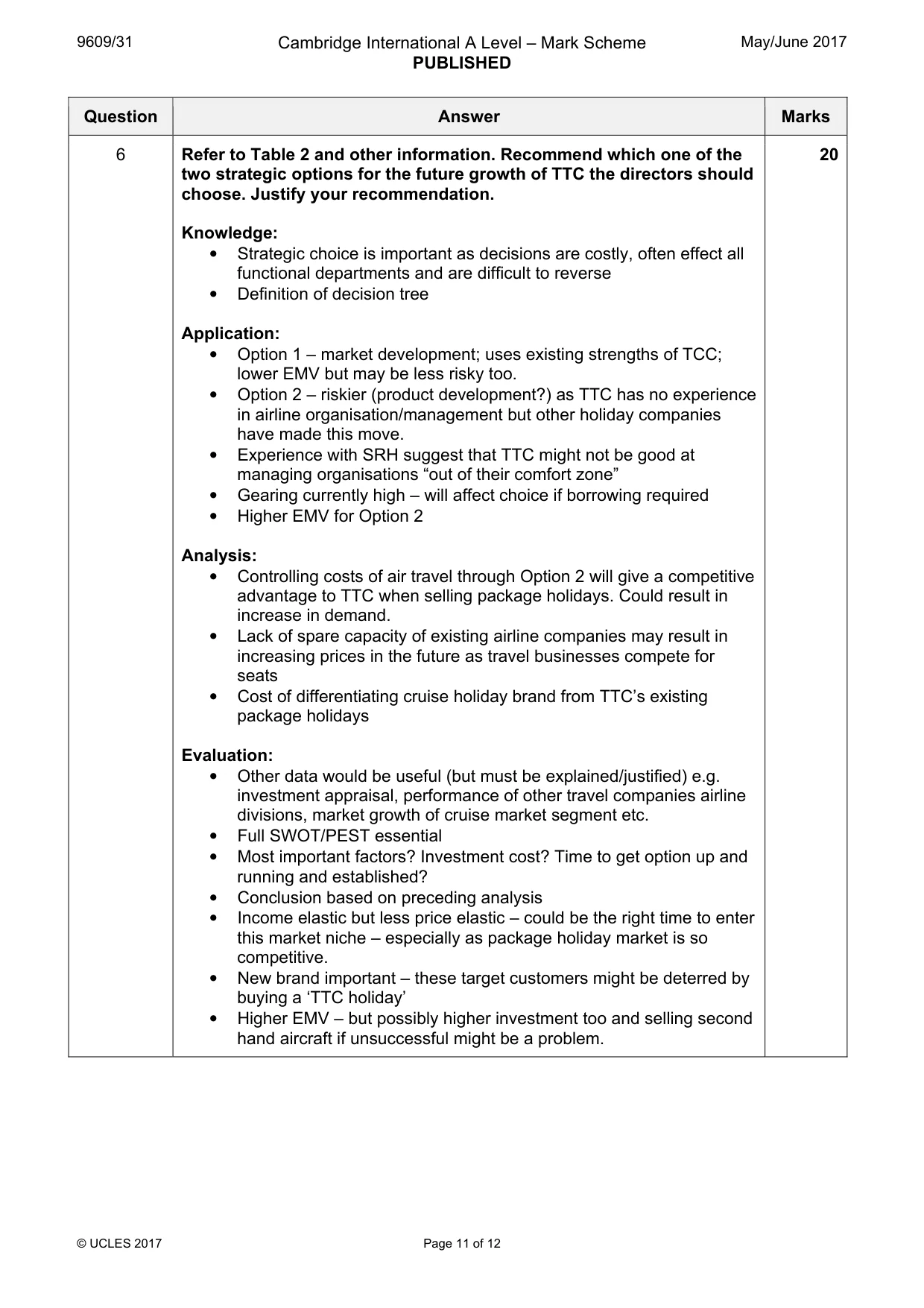
9609/31 Cambridge International A Level – Mark Scheme PUBLISHED May/June 2017 © UCLES 2017 Page 11 of 12 Question Answer Marks 6 Refer to Table 2 and other information. Recommend which one of the two strategic options for the future growth of TTC the directors should choose. Justify your recommendation. Knowledge: • Strategic choice is important as decisions are costly, often effect all functional departments and are difficult to reverse • Definition of decision tree Application: • Option 1 – market development; uses existing strengths of TCC; lower EMV but may be less risky too. • Option 2 – riskier (product development?) as TTC has no experience in airline organisation/management but other holiday companies have made this move. • Experience with SRH suggest that TTC might not be good at managing organisations “out of their comfort zone” • Gearing currently high – will affect choice if borrowing required • Higher EMV for Option 2 Analysis: • Controlling costs of air travel through Option 2 will give a competitive advantage to TTC when selling package holidays. Could result in increase in demand. • Lack of spare capacity of existing airline companies may result in increasing prices in the future as travel businesses compete for seats • Cost of differentiating cruise holiday brand from TTC’s existing package holidays Evaluation: • Other data would be useful (but must be explained/justified) e.g. investment appraisal, performance of other travel companies airline divisions, market growth of cruise market segment etc. • Full SWOT/PEST essential • Most important factors? Investment cost? Time to get option up and running and established? • Conclusion based on preceding analysis • Income elastic but less price elastic – could be the right time to enter this market niche – especially as package holiday market is so competitive. • New brand important – these target customers might be deterred by buying a ‘TTC holiday’ • Higher EMV – but possibly higher investment too and selling second hand aircraft if unsuccessful might be a problem. 20
Mark scheme, page 12
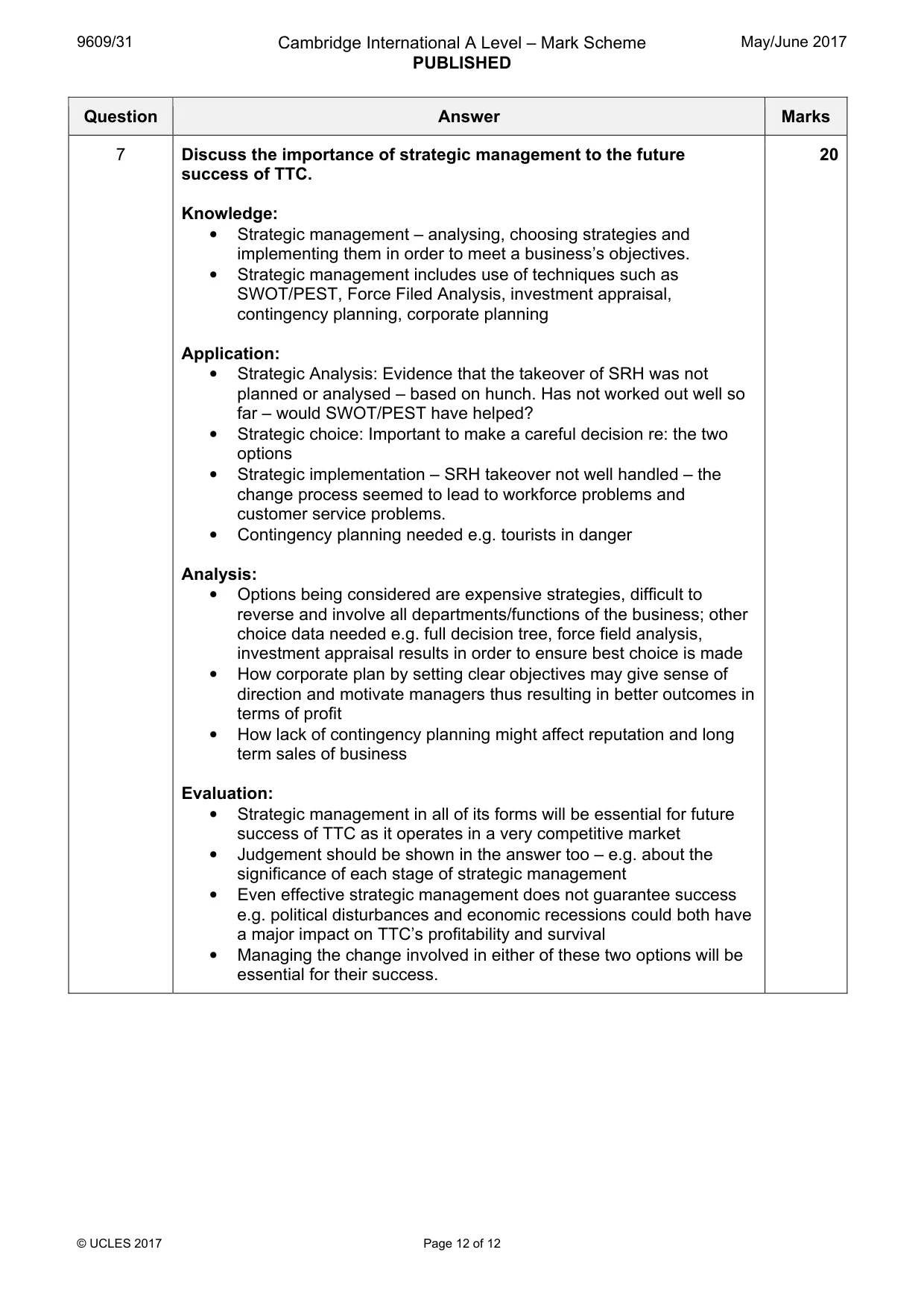
9609/31 Cambridge International A Level – Mark Scheme PUBLISHED May/June 2017 © UCLES 2017 Page 12 of 12 Question Answer Marks 7 Discuss the importance of strategic management to the future success of TTC. Knowledge: • Strategic management – analysing, choosing strategies and implementing them in order to meet a business’s objectives. • Strategic management includes use of techniques such as SWOT/PEST, Force Filed Analysis, investment appraisal, contingency planning, corporate planning Application: • Strategic Analysis: Evidence that the takeover of SRH was not planned or analysed – based on hunch. Has not worked out well so far – would SWOT/PEST have helped? • Strategic choice: Important to make a careful decision re: the two options • Strategic implementation – SRH takeover not well handled – the change process seemed to lead to workforce problems and customer service problems. • Contingency planning needed e.g. tourists in danger Analysis: • Options being considered are expensive strategies, difficult to reverse and involve all departments/functions of the business; other choice data needed e.g. full decision tree, force field analysis, investment appraisal results in order to ensure best choice is made • How corporate plan by setting clear objectives may give sense of direction and motivate managers thus resulting in better outcomes in terms of profit • How lack of contingency planning might affect reputation and long term sales of business Evaluation: • Strategic management in all of its forms will be essential for future success of TTC as it operates in a very competitive market • Judgement should be shown in the answer too – e.g. about the significance of each stage of strategic management • Even effective strategic management does not guarantee success e.g. political disturbances and economic recessions could both have a major impact on TTC’s profitability and survival • Managing the change involved in either of these two options will be essential for their success. 20