Cambridge A Level Business (for first examination in 2016) 9609 — 2017 Feb/March Paper 1 · Variant 2
9609/12/F/M/17 · 40 marks · ≈45 min
The question paper and its mark scheme, free to read here and free to download. This is Cambridge’s own paper, exactly as it was sat.
Question paper4 pages


Mark scheme10 pages
Answers below. Sit the paper first if you are practising.
Paper as text
Question paper, page 1
This document consists of 2 printed pages, 2 blank pages and 1 Insert. DC (RW) 133398 © UCLES 2017 [Turn over Cambridge International Examinations Cambridge International Advanced Subsidiary and Advanced Level * 1 4 4 0 8 0 1 4 8 1 * BUSINESS 9609/12 Paper 1 Short Answer and Essay February/March 2017 1 hour 15 minutes No Additional Materials are required. READ THESE INSTRUCTIONS FIRST An answer booklet is provided inside this question paper. You should follow the instructions on the front cover of the answer booklet. If you need additional answer paper ask the invigilator for a continuation booklet. Section A Answer all questions. Section B Answer one question. You are advised to spend no more than 35 minutes on Section A. The number of marks is given in brackets [ ] at the end of each question or part question.
Question paper, page 2
2 9609/12/F/M/17 © UCLES 2017 Section A (Short Answer) Answer all questions. 1 (a) Define the term ‘market research’. [2] (b) Briefly explain the limitations to a business of using secondary market research information. [3] 2 (a) Define the term ‘working capital’. [2] (b) Briefly explain the difference between revenue expenditure and capital expenditure. [3] 3 Explain why a mission statement might be important for a multinational business. [5] 4 (a) Define the term ‘economies of scale’. [2] (b) Briefly explain two causes of diseconomies of scale. [3] Section B (Essay) Answer one question only. 5 (a) Analyse the strengths and weaknesses of a ‘public limited company’ legal structure for business. [8] (b) Discuss how ethics may influence the decisions of private sector banks. [12] 6 ‘Maslow’s theory of motivation can ensure success for all businesses.’ Discuss this statement. [20] 7 (a) Analyse the importance of a Unique Selling Point (USP) to a mobile (cell) phone manufacturer. [8] (b) Discuss how a retail business could improve customer relations. [12]
Question paper, page 3
3 9609/12/F/M/17 © UCLES 2017 BLANK PAGE
Question paper, page 4
4 9609/12/F/M/17 © UCLES 2017 Permission to reproduce items where third-party owned material protected by copyright is included has been sought and cleared where possible. Every reasonable effort has been made by the publisher (UCLES) to trace copyright holders, but if any items requiring clearance have unwittingly been included, the publisher will be pleased to make amends at the earliest possible opportunity. To avoid the issue of disclosure of answer-related information to candidates, all copyright acknowledgements are reproduced online in the Cambridge International Examinations Copyright Acknowledgements Booklet. This is produced for each series of examinations and is freely available to download at www.cie.org.uk after the live examination series. Cambridge International Examinations is part of the Cambridge Assessment Group. Cambridge Assessment is the brand name of University of Cambridge Local Examinations Syndicate (UCLES), which is itself a department of the University of Cambridge. BLANK PAGE
Mark scheme, page 1
® IGCSE is a registered trademark. This document consists of 10 printed pages. © UCLES 2017 [Turn over Cambridge International Examinations Cambridge International Advanced Subsidiary and Advanced Level BUSINESS 9609/12 Paper 1 Short Answer and Essay March 2017 MARK SCHEME Maximum Mark: 40 Published This mark scheme is published as an aid to teachers and candidates, to indicate the requirements of the examination. It shows the basis on which Examiners were instructed to award marks. It does not indicate the details of the discussions that took place at an Examiners’ meeting before marking began, which would have considered the acceptability of alternative answers. Mark schemes should be read in conjunction with the question paper and the Principal Examiner Report for Teachers. Cambridge will not enter into discussions about these mark schemes. Cambridge is publishing the mark schemes for the March 2017 series for most Cambridge IGCSE®, Cambridge International A and AS Level components and some Cambridge O Level components.
Mark scheme, page 2
9609/12 Cambridge International AS/A Level – Mark Scheme PUBLISHED March 2017 © UCLES 2017 Page 2 of 10 Question Answer Marks 1(a) Define the term market research. Market research is defined as process of collecting, recording and analysis of data about customers, competitors and the market/product/service. Sound definition. (2 marks) Partial definition – limited understanding. (1 mark) 2 1(b) Briefly explain the limitations to a business of using secondary market research information. Answers could include: Secondary market research is the analysis of information that already exists – there are various sources of such information, e.g. internet, commercial information organisations. Main purpose of desk research is to gain information and market intelligence on competitors Considered to be a low-cost approach to getting market information However, there may be serious limitations in using secondary research information: • The information may be historical/out of date and thus give a misleading picture. • The general nature of the information may mean it is not suitable for purpose; it was not collected for the specific needs of a business. • The data collection methods may be unknown and may also lead to inaccurate information. • There may be significant gaps in the information leading to limitations on suitability. Sound explanation of the limitations of using secondary market research. (3 marks) Limited explanation of the limitations of using secondary research. (2 marks) Understanding of secondary market research/list of limitations. (1 mark) 3
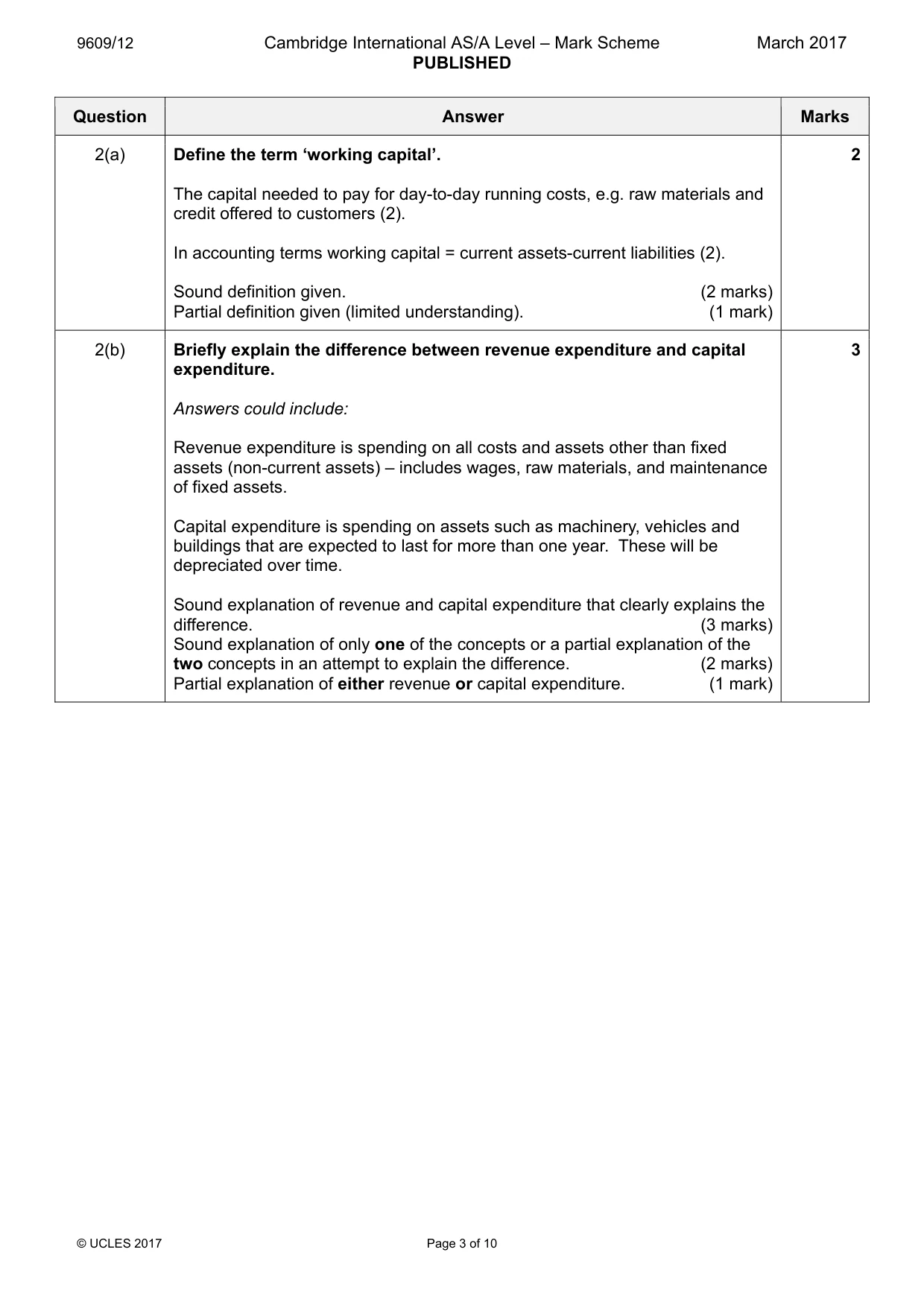
Mark scheme, page 3
9609/12 Cambridge International AS/A Level – Mark Scheme PUBLISHED March 2017 © UCLES 2017 Page 3 of 10 Question Answer Marks 2(a) Define the term ‘working capital’. The capital needed to pay for day-to-day running costs, e.g. raw materials and credit offered to customers (2). In accounting terms working capital = current assets-current liabilities (2). Sound definition given. (2 marks) Partial definition given (limited understanding). (1 mark) 2 2(b) Briefly explain the difference between revenue expenditure and capital expenditure. Answers could include: Revenue expenditure is spending on all costs and assets other than fixed assets (non-current assets) – includes wages, raw materials, and maintenance of fixed assets. Capital expenditure is spending on assets such as machinery, vehicles and buildings that are expected to last for more than one year. These will be depreciated over time. Sound explanation of revenue and capital expenditure that clearly explains the difference. (3 marks) Sound explanation of only one of the concepts or a partial explanation of the two concepts in an attempt to explain the difference. (2 marks) Partial explanation of either revenue or capital expenditure. (1 mark) 3
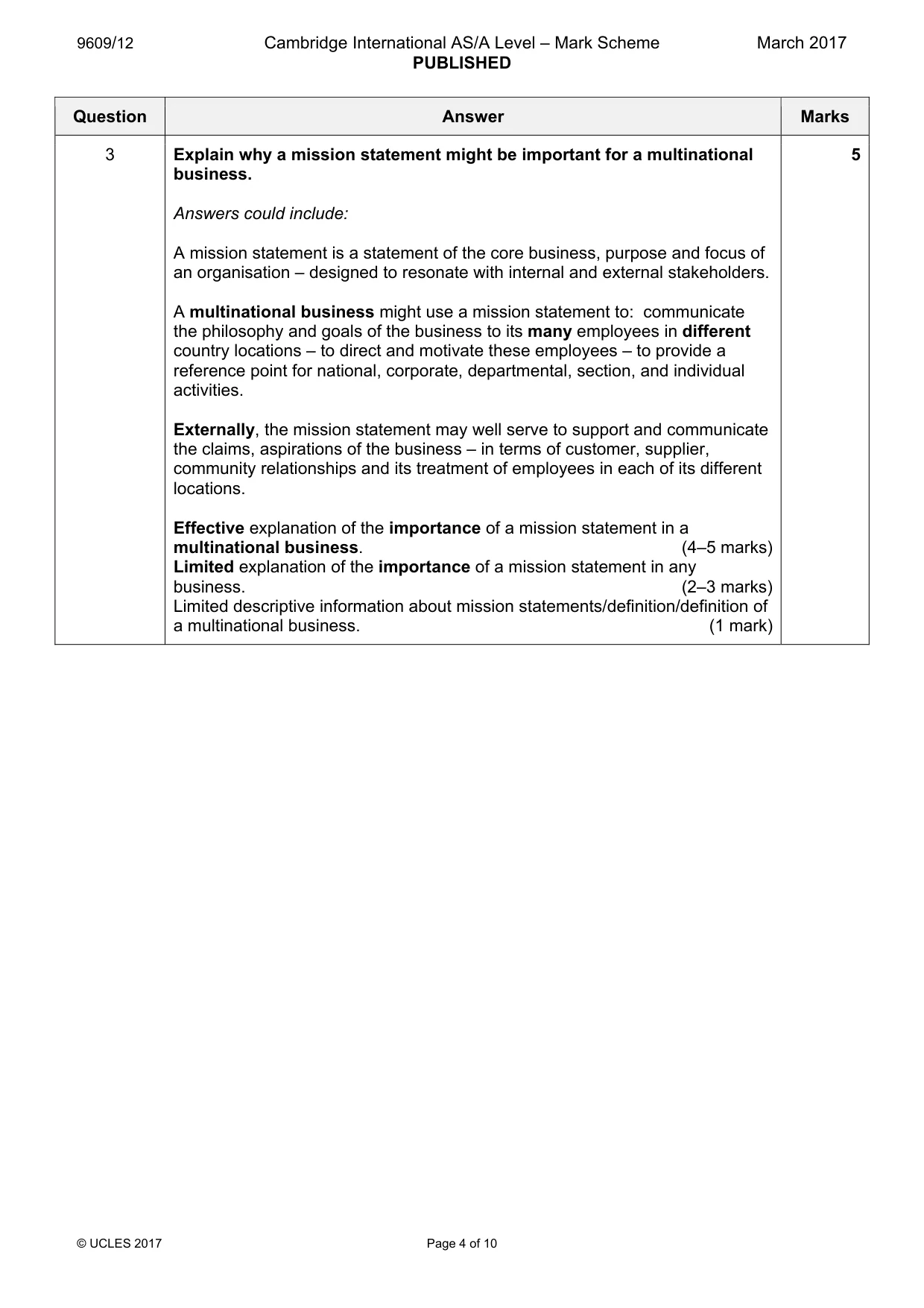
Mark scheme, page 4
9609/12 Cambridge International AS/A Level – Mark Scheme PUBLISHED March 2017 © UCLES 2017 Page 4 of 10 Question Answer Marks 3 Explain why a mission statement might be important for a multinational business. Answers could include: A mission statement is a statement of the core business, purpose and focus of an organisation – designed to resonate with internal and external stakeholders. A multinational business might use a mission statement to: communicate the philosophy and goals of the business to its many employees in different country locations – to direct and motivate these employees – to provide a reference point for national, corporate, departmental, section, and individual activities. Externally, the mission statement may well serve to support and communicate the claims, aspirations of the business – in terms of customer, supplier, community relationships and its treatment of employees in each of its different locations. Effective explanation of the importance of a mission statement in a multinational business. (4–5 marks) Limited explanation of the importance of a mission statement in any business. (2–3 marks) Limited descriptive information about mission statements/definition/definition of a multinational business. (1 mark) 5
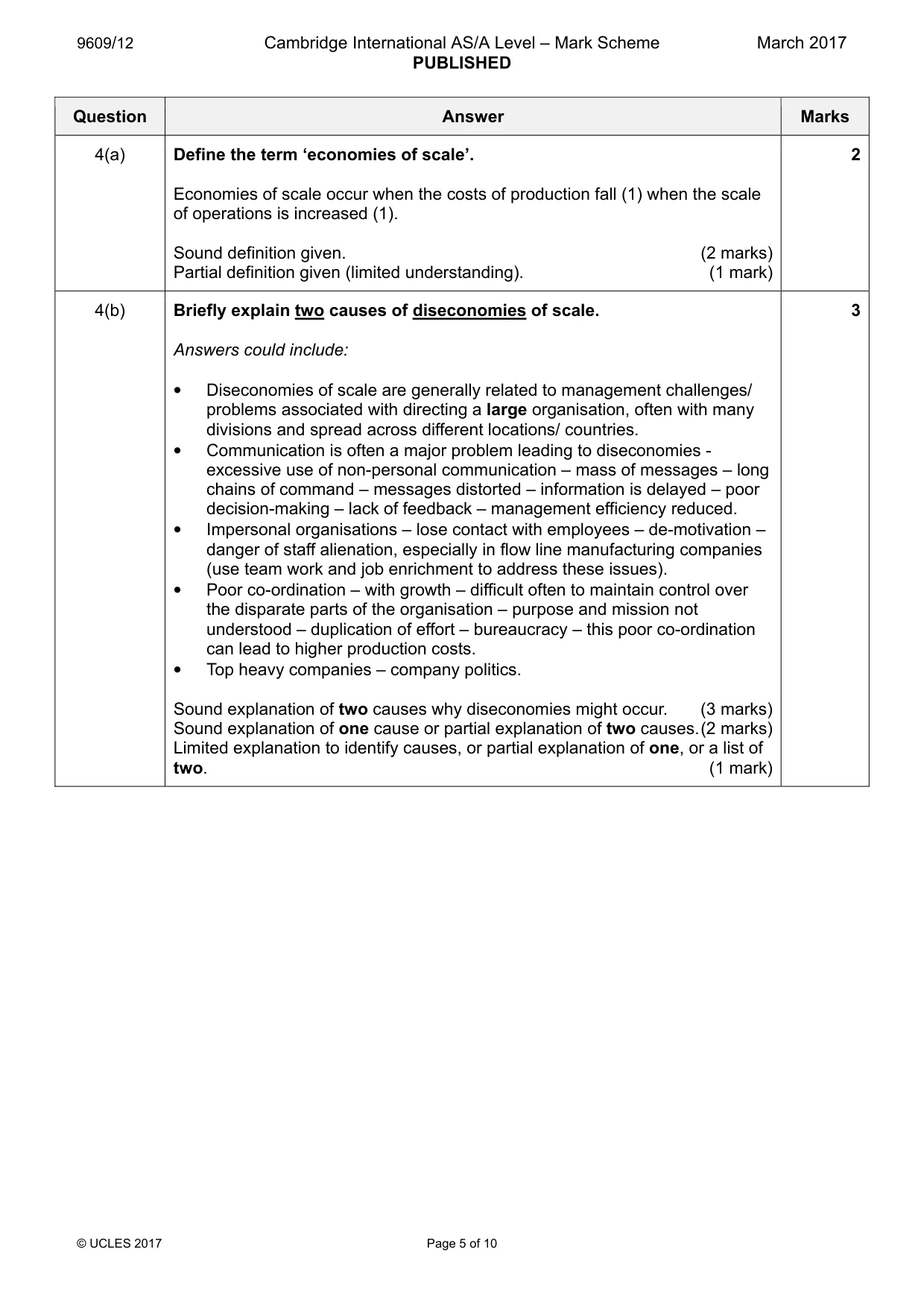
Mark scheme, page 5
9609/12 Cambridge International AS/A Level – Mark Scheme PUBLISHED March 2017 © UCLES 2017 Page 5 of 10 Question Answer Marks 4(a) Define the term ‘economies of scale’. Economies of scale occur when the costs of production fall (1) when the scale of operations is increased (1). Sound definition given. (2 marks) Partial definition given (limited understanding). (1 mark) 2 4(b) Briefly explain two causes of diseconomies of scale. Answers could include: • Diseconomies of scale are generally related to management challenges/ problems associated with directing a large organisation, often with many divisions and spread across different locations/ countries. • Communication is often a major problem leading to diseconomies - excessive use of non-personal communication – mass of messages – long chains of command – messages distorted – information is delayed – poor decision-making – lack of feedback – management efficiency reduced. • Impersonal organisations – lose contact with employees – de-motivation – danger of staff alienation, especially in flow line manufacturing companies (use team work and job enrichment to address these issues). • Poor co-ordination – with growth – difficult often to maintain control over the disparate parts of the organisation – purpose and mission not understood – duplication of effort – bureaucracy – this poor co-ordination can lead to higher production costs. • Top heavy companies – company politics. Sound explanation of two causes why diseconomies might occur. (3 marks) Sound explanation of one cause or partial explanation of two causes. (2 marks) Limited explanation to identify causes, or partial explanation of one, or a list of two. (1 mark) 3
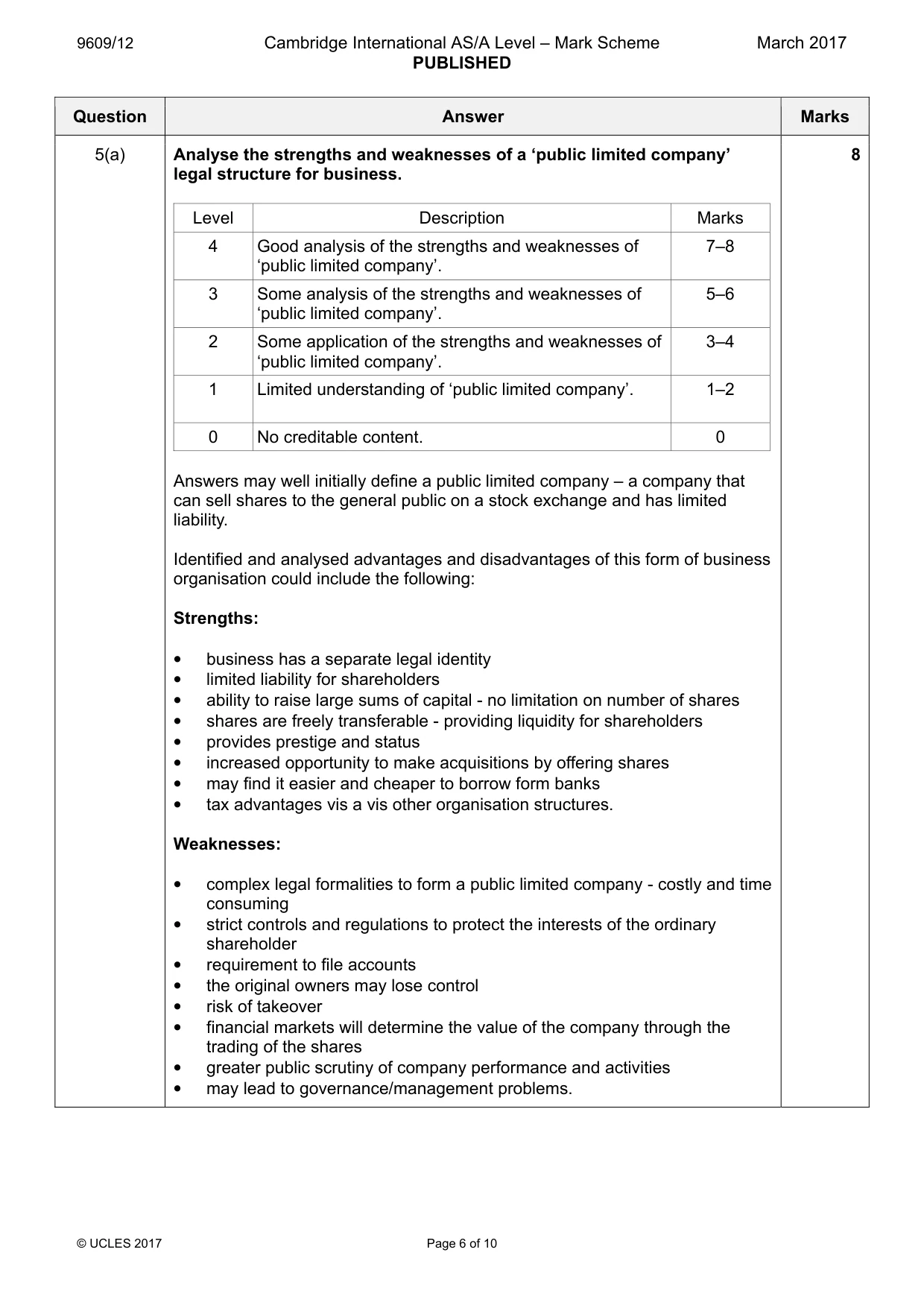
Mark scheme, page 6
9609/12 Cambridge International AS/A Level – Mark Scheme PUBLISHED March 2017 © UCLES 2017 Page 6 of 10 Question Answer Marks 5(a) Analyse the strengths and weaknesses of a ‘public limited company’ legal structure for business. Level Description Marks 4 Good analysis of the strengths and weaknesses of ‘public limited company’. 7–8 3 Some analysis of the strengths and weaknesses of ‘public limited company’. 5–6 2 Some application of the strengths and weaknesses of ‘public limited company’. 3–4 1 Limited understanding of ‘public limited company’. 1–2 0 No creditable content. 0 Answers may well initially define a public limited company – a company that can sell shares to the general public on a stock exchange and has limited liability. Identified and analysed advantages and disadvantages of this form of business organisation could include the following: Strengths: • business has a separate legal identity • limited liability for shareholders • ability to raise large sums of capital - no limitation on number of shares • shares are freely transferable - providing liquidity for shareholders • provides prestige and status • increased opportunity to make acquisitions by offering shares • may find it easier and cheaper to borrow form banks • tax advantages vis a vis other organisation structures. Weaknesses: • complex legal formalities to form a public limited company - costly and time consuming • strict controls and regulations to protect the interests of the ordinary shareholder • requirement to file accounts • the original owners may lose control • risk of takeover • financial markets will determine the value of the company through the trading of the shares • greater public scrutiny of company performance and activities • may lead to governance/management problems. 8
Mark scheme, page 7
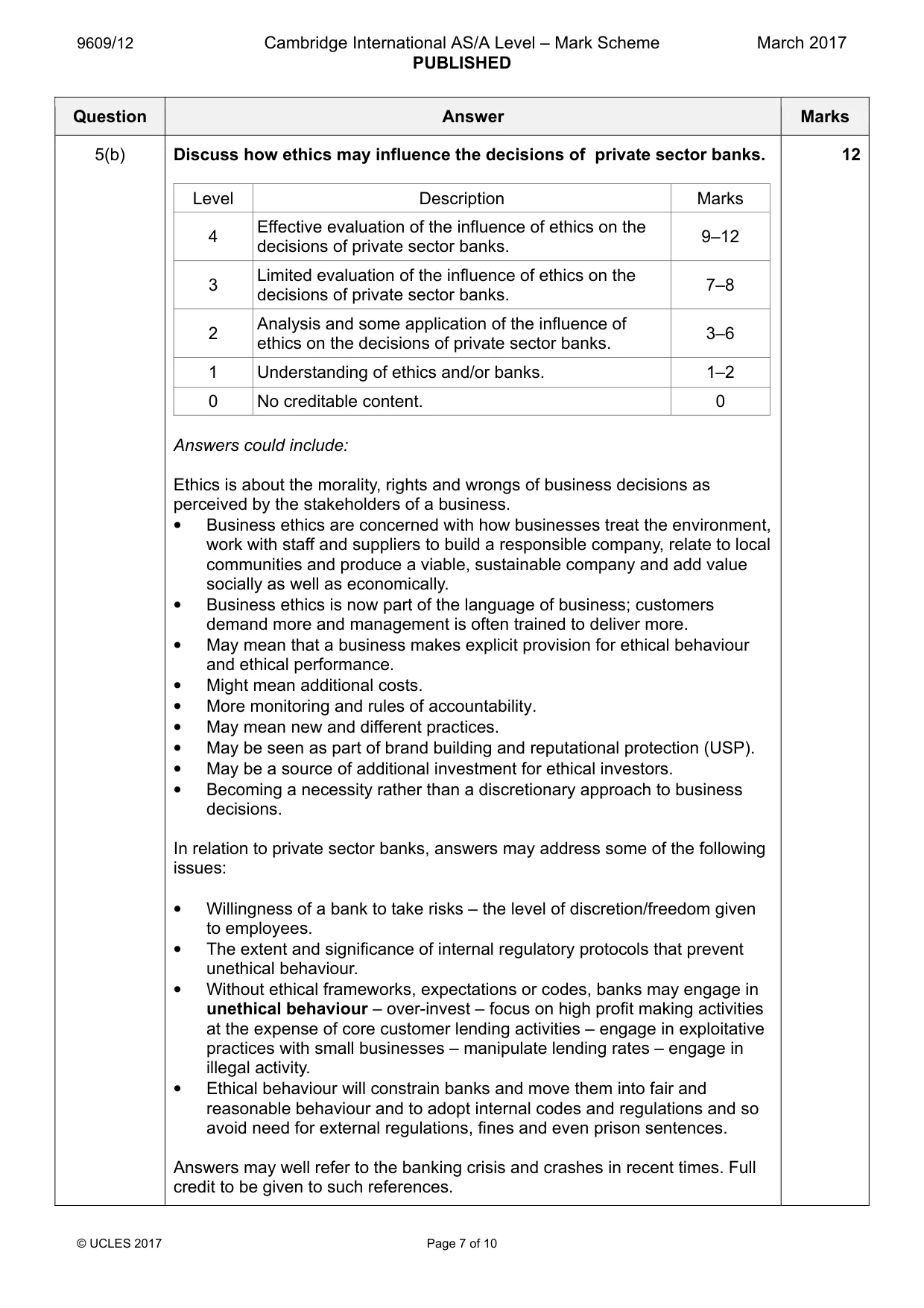
9609/12 Cambridge International AS/A Level – Mark Scheme PUBLISHED March 2017 © UCLES 2017 Page 7 of 10 Question Answer Marks 5(b) Discuss how ethics may influence the decisions of private sector banks. Level Description Marks 4 Effective evaluation of the influence of ethics on the decisions of private sector banks. 9–12 3 Limited evaluation of the influence of ethics on the decisions of private sector banks. 7–8 2 Analysis and some application of the influence of ethics on the decisions of private sector banks. 3–6 1 Understanding of ethics and/or banks. 1–2 0 No creditable content. 0 Answers could include: Ethics is about the morality, rights and wrongs of business decisions as perceived by the stakeholders of a business. • Business ethics are concerned with how businesses treat the environment, work with staff and suppliers to build a responsible company, relate to local communities and produce a viable, sustainable company and add value socially as well as economically. • Business ethics is now part of the language of business; customers demand more and management is often trained to deliver more. • May mean that a business makes explicit provision for ethical behaviour and ethical performance. • Might mean additional costs. • More monitoring and rules of accountability. • May mean new and different practices. • May be seen as part of brand building and reputational protection (USP). • May be a source of additional investment for ethical investors. • Becoming a necessity rather than a discretionary approach to business decisions. In relation to private sector banks, answers may address some of the following issues: • Willingness of a bank to take risks – the level of discretion/freedom given to employees. • The extent and significance of internal regulatory protocols that prevent unethical behaviour. • Without ethical frameworks, expectations or codes, banks may engage in unethical behaviour – over-invest – focus on high profit making activities at the expense of core customer lending activities – engage in exploitative practices with small businesses – manipulate lending rates – engage in illegal activity. • Ethical behaviour will constrain banks and move them into fair and reasonable behaviour and to adopt internal codes and regulations and so avoid need for external regulations, fines and even prison sentences. Answers may well refer to the banking crisis and crashes in recent times. Full credit to be given to such references. 12
Mark scheme, page 8
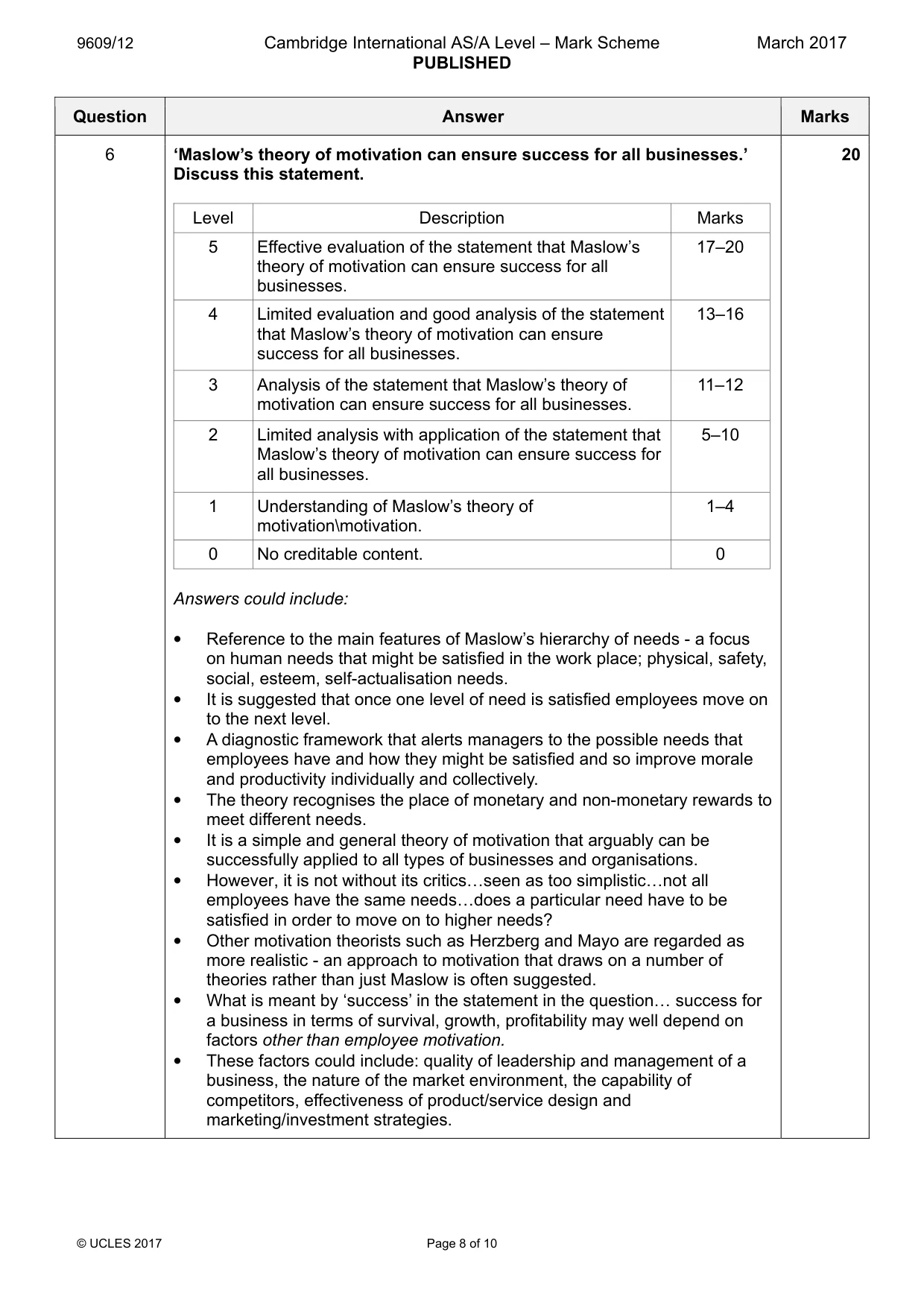
9609/12 Cambridge International AS/A Level – Mark Scheme PUBLISHED March 2017 © UCLES 2017 Page 8 of 10 Question Answer Marks 6 ‘Maslow’s theory of motivation can ensure success for all businesses.’ Discuss this statement. Level Description Marks 5 Effective evaluation of the statement that Maslow’s theory of motivation can ensure success for all businesses. 17–20 4 Limited evaluation and good analysis of the statement that Maslow’s theory of motivation can ensure success for all businesses. 13–16 3 Analysis of the statement that Maslow’s theory of motivation can ensure success for all businesses. 11–12 2 Limited analysis with application of the statement that Maslow’s theory of motivation can ensure success for all businesses. 5–10 1 Understanding of Maslow’s theory of motivation\motivation. 1–4 0 No creditable content. 0 Answers could include: • Reference to the main features of Maslow’s hierarchy of needs - a focus on human needs that might be satisfied in the work place; physical, safety, social, esteem, self-actualisation needs. • It is suggested that once one level of need is satisfied employees move on to the next level. • A diagnostic framework that alerts managers to the possible needs that employees have and how they might be satisfied and so improve morale and productivity individually and collectively. • The theory recognises the place of monetary and non-monetary rewards to meet different needs. • It is a simple and general theory of motivation that arguably can be successfully applied to all types of businesses and organisations. • However, it is not without its critics«seen as too simplistic«not all employees have the same needs«does a particular need have to be satisfied in order to move on to higher needs? • Other motivation theorists such as Herzberg and Mayo are regarded as more realistic - an approach to motivation that draws on a number of theories rather than just Maslow is often suggested. • What is meant by ‘success’ in the statement in the question« success for a business in terms of survival, growth, profitability may well depend on factors other than employee motivation. • These factors could include: quality of leadership and management of a business, the nature of the market environment, the capability of competitors, effectiveness of product/service design and marketing/investment strategies. 20
Mark scheme, page 9
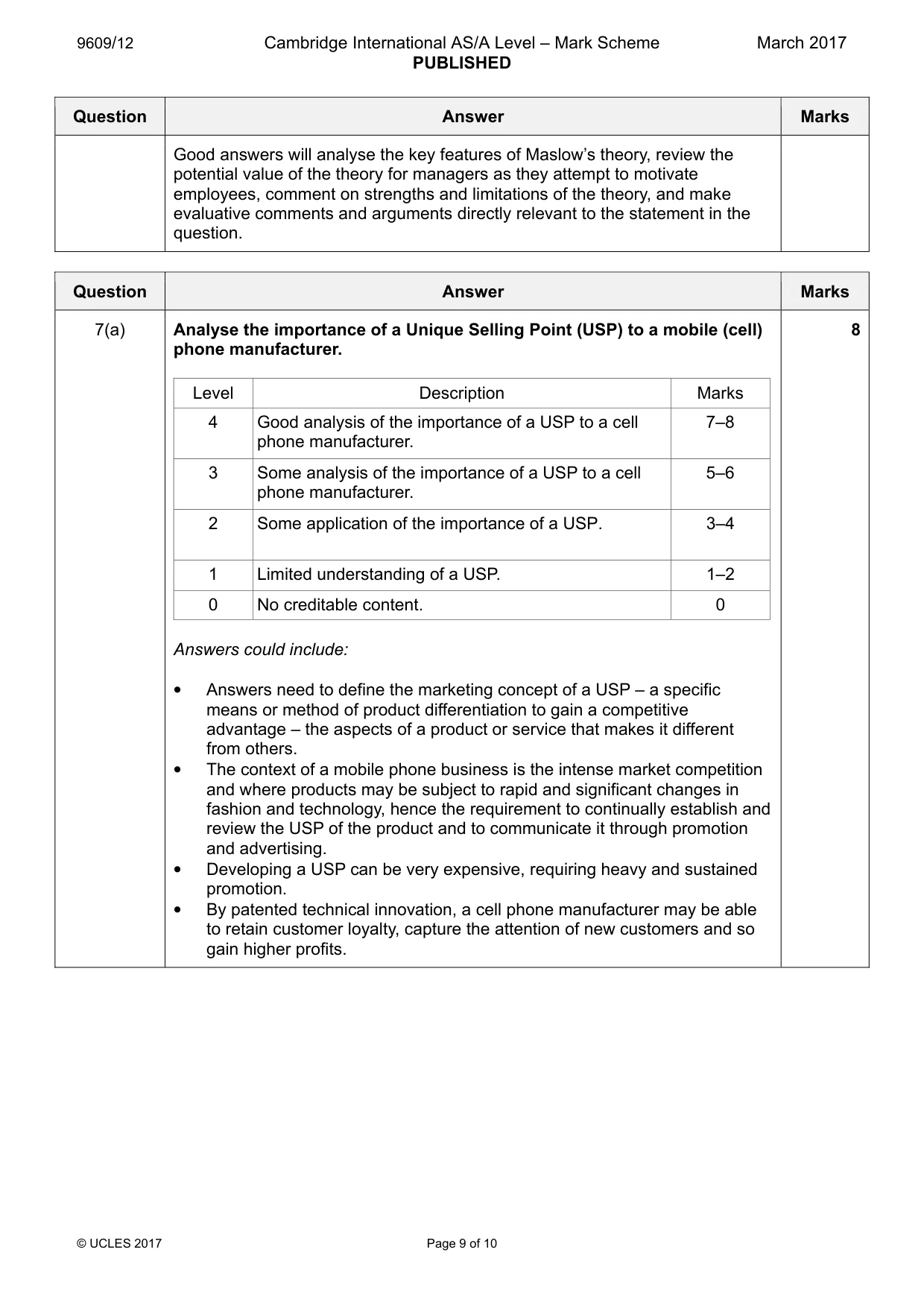
9609/12 Cambridge International AS/A Level – Mark Scheme PUBLISHED March 2017 © UCLES 2017 Page 9 of 10 Question Answer Marks Good answers will analyse the key features of Maslow’s theory, review the potential value of the theory for managers as they attempt to motivate employees, comment on strengths and limitations of the theory, and make evaluative comments and arguments directly relevant to the statement in the question. Question Answer Marks 7(a) Analyse the importance of a Unique Selling Point (USP) to a mobile (cell) phone manufacturer. Level Description Marks 4 Good analysis of the importance of a USP to a cell phone manufacturer. 7–8 3 Some analysis of the importance of a USP to a cell phone manufacturer. 5–6 2 Some application of the importance of a USP. 3–4 1 Limited understanding of a USP. 1–2 0 No creditable content. 0 Answers could include: • Answers need to define the marketing concept of a USP – a specific means or method of product differentiation to gain a competitive advantage – the aspects of a product or service that makes it different from others. • The context of a mobile phone business is the intense market competition and where products may be subject to rapid and significant changes in fashion and technology, hence the requirement to continually establish and review the USP of the product and to communicate it through promotion and advertising. • Developing a USP can be very expensive, requiring heavy and sustained promotion. • By patented technical innovation, a cell phone manufacturer may be able to retain customer loyalty, capture the attention of new customers and so gain higher profits. 8
Mark scheme, page 10
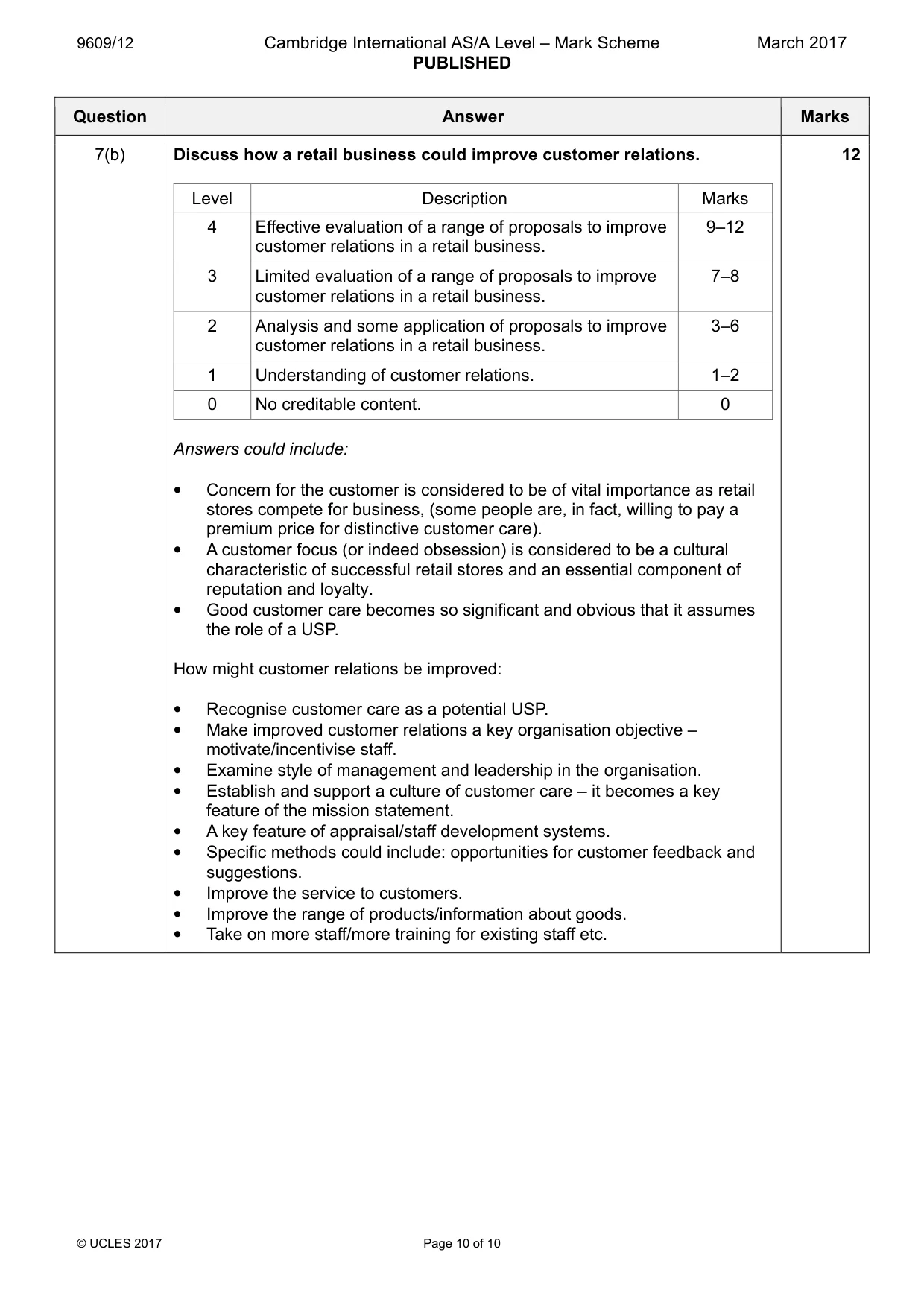
9609/12 Cambridge International AS/A Level – Mark Scheme PUBLISHED March 2017 © UCLES 2017 Page 10 of 10 Question Answer Marks 7(b) Discuss how a retail business could improve customer relations. Level Description Marks 4 Effective evaluation of a range of proposals to improve customer relations in a retail business. 9–12 3 Limited evaluation of a range of proposals to improve customer relations in a retail business. 7–8 2 Analysis and some application of proposals to improve customer relations in a retail business. 3–6 1 Understanding of customer relations. 1–2 0 No creditable content. 0 Answers could include: • Concern for the customer is considered to be of vital importance as retail stores compete for business, (some people are, in fact, willing to pay a premium price for distinctive customer care). • A customer focus (or indeed obsession) is considered to be a cultural characteristic of successful retail stores and an essential component of reputation and loyalty. • Good customer care becomes so significant and obvious that it assumes the role of a USP. How might customer relations be improved: • Recognise customer care as a potential USP. • Make improved customer relations a key organisation objective – motivate/incentivise staff. • Examine style of management and leadership in the organisation. • Establish and support a culture of customer care – it becomes a key feature of the mission statement. • A key feature of appraisal/staff development systems. • Specific methods could include: opportunities for customer feedback and suggestions. • Improve the service to customers. • Improve the range of products/information about goods. • Take on more staff/more training for existing staff etc. 12
What you needed in this session
Cambridge’s own grade thresholds for 2017 Feb/March, Paper 1 · Variant 2. A higher threshold means an easier paper — the bar moves with how the cohort did.