Cambridge A Level Business (for first examination in 2016) 9609 — 2016 Oct/Nov Paper 3 · Variant 2
9609/32/O/N/16 · 100 marks · ≈113 min
The question paper and its mark scheme, free to read here and free to download. This is Cambridge’s own paper, exactly as it was sat.
Question paper8 pages



Mark scheme10 pages
Answers below. Sit the paper first if you are practising.
Paper as text
Question paper, page 1
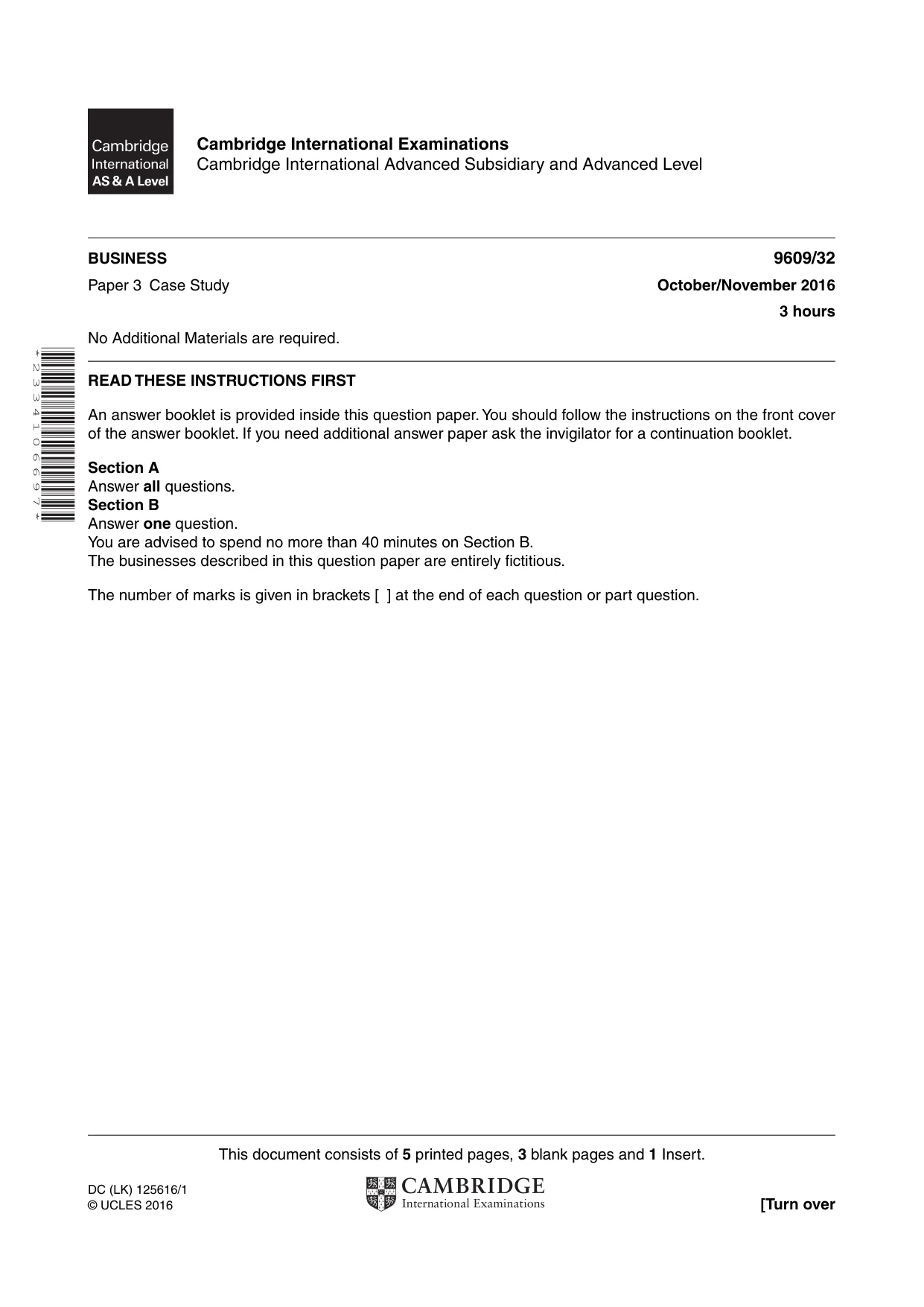
This document consists of 5 printed pages, 3 blank pages and 1 Insert. DC (LK) 125616/1 © UCLES 2016 [Turn over Cambridge International Examinations Cambridge International Advanced Subsidiary and Advanced Level * 2 3 3 4 1 0 6 6 9 7 * BUSINESS 9609/32 Paper 3 Case Study October/November 2016 3 hours No Additional Materials are required. READ THESE INSTRUCTIONS FIRST An answer booklet is provided inside this question paper. You should follow the instructions on the front cover of the answer booklet. If you need additional answer paper ask the invigilator for a continuation booklet. Section A Answer all questions. Section B Answer one question. You are advised to spend no more than 40 minutes on Section B. The businesses described in this question paper are entirely fictitious. The number of marks is given in brackets [ ] at the end of each question or part question.
Question paper, page 2
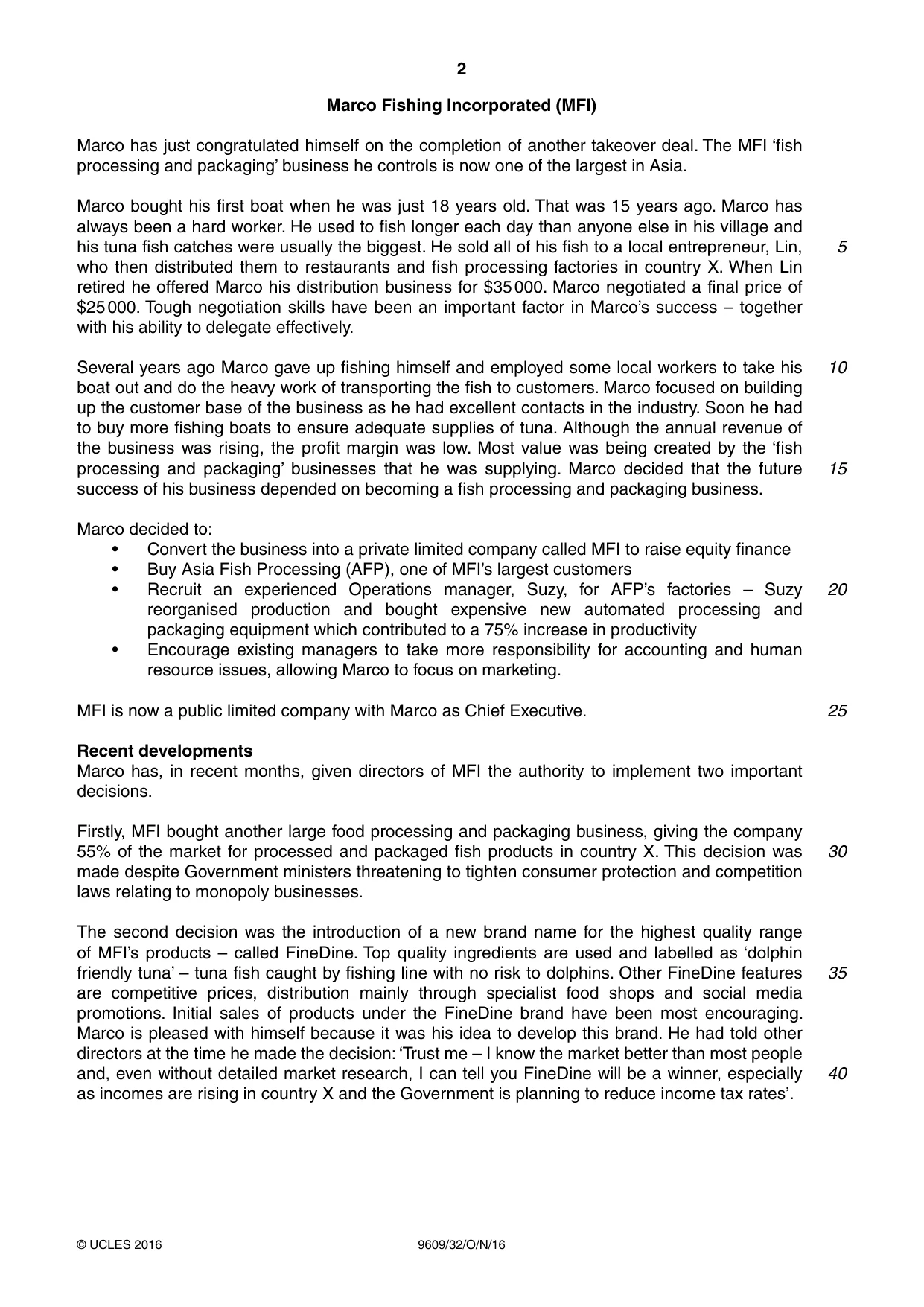
2 9609/32/O/N/16 © UCLES 2016 Marco Fishing Incorporated (MFI) Marco has just congratulated himself on the completion of another takeover deal. The MFI ‘fish processing and packaging’ business he controls is now one of the largest in Asia. Marco bought his first boat when he was just 18 years old. That was 15 years ago. Marco has always been a hard worker. He used to fish longer each day than anyone else in his village and his tuna fish catches were usually the biggest. He sold all of his fish to a local entrepreneur, Lin, who then distributed them to restaurants and fish processing factories in country X. When Lin retired he offered Marco his distribution business for $35 000. Marco negotiated a final price of $25 000. Tough negotiation skills have been an important factor in Marco’s success – together with his ability to delegate effectively. Several years ago Marco gave up fishing himself and employed some local workers to take his boat out and do the heavy work of transporting the fish to customers. Marco focused on building up the customer base of the business as he had excellent contacts in the industry. Soon he had to buy more fishing boats to ensure adequate supplies of tuna. Although the annual revenue of the business was rising, the profit margin was low. Most value was being created by the ‘fish processing and packaging’ businesses that he was supplying. Marco decided that the future success of his business depended on becoming a fish processing and packaging business. Marco decided to: • Convert the business into a private limited company called MFI to raise equity finance • Buy Asia Fish Processing (AFP), one of MFI’s largest customers • Recruit an experienced Operations manager, Suzy, for AFP’s factories – Suzy reorganised production and bought expensive new automated processing and packaging equipment which contributed to a 75% increase in productivity • Encourage existing managers to take more responsibility for accounting and human resource issues, allowing Marco to focus on marketing. MFI is now a public limited company with Marco as Chief Executive. Recent developments Marco has, in recent months, given directors of MFI the authority to implement two important decisions. Firstly, MFI bought another large food processing and packaging business, giving the company 55% of the market for processed and packaged fish products in country X. This decision was made despite Government ministers threatening to tighten consumer protection and competition laws relating to monopoly businesses. The second decision was the introduction of a new brand name for the highest quality range of MFI’s products – called FineDine. Top quality ingredients are used and labelled as ‘dolphin friendly tuna’ – tuna fish caught by fishing line with no risk to dolphins. Other FineDine features are competitive prices, distribution mainly through specialist food shops and social media promotions. Initial sales of products under the FineDine brand have been most encouraging. Marco is pleased with himself because it was his idea to develop this brand. He had told other directors at the time he made the decision: ‘Trust me – I know the market better than most people and, even without detailed market research, I can tell you FineDine will be a winner, especially as incomes are rising in country X and the Government is planning to reduce income tax rates’. 5 10 15 20 25 30 35 40
Question paper, page 3
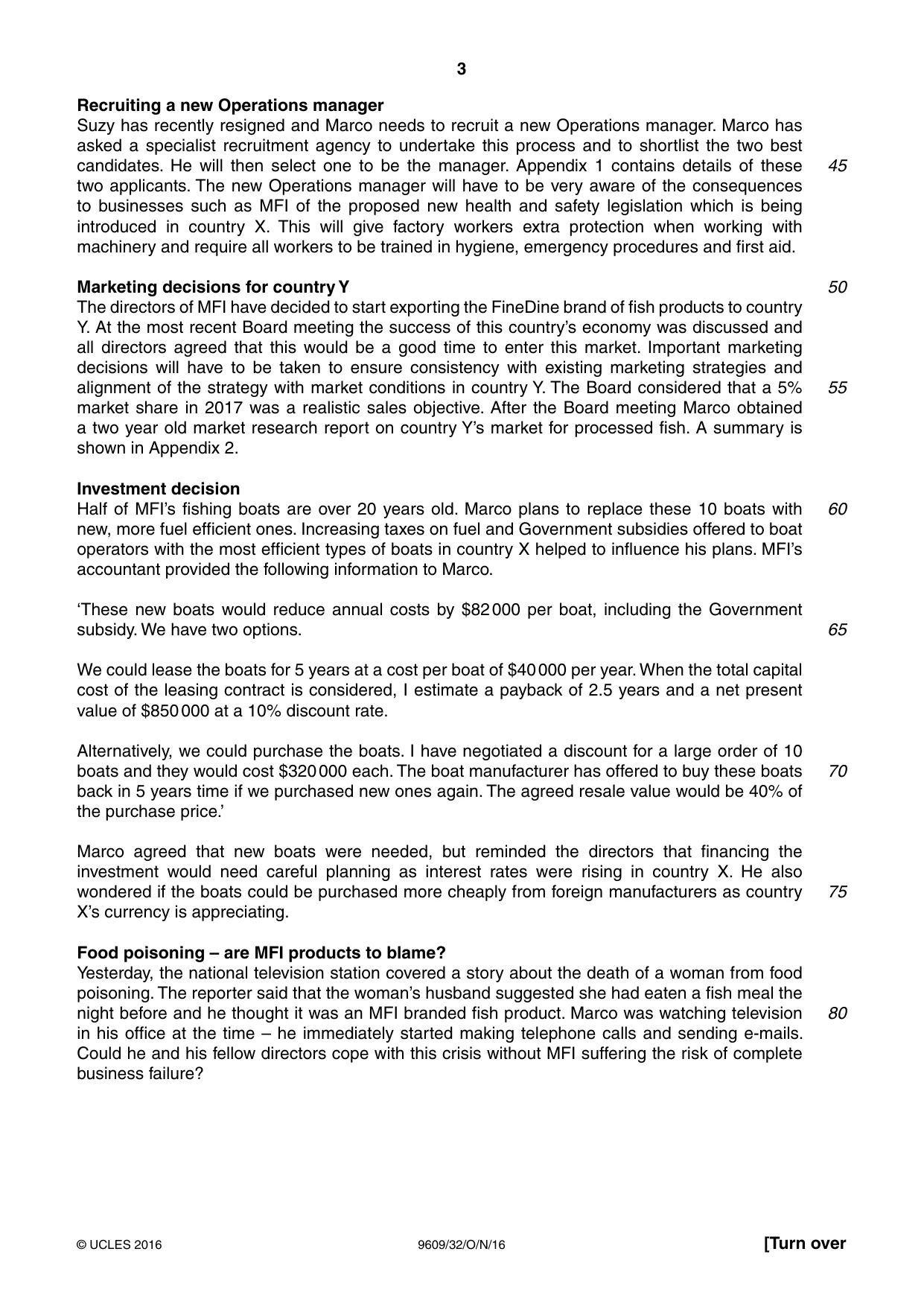
3 9609/32/O/N/16 © UCLES 2016 [Turn over Recruiting a new Operations manager Suzy has recently resigned and Marco needs to recruit a new Operations manager. Marco has asked a specialist recruitment agency to undertake this process and to shortlist the two best candidates. He will then select one to be the manager. Appendix 1 contains details of these two applicants. The new Operations manager will have to be very aware of the consequences to businesses such as MFI of the proposed new health and safety legislation which is being introduced in country X. This will give factory workers extra protection when working with machinery and require all workers to be trained in hygiene, emergency procedures and first aid. Marketing decisions for country Y The directors of MFI have decided to start exporting the FineDine brand of fish products to country Y. At the most recent Board meeting the success of this country’s economy was discussed and all directors agreed that this would be a good time to enter this market. Important marketing decisions will have to be taken to ensure consistency with existing marketing strategies and alignment of the strategy with market conditions in country Y. The Board considered that a 5% market share in 2017 was a realistic sales objective. After the Board meeting Marco obtained a two year old market research report on country Y’s market for processed fish. A summary is shown in Appendix 2. Investment decision Half of MFI’s fishing boats are over 20 years old. Marco plans to replace these 10 boats with new, more fuel efficient ones. Increasing taxes on fuel and Government subsidies offered to boat operators with the most efficient types of boats in country X helped to influence his plans. MFI’s accountant provided the following information to Marco. ‘These new boats would reduce annual costs by $82 000 per boat, including the Government subsidy. We have two options. We could lease the boats for 5 years at a cost per boat of $40 000 per year. When the total capital cost of the leasing contract is considered, I estimate a payback of 2.5 years and a net present value of $850 000 at a 10% discount rate. Alternatively, we could purchase the boats. I have negotiated a discount for a large order of 10 boats and they would cost $320 000 each. The boat manufacturer has offered to buy these boats back in 5 years time if we purchased new ones again. The agreed resale value would be 40% of the purchase price.’ Marco agreed that new boats were needed, but reminded the directors that financing the investment would need careful planning as interest rates were rising in country X. He also wondered if the boats could be purchased more cheaply from foreign manufacturers as country X’s currency is appreciating. Food poisoning – are MFI products to blame? Yesterday, the national television station covered a story about the death of a woman from food poisoning. The reporter said that the woman’s husband suggested she had eaten a fish meal the night before and he thought it was an MFI branded fish product. Marco was watching television in his office at the time – he immediately started making telephone calls and sending e-mails. Could he and his fellow directors cope with this crisis without MFI suffering the risk of complete business failure? 45 50 55 60 65 70 75 80
Question paper, page 4
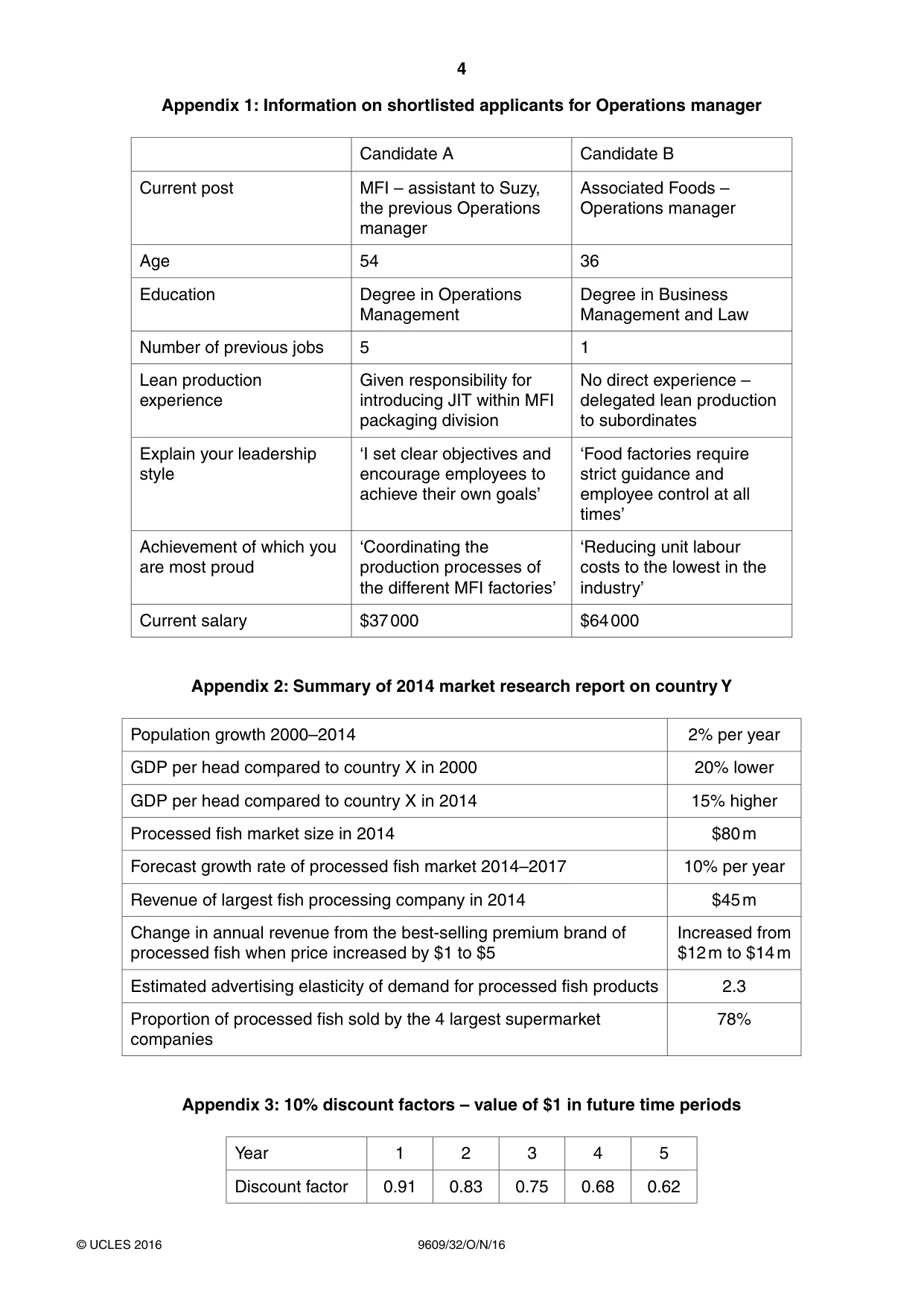
4 9609/32/O/N/16 © UCLES 2016 Appendix 1: Information on shortlisted applicants for Operations manager Candidate A Candidate B Current post MFI – assistant to Suzy, the previous Operations manager Associated Foods – Operations manager Age 54 36 Education Degree in Operations Management Degree in Business Management and Law Number of previous jobs 5 1 Lean production experience Given responsibility for introducing JIT within MFI packaging division No direct experience – delegated lean production to subordinates Explain your leadership style ‘I set clear objectives and encourage employees to achieve their own goals’ ‘Food factories require strict guidance and employee control at all times’ Achievement of which you are most proud ‘Coordinating the production processes of the different MFI factories’ ‘Reducing unit labour costs to the lowest in the industry’ Current salary $37 000 $64 000 Appendix 2: Summary of 2014 market research report on country Y Population growth 2000–2014 2% per year GDP per head compared to country X in 2000 20% lower GDP per head compared to country X in 2014 15% higher Processed fish market size in 2014 $80 m Forecast growth rate of processed fish market 2014–2017 10% per year Revenue of largest fish processing company in 2014 $45 m Change in annual revenue from the best-selling premium brand of processed fish when price increased by $1 to $5 Increased from $12 m to $14 m Estimated advertising elasticity of demand for processed fish products 2.3 Proportion of processed fish sold by the 4 largest supermarket companies 78% Appendix 3: 10% discount factors – value of $1 in future time periods Year 1 2 3 4 5 Discount factor 0.91 0.83 0.75 0.68 0.62
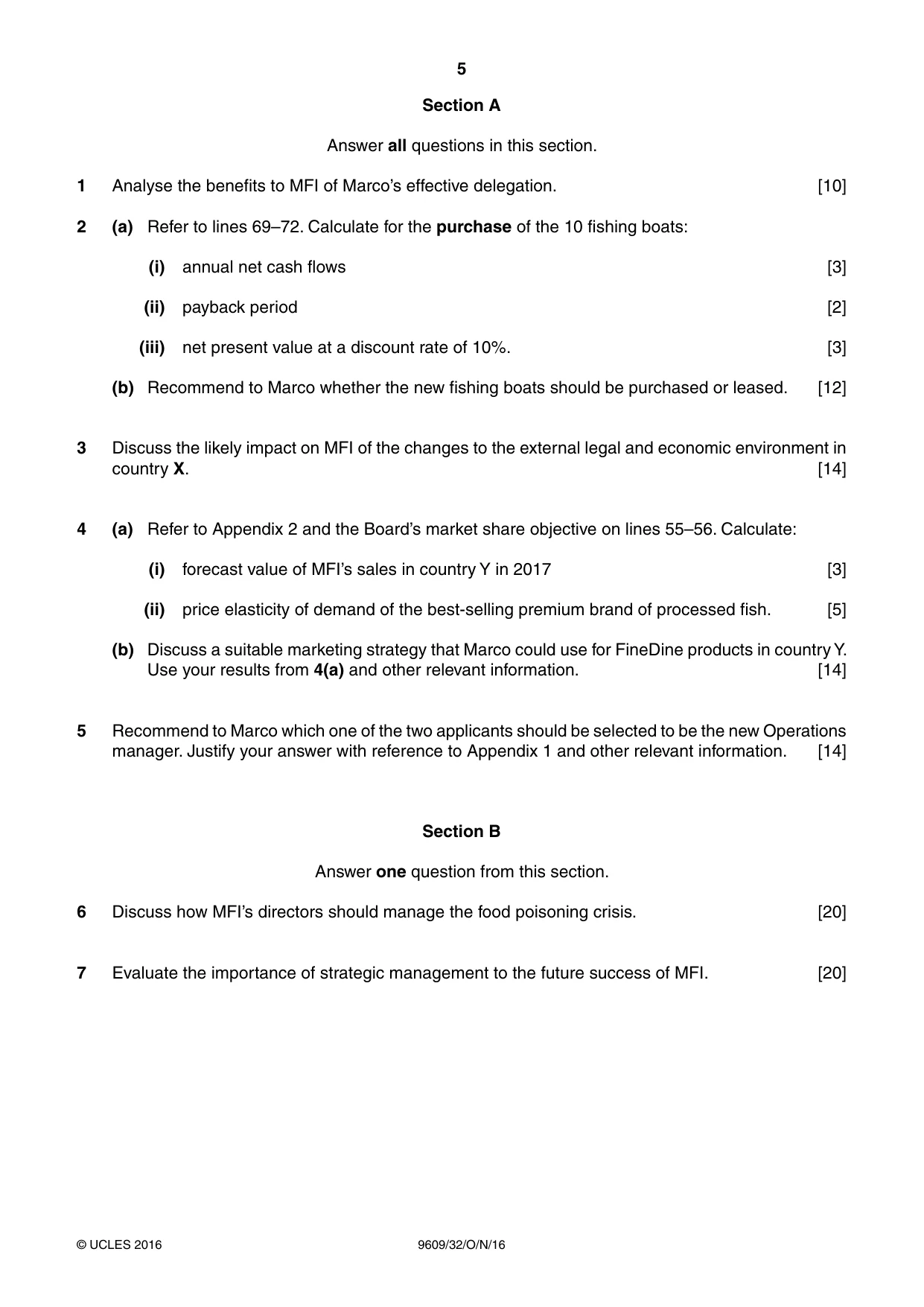
Question paper, page 5
5 9609/32/O/N/16 © UCLES 2016 Section A Answer all questions in this section. 1 Analyse the benefits to MFI of Marco’s effective delegation. [10] 2 (a) Refer to lines 69–72. Calculate for the purchase of the 10 fishing boats: (i) annual net cash flows [3] (ii) payback period [2] (iii) net present value at a discount rate of 10%. [3] (b) Recommend to Marco whether the new fishing boats should be purchased or leased. [12] 3 Discuss the likely impact on MFI of the changes to the external legal and economic environment in country X. [14] 4 (a) Refer to Appendix 2 and the Board’s market share objective on lines 55–56. Calculate: (i) forecast value of MFI’s sales in country Y in 2017 [3] (ii) price elasticity of demand of the best-selling premium brand of processed fish. [5] (b) Discuss a suitable marketing strategy that Marco could use for FineDine products in country Y. Use your results from 4(a) and other relevant information. [14] 5 Recommend to Marco which one of the two applicants should be selected to be the new Operations manager. Justify your answer with reference to Appendix 1 and other relevant information. [14] Section B Answer one question from this section. 6 Discuss how MFI’s directors should manage the food poisoning crisis. [20] 7 Evaluate the importance of strategic management to the future success of MFI. [20]
Question paper, page 6
6 9609/32/O/N/16 © UCLES 2016 BLANK PAGE
Question paper, page 7
7 9609/32/O/N/16 © UCLES 2016 BLANK PAGE
Question paper, page 8
8 9609/32/O/N/16 © UCLES 2016 Permission to reproduce items where third-party owned material protected by copyright is included has been sought and cleared where possible. Every reasonable effort has been made by the publisher (UCLES) to trace copyright holders, but if any items requiring clearance have unwittingly been included, the publisher will be pleased to make amends at the earliest possible opportunity. To avoid the issue of disclosure of answer-related information to candidates, all copyright acknowledgements are reproduced online in the Cambridge International Examinations Copyright Acknowledgements Booklet. This is produced for each series of examinations and is freely available to download at www.cie.org.uk after the live examination series. Cambridge International Examinations is part of the Cambridge Assessment Group. Cambridge Assessment is the brand name of University of Cambridge Local Examinations Syndicate (UCLES), which is itself a department of the University of Cambridge. BLANK PAGE
Mark scheme, page 1
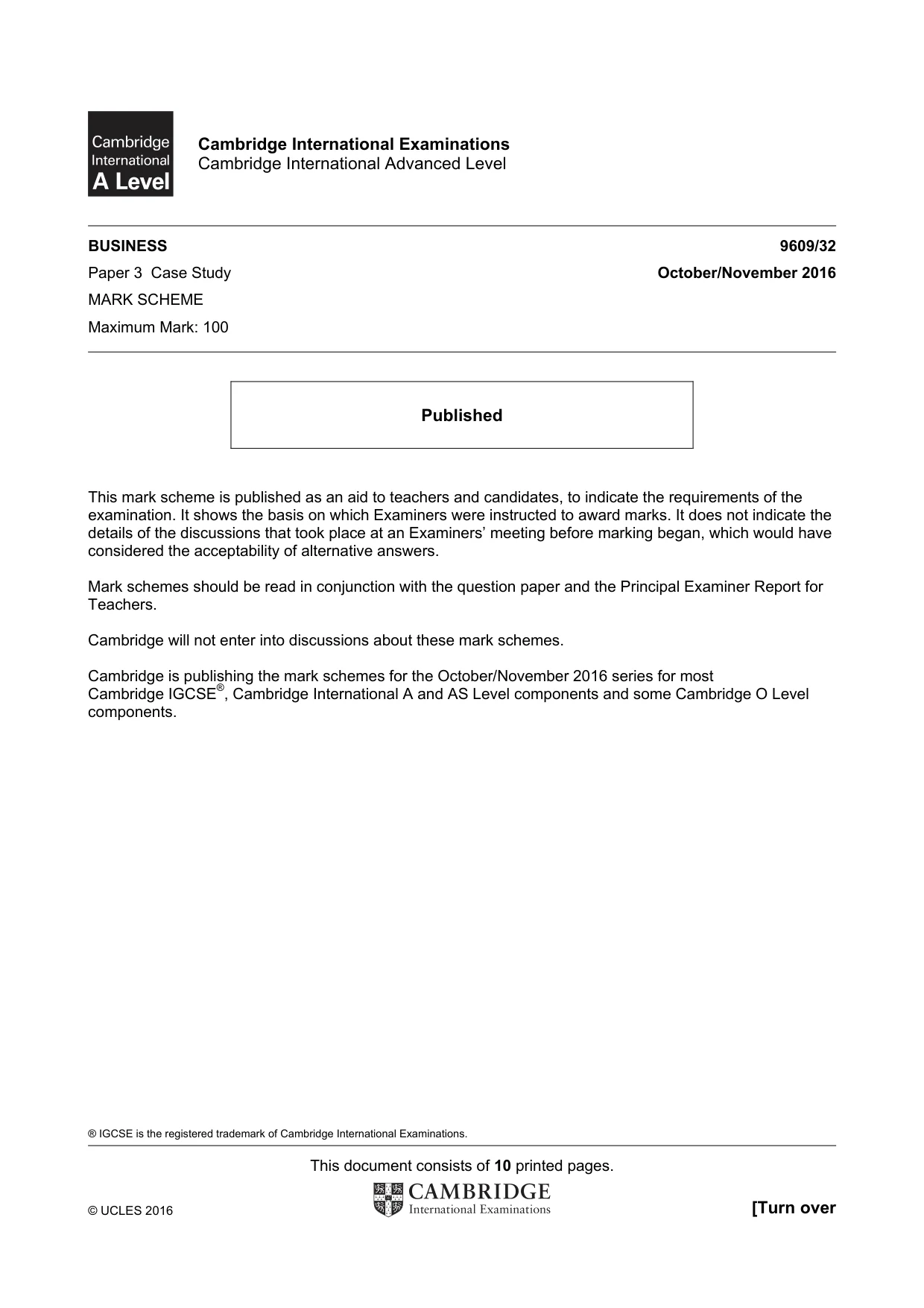
® IGCSE is the registered trademark of Cambridge International Examinations. This document consists of 10 printed pages. © UCLES 2016 [Turn over Cambridge International Examinations Cambridge International Advanced Level BUSINESS 9609/32 Paper 3 Case Study October/November 2016 MARK SCHEME Maximum Mark: 100 Published This mark scheme is published as an aid to teachers and candidates, to indicate the requirements of the examination. It shows the basis on which Examiners were instructed to award marks. It does not indicate the details of the discussions that took place at an Examiners’ meeting before marking began, which would have considered the acceptability of alternative answers. Mark schemes should be read in conjunction with the question paper and the Principal Examiner Report for Teachers. Cambridge will not enter into discussions about these mark schemes. Cambridge is publishing the mark schemes for the October/November 2016 series for most Cambridge IGCSE®, Cambridge International A and AS Level components and some Cambridge O Level components.
Mark scheme, page 2
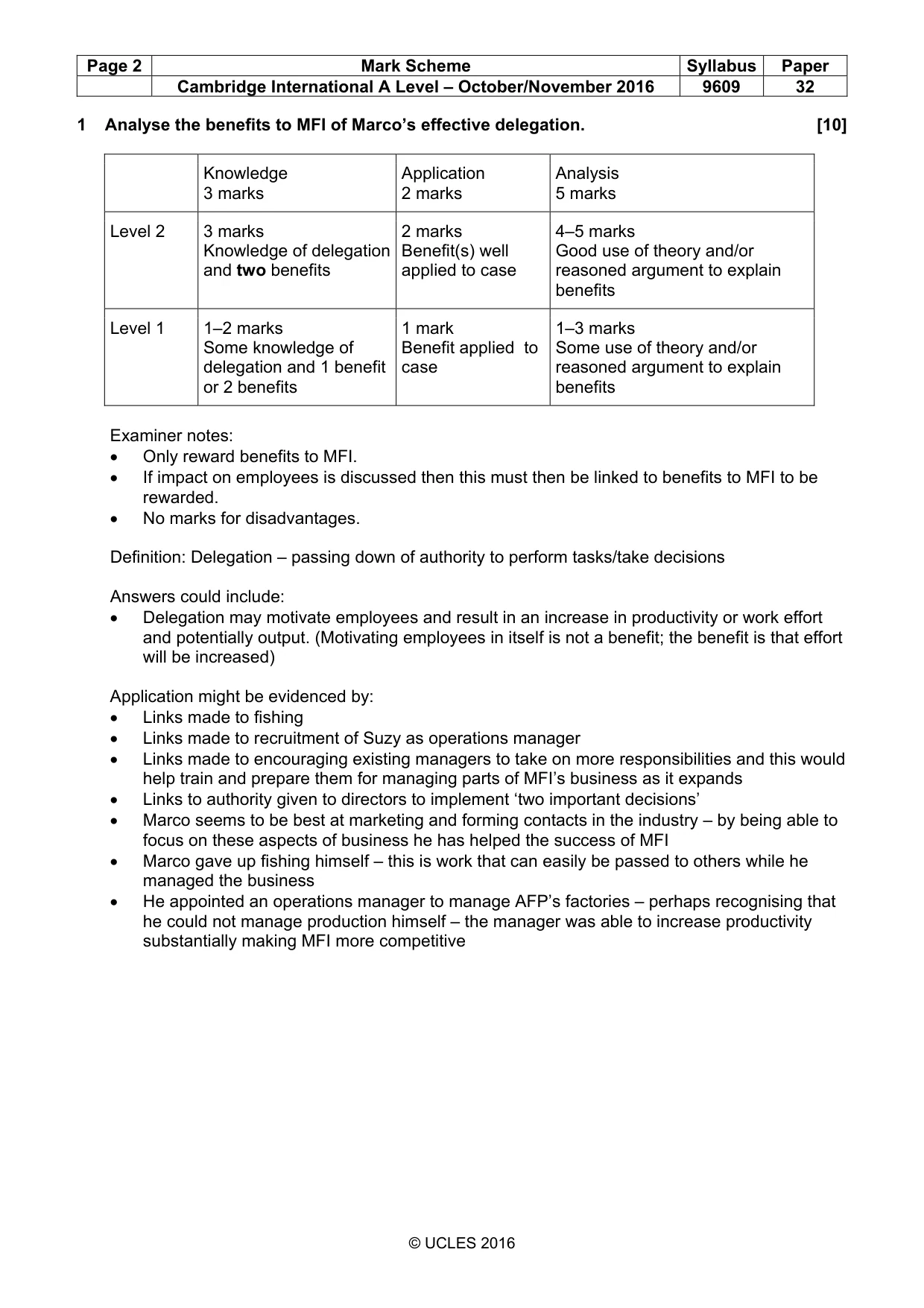
Page 2 Mark Scheme Syllabus Paper Cambridge International A Level – October/November 2016 9609 32 © UCLES 2016 1 Analyse the benefits to MFI of Marco’s effective delegation. [10] Knowledge 3 marks Application 2 marks Analysis 5 marks Level 2 3 marks Knowledge of delegation and two benefits 2 marks Benefit(s) well applied to case 4–5 marks Good use of theory and/or reasoned argument to explain benefits Level 1 1–2 marks Some knowledge of delegation and 1 benefit or 2 benefits 1 mark Benefit applied to case 1–3 marks Some use of theory and/or reasoned argument to explain benefits Examiner notes: • Only reward benefits to MFI. • If impact on employees is discussed then this must then be linked to benefits to MFI to be rewarded. • No marks for disadvantages. Definition: Delegation – passing down of authority to perform tasks/take decisions Answers could include: • Delegation may motivate employees and result in an increase in productivity or work effort and potentially output. (Motivating employees in itself is not a benefit; the benefit is that effort will be increased) Application might be evidenced by: • Links made to fishing • Links made to recruitment of Suzy as operations manager • Links made to encouraging existing managers to take on more responsibilities and this would help train and prepare them for managing parts of MFI’s business as it expands • Links to authority given to directors to implement ‘two important decisions’ • Marco seems to be best at marketing and forming contacts in the industry – by being able to focus on these aspects of business he has helped the success of MFI • Marco gave up fishing himself – this is work that can easily be passed to others while he managed the business • He appointed an operations manager to manage AFP’s factories – perhaps recognising that he could not manage production himself – the manager was able to increase productivity substantially making MFI more competitive
Mark scheme, page 3
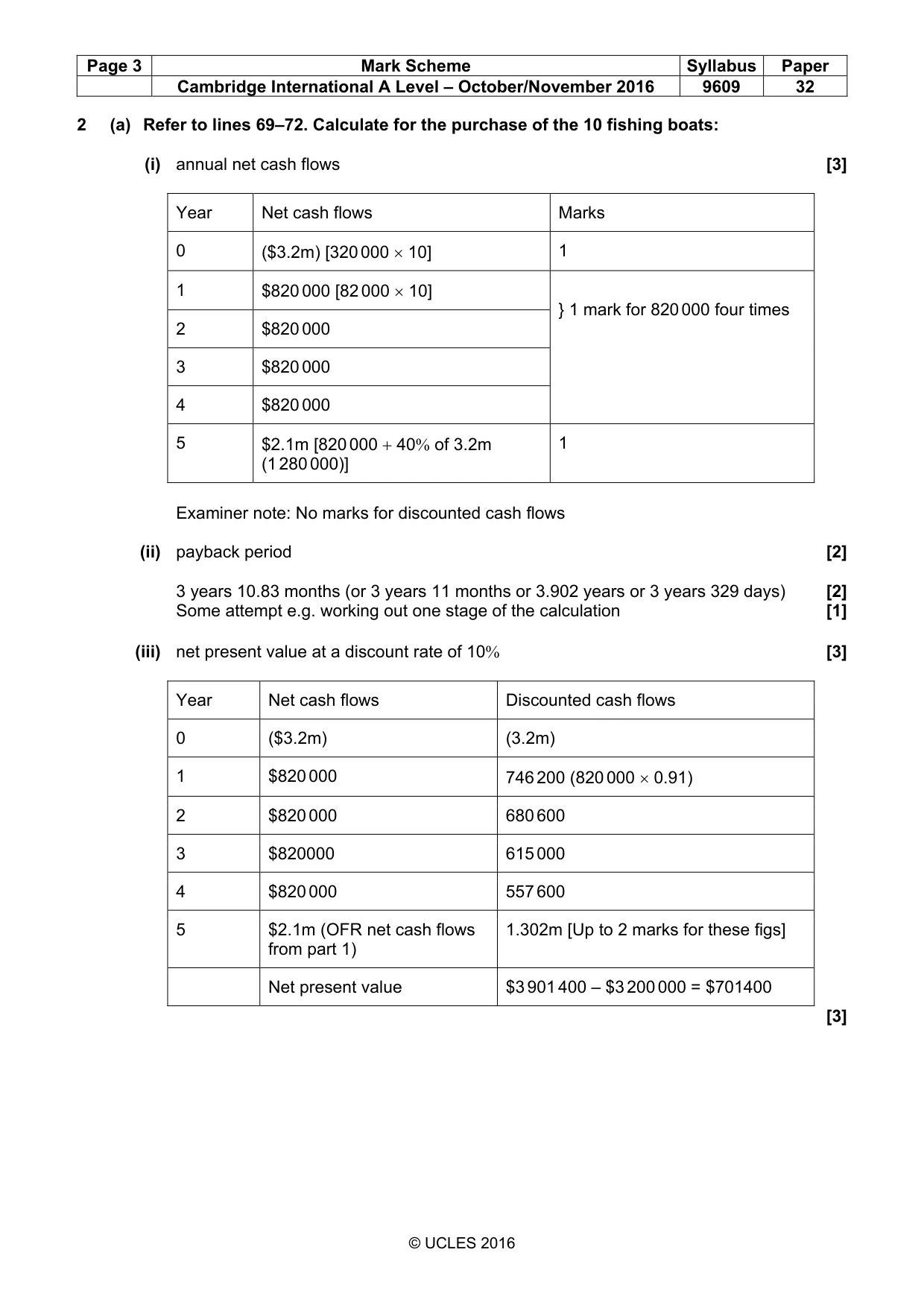
Page 3 Mark Scheme Syllabus Paper Cambridge International A Level – October/November 2016 9609 32 © UCLES 2016 2 (a) Refer to lines 69–72. Calculate for the purchase of the 10 fishing boats: (i) annual net cash flows [3] Year Net cash flows Marks 0 ($3.2m) [320 000 × 10] 1 1 $820 000 [82 000 × 10] } 1 mark for 820 000 four times 2 $820 000 3 $820 000 4 $820 000 5 $2.1m [820 000 + 40% of 3.2m (1 280 000)] 1 Examiner note: No marks for discounted cash flows (ii) payback period [2] 3 years 10.83 months (or 3 years 11 months or 3.902 years or 3 years 329 days) [2] Some attempt e.g. working out one stage of the calculation [1] (iii) net present value at a discount rate of 10% [3] Year Net cash flows Discounted cash flows 0 ($3.2m) (3.2m) 1 $820 000 746 200 (820 000 × 0.91) 2 $820 000 680 600 3 $820000 615 000 4 $820 000 557 600 5 $2.1m (OFR net cash flows from part 1) 1.302m [Up to 2 marks for these figs] Net present value $3 901 400 – $3 200 000 = $701400 [3]
Mark scheme, page 4
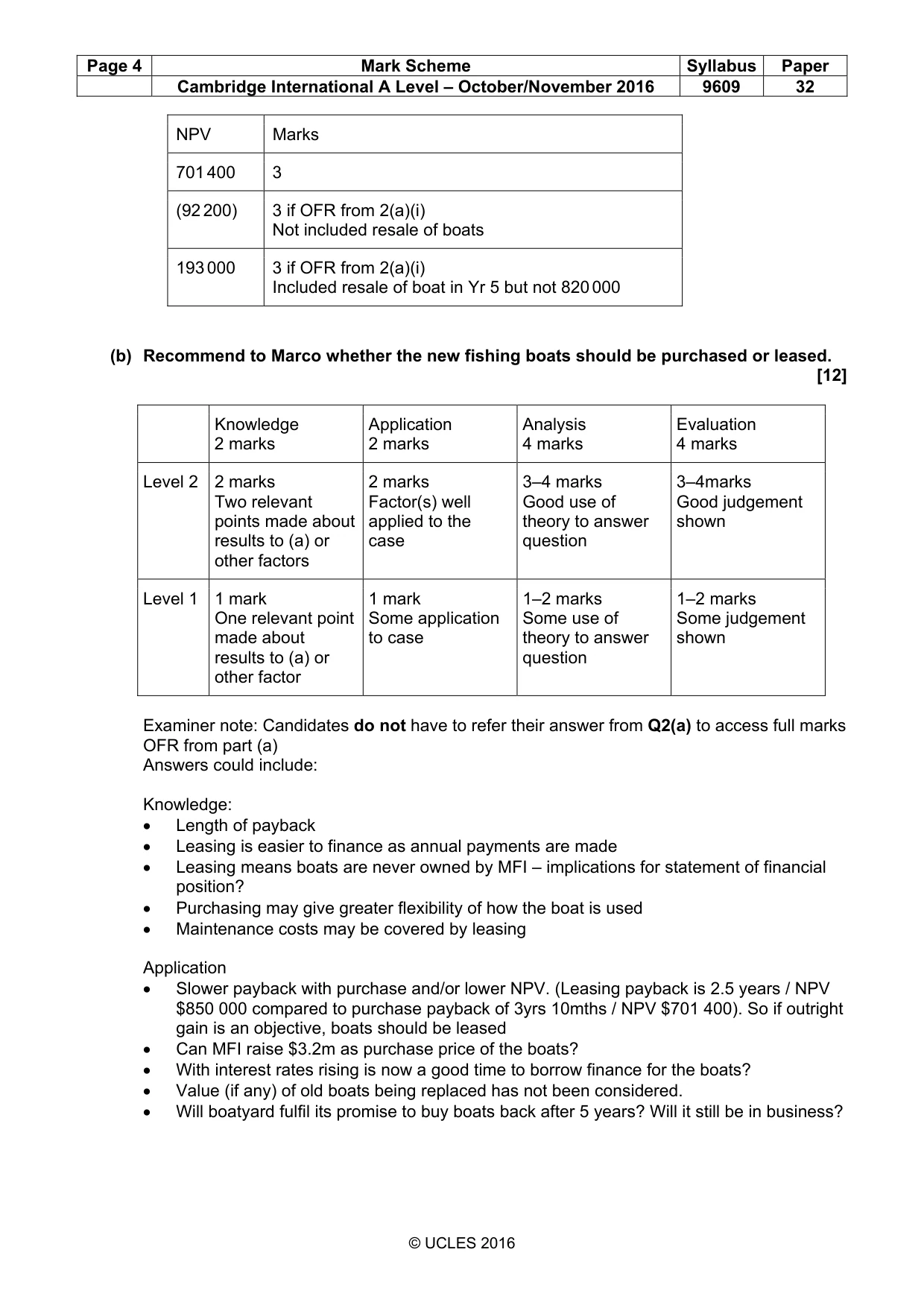
Page 4 Mark Scheme Syllabus Paper Cambridge International A Level – October/November 2016 9609 32 © UCLES 2016 NPV Marks 701 400 3 (92 200) 3 if OFR from 2(a)(i) Not included resale of boats 193 000 3 if OFR from 2(a)(i) Included resale of boat in Yr 5 but not 820 000 (b) Recommend to Marco whether the new fishing boats should be purchased or leased. [12] Knowledge 2 marks Application 2 marks Analysis 4 marks Evaluation 4 marks Level 2 2 marks Two relevant points made about results to (a) or other factors 2 marks Factor(s) well applied to the case 3–4 marks Good use of theory to answer question 3–4marks Good judgement shown Level 1 1 mark One relevant point made about results to (a) or other factor 1 mark Some application to case 1–2 marks Some use of theory to answer question 1–2 marks Some judgement shown Examiner note: Candidates do not have to refer their answer from Q2(a) to access full marks OFR from part (a) Answers could include: Knowledge: • Length of payback • Leasing is easier to finance as annual payments are made • Leasing means boats are never owned by MFI – implications for statement of financial position? • Purchasing may give greater flexibility of how the boat is used • Maintenance costs may be covered by leasing Application • Slower payback with purchase and/or lower NPV. (Leasing payback is 2.5 years / NPV $850 000 compared to purchase payback of 3yrs 10mths / NPV $701 400). So if outright gain is an objective, boats should be leased • Can MFI raise $3.2m as purchase price of the boats? • With interest rates rising is now a good time to borrow finance for the boats? • Value (if any) of old boats being replaced has not been considered. • Will boatyard fulfil its promise to buy boats back after 5 years? Will it still be in business?
Mark scheme, page 5
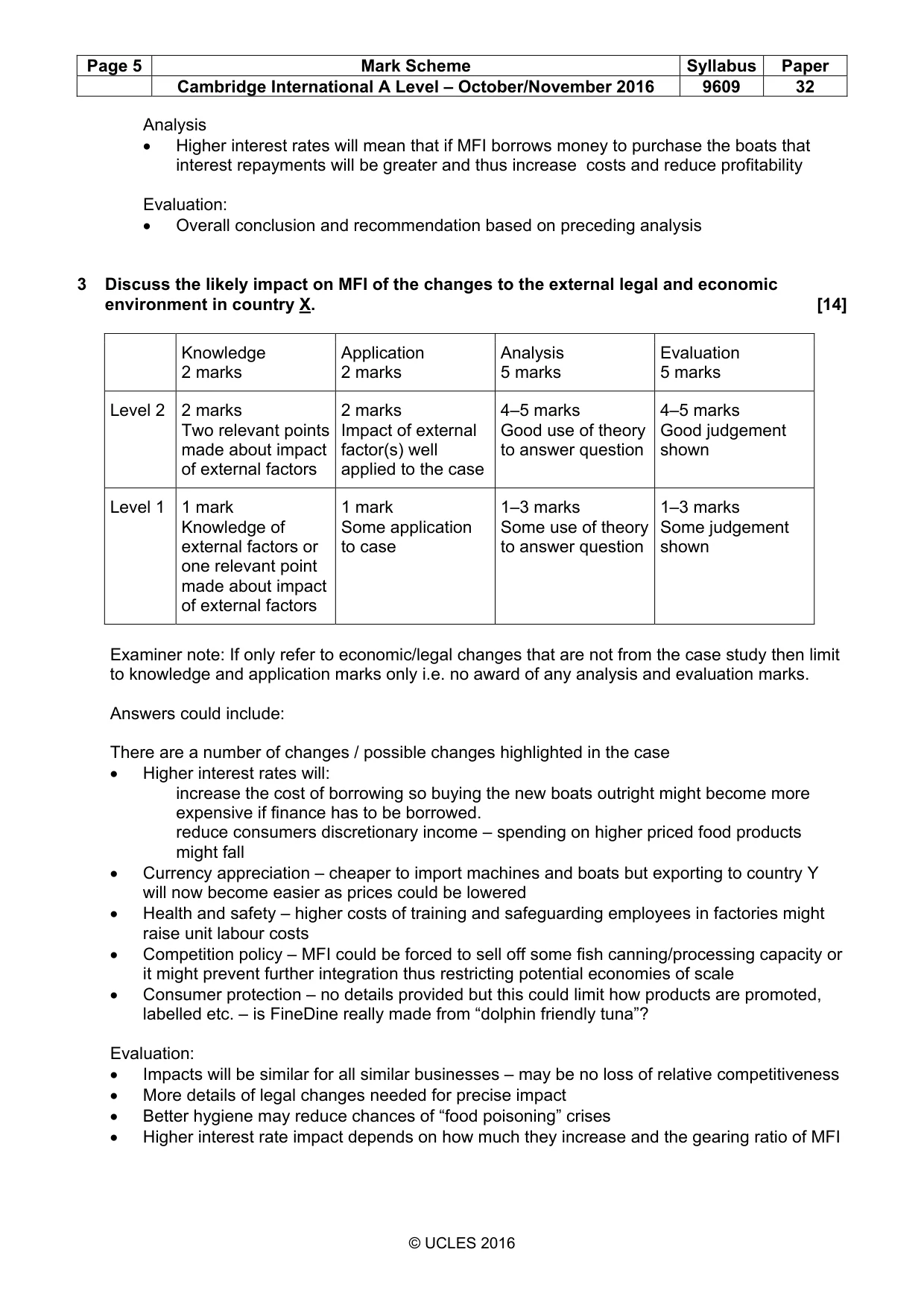
Page 5 Mark Scheme Syllabus Paper Cambridge International A Level – October/November 2016 9609 32 © UCLES 2016 Analysis • Higher interest rates will mean that if MFI borrows money to purchase the boats that interest repayments will be greater and thus increase costs and reduce profitability Evaluation: • Overall conclusion and recommendation based on preceding analysis 3 Discuss the likely impact on MFI of the changes to the external legal and economic environment in country X. [14] Knowledge 2 marks Application 2 marks Analysis 5 marks Evaluation 5 marks Level 2 2 marks Two relevant points made about impact of external factors 2 marks Impact of external factor(s) well applied to the case 4–5 marks Good use of theory to answer question 4–5 marks Good judgement shown Level 1 1 mark Knowledge of external factors or one relevant point made about impact of external factors 1 mark Some application to case 1–3 marks Some use of theory to answer question 1–3 marks Some judgement shown Examiner note: If only refer to economic/legal changes that are not from the case study then limit to knowledge and application marks only i.e. no award of any analysis and evaluation marks. Answers could include: There are a number of changes / possible changes highlighted in the case • Higher interest rates will: increase the cost of borrowing so buying the new boats outright might become more expensive if finance has to be borrowed. reduce consumers discretionary income – spending on higher priced food products might fall • Currency appreciation – cheaper to import machines and boats but exporting to country Y will now become easier as prices could be lowered • Health and safety – higher costs of training and safeguarding employees in factories might raise unit labour costs • Competition policy – MFI could be forced to sell off some fish canning/processing capacity or it might prevent further integration thus restricting potential economies of scale • Consumer protection – no details provided but this could limit how products are promoted, labelled etc. – is FineDine really made from “dolphin friendly tuna”? Evaluation: • Impacts will be similar for all similar businesses – may be no loss of relative competitiveness • More details of legal changes needed for precise impact • Better hygiene may reduce chances of “food poisoning” crises • Higher interest rate impact depends on how much they increase and the gearing ratio of MFI
Mark scheme, page 6
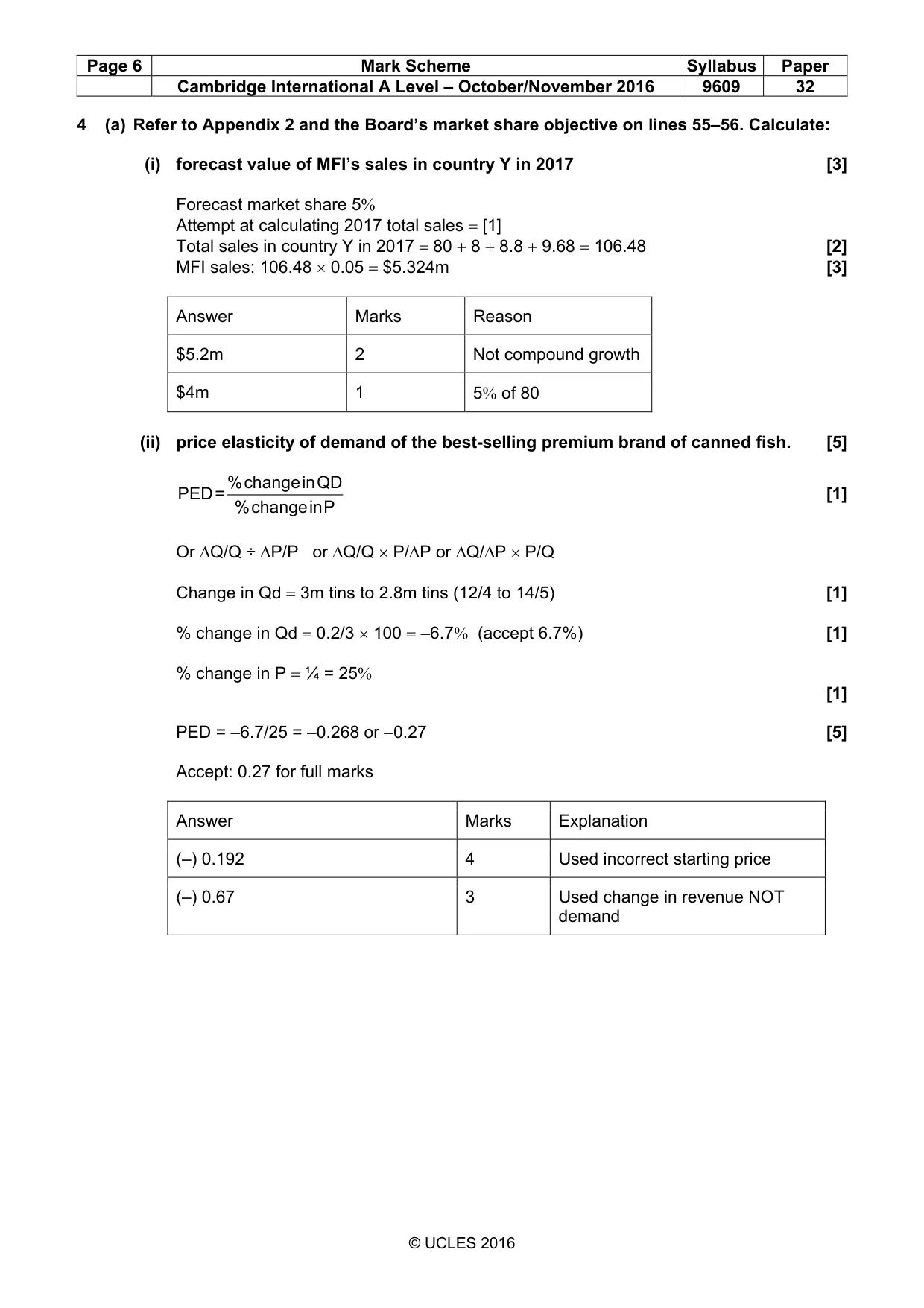
Page 6 Mark Scheme Syllabus Paper Cambridge International A Level – October/November 2016 9609 32 © UCLES 2016 4 (a) Refer to Appendix 2 and the Board’s market share objective on lines 55–56. Calculate: (i) forecast value of MFI’s sales in country Y in 2017 [3] Forecast market share 5% Attempt at calculating 2017 total sales = [1] Total sales in country Y in 2017 = 80 + 8 + 8.8 + 9.68 = 106.48 [2] MFI sales: 106.48 × 0.05 = $5.324m [3] Answer Marks Reason $5.2m 2 Not compound growth $4m 1 5% of 80 (ii) price elasticity of demand of the best-selling premium brand of canned fish. [5] changeinQD PED= chang % % einP [1] Or ∆Q/Q ÷ ∆P/P or ∆Q/Q × P/∆P or ∆Q/∆P × P/Q Change in Qd = 3m tins to 2.8m tins (12/4 to 14/5) [1] % change in Qd = 0.2/3 × 100 = –6.7% (accept 6.7%) [1] % change in P = ¼ = 25% [1] PED = –6.7/25 = –0.268 or –0.27 [5] Accept: 0.27 for full marks Answer Marks Explanation (–) 0.192 4 Used incorrect starting price (–) 0.67 3 Used change in revenue NOT demand
Mark scheme, page 7
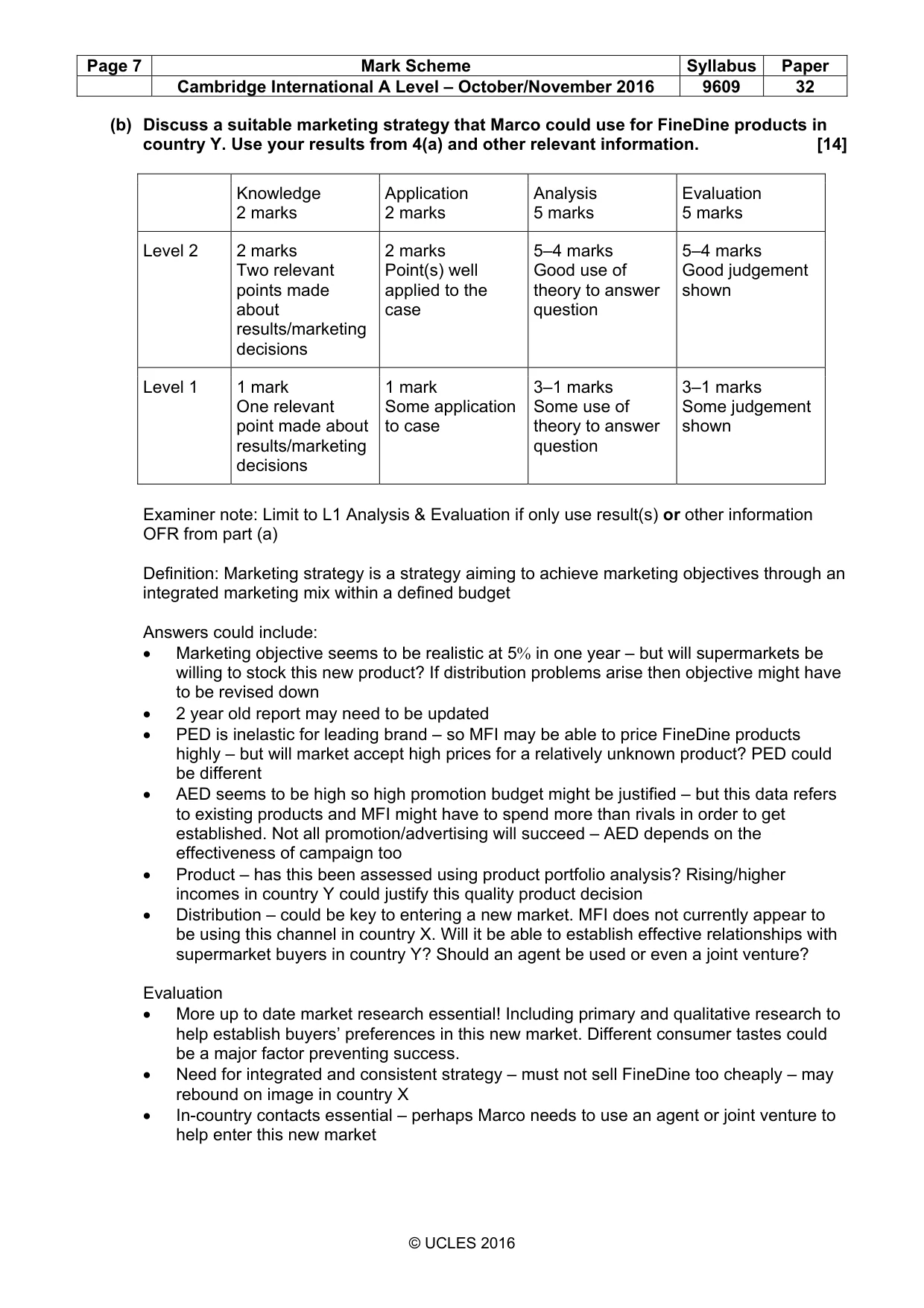
Page 7 Mark Scheme Syllabus Paper Cambridge International A Level – October/November 2016 9609 32 © UCLES 2016 (b) Discuss a suitable marketing strategy that Marco could use for FineDine products in country Y. Use your results from 4(a) and other relevant information. [14] Knowledge 2 marks Application 2 marks Analysis 5 marks Evaluation 5 marks Level 2 2 marks Two relevant points made about results/marketing decisions 2 marks Point(s) well applied to the case 5–4 marks Good use of theory to answer question 5–4 marks Good judgement shown Level 1 1 mark One relevant point made about results/marketing decisions 1 mark Some application to case 3–1 marks Some use of theory to answer question 3–1 marks Some judgement shown Examiner note: Limit to L1 Analysis & Evaluation if only use result(s) or other information OFR from part (a) Definition: Marketing strategy is a strategy aiming to achieve marketing objectives through an integrated marketing mix within a defined budget Answers could include: • Marketing objective seems to be realistic at 5% in one year – but will supermarkets be willing to stock this new product? If distribution problems arise then objective might have to be revised down • 2 year old report may need to be updated • PED is inelastic for leading brand – so MFI may be able to price FineDine products highly – but will market accept high prices for a relatively unknown product? PED could be different • AED seems to be high so high promotion budget might be justified – but this data refers to existing products and MFI might have to spend more than rivals in order to get established. Not all promotion/advertising will succeed – AED depends on the effectiveness of campaign too • Product – has this been assessed using product portfolio analysis? Rising/higher incomes in country Y could justify this quality product decision • Distribution – could be key to entering a new market. MFI does not currently appear to be using this channel in country X. Will it be able to establish effective relationships with supermarket buyers in country Y? Should an agent be used or even a joint venture? Evaluation • More up to date market research essential! Including primary and qualitative research to help establish buyers’ preferences in this new market. Different consumer tastes could be a major factor preventing success. • Need for integrated and consistent strategy – must not sell FineDine too cheaply – may rebound on image in country X • In-country contacts essential – perhaps Marco needs to use an agent or joint venture to help enter this new market
Mark scheme, page 8
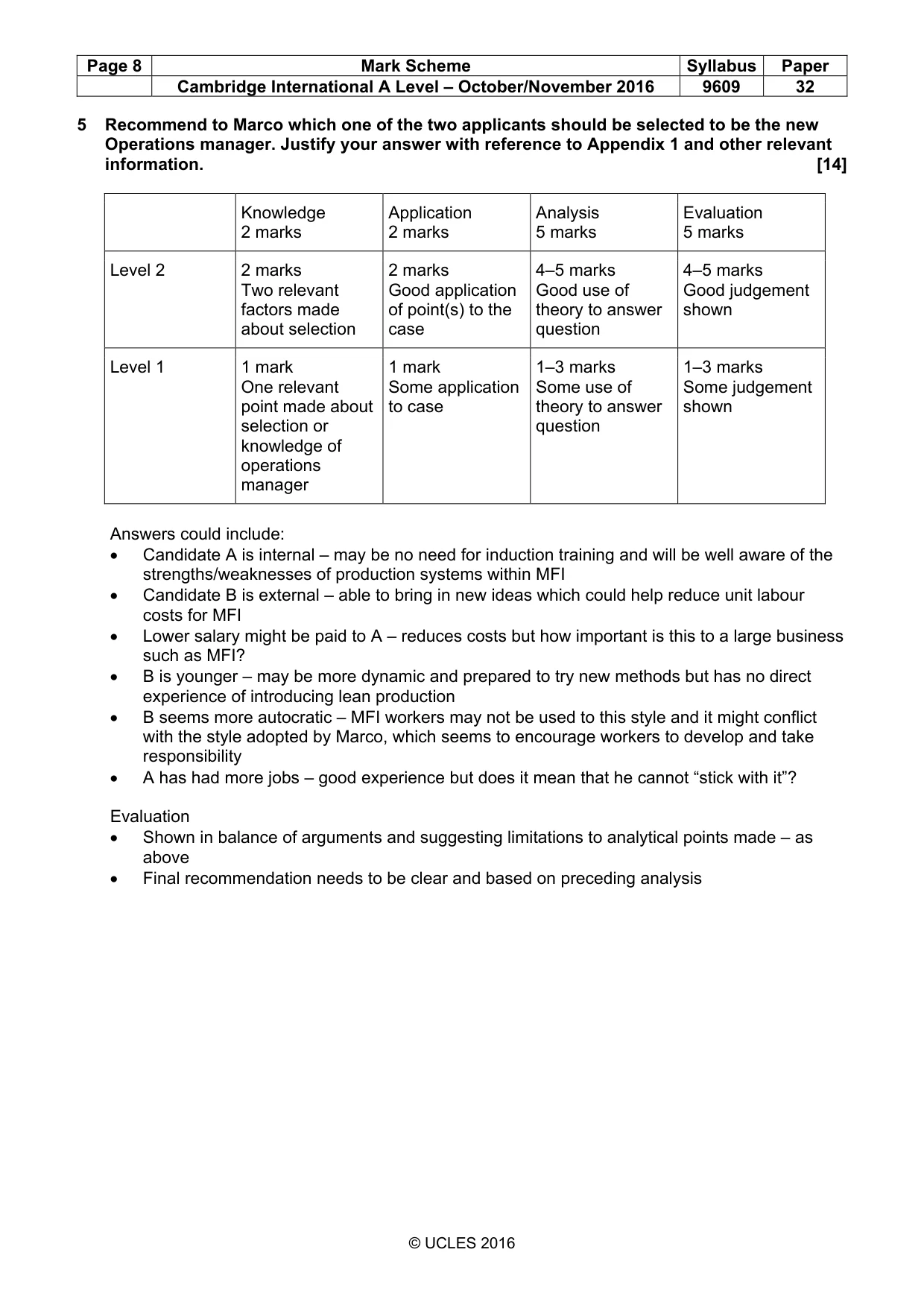
Page 8 Mark Scheme Syllabus Paper Cambridge International A Level – October/November 2016 9609 32 © UCLES 2016 5 Recommend to Marco which one of the two applicants should be selected to be the new Operations manager. Justify your answer with reference to Appendix 1 and other relevant information. [14] Knowledge 2 marks Application 2 marks Analysis 5 marks Evaluation 5 marks Level 2 2 marks Two relevant factors made about selection 2 marks Good application of point(s) to the case 4–5 marks Good use of theory to answer question 4–5 marks Good judgement shown Level 1 1 mark One relevant point made about selection or knowledge of operations manager 1 mark Some application to case 1–3 marks Some use of theory to answer question 1–3 marks Some judgement shown Answers could include: • Candidate A is internal – may be no need for induction training and will be well aware of the strengths/weaknesses of production systems within MFI • Candidate B is external – able to bring in new ideas which could help reduce unit labour costs for MFI • Lower salary might be paid to A – reduces costs but how important is this to a large business such as MFI? • B is younger – may be more dynamic and prepared to try new methods but has no direct experience of introducing lean production • B seems more autocratic – MFI workers may not be used to this style and it might conflict with the style adopted by Marco, which seems to encourage workers to develop and take responsibility • A has had more jobs – good experience but does it mean that he cannot “stick with it”? Evaluation • Shown in balance of arguments and suggesting limitations to analytical points made – as above • Final recommendation needs to be clear and based on preceding analysis
Mark scheme, page 9
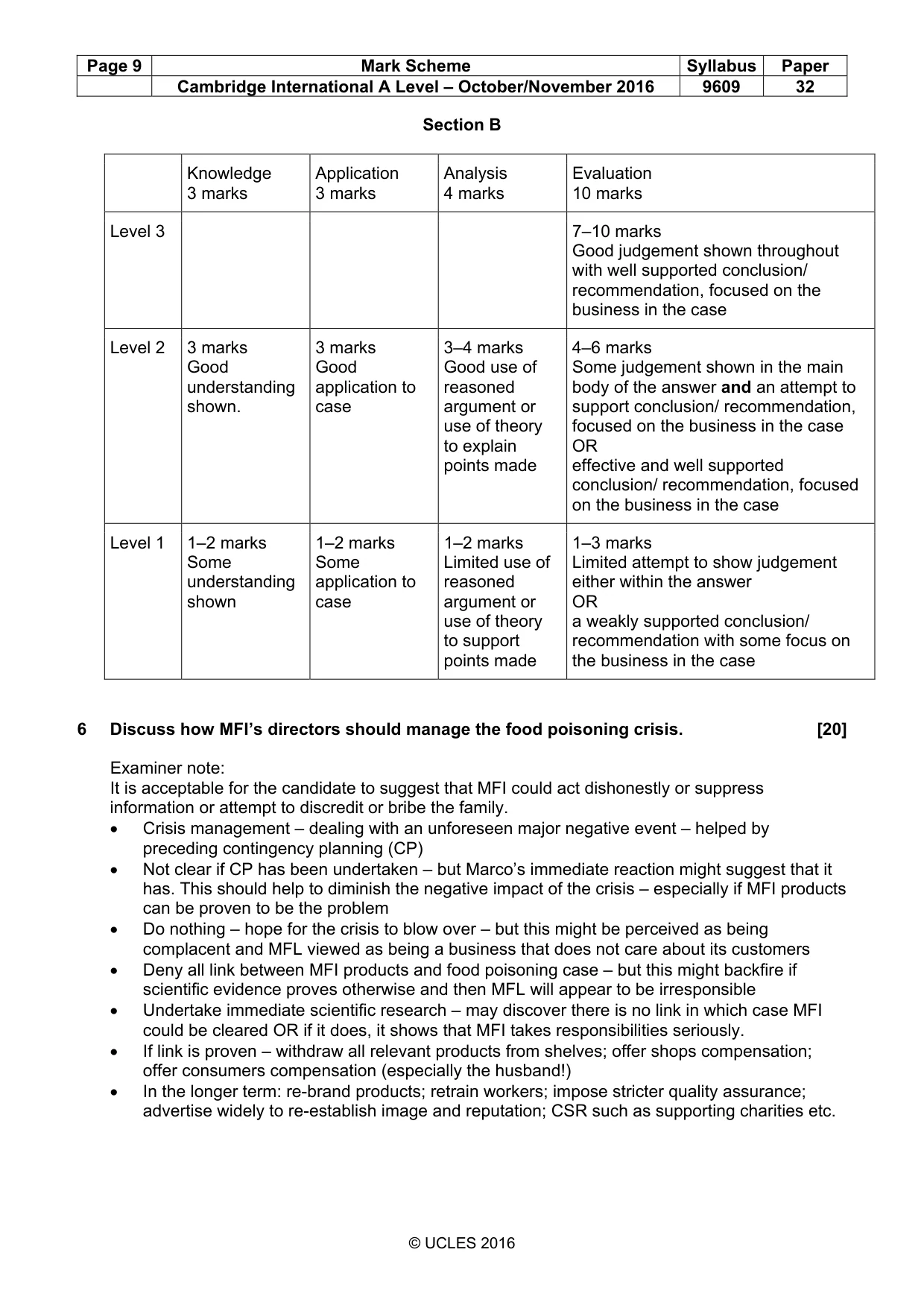
Page 9 Mark Scheme Syllabus Paper Cambridge International A Level – October/November 2016 9609 32 © UCLES 2016 Section B Knowledge 3 marks Application 3 marks Analysis 4 marks Evaluation 10 marks Level 3 7–10 marks Good judgement shown throughout with well supported conclusion/ recommendation, focused on the business in the case Level 2 3 marks Good understanding shown. 3 marks Good application to case 3–4 marks Good use of reasoned argument or use of theory to explain points made 4–6 marks Some judgement shown in the main body of the answer and an attempt to support conclusion/ recommendation, focused on the business in the case OR effective and well supported conclusion/ recommendation, focused on the business in the case Level 1 1–2 marks Some understanding shown 1–2 marks Some application to case 1–2 marks Limited use of reasoned argument or use of theory to support points made 1–3 marks Limited attempt to show judgement either within the answer OR a weakly supported conclusion/ recommendation with some focus on the business in the case 6 Discuss how MFI’s directors should manage the food poisoning crisis. [20] Examiner note: It is acceptable for the candidate to suggest that MFI could act dishonestly or suppress information or attempt to discredit or bribe the family. • Crisis management – dealing with an unforeseen major negative event – helped by preceding contingency planning (CP) • Not clear if CP has been undertaken – but Marco’s immediate reaction might suggest that it has. This should help to diminish the negative impact of the crisis – especially if MFI products can be proven to be the problem • Do nothing – hope for the crisis to blow over – but this might be perceived as being complacent and MFL viewed as being a business that does not care about its customers • Deny all link between MFI products and food poisoning case – but this might backfire if scientific evidence proves otherwise and then MFL will appear to be irresponsible • Undertake immediate scientific research – may discover there is no link in which case MFI could be cleared OR if it does, it shows that MFI takes responsibilities seriously. • If link is proven – withdraw all relevant products from shelves; offer shops compensation; offer consumers compensation (especially the husband!) • In the longer term: re-brand products; retrain workers; impose stricter quality assurance; advertise widely to re-establish image and reputation; CSR such as supporting charities etc.
Mark scheme, page 10
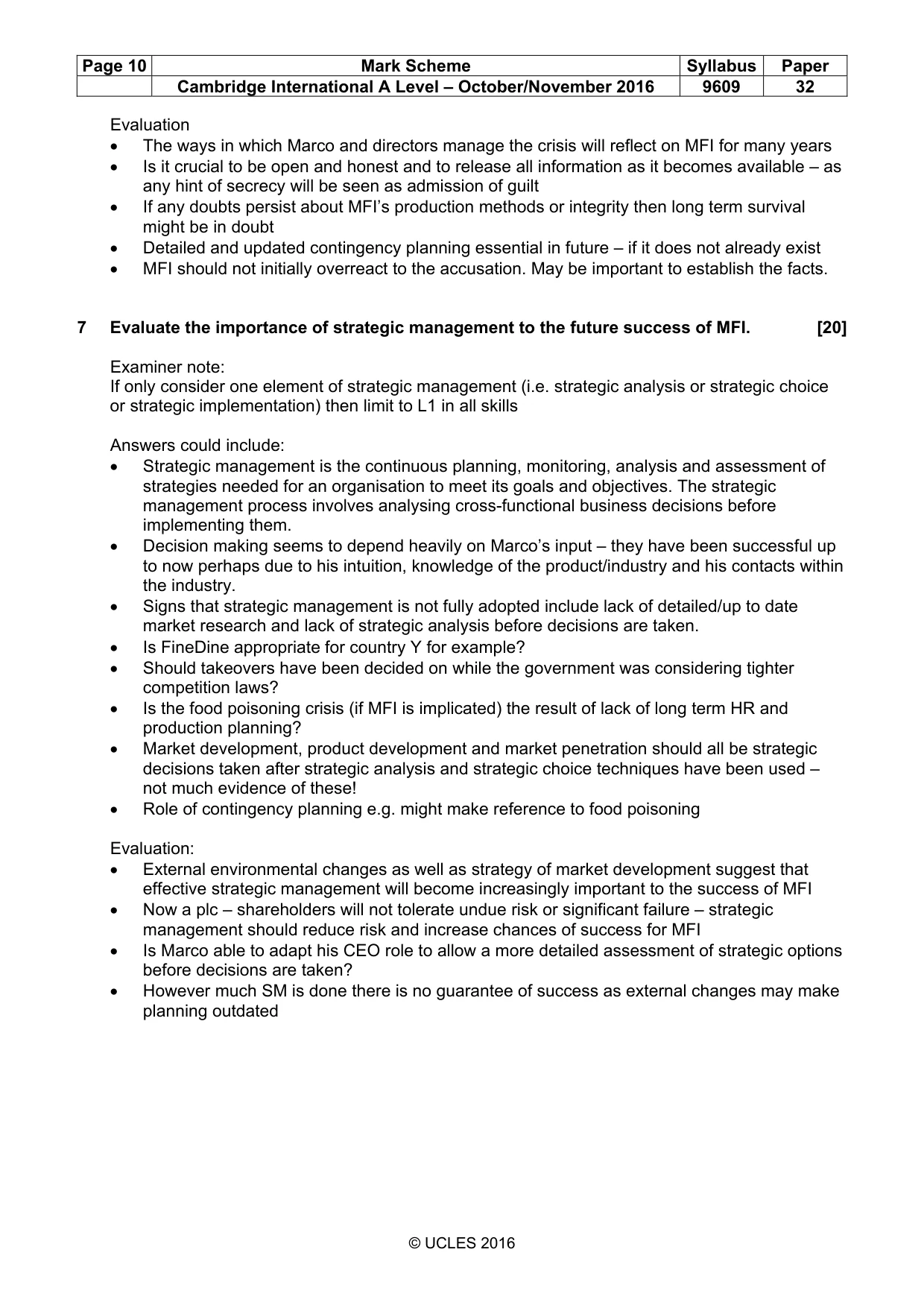
Page 10 Mark Scheme Syllabus Paper Cambridge International A Level – October/November 2016 9609 32 © UCLES 2016 Evaluation • The ways in which Marco and directors manage the crisis will reflect on MFI for many years • Is it crucial to be open and honest and to release all information as it becomes available – as any hint of secrecy will be seen as admission of guilt • If any doubts persist about MFI’s production methods or integrity then long term survival might be in doubt • Detailed and updated contingency planning essential in future – if it does not already exist • MFI should not initially overreact to the accusation. May be important to establish the facts. 7 Evaluate the importance of strategic management to the future success of MFI. [20] Examiner note: If only consider one element of strategic management (i.e. strategic analysis or strategic choice or strategic implementation) then limit to L1 in all skills Answers could include: • Strategic management is the continuous planning, monitoring, analysis and assessment of strategies needed for an organisation to meet its goals and objectives. The strategic management process involves analysing cross-functional business decisions before implementing them. • Decision making seems to depend heavily on Marco’s input – they have been successful up to now perhaps due to his intuition, knowledge of the product/industry and his contacts within the industry. • Signs that strategic management is not fully adopted include lack of detailed/up to date market research and lack of strategic analysis before decisions are taken. • Is FineDine appropriate for country Y for example? • Should takeovers have been decided on while the government was considering tighter competition laws? • Is the food poisoning crisis (if MFI is implicated) the result of lack of long term HR and production planning? • Market development, product development and market penetration should all be strategic decisions taken after strategic analysis and strategic choice techniques have been used – not much evidence of these! • Role of contingency planning e.g. might make reference to food poisoning Evaluation: • External environmental changes as well as strategy of market development suggest that effective strategic management will become increasingly important to the success of MFI • Now a plc – shareholders will not tolerate undue risk or significant failure – strategic management should reduce risk and increase chances of success for MFI • Is Marco able to adapt his CEO role to allow a more detailed assessment of strategic options before decisions are taken? • However much SM is done there is no guarantee of success as external changes may make planning outdated
What you needed in this session
Cambridge’s own grade thresholds for 2016 Oct/Nov, Paper 3 · Variant 2. A higher threshold means an easier paper — the bar moves with how the cohort did.