Cambridge A Level Business (for first examination in 2016) 9609 — 2016 Oct/Nov Paper 3 · Variant 3
9609/33/O/N/16 · 100 marks · ≈113 min
The question paper and its mark scheme, free to read here and free to download. This is Cambridge’s own paper, exactly as it was sat.
Question paper8 pages



Mark scheme10 pages
Answers below. Sit the paper first if you are practising.
Paper as text
Question paper, page 1
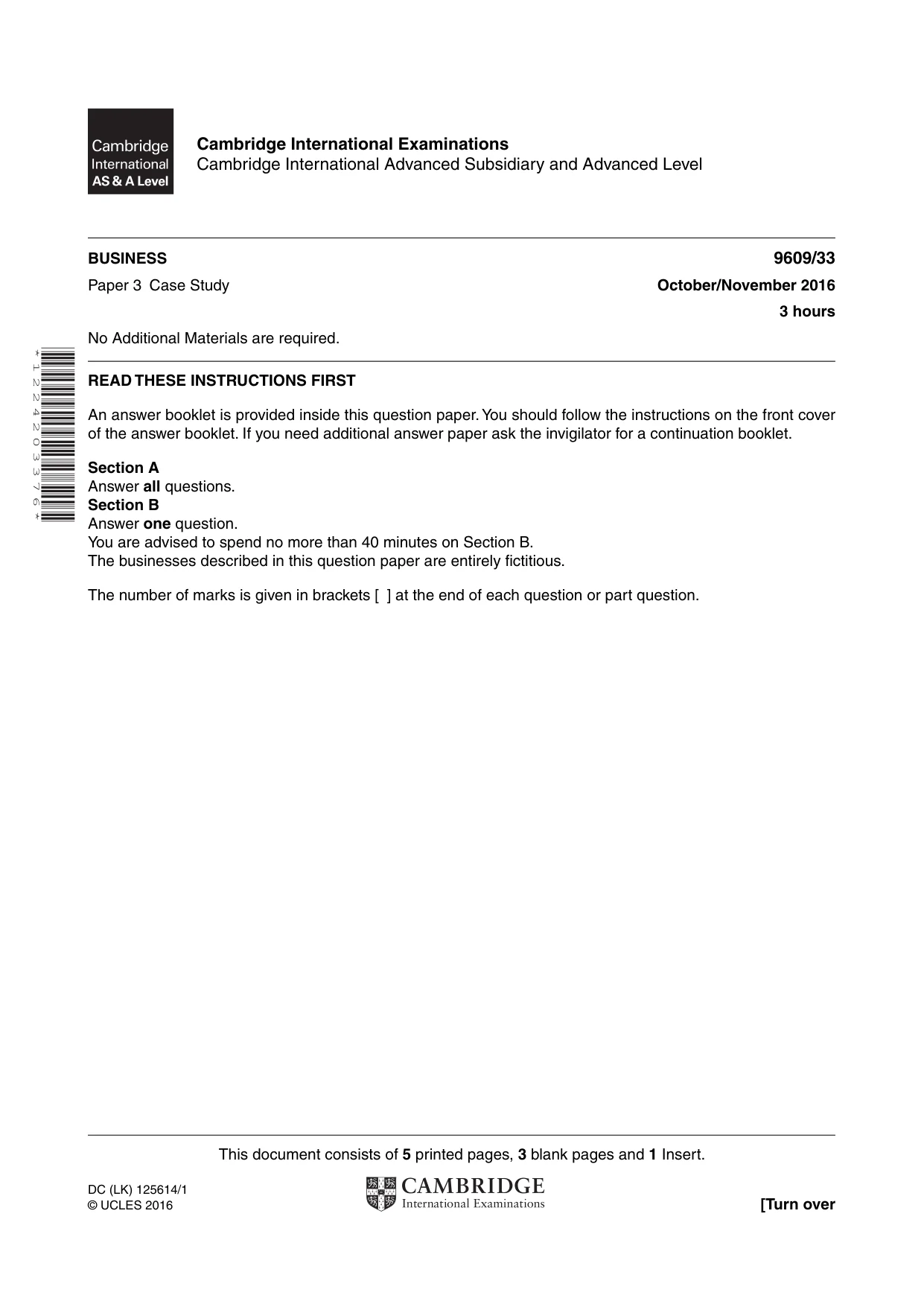
This document consists of 5 printed pages, 3 blank pages and 1 Insert. DC (LK) 125614/1 © UCLES 2016 [Turn over Cambridge International Examinations Cambridge International Advanced Subsidiary and Advanced Level * 1 2 2 4 2 0 3 3 7 6 * BUSINESS 9609/33 Paper 3 Case Study October/November 2016 3 hours No Additional Materials are required. READ THESE INSTRUCTIONS FIRST An answer booklet is provided inside this question paper. You should follow the instructions on the front cover of the answer booklet. If you need additional answer paper ask the invigilator for a continuation booklet. Section A Answer all questions. Section B Answer one question. You are advised to spend no more than 40 minutes on Section B. The businesses described in this question paper are entirely fictitious. The number of marks is given in brackets [ ] at the end of each question or part question.
Question paper, page 2
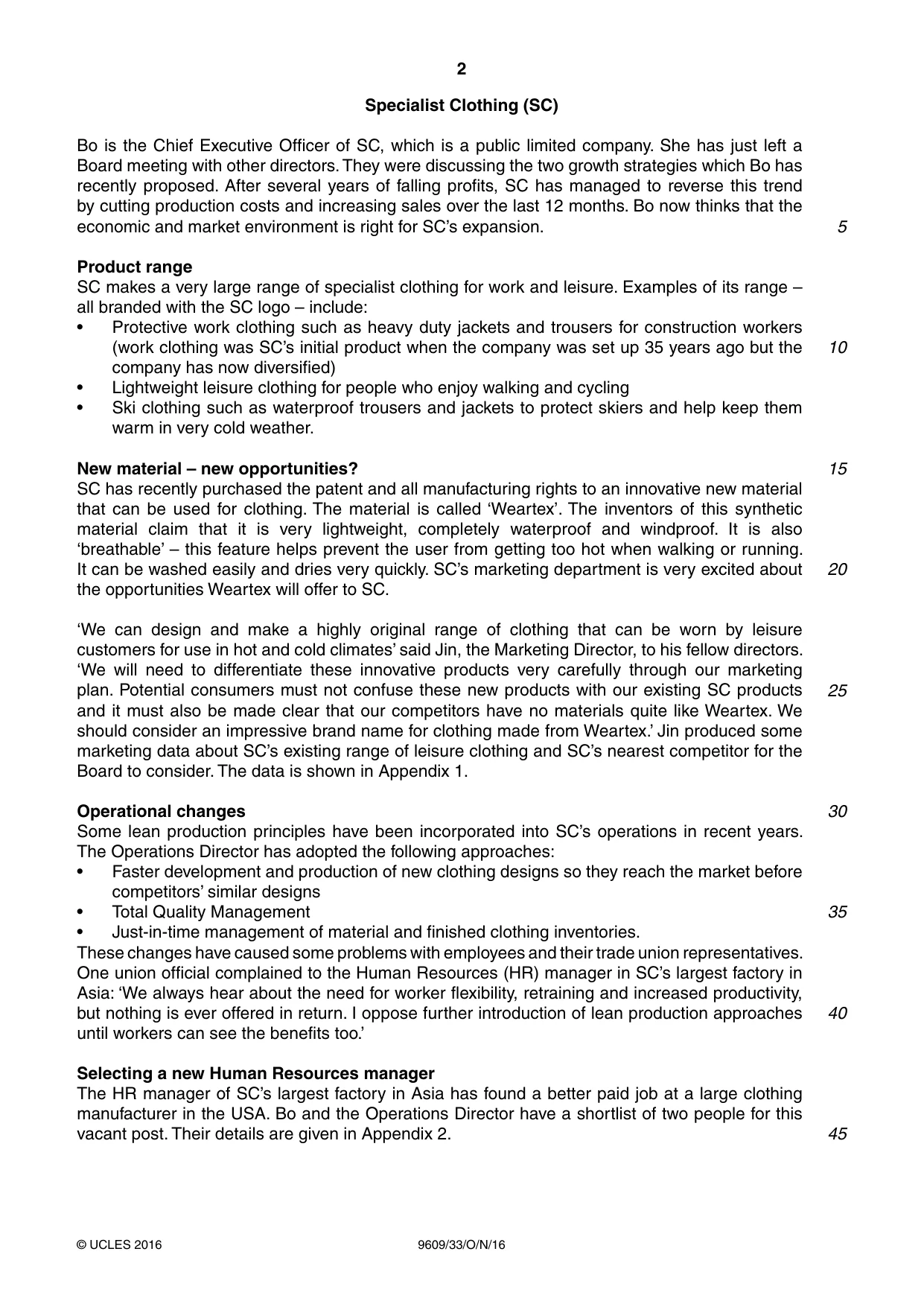
2 9609/33/O/N/16 © UCLES 2016 Specialist Clothing (SC) Bo is the Chief Executive Officer of SC, which is a public limited company. She has just left a Board meeting with other directors. They were discussing the two growth strategies which Bo has recently proposed. After several years of falling profits, SC has managed to reverse this trend by cutting production costs and increasing sales over the last 12 months. Bo now thinks that the economic and market environment is right for SC’s expansion. Product range SC makes a very large range of specialist clothing for work and leisure. Examples of its range – all branded with the SC logo – include: • Protective work clothing such as heavy duty jackets and trousers for construction workers (work clothing was SC’s initial product when the company was set up 35 years ago but the company has now diversified) • Lightweight leisure clothing for people who enjoy walking and cycling • Ski clothing such as waterproof trousers and jackets to protect skiers and help keep them warm in very cold weather. New material – new opportunities? SC has recently purchased the patent and all manufacturing rights to an innovative new material that can be used for clothing. The material is called ‘Weartex’. The inventors of this synthetic material claim that it is very lightweight, completely waterproof and windproof. It is also ‘breathable’ – this feature helps prevent the user from getting too hot when walking or running. It can be washed easily and dries very quickly. SC’s marketing department is very excited about the opportunities Weartex will offer to SC. ‘We can design and make a highly original range of clothing that can be worn by leisure customers for use in hot and cold climates’ said Jin, the Marketing Director, to his fellow directors. ‘We will need to differentiate these innovative products very carefully through our marketing plan. Potential consumers must not confuse these new products with our existing SC products and it must also be made clear that our competitors have no materials quite like Weartex. We should consider an impressive brand name for clothing made from Weartex.’ Jin produced some marketing data about SC’s existing range of leisure clothing and SC’s nearest competitor for the Board to consider. The data is shown in Appendix 1. Operational changes Some lean production principles have been incorporated into SC’s operations in recent years. The Operations Director has adopted the following approaches: • Faster development and production of new clothing designs so they reach the market before competitors’ similar designs • Total Quality Management • Just-in-time management of material and finished clothing inventories. These changes have caused some problems with employees and their trade union representatives. One union official complained to the Human Resources (HR) manager in SC’s largest factory in Asia: ‘We always hear about the need for worker flexibility, retraining and increased productivity, but nothing is ever offered in return. I oppose further introduction of lean production approaches until workers can see the benefits too.’ Selecting a new Human Resources manager The HR manager of SC’s largest factory in Asia has found a better paid job at a large clothing manufacturer in the USA. Bo and the Operations Director have a shortlist of two people for this vacant post. Their details are given in Appendix 2. 5 10 15 20 25 30 35 40 45
Question paper, page 3
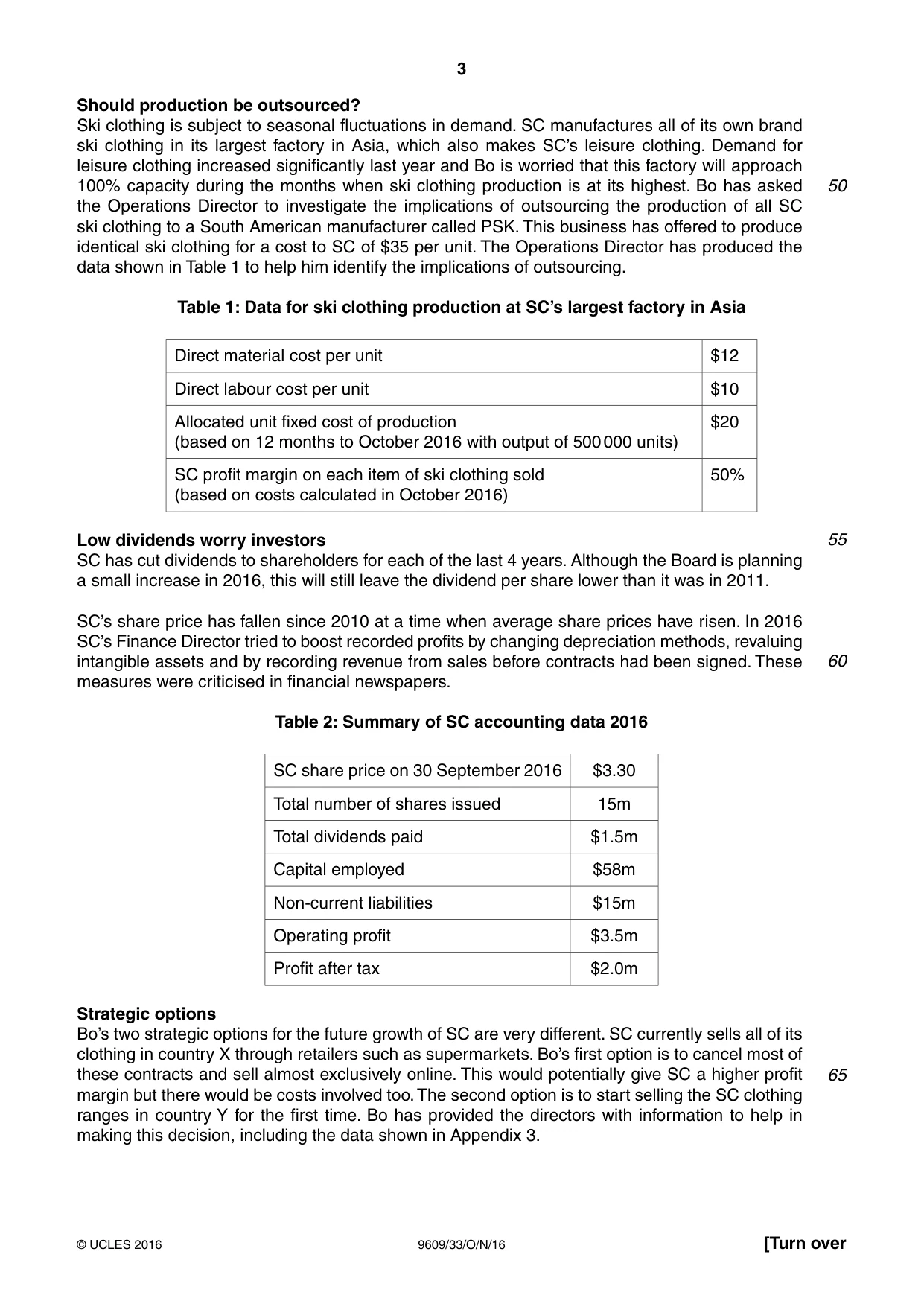
3 9609/33/O/N/16 © UCLES 2016 [Turn over Should production be outsourced? Ski clothing is subject to seasonal fluctuations in demand. SC manufactures all of its own brand ski clothing in its largest factory in Asia, which also makes SC’s leisure clothing. Demand for leisure clothing increased significantly last year and Bo is worried that this factory will approach 100% capacity during the months when ski clothing production is at its highest. Bo has asked the Operations Director to investigate the implications of outsourcing the production of all SC ski clothing to a South American manufacturer called PSK. This business has offered to produce identical ski clothing for a cost to SC of $35 per unit. The Operations Director has produced the data shown in Table 1 to help him identify the implications of outsourcing. Table 1: Data for ski clothing production at SC’s largest factory in Asia Direct material cost per unit $12 Direct labour cost per unit $10 Allocated unit fixed cost of production (based on 12 months to October 2016 with output of 500 000 units) $20 SC profit margin on each item of ski clothing sold (based on costs calculated in October 2016) 50% Low dividends worry investors SC has cut dividends to shareholders for each of the last 4 years. Although the Board is planning a small increase in 2016, this will still leave the dividend per share lower than it was in 2011. SC’s share price has fallen since 2010 at a time when average share prices have risen. In 2016 SC’s Finance Director tried to boost recorded profits by changing depreciation methods, revaluing intangible assets and by recording revenue from sales before contracts had been signed. These measures were criticised in financial newspapers. Table 2: Summary of SC accounting data 2016 SC share price on 30 September 2016 $3.30 Total number of shares issued 15m Total dividends paid $1.5m Capital employed $58m Non-current liabilities $15m Operating profit $3.5m Profit after tax $2.0m Strategic options Bo’s two strategic options for the future growth of SC are very different. SC currently sells all of its clothing in country X through retailers such as supermarkets. Bo’s first option is to cancel most of these contracts and sell almost exclusively online. This would potentially give SC a higher profit margin but there would be costs involved too. The second option is to start selling the SC clothing ranges in country Y for the first time. Bo has provided the directors with information to help in making this decision, including the data shown in Appendix 3. 50 55 60 65
Question paper, page 4
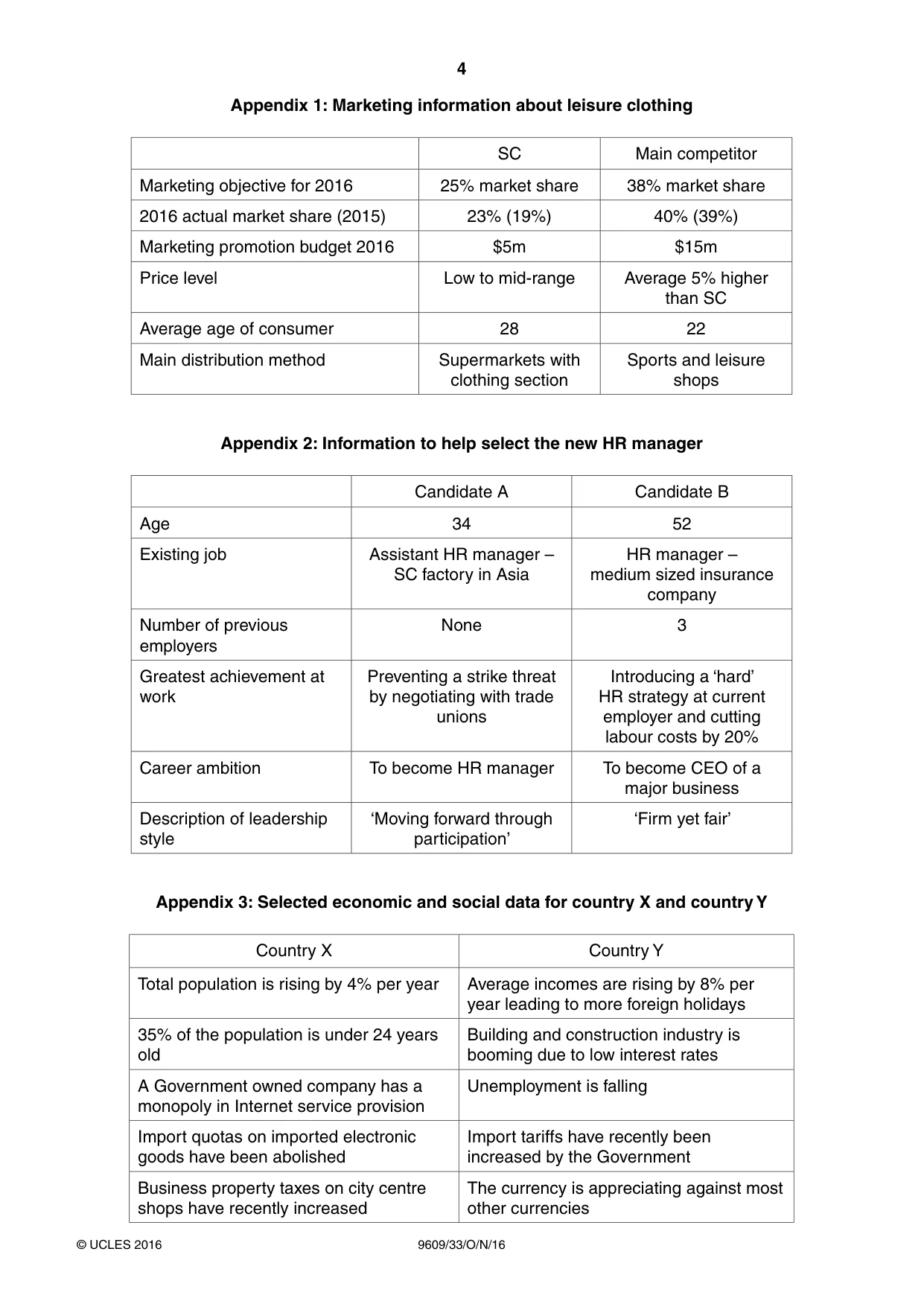
4 9609/33/O/N/16 © UCLES 2016 Appendix 1: Marketing information about leisure clothing SC Main competitor Marketing objective for 2016 25% market share 38% market share 2016 actual market share (2015) 23% (19%) 40% (39%) Marketing promotion budget 2016 $5m $15m Price level Low to mid-range Average 5% higher than SC Average age of consumer 28 22 Main distribution method Supermarkets with clothing section Sports and leisure shops Appendix 2: Information to help select the new HR manager Candidate A Candidate B Age 34 52 Existing job Assistant HR manager – SC factory in Asia HR manager – medium sized insurance company Number of previous employers None 3 Greatest achievement at work Preventing a strike threat by negotiating with trade unions Introducing a ‘hard’ HR strategy at current employer and cutting labour costs by 20% Career ambition To become HR manager To become CEO of a major business Description of leadership style ‘Moving forward through participation’ ‘Firm yet fair’ Appendix 3: Selected economic and social data for country X and country Y Country X Country Y Total population is rising by 4% per year Average incomes are rising by 8% per year leading to more foreign holidays 35% of the population is under 24 years old Building and construction industry is booming due to low interest rates A Government owned company has a monopoly in Internet service provision Unemployment is falling Import quotas on imported electronic goods have been abolished Import tariffs have recently been increased by the Government Business property taxes on city centre shops have recently increased The currency is appreciating against most other currencies
Question paper, page 5
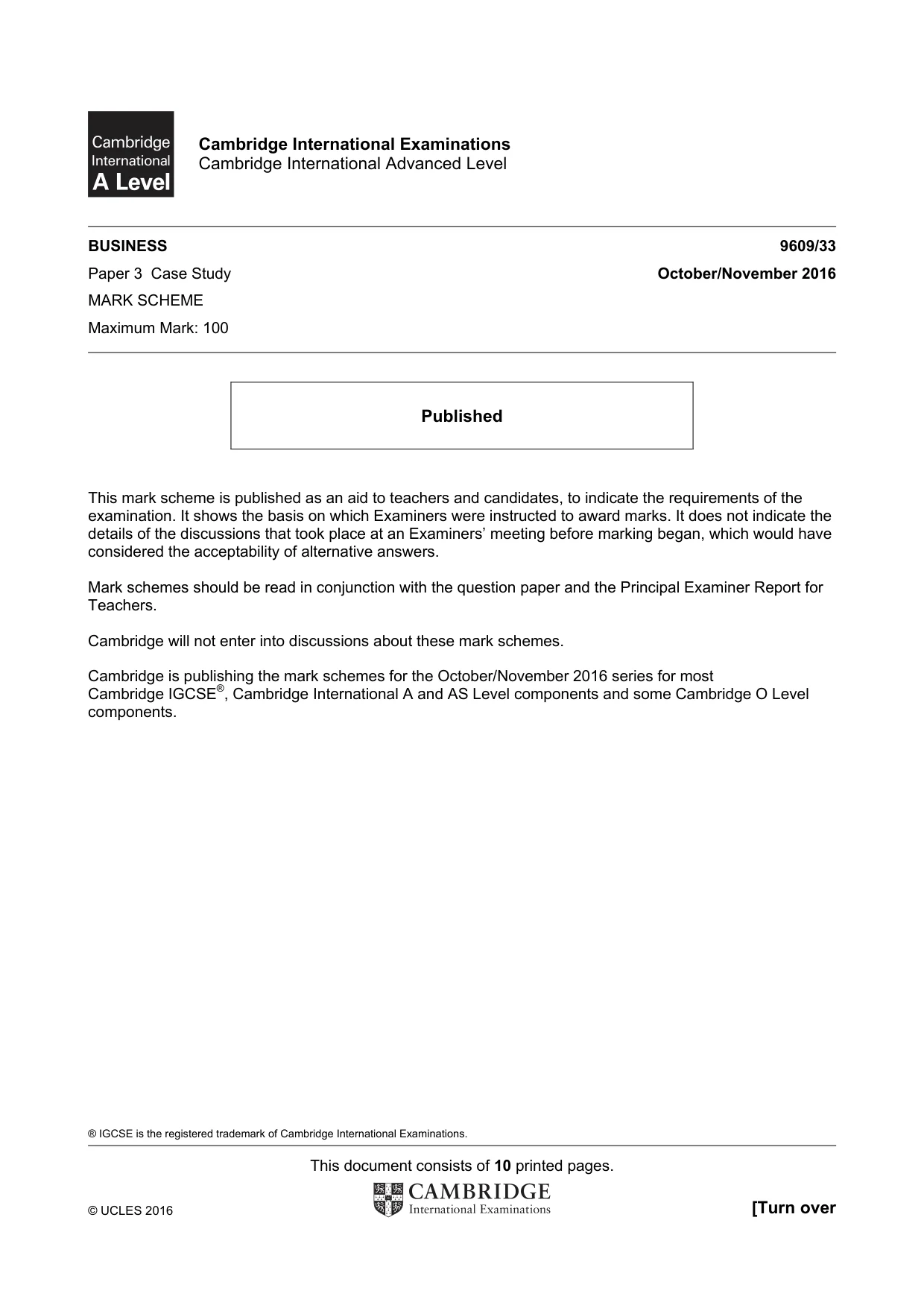
5 9609/33/O/N/16 © UCLES 2016 Section A Answer all questions in this section. 1 Analyse the benefits to SC of lean production. [10] 2 (a) Refer to Table 1 and information on lines 48–53. Calculate the likely impact on SC’s profits of a decision to outsource production of ski clothing to PSK. [6] (b) Discuss whether SC should outsource production of ski clothing. Use your result from 2(a) and other relevant information to justify your answer. [12] 3 Recommend to Bo which candidate should be selected as HR manager for the SC Asian factory. [14] 4 (a) Refer to Table 2. Calculate for 2016: (i) return on capital employed [2] (ii) price earnings ratio [3] (iii) dividend yield. [3] (b) Assess the usefulness of your results from 4(a) and the data in Table 2 to SC’s shareholders. [14] 5 Recommend a suitable marketing plan for the new range of clothing made from Weartex if it was to be launched in your own country. Justify your recommendation. [16] Section B Answer one question from this section. 6 Evaluate whether the information in Appendix 3 is sufficient to allow SC’s directors to choose between the two strategic growth options. [20] 7 Discuss the importance of strategic analysis to SC’s directors before considering strategic options for growth. [20]
Question paper, page 6
6 9609/33/O/N/16 © UCLES 2016 BLANK PAGE
Question paper, page 7
7 9609/33/O/N/16 © UCLES 2016 BLANK PAGE
Question paper, page 8
8 9609/33/O/N/16 © UCLES 2016 Permission to reproduce items where third-party owned material protected by copyright is included has been sought and cleared where possible. Every reasonable effort has been made by the publisher (UCLES) to trace copyright holders, but if any items requiring clearance have unwittingly been included, the publisher will be pleased to make amends at the earliest possible opportunity. To avoid the issue of disclosure of answer-related information to candidates, all copyright acknowledgements are reproduced online in the Cambridge International Examinations Copyright Acknowledgements Booklet. This is produced for each series of examinations and is freely available to download at www.cie.org.uk after the live examination series. Cambridge International Examinations is part of the Cambridge Assessment Group. Cambridge Assessment is the brand name of University of Cambridge Local Examinations Syndicate (UCLES), which is itself a department of the University of Cambridge. BLANK PAGE
Mark scheme, page 1
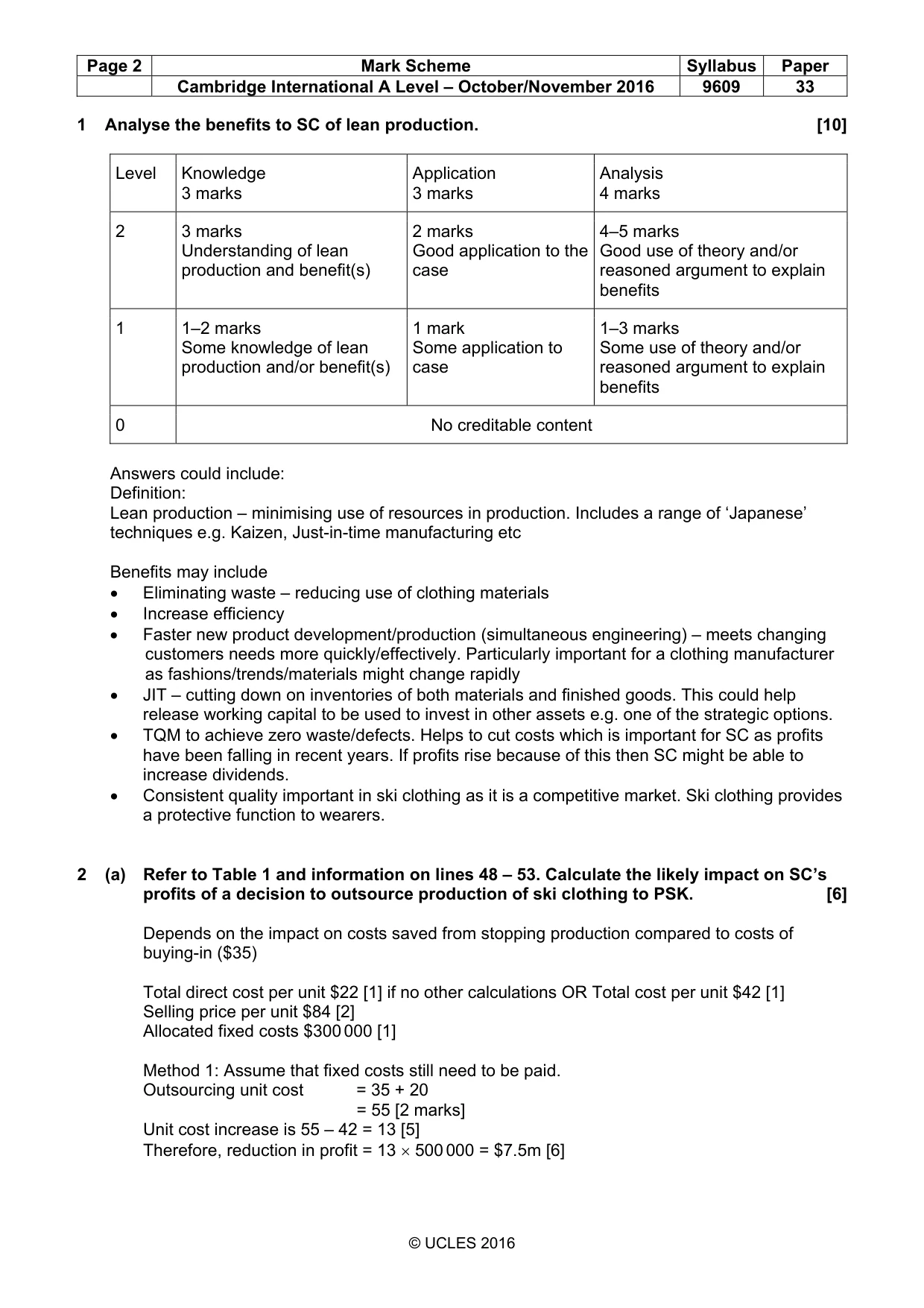
® IGCSE is the registered trademark of Cambridge International Examinations. This document consists of 10 printed pages. © UCLES 2016 [Turn over Cambridge International Examinations Cambridge International Advanced Level BUSINESS 9609/33 Paper 3 Case Study October/November 2016 MARK SCHEME Maximum Mark: 100 Published This mark scheme is published as an aid to teachers and candidates, to indicate the requirements of the examination. It shows the basis on which Examiners were instructed to award marks. It does not indicate the details of the discussions that took place at an Examiners’ meeting before marking began, which would have considered the acceptability of alternative answers. Mark schemes should be read in conjunction with the question paper and the Principal Examiner Report for Teachers. Cambridge will not enter into discussions about these mark schemes. Cambridge is publishing the mark schemes for the October/November 2016 series for most Cambridge IGCSE®, Cambridge International A and AS Level components and some Cambridge O Level components.
Mark scheme, page 2
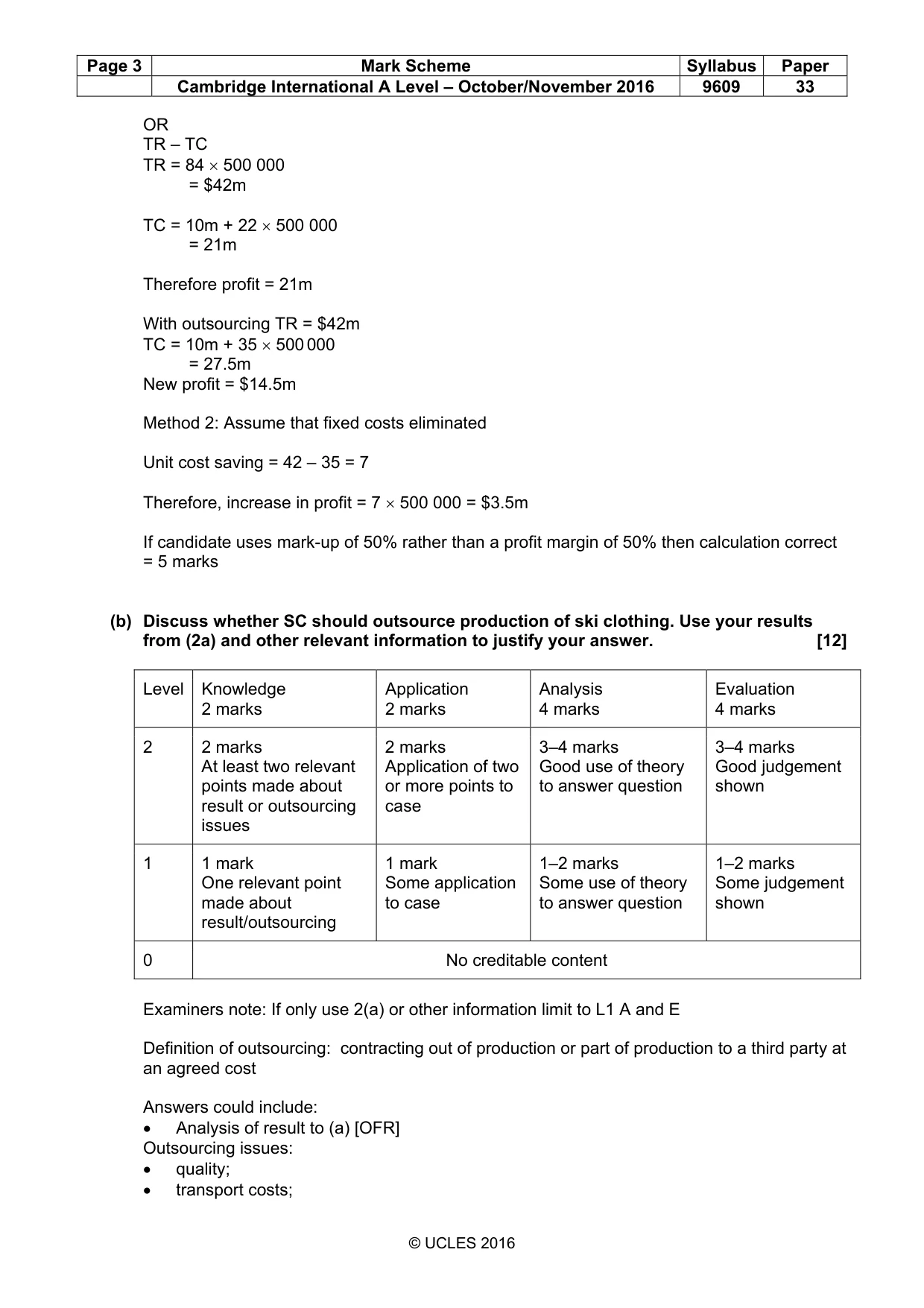
Page 2 Mark Scheme Syllabus Paper Cambridge International A Level – October/November 2016 9609 33 © UCLES 2016 1 Analyse the benefits to SC of lean production. [10] Level Knowledge 3 marks Application 3 marks Analysis 4 marks 2 3 marks Understanding of lean production and benefit(s) 2 marks Good application to the case 4–5 marks Good use of theory and/or reasoned argument to explain benefits 1 1–2 marks Some knowledge of lean production and/or benefit(s) 1 mark Some application to case 1–3 marks Some use of theory and/or reasoned argument to explain benefits 0 No creditable content Answers could include: Definition: Lean production – minimising use of resources in production. Includes a range of ‘Japanese’ techniques e.g. Kaizen, Just-in-time manufacturing etc Benefits may include • Eliminating waste – reducing use of clothing materials • Increase efficiency • Faster new product development/production (simultaneous engineering) – meets changing customers needs more quickly/effectively. Particularly important for a clothing manufacturer as fashions/trends/materials might change rapidly • JIT – cutting down on inventories of both materials and finished goods. This could help release working capital to be used to invest in other assets e.g. one of the strategic options. • TQM to achieve zero waste/defects. Helps to cut costs which is important for SC as profits have been falling in recent years. If profits rise because of this then SC might be able to increase dividends. • Consistent quality important in ski clothing as it is a competitive market. Ski clothing provides a protective function to wearers. 2 (a) Refer to Table 1 and information on lines 48 – 53. Calculate the likely impact on SC’s profits of a decision to outsource production of ski clothing to PSK. [6] Depends on the impact on costs saved from stopping production compared to costs of buying-in ($35) Total direct cost per unit $22 [1] if no other calculations OR Total cost per unit $42 [1] Selling price per unit $84 [2] Allocated fixed costs $300 000 [1] Method 1: Assume that fixed costs still need to be paid. Outsourcing unit cost = 35 + 20 = 55 [2 marks] Unit cost increase is 55 – 42 = 13 [5] Therefore, reduction in profit = 13 × 500 000 = $7.5m [6]
Mark scheme, page 3
Page 3 Mark Scheme Syllabus Paper Cambridge International A Level – October/November 2016 9609 33 © UCLES 2016 OR TR – TC TR = 84 × 500 000 = $42m TC = 10m + 22 × 500 000 = 21m Therefore profit = 21m With outsourcing TR = $42m TC = 10m + 35 × 500 000 = 27.5m New profit = $14.5m Method 2: Assume that fixed costs eliminated Unit cost saving = 42 – 35 = 7 Therefore, increase in profit = 7 × 500 000 = $3.5m If candidate uses mark-up of 50% rather than a profit margin of 50% then calculation correct = 5 marks (b) Discuss whether SC should outsource production of ski clothing. Use your results from (2a) and other relevant information to justify your answer. [12] Level Knowledge 2 marks Application 2 marks Analysis 4 marks Evaluation 4 marks 2 2 marks At least two relevant points made about result or outsourcing issues 2 marks Application of two or more points to case 3–4 marks Good use of theory to answer question 3–4 marks Good judgement shown 1 1 mark One relevant point made about result/outsourcing 1 mark Some application to case 1–2 marks Some use of theory to answer question 1–2 marks Some judgement shown 0 No creditable content Examiners note: If only use 2(a) or other information limit to L1 A and E Definition of outsourcing: contracting out of production or part of production to a third party at an agreed cost Answers could include: • Analysis of result to (a) [OFR] Outsourcing issues: • quality; • transport costs;
Mark scheme, page 4
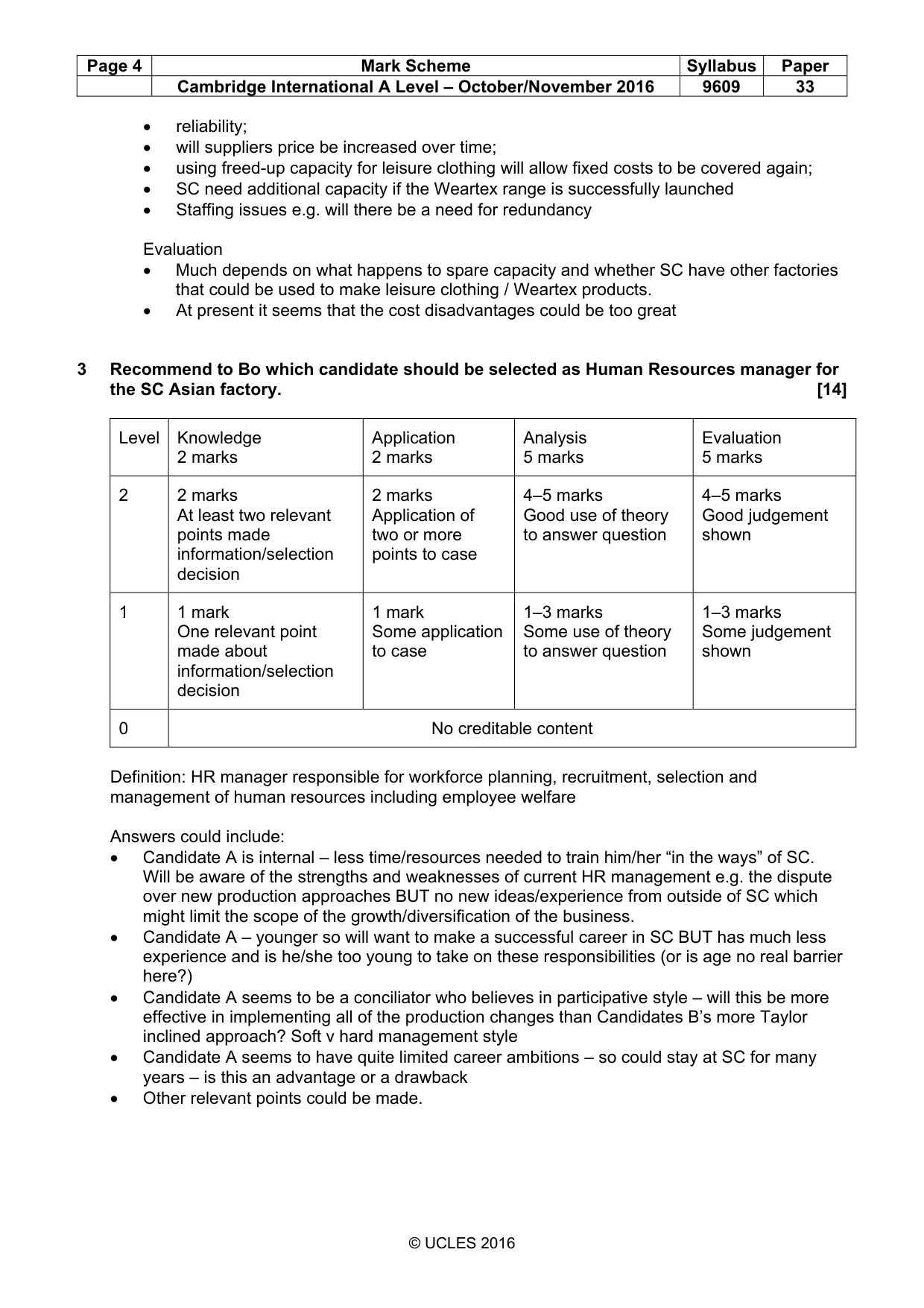
Page 4 Mark Scheme Syllabus Paper Cambridge International A Level – October/November 2016 9609 33 © UCLES 2016 • reliability; • will suppliers price be increased over time; • using freed-up capacity for leisure clothing will allow fixed costs to be covered again; • SC need additional capacity if the Weartex range is successfully launched • Staffing issues e.g. will there be a need for redundancy Evaluation • Much depends on what happens to spare capacity and whether SC have other factories that could be used to make leisure clothing / Weartex products. • At present it seems that the cost disadvantages could be too great 3 Recommend to Bo which candidate should be selected as Human Resources manager for the SC Asian factory. [14] Level Knowledge 2 marks Application 2 marks Analysis 5 marks Evaluation 5 marks 2 2 marks At least two relevant points made information/selection decision 2 marks Application of two or more points to case 4–5 marks Good use of theory to answer question 4–5 marks Good judgement shown 1 1 mark One relevant point made about information/selection decision 1 mark Some application to case 1–3 marks Some use of theory to answer question 1–3 marks Some judgement shown 0 No creditable content Definition: HR manager responsible for workforce planning, recruitment, selection and management of human resources including employee welfare Answers could include: • Candidate A is internal – less time/resources needed to train him/her “in the ways” of SC. Will be aware of the strengths and weaknesses of current HR management e.g. the dispute over new production approaches BUT no new ideas/experience from outside of SC which might limit the scope of the growth/diversification of the business. • Candidate A – younger so will want to make a successful career in SC BUT has much less experience and is he/she too young to take on these responsibilities (or is age no real barrier here?) • Candidate A seems to be a conciliator who believes in participative style – will this be more effective in implementing all of the production changes than Candidates B’s more Taylor inclined approach? Soft v hard management style • Candidate A seems to have quite limited career ambitions – so could stay at SC for many years – is this an advantage or a drawback • Other relevant points could be made.
Mark scheme, page 5
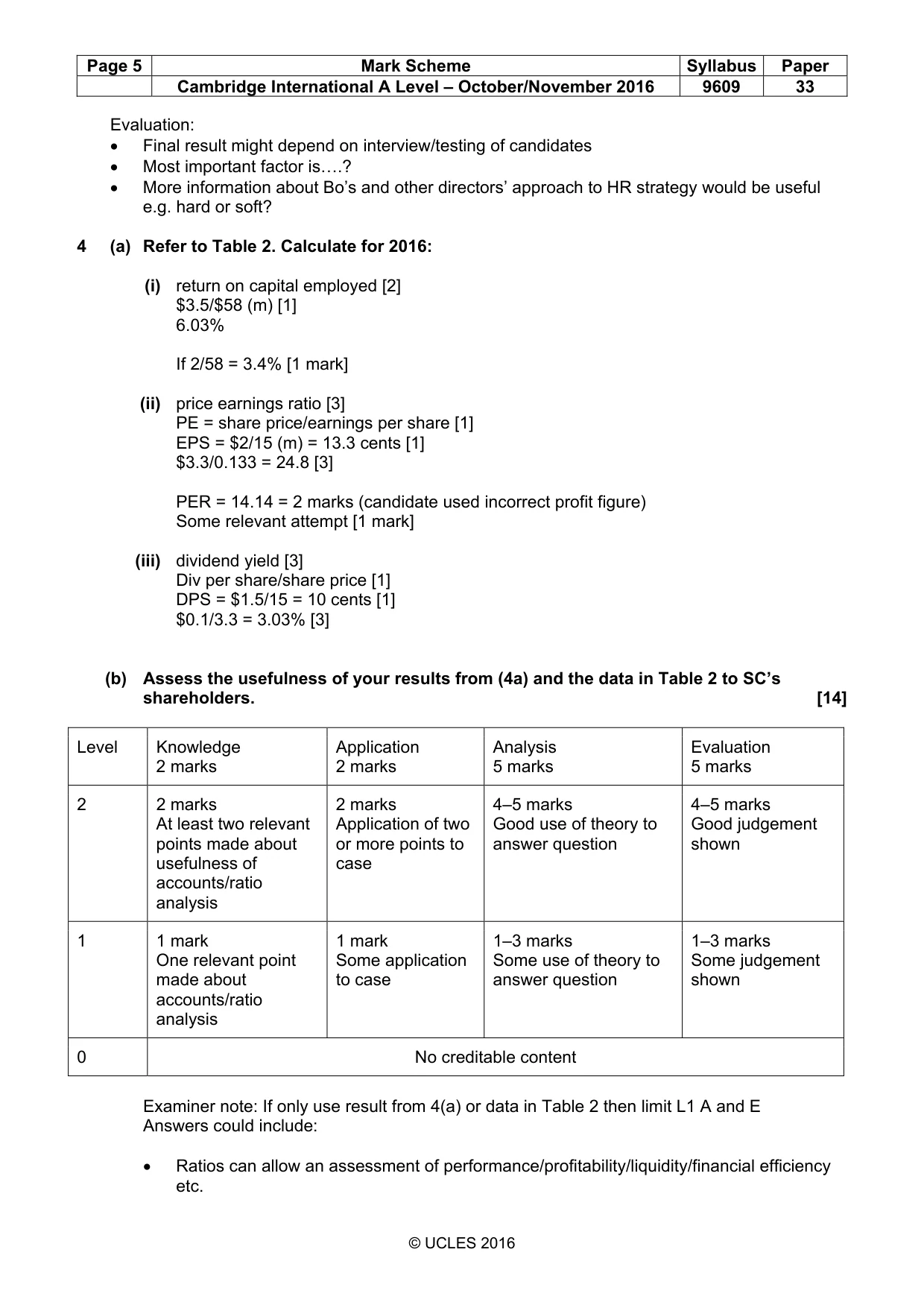
Page 5 Mark Scheme Syllabus Paper Cambridge International A Level – October/November 2016 9609 33 © UCLES 2016 Evaluation: • Final result might depend on interview/testing of candidates • Most important factor is….? • More information about Bo’s and other directors’ approach to HR strategy would be useful e.g. hard or soft? 4 (a) Refer to Table 2. Calculate for 2016: (i) return on capital employed [2] $3.5/$58 (m) [1] 6.03% If 2/58 = 3.4% [1 mark] (ii) price earnings ratio [3] PE = share price/earnings per share [1] EPS = $2/15 (m) = 13.3 cents [1] $3.3/0.133 = 24.8 [3] PER = 14.14 = 2 marks (candidate used incorrect profit figure) Some relevant attempt [1 mark] (iii) dividend yield [3] Div per share/share price [1] DPS = $1.5/15 = 10 cents [1] $0.1/3.3 = 3.03% [3] (b) Assess the usefulness of your results from (4a) and the data in Table 2 to SC’s shareholders. [14] Level Knowledge 2 marks Application 2 marks Analysis 5 marks Evaluation 5 marks 2 2 marks At least two relevant points made about usefulness of accounts/ratio analysis 2 marks Application of two or more points to case 4–5 marks Good use of theory to answer question 4–5 marks Good judgement shown 1 1 mark One relevant point made about accounts/ratio analysis 1 mark Some application to case 1–3 marks Some use of theory to answer question 1–3 marks Some judgement shown 0 No creditable content Examiner note: If only use result from 4(a) or data in Table 2 then limit L1 A and E Answers could include: • Ratios can allow an assessment of performance/profitability/liquidity/financial efficiency etc.
Mark scheme, page 6
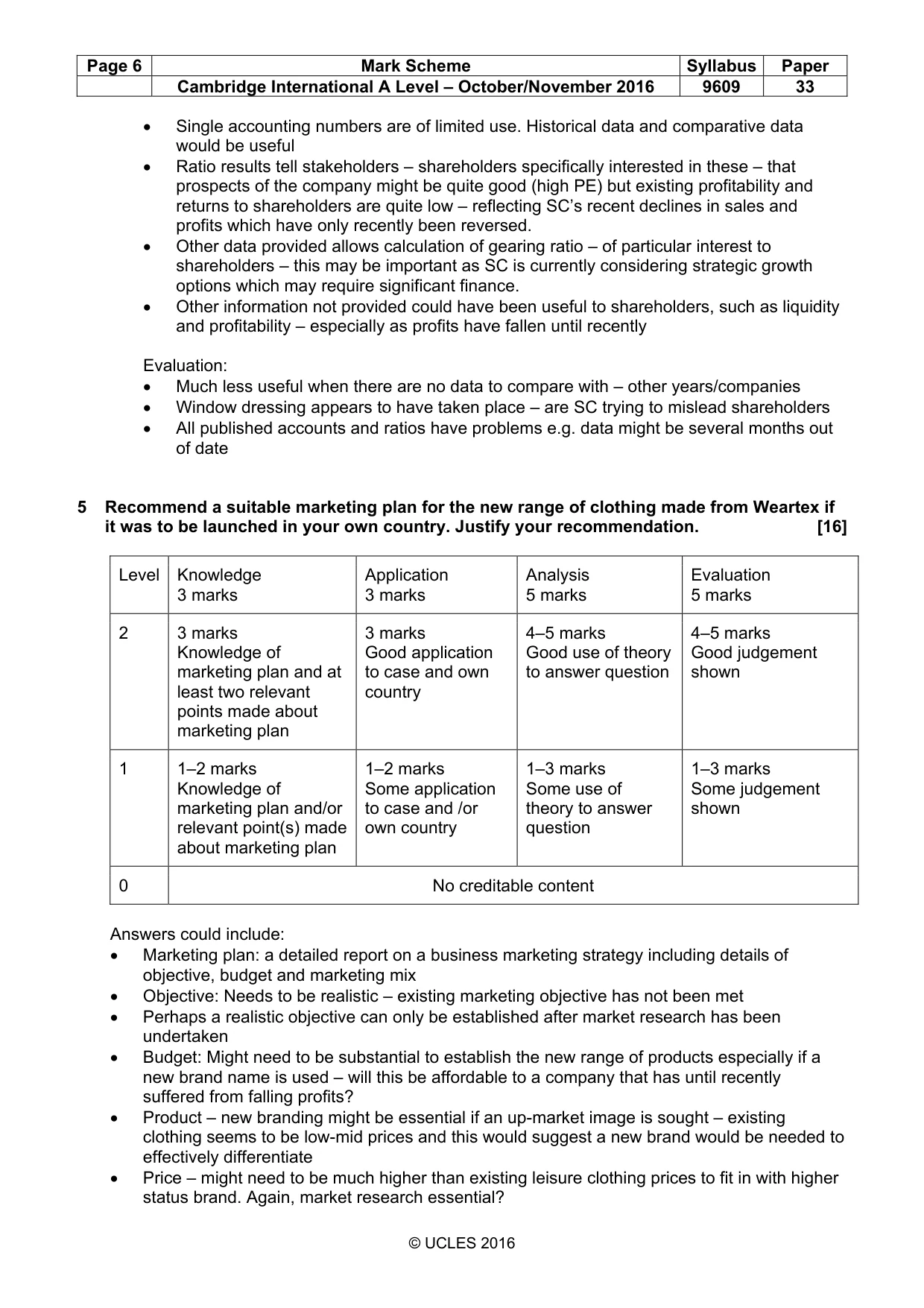
Page 6 Mark Scheme Syllabus Paper Cambridge International A Level – October/November 2016 9609 33 © UCLES 2016 • Single accounting numbers are of limited use. Historical data and comparative data would be useful • Ratio results tell stakeholders – shareholders specifically interested in these – that prospects of the company might be quite good (high PE) but existing profitability and returns to shareholders are quite low – reflecting SC’s recent declines in sales and profits which have only recently been reversed. • Other data provided allows calculation of gearing ratio – of particular interest to shareholders – this may be important as SC is currently considering strategic growth options which may require significant finance. • Other information not provided could have been useful to shareholders, such as liquidity and profitability – especially as profits have fallen until recently Evaluation: • Much less useful when there are no data to compare with – other years/companies • Window dressing appears to have taken place – are SC trying to mislead shareholders • All published accounts and ratios have problems e.g. data might be several months out of date 5 Recommend a suitable marketing plan for the new range of clothing made from Weartex if it was to be launched in your own country. Justify your recommendation. [16] Level Knowledge 3 marks Application 3 marks Analysis 5 marks Evaluation 5 marks 2 3 marks Knowledge of marketing plan and at least two relevant points made about marketing plan 3 marks Good application to case and own country 4–5 marks Good use of theory to answer question 4–5 marks Good judgement shown 1 1–2 marks Knowledge of marketing plan and/or relevant point(s) made about marketing plan 1–2 marks Some application to case and /or own country 1–3 marks Some use of theory to answer question 1–3 marks Some judgement shown 0 No creditable content Answers could include: • Marketing plan: a detailed report on a business marketing strategy including details of objective, budget and marketing mix • Objective: Needs to be realistic – existing marketing objective has not been met • Perhaps a realistic objective can only be established after market research has been undertaken • Budget: Might need to be substantial to establish the new range of products especially if a new brand name is used – will this be affordable to a company that has until recently suffered from falling profits? • Product – new branding might be essential if an up-market image is sought – existing clothing seems to be low-mid prices and this would suggest a new brand would be needed to effectively differentiate • Price – might need to be much higher than existing leisure clothing prices to fit in with higher status brand. Again, market research essential?
Mark scheme, page 7
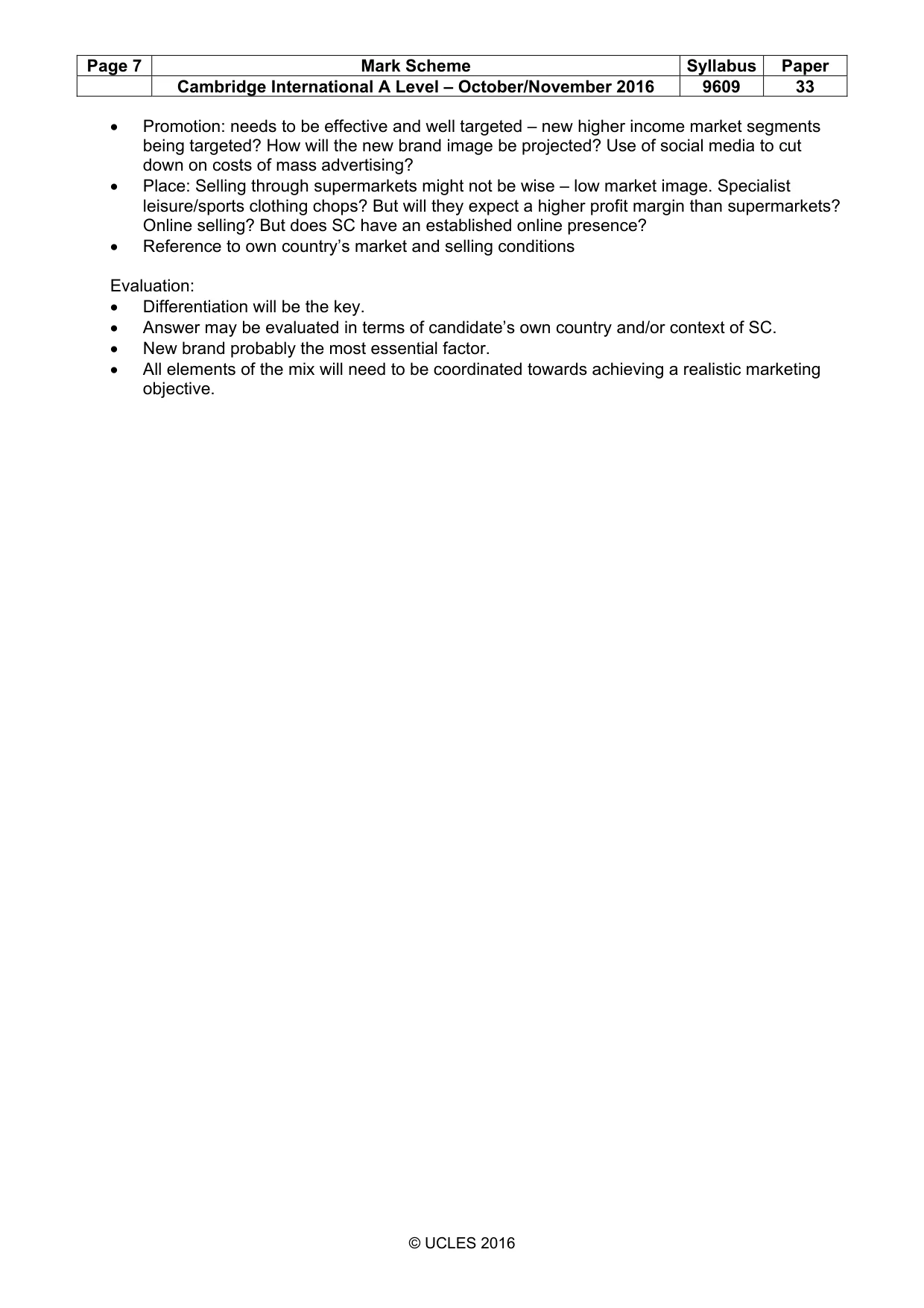
Page 7 Mark Scheme Syllabus Paper Cambridge International A Level – October/November 2016 9609 33 © UCLES 2016 • Promotion: needs to be effective and well targeted – new higher income market segments being targeted? How will the new brand image be projected? Use of social media to cut down on costs of mass advertising? • Place: Selling through supermarkets might not be wise – low market image. Specialist leisure/sports clothing chops? But will they expect a higher profit margin than supermarkets? Online selling? But does SC have an established online presence? • Reference to own country’s market and selling conditions Evaluation: • Differentiation will be the key. • Answer may be evaluated in terms of candidate’s own country and/or context of SC. • New brand probably the most essential factor. • All elements of the mix will need to be coordinated towards achieving a realistic marketing objective.
Mark scheme, page 8
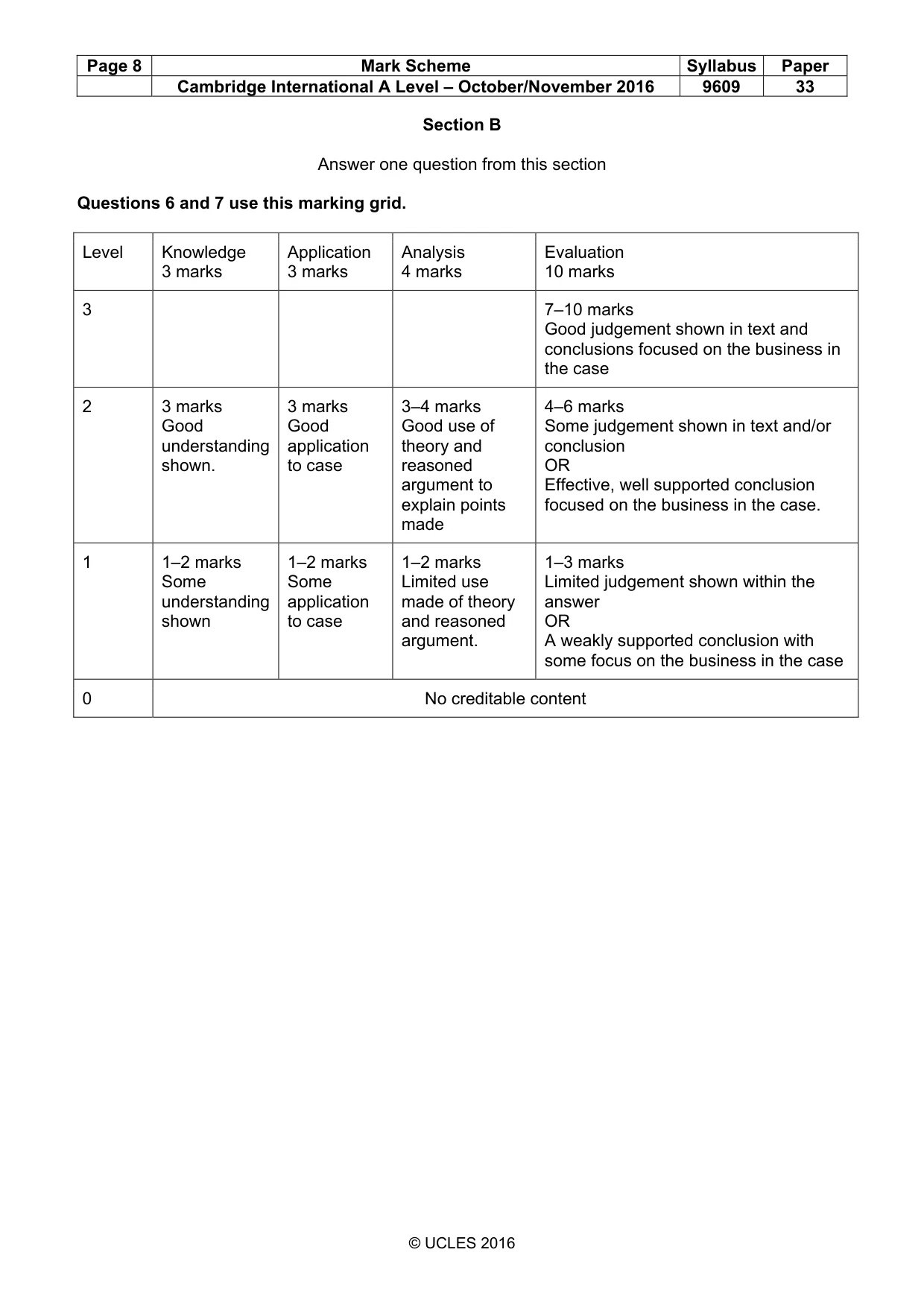
Page 8 Mark Scheme Syllabus Paper Cambridge International A Level – October/November 2016 9609 33 © UCLES 2016 Section B Answer one question from this section Questions 6 and 7 use this marking grid. Level Knowledge 3 marks Application 3 marks Analysis 4 marks Evaluation 10 marks 3 7–10 marks Good judgement shown in text and conclusions focused on the business in the case 2 3 marks Good understanding shown. 3 marks Good application to case 3–4 marks Good use of theory and reasoned argument to explain points made 4–6 marks Some judgement shown in text and/or conclusion OR Effective, well supported conclusion focused on the business in the case. 1 1–2 marks Some understanding shown 1–2 marks Some application to case 1–2 marks Limited use made of theory and reasoned argument. 1–3 marks Limited judgement shown within the answer OR A weakly supported conclusion with some focus on the business in the case 0 No creditable content
Mark scheme, page 9
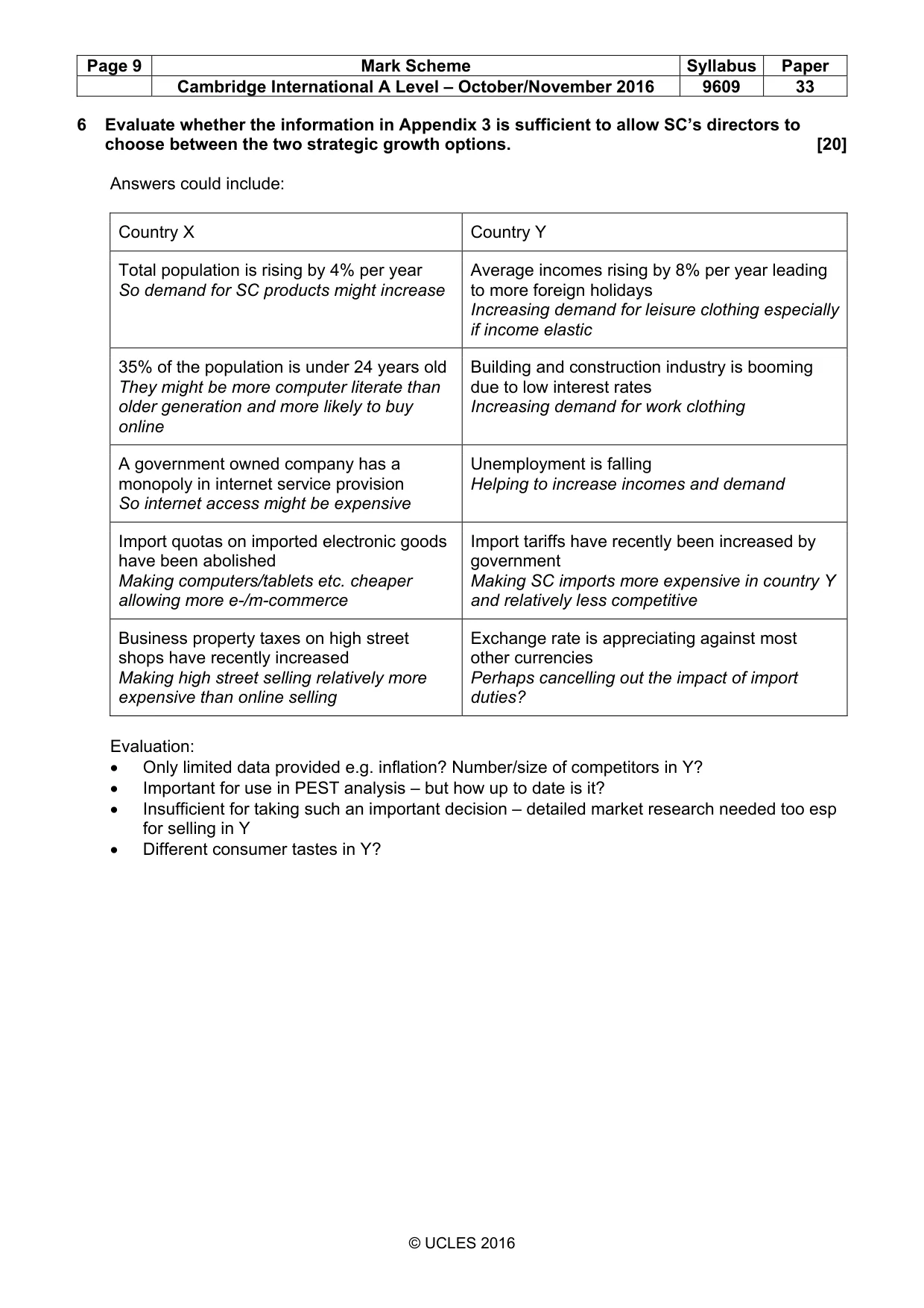
Page 9 Mark Scheme Syllabus Paper Cambridge International A Level – October/November 2016 9609 33 © UCLES 2016 6 Evaluate whether the information in Appendix 3 is sufficient to allow SC’s directors to choose between the two strategic growth options. [20] Answers could include: Country X Country Y Total population is rising by 4% per year So demand for SC products might increase Average incomes rising by 8% per year leading to more foreign holidays Increasing demand for leisure clothing especially if income elastic 35% of the population is under 24 years old They might be more computer literate than older generation and more likely to buy online Building and construction industry is booming due to low interest rates Increasing demand for work clothing A government owned company has a monopoly in internet service provision So internet access might be expensive Unemployment is falling Helping to increase incomes and demand Import quotas on imported electronic goods have been abolished Making computers/tablets etc. cheaper allowing more e-/m-commerce Import tariffs have recently been increased by government Making SC imports more expensive in country Y and relatively less competitive Business property taxes on high street shops have recently increased Making high street selling relatively more expensive than online selling Exchange rate is appreciating against most other currencies Perhaps cancelling out the impact of import duties? Evaluation: • Only limited data provided e.g. inflation? Number/size of competitors in Y? • Important for use in PEST analysis – but how up to date is it? • Insufficient for taking such an important decision – detailed market research needed too esp for selling in Y • Different consumer tastes in Y?
Mark scheme, page 10
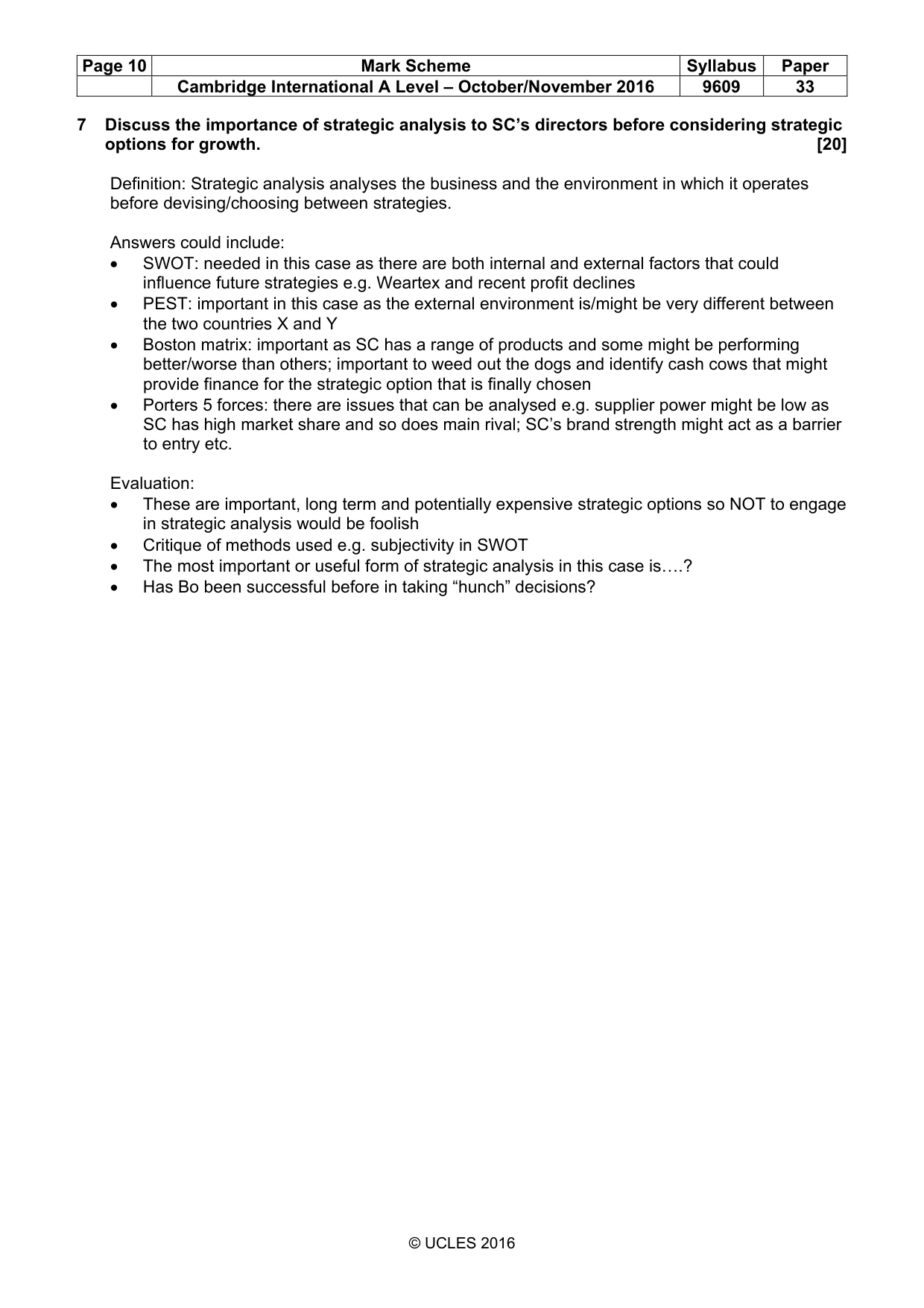
Page 10 Mark Scheme Syllabus Paper Cambridge International A Level – October/November 2016 9609 33 © UCLES 2016 7 Discuss the importance of strategic analysis to SC’s directors before considering strategic options for growth. [20] Definition: Strategic analysis analyses the business and the environment in which it operates before devising/choosing between strategies. Answers could include: • SWOT: needed in this case as there are both internal and external factors that could influence future strategies e.g. Weartex and recent profit declines • PEST: important in this case as the external environment is/might be very different between the two countries X and Y • Boston matrix: important as SC has a range of products and some might be performing better/worse than others; important to weed out the dogs and identify cash cows that might provide finance for the strategic option that is finally chosen • Porters 5 forces: there are issues that can be analysed e.g. supplier power might be low as SC has high market share and so does main rival; SC’s brand strength might act as a barrier to entry etc. Evaluation: • These are important, long term and potentially expensive strategic options so NOT to engage in strategic analysis would be foolish • Critique of methods used e.g. subjectivity in SWOT • The most important or useful form of strategic analysis in this case is….? • Has Bo been successful before in taking “hunch” decisions?
What you needed in this session
Cambridge’s own grade thresholds for 2016 Oct/Nov, Paper 3 · Variant 3. A higher threshold means an easier paper — the bar moves with how the cohort did.