Cambridge A Level Business (for first examination in 2016) 9609 — 2016 Oct/Nov Paper 3 · Variant 1
9609/31/O/N/16 · 100 marks · ≈113 min
The question paper and its mark scheme, free to read here and free to download. This is Cambridge’s own paper, exactly as it was sat.
Question paper8 pages


Mark scheme12 pages
Answers below. Sit the paper first if you are practising.

Paper as text
Question paper, page 1
This document consists of 6 printed pages, 2 blank pages and 1 Insert. DC (NF) 125605/2 © UCLES 2016 [Turn over Cambridge International Examinations Cambridge International Advanced Subsidiary and Advanced Level * 8 3 3 3 4 2 7 2 2 1 * BUSINESS 9609/31 Paper 3 Case Study October/November 2016 3 hours No Additional Materials are required. READ THESE INSTRUCTIONS FIRST An answer booklet is provided inside this question paper. You should follow the instructions on the front cover of the answer booklet. If you need additional answer paper ask the invigilator for a continuation booklet. Section A Answer all questions. Section B Answer one question. You are advised to spend no more than 40 minutes on Section B. The businesses described in this paper are entirely fictitious. The number of marks is given in brackets [ ] at the end of each question or part question.
Question paper, page 2
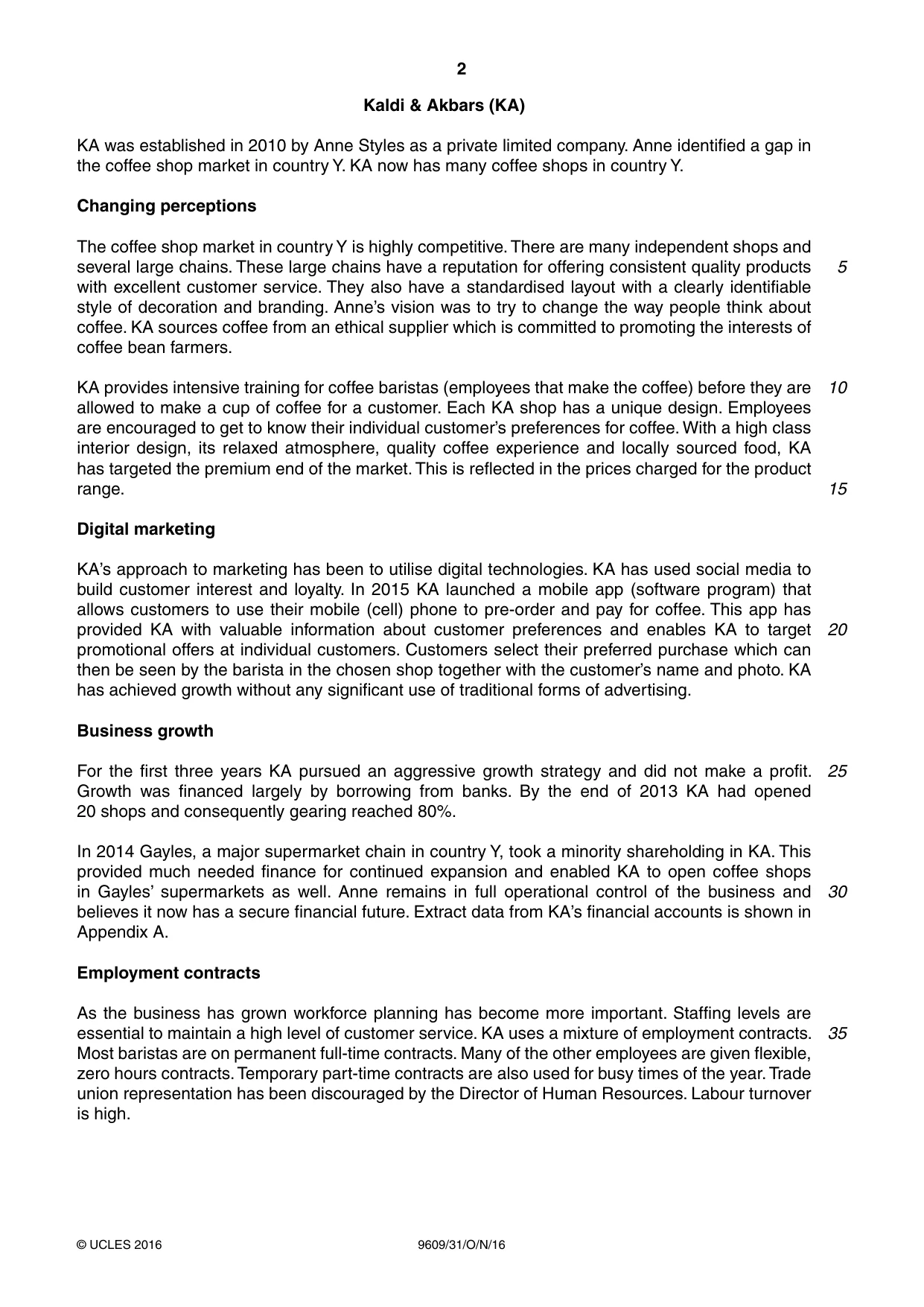
2 9609/31/O/N/16 © UCLES 2016 Kaldi & Akbars (KA) KA was established in 2010 by Anne Styles as a private limited company. Anne identified a gap in the coffee shop market in country Y. KA now has many coffee shops in country Y. Changing perceptions The coffee shop market in country Y is highly competitive. There are many independent shops and several large chains. These large chains have a reputation for offering consistent quality products with excellent customer service. They also have a standardised layout with a clearly identifiable style of decoration and branding. Anne’s vision was to try to change the way people think about coffee. KA sources coffee from an ethical supplier which is committed to promoting the interests of coffee bean farmers. KA provides intensive training for coffee baristas (employees that make the coffee) before they are allowed to make a cup of coffee for a customer. Each KA shop has a unique design. Employees are encouraged to get to know their individual customer’s preferences for coffee. With a high class interior design, its relaxed atmosphere, quality coffee experience and locally sourced food, KA has targeted the premium end of the market. This is reflected in the prices charged for the product range. Digital marketing KA’s approach to marketing has been to utilise digital technologies. KA has used social media to build customer interest and loyalty. In 2015 KA launched a mobile app (software program) that allows customers to use their mobile (cell) phone to pre-order and pay for coffee. This app has provided KA with valuable information about customer preferences and enables KA to target promotional offers at individual customers. Customers select their preferred purchase which can then be seen by the barista in the chosen shop together with the customer’s name and photo. KA has achieved growth without any significant use of traditional forms of advertising. Business growth For the first three years KA pursued an aggressive growth strategy and did not make a profit. Growth was financed largely by borrowing from banks. By the end of 2013 KA had opened 20 shops and consequently gearing reached 80%. In 2014 Gayles, a major supermarket chain in country Y, took a minority shareholding in KA. This provided much needed finance for continued expansion and enabled KA to open coffee shops in Gayles’ supermarkets as well. Anne remains in full operational control of the business and believes it now has a secure financial future. Extract data from KA’s financial accounts is shown in Appendix A. Employment contracts As the business has grown workforce planning has become more important. Staffing levels are essential to maintain a high level of customer service. KA uses a mixture of employment contracts. Most baristas are on permanent full-time contracts. Many of the other employees are given flexible, zero hours contracts. Temporary part-time contracts are also used for busy times of the year. Trade union representation has been discouraged by the Director of Human Resources. Labour turnover is high. 5 10 15 20 25 30 35
Question paper, page 3
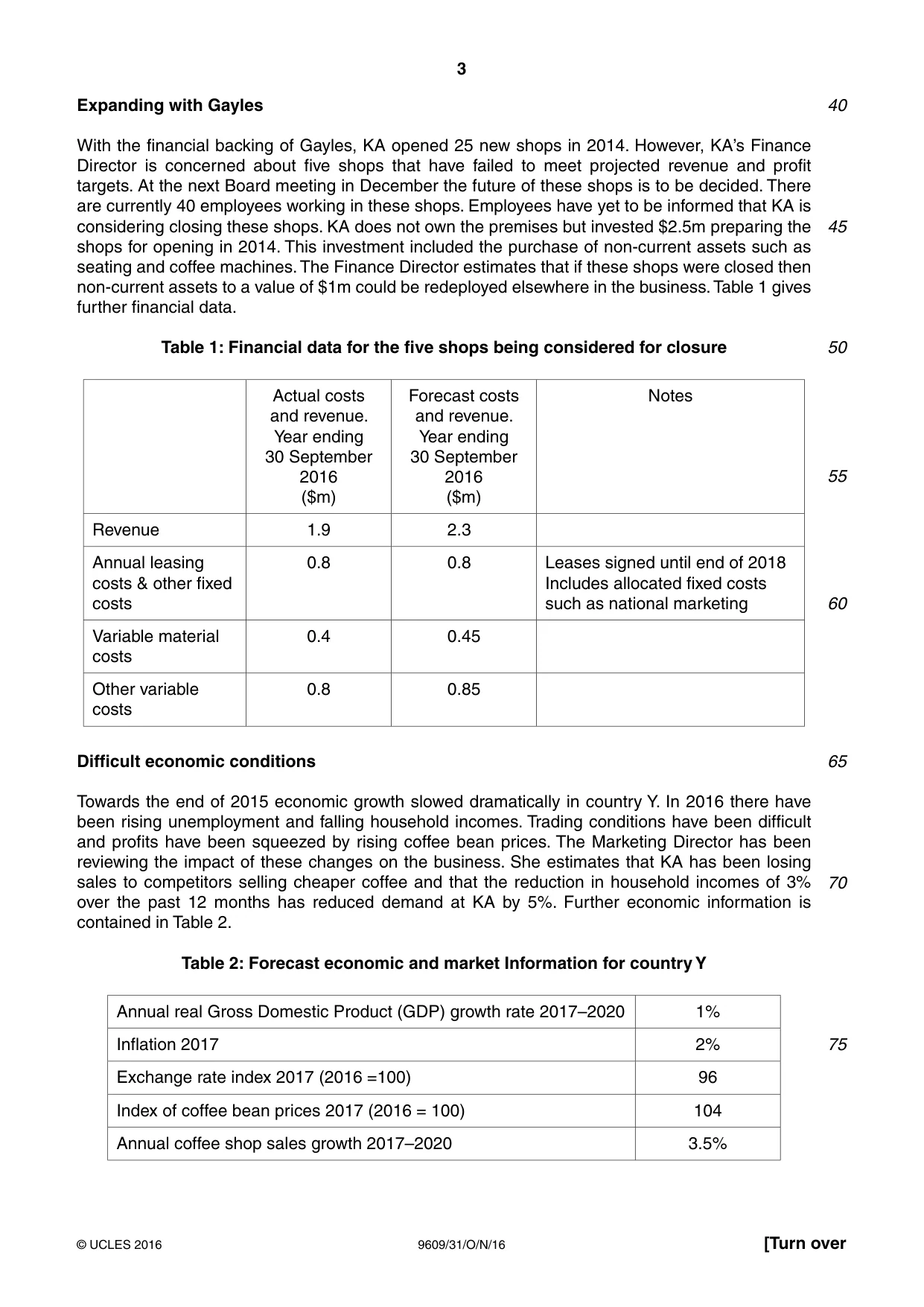
3 9609/31/O/N/16 © UCLES 2016 [Turn over Expanding with Gayles With the financial backing of Gayles, KA opened 25 new shops in 2014. However, KA’s Finance Director is concerned about five shops that have failed to meet projected revenue and profit targets. At the next Board meeting in December the future of these shops is to be decided. There are currently 40 employees working in these shops. Employees have yet to be informed that KA is considering closing these shops. KA does not own the premises but invested $2.5m preparing the shops for opening in 2014. This investment included the purchase of non-current assets such as seating and coffee machines. The Finance Director estimates that if these shops were closed then non-current assets to a value of $1m could be redeployed elsewhere in the business. Table 1 gives further financial data. Table 1: Financial data for the five shops being considered for closure Actual costs and revenue. Year ending 30 September 2016 ($m) Forecast costs and revenue. Year ending 30 September 2016 ($m) Notes Revenue 1.9 2.3 Annual leasing costs & other fixed costs 0.8 0.8 Leases signed until end of 2018 Includes allocated fixed costs such as national marketing Variable material costs 0.4 0.45 Other variable costs 0.8 0.85 Difficult economic conditions Towards the end of 2015 economic growth slowed dramatically in country Y. In 2016 there have been rising unemployment and falling household incomes. Trading conditions have been difficult and profits have been squeezed by rising coffee bean prices. The Marketing Director has been reviewing the impact of these changes on the business. She estimates that KA has been losing sales to competitors selling cheaper coffee and that the reduction in household incomes of 3% over the past 12 months has reduced demand at KA by 5%. Further economic information is contained in Table 2. Table 2: Forecast economic and market Information for country Y Annual real Gross Domestic Product (GDP) growth rate 2017–2020 1% Inflation 2017 2% Exchange rate index 2017 (2016 =100) 96 Index of coffee bean prices 2017 (2016 = 100) 104 Annual coffee shop sales growth 2017–2020 3.5% 40 45 50 55 60 65 70 75
Question paper, page 4
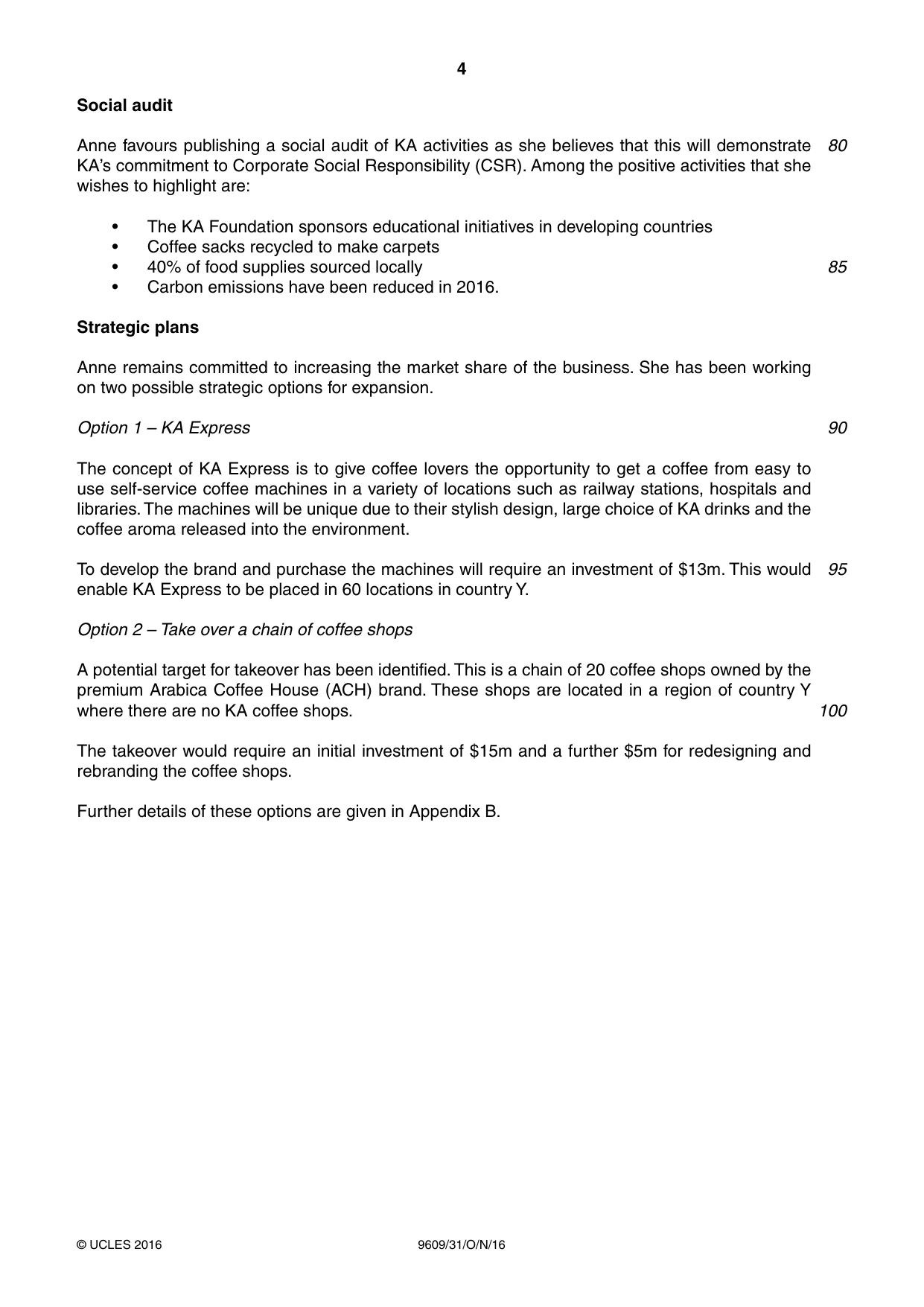
4 9609/31/O/N/16 © UCLES 2016 Social audit Anne favours publishing a social audit of KA activities as she believes that this will demonstrate KA’s commitment to Corporate Social Responsibility (CSR). Among the positive activities that she wishes to highlight are: • The KA Foundation sponsors educational initiatives in developing countries • Coffee sacks recycled to make carpets • 40% of food supplies sourced locally • Carbon emissions have been reduced in 2016. Strategic plans Anne remains committed to increasing the market share of the business. She has been working on two possible strategic options for expansion. Option 1 – KA Express The concept of KA Express is to give coffee lovers the opportunity to get a coffee from easy to use self-service coffee machines in a variety of locations such as railway stations, hospitals and libraries. The machines will be unique due to their stylish design, large choice of KA drinks and the coffee aroma released into the environment. To develop the brand and purchase the machines will require an investment of $13m. This would enable KA Express to be placed in 60 locations in country Y. Option 2 – Take over a chain of coffee shops A potential target for takeover has been identified. This is a chain of 20 coffee shops owned by the premium Arabica Coffee House (ACH) brand. These shops are located in a region of country Y where there are no KA coffee shops. The takeover would require an initial investment of $15m and a further $5m for redesigning and rebranding the coffee shops. Further details of these options are given in Appendix B. 80 85 90 95 100
Question paper, page 5
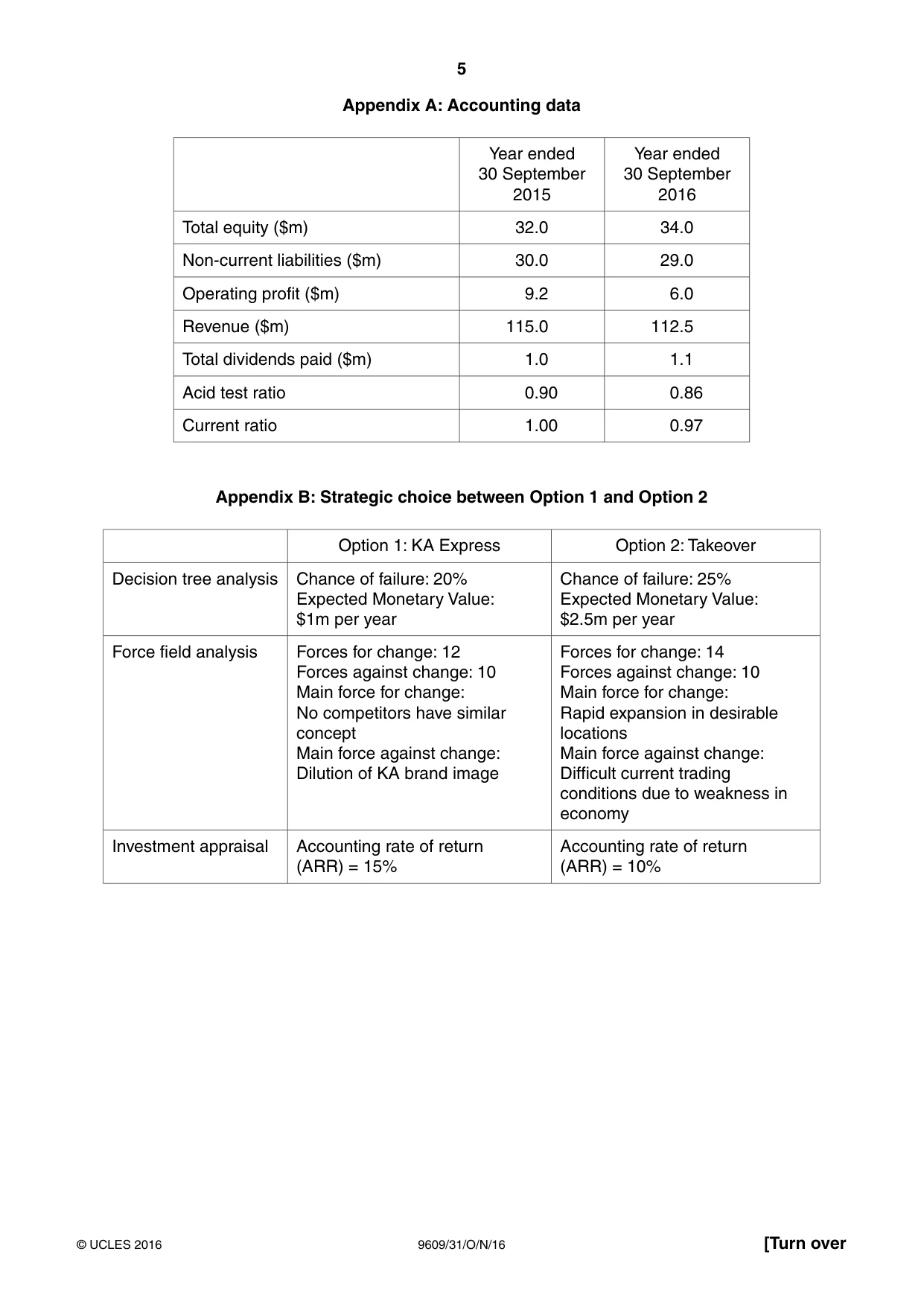
5 9609/31/O/N/16 © UCLES 2016 [Turn over Appendix A: Accounting data Year ended 30 September 2015 Year ended 30 September 2016 Total equity ($m) 32.0 34.0 Non-current liabilities ($m) 30.0 29.0 Operating profit ($m) 9.2 6.0 Revenue ($m) 115.0 112.5 Total dividends paid ($m) 1.0 1.1 Acid test ratio 0.90 0.86 Current ratio 1.00 0.97 Appendix B: Strategic choice between Option 1 and Option 2 Option 1: KA Express Option 2: Takeover Decision tree analysis Chance of failure: 20% Expected Monetary Value: $1m per year Chance of failure: 25% Expected Monetary Value: $2.5m per year Force field analysis Forces for change: 12 Forces against change: 10 Main force for change: No competitors have similar concept Main force against change: Dilution of KA brand image Forces for change: 14 Forces against change: 10 Main force for change: Rapid expansion in desirable locations Main force against change: Difficult current trading conditions due to weakness in economy Investment appraisal Accounting rate of return (ARR) = 15% Accounting rate of return (ARR) = 10%
Question paper, page 6
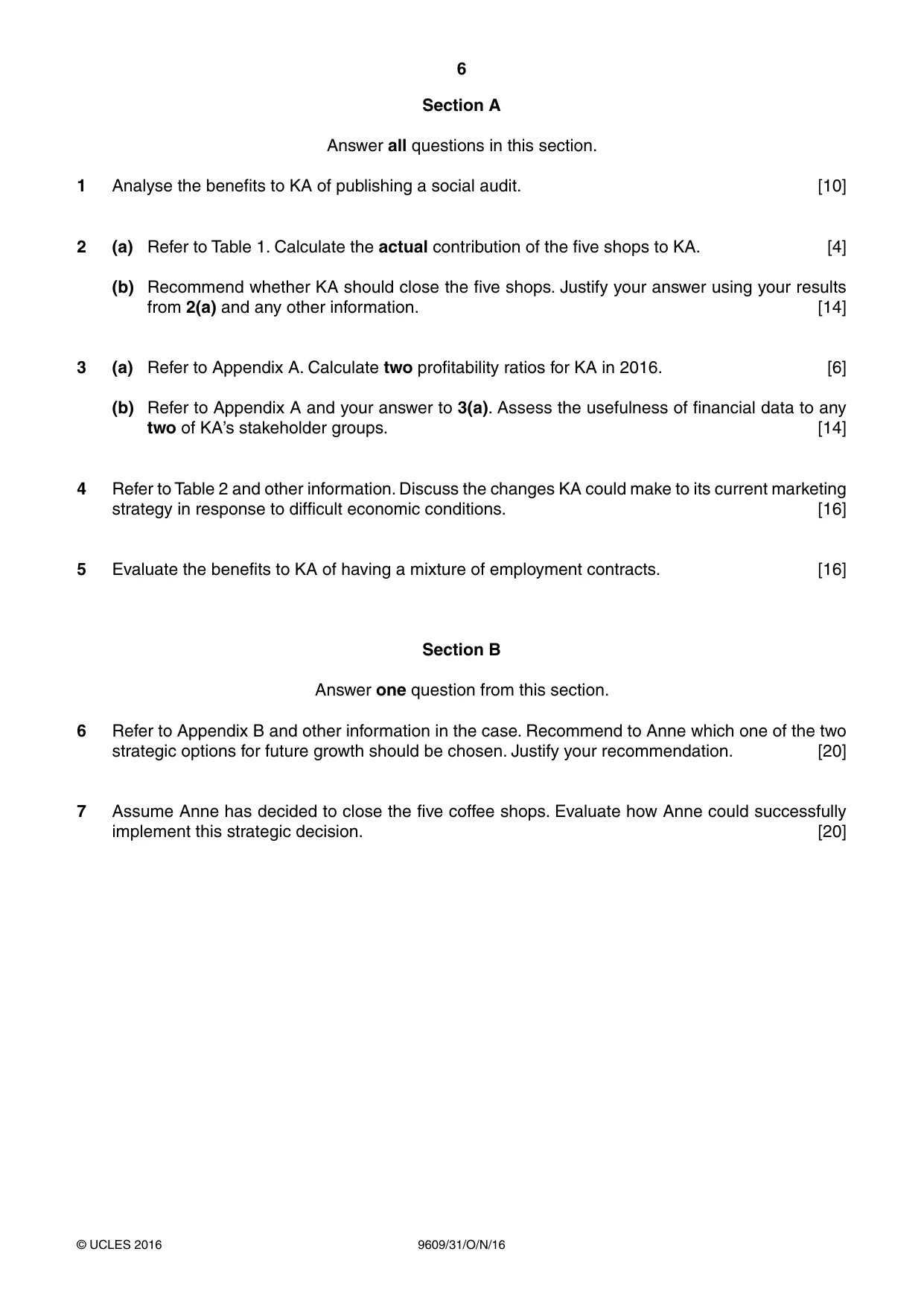
6 9609/31/O/N/16 © UCLES 2016 Section A Answer all questions in this section. 1 Analyse the benefits to KA of publishing a social audit. [10] 2 (a) Refer to Table 1. Calculate the actual contribution of the five shops to KA. [4] (b) Recommend whether KA should close the five shops. Justify your answer using your results from 2(a) and any other information. [14] 3 (a) Refer to Appendix A. Calculate two profitability ratios for KA in 2016. [6] (b) Refer to Appendix A and your answer to 3(a). Assess the usefulness of financial data to any two of KA’s stakeholder groups. [14] 4 Refer to Table 2 and other information. Discuss the changes KA could make to its current marketing strategy in response to difficult economic conditions. [16] 5 Evaluate the benefits to KA of having a mixture of employment contracts. [16] Section B Answer one question from this section. 6 Refer to Appendix B and other information in the case. Recommend to Anne which one of the two strategic options for future growth should be chosen. Justify your recommendation. [20] 7 Assume Anne has decided to close the five coffee shops. Evaluate how Anne could successfully implement this strategic decision. [20]
Question paper, page 7
7 9609/31/O/N/16 © UCLES 2016 BLANK PAGE
Question paper, page 8
8 9609/31/O/N/16 © UCLES 2016 BLANK PAGE Permission to reproduce items where third-party owned material protected by copyright is included has been sought and cleared where possible. Every reasonable effort has been made by the publisher (UCLES) to trace copyright holders, but if any items requiring clearance have unwittingly been included, the publisher will be pleased to make amends at the earliest possible opportunity. To avoid the issue of disclosure of answer-related information to candidates, all copyright acknowledgements are reproduced online in the Cambridge International Examinations Copyright Acknowledgements Booklet. This is produced for each series of examinations and is freely available to download at www.cie.org.uk after the live examination series. Cambridge International Examinations is part of the Cambridge Assessment Group. Cambridge Assessment is the brand name of University of Cambridge Local Examinations Syndicate (UCLES), which is itself a department of the University of Cambridge.
Mark scheme, page 1
® IGCSE is the registered trademark of Cambridge International Examinations. This document consists of 12 printed pages. © UCLES 2016 [Turn over Cambridge International Examinations Cambridge International Advanced Level BUSINESS 9609/31 Paper 3 Case Study October/November 2016 MARK SCHEME Maximum Mark: 100 Published This mark scheme is published as an aid to teachers and candidates, to indicate the requirements of the examination. It shows the basis on which Examiners were instructed to award marks. It does not indicate the details of the discussions that took place at an Examiners’ meeting before marking began, which would have considered the acceptability of alternative answers. Mark schemes should be read in conjunction with the question paper and the Principal Examiner Report for Teachers. Cambridge will not enter into discussions about these mark schemes. Cambridge is publishing the mark schemes for the October/November 2016 series for most Cambridge IGCSE®, Cambridge International A and AS Level components and some Cambridge O Level components.
Mark scheme, page 2
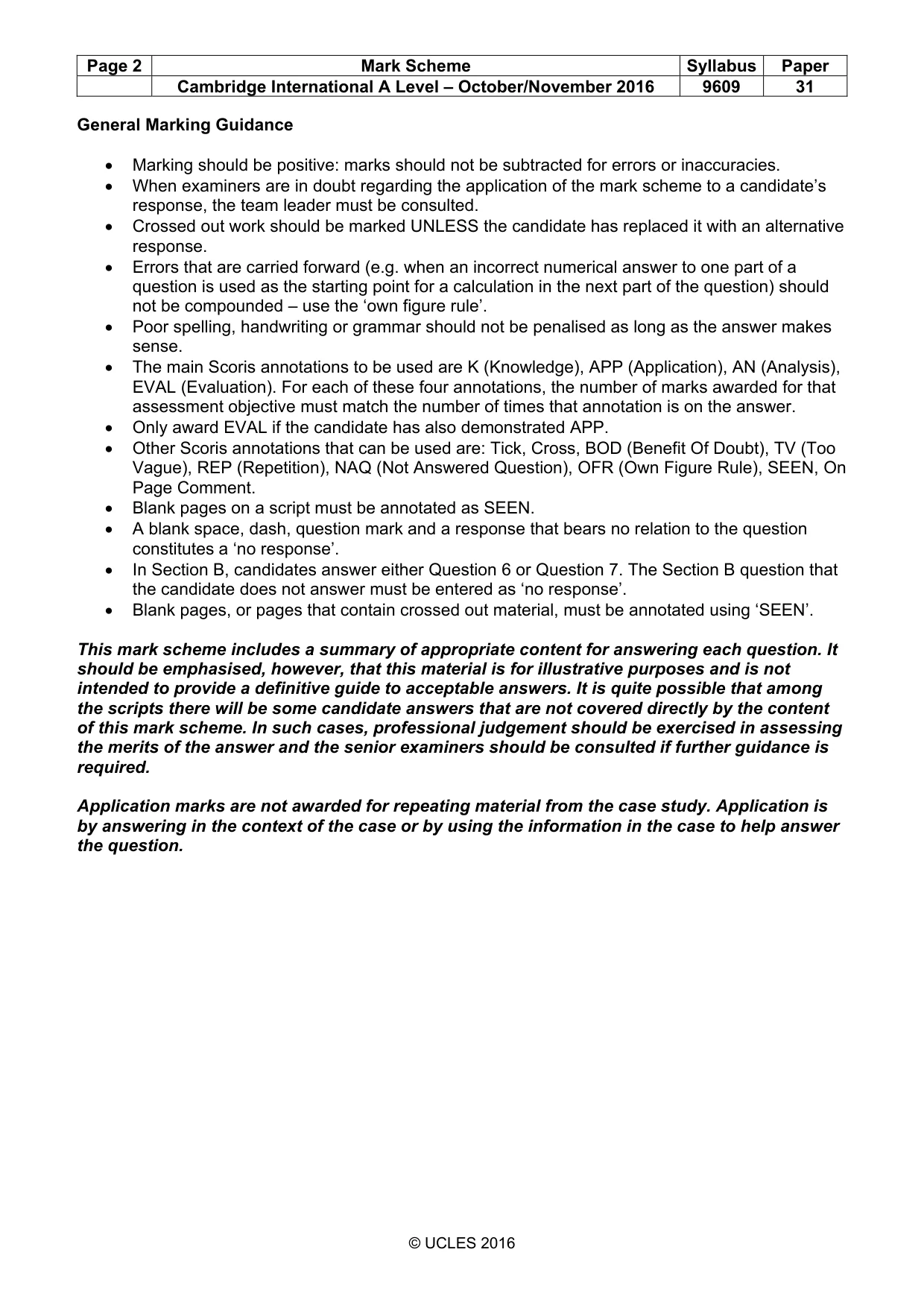
Page 2 Mark Scheme Syllabus Paper Cambridge International A Level – October/November 2016 9609 31 © UCLES 2016 General Marking Guidance • Marking should be positive: marks should not be subtracted for errors or inaccuracies. • When examiners are in doubt regarding the application of the mark scheme to a candidate’s response, the team leader must be consulted. • Crossed out work should be marked UNLESS the candidate has replaced it with an alternative response. • Errors that are carried forward (e.g. when an incorrect numerical answer to one part of a question is used as the starting point for a calculation in the next part of the question) should not be compounded – use the ‘own figure rule’. • Poor spelling, handwriting or grammar should not be penalised as long as the answer makes sense. • The main Scoris annotations to be used are K (Knowledge), APP (Application), AN (Analysis), EVAL (Evaluation). For each of these four annotations, the number of marks awarded for that assessment objective must match the number of times that annotation is on the answer. • Only award EVAL if the candidate has also demonstrated APP. • Other Scoris annotations that can be used are: Tick, Cross, BOD (Benefit Of Doubt), TV (Too Vague), REP (Repetition), NAQ (Not Answered Question), OFR (Own Figure Rule), SEEN, On Page Comment. • Blank pages on a script must be annotated as SEEN. • A blank space, dash, question mark and a response that bears no relation to the question constitutes a ‘no response’. • In Section B, candidates answer either Question 6 or Question 7. The Section B question that the candidate does not answer must be entered as ‘no response’. • Blank pages, or pages that contain crossed out material, must be annotated using ‘SEEN’. This mark scheme includes a summary of appropriate content for answering each question. It should be emphasised, however, that this material is for illustrative purposes and is not intended to provide a definitive guide to acceptable answers. It is quite possible that among the scripts there will be some candidate answers that are not covered directly by the content of this mark scheme. In such cases, professional judgement should be exercised in assessing the merits of the answer and the senior examiners should be consulted if further guidance is required. Application marks are not awarded for repeating material from the case study. Application is by answering in the context of the case or by using the information in the case to help answer the question.
Mark scheme, page 3
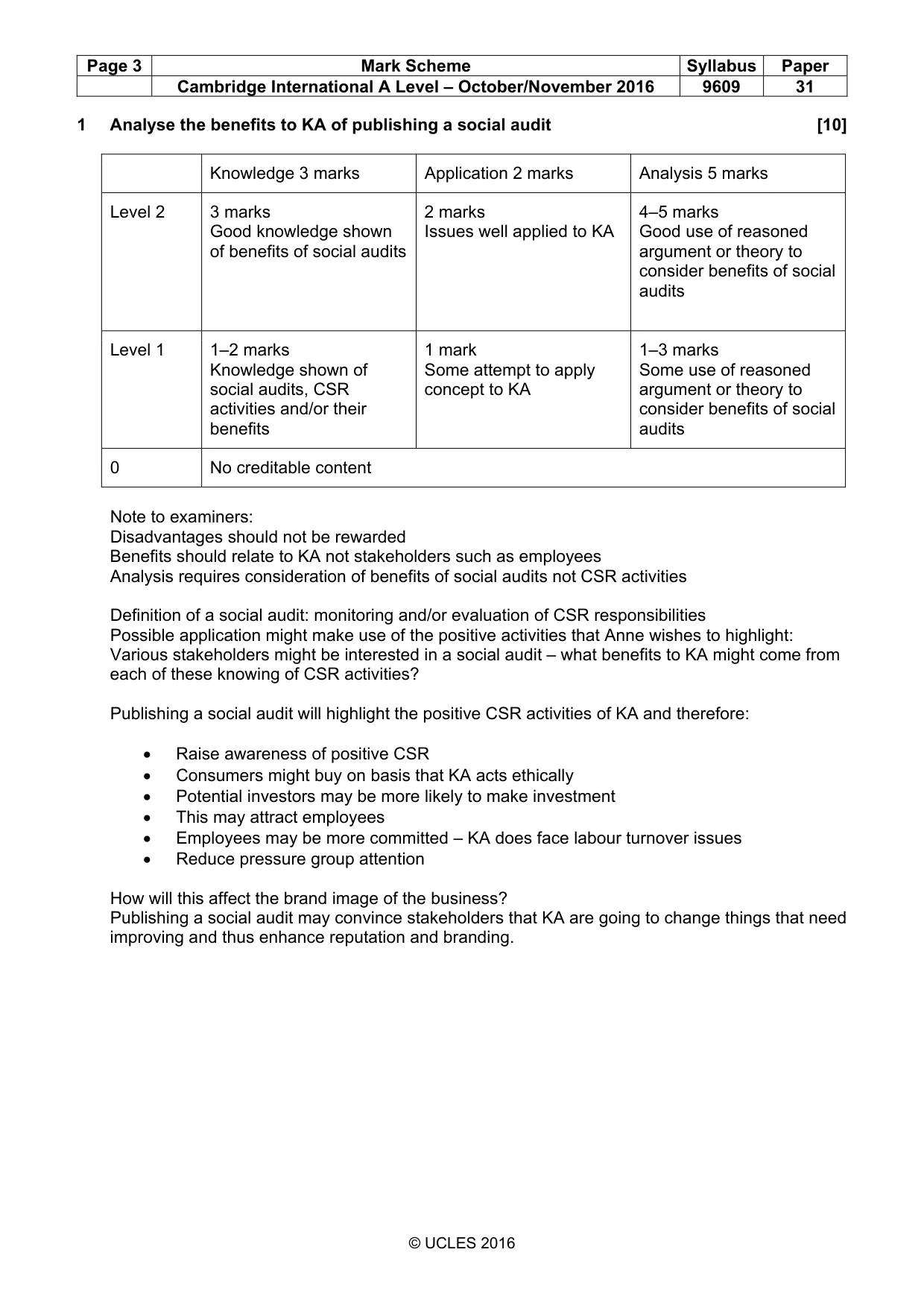
Page 3 Mark Scheme Syllabus Paper Cambridge International A Level – October/November 2016 9609 31 © UCLES 2016 1 Analyse the benefits to KA of publishing a social audit [10] Knowledge 3 marks Application 2 marks Analysis 5 marks Level 2 3 marks Good knowledge shown of benefits of social audits 2 marks Issues well applied to KA 4–5 marks Good use of reasoned argument or theory to consider benefits of social audits Level 1 1–2 marks Knowledge shown of social audits, CSR activities and/or their benefits 1 mark Some attempt to apply concept to KA 1–3 marks Some use of reasoned argument or theory to consider benefits of social audits 0 No creditable content Note to examiners: Disadvantages should not be rewarded Benefits should relate to KA not stakeholders such as employees Analysis requires consideration of benefits of social audits not CSR activities Definition of a social audit: monitoring and/or evaluation of CSR responsibilities Possible application might make use of the positive activities that Anne wishes to highlight: Various stakeholders might be interested in a social audit – what benefits to KA might come from each of these knowing of CSR activities? Publishing a social audit will highlight the positive CSR activities of KA and therefore: • Raise awareness of positive CSR • Consumers might buy on basis that KA acts ethically • Potential investors may be more likely to make investment • This may attract employees • Employees may be more committed – KA does face labour turnover issues • Reduce pressure group attention How will this affect the brand image of the business? Publishing a social audit may convince stakeholders that KA are going to change things that need improving and thus enhance reputation and branding.
Mark scheme, page 4
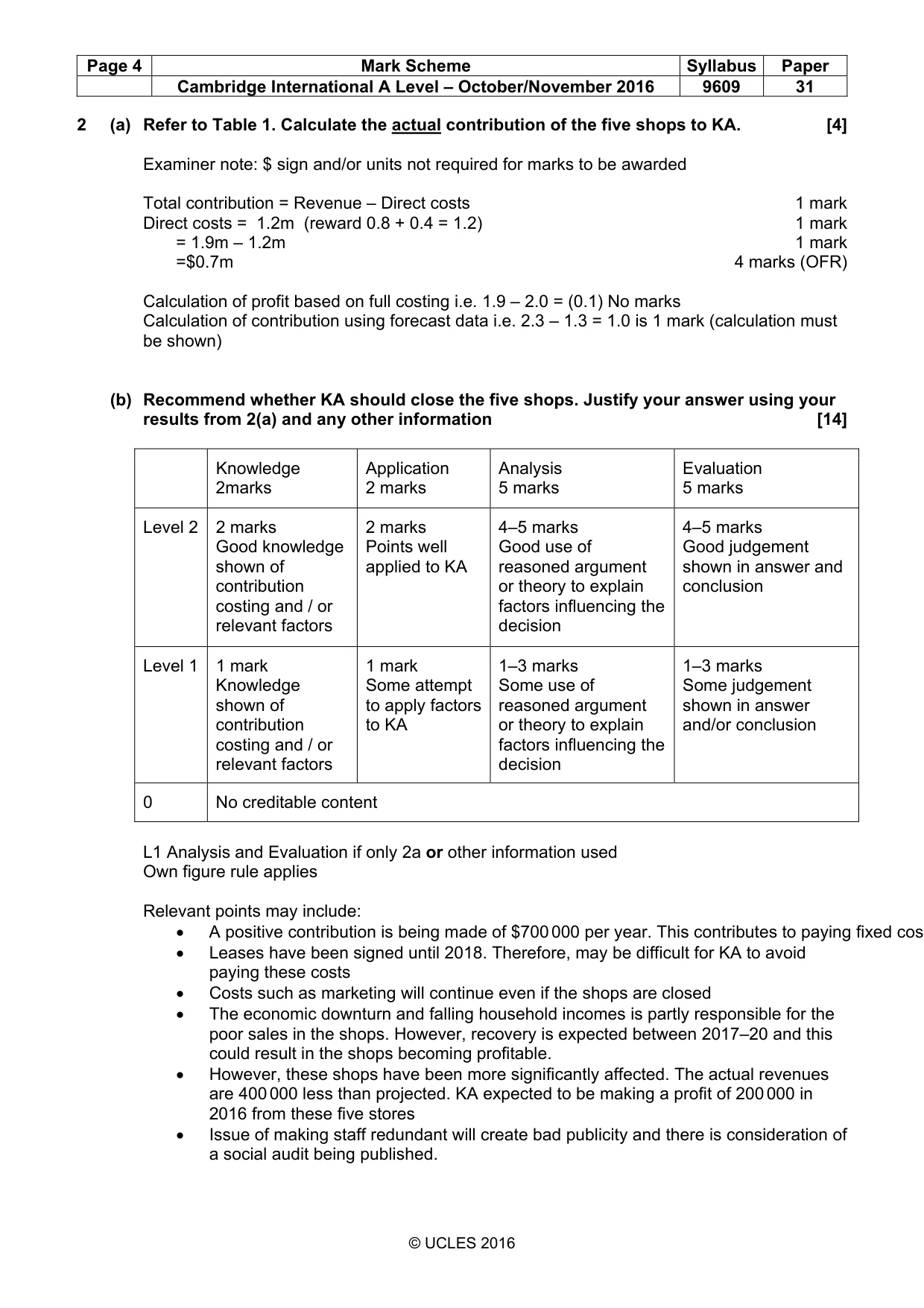
Page 4 Mark Scheme Syllabus Paper Cambridge International A Level – October/November 2016 9609 31 © UCLES 2016 2 (a) Refer to Table 1. Calculate the actual contribution of the five shops to KA. [4] Examiner note: $ sign and/or units not required for marks to be awarded Total contribution = Revenue – Direct costs 1 mark Direct costs = 1.2m (reward 0.8 + 0.4 = 1.2) 1 mark = 1.9m – 1.2m 1 mark =$0.7m 4 marks (OFR) Calculation of profit based on full costing i.e. 1.9 – 2.0 = (0.1) No marks Calculation of contribution using forecast data i.e. 2.3 – 1.3 = 1.0 is 1 mark (calculation must be shown) (b) Recommend whether KA should close the five shops. Justify your answer using your results from 2(a) and any other information [14] Knowledge 2marks Application 2 marks Analysis 5 marks Evaluation 5 marks Level 2 2 marks Good knowledge shown of contribution costing and / or relevant factors 2 marks Points well applied to KA 4–5 marks Good use of reasoned argument or theory to explain factors influencing the decision 4–5 marks Good judgement shown in answer and conclusion Level 1 1 mark Knowledge shown of contribution costing and / or relevant factors 1 mark Some attempt to apply factors to KA 1–3 marks Some use of reasoned argument or theory to explain factors influencing the decision 1–3 marks Some judgement shown in answer and/or conclusion 0 No creditable content L1 Analysis and Evaluation if only 2a or other information used Own figure rule applies Relevant points may include: • A positive contribution is being made of $700 000 per year. This contributes to paying fixed cos • Leases have been signed until 2018. Therefore, may be difficult for KA to avoid paying these costs • Costs such as marketing will continue even if the shops are closed • The economic downturn and falling household incomes is partly responsible for the poor sales in the shops. However, recovery is expected between 2017–20 and this could result in the shops becoming profitable. • However, these shops have been more significantly affected. The actual revenues are 400 000 less than projected. KA expected to be making a profit of 200 000 in 2016 from these five stores • Issue of making staff redundant will create bad publicity and there is consideration of a social audit being published.
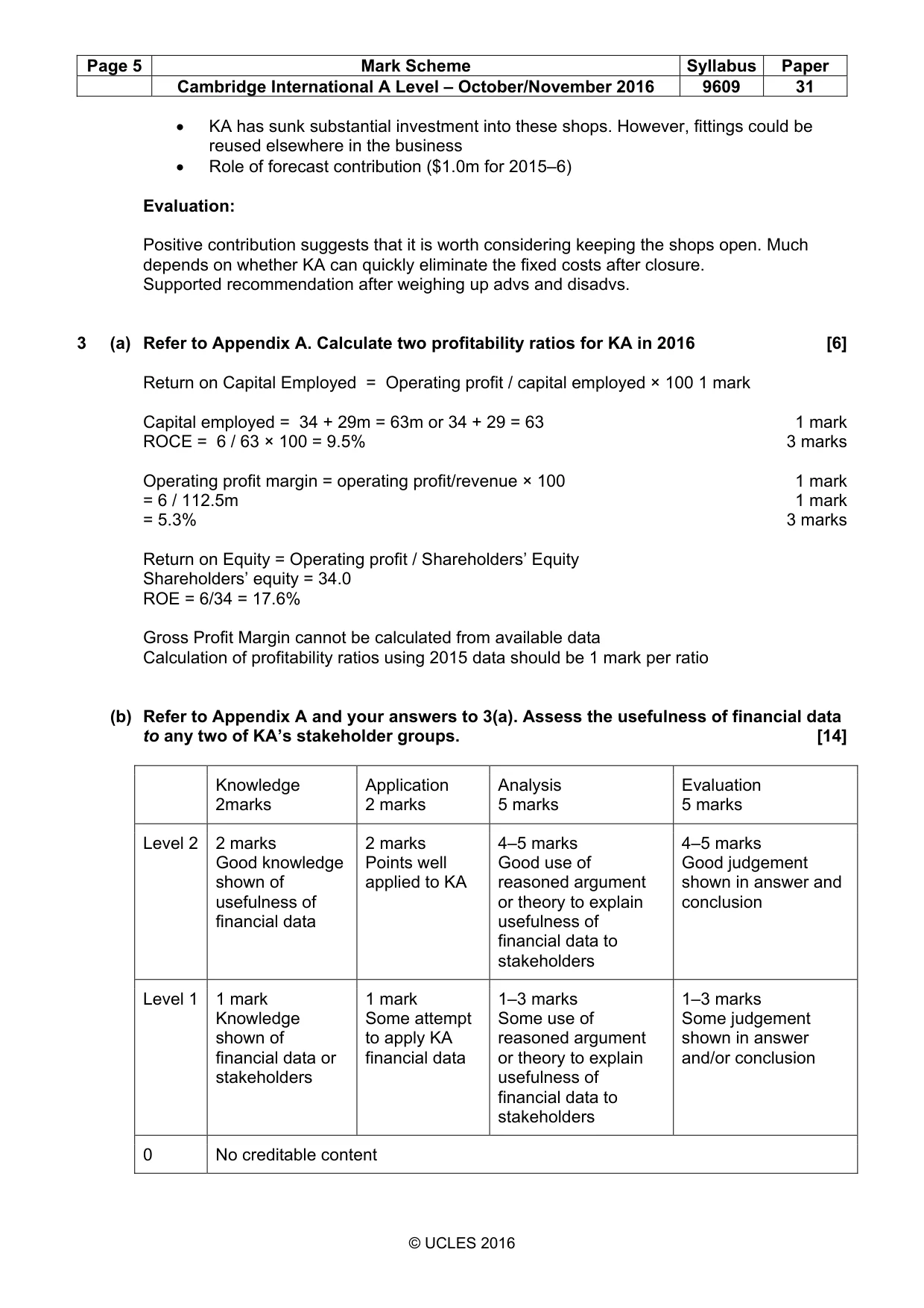
Mark scheme, page 5
Page 5 Mark Scheme Syllabus Paper Cambridge International A Level – October/November 2016 9609 31 © UCLES 2016 • KA has sunk substantial investment into these shops. However, fittings could be reused elsewhere in the business • Role of forecast contribution ($1.0m for 2015–6) Evaluation: Positive contribution suggests that it is worth considering keeping the shops open. Much depends on whether KA can quickly eliminate the fixed costs after closure. Supported recommendation after weighing up advs and disadvs. 3 (a) Refer to Appendix A. Calculate two profitability ratios for KA in 2016 [6] Return on Capital Employed = Operating profit / capital employed × 100 1 mark Capital employed = 34 + 29m = 63m or 34 + 29 = 63 1 mark ROCE = 6 / 63 × 100 = 9.5% 3 marks Operating profit margin = operating profit/revenue × 100 1 mark = 6 / 112.5m 1 mark = 5.3% 3 marks Return on Equity = Operating profit / Shareholders’ Equity Shareholders’ equity = 34.0 ROE = 6/34 = 17.6% Gross Profit Margin cannot be calculated from available data Calculation of profitability ratios using 2015 data should be 1 mark per ratio (b) Refer to Appendix A and your answers to 3(a). Assess the usefulness of financial data to any two of KA’s stakeholder groups. [14] Knowledge 2marks Application 2 marks Analysis 5 marks Evaluation 5 marks Level 2 2 marks Good knowledge shown of usefulness of financial data 2 marks Points well applied to KA 4–5 marks Good use of reasoned argument or theory to explain usefulness of financial data to stakeholders 4–5 marks Good judgement shown in answer and conclusion Level 1 1 mark Knowledge shown of financial data or stakeholders 1 mark Some attempt to apply KA financial data 1–3 marks Some use of reasoned argument or theory to explain usefulness of financial data to stakeholders 1–3 marks Some judgement shown in answer and/or conclusion 0 No creditable content
Mark scheme, page 6
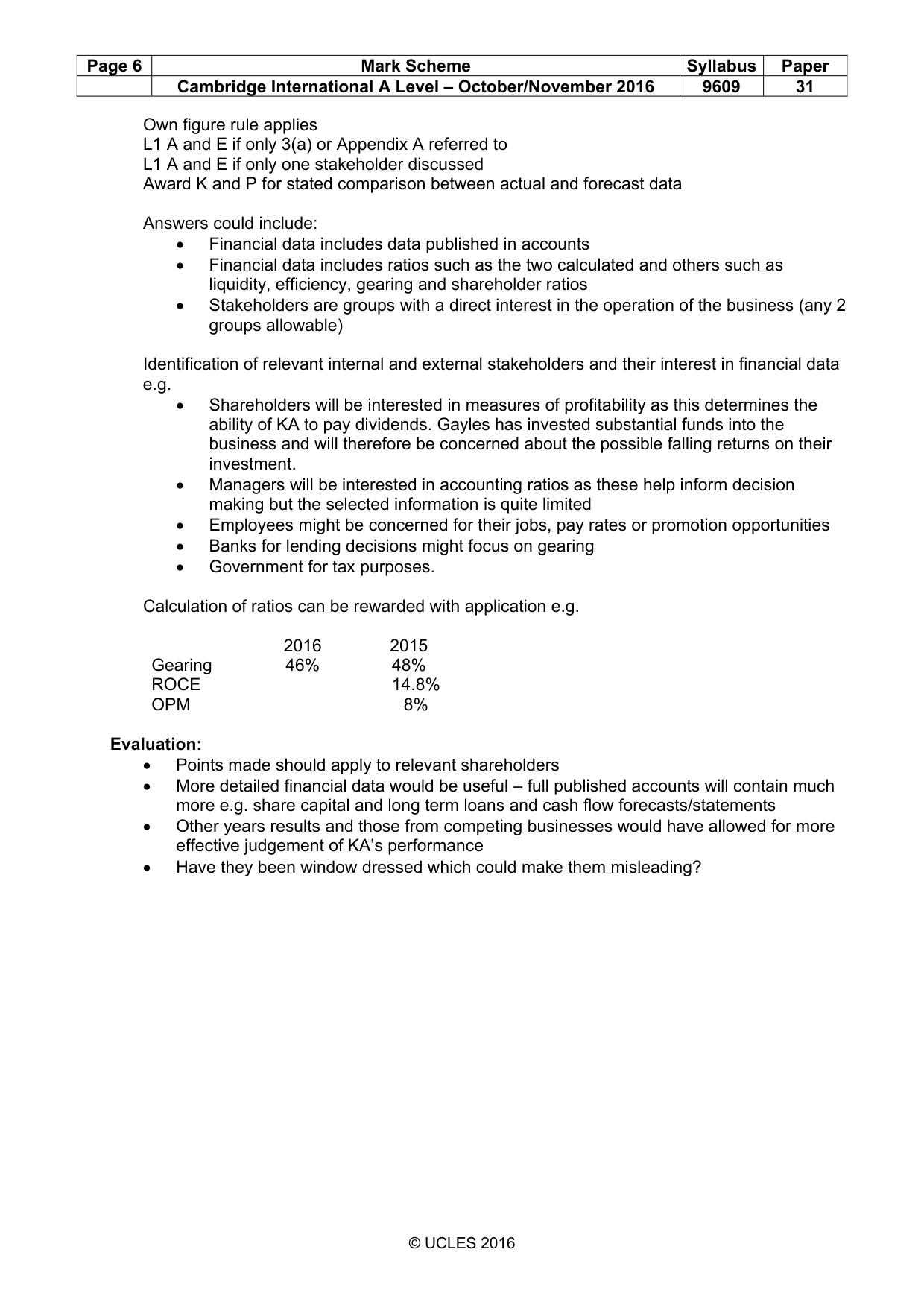
Page 6 Mark Scheme Syllabus Paper Cambridge International A Level – October/November 2016 9609 31 © UCLES 2016 Own figure rule applies L1 A and E if only 3(a) or Appendix A referred to L1 A and E if only one stakeholder discussed Award K and P for stated comparison between actual and forecast data Answers could include: • Financial data includes data published in accounts • Financial data includes ratios such as the two calculated and others such as liquidity, efficiency, gearing and shareholder ratios • Stakeholders are groups with a direct interest in the operation of the business (any 2 groups allowable) Identification of relevant internal and external stakeholders and their interest in financial data e.g. • Shareholders will be interested in measures of profitability as this determines the ability of KA to pay dividends. Gayles has invested substantial funds into the business and will therefore be concerned about the possible falling returns on their investment. • Managers will be interested in accounting ratios as these help inform decision making but the selected information is quite limited • Employees might be concerned for their jobs, pay rates or promotion opportunities • Banks for lending decisions might focus on gearing • Government for tax purposes. Calculation of ratios can be rewarded with application e.g. 2016 2015 Gearing 46% 48% ROCE 14.8% OPM 8% Evaluation: • Points made should apply to relevant shareholders • More detailed financial data would be useful – full published accounts will contain much more e.g. share capital and long term loans and cash flow forecasts/statements • Other years results and those from competing businesses would have allowed for more effective judgement of KA’s performance • Have they been window dressed which could make them misleading?
Mark scheme, page 7
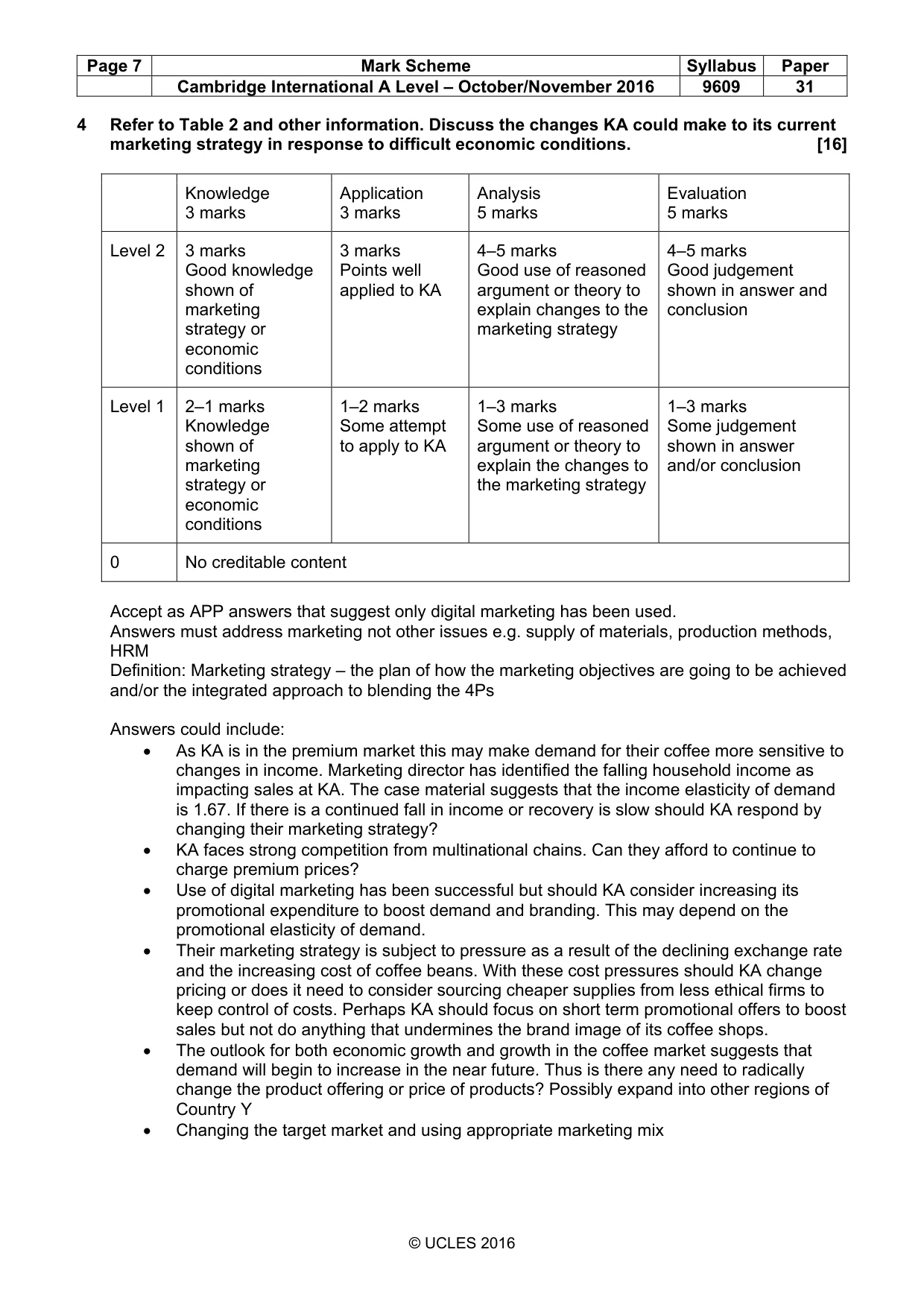
Page 7 Mark Scheme Syllabus Paper Cambridge International A Level – October/November 2016 9609 31 © UCLES 2016 4 Refer to Table 2 and other information. Discuss the changes KA could make to its current marketing strategy in response to difficult economic conditions. [16] Knowledge 3 marks Application 3 marks Analysis 5 marks Evaluation 5 marks Level 2 3 marks Good knowledge shown of marketing strategy or economic conditions 3 marks Points well applied to KA 4–5 marks Good use of reasoned argument or theory to explain changes to the marketing strategy 4–5 marks Good judgement shown in answer and conclusion Level 1 2–1 marks Knowledge shown of marketing strategy or economic conditions 1–2 marks Some attempt to apply to KA 1–3 marks Some use of reasoned argument or theory to explain the changes to the marketing strategy 1–3 marks Some judgement shown in answer and/or conclusion 0 No creditable content Accept as APP answers that suggest only digital marketing has been used. Answers must address marketing not other issues e.g. supply of materials, production methods, HRM Definition: Marketing strategy – the plan of how the marketing objectives are going to be achieved and/or the integrated approach to blending the 4Ps Answers could include: • As KA is in the premium market this may make demand for their coffee more sensitive to changes in income. Marketing director has identified the falling household income as impacting sales at KA. The case material suggests that the income elasticity of demand is 1.67. If there is a continued fall in income or recovery is slow should KA respond by changing their marketing strategy? • KA faces strong competition from multinational chains. Can they afford to continue to charge premium prices? • Use of digital marketing has been successful but should KA consider increasing its promotional expenditure to boost demand and branding. This may depend on the promotional elasticity of demand. • Their marketing strategy is subject to pressure as a result of the declining exchange rate and the increasing cost of coffee beans. With these cost pressures should KA change pricing or does it need to consider sourcing cheaper supplies from less ethical firms to keep control of costs. Perhaps KA should focus on short term promotional offers to boost sales but not do anything that undermines the brand image of its coffee shops. • The outlook for both economic growth and growth in the coffee market suggests that demand will begin to increase in the near future. Thus is there any need to radically change the product offering or price of products? Possibly expand into other regions of Country Y • Changing the target market and using appropriate marketing mix
Mark scheme, page 8
Page 8 Mark Scheme Syllabus Paper Cambridge International A Level – October/November 2016 9609 31 © UCLES 2016 Analysis Linked elements of marketing mix and/or objectives Reasoned argument for method in mix elements An individual marketing mix element and reason for changing it e.g. reducing price in response to more difficult economic conditions Evaluation • How long will the economic downturn last? • More information may be required to make decisions • Validity of forecast information for future market behaviour NB 2015–6 actual differs from forecast in this case • Weighing up alternative changes and/or a recommendation
Mark scheme, page 9
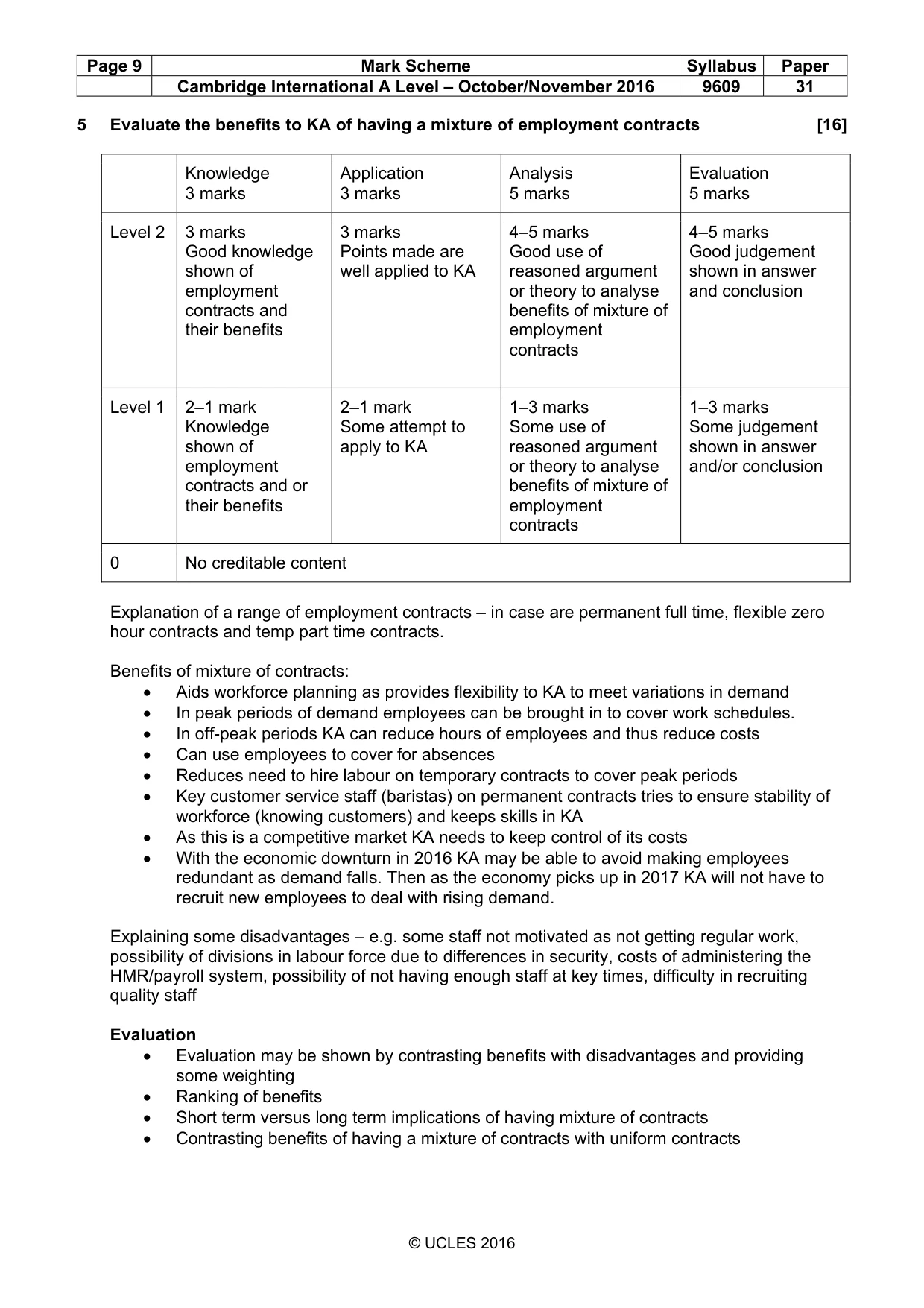
Page 9 Mark Scheme Syllabus Paper Cambridge International A Level – October/November 2016 9609 31 © UCLES 2016 5 Evaluate the benefits to KA of having a mixture of employment contracts [16] Knowledge 3 marks Application 3 marks Analysis 5 marks Evaluation 5 marks Level 2 3 marks Good knowledge shown of employment contracts and their benefits 3 marks Points made are well applied to KA 4–5 marks Good use of reasoned argument or theory to analyse benefits of mixture of employment contracts 4–5 marks Good judgement shown in answer and conclusion Level 1 2–1 mark Knowledge shown of employment contracts and or their benefits 2–1 mark Some attempt to apply to KA 1–3 marks Some use of reasoned argument or theory to analyse benefits of mixture of employment contracts 1–3 marks Some judgement shown in answer and/or conclusion 0 No creditable content Explanation of a range of employment contracts – in case are permanent full time, flexible zero hour contracts and temp part time contracts. Benefits of mixture of contracts: • Aids workforce planning as provides flexibility to KA to meet variations in demand • In peak periods of demand employees can be brought in to cover work schedules. • In off-peak periods KA can reduce hours of employees and thus reduce costs • Can use employees to cover for absences • Reduces need to hire labour on temporary contracts to cover peak periods • Key customer service staff (baristas) on permanent contracts tries to ensure stability of workforce (knowing customers) and keeps skills in KA • As this is a competitive market KA needs to keep control of its costs • With the economic downturn in 2016 KA may be able to avoid making employees redundant as demand falls. Then as the economy picks up in 2017 KA will not have to recruit new employees to deal with rising demand. Explaining some disadvantages – e.g. some staff not motivated as not getting regular work, possibility of divisions in labour force due to differences in security, costs of administering the HMR/payroll system, possibility of not having enough staff at key times, difficulty in recruiting quality staff Evaluation • Evaluation may be shown by contrasting benefits with disadvantages and providing some weighting • Ranking of benefits • Short term versus long term implications of having mixture of contracts • Contrasting benefits of having a mixture of contracts with uniform contracts
Mark scheme, page 10
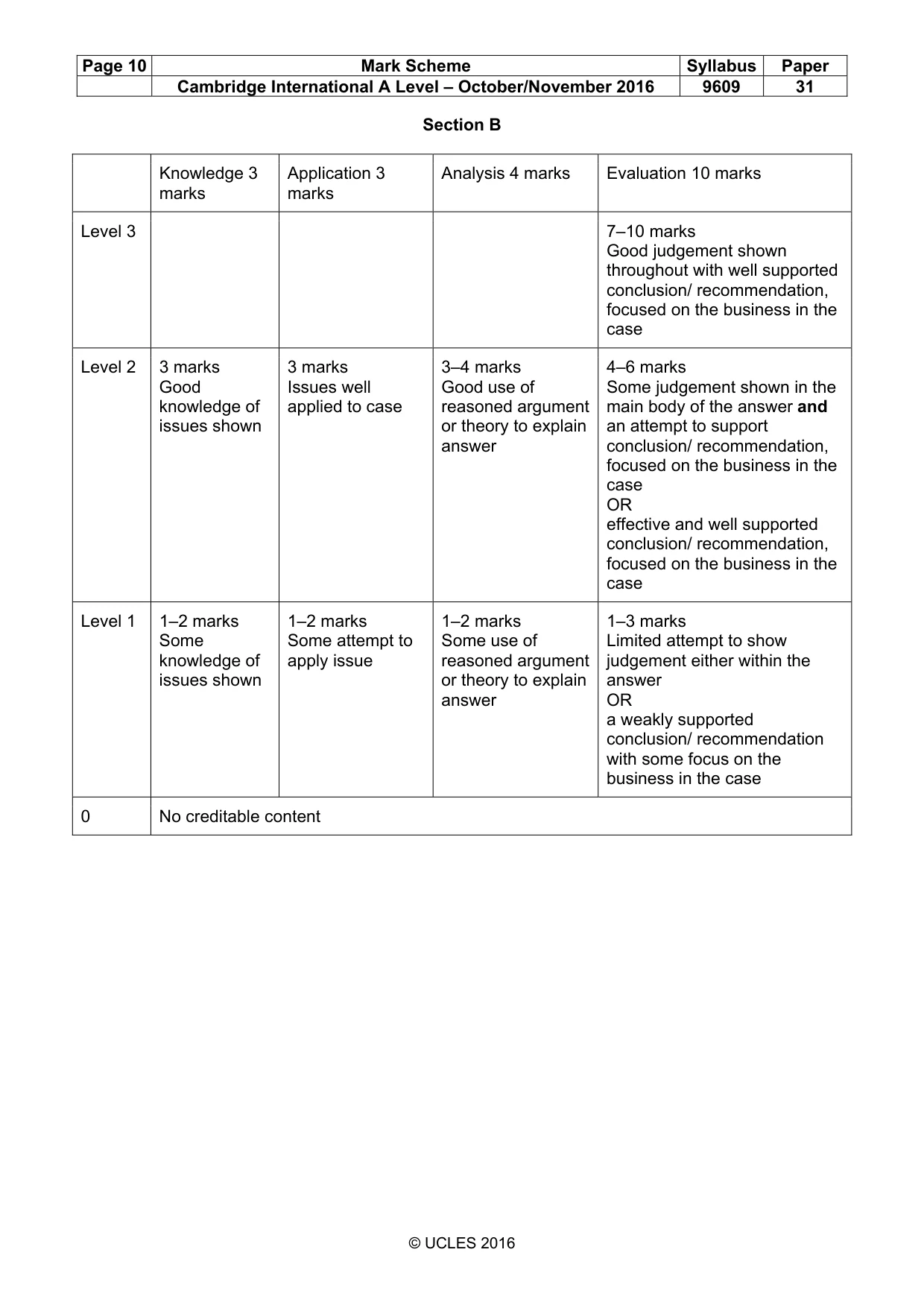
Page 10 Mark Scheme Syllabus Paper Cambridge International A Level – October/November 2016 9609 31 © UCLES 2016 Section B Knowledge 3 marks Application 3 marks Analysis 4 marks Evaluation 10 marks Level 3 7–10 marks Good judgement shown throughout with well supported conclusion/ recommendation, focused on the business in the case Level 2 3 marks Good knowledge of issues shown 3 marks Issues well applied to case 3–4 marks Good use of reasoned argument or theory to explain answer 4–6 marks Some judgement shown in the main body of the answer and an attempt to support conclusion/ recommendation, focused on the business in the case OR effective and well supported conclusion/ recommendation, focused on the business in the case Level 1 1–2 marks Some knowledge of issues shown 1–2 marks Some attempt to apply issue 1–2 marks Some use of reasoned argument or theory to explain answer 1–3 marks Limited attempt to show judgement either within the answer OR a weakly supported conclusion/ recommendation with some focus on the business in the case 0 No creditable content
Mark scheme, page 11
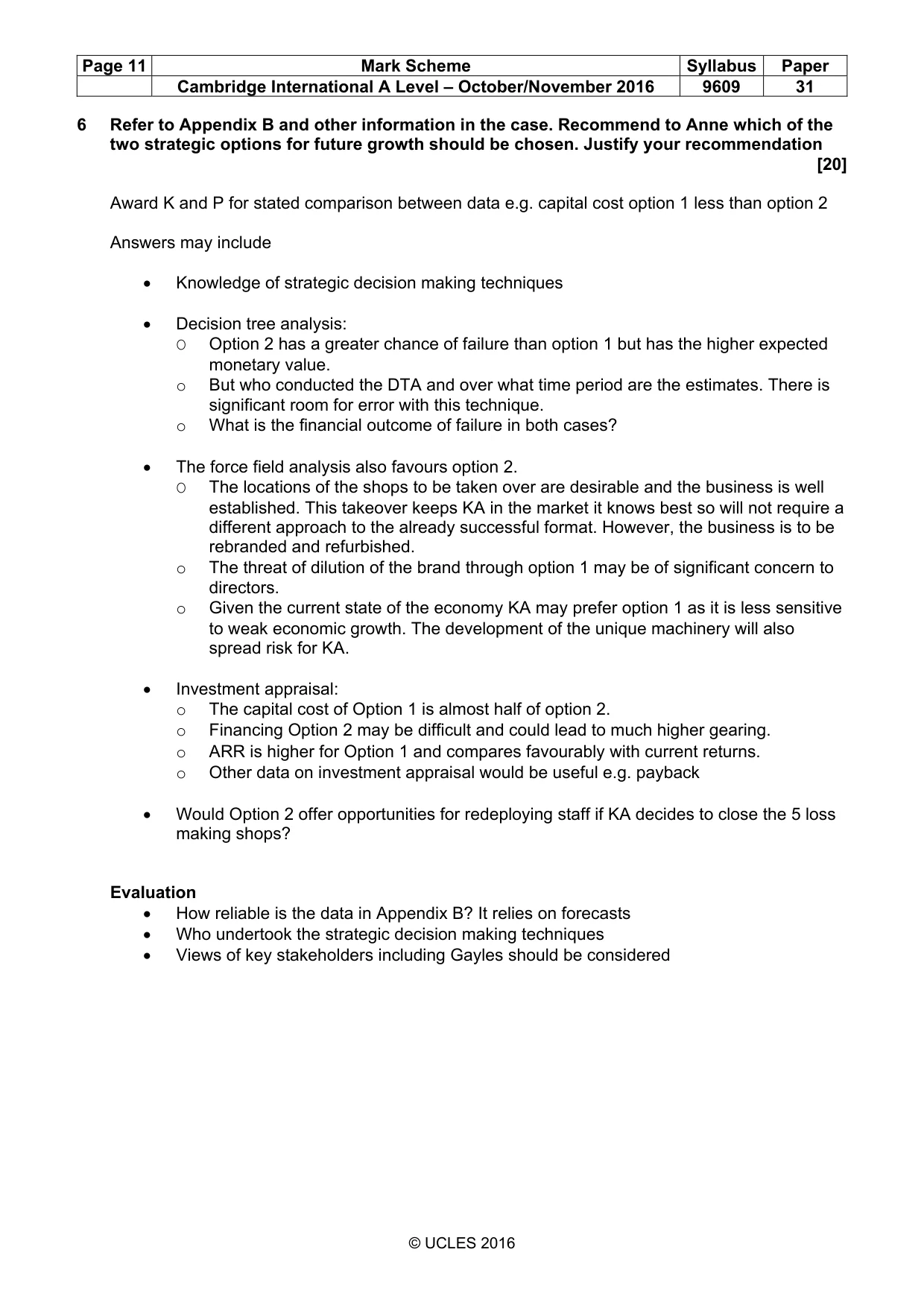
Page 11 Mark Scheme Syllabus Paper Cambridge International A Level – October/November 2016 9609 31 © UCLES 2016 6 Refer to Appendix B and other information in the case. Recommend to Anne which of the two strategic options for future growth should be chosen. Justify your recommendation [20] Award K and P for stated comparison between data e.g. capital cost option 1 less than option 2 Answers may include • Knowledge of strategic decision making techniques • Decision tree analysis: O Option 2 has a greater chance of failure than option 1 but has the higher expected monetary value. o But who conducted the DTA and over what time period are the estimates. There is significant room for error with this technique. o What is the financial outcome of failure in both cases? • The force field analysis also favours option 2. O The locations of the shops to be taken over are desirable and the business is well established. This takeover keeps KA in the market it knows best so will not require a different approach to the already successful format. However, the business is to be rebranded and refurbished. o The threat of dilution of the brand through option 1 may be of significant concern to directors. o Given the current state of the economy KA may prefer option 1 as it is less sensitive to weak economic growth. The development of the unique machinery will also spread risk for KA. • Investment appraisal: o The capital cost of Option 1 is almost half of option 2. o Financing Option 2 may be difficult and could lead to much higher gearing. o ARR is higher for Option 1 and compares favourably with current returns. o Other data on investment appraisal would be useful e.g. payback • Would Option 2 offer opportunities for redeploying staff if KA decides to close the 5 loss making shops? Evaluation • How reliable is the data in Appendix B? It relies on forecasts • Who undertook the strategic decision making techniques • Views of key stakeholders including Gayles should be considered
Mark scheme, page 12
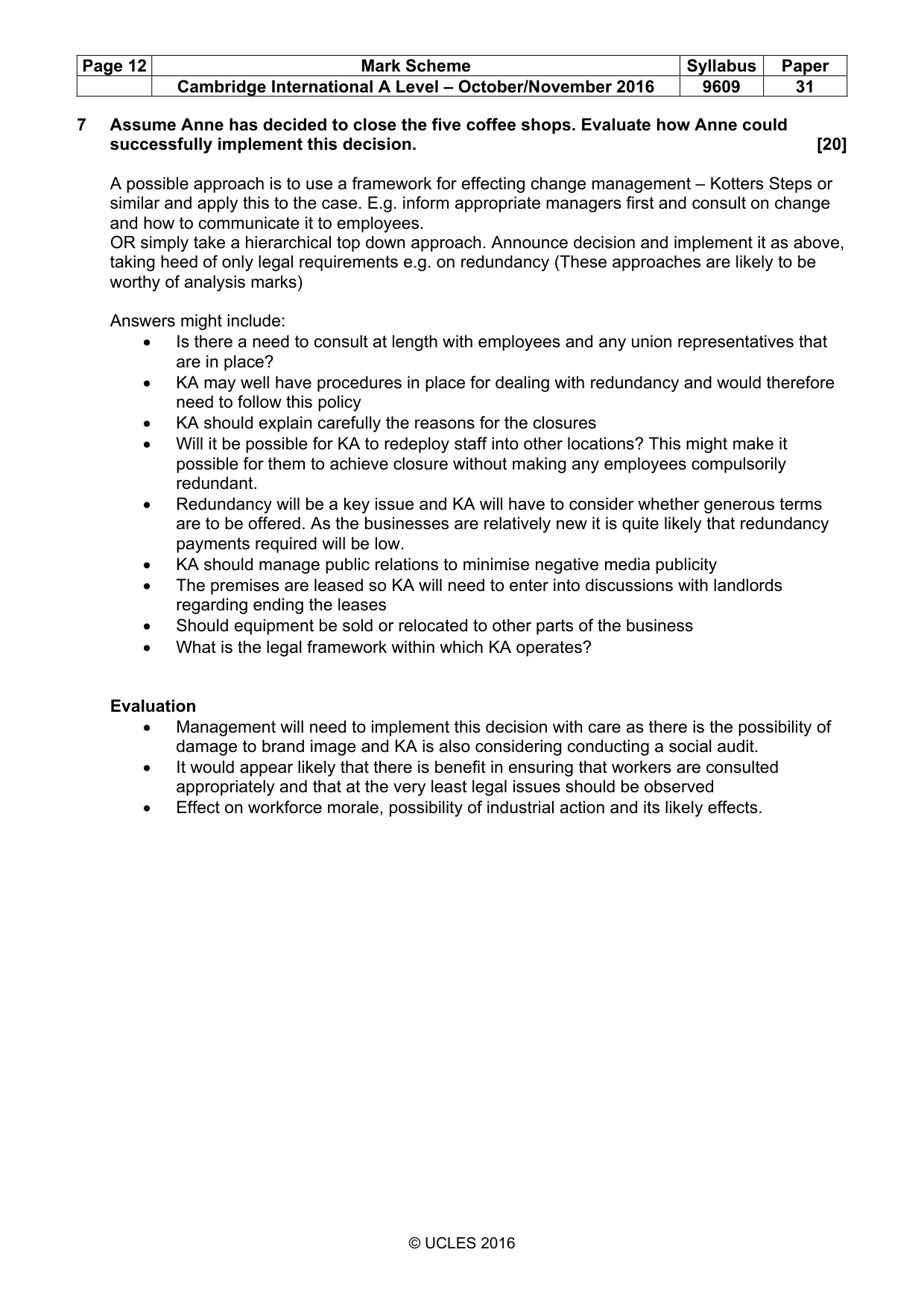
Page 12 Mark Scheme Syllabus Paper Cambridge International A Level – October/November 2016 9609 31 © UCLES 2016 7 Assume Anne has decided to close the five coffee shops. Evaluate how Anne could successfully implement this decision. [20] A possible approach is to use a framework for effecting change management – Kotters Steps or similar and apply this to the case. E.g. inform appropriate managers first and consult on change and how to communicate it to employees. OR simply take a hierarchical top down approach. Announce decision and implement it as above, taking heed of only legal requirements e.g. on redundancy (These approaches are likely to be worthy of analysis marks) Answers might include: • Is there a need to consult at length with employees and any union representatives that are in place? • KA may well have procedures in place for dealing with redundancy and would therefore need to follow this policy • KA should explain carefully the reasons for the closures • Will it be possible for KA to redeploy staff into other locations? This might make it possible for them to achieve closure without making any employees compulsorily redundant. • Redundancy will be a key issue and KA will have to consider whether generous terms are to be offered. As the businesses are relatively new it is quite likely that redundancy payments required will be low. • KA should manage public relations to minimise negative media publicity • The premises are leased so KA will need to enter into discussions with landlords regarding ending the leases • Should equipment be sold or relocated to other parts of the business • What is the legal framework within which KA operates? Evaluation • Management will need to implement this decision with care as there is the possibility of damage to brand image and KA is also considering conducting a social audit. • It would appear likely that there is benefit in ensuring that workers are consulted appropriately and that at the very least legal issues should be observed • Effect on workforce morale, possibility of industrial action and its likely effects.
What you needed in this session
Cambridge’s own grade thresholds for 2016 Oct/Nov, Paper 3 · Variant 1. A higher threshold means an easier paper — the bar moves with how the cohort did.