Cambridge A Level Business (for first examination in 2016) 9609 — 2016 May/June Paper 3 · Variant 2
9609/32/M/J/16 · 100 marks · ≈113 min
The question paper and its mark scheme, free to read here and free to download. This is Cambridge’s own paper, exactly as it was sat.
Question paper8 pages


Mark scheme12 pages
Answers below. Sit the paper first if you are practising.
Paper as text
Question paper, page 1
This document consists of 6 printed pages, 2 blank pages and 1 Insert. DC (ST/FD) 117616/3 © UCLES 2016 [Turn over Cambridge International Examinations Cambridge International Advanced Subsidiary and Advanced Level * 0 3 2 9 1 5 0 8 4 2 * BUSINESS 9609/32 Paper 3 Case Study May/June 2016 3 hours No Additional Materials are required. READ THESE INSTRUCTIONS FIRST An answer booklet is provided inside this question paper. You should follow the instructions on the front cover of the answer booklet. If you need additional answer paper ask the invigilator for a continuation booklet. Section A Answer all questions. Section B Answer one question You are advised to spend no more than 40 minutes on Section B. The businesses described in this question paper are entirely fictitious. The number of marks is given in brackets [ ] at the end of each question or part question.
Question paper, page 2
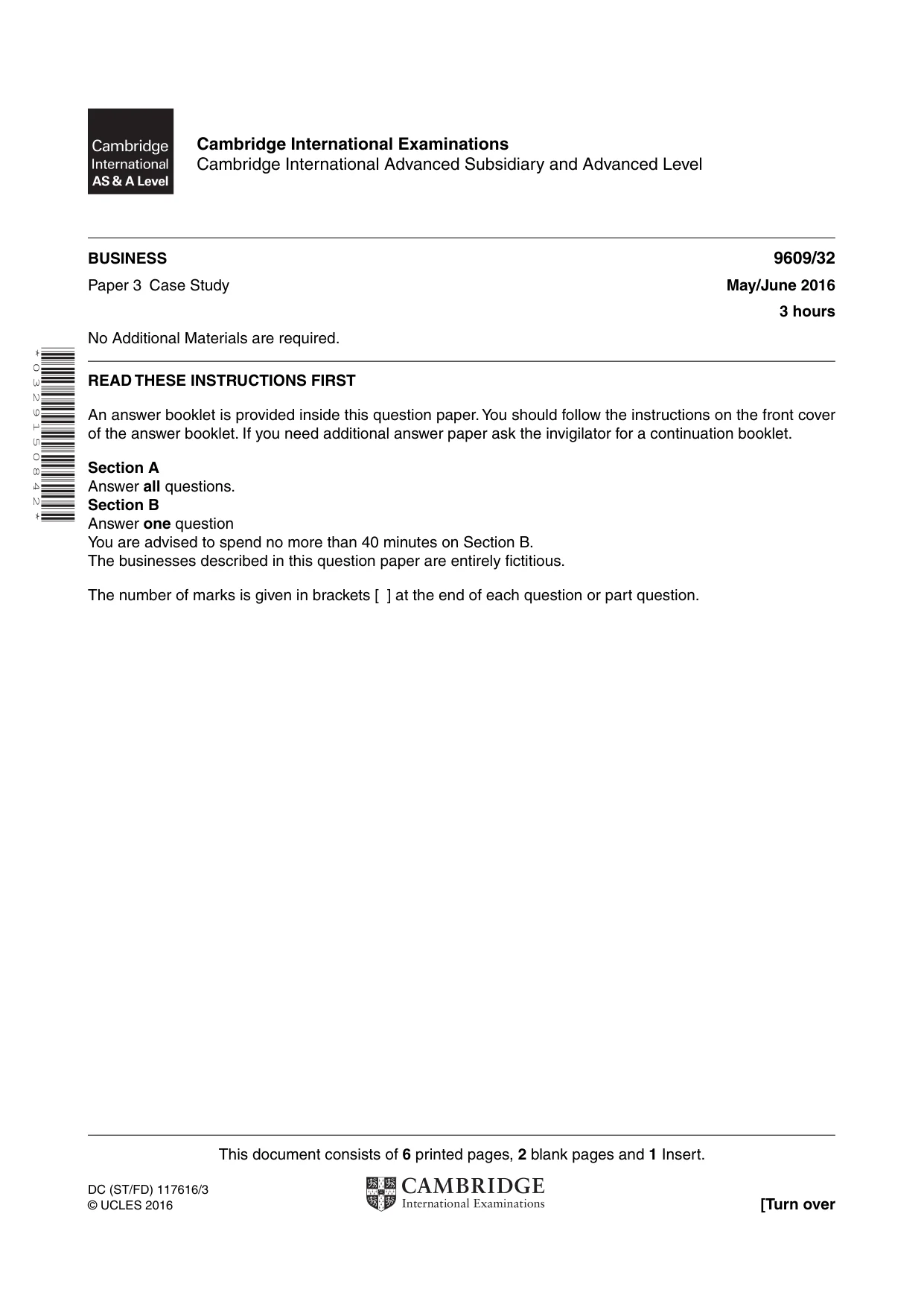
2 9609/32/M/J/16 © UCLES 2016 Cameron Jet Engines (CJE) CJE is a public limited company specialising in the manufacture of jet engines for aircraft. It has operations facilities in several African and Asian countries but its head office and main manufacturing base is in a European Union (EU) country. The corporate mission of CJE is to ‘develop unrivalled engine technology and create power solutions for the next century’. CJE engines are purchased by most of the major global civil aeroplane manufacturers – Fig. 1 shows the geographical breakdown of sales in 2015. The core competence that CJE has gained in jet engines is also put to effective use in the company’s marine and electricity generating divisions. CJE’s core competence is also used to make power systems for fast boats and for electricity stations. Fig. 1: Geographical breakdown of CJE sales (volume) 2015 Asia (7.1%) South America (14.3%) European Union (42.9%) USA (35.7%) Production capacity CJE managers have been surprised by the commercial success of the XL1 engine. Sales have exceeded forecasts and production capacity of 95% has been reached in the factory where the XL1 is assembled. The lack of spare capacity is most serious in the turbine blade department – the blades are an important part of every jet engine. The Operations Director is this week making a decision about whether to increase capacity in this department or outsource some turbine blade production to another business. This business, AOP, is in country X and its factory is 500 kilometres away from the XL1 assembly factory. AOP has substantial spare capacity as a jet engine manufacturer has recently cancelled a large order. The cost estimates for outsourcing and increasing factory capacity are shown in Table 1. 5 10 15 20
Question paper, page 3
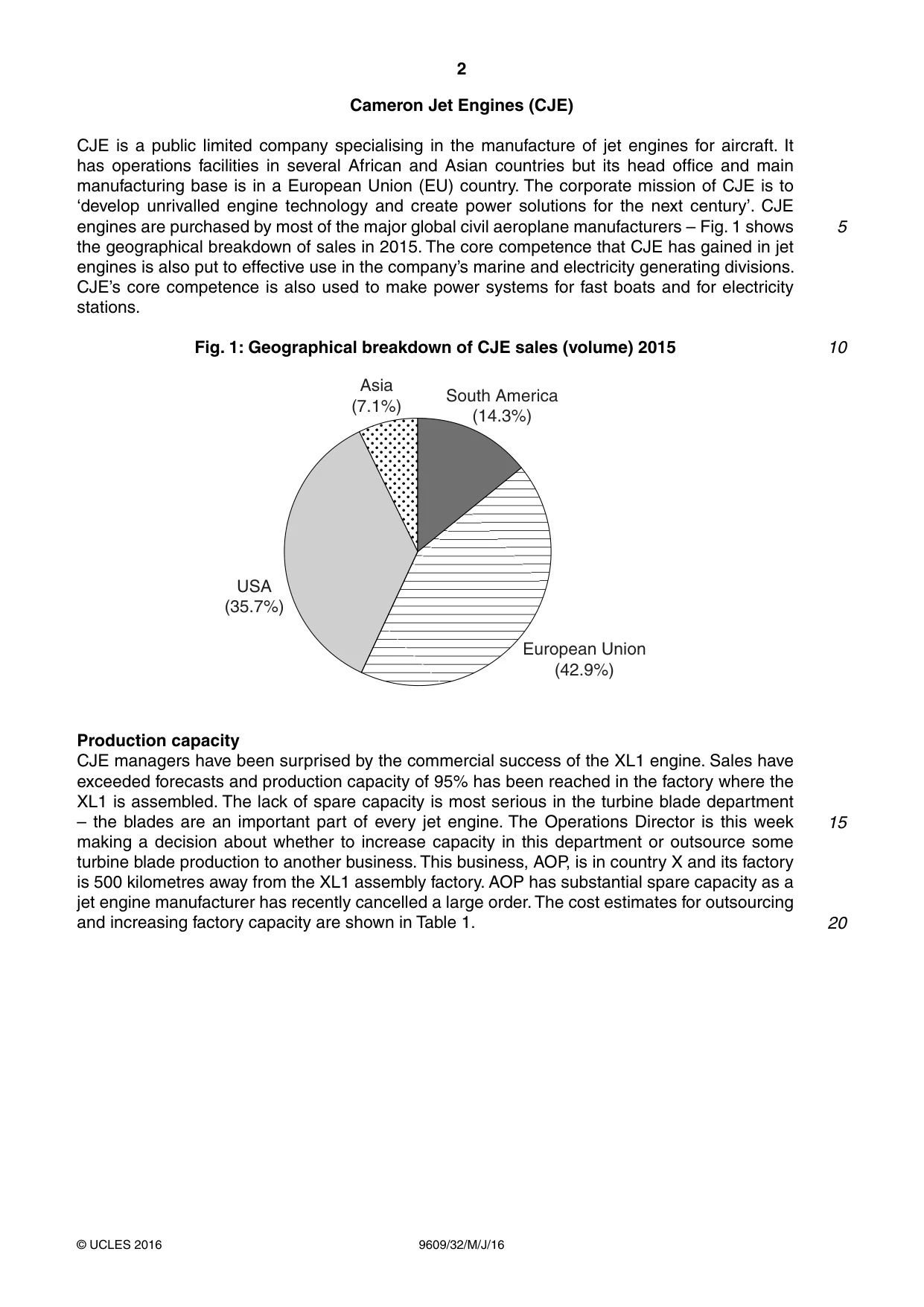
3 9609/32/M/J/16 © UCLES 2016 [Turn over Table 1: Data comparing outsourcing with expansion of CJE factory capacity Outsourcing to AOP Increase capacity of existing factory Time required Contract could be signed within 3 months – deliveries 1 month after that 15 months for completion of factory Variable cost per blade – $500 Contracted price per blade $570 – Transport cost per 10 blades $200 – Additional annual fixed costs – $600 000 Annual fixed costs of existing CJE factory $6 million $6 million Annual capacity 5000 3000 Human resource management Despite significant barriers to the entry of new manufacturers, there is considerable competitive rivalry in the jet engine market. CJE’s market share of 23% is under pressure from two large European based engine manufacturers. Quality, innovation and reliability are essential requirements of jet engines – but so is a competitive price. CJE has lower profit margins than its competitors and a corporate objective is to match competitors’ margins. CJE is using a cost minimisation strategy to achieve this. All departments have been instructed to produce plans for cutting costs by 7% this year. The Human Resource Director has already started implementing his proposals for a more flexible HR strategy: • Recently recruited production employees have been appointed on short-term temporary contracts (even for skilled positions) • Some unskilled employees have been given zero hours contracts • All employees are to be required to learn new skills to allow flexible working. Market for helicopter jet engines CJE directors are determined to enter the market for the supply of engines for helicopters. Profit margins are substantially higher than in the market for engines for other types of aircraft. The Marketing Director has had lengthy negotiations with Government officials in country Y, which is a rich nation that is expanding its fleet of ‘search and rescue’ helicopters. The Government officials are keen for CJE to supply engines for the new helicopters in country Y. However, they have argued that CJE’s engines are more expensive than those of competitors and have a shorter after-sales service agreement. Despite these factors, the officials have indicated secretly that a contract with CJE could soon be signed if substantial ‘facilitating payments’ were made directly to them personally in foreign bank accounts. 25 30 35 40 45 50 55 60
Question paper, page 4
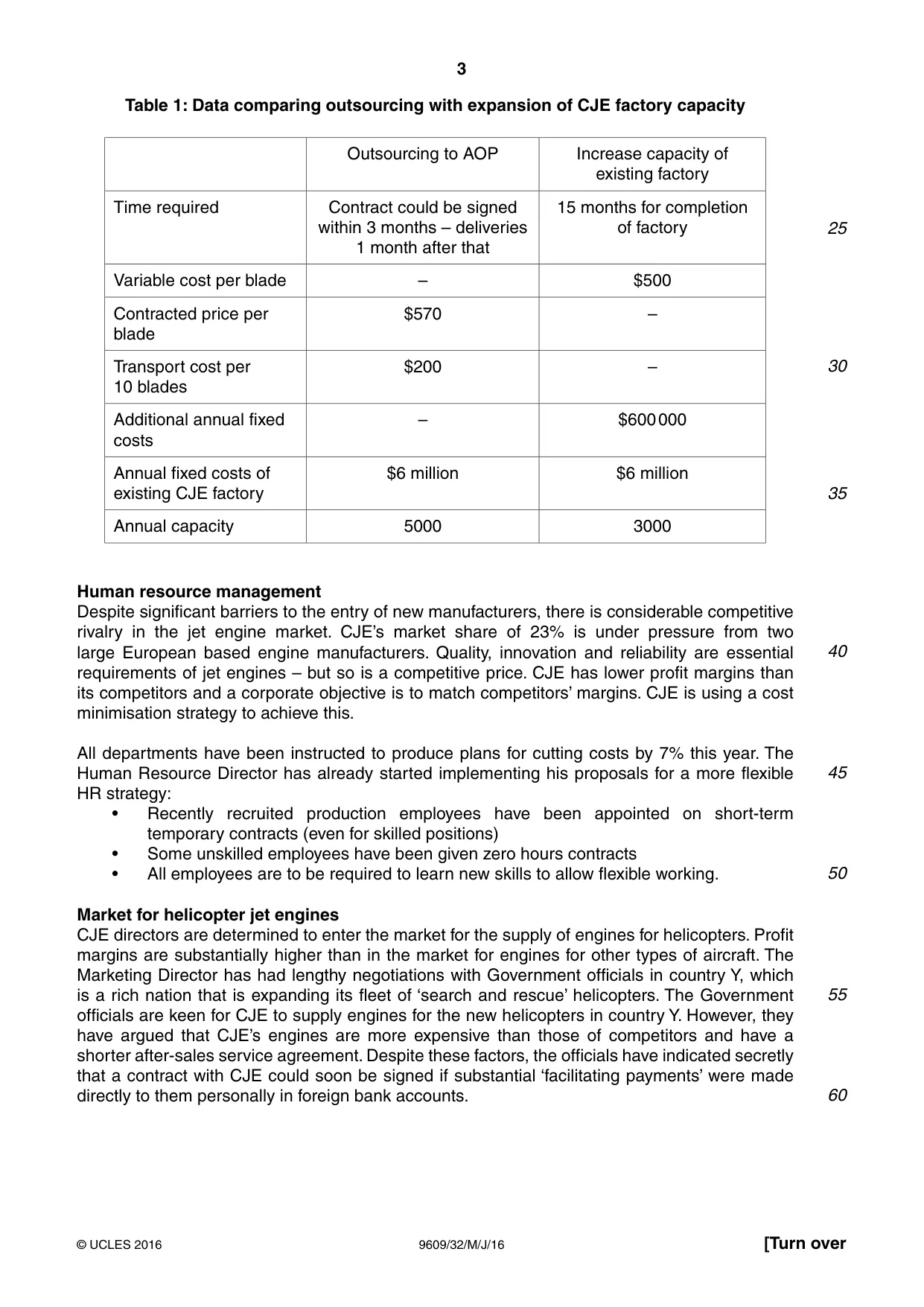
4 9609/32/M/J/16 © UCLES 2016 Financial reporting Under pressure from shareholders to raise the company’s low profit margins, CJE’s Finance Director is thinking about making the following changes to financial reporting methods this year. • Fixed assets are depreciated by the straight line method over 10 years. If this is lengthened to 20 years then it would reduce annual depreciation by $25m. • Offering a major customer an early shipment discount could provide additional revenue of $45 million in the current financial year. The expected operating profit margin of this contract would then be 10%. The Finance Director claimed that, if adopted before the end of October, these measures would help to satisfy shareholder expectations – at least in the short term. Table 2: Summary of CJE accounting data forecasts, at end of October 2016 before changes suggested by Finance Director ($m) Operating profit 65 Revenue (year ending) 850 Total non-current assets 1250 Intangible non-current assets 50 Net current assets 64 Long term liabilities 600 Strategic options The directors are considering the following two strategies for future growth. Strategy 1: Take over a small manufacturer of aircraft in a BRICS country. This manufacturer does not currently use CJE engines. It has designed a new small jet aeroplane which is expected to be popular in lower income countries. Strategy 2: Establish a joint venture with Z&L, a USA based jet engine manufacturer. The joint venture would design and manufacture a new jet engine with a low environmental impact. This engine would be designed and manufactured in an African country. Quantitative and qualitative data regarding these two options are shown in Table 3. Both strategic options would require careful implementation to achieve success as they both have elements of risk and would involve long term commitment of substantial CJE resources. 65 70 75 80 85
Question paper, page 5
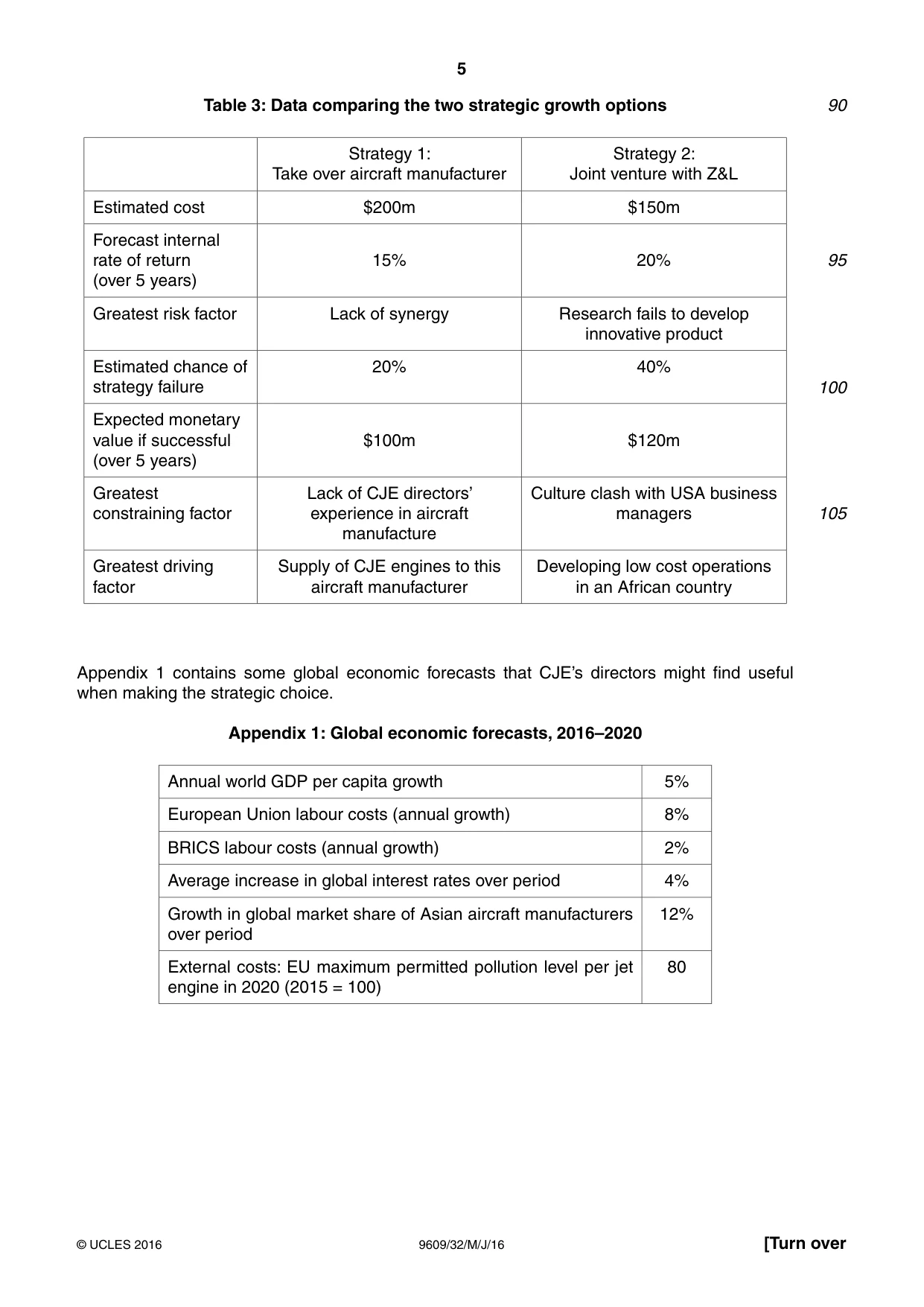
5 9609/32/M/J/16 © UCLES 2016 [Turn over Table 3: Data comparing the two strategic growth options Strategy 1: Take over aircraft manufacturer Strategy 2: Joint venture with Z&L Estimated cost $200m $150m Forecast internal rate of return (over 5 years) 15% 20% Greatest risk factor Lack of synergy Research fails to develop innovative product Estimated chance of strategy failure 20% 40% Expected monetary value if successful (over 5 years) $100m $120m Greatest constraining factor Lack of CJE directors’ experience in aircraft manufacture Culture clash with USA business managers Greatest driving factor Supply of CJE engines to this aircraft manufacturer Developing low cost operations in an African country Appendix 1 contains some global economic forecasts that CJE’s directors might find useful when making the strategic choice. Appendix 1: Global economic forecasts, 2016–2020 Annual world GDP per capita growth 5% European Union labour costs (annual growth) 8% BRICS labour costs (annual growth) 2% Average increase in global interest rates over period 4% Growth in global market share of Asian aircraft manufacturers over period 12% External costs: EU maximum permitted pollution level per jet engine in 2020 (2015 = 100) 80 90 95 100 105
Question paper, page 6
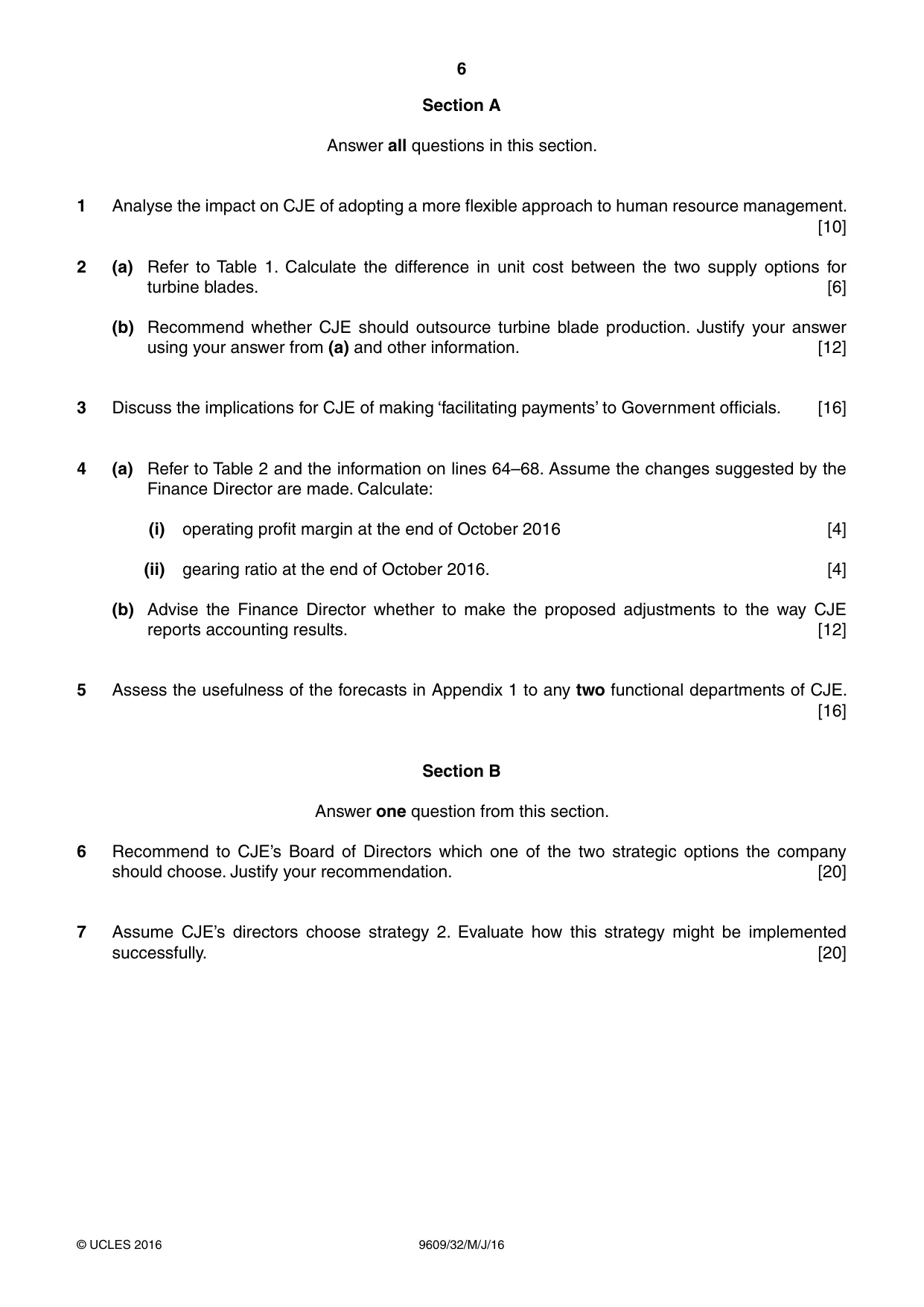
6 9609/32/M/J/16 © UCLES 2016 Section A Answer all questions in this section. 1 Analyse the impact on CJE of adopting a more flexible approach to human resource management. [10] 2 (a) Refer to Table 1. Calculate the difference in unit cost between the two supply options for turbine blades. [6] (b) Recommend whether CJE should outsource turbine blade production. Justify your answer using your answer from (a) and other information. [12] 3 Discuss the implications for CJE of making ‘facilitating payments’ to Government officials. [16] 4 (a) Refer to Table 2 and the information on lines 64–68. Assume the changes suggested by the Finance Director are made. Calculate: (i) operating profit margin at the end of October 2016 [4] (ii) gearing ratio at the end of October 2016. [4] (b) Advise the Finance Director whether to make the proposed adjustments to the way CJE reports accounting results. [12] 5 Assess the usefulness of the forecasts in Appendix 1 to any two functional departments of CJE. [16] Section B Answer one question from this section. 6 Recommend to CJE’s Board of Directors which one of the two strategic options the company should choose. Justify your recommendation. [20] 7 Assume CJE’s directors choose strategy 2. Evaluate how this strategy might be implemented successfully. [20]
Question paper, page 7
7 9609/32/M/J/16 © UCLES 2016 BLANK PAGE
Question paper, page 8
8 9609/32/M/J/16 © UCLES 2016 BLANK PAGE Permission to reproduce items where third-party owned material protected by copyright is included has been sought and cleared where possible. Every reasonable effort has been made by the publisher (UCLES) to trace copyright holders, but if any items requiring clearance have unwittingly been included, the publisher will be pleased to make amends at the earliest possible opportunity. To avoid the issue of disclosure of answer-related information to candidates, all copyright acknowledgements are reproduced online in the Cambridge International Examinations Copyright Acknowledgements Booklet. This is produced for each series of examinations and is freely available to download at www.cie.org.uk after the live examination series. Cambridge International Examinations is part of the Cambridge Assessment Group. Cambridge Assessment is the brand name of University of Cambridge Local Examinations Syndicate (UCLES), which is itself a department of the University of Cambridge.
Mark scheme, page 1
® IGCSE is the registered trademark of Cambridge International Examinations. This document consists of 12 printed pages. © UCLES 2016 [Turn over Cambridge International Examinations Cambridge International Advanced Level BUSINESS 9609/32 Paper 3 Case Study May/June 2016 MARK SCHEME Maximum Mark: 100 Published This mark scheme is published as an aid to teachers and candidates, to indicate the requirements of the examination. It shows the basis on which Examiners were instructed to award marks. It does not indicate the details of the discussions that took place at an Examiners’ meeting before marking began, which would have considered the acceptability of alternative answers. Mark schemes should be read in conjunction with the question paper and the Principal Examiner Report for Teachers. Cambridge will not enter into discussions about these mark schemes. Cambridge is publishing the mark schemes for the May/June 2016 series for most Cambridge IGCSE®, Cambridge International A and AS Level components and some Cambridge O Level components.
Mark scheme, page 2
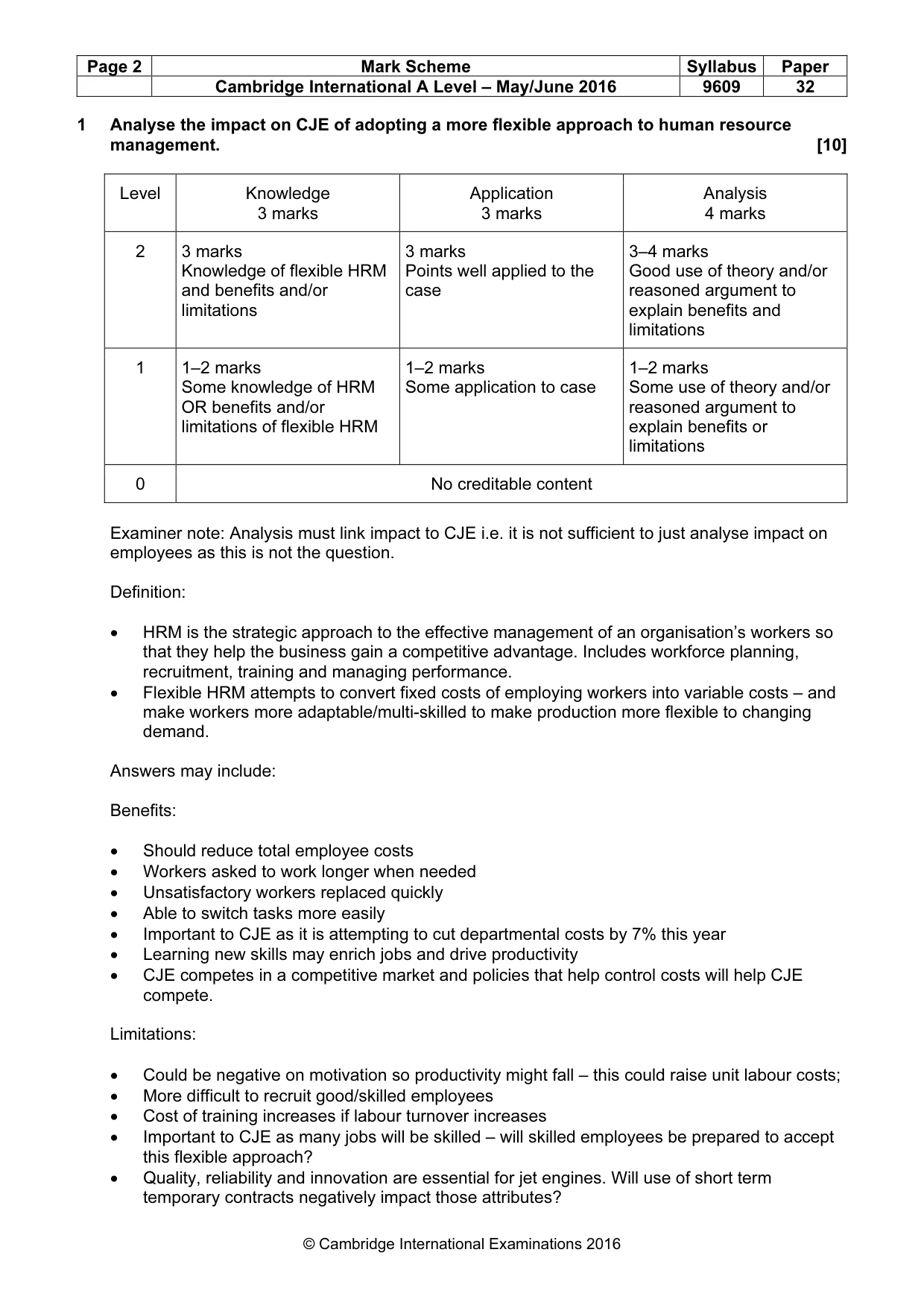
Page 2 Mark Scheme Syllabus Paper Cambridge International A Level – May/June 2016 9609 32 © Cambridge International Examinations 2016 1 Analyse the impact on CJE of adopting a more flexible approach to human resource management. [10] Level Knowledge 3 marks Application 3 marks Analysis 4 marks 2 3 marks Knowledge of flexible HRM and benefits and/or limitations 3 marks Points well applied to the case 3–4 marks Good use of theory and/or reasoned argument to explain benefits and limitations 1 1–2 marks Some knowledge of HRM OR benefits and/or limitations of flexible HRM 1–2 marks Some application to case 1–2 marks Some use of theory and/or reasoned argument to explain benefits or limitations 0 No creditable content Examiner note: Analysis must link impact to CJE i.e. it is not sufficient to just analyse impact on employees as this is not the question. Definition: • HRM is the strategic approach to the effective management of an organisation’s workers so that they help the business gain a competitive advantage. Includes workforce planning, recruitment, training and managing performance. • Flexible HRM attempts to convert fixed costs of employing workers into variable costs – and make workers more adaptable/multi-skilled to make production more flexible to changing demand. Answers may include: Benefits: • Should reduce total employee costs • Workers asked to work longer when needed • Unsatisfactory workers replaced quickly • Able to switch tasks more easily • Important to CJE as it is attempting to cut departmental costs by 7% this year • Learning new skills may enrich jobs and drive productivity • CJE competes in a competitive market and policies that help control costs will help CJE compete. Limitations: • Could be negative on motivation so productivity might fall – this could raise unit labour costs; • More difficult to recruit good/skilled employees • Cost of training increases if labour turnover increases • Important to CJE as many jobs will be skilled – will skilled employees be prepared to accept this flexible approach? • Quality, reliability and innovation are essential for jet engines. Will use of short term temporary contracts negatively impact those attributes?
Mark scheme, page 3
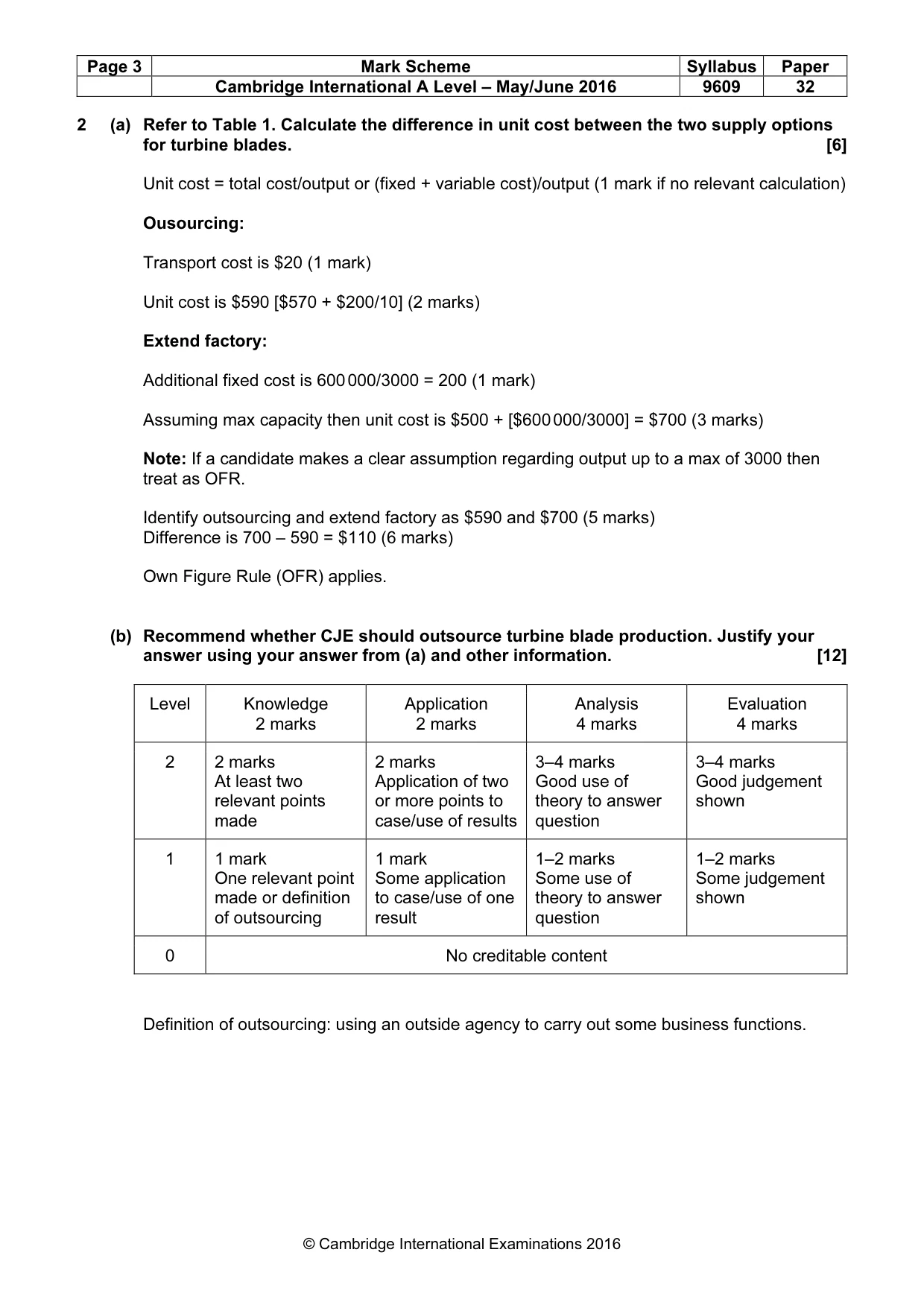
Page 3 Mark Scheme Syllabus Paper Cambridge International A Level – May/June 2016 9609 32 © Cambridge International Examinations 2016 2 (a) Refer to Table 1. Calculate the difference in unit cost between the two supply options for turbine blades. [6] Unit cost = total cost/output or (fixed + variable cost)/output (1 mark if no relevant calculation) Ousourcing: Transport cost is $20 (1 mark) Unit cost is $590 [$570 + $200/10] (2 marks) Extend factory: Additional fixed cost is 600 000/3000 = 200 (1 mark) Assuming max capacity then unit cost is $500 + [$600 000/3000] = $700 (3 marks) Note: If a candidate makes a clear assumption regarding output up to a max of 3000 then treat as OFR. Identify outsourcing and extend factory as $590 and $700 (5 marks) Difference is 700 – 590 = $110 (6 marks) Own Figure Rule (OFR) applies. (b) Recommend whether CJE should outsource turbine blade production. Justify your answer using your answer from (a) and other information. [12] Level Knowledge 2 marks Application 2 marks Analysis 4 marks Evaluation 4 marks 2 2 marks At least two relevant points made 2 marks Application of two or more points to case/use of results 3–4 marks Good use of theory to answer question 3–4 marks Good judgement shown 1 1 mark One relevant point made or definition of outsourcing 1 mark Some application to case/use of one result 1–2 marks Some use of theory to answer question 1–2 marks Some judgement shown 0 No creditable content Definition of outsourcing: using an outside agency to carry out some business functions.
Mark scheme, page 4
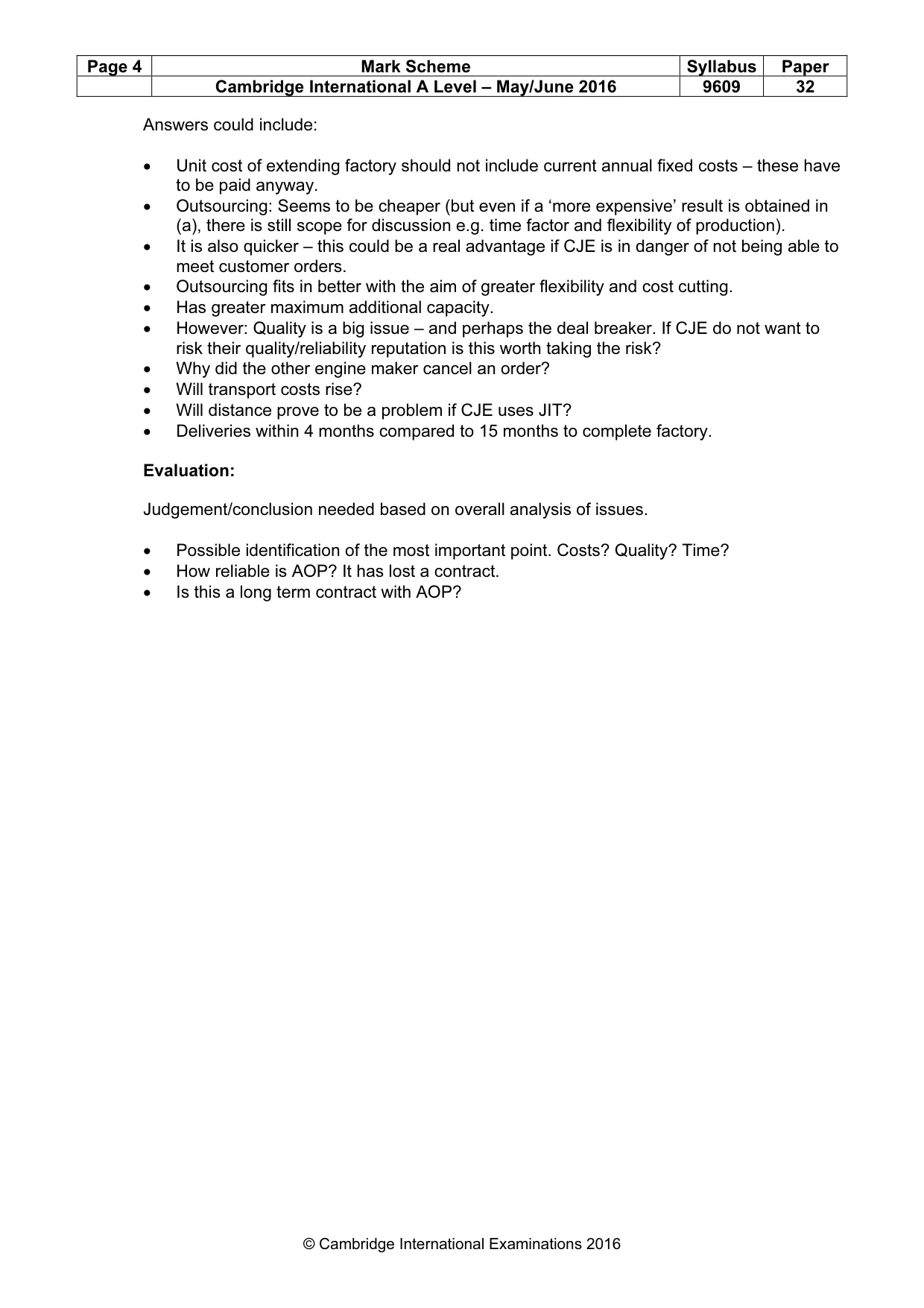
Page 4 Mark Scheme Syllabus Paper Cambridge International A Level – May/June 2016 9609 32 © Cambridge International Examinations 2016 Answers could include: • Unit cost of extending factory should not include current annual fixed costs – these have to be paid anyway. • Outsourcing: Seems to be cheaper (but even if a ‘more expensive’ result is obtained in (a), there is still scope for discussion e.g. time factor and flexibility of production). • It is also quicker – this could be a real advantage if CJE is in danger of not being able to meet customer orders. • Outsourcing fits in better with the aim of greater flexibility and cost cutting. • Has greater maximum additional capacity. • However: Quality is a big issue – and perhaps the deal breaker. If CJE do not want to risk their quality/reliability reputation is this worth taking the risk? • Why did the other engine maker cancel an order? • Will transport costs rise? • Will distance prove to be a problem if CJE uses JIT? • Deliveries within 4 months compared to 15 months to complete factory. Evaluation: Judgement/conclusion needed based on overall analysis of issues. • Possible identification of the most important point. Costs? Quality? Time? • How reliable is AOP? It has lost a contract. • Is this a long term contract with AOP?
Mark scheme, page 5
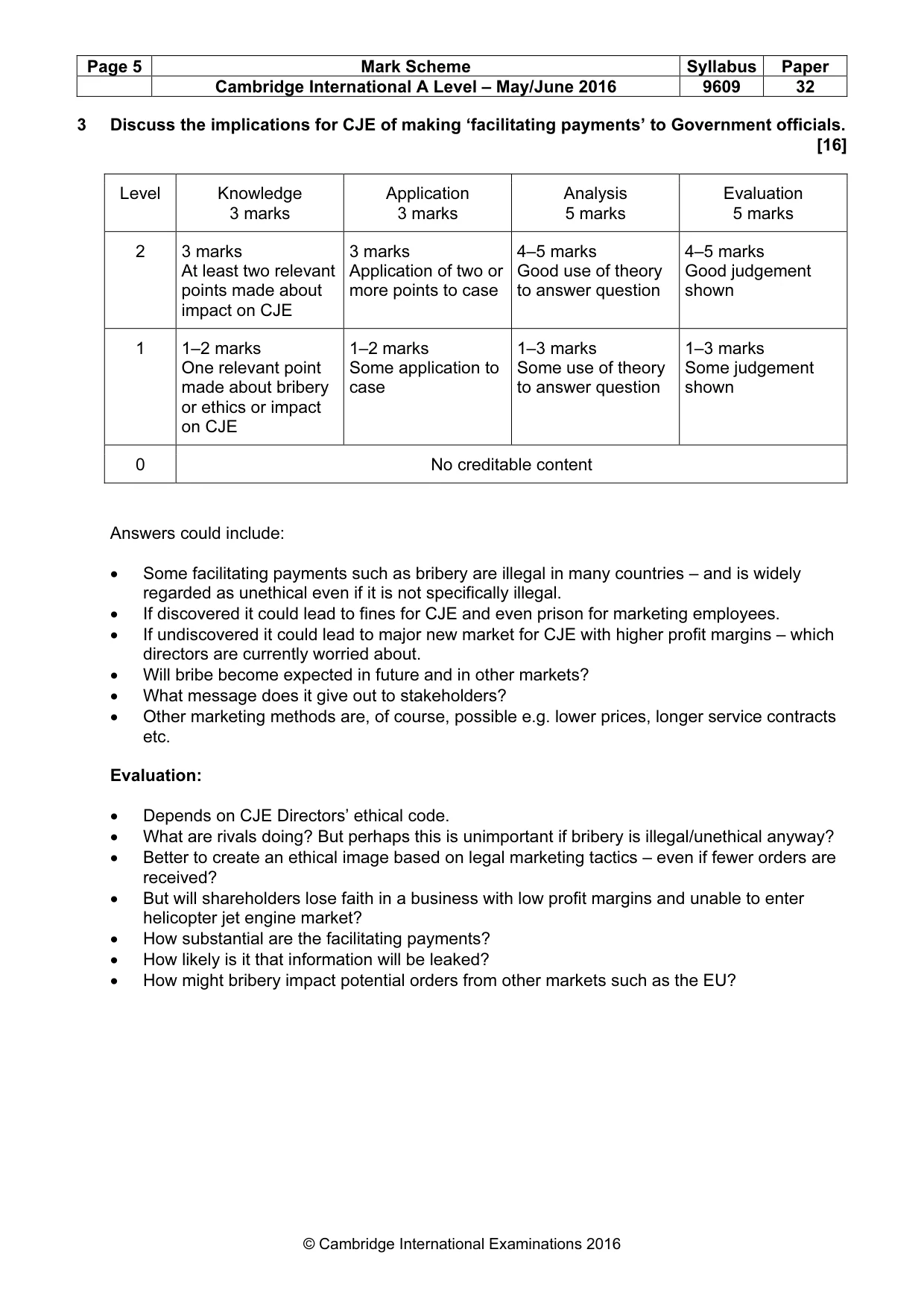
Page 5 Mark Scheme Syllabus Paper Cambridge International A Level – May/June 2016 9609 32 © Cambridge International Examinations 2016 3 Discuss the implications for CJE of making ‘facilitating payments’ to Government officials. [16] Level Knowledge 3 marks Application 3 marks Analysis 5 marks Evaluation 5 marks 2 3 marks At least two relevant points made about impact on CJE 3 marks Application of two or more points to case 4–5 marks Good use of theory to answer question 4–5 marks Good judgement shown 1 1–2 marks One relevant point made about bribery or ethics or impact on CJE 1–2 marks Some application to case 1–3 marks Some use of theory to answer question 1–3 marks Some judgement shown 0 No creditable content Answers could include: • Some facilitating payments such as bribery are illegal in many countries – and is widely regarded as unethical even if it is not specifically illegal. • If discovered it could lead to fines for CJE and even prison for marketing employees. • If undiscovered it could lead to major new market for CJE with higher profit margins – which directors are currently worried about. • Will bribe become expected in future and in other markets? • What message does it give out to stakeholders? • Other marketing methods are, of course, possible e.g. lower prices, longer service contracts etc. Evaluation: • Depends on CJE Directors’ ethical code. • What are rivals doing? But perhaps this is unimportant if bribery is illegal/unethical anyway? • Better to create an ethical image based on legal marketing tactics – even if fewer orders are received? • But will shareholders lose faith in a business with low profit margins and unable to enter helicopter jet engine market? • How substantial are the facilitating payments? • How likely is it that information will be leaked? • How might bribery impact potential orders from other markets such as the EU?
Mark scheme, page 6
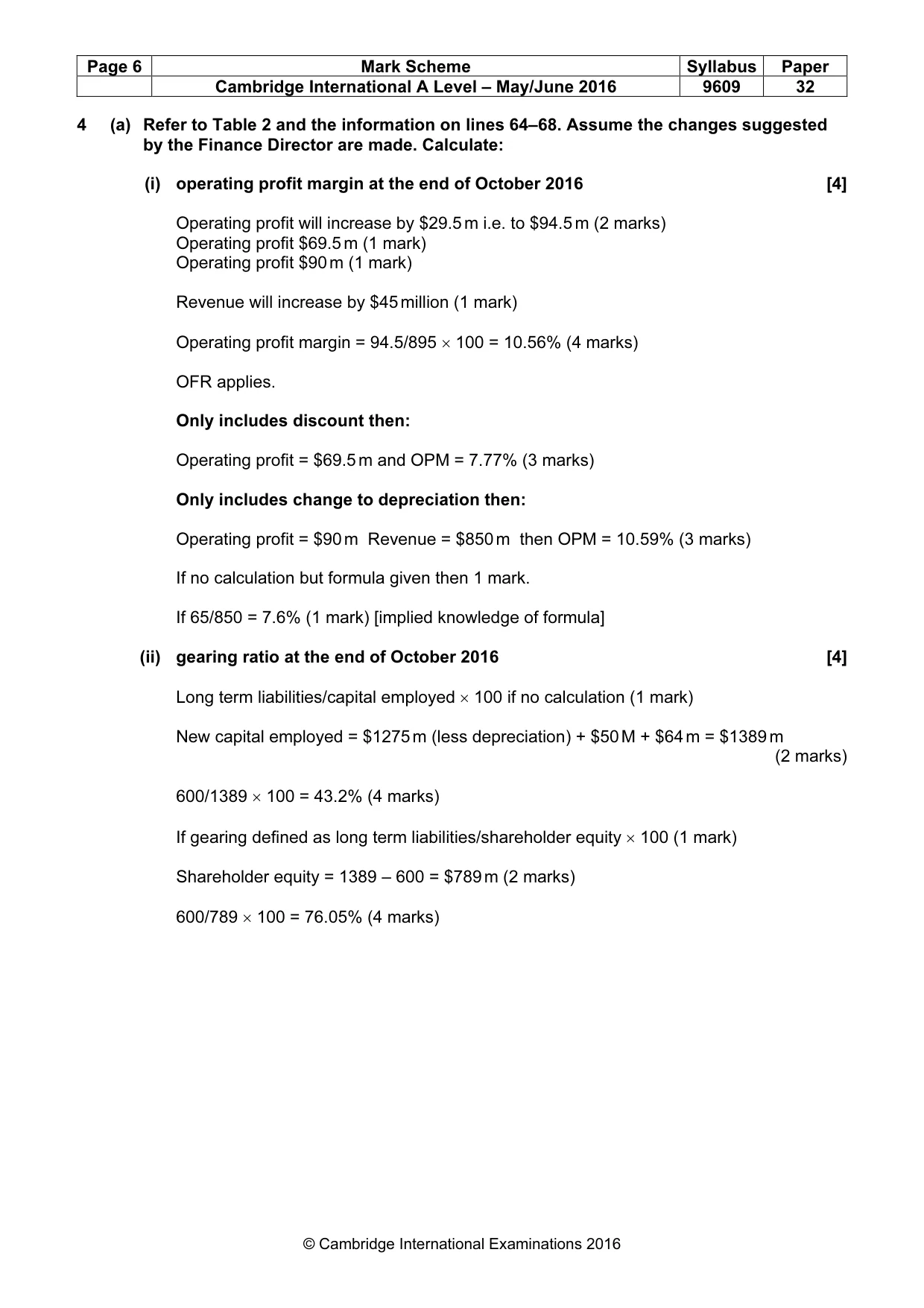
Page 6 Mark Scheme Syllabus Paper Cambridge International A Level – May/June 2016 9609 32 © Cambridge International Examinations 2016 4 (a) Refer to Table 2 and the information on lines 64–68. Assume the changes suggested by the Finance Director are made. Calculate: (i) operating profit margin at the end of October 2016 [4] Operating profit will increase by $29.5 m i.e. to $94.5 m (2 marks) Operating profit $69.5 m (1 mark) Operating profit $90 m (1 mark) Revenue will increase by $45 million (1 mark) Operating profit margin = 94.5/895 × 100 = 10.56% (4 marks) OFR applies. Only includes discount then: Operating profit = $69.5 m and OPM = 7.77% (3 marks) Only includes change to depreciation then: Operating profit = $90 m Revenue = $850 m then OPM = 10.59% (3 marks) If no calculation but formula given then 1 mark. If 65/850 = 7.6% (1 mark) [implied knowledge of formula] (ii) gearing ratio at the end of October 2016 [4] Long term liabilities/capital employed × 100 if no calculation (1 mark) New capital employed = $1275 m (less depreciation) + $50 M + $64 m = $1389 m (2 marks) 600/1389 × 100 = 43.2% (4 marks) If gearing defined as long term liabilities/shareholder equity × 100 (1 mark) Shareholder equity = 1389 – 600 = $789 m (2 marks) 600/789 × 100 = 76.05% (4 marks)
Mark scheme, page 7
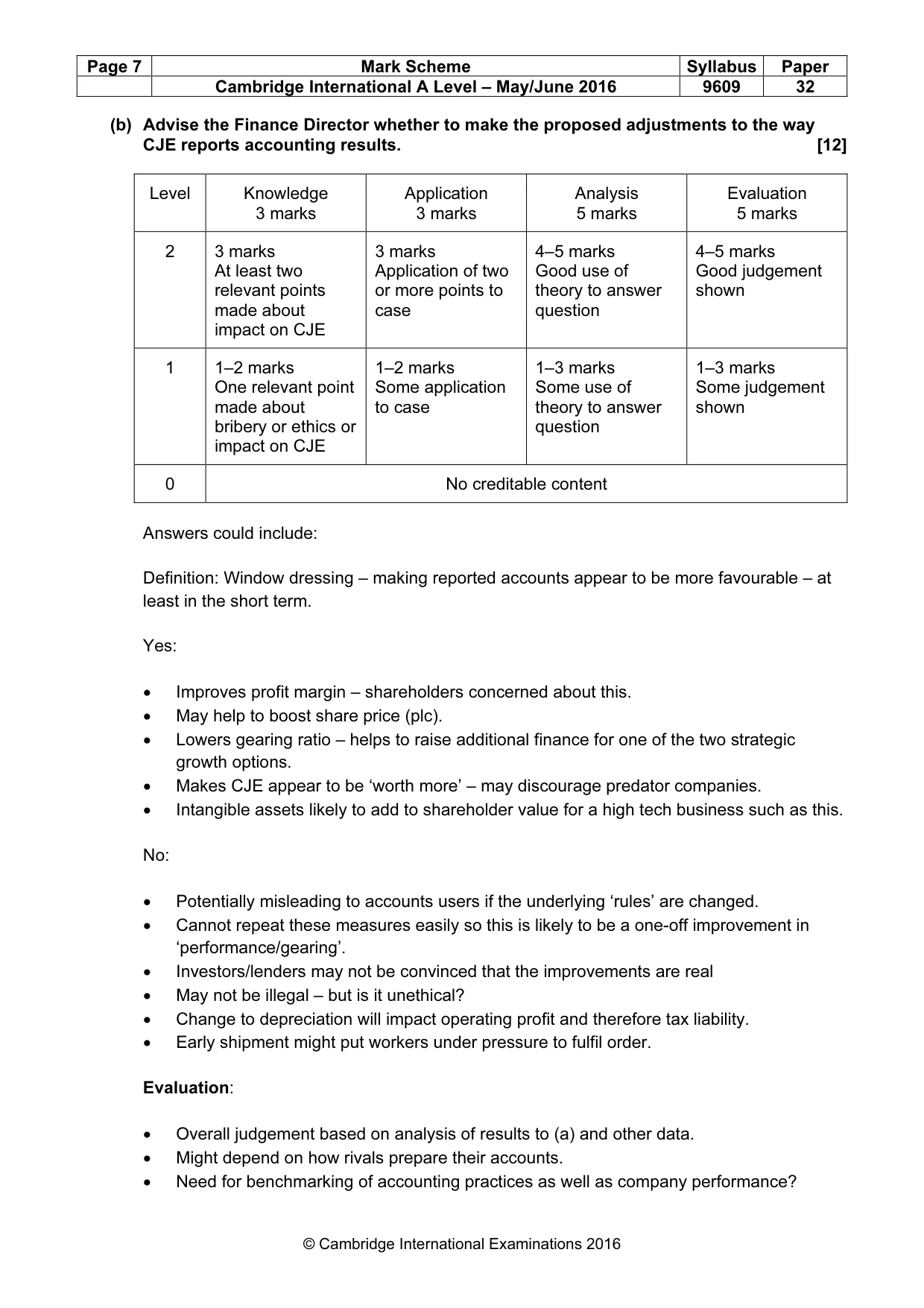
Page 7 Mark Scheme Syllabus Paper Cambridge International A Level – May/June 2016 9609 32 © Cambridge International Examinations 2016 (b) Advise the Finance Director whether to make the proposed adjustments to the way CJE reports accounting results. [12] Level Knowledge 3 marks Application 3 marks Analysis 5 marks Evaluation 5 marks 2 3 marks At least two relevant points made about impact on CJE 3 marks Application of two or more points to case 4–5 marks Good use of theory to answer question 4–5 marks Good judgement shown 1 1–2 marks One relevant point made about bribery or ethics or impact on CJE 1–2 marks Some application to case 1–3 marks Some use of theory to answer question 1–3 marks Some judgement shown 0 No creditable content Answers could include: Definition: Window dressing – making reported accounts appear to be more favourable – at least in the short term. Yes: • Improves profit margin – shareholders concerned about this. • May help to boost share price (plc). • Lowers gearing ratio – helps to raise additional finance for one of the two strategic growth options. • Makes CJE appear to be ‘worth more’ – may discourage predator companies. • Intangible assets likely to add to shareholder value for a high tech business such as this. No: • Potentially misleading to accounts users if the underlying ‘rules’ are changed. • Cannot repeat these measures easily so this is likely to be a one-off improvement in ‘performance/gearing’. • Investors/lenders may not be convinced that the improvements are real • May not be illegal – but is it unethical? • Change to depreciation will impact operating profit and therefore tax liability. • Early shipment might put workers under pressure to fulfil order. Evaluation: • Overall judgement based on analysis of results to (a) and other data. • Might depend on how rivals prepare their accounts. • Need for benchmarking of accounting practices as well as company performance?
Mark scheme, page 8
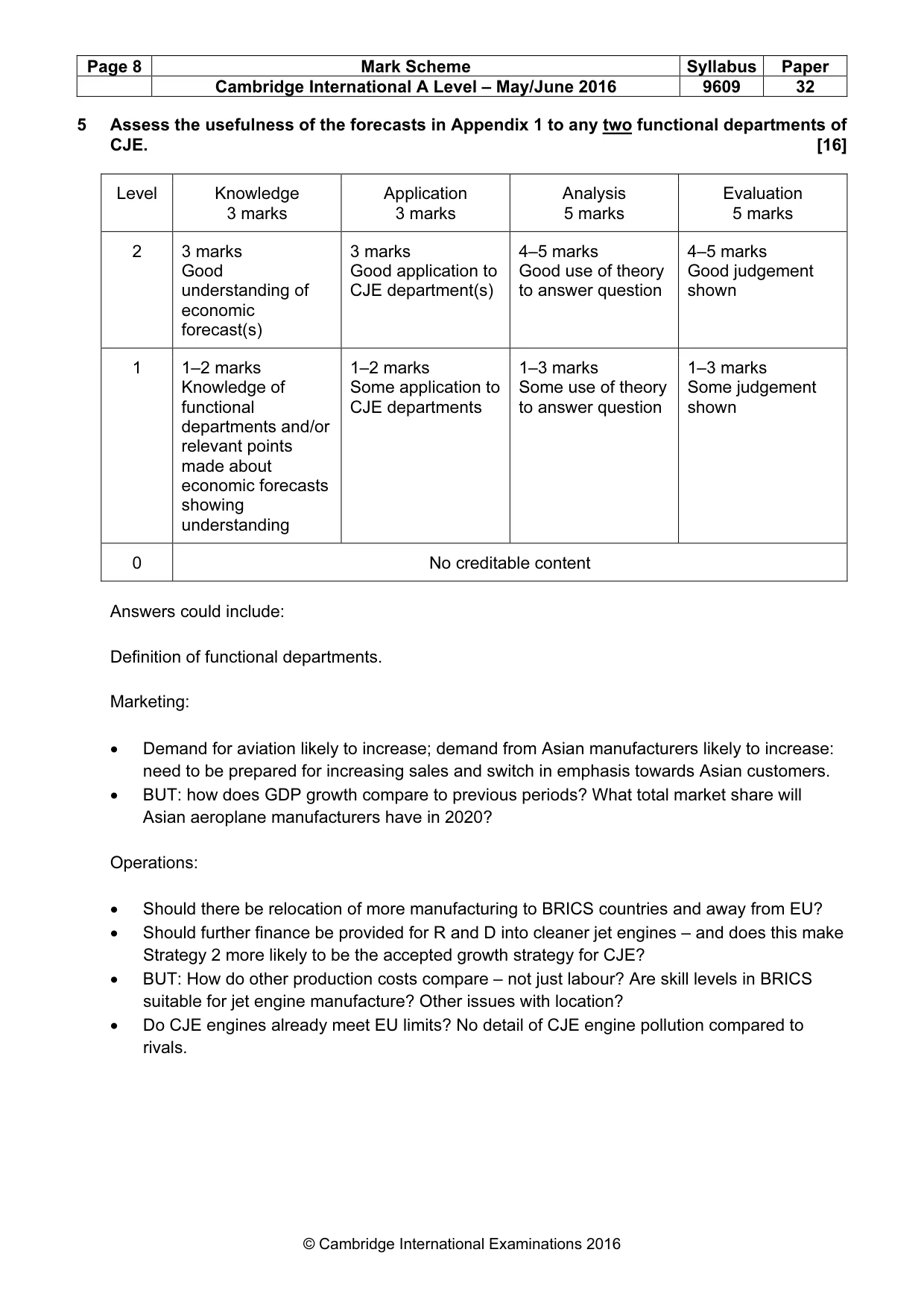
Page 8 Mark Scheme Syllabus Paper Cambridge International A Level – May/June 2016 9609 32 © Cambridge International Examinations 2016 5 Assess the usefulness of the forecasts in Appendix 1 to any two functional departments of CJE. [16] Level Knowledge 3 marks Application 3 marks Analysis 5 marks Evaluation 5 marks 2 3 marks Good understanding of economic forecast(s) 3 marks Good application to CJE department(s) 4–5 marks Good use of theory to answer question 4–5 marks Good judgement shown 1 1–2 marks Knowledge of functional departments and/or relevant points made about economic forecasts showing understanding 1–2 marks Some application to CJE departments 1–3 marks Some use of theory to answer question 1–3 marks Some judgement shown 0 No creditable content Answers could include: Definition of functional departments. Marketing: • Demand for aviation likely to increase; demand from Asian manufacturers likely to increase: need to be prepared for increasing sales and switch in emphasis towards Asian customers. • BUT: how does GDP growth compare to previous periods? What total market share will Asian aeroplane manufacturers have in 2020? Operations: • Should there be relocation of more manufacturing to BRICS countries and away from EU? • Should further finance be provided for R and D into cleaner jet engines – and does this make Strategy 2 more likely to be the accepted growth strategy for CJE? • BUT: How do other production costs compare – not just labour? Are skill levels in BRICS suitable for jet engine manufacture? Other issues with location? • Do CJE engines already meet EU limits? No detail of CJE engine pollution compared to rivals.
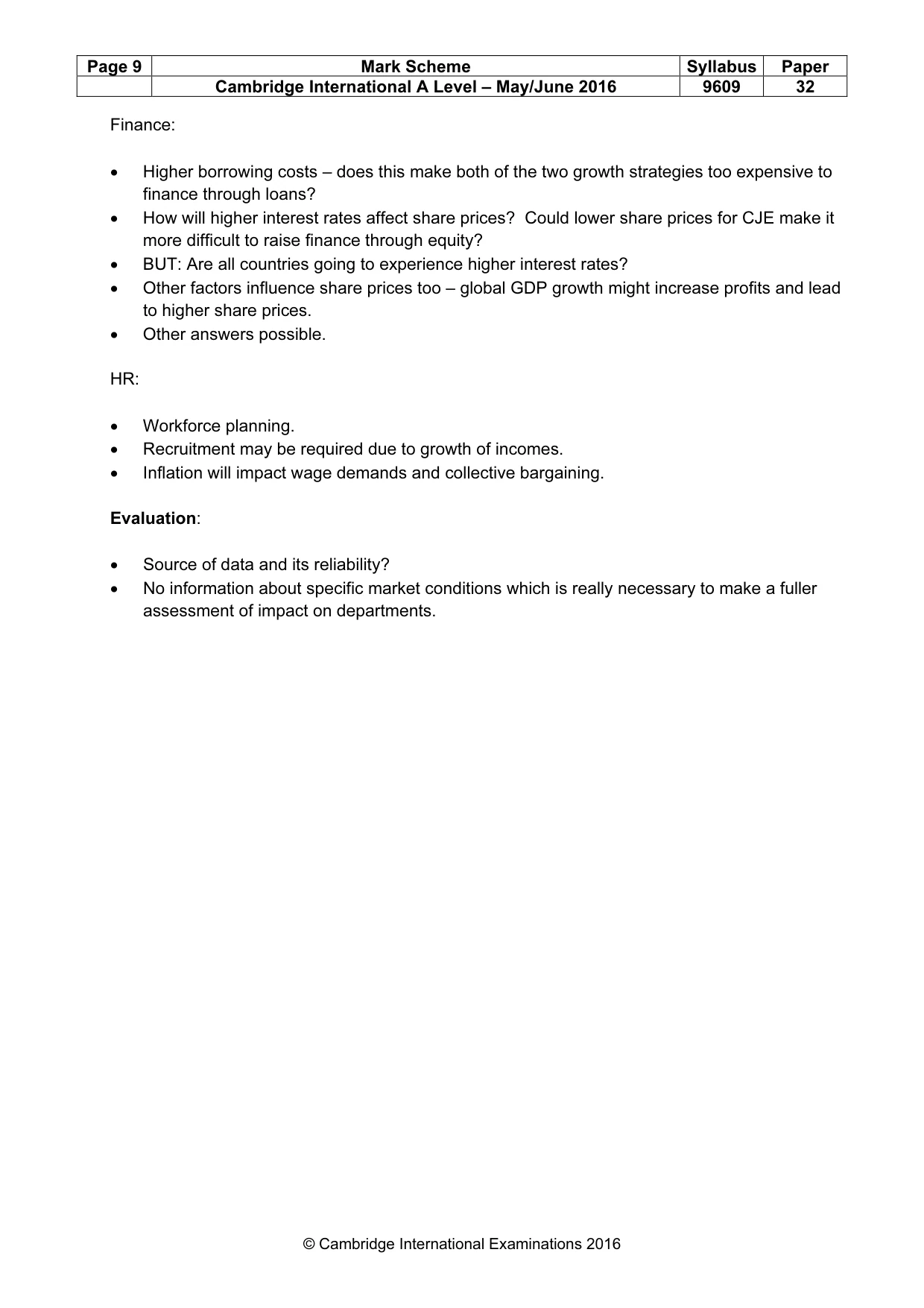
Mark scheme, page 9
Page 9 Mark Scheme Syllabus Paper Cambridge International A Level – May/June 2016 9609 32 © Cambridge International Examinations 2016 Finance: • Higher borrowing costs – does this make both of the two growth strategies too expensive to finance through loans? • How will higher interest rates affect share prices? Could lower share prices for CJE make it more difficult to raise finance through equity? • BUT: Are all countries going to experience higher interest rates? • Other factors influence share prices too – global GDP growth might increase profits and lead to higher share prices. • Other answers possible. HR: • Workforce planning. • Recruitment may be required due to growth of incomes. • Inflation will impact wage demands and collective bargaining. Evaluation: • Source of data and its reliability? • No information about specific market conditions which is really necessary to make a fuller assessment of impact on departments.
Mark scheme, page 10
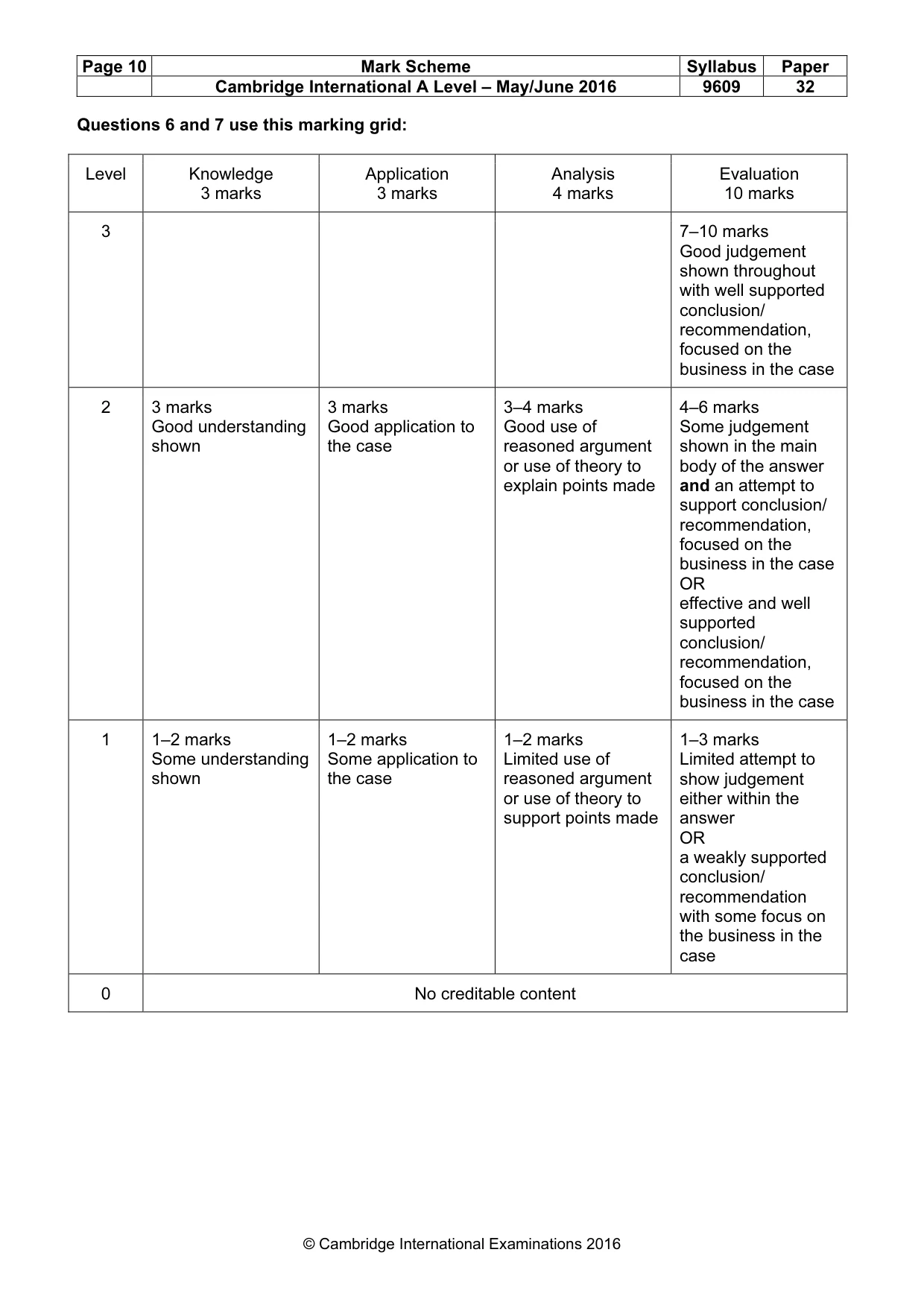
Page 10 Mark Scheme Syllabus Paper Cambridge International A Level – May/June 2016 9609 32 © Cambridge International Examinations 2016 Questions 6 and 7 use this marking grid: Level Knowledge 3 marks Application 3 marks Analysis 4 marks Evaluation 10 marks 3 7–10 marks Good judgement shown throughout with well supported conclusion/ recommendation, focused on the business in the case 2 3 marks Good understanding shown 3 marks Good application to the case 3–4 marks Good use of reasoned argument or use of theory to explain points made 4–6 marks Some judgement shown in the main body of the answer and an attempt to support conclusion/ recommendation, focused on the business in the case OR effective and well supported conclusion/ recommendation, focused on the business in the case 1 1–2 marks Some understanding shown 1–2 marks Some application to the case 1–2 marks Limited use of reasoned argument or use of theory to support points made 1–3 marks Limited attempt to show judgement either within the answer OR a weakly supported conclusion/ recommendation with some focus on the business in the case 0 No creditable content
Mark scheme, page 11
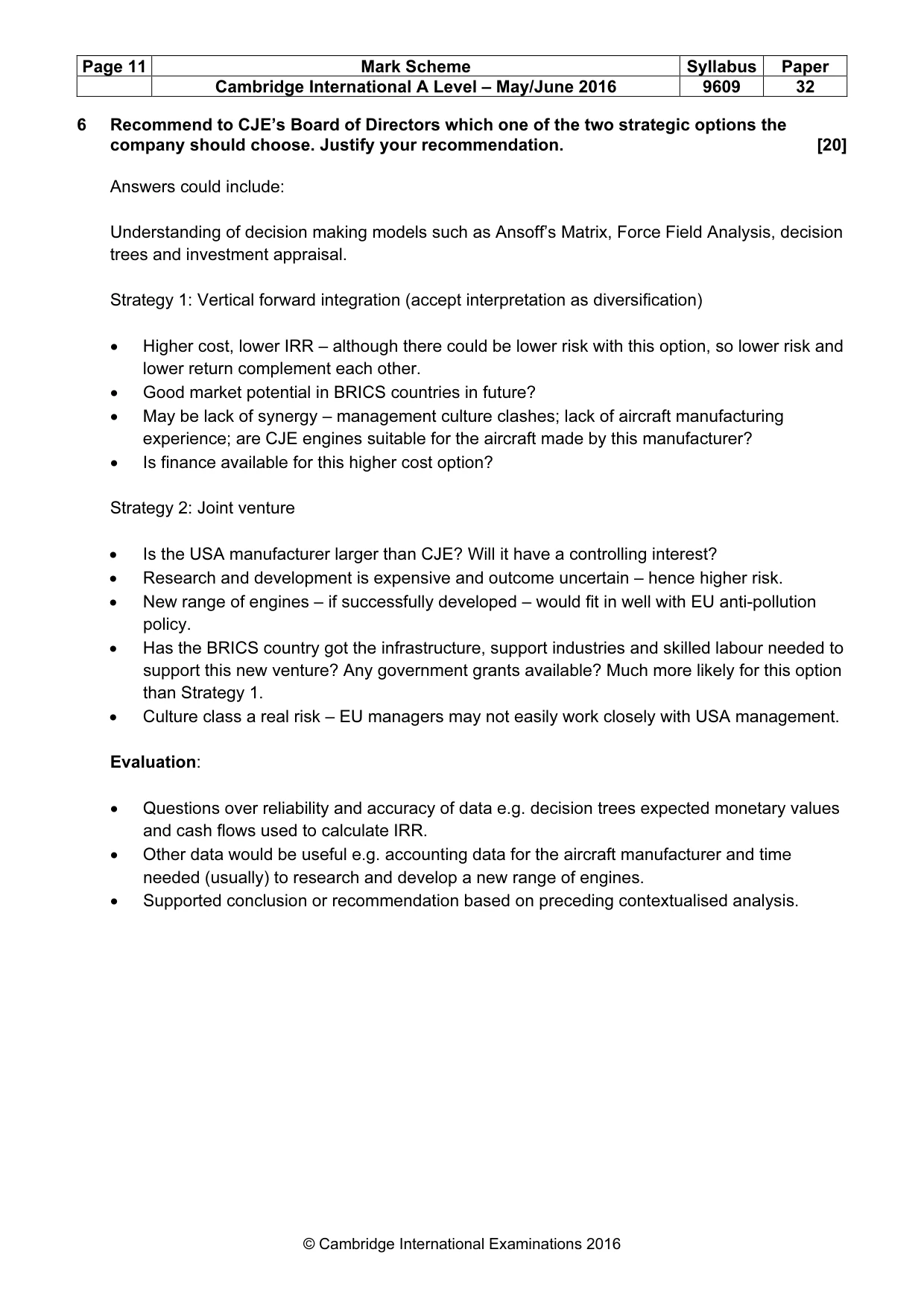
Page 11 Mark Scheme Syllabus Paper Cambridge International A Level – May/June 2016 9609 32 © Cambridge International Examinations 2016 6 Recommend to CJE’s Board of Directors which one of the two strategic options the company should choose. Justify your recommendation. [20] Answers could include: Understanding of decision making models such as Ansoff’s Matrix, Force Field Analysis, decision trees and investment appraisal. Strategy 1: Vertical forward integration (accept interpretation as diversification) • Higher cost, lower IRR – although there could be lower risk with this option, so lower risk and lower return complement each other. • Good market potential in BRICS countries in future? • May be lack of synergy – management culture clashes; lack of aircraft manufacturing experience; are CJE engines suitable for the aircraft made by this manufacturer? • Is finance available for this higher cost option? Strategy 2: Joint venture • Is the USA manufacturer larger than CJE? Will it have a controlling interest? • Research and development is expensive and outcome uncertain – hence higher risk. • New range of engines – if successfully developed – would fit in well with EU anti-pollution policy. • Has the BRICS country got the infrastructure, support industries and skilled labour needed to support this new venture? Any government grants available? Much more likely for this option than Strategy 1. • Culture class a real risk – EU managers may not easily work closely with USA management. Evaluation: • Questions over reliability and accuracy of data e.g. decision trees expected monetary values and cash flows used to calculate IRR. • Other data would be useful e.g. accounting data for the aircraft manufacturer and time needed (usually) to research and develop a new range of engines. • Supported conclusion or recommendation based on preceding contextualised analysis.
Mark scheme, page 12
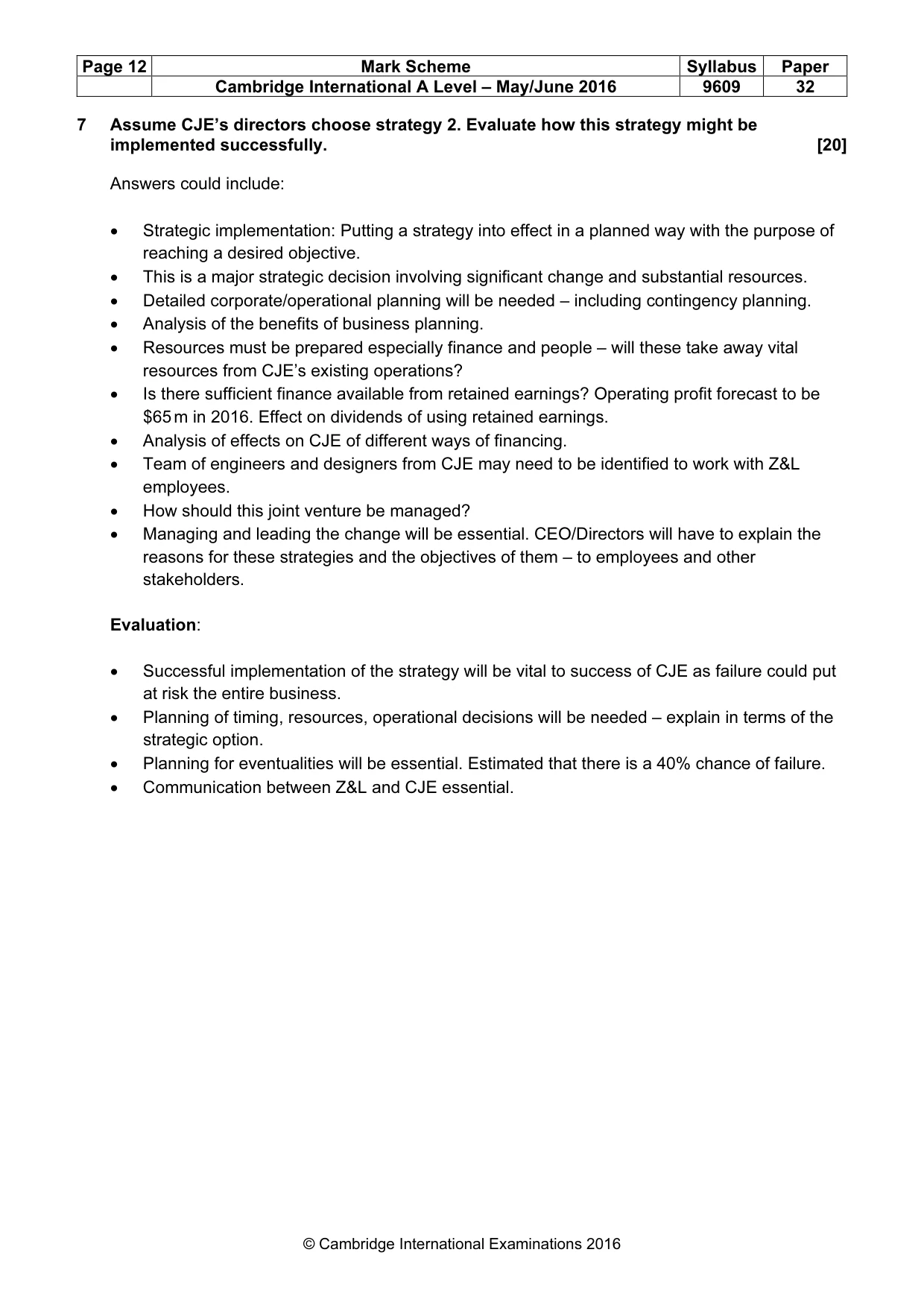
Page 12 Mark Scheme Syllabus Paper Cambridge International A Level – May/June 2016 9609 32 © Cambridge International Examinations 2016 7 Assume CJE’s directors choose strategy 2. Evaluate how this strategy might be implemented successfully. [20] Answers could include: • Strategic implementation: Putting a strategy into effect in a planned way with the purpose of reaching a desired objective. • This is a major strategic decision involving significant change and substantial resources. • Detailed corporate/operational planning will be needed – including contingency planning. • Analysis of the benefits of business planning. • Resources must be prepared especially finance and people – will these take away vital resources from CJE’s existing operations? • Is there sufficient finance available from retained earnings? Operating profit forecast to be $65 m in 2016. Effect on dividends of using retained earnings. • Analysis of effects on CJE of different ways of financing. • Team of engineers and designers from CJE may need to be identified to work with Z&L employees. • How should this joint venture be managed? • Managing and leading the change will be essential. CEO/Directors will have to explain the reasons for these strategies and the objectives of them – to employees and other stakeholders. Evaluation: • Successful implementation of the strategy will be vital to success of CJE as failure could put at risk the entire business. • Planning of timing, resources, operational decisions will be needed – explain in terms of the strategic option. • Planning for eventualities will be essential. Estimated that there is a 40% chance of failure. • Communication between Z&L and CJE essential.
What you needed in this session
Cambridge’s own grade thresholds for 2016 May/June, Paper 3 · Variant 2. A higher threshold means an easier paper — the bar moves with how the cohort did.