Cambridge A Level Business (for first examination in 2016) 9609 — 2016 May/June Paper 3 · Variant 3
9609/33/M/J/16 · 100 marks · ≈113 min
The question paper and its mark scheme, free to read here and free to download. This is Cambridge’s own paper, exactly as it was sat.
Question paper8 pages

Mark scheme12 pages
Answers below. Sit the paper first if you are practising.
Paper as text
Question paper, page 1
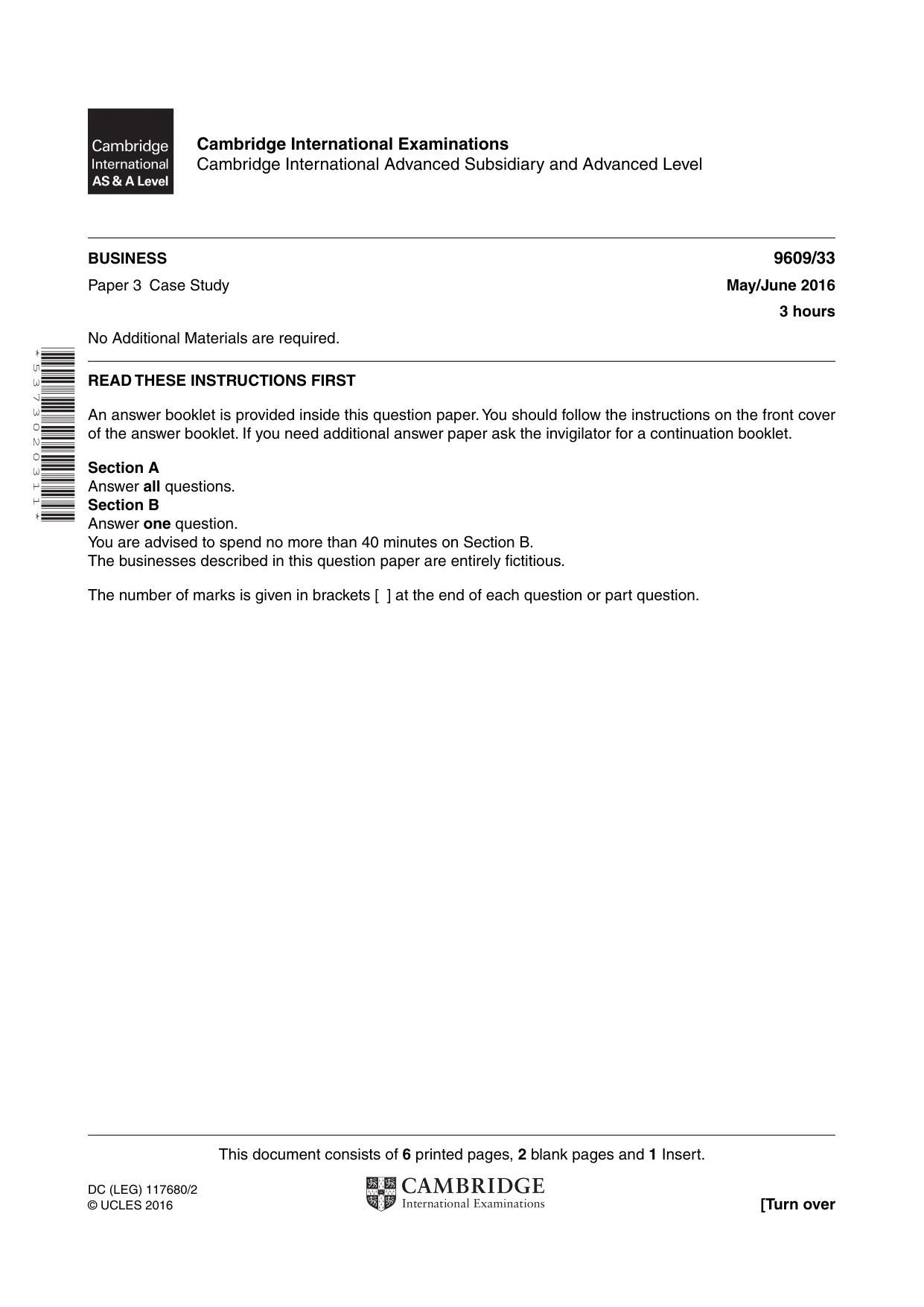
This document consists of 6 printed pages, 2 blank pages and 1 Insert. DC (LEG) 117680/2 © UCLES 2016 [Turn over Cambridge International Examinations Cambridge International Advanced Subsidiary and Advanced Level * 5 3 7 3 0 2 0 3 1 1 * BUSINESS 9609/33 Paper 3 Case Study May/June 2016 3 hours No Additional Materials are required. READ THESE INSTRUCTIONS FIRST An answer booklet is provided inside this question paper. You should follow the instructions on the front cover of the answer booklet. If you need additional answer paper ask the invigilator for a continuation booklet. Section A Answer all questions. Section B Answer one question. You are advised to spend no more than 40 minutes on Section B. The businesses described in this question paper are entirely fictitious. The number of marks is given in brackets [ ] at the end of each question or part question.
Question paper, page 2
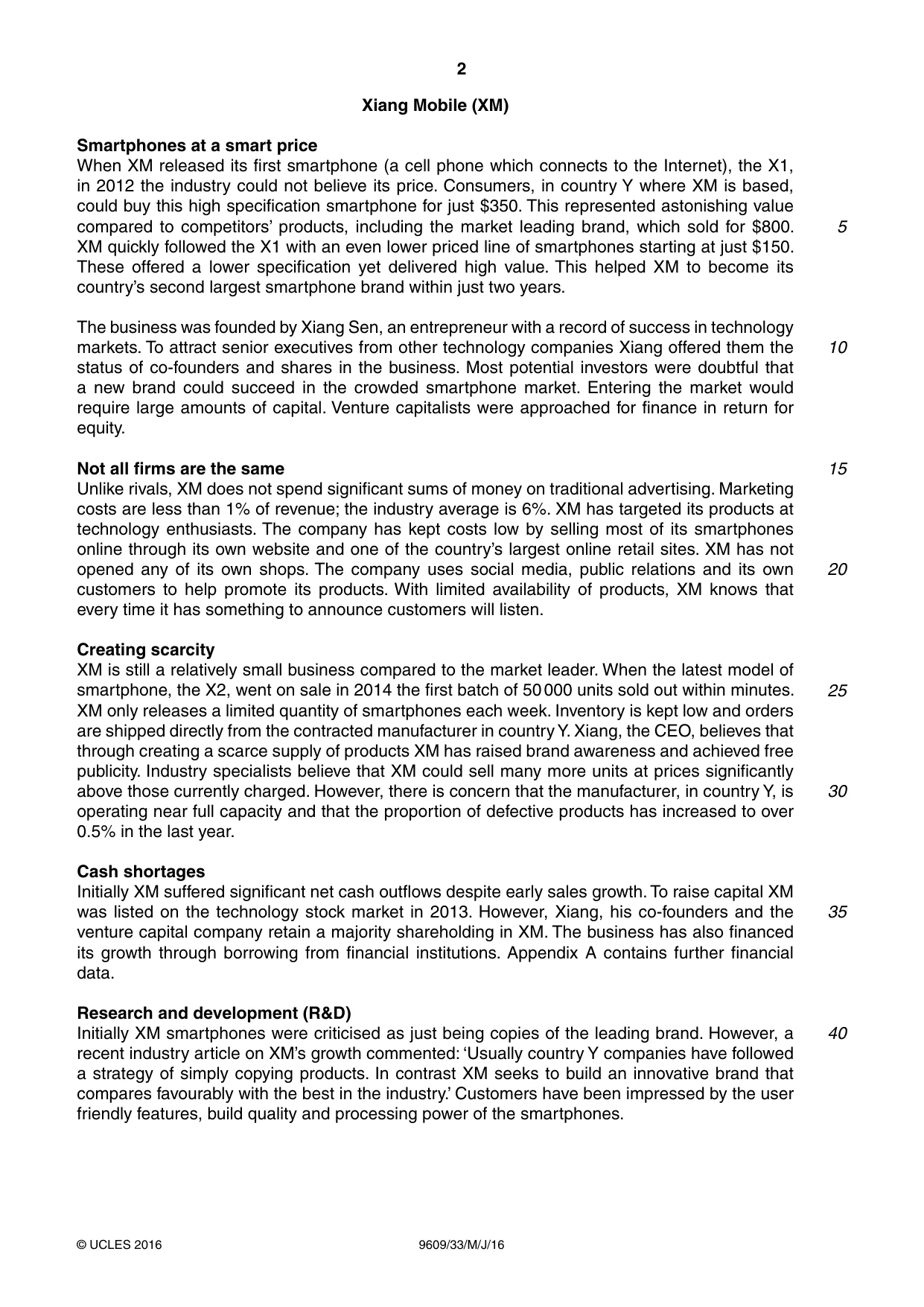
2 9609/33/M/J/16 © UCLES 2016 Xiang Mobile (XM) Smartphones at a smart price When XM released its first smartphone (a cell phone which connects to the Internet), the X1, in 2012 the industry could not believe its price. Consumers, in country Y where XM is based, could buy this high specification smartphone for just $350. This represented astonishing value compared to competitors’ products, including the market leading brand, which sold for $800. XM quickly followed the X1 with an even lower priced line of smartphones starting at just $150. These offered a lower specification yet delivered high value. This helped XM to become its country’s second largest smartphone brand within just two years. The business was founded by Xiang Sen, an entrepreneur with a record of success in technology markets. To attract senior executives from other technology companies Xiang offered them the status of co-founders and shares in the business. Most potential investors were doubtful that a new brand could succeed in the crowded smartphone market. Entering the market would require large amounts of capital. Venture capitalists were approached for finance in return for equity. Not all firms are the same Unlike rivals, XM does not spend significant sums of money on traditional advertising. Marketing costs are less than 1% of revenue; the industry average is 6%. XM has targeted its products at technology enthusiasts. The company has kept costs low by selling most of its smartphones online through its own website and one of the country’s largest online retail sites. XM has not opened any of its own shops. The company uses social media, public relations and its own customers to help promote its products. With limited availability of products, XM knows that every time it has something to announce customers will listen. Creating scarcity XM is still a relatively small business compared to the market leader. When the latest model of smartphone, the X2, went on sale in 2014 the first batch of 50 000 units sold out within minutes. XM only releases a limited quantity of smartphones each week. Inventory is kept low and orders are shipped directly from the contracted manufacturer in country Y. Xiang, the CEO, believes that through creating a scarce supply of products XM has raised brand awareness and achieved free publicity. Industry specialists believe that XM could sell many more units at prices significantly above those currently charged. However, there is concern that the manufacturer, in country Y, is operating near full capacity and that the proportion of defective products has increased to over 0.5% in the last year. Cash shortages Initially XM suffered significant net cash outflows despite early sales growth. To raise capital XM was listed on the technology stock market in 2013. However, Xiang, his co-founders and the venture capital company retain a majority shareholding in XM. The business has also financed its growth through borrowing from financial institutions. Appendix A contains further financial data. Research and development (R&D) Initially XM smartphones were criticised as just being copies of the leading brand. However, a recent industry article on XM’s growth commented: ‘Usually country Y companies have followed a strategy of simply copying products. In contrast XM seeks to build an innovative brand that compares favourably with the best in the industry.’ Customers have been impressed by the user friendly features, build quality and processing power of the smartphones. 5 10 15 20 25 30 35 40
Question paper, page 3
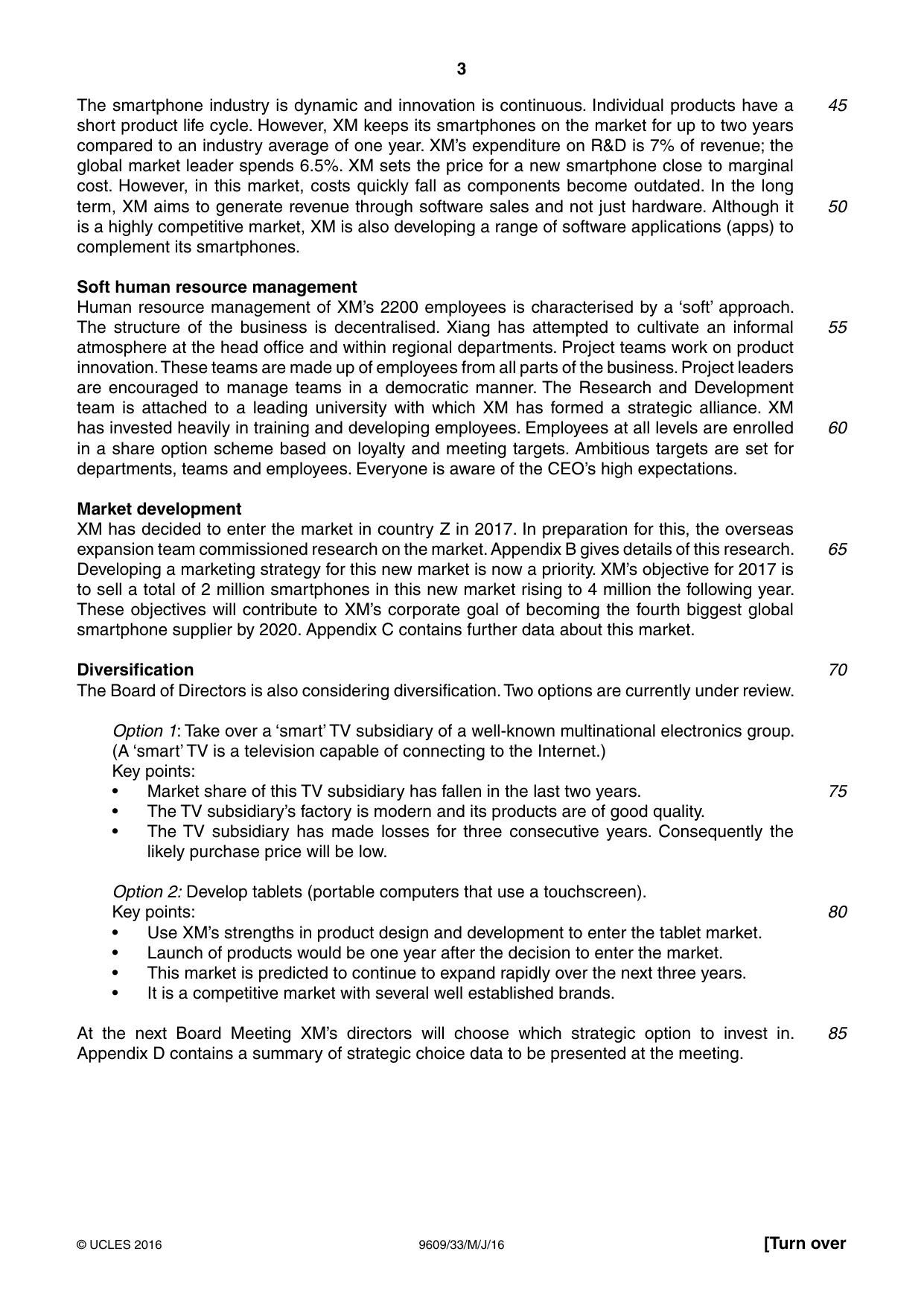
3 9609/33/M/J/16 © UCLES 2016 [Turn over The smartphone industry is dynamic and innovation is continuous. Individual products have a short product life cycle. However, XM keeps its smartphones on the market for up to two years compared to an industry average of one year. XM’s expenditure on R&D is 7% of revenue; the global market leader spends 6.5%. XM sets the price for a new smartphone close to marginal cost. However, in this market, costs quickly fall as components become outdated. In the long term, XM aims to generate revenue through software sales and not just hardware. Although it is a highly competitive market, XM is also developing a range of software applications (apps) to complement its smartphones. Soft human resource management Human resource management of XM’s 2200 employees is characterised by a ‘soft’ approach. The structure of the business is decentralised. Xiang has attempted to cultivate an informal atmosphere at the head office and within regional departments. Project teams work on product innovation. These teams are made up of employees from all parts of the business. Project leaders are encouraged to manage teams in a democratic manner. The Research and Development team is attached to a leading university with which XM has formed a strategic alliance. XM has invested heavily in training and developing employees. Employees at all levels are enrolled in a share option scheme based on loyalty and meeting targets. Ambitious targets are set for departments, teams and employees. Everyone is aware of the CEO’s high expectations. Market development XM has decided to enter the market in country Z in 2017. In preparation for this, the overseas expansion team commissioned research on the market. Appendix B gives details of this research. Developing a marketing strategy for this new market is now a priority. XM’s objective for 2017 is to sell a total of 2 million smartphones in this new market rising to 4 million the following year. These objectives will contribute to XM’s corporate goal of becoming the fourth biggest global smartphone supplier by 2020. Appendix C contains further data about this market. Diversification The Board of Directors is also considering diversification. Two options are currently under review. Option 1: Take over a ‘smart’ TV subsidiary of a well-known multinational electronics group. (A ‘smart’ TV is a television capable of connecting to the Internet.) Key points: • Market share of this TV subsidiary has fallen in the last two years. • The TV subsidiary’s factory is modern and its products are of good quality. • The TV subsidiary has made losses for three consecutive years. Consequently the likely purchase price will be low. Option 2: Develop tablets (portable computers that use a touchscreen). Key points: • Use XM’s strengths in product design and development to enter the tablet market. • Launch of products would be one year after the decision to enter the market. • This market is predicted to continue to expand rapidly over the next three years. • It is a competitive market with several well established brands. At the next Board Meeting XM’s directors will choose which strategic option to invest in. Appendix D contains a summary of strategic choice data to be presented at the meeting. 45 50 55 60 65 70 75 80 85
Question paper, page 4
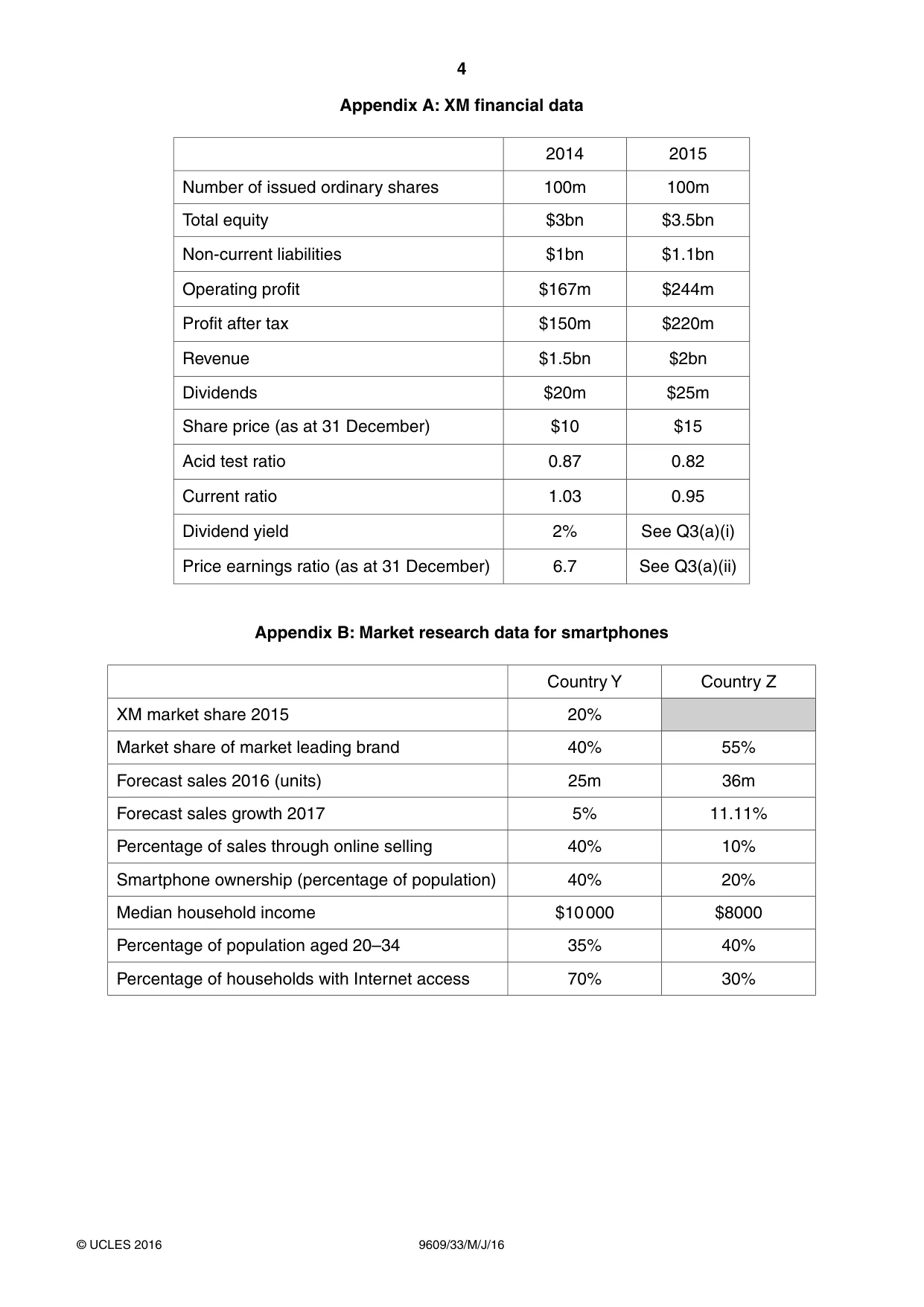
4 9609/33/M/J/16 © UCLES 2016 Appendix A: XM financial data 2014 2015 Number of issued ordinary shares 100m 100m Total equity $3bn $3.5bn Non-current liabilities $1bn $1.1bn Operating profit $167m $244m Profit after tax $150m $220m Revenue $1.5bn $2bn Dividends $20m $25m Share price (as at 31 December) $10 $15 Acid test ratio 0.87 0.82 Current ratio 1.03 0.95 Dividend yield 2% See Q3(a)(i) Price earnings ratio (as at 31 December) 6.7 See Q3(a)(ii) Appendix B: Market research data for smartphones Country Y Country Z XM market share 2015 20% Market share of market leading brand 40% 55% Forecast sales 2016 (units) 25m 36m Forecast sales growth 2017 5% 11.11% Percentage of sales through online selling 40% 10% Smartphone ownership (percentage of population) 40% 20% Median household income $10 000 $8000 Percentage of population aged 20–34 35% 40% Percentage of households with Internet access 70% 30%
Question paper, page 5
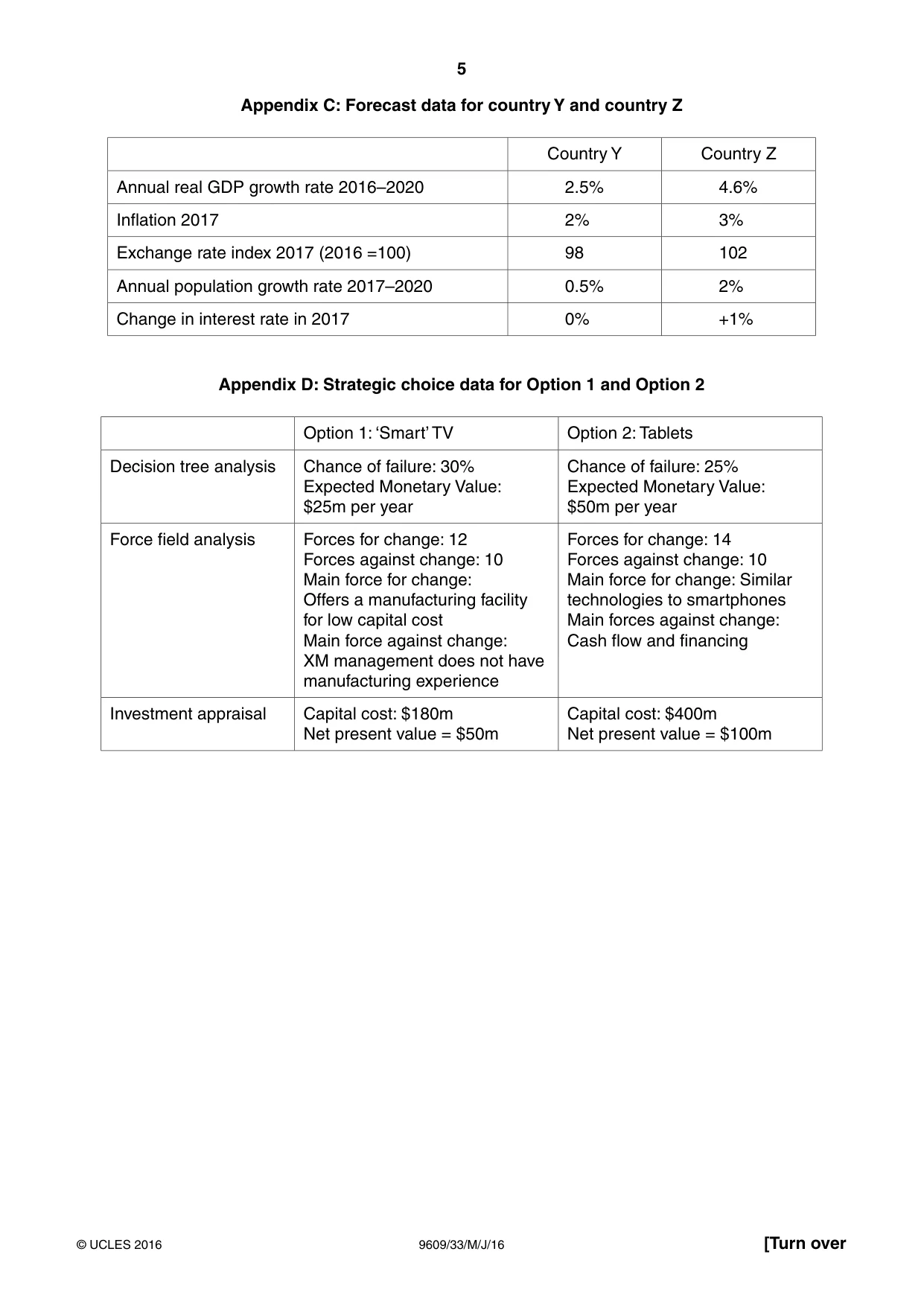
5 9609/33/M/J/16 © UCLES 2016 [Turn over Appendix C: Forecast data for country Y and country Z Country Y Country Z Annual real GDP growth rate 2016–2020 2.5% 4.6% Inflation 2017 2% 3% Exchange rate index 2017 (2016 =100) 98 102 Annual population growth rate 2017–2020 0.5% 2% Change in interest rate in 2017 0% +1% Appendix D: Strategic choice data for Option 1 and Option 2 Option 1: ‘Smart’ TV Option 2: Tablets Decision tree analysis Chance of failure: 30% Expected Monetary Value: $25m per year Chance of failure: 25% Expected Monetary Value: $50m per year Force field analysis Forces for change: 12 Forces against change: 10 Main force for change: Offers a manufacturing facility for low capital cost Main force against change: XM management does not have manufacturing experience Forces for change: 14 Forces against change: 10 Main force for change: Similar technologies to smartphones Main forces against change: Cash flow and financing Investment appraisal Capital cost: $180m Net present value = $50m Capital cost: $400m Net present value = $100m
Question paper, page 6
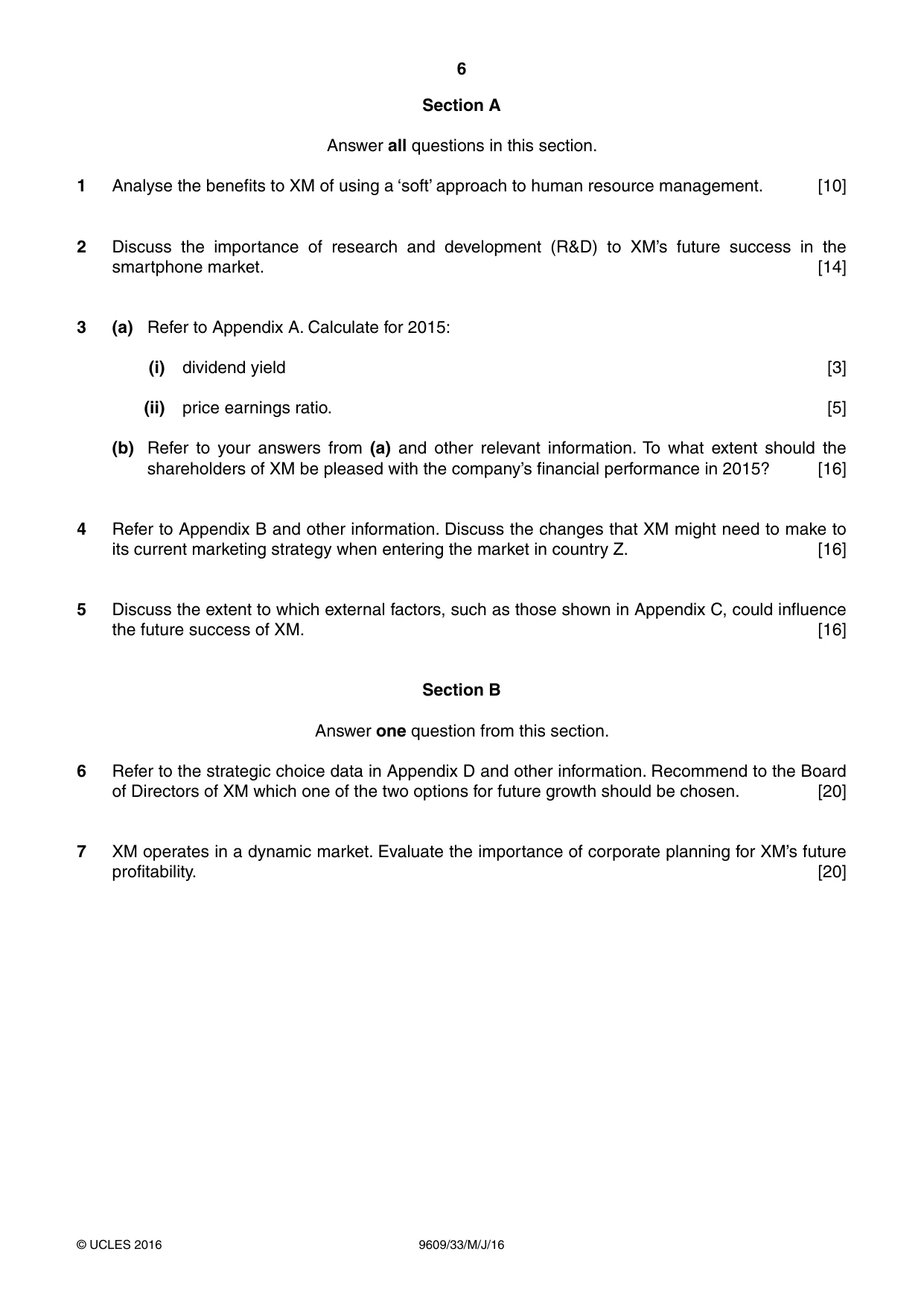
6 9609/33/M/J/16 © UCLES 2016 Section A Answer all questions in this section. 1 Analyse the benefits to XM of using a ‘soft’ approach to human resource management. [10] 2 Discuss the importance of research and development (R&D) to XM’s future success in the smartphone market. [14] 3 (a) Refer to Appendix A. Calculate for 2015: (i) dividend yield [3] (ii) price earnings ratio. [5] (b) Refer to your answers from (a) and other relevant information. To what extent should the shareholders of XM be pleased with the company’s financial performance in 2015? [16] 4 Refer to Appendix B and other information. Discuss the changes that XM might need to make to its current marketing strategy when entering the market in country Z. [16] 5 Discuss the extent to which external factors, such as those shown in Appendix C, could influence the future success of XM. [16] Section B Answer one question from this section. 6 Refer to the strategic choice data in Appendix D and other information. Recommend to the Board of Directors of XM which one of the two options for future growth should be chosen. [20] 7 XM operates in a dynamic market. Evaluate the importance of corporate planning for XM’s future profitability. [20]
Question paper, page 7
7 9609/33/M/J/16 © UCLES 2016 BLANK PAGE
Question paper, page 8
8 9609/33/M/J/16 © UCLES 2016 Permission to reproduce items where third-party owned material protected by copyright is included has been sought and cleared where possible. Every reasonable effort has been made by the publisher (UCLES) to trace copyright holders, but if any items requiring clearance have unwittingly been included, the publisher will be pleased to make amends at the earliest possible opportunity. To avoid the issue of disclosure of answer-related information to candidates, all copyright acknowledgements are reproduced online in the Cambridge International Examinations Copyright Acknowledgements Booklet. This is produced for each series of examinations and is freely available to download at www.cie.org.uk after the live examination series. Cambridge International Examinations is part of the Cambridge Assessment Group. Cambridge Assessment is the brand name of University of Cambridge Local Examinations Syndicate (UCLES), which is itself a department of the University of Cambridge. BLANK PAGE
Mark scheme, page 1
® IGCSE is the registered trademark of Cambridge International Examinations. This document consists of 12 printed pages. © UCLES 2016 [Turn over Cambridge International Examinations Cambridge International Advanced Level BUSINESS 9609/33 Paper 3 Case Study May/June 2016 MARK SCHEME Maximum Mark: 100 Published This mark scheme is published as an aid to teachers and candidates, to indicate the requirements of the examination. It shows the basis on which Examiners were instructed to award marks. It does not indicate the details of the discussions that took place at an Examiners’ meeting before marking began, which would have considered the acceptability of alternative answers. Mark schemes should be read in conjunction with the question paper and the Principal Examiner Report for Teachers. Cambridge will not enter into discussions about these mark schemes. Cambridge is publishing the mark schemes for the May/June 2016 series for most Cambridge IGCSE®, Cambridge International A and AS Level components and some Cambridge O Level components.
Mark scheme, page 2
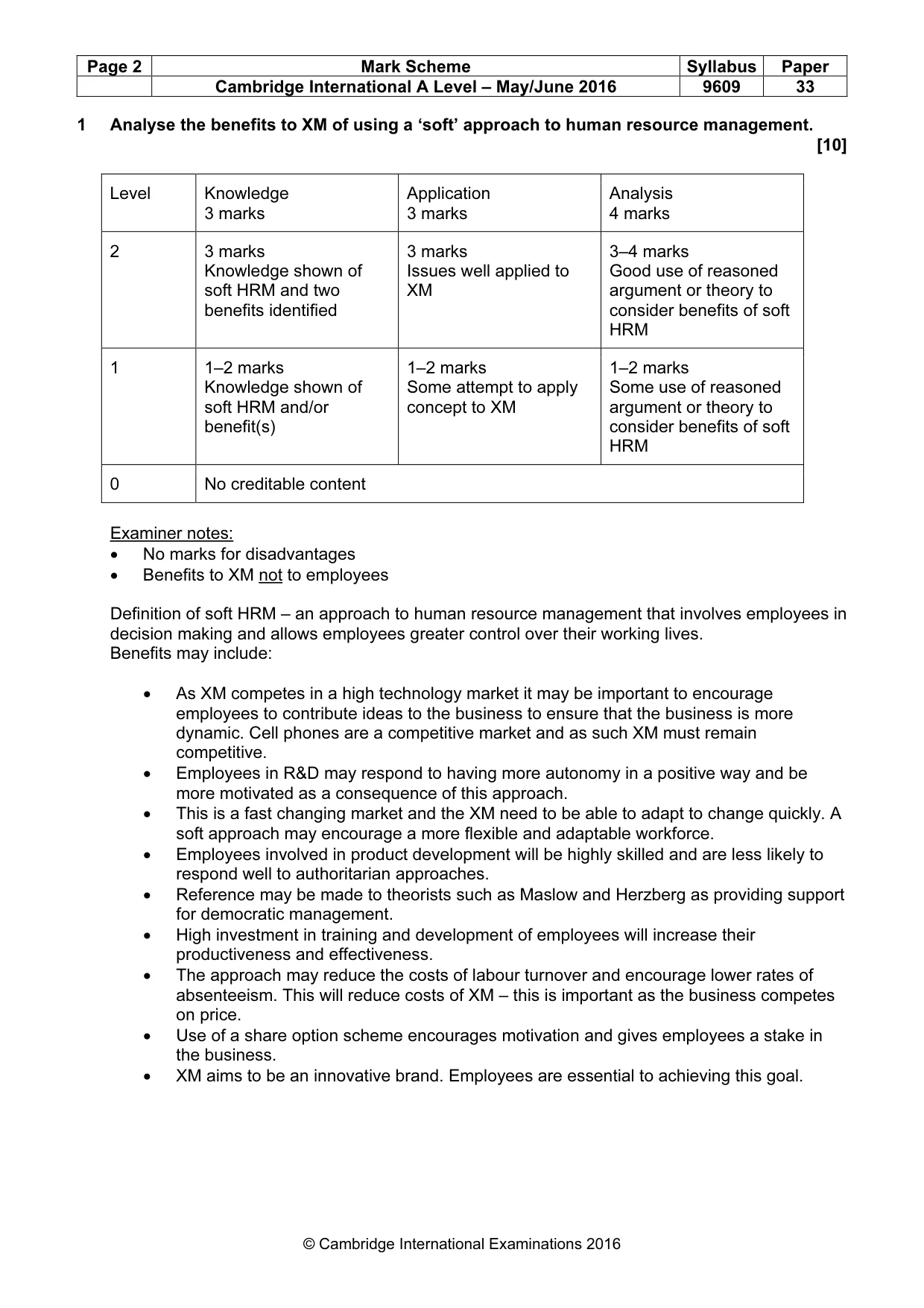
Page 2 Mark Scheme Syllabus Paper Cambridge International A Level – May/June 2016 9609 33 © Cambridge International Examinations 2016 1 Analyse the benefits to XM of using a ‘soft’ approach to human resource management. [10] Level Knowledge 3 marks Application 3 marks Analysis 4 marks 2 3 marks Knowledge shown of soft HRM and two benefits identified 3 marks Issues well applied to XM 3–4 marks Good use of reasoned argument or theory to consider benefits of soft HRM 1 1–2 marks Knowledge shown of soft HRM and/or benefit(s) 1–2 marks Some attempt to apply concept to XM 1–2 marks Some use of reasoned argument or theory to consider benefits of soft HRM 0 No creditable content Examiner notes: • No marks for disadvantages • Benefits to XM not to employees Definition of soft HRM – an approach to human resource management that involves employees in decision making and allows employees greater control over their working lives. Benefits may include: • As XM competes in a high technology market it may be important to encourage employees to contribute ideas to the business to ensure that the business is more dynamic. Cell phones are a competitive market and as such XM must remain competitive. • Employees in R&D may respond to having more autonomy in a positive way and be more motivated as a consequence of this approach. • This is a fast changing market and the XM need to be able to adapt to change quickly. A soft approach may encourage a more flexible and adaptable workforce. • Employees involved in product development will be highly skilled and are less likely to respond well to authoritarian approaches. • Reference may be made to theorists such as Maslow and Herzberg as providing support for democratic management. • High investment in training and development of employees will increase their productiveness and effectiveness. • The approach may reduce the costs of labour turnover and encourage lower rates of absenteeism. This will reduce costs of XM – this is important as the business competes on price. • Use of a share option scheme encourages motivation and gives employees a stake in the business. • XM aims to be an innovative brand. Employees are essential to achieving this goal.
Mark scheme, page 3
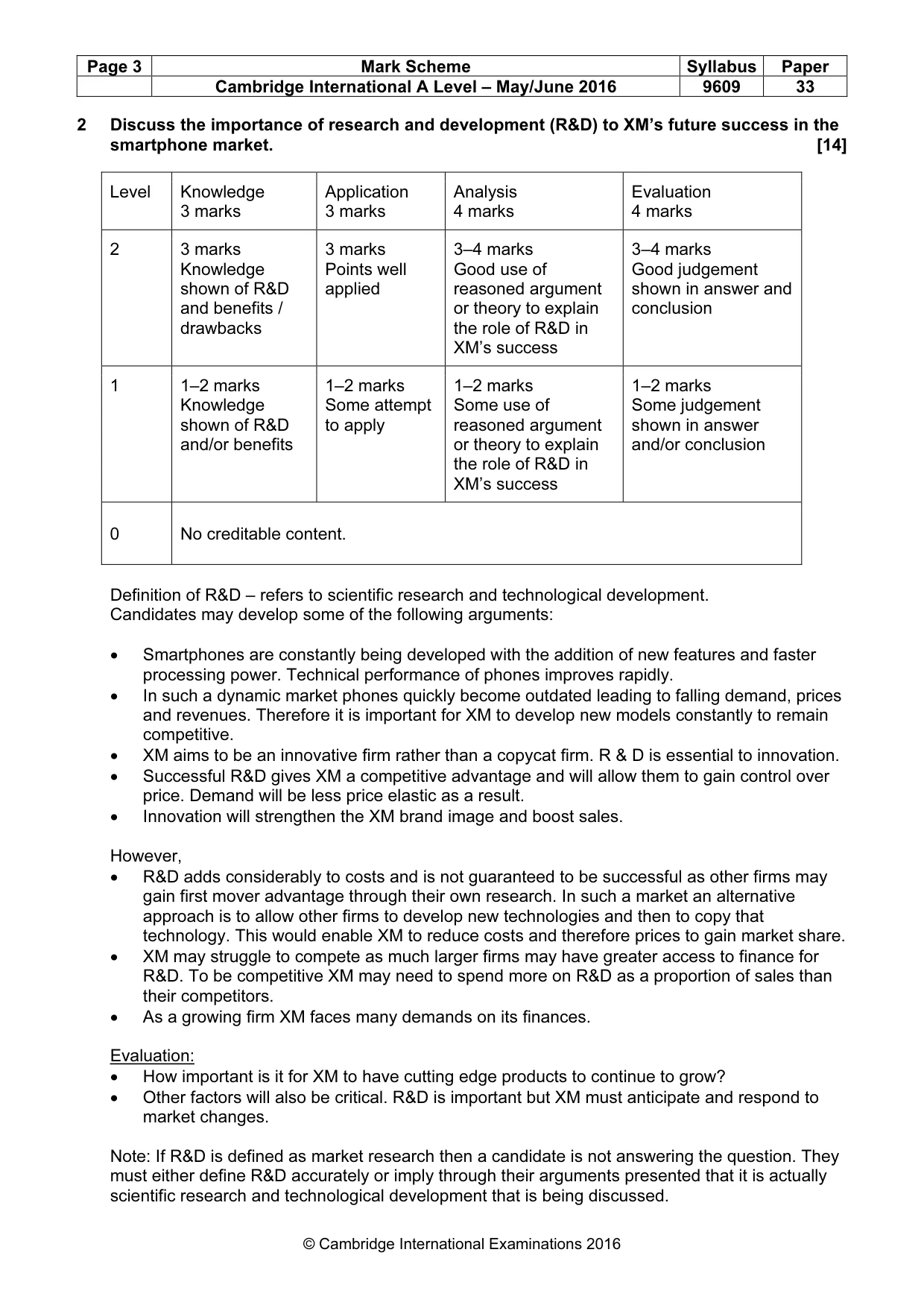
Page 3 Mark Scheme Syllabus Paper Cambridge International A Level – May/June 2016 9609 33 © Cambridge International Examinations 2016 2 Discuss the importance of research and development (R&D) to XM’s future success in the smartphone market. [14] Level Knowledge 3 marks Application 3 marks Analysis 4 marks Evaluation 4 marks 2 3 marks Knowledge shown of R&D and benefits / drawbacks 3 marks Points well applied 3–4 marks Good use of reasoned argument or theory to explain the role of R&D in XM’s success 3–4 marks Good judgement shown in answer and conclusion 1 1–2 marks Knowledge shown of R&D and/or benefits 1–2 marks Some attempt to apply 1–2 marks Some use of reasoned argument or theory to explain the role of R&D in XM’s success 1–2 marks Some judgement shown in answer and/or conclusion 0 No creditable content. Definition of R&D – refers to scientific research and technological development. Candidates may develop some of the following arguments: • Smartphones are constantly being developed with the addition of new features and faster processing power. Technical performance of phones improves rapidly. • In such a dynamic market phones quickly become outdated leading to falling demand, prices and revenues. Therefore it is important for XM to develop new models constantly to remain competitive. • XM aims to be an innovative firm rather than a copycat firm. R & D is essential to innovation. • Successful R&D gives XM a competitive advantage and will allow them to gain control over price. Demand will be less price elastic as a result. • Innovation will strengthen the XM brand image and boost sales. However, • R&D adds considerably to costs and is not guaranteed to be successful as other firms may gain first mover advantage through their own research. In such a market an alternative approach is to allow other firms to develop new technologies and then to copy that technology. This would enable XM to reduce costs and therefore prices to gain market share. • XM may struggle to compete as much larger firms may have greater access to finance for R&D. To be competitive XM may need to spend more on R&D as a proportion of sales than their competitors. • As a growing firm XM faces many demands on its finances. Evaluation: • How important is it for XM to have cutting edge products to continue to grow? • Other factors will also be critical. R&D is important but XM must anticipate and respond to market changes. Note: If R&D is defined as market research then a candidate is not answering the question. They must either define R&D accurately or imply through their arguments presented that it is actually scientific research and technological development that is being discussed.
Mark scheme, page 4
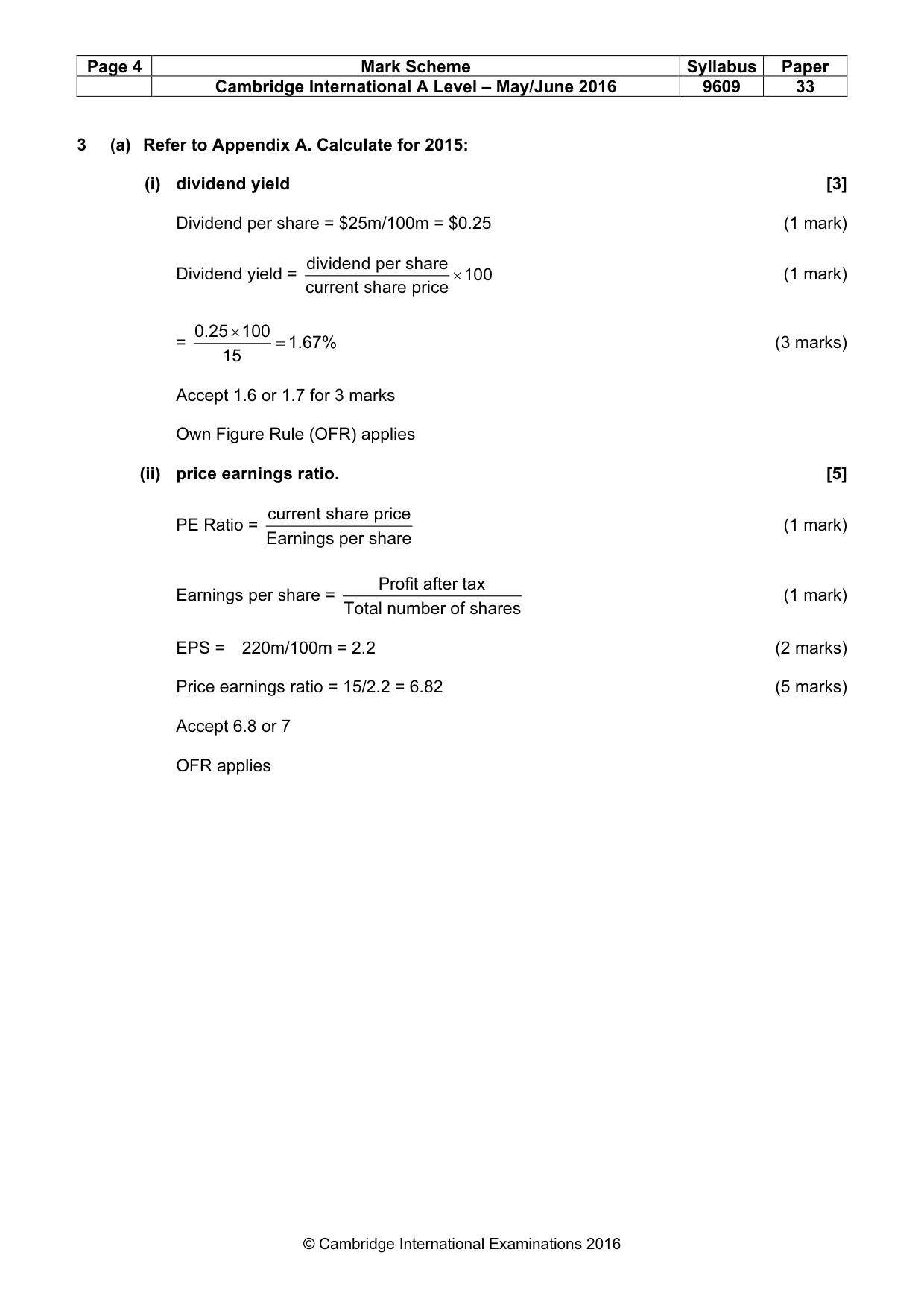
Page 4 Mark Scheme Syllabus Paper Cambridge International A Level – May/June 2016 9609 33 © Cambridge International Examinations 2016 3 (a) Refer to Appendix A. Calculate for 2015: (i) dividend yield [3] Dividend per share = $25m/100m = $0.25 (1 mark) Dividend yield = dividend per share 100 current share price × (1 mark) = 0.25 100 1.67% 15 × = (3 marks) Accept 1.6 or 1.7 for 3 marks Own Figure Rule (OFR) applies (ii) price earnings ratio. [5] PE Ratio = current share price Earnings per share (1 mark) Earnings per share = Profit after tax Total number of shares (1 mark) EPS = 220m/100m = 2.2 (2 marks) Price earnings ratio = 15/2.2 = 6.82 (5 marks) Accept 6.8 or 7 OFR applies
Mark scheme, page 5
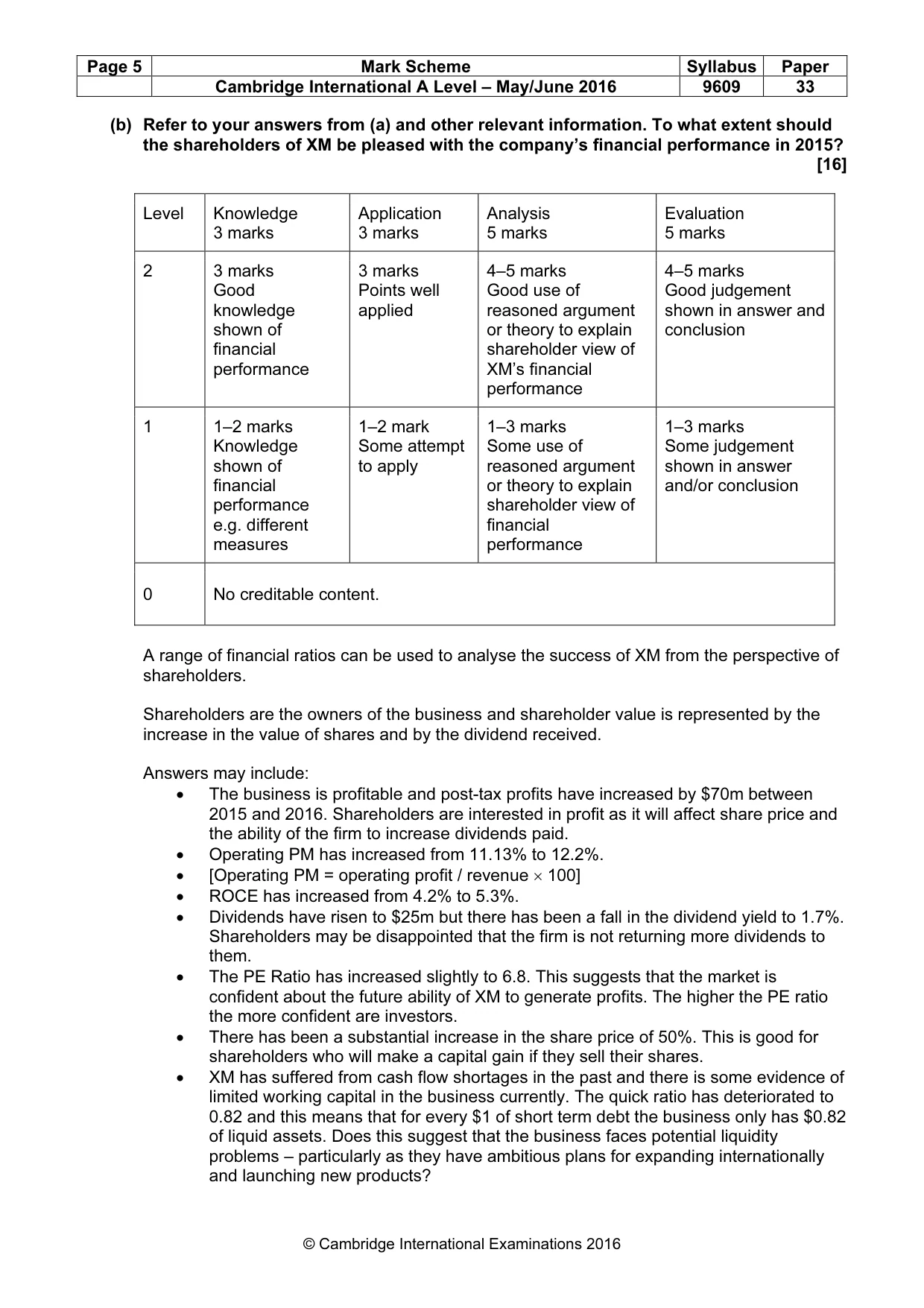
Page 5 Mark Scheme Syllabus Paper Cambridge International A Level – May/June 2016 9609 33 © Cambridge International Examinations 2016 (b) Refer to your answers from (a) and other relevant information. To what extent should the shareholders of XM be pleased with the company’s financial performance in 2015? [16] Level Knowledge 3 marks Application 3 marks Analysis 5 marks Evaluation 5 marks 2 3 marks Good knowledge shown of financial performance 3 marks Points well applied 4–5 marks Good use of reasoned argument or theory to explain shareholder view of XM’s financial performance 4–5 marks Good judgement shown in answer and conclusion 1 1–2 marks Knowledge shown of financial performance e.g. different measures 1–2 mark Some attempt to apply 1–3 marks Some use of reasoned argument or theory to explain shareholder view of financial performance 1–3 marks Some judgement shown in answer and/or conclusion 0 No creditable content. A range of financial ratios can be used to analyse the success of XM from the perspective of shareholders. Shareholders are the owners of the business and shareholder value is represented by the increase in the value of shares and by the dividend received. Answers may include: • The business is profitable and post-tax profits have increased by $70m between 2015 and 2016. Shareholders are interested in profit as it will affect share price and the ability of the firm to increase dividends paid. • Operating PM has increased from 11.13% to 12.2%. • [Operating PM = operating profit / revenue × 100] • ROCE has increased from 4.2% to 5.3%. • Dividends have risen to $25m but there has been a fall in the dividend yield to 1.7%. Shareholders may be disappointed that the firm is not returning more dividends to them. • The PE Ratio has increased slightly to 6.8. This suggests that the market is confident about the future ability of XM to generate profits. The higher the PE ratio the more confident are investors. • There has been a substantial increase in the share price of 50%. This is good for shareholders who will make a capital gain if they sell their shares. • XM has suffered from cash flow shortages in the past and there is some evidence of limited working capital in the business currently. The quick ratio has deteriorated to 0.82 and this means that for every $1 of short term debt the business only has $0.82 of liquid assets. Does this suggest that the business faces potential liquidity problems – particularly as they have ambitious plans for expanding internationally and launching new products?
Mark scheme, page 6
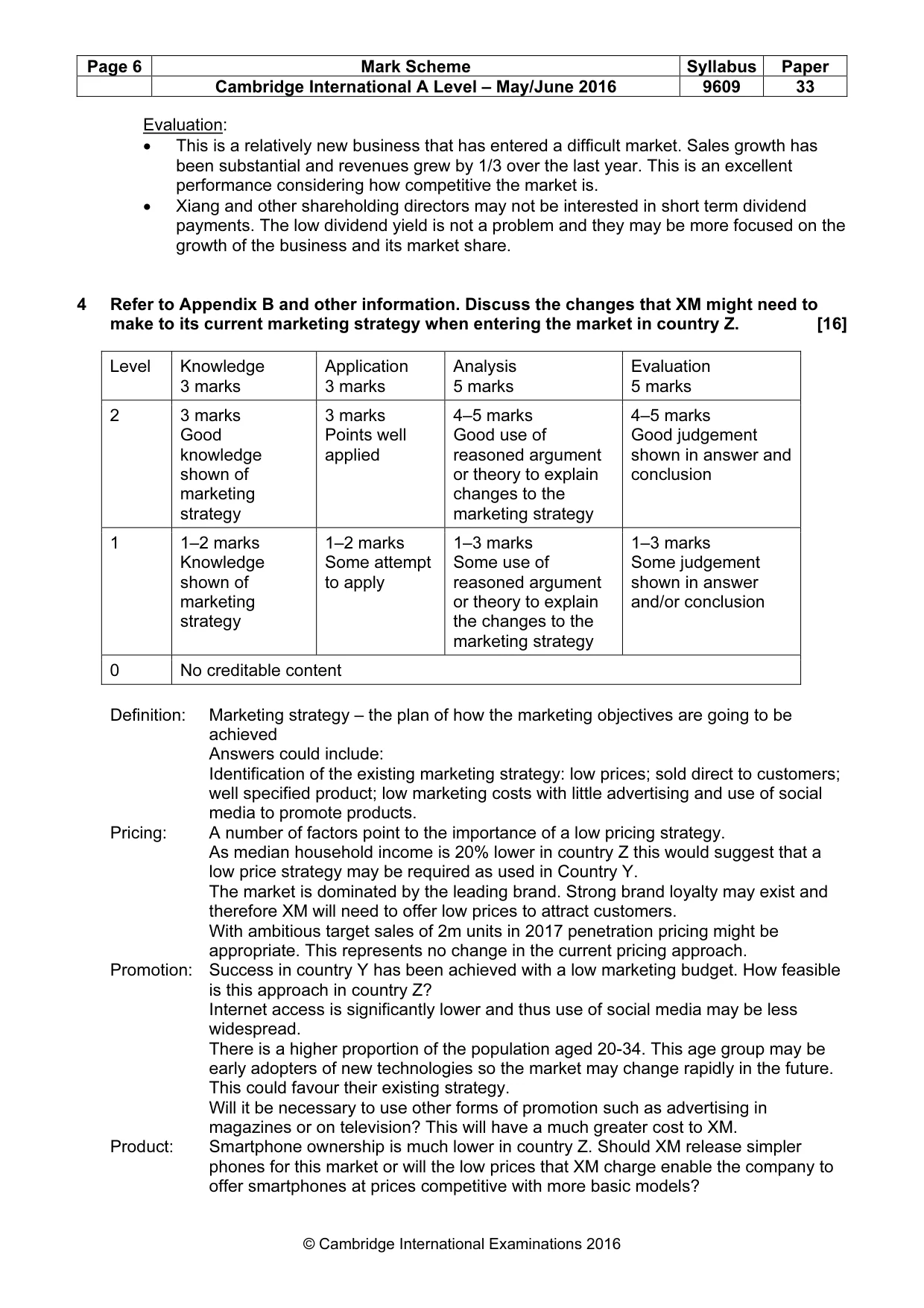
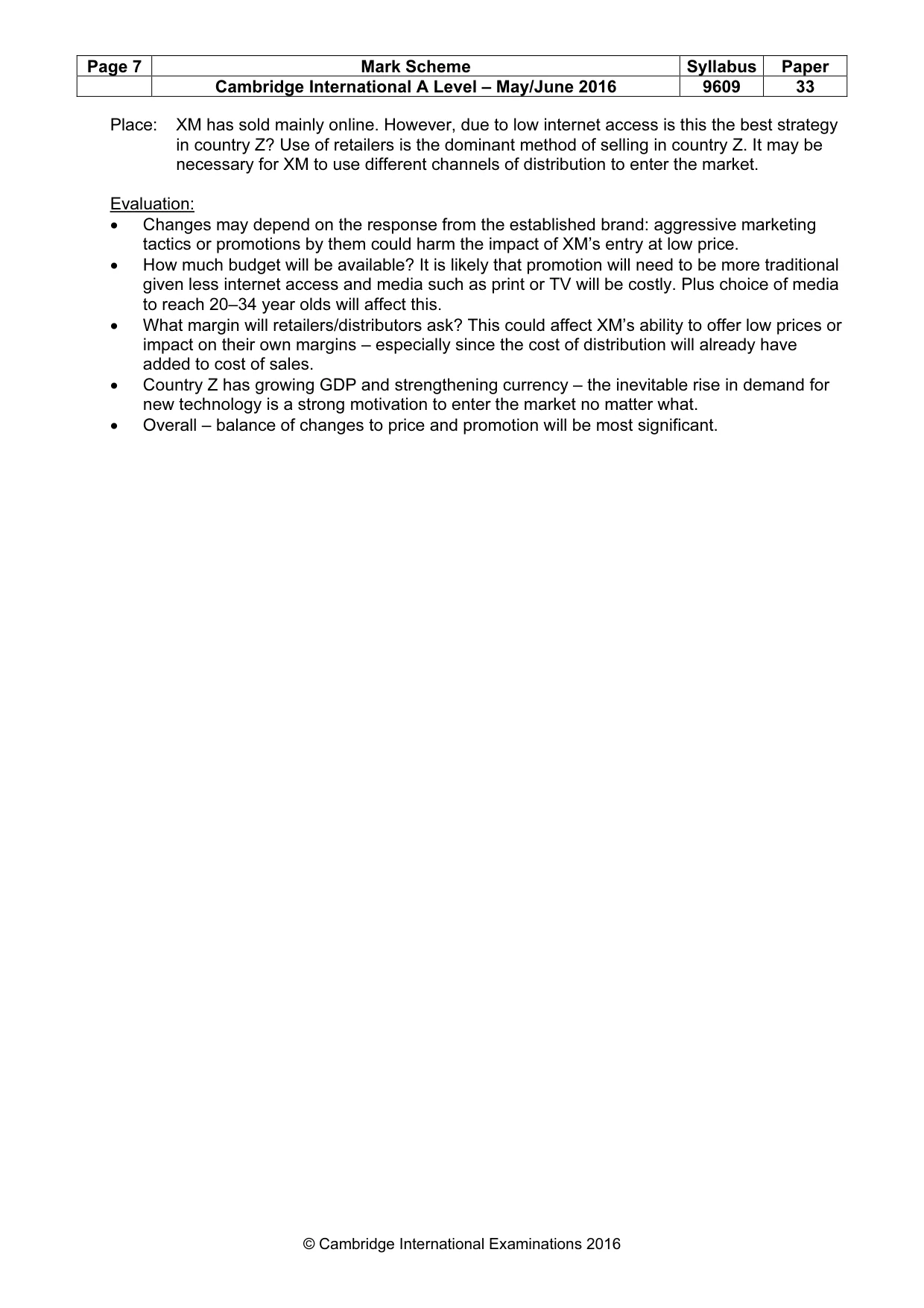
Page 6 Mark Scheme Syllabus Paper Cambridge International A Level – May/June 2016 9609 33 © Cambridge International Examinations 2016 Evaluation: • This is a relatively new business that has entered a difficult market. Sales growth has been substantial and revenues grew by 1/3 over the last year. This is an excellent performance considering how competitive the market is. • Xiang and other shareholding directors may not be interested in short term dividend payments. The low dividend yield is not a problem and they may be more focused on the growth of the business and its market share. 4 Refer to Appendix B and other information. Discuss the changes that XM might need to make to its current marketing strategy when entering the market in country Z. [16] Level Knowledge 3 marks Application 3 marks Analysis 5 marks Evaluation 5 marks 2 3 marks Good knowledge shown of marketing strategy 3 marks Points well applied 4–5 marks Good use of reasoned argument or theory to explain changes to the marketing strategy 4–5 marks Good judgement shown in answer and conclusion 1 1–2 marks Knowledge shown of marketing strategy 1–2 marks Some attempt to apply 1–3 marks Some use of reasoned argument or theory to explain the changes to the marketing strategy 1–3 marks Some judgement shown in answer and/or conclusion 0 No creditable content Definition: Marketing strategy – the plan of how the marketing objectives are going to be achieved Answers could include: Identification of the existing marketing strategy: low prices; sold direct to customers; well specified product; low marketing costs with little advertising and use of social media to promote products. Pricing: A number of factors point to the importance of a low pricing strategy. As median household income is 20% lower in country Z this would suggest that a low price strategy may be required as used in Country Y. The market is dominated by the leading brand. Strong brand loyalty may exist and therefore XM will need to offer low prices to attract customers. With ambitious target sales of 2m units in 2017 penetration pricing might be appropriate. This represents no change in the current pricing approach. Promotion: Success in country Y has been achieved with a low marketing budget. How feasible is this approach in country Z? Internet access is significantly lower and thus use of social media may be less widespread. There is a higher proportion of the population aged 20-34. This age group may be early adopters of new technologies so the market may change rapidly in the future. This could favour their existing strategy. Will it be necessary to use other forms of promotion such as advertising in magazines or on television? This will have a much greater cost to XM. Product: Smartphone ownership is much lower in country Z. Should XM release simpler phones for this market or will the low prices that XM charge enable the company to offer smartphones at prices competitive with more basic models?
Mark scheme, page 7
Page 7 Mark Scheme Syllabus Paper Cambridge International A Level – May/June 2016 9609 33 © Cambridge International Examinations 2016 Place: XM has sold mainly online. However, due to low internet access is this the best strategy in country Z? Use of retailers is the dominant method of selling in country Z. It may be necessary for XM to use different channels of distribution to enter the market. Evaluation: • Changes may depend on the response from the established brand: aggressive marketing tactics or promotions by them could harm the impact of XM’s entry at low price. • How much budget will be available? It is likely that promotion will need to be more traditional given less internet access and media such as print or TV will be costly. Plus choice of media to reach 20–34 year olds will affect this. • What margin will retailers/distributors ask? This could affect XM’s ability to offer low prices or impact on their own margins – especially since the cost of distribution will already have added to cost of sales. • Country Z has growing GDP and strengthening currency – the inevitable rise in demand for new technology is a strong motivation to enter the market no matter what. • Overall – balance of changes to price and promotion will be most significant.
Mark scheme, page 8
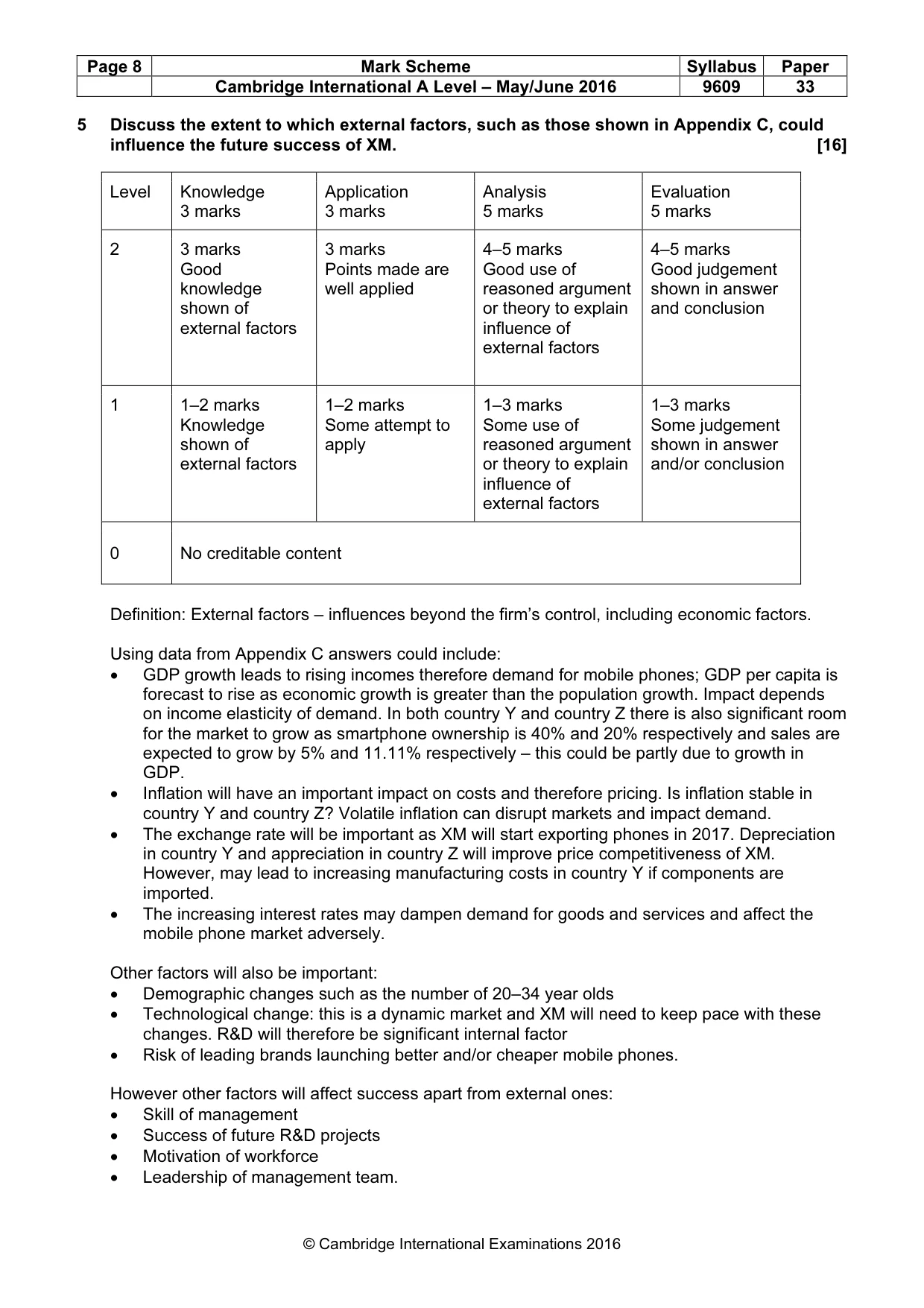
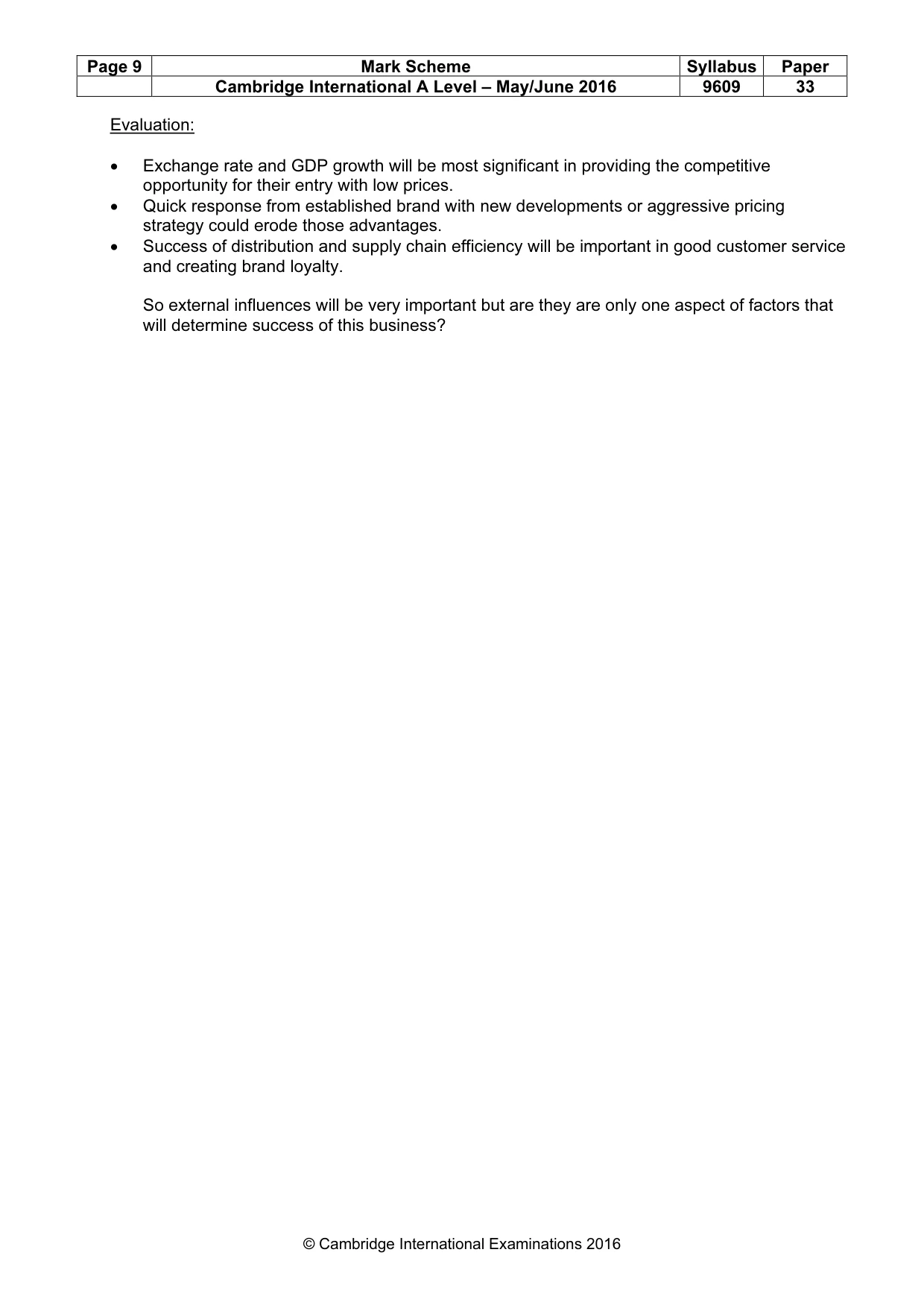
Page 8 Mark Scheme Syllabus Paper Cambridge International A Level – May/June 2016 9609 33 © Cambridge International Examinations 2016 5 Discuss the extent to which external factors, such as those shown in Appendix C, could influence the future success of XM. [16] Level Knowledge 3 marks Application 3 marks Analysis 5 marks Evaluation 5 marks 2 3 marks Good knowledge shown of external factors 3 marks Points made are well applied 4–5 marks Good use of reasoned argument or theory to explain influence of external factors 4–5 marks Good judgement shown in answer and conclusion 1 1–2 marks Knowledge shown of external factors 1–2 marks Some attempt to apply 1–3 marks Some use of reasoned argument or theory to explain influence of external factors 1–3 marks Some judgement shown in answer and/or conclusion 0 No creditable content Definition: External factors – influences beyond the firm’s control, including economic factors. Using data from Appendix C answers could include: • GDP growth leads to rising incomes therefore demand for mobile phones; GDP per capita is forecast to rise as economic growth is greater than the population growth. Impact depends on income elasticity of demand. In both country Y and country Z there is also significant room for the market to grow as smartphone ownership is 40% and 20% respectively and sales are expected to grow by 5% and 11.11% respectively – this could be partly due to growth in GDP. • Inflation will have an important impact on costs and therefore pricing. Is inflation stable in country Y and country Z? Volatile inflation can disrupt markets and impact demand. • The exchange rate will be important as XM will start exporting phones in 2017. Depreciation in country Y and appreciation in country Z will improve price competitiveness of XM. However, may lead to increasing manufacturing costs in country Y if components are imported. • The increasing interest rates may dampen demand for goods and services and affect the mobile phone market adversely. Other factors will also be important: • Demographic changes such as the number of 20–34 year olds • Technological change: this is a dynamic market and XM will need to keep pace with these changes. R&D will therefore be significant internal factor • Risk of leading brands launching better and/or cheaper mobile phones. However other factors will affect success apart from external ones: • Skill of management • Success of future R&D projects • Motivation of workforce • Leadership of management team.
Mark scheme, page 9
Page 9 Mark Scheme Syllabus Paper Cambridge International A Level – May/June 2016 9609 33 © Cambridge International Examinations 2016 Evaluation: • Exchange rate and GDP growth will be most significant in providing the competitive opportunity for their entry with low prices. • Quick response from established brand with new developments or aggressive pricing strategy could erode those advantages. • Success of distribution and supply chain efficiency will be important in good customer service and creating brand loyalty. So external influences will be very important but are they are only one aspect of factors that will determine success of this business?
Mark scheme, page 10
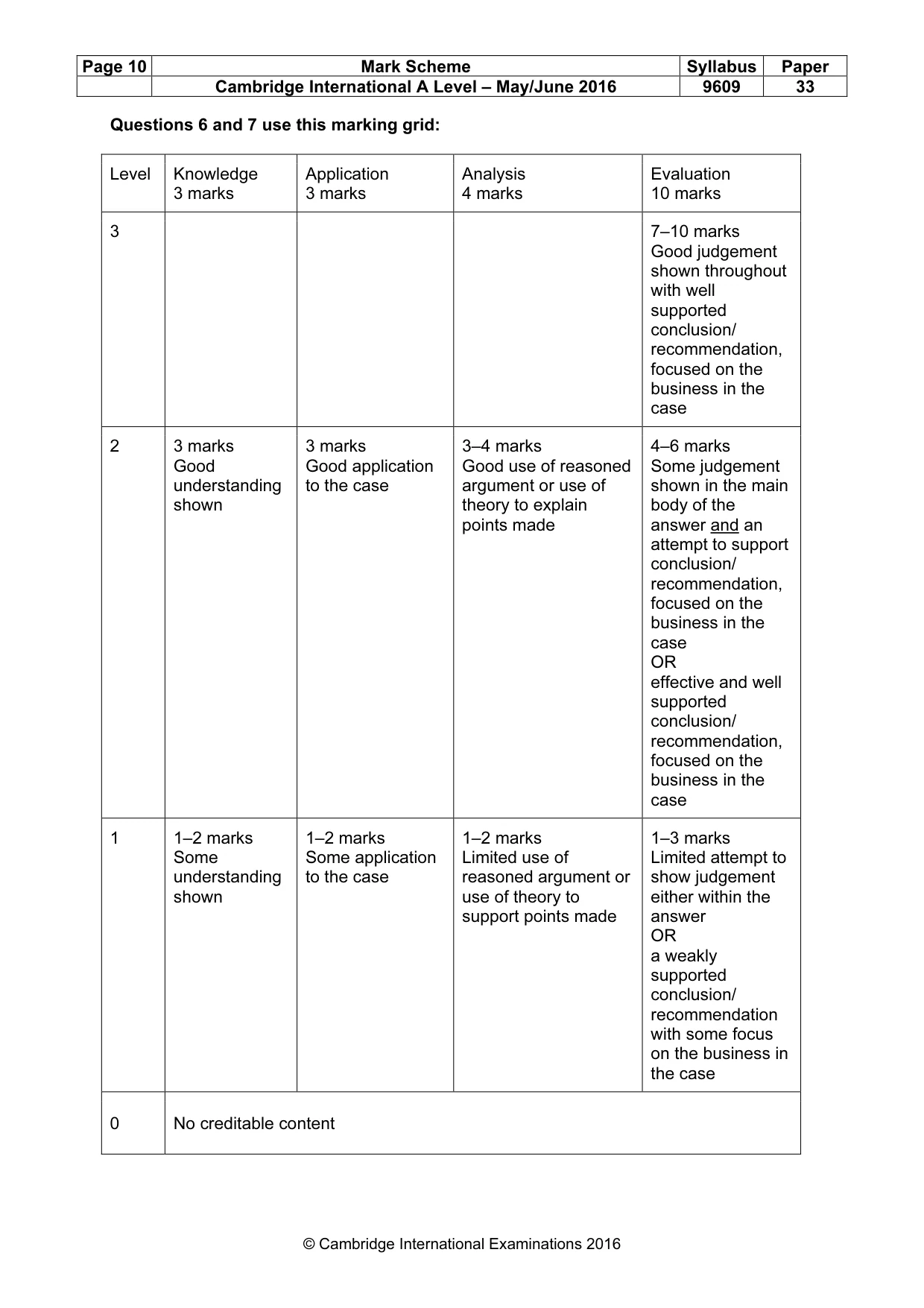
Page 10 Mark Scheme Syllabus Paper Cambridge International A Level – May/June 2016 9609 33 © Cambridge International Examinations 2016 Questions 6 and 7 use this marking grid: Level Knowledge 3 marks Application 3 marks Analysis 4 marks Evaluation 10 marks 3 7–10 marks Good judgement shown throughout with well supported conclusion/ recommendation, focused on the business in the case 2 3 marks Good understanding shown 3 marks Good application to the case 3–4 marks Good use of reasoned argument or use of theory to explain points made 4–6 marks Some judgement shown in the main body of the answer and an attempt to support conclusion/ recommendation, focused on the business in the case OR effective and well supported conclusion/ recommendation, focused on the business in the case 1 1–2 marks Some understanding shown 1–2 marks Some application to the case 1–2 marks Limited use of reasoned argument or use of theory to support points made 1–3 marks Limited attempt to show judgement either within the answer OR a weakly supported conclusion/ recommendation with some focus on the business in the case 0 No creditable content
Mark scheme, page 11
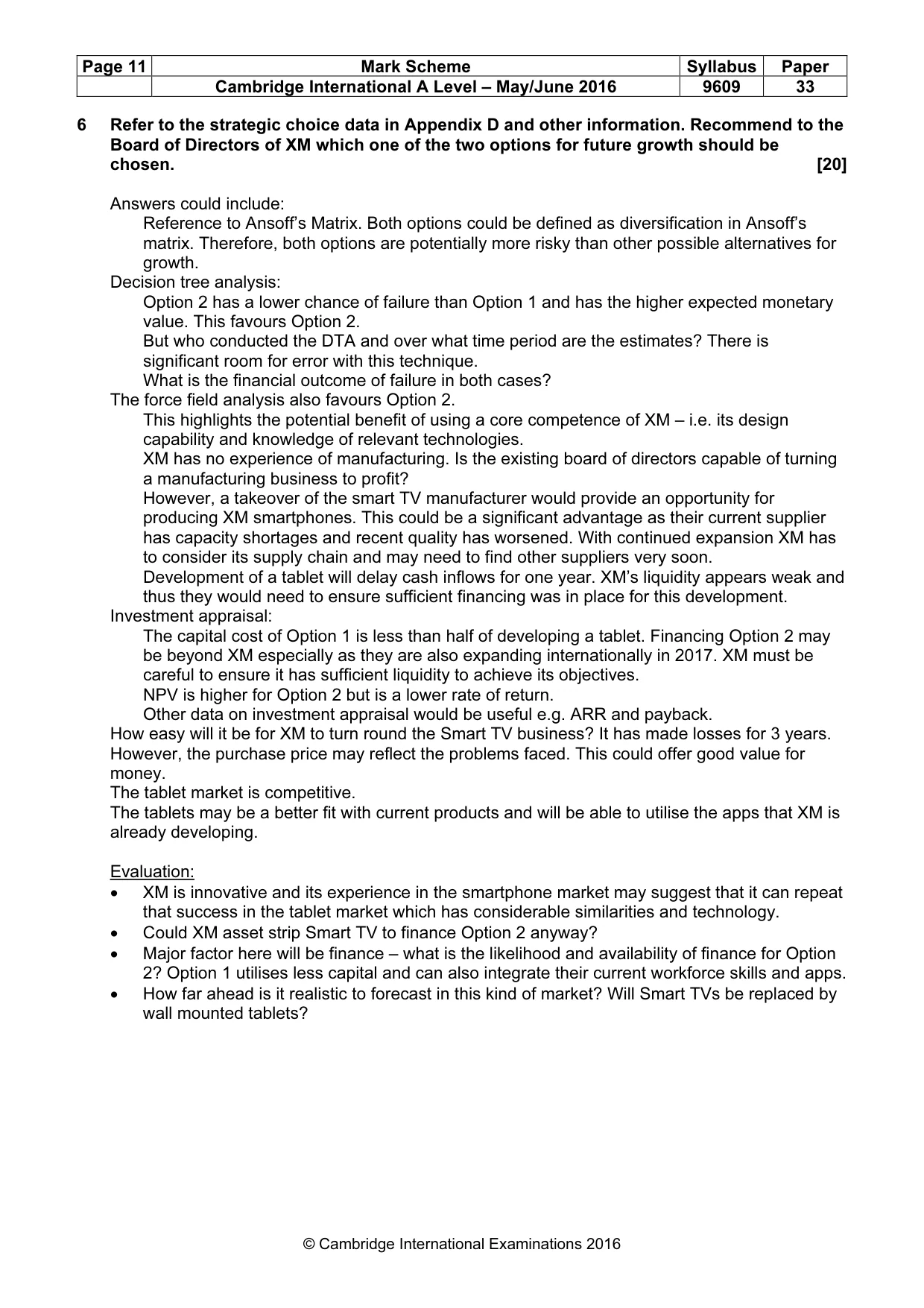
Page 11 Mark Scheme Syllabus Paper Cambridge International A Level – May/June 2016 9609 33 © Cambridge International Examinations 2016 6 Refer to the strategic choice data in Appendix D and other information. Recommend to the Board of Directors of XM which one of the two options for future growth should be chosen. [20] Answers could include: Reference to Ansoff’s Matrix. Both options could be defined as diversification in Ansoff’s matrix. Therefore, both options are potentially more risky than other possible alternatives for growth. Decision tree analysis: Option 2 has a lower chance of failure than Option 1 and has the higher expected monetary value. This favours Option 2. But who conducted the DTA and over what time period are the estimates? There is significant room for error with this technique. What is the financial outcome of failure in both cases? The force field analysis also favours Option 2. This highlights the potential benefit of using a core competence of XM – i.e. its design capability and knowledge of relevant technologies. XM has no experience of manufacturing. Is the existing board of directors capable of turning a manufacturing business to profit? However, a takeover of the smart TV manufacturer would provide an opportunity for producing XM smartphones. This could be a significant advantage as their current supplier has capacity shortages and recent quality has worsened. With continued expansion XM has to consider its supply chain and may need to find other suppliers very soon. Development of a tablet will delay cash inflows for one year. XM’s liquidity appears weak and thus they would need to ensure sufficient financing was in place for this development. Investment appraisal: The capital cost of Option 1 is less than half of developing a tablet. Financing Option 2 may be beyond XM especially as they are also expanding internationally in 2017. XM must be careful to ensure it has sufficient liquidity to achieve its objectives. NPV is higher for Option 2 but is a lower rate of return. Other data on investment appraisal would be useful e.g. ARR and payback. How easy will it be for XM to turn round the Smart TV business? It has made losses for 3 years. However, the purchase price may reflect the problems faced. This could offer good value for money. The tablet market is competitive. The tablets may be a better fit with current products and will be able to utilise the apps that XM is already developing. Evaluation: • XM is innovative and its experience in the smartphone market may suggest that it can repeat that success in the tablet market which has considerable similarities and technology. • Could XM asset strip Smart TV to finance Option 2 anyway? • Major factor here will be finance – what is the likelihood and availability of finance for Option 2? Option 1 utilises less capital and can also integrate their current workforce skills and apps. • How far ahead is it realistic to forecast in this kind of market? Will Smart TVs be replaced by wall mounted tablets?
Mark scheme, page 12
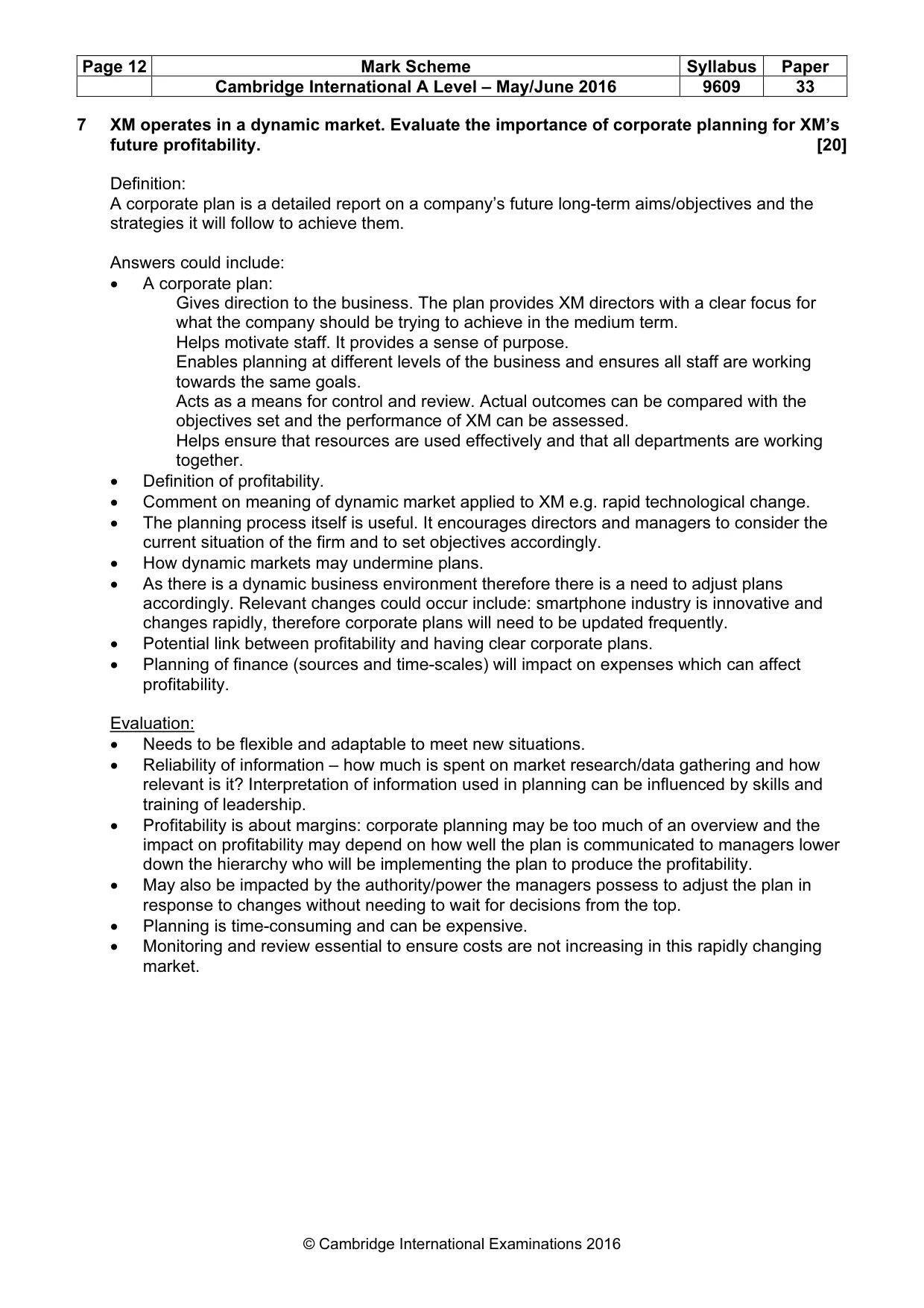
Page 12 Mark Scheme Syllabus Paper Cambridge International A Level – May/June 2016 9609 33 © Cambridge International Examinations 2016 7 XM operates in a dynamic market. Evaluate the importance of corporate planning for XM’s future profitability. [20] Definition: A corporate plan is a detailed report on a company’s future long-term aims/objectives and the strategies it will follow to achieve them. Answers could include: • A corporate plan: Gives direction to the business. The plan provides XM directors with a clear focus for what the company should be trying to achieve in the medium term. Helps motivate staff. It provides a sense of purpose. Enables planning at different levels of the business and ensures all staff are working towards the same goals. Acts as a means for control and review. Actual outcomes can be compared with the objectives set and the performance of XM can be assessed. Helps ensure that resources are used effectively and that all departments are working together. • Definition of profitability. • Comment on meaning of dynamic market applied to XM e.g. rapid technological change. • The planning process itself is useful. It encourages directors and managers to consider the current situation of the firm and to set objectives accordingly. • How dynamic markets may undermine plans. • As there is a dynamic business environment therefore there is a need to adjust plans accordingly. Relevant changes could occur include: smartphone industry is innovative and changes rapidly, therefore corporate plans will need to be updated frequently. • Potential link between profitability and having clear corporate plans. • Planning of finance (sources and time-scales) will impact on expenses which can affect profitability. Evaluation: • Needs to be flexible and adaptable to meet new situations. • Reliability of information – how much is spent on market research/data gathering and how relevant is it? Interpretation of information used in planning can be influenced by skills and training of leadership. • Profitability is about margins: corporate planning may be too much of an overview and the impact on profitability may depend on how well the plan is communicated to managers lower down the hierarchy who will be implementing the plan to produce the profitability. • May also be impacted by the authority/power the managers possess to adjust the plan in response to changes without needing to wait for decisions from the top. • Planning is time-consuming and can be expensive. • Monitoring and review essential to ensure costs are not increasing in this rapidly changing market.
What you needed in this session
Cambridge’s own grade thresholds for 2016 May/June, Paper 3 · Variant 3. A higher threshold means an easier paper — the bar moves with how the cohort did.