Cambridge A Level Business (for first examination in 2016) 9609 — 2016 May/June Paper 3 · Variant 1
9609/31/M/J/16 · 100 marks · ≈113 min
The question paper and its mark scheme, free to read here and free to download. This is Cambridge’s own paper, exactly as it was sat.
Question paper8 pages



Mark scheme11 pages
Answers below. Sit the paper first if you are practising.
Paper as text
Question paper, page 1
This document consists of 5 printed pages, 3 blank pages and 1 Insert. DC (RW) 117617/3 © UCLES 2016 [Turn over Cambridge International Examinations Cambridge International Advanced Subsidiary and Advanced Level * 3 2 4 1 4 3 5 8 9 1 * BUSINESS 9609/31 Paper 3 Case Study May/June 2016 3 hours No Additional Materials are required. READ THESE INSTRUCTIONS FIRST An answer booklet is provided inside this question paper. You should follow the instructions on the front cover of the answer booklet. If you need additional answer paper ask the invigilator for a continuation booklet. Section A Answer all questions. Section B Answer one question. You are advised to spend no more than 40 minutes on Section B. The businesses described in this question paper are entirely fictitious. The number of marks is given in brackets [ ] at the end of each question or part question.
Question paper, page 2
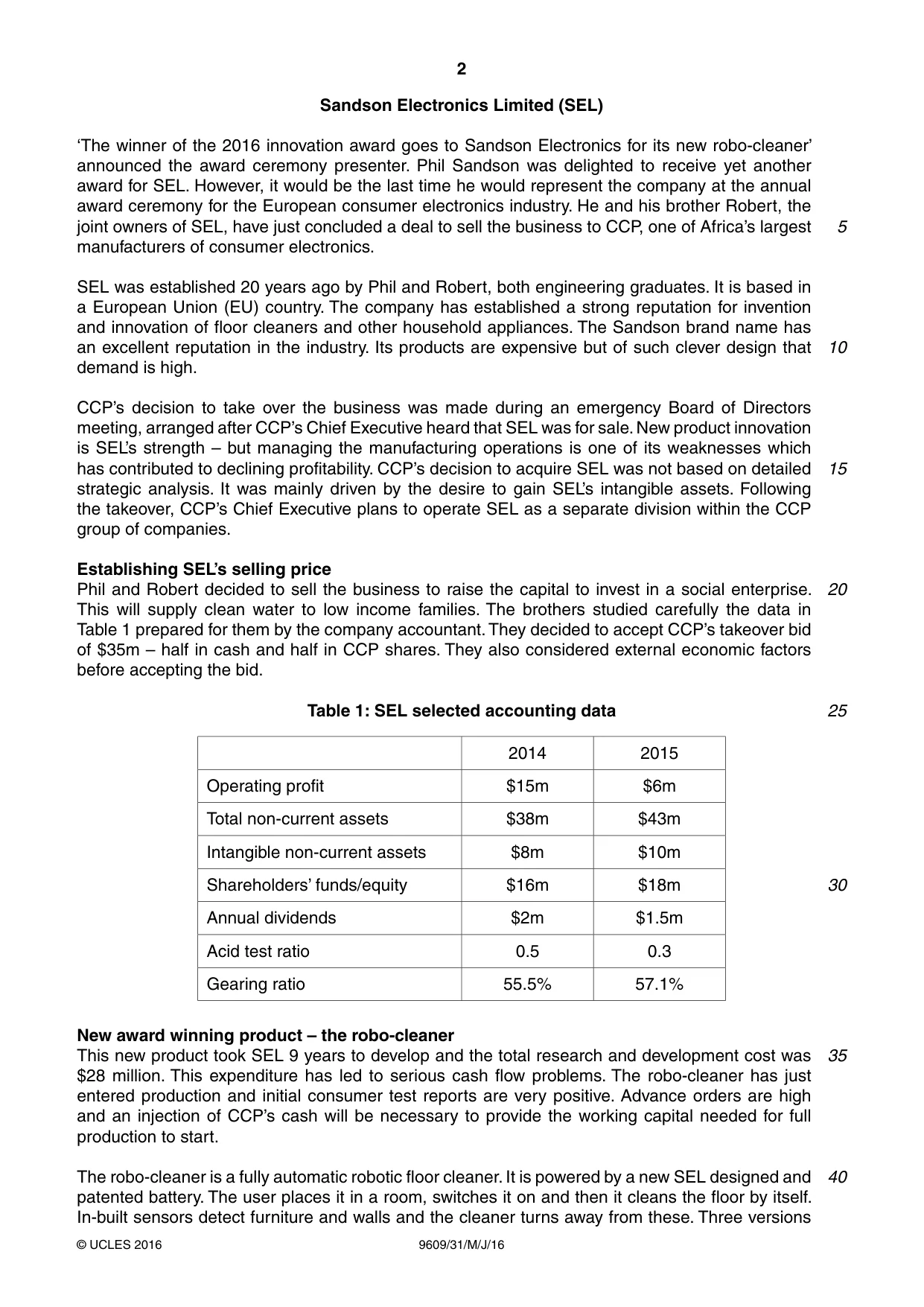
2 9609/31/M/J/16 © UCLES 2016 Sandson Electronics Limited (SEL) ‘The winner of the 2016 innovation award goes to Sandson Electronics for its new robo-cleaner’ announced the award ceremony presenter. Phil Sandson was delighted to receive yet another award for SEL. However, it would be the last time he would represent the company at the annual award ceremony for the European consumer electronics industry. He and his brother Robert, the joint owners of SEL, have just concluded a deal to sell the business to CCP, one of Africa’s largest manufacturers of consumer electronics. SEL was established 20 years ago by Phil and Robert, both engineering graduates. It is based in a European Union (EU) country. The company has established a strong reputation for invention and innovation of floor cleaners and other household appliances. The Sandson brand name has an excellent reputation in the industry. Its products are expensive but of such clever design that demand is high. CCP’s decision to take over the business was made during an emergency Board of Directors meeting, arranged after CCP’s Chief Executive heard that SEL was for sale. New product innovation is SEL’s strength – but managing the manufacturing operations is one of its weaknesses which has contributed to declining profitability. CCP’s decision to acquire SEL was not based on detailed strategic analysis. It was mainly driven by the desire to gain SEL’s intangible assets. Following the takeover, CCP’s Chief Executive plans to operate SEL as a separate division within the CCP group of companies. Establishing SEL’s selling price Phil and Robert decided to sell the business to raise the capital to invest in a social enterprise. This will supply clean water to low income families. The brothers studied carefully the data in Table 1 prepared for them by the company accountant. They decided to accept CCP’s takeover bid of $35m – half in cash and half in CCP shares. They also considered external economic factors before accepting the bid. Table 1: SEL selected accounting data 2014 2015 Operating profit $15m $6m Total non-current assets $38m $43m Intangible non-current assets $8m $10m Shareholders’ funds/equity $16m $18m Annual dividends $2m $1.5m Acid test ratio 0.5 0.3 Gearing ratio 55.5% 57.1% New award winning product – the robo-cleaner This new product took SEL 9 years to develop and the total research and development cost was $28 million. This expenditure has led to serious cash flow problems. The robo-cleaner has just entered production and initial consumer test reports are very positive. Advance orders are high and an injection of CCP’s cash will be necessary to provide the working capital needed for full production to start. The robo-cleaner is a fully automatic robotic floor cleaner. It is powered by a new SEL designed and patented battery. The user places it in a room, switches it on and then it cleans the floor by itself. In-built sensors detect furniture and walls and the cleaner turns away from these. Three versions 5 10 15 20 25 30 35 40
Question paper, page 3
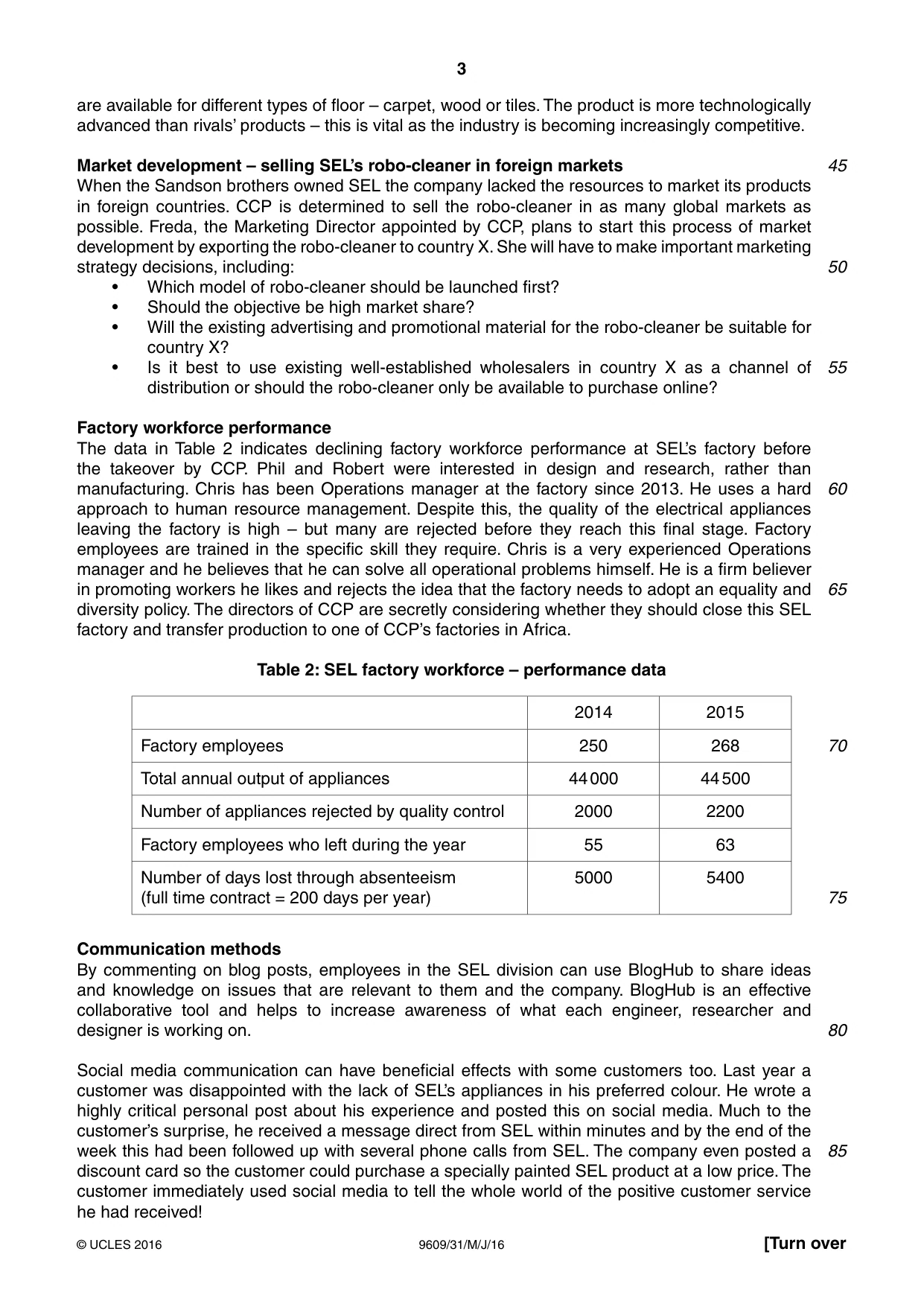
3 9609/31/M/J/16 © UCLES 2016 [Turn over are available for different types of floor – carpet, wood or tiles. The product is more technologically advanced than rivals’ products – this is vital as the industry is becoming increasingly competitive. Market development – selling SEL’s robo-cleaner in foreign markets When the Sandson brothers owned SEL the company lacked the resources to market its products in foreign countries. CCP is determined to sell the robo-cleaner in as many global markets as possible. Freda, the Marketing Director appointed by CCP, plans to start this process of market development by exporting the robo-cleaner to country X. She will have to make important marketing strategy decisions, including: • Which model of robo-cleaner should be launched first? • Should the objective be high market share? • Will the existing advertising and promotional material for the robo-cleaner be suitable for country X? • Is it best to use existing well-established wholesalers in country X as a channel of distribution or should the robo-cleaner only be available to purchase online? Factory workforce performance The data in Table 2 indicates declining factory workforce performance at SEL’s factory before the takeover by CCP. Phil and Robert were interested in design and research, rather than manufacturing. Chris has been Operations manager at the factory since 2013. He uses a hard approach to human resource management. Despite this, the quality of the electrical appliances leaving the factory is high – but many are rejected before they reach this final stage. Factory employees are trained in the specific skill they require. Chris is a very experienced Operations manager and he believes that he can solve all operational problems himself. He is a firm believer in promoting workers he likes and rejects the idea that the factory needs to adopt an equality and diversity policy. The directors of CCP are secretly considering whether they should close this SEL factory and transfer production to one of CCP’s factories in Africa. Table 2: SEL factory workforce – performance data 2014 2015 Factory employees 250 268 Total annual output of appliances 44 000 44 500 Number of appliances rejected by quality control 2000 2200 Factory employees who left during the year 55 63 Number of days lost through absenteeism (full time contract = 200 days per year) 5000 5400 Communication methods By commenting on blog posts, employees in the SEL division can use BlogHub to share ideas and knowledge on issues that are relevant to them and the company. BlogHub is an effective collaborative tool and helps to increase awareness of what each engineer, researcher and designer is working on. Social media communication can have beneficial effects with some customers too. Last year a customer was disappointed with the lack of SEL’s appliances in his preferred colour. He wrote a highly critical personal post about his experience and posted this on social media. Much to the customer’s surprise, he received a message direct from SEL within minutes and by the end of the week this had been followed up with several phone calls from SEL. The company even posted a discount card so the customer could purchase a specially painted SEL product at a low price. The customer immediately used social media to tell the whole world of the positive customer service he had received! 45 50 55 60 65 70 75 80 85
Question paper, page 4
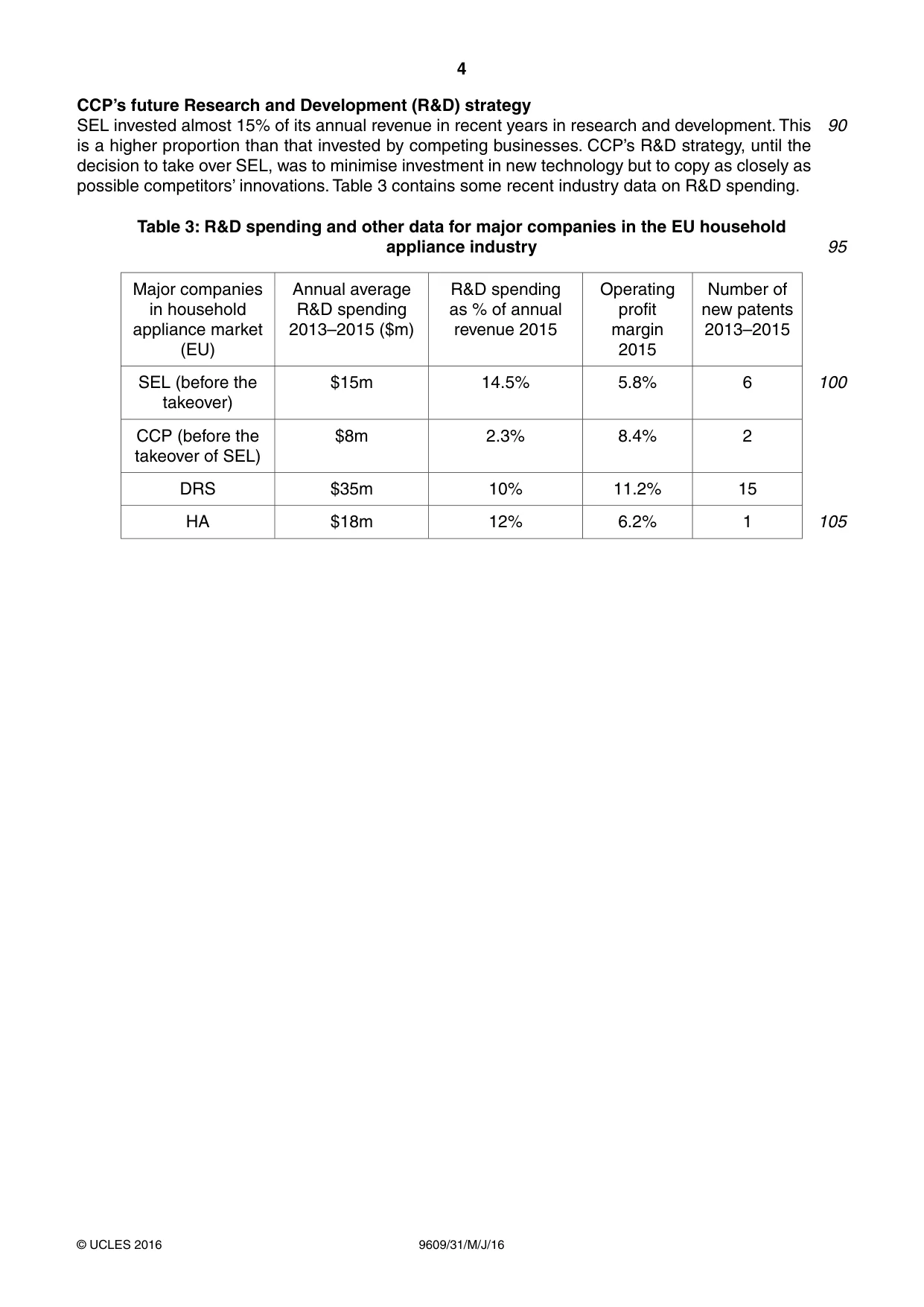
4 9609/31/M/J/16 © UCLES 2016 CCP’s future Research and Development (R&D) strategy SEL invested almost 15% of its annual revenue in recent years in research and development. This is a higher proportion than that invested by competing businesses. CCP’s R&D strategy, until the decision to take over SEL, was to minimise investment in new technology but to copy as closely as possible competitors’ innovations. Table 3 contains some recent industry data on R&D spending. Table 3: R&D spending and other data for major companies in the EU household appliance industry Major companies in household appliance market (EU) Annual average R&D spending 2013–2015 ($m) R&D spending as % of annual revenue 2015 Operating profit margin 2015 Number of new patents 2013–2015 SEL (before the takeover) $15m 14.5% 5.8% 6 CCP (before the takeover of SEL) $8m 2.3% 8.4% 2 DRS $35m 10% 11.2% 15 HA $18m 12% 6.2% 1 90 95 100 105
Question paper, page 5
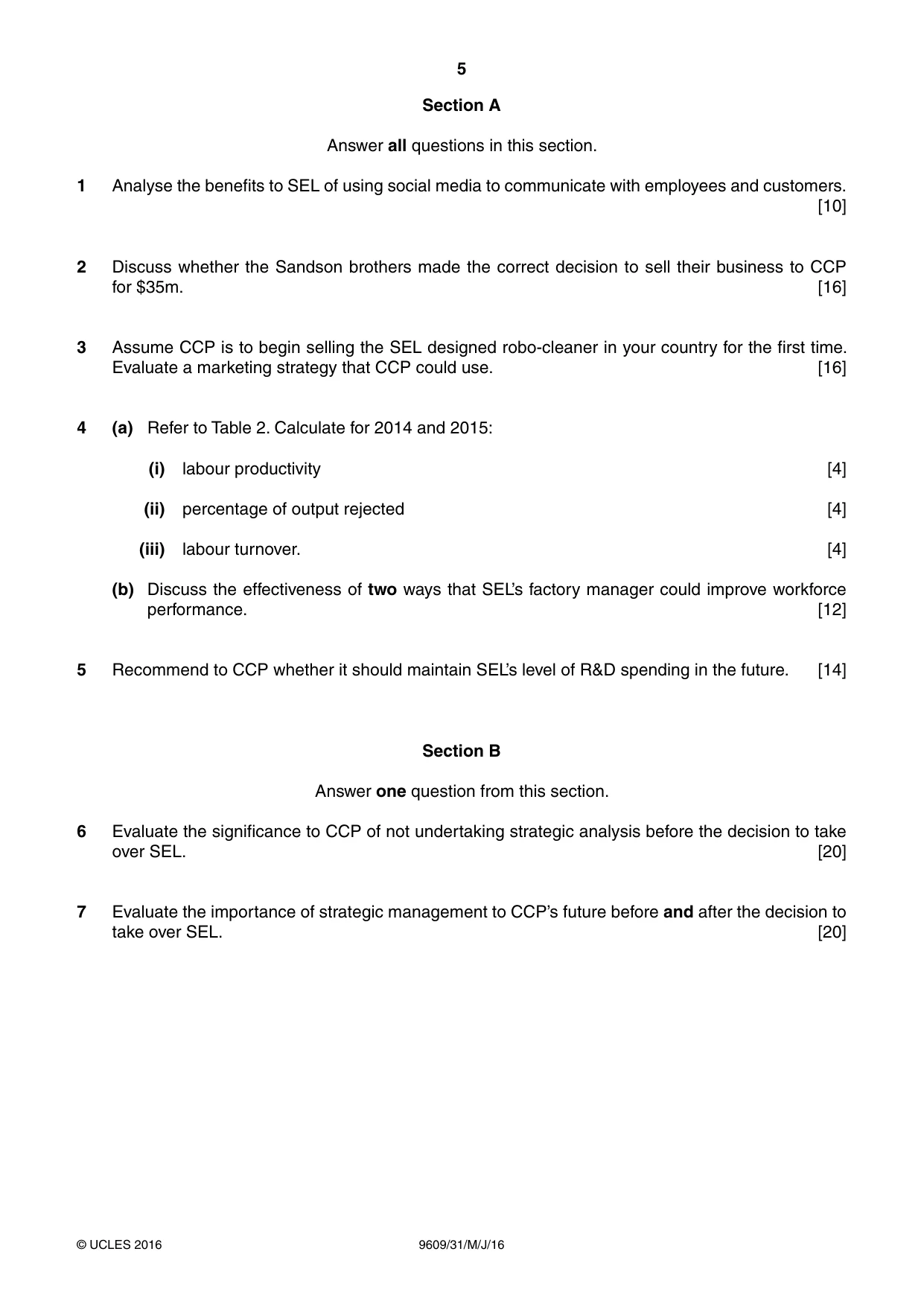
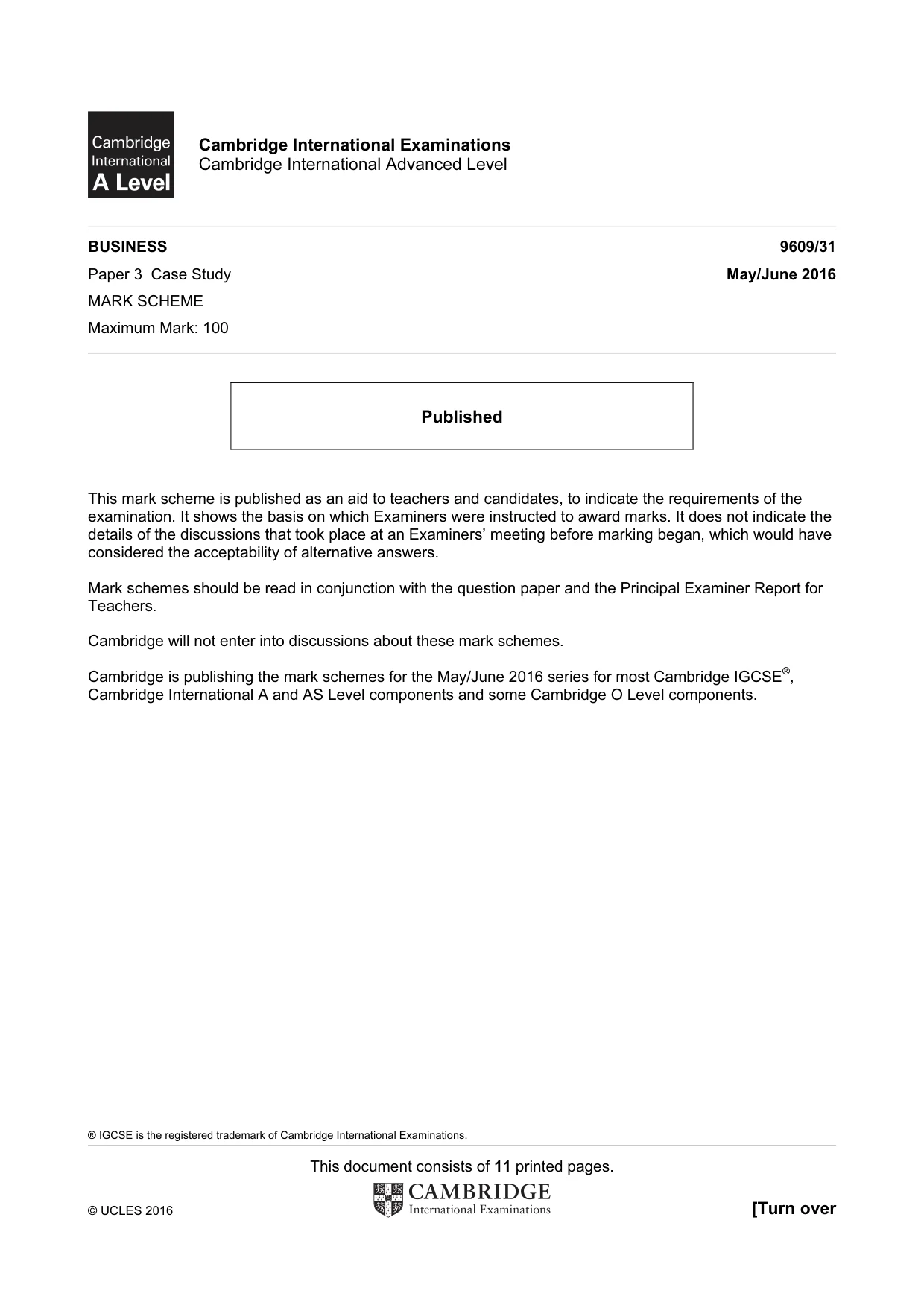
5 9609/31/M/J/16 © UCLES 2016 Section A Answer all questions in this section. 1 Analyse the benefits to SEL of using social media to communicate with employees and customers. [10] 2 Discuss whether the Sandson brothers made the correct decision to sell their business to CCP for $35m. [16] 3 Assume CCP is to begin selling the SEL designed robo-cleaner in your country for the first time. Evaluate a marketing strategy that CCP could use. [16] 4 (a) Refer to Table 2. Calculate for 2014 and 2015: (i) labour productivity [4] (ii) percentage of output rejected [4] (iii) labour turnover. [4] (b) Discuss the effectiveness of two ways that SEL’s factory manager could improve workforce performance. [12] 5 Recommend to CCP whether it should maintain SEL’s level of R&D spending in the future. [14] Section B Answer one question from this section. 6 Evaluate the significance to CCP of not undertaking strategic analysis before the decision to take over SEL. [20] 7 Evaluate the importance of strategic management to CCP’s future before and after the decision to take over SEL. [20]
Question paper, page 6
6 9609/31/M/J/16 © UCLES 2016 BLANK PAGE
Question paper, page 7
7 9609/31/M/J/16 © UCLES 2016 BLANK PAGE
Question paper, page 8
8 9609/31/M/J/16 © UCLES 2016 Permission to reproduce items where third-party owned material protected by copyright is included has been sought and cleared where possible. Every reasonable effort has been made by the publisher (UCLES) to trace copyright holders, but if any items requiring clearance have unwittingly been included, the publisher will be pleased to make amends at the earliest possible opportunity. To avoid the issue of disclosure of answer-related information to candidates, all copyright acknowledgements are reproduced online in the Cambridge International Examinations Copyright Acknowledgements Booklet. This is produced for each series of examinations and is freely available to download at www.cie.org.uk after the live examination series. Cambridge International Examinations is part of the Cambridge Assessment Group. Cambridge Assessment is the brand name of University of Cambridge Local Examinations Syndicate (UCLES), which is itself a department of the University of Cambridge. BLANK PAGE
Mark scheme, page 1
® IGCSE is the registered trademark of Cambridge International Examinations. This document consists of 11 printed pages. © UCLES 2016 [Turn over Cambridge International Examinations Cambridge International Advanced Level BUSINESS 9609/31 Paper 3 Case Study May/June 2016 MARK SCHEME Maximum Mark: 100 Published This mark scheme is published as an aid to teachers and candidates, to indicate the requirements of the examination. It shows the basis on which Examiners were instructed to award marks. It does not indicate the details of the discussions that took place at an Examiners’ meeting before marking began, which would have considered the acceptability of alternative answers. Mark schemes should be read in conjunction with the question paper and the Principal Examiner Report for Teachers. Cambridge will not enter into discussions about these mark schemes. Cambridge is publishing the mark schemes for the May/June 2016 series for most Cambridge IGCSE®, Cambridge International A and AS Level components and some Cambridge O Level components.
Mark scheme, page 2
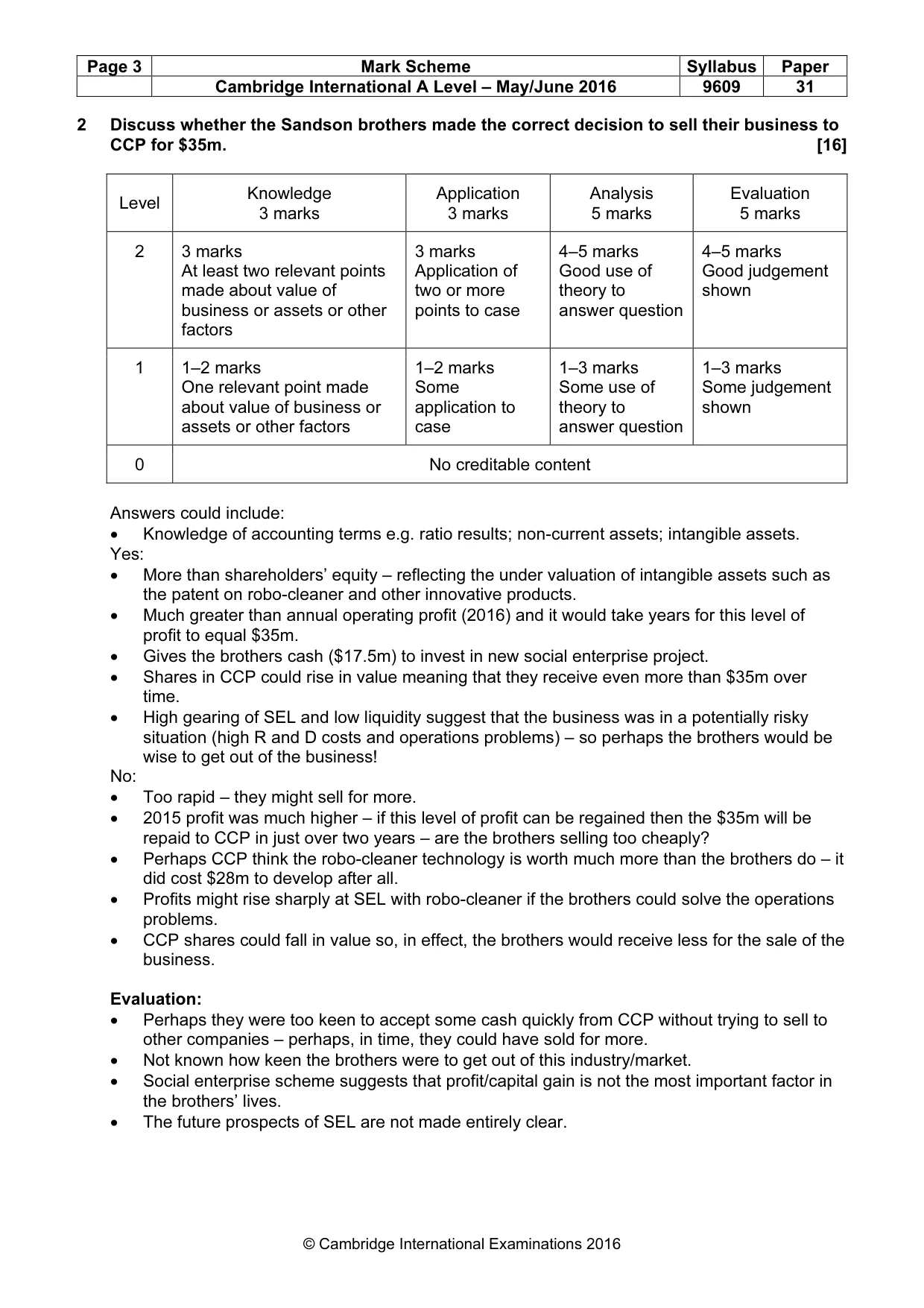
Page 2 Mark Scheme Syllabus Paper Cambridge International A Level – May/June 2016 9609 31 © Cambridge International Examinations 2016 1 Analyse the benefits to SEL of using social media to communicate with employees and customers. [10] Level Knowledge 3 marks Application 3 marks Analysis 4 marks 2 3 marks Knowledge of social media as a means of communication and two benefits 3 marks More than one benefit explained in context 3–4 marks Good use of theory and/or reasoned argument to explain benefits 1 1–2 marks Some knowledge of social media and/or benefits as a means of communication 1–2 marks Some application to case 1–2 marks Some use of theory and/or reasoned argument to explain benefits 0 No creditable content Examiner Note: Benefits to SEL. No reward for disadvantages. Answers could include: • Communication – passing of information to a receiver and receiving feedback • Social media – IT/web based forms of communication • Quick – as in the case, a response was received quickly • Messages can be personalised – as with direct mail • Able to communicate with large number of customers/potential customers • Helps to portray a modern/youthful image to customers – important for a business with a new technology focus • Internal company blogs allow effective formal/informal communication between employees • Important for research based company where formal/hierarchical communication channels would not prompt as much discussion or two-way flow of ideas as IT based methods • Speed of sending message and receiving reply also important between employees
Mark scheme, page 3
Page 3 Mark Scheme Syllabus Paper Cambridge International A Level – May/June 2016 9609 31 © Cambridge International Examinations 2016 2 Discuss whether the Sandson brothers made the correct decision to sell their business to CCP for $35m. [16] Level Knowledge 3 marks Application 3 marks Analysis 5 marks Evaluation 5 marks 2 3 marks At least two relevant points made about value of business or assets or other factors 3 marks Application of two or more points to case 4–5 marks Good use of theory to answer question 4–5 marks Good judgement shown 1 1–2 marks One relevant point made about value of business or assets or other factors 1–2 marks Some application to case 1–3 marks Some use of theory to answer question 1–3 marks Some judgement shown 0 No creditable content Answers could include: • Knowledge of accounting terms e.g. ratio results; non-current assets; intangible assets. Yes: • More than shareholders’ equity – reflecting the under valuation of intangible assets such as the patent on robo-cleaner and other innovative products. • Much greater than annual operating profit (2016) and it would take years for this level of profit to equal $35m. • Gives the brothers cash ($17.5m) to invest in new social enterprise project. • Shares in CCP could rise in value meaning that they receive even more than $35m over time. • High gearing of SEL and low liquidity suggest that the business was in a potentially risky situation (high R and D costs and operations problems) – so perhaps the brothers would be wise to get out of the business! No: • Too rapid – they might sell for more. • 2015 profit was much higher – if this level of profit can be regained then the $35m will be repaid to CCP in just over two years – are the brothers selling too cheaply? • Perhaps CCP think the robo-cleaner technology is worth much more than the brothers do – it did cost $28m to develop after all. • Profits might rise sharply at SEL with robo-cleaner if the brothers could solve the operations problems. • CCP shares could fall in value so, in effect, the brothers would receive less for the sale of the business. Evaluation: • Perhaps they were too keen to accept some cash quickly from CCP without trying to sell to other companies – perhaps, in time, they could have sold for more. • Not known how keen the brothers were to get out of this industry/market. • Social enterprise scheme suggests that profit/capital gain is not the most important factor in the brothers’ lives. • The future prospects of SEL are not made entirely clear.
Mark scheme, page 4
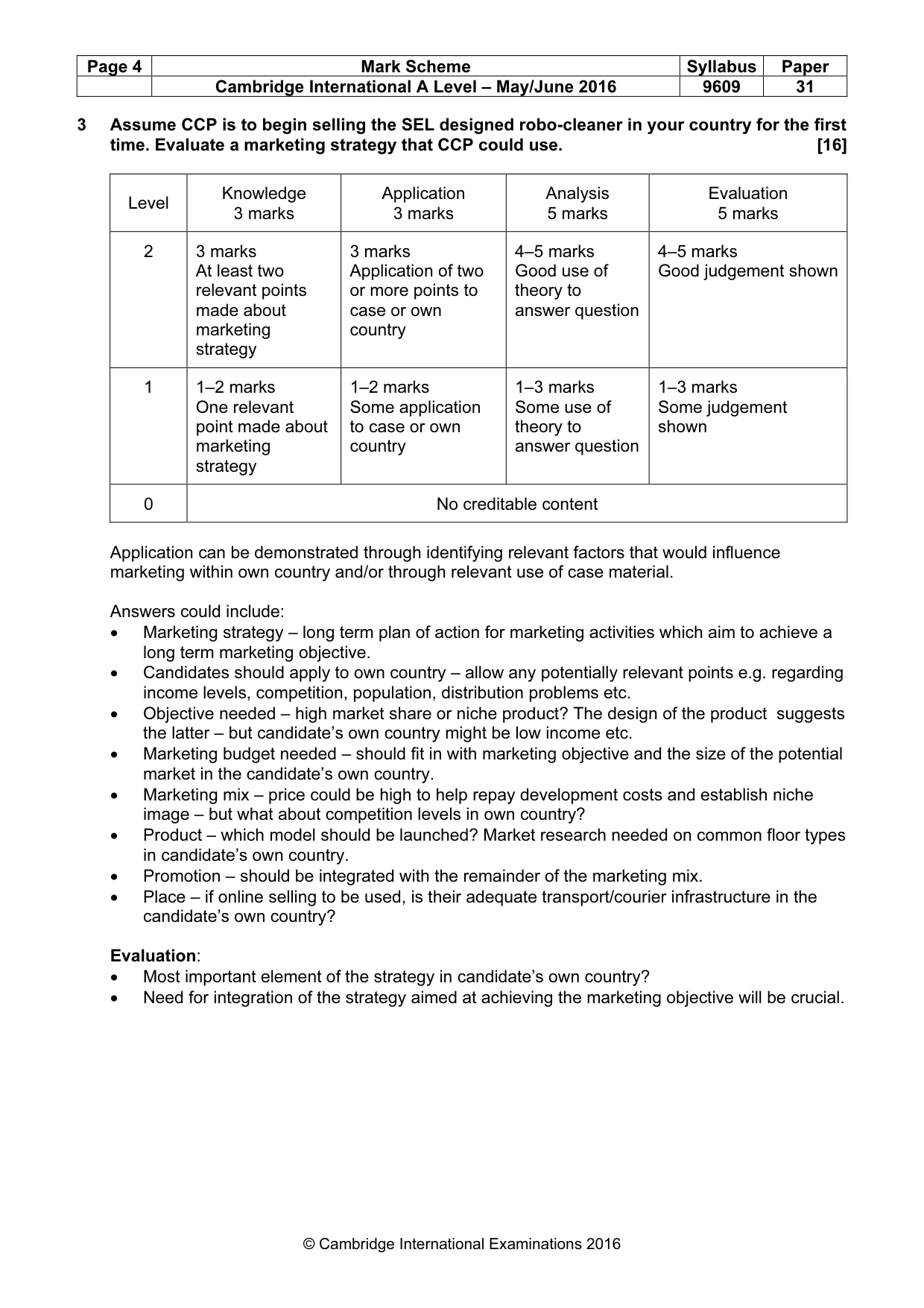
Page 4 Mark Scheme Syllabus Paper Cambridge International A Level – May/June 2016 9609 31 © Cambridge International Examinations 2016 3 Assume CCP is to begin selling the SEL designed robo-cleaner in your country for the first time. Evaluate a marketing strategy that CCP could use. [16] Level Knowledge 3 marks Application 3 marks Analysis 5 marks Evaluation 5 marks 2 3 marks At least two relevant points made about marketing strategy 3 marks Application of two or more points to case or own country 4–5 marks Good use of theory to answer question 4–5 marks Good judgement shown 1 1–2 marks One relevant point made about marketing strategy 1–2 marks Some application to case or own country 1–3 marks Some use of theory to answer question 1–3 marks Some judgement shown 0 No creditable content Application can be demonstrated through identifying relevant factors that would influence marketing within own country and/or through relevant use of case material. Answers could include: • Marketing strategy – long term plan of action for marketing activities which aim to achieve a long term marketing objective. • Candidates should apply to own country – allow any potentially relevant points e.g. regarding income levels, competition, population, distribution problems etc. • Objective needed – high market share or niche product? The design of the product suggests the latter – but candidate’s own country might be low income etc. • Marketing budget needed – should fit in with marketing objective and the size of the potential market in the candidate’s own country. • Marketing mix – price could be high to help repay development costs and establish niche image – but what about competition levels in own country? • Product – which model should be launched? Market research needed on common floor types in candidate’s own country. • Promotion – should be integrated with the remainder of the marketing mix. • Place – if online selling to be used, is their adequate transport/courier infrastructure in the candidate’s own country? Evaluation: • Most important element of the strategy in candidate’s own country? • Need for integration of the strategy aimed at achieving the marketing objective will be crucial.
Mark scheme, page 5
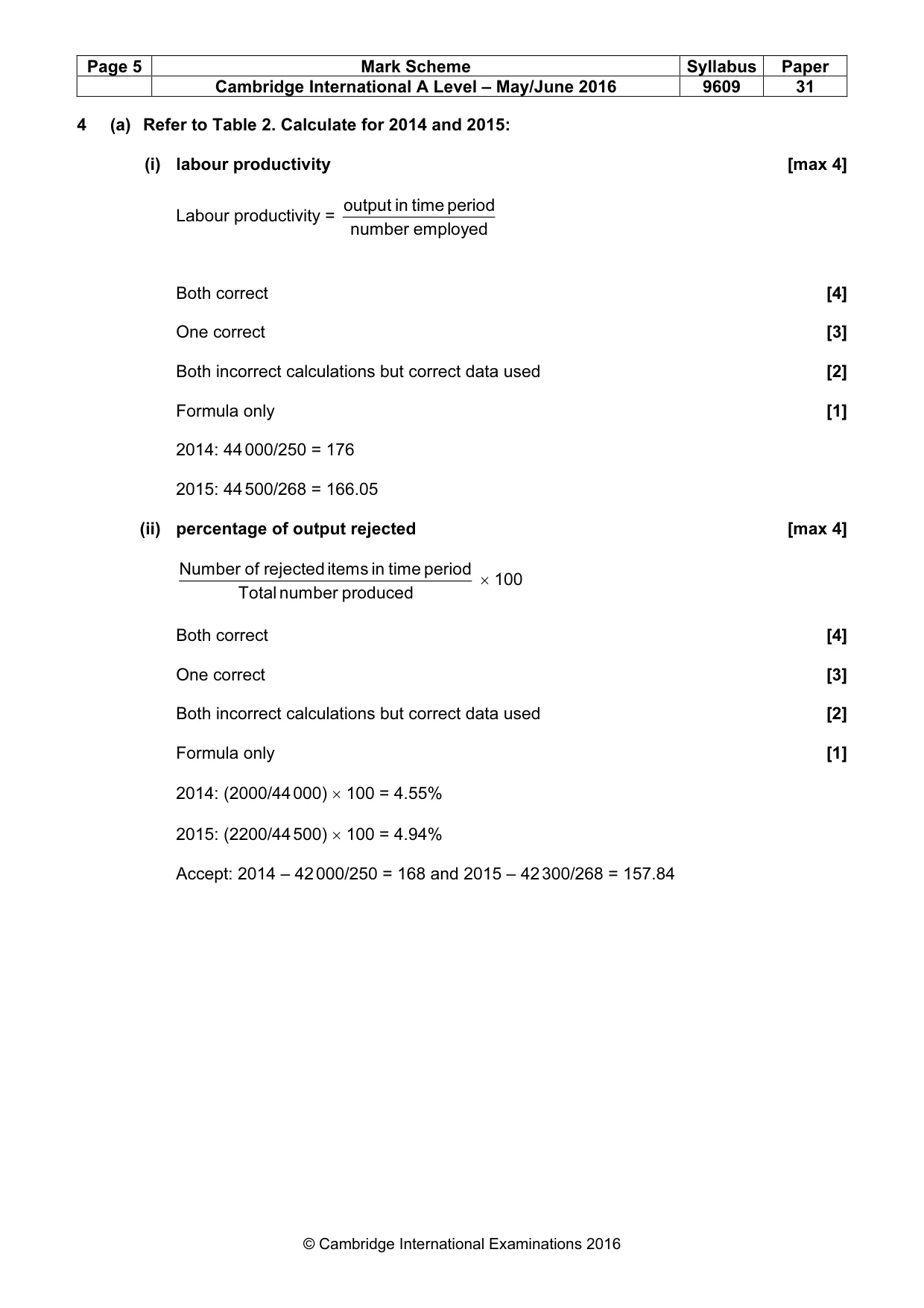
Page 5 Mark Scheme Syllabus Paper Cambridge International A Level – May/June 2016 9609 31 © Cambridge International Examinations 2016 4 (a) Refer to Table 2. Calculate for 2014 and 2015: (i) labour productivity [max 4] Labour productivity = output in time period number employed Both correct [4] One correct [3] Both incorrect calculations but correct data used [2] Formula only [1] 2014: 44 000/250 = 176 2015: 44 500/268 = 166.05 (ii) percentage of output rejected [max 4] Number of rejected items in time period Total number produced × 100 Both correct [4] One correct [3] Both incorrect calculations but correct data used [2] Formula only [1] 2014: (2000/44 000) × 100 = 4.55% 2015: (2200/44 500) × 100 = 4.94% Accept: 2014 – 42 000/250 = 168 and 2015 – 42 300/268 = 157.84
Mark scheme, page 6
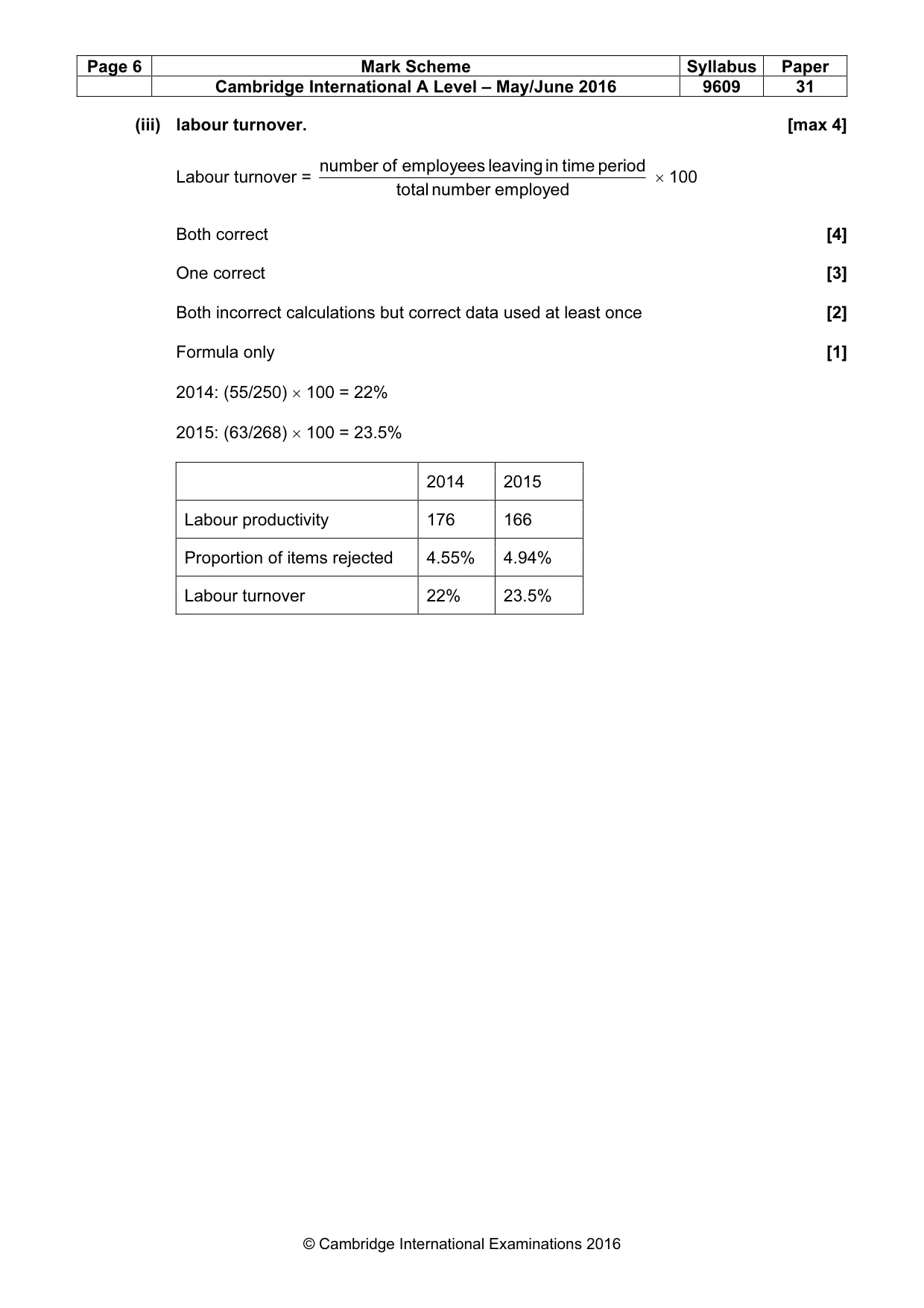
Page 6 Mark Scheme Syllabus Paper Cambridge International A Level – May/June 2016 9609 31 © Cambridge International Examinations 2016 (iii) labour turnover. [max 4] Labour turnover = number of employees leaving in time period total number employed × 100 Both correct [4] One correct [3] Both incorrect calculations but correct data used at least once [2] Formula only [1] 2014: (55/250) × 100 = 22% 2015: (63/268) × 100 = 23.5% 2014 2015 Labour productivity 176 166 Proportion of items rejected 4.55% 4.94% Labour turnover 22% 23.5%
Mark scheme, page 7
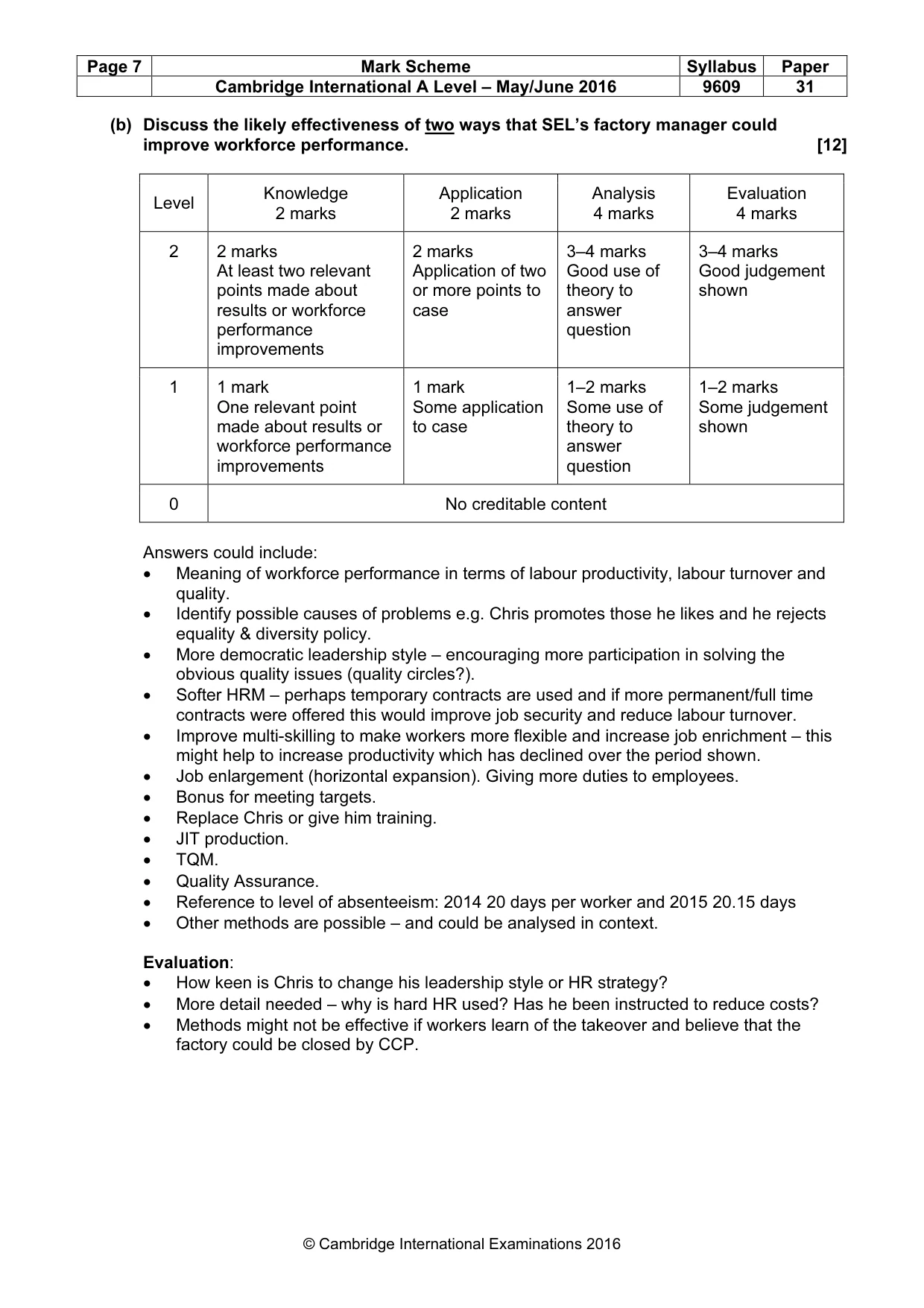
Page 7 Mark Scheme Syllabus Paper Cambridge International A Level – May/June 2016 9609 31 © Cambridge International Examinations 2016 (b) Discuss the likely effectiveness of two ways that SEL’s factory manager could improve workforce performance. [12] Level Knowledge 2 marks Application 2 marks Analysis 4 marks Evaluation 4 marks 2 2 marks At least two relevant points made about results or workforce performance improvements 2 marks Application of two or more points to case 3–4 marks Good use of theory to answer question 3–4 marks Good judgement shown 1 1 mark One relevant point made about results or workforce performance improvements 1 mark Some application to case 1–2 marks Some use of theory to answer question 1–2 marks Some judgement shown 0 No creditable content Answers could include: • Meaning of workforce performance in terms of labour productivity, labour turnover and quality. • Identify possible causes of problems e.g. Chris promotes those he likes and he rejects equality & diversity policy. • More democratic leadership style – encouraging more participation in solving the obvious quality issues (quality circles?). • Softer HRM – perhaps temporary contracts are used and if more permanent/full time contracts were offered this would improve job security and reduce labour turnover. • Improve multi-skilling to make workers more flexible and increase job enrichment – this might help to increase productivity which has declined over the period shown. • Job enlargement (horizontal expansion). Giving more duties to employees. • Bonus for meeting targets. • Replace Chris or give him training. • JIT production. • TQM. • Quality Assurance. • Reference to level of absenteeism: 2014 20 days per worker and 2015 20.15 days • Other methods are possible – and could be analysed in context. Evaluation: • How keen is Chris to change his leadership style or HR strategy? • More detail needed – why is hard HR used? Has he been instructed to reduce costs? • Methods might not be effective if workers learn of the takeover and believe that the factory could be closed by CCP.
Mark scheme, page 8
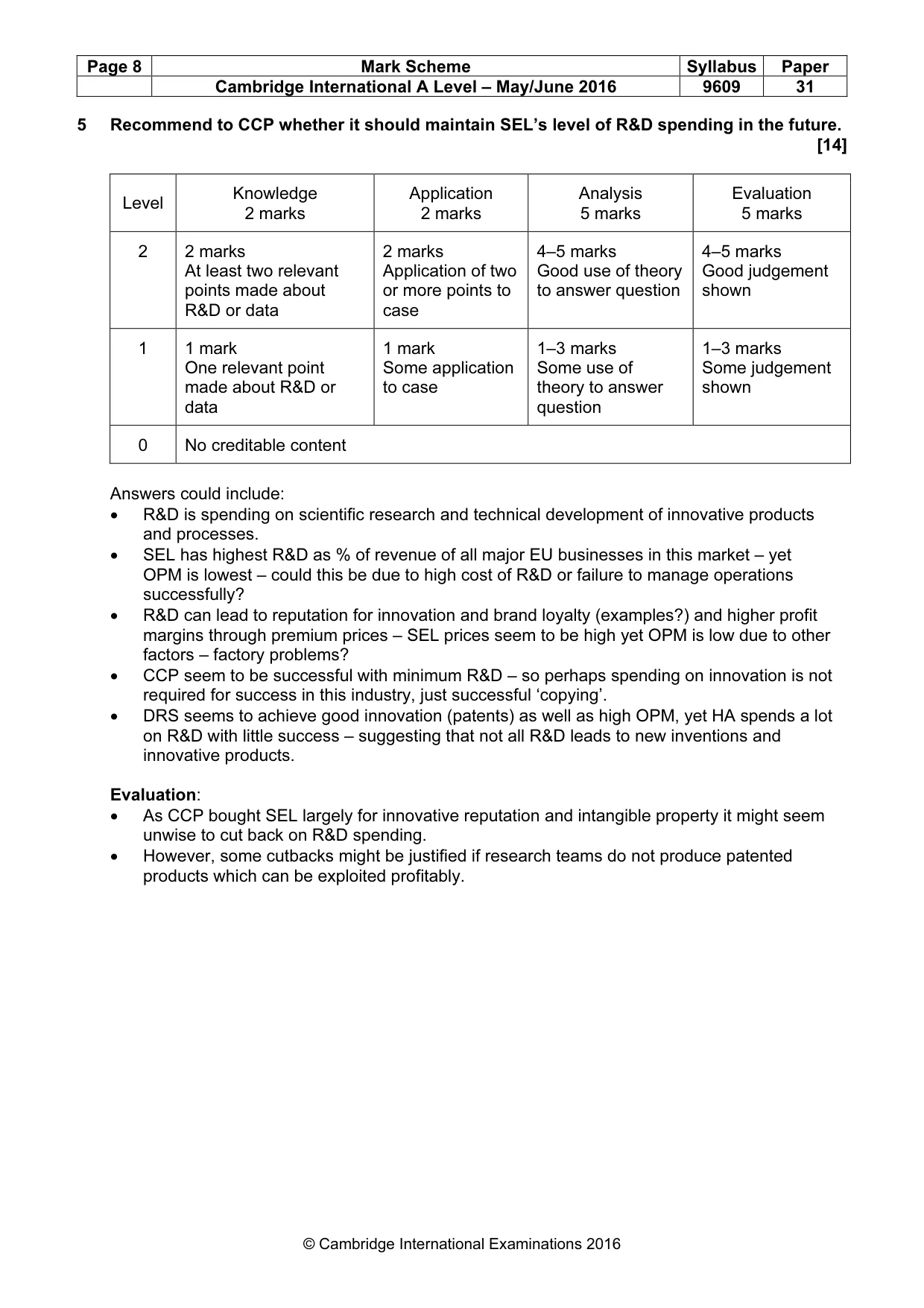
Page 8 Mark Scheme Syllabus Paper Cambridge International A Level – May/June 2016 9609 31 © Cambridge International Examinations 2016 5 Recommend to CCP whether it should maintain SEL’s level of R&D spending in the future. [14] Level Knowledge 2 marks Application 2 marks Analysis 5 marks Evaluation 5 marks 2 2 marks At least two relevant points made about R&D or data 2 marks Application of two or more points to case 4–5 marks Good use of theory to answer question 4–5 marks Good judgement shown 1 1 mark One relevant point made about R&D or data 1 mark Some application to case 1–3 marks Some use of theory to answer question 1–3 marks Some judgement shown 0 No creditable content Answers could include: • R&D is spending on scientific research and technical development of innovative products and processes. • SEL has highest R&D as % of revenue of all major EU businesses in this market – yet OPM is lowest – could this be due to high cost of R&D or failure to manage operations successfully? • R&D can lead to reputation for innovation and brand loyalty (examples?) and higher profit margins through premium prices – SEL prices seem to be high yet OPM is low due to other factors – factory problems? • CCP seem to be successful with minimum R&D – so perhaps spending on innovation is not required for success in this industry, just successful ‘copying’. • DRS seems to achieve good innovation (patents) as well as high OPM, yet HA spends a lot on R&D with little success – suggesting that not all R&D leads to new inventions and innovative products. Evaluation: • As CCP bought SEL largely for innovative reputation and intangible property it might seem unwise to cut back on R&D spending. • However, some cutbacks might be justified if research teams do not produce patented products which can be exploited profitably.
Mark scheme, page 9
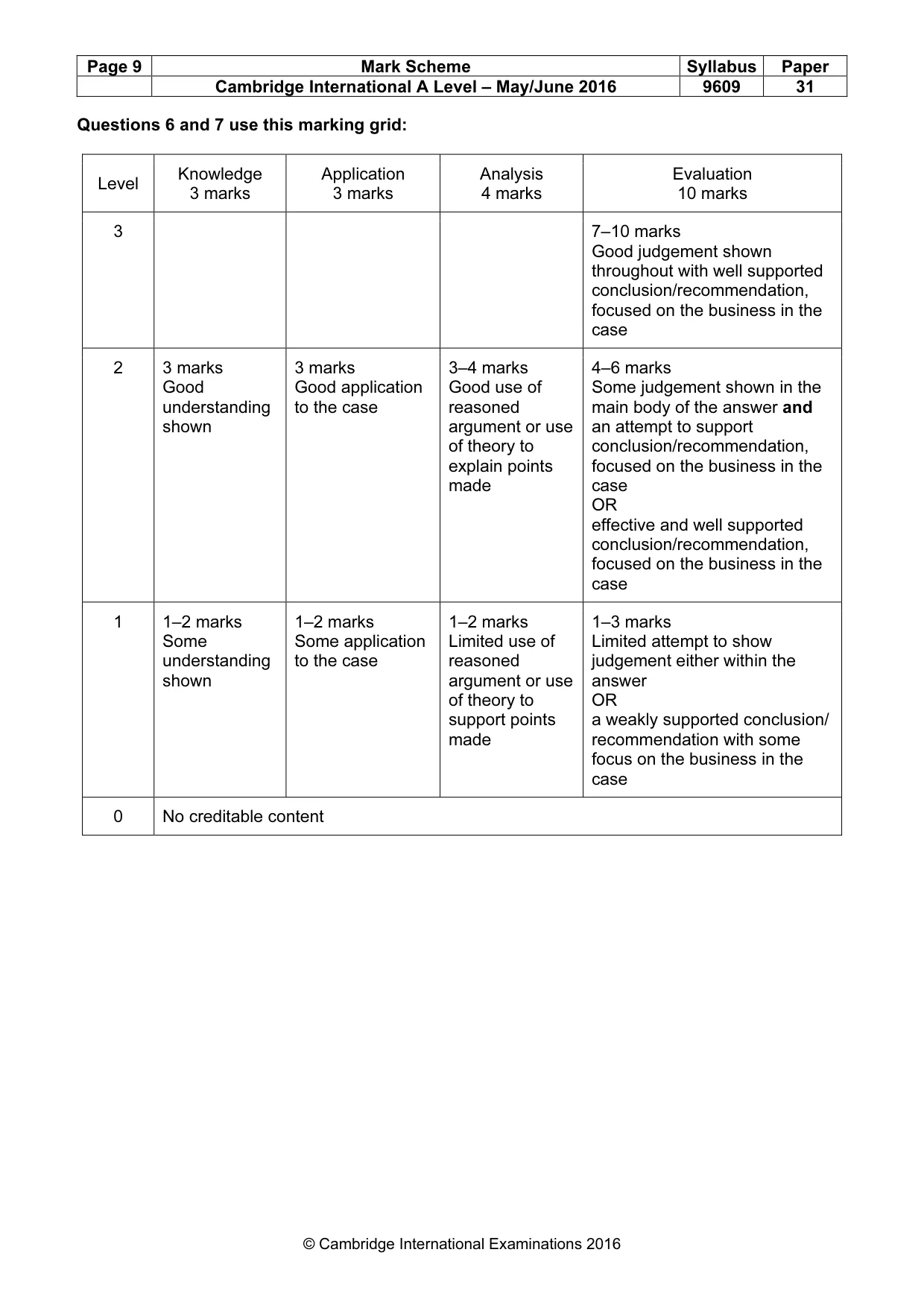
Page 9 Mark Scheme Syllabus Paper Cambridge International A Level – May/June 2016 9609 31 © Cambridge International Examinations 2016 Questions 6 and 7 use this marking grid: Level Knowledge 3 marks Application 3 marks Analysis 4 marks Evaluation 10 marks 3 7–10 marks Good judgement shown throughout with well supported conclusion/recommendation, focused on the business in the case 2 3 marks Good understanding shown 3 marks Good application to the case 3–4 marks Good use of reasoned argument or use of theory to explain points made 4–6 marks Some judgement shown in the main body of the answer and an attempt to support conclusion/recommendation, focused on the business in the case OR effective and well supported conclusion/recommendation, focused on the business in the case 1 1–2 marks Some understanding shown 1–2 marks Some application to the case 1–2 marks Limited use of reasoned argument or use of theory to support points made 1–3 marks Limited attempt to show judgement either within the answer OR a weakly supported conclusion/ recommendation with some focus on the business in the case 0 No creditable content
Mark scheme, page 10
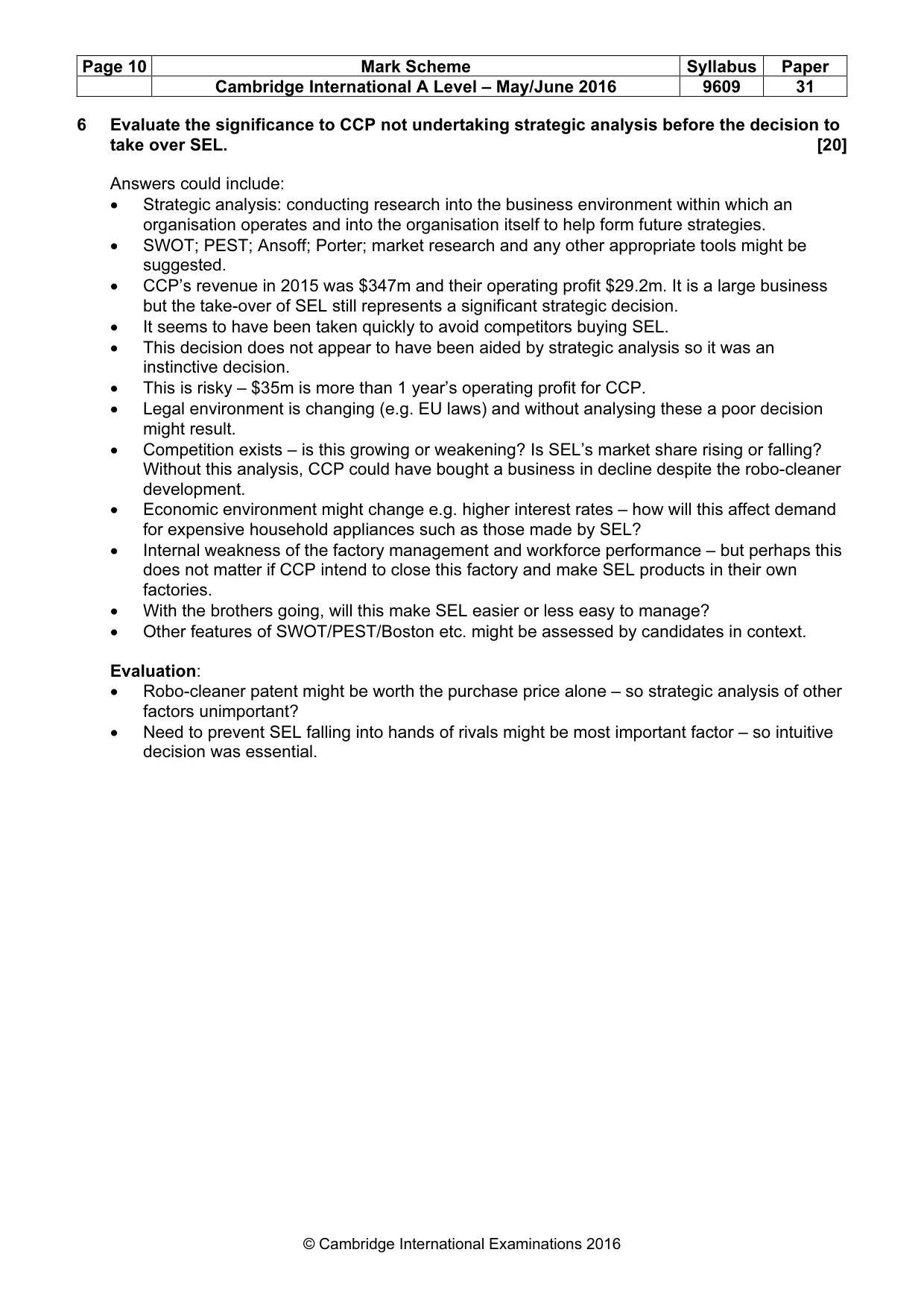
Page 10 Mark Scheme Syllabus Paper Cambridge International A Level – May/June 2016 9609 31 © Cambridge International Examinations 2016 6 Evaluate the significance to CCP not undertaking strategic analysis before the decision to take over SEL. [20] Answers could include: • Strategic analysis: conducting research into the business environment within which an organisation operates and into the organisation itself to help form future strategies. • SWOT; PEST; Ansoff; Porter; market research and any other appropriate tools might be suggested. • CCP’s revenue in 2015 was $347m and their operating profit $29.2m. It is a large business but the take-over of SEL still represents a significant strategic decision. • It seems to have been taken quickly to avoid competitors buying SEL. • This decision does not appear to have been aided by strategic analysis so it was an instinctive decision. • This is risky – $35m is more than 1 year’s operating profit for CCP. • Legal environment is changing (e.g. EU laws) and without analysing these a poor decision might result. • Competition exists – is this growing or weakening? Is SEL’s market share rising or falling? Without this analysis, CCP could have bought a business in decline despite the robo-cleaner development. • Economic environment might change e.g. higher interest rates – how will this affect demand for expensive household appliances such as those made by SEL? • Internal weakness of the factory management and workforce performance – but perhaps this does not matter if CCP intend to close this factory and make SEL products in their own factories. • With the brothers going, will this make SEL easier or less easy to manage? • Other features of SWOT/PEST/Boston etc. might be assessed by candidates in context. Evaluation: • Robo-cleaner patent might be worth the purchase price alone – so strategic analysis of other factors unimportant? • Need to prevent SEL falling into hands of rivals might be most important factor – so intuitive decision was essential.
Mark scheme, page 11
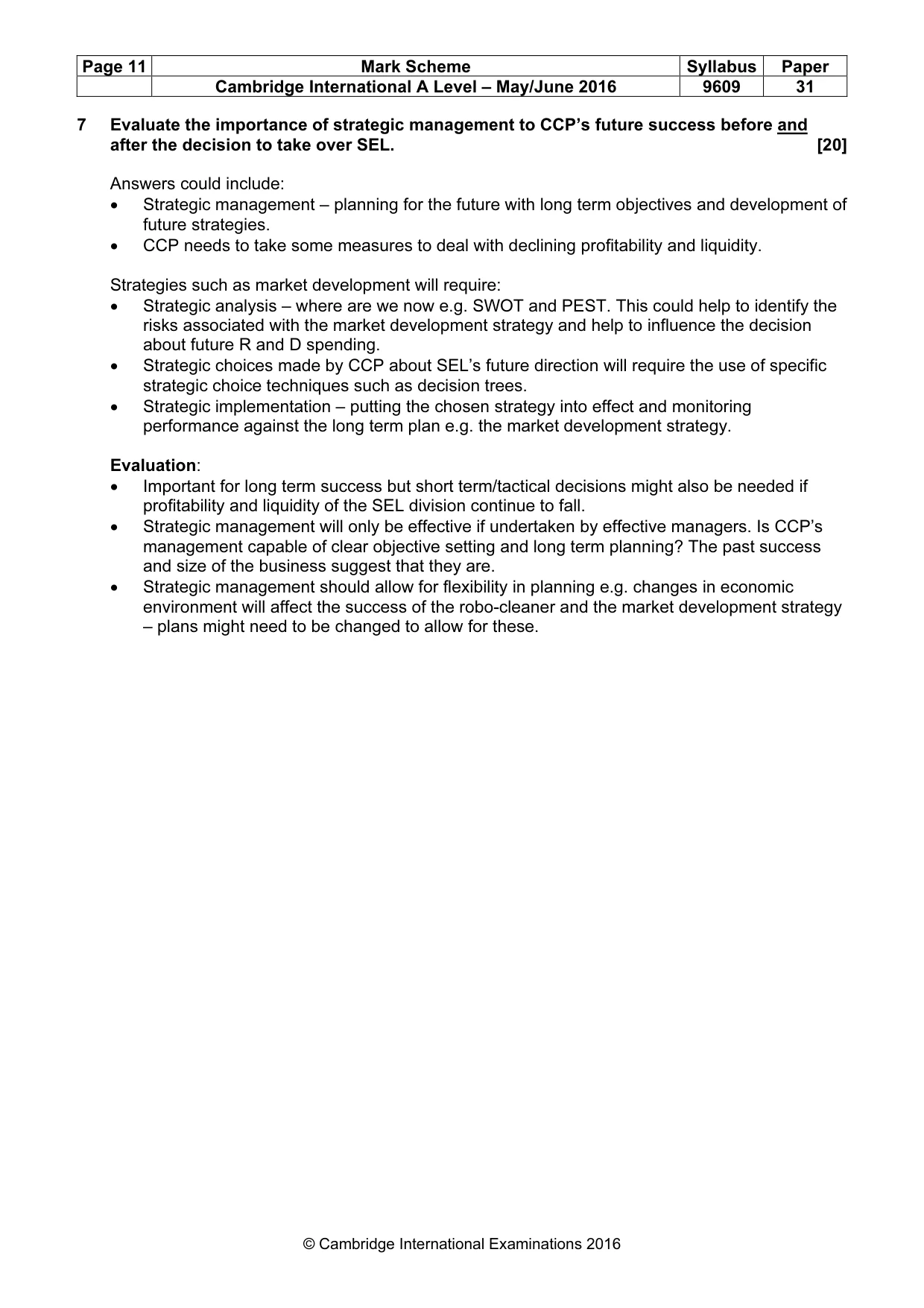
Page 11 Mark Scheme Syllabus Paper Cambridge International A Level – May/June 2016 9609 31 © Cambridge International Examinations 2016 7 Evaluate the importance of strategic management to CCP’s future success before and after the decision to take over SEL. [20] Answers could include: • Strategic management – planning for the future with long term objectives and development of future strategies. • CCP needs to take some measures to deal with declining profitability and liquidity. Strategies such as market development will require: • Strategic analysis – where are we now e.g. SWOT and PEST. This could help to identify the risks associated with the market development strategy and help to influence the decision about future R and D spending. • Strategic choices made by CCP about SEL’s future direction will require the use of specific strategic choice techniques such as decision trees. • Strategic implementation – putting the chosen strategy into effect and monitoring performance against the long term plan e.g. the market development strategy. Evaluation: • Important for long term success but short term/tactical decisions might also be needed if profitability and liquidity of the SEL division continue to fall. • Strategic management will only be effective if undertaken by effective managers. Is CCP’s management capable of clear objective setting and long term planning? The past success and size of the business suggest that they are. • Strategic management should allow for flexibility in planning e.g. changes in economic environment will affect the success of the robo-cleaner and the market development strategy – plans might need to be changed to allow for these.
What you needed in this session
Cambridge’s own grade thresholds for 2016 May/June, Paper 3 · Variant 1. A higher threshold means an easier paper — the bar moves with how the cohort did.