Cambridge A Level Business (for first examination in 2016) 9609 — 2016 Feb/March Paper 1 · Variant 2
9609/12/F/M/16 · 40 marks · ≈45 min
The question paper and its mark scheme, free to read here and free to download. This is Cambridge’s own paper, exactly as it was sat.
Question paper4 pages


Mark scheme9 pages
Answers below. Sit the paper first if you are practising.
Paper as text
Question paper, page 1
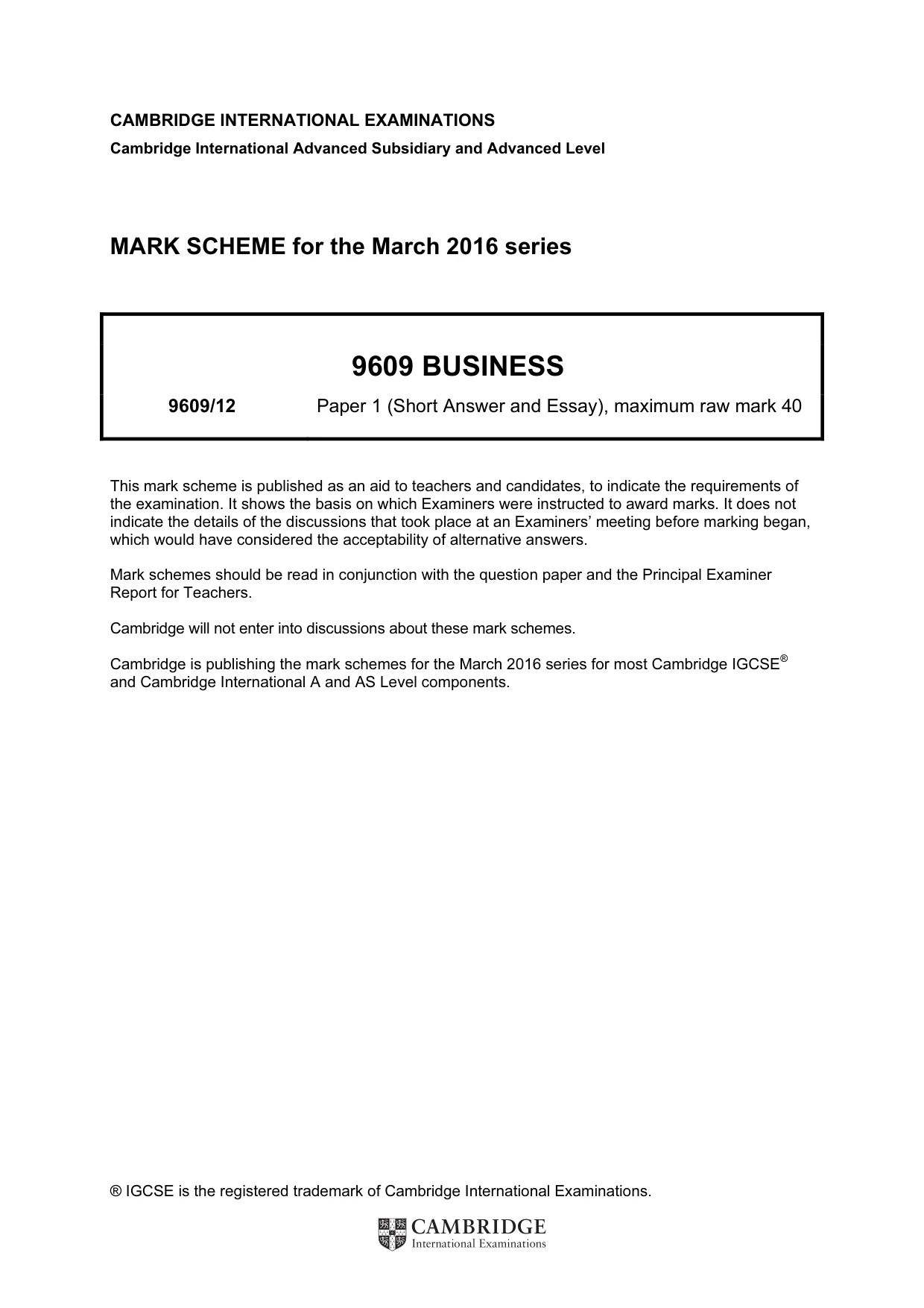
This document consists of 2 printed pages, 2 blank pages and 1 Insert. DC (ST) 113394/2 © UCLES 2016 [Turn over Cambridge International Examinations Cambridge International Advanced Subsidiary and Advanced Level * 9 6 0 7 8 6 8 2 0 5 * BUSINESS 9609/12 Paper 1 Short Answer and Essay February/March 2016 1 hour 15 minutes No Additional Materials are required. READ THESE INSTRUCTIONS FIRST An answer booklet is provided inside this question paper. You should follow the instructions on the front cover of the answer booklet. If you need additional answer paper ask the invigilator for a continuation booklet. Section A Answer all questions. Section B Answer one question. You are advised to spend no more than 35 minutes on Section A. The number of marks is given in brackets [ ] at the end of each question or part question.
Question paper, page 2
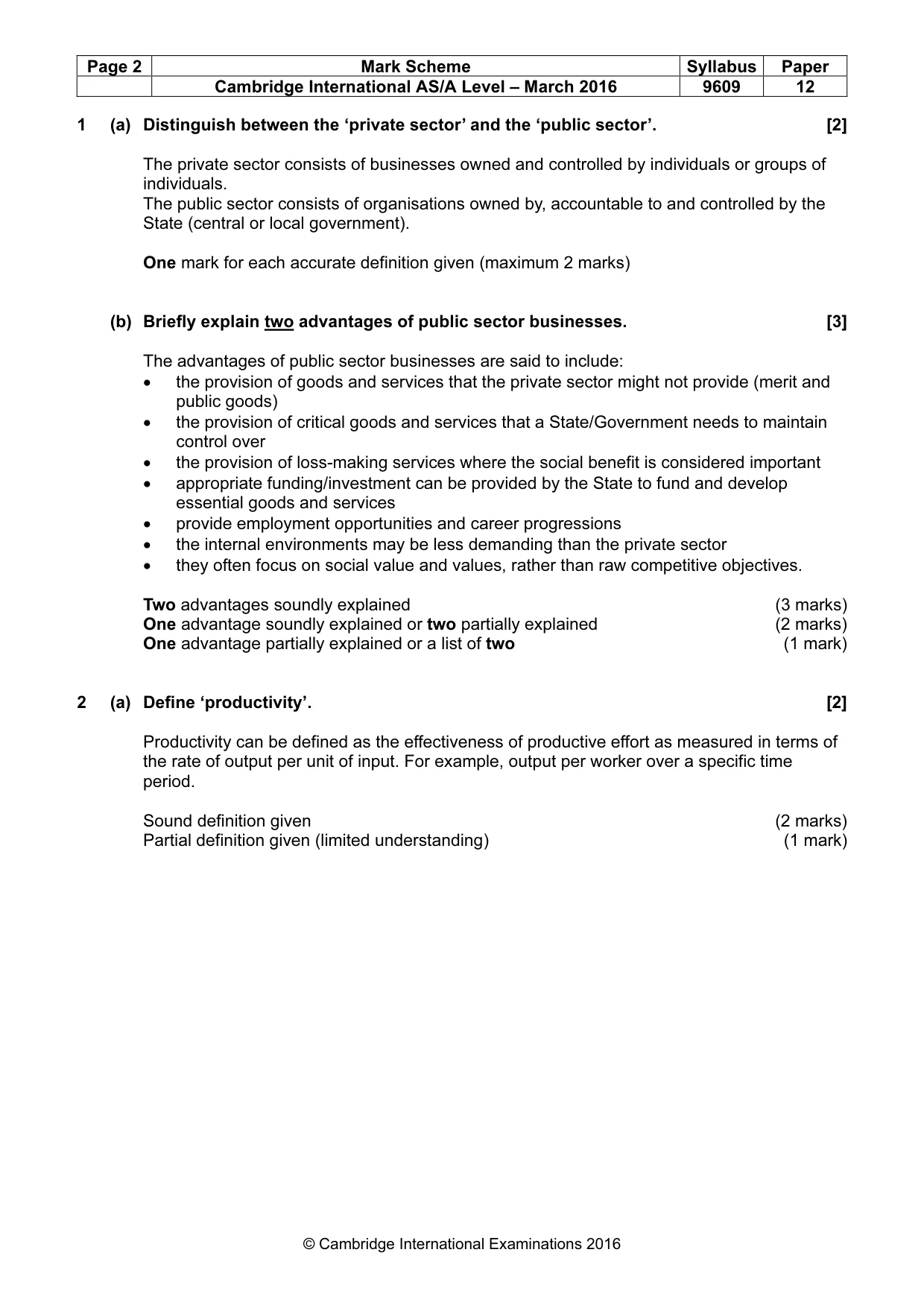
2 9609/12/F/M/16 © UCLES 2016 Section A (Short Answer) Answer all questions. 1 (a) Distinguish between the ‘private sector’ and the ‘public sector’. [2] (b) Briefly explain two advantages of public sector businesses. [3] 2 (a) Define ‘productivity’. [2] (b) Briefly explain two ways of improving manufacturing productivity in a business. [3] 3 Explain why accurate cost data is important to a business. [5] 4 (a) Define ‘product differentiation’. [2] (b) Briefly explain two marketing benefits of product differentiation. [3] Section B (Essay) Answer one question only. 5 (a) Analyse the importance of employee motivation for the achievement of business objectives. [8] (b) Discuss the view that managers and leaders perform very different functions in business organisations. [12] 6 Discuss how and why a multinational food manufacturer might have corporate social responsibility (CSR) as a business objective. [20] 7 (a) Analyse why it is important for businesses to effectively manage their levels of cash. [8] (b) Discuss how liquidity ratios could be useful for external stakeholders of a business. [12]
Question paper, page 3
3 9609/12/F/M/16 © UCLES 2016 BLANK PAGE
Question paper, page 4
4 9609/12/F/M/16 © UCLES 2016 BLANK PAGE Permission to reproduce items where third-party owned material protected by copyright is included has been sought and cleared where possible. Every reasonable effort has been made by the publisher (UCLES) to trace copyright holders, but if any items requiring clearance have unwittingly been included, the publisher will be pleased to make amends at the earliest possible opportunity. To avoid the issue of disclosure of answer-related information to candidates, all copyright acknowledgements are reproduced online in the Cambridge International Examinations Copyright Acknowledgements Booklet. This is produced for each series of examinations and is freely available to download at www.cie.org.uk after the live examination series. Cambridge International Examinations is part of the Cambridge Assessment Group. Cambridge Assessment is the brand name of University of Cambridge Local Examinations Syndicate (UCLES), which is itself a department of the University of Cambridge.
Mark scheme, page 1
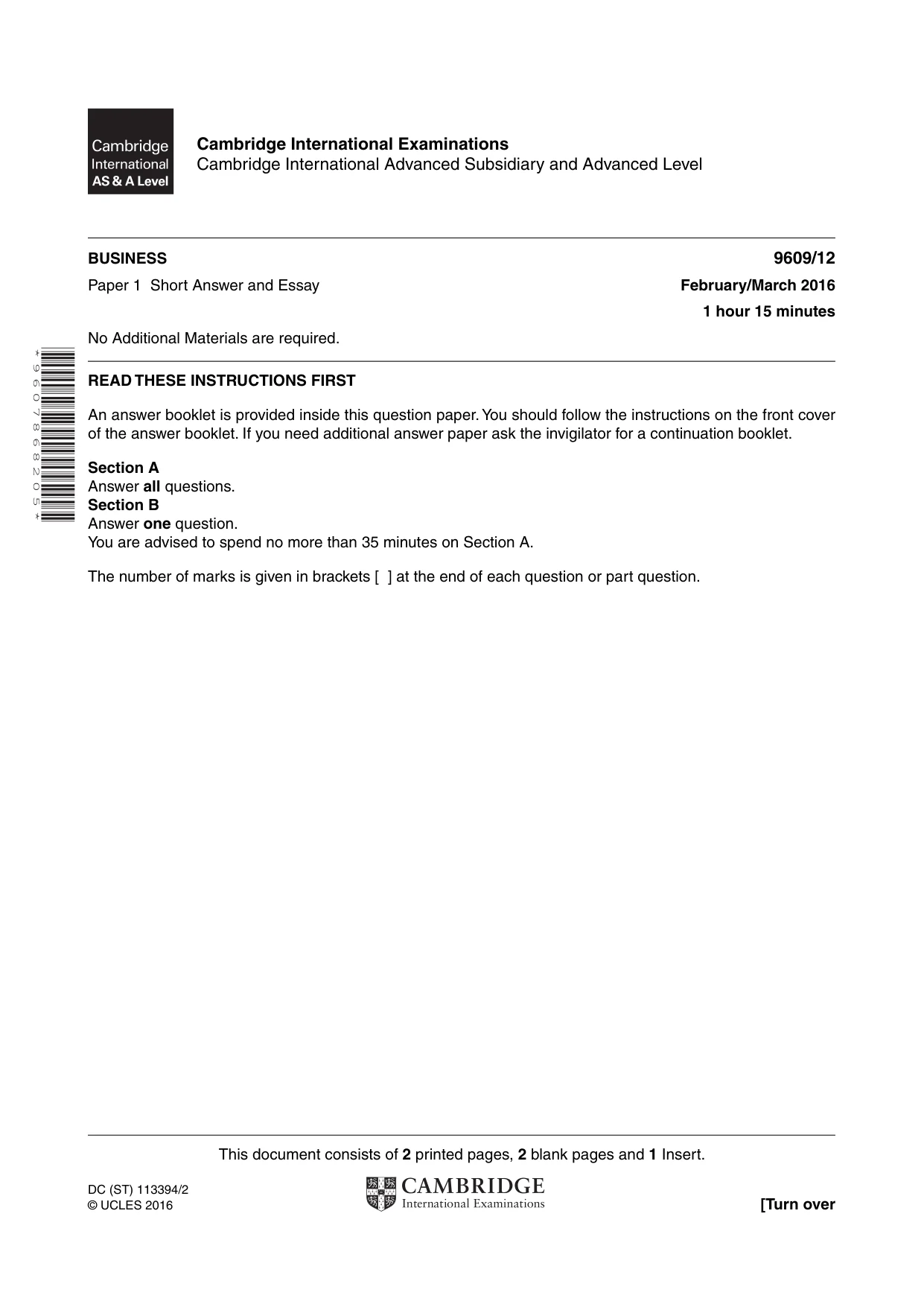
® IGCSE is the registered trademark of Cambridge International Examinations. CAMBRIDGE INTERNATIONAL EXAMINATIONS Cambridge International Advanced Subsidiary and Advanced Level MARK SCHEME for the March 2016 series 9609 BUSINESS 9609/12 Paper 1 (Short Answer and Essay), maximum raw mark 40 This mark scheme is published as an aid to teachers and candidates, to indicate the requirements of the examination. It shows the basis on which Examiners were instructed to award marks. It does not indicate the details of the discussions that took place at an Examiners’ meeting before marking began, which would have considered the acceptability of alternative answers. Mark schemes should be read in conjunction with the question paper and the Principal Examiner Report for Teachers. Cambridge will not enter into discussions about these mark schemes. Cambridge is publishing the mark schemes for the March 2016 series for most Cambridge IGCSE® and Cambridge International A and AS Level components.
Mark scheme, page 2
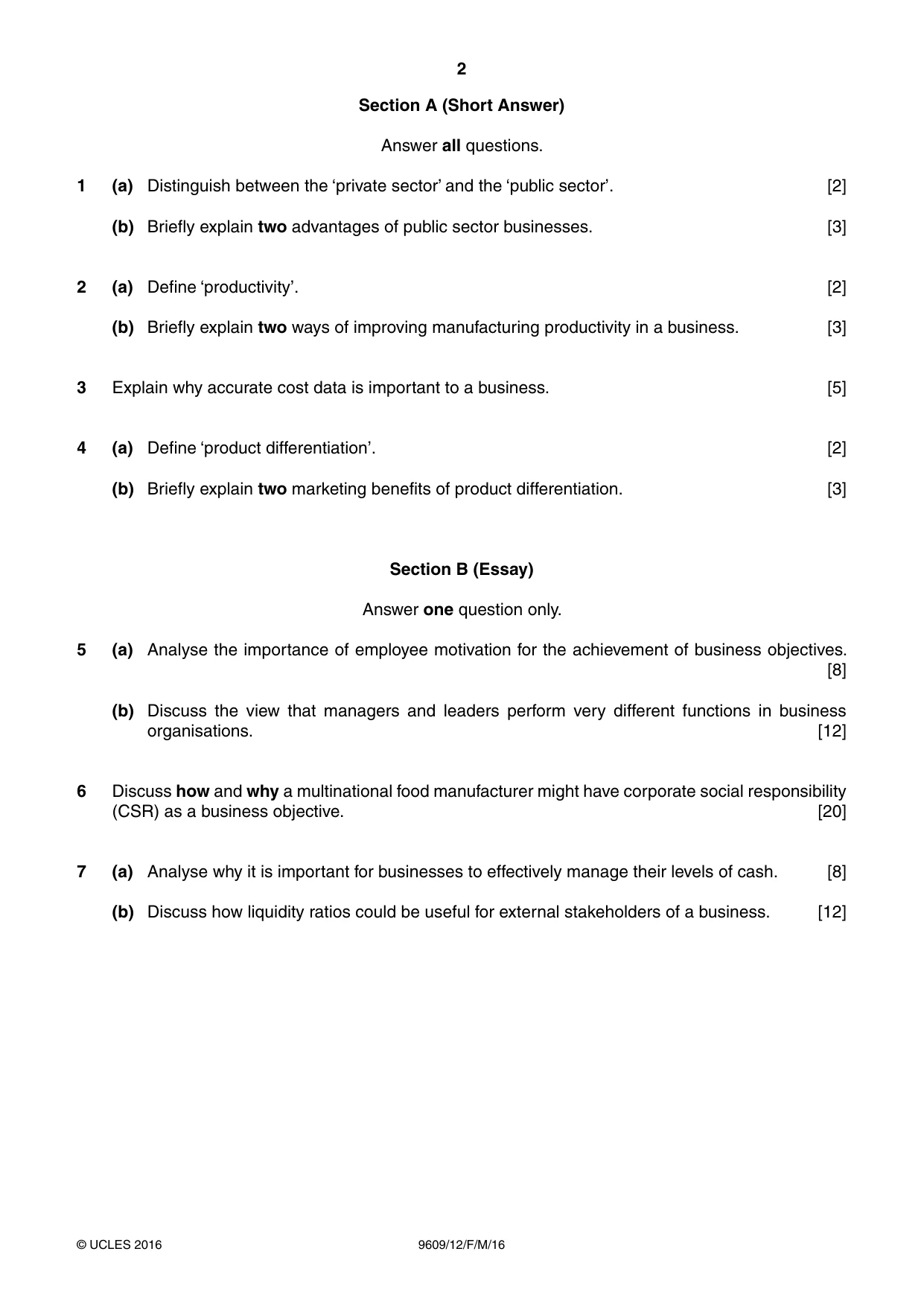
Page 2 Mark Scheme Syllabus Paper Cambridge International AS/A Level – March 2016 9609 12 © Cambridge International Examinations 2016 1 (a) Distinguish between the ‘private sector’ and the ‘public sector’. [2] The private sector consists of businesses owned and controlled by individuals or groups of individuals. The public sector consists of organisations owned by, accountable to and controlled by the State (central or local government). One mark for each accurate definition given (maximum 2 marks) (b) Briefly explain two advantages of public sector businesses. [3] The advantages of public sector businesses are said to include: • the provision of goods and services that the private sector might not provide (merit and public goods) • the provision of critical goods and services that a State/Government needs to maintain control over • the provision of loss-making services where the social benefit is considered important • appropriate funding/investment can be provided by the State to fund and develop essential goods and services • provide employment opportunities and career progressions • the internal environments may be less demanding than the private sector • they often focus on social value and values, rather than raw competitive objectives. Two advantages soundly explained (3 marks) One advantage soundly explained or two partially explained (2 marks) One advantage partially explained or a list of two (1 mark) 2 (a) Define ‘productivity’. [2] Productivity can be defined as the effectiveness of productive effort as measured in terms of the rate of output per unit of input. For example, output per worker over a specific time period. Sound definition given (2 marks) Partial definition given (limited understanding) (1 mark)
Mark scheme, page 3
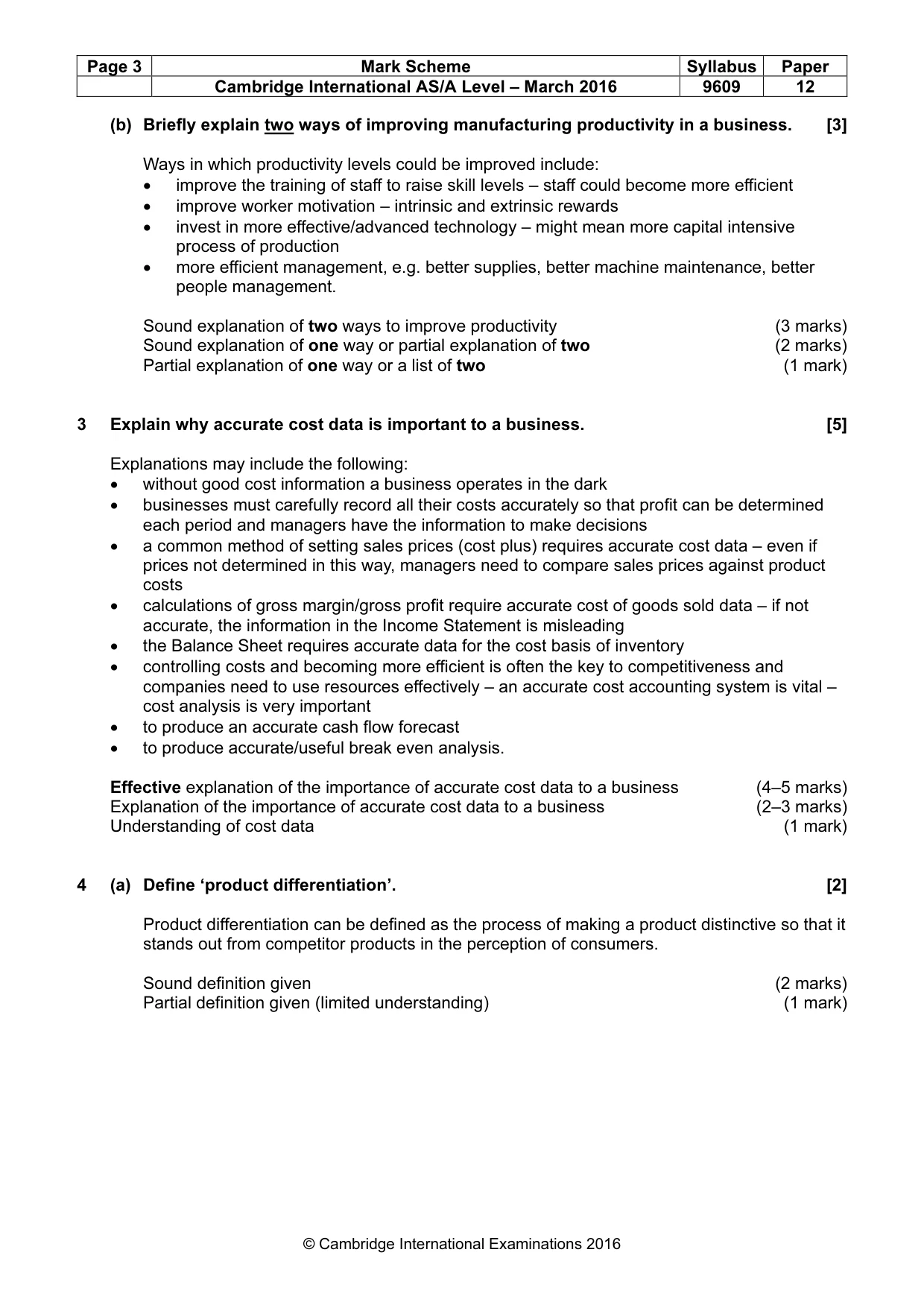
Page 3 Mark Scheme Syllabus Paper Cambridge International AS/A Level – March 2016 9609 12 © Cambridge International Examinations 2016 (b) Briefly explain two ways of improving manufacturing productivity in a business. [3] Ways in which productivity levels could be improved include: • improve the training of staff to raise skill levels – staff could become more efficient • improve worker motivation – intrinsic and extrinsic rewards • invest in more effective/advanced technology – might mean more capital intensive process of production • more efficient management, e.g. better supplies, better machine maintenance, better people management. Sound explanation of two ways to improve productivity (3 marks) Sound explanation of one way or partial explanation of two (2 marks) Partial explanation of one way or a list of two (1 mark) 3 Explain why accurate cost data is important to a business. [5] Explanations may include the following: • without good cost information a business operates in the dark • businesses must carefully record all their costs accurately so that profit can be determined each period and managers have the information to make decisions • a common method of setting sales prices (cost plus) requires accurate cost data – even if prices not determined in this way, managers need to compare sales prices against product costs • calculations of gross margin/gross profit require accurate cost of goods sold data – if not accurate, the information in the Income Statement is misleading • the Balance Sheet requires accurate data for the cost basis of inventory • controlling costs and becoming more efficient is often the key to competitiveness and companies need to use resources effectively – an accurate cost accounting system is vital – cost analysis is very important • to produce an accurate cash flow forecast • to produce accurate/useful break even analysis. Effective explanation of the importance of accurate cost data to a business (4–5 marks) Explanation of the importance of accurate cost data to a business (2–3 marks) Understanding of cost data (1 mark) 4 (a) Define ‘product differentiation’. [2] Product differentiation can be defined as the process of making a product distinctive so that it stands out from competitor products in the perception of consumers. Sound definition given (2 marks) Partial definition given (limited understanding) (1 mark)
Mark scheme, page 4
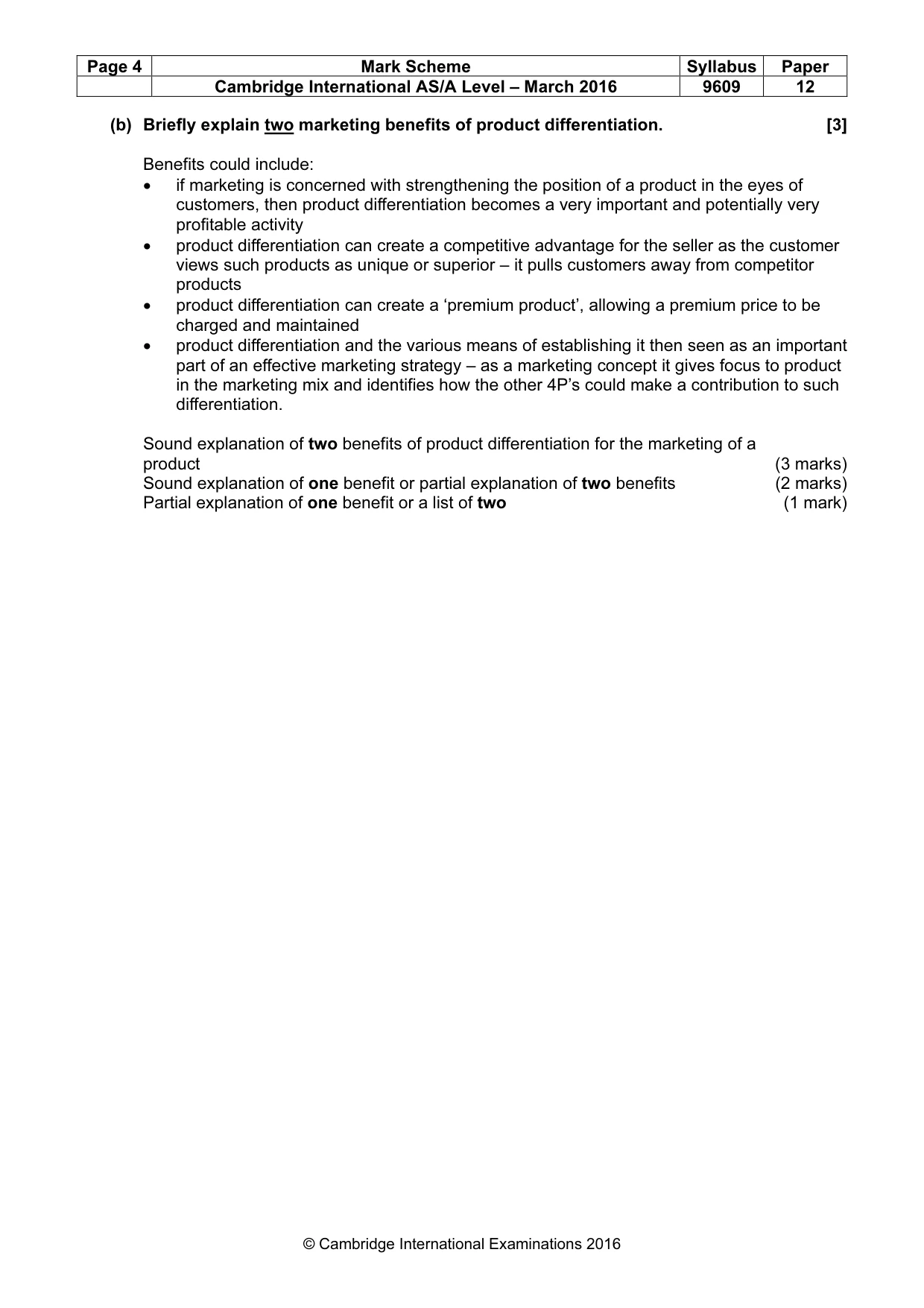
Page 4 Mark Scheme Syllabus Paper Cambridge International AS/A Level – March 2016 9609 12 © Cambridge International Examinations 2016 (b) Briefly explain two marketing benefits of product differentiation. [3] Benefits could include: • if marketing is concerned with strengthening the position of a product in the eyes of customers, then product differentiation becomes a very important and potentially very profitable activity • product differentiation can create a competitive advantage for the seller as the customer views such products as unique or superior – it pulls customers away from competitor products • product differentiation can create a ‘premium product’, allowing a premium price to be charged and maintained • product differentiation and the various means of establishing it then seen as an important part of an effective marketing strategy – as a marketing concept it gives focus to product in the marketing mix and identifies how the other 4P’s could make a contribution to such differentiation. Sound explanation of two benefits of product differentiation for the marketing of a product (3 marks) Sound explanation of one benefit or partial explanation of two benefits (2 marks) Partial explanation of one benefit or a list of two (1 mark)
Mark scheme, page 5
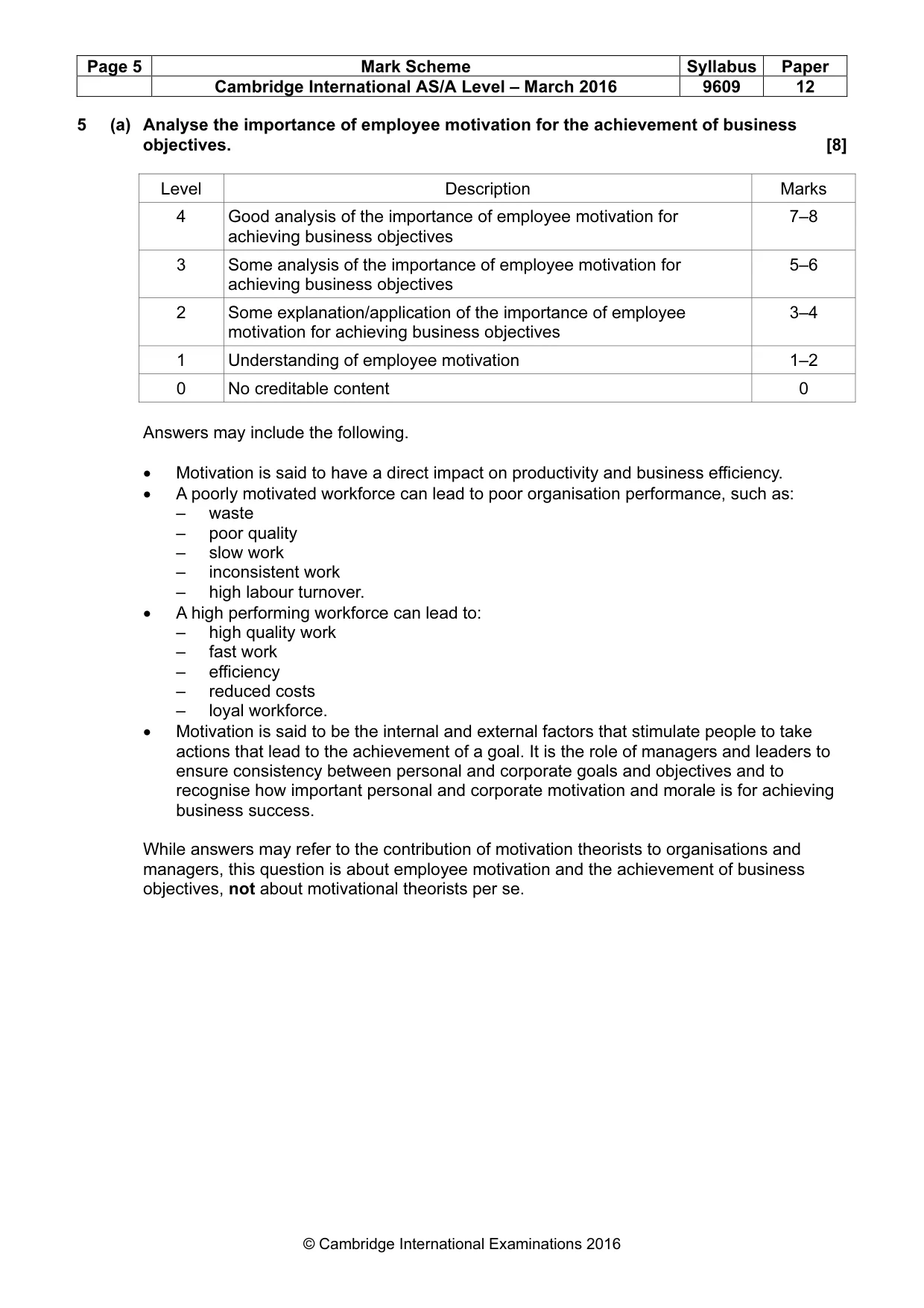
Page 5 Mark Scheme Syllabus Paper Cambridge International AS/A Level – March 2016 9609 12 © Cambridge International Examinations 2016 5 (a) Analyse the importance of employee motivation for the achievement of business objectives. [8] Level Description Marks 4 Good analysis of the importance of employee motivation for achieving business objectives 7–8 3 Some analysis of the importance of employee motivation for achieving business objectives 5–6 2 Some explanation/application of the importance of employee motivation for achieving business objectives 3–4 1 Understanding of employee motivation 1–2 0 No creditable content 0 Answers may include the following. • Motivation is said to have a direct impact on productivity and business efficiency. • A poorly motivated workforce can lead to poor organisation performance, such as: – waste – poor quality – slow work – inconsistent work – high labour turnover. • A high performing workforce can lead to: – high quality work – fast work – efficiency – reduced costs – loyal workforce. • Motivation is said to be the internal and external factors that stimulate people to take actions that lead to the achievement of a goal. It is the role of managers and leaders to ensure consistency between personal and corporate goals and objectives and to recognise how important personal and corporate motivation and morale is for achieving business success. While answers may refer to the contribution of motivation theorists to organisations and managers, this question is about employee motivation and the achievement of business objectives, not about motivational theorists per se.
Mark scheme, page 6
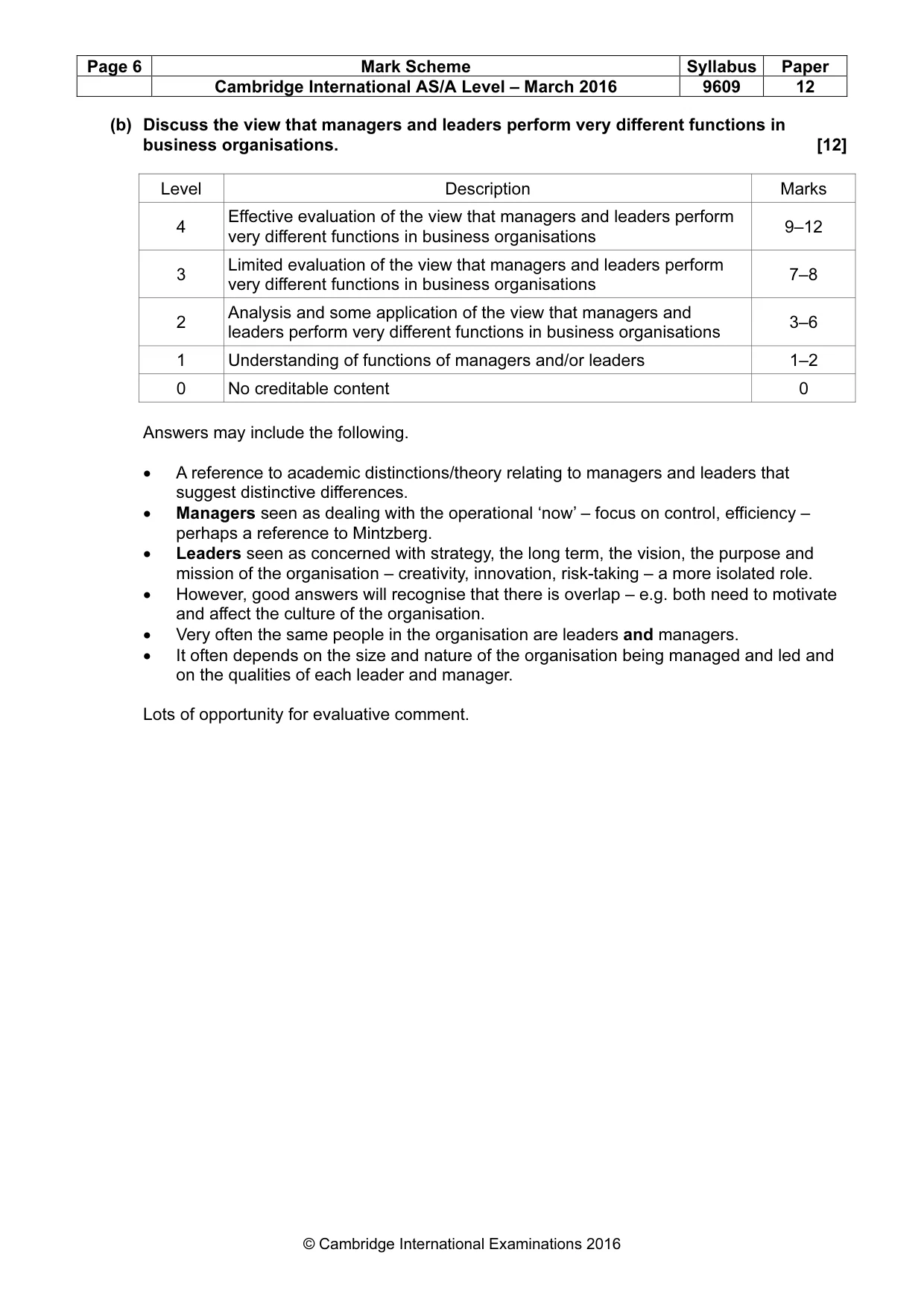
Page 6 Mark Scheme Syllabus Paper Cambridge International AS/A Level – March 2016 9609 12 © Cambridge International Examinations 2016 (b) Discuss the view that managers and leaders perform very different functions in business organisations. [12] Level Description Marks 4 Effective evaluation of the view that managers and leaders perform very different functions in business organisations 9–12 3 Limited evaluation of the view that managers and leaders perform very different functions in business organisations 7–8 2 Analysis and some application of the view that managers and leaders perform very different functions in business organisations 3–6 1 Understanding of functions of managers and/or leaders 1–2 0 No creditable content 0 Answers may include the following. • A reference to academic distinctions/theory relating to managers and leaders that suggest distinctive differences. • Managers seen as dealing with the operational ‘now’ – focus on control, efficiency – perhaps a reference to Mintzberg. • Leaders seen as concerned with strategy, the long term, the vision, the purpose and mission of the organisation – creativity, innovation, risk-taking – a more isolated role. • However, good answers will recognise that there is overlap – e.g. both need to motivate and affect the culture of the organisation. • Very often the same people in the organisation are leaders and managers. • It often depends on the size and nature of the organisation being managed and led and on the qualities of each leader and manager. Lots of opportunity for evaluative comment.
Mark scheme, page 7
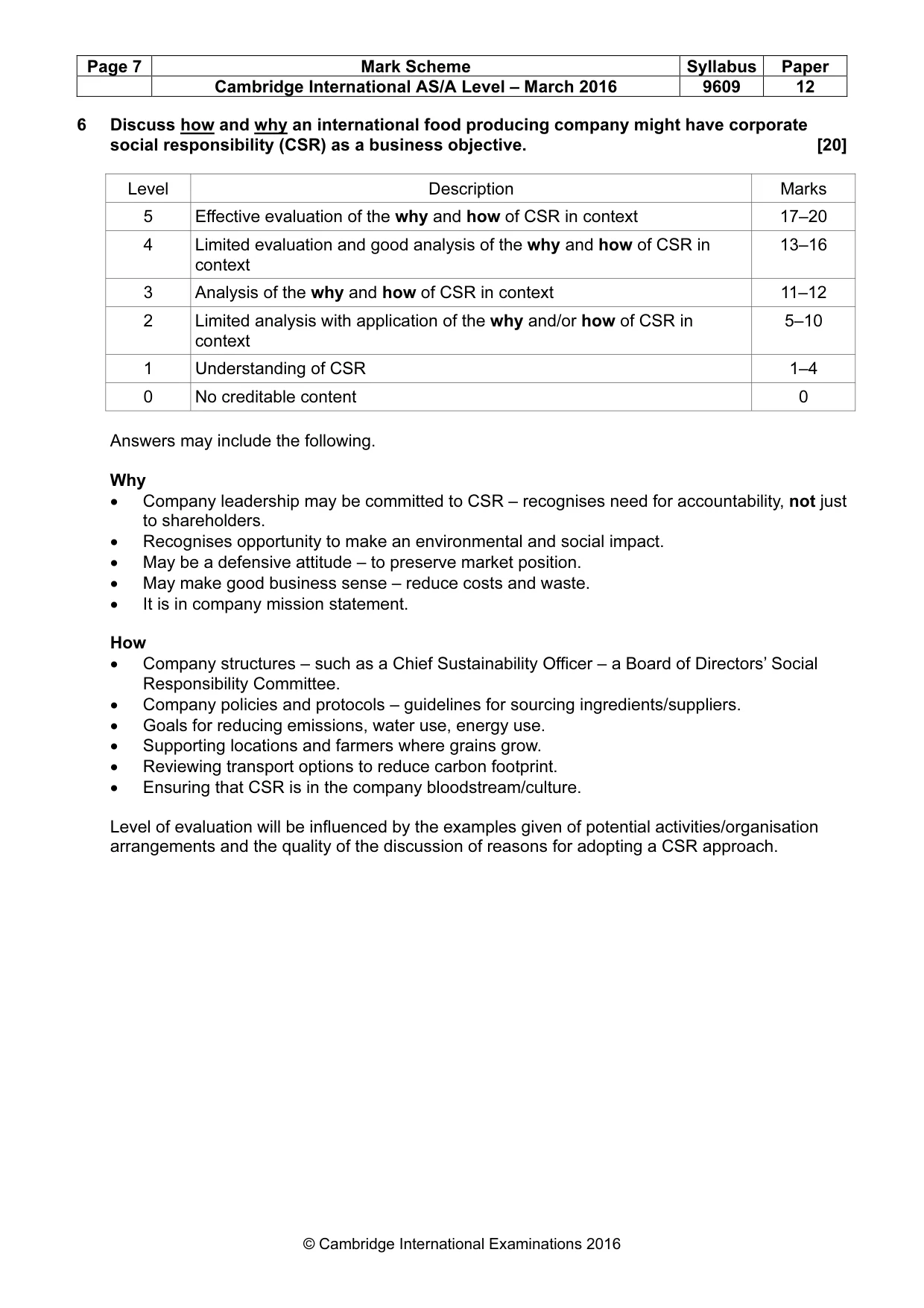
Page 7 Mark Scheme Syllabus Paper Cambridge International AS/A Level – March 2016 9609 12 © Cambridge International Examinations 2016 6 Discuss how and why an international food producing company might have corporate social responsibility (CSR) as a business objective. [20] Level Description Marks 5 Effective evaluation of the why and how of CSR in context 17–20 4 Limited evaluation and good analysis of the why and how of CSR in context 13–16 3 Analysis of the why and how of CSR in context 11–12 2 Limited analysis with application of the why and/or how of CSR in context 5–10 1 Understanding of CSR 1–4 0 No creditable content 0 Answers may include the following. Why • Company leadership may be committed to CSR – recognises need for accountability, not just to shareholders. • Recognises opportunity to make an environmental and social impact. • May be a defensive attitude – to preserve market position. • May make good business sense – reduce costs and waste. • It is in company mission statement. How • Company structures – such as a Chief Sustainability Officer – a Board of Directors’ Social Responsibility Committee. • Company policies and protocols – guidelines for sourcing ingredients/suppliers. • Goals for reducing emissions, water use, energy use. • Supporting locations and farmers where grains grow. • Reviewing transport options to reduce carbon footprint. • Ensuring that CSR is in the company bloodstream/culture. Level of evaluation will be influenced by the examples given of potential activities/organisation arrangements and the quality of the discussion of reasons for adopting a CSR approach.
Mark scheme, page 8
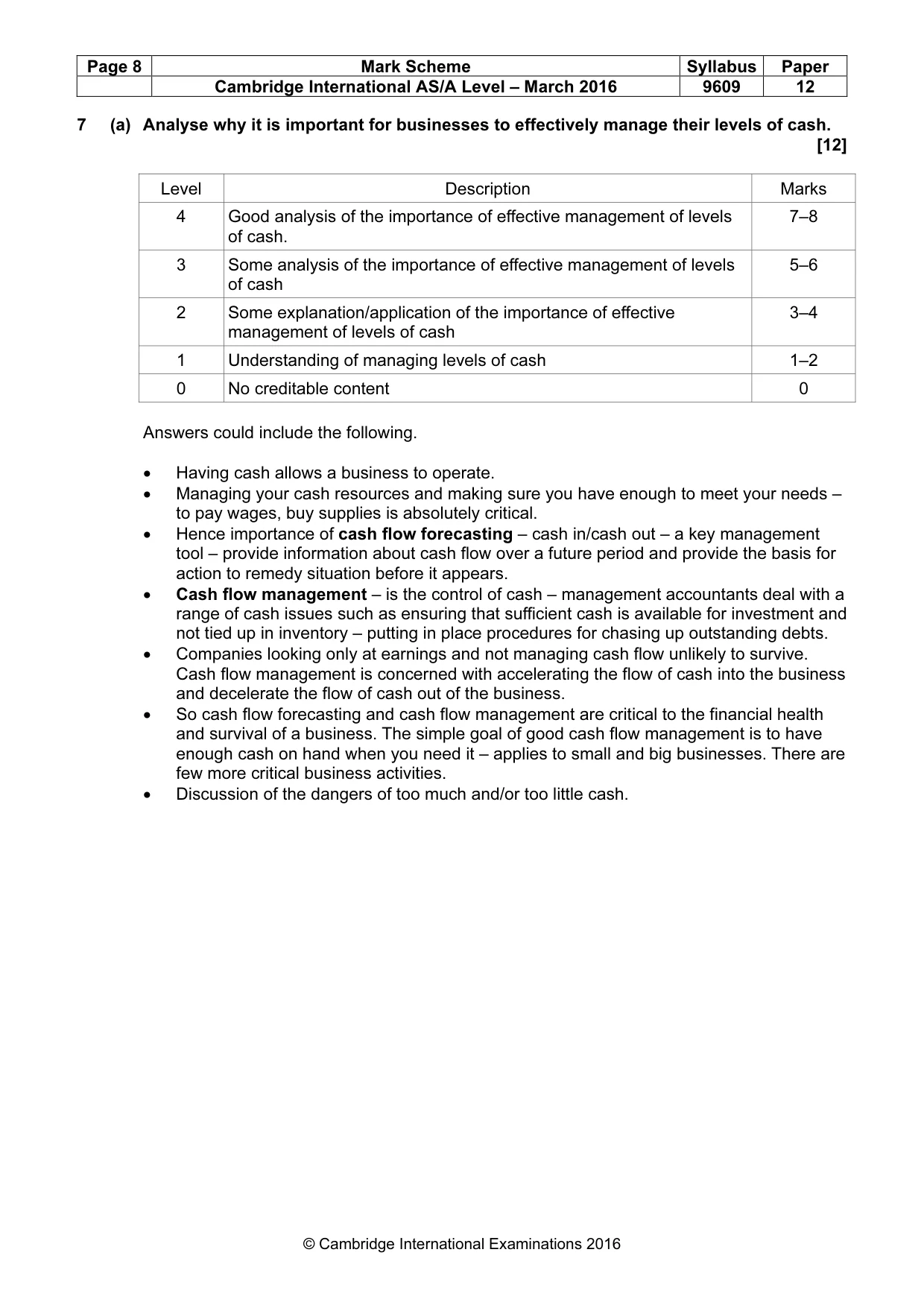
Page 8 Mark Scheme Syllabus Paper Cambridge International AS/A Level – March 2016 9609 12 © Cambridge International Examinations 2016 7 (a) Analyse why it is important for businesses to effectively manage their levels of cash. [12] Level Description Marks 4 Good analysis of the importance of effective management of levels of cash. 7–8 3 Some analysis of the importance of effective management of levels of cash 5–6 2 Some explanation/application of the importance of effective management of levels of cash 3–4 1 Understanding of managing levels of cash 1–2 0 No creditable content 0 Answers could include the following. • Having cash allows a business to operate. • Managing your cash resources and making sure you have enough to meet your needs – to pay wages, buy supplies is absolutely critical. • Hence importance of cash flow forecasting – cash in/cash out – a key management tool – provide information about cash flow over a future period and provide the basis for action to remedy situation before it appears. • Cash flow management – is the control of cash – management accountants deal with a range of cash issues such as ensuring that sufficient cash is available for investment and not tied up in inventory – putting in place procedures for chasing up outstanding debts. • Companies looking only at earnings and not managing cash flow unlikely to survive. Cash flow management is concerned with accelerating the flow of cash into the business and decelerate the flow of cash out of the business. • So cash flow forecasting and cash flow management are critical to the financial health and survival of a business. The simple goal of good cash flow management is to have enough cash on hand when you need it – applies to small and big businesses. There are few more critical business activities. • Discussion of the dangers of too much and/or too little cash.
Mark scheme, page 9
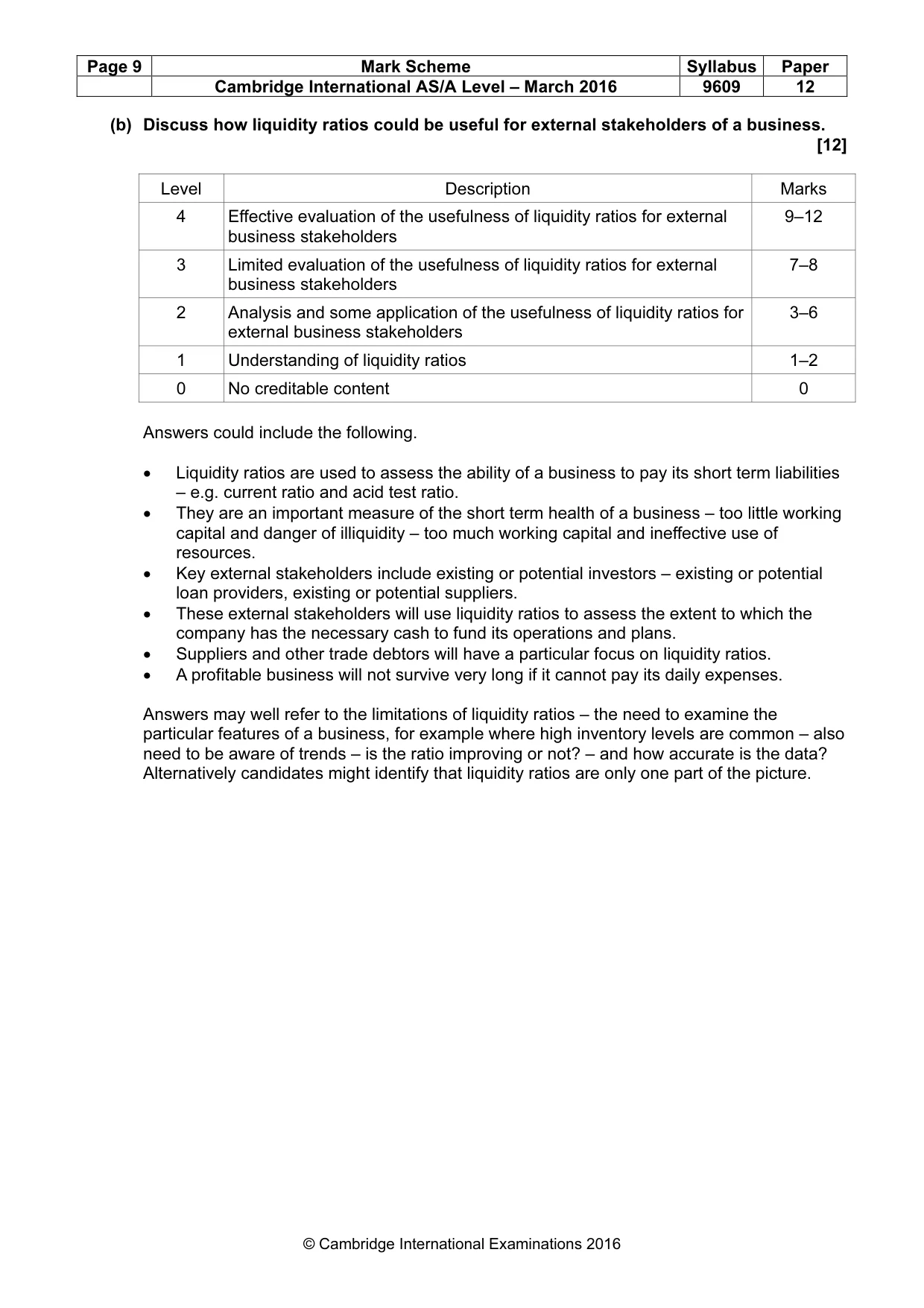
Page 9 Mark Scheme Syllabus Paper Cambridge International AS/A Level – March 2016 9609 12 © Cambridge International Examinations 2016 (b) Discuss how liquidity ratios could be useful for external stakeholders of a business. [12] Level Description Marks 4 Effective evaluation of the usefulness of liquidity ratios for external business stakeholders 9–12 3 Limited evaluation of the usefulness of liquidity ratios for external business stakeholders 7–8 2 Analysis and some application of the usefulness of liquidity ratios for external business stakeholders 3–6 1 Understanding of liquidity ratios 1–2 0 No creditable content 0 Answers could include the following. • Liquidity ratios are used to assess the ability of a business to pay its short term liabilities – e.g. current ratio and acid test ratio. • They are an important measure of the short term health of a business – too little working capital and danger of illiquidity – too much working capital and ineffective use of resources. • Key external stakeholders include existing or potential investors – existing or potential loan providers, existing or potential suppliers. • These external stakeholders will use liquidity ratios to assess the extent to which the company has the necessary cash to fund its operations and plans. • Suppliers and other trade debtors will have a particular focus on liquidity ratios. • A profitable business will not survive very long if it cannot pay its daily expenses. Answers may well refer to the limitations of liquidity ratios – the need to examine the particular features of a business, for example where high inventory levels are common – also need to be aware of trends – is the ratio improving or not? – and how accurate is the data? Alternatively candidates might identify that liquidity ratios are only one part of the picture.
What you needed in this session
Cambridge’s own grade thresholds for 2016 Feb/March, Paper 1 · Variant 2. A higher threshold means an easier paper — the bar moves with how the cohort did.