Cambridge A Level Biology 9700 — 2013 May/June Paper 3 · Variant 3
9700/33/M/J/13 · 40 marks · ≈45 min
The question paper and its mark scheme, free to read here and free to download. This is Cambridge’s own paper, exactly as it was sat.
Question paper12 pages

Mark scheme12 pages
Answers below. Sit the paper first if you are practising.
Paper as text
Question paper, page 1
This document consists of 11 printed pages and 1 blank page. DC (SM/SW) 52074/6 © UCLES 2013 [Turn over UNIVERSITY OF CAMBRIDGE INTERNATIONAL EXAMINATIONS General Certificate of Education Advanced Subsidiary Level and Advanced Level * 4 9 8 8 7 2 0 3 2 4 * BIOLOGY 9700/33 Advanced Practical Skills 1 May/June 2013 2 hours Candidates answer on the Question Paper. Additional Materials: As listed in the Confidential Instructions. READ THESE INSTRUCTIONS FIRST Write your Centre number, candidate number and name on all the work you hand in. Write in dark blue or black ink. You may use a pencil for any diagrams, graphs or rough working. Do not use red ink, staples, paper clips, highlighters, glue or correction fluid. DO NOT WRITE IN ANY BARCODES. Answer all questions. Electronic calculators may be used. You may lose marks if you do not show your working or if you do not use appropriate units. At the end of the examination, fasten all your work securely together. The number of marks is given in brackets [ ] at the end of each question or part question. For Examiner’s Use 1 2 Total
Question paper, page 2
2 9700/33/M/J/13 © UCLES 2013 BLANK PAGE
Question paper, page 3
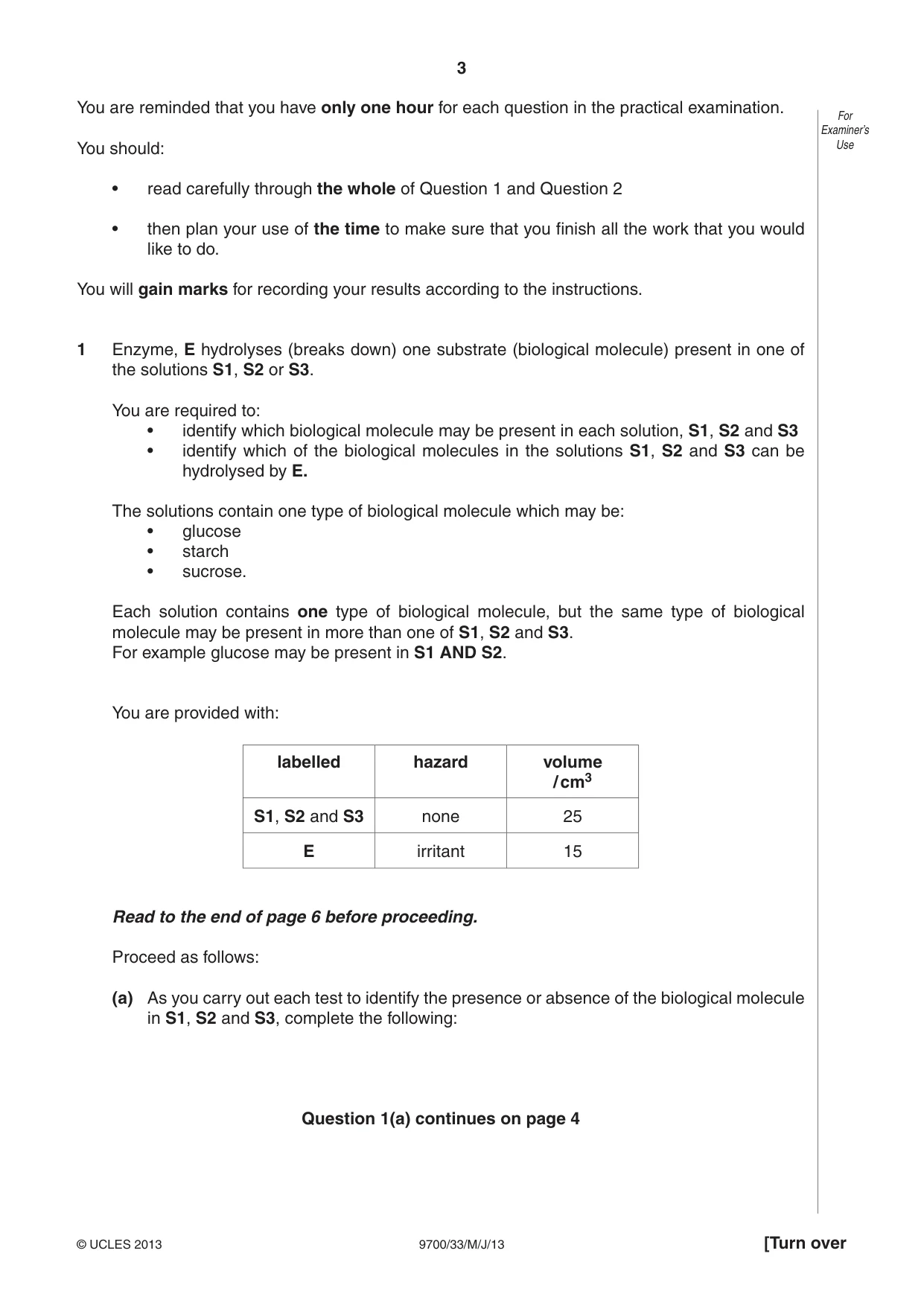
3 9700/33/M/J/13 © UCLES 2013 [Turn over For Examiner’s Use You are reminded that you have only one hour for each question in the practical examination. You should: • read carefully through the whole of Question 1 and Question 2 • then plan your use of the time to make sure that you finish all the work that you would like to do. You will gain marks for recording your results according to the instructions. 1 Enzyme, E hydrolyses (breaks down) one substrate (biological molecule) present in one of the solutions S1, S2 or S3. You are required to: • identify which biological molecule may be present in each solution, S1, S2 and S3 • identify which of the biological molecules in the solutions S1, S2 and S3 can be hydrolysed by E. The solutions contain one type of biological molecule which may be: • glucose • starch • sucrose. Each solution contains one type of biological molecule, but the same type of biological molecule may be present in more than one of S1, S2 and S3. For example glucose may be present in S1 AND S2. You are provided with: labelled hazard volume / cm3 S1, S2 and S3 none 25 E irritant 15 Read to the end of page 6 before proceeding. Proceed as follows: (a) As you carry out each test to identify the presence or absence of the biological molecule in S1, S2 and S3, complete the following: Question 1(a) continues on page 4
Question paper, page 4
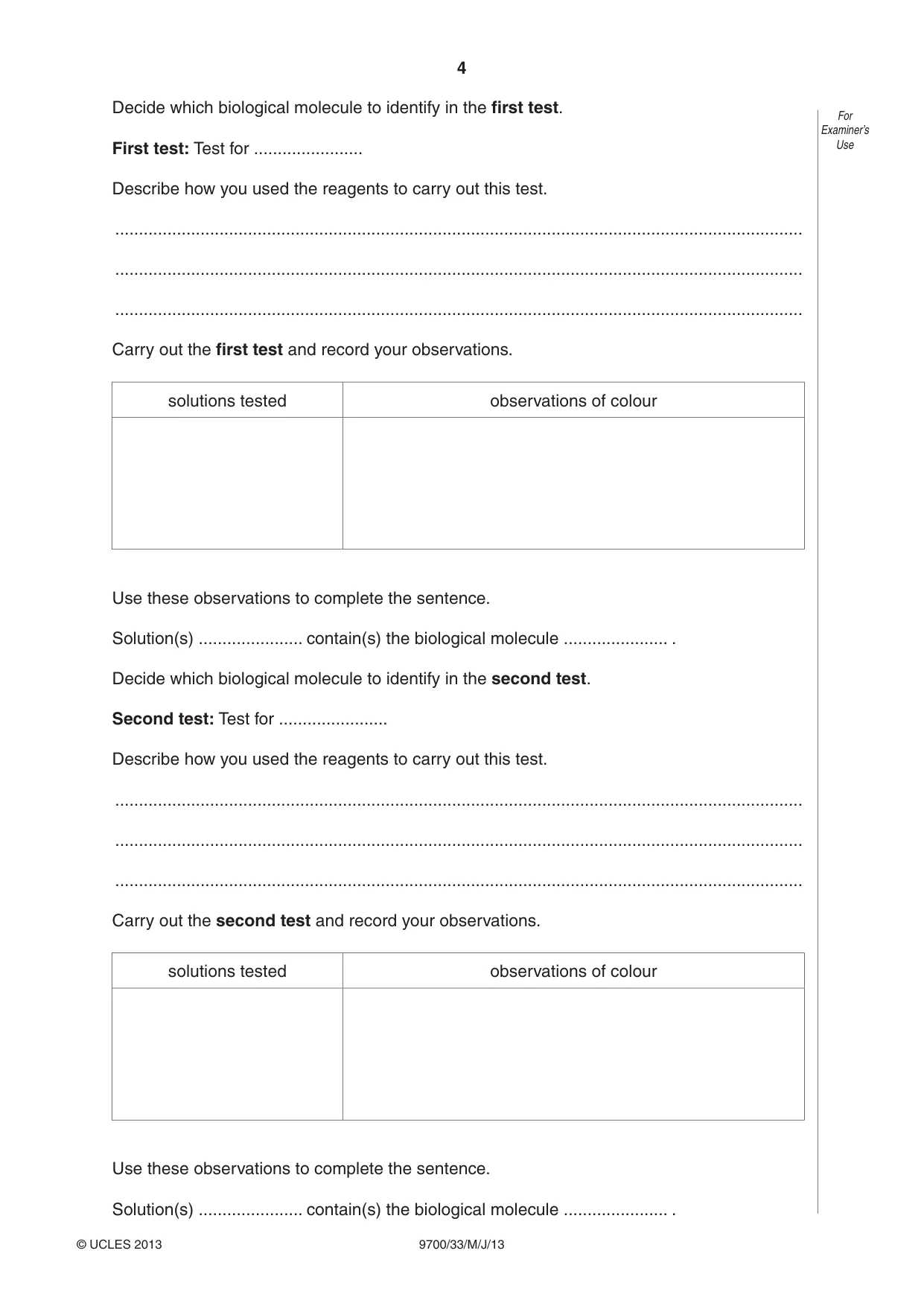
4 9700/33/M/J/13 © UCLES 2013 For Examiner’s Use Decide which biological molecule to identify in the first test. First test: Test for … Describe how you used the reagents to carry out this test. … … … Carry out the first test and record your observations. solutions tested observations of colour Use these observations to complete the sentence. Solution(s) … contain(s) the biological molecule … . Decide which biological molecule to identify in the second test. Second test: Test for … Describe how you used the reagents to carry out this test. … … … Carry out the second test and record your observations. solutions tested observations of colour Use these observations to complete the sentence. Solution(s) … contain(s) the biological molecule … .
Question paper, page 5
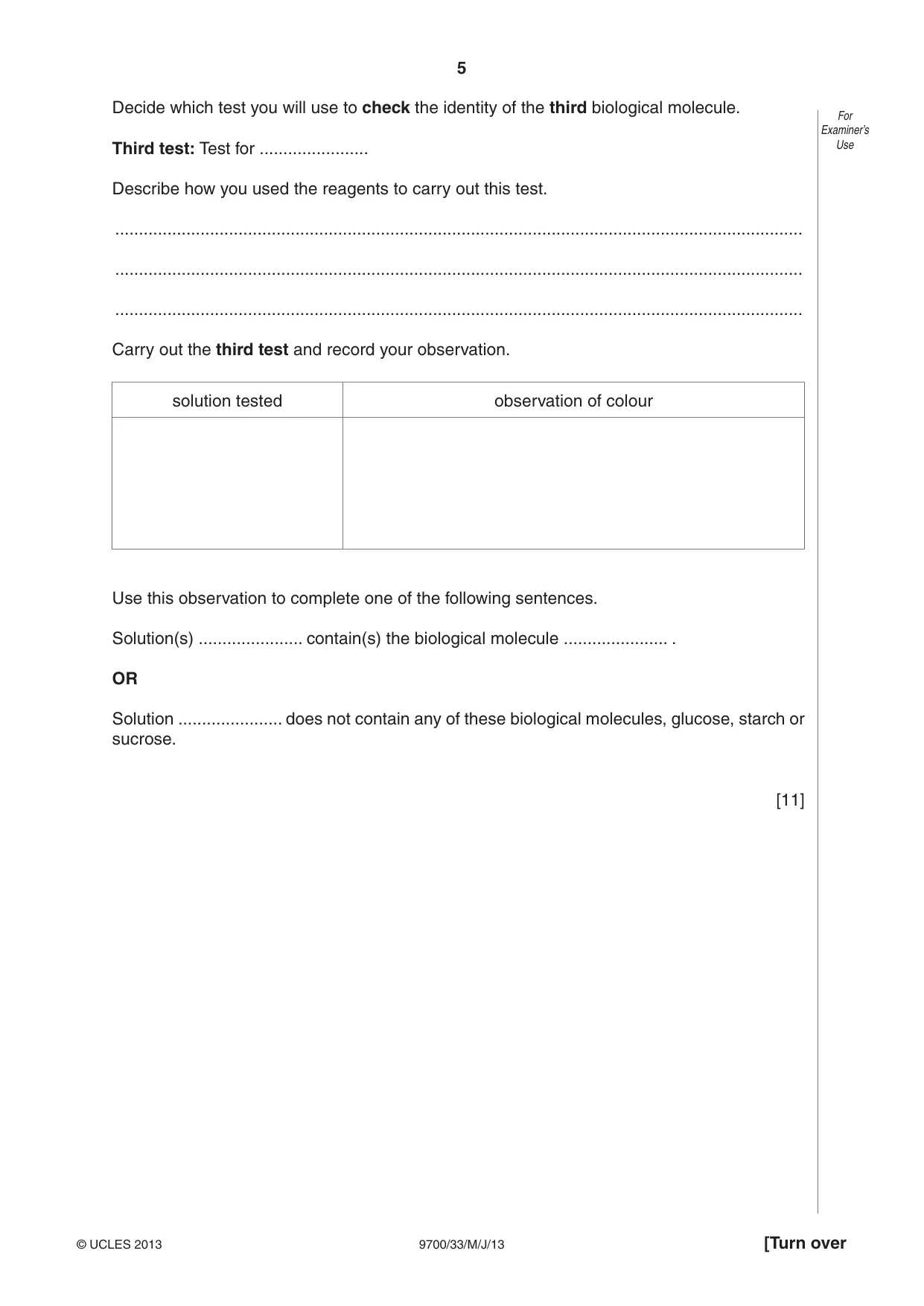
5 9700/33/M/J/13 © UCLES 2013 [Turn over For Examiner’s Use Decide which test you will use to check the identity of the third biological molecule. Third test: Test for … Describe how you used the reagents to carry out this test. … … … Carry out the third test and record your observation. solution tested observation of colour Use this observation to complete one of the following sentences. Solution(s) … contain(s) the biological molecule … . OR Solution … does not contain any of these biological molecules, glucose, starch or sucrose. [11]
Question paper, page 6
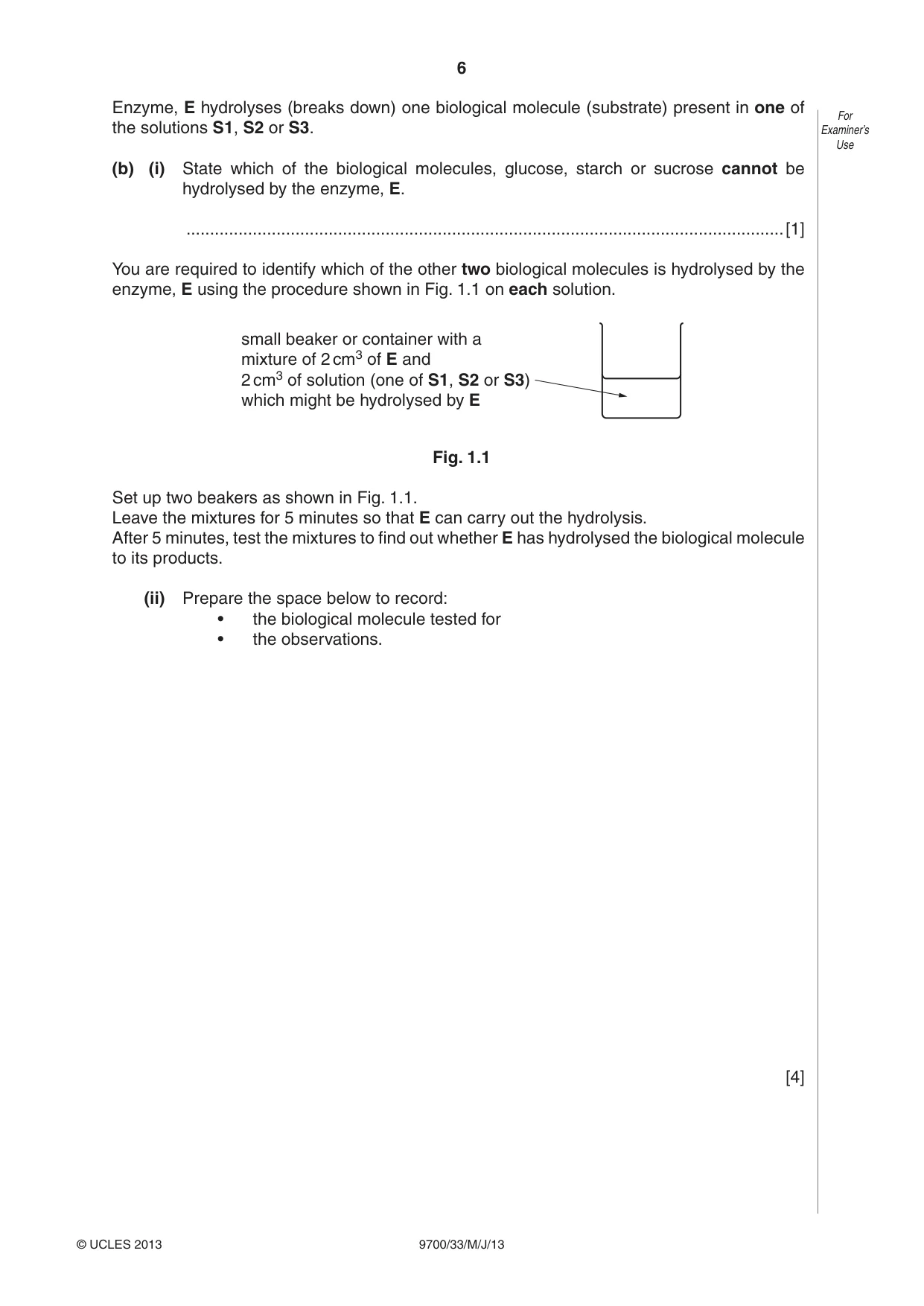
6 9700/33/M/J/13 © UCLES 2013 For Examiner’s Use Enzyme, E hydrolyses (breaks down) one biological molecule (substrate) present in one of the solutions S1, S2 or S3. (b) (i) State which of the biological molecules, glucose, starch or sucrose cannot be hydrolysed by the enzyme, E. …[1] You are required to identify which of the other two biological molecules is hydrolysed by the enzyme, E using the procedure shown in Fig. 1.1 on each solution. small beaker or container with a mixture of 2 cm3 of E and 2 cm3 of solution (one of S1, S2 or S3) which might be hydrolysed by E Fig. 1.1 Set up two beakers as shown in Fig. 1.1. Leave the mixtures for 5 minutes so that E can carry out the hydrolysis. After 5 minutes, test the mixtures to find out whether E has hydrolysed the biological molecule to its products. (ii) Prepare the space below to record: • the biological molecule tested for • the observations. [4]
Question paper, page 7
7 9700/33/M/J/13 © UCLES 2013 [Turn over For Examiner’s Use (iii) From your observations, state which of the solutions (S1, S2, S3) is hydrolysed by the enzyme, E. Explain the reason for your answer. solution … reason … [1] (c) Describe how you would modify this procedure to investigate the effect of temperature on the enzyme, E. … … … … … … …[3] [Total: 20]
Question paper, page 8
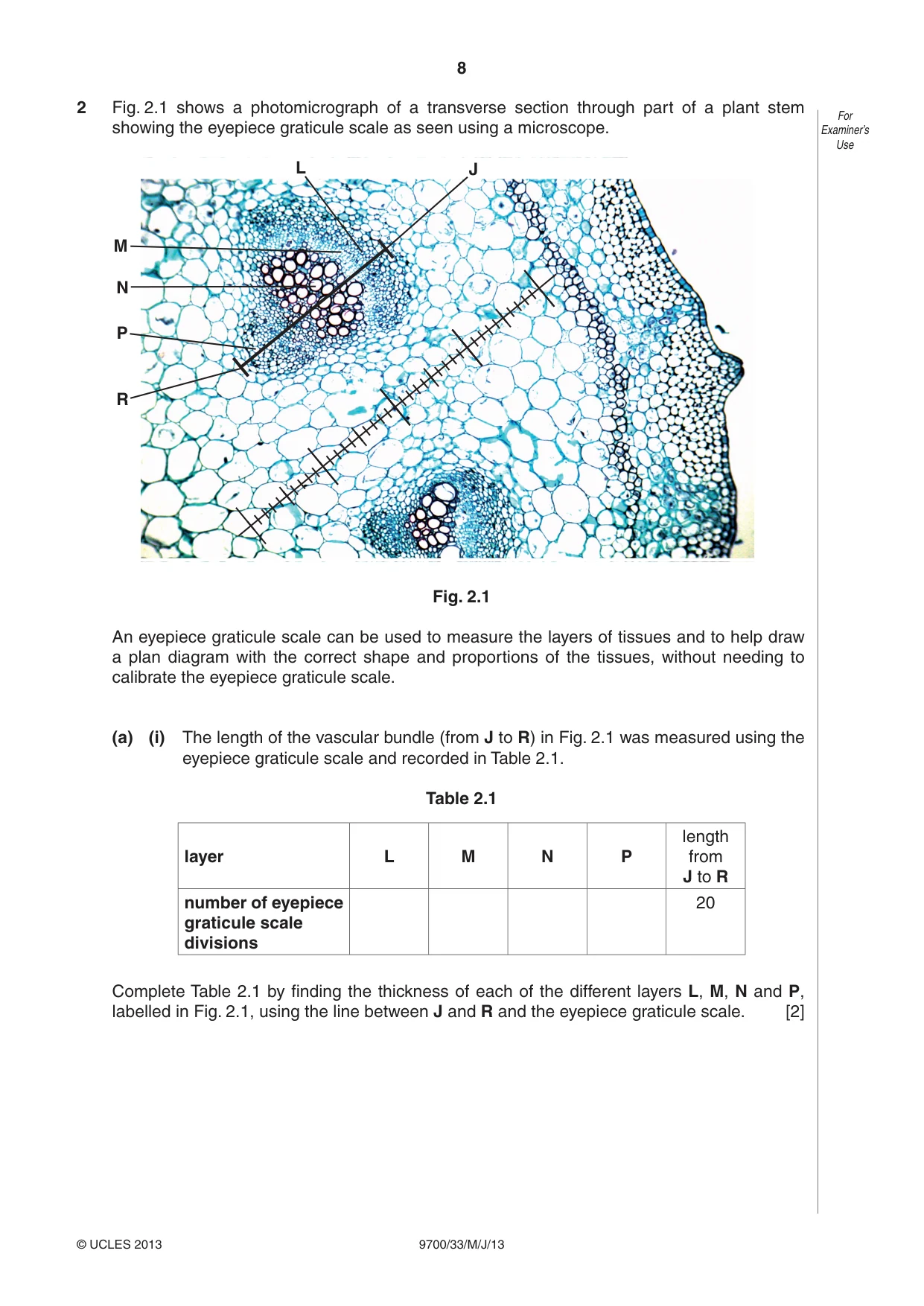
8 9700/33/M/J/13 © UCLES 2013 For Examiner’s Use 2 Fig. 2.1 shows a photomicrograph of a transverse section through part of a plant stem showing the eyepiece graticule scale as seen using a microscope. R P N M L J Fig. 2.1 An eyepiece graticule scale can be used to measure the layers of tissues and to help draw a plan diagram with the correct shape and proportions of the tissues, without needing to calibrate the eyepiece graticule scale. (a) (i) The length of the vascular bundle (from J to R) in Fig. 2.1 was measured using the eyepiece graticule scale and recorded in Table 2.1. Table 2.1 layer L M N P length from J to R number of eyepiece graticule scale divisions 20 Complete Table 2.1 by finding the thickness of each of the different layers L, M, N and P, labelled in Fig. 2.1, using the line between J and R and the eyepiece graticule scale. [2]
Question paper, page 9
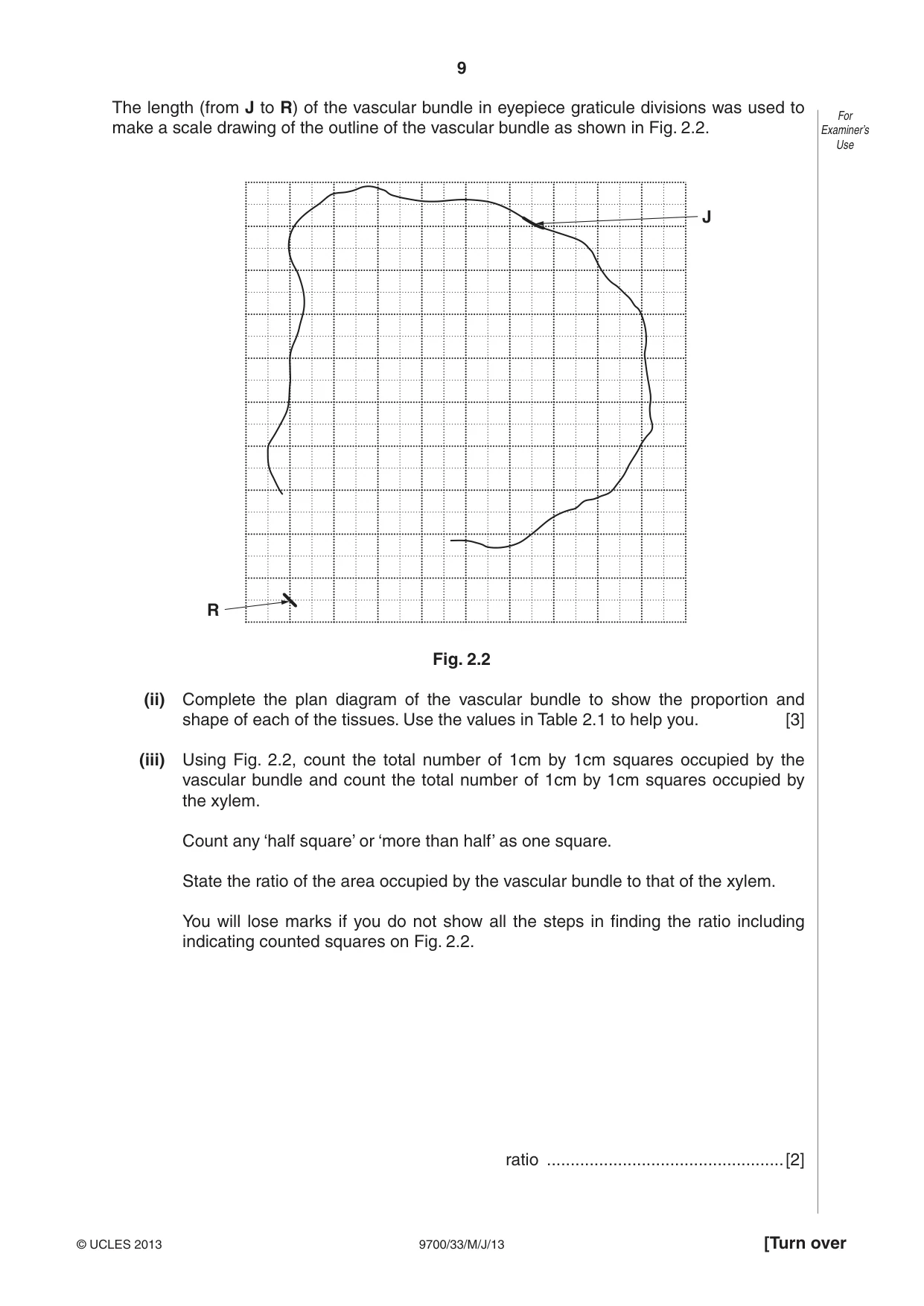
9 9700/33/M/J/13 © UCLES 2013 [Turn over For Examiner’s Use The length (from J to R) of the vascular bundle in eyepiece graticule divisions was used to make a scale drawing of the outline of the vascular bundle as shown in Fig. 2.2. J R Fig. 2.2 (ii) Complete the plan diagram of the vascular bundle to show the proportion and shape of each of the tissues. Use the values in Table 2.1 to help you. [3] (iii) Using Fig. 2.2, count the total number of 1cm by 1cm squares occupied by the vascular bundle and count the total number of 1cm by 1cm squares occupied by the xylem. Count any ‘half square’ or ‘more than half’ as one square. State the ratio of the area occupied by the vascular bundle to that of the xylem. You will lose marks if you do not show all the steps in finding the ratio including indicating counted squares on Fig. 2.2. ratio …[2]
Question paper, page 10
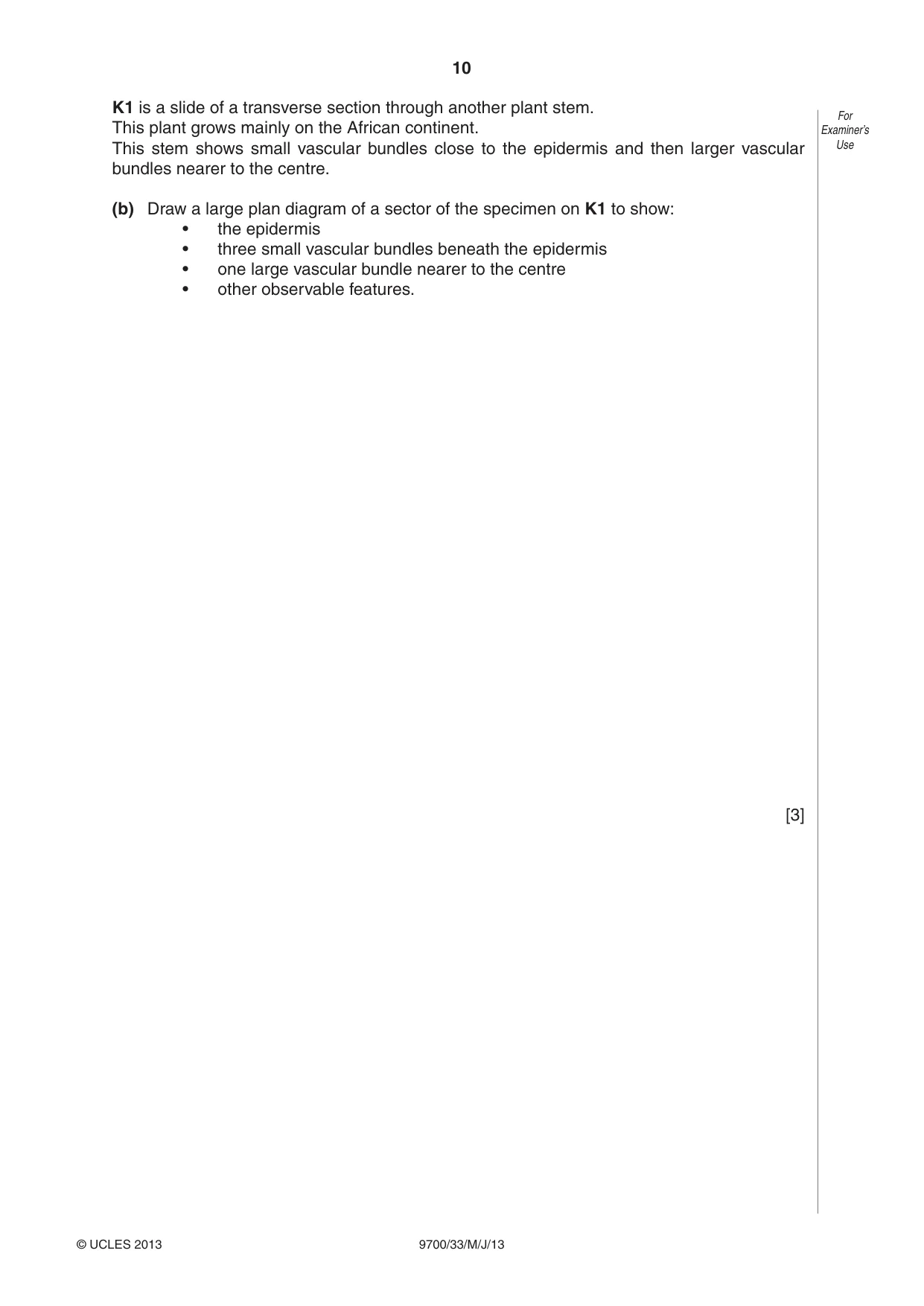
10 9700/33/M/J/13 © UCLES 2013 For Examiner’s Use K1 is a slide of a transverse section through another plant stem. This plant grows mainly on the African continent. This stem shows small vascular bundles close to the epidermis and then larger vascular bundles nearer to the centre. (b) Draw a large plan diagram of a sector of the specimen on K1 to show: • the epidermis • three small vascular bundles beneath the epidermis • one large vascular bundle nearer to the centre • other observable features. [3]
Question paper, page 11
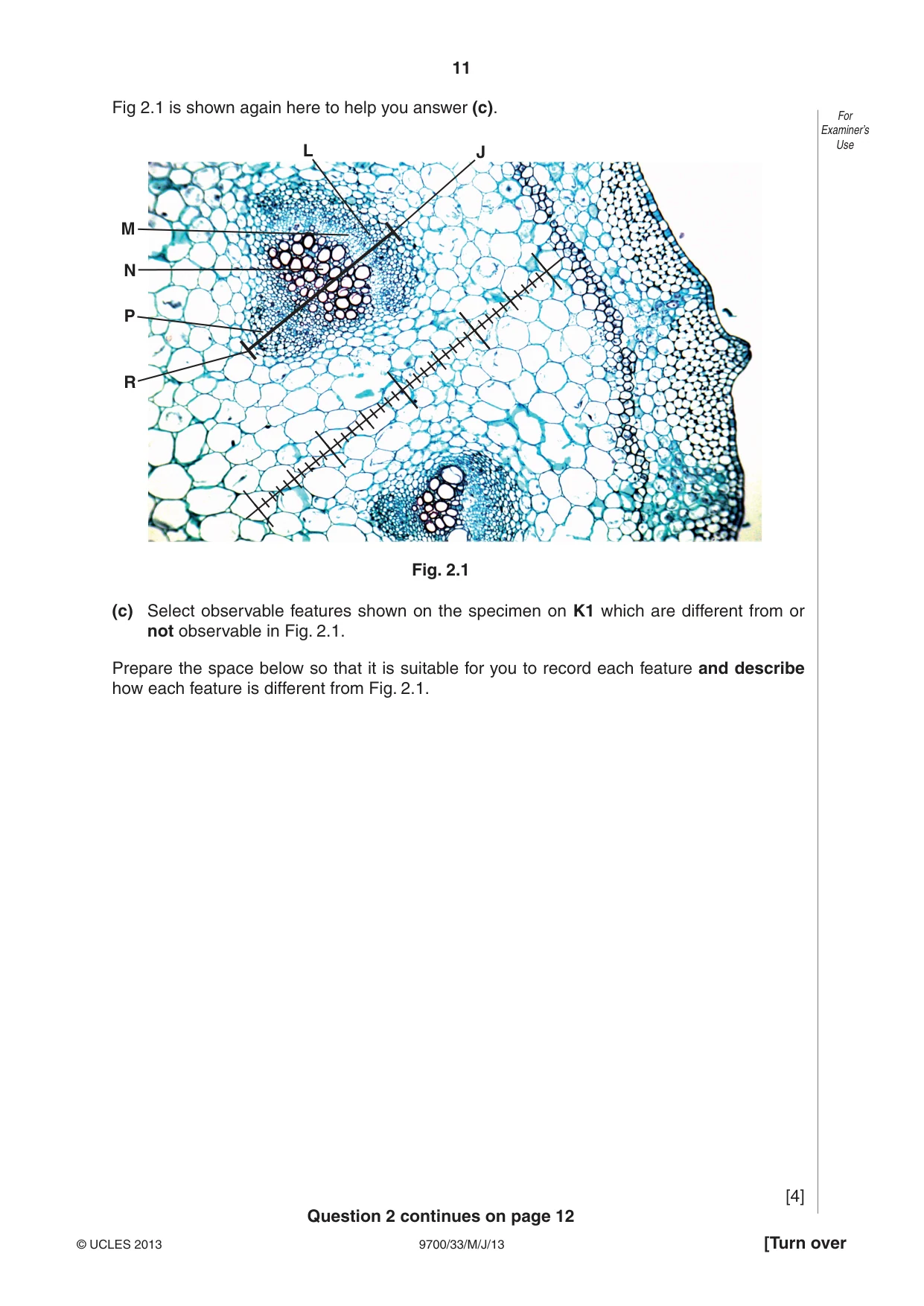
11 9700/33/M/J/13 © UCLES 2013 [Turn over For Examiner’s Use Fig 2.1 is shown again here to help you answer (c). R P N M L J Fig. 2.1 (c) Select observable features shown on the specimen on K1 which are different from or not observable in Fig. 2.1. Prepare the space below so that it is suitable for you to record each feature and describe how each feature is different from Fig. 2.1. [4] Question 2 continues on page 12
Question paper, page 12
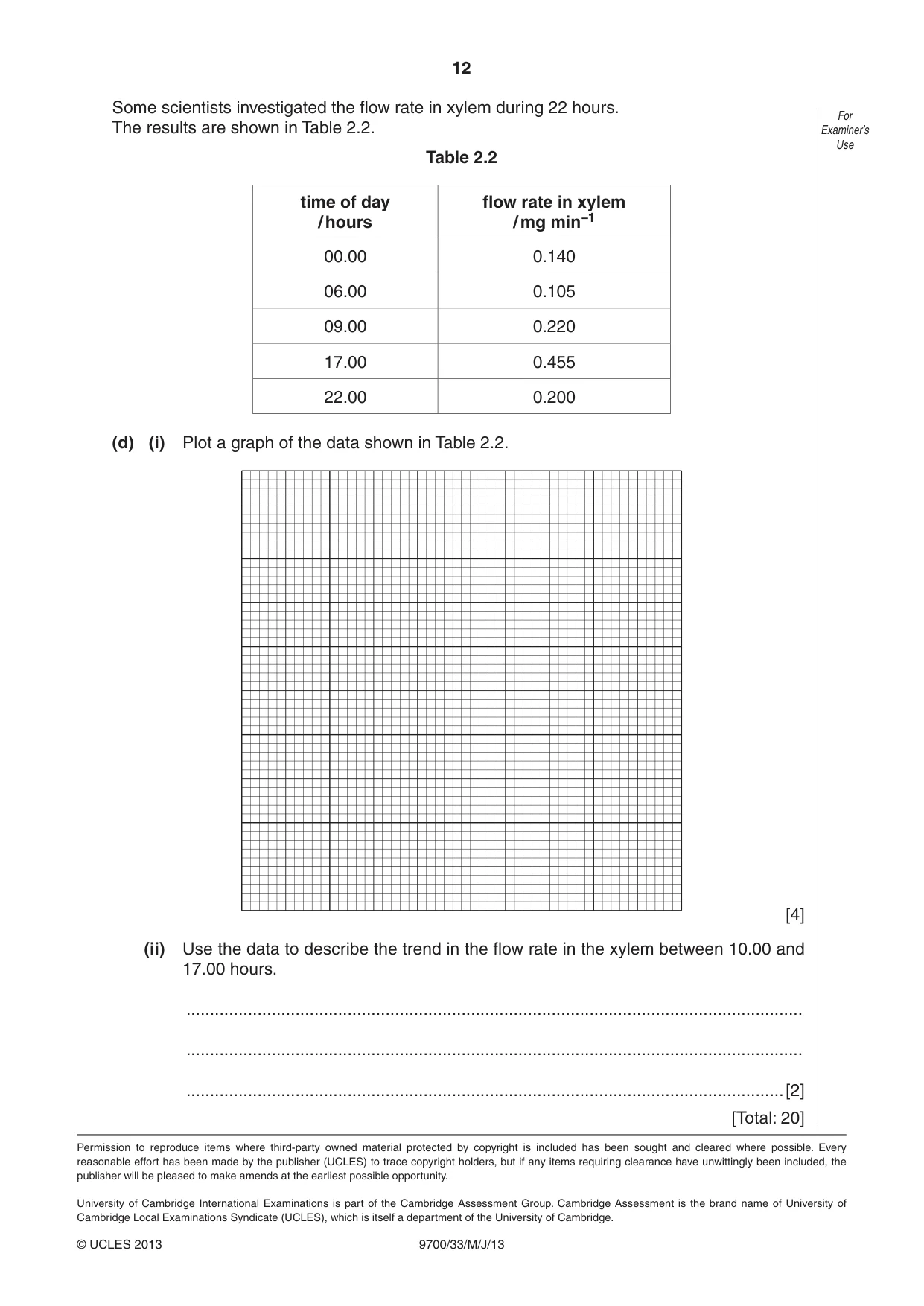
12 9700/33/M/J/13 © UCLES 2013 For Examiner’s Use Some scientists investigated the flow rate in xylem during 22 hours. The results are shown in Table 2.2. Table 2.2 time of day / hours flow rate in xylem / mg min–1 00.00 0.140 06.00 0.105 09.00 0.220 17.00 0.455 22.00 0.200 (d) (i) Plot a graph of the data shown in Table 2.2. [4] (ii) Use the data to describe the trend in the flow rate in the xylem between 10.00 and 17.00 hours. … … …[2] [Total: 20] Permission to reproduce items where third-party owned material protected by copyright is included has been sought and cleared where possible. Every reasonable effort has been made by the publisher (UCLES) to trace copyright holders, but if any items requiring clearance have unwittingly been included, the publisher will be pleased to make amends at the earliest possible opportunity. University of Cambridge International Examinations is part of the Cambridge Assessment Group. Cambridge Assessment is the brand name of University of Cambridge Local Examinations Syndicate (UCLES), which is itself a department of the University of Cambridge.
Mark scheme, page 1
CAMBRIDGE INTERNATIONAL EXAMINATIONS GCE Advanced Subsidiary Level and GCE Advanced Level MARK SCHEME for the May/June 2013 series 9700 BIOLOGY 9700/33 Paper 33 (Advanced Practical Skills 1), maximum raw mark 40 This mark scheme is published as an aid to teachers and candidates, to indicate the requirements of the examination. It shows the basis on which Examiners were instructed to award marks. It does not indicate the details of the discussions that took place at an Examiners’ meeting before marking began, which would have considered the acceptability of alternative answers. Mark schemes should be read in conjunction with the question paper and the Principal Examiner Report for Teachers. Cambridge will not enter into discussions about these mark schemes. Cambridge is publishing the mark schemes for the May/June 2013 series for most IGCSE, GCE Advanced Level and Advanced Subsidiary Level components and some Ordinary Level components.
Mark scheme, page 2
Page 2 Mark Scheme Syllabus Paper GCE AS/A LEVEL – May/June 2013 9700 33 © Cambridge International Examinations 2013 Mark scheme abbreviations: ; separates marking points / alternative answers for the same point R reject A accept (for answers correctly cued by the question, or by extra guidance) AW alternative wording (where responses vary more than usual) underline actual word given must be used by candidate (grammatical variants excepted) max indicates the maximum number of marks that can be given ora or reverse argument mp marking point (with relevant number) ecf error carried forward I ignore ACE Analysis, Conclusions and Evaluation (skills) MMO Manipulations, Measurement and Observation (skills) PDO Presentation of Data and Observations (skills)
Mark scheme, page 3
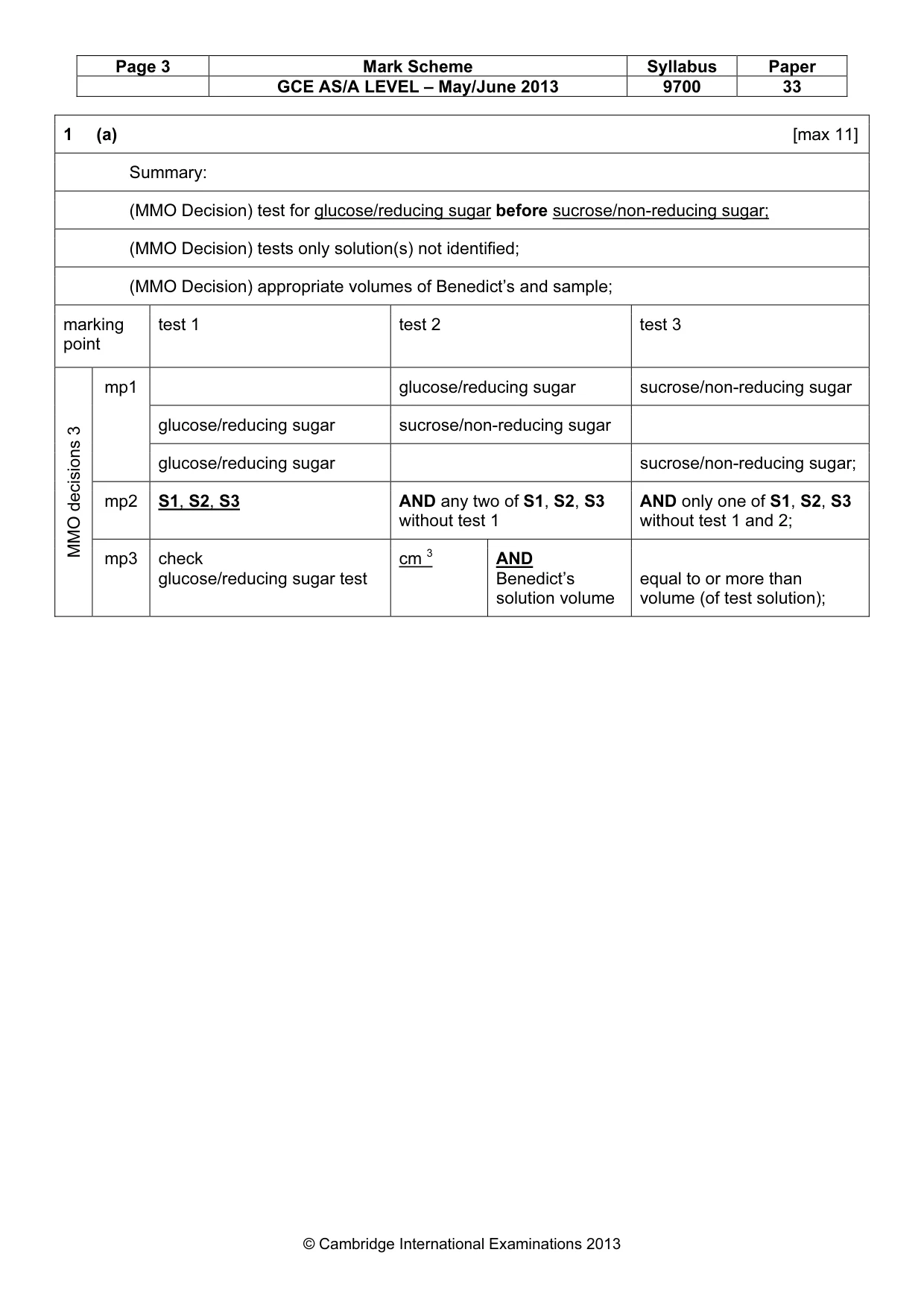
Page 3 Mark Scheme Syllabus Paper GCE AS/A LEVEL – May/June 2013 9700 33 © Cambridge International Examinations 2013 1 (a) [max 11] Summary: (MMO Decision) test for glucose/reducing sugar before sucrose/non-reducing sugar; (MMO Decision) tests only solution(s) not identified; (MMO Decision) appropriate volumes of Benedict’s and sample; marking point test 1 test 2 test 3 MMO decisions 3 mp1 glucose/reducing sugar sucrose/non-reducing sugar glucose/reducing sugar sucrose/non-reducing sugar glucose/reducing sugar sucrose/non-reducing sugar; mp2 S1, S2, S3 AND any two of S1, S2, S3 without test 1 AND only one of S1, S2, S3 without test 1 and 2; mp3 check glucose/reducing sugar test cm 3 AND Benedict’s solution volume equal to or more than volume (of test solution);
Mark scheme, page 4
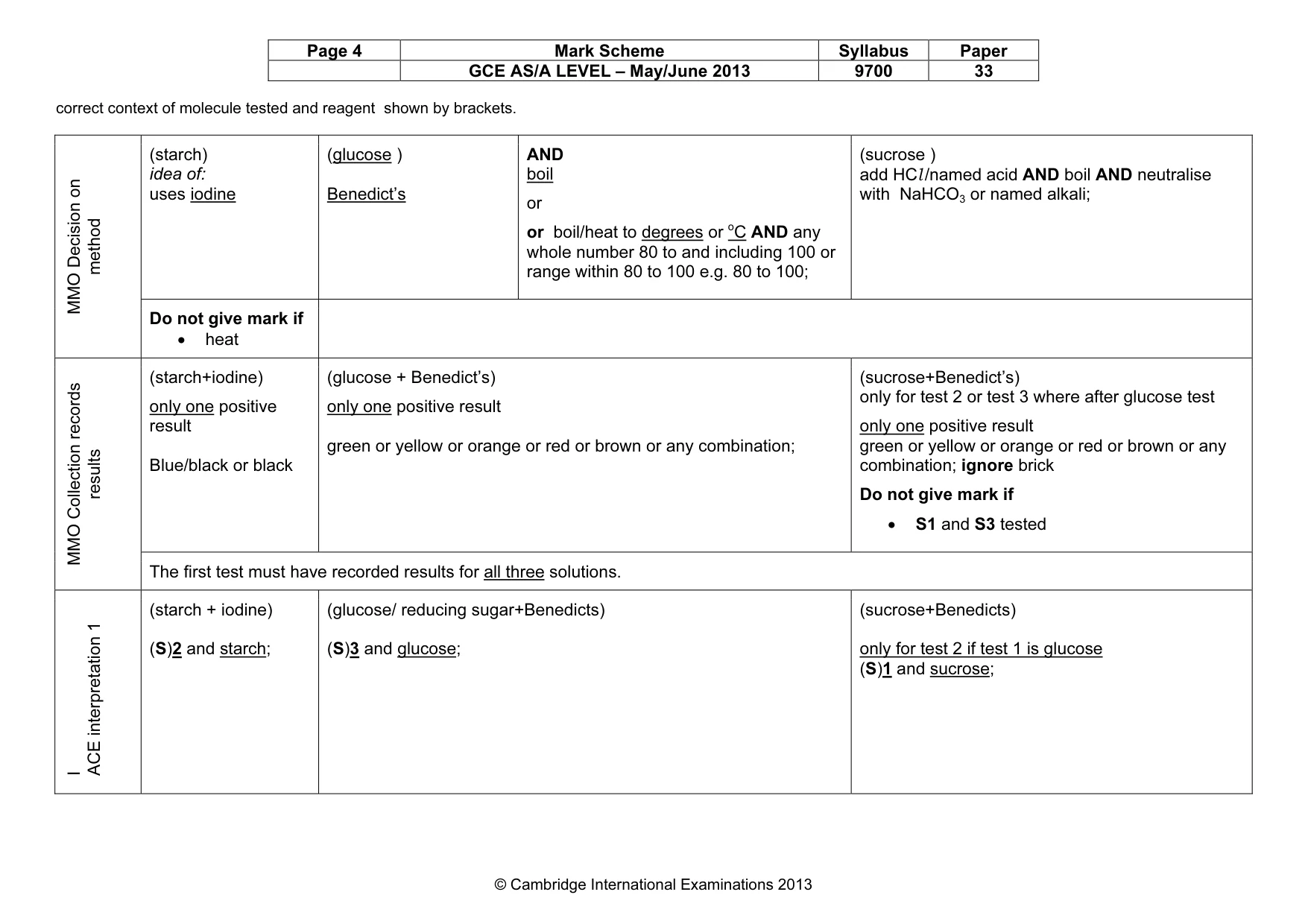
Page 4 Mark Scheme Syllabus Paper GCE AS/A LEVEL – May/June 2013 9700 33 © Cambridge International Examinations 2013 correct context of molecule tested and reagent shown by brackets. MMO Decision on method (starch) idea of: uses iodine (glucose ) Benedict’s AND boil or or boil/heat to degrees or oC AND any whole number 80 to and including 100 or range within 80 to 100 e.g. 80 to 100; (sucrose ) add HCl /named acid AND boil AND neutralise with NaHCO3 or named alkali; Do not give mark if • heat MMO Collection records results (starch+iodine) only one positive result Blue/black or black (glucose + Benedict’s) only one positive result green or yellow or orange or red or brown or any combination; (sucrose+Benedict’s) only for test 2 or test 3 where after glucose test only one positive result green or yellow or orange or red or brown or any combination; ignore brick Do not give mark if • S1 and S3 tested The first test must have recorded results for all three solutions. I ACE interpretation 1 (starch + iodine) (S)2 and starch; (glucose/ reducing sugar+Benedicts) (S)3 and glucose; (sucrose+Benedicts) only for test 2 if test 1 is glucose (S)1 and sucrose;
Mark scheme, page 5
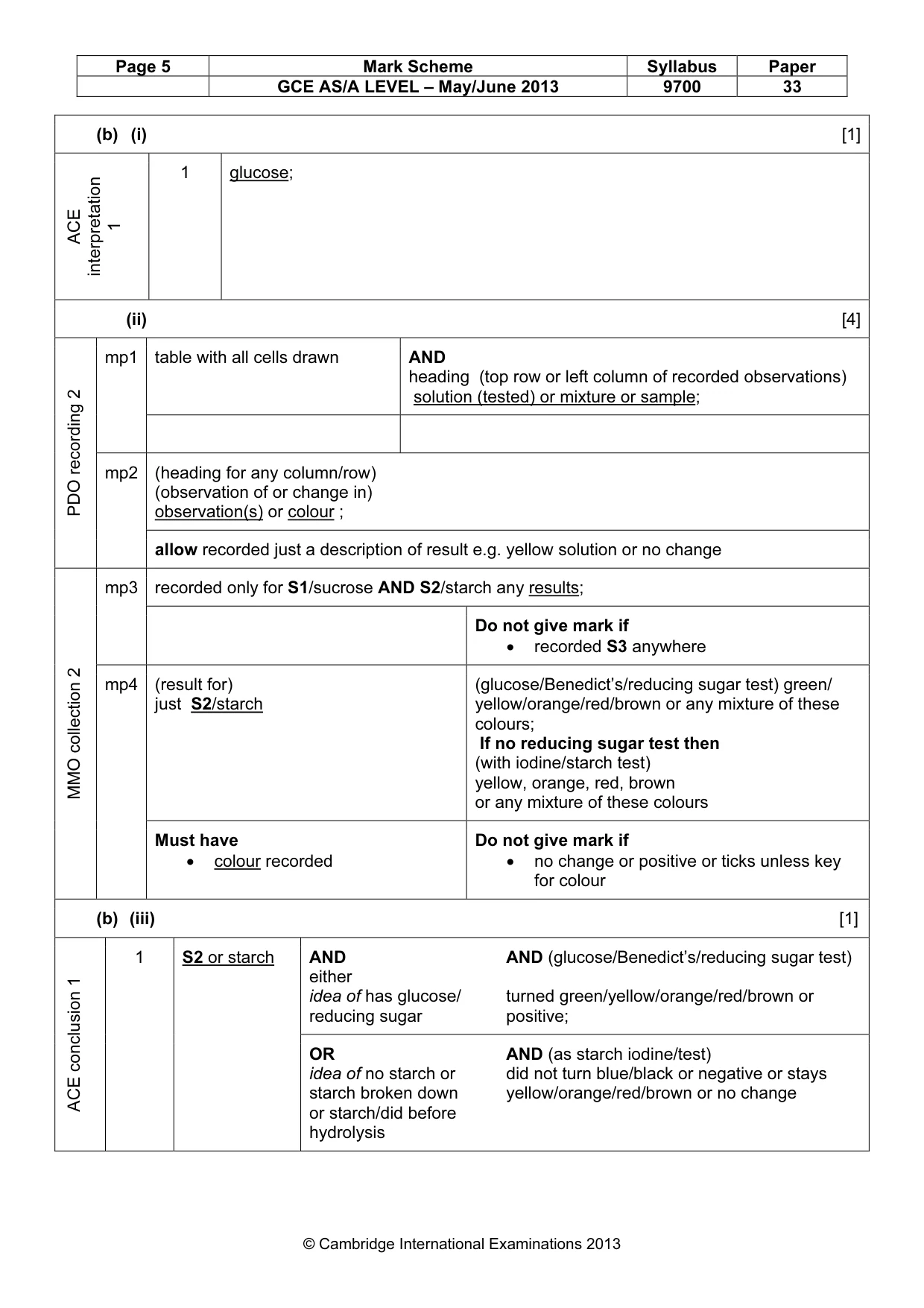
Page 5 Mark Scheme Syllabus Paper GCE AS/A LEVEL – May/June 2013 9700 33 © Cambridge International Examinations 2013 (b) (i) [1] ACE interpretation 1 1 glucose; (ii) [4] PDO recording 2 mp1 table with all cells drawn AND heading (top row or left column of recorded observations) solution (tested) or mixture or sample; mp2 (heading for any column/row) (observation of or change in) observation(s) or colour ; allow recorded just a description of result e.g. yellow solution or no change MMO collection 2 mp3 recorded only for S1/sucrose AND S2/starch any results; Do not give mark if • recorded S3 anywhere mp4 (result for) just S2/starch (glucose/Benedict’s/reducing sugar test) green/ yellow/orange/red/brown or any mixture of these colours; If no reducing sugar test then (with iodine/starch test) yellow, orange, red, brown or any mixture of these colours Must have • colour recorded Do not give mark if • no change or positive or ticks unless key for colour (b) (iii) [1] ACE conclusion 1 1 S2 or starch AND either idea of has glucose/ reducing sugar AND (glucose/Benedict’s/reducing sugar test) turned green/yellow/orange/red/brown or positive; OR idea of no starch or starch broken down or starch/did before hydrolysis AND (as starch iodine/test) did not turn blue/black or negative or stays yellow/orange/red/brown or no change
Mark scheme, page 6
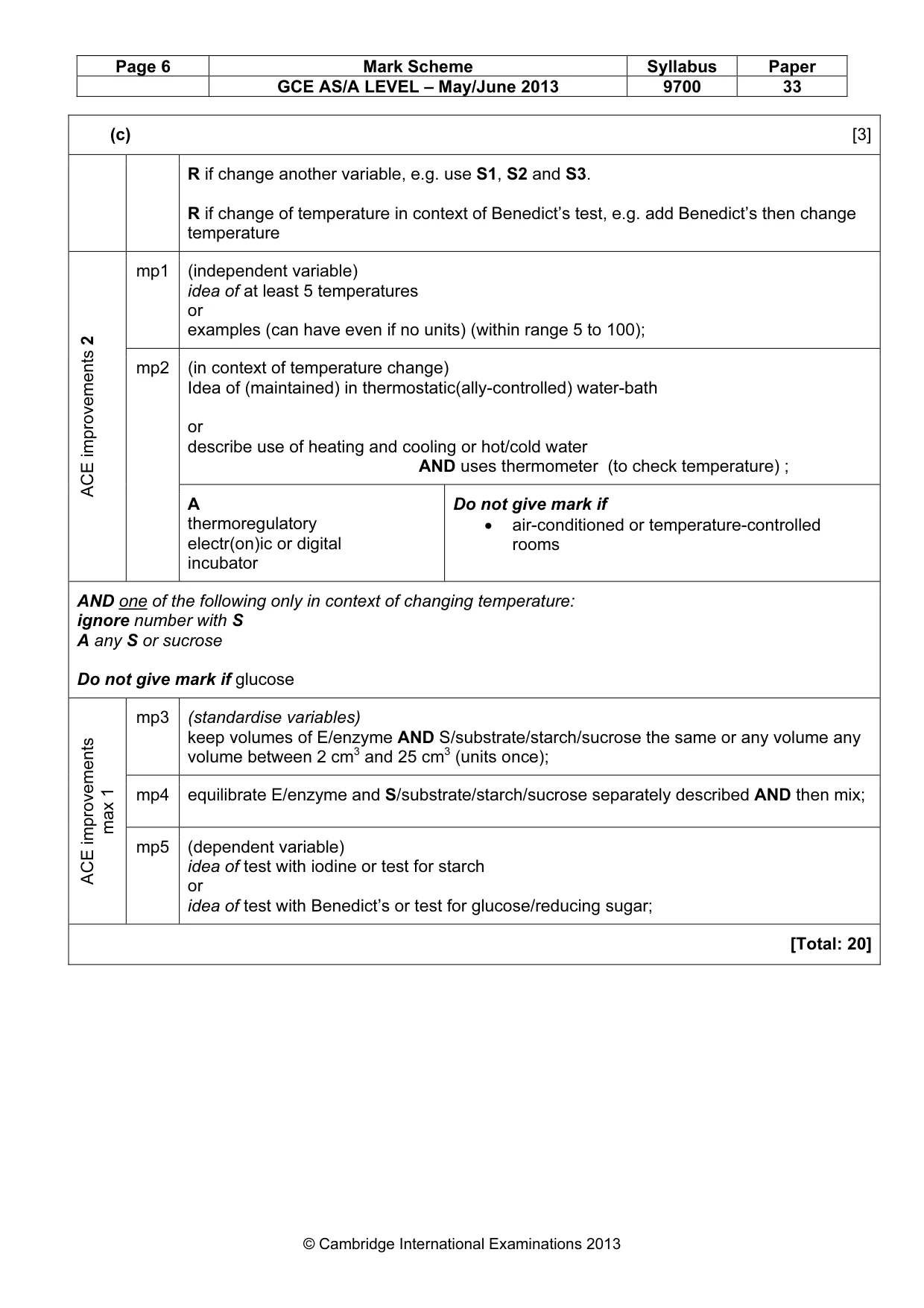
Page 6 Mark Scheme Syllabus Paper GCE AS/A LEVEL – May/June 2013 9700 33 © Cambridge International Examinations 2013 (c) [3] R if change another variable, e.g. use S1, S2 and S3. R if change of temperature in context of Benedict’s test, e.g. add Benedict’s then change temperature ACE improvements 2 mp1 (independent variable) idea of at least 5 temperatures or examples (can have even if no units) (within range 5 to 100); mp2 (in context of temperature change) Idea of (maintained) in thermostatic(ally-controlled) water-bath or describe use of heating and cooling or hot/cold water AND uses thermometer (to check temperature) ; A thermoregulatory electr(on)ic or digital incubator Do not give mark if • air-conditioned or temperature-controlled rooms AND one of the following only in context of changing temperature: ignore number with S A any S or sucrose Do not give mark if glucose ACE improvements max 1 mp3 (standardise variables) keep volumes of E/enzyme AND S/substrate/starch/sucrose the same or any volume any volume between 2 cm3 and 25 cm3 (units once); mp4 equilibrate E/enzyme and S/substrate/starch/sucrose separately described AND then mix; mp5 (dependent variable) idea of test with iodine or test for starch or idea of test with Benedict’s or test for glucose/reducing sugar; [Total: 20]
Mark scheme, page 7
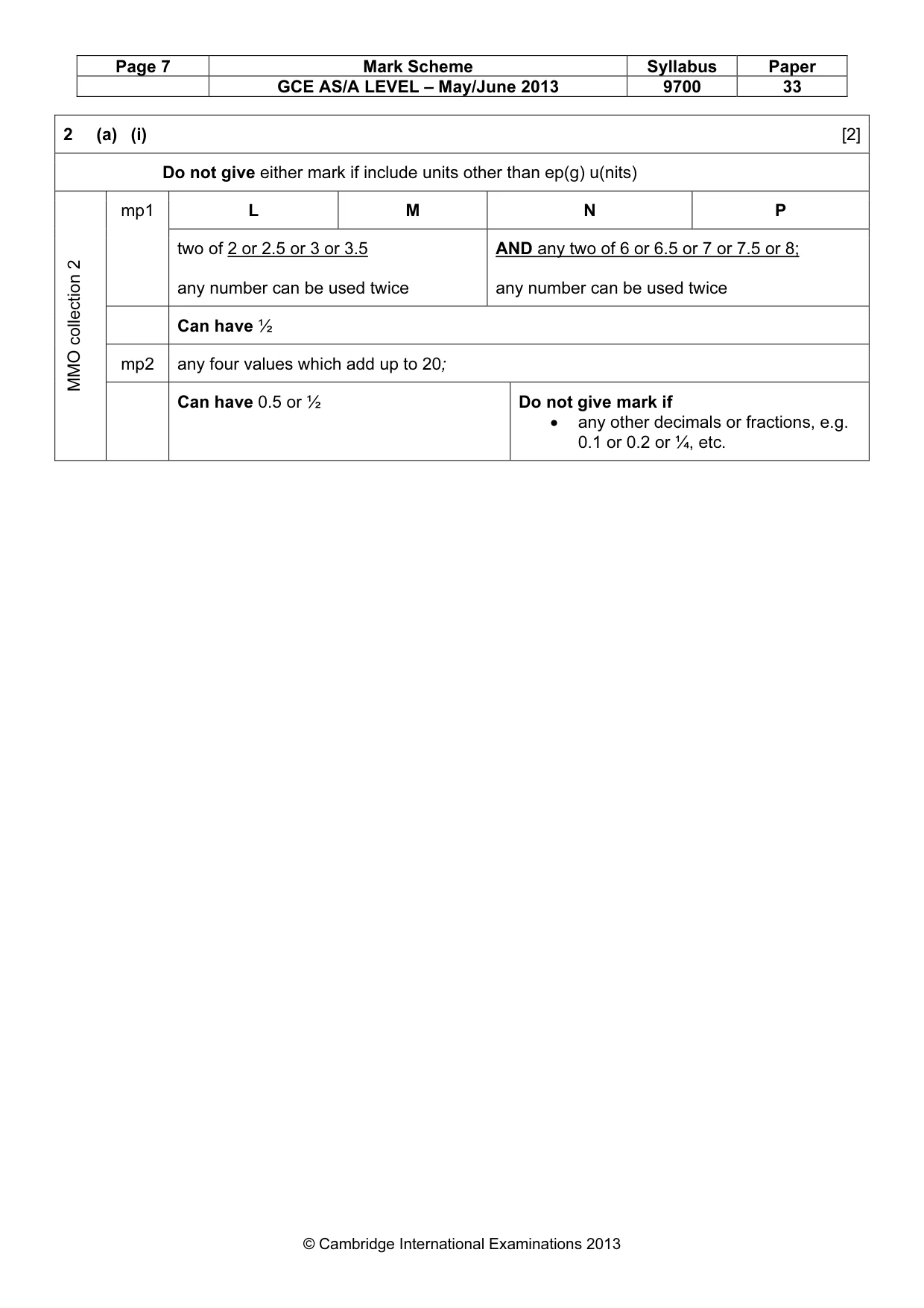
Page 7 Mark Scheme Syllabus Paper GCE AS/A LEVEL – May/June 2013 9700 33 © Cambridge International Examinations 2013 2 (a) (i) [2] Do not give either mark if include units other than ep(g) u(nits) MMO collection 2 mp1 L M N P two of 2 or 2.5 or 3 or 3.5 any number can be used twice AND any two of 6 or 6.5 or 7 or 7.5 or 8; any number can be used twice Can have ½ mp2 any four values which add up to 20; Can have 0.5 or ½ Do not give mark if • any other decimals or fractions, e.g. 0.1 or 0.2 or ¼, etc.
Mark scheme, page 8
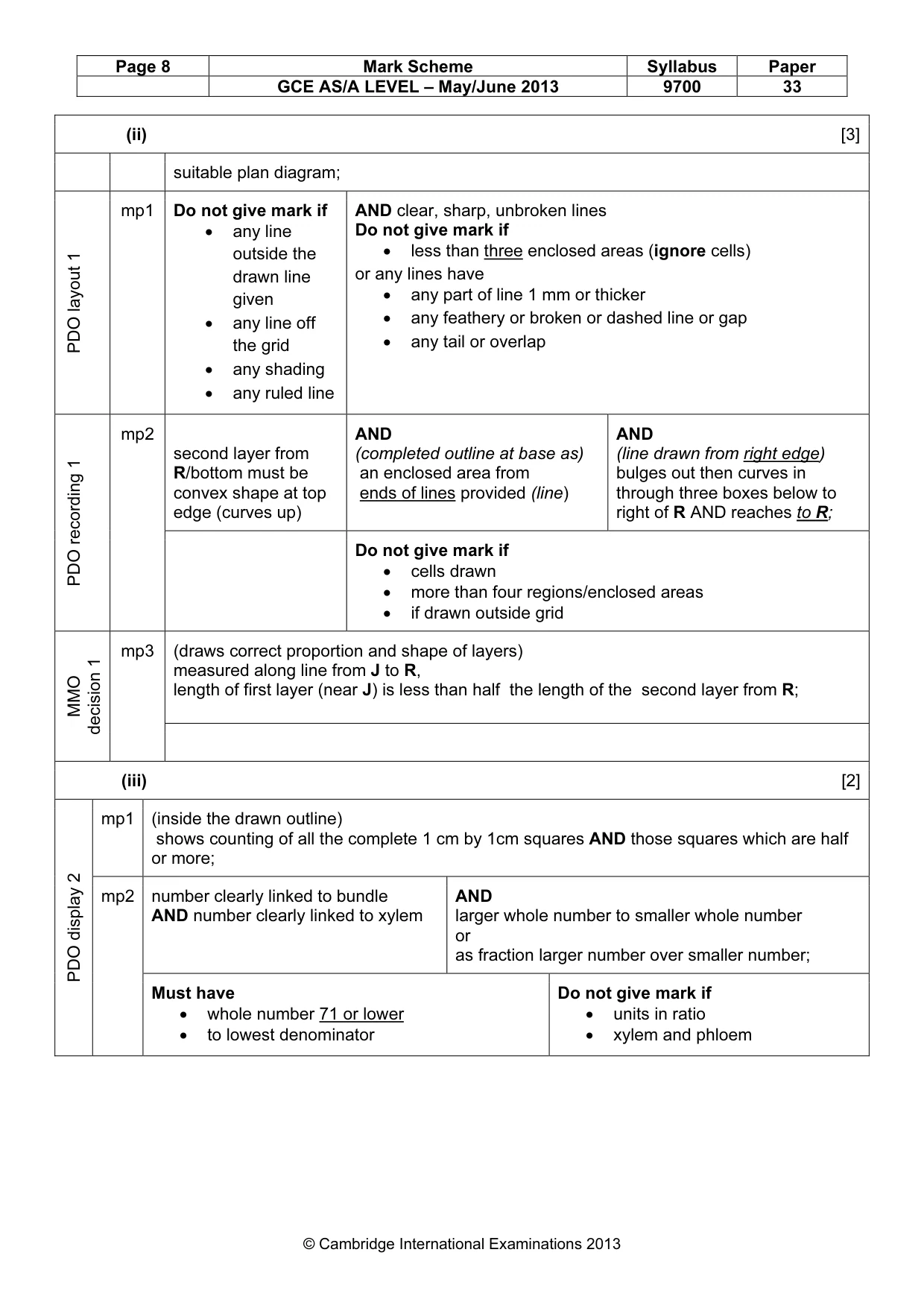
Page 8 Mark Scheme Syllabus Paper GCE AS/A LEVEL – May/June 2013 9700 33 © Cambridge International Examinations 2013 (ii) [3] suitable plan diagram; PDO layout 1 mp1 Do not give mark if • any line outside the drawn line given • any line off the grid • any shading • any ruled line AND clear, sharp, unbroken lines Do not give mark if • less than three enclosed areas (ignore cells) or any lines have • any part of line 1 mm or thicker • any feathery or broken or dashed line or gap • any tail or overlap PDO recording 1 mp2 second layer from R/bottom must be convex shape at top edge (curves up) AND (completed outline at base as) an enclosed area from ends of lines provided (line) AND (line drawn from right edge) bulges out then curves in through three boxes below to right of R AND reaches to R; Do not give mark if • cells drawn • more than four regions/enclosed areas • if drawn outside grid MMO decision 1 mp3 (draws correct proportion and shape of layers) measured along line from J to R, length of first layer (near J) is less than half the length of the second layer from R; (iii) [2] PDO display 2 mp1 (inside the drawn outline) shows counting of all the complete 1 cm by 1cm squares AND those squares which are half or more; mp2 number clearly linked to bundle AND number clearly linked to xylem AND larger whole number to smaller whole number or as fraction larger number over smaller number; Must have • whole number 71 or lower • to lowest denominator Do not give mark if • units in ratio • xylem and phloem
Mark scheme, page 9
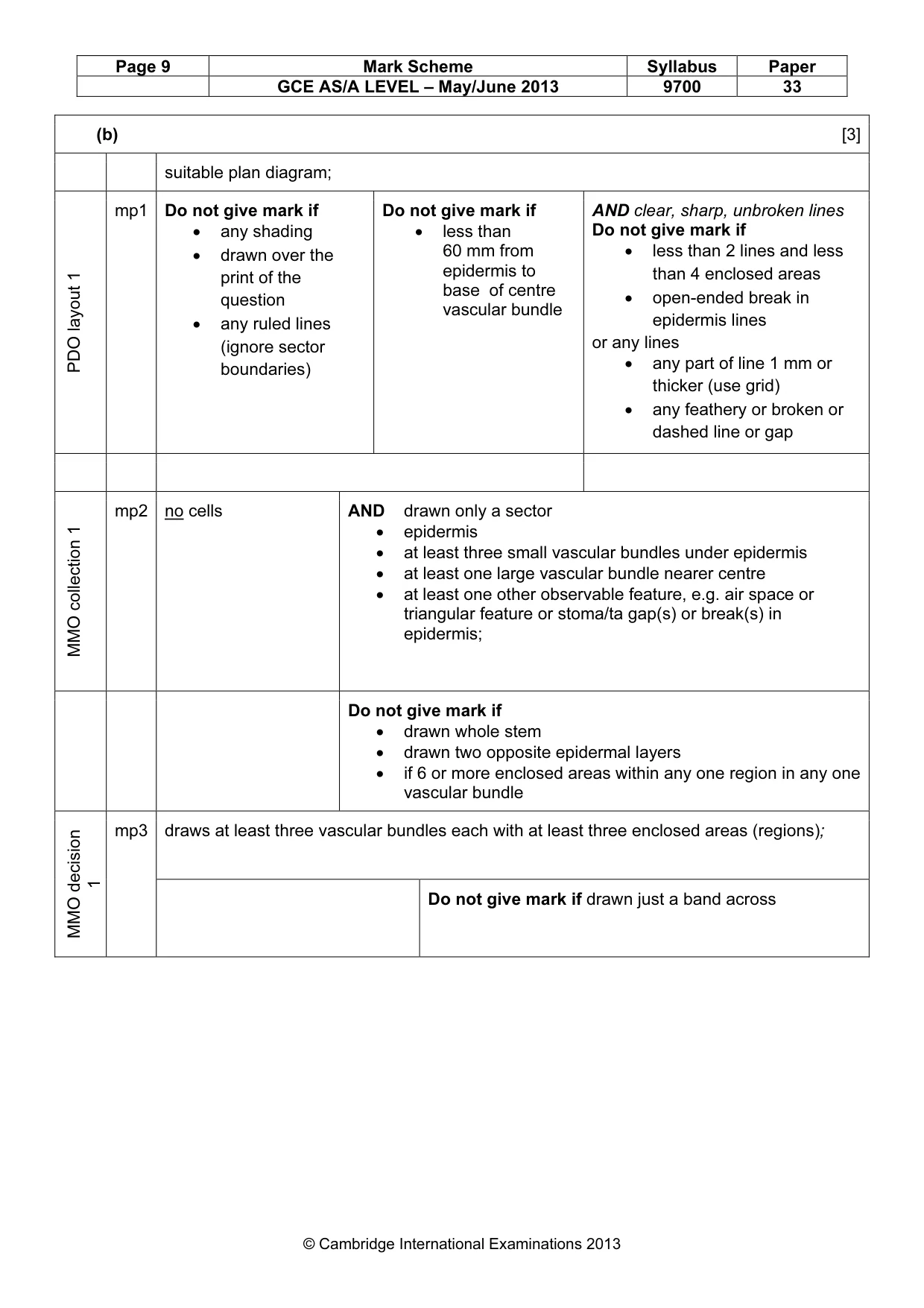
Page 9 Mark Scheme Syllabus Paper GCE AS/A LEVEL – May/June 2013 9700 33 © Cambridge International Examinations 2013 (b) [3] suitable plan diagram; PDO layout 1 mp1 Do not give mark if • any shading • drawn over the print of the question • any ruled lines (ignore sector boundaries) Do not give mark if • less than 60 mm from epidermis to base of centre vascular bundle AND clear, sharp, unbroken lines Do not give mark if • less than 2 lines and less than 4 enclosed areas • open-ended break in epidermis lines or any lines • any part of line 1 mm or thicker (use grid) • any feathery or broken or dashed line or gap MMO collection 1 mp2 no cells AND drawn only a sector • epidermis • at least three small vascular bundles under epidermis • at least one large vascular bundle nearer centre • at least one other observable feature, e.g. air space or triangular feature or stoma/ta gap(s) or break(s) in epidermis; Do not give mark if • drawn whole stem • drawn two opposite epidermal layers • if 6 or more enclosed areas within any one region in any one vascular bundle MMO decision 1 mp3 draws at least three vascular bundles each with at least three enclosed areas (regions); Do not give mark if drawn just a band across
Mark scheme, page 10
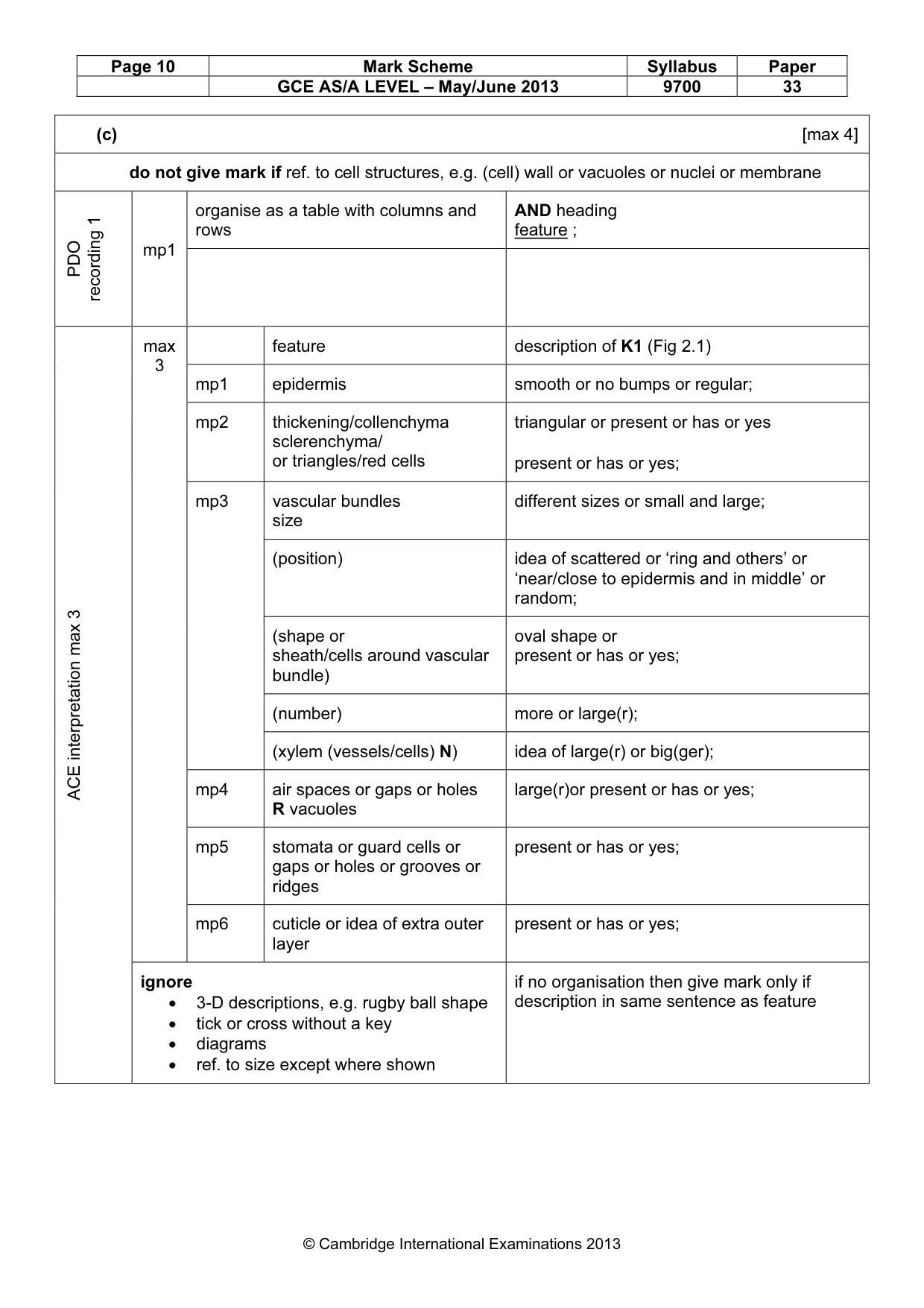
Page 10 Mark Scheme Syllabus Paper GCE AS/A LEVEL – May/June 2013 9700 33 © Cambridge International Examinations 2013 (c) [max 4] do not give mark if ref. to cell structures, e.g. (cell) wall or vacuoles or nuclei or membrane PDO recording 1 mp1 organise as a table with columns and rows AND heading feature ; ACE interpretation max 3 max 3 feature description of K1 (Fig 2.1) mp1 epidermis smooth or no bumps or regular; mp2 thickening/collenchyma sclerenchyma/ or triangles/red cells triangular or present or has or yes present or has or yes; mp3 vascular bundles size different sizes or small and large; (position) idea of scattered or ‘ring and others’ or ‘near/close to epidermis and in middle’ or random; (shape or sheath/cells around vascular bundle) oval shape or present or has or yes; (number) more or large(r); (xylem (vessels/cells) N) idea of large(r) or big(ger); mp4 air spaces or gaps or holes R vacuoles large(r)or present or has or yes; mp5 stomata or guard cells or gaps or holes or grooves or ridges present or has or yes; mp6 cuticle or idea of extra outer layer present or has or yes; ignore • 3-D descriptions, e.g. rugby ball shape • tick or cross without a key • diagrams • ref. to size except where shown if no organisation then give mark only if description in same sentence as feature
Mark scheme, page 11
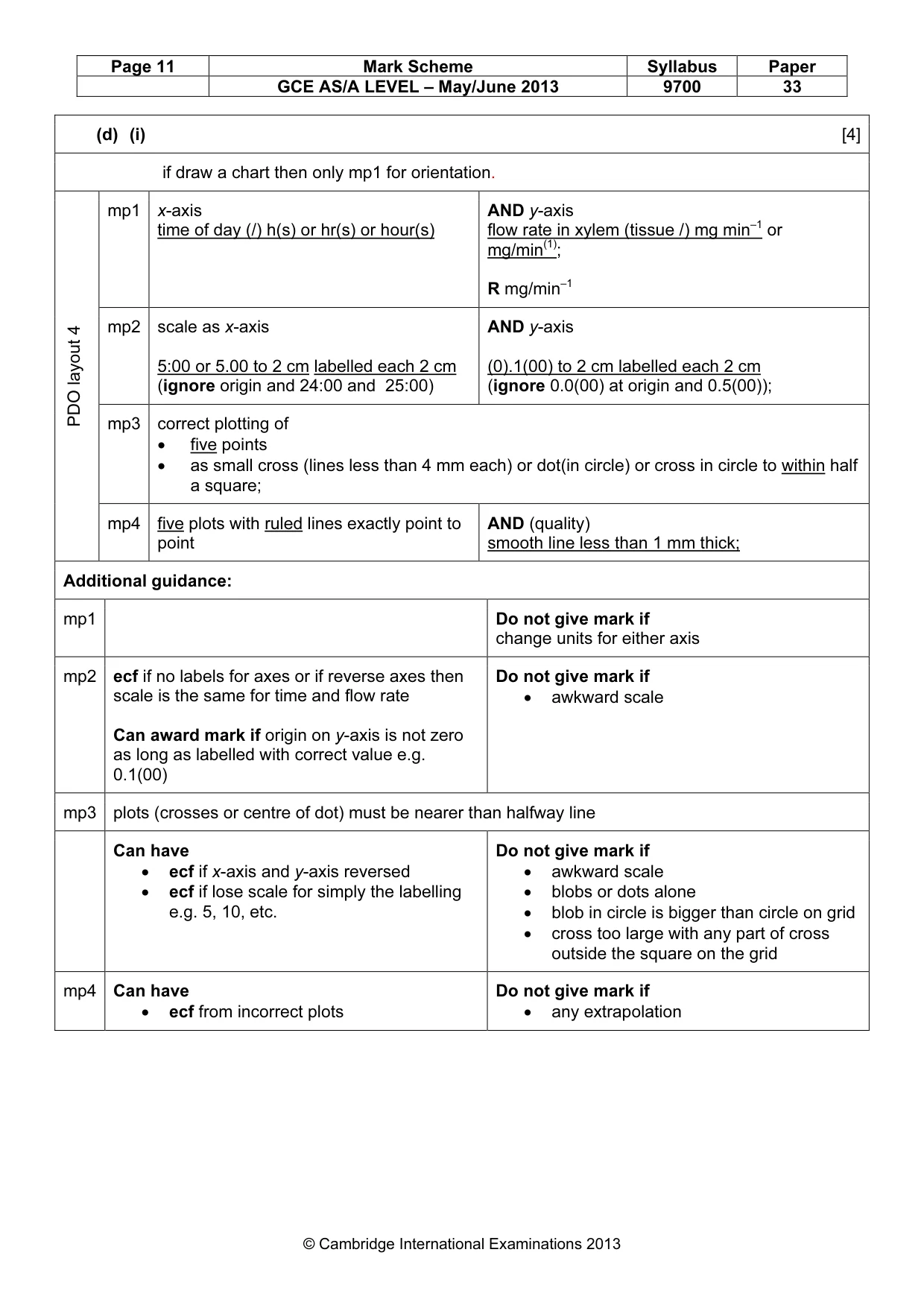
Page 11 Mark Scheme Syllabus Paper GCE AS/A LEVEL – May/June 2013 9700 33 © Cambridge International Examinations 2013 (d) (i) [4] if draw a chart then only mp1 for orientation. PDO layout 4 mp1 x-axis time of day (/) h(s) or hr(s) or hour(s) AND y-axis flow rate in xylem (tissue /) mg min–1 or mg/min(1); R mg/min–1 mp2 scale as x-axis 5:00 or 5.00 to 2 cm labelled each 2 cm (ignore origin and 24:00 and 25:00) AND y-axis (0).1(00) to 2 cm labelled each 2 cm (ignore 0.0(00) at origin and 0.5(00)); mp3 correct plotting of • five points • as small cross (lines less than 4 mm each) or dot(in circle) or cross in circle to within half a square; mp4 five plots with ruled lines exactly point to point AND (quality) smooth line less than 1 mm thick; Additional guidance: mp1 Do not give mark if change units for either axis mp2 ecf if no labels for axes or if reverse axes then scale is the same for time and flow rate Can award mark if origin on y-axis is not zero as long as labelled with correct value e.g. 0.1(00) Do not give mark if • awkward scale mp3 plots (crosses or centre of dot) must be nearer than halfway line Can have • ecf if x-axis and y-axis reversed • ecf if lose scale for simply the labelling e.g. 5, 10, etc. Do not give mark if • awkward scale • blobs or dots alone • blob in circle is bigger than circle on grid • cross too large with any part of cross outside the square on the grid mp4 Can have • ecf from incorrect plots Do not give mark if • any extrapolation
Mark scheme, page 12
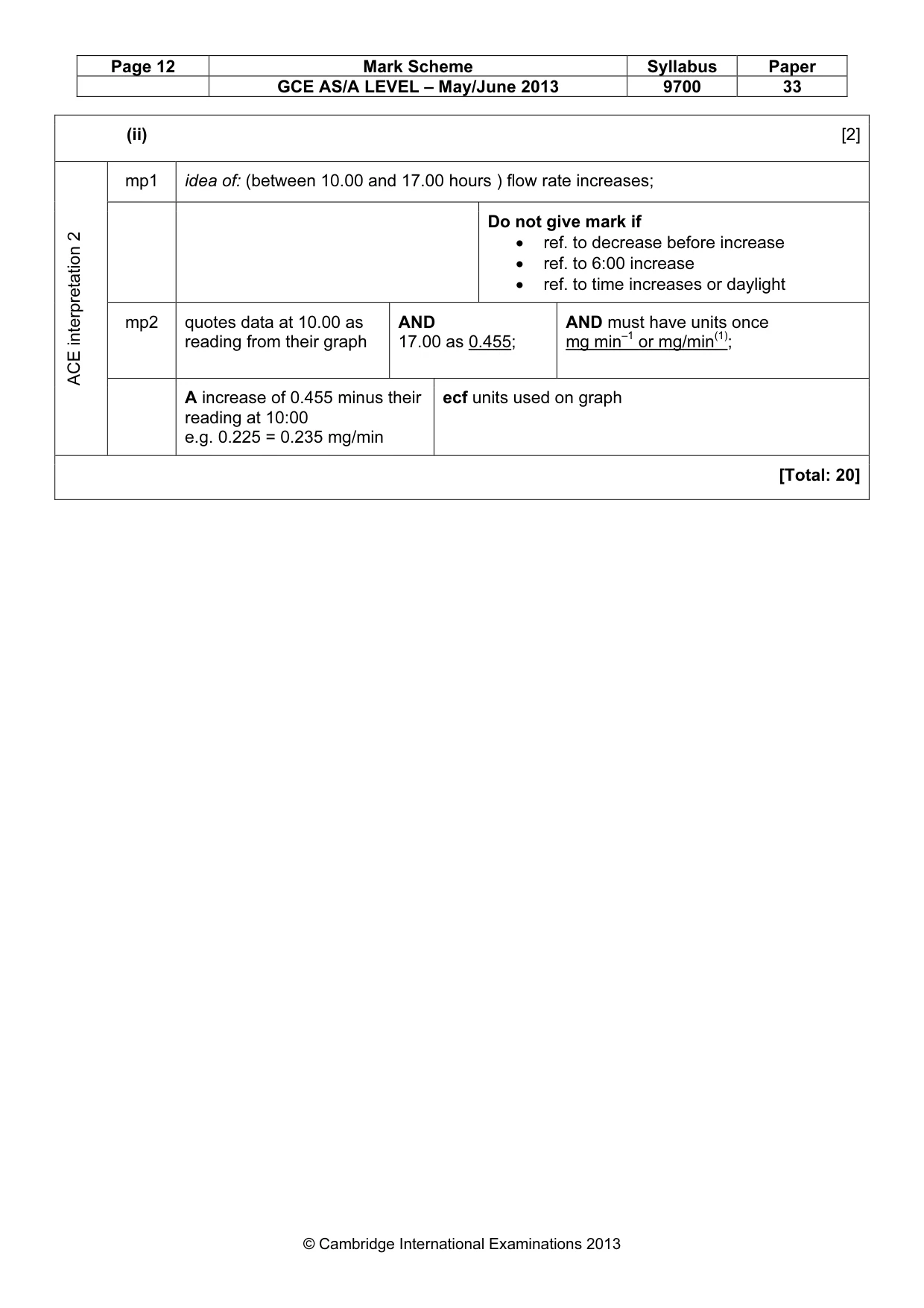
Page 12 Mark Scheme Syllabus Paper GCE AS/A LEVEL – May/June 2013 9700 33 © Cambridge International Examinations 2013 (ii) [2] ACE interpretation 2 mp1 idea of: (between 10.00 and 17.00 hours ) flow rate increases; Do not give mark if • ref. to decrease before increase • ref. to 6:00 increase • ref. to time increases or daylight mp2 quotes data at 10.00 as reading from their graph AND 17.00 as 0.455; AND must have units once mg min–1 or mg/min(1); A increase of 0.455 minus their reading at 10:00 e.g. 0.225 = 0.235 mg/min ecf units used on graph [Total: 20]
What you needed in this session
Cambridge’s own grade thresholds for 2013 May/June, Paper 3 · Variant 3. A higher threshold means an easier paper — the bar moves with how the cohort did.