Cambridge A Level Biology 9700 — 2009 Oct/Nov Paper 3 · Variant 3
9700/33/O/N/09
The question paper and its mark scheme, free to read here and free to download. This is Cambridge’s own paper, exactly as it was sat.
Question paper12 pages
Mark scheme8 pages
Answers below. Sit the paper first if you are practising.
Paper as text
Question paper, page 1
This document consists of 9 printed pages and 3 blank pages. DC (SM/KN) 16746/4 © UCLES 2009 [Turn over UNIVERSITY OF CAMBRIDGE INTERNATIONAL EXAMINATIONS General Certificate of Education Advanced Subsidiary Level and Advanced Level READ THESE INSTRUCTIONS FIRST Write your Centre number, candidate number and name on all the work you hand in. Write in dark blue or black pen. You may use a pencil for any diagrams, graphs or rough working. Do not use staples, paper clips, highlighters, glue or correction fluid. DO NOT WRITE IN ANY BARCODES. Answer both questions. At the end of the examination, fasten all your work securely together. The number of marks is given in brackets [ ] at the end of each question or part question. * 2 1 6 5 9 5 6 6 0 0 * BIOLOGY 9700/33 Paper 3 Advanced Practical Skills October/November 2009 2 hours Candidates answer on the Question Paper. Additional Materials: As listed in the Confidential Instructions For Examiner’s Use 1 2 Total
Question paper, page 2
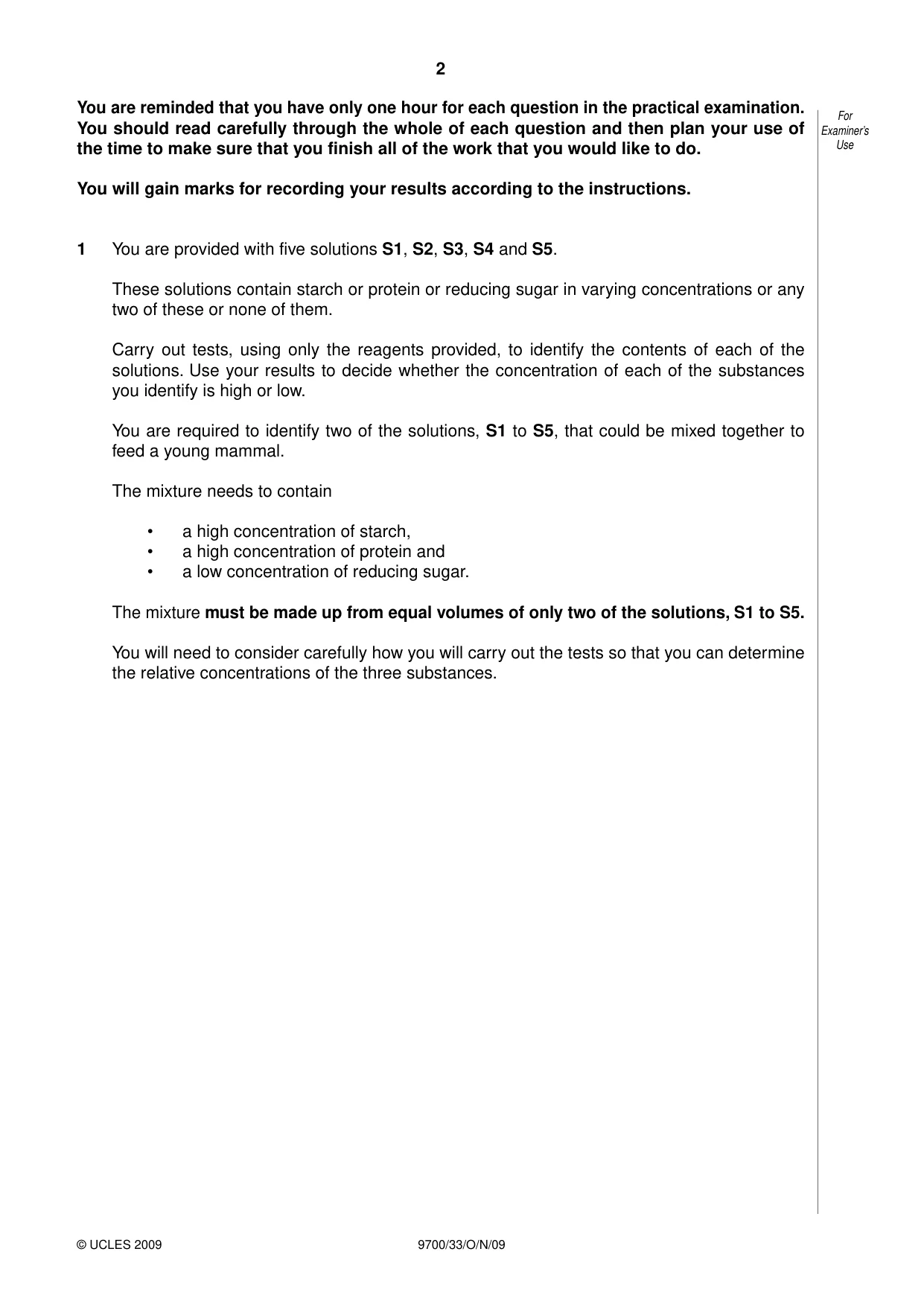
© UCLES 2009 9700/33/O/N/09 For Examiner’s Use You are reminded that you have only one hour for each question in the practical examination. You should read carefully through the whole of each question and then plan your use of the time to make sure that you finish all of the work that you would like to do. You will gain marks for recording your results according to the instructions. 1 You are provided with five solutions S1, S2, S3, S4 and S5. These solutions contain starch or protein or reducing sugar in varying concentrations or any two of these or none of them. Carry out tests, using only the reagents provided, to identify the contents of each of the solutions. Use your results to decide whether the concentration of each of the substances you identify is high or low. You are required to identify two of the solutions, S1 to S5, that could be mixed together to feed a young mammal. The mixture needs to contain • a high concentration of starch, • a high concentration of protein and • a low concentration of reducing sugar. The mixture must be made up from equal volumes of only two of the solutions, S1 to S5. You will need to consider carefully how you will carry out the tests so that you can determine the relative concentrations of the three substances. 2
Question paper, page 3
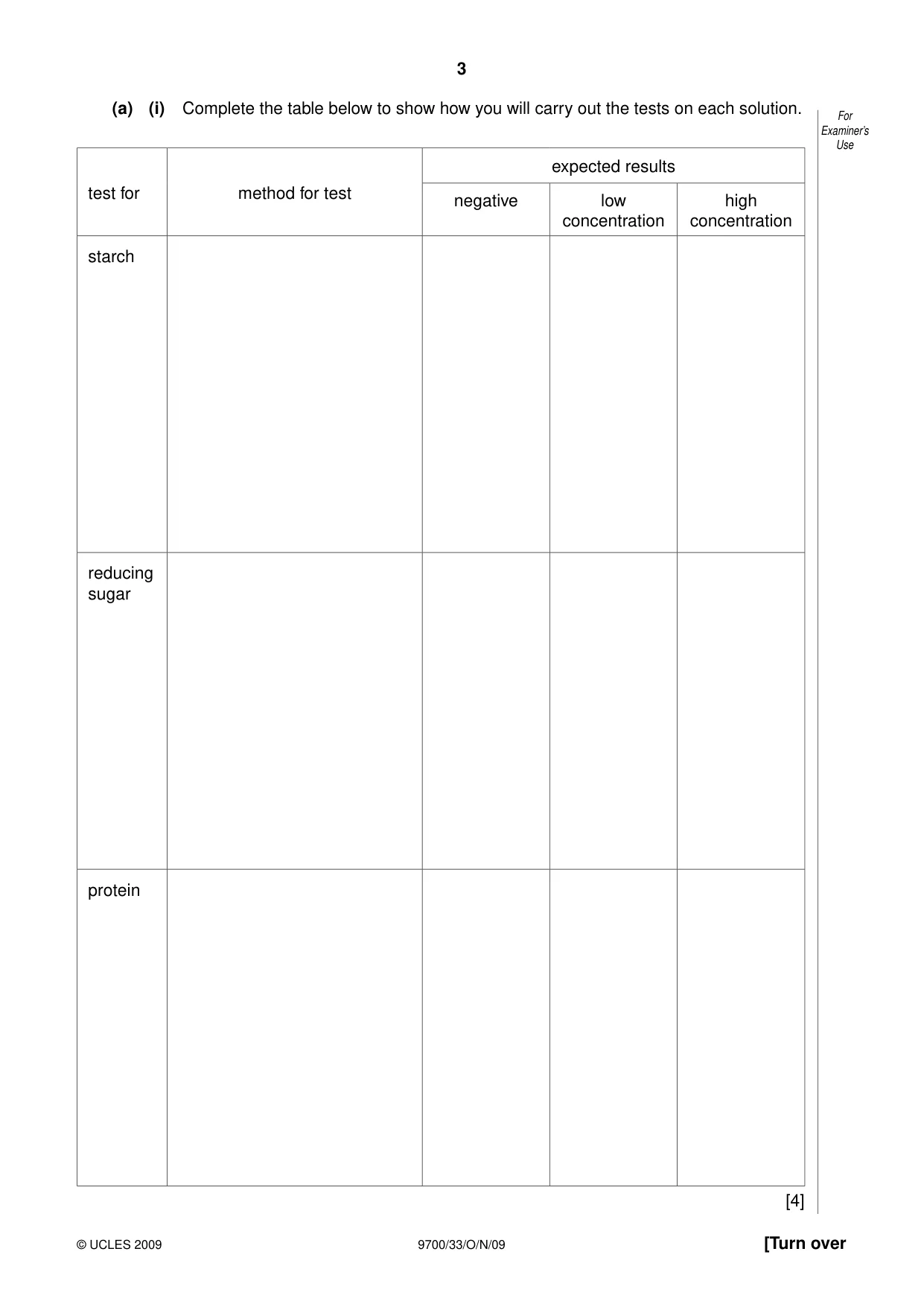
3 © UCLES 2009 [Turn over 9700/33/O/N/09 For Examiner’s Use (a) (i) Complete the table below to show how you will carry out the tests on each solution. test for method for test expected results negative low concentration high concentration starch reducing sugar protein [4]
Question paper, page 4
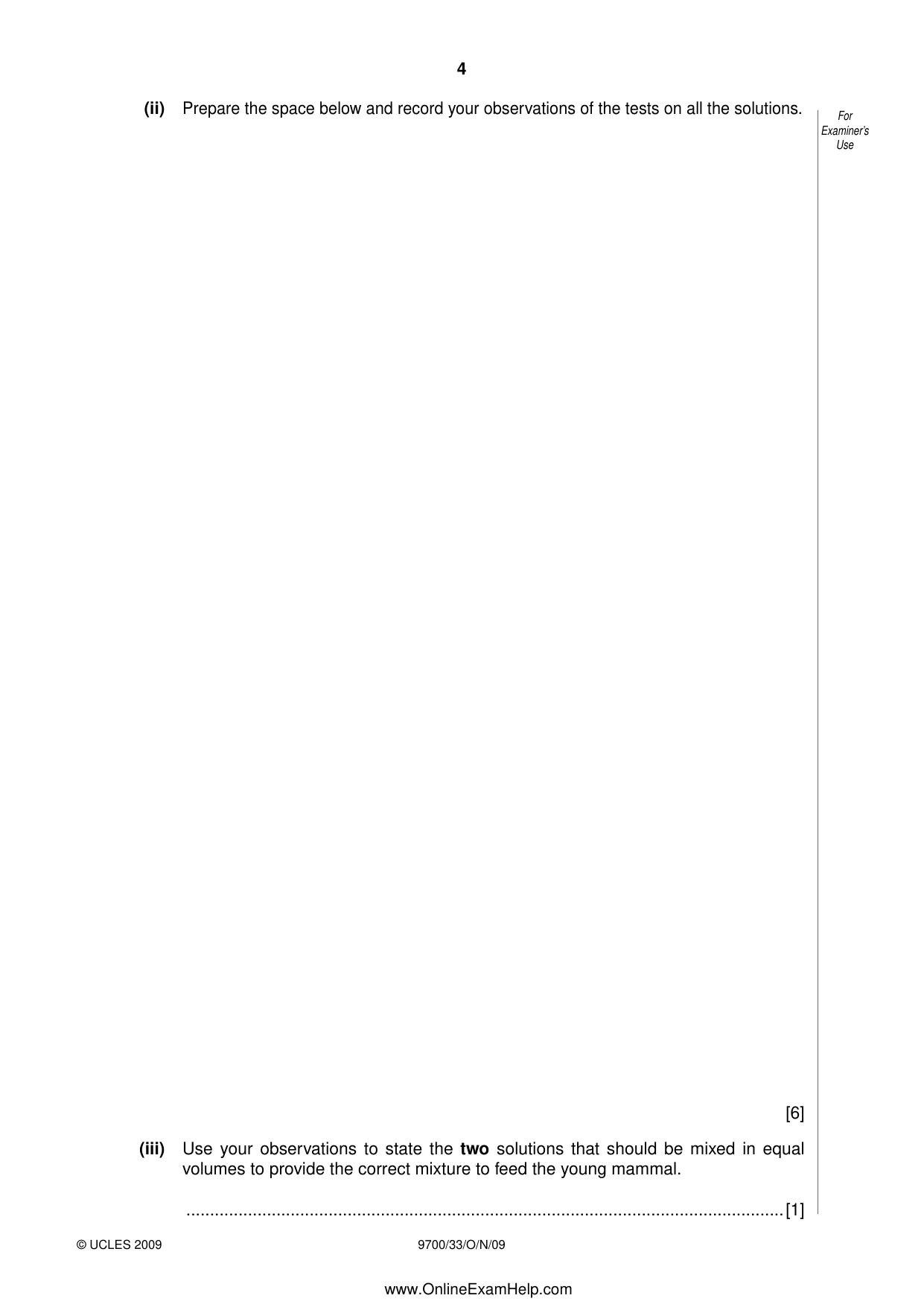
4 © UCLES 2009 9700/33/O/N/09 For Examiner’s Use (ii) Prepare the space below and record your observations of the tests on all the solutions. [6] (iii) Use your observations to state the two solutions that should be mixed in equal volumes to provide the correct mixture to feed the young mammal. …[1] www.OnlineExamHelp.com
Question paper, page 5
5 [Turn over 9700/33/O/N/09 BLANK PAGE QUESTION 1 CONTINUES ON PAGE 6 OVERLEAF
Question paper, page 6
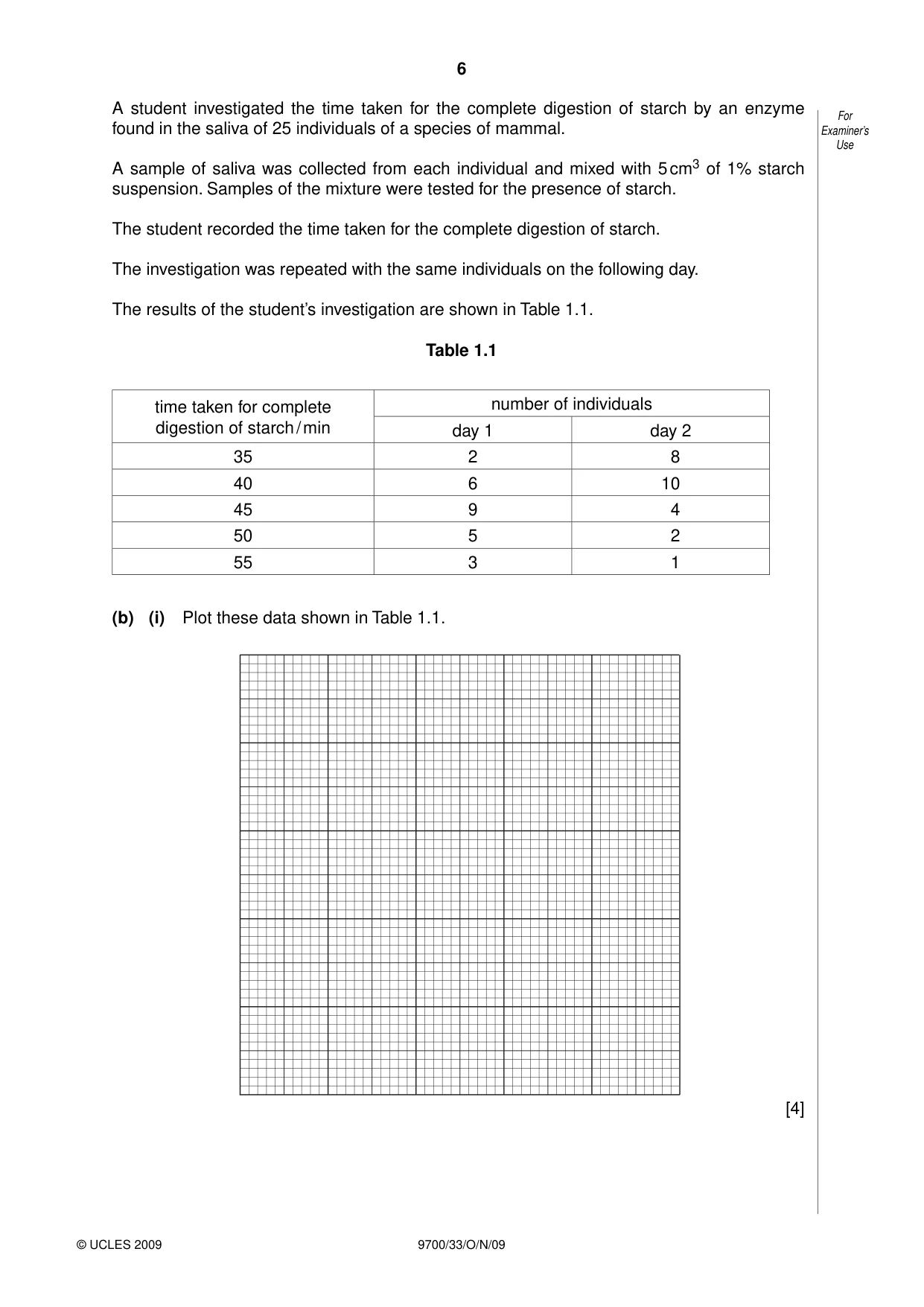
6 © UCLES 2009 9700/33/O/N/09 For Examiner’s Use A student investigated the time taken for the complete digestion of starch by an enzyme found in the saliva of 25 individuals of a species of mammal. A sample of saliva was collected from each individual and mixed with 5 cm3 of 1% starch suspension. Samples of the mixture were tested for the presence of starch. The student recorded the time taken for the complete digestion of starch. The investigation was repeated with the same individuals on the following day. The results of the student’s investigation are shown in Table 1.1. Table 1.1 time taken for complete digestion of starch / min number of individuals day 1 day 2 35 2 8 40 6 10 45 9 4 50 5 2 55 3 1 (b) (i) Plot these data shown in Table 1.1. [4]
Question paper, page 7
7 © UCLES 2009 [Turn over 9700/33/O/N/09 For Examiner’s Use (ii) Describe the patterns in the results. … … … … … … …[3] (iii) Suggest a reason for the difference between the results for day 1 and day 2. … …[1] (iv) Suggest how you might control the variables in this investigation to compare a different species of mammal with the mammal studied. … … … … … … …[3] [Total: 22]
Question paper, page 8
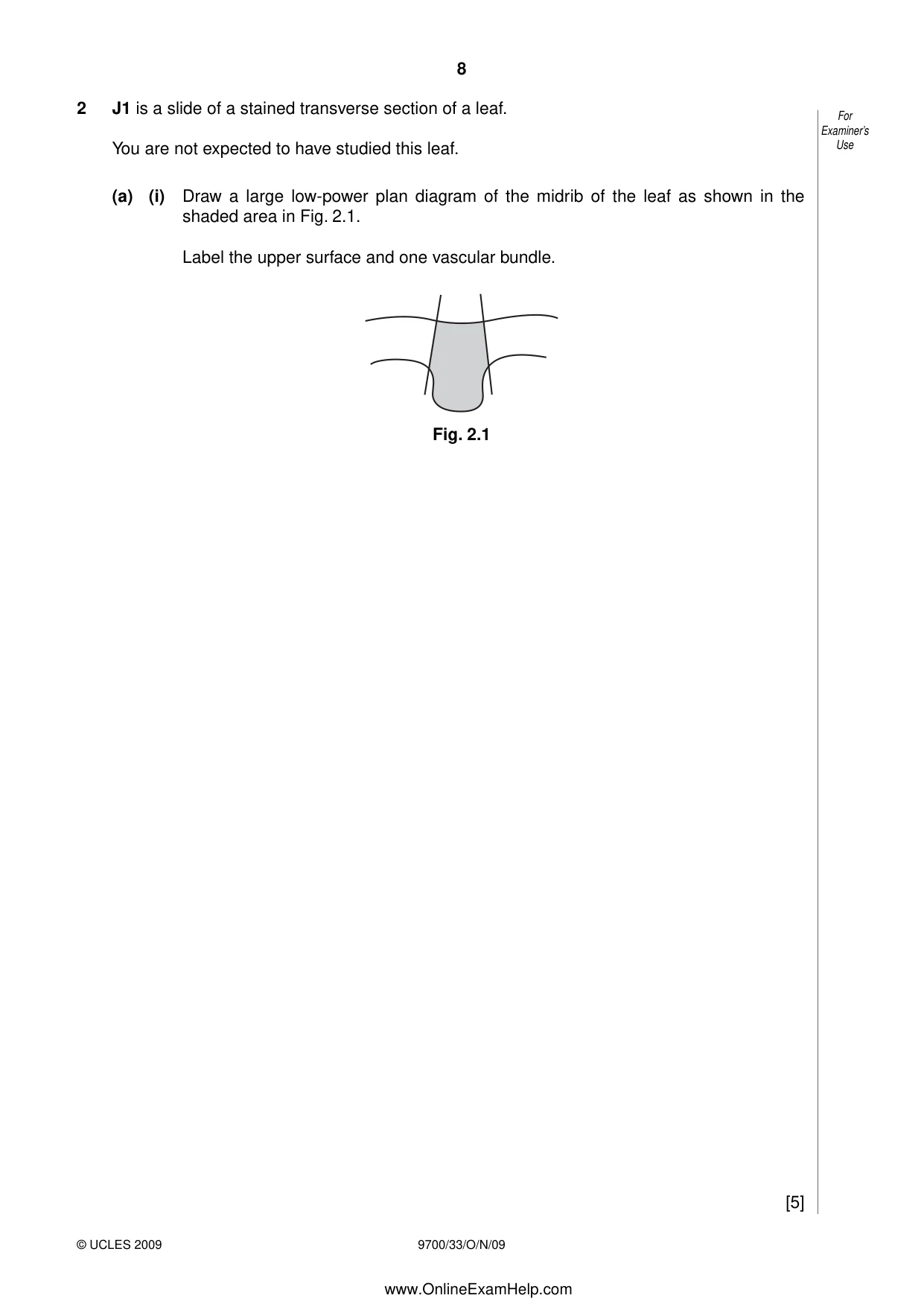
8 © UCLES 2009 9700/33/O/N/09 For Examiner’s Use 2 J1 is a slide of a stained transverse section of a leaf. You are not expected to have studied this leaf. (a) (i) Draw a large low-power plan diagram of the midrib of the leaf as shown in the shaded area in Fig. 2.1. Label the upper surface and one vascular bundle. Fig. 2.1 [5] www.OnlineExamHelp.com
Question paper, page 9
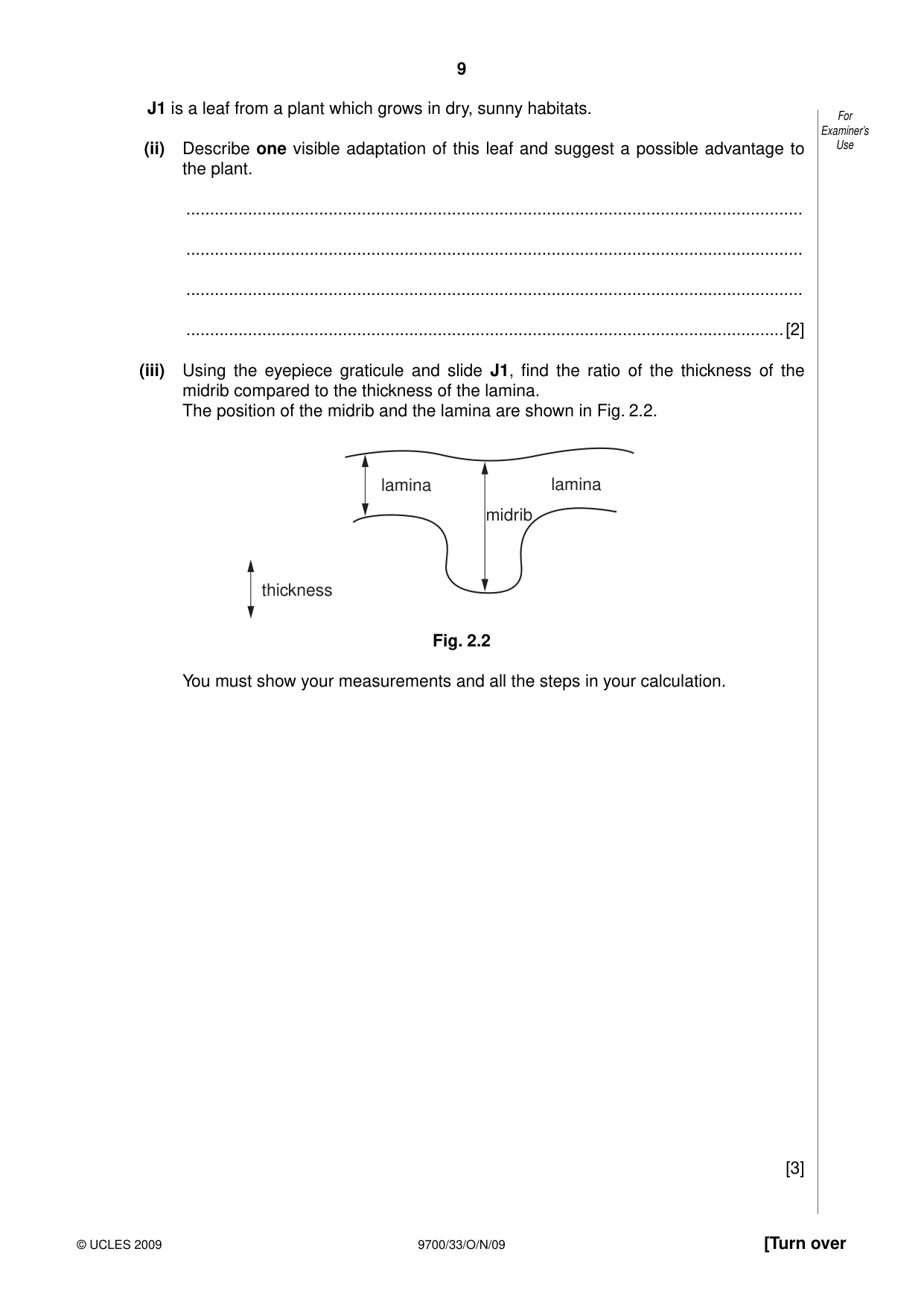
9 © UCLES 2009 [Turn over 9700/33/O/N/09 For Examiner’s Use J1 is a leaf from a plant which grows in dry, sunny habitats. (ii) Describe one visible adaptation of this leaf and suggest a possible advantage to the plant. … … … …[2] (iii) Using the eyepiece graticule and slide J1, find the ratio of the thickness of the midrib compared to the thickness of the lamina. The position of the midrib and the lamina are shown in Fig. 2.2. midrib lamina thickness lamina Fig. 2.2 You must show your measurements and all the steps in your calculation. [3]
Question paper, page 10
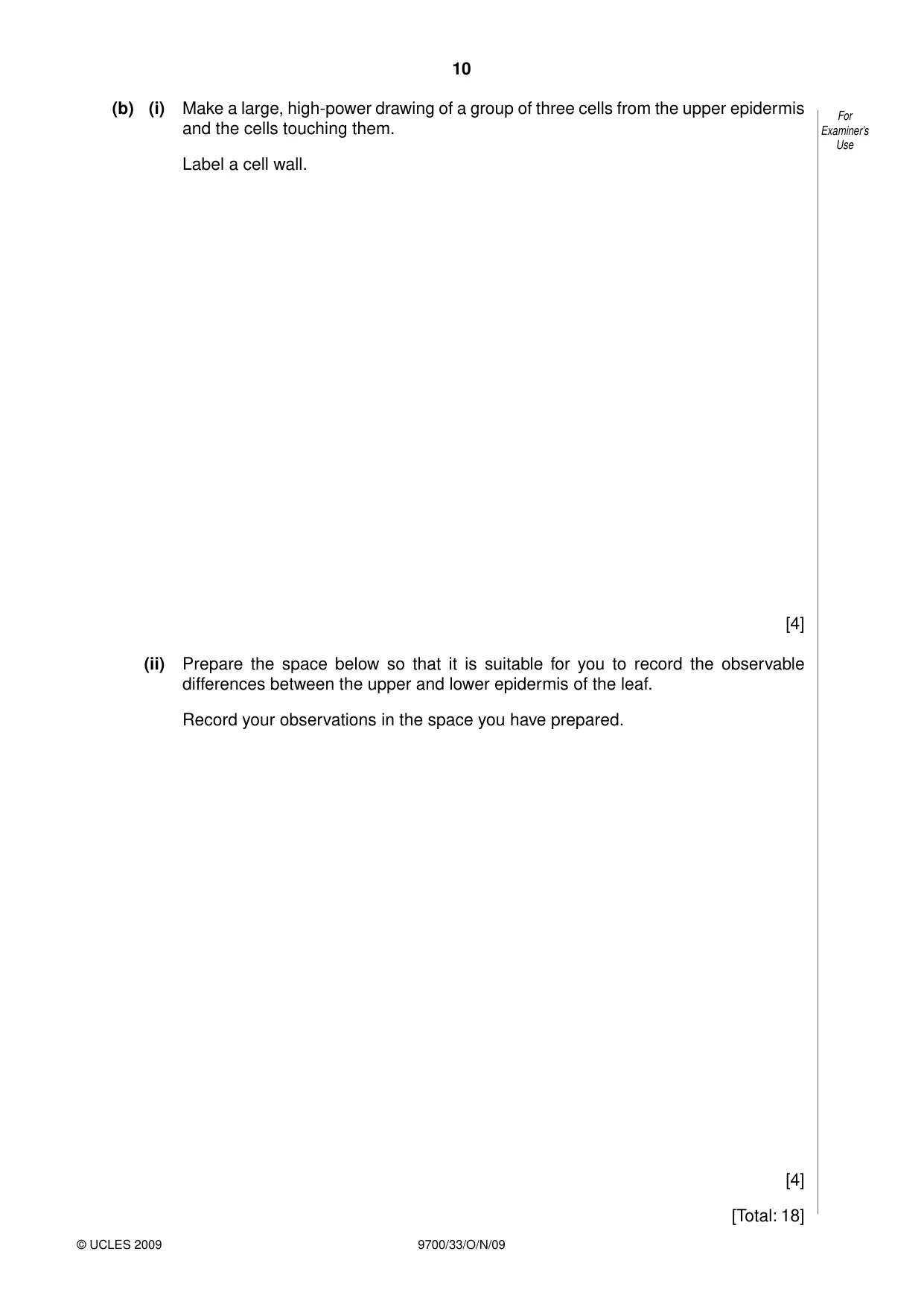
10 © UCLES 2009 9700/33/O/N/09 For Examiner’s Use (b) (i) Make a large, high-power drawing of a group of three cells from the upper epidermis and the cells touching them. Label a cell wall. [4] (ii) Prepare the space below so that it is suitable for you to record the observable differences between the upper and lower epidermis of the leaf. Record your observations in the space you have prepared. [4] [Total: 18]
Question paper, page 12
12 9700/33/O/N/09 BLANK PAGE Permission to reproduce items where third-party owned material protected by copyright is included has been sought and cleared where possible. Every reasonable effort has been made by the publisher (UCLES) to trace copyright holders, but if any items requiring clearance have unwittingly been included, the publisher will be pleased to make amends at the earliest possible opportunity. University of Cambridge International Examinations is part of the Cambridge Assessment Group. Cambridge Assessment is the brand name of University of Cambridge Local Examinations Syndicate (UCLES), which is itself a department of the University of Cambridge. www.OnlineExamHelp.com
Mark scheme, page 1
UNIVERSITY OF CAMBRIDGE INTERNATIONAL EXAMINATIONS GCE Advanced Subsidiary Level and GCE Advanced Level MARK SCHEME for the October/November 2009 question paper for the guidance of teachers 9700 BIOLOGY 9700/33 Paper 33 (Advanced Practical 1), maximum raw mark 40 This mark scheme is published as an aid to teachers and candidates, to indicate the requirements of the examination. It shows the basis on which Examiners were instructed to award marks. It does not indicate the details of the discussions that took place at an Examiners’ meeting before marking began, which would have considered the acceptability of alternative answers. Mark schemes must be read in conjunction with the question papers and the report on the examination. • CIE will not enter into discussions or correspondence in connection with these mark schemes. CIE is publishing the mark schemes for the October/November 2009 question papers for most IGCSE, GCE Advanced Level and Advanced Subsidiary Level syllabuses and some Ordinary Level syllabuses.
Mark scheme, page 2
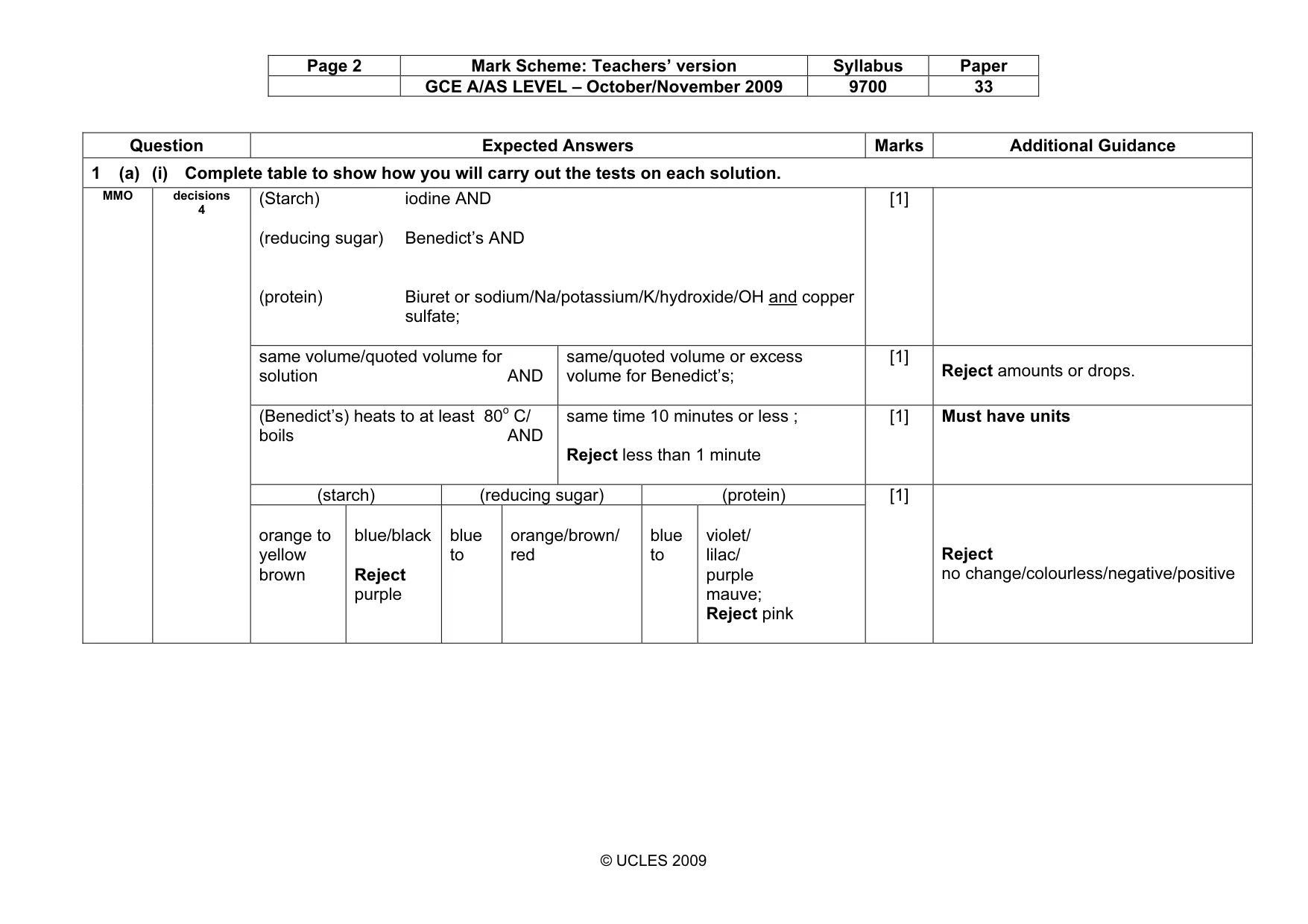
Page 2 Mark Scheme: Teachers’ version Syllabus Paper GCE A/AS LEVEL – October/November 2009 9700 33 © UCLES 2009 Question Expected Answers Marks Additional Guidance 1 (a) (i) Complete table to show how you will carry out the tests on each solution. MMO decisions 4 (Starch) iodine AND (reducing sugar) Benedict’s AND (protein) Biuret or sodium/Na/potassium/K/hydroxide/OH and copper sulfate; [1] same volume/quoted volume for solution AND same/quoted volume or excess volume for Benedict’s; [1] Reject amounts or drops. (Benedict’s) heats to at least 80o C/ boils AND same time 10 minutes or less ; Reject less than 1 minute [1] Must have units (starch) (reducing sugar) (protein) orange to yellow brown blue/black Reject purple blue to orange/brown/ red blue to violet/ lilac/ purple mauve; Reject pink [1] Reject no change/colourless/negative/positive
Mark scheme, page 3
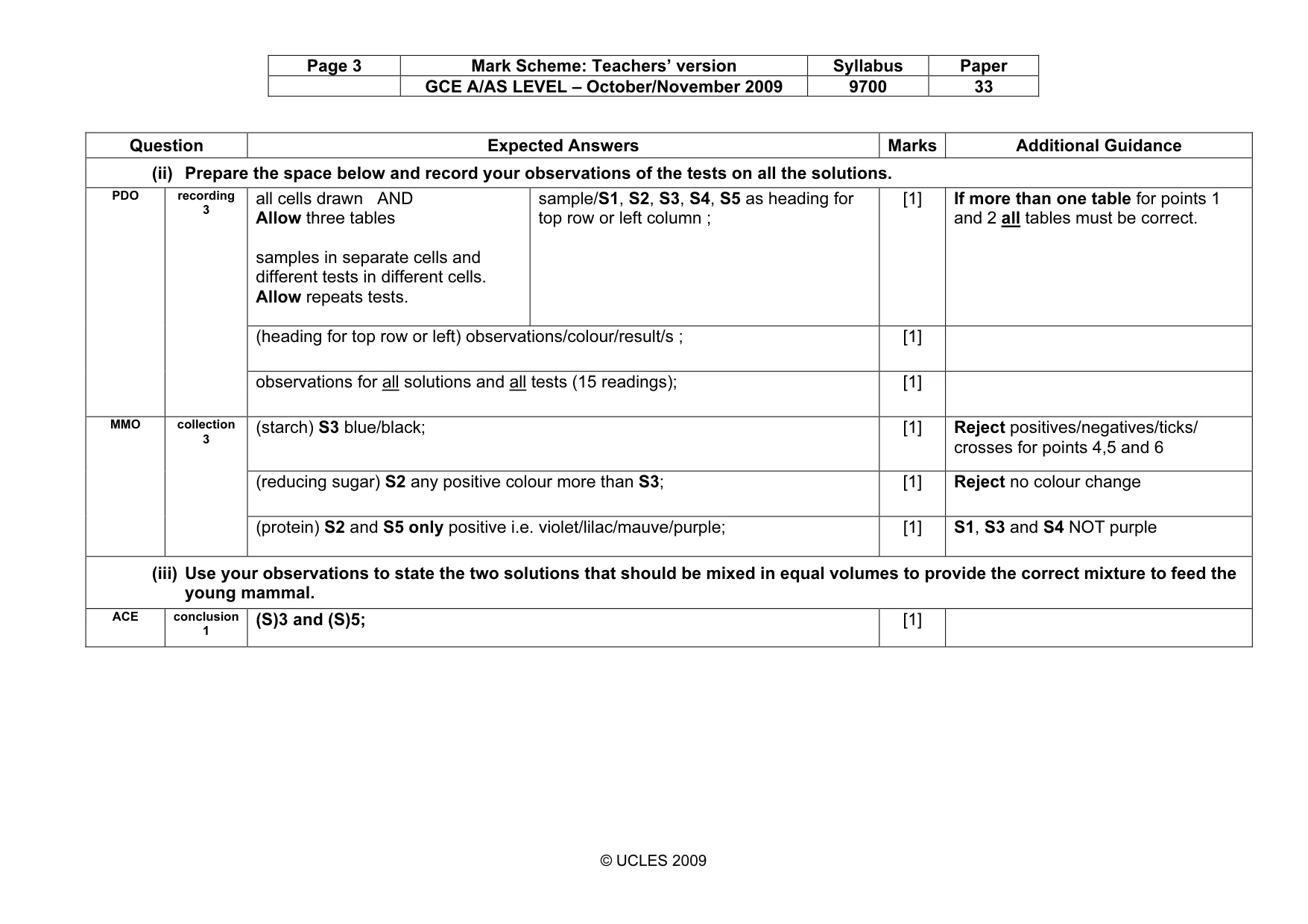
Page 3 Mark Scheme: Teachers’ version Syllabus Paper GCE A/AS LEVEL – October/November 2009 9700 33 © UCLES 2009 Question Expected Answers Marks Additional Guidance (ii) Prepare the space below and record your observations of the tests on all the solutions. PDO recording 3 all cells drawn AND Allow three tables samples in separate cells and different tests in different cells. Allow repeats tests. sample/S1, S2, S3, S4, S5 as heading for top row or left column ; [1] If more than one table for points 1 and 2 all tables must be correct. (heading for top row or left) observations/colour/result/s ; [1] observations for all solutions and all tests (15 readings); [1] MMO collection 3 (starch) S3 blue/black; [1] Reject positives/negatives/ticks/ crosses for points 4,5 and 6 (reducing sugar) S2 any positive colour more than S3; [1] Reject no colour change (protein) S2 and S5 only positive i.e. violet/lilac/mauve/purple; [1] S1, S3 and S4 NOT purple (iii) Use your observations to state the two solutions that should be mixed in equal volumes to provide the correct mixture to feed the young mammal. ACE conclusion 1 (S)3 and (S)5; [1]
Mark scheme, page 4
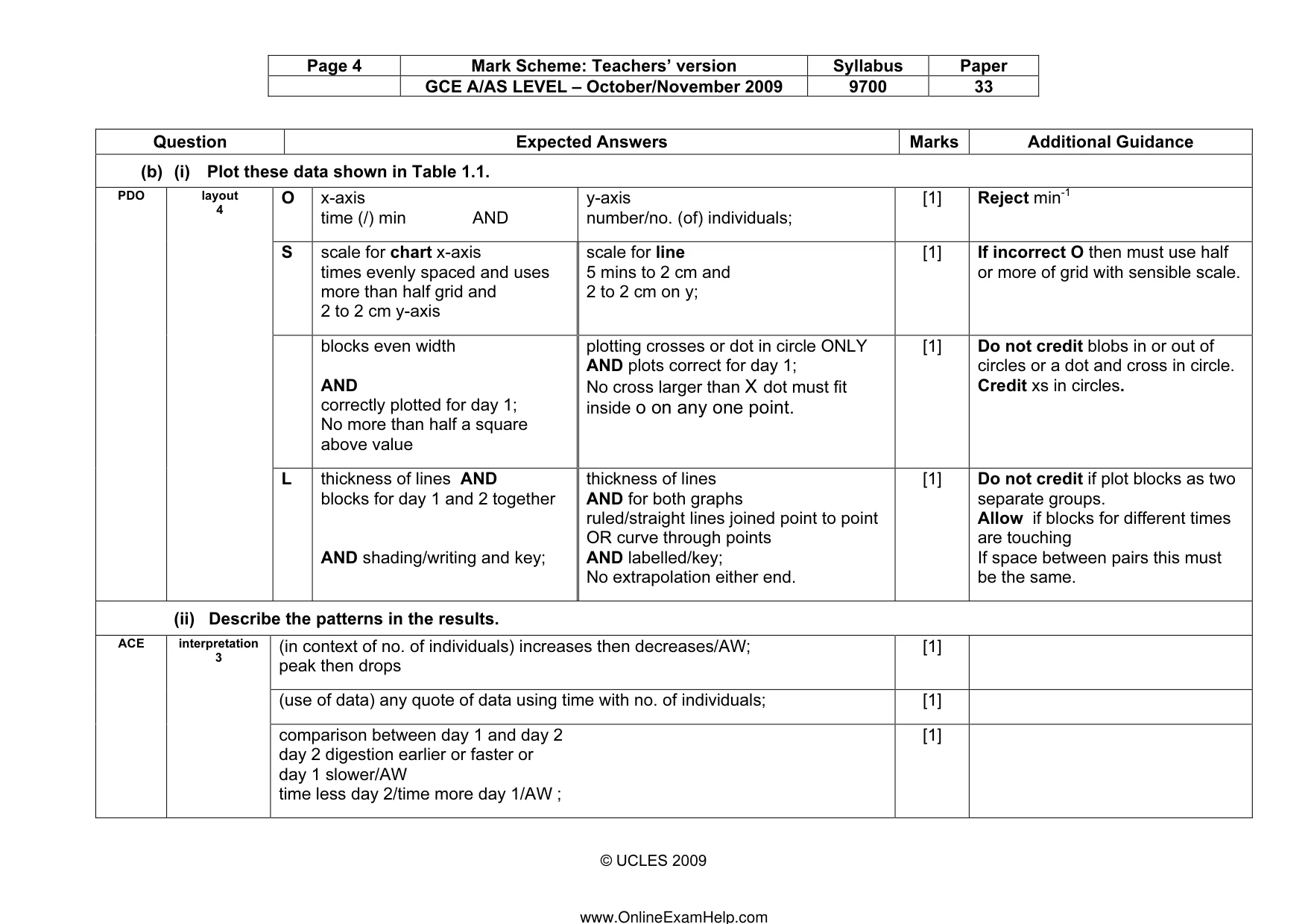
Page 4 Mark Scheme: Teachers’ version Syllabus Paper GCE A/AS LEVEL – October/November 2009 9700 33 © UCLES 2009 Question Expected Answers Marks Additional Guidance (b) (i) Plot these data shown in Table 1.1. PDO layout 4 O x-axis time (/) min AND y-axis number/no. (of) individuals; [1] Reject min-1 S scale for chart x-axis times evenly spaced and uses more than half grid and 2 to 2 cm y-axis scale for line 5 mins to 2 cm and 2 to 2 cm on y; [1] If incorrect O then must use half or more of grid with sensible scale. blocks even width AND correctly plotted for day 1; No more than half a square above value plotting crosses or dot in circle ONLY AND plots correct for day 1; No cross larger than X dot must fit inside o on any one point. [1] Do not credit blobs in or out of circles or a dot and cross in circle. Credit xs in circles. L thickness of lines AND blocks for day 1 and 2 together AND shading/writing and key; thickness of lines AND for both graphs ruled/straight lines joined point to point OR curve through points AND labelled/key; No extrapolation either end. [1] Do not credit if plot blocks as two separate groups. Allow if blocks for different times are touching If space between pairs this must be the same. (ii) Describe the patterns in the results. ACE interpretation 3 (in context of no. of individuals) increases then decreases/AW; peak then drops [1] (use of data) any quote of data using time with no. of individuals; [1] comparison between day 1 and day 2 day 2 digestion earlier or faster or day 1 slower/AW time less day 2/time more day 1/AW ; [1] www.OnlineExamHelp.com
Mark scheme, page 5
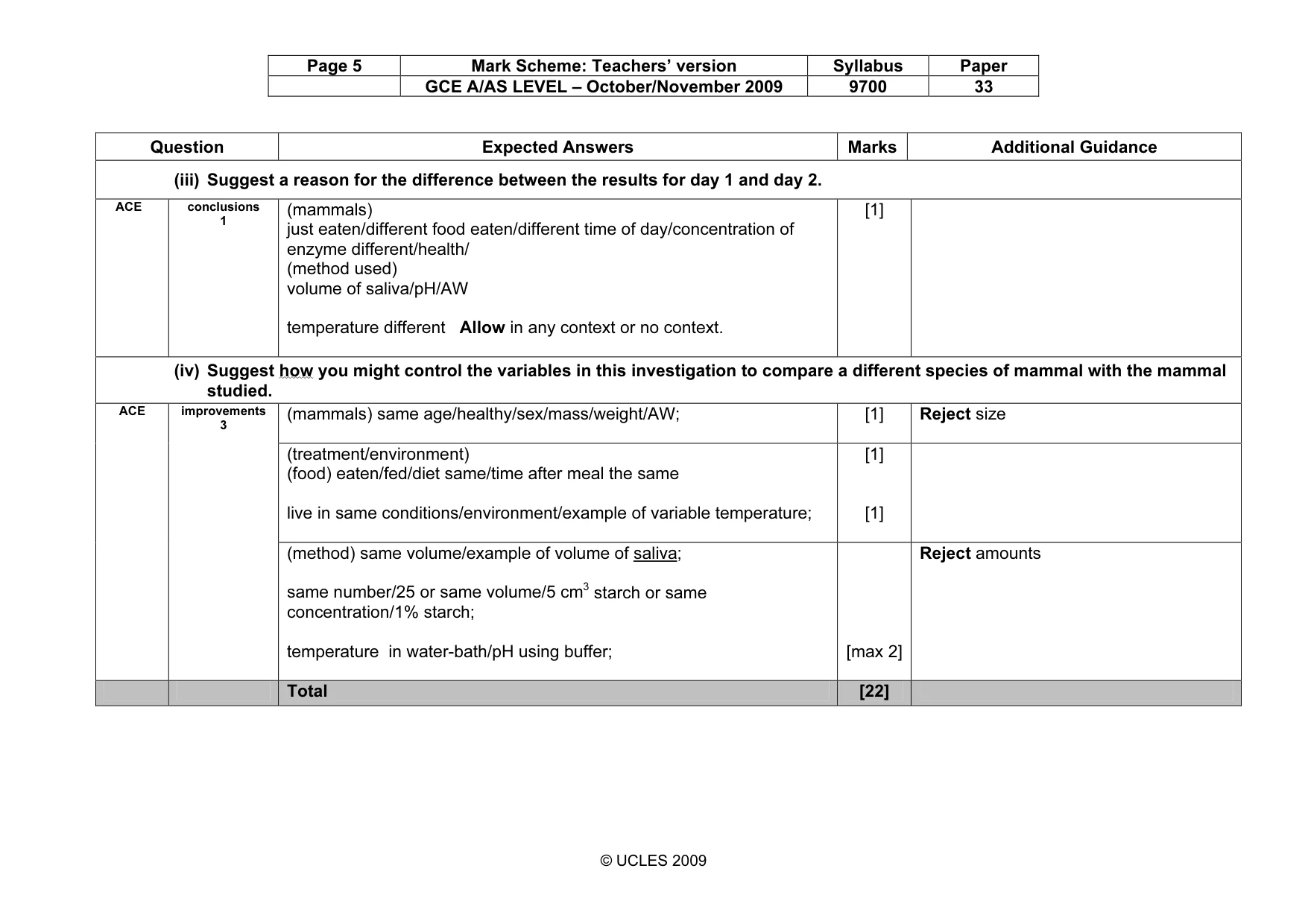
Page 5 Mark Scheme: Teachers’ version Syllabus Paper GCE A/AS LEVEL – October/November 2009 9700 33 © UCLES 2009 Question Expected Answers Marks Additional Guidance (iii) Suggest a reason for the difference between the results for day 1 and day 2. ACE conclusions 1 (mammals) just eaten/different food eaten/different time of day/concentration of enzyme different/health/ (method used) volume of saliva/pH/AW temperature different Allow in any context or no context. [1] (iv) Suggest how you might control the variables in this investigation to compare a different species of mammal with the mammal studied. ACE improvements 3 (mammals) same age/healthy/sex/mass/weight/AW; [1] Reject size (treatment/environment) (food) eaten/fed/diet same/time after meal the same live in same conditions/environment/example of variable temperature; [1] [1] (method) same volume/example of volume of saliva; same number/25 or same volume/5 cm3 starch or same concentration/1% starch; temperature in water-bath/pH using buffer; [max 2] Reject amounts Total [22]
Mark scheme, page 6
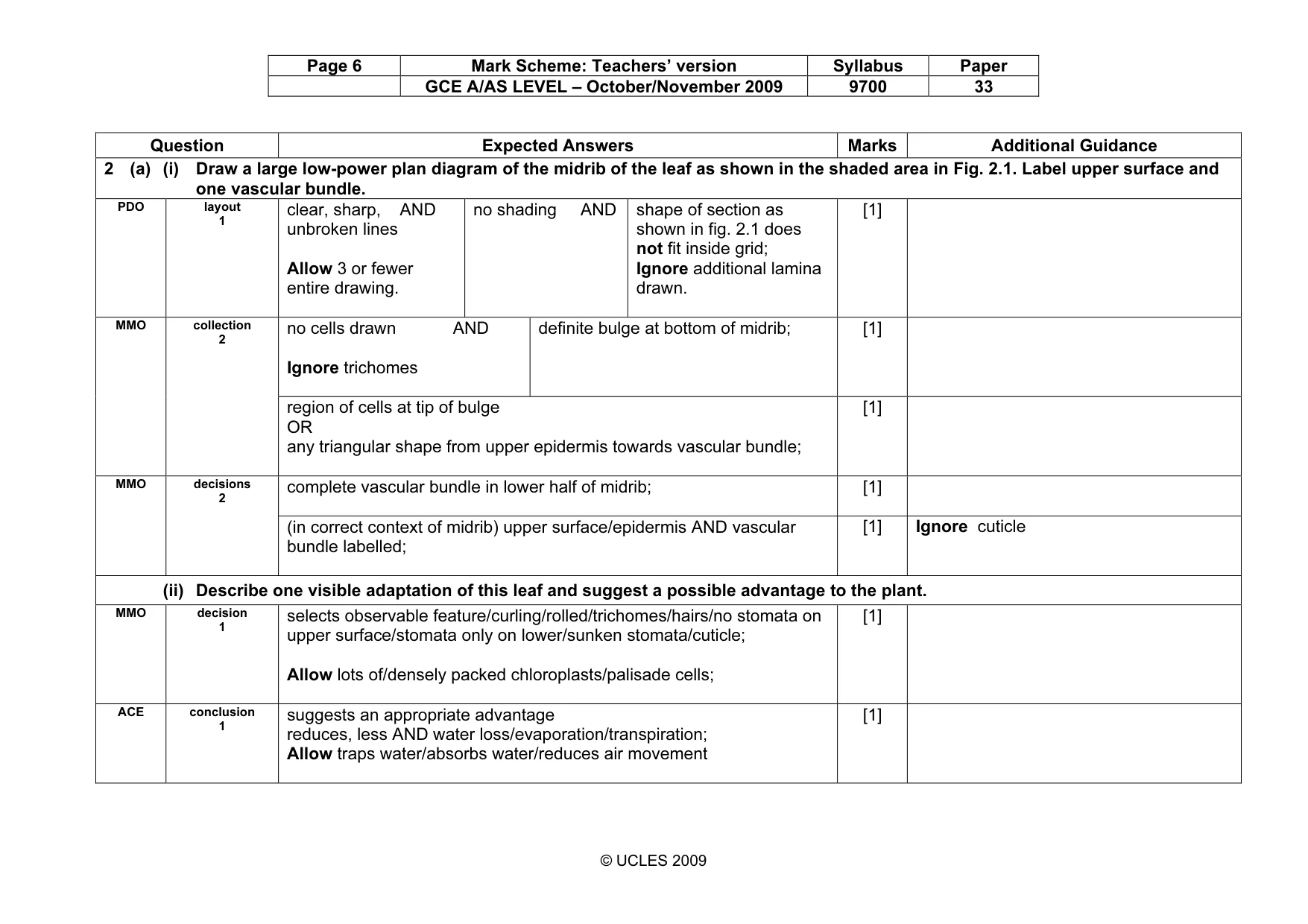
Page 6 Mark Scheme: Teachers’ version Syllabus Paper GCE A/AS LEVEL – October/November 2009 9700 33 © UCLES 2009 Question Expected Answers Marks Additional Guidance 2 (a) (i) Draw a large low-power plan diagram of the midrib of the leaf as shown in the shaded area in Fig. 2.1. Label upper surface and one vascular bundle. PDO layout 1 clear, sharp, AND unbroken lines Allow 3 or fewer entire drawing. no shading AND shape of section as shown in fig. 2.1 does not fit inside grid; Ignore additional lamina drawn. [1] MMO collection 2 no cells drawn AND Ignore trichomes definite bulge at bottom of midrib; [1] region of cells at tip of bulge OR any triangular shape from upper epidermis towards vascular bundle; [1] MMO decisions 2 complete vascular bundle in lower half of midrib; [1] (in correct context of midrib) upper surface/epidermis AND vascular bundle labelled; [1] Ignore cuticle (ii) Describe one visible adaptation of this leaf and suggest a possible advantage to the plant. MMO decision 1 selects observable feature/curling/rolled/trichomes/hairs/no stomata on upper surface/stomata only on lower/sunken stomata/cuticle; Allow lots of/densely packed chloroplasts/palisade cells; [1] ACE conclusion 1 suggests an appropriate advantage reduces, less AND water loss/evaporation/transpiration; Allow traps water/absorbs water/reduces air movement [1]
Mark scheme, page 7
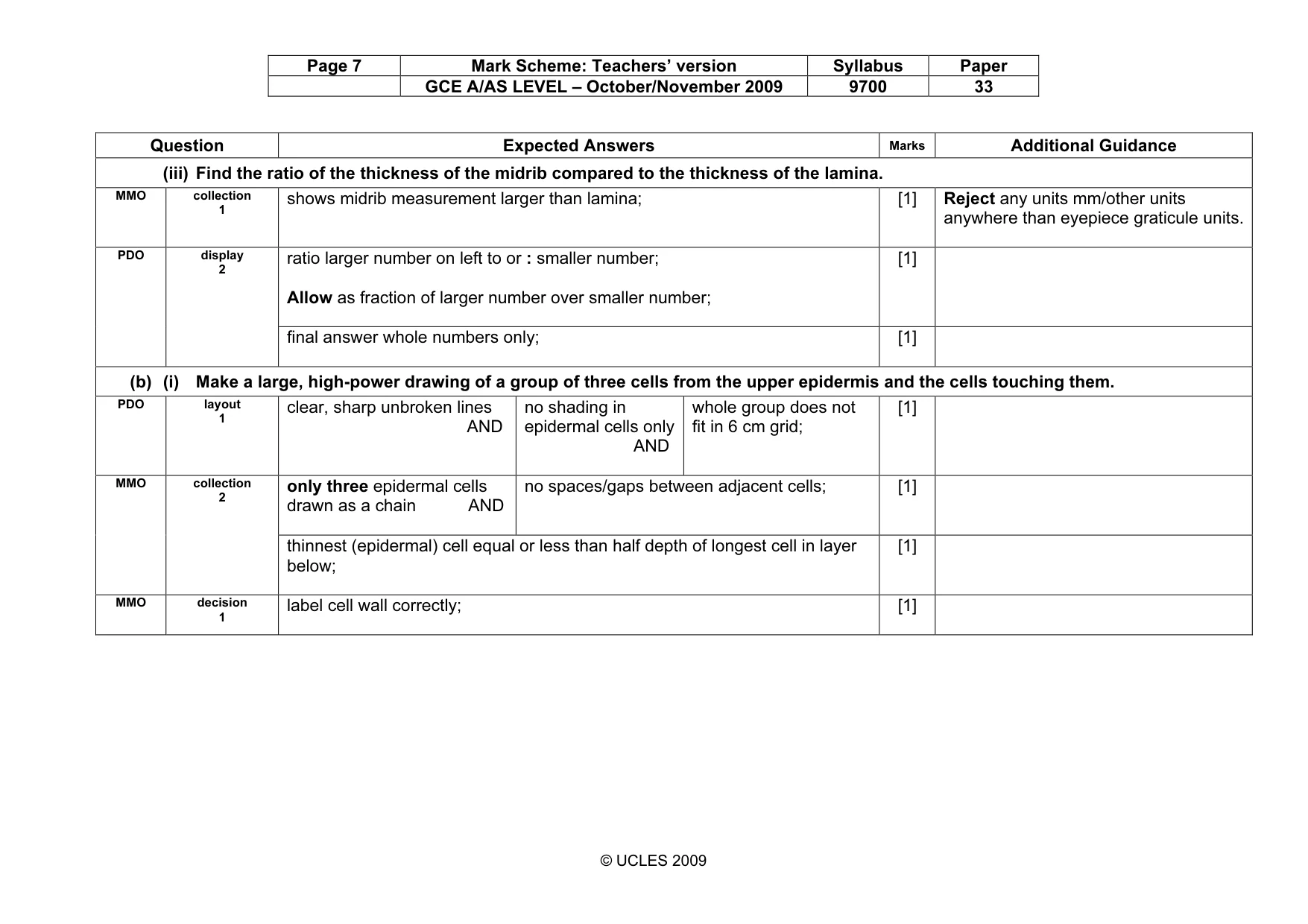
Page 7 Mark Scheme: Teachers’ version Syllabus Paper GCE A/AS LEVEL – October/November 2009 9700 33 © UCLES 2009 Question Expected Answers Marks Additional Guidance (iii) Find the ratio of the thickness of the midrib compared to the thickness of the lamina. MMO collection 1 shows midrib measurement larger than lamina; [1] Reject any units mm/other units anywhere than eyepiece graticule units. PDO display 2 ratio larger number on left to or : smaller number; Allow as fraction of larger number over smaller number; [1] final answer whole numbers only; [1] (b) (i) Make a large, high-power drawing of a group of three cells from the upper epidermis and the cells touching them. PDO layout 1 clear, sharp unbroken lines AND no shading in epidermal cells only AND whole group does not fit in 6 cm grid; [1] MMO collection 2 only three epidermal cells drawn as a chain AND no spaces/gaps between adjacent cells; [1] thinnest (epidermal) cell equal or less than half depth of longest cell in layer below; [1] MMO decision 1 label cell wall correctly; [1]
Mark scheme, page 8
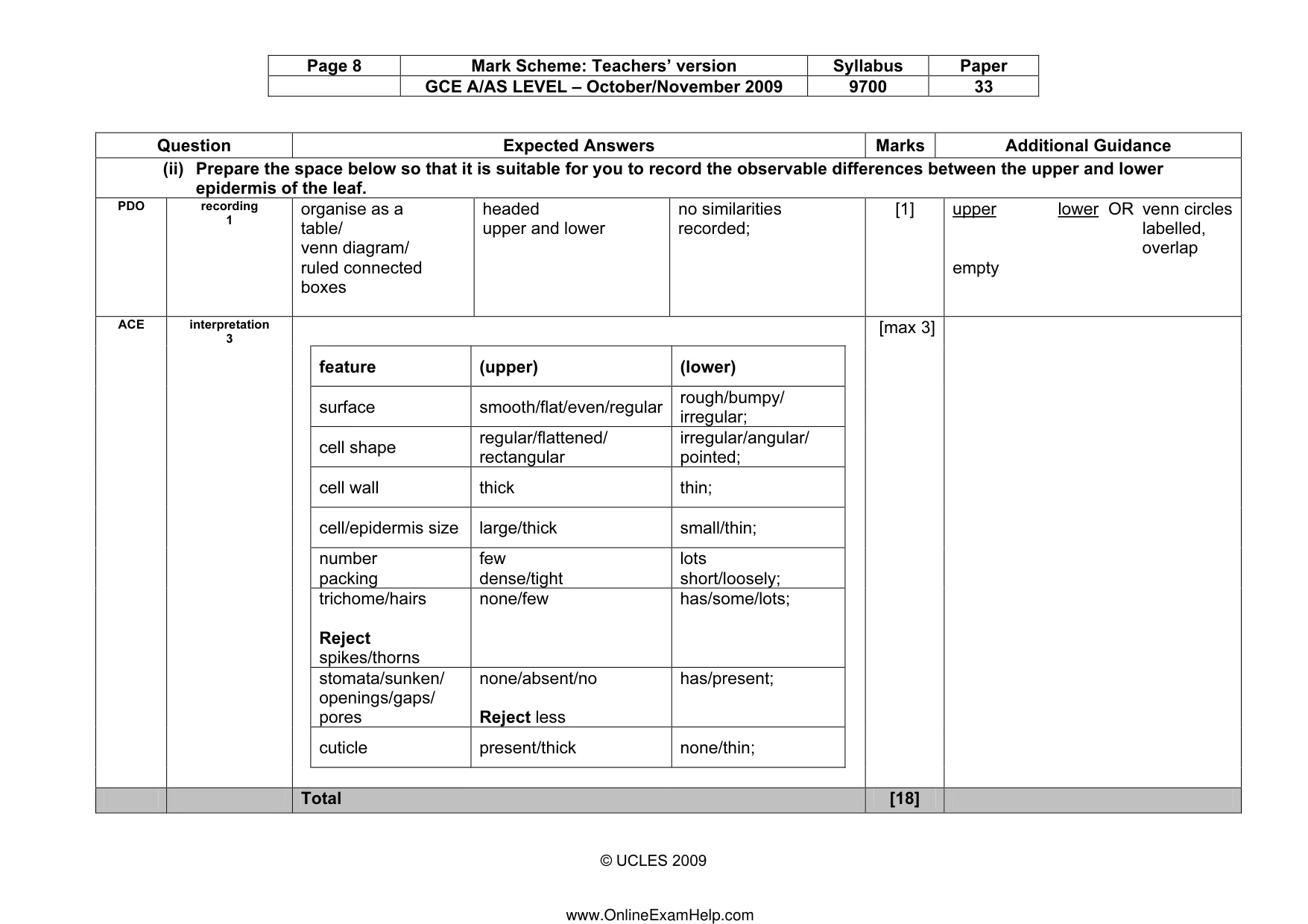
Page 8 Mark Scheme: Teachers’ version Syllabus Paper GCE A/AS LEVEL – October/November 2009 9700 33 © UCLES 2009 Question Expected Answers Marks Additional Guidance (ii) Prepare the space below so that it is suitable for you to record the observable differences between the upper and lower epidermis of the leaf. PDO recording 1 organise as a table/ venn diagram/ ruled connected boxes headed upper and lower no similarities recorded; [1] upper lower OR venn circles labelled, overlap empty ACE interpretation 3 feature (upper) (lower) surface smooth/flat/even/regular rough/bumpy/ irregular; [max 3] cell shape regular/flattened/ rectangular irregular/angular/ pointed; cell wall thick thin; cell/epidermis size large/thick small/thin; number packing few dense/tight lots short/loosely; trichome/hairs Reject spikes/thorns none/few has/some/lots; stomata/sunken/ openings/gaps/ pores none/absent/no Reject less has/present; cuticle present/thick none/thin; Total [18] www.OnlineExamHelp.com